WO2010055878A1 - 絶縁性熱伝導シートの製造方法、絶縁性熱伝導シート及び放熱部材 - Google Patents
絶縁性熱伝導シートの製造方法、絶縁性熱伝導シート及び放熱部材 Download PDFInfo
- Publication number
- WO2010055878A1 WO2010055878A1 PCT/JP2009/069266 JP2009069266W WO2010055878A1 WO 2010055878 A1 WO2010055878 A1 WO 2010055878A1 JP 2009069266 W JP2009069266 W JP 2009069266W WO 2010055878 A1 WO2010055878 A1 WO 2010055878A1
- Authority
- WO
- WIPO (PCT)
- Prior art keywords
- sheet
- heat conductive
- conductive sheet
- insulating heat
- insulating
- Prior art date
- Legal status (The legal status is an assumption and is not a legal conclusion. Google has not performed a legal analysis and makes no representation as to the accuracy of the status listed.)
- Ceased
Links
Classifications
-
- B—PERFORMING OPERATIONS; TRANSPORTING
- B29—WORKING OF PLASTICS; WORKING OF SUBSTANCES IN A PLASTIC STATE IN GENERAL
- B29C—SHAPING OR JOINING OF PLASTICS; SHAPING OF MATERIAL IN A PLASTIC STATE, NOT OTHERWISE PROVIDED FOR; AFTER-TREATMENT OF THE SHAPED PRODUCTS, e.g. REPAIRING
- B29C43/00—Compression moulding, i.e. applying external pressure to flow the moulding material; Apparatus therefor
- B29C43/003—Compression moulding, i.e. applying external pressure to flow the moulding material; Apparatus therefor characterised by the choice of material
-
- B—PERFORMING OPERATIONS; TRANSPORTING
- B29—WORKING OF PLASTICS; WORKING OF SUBSTANCES IN A PLASTIC STATE IN GENERAL
- B29C—SHAPING OR JOINING OF PLASTICS; SHAPING OF MATERIAL IN A PLASTIC STATE, NOT OTHERWISE PROVIDED FOR; AFTER-TREATMENT OF THE SHAPED PRODUCTS, e.g. REPAIRING
- B29C43/00—Compression moulding, i.e. applying external pressure to flow the moulding material; Apparatus therefor
- B29C43/22—Compression moulding, i.e. applying external pressure to flow the moulding material; Apparatus therefor of articles of indefinite length
- B29C43/24—Calendering
-
- B—PERFORMING OPERATIONS; TRANSPORTING
- B29—WORKING OF PLASTICS; WORKING OF SUBSTANCES IN A PLASTIC STATE IN GENERAL
- B29C—SHAPING OR JOINING OF PLASTICS; SHAPING OF MATERIAL IN A PLASTIC STATE, NOT OTHERWISE PROVIDED FOR; AFTER-TREATMENT OF THE SHAPED PRODUCTS, e.g. REPAIRING
- B29C43/00—Compression moulding, i.e. applying external pressure to flow the moulding material; Apparatus therefor
- B29C43/22—Compression moulding, i.e. applying external pressure to flow the moulding material; Apparatus therefor of articles of indefinite length
- B29C43/30—Making multilayered or multicoloured articles
- B29C43/305—Making multilayered articles
-
- B—PERFORMING OPERATIONS; TRANSPORTING
- B29—WORKING OF PLASTICS; WORKING OF SUBSTANCES IN A PLASTIC STATE IN GENERAL
- B29K—INDEXING SCHEME ASSOCIATED WITH SUBCLASSES B29B, B29C OR B29D, RELATING TO MOULDING MATERIALS OR TO MATERIALS FOR MOULDS, REINFORCEMENTS, FILLERS OR PREFORMED PARTS, e.g. INSERTS
- B29K2083/00—Use of polymers having silicon, with or without sulfur, nitrogen, oxygen, or carbon only, in the main chain, as moulding material
- B29K2083/005—LSR, i.e. liquid silicone rubbers, or derivatives thereof
-
- B—PERFORMING OPERATIONS; TRANSPORTING
- B29—WORKING OF PLASTICS; WORKING OF SUBSTANCES IN A PLASTIC STATE IN GENERAL
- B29K—INDEXING SCHEME ASSOCIATED WITH SUBCLASSES B29B, B29C OR B29D, RELATING TO MOULDING MATERIALS OR TO MATERIALS FOR MOULDS, REINFORCEMENTS, FILLERS OR PREFORMED PARTS, e.g. INSERTS
- B29K2105/00—Condition, form or state of moulded material or of the material to be shaped
- B29K2105/06—Condition, form or state of moulded material or of the material to be shaped containing reinforcements, fillers or inserts
- B29K2105/16—Fillers
-
- B—PERFORMING OPERATIONS; TRANSPORTING
- B29—WORKING OF PLASTICS; WORKING OF SUBSTANCES IN A PLASTIC STATE IN GENERAL
- B29K—INDEXING SCHEME ASSOCIATED WITH SUBCLASSES B29B, B29C OR B29D, RELATING TO MOULDING MATERIALS OR TO MATERIALS FOR MOULDS, REINFORCEMENTS, FILLERS OR PREFORMED PARTS, e.g. INSERTS
- B29K2995/00—Properties of moulding materials, reinforcements, fillers, preformed parts or moulds
- B29K2995/0012—Properties of moulding materials, reinforcements, fillers, preformed parts or moulds having particular thermal properties
- B29K2995/0013—Conductive
-
- B—PERFORMING OPERATIONS; TRANSPORTING
- B29—WORKING OF PLASTICS; WORKING OF SUBSTANCES IN A PLASTIC STATE IN GENERAL
- B29L—INDEXING SCHEME ASSOCIATED WITH SUBCLASS B29C, RELATING TO PARTICULAR ARTICLES
- B29L2031/00—Other particular articles
- B29L2031/30—Vehicles, e.g. ships or aircraft, or body parts thereof
- B29L2031/3055—Cars
- B29L2031/3061—Number plates
-
- C—CHEMISTRY; METALLURGY
- C08—ORGANIC MACROMOLECULAR COMPOUNDS; THEIR PREPARATION OR CHEMICAL WORKING-UP; COMPOSITIONS BASED THEREON
- C08K—Use of inorganic or non-macromolecular organic substances as compounding ingredients
- C08K2201/00—Specific properties of additives
- C08K2201/002—Physical properties
-
- C—CHEMISTRY; METALLURGY
- C08—ORGANIC MACROMOLECULAR COMPOUNDS; THEIR PREPARATION OR CHEMICAL WORKING-UP; COMPOSITIONS BASED THEREON
- C08K—Use of inorganic or non-macromolecular organic substances as compounding ingredients
- C08K3/00—Use of inorganic substances as compounding ingredients
- C08K3/38—Boron-containing compounds
-
- Y—GENERAL TAGGING OF NEW TECHNOLOGICAL DEVELOPMENTS; GENERAL TAGGING OF CROSS-SECTIONAL TECHNOLOGIES SPANNING OVER SEVERAL SECTIONS OF THE IPC; TECHNICAL SUBJECTS COVERED BY FORMER USPC CROSS-REFERENCE ART COLLECTIONS [XRACs] AND DIGESTS
- Y10—TECHNICAL SUBJECTS COVERED BY FORMER USPC
- Y10T—TECHNICAL SUBJECTS COVERED BY FORMER US CLASSIFICATION
- Y10T156/00—Adhesive bonding and miscellaneous chemical manufacture
- Y10T156/10—Methods of surface bonding and/or assembly therefor
- Y10T156/1002—Methods of surface bonding and/or assembly therefor with permanent bending or reshaping or surface deformation of self sustaining lamina
- Y10T156/1043—Subsequent to assembly
- Y10T156/1044—Subsequent to assembly of parallel stacked sheets only
-
- Y—GENERAL TAGGING OF NEW TECHNOLOGICAL DEVELOPMENTS; GENERAL TAGGING OF CROSS-SECTIONAL TECHNOLOGIES SPANNING OVER SEVERAL SECTIONS OF THE IPC; TECHNICAL SUBJECTS COVERED BY FORMER USPC CROSS-REFERENCE ART COLLECTIONS [XRACs] AND DIGESTS
- Y10—TECHNICAL SUBJECTS COVERED BY FORMER USPC
- Y10T—TECHNICAL SUBJECTS COVERED BY FORMER US CLASSIFICATION
- Y10T428/00—Stock material or miscellaneous articles
- Y10T428/31504—Composite [nonstructural laminate]
- Y10T428/3154—Of fluorinated addition polymer from unsaturated monomers
Definitions
- the present invention relates to a method for manufacturing an insulating heat conductive sheet, an insulating heat conductive sheet, and a heat radiating member.
- heat dissipation has become a major issue due to the heat generation of the members themselves due to the improvement of processing capacity and the high-density mounting accompanying the downsizing.
- a sheet formed using a silicone grease or a silicone gel containing a thermally conductive filler is known as a heat radiating member (see, for example, Patent Document 1).
- Paste-like materials such as silicone grease are excellent in that the contact thermal resistance can be kept low.
- a coating process is required, and there is a problem that variations in the coating process affect the thermal conductivity of the heat dissipation member.
- there was a problem in terms of handling such as the applied paste flowing.
- the silicone gel is excellent in terms of handling, there is a problem that if the filler is highly filled in order to increase the thermal conductivity, the sheet strength is lowered and the sheet is broken with a weak force.
- An insulating sheet excellent in thermal conductivity is also formed by a composition containing a binder containing synthetic rubber and polytetrafluoroethylene (hereinafter referred to as PTFE) and a thermally conductive inorganic powder. It has been proposed (see Patent Document 2). Such an insulating sheet was excellent in sheet formability and mechanical strength, and was able to realize higher thermal conductivity.
- PTFE polytetrafluoroethylene
- the graphite sheet has a weak surface strength, and peeling and scratches from the surface become a problem. Furthermore, since it is a conductive material, it causes trouble when it comes into contact with a substrate or the like in an electronic device. For this reason, the heat radiating component which covered the front and back of the graphite sheet with the thin cover layer of another member will be used. That is, even if the heat dissipation of graphite itself is high, it cannot be used unless the front and back surfaces are covered with an insulating layer, and there is a problem that the handling property is inferior.
- JP 2005-228955 A Japanese Examined Patent Publication No. 63-46524 JP 2008-60527 A JP 2008-78380 A
- an object of the present invention is to provide an insulating heat conductive sheet that has high heat dissipation performance and mechanical strength without adverse effects when applied to an electronic device, and is excellent in handling properties. It is another object of the present invention to provide a heat dissipating member excellent in handling properties that can quickly diffuse (transport) heat from the heat generating component to alleviate the temperature rise of the heat generating component.
- the insulating heat conductive sheet of the present invention is (I) a step of substantially preparing a plurality of sheet-like molded bodies comprising a fluororesin containing PTFE, thermally conductive inorganic particles, and a molding aid; (II) a step of superposing and rolling a plurality of the sheet-like molded bodies, (III) removing the molding aid; including.
- substantially a sheet-like molded article comprising PTFE-containing fluororesin, thermally conductive inorganic particles, and a molding aid refers to a fluororesin in a sheet-like molded article.
- the content is the characteristic of the insulating heat conductive sheet not including other materials (heat It means that it is a very small amount (for example, 10% by weight or less) that does not greatly reduce the conductive property).
- the insulating heat conductive sheet of the present invention is a sheet substantially composed of a fluororesin containing PTFE and heat conductive inorganic particles, and has a thermal conductivity of 5 to 50 W / mK in the in-plane direction.
- the thermal conductivity in the direction is 1 to 15 W / mK, and the withstand voltage is 5 kV / mm or more.
- a sheet substantially composed of a fluororesin containing PTFE and heat conductive inorganic particles means a material other than the fluororesin and the heat conductive inorganic particles. Even when other materials are included, the content thereof is very small (for example, such that the characteristics (thermal conductivity characteristics) of the insulating heat conductive sheet not including other materials are not greatly deteriorated (for example, 10% by weight or less).
- the present invention further provides an insulating heat conductive sheet obtained by the method for producing an insulating heat conductive sheet of the present invention.
- the present invention further provides a heat dissipating member provided with the insulating heat conductive sheet of the present invention.
- the insulating heat conductive sheet obtained by the production method of the present invention only a fluororesin is substantially used as a matrix and does not contain impurities such as other organic materials, rubber components and vulcanizing agents. Therefore, it is not necessary to consider the influence on the device when applied to the electronic device. Furthermore, the insulating heat conductive sheet obtained by the manufacturing method of the present invention is a sheet having a higher thermal conductivity in the in-plane direction of the sheet than in the thickness direction. Due to such heat conduction anisotropy, heat is quickly diffused in the in-plane direction, the heat radiation area is increased, and high heat radiation performance can be realized.
- an insulating heat conductive sheet having sufficient mechanical strength can be realized even when heat conductive inorganic particles are blended at a high ratio.
- the heat dissipating member of the present invention includes the insulating heat conductive sheet having the above-described performance, it has both insulating properties and high heat dissipating performance. Therefore, the heat dissipating member of the present invention can also be used for electronic devices that require insulation, has excellent handling properties, and quickly diffuses (transports) heat from the heat generating component to lower the temperature of the heat generating component. And partial temperature rise can be mitigated.
- the manufacturing method of the insulating heat conductive sheet of the present embodiment is as follows: (I) a step of substantially preparing a plurality of sheet-like molded bodies comprising a fluororesin containing PTFE, thermally conductive inorganic particles, and a molding aid; (II) a step of superposing and rolling a plurality of the sheet-like molded bodies, (III) removing the molding aid; including.
- the manufacturing method of the insulating heat conductive sheet of the present embodiment may further include a step (step (IV)) of pressure-molding the sheet-like material obtained by the step (III).
- step (IV) it is desirable to perform pressure molding at a temperature within the PTFE firing temperature range.
- step (I) First, an example of a sheet-like molded body prepared in step (I) will be described.
- a fluororesin containing PTFE is prepared.
- This fluororesin may be composed only of PTFE, or may be a mixture of PTFE and another fluororesin.
- the fluororesin preferably contains at least 5% by weight of PTFE, more preferably 10% by weight or more.
- the other fluororesin mixed with PTFE preferably has a melting point of 250 ° C. or higher because of the thermal decomposition product.
- fluororesins include, for example, a tetrafluoroethylene / perfluoroalkyl vinyl ether copolymer (hereinafter referred to as PFA), a tetrafluoroethylene / hexafluoropropylene copolymer (hereinafter referred to as FEP), and the like. It is preferable to use a molten fluororesin having good compatibility with PTFE. When such a molten fluororesin is used, the porosity can be lowered efficiently in the subsequent hot pressing step (step IV), so that the thermal conductivity can be further improved.
- PFA tetrafluoroethylene / perfluoroalkyl vinyl ether copolymer
- FEP tetrafluoroethylene / hexafluoropropylene copolymer
- a fluororesin used for preparation of a sheet-like molded object for example, (A) a fluororesin composed of PTFE, (B) a fluororesin composed of PTFE and PFA, or (C) a fluororesin composed of PTFE and FEP, Is preferred.
- the heat-conductive inorganic particles and the molding aid are mixed with the fluororesin prepared as described above to prepare a paste-like mixture. It is desirable that this mixing be performed under conditions that suppress fiber formation of PTFE as much as possible. Specifically, it is desirable to reduce the number of rotations, shorten the mixing time, and mix without kneading so as not to apply a shearing force to PTFE. If fiber formation of PTFE occurs at the stage of mixing the materials, there is a possibility that the PTFE fiber already formed is cut and the PTFE network structure is destroyed when rolling in the step (II). It may be difficult to maintain the sheet shape. Therefore, by mixing so as to suppress the fiberization of PTFE as in the present embodiment, processing of a sheet-like material using PTFE as a matrix in a later step becomes easy.
- the thermally conductive inorganic particles are preferably formed of an inorganic material having a thermal conductivity of 1 to 200 W / mK in order to impart sufficient thermal conductivity to the insulating thermal conductive sheet.
- the heat conductive inorganic particles are preferably formed of an inorganic material having an electric resistivity of 10 10 to 10 17 ⁇ ⁇ m.
- boron nitride is preferably used because of its high thermal conductivity and high electrical resistivity. Therefore, it is preferable that the thermally conductive inorganic particles in the present embodiment are substantially made of boron nitride.
- thermally conductive inorganic particles substantially composed of boron nitride means that the thermally conductive inorganic particles contain no substances other than boron nitride or contain other substances. However, it means that it is a very small amount (for example, 10% by weight or less) that does not significantly reduce the characteristics (thermal conductivity characteristics) when using thermally conductive inorganic particles (boron nitride particles) that do not contain other substances. .
- the shape of the heat conductive inorganic particles is not particularly limited, but in order to obtain an insulating heat conductive sheet having heat conduction anisotropy, it may be flat or scale-like that can be easily aligned in the in-plane direction by rolling. preferable. For the same reason, it is preferable that the thermally conductive inorganic particles themselves have thermal conductivity anisotropy. Moreover, when improving the heat conductivity of the thickness direction, you may use the heat conductive inorganic particle of the aggregation shape currently sold from each company.
- the heat conductive inorganic particles are preferably blended so that the content is 40 to 95% by weight in the state of the insulating heat conductive sheet, and more preferably 60% by weight or more.
- the thermal conductivity in the in-plane direction of the sheet can be sufficiently increased, so that better heat dissipation performance can be realized.
- the heat conductive inorganic particles are supported on the PTFE matrix without falling off, and the insulating heat conductive sheet to be obtained may be provided with sufficient heat conductivity.
- a particle diameter of 0.3 to 500 ⁇ m is desirable.
- the heat conductive inorganic particles preferably have a larger particle size in order to achieve high heat conductivity. This is because even if the content of the thermally conductive inorganic particles is the same, the larger the particle size, the smaller the number of interfaces, and the lower the thermal resistance.
- the particle diameter is a value measured by a laser diffraction / scattering particle diameter / particle size distribution measuring device (microtrack).
- saturated hydrocarbons such as dodecane and decane can be used as the molding aid.
- the molding aid may be added so as to be 20 to 55% by weight based on the total weight.
- a mother sheet obtained by forming such a mixture into a sheet by extrusion and rolling can be used as the sheet-like molded article of the present invention (first example of a sheet-like molded article).
- the thickness of the sheet-like molded body thus obtained is, for example, 0.5 to 5 mm.
- a laminated sheet (second example of the sheet-like molded body) obtained by rolling a plurality of the above-described mother sheets is also given. It is done.
- the number of laminated sheets is not particularly limited, and can be appropriately determined in consideration of the number of constituent layers of the insulating heat conductive sheet to be manufactured (number of layers constituting the insulating heat conductive sheet). .
- the sheet-like molded body may contain a trace amount of other materials other than the fluororesin, the thermally conductive inorganic particles and the molding aid, but in order to efficiently obtain the effects of the present invention, the fluororesin, the heat It is preferable to produce a sheet-like molded body only with the conductive inorganic particles and the molding aid.
- a sheet-like molded body can be prepared.
- step (II) Next, an example of step (II) will be described.
- step (II) a plurality of sheet-like molded bodies prepared in step (I) are overlaid and rolled. Specifically, a plurality of sheet-like molded bodies prepared in step (I) are laminated, and the laminate is rolled to obtain a laminated sheet.
- the sheet-like molded body may be the mother sheet (sheet-like molded body of the first example) or a laminated sheet (first sheet) obtained by rolling a plurality of mother sheets.
- the sheet-like molded body of the example of 2) may be used.
- the number of sheet-like molded bodies to be overlaid in step (II) is not particularly limited, and can be, for example, about 2 to 10 sheets. In order to achieve high strength, it is desirable to roll the sheet-like molded bodies on top of each other.
- the step (I) and the step (II) may be alternately repeated.
- a specific example in this case will be described below.
- step (I) a plurality of (for example, 2 to 10) mother sheets are prepared (step (I)).
- a plurality of mother sheets are laminated, and the laminate is rolled to obtain a laminated sheet (first laminated sheet) (step (II)).
- a plurality of (for example, 2 to 10) first laminated sheets obtained here are prepared, and the first laminated sheet is used as a sheet-like molded body in step (I).
- a plurality of (for example, 2 to 10) first laminated sheets are laminated, and the laminated product is rolled to obtain a laminated sheet (second laminated sheet) (step (II)).
- step (I) a plurality of (for example, 2 to 10) second laminated sheets obtained are prepared, and the second laminated sheet is used as a sheet-like formed body in the step (I).
- a plurality of (for example, 2 to 10) second laminated sheets are laminated, and the laminated product is rolled to obtain a laminated sheet (third laminated sheet) (step (II)).
- the step (I) and the step (II) can be alternately repeated until the desired number of constituent layers of the insulating heat conductive sheet is reached.
- the lamination sheets having the same number of laminations first lamination sheets, second lamination sheets, etc.
- the lamination numbers are different from each other. It is also possible to roll the sheets by overlapping them.
- the rolling direction may be changed by 90 degrees from the direction of rolling performed to obtain the first laminated sheet.
- the number of constituent layers of the insulating heat conductive sheet is represented by the total number of mother sheets included in the insulating heat conductive sheet
- the number of constituent layers can be, for example, 2 to 5000 layers.
- the number of layers is preferably 200 or more.
- the number of layers is preferably 1500 layers or less. The greater the number of constituent layers, the higher the strength of the resulting sheet.
- the laminated structure (number of constituent layers) is also related to the thermal conductivity and insulating properties of the obtained sheet. Therefore, in order to obtain a sheet having sufficient thermal conductivity and insulation, the number of constituent layers is preferably 10 to 1000.
- step (III) a sheet having a thickness of about 0.1 to 3 mm is produced, and then, as step (III), the insulating auxiliary heat conductive sheet of the present invention can be obtained by heating to remove the molding aid. it can.
- the sheet-like material obtained in step (III) may be pressure-molded (step (IV)).
- a pressure forming step pores can be eliminated, which contributes to improvement in thermal conductivity. That is, in order to further improve the thermal conductivity of the obtained insulating heat conductive sheet, it is desirable to reduce the porosity, for example, the porosity is desirably 30% or less.
- the porosity here is a value calculated
- the step (I) when the fluororesin, the thermally conductive inorganic particles, and the molding aid are mixed to produce a paste-like mixture, the conditions for suppressing the fiber formation of PTFE as much as possible. Is mixing.
- the rolling of process (II) which follows, the change to a sheet shape and the fiberization of PTFE advance simultaneously. Therefore, in the rolling of the step (II), the heat conductive inorganic particles are exposed to the pressing of the rolling without being constrained by the PTFE fibers, and are arranged in a state substantially parallel to the sheet.
- the particles are oriented in the flow direction during rolling, and therefore the thermal conductivity in the in-plane direction becomes higher. Furthermore, the thermal conductivity in the in-plane direction can be further increased by using particles having thermal conductivity anisotropy such as boron nitride particles. By disposing the heat conductive inorganic particles in such a state, anisotropy appears in heat conduction in the obtained insulating heat conductive sheet. That is, according to the manufacturing method of the present embodiment, an insulating heat conductive sheet having a thermal conductivity in the in-plane direction of the sheet higher than that in the thickness direction can be obtained.
- a sheet substantially composed of a fluororesin containing PTFE and thermally conductive inorganic particles, having a thermal conductivity in the in-plane direction of 5 to 50 W / mK and a thermal conductivity in the thickness direction of 1 to 15 W. / MK and an insulating heat conductive sheet having a withstand voltage of 5 kV / mm or more is obtained. Since this insulating heat conductive sheet has a higher thermal conductivity in the in-plane direction than in the thickness direction, heat is quickly diffused in the in-plane direction to increase the heat dissipation area, and high heat dissipation performance can be realized. That is, it has been found that the sheet produced by the production method of the present invention has insulating properties and excellent thermal diffusivity.
- the insulating heat conductive sheet produced by the manufacturing method of the present embodiment only a fluororesin is used as a matrix and does not contain impurities such as other organic materials, rubber components, and vulcanizing agents. Therefore, it is not necessary to consider the influence on the device when applied to the electronic device.
- the thermal conductivity in the in-plane direction is high, and it is optimal for heat diffusion and heat dissipation. Therefore, it is possible to realize a sheet having both insulation and a high heat diffusion function, which has never been achieved.
- this insulating heat conductive sheet has high mechanical strength, and even when heat conductive inorganic particles are blended at a high ratio, sufficient mechanical strength can be realized.
- an insulating heat conductive sheet having a tensile elongation of 1 to 400% can be produced.
- the tensile elongation is the elongation of the test piece when the test piece is cut (broken) when the test piece is pulled at a speed of 100 mm / min using a tensile tester.
- this insulating heat conductive sheet Since such a high tensile elongation rate can be realized, even when this insulating heat conductive sheet is installed as a heat radiating member in an electronic device, it can be arranged at a desired location without twisting the shape of the installation location. Become.
- the manufacturing method of this embodiment since fiber formation of PTFE does not occur so much at the time of mixing the materials, even if the rolling process of step (II) is repeated, the fibers of PTFE cannot be cut and maintained in shape. Therefore, the sheet shape can be easily maintained. Moreover, in this Embodiment, since several sheet-like molded objects are laminated
- the insulating heat conductive sheet produced by the manufacturing method of the present embodiment has an insulating property and a high heat diffusion function. It is also possible to provide a member.
- the heat radiating member may be a heat radiating sheet made of an insulating heat conductive sheet, or may be constituted by an insulating heat conductive sheet and other components such as a metal plate.
- Example 1 Boron nitride (BN) particles (manufactured by Mizushima Alloy Iron Co., Ltd., product number “HP-40”) and PTFE (manufactured by Daikin Industries, Ltd., product number “F104U”) as heat conductive inorganic particles are 90:10 ( (Weight ratio). That is, the content of BN particles was 90% by weight in the state of the insulating heat conductive sheet.
- decane was added as a molding aid so as to be 40% by weight, and mixed under conditions such that PTFE fiberization did not occur as much as possible.
- the mixing conditions were a V-type mixer with a rotation speed of 10 rpm, a temperature of 24 ° C., and a mixing time of 5 minutes. This mixture was passed between a pair of rolling rolls to obtain an elliptical mother sheet (sheet-like molded product) having a thickness of 3 mm, a width of 50 mm, and a length of 150 mm.
- first laminated sheet two mother sheets were laminated, and this laminate was rolled between the rolling rolls to produce a laminated sheet (first laminated sheet).
- first laminated sheet two sheets of the obtained first laminated sheet were prepared as sheet-like molded bodies. These two first laminated sheets were superposed and laminated, and this laminate was rolled to produce a new laminated sheet (second laminated sheet).
- second laminated sheet two sheets of the obtained second laminated sheet were prepared as sheet-like molded bodies. These two second laminated sheets were stacked and laminated, and this laminate was rolled in a direction changed by 90 degrees from the first rolling direction to produce a new laminated sheet (third laminated sheet). .
- the process of superposing and rolling the obtained laminated sheet as a sheet-like formed body is repeated five times while changing the rolling direction by 90 degrees, and then the gap between the rolling rolls is set to 0.5 mm. Each sheet was narrowed and rolled a plurality of times to finally obtain a sheet-like product having a thickness of about 1 mm.
- Example 1 the obtained sheet-like material was heated at 150 ° C. for 30 minutes to remove the molding aid. Next, this sheet-like material was subjected to pressure molding at 380 ° C. and 10 MPa for 5 minutes to obtain an insulating heat conductive sheet of Example 1.
- Example 1 About the insulating heat conductive sheet of Example 1 produced as described above, the thermal conductivity, tensile elongation, and dielectric breakdown voltage were measured by the following methods. The measurement results are as shown in Table 1.
- thermal conductivity was determined for each of the in-plane direction and the thickness direction of the sheet using a laser flash method.
- the thermal diffusivity was measured using a xenon flash analyzer “LFA 447 NanoFlash (registered trademark)” (manufactured by NETZSCH).
- the thermal conductivity was determined by the following formula. In the following formula, a value calculated by weight / volume was used for the density.
- Specific heat was further measured by DSC (“DSC 200 F3 Mia (registered trademark)” (manufactured by NETZSCH)), and as a result, it was considered 0.8.
- Table 1 also shows the values of density and specific heat.
- Thermal conductivity (W / mK) Thermal diffusivity (mm 2 / s) ⁇ specific heat (J / g ⁇ K) ⁇ density (g / cm 3 )
- Example 2 An insulating heat conductive sheet of Example 2 was produced in the same manner as in Example 1 except that BN particles and PTFE were mixed at a ratio of 70:30 (weight ratio). That is, the content of BN particles was set to 70% by weight in the state of the insulating heat conductive sheet.
- the heat conductivity, the tensile elongation rate, and the dielectric breakdown voltage were measured. The measurement results are as shown in Table 1.
- Example 3 An insulating heat conductive sheet of Example 3 was produced in the same manner as in Example 1 except that BN particles and PTFE were mixed at a ratio of 50:50 (weight ratio). That is, the content of BN particles was set to 50% by weight in the state of the insulating heat conductive sheet.
- the heat conductivity, the tensile elongation rate, and the dielectric breakdown voltage were measured. The measurement results are as shown in Table 1.
- Example 4 An insulating heat conductive sheet of Example 4 was produced in the same manner as in Example 1 except that BN particles and PTFE were mixed at a ratio of 80:20 (weight ratio). That is, the content of BN particles was 80% by weight in the state of the insulating heat conductive sheet. About the obtained insulating heat conductive sheet, by the same method as Example 1, the heat conductivity, the tensile elongation rate, and the dielectric breakdown voltage were measured. The measurement results are as shown in Table 1.
- Example 5 An insulating heat conductive sheet of Example 5 was produced in the same manner as in Example 1 except that the pressure during pressure molding after removing the molding aid was 25 MPa. About the obtained insulating heat conductive sheet, by the same method as Example 1, the heat conductivity, the tensile elongation rate, and the dielectric breakdown voltage were measured. The measurement results are as shown in Table 1.
- the insulating heat conductive sheet made of PTFE and heat conductive inorganic particles (BN particles) produced by the manufacturing method of the present invention has a thermal conductivity in the in-plane direction of 5 to 50 W. It was confirmed that the thermal conductivity in the thickness direction at 1 / 15K / mK is 1 to 15 W / mK and the dielectric breakdown voltage (withstand voltage) can be 5 kV / mm or more.
- the insulating heat conductive sheets of Examples 1, 2, 4, and 5 containing 60% by weight or more of heat conductive inorganic particles (BN particles) have high in-plane direction and thickness direction thermal conductivity, In addition, since the difference in thermal conductivity between the in-plane direction and the thickness direction is large, it is considered that high heat dissipation performance is provided.
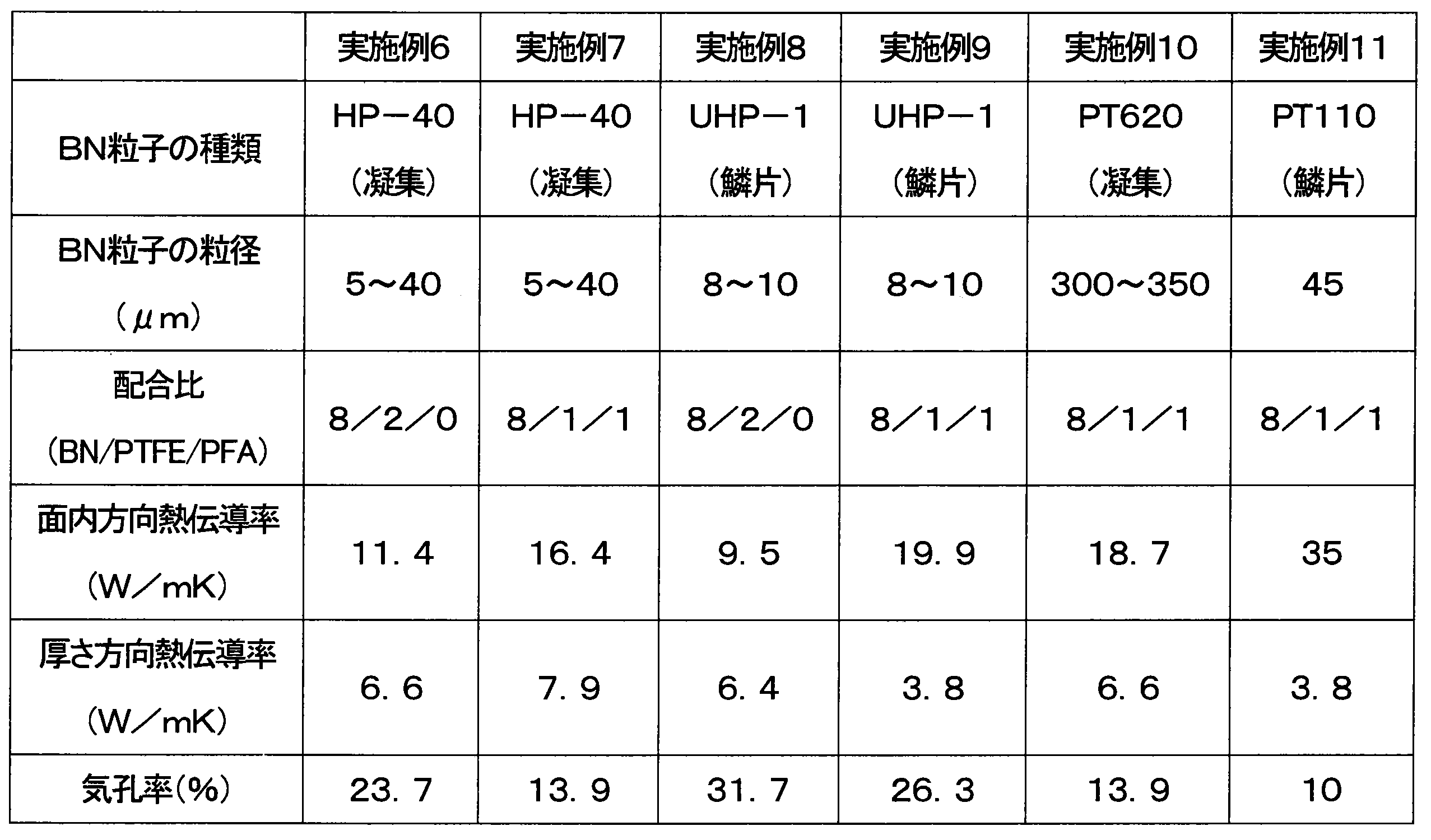
- Example 6 An insulating heat conductive sheet of Example 6 was produced in the same manner as in Example 1 except that BN particles and PTFE were mixed at a ratio of 80:20 (weight ratio). That is, the content of BN particles was 80% by weight in the state of the insulating heat conductive sheet. Also for this sheet, the thermal conductivity was measured by the same method as in Example 1, and the porosity was further determined by the method described below. The measurement results are as shown in Table 2.
- the insulating heat conductive sheet of Example 6 is the same as the insulating heat conductive sheet of Example 4.
- Example 7 In the same manner as in Example 1, except that BN particles, PTFE and PFA (manufactured by Mitsui DuPont, product number “MP-10”) were mixed at a ratio of 80:10:10 (weight ratio). 7 insulating heat conductive sheets were produced. That is, the content of BN particles was 80% by weight in the state of the insulating heat conductive sheet. Also for this sheet, the thermal conductivity and the porosity were measured in the same manner as in Example 6. The measurement results are as shown in Table 2.
- Example 8 The insulating heat of Example 8 was the same as Example 1 except that BN particles (manufactured by Showa Denko, product number “UHP-1”) and PTFE were mixed at a ratio of 80:20 (weight ratio).
- a conductive sheet was prepared. That is, the content of BN particles was 80% by weight in the state of the insulating heat conductive sheet. Also for this sheet, the thermal conductivity and the porosity were measured in the same manner as in Example 6. The measurement results are as shown in Table 2.
- Example 9 Except that BN particles (manufactured by Showa Denko, product number “UHP-1”), PTFE and PFA were mixed at a ratio of 80:10:10 (weight ratio), the same method as in Example 7 was used. An insulating heat conductive sheet was produced. That is, the content of BN particles was 80% by weight in the state of the insulating heat conductive sheet. Also for this sheet, the thermal conductivity and the porosity were measured in the same manner as in Example 6. The measurement results are as shown in Table 2.
- Example 10 Executed in the same manner as in Example 7 except that BN particles (Momentive Performance Materials, product number “PT620”), PTFE and PFA were mixed at a ratio of 80:10:10 (weight ratio).
- the insulating heat conductive sheet of Example 10 was produced. That is, the content of BN particles was 80% by weight in the state of the insulating heat conductive sheet. Also for this sheet, the thermal conductivity and the porosity were measured in the same manner as in Example 6. The measurement results are as shown in Table 2.
- Example 11 Executed in the same manner as in Example 7 except that BN particles (Momentive Performance Materials, product number “PT110”), PTFE and PFA were mixed at a ratio of 80:10:10 (weight ratio).
- the insulating heat conductive sheet of Example 11 was produced. That is, the content of BN particles was 80% by weight in the state of the insulating heat conductive sheet. Also for this sheet, the thermal conductivity and the porosity were measured in the same manner as in Example 6. The measurement results are as shown in Table 2.
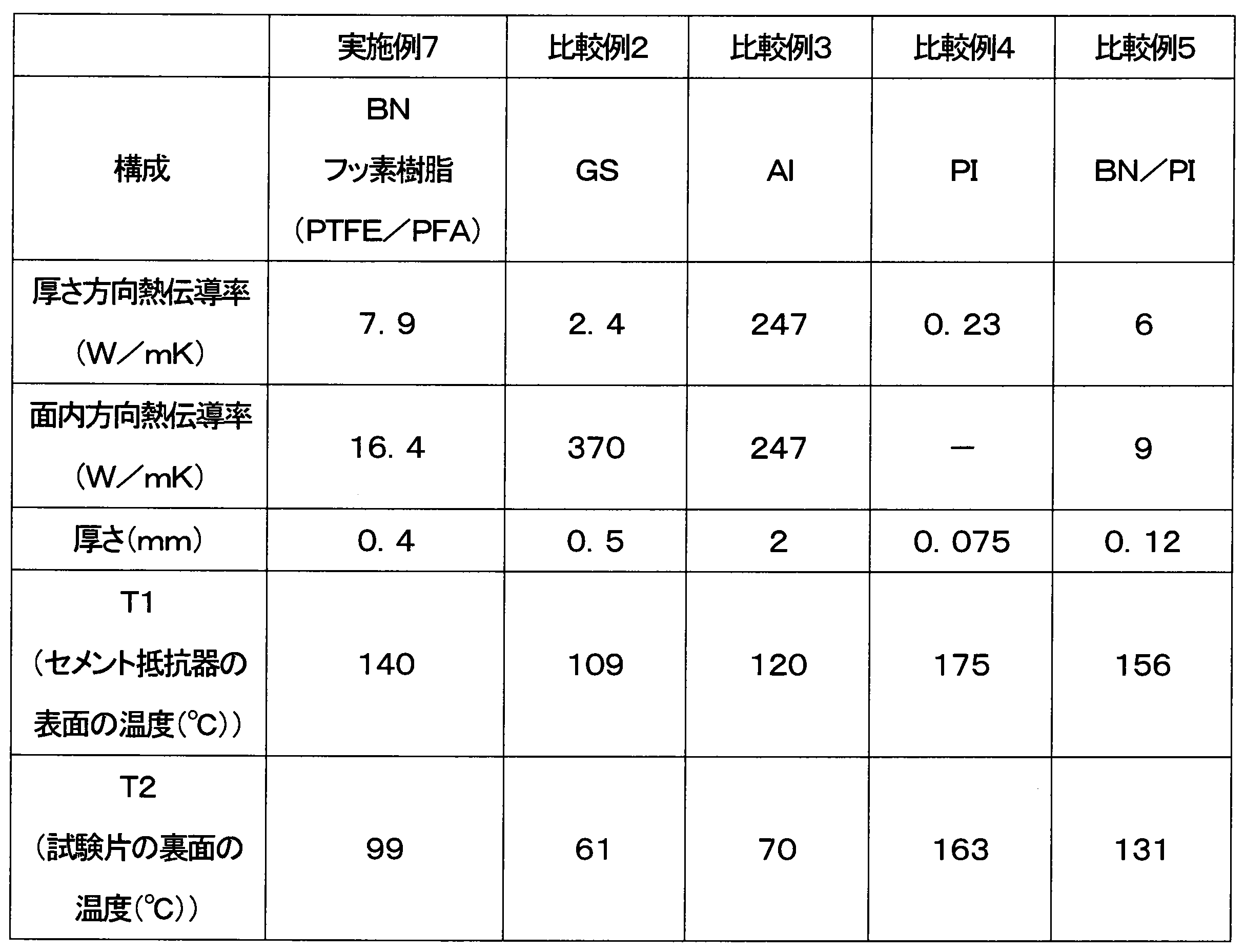
- Example 7 the heat dissipation performance of the insulating heat conductive sheet of the present invention (Example 7) and the conventional heat dissipation sheets (Comparative Examples 2 to 5) shown below were evaluated.
- the thermal conductivity was also measured by the same method as in Example 1. The results are shown in Table 3. A method for evaluating the heat dissipation performance will also be described below.
- Comparative Example 2 A graphite sheet (GS) manufactured by TYK was used as the heat dissipation sheet of Comparative Example 2.
- Comparative Example 5 A sheet composed of PI and BN particles was produced as a heat dissipation sheet of Comparative Example 5.
- BN particles were blended with polyamic acid (PMDA-ODA), which is a polyimide precursor, so that the BN particles (manufactured by Showa Denko, product number “UHP-1”) was 45 vol%. This was applied to a glass plate and subjected to full cure at 320 ° C. to perform imidization. The sheet thus obtained was used as a heat dissipation sheet of Comparative Example 5.
- PMDA-ODA polyamic acid
- UHP-1 product number
- the insulating heat conductive sheet of Example 7 was inferior in heat dissipation performance to the graphite sheet of Comparative Example 2 and the Al sheet of Comparative Example 3, but the PI film of Comparative Example 4 and the PI and BN of Comparative Example 5 The result that it had the heat dissipation performance superior to the sheet
- the insulating heat conductive sheet of Example 7 is insulating, the graphite sheet of Comparative Example 2 and the Al sheet of Comparative Example 3 are conductive. For this reason, when applying the graphite sheet of the comparative example 2 and the Al sheet of the comparative example 3 to an electronic device etc., there exists a problem that an insulating layer must be provided separately.
- the insulating heat conductive sheet of the present invention is a sheet having both insulating properties and excellent heat dissipation performance, which has not existed before. From this, it can be said that the insulating heat conductive sheet of this invention is more excellent as heat radiating members, such as an electronic device, compared with what was conventionally used as a heat radiating sheet.
- the insulating heat conductive sheet obtained by the present invention has high heat dissipation performance and mechanical strength, and does not contain components that adversely affect when applied to electronic devices. Applicable to.
Landscapes
- Engineering & Computer Science (AREA)
- Mechanical Engineering (AREA)
- Cooling Or The Like Of Semiconductors Or Solid State Devices (AREA)
- Manufacture Of Macromolecular Shaped Articles (AREA)
- Laminated Bodies (AREA)
- Casting Or Compression Moulding Of Plastics Or The Like (AREA)
- Compositions Of Macromolecular Compounds (AREA)
- Organic Insulating Materials (AREA)
Abstract
Description
(I)実質的に、PTFEを含むフッ素樹脂と、熱伝導性無機粒子と、成形助剤と、からなるシート状成形体を複数準備する工程と、
(II)複数の前記シート状成形体を重ね合わせて圧延する工程と、
(III)前記成形助剤を除去する工程と、
を含む。なお、本発明の製造方法において、「実質的に、PTFEを含むフッ素樹脂と、熱伝導性無機粒子と、成形助剤と、からなるシート状成形体」とは、シート状成形体にフッ素樹脂、熱伝導性無機粒子及び成形助剤以外の材料が含まれないか、又は、他の材料が含まれる場合でも、その含有量は、他の材料を含まない絶縁性熱伝導シートの特性(熱伝導特性)を大きく低下させない程度のごく少量(例えば10重量%以下)であることを意味する。
(I)実質的に、PTFEを含むフッ素樹脂と、熱伝導性無機粒子と、成形助剤と、からなるシート状成形体を複数準備する工程と、
(II)複数の前記シート状成形体を重ね合わせて圧延する工程と、
(III)前記成形助剤を除去する工程と、
を含む。
(A)PTFEによって構成されているフッ素樹脂、
(B)PTFEとPFAとによって構成されているフッ素樹脂、又は、
(C)PTFEとFEPとによって構成されているフッ素樹脂、
が好適である。
引張り伸び率(%)=100×(L-L0)/L0
(L0:試験前の試験片の長さ、 L:破断時の試験片の長さ)
熱伝導性無機粒子としての窒化ホウ素(BN)粒子(水島合金鉄株式会社製、品番「HP-40」)と、PTFE(ダイキン工業株式会社製、品番「F104U」)とを、90:10(重量比)の割合で混合した。すなわち、絶縁性熱伝導シートの状態でBN粒子の含有率が90重量%となるようにした。これに、成形助剤としてデカンを40重量%となるように添加し、PTFEの繊維化が極力起こらないような条件で混合した。混合条件は、V型ミキサーで、回転数10rpm、温度24℃、混合時間5分間とした。この混合物を一対の圧延ロール間に通して、厚さ3mm、幅50mm、長さ150mmの楕円状の母シート(シート状成形体)を得た。
熱伝導率は、レーザフラッシュ法を利用して、シートの面内方向及び厚さ方向についてそれぞれ求めた。まず、キセノンフラッシュアナライザー「LFA 447 NanoFlash(登録商標)」(NETZSCH社製)を用いて熱拡散率を測定した。この熱拡散率の測定値を用いて、以下の式により熱伝導率を求めた。なお、以下の式において、密度には重量/体積で算出した値を用いた。比熱は、DSC(「DSC 200 F3 Maia(登録商標)」(NETZSCH社製))で追加測定した結果、0.8とみなした。表1に、密度と比熱の値も併せて示す。
熱伝導率(W/mK)
=熱拡散率(mm2/s)×比熱(J/g・K)×密度(g/cm3)
引張り試験機「テンシロン」(オリエント株式会社製)を用いて、試験片(幅10mm、長さ50mm(=L0))を、長さ方向に速度100mm/minで引っ張り、試験片が切断(破断)した時の当該試験片の長さ(L)を測定した。なお、測定は室温で行い、チャック間距離は20mmであった。引張り伸び率は、次の式によって求めた。
引張り伸び率(%)=100×(L-L0)/L0
JIS K 6245に準拠して求めた。
BN粒子とPTFEとを70:30(重量比)の割合で混合した点以外は、実施例1と同様の方法で、実施例2の絶縁性熱伝導シートを作製した。すなわち、絶縁性熱伝導シートの状態でBN粒子の含有率が70重量%となるようにした。得られた絶縁性熱伝導シートについて、実施例1と同様の方法で、熱伝導率、引張り伸び率及び絶縁破壊電圧を測定した。測定結果は、表1に示すとおりである。
BN粒子とPTFEとを50:50(重量比)の割合で混合した点以外は、実施例1と同様の方法で、実施例3の絶縁性熱伝導シートを作製した。すなわち、絶縁性熱伝導シートの状態でBN粒子の含有率が50重量%となるようにした。得られた絶縁性熱伝導シートについて、実施例1と同様の方法で、熱伝導率、引張り伸び率及び絶縁破壊電圧を測定した。測定結果は、表1に示すとおりである。
BN粒子とPTFEとを80:20(重量比)の割合で混合した点以外は、実施例1と同様の方法で、実施例4の絶縁性熱伝導シートを作製した。すなわち、絶縁性熱伝導シートの状態でBN粒子の含有率が80重量%となるようにした。得られた絶縁性熱伝導シートについて、実施例1と同様の方法で、熱伝導率、引張り伸び率及び絶縁破壊電圧を測定した。測定結果は、表1に示すとおりである。
成形助剤除去後の加圧成形時の圧力を25MPaとした点以外は、実施例1と同様の方法で、実施例5の絶縁性熱伝導シートを作製した。得られた絶縁性熱伝導シートについて、実施例1と同様の方法で、熱伝導率、引張り伸び率及び絶縁破壊電圧を測定した。測定結果は、表1に示すとおりである。
シリコーン樹脂(東レ・ダウコーニング株式会社製、品番「SE1886」)、シリコーンオイル(信越化学工業株式会社製、品番「KF96-100CS」)及びBN粒子(水島合金鉄株式会社製、品番「HP-40」)を、10:50:80(重量比)の割合で混合した。この混合物をカプトンフィルム上に塗布し、150℃、2MPaで加圧成形を行い、厚さ約1mmのシートを得た。このシートについても、実施例1と同様の方法で、熱伝導率、引張り伸び率及び絶縁破壊電圧を測定した。測定結果は、表1に示すとおりである。

BN粒子とPTFEとを80:20(重量比)の割合で混合した点以外は、実施例1と同様の方法で、実施例6の絶縁性熱伝導シートを作製した。すなわち、絶縁性熱伝導シートの状態でBN粒子の含有率が80重量%となるようにした。このシートについても、実施例1と同様の方法で熱伝導率を測定し、さらに以下に示す方法で気孔率を求めた。測定結果は、表2に示すとおりである。なお、実施例6の絶縁性熱伝導シートは、実施例4の絶縁性熱伝導シートと同じである。
絶縁性熱伝導シートの重量と体積とを測定し、その結果から実測密度を求めた。この実測密度と真密度とを用いて、以下の式により気孔率を求めた。
気孔率(%)=(1-実測密度/真密度)×100
BN粒子とPTFEとPFA(三井デュポン株式会社製、品番「MP-10」)を80:10:10(重量比)の割合で混合した点以外は、実施例1と同様の方法で、実施例7の絶縁性熱伝導シートを作製した。すなわち、絶縁性熱伝導シートの状態でBN粒子の含有率が80重量%となるようにした。このシートについても、実施例6と同様に熱伝導率及び気孔率を測定した。測定結果は、表2に示すとおりである。
BN粒子(昭和電工製、品番「UHP-1」)とPTFEとを80:20(重量比)の割合で混合した点以外は、実施例1と同様の方法で、実施例8の絶縁性熱伝導シートを作製した。すなわち、絶縁性熱伝導シートの状態でBN粒子の含有率が80重量%となるようにした。このシートについても、実施例6と同様に熱伝導率及び気孔率を測定した。測定結果は、表2に示すとおりである。
BN粒子(昭和電工製、品番「UHP-1」)とPTFEとPFAを80:10:10(重量比)の割合で混合した点以外は、実施例7と同様の方法で、実施例9の絶縁性熱伝導シートを作製した。すなわち、絶縁性熱伝導シートの状態でBN粒子の含有率80重量%となるようにした。このシートについても、実施例6と同様に熱伝導率及び気孔率を測定した。測定結果は、表2に示すとおりである。
BN粒子(モメンティブ・パフォーマンス・マテリアルズ社製、品番「PT620」)とPTFEとPFAを80:10:10(重量比)の割合で混合した点以外は、実施例7と同様の方法で、実施例10の絶縁性熱伝導シートを作製した。すなわち、絶縁性熱伝導シートの状態でBN粒子の含有率が80重量%となるようにした。このシートについても、実施例6と同様に熱伝導率及び気孔率を測定した。測定結果は、表2に示すとおりである。
BN粒子(モメンティブ・パフォーマンス・マテリアルズ社製、品番「PT110」)とPTFEとPFAを80:10:10(重量比)の割合で混合した点以外は、実施例7と同様の方法で、実施例11の絶縁性熱伝導シートを作製した。すなわち、絶縁性熱伝導シートの状態でBN粒子の含有率が80重量%となるようにした。このシートについても、実施例6と同様に熱伝導率及び気孔率を測定した。測定結果は、表2に示すとおりである。
TYK社製のグラファイトシート(GS)を比較例2の放熱シートとして使用した。
Alシートを比較例3の放熱シートとして使用した。
ポリイミド(PI)フィルム(宇部興産株式会社製、品番「Upilex」)を比較例4の放熱シートとして使用した。
PI及びBN粒子からなるシートを比較例5の放熱シートとして作製した。BN粒子(昭和電工製、品番「UHP-1」)が45vol%となるように、ポリイミド前駆体であるポリアミド酸(PMDA-ODA)にBN粒子を配合した。これをガラス板に塗布し、320℃でフルキュアを行い、イミド化を行った。このようにして得られたシートを、比較例5の放熱シートとして使用した。
評価対象のシートを50mm×50mmの正方形に切断し、試験片とした。この試験片を、粘着剤(日東電工株式会社製,品番「No.501H」)にて、セメント抵抗器(TAKMAN電子株式会社製、品番「RWB-5W-47ohm」、サイズ10mm×8mm×22mm)に接合した。4.8W(0.32A×15V)で、セメント抵抗器表面、試験片表面(セメント抵抗器と接合されている面と反対側の面、試験片の裏面)、外気(セメント抵抗器3の表面から5mm離れた位置)の温度を、それぞれK熱電対を用いて測定し、データロガー(株式会社キーエンス製、「NR600」)でモニタリングした。
Claims (15)
- (I)実質的に、ポリテトラフルオロエチレンを含むフッ素樹脂と、熱伝導性無機粒子と、成形助剤と、からなるシート状成形体を複数準備する工程と、
(II)複数の前記シート状成形体を重ね合わせて圧延する工程と、
(III)前記成形助剤を除去する工程と、
を含む、絶縁性熱伝導シートの製造方法。 - 前記熱伝導性無機粒子が実質的に窒化ホウ素からなる、請求項1に記載の絶縁性熱伝導シートの製造方法。
- (IV)前記工程(III)によって得られたシート状物を加圧成形する工程をさらに含む、請求項1に記載の絶縁性熱伝導シートの製造方法。
- 前記工程(IV)において、ポリテトラフルオロエチレンの焼成温度範囲内の温度で加圧成形を行う、請求項3に記載の絶縁性熱伝導シートの製造方法。
- 前記工程(I)と前記工程(II)とが交互に繰り返される、請求項1に記載の絶縁性熱伝導シートの製造方法。
- 前記工程(II)を繰り返す際に、圧延方向を変更する、請求項5に記載の絶縁性熱伝導シートの製造方法。
- 前記フッ素樹脂が、
(A)ポリテトラフルオロエチレンによって構成されている、
(B)ポリテトラフルオロエチレンとテトラフルオロエチレン・パーフルオロアルキルビニルエーテル共重合体とによって構成されている、
又は、
(C)ポリテトラフルオロエチレンとテトラフルオロエチレン・ヘキサフルオロプロピレン共重合体とによって構成されている、
請求項1に記載の絶縁性熱伝導シートの製造方法。 - 請求項1に記載の方法によって得られる絶縁性熱伝導シート。
- 実質的に、ポリテトラフルオロエチレンを含むフッ素樹脂と、熱伝導性無機粒子とからなるシートであって、
面内方向の熱伝導率が5~50W/mKで厚さ方向の熱伝導率が1~15W/mKであり、且つ、耐電圧が5kV/mm以上である、絶縁性熱伝導シート。 - 面内方向の熱伝導率が、厚さ方向の熱伝導率よりも大きい、請求項9に記載の絶縁性熱伝導シート。
- 前記熱伝導性無機粒子が実質的に窒化ホウ素からなる、請求項9に記載の絶縁性熱伝導シート。
- 前記フッ素樹脂が、
(A)ポリテトラフルオロエチレンによって構成されている、
(B)ポリテトラフルオロエチレンとテトラフルオロエチレン・パーフルオロアルキルビニルエーテル共重合体とによって構成されている、
又は、
(C)ポリテトラフルオロエチレンとテトラフルオロエチレン・ヘキサフルオロプロピレン共重合体とによって構成されている、
請求項9に記載の絶縁性熱伝導シート。 - 引張り伸び率が1~400%である、請求項8又は9に記載の絶縁性熱伝導シート。
- 前記熱伝導性無機粒子の含有率が40~95重量%である、請求項8又は9に記載の絶縁性熱伝導シート。
- 請求項8又は9に記載の絶縁性熱伝導シートを備えた放熱部材。
Priority Applications (2)
| Application Number | Priority Date | Filing Date | Title |
|---|---|---|---|
| US13/127,386 US20110223427A1 (en) | 2008-11-12 | 2009-11-12 | Method of producing electrically insulating thermally conductive sheet, electrically insulating thermally conductive sheet, and heat dissipating member |
| CN2009801452893A CN102216047A (zh) | 2008-11-12 | 2009-11-12 | 绝缘性导热片的制造方法、绝缘性导热片及散热构件 |
Applications Claiming Priority (2)
| Application Number | Priority Date | Filing Date | Title |
|---|---|---|---|
| JP2008289989 | 2008-11-12 | ||
| JP2008-289989 | 2008-11-12 |
Publications (1)
| Publication Number | Publication Date |
|---|---|
| WO2010055878A1 true WO2010055878A1 (ja) | 2010-05-20 |
Family
ID=42170009
Family Applications (1)
| Application Number | Title | Priority Date | Filing Date |
|---|---|---|---|
| PCT/JP2009/069266 Ceased WO2010055878A1 (ja) | 2008-11-12 | 2009-11-12 | 絶縁性熱伝導シートの製造方法、絶縁性熱伝導シート及び放熱部材 |
Country Status (4)
| Country | Link |
|---|---|
| US (1) | US20110223427A1 (ja) |
| JP (1) | JP5322894B2 (ja) |
| CN (1) | CN102216047A (ja) |
| WO (1) | WO2010055878A1 (ja) |
Cited By (4)
| Publication number | Priority date | Publication date | Assignee | Title |
|---|---|---|---|---|
| US20130312936A1 (en) * | 2011-03-23 | 2013-11-28 | Nitto Denko Corporation | Heat dissipating member and method for producing the same |
| WO2014061266A1 (ja) * | 2012-10-15 | 2014-04-24 | 日東電工株式会社 | 放熱部材及び放熱部材の製造方法 |
| WO2021235460A1 (ja) * | 2020-05-18 | 2021-11-25 | 住友電気工業株式会社 | フッ素樹脂シート、多層シート及びシールド材 |
| WO2023282183A1 (ja) * | 2021-07-08 | 2023-01-12 | ダイキン工業株式会社 | 押出成形用樹脂組成物、シート及びシートの製造方法 |
Families Citing this family (26)
| Publication number | Priority date | Publication date | Assignee | Title |
|---|---|---|---|---|
| JP4842294B2 (ja) | 2008-04-30 | 2011-12-21 | 日東電工株式会社 | 多孔質シートおよびその製造方法、並びに断熱シート |
| JP5349067B2 (ja) * | 2009-02-03 | 2013-11-20 | 日東電工株式会社 | 高誘電率絶縁シートおよびその製造方法 |
| EP2551324B1 (en) * | 2011-07-29 | 2014-01-01 | W.L.Gore & Associates Gmbh | Use of an anisotropic fluoropolymer for the conduction of heat |
| JP2013082767A (ja) * | 2011-10-06 | 2013-05-09 | Nitto Denko Corp | 放熱部材およびその製造方法 |
| TWI484897B (zh) * | 2012-01-20 | 2015-05-11 | Lite On Technology Corp | 散熱結構與具有此散熱結構的電子裝置 |
| WO2013172429A1 (ja) * | 2012-05-16 | 2013-11-21 | 荒川化学工業株式会社 | 伸縮性放熱シート及びこれが貼付された物品 |
| JPWO2014103328A1 (ja) * | 2012-12-27 | 2017-01-12 | 日東電工株式会社 | 熱伝導性粘着シートの製造方法及び熱伝導性粘着シート |
| WO2014103327A1 (ja) * | 2012-12-27 | 2014-07-03 | 日東電工株式会社 | 熱伝導性粘着シート及びその製造方法 |
| CN105531102B (zh) * | 2013-09-12 | 2017-10-24 | 日东电工株式会社 | 含有填充材料的含氟树脂片的制造方法 |
| WO2015118858A1 (ja) * | 2014-02-04 | 2015-08-13 | 日東電工株式会社 | 熱伝導性シートの製造方法及び熱伝導性シート |
| JP2015168783A (ja) | 2014-03-07 | 2015-09-28 | 三井・デュポンフロロケミカル株式会社 | 高熱伝導性樹脂組成物 |
| WO2016048335A1 (en) * | 2014-09-26 | 2016-03-31 | W.L. Gore & Associates Gmbh | Process for the production of a thermally conductive article |
| JP6453057B2 (ja) | 2014-11-20 | 2019-01-16 | 三井・ケマーズ フロロプロダクツ株式会社 | 熱伝導性に優れた熱溶融性フッ素樹脂組成物、該組成物から製造された成形品および、その製造方法 |
| CN107683200B (zh) | 2015-06-16 | 2020-01-17 | 日星电气有限公司 | 热收缩管及其制造方法 |
| JP6749262B2 (ja) * | 2016-02-17 | 2020-09-02 | 株式会社有沢製作所 | 放熱板 |
| JP6750492B2 (ja) * | 2016-12-14 | 2020-09-02 | 日本ゼオン株式会社 | 加圧方法および複合材料シートの製造方法 |
| JP2020053531A (ja) * | 2018-09-26 | 2020-04-02 | スリーエム イノベイティブ プロパティズ カンパニー | 熱伝導性シート前駆体、並びに該前駆体から得られる熱伝導性シート及びその製造方法 |
| CN113544798B (zh) | 2019-03-22 | 2023-02-21 | 帝人株式会社 | 绝缘片材 |
| CN113573895A (zh) * | 2019-03-26 | 2021-10-29 | 三菱化学株式会社 | 热传导性树脂片、层叠散热片、散热性电路基板及功率半导体器件 |
| JP7366581B2 (ja) * | 2019-04-24 | 2023-10-23 | 東洋メディック株式会社 | 熱蛍光シート読み取り方法、及び、熱蛍光シート読み取り装置 |
| EP3733753A1 (en) | 2019-05-03 | 2020-11-04 | 3M Innovative Properties Company | Film usable for roll-to-roll processing of flexible electronic devices comprising a composite material of a polymer and boron nitride |
| JP7404672B2 (ja) * | 2019-06-25 | 2023-12-26 | 日本ゼオン株式会社 | 熱伝導シート |
| EP3988300B1 (en) * | 2019-07-16 | 2025-11-26 | Daikin Industries, Ltd. | Resin composition for circuit board, molded body for circuit board, layered body for circuit board, and circuit board |
| JP7697273B2 (ja) * | 2021-03-17 | 2025-06-24 | Agc株式会社 | 積層体の製造方法、シートの製造方法、およびシート |
| US20240074113A1 (en) * | 2022-08-30 | 2024-02-29 | roVa Corporation | Aerogel heat extraction apparatus for data centers and energy storage systems |
| US20240068755A1 (en) * | 2022-08-30 | 2024-02-29 | roVa Corporation | Aerogel heat extraction sheets, cables, and apparatus |
Citations (6)
| Publication number | Priority date | Publication date | Assignee | Title |
|---|---|---|---|---|
| JPS59221902A (ja) * | 1983-05-31 | 1984-12-13 | 日本バイリーン株式会社 | 熱伝導性に優れた絶縁シ−ト |
| JP2003060134A (ja) * | 2001-08-17 | 2003-02-28 | Polymatech Co Ltd | 熱伝導性シート |
| JP2007044994A (ja) * | 2005-08-10 | 2007-02-22 | Taika:Kk | グラファイト複合構造体、それを用いた放熱部材及び電子部品 |
| JP2008150595A (ja) * | 2006-11-24 | 2008-07-03 | Techno Polymer Co Ltd | 放熱性樹脂組成物及び成形品 |
| WO2008084512A1 (ja) * | 2006-12-26 | 2008-07-17 | Asahi Kasei E-Materials Corporation | 放熱材料及び放熱材料で成形した放熱シート |
| JP2008208159A (ja) * | 2007-02-23 | 2008-09-11 | Teijin Ltd | 耐熱性熱伝導複合材料、耐熱性熱伝導シート |
Family Cites Families (23)
| Publication number | Priority date | Publication date | Assignee | Title |
|---|---|---|---|---|
| GB1468355A (en) * | 1973-07-18 | 1977-03-23 | Ici Ltd | Making porous diaphragms in electrolytic cells |
| BE504311A (ja) * | 1950-06-30 | 1900-01-01 | ||
| GB1081046A (en) * | 1965-08-31 | 1967-08-31 | Ici Ltd | Manufacture of porous diaphragms |
| BE794889A (fr) * | 1972-02-04 | 1973-08-02 | Ici Ltd | Procede de fabrication d'un diaphragme poreux |
| US4049589A (en) * | 1973-03-19 | 1977-09-20 | Sumitomo Electric Industries, Ltd. | Porous films of polytetrafluoroethylene and process for producing said films |
| US4129470A (en) * | 1974-10-17 | 1978-12-12 | Homsy Charles A | Method of preparing a porous implantable material from polytetrafluoroethylene and carbon fibers |
| JPS5461253A (en) * | 1977-10-25 | 1979-05-17 | Hitachi Cable Ltd | Electrical insulator having improved thermal conductivity |
| US6080472A (en) * | 1979-11-27 | 2000-06-27 | Yeu Ming Tai Chemical Ind. Co., Ltd. | Porous polytetrafluoroethylene molded article |
| JPS6014694B2 (ja) * | 1980-01-30 | 1985-04-15 | 電気化学工業株式会社 | 放熱シ−トの製造法 |
| US4500597A (en) * | 1983-07-26 | 1985-02-19 | Mitsubishi Petrochemical Co., Ltd. | Composite heat-insulating material and process for the production thereof |
| JPS5964355A (ja) * | 1983-07-28 | 1984-04-12 | 電気化学工業株式会社 | 多層構造の絶縁放熱シ−ト |
| US4563488A (en) * | 1984-08-20 | 1986-01-07 | Japan Vilene Co. Ltd. | Insulator with high thermal conductivity |
| EP0343247B1 (en) * | 1987-07-30 | 1993-03-03 | Toray Industries, Inc. | Porous polytetrafluoroethylene membrane, separating apparatus using same, and process for their production |
| US4985296A (en) * | 1989-03-16 | 1991-01-15 | W. L. Gore & Associates, Inc. | Polytetrafluoroethylene film |
| JPH03212987A (ja) * | 1990-01-17 | 1991-09-18 | Matsushita Electric Works Ltd | 電気用複合材料、積層板およびプリント配線板 |
| KR100396862B1 (ko) * | 1995-03-31 | 2003-11-17 | 다이낑 고오교 가부시키가이샤 | 나사이음매밀봉용테이프 |
| US5738936A (en) * | 1996-06-27 | 1998-04-14 | W. L. Gore & Associates, Inc. | Thermally conductive polytetrafluoroethylene article |
| US5945217A (en) * | 1997-10-14 | 1999-08-31 | Gore Enterprise Holdings, Inc. | Thermally conductive polytrafluoroethylene article |
| US6103172A (en) * | 1998-04-07 | 2000-08-15 | Pall Corporation | Method of preparaing a porous polytetrafluoroethylene membranne |
| US7118801B2 (en) * | 2003-11-10 | 2006-10-10 | Gore Enterprise Holdings, Inc. | Aerogel/PTFE composite insulating material |
| CN101140915B (zh) * | 2006-09-08 | 2011-03-23 | 聚鼎科技股份有限公司 | 散热衬底 |
| EP2065433B1 (en) * | 2006-09-22 | 2011-12-21 | Kurabe Industrial Co., Ltd | Ptfe porous body, ptfe mixture, method for producing ptfe porous body, and electric wire/cable using ptfe porous body |
| JP4842294B2 (ja) * | 2008-04-30 | 2011-12-21 | 日東電工株式会社 | 多孔質シートおよびその製造方法、並びに断熱シート |
-
2009
- 2009-11-12 US US13/127,386 patent/US20110223427A1/en not_active Abandoned
- 2009-11-12 WO PCT/JP2009/069266 patent/WO2010055878A1/ja not_active Ceased
- 2009-11-12 JP JP2009258758A patent/JP5322894B2/ja not_active Expired - Fee Related
- 2009-11-12 CN CN2009801452893A patent/CN102216047A/zh active Pending
Patent Citations (6)
| Publication number | Priority date | Publication date | Assignee | Title |
|---|---|---|---|---|
| JPS59221902A (ja) * | 1983-05-31 | 1984-12-13 | 日本バイリーン株式会社 | 熱伝導性に優れた絶縁シ−ト |
| JP2003060134A (ja) * | 2001-08-17 | 2003-02-28 | Polymatech Co Ltd | 熱伝導性シート |
| JP2007044994A (ja) * | 2005-08-10 | 2007-02-22 | Taika:Kk | グラファイト複合構造体、それを用いた放熱部材及び電子部品 |
| JP2008150595A (ja) * | 2006-11-24 | 2008-07-03 | Techno Polymer Co Ltd | 放熱性樹脂組成物及び成形品 |
| WO2008084512A1 (ja) * | 2006-12-26 | 2008-07-17 | Asahi Kasei E-Materials Corporation | 放熱材料及び放熱材料で成形した放熱シート |
| JP2008208159A (ja) * | 2007-02-23 | 2008-09-11 | Teijin Ltd | 耐熱性熱伝導複合材料、耐熱性熱伝導シート |
Cited By (4)
| Publication number | Priority date | Publication date | Assignee | Title |
|---|---|---|---|---|
| US20130312936A1 (en) * | 2011-03-23 | 2013-11-28 | Nitto Denko Corporation | Heat dissipating member and method for producing the same |
| WO2014061266A1 (ja) * | 2012-10-15 | 2014-04-24 | 日東電工株式会社 | 放熱部材及び放熱部材の製造方法 |
| WO2021235460A1 (ja) * | 2020-05-18 | 2021-11-25 | 住友電気工業株式会社 | フッ素樹脂シート、多層シート及びシールド材 |
| WO2023282183A1 (ja) * | 2021-07-08 | 2023-01-12 | ダイキン工業株式会社 | 押出成形用樹脂組成物、シート及びシートの製造方法 |
Also Published As
| Publication number | Publication date |
|---|---|
| JP5322894B2 (ja) | 2013-10-23 |
| CN102216047A (zh) | 2011-10-12 |
| JP2010137562A (ja) | 2010-06-24 |
| US20110223427A1 (en) | 2011-09-15 |
Similar Documents
| Publication | Publication Date | Title |
|---|---|---|
| JP5322894B2 (ja) | 絶縁性熱伝導シートの製造方法、絶縁性熱伝導シート及び放熱部材 | |
| CN106810877B (zh) | 一种导热界面材料及其应用 | |
| CN107109011B (zh) | 具有优异导热性的可熔融加工的含氟聚合物组合物、由该组合物制造的模制品及其制造方法 | |
| JP7389014B2 (ja) | 絶縁放熱シート | |
| JP7233564B2 (ja) | 放熱シート及びその製造方法 | |
| JP5185582B2 (ja) | 熱伝導性シート | |
| TWI674315B (zh) | 熱傳導性樹脂成形品的製造方法 | |
| TWI770063B (zh) | 具有高耐負荷性及高熱傳導性之散熱片 | |
| JP5516034B2 (ja) | 絶縁性の高い熱伝導シート及びこれを用いた放熱装置 | |
| JP6755421B1 (ja) | 絶縁シート | |
| Kim et al. | High‐temperature skin softening materials overcoming the trade‐off between thermal conductivity and thermal contact resistance | |
| WO2015029407A1 (ja) | 絶縁性熱伝導シート | |
| JPWO2017018493A1 (ja) | 混合グラファイトを用いた放熱材およびその製造方法 | |
| WO2013051246A1 (ja) | 放熱部材およびその製造方法 | |
| WO2015118858A1 (ja) | 熱伝導性シートの製造方法及び熱伝導性シート | |
| CN115943492A (zh) | 导热性片材以及导热性片材的制造方法 | |
| CN116097913A (zh) | 导热性片和导热性片的制造方法 | |
| JP2017092322A (ja) | 高熱伝導性、高絶縁性放熱シート | |
| CN114430860A (zh) | 散热片 | |
| CN116964731A (zh) | 导热性树脂片 | |
| JP2025131384A (ja) | 稠密シートの製造方法、及び稠密シート | |
| WO2014061266A1 (ja) | 放熱部材及び放熱部材の製造方法 | |
| KR101656600B1 (ko) | 고분자 나노 복합체를 이용한 방열시트 및 이의 제조방법 | |
| Li et al. | High-Thermal-Conductivity Flexible Boron Nitride Composite Films Enabled by the Directional Arrangement of Nanosheet Assemblies | |
| WO2024090364A1 (ja) | 積層体及びその製造方法 |
Legal Events
| Date | Code | Title | Description |
|---|---|---|---|
| WWE | Wipo information: entry into national phase |
Ref document number: 200980145289.3 Country of ref document: CN |
|
| 121 | Ep: the epo has been informed by wipo that ep was designated in this application |
Ref document number: 09826125 Country of ref document: EP Kind code of ref document: A1 |
|
| WWE | Wipo information: entry into national phase |
Ref document number: 13127386 Country of ref document: US |
|
| NENP | Non-entry into the national phase |
Ref country code: DE |
|
| 122 | Ep: pct application non-entry in european phase |
Ref document number: 09826125 Country of ref document: EP Kind code of ref document: A1 |