WO2006098128A1 - 4-シクロプロピル-1,2,3-チアジアゾール化合物及び農園芸用植物病害防除剤並びにその使用方法 - Google Patents
4-シクロプロピル-1,2,3-チアジアゾール化合物及び農園芸用植物病害防除剤並びにその使用方法 Download PDFInfo
- Publication number
- WO2006098128A1 WO2006098128A1 PCT/JP2006/303313 JP2006303313W WO2006098128A1 WO 2006098128 A1 WO2006098128 A1 WO 2006098128A1 JP 2006303313 W JP2006303313 W JP 2006303313W WO 2006098128 A1 WO2006098128 A1 WO 2006098128A1
- Authority
- WO
- WIPO (PCT)
- Prior art keywords
- group
- halo
- alkyl
- substituent
- alkyl group
- Prior art date
- Legal status (The legal status is an assumption and is not a legal conclusion. Google has not performed a legal analysis and makes no representation as to the accuracy of the status listed.)
- Ceased
Links
Classifications
-
- C—CHEMISTRY; METALLURGY
- C07—ORGANIC CHEMISTRY
- C07D—HETEROCYCLIC COMPOUNDS
- C07D285/00—Heterocyclic compounds containing rings having nitrogen and sulfur atoms as the only ring hetero atoms, not provided for by groups C07D275/00 - C07D283/00
- C07D285/01—Five-membered rings
- C07D285/02—Thiadiazoles; Hydrogenated thiadiazoles
- C07D285/04—Thiadiazoles; Hydrogenated thiadiazoles not condensed with other rings
- C07D285/06—1,2,3-Thiadiazoles; Hydrogenated 1,2,3-thiadiazoles
-
- A—HUMAN NECESSITIES
- A01—AGRICULTURE; FORESTRY; ANIMAL HUSBANDRY; HUNTING; TRAPPING; FISHING
- A01N—PRESERVATION OF BODIES OF HUMANS OR ANIMALS OR PLANTS OR PARTS THEREOF; BIOCIDES, e.g. AS DISINFECTANTS, AS PESTICIDES OR AS HERBICIDES; PEST REPELLANTS OR ATTRACTANTS; PLANT GROWTH REGULATORS
- A01N43/00—Biocides, pest repellants or attractants, or plant growth regulators containing heterocyclic compounds
- A01N43/72—Biocides, pest repellants or attractants, or plant growth regulators containing heterocyclic compounds having rings with nitrogen atoms and oxygen or sulfur atoms as ring hetero atoms
- A01N43/82—Biocides, pest repellants or attractants, or plant growth regulators containing heterocyclic compounds having rings with nitrogen atoms and oxygen or sulfur atoms as ring hetero atoms five-membered rings with three ring hetero atoms
-
- C—CHEMISTRY; METALLURGY
- C07—ORGANIC CHEMISTRY
- C07D—HETEROCYCLIC COMPOUNDS
- C07D417/00—Heterocyclic compounds containing two or more hetero rings, at least one ring having nitrogen and sulfur atoms as the only ring hetero atoms, not provided for by group C07D415/00
- C07D417/02—Heterocyclic compounds containing two or more hetero rings, at least one ring having nitrogen and sulfur atoms as the only ring hetero atoms, not provided for by group C07D415/00 containing two hetero rings
- C07D417/04—Heterocyclic compounds containing two or more hetero rings, at least one ring having nitrogen and sulfur atoms as the only ring hetero atoms, not provided for by group C07D415/00 containing two hetero rings directly linked by a ring-member-to-ring-member bond
Definitions
- the present invention relates to a 4-cyclopropyl 1,2,3 thiadiazole compound or a salt thereof, an agricultural and horticultural plant disease control agent containing the compound as an active ingredient, and a method of using the same. Furthermore, the present invention also relates to a plant disease control agent for seed sterilization for treatment of the seed of the plant to be controlled or a cultivation carrier for seeding the plant, and a method of using the same.
- a method of applying to the seed of the target plant or a cultivation carrier for seeding the target plant is known! /.
- the drug is present only in the vicinity of the seed of the target plant or the cultivation carrier on which the target plant is sown, which reduces the amount of drug used and reduces the burden on the global environment. It has the feature that it improves worker safety by reducing contact with the machine and leads to labor saving.
- Patent Document 1 Japanese Patent Application Laid-Open No. 8-325110
- Patent Document 2 Japanese Patent Laid-Open No. 2001-10909
- the present invention relates to the following (1) to (13).
- R ⁇ R 2 , RR 4 and R 5 may be the same or different; a hydrogen atom; a halogen atom; a cyan group; a (C 1 -C 6) alkyl group; a nano (C 1 -C 6) alkyl group ; (C -C) alkoxy (C -C) a
- An aryl group that may be substituted by a substituent Z an aryl-C) alkyl group that may be substituted on the ring by a substituent Z; or a (C 1 -C 6) alkylcarbol group.
- R 6 is (a) -C ⁇ W ⁇ YR 7 (wherein R 7 is a hydrogen atom; (C- C) alkyl group;
- Caryl (C 1 -C 6) alkyl group; (C 1 -C 6) alkoxycarbonyl (C 1 -C)
- a heterocyclic group which may be substituted by a substituent a heterocyclic ring which may be substituted on the ring by a substituent Z (C -C) alkyl group; (C-C) alkylcarbol group; (C-C) alkylcarbol
- R 9 may be the same or different, a hydrogen atom, a (C-C) alkyl group, a halo (C-C) a
- a phenyl (C 1 -C 6) alkyloxy group which may be substituted on the ring by the substituent Z is shown.
- R 8 and R 9 are combined together to form an oxygen atom, a sulfur atom or NR 1Q (wherein R 1Q is a hydrogen atom, a (C 1 -C 6) alkyl group or a substituent Z which may be substituted with a substituent Z).
- R 1Q is a hydrogen atom, a (C 1 -C 6) alkyl group or a substituent Z which may be substituted with a substituent Z.
- (C 1 -C 6) alkylene groups which may be interrupted may be indicated.
- w 2 is oxygen atom or sulfur source
- Y is an oxygen atom; a sulfur atom; -N (R U )-(wherein R 11 is a hydrogen atom, a (C 1 -C 6) alkyl group, (C
- W 1 represents an oxygen atom or a sulfur atom.
- n an integer of 0 to 4.
- W 3 and W 4 represent the same or different oxygen atom or sulfur atom) or (c) a cyano group.
- Z may be the same or different halogen atom; hydroxyl group; cyano group; nitro group; (C 1 -C 6) a
- a substituent group X having a substituent X on the nitrogen atom is selected from the substituents rubamoyl group.
- a ring which may have 1 to 5 substituents on the ring (C-C) Alkyl group; (C-C)
- Halogen atom hydroxyl group, cyano group, nitro group, (C-C) alkyl group, halo
- a phenyl group which may have 1 to 5 substituents selected from a substituent group having a substituent X, a rubamoyl group or a substituent X which may be the same or different on the nitrogen atom.
- Groups which may be the same or different, a halogen atom, a hydroxyl group, a cyano group, a nitro group, a (C-C) alkyl group, a halo (C-C) alkyl group, a (C-C) alkoxy group, a halo (C-C ) Lucoxy group, (c-C) alkylthio group, halo (C-C) alkylthio group, carboxyl
- a phenylthio group which may have 1 to 5 substituents selected from a substituent ruberamoyl group having a halogen atom, a hydroxyl group, a cyano group, a nitro group, which may be the same or different, (C
- a phenyl sulfier group optionally having 1 to 5 substituents selected from a substituent ruberamoyl group to be substituted; a halogen atom, a hydroxyl group, a cyano group, a nitro group, which may be the same or different, (C-C ) Alkyl group, halo (C-C) alkyl group, (C-C) alkoxy group, halo (C-C
- a phenylsulfol group which may have 1 to 5 substituents selected from a substituent ruberamoyl group having a halogen atom, a hydroxyl group, a cyano group, a nitro group, which may be the same or different; (C-C) alkyl group, halo (C-C) alkyl group, (C-C) alkoxy group, halo (C-
- X is a (C-C) alkyl group; a (C-C) alkyl group; a halo which may be the same or different
- Alkylthio group selected phenyl group optionally having 1 to 5 substituents
- Halogen atom cyano group, nitro group, (C 1 -C 6) alkyl group which may be the same or different
- R 4 and R 5 may be the same or different; a hydrogen atom; a halogen atom; a (C 1 -C 6) alkyl group; a nano (C 1 -C 6) alkyl group; a (C 1 -C 6) alkyl group; C-C) Al
- R 4 and R 5 represent a hydrogen atom, wherein R 7 is (C-C ) Alkyl group; halogen atom, cyan group, (C 1 -C 6) alkyl, which may be the same or different
- a substituted thiazolyl group having one or more selected substituents a benzothiazolyl group; a halogen atom, a cyano group, a (C 1 -C 6) alkyl group, a halo (C 1 -C 6) alkyl, which may be the same or different
- a substituted benzothiazolyl group having one or more substituents having one or more substituents; a pyrimidylyl group; a halogen atom, a cyano group, a (C 1 -C 6) alkyl group, a halo (C 1 -C 6) alkyl group, which may be the same or different, (
- W 1 represents an oxygen atom
- Y represents -Indicates NH. 1, 2, 3 thiadiazole compound or a salt thereof according to (1).
- An agricultural and horticultural plant disease control agent comprising the 1, 2, 3 thiadiazole compound or salt thereof according to any one of (1) to (5) as an active ingredient.
- R ⁇ R 2 , RR 4 and R 5 may be the same or different; a hydrogen atom; a halogen atom; a cyan group; a (C-C) alkyl group; a nano (C-C) alkyl group (C 1 -C 6) alkoxy (C 1 -C 6) alkyl group; (C 1 -C 6) cycloalkyl group;
- An aryl group that may be substituted by a substituent Z an aryl-C) alkyl group that may be substituted on the ring by a substituent Z; or a (C 1 -C 6) alkylcarbol group.
- R 6 is (a)-C ⁇ W ⁇ YR 7 (wherein R 7 is a hydrogen atom; (C-C) alkyl group; (C 1 -C 6) alkenyl group; (C 1 -C 6) alkyl group; (C 1 -C 6) alkyl group;
- Caryl (C 1 -C 6) alkyl group; (C 1 -C 6) alkoxycarbonyl (C 1 -C)
- Kill group phenyl group which may be substituted by substituent Z, or full (C-C) alkyl group which may be substituted on the ring by substituent Z 1 to 2 substituents selected Nikko
- Substituent Z may be substituted with a phenylcarbonyl group; heterocyclic carbon group with a substituent Z may be substituted; (C 1 -C 6) alkylsulfonyl group;
- R 8 and R 9 may be the same or different hydrogen atom, (C-C) alkyl group, halo (C-
- a phenyl group which may be substituted a phenyl which may be substituted on the ring by a substituent z (C ⁇
- a phenyl (c-c) alkyloxy group which may be substituted on the ring by a substituent z
- R 8 and R 9 are combined together to form an oxygen atom, a sulfur atom or NR 1Q (where R 1Q is a hydrogen atom, a (C 1 -C 6) alkyl group or a substituent Z which may be substituted with a substituent Z).
- R 1Q is a hydrogen atom, a (C 1 -C 6) alkyl group or a substituent Z which may be substituted with a substituent Z).
- (C 1 -C 6) alkylene groups that may be more interrupted may be indicated.
- w 2 represents an oxygen atom or vulcanization
- Y is an oxygen atom; a sulfur atom; -N (R U )-(wherein R 11 is a hydrogen atom, a (C 1 -C 6) alkyl group, (C
- W 1 represents an oxygen atom or a sulfur atom.
- n an integer of 0 to 4.
- W 3 and W 4 represent the same or different oxygen atom or sulfur atom) or (c) a cyano group.
- Z may be the same or different halogen atom; hydroxyl group; cyano group; nitro group; (C 1 -C 6) a
- a substituent group X having a substituent X on the nitrogen atom, which may be different, is selected from the substituents rubamoyl group.
- a ring which may have 1 to 5 substituents on the ring (C-C) Alkyl group; (C-C)
- Halogen atom hydroxyl group, cyano group, nitro group, (C-C) alkyl group, halo
- a phenyl group which may have 1 to 5 substituents selected from a substituent group having a substituent X, a rubamoyl group or a substituent X which may be the same or different on the nitrogen atom.
- Groups which may be the same or different, a halogen atom, a hydroxyl group, a cyano group, a nitro group, a (C-C) alkyl group, a halo (C-C) alkyl group, a (C-C) alkoxy group, a halo (C-C )
- a phenylthio group which may have 1 to 5 substituents selected from a substituent ruberamoyl group having a halogen atom, a hydroxyl group, a cyano group, a nitro group, which may be the same or different, (C
- a phenyl sulfier group optionally having 1 to 5 substituents selected from a substituent ruberamoyl group to be substituted; a halogen atom, a hydroxyl group, a cyano group, a nitro group, which may be the same or different, (C-C ) Alkyl group, halo (C-C) alkyl group, (C-C) alkoxy group, halo (C-C
- a phenylsulfol group which may have 1 to 5 substituents selected from a substituent ruberamoyl group having a halogen atom, a hydroxyl group, a cyano group, a nitro group, which may be the same or different; (C-C) alkyl group, halo (C-C) alkyl group, (C-C) alkoxy group, halo (C-
- Substitutive power of rubamoyl group on the above 1 to 5 selected substituents may be present on the ring (C-C) alkyloxy group; carboxyl group; (C-C) alkoxycarbo- Group, forceful rubamoyl group which may be substituted by substituent X; (C 1 -C 6) alkylcarbol
- X is a (C-C) alkyl group; a (C-C) alkyl group; a halo which may be the same or different
- Alkylthio group selected phenyl group optionally having 1 to 5 substituents
- Halogen atom cyano group, nitro group, (C 1 -C 6) alkyl group which may be the same or different
- 4-cyclopropyl 1,2,3 thiadiazole 5 carboxylic acid and 4-cyclopropyl 1,2,3 thiadiazole-5-methyl methyl sulfonate are excluded.
- R 4 and R 5 may be the same or different; a hydrogen atom; a halogen atom; a (C 1 -C 6) alkyl group; a nano (C 1 -C 6) alkyl group; a (C 1 -C 6) alkyl group; C-C) Al
- the present invention not only exhibits superior performance compared to the prior art, particularly excellent safety and excellent control effect on the target plant, but also has an extremely long-lasting residual effect on agricultural and horticultural plant disease control. And a more effective method of using the agent and the control agent.
- halogen atom refers to a chlorine atom, a bromine atom, an iodine atom or a fluorine atom.
- (C 1 -C 6) alkyl and “(C 1 -C 6) alkyl” are, for example, methyl, ethyl,
- alkyl 1 to 6 straight or branched carbon atoms such as normal propyl, isopropyl, normal butyl, isobutyl, secondary butyl, tertiary butyl, normal pentyl, neopentyl, normal hexyl Represents an alkyl group.
- (C 1 -C 6) alkyl refers to a linear or branched alkyl group having 1 to 10 carbon atoms.
- (C 1 -C 6) alkyl group means a linear or branched carbon atom number of 1 to 20
- Halo (C 1 -C 6) alkyl and “Noguchi (C 1 -C 6) alkyl” may be the same or different
- Good represents a linear or branched alkyl group having 1 to 6 carbon atoms substituted with one or more halogen atoms, such as trifluoromethyl group, difluorotyl group, perfluoro group, It represents a perethyl group, a perfluoroisopropyl group, a chloromethyl group, a bromomethyl group, a 1-bromomethyl group, a 2,3 dibromopropyl group, and the like.
- halo (C-C) alkyl such as trifluoromethyl group, difluorotyl group, perfluoro group, It represents a perethyl group, a perfluoroisopropyl group, a chloromethyl group, a bromomethyl group, a 1-bromomethyl group, a 2,3 dibromopropyl group, and the like.
- halo (C-C) alkyl such as trifluoromethyl group, difluorotyl group, perfluor
- C) represents an alkyl group.
- halo (C 1 -C 6) alkyl may be the same or different.
- (C 1 -C 6) cycloalkyl means cyclopropyl, cyclobutyl, cyclopentyl
- Li group refers to an alicyclic alkyl group having 3 to 10 carbon atoms. Also, “(C-C) cycloa
- 3 12 alkyl group means an alicyclic alkyl group having 3 to 12 carbon atoms.
- Halo (C 1 -C 6) cycloalkyl means one or more halogens which may be the same or different
- (C 1 -C 6) alkenyl group means straight or branched alkenyl having 2 to 6 carbon atoms.
- the “-l group” refers to a linear or branched alkenyl group having 2 to 10 carbon atoms. Further, the “(C 1 -C 6) alkenyl group” means a linear or branched alkenyl group having 2 to 20 carbon atoms.
- the ru group is shown.
- halo (C 1 -C 6) alkenyl group is the same or different and may be one or more halogen atoms
- the “-group” means the above (C 1 -C 6) alkyl group substituted with one or more halogen atoms which may be the same or different.
- (C-C) alkynyl group means a linear or branched alkenyl having 2 to 20 carbon atoms.
- -L group for example, ethul group, 2-propyl group, 2-butyl group, 1-methyl 2-propynyl group and the like.
- Halo (C 1 -C 6) alkyl is the same or different and may be one or more halogen atoms
- alkynyl group substituted by “Aryl group” refers to an aromatic group such as a phenyl group, a 1-naphthyl group, and a 2-naphthyl group.
- (C-C) alkylene group means ethylene, trimethylene, tetramethylene, pentamethylene
- (C 1 -C 6) alkoxy and “(C 1 -C 6) alkoxy” include, for example, methoxy, ethoxy
- a linear or branched alkoxy group having 1 to 6 carbon atoms such as a neopentyloxy group and a normal hexyloxy group.
- halo (C 1 -C 6) alkoxy group is the same or different and may be one or more halogen atoms
- a straight-chain or branched alkoxycarbonyl group having 1 to 6 carbon atoms such as an isopropoxycarbol group, a normal butoxycarbonyl group, a tertiary butoxycarbonyl group, and the like.
- (C 1 -C 6) alkylthio and “(C 1 -C 6) alkylthio” are, for example, methylthio groups
- Straight chain or branched chain such as ethylthio, normal propylthio, isopropylthio, normal butylthio, secondary butylthio, tertiary butylthio, normal pentylthio, isopentylthio, normal hexylthio Represents an alkylthio group having 1 to 6 carbon atoms.
- Halo (C 1 -C 6) alkylthio group means one or more halogen atoms which may be the same or different.
- (C 1 -C 6) alkylsulfier group means, for example, methylsulfier group, ethylsulfur group
- Fier normal propyl, isopropyl, normal butyl, secondary butyl, tertiary butyl
- halo (C 1 -C 6) alkylsulfier group is one or more halo, which may be the same or different
- (C 1 -C 6) alkylsulfol group and “(C 1 -C 6) alkylsulfol” include, for example,
- a straight-chain or branched alkyl sulfo group having 1 to 6 carbon atoms such as a tertiary butyl sulfo group, a normal pentyl sulfo group, an isopentyl sulfonyl group, and a normal hexyl sulfonyl group.
- a straight-chain or branched alkyl sulfo group having 1 to 6 carbon atoms such as a tertiary butyl sulfo group, a normal pentyl sulfo group, an isopentyl sulfonyl group, and a normal hexyl sulfonyl group.
- Halo (C 1 -C 6) alkylsulfonyl group means one or more halos which may be the same or different.
- halo (C 1 -C 6) alkylsulfonyl group may be the same or different.
- 1 20 represents a sulfonyl group.
- Heterocyclic group and “heterocyclic ring” represent a 5- to 6-membered heterocyclic group having one or more hetero atoms, which may be the same or different, selected from an oxygen atom, a sulfur atom or a nitrogen atom,
- Examples of the complex ring include 5- to 6-membered heterocycles such as thiazole, isothiazole, pyrazole, imidazole, oxazole, isoxazole, triazole, 1, 2, 3 thiadiazole, pyridine, pyrimidin, triazine, benzothiazole, and quinoline. Or a condensed heterocyclic ring is mentioned.
- Examples of the salt of 4-cyclopropyl 1, 2, 3 thiadiazole compound represented by the formula (I) of the present invention include inorganic acid salts such as hydrochloride, sulfate, nitrate and phosphate, acetate, fumarate and maleate. Acid salts, oxalates, methanesulfonates, benzenesulfonates, organic salts such as paratoluenesulfonates, alkalis such as lithium salts, sodium salts, potassium salts Examples thereof include alkaline earth metal salts such as metal salts, magnesium salts and calcium salts, and salts with organic bases such as triethylamine, pyridine and 4-dimethylaminopyridine.
- inorganic acid salts such as hydrochloride, sulfate, nitrate and phosphate, acetate, fumarate and maleate. Acid salts, oxalates, methanesulfonates, benzenesulfon
- the 4-cyclopropyl 1, 2, 3 thiadiazole compound represented by the formula (I) of the present invention may contain one or more asymmetric centers in the structural formula, and two or more kinds of optical compounds may be used. Forces in which isomers and diastereomers may exist
- the present invention includes all of the optical isomers and mixtures containing them in an arbitrary ratio.
- the 4-cyclopropyl 1, 2, 3 thiadiazole compound represented by the formula (I) of the present invention has two types of geometrical differences derived from a carbon-carbon double bond or a carbon-nitrogen double bond in the structural formula. Although the present invention may exist, the present invention encompasses all geometric isomers and mixtures in which they are included in any proportion.
- R 2 , R 3 , R 4 and R 5 are preferably hydrogen atoms which may be the same or different; halogen atoms; (C 1 -C ) Alkyl group; noro (C 1 -C
- R 1 is more preferably a hydrogen atom; a (C 1 -C 6) alkyl group; or a halogen atom substituted
- R 2 , R 4 and R 5 are more preferably the same or different hydrogen atom or (C 1 -C 6) alkyl group.
- R 6 is preferably -C ⁇ W ⁇ YR 7 ;
- a Shiano group more preferably - a C ⁇ W ⁇ YR 7.
- R 7 is preferably a (C 1 -C 6) alkyl group; a non- (C 1 -C 6) alkyl group;
- a phenyl (C-C) alkyl group which may be substituted on the ring by;
- (C-C) alkyl group, halo (C-C) alkyl group, (C-C) may be the same or different
- a phenyl (C-C) alkyl group which may be substituted on the ring by a group Z, a substituent Z
- Arylsulfur group or -N C (R 8 ) R 9 (wherein R 8 and R 9 may be the same or different hydrogen atom, (C 1 -C 6) alkyl group, halo (C 1 -C 6) alkyl Group, (C 1 -C 6) cycloalkyl group
- the phenyl group which may be substituted by the substituent z is preferable. And more preferably a (C 1 -C 6) alkyl group; a nano (C 1 -C 6) alkyl group; a thiazolyl group; or a benzothiazolyl
- Y is preferably an oxygen atom; a sulfur atom; —NH— or —NHO—, and W 1 is preferably an oxygen atom or a sulfur atom.
- R 4 , R 5 and R 6 , R 4 and R 5 preferably represent a hydrogen atom
- R 6 represents -C ⁇ W ⁇ YR 7 (wherein R 7 is a (C-C) alkyl group or Same age
- Luphonyl group power A substituted phenol (C-C) having one or more selected substituents on the ring
- W 1 and Y represent an oxygen atom.
- Alkyl group halogen atom, cyan group, (C 1 -C 6) alkyl, which may be the same or different
- a substituted thiazolyl group having one or more selected substituents a benzothiazolyl group; a halogen atom, a cyano group, a (C 1 -C 6) alkyl group, a halo (C 1 -C 6) alkyl, which may be the same or different
- a substituted benzothiazolyl group having one or more substituents having one or more substituents; a pyrimidylyl group; a halogen atom, a cyano group, a (C 1 -C 6) alkyl group, a halo (C 1 -C 6) alkyl group, which may be the same or different, (
- a phenylsulfonyl group having the above substituents is shown, W 1 represents an oxygen atom, and Y represents —NH 2 —. ) Is also preferable.
- Z is preferably a halogen atom which may be the same or different; a cyan group; a nitro group;
- Cycloalkyl group halogen atom, hydroxyl group, cyano group, nitro group, (C 1 -C 6) alkyl group, halo (C 1 -C 6) alkyl group, which may be the same or different, (C 1 -C ) Alkoxy group, halo (C-
- a substituent X selected on the nitrogen atom may have a substituent selected from a substituent rubamoyl group, a phenol group;
- halogen atom hydroxyl group, cyano group, nitro group, (C 1 -C 6) alkyl group which may be different
- X may be a substituent rubamoyl group having a substituent X which may be selected.
- Carboxyl group (C 1 -C 6) alkoxycarbol group; may be substituted with substituent X
- X is preferably a (C 1 -C 6) alkyl group.
- n is preferably an integer of 0 to 3
- W 3 and W 4 are preferably oxygen atoms.
- a typical production method of the present invention is schematically shown below, but the present invention is not limited thereto. Is not something
- R 2 , R 3 , R 4 , R 5 , R 7 , R 11 and Y are the same as defined above, and represent an R, h-C alkyl group.
- R ′′ represents a C—C alkyl group, a C—C alkoxy group or an amino group, and Hal represents a halogen atom.
- a hydrazone represented by the formula (IV) by reacting a ketoester represented by the formula ( ⁇ ) with a compound represented by the formula (III) in the presence or absence of an inert solvent; 1, 2, 3 thiadiazole of the present invention represented by the formula (I 1) by reacting with thionyl chloride in the presence or absence of an inert solvent with or without isolating the class (IV)
- a carboxylic acid ester compound is represented by the formula (1-2) by carrying out a hydrolysis reaction in the presence or absence of an inert solvent, with or without isolating the ester compound (I 1).
- the carboxylic acid compound (I 2) is isolated or not isolated, and the condensing agent is used in the presence or absence of a compound represented by the formula (V) and an inert solvent.
- the 1, 2, 3 thiadiazole compound of the present invention represented by the formula (1-3) can be produced.
- the 1,2,3-thiadiazole compound of the present invention represented by the formula (1-3) is obtained by reacting the 1,2,3 thiadiazole carboxylic acid compound of the present invention represented by the formula (I2) with an inert solvent.
- the compounds represented by the formula (VI), the carboxylic acid compound, the compound (VI) is isolated or not isolated. It can also be produced by reacting with a compound represented by the formula (V) in the presence or absence of an active solvent.
- Y represents NR 11
- the 1, 2, 3 thiadiazole compound of the present invention represented by the formula (1-3) is the 1, 1, 3 thiadiazole compound represented by the formula (1-1). It can also be produced by reacting a 2, 3 thiadiazole carboxylic acid ester compound with a compound represented by the formula (V) in the presence or absence of an inert solvent.
- Ketoesters represented by formula (II), which are starting materials, can be produced by or according to methods described in known literature (J. Org. Chem., 43, 2078 (1978), etc.).
- Examples of the compound represented by the formula (I II) include hydrazides, semicarbazides, carbazates and the like.
- This reaction may or may not use a solvent, but any solvent that does not significantly inhibit this reaction may be used.
- a solvent for example, methanol, ethanol, propanol, butanol, 2-propanol, etc.
- Alcohols, chain ethers such as jetyl ether, tetrahydrofuran (THF), dioxane, etc.
- aromatic hydrocarbons such as benzene, toluene, xylene, methylene chloride, chloroform, tetrasalt carbon
- Halogenated hydrocarbons such as halogenated aromatic hydrocarbons such as black benzene and dichlorobenzene, -tolyl such as acetonitrile, esters such as ethyl acetate, N, N dimethylformamide, N, N dimethyl
- amides such as acetoamide, dimethyl sulfoxide, 1,3-dimethyl-2-imidazolinone, water, acetic acid and other iner
- An acid or a base can also be used in this reaction.
- acids used in this reaction include carboxylic acids such as formic acid, acetic acid and propionic acid, sulfonic acids such as methanesulfonic acid and paratoluenesulfonic acid, sulfuric acid, Hydrochloric acid, etc., and bases such as sodium hydroxide, potassium hydroxide, sodium acetate, potassium acetate, sodium carbonate, potassium carbonate, sodium hydrogen carbonate, potassium hydrogen carbonate and other inorganic bases, triethylamine, diisopropyl ether Examples thereof include tertiary amines such as min, 1,8-diazabicyclo [5.4.0] undec-7, nitrogen-containing aromatic compounds such as pyridine and dimethylaminopyridine, and the like. What is necessary is just to select the usage-amount of an acid or a base suitably in the range of 0.001
- the compound represented by the formula (III) may be used in an equimolar amount relative to the ketoester represented by the formula ( ⁇ ), but any one of the reactants is used in excess. It can also be done.
- the reaction temperature is usually 0 ° C to 150 ° C, but it can be carried out within the range of the reflux temperature of the inert solvent used.
- the reaction time is not constant depending on the reaction scale, reaction temperature, etc., but several minutes to 48 hours You can select as appropriate within the range.
- the desired product can be produced by isolating the desired product from the reaction system containing the desired product by a conventional method and purifying it by recrystallization, distillation, column chromatography, etc. as necessary. .
- the desired product can be used for the next reaction without isolation.
- This reaction may or may not use a solvent, but any solvent that can be used in this reaction may be used as long as it does not significantly inhibit this reaction.
- chains such as jetyl ether, tetrahydrofuran, and dioxane.
- cyclic ethers aromatic hydrocarbons such as benzene, toluene and xylene, halogenated hydrocarbons such as methylene chloride, black mouth form, tetrasalt and carbon, halogenated aromas such as black mouth benzene and dichlorobenzene
- Aromatic hydrocarbons such as acetonitryl, esters such as ethyl acetate, amides such as N, N dimethylformamide, N, N dimethylacetamide, dimethyl sulfoxide, 1, 3 dimethyl-2-imidazolinone
- Inert solvents such as these can be used, and these inert solvents can be used alone or in admixture of two or more.
- the amount of salt thiothionyl used in this reaction may be appropriately selected within an equimolar to large excess with respect to the hydrazone represented by the formula (IV)!
- the reaction temperature is usually from 0 ° C to 150 ° C, but the reaction can be performed within the range of the reflux temperature of the inert solvent used, and the reaction time is not constant depending on the reaction scale, reaction temperature, etc., but several minutes to 48 hours It suffices to select appropriately within the range.
- the desired product can be produced by isolating the desired product from the reaction system containing the desired product by a conventional method and purifying it by recrystallization, distillation, column chromatography, etc. as necessary. . In addition, after the completion of this reaction, the desired product can be used for the next reaction without isolation.
- this reaction uses water as a solvent, it can be mixed with other solvents and used as a solvent that can be mixed and used, as long as it does not significantly inhibit this reaction.
- Examples of the base used in this reaction include inorganic bases such as sodium hydroxide, potassium hydroxide and lithium hydroxide.
- the amount of the base used in this reaction may be appropriately selected within the range of 1 to 10 times the molar amount of the 1,2,3 thiadiazolecarboxylic acid ester compound represented by the formula (1-1).
- the reaction temperature is usually from 20 ° C to 100 ° C, but it can be carried out in the range of the reflux temperature of the inert solvent used.
- the reaction time is not constant depending on the reaction scale, reaction temperature, etc., but several minutes to 48 hours The selection may be made as appropriate within the range of
- the desired product can be produced by isolating the desired product from the reaction system containing the desired product by a conventional method and purifying it by recrystallization, distillation, column chromatography, etc. as necessary. .
- it may be used for the next reaction without isolating the target product. it can.
- This reaction may or may not use a solvent, but any solvent that does not significantly inhibit this reaction can be used for this reaction, for example, methanol, ethanol, propanol, butanol, 2-propanol.
- Alcohols such as Jetyl ether, Tetrahydrofuran, Dioxane, etc., Aromatic hydrocarbons such as benzene, Toluene, Xylene, Methylene chloride, Chromium form, Tetrahydrocarbon, etc.
- Halogenated hydrocarbons halogenated aromatic hydrocarbons such as black benzene and dichlorobenzene, -tolyl such as acetonitrile, esters such as ethyl acetate, N, N dimethylformamide, N, N dimethylacetamide
- Inert solvents such as amides such as dimethyl sulfoxide, 1,3 dimethyl-2-imidazolinone and water These inert solvents can be used alone or in admixture of two or more.
- Examples of the condensing agent that can be used in this reaction include carbodiimides such as 1,3 dicyclohexylcarbodiimide, 1,3 diisopropylcarbodiimide, and 1-ethyl-3- (3, -dimethylaminopropyl) carbodiimide hydrochloride. , N, N 'carbodiimidazole, 2-chlorodiethyl 1-methylpyridicum iodide, jetyl phosphoric acid dartrate, phosphoric dichloride phenyl ester, cyanuric chloride, isobutyl chloroformate, chlorosulfonyl Examples include isocyanate and trifluoroacetic anhydride.
- the amount of the condensing agent used may be appropriately selected in a range of 1 to 5 times the molar amount of the 1,2,3 thiadiazolecarboxylic acid compound represented by the formula (I2).
- a base can also be used in this reaction, and the base used in this reaction is a tertiary group such as triethylamine, diisopropylethylamine, 1,8 diazabicyclo [5.4.0] undek-7ene. Examples thereof include nitrogen-containing aromatic compounds such as amines, pyridine and dimethylaminopyridine.
- the amount of the base used may be appropriately selected within the range of 0.1 to 5 times the molar amount of the 1, 2, 3 thiadiazoyl carboxylic acid compound represented by the formula (1-2)!
- reaction temperature is usually 20 ° C ⁇ 150 ° C
- reaction time can be adjusted within the range of the reflux temperature of the inert solvent used.
- the desired product can be produced by isolating the desired product from the reaction system containing the desired product by a conventional method and purifying it by recrystallization, distillation, column chromatography, etc. as necessary. .
- This reaction may or may not use a solvent, but any solvent that can be used in this reaction may be used as long as it does not significantly inhibit this reaction.
- chains such as jetyl ether, tetrahydrofuran, and dioxane.
- cyclic ethers aromatic hydrocarbons such as benzene, toluene and xylene, halogenated hydrocarbons such as methylene chloride, black mouth form, tetrasalt and carbon, halogenated aromas such as black mouth benzene and dichlorobenzene
- Aromatic hydrocarbons such as acetonitryl, esters such as ethyl acetate, amides such as N, N dimethylformamide, N, N dimethylacetamide, dimethyl sulfoxide, 1, 3 dimethyl-2-imidazolinone
- Inert solvents such as these can be used, and these inert solvents can be used alone or in admixture of two or more.
- halogenating agent examples include sodium chloride, phosphorus oxychloride, phosphorus oxybromide, phosphorus pentachloride, phosphorus pentabromide and the like.
- the amount of the halogenating agent used may be appropriately selected from a range of 1 to 10 times the molar amount of the 1,2,3 thiadiazole carboxylic acid compound represented by the formula (I 2).
- the reaction temperature is usually ⁇ 20 ° C. to 150 ° C., but the reaction can be performed within the range of the reflux temperature of the inert solvent used.
- the reaction time is not constant depending on the reaction scale, reaction temperature, etc. What is necessary is just to select suitably in the range of time.
- the desired product can be produced by isolating the desired product from the reaction system containing the desired product by a conventional method and purifying it by recrystallization, distillation, column chromatography, etc. as necessary. .
- the desired product can be used for the next reaction without isolation.
- This reaction may or may not use a solvent, but any solvent that does not significantly inhibit this reaction can be used for this reaction, for example, methanol, ethanol, Alcohols such as panol, butanol, 2-propanol, chain or cyclic ethers such as jetyl ether, tetrahydrofuran, dioxane, aromatic hydrocarbons such as benzene, toluene, xylene, methylene chloride, chloroform, Halogenated hydrocarbons such as tetrasalt and carbon, halogenated aromatic hydrocarbons such as black benzene and dichlorobenzene, -tolyl such as acetonitrile, esters such as ethyl acetate, N, N dimethylformamide, N, N Inert solvents such as dimethylacetamide, dimethyl sulfoxide, 1,3 dimethyl-2-imidazolinone, water and the like can be mentioned, and these inert solvents can be used alone or in combination
- Bases used in this reaction include inorganic bases such as sodium hydroxide, potassium hydroxide, sodium acetate, potassium acetate, sodium carbonate, potassium carbonate, sodium hydrogen carbonate, potassium hydrogen carbonate, triethylamine, diisopropylethylamine, 1 , 8 Terazamins such as diazabicyclo [5.4.0] undec-7, nitrogen-containing aromatic compounds such as pyridine and dimethylaminopyridine, and the like.
- the amount of base used should be appropriately selected within the range of 1 to 5 moles compared to the compound represented by the formula (VI).
- the compound represented by the formula (V) may be used in an equimolar amount with respect to the 1,2,3 thiadiazole carboxylic acid compound represented by the formula (I 2).
- V, or one of the reactants can be used in excess.
- the reaction temperature is usually 20 ° C to 150 ° C, it can be carried out in the range of the reflux temperature of the inert solvent used, and the reaction time is not constant depending on the reaction scale, reaction temperature, etc., but several minutes to 48 hours It suffices to select appropriately within the range.
- the desired product can be produced by isolating the desired product from the reaction system containing the desired product by a conventional method and purifying it by recrystallization, distillation, column chromatography, etc. as necessary. .
- This reaction may or may not use a solvent, but any solvent that does not significantly inhibit this reaction can be used for this reaction, for example, methanol, ethanol, propanol, butanol, 2-propanol.
- Alcohols such as Jetyl ether, Tetrahydrofuran, Dioxane, etc., Aromatic hydrocarbons such as benzene, Toluene, Xylene, Methylene chloride, Chromium form, Tetrahydrocarbon, etc.
- halogen Hydrocarbons halogenated aromatic hydrocarbons such as black benzene and dichlorobenzene, -tolyls such as acetonitrile, esters such as ethyl acetate, N, N dimethylformamide, N, N dimethylacetamide, etc.
- Inert solvents such as amides, dimethyl sulfoxide, 1,3 dimethyl-2-imidazolinone and water can be used, and these inert solvents can be used alone or in admixture of two or more. it can.
- reaction temperature is usually 20 ° C to 150 ° C, it can be carried out in the range of the reflux temperature of the inert solvent used, and the reaction time is not constant depending on the reaction scale, reaction temperature, etc., but several minutes to 48 hours It may be selected as appropriate within the range.
- the desired product can be produced by isolating the desired product from the reaction system containing the desired product by a conventional method and purifying it by recrystallization, distillation, column chromatography, etc. as necessary. .
- a 1, 2, 3 thiadiazole carbohydrazide compound represented by the formula (I 4) By reacting a 1, 2, 3 thiadiazole carbohydrazide compound represented by the formula (I 4) with a carbo-Louis compound represented by the formula (VII) in the presence or absence of an inert solvent. A 1, 2, 3 thiadiazole compound represented by the formula (I 5) can be produced. The 1, 2, 3 thiadiazole carbohydrazide compound represented by the formula (1-4) can be produced according to Production Method 1.
- Halogenated hydrocarbons halogenated aromatic hydrocarbons such as black benzene and dichlorobenzene, -tolyl such as acetonitrile, esters such as ethyl acetate, N, N dimethylformamide, N, N dimethylacetamide
- Inert solvents such as amides such as dimethyl sulfoxide, 1,3 dimethyl-2-imidazolinone, water and acetic acid. These inert solvents can be used alone or in admixture of two or more.
- An acid can also be used in this reaction.
- the acid used in this reaction include carboxylic acids such as formic acid, acetic acid and propionic acid, sulfonic acids such as methanesulfonic acid and paratoluenesulfonic acid, sulfuric acid and hydrochloric acid. It can be illustrated.
- the amount of the acid used may be appropriately selected within the range of 0.001 to 5 times the molar amount of the 1,2,3 thiadiazole carbohydrazide compound represented by the formula (I4).
- the 1, 2, 3 thiadiazole carbohydrazide compound represented by the formula (I 4) is represented by the formula (VII).
- the compound may be used in an equimolar amount, but any of the reactants can be used in excess.
- the reaction temperature is usually 0 ° C to 150 ° C, but it can be carried out within the range of the reflux temperature of the inert solvent used.
- the reaction time is not constant depending on the reaction scale, reaction temperature, etc. You may select as appropriate within the range.
- the desired product can be produced by isolating the desired product from the reaction system containing the desired product by a conventional method and purifying it by recrystallization, distillation, column chromatography, etc. as necessary. .
- a 1, 2, 3 thiadiazole compound represented by formula (I 3) is reacted with a sulfurizing agent to produce a 1, 2, 3 thiadiazole compound represented by formula (1-6). can do. 3-1) Formula (I 3) ⁇ Formula (I 6)
- This reaction may or may not use a solvent, but any solvent that does not significantly inhibit this reaction can be used for this reaction, for example, methanol, ethanol, propanol, butanol, 2-propanol.
- Alcohols such as Jetyl ether, Tetrahydrofuran, Dioxane, etc., Aromatic hydrocarbons such as benzene, Toluene, Xylene, Methylene chloride, Chromium form, Tetrahydrocarbon, etc.
- Halogenated hydrocarbons halogenated aromatic hydrocarbons such as black benzene and dichlorobenzene, -tolyl such as acetonitrile, esters such as ethyl acetate, N, N dimethylformamide, N, N dimethylacetamide
- Inert solvents such as amides such as dimethyl sulfoxide, 1,3 dimethyl-2-imidazolinone, water and acetic acid. These inert solvents can be used alone or in admixture of two or more.
- Examples of the sulfurizing agent that can be used in this reaction include Lawesson's Reagent and pentasulfurium phosphorus.
- the amount of the sulfurizing agent used may be appropriately selected from the range of equimolar to large excess with respect to the 1,2,3 thiadiazole compound represented by the formula (1-3).
- the reaction temperature is usually from 0 ° C to 150 ° C, but it can be carried out in the range of the reflux temperature of the inert solvent used.
- the reaction time is not constant depending on the reaction scale, reaction temperature, etc. You can select the appropriate range.
- the target product is isolated from the reaction system containing the target product by a conventional method, and if necessary, purified by recrystallization, distillation, column chromatography, etc. You can do it.
- a carboxylic acid halide represented by the formula (VI) and an anthrallic acid represented by the formula (VIII) are reacted in the presence or absence of an inert solvent to form the formula (I 7) 1, 2, 3 thiadiazolecarbox-lido compound, and the carboxa-lidi compound (1-7) is isolated, and then the dehydrating agent is used in the presence or absence of an inert solvent.
- an oxazine compound represented by the formula (I 8) can be produced.
- This reaction can be carried out according to 1-6).
- the target product can be produced by isolating the target product from the reaction system containing the target product by a conventional method and purifying it by recrystallization, distillation, column chromatography, etc. as necessary. .
- This reaction may or may not use a solvent, but any solvent that does not significantly inhibit this reaction can be used for this reaction, for example, methanol, ethanol, propanol, butanol, 2-propanol.
- Alcohols such as Jetyl ether, Tetrahydrofuran, Dioxane, etc., Aromatic hydrocarbons such as benzene, Toluene, Xylene, Methylene chloride, Chromium form, Tetrahydrocarbon, etc.
- Halogenated hydrocarbons halogenated aromatic hydrocarbons such as black benzene and dichlorobenzene, -tolyl such as acetonitrile, esters such as ethyl acetate, N, N dimethylformamide, N, N dimethylacetamide
- Inert solvents such as amides such as dimethyl sulfoxide, 1,3 dimethyl-2-imidazolinone, water and acetic acid. These inert solvents can be used alone or in admixture of two or more.
- Examples of the dehydrating agent that can be used in this reaction include trifluoroacetic anhydride, acetic anhydride and other acid anhydrides, acetyl chloride, propioyl chloride, methyl chloroformate, isobutyl chloroformate and other acid chlorides, 1, 3 Carbodiimides such as dicyclohexylcarbodiimide, 1,3 diisopropyl force rubodiimide, 1-ethyl-3- (3-dimethylaminopropyl) carbodiimide hydrochloride, N, N, monocarbodiimidazole, 2-chloro-1-methylpyridine Examples thereof include humuzide, jetyl phosphorocyanate, dichloride phosphate ester, cyanuric chloride, chlorosulfur isocyanate, thiochloride, phosphorus oxychloride and the like.
- the amount of the condensing agent used may be appropriately selected in the range of 1 to 5 times the range of
- the reaction temperature is usually from 0 ° C to 150 ° C, but it can be carried out in the range of the reflux temperature of the inert solvent used, and the reaction time is not constant depending on the reaction scale, reaction temperature, etc., but several minutes to 48 hours You can select as appropriate within the range.
- the desired product can be produced by isolating the desired product from the reaction system containing the desired product by a conventional method and purifying it by recrystallization, distillation, column chromatography, etc. as necessary. .
- a thiazine compound represented by the formula (I 9) can be produced by reacting an oxazine compound represented by the formula (I 8) with a sulfurizing agent.
- This reaction can be carried out according to 3-1.
- the target product can be produced by isolating the target product from the reaction system containing the target product by a conventional method and purifying it by recrystallization, distillation, column chromatography, etc. as necessary. .
- This reaction may or may not use a solvent, but any solvent that can be used in this reaction may be used as long as it does not significantly inhibit this reaction.
- chains such as jetyl ether, tetrahydrofuran, and dioxane.
- cyclic ethers aromatic hydrocarbons such as benzene, toluene and xylene, halogenated hydrocarbons such as methylene chloride, black mouth form, tetrasalt and carbon, halogenated aromas such as black mouth benzene and dichlorobenzene
- Aromatic hydrocarbons such as acetonitryl, esters such as ethyl acetate, amides such as N, N dimethylformamide, N, N dimethylacetamide, dimethyl sulfoxide, 1, 3 dimethyl-2-imidazolinone
- Inert solvents such as these can be used, and these inert solvents can be used alone or in admixture of two or more.
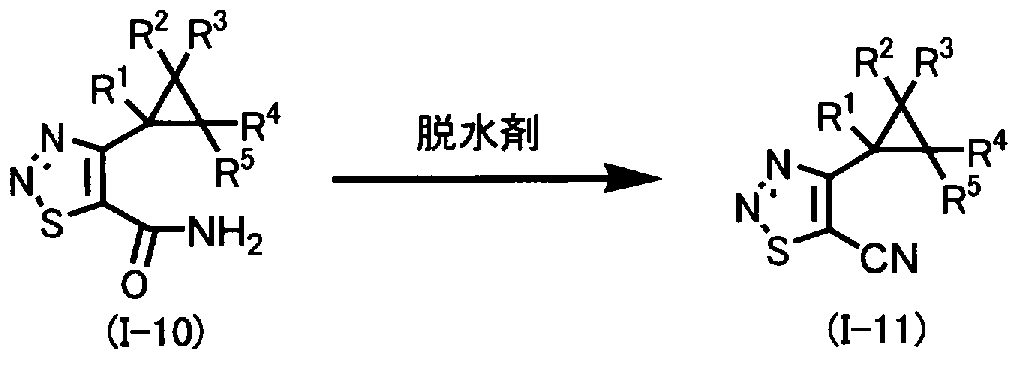
- Examples of the dehydrating agent that can be used in this reaction include acetic anhydride, trifluoroacetic anhydride, and other acid anhydrides, 1,3-dicyclohexylcarbodiimide, carpositimides such as 1,3-diisopropylcarbimide, phosphorus oxychloride, Examples thereof include phosphorus pentachloride and salt thiothionyl.
- the amount of the dehydrating agent may be appropriately selected from an equimolar to large excess with respect to the 1,2,3 thiadiazole carboxamide compound represented by the formula (1-10).
- the reaction temperature is usually from 0 ° C to 150 ° C, but it can be carried out in the range of the reflux temperature of the inert solvent used.
- the reaction time is not constant depending on the reaction scale, reaction temperature, etc. You can select as appropriate within the range.
- the desired product can be produced by isolating the desired product from the reaction system containing the desired product by a conventional method and purifying it by recrystallization, distillation, column chromatography, etc. as necessary. .
- the agricultural and horticultural plant disease control agent used in the present invention contains, as an active ingredient, a 4-cyclopropyl 1, 2, 3 thiadiazole compound represented by the formula (I) or a salt thereof. It can be used in combination with various compounds, for example, compounds having the bactericidal activity shown below, or in combination.
- Examples of the compounds exhibiting bactericidal activity include melanin synthesis inhibitors, stovillin-based bactericides, ergosterol biosynthesis inhibitors, acid amide-type bactericides, succinic acid synthase-inhibiting bactericides, asylalanin-type bactericides, Dicarboximide fungicide, benzimidazole
- bactericides such as rutile bactericides, dithiocarbamate bactericides, metal-containing bactericides, and antibiotics.
- filamentous fungal diseases includes filamentous fungal diseases, bacterial diseases, viral diseases, such as incomplete fungi (for example, Botrytis diseases, Hel minthosporium diseases, Fusarium ( Diseases of the genus Fusarium, diseases of the genus Septoria, diseases of the genus Cercospora, diseases of the genus Pseudocercosporella, diseases of the genus Rhynchosporium, diseases of the genus Pyricularia Disease), basidiomycetes (eg, Hemilelia disease, Rhizoctonia disease, Ustilago disease, Typhula disease, Pucdnia disease, etc.), child Aspergillus fungi (eg, Venturia spp., Podosphaera spp., Leptosphaeria spp., Blumeria disease, Erysiphe disease, Micr odochium disease, Sclerotinia disease, Gaeumann omyces disease, Monilinia
- the individual diseases include, for example, rice, rice blast (Pyricularia oryzae), rice blight (Rhizo ctonia solani), rice-less leaf blight (Cochiobolus miyabeanus), rice-free seedling (Rhizop) us chinensis, Pythium graminicola, Fusarium graminicola, Fusarium roseum, Mucor s p., Phoma sp., Tricoderma sp.), rice idiot (Gibberella! Ujikuroi), barley and wheat, etc.
- Powdery mildew (Blumeria graminis) or Powdery mildew such as cucumber (Sphaerotheca luli ginea), powdery mildew such as eggplant (Erysiphe cichoracoarum) and powdery mildew in other host plants , Barley and wheat, etc. (Pseudocercosporella herpotrichoides), wheat etc. Red, such as corn and wheat; 3 r Withering 3 (Gae umannomyces graminis), Ennok crown rust;) Puccinia coronata and other plant rust, cucumber, strawberry and other gray mold (Botrytis cinerea), tomato, cabbage, etc. Sclerotinia sclerotiorum, potato, tomato, etc. (Phytophthora infestans) and other plant plagues, cucumber and disease (Pseudoperonospora cubensis), grape mildew (Plas mopara viticola Downy mildew of various plants such as
- the plant that can use the plant disease control agent for agricultural and horticultural use of the present invention is not particularly limited, and examples thereof include the following plants.
- Cereals for example, rice, barley, wheat, rye, oats, corn, potatoes, etc.
- beans large Beans, red beans, broad beans, peas, peanuts, etc.
- fruits apples, citrus fruits, pears, grapes, peaches, plums, cherry peaches, tarmi, almonds, bananas, strawberries, etc.
- vegetables cabbage, tomatoes) , Nose, spinach, broccoli, lettuce, onion, leek, bell pepper, etc.), root vegetables (carrot, potato, sweet potato, radish, lotus root, turnip, etc.), crops for processing (cotton, hemp, cucumber, mitsumata, etc.)
- Rapeseed beet, hops, sugar cane, sugar beet, olives, rubber, coffee, tobacco, tea, etc.), moss (cabochia, cucumber, watermelon, melon, etc.), pastures (orchard grass, sorghum, timothy, clover, alfalf
- the plant and disease control agent for agricultural and horticultural use used in the method of use of the present invention is effective for controlling plant diseases as it is, or appropriately diluted with water or suspended in order to control various diseases. If the usual method is applied to the seeds of the target plant where the occurrence of the disease is predicted or the cultivation support for sowing, etc. It can be used in application methods such as seed disinfection, planting hole treatment, plant root treatment, rowing treatment, and soil mixing, and it can be used for diseases occurring in field crops such as fruit straw, cereals and vegetables. Seed treatment such as soaking, soaking of seedling roots, cropping during seeding, etc., irrigation of cultivation containers and planting holes for seedlings, raising seedling carriers, etc., surface spraying, post-irrigation, etc.
- a method of seed treatment for example, a method of immersing seeds in a liquid state by diluting or not diluting a liquid or solid preparation or infiltrating the drug, a solid preparation or liquid according to a usual method
- dispersed in the vicinity of a seed can be mention
- the “seed” to be treated with the seed is broadly synonymous with the “reproduction plant body” in the present invention.
- “Soil” or “cultivation carrier” in the case of carrying out the method of use of the present invention indicates a support for cultivating a plant, and the material is not particularly limited, but the material on which the plant can grow. If so, for example, it includes so-called various soils, seedling mats, water, etc., sand, vermiculite, cotton, paper, diatomaceous earth, agar, gel material, polymer material, rock wool, glass wool, wood Chips, bark, pumice, etc. can also be included.
- Examples of methods for applying to soil include a method of applying a liquid or solid preparation to or near a place for planting without diluting or diluting a liquid or solid preparation in water, or a granule to a plant.
- a method of spraying near the place of installation or nursery spraying powder, wettable powder, granule wettable powder, granule etc. before sowing or transplanting and mixing with the whole soil, before sowing or before planting plant
- Examples of methods include spraying powders, wettable powders, wettable powders of granules, granules, etc. in planting holes and crops.
- the dosage form may vary depending on the application time, such as application during sowing, greening period, application during transplantation, but agents such as powders, granule wettable powders, granules, etc. Apply with a mold. It can also be applied by mixing with soil, and it can be mixed with soil and powder, granulated wettable powder, granules, etc., for example, mixed with floor soil, mixed with cover soil, and mixed with the entire soil. Simply, the soil and various preparations may be applied alternately in layers. The time of sowing may be applied before sowing, at the same time, or after sowing and after covering.
- liquid irrigation treatment or granule spraying treatment to seedling nurseries is preferred.
- a granule is treated in a planting hole at the time of planting or mixed with a cultivation carrier in the vicinity of the transplantation site.
- the plant disease control agent for agriculture and horticulture used in the method of use of the present invention is a conventional method on an agrochemical formulation. Therefore, it is common to formulate and use in a convenient shape for use. That is, the 1,2,3-thiadiazole compound represented by the formula (I) or a salt thereof is added to an appropriate inert carrier, or if necessary, together with an auxiliary agent at an appropriate ratio. Combined, dissolved, separated, suspended, mixed, impregnated, adsorbed or adhered, and in appropriate dosage forms such as suspensions, emulsions, solutions, wettable powders, granules, powders, tablets, seed coatings, etc. May be formulated into a suspension or liquid suitable for treatment such as spraying, coating, and dipping.
- the inert carrier that can be used in the plant disease control agent for agriculture and horticulture used in the present invention may be either solid or liquid.
- the material that can be a solid carrier include soybean flour and cereal grains. Powder, wood powder, husk powder, saw powder, tobacco stem powder, tarmi shell powder, bran, fiber powder, residues after extraction of plant extracts, synthetic polymers such as ground synthetic resin, clays (e.g.
- kaolin kaolin, bentonite) , Acid clay, etc.
- talc eg talc, pyrophyllite, etc.
- silica eg diatomaceous earth, silica sand, mica, white carbon
- active ingredients Activated charcoal, iow powder, pumice, calcined diatomaceous earth, brick ground, fly ash, sand, calcium carbonate, calcium phosphate and other inorganic mineral powders
- Chemical fertilizers such as ammonium sulfate, phosphorous acid, ammonium nitrate, urea and ammonium salt, compost, etc. can be mentioned, and these are used alone or in the form of a mixture of two or more.
- a material that can be a liquid carrier in addition to those that have solvent ability per se, the ability to disperse the active ingredient compound with the aid of an auxiliary agent without having solvent ability is selected.
- the following carriers can be exemplified as typical examples, but these are used alone or in the form of a mixture of two or more thereof, such as water, alcohols (for example, methanol, ethanol, isopropanol, butanol, ethylene glycol, etc.
- Ketones eg, acetone, methyl ethyl ketone, methyl isobutyl ketone, diisobutyl ketone, cyclohexanone, etc.
- ethers eg, ethyl ether, dioxane, cellosolve, dipropyl ether, tetrahydrofuran, etc.
- fat Aromatic hydrocarbons eg kerosene, mineral oil
- aromatic hydrocarbons eg benzene, Toluene, xylene, solvent naphtha, Arukiruna Futaren etc.
- Harogeni ⁇ hydrogen such Jikuroroetan, black hole Holm, carbon tetrachloride, chlorinated benzene, etc.
- esters e.g.
- di isopropoxy pills phthalate di Butyl phthalate, dioctyl phthalate, etc.
- amides eg, dimethylformamide, jetylformamide, dimethylacetamide, etc.
- nitriles eg, acetonitrile, etc.
- dimethyl sulfoxides and the like.
- adjuvants typical adjuvants exemplified below can be mentioned, and these adjuvants are used depending on the purpose, and singly, in some cases, two or more kinds of adjuvants are used. It can be used in combination, or in some cases, no adjuvants can be used at all.
- Surfactants are used for emulsification, dispersion, solubilization and Z or wetting purposes of the active ingredient compounds, such as polyoxyethylene alkyl ethers, polyoxyethylene alkyl aryl ethers, polyoxyethylene higher fatty acid esters, polyoxy Interfaces such as ethylene succinate, polyoxyethylene sorbitan monolaurate, polyoxyethylene sorbitan monooleate, alkylaryl sulfonate, naphthalene sulfonic acid condensate, lignosulfonate, and higher alcohol sulfate An activator can be exemplified.
- auxiliary agents such as casein, gelatin, starch, methylcellulose, carboxymethylcellulose, gum arabic, Adjuvants such as polybulal alcohol, pine oil, coconut oil, bentonite and ligne sulfonate can also be used.
- the following adjuvants may be used, and for example, adjuvants such as waxes, stearates and alkyl phosphates may be used.
- adjuvants such as waxes, stearates and alkyl phosphates
- auxiliary agents such as naphthalene sulfonic acid condensate and condensed phosphate can be used.
- an antifoaming agent for example, an auxiliary agent such as silicone oil can be used.
- the plant disease control agent for agricultural and horticultural use used in the present invention further includes pests to be controlled, other agricultural and horticultural insecticides and acaricides for the purpose of expanding the appropriate period of control, or for the purpose of reducing dosage and synergistic effects.
- the plant disease control agent for agriculture and horticulture used in the method of use of the present invention may be mixed or used in combination with other components as necessary. For example, in seed treatment, birds and the like are used. Repellents and other ingredients may be included to avoid ingestion (including accidental ingestion) by certain animals.
- repellents include odorous compounds such as naphthalene compounds, contact inhibitors such as castor oil, pine resin, polybutane, diphenylamine dichloroamine, quinone, zinc oxide, aromatic solvents, N- (Trichloromethylthio) -4-cyclohexene-1,2,2-carboximide, anthraquinone, copper oxalate, terpene oil and other bitter substances, noradchlorobenzene, allyl isothiocyanate, amyl acetate, anethole, citrus oil, talesols, Herbal oils such as gelatin oil or lavender oil, menthol, methyl salicylate, nicotine, pentanethiol, pyridines, tributyltin chloride, thiram, diram, carbamate insecticides (eg metiocarp), guazatine, chlorinated Cyclogenic insecticides (eg endrin), organophosphorus insecticides (eg For example, f
- toxic substances or growth inhibitory substances include, for example, 3 — black mouth — 4 toluidine hydrochloride, strychnine, 20, 25 — diazacholesterol hydrochloride (code name: SC— 12937).
- the application amount of the plant disease control agent for agricultural and horticultural use used in the present invention is the combination ratio of the active ingredient-compound, weather conditions, formulation form, application time, application method, application place, disease to be controlled, Although it depends on the target crop, etc., as an ordinary spraying agent, it should be applied as an active ingredient compound with an appropriate amount of 0. lg ⁇ : LOOOg range power as appropriate, and preferably 1 ⁇ : LOOg. good.
- a range power of 0.001 to 40% by weight as an active ingredient compound per seed weight is usually selected as appropriate, and preferably applied in a range of 0.001 to 10% by weight.
- an active ingredient compound per in general, the range of 0.1 to: L000 g may be selected as appropriate, and the range of l to 50 g is preferable. Further, about 0.0001 to 10% by weight is preferable with respect to the weight of the cultivation support.
- the application concentration is 0.001 to 70% by weight as an active ingredient, and when treating granules, powders or seeds Such a liquid preparation may be applied as it is without diluting the preparation.
- Methyl cyclopropyl-1-oxopropionate (10 g, 70 mmol) was dissolved in methanol (100 ml). Methyl carbadate (6.3 g, 70 mmol) and p-toluenesulfonic acid (20 mg, 0. l lmol ) After stirring overnight at room temperature, methanol was distilled off under reduced pressure. Next, toluene (10 ml) was added and dissolved, and salt water (20 ml) was slowly added dropwise in an ice bath. After completion of the dropwise addition, the mixture was stirred at room temperature for 4 hours, and then poured into ice to stop the reaction, and neutralized with sodium hydrogen carbonate.
- the above is uniformly mixed, kneaded with an appropriate amount of water, granulated and dried to obtain granules.
- the above is uniformly mixed and ground to obtain a wettable powder.
- Test Example 1 Wheat powdery mildew control effect test by seed treatment
- Control value (%) (1 ⁇ Disease index in treated area ⁇ Disease index in untreated area ⁇ ) X 100
- Comparative compound I III and IV have the ability to show the control value of B in the treatment dose (active ingredient amount 0.15% of dry seed weight) .
- Comparative compound II has the control value of C. there were.
- Test Example 2 Wheat powdery mildew control effect test by seed treatment (long-term residual effect test) Wheat powder (variety: Chihoku Wheat) seeds and a wettable powder prepared according to the formulation example are put in a plastic bag and a small amount Of water was added and mixed well to perform dressing treatment. On the day after the treatment, the seeds were sown in a plastic pot having a diameter of 10 cm and then cultivated in a greenhouse.
- the above comparative compounds I, II, III and IV were evaluated.
- Comparative compound IV showed the control value of B at the treatment dose (active ingredient amount 0.15% of dry seed weight), but comparative compounds I, ⁇ and m showed the treatment dose (effective against dry seed weight). In the component amount (0.15%), the control value of D was shown, which was clearly inferior to the compound of the present invention.
- Test Example 3 Evaluation of phytotoxicity to wheat by seed treatment (Safety test for plants) Wheat (variety: Chihoku wheat) seeds and a wettable powder prepared according to the formulation example are placed in a plastic bag and a small amount of water is added. In addition, the mixture was well mixed and powdered. On the day after the treatment, the seeds were sown in a plastic pot having a diameter of 10 cm and then cultivated in a greenhouse. The phytotoxicity to seed germination and initial growth was evaluated 7 and 14 days after sowing. As a comparative example, Comparative Compound IV, which showed the control value of B in Test Example 2, was evaluated.
- the compound of the present invention which showed the control value of A in Test Example 2 1, 8, 1-11, 1-12, 1-24, 1-30, 1-44, 1-53, 1-63 1-95, 1-96, 1-98, 1110, 1119, 1-121 and 1-166 show no phytotoxicity at the treatment dose (0.15% active ingredient to dry seed weight). I helped.
- the compound of the present invention controls disease for a very long period from the growing season to the late stage of the plant only by applying it to the seed of the target plant or a carrier for sowing the target plant. It is an object. For this purpose, in addition to excellent control value, long-term residual effect and safety for the target plant are required.
- the compound of the present invention has all these elements. As is clear from Test Examples 1 to 3 above, the thiadiazole compound described in JP-A-2001-10909 has these elements. There is no.
- an agro-horticultural plant having not only excellent performance as compared with the prior art, particularly excellent safety and excellent control effect on the target plant, but also an extremely long-lasting residual effect. It is possible to provide a disease control agent and a more effective method of using the control agent.
Landscapes
- Chemical & Material Sciences (AREA)
- Organic Chemistry (AREA)
- Life Sciences & Earth Sciences (AREA)
- Agronomy & Crop Science (AREA)
- Pest Control & Pesticides (AREA)
- Plant Pathology (AREA)
- Health & Medical Sciences (AREA)
- Engineering & Computer Science (AREA)
- Dentistry (AREA)
- General Health & Medical Sciences (AREA)
- Wood Science & Technology (AREA)
- Zoology (AREA)
- Environmental Sciences (AREA)
- Agricultural Chemicals And Associated Chemicals (AREA)
- Plural Heterocyclic Compounds (AREA)
- Nitrogen- Or Sulfur-Containing Heterocyclic Ring Compounds With Rings Of Six Or More Members (AREA)
Abstract
Description




Claims


Priority Applications (12)
| Application Number | Priority Date | Filing Date | Title |
|---|---|---|---|
| BRPI0608197-5A BRPI0608197A2 (pt) | 2005-02-24 | 2006-02-23 | composto 4-ciclopropil-1,2,3-tiadiazol, agente de controle de doença de planta agro-horticultural e método de uso do mesmo |
| PL06714453T PL1852428T3 (pl) | 2005-02-24 | 2006-02-23 | Związek 4-cyklopropylo-1,2,3-tiadiazolowy, środek do zwalczania chorób roślin w rolnictwie i ogrodnictwie oraz sposób stosowania go |
| EP06714453A EP1852428B1 (en) | 2005-02-24 | 2006-02-23 | 4-cyclopropyl-1,2,3-thiadiazole compound, agrohorticultural plant disease controlling agent and method of using the same |
| ZA200707353A ZA200707353B (en) | 2005-02-24 | 2006-02-23 | 4-cyclopropyl-1,2,3-thiadiazole compound, agrohorticultural plant disease controlling agent and method of using the same |
| CN2006800059992A CN101128445B (zh) | 2005-02-24 | 2006-02-23 | 4-环丙基-1,2,3-噻二唑化合物,用于农业和园艺用途的植物病害控制剂和其使用方法 |
| US11/817,082 US7786040B2 (en) | 2005-02-24 | 2006-02-23 | 4-cyclopropyl-1,2,3,-thiadiazole compound, agrohorticultural plant disease controlling agent and method of using the same |
| DK06714453.5T DK1852428T3 (da) | 2005-02-24 | 2006-02-23 | 4-Cyclopropyl-1,2,3-thiadiazolforbindelse, landbrugs- og gartneriplantesygdomskontrolmiddelog fremgangsmåde til anvendelse deraf |
| EA200701788A EA013120B1 (ru) | 2005-02-24 | 2006-02-23 | Соединение 4-циклопропил-1,2,3-тиадиазола, агент для борьбы с болезнями растений для применения в сельском и садоводческом хозяйстве и метод его применения |
| KR1020077019190A KR101206317B1 (ko) | 2005-02-24 | 2006-02-23 | 4-시클로프로필-1,2,3-티아디아졸 화합물 및 농원예용 식물병해 방제제 그리고 그 사용 방법 |
| NO20074296A NO20074296L (no) | 2005-02-24 | 2007-08-22 | 4-cyklopropyl-1,2,3-tiadiazolforbindelse, agrohortikulturelt plantesykdoms-kontrollmiddel og fremgangsmate for anvendelse av det samme |
| EGNA2007000890 EG25201A (en) | 2005-02-24 | 2007-08-22 | 4-cyclopropyl-1,2,3- thiadiazole compound, agrohorticultural plant disease controlling agent and method of using the same |
| IL185438A IL185438A (en) | 2005-02-24 | 2007-08-22 | 4-cyclopropyl-1,2,3-thiadiazole compound, agrohorticultural plant disease controlling agent and method of using the same |
Applications Claiming Priority (4)
| Application Number | Priority Date | Filing Date | Title |
|---|---|---|---|
| JP2005049431 | 2005-02-24 | ||
| JP2005-049431 | 2005-02-24 | ||
| JP2005-263617 | 2005-09-12 | ||
| JP2005263617 | 2005-09-12 |
Publications (1)
| Publication Number | Publication Date |
|---|---|
| WO2006098128A1 true WO2006098128A1 (ja) | 2006-09-21 |
Family
ID=36991481
Family Applications (1)
| Application Number | Title | Priority Date | Filing Date |
|---|---|---|---|
| PCT/JP2006/303313 Ceased WO2006098128A1 (ja) | 2005-02-24 | 2006-02-23 | 4-シクロプロピル-1,2,3-チアジアゾール化合物及び農園芸用植物病害防除剤並びにその使用方法 |
Country Status (17)
| Country | Link |
|---|---|
| US (1) | US7786040B2 (ja) |
| EP (1) | EP1852428B1 (ja) |
| JP (1) | JP5136737B2 (ja) |
| KR (1) | KR101206317B1 (ja) |
| CN (1) | CN101128445B (ja) |
| BR (1) | BRPI0608197A2 (ja) |
| DK (1) | DK1852428T3 (ja) |
| EA (1) | EA013120B1 (ja) |
| EG (1) | EG25201A (ja) |
| IL (1) | IL185438A (ja) |
| IN (1) | IN2007DE06508A (ja) |
| MA (1) | MA29328B1 (ja) |
| NO (1) | NO20074296L (ja) |
| PL (1) | PL1852428T3 (ja) |
| TW (1) | TWI376372B (ja) |
| WO (1) | WO2006098128A1 (ja) |
| ZA (1) | ZA200707353B (ja) |
Cited By (21)
| Publication number | Priority date | Publication date | Assignee | Title |
|---|---|---|---|---|
| DE102006026106A1 (de) * | 2006-05-11 | 2007-11-15 | Isp Biochema Schwaben Gmbh | Flüssiges Konzentrat für die Filmkonservierung |
| WO2009016219A1 (en) | 2007-07-31 | 2009-02-05 | Bayer Cropscience Sa | Fungicide 2-pyridyl-methylene-thio carboxamide or 2-pyridyl-methylene-n-substituted carboximidamide derivatives |
| WO2010055909A1 (ja) * | 2008-11-14 | 2010-05-20 | 日本農薬株式会社 | 農園芸用病害虫防除剤組成物 |
| WO2010089055A2 (de) | 2009-02-03 | 2010-08-12 | Bayer Cropscience Ag | Verwendung von schwefelhaltigen, heteroaromatische säureanaloga als bakterizide |
| EP2239331A1 (en) | 2009-04-07 | 2010-10-13 | Bayer CropScience AG | Method for improved utilization of the production potential of transgenic plants |
| JP2010536761A (ja) * | 2007-08-15 | 2010-12-02 | プレジデント アンド フェロウズ オブ ハーバード カレッジ | ネクロトーシスのヘテロ環式抑制剤 |
| US8410157B2 (en) | 2007-07-31 | 2013-04-02 | Bayer Cropscience Ag | Fungicidal N-cycloalkyl-benzyl-thiocarboxamides or N-cycloalkyl-benzyl-N′-substituted-amidine derivatives |
| WO2014095826A1 (en) | 2012-12-18 | 2014-06-26 | Bayer Cropscience Ag | Binary fungicidal and bactericidal combinations |
| WO2016174042A1 (en) | 2015-04-27 | 2016-11-03 | BASF Agro B.V. | Pesticidal compositions |
| US9725452B2 (en) | 2013-03-15 | 2017-08-08 | Presidents And Fellows Of Harvard College | Substituted indoles and pyrroles as RIP kinase inhibitors |
| EP3202267A1 (en) | 2016-02-05 | 2017-08-09 | Basf Se | Pesticidal mixtures |
| WO2017153200A1 (en) | 2016-03-10 | 2017-09-14 | Basf Se | Fungicidal mixtures iii comprising strobilurin-type fungicides |
| WO2017178407A1 (en) | 2016-04-13 | 2017-10-19 | Bayer Cropscience Aktiengesellschaft | Fungicidal combinations |
| WO2018116073A1 (en) | 2016-12-21 | 2018-06-28 | Pi Industries Ltd. | 1, 2, 3-thiadiazole compounds and their use as crop protecting agent |
| WO2019057661A1 (en) | 2017-09-19 | 2019-03-28 | Bayer Aktiengesellschaft | USE OF ISOTIANIL AGAINST PANAMA'S DISEASE |
| WO2021259761A1 (en) | 2020-06-25 | 2021-12-30 | Bayer Aktiengesellschaft | Use of isotianil against fungal diseases in grapevines and fruit crops |
| WO2024104643A1 (en) | 2022-11-17 | 2024-05-23 | Bayer Aktiengesellschaft | Use of isotianil for controlling plasmodiophora brassica |
| US12030875B2 (en) | 2018-09-07 | 2024-07-09 | PIC Therapeutics, Inc. | EIF4E inhibitors and uses thereof |
| US12157731B2 (en) | 2020-03-03 | 2024-12-03 | PIC Therapeutics, Inc. | EIF4E inhibitors and uses thereof |
| US12157732B2 (en) | 2021-08-25 | 2024-12-03 | PIC Therapeutics, Inc. | eIF4E inhibitors and uses thereof |
| US12234231B2 (en) | 2021-08-25 | 2025-02-25 | PIC Therapeutics, Inc. | EIF4E inhibitors and uses thereof |
Families Citing this family (13)
| Publication number | Priority date | Publication date | Assignee | Title |
|---|---|---|---|---|
| EP1787981A1 (en) * | 2005-11-22 | 2007-05-23 | Bayer CropScience S.A. | New N-phenethylcarboxamide derivatives |
| AR056882A1 (es) * | 2006-02-01 | 2007-10-31 | Bayer Cropscience Sa | Derivados del fungicida n- cicloalquil- bencil- amida |
| CN101597278B (zh) | 2008-06-04 | 2013-04-17 | 中国中化股份有限公司 | 酰胺类化合物及其制备与应用 |
| CN102238874B (zh) * | 2008-10-02 | 2015-02-18 | 拜尔农作物科学股份公司 | 含硫杂芳香酸类似物的用途 |
| WO2010058830A1 (ja) * | 2008-11-21 | 2010-05-27 | 日本農薬株式会社 | 農園芸用植物の病害防除方法 |
| TWI489942B (zh) | 2008-12-19 | 2015-07-01 | Bayer Cropscience Ag | 活性化合物組合物 |
| DE102011017541A1 (de) | 2010-04-29 | 2011-11-10 | Basf Se | Synergistische fungizide Mischungen |
| DE102011017669A1 (de) | 2010-04-29 | 2011-11-03 | Basf Se | Synergistische fungizide Mischungen |
| DE102011017715A1 (de) | 2010-04-29 | 2012-03-08 | Basf Se | Synergistische fungizide Mischungen |
| DE102011017670A1 (de) | 2010-04-29 | 2011-11-03 | Basf Se | Synergistische fungizide Mischungen |
| DE102011017716A1 (de) | 2010-04-29 | 2011-11-03 | Basf Se | Synergistische fungizide Mischungen |
| WO2016026830A1 (en) * | 2014-08-21 | 2016-02-25 | Bayer Cropscience Aktiengesellschaft | Novel fungicidal pyrazole derivatives |
| CN110845436A (zh) * | 2019-11-18 | 2020-02-28 | 合肥锦绣田园化工科技有限公司 | 一种噻唑砜类化合物及其制备与应用 |
Citations (12)
| Publication number | Priority date | Publication date | Assignee | Title |
|---|---|---|---|---|
| JPH08325110A (ja) | 1995-03-31 | 1996-12-10 | Nippon Nohyaku Co Ltd | 農園芸用病害防除剤及びその使用方法 |
| WO1997020465A1 (de) | 1995-12-07 | 1997-06-12 | Bayer Aktiengesellschaft | Verwendung von 1,2,3-thiadiazolcarbonsäure(thio)estern zur bekämpfung von schädlingen sowie neue 1,2,3-thiadiazolcarbonsäure(thio)ester |
| WO1997020840A1 (de) | 1995-12-07 | 1997-06-12 | Bayer Aktiengesellschaft | 1,2,3-thiadiazolcarbonsäure(thio)ester und ihre verwendung als schädlingsbekämpfungsmittel oder als mikrobizide |
| JPH10152482A (ja) * | 1996-09-30 | 1998-06-09 | Nippon Nohyaku Co Ltd | 1,2,3−チアジアゾール誘導体又はその塩類及び農園芸用病害防除剤ならびにその使用方法 |
| EP0930305A1 (en) | 1996-09-30 | 1999-07-21 | Nihon Nohyaku Co., Ltd. | 1,2,3-thiadiazole derivatives and salts thereof, disease controlling agents for agricultural and horticultural use, and method for the use thereof |
| EP0976326A1 (en) | 1998-07-30 | 2000-02-02 | Nihon Nohyaku Co., Ltd. | Fungicidal composition containing a 1,2,3-tiadiazole derivative and its use |
| JP2000103710A (ja) * | 1998-07-30 | 2000-04-11 | Nippon Nohyaku Co Ltd | 殺菌剤組成物及びその使用方法 |
| JP2000169461A (ja) | 1998-09-28 | 2000-06-20 | Nippon Nohyaku Co Ltd | 殺虫殺菌剤組成物及びその使用方法 |
| JP2001010909A (ja) | 1999-04-30 | 2001-01-16 | Nippon Nohyaku Co Ltd | 殺菌剤組成物の使用方法。 |
| JP2001139566A (ja) | 1999-11-16 | 2001-05-22 | Nippon Nohyaku Co Ltd | 有害生物防除剤及びその使用方法 |
| JP2005049431A (ja) | 2003-07-30 | 2005-02-24 | Ricoh Co Ltd | トナー搬送装置及び画像形成装置 |
| JP2005263617A (ja) | 2004-02-16 | 2005-09-29 | Mitsubishi Chemicals Corp | フラーレン類表面修飾基材及びその製造方法 |
Family Cites Families (1)
| Publication number | Priority date | Publication date | Assignee | Title |
|---|---|---|---|---|
| US6166054A (en) * | 1995-03-31 | 2000-12-26 | Nihon Nohyaku Co., Ltd. | Agricultural and horticultural disease controller and a method for controlling the diseases |
-
2006
- 2006-02-23 ZA ZA200707353A patent/ZA200707353B/xx unknown
- 2006-02-23 EA EA200701788A patent/EA013120B1/ru not_active IP Right Cessation
- 2006-02-23 PL PL06714453T patent/PL1852428T3/pl unknown
- 2006-02-23 KR KR1020077019190A patent/KR101206317B1/ko not_active Expired - Fee Related
- 2006-02-23 BR BRPI0608197-5A patent/BRPI0608197A2/pt not_active Application Discontinuation
- 2006-02-23 WO PCT/JP2006/303313 patent/WO2006098128A1/ja not_active Ceased
- 2006-02-23 DK DK06714453.5T patent/DK1852428T3/da active
- 2006-02-23 US US11/817,082 patent/US7786040B2/en not_active Expired - Fee Related
- 2006-02-23 EP EP06714453A patent/EP1852428B1/en not_active Expired - Lifetime
- 2006-02-23 TW TW095106014A patent/TWI376372B/zh active
- 2006-02-23 CN CN2006800059992A patent/CN101128445B/zh not_active Expired - Fee Related
- 2006-02-24 JP JP2006048890A patent/JP5136737B2/ja not_active Expired - Fee Related
-
2007
- 2007-08-22 NO NO20074296A patent/NO20074296L/no not_active Application Discontinuation
- 2007-08-22 IN IN6508DE2007 patent/IN2007DE06508A/en unknown
- 2007-08-22 IL IL185438A patent/IL185438A/en not_active IP Right Cessation
- 2007-08-22 EG EGNA2007000890 patent/EG25201A/xx active
- 2007-09-11 MA MA30213A patent/MA29328B1/fr unknown
Patent Citations (14)
| Publication number | Priority date | Publication date | Assignee | Title |
|---|---|---|---|---|
| JPH08325110A (ja) | 1995-03-31 | 1996-12-10 | Nippon Nohyaku Co Ltd | 農園芸用病害防除剤及びその使用方法 |
| JP2000501400A (ja) * | 1995-12-07 | 2000-02-08 | バイエル・アクチエンゲゼルシヤフト | 1,2,3―チアジアゾールカルボン酸(チオ)エステルおよび有害生物防除剤または殺微生物剤としてのそれらの使用 |
| WO1997020465A1 (de) | 1995-12-07 | 1997-06-12 | Bayer Aktiengesellschaft | Verwendung von 1,2,3-thiadiazolcarbonsäure(thio)estern zur bekämpfung von schädlingen sowie neue 1,2,3-thiadiazolcarbonsäure(thio)ester |
| WO1997020840A1 (de) | 1995-12-07 | 1997-06-12 | Bayer Aktiengesellschaft | 1,2,3-thiadiazolcarbonsäure(thio)ester und ihre verwendung als schädlingsbekämpfungsmittel oder als mikrobizide |
| JP2000501102A (ja) * | 1995-12-07 | 2000-02-02 | バイエル・アクチエンゲゼルシヤフト | 有害生物防除のため1,2,3―チアジアゾールカルボン酸(チオ)エステルの使用および新規な1,2,3―チアジアゾールカルボン酸(チオ)エステル |
| JPH10152482A (ja) * | 1996-09-30 | 1998-06-09 | Nippon Nohyaku Co Ltd | 1,2,3−チアジアゾール誘導体又はその塩類及び農園芸用病害防除剤ならびにその使用方法 |
| EP0930305A1 (en) | 1996-09-30 | 1999-07-21 | Nihon Nohyaku Co., Ltd. | 1,2,3-thiadiazole derivatives and salts thereof, disease controlling agents for agricultural and horticultural use, and method for the use thereof |
| EP0976326A1 (en) | 1998-07-30 | 2000-02-02 | Nihon Nohyaku Co., Ltd. | Fungicidal composition containing a 1,2,3-tiadiazole derivative and its use |
| JP2000103710A (ja) * | 1998-07-30 | 2000-04-11 | Nippon Nohyaku Co Ltd | 殺菌剤組成物及びその使用方法 |
| JP2000169461A (ja) | 1998-09-28 | 2000-06-20 | Nippon Nohyaku Co Ltd | 殺虫殺菌剤組成物及びその使用方法 |
| JP2001010909A (ja) | 1999-04-30 | 2001-01-16 | Nippon Nohyaku Co Ltd | 殺菌剤組成物の使用方法。 |
| JP2001139566A (ja) | 1999-11-16 | 2001-05-22 | Nippon Nohyaku Co Ltd | 有害生物防除剤及びその使用方法 |
| JP2005049431A (ja) | 2003-07-30 | 2005-02-24 | Ricoh Co Ltd | トナー搬送装置及び画像形成装置 |
| JP2005263617A (ja) | 2004-02-16 | 2005-09-29 | Mitsubishi Chemicals Corp | フラーレン類表面修飾基材及びその製造方法 |
Non-Patent Citations (1)
| Title |
|---|
| See also references of EP1852428A4 |
Cited By (23)
| Publication number | Priority date | Publication date | Assignee | Title |
|---|---|---|---|---|
| DE102006026106A1 (de) * | 2006-05-11 | 2007-11-15 | Isp Biochema Schwaben Gmbh | Flüssiges Konzentrat für die Filmkonservierung |
| WO2009016219A1 (en) | 2007-07-31 | 2009-02-05 | Bayer Cropscience Sa | Fungicide 2-pyridyl-methylene-thio carboxamide or 2-pyridyl-methylene-n-substituted carboximidamide derivatives |
| US8410157B2 (en) | 2007-07-31 | 2013-04-02 | Bayer Cropscience Ag | Fungicidal N-cycloalkyl-benzyl-thiocarboxamides or N-cycloalkyl-benzyl-N′-substituted-amidine derivatives |
| JP2010536761A (ja) * | 2007-08-15 | 2010-12-02 | プレジデント アンド フェロウズ オブ ハーバード カレッジ | ネクロトーシスのヘテロ環式抑制剤 |
| US8658689B2 (en) | 2007-08-15 | 2014-02-25 | President And Fellows Of Harvard College | Heterocyclic inhibitors of necroptosis |
| US9108955B2 (en) | 2007-08-15 | 2015-08-18 | President And Fellows Of Harvard College | Heterocyclic inhibitors of necroptosis |
| WO2010055909A1 (ja) * | 2008-11-14 | 2010-05-20 | 日本農薬株式会社 | 農園芸用病害虫防除剤組成物 |
| WO2010089055A2 (de) | 2009-02-03 | 2010-08-12 | Bayer Cropscience Ag | Verwendung von schwefelhaltigen, heteroaromatische säureanaloga als bakterizide |
| EP2239331A1 (en) | 2009-04-07 | 2010-10-13 | Bayer CropScience AG | Method for improved utilization of the production potential of transgenic plants |
| WO2014095826A1 (en) | 2012-12-18 | 2014-06-26 | Bayer Cropscience Ag | Binary fungicidal and bactericidal combinations |
| US9725452B2 (en) | 2013-03-15 | 2017-08-08 | Presidents And Fellows Of Harvard College | Substituted indoles and pyrroles as RIP kinase inhibitors |
| WO2016174042A1 (en) | 2015-04-27 | 2016-11-03 | BASF Agro B.V. | Pesticidal compositions |
| EP3202267A1 (en) | 2016-02-05 | 2017-08-09 | Basf Se | Pesticidal mixtures |
| WO2017153200A1 (en) | 2016-03-10 | 2017-09-14 | Basf Se | Fungicidal mixtures iii comprising strobilurin-type fungicides |
| WO2017178407A1 (en) | 2016-04-13 | 2017-10-19 | Bayer Cropscience Aktiengesellschaft | Fungicidal combinations |
| WO2018116073A1 (en) | 2016-12-21 | 2018-06-28 | Pi Industries Ltd. | 1, 2, 3-thiadiazole compounds and their use as crop protecting agent |
| WO2019057661A1 (en) | 2017-09-19 | 2019-03-28 | Bayer Aktiengesellschaft | USE OF ISOTIANIL AGAINST PANAMA'S DISEASE |
| US12030875B2 (en) | 2018-09-07 | 2024-07-09 | PIC Therapeutics, Inc. | EIF4E inhibitors and uses thereof |
| US12157731B2 (en) | 2020-03-03 | 2024-12-03 | PIC Therapeutics, Inc. | EIF4E inhibitors and uses thereof |
| WO2021259761A1 (en) | 2020-06-25 | 2021-12-30 | Bayer Aktiengesellschaft | Use of isotianil against fungal diseases in grapevines and fruit crops |
| US12157732B2 (en) | 2021-08-25 | 2024-12-03 | PIC Therapeutics, Inc. | eIF4E inhibitors and uses thereof |
| US12234231B2 (en) | 2021-08-25 | 2025-02-25 | PIC Therapeutics, Inc. | EIF4E inhibitors and uses thereof |
| WO2024104643A1 (en) | 2022-11-17 | 2024-05-23 | Bayer Aktiengesellschaft | Use of isotianil for controlling plasmodiophora brassica |
Also Published As
| Publication number | Publication date |
|---|---|
| ZA200707353B (en) | 2009-03-25 |
| EP1852428B1 (en) | 2012-05-16 |
| EA200701788A1 (ru) | 2008-02-28 |
| IN2007DE06508A (ja) | 2007-09-07 |
| IL185438A (en) | 2013-03-24 |
| DK1852428T3 (da) | 2012-08-06 |
| EG25201A (en) | 2011-11-14 |
| TW200640889A (en) | 2006-12-01 |
| JP5136737B2 (ja) | 2013-02-06 |
| KR101206317B1 (ko) | 2012-11-29 |
| EP1852428A4 (en) | 2010-01-06 |
| KR20070106732A (ko) | 2007-11-05 |
| BRPI0608197A2 (pt) | 2009-12-01 |
| NO20074296L (no) | 2007-11-26 |
| US7786040B2 (en) | 2010-08-31 |
| JP2007099749A (ja) | 2007-04-19 |
| TWI376372B (en) | 2012-11-11 |
| IL185438A0 (en) | 2008-01-06 |
| EP1852428A1 (en) | 2007-11-07 |
| EA013120B1 (ru) | 2010-02-26 |
| CN101128445A (zh) | 2008-02-20 |
| US20080200457A1 (en) | 2008-08-21 |
| MA29328B1 (fr) | 2008-03-03 |
| PL1852428T3 (pl) | 2012-10-31 |
| CN101128445B (zh) | 2012-01-18 |
Similar Documents
| Publication | Publication Date | Title |
|---|---|---|
| WO2006098128A1 (ja) | 4-シクロプロピル-1,2,3-チアジアゾール化合物及び農園芸用植物病害防除剤並びにその使用方法 | |
| KR101067805B1 (ko) | N-2-(헤테로)아릴에틸카르복사미드 유도체 및 이것을 함유하는 유해 생물 방제제 | |
| ES2315392T3 (es) | Derivado de tetrazoiloxima y producto agroquimico que contiene el mismo como ingrediente activo. | |
| JPH04288005A (ja) | 複素環置換スルホン類を基材とした殺菌殺カビ剤 | |
| JPH06199795A (ja) | ピリジロキシ−アクリル酸エステル | |
| WO2010058830A1 (ja) | 農園芸用植物の病害防除方法 | |
| WO1995032182A1 (en) | 2-(substituted phenyl)-2-alkoxyimino-n-alkylacetamide compound and bactericide containing the same | |
| JP2000103710A (ja) | 殺菌剤組成物及びその使用方法 | |
| US5248683A (en) | Benzo-1,2,3-thiadiazole derivatives | |
| JPH01283271A (ja) | アシル化尿素誘導体及び該化合物を含有する微生物の感染から植物を保護するための製剤 | |
| JP2007254317A (ja) | 増収剤及びその使用方法 | |
| CN103242308A (zh) | 2-氟烟酰衍生物及其制备方法和其应用 | |
| WO1999023084A1 (en) | Thiadiazole carboxamide derivative, plant disease controlling agent, and method of using the same | |
| JP2001172270A (ja) | 5−カルボキサニリド−2,4−ビス−トリフルオロメチル−チアゾール | |
| JPS59164773A (ja) | 置換マレイミド類、その製法及び利用 | |
| JP2552846B2 (ja) | 置換チアゾールカルボン酸誘導体およびそれを有効成分とする農園芸用殺菌剤 | |
| JP3023607B2 (ja) | チアジアゾールカルボキサミド誘導体及び植物病害防除剤並びにその使用方法 | |
| JP2001010909A (ja) | 殺菌剤組成物の使用方法。 | |
| JP2638966B2 (ja) | 置換チアゾールカルボン酸誘導体およびそれを有効成分とする農園芸用殺菌剤 | |
| JP3086316B2 (ja) | フェニルカーバメート誘導体、その製造法及び該誘導体を有効成分とする農園芸用殺菌剤 | |
| WO2000065914A1 (fr) | Procede d'utilisation de composition bactericide | |
| JPH051068A (ja) | ベンズイミダゾール誘導体、その製造法およびそれを有効成分とする農園芸用殺菌剤 | |
| JPH04178363A (ja) | 尿素誘導体及びそれを含有する有害生物防除剤 | |
| JPS6256464A (ja) | N−スルフエニル化されたベンゼンスルホン酸アミド類 | |
| JPH01250379A (ja) | アミド誘導体、その製造法およびそれを有効成分とする農園芸用殺菌剤 |
Legal Events
| Date | Code | Title | Description |
|---|---|---|---|
| 121 | Ep: the epo has been informed by wipo that ep was designated in this application | ||
| WWE | Wipo information: entry into national phase |
Ref document number: 1200701352 Country of ref document: VN |
|
| WWE | Wipo information: entry into national phase |
Ref document number: 185438 Country of ref document: IL Ref document number: 6508/DELNP/2007 Country of ref document: IN Ref document number: 1020077019190 Country of ref document: KR |
|
| WWE | Wipo information: entry into national phase |
Ref document number: 2006714453 Country of ref document: EP |
|
| WWE | Wipo information: entry into national phase |
Ref document number: 200680005999.2 Country of ref document: CN Ref document number: 11817082 Country of ref document: US |
|
| NENP | Non-entry into the national phase |
Ref country code: DE |
|
| WWE | Wipo information: entry into national phase |
Ref document number: 200701788 Country of ref document: EA |
|
| WWP | Wipo information: published in national office |
Ref document number: 2006714453 Country of ref document: EP |
|
| ENP | Entry into the national phase |
Ref document number: PI0608197 Country of ref document: BR Kind code of ref document: A2 |