US6117775A - Polishing method - Google Patents
Polishing method Download PDFInfo
- Publication number
- US6117775A US6117775A US09/182,438 US18243898A US6117775A US 6117775 A US6117775 A US 6117775A US 18243898 A US18243898 A US 18243898A US 6117775 A US6117775 A US 6117775A
- Authority
- US
- United States
- Prior art keywords
- polishing
- metal film
- solution
- abrasive
- cmp
- Prior art date
- Legal status (The legal status is an assumption and is not a legal conclusion. Google has not performed a legal analysis and makes no representation as to the accuracy of the status listed.)
- Expired - Lifetime
Links
Images




Classifications
-
- C—CHEMISTRY; METALLURGY
- C23—COATING METALLIC MATERIAL; COATING MATERIAL WITH METALLIC MATERIAL; CHEMICAL SURFACE TREATMENT; DIFFUSION TREATMENT OF METALLIC MATERIAL; COATING BY VACUUM EVAPORATION, BY SPUTTERING, BY ION IMPLANTATION OR BY CHEMICAL VAPOUR DEPOSITION, IN GENERAL; INHIBITING CORROSION OF METALLIC MATERIAL OR INCRUSTATION IN GENERAL
- C23F—NON-MECHANICAL REMOVAL OF METALLIC MATERIAL FROM SURFACE; INHIBITING CORROSION OF METALLIC MATERIAL OR INCRUSTATION IN GENERAL; MULTI-STEP PROCESSES FOR SURFACE TREATMENT OF METALLIC MATERIAL INVOLVING AT LEAST ONE PROCESS PROVIDED FOR IN CLASS C23 AND AT LEAST ONE PROCESS COVERED BY SUBCLASS C21D OR C22F OR CLASS C25
- C23F3/00—Brightening metals by chemical means
- C23F3/04—Heavy metals
- C23F3/06—Heavy metals with acidic solutions
-
- H—ELECTRICITY
- H01—ELECTRIC ELEMENTS
- H01L—SEMICONDUCTOR DEVICES NOT COVERED BY CLASS H10
- H01L21/00—Processes or apparatus adapted for the manufacture or treatment of semiconductor or solid state devices or of parts thereof
- H01L21/02—Manufacture or treatment of semiconductor devices or of parts thereof
- H01L21/04—Manufacture or treatment of semiconductor devices or of parts thereof the devices having potential barriers, e.g. a PN junction, depletion layer or carrier concentration layer
- H01L21/18—Manufacture or treatment of semiconductor devices or of parts thereof the devices having potential barriers, e.g. a PN junction, depletion layer or carrier concentration layer the devices having semiconductor bodies comprising elements of Group IV of the Periodic Table or AIIIBV compounds with or without impurities, e.g. doping materials
- H01L21/30—Treatment of semiconductor bodies using processes or apparatus not provided for in groups H01L21/20 - H01L21/26
- H01L21/302—Treatment of semiconductor bodies using processes or apparatus not provided for in groups H01L21/20 - H01L21/26 to change their surface-physical characteristics or shape, e.g. etching, polishing, cutting
-
- B—PERFORMING OPERATIONS; TRANSPORTING
- B24—GRINDING; POLISHING
- B24B—MACHINES, DEVICES, OR PROCESSES FOR GRINDING OR POLISHING; DRESSING OR CONDITIONING OF ABRADING SURFACES; FEEDING OF GRINDING, POLISHING, OR LAPPING AGENTS
- B24B37/00—Lapping machines or devices; Accessories
- B24B37/04—Lapping machines or devices; Accessories designed for working plane surfaces
-
- C—CHEMISTRY; METALLURGY
- C09—DYES; PAINTS; POLISHES; NATURAL RESINS; ADHESIVES; COMPOSITIONS NOT OTHERWISE PROVIDED FOR; APPLICATIONS OF MATERIALS NOT OTHERWISE PROVIDED FOR
- C09G—POLISHING COMPOSITIONS; SKI WAXES
- C09G1/00—Polishing compositions
- C09G1/02—Polishing compositions containing abrasives or grinding agents
-
- C—CHEMISTRY; METALLURGY
- C09—DYES; PAINTS; POLISHES; NATURAL RESINS; ADHESIVES; COMPOSITIONS NOT OTHERWISE PROVIDED FOR; APPLICATIONS OF MATERIALS NOT OTHERWISE PROVIDED FOR
- C09K—MATERIALS FOR MISCELLANEOUS APPLICATIONS, NOT PROVIDED FOR ELSEWHERE
- C09K3/00—Materials not provided for elsewhere
- C09K3/14—Anti-slip materials; Abrasives
- C09K3/1454—Abrasive powders, suspensions and pastes for polishing
- C09K3/1463—Aqueous liquid suspensions
-
- H—ELECTRICITY
- H01—ELECTRIC ELEMENTS
- H01L—SEMICONDUCTOR DEVICES NOT COVERED BY CLASS H10
- H01L21/00—Processes or apparatus adapted for the manufacture or treatment of semiconductor or solid state devices or of parts thereof
- H01L21/02—Manufacture or treatment of semiconductor devices or of parts thereof
- H01L21/02041—Cleaning
- H01L21/02057—Cleaning during device manufacture
- H01L21/02068—Cleaning during device manufacture during, before or after processing of conductive layers, e.g. polysilicon or amorphous silicon layers
- H01L21/02074—Cleaning during device manufacture during, before or after processing of conductive layers, e.g. polysilicon or amorphous silicon layers the processing being a planarization of conductive layers
-
- H—ELECTRICITY
- H01—ELECTRIC ELEMENTS
- H01L—SEMICONDUCTOR DEVICES NOT COVERED BY CLASS H10
- H01L21/00—Processes or apparatus adapted for the manufacture or treatment of semiconductor or solid state devices or of parts thereof
- H01L21/02—Manufacture or treatment of semiconductor devices or of parts thereof
- H01L21/04—Manufacture or treatment of semiconductor devices or of parts thereof the devices having potential barriers, e.g. a PN junction, depletion layer or carrier concentration layer
- H01L21/18—Manufacture or treatment of semiconductor devices or of parts thereof the devices having potential barriers, e.g. a PN junction, depletion layer or carrier concentration layer the devices having semiconductor bodies comprising elements of Group IV of the Periodic Table or AIIIBV compounds with or without impurities, e.g. doping materials
- H01L21/30—Treatment of semiconductor bodies using processes or apparatus not provided for in groups H01L21/20 - H01L21/26
- H01L21/31—Treatment of semiconductor bodies using processes or apparatus not provided for in groups H01L21/20 - H01L21/26 to form insulating layers thereon, e.g. for masking or by using photolithographic techniques; After treatment of these layers; Selection of materials for these layers
- H01L21/3205—Deposition of non-insulating-, e.g. conductive- or resistive-, layers on insulating layers; After-treatment of these layers
- H01L21/321—After treatment
- H01L21/32115—Planarisation
- H01L21/3212—Planarisation by chemical mechanical polishing [CMP]
-
- H—ELECTRICITY
- H01—ELECTRIC ELEMENTS
- H01L—SEMICONDUCTOR DEVICES NOT COVERED BY CLASS H10
- H01L21/00—Processes or apparatus adapted for the manufacture or treatment of semiconductor or solid state devices or of parts thereof
- H01L21/70—Manufacture or treatment of devices consisting of a plurality of solid state components formed in or on a common substrate or of parts thereof; Manufacture of integrated circuit devices or of parts thereof
- H01L21/71—Manufacture of specific parts of devices defined in group H01L21/70
- H01L21/768—Applying interconnections to be used for carrying current between separate components within a device comprising conductors and dielectrics
- H01L21/76838—Applying interconnections to be used for carrying current between separate components within a device comprising conductors and dielectrics characterised by the formation and the after-treatment of the conductors
- H01L21/7684—Smoothing; Planarisation
Definitions
- This invention relates to the polishing of a metal film, and, in particular, the invention relates to a method of polishing a metal film in a semiconductor device interconnection process.
- CMP chemical mechanical polishing
- slurries used for CMP of a copper alloy interconnection comprise a solid abrasive and an oxidizing substance as main components.
- the basic mechanism of CMP is to mechanically remove the oxide using a solid abrasive while oxidizing the surface of the metal by the oxidizing action of an oxidizing substance. This is disclosed on p. 299 of "The Science of CMP", edited by Masahiro Kashiwagi and published by Science Forum on Aug. 20, 1997 (in Japanese).
- solid abrasives an alumina abrasive and silica abrasive with a particle diameter of several 10-several 100 nm, have been used but most solid abrasives for metal polishing on the market are of the alumina type.
- H 2 O 2 hydrogen peroxide
- Fe(NO 3 ) 3 ferric nitrate
- KIO 3 potassium iodate
- Denting occurs wherein the surface of the central part of the metal interconnection inlaid in the groove formed in the insulating film is polished excessively compared to the periphery there of, or a phenomenon (referred to hereafter as erosion) occurs wherein the insulating film surface around the interconnection is polished (FIGS. 5A, 5B).
- the metal/insulating film selective ratio of a slurry intended for metal film polishing is as high as ten or more. This value is obtained by performing CMP on a wafer with only a flat metal film, and a wafer with only a flat insulating film, and comparing the polishing rates in the two cases.
- Scratches occur due to the solid abrasive used for polishing.
- alumina which is the main material used as a metal polishing abrasive
- silicon dioxide which is the main material of the insulating film. Therefore, scratches occur on the surface of an insulating film exposed by CMP in addition to the surface of the metal film used for the interconnection.
- a slurry remains behind in the scratches on the insulating film surface, and this causes a malfunction of the semiconductor device due to heavy metal ion contamination. It also affects the shape of the upper layer interconnection, and causes short circuits.
- the scratches on the metal film surface cause poor continuity and deterioration of electromigration resistance.
- the scratches can be reduced by using a soft polishing pad, but dishing and erosion become more serious, and the flatness after CMP deteriorates. It was therefore suggested to perform CMP with a hard polishing pad in a first stage, and then to finish with a soft polishing pad, i.e. to perform a two-stage CMP. A new problem, however, arises in this case in that the throughput falls.
- the cleaning technique is very complicated, as shown in FIG. 11.
- Brush-cleaning and megasonic cleaning that use a reagent fluid together are mainly used.
- the brush materials must be special materials which do not damage the metal film surface, and, for example, ammonium hydroxide or an aqueous solution of hydrofluoric acid are used as a reagent fluid.
- Megasonic cleaning is a cleaning method using a high frequency of 800 kHz applied to the cleaning fluid so as to remove abrasive material from the substrate. This cleaning is more powerful than conventional cleaning by ultrasonic waves (40 kHz). In this technique, sufficient energy or force must be supplied to remove the abrasive material from the substrate. On the other hand, the output must be set in a range that does not damage the metal film and the insulating film.
- An example of post-CMP cleaning is disclosed on P. 172 of the May 1995 edition of Semiconductor World (in Japanese).
- Consumable items used for CMP are costly. This is because the production cost of abrasives used in the slurry is high, and great care must be taken to adjust the particle size. In particular, alumina abrasive is several times higher in price compared with silica abrasive.
- foaming polyurethane is used as a polishing pad.
- CMP polishing abrasive adheres to this polishing pad, clogging occurs, and the CMP rate drops.
- the polishing pad surface needs to be sharpened with a whetstone (referred to hereafter as a conditioner) to which diamond particles were made to adhere. Therefore the life of the polishing pad is short, and it represents a high cost consumable item next to the cost of the polishing abrasive.
- a whetstone referred to hereafter as a conditioner
- the cost of the CMP process is discussed in "Recent Trends and Problems in CMP Apparatus and Related Materials, Realize Inc., New Tech Lecture, May 1996.
- the throughput of the whole CMP process is low.
- the post-cleaning machine involves brush cleaning, wafers are usually cleaned wafer by wafer. Therefore, the throughput of the whole CMP process represents the lowest throughput in the semiconductor device manufacturing process.
- An example of the overall CMP process is given in detail, for example, in the May 1995 edition of Semiconductor World, P. 172.
- the CMP machine uses large amounts of the polishing abrasive, which tends to generate dust, it must be operated in a clean room.
- a system must be provided to suppress dust in the exhaust duct of the CMP machine, and a special room must be set up in the clean room to maintain the degree of cleanliness, which is costly.
- FIG. 2 is the result of an additional test based on said Japanese Published Unexamined Patent Application No. 7-233485. This test measured the hydrogen peroxide aqueous concentration dependency of CMP rate and etching rate in a polishing solution containing 0.1 wt % aminoacetic acid and hydrogen peroxide (not containing abrasive), so as to reproduce the results of the aforesaid Koho. It should be noted that FIG. 2 shows a concentration of 30% aqueous hydrogen peroxide, and so, to make a comparison with the above Koho, the results should be multiplied by a factor of 0.3. The hard pad IC1000 of the Rodel company was used as a polishing pad.
- the rotation speeds of the platen (diameter: 340 mm) and holder were both 60 rpm, and the down force was 220 g/cm 2 (same as CMP condition of this invention). From the result of FIG. 2, it is seen that when an abrasive is not included, the CMP rate is barely 20 nm/min, i.e. a practical CMP rate is not obtained. When the hydrogen peroxide concentration is low, the etching rate is fast, and the stability of polishing becomes poor. The stability rises if the hydrogen peroxide concentration is increased, but the CMP rate becomes very low, which is disadvantageous from the viewpoint of throughput.
- the still solution etching rate (the etching rate in the case when a stationary sample was immersed in a polishing solution which was not stirred) does not fall exactly to zero even at a high hydrogen peroxide concentration.
- the polishing solution is stirred, and the etching rate is measured (the etching rate in a stirred solution is near to the etching rate during CMP), it is seen that the etching rate increases, and exceeds 1/2 of the polishing rate.
- rate ratio the ratio of the CMP rate and stirred etching rate
- FIGS. 22A, 22B A cross-section of the copper interconnection formed is shown in FIGS. 22A, 22B. Most of the copper which would have been left in the groove of the silicon dioxide film was etched out. As a result of a continuity test using a meandering pattern (line width 0.3-3 ⁇ m, length 40 mm), the yield was 0%. Therefore, this could not be used as an LSI interconnection. This is due to the fact that as the CMP rate was slow, etching occurred during a long polishing time.
- potassium hydroxide may be added to the polishing solution to adjust the alkalinity to pH10.5.
- a problem occurs in that the selective ratio falls and erosion occurs due to the etching of the silicon dioxide film by potassium hydroxide. Potassium ions which remain behind spread through the insulating film, and cause deterioration of the characteristics of the semiconductor device.
- FIG. 26 shows the difference of the corrosion rate (etching rate) in the domain of corrosion and the domain of passivation of copper.
- the solid line shows the corrosion rate when the oxidation-reduction potential is the same for the citric acid-based polishing solution and the aminoacetic acid-based polishing solution in FIG. 9.
- corrosion rate was plotted for a polishing solution comprising a mixture of citric acid and aqueous hydrogen peroxide in the domain of corrosion, and a polishing solution comprising a mixture of aminoacetic acid and aqueous hydrogen peroxide in the domain of passivation. Both polishing solutions were prepared with equal mole ratios.
- copper is rendered water-soluble and ionized at a much faster rate than in the domain of passivation.
- This invention which was conceived in view of the aforesaid problems, therefore aims to provide a polishing method and semiconductor manufacturing method which permit at least one of the following to be attained: (1) control of dishing and erosion in the formation of an inlaid interconnection, (2) reduction of scratches, (3) reduction of peeling, (4) simplification of post-CMP cleaning, (5) cost reduction of polishing solutions and polishing pads, (6) simplification of slurry supply/processing equipment, (7) higher throughput, and (8) less dust.
- a metal film polishing method wherein a metal film surface is mechanically rubbed using a polishing solution, which does not comprises a polishing abrasive or comprises a polishing abrasive at a low concentration of less than 1 wt % and which has a pH and oxidation-reduction potential within the domain of corrosion of the metal film.
- a substance for suppressing corrosion may be added to the polishing solution as necessary.
- a polishing solution 1 comprising an oxidizer (substance which removes metal electrons and raises the atomic valence) and a substance which renders oxides water-soluble.
- oxidizer substance which removes metal electrons and raises the atomic valence
- substance which renders oxides water-soluble it may be applied to a metal film of Cu, W, Ti, TiN or Al.
- the above objects are achieved by mechanically rubbing the metal film surface with a polishing solution 2 comprising a substance which renders the aforesaid metal water-soluble.
- a polishing solution 2 comprising a substance which renders the aforesaid metal water-soluble.
- it may be applied to metal films of Al or the like, which are commonly metals having a lower ionization tendency than hydrogen.
- substances which render the metal water-soluble are hydrochloric acid, organic acids, or alkalis such as ammonium hydroxide.
- ammonium hydroxide as the substance which renders the metal water-soluble in the case of copper, which has a higher ionization tendency than hydrogen.
- the metal can be rendered water-soluble, and metal remaining on the surface of the insulating film exposed on the surface of the polished substrate can be reduced.
- the domain of corrosion of each metal is given in the pH-oxidation/reduction potential diagram of Pourbaix mentioned above.
- Cu dissolves as a Cu 2+ ion, if the pH ⁇ 7 and the oxidation reduction potential is >0.2, as shown in FIG. 9. Otherwise, it dissolves as a CuO 2 2- ion in the alkaline region of pH>12.5. Therefore, when polishing copper, it is desirable that it is in either domain of corrosion.
- the Pourbaix diagram relates to an H 2 O system, and when other reagents are contained in the polishing solution, the range of the domain of corrosion in the pH and oxidation-reduction potential diagram will vary.
- the domain of corrosion in the context of this invention is defined by whether or not certain substances, including these substances, are within the range of pH and oxidation-reduction potential in which the polishing solution corrodes the metal.
- the polishing solution contains both a corrosive substance and an inhibitor, the former is within the domain of corrosion shown by this invention.
- the metal surface is first oxidized by the oxidizer, and a thin oxide layer is formed on the surface.
- the oxide layer becomes an aqueous solution, and the thickness of the oxide layer decreases.
- the part of the oxide layer which became thinner is again exposed to the oxidizer, and the thickness of the oxide layer increases. This reaction is repeated as the CMP progresses.
- the inhibitor adheres to the metal surface, suppresses the reaction of the depressions and has the final effect of improving flatness. If the polishing solution is within the domain of corrosion of the Pourbaix diagram even when an inhibitor is added, the aforesaid reaction proceeds at the projections on the metal surface where the inhibitor has been removed by rubbing with the polishing pad, and the surface becomes flat. In other words, the polishing solution has both a corrosive effect and an inhibitory effect, and it is important to control both effects during CMP.
- the addition concentration of the inhibitor to the polishing solution should be such that inhibitor adhering to the projections on the metal surface is removed by the mechanical friction of the polishing pad.
- the CMP rate is maintained at 50 nm/min or more, and that the stirred etching rate should be several nm/min or less (rate ratio of the order of 50).
- the CMP rate may fall. If the CMP rate is sufficiently high without the addition of additives, and the etching rate is no greater than several nm/min, the substrate can be polished to a high degree of flatness even if the inhibitor is not added.
- the metal surface was oxidized by an oxidizer, and the CMP rate was increased by mechanically removing this oxide layer using a polishing abrasive.
- a practical CMP rate is effectively obtained by the mechanical friction of the polishing pad alone by adding a substance which renders the oxide water-soluble.
- the object of suppressing dishing and erosion is achieved by making the concentration of the above-mentioned polishing abrasive equal to or less than 0.05 wt %.
- the object of reducing scratches on the insulating film surface is achieved by making the concentration of the above-mentioned polishing abrasive less than 1 wt %.
- the object of reducing scratches on the metal film surface is achieved by making the concentration of the above-mentioned polishing abrasive equal to or less than 0.1 wt %.
- the object of reducing peeling is achieved by making the concentration of the above-mentioned polishing abrasive equal to or less than 0.5 wt %.
- the object of improving cleaning performance is achieved by making the concentration of the above-mentioned polishing abrasive equal to or less than 0.01 wt %.
- the object of reducing the cost of the polishing solution and polishing pad is achieved by making the concentration of the above-mentioned polishing abrasive equal to or less than 0.001 wt %.
- the object of resolving problems of slurry supply and processing equipment is achieved by making the concentration of the above-mentioned polishing abrasive equal to or less than 0.0001 wt %.
- the object of improving throughput is achieved by making the concentration of the above-mentioned polishing abrasive equal to or less than 0.01 wt %.
- the object of suppressing dust is achieved by not adding the above-mentioned polishing abrasive.
- Ferric nitrate and potassium iodate contain a metal component, but they have the effect of increasing the CMP rate due to their strong oxidizing power.
- Examples of substances that make the aforesaid oxide water-soluble are acids, which convert the metal to a metal ion (e.g. Cu2+ ion).
- Typical inorganic acids are nitric acid, sulfuric acid and hydrochloric acid.
- Organic acids or their salts have low toxicity and are easy to handle as a polishing solution.
- Typical examples are hydroxy acid and carboxylic acid such as citric acid, malic acid, malonic acid, succinic acid, phthalic acid, dihydroxysuccinic acid, lactic acid, maleic acid, fumaric acid, pimelic acid, adipic acid, glutaric acid, oxalic acid, salicylic acid, glycolic acid, benzoic acid, formic acid, acetic acid, propionic acid, butyric acid and valeric acid and their salts.
- Salts increase solubility, and preferably comprise ammonium salts, which do not contain a metal component, or an element which does not have an adverse effect on semiconductor elements (e.g. aluminum).
- citric acid malic acid, malonic acid, succinic acid, dihydroxysuccinic acid and formic acid are preferable as the acid used in the polishing solution of this invention, due to the high CMP rate and the low etching rate achieved with their use.
- citric acid and malic acid are generally used as food additives, and due to their low toxicity, low effluent problem, lack of odor and high solubility in water, they are preferable as the acid used in the polishing solution of this invention.
- phthalic acid when used as a polishing solution for copper, if the hydrogenphthalate salt is used wherein only one of the two carboxyl groups in the phthalic acid molecule is substituted, the solubility in water increases and the pH can be kept on the acid side (domain of corrosion), so that it is suitable as a polishing solution.
- One substance alone may be used both as an oxidizer and as a reagent for rendering the oxide soluble, for example, nitric acid which dissolves copper. This makes it possible to reduce the amount of reagent added, so the time and cost required to prepare the polishing solution can be reduced.
- Other oxidizers, such as hydrogen peroxide, can also be mixed in to increase the oxidizing power.
- the substance which renders the oxide water-soluble may be ammonium hydroxide, ammonium nitrate or ammonium chloride.
- Examples of substances which suppress etching or oxidation are inhibitors and surfactants.
- a substance may be a material which, when mixed with the polishing solution, suppresses etching while permitting a sufficient CMP rate to be obtained.
- the most effective inhibitor for copper alloy is benzotriazole (referred to hereafter as BTA).
- BTA benzotriazole
- Other substances with an inhibitory effect are tolyltriazole (referred to hereafter as TTA), BTA derivatives, such as BTA carboxylic acids (referred to hereafter as BTA-COOH), cystine, haloacetic acids, glucose and dodecyl mercaptan.
- the effective surfactants are polyacrylic acid, polyammoniumacrylate, polymethacrylic acid, polyammoniummethacrylate.
- the most effective surfactant is polyamoniumacrylate due to the high CMP rate and low etching rate achieved with its use.
- a polishing pad may be used wherein more than 1 wt % of polishing abrasive is not supplied to the polishing solution.
- the optimum hardness of the polishing pad is different depending on the object on which CMP is performed, but if, for example, a copper electrode pattern of on a side is to be formed, and the permissible amount of dishing is 100 nm or less, it is desirable that when the polishing pad is pushed into a 0.1 mm opening under the load for performing CMP, the amount by which the polishing pad is compressed and pushed out from the opening is no more than 100 nm. A hard polishing pad meets this condition, and by using such a pad, dishing can be suppressed.
- the damascene method is a technique wherein a metal film is formed on an insulating film which has an opening is, polished, and the metal film is left in the opening.
- a soft polishing pad can also be used.
- the polishing pad is hard, provided that scratches or peeling is not caused, however, it must be sufficiently soft to be able to follow projections on the substrate surface other than the interconnection or plug pattern, such as, for example, the curve of a wafer.
- the upper limit of polishing abrasive supplied from the polishing pad is different according to the above objects (1)-(8).
- the object (1) of suppressing dishing and erosion is achieved by an abrasive concentration of 0.05 wt % or less.
- a polishing solution having a CMP rate of 10 nm/min or less requires 80 min for performing CMP on a metal film of, for example, 800 nm. Therefore, it is not practical for preparing an interconnection structure, and as it does not resolve the above problems of throughput and cost, and so it is not defined as a polishing solution according to this invention.
- the ratio of CMP rate and etching rate is 5 or more, and, if possible, is 10 or more. If it is less than this, the interconnection structure cannot be formed with high precision due to the etching effect produced in CMP even if the CMP rate is high.
- the etching rate is no higher than several nm/min.
- This invention is most effective for performing CMP on copper alloy or aluminum alloy wherein scratches, dishing and erosion may easily occur. It is also effective for reducing scratches on insulating films in other metal CMP, e.g. tungsten and tungsten alloy, and titanium and titanium alloy (particularly titanium nitride).
- FIG. 1 is a diagram showing a CMP machine implementing this invention
- FIG. 2 is a graph showing the hydrogen peroxide concentration dependence of CMP rate and the etching rate of copper when CMP is performed according to a known method
- FIG. 3 is a graph showing the hydrogen peroxide concentration dependence of CMP rate and the etching rate of copper when CMP is performed according to the method of this invention
- FIG. 4A is a diagram showing the cross-sectional structure of an interconnection part of a sample before CMP
- FIG. 4B is a diagram showing the cross-sectional structure of the interconnection part of the sample after CMP
- FIG. 4C is a plan view of the sample after CMP, wherein the dotted line is the cross-section position of FIG. 4B;
- FIG. 5A is a diagram showing an example of dishing
- FIG. 5B is a diagram showing an example of erosion
- FIG. 6A is a graph showing erosion amount and dishing amount of a sample on which CMP was performed according to a known method
- FIG. 6B is a graph showing erosion amount and dishing amount of a sample on which CMP was performed according to the method of this invention.
- FIG. 7A is a cross-sectional view of a sample on which CMP was performed according to a known method
- FIG. 7B is a cross-sectional view of a sample on which CMP was performed according to the method of this invention.
- FIG. 8A is a cross-sectional view of a sample on which CMP was performed according a known method
- FIG. 8B is a cross-sectional view of a sample on which CMP was performed according to the method of this invention.
- FIG. 9 is a pH-oxidation/reduction potential diagram for copper
- FIG. 10 is a graph showing the dependence of the number of defects in a wafer on alumina abrasive concentration in a polishing solution
- FIG. 11 is a schematic diagram showing a known CMP process
- FIG. 12 is a schematic diagram showing the CMP process of this invention.
- FIG. 13 is a diagram showing the CMP-related cost reduction effect of this invention.
- FIG. 14A is a diagram showing the cross-sectional structure of a sample wherein a multi-layer interconnection is formed by a known polishing solution
- FIG. 14B is a plan view of the sample, wherein the dotted line is the cross-section position of FIG. 14A;
- FIG. 15A is a diagram showing the cross-sectional structure of a sample wherein a multi-layer interconnection is formed using a polishing solution according to this invention.
- FIG. 15B is a plan view of the sample, wherein the dotted line is the cross-section position of FIG. 15A;
- FIG. 16A is a diagram showing the cross-sectional structure of a sample wherein an interconnection part is etched by over-CMP;
- FIG. 16B is a diagram of a sample wherein etching is suppressed by an inhibitor
- FIG. 17A is a diagram showing the cross-sectional structure of a plug of a sample before CMP
- FIG. 17B is a diagram showing the cross-sectional structure of the plug of the sample after CMP
- FIG. 17C is a plan view of the sample after CMP, wherein the dotted line is the cross-section position of FIG. 17B;
- FIG. 18A is a diagram showing the cross-sectional structure of a sample wherein a multi-layer interconnection is formed using a polishing solution according to this invention
- FIG. 18B is a plan view of the sample, wherein the dotted line is the cross-section position of FIG. 18A;
- FIG. 19A is a diagram showing the cross-sectional structure of a sample wherein a multi-layer interconnection is formed by a dual damascene method using a polishing solution according to this invention
- FIG. 19B is a plan view of the sample, wherein the dotted line is the cross-section position of FIG. 19A;
- FIG. 20A is a cross-sectional view of a sample showing corrosion of a base layer copper interconnection due to seepage of tungsten polishing solution when a tungsten plug is formed by a polishing solution according to this invention
- FIG. 20B is a cross-sectional view of a sample showing inhibition of corrosion due to the addition of BTA to the tungsten polishing solution;
- FIG. 21 is a cross-sectional view of a sample showing a plug and interconnection formed on a diffusion layer of a substrate using a polishing solution according to this invention
- FIG. 22A is a cross-sectional view of an interconnection part of a sample on which CMP was performed using an aminoacetic acid-based polishing solution
- FIG. 22B is a plan view of the sample, wherein the dotted line is the cross-section position of FIG. 22A;
- FIG. 23 is a graph showing the result of end point detection from a torque signal strength of a CMP machine using a polishing solution according to this invention.
- FIG. 24 is a graph showing the result of end point detection from an optical signal strength using a polishing solution according to this invention.
- FIG. 25 is a graph showing the dependence on down force of a number of scratches produced on a silicon dioxide film when CMP was performed using a polishing solution comprising an abrasive.
- FIG. 26 is a graph showing a difference of corrosion rate in the domain of corrosion and domain of passivation of copper.
- FIG. 1 is a schematic view showing a CMP machine used in this embodiment of the invention.
- a holder 12 which supports a wafer 14 via a backing pad 18, is rotated above a platen 11 to which a polishing pad 17 is attached.
- a retainer ring 13 is provided so that the wafer does not come off during CMP.
- the down force during CMP was 220 g/cm 2
- the rotation speed of the platen 11 and the holder 12 was 60 rpm.
- the down force and rotation speed are not limited to this.
- the CMP rate is faster if the load and the rotation speed are increased, but, if this is done, scratches occur more easily, since shown in FIG. 25.
- the polishing abrasive concentration is low or zero in accordance with this invention, not many scratches occur relative to the load.
- the polishing pad used was the polishing pad IC1000 manufactured by the Rodel company.
- the polishing solution of this invention was dripped from a first supply nozzle 15 provided above the platen 11 onto the polishing pad 17 at a rate of about 30 cc/min, and CMP was performed.
- the first supply nozzle 15 was closed to stop supply of the polishing solution, and pure water was supplied from a second supply nozzle 16 at a rate of approximately 3000 cc/min to perform rinsing for 15-30 seconds.
- megasonic cleaning was performed to remove the polishing solution, and the wafer was dried.
- the basic polishing characteristics of the polishing solution were examined using a wafer on which an interconnection pattern had not been formed.
- a sample was obtained by forming silicon dioxide to a thickness of 200 nm on a silicon wafer, and then continuously depositing a TiN film of 50 nm thickness as adhesion layer and a Cu film of thickness 800 nm in vacuum by the sputtering method.
- the diameter of the wafer was 4 inches.
- the polishing solution used in this embodiment was a mixture of an oxidizer and an organic acid, which is a substance for rendering an oxide water-soluble.
- the oxidizer was hydrogen peroxide (30% aqueous solution of H 2 O 2 ), and citric acid was used as the organic acid.
- Citric acid has the advantage of high solubility in water. To optimize the mixing ratio, the concentration was varied, and the CMP rate and the etching rate were examined. The temperature of the polishing solution was room temperature.
- the etching rate is the etching rate of a copper surface when the sample was immersed in the polishing solution. Since the interconnection structure cannot be formed when etching during CMP is excessive, the etching rate is preferably as low as possible.
- the still solution etching rate and stirred solution etching rate were examined as in FIG. 2. The CMP rate and the etching rate were estimated by conversion from the electrical resistivity variation.
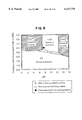
- FIG. 3 shows the result of examining the dependency of the polishing solution on the aqueous hydrogen peroxide concentration.
- the citric acid concentration was 0.03 wt %.
- the ratio of the CMP rate to the still solution etching rate is also shown.
- the CMP rate shows a maximum value of 84 nm/min when the aqueous hydrogen peroxide concentration is 10 vol %, but since the etching rate has a low value of 5 nm/min or less at 5 vol % or lower, the ratio of the CMP rate and the etching rate shows its highest value of 30 at 5 vol %.
- the CMP rate is 10 nm/min or less, which is not sufficient for the purpose of forming an inlaid interconnection. That is, the polishing solution must contain both citric acid and aqueous hydrogen peroxide.
- a copper inlaid interconnection pattern was formed using a polishing solution comprising 5 vol % of aqueous hydrogen peroxide and 0.03 wt % citric acid mixed with pure water. This polishing solution is in the domain of the corrosion of copper, as shown in FIG. 9.
- FIG. 4A A cross-section of a sample with an inlaid interconnection before polishing is shown in FIG. 4A.
- a BPSG film 24 (silicon dioxide to which boron and phosphorus were added) having a thickness of 500 nm and a silicon dioxide film 23 having a thickness of 500 nm were formed on a silicon substrate 25 on which an impurity-doped layer and an insulating film had been formed, and an interconnection groove pattern having a thickness of 500 nm was formed in the silicon dioxide layer 23 by a lithography process and dry etching process.
- a copper film having a thickness of 800 nm was continuously formed in vacuum by sputtering.
- Vacuum heat processing was also performed at 450° C. for 30 min in the sputter machine to improve step covering properties. Impurity-doped layers, such as a source and drain, were thereby formed in the silicon substrate 25, but these will not be described here.
- FIGS. 17A-17C show the structure of a copper plug of 0.5 ⁇ m diameter.
- FIG. 17A is a cross-section of the structure before CMP
- FIG. 17B is a cross-section of the structure after CMP
- FIG. 17C is the structure viewed from above.
- the insulation film opening is no more than one ⁇ m, so that the plug could be formed without dishing or erosion, as shown in FIG. 17B, even using a soft polishing pad (for example, Suba800 or XHGM1158 manufactured by the Rodel company).
- a hard polishing pad (IC1000) may of course also be used.
- CMP end point detection was performed without problems.
- the end point was detected based on the variation of rotation torque of the polishing platen or the wafer holder of the CMP machine, a signal shown in FIG. 23 was obtained. Polishing of Cu was completed after approximately 350 seconds had elapsed. In the TiN polishing stage, the torque signal strength increased, and the strength dropped after approximately 400 seconds had elapsed, which was determined as the end point.
- the polishing solution was transparent, but when copper is polished, copper ions dissolve in the polishing solution, which therefore becomes blue.
- citric acid was used as an acid, but the interconnection structure can also be formed if malic acid, malonic acid, succinic acid or dihydroxysuccinic acid is used instead of citric acid.
- hydrogen peroxide was used as an oxidizer, but the interconnection structure can also be formed if ferric nitrate or potassium iodate is used instead of hydrogen peroxide.
- ferric nitrate or potassium iodate is used instead of hydrogen peroxide.
- some method is needed to contend with iron or potassium contamination.
- An inlaid interconnection structure may be formed in the same way if CMP is performed using a polishing solution containing ammonium hydroxide, ammonium chloride or ammonium nitrate.
- the etching rate shown in FIG. 3 decreases, and the ratio of the CMP rate to the etching rate further increases. As a result, excessive etching of the copper surface during CMP can be prevented, and oxidation of the polished copper surface after CMP can be prevented.
- the inhibitor was BTA.
- 0.1 wt % BTA was added to a polishing solution comprising 5 vol % aqueous hydrogen peroxide and 0.03 wt % citric acid mixed with pure water.
- the etching rate was measured as in Embodiment 1, and was found to have decreased to about 1/6 compared with the solution before BTA was added.
- An interconnection structure could also be formed even if the above-mentioned polishing solution was concentrated.
- good results were obtained with a solution comprising 30 vol % aqueous hydrogen peroxide, 0.15 wt % citric acid and 0.3 wt % BTA mixed with pure water.
- the polishing uniformity in the wafer improved, i.e. whereas the uniformity was 10% or more with a dilute polishing solution, it was 8% or less with a concentrated polishing solution.
- a dilute solution has the advantage of being able to be manufactured more cheaply.
- citric acid was used as an acid, but the interconnection structure can also be formed if malic acid, malonic acid, succinic acid or dihydroxysuccinic acid is used instead of citric acid.
- malic acid malonic acid
- succinic acid succinic acid or dihydroxysuccinic acid
- good results were obtained with a solution comprising 30 vol % aqueous hydrogen peroxide, 0.15 wt % malic acid and 0.2 wt % BTA mixed with pure water.
- Embodiment 2 The polishing solution of Embodiment 2 (5 vol % aqueous hydrogen peroxide, 0.03 wt % citric acid and 0.01% BTA mixed with pure water), and the same polishing solution with 2.5 wt % added alumina abrasive (particle diameter: approx. 200 nm) as a comparison, were prepared.
- An inlaid interconnection was formed as in Embodiment 2 using these polishing solutions, and the line width dependence of dishing and erosion defined in FIGS. 5A-5B was measured for a width of 0.4-90 ⁇ m by photographing a 400 ⁇ m length of the interconnection in section with a scanning electron microscope (SEM).
- SEM scanning electron microscope
- FIGS. 6A, 6B show the measurement results
- FIGS. 7A, 7B, 8A, and 8B show sections which were drawn based on the SEM observations.
- the polishing solution of Embodiment 2 (5 vol % aqueous hydrogen peroxide, 0.03 wt % citric acid and 0.01% BTA mixed with pure water), and polishing solutions with 0.0001 wt %, 0.001 wt %, 0.01 wt %, 0.05 wt %, 0.1 wt %, 0.5 wt %, 1 wt %. 2.5 wt % and 5 wt % alumina abrasive (particle diameter: approx. 200 nm) added to this solution, were prepared.
- CMP was performed using these solutions on a copper thin film surface with no interconnection pattern and a silicon dioxide film surface.
- the down force and platen rotation speed can be increased, so the CMP rate can be increased.
- An inlaid interconnection was formed by the same method as that of Embodiment 1 using the polishing solution having an abrasive concentration of less than 0.1 wt %.
- an effectively 100% yield was obtained.
- the polishing solution of Embodiment 2 (5 vol % aqueous hydrogen peroxide, 0.03 wt % citric acid and 0.01 wt % BTA mixed with pure water), and polishing solutions with 0.0001 wt %, 0.001 wt %, 0.01 wt %, 0.05 wt %, 0.1 wt %, 0.5 wt %, 1 wt %, 5 wt % and 10 wt % alumina abrasive added to this solution, were prepared.
- a sample was prepared by forming a thin copper film of thickness 800 nm on a silicon dioxide film surface by sputtering, with a TiN layer of thickness 5 nm (1/10 the thickness of Embodiment 1) in between. CMP was performed on this sample using the aforesaid polishing solutions.
- peeling occurred between the copper layer and the TiN layer from the periphery of a wafer on which CMP was performed using a polishing solution having an alumina abrasive concentration of 1 wt % or more. This is considered to be due to the frictional force which occurs between the alumina abrasive and the copper surface.
- the frictional force decreased in a wafer on which CMP was performed using a polishing solution having an alumina abrasive concentration of 0.5 wt % or less, and in this case, no peeling occurred at all. Further, as peeling is reduced, the down force and platen rotation speed can be increased, so that the CMP rate can be increased.
- An inlaid interconnection was formed by the same method as that of Embodiment 2 using the polishing solution having an abrasive concentration of 0.5 wt % or less. A sample was used wherein the TiN layer 22 of FIGS. 4A-4C was 5 nm. As a result, an inlaid interconnection was formed without any peeling of the thin copper film.
- the polishing solution of Embodiment 2 (5 vol % aqueous hydrogen peroxide, 0.03 wt % citric acid and 0.1 wt % BTA mixed with pure water), and polishing solutions with 0.0001 wt %, 0.001 wt %, 0.01 wt %, 0.05 wt %, 0.1 wt %, 0.5 wt %, 1 wt %, 5 wt % and 10 wt % alumina abrasive added to this solution, were prepared.
- the copper thin film and TiN thin film formed on the silicon dioxide film surface were removed by CMP, and after the silicon dioxide film surface which appeared was washed with pure water, the alumina abrasive (number of defects) which remained was examined with a wafer particle counter.
- the number of defects having a size of 0.2 ⁇ m or larger per wafer was measured.
- the size of the wafer was 4 inches.
- the number of defects decreased according to the decrease of the alumina abrasive concentration as shown in FIG. 10, and at a concentration, of 0.01 wt % or less, the number can be reduced to 100 or less by megasonic cleaning alone.
- the number of CMP processing steps is reduced by reducing the abrasive concentration.
- FIG. 11 shows a CMP process where a known polishing solution was used.
- the alumina abrasive concentration was as high as, for example, 1 wt % or more, and conditioning of the polishing pad was performed for several tens of seconds to a few minutes before CMP to prevent clogging of the polishing pad with abrasive.
- CMP was performed on the insulating film from several tens of seconds to about 2 minutes to remove the damaged layer of the insulating film surface, e.g. the silicon dioxide film exposed by polishing. Subsequently, the wafer was subjected to a cleaning step without drying, and a first brush cleaning was performed with an ammonia solution to remove the abrasive. A second brush cleaning with dilute hydrofluoric acid (HF) was performed to remove metal contamination in the damaged layer of the insulating film surface, e.g. the silicon dioxide film. Finally, after removing the abrasive to the desired level by megasonic cleaning, the wafer was dried.
- HF dilute hydrofluoric acid
- FIG. 12 shows the whole CMP process when a polishing solution having a low polishing abrasive concentration of less than 0.01 wt % according to this invention was used.
- a polishing solution having a low polishing abrasive concentration of less than 0.01 wt % according to this invention was used.
- the abrasive concentration was 1/10, the life of the polishing pad was extended 10 times.
- the standard level number of defects
- the process of FIG. 12 may be used in practice if the abrasive concentration is 0.01 wt % or less, but it is preferably 0.005 wt % or less.
- the CMP time including an over-polishing time for a CMP alumina slurry used for copper CMP is 5 min, and the slurry is supplied to a CMP machine at a rate of 100 cc/min, one liter is used for one CMP.
- One polishing pad is consumed approximately every 400 wafers.
- a post-cleaning machine is necessary.
- CMP costs are largely reduced by decreasing the alumina abrasive concentration to 0.001 wt % or less.
- the reagents added to the polishing solution are still required, but the cost is of the order of 1/100 of a conventional alumina slurry. Further, as the conditioning frequency in the prior technology is less, the cost of polishing pads can also be reduced.
- the alumina abrasive concentration is 0.0001 wt % or less, slurry supply equipment, slurry stirring equipment and slurry processing equipment are unnecessary, and if the alumina abrasive concentration is zero, there is no need for dust prevention measures in the clean room and costs can be largely reduced compared to the known machine.
- the cleaning machine brush-cleaning is unnecessary, so the cost is about half. Hence, about 70% of the cost of CMP as a whole can be reduced by using the polishing solution of this invention.
- Nitric acid has an oxidizing action on copper, and as copper is made water-soluble by the acidic nature of nitric acid, two of the functions of this invention may be realized by one reagent.
- BTA suppresses etching as in the case of Embodiment 2, so the ratio of the CMP rate and the etching rate is increased. Excessive etching of the copper surface during CMP can therefore be prevented, and excessive oxidation of the polished copper surface after CMP can also be prevented.
- the polishing solution is an aqueous solution comprising nitric acid: 0.2 vol % and BTA: 0.01 wt % mixed with pure water. This polishing solution is in the domain of corrosion of copper, as shown in FIG. 9.
- the etching rate of copper was examined as in Embodiment 1, and found to be reduced to about 1/6 due to the addition of BTA.
- CMP was performed using this polishing solution under the same conditions as those of Embodiment 1, corrosion of the polished copper surface was prevented and an inlaid interconnection could be formed.
- the copper interconnection part is etched and was observed to be more depressed than the surrounding insulating film (in particular, the copper disappeared when the nitric acid concentration was as high as 1 vol % or more). This was suppressed to several 10 nm or less as shown in FIG. 16B when a polishing solution with added BTA was used.
- a multilayered interconnection structure was prepared using the polishing solution of Embodiment 2 (30 vol % aqueous hydrogen peroxide, 0.15 wt % malic acid and 0.2 wt % BTA mixed with pure water), and experiments were performed to demonstrate its effect.
- CMP was performed using a known polishing solution comprising 1 wt % of alumina abrasive.
- FIGS. 14A-14C show a two-layer interconnection structure obtained as a result of performing CMP using a known polishing solution.
- a semiconductor device was manufactured comprising diffusion layers, such as a source and drain, in a silicon substrate 25, but this will not be described here (same for FIGS. 15-20).
- polishing residues 32, 33 and 34 were also left on the surface of an insulating film 35 formed on top, and these polishing residues caused electrical short-circuits in second layer copper interconnections 31.
- 39 is a TiN layer and 52 is a throughhole layer insulating film.
- FIGS. 15A-15B Since there is no TiN layer above the copper interconnections, there is a possibility that copper will diffuse into the silicon dioxide film and contaminate the semiconductor device. To prevent this, a silicon nitride film is formed on the copper interconnections to a thickness of 50 nm, but this is not shown in FIGS. 14A, 14B, 15A, and 15B (it is also omitted from FIGS. 18A, 18B, 19A, 19B, 20A, and 20B).
- FIGS. 18A and 18B show a part wherein the first layer interconnection 21 and second layer interconnection 31 are connected by a copper plug 40.
- This device was manufactured by performing CMP using the aforesaid polishing solution on each layer including the plug. There were no electrical short-circuits whatever due to the dishing, erosion and scratches shown in FIGS. 14A-14B.
- a multi-layer interconnection could also be formed in the same way using the polishing solutions described in Embodiment 1 and Embodiment 9.
- the plug may also be formed by a tungsten film using the CVD method which has a high coverage performance, as shown in FIGS. 20A-20B.
- a seam 43 (known also as a keyhole, etc.) is easily formed in the center part of the plug, and polishing solution may seep into the interior of the device and rapidly corrode the base copper interconnection 21.
- FIG. 20A shows this situation.
- 44 is a corroded copper interconnection part.
- a copper inhibitor for example BTA
- FIG. 20B shows this result, Also, as the polishing solution does not contain an abrasive material, abrasive does not remain in the seam.
- FIG. 19 shows a sample wherein a two-layer interconnection is formed by a dual damascene method.
- This is a technique wherein a plug for the first layer interconnection and the second layer interconnection are polished in one step. After polishing the first layer interconnection with the aforesaid polishing solution, the plug and second layer interconnection were then polished by CMP with the aforesaid polishing solution.
- Numeral 41 is the plug formed by the dual damascene method. There were no electrical short-circuits whatever due to the dishing, erosion and scratches shown in FIGS. 14A and 14B. A multi-layer interconnection could also be formed in the same way using the polishing solutions described in Embodiment 1 and Embodiment 9.
- FIG. 21 shows a situation wherein a tungsten plug 42 is formed on an impurity-doped layer 45 of a silicon substrate and connected to the copper interconnection 21 using the polishing solution of this invention. It was confirmed that, by forming a multi-layer interconnection as described hereabove on this upper layer, an LSI could be manufactured and operated by connecting different semiconductor devices.
Landscapes
- Engineering & Computer Science (AREA)
- Chemical & Material Sciences (AREA)
- Condensed Matter Physics & Semiconductors (AREA)
- General Physics & Mathematics (AREA)
- Manufacturing & Machinery (AREA)
- Computer Hardware Design (AREA)
- Microelectronics & Electronic Packaging (AREA)
- Power Engineering (AREA)
- Physics & Mathematics (AREA)
- Organic Chemistry (AREA)
- Mechanical Engineering (AREA)
- Materials Engineering (AREA)
- Chemical Kinetics & Catalysis (AREA)
- General Chemical & Material Sciences (AREA)
- Metallurgy (AREA)
- Mechanical Treatment Of Semiconductor (AREA)
- Finish Polishing, Edge Sharpening, And Grinding By Specific Grinding Devices (AREA)
Priority Applications (5)
| Application Number | Priority Date | Filing Date | Title |
|---|---|---|---|
| US09/618,999 US6596638B1 (en) | 1997-10-31 | 2000-07-18 | Polishing method |
| US10/441,063 US7132367B2 (en) | 1997-10-31 | 2003-05-20 | Polishing method |
| US10/825,100 US20040229468A1 (en) | 1997-10-31 | 2004-04-16 | Polishing method |
| US11/581,375 US7279425B2 (en) | 1997-10-31 | 2006-10-17 | Polishing method |
| US11/693,383 US7563716B2 (en) | 1997-10-31 | 2007-03-29 | Polishing method |
Applications Claiming Priority (2)
| Application Number | Priority Date | Filing Date | Title |
|---|---|---|---|
| JP9-299937 | 1997-10-31 | ||
| JP29993797A JP3371775B2 (ja) | 1997-10-31 | 1997-10-31 | 研磨方法 |
Related Child Applications (1)
| Application Number | Title | Priority Date | Filing Date |
|---|---|---|---|
| US09/618,999 Continuation US6596638B1 (en) | 1997-10-31 | 2000-07-18 | Polishing method |
Publications (1)
| Publication Number | Publication Date |
|---|---|
| US6117775A true US6117775A (en) | 2000-09-12 |
Family
ID=17878748
Family Applications (5)
| Application Number | Title | Priority Date | Filing Date |
|---|---|---|---|
| US09/182,438 Expired - Lifetime US6117775A (en) | 1997-10-31 | 1998-10-30 | Polishing method |
| US09/618,999 Expired - Lifetime US6596638B1 (en) | 1997-10-31 | 2000-07-18 | Polishing method |
| US10/441,063 Expired - Lifetime US7132367B2 (en) | 1997-10-31 | 2003-05-20 | Polishing method |
| US11/581,375 Expired - Fee Related US7279425B2 (en) | 1997-10-31 | 2006-10-17 | Polishing method |
| US11/693,383 Expired - Fee Related US7563716B2 (en) | 1997-10-31 | 2007-03-29 | Polishing method |
Family Applications After (4)
| Application Number | Title | Priority Date | Filing Date |
|---|---|---|---|
| US09/618,999 Expired - Lifetime US6596638B1 (en) | 1997-10-31 | 2000-07-18 | Polishing method |
| US10/441,063 Expired - Lifetime US7132367B2 (en) | 1997-10-31 | 2003-05-20 | Polishing method |
| US11/581,375 Expired - Fee Related US7279425B2 (en) | 1997-10-31 | 2006-10-17 | Polishing method |
| US11/693,383 Expired - Fee Related US7563716B2 (en) | 1997-10-31 | 2007-03-29 | Polishing method |
Country Status (8)
| Country | Link |
|---|---|
| US (5) | US6117775A (de) |
| EP (2) | EP0913442B1 (de) |
| JP (1) | JP3371775B2 (de) |
| KR (2) | KR100624589B1 (de) |
| CN (2) | CN1974129A (de) |
| DE (1) | DE69836612T2 (de) |
| SG (1) | SG95588A1 (de) |
| TW (1) | TW380083B (de) |
Cited By (120)
| Publication number | Priority date | Publication date | Assignee | Title |
|---|---|---|---|---|
| US6228771B1 (en) * | 2000-03-23 | 2001-05-08 | Infineon Technologies North America Corp. | Chemical mechanical polishing process for low dishing of metal lines in semiconductor wafer fabrication |
| US6316364B1 (en) * | 1999-02-15 | 2001-11-13 | Nec Corporation | Polishing method and polishing solution |
| US6332989B1 (en) * | 1998-10-22 | 2001-12-25 | Advanced Micro Devices, Inc. | Slurry for chemical mechanical polishing of copper |
| US6350694B1 (en) | 2000-10-04 | 2002-02-26 | Taiwan Semiconductor Manufacturing Company | Reducing CMP scratch, dishing and erosion by post CMP etch back method for low-k materials |
| US6376381B1 (en) * | 1999-08-31 | 2002-04-23 | Micron Technology, Inc. | Planarizing solutions, planarizing machines, and methods for mechanical and/or chemical-mechanical planarization of microelectronic substrate assemblies |
| US6376345B1 (en) * | 1998-07-24 | 2002-04-23 | Hitachi Ltd. | Process for manufacturing semiconductor integrated circuit device |
| US20020090820A1 (en) * | 2001-01-05 | 2002-07-11 | Applied Materials, Inc. | Tantalum removal during chemical mechanical polishing |
| US6426294B1 (en) * | 1998-10-07 | 2002-07-30 | Kabushiki Kaisha Toshiba | Copper-based metal polishing composition, method for manufacturing a semiconductor device, polishing composition, aluminum-based metal polishing composition, and tungsten-based metal polishing composition |
| US20020106975A1 (en) * | 1999-06-24 | 2002-08-08 | Micron Technology, Inc. | Fixed-abrasive chemical-mechanical planarization of titanium nitride |
| US6432826B1 (en) * | 1999-11-29 | 2002-08-13 | Applied Materials, Inc. | Planarized Cu cleaning for reduced defects |
| US6435944B1 (en) | 1999-10-27 | 2002-08-20 | Applied Materials, Inc. | CMP slurry for planarizing metals |
| US6436302B1 (en) * | 1999-08-23 | 2002-08-20 | Applied Materials, Inc. | Post CU CMP polishing for reduced defects |
| US6436811B1 (en) * | 1999-12-28 | 2002-08-20 | Nec Corporation | Method of forming a copper-containing metal interconnect using a chemical mechanical planarization (CMP) slurry |
| US20020113271A1 (en) * | 1999-08-10 | 2002-08-22 | Hitachi, Ltd. | Semiconductor integrated circuit device and manufacturing method of semiconductor integrated circuit device |
| US6451697B1 (en) * | 2000-04-06 | 2002-09-17 | Applied Materials, Inc. | Method for abrasive-free metal CMP in passivation domain |
| US20020130049A1 (en) * | 2001-03-14 | 2002-09-19 | Liang-Yuh Chen | Planarization of substrates using electrochemical mechanical polishing |
| US6461964B2 (en) | 1999-08-31 | 2002-10-08 | Micron Technology, Inc. | Methods and apparatuses for monitoring and controlling mechanical or chemical-mechanical planarization of microelectronic substrate assemblies |
| US6461227B1 (en) * | 2000-10-17 | 2002-10-08 | Cabot Microelectronics Corporation | Method of polishing a memory or rigid disk with an ammonia-and/or halide-containing composition |
| US20020146908A1 (en) * | 2001-04-05 | 2002-10-10 | Saket Chadda | Apparatus and process for polishing a workpiece |
| US6475914B2 (en) * | 2000-07-22 | 2002-11-05 | Samsung Electronics Co., Ltd. | Method of manufacturing semiconductor device for protecting Cu layer from post chemical mechanical polishing-corrosion |
| US20020193051A1 (en) * | 1999-04-27 | 2002-12-19 | Hitachi, Ltd. | Apparatus and method for producing substrate with electrical wire thereon |
| US6503834B1 (en) * | 2000-10-03 | 2003-01-07 | International Business Machines Corp. | Process to increase reliability CuBEOL structures |
| US20030013387A1 (en) * | 2001-07-13 | 2003-01-16 | Applied Materials, Inc. | Barrier removal at low polish pressure |
| US20030013306A1 (en) * | 2001-07-13 | 2003-01-16 | Applied Materials, Inc. | Dual reduced agents for barrier removal in chemical mechanical polishing |
| US6509273B1 (en) * | 1999-04-28 | 2003-01-21 | Hitachi, Ltd. | Method for manufacturing a semiconductor device |
| US20030022501A1 (en) * | 2001-07-25 | 2003-01-30 | Applied Materials, Inc. | Method and apparatus for chemical mechanical polishing of semiconductor substrates |
| US20030022497A1 (en) * | 2001-07-11 | 2003-01-30 | Applied Materials, Inc. | Method of chemical mechanical polishing with high throughput and low dishing |
| US20030022801A1 (en) * | 2000-05-11 | 2003-01-30 | Applied Materials, Inc. | Selective removal of tantalum-containing barrier layer during metal CMP title |
| US20030032292A1 (en) * | 2001-08-07 | 2003-02-13 | Hitachi, Ltd. | Fabrication method of semiconductor integrated circuit device |
| WO2003011479A1 (en) * | 2001-08-02 | 2003-02-13 | Mykrolis Corporation | Selective electroless deposition and interconnects made therefrom |
| US6524167B1 (en) | 2000-10-27 | 2003-02-25 | Applied Materials, Inc. | Method and composition for the selective removal of residual materials and barrier materials during substrate planarization |
| US6530824B2 (en) * | 2001-03-09 | 2003-03-11 | Rodel Holdings, Inc. | Method and composition for polishing by CMP |
| US20030054667A1 (en) * | 1998-11-04 | 2003-03-20 | Applied Materials, Inc. | Method of improving moisture resistance of low dielectric constant films |
| US20030077983A1 (en) * | 2001-10-12 | 2003-04-24 | International Business Machines Corporation | Cleaning polish etch composition and process for a superfinished surface of a substrate |
| US6569349B1 (en) | 2000-10-23 | 2003-05-27 | Applied Materials Inc. | Additives to CMP slurry to polish dielectric films |
| US6579439B1 (en) | 2001-01-12 | 2003-06-17 | Southern Industrial Chemicals, Inc. | Electrolytic aluminum polishing processes |
| US20030116446A1 (en) * | 2001-12-21 | 2003-06-26 | Alain Duboust | Electrolyte composition and treatment for electrolytic chemical mechanical polishing |
| US20030124959A1 (en) * | 2001-12-05 | 2003-07-03 | Cabot Microelectronics Corporation | Method for copper CMP using polymeric complexing agents |
| US6592677B1 (en) * | 1999-10-04 | 2003-07-15 | Nec Electronics Corporation | Method of forming a semiconductor device by simultaneously cleaning both sides of a wafer using different cleaning solutions |
| US6592742B2 (en) | 2001-07-13 | 2003-07-15 | Applied Materials Inc. | Electrochemically assisted chemical polish |
| US20030134576A1 (en) * | 2002-01-17 | 2003-07-17 | Saket Chadda | Method for polishing copper on a workpiece surface |
| US6602436B2 (en) * | 2000-08-11 | 2003-08-05 | Rodel Holdings, Inc | Chemical mechanical planarization of metal substrates |
| US6607424B1 (en) * | 1999-08-24 | 2003-08-19 | Rodel Holdings, Inc. | Compositions for insulator and metal CMP and methods relating thereto |
| US20030159362A1 (en) * | 2002-02-22 | 2003-08-28 | Singh Rajiv K. | Chemical-mechanical polishing slurry for polishing of copper or silver films |
| US6620725B1 (en) * | 1999-09-13 | 2003-09-16 | Taiwan Semiconductor Manufacturing Company | Reduction of Cu line damage by two-step CMP |
| US6632259B2 (en) | 2001-05-18 | 2003-10-14 | Rodel Holdings, Inc. | Chemical mechanical polishing compositions and methods relating thereto |
| US6632377B1 (en) * | 1998-10-23 | 2003-10-14 | International Business Machines Corporation | Chemical-mechanical planarization of metallurgy |
| US6638143B2 (en) | 1999-12-22 | 2003-10-28 | Applied Materials, Inc. | Ion exchange materials for chemical mechanical polishing |
| US6638326B2 (en) * | 2001-09-25 | 2003-10-28 | Ekc Technology, Inc. | Compositions for chemical mechanical planarization of tantalum and tantalum nitride |
| US20030203624A1 (en) * | 2002-03-27 | 2003-10-30 | Kenji Sameshima | Manufacturing method of semiconductor device |
| WO2003018252A3 (en) * | 2001-08-23 | 2003-11-13 | Mykrolis Corp | Metal polishing |
| US20030209523A1 (en) * | 2002-05-09 | 2003-11-13 | Applied Materials, Inc. | Planarization by chemical polishing for ULSI applications |
| US20030216049A1 (en) * | 2000-12-01 | 2003-11-20 | Applied Materials, Inc. | Method and composition for the removal of residual materials during substrate planarization |
| US6653242B1 (en) | 2000-06-30 | 2003-11-25 | Applied Materials, Inc. | Solution to metal re-deposition during substrate planarization |
| US6656842B2 (en) * | 1999-09-22 | 2003-12-02 | Applied Materials, Inc. | Barrier layer buffing after Cu CMP |
| US20030228762A1 (en) * | 2002-06-07 | 2003-12-11 | Cabot Microelectronics Corporation | CMP compositions for low-k dielectric materials |
| US20030228763A1 (en) * | 2002-06-07 | 2003-12-11 | Cabot Microelectronics Corporation | CMP method utilizing amphiphilic nonionic surfactants |
| US20030234184A1 (en) * | 2001-03-14 | 2003-12-25 | Applied Materials, Inc. | Method and composition for polishing a substrate |
| US20040029495A1 (en) * | 2002-02-11 | 2004-02-12 | Small Robert J. | Catalytic composition for chemical-mechanical polishing, method of using same, and substrate treated with same |
| US20040053499A1 (en) * | 2001-03-14 | 2004-03-18 | Applied Materials, Inc. | Method and composition for polishing a substrate |
| US6709316B1 (en) | 2000-10-27 | 2004-03-23 | Applied Materials, Inc. | Method and apparatus for two-step barrier layer polishing |
| US20040116052A1 (en) * | 2002-10-03 | 2004-06-17 | Applied Materials, Inc. | Methods for reducing delamination during chemical mechanical polishing |
| US20040117880P1 (en) * | 2002-12-17 | 2004-06-17 | Rubio Ignacio Abascal | Peach tree plant named 'Plajanomel' |
| US20040147118A1 (en) * | 2003-01-23 | 2004-07-29 | Zhendong Liu | Selective barrier metal polishing solution |
| US6776810B1 (en) | 2002-02-11 | 2004-08-17 | Cabot Microelectronics Corporation | Anionic abrasive particles treated with positively charged polyelectrolytes for CMP |
| KR100445757B1 (ko) * | 2001-12-28 | 2004-08-25 | 제일모직주식회사 | 금속배선 연마용 슬러리 조성물 |
| US6783432B2 (en) | 2001-06-04 | 2004-08-31 | Applied Materials Inc. | Additives for pressure sensitive polishing compositions |
| US20040175942A1 (en) * | 2003-01-03 | 2004-09-09 | Chang Song Y. | Composition and method used for chemical mechanical planarization of metals |
| US20040180536A1 (en) * | 2001-06-12 | 2004-09-16 | Tsuyoshi Fujiwara | Method for manufature of semiconductor intergrated circuit device |
| US6800218B2 (en) * | 2001-08-23 | 2004-10-05 | Advanced Technology Materials, Inc. | Abrasive free formulations for chemical mechanical polishing of copper and associated materials and method of using same |
| US6812193B2 (en) | 2001-08-31 | 2004-11-02 | International Business Machines Corporation | Slurry for mechanical polishing (CMP) of metals and use thereof |
| US6840971B2 (en) * | 1999-08-13 | 2005-01-11 | Cabot Microelectronics Corporation | Chemical mechanical polishing systems and methods for their use |
| US6872329B2 (en) | 2000-07-28 | 2005-03-29 | Applied Materials, Inc. | Chemical mechanical polishing composition and process |
| US20050074967A1 (en) * | 1997-10-31 | 2005-04-07 | Seiichi Kondo | Polishing method |
| US20050076581A1 (en) * | 2003-10-10 | 2005-04-14 | Small Robert J. | Particulate or particle-bound chelating agents |
| US20050112292A1 (en) * | 2003-11-25 | 2005-05-26 | Parker Russell A. | Methods for treating at least one member of a microarray structure and methods of using the same |
| US20050148176A1 (en) * | 2002-03-12 | 2005-07-07 | Kabushiki Kaisha Toshiba | Method of manufacturing a semiconductor device |
| US20050145602A1 (en) * | 2002-04-11 | 2005-07-07 | Jeong-Heon Park | Test patterns and methods of controlling CMP process using the same |
| US20050155296A1 (en) * | 2004-01-16 | 2005-07-21 | Siddiqui Junaid A. | Surface modified colloidal abrasives, including stable bimetallic surface coated silica sols for chemical mechanical planarization |
| US20050197266A1 (en) * | 2004-03-05 | 2005-09-08 | Ashutosh Misra | Acidic chemistry for post-CMP cleaning |
| US20050211951A1 (en) * | 2004-03-24 | 2005-09-29 | Kelley Francis J | Compositions and methods for polishing copper |
| US20050236601A1 (en) * | 2004-04-21 | 2005-10-27 | Zhendong Liu | Barrier polishing solution |
| US20060000150A1 (en) * | 2004-07-01 | 2006-01-05 | Kelley Francis J | Chemical mechanical polishing compositions and methods relating thereto |
| US20060000151A1 (en) * | 2004-07-01 | 2006-01-05 | Kelley Francis J | Chemical mechanical polishing compositions and methods relating thereto |
| US20060010781A1 (en) * | 2004-07-15 | 2006-01-19 | Jsr Corporation | Chemical mechanical polishing aqueous dispersion and chemical mechanical polishing method |
| US20060046623A1 (en) * | 2004-08-24 | 2006-03-02 | Applied Materials, Inc. | Method and apparatus for reduced wear polishing pad conditioning |
| US20060110924A1 (en) * | 2004-11-24 | 2006-05-25 | Tirthankar Ghosh | Abrasive-free chemical mechanical polishing compositions and methods relating thereto |
| US20060110923A1 (en) * | 2004-11-24 | 2006-05-25 | Zhendong Liu | Barrier polishing solution |
| US20060111024A1 (en) * | 2004-11-24 | 2006-05-25 | Hongyu Wang | Cellulose-containing polishing compositions and methods relating thereto |
| US20060117667A1 (en) * | 2002-02-11 | 2006-06-08 | Siddiqui Junaid A | Free radical-forming activator attached to solid and used to enhance CMP formulations |
| US20060163530A1 (en) * | 2005-01-26 | 2006-07-27 | Zhendong Liu | Corrosion-resistant barrier polishing solution |
| US7084064B2 (en) | 2004-09-14 | 2006-08-01 | Applied Materials, Inc. | Full sequence metal and barrier layer electrochemical mechanical processing |
| US20060216939A1 (en) * | 1998-12-28 | 2006-09-28 | Takeshi Uchida | Materials for polishing liquid for metal, polishing liquid for metal, method for preparation thereof and polishing method using the same |
| US20060228991A1 (en) * | 2002-04-26 | 2006-10-12 | Applied Materials, Inc. A Delaware Corporation | Polishing method and apparatus |
| US7128825B2 (en) | 2001-03-14 | 2006-10-31 | Applied Materials, Inc. | Method and composition for polishing a substrate |
| US20060255016A1 (en) * | 2002-01-17 | 2006-11-16 | Novellus Systems, Inc. | Method for polishing copper on a workpiece surface |
| US20070037394A1 (en) * | 2005-08-15 | 2007-02-15 | Ciwest Semiconductor Corporation | A method for using a cu beol process to fabricate an integrated circuit (ic) originally having an al design |
| US20070037384A1 (en) * | 2005-08-15 | 2007-02-15 | Ciwest Semiconductor Corporation | A method for processing ic designs for different metal beol processes |
| US20070095677A1 (en) * | 2005-10-31 | 2007-05-03 | Applied Materials, Inc. | Electrochemical method for ecmp polishing pad conditioning |
| US7220322B1 (en) | 2000-08-24 | 2007-05-22 | Applied Materials, Inc. | Cu CMP polishing pad cleaning |
| US7226345B1 (en) | 2005-12-09 | 2007-06-05 | The Regents Of The University Of California | CMP pad with designed surface features |
| US20070151866A1 (en) * | 2006-01-05 | 2007-07-05 | Applied Materials, Inc. | Substrate polishing with surface pretreatment |
| US20070158207A1 (en) * | 2006-01-06 | 2007-07-12 | Applied Materials, Inc. | Methods for electrochemical processing with pre-biased cells |
| US20070227902A1 (en) * | 2006-03-29 | 2007-10-04 | Applied Materials, Inc. | Removal profile tuning by adjusting conditioning sweep profile on a conductive pad |
| US7323095B2 (en) | 2000-12-18 | 2008-01-29 | Applied Materials, Inc. | Integrated multi-step gap fill and all feature planarization for conductive materials |
| US7323416B2 (en) | 2001-03-14 | 2008-01-29 | Applied Materials, Inc. | Method and composition for polishing a substrate |
| US20080105651A1 (en) * | 2004-09-14 | 2008-05-08 | Katsumi Mabuchi | Polishing Slurry for Cmp |
| US7390744B2 (en) | 2004-01-29 | 2008-06-24 | Applied Materials, Inc. | Method and composition for polishing a substrate |
| US7390429B2 (en) | 2003-06-06 | 2008-06-24 | Applied Materials, Inc. | Method and composition for electrochemical mechanical polishing processing |
| US20090032075A1 (en) * | 2004-05-11 | 2009-02-05 | Applied Materials, Inc. | Methods and apparatus for liquid chemical delivery |
| US20090057264A1 (en) * | 2007-08-29 | 2009-03-05 | Applied Materials, Inc. | High throughput low topography copper cmp process |
| US20090095939A1 (en) * | 2007-10-10 | 2009-04-16 | Cheil Industries Inc. | Slurry Composition for Chemical Mechanical Polishing of Metal and Polishing Method Using the Same |
| US7524346B2 (en) | 2002-01-25 | 2009-04-28 | Dupont Air Products Nanomaterials Llc | Compositions of chemical mechanical planarization slurries contacting noble-metal-featured substrates |
| US7582564B2 (en) | 2001-03-14 | 2009-09-01 | Applied Materials, Inc. | Process and composition for conductive material removal by electrochemical mechanical polishing |
| EP2196509A1 (de) | 2008-12-11 | 2010-06-16 | Rohm and Haas Electronic Materials CMP Holdings, Inc. | Chemisch-mechanische Polierzusammensetzung zum Polieren von Substraten enthaltend ein Material mit niedreiger dielektrizitätskonstante und zugehörige Verfahren |
| US8092707B2 (en) | 1997-04-30 | 2012-01-10 | 3M Innovative Properties Company | Compositions and methods for modifying a surface suited for semiconductor fabrication |
| US20140030891A1 (en) * | 2012-07-24 | 2014-01-30 | Kabushiki Kaisha Toshiba | Method of manufacturing semiconductor device and apparatus for manufacturing semiconductor device |
| CN112067643A (zh) * | 2020-09-08 | 2020-12-11 | 宁波江丰电子材料股份有限公司 | 一种高纯铝靶材组件焊接扩散层sem检测的制样方法 |
| US20220017780A1 (en) * | 2020-07-20 | 2022-01-20 | Taiwan Semiconductor Manufacturing Company Ltd. | Composition and method for polishing and integrated circuit |
| CN115452693A (zh) * | 2022-10-11 | 2022-12-09 | 宜特(昆山)检测技术服务有限公司 | 磷青铜腐蚀性检测试剂及检测方法 |
Families Citing this family (74)
| Publication number | Priority date | Publication date | Assignee | Title |
|---|---|---|---|---|
| US7338908B1 (en) * | 2003-10-20 | 2008-03-04 | Novellus Systems, Inc. | Method for fabrication of semiconductor interconnect structure with reduced capacitance, leakage current, and improved breakdown voltage |
| US6276996B1 (en) | 1998-11-10 | 2001-08-21 | Micron Technology, Inc. | Copper chemical-mechanical polishing process using a fixed abrasive polishing pad and a copper layer chemical-mechanical polishing solution specifically adapted for chemical-mechanical polishing with a fixed abrasive pad |
| US6206756B1 (en) | 1998-11-10 | 2001-03-27 | Micron Technology, Inc. | Tungsten chemical-mechanical polishing process using a fixed abrasive polishing pad and a tungsten layer chemical-mechanical polishing solution specifically adapted for chemical-mechanical polishing with a fixed abrasive pad |
| JP2000228391A (ja) * | 1998-11-30 | 2000-08-15 | Canon Inc | 半導体基板の精密研磨方法および装置 |
| JP4127926B2 (ja) | 1999-04-08 | 2008-07-30 | 株式会社荏原製作所 | ポリッシング方法 |
| US6855266B1 (en) | 1999-08-13 | 2005-02-15 | Cabot Microelectronics Corporation | Polishing system with stopping compound and method of its use |
| IL147236A0 (en) | 1999-08-13 | 2002-08-14 | Cabot Microelectronics Corp | Polishing system and method of its use |
| TW501197B (en) | 1999-08-17 | 2002-09-01 | Hitachi Chemical Co Ltd | Polishing compound for chemical mechanical polishing and method for polishing substrate |
| JP4832690B2 (ja) * | 1999-08-24 | 2011-12-07 | ローム アンド ハース エレクトロニック マテリアルズ シーエムピー ホウルディングス インコーポレイテッド | 絶縁体及び金属のcmp用組成物及びそれに関する方法 |
| CN1161826C (zh) | 1999-08-26 | 2004-08-11 | 日立化成工业株式会社 | 化学机械研磨用研磨剂及研磨方法 |
| JP4513145B2 (ja) * | 1999-09-07 | 2010-07-28 | ソニー株式会社 | 半導体装置の製造方法および研磨方法 |
| JP4759779B2 (ja) * | 1999-09-09 | 2011-08-31 | 日立化成工業株式会社 | 基板の研磨方法 |
| CN1125862C (zh) * | 1999-09-20 | 2003-10-29 | 长兴化学工业股份有限公司 | 半导体加工用化学机械研磨组合物 |
| US6303506B1 (en) * | 1999-09-30 | 2001-10-16 | Infineon Technologies Ag | Compositions for and method of reducing/eliminating scratches and defects in silicon dioxide during CMP process |
| US6720264B2 (en) * | 1999-11-04 | 2004-04-13 | Advanced Micro Devices, Inc. | Prevention of precipitation defects on copper interconnects during CMP by use of solutions containing organic compounds with silica adsorption and copper corrosion inhibiting properties |
| JP3439402B2 (ja) * | 1999-11-05 | 2003-08-25 | Necエレクトロニクス株式会社 | 半導体装置の製造方法 |
| JP3805588B2 (ja) | 1999-12-27 | 2006-08-02 | 株式会社日立製作所 | 半導体装置の製造方法 |
| US6881674B2 (en) | 1999-12-28 | 2005-04-19 | Intel Corporation | Abrasives for chemical mechanical polishing |
| TW572980B (en) | 2000-01-12 | 2004-01-21 | Jsr Corp | Aqueous dispersion for chemical mechanical polishing and chemical mechanical polishing process |
| US6797623B2 (en) * | 2000-03-09 | 2004-09-28 | Sony Corporation | Methods of producing and polishing semiconductor device and polishing apparatus |
| JP2001269859A (ja) | 2000-03-27 | 2001-10-02 | Jsr Corp | 化学機械研磨用水系分散体 |
| US6943113B1 (en) * | 2000-05-11 | 2005-09-13 | Infineon Technologies Ag | Metal chemical polishing process for minimizing dishing during semiconductor wafer fabrication |
| JP3945964B2 (ja) * | 2000-06-01 | 2007-07-18 | 株式会社ルネサステクノロジ | 研磨剤、研磨方法及び半導体装置の製造方法 |
| JP4743941B2 (ja) * | 2000-06-30 | 2011-08-10 | Jsr株式会社 | 化学機械研磨用水系分散体 |
| JP3837277B2 (ja) | 2000-06-30 | 2006-10-25 | 株式会社東芝 | 銅の研磨に用いる化学機械研磨用水系分散体及び化学機械研磨方法 |
| JP2002043256A (ja) * | 2000-07-27 | 2002-02-08 | Hitachi Ltd | 半導体ウエハ平坦化加工方法及び平坦化加工装置 |
| JP2002050595A (ja) | 2000-08-04 | 2002-02-15 | Hitachi Ltd | 研磨方法、配線形成方法及び半導体装置の製造方法 |
| US7192888B1 (en) | 2000-08-21 | 2007-03-20 | Micron Technology, Inc. | Low selectivity deposition methods |
| US6605537B2 (en) | 2000-10-27 | 2003-08-12 | Rodel Holdings, Inc. | Polishing of metal substrates |
| WO2002024413A2 (en) * | 2000-09-20 | 2002-03-28 | Rodel Holdings, Inc. | Polishing by cmp for optimized planarization |
| KR100407296B1 (ko) * | 2000-12-18 | 2003-11-28 | 주식회사 하이닉스반도체 | 티타늄알루미늄나이트라이드의 화학적기계적연마 방법 |
| CN1426343A (zh) * | 2000-12-22 | 2003-06-25 | 皇家菲利浦电子有限公司 | 采用上游和下游流体分配装置的化学机械抛光方法和设备 |
| US6627550B2 (en) | 2001-03-27 | 2003-09-30 | Micron Technology, Inc. | Post-planarization clean-up |
| US6568997B2 (en) | 2001-04-05 | 2003-05-27 | Rodel Holdings, Inc. | CMP polishing composition for semiconductor devices containing organic polymer particles |
| JP2004533115A (ja) | 2001-04-12 | 2004-10-28 | ロデール ホールディングス インコーポレイテッド | 界面活性剤を有する研磨用組成物 |
| KR20020083264A (ko) * | 2001-04-26 | 2002-11-02 | 삼성전자 주식회사 | 화학적 기계적 연마용 슬러리와 그 제조방법 |
| WO2003038883A1 (en) * | 2001-10-31 | 2003-05-08 | Hitachi Chemical Co., Ltd. | Polishing fluid and polishing method |
| JP4187497B2 (ja) * | 2002-01-25 | 2008-11-26 | Jsr株式会社 | 半導体基板の化学機械研磨方法 |
| KR20030070191A (ko) * | 2002-02-21 | 2003-08-29 | 주식회사 동진쎄미켐 | 안정성 및 탄탈계 금속막에 대한 연마 속도가 우수한화학-기계적 연마 슬러리 조성물 |
| JP3749867B2 (ja) * | 2002-03-08 | 2006-03-01 | 株式会社東芝 | アルミニウム系金属用研磨液および半導体装置の製造方法 |
| KR100500517B1 (ko) * | 2002-10-22 | 2005-07-12 | 삼성전자주식회사 | 반도체 웨이퍼용 cmp 설비 |
| US6936534B2 (en) * | 2003-09-17 | 2005-08-30 | Micron Technology, Inc. | Method for the post-etch cleaning of multi-level damascene structures having underlying copper metallization |
| US20050092620A1 (en) * | 2003-10-01 | 2005-05-05 | Applied Materials, Inc. | Methods and apparatus for polishing a substrate |
| US8530359B2 (en) * | 2003-10-20 | 2013-09-10 | Novellus Systems, Inc. | Modulated metal removal using localized wet etching |
| US7972970B2 (en) | 2003-10-20 | 2011-07-05 | Novellus Systems, Inc. | Fabrication of semiconductor interconnect structure |
| US7531463B2 (en) * | 2003-10-20 | 2009-05-12 | Novellus Systems, Inc. | Fabrication of semiconductor interconnect structure |
| US8158532B2 (en) * | 2003-10-20 | 2012-04-17 | Novellus Systems, Inc. | Topography reduction and control by selective accelerator removal |
| US8372757B2 (en) * | 2003-10-20 | 2013-02-12 | Novellus Systems, Inc. | Wet etching methods for copper removal and planarization in semiconductor processing |
| US7465408B1 (en) * | 2003-12-03 | 2008-12-16 | Advanced Micro Devices, Inc. | Solutions for controlled, selective etching of copper |
| US20050139292A1 (en) * | 2003-12-31 | 2005-06-30 | Suresh Ramarajan | Method and apparatus for minimizing thickness-to-planarity and dishing in CMP |
| JP2005317808A (ja) * | 2004-04-28 | 2005-11-10 | Nitta Haas Inc | 薄膜研磨用研磨布およびそれを用いる薄膜の研磨方法 |
| JP2006080388A (ja) * | 2004-09-10 | 2006-03-23 | Nitta Haas Inc | 金属研磨用組成物 |
| KR101423579B1 (ko) * | 2005-08-22 | 2014-07-25 | 어플라이드 머티어리얼스, 인코포레이티드 | 화학적 기계적 폴리싱의 스펙트럼 기반 모니터링을 위한 장치 및 방법 |
| US7306507B2 (en) | 2005-08-22 | 2007-12-11 | Applied Materials, Inc. | Polishing pad assembly with glass or crystalline window |
| US7605082B1 (en) | 2005-10-13 | 2009-10-20 | Novellus Systems, Inc. | Capping before barrier-removal IC fabrication method |
| US7435162B2 (en) * | 2005-10-24 | 2008-10-14 | 3M Innovative Properties Company | Polishing fluids and methods for CMP |
| TWI343945B (en) | 2005-12-27 | 2011-06-21 | Hitachi Chemical Co Ltd | Slurry for metal polishing and polishing method of polished film |
| CN101584028A (zh) * | 2006-04-26 | 2009-11-18 | Nxp股份有限公司 | 制造半导体器件的方法、由此获得的半导体器件和适合该方法中使用的浆料 |
| JP5168966B2 (ja) * | 2007-03-20 | 2013-03-27 | 富士通セミコンダクター株式会社 | 研磨方法及び研磨装置 |
| WO2009017095A1 (ja) | 2007-07-30 | 2009-02-05 | Hitachi Chemical Co., Ltd. | 金属用研磨液及び研磨方法 |
| JP5207002B2 (ja) * | 2008-02-27 | 2013-06-12 | Jsr株式会社 | 化学機械研磨用水系分散体およびそれを用いた化学機械研磨方法、化学機械研磨用水系分散体の再生方法 |
| KR101962587B1 (ko) | 2009-09-02 | 2019-07-18 | 노벨러스 시스템즈, 인코포레이티드 | 작업물 가공 장치 및 작업물 가공 방법 |
| US8603862B2 (en) * | 2010-05-14 | 2013-12-10 | International Business Machines Corporation | Precise-aligned lock-and-key bonding structures |
| TWI490290B (zh) * | 2010-12-23 | 2015-07-01 | Anji Microelectronics Co Ltd | Chemical mechanical polishing solution |
| JP5858333B2 (ja) * | 2010-12-24 | 2016-02-10 | 日立金属株式会社 | 金属線材の熱処理装置 |
| JP5808201B2 (ja) * | 2011-09-01 | 2015-11-10 | 株式会社ディスコ | 砥粒埋め込み装置、ラッピング装置及びラッピング方法 |
| CN102909639B (zh) * | 2012-10-30 | 2016-02-24 | 上海新傲科技股份有限公司 | 半导体衬底的表面处理方法 |
| US20140308814A1 (en) * | 2013-04-15 | 2014-10-16 | Applied Materials, Inc | Chemical mechanical polishing methods and systems including pre-treatment phase and pre-treatment compositions |
| CN103646866B (zh) * | 2013-11-29 | 2016-03-02 | 上海华力微电子有限公司 | 化学机械抛光装置及方法 |
| JP6206360B2 (ja) * | 2014-08-29 | 2017-10-04 | 株式会社Sumco | シリコンウェーハの研磨方法 |
| KR101677248B1 (ko) | 2015-04-24 | 2016-11-17 | (주) 진우테크 | 웨이퍼 연마장치 |
| KR101693278B1 (ko) * | 2015-09-25 | 2017-01-05 | 유비머트리얼즈주식회사 | 슬러리 및 이를 이용한 기판 연마 방법 |
| CN105922084B (zh) * | 2016-07-11 | 2017-11-28 | 安徽三联学院 | 一种对金属表面涂层的精磨工艺 |
| CN110509114B (zh) * | 2019-08-14 | 2021-01-05 | 大连理工大学 | 一种钨合金的研磨抛光方法 |
Citations (10)
| Publication number | Priority date | Publication date | Assignee | Title |
|---|---|---|---|---|
| US4944836A (en) * | 1985-10-28 | 1990-07-31 | International Business Machines Corporation | Chem-mech polishing method for producing coplanar metal/insulator films on a substrate |
| JPH07233485A (ja) * | 1993-12-14 | 1995-09-05 | Toshiba Corp | 銅系金属用研磨液および半導体装置の製造方法 |
| US5676760A (en) * | 1994-03-25 | 1997-10-14 | Nec Corporation | Method for wet processing of a semiconductor substrate |
| US5695660A (en) * | 1992-09-17 | 1997-12-09 | Luxtron Corporation | Optical techniques of measuring endpoint during the processing of material layers in an optically hostile environment |
| US5733176A (en) * | 1996-05-24 | 1998-03-31 | Micron Technology, Inc. | Polishing pad and method of use |
| US5759917A (en) * | 1996-12-30 | 1998-06-02 | Cabot Corporation | Composition for oxide CMP |
| US5783489A (en) * | 1996-09-24 | 1998-07-21 | Cabot Corporation | Multi-oxidizer slurry for chemical mechanical polishing |
| US5840629A (en) * | 1995-12-14 | 1998-11-24 | Sematech, Inc. | Copper chemical mechanical polishing slurry utilizing a chromate oxidant |
| US5858813A (en) * | 1996-05-10 | 1999-01-12 | Cabot Corporation | Chemical mechanical polishing slurry for metal layers and films |
| US5866031A (en) * | 1996-06-19 | 1999-02-02 | Sematech, Inc. | Slurry formulation for chemical mechanical polishing of metals |
Family Cites Families (23)
| Publication number | Priority date | Publication date | Assignee | Title |
|---|---|---|---|---|
| DE3776530D1 (de) * | 1986-04-05 | 1992-03-12 | Nagase Iron Works Co Ltd | Vorrichtung und verfahren zum schleifen von giessformen. |
| EP0265578A1 (de) * | 1986-10-30 | 1988-05-04 | Jan-Olof Eriksson | Zusammensetzung eines nicht abschleifenden Polier- und Reinigungsmittels und Verfahren zu ihrer Herstellung |
| US5981454A (en) * | 1993-06-21 | 1999-11-09 | Ekc Technology, Inc. | Post clean treatment composition comprising an organic acid and hydroxylamine |
| JP2580939B2 (ja) | 1992-10-15 | 1997-02-12 | 日本電気株式会社 | 埋め込み金属配線の形成方法 |
| JPH0794455A (ja) | 1993-09-24 | 1995-04-07 | Sumitomo Metal Ind Ltd | 配線の形成方法 |
| US5340370A (en) * | 1993-11-03 | 1994-08-23 | Intel Corporation | Slurries for chemical mechanical polishing |
| JP2585963B2 (ja) | 1993-12-10 | 1997-02-26 | 日本エクシード株式会社 | 化合物半導体のための研磨液及びこれを用いた化合物半導体の研磨方法 |
| US5575885A (en) * | 1993-12-14 | 1996-11-19 | Kabushiki Kaisha Toshiba | Copper-based metal polishing solution and method for manufacturing semiconductor device |
| JP2781954B2 (ja) * | 1994-03-04 | 1998-07-30 | メック株式会社 | 銅および銅合金の表面処理剤 |
| JP3397501B2 (ja) * | 1994-07-12 | 2003-04-14 | 株式会社東芝 | 研磨剤および研磨方法 |
| US5674443A (en) * | 1994-09-26 | 1997-10-07 | Skc Limited | Process for the preparation of polyester film |
| JP2820059B2 (ja) * | 1995-03-24 | 1998-11-05 | トヨタ自動車株式会社 | 研摩装置 |
| US5695661A (en) * | 1995-06-07 | 1997-12-09 | Micron Display Technology, Inc. | Silicon dioxide etch process which protects metal |
| US5875507A (en) * | 1996-07-15 | 1999-03-02 | Oliver Design, Inc. | Wafer cleaning apparatus |
| DE69734868T2 (de) * | 1996-07-25 | 2006-08-03 | Dupont Air Products Nanomaterials L.L.C., Tempe | Zusammensetzung und verfahren zum chemisch-mechanischen polieren |
| US5932486A (en) * | 1996-08-16 | 1999-08-03 | Rodel, Inc. | Apparatus and methods for recirculating chemical-mechanical polishing of semiconductor wafers |
| US5972792A (en) | 1996-10-18 | 1999-10-26 | Micron Technology, Inc. | Method for chemical-mechanical planarization of a substrate on a fixed-abrasive polishing pad |
| US6126853A (en) | 1996-12-09 | 2000-10-03 | Cabot Microelectronics Corporation | Chemical mechanical polishing slurry useful for copper substrates |
| US5954997A (en) * | 1996-12-09 | 1999-09-21 | Cabot Corporation | Chemical mechanical polishing slurry useful for copper substrates |
| US5916855A (en) * | 1997-03-26 | 1999-06-29 | Advanced Micro Devices, Inc. | Chemical-mechanical polishing slurry formulation and method for tungsten and titanium thin films |
| US6001269A (en) * | 1997-05-20 | 1999-12-14 | Rodel, Inc. | Method for polishing a composite comprising an insulator, a metal, and titanium |
| JP3371775B2 (ja) * | 1997-10-31 | 2003-01-27 | 株式会社日立製作所 | 研磨方法 |
| US6954997B2 (en) * | 2003-01-28 | 2005-10-18 | Kor Hockey Ltd. | Apparatus, system, and method for engaging toes in footwear |
-
1997
- 1997-10-31 JP JP29993797A patent/JP3371775B2/ja not_active Expired - Lifetime
-
1998
- 1998-10-01 TW TW087116346A patent/TW380083B/zh not_active IP Right Cessation
- 1998-10-13 SG SG9804195A patent/SG95588A1/en unknown
- 1998-10-26 KR KR1019980044809A patent/KR100624589B1/ko not_active Expired - Lifetime
- 1998-10-30 EP EP98308923A patent/EP0913442B1/de not_active Expired - Lifetime
- 1998-10-30 DE DE69836612T patent/DE69836612T2/de not_active Expired - Lifetime
- 1998-10-30 US US09/182,438 patent/US6117775A/en not_active Expired - Lifetime
- 1998-10-30 CN CNA2006101670612A patent/CN1974129A/zh active Pending
- 1998-10-30 CN CNB981236723A patent/CN1298508C/zh not_active Expired - Lifetime
- 1998-10-30 EP EP06020541A patent/EP1760127A2/de not_active Withdrawn
-
2000
- 2000-07-18 US US09/618,999 patent/US6596638B1/en not_active Expired - Lifetime
-
2003
- 2003-05-20 US US10/441,063 patent/US7132367B2/en not_active Expired - Lifetime
-
2005
- 2005-09-12 KR KR1020050084557A patent/KR100724023B1/ko not_active Expired - Lifetime
-
2006
- 2006-10-17 US US11/581,375 patent/US7279425B2/en not_active Expired - Fee Related
-
2007
- 2007-03-29 US US11/693,383 patent/US7563716B2/en not_active Expired - Fee Related
Patent Citations (10)
| Publication number | Priority date | Publication date | Assignee | Title |
|---|---|---|---|---|
| US4944836A (en) * | 1985-10-28 | 1990-07-31 | International Business Machines Corporation | Chem-mech polishing method for producing coplanar metal/insulator films on a substrate |
| US5695660A (en) * | 1992-09-17 | 1997-12-09 | Luxtron Corporation | Optical techniques of measuring endpoint during the processing of material layers in an optically hostile environment |
| JPH07233485A (ja) * | 1993-12-14 | 1995-09-05 | Toshiba Corp | 銅系金属用研磨液および半導体装置の製造方法 |
| US5676760A (en) * | 1994-03-25 | 1997-10-14 | Nec Corporation | Method for wet processing of a semiconductor substrate |
| US5840629A (en) * | 1995-12-14 | 1998-11-24 | Sematech, Inc. | Copper chemical mechanical polishing slurry utilizing a chromate oxidant |
| US5858813A (en) * | 1996-05-10 | 1999-01-12 | Cabot Corporation | Chemical mechanical polishing slurry for metal layers and films |
| US5733176A (en) * | 1996-05-24 | 1998-03-31 | Micron Technology, Inc. | Polishing pad and method of use |
| US5866031A (en) * | 1996-06-19 | 1999-02-02 | Sematech, Inc. | Slurry formulation for chemical mechanical polishing of metals |
| US5783489A (en) * | 1996-09-24 | 1998-07-21 | Cabot Corporation | Multi-oxidizer slurry for chemical mechanical polishing |
| US5759917A (en) * | 1996-12-30 | 1998-06-02 | Cabot Corporation | Composition for oxide CMP |
Non-Patent Citations (10)
| Title |
|---|
| "An Examination of Slurry for Wiring Metal's Chemical Mechanical Polishing", vol. 41, p35-37, Jun. 1997 (in Japanese). |
| "Electrochemical Potentioal Measurements during the chemical-mechanical Polishing of Copper Thin Films",J.Electrochem.Soc.,vol.142, Jul. 7, 1995. |
| "Pattern Geometry Effects in the Chemical-Mechanical Polishing of Inlaid Copper Structures", J. Electrochem.Soc., vol. 141 p. 2842-2848, Oct. 10, 1994. |
| "Semiconductor International", Semiconductor World, p. 171-172, May 1995 (in Japanese). |
| An Examination of Slurry for Wiring Metal s Chemical Mechanical Polishing , vol. 41, p35 37, Jun. 1997 (in Japanese). * |
| Chemical Mechanical Polishing of Copper using a Slurry composed of glycine and hydrogen peroxide:, CMP MIC Conferences 1996 ISMIC, Feb. 22 23, 1996 CMP P.299 300, (in Japanese language) p. 387 English. * |
| Chemical Mechanical Polishing of Copper using a Slurry composed of glycine and hydrogen peroxide:, CMP-MIC Conferences 1996 ISMIC, Feb. 22-23, 1996 CMP P.299-300, (in Japanese language) p. 387 English. |
| Electrochemical Potentioal Measurements during the chemical mechanical Polishing of Copper Thin Films ,J.Electrochem.Soc.,vol.142, Jul. 7, 1995. * |
| Pattern Geometry Effects in the Chemical Mechanical Polishing of Inlaid Copper Structures , J. Electrochem.Soc., vol. 141 p. 2842 2848, Oct. 10, 1994. * |
| Semiconductor International , Semiconductor World, p. 171 172, May 1995 (in Japanese). * |
Cited By (254)
| Publication number | Priority date | Publication date | Assignee | Title |
|---|---|---|---|---|
| US8092707B2 (en) | 1997-04-30 | 2012-01-10 | 3M Innovative Properties Company | Compositions and methods for modifying a surface suited for semiconductor fabrication |
| US7279425B2 (en) | 1997-10-31 | 2007-10-09 | Hitachi, Ltd. | Polishing method |
| US20070029285A1 (en) * | 1997-10-31 | 2007-02-08 | Seiichi Kondo | Polishing method |
| US7563716B2 (en) * | 1997-10-31 | 2009-07-21 | Renesas Technology Corp. | Polishing method |
| US20050074967A1 (en) * | 1997-10-31 | 2005-04-07 | Seiichi Kondo | Polishing method |
| US20070167015A1 (en) * | 1997-10-31 | 2007-07-19 | Seiichi Kondo | Polishing method |
| US7132367B2 (en) * | 1997-10-31 | 2006-11-07 | Hitachi, Ltd. | Polishing method |
| US6376345B1 (en) * | 1998-07-24 | 2002-04-23 | Hitachi Ltd. | Process for manufacturing semiconductor integrated circuit device |
| US20060141792A1 (en) * | 1998-07-24 | 2006-06-29 | Naofumi Ohashi | Process for manufacturing semiconductor integrated circuit device |
| US8129275B2 (en) | 1998-07-24 | 2012-03-06 | Renesas Electronics Corporation | Process for manufacturing semiconductor integrated circuit device |
| US6800557B2 (en) | 1998-07-24 | 2004-10-05 | Renesas Technology Corp. | Process for manufacturing semiconductor integrated circuit device |
| US7659201B2 (en) | 1998-07-24 | 2010-02-09 | Renesas Technology Corp. | Process for manufacturing semiconductor integrated circuit device |
| US20040152298A1 (en) * | 1998-07-24 | 2004-08-05 | Naofumi Ohashi | Process for manufacturing semiconductor integrated circuit device |
| US7510970B2 (en) | 1998-07-24 | 2009-03-31 | Renesas Technology Corp. | Process for manufacturing semiconductor integrated circuit device |
| US6458674B1 (en) | 1998-07-24 | 2002-10-01 | Hitachi, Ltd. | Process for manufacturing semiconductor integrated circuit device |
| US20100136786A1 (en) * | 1998-07-24 | 2010-06-03 | Naofumi Ohashi | Process for manufacturing semiconductor integrated circuit device |
| US6531400B2 (en) | 1998-07-24 | 2003-03-11 | Hitachi, Ltd. | Process for manufacturing semiconductor integrated circuit device |
| US6426294B1 (en) * | 1998-10-07 | 2002-07-30 | Kabushiki Kaisha Toshiba | Copper-based metal polishing composition, method for manufacturing a semiconductor device, polishing composition, aluminum-based metal polishing composition, and tungsten-based metal polishing composition |
| US20020160608A1 (en) * | 1998-10-07 | 2002-10-31 | Kabushiki Kaisha Toshiba | Copper-based metal polishing composition, method for manufacturing a semiconductor device, polishing composition, aluminum-based metal polishing composition, and tungsten-based metal polishing composition |
| US6861010B2 (en) | 1998-10-07 | 2005-03-01 | Kabushiki Kaisha Toshiba | Copper-based metal polishing composition, method for manufacturing a semiconductor device, polishing composition, aluminum-based metal polishing composition, and tungsten-based metal polishing composition |
| US6332989B1 (en) * | 1998-10-22 | 2001-12-25 | Advanced Micro Devices, Inc. | Slurry for chemical mechanical polishing of copper |
| US6632377B1 (en) * | 1998-10-23 | 2003-10-14 | International Business Machines Corporation | Chemical-mechanical planarization of metallurgy |
| US20030054667A1 (en) * | 1998-11-04 | 2003-03-20 | Applied Materials, Inc. | Method of improving moisture resistance of low dielectric constant films |
| US6743737B2 (en) | 1998-11-04 | 2004-06-01 | Applied Materials, Inc. | Method of improving moisture resistance of low dielectric constant films |
| US20080121840A1 (en) * | 1998-12-28 | 2008-05-29 | Takeshi Uchida | Materials for polishing liquid for metal, polishing liquid for metal, method for preparation thereof and polishing method using the same |
| US8226849B2 (en) | 1998-12-28 | 2012-07-24 | Hitachi, Ltd. | Materials for polishing liquid for metal, polishing liquid for metal, method for preparation thereof and polishing method using the same |
| US20070167017A1 (en) * | 1998-12-28 | 2007-07-19 | Takeshi Uchida | Materials for polishing liquid for metal, polishing liquid for metal, method for preparation thereof and polishing method using the same |
| US7250369B1 (en) * | 1998-12-28 | 2007-07-31 | Hitachi, Ltd. | Materials for polishing liquid for metal, polishing liquid for metal, method for preparation thereof and polishing method using the same |
| US20060216939A1 (en) * | 1998-12-28 | 2006-09-28 | Takeshi Uchida | Materials for polishing liquid for metal, polishing liquid for metal, method for preparation thereof and polishing method using the same |
| US7799686B2 (en) | 1998-12-28 | 2010-09-21 | Hitachi, Ltd. | Materials for polishing liquid for metal, polishing liquid for metal, method for preparation thereof and polishing method using the same |
| US6316364B1 (en) * | 1999-02-15 | 2001-11-13 | Nec Corporation | Polishing method and polishing solution |
| US6855035B2 (en) * | 1999-04-27 | 2005-02-15 | Renesas Technology Corp. | Apparatus and method for producing substrate with electrical wire thereon |
| US20020193051A1 (en) * | 1999-04-27 | 2002-12-19 | Hitachi, Ltd. | Apparatus and method for producing substrate with electrical wire thereon |
| US6509273B1 (en) * | 1999-04-28 | 2003-01-21 | Hitachi, Ltd. | Method for manufacturing a semiconductor device |
| US7402094B2 (en) | 1999-06-24 | 2008-07-22 | Micron Technology, Inc. | Fixed-abrasive chemical-mechanical planarization of titanium nitride |
| US20050199588A1 (en) * | 1999-06-24 | 2005-09-15 | Micron Technology, Inc. | Fixed-abrasive chemical-mechanical planarization of titanium nitride |
| US20060003675A1 (en) * | 1999-06-24 | 2006-01-05 | Micron Technology, Inc. | Fixed-abrasive chemical-mechanical planarization of titanium nitride |
| US6997781B2 (en) | 1999-06-24 | 2006-02-14 | Micron Technology, Inc. | Fixed-abrasive chemical-mechanical planarization of titanium nitride |
| US20020109122A1 (en) * | 1999-06-24 | 2002-08-15 | Micron Technology, Inc. | Fixed-abrasive chemical-mechanical planarization of titanium nitride |
| US20020115384A1 (en) * | 1999-06-24 | 2002-08-22 | Micron Technology, Inc. | Fixed-abrasive chemical-mechanical planarization of titanium nitride |
| US6881129B2 (en) * | 1999-06-24 | 2005-04-19 | Micron Technology, Inc. | Fixed-abrasive chemical-mechanical planarization of titanium nitride |
| US20020106977A1 (en) * | 1999-06-24 | 2002-08-08 | Micron Technology, Inc. | Fixed-abrasive chemical-mechanical planarization of titanium nitride |
| US20020106975A1 (en) * | 1999-06-24 | 2002-08-08 | Micron Technology, Inc. | Fixed-abrasive chemical-mechanical planarization of titanium nitride |
| US6716749B2 (en) | 1999-08-10 | 2004-04-06 | Renesas Technology Corporation | Semiconductor integrated circuit device and manufacturing method of semiconductor integrated circuit device |
| US20020119651A1 (en) * | 1999-08-10 | 2002-08-29 | Hitachi, Ltd. | Semiconductor integrated circuit device and manufacturing method of semiconductor integrated circuit device |
| US6756679B2 (en) | 1999-08-10 | 2004-06-29 | Hitachi, Ltd. | Semiconductor integrated circuit device and manufacturing method of semiconductor integrated circuit device |
| US20020113271A1 (en) * | 1999-08-10 | 2002-08-22 | Hitachi, Ltd. | Semiconductor integrated circuit device and manufacturing method of semiconductor integrated circuit device |
| US20030001183A1 (en) * | 1999-08-10 | 2003-01-02 | Hitachi, Ltd. | Semiconductor integrated circuit device and manufacturing method of semiconductor integrated circuit device |
| US6797609B2 (en) | 1999-08-10 | 2004-09-28 | Renesas Technology Corp. | Semiconductor integrated circuit device and manufacturing method of semiconductor integrated circuit device |
| US6797606B2 (en) | 1999-08-10 | 2004-09-28 | Renesas Technology Corp. | Semiconductor integrated circuit device and manufacturing method of semiconductor integrated circuit device |
| US6815330B2 (en) | 1999-08-10 | 2004-11-09 | Renesas Technology Corp. | Semiconductor integrated circuit device and manufacturing method of semiconductor integrated circuit device |
| US20020142576A1 (en) * | 1999-08-10 | 2002-10-03 | Hitachi, Ltd. | Semiconductor integrated circuit device and manufacturing method of semiconductor integrated circuit device |
| US6864169B2 (en) | 1999-08-10 | 2005-03-08 | Renesas Technology Corp. | Semiconductor integrated circuit device and manufacturing method of semiconductor integrated circuit device |
| US20080138979A1 (en) * | 1999-08-10 | 2008-06-12 | Junji Noguchi | Semiconductor integrated circuit device and manufacturing method of semiconductor integrated circuit device |
| US6849535B2 (en) | 1999-08-10 | 2005-02-01 | Renesas Technology Corp. | Semiconductor integrated circuit device and manufacturing method of semiconductor integrated circuit device |
| US20030017692A1 (en) * | 1999-08-10 | 2003-01-23 | Hitachi, Ltd. | Semiconductor integrated circuit device and manufacturing method of semiconductor integrated circuit device |
| US6840971B2 (en) * | 1999-08-13 | 2005-01-11 | Cabot Microelectronics Corporation | Chemical mechanical polishing systems and methods for their use |
| US7354530B2 (en) * | 1999-08-13 | 2008-04-08 | Shumin Wang | Chemical mechanical polishing systems and methods for their use |
| US6436302B1 (en) * | 1999-08-23 | 2002-08-20 | Applied Materials, Inc. | Post CU CMP polishing for reduced defects |
| US6607424B1 (en) * | 1999-08-24 | 2003-08-19 | Rodel Holdings, Inc. | Compositions for insulator and metal CMP and methods relating thereto |
| US20060121632A1 (en) * | 1999-08-31 | 2006-06-08 | Jim Hofmann | Methods and apparatuses for monitoring and controlling mechanical or chemical-mechanical planarization of microelectronic substrate assemblies |
| US6376381B1 (en) * | 1999-08-31 | 2002-04-23 | Micron Technology, Inc. | Planarizing solutions, planarizing machines, and methods for mechanical and/or chemical-mechanical planarization of microelectronic substrate assemblies |
| US6699791B2 (en) | 1999-08-31 | 2004-03-02 | Micron Technology, Inc. | Methods and apparatuses for monitoring and controlling mechanical or chemical-mechanical planarization of microelectronic substrate assemblies |
| US6492273B1 (en) * | 1999-08-31 | 2002-12-10 | Micron Technology, Inc. | Methods and apparatuses for monitoring and controlling mechanical or chemical-mechanical planarization of microelectronic substrate assemblies |
| US6858538B2 (en) | 1999-08-31 | 2005-02-22 | Micron Technology, Inc. | Methods and apparatuses for monitoring and controlling mechanical or chemical-mechanical planarization of microelectronic substrate assemblies |
| US6461964B2 (en) | 1999-08-31 | 2002-10-08 | Micron Technology, Inc. | Methods and apparatuses for monitoring and controlling mechanical or chemical-mechanical planarization of microelectronic substrate assemblies |
| US6468912B2 (en) | 1999-08-31 | 2002-10-22 | Micron Technology, Inc. | Methods and apparatuses for monitoring and controlling mechanical or chemical-mechanical planarization of microelectronic substrate assemblies |
| US6720266B2 (en) | 1999-08-31 | 2004-04-13 | Micron Technology, Inc. | Methods and apparatuses for monitoring and controlling mechanical or chemical-mechanical planarization of microelectronic substrate assemblies |
| US6472325B2 (en) | 1999-08-31 | 2002-10-29 | Micron Technology, Inc. | Method and apparatuses for monitoring and controlling mechanical or chemical-mechanical planarization of microelectronic substrate assemblies |
| US7625495B2 (en) | 1999-08-31 | 2009-12-01 | Micron Technology, Inc. | Methods and apparatuses for monitoring and controlling mechanical or chemical-mechanical planarization of microelectronic substrate assemblies |
| US7261832B2 (en) | 1999-08-31 | 2007-08-28 | Micron Technology, Inc. | Methods and apparatuses for monitoring and controlling mechanical or chemical-mechanical planarization of microelectronic substrate assemblies |
| US20030219962A1 (en) * | 1999-08-31 | 2003-11-27 | Jim Hofmann | Methods and apparatuses for monitoring and controlling mechanical or chemical-mechanical planarization of microelectronic substrate assemblies |
| US6620725B1 (en) * | 1999-09-13 | 2003-09-16 | Taiwan Semiconductor Manufacturing Company | Reduction of Cu line damage by two-step CMP |
| US6656842B2 (en) * | 1999-09-22 | 2003-12-02 | Applied Materials, Inc. | Barrier layer buffing after Cu CMP |
| US6592677B1 (en) * | 1999-10-04 | 2003-07-15 | Nec Electronics Corporation | Method of forming a semiconductor device by simultaneously cleaning both sides of a wafer using different cleaning solutions |
| US6435944B1 (en) | 1999-10-27 | 2002-08-20 | Applied Materials, Inc. | CMP slurry for planarizing metals |
| US6520840B1 (en) | 1999-10-27 | 2003-02-18 | Applied Materials, Inc. | CMP slurry for planarizing metals |
| US7104267B2 (en) | 1999-11-29 | 2006-09-12 | Applied Materials Inc. | Planarized copper cleaning for reduced defects |
| US6432826B1 (en) * | 1999-11-29 | 2002-08-13 | Applied Materials, Inc. | Planarized Cu cleaning for reduced defects |
| US6638143B2 (en) | 1999-12-22 | 2003-10-28 | Applied Materials, Inc. | Ion exchange materials for chemical mechanical polishing |
| US6436811B1 (en) * | 1999-12-28 | 2002-08-20 | Nec Corporation | Method of forming a copper-containing metal interconnect using a chemical mechanical planarization (CMP) slurry |
| US6228771B1 (en) * | 2000-03-23 | 2001-05-08 | Infineon Technologies North America Corp. | Chemical mechanical polishing process for low dishing of metal lines in semiconductor wafer fabrication |
| US6451697B1 (en) * | 2000-04-06 | 2002-09-17 | Applied Materials, Inc. | Method for abrasive-free metal CMP in passivation domain |
| US20030022801A1 (en) * | 2000-05-11 | 2003-01-30 | Applied Materials, Inc. | Selective removal of tantalum-containing barrier layer during metal CMP title |
| US6858540B2 (en) | 2000-05-11 | 2005-02-22 | Applied Materials, Inc. | Selective removal of tantalum-containing barrier layer during metal CMP |
| US6653242B1 (en) | 2000-06-30 | 2003-11-25 | Applied Materials, Inc. | Solution to metal re-deposition during substrate planarization |
| US6475914B2 (en) * | 2000-07-22 | 2002-11-05 | Samsung Electronics Co., Ltd. | Method of manufacturing semiconductor device for protecting Cu layer from post chemical mechanical polishing-corrosion |
| US6872329B2 (en) | 2000-07-28 | 2005-03-29 | Applied Materials, Inc. | Chemical mechanical polishing composition and process |
| US6602436B2 (en) * | 2000-08-11 | 2003-08-05 | Rodel Holdings, Inc | Chemical mechanical planarization of metal substrates |
| US7220322B1 (en) | 2000-08-24 | 2007-05-22 | Applied Materials, Inc. | Cu CMP polishing pad cleaning |
| US6503834B1 (en) * | 2000-10-03 | 2003-01-07 | International Business Machines Corp. | Process to increase reliability CuBEOL structures |
| US6350694B1 (en) | 2000-10-04 | 2002-02-26 | Taiwan Semiconductor Manufacturing Company | Reducing CMP scratch, dishing and erosion by post CMP etch back method for low-k materials |
| US6461227B1 (en) * | 2000-10-17 | 2002-10-08 | Cabot Microelectronics Corporation | Method of polishing a memory or rigid disk with an ammonia-and/or halide-containing composition |
| US6569349B1 (en) | 2000-10-23 | 2003-05-27 | Applied Materials Inc. | Additives to CMP slurry to polish dielectric films |
| US6524167B1 (en) | 2000-10-27 | 2003-02-25 | Applied Materials, Inc. | Method and composition for the selective removal of residual materials and barrier materials during substrate planarization |
| US6709316B1 (en) | 2000-10-27 | 2004-03-23 | Applied Materials, Inc. | Method and apparatus for two-step barrier layer polishing |
| US20030216049A1 (en) * | 2000-12-01 | 2003-11-20 | Applied Materials, Inc. | Method and composition for the removal of residual materials during substrate planarization |
| US7022608B2 (en) | 2000-12-01 | 2006-04-04 | Applied Materials Inc. | Method and composition for the removal of residual materials during substrate planarization |
| US7323095B2 (en) | 2000-12-18 | 2008-01-29 | Applied Materials, Inc. | Integrated multi-step gap fill and all feature planarization for conductive materials |
| US7012025B2 (en) * | 2001-01-05 | 2006-03-14 | Applied Materials Inc. | Tantalum removal during chemical mechanical polishing |
| US20020090820A1 (en) * | 2001-01-05 | 2002-07-11 | Applied Materials, Inc. | Tantalum removal during chemical mechanical polishing |
| US6579439B1 (en) | 2001-01-12 | 2003-06-17 | Southern Industrial Chemicals, Inc. | Electrolytic aluminum polishing processes |
| US6530824B2 (en) * | 2001-03-09 | 2003-03-11 | Rodel Holdings, Inc. | Method and composition for polishing by CMP |
| US6811680B2 (en) | 2001-03-14 | 2004-11-02 | Applied Materials Inc. | Planarization of substrates using electrochemical mechanical polishing |
| US20020130049A1 (en) * | 2001-03-14 | 2002-09-19 | Liang-Yuh Chen | Planarization of substrates using electrochemical mechanical polishing |
| US7582564B2 (en) | 2001-03-14 | 2009-09-01 | Applied Materials, Inc. | Process and composition for conductive material removal by electrochemical mechanical polishing |
| US20040053499A1 (en) * | 2001-03-14 | 2004-03-18 | Applied Materials, Inc. | Method and composition for polishing a substrate |
| US7128825B2 (en) | 2001-03-14 | 2006-10-31 | Applied Materials, Inc. | Method and composition for polishing a substrate |
| US7160432B2 (en) | 2001-03-14 | 2007-01-09 | Applied Materials, Inc. | Method and composition for polishing a substrate |
| US20030234184A1 (en) * | 2001-03-14 | 2003-12-25 | Applied Materials, Inc. | Method and composition for polishing a substrate |
| US7323416B2 (en) | 2001-03-14 | 2008-01-29 | Applied Materials, Inc. | Method and composition for polishing a substrate |
| US7232514B2 (en) | 2001-03-14 | 2007-06-19 | Applied Materials, Inc. | Method and composition for polishing a substrate |
| US6849547B2 (en) * | 2001-04-05 | 2005-02-01 | Speedfam Ipec Corporation | Apparatus and process for polishing a workpiece |
| US20020146908A1 (en) * | 2001-04-05 | 2002-10-10 | Saket Chadda | Apparatus and process for polishing a workpiece |
| US6899804B2 (en) | 2001-04-10 | 2005-05-31 | Applied Materials, Inc. | Electrolyte composition and treatment for electrolytic chemical mechanical polishing |
| US6632259B2 (en) | 2001-05-18 | 2003-10-14 | Rodel Holdings, Inc. | Chemical mechanical polishing compositions and methods relating thereto |
| US6783432B2 (en) | 2001-06-04 | 2004-08-31 | Applied Materials Inc. | Additives for pressure sensitive polishing compositions |
| US20040180536A1 (en) * | 2001-06-12 | 2004-09-16 | Tsuyoshi Fujiwara | Method for manufature of semiconductor intergrated circuit device |
| US6780773B2 (en) | 2001-07-11 | 2004-08-24 | Applied Materials Inc. | Method of chemical mechanical polishing with high throughput and low dishing |
| US20030022497A1 (en) * | 2001-07-11 | 2003-01-30 | Applied Materials, Inc. | Method of chemical mechanical polishing with high throughput and low dishing |
| US7232761B2 (en) | 2001-07-11 | 2007-06-19 | Applied Materials, Inc. | Method of chemical mechanical polishing with high throughput and low dishing |
| US20050026442A1 (en) * | 2001-07-11 | 2005-02-03 | Shijian Li | Method of chemical mechanical polishing with high throughput and low dishing |
| US6960521B2 (en) | 2001-07-11 | 2005-11-01 | Applied Materials, Inc. | Method and apparatus for polishing metal and dielectric substrates |
| US20050032381A1 (en) * | 2001-07-11 | 2005-02-10 | Yongsik Moon | Method and apparatus for polishing metal and dielectric substrates |
| US6790768B2 (en) | 2001-07-11 | 2004-09-14 | Applied Materials Inc. | Methods and apparatus for polishing substrates comprising conductive and dielectric materials with reduced topographical defects |
| US20060144825A1 (en) * | 2001-07-13 | 2006-07-06 | Applied Materials, Inc. | Dual reduced agents for barrier removal in chemical mechanical polishing |
| US7008554B2 (en) | 2001-07-13 | 2006-03-07 | Applied Materials, Inc. | Dual reduced agents for barrier removal in chemical mechanical polishing |
| US20030013306A1 (en) * | 2001-07-13 | 2003-01-16 | Applied Materials, Inc. | Dual reduced agents for barrier removal in chemical mechanical polishing |
| US7104869B2 (en) | 2001-07-13 | 2006-09-12 | Applied Materials, Inc. | Barrier removal at low polish pressure |
| US6592742B2 (en) | 2001-07-13 | 2003-07-15 | Applied Materials Inc. | Electrochemically assisted chemical polish |
| US20030013387A1 (en) * | 2001-07-13 | 2003-01-16 | Applied Materials, Inc. | Barrier removal at low polish pressure |
| US7060606B2 (en) | 2001-07-25 | 2006-06-13 | Applied Materials Inc. | Method and apparatus for chemical mechanical polishing of semiconductor substrates |
| US20030022501A1 (en) * | 2001-07-25 | 2003-01-30 | Applied Materials, Inc. | Method and apparatus for chemical mechanical polishing of semiconductor substrates |
| US6821881B2 (en) | 2001-07-25 | 2004-11-23 | Applied Materials, Inc. | Method for chemical mechanical polishing of semiconductor substrates |
| US20050282380A1 (en) * | 2001-07-25 | 2005-12-22 | Tsai Stan D | Method and apparatus for chemical mechanical polishing of semiconductor substrates |
| WO2003011479A1 (en) * | 2001-08-02 | 2003-02-13 | Mykrolis Corporation | Selective electroless deposition and interconnects made therefrom |
| US20040197541A1 (en) * | 2001-08-02 | 2004-10-07 | Joseph Zahka | Selective electroless deposition and interconnects made therefrom |
| US20030032292A1 (en) * | 2001-08-07 | 2003-02-13 | Hitachi, Ltd. | Fabrication method of semiconductor integrated circuit device |
| US20040224511A1 (en) * | 2001-08-23 | 2004-11-11 | Pillion John E. | Metal polishing |
| US6800218B2 (en) * | 2001-08-23 | 2004-10-05 | Advanced Technology Materials, Inc. | Abrasive free formulations for chemical mechanical polishing of copper and associated materials and method of using same |
| US20050026437A1 (en) * | 2001-08-23 | 2005-02-03 | Ying Ma | Abrasive free formulations for chemical mechanical polishing of copper and associated materials and method of using same |
| WO2003018252A3 (en) * | 2001-08-23 | 2003-11-13 | Mykrolis Corp | Metal polishing |
| US6812193B2 (en) | 2001-08-31 | 2004-11-02 | International Business Machines Corporation | Slurry for mechanical polishing (CMP) of metals and use thereof |
| US20050250329A1 (en) * | 2001-09-25 | 2005-11-10 | Ekc Technology | Compositions for chemical mechanical planarization of tantalum and tantalum nitride |
| US6638326B2 (en) * | 2001-09-25 | 2003-10-28 | Ekc Technology, Inc. | Compositions for chemical mechanical planarization of tantalum and tantalum nitride |
| US7033409B2 (en) | 2001-09-25 | 2006-04-25 | Dananomaterials Llc | Compositions for chemical mechanical planarization of tantalum and tantalum nitride |
| US20030077983A1 (en) * | 2001-10-12 | 2003-04-24 | International Business Machines Corporation | Cleaning polish etch composition and process for a superfinished surface of a substrate |
| US7429338B2 (en) | 2001-10-15 | 2008-09-30 | Dupont Air Products Nanomaterials Llc | Surface modified colloidal abrasives, including stable bimetallic surface coated silica sols for chemical mechanical planarization |
| US20060255015A1 (en) * | 2001-10-15 | 2006-11-16 | D A Nanomaterials Llc | Surface modified colloidal abrasives, including stable bimetallic surface coated silica sols for chemical mechanical planarization |
| US6821897B2 (en) | 2001-12-05 | 2004-11-23 | Cabot Microelectronics Corporation | Method for copper CMP using polymeric complexing agents |
| US20030124959A1 (en) * | 2001-12-05 | 2003-07-03 | Cabot Microelectronics Corporation | Method for copper CMP using polymeric complexing agents |
| US20030116445A1 (en) * | 2001-12-21 | 2003-06-26 | Applied Materials, Inc. | Electrolyte with good planarization capability, high removal rate and smooth surface finish for electrochemically controlled copper CMP |
| US6863797B2 (en) | 2001-12-21 | 2005-03-08 | Applied Materials, Inc. | Electrolyte with good planarization capability, high removal rate and smooth surface finish for electrochemically controlled copper CMP |
| US7229535B2 (en) | 2001-12-21 | 2007-06-12 | Applied Materials, Inc. | Hydrogen bubble reduction on the cathode using double-cell designs |
| US7384534B2 (en) | 2001-12-21 | 2008-06-10 | Applied Materials, Inc. | Electrolyte with good planarization capability, high removal rate and smooth surface finish for electrochemically controlled copper CMP |
| US20030216045A1 (en) * | 2001-12-21 | 2003-11-20 | Applied Materials, Inc. | Hydrogen bubble reduction on the cathode using double-cell designs |
| US20030116446A1 (en) * | 2001-12-21 | 2003-06-26 | Alain Duboust | Electrolyte composition and treatment for electrolytic chemical mechanical polishing |
| KR100445757B1 (ko) * | 2001-12-28 | 2004-08-25 | 제일모직주식회사 | 금속배선 연마용 슬러리 조성물 |
| US20060255016A1 (en) * | 2002-01-17 | 2006-11-16 | Novellus Systems, Inc. | Method for polishing copper on a workpiece surface |
| US20030134576A1 (en) * | 2002-01-17 | 2003-07-17 | Saket Chadda | Method for polishing copper on a workpiece surface |
| US7524346B2 (en) | 2002-01-25 | 2009-04-28 | Dupont Air Products Nanomaterials Llc | Compositions of chemical mechanical planarization slurries contacting noble-metal-featured substrates |
| US8142675B2 (en) | 2002-01-25 | 2012-03-27 | Air Products And Chemicals, Inc. | Compositions for chemical-mechanical planarization of noble-metal-featured substrates, associated methods, and substrates produced by such methods |
| US20090255903A1 (en) * | 2002-01-25 | 2009-10-15 | Small Robert J | Compositions for chemical-mechanical planarization of noble-metal-featured substrates, associated methods, and substrates produced by such methods |
| US7427305B2 (en) | 2002-02-11 | 2008-09-23 | Dupont Air Products Nanomaterials Llc | Free radical-forming activator attached to solid and used to enhance CMP formulations |
| US20090250656A1 (en) * | 2002-02-11 | 2009-10-08 | Junaid Ahmed Siddiqui | Free Radical-Forming Activator Attached to Solid and Used to Enhance CMP Formulations |
| US7306637B2 (en) | 2002-02-11 | 2007-12-11 | Cabot Microelectronics Corporation | Anionic abrasive particles treated with positively charged polyelectrolytes for CMP |
| US20040025444A1 (en) * | 2002-02-11 | 2004-02-12 | Ekc Technology, Inc. | Fenton's reagent composition for chemical-mechanical polishing, method of using same, and substrate treated with same |
| US20060180788A1 (en) * | 2002-02-11 | 2006-08-17 | Dupont Air Products Nanomaterials Llc | Free radical-forming activator attached to solid and used to enhance CMP formulations |
| US20090029553A1 (en) * | 2002-02-11 | 2009-01-29 | Dupont Air Products Nanomaterials Llc | Free radical-forming activator attached to solid and used to enhance CMP formulations |
| US7513920B2 (en) | 2002-02-11 | 2009-04-07 | Dupont Air Products Nanomaterials Llc | Free radical-forming activator attached to solid and used to enhance CMP formulations |
| US20040029495A1 (en) * | 2002-02-11 | 2004-02-12 | Small Robert J. | Catalytic composition for chemical-mechanical polishing, method of using same, and substrate treated with same |
| US20040229552A1 (en) * | 2002-02-11 | 2004-11-18 | Cabot Microelectronics Corporation | Anionic abrasive particles treated with positively charged polyelectrolytes for CMP |
| US20060117667A1 (en) * | 2002-02-11 | 2006-06-08 | Siddiqui Junaid A | Free radical-forming activator attached to solid and used to enhance CMP formulations |
| US7014669B2 (en) | 2002-02-11 | 2006-03-21 | Dupont Air Products Nanomaterials Llc | Catalytic composition for chemical-mechanical polishing, method of using same, and substrate treated with same |
| US6776810B1 (en) | 2002-02-11 | 2004-08-17 | Cabot Microelectronics Corporation | Anionic abrasive particles treated with positively charged polyelectrolytes for CMP |
| US20030159362A1 (en) * | 2002-02-22 | 2003-08-28 | Singh Rajiv K. | Chemical-mechanical polishing slurry for polishing of copper or silver films |
| WO2003072670A1 (en) * | 2002-02-22 | 2003-09-04 | University Of Florida | Improved chemical-mechanical polishing slurry for polishing of copper or silver films |
| US6821309B2 (en) * | 2002-02-22 | 2004-11-23 | University Of Florida | Chemical-mechanical polishing slurry for polishing of copper or silver films |
| US20050148176A1 (en) * | 2002-03-12 | 2005-07-07 | Kabushiki Kaisha Toshiba | Method of manufacturing a semiconductor device |
| US7727891B2 (en) * | 2002-03-12 | 2010-06-01 | Kabushiki Kaisha Toshiba | Method of manufacturing a semiconductor device using a wet process |
| US20030203624A1 (en) * | 2002-03-27 | 2003-10-30 | Kenji Sameshima | Manufacturing method of semiconductor device |
| US7294516B2 (en) * | 2002-04-11 | 2007-11-13 | Samsung Electronics Co., Ltd. | Test patterns and methods of controlling CMP process using the same |
| US20050145602A1 (en) * | 2002-04-11 | 2005-07-07 | Jeong-Heon Park | Test patterns and methods of controlling CMP process using the same |
| US20060228991A1 (en) * | 2002-04-26 | 2006-10-12 | Applied Materials, Inc. A Delaware Corporation | Polishing method and apparatus |
| US20030209523A1 (en) * | 2002-05-09 | 2003-11-13 | Applied Materials, Inc. | Planarization by chemical polishing for ULSI applications |
| US20030228762A1 (en) * | 2002-06-07 | 2003-12-11 | Cabot Microelectronics Corporation | CMP compositions for low-k dielectric materials |
| US6936543B2 (en) | 2002-06-07 | 2005-08-30 | Cabot Microelectronics Corporation | CMP method utilizing amphiphilic nonionic surfactants |
| US20030228763A1 (en) * | 2002-06-07 | 2003-12-11 | Cabot Microelectronics Corporation | CMP method utilizing amphiphilic nonionic surfactants |
| US20060172664A1 (en) * | 2002-10-03 | 2006-08-03 | Applied Materials, Inc. | Methods for reducing delamination during chemical mechanical polishing |
| US7244168B2 (en) | 2002-10-03 | 2007-07-17 | Applied Materials, Inc. | Methods for reducing delamination during chemical mechanical polishing |
| US20040116052A1 (en) * | 2002-10-03 | 2004-06-17 | Applied Materials, Inc. | Methods for reducing delamination during chemical mechanical polishing |
| US7037174B2 (en) | 2002-10-03 | 2006-05-02 | Applied Materials, Inc. | Methods for reducing delamination during chemical mechanical polishing |
| US20040117880P1 (en) * | 2002-12-17 | 2004-06-17 | Rubio Ignacio Abascal | Peach tree plant named 'Plajanomel' |
| CN1735670B (zh) * | 2003-01-03 | 2012-06-27 | 气体产品及化学制品公司 | 用于金属的化学机械平面化的组合物和方法 |
| US20080254629A1 (en) * | 2003-01-03 | 2008-10-16 | Chang Song Y | Composition and method used for chemical mechanical planarization of metals |
| US20040175942A1 (en) * | 2003-01-03 | 2004-09-09 | Chang Song Y. | Composition and method used for chemical mechanical planarization of metals |
| US10373842B2 (en) * | 2003-01-03 | 2019-08-06 | Versum Materials Us, Llc | Composition and method used for chemical mechanical planarization of metals |
| US7300602B2 (en) | 2003-01-23 | 2007-11-27 | Rohm And Haas Electronic Materials Cmp Holdings, Inc. | Selective barrier metal polishing solution |
| US20040147118A1 (en) * | 2003-01-23 | 2004-07-29 | Zhendong Liu | Selective barrier metal polishing solution |
| US7390429B2 (en) | 2003-06-06 | 2008-06-24 | Applied Materials, Inc. | Method and composition for electrochemical mechanical polishing processing |
| US7427361B2 (en) * | 2003-10-10 | 2008-09-23 | Dupont Air Products Nanomaterials Llc | Particulate or particle-bound chelating agents |
| US20050076581A1 (en) * | 2003-10-10 | 2005-04-14 | Small Robert J. | Particulate or particle-bound chelating agents |
| US20050112292A1 (en) * | 2003-11-25 | 2005-05-26 | Parker Russell A. | Methods for treating at least one member of a microarray structure and methods of using the same |
| US7077880B2 (en) | 2004-01-16 | 2006-07-18 | Dupont Air Products Nanomaterials Llc | Surface modified colloidal abrasives, including stable bimetallic surface coated silica sols for chemical mechanical planarization |
| US20050155296A1 (en) * | 2004-01-16 | 2005-07-21 | Siddiqui Junaid A. | Surface modified colloidal abrasives, including stable bimetallic surface coated silica sols for chemical mechanical planarization |
| US7390744B2 (en) | 2004-01-29 | 2008-06-24 | Applied Materials, Inc. | Method and composition for polishing a substrate |
| US20050197266A1 (en) * | 2004-03-05 | 2005-09-08 | Ashutosh Misra | Acidic chemistry for post-CMP cleaning |
| US7087564B2 (en) * | 2004-03-05 | 2006-08-08 | Air Liquide America, L.P. | Acidic chemistry for post-CMP cleaning |
| US20050211951A1 (en) * | 2004-03-24 | 2005-09-29 | Kelley Francis J | Compositions and methods for polishing copper |
| US7497967B2 (en) | 2004-03-24 | 2009-03-03 | Rohm And Haas Electronic Materials Cmp Holdings, Inc. | Compositions and methods for polishing copper |
| US20050236601A1 (en) * | 2004-04-21 | 2005-10-27 | Zhendong Liu | Barrier polishing solution |
| US7253111B2 (en) | 2004-04-21 | 2007-08-07 | Rohm And Haas Electronic Materials Cmp Holding, Inc. | Barrier polishing solution |
| US20090032075A1 (en) * | 2004-05-11 | 2009-02-05 | Applied Materials, Inc. | Methods and apparatus for liquid chemical delivery |
| US7303993B2 (en) | 2004-07-01 | 2007-12-04 | Rohm And Haas Electronic Materials Cmp Holdings, Inc. | Chemical mechanical polishing compositions and methods relating thereto |
| US20060000151A1 (en) * | 2004-07-01 | 2006-01-05 | Kelley Francis J | Chemical mechanical polishing compositions and methods relating thereto |
| US7384871B2 (en) | 2004-07-01 | 2008-06-10 | Rohm And Haas Electronic Materials Cmp Holdings, Inc. | Chemical mechanical polishing compositions and methods relating thereto |
| US20060000150A1 (en) * | 2004-07-01 | 2006-01-05 | Kelley Francis J | Chemical mechanical polishing compositions and methods relating thereto |
| US20060010781A1 (en) * | 2004-07-15 | 2006-01-19 | Jsr Corporation | Chemical mechanical polishing aqueous dispersion and chemical mechanical polishing method |
| US7550020B2 (en) * | 2004-07-15 | 2009-06-23 | Jsr Corporation | Chemical mechanical polishing aqueous dispersion and chemical mechanical polishing method |
| US7210988B2 (en) | 2004-08-24 | 2007-05-01 | Applied Materials, Inc. | Method and apparatus for reduced wear polishing pad conditioning |
| US20060046623A1 (en) * | 2004-08-24 | 2006-03-02 | Applied Materials, Inc. | Method and apparatus for reduced wear polishing pad conditioning |
| US7084064B2 (en) | 2004-09-14 | 2006-08-01 | Applied Materials, Inc. | Full sequence metal and barrier layer electrochemical mechanical processing |
| US7446041B2 (en) | 2004-09-14 | 2008-11-04 | Applied Materials, Inc. | Full sequence metal and barrier layer electrochemical mechanical processing |
| US20110027994A1 (en) * | 2004-09-14 | 2011-02-03 | Katsumi Mabuchi | Polishing slurry for cmp |
| US20080105651A1 (en) * | 2004-09-14 | 2008-05-08 | Katsumi Mabuchi | Polishing Slurry for Cmp |
| US20060110923A1 (en) * | 2004-11-24 | 2006-05-25 | Zhendong Liu | Barrier polishing solution |
| US7086935B2 (en) | 2004-11-24 | 2006-08-08 | Rohm And Haas Electronic Materials Cmp Holdings, Inc. | Cellulose-containing polishing compositions and methods relating thereto |
| US20060111024A1 (en) * | 2004-11-24 | 2006-05-25 | Hongyu Wang | Cellulose-containing polishing compositions and methods relating thereto |
| US20060110924A1 (en) * | 2004-11-24 | 2006-05-25 | Tirthankar Ghosh | Abrasive-free chemical mechanical polishing compositions and methods relating thereto |
| US7435356B2 (en) | 2004-11-24 | 2008-10-14 | Rohm And Haas Electronic Materials Cmp Holdings, Inc. | Abrasive-free chemical mechanical polishing compositions and methods relating thereto |
| US20060163530A1 (en) * | 2005-01-26 | 2006-07-27 | Zhendong Liu | Corrosion-resistant barrier polishing solution |
| US7427362B2 (en) | 2005-01-26 | 2008-09-23 | Rohm And Haas Electronic Materials Cmp Holdings, Inc. | Corrosion-resistant barrier polishing solution |
| US20070037394A1 (en) * | 2005-08-15 | 2007-02-15 | Ciwest Semiconductor Corporation | A method for using a cu beol process to fabricate an integrated circuit (ic) originally having an al design |
| US7381646B2 (en) | 2005-08-15 | 2008-06-03 | Chartered Semiconductor Manufacturing, Ltd. | Method for using a Cu BEOL process to fabricate an integrated circuit (IC) originally having an al design |
| US7442637B2 (en) | 2005-08-15 | 2008-10-28 | Chartered Semiconductor Manufacturing, Ltd | Method for processing IC designs for different metal BEOL processes |
| US20070037384A1 (en) * | 2005-08-15 | 2007-02-15 | Ciwest Semiconductor Corporation | A method for processing ic designs for different metal beol processes |
| US20070095677A1 (en) * | 2005-10-31 | 2007-05-03 | Applied Materials, Inc. | Electrochemical method for ecmp polishing pad conditioning |
| US7504018B2 (en) | 2005-10-31 | 2009-03-17 | Applied Materials, Inc. | Electrochemical method for Ecmp polishing pad conditioning |
| US7226345B1 (en) | 2005-12-09 | 2007-06-05 | The Regents Of The University Of California | CMP pad with designed surface features |
| US20070151866A1 (en) * | 2006-01-05 | 2007-07-05 | Applied Materials, Inc. | Substrate polishing with surface pretreatment |
| US20070158207A1 (en) * | 2006-01-06 | 2007-07-12 | Applied Materials, Inc. | Methods for electrochemical processing with pre-biased cells |
| US20070227902A1 (en) * | 2006-03-29 | 2007-10-04 | Applied Materials, Inc. | Removal profile tuning by adjusting conditioning sweep profile on a conductive pad |
| US20090057264A1 (en) * | 2007-08-29 | 2009-03-05 | Applied Materials, Inc. | High throughput low topography copper cmp process |
| WO2009048203A1 (en) | 2007-10-10 | 2009-04-16 | Cheil Industries Inc. | Slurry composition for chemical mechanical polishing of metal and polishing method using the same |
| US20090095939A1 (en) * | 2007-10-10 | 2009-04-16 | Cheil Industries Inc. | Slurry Composition for Chemical Mechanical Polishing of Metal and Polishing Method Using the Same |
| US9695347B2 (en) | 2007-10-10 | 2017-07-04 | Samsung Sdi Co., Ltd. | Slurry composition for chemical mechanical polishing of metal and polishing method using the same |
| US8071479B2 (en) | 2008-12-11 | 2011-12-06 | Rohm And Haas Electronic Materials Cmp Holdings, Inc. | Chemical mechanical polishing composition and methods relating thereto |
| EP2196509A1 (de) | 2008-12-11 | 2010-06-16 | Rohm and Haas Electronic Materials CMP Holdings, Inc. | Chemisch-mechanische Polierzusammensetzung zum Polieren von Substraten enthaltend ein Material mit niedreiger dielektrizitätskonstante und zugehörige Verfahren |
| US20100151683A1 (en) * | 2008-12-11 | 2010-06-17 | Zhendong Liu | Chemical mechanical polishing composition and methods relating thereto |
| US20140030891A1 (en) * | 2012-07-24 | 2014-01-30 | Kabushiki Kaisha Toshiba | Method of manufacturing semiconductor device and apparatus for manufacturing semiconductor device |
| US20220017780A1 (en) * | 2020-07-20 | 2022-01-20 | Taiwan Semiconductor Manufacturing Company Ltd. | Composition and method for polishing and integrated circuit |
| US12359090B2 (en) * | 2020-07-20 | 2025-07-15 | Taiwan Semiconductor Manufacturing Company Ltd. | Composition and method for polishing and integrated circuit |
| CN112067643A (zh) * | 2020-09-08 | 2020-12-11 | 宁波江丰电子材料股份有限公司 | 一种高纯铝靶材组件焊接扩散层sem检测的制样方法 |
| CN115452693A (zh) * | 2022-10-11 | 2022-12-09 | 宜特(昆山)检测技术服务有限公司 | 磷青铜腐蚀性检测试剂及检测方法 |
Also Published As
| Publication number | Publication date |
|---|---|
| KR100724023B1 (ko) | 2007-06-04 |
| CN1216727A (zh) | 1999-05-19 |
| EP1760127A2 (de) | 2007-03-07 |
| EP0913442A2 (de) | 1999-05-06 |
| CN1298508C (zh) | 2007-02-07 |
| US20050074967A1 (en) | 2005-04-07 |
| KR20050101128A (ko) | 2005-10-20 |
| SG95588A1 (en) | 2003-04-23 |
| TW380083B (en) | 2000-01-21 |
| CN1974129A (zh) | 2007-06-06 |
| EP0913442A3 (de) | 2002-03-06 |
| US7279425B2 (en) | 2007-10-09 |
| US7563716B2 (en) | 2009-07-21 |
| JP3371775B2 (ja) | 2003-01-27 |
| EP0913442B1 (de) | 2006-12-13 |
| JPH11135466A (ja) | 1999-05-21 |
| KR19990037374A (ko) | 1999-05-25 |
| DE69836612T2 (de) | 2007-10-25 |
| KR100624589B1 (ko) | 2006-11-30 |
| US7132367B2 (en) | 2006-11-07 |
| US20070029285A1 (en) | 2007-02-08 |
| US20070167015A1 (en) | 2007-07-19 |
| US6596638B1 (en) | 2003-07-22 |
| DE69836612D1 (de) | 2007-01-25 |
Similar Documents
| Publication | Publication Date | Title |
|---|---|---|
| US6117775A (en) | Polishing method | |
| Kondo et al. | Abrasive‐Free Polishing for Copper Damascene Interconnection | |
| KR100514536B1 (ko) | 연마방법 | |
| EP1163311B1 (de) | Bearbeitungsflüssigkeit und verfahren zur modifikation von struturierten halbleiterscheiben zur herstellung von halbleitern | |
| US6750128B2 (en) | Methods of polishing, interconnect-fabrication, and producing semiconductor devices | |
| JP3970439B2 (ja) | 半導体装置の製造方法 | |
| JP2004006628A (ja) | 半導体装置の製造方法 | |
| JP2004072099A (ja) | 研磨方法 | |
| WO2000044034A1 (en) | Methods and cleaning solutions for post-chemical mechanical polishing | |
| US20040229468A1 (en) | Polishing method | |
| JP3668694B2 (ja) | 半導体装置の製造方法 | |
| JP4618267B2 (ja) | 半導体装置の製造方法 | |
| JP2000299320A (ja) | 配線形成方法 | |
| JP2003324084A (ja) | 研磨方法 | |
| JP4774669B2 (ja) | 研磨液及び研磨方法 | |
| JP2008277848A (ja) | 化学機械研磨組成物及び化学機械研磨方法 | |
| Petitdidier et al. | Post cu-CMP engineering challenges for the 65 nm technology nodes and beyond | |
| JP2004123930A (ja) | 研磨液及び研磨方法 |
Legal Events
| Date | Code | Title | Description |
|---|---|---|---|
| AS | Assignment |
Owner name: HITACHI LTD, JAPAN Free format text: ASSIGNMENT OF ASSIGNORS INTEREST;ASSIGNORS:KONDO, SEIICHI;HOMMA, YOSHIO;SAKUMA, NORIYUKI;AND OTHERS;REEL/FRAME:009561/0843 Effective date: 19980925 |
|
| STCF | Information on status: patent grant |
Free format text: PATENTED CASE |
|
| RR | Request for reexamination filed |
Effective date: 20001201 |
|
| B1 | Reexamination certificate first reexamination |
Free format text: CLAIMS 1-6, 9-12, 14, 15, 27, 28, 30 AND 31, 33, 35-38, 43, 46 ARE CANCELLED. CLAIMS 7, 8, 13, 16, 18-26, 29, 32, 34 AND 39-42, 44, 45 AND 47-50 ARE DETERMINED TO BE PATENTABLE AS AMENDED. CLAIM 17, DEPENDENT ON AN AMENDED CLAIM, IS DETERMINED TO BE PATENTABLE. NEW CLAIMS 51-76 ARE ADDED AND DETERMINED TO BE PATENTABLE. |
|
| FEPP | Fee payment procedure |
Free format text: PAYOR NUMBER ASSIGNED (ORIGINAL EVENT CODE: ASPN); ENTITY STATUS OF PATENT OWNER: LARGE ENTITY |
|
| FPAY | Fee payment |
Year of fee payment: 4 |
|
| FEPP | Fee payment procedure |
Free format text: PAYER NUMBER DE-ASSIGNED (ORIGINAL EVENT CODE: RMPN); ENTITY STATUS OF PATENT OWNER: LARGE ENTITY |
|
| FEPP | Fee payment procedure |
Free format text: PAYOR NUMBER ASSIGNED (ORIGINAL EVENT CODE: ASPN); ENTITY STATUS OF PATENT OWNER: LARGE ENTITY |
|
| FPAY | Fee payment |
Year of fee payment: 8 |
|
| AS | Assignment |
Owner name: RENESAS TECHNOLOGY CORP., JAPAN Free format text: ASSIGNMENT OF ASSIGNORS INTEREST;ASSIGNOR:HITACHI, LTD.;REEL/FRAME:022320/0853 Effective date: 20090219 |
|
| AS | Assignment |
Owner name: RENESAS ELECTRONICS CORPORATION, JAPAN Free format text: MERGER;ASSIGNOR:RENESAS TECHNOLOGY CORP.;REEL/FRAME:026109/0269 Effective date: 20100401 |
|
| FPAY | Fee payment |
Year of fee payment: 12 |
|
| AS | Assignment |
Owner name: RENESAS ELECTRONICS CORPORATION, JAPAN Free format text: CHANGE OF ADDRESS;ASSIGNOR:RENESAS ELECTRONICS CORPORATION;REEL/FRAME:044928/0001 Effective date: 20150806 |