EP4523752A2 - Filmformulierungen mit dexmedetomidin und verfahren zur herstellung davon - Google Patents
Filmformulierungen mit dexmedetomidin und verfahren zur herstellung davon Download PDFInfo
- Publication number
- EP4523752A2 EP4523752A2 EP24208127.1A EP24208127A EP4523752A2 EP 4523752 A2 EP4523752 A2 EP 4523752A2 EP 24208127 A EP24208127 A EP 24208127A EP 4523752 A2 EP4523752 A2 EP 4523752A2
- Authority
- EP
- European Patent Office
- Prior art keywords
- film
- dexmedetomidine
- composition
- water
- micrograms
- Prior art date
- Legal status (The legal status is an assumption and is not a legal conclusion. Google has not performed a legal analysis and makes no representation as to the accuracy of the status listed.)
- Pending
Links
Images








Classifications
-
- A—HUMAN NECESSITIES
- A61—MEDICAL OR VETERINARY SCIENCE; HYGIENE
- A61K—PREPARATIONS FOR MEDICAL, DENTAL OR TOILETRY PURPOSES
- A61K31/00—Medicinal preparations containing organic active ingredients
- A61K31/33—Heterocyclic compounds
- A61K31/395—Heterocyclic compounds having nitrogen as a ring hetero atom, e.g. guanethidine or rifamycins
- A61K31/41—Heterocyclic compounds having nitrogen as a ring hetero atom, e.g. guanethidine or rifamycins having five-membered rings with two or more ring hetero atoms, at least one of which being nitrogen, e.g. tetrazole
- A61K31/4164—1,3-Diazoles
- A61K31/4174—Arylalkylimidazoles, e.g. oxymetazolin, naphazoline, miconazole
-
- A—HUMAN NECESSITIES
- A61—MEDICAL OR VETERINARY SCIENCE; HYGIENE
- A61K—PREPARATIONS FOR MEDICAL, DENTAL OR TOILETRY PURPOSES
- A61K45/00—Medicinal preparations containing active ingredients not provided for in groups A61K31/00 - A61K41/00
- A61K45/06—Mixtures of active ingredients without chemical characterisation, e.g. antiphlogistics and cardiaca
-
- A—HUMAN NECESSITIES
- A61—MEDICAL OR VETERINARY SCIENCE; HYGIENE
- A61K—PREPARATIONS FOR MEDICAL, DENTAL OR TOILETRY PURPOSES
- A61K47/00—Medicinal preparations characterised by the non-active ingredients used, e.g. carriers or inert additives; Targeting or modifying agents chemically bound to the active ingredient
- A61K47/06—Organic compounds, e.g. natural or synthetic hydrocarbons, polyolefins, mineral oil, petrolatum or ozokerite
- A61K47/08—Organic compounds, e.g. natural or synthetic hydrocarbons, polyolefins, mineral oil, petrolatum or ozokerite containing oxygen, e.g. ethers, acetals, ketones, quinones, aldehydes, peroxides
- A61K47/10—Alcohols; Phenols; Salts thereof, e.g. glycerol; Polyethylene glycols [PEG]; Poloxamers; PEG/POE alkyl ethers
-
- A—HUMAN NECESSITIES
- A61—MEDICAL OR VETERINARY SCIENCE; HYGIENE
- A61K—PREPARATIONS FOR MEDICAL, DENTAL OR TOILETRY PURPOSES
- A61K47/00—Medicinal preparations characterised by the non-active ingredients used, e.g. carriers or inert additives; Targeting or modifying agents chemically bound to the active ingredient
- A61K47/30—Macromolecular organic or inorganic compounds, e.g. inorganic polyphosphates
- A61K47/34—Macromolecular compounds obtained otherwise than by reactions only involving carbon-to-carbon unsaturated bonds, e.g. polyesters, polyamino acids, polysiloxanes, polyphosphazines, copolymers of polyalkylene glycol or poloxamers
-
- A—HUMAN NECESSITIES
- A61—MEDICAL OR VETERINARY SCIENCE; HYGIENE
- A61K—PREPARATIONS FOR MEDICAL, DENTAL OR TOILETRY PURPOSES
- A61K47/00—Medicinal preparations characterised by the non-active ingredients used, e.g. carriers or inert additives; Targeting or modifying agents chemically bound to the active ingredient
- A61K47/30—Macromolecular organic or inorganic compounds, e.g. inorganic polyphosphates
- A61K47/36—Polysaccharides; Derivatives thereof, e.g. gums, starch, alginate, dextrin, hyaluronic acid, chitosan, inulin, agar or pectin
- A61K47/38—Cellulose; Derivatives thereof
-
- A—HUMAN NECESSITIES
- A61—MEDICAL OR VETERINARY SCIENCE; HYGIENE
- A61K—PREPARATIONS FOR MEDICAL, DENTAL OR TOILETRY PURPOSES
- A61K9/00—Medicinal preparations characterised by special physical form
- A61K9/0012—Galenical forms characterised by the site of application
- A61K9/0053—Mouth and digestive tract, i.e. intraoral and peroral administration
- A61K9/0056—Mouth soluble or dispersible forms; Suckable, eatable, chewable coherent forms; Forms rapidly disintegrating in the mouth; Lozenges; Lollipops; Bite capsules; Baked products; Baits or other oral forms for animals
-
- A—HUMAN NECESSITIES
- A61—MEDICAL OR VETERINARY SCIENCE; HYGIENE
- A61K—PREPARATIONS FOR MEDICAL, DENTAL OR TOILETRY PURPOSES
- A61K9/00—Medicinal preparations characterised by special physical form
- A61K9/0012—Galenical forms characterised by the site of application
- A61K9/0053—Mouth and digestive tract, i.e. intraoral and peroral administration
- A61K9/006—Oral mucosa, e.g. mucoadhesive forms, sublingual droplets; Buccal patches or films; Buccal sprays
-
- A—HUMAN NECESSITIES
- A61—MEDICAL OR VETERINARY SCIENCE; HYGIENE
- A61K—PREPARATIONS FOR MEDICAL, DENTAL OR TOILETRY PURPOSES
- A61K9/00—Medicinal preparations characterised by special physical form
- A61K9/70—Web, sheet or filament bases ; Films; Fibres of the matrix type containing drug
- A61K9/7007—Drug-containing films, membranes or sheets
-
- A—HUMAN NECESSITIES
- A61—MEDICAL OR VETERINARY SCIENCE; HYGIENE
- A61P—SPECIFIC THERAPEUTIC ACTIVITY OF CHEMICAL COMPOUNDS OR MEDICINAL PREPARATIONS
- A61P25/00—Drugs for disorders of the nervous system
-
- A—HUMAN NECESSITIES
- A61—MEDICAL OR VETERINARY SCIENCE; HYGIENE
- A61P—SPECIFIC THERAPEUTIC ACTIVITY OF CHEMICAL COMPOUNDS OR MEDICINAL PREPARATIONS
- A61P25/00—Drugs for disorders of the nervous system
- A61P25/20—Hypnotics; Sedatives
-
- A—HUMAN NECESSITIES
- A61—MEDICAL OR VETERINARY SCIENCE; HYGIENE
- A61P—SPECIFIC THERAPEUTIC ACTIVITY OF CHEMICAL COMPOUNDS OR MEDICINAL PREPARATIONS
- A61P25/00—Drugs for disorders of the nervous system
- A61P25/22—Anxiolytics
Definitions
- the disclosure provides film formulations comprising a polymer-based film substrate (e.g. a drug-free polymer matrix film) onto the surface of which is stenciled the dexmedetomidine composition at one or more discrete locations.
- a polymer-based film substrate e.g. a drug-free polymer matrix film
- One advantage of such films is the ability to deposit a high concentration of dexmedetomidine onto the surface of the "placebo" substrate for rapid trans-mucosal delivery of dexmedetomidine. Another advantage is that the use of individually formed doses limits variation of the active ingredient between dosage units. Particularly in the case when the surface of the film substrate is stenciled with the dexmedetomidine composition, advantages include the ability to deliver readily an appropriate thickness of dexmedetomidine composition onto the surface of the film.
- Still another advantage of the deposition method includes the ability to incorporate a combination of dexmedetomidine or a pharmaceutically acceptable salt thereof and one or more additional actives into a single unit dose, even if the active ingredients would otherwise be incompatible with one another, through discrete deposition of those active ingredients at separate locations on the substrate. Yet another advantage is the avoidance of yield losses associated with conventional dissolvable film production processes. Because the formulations used to create the film generally contain relatively expensive pharmaceuticals, these yield losses represent a significant cost.
- the disclosure also provides processes for preparing films of the present disclosure.
- a film is produced in which dexmedetomidine or a pharmaceutically acceptable salt thereof is disposed (e.g. substantially uniformally distributed) within a polymer-based film.
- a film is produced in which dexmedetomidine or a pharmaceutically acceptable salt thereof is present on the surface of a polymer-based film substrate.
- pharmaceutically acceptable carrier refers to a pharmacologically inert substance to be used as a carrier.
- carrier and “excipients” are used interchangeably, except where otherwise clearly intended to have different meanings.
- a monolithic film in the context of a film composition, refers to a single layer polymer film as a "placebo" film matrix or a drug-containing film matrix.
- a monolithic film is used as a drug-free film matrix intermediate product in the preparation of a drug micro-deposited matrix film composition.
- self-supporting means the films herein maintain structural integrity upon handling without the need for a backing layer. Some flexibility in the film is contemplated and may be desirable.
- dissolvable means the films herein are readily disintegrated, e.g. at least within about 20 minutes, following administration to the oral mucosa. Disintegration is achieved by saliva and/or other aqueous materials on the mucosal surface.
- the term "without significant sedation” and the like means that the patient experiences a level of sedation not greater than Level 3 on the Ramsay Sedation Scale. Level 3 means sedated, but responds to commands.
- the dexmedetomidine may be dosed to achieve a Richmond Agitation Sedation Scale (RASS) of -1 ("light sedation").
- RASS Richmond Agitation Sedation Scale
- the phrase "disposed within a polymer matrix” means that dexmedetomidine or a pharmaceutically acceptable salt thereof is incorporated directly into the polymer solution prior to the formation of the solid polymer matrix film composition.
- the phrase "deposited on the surface of a polymer matrix” means that dexmedetomidine or a pharmaceutically acceptable salt thereof is formulated as liquid composition separate from the preparation of the solid polymer matrix, and deposited onto the solid polymer, e.g. as one or more micro-deposits, where it dries.
- the dried product is sometimes referred to herein as the "micro-deposited matrix film”.
- the drug liquid formulation may be in any form, including as a solution, emulsion, suspension, or dispersion.
- Dexmedetomidine has the IUPAC name (+) 4-(S)-[1-(2,3-dimethylphenyl)ethyl]-1H-imidazole.
- the monohydrochloride salt it is predominantly used as a medication for the sedation of patients during treatment in an intensive care setting or to sedate patients prior to and/or during surgical and other procedures.
- Such medication is currently sold under the registered trade name "PRECEDEX”.
- the water-soluble polymer component including water-soluble polymer carriers when present, may conveniently comprise about 40% to about 99.8%, about 50% to about 99.7%, about 60% to about 99.6% of the film composition, based on the weight of the film on a dry weight basis.
- the polymer component for the film composition comprises a first water-soluble polymer present in an amount of from about 2% to about 15% on a dry weight basis of the polymer component (e.g. at about 3% to about 8% w/w of the total film weight).
- This water-soluble polymer may conveniently have a molecular weight from about 5,000 daltons to about 49,000 daltons.
- suitable such water-soluble polymers include those selected from the group consisting of hydroxypropyl cellulose, hydroxyethyl cellulose, hydroxypropyl methylcellulose, carboxymethyl cellulose, methyl cellulose, and mixtures thereof.
- low molecular weight hydroxypropyl cellulose may be present in the film at about 3% to about 8% w/w of the total film weight.
- a polyethylene oxide may be present in the film at about 50% to about 60% w/w of the total film weight.
- the polymer component for the film composition consists of a low molecular weight, water-soluble polymer (e.g., having a molecular weight less than about 60,000 daltons) and one or more high molecular weight polymers (e.g., having a molecular weight greater about 60,000, up to about 1,500,000 daltons when a polyethylene oxide is included in the polymer mixture or up to about 500,000 daltons when a polyethylene oxide is not included in the polymer mixture).
- This polymer combination especially when the polymers are a combination of hydroxypropyl cellulose and polyethylene oxide, lends certain advantages to the tensile strength and pharmacokinetics of the film composition.
- the present disclosure provides a thin film composition
- a thin film composition comprising, e.g. consisting essentially of:
- the present disclosure provides a thin film composition
- a thin film composition comprising, e.g. consisting essentially of:
- the molecular weight of hydroxypropyl cellulose when present in the film of the present disclosure, may be varied, and may be present as both a low molecular weight, water-soluble polymer and as one or more high molecular weight, water-soluble polymers. In some embodiments, the molecular weight may be less than about 60,000 daltons (e.g. about 5,000 daltons to about 49,000 daltons). In other embodiments the molecular weight may be in the range from about 90,000 daltons to about 200,000 daltons. In yet other embodiments, the molecular weight may be in the range from about 200,000 daltons to about 500,000 daltons.
- Hydroxypropyl cellulose when part of the film composition including polyethylene oxide, may conveniently be present in the range from about 10% to about 90% by weight on a dry weight basis of the polymer component, e.g. about 20% to about 80% by weight on dry weight basis of the polymer component, e.g. about 20% to about 50% by weight on dry weight basis of the polymer component, e.g. about 25% to about 45% by weight on dry weight basis of the polymer component.
- the molecular weight of polyethylene oxide when present in the film of the present disclosure, may also be varied.
- a water-soluble, high molecular weight polyethylene oxide may be used, for example, to increase muco-adhesivity of the film.
- the molecular weight may range from about 100,000 daltons to about 1,500,000 daltons, including about 100,000, 200,000, 300,000, 600,000, 900,000 or 1,000,000 daltons.
- Each water-soluble polymer may independently be selected from the group consisting of hydroxypropyl cellulose, hydroxypropyl methylcellulose, hydroxyethyl cellulose, carboxymethyl cellulose, polyethylene oxide and methyl cellulose, e.g. hydroxypropyl cellulose and/or polyethylene oxide.
- the dexmedetomidine composition comprises hydroxypropyl cellulose (40,000MW) and one or both of hydroxypropyl cellulose (140,000MW) and hydroxypropyl cellulose (370,000MW).
- the film comprises a film substrate (e.g. a placebo) with the dexmedetomidine composition as previously described but absent solvent deposited (e.g. micro-deposited) on the surface of the film substrate.
- the dried composition may cover the whole of the film substrate surface or only part of the film substrate surface.
- the composition appears as one or more discrete drug-containing droplets on the film substrate surface.
- stenciling may be used to achieve a one or more defined and discrete regions of drug-containing composition on the surface of the film substrate.
- the film also comprises a polymer matrix, wherein the polymer matrix comprises: (i) hydroxypropyl cellulose (40,000MW) present at about 3% to about 40% w/w of the polymer matrix; (ii) hydroxypropyl cellulose (140,000MW) present at about 3% to about 40% w/w of the polymer matrix; (iii) hydroxypropyl cellulose (370,000MW) present at about 0% to about 30% w/w of the polymer matrix, and (iv) polyethylene oxide (600,000MW) present at about 55% to about 75% w/w of the polymer matrix.
- the polymer matrix comprises: (i) hydroxypropyl cellulose (40,000MW) present at about 3% to about 40% w/w of the polymer matrix; (ii) hydroxypropyl cellulose (140,000MW) present at about 3% to about 40% w/w of the polymer matrix; (iii) hydroxypropyl cellulose (370,000MW) present at about 0% to about 30% w/w of the poly
- the disclosure also provides a monolithic film formulation for sublingual administration.
- the film comprises a deposition composition comprising: (i) dexmedetomidine hydrochloride, present at about 1% to about 50% w/w of the total composition; (ii) hydroxypropyl cellulose (40,000MW), present at about 2% to about 30% w/w of the total composition; (iii) hydroxypropyl cellulose (140,000MW) present at about 2% to about 30% w/w of the total composition; (iv) hydroxypropyl cellulose (370,000MW) present at about 10% to about 50% w/w of the total composition, (v) polyethylene oxide (600,000MW) present at about 40% to about 75% w/w of the total composition and (vi) optionally other pharmaceutically acceptable carriers.
- the films disclosed herein combine several types of hydroxypropyl cellulose (HPC) to provide a film with advantageous properties.
- the film composition may contain two or three of hydroxypropyl cellulose (40,000MW), hydroxypropyl cellulose (140,000MW) and hydroxypropyl cellulose (370,000MW) in combination.
- polyethylene oxide (600,000MW) is included with these types of HPC when part of a monolithic film.
- a low molecular weight hydroxypropyl cellulose (e.g. 40,000MW) is present at about 3% to about 8% (e.g. about 5%) w/w of the total film weight
- a high molecular weight hydroxypropyl cellulose (e.g. 140,000MW) is present at about 3% to about 8% (e.g. about 5%) w/w of the total film weight
- a high molecular weight hydroxypropyl cellulose e.g. 370,000MW
- a polyethylene oxide (e.g. 600,000MW) is present at about 40% to about 70%, (e.g. about 50% to about 60%) w/w of the total film weight.
- the two high molecular weight, water-soluble polymers are together present at about 25% to about 40% w/w of the total film weight.
- the selection and ratio of water-soluble polymers can be made to effect complete dissolution of the film composition in oral mucosal fluids within seconds to minutes, e.g. in about 0.25 minutes to about 15 minutes, thus ensuring delivery of a therapeutically effective amount of dexmedetomidine or a pharmaceutically acceptable salt thereof via the oral mucosa.
- the film compositions may reside in the sublingual region of the mouth up to about 15 minutes, up to about 10 minutes, or up to about 5 minutes, including for a period of from about 30 seconds to about 15 minutes, about 1 minute to about 10 minutes, or about 1 minute to about 5 minutes.
- dissolution medium The standard basket or paddle apparatus described in any pharmacopoeia can be used for in vitro dissolution testing.
- the selection of dissolution medium will essentially depend as per the sink conditions and highest dose of drug.
- the temperature of dissolution medium should be maintained at 37 ⁇ 0.5°C and rpm at 50 (see Bala et al., in Int J Pharm Investigation, vol. 3(2), pages 67-76 ).
- thin films compositions of the disclosure have several functional advantages to promote rapid onset of drug effect.
- thin films compositions of the disclosure have a disintegration time (DT) of about 15 seconds to about 180 seconds, about 15 seconds to about 160 seconds, about 25 seconds to about 150 seconds, about 15 seconds to about 140 seconds, about 15 seconds to about 120 seconds, about 40 seconds to about 120 seconds, about 50 seconds to about 120 seconds, for example about 120 seconds, when applied sublingually.
- DT disintegration time
- a disintegration time in this time-frame provides optimal onset of drug effects.
- the film compositions may further comprise one or more pharmaceutically acceptable carriers that includes, but is not limited to, liquid carriers, flavours, sweeteners, refreshing agents, antioxidants, pH adjusting agents, permeation enhancers, mucoadhesive agents, plasticizers, bulking agents, surfactants/non-ionic solubilizers, stabilizers, anti-foam agents, colors or the like.
- the film compositions are substantially free of acidic buffer or other acidic agents.
- the pharmaceutically acceptable carrier includes a liquid carrier.
- the liquid carrier comprises one or more solvents useful in the preparation of the polymer matrix (drug containing or placebo) and deposition composition in the film composition.
- the solvent may be water.
- the solvent may a polar organic solvent including, but not limited to, ethanol, isopropanol, acetone, butanol, benzyl alcohol and mixtures thereof.
- the solvent may be a non-polar organic solvent, such as methylene chloride, toluene, ethyl acetate and mixtures thereof. Certain solvents are alcohols, especially ethanol, water and mixtures thereof.
- the solvent content in the wet polymer matrix is at least about 30% by weight of the total wet weight of the total film composition prior to drying.
- the subsequent dried film composition will desirably contain less than about 10% by weight of solvent, more desirably less than about 8% by weight of solvent, even more desirably less than about 6% by weight of solvent and most desirably less than about 2% by weight of solvent.
- sweetener it may be beneficial to add a sweetener, flavoring agent, refreshing agent, taste-masking agent or a combination thereof to the film compositions to improve the film composition taste.
- Flavors may be chosen from natural and synthetic flavoring liquids.
- An illustrative list of such agents includes volatile oils, synthetic flavor oils, flavoring aromatics, oils, liquids, oleoresins or extracts derived from plants, leaves, flowers, fruits, stems and combinations thereof.
- a non-limiting representative list of examples includes mint oils, cocoa, and citrus oils such as lemon, orange, grape, lime and grapefruit and fruit essences including apple, pear, peach, grape, strawberry, raspberry, cherry, plum, pineapple, apricot or other fruit flavors.
- flavors or flavoring agents include natural and artificial flavors. These flavorings may be chosen from synthetic flavor oils and flavoring aromatics, and/or oils, oleo resins and extracts derived from plants, leaves, flowers, fruits and so forth, and combinations thereof.
- Non-limiting flavor oils include: spearmint oil, cinnamon oil, peppermint oil, clove oil, bay oil, thyme oil, cedar leaf oil, oil of nutmeg, oil of sage, and oil of bitter almonds.
- artificial, natural or synthetic fruit flavors such as vanilla, chocolate, coffee, cocoa and citrus oil, including lemon, orange, grape, lime and grapefruit, and fruit essences including apple, pear, peach, strawberry, raspberry, cherry, plum, pineapple, apricot or the like.
- flavorings can be used individually or in combination.
- Commonly used flavors include mints such as peppermint, artificial vanilla, cinnamon derivatives, and various fruit flavors, whether employed individually or in combination.
- Flavorings such as aldehydes and esters including cinnamylacetate, cinnamaldehyde, citral, diethylacetal, dihydrocarvyl acetate, eugenyl formate, p-methylanisole, or the like may also be used.
- aldehyde flavorings include, but are not limited to acetaldehyde (apple); benzaldehyde (cherry, almond); cinnamaldehyde (cinnamon); citral, i.e., alpha citral (lemon, lime); neral, i.e.
- beta citral lemon, lime
- decanal orange, lemon
- ethyl vanillin vanilla, cream
- heliotropine i.e., piperonal (vanilla, cream); vanillin (vanilla, cream); alpha-amyl cinnamaldehyde (spicy fruity flavors); butyraldehyde (butter, cheese); valeraldehyde (butter, cheese); citronellal (modifies, many types); decanal (citrus fruits); aldehyde C-8 (citrus fruits); aldehyde C-9 (citrus fruits); aldehyde C-12 (citrus fruits); 2-ethyl butyraldehyde (berry fruits); hexenal, i.e.
- a suitable amount of the sulfite salt (e.g., sodium sulfite) is up to about 5%, e.g. about 0.001% to about 2% based on the weight of the film composition on a dry weight basis.
- the film compositions may be prepared as disclosed herein.
- all the film composition ingredients are mixed together in a solvent to produce a solution or slurry, any entrapped air is removed (e.g. under vacuum) and the resulting mixture cast onto a suitable substrate and dried to remove solvent to form a film (e.g. a thin film).
- the active ingredient when the active ingredient is dispersed within the film polymer matrix (as opposed to deposition on the surface of the "placebo" polymer matrix), the active ingredient may be substantially uniformally distributed throughout the polymer matrix.
- a "placebo" polymer film matrix i.e. containing no drug
- the active ingredient as part of a suitable composition is directly deposited onto the surface of the dried continuous polymer film matrix.
- a "placebo" polymer matrix is formed as a continuous web that is cut into individual units prior to depositing the dexmedetomidine composition to the surface of "placebo" polymer matrix.
- micro-deposited matrix compositions and the method used to prepare them are less susceptible to variation in the amount of dexmedetomidine present than can occur during the preparation of conventional drug-containing monolithic films.
- Micro-deposition helps to ensure that a relatively more precise and consistent volume of formulation and dexmedetomidine is deposited.
- Another advantage of micro-deposited matrix compositions and the method used to prepare them is that different doses can be produced from the same roll of film substrate. The dose either depends on the number of droplets that are applied to a certain area of the substrate or the way the film is cut after application of the droplets is a consistent pattern. Conversely, in drug-containing monolithic films, the process only allows for the preparation of units containing the same dose of drug.
- a small volume of the active ingredient typically between 1 ⁇ L to about 5000 ⁇ L, 1 ⁇ L to about 100 ⁇ L, 1 ⁇ L to about 500 ⁇ L, 250 ⁇ L to about 750 ⁇ L, alternatively between 500 ⁇ L to about 1000 ⁇ L, alternatively between 1 ⁇ L to about 1000 ⁇ L, alternatively between 500 ⁇ L to about 1500 ⁇ L, alternatively between 1000 ⁇ L to about 2000 ⁇ L alternatively between 1500 ⁇ L to about 2500 ⁇ L, alternatively between 2000 ⁇ L to about 3000 ⁇ L directly, alternatively between 2500 ⁇ L to about 3500 ⁇ L, alternatively between 3000 ⁇ L to about 4000 ⁇ L, alternatively between 3500 ⁇ L to about 4500 ⁇ L, alternatively between 4000 ⁇ L to about 5000 ⁇ L directly on to a surface of the "placebo" polymer
- the particular viscosity of the dexmedetomidine formulation within this range may vary depending upon a variety of factors depending on the characteristics of the deposition to be created, including how the liquid formulation is desired to behave after it is dispensed onto the substrate, which itself may be a function of how a particular film geometry is to be obtained. For example, pinning the liquid film formulation so that it does not spread beyond the intended area may be influenced by the fluid's viscosity, as well as its surface tension and the "placebo" polymer matrix surface energy.
- the solvent casting method produces a film having a thickness of from about 20 micrometers to about 1200 micrometers, e.g. about 50 micrometers to about 1000 micrometers, e.g. about 70 micrometers to about 200 micrometers.
- the dry film can be cut in appropriate sizes, typically an area of from about 1 square centimeter to about 15 square centimeters (e.g. about 1 cm 2 to about 3 cm 2 ), to provide an appropriate dose of dexmedetomidine or a pharmaceutically acceptable salt thereof, e.g. in the size of length of from about 5 mm to about 15 mm (e.g. 8.8 mm ⁇ 0.5 mm) and width of from about 10 mm to about 30 mm (e.g. 22 mm ⁇ 1.5 mm).
- the film composition is prepared by a deposition method that results in a "placebo" film having, on the surface thereof, a substantially non-uniform distribution of dexmedetomidine or a pharmaceutically acceptable salt thereof.
- drying ovens and/or forced hot air may be used. Drying temperature may vary from about 40°C to about 80°C. Drying temperature is adjusted in such a manner that moisture content of film is about ⁇ 5 %. Drying time may vary from about 5 minutes to about 180 minutes, e.g. about 5 minutes to about 60 minutes. In some embodiments, drying time may be about at least 30 minutes.
- drying ovens may be used.
- the fluid rheology of a particular deposition formulation will dictate the particular drying parameters required.
- drying conditions may include heating at 70°C for 5 -10 minutes.
- Each unit contains at least one spot of micro-deposition composition.
- the viscosity of the micro-deposition solution/suspension may range from about 6 cps to about 3700 cps, when measured at 25°C using a Brookfield viscometer with a small sample adapter.
- deposition does not require a drying step, then the process can continue after initial substrate drying and during slitting of master rolls. Since the film is wide web, it is possible that multiple lanes of deposition can occur at the same time. It is also contemplated that the deposition process can be accomplished using a single lane.
- the packaging machine can be equipped with a slitting station to control the width of the film being processed.
- a slitting station to control the width of the film being processed. This is a standalone station that can function in-line during the processing of finished units. Formulation can be deposited onto the surface of a placebo slit roll by applying a single deposition apparatus in-line at the slitting station. An air-knife and IR heater placed in-line to gently blow air over the film after deposition would provide slight drying of the deposition, despite the application not requiring drying. This reduces the amount of solvent remaining in the deposition if necessary. Following deposition, the film is die-cut and packaged as a unit dose.
- any suitable drying process may be applied such as thermal drying process.
- Other methods include gas forced air drying in which hot air is blown down on the deposit at high velocity to minimize the boundary layer and facilitate mass transfer, drying in a box oven and IR drying, all by the way of example.
- the packed films must be stored at a controlled temperature, e.g. from about 15-30°C.
- Another benefit of direct dispensing individual unit doses is an ability to vacuum dry the dispensed dexmedetomidine composition onto the polymer matrix film.
- the use of vacuum drying provides faster drying times at lower temperatures that, in turn, affords improved productivity, low energy consumption (less heat) and improved film and drug stability as a result of the lower temperatures.
- Vacuum drying may also yield a better content uniformity and patient dosing by reduced potential for entrapped air or bubble defects.
- Improved productivity may be achieved by drying more quickly at lower pressures as well as affording integration of other product conversion steps as part of an overall, in-line process sequence.
- One example of a deposition method comprises the following steps:
- Additional ingredients can also be applied to the dried film by, for example, printing, spraying, dusting, or vapor adsorption processes, among others.
- the film product can be processed into unit doses by any suitable technique, including, for example, die-cutting or cutting across the width of a singular narrow roll to prepare unit doses of any desired geometric size or shape.
- the unit doses may then conveniently be packaged with various suitable materials known in the art to prevent degradation and protect the active ingredient from adulteration.
- a series of such unit doses are packaged together in accordance with the prescribed regimen or treatment, e.g., a 10-90 day supply, depending on the particular therapy.
- Individual films may also comprise a backing material, which can be peeled off prior to use.
- the present disclosure also provides film compositions of dexmedetomidine or a pharmaceutically acceptable thereof, wherein the film has the thickness about 0.02 millimeters (20 micrometers) to about 0.2 millimeters (200 micrometers), resulting in weight in the range of about 0.5 milligrams to about 200 milligrams.
- the film compositions comprise a polymer matrix monolayer having a limited thickness allowing them to rapidly disintegrate in the oral environment and release dexmedetomidine or a pharmaceutically acceptable salt thereof without undue discomfort to the oral mucosa.
- Such a composition may be a "placebo" layer with drug deposited on a surface or may contain the active ingredient in the polymer matrix itself.
- a film of this disclosure together with a long-acting dexmedetomidine formulation.
- long-acting dexmedetomidine formulations include transdermal patches and depot products such as depot injections (e.g. IV or IM) or implantable devices.
- transdermal patches include patches disclosed in published US patent/patent applications nos.
- a specific embodiment provides a method of treating agitation in a subject comprising administering to a subject a film of the present disclosure and concurrently or subsequently administering a long-acting transdermal patch formulation of dexmedetomidine, optionally followed by the further administration of a film of the present disclosure.
- a further specific embodiment provides a method of treating agitation in a subject comprising administering to a subject a film of the present disclosure and concurrently or subsequently administering a long-acting depot injectable formulation of dexmedetomidine, optionally followed by administration of a film of the present disclosure.
- compositions disclosed herein may be used for the treatment of various disorders/conditions including:
- compositions disclosed herein find particular use in the treatment of acute agitation associated with the disorders/conditions described above.
- the film compositions disclosed herein also find particular use in the treatment of hyperarousal associated with acute agitation in patients with schizophrenia, bipolar disorder, and dementia.
- the film compositions disclosed herein also find particular use in the treatment of acute agitation without causing significant sedation.
- the film compositions disclosed herein also find particular use in the treatment of chronic agitation without causing significant sedation.
- the film compositions disclosed herein may also be used as adjunct therapeutics to exposure therapy for the treatment of post-traumatic stress disorder (PTSD).
- PTSD post-traumatic stress disorder
- the present disclosure provides a film as disclosed herein, wherein the film comprises dexmedetomidine or a pharmaceutically acceptable salt thereof together with an effective amount of a partial agonist or a pharmaceutically acceptable salt thereof for the treatment of agitation associated with opioid withdrawal.
- we provide a method of treating agitation in a subject comprising administering to the subject a film of the present disclosure with concomitant exposure therapy.
- Embodiment 3 The pharmaceutical film composition according to Embodiment 1 or Embodiment 2, wherein said the polymer component consisting of at least two different water-soluble polymers.
- Embodiment 4 The pharmaceutical film composition according to Embodiment 3, wherein the first water-soluble polymer has a molecular weight from about 5,000 daltons to about 49,000 daltons and one or more second water-soluble polymers each have a molecular weight greater than about 60,000 daltons.
- Embodiment 5 The pharmaceutical film composition according to Embodiment 3 or Embodiment 4, wherein the ratio of first water-soluble polymer to second water-soluble polymer(s) (including PEO when present in the film) in the entire film composition is from about 1:10 to about 1:30, about 1:15 to about 1:25 or about 1:15 to about 1:20.
- Embodiment 6 The pharmaceutical film composition according to Embodiment 4, wherein the first water-soluble polymer is selected from the group consisting of hydroxypropyl cellulose, hydroxypropyl methylcellulose, hydroxyethyl cellulose, carboxymethyl cellulose, methyl cellulose, and mixtures thereof.
- Embodiment 7 The pharmaceutical film composition according to Embodiment 6, wherein the first water-soluble polymer consisting of hydroxypropyl cellulose and/or hydroxyethyl cellulose.
- Embodiment 9 The pharmaceutical film composition according to Embodiment 7, wherein the second water-soluble polymer(s) is/are selected from hydroxypropyl cellulose, hydroxyethyl cellulose, polyethylene oxide and mixtures thereof.
- Embodiment 10 The pharmaceutical film composition according to any of Embodiments 1 to 9, wherein the dexmedetomidine or a pharmaceutically acceptable salt thereof is dexmedetomidine hydrochloride.
- Embodiment 12 The pharmaceutical film composition according to any of Embodiments 1 to 11, wherein dexmedetomidine hydrochloride is present in an amount of from about 0.01% to about 50% based on the weight of the film on a dry weight basis, e.g. from about 0.05 % to about 30% based on the weight of the film on a dry weight basis, e.g. from about 0.05% to about 20% based on the weight of the film on a dry weight basis.
- Embodiment 13 The pharmaceutical film composition according to any of Embodiments 1 to 12, wherein the pharmaceutically acceptable carrier includes, but not limited to, one or more of liquid carriers, flavors, sweeteners, refreshing agents, pH adjusting agents, permeation enhancers, mucoadhesive agents, plasticizers, bulking agents, surfactants, anti-foaming agents, colorants or the like.
- the pharmaceutically acceptable carrier includes, but not limited to, one or more of liquid carriers, flavors, sweeteners, refreshing agents, pH adjusting agents, permeation enhancers, mucoadhesive agents, plasticizers, bulking agents, surfactants, anti-foaming agents, colorants or the like.
- Embodiment 14 The pharmaceutical film composition according to any of Embodiments 1 to 13, wherein the film has a thickness of about 20 micrometers to about 1200 micrometers.
- Embodiment 15 The pharmaceutical film composition according to any of Embodiments 1 to 14, wherein the film, when placed sublingually, will dissolve in about 10 seconds to about 180 seconds, e.g. about 60 seconds to about 180 seconds.
- Embodiment 16 The pharmaceutical film composition according to any of Embodiments 1 to 15, wherein the film is mucoadhesive in nature.
- Embodiment 17 The pharmaceutical film composition according to any of Embodiments 1 to 16, wherein the disintegration time of the film composition upon contacting simulated fluids is between about 10 seconds to about 180 seconds, about 15 seconds to about 180 seconds, about 30 seconds to about 180 seconds, about 45 seconds to about 180 seconds, about 60 seconds to about 180 seconds, or about 60 seconds to about 140 seconds; or the disintegration time of the film composition upon contacting simulated fluids is between about 15 seconds to about 180 seconds, about 15 seconds to about 160 seconds, about 25 seconds to about 150 seconds, about 15 seconds to about 140 seconds, about 15 seconds to about 120 seconds, about 40 seconds to about 120 seconds, about 50 seconds to about 120 seconds, for example about 120 seconds.
- Embodiment 18 A process for preparing a pharmaceutical film composition comprises the steps of:
- Embodiment 19 A process for preparing a pharmaceutical film composition comprises the steps of:
- Embodiment 20 The process according to Embodiment 19, wherein the second composition comprises a polymer component.
- Embodiment 21 A method of treating agitation in a subject in need thereof, the method comprising administering to the subject a therapeutically effective amount of a pharmaceutical film composition according to any of Embodiments 1 to 15.
- Embodiment 22 The method according to Embodiment 21, wherein the pharmaceutical film composition is placed in the mouth of the subject under the tongue.
- Embodiment 23 The method according to Embodiment 21 or 22, wherein the agitation is associated neurodegenerative diseases selected from the group consisting of Alzheimer's disease, frontotemporal dementia (FTD), dementia, dementia with Lewy bodies (DLB), post-traumatic stress disorder (PTSD), Parkinson's disease, vascular dementia, vascular cognitive impairment, Huntington's disease, multiple sclerosis, Creutzfeldt-Jakob disease, multiple system atrophy, and progressive supranuclear palsy.
- FDD frontotemporal dementia
- DLB dementia with Lewy bodies
- PTSD post-traumatic stress disorder
- Parkinson's disease vascular dementia
- vascular cognitive impairment Huntington's disease
- multiple sclerosis Creutzfeldt-Jakob disease
- progressive supranuclear palsy progressive supranuclear palsy.
- Embodiment 24 The method according to Embodiment 21 or 22, wherein the agitation is associated neuropsychiatric conditions selected from the group consisting of schizophrenia, bipolar disorder, bipolar mania, delirium, and depression.
- Embodiment 25 The method according to Embodiment 21 or 22, wherein the agitation is associated with conditions such as OPD/IPD procedures (e.g. MRI, CT or CAT scan, lumbar puncture, bone marrow aspiration/biopsy, tooth extraction or other dental procedures).
- OPD/IPD procedures e.g. MRI, CT or CAT scan, lumbar puncture, bone marrow aspiration/biopsy, tooth extraction or other dental procedures.
- Embodiment 26 The method according to Embodiment 21 or 22, wherein the agitation is associated with alcohol withdrawal, opioid use disorder, opioid withdrawal and substance abuse withdrawal.
- Embodiment 27 The pharmaceutical film composition prepared according to Embodiment 18 or Embodiment 19, wherein said polymer component consisting of at least two different water-soluble polymers.
- Embodiment 28 The pharmaceutical film composition according to Embodiment 27, wherein the first water-soluble polymer has a molecular weight from about 5,000 daltons to about 49,000 daltons and one or more second water-soluble polymers each have a molecular weight greater than about 60,000 daltons.
- Embodiment 29 The pharmaceutical film composition according to Embodiment 18 or Embodiment 28, wherein the ratio of first water-soluble polymer to second water-soluble polymer(s) (including PEO when present in the film) in the entire film composition is from about 1:10 to 1: 30, about 1:15 to about 1:25 or about 1:15 to about 1:20.
- Embodiment 30 The pharmaceutical film composition according to Embodiment 19 or Embodiment 28, wherein the ratio of first water-soluble polymer to second water-soluble polymer(s) (including PEO when present in the film) in the polymer matrix composition ("placebo") is from about 1: 10 to 1: 30, about 1:15 to about 1:25 or about 1:15 to about 1:20.
- Embodiment 31 A method of treating agitation associated with opioid withdrawal in a subject in need thereof, the method comprising administering to the subject a therapeutically effective amount of a pharmaceutical film composition comprising an effective amount of dexmedetomidine or a pharmaceutically acceptable salt thereof and an effective amount of opioid antagonist.
- Embodiment 32 A method of treating agitation associated with opioid withdrawal in a subject in need thereof, the method comprising administering to the subject a therapeutically effective amount of a pharmaceutical film composition comprising an effective amount of dexmedetomidine or a pharmaceutically acceptable salt thereof and an effective amount of partial agonist.
- Embodiment 33 A method of treating agitation associated with post-traumatic stress disorder in a subject in need thereof, the method comprising administering to the subject a therapeutically effective amount of a pharmaceutical film composition comprising an effective amount of dexmedetomidine or a pharmaceutically acceptable salt thereof as adjunct therapeutic to exposure therapy.
- Embodiment 34 A method of treating post-traumatic stress disorder in a subject in need thereof, the method comprising administering to the subject a therapeutically effective amount of a pharmaceutical film composition comprising an effective amount of dexmedetomidine or a pharmaceutically acceptable salt thereof as adjunct therapeutic to exposure therapy.
- Embodiment 35 A method of treating post-traumatic stress disorder associated with opioid withdrawal in a subject in need thereof, the method comprising administering to the subject a therapeutically effective amount of a pharmaceutical film composition comprising an effective amount of dexmedetomidine or a pharmaceutically acceptable salt thereof.
- Embodiment 36 A method of treating traumatic brain injury in a subject in need thereof, the method comprising administering to the subject a pharmaceutical film composition comprising an effective amount of dexmedetomidine or a pharmaceutically acceptable salt thereof.
- Table 12 Dexmedetomidine deposited on the surface of a polymer matrix film composition
- FDC blue was dissolved in ethyl alcohol for at least 180 minutes.
- Dexmedetomidine hydrochloride was added to the ethyl alcohol solution with continuous stirring for 10 minutes at about 400 rpm to about 800 rpm.
- Hydroxypropyl cellulose (40K) and hydroxypropyl cellulose (140K) were added to the mixture, and stirred for at least 30 minutes until all the materials were dissolved.
- the deposition solution obtained in Step (B) above was filled into a pipette to the required volume (determined according to the specific drug product strength of the final product).
- the film was initially die cut in individual units with dimensions of 22 mm x 8.8 mm containing a single deposit of the drug-containing composition.
- the die cut micro-deposited matrixes were then dried in an oven for 70°C for 10 minutes and further die cut into 10 units with each unit containing a single deposit of the drug-containing composition.
- unit strengths e.g. 40 ⁇ g, 60 ⁇ g and 80 ⁇ g films
- 40 ⁇ g, 60 ⁇ g and 80 ⁇ g films were similarly prepared by varying the concentrations of drug, polymers and colorant within the drug-containing composition.
- the 40 ⁇ g, 60 ⁇ g and 80 ⁇ g films were prepared from drug-containing compositions containing, respectively, approximately 2x, 3x, and 4x the amounts of drug, polymers and colorant that appear in the 20 ⁇ g drug-containing composition described in Table 12 above.
- Table 13 Dexmedetomidine deposited on the surface of a polymer matrix film composition
- Ingredients Concentration g/100 g Function Drug-containing composition Dexmedetomidine HCL 0.33 Active Ethanol q.s.
- Table 14 Dexmedetomidine deposited on the surface of a polymer matrix film composition
- Table 15 Dexmedetomidine deposited on the surface of a polymer matrix film composition
- Table 19 Dexmedetomidine hydrochloride deposited on the surface of a polymer matrix film composition
- Table 20 Dexmedetomidine hydrochloride deposited on the surface of a polymer matrix film composition
- Polyethylene oxide and other ingredients of the polymer matrix composition are dissolved in water with stirring, cast through a fixed gap onto a release liner substrate to form a film and subsequently dried in a lab oven at 70°C for 30 minutes.
- dexmedetomidine hydrochloride and hydroxypropyl celluloses of the drug containing composition were dissolved in ethanol on a vortex mixer and then deposited (as droplets) via volumetric pipette onto the film.
- Deposited drug composition was dried in a lab oven at 70°C for five minutes to provide the thin film product.
- Hydroxypropyl cellulose and other ingredients of the polymer matrix composition are dissolved in water with stirring, cast through a fixed gap onto a release liner substrate to form a film and subsequently dried in a lab oven at 70°C for 30 minutes.
- dexmedetomidine hydrochloride and hydroxypropyl cellulose of the drug containing composition are dissolved in ethanol on a vortex mixer and then deposited (as droplets) via volumetric pipette onto the film.
- Deposited drug composition is dried in a lab oven at 70°C for five minutes to provide the thin film product.
- Table 23 Dexmedetomidine hydrochloride deposited on the surface of a polymer matrix film composition
- Hydroxypropyl cellulose and other ingredients of the polymer matrix composition are dissolved in water with stirring, cast through a fixed gap onto a release liner substrate to form a film and subsequently dried in a lab oven at 70°C for 30 minutes.
- dexmedetomidine hydrochloride and hydroxypropyl celluloses of the drug containing composition are dissolved in ethanol on a vortex mixer and then deposited (as droplets) via volumetric pipette onto the film.
- Deposited drug composition is dried in a lab oven at 70°C for five minutes to provide the thin film product.
- tissue inserts were removed from the TEER-Buffer and placed into a new 24- well plate containing 300 microlitres of DPBS receiver media. Prior to dosing with Formulations 1 to 13 and Precedex ® , TEER was measured on each tissue insert to ensure viability following the equilibration.
- Each insert was pre-wetted with 25 microliters DPBS prior to applying Formulations 1 to 13 and Precedex ® to the donor side of the tissue insert, followed by an additional 25 microliters of DPBS onto the top of each formulation.
- Formulations 1 to 13 Prior to applying Formulations 1 to 13 to the tissue inserts, Formulations 2 to 13 were die-cut to 52.65 mm 2 and Formulation 1 was die-cut to 13.125 mm 2 . The units were die-cut to deliver the intended dose as specified below.
- the 24-well plate containing each tissue insert was returned to the incubator for the specified time and subsequently removed from the incubator following the elapsed time.
- the tissue inserts were transferred to a fresh 24-well plate containing 300 microliters of receiver media and returned to the incubator for the additional specified time.
- 300 microliters receiver media from each well of the 24-well plate was transferred to HPLC vials and stored in the refrigerator (1 day) until analyzed via UPLC/MS. This experimental sequence was repeated for all time points.
- Table 26 depicts the non-crossover study design: Group Number Test Article Dosing Route Animals
- N Dose Dosing Conc.
- Dosing Volume Vehicle 1 Precedex ® IV 5 1.5 ⁇ g/kg 4.0 ⁇ g /mL 0.375mL/kg 0.9%NaCl 2
- Formulation 1 SL 5 10 ⁇ g 10 ⁇ g - - 3
- Formulation 2 SL 5 10 ⁇ g 10 ⁇ g - - 4
- Formulation 7 SL 5 10 ⁇ g 10 ⁇ g - - 5 Formulation 3
- Formulation 13 SL 5 10 ⁇ g 10 ⁇ g - -
- Table 27 depicts the summary of Mean Pharmacokinetic Parameters for dexmedetomidine hydrochloride after intravenous and sublingual administration in Male New Zealand White Rabbits with average body weight ranged from 2.96 to 3.34 kg: Dexmedetomidine hydro
- the sublingual film products provided exposure levels of dexmedetomidine hydrochloride in rabbits that are similar to the IV route of administration, when normalized to dose. Based upon mean animal mass at 3.34kg in Group 1, the IV bolus dose administered was about 5 ⁇ g. AUC for the IV product was 161 h pg.mL in the rabbit study while sublingual film products dosed at twice the strength (10 micrograms) of the IV product gave twice the AUC (range 359 - 426 h ⁇ pg.mL). Therefore, the delivery of dexmedetomidine hydrochloride via the films provided exposures equivalent to an IV dose.
- Study design was as follows: Animals were anesthetized with isoflurane, prior to dose administration. Dosing formulations were administered sublingually (SL) with the film or Precedex ® drops placed in the sublingual space (underneath the tongue of the animal). Micro-deposited films in dose groups were administered sublingually with the letter 'P' facing up (away from the mucosal tissue). Animals in the Precedex ® injection dose group were anesthetized via isoflurane and Precedex with 0.9% NaCl was administered via a syringe and 25 gauge needle into the marginal ear vein. The time course began with test article placement (T0).
- the animals were left anesthetized and in a sternal position with its head propped up for 30 minutes to ensure TA dose does not move (T0-T30). After the dosing period, the sublingual space was not wiped and the animals were recovered (T30).
- Table 28 depicts the non-crossover study design: Test Article Film Type: Formulation # Description Micro deposited -1 Micro deposited Identical to formulation 12 in composition SL film containing 1.47 ⁇ g dexmedetomidine Micro deposited -2 Micro deposited Identical to formulation 12 in composition SL film containing 2.94 ⁇ g dexmedetomidine Micro deposited -3 Micro deposited Identical to formulation 12 in composition SL film containing 5.88 ⁇ g dexmedetomidine Micro deposited -4 Micro deposited Identical to formulation 12 in composition SL film containing 8.82 ⁇ g dexmedetomidine Monolith 1 Monolith Identical to formulation 1 in composition SL film containing 5.88 ⁇ g dexmedetomidine Monolith 2 Monolith Identical to formulation 1 in composition SL film containing 8.82 ⁇ g dexmedetomidine Precedex (100 ⁇ g/mL) Solution for SL Drops Reference
- results The systemic exposure of dexmedetomidine following sublingual dosing showed a numeric trend for higher exposures from increased doses from micro-deposited matrix films 2, 3 and 4.
- Micro-deposited matrix film 1 showed a greater than dose proportional C max and AUC last compared to Micro-deposited matrix films 2-4.
- the Monolithic films 1 and 2 showed an approximate dose proportional increase in C max and AUC last .
- the systemic exposure of dexmedetomidine following sublingual dosing showed a numeric trend for higher exposures from increased doses from Micro-deposited matrix films 2, 3 and 4.
- Micro-deposited matrix films 1 showed a greater than dose proportional C max and AUC last compared to Micro-deposited matrix films 2-4.
- the Monolithic films 1 and 2 showed an approximate dose proportional increase in C max and AUC last .
- the resulting F% values for the SL films showed higher results as compared to the Precedex SL dosing.
- Micro-deposited matrix films 1 and 4 which showed a 2.5 and 1.9 fold higher F% compared to the Precedex SL dosing which could be attributed to not have crossover IV data for the animals in these groups.
- Formulation 12 evaluated for various parameters, including stability studies and results Parameters Specification Formulation 12 Formulation 12 Strength (mcg) 10 mcg 20 mcg Appearance Green rectangular thin film with one blue spot Pass Pass Size (mm) Width: 22 mm ⁇ 1.5mm Width - 22.3 mm Width - 22.2 mm Length:8.8 mm ⁇ 0.5mm Length - 9.2 mm Length - 9.1 mm Assay (%) 90%-110% 105.3% 101.0% Uniformity of dosage (%) (Average) USP ⁇ 905> Average (10) : 105.8% Average (10) : 99.4% Stage 1-10 of 10 specimens AV ⁇ 15 Stage 2 (if required) - 30 of 30 specimens AV ⁇ 25 AV: 10 AV: 7 Related substances Hydroxymedetomidine (1-(2,3-Dimethylphenyl)-1-(1H-imidazole-5-yl) ethanol) ⁇ 1.0% ND ND N-
- Formulation 1 (Monolithic film) and Formulation 12 [Micro-deposited matrix film (60 mcg)] were packaged individually in foil pouches. The films were tested for stability by subjecting the packaged films to temperatures of 25°C and 40° C. After 6 months the films were evaluated with respect to various parameters. The results are provided in Table 31 and Table 32.
- Table 31 depicts stability data for the micro deposited matrix film (Formulation 12) Parameters Specification Dexmedetomidine 60 mcg sublingual film Micro-deposited film stored at 25°C/60% RH Micro-deposited film stored at 40°C/75% RH 0 month 1 month 3 months 6 months 0 month 1 month 3 months 6 months Appearance Green rectangular film with one spot Pass Pass Pass Pass Pass Pass Pass Assay 90% - 110% 100.6.
- Micro-deposited matrix films as exemplified by Formulation 12, are more stable than monolithic films, as exemplified by Formulation 1, when stored at 25°C and 40°C up to 6 months.
- Example 6 Phase 1, randomized, single-blind, placebo-controlled, single ascending dose study of the pharmacokinetics, safety & tolerability of dexmedetomidine sublingual film (Formulation 12) in healthy adult volunteers
- a venous catheter was inserted for allowing sampling for PK.
- a single dose of dexmedetomidine sublingual film (Formulation 12) was administered sublingually by an unblinded staff.
- the dexmedetomidine sublingual film was retained in the sublingual cavity until dissolved. Evaluations were done every 5 minutes for the first 15 minutes and then every 15 minutes to determine the time to dissolution of the film.
- the ECG, BP and oxygen saturation were monitored as per the schedule. Participants were allowed water as desired at least 1 hour after drug administration. Standard meals were offered at approximately 4, 8, and 12 hours after dexmedetomidine sublingual film dosing.
- the first two cohorts (Cohort 1 and Cohort 2), twelve (12) new participants were enrolled per cohort, randomized in a ratio of 2:1, i.e. 8 receiving dexmedetomidine sublingual film and 4 receiving Placebo film.
- Participants that dropped out receiving placebo in Cohorts 1 and 2 were replaced by patients to receive placebo when they crossed over, i.e., in the event that placebo participants dropped out, when crossing over from Cohort 1 to Cohort 3 or Cohort 2 to Cohort 4, additional new participants were added to make up the total participants to four (4) in the placebo arms of Cohort 3 and Cohort 4.
- Cohort 1, Cohort 2, Cohort 3 and Cohort 4 were given 10 ⁇ g, 20 ⁇ g (2 x 10 ⁇ g films), 40 ⁇ g and 60 ⁇ g dose of dexmedetomidine sublingual films (Formulation 12) and accompanying Placebo respectively. Except for the first dose cohort (10 ⁇ g dose), each subsequent dose level was authorized after safety review of the previous dosing cohort. Dosing was done only once to each cohort. Dexmedetomidine sublingual film (having dot) was different from placebo in appearance.
- AUC0-12, AUC0-24, AUCO- ⁇ Area under the curve (AUC0-12, AUC0-24, AUCO- ⁇ ) for 0 to 12 hours and 0-24 hours post dosing for Dexmedetomidine plasma concentration, peak plasma Dexmedetomidine concentration (Cmax), time to peak Dexmedetomidine concentration level (Tmax), terminal half-life (t1/2) of Dexmedetomidine, volume of distribution of Dexmedetomidine and clearance of Dexmedetomidine (CL).
- Table 33 summarizes pharmacokinetics parameters of 10 micrograms dexmedetomidine sublingual film in healthy volunteers 10 micrograms dexmedetomidine sublingual film
- AUC0-INF (hr*ng/L) 1001 37.94 1.5 2.06 179.19 201.32 1002 18.27 1.00 1.17 49.45 58.27 1005 33.28 2.00 1.86 116.63 140.07 1007 35.74 2.00 2.95 142.22 168.59 1009 24.15 3.02 2.70 102.76 147.74 1011 30.87 1.00 2.75 114.35 138.82 1012 24.53 1.50 2.58 98.28 132.11 1016 35.19 2.00 1.24 119.28 129.17 N 8 8 8 8 8 8 Mean 29.996 1.752 2.163 115.271 139.512 SD 6.930 0.6
- Example 7 A Phase Ib Multicenter, Randomized, Double-blind, Placebo-controlled, Multiple Ascending Dose Study to determine Efficacy, Pharmacokinetics and Safety of Dexmedetomidine sublingual film in Agitation associated with Schizophrenia
- escalating dose regimens of 20 ⁇ g, 60 ⁇ g and 120 ⁇ g were performed for the first stage, with an option to test a different dose should a safety or tolerability signal be observed.
- Male and female adults with acute agitation associated with schizophrenia, schizoaffective disorder, or schizophreniform disorder were enrolled in each cohort.
- Investigators chose to repeat the 20 ⁇ g dose 1 hour after initial administration.
- Drug Sublingual film containing dexmedetomidine hydrochloride.
- the investigator might repeat the dose such that the subject receives a second administration (and no further) of the same randomized dose thereby testing the safety/efficacy of receiving two doses separated by 1 hour which approximates dosing before initiating the next dose level cohort.
- Sequential accrual of subjects in the high dose cohort enables more rapid discontinuation of dosing, exposing only a minimum number of subjects, should dose-limiting safety or tolerability be observed.
- the dose regimen may be altered (e.g. repeated dosing may be discontinued or allowed only after an elapsed time), or different dose may be selected to test the hypothesis that a (typically lower) dose regimen is better tolerated.
- Eligible subjects were randomized to dexmedetomidine sublingual film (Formulation 12) or Placebo.
- a single dose of dexmedetomidine sublingual film (Formulation 12) was self-administered sublingually by the patient, after training with a placebo film and under the supervision of an unblinded staff who had not participated in evaluation of safety or efficacy.
- Dexmedetomidine sublingual film (Formulation 12) was retained in the sublingual cavity until dissolved. Participants were evaluated for local irritation around the area where the film was placed. Efficacy and safety assessments were conducted periodically before and after dosing. If reduction in PEC is less than or equal to 40% one hour after the first administration, the investigator may request a second dose of dexmedetomidine sublingual film be administered (of the same randomized dose) with an additional PEC assessment completed at 1.5 hours post-dose. Should the patient's situation warrant it, standard of care treatment may be initiated, e.g. after the 4 hours assessments are completed.
- Stage 1 In each cohort twenty-seven (27) new participants were enrolled, randomized 2:1 Dexmedetomidine sublingual film: Placebo film, i.e. 18 received dexmedetomidine sublingual film and 9 received placebo film. Three doses were initially planned (total of 81 subjects). A different or additional dose may be tested based on ongoing safety reviews. At the conclusion of Stage 1, two doses that describe a safe and effective range (High and Low) will selected based upon blinded review of the overall clinical safety, tolerability, adverse effects and PK observed during dosing.
- Stage 2 In order to more accurately estimate the range of safety tolerability and calming effects observed upon exposing greater numbers of subjects, an additional 120 subjects are enrolled in a double blind placebo controlled parallel group sequential 3-arm design testing each of two identified effective doses or placebo (randomized 1:1:1 High: Low: placebo with 40 subjects per arm; total 120 subjects in Stage 2; Study total of approximately 201 subjects).
- Vital Signs and ECG with rhythm strip are measured as per schedule of assessments, prior to any PK assessments. Participants are allowed water as desired 30 minutes after completion of dosing. Standard meals may be offered beginning 1 hour after dexmedetomidine sublingual film dosing. Safety and tolerability assessments are continued until the morning of Day 3 (day of discharge) and will be repeated again on Day 7(+2).
- Approximately 4 mL of venous blood (to obtain a minimum of 1.2 mL plasma) will be taken into K2- EDTA tubes at set time intervals for the determination of plasma concentrations of study drug (or Placebo).
- the PK plasma samples should be collected within 5 minutes of the scheduled sampling time on Day 1. Blood samples will be collected per Table 3-1 Schedule of Events.
- Test Product, Dose, and Mode of Administration Dexmedetomidine sublingual film (Formulation 12) is tested in a small, solid-dose film formulation, approximately 193.6 mm 2 in area and 0.7 mm thick, designed to completely dissolve in the SL space within 2-3 minutes.
- Reference therapy, dosage and mode of Administration Matching placebo films to be taken sublingually as described above.
- Efficacy assessment Assessment of drug effects on acute agitation done by the Positive and Negative Syndrome Scale - Excited Component (PEC).
- the PEC comprises 5 items associated with agitation: poor impulse control, tension, hostility, uncooperativeness, and excitement; each scored 1 (minimum) to 7 (maximum).
- the PEC the sum of these 5 subscales, thus ranges from 5 to 35.
- CGI-I Clinical Global Impressions - Improvement
- Safety and tolerability assessments AEs, clinical laboratory tests, ECG with rhythm strip, and vital signs are monitored for tolerability assessment. All observed and volunteered AEs are recorded. The relationship of AEs to the study drugs are graded as not related, unlikely/remotely related, possibly related, probably related or definitely related by the investigators. Vital signs including systolic blood pressure (SBP), diastolic blood pressure (DBP), and heart rate are measured prior to the PK blood samples. The application site of the SL preparation (buccal mucosa) is inspected for any signs of local irritation.
- SBP systolic blood pressure
- DBP diastolic blood pressure
- heart rate are measured prior to the PK blood samples.
- the application site of the SL preparation (buccal mucosa) is inspected for any signs of local irritation.
- the primary efficacy endpoint for Stage 1 is the proportion of subjects at each dose that achieve a 40% reduction in PEC at 2 hr.
- the primary efficacy endpoint for Stage 2 is the absolute change from baseline in the PEC total score at 2 hr.
- Sample Size Determination The study is not powered for detecting statistically significant differences in efficacy parameters. However, cohorts of up to 27 subjects (2:1 ratio of dexmedetomidine sublingual film: placebo) are sufficient to characterize the safety, tolerability and PK profile in Stage 1. In Stage 2, cohorts of 40 subjects are enrolled (40 on high dexmedetomidine sublingual film dose, 40 on low dexmedetomidine sublingual film dose, 40 on placebo).
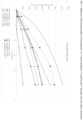
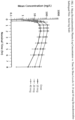
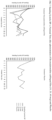
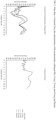
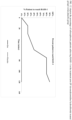
- Tables 38 and 39 and Figures 17 and 18 illustrate that the median Tmax ranges from 1.5 - 2.3 hours for different dose levels. Further, exposure is increasing with increasing dose from 20 to 60 mcg in a proportional manner. The redosing of 20 mcg after 1 hr in Cohort 1 led to 2.5-fold increase in the geometric mean of Cmax and in AUC.
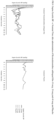
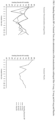
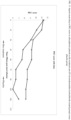
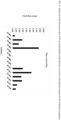
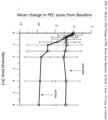
- Figures 19 and 20 show that in Cohort 3, a 120 mcg dose resulted in a significant decrease in the PEC Score, compared with pooled placebo group. Notably, the decrease in PEC Score in 120 mcg is differentiated from the pooled placebo group at 0.5 hr and is maintained throughout the course of the measurement (6 hr).
- Example 8 Clinical study of the efficacy (sedation and anti-agitation), pharmacokinetics and safety of dexmedetomidine infused intravenously in subjects suffering from schizophrenia
- a Key Objective of the study was to determine the optimal intravenous (IV) dose of dexmedetomidine hydrochloride in the target population in terms of efficacy and safety to achieve arousable sedation (RASS of -1) which can be reversed by verbal stimulation. When this goal was achieved in each participant, the IV infusion of dexmedetomidine hydrochloride ceased.
- Another Key Objective of the study was to determine the reduction in the level of agitation, as determined by their PEC score, at the doses to achieve a RASS of -1.
- Participants were provide written informed consent before any study related procedures were performed. All participants were screened for inclusion and exclusion criteria. The participants were admitted to the site at screening (Day -1), the day before the infusion. Baseline assessments were performed on Day -1, as well as on the day of infusion (Day 1). The participants were on Day 1 prepared for the infusion, infused for up to 3 hours and monitored for resolution of sedation and any decreases in blood pressure or heart rate which met stopping criteria. The participants were not discharged from the research unit until three hours after resolution of any reduction in the level of arousal (e.g., RASS -1) and/or resolution of any decrease in blood pressure or heart rate meeting stopping criteria. The Principal Investigator had discretion to keep the participant overnight at the site the evening of Day 1 for extended monitoring and then discharge home the participant on Day 2 if the Principal Investigator or designee determined that the participant has returned to their baseline state.
- RASS -1 level of arousal
- the Principal Investigator had discretion to keep the participant overnight at the site the evening of Day 1 for extended monitoring
- the study population included 14 participants, 10 active and 4 placebo. Patients 5, 7, 8 and 9 received placebo. Patients 1, 2, 3, 4, 11, 12, 14, 16, 17, 18 were infused with intravenous dexmedetomidine hydrochloride, starting at a rate of 0.2 mcg/kg/hr, and rising by 0.1 mcg/kg/hr every 30 minutes until stopping criteria were reached up or to a maximum duration of 3 hours. Participants randomized to placebo received a matching intravenous infusion of placebo solution.
- Table 40 Study Treatments Treatment Formulation Frequency Dexmedetomidine hydrochloride Precedex ® Continuous infusion, increment every 30 minutes Placebo Normal Saline Continuous infusion
- the maximum total dose administered was 1.6 mcg/kg/hr, when either the desired level of sedation was achieved or the maximum allowable decrease in either systolic or diastolic blood pressure or heart rate occurred.
- the participants were continuously monitored during the study by the site personnel, including monitoring blood pressure and heart rate. Intermittent electrocardiograms were taken from the start of the infusion through resolution of the sedation and/or any adverse effects on blood pressure or heart rate.
- the site stopped the infusion and the site continued to monitor the participant's vital signs every 15 minutes until the participant has reached their baseline parameters or in the judgment of the principal investigator the participant has reached a stable and acceptable level of blood pressure and heart rate.
- Return to baseline parameters is defined as BP falling within 15 mm of Hg of baseline reading prior to drug administration or HR falling within 10 beats per minute of baseline reading prior to drug administration.
- remedial drugs could be administered in addition to termination of the dexmedetomidine hydrochloride infusion, based on investigator's judgement.
- AEs Adverse events
- SAEs serious adverse events
- Table 41 Depicts the RASS score of Schizophrenia patients receiving infusion of dexmedetomidine hydrochloride and normal saline Infusion (minutes) RASS values after infusion start Patient No.
- Table 42 Depicts the PEC data of schizophrenia patients receiving infusion of dexmedetomidine and normal saline Time (Mins) PEC values after infusion start Patient No.
- the level of dexmedetomidine in the plasma of patients was also measured over the time of infusion. The results are tabulated in Table 43.
- the maximum dexmedetomidine concentrations in schizophrenic patients (C max ) ranged from about 22.45 pg/ml to about 406.3 pg/ml.
- Time to reach C max ranged from about 15 minutes to about 105 minutes.
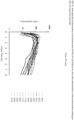
- Mean infusion rate is 0.36 mcg/kg/hr with the maximum rate ranging from about 0.2 mcg/kg/hr to about 0.6 mcg/kg/hr (see Figures 14 , 15 and 16 ).
- Table 43 depicts the plasma concentrations (pg/mL) of schizophrenia patients at different timepoints during the infusion of dexmedetomidine hydrochloride and normal saline Time (Mins) Plasma level concentration (picogram/ml) 1 2 3 4 5 7 8 9 11 12 14 16 17 18 T T T T P P P P P T T T T T T 0 BLQ BLQ BLQ BLQ BLQ BLQ BLQ BLQ BLQ BLQ BLQ BLQ BLQ 15 22.45 BLQ BLQ BLQ BLQ BLQ 41.01 BLQ BLQ 2.56 15.87 48.36 30 14.72 BLQ BLQ BLQ BLQ BLQ BLQ BLQ 62.91 44.87 52.66 15.59 BLQ 54.53 45 BLQ BLQ BLQ BLQ BLQ 124.07 50.51 46.53 41.17 39.93 60 BLQ BLQ BLQ BLQ BL
- sublingual dexmedetomidine hydrochloride administered to healthy volunteers produced good plasma exposure levels at doses of 10, 20 and 40 micrograms, indicating that such doses would be suitable for obtaining good anti-agitation effects (e.g. as measured by a reduction in PEC score) in agitated subjects, including subjects with schizophrenia, without also producing clinically meaningful detrimental effects on blood pressure and/or heart rate.
Landscapes
- Health & Medical Sciences (AREA)
- Chemical & Material Sciences (AREA)
- Life Sciences & Earth Sciences (AREA)
- Veterinary Medicine (AREA)
- Medicinal Chemistry (AREA)
- Public Health (AREA)
- General Health & Medical Sciences (AREA)
- Animal Behavior & Ethology (AREA)
- Pharmacology & Pharmacy (AREA)
- Epidemiology (AREA)
- Engineering & Computer Science (AREA)
- Bioinformatics & Cheminformatics (AREA)
- General Chemical & Material Sciences (AREA)
- Chemical Kinetics & Catalysis (AREA)
- Inorganic Chemistry (AREA)
- Nuclear Medicine, Radiotherapy & Molecular Imaging (AREA)
- Organic Chemistry (AREA)
- Neurosurgery (AREA)
- Neurology (AREA)
- Biomedical Technology (AREA)
- Physiology (AREA)
- Nutrition Science (AREA)
- Proteomics, Peptides & Aminoacids (AREA)
- Oil, Petroleum & Natural Gas (AREA)
- Zoology (AREA)
- Anesthesiology (AREA)
- Medicinal Preparation (AREA)
- Pharmaceuticals Containing Other Organic And Inorganic Compounds (AREA)
Applications Claiming Priority (8)
| Application Number | Priority Date | Filing Date | Title |
|---|---|---|---|
| US201862690407P | 2018-06-27 | 2018-06-27 | |
| US201862693726P | 2018-07-03 | 2018-07-03 | |
| US201862767422P | 2018-11-14 | 2018-11-14 | |
| US201962787649P | 2019-01-02 | 2019-01-02 | |
| US201962798842P | 2019-01-30 | 2019-01-30 | |
| US201962849747P | 2019-05-17 | 2019-05-17 | |
| EP19826778.3A EP3813802B1 (de) | 2018-06-27 | 2019-06-26 | Filmformulierungen mit dexmedetomidin und verfahren zur herstellung davon |
| PCT/US2019/039268 WO2020006092A1 (en) | 2018-06-27 | 2019-06-26 | Film formulations containing dexmedetomidine and methods of producing them |
Related Parent Applications (1)
| Application Number | Title | Priority Date | Filing Date |
|---|---|---|---|
| EP19826778.3A Division EP3813802B1 (de) | 2018-06-27 | 2019-06-26 | Filmformulierungen mit dexmedetomidin und verfahren zur herstellung davon |
Publications (2)
| Publication Number | Publication Date |
|---|---|
| EP4523752A2 true EP4523752A2 (de) | 2025-03-19 |
| EP4523752A3 EP4523752A3 (de) | 2025-05-14 |
Family
ID=68987261
Family Applications (2)
| Application Number | Title | Priority Date | Filing Date |
|---|---|---|---|
| EP24208127.1A Pending EP4523752A3 (de) | 2018-06-27 | 2019-06-26 | Filmformulierungen mit dexmedetomidin und verfahren zur herstellung davon |
| EP19826778.3A Active EP3813802B1 (de) | 2018-06-27 | 2019-06-26 | Filmformulierungen mit dexmedetomidin und verfahren zur herstellung davon |
Family Applications After (1)
| Application Number | Title | Priority Date | Filing Date |
|---|---|---|---|
| EP19826778.3A Active EP3813802B1 (de) | 2018-06-27 | 2019-06-26 | Filmformulierungen mit dexmedetomidin und verfahren zur herstellung davon |
Country Status (15)
| Country | Link |
|---|---|
| US (9) | US10792246B2 (de) |
| EP (2) | EP4523752A3 (de) |
| JP (2) | JP7488201B2 (de) |
| KR (1) | KR102824967B1 (de) |
| CN (5) | CN112888431B (de) |
| AU (2) | AU2019295699A1 (de) |
| BR (1) | BR112020026672A2 (de) |
| CA (1) | CA3103431A1 (de) |
| ES (1) | ES3004544T3 (de) |
| IL (1) | IL279713B2 (de) |
| MX (1) | MX2020014000A (de) |
| PL (1) | PL3813802T3 (de) |
| PT (1) | PT3813802T (de) |
| SG (1) | SG11202012772XA (de) |
| WO (1) | WO2020006092A1 (de) |
Families Citing this family (16)
| Publication number | Priority date | Publication date | Assignee | Title |
|---|---|---|---|---|
| EP4371554A3 (de) | 2016-12-31 | 2024-08-07 | BioXcel Therapeutics, Inc. | Verwendung von sublingualem dexmedetomidin zur behandlung von unruhe |
| EP3505157B1 (de) | 2017-12-29 | 2021-12-08 | Celon Pharma S.A. | Trockenpulver-ketamin zusammensetzung zur pulmonalen verabreichung bei behandlungsresistenter depression |
| EP4523752A3 (de) | 2018-06-27 | 2025-05-14 | BioXcel Therapeutics, Inc. | Filmformulierungen mit dexmedetomidin und verfahren zur herstellung davon |
| CA3105187A1 (en) | 2018-06-28 | 2020-01-02 | Arx, Llc | Dispensing method for producing dissolvable unit dose film constructs |
| MX2022000709A (es) | 2019-07-19 | 2022-05-19 | Bioxcel Therapeutics Inc | Regimenes de tratamiento con dexmedetomidina no sedante. |
| AU2020416292B2 (en) * | 2019-12-31 | 2024-08-22 | Cure Pharmaceutical, Inc. | Oral dissolvable film and method of manufacturing and using the same |
| CA3203241A1 (en) * | 2021-01-04 | 2022-07-07 | Robert RISINGER | Dexmedetomidine treatment regimens |
| KR20230159515A (ko) | 2021-03-19 | 2023-11-21 | 오리온 코포레이션 | 타시피미딘 제형 및 이의 용도 |
| US20250319069A1 (en) * | 2021-07-02 | 2025-10-16 | Bioxcel Therapeutics, Inc. | Methods for treating depressive states |
| IL318007A (en) | 2022-07-27 | 2025-02-01 | Universit?T Z?Rich | Dexmedetocidin for the treatment of sleep disorders |
| EP4583871A1 (de) * | 2022-09-11 | 2025-07-16 | BioXcel Therapeutics, Inc. | Verfahren zur behandlung von agitation in gemeinschaftseinstellungen |
| US11806334B1 (en) | 2023-01-12 | 2023-11-07 | Bioxcel Therapeutics, Inc. | Non-sedating dexmedetomidine treatment regimens |
| WO2025043236A1 (en) * | 2023-08-24 | 2025-02-27 | Joseph Fuisz | Edible oral films, compositions, method of manufacture and packaging systems |
| WO2025147530A1 (en) * | 2024-01-05 | 2025-07-10 | Taho Pharmaceuticals Ltd. | Naloxone buccal film product and uses thereof |
| CN118542852B (zh) * | 2024-07-30 | 2024-10-01 | 山东则正医药技术有限公司 | 包含经口给药的右美托咪定舌下膜组合物及其制备方法和应用 |
| CN119139275B (zh) * | 2024-11-05 | 2025-08-22 | 中国人民解放军军事科学院军事医学研究院 | 一种盐酸右美托咪定口溶膜及其制备方法和其应用 |
Citations (13)
| Publication number | Priority date | Publication date | Assignee | Title |
|---|---|---|---|---|
| US5217718A (en) | 1989-08-18 | 1993-06-08 | Cygnus Therapeutic Systems | Method and device for administering dexmedetomidine transdermally |
| US5817332A (en) | 1994-07-08 | 1998-10-06 | Urtti; Arto O. | Transdermal drug delivery system |
| US5820875A (en) | 1991-10-10 | 1998-10-13 | Cygnus, Inc. | Device for administering drug transdermally with a controlled temporal change in skin flux |
| WO2010132882A2 (en) | 2009-05-15 | 2010-11-18 | Recro Pharma, Inc. | Sublingual dexmedetomidine compositions and methods of use thereof |
| US20130072532A1 (en) | 2010-01-08 | 2013-03-21 | Recro Pharma, Inc. | Topical transdermal dexmedetomidine compositions and methods of use thereof |
| US20140328898A1 (en) | 2013-03-15 | 2014-11-06 | Children's National Medical Center | Nano-Liposomal Formulations and Methods of Use |
| US20150098980A1 (en) | 2013-10-07 | 2015-04-09 | Teikoku Pharma Usa, Inc. | Dexmedetomidine Transdermal Delivery Devices and Methods for Using the Same |
| US20150098997A1 (en) | 2013-10-07 | 2015-04-09 | Teikoku Pharma Usa, Inc. | Methods and Compositions for Treating Attention Deficit Hyperactivity Disorder, Anxiety and Insomnia Using Dexmedetomidine Transdermal Compositions |
| US20150098981A1 (en) | 2013-10-07 | 2015-04-09 | Teikoku Pharma Usa, Inc. | Methods and Compositions for Transdermal Delivery of a Non-Sedative Amount of Dexmedetomidine |
| US20150098982A1 (en) | 2013-10-07 | 2015-04-09 | Teikoku Pharma Usa, Inc. | Methods and Compositions for Managing Pain Comprising Dexmedetomidine Transdermal Compositions |
| US20150098983A1 (en) | 2013-10-07 | 2015-04-09 | Teikoku Pharma Usa, Inc. | Methods and Compositions for Treating Withdrawal Syndromes Using Non-Sedative Dexmedetomidine Transdermal Compositions |
| US20180117012A1 (en) | 2016-10-31 | 2018-05-03 | Teikoku Pharma Usa, Inc. | Methods of Managing Pain Using Dexmedetomidine Transdermal Delivery Devices |
| US9974754B2 (en) | 2013-12-18 | 2018-05-22 | Maruishi Pharmaceutical Co., Ltd. | Hydrous adhesive patch |
Family Cites Families (247)
| Publication number | Priority date | Publication date | Assignee | Title |
|---|---|---|---|---|
| SU1138164A1 (ru) | 1963-04-25 | 1985-02-07 | Shadurskij Konstantin S | Антигистаминное средство "димебон |
| US4407957A (en) | 1981-03-13 | 1983-10-04 | Damon Corporation | Reversible microencapsulation of a core material |
| FI844786A0 (fi) | 1984-12-04 | 1984-12-04 | Farmos Oy | Terapeutiskt utnyttjbar foerening. |
| US4839170A (en) | 1985-10-01 | 1989-06-13 | Survival Technology, Inc. | Protein absorption enhancing agents |
| US4760094A (en) | 1986-10-21 | 1988-07-26 | American Home Products Corporation (Del.) | Spray dried acetaminophen |
| US4767789A (en) | 1986-10-21 | 1988-08-30 | American Home Products Corporation (Del.) | Spray dried acetaminophen |
| US4760093A (en) | 1986-10-21 | 1988-07-26 | American Home Products Corporation (Del.) | Spray dried acetaminophen |
| US5039540A (en) | 1989-08-14 | 1991-08-13 | Neophore Technologies, Inc. | Freeze dry composition and method for oral administration of drugs, biologicals, nutrients and foodstuffs |
| US5178878A (en) | 1989-10-02 | 1993-01-12 | Cima Labs, Inc. | Effervescent dosage form with microparticles |
| US5215756A (en) | 1989-12-22 | 1993-06-01 | Gole Dilip J | Preparation of pharmaceutical and other matrix systems by solid-state dissolution |
| US5188825A (en) | 1989-12-28 | 1993-02-23 | Iles Martin C | Freeze-dried dosage forms and methods for preparing the same |
| DK0585368T3 (da) | 1991-04-25 | 1998-03-16 | Univ Brown Res Found | Implanterbart biokompatibelt immunisolatorisk vehikel til afgivelse af udvalgte terapeutiske produkter |
| US5383851A (en) | 1992-07-24 | 1995-01-24 | Bioject Inc. | Needleless hypodermic injection device |
| US5569189A (en) | 1992-09-28 | 1996-10-29 | Equidyne Systems, Inc. | hypodermic jet injector |
| CZ286632B6 (cs) | 1992-09-29 | 2000-05-17 | Inhale Therapeutic Systems | Farmaceutický prostředek |
| US5343672A (en) | 1992-12-01 | 1994-09-06 | Scherer Ltd R P | Method for manufacturing freeze dried dosages in a multilaminate blister pack |
| ATE208615T1 (de) | 1993-07-09 | 2001-11-15 | Scherer Corp R P | Verfahren zur herstellung von gefriergetrockneten arzneistoffdosierungsformen |
| GB2281206A (en) | 1993-08-25 | 1995-03-01 | Orion Yhtymae Oy | Use of dexmedetomidine |
| US5457895A (en) | 1993-10-01 | 1995-10-17 | R. P. Scherer Corporation | Method of identifying freeze-dried dosage forms |
| CA2154483C (en) | 1993-11-29 | 2001-03-27 | Michael J. Zajaczkowski | Water-soluble pressure sensitive adhesive |
| US5395907A (en) | 1993-11-29 | 1995-03-07 | Adhesive Research, Inc. | Water-soluble pressure sensitive adhesive |
| US5508367A (en) | 1993-11-29 | 1996-04-16 | Adhesives Research, Inc. | Water-soluble pressure sensitive adhesive |
| FR2718357B1 (fr) | 1994-04-06 | 1997-10-03 | Defarges Alain Moreau | Perfectionnements apportés à un dispositif d'injection par jet sans aiguille. |
| US5726250A (en) | 1994-07-11 | 1998-03-10 | Adhesives Research, Inc. | Covalently crosslinked water-absorbent graft copolymer |
| US5731387A (en) | 1994-07-11 | 1998-03-24 | Adhesives Research, Inc. | Ionically-crosslinked water-absorbent graft copolymer |
| GB9421836D0 (en) | 1994-10-28 | 1994-12-14 | Scherer Corp R P | Process for preparing solid pharmaceutical dosage forms of hydrophobic substances |
| US6726928B2 (en) | 1994-10-28 | 2004-04-27 | R.P. Scherer Technologies, Inc. | Process for preparing solid dosage forms for unpalatable pharmaceuticals |
| US5837287A (en) | 1994-10-28 | 1998-11-17 | R P Scherer Corporation | Process for preparing solid pharmaceutical dosage forms |
| US5599302A (en) | 1995-01-09 | 1997-02-04 | Medi-Ject Corporation | Medical injection system and method, gas spring thereof and launching device using gas spring |
| US5605911A (en) | 1995-01-31 | 1997-02-25 | Washington University | Use of alpha-2 adrenergic drugs to prevent adverse effects of NMDA receptor hypofunction (NRH) |
| US5700873A (en) | 1995-03-07 | 1997-12-23 | Adhesives Research, Inc. | Method of preparation of water-soluble copolymer |
| US5780014A (en) | 1995-04-14 | 1998-07-14 | Inhale Therapeutic Systems | Method and apparatus for pulmonary administration of dry powder alpha 1-antitrypsin |
| US5654007A (en) | 1995-06-07 | 1997-08-05 | Inhale Therapeutic Systems | Methods and system for processing dispersible fine powders |
| GB9616672D0 (en) | 1996-08-08 | 1996-09-25 | Scherer Ltd R P | Pharmaceutical compositions |
| US5800832A (en) * | 1996-10-18 | 1998-09-01 | Virotex Corporation | Bioerodable film for delivery of pharmaceutical compounds to mucosal surfaces |
| GB9700624D0 (en) | 1997-01-14 | 1997-03-05 | Danbiosyst Uk | Drug delivery composition |
| GB9702799D0 (en) | 1997-02-12 | 1997-04-02 | Scherer Corp R P | Process for preparing solid pharmaceutical dosage forms |
| WO1998036738A1 (en) | 1997-02-20 | 1998-08-27 | Therics, Inc. | Dosage form exhibiting rapid disperse properties, methods of use and process for the manufacture of same |
| US6239228B1 (en) | 1997-02-21 | 2001-05-29 | Adhesives Research, Inc. | Pressure sensitive adhesive containing macromer having repeat hydrophilic moieties |
| KR20000070375A (ko) | 1997-02-21 | 2000-11-25 | 에드워드 엘. 데이지 | 압력 민감성 접착제 약물 경피 전달 시스템과 이에 사용되는압력 민감성 접착제 |
| US5951999A (en) | 1997-02-21 | 1999-09-14 | Adhesives Research, Inc. | Transdermal pressure sensitive adhesive drug delivery system |
| US6024981A (en) | 1997-04-16 | 2000-02-15 | Cima Labs Inc. | Rapidly dissolving robust dosage form |
| US5976577A (en) | 1997-07-11 | 1999-11-02 | Rp Scherer Corporation | Process for preparing fast dispersing solid oral dosage form |
| DE69834255T2 (de) | 1997-07-25 | 2006-09-28 | Alpex Pharma S.A. | Verfahren zur herstellung eines granulates, geeignet zur herstellung schnell-freisetzender, im mund löslicher tabletten |
| US7632517B2 (en) | 1997-10-01 | 2009-12-15 | Novadel Pharma Inc. | Buccal, polar and non-polar spray containing zolpidem |
| GB9802088D0 (en) | 1998-01-30 | 1998-03-25 | Scherer Ltd R P | Pharmaceutical products |
| DE69936949T2 (de) | 1998-03-09 | 2008-05-15 | Cima Labs Inc., Eden Prairie | Vorrichtung zum Handhaben und Verpacken von spröden Tabletten |
| US6200604B1 (en) | 1998-03-27 | 2001-03-13 | Cima Labs Inc. | Sublingual buccal effervescent |
| US6716867B1 (en) | 1998-04-01 | 2004-04-06 | Orion Corporation | Use of dexmedetomidine for ICU sedation |
| WO1999062403A1 (en) | 1998-06-03 | 1999-12-09 | Scott Laboratories, Inc. | Apparatus and method for providing a conscious patient relief from pain and anxiety associated with medical or surgical procedures |
| US7565905B2 (en) | 1998-06-03 | 2009-07-28 | Scott Laboratories, Inc. | Apparatuses and methods for automatically assessing and monitoring a patient's responsiveness |
| AU2005201500B2 (en) | 1998-06-03 | 2007-01-04 | Scott Laboratories, Inc. | Apparatus and method for providing a conscious patient relief from pain and anxiety associated with medical or surgical procedures |
| US7001609B1 (en) | 1998-10-02 | 2006-02-21 | Regents Of The University Of Minnesota | Mucosal originated drug delivery systems and animal applications |
| CZ20011739A3 (cs) | 1998-11-20 | 2001-10-17 | Rtp Pharma Inc. | Dispergovatelné fosfolipidem stabilizované mikročástice |
| GB9901819D0 (en) | 1999-01-27 | 1999-03-17 | Scherer Corp R P | Pharmaceutical compositions |
| GB9908014D0 (en) | 1999-04-08 | 1999-06-02 | Scherer Corp R P | Pharmaceutical compositions |
| US6284270B1 (en) | 1999-08-04 | 2001-09-04 | Drugtech Corporation | Means for creating a mass having structural integrity |
| DE19940740A1 (de) | 1999-08-31 | 2001-03-01 | Gruenenthal Gmbh | Pharmazeutische Salze |
| US6984207B1 (en) | 1999-09-14 | 2006-01-10 | Hoana Medical, Inc. | Passive physiological monitoring (P2M) system |
| CA2324967A1 (en) | 2000-11-01 | 2002-05-01 | 3816133 Canada Inc. | System for monitoring patients with alzheimer's disease or related dementia |
| US6316029B1 (en) | 2000-05-18 | 2001-11-13 | Flak Pharma International, Ltd. | Rapidly disintegrating solid oral dosage form |
| CA2415076C (en) * | 2000-07-07 | 2010-04-13 | Mikhail M. Feldstein | Preparation of hydrophilic pressure sensitive adhesives having optimized adhesive properties |
| US20020192287A1 (en) * | 2000-11-09 | 2002-12-19 | Mooney Mark T. | Extrudable compositions for topical or transdermal drug delivery |
| US6982251B2 (en) | 2000-12-20 | 2006-01-03 | Schering Corporation | Substituted 2-azetidinones useful as hypocholesterolemic agents |
| US6814978B2 (en) | 2000-12-29 | 2004-11-09 | Mcneil-Ppc, Inc. | Process for preparing a soft tablet |
| US20030022926A1 (en) | 2001-05-07 | 2003-01-30 | Lavand'homme Patricia | Method for treating neuropathic pain and pharmaceutical preparation therefor |
| JP2004532475A (ja) | 2001-05-15 | 2004-10-21 | サイコジェニックス・インコーポレーテッド | 行動情報工学を監視するシステムおよび方法 |
| US6509040B1 (en) | 2001-06-22 | 2003-01-21 | R.P. Scherer Corporation | Fast dispersing dosage forms essentially free of mammalian gelatin |
| AU2002334939A1 (en) | 2001-10-12 | 2003-04-22 | Eugene R. Cooper | Compositions having a combination of particles for immediate release and for controlled release |
| US20070281003A1 (en) * | 2001-10-12 | 2007-12-06 | Fuisz Richard C | Polymer-Based Films and Drug Delivery Systems Made Therefrom |
| US8900498B2 (en) | 2001-10-12 | 2014-12-02 | Monosol Rx, Llc | Process for manufacturing a resulting multi-layer pharmaceutical film |
| US20140271788A1 (en) | 2013-03-15 | 2014-09-18 | Monosol Rx, Llc | Sublingual and buccal film compositions |
| US8603514B2 (en) | 2002-04-11 | 2013-12-10 | Monosol Rx, Llc | Uniform films for rapid dissolve dosage form incorporating taste-masking compositions |
| US7357891B2 (en) | 2001-10-12 | 2008-04-15 | Monosol Rx, Llc | Process for making an ingestible film |
| US8663687B2 (en) | 2001-10-12 | 2014-03-04 | Monosol Rx, Llc | Film compositions for delivery of actives |
| US20110033542A1 (en) | 2009-08-07 | 2011-02-10 | Monosol Rx, Llc | Sublingual and buccal film compositions |
| US7666337B2 (en) * | 2002-04-11 | 2010-02-23 | Monosol Rx, Llc | Polyethylene oxide-based films and drug delivery systems made therefrom |
| US8765167B2 (en) | 2001-10-12 | 2014-07-01 | Monosol Rx, Llc | Uniform films for rapid-dissolve dosage form incorporating anti-tacking compositions |
| US7425292B2 (en) | 2001-10-12 | 2008-09-16 | Monosol Rx, Llc | Thin film with non-self-aggregating uniform heterogeneity and drug delivery systems made therefrom |
| FR2832311B1 (fr) | 2001-11-21 | 2004-04-16 | Besins Int Belgique | Poudre filmogene, compositions la comprenant, leurs procedes de preparation et leurs utilisations |
| FR2834212B1 (fr) | 2001-12-27 | 2004-07-09 | Besins Int Belgique | Utilisation d'une poudre a liberation immediate dans des compositions pharmaceutiques et nutraceutiques |
| CN100556762C (zh) | 2002-02-13 | 2009-11-04 | 迈克尔K·韦伯尔 | 药物剂型及其制造方法 |
| US20040138312A1 (en) | 2002-10-08 | 2004-07-15 | Wheeler Larry A. | Methods for the treatment of neurodegeneration |
| US20040156894A1 (en) | 2003-02-07 | 2004-08-12 | Grother Leon Paul | Use of edible acids in fast-dispersing pharmaceutical solid dosage forms |
| EP1663178A1 (de) | 2003-05-28 | 2006-06-07 | MonoSolRX, LLC | Filme basiert auf polyethylenoxid, sowie daraus hergestellte arzneistoffabgabesysteme |
| US7282217B1 (en) | 2003-08-29 | 2007-10-16 | Kv Pharmaceutical Company | Rapidly disintegrable tablets |
| US9248146B2 (en) | 2003-10-24 | 2016-02-02 | Adhesives Research, Inc. | Dissolvable adhesive films for delivery of pharmaceutical or cosmetic agents |
| AU2004284080B2 (en) | 2003-10-24 | 2008-10-02 | Adhesives Research, Inc. | Disintegratable films for diagnostic devices |
| GB0403808D0 (en) * | 2004-02-20 | 2004-03-24 | Bioprogress Technology Ltd | Films for use as dosage forms |
| US20050222270A1 (en) | 2004-02-26 | 2005-10-06 | Olney John W | Prolonged administration of NMDA antagonist drug and safener drug to create improved stable neural homeostasis |
| US7972621B2 (en) | 2004-06-03 | 2011-07-05 | R.P. Scherer Technologies, Llc | Process for formulating fast dispersing dosage forms comprising at least one fish gelatin selected on the basis of molecular weight |
| US20060058590A1 (en) | 2004-08-24 | 2006-03-16 | Shaw Geoffrey M | Method and system for assaying agitation |
| US20060058700A1 (en) | 2004-08-26 | 2006-03-16 | Marro Dominic P | Patient sedation monitor |
| CA2580694A1 (en) | 2004-09-23 | 2006-03-30 | Alexander Michalow | Methods for regulating neurotransmitter systems by inducing counteradaptations |
| US20080214903A1 (en) | 2005-02-22 | 2008-09-04 | Tuvi Orbach | Methods and Systems for Physiological and Psycho-Physiological Monitoring and Uses Thereof |
| CA2599937A1 (en) | 2005-03-04 | 2006-09-14 | Boehringer Ingelheim International Gmbh | Pharmaceutical compositions for the treatment and/or prevention of anxiety disorders |
| WO2007010242A1 (en) | 2005-07-18 | 2007-01-25 | Imperial College Innovations Limited | Use of a noradrenergic agonist, e.g. guanfacine, for the treatment of cognitive disorders |
| US20070106126A1 (en) | 2005-09-30 | 2007-05-10 | Mannheimer Paul D | Patient monitoring alarm escalation system and method |
| CA2624731A1 (en) | 2005-10-04 | 2007-04-12 | Medivation, Inc. | Hydrogenated pyrido-indole compounds for the treatment of huntington's disease |
| US8158152B2 (en) | 2005-11-18 | 2012-04-17 | Scidose Llc | Lyophilization process and products obtained thereby |
| EP1978939A2 (de) | 2005-12-27 | 2008-10-15 | Jubilant Organosys Limited | Sich im mund auflösende pharmazeutische zusammensetzung und verfahren zu ihrer herstellung unter verwendung einer grossen menge von siliziumdioxin |
| US8481583B2 (en) | 2006-02-13 | 2013-07-09 | Orient Pharma (Samoa) Co., Ltd. | Combination of alpha-2 receptor agonist (clonidin) and anti-muscarinic agent (oxybutynin) for the treatment of sialorrhoea |
| US7630758B2 (en) | 2006-06-22 | 2009-12-08 | General Electric Company | Separation of natural and drug-induced sleep of a subject |
| US20080026040A1 (en) * | 2006-07-31 | 2008-01-31 | Isaac Farr | Active agent-releasing dosage forms |
| CA2664097A1 (en) | 2006-09-20 | 2008-03-27 | Monosol Rx, Llc | Edible water-soluble film containing a foam reducing flavoring agent |
| US8157730B2 (en) | 2006-12-19 | 2012-04-17 | Valencell, Inc. | Physiological and environmental monitoring systems and methods |
| US20080153808A1 (en) | 2006-12-22 | 2008-06-26 | Allergan, Inc. | Alpha-2 receptor pan agonist and serotonin-norepinephrine reuptake inhibitor compositions for treating chronic pain |
| EP2112923A1 (de) | 2007-01-22 | 2009-11-04 | Targacept Inc. | Intranasale, orale und sublinguale verabreichung von metanikotin-analogen |
| US8568777B2 (en) | 2007-03-30 | 2013-10-29 | Monosol Rx, Llc | Packaged film dosage unit containing a complexate |
| MX2009012109A (es) | 2007-05-10 | 2010-02-22 | Novadel Pharma Inc | Composiciones contra el insomnio y metodos. |
| US20090099480A1 (en) | 2007-05-24 | 2009-04-16 | Peter Salgo | System and method for patient monitoring |
| EP2170282A4 (de) | 2007-06-27 | 2014-11-05 | Hanmi Pharm Ind Co Ltd | Verfahren zur herstellung einer schnell zerfallenden formulierung zur oralen verabreichung und gerät zur herstellung und verpackung der formulierung |
| RU2338533C1 (ru) | 2007-06-28 | 2008-11-20 | Сергей Олегович Бачурин | СРЕДСТВО, ОБЛАДАЮЩЕЕ АНКСИОЛИТИЧЕСКИМ ДЕЙСТВИЕМ, НА ОСНОВЕ ГИДРИРОВАННЫХ ПИРИДО(4,3-b)ИНДОЛОВ (ВАРИАНТЫ), ФАРМАКОЛОГИЧЕСКОЕ СРЕДСТВО НА ЕГО ОСНОВЕ И СПОСОБ ЕГО ПРИМЕНЕНИЯ |
| KR20100054812A (ko) | 2007-08-01 | 2010-05-25 | 메디베이션 뉴롤로지 인코퍼레이티드 | 항정신병제 조합 치료제를 사용하여 정신분열증을 치료하기 위한 방법 및 조성물 |
| MY185299A (en) | 2007-10-11 | 2021-04-30 | Philip Morris Products Sa | Smokeless tobacco product |
| US8298583B2 (en) | 2007-10-19 | 2012-10-30 | Monosol Rx, Llc | Film delivery system for tetrahydrolipstatin |
| PE20091084A1 (es) | 2007-12-07 | 2009-07-23 | Schering Plough Healthcare | Formulaciones farmaceuticas de fenilefrina y composiciones para absorcion transmucosal |
| CN101496801A (zh) | 2008-02-02 | 2009-08-05 | 四川百利药业有限责任公司 | 右旋美托咪定及其药用盐的用途 |
| CN101878029B (zh) | 2008-02-15 | 2013-04-03 | 骨治疗公司 | 用于治疗和/或预防骨关节病的药物组合物 |
| NZ587611A (en) | 2008-02-28 | 2012-07-27 | Rp Scherer Technologies Llc | Process to minimize polymorphism |
| US20190216389A1 (en) | 2008-04-07 | 2019-07-18 | Christopher Scheib | Method and system for analyzing a series of electroencephalogram (eeg) signals during altered brain states |
| US20090275853A1 (en) | 2008-04-30 | 2009-11-05 | The General Electric Company | Method and apparatus for monitoring physiological state of a subject |
| US8882684B2 (en) | 2008-05-12 | 2014-11-11 | Earlysense Ltd. | Monitoring, predicting and treating clinical episodes |
| WO2010014758A1 (en) | 2008-07-30 | 2010-02-04 | Edison Pharmaceuticals, Inc. | Use of hydrogenated pyrido[4,3-b] indoles for the treatment of oxidative stress |
| US20110172262A1 (en) | 2008-09-15 | 2011-07-14 | Biovista, Inc. | Compositions and methods for treating epilepsy |
| US8221480B2 (en) | 2008-10-31 | 2012-07-17 | The Invention Science Fund I, Llc | Compositions and methods for biological remodeling with frozen particle compositions |
| US8256233B2 (en) | 2008-10-31 | 2012-09-04 | The Invention Science Fund I, Llc | Systems, devices, and methods for making or administering frozen particles |
| US8470546B2 (en) | 2008-11-25 | 2013-06-25 | Albert Einstein College Of Medicine Of Yeshiva University | Treatment of autism spectrum disorders with agents that activate the Locus Coeruleus-Noradrenergic system |
| US20100196286A1 (en) | 2008-12-01 | 2010-08-05 | Armer Thomas A | Inhalation delivery methods and devices |
| US8282954B2 (en) | 2008-12-15 | 2012-10-09 | Monosol Rx, Llc | Method for manufacturing edible film |
| TR200903014A1 (tr) | 2009-04-17 | 2010-11-22 | Sanovel İlaç San. Ve Ti̇c. A.Ş. | Oral yolla dağılan dimebolin bileşimleri. |
| US8475832B2 (en) | 2009-08-07 | 2013-07-02 | Rb Pharmaceuticals Limited | Sublingual and buccal film compositions |
| US9775819B2 (en) | 2009-09-16 | 2017-10-03 | R.P. Scherer Technologies, Llc | Oral solid dosage form containing nanoparticles and process of formulating the same using fish gelatin |
| US8313768B2 (en) | 2009-09-24 | 2012-11-20 | Mcneil-Ppc, Inc. | Manufacture of tablet having immediate release region and sustained release region |
| WO2011039686A1 (en) | 2009-09-30 | 2011-04-07 | Pfizer Inc. | Latrepirdine oral sustained release dosage forms |
| WO2011109716A2 (en) | 2010-03-04 | 2011-09-09 | Neumitra LLC | Devices and methods for treating psychological disorders |
| US10548839B2 (en) | 2010-03-16 | 2020-02-04 | Wei Tian | Process of manufacturing a lyophilized fast dissolving, multi-phasic dosage form |
| US20130029989A1 (en) | 2010-04-15 | 2013-01-31 | The Royal Institution For The Advancement Of Learning/Mcgill University | Topical treatments for pain |
| US9572773B2 (en) | 2010-04-26 | 2017-02-21 | Novartis A.G. | Layered drug delivery device |
| US20110290694A1 (en) | 2010-05-27 | 2011-12-01 | Monosol Rx, Llc | Oral film dosage form having indicia thereon |
| EP2579844B1 (de) * | 2010-06-10 | 2016-02-24 | Midatech Ltd. | Systeme zur freisetzung von nanopartikeln |
| US8529914B2 (en) | 2010-06-28 | 2013-09-10 | Richard C. Fuisz | Bioactive dose having containing a material for modulating pH of a bodily fluid to help or hinder absorption of a bioactive |
| CA2808379C (en) | 2010-08-17 | 2019-04-09 | University Of Florida Research Foundation, Inc. | Central site photoplethysmography, medication administration, and safety |
| KR101802553B1 (ko) | 2010-09-23 | 2017-11-28 | 모노졸 알엑스, 엘엘씨 | 제약 생성물을 패키지 표면 상에 직접적으로 형성시키는 방법 및 시스템 |
| US8383135B2 (en) | 2010-12-03 | 2013-02-26 | Richard C. Fuisz | Solid dosage form that promotes reliable oral, esophageal and GI transit |
| CA2821756C (en) | 2010-12-16 | 2021-06-29 | Cynapsus Therapeutics, Inc. | Sublingual films comprising apomorphine and an organic base |
| US8445526B2 (en) | 2011-02-03 | 2013-05-21 | Glaucoma & Nasal Therapies Llc | Compositions and methods for treatment of glaucoma |
| US20140163080A1 (en) | 2011-02-03 | 2014-06-12 | Gnt, Llc | Compositions and Methods for Treatment of Glaucoma |
| WO2012104834A1 (en) * | 2011-02-03 | 2012-08-09 | Pharmedica Ltd. | New oral dissolving films for insulin administration, for treating diabetes |
| WO2016029227A1 (en) | 2014-08-22 | 2016-02-25 | The General Hospital Corporation | Systems and methods for predicting arousal to consciousness during general anesthesia and sedation |
| US8703697B2 (en) | 2011-06-24 | 2014-04-22 | Luc QUINTIN | Method for treating early severe diffuse acute respiratory distress syndrome |
| US8241661B1 (en) * | 2011-06-24 | 2012-08-14 | Fuisz Richard C | Biocompatible film with variable cross-sectional properties |
| US20130096170A1 (en) | 2011-10-14 | 2013-04-18 | Hospira, Inc. | Methods of treating pediatric patients using dexmedetomidine |
| US20130116215A1 (en) | 2011-10-28 | 2013-05-09 | Mireia Coma | Combination therapies for treating neurological disorders |
| US9795559B2 (en) * | 2011-12-11 | 2017-10-24 | Recro Pharma, Inc. | Intranasal dexmedetomidine compositions and methods of use thereof |
| US8242158B1 (en) | 2012-01-04 | 2012-08-14 | Hospira, Inc. | Dexmedetomidine premix formulation |
| JP2015517980A (ja) | 2012-02-27 | 2015-06-25 | アイ・セラピーズ・エル・エル・シー | 片頭痛の治療のための組成物および方法 |
| JP5921928B2 (ja) | 2012-03-28 | 2016-05-24 | テルモ株式会社 | 既希釈デクスメデトミジン製剤 |
| CN102657635B (zh) * | 2012-05-04 | 2013-08-07 | 上海现代药物制剂工程研究中心有限公司 | 具有微孔的海绵状的阿塞那平舌下膜剂及其制备方法 |
| WO2013173317A1 (en) | 2012-05-14 | 2013-11-21 | Prospire, Llc | TREATMENT OF OBSTRUCTIVE SLEEP APNEA WITH α2-ADRENERGIC RECEPTOR AGONISTS |
| AU2013285988A1 (en) | 2012-07-06 | 2015-02-12 | Egalet Ltd. | Abuse deterrent pharmaceutical compositions for controlled release |
| US10130766B1 (en) | 2012-08-08 | 2018-11-20 | Neurowave Systems Inc. | Intelligent pharmaceutical delivery system with automatic shutoff and method of using |
| US20140180160A1 (en) | 2012-10-12 | 2014-06-26 | Emery N. Brown | System and method for monitoring and controlling a state of a patient during and after administration of anesthetic compound |
| PL2719376T3 (pl) | 2012-10-12 | 2015-08-31 | Omya Int Ag | Gastroretencyjny preparat leku oraz sposoby dostarczania i sposób jego wytwarzania z użyciem funkcjonalizowanego węglanu wapnia |
| PL2906213T3 (pl) | 2012-10-15 | 2018-04-30 | Orion Corporation | Weterynaryjny sposób łagodzenia awersji wobec hałasu |
| GB2510321B (en) | 2012-11-12 | 2018-01-31 | Biosurgical S L | Agitation apparatus |
| US9545376B2 (en) | 2013-01-23 | 2017-01-17 | Arx, Llc | Production of unit dose constructs |
| CN105228652A (zh) | 2013-02-21 | 2016-01-06 | 罗契斯特大学 | 评价全脑血管旁路径的废弃物清除功能的方法以及基于这种方法治疗神经退化性病症的方法 |
| US20140261990A1 (en) | 2013-03-15 | 2014-09-18 | Monosol Rx, Llc | Multi-layer films having uniform content |
| US9346601B2 (en) | 2013-03-15 | 2016-05-24 | Monosol Rx, Llc | Reduction in stress cracking of films |
| US9303918B2 (en) | 2013-03-15 | 2016-04-05 | Monosol Rx, Llc | Process for drying a wet film with control of loss on drying |
| SG11201507898UA (en) | 2013-03-22 | 2015-11-27 | Adhesives Res Inc | Hydrophilic adhesives and tapes and devices containing the same |
| EP2988666A1 (de) | 2013-04-23 | 2016-03-02 | The General Hospital Corporation | System und verfahren zur überwachung einer anästhesie und sedierung mit massnahmen für gehirnkohärenz und -synchronität |
| US20140323898A1 (en) | 2013-04-24 | 2014-10-30 | Patrick L. Purdon | System and Method for Monitoring Level of Dexmedatomidine-Induced Sedation |
| WO2014176436A1 (en) | 2013-04-24 | 2014-10-30 | The General Hospital Corporation | System and method for estimating high time-frequency resolution eeg spectrograms to monitor patient state |
| CN103284945A (zh) | 2013-06-03 | 2013-09-11 | 四川百利药业有限责任公司 | 一种预充式盐酸右美托咪定注射液的制备方法 |
| TWI642768B (zh) | 2013-06-04 | 2018-12-01 | 蒙諾蘇爾有限公司 | 水溶性膜之密封溶液、相關方法及相關物品 |
| US10314503B2 (en) | 2013-06-27 | 2019-06-11 | The General Hospital Corporation | Systems and methods for tracking non-stationary spectral structure and dynamics in physiological data |
| US10383574B2 (en) | 2013-06-28 | 2019-08-20 | The General Hospital Corporation | Systems and methods to infer brain state during burst suppression |
| EP4166072A1 (de) | 2013-09-13 | 2023-04-19 | The General Hospital Corporation | Systeme und verfahren zur verbesserten gehirnüberwachung während der allgemeinen anästhesie und sedierung |
| US20160324446A1 (en) | 2013-11-05 | 2016-11-10 | The General Hospital Corporation | System and method for determining neural states from physiological measurements |
| US11033493B2 (en) | 2013-12-02 | 2021-06-15 | Intelgenx Corp. | Film dosage form with extended release mucoadhesive particles |
| WO2016029211A1 (en) | 2014-08-22 | 2016-02-25 | The General Hospital Corporation | Systems and methods for discovery and characterization of neuroactive drugs |
| WO2016029226A1 (en) | 2014-08-22 | 2016-02-25 | The General Hospital Corporation | System and method for administering, monitoring and controlling biomimetic sleep |
| CN104161760A (zh) | 2014-09-01 | 2014-11-26 | 西北农林科技大学 | 一种貉用复合麻醉剂及其制备方法和应用 |
| MA41689A (fr) | 2014-10-15 | 2017-08-22 | Bioxcel Corp | Prévention ou traitement de troubles du sommeil au moyen d'une formulation de dexmédétomidine |
| WO2016061554A1 (en) | 2014-10-16 | 2016-04-21 | Bioxcel Corporation | Synergistic composition of known, safe pharmaceuticals for use in insomnia and a method of treatment thereof |
| FI127534B (en) | 2014-11-10 | 2018-08-31 | Vetcare Oy | Substituted benzoefuroquinolizine and ɑ2-adrenergic agonist comprising compositions |
| US10022341B2 (en) | 2014-12-02 | 2018-07-17 | Yale University | Methods of preventing neurodegeneration of association cortex in a mammal |
| JP2016154598A (ja) | 2015-02-23 | 2016-09-01 | ニプロ株式会社 | デクスメデトミジン注射液を充填したプレフィルドシリンジ |
| CN104784174A (zh) | 2015-03-06 | 2015-07-22 | 北京大学第一医院 | 右美托咪定的药物新用途 |
| CN107683140A (zh) | 2015-04-10 | 2018-02-09 | 特丽珂生物医学股份有限公司 | 用于控制出血和用于促进治愈的生物粘附性脱乙酰壳多糖凝胶,其减少疤痕而不模糊或干扰术野的获得 |
| CN106038538A (zh) | 2015-04-17 | 2016-10-26 | 江苏恒瑞医药股份有限公司 | 一种右美托咪定的预混合制剂 |
| US10179136B2 (en) | 2015-06-19 | 2019-01-15 | Imprimis Pharmaceuticals, Inc. | Pharmaceutical compositions and methods for anesthesiological applications |
| US20160374588A1 (en) | 2015-06-24 | 2016-12-29 | Microsoft Technology Licensing, Llc | Monitoring hydration based on galvanic skin response |
| CN105168122B (zh) | 2015-09-24 | 2018-11-27 | 辰欣药业股份有限公司 | 一种盐酸右美托咪定注射液及其制备工艺 |
| US20170128421A1 (en) | 2015-11-11 | 2017-05-11 | Siva Prasad Reddy Sura | Premix formulation for parenteral use and packaging thereof |
| US10632043B2 (en) | 2015-11-11 | 2020-04-28 | Aurobindo Pharma Ltd | Premix formulation for parenteral use and packaging thereof |
| US20190290474A1 (en) | 2016-01-04 | 2019-09-26 | Jurox Pty Ltd | Drug release device and use |
| CN105534891A (zh) | 2016-01-18 | 2016-05-04 | 南京正科医药股份有限公司 | 一种盐酸右美托咪定注射液 |
| US9949934B1 (en) | 2016-10-20 | 2018-04-24 | Intelgenx Corp. | Device and method of treating conditions associated with neuroinflammation |
| US9717796B1 (en) | 2016-04-20 | 2017-08-01 | Slypharma, Llc | Heat sterilizeable, premixed, ready to use dexmedetomidine solution packaged in a flexible plastic container |
| CN107412152B (zh) | 2016-05-24 | 2020-12-04 | 海南合瑞制药股份有限公司 | 一种盐酸右美托咪定注射液组合物 |
| US20190307762A1 (en) | 2016-06-07 | 2019-10-10 | Akhil MEHRA | Methods and compositions for the treatment of trauma and stressor-related disorders |
| CN105997955B (zh) | 2016-06-28 | 2017-09-12 | 力品药业(厦门)有限公司 | 一种帕洛诺司琼口腔膜剂及其制备方法 |
| RU2635532C1 (ru) | 2016-09-06 | 2017-11-13 | Федеральное государственное бюджетное учреждение "Ростовский научно-исследовательский онкологический институт" Министерства здравоохранения Российской Федерации | Способ профилактики ажитационного синдрома у детей с онкологической патологией |
| CA3285799A1 (en) * | 2016-10-12 | 2025-11-29 | Ps Therapy, Inc. | Artificial tear, contact lens and drug vehicle compositions and methods of use thereof |
| AU2017342160A1 (en) | 2016-10-13 | 2019-05-23 | Catalent U.K. Swindon Zydis Limited | Lyophilized pharmaceutical compositions for vaginal delivery |
| US11517533B2 (en) | 2016-10-25 | 2022-12-06 | Catalent U.K. Swindon Zydis Limited | Compositions of different densities for fast disintegrating multi-layer tablet |
| WO2018081792A2 (en) | 2016-10-31 | 2018-05-03 | Allodynic Therapeutics, Llc | Combinations of opioid/tlr4 antagonists and acetaminophen for use in the treatment of emotional pain and insomnia |
| CN106727524A (zh) | 2016-11-08 | 2017-05-31 | 叶茂 | 一种药物组合物及其应用 |
| CN106727443A (zh) | 2016-12-08 | 2017-05-31 | 武汉大学 | 一种小儿麻醉术前镇静的隐形鼻贴制剂及其制备方法 |
| CN106539778A (zh) | 2016-12-08 | 2017-03-29 | 武汉大学 | 一种小儿麻醉术前含服口腔泡腾片及其制备方法 |
| EP3554501B1 (de) * | 2016-12-13 | 2021-06-09 | Orion Corporation | Dexmedetomidin oder medetomidin zur verwendung bei der behandlung von trennungsangst bei begleittieren |
| WO2018116202A1 (en) | 2016-12-20 | 2018-06-28 | Azista Industries Pvt Ltd | Stabilized mouth freshener strips |
| EP4371554A3 (de) | 2016-12-31 | 2024-08-07 | BioXcel Therapeutics, Inc. | Verwendung von sublingualem dexmedetomidin zur behandlung von unruhe |
| CA3054992A1 (fr) | 2017-03-07 | 2018-09-13 | CHILDS, Marc | Prevention des risques associes a un allongement de l'intervalle qt d'origine medicamenteuse a l'aide d'un inhibiteur specifique de la production de ros d'origine mitochondriale |
| CN107412204A (zh) | 2017-04-24 | 2017-12-01 | 重庆医科大学附属儿童医院 | 一种用于麻醉的干粉吸入剂及其制备方法 |
| CN107137399A (zh) | 2017-04-24 | 2017-09-08 | 徐颖 | 一种用于麻醉的舌下片及其制备方法 |
| CN107693485A (zh) | 2017-04-24 | 2018-02-16 | 重庆医科大学附属儿童医院 | 一种用于麻醉的滴鼻液及其制备方法 |
| CN107028880A (zh) | 2017-06-09 | 2017-08-11 | 安徽赛诺制药有限公司 | 一种盐酸右美托咪定注射液的生产工艺 |
| EP3668488A4 (de) | 2017-08-15 | 2021-03-24 | The Board of Trustees of the Leland Stanford Junior University | Polymere perfluorkohlenstoff-nanoemulsionen für die ultraschallbehandlung von arzneimitteln |
| IL272220B2 (en) | 2017-08-20 | 2024-05-01 | Formulex Pharma Innovations Ltd | Preparations in the form of dry powder to be administered into the nose |
| WO2019070929A1 (en) | 2017-10-04 | 2019-04-11 | The General Hospital Corporation | SYSTEMS AND METHODS FOR MONITORING A SUBJECT UNDER THE INFLUENCE OF MEDICAMENTS |
| US20190216345A1 (en) | 2017-10-18 | 2019-07-18 | Christoper Scheib | Method and system for monitoring and displaying physiological conditions |
| US11147459B2 (en) | 2018-01-05 | 2021-10-19 | CareBand Inc. | Wearable electronic device and system for tracking location and identifying changes in salient indicators of patient health |
| US11406316B2 (en) | 2018-02-14 | 2022-08-09 | Cerenion Oy | Apparatus and method for electroencephalographic measurement |
| WO2019171173A1 (en) | 2018-03-08 | 2019-09-12 | Catalent U.K. Swindon Zydis Limited | Process to reduce endotoxin in gelatin |
| KR20190109310A (ko) | 2018-03-15 | 2019-09-25 | 주식회사 바이오홀딩스 | 레반을 함유하는 염증성 질환 치료용 경비투여형 스프레이 제제 |
| CN108498469A (zh) | 2018-05-30 | 2018-09-07 | 宁波蒙曼生物科技有限公司 | 盐酸右美托咪定冻干粉及其制备方法 |
| EP4523752A3 (de) | 2018-06-27 | 2025-05-14 | BioXcel Therapeutics, Inc. | Filmformulierungen mit dexmedetomidin und verfahren zur herstellung davon |
| WO2020006119A1 (en) | 2018-06-27 | 2020-01-02 | Bioxcel Therapeutics, Inc. | Methods for treating agitation using dexmedetomidine hydrochloride |
| CA3105187A1 (en) | 2018-06-28 | 2020-01-02 | Arx, Llc | Dispensing method for producing dissolvable unit dose film constructs |
| CN110893186A (zh) | 2018-09-12 | 2020-03-20 | 宜昌人福药业有限责任公司 | 一种药物组合物及其制备方法和用途 |
| JP2019048091A (ja) | 2018-10-23 | 2019-03-28 | ニプロ株式会社 | デクスメデトミジン注射液を充填したプレフィルドシリンジ |
| KR102183744B1 (ko) | 2018-11-26 | 2020-11-27 | 연세대학교 산학협력단 | 섬망 발병 위험도의 예측 방법 및 이를 이용한 디바이스 |
| CN109620802A (zh) | 2018-12-05 | 2019-04-16 | 杜皓 | 一种麻醉用鼻喷剂及其制备方法 |
| CN111481506B (zh) | 2019-01-25 | 2023-01-24 | 江苏恒瑞医药股份有限公司 | 一种包含经鼻给药的右美托咪定组合物的药物制品 |
| US10900762B2 (en) | 2019-02-21 | 2021-01-26 | Aob Products Company | Ammunition press and components thereof |
| CN112107544A (zh) | 2019-06-28 | 2020-12-22 | 四川普锐特药业有限公司 | 右美托咪定鼻喷剂、其制备方法及应用 |
| CN116474218A (zh) | 2019-06-28 | 2023-07-25 | 四川普锐特药业有限公司 | 保持给药均一度的药物流体分配器及右美托咪定鼻喷器 |
| MX2022000709A (es) | 2019-07-19 | 2022-05-19 | Bioxcel Therapeutics Inc | Regimenes de tratamiento con dexmedetomidina no sedante. |
| JP2022549142A (ja) | 2019-09-18 | 2022-11-24 | バイオエクセル セラピューティクス,インコーポレイテッド | 激越の出現を検出及び防止するためのシステム及び方法 |
| CA3167994A1 (en) | 2020-02-14 | 2021-08-19 | Bioxcel Therapeutics, Inc. | Systems and methods for detection and prevention of emergence of agitation |
| AU2021356687A1 (en) | 2020-10-08 | 2023-06-15 | Bioxcel Therapeutics, Inc. | Treatment of bipolar disorders and psychosis using dexmedetomidine hydrochloride |
| CA3203241A1 (en) | 2021-01-04 | 2022-07-07 | Robert RISINGER | Dexmedetomidine treatment regimens |
| JP2024507991A (ja) | 2021-02-26 | 2024-02-21 | バイオエクセル セラピューティクス,インコーポレイテッド | 激越を処置するための方法及び組成物 |
-
2019
- 2019-06-26 EP EP24208127.1A patent/EP4523752A3/de active Pending
- 2019-06-26 CA CA3103431A patent/CA3103431A1/en active Pending
- 2019-06-26 US US16/453,679 patent/US10792246B2/en active Active
- 2019-06-26 WO PCT/US2019/039268 patent/WO2020006092A1/en not_active Ceased
- 2019-06-26 CN CN201980050240.3A patent/CN112888431B/zh active Active
- 2019-06-26 EP EP19826778.3A patent/EP3813802B1/de active Active
- 2019-06-26 BR BR112020026672-8A patent/BR112020026672A2/pt unknown
- 2019-06-26 AU AU2019295699A patent/AU2019295699A1/en not_active Abandoned
- 2019-06-26 SG SG11202012772XA patent/SG11202012772XA/en unknown
- 2019-06-26 CN CN202210529701.9A patent/CN115154440A/zh active Pending
- 2019-06-26 JP JP2020573042A patent/JP7488201B2/ja active Active
- 2019-06-26 IL IL279713A patent/IL279713B2/en unknown
- 2019-06-26 KR KR1020217001249A patent/KR102824967B1/ko active Active
- 2019-06-26 MX MX2020014000A patent/MX2020014000A/es unknown
- 2019-06-26 PT PT198267783T patent/PT3813802T/pt unknown
- 2019-06-26 PL PL19826778.3T patent/PL3813802T3/pl unknown
- 2019-06-26 ES ES19826778T patent/ES3004544T3/es active Active
- 2019-06-26 CN CN202210529689.1A patent/CN114983981A/zh active Pending
- 2019-06-26 CN CN202210528428.8A patent/CN114983979A/zh active Pending
- 2019-06-26 CN CN202210529685.3A patent/CN114983980A/zh active Pending
-
2020
- 2020-07-17 US US16/931,630 patent/US11478422B2/en active Active
- 2020-11-24 US US17/103,013 patent/US11559484B2/en active Active
-
2021
- 2021-12-23 US US17/560,423 patent/US11517524B2/en active Active
- 2021-12-23 US US17/560,392 patent/US11497711B2/en active Active
-
2022
- 2022-01-20 US US17/579,914 patent/US11806429B2/en active Active
- 2022-12-20 US US18/085,263 patent/US20230140624A1/en active Pending
-
2023
- 2023-08-11 US US18/448,754 patent/US20230390190A1/en not_active Abandoned
- 2023-08-11 US US18/448,640 patent/US20230381099A1/en not_active Abandoned
-
2024
- 2024-05-09 JP JP2024076628A patent/JP2024112848A/ja active Pending
-
2025
- 2025-03-26 AU AU2025202163A patent/AU2025202163A1/en active Pending
Patent Citations (13)
| Publication number | Priority date | Publication date | Assignee | Title |
|---|---|---|---|---|
| US5217718A (en) | 1989-08-18 | 1993-06-08 | Cygnus Therapeutic Systems | Method and device for administering dexmedetomidine transdermally |
| US5820875A (en) | 1991-10-10 | 1998-10-13 | Cygnus, Inc. | Device for administering drug transdermally with a controlled temporal change in skin flux |
| US5817332A (en) | 1994-07-08 | 1998-10-06 | Urtti; Arto O. | Transdermal drug delivery system |
| WO2010132882A2 (en) | 2009-05-15 | 2010-11-18 | Recro Pharma, Inc. | Sublingual dexmedetomidine compositions and methods of use thereof |
| US20130072532A1 (en) | 2010-01-08 | 2013-03-21 | Recro Pharma, Inc. | Topical transdermal dexmedetomidine compositions and methods of use thereof |
| US20140328898A1 (en) | 2013-03-15 | 2014-11-06 | Children's National Medical Center | Nano-Liposomal Formulations and Methods of Use |
| US20150098980A1 (en) | 2013-10-07 | 2015-04-09 | Teikoku Pharma Usa, Inc. | Dexmedetomidine Transdermal Delivery Devices and Methods for Using the Same |
| US20150098997A1 (en) | 2013-10-07 | 2015-04-09 | Teikoku Pharma Usa, Inc. | Methods and Compositions for Treating Attention Deficit Hyperactivity Disorder, Anxiety and Insomnia Using Dexmedetomidine Transdermal Compositions |
| US20150098981A1 (en) | 2013-10-07 | 2015-04-09 | Teikoku Pharma Usa, Inc. | Methods and Compositions for Transdermal Delivery of a Non-Sedative Amount of Dexmedetomidine |
| US20150098982A1 (en) | 2013-10-07 | 2015-04-09 | Teikoku Pharma Usa, Inc. | Methods and Compositions for Managing Pain Comprising Dexmedetomidine Transdermal Compositions |
| US20150098983A1 (en) | 2013-10-07 | 2015-04-09 | Teikoku Pharma Usa, Inc. | Methods and Compositions for Treating Withdrawal Syndromes Using Non-Sedative Dexmedetomidine Transdermal Compositions |
| US9974754B2 (en) | 2013-12-18 | 2018-05-22 | Maruishi Pharmaceutical Co., Ltd. | Hydrous adhesive patch |
| US20180117012A1 (en) | 2016-10-31 | 2018-05-03 | Teikoku Pharma Usa, Inc. | Methods of Managing Pain Using Dexmedetomidine Transdermal Delivery Devices |
Non-Patent Citations (1)
| Title |
|---|
| BALA ET AL., INT J PHARM INVESTIGATION, vol. 3, no. 2, pages 67 - 76 |
Also Published As
Similar Documents
| Publication | Publication Date | Title |
|---|---|---|
| US11517524B2 (en) | Film formulations containing dexmedetomidine and methods of producing them | |
| US12138247B2 (en) | Non-sedating dexmedetomidine treatment regimens | |
| TW202228682A (zh) | 使用右美托咪啶(dexmedetomidine)鹽酸鹽治療躁鬱症及精神病 | |
| TWI905080B (zh) | 含右美托咪啶(dexmedetomidine)之膜調配物及其製造方法 | |
| HK40079499A (en) | Film formulations containing dexmedetomidine and methods of producing them | |
| HK40078379A (en) | Film formulations containing dexmedetomidine and methods of producing them | |
| EA040771B1 (ru) | Пленочные составы, содержащие дексмедетомидин, и способы их получения | |
| EA045213B1 (ru) | Пленочный состав, содержащий дексмедетомидин, и способ его получения |
Legal Events
| Date | Code | Title | Description |
|---|---|---|---|
| PUAI | Public reference made under article 153(3) epc to a published international application that has entered the european phase |
Free format text: ORIGINAL CODE: 0009012 |
|
| STAA | Information on the status of an ep patent application or granted ep patent |
Free format text: STATUS: THE APPLICATION HAS BEEN PUBLISHED |
|
| AC | Divisional application: reference to earlier application |
Ref document number: 3813802 Country of ref document: EP Kind code of ref document: P |
|
| AK | Designated contracting states |
Kind code of ref document: A2 Designated state(s): AL AT BE BG CH CY CZ DE DK EE ES FI FR GB GR HR HU IE IS IT LI LT LU LV MC MK MT NL NO PL PT RO RS SE SI SK SM TR |
|
| REG | Reference to a national code |
Ref country code: DE Ref legal event code: R079 Free format text: PREVIOUS MAIN CLASS: A61P0025220000 Ipc: A61K0009700000 |
|
| PUAL | Search report despatched |
Free format text: ORIGINAL CODE: 0009013 |
|
| AK | Designated contracting states |
Kind code of ref document: A3 Designated state(s): AL AT BE BG CH CY CZ DE DK EE ES FI FR GB GR HR HU IE IS IT LI LT LU LV MC MK MT NL NO PL PT RO RS SE SI SK SM TR |
|
| RIC1 | Information provided on ipc code assigned before grant |
Ipc: A61P 25/22 20060101ALI20250410BHEP Ipc: A61K 47/10 20170101ALI20250410BHEP Ipc: A61P 25/00 20060101ALI20250410BHEP Ipc: A61K 47/38 20060101ALI20250410BHEP Ipc: A61K 31/4174 20060101ALI20250410BHEP Ipc: A61K 9/70 20060101AFI20250410BHEP |
|
| STAA | Information on the status of an ep patent application or granted ep patent |
Free format text: STATUS: REQUEST FOR EXAMINATION WAS MADE |
|
| 17P | Request for examination filed |
Effective date: 20251114 |