EP4159901A1 - Verfahren zur herstellung eines polymerformprodukts mit vorbehandlung durch erhitzen - Google Patents
Verfahren zur herstellung eines polymerformprodukts mit vorbehandlung durch erhitzen Download PDFInfo
- Publication number
- EP4159901A1 EP4159901A1 EP21816826.8A EP21816826A EP4159901A1 EP 4159901 A1 EP4159901 A1 EP 4159901A1 EP 21816826 A EP21816826 A EP 21816826A EP 4159901 A1 EP4159901 A1 EP 4159901A1
- Authority
- EP
- European Patent Office
- Prior art keywords
- temperature
- melting
- polyhydroxyalkanoate
- sample
- mol
- Prior art date
- Legal status (The legal status is an assumption and is not a legal conclusion. Google has not performed a legal analysis and makes no representation as to the accuracy of the status listed.)
- Pending
Links
Images





Classifications
-
- B—PERFORMING OPERATIONS; TRANSPORTING
- B29—WORKING OF PLASTICS; WORKING OF SUBSTANCES IN A PLASTIC STATE IN GENERAL
- B29C—SHAPING OR JOINING OF PLASTICS; SHAPING OF MATERIAL IN A PLASTIC STATE, NOT OTHERWISE PROVIDED FOR; AFTER-TREATMENT OF THE SHAPED PRODUCTS, e.g. REPAIRING
- B29C48/00—Extrusion moulding, i.e. expressing the moulding material through a die or nozzle which imparts the desired form; Apparatus therefor
- B29C48/25—Component parts, details or accessories; Auxiliary operations
- B29C48/78—Thermal treatment of the extrusion moulding material or of preformed parts or layers, e.g. by heating or cooling
-
- D—TEXTILES; PAPER
- D01—NATURAL OR MAN-MADE THREADS OR FIBRES; SPINNING
- D01F—CHEMICAL FEATURES IN THE MANUFACTURE OF ARTIFICIAL FILAMENTS, THREADS, FIBRES, BRISTLES OR RIBBONS; APPARATUS SPECIALLY ADAPTED FOR THE MANUFACTURE OF CARBON FILAMENTS
- D01F6/00—Monocomponent artificial filaments or the like of synthetic polymers; Manufacture thereof
- D01F6/58—Monocomponent artificial filaments or the like of synthetic polymers; Manufacture thereof from homopolycondensation products
- D01F6/62—Monocomponent artificial filaments or the like of synthetic polymers; Manufacture thereof from homopolycondensation products from polyesters
- D01F6/625—Monocomponent artificial filaments or the like of synthetic polymers; Manufacture thereof from homopolycondensation products from polyesters derived from hydroxy-carboxylic acids, e.g. lactones
-
- B—PERFORMING OPERATIONS; TRANSPORTING
- B29—WORKING OF PLASTICS; WORKING OF SUBSTANCES IN A PLASTIC STATE IN GENERAL
- B29C—SHAPING OR JOINING OF PLASTICS; SHAPING OF MATERIAL IN A PLASTIC STATE, NOT OTHERWISE PROVIDED FOR; AFTER-TREATMENT OF THE SHAPED PRODUCTS, e.g. REPAIRING
- B29C48/00—Extrusion moulding, i.e. expressing the moulding material through a die or nozzle which imparts the desired form; Apparatus therefor
- B29C48/022—Extrusion moulding, i.e. expressing the moulding material through a die or nozzle which imparts the desired form; Apparatus therefor characterised by the choice of material
-
- B—PERFORMING OPERATIONS; TRANSPORTING
- B29—WORKING OF PLASTICS; WORKING OF SUBSTANCES IN A PLASTIC STATE IN GENERAL
- B29C—SHAPING OR JOINING OF PLASTICS; SHAPING OF MATERIAL IN A PLASTIC STATE, NOT OTHERWISE PROVIDED FOR; AFTER-TREATMENT OF THE SHAPED PRODUCTS, e.g. REPAIRING
- B29C48/00—Extrusion moulding, i.e. expressing the moulding material through a die or nozzle which imparts the desired form; Apparatus therefor
- B29C48/25—Component parts, details or accessories; Auxiliary operations
- B29C48/92—Measuring, controlling or regulating
-
- D—TEXTILES; PAPER
- D01—NATURAL OR MAN-MADE THREADS OR FIBRES; SPINNING
- D01F—CHEMICAL FEATURES IN THE MANUFACTURE OF ARTIFICIAL FILAMENTS, THREADS, FIBRES, BRISTLES OR RIBBONS; APPARATUS SPECIALLY ADAPTED FOR THE MANUFACTURE OF CARBON FILAMENTS
- D01F6/00—Monocomponent artificial filaments or the like of synthetic polymers; Manufacture thereof
- D01F6/78—Monocomponent artificial filaments or the like of synthetic polymers; Manufacture thereof from copolycondensation products
- D01F6/84—Monocomponent artificial filaments or the like of synthetic polymers; Manufacture thereof from copolycondensation products from copolyesters
-
- B—PERFORMING OPERATIONS; TRANSPORTING
- B29—WORKING OF PLASTICS; WORKING OF SUBSTANCES IN A PLASTIC STATE IN GENERAL
- B29K—INDEXING SCHEME ASSOCIATED WITH SUBCLASSES B29B, B29C OR B29D, RELATING TO MOULDING MATERIALS OR TO MATERIALS FOR MOULDS, REINFORCEMENTS, FILLERS OR PREFORMED PARTS, e.g. INSERTS
- B29K2067/00—Use of polyesters or derivatives thereof, as moulding material
- B29K2067/04—Polyesters derived from hydroxycarboxylic acids
-
- B—PERFORMING OPERATIONS; TRANSPORTING
- B29—WORKING OF PLASTICS; WORKING OF SUBSTANCES IN A PLASTIC STATE IN GENERAL
- B29K—INDEXING SCHEME ASSOCIATED WITH SUBCLASSES B29B, B29C OR B29D, RELATING TO MOULDING MATERIALS OR TO MATERIALS FOR MOULDS, REINFORCEMENTS, FILLERS OR PREFORMED PARTS, e.g. INSERTS
- B29K2995/00—Properties of moulding materials, reinforcements, fillers, preformed parts or moulds
- B29K2995/0037—Other properties
- B29K2995/0059—Degradable
- B29K2995/006—Bio-degradable, e.g. bioabsorbable, bioresorbable or bioerodible
Definitions
- the present invention relates to a method for producing a polymeric molded product, characterized in that a temperature range that can be used in heat molding by subsequent partial melting is expanded by rearranging thicknesses of lamellar crystals of a crystalline polyhydroxyalkanoate.
- PHAs Polyhydroxyalkanoates
- P(3HB) poly-3-hydroxybutyrate
- 3HB poly-3-hydroxybutyrate
- P(3HB) has a melting point of approximately from 175 to 180°C, which is as high as that of polypropylene (hereinafter abbreviated as PP).
- P(3HB) has an equivalent fracture strength to that of PP, but has an elongation at fracture of 5% or less and a glass transition temperature of 4°C (room temperature or lower).
- P(3HB) is often not used for a molded body such as a single film, because it is highly crystalline, hard, and brittle.
- a method of introducing a second component monomer unit to form a copolymer, a method of increasing the molecular weight, a method of forming a complex with dissimilar polymeric materials, and the like have been known.
- a crystallization rate of PHA is significantly slower than that of a traditional industrial polymer, and its glass transition temperature is room temperature or lower.
- a cooling time for solidification is long, which leads to poor productivity; that, in melt-spinning, due to slow crystallization, yarns are wound in an amorphous state which leads to agglutination of the yarns; that the yarns must be wound so as not to overlap in order to avoid agglutination; and that a long cooling time is required for solidification (crystallization) after winding.
- crystal nucleating agent for example, adding the following materials to a specific polyester is known:
- a crystal nucleating agent for PHA granules such as talc, atomized mica, boron nitride, and calcium carbonate have been tried.
- organic phosphonic acids such as cyclohexyl phosphonic acid or organic phosphinic acids or esters thereof, or derivatives of the acids or esters, and metal compounds such as oxides, hydroxides and saturated or unsaturated carboxylic acid salts of metals belonging to Groups IA to VA or Groups IB to VB of the periodic table together (Patent Document 2).
- nucleating agents for PHA are known as nucleating agents for PHA:
- the above nucleating agents also include those including non-toxic fatty acids and amino acids that are easily decomposed and absorbed or metabolized in the body, assuming that they will be used in the living body, but, at present, substantially effective crystal nucleating agents have not been found yet.
- Patent Documents 27 to 29 disclose addition of P(3HB) having a higher melting point, as a crystal nucleating agent (nucleating material), to a P(3HB-co-3HV) copolymer comprising 3HB and 3-hydroxyvalerate (3-hydroxyvaleric acid, hereinafter abbreviated as 3HV), a P(3HB-co-3HHx) copolymer comprising 3HB and 3-hydroxyhexanoate (abbreviated as 3-hydroxyhexanoic acid, hereinafter abbreviated as 3HHx), or a P(3HB-co-3HO) copolymer comprising 3HB and 3-hydroxyoctanoate (3-hydroxyoctanoic acid, hereinafter abbreviated as 3HO).
- Patent Documents 27 to 29 describes mixing methods such as:
- the added P(3HB) having high crystallinity and a high melting point may not be suitable for forming a fine uniform microcrystalline nucleus, since P(3HB) particles may be mixed without melting at approximately its intact size.
- the method, in which mixing is performed at a temperature raised to be equal to or higher than the melting point of P(3HB), such that the blend is uniformly mixed, is general melt mixing, but, near the melting point of P(3HB), PHAs which include P(3HB) are inevitably deteriorated by thermal decomposition and stirring, and lowered in molecular weight.
- Patent Document 30 describes a method for producing P(3HB-co-3HHx) with a low ratio of P(3HB) or 3HHx, together with P(3HB-co-3HHx) having an increased ratio of 3HHx, by changing feed of carbon sources in the middle of culture.
- Patent Documents 31 and 32 disclose methods of producing a blend body of PHAs having different melting points in the same cell by retaining a plurality of kinds of PHA polymerization enzymes different in substrate specificity in the same bacterial cell by a gene recombination technique.
- mold processing can be performed at a temperature of 170°C or lower, it is unclear in what temperature range melting and processing can be performed.
- known mold processing it is common to perform molding after melting at a temperature not lower than the melting point of the polymer, and the patent documents also aim at improving the solidification rate (crystallization rate) of once melted PHA blend bodies.
- Non-Patent Documents 2 to 4 P(3HB) is not intended to serve as crystalline nuclei.
- these Non-Patent Documents describe a PHA-producing wild strain that produces a blend of P(3HB) and a PHA copolymer in the same bacterium, and also describe blend production of P(3HB) homopolymers and C4 to C12 PHA copolymers, by naturally retaining PHA polymerizing enzymes with different substrate specificities in the same cell.
- an ultra-high molecular weight body P(3HB) there are also a report on the use of an ultra-high molecular weight body P(3HB), and a report that strength is increased by controlling crystal formation independently of molecular weight.
- an ultra-high molecular weight P(3HB) having a number average molecular weight of 1.5 million or greater (weight average molecular weight: 3 million) using a recombinant E. coli has been biosynthesized, and a P(3HB) film with improved physical properties has been obtained using the ultra-high molecular weight P(3HB) (Patent Document 33 and Non-Patent Document 5).
- P(3HB) fibers have been obtained by melt extruding P(3HB); rapidly cooling the extruded P(3HB) to a glass transition temperature + 15°C or lower; solidifying it to produce amorphous fibers; cold drawing the amorphous fibers; orienting molecular chains of the amorphous fibers; and thermally treating the fibers (Patent Documents 34 and 35).
- Patent Document 36 a method for producing a fiber that is characterized by quenching the melt extruded fiber to a temperature not higher than a glass transition temperature + 15°C and then solidifying the melt extruded fiber to produce amorphous fiber, and leaving the amorphous fiber to stand at a temperature not higher than a glass transition temperature of PHA +15°C to form crystallized fibers in which the microcrystalline nuclei have been formed (isothermal crystallization), and then subjecting the crystallized fibers to stretching and, further heat treatment under tension (referred to as "microcrystalline nucleus-stretching method” hereinafter).
- the producing efficiency of the ultra-high molecular weight P(3HB) is poor so that cost is expensive
- the cold stretching method requires quenching the melt to a low temperature near the glass transition temperature to obtain amorphous fibers
- the microcrystalline nucleus-stretching method requires quenching the fiber to a low temperature near the glass transition temperature to produce the micro-crystals of the melted P(3HB) and then storing the fiber at the low temperature for a long period of time. Therefore, the methods described above are industrially disadvantageous.
- Non-Patent Document 6 describes the method of adding an ultra-high molecular weight body P(3HB) having a weight average molecular weight of 2.70 million made by recombinant E. coli to P(3HB) derived from an ordinary microorganism and having a weight average molecular weight of 520000, dissolving the mixture in chloroform, then molding it into a cast film, hot-pressing the cast film at 200°C, quenching the cast film with ice water, and then cold-stretching the cast film to produce a trace ultra-high molecular weight body-added P(3HB) film.
- a method for producing a biodegradable resin molded body characterized in that, when a biodegradable resin composition containing poly(3-hydroxy alkanoate) is heat melted and kneaded to mold a molded body, a residual crystal amount at an outlet of a molding machine after heat melting and kneading is confirmed by near-infrared spectroscopic spectra, and the residual crystal amount at the outlet of the molding machine is adjusted so that a crystallization peak of the molded body by near-infrared spectroscopy is observed within 200 seconds immediately after molding (Patent Document 39).
- melt-molding temperature is set to a temperature which is higher than an outflow onset temperature according to a flow tester temperature raising method and indicates that crystal melting as measured by a differential scanning calorimeter is entirely completed (in particular, a temperature lower than an extrapolated melting offset temperature).
- melt-molding of a biodegradable crystalline polymer various attempts have been made to promote crystallization for the purpose of improving poor processability due to slow crystallization rate and increasing strength. However, there is still room for improvement.
- melt-molding can be performed in a state where fine but thick lamellar crystals are not melted, by melting (that is, partially melting) a polymer at a temperature which is lower than a temperature where the entire polymer can be melted, and at which amorphous regions and fine lamellar crystals that are relatively thin, and have a lower-melting-point undergo flowing. It has been found that when the polymeric molded product is produced by such partial melting, the temperature range that can be used for partial melting may be narrow.
- An object of the present invention is to provide a method for producing a polymeric molded product, the method enabling expansion of a temperature range that can be used for partial melting.
- the present inventors have found that the temperature range that can be used in heat molding by partial melting can be expanded by subjecting a crystalline polyhydroxyalkanoate to a heating treatment at a temperature equal to or higher than a glass transition temperature, followed by partial melt-molding.
- the present invention has been completed based on the findings described above.
- the method for producing a polymeric molded product according to the present invention enables expansion of a temperature range that can be used for partial melting.
- the method for producing a polymeric molded product according to the present invention which comprises subjecting a crystalline polyhydroxyalkanoate (PHA) to a heating treatment at a temperature equal to or higher than a glass transition temperature; and melt-molding a polyhydroxyalkanoate yielded by the heating treatment, which contains lamellar crystals that are different in lamellar thickness, in a temperature range where some of the lamellar crystals undergo melting and flowing, and the other balance lamellar crystals remain unmelted.
- PHA crystalline polyhydroxyalkanoate
- a crystalline polyhydroxyalkanoate is subjected to a heating treatment at a temperature equal to or higher than a glass transition temperature.
- the heating treatment makes it possible to rearrange the thicknesses of lamellar crystals, which enables expansion of a temperature range that can be used in melt-molding.
- a heating temperature is desirably in a temperature range which is not lower than or equal to the glass transition temperature of the crystalline polyhydroxyalkanoate, and at which not all crystals are melted.
- the crystalline polyhydroxyalkanoate can be subjected to a heating treatment at a temperature which is from 20 to 170°C higher (preferably a temperature which is from 40 to 120°C higher) than the glass transition temperature.
- the heating time is not particularly limited, but heating can be performed typically from 1 hour to 72 hours, preferably from 6 hours to 48 hours, and more preferably from 12 hours to 36 hours.
- a means for the heating treatment is not particularly limited, and the heating treatment may be any heating treatment mediated by a gas, a liquid, or a solid.
- the heating treatment mediated by a gas refers to subjecting the crystalline polyhydroxyalkanoate to a heating treatment in a gas.
- the gas include air and an inert gas (such as nitrogen).
- the heating treatment mediated by a liquid refers to subjecting the crystalline polyhydroxyalkanoate to a heating treatment in a liquid.
- the liquid include water, organic solvents such as lower alcohols (such as methanol and ethanol), polyhydric alcohols (such as glycerin and propylene glycol), hexane, and acetone, or mixtures thereof. It is preferable that, in the heating treatment mediated by a liquid, the polyhydroxyalkanoate should not be completely dissolved in the liquid in a heated state.
- the heat treatment mediated by a solid refers to, for example, subjecting the crystalline polyhydroxyalkanoate to a heating treatment while the crystalline polyhydroxyalkanoate is in contact with a solid medium (for example, a plate).
- a solid medium for example, a plate.
- the solid include metals (such as aluminum, copper, silver, iron, and stainless steel), ceramics, and glass.
- the polyhydroxyalkanoate includes:
- One of the polyhydroxyalkanoates can be used alone, or two or more thereof can be used in combination.
- a highly crystalline continuous monomer unit chain for example, a chain of 3-hydroxypropionic acid, a chain of 3-hydroxybutyric acid, a chain of 3-hydroxyvaleric acid, a chain of 4-hydroxybutyric acid, a chain of 3-hydroxyhexanoic acid, a chain of 3-hydroxyhexanoic acid, a chain of 3-hydroxyoctanoic acid, a chain of 4-hydroxyvaleric acid, a chain of 4-hydroxyhexanoic acid, a chain of 5-hydroxyvaleric acid, a chain of 2-hydroxybutyric acid, a chain of 2-hydroxyvaleric acid, or a chain of 2-hydroxyhexanoic acid, which is a chain of 3-hydroxypropionic acid, a chain of 3-hydroxybutyric acid, a chain of 3-hydroxyvaleric acid, a chain of 4-hydroxybutyric acid, a chain of 3-hydroxyhexanoic acid, a chain of 3-hydroxyoctanoic acid, a chain of 4-hydroxyvaleric acid, a
- a crystalline segment including a chain made of the same stereoisomer is required.
- the chain structure made of the identical stereoisomer such as a chain structure of the same stereoisomer such as a chain of R-3-hydroxybutyric acid, a chain of S-3-hydroxybutyric acid, a chain of R-3-hydroxyvaleric acid, a chain of S-3-hydroxyvaleric acid, a chain of R-3-hydroxyhexanoic acid, or a chain of S-3-hydroxyhexanoic acid, is an important element.
- the polyhydroxyalkanoate may be produced by either a chemical synthesis method or a biosynthesis method.
- the polyhydroxyalkanoate is desirably a copolymer comprising either stereoisomer, such as a copolymer of a copolymer of R-3-hydroxybutyric acid and 4-hydroxybutyric acid, or a copolymer of S-3-hydroxybutyric acid and 4-hydroxybutyric acid.
- a proportion of the 4-hydroxybutyric acid unit relative to all monomer units is preferably 5 mol% or greater and 40 mol% or less.
- the proportion of the 4-hydroxybutyric acid unit relative to all monomer units may be 6 mol% or greater, 7 mol% or greater, 8 mol% or greater, 9 mol% or greater, 10 mol% or greater, 11 mol% or greater, 12 mol% or greater, 13 mol% or greater, 14 mol% or greater, 15 mol% or greater, or 16 mol% or greater, and may be 17 mol% or greater, 18 mol% or greater, 19 mol% or greater, or 20 mol% or greater.
- the proportion of the 4-hydroxybutyric acid unit relative to all monomer units may be 35 mol% or less, 34 mol% or less, 33 mol% or less, 32 mol% or less, 31 mol% or less, 30 mol% or less, 29 mol% or less, 28 mol% or less, 27 mol% or less, 26 mol% or less, 25 mol% or less, 24 mol% or less, 23mol% or less, 22mol% or less, or 21 mol% or less.
- a proportion of the 3-hydroxyvaleric acid unit relative to all monomer units is preferably 5 mol% or greater and 90 mol% or less.
- a proportion of the 3-hydroxyvaleric acid unit relative to all monomer units may be 5 mol% or greater, 6 mol% or greater, 7 mol% or greater, 8 mol% or greater, 9 mol% or greater, 10 mol% or greater, 15 mol% or greater, 20 mol% or greater, 25 mol% or greater, 30 mol% or greater, 35 mol% or greater, or 40 mol% or greater, and may be 45 mol% or greater, 50 mol% or greater, 55 mol% or greater, or 60 mol% or greater.
- the proportion of a 3-hydroxyvalerate unit relative to all monomer units may be 90 mol% or less, 85 mol% or less, 80 mol% or less, 75 mol% or less, 70 mol% or less, or 65 mol% or
- a weight average molecular weight determined by gel permeation chromatography, calibrated with polystyrene is preferably 100000 or greater, and more preferably 200000 or greater, and, further, may be 300000 or greater, 400000 or greater, or 500000 or greater.
- the weight average molecular weight determined by gel permeation chromatography, calibrated with polystyrene may be 600000 or greater, 700000 or greater, 800000 or greater, 900000 or greater, 1000000 or greater, 1100000 or greater, 1200000 or greater, 1300000 or greater, 1400000 or greater, 1500000 or greater, 2000000 or greater, 3000000 or greater, or 4000000 or greater.
- the upper limit of the weight average molecular weight determined by gel permeation chromatography, calibrated with polystyrene is not particularly limited and is typically 20000000 or less, 10000000 or less, 8000000 or less, 7000000 or less, 6000000 or less, 5000000 or less, 4000000 or less, or 3000000 or less.
- the weight average molecular weight determined by gel permeation chromatography, calibrated with polystyrene is preferably 400000 or greater and 2500000 or less, more preferably 500000 or greater and 2200000 or less, and even more preferably 600000 or greater and 2000000 or less.
- the molecular weight of the polymer used may be a lower molecular weight than that used at the time of melt-molding, and the weight average molecular weight determined by gel permeation chromatography calibrated with polystyrene is desirably 200000 or greater and 2.5 million or less, and more preferably 400000 or greater and 2 million or less, and even more preferably 600000 or greater and 1.5 million or less.
- the polymer of the present invention may be any one selected from a random polymer, a block polymer, an alternating polymer, or a grafted polymer, but is preferably a random polymer.
- the polyhydroxyalkanoate may be a thermoplastic resin.
- the polyhydroxyalkanoate is preferably a biodegradable polymer, and even more preferably a bioabsorbable polymer.
- Biodegradable means that the material can be decomposed by microorganisms or enzymes in the natural environment (e.g., soil, compost, lakes and marshes, and sea water) or decomposed into non-toxic components in vivo.
- Bioabsorbable means that the material can be metabolized by organisms, such as humans and animals.
- a melting point of the polyhydroxyalkanoate is not particularly limited, but is preferably 180°C or lower, more preferably 175°C or lower (or lower than 175°C), and even more preferably 170°C or lower.
- the melting point of the polyhydroxyalkanoate may be 160°C or lower, 150°C or lower, 140°C or lower, or 130°C or lower.
- a lower limit on the melting point of the polyhydroxyalkanoate is not particularly limited, but is generally 40°C or higher, and may be 50°C or higher, 60°C or higher, 70°C or higher, 80°C or higher, 90°C or higher, or 100°C or higher.
- the melting point of the main component should be within the range described above.
- a crystalline polyhydroxyalkanoate is melted in a temperature range which is not lower than an outflow onset temperature, the outflow onset temperature being measured when flowability of the crystalline polyhydroxyalkanoate is evaluated using a flow tester temperature raising method, and which is lower than a temperature indicating completion of crystal melting determined by a differential scanning calorimeter (DSC); the melted polyhydroxyalkanoate is then molded; and thus processability of a slow-crystallizing thermoplastic resin having poor processing properties can be improved.
- DSC differential scanning calorimeter
- the temperature range that can be used in heat molding by subsequent partial melting can be expanded by rearranging the thicknesses of the lamellar crystals of the crystalline polyhydroxyalkanoate.
- the "temperature indicating completion of crystal melting determined by a differential scanning calorimeter (DSC)" is preferably an extrapolated melting offset temperature of a melting peak.
- the extrapolated melting offset temperature of a melting peak can be determined as will be described in the Examples below. That is, when the melting peak is sharp, in accordance with JIS-K7121, the extrapolated melting offset temperature of the melting peak is a temperature at an intersection between a tangent line drawn at a point of maximum slope before the peak end and a baseline after the peak (as recognized by Thermo plus EVO software, Rigaku). When a plurality of melting peak shapes overlap, the tangent line is redrawn manually for the peak on a higher temperature side, and a point of intersection with the baseline is set as the extrapolated melting offset temperature.
- typical melt-molding generally involves melting at a temperature not lower than a melting point, such as a melting point + 20°C, a melting point + 10°C or a melting point + 5°C, followed by molding.
- a melting point such as a melting point + 20°C, a melting point + 10°C or a melting point + 5°C
- typical melt-molding generally involves melting at a temperature not lower than a melting point, such as a melting point + 20°C, a melting point + 10°C or a melting point + 5°C, followed by molding.
- a polymer is molded in a partially melted state in accordance with the present invention, because the polymer is partially melted at a temperature lower than the melting point, in a case where the polymer has a melting point and a heat decomposition point close to each other, it is possible to suppress decomposition due to heat, that is, a reduction in molecular weight of the polymer after molding, and to maintain the high molecular weight of the poly
- the melting in a partially melted state is performed at a temperature lower than that in complete melting, and thus it is inferred that not only the thermal decomposition of the polymer, but also the hydrolysis of the molecular chain of the polyhydroxyalkanoate in which a minor amount of moisture mixed therein is involved in a heated state can be reduced. Therefore, it is generally desirable that a moisture content of a raw material be low, but the need to reduce and maintain the amount of moisture to attain a particularly low concentration is reduced. Thus, it is also expected that a special device for strictly maintaining a dry state of a dry raw material polyhydroxyalkanoate, preventing moisture in the atmosphere from entering the raw material polyhydroxyalkanoate in spinning or molding equipment, is not necessary.
- the present invention improves the mold processability of polyester that slowly melts and crystallizes, and enhances productivity without adding a crystal nucleating agent, the present invention does not prevent the use of the crystal nucleating agent.
- P(3HB-co-4HB) can be used as the polyhydroxyalkanoate.
- the method of the present invention is characterized by comprising a step of melt extruding P(3HB-co-4HB) during melting thereof, at a temperature ranging from a temperature at which crystals comprising relatively thin lamellar crystals comprising a 3HB segment inside the polymer and an amorphous region start to melt and flow, to a temperature at which relatively thick lamellar crystals comprising a 3HB segment melt.
- the present invention relates to a method for producing a biodegradable polyester molded product, characterized in that melt-molding is performed while a part of crystals comprising lamellar crystals contained in a polyhydroxyalkanoate remains, the remaining unmelted crystals serve as crystal nuclei, and thus molding can be performed without waiting for primary nucleation in common melt-molding.
- the method improves poor mold processability of a crystalline thermoplastic polyhydroxyalkanoate that slowly crystallizes, can perform molding immediately after partial melting without waiting for crystal primary nucleation, unlike in the case of complete melting, and improves productivity.
- a degree of hydrolysis in which heat and moisture are involved can also be reduced compared to that in a case of complete melt-molding, the reduction in molecular weight of the polyhydroxyalkanoate can be reduced, and the molecular weight of the molded product can be maintained.
- the polyhydroxyalkanoate is melt-molded.
- additives may be added as long as the effects of the present invention are not impaired.
- additives include one or more selected from antioxidants, thermal stabilizers (e.g., hindered phenols, hydroquinone, phosphites and substituents thereof), ultraviolet absorbers (e.g., resorcinol, and salicylate), anti-colorants (e.g., phosphite and hypophosphite), lubricants, release agents (e.g., montanic acid and metal salts thereof, esters thereof, half esters thereof, stearyl alcohol, stearamide and polyethylene waxes), colorants (e.g., dyes or pigments), carbon black as a conductive or colorant, plasticizers, flame retardants (e.g., bromine-based flame retardant, phosphorus-based flame retardant, red phosphorus, and silicone-based flame retardant), flame retardant aids, and antistatic agents.
- antioxidants e.g., thermal stabilizers (e.g., hindered phenols, hydroquinone, phosphites
- a method of formulating an additive into the polyhydroxyalkanoate is not particularly limited, and includes dry blend, solution blending, and addition during chemical polymerization of the polyhydroxyalkanoate.
- the polyhydroxyalkanoate can be subjected to known melt-molding such as injection molding, injection compression molding, compression molding, extrusion molding (melt extrusion molding), blow molding, press molding, and spinning (melt extrusion spinning).
- melt-molding such as injection molding, injection compression molding, compression molding, extrusion molding (melt extrusion molding), blow molding, press molding, and spinning (melt extrusion spinning).
- melt-molding is not particularly limited, but melt-molding can be performed only once.
- a step of solidifying after molding can be performed in a molding die, in a gas (e.g., air or nitrogen), or in a liquid (e.g., water, alcohol, glycerin or a mixture thereof). That is, solidification can be performed by cooling the polyhydroxyalkanoate partially melted according to the method of the present invention in a molding die, in a gas or in a liquid.
- the partially melted polyhydroxyalkanoate can be cooled in a molding die, in air or in water. More preferably, the partially melted polyhydroxyalkanoate can be cooled in a molding die or in air.
- Examples of a polyhydroxyalkanoate molded article produced by the method of the present invention include an injection molded article, an extrusion molded article, a press molded article, a sheet, a pipe, various films such as an unstretched film, a uniaxially stretched film and a biaxially stretched film, and various fibers such as an undrawn yarn and a super-drawn yarn.
- the polymeric molded article produced by the method of the present invention may have a tube shape or may have a shape other than the tube shape.
- the poly 3-hydroxybutyric acid (P(3HB)) used was "BIOGREEN (Mw: 940000; melting point: approximately 175°C; glass transition temperature: approximately 2°C)" available from Mitsubishi Gas Chemical Company, Inc.
- a P(3HB-co-4HB) copolymer can be produced by a culture method according to the method described in WO 2019/044837 .
- P(3HB-co-4HB) copolymers having various 4HB ratios can be produced by appropriately changing the type and feed proportion of the carbon source to be used.
- P(3HB-co-61.5 mol% 3HV) was produced by a culture method according to the method described in JP 01-069622 A .
- a solvent extraction method of extracting PHA with a halogenated hydrocarbon solvent such as chloroform and precipitating it with a poor solvent such as hexane or methanol may be used as known, or a water-based extraction method may be used as described in JP 04-061638 A , JP 07-177894 A , and WO 2004029266 .
- the PHA molecular weight measurement was performed by gel permeation chromatography method as described below.
- PHA was adjusted to approximately 0.5 mg/mL by adding chloroform and dissolved at 60°C for 4 hours, and cooled to room temperature. Insoluble substances were filtered and removed by using a PTFE filter having a pore diameter of 0.2 ⁇ m to obtain a measurement sample. Conditions for GPC are as shown below.
- PHA is subjected to measurement using a flow tester CFT-500D (Capillary Rheometer Flowtester available from Shimadzu Corporation) or CFT-500EX available from Shimadzu Corporation).
- the sample amount used for measurement is approximately 1.2 g of PHA having a pellet shape, a powder shape, a film shape, or the like, and is measured by filling the sample in a cylinder.
- the polymer may be molded using an appropriate granulator or press machine and filled in the cylinder.
- a die (nozzle) having a diameter of 1.0 mm and a thickness of 1.0 mm is used.
- An extrusion load of 5 kg is applied, preheating is performed for 240 seconds at an initial set temperature of from 30°C to 140°C (appropriately selected depending on the type and melting point of the polymer), and then the temperature is raised to a range from 130 to 260°C (appropriately selected depending on the type and melting point of the polymer) at a constant rate of 3 °C/min.
- the curves for the stoke length (mm) and the temperature for this process are determined.
- PHA is heated, and the polymer starts to flow out of the die.
- the temperature at this time is defined as outflow onset temperature.
- the melting behavior of PHA was measured using a differential scanning calorimeter (Rigaku, Thermo plus EVO DSC8230).
- the measurement atmosphere was nitrogen (30 ml/min), and the temperature was raised from 30°C to a range from 130 to 260°C (appropriately selected depending on the type and melting point of PHA) at 20°C/min.
- the amount of the sample was approximately 1 mg, and an aluminum sample pan was used. Indium was used for temperature calibration.
- the extrapolated melting offset temperature of the melting peak was a temperature at an intersection between a tangent line drawn at a point of maximum slope before peak end and a baseline after the peak (recognized by Thermo plus EVO software, Rigaku).
- the tangent line was redrawn manually for the peak on a higher temperature side, and a point of intersection with the baseline was set as the extrapolated melting offset temperature.
- the glass transition temperature (Tg) of each sample was measured using a differential scanning calorimeter (DSC) model: DSC 8500 (PerkinElme, USA) attached with an intracooler under a nitrogen atmosphere (20 mL/min).
- DSC differential scanning calorimeter
- the temperature was raised from 50°C to 200°C at a temperature raising rate of 10°C/min, and the sample was melted by an isothermal treatment for 1 minute at 200°C. Thereafter, the sample was quenched to -50°C at 200°C/min, and subjected to an isothermal treatment for 1 minute at -50°C; the temperature was then raised from -50°C to 200°C at 10°C/min; and the T g was measured at the 2 nd run.
- a sample pan made of aluminum was used. Indium was used for temperature calibration.
- Melt extrusion spinning was performed using a flow tester CFT-500D (available from Shimadzu Corporation) or CFT-500EX available from Shimadzu Corporation).
- Sample S1 Water-based purified P(3HB) powder was used as Sample S1.
- the Mw of Sample S1 was 940000.
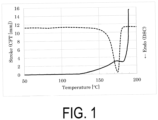
- Sample S1 was analyzed by CFT (Capillary Flowtester) and DSC.
- the CFT outflow onset temperature was 181.0°C
- the width of the crystal melting peak by DSC was approximately from 140 to 189°C.
- the crystal melting peak apex was 175.0°C
- the DSC extrapolated melting offset temperature was 179.5°C
- the temperature at which the melting point peak reached the baseline was 188.7°C. It was found that the DSC extrapolated melting offset temperature was lower than the CFT outflow onset temperature, and that the polymer did not flow out unless in a completely melted state.
- FIG. 1 shows measurement results of CFT and DSC.
- the temperature at which the melting point peak reached the baseline was higher than the CFT outflow onset temperature, and, when paying attention to this fact, it can be considered, in view of the measurement value, it is possible that Sample S1 is partially melted.
- the melting state of a polymer can be affected not only by the temperature, but also by another factor such as the time during which the polymer is being heated, and, when the pressure at the time of melt extrusion is high, the polymer is easily partially melt extruded. From such considerations, temperatures ranging from the CFT outflow onset temperature to the DSC extrapolated melting offset temperature are shown as partial melt extrusion enabling temperatures in the tables.
- Sample S1 The water-based purified P(3HB) powder as Sample S1 was immersed in water and subjected to a warm bath treatment at 70°C for 24 hours, and then dried in vacuo to obtain Sample S2.
- the Mw of Sample S2 was 940000.
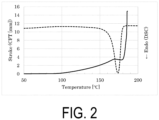
- Sample S2 was analyzed by CFT and DSC.
- the CFT outflow onset temperature was 178.6°C
- the width of the crystal melting peak by DSC was approximately from 140 to 188°C.
- the crystal melting peak apex was 175.1°C
- the DSC extrapolated melting offset temperature was 182.0°C
- the temperature at which the melting point peak reached the baseline was 188.0°C.
- the DSC extrapolated melting offset temperature was higher than the CFT outflow onset temperature, and the sample could flow out in a partially melted state.
- the CFT outflow onset temperature and the DSC extrapolated melting offset temperature were in almost the same temperature range (temperature difference: 3.4°C), and strict temperature control is considered to be required for molding it in a substantially partially melted state.
- FIG. 2 shows measurement results of CFT and DSC.
- the water-based purified P(3HB) powder as Sample S1 was subjected to a dry heat treatment at 70°C in a dry heat oven for 24 hours, and the temperature was then returned to room temperature to obtain Sample S3.
- the Mw of Sample S3 was 940000.
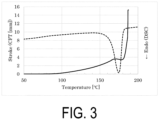
- the CFT outflow onset temperature was 178.6°C
- the width of the crystal melting peak by DSC was approximately from 140 to 187°C.
- the crystal melting peak apex was 174.9°C
- the DSC extrapolated melting offset temperature was 180.5°C
- the temperature at which the melting point peak reached the baseline was 186.9°C.
- the DSC extrapolated melting offset temperature was higher than the CFT outflow onset temperature, and the sample could flow out in a partially melted state.
- FIG. 3 shows measurement results of CFT and DSC.
- FIG. 4 shows superposition of the DSC curves of Sample S1, Sample S2, and Sample S3 of Comparative Example 1, Example 1, and Example 2, respectively.
- P(3HB) included a continuous monomer unit chain of highly crystalline (R)-3HB, and had substantially similar DSC curves without the peak top position of the main melting point peak being significantly changed due to the presence or absence of heat treatment like PHA copolymer.
- the CFT outflow onset temperature was shifted to a slightly lower temperature side than 181.0°C (178.6°C).
- Sample S4 Water-based purified P(3HB-co-13.1 mol% 4HB) through a water-based reaction at 70°C for 35 hours was used as Sample S4.
- the Mw of Sample S4 was 1 million, and the glass transition temperature (Tg) was approximately -4°C.
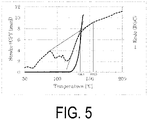
- Sample S4 was analyzed by CFT and DSC.
- the CFT outflow onset temperature was 125.1°C, and the width of the crystal melting peak by DSC was approximately from 49 to 157°C.
- the crystal melting peak apexes were 63.7°C and 114.8°C, the DSC extrapolated melting offset temperature was 135.1°C, and the temperature at which the melting point peak reached the baseline was 155.0°C.
- FIG. 5 shows measurement results of CFT and DSC.
- Melt spinning was performed at 126°C, 130°C or 135°C as a temperature enabling partial melting, or at 150°C, 160°C or 170°C as a temperature at which the sample was almost melted.
- the Mw before melt spinning was 1 million, whereas the Mw after partial melt spinning at 126°C was 950000, the Mw after partial melt spinning at 130°C was 970000, the Mw after partial melt spinning at 135°C was 970000, the Mw after melt spinning at 150°C was 820000, the Mw after melt spinning at 160°C was 650000, and the Mw after melt spinning at 170°C was 540000.
- the molecular weight Mw of 1 million before melt spinning was defined as 100%, the residual ratio of the molecular weight Mw after melt spinning at each temperature was 95% at 126°C, 97% at 130°C, 97% at 135°C, 91% at 140°C, 82% at 150°C, and 65% at 160°C.
- Sample S4 the water-based purified P(3HB-co-13.1 mol% 4HB) in a dry state, was immersed in water again, subjected to a warm bath treatment at 70°C for 24 hours, and then dried in vacuo to obtain Sample S5.
- the Mw of Sample S5 was 1 million.
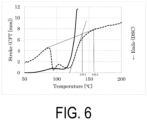
- Sample S5 was analyzed by CFT and DSC.
- the CFT outflow onset temperature was 109.8°C
- the width of the crystal melting peak by DSC was approximately from 88 to 159°C.
- the crystal melting peak apexes were 95.0°C and 118.6°C
- the DSC extrapolated melting offset temperature was 139.1°C
- the temperature at which the melting point peak reached the baseline was 158.5°C.
- FIG. 6 shows measurement results of CFT and DSC.
- Sample S4 could be partially melt extruded in a range of 125. 1°C or higher and lower than 140.2°C.
- Sample S5 which had been subjected to the heating treatment in water at 70°C could be partially melt extruded in a range of 109.8°C or higher and lower than 139.8°C, and the temperature range where the sample can be partially melt extruded by the heating treatment was expanded by approximately 15°C toward the low temperature side.
- Sample S4 the water-based purified P(3HB-co-13.1 mol% 4HB) in a dry state, was subjected to a dry heat treatment at 70°C in an oven for 24 hours, and the temperature was then returned to room temperature to obtain Sample S6.
- the Mw of Sample S6 was 1 million.
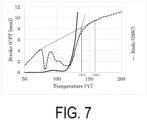
- Sample S6 was analyzed by CFT and DSC.
- the CFT outflow onset temperature was 110.0°C
- the width of the crystal melting peak by DSC was approximately from 75 to 160°C.
- the crystal melting peak apexes were 81.9°C and 119.1°C
- the DSC extrapolated melting offset temperature was 137.8°C
- the temperature at which the melting point peak reached the baseline was 158.8°C.
- FIG. 7 shows measurement results of CFT and DSC.
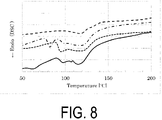
- FIG. 8 shows superposition of the DSC curves of Sample S4, Sample S5, and Sample S6 of Example 3, Example 4, and Example 5, respectively. Furthermore, after Sample S4 was dissolved in chloroform, a cast film was prepared, and the DSC curve of a film (Sample S7) aged at room temperature for 1 week or longer was also illustrated. Unlike the DSC curves of P(3HB) shown in FIG. 4 , the DSC curves of the P(3HB-co-4HB) copolymers greatly varied in the peak shape during melting depending on the way to give the thermal history, dissolution in the solvent, and solvent evaporation.
- Sample S4 could be partially melt extruded in a range of 125.1°C or higher and lower than 140.2°C.
- Sample S5 which had been subjected to the heating treatment in water at 70°C could be partially melt extruded in a range of 109.8°C or higher and lower than 139.8°C
- Sample S6 which had been subjected to the dry heat treatment at 70°C could be partially melt extruded in a range of 110.0°C or higher and lower than 139.1°C.
- the temperature range where the sample could be partially melt extruded by the heating treatment was expanded by approximately 15°C toward the low temperature side.
- Sample S8 P(3HB-co-61.5 mol% 3HV) purified by solvent extraction precipitation (chloroform extraction-hexane precipitation system) was used as Sample S8.
- the Mw of Sample S8 was 730000, and the glass transition temperature (Tg) was approximately -11°C.
- Sample S8 was analyzed by CFT and DSC.
- the CFT outflow onset temperature was 84.5°C, and the width of the crystal melting peak by DSC was approximately from 56 to 179°C.
- the crystal melting peak apex was 90.5°C, and there was an apex of a small melting peak that would be derived from the 3HB-rich crystals also at 166.3°C.
- the DSC extrapolated melting offset temperature of the main melting peak was 97.5°C; the DSC extrapolated melting offset temperature of the melting peak on a high temperature side was 173.2°C; and the temperature at which the melting point peak reached the baseline was 178.5°C. It has been found that the DSC extrapolated melting offset temperature was higher than the CFT outflow onset temperature, and that the polymer could be partially melt extruded in a range of 84.5°C or higher and lower than 173.2°C.
- FIG. 9 shows measurement results of CFT and DSC.
- Sample S8 P(3HB-co-61.5 mol% 3HV) purified by solvent extraction precipitation, was immersed in water, subjected to a warm bath treatment at 70°C for 24 hours, and then dried in vacuo to obtain Sample S9.
- the Mw of Sample S9 was 720000.
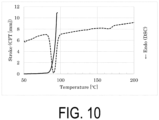
- Sample S9 was analyzed by CFT and DSC.
- the CFT outflow onset temperature was 80.8°C
- the width of the crystal melting peak by DSC was approximately from 49 to 178°C.
- the crystal melting peak apex was 90.7°C, and there was an apex of a small melting peak that would be derived from the 3HB-rich crystals also at 165.6°C.
- the DSC extrapolated melting offset temperature of the main melting peak was 96.9°C; the DSC extrapolated melting offset temperature of the melting peak on a high temperature side was 172.6°C; and the temperature at which the melting point peak reached the baseline was 176.2°C. It has been found that the DSC extrapolated melting offset temperature was higher than the CFT outflow onset temperature, and that the polymer could be partially melt extruded in a range of 80.8°C or higher and lower than 172.6°C.
- FIG. 10 shows measurement results of CFT and DSC.
- Sample S8 P(3HB-co-61.5 mol% 3HV) purified by solvent extraction precipitation, was again subjected to a dry heat treatment at 70°C in the oven for 24 hours, and the temperature was then returned to room temperature to obtain Sample S10.
- the Mw of Sample S10 was 730000.
- Sample S10 was analyzed by CFT and DSC.
- the CFT outflow onset temperature was 79.8°C, and the width of the crystal melting peak by DSC was approximately from 75 to 178°C.
- the crystal melting peak apex was 88.9°C, and there was an apex of a small melting peak that would be derived from the 3HB-rich crystals also at 167.0°C.
- the DSC extrapolated melting offset temperature of the main melting peak was 97.5°C; the DSC extrapolated melting offset temperature of the melting peak on a high temperature side was 173.3°C; and the temperature at which the melting point peak reached the baseline was 177.3°C. It has been found that the DSC extrapolated melting offset temperature was higher than the CFT outflow onset temperature, and that the polymer could be partially melt extruded in a range of 79.8°C or higher and lower than 173.3°C.
- FIG. 11 shows measurement results of CFT and DSC.
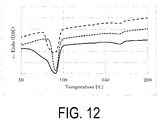
- FIG. 12 shows superposition of the DSC curves of Sample S8, Sample S9, and Sample S10 of Comparative Example 2, Example 6, and Example 7, respectively.
- the DSC curves of the P(3HB-co-3HV) copolymers greatly varied in peak shape during melting depending on the way to give the thermal history.
- Sample S8 could be partially melt extruded in a range of 84.5°C or higher and lower than 173.2°C.
- Sample S9 which had been subjected to the heating treatment in water at 70°C could be partially melt extruded in a range of 80.8°C or higher and lower than 172.6°C
- Sample S10 which had been subjected to the dry heat treatment at 70°C could be partially melt extruded in a range of 79.8°C or higher and lower than 173.3°C.
- the temperature range where the sample could be partially melt extruded by the heating treatment was expanded by approximately 5°C toward the low temperature side.
- Sample S11 Water-based purified P(3HB-co-16.0 mol% 4HB) powder having a Mw of 620000 and a glass transition temperature (Tg) of approximately -5°C was used as Sample S11.
- Sample S11 was subjected to a dry heat treatment at 70°C in air for 24 hours, a treatment at 50°C in water for 24 hours, a treatment at 60°C in water for 24 hours, a treatment at 70°C in water for 24 hours, or a treatment at 80°C hours in water, and the PHAs subjected to the heat treatment in water were lyophilized, to yield dry bodies.
- the respective heat treated samples were evaluated by DSC, and DSC curves (thermograms) of their temperature rise first cycles are shown together in FIG. 13 .
- Sample S11 was subjected to a treatment at 50°C in water for 24 hours, a treatment at 50°C in methanol for 12 hours, a treatment at 50°C in ethanol for 12 hours, or a treatment at 50°C in hexane for 12 hours, and then dried in vacuo to yield dry bodies.
- the respective heat treated samples were evaluated by DSC, and DSC curves (thermograms) of their temperature rise first cycles are shown together in FIG. 14 .
- FIG. 1 Comparative Example Composition CFT outflow onset temperature [°C] Extrapolated melting offset temperature of DSC 1st heating peaks [°C] Baseline arrival temperature of DSC 1st heating peaks [°C] Whether partial melt extrusion is
Landscapes
- Engineering & Computer Science (AREA)
- Mechanical Engineering (AREA)
- Chemical & Material Sciences (AREA)
- Chemical Kinetics & Catalysis (AREA)
- General Chemical & Material Sciences (AREA)
- Textile Engineering (AREA)
- Physics & Mathematics (AREA)
- Thermal Sciences (AREA)
- Polyesters Or Polycarbonates (AREA)
- Biological Depolymerization Polymers (AREA)
- Compositions Of Macromolecular Compounds (AREA)
Applications Claiming Priority (2)
| Application Number | Priority Date | Filing Date | Title |
|---|---|---|---|
| JP2020096145 | 2020-06-02 | ||
| PCT/JP2021/020957 WO2021246434A1 (ja) | 2020-06-02 | 2021-06-02 | 加熱による前処理を伴う高分子成形物の製造方法 |
Publications (2)
| Publication Number | Publication Date |
|---|---|
| EP4159901A1 true EP4159901A1 (de) | 2023-04-05 |
| EP4159901A4 EP4159901A4 (de) | 2024-12-04 |
Family
ID=78831095
Family Applications (1)
| Application Number | Title | Priority Date | Filing Date |
|---|---|---|---|
| EP21816826.8A Pending EP4159901A4 (de) | 2020-06-02 | 2021-06-02 | Verfahren zur herstellung eines polymerformprodukts mit vorbehandlung durch erhitzen |
Country Status (7)
| Country | Link |
|---|---|
| US (1) | US20230211539A1 (de) |
| EP (1) | EP4159901A4 (de) |
| JP (1) | JP7766302B2 (de) |
| KR (1) | KR20230018416A (de) |
| CN (1) | CN115698398B (de) |
| TW (1) | TW202212088A (de) |
| WO (1) | WO2021246434A1 (de) |
Cited By (1)
| Publication number | Priority date | Publication date | Assignee | Title |
|---|---|---|---|---|
| EP4159902A4 (de) * | 2020-06-02 | 2024-12-04 | Mitsubishi Gas Chemical Company, Inc. | Verfahren zur herstellung eines polymerformprodukts |
Families Citing this family (4)
| Publication number | Priority date | Publication date | Assignee | Title |
|---|---|---|---|---|
| WO2021246434A1 (ja) * | 2020-06-02 | 2021-12-09 | 三菱瓦斯化学株式会社 | 加熱による前処理を伴う高分子成形物の製造方法 |
| CN115157478B (zh) * | 2022-09-02 | 2022-12-06 | 北京蓝晶微生物科技有限公司 | 一种可降解材料的造粒加工方法及其制备的成型体 |
| KR20240177430A (ko) * | 2023-06-20 | 2024-12-27 | 씨제이제일제당 (주) | 생분해성 고분자 분산액, 이의 제조방법, 및 이를 이용한 생분해성 물품 |
| WO2025058065A1 (ja) * | 2023-09-14 | 2025-03-20 | 旭化成株式会社 | 脂肪族共重合ポリエステル連続長繊維、及びその製法 |
Family Cites Families (69)
| Publication number | Priority date | Publication date | Assignee | Title |
|---|---|---|---|---|
| JPS6469622A (en) | 1987-09-09 | 1989-03-15 | Mitsubishi Gas Chemical Co | Preparation of copolymer |
| GB8912388D0 (en) | 1989-05-30 | 1989-07-12 | Ici Plc | 3-hydroxybutyrate polymer composition |
| JPH0461638A (ja) | 1990-06-27 | 1992-02-27 | Ube Ind Ltd | 光記録媒体 |
| JP3308335B2 (ja) | 1993-04-13 | 2002-07-29 | 三井化学株式会社 | 乳酸系ポリマー組成物並びにそのペレット、その成形体およびその成形方法 |
| GB9310712D0 (en) | 1993-05-24 | 1993-07-07 | Zeneca Ltd | Polymer composition |
| JP3243334B2 (ja) | 1993-06-10 | 2002-01-07 | テルモ株式会社 | ヒドロキシアルカノエート重合体組成物 |
| JPH07126496A (ja) | 1993-10-28 | 1995-05-16 | Polyplastics Co | ポリエステル樹脂組成物及び成形品 |
| GB9325952D0 (en) * | 1993-12-20 | 1994-02-23 | Zeneca Ltd | Process for preparing films and coatings |
| JPH07177894A (ja) | 1993-12-22 | 1995-07-18 | Mitsubishi Gas Chem Co Inc | ポリ−3−ヒドロキシ酪酸の分離精製方法 |
| JPH07188537A (ja) | 1993-12-27 | 1995-07-25 | Tokuyama Corp | 樹脂組成物 |
| US5763513A (en) * | 1994-05-19 | 1998-06-09 | Mitsui Toatsu Chemicals, Inc. | L-lactic acid polymer composition, molded product and film |
| GB9411792D0 (en) * | 1994-06-13 | 1994-08-03 | Zeneca Ltd | Polymer composition |
| JP3852958B2 (ja) | 1994-07-12 | 2006-12-06 | 三井化学株式会社 | 乳酸系ポリマー組成物 |
| EP0787436A4 (de) * | 1995-07-28 | 1998-11-25 | Snow Brand Milk Products Co Ltd | Verfahren zur herstellung von wurst mit niedrigem fettgehalt |
| JPH09131779A (ja) * | 1995-11-07 | 1997-05-20 | Gunze Ltd | 生分解性シートの製造方法 |
| JP3411168B2 (ja) | 1995-12-21 | 2003-05-26 | 三井化学株式会社 | 脂肪族ポリエステル成形体の製造方法及びそれにより製造された成形体 |
| US6417294B1 (en) * | 1995-12-21 | 2002-07-09 | Mitsui Chemicals, Inc. | Films and molded articles formed from aliphatic polyester compositions containing nucleating agents |
| JPH1060099A (ja) * | 1996-08-27 | 1998-03-03 | Takasago Internatl Corp | 生分解性高分子組成物からなる繊維およびその製造方法 |
| JPH10158369A (ja) | 1996-11-29 | 1998-06-16 | Mitsui Chem Inc | 樹脂組成物及びそれからなる成形物 |
| JP3369421B2 (ja) | 1996-12-18 | 2003-01-20 | 理化学研究所 | ポリ(3−ヒドロキシブタン酸)からなるフィルム |
| JPH115849A (ja) | 1997-06-19 | 1999-01-12 | Mitsui Chem Inc | 樹脂組成物及びその成形物 |
| JP3886613B2 (ja) | 1997-10-09 | 2007-02-28 | 三井化学株式会社 | 成形体及びその製造方法 |
| GB2370340B (en) * | 2000-12-18 | 2003-05-21 | Tripat Singh Mangat | Valve |
| KR100545523B1 (ko) | 2000-12-21 | 2006-01-24 | 더 프록터 앤드 갬블 캄파니 | 개선된 결정화 성질을 갖는 생분해성폴리히드록시알카노에이트 공중합체 |
| JP4562316B2 (ja) * | 2001-06-11 | 2010-10-13 | 株式会社カネカ | 生分解性繊維およびその製造方法 |
| JP3960797B2 (ja) | 2001-12-28 | 2007-08-15 | 株式会社Adeka | ポリ乳酸系ポリマー組成物、成形品及びその製造方法 |
| CN1246387C (zh) * | 2001-12-28 | 2006-03-22 | 旭电化工业株式会社 | 聚乳酸型树脂组合物、模塑制品和其制备方法 |
| JP2003238779A (ja) | 2002-02-15 | 2003-08-27 | Sony Corp | 樹脂組成物 |
| JP3864188B2 (ja) | 2002-02-28 | 2006-12-27 | 独立行政法人科学技術振興機構 | ポリヒドロキシアルカン酸の高強度かつ高弾性率である繊維およびその製造法 |
| JP3864187B2 (ja) | 2002-02-28 | 2006-12-27 | 独立行政法人科学技術振興機構 | ポリヒドロキシアルカン酸の高強度繊維およびその製造法 |
| DE60330325D1 (de) * | 2002-02-28 | 2010-01-14 | Japan Science & Tech Agency | Feste fasern mit hohem elastizitätsmodul sowie verfahren zu deren herstellung |
| JP2003311825A (ja) * | 2002-04-25 | 2003-11-06 | Inst Of Physical & Chemical Res | ポリヒドロキシアルカン酸からなる高強度フィルムおよびその製造法 |
| JP4245306B2 (ja) | 2002-05-09 | 2009-03-25 | 旭化成ケミカルズ株式会社 | 生分解性ポリエステル延伸成形体 |
| JP4019414B2 (ja) | 2002-05-09 | 2007-12-12 | ソニー株式会社 | 樹脂組成物及びその製造方法、並びにその成形品 |
| WO2004029266A1 (ja) | 2002-09-30 | 2004-04-08 | Kaneka Corporation | 3−ヒドロキシアルカン酸共重合体の精製方法 |
| JP2004204128A (ja) * | 2002-12-26 | 2004-07-22 | Mitsubishi Plastics Ind Ltd | 熱成形用ポリ乳酸系重合体組成物、熱成形用ポリ乳酸系重合体シート、及びこれを用いた熱成形体 |
| JP2004250629A (ja) | 2003-02-21 | 2004-09-09 | Kanegafuchi Chem Ind Co Ltd | ポリヒドロキシアルカン酸の製造方法 |
| US7329723B2 (en) | 2003-09-18 | 2008-02-12 | Eastman Chemical Company | Thermal crystallization of polyester pellets in liquid |
| WO2005066256A1 (en) * | 2003-12-30 | 2005-07-21 | Metabolix, Inc. | Nucleating agents |
| DE602004027554D1 (de) * | 2004-08-06 | 2010-07-15 | Phb Ind Sa | Verwendung von fettalkoholen als weichmacher zur vaften und verarbeitbarkeit von phb und seinen copolymeren |
| JP4868521B2 (ja) | 2004-10-01 | 2012-02-01 | 独立行政法人理化学研究所 | 生分解性脂肪族ポリエステルの高強度繊維およびその製造方法 |
| JP4654737B2 (ja) | 2005-04-04 | 2011-03-23 | ソニー株式会社 | 樹脂組成物、成形物及び成形物の製造方法 |
| JP5019554B2 (ja) | 2005-09-13 | 2012-09-05 | 国立大学法人東京工業大学 | 生分解性ポリエステル系樹脂組成物 |
| JPWO2008099586A1 (ja) | 2007-02-15 | 2010-05-27 | 国立大学法人東京工業大学 | 生分解性樹脂組成物 |
| JP2008222876A (ja) * | 2007-03-13 | 2008-09-25 | Institute Of Physical & Chemical Research | 生分解性吸油用フィルム |
| JP5057874B2 (ja) | 2007-07-18 | 2012-10-24 | バイオベース株式会社 | ポリ乳酸樹脂組成物およびポリ乳酸樹脂用添加剤 |
| CN101538750A (zh) * | 2008-03-18 | 2009-09-23 | 天津国韵生物材料有限公司 | 聚羟基脂肪酸酯纤维及其制备方法 |
| JP5353768B2 (ja) | 2009-03-06 | 2013-11-27 | 国立大学法人東京工業大学 | 樹脂組成物 |
| JP2010241075A (ja) * | 2009-04-09 | 2010-10-28 | Kaneka Corp | 生分解性樹脂成形体の製造法 |
| TWI532787B (zh) * | 2009-06-17 | 2016-05-11 | 東麗股份有限公司 | 結晶化聚酯之製造方法 |
| CN102108563B (zh) * | 2010-11-16 | 2012-11-21 | 清华大学 | 聚羟基脂肪酸酯纤维的制备方法 |
| EP2690207A4 (de) | 2011-03-25 | 2014-09-10 | Univ Tokyo | Biologisch abbaubare polyesterfaser mit hervorragender wärmestabilität und stärke sowie herstellungsverfahren dafür |
| CN104662088B (zh) | 2012-08-03 | 2018-11-02 | 株式会社钟化 | 聚酯树脂组合物及含有该树脂组合物的成形体 |
| US9340659B2 (en) * | 2012-10-29 | 2016-05-17 | Kaneka Corporation | Aliphatic polyester resin composition and molded article containing this resin composition |
| JP6592862B2 (ja) * | 2013-09-02 | 2019-10-23 | 国立大学法人東京工業大学 | ポリエステル繊維 |
| WO2015052876A1 (ja) | 2013-10-11 | 2015-04-16 | 株式会社カネカ | 脂肪族ポリエステル樹脂組成物および脂肪族ポリエステル樹脂成形体 |
| WO2015146195A1 (ja) | 2014-03-28 | 2015-10-01 | 株式会社カネカ | Pha合成酵素をコードする遺伝子を複数有する微生物、およびそれを用いたphaの製造方法 |
| EP3159137B1 (de) * | 2014-06-20 | 2020-08-05 | Nissei Asb Machine Co., Ltd. | Herstellungsverfahren und herstellungsvorrichtung für hohlen behälter |
| JP6860489B2 (ja) * | 2015-09-28 | 2021-04-14 | 株式会社カネカ | Pha合成酵素をコードする遺伝子を有する微生物、およびそれを用いたphaの製造方法 |
| EP3677685A4 (de) * | 2017-08-29 | 2020-10-28 | Mitsubishi Gas Chemical Company, Inc. | Verfahren zur herstellung von polyester |
| KR20200046051A (ko) * | 2017-08-29 | 2020-05-06 | 미쯔비시 가스 케미칼 컴파니, 인코포레이티드 | 4-하이드록시부티레이트 단위를 포함하는 폴리에스테르 |
| JP7057135B2 (ja) | 2018-01-11 | 2022-04-19 | 株式会社カネカ | ポリエステル樹脂組成物 |
| JP2019119840A (ja) | 2018-01-11 | 2019-07-22 | 株式会社カネカ | 脂肪族ポリエステル樹脂組成物 |
| US12221538B2 (en) | 2018-08-20 | 2025-02-11 | Kaneka Corporation | Poly(3-hydroxybutyrate) resin tube and method for producing same |
| TWI871319B (zh) * | 2019-05-13 | 2025-02-01 | 日商三菱瓦斯化學股份有限公司 | 脂肪族聚酯共聚物 |
| US12286662B2 (en) * | 2019-09-25 | 2025-04-29 | Kaneka Corporation | Method of producing polyhydroxyalkanoate |
| KR20230018413A (ko) * | 2020-06-02 | 2023-02-07 | 미쯔비시 가스 케미칼 컴파니, 인코포레이티드 | 고분자 성형물의 제조방법 |
| WO2021246434A1 (ja) | 2020-06-02 | 2021-12-09 | 三菱瓦斯化学株式会社 | 加熱による前処理を伴う高分子成形物の製造方法 |
| WO2022092014A1 (ja) * | 2020-10-26 | 2022-05-05 | 三菱瓦斯化学株式会社 | 生体吸収性繊維状医療材料 |
-
2021
- 2021-06-02 WO PCT/JP2021/020957 patent/WO2021246434A1/ja not_active Ceased
- 2021-06-02 KR KR1020227045045A patent/KR20230018416A/ko active Pending
- 2021-06-02 US US18/000,446 patent/US20230211539A1/en active Pending
- 2021-06-02 TW TW110119986A patent/TW202212088A/zh unknown
- 2021-06-02 EP EP21816826.8A patent/EP4159901A4/de active Pending
- 2021-06-02 CN CN202180039544.7A patent/CN115698398B/zh active Active
- 2021-06-02 JP JP2022528860A patent/JP7766302B2/ja active Active
Cited By (1)
| Publication number | Priority date | Publication date | Assignee | Title |
|---|---|---|---|---|
| EP4159902A4 (de) * | 2020-06-02 | 2024-12-04 | Mitsubishi Gas Chemical Company, Inc. | Verfahren zur herstellung eines polymerformprodukts |
Also Published As
| Publication number | Publication date |
|---|---|
| JPWO2021246434A1 (de) | 2021-12-09 |
| TW202212088A (zh) | 2022-04-01 |
| CN115698398B (zh) | 2025-05-30 |
| WO2021246434A1 (ja) | 2021-12-09 |
| EP4159901A4 (de) | 2024-12-04 |
| KR20230018416A (ko) | 2023-02-07 |
| CN115698398A (zh) | 2023-02-03 |
| US20230211539A1 (en) | 2023-07-06 |
| JP7766302B2 (ja) | 2025-11-10 |
Similar Documents
| Publication | Publication Date | Title |
|---|---|---|
| EP4159901A1 (de) | Verfahren zur herstellung eines polymerformprodukts mit vorbehandlung durch erhitzen | |
| EP3404130B1 (de) | Biologisch abbaubare, auf aliphatischem polyester basierende faser und verfahren zur herstellung davon | |
| KR101407810B1 (ko) | 폴리유산블록공중합체의 제조방법 | |
| CN102282194B (zh) | 聚乳酸树脂组合物和聚乳酸树脂用添加剂 | |
| TWI860716B (zh) | 聚羥基烷酸酯的酸類成核劑及聚羥基烷酸酯成型體 | |
| US20100056751A1 (en) | Process of producing polylactic acid | |
| WO2014020838A1 (ja) | ポリエステル樹脂組成物および該樹脂組成物を含む成形体 | |
| JPWO2008018474A1 (ja) | ポリ乳酸およびその製造方法 | |
| JP5285834B2 (ja) | ポリ乳酸の製造方法 | |
| EP1795631B1 (de) | Hochfeste faser aus biologisch abbaubarem aliphatischem polyester sowie herstellungsverfahren dafür | |
| JP6172795B2 (ja) | ポリエステル樹脂組成物およびその製造方法、並びに該樹脂組成物から形成される成形体 | |
| JP7766301B2 (ja) | 高分子成形物の製造方法 | |
| EP4434724A1 (de) | Verfahren zur herstellung einer verstreckten folie | |
| EP4434725A1 (de) | Gestreckte folie und verfahren zur herstellung davon | |
| WO2010134205A1 (ja) | ポリ乳酸系樹脂組成物及びその製造方法 | |
| EP4636035A1 (de) | Harzzusammensetzung zur herstellung gestreckter filme | |
| WO2024262377A1 (ja) | フィルム | |
| WO2025177973A1 (ja) | 成形体の製造方法 | |
| WO2025177972A1 (ja) | 成形体の製造方法 | |
| WO2025177971A1 (ja) | 成形体の製造方法 | |
| JP2024113402A (ja) | 脂肪族ポリエステルの成形物の製造方法および脂肪族ポリエステルの成形物 | |
| JP2025127516A (ja) | 熱加工用組成物の製造方法 | |
| HK1135713B (en) | Process for producing polylactic acid block copolymer |
Legal Events
| Date | Code | Title | Description |
|---|---|---|---|
| STAA | Information on the status of an ep patent application or granted ep patent |
Free format text: STATUS: THE INTERNATIONAL PUBLICATION HAS BEEN MADE |
|
| PUAI | Public reference made under article 153(3) epc to a published international application that has entered the european phase |
Free format text: ORIGINAL CODE: 0009012 |
|
| STAA | Information on the status of an ep patent application or granted ep patent |
Free format text: STATUS: REQUEST FOR EXAMINATION WAS MADE |
|
| 17P | Request for examination filed |
Effective date: 20221208 |
|
| AK | Designated contracting states |
Kind code of ref document: A1 Designated state(s): AL AT BE BG CH CY CZ DE DK EE ES FI FR GB GR HR HU IE IS IT LI LT LU LV MC MK MT NL NO PL PT RO RS SE SI SK SM TR |
|
| DAV | Request for validation of the european patent (deleted) | ||
| DAX | Request for extension of the european patent (deleted) | ||
| A4 | Supplementary search report drawn up and despatched |
Effective date: 20241107 |
|
| RIC1 | Information provided on ipc code assigned before grant |
Ipc: B29K 67/00 20060101ALI20241031BHEP Ipc: B29C 48/00 20190101ALI20241031BHEP Ipc: D01F 6/84 20060101AFI20241031BHEP |