EP3236487A2 - Verfahren zur herstellung eines ferroelektrischen halbleiterspeicherelements und ferroelektrischer speichertransistor - Google Patents
Verfahren zur herstellung eines ferroelektrischen halbleiterspeicherelements und ferroelektrischer speichertransistor Download PDFInfo
- Publication number
- EP3236487A2 EP3236487A2 EP17167457.5A EP17167457A EP3236487A2 EP 3236487 A2 EP3236487 A2 EP 3236487A2 EP 17167457 A EP17167457 A EP 17167457A EP 3236487 A2 EP3236487 A2 EP 3236487A2
- Authority
- EP
- European Patent Office
- Prior art keywords
- ferroelectric
- annealing
- oxygen
- film
- semiconductor
- Prior art date
- Legal status (The legal status is an assumption and is not a legal conclusion. Google has not performed a legal analysis and makes no representation as to the accuracy of the status listed.)
- Granted
Links
Images






Classifications
-
- H—ELECTRICITY
- H10—SEMICONDUCTOR DEVICES; ELECTRIC SOLID-STATE DEVICES NOT OTHERWISE PROVIDED FOR
- H10D—INORGANIC ELECTRIC SEMICONDUCTOR DEVICES
- H10D30/00—Field-effect transistors [FET]
- H10D30/01—Manufacture or treatment
- H10D30/021—Manufacture or treatment of FETs having insulated gates [IGFET]
- H10D30/0415—Manufacture or treatment of FETs having insulated gates [IGFET] of FETs having ferroelectric gate insulators
-
- H—ELECTRICITY
- H10—SEMICONDUCTOR DEVICES; ELECTRIC SOLID-STATE DEVICES NOT OTHERWISE PROVIDED FOR
- H10D—INORGANIC ELECTRIC SEMICONDUCTOR DEVICES
- H10D64/00—Electrodes of devices having potential barriers
- H10D64/01—Manufacture or treatment
- H10D64/031—Manufacture or treatment of data-storage electrodes
- H10D64/033—Manufacture or treatment of data-storage electrodes comprising ferroelectric layers
-
- H—ELECTRICITY
- H10—SEMICONDUCTOR DEVICES; ELECTRIC SOLID-STATE DEVICES NOT OTHERWISE PROVIDED FOR
- H10B—ELECTRONIC MEMORY DEVICES
- H10B53/00—Ferroelectric RAM [FeRAM] devices comprising ferroelectric memory capacitors
-
- G—PHYSICS
- G11—INFORMATION STORAGE
- G11C—STATIC STORES
- G11C11/00—Digital stores characterised by the use of particular electric or magnetic storage elements; Storage elements therefor
- G11C11/21—Digital stores characterised by the use of particular electric or magnetic storage elements; Storage elements therefor using electric elements
- G11C11/22—Digital stores characterised by the use of particular electric or magnetic storage elements; Storage elements therefor using electric elements using ferroelectric elements
- G11C11/223—Digital stores characterised by the use of particular electric or magnetic storage elements; Storage elements therefor using electric elements using ferroelectric elements using MOS with ferroelectric gate insulating film
-
- H—ELECTRICITY
- H10—SEMICONDUCTOR DEVICES; ELECTRIC SOLID-STATE DEVICES NOT OTHERWISE PROVIDED FOR
- H10B—ELECTRONIC MEMORY DEVICES
- H10B53/00—Ferroelectric RAM [FeRAM] devices comprising ferroelectric memory capacitors
- H10B53/30—Ferroelectric RAM [FeRAM] devices comprising ferroelectric memory capacitors characterised by the memory core region
-
- H—ELECTRICITY
- H10—SEMICONDUCTOR DEVICES; ELECTRIC SOLID-STATE DEVICES NOT OTHERWISE PROVIDED FOR
- H10D—INORGANIC ELECTRIC SEMICONDUCTOR DEVICES
- H10D30/00—Field-effect transistors [FET]
- H10D30/60—Insulated-gate field-effect transistors [IGFET]
- H10D30/701—IGFETs having ferroelectric gate insulators, e.g. ferroelectric FETs
-
- H—ELECTRICITY
- H10—SEMICONDUCTOR DEVICES; ELECTRIC SOLID-STATE DEVICES NOT OTHERWISE PROVIDED FOR
- H10D—INORGANIC ELECTRIC SEMICONDUCTOR DEVICES
- H10D64/00—Electrodes of devices having potential barriers
- H10D64/60—Electrodes characterised by their materials
- H10D64/66—Electrodes having a conductor capacitively coupled to a semiconductor by an insulator, e.g. MIS electrodes
- H10D64/68—Electrodes having a conductor capacitively coupled to a semiconductor by an insulator, e.g. MIS electrodes characterised by the insulator, e.g. by the gate insulator
- H10D64/681—Electrodes having a conductor capacitively coupled to a semiconductor by an insulator, e.g. MIS electrodes characterised by the insulator, e.g. by the gate insulator having a compositional variation, e.g. multilayered
- H10D64/685—Electrodes having a conductor capacitively coupled to a semiconductor by an insulator, e.g. MIS electrodes characterised by the insulator, e.g. by the gate insulator having a compositional variation, e.g. multilayered being perpendicular to the channel plane
-
- H—ELECTRICITY
- H10—SEMICONDUCTOR DEVICES; ELECTRIC SOLID-STATE DEVICES NOT OTHERWISE PROVIDED FOR
- H10D—INORGANIC ELECTRIC SEMICONDUCTOR DEVICES
- H10D64/00—Electrodes of devices having potential barriers
- H10D64/60—Electrodes characterised by their materials
- H10D64/66—Electrodes having a conductor capacitively coupled to a semiconductor by an insulator, e.g. MIS electrodes
- H10D64/68—Electrodes having a conductor capacitively coupled to a semiconductor by an insulator, e.g. MIS electrodes characterised by the insulator, e.g. by the gate insulator
- H10D64/689—Electrodes having a conductor capacitively coupled to a semiconductor by an insulator, e.g. MIS electrodes characterised by the insulator, e.g. by the gate insulator having ferroelectric layers
-
- H10P14/6329—
-
- H10P14/6334—
-
- H10P14/6529—
-
- H10P14/6544—
-
- H10P14/662—
-
- H10P14/69392—
-
- H10P14/69398—
-
- H—ELECTRICITY
- H10—SEMICONDUCTOR DEVICES; ELECTRIC SOLID-STATE DEVICES NOT OTHERWISE PROVIDED FOR
- H10B—ELECTRONIC MEMORY DEVICES
- H10B51/00—Ferroelectric RAM [FeRAM] devices comprising ferroelectric memory transistors
- H10B51/30—Ferroelectric RAM [FeRAM] devices comprising ferroelectric memory transistors characterised by the memory core region
-
- H—ELECTRICITY
- H10—SEMICONDUCTOR DEVICES; ELECTRIC SOLID-STATE DEVICES NOT OTHERWISE PROVIDED FOR
- H10D—INORGANIC ELECTRIC SEMICONDUCTOR DEVICES
- H10D64/00—Electrodes of devices having potential barriers
- H10D64/60—Electrodes characterised by their materials
- H10D64/66—Electrodes having a conductor capacitively coupled to a semiconductor by an insulator, e.g. MIS electrodes
- H10D64/665—Electrodes having a conductor capacitively coupled to a semiconductor by an insulator, e.g. MIS electrodes the conductor comprising a layer of elemental metal contacting the insulator, e.g. tungsten or molybdenum
-
- H—ELECTRICITY
- H10—SEMICONDUCTOR DEVICES; ELECTRIC SOLID-STATE DEVICES NOT OTHERWISE PROVIDED FOR
- H10D—INORGANIC ELECTRIC SEMICONDUCTOR DEVICES
- H10D64/00—Electrodes of devices having potential barriers
- H10D64/60—Electrodes characterised by their materials
- H10D64/66—Electrodes having a conductor capacitively coupled to a semiconductor by an insulator, e.g. MIS electrodes
- H10D64/667—Electrodes having a conductor capacitively coupled to a semiconductor by an insulator, e.g. MIS electrodes the conductor comprising a layer of alloy material, compound material or organic material contacting the insulator, e.g. TiN workfunction layers
-
- H—ELECTRICITY
- H10—SEMICONDUCTOR DEVICES; ELECTRIC SOLID-STATE DEVICES NOT OTHERWISE PROVIDED FOR
- H10D—INORGANIC ELECTRIC SEMICONDUCTOR DEVICES
- H10D64/00—Electrodes of devices having potential barriers
- H10D64/60—Electrodes characterised by their materials
- H10D64/66—Electrodes having a conductor capacitively coupled to a semiconductor by an insulator, e.g. MIS electrodes
- H10D64/68—Electrodes having a conductor capacitively coupled to a semiconductor by an insulator, e.g. MIS electrodes characterised by the insulator, e.g. by the gate insulator
- H10D64/691—Electrodes having a conductor capacitively coupled to a semiconductor by an insulator, e.g. MIS electrodes characterised by the insulator, e.g. by the gate insulator comprising metallic compounds, e.g. metal oxides or metal silicates
-
- H—ELECTRICITY
- H10—SEMICONDUCTOR DEVICES; ELECTRIC SOLID-STATE DEVICES NOT OTHERWISE PROVIDED FOR
- H10D—INORGANIC ELECTRIC SEMICONDUCTOR DEVICES
- H10D64/00—Electrodes of devices having potential barriers
- H10D64/60—Electrodes characterised by their materials
- H10D64/66—Electrodes having a conductor capacitively coupled to a semiconductor by an insulator, e.g. MIS electrodes
- H10D64/68—Electrodes having a conductor capacitively coupled to a semiconductor by an insulator, e.g. MIS electrodes characterised by the insulator, e.g. by the gate insulator
- H10D64/693—Electrodes having a conductor capacitively coupled to a semiconductor by an insulator, e.g. MIS electrodes characterised by the insulator, e.g. by the gate insulator the insulator comprising nitrogen, e.g. nitrides, oxynitrides or nitrogen-doped materials
Definitions
- the present invention relates to a method of making a semiconductor ferroelectric memory element and to a semiconductor ferroelectric memory transistor. More specifically, it relates to a semiconductor ferroelectric memory transistor operable under a reduced voltage and to a method of making such a semiconductor ferroelectric memory element.
- a ferroelectric-gate field effect transistor (FeFET) incorporating a ferroelectric in its gate insulator has come to be attracting attention as a transistor having a memory function. While having long had the problem that its data storage time is short, in patent document 1 an FeFET is shown in which the gate laminate of electrode conductor / ferroelectric / insulator / semiconductor is comprised of metal Pt, SBT (Sr Bi 2 Ta 2 O 9 ) as a sort of crystal of Bi layered perovskite structure, insulator Hf - Al - O and semiconductor Si, thus of Pt / Sr Bi 2 Ta 2 O 9 / Hf - Al - O 2 / Si.
- An example of the FeFET is disclosed there in which both the on and off states of a drain current when each measured for a long period of time are continued extremely stably and the ratio of drain currents in the on state and off state after a weak reaches not less than 10 5 .
- a good data retention property is disclosed of a FeFET composed of Pt / Sr Bi 2 Ta 2 O 9 / Hf O 2 / Si, too.
- patent document 1 it has been demonstrated by patent document 1 that a FeFET acts as a memory transistor in which data is truly retained and stored.
- data rewrite withstand property is evaluated and it is disclosed that after rewriting 10 12 times, the on time and off states read out are fully discriminated.
- ferroelectric is made up of crystal of Bi layer perovskite structure.
- ferroelectricity i.e. the property that atoms are distorted according to a direction of electric field and after the electric field is removed, the distortion is left and electric polarization is not restored to zero
- Bi layered oxide substance between the perovskite portions acting as a buffer layer renders a malfunction less liable to occur at an interface with another layer such as of Pt, in data rewriting, to wit, during a repetition of the reversal of electric field for writing, thus leading to the good rewrite withstand capability of a FeFET.
- Non-patent reference 1 discloses the use in FeFETs of (Bi, La) 4 Ti 3 O 12 that is a Bi layer perovskite substance, as the ferroelectric.
- Patent document 3 discloses using CSBT (Ca x Sr 1-x Bi 2 Ta 2 O 9 ) as the ferroelectric of Bi layer perovskite substance, and that a FeFET composed of Pt / Ca x Sr 1-x Bi 2 Ta 2 O 9 / Hf - Al- O /Si processes a good data retention property and a good data rewrite withstand capability.
- CSBT Ca x Sr 1-x Bi 2 Ta 2 O 9
- annealing is performed in an oxygen atmosphere for a time period of 10 to 60 minutes to crystallize the Bi layer perovskite, thereby causing it to express the ferroelectricity. It is performed at a temperature preferably from 700 to 830 degrees Celsius, more preferably from 730 to 813 degrees C. Passing the process step of annealing is found to achieve a good data retention and a good rewrite withstand property as mentioned above. By passing the process step of annealing, an interfacial layer is formed at an interface between silicon and the insulator as shown by non-patent reference 2 to 4.
- Non-patent reference 3 teaches that the interfacial layer is formed mainly composed of SiO 2 . This connotes that in annealing in an oxygen atmosphere for crystallizing the Bi layer perovskite, a silicon surface is oxidized to form the interfacial layer mainly composed of SiO 2 . As a result of uniform formation of the interfacial layer, it contributes to development of good electrical characteristics.
- Non-patent reference 5 discloses an example of development of an NAND flash memory of 64 k bitts with a FeFET as a memory cell by this technique.
- non-patent reference 6 a film of silicon nitride is formed on silicon and thereafter a film of HfO 2 is formed.
- non-patent reference 7 a film of oxynitride of silicon is formed on silicon and thereafter HfO 2 is formed.
- passing the process step of annealing to crystallize the Bi layer perovskite and to develop the ferroelectricity causes an interfacial layer mainly composed of SiO 2 to be formed between Si and HfO 2 .
- the interfacial layer may contain nitrogen as derived from the film of silicon nitride and/or the film of oxynitride of silicon but is mainly composed of SiO 2 .
- the interfacial layer is formed mainly by oxidation of Si, but may be merged with the insulating layer, and may have an insulating material contained therein as an impurity. Note that while non-patent reference 7 shows the range in which the gate voltage is swept is from 1 - 3.3 volts to 1 + 3.3 volts, the data given there teaches that the ferroelectric SBT has a thickness as thick as 450 nm and is not suitable for a FeFET to be nanofined.
- Non-patent reference 2 shows that a FeFET composed of Pt / Sr Bi 2 Ta 2 O 9 / Hf - Al - O / Si annealed in oxygen at a temperature of 800 degrees C and for a time period of 60 minutes has an interfacial layer having a thickness of 4.4 nm.
- patent document 2 discloses that SiO 2 having a thickness of 2 nm to 5 nm is provided between Hf 2 and Si, it is not the thickness of an interfacial layer mainly composed of SiO 2 , but is the thickness of SiO 2 in the insulator prior to annealing for ferroelectric crystallization. There is no mention of the thickness of an interfacial layer mainly composed of SiO 2 subsequent to annealing which is effected at a temperature of 700 to 800 degrees C in an oxygen atmosphere for a time period of 30 minutes for the purposes of annealing for ferroelectric crystallization.
- patent reference 8 it is shown that annealed in oxygen at a temperature of 750 degrees C for a time period of 30 minutes, a laminate constituted of a film of (Bi, La) 4 Ti 3 O 12 having a thickness of 400 nm on a film of HfO 2 having a thickness of 8 nm on Si has an interfacial layer having a thickness of about 5 nm.
- a FeFET composed of Pt / Ca x Sr 1-X Bi 2 Ta 2 O 9 / Hf - Al - O / Si annealed in oxygen at a temperature of 778 degrees C for a time period of 30 minutes has an interfacial layer having a thickness of 3.4 nm.
- non-patent reference 6 it is shown that a gate laminate composed of Pt / Sr Bi 2 Ta 2 O 9 / HfO 2 / SiN / Si is annealed in oxygen at a temperature of 800 degrees C for a time period of 1 hour, forming an interfacial layer mainly composed of SiO 2 and having a thickness of 4 nm.
- annealing in oxygen at a temperature of 750 to 800 degrees C for a time period of 30 to 60 minutes is shown to form an interfacial layer having a thickness of 3.4 nm to 5 nm.
- Further lowering the annealing temperature is shown to tend to decrease the thickness of an interfacial layer and to produce a FeFET whose electrical characteristics are not good.
- a FeFET presenting acceptable characteristics is shown to have an interfacial layer having a thickness of 3.4 nm to 5 nm.
- the thickness of a ferroelectric is commonly 400 nm or more. While in patent reference 3 Examples are almost of a film of ferroelectric Ca x Sr 1-x Bi 2 Ta 2 having a thickness of 200 nm, an Example is shown in which the film thickness is 120 nm. However, the writing voltage is used which in absolute value is as high as 5 volts.
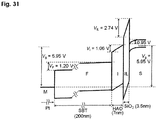
- non-patent reference 9 where a positive voltage for data writing is shown applied to the gate of an FeFET of Pt / Sr Bi 2 Ta 2 O 9 / Hf -Al- O / Si, a diagram is discussed of voltage divisions applied to various portions of a gate and energy bands in directions of depth of the gate. Identically computed, there is derived an energy band diagram ( Fig. 31 ) that is equivalent to that of non-patent reference 9. It is assumed that Pt / Sr Bi 2 Ta 2 O 9 (SBT), Hf -Al- O (HAO) and an interfacial layer (IL) mainly composed of SiO 2 have thicknesses of 200 nm, 7 nm and 3.5 nm, respectively.
- SBT St / Sr Bi 2 Ta 2 O 9
- Hf -Al- O Hf -Al- O
- IL interfacial layer
- the electric polarization at writing is of a degree of 1 to 3 micro C / cm 2 .
- the polarization is greater than of 3 micro C / cm 2 , the voltage and electric field applied to the interfacial layer are increased so that there may develop a phenomenon of injection of electrons from the semiconductor side into the gate insulator side.
- the addition of a phenomenon other than polarization reversal mechanism makes the operation of a FeFET very complicated.
- Non-patent reference 10 discloses a FeFET of Al / PTO / Si where PTO is lead titanate in the form of a film whose thickness is 90 nm. Id - Vd characteristics of FeFET is shown which is obtained on sweeping the gate voltage between - 4 volts and + 4 volts and sweeping it in reciprocation between 1 2 volts and + 2 volts. A data retention property with writing voltages of - 4 and + 4 colts is measured. It is shown that in about 10 4 seconds, it becomes hard to discriminate an On and an Off states. There is no showing of a data retention property with writing voltages of - 2 and + 2 volts, nor is a result shown of rewrite withstand test.
- non-patent reference 11 a Fe FET of TiN / HfSiO / SiO 2 / Si is reported where HfSiO is claimed to be a ferroelectric, having a thickness of 8.5 nm.
- a writing voltage is shown as - 3 and 4 volts and, if a manner of expression of the present invention as mentioned hereinafter is followed, its absolute value is 3.5 volts.
- a data retention property of up to 3 x 10 4 seconds is shown but there is no mention of results of rewrite withstand property.
- an interfacial layer mainly composed of SiO 2 and having a thickness of 3.4 to 5 nm and which is formed on a Si semiconductor surface
- the interfacial layer has a thickness, e. g. of 3.5 nm.
- a voltage of 2.74 volts is applied to the interfacial layer, amounting to 46 % of a gate voltage of 5.95 volts.
- Figs. 30 (a) and (b) are of examples in which the films have thicknesses of 120 nm and 160 nm, respectively.
- FIG. 30(c) shows memory windows of 6 (six) FeFETs of composition Ca 0.2 Sr 0.8 Bi 2 Ta 2 O 9 which are of film thicknesses of 120 nm, 160 nm and 200 nm and are annealed in oxygen at temperatures of 775 and 800 degrees C.
- the same six FeFETs of Fig. 30(c) are measured in sweeping rages of - 0.5 volt to + 0.5 volt.
- Memory windows measured with sleep amplitudes of 3.3 and 5.0 volts are shown in Fig. 30(d) .
- the rate of reduction of a memory window at a sweep amplitude of 3.3 volts down to a memory window at a sweep amplitude of 5.0 volts is at most 38.8 %.
- a sufficient memory window is not obtainable at a sweep amplitude of 3.3 volts.
- the thickness of an interfacial layer across which a voltage is applied is as thick as 3.4 to 5 nm, which made it necessary to apply a surplus writing voltage to cause a phenomenon of electric polarization reversal to develop.
- a sufficient and satisfactory memory window has hitherto been unobtainable.
- P max 2.7 micro C / cm 2
- a reduction of 1 nm of the interfacial layer can be estimated to lead to a decrease of 0.78 volt of the writing voltage.
- the formation and thickness of an interfacial layer may not be enough simply if the time period of annealing is reduced, and the process step of annealing must be one that is sufficient for a ferroelectric layer to develop ferroelectricity.
- a semiconductor ferroelectric memory element less than a gate length of 100 nm requires making a gate laminate less in thickness by photolithography or working technique. Although the thinner, the better; the thickness of a ferroelectric needs to be less than 150 nm.
- the lower limit of the thickness of a ferroelectric is defined as follows: The limit of electric polarization at which the aforementioned phenomenon of injection of electrons may no longer occurs at the time of writing is 3 micro C / cm 2 .
- the method being a method of making a semiconductor ferroelectric memory element, characterized in that: the said film comprises one selected from the class which consists of a film composed of strontium, bismuth, tantalum and oxygen, a film of calcium, strontium, bismuth, tantalum and oxygen, a film of strontium, bismuth, tantalum, niobium and oxygen, and a film of calcium, strontium, bismuth, tantalum, niobium and oxygen; the said metal is composed of one selected from the class which consists of Ir
- the present invention also provides a method of making a semiconductor ferroelectric memory element as set forth above, characterized in that the said semiconductor substrate has a source and a drain region, the said semiconductor ferroelectric memory element being a transistor.
- the said annealing for ferroelectric crystallization is performed preferably at a temperature of not less than 730 degrees Celsius and not more than 800 degrees Celsius.
- the said metal be Ir
- the said mixed gas having oxygen added to nitrogen have oxygen added to nitrogen at a volume proportion of not less than 0.0002 and not more than 0.02.
- the said metal be Pt, and the said mixed gas having oxygen added to nitrogen have oxygen added to nitrogen at a volume proportion of more than 0.0007 and not more than 0.01.
- the said metal be an alloy of Ir and Pt alloyed at a weight proportion of 1 to 1, and the said mixed gas having oxygen added to nitrogen have oxygen added to nitrogen at a volume proportion of more than 0.0001 and not more than 0.0004.
- the said annealing for ferroelectric crystallization is performed, preferably, under a pressure of not less than 0.001 MPa and not more than 1 atmospheric pressure. Note here that 1 atm is equal to 0.1013 Pa.
- the present invention provides a method of making a semiconductor ferroelectric memory element, characterized in that the said insulator is composed of a metal oxide containing at least one of metallic elements of hafnium, zirconium, lanthanum, yttrium, aluminum, magnesium and manganese and comprises a laminate of such metal oxides.
- the present invention provides a method of making a semiconductor ferroelectric memory element, characterized in that the said insulator is of a nitride selected from the class which consists of hafnium nitride and aluminum nitride.
- the present invention provides a method of making a semiconductor ferroelectric memory element, characterized in that the said insulator is selected from the class which consists of one which is composed of the said nitride and the said metal oxide and one which is constituted of a lamination of the said nitride and the said metal oxide laminate.
- the present invention provides a method of making a semiconductor ferroelectric memory element, characterized in that the said nitride is hafnium nitride and the said metal oxide is HfO 2 .
- the said metal oxide is preferably in the form of a film of HfO 2 having a film thickness of not less than 1. 3 nm and not more than 13 nm.
- the present invention provides a method of making a semiconductor ferroelectric memory element, characterized in that the said annealing for ferroelectric crystallization is followed by characteristic adjustment annealing which is at least one of annealing in an oxygen gas and annealing in a mixed gas having hydrogen mixed with nitrogen.
- annealing in the oxygen gas in the characteristic adjustment annealing is effected at an annealing temperature, preferably, of not less than 600 degrees C and not more than 700 degrees C.
- annealing in the mixed gas having hydrogen mixed with nitrogen is effected at an annealing temperature, preferably, of not less than 350 degrees C and not more than 450 degrees C.
- the present invention further provides a method of making a device comprising a semiconductor substrate, an insulator, a ferroelectric and a metal in which the insulator, a film made of constituent elements of a bismuth layer perovskite crystalline ferroelectric and the metal are sequentially formed in the indicated order on a semiconductor substrate and thereafter are subjected to annealing for ferroelectric crystallization, the method being a method of making a semiconductor ferroelectric memory element, characterized in that: the said film comprises one selected from the class which consists of a film composed of strontium, bismuth, tantalum and oxygen, a film of calcium, strontium, bismuth, tantalum and oxygen, a film of strontium, bismuth, tantalum, niobium and oxygen, and a film of calcium, strontium, bismuth, tantalum, niobium and oxygen; the said metal is composed of one selected from the class which consists of Ir, Pt, an alloy of Ir and Pt
- the present invention provides a method of making a semiconductor ferroelectric memory element, characterized in that the said hafnium nitride is formed upon reaction between NH 3 gas and a complex containing Hf in a growth chamber by a metal organic chemical vapor deposition process which comprises the steps of preparing a raw material liquid solution having the complex with Hf dissolved in a solvent; dispersing the raw material liquid solution into a carrier gas to form a raw material gaseous medium in a state of gas and liquid two phases; introducing the raw material gaseous medium while in the state of gas and liquid two phases into a vaporizing chamber to form a vapor thereof; and introducing the vapor into a film forming chamber.
- the said complex that contains hafnium is preferably one of TEMAHF and TDEAHF.
- the present invention provides a semiconductor ferroelectric memory transistor, characterized in that it comprises a semiconductor substrate having a source and a drain region; and an insulator, a ferroelectric and a metal which are layered or laminated in this order on the semiconductor substrate, wherein: the said ferroelectric is one selected from the class which consists of a bismuth layer perovskite ferroelectric composed of strontium, bismuth, tantalum and oxygen, a bismuth layer perovskite ferroelectric composed of calcium, strontium, bismuth, tantalum and oxygen, a bismuth layer perovskite ferroelectric composed of strontium, bismuth, tantalum, niobium and oxygen, and a bismuth layer perovskite ferroelectric composed of calcium, strontium, bismuth, tantalum, niobium and oxygen; the said metal is one selected from the class which consists of Ir, Pt, an alloy of Ir and Pt, and Ru; and the said ferro
- the present invention further provides a semiconductor ferroelectric memory transistor as set forth above, characterized in that it is capable of rewriting data not less than 10 8 times.
- the present invention still further provides a semiconductor ferroelectric memory transistor as set forth in claim 20, characterized in that an interfacial layer is formed between said semiconductor substrate and said insulator and has a thickness of less than 3.4 nm.
- a semiconductor ferroelectric memory element having a laminated structure of an insulator, a ferroelectric and a metal formed on a semiconductor substrate
- preferred conditions are selected for the metal and for the gas in which annealing is effected to crystallize the ferroelectric which adjoins the metal, to reduce the thickness of an interfacial layer mainly composed of SiO 2 and tending to form on surfaces of the semiconductor substrate, whereby an ferroelectric memory element and a transistor having a memory window sufficiently wide at a lower voltage are brought into reality.
- annealing for characteristic adjustment is subsequently effected to achieve a characteristic improvement such as to enlarge the change in drain current with respect to the change in gate voltage.
- Fig. 1 is a sectional view diagrammatically illustrating a course of making a semiconductor ferroelectric memory element made in a first form of implementation of the present invention.
- Numeral 1 designates a semiconductor substrate.
- Fig. 2 is a sectional view diagrammatically illustrating a course of making a semiconductor ferroelectric memory element made in a second form of implementation of the present invention.
- a semiconductor substrate 1 is shown having a source region 6 and a drain region 7.
- the semiconductor substrate 1 is composed of silicon or a semiconductor having a silicon component. It may also be of a mixed crystal of Si and Ge or of SiC. In lieu of a semiconductor substrate, it may also be a SOI (silicon on insulator) substrate.
- Character 3a denotes a layer formed of a composition, as a ferroelectric predecessor, of constituent elements of a Bi layered perovskite crystal structure. Prior to annealing for ferroelectric crystallization, the composition has not yet be of Bi layered perovskite crystal structure.
- Representative are a film made of strontium, bismuth, tantalum and oxygen elements, a film of calcium, strontium, bismuth, tantalum and oxygen, a film of strontium, bismuth, tantalum, niobium and oxygen, and a film of calcium, strontium, bismuth, tantalum, niobium and oxygen.
- Metal 4 may be Ir, Pt, Ru or an alloy of them.
- the film 3a is annealed in a suitable environment for ferroelectric crystallization. This causes its composition to transform into a ferroelectric 3.
- the ferroelectric 3 is composed of a material mainly constituted by a Bi layer perovskite which has been found robust in the fatigue of polarization reversal of ferroelectrics.
- the main constituent of such perovskite may be Sr 2 Bi 2 Ta 2 O 9 ; Ca x Sr 1-x Bi 2 Ta 2 O 9 as a substitute of a part of Sr with Ca in Sr 2 Bi 2 Ta 2 O 9 ; Sr Bi 2 (Ta 1-z Nb z ) 2 O 9 and Ca in Sr 2 Bi 2 Ta 2 O 9 as substitutes of parts of Ta with Nb in Sr 2 Bi 2 Ta 2 O 9 ; Ca x Sr 1-x Bi 2 Ta 2 O 9 and Ca x Sr 1-x Bi 2 Ta 2 O 9 ; Bi 4 Ti 3 O 12 ; (Bi, La) 4 Ti 3 O 12 ; and (Bi, Nd) 4 Ti 3 O 12 .
- Ca x Sr 1-x Bi 2 Ta 2 , Sr Bi 2 (Ta 1-z Nb z ) 2 O 9 and Sr Bi 2 (Ta 1-z Nb z ) 2 O 9 are similar in crystal structure and properties and may interchangeably be used. It has been found that annealing the film 3a after formation of up to the metal 4 on the substrate makes an interfacial region between the ferroelectric 3 and the metal 4 stable in quality, this being connected with and leading to excellent data retention capability and exceeding data rewriting tolerance. Upon zealous investigations in annealing to crystallize the ferroelectric, it has been found important that annealing be performed in the environment of a mixed gas having oxygen added to an inert gas such as N 2 or Ar.
- An interfacial layer 5 mainly composed of SiO 2 is formed on a surface region of the semiconductor substrate 1.
- the term "interfacial layer 5" may hereinafter be so simply termed, suggesting that it be so composed. While the interfacial layer 5 which is of electrical insulating properties can be defined as included in an insulator 2, it may well be regarded as a part of the semiconductor substrate in the present invention. Either way, it is only a question of definition and mode. Electrical conduction in a semiconductor occurs at an interface between the interfacial layer and the internal semiconductor.
- Example 02B of the invention disclosed in Fig. 5 the interfacial layer 5 mainly composed of SiO 2 has a thickness of 2.6 nm.
- a layer denoted by character IL in Fig. 5 is the interfacial layer 5.
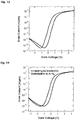
- I d - Vg of the n channel FeFET is disclosed in Fig. 6(a) .
- the drain current is represented in logarithm.
- This FeFET has a gate length (L) of 10 micro-m and a gate width of 200 micro-m.
- Vg is swept in reciprocation between - 3.3 volts and + 3.3 volts.
- V c 0
- a sweep amplitude V amp refers to the absolute value of a data writing voltage into the FeFET. While in measurement of I d - V g the sweep range may hereafter be referred to as Vc ⁇ Vamp, note that it signifies that Vg is swept in reciprocation between V c - V amp and V c + V amp . Along the direction of the arrows as shown, the drain current is changed.
- the drain current (I d ) as shown is normalized for a current per a gate width of 1 micro-m.
- V w V a - V b is equal to 0.59 volt which apparently is wide enough compared with values of the memory window in the prior art (shown in Fig. 30 ).
- the memory window here is markedly widened.
- Example 21C of the invention disclosed in Fig. 7 it is found from a sectional TEM analysis that an interfacial layer 5 mainly composed of SiO 2 has a thickness of 2.5 nm.
- the silicon surface is oxynitrided to a depth of 1.4 nm in an environment of reduced pressure, leaving "SiON (1.4 nm thick) / Si" as it is briefly termed.
- the interfacial layer 5 is formed mainly composed of SiO 2 initially united with a layer of oxynitride of 1.4 nm thick.
- a layer denoted by IL in Fig. 7 is the interfacial layer 5.
- the thickness of the interfacial layer 5 is 2.5 nm which is sufficiently thinner than 3.4 to 5 nm in the prior art.
- Example 02A represents an embodiment of the first form of implementation 1 of the present invention.
- the semiconductor substrate is Si of p type.
- a relationship of electric capacitance with respect to gate voltage: C g -V g is measured, giving a graph shown in Fig. 8 .
- Metal Ir is planar in form and of a square having a side of 100 micro-m.
- the gate voltage after rising from - 3.3 volts to + 3.3 volts is returned to - 3.3 volts.
- An AC voltage having an amplitude of 0.1 volts and an AC frequency of 100 kHz is used.
- a memory window V w of 0.56 volts is evaluated from the C g -V g curves.
- the semiconductor substrate 1 is of silicon or of a semiconductor having a silicon component. It may be a mixed crystal of Si and Ge, or SiC. In lieu of the semiconductor substrate there may be used an SOI (silicon on insulator) substrate.
- SOI silicon on insulator
- the process step of forming the insulator 2 is effected directly upon removal of the surface oxide film, or after the semiconductor substrate surface is nitrided or oxynitrided.
- the nitride or oxynitride film formed has a thickness preferably of not more than 1.5 nm. Any process may be used to make it.
- the surface oxide film is removed by immersion in a solution of buffered or unbuffered fluorinated acid.
- a nitride film may, for example, be formed by introducing NH 3 gas into an atmosphere of reduced pressure and effecting rapid thermal annealing (RTA).
- RTA rapid thermal annealing
- An oxynitride film may, for example, be formed by introducing O 2 gas in an atmosphere of reduced pressure and effecting rapid thermal annealing (RTA) and thereafter introducing NH 3 gas in an atmosphere of reduced pressure and effecting rapid thermal annealing (RTA).
- the insulator 2 is required to be elaborate and to diminish the leakage current between the gate and the semiconductor substrate surface. Further, in the process of making a FeFET, it is also requited, not to cause inter-diffusion of, and to produce no chemical reaction product from, elements of the film 3a, the ferroelectric 3, the semiconductor substrate 1. Further, it is preferred that the insulator 2 be high in dielectric constant so that a gate voltage applied to the FeFET may effectively be applied to the ferroelectric 3.
- the insulator 2 should have an electron affinity (difference in energy between the vacuum level and the lowermost end of conduction bands) smaller than that of the ferroelectric 3, and further that the insulator 2 should have an ionization potential (difference in energy between vacuum level and the uppermost end of conduction bands) larger than that of the ferroelectric 3. If the electron affinity of the insulator 2 is larger than that of the ferroelectric 3, the insulator 2 between the ferroelectric 3 and the interfacial layer 5 mainly composed of SiO 2 on the semiconductor substrate surface tends to become a well for conductive electrons. Due to a leakage current, electrons once they enter the well are hard to come off therefrom; the well providing for a collecting place for incoming electrons.
- the threshold voltage of the FeFET will be caused to shift by a mechanism separate from that of switching between polarizations of the ferroelectric. If the ionization potential of the insulator 2 is lower than that of the ferroelectric, the insulator 2 between the ferroelectric 3 and the interfacial layer 5 mainly composed of SiO 2 on the semiconductor substrate surface tends to become a well for positive holes. Due to a leakage current, positive holes once they enter the well are hard to come off therefrom; the well providing for a collecting place for incoming positive holes.
- the insulator 2 regardless of its kinds if they satisfy these requirements, should preferably be a single oxide or mixed oxides or layered oxides of elements such as hafnium, zirconium, lanthanum, yttrium, aluminum, magnesium and/or manganese. It is also useful to achieve the object of diminishing a leakage current to add nitrogen to the oxides listed.
- the insulator 2 of one or more of aluminum nitride, hafnium nitride, and mixed nitride of aluminum and hafnium, which are found to act to reduce oxygen diffusing into the ferroelectric in the process step of annealing for its crystallization and thus to reduce the extent in which to form an interfacial layer 5 mainly composed of SiO 2 . It is preferable to use a composite compound and layered composite compounds of a nitride such as aluminum nitride, hafnium nitride, or a mixed nitride of aluminum and hafnium and an oxide as an insulator that satisfies the abovementioned requirements as to the insulator 2. In addition, a material may be used that is not an insulator prior to the process step of ferroelectric crystallization annealing and which thereafter comes to satisfy the abovementioned requirements to form the ferroelectric 2.
- an interfacial layer 5 mainly composed of SiO 2 be thinner than 3.4nm as mentioned above, an SiO 2 equivalent film thickness (EOT) of an insulator 2 be also smaller than 3.4 nm and let to stay not less than 0.2 nm and not more than 2 nm, so that a voltage may equally be applied to the interfacial layer 5 and to the insulator 2.
- EOT SiO 2 equivalent film thickness
- An insulator 2 may be formed by any process that meets the abovementioned requirements and may suitably be formed by pulse laser deposition, sputtering, metal organic chemical vapor deposition, atomic layer deposition or the like technique.
- the film 3a is a film composed of elements constituting a Bi layer perovskite. Prior to a process step of crystallization annealing, the film has not yet had a Bi layer perovskite crystal structure.
- Representative of the film 3a are a film of elements of strontium, bismuth, tantalum and oxygen, a film of calcium, strontium, bismuth, tantalum and oxygen, a film of strontium, bismuth, tantalum, niobium and oxygen, and a film of calcium, strontium, bismuth, tantalum, niobium and oxygen, it may also be a film of bismuth, titanium and oxygen, a film of bismuth, tantalum, titanium and oxygen, or a film of bismuth, neodymium, titanium and oxygen.
- the film 3a may be formed by pulse laser deposition, sputtering, or metal chemical vapor deposition, metal organic decomposition (MOD or sol - gel technique or the like.
- the metal 4 may be selected to be a pure metal or an alloy thereof.
- a FeFET that is excellent in data retention property and rewrite withstand property.
- Annealing for ferroelectric crystallization is effected preferably at a temperature of 700 to 820 degrees C and for a time period of 10 to 60 minutes. A material is thus called for to meet the annealing conditions. After zealous investigations, it has been found that Ir, Pt, or an alloy of Ir and Pt, or Ru is suitable.
- metal 4 While there is no particular limitation in how metal 4 is formed, it may be formed, for example, by sputtering, metal organic chemical vapor deposition or electron beam vapor deposition technique.
- the ferroelectric 3 is constituted by a material mainly composed of a Bi layered perovskite that is found robust in fatigue of ferroelectric polarization reversal.
- its main component may be Sr 2 Bi2 Ta 2 O 9 ; Ca x Sr 1-x Bi 2 Ta 2 O 9 as a substitute of a part of Sr with Ca in Sr 2 Bi 2 Ta 2 O 9 ; Sr Bi 2 (Ta 1-z Nb z ) 2 O 9 and Ca in Sr 2 Bi 2 Ta 2 O 9 as substitutes of parts of Ta with Nb in Sr 2 Bi 2 Ta 2 O 9 ; Ca x Sr 1-x Bi 2 Ta 2 O 9 and Ca x Sr 1-x Bi 2 Ta 2 O 9 ; Bi 4 Ti 3 O 12 ; (Bi, La) 4 Ti 3 O 12 ; and (Bi, Nd) 4 Ti 3 O 12 .
- annealing after formation of up to the metal 4 makes an interfacial region between the ferroelectric 3 and the metal 4 stable in quality, this being connected with and leading to excellent data retention capability and exceeding data rewriting tolerance.
- a mixed gas having oxygen added to an inert gas such as N 2 or Ar.
- the ferroelectric 3 which has undergone annealing for ferroelectric crystallization has a Bi layered perovskite crystal structure.
- the ferroelectric should have a thickness df preferably such that 59 nm ⁇ d ⁇ 150 nm.
- an interfacial layer 5 mainly composed of SiO 2 it is important that oxygen as a component of the gaseous atmosphere used in annealing for ferroelectric crystallization should be reduced as much as possible in nitrogen or argon as its main component.
- the ferroelectric being an oxide requires that there exist a degree of oxygen in the atmospheric gas. It is further necessary that metal 4 should withstand the annealing.
- annealing for ferroelectric crystallization is effected at a temperature of 760 degrees C and for a time period of 30 minutes.
- annealing for ferroelectric crystallization is effected at a temperature of 760 degrees C and for a time period of 30 minutes.
- the insulator 2 is of HfO 2 .
- annealing for ferroelectric crystallization is effected at a temperature of 750 degrees C and for a time period of 30 minutes.
- Fig. 11 is a result of measurement of I d - Vg.
- the ferroelectric contains Nb.
- the structure and thickness of a gate laminate are: Ir (75 nm) / Ca 0.2 Sr 0.8 Bi 2 (Ta 0.75 Nb 0.25 ) 2 O 9 (135 nm) / Hf O 2 (5 nm) / Si.
- annealing for ferroelectric crystallization is effected at a temperature of 793 degrees C and for a time period of 30 minutes.
- V w 0.28 volts.
- the insulator 2 is a laminated film having a layer of hafnium nitride having a thickness of 2 nm deposited on Si and a layer of HfO 2 having a thickness of 4 nm deposited on the Hf - N layer .
- annealing for ferroelectric crystallization is effected at a temperature of 780 degrees C and for a time period of 30 minutes.
- the insulator 2 is a laminated film having a layer of hafnium nitride having a thickness of 2 nm deposited on Si and a layer of HfO 2 having a thickness of 4 nm deposited on the Hf - N layer.
- annealing for ferroelectric crystallization is effected at a temperature of 780 degrees C and for a time period of 30 minutes.
- a result of measurement of I d - Vg: with a gate voltage that is swept in a range from - 3.3 volts to + 3.3 volts there is observed a memory window: V w 0.52 volts.
- the insulator 2 is a layer of hafnium nitride having a thickness of 5 nm.
- annealing for ferroelectric crystallization is effected at a temperature of 750 degrees C and for a time period of 30 minutes.
- annealing for ferroelectric crystallization is effected at a temperature of 793 degrees C and for a time period of 30 minutes.
- the insulator 2 is a laminated film formed of a layer of hafnium nitride (Hf - N) deposited on Si and a layer of HfO 2 deposited on the Hf - N layer are put together in Table1.
- the memory window of I d - Vg characteristic has values found with a gate voltage swept from V c - 3.3 volts to V c + 3.3 volts.
- Hf - N is formed by a metal organic chemical vapor deposition (MOCVD) technique.
- the flow of NH 3 should preferably be not less than 9 sccm and not more than 20 sccm. Ranging it so is found to achieve a memory window of not less than 0.4 volt.
- the susceptor temperature should preferably be not less than 260 degrees C and not more than 400 degrees C.
- Hf - N should have a thickness of not less than 1 nm and not more than 3.1 nm. The result of sectional TEM analysis indicates that the thickness of an interfacial layer mainly composed of SiO 2 in Example 11A is 3.1 nm.
- a film of Ir as metal 4 is formed by a sputtering technique and a film 3a by a pulse laser deposition technique.
- hafnium nitride and aluminum nitride are formed by a metal organic chemical vapor deposition technique, and other materials by the pulse laser deposition technique.
- the film 3a is made by the metal organic chemical vapor deposition technique.
- annealing for ferroelectric crystallization is effected at a temperature of 780 degrees C and for a time period of 30 minutes.
- Ir and HfO 2 are formed by the sputtering and pulse laser deposition techniques, respectively.
- Annealing for ferroelectric crystallization may be carried out in an atmosphere having oxygen mixed with an inert gas.
- annealing for ferroelectric crystallization is effected at a temperature of 760 degrees C and for a time period of 30 minutes.
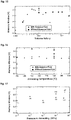
- a volume proportion y of N 2 to O 2 with respect to a memory window in an I d - V g characteristic measured, of a FeFET made using the volume proportion.
- the memory window as a variable along the ordinate axis has values with the gate voltage that is swept in the rage of - 3.3 volts to + 3.3 volts.
- the abscissa axis has a variable y representing a volume proportion of O 2 to N 2 , viz.
- y (volume of O 2 in the mixed gas) / (volume of N 2 in the mixed gas).
- the gases are added at a selected proportion of mixture for ferroelectric crystallization annealing.
- Embodiments indicated by marks ( ⁇ ) in Fig. 15 are the case that annealing is effected in the presence of a flow of nitrogen and oxygen gases. More specifically, the flows of N 2 and O 2 are 1000 and 1000y, respectively.
- Embodiments of marks ( ⁇ ) are the case that annealing is effected in the absence of the flow of nitrogen and oxygen gases. It has been found that favorable conditions to obtain good window are represented by a volume proportion of the gases, regardless of the presence or absence of the gases flowing. With Ir selected for metal 4, a preferred volume proportion of oxygen is not less than 0.0002 and not more than 0.02, achieving a memory window of not less than 0.4 volts.
- an FeFET is made of Ca composition X
- a good memory window is achieved, regardless of presence or absence of gases flowing.
- x 0.25
- Fig. 16 is a graph illustrating a relationship between an annealing temperature in the process step of annealing for ferroelectric crystallization and a memory window in I d - V g characteristic of a FeFET made.
- the memory window as a variable along the ordinate axis has values with the gate voltage that is swept in the rage of - 3.3 volts to + 3.3 volts.
- the time period for annealing is 30 minutes.
- the marks in Fig. 16 individually represent embodiments of FeFET made.
- Embodiments indicated by marks ( ⁇ ) in Fig. 16 are the case that annealing is effected in the presence of a flow of nitrogen and oxygen gases. More specifically, the flows of N 2 and O 2 are 1000 and 1, respectively.
- Embodiments of marks ( ⁇ ) are the case that annealing is effected in the absence of the flow of nitrogen and oxygen gases.
- the preferred temperature conditioned for ferroelectric crystallization annealing is not less than 730 degrees C and not more than 800 degrees C, yielding memory window of not less than 0.4 volts.
- Examples using embodiments of metal 4 other than Ir are shown in Table 4.
- Pt is used for metal 4.
- the memory window is not less than 0.40 volts.
- Fig. 18 is a graph illustrating a relationship between a thickness of HfO 2 used for the insulator 2 and a memory window.
- the marks in Figure individually represent embodiments of FeFET made.
- Embodiments of marks ( ⁇ ) are the case that annealing is effected in the absence of a gaseous flow.
- Embodiments indicated by marks ( ⁇ ) in Fig. 15 are the case that annealing is effected in the presence of the gaseous flow.
- the volume proportion of oxygen gas y 0.0001.
- Fig. 18 shows that the film of HfO 2 (4 nm) most preferably has a thickness of not less than 2 nm and not more than 6 nm.
- the first process is to anneal in oxygen gas under a temperature condition lower than that in annealing for ferroelectric crystallization.
- the second process is to anneal in a gas containing hydrogen.
- the two characteristic adjustment annealing processes may be used in combination.
- annealing is effected at a temperature of not less than 500 degrees C and not more than 700 degrees C for a time period of not less than 10 minutes and not more than 60 minutes.
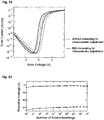
- Fig. 19 discloses the I d - Vg characteristics of one FeFET on the chip in Example 02B before and after the characteristic adjustment annealing. The broken and solid curves represent them before and after the characteristic adjustment. It is seen that with respect to a change in the gate voltage the drain current evidently changes in a region of the gate voltage from to 1 volt, more sharply after the characteristic adjustment annealing than before the characteristic adjustment annealing. The characteristic is improved because of a larger change in current deemed in general better for a narrow change in voltage.
- SS sub - threshold swing
- the SS value is defined as a gate voltage needed to change the drain current by one order of magnitude in a region of voltage lower than the threshold value, and it is better that the SS value is small.
- Fig. 19 (20) discloses the rate of change of the characteristic subsequent to annealing with respect to the temperature in the characteristic adjustment annealing.
- Marked with ⁇ are the rate of change of the memory window, and marked with ⁇ are the rate of change of the S value.
- the rate of change is ([the physical quantity subsequent to annealing] - [the physical quantity prior to annealing]) / [the physical quantity prior to annealing] and represented in per cent (%). It is not good that the rate of the window subsequent to annealing decreases and it is good that the SS value decreases.
- the rate of change of the memory window is small in a range of 500 to 700 degrees C while the SS value diminishes largely as the temperature is risen. A decrease is seen in the SS value to the extent of 10 % in the range of 500 to 700 degrees C.
- the upper limit of annealing temperature in the first process is determined. Annealing in oxygen is deemed to recover a defect in the interface between the interfacial layer and Si.
- the second process makes use of a mixed gas of hydrogen and nitrogen, containing 3 to 5 % of hydrogen.
- the annealing temperature is preferably not less than 350 degrees C and not more than 450 degrees C.
- the annealing time period is preferably not less than 3 minutes and not more than 30 minutes.
- Example 22 shows results of the second process of annealing a FeFET at a temperature of 400 degrees C for a time period of 5 minutes, the FeFET being on the chip in Example 23C.
- the effect of improvement is observed.
- a hydrogen atom coming into a dangling bond between Si and an interfacial layer 5 mainly composed of SiO 2 is deemed to decrease the state density in the interface, causing the effect of hydrogen annealing to be revealed.
- the temperature and period of time are preferably as mentioned above.
- a pulse rewrite withstand property and a data retention capability are disclosed if the writing voltage has its absolute value of 3. 3 volts.
- Use is made of a FeFET in Example 02B.
- An alternating pulse having a cycle of a negatively poled pulse having a height of - 3.3 volts and a width of 10 microseconds followed by a positively poled pulse having a height of + 3.3 volts and a width of 10 microseconds is repetitively applied, constituting rewriting pulses.
- the I d - V g characteristic is measured to examine a rewriting tolerance.
- the gate voltage is swept in reciprocation between - 3.3 and + 3.3 volts.
- Vg is swept from 1.0 volt to 0 volt to obtain an I d - Vg characteristic.
- Vg applied to yield I d 10 -8
- a / micro-m represents a threshold value which is plotted in Fig. 24 .
- the mark ⁇ at after 10 4 seconds and the marks ⁇ at after 10 5 seconds are connected by a straight line (broken line) and extrapolated up to 10 years.
- This extrapolating operation indicates that the difference in threshold voltage after 10 years remains to be about 0.18 volt, showing that two storage states are sufficiently distinguishable from each other. It thus follows that a data retention property equivalent to the data retention property described in patent documents 1 to 3 and non-p references 1 to 9 is met by the present invention.
- the end of a data retention time period refers to a point of time at which two states are no longer distinguishable from each other. It is herein defined as a time at which the difference between the two threshold voltages reaches 0.05 volt.
- the data retention property can also be rated by a method whereby in readout the drain current is measured with the gate voltage fixed.
- the ratio of on current to off current is 3 corresponds virtually to that the difference in threshold voltage is 0.05 volt.
- the end of a data retention time period is defined in a method of measuring a drain current by a time at which the ratio of on current to off current reaches 3. According to this definition, the life of data retention of embodiments of the present invention is enough in excess of 10 years.
- the present invention thus provides a FeFET capable of writing data with a writing voltage whose absolute value is not more than 3.3 volts, without impairing either of two properties which in combination are had by a FeFET which has been developed, the two properties being 1) a data retention property of not less than 10 5 seconds and 2) a data rewrite withstand capability of 10 8 times.
- a Fe FET according to the present invention provides a good device property by a writing voltage even if its absolute value is in excess of 3.3 volts.
- Figs. 25 and 26 show results of a data rewriting tolerance test.
- Fig. 25 is a graph having results from Example 27E.
- Fig. 26 represents results from Example 12H.
- the graph in Fig. 25 is obtained from measurement using the same process as those mentioned above. Only a portion that differs numerically is mentioned.
- An alternating pulse for a cycle of 20 microseconds, constituted of a negatively poled pulse having a height of - 4.5 volts and a width of 10 microseconds followed by a positively poled pulse having a height of + 4.5 volts and a width of 10 microseconds is used.
- a readout operation is performed. In reading out, the gate voltage is swept from 0.6 to - 0.4 volt.
- Fig 26 graphically shows a rewrite withstand capability not less than 10 9 times.
- Figs. 27 and 28 graphically show results of the data retention property.
- Fig. 27 represents results from Example 27F.
- a single negatively poled pulse having a height of - 4.5 volts and a width of 10 microseconds is applied, a state of data retention is entered.
- Vg is swept from 0.3 volt to - 0.4 volt to obtain an I d - Vg characteristic.
- Results of the data readout operation that is likewise performed are shown marked with ⁇ .
- the threshold voltage following the negatively poled pulse is found to be larger by about 0.5 volt higher than the threshold voltage following the positively poled pulse. showing a good data retention property.
- Fig. 28 shows results from Example 12H. Thickness of a gate laminate and condition of annealing for ferroelectric crystallization of the Example 12H are as mentioned above.
- the negatively poled pulse for writing has a height of - 4.5 volts and a width of 10 microseconds.
- the positively poled pulse for writing has a height of + 4.5 volts and a width of 10 microseconds.
- a source and a drain region are formed and a Si substrate of p - type covered with a SiO 2 surface layer having a thickness of 35 nm is prepared.
- the substrate is immersed in buffered hydrofluoric acid to remove the protective SiO 2 film on its surface, a state as shown in Fig. 29(a) .
- a pulse laser deposition technique is used to form an insulator 2.
- Its target is HfO2 and the laser is KrF excimer laser, having a wavelength of 248 nm, a pulse projection number of 10 per second and a laser energy of 250 mJ.
- the substrate is held at a temperature of 220 degrees C, and N 2 is introduced at a rate of flow of 4 sccm and under a pressure of 15 Pa and for a time period of 8 minutes and 57 seconds.
- the insulator 2 is formed in the form of a film of HfO 2 . Note that the rate of forming the film varying with the state of equipment and target is seized separately by a monitor. The film forming time is adjusted to give a selected film thickness.
- a pulse laser deposition technique is used to form a film 3a.
- the target is Ca - Sr - Bi - Ta - O.
- the laser is KrF excimer laser, having a wavelength of 246 nm, a pulse projection number of 50 per second and a laser energy of 250 mJ.
- the substrate is held at a temperature of 415 degrees C, and O 2 is introduced at a rate of flow of 3.1 sccm and under a pressure of 11 Pa and for a time period of 17 minutes and 47 seconds to form a film 3a.
- the film 3a formed is of Ca - Sr - Bi - Ta - O. Note that the rate of forming the film varying with the state of equipment and target is seized separately by a monitor. The film forming time is adjusted to give a selected film thickness.
- An Rf magnetron scattering technique is used to form a metal 4.
- the target is metal Ir and the substrate is not heated.
- Argon is introduced at a rate of flow of 1.4 sccm and under a pressure of 0.15 Pa.
- Rf power is 40 W and held for 22 minutes and 30 seconds to form a film of Ir having a thickness of 75 nm, as the metal.
- Past process steps 2, 3 and 4 a state as shown in Fig. 29(b) is had.
- a photoresist of the gate configuration is left by an ordinary photographic technique.
- FeFETs of 8 kinds have a gate length of 10 micrometers and a gate width of 200 to 10 micrometers
- An ion milling technique is used to remove portions of Ir metal which are not covered with the photoresist.
- Example specimen is immersed in acetone to remove the photoresist, the specimen being thereafter cleansed in ultrapure water, bringing about a state as shown in Fig. 29c ).
- An infrared gold-image furnace is used to perform annealing for ferroelectric crystallization.
- the Example specimen has a temperature risen from room temperature to 750 degrees C for a time period of 10 minutes and is annealed at the temperature of 750 degrees C under a pressure of 1 atm in the absence of flow for a time period of 30 minutes.
- An ordinary photolithographic technique is used to remove the resist at a portion of the hole for contact of the source and drain.
- An ion milling technique is used to remove portions of the ferroelectric and insulator 2.
- Example specimen is immersed in acetone to remove the photoresist.
- a state as shown in Fig. 29(d) is reached, making it possible to measure an I d - V g characteristic and others.
- the process step of annealing for ferroelectric crystallization is effected intervening between the process steps of Fig. 29(c) and2(d) , transforming the film 3a in Fig. 29(c) into a ferroelectric 3.
- the interfacial layer 5 mainly composed of SiO 2 is omitted from illustration.
- the two sorts of annealing may be performed at need and after process steps 6 and 7.
- this Example has hafnium nitride (Hf - N) formed having a thickness of 2 nm and thereafter HfO 2 formed having a thickness of 4 nm. Forming of HfO 2 is the same as in Example 302B. However, the time period for film forming is varied in consideration of a change in rate of film forming.
- a film of hafnium nitride (Hf - N) is formed using a metal organic chemical vapor deposition technique of the type in which a raw material liquid solution is prepared having a complex compound containing Hf and dissolved in a solvent, the raw material liquid solution being dispersed into a carrier gas to form a raw material gaseous medium in a state of gas and liquid two phases; the raw material gaseous medium while in the state of gas and liquid two phases is introduced into a vaporizing chamber to form a vapor thereof; and the vapor is introduced into a film forming chamber.
- the complex compound containing Hf is preferably Hf [N (C 2 H 5 ) (CH 3 )] 4 , tetrakis - dimethyl amino hafnium, which is abbreviated as TEMAHF. It can be confirmed that a complex compound expressed by chemical formula: Hf (N (C 2 H 5 ) 2 ] 4 , tetrakis diethyl-amido hafnium abbreviated as TDEAHF can also be used to form a film of Hf-N.
- TDEAHF tetrakis diethyl-amido hafnium
- EHC ethyl cyclohexane
- the carrier gas uses nitrogen gas, but may be argon gas. Ammonia (NH 3 ) gas is also introduced in to the growth chamber.
- the concentration of TEMAHF in ECT is preferably 0.1 mol to 0.2 mol per liter.
- the concentration of TDEAHF in ECT is preferably 0.1 mol to 0.2 mol per liter.
- the rate of liquid flow of the raw material liquid solution is preferably 0.1 to ccm to 0.3 ccm.
- the pressure of the growth chamber is 200 Pa to 700 Pa.
- the rate of NH 3 gas is not less than 5 sccm and not more than 30 sccm, and the susceptor temperature is not less than 260 degrees C and not more than 400 degrees C, it has been found that they are preferable to form a film of hafnium nitride satisfying a stoichiometric mixture ratio of Hf 3 N 4 .
Landscapes
- Engineering & Computer Science (AREA)
- Computer Hardware Design (AREA)
- Physics & Mathematics (AREA)
- Power Engineering (AREA)
- Condensed Matter Physics & Semiconductors (AREA)
- General Physics & Mathematics (AREA)
- Manufacturing & Machinery (AREA)
- Microelectronics & Electronic Packaging (AREA)
- Chemical & Material Sciences (AREA)
- Non-Volatile Memory (AREA)
- Semiconductor Memories (AREA)
- Materials Engineering (AREA)
- Crystallography & Structural Chemistry (AREA)
- Chemical Kinetics & Catalysis (AREA)
- Optics & Photonics (AREA)
- Formation Of Insulating Films (AREA)
Applications Claiming Priority (1)
| Application Number | Priority Date | Filing Date | Title |
|---|---|---|---|
| JP2016086570A JP6751866B2 (ja) | 2016-04-22 | 2016-04-22 | 半導体強誘電体記憶素子の製造方法及び半導体強誘電体記憶トランジスタ |
Publications (3)
| Publication Number | Publication Date |
|---|---|
| EP3236487A2 true EP3236487A2 (de) | 2017-10-25 |
| EP3236487A3 EP3236487A3 (de) | 2018-05-16 |
| EP3236487B1 EP3236487B1 (de) | 2024-06-05 |
Family
ID=58644838
Family Applications (1)
| Application Number | Title | Priority Date | Filing Date |
|---|---|---|---|
| EP17167457.5A Active EP3236487B1 (de) | 2016-04-22 | 2017-04-21 | Verfahren zur herstellung eines ferroelektrischen halbleiterspeicherelements und ferroelektrischer speichertransistor |
Country Status (6)
| Country | Link |
|---|---|
| US (2) | US10686043B2 (de) |
| EP (1) | EP3236487B1 (de) |
| JP (1) | JP6751866B2 (de) |
| KR (1) | KR102154646B1 (de) |
| CN (1) | CN107452742B (de) |
| TW (1) | TWI721157B (de) |
Families Citing this family (12)
| Publication number | Priority date | Publication date | Assignee | Title |
|---|---|---|---|---|
| KR20190008049A (ko) * | 2017-07-14 | 2019-01-23 | 에스케이하이닉스 주식회사 | 강유전성 메모리 소자의 제조 방법 |
| KR20190115508A (ko) * | 2018-03-15 | 2019-10-14 | 에스케이하이닉스 주식회사 | 강유전성 메모리 장치 |
| US10879391B2 (en) | 2019-05-07 | 2020-12-29 | Taiwan Semiconductor Manufacturing Co., Ltd. | Wakeup-free ferroelectric memory device |
| KR102827209B1 (ko) | 2019-07-29 | 2025-07-01 | 삼성전자주식회사 | 반도체 소자 및 그 제조 방법 |
| US11139315B2 (en) * | 2019-10-31 | 2021-10-05 | Qualcomm Incorporated | Ferroelectric transistor |
| US11227933B2 (en) * | 2020-03-31 | 2022-01-18 | Taiwan Semiconductor Manufacturing Company Limited | Ferroelectric field effect transistor using charge trapping band misalignment and methods of forming the same |
| KR102906608B1 (ko) * | 2020-05-19 | 2025-12-30 | 삼성전자주식회사 | 산화물 반도체 트랜지스터 |
| US11569382B2 (en) * | 2020-06-15 | 2023-01-31 | Taiwan Semiconductor Manufacturing Company, Ltd. | Semiconductor device and method of fabricating the same |
| US12148828B2 (en) * | 2020-06-18 | 2024-11-19 | Taiwan Semiconductor Manufacturing Company, Ltd. | Semiconductor device and manufacturing method thereof |
| KR20210030306A (ko) | 2021-02-25 | 2021-03-17 | 삼성전자주식회사 | 반도체 메모리 장치 |
| KR20230077516A (ko) | 2021-11-25 | 2023-06-01 | 삼성전자주식회사 | 강유전 메모리 소자 |
| US20240413078A1 (en) * | 2023-06-08 | 2024-12-12 | Nanya Technology Corporation | Anti-Fuse Device by Ferroelectric Characteristic |
Citations (3)
| Publication number | Priority date | Publication date | Assignee | Title |
|---|---|---|---|---|
| JP2004304143A (ja) | 2002-08-20 | 2004-10-28 | National Institute Of Advanced Industrial & Technology | 半導体強誘電体記憶デバイスとその製造方法 |
| JP2006108648A (ja) | 2004-09-10 | 2006-04-20 | Fujitsu Ltd | 強誘電体メモリ、多値データ記録方法、および多値データ読出し方法 |
| WO2013183547A1 (ja) | 2012-06-05 | 2013-12-12 | 独立行政法人産業技術総合研究所 | 半導体強誘電体記憶トランジスタおよびその製造方法 |
Family Cites Families (44)
| Publication number | Priority date | Publication date | Assignee | Title |
|---|---|---|---|---|
| JP3152859B2 (ja) | 1994-09-16 | 2001-04-03 | 株式会社東芝 | 半導体装置の製造方法 |
| US6185472B1 (en) * | 1995-12-28 | 2001-02-06 | Kabushiki Kaisha Toshiba | Semiconductor device manufacturing method, manufacturing apparatus, simulation method and simulator |
| JP3103916B2 (ja) | 1997-07-09 | 2000-10-30 | ソニー株式会社 | 強誘電体キャパシタおよびその製造方法並びにそれを用いたメモリセル |
| US6133092A (en) * | 1998-07-24 | 2000-10-17 | Symetrix Corporation | Low temperature process for fabricating layered superlattice materials and making electronic devices including same |
| US6048740A (en) * | 1998-11-05 | 2000-04-11 | Sharp Laboratories Of America, Inc. | Ferroelectric nonvolatile transistor and method of making same |
| JP2000236075A (ja) * | 1999-02-12 | 2000-08-29 | Sony Corp | 誘電体キャパシタの製造方法および半導体記憶装置の製造方法 |
| US6151241A (en) | 1999-05-19 | 2000-11-21 | Symetrix Corporation | Ferroelectric memory with disturb protection |
| US6495878B1 (en) | 1999-08-02 | 2002-12-17 | Symetrix Corporation | Interlayer oxide containing thin films for high dielectric constant application |
| JP4303389B2 (ja) * | 2000-02-24 | 2009-07-29 | ローム株式会社 | 強誘電体メモリ装置の製造方法 |
| JP4445091B2 (ja) * | 2000-04-07 | 2010-04-07 | 康夫 垂井 | 強誘電体記憶素子 |
| US6822277B2 (en) * | 2000-08-24 | 2004-11-23 | Rohm Co. Ltd. | Semiconductor device and method for manufacturing the same |
| US6660631B1 (en) * | 2000-08-31 | 2003-12-09 | Micron Technology, Inc. | Devices containing platinum-iridium films and methods of preparing such films and devices |
| JP5016416B2 (ja) | 2001-01-18 | 2012-09-05 | 株式会社渡辺商行 | 気化器及び気化方法 |
| US6441417B1 (en) | 2001-03-28 | 2002-08-27 | Sharp Laboratories Of America, Inc. | Single c-axis PGO thin film on ZrO2 for non-volatile memory applications and methods of making the same |
| JP2002305289A (ja) | 2001-04-05 | 2002-10-18 | Hitachi Ltd | 半導体集積回路装置およびその製造方法 |
| US20020168785A1 (en) * | 2001-05-10 | 2002-11-14 | Symetrix Corporation | Ferroelectric composite material, method of making same, and memory utilizing same |
| JP4488661B2 (ja) * | 2001-09-18 | 2010-06-23 | Okiセミコンダクタ株式会社 | 強誘電体キャパシタの製造方法 |
| JP2003243628A (ja) * | 2002-02-15 | 2003-08-29 | Sony Corp | 強誘電体薄膜、強誘電体キャパシタ、及び強誘電体メモリ素子の製造方法 |
| CN1306599C (zh) * | 2002-03-26 | 2007-03-21 | 松下电器产业株式会社 | 半导体装置及其制造方法 |
| CN100423266C (zh) | 2002-08-20 | 2008-10-01 | 独立行政法人产业技术综合研究所 | 半导体-铁电体存储器设备以及制造该设备的工艺 |
| US6714435B1 (en) | 2002-09-19 | 2004-03-30 | Cova Technologies, Inc. | Ferroelectric transistor for storing two data bits |
| JP2004139655A (ja) * | 2002-10-17 | 2004-05-13 | Matsushita Electric Ind Co Ltd | 半導体記憶装置及びそれが搭載された電子装置 |
| JP4252537B2 (ja) * | 2002-12-25 | 2009-04-08 | 富士通マイクロエレクトロニクス株式会社 | 半導体装置の製造方法 |
| US6876536B2 (en) | 2002-12-27 | 2005-04-05 | Tdk Corporation | Thin film capacitor and method for fabricating the same |
| US9121098B2 (en) | 2003-02-04 | 2015-09-01 | Asm International N.V. | NanoLayer Deposition process for composite films |
| JP4192008B2 (ja) | 2003-02-18 | 2008-12-03 | 株式会社渡辺商行 | 気化器及び気化器の洗浄方法並びに気化器を用いた装置 |
| US7250648B2 (en) * | 2003-09-04 | 2007-07-31 | Intematix Corporation | Ferroelectric rare-earth manganese-titanium oxides |
| KR100655291B1 (ko) * | 2005-03-14 | 2006-12-08 | 삼성전자주식회사 | 비휘발성 반도체 메모리 장치 및 그 제조방법 |
| JP2007115733A (ja) * | 2005-10-18 | 2007-05-10 | Fujitsu Ltd | 強誘電体キャパシタ、強誘電体メモリ、及びそれらの製造方法 |
| JP4768469B2 (ja) * | 2006-02-21 | 2011-09-07 | 株式会社東芝 | 半導体装置の製造方法 |
| KR101101566B1 (ko) * | 2006-03-30 | 2012-01-02 | 후지쯔 세미컨덕터 가부시키가이샤 | 반도체 장치 및 그 제조 방법 |
| JP2008016626A (ja) | 2006-07-05 | 2008-01-24 | Toshiba Corp | 半導体装置及びその製造方法 |
| US20080087890A1 (en) * | 2006-10-16 | 2008-04-17 | Micron Technology, Inc. | Methods to form dielectric structures in semiconductor devices and resulting devices |
| JP5092461B2 (ja) * | 2007-03-09 | 2012-12-05 | 富士通セミコンダクター株式会社 | 半導体装置及びその製造方法 |
| JP4822547B2 (ja) | 2007-03-28 | 2011-11-24 | 独立行政法人産業技術総合研究所 | 強誘電体を有する電界効果トランジスタ型記憶素子及びその製造方法 |
| JP2008219026A (ja) | 2008-03-31 | 2008-09-18 | Watanabe Shoko:Kk | 原料溶液の気化方法 |
| US8304823B2 (en) | 2008-04-21 | 2012-11-06 | Namlab Ggmbh | Integrated circuit including a ferroelectric memory cell and method of manufacturing the same |
| US20120181584A1 (en) | 2011-01-19 | 2012-07-19 | Ru Huang | Resistive Field Effect Transistor Having an Ultra-Steep Subthreshold Slope and Method for Fabricating the Same |
| US8513773B2 (en) * | 2011-02-02 | 2013-08-20 | Semiconductor Energy Laboratory Co., Ltd. | Capacitor and semiconductor device including dielectric and N-type semiconductor |
| KR20130047054A (ko) * | 2011-10-31 | 2013-05-08 | 에스케이하이닉스 주식회사 | 고유전층 및 금속게이트전극을 갖는 반도체장치 및 그 제조 방법 |
| JP5561300B2 (ja) | 2012-03-26 | 2014-07-30 | 富士通セミコンダクター株式会社 | 半導体装置の製造方法 |
| JP2014053571A (ja) * | 2012-09-10 | 2014-03-20 | Toshiba Corp | 強誘電体メモリ及びその製造方法 |
| JP6261987B2 (ja) * | 2013-01-16 | 2018-01-17 | 日東電工株式会社 | 透明導電フィルムおよびその製造方法 |
| JP6438727B2 (ja) * | 2013-10-11 | 2018-12-19 | 株式会社半導体エネルギー研究所 | 半導体装置および半導体装置の作製方法 |
-
2016
- 2016-04-22 JP JP2016086570A patent/JP6751866B2/ja active Active
-
2017
- 2017-04-21 CN CN201710265559.0A patent/CN107452742B/zh active Active
- 2017-04-21 US US15/493,995 patent/US10686043B2/en active Active
- 2017-04-21 EP EP17167457.5A patent/EP3236487B1/de active Active
- 2017-04-21 KR KR1020170051593A patent/KR102154646B1/ko active Active
- 2017-04-21 TW TW106113416A patent/TWI721157B/zh active
-
2020
- 2020-05-08 US US16/870,308 patent/US11335783B2/en active Active
Patent Citations (3)
| Publication number | Priority date | Publication date | Assignee | Title |
|---|---|---|---|---|
| JP2004304143A (ja) | 2002-08-20 | 2004-10-28 | National Institute Of Advanced Industrial & Technology | 半導体強誘電体記憶デバイスとその製造方法 |
| JP2006108648A (ja) | 2004-09-10 | 2006-04-20 | Fujitsu Ltd | 強誘電体メモリ、多値データ記録方法、および多値データ読出し方法 |
| WO2013183547A1 (ja) | 2012-06-05 | 2013-12-12 | 独立行政法人産業技術総合研究所 | 半導体強誘電体記憶トランジスタおよびその製造方法 |
Non-Patent Citations (11)
| Title |
|---|
| APPLIED PHYSICS LETTERS, vol. 85, 2004, pages 399 - 3201 |
| APPLIED PHYSICS LETTERS, vol. 85, 2004, pages 4726 - 4728 |
| IEEE INTERNATIONAL ELECTRON DEVICES MEETING DIGEST, 2011, pages 547 - 550 |
| IEEE INTERNATIONAL ELECTRON DEVICES MEETING TECHNICAL DIGEST, 2004, pages 915 - 918 |
| IEEE NON-VOLATILE MEMORY TECHNOLOGY SYMPOSIUM 2012 PROCEEDING, 2013, pages 55 - 59 |
| JAPANESE JOURNAL OF APPLIED PHYSICS, vol. 43, 2004, pages 7876 - 7878 |
| JAPANESE JOURNAL OF APPLIED PHYSICS, vol. 44, 2005, pages 6218 - 6220 |
| JAPANESE JOURNAL OF APPLIED PHYSICS, vol. 51, no. 7, 2012, pages 04DD01 |
| SEMICONDUCTOR SCIENCE AND TECHNOLOGY, vol. 24, no. 5, 2009, pages 105026 |
| SEMICONDUCTOR SCIENCE AND TECHNOLOGY, vol. 25, no. 5, 2009, pages 055005 |
| SEMICONDUCTOR SCIENCE AND TECHNOLOGY, vol. 28, no. 7, 2013, pages 085003 |
Also Published As
| Publication number | Publication date |
|---|---|
| US20170309488A1 (en) | 2017-10-26 |
| TW201803033A (zh) | 2018-01-16 |
| EP3236487B1 (de) | 2024-06-05 |
| KR102154646B1 (ko) | 2020-09-10 |
| US10686043B2 (en) | 2020-06-16 |
| JP2017195348A (ja) | 2017-10-26 |
| US11335783B2 (en) | 2022-05-17 |
| CN107452742A (zh) | 2017-12-08 |
| US20200279927A1 (en) | 2020-09-03 |
| EP3236487A3 (de) | 2018-05-16 |
| TWI721157B (zh) | 2021-03-11 |
| JP6751866B2 (ja) | 2020-09-09 |
| CN107452742B (zh) | 2022-02-01 |
| KR20170121082A (ko) | 2017-11-01 |
Similar Documents
| Publication | Publication Date | Title |
|---|---|---|
| US11335783B2 (en) | Method of making semiconductor ferroelectric memory element, and semiconductor ferroelectric memory transistor | |
| Tokumitsu et al. | Nonvolatile ferroelectric-gate field-effect transistors using SrBi 2 Ta 2 O 9/Pt/SrTa 2 O 6/SiON/Si structures | |
| KR100754264B1 (ko) | 반도체 강유전체 기억 디바이스와 그 제조방법 | |
| CN100524643C (zh) | 半导体装置及其制造方法 | |
| EP1246253A2 (de) | MFMOS-Speicher-Transistorstrukturen mit Materialien von hoher dielektrischer Konstante und diesbezügliches Herstellungsverfahren | |
| Jeon et al. | Electrical characteristics of epitaxially grown SrTiO 3 on silicon for metal-insulator-semiconductor gate dielectric applications | |
| Duenas et al. | The electrical-interface quality of as-grown atomic-layer-deposited disordered HfO2 on p-and n-type silicon | |
| US7262450B2 (en) | MFS type field effect transistor, its manufacturing method, ferroelectric memory and semiconductor device | |
| US20020125515A1 (en) | Field effect transistor using zirconiumtitanate thin film | |
| Gonta | Atomic layer of deposition of ferroelectric HfO2 | |
| Huang et al. | BaTiO3 as charge-trapping layer for nonvolatile memory applications | |
| CN100423266C (zh) | 半导体-铁电体存储器设备以及制造该设备的工艺 | |
| Shi et al. | Y-doped BaTiO 3 as a charge-trapping layer for nonvolatile memory applications | |
| Zhang et al. | Leakage Study of Ferroelectric AlScN Capacitors Prepared on Different Bottom Electrodes | |
| Uedono et al. | Characterization of Hf0. 3Al0. 7O x Fabricated by Atomic-Layer-Deposition Technique Using Monoenergetic Positron Beams | |
| Dixit | Radiation-induced charge trapping studies of advanced Si and SiC based MOS devices | |
| 김세현 | Interface Engineering of Ferroelectric/Metal and Ferroelectric/Semiconductor interface for HfO2-based ferroelectrics | |
| Paskaleva et al. | Electrical properties and conduction mechanisms in Hf/sub x/Ti/sub y/Si/sub z/O films obtained from novel MOCVD precursors | |
| Zhu et al. | Pulsed laser deposition of zirconium silicate thin films as candidate gate dielectrics | |
| Kar | Physics and Technology of High-k Gate Dielectrics II: Proceedings of the Second International Symposium on High Dielectric Constant Materials: Materials Science, Processing, Reliability, and Manufacturing Issues: Held in Orlando, Florida, October 12-16, 2003 | |
| García et al. | Electrical characterization of MIS capacitors based on Dy 2 O 3-doped ZrO 2 dielectrics | |
| Han | Electrical characterization of doped strontium titanate thin films for semiconductor memories | |
| Mahapatra et al. | Structural and electrical characteristics of the interfacial layer of ultrathin ZrO 2 films on partially strain compensated Si 0.69 Ge 0.3 C 0.01 layers | |
| Mussig et al. | Can praseodymium oxide be an alternative high-k gate dielectric material for silicon integrated circuits? | |
| Kim et al. | Ferroelectric Properties of La-doped Bi4Ti3O12 Thin Films deposited directly on Si by pulse-injection MOCVD |
Legal Events
| Date | Code | Title | Description |
|---|---|---|---|
| PUAI | Public reference made under article 153(3) epc to a published international application that has entered the european phase |
Free format text: ORIGINAL CODE: 0009012 |
|
| STAA | Information on the status of an ep patent application or granted ep patent |
Free format text: STATUS: THE APPLICATION HAS BEEN PUBLISHED |
|
| AK | Designated contracting states |
Kind code of ref document: A2 Designated state(s): AL AT BE BG CH CY CZ DE DK EE ES FI FR GB GR HR HU IE IS IT LI LT LU LV MC MK MT NL NO PL PT RO RS SE SI SK SM TR |
|
| AX | Request for extension of the european patent |
Extension state: BA ME |
|
| RIC1 | Information provided on ipc code assigned before grant |
Ipc: H01L 29/78 20060101ALI20180111BHEP Ipc: G11C 11/22 20060101ALI20180111BHEP Ipc: H01L 21/28 20060101AFI20180111BHEP Ipc: H01L 29/51 20060101ALI20180111BHEP Ipc: H01L 29/66 20060101ALI20180111BHEP |
|
| PUAL | Search report despatched |
Free format text: ORIGINAL CODE: 0009013 |
|
| AK | Designated contracting states |
Kind code of ref document: A3 Designated state(s): AL AT BE BG CH CY CZ DE DK EE ES FI FR GB GR HR HU IE IS IT LI LT LU LV MC MK MT NL NO PL PT RO RS SE SI SK SM TR |
|
| AX | Request for extension of the european patent |
Extension state: BA ME |
|
| RIC1 | Information provided on ipc code assigned before grant |
Ipc: G11C 11/22 20060101ALI20180412BHEP Ipc: H01L 29/51 20060101ALI20180412BHEP Ipc: H01L 29/78 20060101ALI20180412BHEP Ipc: H01L 21/28 20060101AFI20180412BHEP Ipc: H01L 29/66 20060101ALI20180412BHEP |
|
| STAA | Information on the status of an ep patent application or granted ep patent |
Free format text: STATUS: REQUEST FOR EXAMINATION WAS MADE |
|
| 17P | Request for examination filed |
Effective date: 20181116 |
|
| RBV | Designated contracting states (corrected) |
Designated state(s): AL AT BE BG CH CY CZ DE DK EE ES FI FR GB GR HR HU IE IS IT LI LT LU LV MC MK MT NL NO PL PT RO RS SE SI SK SM TR |
|
| STAA | Information on the status of an ep patent application or granted ep patent |
Free format text: STATUS: EXAMINATION IS IN PROGRESS |
|
| 17Q | First examination report despatched |
Effective date: 20210311 |
|
| RAP1 | Party data changed (applicant data changed or rights of an application transferred) |
Owner name: NATIONAL INSTITUTE OF ADVANCED INDUSTRIAL SCIENCE AND TECHNOLOGY Owner name: WACOM |
|
| RAP3 | Party data changed (applicant data changed or rights of an application transferred) |
Owner name: WACOM R&D CORPORATION Owner name: NATIONAL INSTITUTE OF ADVANCED INDUSTRIAL SCIENCE AND TECHNOLOGY |
|
| RIC1 | Information provided on ipc code assigned before grant |
Ipc: H01L 29/49 20060101ALN20231012BHEP Ipc: H01L 21/02 20060101ALI20231012BHEP Ipc: H01L 29/78 20060101ALI20231012BHEP Ipc: H01L 29/66 20060101ALI20231012BHEP Ipc: H01L 29/51 20060101ALI20231012BHEP Ipc: G11C 11/22 20060101ALI20231012BHEP Ipc: H01L 21/28 20060101AFI20231012BHEP |
|
| GRAP | Despatch of communication of intention to grant a patent |
Free format text: ORIGINAL CODE: EPIDOSNIGR1 |
|
| STAA | Information on the status of an ep patent application or granted ep patent |
Free format text: STATUS: GRANT OF PATENT IS INTENDED |
|
| RIC1 | Information provided on ipc code assigned before grant |
Ipc: H01L 29/49 20060101ALN20231106BHEP Ipc: H01L 21/02 20060101ALI20231106BHEP Ipc: H01L 29/78 20060101ALI20231106BHEP Ipc: H01L 29/66 20060101ALI20231106BHEP Ipc: H01L 29/51 20060101ALI20231106BHEP Ipc: G11C 11/22 20060101ALI20231106BHEP Ipc: H01L 21/28 20060101AFI20231106BHEP |
|
| INTG | Intention to grant announced |
Effective date: 20231124 |
|
| GRAS | Grant fee paid |
Free format text: ORIGINAL CODE: EPIDOSNIGR3 |
|
| GRAA | (expected) grant |
Free format text: ORIGINAL CODE: 0009210 |
|
| STAA | Information on the status of an ep patent application or granted ep patent |
Free format text: STATUS: THE PATENT HAS BEEN GRANTED |
|
| AK | Designated contracting states |
Kind code of ref document: B1 Designated state(s): AL AT BE BG CH CY CZ DE DK EE ES FI FR GB GR HR HU IE IS IT LI LT LU LV MC MK MT NL NO PL PT RO RS SE SI SK SM TR |
|
| REG | Reference to a national code |
Ref country code: GB Ref legal event code: FG4D |
|
| REG | Reference to a national code |
Ref country code: CH Ref legal event code: EP |
|
| REG | Reference to a national code |
Ref country code: DE Ref legal event code: R096 Ref document number: 602017082381 Country of ref document: DE |
|
| REG | Reference to a national code |
Ref country code: IE Ref legal event code: FG4D |
|
| REG | Reference to a national code |
Ref country code: NL Ref legal event code: FP |
|
| REG | Reference to a national code |
Ref country code: LT Ref legal event code: MG9D |
|
| PG25 | Lapsed in a contracting state [announced via postgrant information from national office to epo] |
Ref country code: BG Free format text: LAPSE BECAUSE OF FAILURE TO SUBMIT A TRANSLATION OF THE DESCRIPTION OR TO PAY THE FEE WITHIN THE PRESCRIBED TIME-LIMIT Effective date: 20240605 |
|
| PG25 | Lapsed in a contracting state [announced via postgrant information from national office to epo] |
Ref country code: FI Free format text: LAPSE BECAUSE OF FAILURE TO SUBMIT A TRANSLATION OF THE DESCRIPTION OR TO PAY THE FEE WITHIN THE PRESCRIBED TIME-LIMIT Effective date: 20240605 Ref country code: HR Free format text: LAPSE BECAUSE OF FAILURE TO SUBMIT A TRANSLATION OF THE DESCRIPTION OR TO PAY THE FEE WITHIN THE PRESCRIBED TIME-LIMIT Effective date: 20240605 |
|
| PG25 | Lapsed in a contracting state [announced via postgrant information from national office to epo] |
Ref country code: GR Free format text: LAPSE BECAUSE OF FAILURE TO SUBMIT A TRANSLATION OF THE DESCRIPTION OR TO PAY THE FEE WITHIN THE PRESCRIBED TIME-LIMIT Effective date: 20240906 |
|
| PG25 | Lapsed in a contracting state [announced via postgrant information from national office to epo] |
Ref country code: ES Free format text: LAPSE BECAUSE OF FAILURE TO SUBMIT A TRANSLATION OF THE DESCRIPTION OR TO PAY THE FEE WITHIN THE PRESCRIBED TIME-LIMIT Effective date: 20240605 |
|
| PG25 | Lapsed in a contracting state [announced via postgrant information from national office to epo] |
Ref country code: LV Free format text: LAPSE BECAUSE OF FAILURE TO SUBMIT A TRANSLATION OF THE DESCRIPTION OR TO PAY THE FEE WITHIN THE PRESCRIBED TIME-LIMIT Effective date: 20240605 |
|
| PG25 | Lapsed in a contracting state [announced via postgrant information from national office to epo] |
Ref country code: NO Free format text: LAPSE BECAUSE OF FAILURE TO SUBMIT A TRANSLATION OF THE DESCRIPTION OR TO PAY THE FEE WITHIN THE PRESCRIBED TIME-LIMIT Effective date: 20240905 Ref country code: LV Free format text: LAPSE BECAUSE OF FAILURE TO SUBMIT A TRANSLATION OF THE DESCRIPTION OR TO PAY THE FEE WITHIN THE PRESCRIBED TIME-LIMIT Effective date: 20240605 Ref country code: HR Free format text: LAPSE BECAUSE OF FAILURE TO SUBMIT A TRANSLATION OF THE DESCRIPTION OR TO PAY THE FEE WITHIN THE PRESCRIBED TIME-LIMIT Effective date: 20240605 Ref country code: GR Free format text: LAPSE BECAUSE OF FAILURE TO SUBMIT A TRANSLATION OF THE DESCRIPTION OR TO PAY THE FEE WITHIN THE PRESCRIBED TIME-LIMIT Effective date: 20240906 Ref country code: FI Free format text: LAPSE BECAUSE OF FAILURE TO SUBMIT A TRANSLATION OF THE DESCRIPTION OR TO PAY THE FEE WITHIN THE PRESCRIBED TIME-LIMIT Effective date: 20240605 Ref country code: ES Free format text: LAPSE BECAUSE OF FAILURE TO SUBMIT A TRANSLATION OF THE DESCRIPTION OR TO PAY THE FEE WITHIN THE PRESCRIBED TIME-LIMIT Effective date: 20240605 Ref country code: BG Free format text: LAPSE BECAUSE OF FAILURE TO SUBMIT A TRANSLATION OF THE DESCRIPTION OR TO PAY THE FEE WITHIN THE PRESCRIBED TIME-LIMIT Effective date: 20240605 Ref country code: RS Free format text: LAPSE BECAUSE OF FAILURE TO SUBMIT A TRANSLATION OF THE DESCRIPTION OR TO PAY THE FEE WITHIN THE PRESCRIBED TIME-LIMIT Effective date: 20240905 |
|
| REG | Reference to a national code |
Ref country code: AT Ref legal event code: MK05 Ref document number: 1693090 Country of ref document: AT Kind code of ref document: T Effective date: 20240605 |
|
| REG | Reference to a national code |
Ref country code: DE Ref legal event code: R079 Ref document number: 602017082381 Country of ref document: DE Free format text: PREVIOUS MAIN CLASS: H01L0021280000 Ipc: H10D0064010000 |
|
| PG25 | Lapsed in a contracting state [announced via postgrant information from national office to epo] |
Ref country code: PT Free format text: LAPSE BECAUSE OF FAILURE TO SUBMIT A TRANSLATION OF THE DESCRIPTION OR TO PAY THE FEE WITHIN THE PRESCRIBED TIME-LIMIT Effective date: 20241007 |
|
| PG25 | Lapsed in a contracting state [announced via postgrant information from national office to epo] |
Ref country code: PT Free format text: LAPSE BECAUSE OF FAILURE TO SUBMIT A TRANSLATION OF THE DESCRIPTION OR TO PAY THE FEE WITHIN THE PRESCRIBED TIME-LIMIT Effective date: 20241007 |
|
| PG25 | Lapsed in a contracting state [announced via postgrant information from national office to epo] |
Ref country code: PL Free format text: LAPSE BECAUSE OF FAILURE TO SUBMIT A TRANSLATION OF THE DESCRIPTION OR TO PAY THE FEE WITHIN THE PRESCRIBED TIME-LIMIT Effective date: 20240605 |
|
| PG25 | Lapsed in a contracting state [announced via postgrant information from national office to epo] |
Ref country code: EE Free format text: LAPSE BECAUSE OF FAILURE TO SUBMIT A TRANSLATION OF THE DESCRIPTION OR TO PAY THE FEE WITHIN THE PRESCRIBED TIME-LIMIT Effective date: 20240605 |
|
| PG25 | Lapsed in a contracting state [announced via postgrant information from national office to epo] |
Ref country code: IS Free format text: LAPSE BECAUSE OF FAILURE TO SUBMIT A TRANSLATION OF THE DESCRIPTION OR TO PAY THE FEE WITHIN THE PRESCRIBED TIME-LIMIT Effective date: 20241005 Ref country code: AT Free format text: LAPSE BECAUSE OF FAILURE TO SUBMIT A TRANSLATION OF THE DESCRIPTION OR TO PAY THE FEE WITHIN THE PRESCRIBED TIME-LIMIT Effective date: 20240605 |
|
| PG25 | Lapsed in a contracting state [announced via postgrant information from national office to epo] |
Ref country code: CZ Free format text: LAPSE BECAUSE OF FAILURE TO SUBMIT A TRANSLATION OF THE DESCRIPTION OR TO PAY THE FEE WITHIN THE PRESCRIBED TIME-LIMIT Effective date: 20240605 |
|
| PG25 | Lapsed in a contracting state [announced via postgrant information from national office to epo] |
Ref country code: RO Free format text: LAPSE BECAUSE OF FAILURE TO SUBMIT A TRANSLATION OF THE DESCRIPTION OR TO PAY THE FEE WITHIN THE PRESCRIBED TIME-LIMIT Effective date: 20240605 Ref country code: SK Free format text: LAPSE BECAUSE OF FAILURE TO SUBMIT A TRANSLATION OF THE DESCRIPTION OR TO PAY THE FEE WITHIN THE PRESCRIBED TIME-LIMIT Effective date: 20240605 |
|
| PG25 | Lapsed in a contracting state [announced via postgrant information from national office to epo] |
Ref country code: SM Free format text: LAPSE BECAUSE OF FAILURE TO SUBMIT A TRANSLATION OF THE DESCRIPTION OR TO PAY THE FEE WITHIN THE PRESCRIBED TIME-LIMIT Effective date: 20240605 |
|
| PG25 | Lapsed in a contracting state [announced via postgrant information from national office to epo] |
Ref country code: SM Free format text: LAPSE BECAUSE OF FAILURE TO SUBMIT A TRANSLATION OF THE DESCRIPTION OR TO PAY THE FEE WITHIN THE PRESCRIBED TIME-LIMIT Effective date: 20240605 Ref country code: SK Free format text: LAPSE BECAUSE OF FAILURE TO SUBMIT A TRANSLATION OF THE DESCRIPTION OR TO PAY THE FEE WITHIN THE PRESCRIBED TIME-LIMIT Effective date: 20240605 Ref country code: RO Free format text: LAPSE BECAUSE OF FAILURE TO SUBMIT A TRANSLATION OF THE DESCRIPTION OR TO PAY THE FEE WITHIN THE PRESCRIBED TIME-LIMIT Effective date: 20240605 Ref country code: PL Free format text: LAPSE BECAUSE OF FAILURE TO SUBMIT A TRANSLATION OF THE DESCRIPTION OR TO PAY THE FEE WITHIN THE PRESCRIBED TIME-LIMIT Effective date: 20240605 Ref country code: IS Free format text: LAPSE BECAUSE OF FAILURE TO SUBMIT A TRANSLATION OF THE DESCRIPTION OR TO PAY THE FEE WITHIN THE PRESCRIBED TIME-LIMIT Effective date: 20241005 Ref country code: EE Free format text: LAPSE BECAUSE OF FAILURE TO SUBMIT A TRANSLATION OF THE DESCRIPTION OR TO PAY THE FEE WITHIN THE PRESCRIBED TIME-LIMIT Effective date: 20240605 Ref country code: CZ Free format text: LAPSE BECAUSE OF FAILURE TO SUBMIT A TRANSLATION OF THE DESCRIPTION OR TO PAY THE FEE WITHIN THE PRESCRIBED TIME-LIMIT Effective date: 20240605 Ref country code: AT Free format text: LAPSE BECAUSE OF FAILURE TO SUBMIT A TRANSLATION OF THE DESCRIPTION OR TO PAY THE FEE WITHIN THE PRESCRIBED TIME-LIMIT Effective date: 20240605 |
|
| PG25 | Lapsed in a contracting state [announced via postgrant information from national office to epo] |
Ref country code: IT Free format text: LAPSE BECAUSE OF FAILURE TO SUBMIT A TRANSLATION OF THE DESCRIPTION OR TO PAY THE FEE WITHIN THE PRESCRIBED TIME-LIMIT Effective date: 20240605 |
|
| REG | Reference to a national code |
Ref country code: DE Ref legal event code: R097 Ref document number: 602017082381 Country of ref document: DE |
|
| PLBE | No opposition filed within time limit |
Free format text: ORIGINAL CODE: 0009261 |
|
| STAA | Information on the status of an ep patent application or granted ep patent |
Free format text: STATUS: NO OPPOSITION FILED WITHIN TIME LIMIT |
|
| PG25 | Lapsed in a contracting state [announced via postgrant information from national office to epo] |
Ref country code: DK Free format text: LAPSE BECAUSE OF FAILURE TO SUBMIT A TRANSLATION OF THE DESCRIPTION OR TO PAY THE FEE WITHIN THE PRESCRIBED TIME-LIMIT Effective date: 20240605 |
|
| 26N | No opposition filed |
Effective date: 20250306 |
|
| PGFP | Annual fee paid to national office [announced via postgrant information from national office to epo] |
Ref country code: NL Payment date: 20250427 Year of fee payment: 9 |
|
| PGFP | Annual fee paid to national office [announced via postgrant information from national office to epo] |
Ref country code: DE Payment date: 20250429 Year of fee payment: 9 |
|
| PGFP | Annual fee paid to national office [announced via postgrant information from national office to epo] |
Ref country code: FR Payment date: 20250425 Year of fee payment: 9 |
|
| PG25 | Lapsed in a contracting state [announced via postgrant information from national office to epo] |
Ref country code: SE Free format text: LAPSE BECAUSE OF FAILURE TO SUBMIT A TRANSLATION OF THE DESCRIPTION OR TO PAY THE FEE WITHIN THE PRESCRIBED TIME-LIMIT Effective date: 20240605 |
|
| REG | Reference to a national code |
Ref country code: CH Ref legal event code: H13 Free format text: ST27 STATUS EVENT CODE: U-0-0-H10-H13 (AS PROVIDED BY THE NATIONAL OFFICE) Effective date: 20251125 |
|
| PG25 | Lapsed in a contracting state [announced via postgrant information from national office to epo] |
Ref country code: LU Free format text: LAPSE BECAUSE OF NON-PAYMENT OF DUE FEES Effective date: 20250421 |
|
| PG25 | Lapsed in a contracting state [announced via postgrant information from national office to epo] |
Ref country code: MC Free format text: LAPSE BECAUSE OF FAILURE TO SUBMIT A TRANSLATION OF THE DESCRIPTION OR TO PAY THE FEE WITHIN THE PRESCRIBED TIME-LIMIT Effective date: 20240605 |
|
| GBPC | Gb: european patent ceased through non-payment of renewal fee |
Effective date: 20250421 |
|
| REG | Reference to a national code |
Ref country code: BE Ref legal event code: MM Effective date: 20250430 |
|
| PG25 | Lapsed in a contracting state [announced via postgrant information from national office to epo] |
Ref country code: GB Free format text: LAPSE BECAUSE OF NON-PAYMENT OF DUE FEES Effective date: 20250421 |
|
| PG25 | Lapsed in a contracting state [announced via postgrant information from national office to epo] |
Ref country code: BE Free format text: LAPSE BECAUSE OF NON-PAYMENT OF DUE FEES Effective date: 20250430 |
|
| PG25 | Lapsed in a contracting state [announced via postgrant information from national office to epo] |
Ref country code: CH Free format text: LAPSE BECAUSE OF NON-PAYMENT OF DUE FEES Effective date: 20250430 |