EP3216071B1 - Battery cell comprising a semi-solid electrode - Google Patents
Battery cell comprising a semi-solid electrode Download PDFInfo
- Publication number
- EP3216071B1 EP3216071B1 EP15791232.0A EP15791232A EP3216071B1 EP 3216071 B1 EP3216071 B1 EP 3216071B1 EP 15791232 A EP15791232 A EP 15791232A EP 3216071 B1 EP3216071 B1 EP 3216071B1
- Authority
- EP
- European Patent Office
- Prior art keywords
- semi
- solid
- lithium
- anode
- electrode
- Prior art date
- Legal status (The legal status is an assumption and is not a legal conclusion. Google has not performed a legal analysis and makes no representation as to the accuracy of the status listed.)
- Active
Links
Images




Classifications
-
- H—ELECTRICITY
- H01—ELECTRIC ELEMENTS
- H01M—PROCESSES OR MEANS, e.g. BATTERIES, FOR THE DIRECT CONVERSION OF CHEMICAL ENERGY INTO ELECTRICAL ENERGY
- H01M4/00—Electrodes
- H01M4/02—Electrodes composed of, or comprising, active material
- H01M4/36—Selection of substances as active materials, active masses, active liquids
- H01M4/38—Selection of substances as active materials, active masses, active liquids of elements or alloys
- H01M4/381—Alkaline or alkaline earth metals elements
- H01M4/382—Lithium
-
- H—ELECTRICITY
- H01—ELECTRIC ELEMENTS
- H01M—PROCESSES OR MEANS, e.g. BATTERIES, FOR THE DIRECT CONVERSION OF CHEMICAL ENERGY INTO ELECTRICAL ENERGY
- H01M10/00—Secondary cells; Manufacture thereof
- H01M10/04—Construction or manufacture in general
- H01M10/049—Processes for forming or storing electrodes in the battery container
-
- H—ELECTRICITY
- H01—ELECTRIC ELEMENTS
- H01M—PROCESSES OR MEANS, e.g. BATTERIES, FOR THE DIRECT CONVERSION OF CHEMICAL ENERGY INTO ELECTRICAL ENERGY
- H01M10/00—Secondary cells; Manufacture thereof
- H01M10/05—Accumulators with non-aqueous electrolyte
- H01M10/052—Li-accumulators
- H01M10/0525—Rocking-chair batteries, i.e. batteries with lithium insertion or intercalation in both electrodes; Lithium-ion batteries
-
- H—ELECTRICITY
- H01—ELECTRIC ELEMENTS
- H01M—PROCESSES OR MEANS, e.g. BATTERIES, FOR THE DIRECT CONVERSION OF CHEMICAL ENERGY INTO ELECTRICAL ENERGY
- H01M10/00—Secondary cells; Manufacture thereof
- H01M10/05—Accumulators with non-aqueous electrolyte
- H01M10/058—Construction or manufacture
-
- H—ELECTRICITY
- H01—ELECTRIC ELEMENTS
- H01M—PROCESSES OR MEANS, e.g. BATTERIES, FOR THE DIRECT CONVERSION OF CHEMICAL ENERGY INTO ELECTRICAL ENERGY
- H01M4/00—Electrodes
- H01M4/02—Electrodes composed of, or comprising, active material
- H01M4/04—Processes of manufacture in general
- H01M4/049—Manufacturing of an active layer by chemical means
-
- H—ELECTRICITY
- H01—ELECTRIC ELEMENTS
- H01M—PROCESSES OR MEANS, e.g. BATTERIES, FOR THE DIRECT CONVERSION OF CHEMICAL ENERGY INTO ELECTRICAL ENERGY
- H01M4/00—Electrodes
- H01M4/02—Electrodes composed of, or comprising, active material
- H01M4/13—Electrodes for accumulators with non-aqueous electrolyte, e.g. for lithium-accumulators; Processes of manufacture thereof
- H01M4/133—Electrodes based on carbonaceous material, e.g. graphite-intercalation compounds or CFx
-
- H—ELECTRICITY
- H01—ELECTRIC ELEMENTS
- H01M—PROCESSES OR MEANS, e.g. BATTERIES, FOR THE DIRECT CONVERSION OF CHEMICAL ENERGY INTO ELECTRICAL ENERGY
- H01M4/00—Electrodes
- H01M4/02—Electrodes composed of, or comprising, active material
- H01M4/13—Electrodes for accumulators with non-aqueous electrolyte, e.g. for lithium-accumulators; Processes of manufacture thereof
- H01M4/139—Processes of manufacture
- H01M4/1393—Processes of manufacture of electrodes based on carbonaceous material, e.g. graphite-intercalation compounds or CFx
-
- H—ELECTRICITY
- H01—ELECTRIC ELEMENTS
- H01M—PROCESSES OR MEANS, e.g. BATTERIES, FOR THE DIRECT CONVERSION OF CHEMICAL ENERGY INTO ELECTRICAL ENERGY
- H01M4/00—Electrodes
- H01M4/02—Electrodes composed of, or comprising, active material
- H01M4/36—Selection of substances as active materials, active masses, active liquids
- H01M4/362—Composites
- H01M4/364—Composites as mixtures
-
- H—ELECTRICITY
- H01—ELECTRIC ELEMENTS
- H01M—PROCESSES OR MEANS, e.g. BATTERIES, FOR THE DIRECT CONVERSION OF CHEMICAL ENERGY INTO ELECTRICAL ENERGY
- H01M4/00—Electrodes
- H01M4/02—Electrodes composed of, or comprising, active material
- H01M4/36—Selection of substances as active materials, active masses, active liquids
- H01M4/58—Selection of substances as active materials, active masses, active liquids of inorganic compounds other than oxides or hydroxides, e.g. sulfides, selenides, tellurides, halogenides or LiCoFy; of polyanionic structures, e.g. phosphates, silicates or borates
- H01M4/583—Carbonaceous material, e.g. graphite-intercalation compounds or CFx
- H01M4/587—Carbonaceous material, e.g. graphite-intercalation compounds or CFx for inserting or intercalating light metals
-
- H—ELECTRICITY
- H01—ELECTRIC ELEMENTS
- H01M—PROCESSES OR MEANS, e.g. BATTERIES, FOR THE DIRECT CONVERSION OF CHEMICAL ENERGY INTO ELECTRICAL ENERGY
- H01M4/00—Electrodes
- H01M4/02—Electrodes composed of, or comprising, active material
- H01M4/62—Selection of inactive substances as ingredients for active masses, e.g. binders, fillers
- H01M4/624—Electric conductive fillers
- H01M4/625—Carbon or graphite
-
- H—ELECTRICITY
- H01—ELECTRIC ELEMENTS
- H01M—PROCESSES OR MEANS, e.g. BATTERIES, FOR THE DIRECT CONVERSION OF CHEMICAL ENERGY INTO ELECTRICAL ENERGY
- H01M4/00—Electrodes
- H01M4/02—Electrodes composed of, or comprising, active material
- H01M2004/026—Electrodes composed of, or comprising, active material characterised by the polarity
- H01M2004/027—Negative electrodes
-
- H—ELECTRICITY
- H01—ELECTRIC ELEMENTS
- H01M—PROCESSES OR MEANS, e.g. BATTERIES, FOR THE DIRECT CONVERSION OF CHEMICAL ENERGY INTO ELECTRICAL ENERGY
- H01M4/00—Electrodes
- H01M4/02—Electrodes composed of, or comprising, active material
- H01M4/04—Processes of manufacture in general
- H01M4/049—Manufacturing of an active layer by chemical means
- H01M4/0495—Chemical alloying
-
- H—ELECTRICITY
- H01—ELECTRIC ELEMENTS
- H01M—PROCESSES OR MEANS, e.g. BATTERIES, FOR THE DIRECT CONVERSION OF CHEMICAL ENERGY INTO ELECTRICAL ENERGY
- H01M4/00—Electrodes
- H01M4/02—Electrodes composed of, or comprising, active material
- H01M4/13—Electrodes for accumulators with non-aqueous electrolyte, e.g. for lithium-accumulators; Processes of manufacture thereof
- H01M4/134—Electrodes based on metals, Si or alloys
-
- H—ELECTRICITY
- H01—ELECTRIC ELEMENTS
- H01M—PROCESSES OR MEANS, e.g. BATTERIES, FOR THE DIRECT CONVERSION OF CHEMICAL ENERGY INTO ELECTRICAL ENERGY
- H01M4/00—Electrodes
- H01M4/02—Electrodes composed of, or comprising, active material
- H01M4/13—Electrodes for accumulators with non-aqueous electrolyte, e.g. for lithium-accumulators; Processes of manufacture thereof
- H01M4/139—Processes of manufacture
- H01M4/1395—Processes of manufacture of electrodes based on metals, Si or alloys
-
- H—ELECTRICITY
- H01—ELECTRIC ELEMENTS
- H01M—PROCESSES OR MEANS, e.g. BATTERIES, FOR THE DIRECT CONVERSION OF CHEMICAL ENERGY INTO ELECTRICAL ENERGY
- H01M4/00—Electrodes
- H01M4/02—Electrodes composed of, or comprising, active material
- H01M4/36—Selection of substances as active materials, active masses, active liquids
- H01M4/38—Selection of substances as active materials, active masses, active liquids of elements or alloys
- H01M4/386—Silicon or alloys based on silicon
-
- H—ELECTRICITY
- H01—ELECTRIC ELEMENTS
- H01M—PROCESSES OR MEANS, e.g. BATTERIES, FOR THE DIRECT CONVERSION OF CHEMICAL ENERGY INTO ELECTRICAL ENERGY
- H01M4/00—Electrodes
- H01M4/02—Electrodes composed of, or comprising, active material
- H01M4/36—Selection of substances as active materials, active masses, active liquids
- H01M4/38—Selection of substances as active materials, active masses, active liquids of elements or alloys
- H01M4/387—Tin or alloys based on tin
-
- H—ELECTRICITY
- H01—ELECTRIC ELEMENTS
- H01M—PROCESSES OR MEANS, e.g. BATTERIES, FOR THE DIRECT CONVERSION OF CHEMICAL ENERGY INTO ELECTRICAL ENERGY
- H01M4/00—Electrodes
- H01M4/02—Electrodes composed of, or comprising, active material
- H01M4/36—Selection of substances as active materials, active masses, active liquids
- H01M4/48—Selection of substances as active materials, active masses, active liquids of inorganic oxides or hydroxides
- H01M4/485—Selection of substances as active materials, active masses, active liquids of inorganic oxides or hydroxides of mixed oxides or hydroxides for inserting or intercalating light metals, e.g. LiTi2O4 or LiTi2OxFy
-
- Y—GENERAL TAGGING OF NEW TECHNOLOGICAL DEVELOPMENTS; GENERAL TAGGING OF CROSS-SECTIONAL TECHNOLOGIES SPANNING OVER SEVERAL SECTIONS OF THE IPC; TECHNICAL SUBJECTS COVERED BY FORMER USPC CROSS-REFERENCE ART COLLECTIONS [XRACs] AND DIGESTS
- Y02—TECHNOLOGIES OR APPLICATIONS FOR MITIGATION OR ADAPTATION AGAINST CLIMATE CHANGE
- Y02E—REDUCTION OF GREENHOUSE GAS [GHG] EMISSIONS, RELATED TO ENERGY GENERATION, TRANSMISSION OR DISTRIBUTION
- Y02E60/00—Enabling technologies; Technologies with a potential or indirect contribution to GHG emissions mitigation
- Y02E60/10—Energy storage using batteries
Definitions
- Lithium-ion electrodes and particularly anodes suffer from irreversible capacity loss at the battery formation stage (i.e., the initial cycling step which includes charging and discharging of the electrochemical cell).
- the irreversible capacity loss can happen due to the transfer of lithium ions from the cathode active material to the anode, where they are used in the formation of the solid-electrolyte interface (SEI) layer.
- SEI solid-electrolyte interface
- Embodiments described herein relate generally to electrochemical cells having pre-lithiated semi-solid electrodes (e.g., anodes), and particularly to battery cells comprising semi-solid electrodes that are pre-lithiated during the mixing of the semi-solid electrode slurry such that a solid-electrolyte interface (SEI) layer is formed in the semi-solid electrode prior to the electrochemical cell formation and/or initial cycling.
- SEI solid-electrolyte interface
- a battery cell of the invention comprises a semi-solid electrode which includes 20% to 90% by volume of an active material, 0% to 25% by volume of a conductive material, 10% to 70% by volume of a liquid electrolyte, the liquid electrolyte including ethylene carbonate, dimethyl carbonate, diethyl carbonate, propylene carbonate, gamma butyrolactone or combinations thereof, and lithium (as lithium metal, a lithium-containing material, and/or a lithium ion) in an amount sufficient to pre-lithiate the active material.
- the semi-solid electrode of the invention has a thickness of greater than 250 ⁇ m.
- the lithium metal is configured to form a solid-electrolyte interface (SEI) layer on a surface of the active material and in some cases lithiate and charge the anode material before an initial charging cycle of an electrochemical cell that includes the semi-solid electrode.
- SEI solid-electrolyte interface
- Also described herein is a method of manufacturing an electrochemical cell, the method comprising: assembling a cell stack, the assembling including (i) preparing an electrode by a method comprising: preparing an electrode mixture comprising 20% to 90% by volume of an active material, 0% to 25% by volume of a conductive material, 10% to 70% by volume of a liquid electrolyte, the liquid electrolyte including ethylene carbonate, dimethyl carbonate, diethyl carbonate, propylene carbonate, gamma butyrolactone, or combinations thereof, and a lithium metal, a lithium ion, and/or a lithium-containing material in an amount sufficient to pre-lithiate the active material, the electrode mixture having a thickness of greater than 250 ⁇ m; and storing the electrode mixture to pre-lithiate the electrode mixture prior to its incorporation into an electrochemical cell, optionally wherein: the storage duration is sufficient to form a solid-electrolyte interface (SEI) layer on all of the surface area of the active material, or the electrode mixture further
- Embodiments described herein relate generally to electrochemical cells having pre-lithiated semi-solid electrodes, and particularly to battery cells comprising semi-solid electrodes that are pre-lithiated during the mixing of the semi-solid electrode slurry such that a solid-electrolyte interface (SEI) layer is formed in the semi-solid electrode before the electrochemical cell formation.
- SEI solid-electrolyte interface
- the stored energy, or charge capacity, of a manufactured battery is a function of: (1) the inherent charge capacity of the active material (mAh/g), (2) the volume of the electrodes (cm 3 ) (i.e., the product of the electrode thickness, electrode area, and number of layers (stacks)), and (3) the loading of active material in the electrode media (e.g., grams of active material per cm 3 of electrode media). Therefore, to enhance commercial appeal (e.g., increased energy density and decreased cost), it is generally desirable to increase the areal charge capacity (mAh/cm 2 ) and also to reduce the irreversible capacity loss that can occur, particularly in lithium-ion batteries.
- the battery cells of the invention comprise semi-solid electrodes. References to semi solid electrodes of the invention below refer to the semi-solid electrodes present in the battery cells of the invention.
- Semi-solid electrodes described herein are made: (i) thicker (e.g., greater than 250 ⁇ m - preferably up to 2,000 ⁇ m or even greater) due to the reduced tortuosity and higher electronic conductivity of the semi-solid electrode, (ii) with higher loadings of active materials, and (iii) with a simplified manufacturing process utilizing less equipment.
- These semi-solid electrodes can be formed in fixed or flowable configurations and decrease the volume, mass and cost contributions of inactive components with respect to active components, thereby enhancing the commercial appeal of batteries made with the semi-solid electrodes.
- the reduced tortuosity and a higher electronic conductivity of the semi-solid electrodes described herein results in superior rate capability and charge capacity of electrochemical cells formed from the semi-solid electrodes.
- the semi-solid electrodes described herein can be made substantially thicker than conventional electrodes, the ratio of active materials (i.e., the semi-solid cathode and/or anode) to inactive materials (i.e. the current collector and separator) can be much higher in a battery formed from electrochemical cell stacks that include semi-solid electrodes relative to a similar battery formed from electrochemical cell stacks that include conventional electrodes. This substantially increases the overall charge capacity and energy density of a battery that includes the semi-solid electrodes described herein. Examples of electrochemical cells utilizing thick semi-solid electrodes and various formulations thereof are described in U.S. Patent Application No.
- Irreversible capacity loss can occur due to consumption of lithium ions from the cathode active material by the anode, which uses those lithium ions in the formation of the SEI layer. This quantity of consumed lithium becomes unavailable for subsequent use in electric charge storage, and therefore represents an undesirable and irreversible capacity loss.
- this irreversible capacity loss can be accompanied by volumetric expansion of the anode due to the lithium ions being irreversibly trapped in the anode material.
- Embodiments of the semi-solid electrodes described herein are pre-lithiated with lithium during the preparation of the semi-solid electrode suspension and before formation of an electrochemical cell, thereby overcoming, at least in part, the irreversible capacity loss and volumetric expansion problems discussed above.
- the semi-solid electrodes described herein allow the mixing of the lithium metal during the mixing process of the electrode slurry, unlike conventional electrodes. This is possible because the semi-solid electrodes described herein includes the electrolyte mixed into the semi-solid electrode composition.
- the electrolyte provides a medium for lithium ions provided by the lithium metal to interact with the active materials included in the semi-solid electrode, particularly the active materials (e.g., graphite) or high capacity materials (e.g., silicon or tin) included in a semi-solid anode.
- the active materials e.g., graphite
- high capacity materials e.g., silicon or tin
- the lithium ions from the cathode do not contribute to irreversible capacity loss at the anode, allowing the cathode to maintain its initial capacity after electrochemical cell formation.
- the electrolyte included in the semi-solid electrode composition also protects the lithium metal from the ambient environment (e.g., moisture or humidity of the ambient environment) and thereby, allows the lithium metal to remain stable during the mixing process.
- the anode can be pre-lithiated such that it is completely charged before it is paired with a cathode.
- This enables the use of cathodes that do not include any available lithium for forming the SEI layer in the anode.
- carbon based anode materials can be used instead of lithium metal leading to better cycle stability and safety.
- intercalation of the lithium ions into high capacity materials included in the anode can also occur during the mixing step, which allows any expansion of the high capacity material to occur during the mixing step.
- the pre-lithiation can pre-expand the semi-solid anode such that the semi-solid anode experiences less expansion during electrochemical cell formation and subsequent charge/discharge cycles. In this manner, any physical damage to the electrochemical cell due to the semi-solid anode expansion is substantially reduced or in certain cases possibly eliminated.
- electrochemical cells that include such prelithiated semi-solid anodes can have substantially higher mechanical stability and longer life compared to anodes (e.g., semi-solid anodes) that are not pre-lithiated.
- Embodiments of the pre-lithiated semi-solid electrodes described herein provide several advantages over conventional electrodes including, for example: (1) formation of SEI layer on an active material of the semi-solid electrode (e.g., the anode) before the electrochemical cell is formed; (2) limiting or otherwise substantially eliminating the formation of an SEI layer with lithium ions extracted from the other electrode (e.g., the cathode); (3) retaining of substantially all of an initial capacity of the other electrode (e.g., the cathode) after electrochemical cell formation; (4) pre-expansion of semi-solid anodes that include a high capacity material by pre-lithiation before electrochemical cell formation to limit and or reduce any volumetric expansion of the semi-solid anode on electrochemical cell formation and during regular use; and (5) enhancing the charge capacity and operational lifetime of the electrochemical cell.
- a semi-solid electrode includes 20% to 90% by volume of an active material, 0% to 25% by volume of a conductive material, 10% to 70% by volume of a liquid electrolyte, the liquid electrolyte including ethylene carbonate, dimethyl carbonate, diethyl carbonate, propylene carbonate, gamma butyrolactone or combinations thereof, and lithium (as lithium metal, a lithium-containing material, and/or a lithium ion) in an amount sufficient to substantially pre-lithiate the active material.
- the lithium is configured to form a solid-electrolyte interface (SEI) layer on a surface of the active material before an initial charging cycle of an electrochemical cell that includes the semi-solid electrode.
- the lithium metal can include at least one of lithium metal powder, lithium salt, lithium foil, and lithium metal disposed on a semi-solid electrode current collector.
- a semi-solid electrode excluding the electrolyte component, includes 75% to 100% by weight of an active material, 0% to 50% by weight of a conductive material, and 1% to 50% lithium metal or lithium-ion equivalents.
- the total solid components of the electrode are composed of the active material, conductive material, and lithium-ion equivalents.
- the solid components compose of 35% to 90% by volume of the semi-solid electrode and the electrolyte composes of 10% to 65% by volume of the semi-solid electrode.
- the lithium metal is added to the electrode in order to consume the irreversible capacity of the anode material, which can range from 1% to 50% of the theoretical first charge capacity of the anode material.
- the lithium metal may be mixed with a non-lithiated cathode material to create a cathode material that is lithiated for use in a secondary battery such as FeS 2 .
- the amount of lithium metal or lithiumion equivalents used would be equal to the total available capacity of the cathode.
- Another usage of pre-lithiation is to lithiate the anode to not only consume all the irreversible capacity but also further lithiate the anode in order to provide a buffer for active lithium-ions that would be saved as a reserve in future cycling usage.
- the amount of lithium metal used would range from 10% to 50% of the theoretical capacity of the anode.
- the pre-lithiation process could be used to lithiate the cathode material to provide it with an excess amount of lithium ions (i.e., to "over-lithiate” the cathode), thus possibly making the material more stable during electrochemical cycling.
- a method of preparing a pre-lithiated anode includes combining an active material and a lithium metal to form a pre-lithiated anode. An electrolyte is combined with the pre-lithiated material to form a semi-solid anode material. The semi-solid anode material is then formed into a semi-solid anode.
- a conductive material can optionally be combined with the pre-lithiated anode material.
- a high capacity material can optionally be combined with the pre-lithiated anode material.
- solid refers to a material that is a mixture of liquid and solid phases, for example, such as particle suspension, colloidal suspension, emulsion, gel, or micelle.
- conductive carbon network and “networked carbon” relate to a general qualitative state of an electrode.
- an electrode with a carbon network is such that the carbon particles within the electrode assume an individual particle morphology and arrangement with respect to each other that facilitates electrical contact and electrical conductivity between particles and through the thickness and length of the electrode.
- unnetworked carbon relates to an electrode wherein the carbon particles either exist as individual particle islands or multi-particle agglomerate islands that may not be sufficiently connected to provide adequate electrical conduction through the electrode.
- electrochemical cell formation refers to the initial charge and/or discharge cycle performed on an electrochemical cell after the components of the electrochemical cell (e.g., cathode, anode, spacer, current collectors, etc.) are assembled for the first time to form the electrochemical cell.
- components of the electrochemical cell e.g., cathode, anode, spacer, current collectors, etc.
- capacity may be synonymous with “battery capacity,” “volumetric energy density,” and/or “specific energy.”
- FIG. 1 shows a schematic illustration of an electrochemical cell 100.
- the electrochemical cell 100 includes a positive current collector 110, a negative current collector 120 and a separator 130 disposed between the positive current collector 110 and the negative current collector 120.
- the positive current collector 110 is spaced from the separator 130 by a first distance ti and at least partially defines a positive electroactive zone.
- the negative current collector 120 is spaced from the separator 130 by a second distance t2 and at least partially defines a negative electroactive zone.
- a semi-solid cathode 140 is disposed in the positive electroactive zone and a semi-solid anode 150 is disposed in the negative electroactive zone.
- the thickness of the positive electroactive zone defined by the distance ti and/or the thickness of the negative electroactive zone defined by the distance t2 can be in range of 250 ⁇ m to 2,000 ⁇ m.
- the semi-solid cathode 140 and/or the semi-solid anode 150 can be disposed on a current collector, for example, coated, casted, drop coated, pressed, roll pressed, or deposited using any other suitable method.
- the semi-solid cathode 140 can be disposed on the positive current collector 110 and the semi-solid anode 150 can be disposed on the negative current collector 120.
- the semi-solid cathode 140 and/or the semi-solid anode 150 can be coated, casted, calendered and/or pressed on the positive current collector 110 and the negative current collector 120, respectively.
- the positive current collector 110 and the negative current collector 120 can be any current collectors that are electronically conductive and are electrochemically inactive under the operating conditions of the cell. Typical current collectors for lithium cells include copper, aluminum, or titanium for the negative current collector 120 and aluminum for the positive current collector 110, in the form of sheets or mesh, or any combination thereof.
- the positive current collector 110 can include aluminum, or aluminum coated with conductive material that does not electrochemically dissolve at operating potentials of 2.5-5.0 V with respect to Li/Li + .
- Materials coating an aluminum current collector may include platinum, gold, nickel, conductive metal oxides such as vanadium oxide, and carbon.
- the negative current collector 120 can include copper or other metals that do not form alloys or intermetallic compounds with lithium, carbon, and/or coatings comprising such materials disposed on another conductor.
- the semi-solid cathode 140 and the semi-solid anode 150 included in an electrochemical cell can be separated by a separator 130.
- the separator 130 can be any conventional membrane that is capable of ion transport.
- the separator 130 is a liquid impermeable membrane that permits the transport of ions therethrough, namely a solid or gel ionic conductor.
- the separator 130 is a porous polymer membrane infused with a liquid electrolyte that allows for the shuttling of ions between the semi-solid cathode 140 and the semi-solid anode 150 electroactive materials, while preventing the transfer of electrons.
- the separator 130 is a microporous membrane that prevents particles forming the positive and negative electrode compositions from crossing the membrane.
- the separator 130 is a single or multilayer microporous separator, optionally with the ability to fuse or "shut down" above a certain temperature so that it no longer transmits working ions, of the type used in the lithium ion battery industry and well-known to those skilled in the art.
- the separator 130 can include a polyethyleneoxide (PEO) polymer in which a lithium salt is complexed to provide lithium conductivity, or Nafion TM membranes which are proton conductors.
- PEO polyethyleneoxide
- PEO based electrolytes can be used as the separator 130, which is pinhole-free and a solid ionic conductor, optionally stabilized with other membranes such as glass fiber separators as supporting layers.
- PEO can also be used as a slurry stabilizer, dispersant, etc. in the positive or negative redox compositions.
- PEO is stable in contact with typical alkyl carbonate-based electrolytes. This can be especially useful in phosphate-based cell chemistries with cell potential at the positive electrode that is less than 3.6 V with respect to Li metal.
- the operating temperature of the redox cell can be elevated as necessary to improve the ionic conductivity of the membrane.
- the semi-solid cathode 140 can be a semi-solid stationary cathode.
- the semi-solid cathode 140 can include an ion-storing solid phase material which can include, for example, an active material and/or a conductive material.
- the quantity of the ion-storing solid phase material can be in the range of 0% to 90% by volume.
- the semi-solid cathode 140 can include an active material such as, for example, a lithium bearing compound (e.g., Lithium Iron Phosphate (LFP), LiCoO 2 , LiCoO 2 doped with Mg, LiNiO 2 , Li(Ni, Co, Al)O 2 (known as "NCA"), Li(Ni, Mn, Co)O 2 (known as "NMC”), LiMn 2 O 4 and its derivatives, etc.).
- a lithium bearing compound e.g., Lithium Iron Phosphate (LFP), LiCoO 2 , LiCoO 2 doped with Mg, LiNiO 2 , Li(Ni, Co, Al)O 2 (known as "NCA"), Li(Ni, Mn, Co)O 2 (known as "NMC”), LiMn 2 O 4 and its derivatives, etc.
- LFP Lithium Iron Phosphate
- NCA Li(Ni, Co, Al)O 2
- NMC Li
- the semi-solid cathode 140 can also include a conductive material such as, for example, graphite, carbon powder, pyrolytic carbon, carbon black, carbon fibers, carbon microfibers, carbon nanotubes (CNTs), single walled CNTs, multi walled CNTs, fullerene carbons including "bucky balls," graphene sheets, aggregates of graphene sheets, and/or any other conductive material, alloys or combination thereof.
- the semi-solid cathode 140 can also include a non-aqueous liquid electrolyte such as, for example, ethylene carbonate, dimethyl carbonate, diethyl carbonate, propylene carbonate, gamma butyrolactone, or any other electrolyte described herein or combination thereof.
- the electrolyte comprises one or more of the following salts: lithium hexafluorophosphate (LiPF6), LiPF 5 (CF 3 ), LiPF 5 (C 2 F 5 ), LiPF 5 (C 3 F 7 ), LiPF4(CF3)2, LiPF 4 (CF 3 )(C 2 F 5 ), LiPF3(CF3)3, LiPF 3 (CF 2 CF 3 ) 3 , LiPF 4 (C 2 O 4 ) 2 , LiBF 4 , LiBF 3 (C 2 F 5 ), LiBOB, lithium bis(oxalato)borate (LiBOP), lithium oxalyldifluoroborate (LIODFB), lithium difluoro(oxalato)borate (LiDFOB), lithium bis(trifluoro methanesulfonyl)imide (LiTFSI), LiN(SO 2 CF 3 ) 2 , lithium bis(fluorosulfonyl)imide (LiFSI), LiN
- the semi-solid anode 150 includes an ion-storing solid phase material which can include, for example, an active material and/or a conductive material.
- the quantity of the ion-storing solid phase material can be in the range of 0% to 90% by volume.
- the anode 150 can include an anode active material such as, for example, lithium metal, carbon, lithium-intercalated carbon, graphite, lithium nitrides, lithium alloys and lithium alloy forming compounds of silicon, bismuth, boron, gallium, indium, zinc, tin, tin oxide, antimony, aluminum, titanium oxide, molybdenum, germanium, manganese, niobium, vanadium, tantalum, gold, platinum, iron, copper, chromium, nickel, cobalt, zirconium, yttrium, molybdenum oxide, germanium oxide, silicon oxide, silicon carbide, any other materials or alloys thereof, and any other combination thereof.
- anode active material such as, for example, lithium metal, carbon, lithium-intercalated carbon, graphite, lithium nitrides, lithium alloys and lithium alloy forming compounds of silicon, bismuth, boron, gallium, indium, zinc, tin, tin oxide, antimony, aluminum,
- the semi-solid anode 150 can also include a conductive material which can be a carbonaceous material such as, for example, graphite, carbon powder, pyrolytic carbon, carbon black, carbon fibers, carbon microfibers, carbon nanotubes (CNTs), single walled CNTs, multi walled CNTs, fullerene carbons including "bucky balls", graphene sheets and/or aggregate of graphene sheets, any other carbonaceous material or combination thereof.
- the semi-solid anode 150 also includes a non-aqueous liquid electrolyte including ethylene carbonate, dimethyl carbonate, diethyl carbonate, propylene carbonate, gamma butyrolactone or combination thereof.
- the semi-solid cathode 140 and/or the semi-solid anode 150 can include active materials and optionally conductive materials in particulate form suspended in a non-aqueous liquid electrolyte.
- the semi-solid cathode 140 and/or the semi-solid anode 150 particles e.g., cathodic or anodic particles, which in some embodiments are secondary particles formed by the agglomeration of primary particles
- the cathodic or anodic particles have an effective diameter between 1 ⁇ m and 10 ⁇ m. In other embodiments, the cathodic or anodic particles have an effective diameter of at least 10 ⁇ m or more.
- the cathodic or anodic particles have an effective diameter of less than 1 ⁇ m. In other embodiments, the cathodic or anodic particles have an effective diameter of less than 0.5 ⁇ m. In other embodiments, the cathodic or anodic particles have an effective diameter of less than 0.25 ⁇ m. In other embodiments, the cathodic or anodic particles have an effective diameter of less than 0.1 ⁇ m. In other embodiments, the cathodic or anodic particles have an effective diameter of less than 0.05 ⁇ m. In other embodiments, the cathodic or anodic particles have an effective diameter of less than 0.01 ⁇ m.
- the semi-solid cathode 140 includes 20% to 90% by volume of an active material. In some embodiments, the semi-solid cathode 140 can include 40% to 75% by volume, 50% to 75% by volume, 60% to 75% by volume, or 60% to 90% by volume of an active material.
- the semi-solid cathode 140 can include 0% to 25% by volume of a conductive material. In some embodiments, the semi-solid cathode 140 can include 0.5% to 25% by volume, 1% to 6% by volume, 6% to 12%, or 2% to 15% by volume of a conductive material.
- the semi-solid cathode 140 can include 10% to 70% by volume of an electrolyte. In some embodiments, the semi-solid cathode 140 can include 30% to 60%, 40% to 50%, or 10% to 40% by volume of an electrolyte.
- the semi-solid anode 150 can include 20% to 90% by volume of an active material. In some embodiments, the semi-solid anode 150 can include 40% to 75% by volume, 50% to 75%, 60% to 75%, or 60% to 90% by volume of an active material.
- the semi-solid anode 150 can include 0% to 20% by volume of a conductive material. In some embodiments, the semi-solid anode 150 can include 1% to 10%, 1% to 6%, 0.5% to 2% by volume, 2% to 6%, or 2% to 4% by volume of a conductive material.
- the semi-solid anode 150 can include 10% to 70% by volume of an electrolyte. In some embodiments, the semi-solid anode 150 can include 30% to 60%, 40% to 50%, or 10% to 40% by volume of an electrolyte.
- active materials, conductive materials, and/or electrolytes that can be used in the semi-solid cathode 140 and/or the semi-solid anode 150 compositions, various formulations thereof, and electrochemical cells formed therefrom, are described in the '613 application and the '606 application.
- the semi-solid anode 150 can also include 1% to 30% by volume of a high capacity material.
- high capacity materials can include, for example, silicon, bismuth, boron, gallium, indium, zinc, tin, antimony, aluminum, titanium oxide, molybdenum, germanium, manganese, niobium, vanadium, tantalum, iron, copper, gold, platinum, chromium, nickel, cobalt, zirconium, yttrium, molybdenum oxide, germanium oxide, silicon oxide, silicon carbide, any other high capacity materials or alloys thereof, and any combination thereof.
- the semi-solid anode can include 1% to 5% by volume, 1% to 10% by volume, or 1% to 20% by volume of the high capacity material.
- the high capacity material can constitute up to 50% of the volume of the semi-solid anode. In other embodiments, the high capacity material can constitute up to 100%, or substantially all, of the volume of the semi-solid anode. Examples of high capacity materials that can be included in the semi-solid anode 150, various formulations thereof and electrochemical cells formed therefrom, are described in the '606 application.
- the semi-solid anode 150 and/or the semi-solid cathode 140 can also include a lithium metal, a lithium-containing material (e.g., LiFePO 4 , Li(Mn 1/3 Ni 1/3 Co 1/3 )O 2 and LiMn 2 O 4 , and/or LiCoO 2 ), and/or a lithium ion (which may or may not be intercalated and/or associated with an electrode material) in the semi-solid electrode composition.
- the lithium metal can be included/introduced in the semi-solid anode 150 and/or the semi-solid cathode 140 during the mixing of the semi-solid electrode suspension.
- the lithium metal, lithium-containing material, and/or lithium ion can be present within the semi-solid anode and/or the semi-solid cathode in an amount that is sufficient to at least partially (or, in some embodiments, substantially fully) "pre-lithiate" the semi-solid anode and/or semi-solid cathode.
- the lithium metal, lithium-containing material, and/or lithium ion can be included in the semi-solid anode 150 and/or semi-solid cathode 140 before the electrochemical cell 100 is assembled and formed.
- the lithium metal, lithium-containing material, and/or lithium ion can be configured to form an SEI layer on a surface of the active material included in the semi-solid electrode (e.g., the semi-solid anode 150) before an initial charging cycle of the electrochemical cell 100 (i.e., before electrochemical cell formation).
- the semi-solid cathode 140 little or no amount of lithium from the semi-solid cathode 140 is consumed in forming the SEI layer on the surface(s) of the semi-solid anode active material during the electrochemical cell 100 formation stage. Therefore, the possibility of loss in capacity of the semi-solid cathode 140 due to consumption of cathodic lithium ions in the anodic SEI layer formation is reduced or eliminated.
- the amount of lithium metal, lithium-containing material, and/or lithium ion may be sufficient to fully compensate for (i.e., prevent) the traditional lithium consumption that occurs in the formation of an SEI layer during initial cell cycling (e.g., lithium ions that are "robbed” from the cathode).
- the amount of lithium metal, lithium-containing material, and/or lithium ion may exceed the amount required to fully compensate for the traditional SEI layer formation.
- the excess lithium contained within the anode may help to offset capacity degradation due to side reactions occurring in the anode, and/or may constitute a "pre-charging" of the anode itself.
- the amount of pre-charging of the anode by virtue of excess intercalated lithium (e.g., metallic Li or a compound or ion thereof), depends upon the amount of lithium metal, lithium-containing material, and/or lithium ion added. As a result, it is theoretically possible to achieve or exceed a "fully charged" anode state of the anode through pre-lithiation alone. As illustrated in Tables 1 through 6 (discussed below), the required amount of lithium (e.g., as provided in the form of lithium metal, lithium-containing material, and/or lithium ion) may be calculated by taking into account several factors.
- these factors may include, depending upon the embodiment, the capacity (e.g., charge capacity) of one or more active materials, the weight of one or more active materials, the percentage(s) of the capacity of one or more active materials that is irreversible, the weight and type of one or more additives, the irreversible capacity of the one or more additives, the capacity of lithium (e.g., lithium metal, lithium-containing material, and/or lithium ion), the overall capacity of the electrode, and the amount of additional (i.e., "buffer") capacity desired.
- the capacity e.g., charge capacity
- the weight of one or more active materials e.g., the percentage(s) of the capacity of one or more active materials that is irreversible
- the weight and type of one or more additives e.g., the capacity of lithium (e.g., lithium metal, lithium-containing material, and/or lithium ion)
- the capacity of lithium e.g., lithium metal, lithium-containing material, and/or lithium ion
- the amount of lithium metal included in the semi-solid anode 150 can depend on the active material included in the semi-solid anode 150.
- the loss due to SEI layer formation is manifested essentially as an irreversible capacity loss during the first cycle (i.e., electrochemical cell formation) of the electrochemical cell 100.
- the added lithium metal can itself form an SEI contact with the electrolyte, which constitutes an additional irreversible loss. Therefore, the amount of lithium metal added to the semi-solid anode 150 can be directly related to the first cycle irreversible capacity loss of the electrochemical cell 100.
- the irreversible capacity loss can be 5% to 30% of the initial capacity of the anode.
- the amount of lithium metal that can be included in anodes that include graphite as the active material can be calculated as follows.
- the amount of lithium metal included in the semi-solid anode 150 that includes graphite as an active material can be in the range of 1% to 20% by volume.
- the lithium metal added to the semi-solid anode 150 and/or the semi-solid cathode 140 can also partially lithiate the semi-solid anode 150 and/or the semi-solid cathode.
- the limiting concentrations of lithium in the charged and discharged state of the semi-solid anode 150 and/or the semi-solid cathode 140 can have a positive impact on the electrochemical cell voltage, capacity, life or other electronic properties.
- the semi-solid anode 150 includes a high capacity material (e.g., silicon, tin or any other high capacity material described herein)
- the degree of lithiation should maintain the material in an operating range over which the least amount of volume change occurs. In the case of silicon, this would be somewhere in the range of 10%-80% lithiation. This can extend the life of the semi-solid anode 150 during charge/discharge cycling by limiting the expansion or contraction of the semi-solid anode 150. This is because the pre-lithiation of the semi-solid anode 150 allows the lithium to be intercalated into the high capacity material (e.g., silicon) before electrochemical cell formation.
- the high capacity material e.g., silicon
- the lithium in the pre-lithiated semi-solid anode 150 permanently shifts the lithium concentration range over which the anode is cycled, and increases the minimum lithium concentration in the semi-solid anode 150 at the end of the discharge (i.e., the semi-solid anode remains substantially lithiated throughout the charging and discharging of the cell before, during and after the electrochemical cell 100 formation).
- the amount of lithium metal to be added for effective pre-lithiation can be determined by the optimum cycling range for the semi-solid anode 150 and can be calculated in a similar fashion as described herein with respect to graphite.
- silicon has a formula weight of 29 grams per mole and density of 2.33 grams per cm 3 and can be pre-lithiated to a composition as high as Li 4.4 Si.
- the theoretical capacity of the pre-lithiated silicon is 4,212 mAh/g, and the corresponding theoretical volumetric capacity is 9,814 mAh/cm 3 , which is based on the mass and volume of the starting silicon.
- Semi-solid anodes of the present disclosure that include high-capacity materials e.g., silicon
- the amount of pre-lithiation can be determined based on the amount of active material present in the semi-solid anode 150. For example, in a semi-solid anode 150 that includes a high capacity material and inactive material but no active material, the amount of lithium added in the pre-lithiation will be used only to pre-lithiate the high capacity material (e.g., intercalate in the high capacity material).
- a semi-solid anode 150 that includes an active material, silicon as a high capacity material, and an inactive material
- the amount of lithium added in the pre-lithiation will be utilized by the active material (e.g., in forming the SEI layer) as well as by the high capacity material (e.g., intercalation of the high capacity material).
- additional loss of working lithium may be incurred during cycling as fracture of particles and/or aggregates of particles exposes new surface area to the electrolyte, and new SEI layer(s) can form on such surfaces.
- any suitable form of lithium metal can be included in the semi-solid anode 150 and/or the semi-solid cathode 140 for pre-lithiation.
- the lithium metal can include lithium metal powder, lithium salt, and/or lithium foil.
- the lithium metal can have any shape or size such as, for example, powder, microparticles, nanoparticles, pieces, foil, etc.
- lithium metal can be first deposited on a metal foil (e.g., a copper foil or an aluminum foil) or electrode.
- the semi-solid anode 150 and/or the semi-solid cathode 140 can be disposed on the metal foil or other electrode material and can be pre-lithiated from the metal foil or otherwise electrode by diffusion or electroplating before assembling the electrochemical cell 100.
- the lithium metal used for pre-lithiation can be mixed in with the semi-solid anode 150 and/or semi-solid cathode 140 suspension during preparation of the suspensions.
- the lithium metal can have one or more coatings or treatments to protect it from the ambient environment such that the lithium metal does not react with ambient moisture during the mixing process.
- the lithium metal can be treated with CO 2 or coated with Al-Li to protect the lithium metal from reacting with the environment.
- the electrolyte included in the semi-solid anode 150 and the semi-solid cathode 140 formulations can protect the lithium metal from reacting with the environment.
- the coating on the lithium metal can be formulated to dissolve in the electrolyte such that lithium metal can interact with the components of the semi-solid anode 150 and/or the semi-solid cathode (e.g., form an SEI layer on the active material of the semi-solid anode 150).
- semi-solid anode 150 and semi-solid cathode 140 suspensions described herein can be mixed in a batch process, for example, with a batch mixer that can include, for example, a high shear mixture, a planetary mixture, a centrifugal planetary mixture, a sigma mixture, a CAM mixture, and/or a roller mixture, with a specific spatial and/or temporal ordering of component addition.
- a semi-solid anode 150 and/or semi-solid cathode 140 suspension can be mixed in a continuous process (e.g. in an extruder), with a specific spatial and/or temporal ordering of component addition.
- solid particles for example, ion conductive polymers
- the slurry mixing can be performed at a low temperature, for example, lower than 25 degrees Celsius (e.g., 5 degrees Celsius).
- the temperature can be allowed to increase, for example, to greater than 37 degrees Celsius.
- mixing can be performed in a vacuum, in a moisture free environment, and/or in an inert gas atmosphere (e.g., under N 2 or Argon).
- the mixing and forming of the components of the semi-solid cathode 140 and the semi-solid anode 150 suspensions generally includes: (i) raw material conveyance and/or feeding, (ii) mixing, (iii) mixed slurry conveyance, (iv) dispensing and/or extruding, and (v) forming.
- multiple steps in the process can be performed at the same time and/or with the same piece of equipment.
- the mixing and conveyance of the slurry can be performed at the same time with an extruder.
- Each step in the process can include one or more possible embodiments of that step.
- each step in the process can be performed manually or by any of a variety of process equipment.
- Each step can also include one or more sub-processes and, optionally, an inspection step to monitor process quality.
- an anode according to the disclosure is mixed and dispensed via standard methods.
- a stabilized lithium metal powder is weighed such that the total mass of lithium (excluding inactive stabilizing coating) has the equivalent capacity to the target pre-lithiation capacity.
- the lithium powder is selected such that the average diameter of a particle is at least one order of magnitude smaller than the target height of the anode electrode.
- the powder is dispersed such that it uniformly covers the top of the anode electrode. Afterwards a separator is applied with a slight pressure to the top of the electrode, and a cathode electrode is placed on top of the separator to create a unit cell.
- the process conditions can be selected to produce a prepared semi-solid cathode 140 and/or semi-solid anode 150 suspensions having a mixing index of at least 0.80, at least 0.90, at least 0.95, or at least 0.975.
- the process conditions can be selected to produce a semi-solid cathode 140 and/or semi-solid anode 150 suspension having an electronic conductivity of at least 10 -6 S/cm, at least 10 -5 S/cm, at least 10 -4 S/cm, at least 10 -3 S/cm, at least 10 -2 S/cm, at least 10 -1 S/cm, at least 1 S/cm, or at least 10 S/cm
- the process conditions can be selected to produce a semi-solid cathode 150 and/or semi-solid anode 140 suspension having an apparent viscosity at room temperature of less than 100,000 Pa-s, less than 10,000 Pa-s, or less than 1,000 Pa-s, all at an apparent shear rate of 1,000 s -1 .
- the process conditions can be selected to produce a semi-solid cathode 140 and/or semi-solid anode 150 suspension having two or more properties as described herein.
- Examples of systems and methods that can be used for preparing the semi-solid electrode compositions described herein are described in U.S. Patent Application No. 13/832,861 (also referred to as “the '861 application"), filed March 15, 2013 , entitled “Electrochemical Slurry Compositions and Methods for Preparing the Same".
- FIG. 2 is a schematic illustration of a method 200 for preparing a pre-lithiated semi-solid anode, for example, the semi-solid anode 150 or any other semi-solid anode described herein.
- the method 200 includes combining an active material and a lithium metal to form a pre-lithiated anode material, at 202.
- the active material can include any active material described with respect to the semi-solid anode 150, for example, graphite.
- the lithium metal can be in any form such as, for example, lithium metal powder, lithium salt, or lithium foil.
- the lithium metal can have any shape or size such as, for example, powder, microparticles, nanoparticles, pieces, foil, etc.
- the lithium metal can be deposited on the surface of the active material.
- the lithium metal mixed with active material can be in liquid form.
- the lithium metal can be in a molten state, or dissolved in an appropriate solvent to form a solution which can be mixed with the active material.
- the lithium metal can have one or more coatings or treatments to protect it from the ambient environment such that the lithium metal does not react with ambient moisture during the mixing process.
- the lithium metal can be treated with CO 2 or coated with Al-Li to protect the lithium metal from reacting with the environment.
- the thickness of the coating can be controlled to reduce reactivity of the lithium metal.
- the coating on the lithium metal can be formulated to dissolve in an electrolyte included in the semi-solid anode formulation, as described herein, such that lithium metal can interact with the components of the semi-solid anode, i.e., the active material. Combining the lithium metal with the active material can allow the lithium metal to form an SEI layer on a surface of the active material, as described herein.
- a conductive material can be combined with the prelithiated anode material, at 204.
- the conductive material can include carbon powder, CNTs or any other conductive material described with respect to the semi-solid anode 150.
- a high capacity material can also be combined with the pre-lithiated anode material, at 206.
- the high capacity material can include silicon, tin or any other high capacity material described with respect to the semi-solid anode 150.
- the lithium metal included in the pre-lithiated anode can also form an SEI layer on the high capacity material (e.g., silicon).
- the ions of the lithium metal can intercalate into the high capacity material, thereby urging the high capacity material to expand.
- the lithium metal can be combined with a small portion of the total quantity of an active material and/or the high capacity material included in the semi-solid anode, and mixed such that a SEI layer forms over the portion of the active material and the high capacity material. Once the SEI layer is formed, the remaining active material and/or high capacity material can be combined with the pre-lithiated portion of the active material and/or the high capacity material.
- the electrolyte is combined with the pre-lithiated anode material to form a semi-solid anode material, at 208.
- the electrolyte can include any suitable electrolyte, for example, any electrolyte described with respect to the semi-solid anode 150.
- the electrolyte can, for example, enable formation of the semi-solid anode suspension as well as short circuit the active material, conductive material, and/or high capacity material included in the semi-solid anode reducing tortuosity and impedance of the semi-solid anode.
- the electrolyte can dissolve any protective coating on the lithium metal and also facilitate the formation of the SEI layer by short circuiting the lithium metal with the active material and/or the high capacity material.
- the semi-solid anode material is then formed into a semi-solid anode, at 210.
- the semi-solid anode material can be casted, drop coated, or formed into the semi-solid anode using any suitable method described with respect to the semi-solid anode 150.
- the formed semi-solid anode can be paired with a cathode, for example, a semi-solid cathode (e.g., the semi-solid cathode 140) and included in an electrochemical cell, for example, the electrochemical cell 100.
- the cathode can retain substantially all of its initial capacity (i.e., capacity before electrochemical cell formation) after the electrochemical cell formation process.
- the pre-lithiated semi-solid anode formed using the method 200 includes a high capacity material, the lithium metal is already intercalated into the high capacity material such that the high capacity material, and thereby the pre-lithiated semi-solid anode, are pre-expanded.
- the pre-lithiated anode experiences only a negligible amount of expansion during the electrochemical cell formation process. This can substantially reduce any mechanical damage to the semi-solid anode due to the expansion, prevent reduction in voltage and/or capacity of the cell (e.g., cracking of the electrode and/or "capacity fade"), and enhance the performance and operational life of the pre-lithiated semi-solid anode and thereby, of the electrochemical cell.
- Example 1 Pre-lithiation of Semi-Solid Anode using Lithium Coated Copper Foil
- a semi-solid anode was pre-lithiated using a lithium coated copper foil.
- a semi-solid anode was prepared by mixing 50% by volume of mesophase graphite powder (MGP-A from China Steel Chemical Corporation) as the active material, with 2% by volume of carbon black (C45 obtained from Timcal) as the conductive material, and 48% by volume of an electrolyte.
- the electrode included ethylene carbonate (EC) and gamma butyrolactone (GBL) in a 30:70 ratio, 1.1 moles of LiBF 4 , 2% by weight of vinylene carbonate (VC), 1.5% by weight of LiBOB, and 0.5% by weight of tris (2-ethylhexyl) phosphate (TOP).
- the semi-solid anode components were mixed in a RESODYN ® mixer for 12 mins.
- the semi-solid anode was disposed on two sides of a lithium metal coated copper foil which also serves as the negative current collector.
- the semi-solid anode was paired with a semi-solid cathode.
- the semi-solid cathode included 50% by volume of LFP as the active material, 0.8% by volume of Ketjen black as the conductive material, and 49.2% by volume of an electrolyte, which was same the electrolyte used to prepare the semi-solid anode suspension.
- the components of the semi-solid cathode were mixed in a speed mixer at 1,250 rpm for 90 seconds.
- the semi-solid cathode was disposed on one side of a current collector and paired with the semi-solid anode, with a spacer disposed therebetween to prepare a pre-lithiated electrochemical cell. Since the anode was disposed on both sides of the lithium coated copper foil, two cathodes were prepared and paired with the semi-solid anode disposed on each side of the lithium coated copper foil.
- the pre-lithiated electrochemical cell was disposed in a vacuum seal pouch and kept under dry conditions for 3 days to allow the lithium metal disposed on the lithium coated copper foil to pre-lithiate the anode.
- FIG. 3 shows a test semi-solid anode, prepared using the same process as the semi-solid anode described herein, peeled off from a lithium metal coated copper foil after three days of storage in a vacuum sealed pouch.
- the portion of the lithium metal coated copper foil on which the test semi-solid anode was disposed is devoid of any lithium after the anode is peeled off such that the underlying copper can be seen.
- a standard electrochemical cell was prepared in exactly the same manner as the pre-lithiated electrochemical cell except that the negative current collector included a bare copper foil not coated with the lithium metal. Thus, the semi-solid anode of the standard electrochemical cell was not pre-lithiated.
- the pre-lithiated electrochemical cell which included the pre-lithiated semi-solid anode was subjected to electrochemical tests to determine the electronic performance of the electrochemical cell.
- the electrochemical was subjected to 2 cycles at a C-Rate of C/10 and 10 cycles at a C-rate of C/4. All testing was performed using a MACCOR ® battery tester.
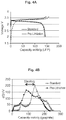
- FIG. 4A shows a plot of voltage vs capacity of the pre-lithiated electrochemical cell and the standard electrochemical cell after one charge/discharge cycle
- FIG. 4B shows a plot of differential capacity (dQ/dV) vs capacity of the pre-lithiated and standard electrochemical cells, derived from FIG 4A .
- the Coulomb efficiency of the pre-lithiated electrochemical cell was 96.6%
- the Coulomb efficiency of the standard electrochemical cell was 88.2%.
- the pre-lithiated electrochemical cell charges substantially faster compared to the standard electrochemical cell.
- the final capacity retained by the pre-lithiated electrochemical cell is slightly lower than the standard electrochemical cell, this is attributed to lower cell quality and data variation.
- One explanation can be that since the semi-solid anode is disposed on the lithium coated copper current collector and a portion of the lithium in contact with the semi-solid anode intercalates with the semi-solid anode material to pre-lithiate the semi-solid anode, the copper foil disposed below the lithium metal contacts the pre-lithiated semi-solid anode. This contact can however, be of poor quality which can increase impedance and reduce overall charge capacity of the pre-lithiated electrochemical cell prepared using the lithium coated copper foil method.
- FIG. 5A shows a plot of Coulomb efficiency of the pre-lithiated electrochemical cell after 8 cycles
- FIG. 5B shows a plot of capacity retained by the pre-lithiated electrochemical cell after 8 cycles.
- the pre-lithiated electrochemical cell retained 96% of its initial Coulomb efficiency, and retains 72% of its initial capacity after 8 cycles. This again is attributed to the low quality of the pre-lithiated electrochemical cell because of the low quality of the electronic contact between the pre-lithiated semi-solid anode with the copper foil negative current collector after the lithium metal coating reacts with the semi-solid anode active material and is incorporated into the semi-solid anode.
- Example 2 Pre-lithiation by Mixing Lithium Powder in Semi-Solid Anode Suspension
- a lithium powder was incorporated into a semi-solid anode during the preparation of the semi-solid anode suspension to pre-lithiate the anode.
- a semi-solid anode suspension was prepared similar to the semi-solid anode described in Example 1.
- the semi-solid anode was mixed with lithium powder and stored for 1 day.
- the quantity of the lithium powder mixed with the semi-solid anode suspension was such that the capacity of the lithium powder was 15% of the total charge capacity (including that of the graphite) included in the semi-solid anode.
- FIG. 6A shows an optical image of the semi-solid anode with the lithium powder added but not mixed into the semi-solid anode suspension.
- FIG. 6B shows the semi-solid anode suspension after mixing and storing for 1 day.
- the semi-solid anode suspension appeared dry after 1 day which indicated that the lithium had reacted with the graphite, possibly forming an SEI layer on the graphite.
- Tables 1-6 below contain exemplary electrode component parameters according to some embodiments of the disclosure, as well as calculations of the theoretical percentage of lithium present in a prelithiated semi-solid anode prior to the application of current under various scenarios.
- Table 1 shows exemplary parameters and calculations for an anode formulation in which a single active material (mesophase graphite powder (MGP-A)) is used, and in which the lithium content is sufficient for fully “pre-lithiating” (i.e., compensating for the traditional SEI formation) without any additional “buffer” or extra capacity by way of excess intercalated lithium.
- MGP-A mesophase graphite powder
- Table 2 shows exemplary parameters and calculations for an anode formulation in which a single active material (MGP-A) is used, and in which the lithium percentage is calculated to include a 5% buffer (i.e., the graphite is ⁇ 5% charged prior to cell assembly and/or cycling).
- Tables 3 and 4 include parameters and calculations similar to those in Table 2, but are directed to buffer percentages of 50% and 100%, respectively.
- Table 5 shows exemplary parameters and calculations for an anode formulation in which two active materials (MGP-A and soft carbon) are used, and in which the lithium percentage is calculated to include a 5% buffer.
- Table 6 shows exemplary parameters and calculations for an anode formulation in which two active materials (MGP-A and silicon, a high-capacity material) are used, and in which the lithium percentage is calculated to include a 5% buffer.
Landscapes
- Chemical & Material Sciences (AREA)
- General Chemical & Material Sciences (AREA)
- Chemical Kinetics & Catalysis (AREA)
- Electrochemistry (AREA)
- Engineering & Computer Science (AREA)
- Manufacturing & Machinery (AREA)
- Materials Engineering (AREA)
- Composite Materials (AREA)
- Inorganic Chemistry (AREA)
- Secondary Cells (AREA)
- Battery Electrode And Active Subsutance (AREA)
Priority Applications (1)
| Application Number | Priority Date | Filing Date | Title |
|---|---|---|---|
| EP21218462.6A EP4037007A1 (en) | 2014-11-03 | 2015-11-03 | Battery cell comprising a semi-solid electrode |
Applications Claiming Priority (2)
| Application Number | Priority Date | Filing Date | Title |
|---|---|---|---|
| US201462074372P | 2014-11-03 | 2014-11-03 | |
| PCT/US2015/058770 WO2016073438A1 (en) | 2014-11-03 | 2015-11-03 | Pre-lithiation of electrode materials in a semi-solid electrode |
Related Child Applications (1)
| Application Number | Title | Priority Date | Filing Date |
|---|---|---|---|
| EP21218462.6A Division EP4037007A1 (en) | 2014-11-03 | 2015-11-03 | Battery cell comprising a semi-solid electrode |
Publications (2)
| Publication Number | Publication Date |
|---|---|
| EP3216071A1 EP3216071A1 (en) | 2017-09-13 |
| EP3216071B1 true EP3216071B1 (en) | 2022-01-05 |
Family
ID=54477417
Family Applications (2)
| Application Number | Title | Priority Date | Filing Date |
|---|---|---|---|
| EP15791232.0A Active EP3216071B1 (en) | 2014-11-03 | 2015-11-03 | Battery cell comprising a semi-solid electrode |
| EP21218462.6A Pending EP4037007A1 (en) | 2014-11-03 | 2015-11-03 | Battery cell comprising a semi-solid electrode |
Family Applications After (1)
| Application Number | Title | Priority Date | Filing Date |
|---|---|---|---|
| EP21218462.6A Pending EP4037007A1 (en) | 2014-11-03 | 2015-11-03 | Battery cell comprising a semi-solid electrode |
Country Status (4)
| Country | Link |
|---|---|
| US (3) | US10497935B2 (https=) |
| EP (2) | EP3216071B1 (https=) |
| JP (3) | JP7111468B2 (https=) |
| WO (1) | WO2016073438A1 (https=) |
Families Citing this family (138)
| Publication number | Priority date | Publication date | Assignee | Title |
|---|---|---|---|---|
| US11909077B2 (en) | 2008-06-12 | 2024-02-20 | Massachusetts Institute Of Technology | High energy density redox flow device |
| US8722226B2 (en) | 2008-06-12 | 2014-05-13 | 24M Technologies, Inc. | High energy density redox flow device |
| WO2013036801A1 (en) | 2011-09-07 | 2013-03-14 | 24M Technologies, Inc. | Semi-solid electrode cell having a porous current collector and methods of manufacture |
| US9401501B2 (en) | 2012-05-18 | 2016-07-26 | 24M Technologies, Inc. | Electrochemical cells and methods of manufacturing the same |
| US9484569B2 (en) | 2012-06-13 | 2016-11-01 | 24M Technologies, Inc. | Electrochemical slurry compositions and methods for preparing the same |
| US9362583B2 (en) | 2012-12-13 | 2016-06-07 | 24M Technologies, Inc. | Semi-solid electrodes having high rate capability |
| US9437864B2 (en) | 2013-03-15 | 2016-09-06 | 24M Technologies, Inc. | Asymmetric battery having a semi-solid cathode and high energy density anode |
| KR102294032B1 (ko) | 2013-04-29 | 2021-08-27 | 옵토도트 코포레이션 | 증가된 열 전도율을 갖는 나노기공성 복합체 분리기들 |
| WO2015009990A2 (en) | 2013-07-19 | 2015-01-22 | 24M Technologies, Inc. | Semi-solid electrodes with polymer additive |
| US10230128B2 (en) | 2014-04-09 | 2019-03-12 | 24M Technologies, Inc. | Damage tolerant batteries |
| EP4350937A3 (en) | 2014-10-13 | 2024-10-09 | 24M Technologies, Inc. | Systems and methods for series battery charging and forming |
| US10497935B2 (en) | 2014-11-03 | 2019-12-03 | 24M Technologies, Inc. | Pre-lithiation of electrode materials in a semi-solid electrode |
| EP4300666A3 (en) | 2014-11-05 | 2024-02-21 | 24m Technologies, Inc. | Electrochemical cells having semi-solid electrodes and methods of manufacturing the same |
| US10115970B2 (en) | 2015-04-14 | 2018-10-30 | 24M Technologies, Inc. | Semi-solid electrodes with porous current collectors and methods of manufacture |
| US10593952B2 (en) | 2015-05-19 | 2020-03-17 | 24M Technologies Inc. | Mechanical systems and methods for providing edge support and protection in semi-solid electrodes |
| WO2016205663A1 (en) | 2015-06-18 | 2016-12-22 | 24M Technologies, Inc. | Single pouch battery cells and methods of manufacture |
| WO2016205780A1 (en) | 2015-06-19 | 2016-12-22 | 24M Technologies, Inc. | Methods for electrochemical cell remediation |
| DE102015218189B4 (de) * | 2015-09-22 | 2025-02-27 | Bayerische Motoren Werke Aktiengesellschaft | Lithium-Ionen-Zelle |
| WO2017124098A1 (en) | 2016-01-15 | 2017-07-20 | 24M Technologies, Inc. | Systems and methods for infusion mixing a slurry-based electrode |
| WO2017127922A1 (en) * | 2016-01-25 | 2017-08-03 | HYDRO-QUéBEC | Core-shell electrode material particles and their use in electrochemical cells |
| KR20180116296A (ko) | 2016-02-23 | 2018-10-24 | 맥스웰 테크놀러지스 인코포레이티드 | 에너지 저장 장치를 위한 원소상 금속 및 탄소 혼합물들 |
| US10734642B2 (en) | 2016-03-30 | 2020-08-04 | Global Graphene Group, Inc. | Elastomer-encapsulated particles of high-capacity anode active materials for lithium batteries |
| JP2019522879A (ja) * | 2016-06-21 | 2019-08-15 | アプライド マテリアルズ インコーポレイテッドApplied Materials,Incorporated | 改善されたリチウム金属サイクリングのための中間相層 |
| US10424779B1 (en) | 2016-09-07 | 2019-09-24 | Google Llc | Lithium-ion cells and methods of manufacture |
| JP6860125B2 (ja) * | 2017-01-06 | 2021-04-14 | 学校法人早稲田大学 | 二次電池 |
| CN119725968A (zh) | 2017-02-01 | 2025-03-28 | 24M技术公司 | 用于改进电化学电池中的安全特征的系统和方法 |
| US11495792B2 (en) | 2017-02-16 | 2022-11-08 | Global Graphene Group, Inc. | Method of manufacturing a lithium secondary battery having a protected high-capacity anode active material |
| US10211455B2 (en) * | 2017-02-20 | 2019-02-19 | Nanotek Instruments, Inc. | Lithium secondary batteries containing protected particles of anode active materials and method of manufacturing |
| JP7113017B2 (ja) * | 2017-02-21 | 2022-08-04 | テスラ・インコーポレーテッド | プレリチオ化されたハイブリッドエネルギー貯蔵装置 |
| US10084182B2 (en) | 2017-02-23 | 2018-09-25 | Nanotek Instruments, Inc. | Alkali metal-sulfur secondary battery containing a protected sulfur cathode and manufacturing method |
| US10840502B2 (en) | 2017-02-24 | 2020-11-17 | Global Graphene Group, Inc. | Polymer binder for lithium battery and method of manufacturing |
| US11978904B2 (en) | 2017-02-24 | 2024-05-07 | Honeycomb Battery Company | Polymer binder for lithium battery and method of manufacturing |
| US10411264B2 (en) * | 2017-02-27 | 2019-09-10 | Global Graphene Group, Inc. | Cathode active material layer for lithium secondary battery and method of manufacturing |
| US10985373B2 (en) | 2017-02-27 | 2021-04-20 | Global Graphene Group, Inc. | Lithium battery cathode and method of manufacturing |
| WO2018183828A1 (en) | 2017-03-31 | 2018-10-04 | 24M Technologies, Inc. | Overcharge protection of batteries using current interrupt devices |
| US11742475B2 (en) | 2017-04-03 | 2023-08-29 | Global Graphene Group, Inc. | Encapsulated anode active material particles, lithium secondary batteries containing same, and method of manufacturing |
| KR102253785B1 (ko) * | 2017-04-03 | 2021-05-21 | 주식회사 엘지화학 | 전리튬화 장치, 이를 이용한 음극부의 제조 방법 및 음극부 |
| US10483533B2 (en) | 2017-04-10 | 2019-11-19 | Global Graphene Group, Inc. | Encapsulated cathode active material particles, lithium secondary batteries containing same, and method of manufacturing |
| US10916766B2 (en) | 2017-04-10 | 2021-02-09 | Global Graphene Group, Inc. | Alkali metal-sulfur secondary battery containing a polymer-encapsulated sulfur cathode and manufacturing method |
| US10770721B2 (en) | 2017-04-10 | 2020-09-08 | Global Graphene Group, Inc. | Lithium metal secondary battery containing anode-protecting polymer layer and manufacturing method |
| US10862129B2 (en) | 2017-04-12 | 2020-12-08 | Global Graphene Group, Inc. | Lithium anode-protecting polymer layer for a lithium metal secondary battery and manufacturing method |
| JP7285213B2 (ja) * | 2017-05-25 | 2023-06-01 | 株式会社村田製作所 | 非水電解質二次電池および非水電解質二次電池の製造方法 |
| KR20180130182A (ko) * | 2017-05-29 | 2018-12-07 | 에스케이이노베이션 주식회사 | 리튬 이차 전지 |
| CN111033658A (zh) * | 2017-06-14 | 2020-04-17 | Ioxus公司 | 用于制备电化学储能装置的固体电解质界面的系统和方法 |
| WO2019006319A1 (en) * | 2017-06-30 | 2019-01-03 | The Regents Of The University Of California | SULFUR-SILICON CELL AND METHODS |
| CN110998916A (zh) * | 2017-07-10 | 2020-04-10 | 那诺思卡乐康母庞特公司 | 用于在阳极上形成sei层的方法 |
| CN111108576B (zh) | 2017-07-31 | 2023-03-07 | 24M技术公司 | 使用形状记忆材料的电流中断设备 |
| US10804537B2 (en) | 2017-08-14 | 2020-10-13 | Global Graphene Group, Inc. | Protected particles of anode active materials, lithium secondary batteries containing same and method of manufacturing |
| US10964951B2 (en) | 2017-08-14 | 2021-03-30 | Global Graphene Group, Inc. | Anode-protecting layer for a lithium metal secondary battery and manufacturing method |
| US10854869B2 (en) | 2017-08-17 | 2020-12-01 | 24M Technologies, Inc. | Short-circuit protection of battery cells using fuses |
| US11876178B2 (en) * | 2017-08-25 | 2024-01-16 | University Of Maryland, College Park | High voltage aqueous electrolyte system for lithium metal or graphite anode |
| US12057548B2 (en) * | 2017-08-28 | 2024-08-06 | Honeycomb Battery Company | Continuous process for producing electrochemical cells |
| KR20250154525A (ko) * | 2017-08-31 | 2025-10-28 | 알베마를 코포레이션 | 리튬 실리콘 합금을 사용하여 전극을 전리튬화하기 위한 방법 |
| US10673063B2 (en) * | 2017-09-21 | 2020-06-02 | Global Graphene Group, Inc. | Process for prelithiating an anode active material for a lithium battery |
| JP2020536348A (ja) * | 2017-10-03 | 2020-12-10 | イオクサス, インコーポレイテッド | 電気化学的エネルギー貯蔵装置のための安定化リチウム化電極を製造するためのシステム及び方法 |
| EP3721491A1 (en) * | 2017-12-07 | 2020-10-14 | Enevate Corporation | A prelithiated and methods for prelithiating an energy storage device |
| JP2019114390A (ja) * | 2017-12-22 | 2019-07-11 | 日本ゼオン株式会社 | 電気化学デバイス用電解質組成物および電気化学デバイス用電極の製造方法 |
| KR102566406B1 (ko) | 2018-01-05 | 2023-08-14 | 삼성전자주식회사 | 무음극 리튬금속전지 및 그 제조방법 |
| KR102568793B1 (ko) | 2018-01-05 | 2023-08-22 | 삼성전자주식회사 | 무음극 리튬금속전지 및 그 제조방법 |
| CN111712942A (zh) * | 2018-01-08 | 2020-09-25 | 24M技术公司 | 包括选择性渗透膜的电化学电芯、系统及其制造方法 |
| US10573894B2 (en) | 2018-02-21 | 2020-02-25 | Global Graphene Group, Inc. | Protected particles of anode active materials for lithium batteries |
| US10601034B2 (en) | 2018-02-21 | 2020-03-24 | Global Graphene Group, Inc. | Method of producing protected particles of anode active materials for lithium batteries |
| JP6933589B2 (ja) * | 2018-02-22 | 2021-09-08 | 日産自動車株式会社 | 負極活物質のプレドープ方法、負極の製造方法、及び蓄電デバイスの製造方法 |
| US11721832B2 (en) | 2018-02-23 | 2023-08-08 | Global Graphene Group, Inc. | Elastomer composite-encapsulated particles of anode active materials for lithium batteries |
| CN108417774B (zh) * | 2018-02-23 | 2020-05-22 | 江西安驰新能源科技有限公司 | 一种具有预锂化效应的负极浆料合浆工艺及锂电池 |
| US10971722B2 (en) | 2018-03-02 | 2021-04-06 | Global Graphene Group, Inc. | Method of manufacturing conducting elastomer composite-encapsulated particles of anode active materials for lithium batteries |
| US10964936B2 (en) | 2018-03-02 | 2021-03-30 | Global Graphene Group, Inc. | Conducting elastomer composite-encapsulated particles of anode active materials for lithium batteries |
| US10818926B2 (en) * | 2018-03-07 | 2020-10-27 | Global Graphene Group, Inc. | Method of producing electrochemically stable elastomer-encapsulated particles of anode active materials for lithium batteries |
| US11005094B2 (en) | 2018-03-07 | 2021-05-11 | Global Graphene Group, Inc. | Electrochemically stable elastomer-encapsulated particles of anode active materials for lithium batteries |
| US10971723B2 (en) | 2018-04-16 | 2021-04-06 | Global Graphene Group, Inc. | Process for alkali metal-selenium secondary battery containing a cathode of encapsulated selenium particles |
| US11043694B2 (en) | 2018-04-16 | 2021-06-22 | Global Graphene Group, Inc. | Alkali metal-selenium secondary battery containing a cathode of encapsulated selenium particles |
| JP7535948B2 (ja) | 2018-05-24 | 2024-08-19 | 24エム・テクノロジーズ・インコーポレイテッド | 高エネルギー密度の組成勾配電極およびその製造方法 |
| US10978698B2 (en) | 2018-06-15 | 2021-04-13 | Global Graphene Group, Inc. | Method of protecting sulfur cathode materials for alkali metal-sulfur secondary battery |
| US11121398B2 (en) | 2018-06-15 | 2021-09-14 | Global Graphene Group, Inc. | Alkali metal-sulfur secondary battery containing cathode material particulates |
| US10854927B2 (en) | 2018-06-18 | 2020-12-01 | Global Graphene Group, Inc. | Method of improving cycle-life of alkali metal-sulfur secondary battery |
| US10978744B2 (en) | 2018-06-18 | 2021-04-13 | Global Graphene Group, Inc. | Method of protecting anode of a lithium-sulfur battery |
| US10957912B2 (en) | 2018-06-18 | 2021-03-23 | Global Graphene Group, Inc. | Method of extending cycle-life of a lithium-sulfur battery |
| US10985365B2 (en) | 2018-06-18 | 2021-04-20 | Global Graphene Group, Inc. | Lithium-sulfur battery containing two anode-protecting layers |
| US10862157B2 (en) | 2018-06-18 | 2020-12-08 | Global Graphene Group, Inc. | Alkali metal-sulfur secondary battery containing a conductive electrode-protecting layer |
| US10985376B2 (en) | 2018-06-18 | 2021-04-20 | Global Graphene Group, Inc. | Lithium-sulfur battery containing an electrode-protecting layer |
| US12218346B2 (en) | 2018-06-21 | 2025-02-04 | Honeycomb Battery Company | Method of extending cycle-life of a lithium metal secondary battery |
| US12609344B2 (en) | 2018-06-21 | 2026-04-21 | Honeycomb Battery Company | Method of improving the cycle stability and energy density of a lithium metal secondary battery |
| US11276852B2 (en) | 2018-06-21 | 2022-03-15 | Global Graphene Group, Inc. | Lithium metal secondary battery containing an elastic anode-protecting layer |
| US10777810B2 (en) | 2018-06-21 | 2020-09-15 | Global Graphene Group, Inc. | Lithium metal secondary battery containing a protected lithium anode |
| US12288883B2 (en) | 2018-06-21 | 2025-04-29 | Honeycomb Battery Company | Method of improving cycle-life of a lithium metal secondary battery |
| US11094487B2 (en) | 2018-06-25 | 2021-08-17 | 24M Technologies, Inc. | Current interrupt device based on thermal activation of frangible glass bulb |
| US10873088B2 (en) | 2018-06-25 | 2020-12-22 | Global Graphene Group, Inc. | Lithium-selenium battery containing an electrode-protecting layer and method of improving cycle-life |
| WO2020014268A1 (en) | 2018-07-09 | 2020-01-16 | 24M Technologies, Inc. | Continuous and semi-continuous methods of semi-solid electrode and battery manufacturing |
| US11043662B2 (en) | 2018-08-22 | 2021-06-22 | Global Graphene Group, Inc. | Electrochemically stable elastomer-encapsulated particles of cathode active materials for lithium batteries |
| US11239460B2 (en) | 2018-08-22 | 2022-02-01 | Global Graphene Group, Inc. | Method of producing electrochemically stable elastomer-encapsulated particles of cathode active materials for lithium batteries |
| US11223049B2 (en) | 2018-08-24 | 2022-01-11 | Global Graphene Group, Inc. | Method of producing protected particles of cathode active materials for lithium batteries |
| US10886528B2 (en) | 2018-08-24 | 2021-01-05 | Global Graphene Group, Inc. | Protected particles of cathode active materials for lithium batteries |
| JP7237092B2 (ja) * | 2018-09-27 | 2023-03-10 | エルジー エナジー ソリューション リミテッド | 全固体電池用負極及びその製造方法 |
| CN112930630A (zh) * | 2018-09-28 | 2021-06-08 | 哈勃股份有限公司 | 具有压接定位的电动工具 |
| US10629899B1 (en) | 2018-10-15 | 2020-04-21 | Global Graphene Group, Inc. | Production method for electrochemically stable anode particulates for lithium secondary batteries |
| US10971724B2 (en) | 2018-10-15 | 2021-04-06 | Global Graphene Group, Inc. | Method of producing electrochemically stable anode particulates for lithium secondary batteries |
| US12444744B2 (en) | 2018-10-15 | 2025-10-14 | Honeycomb Battery Company | Electrochemically stable anode particulates for lithium secondary batteries |
| US11791450B2 (en) | 2019-01-24 | 2023-10-17 | Global Graphene Group, Inc. | Method of improving cycle life of a rechargeable lithium metal battery |
| US10971725B2 (en) | 2019-01-24 | 2021-04-06 | Global Graphene Group, Inc. | Lithium metal secondary battery containing elastic polymer foam as an anode-protecting layer |
| US12121566B2 (en) | 2019-01-30 | 2024-10-22 | Horizon Therapeutics Usa, Inc. | Methods for treating gout |
| KR102530157B1 (ko) | 2019-01-31 | 2023-05-10 | 주식회사 엘지에너지솔루션 | 이차전지용 음극의 전리튬화 방법 |
| KR102764986B1 (ko) * | 2019-05-08 | 2025-02-12 | 주식회사 엘지에너지솔루션 | 전고체 이차전지용 음극의 전리튬화 방법 및 이를 이용한 이차전지 |
| KR102755824B1 (ko) * | 2019-05-24 | 2025-01-17 | 주식회사 엘지에너지솔루션 | 전고체전지용 음극의 제조방법 |
| WO2020250394A1 (ja) * | 2019-06-13 | 2020-12-17 | 昭和電工マテリアルズ株式会社 | 二次電池 |
| US11631920B2 (en) | 2019-06-27 | 2023-04-18 | 24M Technologies, Inc. | Dual electrolyte electrochemical cells, systems, and methods of manufacturing the same |
| JP2021044171A (ja) * | 2019-09-12 | 2021-03-18 | マツダ株式会社 | リチウムイオン二次電池及びその製造方法 |
| JP2023503696A (ja) * | 2019-12-02 | 2023-01-31 | ホーフェイ ゴション ハイテク パワー エナジー カンパニー リミテッド | 電池パック及びセル |
| JP7721541B2 (ja) | 2020-01-21 | 2025-08-12 | 24エム・テクノロジーズ・インコーポレイテッド | 高活性固体ローディングを有する半固体電極、及びそれを含む電気化学セルを形成するための装置及びプロセス |
| US11742525B2 (en) | 2020-02-07 | 2023-08-29 | 24M Technologies, Inc. | Divided energy electrochemical cell systems and methods of producing the same |
| WO2021167353A1 (ko) * | 2020-02-17 | 2021-08-26 | 주식회사 엘지에너지솔루션 | 음극의 전리튬 방법, 전리튬화 음극, 및 이를 포함하는 리튬 이차전지 |
| JP7737381B2 (ja) | 2020-02-21 | 2025-09-10 | 24エム・テクノロジーズ・インコーポレイテッド | 電極材料がフィルムに直接結合された電気化学セル及びそれを製造する方法 |
| DE102020105279A1 (de) | 2020-02-28 | 2021-09-02 | Volkswagen Aktiengesellschaft | Verfahren zur Herstellung mindestens einer Elektrode für eine Batteriezelle |
| DE102020111239A1 (de) | 2020-04-24 | 2021-10-28 | Bayerische Motoren Werke Aktiengesellschaft | Lithiumionen-Batterie und Verfahren zur Herstellung einer Lithiumionen-Batterie |
| DE102020111235A1 (de) | 2020-04-24 | 2021-10-28 | Bayerische Motoren Werke Aktiengesellschaft | Lithiumionen-Batterie und Verfahren zur Herstellung einer Lithiumionen-Batterie |
| DE102020111237A1 (de) | 2020-04-24 | 2021-10-28 | Bayerische Motoren Werke Aktiengesellschaft | Lithiumionen-Batterie und Verfahren zur Herstellung einer Lithiumionen-Batterie |
| WO2021248012A1 (en) | 2020-06-04 | 2021-12-09 | 24M Technologies, Inc. | Electrochemical cells with one or more segmented current collectors and methods of making the same |
| US12381277B2 (en) | 2020-06-17 | 2025-08-05 | 24M Technologies, Inc. | Electrochemical cells with flame retardant mechanism and methods of producing the same |
| CN115836401A (zh) * | 2020-07-10 | 2023-03-21 | 雷诺股份公司 | 固体锂电池单元、包含所述电池单元的电池以及用于制造所述电池的制造方法 |
| JP7513983B2 (ja) | 2020-09-17 | 2024-07-10 | マツダ株式会社 | リチウムイオン二次電池及びその製造方法 |
| JP7811582B2 (ja) | 2020-10-09 | 2026-02-05 | 24エム・テクノロジーズ・インコーポレイテッド | 電気化学セルの連続的及び半連続的製作方法 |
| KR20220051500A (ko) * | 2020-10-19 | 2022-04-26 | 주식회사 엘지에너지솔루션 | 무기 코팅층이 형성된 음극의 제조방법 |
| CN112467139A (zh) * | 2020-10-23 | 2021-03-09 | 合肥国轩高科动力能源有限公司 | 一种锂离子电池正极预锂化剂及其制备方法和应用 |
| KR102921351B1 (ko) * | 2020-11-02 | 2026-01-30 | 주식회사 엘지에너지솔루션 | 전리튬화층을 포함하는 리튬 금속 전지용 음극, 이의 제조방법, 및 이를 포함하는 리튬 금속 전지 |
| CN116583978A (zh) | 2020-11-02 | 2023-08-11 | 24M技术公司 | 具有枝晶防止机制的电化学电池及其制造方法 |
| WO2022110204A1 (zh) * | 2020-11-30 | 2022-06-02 | 宁德新能源科技有限公司 | 一种电化学装置和电子装置 |
| WO2022159733A1 (en) | 2021-01-22 | 2022-07-28 | 24M Technologies, Inc. | Production of semi-solid electrodes via addition of electrolyte to mixture of active material, conductive material, and electrolyte solvent |
| CN112786971B (zh) * | 2021-02-04 | 2023-02-28 | 湖南立方新能源科技有限责任公司 | 一种负极预锂化锂离子电池的制备方法及负极预锂化锂离子电池 |
| CN112993213A (zh) * | 2021-03-11 | 2021-06-18 | 湖南立方新能源科技有限责任公司 | 一种负极预锂化补锂容量的计算方法及其应用 |
| WO2022212404A1 (en) | 2021-03-30 | 2022-10-06 | 24M Technologies, Inc. | Electrochemical cells with reinforced current collectors, and methods of producing the same |
| GB2606515B (en) * | 2021-04-15 | 2026-03-25 | Dyson Technology Ltd | Electrolyte compositions |
| CN117256062A (zh) | 2021-04-29 | 2023-12-19 | 24M技术公司 | 具有多个隔膜的电化学电池及其生产方法 |
| CN115621418A (zh) * | 2022-11-02 | 2023-01-17 | 宜昌邦普循环科技有限公司 | 一种自修复快离子导体锂金属负极及其制备方法 |
| TW202443944A (zh) | 2022-12-16 | 2024-11-01 | 美商24M科技公司 | 用於最小化及預防電化電池中形成枝晶的系統及方法 |
| US12300786B1 (en) | 2023-10-24 | 2025-05-13 | 24M Technologies, Inc. | Electrolyte including electrolyte solvent, fluoroether, and bis(fluorosulfonyl) imide salt, and lithium metal electrochemical cells including the same |
| WO2025090522A1 (en) | 2023-10-24 | 2025-05-01 | 24M Technologies, Inc. | High performance electrolyte for electrochemical energy storage devices, and methods of producing the same |
| WO2025207438A1 (en) | 2024-03-26 | 2025-10-02 | 24M Technologies, Inc. | Systems and methods for minimizing and preventing dendrite formation in electrochemical cells |
| US12431545B1 (en) | 2024-03-26 | 2025-09-30 | 24M Technologies, Inc. | Systems and methods for minimizing and preventing dendrite formation in electrochemical cells |
| WO2025205670A1 (ja) * | 2024-03-26 | 2025-10-02 | 富士フイルム株式会社 | 準固体電池の製造方法 |
Citations (2)
| Publication number | Priority date | Publication date | Assignee | Title |
|---|---|---|---|---|
| JP2012204306A (ja) * | 2011-03-28 | 2012-10-22 | Kri Inc | リチウムのプリドープ方法及びこの方法を用いた電極、蓄電デバイス |
| WO2015176051A1 (en) * | 2014-05-15 | 2015-11-19 | Quickhatch Corporation | Lithium intercalated nanocrystal anodes |
Family Cites Families (88)
| Publication number | Priority date | Publication date | Assignee | Title |
|---|---|---|---|---|
| US20050130043A1 (en) * | 2003-07-29 | 2005-06-16 | Yuan Gao | Lithium metal dispersion in electrodes |
| US8883354B2 (en) | 2006-02-15 | 2014-11-11 | Optodot Corporation | Separators for electrochemical cells |
| US9786944B2 (en) | 2008-06-12 | 2017-10-10 | Massachusetts Institute Of Technology | High energy density redox flow device |
| CN102119461B (zh) | 2008-06-12 | 2016-08-03 | 麻省理工学院 | 高能量密度氧化还原液流装置 |
| US11909077B2 (en) | 2008-06-12 | 2024-02-20 | Massachusetts Institute Of Technology | High energy density redox flow device |
| US8722226B2 (en) | 2008-06-12 | 2014-05-13 | 24M Technologies, Inc. | High energy density redox flow device |
| EP2337994A4 (en) | 2008-09-22 | 2015-01-28 | Madico Inc | SYSTEM FOR FILTERING RADIO FREQUENCY AND OPTICAL TRANSMISSIONS IN INFRARED |
| EP2344330A4 (en) | 2008-10-28 | 2016-07-13 | Madico Inc | SUN-CONTROLLED WINDOW FILMS WITH INFRARED REFLECTION LAYERS |
| PL2361357T3 (pl) | 2008-10-28 | 2019-05-31 | Optodot Corp | Stabilne folie do podczerwieni |
| EP2369659B1 (en) | 2008-12-19 | 2014-12-17 | NEC Energy Devices, Ltd. | Negative electrode for nonaqueous electrolyte solution secondary cell and nonaqueous electrolyte solution secondary cell using the same, and method for producing negative electrode for nonaqueous electrolyte solution secondary cell |
| JP5882888B2 (ja) | 2009-04-06 | 2016-03-09 | 24エム・テクノロジーズ・インコーポレイテッド24M Technologies, Inc. | レドックスフロー電池を使用した燃料システム |
| EP2928004B1 (en) | 2009-05-26 | 2018-04-04 | Optodot Corporation | Method of making a lithium battery |
| KR101060828B1 (ko) | 2009-07-01 | 2011-08-30 | 삼성전기주식회사 | 하이브리드 슈퍼캐패시터 |
| WO2011008287A1 (en) | 2009-07-15 | 2011-01-20 | Steven Allen Carlson | Dual vesicular and infrared imaging media |
| JP5402411B2 (ja) * | 2009-08-31 | 2014-01-29 | 日産自動車株式会社 | リチウムイオン二次電池およびその製造方法 |
| JP5463817B2 (ja) * | 2009-09-16 | 2014-04-09 | 日産自動車株式会社 | 非水電解質二次電池およびこの製造方法 |
| US20110274948A1 (en) | 2010-04-09 | 2011-11-10 | Massachusetts Institute Of Technology | Energy transfer using electrochemically isolated fluids |
| JP2012009209A (ja) * | 2010-06-23 | 2012-01-12 | Nissan Motor Co Ltd | リチウムイオン二次電池用負極 |
| JP5714262B2 (ja) | 2010-08-11 | 2015-05-07 | 株式会社Kri | リチウムのプリドープ方法、電極の製造方法及びこれら方法を用いた蓄電デバイス |
| JP5714283B2 (ja) | 2010-09-28 | 2015-05-07 | 株式会社Kri | プリドープ型電極の製造方法及び蓄電デバイス |
| KR20130098339A (ko) | 2010-08-18 | 2013-09-04 | 메사추세츠 인스티튜트 오브 테크놀로지 | 정지형 유체 산화환원 전극 |
| JP2014507748A (ja) | 2010-12-16 | 2014-03-27 | 24エム・テクノロジーズ・インコーポレイテッド | スタックフローセル設計及び方法 |
| WO2012088442A2 (en) | 2010-12-23 | 2012-06-28 | 24M Technologies, Inc. | Semi-solid filled battery and method of manufacture |
| JP2012204310A (ja) * | 2011-03-28 | 2012-10-22 | Kri Inc | リチウムのプリドープ方法、電極の製造方法及びこれら方法を用いた蓄電デバイス |
| KR20130018435A (ko) | 2011-07-19 | 2013-02-22 | 가부시키가이샤 히타치세이사쿠쇼 | 이온 이차 전지용 전극, 이온 이차 전지용 전극의 제조 방법, 리튬 이온 이차 전지 및 마그네슘 이온 이차 전지 |
| US9385397B2 (en) | 2011-08-19 | 2016-07-05 | Nanotek Instruments, Inc. | Prelithiated current collector and secondary lithium cells containing same |
| WO2013036801A1 (en) | 2011-09-07 | 2013-03-14 | 24M Technologies, Inc. | Semi-solid electrode cell having a porous current collector and methods of manufacture |
| JP5835617B2 (ja) | 2012-01-24 | 2015-12-24 | トヨタ自動車株式会社 | 密閉型リチウム二次電池 |
| JP2013191296A (ja) | 2012-03-12 | 2013-09-26 | Nippon Electric Glass Co Ltd | 蓄電デバイス |
| US9509176B2 (en) | 2012-04-04 | 2016-11-29 | Ihi Inc. | Energy storage modeling and control |
| US9401501B2 (en) | 2012-05-18 | 2016-07-26 | 24M Technologies, Inc. | Electrochemical cells and methods of manufacturing the same |
| US9178200B2 (en) | 2012-05-18 | 2015-11-03 | 24M Technologies, Inc. | Electrochemical cells and methods of manufacturing the same |
| US9484569B2 (en) | 2012-06-13 | 2016-11-01 | 24M Technologies, Inc. | Electrochemical slurry compositions and methods for preparing the same |
| JP5947198B2 (ja) | 2012-11-21 | 2016-07-06 | 信越化学工業株式会社 | 蓄電デバイス用負極材および蓄電デバイス用電極の製造方法 |
| WO2014092016A1 (ja) | 2012-12-11 | 2014-06-19 | 日本電気株式会社 | 蓄電デバイス |
| US9362583B2 (en) | 2012-12-13 | 2016-06-07 | 24M Technologies, Inc. | Semi-solid electrodes having high rate capability |
| US8993159B2 (en) | 2012-12-13 | 2015-03-31 | 24M Technologies, Inc. | Semi-solid electrodes having high rate capability |
| US8999584B2 (en) * | 2013-03-15 | 2015-04-07 | GM Global Technology Operations LLC | Method for pre-lithiation of the negative electrode in lithium ion batteries |
| US9437864B2 (en) | 2013-03-15 | 2016-09-06 | 24M Technologies, Inc. | Asymmetric battery having a semi-solid cathode and high energy density anode |
| US9711297B2 (en) * | 2013-04-23 | 2017-07-18 | Maxwell Technologies, Inc. | Methods for solid electrolyte interphase formation and anode pre-lithiation of lithium ion capacitors |
| KR102294032B1 (ko) | 2013-04-29 | 2021-08-27 | 옵토도트 코포레이션 | 증가된 열 전도율을 갖는 나노기공성 복합체 분리기들 |
| WO2015009990A2 (en) | 2013-07-19 | 2015-01-22 | 24M Technologies, Inc. | Semi-solid electrodes with polymer additive |
| US20150140371A1 (en) | 2013-10-14 | 2015-05-21 | 24M Technologies, Inc. | Curved battery container |
| US10230128B2 (en) | 2014-04-09 | 2019-03-12 | 24M Technologies, Inc. | Damage tolerant batteries |
| US20150357626A1 (en) | 2014-06-05 | 2015-12-10 | 24M Technologies, Inc. | Porous semi-solid electrode and methods of manufacturing the same |
| EP4350937A3 (en) | 2014-10-13 | 2024-10-09 | 24M Technologies, Inc. | Systems and methods for series battery charging and forming |
| US10497935B2 (en) | 2014-11-03 | 2019-12-03 | 24M Technologies, Inc. | Pre-lithiation of electrode materials in a semi-solid electrode |
| EP4300666A3 (en) | 2014-11-05 | 2024-02-21 | 24m Technologies, Inc. | Electrochemical cells having semi-solid electrodes and methods of manufacturing the same |
| US20170025674A1 (en) | 2015-02-03 | 2017-01-26 | Taison Tan | Optimum electronic and ionic conductivity ratios in semi-solid electrodes |
| US10115970B2 (en) | 2015-04-14 | 2018-10-30 | 24M Technologies, Inc. | Semi-solid electrodes with porous current collectors and methods of manufacture |
| US10593952B2 (en) | 2015-05-19 | 2020-03-17 | 24M Technologies Inc. | Mechanical systems and methods for providing edge support and protection in semi-solid electrodes |
| WO2016205663A1 (en) | 2015-06-18 | 2016-12-22 | 24M Technologies, Inc. | Single pouch battery cells and methods of manufacture |
| WO2016205780A1 (en) | 2015-06-19 | 2016-12-22 | 24M Technologies, Inc. | Methods for electrochemical cell remediation |
| WO2017124098A1 (en) | 2016-01-15 | 2017-07-20 | 24M Technologies, Inc. | Systems and methods for infusion mixing a slurry-based electrode |
| US20170237111A1 (en) | 2016-01-21 | 2017-08-17 | 24M Technologies, Inc. | Centrally located spacers for electrochemical cells |
| US20170237112A1 (en) | 2016-01-21 | 2017-08-17 | 24M Technologies, Inc. | Porous spacers for electrochemical cells |
| KR20180132122A (ko) | 2016-04-05 | 2018-12-11 | 메사추세츠 인스티튜트 오브 테크놀로지 | 리튬 금속 전극 및 그의 배터리 |
| CN119725968A (zh) | 2017-02-01 | 2025-03-28 | 24M技术公司 | 用于改进电化学电池中的安全特征的系统和方法 |
| WO2018183828A1 (en) | 2017-03-31 | 2018-10-04 | 24M Technologies, Inc. | Overcharge protection of batteries using current interrupt devices |
| CN111108576B (zh) | 2017-07-31 | 2023-03-07 | 24M技术公司 | 使用形状记忆材料的电流中断设备 |
| US10854869B2 (en) | 2017-08-17 | 2020-12-01 | 24M Technologies, Inc. | Short-circuit protection of battery cells using fuses |
| KR102164254B1 (ko) | 2017-11-15 | 2020-10-12 | 주식회사 엘지화학 | 이차 전지 및 그의 제조 방법, 이차 전지용 파우치 및 그의 제조 방법 |
| CN111712942A (zh) | 2018-01-08 | 2020-09-25 | 24M技术公司 | 包括选择性渗透膜的电化学电芯、系统及其制造方法 |
| JP7535948B2 (ja) | 2018-05-24 | 2024-08-19 | 24エム・テクノロジーズ・インコーポレイテッド | 高エネルギー密度の組成勾配電極およびその製造方法 |
| US11094487B2 (en) | 2018-06-25 | 2021-08-17 | 24M Technologies, Inc. | Current interrupt device based on thermal activation of frangible glass bulb |
| WO2020014268A1 (en) | 2018-07-09 | 2020-01-16 | 24M Technologies, Inc. | Continuous and semi-continuous methods of semi-solid electrode and battery manufacturing |
| US11631920B2 (en) | 2019-06-27 | 2023-04-18 | 24M Technologies, Inc. | Dual electrolyte electrochemical cells, systems, and methods of manufacturing the same |
| WO2021046524A1 (en) | 2019-09-06 | 2021-03-11 | 24M Technologies, Inc. | Overcharge protection in electrochemical cells |
| WO2021087465A1 (en) | 2019-11-01 | 2021-05-06 | 24M Technologies, Inc. | Electrochemical cells with separator seals, and methods of manufacturing the same |
| CN114730951A (zh) | 2019-11-20 | 2022-07-08 | 24M技术公司 | 串联连接在单个袋中的电化学电池及其制造方法 |
| JP7721541B2 (ja) | 2020-01-21 | 2025-08-12 | 24エム・テクノロジーズ・インコーポレイテッド | 高活性固体ローディングを有する半固体電極、及びそれを含む電気化学セルを形成するための装置及びプロセス |
| US11742525B2 (en) | 2020-02-07 | 2023-08-29 | 24M Technologies, Inc. | Divided energy electrochemical cell systems and methods of producing the same |
| JP7737381B2 (ja) | 2020-02-21 | 2025-09-10 | 24エム・テクノロジーズ・インコーポレイテッド | 電極材料がフィルムに直接結合された電気化学セル及びそれを製造する方法 |
| WO2021248012A1 (en) | 2020-06-04 | 2021-12-09 | 24M Technologies, Inc. | Electrochemical cells with one or more segmented current collectors and methods of making the same |
| US12381277B2 (en) | 2020-06-17 | 2025-08-05 | 24M Technologies, Inc. | Electrochemical cells with flame retardant mechanism and methods of producing the same |
| WO2021262996A1 (en) | 2020-06-24 | 2021-12-30 | 24M Technologies, Inc. | Electrochemical cells and electrodes with carbon-containing coatings and methods of producing the same |
| EP4218067A1 (en) | 2020-09-24 | 2023-08-02 | 24M Technologies, Inc. | Semi-solid electrodes with carbon additives, and methods of making the same |
| JP7811582B2 (ja) | 2020-10-09 | 2026-02-05 | 24エム・テクノロジーズ・インコーポレイテッド | 電気化学セルの連続的及び半連続的製作方法 |
| CN116583978A (zh) | 2020-11-02 | 2023-08-11 | 24M技术公司 | 具有枝晶防止机制的电化学电池及其制造方法 |
| WO2022159733A1 (en) | 2021-01-22 | 2022-07-28 | 24M Technologies, Inc. | Production of semi-solid electrodes via addition of electrolyte to mixture of active material, conductive material, and electrolyte solvent |
| CN117256062A (zh) | 2021-04-29 | 2023-12-19 | 24M技术公司 | 具有多个隔膜的电化学电池及其生产方法 |
| US20230022329A1 (en) | 2021-07-21 | 2023-01-26 | 24M Technologies, Inc. | Electrodes and electrochemical cells with positive temperature coefficient materials and methods of producing the same |
| US20230133464A1 (en) | 2021-10-28 | 2023-05-04 | 24M Technologies, Inc. | Electrochemical cell modules and methods of producing the same |
| US20230238562A1 (en) | 2022-01-25 | 2023-07-27 | 24M Technologies, Inc. | Systems and methods for high pressure assembly of electrochemical cells |
| US20230282906A1 (en) | 2022-03-07 | 2023-09-07 | 24M Technologies, Inc. | Electrochemical cells and electrochemical cell systems with thermal insulation battery packs |
| JP2025517272A (ja) | 2022-03-30 | 2025-06-05 | 24エム・テクノロジーズ・インコーポレイテッド | 電気化学セル材料のリサイクルのためのシステム及び方法 |
| CN119366021A (zh) | 2022-04-12 | 2025-01-24 | 24M技术公司 | 电极和电化学电池生产的连续和半连续方法 |
| US20230369603A1 (en) | 2022-05-11 | 2023-11-16 | 24M Technologies, Inc. | Electrodes with resin layers and methods of producing the same |
-
2015
- 2015-11-03 US US14/930,991 patent/US10497935B2/en active Active
- 2015-11-03 EP EP15791232.0A patent/EP3216071B1/en active Active
- 2015-11-03 JP JP2017542825A patent/JP7111468B2/ja active Active
- 2015-11-03 WO PCT/US2015/058770 patent/WO2016073438A1/en not_active Ceased
- 2015-11-03 EP EP21218462.6A patent/EP4037007A1/en active Pending
-
2019
- 2019-10-16 US US16/654,784 patent/US11804595B2/en active Active
-
2021
- 2021-04-21 JP JP2021071662A patent/JP7511804B2/ja active Active
-
2023
- 2023-02-24 JP JP2023027630A patent/JP7811920B2/ja active Active
- 2023-09-25 US US18/372,308 patent/US12272818B2/en active Active
Patent Citations (2)
| Publication number | Priority date | Publication date | Assignee | Title |
|---|---|---|---|---|
| JP2012204306A (ja) * | 2011-03-28 | 2012-10-22 | Kri Inc | リチウムのプリドープ方法及びこの方法を用いた電極、蓄電デバイス |
| WO2015176051A1 (en) * | 2014-05-15 | 2015-11-19 | Quickhatch Corporation | Lithium intercalated nanocrystal anodes |
Non-Patent Citations (5)
| Title |
|---|
| "IARC Monographs on the Evaluation of Carcinogenic Risks to Humans", 31 December 2010, article WHO: "APPENDIX: Chemical and Physical Data for Some Non-heterocyclic Polycyclic Aromatic Hydrocarbons", XP055769817 * |
| IFA: "Carbon Black", 28 January 2021 (2021-01-28), XP055769820, Retrieved from the Internet <URL:https://gestis-database.dguv.de/data?name=091940> [retrieved on 20210128] * |
| THINKY: "Container / Adapter List for THINKY MIXER", 30 April 2016 (2016-04-30), XP055769825, Retrieved from the Internet <URL:https://www.intertronics.co.uk/wp-content/uploads/2016/11/Thinky-Container-and-Adapter-List-2016.pdf> [retrieved on 20210128] * |
| W M HAYNES: "Propylene Carbonate", HAZARDOUS SUBSTANCES DATA BANK, 28 January 2021 (2021-01-28), XP055769822, Retrieved from the Internet <URL:https://pubchem.ncbi.nlm.nih.gov/compound/Propylene-carbonate> [retrieved on 20210128] * |
| ZHIJIA DU ET AL: "High Energy Density Calendered Si Alloy/Graphite Anodes", JOURNAL OF THE ELECTROCHEMICAL SOCIETY, vol. 161, no. 10, 26 July 2014 (2014-07-26), pages A1698 - A1705, XP055641052, ISSN: 0013-4651, DOI: 10.1149/2.0941410jes * |
Also Published As
| Publication number | Publication date |
|---|---|
| US10497935B2 (en) | 2019-12-03 |
| JP2017534164A (ja) | 2017-11-16 |
| US20240234705A1 (en) | 2024-07-11 |
| US20200106094A1 (en) | 2020-04-02 |
| EP3216071A1 (en) | 2017-09-13 |
| JP7511804B2 (ja) | 2024-07-08 |
| US12272818B2 (en) | 2025-04-08 |
| JP7111468B2 (ja) | 2022-08-02 |
| JP2021158119A (ja) | 2021-10-07 |
| JP7811920B2 (ja) | 2026-02-06 |
| US11804595B2 (en) | 2023-10-31 |
| JP2023059975A (ja) | 2023-04-27 |
| EP4037007A1 (en) | 2022-08-03 |
| US20160126543A1 (en) | 2016-05-05 |
| WO2016073438A1 (en) | 2016-05-12 |
Similar Documents
| Publication | Publication Date | Title |
|---|---|---|
| US12272818B2 (en) | Pre-lithiation of electrode materials in a semi-solid electrode | |
| US9985326B2 (en) | Method for manufacturing a lithiated metal-carbon composite electrode, lithiated metal-carbon composite electrode manufactured thereby, and electrochemical device including the electrode | |
| JP5538226B2 (ja) | 非水電解質二次電池 | |
| US20150357626A1 (en) | Porous semi-solid electrode and methods of manufacturing the same | |
| JP2022518395A (ja) | プレリチウム化エネルギー貯蔵デバイスのための組成物及び方法 | |
| EP3103151B1 (en) | Electrode compositions and alkali metal batteries comprising same | |
| US11769900B2 (en) | Lithium ion battery and prelithiation method of anode | |
| US10862108B2 (en) | Positive electrode for a lithium electrochemical cell | |
| EP4184652A1 (en) | Method for charging and discharging secondary battery | |
| EP4362130B1 (en) | Negative electrode and secondary battery comprising same | |
| KR102623063B1 (ko) | 리튬 이차전지용 복합음극 및 이를 포함하는 리튬 이차전지 | |
| CN116845393A (zh) | 一种固态锂离子电池 | |
| KR20240015482A (ko) | 양극, 및 이를 포함하는 리튬 이차 전지 | |
| JPWO2012049889A1 (ja) | 二次電池およびそれに用いる二次電池用電解液 | |
| US20230016431A1 (en) | Lithium Ion Battery and Method for Producing a Lithium Ion Battery | |
| US9172089B2 (en) | Anode active material, method of preparing the same, anode including the anode active material, and lithium battery including the anode | |
| CN115552661A (zh) | 锂离子电池和用于制造这种锂离子电池的方法 | |
| US20210234149A1 (en) | Lithium cells and methods of making and use thereof | |
| US20250260009A1 (en) | Carbon-free cathodes for lithium sulfur batteries | |
| EP4629425A1 (en) | Separator and preparation method therefor, lithium ion battery, and electric device | |
| EP4697415A1 (en) | Secondary battery and electric apparatus | |
| Park | development of lithium powder based anode with conductive carbon materials for lithium batteries |
Legal Events
| Date | Code | Title | Description |
|---|---|---|---|
| STAA | Information on the status of an ep patent application or granted ep patent |
Free format text: STATUS: THE INTERNATIONAL PUBLICATION HAS BEEN MADE |
|
| PUAI | Public reference made under article 153(3) epc to a published international application that has entered the european phase |
Free format text: ORIGINAL CODE: 0009012 |
|
| STAA | Information on the status of an ep patent application or granted ep patent |
Free format text: STATUS: REQUEST FOR EXAMINATION WAS MADE |
|
| 17P | Request for examination filed |
Effective date: 20170601 |
|
| AK | Designated contracting states |
Kind code of ref document: A1 Designated state(s): AL AT BE BG CH CY CZ DE DK EE ES FI FR GB GR HR HU IE IS IT LI LT LU LV MC MK MT NL NO PL PT RO RS SE SI SK SM TR |
|
| AX | Request for extension of the european patent |
Extension state: BA ME |
|
| RIN1 | Information on inventor provided before grant (corrected) |
Inventor name: TAN, TAISON Inventor name: MISHIMA, HIROMITSU Inventor name: OTA, NAOKI Inventor name: DUDUTA, MIHAI Inventor name: YU, HIULING ZOE Inventor name: FUKUSHIMA, TAKAAKI |
|
| RIN1 | Information on inventor provided before grant (corrected) |
Inventor name: MISHIMA, HIROMITSU Inventor name: FUKUSHIMA, TAKAAKI Inventor name: DUDUTA, MIHAI Inventor name: TAN, TAISON Inventor name: YU, HIULING ZOE Inventor name: OTA, NAOKI |
|
| DAV | Request for validation of the european patent (deleted) | ||
| DAX | Request for extension of the european patent (deleted) | ||
| STAA | Information on the status of an ep patent application or granted ep patent |
Free format text: STATUS: EXAMINATION IS IN PROGRESS |
|
| 17Q | First examination report despatched |
Effective date: 20180803 |
|
| RIC1 | Information provided on ipc code assigned before grant |
Ipc: H01M 4/04 20060101AFI20210520BHEP Ipc: H01M 4/133 20100101ALI20210520BHEP Ipc: H01M 4/1393 20100101ALI20210520BHEP Ipc: H01M 4/36 20060101ALI20210520BHEP Ipc: H01M 4/38 20060101ALI20210520BHEP Ipc: H01M 4/587 20100101ALI20210520BHEP Ipc: H01M 4/62 20060101ALI20210520BHEP Ipc: H01M 10/04 20060101ALI20210520BHEP Ipc: H01M 10/0525 20100101ALI20210520BHEP Ipc: H01M 10/058 20100101ALI20210520BHEP Ipc: H01M 4/134 20100101ALN20210520BHEP Ipc: H01M 4/1395 20100101ALN20210520BHEP Ipc: H01M 4/485 20100101ALN20210520BHEP |
|
| GRAJ | Information related to disapproval of communication of intention to grant by the applicant or resumption of examination proceedings by the epo deleted |
Free format text: ORIGINAL CODE: EPIDOSDIGR1 |
|
| GRAP | Despatch of communication of intention to grant a patent |
Free format text: ORIGINAL CODE: EPIDOSNIGR1 |
|
| RIC1 | Information provided on ipc code assigned before grant |
Ipc: H01M 4/04 20060101AFI20210528BHEP Ipc: H01M 4/133 20100101ALI20210528BHEP Ipc: H01M 4/1393 20100101ALI20210528BHEP Ipc: H01M 4/36 20060101ALI20210528BHEP Ipc: H01M 4/38 20060101ALI20210528BHEP Ipc: H01M 4/587 20100101ALI20210528BHEP Ipc: H01M 4/62 20060101ALI20210528BHEP Ipc: H01M 10/04 20060101ALI20210528BHEP Ipc: H01M 10/0525 20100101ALI20210528BHEP Ipc: H01M 10/058 20100101ALI20210528BHEP Ipc: H01M 4/134 20100101ALN20210528BHEP Ipc: H01M 4/1395 20100101ALN20210528BHEP Ipc: H01M 4/485 20100101ALN20210528BHEP |
|
| GRAP | Despatch of communication of intention to grant a patent |
Free format text: ORIGINAL CODE: EPIDOSNIGR1 |
|
| STAA | Information on the status of an ep patent application or granted ep patent |
Free format text: STATUS: GRANT OF PATENT IS INTENDED |
|
| INTG | Intention to grant announced |
Effective date: 20210715 |
|
| RIC1 | Information provided on ipc code assigned before grant |
Ipc: H01M 4/04 20060101AFI20210705BHEP Ipc: H01M 4/133 20100101ALI20210705BHEP Ipc: H01M 4/1393 20100101ALI20210705BHEP Ipc: H01M 4/36 20060101ALI20210705BHEP Ipc: H01M 4/38 20060101ALI20210705BHEP Ipc: H01M 4/587 20100101ALI20210705BHEP Ipc: H01M 4/62 20060101ALI20210705BHEP Ipc: H01M 10/04 20060101ALI20210705BHEP Ipc: H01M 10/0525 20100101ALI20210705BHEP Ipc: H01M 10/058 20100101ALI20210705BHEP Ipc: H01M 4/134 20100101ALN20210705BHEP Ipc: H01M 4/1395 20100101ALN20210705BHEP Ipc: H01M 4/485 20100101ALN20210705BHEP |
|
| GRAS | Grant fee paid |
Free format text: ORIGINAL CODE: EPIDOSNIGR3 |
|
| GRAA | (expected) grant |
Free format text: ORIGINAL CODE: 0009210 |
|
| STAA | Information on the status of an ep patent application or granted ep patent |
Free format text: STATUS: THE PATENT HAS BEEN GRANTED |
|
| AK | Designated contracting states |
Kind code of ref document: B1 Designated state(s): AL AT BE BG CH CY CZ DE DK EE ES FI FR GB GR HR HU IE IS IT LI LT LU LV MC MK MT NL NO PL PT RO RS SE SI SK SM TR |
|
| REG | Reference to a national code |
Ref country code: GB Ref legal event code: FG4D |
|
| REG | Reference to a national code |
Ref country code: CH Ref legal event code: EP |
|
| REG | Reference to a national code |
Ref country code: AT Ref legal event code: REF Ref document number: 1461371 Country of ref document: AT Kind code of ref document: T Effective date: 20220115 |
|
| REG | Reference to a national code |
Ref country code: DE Ref legal event code: R096 Ref document number: 602015076260 Country of ref document: DE |
|
| REG | Reference to a national code |
Ref country code: IE Ref legal event code: FG4D |
|
| REG | Reference to a national code |
Ref country code: NO Ref legal event code: T2 Effective date: 20220105 |
|
| REG | Reference to a national code |
Ref country code: LT Ref legal event code: MG9D |
|
| REG | Reference to a national code |
Ref country code: NL Ref legal event code: MP Effective date: 20220105 |
|
| REG | Reference to a national code |
Ref country code: AT Ref legal event code: MK05 Ref document number: 1461371 Country of ref document: AT Kind code of ref document: T Effective date: 20220105 |
|
| PG25 | Lapsed in a contracting state [announced via postgrant information from national office to epo] |
Ref country code: NL Free format text: LAPSE BECAUSE OF FAILURE TO SUBMIT A TRANSLATION OF THE DESCRIPTION OR TO PAY THE FEE WITHIN THE PRESCRIBED TIME-LIMIT Effective date: 20220105 |
|
| PG25 | Lapsed in a contracting state [announced via postgrant information from national office to epo] |
Ref country code: SE Free format text: LAPSE BECAUSE OF FAILURE TO SUBMIT A TRANSLATION OF THE DESCRIPTION OR TO PAY THE FEE WITHIN THE PRESCRIBED TIME-LIMIT Effective date: 20220105 Ref country code: RS Free format text: LAPSE BECAUSE OF FAILURE TO SUBMIT A TRANSLATION OF THE DESCRIPTION OR TO PAY THE FEE WITHIN THE PRESCRIBED TIME-LIMIT Effective date: 20220105 Ref country code: PT Free format text: LAPSE BECAUSE OF FAILURE TO SUBMIT A TRANSLATION OF THE DESCRIPTION OR TO PAY THE FEE WITHIN THE PRESCRIBED TIME-LIMIT Effective date: 20220505 Ref country code: LT Free format text: LAPSE BECAUSE OF FAILURE TO SUBMIT A TRANSLATION OF THE DESCRIPTION OR TO PAY THE FEE WITHIN THE PRESCRIBED TIME-LIMIT Effective date: 20220105 Ref country code: HR Free format text: LAPSE BECAUSE OF FAILURE TO SUBMIT A TRANSLATION OF THE DESCRIPTION OR TO PAY THE FEE WITHIN THE PRESCRIBED TIME-LIMIT Effective date: 20220105 Ref country code: ES Free format text: LAPSE BECAUSE OF FAILURE TO SUBMIT A TRANSLATION OF THE DESCRIPTION OR TO PAY THE FEE WITHIN THE PRESCRIBED TIME-LIMIT Effective date: 20220105 Ref country code: BG Free format text: LAPSE BECAUSE OF FAILURE TO SUBMIT A TRANSLATION OF THE DESCRIPTION OR TO PAY THE FEE WITHIN THE PRESCRIBED TIME-LIMIT Effective date: 20220405 |
|
| PG25 | Lapsed in a contracting state [announced via postgrant information from national office to epo] |
Ref country code: PL Free format text: LAPSE BECAUSE OF FAILURE TO SUBMIT A TRANSLATION OF THE DESCRIPTION OR TO PAY THE FEE WITHIN THE PRESCRIBED TIME-LIMIT Effective date: 20220105 Ref country code: LV Free format text: LAPSE BECAUSE OF FAILURE TO SUBMIT A TRANSLATION OF THE DESCRIPTION OR TO PAY THE FEE WITHIN THE PRESCRIBED TIME-LIMIT Effective date: 20220105 Ref country code: GR Free format text: LAPSE BECAUSE OF FAILURE TO SUBMIT A TRANSLATION OF THE DESCRIPTION OR TO PAY THE FEE WITHIN THE PRESCRIBED TIME-LIMIT Effective date: 20220406 Ref country code: FI Free format text: LAPSE BECAUSE OF FAILURE TO SUBMIT A TRANSLATION OF THE DESCRIPTION OR TO PAY THE FEE WITHIN THE PRESCRIBED TIME-LIMIT Effective date: 20220105 Ref country code: AT Free format text: LAPSE BECAUSE OF FAILURE TO SUBMIT A TRANSLATION OF THE DESCRIPTION OR TO PAY THE FEE WITHIN THE PRESCRIBED TIME-LIMIT Effective date: 20220105 |
|
| PG25 | Lapsed in a contracting state [announced via postgrant information from national office to epo] |
Ref country code: IS Free format text: LAPSE BECAUSE OF FAILURE TO SUBMIT A TRANSLATION OF THE DESCRIPTION OR TO PAY THE FEE WITHIN THE PRESCRIBED TIME-LIMIT Effective date: 20220505 |
|
| REG | Reference to a national code |
Ref country code: DE Ref legal event code: R097 Ref document number: 602015076260 Country of ref document: DE |
|
| PG25 | Lapsed in a contracting state [announced via postgrant information from national office to epo] |
Ref country code: SM Free format text: LAPSE BECAUSE OF FAILURE TO SUBMIT A TRANSLATION OF THE DESCRIPTION OR TO PAY THE FEE WITHIN THE PRESCRIBED TIME-LIMIT Effective date: 20220105 Ref country code: SK Free format text: LAPSE BECAUSE OF FAILURE TO SUBMIT A TRANSLATION OF THE DESCRIPTION OR TO PAY THE FEE WITHIN THE PRESCRIBED TIME-LIMIT Effective date: 20220105 Ref country code: RO Free format text: LAPSE BECAUSE OF FAILURE TO SUBMIT A TRANSLATION OF THE DESCRIPTION OR TO PAY THE FEE WITHIN THE PRESCRIBED TIME-LIMIT Effective date: 20220105 Ref country code: EE Free format text: LAPSE BECAUSE OF FAILURE TO SUBMIT A TRANSLATION OF THE DESCRIPTION OR TO PAY THE FEE WITHIN THE PRESCRIBED TIME-LIMIT Effective date: 20220105 Ref country code: DK Free format text: LAPSE BECAUSE OF FAILURE TO SUBMIT A TRANSLATION OF THE DESCRIPTION OR TO PAY THE FEE WITHIN THE PRESCRIBED TIME-LIMIT Effective date: 20220105 Ref country code: CZ Free format text: LAPSE BECAUSE OF FAILURE TO SUBMIT A TRANSLATION OF THE DESCRIPTION OR TO PAY THE FEE WITHIN THE PRESCRIBED TIME-LIMIT Effective date: 20220105 |
|
| PLBE | No opposition filed within time limit |
Free format text: ORIGINAL CODE: 0009261 |
|
| STAA | Information on the status of an ep patent application or granted ep patent |
Free format text: STATUS: NO OPPOSITION FILED WITHIN TIME LIMIT |
|
| PG25 | Lapsed in a contracting state [announced via postgrant information from national office to epo] |
Ref country code: AL Free format text: LAPSE BECAUSE OF FAILURE TO SUBMIT A TRANSLATION OF THE DESCRIPTION OR TO PAY THE FEE WITHIN THE PRESCRIBED TIME-LIMIT Effective date: 20220105 |
|
| 26N | No opposition filed |
Effective date: 20221006 |
|
| PG25 | Lapsed in a contracting state [announced via postgrant information from national office to epo] |
Ref country code: SI Free format text: LAPSE BECAUSE OF FAILURE TO SUBMIT A TRANSLATION OF THE DESCRIPTION OR TO PAY THE FEE WITHIN THE PRESCRIBED TIME-LIMIT Effective date: 20220105 |
|
| P01 | Opt-out of the competence of the unified patent court (upc) registered |
Effective date: 20230520 |
|
| PG25 | Lapsed in a contracting state [announced via postgrant information from national office to epo] |
Ref country code: MC Free format text: LAPSE BECAUSE OF FAILURE TO SUBMIT A TRANSLATION OF THE DESCRIPTION OR TO PAY THE FEE WITHIN THE PRESCRIBED TIME-LIMIT Effective date: 20220105 |
|
| REG | Reference to a national code |
Ref country code: CH Ref legal event code: PL |
|
| REG | Reference to a national code |
Ref country code: BE Ref legal event code: MM Effective date: 20221130 |
|
| PG25 | Lapsed in a contracting state [announced via postgrant information from national office to epo] |
Ref country code: LI Free format text: LAPSE BECAUSE OF NON-PAYMENT OF DUE FEES Effective date: 20221130 Ref country code: CH Free format text: LAPSE BECAUSE OF NON-PAYMENT OF DUE FEES Effective date: 20221130 |
|
| PG25 | Lapsed in a contracting state [announced via postgrant information from national office to epo] |
Ref country code: LU Free format text: LAPSE BECAUSE OF NON-PAYMENT OF DUE FEES Effective date: 20221103 |
|
| PG25 | Lapsed in a contracting state [announced via postgrant information from national office to epo] |
Ref country code: IE Free format text: LAPSE BECAUSE OF NON-PAYMENT OF DUE FEES Effective date: 20221103 |
|
| PG25 | Lapsed in a contracting state [announced via postgrant information from national office to epo] |
Ref country code: BE Free format text: LAPSE BECAUSE OF NON-PAYMENT OF DUE FEES Effective date: 20221130 |
|
| PG25 | Lapsed in a contracting state [announced via postgrant information from national office to epo] |
Ref country code: HU Free format text: LAPSE BECAUSE OF FAILURE TO SUBMIT A TRANSLATION OF THE DESCRIPTION OR TO PAY THE FEE WITHIN THE PRESCRIBED TIME-LIMIT; INVALID AB INITIO Effective date: 20151103 |
|
| PG25 | Lapsed in a contracting state [announced via postgrant information from national office to epo] |
Ref country code: CY Free format text: LAPSE BECAUSE OF FAILURE TO SUBMIT A TRANSLATION OF THE DESCRIPTION OR TO PAY THE FEE WITHIN THE PRESCRIBED TIME-LIMIT Effective date: 20220105 |
|
| PG25 | Lapsed in a contracting state [announced via postgrant information from national office to epo] |
Ref country code: MK Free format text: LAPSE BECAUSE OF FAILURE TO SUBMIT A TRANSLATION OF THE DESCRIPTION OR TO PAY THE FEE WITHIN THE PRESCRIBED TIME-LIMIT Effective date: 20220105 |
|
| REG | Reference to a national code |
Ref country code: DE Ref legal event code: R081 Ref document number: 602015076260 Country of ref document: DE Owner name: KYOCERA CORPORATION, JP Free format text: FORMER OWNERS: 24M TECHNOLOGIES, INC., CAMBRIDGE, MASS., US; FUKUSHIMA, TAKAAKI, OKAYAMA-SHI, JP; MISHIMA, HIROMITSU, KIRISHIMA-SHI, JP Ref country code: DE Ref legal event code: R081 Ref document number: 602015076260 Country of ref document: DE Owner name: 24M TECHNOLOGIES, INC., CAMBRIDGE, US Free format text: FORMER OWNERS: 24M TECHNOLOGIES, INC., CAMBRIDGE, MASS., US; FUKUSHIMA, TAKAAKI, OKAYAMA-SHI, JP; MISHIMA, HIROMITSU, KIRISHIMA-SHI, JP |
|
| REG | Reference to a national code |
Ref country code: GB Ref legal event code: 732E Free format text: REGISTERED BETWEEN 20240725 AND 20240731 |
|
| PG25 | Lapsed in a contracting state [announced via postgrant information from national office to epo] |
Ref country code: MT Free format text: LAPSE BECAUSE OF FAILURE TO SUBMIT A TRANSLATION OF THE DESCRIPTION OR TO PAY THE FEE WITHIN THE PRESCRIBED TIME-LIMIT Effective date: 20220105 |
|
| PG25 | Lapsed in a contracting state [announced via postgrant information from national office to epo] |
Ref country code: TR Free format text: LAPSE BECAUSE OF FAILURE TO SUBMIT A TRANSLATION OF THE DESCRIPTION OR TO PAY THE FEE WITHIN THE PRESCRIBED TIME-LIMIT Effective date: 20220105 |
|
| PGFP | Annual fee paid to national office [announced via postgrant information from national office to epo] |
Ref country code: DE Payment date: 20251029 Year of fee payment: 11 |
|
| PGFP | Annual fee paid to national office [announced via postgrant information from national office to epo] |
Ref country code: GB Payment date: 20251030 Year of fee payment: 11 |
|
| PGFP | Annual fee paid to national office [announced via postgrant information from national office to epo] |
Ref country code: NO Payment date: 20251110 Year of fee payment: 11 |
|
| PGFP | Annual fee paid to national office [announced via postgrant information from national office to epo] |
Ref country code: IT Payment date: 20251111 Year of fee payment: 11 |
|
| PGFP | Annual fee paid to national office [announced via postgrant information from national office to epo] |
Ref country code: FR Payment date: 20251106 Year of fee payment: 11 |