EP2961858B1 - Coated syringe. - Google Patents
Coated syringe. Download PDFInfo
- Publication number
- EP2961858B1 EP2961858B1 EP14711096.9A EP14711096A EP2961858B1 EP 2961858 B1 EP2961858 B1 EP 2961858B1 EP 14711096 A EP14711096 A EP 14711096A EP 2961858 B1 EP2961858 B1 EP 2961858B1
- Authority
- EP
- European Patent Office
- Prior art keywords
- injection
- syringe
- layer
- sio
- coating
- Prior art date
- Legal status (The legal status is an assumption and is not a legal conclusion. Google has not performed a legal analysis and makes no representation as to the accuracy of the status listed.)
- Active
Links
Images


Classifications
-
- A—HUMAN NECESSITIES
- A61—MEDICAL OR VETERINARY SCIENCE; HYGIENE
- A61M—DEVICES FOR INTRODUCING MEDIA INTO, OR ONTO, THE BODY; DEVICES FOR TRANSDUCING BODY MEDIA OR FOR TAKING MEDIA FROM THE BODY; DEVICES FOR PRODUCING OR ENDING SLEEP OR STUPOR
- A61M5/00—Devices for bringing media into the body in a subcutaneous, intra-vascular or intramuscular way; Accessories therefor, e.g. filling or cleaning devices, arm-rests
- A61M5/178—Syringes
- A61M5/31—Details
- A61M5/315—Pistons; Piston-rods; Guiding, blocking or restricting the movement of the rod or piston; Appliances on the rod for facilitating dosing ; Dosing mechanisms
- A61M5/31511—Piston or piston-rod constructions, e.g. connection of piston with piston-rod
- A61M5/31513—Piston constructions to improve sealing or sliding
-
- A—HUMAN NECESSITIES
- A61—MEDICAL OR VETERINARY SCIENCE; HYGIENE
- A61M—DEVICES FOR INTRODUCING MEDIA INTO, OR ONTO, THE BODY; DEVICES FOR TRANSDUCING BODY MEDIA OR FOR TAKING MEDIA FROM THE BODY; DEVICES FOR PRODUCING OR ENDING SLEEP OR STUPOR
- A61M5/00—Devices for bringing media into the body in a subcutaneous, intra-vascular or intramuscular way; Accessories therefor, e.g. filling or cleaning devices, arm-rests
- A61M5/178—Syringes
- A61M5/31—Details
-
- A—HUMAN NECESSITIES
- A61—MEDICAL OR VETERINARY SCIENCE; HYGIENE
- A61L—METHODS OR APPARATUS FOR STERILISING MATERIALS OR OBJECTS IN GENERAL; DISINFECTION, STERILISATION OR DEODORISATION OF AIR; CHEMICAL ASPECTS OF BANDAGES, DRESSINGS, ABSORBENT PADS OR SURGICAL ARTICLES; MATERIALS FOR BANDAGES, DRESSINGS, ABSORBENT PADS OR SURGICAL ARTICLES
- A61L31/00—Materials for other surgical articles, e.g. stents, stent-grafts, shunts, surgical drapes, guide wires, materials for adhesion prevention, occluding devices, surgical gloves, tissue fixation devices
- A61L31/02—Inorganic materials
- A61L31/026—Ceramic or ceramic-like structures, e.g. glasses
-
- A—HUMAN NECESSITIES
- A61—MEDICAL OR VETERINARY SCIENCE; HYGIENE
- A61L—METHODS OR APPARATUS FOR STERILISING MATERIALS OR OBJECTS IN GENERAL; DISINFECTION, STERILISATION OR DEODORISATION OF AIR; CHEMICAL ASPECTS OF BANDAGES, DRESSINGS, ABSORBENT PADS OR SURGICAL ARTICLES; MATERIALS FOR BANDAGES, DRESSINGS, ABSORBENT PADS OR SURGICAL ARTICLES
- A61L31/00—Materials for other surgical articles, e.g. stents, stent-grafts, shunts, surgical drapes, guide wires, materials for adhesion prevention, occluding devices, surgical gloves, tissue fixation devices
- A61L31/04—Macromolecular materials
- A61L31/048—Macromolecular materials obtained by reactions only involving carbon-to-carbon unsaturated bonds
-
- A—HUMAN NECESSITIES
- A61—MEDICAL OR VETERINARY SCIENCE; HYGIENE
- A61L—METHODS OR APPARATUS FOR STERILISING MATERIALS OR OBJECTS IN GENERAL; DISINFECTION, STERILISATION OR DEODORISATION OF AIR; CHEMICAL ASPECTS OF BANDAGES, DRESSINGS, ABSORBENT PADS OR SURGICAL ARTICLES; MATERIALS FOR BANDAGES, DRESSINGS, ABSORBENT PADS OR SURGICAL ARTICLES
- A61L31/00—Materials for other surgical articles, e.g. stents, stent-grafts, shunts, surgical drapes, guide wires, materials for adhesion prevention, occluding devices, surgical gloves, tissue fixation devices
- A61L31/08—Materials for coatings
- A61L31/082—Inorganic materials
- A61L31/088—Other specific inorganic materials not covered by A61L31/084 or A61L31/086
-
- A—HUMAN NECESSITIES
- A61—MEDICAL OR VETERINARY SCIENCE; HYGIENE
- A61L—METHODS OR APPARATUS FOR STERILISING MATERIALS OR OBJECTS IN GENERAL; DISINFECTION, STERILISATION OR DEODORISATION OF AIR; CHEMICAL ASPECTS OF BANDAGES, DRESSINGS, ABSORBENT PADS OR SURGICAL ARTICLES; MATERIALS FOR BANDAGES, DRESSINGS, ABSORBENT PADS OR SURGICAL ARTICLES
- A61L31/00—Materials for other surgical articles, e.g. stents, stent-grafts, shunts, surgical drapes, guide wires, materials for adhesion prevention, occluding devices, surgical gloves, tissue fixation devices
- A61L31/08—Materials for coatings
- A61L31/10—Macromolecular materials
-
- A—HUMAN NECESSITIES
- A61—MEDICAL OR VETERINARY SCIENCE; HYGIENE
- A61L—METHODS OR APPARATUS FOR STERILISING MATERIALS OR OBJECTS IN GENERAL; DISINFECTION, STERILISATION OR DEODORISATION OF AIR; CHEMICAL ASPECTS OF BANDAGES, DRESSINGS, ABSORBENT PADS OR SURGICAL ARTICLES; MATERIALS FOR BANDAGES, DRESSINGS, ABSORBENT PADS OR SURGICAL ARTICLES
- A61L31/00—Materials for other surgical articles, e.g. stents, stent-grafts, shunts, surgical drapes, guide wires, materials for adhesion prevention, occluding devices, surgical gloves, tissue fixation devices
- A61L31/14—Materials characterised by their function or physical properties, e.g. injectable or lubricating compositions, shape-memory materials, surface modified materials
-
- A—HUMAN NECESSITIES
- A61—MEDICAL OR VETERINARY SCIENCE; HYGIENE
- A61L—METHODS OR APPARATUS FOR STERILISING MATERIALS OR OBJECTS IN GENERAL; DISINFECTION, STERILISATION OR DEODORISATION OF AIR; CHEMICAL ASPECTS OF BANDAGES, DRESSINGS, ABSORBENT PADS OR SURGICAL ARTICLES; MATERIALS FOR BANDAGES, DRESSINGS, ABSORBENT PADS OR SURGICAL ARTICLES
- A61L31/00—Materials for other surgical articles, e.g. stents, stent-grafts, shunts, surgical drapes, guide wires, materials for adhesion prevention, occluding devices, surgical gloves, tissue fixation devices
- A61L31/14—Materials characterised by their function or physical properties, e.g. injectable or lubricating compositions, shape-memory materials, surface modified materials
- A61L31/16—Biologically active materials, e.g. therapeutic substances
-
- A—HUMAN NECESSITIES
- A61—MEDICAL OR VETERINARY SCIENCE; HYGIENE
- A61M—DEVICES FOR INTRODUCING MEDIA INTO, OR ONTO, THE BODY; DEVICES FOR TRANSDUCING BODY MEDIA OR FOR TAKING MEDIA FROM THE BODY; DEVICES FOR PRODUCING OR ENDING SLEEP OR STUPOR
- A61M5/00—Devices for bringing media into the body in a subcutaneous, intra-vascular or intramuscular way; Accessories therefor, e.g. filling or cleaning devices, arm-rests
- A61M5/178—Syringes
- A61M5/31—Details
- A61M5/3129—Syringe barrels
-
- C—CHEMISTRY; METALLURGY
- C23—COATING METALLIC MATERIAL; COATING MATERIAL WITH METALLIC MATERIAL; CHEMICAL SURFACE TREATMENT; DIFFUSION TREATMENT OF METALLIC MATERIAL; COATING BY VACUUM EVAPORATION, BY SPUTTERING, BY ION IMPLANTATION OR BY CHEMICAL VAPOUR DEPOSITION, IN GENERAL; INHIBITING CORROSION OF METALLIC MATERIAL OR INCRUSTATION IN GENERAL
- C23C—COATING METALLIC MATERIAL; COATING MATERIAL WITH METALLIC MATERIAL; SURFACE TREATMENT OF METALLIC MATERIAL BY DIFFUSION INTO THE SURFACE, BY CHEMICAL CONVERSION OR SUBSTITUTION; COATING BY VACUUM EVAPORATION, BY SPUTTERING, BY ION IMPLANTATION OR BY CHEMICAL VAPOUR DEPOSITION, IN GENERAL
- C23C16/00—Chemical coating by decomposition of gaseous compounds, without leaving reaction products of surface material in the coating, i.e. chemical vapour deposition [CVD] processes
- C23C16/22—Chemical coating by decomposition of gaseous compounds, without leaving reaction products of surface material in the coating, i.e. chemical vapour deposition [CVD] processes characterised by the deposition of inorganic material, other than metallic material
- C23C16/30—Deposition of compounds, mixtures or solid solutions, e.g. borides, carbides, nitrides
- C23C16/40—Oxides
- C23C16/401—Oxides containing silicon
-
- C—CHEMISTRY; METALLURGY
- C23—COATING METALLIC MATERIAL; COATING MATERIAL WITH METALLIC MATERIAL; CHEMICAL SURFACE TREATMENT; DIFFUSION TREATMENT OF METALLIC MATERIAL; COATING BY VACUUM EVAPORATION, BY SPUTTERING, BY ION IMPLANTATION OR BY CHEMICAL VAPOUR DEPOSITION, IN GENERAL; INHIBITING CORROSION OF METALLIC MATERIAL OR INCRUSTATION IN GENERAL
- C23C—COATING METALLIC MATERIAL; COATING MATERIAL WITH METALLIC MATERIAL; SURFACE TREATMENT OF METALLIC MATERIAL BY DIFFUSION INTO THE SURFACE, BY CHEMICAL CONVERSION OR SUBSTITUTION; COATING BY VACUUM EVAPORATION, BY SPUTTERING, BY ION IMPLANTATION OR BY CHEMICAL VAPOUR DEPOSITION, IN GENERAL
- C23C16/00—Chemical coating by decomposition of gaseous compounds, without leaving reaction products of surface material in the coating, i.e. chemical vapour deposition [CVD] processes
- C23C16/44—Chemical coating by decomposition of gaseous compounds, without leaving reaction products of surface material in the coating, i.e. chemical vapour deposition [CVD] processes characterised by the method of coating
- C23C16/50—Chemical coating by decomposition of gaseous compounds, without leaving reaction products of surface material in the coating, i.e. chemical vapour deposition [CVD] processes characterised by the method of coating using electric discharges
-
- A—HUMAN NECESSITIES
- A61—MEDICAL OR VETERINARY SCIENCE; HYGIENE
- A61L—METHODS OR APPARATUS FOR STERILISING MATERIALS OR OBJECTS IN GENERAL; DISINFECTION, STERILISATION OR DEODORISATION OF AIR; CHEMICAL ASPECTS OF BANDAGES, DRESSINGS, ABSORBENT PADS OR SURGICAL ARTICLES; MATERIALS FOR BANDAGES, DRESSINGS, ABSORBENT PADS OR SURGICAL ARTICLES
- A61L2400/00—Materials characterised by their function or physical properties
- A61L2400/10—Materials for lubricating medical devices
-
- A—HUMAN NECESSITIES
- A61—MEDICAL OR VETERINARY SCIENCE; HYGIENE
- A61L—METHODS OR APPARATUS FOR STERILISING MATERIALS OR OBJECTS IN GENERAL; DISINFECTION, STERILISATION OR DEODORISATION OF AIR; CHEMICAL ASPECTS OF BANDAGES, DRESSINGS, ABSORBENT PADS OR SURGICAL ARTICLES; MATERIALS FOR BANDAGES, DRESSINGS, ABSORBENT PADS OR SURGICAL ARTICLES
- A61L2420/00—Materials or methods for coatings medical devices
- A61L2420/02—Methods for coating medical devices
-
- A—HUMAN NECESSITIES
- A61—MEDICAL OR VETERINARY SCIENCE; HYGIENE
- A61L—METHODS OR APPARATUS FOR STERILISING MATERIALS OR OBJECTS IN GENERAL; DISINFECTION, STERILISATION OR DEODORISATION OF AIR; CHEMICAL ASPECTS OF BANDAGES, DRESSINGS, ABSORBENT PADS OR SURGICAL ARTICLES; MATERIALS FOR BANDAGES, DRESSINGS, ABSORBENT PADS OR SURGICAL ARTICLES
- A61L2420/00—Materials or methods for coatings medical devices
- A61L2420/08—Coatings comprising two or more layers
-
- A—HUMAN NECESSITIES
- A61—MEDICAL OR VETERINARY SCIENCE; HYGIENE
- A61M—DEVICES FOR INTRODUCING MEDIA INTO, OR ONTO, THE BODY; DEVICES FOR TRANSDUCING BODY MEDIA OR FOR TAKING MEDIA FROM THE BODY; DEVICES FOR PRODUCING OR ENDING SLEEP OR STUPOR
- A61M5/00—Devices for bringing media into the body in a subcutaneous, intra-vascular or intramuscular way; Accessories therefor, e.g. filling or cleaning devices, arm-rests
- A61M5/178—Syringes
- A61M5/31—Details
- A61M2005/3103—Leak prevention means for distal end of syringes, i.e. syringe end for mounting a needle
- A61M2005/3104—Caps for syringes without needle
-
- A—HUMAN NECESSITIES
- A61—MEDICAL OR VETERINARY SCIENCE; HYGIENE
- A61M—DEVICES FOR INTRODUCING MEDIA INTO, OR ONTO, THE BODY; DEVICES FOR TRANSDUCING BODY MEDIA OR FOR TAKING MEDIA FROM THE BODY; DEVICES FOR PRODUCING OR ENDING SLEEP OR STUPOR
- A61M5/00—Devices for bringing media into the body in a subcutaneous, intra-vascular or intramuscular way; Accessories therefor, e.g. filling or cleaning devices, arm-rests
- A61M5/178—Syringes
- A61M5/31—Details
- A61M5/3129—Syringe barrels
- A61M2005/3131—Syringe barrels specially adapted for improving sealing or sliding
-
- A—HUMAN NECESSITIES
- A61—MEDICAL OR VETERINARY SCIENCE; HYGIENE
- A61M—DEVICES FOR INTRODUCING MEDIA INTO, OR ONTO, THE BODY; DEVICES FOR TRANSDUCING BODY MEDIA OR FOR TAKING MEDIA FROM THE BODY; DEVICES FOR PRODUCING OR ENDING SLEEP OR STUPOR
- A61M2205/00—General characteristics of the apparatus
- A61M2205/02—General characteristics of the apparatus characterised by a particular materials
- A61M2205/0238—General characteristics of the apparatus characterised by a particular materials the material being a coating or protective layer
Definitions
- the present invention relates to the technical field of lubricated and siliconized surfaces, for example interior surfaces of pharmaceutical packages or other vessels for storing or other contact with fluids.
- a "deposit of lubricant” as defined in this specification also includes deposits of "lubricants” for non-lubricating uses, for example siliconization of a vessel wall to prevent adherence of a fluid stored in the vessel.)
- the present invention also relates to a syringe with a lubricated surface.
- silicone oil is typically used as a lubricant to allow the plunger tip to slide in the barrel, and/or to promote draining of the intended deliverable fluid from the syringe surfaces.
- Glass pharmaceutical packages or other vessels are prone to breakage or degradation during manufacture, filling operations, shipping and use, which means that glass particulates may enter the drug.
- the presence of glass particles has led to many FDA Warning Letters and to product recalls.
- Glass-forming processes do not yield the tight dimensional tolerances required for some of the newer auto-injectors and delivery systems. Glass is also more difficult and expensive to fabricate into syringes than injection molded plastics.
- An important consideration regarding medical syringes is to ensure that the plunger can move at a constant speed and with a constant force when it is pressed into the barrel during use, with a low initiation or breakout force, F i , and a low maintenance force, F m .
- a similar consideration making lubrication desirable applies to vessels such as pharmaceutical vials which have to be closed by a closure, for example a plunger tip, septum or stopper, and to the septum or stopper itself, and more generally to any surface which desirably provides smooth operation of moving parts and/or is protectively coated.
- the breakout force is lower for glass syringes than for plastic syringes due to the surface energy differences between glass and plastic (glass is a hydrophilic surface and plastic is a hydrophobic surface).
- PDMS is hydrophobic. It would be useful to provide a similar breakout force profile on plastic and glass syringes, and for the effect of aging on the breakout force to be minimal.
- EP 0 329 041 A2 and US 7,985,188 B2 describe methods for preparing lubricated surfaces by plasma treatment of a siloxane precursor.
- the invention pertains to a syringe comprising a wall, a primer coating, and a deposit of fluid lubricant.
- the invention is set forth in the appended claims.
- the wall has a generally cylindrical interior surface defining a lumen and adapted to receive a plunger.
- the primer coating or layer is between 1 and 1000 nm thick and is of SiO x C y H z , in which x is from 0.5 to 2.4 as measured by X-ray photoelectron spectroscopy (XPS), y is from 0.6 to 3 as measured by XPS, and z is from 2 to 9.
- the primer coating is on at least a portion of the interior surface.
- the primer coating or layer has an outside surface facing the interior surface of the barrel and an inside surface facing the lumen.
- the primer coating or layer has been deposited by PECVD using octamethylenecyclotetrasiloxane (OMCTS) or hexamethyldisiloxane (HMDSO) as precursor in the presence of oxygen.
- OCTS octamethylenecyclotetrasiloxane
- HMDSO hexamethyldisiloxane
- the deposit of fluid lubricant is deposited on the inside surface of the primer coating or layer. It comprises polydimethylsiloxane.
- the primer coating or layer improves the lubrication between the relatively sliding parts. More evenly distributed lubricant might be a factor in lowering the sliding friction and making the sliding friction more uniform. As another potential result, in a medical vessel coated on the interior wall with the primer coating or layer and a deposit of lubricant, the more evenly distributed lubricant can improve draining of the vessel. As a third potential result, the more evenly distributed lubricant can be used in a smaller quantity to obtain the same technical effect or advantage, thus potentially reducing the amount of lubricant available to mix with the contents of the vessel. Some potential examples of the lubricant mixing with the contents of the vessel are mechanical or chemical emulsification of the lubricant and a drug or other contents of the vessel.
- the primer coating or layer itself without a deposit of lubricant, can improve draining of the vessel.
- a similar breakout force profile can be obtained on plastic and glass syringes if the plastic syringes are treated as described in this specification.
- a method of making a syringe as described above is as follows:
- a syringe having a surface to be lubricated.
- the primer coating or layer is applied to the surface.
- the primer coating or layer is applied by chemical vapor deposition of the polysiloxane precursor in the presence of oxygen.
- the primer coating or layer is applied either directly to the syringe surface or with one or more intervening coatings or layers between the primer coating or layer and the syringe surface.
- the primer coating or layer has a first primer surface facing away from the syringe surface and a second primer surface facing the syringe surface.
- a deposit of lubricant is applied to the first primer surface.
- Another aspect of the invention is a prefilled syringe comprising a syringe as described above containing a fluid to be dispensed and closed with a plunger.
- the fluid to be dispensed can be any of the inhalation anesthetics, injectable drugs, liquid drugs (non-injectable), drug classes, diagnostic test materials, or other materials recited in the specification or claims.
- First and “second” or similar references to, for example, deposits of lubricant refer to the minimum number of deposits that are present, but do not necessarily represent the order or total number of deposits or require additional deposits beyond the stated number.
- an "organosilicon precursor” is a compound having at least one of the linkages: which is a tetravalent silicon atom connected to an oxygen or nitrogen atom and an organic carbon atom (an organic carbon atom being a carbon atom bonded to at least one hydrogen atom).
- a volatile organosilicon precursor is defined as such a precursor that can be supplied as a vapor in a PECVD apparatus.
- the organosilicon precursor is selected from the group consisting of octamethylenecyclotetrasiloxane (OMCTS), hexamethyldisiloxane (HMDSO), or a combination of these precursors.
- the feed amounts of PECVD precursors, gaseous reactant or process gases, and carrier gas are sometimes expressed in "standard volumes" in the specification.
- the standard volume of a charge or other fixed amount of gas is the volume the fixed amount of the gas would occupy at a standard temperature and pressure (without regard to the actual temperature and pressure of delivery).
- Standard volumes can be measured using different units of volume. For example, the same fixed amount of gas could be expressed as the number of standard cubic centimeters, the number of standard cubic meters, or the number of standard cubic feet.
- Standard volumes can also be defined using different standard temperatures and pressures. For example, the standard temperature might be 0°C and the standard pressure might be 760 Torr (as is conventional), or the standard temperature might be 20°C and the standard pressure might be 1 Torr. But whatever standard is used in a given case, when comparing relative amounts of two or more different gases without specifying particular parameters, the same units of volume, standard temperature, and standard pressure are to be used relative to each gas, unless otherwise indicated.
- the corresponding feed rates of PECVD precursors, gaseous reactant or process gases, and carrier gas are expressed in standard volumes per unit of time in the specification.
- the flow rates are expressed as standard cubic centimeters per minute, abbreviated as sccm.
- other units of time can be used, such as seconds or hours, but consistent parameters are to be used when comparing the flow rates of two or more gases, unless otherwise indicated.
- the present syringes optionally can be used as pharmaceutical packages or other vessels in which the lumen has a void volume of from 0.5 to 50 mL, optionally from 1 to 10 mL, optionally from 0.5 to 5 mL, optionally from 1 to 3 mL.
- the substrate surface can be part or all of the inner or interior surface of the syringe.
- hydrophobic layer in the context of the present invention means that the coating or layer lowers the wetting tension of a surface coated with the coating or layer, compared to the corresponding uncoated surface. Hydrophobicity is thus a function of both the uncoated substrate and the coating or layer. The same applies with appropriate alterations for other contexts wherein the term “hydrophobic” is used.
- hydrophilic means the opposite, i.e. that the wetting tension is increased compared to reference sample.
- the present hydrophobic layers are primarily defined by their hydrophobicity and the process conditions providing hydrophobicity.
- the values of w, x, y, and z as applicable to the empirical composition Si w O x C y H z throughout this specification should be understood as ratios or an empirical formula (for example for a coating or layer), rather than as a limit on the number or type of atoms in a molecule.
- octamethylcyclotetrasiloxane which has the molecular composition Si 4 O 4 C 8 H 24
- Si 4 O 4 C 8 H 24 can be described by the following empirical formula, arrived at by dividing each of w, x, y, and z in the molecular formula by 4, the largest common factor: Si 1 O 1 C 2 H 6 .
- the values of w, x, y, and z are also not limited to integers.
- SiO x C y H z is described as equivalent to SiO x C y , it is not necessary to show the presence of hydrogen in any proportion to show the presence of SiO x C y .
- wetting tension is a specific measure for the hydrophobicity or hydrophilicity of a surface.
- An optional wetting tension measurement method in the context of the present invention is ASTM D 2578 or a modification of the method described in ASTM D 2578. This method uses standard wetting tension solutions (called dyne solutions) to determine the solution that comes nearest to wetting a plastic film surface for exactly two seconds. This is the film's wetting tension.
- the procedure utilized is varied herein from ASTM D 2578 in that the substrates are not flat plastic films, but are tubular..
- a "primer coating or layer” according to the present invention is a coating or layer which is more receptive than the uncoated surface to a deposit of lubricant.
- the deposit of lubricant reduces the frictional resistance of the coated surface in comparison to a reference surface that is uncoated.
- the primer coating or layer has a composition according to the empirical composition Si w O x C y H z , (or its equivalent SiO x C y ) as defined herein, which omits hydrogen because it is not measured by the XPS (X-ray photoelectron spectroscopy) method used in this specification to define the composition of a plasma treated surface or a CVD or chemical vapor deposition coating or layer.
- the primer coating or layer generally has an atomic ratio Si w O x C y (or its equivalent SiO x C y ) wherein w is 1, x is from 0.5 to 2.4, y is from 0.6 to 3, as measured by XPS.
- the atomic ratios of Si, O, and C in the "primer coating or layer” are, as several options:
- the atomic ratio can be determined by XPS. Taking into account the H atoms, which are not measured by XPS, the coating or layer has the formula Si w O x C y H z (or its equivalent SiO x C y ), where w is 1.
- X is from 0.5 to 2.4, optionally between 0.5 and 1.5, preferably between 0.7 and 1.3, more preferably between 0.8 and 1.2, still more preferably between 0.9 and 1.2.
- Y is from 0.6 to 3, optionally between 0.9 and 2, preferably between 0.9 and 1.5, more preferably between 0.9 and 1.4.
- Z is from 2 to 9.
- such coating or layer would hence contain 36% to 41% carbon normalized to 100% carbon plus oxygen plus silicon.
- Fritional resistance can be static frictional resistance and/or kinetic frictional resistance.
- a syringe part for example a syringe or plunger tip, may be coated with a deposit of lubricant on a primer coating or layer.
- the relevant static frictional resistance is the breakout force as defined herein
- the relevant kinetic frictional resistance is the plunger sliding force as defined herein.
- the plunger sliding force as defined and determined herein is suitable to determine the presence or absence and the lubricity and/or protective characteristics of a deposit of lubricant on a primer coating or layer in the context of the present invention when the coating or layer is applied to the inner wall of a syringe.
- the breakout force is of particular relevance for evaluation of the coating or layer effect on a prefilled syringe, i.e. a syringe which is filled after coating and can be stored for some time, for example several months or even years, before the plunger tip is moved again (has to be "broken out").
- the "plunger sliding force” (synonym to “glide force,” “maintenance force”, or F m , also used in this description) in the context of the present invention is the force required to maintain movement of a plunger tip in a syringe, for example during aspiration or dispense. It can advantageously be determined using the ISO 7886-1:1993 test known in the art. A synonym for “plunger sliding force” often used in the art is “plunger force” or “pushing force”.
- the "plunger breakout force” (synonym to “breakout force”, “break loose force”, “initiation force”, F i , also used in this description) in the context of the present invention is the initial force required to move the plunger tip in a syringe, for example in a prefilled syringe.
- “Slidably” means that the plunger tip, closure, or other removable part is permitted to slide in a syringe or other vessel.
- a syringe 252 comprises a syringe barrel 250 having a PECVD treated generally cylindrical interior surface 254 defining an inner sliding surface; and a deposit of fluid lubricant 287 on the PECVD treated surface 254.
- the syringe barrel optionally is made of injection molded material, for example cyclic olefin polymer (COP).
- COP cyclic olefin polymer
- the syringe as illustrated includes a plunger 258 having an outer sliding surface 259 configured to slide within the lumen 300 along the inner sliding surface 254.
- the outer sliding surface 259 can be a PECVD treated surface as well.
- syringe as used here, is broadly defined to include cartridges, injection “pens,” and other types of barrels or reservoirs adapted to be assembled with one or more other components to provide a functional syringe.
- Syringe is also broadly defined to include related articles such as auto-injectors, which provide a mechanism for dispensing the contents.
- the interior surface 254 to be lubricated comprises a first deposit of lubricant 287 applied to the primer surface.
- At least a portion of the wall 214 of the barrel 250 comprises or consists essentially of a polymer, for example a polyolefin (for example a cyclic olefin polymer, a cyclic olefin copolymer, or polypropylene), a polyester, for example polyethylene terephthalate, polyethylene naphthalate, a polycarbonate, or any combination or copolymer of any of these.
- Specific contemplated wall materials include COC (cyclic olefin copolymer), COP (cyclic olefin polymer), PET (polyethylene terephthalate), polypropylene (PP), or a combination of two or more of these.
- at least a portion of the wall 214 of the barrel 250 comprises or consists essentially of glass, for example borosilicate glass.
- the plunger can be made of a variety of materials.
- at least a portion of the plunger can be made of chlorobutyl rubber, bromobutyl rubber, silicone rubber, or a combination of any two or more of these.
- the outer diameter of the plunger when unconstrained by the syringe barrel is from 0.05 mm to 0.3 mm greater, preferably from 0.1 to 0.3 mm greater, more preferably from 0.15 mm to 0.25 mm greater, still more preferably 0.2 mm greater than the average inner diameter of the interior surface.
- the PECVD treated surface comprises a primer coating or layer 286 of SiO x C y , in which x is from 0.5 to 2.4 and y is from 0.6 to 3.
- x is between 0.5 and 1.5 and y is between 0.9 and 2.
- x is between 0.7 and 1.3 and y is between 0.9 and 2.
- x is between 0.8 and 1.2 and y is between 0.9 and 1.5.
- x is between 0.9 and 1.2 and y is between 0.9 and 1.4.
- x is between 0.92 and 1.07 and y is between 1.16 and 1.33.
- the primer coating or layer 286 is between 1 and 1000 nm thick.
- the primer coating or layer is between 10 and 1000 nm thick.
- the primer coating or layer is between 50 and 800 nm thick.
- the primer coating or layer is between 100 and 700 nm thick.
- the primer coating or layer is between 300 and 600 nm thick.
- the primer coating or layer 286 contacting the fluid is between 10 and 1000 nm thick two years after the article is assembled.
- the primer coating or layer contacting the fluid is between 20 and 700 nm thick two years after the article is assembled.
- the primer coating or layer contacting the fluid is between 50 and 500 nm thick two years after the article is assembled.
- the primer coating or layer contacting the fluid is between 100 and 400 nm thick two years after the article is assembled.
- the primer coating or layer contacting the fluid is between 150 and 300 nm thick two years after the article is assembled.
- the fluid removes the primer coating or layer at a rate of 1 nm or less of primer coating or layer thickness per 44 hours of contact with the fluid.
- the fluid removes the primer coating or layer at a rate of 1 nm or less of primer coating or layer thickness per 88 hours of contact with the fluid.
- the fluid removes the primer coating or layer at a rate of 1 nm or less of primer coating or layer thickness per 175 hours of contact with the fluid.
- the fluid removes the primer coating or layer at a rate of 1 nm or less of primer coating or layer thickness per 250 hours of contact with the fluid.
- the fluid removes the primer coating or layer at a rate of 1 nm or less of primer coating or layer thickness per 350 hours of contact with the fluid.
- the primer coating or layer has a contact angle (with distilled water) of from 70° to 130°.
- the interior surface of the primer coating or layer has a contact angle (with distilled water) of from 90° to 110°.
- the interior surface of the primer coating or layer has a contact angle (with distilled water) of from 80° to 120°.
- the fluid lubricant 287 comprises polydimethylsiloxane.
- it can comprise non-reactive silicone fluid, nonreactive silicone emulsion, curable silicone fluid, or a combination of two or more of these.
- a deposit of fluid lubricant 287 can be formed on the CVD treated surface 254 in any convenient manner, such as by spraying a liquid lubricant or by applying it using an applicator.
- the lubricant has a molecular weight of from 1900 to 37,000.
- the lubricant has a viscosity of from 20 cSt to 13,000 cSt, alternatively from 500 to 30,000 cSt, preferably from 1000 to 25,000 cSt, more preferably from 5,000 to 20,000 cSt, still more preferably from 10,000 to 15,000 cSt, optionally 12,500 cSt.
- the breakout force, F i of the plunger is between 0.5 and 15 N, alternatively between 1 and 10 N, alternatively between 5 and 15 N, after a park time of 3 days, alternatively 10 days, alternatively 30 days, alternatively 3 months, alternatively 6 months, alternatively 9 months, alternatively 12 months, alternatively 15 months, alternatively 18 months, alternatively two years.
- the maintenance force, F m of the plunger is between 0.5 and 15 N, alternatively between 1 and 10 N, alternatively between 5 and 15 N, after a park time of 3 days, alternatively 10 days, alternatively 30 days, alternatively 3 months, alternatively 6 months, alternatively 9 months, alternatively 12 months, alternatively 15 months, alternatively 18 months, alternatively two years.
- the lubricant has a contact angle (with distilled water) of from 90° to 150°.
- the lubricant has a contact angle (with distilled water) of from 90° to 110°.
- the lubricant has a contact angle (with distilled water) of from 90° to 120°.
- the lubricant has a contact angle (with distilled water) of from 0° to 35° greater than the contact angle (with distilled water) of the primer coating or layer.
- the deposit of lubricant on the primer coating or layer is effective to provide a lower frictional resistance than the uncoated syringe surface between the syringe surface and a relatively sliding part at least one year after the syringe is assembled with a plunger.
- the frictional resistance is reduced by at least 25% in comparison to the uncoated article surface.
- the frictional resistance is reduced by at least 45% in comparison to the uncoated article surface.
- the frictional resistance is reduced by at least 60% in comparison to the uncoated article surface.
- the deposit of lubricant is effective to reduce the frictional resistance between a portion of the article surface contacted by the fluid and a relatively sliding part after the article is assembled.
- the deposit of lubricant is effective to reduce the frictional resistance between the article surface and a relatively sliding part at least one year after the article is assembled.
- the deposit of lubricant is effective to reduce the frictional resistance between the article surface and a relatively sliding part at least eighteen months after the article is assembled.
- the deposit of lubricant is effective to reduce the frictional resistance between the article surface and a relatively sliding part at least two years after the article is assembled.
- PECVD coatings or layers are contemplated, in addition to the primer coating or layer 286.
- a barrier coating or layer 288 can be provided between the primer coating or layer 286 and the syringe surface 254.
- the barrier coating or layer 288 can be made at least in part of SiO x , wherein x is from 1.5 to 2.9, from 2 to 1000 nm thick.
- the barrier coating or layer of SiO x has an interior surface facing the lumen and an outer surface facing the wall inner or article surface 254.
- the barrier coating or layer 288 is effective to reduce the ingress of atmospheric gas into the lumen 212, compared to an uncoated container otherwise the same as the pharmaceutical package or other vessel 210.
- an adhesion layer 266 can be provided between the barrier coating or layer 288 and the syringe surface 254.
- a method of making a syringe as previously described is also contemplated.
- a syringe is provided having a surface to be lubricated.
- a primer coating or layer of SiO x C y is applied to the surface; x can be from 0.5 to 2.4 and y can be from 0.6 to 3.
- the primer coating or layer is applied by chemical vapor deposition in the presence of oxygen.
- the primer coating or layer can be applied either directly to the syringe surface or with one or more intervening coatings or layers between the primer coating or layer and the syringe surface.
- the primer coating or layer has a first primer surface facing away from the syringe surface and a second primer surface facing the syringe surface. A first deposit of lubricant is adhered to the first primer surface.
- a fluid can be placed in the lumen via the opening, optionally for extended storage, and the opening can be closed with a closure such as the plunger 258.
- the fluid can be an aqueous liquid, for example a drug.
- the drug can be a parenteral drug, as one example.
- suitable fluids are a food, a nutritional supplement, an inhalation anesthetic, or a diagnostic test material.
- the fluid can be a member selected from the group consisting of:
- Syringe barrels already interior coated with a barrier coating or layer of SiO x are further interior coated with a primer coating or layer of SiO x C y as previously identified, generally following the protocols of U.S. Patent No. 7,985,188 for applying the lubricity coating or layer, except with modified conditions in certain instances.
- This protocol is used to determine the total amount of silicon coatings present on the entire vessel wall.
- a supply of 0.1 N potassium hydroxide (KOH) aqueous solution is prepared, taking care to avoid contact between the solution or ingredients and glass.
- the water used is purified water, 18 M' ⁇ quality.
- a Perkin Elmer Optima Model 7300DV ICP-OES instrument is used for the measurement except as otherwise indicated.
- each device (vial, syringe, tube, or the like) to be tested and its cap and crimp (in the case of a vial) or other closure are weighed empty to 0.001 g, then filled completely with the KOH solution (with no headspace), capped, crimped, and reweighed to 0.001 g.
- each vial is placed in an autoclave oven (liquid cycle) at 121°C for 1 hour. The digestion step is carried out to quantitatively remove the silicon coatings from the vessel wall into the KOH solution. After this digestion step, the vials are removed from the autoclave oven and allowed to cool to room temperature. The contents of the vials are transferred into ICP tubes. The total Si concentration is run on each solution by ICP/OES following the operating procedure for the ICP/OES.
- the total Si concentration is reported as parts per billion of Si in the KOH solution. This concentration represents the total amount of silicon coatings that were on the vessel wall before the digestion step was used to remove it.
- the total Si concentration can also be determined for fewer than all the silicon layers on the vessel, as when an SiO x barrier layer is applied, an SiO x C y second layer (for example, a lubricity layer or a primer coating or layer) is then applied, and it is desired to know the total silicon concentration of just the SiO x C y layer.
- This determination is made by preparing two sets of vessels, one set to which only the SiO x layer is applied and the other set to which the same SiO x layer is applied, followed by the SiO x C y layer or other layers of interest.
- the total Si concentration for each set of vessels is determined in the same manner as described above. The difference between the two Si concentrations is the total Si concentration of the SiO x C y second layer.
- the amount of silicon dissolved from the wall of the vessel by a test solution is determined, in parts per billion (ppb), for example to evaluate the dissolution rate of the test solution.
- This determination of dissolved silicon is made by storing the test solution in a vessel provided with an SiO x and/or SiO x C y coating or layer under test conditions, then removing a sample of the solution from the vessel and testing the Si concentration of the sample.
- the test is done in the same manner as the Protocol for Total Silicon Measurement, except that the digestion step of that protocol is replaced by storage of the test solution in the vessel as described in this protocol.
- the total Si concentration is reported as parts per billion of Si in the test solution.
- the average dissolution rates reported in the working examples are determined as follows.
- a series of test vessels having a known total silicon measurement are filled with the desired test solution analogous to the manner of filling the vials with the KOH solution in the Protocol for Total Silicon Measurement.
- the test solution can be a physiologically inactive test solution as employed in the present working examples or a physiologically active pharmaceutical preparation intended to be stored in the vessels to form a pharmaceutical package).
- the test solution is stored in respective vessels for several different amounts of time, then analyzed for the Si concentration in parts per billion in the test solution for each storage time.
- the respective storage times and Si concentrations are then plotted. The plots are studied to find a series of substantially linear points having the steepest slope.
- linear plots of dissolution versus time data are prepared by using a least squares linear regression program to find a linear plot corresponding to the first five data points of each of the experimental plots. The slope of each linear plot is then determined and reported as representing the average dissolution rate applicable to the test, measured in parts per billion of Si dissolved in the test solution per unit of time.
- the calculated shelf life values reported in the working examples below are determined by extrapolation of the total silicon measurements and average dissolution rates, respectively determined as described in the Protocol for Total Silicon Measurement and the Protocol for Determining Average Dissolution Rate. The assumption is made that under the indicated storage conditions the SiO x C y primer coating or layer will be removed at the average dissolution rate until the coating is entirely removed. Thus, the total silicon measurement for the vessel, divided by the dissolution rate, gives the period of time required for the test solution to totally dissolve the SiO x C y coating. This period of time is reported as the calculated shelf life. Unlike commercial shelf life calculations, no safety factor is calculated. Instead, the calculated shelf life is the calculated time to failure.
- Syringe samples 1-3 employing three different primer coatings or layers, were produced under the following PECVD conditions:
- Syringe 1 had a three-component primer coating or layer employing OMCTS, oxygen, and carrier gas.
- Syringe 2 had a two component primer coating or layer employing OMCTS and oxygen, but no carrier gas.
- Syringe 3 had a one-component primer coating or layer (OMCTS only).
- the primer coatings or layers produced according to these working examples are contemplated to function as protective coatings or layers to increase the shelf life of the vessels, compared to similar vessels provided with a barrier coating or layer but no primer coating or layer.
- HMDSO was used as the precursor in Examples 4-6.
- the results are shown in Table 1.
- the coatings produced according to these working examples are contemplated to function as primer coatings or layers, and also as protective coatings or layers to increase the shelf life of the vessels, compared to similar vessels provided with a barrier coating or layer but no primer coating or layer.
- Silicon extractables from syringes were measured using ICP-MS analysis as described in the Protocol for Measuring Dissolved Silicon in a Vessel. The syringes were evaluated in both static and dynamic situations.
- the Protocol for Measuring Dissolved Silicon in a Vessel modified as follows, describes the test procedure:
- Test solutions - 50 mM buffer solutions at pH 3, 6, 7, 8, 9, and 12 are prepared. Buffers are selected having appropriate pK a values to provide the pH values being studied. A potassium phosphate buffer is selected for pH 3, 7, 8 and 12, a sodium citrate buffer is utilized for pH 6 and a tris buffer is selected for pH 9. 3 ml of each test solution is placed in borosilicate glass 5 ml pharmaceutical vials and SiO x coated 5 ml thermoplastic pharmaceutical vials. The vials are all closed with standard coated stoppers and crimped.
- the vials are placed in storage at 20 - 25°C and pulled at various time points for inductively coupled plasma spectrometer (ICP) analysis of Si content in the solutions contained in the vials, in parts per billion (ppb) by weight, for different storage times.
- ICP inductively coupled plasma spectrometer
- the Protocol for Determining Average Dissolution Rate Si Content is used to monitor the rate of glass dissolution, except as modified here.
- the data is plotted to determine an average rate of dissolution of borosilicate glass or SiO x coating at each pH condition.
- the rate of Si dissolution in ppb is converted to a predicted thickness (nm) rate of Si dissolution by determining the total weight of Si removed, then using a surface area calculation of the amount of vial surface (11.65 cm 2 ) exposed to the solution and a density of SiO x of 2.2 g/cm 3 .
- the predicted initial thickness of the SiO x coating required is about 36 nm at pH 5, about 80 nm at pH 6, about 230 nm at pH 7, about 400 nm at pH 7.5, about 750 nm at pH 8, and about 2600 nm at pH 9.
- the coating thicknesses represent atypically harsh case scenarios for pharma and biotech products. Most biotech products and many pharma products are stored at refrigerated conditions and none are typically recommended for storage above room temperature. As a general rule of thumb, storage at a lower temperature reduces the thickness required, all other conditions being equivalent.
- the SiO x coating dissolves more slowly than borosilicate glass at a pH lower than 8.
- the SiO x coating shows a linear, monophasic dissolution over time, whereas borosilicate glass tends to show a more rapid dissolution in the early hours of exposure to solutions, followed by a slower linear dissolution. This may be due to surface accumulation of some salts and elements on borosilicate during the forming process relative to the uniform composition of the SiO x coating.
- vessels coated with SiO x coating + OMCTS primer coating or layer to test the primer coating or layer for its functionality as a protective coating or layer.
- the vessels are 5 mL vials (the vials are normally filled with product to 5 mL; their capacity without headspace, when capped, is about 7.5 mL) composed of cyclic olefin co-polymer (COC, Topas ® 6013M-07).
- the SiO x coated vials are coated over the SiO x with an SiO x C y coating produced in a PECVD process using an OMCTS precursor gas according to the Protocol for Coating Syringe Barrel Interior with Primer Coating or Layer set forth above, except that the same coating equipment is used as for the SiO x coating.
- the special adaptations in the protocol for coating a syringe are not used. The following conditions are used.
- Protocol for Determining Average Dissolution Rate is followed.
- Two buffered pH test solutions are used in the remainder of the experiment, respectively at pH 4 and pH 8 to test the effect of pH on dissolution rate.
- Both test solutions are 50 mM buffers using potassium phosphate as the buffer, diluted in water for injection (WFI) (0.1 um sterilized, filtered). The pH is adjusted to pH 4 or 8, respectively, with concentrated nitric acid.
- WFI water for injection
- 25 vials are filled with 7.5 ml per vial of pH 4 buffered test solution and 25 other vials are filled with 7.5 ml per vial of pH 4 buffered test solution (note the fill level is to the top of the vial - no head space).
- the vials are closed using prewashed butyl stoppers and aluminum crimps.
- the vials at each pH are split into two groups. One group at each pH containing 12 vials is stored at 4°C and the second group of 13 vials is stored at 23°C
- the vials are sampled at Days 1, 3, 6, and 8.
- the Protocol for Measuring Dissolved Silicon in a Vessel is used, except as otherwise indicated in this example.
- the analytical result is reported on the basis of parts per billion of silicon in the buffered test solutions of each vial.
- a dissolution rate is calculated in terms of parts per billion per day as described above in the Protocol for Determining Average Dissolution Rate.
- the OMCTS protective layer needs to be about 2.5 times thicker - resulting in dissolution of 33945 ppb versus the 14,371 ppb representing the entire mass of coating tested - to achieve a 3-year calculated shelf life.
- Comparative Example 8 and Example 9 above can be compared as follows, where the "primer coating or layer" is the coating of SiO x C y referred to in Example 9. Shelf Life Conditions - - pH8 and 23°C Vial SiO x Vial SiO x + Lubricity Coating Si Dissolution Rate (ppb/day) 1,250 7
- Table 5 Row A (SiO x with OMCTS coating) versus C (SiO x without OMCTS coating), shows that the OMCTS primer coating or layer is also an effective protective coating or layer to the SiO x coating at pH 8.
- the OMCTS coating reduced the one-day dissolution rate from 2504 ⁇ g/L ("u” or ⁇ or the Greek letter "mu” as used herein are identical, and are abbreviations for "micro”) to 165 ⁇ g/L.
- Example 9 An experiment similar to Example 9 was carried out, modified as indicated in this example and in Table 3 (where the results are tabulated). 100 5 mL COP vials were made and coated with an SiO x barrier layer and an OMCTS-based primer coating or layer as described previously, except that for Sample PC194 only the primer coating or layer was applied. The coating quantity was again measured in parts per billion extracted from the surfaces of the vials to remove the entire primer coating or layer, as reported in Table 3.
- test solutions used for dissolution contained either 0.02 or 0.2 wt.% polysorbate-80 surfactant, as well as a buffer to maintain a pH of 8. Dissolution tests were carried out at either 23°C or 40°C.
- the longest calculated shelf lives corresponded with the use of an RF power level of 150 Watts and a corresponding high W/F m value. It is believed that the use of a higher power level causes higher cross-link density of the primer coating or layer.
- the SiO x barrier coatings were applied according to the Protocol for Coating Syringe Barrel Interior with SiO x .
- the OMCTS primer coating or layer was applied according to the Protocol for Coating Syringe Barrel Interior with OMCTS Primer Coating or Layer.
- the vials were filled with a 50 mM potassium phosphate solution of pH 8 with 0.2% Tween ® -80.
- the filled vials were closed with a prewashed stopper and aluminum crimp and stored for up to 600 hours at a temperature of 40°C, then the solutions from the vials were tested for PMDS non-reactive silicone fluid content according to the Protocol for Determining Average Dissolution Rate.
- One set of each type of vial is provided with a deposit of PMDS non-reactive silicone fluid, except that, as indicated above, some of the test vials receiving the deposit of lubricant have not previously been coated with a primer coating or layer.
- a second set of each type of vial does not receive a deposit of lubricant and serves as controls.
- the vials are filled with one of the following test solutions:
- the test purpose was to determine the contact angle or surface energy on the inside surface of two kinds of plastic vials and one kind of glass vial.
- the specimens that underwent testing and analysis reported here are three kinds of vials.
- the specimens are (A) an uncoated COP vial, (B) an SiO x + primer layer coated COP vial prepared according to the above Protocol for Coating Syringe Barrel Interior with SiO x , followed by the Protocol for Coating Syringe Barrel Interior with Primer Coating or Layer, and (C) a glass vial. Small pieces were obtained by cutting the plastic vials or crushing the glass vial in order to test the inside surface.
- the analysis instrument for the contact angle tests is the Contact Angle Meter model DM-701, made by Kyowa Interface Science Co., Ltd. (Tokyo, Japan). To obtain the contact angle, five water droplets were deposited on the inside surface of small pieces obtained from each specimen. The testing conditions and parameters are summarized below. Both plastic vials were cut and trimmed, while the glass vial needed to be crushed. The best representative pieces for each specimen were selected for testing. A drop size of 1 ⁇ L (one microliter) was used for all samples. Due to the curvature of the specimens, a curvature correction routine was used to accurately measure the contact angle. The second table below contains the values for the radius of curvature used for each specimen.
- the COP plus primer coated specimen had the highest average contact angle of all tested specimens.
- the average contact angle for the COP plus primer coating or layer specimen was 99.1°.
- the average contact angle for the uncoated COP specimen was 90.5°.
- the glass specimen had a significantly lower average contact angle at 10.6°.
- This data shows the utility of the primer coating to raise the contact angle of the uncoated COP vessel. It is expected that an SiO x coated vessel without the primer coating or layer would exhibit a result similar to glass, which shows a hydrophilic coating relative to the primer coating or layer.
- the purpose of this example was to evaluate the recoverability or drainage of a slightly viscous aqueous solution from glass, COP and coated vials,
- This study evaluated the recovery of a 30 cps (centipoise) carbohydrate solution in water-for-injection from (A) an uncoated COP vial, (B) an SiO x + primer layer coated COP vial prepared according to the above Protocol for Coating Syringe Barrel Interior with SiO x , followed by the Protocol for Coating Syringe Barrel Interior with Primer Coating or Layer, and (C) a glass vial.
- primer coated vials do not wet with aqueous solutions as do glass vials, leading to superior recovery of drug product relative to glass. Primer coated vials were not observed to cause beading of solution on sidewall during aspiration of aqueous products therefore coated vials performed better than uncoated COP vials in product recovery experiments.
- Plasma treating processes and PECVD primer coating formulations used on the syringes tested in this example are among those defined by the parameters set out in Table 4 (employing HMDSO to deposit a PECVD coating, or no HMDSO to effect a plasma treatment without coating, or no HMDSO to effect a plasma treatment of the SiO x C y coated surface), and the data obtained is presented in FIG. 3 .
- COP cyclic olefin polymer
- the treatment conditions and data identified as "EO-4 bilayer” relate to plastic syringe samples composed of cyclic olefin polymer.
- a bi-layer coating (an SiO x barrier coating or layer, followed by an SiO x C y pH protective coating or layer) is applied to the interior surface of the syringe using a PECVD process.
- the top (pH protective) layer is hydrophobic. After PDMS is applied onto the top layer the syringe is treated with ethylene oxide (sterilization).
- the treatment conditions and data identified as "EO-1 SiO x " relate to plastic syringe samples composed of cyclic olefin polymer.
- a SiO x coating is applied to the interior surface of the syringe using a PECVD process.
- the SiO x layer is hydrophilic.
- PDMS is applied on to the SiO x layer.
- the syringe has been treated with ethylene oxide (sterilization).
- BD treatment conditions and data identified as "BD" relate to a glass syringe commercially available from Becton, Dickinson and Company or a related company, which is coated by the supplier with 1000 cSt PDMS (Comparative example).
- the treatment conditions and data identified as "Schott” relate to a glass syringe commercially available from Schott AG or a related company, which is coated by the supplier with 1000 cSt PDMS (Comparative example).
- the syringe barrels are then assembled with Grey Stelmi plunger tips, which are parked in the syringe for the amount of time indicated in FIG. 3 , then tested for F i (breakout force). Breakout force testing is then conducted similarly to the testing in Example 21 of U.S. Patent 7,985,188 .
- a high breakout force is undesirable because it indicates that a user administering medication to a patient using the syringe needs to apply a large force to start the plunger moving.
- the force to keep the plunger moving is lower than the breakout force, so the syringe typically is prone to jerking after breakout when administration of a medicament is started, causing discomfort to the recipient.
- a rapidly increasing breakout force versus park time is undesirable because it indicates that the syringe will soon age as the park time increases, to the point where the breakout force is high with the disadvantage noted above.
- a rapidly increasing breakout force with park time indicates a syringe with a short useful shelf life.
- the data points such as 650 represent the breakout force data for the lubricated, non-plasma treated COP syringe.
- This syringe type has the highest breakout force after any tested park time, and the breakout force increases substantially with park time - for example at 0.25 hours (15 minutes) park time the breakout force is about 6 N but at 24 hours the breakout force is about 18 N - three times as great.
- the bilayer syringe samples represented by the data points 652 of FIG. 3 have a much lower breakout force and a much lower rate of increase of breakout force with park time than the non-plasma-treated samples represented by the data points 650.
- the breakout force is about 3.5 N
- the breakout force is about 7.6 N.
- the SiO x barrier coated syringe samples represented by the data points 654 of FIG. 3 have a much lower breakout force and rate of increase with park time than the samples described above represented by the data points 650 and 652.
- the SiO x barrier coated syringe samples have a breakout force of less than 2 N, comparable to that of the glass-coated syringes represented by the overlapping data points 656 and 658, and at 24 hours the overlap is similar and the breakout force is about 3.5 N.
- the COP syringes that are barrier coated and lubricated with PDMS perform about as well as the glass syringes. This is a surprising result, showing that the barrier coating on a plastic syringe makes its breakout performance substantially that of a much more expensive and breakable glass syringe.
- Example 17 is carried out comparably to Example 16, except that in addition to the above types of samples, all represented by data points having the same reference numbers in FIG. 4 as in FIG. 3 , another type of samples, represented by data points such as 660, represented among the surface modifications in Table 4 employing no monomer ("NA"), was also prepared and tested. These represent plasma treatment without PECVD coating, or plasma treatment after applying a pH protective layer by PECVD. FIG. 4 shows similar results again, and for the plasma treatment only samples represented by the points 660, the results are surprisingly similar to those obtained using glass or SiO x barrier coated syringe barrels.
- the working examples thus show several different types of plasma treatments, with and without deposition of a PECVD coating, improving the breakout force and the rate of increase of breakout force with park time in a molded plastic syringe.
- the bilayer syringe model used in these examples was an injection molded cyclic olefin polymer (COP) syringe barrel 250 that underwent two PECVD processes to apply two different silicon based coatings on the inside of the syringe barrel.
- the first layer called the adhesion layer 266 or alternatively a tie layer, is a layer typically from about 1 to several nanometers thick (although it can be thicker or thinner), composed of SiO x C y H z , provided to create a rugged connection between the COP syringe barrel 250 and a second thicker SiO x barrier layer 288.
- the purpose of the SiO x barrier layer 288 is to provide a barrier to oxygen permeation through the syringe and into its contents. Because of the chemical properties of the SiO x barrier layer 288, aqueous solutions having a pH of 4 or higher are able to react and dissolve away this layer over time. Generally speaking, the higher the pH of a solution, the faster it dissolves away the SiO x barrier layer 288.
- the SiO x C y H z coating 286 was not present in the bilayer syringe model.
- the trilayer syringe model used in other trials had the syringe barrel 250, adhesion layer 266, and barrier layer 288 of the bilayer syringe model described in the previous paragraph, and in addition underwent a third PECVD process to apply a separate primer coating or layer 286 -- another SiO x C y H z layer.
- This primer coating or layer 286, also referred to as a pH protective coating or layer protects the barrier layer from the contents of the syringe. It has the ability to hold up against solutions having a pH greater than 4, including base solutions, without dissolving, or with reduced dissolution, over time.
- This primer coating or layer 286 was formed using TMDSO as a precursor.
- the bilayer and trilayer syringe barrels were evaluated with barrel inner diameters (ID) of 6.35 and 6.50 mm.
- ID barrel inner diameters
- the barrel inner diameters were measured at the midpoint between the front walls of the syringe barrels bearing the needle and the rear flange and opening of the syringe barrel, as is conventional.
- the bilayer syringe barrels and trilayer syringe barrels were coated with 1 mg per syringe barrel of 1,000 centistoke (cSt) polydimethylsiloxane (PDMS).
- cSt centistoke
- PDMS polydimethylsiloxane
- the bilayer and trilayer syringe barrels were coated with 1 mg of 12,500 cSt PDMS.
- the PDMS coatings are shown as 287 in FIG. 2 .
- the PDMS polydimethylsiloxane
- silicone oil silicone oil
- the PDMS was sent through an IVEK 40 Point Linear Actuator that can dispense the PDMS at a specific rate and volume.
- the actuator was set to dispense a volume of 1.75 ⁇ L at a rate of 1.00 ⁇ L/min. Pressurized air is then mixed with the PDMS to aerosolize and spray it into the inside of the syringe.
- the syringe barrels were set aside for 8 days to allow the PDMS time to evenly disperse throughout the syringe and cure.
- the 1,000 cSt and 12,500 cSt PDMS materials used for this experiment were each 360 Dow Corning Medical Fluid. Due to the high viscosity of 12,500 cSt PDMS, the pressurized air was heated to 205°F, and the PDMS was heated to 250°F before they were combined.
- 6.7 mm nominal diameter Stelmi plunger tips were inserted in the syringe barrels.
- the plunger depth was set to 15mm from the bottom of the flange to the tip of the plunger, using a molded puck for consistent manual loading with a plunger rod.
- Each group contained 30 syringe barrels for five time data points after plunger insertion (3 hours, 1 day, 3 days, 7 days, 21 days), with 6 syringe barrels per time point. Syringe barrels were tested at each time point, except as noted.
- Table 6 shows all the types of syringe barrels tested and identifies the test conditions and corresponding data points in FIGS. 5-29 .
- Plunger Initiation Force, F i and Plunger Maintenance Force, F m , were analyzed by the linear regression of log (F i ) vs. log (time), and a two year estimate was generated by extrapolation of this regression.
- the upper and lower prediction limits (UPL and LPL) of this two year estimate were calculated by a 100(1- ⁇ ) % Prediction Interval using the t-distribution, with a 95% confidence interval. All error bars in FIGS. 5-29 are two times the sample standard deviation, with the exception of the two year estimates which are the UPL and LPL.
- FIG. 6 reports the test results for Becton-Dickinson (BD) Hypak ® commercial glass syringe barrels, all 6.35 mm inner diameter (ID), which maintained a low F i of under 10 Newtons (N) for 3 months, in both dry (data points 66) and wet (data points 68) storage, with two year estimates of 15 N and 27 N for dry and wet storage, respectively.
- FIG. 5 reports the test results for the SiO x bilayer syringe barrels with 6.35 mm ID, dry (data points 62) and wet (data points 64) storage.
- FIG. 7 is a plot of maintenance force, F m , versus time for the data points represented by reference characters 62, 64, 66, and 68 in Table 6.
- Maximum Maintenance Force which is the maximum force required to maintain movement of the plunger at any point along the barrel
- F m,max values 62 for SiO x bilayer syringe barrels under dry storage were comparable to BD syringe barrel values 68 and 66 under wet and dry storage.
- F m,max values 62 for SiO x bilayer syringe barrels under dry storage were comparable to BD syringe barrel values 68 and 66 under wet and dry storage.
- F m,max values 62 for SiO x bilayer syringe barrels under dry storage were comparable to BD syringe barrel values 68 and 66 under wet and dry storage.
- F m,max values 62 for SiO x bilayer syringe barrels under dry storage were comparable to BD syring
- FIG. 9 compares the dry storage results for SiO x bilayer 6.35mm ID (data points 62) and 6.50mm ID (data points 70) syringe barrels. There was significant improvement in performance, in terms of F i , by simply increasing the barrel ID to 6.50 mm. Two year dry storage estimates dropped from above 60 N for 6.35 mm ID to 13 N for 6.5mm ID.
- FIG. 10 shows that the SiO x bilayer syringe with a 6.50mm ID (data points 70) can deliver lubricity performance equal to BD syringe barrels with a 6.35 mm ID (data points 66) for dry storage.
- FIG. 11 the performance of the bilayer syringe (data points 72) is comparable to BD (data points 64).
- a larger barrel ID decreases compression on the plunger tip, which reduces the friction forces between the plunger and the barrel wall.
- FIG. 12 shows the aging effect on maximum maintenance force for SiO x bilayer, 6.50 mm ID syringe barrels under wet conditions (data points 72) and dry conditions (data points 70).
- F m,max values are reduced and are much more consistent between samples for SiO x bilayer syringe barrels with 6.50 mm IDs than those with 6.35 mm IDs ( FIG. 7 ).
- the dry storage syringe barrels (data points 70) were comparable to BD, and the wet storage syringe barrels (data points 72) were approaching BD.
- the use of 1000 cSt PDMS on 6.50 mm ID COP trilayer syringe barrels with a thin SiO 2 layer deposited on the standard tri-layer coating is contemplated to be useful to deliver lubrication performance equal to the benchmark BD glass syringe.
- the SiO x bilayer 6.50 mm syringe barrels show F i performance equivalent to the BD 6.35 mm syringe in both wet and dry conditions.
- the SiO x bilayer 6.50 mm syringe shows F m,max approaching that of the BD 6.35 mm syringe in dry and wet conditions.
- FIGS. 13-17 are tests showing the influence of increasing the viscosity of the PDMS lubricant from 1,000 cSt to 12,500 cSt on F i and F m performance.
- SiO x bilayer syringe barrels with 1 mg PDMS (12,500 cSt) with 6.35 mm barrel ID are represented by data points 74 (dry storage) and 76 (wet storage) in FIG. 13 .
- F i and F m performance data of the BD glass syringe for dry (data points 78) and wet (data points 80) storage is presented in FIG. 14 .
- FIG. 15 compares Initiation Force for SiO x bilayer 6.35 mm syringes lubricated with 1,000 cSt (data points 62) vs. 12,500 cSt (data points 74) PDMS, both after dry storage.
- FIG. 16 compares Initiation Force for SiO x bilayer 6.35 mm syringes lubricated with 1,000 cSt (data points 64) vs. 12,500 cSt (data points 76), Wet Storage.
- FIG. 17 determines the Aging Effect on Maximum Maintenance Force for SiO x bilayer, 6.35 mm ID, 12,500 cSt PDMS, with wet storage (data points 76) and dry storage (data points 74), and BD Control with wet storage (data points 80) and dry storage (data points 78).
- the F i at the time of plunger insertion observed for 12,500 cSt PDMS coated on the SiO x bilayer 6.35 mm syringe barrels is greater than that observed with 1,000 PDMS coated on equivalent syringe barrels, for both dry and wet storage.
- the increase in F i over time, under both storage conditions, with 12,500 cSt PDMS is slower than that of 1,000 cSt PDMS.
- the extrapolations suggest the 12,500 cSt PDMS lubricant will have lower F i at long storage times.
- F m,max appears to have greater variation between samples with the 12,500 cSt PDMS than with the 1,000 cSt PDMS. This is believed to be an artifact of the lubrication process, and not an inherent difference.
- Wet storage still appears to be the worst performance scenario, but it does level off at 5 N, which is a low level of friction, and performs better than wet storage with 1,000 cSt PDMS ( FIG. 7 ).
- 12,500 cSt PDMS also has other advantages as a lubricant for syringes. It is less mobile when applied to the syringe barrel, and is believed to provide fewer subvisible PDMS emulsion particles than 1,000 cSt PDMS.
- FIGS. 18-20 show the initiation force F i , after both dry and wet storage, for trilayer, 1,000 cSt PDMS lubricated syringe barrels in three sizes -- . 6.35 mm ID, 6.5 mm ID, and 6.65 mm ID.
- FIGS. 18-20 show that F i improves for both wet and dry storage as the barrel inner diameter increases, with small differences between wet and dry storage over the 21 days of storage.
- FIGS. 21 and 22 compare the initiation force for bilayer and trilayer syringe barrels at 6.35 mm ID, respectively under dry and wet storage conditions.
- FIGS. 23 and 24 compare the initiation force for bilayer and trilayer syringe barrels at 6.5 mm ID, respectively under dry and wet storage conditions. Every measured F i value, under dry storage, is greater for the trilayer syringes than that observed with the bilayer syringes at the same time after plunger insertion. However, the slope of the log(F i ) vs. log(t) plot is less than that of SiO x bilayer for dry and wet storage (See FIGS. 21 through 24 ), indicating that F i is changing more slowly with the trilayer syringes than SiO x bilayer in these experiments.
- FIGS. 25 and 26 compare the initation force of 6.35 mm ID, 6.5 mm ID, and 6.65 mm ID trilayer syringe barrels and the 6.35 mm ID BD Hypak ® syringe barrels, respectively under wet and dry conditions. These data show a clear trend of lower initiation force with increasing syringe barrel diameter of the trilayer syringe barrels.
- FIGS. 25 and 26 further illustrate that every measured F i value under dry storage is above that of BD.
- the slope of the log plots show that F i is changing more slowly with trilayer syringes.
- the wet performance is better on trilayer syringes, which approaches BD performance.
- the two-year extrapolated initiation force data for these examples is presented in Table 7, and shows the same trend. The extrapolated initiation force of the trilayer 6.65 mm ID syringe barrel after wet storage is less than that of the BD glass syringe.
- FIG. 27 shows the maintenance force (F m ) data for the respective trilayer syringe diameters under wet storage conditions, with both force and time shown on a linear scale.
- the 6.35 mm ID trilayer syringe barrels require a greater maintenance force than the larger-diameter trilayer syringe barrels or the BD glass syringe barrel, which all require about the same, quite low maintenance force.
- FIGS. 28 and 29 both having linear scales, show the silicon dissolution rate for PDMS coated bilayer, trilayer, and glass (BD Hypak ® ) syringe barrels, measured as indicated previously in this specification.
- Data points 64 represent 6.35 mm ID bilayer syringe barrels lubricated with 1,000 cSt PDMS
- data points 72 represent 6.5 mm ID bilayer syringe barrels lubricated with 1,000 cSt PDMS
- data points 76 represent 6.35 mm ID bilayer syringe barrels lubricated with 12,500 cSt PDMS.
- the SiO x surface of the bilayer syringe barrels dissolved in less than a week, after which the amount of silicon in solution reached a steady state at about 25 micrograms ( ⁇ g) of silicon.
- the tri-layer system represented by data points 88 and 92, is more stable under the same storage conditions, with less than 1.5 ⁇ g of Si dissolved after 20 days.
- the surface of the trilayer syringe barrels exposed to the fluid under wet storage conditions is an SiO x C y pH protective coating or layer that guards the underlying SiO x coating or layer against dissolution.
- FIG. 29 shows the silicon dissolution data for the BD Hypak ® glass syringe barrels.
- Data points 68 and 80 are two groups of nominally identical syringe barrels, showing dissolution of over 5 ⁇ g of Si in less than 3 weeks under wet storage conditions. This data shows that more silicon is dissolved from the glass syringe barrels over the period of this experiment than from the trilayer syringe barrels discussed in the preceding paragraph.
- FIG. 30 the relation between F i , F m , and container closure integrity failure data is shown for trilayer syringes having 6.48 mm ID to 6.67 mm ID.
- Datwyler Omniflex Plungers were used, having a nominal diameter (expressed as the average maximum rib outside diameter) of 6.77 mm, thus exceeding the respective syringe barrel IDs identified in FIG. 30 by the amounts shown in Table 8.
- This data shows that increasing the syringe ID to reduce initiation and sliding forces when dispensing from the syringe increases the failure rate resulting from loss of container closure integrity.
- This data shows that a plunger 0.2 mm larger than the Barrel ID provided a 3% failure rate in container closure integrity of the COP trilayer syringe barrel, while a plunger 0.1 mm larger than the Barrel ID provided a 100% failure rate with the same barrel.
- This larger statistical deviation of the glass syringe barrels means that glass outliers having the greatest ID are much more likely to cross the threshold of breakdown of CCI than COP outliers in a lot having the same nominal diameter.
- Increasing the COP syringe barrel ID from 6.35 mm to 6.50 reduced the F i /F m with PDMS, for both bilayer and trilayer syringe barrels.
- a plastic, injection molded syringe has better dimensional tolerances than a glass syringe. Better dimensional tolerances mean that the nominal syringe ID can be increased from 6.35 mm (used in glass syringes) to 6.50 mm (for COP syringes) without degrading the seal integrity between the plunger and the syringe barrel.
- COP bilayer 6.50 mm ID syringe barrels with PDMS had similar F i /F m characteristics to BD Hypak ® glass syringe barrels using PDMS on glass.
Landscapes
- Health & Medical Sciences (AREA)
- Chemical & Material Sciences (AREA)
- Life Sciences & Earth Sciences (AREA)
- General Health & Medical Sciences (AREA)
- Vascular Medicine (AREA)
- Heart & Thoracic Surgery (AREA)
- Animal Behavior & Ethology (AREA)
- Public Health (AREA)
- Veterinary Medicine (AREA)
- Engineering & Computer Science (AREA)
- Surgery (AREA)
- Epidemiology (AREA)
- Biomedical Technology (AREA)
- Hematology (AREA)
- Anesthesiology (AREA)
- Inorganic Chemistry (AREA)
- Chemical Kinetics & Catalysis (AREA)
- General Chemical & Material Sciences (AREA)
- Materials Engineering (AREA)
- Mechanical Engineering (AREA)
- Metallurgy (AREA)
- Organic Chemistry (AREA)
- Physics & Mathematics (AREA)
- Molecular Biology (AREA)
- Medicinal Chemistry (AREA)
- Plasma & Fusion (AREA)
- Ceramic Engineering (AREA)
- Medicinal Preparation (AREA)
- Infusion, Injection, And Reservoir Apparatuses (AREA)
- Pharmaceuticals Containing Other Organic And Inorganic Compounds (AREA)
- Acyclic And Carbocyclic Compounds In Medicinal Compositions (AREA)
- Medicines That Contain Protein Lipid Enzymes And Other Medicines (AREA)
Description
- The present invention relates to the technical field of lubricated and siliconized surfaces, for example interior surfaces of pharmaceutical packages or other vessels for storing or other contact with fluids. (A "deposit of lubricant" as defined in this specification also includes deposits of "lubricants" for non-lubricating uses, for example siliconization of a vessel wall to prevent adherence of a fluid stored in the vessel.)
- The present invention also relates to a syringe with a lubricated surface.
- In glass syringes and other pharmaceutical packages, silicone oil is typically used as a lubricant to allow the plunger tip to slide in the barrel, and/or to promote draining of the intended deliverable fluid from the syringe surfaces.
- Glass pharmaceutical packages or other vessels are prone to breakage or degradation during manufacture, filling operations, shipping and use, which means that glass particulates may enter the drug. The presence of glass particles has led to many FDA Warning Letters and to product recalls.
- Glass-forming processes do not yield the tight dimensional tolerances required for some of the newer auto-injectors and delivery systems. Glass is also more difficult and expensive to fabricate into syringes than injection molded plastics.
- An important consideration regarding medical syringes is to ensure that the plunger can move at a constant speed and with a constant force when it is pressed into the barrel during use, with a low initiation or breakout force, Fi, and a low maintenance force, Fm. A similar consideration making lubrication desirable applies to vessels such as pharmaceutical vials which have to be closed by a closure, for example a plunger tip, septum or stopper, and to the septum or stopper itself, and more generally to any surface which desirably provides smooth operation of moving parts and/or is protectively coated.
- One factor affecting the magnitude and aging of the breakout force is the surface composition and topology of the syringe. Specifically, the breakout force is lower for glass syringes than for plastic syringes due to the surface energy differences between glass and plastic (glass is a hydrophilic surface and plastic is a hydrophobic surface). PDMS is hydrophobic. It would be useful to provide a similar breakout force profile on plastic and glass syringes, and for the effect of aging on the breakout force to be minimal.
-
EP 0 329 041 A2US 7,985,188 B2 describe methods for preparing lubricated surfaces by plasma treatment of a siloxane precursor. - The invention pertains to a syringe comprising a wall, a primer coating, and a deposit of fluid lubricant. The invention is set forth in the appended claims.
- The wall has a generally cylindrical interior surface defining a lumen and adapted to receive a plunger.
- The primer coating or layer is between 1 and 1000 nm thick and is of SiOxCyHz, in which x is from 0.5 to 2.4 as measured by X-ray photoelectron spectroscopy (XPS), y is from 0.6 to 3 as measured by XPS, and z is from 2 to 9. The primer coating is on at least a portion of the interior surface. The primer coating or layer has an outside surface facing the interior surface of the barrel and an inside surface facing the lumen. The primer coating or layer has been deposited by PECVD using octamethylenecyclotetrasiloxane (OMCTS) or hexamethyldisiloxane (HMDSO) as precursor in the presence of oxygen.
- The deposit of fluid lubricant is deposited on the inside surface of the primer coating or layer. It comprises polydimethylsiloxane.
- The primer coating or layer improves the lubrication between the relatively sliding parts. More evenly distributed lubricant might be a factor in lowering the sliding friction and making the sliding friction more uniform. As another potential result, in a medical vessel coated on the interior wall with the primer coating or layer and a deposit of lubricant, the more evenly distributed lubricant can improve draining of the vessel. As a third potential result, the more evenly distributed lubricant can be used in a smaller quantity to obtain the same technical effect or advantage, thus potentially reducing the amount of lubricant available to mix with the contents of the vessel. Some potential examples of the lubricant mixing with the contents of the vessel are mechanical or chemical emulsification of the lubricant and a drug or other contents of the vessel.
- Optionally, the primer coating or layer itself, without a deposit of lubricant, can improve draining of the vessel.
- Optionally, a similar breakout force profile can be obtained on plastic and glass syringes if the plastic syringes are treated as described in this specification.
- A method of making a syringe as described above is as follows:
- A syringe is provided having a surface to be lubricated.
- The primer coating or layer is applied to the surface. The primer coating or layer is applied by chemical vapor deposition of the polysiloxane precursor in the presence of oxygen. The primer coating or layer is applied either directly to the syringe surface or with one or more intervening coatings or layers between the primer coating or layer and the syringe surface. The primer coating or layer has a first primer surface facing away from the syringe surface and a second primer surface facing the syringe surface.
- A deposit of lubricant is applied to the first primer surface.
- Another aspect of the invention is a prefilled syringe comprising a syringe as described above containing a fluid to be dispensed and closed with a plunger. The fluid to be dispensed can be any of the inhalation anesthetics, injectable drugs, liquid drugs (non-injectable), drug classes, diagnostic test materials, or other materials recited in the specification or claims.
-
-
FIG. 1 is an exploded longitudinal view, partly in section, of a syringe, plunger, and cap assembly according to the present invention. -
FIG. 2 is a detail view ofFIG. 1 showing the coatings on the wall of the syringe barrel. -
FIG. 3 is a plot of Fi, the force required to initiate movement of a plunger within the barrel of a syringe, for syringes having a treated interior. -
FIG. 4 is another plot of Fi, the force required to initiate movement of a plunger within the barrel of a syringe, for syringes having a treated interior. -
FIG. 5 is a plot showing the aging effect on initiation force for SiOx bilayer syringes having a 6.35 mm ID, lubricated with 1,000 cSt PDMS, wet vs. dry storage. -
FIG. 6 is a plot showing the aging effect on initiation force for Hypak® glass syringes having a 6.35 mm ID, lubricated with 1,000 cSt PDMS, wet vs. dry storage. -
FIG. 7 is a plot showing the aging effect on Maximum maintenance force for SiOx bilayer syringes having a 6.35 mm ID, lubricated with 1,000 cSt PDMS, and Hypak® glass syringes having a 6.35 mm ID, lubricated with 1,000 cSt PDMS, each under wet vs. dry storage. -
FIG. 8 is a plot showing the aging effect on initiation force for SiOx bilayer syringes having a 6.50 mm ID, lubricated with 1,000 cSt PDMS, wet vs. dry storage. -
FIG. 9 is a plot comparing initiation force for SiOx bilayer syringes 6.35 mm ID vs. 6.50 mm ID, lubricated with 1,000 cSt PDMS, dry storage. -
FIG. 10 is a plot comparing initiation force for SiOx bilayer syringes 6.50mm ID to Hypak® glass syringes having a 6.35 mm ID, both lubricated with 1,000 cSt PDMS, dry storage. -
FIG.11 is a plot comparing initiation force for SiOx bilayer syringes 6.50mm ID to Hypak® glass syringes having a 6.35 mm ID, both lubricated with 1,000 cSt PDMS, wet storage. -
FIG. 12 is a plot showing the aging effect on maximum maintenance force for SiOx bilayer syringes having a 6.50 mm ID, lubricated with 1,000 cSt PDMS, wet vs. dry storage. -
FIG. 13 is a plot showing the aging effect on initiation force for SiOx bilayer syringes having a 6.35 mm ID, lubricated with 12,500 cSt PDMS, wet vs. dry storage. -
FIG. 14 is a plot showing the aging effect on initiation force for Hypak® glass syringes having a 6.35 mm ID, lubricated with 1,000 cSt PDMS, wet vs. dry storage. -
FIG. 15 is a plot comparing initiation force for SiOx bilayer syringes 6.35 mm ID lubricated with 1,000 cSt. vs. 12,500 cSt. PDMS, dry storage. -
FIG. 16 is a plot comparing initiation force for SiOx bilayer syringes 6.35 mm ID lubricated with 1,000 cSt vs. 12,500 cSt, wet storage. -
FIG. 17 is a plot showing the aging effect on Maximum maintenance force for SiOx bilayer syringes having a 6.35 mm ID, lubricated with 12,500 cSt PDMS, and Hypak® glass syringes having a 6.35 mm ID, lubricated with 1,000 cSt PDMS, wet vs. dry storage. -
FIG. 18 is a plot showing the aging effect on initiation force for trilayer syringes, 6.35 mm ID, lubricated with 1,000 cSt PDMS, wet vs. dry storage. -
FIG. 19 is a plot showing the aging effect on initiation force for trilayer syringes, 6.50 mm ID, lubricated with 1,000 cSt PDMS, wet vs. dry storage. -
FIG. 20 is a plot showing the aging effect on initiation force for trilayer syringes, 6.65 mm ID, lubricated with 1,000 cSt PDMS, wet vs. dry storage. -
FIG. 21 is a plot comparing initiation force between SiOx bilayer and trilayer syringes, 6.35 mm ID, lubricated with 1,000 cSt PDMS, dry storage. -
FIG. 22 is a plot comparing initiation force between SiOx bilayer and trilayer syringes, 6.35 mm ID, lubricated with 1,000 cSt PDMS, wet storage. -
FIG. 23 is a plot comparing initiation force between SiOx bilayer and trilayer syringes 6.50 mm ID, lubricated with 1,000 cSt PDMS, dry storage. -
FIG. 24 is a plot comparing initiation force Between SiOx bilayer and trilayer syringes 6.50 mm ID, lubricated with 1,000 cSt PDMS, wet storage. -
FIG. 25 is a plot comparing initiation force for trilayer syringes and Hypak® glass syringes having a 6.35 mm ID, lubricated with 1,000 cSt PDMS, dry storage. -
FIG. 26 is a plot comparing initiation force for trilayer syringes and Hypak® glass syringes having a 6.35 mm ID, lubricated with 1,000 cSt PDMS, wet storage. -
FIG. 27 is a plot comparing aging effect on Maximum maintenance force for trilayer syringes, ID 6.35, 6.5, or 6.65, vs. BD Hypak® glass syringes having a 6.35 mm ID, all lubricated with 1,000 cSt PDMS, wet storage. -
FIG. 28 is a plot comparing silicon dissolution over time for- bilayer syringes, ID 6.35 and 6.5 mm, lubricated with 1,000 cSt. PDMS, wet storage;
- bilayer syringes, ID 6.35 mm, lubricated with 12,000 cSt. PDMS, wet storage;
- trilayer syringes, ID 6.35, 6.5, or 6.65 mm, lubricated with 1,000 cSt PDMS, wet storage.
-
FIG. 29 is a plot comparing silicon dissolution over Time for BD Hypak® glass syringes having a 6.35 mm ID, lubricated with 1,000 cSt PDMS, wet storage. - The following reference characters are used in the drawing figures:
62 Data points, group 1A 64 Data points, group 1B 66 Data points, group 1C 68 Data points, group 1D 70 Data points, group 2A 72 Data points, group 2B 74 Data points, group 3A 76 Data points, group 3B 78 Data points, group 3C 80 Data points, group 3D 82 Data points, group 4A 84 Data points, group 4B 86 Data points, group 4C 88 Data points, group 4D 90 Data points, group 4E 92 Data points, group 4F 94 Fi, FIG. 30 96 Fm, FIG. 30 98 CCI failure rate, FIG. 30 214 Wall 216 Exterior surface (of 241) 218 Fluid 250 Syringe barrel 252 Syringe 254 Inner or interior surface (of 250) 256 Back end (of 250) 258 Plunger (of 252) (relatively sliding part) 259 Outer sliding surface 260 Front end (of 250) 262 Cap 264 Inner or interior surface (of 262) 266 Adhesion layer 286 Primer coating or layer 287 Fluid lubricant 288 Barrier coating or layer 300 Lumen (of 250) 650 Exemplary data point, COP syringe without plasma treatment (comparative example) 652 Exemplary data point, COP syringe with PECVD plasma treatment applying SiOx barrier layer and SiOxCy pH protective layer (inventive example) 654 Exemplary data point, COP syringe with PECVD plasma treatment applying SiOx barrier layer as the outer layer (inventive example) 656 Exemplary data point, glass syringe (comparative example) 658 Exemplary data point, glass syringe (comparative example) 660 Exemplary data point, plasma treatment without organosilicon precursor (inventive example) - In the context of the present invention, the following definitions and abbreviations are used:
- The term "at least" in the context of the present invention means "equal or more" than the integer following the term. The word "comprising" does not exclude other elements or steps, and the indefinite article "a" or "an" does not exclude a plurality unless indicated otherwise. Whenever a parameter range is indicated, it is intended to disclose the parameter values given as limits of the range and all values of the parameter falling within said range.
- "First" and "second" or similar references to, for example, deposits of lubricant refer to the minimum number of deposits that are present, but do not necessarily represent the order or total number of deposits or require additional deposits beyond the stated number.
- For purposes of the present invention, an "organosilicon precursor" is a compound having at least one of the linkages:
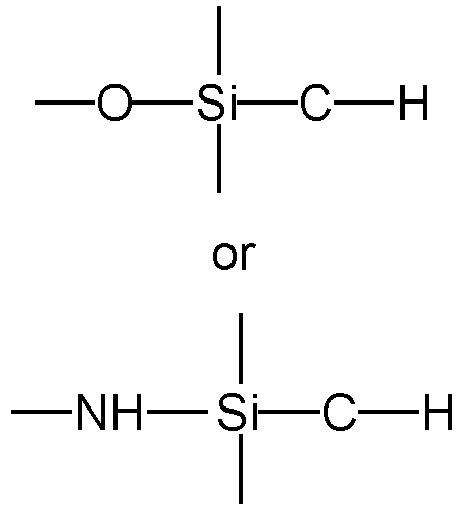
- The feed amounts of PECVD precursors, gaseous reactant or process gases, and carrier gas are sometimes expressed in "standard volumes" in the specification. The standard volume of a charge or other fixed amount of gas is the volume the fixed amount of the gas would occupy at a standard temperature and pressure (without regard to the actual temperature and pressure of delivery). Standard volumes can be measured using different units of volume. For example, the same fixed amount of gas could be expressed as the number of standard cubic centimeters, the number of standard cubic meters, or the number of standard cubic feet. Standard volumes can also be defined using different standard temperatures and pressures. For example, the standard temperature might be 0°C and the standard pressure might be 760 Torr (as is conventional), or the standard temperature might be 20°C and the standard pressure might be 1 Torr. But whatever standard is used in a given case, when comparing relative amounts of two or more different gases without specifying particular parameters, the same units of volume, standard temperature, and standard pressure are to be used relative to each gas, unless otherwise indicated.
- The corresponding feed rates of PECVD precursors, gaseous reactant or process gases, and carrier gas are expressed in standard volumes per unit of time in the specification. For example, in the working examples the flow rates are expressed as standard cubic centimeters per minute, abbreviated as sccm. As with the other parameters, other units of time can be used, such as seconds or hours, but consistent parameters are to be used when comparing the flow rates of two or more gases, unless otherwise indicated.
- The present syringes optionally can be used as pharmaceutical packages or other vessels in which the lumen has a void volume of from 0.5 to 50 mL, optionally from 1 to 10 mL, optionally from 0.5 to 5 mL, optionally from 1 to 3 mL. The substrate surface can be part or all of the inner or interior surface of the syringe.
- A "hydrophobic layer" in the context of the present invention means that the coating or layer lowers the wetting tension of a surface coated with the coating or layer, compared to the corresponding uncoated surface. Hydrophobicity is thus a function of both the uncoated substrate and the coating or layer. The same applies with appropriate alterations for other contexts wherein the term "hydrophobic" is used. The term "hydrophilic" means the opposite, i.e. that the wetting tension is increased compared to reference sample. The present hydrophobic layers are primarily defined by their hydrophobicity and the process conditions providing hydrophobicity.
- The values of w, x, y, and z as applicable to the empirical composition SiwOxCyHz throughout this specification should be understood as ratios or an empirical formula (for example for a coating or layer), rather than as a limit on the number or type of atoms in a molecule. For example, octamethylcyclotetrasiloxane, which has the molecular composition Si4O4C8H24, can be described by the following empirical formula, arrived at by dividing each of w, x, y, and z in the molecular formula by 4, the largest common factor: Si1O1C2H6. The values of w, x, y, and z are also not limited to integers. For example, (acyclic) octamethyltrisiloxane, molecular composition Si3O2C8H24, is reducible to Si1O0.67C2.67H8. Also, although SiOxCyHz is described as equivalent to SiOxCy, it is not necessary to show the presence of hydrogen in any proportion to show the presence of SiOxCy.
- "Wetting tension" is a specific measure for the hydrophobicity or hydrophilicity of a surface. An optional wetting tension measurement method in the context of the present invention is ASTM D 2578 or a modification of the method described in ASTM D 2578. This method uses standard wetting tension solutions (called dyne solutions) to determine the solution that comes nearest to wetting a plastic film surface for exactly two seconds. This is the film's wetting tension. The procedure utilized is varied herein from ASTM D 2578 in that the substrates are not flat plastic films, but are tubular..
- A "primer coating or layer" according to the present invention is a coating or layer which is more receptive than the uncoated surface to a deposit of lubricant. The deposit of lubricant reduces the frictional resistance of the coated surface in comparison to a reference surface that is uncoated. The primer coating or layer has a composition according to the empirical composition SiwOxCyHz, (or its equivalent SiOxCy) as defined herein, which omits hydrogen because it is not measured by the XPS (X-ray photoelectron spectroscopy) method used in this specification to define the composition of a plasma treated surface or a CVD or chemical vapor deposition coating or layer. The primer coating or layer generally has an atomic ratio SiwOxCy (or its equivalent SiOxCy) wherein w is 1, x is from 0.5 to 2.4, y is from 0.6 to 3, as measured by XPS.
- Where it is desired to determine the proportion of hydrogen, and thus the value of z in SiwOxCyHz, this can be done using well-known techniques such as Rutherford backscattering (RBS) or hydrogen forward scattering (HFS).
- Typically, expressed as the formula SiwOxCy, the atomic ratios of Si, O, and C in the "primer coating or layer" are, as several options:
- Si 100: O 50-150 : C 90-200 (i.e. w = 1, x = 0.5 to 1.5, y = 0.9 to 2);
- Si 100: O 70-130 : C 90-200 (i.e. w = 1, x = 0.7 to 1.3, y = 0.9 to 2)
- Si 100: O 80-120 : C 90-150 (i.e. w = 1, x = 0.8 to 1.2, y = 0.9 to 1.5)
- Si 100: O 90-120 : C 90-140 (i.e. w = 1, x = 0.9 to 1.2, y = 0.9 to 1.4), or
- Si 100: O 92-107 : C 116-133 (i.e. w = 1, x = 0.92 to 1.07, y = 1.16 to 1.33).
- The atomic ratio can be determined by XPS. Taking into account the H atoms, which are not measured by XPS, the coating or layer has the formula SiwOxCyHz (or its equivalent SiOxCy), where w is 1. X is from 0.5 to 2.4, optionally between 0.5 and 1.5, preferably between 0.7 and 1.3, more preferably between 0.8 and 1.2, still more preferably between 0.9 and 1.2. Y is from 0.6 to 3, optionally between 0.9 and 2, preferably between 0.9 and 1.5, more preferably between 0.9 and 1.4. Z is from 2 to 9. Typically, such coating or layer would hence contain 36% to 41% carbon normalized to 100% carbon plus oxygen plus silicon.
- "Frictional resistance" can be static frictional resistance and/or kinetic frictional resistance.
- A syringe part, for example a syringe or plunger tip, may be coated with a deposit of lubricant on a primer coating or layer. In this case, the relevant static frictional resistance is the breakout force as defined herein, and the relevant kinetic frictional resistance is the plunger sliding force as defined herein. For example, the plunger sliding force as defined and determined herein is suitable to determine the presence or absence and the lubricity and/or protective characteristics of a deposit of lubricant on a primer coating or layer in the context of the present invention when the coating or layer is applied to the inner wall of a syringe. The breakout force is of particular relevance for evaluation of the coating or layer effect on a prefilled syringe, i.e. a syringe which is filled after coating and can be stored for some time, for example several months or even years, before the plunger tip is moved again (has to be "broken out").
- The "plunger sliding force" (synonym to "glide force," "maintenance force", or Fm, also used in this description) in the context of the present invention is the force required to maintain movement of a plunger tip in a syringe, for example during aspiration or dispense. It can advantageously be determined using the ISO 7886-1:1993 test known in the art. A synonym for "plunger sliding force" often used in the art is "plunger force" or "pushing force".
- The "plunger breakout force" (synonym to "breakout force", "break loose force", "initiation force", Fi, also used in this description) in the context of the present invention is the initial force required to move the plunger tip in a syringe, for example in a prefilled syringe.
- Both "plunger sliding force" and "plunger breakout force" and methods for their measurement are described in more detail in subsequent parts of this description. These two forces can be expressed in N, lbs or kg. These units correlate as follows: 1 N = 0.102 kg = 0.2248 lbs (pounds).
- "Slidably" means that the plunger tip, closure, or other removable part is permitted to slide in a syringe or other vessel.
- The present invention will now be described more fully, with reference to the accompanying drawings, in which several embodiments are shown. These embodiments are examples of the invention, which has the full scope indicated by the language of the claims. Like numbers refer to like or corresponding elements throughout. The following disclosure relates to all embodiments unless specifically limited to a certain embodiment.
- Referring to
FIGS. 1 and2 showing an embodiment, asyringe 252 comprises asyringe barrel 250 having a PECVD treated generally cylindricalinterior surface 254 defining an inner sliding surface; and a deposit offluid lubricant 287 on the PECVD treatedsurface 254. The syringe barrel optionally is made of injection molded material, for example cyclic olefin polymer (COP). - The syringe as illustrated includes a
plunger 258 having an outer slidingsurface 259 configured to slide within thelumen 300 along the inner slidingsurface 254. Optionally, the outer slidingsurface 259 can be a PECVD treated surface as well. - The term "syringe," as used here, is broadly defined to include cartridges, injection "pens," and other types of barrels or reservoirs adapted to be assembled with one or more other components to provide a functional syringe. "Syringe" is also broadly defined to include related articles such as auto-injectors, which provide a mechanism for dispensing the contents.
- The
interior surface 254 to be lubricated comprises a first deposit oflubricant 287 applied to the primer surface. - Optionally for any of the embodiments, at least a portion of the
wall 214 of thebarrel 250 comprises or consists essentially of a polymer, for example a polyolefin (for example a cyclic olefin polymer, a cyclic olefin copolymer, or polypropylene), a polyester, for example polyethylene terephthalate, polyethylene naphthalate, a polycarbonate, or any combination or copolymer of any of these. Specific contemplated wall materials include COC (cyclic olefin copolymer), COP (cyclic olefin polymer), PET (polyethylene terephthalate), polypropylene (PP), or a combination of two or more of these. Optionally, at least a portion of thewall 214 of thebarrel 250 comprises or consists essentially of glass, for example borosilicate glass. - The plunger can be made of a variety of materials. For example, at least a portion of the plunger can be made of chlorobutyl rubber, bromobutyl rubber, silicone rubber, or a combination of any two or more of these.
- Optionally, the outer diameter of the plunger when unconstrained by the syringe barrel is from 0.05 mm to 0.3 mm greater, preferably from 0.1 to 0.3 mm greater, more preferably from 0.15 mm to 0.25 mm greater, still more preferably 0.2 mm greater than the average inner diameter of the interior surface.
- The PECVD treated surface comprises a primer coating or
layer 286 of SiOxCy, in which x is from 0.5 to 2.4 and y is from 0.6 to 3. Optionally, x is between 0.5 and 1.5 and y is between 0.9 and 2. Optionally, x is between 0.7 and 1.3 and y is between 0.9 and 2. Optionally, x is between 0.8 and 1.2 and y is between 0.9 and 1.5. Optionally, x is between 0.9 and 1.2 and y is between 0.9 and 1.4. Optionally, x is between 0.92 and 1.07 and y is between 1.16 and 1.33. - The primer coating or
layer 286 is between 1 and 1000 nm thick. Optionally, the primer coating or layer is between 10 and 1000 nm thick. Optionally, the primer coating or layer is between 50 and 800 nm thick. Optionally, the primer coating or layer is between 100 and 700 nm thick. Optionally, the primer coating or layer is between 300 and 600 nm thick. - Optionally, the primer coating or
layer 286 contacting the fluid is between 10 and 1000 nm thick two years after the article is assembled. Optionally, the primer coating or layer contacting the fluid is between 20 and 700 nm thick two years after the article is assembled. Optionally, the primer coating or layer contacting the fluid is between 50 and 500 nm thick two years after the article is assembled. Optionally, the primer coating or layer contacting the fluid is between 100 and 400 nm thick two years after the article is assembled. Optionally, the primer coating or layer contacting the fluid is between 150 and 300 nm thick two years after the article is assembled. - Optionally, the fluid removes the primer coating or layer at a rate of 1 nm or less of primer coating or layer thickness per 44 hours of contact with the fluid. Optionally, the fluid removes the primer coating or layer at a rate of 1 nm or less of primer coating or layer thickness per 88 hours of contact with the fluid. Optionally, the fluid removes the primer coating or layer at a rate of 1 nm or less of primer coating or layer thickness per 175 hours of contact with the fluid. Optionally, the fluid removes the primer coating or layer at a rate of 1 nm or less of primer coating or layer thickness per 250 hours of contact with the fluid. Optionally, the fluid removes the primer coating or layer at a rate of 1 nm or less of primer coating or layer thickness per 350 hours of contact with the fluid.
- Optionally, the primer coating or layer has a contact angle (with distilled water) of from 70° to 130°. Optionally, the interior surface of the primer coating or layer has a contact angle (with distilled water) of from 90° to 110°. Optionally, the interior surface of the primer coating or layer has a contact angle (with distilled water) of from 80° to 120°.
- The
fluid lubricant 287 comprises polydimethylsiloxane. For several examples, it can comprise non-reactive silicone fluid, nonreactive silicone emulsion, curable silicone fluid, or a combination of two or more of these. - A deposit of
fluid lubricant 287 can be formed on the CVD treatedsurface 254 in any convenient manner, such as by spraying a liquid lubricant or by applying it using an applicator. Optionally, the lubricant has a molecular weight of from 1900 to 37,000. Optionally, the lubricant has a viscosity of from 20 cSt to 13,000 cSt, alternatively from 500 to 30,000 cSt, preferably from 1000 to 25,000 cSt, more preferably from 5,000 to 20,000 cSt, still more preferably from 10,000 to 15,000 cSt, optionally 12,500 cSt. - Optionally, the breakout force, Fi, of the plunger is between 0.5 and 15 N, alternatively between 1 and 10 N, alternatively between 5 and 15 N, after a park time of 3 days, alternatively 10 days, alternatively 30 days, alternatively 3 months, alternatively 6 months, alternatively 9 months, alternatively 12 months, alternatively 15 months, alternatively 18 months, alternatively two years.
- Optionally, the maintenance force, Fm, of the plunger is between 0.5 and 15 N, alternatively between 1 and 10 N, alternatively between 5 and 15 N, after a park time of 3 days, alternatively 10 days, alternatively 30 days, alternatively 3 months, alternatively 6 months, alternatively 9 months, alternatively 12 months, alternatively 15 months, alternatively 18 months, alternatively two years.
- Optionally, the lubricant has a contact angle (with distilled water) of from 90° to 150°. Optionally, the lubricant has a contact angle (with distilled water) of from 90° to 110°. Optionally, the lubricant has a contact angle (with distilled water) of from 90° to 120°. Optionally, the lubricant has a contact angle (with distilled water) of from 0° to 35° greater than the contact angle (with distilled water) of the primer coating or layer.
- Optionally, the deposit of lubricant on the primer coating or layer is effective to provide a lower frictional resistance than the uncoated syringe surface between the syringe surface and a relatively sliding part at least one year after the syringe is assembled with a plunger. Optionally, the frictional resistance is reduced by at least 25% in comparison to the uncoated article surface. Optionally, the frictional resistance is reduced by at least 45% in comparison to the uncoated article surface. Optionally, the frictional resistance is reduced by at least 60% in comparison to the uncoated article surface. Optionally, the deposit of lubricant is effective to reduce the frictional resistance between a portion of the article surface contacted by the fluid and a relatively sliding part after the article is assembled. Optionally, the deposit of lubricant is effective to reduce the frictional resistance between the article surface and a relatively sliding part at least one year after the article is assembled. Optionally, the deposit of lubricant is effective to reduce the frictional resistance between the article surface and a relatively sliding part at least eighteen months after the article is assembled. Optionally, the deposit of lubricant is effective to reduce the frictional resistance between the article surface and a relatively sliding part at least two years after the article is assembled.
- Further PECVD coatings or layers are contemplated, in addition to the primer coating or
layer 286. - Optionally, a barrier coating or
layer 288 can be provided between the primer coating orlayer 286 and thesyringe surface 254. The barrier coating orlayer 288 can be made at least in part of SiOx, wherein x is from 1.5 to 2.9, from 2 to 1000 nm thick. The barrier coating or layer of SiOx has an interior surface facing the lumen and an outer surface facing the wall inner orarticle surface 254. The barrier coating orlayer 288 is effective to reduce the ingress of atmospheric gas into the lumen 212, compared to an uncoated container otherwise the same as the pharmaceutical package or other vessel 210. - As another option, an
adhesion layer 266 can be provided between the barrier coating orlayer 288 and thesyringe surface 254. - A method of making a syringe as previously described is also contemplated. To carry out the method, a syringe is provided having a surface to be lubricated. A primer coating or layer of SiOxCy is applied to the surface; x can be from 0.5 to 2.4 and y can be from 0.6 to 3. The primer coating or layer is applied by chemical vapor deposition in the presence of oxygen. The primer coating or layer can be applied either directly to the syringe surface or with one or more intervening coatings or layers between the primer coating or layer and the syringe surface.
- The primer coating or layer has a first primer surface facing away from the syringe surface and a second primer surface facing the syringe surface. A first deposit of lubricant is adhered to the first primer surface.
- Optionally, a fluid can be placed in the lumen via the opening, optionally for extended storage, and the opening can be closed with a closure such as the
plunger 258. The fluid can be an aqueous liquid, for example a drug. The drug can be a parenteral drug, as one example. Other examples of suitable fluids are a food, a nutritional supplement, an inhalation anesthetic, or a diagnostic test material. - The fluid can be a member selected from the group consisting of:
-
- Aliflurane
- Chloroform
- Cyclopropane
- Desflurane (Suprane)
- Diethyl Ether
- Enflurane (Ethrane)
- Ethyl Chloride
- Ethylene
- Halothane (Fluothane)
- Isoflurane (Forane, Isoflo)
- Isopropenyl vinyl ether
- Methoxyflurane
- methoxyflurane,
- Methoxypropane
- Nitrous Oxide
- Roflurane
- Sevoflurane (Sevorane, Ultane, Sevoflo)
- Teflurane
- Trichloroethylene
- Vinyl Ether
- Xenon
- INJECTABLE DRUGS
- Ablavar (Gadofosveset Trisodium Injection)
- Abarelix Depot
- Abobotulinumtoxin A Injection (Dysport)
- ABT-263
- ABT-869
- ABX-EFG
- Accretropin (Somatropin Injection)
- Acetadote (Acetylcysteine Injection)
- Acetazolamide Injection (Acetazolamide Injection)
- Acetylcysteine Injection (Acetadote)
- Actemra (Tocilizumab Injection)
- Acthrel (Corticorelin Ovine Triflutate for Injection)
- Actummune
- Activase
- Acyclovir for Injection (Zovirax Injection)
- Adacel
- Adalimumab
- Adenoscan (Adenosine Injection)
- Adenosine Injection (Adenoscan)
- Adrenaclick
- AdreView (Iobenguane I 123 Injection for Intravenous Use)
- Afluria
- Ak-Fluor (Fluorescein Injection)
- Aldurazyme (Laronidase)
- Alglucerase Injection (Ceredase)
- Alkeran Injection (Melphalan Hcl Injection)
- Allopurinol Sodium for Injection (Aloprim)
- Aloprim (Allopurinol Sodium for Injection)
- Alprostadil
- Alsuma (Sumatriptan Injection)
- ALTU-238
- Amino Acid Injections
- Aminosyn
- Apidra
- Apremilast
- Alprostadil Dual Chamber System for Injection (Caverject Impulse)
- AMG 009
- AMG 076
- AMG 102
- AMG 108
- AMG 114
- AMG 162
- AMG 220
- AMG 221
- AMG 222
- AMG 223
- AMG 317
- AMG 379
- AMG 386
- AMG 403
- AMG 477
- AMG 479
- AMG 517
- AMG 531
- AMG 557
- AMG 623
- AMG 655
- AMG 706
- AMG 714
- AMG 745
- AMG 785
- AMG 811
- AMG 827
- AMG 837
- AMG 853
- AMG 951
- Amiodarone HCl Injection (Amiodarone HCl Injection)
- Amobarbital Sodium Injection (Amytal Sodium)
- Amytal Sodium (Amobarbital Sodium Injection)
- Anakinra
- Anti-Abeta
- Anti-Beta7
- Anti-Beta20
- Anti-CD4
- Anti-CD20
- Anti-CD40
- Anti-IFNalpha
- Anti-IL13
- Anti-OX40L
- Anti-oxLDS
- Anti-NGF
- Anti-NRP1
- Arixtra
- Amphadase (Hyaluronidase Inj)
- Ammonul (Sodium Phenylacetate and Sodium Benzoate Injection)
- Anaprox
- Anzemet Injection (Dolasetron Mesylate Injection)
- Apidra (Insulin Glulisine [rDNA origin] Inj)
- Apomab
- Aranesp (darbepoetin alfa)
- Argatroban (Argatroban Injection)
- Arginine Hydrochloride Injection (R-Gene 10)
- Aristocort
- Aristospan
- Arsenic Trioxide Injection (Trisenox)
- Articane HCI and Epinephrine Injection (Septocaine)
- Arzerra (Ofatumumab Injection)
- Asclera (Polidocanol Injection)
- Ataluren
- Ataluren-DMD
- Atenolol Inj (Tenormin I.V. Injection)
- Atracurium Besylate Injection (Atracurium Besylate Injection)
- Avastin
- Azactam Injection (Aztreonam Injection)
- Azithromycin (Zithromax Injection)
- Aztreonam Injection (Azactam Injection)
- Baclofen Injection (Lioresal Intrathecal)
- Bacteriostatic Water (Bacteriostatic Water for Injection)
- Baclofen Injection (Lioresal Intrathecal)
- Bal in Oil Ampules (Dimercarprol Injection)
- BayHepB
- BayTet
- Benadryl
- Bendamustine Hydrochloride Injection (Treanda)
- Benztropine Mesylate Injection (Cogentin)
- Betamethasone Injectable Suspension (Celestone Soluspan)
- Bexxar
- Bicillin C-R 900/300 (Penicillin G Benzathine and Penicillin G Procaine Injection)
- Blenoxane (Bleomycin Sulfate Injection)
- Bleomycin Sulfate Injection (Blenoxane)
- Boniva Injection (Ibandronate Sodium Injection)
- Botox Cosmetic (OnabotulinumtoxinA for Injection)
- BR3-FC
- Bravelle (Urofollitropin Injection)
- Bretylium (Bretylium Tosylate Injection )
- Brevital Sodium (Methohexital Sodium for Injection)
- Brethine
- Briobacept
- BTT-1023
- Bupivacaine HCI
- Byetta
- Ca-DTPA (Pentetate Calcium Trisodium Inj)
- Cabazitaxel Injection (Jevtana)
- Caffeine Alkaloid (Caffeine and Sodium Benzoate Injection)
- Calcijex Injection (Calcitrol)
- Calcitrol (Calcijex Injection)
- Calcium Chloride (
Calcium Chloride Injection 10%) - Calcium Disodium Versenate (Edetate Calcium Disodium Injection)
- Campath (Altemtuzumab)
- Camptosar Injection (Irinotecan Hydrochloride)
- Canakinumab Injection (Ilaris)
- Capastat Sulfate (Capreomycin for Injection)
- Capreomycin for Injection (Capastat Sulfate)
- Cardiolite (Prep kit for Technetium Tc99 Sestamibi for Injection)
- Carticel
- Cathflo
- Cefazolin and Dextrose for Injection (Cefazolin Injection)
- Cefepime Hydrochloride
- Cefotaxime
- Ceftriaxone
- Cerezyme
- Carnitor Injection
- Caverject
- Celestone Soluspan
- Celsior
- Cerebyx (Fosphenytoin Sodium Injection)
- Ceredase (Alglucerase Injection)
- Ceretec (Technetium Tc99m Exametazime Injection)
- Certolizumab
- CF-101
- Chloramphenicol Sodium Succinate (Chloramphenicol Sodium Succinate Injection)
- Chloramphenicol Sodium Succinate Injection (Chloramphenicol Sodium Succinate)
- Cholestagel (Colesevelam HCL)
- Choriogonadotropin Alfa Injection (Ovidrel)
- Cimzia
- Cisplatin (Cisplatin Injection)
- Clolar (Clofarabine Injection)
- Clomiphine Citrate
- Clonidine Injection (Duraclon)
- Cogentin (Benztropine Mesylate Injection)
- Colistimethate Injection (Coly-Mycin M)
- Coly-Mycin M (Colistimethate Injection)
- Compath
- Conivaptan Hcl Injection (Vaprisol)
- Conjugated Estrogens for Injection (Premarin Injection)
- Copaxone
- Corticorelin Ovine Triflutate for Injection (Acthrel)
- Corvert (Ibutilide Fumarate Injection)
- Cubicin (Daptomycin Injection)
- CF-101
- Cyanokit (Hydroxocobalamin for Injection)
- Cytarabine Liposome Injection (DepoCyt)
- Cyanocobalamin
- Cytovene (ganciclovir)
- D.H.E. 45
- Dacetuzumab
- Dacogen (Decitabine Injection)
- Dalteparin
- Dantrium IV (Dantrolene Sodium for Injection)
- Dantrolene Sodium for Injection (Dantrium IV)
- Daptomycin Injection (Cubicin)
- Darbepoietin Alfa
- DDAVP Injection (Desmopressin Acetate Injection)
- Decavax
- Decitabine Injection (Dacogen)
- Dehydrated Alcohol (Dehydrated Alcohol Injection)
- Denosumab Injection (Prolia)
- Delatestryl
- Delestrogen
- Delteparin Sodium
- Depacon (Valproate Sodium Injection)
- Depo Medrol (Methylprednisolone Acetate Injectable Suspension)
- DepoCyt (Cytarabine Liposome Injection)
- DepoDur (Morphine Sulfate XR Liposome Injection)
- Desmopressin Acetate Injection (DDAVP Injection)
- Depo-Estradiol
- Depo-Provera 104mg/ml
- Depo-Provera 150mg/ml
- Depo-Testosterone
- Dexrazoxane for Injection, Intravenous Infusion Only (Totect)
- Dextrose / Electrolytes
- Dextrose and Sodium Chloride Inj (Dextrose 5% in 0.9% Sodium Chloride)
- Dextrose
- Diazepam Injection (Diazepam Injection)
- Digoxin Injection (Lanoxin Injection)
- Dilaudid-HP (Hydromorphone Hydrochloride Injection)
- Dimercarprol Injection (Bal in Oil Ampules)
- Diphenhydramine Injection (Benadryl Injection)
- Dipyridamole Injection (Dipyridamole Injection)
- DMOAD
- Docetaxel for Injection (Taxotere)
- Dolasetron Mesylate Injection (Anzemet Injection)
- Doribax (Doripenem for Injection)
- Doripenem for Injection (Doribax)
- Doxercalciferol Injection (Hectorol Injection)
- Doxil (Doxorubicin Hcl Liposome Injection)
- Doxorubicin Hcl Liposome Injection (Doxil)
- Duraclon (Clonidine Injection)
- Duramorph (Morphine Injection)
- Dysport (Abobotulinumtoxin A Injection)
- Ecallantide Injection (Kalbitor)
- EC-Naprosyn (naproxen)
- Edetate Calcium Disodium Injection (Calcium Disodium Versenate)
- Edex (Alprostadil for Injection)
- Engerix
- Edrophonium Injection (Enlon)
- Eliglustat Tartate
- Eloxatin (Oxaliplatin Injection)
- Emend Injection (Fosaprepitant Dimeglumine Injection)
- Enalaprilat Injection (Enalaprilat Injection)
- Enlon (Edrophonium Injection)
- Enoxaparin Sodium Injection (Lovenox)
- Eovist (Gadoxetate Disodium Injection)
- Enbrel (etanercept)
- Enoxaparin
- Epicel
- Epinepherine
- Epipen
- Epipen Jr.
- Epratuzumab
- Erbitux
- Ertapenem Injection (Invanz)
- Erythropoieten
- Essential Amino Acid Injection (Nephramine)
- Estradiol Cypionate
- Estradiol Valerate
- Etanercept
- Exenatide Injection (Byetta)
- Evlotra
- Fabrazyme (Adalsidase beta)
- Famotidine Injection
- FDG (
Fludeoxyglucose F 18 Injection) - Feraheme (Ferumoxytol Injection)
- Feridex I.V. (Ferumoxides Injectable Solution)
- Fertinex
- Ferumoxides Injectable Solution (Feridex I.V.)
- Ferumoxytol Injection (Feraheme)
- Flagyl Injection (Metronidazole Injection)
- Fluarix
- Fludara (Fludarabine Phosphate)
-
Fludeoxyglucose F 18 Injection (FDG) - Fluorescein Injection (Ak-Fluor)
- Follistim AQ Cartridge (Follitropin Beta Injection)
- Follitropin Alfa Injection (Gonal-f RFF)
- Follitropin Beta Injection (Follistim AQ Cartridge)
- Folotyn (Pralatrexate Solution for Intravenous Injection)
- Fondaparinux
- Forteo (Teriparatide (rDNA origin) Injection)
- Fostamatinib
- Fosaprepitant Dimeglumine Injection (Emend Injection)
- Foscarnet Sodium Injection (Foscavir)
- Foscavir (Foscarnet Sodium Injection)
- Fosphenytoin Sodium Injection (Cerebyx)
- Fospropofol Disodium Injection (Lusedra)
- Fragmin
- Fuzeon (enfuvirtide)
- GA101
- Gadobenate Dimeglumine Injection (Multihance)
- Gadofosveset Trisodium Injection (Ablavar)
- Gadoteridol Injection Solution (ProHance)
- Gadoversetamide Injection (OptiMARK)
- Gadoxetate Disodium Injection (Eovist)
- Ganirelix (Ganirelix Acetate Injection)
- Gardasil
- GC1008
- GDFD
- Gemtuzumab Ozogamicin for Injection (Mylotarg)
- Genotropin
- Gentamicin Injection
- GENZ-112638
- Golimumab Injection (Simponi Injection)
- Gonal-f RFF (Follitropin Alfa Injection)
- Granisetron Hydrochloride (Kytril Injection)
- Gentamicin Sulfate
- Glatiramer Acetate
- Glucagen
- Glucagon
- HAE1
- Haldol (Haloperidol Injection)
- Havrix
- Hectorol Injection (Doxercalciferol Injection)
- Hedgehog Pathway Inhibitor
- Heparin
- Herceptin
- hG-CSF
- Humalog
- Human Growth Hormone
- Humatrope
- HuMax
- Humegon
- Humira
- Humulin
- Ibandronate Sodium Injection (Boniva Injection)
- Ibuprofen Lysine Injection (NeoProfen)
- Ibutilide Fumarate Injection (Corvert)
- Idamycin PFS (Idarubicin Hydrochloride Injection)
- Idarubicin Hydrochloride Injection (Idamycin PFS)
- Ilaris (Canakinumab Injection)
- Imipenem and Cilastatin for Injection (Primaxin I.V.)
- Imitrex
- Incobotulinumtoxin A for Injection (Xeomin)
- Increlex (Mecasermin [rDNA origin] Injection)
- Indocin IV (Indomethacin Inj)
- Indomethacin Inj (Indocin IV)
- Infanrix
- Innohep
- Insulin
- Insulin Aspart [rDNA origin] Inj (NovoLog)
- Insulin Glargine [rDNA origin] Injection (Lantus)
- Insulin Glulisine [rDNA origin] Inj (Apidra)
- Interferon alfa-2b, Recombinant for Injection (Intron A)
- Intron A (Interferon alfa-2b, Recombinant for Injection)
- Invanz (Ertapenem Injection)
- Invega Sustenna (Paliperidone Palmitate Extended-Release Injectable Suspension)
- Invirase (saquinavir mesylate)
- lobenguane I 123 Injection for Intravenous Use (AdreView)
- lopromide Injection (Ultravist)
- Ioversol Injection (Optiray Injection)
- Iplex (Mecasermin Rinfabate [rDNA origin] Injection)
- Iprivask
- Irinotecan Hydrochloride (Camptosar Injection)
- Iron Sucrose Injection (Venofer)
- Istodax (Romidepsin for Injection)
- Itraconazole Injection (Sporanox Injection)
- Jevtana (Cabazitaxel Injection)
- Jonexa
- Kalbitor (Ecallantide Injection)
- KCL in D5NS (Potassium Chloride in 5% Dextrose and Sodium Chloride Injection)
- KCL in D5W
- KCL in NS
-
Kenalog 10 Injection (Triamcinolone Acetonide Injectable Suspension) - Kepivance (Palifermin)
- Keppra Injection (Levetiracetam)
- Keratinocyte
- KFG
- Kinase Inhibitor
- Kineret (Anakinra)
- Kinlytic (Urokinase Injection)
- Kinrix
- Klonopin (clonazepam)
- Kytril Injection (Granisetron Hydrochloride)
- lacosamide Tablet and Injection (Vimpat)
- Lactated Ringer's
- Lanoxin Injection (Digoxin Injection)
- Lansoprazole for Injection (Prevacid I.V.)
- Lantus
- Leucovorin Calcium (Leucovorin Calcium Injection)
- Lente (L)
- Leptin
- Levemir
- Leukine Sargramostim
- Leuprolide Acetate
- Levothyroxine
- Levetiracetam (Keppra Injection)
- Lovenox
- Levocarnitine Injection (Carnitor Injection)
- Lexiscan (Regadenoson Injection)
- Lioresal Intrathecal (Baclofen Injection)
- Liraglutide [rDNA] Injection (Victoza)
- Lovenox (Enoxaparin Sodium Injection)
- Lucentis (Ranibizumab Injection)
- Lumizyme
- Lupron (Leuprolide Acetate Injection)
- Lusedra (Fospropofol Disodium Injection)
- Maci
- Magnesium Sulfate (Magnesium Sulfate Injection)
- Mannitol Injection (Mannitol IV)
- Marcaine (Bupivacaine Hydrochloride and Epinephrine Injection)
- Maxipime (Cefepime Hydrochloride for Injection)
- MDP Multidose Kit of Technetium Injection (Technetium Tc99m Medronate Injection)
- Mecasermin [rDNA origin] Injection (Increlex)
- Mecasermin Rinfabate [rDNA origin] Injection (Iplex)
- Melphalan Hcl Injection (Alkeran Injection)
- Methotrexate
- Menactra
- Menopur (Menotropins Injection)
- Menotropins for Injection (Repronex)
- Methohexital Sodium for Injection (Brevital Sodium)
- Methyldopate Hydrochloride Injection, Solution (Methyldopate Hcl)
- Methylene Blue (Methylene Blue Injection)
- Methylprednisolone Acetate Injectable Suspension (Depo Medrol)
- MetMab
- Metoclopramide Injection (Reglan Injection)
- Metrodin (Urofollitropin for Injection)
- Metronidazole Injection (Flagyl Injection)
- Miacalcin
- Midazolam (Midazolam Injection)
- Mimpara (Cinacalet)
- Minocin Injection (Minocycline Inj)
- Minocycline Inj (Minocin Injection)
- Mipomersen
- Mitoxantrone for Injection Concentrate (Novantrone)
- Morphine Injection (Duramorph)
- Morphine Sulfate XR Liposome Injection (DepoDur)
- Morrhuate Sodium (Morrhuate Sodium Injection)
- Motesanib
- Mozobil (Plerixafor Injection)
- Multihance (Gadobenate Dimeglumine Injection)
- Multiple Electrolytes and Dextrose Injection
- Multiple Electrolytes Injection
- Mylotarg (Gemtuzumab Ozogamicin for Injection)
- Myozyme (Alglucosidase alfa)
- Nafcillin Injection (Nafcillin Sodium)
- Nafcillin Sodium (Nafcillin Injection)
- Naltrexone XR Inj (Vivitrol)
- Naprosyn (naproxen)
- NeoProfen (Ibuprofen Lysine Injection)
- Nandrol Decanoate
- Neostigmine Methylsulfate (Neostigmine Methylsulfate Injection)
- NEO-GAA
- NeoTect (Technetium Tc 99m Depreotide Injection)
- Nephramine (Essential Amino Acid Injection)
- Neulasta (pegfilgrastim)
- Neupogen (Filgrastim)
- Novolin
- Novolog
- NeoRecormon
- Neutrexin (Trimetrexate Glucuronate Inj)
- NPH (N)
- Nexterone (Amiodarone HCI Injection)
- Norditropin (Somatropin Injection)
- Normal Saline (Sodium Chloride Injection)
- Novantrone (Mitoxantrone for Injection Concentrate)
-
Novolin 70/30 Innolet (70% NPH, Human Insulin Isophane Suspension and 30% - Regular, Human Insulin Injection)
- NovoLog (Insulin Aspart [rDNA origin] Inj)
- Nplate (romiplostim)
- Nutropin (Somatropin (rDNA origin) for Inj)
- Nutropin AQ
- Nutropin Depot (Somatropin (rDNA origin) for Inj)
- Octreotide Acetate Injection (Sandostatin LAR)
- Ocrelizumab
- Ofatumumab Injection (Arzerra)
- Olanzapine Extended Release Injectable Suspension (Zyprexa Relprevv)
- Omnitarg
- Omnitrope (Somatropin [ rDNA origin] Injection)
- Ondansetron Hydrochloride Injection (Zofran Injection)
- OptiMARK (Gadoversetamide Injection)
- Optiray Injection (Ioversol Injection)
- Orencia
- Osmitrol Injection in Aviva (Mannitol Injection in Aviva Plastic Vessel)
- Osmitrol Injection in Viaflex (Mannitol Injection in Viaflex Plastic Vessel)
- Osteoprotegrin
- Ovidrel (Choriogonadotropin Alfa Injection)
- Oxacillin (Oxacillin for Injection)
- Oxaliplatin Injection (Eloxatin)
- Oxytocin Injection (Pitocin)
- Paliperidone Palmitate Extended-Release Injectable Suspension (Invega Sustenna)
- Pamidronate Disodium Injection (Pamidronate Disodium Injection)
- Panitumumab Injection for Intravenous Use (Vectibix)
- Papaverine Hydrochloride Injection (Papaverine Injection)
- Papaverine Injection (Papaverine Hydrochloride Injection)
- Parathyroid Hormone
- Paricalcitol Injection Fliptop Vial (Zemplar Injection)
- PARP Inhibitor
- Pediarix
- PEGIntron
- Peginterferon
- Pegfilgrastim
- Penicillin G Benzathine and Penicillin G Procaine
- Pentetate Calcium Trisodium Inj (Ca-DTPA)
- Pentetate Zinc Trisodium Injection (Zn-DTPA)
- Pepcid Injection (Famotidine Injection)
- Pergonal
- Pertuzumab
- Phentolamine Mesylate (Phentolamine Mesylate for Injection)
- Physostigmine Salicylate (Physostigmine Salicylate (injection))
- Physostigmine Salicylate (injection) (Physostigmine Salicylate)
- Piperacillin and Tazobactam Injection (Zosyn)
- Pitocin (Oxytocin Injection)
- Plasma-Lyte 148 (Multiple Electrolytes Inj)
- Plasma-Lyte 56 and Dextrose (Multiple Electrolytes and Dextrose Injection in Viaflex
- Plastic Vessel)
- PlasmaLyte
- Plerixafor Injection (Mozobil)
- Polidocanol Injection (Asclera)
- Potassium Chloride
- Pralatrexate Solution for Intravenous Injection (Folotyn)
- Pramlintide Acetate Injection (Symlin)
- Premarin Injection (Conjugated Estrogens for Injection)
- Prep kit for Technetium Tc99 Sestamibi for Injection (Cardiolite)
- Prevacid I.V. (Lansoprazole for Injection)
- Primaxin I.V. (Imipenem and Cilastatin for Injection)
- Prochymal
- Procrit
- Progesterone
- ProHance (Gadoteridol Injection Solution)
- Prolia (Denosumab Injection)
- Promethazine HCl Injection (Promethazine Hydrochloride Injection)
- Propranolol Hydrochloride Injection (Propranolol Hydrochloride Injection)
- Quinidine Gluconate Injection (Quinidine Injection)
- Quinidine Injection (Quinidine Gluconate Injection)
- R-Gene 10 (Arginine Hydrochloride Injection)
- Ranibizumab Injection (Lucentis)
- Ranitidine Hydrochloride Injection (Zantac Injection)
- Raptiva
- Reclast (Zoledronic Acid Injection)
- Recombivarix HB
- Regadenoson Injection (Lexiscan)
- Reglan Injection (Metoclopramide Injection)
- Remicade
- Renagel
- Renvela (Sevelamer Carbonate)
- Repronex (Menotropins for Injection)
- Retrovir IV (Zidovudine Injection)
- rhApo2L/TRAIL
- Ringer's and 5% Dextrose Injection (Ringers in Dextrose)
- Ringer's Injection (Ringers Injection)
- Rituxan
- Rituximab
- Rocephin (ceftriaxone)
- Rocuronium Bromide Injection (Zemuron)
- Roferon-A (interferon alfa-2a)
- Romazicon (flumazenil)
- Romidepsin for Injection (Istodax)
- Saizen (Somatropin Injection)
- Sandostatin LAR (Octreotide Acetate Injection)
- Sclerostin Ab
- Sensipar (cinacalcet)
- Sensorcaine (Bupivacaine HCl Injections)
- Septocaine (Articane HCI and Epinephrine Injection)
- Serostim LQ (Somatropin (rDNA origin) Injection)
- Simponi Injection (Golimumab Injection)
- Sodium Acetate (Sodium Acetate Injection)
- Sodium Bicarbonate (Sodium Bicarbonate 5% Injection)
- Sodium Lactate (Sodium Lactate Injection in AVIVA)
- Sodium Phenylacetate and Sodium Benzoate Injection (Ammonul)
- Somatropin (rDNA origin) for Inj (Nutropin)
- Sporanox Injection (Itraconazole Injection)
- Stelara Injection (Ustekinumab)
- Stemgen
- Sufenta (Sufentanil Citrate Injection)
- Sufentanil Citrate Injection (Sufenta )
- Sumavel
- Sumatriptan Injection (Alsuma)
- Symlin
- Symlin Pen
- Systemic Hedgehog Antagonist
- Synvisc-One (Hylan G-F 20 Single Intra-articular Injection)
- Tarceva
- Taxotere (Docetaxel for Injection)
- Technetium Tc 99m
- Telavancin for Injection (Vibativ)
- Temsirolimus Injection (Torisel)
- Tenormin I.V. Injection (Atenolol Inj)
- Teriparatide (rDNA origin) Injection (Forteo)
- Testosterone Cypionate
- Testosterone Enanthate
- Testosterone Propionate
- Tev-Tropin (Somatropin, rDNA Origin, for Injection)
- tgAAC94
- Thallous Chloride
- Theophylline
- Thiotepa (Thiotepa Injection)
- Thymoglobulin (Anti-Thymocyte Globulin (Rabbit)
- Thyrogen (Thyrotropin Alfa for Injection)
- Ticarcillin Disodium and Clavulanate Potassium Galaxy (Timentin Injection)
- Tigan Injection (Trimethobenzamide Hydrochloride Injectable)
- Timentin Injection (Ticarcillin Disodium and Clavulanate Potassium Galaxy)
- TNKase
- Tobramycin Injection (Tobramycin Injection)
- Tocilizumab Injection (Actemra)
- Torisel (Temsirolimus Injection)
- Totect (Dexrazoxane for Injection, Intravenous Infusion Only )
- Trastuzumab-DM1
- Travasol (Amino Acids (Injection))
- Treanda (Bendamustine Hydrochloride Injection)
- Trelstar (Triptorelin Pamoate for Injectable Suspension)
- Triamcinolone Acetonide
- Triamcinolone Diacetate
- Triamcinolone Hexacetonide Injectable Suspension (
Aristospan Injection 20 mg) - Triesence (Triamcinolone Acetonide Injectable Suspension)
- Trimethobenzamide Hydrochloride Injectable (Tigan Injection)
- Trimetrexate Glucuronate Inj (Neutrexin)
- Triptorelin Pamoate for Injectable Suspension (Trelstar)
- Twinject
- Trivaris (Triamcinolone Acetonide Injectable Suspension)
- Trisenox (Arsenic Trioxide Injection)
- Twinrix
- Typhoid Vi
- Ultravist (Iopromide Injection)
- Urofollitropin for Injection (Metrodin)
- Urokinase Injection (Kinlytic)
- Ustekinumab (Stelara Injection)
- Ultralente (U)
- Valium (diazepam)
- Valproate Sodium Injection (Depacon)
- Valtropin (Somatropin Injection)
- Vancomycin Hydrochloride (Vancomycin Hydrochloride Injection)
- Vancomycin Hydrochloride Injection (Vancomycin Hydrochloride)
- Vaprisol (Conivaptan Hcl Injection)
- VAQTA
- Vasovist (Gadofosveset Trisodium Injection for Intravenous Use)
- Vectibix (Panitumumab Injection for Intravenous Use)
- Venofer (Iron Sucrose Injection)
- Verteporfin Inj (Visudyne)
- Vibativ (Telavancin for Injection)
- Victoza (Liraglutide [rDNA] Injection)
- Vimpat (lacosamide Tablet and Injection)
- Vinblastine Sulfate (Vinblastine Sulfate Injection)
- Vincasar PFS (Vincristine Sulfate Injection)
- Victoza
- Vincristine Sulfate (Vincristine Sulfate Injection)
- Visudyne (Verteporfin Inj)
- Vitamin B-12
- Vivitrol (Naltrexone XR Inj)
- Voluven (Hydroxyethyl Starch in Sodium Chloride Injection)
- Xeloda
- Xenical (orlistat)
- Xeomin (Incobotulinumtoxin A for Injection)
- Xolair
- Zantac Injection (Ranitidine Hydrochloride Injection)
- Zemplar Injection (Paricalcitol Injection Fliptop Vial)
- Zemuron (Rocuronium Bromide Injection)
- Zenapax (daclizumab)
- Zevalin
- Zidovudine Injection (Retrovir IV)
- Zithromax Injection (Azithromycin)
- Zn-DTPA (Pentetate Zinc Trisodium Injection)
- Zofran Injection (Ondansetron Hydrochloride Injection)
- Zingo
- Zoledronic Acid for Inj (Zometa)
- Zoledronic Acid Injection (Reclast)
- Zometa (Zoledronic Acid for Inj)
- Zosyn (Piperacillin and Tazobactam Injection)
- Zyprexa Relprevv (Olanzapine Extended Release Injectable Suspension)
- LIQUID DRUGS (NON-INJECTABLE)
- Abilify
- AccuNeb (Albuterol Sulfate Inhalation Solution)
- Actidose Aqua (Activated Charcoal Suspension)
- Activated Charcoal Suspension (Actidose Aqua)
- Advair
- Agenerase Oral Solution (Amprenavir Oral Solution)
- Akten (Lidocaine Hydrochloride Ophthalmic Gel)
- Alamast (Pemirolast Potassium Ophthalmic Solution)
- Albumin (Human) 5% Solution (Buminate 5%)
- Albuterol Sulfate Inhalation Solution
- Alinia
- Alocril
- Alphagan
- Alrex
- Alvesco
- Amprenavir Oral Solution
- Analpram-HC
- Arformoterol Tartrate Inhalation Solution (Brovana)
-
Aristospan Injection 20 mg (Triamcinolone Hexacetonide Injectable Suspension) - Asacol
- Asmanex
- Astepro
- Astepro (Azelastine Hydrochloride Nasal Spray)
- Atrovent Nasal Spray (Ipratropium Bromide Nasal Spray)
- Atrovent Nasal Spray .06
- Augmentin ES-600
- Azasite (Azithromycin Ophthalmic Solution)
- Azelaic Acid (Finacea Gel)
- Azelastine Hydrochloride Nasal Spray (Astepro)
- Azelex (Azelaic Acid Cream)
- Azopt (Brinzolamide Ophthalmic Suspension)
- Bacteriostatic Saline
- Balanced Salt
- Bepotastine
- Bactroban Nasal
- Bactroban
- Beclovent
- Benzac W
- Betimol
- Betoptic S
- Bepreve
- Bimatoprost Ophthalmic Solution
- Bleph 10 (Sulfacetamide Sodium
Ophthalmic Solution 10%) - Brinzolamide Ophthalmic Suspension (Azopt)
- Bromfenac Ophthalmic Solution (Xibrom)
- Bromhist
- Brovana (Arformoterol Tartrate Inhalation Solution)
- Budesonide Inhalation Suspension (Pulmicort Respules)
- Cambia (Diclofenac Potassium for Oral Solution)
- Capex
- Carac
- Carboxine-PSE
- Carnitor
- Cayston (Aztreonam for Inhalation Solution)
- Cellcept
- Centany
- Cerumenex
- Ciloxan Ophthalmic Solution (Ciprofloxacin HCL Ophthalmic Solution)
- Ciprodex
- Ciprofloxacin HCL Ophthalmic Solution (Ciloxan Ophthalmic Solution)
- Clemastine Fumarate Syrup (Clemastine Fumarate Syrup)
- CoLyte (PEG Electrolytes Solution)
- Combiven
- Comtan
- Condylox
- Cordran
- Cortisporin Ophthalmic Suspension
- Cortisporin Otic Suspension
- Cromolyn Sodium Inhalation Solution (Intal Nebulizer Solution)
- Cromolyn Sodium Ophthalmic Solution (Opticrom)
- Crystalline Amino Acid Solution with Electrolytes (Aminosyn Electrolytes)
- Cutivate
- Cuvposa (Glycopyrrolate Oral Solution)
- Cyanocobalamin (CaloMist Nasal Spray)
- Cyclosporine Oral Solution (Gengraf Oral Solution)
- Cyclogyl
- Cysview (Hexaminolevulinate Hydrochloride Intravesical Solution)
- DermOtic Oil (Fluocinolone Acetonide Oil Ear Drops)
- Desmopressin Acetate Nasal Spray
- DDAVP
- Derma-Smoothe/FS
- Dexamethasone Intensol
- Dianeal Low Calcium
- Dianeal PD
- Diclofenac Potassium for Oral Solution (Cambia)
- Didanosine Pediatric Powder for Oral Solution (Videx)
- Differin
- Dilantin 125 (Phenytoin Oral Suspension)
- Ditropan
- Dorzolamide Hydrochloride Ophthalmic Solution (Trusopt)
- Dorzolamide Hydrochloride-Timolol Maleate Ophthalmic Solution (Cosopt)
- Dovonex Scalp (Calcipotriene Solution)
- Doxycycline Calcium Oral Suspension (Vibramycin Oral)
- Efudex
- Elaprase (Idursulfase Solution)
- Elestat (Epinastine HCI Ophthalmic Solution)
- Elocon
- Epinastine HCI Ophthalmic Solution (Elestat)
- Epivir HBV
- Epogen (Epoetin alfa)
- Erythromycin Topical Solution 1.5% (Staticin)
- Ethiodol (Ethiodized Oil)
- Ethosuximide Oral Solution (Zarontin Oral Solution)
- Eurax
- Extraneal (Icodextrin Peritoneal Dialysis Solution)
- Felbatol
- Feridex I.V. (Ferumoxides Injectable Solution)
- Flovent
- Floxin Otic (Ofloxacin Otic Solution)
- Flo-Pred (Prednisolone Acetate Oral Suspension)
- Fluoroplex
- Flunisolide Nasal Solution (Flunisolide Nasal Spray .025%)
- Fluorometholone Ophthalmic Suspension (FML)
- Flurbiprofen Sodium Ophthalmic Solution (Ocufen)
- FML
- Foradil
- Formoterol Fumarate Inhalation Solution (Perforomist)
- Fosamax
- Furadantin (Nitrofurantoin Oral Suspension)
- Furoxone
- Gammagard Liquid (Immune Globulin Intravenous (Human) 10%)
- Gantrisin (Acetyl Sulfisoxazole Pediatric Suspension)
- Gatifloxacin Ophthalmic Solution (Zymar)
- Gengraf Oral Solution (Cyclosporine Oral Solution)
- Glycopyrrolate Oral Solution (Cuvposa)
- Halcinonide Topical Solution (Halog Solution)
- Halog Solution (Halcinonide Topical Solution)
- HEP-LOCK U/P (Preservative-Free Heparin Lock Flush Solution)
- Heparin Lock Flush Solution (Hepflush 10)
- Hexaminolevulinate Hydrochloride Intravesical Solution (Cysview)
- Hydrocodone Bitartrate and Acetaminophen Oral Solution (Lortab Elixir)
- Hydroquinone 3% Topical Solution (Melquin-3 Topical Solution)
- IAP Antagonist
- Isopto
- Ipratropium Bromide Nasal Spray (Atrovent Nasal Spray)
- Itraconazole Oral Solution (Sporanox Oral Solution)
- Ketorolac Tromethamine Ophthalmic Solution (Acular LS)
- Kaletra
- Lanoxin
- Lexiva
- Leuprolide Acetate for Depot Suspension (Lupron Depot 11.25 mg)
- Levobetaxolol Hydrochloride Ophthalmic Suspension (Betaxon)
- Levocarnitine Tablets, Oral Solution, Sugar-Free (Carnitor)
- Levofloxacin Ophthalmic Solution 0.5% (Quixin)
- Lidocaine HCI Sterile Solution (Xylocaine MPF Sterile Solution)
- Lok Pak (Heparin Lock Flush Solution)
- Lorazepam Intensol
- Lortab Elixir (Hydrocodone Bitartrate and Acetaminophen Oral Solution)
- Lotemax (Loteprednol Etabonate Ophthalmic Suspension)
- Loteprednol Etabonate Ophthalmic Suspension (Alrex)
- Low Calcium Peritoneal Dialysis Solutions (Dianeal Low Calcium)
- Lumigan (Bimatoprost Ophthalmic Solution 0.03% for Glaucoma)
- Lupron Depot 11.25 mg (Leuprolide Acetate for Depot Suspension)
- Megestrol Acetate Oral Suspension (Megestrol Acetate Oral Suspension)
- MEK Inhibitor
- Mepron
- Mesnex
- Mestinon
- Mesalamine Rectal Suspension Enema (Rowasa)
- Melquin-3 Topical Solution (Hydroquinone 3% Topical Solution)
- MetMab
- Methyldopate Hcl (Methyldopate Hydrochloride Injection, Solution)
- Methylin Oral Solution (Methylphenidate HCI Oral Solution 5 mg/5 mL and 10 mg/5 mL)
- Methylprednisolone Acetate Injectable Suspension (Depo Medrol)
- Methylphenidate HCI Oral Solution 5 mg/5 mL and 10 mg/5 mL (Methylin Oral Solution)
- Methylprednisolone sodium succinate (Solu Medrol)
- Metipranolol Ophthalmic Solution (Optipranolol)
- Migranal
- Miochol-E (Acetylcholine Chloride Intraocular Solution)
- Micro-K for Liquid Suspension (Potassium Chloride Extended Release Formulation for
- Liquid Suspension)
- Minocin (Minocycline Hydrochloride Oral Suspension)
- Nasacort
- Neomycin and Polymyxin B Sulfates and Hydrocortisone
- Nepafenac Ophthalmic Suspension (Nevanac)
- Nevanac (Nepafenac Ophthalmic Suspension)
- Nitrofurantoin Oral Suspension (Furadantin)
- Noxafil (Posaconazole Oral Suspension)
- Nystatin (oral) (Nystatin Oral Suspension)
- Nystatin Oral Suspension (Nystatin (oral))
- Ocufen (Flurbiprofen Sodium Ophthalmic Solution)
- Ofloxacin Ophthalmic Solution (Ofloxacin Ophthalmic Solution)
- Ofloxacin Otic Solution (Floxin Otic)
- Olopatadine Hydrochloride Ophthalmic Solution (Pataday)
- Opticrom (Cromolyn Sodium Ophthalmic Solution)
- Optipranolol (Metipranolol Ophthalmic Solution)
- Patanol
- Pediapred
- PerioGard
- Phenytoin Oral Suspension (Dilantin 125)
- Phisohex
- Posaconazole Oral Suspension (Noxafil)
- Potassium Chloride Extended Release Formulation for Liquid Suspension (Micro-K for
- Liquid Suspension)
- Pataday (Olopatadine Hydrochloride Ophthalmic Solution)
- Patanase Nasal Spray (Olopatadine Hydrochloride Nasal Spray)
- PEG Electrolytes Solution (CoLyte)
- Pemirolast Potassium Ophthalmic Solution (Alamast)
- Penlac (Ciclopirox Topical Solution)
- PENNSAID (Diclofenac Sodium Topical Solution)
- Perforomist (Formoterol Fumarate Inhalation Solution)
- Peritoneal Dialysis Solution
- Phenylephrine Hydrochloride Ophthalmic Solution (Neo-Synephrine)
- Phospholine Iodide (Echothiophate Iodide for Ophthalmic Solution)
- Podofilox (Podofilox Topical Solution)
- Pred Forte (Prednisolone Acetate Ophthalmic Suspension)
- Pralatrexate Solution for Intravenous Injection (Folotyn)
- Pred Mild
- Prednisone Intensol
- Prednisolone Acetate Ophthalmic Suspension (Pred Forte)
- Prevacid
- PrismaSol Solution (Sterile Hemofiltration Hemodiafiltration Solution)
- ProAir
- Proglycem
- ProHance (Gadoteridol Injection Solution)
- Proparacaine Hydrochloride Ophthalmic Solution (Alcaine)
- Propine
- Pulmicort
- Pulmozyme
- Quixin (Levofloxacin Ophthalmic Solution 0.5%)
- QVAR
- Rapamune
- Rebetol
- Relacon-HC
- Rotarix (Rotavirus Vaccine, Live, Oral Suspension)
- Rotavirus Vaccine, Live, Oral Suspension (Rotarix)
- Rowasa (Mesalamine Rectal Suspension Enema)
- Sabril (Vigabatrin Oral Solution)
- Sacrosidase Oral Solution (Sucraid)
- Sandimmune
- Sepra
- Serevent Diskus
- Solu Cortef (Hydrocortisone Sodium Succinate)
- Solu Medrol (Methylprednisolone sodium succinate)
- Spiriva
- Sporanox Oral Solution (Itraconazole Oral Solution)
- Staticin (Erythromycin Topical Solution 1.5%)
- Stalevo
- Starlix
- Sterile Hemofiltration Hemodiafiltration Solution (PrismaSol Solution)
- Stimate
- Sucralfate (Carafate Suspension)
- Sulfacetamide Sodium
Ophthalmic Solution 10% (Bleph 10) - Synarel Nasal Solution (Nafarelin Acetate Nasal Solution for Endometriosis)
- Taclonex Scalp (Calcipotriene and Betamethasone Dipropionate Topical Suspension)
- Tamiflu
- Tobi
- TobraDex
- Tobradex ST (Tobramycin / Dexamethasone Ophthalmic Suspension 0.3%/0.05%)
- Tobramycin / Dexamethasone Ophthalmic Suspension 0.3%/0.05% (Tobradex ST)
- Timolol
- Timoptic
- Travatan Z
- Treprostinil Inhalation Solution (Tyvaso)
- Trusopt (Dorzolamide Hydrochloride Ophthalmic Solution)
- Tyvaso (Treprostinil Inhalation Solution)
- Ventolin
- Vfend
- Vibramycin Oral (Doxycycline Calcium Oral Suspension)
- Videx (Didanosine Pediatric Powder for Oral Solution)
- Vigabatrin Oral Solution (Sabril)
- Viokase
- Viracept
- Viramune
- Vitamin K1 (Fluid Colloidal Solution of Vitamin K1)
- Voltaren Ophthalmic (Diclofenac Sodium Ophthalmic Solution)
- Zarontin Oral Solution (Ethosuximide Oral Solution)
- Ziagen
- Zyvox
- Zymar (Gatifloxacin Ophthalmic Solution)
- Zymaxid (Gatifloxacin Ophthalmic Solution)
-
- 5-alpha-reductase inhibitors
- 5-aminosalicylates
- 5HT3 receptor antagonists
- adamantane antivirals
- adrenal cortical steroids
- adrenal corticosteroid inhibitors
- adrenergic bronchodilators
- agents for hypertensive emergencies
- agents for pulmonary hypertension
- aldosterone receptor antagonists
- alkylating agents
- alpha-adrenoreceptor antagonists
- alpha-glucosidase inhibitors
- alternative medicines
- amebicides
- aminoglycosides
- aminopenicillins
- aminosalicylates
- amylin analogs
- Analgesic Combinations
- Analgesics
- androgens and anabolic steroids
- angiotensin converting enzyme inhibitors
- angiotensin II inhibitors
- anorectal preparations
- anorexiants
- antacids
- anthelmintics
- anti-angiogenic ophthalmic agents
- anti-CTLA-4 monoclonal antibodies
- anti-infectives
- antiadrenergic agents, centrally acting
- antiadrenergic agents, peripherally acting
- antiandrogens
- antianginal agents
- antiarrhythmic agents
- antiasthmatic combinations
- antibiotics/antineoplastics
- anticholinergic antiemetics
- anticholinergic antiparkinson agents
- anticholinergic bronchodilators
- anticholinergic chronotropic agents
- anticholinergics/antispasmodics
- anticoagulants
- anticonvulsants
- antidepressants
- antidiabetic agents
- antidiabetic combinations
- antidiarrheals
- antidiuretic hormones
- antidotes
- antiemetic/antivertigo agents
- antifungals
- antigonadotropic agents
- antigout agents
- antihistamines
- antihyperlipidemic agents
- antihyperlipidemic combinations
- antihypertensive combinations
- antihyperuricemic agents
- antimalarial agents
- antimalarial combinations
- antimalarial quinolines
- antimetabolites
- antimigraine agents
- antineoplastic detoxifying agents
- antineoplastic interferons
- antineoplastic monoclonal antibodies
- antineoplastics
- antiparkinson agents
- antiplatelet agents
- antipseudomonal penicillins
- antipsoriatics
- antipsychotics
- antirheumatics
- antiseptic and germicides
- antithyroid agents
- antitoxins and antivenins
- antituberculosis agents
- antituberculosis combinations
- antitussives
- antiviral agents
- antiviral combinations
- antiviral interferons
- anxiolytics, sedatives, and hypnotics
- aromatase inhibitors
- atypical antipsychotics
- azole antifungals
- bacterial vaccines
- barbiturate anticonvulsants
- barbiturates
- BCR-ABL tyrosine kinase inhibitors
- benzodiazepine anticonvulsants
- benzodiazepines
- beta-adrenergic blocking agents
- beta-lactamase inhibitors
- bile acid sequestrants
- biologicals
- bisphosphonates
- bone resorption inhibitors
- bronchodilator combinations
- bronchodilators
- calcitonin
- calcium channel blocking agents
- carbamate anticonvulsants
- carbapenems
- carbonic anhydrase inhibitor anticonvulsants
- carbonic anhydrase inhibitors
- cardiac stressing agents
- cardioselective beta blockers
- cardiovascular agents
- catecholamines
- CD20 monoclonal antibodies
- CD33 monoclonal antibodies
- CD52 monoclonal antibodies
- central nervous system agents
- cephalosporins
- cerumenolytics
- chelating agents
- chemokine receptor antagonist
- chloride channel activators
- cholesterol absorption inhibitors
- cholinergic agonists
- cholinergic muscle stimulants
- cholinesterase inhibitors
- CNS stimulants
- coagulation modifiers
- colony stimulating factors
- contraceptives
- corticotropin
- coumarins and indandiones
- cox-2 inhibitors
- decongestants
- dermatological agents
- diagnostic radiopharmaceuticals
- dibenzazepine anticonvulsants
- digestive enzymes
-
dipeptidyl peptidase 4 inhibitors - diuretics
- dopaminergic antiparkinsonism agents
- drugs used in alcohol dependence
- echinocandins
- EGFR inhibitors
- estrogen receptor antagonists estrogens
- expectorants
- factor Xa inhibitors
- fatty acid derivative anticonvulsants
- fibric acid derivatives
- first generation cephalosporins
- fourth generation cephalosporins
- functional bowel disorder agents
- gallstone solubilizing agents
- gamma-aminobutyric acid analogs
- gamma-aminobutyric acid reuptake inhibitors
- gamma-aminobutyric acid transaminase inhibitors
- gastrointestinal agents
- general anesthetics
- genitourinary tract agents
- GI stimulants
- glucocorticoids
- glucose elevating agents
- glycopeptide antibiotics
- glycoprotein platelet inhibitors
- glycylcyclines
- gonadotropin releasing hormones
- gonadotropin-releasing hormone antagonists
- gonadotropins
- group I antiarrhythmics
- group II antiarrhythmics
- group III antiarrhythmics
- group IV antiarrhythmics
- group V antiarrhythmics
- growth hormone receptor blockers
- growth hormones
- H. pylori eradication agents
- H2 antagonists
- hematopoietic stem cell mobilizer
- heparin antagonists
- heparins
- HER2 inhibitors
- herbal products
- histone deacetylase inhibitors
- hormone replacement therapy
- hormones
- hormones/antineoplastics
- hydantoin anticonvulsants
- illicit (street) drugs
- immune globulins
- immunologic agents
- immunosuppressive agents
- impotence agents
- in vivo diagnostic biologicals
- incretin mimetics
- inhaled anti-infectives
- inhaled corticosteroids
- inotropic agents
- insulin
- insulin-like growth factor
- integrase strand transfer inhibitor
- interferons
- intravenous nutritional products
- iodinated contrast media
- ionic iodinated contrast media
- iron products
- ketolides
- laxatives
- leprostatics
- leukotriene modifiers
- lincomycin derivatives
- lipoglycopeptides
- local injectable anesthetics
- loop diuretics
- lung surfactants
- lymphatic staining agents
- lysosomal enzymes
- macrolide derivatives
- macrolides
- magnetic resonance imaging contrast media
- mast cell stabilizers
- medical gas
- meglitinides
- metabolic agents
- methylxanthines
- mineralocorticoids
- minerals and electrolytes
- miscellaneous agents
- miscellaneous analgesics
- miscellaneous antibiotics
- miscellaneous anticonvulsants
- miscellaneous antidepressants
- miscellaneous antidiabetic agents
- miscellaneous antiemetics
- miscellaneous antifungals
- miscellaneous antihyperlipidemic agents
- miscellaneous antimalarials
- miscellaneous antineoplastics
- miscellaneous antiparkinson agents
- miscellaneous antipsychotic agents
- miscellaneous antituberculosis agents
- miscellaneous antivirals
- miscellaneous anxiolytics, sedatives and hypnotics
- miscellaneous biologicals
- miscellaneous bone resorption inhibitors
- miscellaneous cardiovascular agents
- miscellaneous central nervous system agents
- miscellaneous coagulation modifiers
- miscellaneous diuretics
- miscellaneous genitourinary tract agents
- miscellaneous GI agents
- miscellaneous hormones
- miscellaneous metabolic agents
- miscellaneous ophthalmic agents
- miscellaneous otic agents
- miscellaneous respiratory agents
- miscellaneous sex hormones
- miscellaneous topical agents
- miscellaneous uncategorized agents
- miscellaneous vaginal agents
- mitotic inhibitors
- monoamine oxidase inhibitors
- monoclonal antibodies
- mouth and throat products
- mTOR inhibitors
- mTOR kinase inhibitors
- mucolytics
- multikinase inhibitors
- muscle relaxants
- mydriatics
- narcotic analgesic combinations
- narcotic analgesics
- nasal anti-infectives
- nasal antihistamines and decongestants
- nasal lubricants and irrigations
- nasal preparations
- nasal steroids
- natural penicillins
- neuraminidase inhibitors
- neuromuscular blocking agents
- next generation cephalosporins
- nicotinic acid derivatives
- nitrates
- NNRTIs
- non-cardioselective beta blockers
- non-iodinated contrast media
- non-ionic iodinated contrast media
- non-sulfonylureas
- nonsteroidal anti-inflammatory agents
- norepinephrine reuptake inhibitors
- norepinephrine-dopamine reuptake inhibitors
- nucleoside reverse transcriptase inhibitors (NRTIs)
- nutraceutical products
- nutritional products
- ophthalmic anesthetics
- ophthalmic anti-infectives
- ophthalmic anti-inflammatory agents
- ophthalmic antihistamines and decongestants
- ophthalmic diagnostic agents
- ophthalmic glaucoma agents
- ophthalmic lubricants and irrigations
- ophthalmic preparations
- ophthalmic steroids
- ophthalmic steroids with anti-infectives
- ophthalmic surgical agents
- oral nutritional supplements
- otic anesthetics
- otic anti-infectives
- otic preparations
- otic steroids
- otic steroids with anti-infectives
- oxazolidinedione anticonvulsants
- parathyroid hormone and analogs
- penicillinase resistant penicillins
- penicillins
- peripheral opioid receptor antagonists
- peripheral vasodilators
- peripherally acting antiobesity agents
- phenothiazine antiemetics
- phenothiazine antipsychotics
- phenylpiperazine antidepressants
- plasma expanders
- platelet aggregation inhibitors
- platelet-stimulating agents
- polyenes
- potassium-sparing diuretics
- probiotics
- progesterone receptor modulators
- progestins
- prolactin inhibitors
- prostaglandin D2 antagonists
- protease inhibitors
- proton pump inhibitors
- psoralens
- psychotherapeutic agents
- psychotherapeutic combinations
- purine nucleosides
- pyrrolidine anticonvulsants
- quinolones
- radiocontrast agents
- radiologic adjuncts
- radiologic agents
- radiologic conjugating agents
- radiopharmaceuticals
- RANK ligand inhibitors
- recombinant human erythropoietins
- renin inhibitors
- respiratory agents
- respiratory inhalant products
- rifamycin derivatives
- salicylates
- sclerosing agents
- second generation cephalosporins
- selective estrogen receptor modulators
- selective serotonin reuptake inhibitors
- serotonin-norepinephrine reuptake inhibitors
- serotoninergic neuroenteric modulators
- sex hormone combinations
- sex hormones
- skeletal muscle relaxant combinations
- skeletal muscle relaxants
- smoking cessation agents
- somatostatin and somatostatin analogs
- spermicides
- statins
- sterile irrigating solutions
- streptomyces derivatives
- succinimide anticonvulsants
- sulfonamides
- sulfonylureas
- synthetic ovulation stimulants
- tetracyclic antidepressants
- tetracyclines
- therapeutic radiopharmaceuticals
- thiazide diuretics
- thiazolidinediones
- thioxanthenes
- third generation cephalosporins
- thrombin inhibitors
- thrombolytics
- thyroid drugs
- tocolytic agents
- topical acne agents
- topical agents
- topical anesthetics
- topical anti-infectives
- topical antibiotics
- topical antifungals
- topical antihistamines
- topical antipsoriatics
- topical antivirals
- topical astringents
- topical debriding agents
- topical depigmenting agents
- topical emollients
- topical keratolytics
- topical steroids
- topical steroids with anti-infectives
- toxoids
- triazine anticonvulsants
- tricyclic antidepressants
- trifunctional monoclonal antibodies
- tumor necrosis factor (TNF) inhibitors
- tyrosine kinase inhibitors
- ultrasound contrast media
- upper respiratory combinations
- urea anticonvulsants
- urinary anti-infectives
- urinary antispasmodics
- urinary pH modifiers
- uterotonic agents
- vaccine
- vaccine combinations
- vaginal anti-infectives
- vaginal preparations
- vasodilators
- vasopressin antagonists
- vasopressors
- VEGF/VEGFR inhibitors
- viral vaccines
- viscosupplementation agents
- vitamin and mineral combinations
- vitamins
-
- 17-Hydroxyprogesterone
- ACE (Angiotensin I converting enzyme)
- Acetaminophen
- Acid phosphatase
- ACTH
- Activated clotting time
- Activated protein C resistance
- Adrenocorticotropic hormone (ACTH)
- Alanine aminotransferase (ALT)
- Albumin
- Aldolase
- Aldosterone
- Alkaline phosphatase
- Alkaline phosphatase (ALP)
- Alpha1-antitrypsin
- Alpha-fetoprotein
- Alpha-fetoprotien
- Ammonia levels
- Amylase
- ANA (antinuclear antbodies)
- ANA (antinuclear antibodies)
- Angiotensin-converting enzyme (ACE)
- Anion gap
- Anticardiolipin antibody
- Anticardiolipin antivbodies (ACA)
- Anti-centromere antibody
- Antidiuretic hormone
- Anti-DNA
- Anti-Dnase-B
- Anti-Gliadin antibody
- Anti-glomerular basement membrane antibody
- Anti-HBc (Hepatitis B core antibodies
- Anti-HBs (Hepatitis B surface antibody
- Antiphospholipid antibody
- Anti-RNA polymerase
- Anti-Smith (Sm) antibodies
- Anti-Smooth Muscle antibody
- Antistreptolysin O (ASO)
- Antithrombin III
- Anti-Xa activity
- Anti-Xa assay
- Apolipoproteins
- Arsenic
- Aspartate aminotransferase (AST)
- B12
- Basophil
- Beta-2-Microglobulin
- Beta-hydroxybutyrate
- B-HCG
- Bilirubin
- Bilirubin, direct
- Bilirubin, indirect
- Bilirubin, total
- Bleeding time
- Blood gases (arterial)
- Blood urea nitrogen (BUN)
- BUN
- BUN (blood urea nitrogen)
- CA 125
- CA 15-3
- CA 19-9
- Calcitonin
- Calcium
- Calcium (ionized)
- Carbon monoxide (CO)
- Carcinoembryonic antigen (CEA)
- CBC
- CEA
- CEA (carcinoembryonic antigen)
- Ceruloplasmin
- CH50Chloride
- Cholesterol
- Cholesterol, HDL
- Clot lysis time
- Clot retraction time
- CMP
- CO2
- Cold agglutinins
- Complement C3
- Copper
- Corticotrophin releasing hormone (CRH) stimulation test
- Cortisol
- Cortrosyn stimulation test
- C-peptide
- CPK (Total)
- CPK-MB
- C-reactive protein
- Creatinine
- Creatinine kinase (CK)
- Cryoglobulins
- DAT (Direct antiglobulin test)
- D-Dimer
- Dexamethasone suppression test
- DHEA-S
- Dilute Russell viper venom
- Elliptocytes
- Eosinophil
- Erythrocyte sedimentation rate (ESR)
- Estradiol
- Estriol
- Ethanol
- Ethylene glycol
- Euglobulin lysis
- Factor V Leiden
- Factor VIII inhibitor
- Factor VIII level
- Ferritin
- Fibrin split products
- Fibrinogen
- Folate
- Folate (serum
- Fractional excretion of sodium (FENA)
- FSH (follicle stimulating factor)
- FTA-ABS
- Gamma glutamyl transferase (GGT)
- Gastrin
- GGTP (Gamma glutamyl transferase)
- Glucose
- Growth hormone
- Haptoglobin
- HBeAg (Hepatitis Be antigen)
- HBs-Ag (Hepatitis B surface antigen)
- Helicobacter pylori
- Hematocrit
- Hematocrit (HCT)
- Hemoglobin
- Hemoglobin A1C
- Hemoglobin electrophoresis
- Hepatitis A antibodies
- Hepatitis C antibodies
- IAT (Indirect antiglobulin test)
- Immunofixation (IFE)
- Iron
- Lactate dehydrogenase (LDH)
- Lactic acid (lactate)
- LDH
- LH (Leutinizing hormone
- Lipase
- Lupus anticoagulant
- Lymphocyte
- Magnesium
- MCH (mean corpuscular hemoglobin
- MCHC (mean corpuscular hemoglobin concentration)
- MCV (mean corpuscular volume)
- Methylmalonate
- Monocyte
- MPV (mean platelet volume)
- Myoglobin
- Neutrophil
- Parathyroid hormone (PTH)
- Phosphorus
- Platelets (pit)
- Potassium
- Prealbumin
- Prolactin
- Prostate specific antigen (PSA)
- Protein C
- Protein S
- PSA (prostate specific antigen)
- PT (Prothrombin time)
- PTT (Partial thromboplastin time)
- RDW (red cell distribution width)
- Renin
- Rennin
- Reticulocyte count
- reticulocytes
- Rheumatoid factor (RF)
- Sed Rate
- Serum glutamic-pyruvic transaminase (SGPT
- Serum protein electrophoresis (SPEP)
- Sodium
- T3-resin uptake (T3RU)
- T4, Free
- Thrombin time
- Thyroid stimulating hormone (TSH)
- Thyroxine (T4)
- Total iron binding capacity (TIBC)
- Total protein
- Transferrin
- Transferrin saturation
- Triglyceride (TG)
- Troponin
- Uric acid
- Vitamin B12
- White blood cells (WBC)
- Widal test
- The apparatus and protocol generally as found in
U.S. Patent No. 7,985,188 were used for coating syringe barrel interiors with an SiOx barrier coating or layer, in some cases with minor variations. A similar apparatus and protocol were used for coating vials with an SiOx barrier coating or layer, in some cases with minor variations. - Syringe barrels already interior coated with a barrier coating or layer of SiOx, as previously identified, are further interior coated with a primer coating or layer of SiOxCy as previously identified, generally following the protocols of
U.S. Patent No. 7,985,188 for applying the lubricity coating or layer, except with modified conditions in certain instances. - Convenient methods for measuring the breakout or initiation force required to initiate travel of a previously parked plunger in a syringe are described in Examples 11, 12, or 21 of
U.S. Patent No. 7,985,188 . - This protocol is used to determine the total amount of silicon coatings present on the entire vessel wall. A supply of 0.1 N potassium hydroxide (KOH) aqueous solution is prepared, taking care to avoid contact between the solution or ingredients and glass. The water used is purified water, 18 M'Ω quality. A Perkin Elmer Optima Model 7300DV ICP-OES instrument is used for the measurement except as otherwise indicated.
- Each device (vial, syringe, tube, or the like) to be tested and its cap and crimp (in the case of a vial) or other closure are weighed empty to 0.001 g, then filled completely with the KOH solution (with no headspace), capped, crimped, and reweighed to 0.001 g. In a digestion step, each vial is placed in an autoclave oven (liquid cycle) at 121°C for 1 hour. The digestion step is carried out to quantitatively remove the silicon coatings from the vessel wall into the KOH solution. After this digestion step, the vials are removed from the autoclave oven and allowed to cool to room temperature. The contents of the vials are transferred into ICP tubes. The total Si concentration is run on each solution by ICP/OES following the operating procedure for the ICP/OES.
- The total Si concentration is reported as parts per billion of Si in the KOH solution. This concentration represents the total amount of silicon coatings that were on the vessel wall before the digestion step was used to remove it.
- The total Si concentration can also be determined for fewer than all the silicon layers on the vessel, as when an SiOx barrier layer is applied, an SiOxCy second layer (for example, a lubricity layer or a primer coating or layer) is then applied, and it is desired to know the total silicon concentration of just the SiOxCy layer. This determination is made by preparing two sets of vessels, one set to which only the SiOx layer is applied and the other set to which the same SiOx layer is applied, followed by the SiOxCy layer or other layers of interest. The total Si concentration for each set of vessels is determined in the same manner as described above. The difference between the two Si concentrations is the total Si concentration of the SiOxCy second layer.
- In some of the working examples, the amount of silicon dissolved from the wall of the vessel by a test solution is determined, in parts per billion (ppb), for example to evaluate the dissolution rate of the test solution. This determination of dissolved silicon is made by storing the test solution in a vessel provided with an SiOx and/or SiOxCy coating or layer under test conditions, then removing a sample of the solution from the vessel and testing the Si concentration of the sample. The test is done in the same manner as the Protocol for Total Silicon Measurement, except that the digestion step of that protocol is replaced by storage of the test solution in the vessel as described in this protocol. The total Si concentration is reported as parts per billion of Si in the test solution.
- The average dissolution rates reported in the working examples are determined as follows. A series of test vessels having a known total silicon measurement are filled with the desired test solution analogous to the manner of filling the vials with the KOH solution in the Protocol for Total Silicon Measurement. (The test solution can be a physiologically inactive test solution as employed in the present working examples or a physiologically active pharmaceutical preparation intended to be stored in the vessels to form a pharmaceutical package). The test solution is stored in respective vessels for several different amounts of time, then analyzed for the Si concentration in parts per billion in the test solution for each storage time. The respective storage times and Si concentrations are then plotted. The plots are studied to find a series of substantially linear points having the steepest slope.
- The plot of dissolution amount (ppb Si) versus days decreases in slope with time, even though it does not appear that the Si layer has been fully digested by the test solution.
- For the PC194 test data in Table 3, linear plots of dissolution versus time data are prepared by using a least squares linear regression program to find a linear plot corresponding to the first five data points of each of the experimental plots. The slope of each linear plot is then determined and reported as representing the average dissolution rate applicable to the test, measured in parts per billion of Si dissolved in the test solution per unit of time.
- The calculated shelf life values reported in the working examples below are determined by extrapolation of the total silicon measurements and average dissolution rates, respectively determined as described in the Protocol for Total Silicon Measurement and the Protocol for Determining Average Dissolution Rate. The assumption is made that under the indicated storage conditions the SiOxCy primer coating or layer will be removed at the average dissolution rate until the coating is entirely removed. Thus, the total silicon measurement for the vessel, divided by the dissolution rate, gives the period of time required for the test solution to totally dissolve the SiOxCy coating. This period of time is reported as the calculated shelf life. Unlike commercial shelf life calculations, no safety factor is calculated. Instead, the calculated shelf life is the calculated time to failure.
- It should be understood that because the plot of ppb Si versus hours decreases in slope with time, an extrapolation from relatively short measurement times to relatively long calculated shelf lives is believed to be a "worst case" test that tends to underestimate the calculated shelf life actually obtainable.
- Syringe samples 1-3, employing three different primer coatings or layers, were produced under the following PECVD conditions:
- OMCTS -2.5 sccm
- Argon gas -7.6 sccm (when used)
- Oxygen 0.38 sccm (when used)
- Power - 3 watts
- Power on time - 10 seconds
- Syringe 1 had a three-component primer coating or layer employing OMCTS, oxygen, and carrier gas.
Syringe 2 had a two component primer coating or layer employing OMCTS and oxygen, but no carrier gas. Syringe 3 had a one-component primer coating or layer (OMCTS only). The primer coatings or layers produced according to these working examples are contemplated to function as protective coatings or layers to increase the shelf life of the vessels, compared to similar vessels provided with a barrier coating or layer but no primer coating or layer. - HMDSO was used as the precursor in Examples 4-6. The results are shown in Table 1. The coatings produced according to these working examples are contemplated to function as primer coatings or layers, and also as protective coatings or layers to increase the shelf life of the vessels, compared to similar vessels provided with a barrier coating or layer but no primer coating or layer.
- Silicon extractables from syringes were measured using ICP-MS analysis as described in the Protocol for Measuring Dissolved Silicon in a Vessel. The syringes were evaluated in both static and dynamic situations. The Protocol for Measuring Dissolved Silicon in a Vessel, modified as follows, describes the test procedure:
- Syringe filled with 2 ml of 0.9% saline solution
- Syringe placed in a stand - stored at 50°C for 72 hours.
- After 72 hours saline solution test for dissolved silicon
- Dissolved silicon measured before and after saline solution expelled through syringe.
- The extractable Silicon Levels from a silicone oil coated glass syringe and a protective coated and SiOx coated COC syringe are shown in Table 2. Precision of the ICP-MS total silicon measurement is +/- 3%.
- The Protocol for Measuring Dissolved Silicon in a Vessel is followed, except as modified here. Test solutions - 50 mM buffer solutions at
pH pH pH 6 and a tris buffer is selected for pH 9. 3 ml of each test solution is placed in borosilicate glass 5 ml pharmaceutical vials and SiOx coated 5 ml thermoplastic pharmaceutical vials. The vials are all closed with standard coated stoppers and crimped. The vials are placed in storage at 20 - 25°C and pulled at various time points for inductively coupled plasma spectrometer (ICP) analysis of Si content in the solutions contained in the vials, in parts per billion (ppb) by weight, for different storage times. - The Protocol for Determining Average Dissolution Rate Si Content is used to monitor the rate of glass dissolution, except as modified here. The data is plotted to determine an average rate of dissolution of borosilicate glass or SiOx coating at each pH condition.
- The rate of Si dissolution in ppb is converted to a predicted thickness (nm) rate of Si dissolution by determining the total weight of Si removed, then using a surface area calculation of the amount of vial surface (11.65 cm2) exposed to the solution and a density of SiOx of 2.2 g/cm3. The predicted initial thickness of the SiOx coating required, based on the conditions and assumptions of this example (assuming a residual SiOx coating of at least 30 nm at the end of the desired shelf life of two years, and assuming storage at 20 to 25°C) is about 36 nm at pH 5, about 80 nm at
pH 6, about 230 nm at pH 7, about 400 nm at pH 7.5, about 750 nm atpH 8, and about 2600 nm at pH 9. - The coating thicknesses represent atypically harsh case scenarios for pharma and biotech products. Most biotech products and many pharma products are stored at refrigerated conditions and none are typically recommended for storage above room temperature. As a general rule of thumb, storage at a lower temperature reduces the thickness required, all other conditions being equivalent.
- The following conclusions are reached, based on this test. First, the amount of dissolved Si in the SiOx coating or glass increases exponentially with increasing pH. Second, the SiOx coating dissolves more slowly than borosilicate glass at a pH lower than 8. The SiOx coating shows a linear, monophasic dissolution over time, whereas borosilicate glass tends to show a more rapid dissolution in the early hours of exposure to solutions, followed by a slower linear dissolution. This may be due to surface accumulation of some salts and elements on borosilicate during the forming process relative to the uniform composition of the SiOx coating. This result incidentally suggests the utility of an SiOx coating on the wall of a borosilicate glass vial to reduce dissolution of the glass at a pH lower than 8. Third, PECVD applied barrier coatings for vials in which pharmaceutical preparations are stored will need to be adapted to the specific pharmaceutical preparation and proposed storage conditions (or vice versa), at least in some instances in which the pharmaceutical preparation interacts with the barrier coating significantly.
- An experiment is conducted with vessels coated with SiOx coating + OMCTS primer coating or layer, to test the primer coating or layer for its functionality as a protective coating or layer. The vessels are 5 mL vials (the vials are normally filled with product to 5 mL; their capacity without headspace, when capped, is about 7.5 mL) composed of cyclic olefin co-polymer (COC, Topas® 6013M-07).
- Sixty vessels are coated on their interior surfaces with an SiOx coating produced in a plasma enhanced chemical vapor deposition (PECVD) process using a HMDSO precursor gas according to the Protocol for Coating Syringe Barrel Interior with SiOx set forth above, except that equipment suitable for coating a vial is used. The following conditions are used.
- HMDSO flow rate: 0.47 sccm
- Oxygen flow rate: 7.5 sccm
- RF power: 70 Watts
- Coating time: 12 seconds (includes a 2-sec RF power ramp-up time)
- Next the SiOx coated vials are coated over the SiOx with an SiOxCy coating produced in a PECVD process using an OMCTS precursor gas according to the Protocol for Coating Syringe Barrel Interior with Primer Coating or Layer set forth above, except that the same coating equipment is used as for the SiOx coating. Thus, the special adaptations in the protocol for coating a syringe are not used. The following conditions are used.
- OMCTS flow rate: 2.5 sccm
- Argon flow rate: 10 sccm
- Oxygen flow rate: 0.7 sccm
- RF power: 3.4 Watts
- Coating time: 5 seconds
- Eight vials are selected and the total deposited quantity of PECVD coating (SiOx + SiOxCy) is determined with a Perkin Elmer Optima Model 7300DV ICP-OES instrument, using the Protocol for Total Silicon Measurement set forth above. This measurement determines the total amount of silicon in both coatings, and does not distinguish between the respective SiOx and SiOxCy coatings. The results are shown below.
Quantity of SiOx + Lubricity layer on Vials Vial Total Silicon µg/L 1 13844 2 14878 3 14387 4 13731 5 15260 6 15017 7 15118 8 12736 Mean 14371 StdDev 877 - In the following work, except as indicated otherwise in this example, the Protocol for Determining Average Dissolution Rate is followed. Two buffered pH test solutions are used in the remainder of the experiment, respectively at
pH 4 andpH 8 to test the effect of pH on dissolution rate. Both test solutions are 50 mM buffers using potassium phosphate as the buffer, diluted in water for injection (WFI) (0.1 um sterilized, filtered). The pH is adjusted topH - 25 vials are filled with 7.5 ml per vial of
pH 4 buffered test solution and 25 other vials are filled with 7.5 ml per vial ofpH 4 buffered test solution (note the fill level is to the top of the vial - no head space). The vials are closed using prewashed butyl stoppers and aluminum crimps. The vials at each pH are split into two groups. One group at each pH containing 12 vials is stored at 4°C and the second group of 13 vials is stored at 23°C - The vials are sampled at
Days Shelf Life Conditions 23° C Vial SiOx + Lubricity Coating at pH4 Vial SiOx + Lubricity Coating at pH8 Si Dissolution Rate (ppb/day) 31 7 Shelf Life Conditions 4° CVial SiOx + Lubricity Coating at pH4 Vial SiOx + Lubricity Coating at pH8 Si Dissolution Rate (ppb/day) 7 11 - The observations of Si dissolution versus time for the OMCTS-based coating at
pH 8 andpH 4 indicate thepH 4 rates are higher at ambient conditions. Thus, thepH 4 rates are used to determine how much material would need to be initially applied to leave a coating of adequate thickness at the end of the shelf life, taking account of the amount of the initial coating that would be dissolved. The results of this calculation are:Shelf Life Calculation Vial SiOx + Lubricity Coating at pH4 Si Dissolution Rate (PPB/day) 31 Mass of Coating Tested (Total Si) 14,371 Shelf Life (days) at 23°C 464 Shelf Life (years) at 23°C 1.3 Required Mass of Coating (Total Si) - 2 years 22,630 Required Mass of Coating (Total Si) - 3 years 33,945 - Based on this calculation, the OMCTS protective layer needs to be about 2.5 times thicker - resulting in dissolution of 33945 ppb versus the 14,371 ppb representing the entire mass of coating tested - to achieve a 3-year calculated shelf life.
- The results of Comparative Example 8 and Example 9 above can be compared as follows, where the "primer coating or layer" is the coating of SiOxCy referred to in Example 9.
Shelf Life Conditions - - pH8 and 23°C Vial SiOx Vial SiOx + Lubricity Coating Si Dissolution Rate (ppb/day) 1,250 7 - This data shows that the silicon dissolution rate of SiOx alone is reduced by more than 2 orders of magnitude at
pH 8 in vials also coated with SiOxCy coatings. - Another comparison is shown by the data in Table 5 from several different experiments carried out under similar accelerated dissolution conditions.
- Table 5, Row A (SiOx with OMCTS coating) versus C (SiOx without OMCTS coating), shows that the OMCTS primer coating or layer is also an effective protective coating or layer to the SiOx coating at
pH 8. The OMCTS coating reduced the one-day dissolution rate from 2504 µg/L ("u" or µ or the Greek letter "mu" as used herein are identical, and are abbreviations for "micro") to 165 µg/L. This data also shows that an HMDSO-based SiwOxCy (or its equivalent SiOxCy) overcoat (Row D) provided a far higher dissolution rate than an OMCTS-based SiwOxCy (or its equivalent SiOxCy) overcoat (Row A). - An experiment similar to Example 9 was carried out, modified as indicated in this example and in Table 3 (where the results are tabulated). 100 5 mL COP vials were made and coated with an SiOx barrier layer and an OMCTS-based primer coating or layer as described previously, except that for Sample PC194 only the primer coating or layer was applied. The coating quantity was again measured in parts per billion extracted from the surfaces of the vials to remove the entire primer coating or layer, as reported in Table 3.
- In this example, several different coating dissolution conditions were employed. The test solutions used for dissolution contained either 0.02 or 0.2 wt.% polysorbate-80 surfactant, as well as a buffer to maintain a pH of 8. Dissolution tests were carried out at either 23°C or 40°C.
- Multiple syringes were filled with each test solution, stored at the indicated temperature, and analyzed at several intervals to determine the extraction profile and the amount of silicon extracted. An average dissolution rate for protracted storage times was then calculated by extrapolating the data obtained according to the Protocol for Determining Average Dissolution Rate. The results were calculated as described previously and are shown in Table 3. Of particular note, as shown on Table 3, were the very long calculated shelf lives of the filled packages provided with a PC 194 primer coating or layer:
- 21045 days (over 57 years) based on storage at a pH of 8, 0.02 wt.% polysorbate-80 surfactant, at 23°C;
- 38768 days (over 100 years) based on storage at a pH of 8, 0.2 wt.% polysorbate-80 surfactant, at 23°C;
- 8184 days (over 22 years) based on storage at a pH of 8, 0.02 wt.% polysorbate-80 surfactant, at 40°C; and
- 14732 days (over 40 years) based on storage at a pH of 8, 0.2 wt.% polysorbate-80 surfactant, at 40°C.
- Referring to Table 3, the longest calculated shelf lives corresponded with the use of an RF power level of 150 Watts and a corresponding high W/Fm value. It is believed that the use of a higher power level causes higher cross-link density of the primer coating or layer.
- A preliminary study was conducted to compare the relative amounts of free (i.e. readily removable) Dow Corning 360 Medical Fluid (PMDS non-reactive silicone fluid) on:
- borosilicate glass vials,
- SiOx barrier-coated COP vials, and
- SiOx barrier-coated COP vials further coated with an OMCTS primer coating or layer.
- The SiOx barrier coatings were applied according to the Protocol for Coating Syringe Barrel Interior with SiOx. The OMCTS primer coating or layer was applied according to the Protocol for Coating Syringe Barrel Interior with OMCTS Primer Coating or Layer.
- This study was carried out by applying a deposit of Dow Corning 360 Medical Fluid (having a viscosity of 350 cSt) to the test vials.
- To carry out the preliminary study, the vials were filled with a 50 mM potassium phosphate solution of
pH 8 with 0.2% Tween®-80. The filled vials were closed with a prewashed stopper and aluminum crimp and stored for up to 600 hours at a temperature of 40°C, then the solutions from the vials were tested for PMDS non-reactive silicone fluid content according to the Protocol for Determining Average Dissolution Rate. - This preliminary study showed that the OMCTS primer coating or layer prevented significant amounts of PMDS non-reactive silicone fluid from dissolving into a Tween solution, while significant amounts of PMDS non-reactive silicone fluid dissolved in solution from the borosilicate glass vials and SiOx barrier-coated COP vials. The OMCTS primer coating or layer appeared to have a great affinity for PMDS non-reactive silicone fluid, compared to the other substrates tested.
- A more rigorous study similar to Example 12 is conducted, using as the substrates:
- borosilicate glass vials,
- uncoated COP vials,
- SiOx barrier-coated COP vials, and
- SiOx barrier-coated COP vials further coated with an OMCTS primer coating or layer.
- One set of each type of vial is provided with a deposit of PMDS non-reactive silicone fluid, except that, as indicated above, some of the test vials receiving the deposit of lubricant have not previously been coated with a primer coating or layer. A second set of each type of vial does not receive a deposit of lubricant and serves as controls.
- The vials are filled with one of the following test solutions:
- 50 mM aqueous phosphate solutions with pHs of 4.0, 6.5, 8.0, 8.0, each also containing 0.2% Tween®-80
- water for injection (wfi) and
- 300 mM aqueous sodium chloride (NaCI).
- All vials with solution are incubated at 40°C and samples pulled at the intervals shown in the table below for testing. The following tests are performed:
- Dissolved Si in solution, a measure of silicone oil and dissolved SiO2
- Total Organic Carbon (TOC) on solution not containing tween, to determine amount of silicone oil in solution
- Particulates focusing on low micron channels to measure micelles of silicone oil
- pH of wfi solutions
- Oxygen transmission rate (OTR) as deemed appropriate to verify integrity of barrier coatings
- The study is expected to demonstrate that the application of a primer coating or layer as described in this specification improves the retention of the PMDS non-reactive silicone fluid on the vials.
- The test purpose was to determine the contact angle or surface energy on the inside surface of two kinds of plastic vials and one kind of glass vial.
- The specimens that underwent testing and analysis reported here are three kinds of vials. The specimens are (A) an uncoated COP vial, (B) an SiOx + primer layer coated COP vial prepared according to the above Protocol for Coating Syringe Barrel Interior with SiOx, followed by the Protocol for Coating Syringe Barrel Interior with Primer Coating or Layer, and (C) a glass vial. Small pieces were obtained by cutting the plastic vials or crushing the glass vial in order to test the inside surface.
- The analysis instrument for the contact angle tests is the Contact Angle Meter model DM-701, made by Kyowa Interface Science Co., Ltd. (Tokyo, Japan). To obtain the contact angle, five water droplets were deposited on the inside surface of small pieces obtained from each specimen. The testing conditions and parameters are summarized below. Both plastic vials were cut and trimmed, while the glass vial needed to be crushed. The best representative pieces for each specimen were selected for testing. A drop size of 1 µL (one microliter) was used for all samples. Due to the curvature of the specimens, a curvature correction routine was used to accurately measure the contact angle. The second table below contains the values for the radius of curvature used for each specimen.
-
- Test instrument - DM-701 Contact Angle Meter
- Liquid Dispenser - 22 gauge stainless steel needle
- Drop Size - 1 µL
-
Specimen Radius of Curvature (µm, micrometers) COP 9240 COP plus primer 9235 Glass 9900 - The contact angle results for each specimen are provided in an accompanying table.
- The COP plus primer coated specimen had the highest average contact angle of all tested specimens. The average contact angle for the COP plus primer coating or layer specimen was 99.1°. The average contact angle for the uncoated COP specimen was 90.5°. The glass specimen had a significantly lower average contact angle at 10.6°. This data shows the utility of the primer coating to raise the contact angle of the uncoated COP vessel. It is expected that an SiOx coated vessel without the primer coating or layer would exhibit a result similar to glass, which shows a hydrophilic coating relative to the primer coating or layer.
Contact Angle Result for Each Tested Specimen (degrees) Specimen Test 1 Test 2Test 3 Test 4Test 5 Ave Std. Dev. COP 88.9 91.9 89.1 91.4 91.1 90.5 1.4 COP/Primer 98.9 96.8 102.2 98.3 99.5 99.1 2.0 Glass 11.6 10.6 10.1 10.4 10.4 10.6 0.6 - The purpose of this example was to evaluate the recoverability or drainage of a slightly viscous aqueous solution from glass, COP and coated vials,
- This study evaluated the recovery of a 30 cps (centipoise) carbohydrate solution in water-for-injection from (A) an uncoated COP vial, (B) an SiOx + primer layer coated COP vial prepared according to the above Protocol for Coating Syringe Barrel Interior with SiOx, followed by the Protocol for Coating Syringe Barrel Interior with Primer Coating or Layer, and (C) a glass vial.
- 2.0 ml of the carbohydrate solution was pipetted into 30 vials each of glass, COP and primer coated vials. The solution was aspirated from the vials with a 10 ml syringe, through a 23 gauge, 1.5" needle. The vials were tipped to one side as the solution was aspirated to maximize the amount recovered. The same technique and similar withdrawal time was used for all vials. The vials were weighed empty, after placing 2.0 ml of the solution to the vial and at the conclusion of aspirating the solution from the vial. The amount delivered to the vial (A) was determined by subtracting the weight of the empty vial from the weight of the vial with the 2.0 ml of solution. The weight of solution not recovered (B) was determined by subtracting the weight of the empty vial from the weight of the vials after aspirating the solution from the vial. The percent unrecovered was determined by dividing B by A and multiplying by 100.
- It was observed during the aspiration of drug product that the glass vials remained wetted with the solution. The COP vial repelled the liquid and as the solution was aspirated from the vials. This helped with recovery but droplets were observed to bead on the sidewalls of the vials during the aspiration. The primer coated vials also repelled the liquid during aspiration but no beading of solution on the sidewalls was observed.
- The conclusion was that primer coated vials do not wet with aqueous solutions as do glass vials, leading to superior recovery of drug product relative to glass. Primer coated vials were not observed to cause beading of solution on sidewall during aspiration of aqueous products therefore coated vials performed better than uncoated COP vials in product recovery experiments.
- Multiple syringe samples of each type defined below are plasma processed (except the comparative examples), lubricated with polydimethylsiloxane (PDMS), assembled and filled, and then tested for breakout force. The plasma treating processes and PECVD primer coating formulations used on the syringes tested in this example are among those defined by the parameters set out in Table 4 (employing HMDSO to deposit a PECVD coating, or no HMDSO to effect a plasma treatment without coating, or no HMDSO to effect a plasma treatment of the SiOxCy coated surface), and the data obtained is presented in
FIG. 3 . - The treatment conditions and data identified as "421-48 COP" relate to plastic syringe samples composed of cyclic olefin polymer (COP) that has not been plasma treated (Comparative example).
- The treatment conditions and data identified as "EO-4 bilayer" relate to plastic syringe samples composed of cyclic olefin polymer. A bi-layer coating (an SiOx barrier coating or layer, followed by an SiOxCy pH protective coating or layer) is applied to the interior surface of the syringe using a PECVD process. The top (pH protective) layer is hydrophobic. After PDMS is applied onto the top layer the syringe is treated with ethylene oxide (sterilization).
- The treatment conditions and data identified as "EO-1 SiOx" relate to plastic syringe samples composed of cyclic olefin polymer. A SiOx coating is applied to the interior surface of the syringe using a PECVD process. The SiOx layer is hydrophilic. PDMS is applied on to the SiOx layer. The syringe has been treated with ethylene oxide (sterilization).
- The treatment conditions and data identified as "BD" relate to a glass syringe commercially available from Becton, Dickinson and Company or a related company, which is coated by the supplier with 1000 cSt PDMS (Comparative example).
- The treatment conditions and data identified as "Schott" relate to a glass syringe commercially available from Schott AG or a related company, which is coated by the supplier with 1000 cSt PDMS (Comparative example).
- The barrel interior of each of the above-listed samples except the glass syringes is coated with approximately 1 mg of PDMS (Dow 360 Medical Fluid, 1,000 cSt) using an IVEK Multispense 2000 coater under the following conditions:
- Volume - 0.8 - 1.0 mL
- Dispense Rate - 10 µL/ sec
- Atomizing Pressure - 5 - 8 psi (x N/cm2)
- Back Pressure - 25 - 30 psi (x N/cm2)
- The syringe barrels are then assembled with Grey Stelmi plunger tips, which are parked in the syringe for the amount of time indicated in
FIG. 3 , then tested for Fi (breakout force). Breakout force testing is then conducted similarly to the testing in Example 21 ofU.S. Patent 7,985,188 . - The results of this testing are shown in
FIG. 3 . Fi in Newtons (N) is shown in the vertical scale and hours are shown in the horizontal scale. - The following guide is provided to assist interpretation of the test results represented in
FIG. 3 . A high breakout force is undesirable because it indicates that a user administering medication to a patient using the syringe needs to apply a large force to start the plunger moving. Typically, the force to keep the plunger moving is lower than the breakout force, so the syringe typically is prone to jerking after breakout when administration of a medicament is started, causing discomfort to the recipient. A rapidly increasing breakout force versus park time is undesirable because it indicates that the syringe will soon age as the park time increases, to the point where the breakout force is high with the disadvantage noted above. Thus, a rapidly increasing breakout force with park time indicates a syringe with a short useful shelf life. - As
FIG. 3 illustrates, the data points such as 650 represent the breakout force data for the lubricated, non-plasma treated COP syringe. This syringe type has the highest breakout force after any tested park time, and the breakout force increases substantially with park time - for example at 0.25 hours (15 minutes) park time the breakout force is about 6 N but at 24 hours the breakout force is about 18 N - three times as great. - The bilayer syringe samples represented by the data points 652 of
FIG. 3 have a much lower breakout force and a much lower rate of increase of breakout force with park time than the non-plasma-treated samples represented by the data points 650. Thus, at 0.25 hours (15 minutes) park time the breakout force is about 3.5 N, while at 24 hours park time the breakout force is about 7.6 N. - The SiOx barrier coated syringe samples represented by the data points 654 of
FIG. 3 have a much lower breakout force and rate of increase with park time than the samples described above represented by the data points 650 and 652. Thus, at 0.25 hours, 15 minutes, the SiOx barrier coated syringe samples have a breakout force of less than 2 N, comparable to that of the glass-coated syringes represented by the overlappingdata points - Example 17 is carried out comparably to Example 16, except that in addition to the above types of samples, all represented by data points having the same reference numbers in
FIG. 4 as inFIG. 3 , another type of samples, represented by data points such as 660, represented among the surface modifications in Table 4 employing no monomer ("NA"), was also prepared and tested. These represent plasma treatment without PECVD coating, or plasma treatment after applying a pH protective layer by PECVD.FIG. 4 shows similar results again, and for the plasma treatment only samples represented by thepoints 660, the results are surprisingly similar to those obtained using glass or SiOx barrier coated syringe barrels. - The working examples thus show several different types of plasma treatments, with and without deposition of a PECVD coating, improving the breakout force and the rate of increase of breakout force with park time in a molded plastic syringe.
- These working examples compare the effects of aging lubricated 1 mL syringe barrels on their lubricity properties: breakout or initial force, Fi and maintenance force, Fm, with dry storage at room temperature (RT) and wet storage at 40°C. Wet storage is defined as filling the syringe with 0.8 mL of water balanced to
pH 8 and containing 0.2% Tween ® 80 surfactant. Dry storage is of the unfilled syringe barrel. - Referring to
FIGS. 1 and2 , the bilayer syringe model used in these examples was an injection molded cyclic olefin polymer (COP)syringe barrel 250 that underwent two PECVD processes to apply two different silicon based coatings on the inside of the syringe barrel. The first layer, called theadhesion layer 266 or alternatively a tie layer, is a layer typically from about 1 to several nanometers thick (although it can be thicker or thinner), composed of SiOxCyHz, provided to create a rugged connection between theCOP syringe barrel 250 and a second thicker SiOx barrier layer 288. The purpose of the SiOx barrier layer 288 is to provide a barrier to oxygen permeation through the syringe and into its contents. Because of the chemical properties of the SiOx barrier layer 288, aqueous solutions having a pH of 4 or higher are able to react and dissolve away this layer over time. Generally speaking, the higher the pH of a solution, the faster it dissolves away the SiOx barrier layer 288. The SiOxCyHz coating 286 was not present in the bilayer syringe model. - Still referring to
FIGS. 1 and2 , the trilayer syringe model used in other trials had thesyringe barrel 250,adhesion layer 266, andbarrier layer 288 of the bilayer syringe model described in the previous paragraph, and in addition underwent a third PECVD process to apply a separate primer coating orlayer 286 -- another SiOxCyHz layer. This primer coating orlayer 286, also referred to as a pH protective coating or layer, protects the barrier layer from the contents of the syringe. It has the ability to hold up against solutions having a pH greater than 4, including base solutions, without dissolving, or with reduced dissolution, over time. This primer coating orlayer 286 was formed using TMDSO as a precursor. - The bilayer and trilayer syringe barrels were evaluated with barrel inner diameters (ID) of 6.35 and 6.50 mm. The barrel inner diameters were measured at the midpoint between the front walls of the syringe barrels bearing the needle and the rear flange and opening of the syringe barrel, as is conventional.
- For low-viscosity trials, the bilayer syringe barrels and trilayer syringe barrels were coated with 1 mg per syringe barrel of 1,000 centistoke (cSt) polydimethylsiloxane (PDMS). For high-viscosity trials, the bilayer and trilayer syringe barrels were coated with 1 mg of 12,500 cSt PDMS. The PDMS coatings are shown as 287 in
FIG. 2 . - To apply the polydimethylsiloxane (PDMS) or silicone oil to the syringe barrels, the PDMS was sent through an
IVEK 40 Point Linear Actuator that can dispense the PDMS at a specific rate and volume. For this experiment, the actuator was set to dispense a volume of 1.75 µL at a rate of 1.00 µL/min. Pressurized air is then mixed with the PDMS to aerosolize and spray it into the inside of the syringe. The syringe barrels were set aside for 8 days to allow the PDMS time to evenly disperse throughout the syringe and cure. The 1,000 cSt and 12,500 cSt PDMS materials used for this experiment were each 360 Dow Corning Medical Fluid. Due to the high viscosity of 12,500 cSt PDMS, the pressurized air was heated to 205°F, and the PDMS was heated to 250°F before they were combined. - Commercial PDMS-coated BD Hypak® glass syringe barrels with 6.35 mm ID served as a benchmark under both storage conditions. These BD syringe barrels were coated with about 0.4 mg of 1000 cSt PDMS.
- Except as otherwise indicated, 6.7 mm nominal diameter Stelmi plunger tips were inserted in the syringe barrels. The plunger depth was set to 15mm from the bottom of the flange to the tip of the plunger, using a molded puck for consistent manual loading with a plunger rod. Each group contained 30 syringe barrels for five time data points after plunger insertion (3 hours, 1 day, 3 days, 7 days, 21 days), with 6 syringe barrels per time point. Syringe barrels were tested at each time point, except as noted.
- Many of the sets of data points were extrapolated to a storage time of two years (740 days). Various combinations of data sets were plotted, and are presented as
FIGS. 5-29 . The two-year (740-day) data points are all extrapolated from the data for shorter storage periods. - For convenient reference, Table 6 shows all the types of syringe barrels tested and identifies the test conditions and corresponding data points in
FIGS. 5-29 . - Plunger Initiation Force, Fi, and Plunger Maintenance Force, Fm, were analyzed by the linear regression of log (Fi) vs. log (time), and a two year estimate was generated by extrapolation of this regression. The upper and lower prediction limits (UPL and LPL) of this two year estimate were calculated by a 100(1-α) % Prediction Interval using the t-distribution, with a 95% confidence interval. All error bars in
FIGS. 5-29 are two times the sample standard deviation, with the exception of the two year estimates which are the UPL and LPL. -
FIG. 6 reports the test results for Becton-Dickinson (BD) Hypak® commercial glass syringe barrels, all 6.35 mm inner diameter (ID), which maintained a low Fi of under 10 Newtons (N) for 3 months, in both dry (data points 66) and wet (data points 68) storage, with two year estimates of 15 N and 27 N for dry and wet storage, respectively.FIG. 5 reports the test results for the SiOx bilayer syringe barrels with 6.35 mm ID, dry (data points 62) and wet (data points 64) storage. For the bilayer syringe barrels, Fi rose above 20 N after 3 months for both wet and dry storage conditions, and 2 year estimates of 68 N and 63 N for dry and wet storage were calculated, respectively. The BD Hypak® commercial glass syringe barrels performed consistently between samples, while the SiOx bilayer syringe barrels had larger variations between samples. -
FIG. 7 is a plot of maintenance force, Fm, versus time for the data points represented byreference characters - Next, SiOx bilayer syringe barrels with 1 mg PDMS (1,000 cSt) and a larger (6.50 mm) barrel ID were tested, as shown in
FIG. 8 . Fi and Fm performance for dry storage (data points 70) and wet storage (data points 72), compare withBD Groups 1C and 1D. -
FIG. 9 compares the dry storage results for SiOx bilayer 6.35mm ID (data points 62) and 6.50mm ID (data points 70) syringe barrels. There was significant improvement in performance, in terms of Fi, by simply increasing the barrel ID to 6.50 mm. Two year dry storage estimates dropped from above 60 N for 6.35 mm ID to 13 N for 6.5mm ID. -
FIG. 10 shows that the SiOx bilayer syringe with a 6.50mm ID (data points 70) can deliver lubricity performance equal to BD syringe barrels with a 6.35 mm ID (data points 66) for dry storage. For wet storage,FIG. 11 , the performance of the bilayer syringe (data points 72) is comparable to BD (data points 64). - A larger barrel ID decreases compression on the plunger tip, which reduces the friction forces between the plunger and the barrel wall.
-
FIG. 12 shows the aging effect on maximum maintenance force for SiOx bilayer, 6.50 mm ID syringe barrels under wet conditions (data points 72) and dry conditions (data points 70). Fm,max values are reduced and are much more consistent between samples for SiOx bilayer syringe barrels with 6.50 mm IDs than those with 6.35 mm IDs (FIG. 7 ). The dry storage syringe barrels (data points 70) were comparable to BD, and the wet storage syringe barrels (data points 72) were approaching BD. - Based on this data, the use of 1000 cSt PDMS on 6.50 mm ID COP trilayer syringe barrels with a thin SiO2 layer deposited on the standard tri-layer coating is contemplated to be useful to deliver lubrication performance equal to the benchmark BD glass syringe. The SiOx bilayer 6.50 mm syringe barrels show Fi performance equivalent to the BD 6.35 mm syringe in both wet and dry conditions. The SiOx bilayer 6.50 mm syringe shows Fm,max approaching that of the BD 6.35 mm syringe in dry and wet conditions.
-
FIGS. 13-17 are tests showing the influence of increasing the viscosity of the PDMS lubricant from 1,000 cSt to 12,500 cSt on Fi and Fm performance. SiOx bilayer syringe barrels with 1 mg PDMS (12,500 cSt) with 6.35 mm barrel ID are represented by data points 74 (dry storage) and 76 (wet storage) inFIG. 13 . Fi and Fm performance data of the BD glass syringe for dry (data points 78) and wet (data points 80) storage is presented inFIG. 14 . -
FIG. 15 compares Initiation Force for SiOx bilayer 6.35 mm syringes lubricated with 1,000 cSt (data points 62) vs. 12,500 cSt (data points 74) PDMS, both after dry storage. -
FIG. 16 compares Initiation Force for SiOx bilayer 6.35 mm syringes lubricated with 1,000 cSt (data points 64) vs. 12,500 cSt (data points 76), Wet Storage. -
FIG. 17 determines the Aging Effect on Maximum Maintenance Force for SiOx bilayer, 6.35 mm ID, 12,500 cSt PDMS, with wet storage (data points 76) and dry storage (data points 74), and BD Control with wet storage (data points 80) and dry storage (data points 78). - The Fi at the time of plunger insertion observed for 12,500 cSt PDMS coated on the SiOx bilayer 6.35 mm syringe barrels is greater than that observed with 1,000 PDMS coated on equivalent syringe barrels, for both dry and wet storage. However, the increase in Fi over time, under both storage conditions, with 12,500 cSt PDMS is slower than that of 1,000 cSt PDMS. The extrapolations suggest the 12,500 cSt PDMS lubricant will have lower Fi at long storage times.
- In
FIG. 17 , Fm,max appears to have greater variation between samples with the 12,500 cSt PDMS than with the 1,000 cSt PDMS. This is believed to be an artifact of the lubrication process, and not an inherent difference. Wet storage still appears to be the worst performance scenario, but it does level off at 5 N, which is a low level of friction, and performs better than wet storage with 1,000 cSt PDMS (FIG. 7 ). - 12,500 cSt PDMS also has other advantages as a lubricant for syringes. It is less mobile when applied to the syringe barrel, and is believed to provide fewer subvisible PDMS emulsion particles than 1,000 cSt PDMS.
-
FIGS. 18-20 show the initiation force Fi, after both dry and wet storage, for trilayer, 1,000 cSt PDMS lubricated syringe barrels in three sizes -- . 6.35 mm ID, 6.5 mm ID, and 6.65 mm ID.FIGS. 18-20 show that Fi improves for both wet and dry storage as the barrel inner diameter increases, with small differences between wet and dry storage over the 21 days of storage. -
FIGS. 21 and 22 compare the initiation force for bilayer and trilayer syringe barrels at 6.35 mm ID, respectively under dry and wet storage conditions.FIGS. 23 and 24 compare the initiation force for bilayer and trilayer syringe barrels at 6.5 mm ID, respectively under dry and wet storage conditions. Every measured Fi value, under dry storage, is greater for the trilayer syringes than that observed with the bilayer syringes at the same time after plunger insertion. However, the slope of the log(Fi) vs. log(t) plot is less than that of SiOx bilayer for dry and wet storage (SeeFIGS. 21 through 24 ), indicating that Fi is changing more slowly with the trilayer syringes than SiOx bilayer in these experiments. -
FIGS. 25 and 26 compare the initation force of 6.35 mm ID, 6.5 mm ID, and 6.65 mm ID trilayer syringe barrels and the 6.35 mm ID BD Hypak® syringe barrels, respectively under wet and dry conditions. These data show a clear trend of lower initiation force with increasing syringe barrel diameter of the trilayer syringe barrels. -
FIGS. 25 and 26 further illustrate that every measured Fi value under dry storage is above that of BD. However the slope of the log plots show that Fi is changing more slowly with trilayer syringes. It should also be noted that the wet performance is better on trilayer syringes, which approaches BD performance. The two-year extrapolated initiation force data for these examples is presented in Table 7, and shows the same trend. The extrapolated initiation force of the trilayer 6.65 mm ID syringe barrel after wet storage is less than that of the BD glass syringe. -
FIG. 27 shows the maintenance force (Fm) data for the respective trilayer syringe diameters under wet storage conditions, with both force and time shown on a linear scale. The 6.35 mm ID trilayer syringe barrels require a greater maintenance force than the larger-diameter trilayer syringe barrels or the BD glass syringe barrel, which all require about the same, quite low maintenance force. By increasing the ID to just 6.50 mm, there is significant improvement that is comparable to BD. -
FIGS. 28 and29 , both having linear scales, show the silicon dissolution rate for PDMS coated bilayer, trilayer, and glass (BD Hypak®) syringe barrels, measured as indicated previously in this specification. Data points 64 represent 6.35 mm ID bilayer syringe barrels lubricated with 1,000 cSt PDMS, data points 72 represent 6.5 mm ID bilayer syringe barrels lubricated with 1,000 cSt PDMS, anddata points 76 represent 6.35 mm ID bilayer syringe barrels lubricated with 12,500 cSt PDMS. The SiOx surface of the bilayer syringe barrels dissolved in less than a week, after which the amount of silicon in solution reached a steady state at about 25 micrograms (µg) of silicon. In comparison, the tri-layer system, represented bydata points -
FIG. 29 shows the silicon dissolution data for the BD Hypak® glass syringe barrels. Data points 68 and 80 are two groups of nominally identical syringe barrels, showing dissolution of over 5 µg of Si in less than 3 weeks under wet storage conditions. This data shows that more silicon is dissolved from the glass syringe barrels over the period of this experiment than from the trilayer syringe barrels discussed in the preceding paragraph. - Referring to
FIG. 30 , the relation between Fi, Fm, and container closure integrity failure data is shown for trilayer syringes having 6.48 mm ID to 6.67 mm ID. In this work, Datwyler Omniflex Plungers were used, having a nominal diameter (expressed as the average maximum rib outside diameter) of 6.77 mm, thus exceeding the respective syringe barrel IDs identified inFIG. 30 by the amounts shown in Table 8. - This data shows that increasing the syringe ID to reduce initiation and sliding forces when dispensing from the syringe increases the failure rate resulting from loss of container closure integrity. This data shows that a plunger 0.2 mm larger than the Barrel ID provided a 3% failure rate in container closure integrity of the COP trilayer syringe barrel, while a plunger 0.1 mm larger than the Barrel ID provided a 100% failure rate with the same barrel.
- Finally, the solution of increasing the barrel ID, used in this data to improve the initiation and maintenance forces of COP syringe barrels, is not as practical for improving a glass syringe barrel because the barrel ID tolerance of a glass syringe barrel is much greater than the barrel ID tolerance of an injection molded COP barrel, due to the different manufacturing methods used for glass vs. injection molded resin. For example, each member of a lot of 25 COP syringe barrels, nominally 0.2544 inch (6.462 mm) ID, was found to have a standard deviation of 0.0002 inch (0.005 mm), while a lot of BD Hypak® glass syringe barrels, nominally 0.2506 inch (6.365 mm) ID, had a standard deviation of 0.0012 inch (0.03 mm) - six times as great as for the COP syringe barrels. This larger statistical deviation of the glass syringe barrels means that glass outliers having the greatest ID are much more likely to cross the threshold of breakdown of CCI than COP outliers in a lot having the same nominal diameter.
- To summarize this experimentation:
- COP trilayer syringes with PDMS performed better during chemical aging than a BD glass syringe with PDMS (see
FIGS. 28-29 ). - COP trilayer syringes with PDMS aged in a wet environment showed a slower increase in Fi over time than a BD syringe PDMS on glass.
- Increasing the COP syringe barrel ID from 6.35 mm to 6.50 reduced the Fi/Fm with PDMS, for both bilayer and trilayer syringe barrels. A plastic, injection molded syringe has better dimensional tolerances than a glass syringe. Better dimensional tolerances mean that the nominal syringe ID can be increased from 6.35 mm (used in glass syringes) to 6.50 mm (for COP syringes) without degrading the seal integrity between the plunger and the syringe barrel.
COP bilayer 6.50 mm ID syringe barrels with PDMS had similar Fi/Fm characteristics to BD Hypak® glass syringe barrels using PDMS on glass. - Employing 12,500 cSt PDMS, having a higher viscosity and molecular weight compared with 1,000 cSt PDMS, has several advantages. The comparative studies with 12,500 and 1,000 cSt PDMS with COP and SiO2 coated COP syringes show that the rate of increase in force over time (aging) is slower with 12,500 cSt PDMS. Thus, the magnitude of forces Fi/Fm is higher with 12,500 than 1,000 cSt PDMS at early times, but the relative magnitude reverses at long storage times after plunger insertion
-
TABLE 1: primer coating or layer Example OMCTS (sccm) O2 (sccm) Ar (sccm) I 2.5 0.38 7.6 J 2.5 0.38 - K 2.5 - - TABLE 2 Silicon Extractables Comparison of Lubricity Coatings Package Type Static (ug/L) Dynamic (ug/L) Cyclic Olefin Syringe with CV Holdings SiOCH Lubricity Coating 70 81 Borocilicate Glass Syringe with silicone oil 825 835 TABLE 3 Sample OMCTS Flow Rate (seem) Argon Flow Rate (seem) O2 Flow Rate (seem) Power (W) Plasma Duration (sec) W/Fm (kJ/kg) Total Si (ppb) (OMCTS layer) Calculated Shelf-life (days) Average Rate of Dissolution (ppb/day) Process Parameters Si Dissolution @ pH8/23°C/0.02% Tween®-80 PC194 0.5 20 0.5 150 20 1223335 73660 21045 3.5 018 1.0 20 0.5 18 15 77157 42982 1330 32.3 Process Parameters Si Dissolution @ pH8/23°C/0.2% Tween®-80 PC194 0.5 20 0.5 150 20 1223335 73660 38768 1.9 018 1.0 20 0.5 18 15 77157 42982 665 64.6 048 4 80 2 35 20 37507 56520 1074 52.62 Process Parameters Si Dissolution @ pH8/40°C/0.02% Tween®-80 PC194 0.5 20 0.5 150 20 1223335 73660 8184 9 018 1.0 20 0.5 18 15 77157 42982 511 84 Process Parameters Si Dissolution @ pH8/40°C/0.2% Tween®-80 PC194 0.5 20 0.5 150 20 1223335 73660 14732 5 018 1.0 20 0.5 18 15 77157 42982 255 168 TABLE 4 Surface Mod Monomer Monomer (sccm) Argon (sccm) Oxygen (sccm) Power (W) Time (sec) 1 HMDSO about 3 0 25 35 2.5 2 HMDSO 0 25 35 5 3 HMDSO 0 25 35 10 4 HMDSO 0 25 40 5 5 HMDSO 0 50 40 5 6 HMDSO 0 75 40 5 7 None NA 50 0 40 5 8 None NA 25 25 40 5 9 None NA 0 50 40 5 TABLE 5 Silicon Dissolution with pH 8 at 40°C (µg/L) Vial Coating Description 1 day 2 days 3 days 4 days 7 days 10 days 15 days A. SiOx made with HMDSO Plasma + SiwOxCy or its equivalent SiOxCy made with OMCTS Plasma 165 211 226 252 435 850 1,364 B. SiwOxCy or its equivalent SiOxCy made with OMCTS Plasma 109 107 76 69 74 158 198 C. SiOx made with HMDSO Plasma 2,504 4,228 5,226 5,650 9,292 10,177 9,551 D. SiOx made with HMDSO Plasma + SiwOxCy or its equivalent SiOxCy made with HMDSO Plasma 1,607 1,341 3,927 10,182 18,148 20,446 21,889 E. SiwOxCy or its equivalent SiOxCy made with HMDSO Plasma 1,515 1,731 1,813 1,743 2,890 3,241 3,812 TABLE 6 Ref. Char. Group Substrate Viscosity (cSt) Barrel ID (mm) Solution Storage (°C) 62 1A Bilayer 1,000 6.35 Dry RT 64 1B Bilayer 1,000 6.35 Wet 40 70 2A Bilayer 1,000 6.50 Dry RT 72 2B Bilayer 1,000 6.50 Wet 40 74 3A Bilayer 12,500 6.35 Dry RT 76 3B Bilayer 12,500 6.35 Wet 40 82 4A Trilayer 1,000 6.35 Dry RT 84 4B Trilayer 1,000 6.35 Wet 40 86 4C Trilayer 1,000 6.50 Dry RT 88 4D Trilayer 1,000 6.50 Wet 40 90 4E Trilayer 1,000 6.65 Dry RT 92 4F Trilayer 1,000 6.65 Wet 40 66 1C BD Hypak 1,000 6.35 Dry RT 68 1D BD Hypak 1,000 6.35 Wet 40 78 3C BD Hypak 1,000 6.35 Dry RT 80 3D BD Hypak 1,000 6.35 Wet 40 TABLE 7 Extrapolated 2 Year Estimates on Fi for Trilayer and BD. Syringe Dry Storage Wet Storage Trilayer 6.35 mm 33 N 49 N Trilayer 6.50 mm 36 N 34 N Trilayer 6.65 mm 29 N 18 N BD Hypak® 15 N 28 N TABLE 8 Barrel ID Difference, Plunger OD vs. Barrel ID Compression of Plunger in Barrel CCI Failure Rate, FIG. 30 6.48 mm 0.29 mm 4.28% 0% 6.52 mm 0.25 mm -- 6% 6.55 mm 0.22 mm 3.25% 0% 6.57 mm 0.20 mm -- 3% 6.67 mm 0.10 mm 1.48% 100%
| Test liquid | Distilled water |
| Environment | Ambient air, room temperature |
Claims (13)
- A syringe comprising:• a wall having a generally cylindrical interior surface defining a lumen and adapted to receive a plunger;• a primer coating or layer between 1 and 1000 nm thick of SiOxCyHz, in which x is from 0.5 to 2.4 as measured by X-ray photoelectron spectroscopy (XPS), y is from 0.6 to 3 as measured by XPS, and z is from 2 to 9, on at least a portion of the interior surface, the primer coating or layer having an outside surface facing the interior surface of the barrel and an inside surface facing the lumen, the primer coating or layer having been deposited by PECVD using octamethylenecyclotetrasiloxane (OMCTS) or hexamethyldisiloxane (HMDSO) as precursor in the presence of oxygen; and• a deposit of fluid lubricant which comprises polydimethylsiloxane on the inside surface of the primer coating or layer.
- The syringe of claim 1, further comprising a plunger having an outer sliding surface configured to slide along the interior surface and seated in the barrel against the interior surface.
- The syringe of claim 2, in which the outer diameter of the plunger when unconstrained by the barrel is from 0.05 mm to 0.3 mm greater, preferably from 0.1 to 0.3 mm greater, more preferably from 0.15 mm to 0.25 mm greater, still more preferably 0.2 mm greater than the average inner diameter of the interior surface.
- The syringe of a preceding claim 2 or 3, in which the plunger outer sliding surface has a primer coating or layer.
- The syringe of a preceding claim 1-4, in which the syringe barrel adjacent to the interior surface comprises a polyolefin, a polyester, or a combination of a polyolefin and a polyester.
- The syringe of claim 5, in which the syringe barrel adjacent to the interior surface comprises COC (cyclic olefin copolymer), COP (cyclic olefin polymer), PET (polyethylene terephthalate), polypropylene (PP), or a combination of two or more of these.
- The syringe of a preceding claim 1-6 in which, in SiOxCyHz,• x is between 0.5 and 1.5, preferably between 0.7 and 1.3, more preferably between 0.8 and 1.2, still more preferably between 0.9 and 1.2; and• y is between 0.9 and 2, preferably between 0.9 and 1.5, more preferably between 0.9 and 1.4.
- The syringe of a preceding claim 1-7, in which the primer coating or layer is between 10 and 1000 nm thick, preferably between 50 and 800 nm thick, more preferably between 100 and 700 nm thick, still more preferably between 300 and 600 nm thick.
- The syringe of a preceding claim 1-8, in which the viscosity of the fluid lubricant is from 500 to 30,000 cSt, preferably from 1000 to 25,000 cSt, more preferably from 5,000 to 20,000 cSt, still more preferably from 10,000 to 15,000 cSt, optionally 12,500 cSt.
- The syringe of a preceding claim 1-9, further comprising a barrier coating or layer of SiOx, in which x is from 1.5 to 2.9 as measured by XPS, located between the primer coating or layer and the interior surface.
- The syringe of claim 10, further comprising an adhesion coating or layer of the SiOxCyHz, located between the barrier coating or layer and the interior surface.
- The syringe of a preceding claim 1-11, in which the deposit of lubricant is effective to reduce the frictional resistance between a portion of the barrel interior surface contacted by the deposit of fluid lubricant and a relatively sliding part after the syringe is assembled, optionally at least one year after the syringe is assembled, optionally at least eighteen months after the syringe is assembled, or optionally at least two years after the syringe is assembled.
- The syringe of a preceding claim 1-12, further comprising a fluid stored in the lumen in contact with the deposit of fluid lubricant, in which the fluid comprises a food, a nutritional supplement, a water solution or dispersion, a parenteral drug, an inhalation anesthetic, or a diagnostic test material.
Applications Claiming Priority (2)
| Application Number | Priority Date | Filing Date | Title |
|---|---|---|---|
| US201361771644P | 2013-03-01 | 2013-03-01 | |
| PCT/US2014/019684 WO2014134577A1 (en) | 2013-03-01 | 2014-02-28 | Plasma or cvd pre-treatment for lubricated pharmaceutical package, coating process and apparatus |
Publications (2)
| Publication Number | Publication Date |
|---|---|
| EP2961858A1 EP2961858A1 (en) | 2016-01-06 |
| EP2961858B1 true EP2961858B1 (en) | 2022-09-07 |
Family
ID=50290306
Family Applications (1)
| Application Number | Title | Priority Date | Filing Date |
|---|---|---|---|
| EP14711096.9A Active EP2961858B1 (en) | 2013-03-01 | 2014-02-28 | Coated syringe. |
Country Status (3)
| Country | Link |
|---|---|
| US (3) | US20160015898A1 (en) |
| EP (1) | EP2961858B1 (en) |
| WO (1) | WO2014134577A1 (en) |
Families Citing this family (62)
| Publication number | Priority date | Publication date | Assignee | Title |
|---|---|---|---|---|
| EP2296998A1 (en) * | 2008-05-23 | 2011-03-23 | Hospira, Inc. | Packaged iron sucrose products |
| EP2251455B1 (en) | 2009-05-13 | 2017-09-06 | SiO2 Medical Products, Inc. | PECVD coating using an organosilicon precursor |
| US9458536B2 (en) | 2009-07-02 | 2016-10-04 | Sio2 Medical Products, Inc. | PECVD coating methods for capped syringes, cartridges and other articles |
| US11624115B2 (en) | 2010-05-12 | 2023-04-11 | Sio2 Medical Products, Inc. | Syringe with PECVD lubrication |
| US9878101B2 (en) | 2010-11-12 | 2018-01-30 | Sio2 Medical Products, Inc. | Cyclic olefin polymer vessels and vessel coating methods |
| US9272095B2 (en) | 2011-04-01 | 2016-03-01 | Sio2 Medical Products, Inc. | Vessels, contact surfaces, and coating and inspection apparatus and methods |
| US11116695B2 (en) | 2011-11-11 | 2021-09-14 | Sio2 Medical Products, Inc. | Blood sample collection tube |
| CN103930595A (en) | 2011-11-11 | 2014-07-16 | Sio2医药产品公司 | Passivation, ph protective or lubricity coating for pharmaceutical package, coating process and apparatus |
| CA2887352A1 (en) | 2012-05-09 | 2013-11-14 | Sio2 Medical Products, Inc. | Saccharide protective coating for pharmaceutical package |
| PT3858405T (en) | 2012-06-01 | 2023-06-26 | Novartis Ag | Syringe |
| DE202013000688U1 (en) * | 2012-07-03 | 2013-03-05 | Novartis Ag | Glass syringe |
| US20150297800A1 (en) | 2012-07-03 | 2015-10-22 | Sio2 Medical Products, Inc. | SiOx BARRIER FOR PHARMACEUTICAL PACKAGE AND COATING PROCESS |
| JP6509734B2 (en) | 2012-11-01 | 2019-05-08 | エスアイオーツー・メディカル・プロダクツ・インコーポレイテッド | Film inspection method |
| US9903782B2 (en) | 2012-11-16 | 2018-02-27 | Sio2 Medical Products, Inc. | Method and apparatus for detecting rapid barrier coating integrity characteristics |
| US9764093B2 (en) | 2012-11-30 | 2017-09-19 | Sio2 Medical Products, Inc. | Controlling the uniformity of PECVD deposition |
| WO2014085348A2 (en) | 2012-11-30 | 2014-06-05 | Sio2 Medical Products, Inc. | Controlling the uniformity of pecvd deposition on medical syringes, cartridges, and the like |
| EP2961858B1 (en) | 2013-03-01 | 2022-09-07 | Si02 Medical Products, Inc. | Coated syringe. |
| US9937099B2 (en) | 2013-03-11 | 2018-04-10 | Sio2 Medical Products, Inc. | Trilayer coated pharmaceutical packaging with low oxygen transmission rate |
| CN105392916B (en) | 2013-03-11 | 2019-03-08 | Sio2医药产品公司 | Coated Packaging Materials |
| EP2971227B1 (en) | 2013-03-15 | 2017-11-15 | Si02 Medical Products, Inc. | Coating method. |
| EP3114250B1 (en) * | 2014-03-03 | 2024-05-01 | Picosun Oy | Protecting an interior of a gas container with an ald coating |
| US11066745B2 (en) | 2014-03-28 | 2021-07-20 | Sio2 Medical Products, Inc. | Antistatic coatings for plastic vessels |
| HRP20201351T1 (en) | 2014-11-05 | 2020-11-27 | Genentech, Inc. | PROCEDURES FOR THE PRODUCTION OF TWO - CHAIN PROTEINS IN BACTERIA |
| RU2694820C9 (en) * | 2014-12-23 | 2019-08-12 | Мерц Фарма Гмбх Унд Ко. Кгаа | Container pre-filled with botulinum toxin |
| US9744209B2 (en) | 2015-01-30 | 2017-08-29 | Par Pharmaceutical, Inc. | Vasopressin formulations for use in treatment of hypotension |
| US9687526B2 (en) | 2015-01-30 | 2017-06-27 | Par Pharmaceutical, Inc. | Vasopressin formulations for use in treatment of hypotension |
| US9744239B2 (en) | 2015-01-30 | 2017-08-29 | Par Pharmaceutical, Inc. | Vasopressin formulations for use in treatment of hypotension |
| US9925233B2 (en) | 2015-01-30 | 2018-03-27 | Par Pharmaceutical, Inc. | Vasopressin formulations for use in treatment of hypotension |
| US9937223B2 (en) | 2015-01-30 | 2018-04-10 | Par Pharmaceutical, Inc. | Vasopressin formulations for use in treatment of hypotension |
| US9750785B2 (en) | 2015-01-30 | 2017-09-05 | Par Pharmaceutical, Inc. | Vasopressin formulations for use in treatment of hypotension |
| JP6813492B2 (en) * | 2015-02-03 | 2021-01-13 | メルツ ファーマ ゲゼルシャフト ミット ベシュレンクテル ハフツング ウント コンパニー コマンディト ゲゼルシャフト アウフ アクティーン | Botulinum toxin-filled container |
| DE102015207228A1 (en) * | 2015-04-21 | 2016-10-27 | Vetter Pharma-Fertigung GmbH & Co. KG | Primary packaging and method of making a primary packaging |
| US11077233B2 (en) | 2015-08-18 | 2021-08-03 | Sio2 Medical Products, Inc. | Pharmaceutical and other packaging with low oxygen transmission rate |
| JP6267172B2 (en) * | 2015-10-23 | 2018-01-24 | ファナック株式会社 | Injection molding system |
| US10471211B2 (en) | 2016-01-15 | 2019-11-12 | W. L. Gore & Associates, Inc. | Medical delivery device with laminated stopper |
| EP3251654A1 (en) * | 2016-05-30 | 2017-12-06 | Chemische Fabrik Kreussler & Co. Gmbh | Nonionic surfactants for reduction of adipose tissue |
| IL265109B2 (en) | 2016-09-13 | 2024-05-01 | Allergan Inc | Stabilized Clostridium toxin preparations without protein |
| US10493207B2 (en) * | 2017-02-27 | 2019-12-03 | W. L. Gore & Associates, Inc. | Medical delivery devices having low lubricant syringe barrels |
| KR20240133776A (en) | 2017-03-27 | 2024-09-04 | 리제너론 파아마슈티컬스, 인크. | Sterilisation method |
| US20180318319A1 (en) | 2017-05-04 | 2018-11-08 | Ocular Science, Inc. | Compositions and Methods for Treating Eyes and Methods of Preparation |
| DE102018116560A1 (en) * | 2018-07-09 | 2020-01-09 | Gerresheimer Regensburg Gmbh | METHOD FOR COATING A GLASS SYRINGE BODY FOR A HYPODERMIC FINISHED GLASS SYRINGE, HYPODERMIC FINISHED GLASS SYRINGE AND PLASMA TREATMENT DEVICE FOR GLASS SYRINGE BODIES OF HYPODERMIC FINISHED GLASS SYRINGES |
| PL3681818T3 (en) * | 2018-09-07 | 2024-07-01 | Wacker Chemie Ag | Method of packaging silicone masses |
| PT3659594T (en) | 2018-11-30 | 2020-12-28 | Stegemann Klaus | A sterile solution with an application injector comprising a medical agent and method for producing same |
| CN111846514A (en) * | 2019-04-30 | 2020-10-30 | 北京蓝丹医药科技有限公司 | Combination of flurbiprofen injection and container |
| US11071724B2 (en) | 2019-05-17 | 2021-07-27 | Ocular Science, Inc. | Compositions and methods for treating presbyopia |
| MA54325A (en) | 2019-06-05 | 2022-05-11 | Regeneron Pharma | DEVICES AND METHODS FOR ACCURATE DOSE DELIVERY |
| MX2022002980A (en) | 2019-09-16 | 2022-04-06 | Amgen Inc | METHOD FOR THE EXTERNAL STERILIZATION OF A DRUG SUPPLY DEVICE. |
| KR102727299B1 (en) | 2019-12-12 | 2024-11-08 | 노파르티스 아게 | Injection device and injection solution delivery system |
| CN111624353A (en) * | 2020-06-10 | 2020-09-04 | 光景生物科技(苏州)有限公司 | Microalbumin/creatinine combined detection reagent card and preparation method thereof |
| WO2022026798A1 (en) | 2020-07-30 | 2022-02-03 | Sio2 Medical Products, Inc. | Common contact surfaces for use in the manufacture, packaging, delivery, and assessment of biopharmaceutical products |
| CN114133455A (en) * | 2020-09-04 | 2022-03-04 | 深圳翰宇药业股份有限公司 | A kind of synthetic method of desmopressin acetate dimer impurity |
| IT202300010506A1 (en) | 2021-09-24 | 2023-03-24 | Stevanato Group Spa | Apparatus for manufacturing a medical device for injection |
| WO2023047375A2 (en) * | 2021-09-24 | 2023-03-30 | Stevanato Group S.P.A. | Method of manufacturing a medical injection device and medical injection device thus obtained |
| IT202200003761A1 (en) | 2022-03-01 | 2023-09-01 | Stevanato Group Spa | Method for manufacturing a medical device for injection |
| IT202100024574A1 (en) | 2021-09-24 | 2023-03-24 | Stevanato Group Spa | Method for manufacturing a medical device by injection and the resulting medical device |
| CN115656505B (en) * | 2022-10-19 | 2023-09-15 | 陕西脉元生物科技有限公司 | A kit, detection method and application for detecting AChR blocking antibodies |
| CN115678048B (en) * | 2022-11-27 | 2024-05-31 | 福州大学 | Injectable composite hydrogel capable of promoting wound healing and reducing scar formation, and preparation method and application thereof |
| USD1120314S1 (en) | 2022-11-30 | 2026-03-24 | Regeneron Pharmaceuticals, Inc. | Dose delivery device |
| CN115985521A (en) * | 2022-12-29 | 2023-04-18 | 广州白云山明兴制药有限公司 | A detection model of Qingkailing injection-like allergic reaction |
| CA3237624A1 (en) * | 2023-07-28 | 2025-04-24 | Genentech, Inc. | New uses of omalizumab |
| CN116870872B (en) * | 2023-09-06 | 2023-12-01 | 山东建筑大学 | Carbon dioxide gas adsorption separation membrane, application thereof and underground facility safety device |
| CN119345123A (en) * | 2024-10-29 | 2025-01-24 | 海南钧华医疗科技有限公司 | Vitamin B12 injection and preparation method thereof |
Citations (2)
| Publication number | Priority date | Publication date | Assignee | Title |
|---|---|---|---|---|
| EP0329041A2 (en) * | 1988-02-16 | 1989-08-23 | Becton, Dickinson and Company | Method for preparing lubricated surfaces |
| US7985188B2 (en) * | 2009-05-13 | 2011-07-26 | Cv Holdings Llc | Vessel, coating, inspection and processing apparatus |
Family Cites Families (1027)
| Publication number | Priority date | Publication date | Assignee | Title |
|---|---|---|---|---|
| FR891892A (en) | 1942-11-17 | 1944-03-22 | Injection needle | |
| GB752822A (en) | 1953-03-12 | 1956-07-18 | Onera (Off Nat Aerospatiale) | Improvements in rate of flow meters, especially for liquids |
| US3355947A (en) | 1959-02-26 | 1967-12-05 | Rockwell Mfg Co | Viscosity compensated turbine flow meter |
| DE1147836B (en) | 1959-09-26 | 1963-04-25 | Nadler Werke | Process for the sterilization of pulpy vegetable foods |
| DE1147838B (en) | 1960-10-12 | 1963-04-25 | Andre Michels | Drive of the corner locking elements of a stamp in a device for erecting a blank made of paper, cardboard or the like to form a box |
| US3274267A (en) | 1963-09-23 | 1966-09-20 | Union Carbide Corp | Cyclic alpha-perfluoro-di-p-xylylenes |
| US3297465A (en) | 1963-12-31 | 1967-01-10 | Ibm | Method for producing organic plasma and for depositing polymer films |
| US3442686A (en) | 1964-03-13 | 1969-05-06 | Du Pont | Low permeability transparent packaging films |
| FR1475825A (en) | 1966-02-21 | 1967-04-07 | Compteurs Comp D | Improvements to turbine meters for metering volumes of fluids |
| US3838598A (en) | 1969-03-28 | 1974-10-01 | Brunswick Corp | Capillary flow meter |
| US3590634A (en) | 1969-05-05 | 1971-07-06 | Stanford Research Inst | Instrument for determining permeation rates through a membrane |
| GB1363762A (en) | 1971-06-28 | 1974-08-14 | Atomic Energy Authority Uk | Fluid flow meters |
| US3957653A (en) | 1975-04-03 | 1976-05-18 | Becton, Dickinson And Company | Apparatus for collection, separation and isolation of blood |
| US4186840A (en) | 1976-03-04 | 1980-02-05 | Becton, Dickinson And Company | Cannulapierceable, self-sealing closure |
| US4111326A (en) | 1976-03-04 | 1978-09-05 | Becton, Dickinson And Company | Closure for air evacuated container |
| US4162528A (en) | 1976-05-18 | 1979-07-24 | Bell Telephone Laboratories, Incorporated | X-ray-fluorescence measurement of thin film thicknesses |
| GB1513426A (en) | 1976-06-01 | 1978-06-07 | Aspro Nicholas Ltd | Packaging |
| NO137663C (en) | 1976-09-30 | 1978-03-29 | Ken Heimreid | PROCEDURES FOR EXAMINATION OF UNCOAGULATED BLOOD |
| GB1566251A (en) | 1976-10-15 | 1980-04-30 | Gervase Instr Ltd | Flow meters |
| US4118972A (en) | 1977-08-31 | 1978-10-10 | Container Corporation Of America | Apparatus for detecting leaks in composite packages |
| US4168330A (en) | 1977-10-13 | 1979-09-18 | Rca Corporation | Method of depositing a silicon oxide layer |
| US4484479A (en) | 1978-04-05 | 1984-11-27 | Richard Eckhardt | Gas flow metering |
| US4392218A (en) | 1979-01-02 | 1983-07-05 | Lanier Business Products, Inc. | Apparatus for identifying a dictate station by providing an automatically generated sequence of signals and a manually entered sequence of signals |
| US4289726A (en) | 1979-07-02 | 1981-09-15 | Potoczky Joseph B | Apparatus and method for injection molding of elongated hollow plastic container walls |
| JPS5627330A (en) | 1979-08-15 | 1981-03-17 | Yoshino Kogyosho Co Ltd | Heat treatment for internal wall surface of saturated polyester resin biaxially stretched bottle |
| US4293078A (en) | 1979-11-01 | 1981-10-06 | Becton, Dickinson And Company | Vacuum indicator closure for a blood collection tube |
| US4486378A (en) | 1980-05-07 | 1984-12-04 | Toyo Seikan Kaisha Ltd. | Plastic bottles and process for preparation thereof |
| US4391128A (en) | 1981-04-20 | 1983-07-05 | Air Products And Chemicals, Inc. | Back-diffusion quality control method for barrier treated containers |
| US4452679A (en) | 1981-10-07 | 1984-06-05 | Becton Dickinson And Company | Substrate with chemically modified surface and method of manufacture thereof |
| US4422896A (en) | 1982-01-26 | 1983-12-27 | Materials Research Corporation | Magnetically enhanced plasma process and apparatus |
| JPS58154602A (en) | 1982-03-10 | 1983-09-14 | Nippon Kokan Kk <Nkk> | Method and device for measuring surface coating thickness of stain-free steel |
| JPH0635323B2 (en) | 1982-06-25 | 1994-05-11 | 株式会社日立製作所 | Surface treatment method |
| US4522510A (en) | 1982-07-26 | 1985-06-11 | Therma-Wave, Inc. | Thin film thickness measurement with thermal waves |
| DE3239379A1 (en) | 1982-10-23 | 1984-04-26 | Helmut Fischer GmbH & Co Institut für Elektronik und Meßtechnik, 7032 Sindelfingen | DEVICE FOR MEASURING THE THICKNESS LAYERS |
| JPS5987307A (en) | 1982-11-11 | 1984-05-19 | Nippon Kokan Kk <Nkk> | Measuring device of thickness of surface film |
| US4483737A (en) | 1983-01-31 | 1984-11-20 | University Of Cincinnati | Method and apparatus for plasma etching a substrate |
| JPS59154029A (en) | 1983-02-23 | 1984-09-03 | Nippon Telegr & Teleph Corp <Ntt> | Formation of insulating film |
| JPS59168310A (en) | 1983-03-02 | 1984-09-22 | エナ−ジ−・コンバ−シヨン・デバイセス・インコ−ポレ−テツド | Method and device for measuring thickness of thin-film |
| US4478873A (en) | 1983-05-23 | 1984-10-23 | American Optical Corporation | Method imparting anti-static, anti-reflective properties to ophthalmic lenses |
| CA1199854A (en) | 1983-08-31 | 1986-01-28 | Majesty (Her) The Queen In Right Of Canada As Represented By The Minister Of National Defence | Laminar flow element |
| US4524616A (en) | 1983-09-02 | 1985-06-25 | Tylan Corporation | Adjustable laminar flow bypass |
| US4524089A (en) | 1983-11-22 | 1985-06-18 | Olin Corporation | Three-step plasma treatment of copper foils to enhance their laminate adhesion |
| US4552791A (en) | 1983-12-09 | 1985-11-12 | Cosden Technology, Inc. | Plastic container with decreased gas permeability |
| JPH0627323B2 (en) | 1983-12-26 | 1994-04-13 | 株式会社日立製作所 | Sputtering method and apparatus |
| AT379069B (en) | 1984-01-11 | 1985-11-11 | Greiner & Soehne C A | BLOOD SAMPLES |
| JPS60158316A (en) | 1984-01-30 | 1985-08-19 | Osaka Gas Co Ltd | Turbine type flowmeter |
| GR850153B (en) | 1984-02-06 | 1985-03-29 | Obrist Ag Crown | |
| JPS6113626A (en) | 1984-06-29 | 1986-01-21 | Hitachi Ltd | plasma processing equipment |
| JPS6130036A (en) | 1984-07-23 | 1986-02-12 | Fujitsu Ltd | Microwave plasma processing apparatus |
| DE3566194D1 (en) | 1984-08-31 | 1988-12-15 | Hitachi Ltd | Microwave assisting sputtering |
| US4668365A (en) | 1984-10-25 | 1987-05-26 | Applied Materials, Inc. | Apparatus and method for magnetron-enhanced plasma-assisted chemical vapor deposition |
| DE3444270A1 (en) | 1984-12-05 | 1986-06-05 | Helmut Fischer GmbH & Co Institut für Elektronik und Meßtechnik, 7032 Sindelfingen | DEVICE FOR MEASURING THE THICKNESS LAYERS |
| JPH0740468B2 (en) | 1984-12-11 | 1995-05-01 | 株式会社日立製作所 | High frequency plasma generator |
| JPS61183462A (en) | 1985-02-06 | 1986-08-16 | Yuugou Giken:Kk | Apparatus and method for ion plating inner surface of pipe and the like utilizing magnetic field of magnet and coil |
| CH667528A5 (en) | 1985-03-15 | 1988-10-14 | Alusuisse | METHOD FOR DETERMINING THE THICKNESS OF TRANSPARENT PAINT LAYERS AND DEVICE FOR IMPLEMENTING IT. |
| US4767414A (en) | 1985-05-16 | 1988-08-30 | Becton, Dickinson And Company | Ionizing plasma lubricant method |
| US4667620A (en) | 1985-10-29 | 1987-05-26 | Cosden Technology, Inc. | Method and apparatus for making plastic containers having decreased gas permeability |
| JPS62180069A (en) | 1986-02-05 | 1987-08-07 | Kobe Steel Ltd | Method for coating inside surface of pipe |
| US4824444A (en) | 1986-04-11 | 1989-04-25 | Applied Membrane Technology, Inc. | Gas permselective composite membrane prepared by plasma polymerization coating techniques |
| JP2575653B2 (en) | 1986-06-06 | 1997-01-29 | 日新電機株式会社 | Method for forming a thin film on the inner surface of a metal cylindrical coated material |
| US6248219B1 (en) | 1986-06-23 | 2001-06-19 | Unaxis Balzers Aktiengesellschaft | Process and apparatus for sputter etching or sputter coating |
| JPS638524A (en) | 1986-06-30 | 1988-01-14 | Yamatake Honeywell Co Ltd | Differential pressure transmitter |
| ZA874580B (en) | 1986-07-04 | 1988-01-04 | ||
| US4778721A (en) | 1986-07-09 | 1988-10-18 | Battelle Memorial Institute | Method of forming abrasion-resistant plasma coatings and resulting articles |
| US4697717A (en) | 1986-08-18 | 1987-10-06 | Becton, Dickinson And Company | Rubber/plastic stopper composite with mechanical adhesive joints |
| DE3729347A1 (en) | 1986-09-05 | 1988-03-17 | Mitsubishi Electric Corp | PLASMA PROCESSOR |
| DE3632748A1 (en) | 1986-09-26 | 1988-04-07 | Ver Foerderung Inst Kunststoff | METHOD FOR COATING HOLLOW BODIES |
| US4756964A (en) | 1986-09-29 | 1988-07-12 | The Dow Chemical Company | Barrier films having an amorphous carbon coating and methods of making |
| JP2587924B2 (en) | 1986-10-11 | 1997-03-05 | 日本電信電話株式会社 | Thin film forming equipment |
| US4725481A (en) | 1986-10-31 | 1988-02-16 | E. I. Du Pont De Nemours And Company | Vapor-permeable, waterproof bicomponent structure |
| JPS63124521A (en) | 1986-11-14 | 1988-05-28 | Shin Etsu Chem Co Ltd | Method for treating the surface of a mask for X-ray lithography |
| DE3774098D1 (en) | 1986-12-29 | 1991-11-28 | Sumitomo Metal Ind | PLASMA UNIT. |
| US4741446A (en) | 1986-12-29 | 1988-05-03 | Becton, Dickinson And Company | Computer generated stopper |
| US4853102A (en) | 1987-01-07 | 1989-08-01 | Hitachi, Ltd. | Sputtering process and an apparatus for carrying out the same |
| SU1530913A1 (en) | 1987-01-13 | 1989-12-23 | Казахский научно-исследовательский институт энергетики | Flow meter |
| KR960015609B1 (en) | 1987-01-19 | 1996-11-18 | 미쓰다 가쓰시게 | Plasma treatment apparatus and method |
| EP0284867A2 (en) | 1987-04-03 | 1988-10-05 | Tegal Corporation | Dry etching apparatus using surface magnetic field confinement of plasma |
| US5028566A (en) | 1987-04-10 | 1991-07-02 | Air Products And Chemicals, Inc. | Method of forming silicon dioxide glass films |
| US4808453A (en) | 1987-04-13 | 1989-02-28 | Romberg Val G | Pharmaceutical elastomeric coating |
| US4973504A (en) | 1987-04-13 | 1990-11-27 | The West Company Incorporated | Pharmaceutical elastomeric coating |
| US5000994A (en) | 1987-04-13 | 1991-03-19 | The West Company, Incorporated | Pharmaceutical elastomeric coating |
| US5203959A (en) | 1987-04-27 | 1993-04-20 | Semiconductor Energy Laboratory Co., Ltd. | Microwave plasma etching and deposition method employing first and second magnetic fields |
| JPH0672306B2 (en) | 1987-04-27 | 1994-09-14 | 株式会社半導体エネルギー研究所 | Plasma processing apparatus and plasma processing method |
| AU623598B2 (en) | 1987-06-19 | 1992-05-21 | Terumo Kabushiki Kaisha | Medical instrument and production thereof |
| ZA884511B (en) | 1987-07-15 | 1989-03-29 | Boc Group Inc | Method of plasma enhanced silicon oxide deposition |
| KR920002864B1 (en) | 1987-07-20 | 1992-04-06 | 가부시기가이샤 히다찌세이사꾸쇼 | Apparatus for treating matrial by using plasma |
| JPS6428509A (en) | 1987-07-23 | 1989-01-31 | Nippon Kokan Kk | Apparatus for measuring thickness of film |
| US4842704A (en) | 1987-07-29 | 1989-06-27 | Collins George J | Magnetron deposition of ceramic oxide-superconductor thin films |
| WO1989001957A1 (en) | 1987-08-24 | 1989-03-09 | General Electric Company | Abrasion-resistant plastic articles and method for making them |
| US4809876A (en) | 1987-08-27 | 1989-03-07 | Aluminum Company Of America | Container body having improved gas barrier properties |
| US4880120A (en) | 1987-09-02 | 1989-11-14 | The Coca-Cola Company | Plastic container inspection process |
| US4810752A (en) | 1987-09-24 | 1989-03-07 | The West Company | Halobutyl thermoplastic elastomer |
| GB2210826B (en) | 1987-10-19 | 1992-08-12 | Bowater Packaging Ltd | Barrier packaging materials |
| DE3738993A1 (en) | 1987-11-17 | 1989-05-24 | Philips Patentverwaltung | METHOD FOR THE GLIMATE CHARGE-ACTIVATED REACTIVE DEPOSITION OF METAL FROM A GAS PHASE |
| US4886086A (en) | 1987-12-23 | 1989-12-12 | Graco, Inc. | Non-degrading pressure regulator |
| JPH0668152B2 (en) | 1988-01-27 | 1994-08-31 | 株式会社半導体エネルギー研究所 | Thin film forming equipment |
| US5798027A (en) | 1988-02-08 | 1998-08-25 | Optical Coating Laboratory, Inc. | Process for depositing optical thin films on both planar and non-planar substrates |
| JPH01225775A (en) | 1988-03-04 | 1989-09-08 | Toyo Sutoufuaa Chem:Kk | Formation of ceramic coating film on inner surface of tubular material |
| US5041303A (en) | 1988-03-07 | 1991-08-20 | Polyplasma Incorporated | Process for modifying large polymeric surfaces |
| JPH0534669Y2 (en) | 1988-03-16 | 1993-09-02 | ||
| US5275299A (en) | 1988-04-15 | 1994-01-04 | C. A. Greiner & Sohne Gesellschaft Mbh | Closure device for an in particular evacuable cylindrical housing |
| US4880675A (en) | 1988-04-25 | 1989-11-14 | Air Products And Chemicals, Inc. | Hot-fillable plastic containers |
| JP2599176B2 (en) | 1988-05-02 | 1997-04-09 | オリエント時計 株式会社 | Golden ornaments |
| EP0343017A3 (en) | 1988-05-20 | 1990-05-23 | Nec Corporation | Reactive ion etching apparatus |
| US4883686A (en) | 1988-05-26 | 1989-11-28 | Energy Conversion Devices, Inc. | Method for the high rate plasma deposition of high quality material |
| DE3820237C1 (en) | 1988-06-14 | 1989-09-14 | Max-Planck-Gesellschaft Zur Foerderung Der Wissenschaften Ev, 3400 Goettingen, De | |
| JPH025038A (en) | 1988-06-24 | 1990-01-09 | Konica Corp | Silver halide photographic sensitive material |
| US4846101A (en) | 1988-07-01 | 1989-07-11 | Becton, Dickinson And Company | Apparatus for plasma treatment of small diameter tubes |
| US4948628A (en) | 1988-07-01 | 1990-08-14 | Becton, Dickinson And Company | Method for plasma treatment of small diameter tubes |
| JPH0224502A (en) | 1988-07-12 | 1990-01-26 | Dainippon Screen Mfg Co Ltd | Film-thickness measuring method |
| US4869203A (en) | 1988-07-18 | 1989-09-26 | Vapor Technologies Inc. | Apparatus for coating a metal gas-pressure bottle or tank |
| DE3926023A1 (en) | 1988-09-06 | 1990-03-15 | Schott Glaswerke | CVD COATING METHOD FOR PRODUCING LAYERS AND DEVICE FOR CARRYING OUT THE METHOD |
| CA1335495C (en) | 1988-12-22 | 1995-05-09 | Renate Foerch | Modification of polymer surfaces by two-step reactions |
| US4978714A (en) | 1989-03-01 | 1990-12-18 | The West Company Incorporated | Modified halobutyl thermoplastic elastomer |
| GB8905075D0 (en) | 1989-03-06 | 1989-04-19 | Nordiko Ltd | Electrode assembly and apparatus |
| US5472660A (en) | 1989-03-08 | 1995-12-05 | Fortex, Inc. | Method for the manufacture of shaped products of biaxially oriented polymeric material |
| DE3908418C2 (en) | 1989-03-15 | 1999-06-02 | Buck Chem Tech Werke | Process for the internal coating of plastic containers and device for coating |
| US4999014A (en) | 1989-05-04 | 1991-03-12 | Therma-Wave, Inc. | Method and apparatus for measuring thickness of thin films |
| US5042951A (en) | 1989-09-19 | 1991-08-27 | Therma-Wave, Inc. | High resolution ellipsometric apparatus |
| EP0396919A3 (en) | 1989-05-08 | 1991-07-10 | Applied Materials, Inc. | Plasma reactor and method for semiconductor processing |
| US5225024A (en) | 1989-05-08 | 1993-07-06 | Applied Materials, Inc. | Magnetically enhanced plasma reactor system for semiconductor processing |
| JPH02298024A (en) | 1989-05-12 | 1990-12-10 | Tadahiro Omi | Reactive ion etching apparatus |
| US5429070A (en) | 1989-06-13 | 1995-07-04 | Plasma & Materials Technologies, Inc. | High density plasma deposition and etching apparatus |
| US5032202A (en) | 1989-10-03 | 1991-07-16 | Martin Marietta Energy Systems, Inc. | Plasma generating apparatus for large area plasma processing |
| US5792550A (en) | 1989-10-24 | 1998-08-11 | Flex Products, Inc. | Barrier film having high colorless transparency and method |
| US5044199A (en) | 1989-11-13 | 1991-09-03 | Dxl International, Inc. | Flowmeter |
| JP2905828B2 (en) | 1989-12-05 | 1999-06-14 | 株式会社吉野工業所 | Syringe cylinder molding apparatus and syringe cylinder molding method |
| US5067491A (en) | 1989-12-08 | 1991-11-26 | Becton, Dickinson And Company | Barrier coating on blood contacting devices |
| JPH03183759A (en) | 1989-12-12 | 1991-08-09 | Toyobo Co Ltd | Laminated plastic film and its production |
| US5064083A (en) | 1990-03-08 | 1991-11-12 | The West Company, Incorporated | Closure device |
| JP2706546B2 (en) | 1990-03-08 | 1998-01-28 | 日東工器株式会社 | Coating method for inner peripheral cylindrical body |
| AT401341B (en) | 1990-03-09 | 1996-08-26 | Greiner & Soehne C A | LOCKING DEVICE FOR A PARTICULARLY EVACUABLE HOUSING |
| DE4008405C1 (en) | 1990-03-16 | 1991-07-11 | Schott Glaswerke, 6500 Mainz, De | |
| JPH03271374A (en) | 1990-03-22 | 1991-12-03 | Toshiba Corp | Thin film forming device |
| JPH04375A (en) | 1990-04-16 | 1992-01-06 | Mitsubishi Heavy Ind Ltd | Production of hardened protective film on surface of plastic substrate |
| JPH04374A (en) | 1990-04-16 | 1992-01-06 | Mitsubishi Heavy Ind Ltd | Production of hardened protective film on surface of plastic substrate |
| JPH04373A (en) | 1990-04-16 | 1992-01-06 | Mitsubishi Heavy Ind Ltd | Production of hardened protective film on surface of plastic substrate |
| US5084356A (en) | 1990-04-20 | 1992-01-28 | E. I. Du Pont De Nemours And Company | Film coated with glass barrier layer with metal dopant |
| US5085904A (en) | 1990-04-20 | 1992-02-04 | E. I. Du Pont De Nemours And Company | Barrier materials useful for packaging |
| JPH0414440A (en) | 1990-05-07 | 1992-01-20 | Toray Ind Inc | Laminated film |
| US5443645A (en) | 1990-05-19 | 1995-08-22 | Canon Kabushiki Kaisha | Microwave plasma CVD apparatus comprising coaxially aligned multiple gas pipe gas feed structure |
| DE4026367A1 (en) | 1990-06-25 | 1992-03-12 | Leybold Ag | DEVICE FOR COATING SUBSTRATES |
| US5131752A (en) | 1990-06-28 | 1992-07-21 | Tamarack Scientific Co., Inc. | Method for film thickness endpoint control |
| US6251792B1 (en) | 1990-07-31 | 2001-06-26 | Applied Materials, Inc. | Plasma etch processes |
| US5082542A (en) | 1990-08-02 | 1992-01-21 | Texas Instruments Incorporated | Distributed-array magnetron-plasma processing module and method |
| US5079481A (en) | 1990-08-02 | 1992-01-07 | Texas Instruments Incorporated | Plasma-assisted processing magneton with magnetic field adjustment |
| EP0470777A3 (en) | 1990-08-07 | 1993-06-02 | The Boc Group, Inc. | Thin gas barrier films and rapid deposition method therefor |
| US5192849A (en) | 1990-08-10 | 1993-03-09 | Texas Instruments Incorporated | Multipurpose low-thermal-mass chuck for semiconductor processing equipment |
| JPH04110617A (en) | 1990-08-31 | 1992-04-13 | Nippon Tairan Kk | Divided flow structure of mass flow controller |
| JP2916942B2 (en) | 1990-09-14 | 1999-07-05 | 住友重機械工業株式会社 | Plasma CVD treatment method and apparatus for inner surface of tube |
| CA2051219C (en) | 1990-09-14 | 2001-06-19 | Yuji Komiya | Method of preparing laminated packaging material |
| US5240774A (en) | 1990-10-25 | 1993-08-31 | Matsushita Electric Industrial Co., Ltd. | Fluorocarbon-based coating film and method of manufacturing the same |
| EP0484746B1 (en) | 1990-10-25 | 1996-09-18 | Matsushita Electric Industrial Co., Ltd. | Chemically adsorbed monomolecular lamination film and method of manufacturing the same |
| US5779802A (en) | 1990-12-10 | 1998-07-14 | Imec V.Z.W. | Thin film deposition chamber with ECR-plasma source |
| JPH04236770A (en) | 1991-01-17 | 1992-08-25 | Kobe Steel Ltd | Method for controlling arc spot in vacuum arc deposition and vaporization source |
| FR2671931A1 (en) | 1991-01-22 | 1992-07-24 | Metal Process | DEVICE FOR DISTRIBUTING MICROWAVE ENERGY FOR EXCITATION OF PLASMA |
| US5288560A (en) | 1991-01-30 | 1994-02-22 | Daikyo Gomu Seiko, Ltd. | Laminated sanitary rubber article |
| US5330578A (en) | 1991-03-12 | 1994-07-19 | Semiconductor Energy Laboratory Co., Ltd. | Plasma treatment apparatus |
| DE4109619C1 (en) | 1991-03-23 | 1992-08-06 | Leybold Ag, 6450 Hanau, De | |
| JP2501490B2 (en) | 1991-03-25 | 1996-05-29 | 日新製鋼株式会社 | Plate thickness controller for tandem rolling mill |
| CA2067691C (en) | 1991-05-13 | 1995-12-12 | James A. Burns | Stopper-shield combination closure |
| US5189446A (en) | 1991-05-17 | 1993-02-23 | International Business Machines Corporation | Plasma wafer processing tool having closed electron cyclotron resonance |
| DE4119362A1 (en) | 1991-06-12 | 1992-12-17 | Leybold Ag | PARTICLE SOURCE, ESPECIALLY FOR REACTIVE ION NETWORK AND PLASMA SUPPORTED CVD PROCESSES |
| JPH056688A (en) | 1991-06-20 | 1993-01-14 | Fujitsu Ltd | Sample-and-hold circuit |
| US5888414A (en) | 1991-06-27 | 1999-03-30 | Applied Materials, Inc. | Plasma reactor and processes using RF inductive coupling and scavenger temperature control |
| KR100255703B1 (en) | 1991-06-27 | 2000-05-01 | 조셉 제이. 스위니 | Device of plasma using electromagnetic rf |
| US6518195B1 (en) | 1991-06-27 | 2003-02-11 | Applied Materials, Inc. | Plasma reactor using inductive RF coupling, and processes |
| US5633711A (en) | 1991-07-08 | 1997-05-27 | Massachusettes Institute Of Technology | Measurement of material properties with optically induced phonons |
| DE4122802C1 (en) | 1991-07-10 | 1992-12-17 | Schott Glaswerke, 6500 Mainz, De | |
| US5198725A (en) | 1991-07-12 | 1993-03-30 | Lam Research Corporation | Method of producing flat ecr layer in microwave plasma device and apparatus therefor |
| US5271274A (en) | 1991-08-14 | 1993-12-21 | The Board Of Trustees Of The Leland Stanford Junior University | Thin film process monitoring techniques using acoustic waves |
| US5204141A (en) | 1991-09-18 | 1993-04-20 | Air Products And Chemicals, Inc. | Deposition of silicon dioxide films at temperatures as low as 100 degree c. by lpcvd using organodisilane sources |
| JP3105962B2 (en) | 1991-09-20 | 2000-11-06 | 株式会社豊田中央研究所 | Amorphous thin film having solid lubricity and method for producing the same |
| US5224441A (en) | 1991-09-27 | 1993-07-06 | The Boc Group, Inc. | Apparatus for rapid plasma treatments and method |
| CA2268719C (en) | 1991-10-03 | 2001-08-28 | Becton, Dickinson And Company | Blood collection tube assembly |
| DE69208793T2 (en) | 1991-10-03 | 1996-09-19 | Becton Dickinson Co | Blood collection tube |
| DE69218720T2 (en) | 1991-10-17 | 1997-07-17 | Applied Materials Inc | Plasma reactor |
| JP2647585B2 (en) | 1991-11-28 | 1997-08-27 | 三菱電機株式会社 | Automatic thin film measuring device |
| US5333049A (en) | 1991-12-06 | 1994-07-26 | Hughes Aircraft Company | Apparatus and method for interferometrically measuring the thickness of thin films using full aperture irradiation |
| US5372851A (en) | 1991-12-16 | 1994-12-13 | Matsushita Electric Industrial Co., Ltd. | Method of manufacturing a chemically adsorbed film |
| US5397956A (en) | 1992-01-13 | 1995-03-14 | Tokyo Electron Limited | Electron beam excited plasma system |
| DE4204082A1 (en) | 1992-02-12 | 1993-08-19 | Leybold Ag | METHOD FOR PRODUCING A ADHESIVE LAYER ON WORKPIECE SURFACES |
| JPH05263223A (en) | 1992-03-14 | 1993-10-12 | Nitto Kohki Co Ltd | Method for coating body to be coated having inner part and device therefor |
| US5302266A (en) | 1992-03-20 | 1994-04-12 | International Business Machines Corporation | Method and apparatus for filing high aspect patterns with metal |
| DE4209384C1 (en) | 1992-03-23 | 1993-04-22 | Fraunhofer-Gesellschaft Zur Foerderung Der Angewandten Forschung Ev, 8000 Muenchen, De | |
| US5444207A (en) | 1992-03-26 | 1995-08-22 | Kabushiki Kaisha Toshiba | Plasma generating device and surface processing device and method for processing wafers in a uniform magnetic field |
| DE69324849T2 (en) | 1992-04-16 | 1999-09-23 | Mitsubishi Jukogyo K.K., Tokio/Tokyo | Method and device for plasma-assisted chemical vapor deposition |
| DE4214401C1 (en) | 1992-04-30 | 1993-03-11 | Max-Planck-Gesellschaft Zur Foerderung Der Wissenschaften Ev, 3400 Goettingen, De | Plasma-aided CVD of coating inside hollow body - by introducing atmos. contg. cpd. vapour into cavity at below atmos. pressure and passing microwaves into cavity |
| CA2095674A1 (en) | 1992-05-13 | 1993-11-14 | Nicholas A. Grippi | Blood collection tube assembly |
| EP0571896B1 (en) | 1992-05-27 | 1996-08-28 | Matsushita Electric Industrial Co., Ltd. | Method of manufacturing a chemically adsorbed film |
| MX9303141A (en) | 1992-05-28 | 1994-04-29 | Polar Materials Inc | METHODS AND DEVICES FOR DEPOSITING BARRIER COATINGS. |
| US5486701A (en) | 1992-06-16 | 1996-01-23 | Prometrix Corporation | Method and apparatus for measuring reflectance in two wavelength bands to enable determination of thin film thickness |
| US5286297A (en) | 1992-06-24 | 1994-02-15 | Texas Instruments Incorporated | Multi-electrode plasma processing apparatus |
| US5252178A (en) | 1992-06-24 | 1993-10-12 | Texas Instruments Incorporated | Multi-zone plasma processing method and apparatus |
| US5308649A (en) | 1992-06-26 | 1994-05-03 | Polar Materials, Inc. | Methods for externally treating a container with application of internal bias gas |
| JPH0610132A (en) | 1992-06-29 | 1994-01-18 | Nagasaki Pref Gov | Production of thin film of organosilicon compound |
| US5812261A (en) | 1992-07-08 | 1998-09-22 | Active Impulse Systems, Inc. | Method and device for measuring the thickness of opaque and transparent films |
| CA2100275A1 (en) | 1992-07-22 | 1994-01-23 | Mitchell K. Antoon, Jr. | Blood collection assembly |
| US5272735A (en) | 1992-08-03 | 1993-12-21 | Combustion Engineering, Inc. | Sputtering process burnable poison coating |
| US5531683A (en) | 1992-08-13 | 1996-07-02 | Science Incorporated | Mixing and delivery syringe assembly |
| US5292370A (en) | 1992-08-14 | 1994-03-08 | Martin Marietta Energy Systems, Inc. | Coupled microwave ECR and radio-frequency plasma source for plasma processing |
| US5260095A (en) | 1992-08-21 | 1993-11-09 | Battelle Memorial Institute | Vacuum deposition and curing of liquid monomers |
| GB9219450D0 (en) | 1992-09-15 | 1992-10-28 | Glaverbel | Thin film thickness monitoring and control |
| TW267975B (en) | 1992-10-20 | 1996-01-11 | Toppan Printing Co Ltd | |
| US5433345A (en) | 1992-10-28 | 1995-07-18 | Dai Nippon Printing Co., Ltd. | Bag-in-carton and pouring spout thereof |
| AU669754B2 (en) | 1992-12-18 | 1996-06-20 | Becton Dickinson & Company | Barrier coating |
| CA2085805A1 (en) | 1992-12-18 | 1994-06-19 | Jaromir Friedrich | Fluid flow rate measuring apparatus |
| CA2110761A1 (en) | 1992-12-18 | 1994-06-19 | Yelena G. Tropsha | Barrier label |
| US5298587A (en) | 1992-12-21 | 1994-03-29 | The Dow Chemical Company | Protective film for articles and method |
| TW249313B (en) | 1993-03-06 | 1995-06-11 | Tokyo Electron Co | |
| JP3274217B2 (en) | 1993-04-05 | 2002-04-15 | 株式会社リコー | Manufacturing method of liquid crystal display device |
| AU5914994A (en) | 1993-04-21 | 1994-10-27 | Bend Research, Inc. | Plasma polymerization and surface modification inside hollow micro-substrates |
| US5494170A (en) | 1993-05-06 | 1996-02-27 | Becton Dickinson And Company | Combination stopper-shield closure |
| US5632396A (en) | 1993-05-06 | 1997-05-27 | Becton, Dickinson And Company | Combination stopper-shield closure |
| PE9895A1 (en) | 1993-05-13 | 1995-05-15 | Coca Cola Co | METHOD FOR OBTAINING A BEVERAGE CONTAINER HAVING AN INTERNAL SURFACE WITH A RELATIVELY LOW PERMEABILITY / ABSORPTION |
| IL109589A0 (en) | 1993-05-14 | 1994-08-26 | Hughes Aircraft Co | Apparatus and method for performing high spatial resolution thin film layer thickness metrology |
| DE4316349C2 (en) | 1993-05-15 | 1996-09-05 | Ver Foerderung Inst Kunststoff | Process for the internal coating of hollow bodies with organic cover layers by plasma polymerization, and device for carrying out the process |
| EP0778089A1 (en) | 1993-06-01 | 1997-06-11 | Kautex Werke Reinold Hagen Ag | Device for producing a polymer coating inside hollow plastic articles |
| CH685755A5 (en) | 1993-06-03 | 1995-09-29 | Tetra Pak Suisse Sa | A process for preparing a laminate. |
| JP2803017B2 (en) | 1993-06-07 | 1998-09-24 | 工業技術院長 | Antithrombotic medical material and medical device, and their manufacturing method, manufacturing apparatus, and plasma processing apparatus |
| US5361921A (en) | 1993-06-29 | 1994-11-08 | Becton Dickinson And Company | Combination stopper-shield closure |
| JP3369261B2 (en) | 1993-08-02 | 2003-01-20 | 東洋紡績株式会社 | Gas barrier container |
| US5356029A (en) | 1993-08-25 | 1994-10-18 | Kaneka Texas Corporation | Bin-type bulk fluid container |
| US5433786A (en) | 1993-08-27 | 1995-07-18 | The Dow Chemical Company | Apparatus for plasma enhanced chemical vapor deposition comprising shower head electrode with magnet disposed therein |
| JPH0768614A (en) | 1993-09-03 | 1995-03-14 | Olympus Optical Co Ltd | Injection molding die and injection molding method for optical element |
| US5512399A (en) | 1993-09-21 | 1996-04-30 | Fuji Electric Co., Ltd. | Organic photo sensitive member for electrophotography |
| CA2130388A1 (en) | 1993-09-23 | 1995-03-24 | Joel L. Williams | Process for barrier coating of plastic objects |
| US5364666A (en) | 1993-09-23 | 1994-11-15 | Becton, Dickinson And Company | Process for barrier coating of plastic objects |
| EP0722787B1 (en) | 1993-10-04 | 2002-06-05 | 3M Innovative Properties Company | Process for making an acrylate coating |
| US5440446A (en) | 1993-10-04 | 1995-08-08 | Catalina Coatings, Inc. | Acrylate coating material |
| US5571366A (en) | 1993-10-20 | 1996-11-05 | Tokyo Electron Limited | Plasma processing apparatus |
| US5449432A (en) | 1993-10-25 | 1995-09-12 | Applied Materials, Inc. | Method of treating a workpiece with a plasma and processing reactor having plasma igniter and inductive coupler for semiconductor fabrication |
| FR2711647B1 (en) | 1993-10-27 | 1996-01-19 | Europ Propulsion | Process for the chemical vapor infiltration of a material into a porous substrate at a controlled surface temperature. |
| US5679412A (en) | 1993-10-28 | 1997-10-21 | Manfred R. Kuehnle | Method and apparatus for producing gas impermeable, chemically inert container structures for food and volatile substances |
| JPH07126419A (en) | 1993-11-04 | 1995-05-16 | Toppan Printing Co Ltd | Gas barrier laminate |
| US5413813A (en) | 1993-11-23 | 1995-05-09 | Enichem S.P.A. | CVD of silicon-based ceramic materials on internal surface of a reactor |
| US5354286A (en) | 1993-12-07 | 1994-10-11 | Survival Technology, Inc. | Injection device having polyparaxylylene coated container |
| AT400802B (en) | 1993-12-16 | 1996-03-25 | Greiner & Soehne C A | HOLDING DEVICE FOR A BLOOD SAMPLING TUBE OF A BLOOD SAMPLING DEVICE |
| US5871700A (en) | 1993-12-21 | 1999-02-16 | C.A. Greiner & Sohne Gesellschaft M.B.H. | Holding device with a cylindrical container and blood sampling tube with such a holding device |
| US5439736A (en) | 1994-01-21 | 1995-08-08 | Neomecs Incorporated | Gas plasma polymerized permselective membrane |
| EP0665304B1 (en) | 1994-01-31 | 1997-08-13 | Nissin Electric Company, Limited | Method of manufacturing a tube having a film on its inner peripheral surface and apparatus for manufacturing the same |
| CH687601A5 (en) | 1994-02-04 | 1997-01-15 | Tetra Pak Suisse Sa | Process for the production of internally sterile packaging with excellent barrier properties. |
| US5565248A (en) | 1994-02-09 | 1996-10-15 | The Coca-Cola Company | Method and apparatus for coating hollow containers through plasma-assisted deposition of an inorganic substance |
| US6149982A (en) | 1994-02-16 | 2000-11-21 | The Coca-Cola Company | Method of forming a coating on an inner surface |
| WO1995022413A1 (en) | 1994-02-16 | 1995-08-24 | The Coca-Cola Company | Hollow containers with inert or impermeable inner surface through plasma-assisted surface reaction or on-surface polymerization |
| US5618619A (en) | 1994-03-03 | 1997-04-08 | Monsanto Company | Highly abrasion-resistant, flexible coatings for soft substrates |
| US5569810A (en) | 1994-03-18 | 1996-10-29 | Samco International, Inc. | Method of and system for processing halogenated hydrocarbons |
| US5620523A (en) | 1994-04-11 | 1997-04-15 | Canon Sales Co., Inc. | Apparatus for forming film |
| US5593550A (en) | 1994-05-06 | 1997-01-14 | Medtronic, Inc. | Plasma process for reducing friction within the lumen of polymeric tubing |
| JPH07304127A (en) | 1994-05-13 | 1995-11-21 | Toppan Printing Co Ltd | Gas barrier packaging material and manufacturing method thereof |
| US5670415A (en) | 1994-05-24 | 1997-09-23 | Depositech, Inc. | Method and apparatus for vacuum deposition of highly ionized media in an electromagnetic controlled environment |
| US5514246A (en) | 1994-06-02 | 1996-05-07 | Micron Technology, Inc. | Plasma reactors and method of cleaning a plasma reactor |
| GB9411626D0 (en) | 1994-06-10 | 1994-08-03 | Smithkline Beecham Plc | Package |
| EP0955951B1 (en) | 1994-07-01 | 2005-08-24 | Edwards Lifesciences Corporation | Device for harvesting adipose tissue containing autologous microvascular endothelial cells |
| US5452082A (en) | 1994-07-05 | 1995-09-19 | Uop | Flow cell with leakage detection |
| US5536253A (en) | 1994-07-15 | 1996-07-16 | Habley Medical Technology Corporation | Pre-filled safety syringe having a retractable needle |
| JPH0825244A (en) | 1994-07-21 | 1996-01-30 | Besutoma Kk | Control device for fastening force of bolt joint |
| US5578103A (en) | 1994-08-17 | 1996-11-26 | Corning Incorporated | Alkali metal ion migration control |
| US5521351A (en) | 1994-08-30 | 1996-05-28 | Wisconsin Alumni Research Foundation | Method and apparatus for plasma surface treatment of the interior of hollow forms |
| US5510155A (en) | 1994-09-06 | 1996-04-23 | Becton, Dickinson And Company | Method to reduce gas transmission |
| JPH0884773A (en) | 1994-09-14 | 1996-04-02 | Taisei Kako Kk | Syringe cylinder made of amorphous resin without draft angle and method for injection molding thereof |
| US5545375A (en) | 1994-10-03 | 1996-08-13 | Becton, Dickinson And Company | Blood collection tube assembly |
| DE4437050A1 (en) | 1994-10-17 | 1996-04-18 | Leybold Ag | Device for treating surfaces of hollow bodies, in particular inner surfaces of fuel tanks |
| DE4438360C2 (en) * | 1994-10-27 | 1999-05-20 | Schott Glas | Pre-fillable, low-particle, sterile disposable syringe for the injection of preparations and methods for their manufacture |
| DE4438359C2 (en) | 1994-10-27 | 2001-10-04 | Schott Glas | Plastic container with a barrier coating |
| US6083628A (en) | 1994-11-04 | 2000-07-04 | Sigma Laboratories Of Arizona, Inc. | Hybrid polymer film |
| DE4445427C2 (en) | 1994-12-20 | 1997-04-30 | Schott Glaswerke | Plasma CVD method for producing a gradient layer |
| DE4445969C1 (en) | 1994-12-22 | 1996-03-14 | Schott Glaswerke | Syringe cylinder with two compartments for two constituents |
| JP3022229B2 (en) | 1994-12-26 | 2000-03-15 | 東洋製罐株式会社 | Method for forming silicon oxide film of uniform thickness on three-dimensional container made of plastics material |
| DE69625799T2 (en) | 1995-02-01 | 2003-10-23 | Schneider (Usa) Inc., Plymouth | METHOD FOR HYDROPHILIZING HYDROPHOBIC POLYMERS |
| WO1996024392A1 (en) | 1995-02-07 | 1996-08-15 | Fidia Advanced Biopolymers, S.R.L. | Process for the coating of objects with hyaluronic acid, derivatives thereof, and semisynthetic polymers |
| JPH08288096A (en) | 1995-02-13 | 1996-11-01 | Mitsubishi Electric Corp | Plasma processing device |
| EP0728676A1 (en) | 1995-02-25 | 1996-08-28 | TNT Limited | Sampling device for a flexible container |
| US5877895A (en) | 1995-03-20 | 1999-03-02 | Catalina Coatings, Inc. | Multicolor interference coating |
| JP2920187B2 (en) | 1995-04-28 | 1999-07-19 | 日新電機株式会社 | Method and apparatus for forming a film on the peripheral surface of a tube |
| US5674321A (en) | 1995-04-28 | 1997-10-07 | Applied Materials, Inc. | Method and apparatus for producing plasma uniformity in a magnetic field-enhanced plasma reactor |
| US5485091A (en) | 1995-05-12 | 1996-01-16 | International Business Machines Corporation | Contactless electrical thin oxide measurements |
| US5513515A (en) | 1995-05-15 | 1996-05-07 | Modern Controls, Inc. | Method for measuring permeability of a material |
| US5555471A (en) | 1995-05-24 | 1996-09-10 | Wyko Corporation | Method for measuring thin-film thickness and step height on the surface of thin-film/substrate test samples by phase-shifting interferometry |
| KR100463008B1 (en) | 1995-06-26 | 2005-06-16 | 제너럴 일렉트릭 캄파니 | Protected Thermal Barrier Coating Composite With Multiple Coatings |
| US5840167A (en) | 1995-08-14 | 1998-11-24 | Lg Semicon Co., Ltd | Sputtering deposition apparatus and method utilizing charged particles |
| WO1997011482A2 (en) | 1995-09-05 | 1997-03-27 | Lsi Logic Corporation | Removal of halogens and photoresist from wafers |
| US5837903A (en) | 1995-09-22 | 1998-11-17 | The Scott Fetzer Company Inc. | Device for measuring exhaust flowrate using laminar flow element |
| US5779716A (en) | 1995-10-06 | 1998-07-14 | Metamorphic Surgical Devices, Inc. | Device for removing solid objects from body canals, cavities and organs |
| US5591898A (en) | 1995-10-12 | 1997-01-07 | Modern Controls, Inc. | Method for measuring material permeability characteristics |
| AU7435896A (en) | 1995-10-13 | 1997-04-30 | Dow Chemical Company, The | Coated plastic substrate |
| ATE195697T1 (en) | 1995-10-18 | 2000-09-15 | Daikyo Seiko Ltd | PLASTIC CAP AND METHOD FOR PRODUCING SAME |
| US6210791B1 (en) | 1995-11-30 | 2001-04-03 | General Electric Company | Article with a diffuse reflective barrier coating and a low-emissity coating thereon, and its preparation |
| US5658438A (en) | 1995-12-19 | 1997-08-19 | Micron Technology, Inc. | Sputter deposition method for improved bottom and side wall coverage of high aspect ratio features |
| US5985103A (en) | 1995-12-19 | 1999-11-16 | Micron Technology, Inc. | Method for improved bottom and side wall coverage of high aspect ratio features |
| TW303480B (en) | 1996-01-24 | 1997-04-21 | Applied Materials Inc | Magnetically confined plasma reactor for processing a semiconductor wafer |
| US6471822B1 (en) | 1996-01-24 | 2002-10-29 | Applied Materials, Inc. | Magnetically enhanced inductively coupled plasma reactor with magnetically confined plasma |
| US5955161A (en) | 1996-01-30 | 1999-09-21 | Becton Dickinson And Company | Blood collection tube assembly |
| US5702770A (en) | 1996-01-30 | 1997-12-30 | Becton, Dickinson And Company | Method for plasma processing |
| US5738920A (en) | 1996-01-30 | 1998-04-14 | Becton, Dickinson And Company | Blood collection tube assembly |
| TW434301B (en) | 1996-01-30 | 2001-05-16 | Becton Dickinson Co | Non-ideal barrier coating composition comprising organic and inorganic materials |
| US5716683A (en) | 1996-01-30 | 1998-02-10 | Becton, Dickinson And Company | Blood collection tube assembly |
| US5763033A (en) | 1996-01-30 | 1998-06-09 | Becton, Dickinson And Company | Blood collection tube assembly |
| US5686157A (en) | 1996-01-30 | 1997-11-11 | Becton, Dickinson And Company | Blood collection tube assembly |
| US5683771A (en) | 1996-01-30 | 1997-11-04 | Becton, Dickinson And Company | Blood collection tube assembly |
| CA2277679C (en) | 1996-01-30 | 2003-06-10 | Becton, Dickinson And Company | Blood collection tube assembly |
| US5737179A (en) | 1996-02-07 | 1998-04-07 | Catalina Coatings, Inc. | Metallized film capacitor |
| US5667840A (en) | 1996-02-27 | 1997-09-16 | Becton Dickinson And Company | Lubricant soluble fluorescent agent and method for its use in a system for detection of lubricant coatings |
| US6160350A (en) | 1996-03-25 | 2000-12-12 | Sumitomo Heavy Industries, Ltd. | Ion plating apparatus |
| US6106678A (en) | 1996-03-29 | 2000-08-22 | Lam Research Corporation | Method of high density plasma CVD gap-filling |
| EP0896640B1 (en) | 1996-04-22 | 2002-02-06 | N.V. Bekaert S.A. | Diamond-like nanocomposite compositions |
| US5888591A (en) | 1996-05-06 | 1999-03-30 | Massachusetts Institute Of Technology | Chemical vapor deposition of fluorocarbon polymer thin films |
| US6020196A (en) | 1996-05-09 | 2000-02-01 | Baxter International Inc. | Devices for harvesting and homogenizing adipose tissue containing autologous endothelial cells |
| JP3256459B2 (en) | 1996-05-20 | 2002-02-12 | 株式会社大協精工 | Sanitary goods container and method for producing the same |
| EP0814114A1 (en) | 1996-06-18 | 1997-12-29 | Becton, Dickinson and Company | Barrier coating |
| JPH108254A (en) | 1996-06-21 | 1998-01-13 | Toyota Motor Corp | Method for forming silicon dioxide layer |
| JPH1023105A (en) | 1996-07-03 | 1998-01-23 | Nec Corp | Data reception system |
| US6190992B1 (en) | 1996-07-15 | 2001-02-20 | Micron Technology, Inc. | Method to achieve rough silicon surface on both sides of container for enhanced capacitance/area electrodes |
| US6161712A (en) | 1996-07-22 | 2000-12-19 | Becton Dickinson And Company | Ball and socket closure |
| DE19629877C1 (en) | 1996-07-24 | 1997-03-27 | Schott Glaswerke | CVD for internal coating of hollow articles with barrier film |
| US5900284A (en) | 1996-07-30 | 1999-05-04 | The Dow Chemical Company | Plasma generating device and method |
| AT404317B (en) | 1996-08-02 | 1998-10-27 | Greiner & Soehne C A | LOCKING DEVICE, DISCONNECTING DEVICE AND RECEIVING CONTAINER FOR A RECEIVING DEVICE |
| JP3198065B2 (en) | 1996-08-19 | 2001-08-13 | 株式会社大協精工 | Hygiene container |
| JP3945664B2 (en) | 1996-09-06 | 2007-07-18 | 治 高井 | Method for producing water-repellent silicon oxide film |
| US5750892A (en) | 1996-09-27 | 1998-05-12 | Teledyne Industries, Inc. | Laminar flow element with inboard sensor taps and coaxial laminar flow guides |
| US5807343A (en) | 1996-09-30 | 1998-09-15 | Becton Dickinson And Company | Protective sealing barrier for a syringe |
| US5691007A (en) | 1996-09-30 | 1997-11-25 | Becton Dickinson And Company | Process for depositing barrier film on three-dimensional articles |
| US5792940A (en) | 1996-09-30 | 1998-08-11 | Becton, Dickinson And Company | Rapid evaluation of thin-film barrier coatings on thick substrates via transient response measurements |
| US5766362A (en) | 1996-09-30 | 1998-06-16 | Becton Dickinson And Company | Apparatus for depositing barrier film on three-dimensional articles |
| US6112695A (en) | 1996-10-08 | 2000-09-05 | Nano Scale Surface Systems, Inc. | Apparatus for plasma deposition of a thin film onto the interior surface of a container |
| US6027619A (en) | 1996-12-19 | 2000-02-22 | Micron Technology, Inc. | Fabrication of field emission array with filtered vacuum cathodic arc deposition |
| US5913140A (en) | 1996-12-23 | 1999-06-15 | Lam Research Corporation | Method for reduction of plasma charging damage during chemical vapor deposition |
| CN1244110A (en) | 1996-12-23 | 2000-02-09 | 诺沃挪第克公司 | Medicament container of polymer of cyclic hydrocarbon for storing liquid medicament |
| US7268179B2 (en) | 1997-02-03 | 2007-09-11 | Cytonix Corporation | Hydrophobic coating compositions, articles coated with said compositions, and processes for manufacturing same |
| US5824607A (en) | 1997-02-06 | 1998-10-20 | Applied Materials, Inc. | Plasma confinement for an inductively coupled plasma reactor |
| DE19706255C2 (en) | 1997-02-18 | 2000-11-30 | Schott Glas | Sterilizable glass container for medical purposes, in particular for storing pharmaceutical or diagnostic products |
| DE19707645A1 (en) | 1997-02-26 | 1998-08-27 | Leybold Ag | Layer thickness determination |
| JP3380705B2 (en) | 1997-03-12 | 2003-02-24 | 株式会社大協精工 | Sealed rubber stopper for syringe and container |
| US6223683B1 (en) | 1997-03-14 | 2001-05-01 | The Coca-Cola Company | Hollow plastic containers with an external very thin coating of low permeability to gases and vapors through plasma-assisted deposition of inorganic substances and method and system for making the coating |
| US20020155299A1 (en) | 1997-03-14 | 2002-10-24 | Harris Caroline S. | Photo-induced hydrophilic article and method of making same |
| US5800880A (en) | 1997-03-26 | 1998-09-01 | Tetra Laval Holdings & Finance, S.A. | Process for coating the interior wall of a container with a SiOx barrier layer |
| US6017317A (en) | 1997-03-26 | 2000-01-25 | Becton Dickinson And Company | Assembly for collecting blood or other body fluids |
| JP3582287B2 (en) | 1997-03-26 | 2004-10-27 | 株式会社日立製作所 | Etching equipment |
| WO1998045871A1 (en) | 1997-04-04 | 1998-10-15 | Alexander Igorevich Dodonov | Producing electric arc plasma in a curvilinear plasmaguide and substrate coating |
| US6261643B1 (en) | 1997-04-08 | 2001-07-17 | General Electric Company | Protected thermal barrier coating composite with multiple coatings |
| US5880034A (en) | 1997-04-29 | 1999-03-09 | Princeton University | Reduction of semiconductor structure damage during reactive ion etching |
| US5814738A (en) | 1997-05-01 | 1998-09-29 | Mccrometer, Inc. | Fluid flow meter and mixer having removable and replaceable displacement member |
| US5837888A (en) | 1997-05-14 | 1998-11-17 | Modern Controls, Inc. | Process for measuring vapor transmission through materials |
| JP3387775B2 (en) | 1997-05-22 | 2003-03-17 | 株式会社大協精工 | Sealing stopper for syringe and prefilled syringe |
| JPH10335314A (en) | 1997-06-05 | 1998-12-18 | Mitsubishi Electric Corp | Plasma processing device and substrate processing method |
| JPH111770A (en) | 1997-06-06 | 1999-01-06 | Anelva Corp | Sputtering apparatus and sputtering method |
| JPH1171676A (en) | 1997-06-26 | 1999-03-16 | General Electric Co <Ge> | Deposition method of silicon dioxide by plasma activated evaporation method |
| US6110544A (en) | 1997-06-26 | 2000-08-29 | General Electric Company | Protective coating by high rate arc plasma deposition |
| US6135053A (en) | 1997-07-16 | 2000-10-24 | Canon Kabushiki Kaisha | Apparatus for forming a deposited film by plasma chemical vapor deposition |
| US6001429A (en) | 1997-08-07 | 1999-12-14 | Becton Dickinson And Company | Apparatus and method for plasma processing |
| US5861546A (en) | 1997-08-20 | 1999-01-19 | Sagi; Nehemiah Hemi | Intelligent gas flow measurement and leak detection apparatus |
| US6110395A (en) | 1997-08-26 | 2000-08-29 | Trikon Technologies, Inc. | Method and structure for controlling plasma uniformity |
| US5902461A (en) | 1997-09-03 | 1999-05-11 | Applied Materials, Inc. | Apparatus and method for enhancing uniformity of a metal film formed on a substrate with the aid of an inductively coupled plasma |
| DE19739321C2 (en) | 1997-09-09 | 2001-09-27 | Helmut Fischer Gmbh & Co | Method and device for determining the measurement uncertainty in X-ray fluorescence layer thickness measurements |
| US5972297A (en) | 1997-09-12 | 1999-10-26 | Becton, Dickinson & Company | Ball and socket closure for specimen collection container incorporating a septum |
| US6350415B1 (en) | 1997-09-12 | 2002-02-26 | Becton, Dickinson And Company | Ball and socket closure for specimen collection container incorporating a dimple locking mechanism |
| US6032813A (en) | 1997-09-12 | 2000-03-07 | Becton, Dickinson And Company | Ball and socket closure for specimen collection container incorporating an integral flexible seal |
| US5919420A (en) | 1997-09-12 | 1999-07-06 | Becton Dickinson And Company | Ball and socket closure for specimen collection container incorporating a resilient elastomeric seal |
| US5948364A (en) | 1997-09-12 | 1999-09-07 | Becton Dickinson & Company | Ball and socket closure for specimen collection container |
| US6757056B1 (en) | 2001-03-26 | 2004-06-29 | Candela Instruments | Combined high speed optical profilometer and ellipsometer |
| JPH11102799A (en) | 1997-09-26 | 1999-04-13 | Mitsubishi Electric Corp | Plasma generator |
| JP2001518565A (en) | 1997-09-30 | 2001-10-16 | テトラ ラヴァル ホールディングズ アンド ファイナンス エス.アー. | Apparatus and method for treating inner surface of plastic container with small opening in plasma enhanced process |
| RU2199792C2 (en) | 1997-09-30 | 2003-02-27 | Тетра Лаваль Холдинг Энд Финанс С.А. | Process and device for plasma working of internal surfaces of plastic bottles |
| JPH11108833A (en) | 1997-10-06 | 1999-04-23 | Mitsubishi Chemical Corp | Material spectroscopy |
| US6124212A (en) | 1997-10-08 | 2000-09-26 | Taiwan Semiconductor Manufacturing Co. | High density plasma (HDP) etch method for suppressing micro-loading effects when etching polysilicon layers |
| JPH11106920A (en) | 1997-10-08 | 1999-04-20 | Nissin Electric Co Ltd | Container and its production |
| JP2001521989A (en) | 1997-11-03 | 2001-11-13 | シーメンス アクチエンゲゼルシヤフト | Method for forming a film and apparatus for performing the method |
| GB9723222D0 (en) | 1997-11-04 | 1998-01-07 | Pilkington Plc | Coating glass |
| US6051151A (en) | 1997-11-12 | 2000-04-18 | International Business Machines Corporation | Apparatus and method of producing a negative ion plasma |
| SE511139C2 (en) | 1997-11-20 | 1999-08-09 | Hana Barankova | Plasma processing apparatus with rotatable magnets |
| US6136165A (en) | 1997-11-26 | 2000-10-24 | Cvc Products, Inc. | Apparatus for inductively-coupled-plasma-enhanced ionized physical-vapor deposition |
| US5961911A (en) | 1997-12-05 | 1999-10-05 | Becton Dickinson And Company | Process for manufacture of closure assembly |
| KR100256173B1 (en) | 1997-12-22 | 2000-05-15 | 윤종용 | Plasma etching chamber for fabricating semiconductor device |
| JPH11193470A (en) | 1997-12-26 | 1999-07-21 | Canon Inc | Deposited film forming apparatus and deposited film forming method |
| US6162443A (en) | 1998-01-09 | 2000-12-19 | Abbott Laboratories | Container for an inhalation anesthetic |
| DE19801861C2 (en) | 1998-01-20 | 2001-10-18 | Schott Glas | Process for producing a hollow, internally coated molded glass body |
| JPH11218418A (en) | 1998-02-03 | 1999-08-10 | Seiko Instruments Inc | In-line fluorescent X-ray film thickness monitor |
| US6163006A (en) | 1998-02-06 | 2000-12-19 | Astex-Plasmaquest, Inc. | Permanent magnet ECR plasma source with magnetic field optimization |
| US6103074A (en) | 1998-02-14 | 2000-08-15 | Phygen, Inc. | Cathode arc vapor deposition method and apparatus |
| US5993745A (en) | 1998-03-04 | 1999-11-30 | Roche Diagnostics Corporation | Archival storage tray for multiple test tubes |
| JP3669138B2 (en) | 1998-03-05 | 2005-07-06 | 日新電機株式会社 | Plasma CVD method, plasma CVD apparatus and electrode |
| US6189484B1 (en) | 1999-03-05 | 2001-02-20 | Applied Materials Inc. | Plasma reactor having a helicon wave high density plasma source |
| US6482509B2 (en) | 1998-03-06 | 2002-11-19 | Novo Nordisk A/S | Coating system providing low friction |
| JP3698887B2 (en) | 1998-03-16 | 2005-09-21 | 株式会社アルバック | Diamond-like carbon film production equipment |
| US6243938B1 (en) | 1998-03-17 | 2001-06-12 | Becton, Dickinson And Company | Low silicone plastic prefillable syringe |
| DE19912737A1 (en) | 1998-03-19 | 2000-06-21 | Henning Nagel | Production of porous silicon oxide film useful as antireflection coating on glass or transparent plastics, involves using self-shading or atoms and molecules in plasma-enhanced chemical vapor deposition |
| FR2776540B1 (en) | 1998-03-27 | 2000-06-02 | Sidel Sa | BARRIER-EFFECT CONTAINER AND METHOD AND APPARATUS FOR ITS MANUFACTURING |
| CA2326202C (en) | 1998-03-31 | 2008-06-17 | Universiteit Gent | Method and apparatus for deposition of biaxially textured coatings |
| JPH11297673A (en) | 1998-04-15 | 1999-10-29 | Hitachi Ltd | Plasma processing apparatus and cleaning method |
| KR100386793B1 (en) | 1998-04-21 | 2003-06-09 | 가부시키가이샤 히타치세이사쿠쇼 | Apparatus and method for measuring thickness of thin film and method and apparatus for manufacturing thin film device using the same |
| US6068884A (en) | 1998-04-28 | 2000-05-30 | Silcon Valley Group Thermal Systems, Llc | Method of making low κ dielectric inorganic/organic hybrid films |
| CA2236703C (en) | 1998-05-05 | 2002-01-29 | Morihiro Sudo | Sliding piston for syringe |
| US6217716B1 (en) | 1998-05-06 | 2001-04-17 | Novellus Systems, Inc. | Apparatus and method for improving target erosion in hollow cathode magnetron sputter source |
| US6035717A (en) | 1998-05-12 | 2000-03-14 | Krautkramer Branson, Inc. | Method and apparatus for measuring the thickness of a coated material |
| US6271047B1 (en) | 1998-05-21 | 2001-08-07 | Nikon Corporation | Layer-thickness detection methods and apparatus for wafers and the like, and polishing apparatus comprising same |
| US6015595A (en) | 1998-05-28 | 2000-01-18 | Felts; John T. | Multiple source deposition plasma apparatus |
| JPH11344316A (en) | 1998-05-29 | 1999-12-14 | Futec Inc | Film thickness measurement method |
| US6093175A (en) | 1998-06-05 | 2000-07-25 | Becton Dickinson And Company | Localized lubrication of syringe barrels and stoppers |
| EP1123869A4 (en) | 1998-06-30 | 2009-07-01 | Nippon Zeon Co | CONTAINER AND BLOW MOLDED PRODUCT |
| US20010042510A1 (en) | 1998-07-08 | 2001-11-22 | The Coca-Cola Company | Hollow containers with inert or impermeable inner surface through plasma-assisted surface reaction or on-surface polymerization |
| DE19830794B4 (en) | 1998-07-09 | 2005-10-27 | Singulus Technologies Ag | Coating thickness measurement system and method |
| US7798993B2 (en) | 1998-07-29 | 2010-09-21 | Becton, Dickinson And Company | Single use syringe |
| US6018987A (en) | 1998-08-03 | 2000-02-01 | Mocon, Inc. | Apparatus for measuring gas transmission through container closures |
| JP3437772B2 (en) | 1998-08-17 | 2003-08-18 | 長崎県 | Surface treatment method and apparatus for pipe inner surface |
| US6125687A (en) | 1998-08-20 | 2000-10-03 | International Business Machines Corporation | Apparatus for measuring outgassing of volatile materials from an object |
| US6009743A (en) | 1998-08-24 | 2000-01-04 | Mocon, Inc. | Apparatus and method for online or offline measurement of vapor transmission through sheet materials |
| KR100430807B1 (en) | 1998-09-28 | 2004-05-10 | 동경 엘렉트론 주식회사 | Method of plasma-assisted film deposition |
| JP2000127290A (en) | 1998-09-30 | 2000-05-09 | Becton Dickinson & Co | Barrier coating and method for depositing barrier coating on plastic objects by high power plasma enhanced chemical vapor deposition |
| US6165138A (en) | 1998-09-30 | 2000-12-26 | Becton Dickinson And Company | Self-sealing closure for a medical speciman collection container |
| JP2000109076A (en) | 1998-10-01 | 2000-04-18 | Toppan Printing Co Ltd | Inner coated bottle and method of manufacturing the same |
| US6236459B1 (en) | 1998-11-05 | 2001-05-22 | University Of Miami | Thin film measuring device and method |
| JP2000140103A (en) | 1998-11-05 | 2000-05-23 | Daikyo Seiko Ltd | Plunger for syringe |
| US6596401B1 (en) | 1998-11-10 | 2003-07-22 | C. R. Bard Inc. | Silane copolymer compositions containing active agents |
| KR100341565B1 (en) | 1998-11-11 | 2002-06-22 | 김윤 | Fluorinated resins having a surface with high wettability |
| US6486081B1 (en) | 1998-11-13 | 2002-11-26 | Applied Materials, Inc. | Gas distribution system for a CVD processing chamber |
| US6263249B1 (en) | 1999-02-26 | 2001-07-17 | Medtronic, Inc. | Medical electrical lead having controlled texture surface and method of making same |
| US6204922B1 (en) | 1998-12-11 | 2001-03-20 | Filmetrics, Inc. | Rapid and accurate thin film measurement of individual layers in a multi-layered or patterned sample |
| WO2000035531A1 (en) | 1998-12-14 | 2000-06-22 | Tre Esse Progettazione Biomedica S.R.L. | Catheter system for performing intramyocardiac therapeutic treatment |
| US6207238B1 (en) | 1998-12-16 | 2001-03-27 | Battelle Memorial Institute | Plasma enhanced chemical deposition for high and/or low index of refraction polymers |
| US6165542A (en) | 1998-12-23 | 2000-12-26 | United Technologies Corporation | Method for fabricating and inspecting coatings |
| AT407007B (en) | 1998-12-23 | 2000-11-27 | Greiner Labortechnik Gmbh | RECEIVING DEVICE FOR AN INSERT ELEMENT |
| WO2000037206A2 (en) | 1998-12-23 | 2000-06-29 | Applied Science And Technology, Inc. | Permanent magnet ecr plasma source with integrated multipolar magnetic confinement |
| US6188079B1 (en) | 1999-01-12 | 2001-02-13 | Owens-Brockway Glass Container Inc. | Measurement of hot container wall thickness |
| US6774018B2 (en) | 1999-02-01 | 2004-08-10 | Sigma Laboratories Of Arizona, Inc. | Barrier coatings produced by atmospheric glow discharge |
| US6193853B1 (en) | 1999-02-25 | 2001-02-27 | Cametoid Limited | Magnetron sputtering method and apparatus |
| US6284986B1 (en) | 1999-03-15 | 2001-09-04 | Seh America, Inc. | Method of determining the thickness of a layer on a silicon substrate |
| SE520491C2 (en) | 1999-04-07 | 2003-07-15 | Tetra Laval Holdings & Finance | Packaging laminate with barrier properties against gas and flavorings |
| US6929727B2 (en) | 1999-04-12 | 2005-08-16 | G & H Technologies, Llc | Rectangular cathodic arc source and method of steering an arc spot |
| US6645354B1 (en) | 2000-04-07 | 2003-11-11 | Vladimir I. Gorokhovsky | Rectangular cathodic arc source and method of steering an arc spot |
| EP1048746B1 (en) | 1999-04-28 | 2005-09-21 | Alcan Technology & Management AG | Method and apparatus for making packages |
| US6582823B1 (en) | 1999-04-30 | 2003-06-24 | North Carolina State University | Wear-resistant polymeric articles and methods of making the same |
| DE19921303C1 (en) | 1999-05-07 | 2000-10-12 | Schott Glas | Medical glass container, for holding pharmaceutical or medical diagnostic solution, has an inner PECVD non-stick layer containing silicon, oxygen, carbon and hydrogen |
| AU4744000A (en) | 1999-05-28 | 2000-12-18 | Novo Nordisk A/S | Injection-moulded stopper for medical containers |
| US6306132B1 (en) | 1999-06-17 | 2001-10-23 | Vivant Medical | Modular biopsy and microwave ablation needle delivery apparatus adapted to in situ assembly and method of use |
| US6399944B1 (en) | 1999-07-09 | 2002-06-04 | Fei Company | Measurement of film thickness by inelastic electron scattering |
| DE19932082A1 (en) | 1999-07-12 | 2001-01-18 | Schott Glas | Interference optical narrow band filter |
| US6085927A (en) | 1999-07-12 | 2000-07-11 | Owens-Illinois Closure Inc. | Container with insert to reduce effective volume and package incorporating same |
| US6185992B1 (en) | 1999-07-15 | 2001-02-13 | Veeco Instruments Inc. | Method and system for increasing the accuracy of a probe-based instrument measuring a heated sample |
| JP3226512B2 (en) | 1999-07-19 | 2001-11-05 | 東洋ガラス株式会社 | Glass container coating inspection method and apparatus |
| US6083313A (en) | 1999-07-27 | 2000-07-04 | Advanced Refractory Technologies, Inc. | Hardcoats for flat panel display substrates |
| US6054188A (en) | 1999-08-02 | 2000-04-25 | Becton Dickinson And Company | Non-ideal barrier coating architecture and process for applying the same to plastic substrates |
| US6143140A (en) | 1999-08-16 | 2000-11-07 | Applied Materials, Inc. | Method and apparatus to improve the side wall and bottom coverage in IMP process by using magnetic field |
| DE19938724A1 (en) | 1999-08-16 | 2001-02-22 | Tetra Laval Holdings & Finance | Device for the production of plastic containers by means of stretch blow molding |
| DE60015254T2 (en) | 1999-08-18 | 2006-02-02 | Becton, Dickinson And Co. | Closure consisting of a stopper and a protective cap |
| US6410926B1 (en) | 1999-10-01 | 2002-06-25 | Ppg Industries Ohio, Inc. | Coating with optical taggent |
| CA2286414A1 (en) | 1999-10-04 | 2001-04-04 | Zhibo Gan | Non-separation heterogenous assay for biological substance |
| US6623861B2 (en) | 2001-04-16 | 2003-09-23 | Battelle Memorial Institute | Multilayer plastic substrates |
| US6413645B1 (en) | 2000-04-20 | 2002-07-02 | Battelle Memorial Institute | Ultrabarrier substrates |
| US6322661B1 (en) | 1999-11-15 | 2001-11-27 | Lam Research Corporation | Method and apparatus for controlling the volume of a plasma |
| SE521904C2 (en) | 1999-11-26 | 2003-12-16 | Ladislav Bardos | Hybrid Plasma Treatment Device |
| SE0004353L (en) | 1999-12-06 | 2001-06-07 | Greiner Bio One Gmbh | Device in the form of a vessel and / or seal |
| US6308556B1 (en) | 1999-12-17 | 2001-10-30 | Atc, Inc. | Method and apparatus of nondestructive testing a sealed product for leaks |
| US6584828B2 (en) | 1999-12-17 | 2003-07-01 | Atc, Inc. | Method and apparatus of nondestructive testing a sealed product for leaks |
| DE19963122A1 (en) | 1999-12-24 | 2001-06-28 | Tetra Laval Holdings & Finance | Plasma chemical vapor deposition assembly has a cylindrical structure with a waveguide system to couple the microwave energy with a gas feed to coat the interior of plastics containers of all shapes and sizes without modification |
| AU2001229866A1 (en) | 2000-01-27 | 2001-08-07 | Greiner Bio-One Gmbh | Container for holding fluids |
| DE10004274A1 (en) | 2000-02-01 | 2001-08-02 | Tetra Laval Holdings & Finance | Device for coating the inner surface of a hollow body |
| JP4492985B2 (en) | 2000-02-24 | 2010-06-30 | 三菱商事プラスチック株式会社 | Liquid medicine plastic container and liquid medicine storage and recovery method |
| JP3697250B2 (en) | 2000-02-24 | 2005-09-21 | 三菱重工業株式会社 | Plasma processing apparatus and method for producing carbon coating-formed plastic container |
| WO2001065204A1 (en) | 2000-03-01 | 2001-09-07 | Plastic Technologies, Inc. | Method and apparatus for measuring wall thickness of a plastic container |
| DE10010831A1 (en) | 2000-03-10 | 2001-09-13 | Pierre Flecher | Low pressure microwave plasma treatment method for plastic bottles involves filling bottles with process gas and subjecting to microwaves from a plasma in a vacuum chamber |
| US20010038894A1 (en) | 2000-03-14 | 2001-11-08 | Minoru Komada | Gas barrier film |
| DE10012446B4 (en) | 2000-03-15 | 2007-06-14 | Tetra Laval Holdings & Finance S.A. | Method for measuring the gas permeability of a coating on a plastic wall and apparatus for carrying out the method |
| AT414209B (en) | 2000-03-17 | 2006-10-15 | Greiner Bio One Gmbh | COLLECTION TANK FOR LIQUIDS |
| US6853141B2 (en) | 2002-05-22 | 2005-02-08 | Daniel J. Hoffman | Capacitively coupled plasma reactor with magnetic plasma control |
| US6382441B1 (en) | 2000-03-22 | 2002-05-07 | Becton, Dickinson And Company | Plastic tube and resealable closure having protective collar |
| US20030010454A1 (en) | 2000-03-27 | 2003-01-16 | Bailey Andrew D. | Method and apparatus for varying a magnetic field to control a volume of a plasma |
| US7067034B2 (en) | 2000-03-27 | 2006-06-27 | Lam Research Corporation | Method and apparatus for plasma forming inner magnetic bucket to control a volume of a plasma |
| KR100458779B1 (en) | 2000-03-27 | 2004-12-03 | 미츠비시 쥬고교 가부시키가이샤 | Method for forming metallic film and apparatus for forming the same |
| US20040039401A1 (en) | 2000-03-31 | 2004-02-26 | Chow Alan Y. | Implant instrument |
| CA2305938C (en) | 2000-04-10 | 2007-07-03 | Vladimir I. Gorokhovsky | Filtered cathodic arc deposition method and apparatus |
| DE10018015A1 (en) | 2000-04-11 | 2001-10-25 | Infineon Technologies Ag | Arrangement for carrying out plasma-based process especially for ionised physical vapour deposition (IPVD) for metal deposition in microelectronics components manufacture |
| DE10019355A1 (en) | 2000-04-18 | 2001-10-31 | Schott Glas | Vitreous body with increased strength |
| US6562189B1 (en) | 2000-05-19 | 2003-05-13 | Applied Materials Inc. | Plasma reactor with a tri-magnet plasma confinement apparatus |
| GB0012170D0 (en) | 2000-05-20 | 2000-07-12 | Harcostar Drums Limited | Treatment of plastics containers |
| JP2001338912A (en) | 2000-05-29 | 2001-12-07 | Tokyo Electron Ltd | Plasma processing apparatus and processing method |
| MXPA02012124A (en) | 2000-06-06 | 2003-04-25 | Dow Chemical Co | Transmission barrier layer for polymers and containers. |
| US6394979B1 (en) | 2000-06-09 | 2002-05-28 | Inviro Medical Devices Ltd. | Cannula for use with a medical syringe |
| TW583249B (en) | 2000-06-20 | 2004-04-11 | Mitsui Chemicals Inc | Crosslinkable rubber composition and sealing materials, potting materials, coating materials and adhesives using the same |
| US6375022B1 (en) | 2000-06-30 | 2002-04-23 | Becton, Dickinson And Company | Resealable closure for containers |
| JP3860954B2 (en) | 2000-07-07 | 2006-12-20 | 株式会社日立グローバルストレージテクノロジーズ | Plasma processing apparatus with real-time particle filter |
| US6352629B1 (en) | 2000-07-10 | 2002-03-05 | Applied Materials, Inc. | Coaxial electromagnet in a magnetron sputtering reactor |
| US6346596B1 (en) | 2000-07-14 | 2002-02-12 | Valspar Corporation | Gas barrier polymer composition |
| US6354452B1 (en) | 2000-07-25 | 2002-03-12 | Becton, Dickinson And Company | Collection container assembly |
| US6749078B2 (en) | 2000-07-25 | 2004-06-15 | Becton, Dickinson And Company | Collection assembly |
| JP2002107134A (en) | 2000-07-27 | 2002-04-10 | Seiko Instruments Inc | X-ray fluorescence film thickness meter |
| EP1178134A1 (en) | 2000-08-04 | 2002-02-06 | Cold Plasma Applications C.P.A. | Process and apparatus for the continuous plasma treatment of metallic substrates |
| GB0100958D0 (en) | 2001-01-13 | 2001-02-28 | Surface Technology Systems Ltd | Plasma processing apparatus |
| US20020185226A1 (en) | 2000-08-10 | 2002-12-12 | Lea Leslie Michael | Plasma processing apparatus |
| US6720052B1 (en) | 2000-08-24 | 2004-04-13 | The Coca-Cola Company | Multilayer polymeric/inorganic oxide structure with top coat for enhanced gas or vapor barrier and method for making same |
| JP2002086481A (en) | 2000-09-14 | 2002-03-26 | Terumo Corp | Method for manufacturing gasket |
| KR100848423B1 (en) | 2000-09-19 | 2008-07-28 | 맷슨 테크놀로지, 인크. | Dielectric Coatings and Methods of Forming Dielectric Coatings |
| WO2002025708A2 (en) | 2000-09-20 | 2002-03-28 | Kla-Tencor-Inc. | Methods and systems for semiconductor fabrication processes |
| CH694949A5 (en) | 2000-09-22 | 2005-09-30 | Tetra Laval Holdings & Finance | Method and apparatus for the treatment of surfaces by means of a glow discharge plasma. |
| EA006831B1 (en) | 2000-10-04 | 2006-04-28 | Дау Корнинг Айэлэнд Лимитед | Method and apparatus for forming a coating |
| US6551267B1 (en) | 2000-10-18 | 2003-04-22 | Becton, Dickinson And Company | Medical article having blood-contacting surface |
| FR2815954B1 (en) | 2000-10-27 | 2003-02-21 | Commissariat Energie Atomique | PROCESS AND DEVICE FOR DEPOSIT BY PLASMA AT THE ELECTRONIC CYCLOTRON RESONANCE OF MONOPAROIS CARBON NANOTUBES AND NANOTUBES THUS OBTAINED |
| KR20030051765A (en) | 2000-11-01 | 2003-06-25 | 어플라이드 머티어리얼즈 인코포레이티드 | Etching of high aspect ratio features in a substrate |
| US20070258894A1 (en) | 2000-11-08 | 2007-11-08 | Melker Richard J | System and Method for Real-Time Diagnosis, Treatment, and Therapeutic Drug Monitoring |
| US20050054942A1 (en) | 2002-01-22 | 2005-03-10 | Melker Richard J. | System and method for therapeutic drug monitoring |
| FR2816926B1 (en) | 2000-11-20 | 2003-02-14 | Becton Dickinson France | MULTIFUNCTIONAL PACKAGING, AND MORE PARTICULARLY PACKAGING INTENDED TO TRANSPORT STERILIZED OR PRODUCTS INTENDED TO BE STERILIZED |
| US20020070647A1 (en) | 2000-12-11 | 2002-06-13 | Andrey Ginovker | Nanostructure plasma source |
| JP4698020B2 (en) | 2000-12-19 | 2011-06-08 | テルモ株式会社 | Drug storage container |
| AU2001222223A1 (en) | 2000-12-21 | 2002-07-01 | Mitsubishi Shoji Plastics Corporation | Apparatus for manufacturing dlc-film-coated plastic container, method of manufacturing the same, and method for cleaning inner electrode |
| JP2002206167A (en) | 2000-12-28 | 2002-07-26 | Toshiba Corp | Plasma coating apparatus and plasma coating method |
| JP2002209975A (en) | 2001-01-19 | 2002-07-30 | Daikyo Seiko Ltd | Laminated rubber stopper for pharmaceutical vials |
| BRPI0206669B8 (en) | 2001-01-24 | 2021-06-22 | Becton Dickinson Co | medical device comprising lubricating coating |
| US6640615B1 (en) | 2001-01-26 | 2003-11-04 | Darrell R. Morrow | System for determining the integrity of a package or packaging material based on its transmission of a test gas |
| US6680621B2 (en) | 2001-01-26 | 2004-01-20 | Semiconductor Diagnostics, Inc. | Steady state method for measuring the thickness and the capacitance of ultra thin dielectric in the presence of substantial leakage current |
| US6597193B2 (en) | 2001-01-26 | 2003-07-22 | Semiconductor Diagnostics, Inc. | Steady state method for measuring the thickness and the capacitance of ultra thin dielectric in the presence of substantial leakage current |
| ES2267940T3 (en) | 2001-01-30 | 2007-03-16 | Daikyo Seiko, Ltd. | A RUBBER COMPOSITION OR OF A RETICULATED PRODUCT USED FOR A RUBBER PLUG FOR A MEDICINAL OR MEDICAL TREATMENT. |
| EP1229068B1 (en) | 2001-02-06 | 2005-09-14 | Shibuya Kogyo Co., Ltd. | Method and apparatus for modifying the inner surface of containers made of polymeric compound |
| US6673199B1 (en) | 2001-03-07 | 2004-01-06 | Applied Materials, Inc. | Shaping a plasma with a magnetic field to control etch rate uniformity |
| DE10112731A1 (en) | 2001-03-14 | 2002-10-02 | Schott Glas | Coating of substrates |
| DE10114401B4 (en) | 2001-03-23 | 2005-03-17 | Tetra Laval Holdings & Finance S.A. | Method for blow molding a container made of plastic and for coating the container interior |
| US7288293B2 (en) | 2001-03-27 | 2007-10-30 | Apit Corp. S.A. | Process for plasma surface treatment and device for realizing the process |
| US20020182101A1 (en) | 2001-03-27 | 2002-12-05 | Pavel Koulik | Process and device for plasma surface treatment |
| JP3833900B2 (en) | 2001-03-28 | 2006-10-18 | 株式会社東芝 | Etching apparatus and etching method |
| JP3954319B2 (en) | 2001-03-28 | 2007-08-08 | 株式会社東芝 | Thin film thickness monitoring method and substrate temperature measurement method |
| US20040161623A1 (en) | 2001-03-29 | 2004-08-19 | Domine Joseph D | Ionomer laminates and articles formed from ionomer laminates |
| JP4085593B2 (en) | 2001-03-29 | 2008-05-14 | 日新電機株式会社 | Vacuum arc evaporation system |
| AT500247B1 (en) | 2001-03-30 | 2007-06-15 | Greiner Bio One Gmbh | RECEIVING DEVICE, ESPECIALLY FOR BODY FLUIDS, WITH A SEPARATION DEVICE AND SEPARATING DEVICE THEREFOR |
| US20020150709A1 (en) | 2001-04-16 | 2002-10-17 | Hetzler Kevin George | Method of fusing a component to a medical storage or transfer device and container assembly |
| US6595961B2 (en) | 2001-04-16 | 2003-07-22 | Becton, Dickinson And Company | Sterilizable transfer or storage device for medicaments, drugs and vaccines |
| US20020153103A1 (en) | 2001-04-20 | 2002-10-24 | Applied Process Technologies, Inc. | Plasma treatment apparatus |
| EP1390558B1 (en) | 2001-04-20 | 2011-01-19 | General Plasma, Inc. | Penning discharge plasma source |
| DE10119571C1 (en) | 2001-04-21 | 2002-11-28 | Schott Glas | Process for the uniform coating of hollow bodies and their use |
| US20030119193A1 (en) | 2001-04-25 | 2003-06-26 | Robert Hess | System and method for high throughput screening of droplets |
| DE60101209T2 (en) | 2001-04-27 | 2004-09-02 | European Community | Method and device for sequential plasma treatment |
| TW570876B (en) | 2001-05-11 | 2004-01-11 | Toyo Seikan Kaisha Ltd | Silicon oxide film |
| DE10122959A1 (en) | 2001-05-11 | 2002-11-21 | West Pharm Serv Drug Res Ltd | Method for producing a piston for a pharmaceutical syringe or a similar item includes a step in which surplus of the inert foil cap on the piston body is separated in a punching unit |
| US20020170495A1 (en) | 2001-05-17 | 2002-11-21 | Ngk Insulators, Ltd. | Method for fabricating a thin film and apparatus for fabricating a thin film |
| DE10124225B4 (en) | 2001-05-18 | 2006-03-02 | Tetra Laval Holdings & Finance S.A. | Method and device for determining the permeation of a barrier layer |
| US7362425B2 (en) | 2001-05-18 | 2008-04-22 | Meeks Steven W | Wide spatial frequency topography and roughness measurement |
| US20030215652A1 (en) | 2001-06-04 | 2003-11-20 | O'connor Paul J. | Transmission barrier layer for polymers and containers |
| JP3678361B2 (en) | 2001-06-08 | 2005-08-03 | 大日本印刷株式会社 | Gas barrier film |
| US6397776B1 (en) | 2001-06-11 | 2002-06-04 | General Electric Company | Apparatus for large area chemical vapor deposition using multiple expanding thermal plasma generators |
| JP4774635B2 (en) | 2001-06-15 | 2011-09-14 | 凸版印刷株式会社 | Thin film deposition apparatus for three-dimensional hollow container and thin film deposition method using the same |
| CN101816561A (en) | 2001-06-18 | 2010-09-01 | 贝克顿迪肯森公司 | Laminated vessel and about forming the course of processing of laminated vessel |
| US20030031806A1 (en) | 2001-07-10 | 2003-02-13 | Jinks Philip A. | Medicinal inhalation devices and components coated using thermal chemical vapor deposition |
| JP3932836B2 (en) | 2001-07-27 | 2007-06-20 | 株式会社日立製作所 | Thin film thickness measuring method and apparatus, and device manufacturing method using the same |
| DE10138696A1 (en) | 2001-08-07 | 2003-03-06 | Schott Glas | Method and device for simultaneously coating and shaping a three-dimensional body |
| DE10139305A1 (en) | 2001-08-07 | 2003-03-06 | Schott Glas | Composite material made of a substrate material and a barrier layer material |
| JP2003050115A (en) | 2001-08-07 | 2003-02-21 | Seiko Instruments Inc | X-ray thickness gauge |
| US20030029837A1 (en) | 2001-08-10 | 2003-02-13 | Applied Materials, Inc. | Dielectric etch plasma chamber utilizing a magnetic filter to optimize plasma characteristics |
| CA2457791C (en) | 2001-08-20 | 2010-08-03 | Nova-Plasma Inc. | Coatings with low permeation of gases and vapors |
| JP4812991B2 (en) | 2001-09-20 | 2011-11-09 | 東京エレクトロン株式会社 | Plasma processing equipment |
| JP4242767B2 (en) | 2001-09-21 | 2009-03-25 | ケイマック | Thin film characteristic measuring apparatus using two-dimensional detector and measuring method thereof |
| DE10150738C1 (en) | 2001-10-13 | 2003-05-22 | Schott Glas | Process for producing a glass tube with a radiation-absorbing, aging-resistant coating and its use |
| US6766682B2 (en) | 2001-10-19 | 2004-07-27 | Desert Cryogenics Llc | Precise measurement system for barrier materials |
| US6887578B2 (en) | 2001-10-30 | 2005-05-03 | Massachusetts Institute Of Technology | Fluorocarbon-organosilicon copolymers and coatings prepared by hot-filament chemical vapor deposition |
| US7569035B1 (en) | 2001-11-02 | 2009-08-04 | Meridian Medical Technologies, Inc. | Automatic injector with anti-coring needle |
| DE10154404C1 (en) | 2001-11-06 | 2003-06-18 | Ovd Kinegram Ag Zug | Method and device for measuring physical parameters of thin, optically transparent layers and device for carrying out the method |
| AU2002366086A1 (en) | 2001-11-15 | 2003-06-10 | Ionic Fusion Corporation | Ionic plasma deposition apparatus |
| US6948448B2 (en) | 2001-11-27 | 2005-09-27 | General Electric Company | Apparatus and method for depositing large area coatings on planar surfaces |
| JP2003234331A (en) | 2001-12-05 | 2003-08-22 | Tokyo Electron Ltd | Plasma etching method and plasma etching apparatus |
| JP4067817B2 (en) | 2001-12-07 | 2008-03-26 | 日精エー・エス・ビー機械株式会社 | Container coating equipment |
| KR100685594B1 (en) | 2001-12-13 | 2007-02-22 | 미츠비시 쥬고교 가부시키가이샤 | Carbon film forming apparatus on inner surface of plastic container and manufacturing method of inner carbon film coated plastic container |
| US7348055B2 (en) | 2001-12-21 | 2008-03-25 | Surmodics, Inc. | Reagent and method for providing coatings on surfaces |
| DE10201110B4 (en) | 2002-01-15 | 2006-09-28 | Schott Ag | Container for Parenteralia / Injectabila |
| US6752899B1 (en) | 2002-01-16 | 2004-06-22 | Advanced Micro Devices, Inc. | Acoustic microbalance for in-situ deposition process monitoring and control |
| JP3953821B2 (en) | 2002-01-17 | 2007-08-08 | ファブソリューション株式会社 | Film thickness measuring method and film thickness measuring apparatus |
| JP2003305121A (en) | 2002-04-16 | 2003-10-28 | Jfe Steel Kk | Manufacturing method of ceramic coated needle for medical use |
| WO2003061490A1 (en) | 2002-01-22 | 2003-07-31 | Kawasaki Steel Corporation | Ceramic-coated instruments for medical use, ceramic-coated instruments for studying living organisms and process for producing the same |
| DE10202311B4 (en) | 2002-01-23 | 2007-01-04 | Schott Ag | Apparatus and method for the plasma treatment of dielectric bodies |
| AU2003207794A1 (en) | 2002-02-05 | 2003-09-02 | Dow Global Technologies Inc. | Corona-generated chemical vapor deposition on a substrate |
| US6684683B2 (en) | 2002-02-27 | 2004-02-03 | General Electric Company | Method and apparatus for characterizing the barrier properties of members of combinatorial libraries |
| US6816570B2 (en) | 2002-03-07 | 2004-11-09 | Kla-Tencor Corporation | Multi-technique thin film analysis tool |
| JP4031654B2 (en) | 2002-03-12 | 2008-01-09 | 三菱商事プラスチック株式会社 | CVD film forming apparatus and method for cleaning internal electrode for CVD film forming apparatus |
| JP4124609B2 (en) | 2002-04-03 | 2008-07-23 | エスアイアイ・ナノテクノロジー株式会社 | Method and apparatus for measuring film thickness of pattern part in semiconductor manufacturing process |
| JP4431402B2 (en) | 2002-04-08 | 2010-03-17 | 東京エレクトロン株式会社 | Plasma etching method |
| TWI233644B (en) | 2002-04-08 | 2005-06-01 | Tokyo Electron Ltd | Plasma etching method and plasma etching apparatus |
| US6876154B2 (en) | 2002-04-24 | 2005-04-05 | Trikon Holdings Limited | Plasma processing apparatus |
| GB0209291D0 (en) | 2002-04-24 | 2002-06-05 | Trikon Technologies Ltd | Plasma processing apparatus |
| US20050233091A1 (en) | 2002-05-08 | 2005-10-20 | Devendra Kumar | Plasma-assisted coating |
| US20060228497A1 (en) | 2002-05-08 | 2006-10-12 | Satyendra Kumar | Plasma-assisted coating |
| US8961688B2 (en) | 2002-05-24 | 2015-02-24 | Khs Corpoplast Gmbh | Method and device for plasma treating workpieces |
| DE50301940D1 (en) | 2002-05-24 | 2006-01-19 | Schott Ag | COATING DEVICE WITH TRANSPORT DEVICE |
| AU2003237678A1 (en) | 2002-05-24 | 2003-12-12 | Schott Ag | Device and method for treating workpieces |
| EP1365043B1 (en) | 2002-05-24 | 2006-04-05 | Schott Ag | CVD apparatus |
| US20050229850A1 (en) | 2002-05-24 | 2005-10-20 | Stephan Behle | Rotary machine for cvd coatings |
| CN100412230C (en) | 2002-05-24 | 2008-08-20 | 肖特股份公司 | Multi-position coating apparatus and method for plasma coating |
| WO2003100127A1 (en) | 2002-05-24 | 2003-12-04 | Sig Technology Ltd. | Method and device for the plasma treatment of workpieces |
| EP1507723B1 (en) | 2002-05-24 | 2006-03-15 | SIG Technology Ltd. | Method and device for handling workpieces |
| ATE326557T1 (en) | 2002-05-24 | 2006-06-15 | Schott Ag | DEVICE FOR CVD TREATMENTS |
| US20060086320A1 (en) | 2002-05-24 | 2006-04-27 | Michael Lizenberg | Method and device for plasma treating workpieces |
| CN2546041Y (en) | 2002-05-28 | 2003-04-23 | 无锡市宇寿医疗器械有限公司 | Safety self-destroy injector |
| AU2003241765B2 (en) | 2002-05-28 | 2009-08-06 | Kirin Beer Kabushiki Kaisha | DLC film coated plastic container, and device and method for manufacturing the plastic container |
| JP4168671B2 (en) | 2002-05-31 | 2008-10-22 | 凸版印刷株式会社 | Thin film deposition system for 3D hollow containers |
| JP3611324B2 (en) | 2002-06-03 | 2005-01-19 | 信越化学工業株式会社 | Magnetron plasma magnetic field generator |
| CN1659307A (en) | 2002-06-05 | 2005-08-24 | 三菱商事塑料株式会社 | Method and device for cleaning raw material gas inlet pipe used in CVD device |
| JP2004008509A (en) | 2002-06-07 | 2004-01-15 | Terumo Corp | Syringe gasket and manufacturing method therefor, and syringe |
| US6764714B2 (en) | 2002-06-11 | 2004-07-20 | Southwest Research Institute | Method for depositing coatings on the interior surfaces of tubular walls |
| US7052736B2 (en) | 2002-06-11 | 2006-05-30 | Southwest Research Institute | Method for depositing coatings on the interior surfaces of tubular structures |
| US20080090425A9 (en) | 2002-06-12 | 2008-04-17 | Christopher Olsen | Two-step post nitridation annealing for lower EOT plasma nitrided gate dielectrics |
| JP4080799B2 (en) | 2002-06-28 | 2008-04-23 | 三井金属鉱業株式会社 | Method for forming polyimide film containing dielectric filler on metal material surface, method for producing copper clad laminate for forming capacitor layer for printed wiring board, and copper clad laminate obtained by the method |
| TWI283899B (en) | 2002-07-09 | 2007-07-11 | Applied Materials Inc | Capacitively coupled plasma reactor with magnetic plasma control |
| JP4385657B2 (en) | 2002-07-15 | 2009-12-16 | 凸版印刷株式会社 | Film forming apparatus and film forming method |
| KR100390540B1 (en) | 2002-07-31 | 2003-07-04 | 에이엔 에스 주식회사 | Magnetron plasma etching apparatus |
| US6995377B2 (en) | 2002-08-02 | 2006-02-07 | Plastipak Packaging, Inc. | Process and apparatus for testing bottles |
| US7399500B2 (en) | 2002-08-07 | 2008-07-15 | Schott Ag | Rapid process for the production of multilayer barrier layers |
| EP1388594B1 (en) | 2002-08-07 | 2010-01-06 | Schott Ag | Composite material with smooth barrier layer and process for its production |
| US7109070B2 (en) | 2002-08-07 | 2006-09-19 | Schot Glas | Production of a composite material having a biodegradable plastic substrate and at least one coating |
| DE10258678B4 (en) | 2002-12-13 | 2004-12-30 | Schott Ag | Fast process for the production of multilayer barrier layers |
| EP1539598A4 (en) | 2002-08-20 | 2006-01-18 | Becton Dickinson Co | Collection assembly |
| AU2003257652A1 (en) | 2002-08-21 | 2004-03-11 | Shin-Etsu Chemical Co., Ltd. | Magnetron plasma-use magnetic field generation device |
| US20040040372A1 (en) | 2002-08-30 | 2004-03-04 | George Plester | Method for determining the permeation of gases into or out of plastic packages and for determination of shelf-life with respect to gas permeation |
| AU2003268274A1 (en) | 2002-09-04 | 2004-03-29 | Becton, Dickinson And Company | Collection assembly |
| US6758949B2 (en) | 2002-09-10 | 2004-07-06 | Applied Materials, Inc. | Magnetically confined metal plasma sputter source with magnetic control of ion and neutral densities |
| DE10242086A1 (en) | 2002-09-11 | 2004-04-15 | Sig Technology Ltd. | Containers for packaging products, device for processing plastic and methods for producing containers |
| US7015640B2 (en) | 2002-09-11 | 2006-03-21 | General Electric Company | Diffusion barrier coatings having graded compositions and devices incorporating the same |
| DE10242698B3 (en) | 2002-09-13 | 2004-03-25 | Fresenius Hemocare Gmbh | Container made from silica-coated entropy-elastic film, useful especially as blood transfusion bag, has increased water vapor permeability after stretching |
| EP1537057B1 (en) | 2002-09-14 | 2008-05-07 | Schott AG | Method for producing layers and layer systems and coated substrate |
| DE10246181A1 (en) | 2002-10-02 | 2004-04-15 | Fraunhofer-Gesellschaft zur Förderung der angewandten Forschung e.V. | Plasma coating, etching or treatment of concave surfaces in vacuum, directs electron beam from arc source along magnetic field lines into cavity of substrate |
| AT413648B (en) | 2002-10-02 | 2006-04-15 | Greiner Bio One Gmbh | RECORDING DEVICE WITH ADJUSTABLE COVERING ELEMENT |
| CH707466B1 (en) | 2002-10-03 | 2014-07-15 | Tetra Laval Holdings & Finance | Apparatus for performing a plasma-assisted process. |
| US6863731B2 (en) | 2002-10-18 | 2005-03-08 | Controls Corporation Of America | System for deposition of inert barrier coating to increase corrosion resistance |
| JP2004156444A (en) | 2002-11-01 | 2004-06-03 | Mitsubishi Heavy Ind Ltd | Thermal barrier coating degradation diagnosing method |
| CN100347229C (en) | 2002-11-12 | 2007-11-07 | 陶氏环球技术公司 | Method and apparatus for depositing a plasma coating in a vessel |
| AU2003290687A1 (en) | 2002-11-12 | 2004-06-03 | Dow Global Technologies Inc. | Process and apparatus for depositing plasma coating onto a container |
| US6965221B2 (en) | 2002-11-12 | 2005-11-15 | O2Micro International Limited | Controller for DC to DC converter |
| DE10353540A1 (en) | 2002-11-15 | 2004-05-27 | Laure, Stefan, Dr. | Process for the plasma-supported coating of a tubular component comprises inserting a source containing coating material into the component, evacuating the inner chamber of the component, and producing a high frequency magnetic field |
| JP4238015B2 (en) | 2002-11-19 | 2009-03-11 | 大日本印刷株式会社 | Manufacturing method for plastic containers |
| JP3970169B2 (en) | 2002-11-20 | 2007-09-05 | 三菱商事プラスチック株式会社 | DLC film coated plastic container manufacturing method |
| US8066854B2 (en) | 2002-12-18 | 2011-11-29 | Metascape Llc | Antimicrobial coating methods |
| US7059268B2 (en) | 2002-12-20 | 2006-06-13 | Tokyo Electron Limited | Method, apparatus and magnet assembly for enhancing and localizing a capacitively coupled plasma |
| JP2004203682A (en) | 2002-12-25 | 2004-07-22 | Sumitomo Electric Ind Ltd | Method and apparatus for manufacturing optical fiber preform |
| US6891158B2 (en) | 2002-12-27 | 2005-05-10 | Revera Incorporated | Nondestructive characterization of thin films based on acquired spectrum |
| US6800852B2 (en) | 2002-12-27 | 2004-10-05 | Revera Incorporated | Nondestructive characterization of thin films using measured basis spectra |
| CN1745179A (en) | 2003-01-02 | 2006-03-08 | 拜澳富斯毫微科学有限公司 | Method and apparatus for molecular analysis in small sample volumes |
| US7252651B2 (en) | 2003-01-07 | 2007-08-07 | Becton, Dickinson And Company | Disposable injection device |
| AT413947B (en) | 2003-01-27 | 2006-07-15 | Greiner Bio One Gmbh | MEDICAL ASSEMBLY, AND A PROTECTION DEVICE, AN ARTICLE AND HANDLING DEVICE FOR THIS MODULE |
| JP2004229750A (en) | 2003-01-28 | 2004-08-19 | Nipro Corp | Method for manufacturing prefilled syringe and barrel thereof |
| US6989675B2 (en) | 2003-03-13 | 2006-01-24 | Multimetrixs Llc | Method and apparatus for precision measurement of film thickness |
| US7288311B2 (en) | 2003-02-10 | 2007-10-30 | Dai Nippon Printing Co., Ltd. | Barrier film |
| JP4233085B2 (en) | 2003-02-17 | 2009-03-04 | 日本碍子株式会社 | Thin film manufacturing method and apparatus |
| US7303789B2 (en) | 2003-02-17 | 2007-12-04 | Ngk Insulators, Ltd. | Methods for producing thin films on substrates by plasma CVD |
| JP2004253683A (en) | 2003-02-21 | 2004-09-09 | Komatsu Ltd | Resist outgas measuring device |
| JP2006519070A (en) | 2003-02-27 | 2006-08-24 | バクスター・インターナショナル・インコーポレイテッド | Piston assembly for syringe |
| JP3699474B2 (en) | 2003-02-28 | 2005-09-28 | 鹿毛 剛 | Gas barrier property measurement method for plastic moldings |
| US7332227B2 (en) | 2003-03-14 | 2008-02-19 | Becton, Dickinson And Company | Non-volatile lubricant system for medical devices |
| US7694403B2 (en) | 2003-03-25 | 2010-04-13 | Becton, Dickinson And Company | Method of forming IV catheter and needle assembly |
| US6946164B2 (en) | 2003-03-26 | 2005-09-20 | E.I. Du Pont Nemours And Company | Thin nanometer-controlled polymer film gradient |
| KR101162377B1 (en) | 2003-03-28 | 2012-07-09 | 도요 세이칸 가부시키가이샤 | Chemical vapor deposition film formed by plasma cvd process and method for forming same |
| US6864773B2 (en) | 2003-04-04 | 2005-03-08 | Applied Materials, Inc. | Variable field magnet apparatus |
| JP4252347B2 (en) | 2003-04-07 | 2009-04-08 | 三菱商事プラスチック株式会社 | Method for producing gas barrier thin film coated plastic container |
| US7972467B2 (en) | 2003-04-17 | 2011-07-05 | Applied Materials Inc. | Apparatus and method to confine plasma and reduce flow resistance in a plasma reactor |
| AT500525A1 (en) | 2003-04-17 | 2006-01-15 | Greiner Bio One Gmbh | RECEIVING DEVICE AND SEALING DEVICE AND CAP SHAPED LOCKING DEVICE |
| US7431989B2 (en) | 2003-05-06 | 2008-10-07 | Tribofilm Research, Inc. | Article with lubricated surface and method |
| KR100509298B1 (en) | 2003-05-31 | 2005-08-22 | 한국과학기술연구원 | Method to manufacture composite polymer electrolyte membranes coated with inorganic thin films for direct methanol fuel cells |
| JP4202841B2 (en) | 2003-06-30 | 2008-12-24 | 株式会社Sumco | Surface polishing equipment |
| JP2005029855A (en) | 2003-07-08 | 2005-02-03 | Fuji Electric Device Technology Co Ltd | Vacuum arc deposition apparatus, vacuum arc deposition method, and magnetic recording medium |
| US20050057754A1 (en) | 2003-07-08 | 2005-03-17 | Smith David E. A. | Measurement of thin film properties using plasmons |
| DE10330981B4 (en) | 2003-07-09 | 2010-04-01 | Medion Diagnostics Ag | Apparatus and method for simultaneously performing blood grouping, serum cross-checking and antibody-screening |
| JP2005035597A (en) | 2003-07-14 | 2005-02-10 | Fuji Seal International Inc | Method of protecting gas-barrier film in plastic container |
| JP4437647B2 (en) | 2003-07-17 | 2010-03-24 | 三菱商事プラスチック株式会社 | Method for producing gas container coated plastic container |
| JP4179941B2 (en) | 2003-07-24 | 2008-11-12 | 独立行政法人科学技術振興機構 | X-ray diffraction measurement container for thin film sample |
| US20050037331A1 (en) | 2003-08-13 | 2005-02-17 | William Galbraith | Apparatuses and methods for reducing albumin in samples |
| US7029803B2 (en) | 2003-09-05 | 2006-04-18 | Schott Ag | Attenuating phase shift mask blank and photomask |
| WO2005024518A2 (en) | 2003-09-05 | 2005-03-17 | Schott Ag | Phase shift mask blank with increased uniformity |
| JP3811150B2 (en) | 2003-09-05 | 2006-08-16 | 株式会社東芝 | Film thickness measuring method, film thickness measuring system, semiconductor device manufacturing method, and film thickness measuring system control program |
| US7150299B2 (en) | 2003-09-12 | 2006-12-19 | Air Products And Chemicals, Inc. | Assembly and method for containing, receiving and storing fluids and for dispensing gas from a fluid control and gas delivery assembly having an integrated fluid flow restrictor |
| US7932678B2 (en) | 2003-09-12 | 2011-04-26 | General Plasma, Inc. | Magnetic mirror plasma source and method using same |
| US7087437B2 (en) | 2003-09-16 | 2006-08-08 | Vici Gig Harbor Group, Inc. | Direct vial surface sorbent micro extraction device and method |
| US20070017870A1 (en) | 2003-09-30 | 2007-01-25 | Belov Yuri P | Multicapillary device for sample preparation |
| US20050075611A1 (en) | 2003-10-01 | 2005-04-07 | Hetzler Kevin G. | Low extractable, thermoplastic syringe and tip cap |
| US20050075612A1 (en) | 2003-10-03 | 2005-04-07 | Baxter International Inc. | Parylene coated fluid flow regulator |
| JP2005114461A (en) | 2003-10-06 | 2005-04-28 | Hitachi Industries Co Ltd | Thin film thickness measuring method and apparatus |
| US6844075B1 (en) | 2003-10-06 | 2005-01-18 | General Electric Company | Environmental barrier coating |
| DE10347338A1 (en) | 2003-10-11 | 2005-05-19 | Schott Ag | Dünnstsubstrathalter |
| US7381311B2 (en) | 2003-10-21 | 2008-06-03 | The United States Of America As Represented By The Secretary Of The Air Force | Filtered cathodic-arc plasma source |
| FR2861386B1 (en) | 2003-10-23 | 2006-02-17 | Saint Gobain | SUBSTRATE, IN PARTICULAR GLASS SUBSTRATE, CARRYING A PHOTOCATALYTIC LAYER COATED WITH A PROTECTIVE THIN LAYER. |
| JP2005132416A (en) | 2003-10-30 | 2005-05-26 | Toppan Printing Co Ltd | Silicon oxide thin film coating hollow container |
| US6981403B2 (en) | 2003-10-31 | 2006-01-03 | Mocon, Inc. | Method and apparatus for measuring gas transmission rates of deformable or brittle materials |
| DE10351467B4 (en) | 2003-11-04 | 2011-07-07 | Schott Ag, 55122 | An article with an easily cleanable surface and process for its preparation |
| CA2945455C (en) | 2003-11-20 | 2019-11-26 | Sigma-Aldrich Co. Llc | Polysilazane thermosetting polymers for use in chromatographic systems and applications |
| WO2005050725A1 (en) | 2003-11-20 | 2005-06-02 | Hitachi Kokusai Electric Inc. | Method for manufacturing semiconductor device and substrate processing apparatus |
| DE10354625A1 (en) | 2003-11-22 | 2005-06-30 | Sig Technology Ltd. | Method for determining the gas permeability of container walls, containers with surface coating and coating device with measuring device |
| US7513953B1 (en) | 2003-11-25 | 2009-04-07 | Nano Scale Surface Systems, Inc. | Continuous system for depositing films onto plastic bottles and method |
| WO2005051525A1 (en) | 2003-11-25 | 2005-06-09 | Polyvalor, Limited Partnership | Permeation barrier coating or layer with modulated properties and methods of making the same |
| JP2005160888A (en) | 2003-12-05 | 2005-06-23 | Terumo Corp | Gasket for syringe, and manufacturing method for syringe and gasket for syringe |
| ZA200605822B (en) | 2003-12-16 | 2009-05-27 | Genentech Inc | Novel gene disruptions, compositions and methods relating thereto |
| JP4460278B2 (en) | 2003-12-17 | 2010-05-12 | 株式会社大協精工 | Seal plug for syringe and prefilled syringe |
| CN1898087A (en) | 2003-12-22 | 2007-01-17 | 诺沃挪第克公司 | Transparent, flexible, impermeable plastic container for storage of pharmaceutical liquids |
| US8110043B2 (en) | 2004-01-08 | 2012-02-07 | University Of Virginia Patent Foundation | Apparatus and method for applying coatings onto the interior surfaces of components and related structures produced therefrom |
| DE102004001603B4 (en) | 2004-01-09 | 2009-03-05 | Schott Ag | Container with interior decor |
| JP2005200044A (en) | 2004-01-14 | 2005-07-28 | Dainippon Printing Co Ltd | Plastic container and manufacturing method thereof |
| KR20050076827A (en) | 2004-01-22 | 2005-07-28 | 쇼오트 아게 | Ultra high transmission phase shift mask blanks |
| AT500459B1 (en) | 2004-01-23 | 2010-08-15 | Greiner Bio One Gmbh | METHOD FOR ASSEMBLING A CAP WITH A RECEIVING CONTAINER |
| JP3914925B2 (en) | 2004-01-28 | 2007-05-16 | 株式会社リガク | Film thickness measuring method and apparatus |
| EP1718709A1 (en) | 2004-02-12 | 2006-11-08 | Valspar Sourcing, Inc. | Methods of coating interior container surfaces and containers containing internal coatings |
| US7534733B2 (en) | 2004-02-23 | 2009-05-19 | Corning Incorporated | Synthetic silica glass optical material having high resistance to laser induced damage |
| JP2005241524A (en) | 2004-02-27 | 2005-09-08 | Sii Nanotechnology Inc | Scanning probe microscope and measuring method using the microscope |
| CN1965104A (en) | 2004-03-09 | 2007-05-16 | 埃克阿泰克有限责任公司 | Expansion Thermal Plasma Deposition System |
| WO2005087978A1 (en) | 2004-03-09 | 2005-09-22 | Exatec, Llc | Plasma coating system for non-planar substrates |
| JP4323991B2 (en) | 2004-03-19 | 2009-09-02 | 大日本スクリーン製造株式会社 | Spectral reflectance measuring device, film thickness measuring device, and spectral reflectance measuring method |
| JP2005271997A (en) | 2004-03-22 | 2005-10-06 | Kazuo Saito | Protective film of inner wall of pet bottle |
| DE102004017236B4 (en) | 2004-04-05 | 2012-10-25 | Schott Ag | Composite having improved chemical resistance and method of making the same |
| JP4527431B2 (en) | 2004-04-08 | 2010-08-18 | 東京エレクトロン株式会社 | Plasma processing equipment |
| US20050260504A1 (en) | 2004-04-08 | 2005-11-24 | Hans Becker | Mask blank having a protection layer |
| EP1738137A1 (en) | 2004-04-22 | 2007-01-03 | OPO sprl | Instrument for measuring the thickness of a coating on bottles |
| US7232038B2 (en) | 2004-04-27 | 2007-06-19 | Whitney Steven G | Disposable test tube rack |
| US7867366B1 (en) | 2004-04-28 | 2011-01-11 | Alameda Applied Sciences Corp. | Coaxial plasma arc vapor deposition apparatus and method |
| US8038858B1 (en) | 2004-04-28 | 2011-10-18 | Alameda Applied Sciences Corp | Coaxial plasma arc vapor deposition apparatus and method |
| US20080131638A1 (en) | 2004-05-04 | 2008-06-05 | Becton, Dickinson And Company | Multilayer barrier containers having increased adhesion and durability |
| US7112541B2 (en) | 2004-05-06 | 2006-09-26 | Applied Materials, Inc. | In-situ oxide capping after CVD low k deposition |
| GB0410749D0 (en) | 2004-05-14 | 2004-06-16 | Dow Corning Ireland Ltd | Coating apparatus |
| JP5042820B2 (en) | 2004-05-14 | 2012-10-03 | ベクトン・ディキンソン・アンド・カンパニー | Articles with bioactive surfaces and methods for their solvent-free preparation |
| US7444955B2 (en) | 2004-05-19 | 2008-11-04 | Sub-One Technology, Inc. | Apparatus for directing plasma flow to coat internal passageways |
| DK1600190T3 (en) | 2004-05-29 | 2007-12-27 | Gerresheimer Buende Gmbh | Syringe closure device and method for manufacturing a syringe closure device |
| DE102004028369B4 (en) | 2004-06-11 | 2007-05-31 | Schott Ag | Method and device for treating substrates in a rotary machine |
| US7935653B2 (en) | 2004-06-11 | 2011-05-03 | Kabushiki Kaisha Toyota Chuo Kenkyusho | Metal oxide nanoporous material, coating composition to obtain the same, and methods of manufacturing them |
| US7220687B2 (en) | 2004-06-25 | 2007-05-22 | Applied Materials, Inc. | Method to improve water-barrier performance by changing film surface morphology |
| US7421885B2 (en) | 2004-06-28 | 2008-09-09 | Air Products And Chemicals, Inc. | Method for characterizing porous low dielectric constant films |
| US20060079839A1 (en) | 2004-06-29 | 2006-04-13 | Becton, Dickinson And Company | Single-use syringe |
| US20060014309A1 (en) | 2004-07-13 | 2006-01-19 | Sachdev Krishna G | Temporary chip attach method using reworkable conductive adhesive interconnections |
| DE102004034418B4 (en) | 2004-07-15 | 2009-06-25 | Schott Ag | Process for producing structured optical filter layers on substrates |
| US7300684B2 (en) | 2004-07-15 | 2007-11-27 | Sub-One Technology, Inc. | Method and system for coating internal surfaces of prefabricated process piping in the field |
| DE102004034417B4 (en) | 2004-07-15 | 2007-09-27 | Schott Ag | Process for the preparation of a coated substrate with a curved surface |
| US7118538B2 (en) | 2004-07-19 | 2006-10-10 | Greiner Bio-One Gmbh | Holding device for a medical device |
| DE102004035336A1 (en) | 2004-07-21 | 2006-02-16 | Schott Ag | Cleanable coating system |
| DE102004036170B4 (en) | 2004-07-26 | 2007-10-11 | Schott Ag | Vacuum coating system and method for vacuum coating and their use |
| US7238382B2 (en) | 2004-07-30 | 2007-07-03 | Tokyo Electron Limited | Method and system for characterizing porous materials |
| EP1626278A3 (en) | 2004-08-03 | 2006-06-21 | OnChip Cellomics Consortium | Cellomics system |
| DE102004037837B3 (en) | 2004-08-04 | 2006-05-11 | Universität Augsburg | Apparatus for providing an evacuated cryogenic environment for a sample and using the apparatus |
| EP1799883A2 (en) | 2004-08-18 | 2007-06-27 | Dow Corning Corporation | Coated substrates and methods for their preparation |
| JP2006064416A (en) | 2004-08-24 | 2006-03-09 | Takeshi Kage | Gas barrier property measuring method and gas barrier property measuring apparatus for plastic molded body. |
| FR2874606B1 (en) | 2004-08-26 | 2006-10-13 | Saint Gobain | METHOD FOR TRANSFERRING A FUNCTIONAL ORGANIC MOLECULE TO A TRANSPARENT SUBSTRATE |
| US20060042755A1 (en) | 2004-08-30 | 2006-03-02 | Plasmamed, Llc | Large surface area dry etcher |
| DE102004042431B4 (en) | 2004-08-31 | 2008-07-03 | Schott Ag | Method and device for plasma coating of workpieces with spectral evaluation of the process parameters and use of the device |
| US20060046006A1 (en) | 2004-08-31 | 2006-03-02 | Bastion Bradley J | Multilayer polymeric barrier film, flexible packaging made therewith, and methods |
| GB0419772D0 (en) | 2004-09-07 | 2004-10-06 | Scalar Technologies Ltd | Method and apparatus for thin film metrology |
| JP2008512128A (en) | 2004-09-09 | 2008-04-24 | マイクロフルイディク システムズ インコーポレイテッド | Extraction apparatus and sample preparation method |
| JP2006083408A (en) | 2004-09-14 | 2006-03-30 | Shin Meiwa Ind Co Ltd | Vacuum deposition system |
| US20070048456A1 (en) | 2004-09-14 | 2007-03-01 | Keshner Marvin S | Plasma enhanced chemical vapor deposition apparatus and method |
| DE602005008839D1 (en) | 2004-09-14 | 2008-09-25 | Daikyo Seiko Ltd | Container for medication and rubber closure |
| DE102004045046B4 (en) | 2004-09-15 | 2007-01-04 | Schott Ag | Method and device for applying an electrically conductive transparent coating to a substrate |
| US7480363B2 (en) | 2004-09-15 | 2009-01-20 | Ge Betz, Inc. | Converting a digital radiograph to an absolute thickness map |
| JP4545073B2 (en) | 2004-09-17 | 2010-09-15 | 三菱重工業株式会社 | Gas barrier membrane and container |
| EP1809351A2 (en) | 2004-09-28 | 2007-07-25 | Mallinckrodt, Inc. | Container with constrained quality maintenance agent |
| US7648487B2 (en) | 2004-09-28 | 2010-01-19 | Nipro Corporation | Syringe |
| FR2876094B1 (en) | 2004-10-04 | 2009-01-09 | Saint Gobain | GLASS SUBSTRATE FOR DISPLAY SCREEN. |
| EP1807009B1 (en) | 2004-10-05 | 2014-11-26 | Genzyme Corporation | Stepped cannula |
| US20060076231A1 (en) | 2004-10-12 | 2006-04-13 | Southwest Research Institute | Method for magnetron sputter deposition |
| US7520965B2 (en) | 2004-10-12 | 2009-04-21 | Southwest Research Institute | Magnetron sputtering apparatus and method for depositing a coating using same |
| EP1802686A1 (en) | 2004-10-13 | 2007-07-04 | Dow Gloval Technologies Inc. | Process for plasma coating |
| JP4412661B2 (en) | 2004-10-15 | 2010-02-10 | 信越化学工業株式会社 | Plasma processing apparatus and plasma processing method |
| JP4171452B2 (en) | 2004-10-18 | 2008-10-22 | 三菱重工食品包装機械株式会社 | Barrier film forming internal electrode and film forming apparatus |
| BE1016251A3 (en) | 2004-10-27 | 2006-06-06 | Ct Rech Metallurgiques Asbl | Improved method and apparatus for measuring the thickness of a layer oxide. |
| DE102004053706A1 (en) | 2004-11-03 | 2006-05-04 | Schott Ag | Barrier coated article and method of making such article |
| DE102004053708A1 (en) | 2004-11-03 | 2006-05-04 | Schott Ag | Process for the production of a product with anti-fog coating, as well as product according to the method |
| DE102004053707B8 (en) | 2004-11-03 | 2008-08-28 | Schott Ag | Process for producing a glass-ceramic article with diffusion barrier and use of a glass-ceramic article produced according to the method |
| JP5180585B2 (en) | 2004-11-05 | 2013-04-10 | ダウ・コーニング・アイルランド・リミテッド | Plasma processing apparatus and method |
| AT414322B (en) | 2004-11-29 | 2007-03-15 | Greiner Bio One Gmbh | SEPARATING DEVICE, ESPECIALLY FOR BODY FLUIDS, AND RECORDING EQUIPMENT WITH SUCH A SEPARATING DEVICE |
| JP2006153770A (en) | 2004-11-30 | 2006-06-15 | Omron Corp | Spectrometer |
| JP4566719B2 (en) | 2004-12-02 | 2010-10-20 | 麒麟麦酒株式会社 | Carbon film coated plastic container manufacturing method, plasma CVD film forming apparatus and plastic container |
| US7534615B2 (en) | 2004-12-03 | 2009-05-19 | Cryovac, Inc. | Process for detecting leaks in sealed packages |
| US8097725B2 (en) | 2004-12-03 | 2012-01-17 | Roche Diagnostics Operations, Inc. | Luminescent indicator dye and optical sensor |
| CN2766863Y (en) | 2004-12-23 | 2006-03-29 | 许亮 | Painless injection needle |
| JP2006181027A (en) | 2004-12-27 | 2006-07-13 | Daikyo Seiko Ltd | Syringe piston |
| WO2006069469A1 (en) | 2004-12-27 | 2006-07-06 | Sae Magnetics (H.K.) Ltd. | Method of nano thin film thickness measurement by auger electron spectrscopy |
| DE102004063703A1 (en) | 2004-12-28 | 2006-07-06 | Schott Ag | Vacuum coating system |
| US7297640B2 (en) | 2005-01-13 | 2007-11-20 | Chartered Semiconductor Manufacturing Ltd. | Method for reducing argon diffusion from high density plasma films |
| JP4929727B2 (en) | 2005-02-14 | 2012-05-09 | 東洋製罐株式会社 | Gas supply pipe for plasma processing |
| US7202564B2 (en) | 2005-02-16 | 2007-04-10 | International Business Machines Corporation | Advanced low dielectric constant organosilicon plasma chemical vapor deposition films |
| JP4515280B2 (en) | 2005-02-17 | 2010-07-28 | 麒麟麦酒株式会社 | Apparatus and method for manufacturing a plastic container having a gas barrier thin film formed thereon |
| US7339682B2 (en) | 2005-02-25 | 2008-03-04 | Verity Instruments, Inc. | Heterodyne reflectometer for film thickness monitoring and method for implementing |
| US7541069B2 (en) | 2005-03-07 | 2009-06-02 | Sub-One Technology, Inc. | Method and system for coating internal surfaces using reverse-flow cycling |
| US7608151B2 (en) | 2005-03-07 | 2009-10-27 | Sub-One Technology, Inc. | Method and system for coating sections of internal surfaces |
| US20090220948A1 (en) | 2005-03-16 | 2009-09-03 | Attogenix Biosystems Pte Ltd. | Methods and Device for Transmitting, Enclosing and Analysing Fluid Samples |
| US20060210425A1 (en) | 2005-03-21 | 2006-09-21 | Laura Mirkarimi | Inorganic coatings for optical and other applications |
| CN101151544B (en) | 2005-03-28 | 2011-08-03 | 株式会社半导体能源研究所 | Semiconductor device, and method for manufacturing and measuring same |
| US7785862B2 (en) | 2005-04-07 | 2010-08-31 | 454 Life Sciences Corporation | Thin film coated microwell arrays |
| US7682816B2 (en) | 2005-04-07 | 2010-03-23 | 454 Life Sciences Corporation | Thin film coated microwell arrays and methods of using same |
| JP4122011B2 (en) | 2005-04-15 | 2008-07-23 | 株式会社アルバック | Method for forming diamond-like carbon film |
| WO2006109282A1 (en) | 2005-04-15 | 2006-10-19 | Luxcel Biosciences Limited | Assessment of biological or chemical samples |
| EP1715289A1 (en) | 2005-04-21 | 2006-10-25 | Nederlandse Organisatie Voor Toegepast-Natuurwetenschappelijk Onderzoek Tno | An optical light reflection method |
| DE102005023582B4 (en) | 2005-05-18 | 2009-04-16 | Schott Ag | Process for the production of internally tempered glass tubes |
| EP1888150A1 (en) | 2005-05-31 | 2008-02-20 | Baxter International Inc. | Polypropylene hollow barrel with sliding coated rubber piston |
| US20070005024A1 (en) | 2005-06-10 | 2007-01-04 | Jan Weber | Medical devices having superhydrophobic surfaces, superhydrophilic surfaces, or both |
| WO2007003502A2 (en) | 2005-07-01 | 2007-01-11 | Siemens Aktiengesellschaft | Parylene coating and method for the production thereof |
| US20070009673A1 (en) | 2005-07-06 | 2007-01-11 | Asm Japan K.K. | Insulation film and method for manufacturing same |
| FR2889204B1 (en) | 2005-07-26 | 2007-11-30 | Sidel Sas | APPARATUS FOR THE PECVD DEPOSITION OF AN INTERNAL BARRIER LAYER ON A CONTAINER, COMPRISING A GAS LINE ISOLATED BY ELECTROVANNE |
| US8475886B2 (en) | 2005-08-05 | 2013-07-02 | Corning Incorporated | Methods for producing surfaces that resist non-specific protein binding and cell attachment |
| US7745547B1 (en) | 2005-08-05 | 2010-06-29 | Becton, Dickinson And Company | Multi-arm cyclic or cubic siloxane-based formulations for drug delivery |
| JP2007050898A (en) | 2005-08-17 | 2007-03-01 | Toppan Printing Co Ltd | Method for manufacturing film forming container and apparatus for manufacturing the same |
| WO2007020170A1 (en) | 2005-08-17 | 2007-02-22 | Siemens Aktiengesellschaft | Method for determining the layer thickness of a tbc coating of at least one blade of a non-positive-displacement machine, a corresponding tbc layer thickness measuring device for carrying out the method and use of the method and the tbc layer thickness measuring device |
| ATE540296T1 (en) | 2005-08-24 | 2012-01-15 | Southside Thermal Sciences Sts Ltd | MEASURING SYSTEM AND METHOD |
| DE102005040266A1 (en) | 2005-08-24 | 2007-03-01 | Schott Ag | Method and device for inside plasma treatment of hollow bodies |
| CN101252961B (en) | 2005-08-29 | 2011-07-20 | 韦斯特制药服务公司 | Dual material plunger tip for use with a syringe |
| JP5275543B2 (en) | 2005-08-31 | 2013-08-28 | 株式会社吉野工業所 | Synthetic resin container with high barrier properties |
| US20070049048A1 (en) | 2005-08-31 | 2007-03-01 | Shahid Rauf | Method and apparatus for improving nitrogen profile during plasma nitridation |
| WO2007089216A1 (en) | 2005-09-01 | 2007-08-09 | Gorokhovsky Vladimir I | Plasma vapor deposition method and apparatus utilizing bipolar bias controller |
| US8786439B2 (en) | 2005-09-02 | 2014-07-22 | Wg Security Products | Active antenna |
| EP1923484A1 (en) | 2005-09-05 | 2008-05-21 | Fukuwauchi Technologies Inc. | Dlc film-forming apparatus |
| US20070051629A1 (en) | 2005-09-08 | 2007-03-08 | Vladislav Dolnik | Poly(amino saccharide) wall coating for electrophoretic separations in capillaries and microchannels |
| WO2007034773A1 (en) | 2005-09-20 | 2007-03-29 | Mitsubishi Plastics, Inc. | Laminated film having gas barrier characteristics |
| WO2007035741A2 (en) | 2005-09-20 | 2007-03-29 | Dow Global Technologies Inc. | Process for plasma assisted coating a nanocomposite object |
| FR2891279B1 (en) | 2005-09-27 | 2007-12-14 | Centre Nat Rech Scient | NEW CHIPS FOR SURFACE PLASMON DETECTION (SPR) |
| AT502522A3 (en) | 2005-10-04 | 2007-12-15 | Greiner Bio One Gmbh | DISCONNECTION DEVICE, RECORDING DEVICE AND METHOD OF DISCONNECTING |
| ATE554111T1 (en) | 2005-11-07 | 2012-05-15 | Fraunhofer Ges Forschung | PAINTS WITH OXYGEN SCAVENGER AND POSSIBLE. OXYGEN INDICATOR FUNCTION FOR COATING OR BONDING AND PRODUCTS MADE THEREWITH |
| EP1960279B1 (en) | 2005-12-01 | 2011-10-19 | CSP Technologies, Inc. | Bottle shaped container |
| US7409313B2 (en) | 2005-12-16 | 2008-08-05 | General Electric Company | Method and apparatus for nondestructive evaluation of insulative coating |
| US20070148326A1 (en) | 2005-12-28 | 2007-06-28 | Hastings Mitchell R | Syringe |
| US8025915B2 (en) | 2006-01-11 | 2011-09-27 | Schott Ag | Method of preparing a macromolecule deterrent surface on a pharmaceutical package |
| US20070166187A1 (en) | 2006-01-18 | 2007-07-19 | Song Jing F | Stabilization of paricalcitol using chlorobutyl or chlorinated butyl stoppers |
| CN101415814A (en) | 2006-02-08 | 2009-04-22 | 贝克顿·迪金森公司 | Improved sample collection and storage devices and methods related thereto |
| US20070184657A1 (en) | 2006-02-09 | 2007-08-09 | Tokyo Electron Limited | Etching method |
| US20080045880A1 (en) | 2006-02-11 | 2008-02-21 | Rune Kjeken | Device and method for single-needle in vivo electroporation |
| EA200870252A1 (en) | 2006-02-11 | 2009-02-27 | Дженетроникс, Инк. | DEVICE AND METHOD OF ONE NEEDLE ELECTRICAL FORMATION IN VIVO |
| WO2007095205A2 (en) | 2006-02-14 | 2007-08-23 | Advanced Electron Beams, Inc. | Electron beam emitter |
| DE102006009822B4 (en) | 2006-03-01 | 2013-04-18 | Schott Ag | Process for the plasma treatment of glass surfaces, their use and glass substrate and its use |
| JP2007231386A (en) | 2006-03-02 | 2007-09-13 | Toppan Printing Co Ltd | Container processing equipment using plasma |
| US20070205096A1 (en) | 2006-03-06 | 2007-09-06 | Makoto Nagashima | Magnetron based wafer processing |
| JP4693120B2 (en) | 2006-03-15 | 2011-06-01 | 国立大学法人 長崎大学 | Coating method for extra-long shaft body and coating apparatus for extra-long shaft body |
| US20090032393A1 (en) | 2006-03-17 | 2009-02-05 | General Plasma, Inc. | Mirror Magnetron Plasma Source |
| CA2643758C (en) | 2006-03-24 | 2014-12-09 | University Of Utah Research Foundation | Measurement of thickness of dielectric films on surfaces |
| US8545865B2 (en) | 2006-03-24 | 2013-10-01 | Boston Scientific Scimed, Inc. | Medical devices having polymer brushes |
| US7943242B2 (en) | 2006-03-30 | 2011-05-17 | Becton, Dickinson And Company | Sealing members, articles using the same and methods of reducing sticktion |
| US8075995B2 (en) | 2006-03-30 | 2011-12-13 | Becton, Dickinson And Company | Coating system, articles and assembly using the same and methods of reducing sticktion |
| US8916001B2 (en) | 2006-04-05 | 2014-12-23 | Gvd Corporation | Coated molds and related methods and components |
| US20070243618A1 (en) | 2006-04-11 | 2007-10-18 | Oxysense, Inc. | Device and method for non-invasive oxygen sensing of sealed packages |
| US20070259184A1 (en) | 2006-05-04 | 2007-11-08 | Commonwealth Scientific And Industrial Research Organisation | Method of mounting objects for chemical vapour deposition |
| WO2007133378A1 (en) | 2006-05-11 | 2007-11-22 | Dow Global Technologies Inc. | Multi-wall plastic sheet having an internal plasma-enhanced chemical vapor deposition coating and process for manufacturing the same |
| US8273222B2 (en) | 2006-05-16 | 2012-09-25 | Southwest Research Institute | Apparatus and method for RF plasma enhanced magnetron sputter deposition |
| DE102006023018A1 (en) | 2006-05-17 | 2007-11-22 | Strämke, Siegfried, Dr. | Plasma process for surface treatment of workpieces |
| AT503747B1 (en) | 2006-05-18 | 2009-05-15 | Greiner Bio One Gmbh | RECORDING DEVICE FOR A MEDICAL DEVICE |
| ITRM20060277A1 (en) | 2006-05-24 | 2007-11-25 | Sipa Societa Industrializzazio | PLANT AND PROCESS OF CONTAINER PAINTING |
| US7624622B1 (en) | 2006-05-26 | 2009-12-01 | Mocon, Inc. | Method of measuring the transmission rate of a permeant through a container and determining shelf life of a packaged product within the container |
| US7825038B2 (en) | 2006-05-30 | 2010-11-02 | Applied Materials, Inc. | Chemical vapor deposition of high quality flow-like silicon dioxide using a silicon containing precursor and atomic oxygen |
| US20070281117A1 (en) | 2006-06-02 | 2007-12-06 | Xtent, Inc. | Use of plasma in formation of biodegradable stent coating |
| JP2008000287A (en) | 2006-06-21 | 2008-01-10 | Terumo Corp | Sliding composition for coating medical appliance and medical appliance with sliding coat |
| US7645696B1 (en) | 2006-06-22 | 2010-01-12 | Novellus Systems, Inc. | Deposition of thin continuous PVD seed layers having improved adhesion to the barrier layer |
| FR2903622B1 (en) | 2006-07-17 | 2008-10-03 | Sidel Participations | DEVICE FOR DEPOSITING A COATING ON AN INTERNAL SIDE OF A CONTAINER |
| US8197452B2 (en) | 2006-07-28 | 2012-06-12 | Becton, Dickinson And Company | Vascular access device non-adhering surfaces |
| JP5127180B2 (en) | 2006-07-31 | 2013-01-23 | 株式会社大協精工 | MEDICAL CONTAINER AND METHOD FOR TREATING THE MEDICAL CONTAINER |
| US20080033370A1 (en) | 2006-08-03 | 2008-02-07 | Becton, Dickinson And Company | Binary needle attachment mechanisms |
| US7740792B2 (en) | 2006-08-03 | 2010-06-22 | Medrad, Inc. | Methods of molding a syringe |
| DE102006061585B4 (en) | 2006-08-23 | 2013-11-28 | Singulus Technologies Ag | Method and device for spin coating substrates |
| US20080050932A1 (en) | 2006-08-23 | 2008-02-28 | Applied Materials, Inc. | Overall defect reduction for PECVD films |
| US7552620B2 (en) | 2006-09-07 | 2009-06-30 | 3M Innovative Properties Company | Fluid permeation testing method employing mass spectrometry |
| US7555934B2 (en) | 2006-09-07 | 2009-07-07 | 3M Innovative Properties Company | Fluid permeation testing apparatus employing mass spectrometry |
| WO2008034058A2 (en) | 2006-09-15 | 2008-03-20 | Becton, Dickinson And Company | Medical components having coated surfaces exhibiting low friction and methods of reducing sticktion |
| JP5551439B2 (en) | 2006-09-15 | 2014-07-16 | ベクトン・ディキンソン・アンド・カンパニー | Medical parts having a coated surface exhibiting low friction and methods for reducing stiction |
| JP5257915B2 (en) | 2006-09-29 | 2013-08-07 | 国立大学法人東北大学 | Film coating apparatus and film coating method |
| JP2008086855A (en) | 2006-09-29 | 2008-04-17 | Fujifilm Corp | Biochemical instruments |
| US20100084404A1 (en) | 2006-10-05 | 2010-04-08 | Greiner Bio-One Gmbh | Thermoplastic elastomers containing organoclays |
| US8062266B2 (en) | 2006-10-11 | 2011-11-22 | Becton, Dickinson And Company | Vascular access device including a tear-resistant septum |
| DE102006048658B4 (en) | 2006-10-14 | 2014-03-27 | Khs Corpoplast Gmbh | PICVD coating for plastic containers and process for their manufacture |
| US20080139003A1 (en) | 2006-10-26 | 2008-06-12 | Shahid Pirzada | Barrier coating deposition for thin film devices using plasma enhanced chemical vapor deposition process |
| US20080102206A1 (en) | 2006-11-01 | 2008-05-01 | Sigurd Wagner | Multilayered coatings for use on electronic devices or other articles |
| JP5093113B2 (en) | 2006-11-02 | 2012-12-05 | 旭硝子株式会社 | Ethylene-tetrafluoroethylene copolymer molded product and method for producing the same |
| EP1918966A1 (en) | 2006-11-02 | 2008-05-07 | Dow Corning Corporation | Method for forming a film with a graded bandgap by deposition of an amorphous material from a plasma |
| US9492596B2 (en) | 2006-11-06 | 2016-11-15 | Atrium Medical Corporation | Barrier layer with underlying medical device and one or more reinforcing support structures |
| DE102007037527B4 (en) | 2006-11-10 | 2013-05-08 | Schott Ag | Process for coating objects with alternating layers |
| DE102006053366A1 (en) | 2006-11-10 | 2008-05-15 | Schott Ag | Method and apparatus for plasma enhanced chemical vapor deposition |
| US7780866B2 (en) | 2006-11-15 | 2010-08-24 | Applied Materials, Inc. | Method of plasma confinement for enhancing magnetic control of plasma radial distribution |
| US7744567B2 (en) | 2006-11-22 | 2010-06-29 | Becton, Dickinson And Company | Reducing withdrawal force in a safety IV catheter |
| US8092605B2 (en) | 2006-11-28 | 2012-01-10 | Applied Materials, Inc. | Magnetic confinement of a plasma |
| US8115326B2 (en) | 2006-11-30 | 2012-02-14 | Corning Incorporated | Flexible substrates having a thin-film barrier |
| AT504533A1 (en) | 2006-12-05 | 2008-06-15 | Greiner Bio One Gmbh | SAMPLE PACKAGE |
| DE102006058771B4 (en) | 2006-12-12 | 2018-03-01 | Schott Ag | Container with improved emptiness and method for its production |
| US20080145271A1 (en) | 2006-12-19 | 2008-06-19 | Kidambi Srikanth S | Method of using sulfur-based corrosion inhibitors for galvanized metal surfaces |
| EP2103320A1 (en) | 2006-12-27 | 2009-09-23 | Daikyo Seiko, LTD. | Piston for syringe |
| FR2911071A1 (en) | 2007-01-09 | 2008-07-11 | Becton Dickinson France Soc Pa | METHOD AND EQUIPMENT FOR RADIATION DECONTAMINATION OF A PRODUCT SUCH AS A PACKAGE CONTAINING MEDICAL DEVICES |
| CN201002786Y (en) | 2007-01-12 | 2008-01-09 | 石家庄第一橡胶股份有限公司 | Bottle stopper coated with film |
| JP2008174793A (en) | 2007-01-18 | 2008-07-31 | Nanotec Corp | Film-forming apparatus and film-forming method |
| CN101715393B (en) | 2007-01-29 | 2014-04-30 | 格林科特以色列有限公司 | Methods of preparing thin polymetal diffusion coatings |
| JP2008194317A (en) | 2007-02-14 | 2008-08-28 | Daikyo Seiko Ltd | Syringe outer cylinder and syringe |
| US20080202414A1 (en) | 2007-02-23 | 2008-08-28 | General Electric Company | Methods and devices for coating an interior surface of a plastic container |
| US8409441B2 (en) | 2007-02-27 | 2013-04-02 | Deka Products Limited Partnership | Blood treatment systems and methods |
| DE102007011589A1 (en) | 2007-03-08 | 2008-09-11 | Schott Ag | Conveyor for precursor |
| US20100178490A1 (en) | 2007-03-28 | 2010-07-15 | Glenn Cerny | Roll-to-roll plasma enhanced chemical vapor deposition method of barrier layers comprising silicon and carbon |
| US20080260966A1 (en) | 2007-04-22 | 2008-10-23 | Applied Materials, Inc. | Plasma processing method |
| EP3106189A1 (en) | 2007-04-26 | 2016-12-21 | Daikyo Seiko, LTD. | Mold and method for molding same for needle-equipped syringe barrel and needle-equipped syringe |
| US20080277332A1 (en) | 2007-05-11 | 2008-11-13 | Becton, Dickinson And Company | Micromachined membrane filter device for a glaucoma implant and method for making the same |
| US8029875B2 (en) | 2007-05-23 | 2011-10-04 | Southwest Research Institute | Plasma immersion ion processing for coating of hollow substrates |
| US7922880B1 (en) | 2007-05-24 | 2011-04-12 | Novellus Systems, Inc. | Method and apparatus for increasing local plasma density in magnetically confined plasma |
| KR20080105617A (en) | 2007-05-31 | 2008-12-04 | 삼성모바일디스플레이주식회사 | Chemical Vapor Deposition and Plasma Enhanced Chemical Vapor Deposition |
| CN201056331Y (en) | 2007-05-31 | 2008-05-07 | 许奕新 | Packing bottle with coating |
| US8723332B2 (en) | 2007-06-11 | 2014-05-13 | Invensas Corporation | Electrically interconnected stacked die assemblies |
| KR20080111801A (en) | 2007-06-20 | 2008-12-24 | 삼성전자주식회사 | Plasma processing apparatus and method |
| TR201815540T4 (en) | 2007-06-20 | 2018-11-21 | Daikyo Seiko Ltd | Injector with a spool valve and spool valve located on the injector. |
| WO2009001350A1 (en) | 2007-06-27 | 2008-12-31 | Medingo Ltd. | Tubing for fluid delivery device |
| US7563425B2 (en) | 2007-06-28 | 2009-07-21 | Korea Advanced Institute Of Science And Technology | Carbonnitride nanotubes with nano-sized pores on their stems, their preparation method and control method of size and quantity of pore thereof |
| FR2918301B1 (en) | 2007-07-06 | 2011-06-24 | Sidel Participations | PLASMA REMOVABLE BARRIER COATING COMPRISING AT LEAST THREE LAYERS, PROCESS FOR OBTAINING SUCH COATING AND CONTAINER COATED WITH SUCH COATING |
| EP2174681A4 (en) | 2007-07-13 | 2013-05-01 | Daikyo Seiko Ltd | Plunger assembly for injector |
| US8101674B2 (en) | 2007-07-25 | 2012-01-24 | Daikyo Seiko, Ltd. | Rubber compound and molded article |
| CH702317B1 (en) | 2007-08-02 | 2011-06-15 | Stevanato Group Internat As | Structure of the pack of glass vials for pharmaceutical use. |
| EP2178936A4 (en) | 2007-08-03 | 2012-12-12 | Univ Massachusetts Medical | POLYMERIC COMPOSITIONS FOR BIOMEDICAL APPLICATIONS AND MATERIAL APPLICATIONS |
| US8389958B2 (en) | 2009-03-18 | 2013-03-05 | Duke University | Up and down conversion systems for production of emitted light from various energy sources |
| US9232618B2 (en) | 2007-08-06 | 2016-01-05 | Immunolight, Llc | Up and down conversion systems for production of emitted light from various energy sources including radio frequency, microwave energy and magnetic induction sources for upconversion |
| CN101785088B (en) | 2007-08-08 | 2013-06-05 | 株式会社爱发科 | Plasma processing method and plasma processing apparatus |
| WO2009021257A1 (en) | 2007-08-13 | 2009-02-19 | Greiner Bio-One Gmbh | Medical separator |
| US20090061237A1 (en) | 2007-08-28 | 2009-03-05 | International Business Machines Corporation | LOW k POROUS SiCOH DIELECTRIC AND INTEGRATION WITH POST FILM FORMATION TREATMENT |
| EP2183289A2 (en) | 2007-08-31 | 2010-05-12 | Corning Incorporated | Reactive surface on a polymeric substrate |
| WO2009030975A1 (en) | 2007-09-03 | 2009-03-12 | Becton Dickinson France | Medical device comprising a siliconized chamber and a coated closure means |
| WO2009030974A1 (en) | 2007-09-03 | 2009-03-12 | Becton Dickinson France | Medical device and lubricant coating therefor |
| WO2009030976A1 (en) | 2007-09-03 | 2009-03-12 | Becton Dickinson France | Medical device and smooth coating therefor |
| KR100917913B1 (en) | 2007-09-05 | 2009-09-16 | 한국표준과학연구원 | Specimens and Thickness Simultaneous Optical Analysis Apparatus for Organic Thin Films Using CAS Microscope |
| US20090069790A1 (en) | 2007-09-07 | 2009-03-12 | Edward Maxwell Yokley | Surface properties of polymeric materials with nanoscale functional coating |
| DE102007045455A1 (en) | 2007-09-24 | 2009-04-09 | Schott Ag | Process for producing wafers from ingots |
| JP5711868B2 (en) | 2007-09-28 | 2015-05-07 | テルモ株式会社 | Stable edaravone-containing aqueous formulation |
| US8231568B2 (en) | 2007-10-16 | 2012-07-31 | Nordson Corporation | Syringes with a reduced susceptibility to freeze-thaw void formation and methods of manufacturing such syringes |
| WO2009053947A2 (en) | 2007-10-22 | 2009-04-30 | Becton Dickinson France | Surface coating to prevent cation leaching |
| ES2543735T3 (en) | 2007-10-22 | 2015-08-21 | Becton Dickinson And Company | Medical articles coated with organopolysiloxane containing a protein solution and a non-ionic surfactant |
| CN100566764C (en) | 2007-10-26 | 2009-12-09 | 哈尔滨医科大学 | A drug-coated carrier for drug-coated vascular stent and preparation method of drug-coated vascular stent |
| US8105294B2 (en) | 2007-10-31 | 2012-01-31 | Daikyo Seiko Ltd. | Syringe and syringe barrel |
| US8227025B2 (en) | 2007-11-02 | 2012-07-24 | Gvd Corporation | Conductive polymer coatings and methods of forming the same |
| JP2009119171A (en) | 2007-11-19 | 2009-06-04 | Daikyo Seiko Ltd | Plunger rod and syringe |
| DE102007056240A1 (en) | 2007-11-22 | 2009-05-28 | Henke-Sass, Wolf Gmbh | syringe |
| KR100935976B1 (en) | 2007-12-07 | 2010-01-08 | 삼성전기주식회사 | Multi-Destination Data Transmission Method in Wireless LAN System |
| JP5230185B2 (en) | 2007-12-13 | 2013-07-10 | 富士フイルム株式会社 | Reactive sputtering apparatus and reactive sputtering method |
| CA2707035A1 (en) | 2007-12-19 | 2009-09-24 | Ajjer Llc | High throughput methods for analysis of contamination in environmental samples |
| DE102007062977B4 (en) | 2007-12-21 | 2018-07-19 | Schott Ag | Process for the production of process gases for the vapor phase separation |
| TR201815698T4 (en) | 2007-12-26 | 2018-11-21 | Daikyo Seiko Ltd | Rubber molds. |
| US8277025B2 (en) | 2008-01-16 | 2012-10-02 | Zamtec Limited | Printhead cartridge with no paper path obstructions |
| JP5286553B2 (en) | 2008-02-05 | 2013-09-11 | 東洋製罐株式会社 | High frequency plasma processing apparatus and high frequency plasma processing method |
| KR101514479B1 (en) | 2008-03-12 | 2015-04-22 | 알리투스 코포레이션 에스.에이. | Plasma system |
| FR2929295A1 (en) | 2008-03-25 | 2009-10-02 | Becton Dickinson France Soc Pa | APPARATUS FOR PLASMA TREATMENT OF HOLLOW BODIES |
| WO2009123243A1 (en) | 2008-03-31 | 2009-10-08 | 国立大学法人琉球大学 | Plasma generating device and method |
| US20090263668A1 (en) | 2008-04-21 | 2009-10-22 | 3M Innovative Properties Company | Durable coating of an oligomer and methods of applying |
| US7632549B2 (en) | 2008-05-05 | 2009-12-15 | Asm Japan K.K. | Method of forming a high transparent carbon film |
| WO2009137777A2 (en) | 2008-05-08 | 2009-11-12 | Replenish Pumps, Llc | Implantable drug-delivery devices, and apparatus and methods for filling the devices |
| DE102008023027B4 (en) | 2008-05-09 | 2012-06-28 | Von Ardenne Anlagentechnik Gmbh | Electrode arrangement for magnetic-field-guided plasma-assisted processes in vacuum |
| US8062470B2 (en) | 2008-05-12 | 2011-11-22 | Yuri Glukhoy | Method and apparatus for application of thin coatings from plasma onto inner surfaces of hollow containers |
| US7967945B2 (en) | 2008-05-30 | 2011-06-28 | Yuri Glukhoy | RF antenna assembly for treatment of inner surfaces of tubes with inductively coupled plasma |
| WO2009158613A1 (en) | 2008-06-26 | 2009-12-30 | West Pharmaceutical Services, Inc. | Method of coating polyxylylene onto flouropolymer surfaces and devices coated thereby |
| US20090326517A1 (en) | 2008-06-27 | 2009-12-31 | Toralf Bork | Fluidic capillary chip for regulating drug flow rates of infusion pumps |
| KR100995700B1 (en) | 2008-07-14 | 2010-11-22 | 한국전기연구원 | Inductively Coupled Plasma Process Chamber and Method for Cylindrical Workpieces with Three-Dimensional Surface Shapes |
| US20110174220A1 (en) | 2008-07-25 | 2011-07-21 | Dr. Laure Plasmatechnologie Gmbh | Device for Plasma-Assisted Coating of the Inner Side of Tubular Components |
| US8288513B2 (en) | 2008-07-25 | 2012-10-16 | Becton, Dickinson And Company | Defined cell culturing surfaces and methods of use |
| CN105154856B (en) | 2008-08-04 | 2018-08-10 | 北美Agc平板玻璃公司 | Plasma source and with the chemical vapor deposition of plasma enhancing come the method for depositing thin film coatings |
| DE102008037159A1 (en) | 2008-08-08 | 2010-02-11 | Krones Ag | Apparatus and method for the plasma treatment of hollow bodies |
| JP5093686B2 (en) | 2008-08-27 | 2012-12-12 | 富士電機株式会社 | Method for forming protective film for magnetic recording medium |
| US20110186537A1 (en) | 2008-09-22 | 2011-08-04 | Becton, Dickinson And Company | Systems, Apparatus and Methods for Coating the Interior of a Container Using a Photolysis and/or Thermal Chemical Vapor Deposition Process |
| DE102008051614B4 (en) | 2008-10-09 | 2012-09-20 | Schott Ag | Process for the production of glass packaging materials for pharmaceutical products |
| US9018098B2 (en) | 2008-10-23 | 2015-04-28 | Lam Research Corporation | Silicon etch with passivation using chemical vapor deposition |
| EP2349034A4 (en) | 2008-10-24 | 2013-12-11 | Gvd Corp | Coating methods, systems and related articles |
| US20100104770A1 (en) | 2008-10-27 | 2010-04-29 | Asm Japan K.K. | Two-step formation of hydrocarbon-based polymer film |
| JP5012761B2 (en) | 2008-10-30 | 2012-08-29 | 大日本印刷株式会社 | Manufacturing method for plastic containers |
| JP5012762B2 (en) | 2008-10-30 | 2012-08-29 | 大日本印刷株式会社 | Manufacturing method for plastic containers |
| US20100132762A1 (en) | 2008-12-02 | 2010-06-03 | Georgia Tech Research Corporation | Environmental barrier coating for organic semiconductor devices and methods thereof |
| DE102008062881B4 (en) | 2008-12-16 | 2021-04-08 | Schott Ag | Process for the production of a hollow molded glass body |
| US20100174245A1 (en) | 2009-01-08 | 2010-07-08 | Ward Dean Halverson | System for pretreating the lumen of a catheter |
| EP2251455B1 (en) | 2009-05-13 | 2017-09-06 | SiO2 Medical Products, Inc. | PECVD coating using an organosilicon precursor |
| US20100190036A1 (en) | 2009-01-27 | 2010-07-29 | Kyriakos Komvopoulos | Systems and Methods for Surface Modification by Filtered Cathodic Vacuum Arc |
| EP2218465A1 (en) | 2009-02-02 | 2010-08-18 | KHS GmbH | Apparatus for sterilising a container |
| US8388583B2 (en) | 2009-08-20 | 2013-03-05 | Becton, Dickinson And Company | Systems and methods for providing a flushable catheter assembly |
| US8679063B2 (en) | 2009-02-11 | 2014-03-25 | Becton, Dickinson And Company | Systems and methods for providing a catheter assembly |
| US8574203B2 (en) | 2009-02-11 | 2013-11-05 | Becton, Dickinson And Company | Systems and methods for providing a flushable catheter assembly |
| US8469928B2 (en) | 2009-02-11 | 2013-06-25 | Becton, Dickinson And Company | Systems and methods for providing a flushable catheter assembly |
| KR101660557B1 (en) | 2009-02-18 | 2016-09-27 | 카운슬 오브 사이언티픽 앤드 인더스트리얼 리서치 | Process to deposit diamond like carbon as protective coating on inner surface of a shaped object |
| DE102009011960B4 (en) | 2009-03-10 | 2013-06-13 | Schott Ag | Method for monitoring plasma discharges |
| KR20100104119A (en) | 2009-03-16 | 2010-09-29 | 삼성전자주식회사 | Thin film forming apparatus and method for forming the thin film with the same |
| US8197910B2 (en) | 2009-04-27 | 2012-06-12 | Becton, Dickinson And Company | Methods for producing synthetic surfaces that mimic collagen coated surfaces for cell culture |
| WO2010132585A2 (en) | 2009-05-13 | 2010-11-18 | Cv Holdings, Llc | Vessel processing |
| US9458536B2 (en) | 2009-07-02 | 2016-10-04 | Sio2 Medical Products, Inc. | PECVD coating methods for capped syringes, cartridges and other articles |
| FR2948177B1 (en) | 2009-07-16 | 2011-08-05 | Inst Francais Du Petrole | CHEMICAL LOOP COMBUSTION PROCESS WITH INDEPENDENT CONTROL OF SOLIDS CIRCULATION |
| JP5431051B2 (en) | 2009-07-17 | 2014-03-05 | 株式会社大協精工 | A small-capacity piston for a syringe and a plunger to which the piston is attached |
| KR20120023799A (en) | 2009-07-17 | 2012-03-13 | 가부시키가이샤 아루박 | Film-forming apparatus and film-forming method |
| KR20110020186A (en) | 2009-08-21 | 2011-03-02 | 한양대학교 산학협력단 | Polymer electrolyte membrane for polymer electrolyte fuel cell, manufacturing method thereof and polymer electrolyte fuel cell system comprising same |
| JP2011060885A (en) | 2009-09-08 | 2011-03-24 | Tokyo Electron Ltd | Plasma processing apparatus and plasma processing method |
| DE102009041132B4 (en) | 2009-09-14 | 2014-08-14 | Schott Ag | Method for producing a sliding layer and pharmaceutical packaging with sliding layer |
| US20110065798A1 (en) | 2009-09-17 | 2011-03-17 | Becton, Dickinson And Company | Anti-infective lubricant for medical devices and methods for preparing the same |
| WO2011035449A2 (en) | 2009-09-22 | 2011-03-31 | Medmix System Ag | Sealed container comprising a displaceable piston |
| CN102725202B (en) | 2009-10-09 | 2015-03-25 | 西氏制药服务德国有限公司及两合公司 | Elastomeric enclosure with barrier layer and method of making same |
| JP2013509270A (en) | 2009-10-29 | 2013-03-14 | ゴア エンタープライズ ホールディングス,インコーポレイティド | Syringe stopper covered with expanded PTFE |
| US20110111132A1 (en) | 2009-11-09 | 2011-05-12 | Electric Power Research Institute, Inc. | System and method for depositing coatings on inner surface of tubular structure |
| JP5357710B2 (en) | 2009-11-16 | 2013-12-04 | 東京エレクトロン株式会社 | Substrate processing method, substrate processing apparatus, and recording medium recording program |
| US20110152820A1 (en) | 2009-12-22 | 2011-06-23 | Medtronic Minimed, Inc. | Barrier coatings for fluids contacting medical devices |
| FR2954326B1 (en) | 2009-12-23 | 2013-01-18 | Valois Sas | METHOD FOR SURFACE TREATMENT OF A FLUID PRODUCT DISPENSING DEVICE |
| US8900663B2 (en) | 2009-12-28 | 2014-12-02 | Gvd Corporation | Methods for coating articles |
| EP2519291A1 (en) | 2009-12-31 | 2012-11-07 | Becton Dickinson France | Medical components having coated surfaces exhibiting low friction and/or low gas/liquid permeability |
| WO2011082296A1 (en) | 2009-12-31 | 2011-07-07 | Surmodics, Inc. | Silyl ether-modified hydrophilic polymers and uses for medical articles |
| US9492607B2 (en) | 2010-02-05 | 2016-11-15 | Deka Products Limited Partnership | Infusion pump apparatus, method and system |
| US8747631B2 (en) | 2010-03-15 | 2014-06-10 | Southwest Research Institute | Apparatus and method utilizing a double glow discharge plasma for sputter cleaning |
| JP5226031B2 (en) | 2010-04-13 | 2013-07-03 | テルモ株式会社 | Drug container |
| EP2381246A1 (en) | 2010-04-26 | 2011-10-26 | Becton Dickinson France | Device, kit and method for inspection of an article |
| US20130126559A1 (en) | 2010-04-30 | 2013-05-23 | Bayer Intellectual Property Gmbh | Displacement Syringe |
| WO2011143509A1 (en) * | 2010-05-12 | 2011-11-17 | Cv Holdings, Llc | Vessel outgassing inspection methods |
| US8802603B2 (en) | 2010-06-17 | 2014-08-12 | Becton, Dickinson And Company | Medical components having coated surfaces exhibiting low friction and low reactivity |
| WO2011163368A1 (en) | 2010-06-24 | 2011-12-29 | Cdw Investments, Llc | Hyperechogenic needles |
| WO2012003221A1 (en) | 2010-06-29 | 2012-01-05 | Cv Holdings, Llc | Syringe with integrated needle |
| US9475225B2 (en) | 2010-07-16 | 2016-10-25 | SiO2 Medical Produts, Inc. | Injection molding process and product produced using the same |
| US20120021136A1 (en) | 2010-07-20 | 2012-01-26 | Varian Semiconductor Equipment Associates, Inc. | System and method for controlling plasma deposition uniformity |
| US8623324B2 (en) | 2010-07-21 | 2014-01-07 | Aat Bioquest Inc. | Luminescent dyes with a water-soluble intramolecular bridge and their biological conjugates |
| WO2012021537A1 (en) | 2010-08-09 | 2012-02-16 | Msnw Llc | Apparatus, systems and methods for establishing plasma and using plasma in a rotating magnetic field |
| US8932259B2 (en) | 2010-09-13 | 2015-01-13 | Becton, Dickinson And Company | Catheter assembly |
| US8773020B2 (en) | 2010-10-22 | 2014-07-08 | Applied Materials, Inc. | Apparatus for forming a magnetic field and methods of use thereof |
| US8476162B2 (en) | 2010-10-27 | 2013-07-02 | Applied Materials, Inc. | Methods of forming layers on substrates |
| UA97584C2 (en) | 2010-11-08 | 2012-02-27 | Национальный Научный Центр "Харьковский Физико-Технический Институт" | METHOD For TRANSPORTATION vacuum-arc cathode plasma with FILTERING OF MACROparticles AND DEVICE FOR realization thereof |
| US9878101B2 (en) | 2010-11-12 | 2018-01-30 | Sio2 Medical Products, Inc. | Cyclic olefin polymer vessels and vessel coating methods |
| US8921516B2 (en) | 2010-12-08 | 2014-12-30 | Corning Incorporated | Synthetic, defined fibronectin mimetic peptides and surfaces modified with the same |
| CN103703085B (en) | 2011-01-19 | 2016-09-28 | 哈佛学院院长等 | Smooth fluid injection porous surface and its biological applications |
| DE102011009057B4 (en) | 2011-01-20 | 2015-12-10 | Schott Ag | Plasma treatment apparatus for the production of coatings and methods for the internal plasma treatment of containers |
| US10081864B2 (en) | 2011-03-10 | 2018-09-25 | Kaiatech, Inc | Method and apparatus for treating containers |
| JP5801586B2 (en) | 2011-03-31 | 2015-10-28 | テルモ株式会社 | Fat emulsion prefilled syringe formulation |
| US9272095B2 (en) | 2011-04-01 | 2016-03-01 | Sio2 Medical Products, Inc. | Vessels, contact surfaces, and coating and inspection apparatus and methods |
| US8871319B2 (en) | 2011-04-12 | 2014-10-28 | The Procter & Gamble Company | Flexible barrier packaging derived from renewable resources |
| DE102011076754A1 (en) | 2011-05-31 | 2012-12-06 | Schott Ag | Substrate element for the coating with an easy-to-clean coating |
| US20140190846A1 (en) | 2011-07-29 | 2014-07-10 | Dsm Ip Assets B.V | Medical device comprising a wetted hydrophilic coating |
| US20130046375A1 (en) | 2011-08-17 | 2013-02-21 | Meng Chen | Plasma modified medical devices and methods |
| US10388493B2 (en) | 2011-09-16 | 2019-08-20 | Lam Research Corporation | Component of a substrate support assembly producing localized magnetic fields |
| EP2760509B1 (en) | 2011-09-27 | 2023-04-05 | Becton Dickinson France | Use of plasma treated silicone oil as a coating in a medical injection device |
| FR2980789B1 (en) | 2011-09-29 | 2013-10-25 | Commissariat Energie Atomique | METHOD FOR MANUFACTURING AN OBJECT FROM A SOL-GEL SOLUTION |
| SE1250261A1 (en) | 2011-10-31 | 2013-05-01 | Billerudkorsnaes Gaevle Froevi Ab | Coating composition, a method for coating a substrate, a coated substrate, a packaging material and liquid packaging |
| CN103930595A (en) | 2011-11-11 | 2014-07-16 | Sio2医药产品公司 | Passivation, ph protective or lubricity coating for pharmaceutical package, coating process and apparatus |
| EP2602354A1 (en) | 2011-12-05 | 2013-06-12 | Pivot a.s. | Filtered cathodic vacuum arc deposition apparatus and method |
| DE102012201955A1 (en) | 2012-02-09 | 2013-08-14 | Krones Ag | Power lance and plasma-enhanced coating with high-frequency coupling |
| CN102581274B (en) | 2012-03-08 | 2014-06-11 | 中国工程物理研究院化工材料研究所 | Method for coating micro/nano-metal powder by chemical vapor deposition |
| US9068565B2 (en) | 2012-05-03 | 2015-06-30 | Becton, Dickinson And Company | Container and method for storing a pharmaceutical agent |
| CA2887352A1 (en) | 2012-05-09 | 2013-11-14 | Sio2 Medical Products, Inc. | Saccharide protective coating for pharmaceutical package |
| EP2846856A1 (en) | 2012-05-09 | 2015-03-18 | SiO2 Medical Products, Inc. | Inspection methods for pecvd coatings |
| US9993597B2 (en) | 2012-05-29 | 2018-06-12 | Becton Dickinson France | Lubricant coating and medical injection device comprising such a coating |
| US9034442B2 (en) | 2012-11-30 | 2015-05-19 | Corning Incorporated | Strengthened borosilicate glass containers with improved damage tolerance |
| CN106170582A (en) | 2012-07-03 | 2016-11-30 | Sio2医药产品公司 | SiOx barriers and coating methods for pharmaceutical packaging |
| TWI501441B (en) | 2012-08-24 | 2015-09-21 | 財團法人工業技術研究院 | Non-continuous composite barrier layer, method of forming the same, and package structure including same |
| FR2994851B1 (en) | 2012-09-04 | 2015-08-21 | Rexam Healthcare La Verpillier | APPARATUS FOR INJECTING PHARMACEUTICAL LIQUID CONFIGURED TO BE PRE-FILLED |
| WO2014059012A1 (en) | 2012-10-12 | 2014-04-17 | Sio2 Medical Products, Inc. | Process for the internal coating of hollow bodies |
| JP6509734B2 (en) | 2012-11-01 | 2019-05-08 | エスアイオーツー・メディカル・プロダクツ・インコーポレイテッド | Film inspection method |
| US9903782B2 (en) | 2012-11-16 | 2018-02-27 | Sio2 Medical Products, Inc. | Method and apparatus for detecting rapid barrier coating integrity characteristics |
| WO2014085348A2 (en) | 2012-11-30 | 2014-06-05 | Sio2 Medical Products, Inc. | Controlling the uniformity of pecvd deposition on medical syringes, cartridges, and the like |
| US10117806B2 (en) | 2012-11-30 | 2018-11-06 | Corning Incorporated | Strengthened glass containers resistant to delamination and damage |
| EP2961858B1 (en) | 2013-03-01 | 2022-09-07 | Si02 Medical Products, Inc. | Coated syringe. |
| CN105392916B (en) | 2013-03-11 | 2019-03-08 | Sio2医药产品公司 | Coated Packaging Materials |
| EP2971227B1 (en) | 2013-03-15 | 2017-11-15 | Si02 Medical Products, Inc. | Coating method. |
| DE102013103676A1 (en) | 2013-04-11 | 2014-10-30 | Schott Ag | Containers with low particulate emission and frictionally controlled dry sliding surface, and process for its production |
-
2014
- 2014-02-28 EP EP14711096.9A patent/EP2961858B1/en active Active
- 2014-02-28 US US14/771,751 patent/US20160015898A1/en not_active Abandoned
- 2014-02-28 WO PCT/US2014/019684 patent/WO2014134577A1/en not_active Ceased
- 2014-02-28 US US14/194,221 patent/US9662450B2/en active Active
-
2017
- 2017-05-03 US US15/585,430 patent/US20170232198A1/en not_active Abandoned
Patent Citations (2)
| Publication number | Priority date | Publication date | Assignee | Title |
|---|---|---|---|---|
| EP0329041A2 (en) * | 1988-02-16 | 1989-08-23 | Becton, Dickinson and Company | Method for preparing lubricated surfaces |
| US7985188B2 (en) * | 2009-05-13 | 2011-07-26 | Cv Holdings Llc | Vessel, coating, inspection and processing apparatus |
Also Published As
| Publication number | Publication date |
|---|---|
| US20170232198A1 (en) | 2017-08-17 |
| US20160015898A1 (en) | 2016-01-21 |
| US9662450B2 (en) | 2017-05-30 |
| EP2961858A1 (en) | 2016-01-06 |
| WO2014134577A1 (en) | 2014-09-04 |
| US20140249484A1 (en) | 2014-09-04 |
Similar Documents
| Publication | Publication Date | Title |
|---|---|---|
| US12239606B2 (en) | PECVD coated pharmaceutical packaging | |
| US9662450B2 (en) | Plasma or CVD pre-treatment for lubricated pharmaceutical package, coating process and apparatus | |
| US12623813B2 (en) | Passivation, pH protective or lubricity coating for pharmaceutical package, coating process and apparatus | |
| EP4168068B1 (en) | Atomic layer deposition coated pharmaceutical packaging and improved syringes and vials, e.g. for lyophilized/cold-chain drugs/vaccines | |
| US10537494B2 (en) | Trilayer coated blood collection tube with low oxygen transmission rate | |
| US9545360B2 (en) | Saccharide protective coating for pharmaceutical package | |
| US20130041241A1 (en) | Pecvd coating methods for capped syringes, cartridges and other articles | |
| CA2878638A1 (en) | Siox barrier for pharmaceutical package and coating process | |
| WO2014059012A1 (en) | Process for the internal coating of hollow bodies | |
| US20230277415A1 (en) | Polymer vials having standard external dimensions and reduced internal volume |
Legal Events
| Date | Code | Title | Description |
|---|---|---|---|
| PUAI | Public reference made under article 153(3) epc to a published international application that has entered the european phase |
Free format text: ORIGINAL CODE: 0009012 |
|
| 17P | Request for examination filed |
Effective date: 20150925 |
|
| AK | Designated contracting states |
Kind code of ref document: A1 Designated state(s): AL AT BE BG CH CY CZ DE DK EE ES FI FR GB GR HR HU IE IS IT LI LT LU LV MC MK MT NL NO PL PT RO RS SE SI SK SM TR |
|
| AX | Request for extension of the european patent |
Extension state: BA ME |
|
| DAX | Request for extension of the european patent (deleted) | ||
| STAA | Information on the status of an ep patent application or granted ep patent |
Free format text: STATUS: EXAMINATION IS IN PROGRESS |
|
| 17Q | First examination report despatched |
Effective date: 20171005 |
|
| RAP3 | Party data changed (applicant data changed or rights of an application transferred) |
Owner name: SI02 MEDICAL PRODUCTS, INC. |
|
| RIC1 | Information provided on ipc code assigned before grant |
Ipc: A61M 5/315 20060101ALI20220128BHEP Ipc: A61M 5/31 20060101ALI20220128BHEP Ipc: C23C 16/40 20060101AFI20220128BHEP |
|
| GRAP | Despatch of communication of intention to grant a patent |
Free format text: ORIGINAL CODE: EPIDOSNIGR1 |
|
| STAA | Information on the status of an ep patent application or granted ep patent |
Free format text: STATUS: GRANT OF PATENT IS INTENDED |
|
| INTG | Intention to grant announced |
Effective date: 20220325 |
|
| GRAS | Grant fee paid |
Free format text: ORIGINAL CODE: EPIDOSNIGR3 |
|
| GRAA | (expected) grant |
Free format text: ORIGINAL CODE: 0009210 |
|
| STAA | Information on the status of an ep patent application or granted ep patent |
Free format text: STATUS: THE PATENT HAS BEEN GRANTED |
|
| AK | Designated contracting states |
Kind code of ref document: B1 Designated state(s): AL AT BE BG CH CY CZ DE DK EE ES FI FR GB GR HR HU IE IS IT LI LT LU LV MC MK MT NL NO PL PT RO RS SE SI SK SM TR |
|
| REG | Reference to a national code |
Ref country code: GB Ref legal event code: FG4D |
|
| REG | Reference to a national code |
Ref country code: CH Ref legal event code: EP Ref country code: AT Ref legal event code: REF Ref document number: 1517095 Country of ref document: AT Kind code of ref document: T Effective date: 20220915 |
|
| REG | Reference to a national code |
Ref country code: DE Ref legal event code: R096 Ref document number: 602014084862 Country of ref document: DE |
|
| REG | Reference to a national code |
Ref country code: IE Ref legal event code: FG4D |
|
| REG | Reference to a national code |
Ref country code: LT Ref legal event code: MG9D |
|
| REG | Reference to a national code |
Ref country code: NL Ref legal event code: MP Effective date: 20220907 |
|
| PG25 | Lapsed in a contracting state [announced via postgrant information from national office to epo] |
Ref country code: SE Free format text: LAPSE BECAUSE OF FAILURE TO SUBMIT A TRANSLATION OF THE DESCRIPTION OR TO PAY THE FEE WITHIN THE PRESCRIBED TIME-LIMIT Effective date: 20220907 Ref country code: RS Free format text: LAPSE BECAUSE OF FAILURE TO SUBMIT A TRANSLATION OF THE DESCRIPTION OR TO PAY THE FEE WITHIN THE PRESCRIBED TIME-LIMIT Effective date: 20220907 Ref country code: NO Free format text: LAPSE BECAUSE OF FAILURE TO SUBMIT A TRANSLATION OF THE DESCRIPTION OR TO PAY THE FEE WITHIN THE PRESCRIBED TIME-LIMIT Effective date: 20221207 Ref country code: LV Free format text: LAPSE BECAUSE OF FAILURE TO SUBMIT A TRANSLATION OF THE DESCRIPTION OR TO PAY THE FEE WITHIN THE PRESCRIBED TIME-LIMIT Effective date: 20220907 Ref country code: LT Free format text: LAPSE BECAUSE OF FAILURE TO SUBMIT A TRANSLATION OF THE DESCRIPTION OR TO PAY THE FEE WITHIN THE PRESCRIBED TIME-LIMIT Effective date: 20220907 Ref country code: FI Free format text: LAPSE BECAUSE OF FAILURE TO SUBMIT A TRANSLATION OF THE DESCRIPTION OR TO PAY THE FEE WITHIN THE PRESCRIBED TIME-LIMIT Effective date: 20220907 Ref country code: ES Free format text: LAPSE BECAUSE OF FAILURE TO SUBMIT A TRANSLATION OF THE DESCRIPTION OR TO PAY THE FEE WITHIN THE PRESCRIBED TIME-LIMIT Effective date: 20220907 |
|
| REG | Reference to a national code |
Ref country code: AT Ref legal event code: MK05 Ref document number: 1517095 Country of ref document: AT Kind code of ref document: T Effective date: 20220907 |
|
| PG25 | Lapsed in a contracting state [announced via postgrant information from national office to epo] |
Ref country code: HR Free format text: LAPSE BECAUSE OF FAILURE TO SUBMIT A TRANSLATION OF THE DESCRIPTION OR TO PAY THE FEE WITHIN THE PRESCRIBED TIME-LIMIT Effective date: 20220907 Ref country code: GR Free format text: LAPSE BECAUSE OF FAILURE TO SUBMIT A TRANSLATION OF THE DESCRIPTION OR TO PAY THE FEE WITHIN THE PRESCRIBED TIME-LIMIT Effective date: 20221208 |
|
| PG25 | Lapsed in a contracting state [announced via postgrant information from national office to epo] |
Ref country code: SM Free format text: LAPSE BECAUSE OF FAILURE TO SUBMIT A TRANSLATION OF THE DESCRIPTION OR TO PAY THE FEE WITHIN THE PRESCRIBED TIME-LIMIT Effective date: 20220907 Ref country code: RO Free format text: LAPSE BECAUSE OF FAILURE TO SUBMIT A TRANSLATION OF THE DESCRIPTION OR TO PAY THE FEE WITHIN THE PRESCRIBED TIME-LIMIT Effective date: 20220907 Ref country code: PT Free format text: LAPSE BECAUSE OF FAILURE TO SUBMIT A TRANSLATION OF THE DESCRIPTION OR TO PAY THE FEE WITHIN THE PRESCRIBED TIME-LIMIT Effective date: 20230109 Ref country code: CZ Free format text: LAPSE BECAUSE OF FAILURE TO SUBMIT A TRANSLATION OF THE DESCRIPTION OR TO PAY THE FEE WITHIN THE PRESCRIBED TIME-LIMIT Effective date: 20220907 Ref country code: AT Free format text: LAPSE BECAUSE OF FAILURE TO SUBMIT A TRANSLATION OF THE DESCRIPTION OR TO PAY THE FEE WITHIN THE PRESCRIBED TIME-LIMIT Effective date: 20220907 |
|
| PG25 | Lapsed in a contracting state [announced via postgrant information from national office to epo] |
Ref country code: SK Free format text: LAPSE BECAUSE OF FAILURE TO SUBMIT A TRANSLATION OF THE DESCRIPTION OR TO PAY THE FEE WITHIN THE PRESCRIBED TIME-LIMIT Effective date: 20220907 Ref country code: PL Free format text: LAPSE BECAUSE OF FAILURE TO SUBMIT A TRANSLATION OF THE DESCRIPTION OR TO PAY THE FEE WITHIN THE PRESCRIBED TIME-LIMIT Effective date: 20220907 Ref country code: IS Free format text: LAPSE BECAUSE OF FAILURE TO SUBMIT A TRANSLATION OF THE DESCRIPTION OR TO PAY THE FEE WITHIN THE PRESCRIBED TIME-LIMIT Effective date: 20230107 Ref country code: EE Free format text: LAPSE BECAUSE OF FAILURE TO SUBMIT A TRANSLATION OF THE DESCRIPTION OR TO PAY THE FEE WITHIN THE PRESCRIBED TIME-LIMIT Effective date: 20220907 |
|
| REG | Reference to a national code |
Ref country code: DE Ref legal event code: R097 Ref document number: 602014084862 Country of ref document: DE |
|
| P01 | Opt-out of the competence of the unified patent court (upc) registered |
Effective date: 20230426 |
|
| PG25 | Lapsed in a contracting state [announced via postgrant information from national office to epo] |
Ref country code: NL Free format text: LAPSE BECAUSE OF FAILURE TO SUBMIT A TRANSLATION OF THE DESCRIPTION OR TO PAY THE FEE WITHIN THE PRESCRIBED TIME-LIMIT Effective date: 20220907 Ref country code: AL Free format text: LAPSE BECAUSE OF FAILURE TO SUBMIT A TRANSLATION OF THE DESCRIPTION OR TO PAY THE FEE WITHIN THE PRESCRIBED TIME-LIMIT Effective date: 20220907 |
|
| PLBE | No opposition filed within time limit |
Free format text: ORIGINAL CODE: 0009261 |
|
| STAA | Information on the status of an ep patent application or granted ep patent |
Free format text: STATUS: NO OPPOSITION FILED WITHIN TIME LIMIT |
|
| PG25 | Lapsed in a contracting state [announced via postgrant information from national office to epo] |
Ref country code: DK Free format text: LAPSE BECAUSE OF FAILURE TO SUBMIT A TRANSLATION OF THE DESCRIPTION OR TO PAY THE FEE WITHIN THE PRESCRIBED TIME-LIMIT Effective date: 20220907 |
|
| 26N | No opposition filed |
Effective date: 20230608 |
|
| PG25 | Lapsed in a contracting state [announced via postgrant information from national office to epo] |
Ref country code: SI Free format text: LAPSE BECAUSE OF FAILURE TO SUBMIT A TRANSLATION OF THE DESCRIPTION OR TO PAY THE FEE WITHIN THE PRESCRIBED TIME-LIMIT Effective date: 20220907 |
|
| PG25 | Lapsed in a contracting state [announced via postgrant information from national office to epo] |
Ref country code: MC Free format text: LAPSE BECAUSE OF FAILURE TO SUBMIT A TRANSLATION OF THE DESCRIPTION OR TO PAY THE FEE WITHIN THE PRESCRIBED TIME-LIMIT Effective date: 20220907 |
|
| REG | Reference to a national code |
Ref country code: BE Ref legal event code: MM Effective date: 20230228 |
|
| PG25 | Lapsed in a contracting state [announced via postgrant information from national office to epo] |
Ref country code: LU Free format text: LAPSE BECAUSE OF NON-PAYMENT OF DUE FEES Effective date: 20230228 |
|
| REG | Reference to a national code |
Ref country code: IE Ref legal event code: MM4A |
|
| PG25 | Lapsed in a contracting state [announced via postgrant information from national office to epo] |
Ref country code: IE Free format text: LAPSE BECAUSE OF NON-PAYMENT OF DUE FEES Effective date: 20230228 |
|
| PG25 | Lapsed in a contracting state [announced via postgrant information from national office to epo] |
Ref country code: BE Free format text: LAPSE BECAUSE OF NON-PAYMENT OF DUE FEES Effective date: 20230228 |
|
| PG25 | Lapsed in a contracting state [announced via postgrant information from national office to epo] |
Ref country code: IT Free format text: LAPSE BECAUSE OF FAILURE TO SUBMIT A TRANSLATION OF THE DESCRIPTION OR TO PAY THE FEE WITHIN THE PRESCRIBED TIME-LIMIT Effective date: 20220907 |
|
| PG25 | Lapsed in a contracting state [announced via postgrant information from national office to epo] |
Ref country code: BG Free format text: LAPSE BECAUSE OF FAILURE TO SUBMIT A TRANSLATION OF THE DESCRIPTION OR TO PAY THE FEE WITHIN THE PRESCRIBED TIME-LIMIT Effective date: 20220907 |
|
| PG25 | Lapsed in a contracting state [announced via postgrant information from national office to epo] |
Ref country code: BG Free format text: LAPSE BECAUSE OF FAILURE TO SUBMIT A TRANSLATION OF THE DESCRIPTION OR TO PAY THE FEE WITHIN THE PRESCRIBED TIME-LIMIT Effective date: 20220907 |
|
| PG25 | Lapsed in a contracting state [announced via postgrant information from national office to epo] |
Ref country code: CY Free format text: LAPSE BECAUSE OF FAILURE TO SUBMIT A TRANSLATION OF THE DESCRIPTION OR TO PAY THE FEE WITHIN THE PRESCRIBED TIME-LIMIT; INVALID AB INITIO Effective date: 20140228 |
|
| PG25 | Lapsed in a contracting state [announced via postgrant information from national office to epo] |
Ref country code: HU Free format text: LAPSE BECAUSE OF FAILURE TO SUBMIT A TRANSLATION OF THE DESCRIPTION OR TO PAY THE FEE WITHIN THE PRESCRIBED TIME-LIMIT; INVALID AB INITIO Effective date: 20140228 |
|
| PG25 | Lapsed in a contracting state [announced via postgrant information from national office to epo] |
Ref country code: TR Free format text: LAPSE BECAUSE OF FAILURE TO SUBMIT A TRANSLATION OF THE DESCRIPTION OR TO PAY THE FEE WITHIN THE PRESCRIBED TIME-LIMIT Effective date: 20220907 |
|
| REG | Reference to a national code |
Ref country code: CH Ref legal event code: U11 Free format text: ST27 STATUS EVENT CODE: U-0-0-U10-U11 (AS PROVIDED BY THE NATIONAL OFFICE) Effective date: 20260301 |
|
| PGFP | Annual fee paid to national office [announced via postgrant information from national office to epo] |
Ref country code: GB Payment date: 20260227 Year of fee payment: 13 |
|
| PGFP | Annual fee paid to national office [announced via postgrant information from national office to epo] |
Ref country code: DE Payment date: 20260227 Year of fee payment: 13 |
|
| PGFP | Annual fee paid to national office [announced via postgrant information from national office to epo] |
Ref country code: FR Payment date: 20260225 Year of fee payment: 13 |
|
| PGFP | Annual fee paid to national office [announced via postgrant information from national office to epo] |
Ref country code: CH Payment date: 20260301 Year of fee payment: 13 |