EP2958603B1 - Improved setting of hardenable bone substitute - Google Patents
Improved setting of hardenable bone substitute Download PDFInfo
- Publication number
- EP2958603B1 EP2958603B1 EP14706531.2A EP14706531A EP2958603B1 EP 2958603 B1 EP2958603 B1 EP 2958603B1 EP 14706531 A EP14706531 A EP 14706531A EP 2958603 B1 EP2958603 B1 EP 2958603B1
- Authority
- EP
- European Patent Office
- Prior art keywords
- powder
- bone substitute
- setting
- bone
- raw
- Prior art date
- Legal status (The legal status is an assumption and is not a legal conclusion. Google has not performed a legal analysis and makes no representation as to the accuracy of the status listed.)
- Active
Links
Images


Classifications
-
- C—CHEMISTRY; METALLURGY
- C01—INORGANIC CHEMISTRY
- C01B—NON-METALLIC ELEMENTS; COMPOUNDS THEREOF; METALLOIDS OR COMPOUNDS THEREOF NOT COVERED BY SUBCLASS C01C
- C01B25/00—Phosphorus; Compounds thereof
- C01B25/16—Oxyacids of phosphorus; Salts thereof
- C01B25/26—Phosphates
- C01B25/32—Phosphates of magnesium, calcium, strontium, or barium
- C01B25/327—After-treatment
-
- A—HUMAN NECESSITIES
- A61—MEDICAL OR VETERINARY SCIENCE; HYGIENE
- A61K—PREPARATIONS FOR MEDICAL, DENTAL OR TOILETRY PURPOSES
- A61K31/00—Medicinal preparations containing organic active ingredients
- A61K31/70—Carbohydrates; Sugars; Derivatives thereof
- A61K31/7028—Compounds having saccharide radicals attached to non-saccharide compounds by glycosidic linkages
- A61K31/7034—Compounds having saccharide radicals attached to non-saccharide compounds by glycosidic linkages attached to a carbocyclic compound, e.g. phloridzin
- A61K31/7036—Compounds having saccharide radicals attached to non-saccharide compounds by glycosidic linkages attached to a carbocyclic compound, e.g. phloridzin having at least one amino group directly attached to the carbocyclic ring, e.g. streptomycin, gentamycin, amikacin, validamycin, fortimicins
-
- A—HUMAN NECESSITIES
- A61—MEDICAL OR VETERINARY SCIENCE; HYGIENE
- A61K—PREPARATIONS FOR MEDICAL, DENTAL OR TOILETRY PURPOSES
- A61K33/00—Medicinal preparations containing inorganic active ingredients
- A61K33/06—Aluminium, calcium or magnesium; Compounds thereof, e.g. clay
-
- A—HUMAN NECESSITIES
- A61—MEDICAL OR VETERINARY SCIENCE; HYGIENE
- A61K—PREPARATIONS FOR MEDICAL, DENTAL OR TOILETRY PURPOSES
- A61K33/00—Medicinal preparations containing inorganic active ingredients
- A61K33/42—Phosphorus; Compounds thereof
-
- A—HUMAN NECESSITIES
- A61—MEDICAL OR VETERINARY SCIENCE; HYGIENE
- A61K—PREPARATIONS FOR MEDICAL, DENTAL OR TOILETRY PURPOSES
- A61K38/00—Medicinal preparations containing peptides
- A61K38/04—Peptides having up to 20 amino acids in a fully defined sequence; Derivatives thereof
- A61K38/14—Peptides containing saccharide radicals; Derivatives thereof, e.g. bleomycin, phleomycin, muramylpeptides or vancomycin
-
- A—HUMAN NECESSITIES
- A61—MEDICAL OR VETERINARY SCIENCE; HYGIENE
- A61K—PREPARATIONS FOR MEDICAL, DENTAL OR TOILETRY PURPOSES
- A61K49/00—Preparations for testing in vivo
- A61K49/04—X-ray contrast preparations
-
- A—HUMAN NECESSITIES
- A61—MEDICAL OR VETERINARY SCIENCE; HYGIENE
- A61K—PREPARATIONS FOR MEDICAL, DENTAL OR TOILETRY PURPOSES
- A61K49/00—Preparations for testing in vivo
- A61K49/04—X-ray contrast preparations
- A61K49/0433—X-ray contrast preparations containing an organic halogenated X-ray contrast-enhancing agent
-
- A—HUMAN NECESSITIES
- A61—MEDICAL OR VETERINARY SCIENCE; HYGIENE
- A61K—PREPARATIONS FOR MEDICAL, DENTAL OR TOILETRY PURPOSES
- A61K9/00—Medicinal preparations characterised by special physical form
- A61K9/0012—Galenical forms characterised by the site of application
- A61K9/0019—Injectable compositions; Intramuscular, intravenous, arterial, subcutaneous administration; Compositions to be administered through the skin in an invasive manner
- A61K9/0024—Solid, semi-solid or solidifying implants, which are implanted or injected in body tissue
-
- A—HUMAN NECESSITIES
- A61—MEDICAL OR VETERINARY SCIENCE; HYGIENE
- A61L—METHODS OR APPARATUS FOR STERILISING MATERIALS OR OBJECTS IN GENERAL; DISINFECTION, STERILISATION OR DEODORISATION OF AIR; CHEMICAL ASPECTS OF BANDAGES, DRESSINGS, ABSORBENT PADS OR SURGICAL ARTICLES; MATERIALS FOR BANDAGES, DRESSINGS, ABSORBENT PADS OR SURGICAL ARTICLES
- A61L27/00—Materials for grafts or prostheses or for coating grafts or prostheses
- A61L27/02—Inorganic materials
- A61L27/025—Other specific inorganic materials not covered by A61L27/04 - A61L27/12
-
- A—HUMAN NECESSITIES
- A61—MEDICAL OR VETERINARY SCIENCE; HYGIENE
- A61L—METHODS OR APPARATUS FOR STERILISING MATERIALS OR OBJECTS IN GENERAL; DISINFECTION, STERILISATION OR DEODORISATION OF AIR; CHEMICAL ASPECTS OF BANDAGES, DRESSINGS, ABSORBENT PADS OR SURGICAL ARTICLES; MATERIALS FOR BANDAGES, DRESSINGS, ABSORBENT PADS OR SURGICAL ARTICLES
- A61L27/00—Materials for grafts or prostheses or for coating grafts or prostheses
- A61L27/02—Inorganic materials
- A61L27/10—Ceramics or glasses
-
- A—HUMAN NECESSITIES
- A61—MEDICAL OR VETERINARY SCIENCE; HYGIENE
- A61L—METHODS OR APPARATUS FOR STERILISING MATERIALS OR OBJECTS IN GENERAL; DISINFECTION, STERILISATION OR DEODORISATION OF AIR; CHEMICAL ASPECTS OF BANDAGES, DRESSINGS, ABSORBENT PADS OR SURGICAL ARTICLES; MATERIALS FOR BANDAGES, DRESSINGS, ABSORBENT PADS OR SURGICAL ARTICLES
- A61L27/00—Materials for grafts or prostheses or for coating grafts or prostheses
- A61L27/02—Inorganic materials
- A61L27/12—Phosphorus-containing materials, e.g. apatite
-
- A—HUMAN NECESSITIES
- A61—MEDICAL OR VETERINARY SCIENCE; HYGIENE
- A61L—METHODS OR APPARATUS FOR STERILISING MATERIALS OR OBJECTS IN GENERAL; DISINFECTION, STERILISATION OR DEODORISATION OF AIR; CHEMICAL ASPECTS OF BANDAGES, DRESSINGS, ABSORBENT PADS OR SURGICAL ARTICLES; MATERIALS FOR BANDAGES, DRESSINGS, ABSORBENT PADS OR SURGICAL ARTICLES
- A61L27/00—Materials for grafts or prostheses or for coating grafts or prostheses
- A61L27/36—Materials for grafts or prostheses or for coating grafts or prostheses containing ingredients of undetermined constitution or reaction products thereof, e.g. transplant tissue, natural bone, extracellular matrix
- A61L27/3604—Materials for grafts or prostheses or for coating grafts or prostheses containing ingredients of undetermined constitution or reaction products thereof, e.g. transplant tissue, natural bone, extracellular matrix characterised by the human or animal origin of the biological material, e.g. hair, fascia, fish scales, silk, shellac, pericardium, pleura, renal tissue, amniotic membrane, parenchymal tissue, fetal tissue, muscle tissue, fat tissue, enamel
- A61L27/3608—Bone, e.g. demineralised bone matrix [DBM], bone powder
-
- A—HUMAN NECESSITIES
- A61—MEDICAL OR VETERINARY SCIENCE; HYGIENE
- A61L—METHODS OR APPARATUS FOR STERILISING MATERIALS OR OBJECTS IN GENERAL; DISINFECTION, STERILISATION OR DEODORISATION OF AIR; CHEMICAL ASPECTS OF BANDAGES, DRESSINGS, ABSORBENT PADS OR SURGICAL ARTICLES; MATERIALS FOR BANDAGES, DRESSINGS, ABSORBENT PADS OR SURGICAL ARTICLES
- A61L27/00—Materials for grafts or prostheses or for coating grafts or prostheses
- A61L27/36—Materials for grafts or prostheses or for coating grafts or prostheses containing ingredients of undetermined constitution or reaction products thereof, e.g. transplant tissue, natural bone, extracellular matrix
- A61L27/3604—Materials for grafts or prostheses or for coating grafts or prostheses containing ingredients of undetermined constitution or reaction products thereof, e.g. transplant tissue, natural bone, extracellular matrix characterised by the human or animal origin of the biological material, e.g. hair, fascia, fish scales, silk, shellac, pericardium, pleura, renal tissue, amniotic membrane, parenchymal tissue, fetal tissue, muscle tissue, fat tissue, enamel
- A61L27/3616—Blood, e.g. platelet-rich plasma
-
- A—HUMAN NECESSITIES
- A61—MEDICAL OR VETERINARY SCIENCE; HYGIENE
- A61L—METHODS OR APPARATUS FOR STERILISING MATERIALS OR OBJECTS IN GENERAL; DISINFECTION, STERILISATION OR DEODORISATION OF AIR; CHEMICAL ASPECTS OF BANDAGES, DRESSINGS, ABSORBENT PADS OR SURGICAL ARTICLES; MATERIALS FOR BANDAGES, DRESSINGS, ABSORBENT PADS OR SURGICAL ARTICLES
- A61L27/00—Materials for grafts or prostheses or for coating grafts or prostheses
- A61L27/36—Materials for grafts or prostheses or for coating grafts or prostheses containing ingredients of undetermined constitution or reaction products thereof, e.g. transplant tissue, natural bone, extracellular matrix
- A61L27/3641—Materials for grafts or prostheses or for coating grafts or prostheses containing ingredients of undetermined constitution or reaction products thereof, e.g. transplant tissue, natural bone, extracellular matrix characterised by the site of application in the body
- A61L27/3645—Connective tissue
- A61L27/365—Bones
-
- A—HUMAN NECESSITIES
- A61—MEDICAL OR VETERINARY SCIENCE; HYGIENE
- A61L—METHODS OR APPARATUS FOR STERILISING MATERIALS OR OBJECTS IN GENERAL; DISINFECTION, STERILISATION OR DEODORISATION OF AIR; CHEMICAL ASPECTS OF BANDAGES, DRESSINGS, ABSORBENT PADS OR SURGICAL ARTICLES; MATERIALS FOR BANDAGES, DRESSINGS, ABSORBENT PADS OR SURGICAL ARTICLES
- A61L27/00—Materials for grafts or prostheses or for coating grafts or prostheses
- A61L27/50—Materials characterised by their function or physical properties, e.g. injectable or lubricating compositions, shape-memory materials, surface modified materials
- A61L27/54—Biologically active materials, e.g. therapeutic substances
-
- A—HUMAN NECESSITIES
- A61—MEDICAL OR VETERINARY SCIENCE; HYGIENE
- A61P—SPECIFIC THERAPEUTIC ACTIVITY OF CHEMICAL COMPOUNDS OR MEDICINAL PREPARATIONS
- A61P19/00—Drugs for skeletal disorders
- A61P19/08—Drugs for skeletal disorders for bone diseases, e.g. rachitism, Paget's disease
-
- A—HUMAN NECESSITIES
- A61—MEDICAL OR VETERINARY SCIENCE; HYGIENE
- A61L—METHODS OR APPARATUS FOR STERILISING MATERIALS OR OBJECTS IN GENERAL; DISINFECTION, STERILISATION OR DEODORISATION OF AIR; CHEMICAL ASPECTS OF BANDAGES, DRESSINGS, ABSORBENT PADS OR SURGICAL ARTICLES; MATERIALS FOR BANDAGES, DRESSINGS, ABSORBENT PADS OR SURGICAL ARTICLES
- A61L2300/00—Biologically active materials used in bandages, wound dressings, absorbent pads or medical devices
- A61L2300/10—Biologically active materials used in bandages, wound dressings, absorbent pads or medical devices containing or releasing inorganic materials
- A61L2300/112—Phosphorus-containing compounds, e.g. phosphates, phosphonates
-
- A—HUMAN NECESSITIES
- A61—MEDICAL OR VETERINARY SCIENCE; HYGIENE
- A61L—METHODS OR APPARATUS FOR STERILISING MATERIALS OR OBJECTS IN GENERAL; DISINFECTION, STERILISATION OR DEODORISATION OF AIR; CHEMICAL ASPECTS OF BANDAGES, DRESSINGS, ABSORBENT PADS OR SURGICAL ARTICLES; MATERIALS FOR BANDAGES, DRESSINGS, ABSORBENT PADS OR SURGICAL ARTICLES
- A61L2300/00—Biologically active materials used in bandages, wound dressings, absorbent pads or medical devices
- A61L2300/20—Biologically active materials used in bandages, wound dressings, absorbent pads or medical devices containing or releasing organic materials
- A61L2300/202—Biologically active materials used in bandages, wound dressings, absorbent pads or medical devices containing or releasing organic materials with halogen atoms, e.g. triclosan, povidone-iodine
-
- A—HUMAN NECESSITIES
- A61—MEDICAL OR VETERINARY SCIENCE; HYGIENE
- A61L—METHODS OR APPARATUS FOR STERILISING MATERIALS OR OBJECTS IN GENERAL; DISINFECTION, STERILISATION OR DEODORISATION OF AIR; CHEMICAL ASPECTS OF BANDAGES, DRESSINGS, ABSORBENT PADS OR SURGICAL ARTICLES; MATERIALS FOR BANDAGES, DRESSINGS, ABSORBENT PADS OR SURGICAL ARTICLES
- A61L2300/00—Biologically active materials used in bandages, wound dressings, absorbent pads or medical devices
- A61L2300/40—Biologically active materials used in bandages, wound dressings, absorbent pads or medical devices characterised by a specific therapeutic activity or mode of action
-
- A—HUMAN NECESSITIES
- A61—MEDICAL OR VETERINARY SCIENCE; HYGIENE
- A61L—METHODS OR APPARATUS FOR STERILISING MATERIALS OR OBJECTS IN GENERAL; DISINFECTION, STERILISATION OR DEODORISATION OF AIR; CHEMICAL ASPECTS OF BANDAGES, DRESSINGS, ABSORBENT PADS OR SURGICAL ARTICLES; MATERIALS FOR BANDAGES, DRESSINGS, ABSORBENT PADS OR SURGICAL ARTICLES
- A61L2300/00—Biologically active materials used in bandages, wound dressings, absorbent pads or medical devices
- A61L2300/40—Biologically active materials used in bandages, wound dressings, absorbent pads or medical devices characterised by a specific therapeutic activity or mode of action
- A61L2300/404—Biocides, antimicrobial agents, antiseptic agents
-
- A—HUMAN NECESSITIES
- A61—MEDICAL OR VETERINARY SCIENCE; HYGIENE
- A61L—METHODS OR APPARATUS FOR STERILISING MATERIALS OR OBJECTS IN GENERAL; DISINFECTION, STERILISATION OR DEODORISATION OF AIR; CHEMICAL ASPECTS OF BANDAGES, DRESSINGS, ABSORBENT PADS OR SURGICAL ARTICLES; MATERIALS FOR BANDAGES, DRESSINGS, ABSORBENT PADS OR SURGICAL ARTICLES
- A61L2300/00—Biologically active materials used in bandages, wound dressings, absorbent pads or medical devices
- A61L2300/40—Biologically active materials used in bandages, wound dressings, absorbent pads or medical devices characterised by a specific therapeutic activity or mode of action
- A61L2300/404—Biocides, antimicrobial agents, antiseptic agents
- A61L2300/406—Antibiotics
-
- A—HUMAN NECESSITIES
- A61—MEDICAL OR VETERINARY SCIENCE; HYGIENE
- A61L—METHODS OR APPARATUS FOR STERILISING MATERIALS OR OBJECTS IN GENERAL; DISINFECTION, STERILISATION OR DEODORISATION OF AIR; CHEMICAL ASPECTS OF BANDAGES, DRESSINGS, ABSORBENT PADS OR SURGICAL ARTICLES; MATERIALS FOR BANDAGES, DRESSINGS, ABSORBENT PADS OR SURGICAL ARTICLES
- A61L2300/00—Biologically active materials used in bandages, wound dressings, absorbent pads or medical devices
- A61L2300/40—Biologically active materials used in bandages, wound dressings, absorbent pads or medical devices characterised by a specific therapeutic activity or mode of action
- A61L2300/412—Tissue-regenerating or healing or proliferative agents
-
- A—HUMAN NECESSITIES
- A61—MEDICAL OR VETERINARY SCIENCE; HYGIENE
- A61L—METHODS OR APPARATUS FOR STERILISING MATERIALS OR OBJECTS IN GENERAL; DISINFECTION, STERILISATION OR DEODORISATION OF AIR; CHEMICAL ASPECTS OF BANDAGES, DRESSINGS, ABSORBENT PADS OR SURGICAL ARTICLES; MATERIALS FOR BANDAGES, DRESSINGS, ABSORBENT PADS OR SURGICAL ARTICLES
- A61L2300/00—Biologically active materials used in bandages, wound dressings, absorbent pads or medical devices
- A61L2300/40—Biologically active materials used in bandages, wound dressings, absorbent pads or medical devices characterised by a specific therapeutic activity or mode of action
- A61L2300/412—Tissue-regenerating or healing or proliferative agents
- A61L2300/414—Growth factors
-
- A—HUMAN NECESSITIES
- A61—MEDICAL OR VETERINARY SCIENCE; HYGIENE
- A61L—METHODS OR APPARATUS FOR STERILISING MATERIALS OR OBJECTS IN GENERAL; DISINFECTION, STERILISATION OR DEODORISATION OF AIR; CHEMICAL ASPECTS OF BANDAGES, DRESSINGS, ABSORBENT PADS OR SURGICAL ARTICLES; MATERIALS FOR BANDAGES, DRESSINGS, ABSORBENT PADS OR SURGICAL ARTICLES
- A61L2300/00—Biologically active materials used in bandages, wound dressings, absorbent pads or medical devices
- A61L2300/40—Biologically active materials used in bandages, wound dressings, absorbent pads or medical devices characterised by a specific therapeutic activity or mode of action
- A61L2300/416—Anti-neoplastic or anti-proliferative or anti-restenosis or anti-angiogenic agents, e.g. paclitaxel, sirolimus
-
- A—HUMAN NECESSITIES
- A61—MEDICAL OR VETERINARY SCIENCE; HYGIENE
- A61L—METHODS OR APPARATUS FOR STERILISING MATERIALS OR OBJECTS IN GENERAL; DISINFECTION, STERILISATION OR DEODORISATION OF AIR; CHEMICAL ASPECTS OF BANDAGES, DRESSINGS, ABSORBENT PADS OR SURGICAL ARTICLES; MATERIALS FOR BANDAGES, DRESSINGS, ABSORBENT PADS OR SURGICAL ARTICLES
- A61L2300/00—Biologically active materials used in bandages, wound dressings, absorbent pads or medical devices
- A61L2300/40—Biologically active materials used in bandages, wound dressings, absorbent pads or medical devices characterised by a specific therapeutic activity or mode of action
- A61L2300/428—Vitamins, e.g. tocopherol, riboflavin
-
- A—HUMAN NECESSITIES
- A61—MEDICAL OR VETERINARY SCIENCE; HYGIENE
- A61L—METHODS OR APPARATUS FOR STERILISING MATERIALS OR OBJECTS IN GENERAL; DISINFECTION, STERILISATION OR DEODORISATION OF AIR; CHEMICAL ASPECTS OF BANDAGES, DRESSINGS, ABSORBENT PADS OR SURGICAL ARTICLES; MATERIALS FOR BANDAGES, DRESSINGS, ABSORBENT PADS OR SURGICAL ARTICLES
- A61L2300/00—Biologically active materials used in bandages, wound dressings, absorbent pads or medical devices
- A61L2300/40—Biologically active materials used in bandages, wound dressings, absorbent pads or medical devices characterised by a specific therapeutic activity or mode of action
- A61L2300/43—Hormones, e.g. dexamethasone
-
- A—HUMAN NECESSITIES
- A61—MEDICAL OR VETERINARY SCIENCE; HYGIENE
- A61L—METHODS OR APPARATUS FOR STERILISING MATERIALS OR OBJECTS IN GENERAL; DISINFECTION, STERILISATION OR DEODORISATION OF AIR; CHEMICAL ASPECTS OF BANDAGES, DRESSINGS, ABSORBENT PADS OR SURGICAL ARTICLES; MATERIALS FOR BANDAGES, DRESSINGS, ABSORBENT PADS OR SURGICAL ARTICLES
- A61L2400/00—Materials characterised by their function or physical properties
- A61L2400/06—Flowable or injectable implant compositions
-
- A—HUMAN NECESSITIES
- A61—MEDICAL OR VETERINARY SCIENCE; HYGIENE
- A61L—METHODS OR APPARATUS FOR STERILISING MATERIALS OR OBJECTS IN GENERAL; DISINFECTION, STERILISATION OR DEODORISATION OF AIR; CHEMICAL ASPECTS OF BANDAGES, DRESSINGS, ABSORBENT PADS OR SURGICAL ARTICLES; MATERIALS FOR BANDAGES, DRESSINGS, ABSORBENT PADS OR SURGICAL ARTICLES
- A61L2430/00—Materials or treatment for tissue regeneration
- A61L2430/02—Materials or treatment for tissue regeneration for reconstruction of bones; weight-bearing implants
Definitions
- the present invention relates to hardenable ceramic bone substitute compositions having improved setting, powders for such compositions and methods for their manufacture and use in medical treatment. More specifically the invention relates to hardenable bone substitute powder and hardenable bone substitute paste with improved setting properties, comprising calcium sulfate and heat-treated hydroxyapatite (passivated HA), which bone substitute is suitable for treatment of disorders of supportive tissue such as bone loss, bone fracture, bone trauma and osteomyelitis.
- HA hydroxyapatite
- Bone is the second most common tissue to be transplanted after blood.
- the most reliable method to repair bone defects is to use autogenous bone, i.e. bone taken from another site in the body.
- problems may occur at the second surgical site from where the graft is taken.
- allografts can be used, i.e. bone graft between individuals of the same species. Allografts have a lower osteogenic capacity than autografts and the rate of new bone formation might be lower. They also have a higher resorption rate, a larger immunogenic response and less revascularisation of the recipient. Allografts must also be controlled for viruses since they can transfer, for example, HIV and hepatitis.
- Ceramic based synthetic bones substitutes can be divided into two main types. One type is based on calcium phosphate as the setting component and these are referred to as calcium phosphate cements. Another type is based on calcium sulfate as the setting component. The most important advantage with calcium sulfate is its excellent biocompatibility. The drawbacks with pure calcium sulfate bone substitutes are the rapid resorption and low strength, which make them less useful in larger or non-contained defects and when the fracture healing exceeds 4-6 weeks.
- Bone Support AB has developed hardenable and injectable calcium sulfate based bone substitutes with the powder phase comprising approximately 40 wt% sintered hydroxyapatite (HA) (Ca 10 (PO 4 ) 6 (OH) 2 ) and approximately 60 wt% calcium sulfate hemihydrate, CSH, (CaSO 4 ⁇ 1 ⁇ 2 H 2 O). Of the two components, only CSH will set during the setting process. The HA powder will remain un-dissolved.
- the liquid phase of the injectable paste consists of an aqueous solution that for some of the products contain iohexol molecules to enhance the radiopacity of the material ( WO2003/053488 ).
- US 5766247 discloses a material for implantation into the body comprising ultrafine hydroxyapatite particles of less than 2 micron diameter
- US 5766247 discloses a material for implantation into the body comprising ultrafine hydroxyapatite particles of less than 2 micron diameter.
- US 2004/0048947 discloses injectable compositions useful for bone mineral substitute material, comprising an aqueous liquid and a dry powder comprising calcium sulfate hemihydrate, sintered calcium phosphates, and at least one accelerator.
- the setting time of the hardened bone substitute from the paste is an important parameter for determining their applicability as bone substitutes.
- Gillmore needles (ASTM C266) are often used to measure the initial setting time (IST) and the final setting time (FST) of cements. In a clinical situation the IST and FST can be interpreted such that the cement should be implanted before IST is reached and the wound is ready to be closed after the FST.
- IST times around 5-25 min typically allows sufficient time for the cement to be injected or molded, and FST times around 10-40 minutes are usually acceptable for clinical use. It is preferred to have IST times around 5-15 minutes, such as less than 10 minutes. Different products have different specifications since they will be used for different applications. Other ways of determining the applicability of a hardenable bone substitute are known in the art.
- Bone substitutes comprising an additive such as for example an antibiotic would be desirable to have in order to be able to treat or prevent different disorders, e.g. osteomyelitis (bone infections).
- an additive such as for example an antibiotic
- the addition of some bioactive agents, such as antibiotics retard the setting of the bone substitute in such a manner that the setting time exceeds clinically acceptable values.
- not only additives, but also basic components of the bone substitute, such as HA may have a negative effect on the setting properties. It has surprisingly turned out, that the rate of the CSH hydration necessary for setting of the calcium sulfate in a HA containing calcium sulfate based bone substitute is highly dependent on the properties of the HA.
- the present invention was made in view of the problems observed in connection with the prior art described above, and the object of the present invention has been to provide a solution to the problem which solution is the provision of a HA that does not, alone or together with different additives such as antibiotics, give clinically poor and/or unacceptable setting times for hardenable bone substitutes based on calcium sulfate (CSH) and hydroxyapatite (HA).
- CSH calcium sulfate
- HA hydroxyapatite
- the inventors of the present invention have surprisingly found that the unpredictable setting properties of hardenable bone substitutes comprising CSH and HA (example 1) which most often lead to clinically unacceptable setting times, can be overcome by making the HA practically inert to the CSH hydration reaction by exposing sintered and micronized HA powder ("raw HA powder”), normally used in hardenable bone substitutes, to a heat-treatment step of for example 500 °C for two hours, where temperature and time are inversely related, to obtain "passivated HA powder" (pHA).
- raw HA powder sintered and micronized HA powder
- pHA passivated HA powder
- passivating HA Another advantage of passivating HA is that the setting of a hardenable bone substitute will become more reliable and kept under control without changing the composition of the bone substitute by adding further chemicals, such as accelerants.
- additives such as for example antibiotics
- the passivated HA is also shown to be more resistant to storage over time and to changing temperatures and relative humidity in the surroundings of stored hardenable bone substitute products (see Example 12).
- setting time for hardenable bone substitutes containing different lots of passivated HA but with the same CSH/HA ratio have become much more uniform than when using non-passivated raw HA, and thus much more predictable.
- the minimized spread in setting times is surprisingly also independent of the degree of retardation induced by the same raw HA lots before passivation.
- Raw HA can be produced in several ways. The most common way to synthesize HA is by wet precipitation methods using orthophosphoric acid and calcium hydroxide as raw materials followed by drying and heating. 10 Ca(OH) 2 + 6 H 3 PO 4 ⁇ Ca 10 (PO 4 ) 6 (OH) 2 + 18 H 2 O
- HA can also be produced with a solid state reaction where the Ca 2+ and PO 4 3- are mixed dry and then heated to a high temperature.
- a solid state reaction where the Ca 2+ and PO 4 3- are mixed dry and then heated to a high temperature.
- several combinations of salts can be mixed. By using different salt combinations, a lot of different precipitation/solid state reaction can be performed.
- Ca 2+ is mixed with PO 4 3- in a ratio of 1.67. If HA is to be precipitated, the Ca 2+ and the PO 4 3- are added to a water solution and the pH and temperature is controlled while the HA is precipitated.
- the liquid is removed and the precipitate may be filtered before it is dried and finally sintered at high temperature, such as above 900 °C, preferably between 900 and 1350 °C.
- the sintered hydroxyapatite then needs to be crushed and grinded/milled and may be also sieved in order to achieve the proper particle size distribution of the raw HA powder.
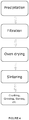
- Figure 4 illustrates the different steps in one way of producing raw HA.
- HA hydroxyapatite
- CSH calcium sulfate hemihydrate
- the present invention relates to hardenable bone substitutes comprising as the two major components passivated crystalline HA and CSH, where the bone substitute shows a faster setting time after passivation of the crystalline HA.
- HA present in the powders of the present invention have a slow resorption rate inside the body.
- solubility is mainly determined by the stoichiometry and the crystal size.
- the sintered HA powder should contain >90% crystalline HA, preferably 95% or more, such as 99%.
- crystalline hydroxyapatite when used in the present context thus means that the sintered HA consists of >90% crystalline HA, preferably 95% or more, such as 99% crystalline HA.
- a method for preparing passivated sintered crystalline hydroxyapatite (pHA) powder as well as the products obtainable by such method comprising providing a first sintered crystalline raw HA powder (for example a commercial available HA powder) and heating said powder from 300°C to 900°C for between 10 minutes and 10 hours preferably from 300°C to 600°C for between 1 and 4 hours.
- the heat treatment may be from 450°C to 550°C for between 11 ⁇ 2 and 21 ⁇ 2 hours, such as 500°C for 2 hours.
- the HA powder, raw or passivated has a crystalline content of >90%, preferably >95%, such as >99% after the sintering process, which takes place at a temperature above 900°C, for example between 900 and 1350 °C.
- the powder has a particle size of D(v,0.99) ⁇ 1000 ⁇ m, such as ⁇ 200 ⁇ m, preferably ⁇ 100 ⁇ m and more preferably ⁇ 50 ⁇ m, such as less than 35 ⁇ m.
- the specific surface area of the powder should preferable be below 20 m 2 /g, and more preferably below 10 m 2 /g, when measured according to the BET (Brunauer, Emmett and Teller) method, which is a method for the determination of the total surface area of a powder expressed in units of area per mass of sample (m 2 /g) by measurement of the volume of gas (usually N 2 ) adsorbed on the surface of a known weight of the powder sample.
- BET Brunauer, Emmett and Teller
- the temperature and duration of the heating step necessary for passivation may be influenced by several parameters including, but not limited to, the previous sintering conditions, how extensive the mechanical treatment has been, the type and means for micronization, the crucible used during passivation heating, how much powder to be passivated and how fast the oven reaches its passivation temperature and cools off. For example, in some cases the duration and/or temperature may be reduced if the mechanical treatment has not been extensive.
- the minimum duration of the heating step in the passivation can be experimentally determined, and depends on many factors, such as the temperature during passivation, the heating temperature during sintering and extent of mechanical treatment.
- the duration of the passivation heat-treatment is at least 10 minutes, and preferably at least 1 hour.
- the heating time is between 1 and 4 hours.
- the heat-treatment step is performed above 300 °C, above 400 °C, or above 500 °C.
- the passivation heat-treatment preferably is below 900 °C, such as below 800 °C or below 700 °C.
- Example 8 shows the effect of the heating temperature in passivation and the risk of having a too high temperature on the pH/buffering properties.
- the passivation temperature is between 300 and 600 °C.
- Example 6 It has also been found that the HA powder is less buffering after the passivation than before. Two examples that show this, with and without additives, are shown in Example 6. This effect may be used to monitor the passivation effect of the heat treatment.
- the heating step is e.g. from 300 °C to 600 °C for between 1 h and 4 h, e.g. from 400 °C to 600 °C for between 1 h and 4 h, e.g. from 450 °C to 550 °C for between 11 ⁇ 2 h and 21 ⁇ 2 h, e.g. 500 °C ⁇ 10 °C for 2 h ⁇ 15 min
- the passivated HA is further characterized by a method where the pH/buffering capacity is investigated by studying how the pH of the HA/water solution is changed when 100 ⁇ l 1 M HCl is added every 10 th second to the suspension..
- two hardenable bone substitute pastes comprising at least CSH, HA and an aqueous phase, wherein the only difference is the HA, which in one hardenable bone substitute is a first raw HA and in the other hardenable bone substitute it is the same raw HA, however after being passivated, for example after 2 hours at 500°C.
- the comparison should be performed under identical conditions.
- a reduction in setting time of at least 3 minutes should preferable be obtained by use of passivated HA compared to non-passivated raw HA.
- One way of determine the setting time may be by use of Gillmore needles, where both the initial setting time (IST) and final setting time (FST) are determined.
- Reduction in setting time of less than 3 minutes may be the result of an inadequate passivation treatment of the raw HA lot or because the raw HA lot remains practically inert without any setting retarding properties being introduced during the sintering and micronization process.
- passivation of the lot may reduce the setting time by more than 3 minutes, such as by 5 minutes or more, or by 10 minutes or more, compared to the use of the raw HA lot without passivation.
- the passivation of said first (raw) HA powder causes the setting time (both initial setting time (IST) and final setting time (FST), measured with e.g. Gillmore needles) for a hardenable bone substitute paste consisting of said passivated hydroxyapatite (pHA) powder, calcium sulfate powder and an aqueous liquid to be reduced, under identical conditions, by at least 3 minutes, such as 5 minutes or more, for example 10 minutes or more, compared to the setting time for the same paste, however comprising said first raw HA powder instead of said passivated HA powder.
- IST initial setting time
- FST final setting time
- the passivated HA can be used in powders for hardenable bone substitutes, and consequently it is an aspect of the present invention to provide a powder, which is ready to use in a hardenable bone substitute, comprising as the two major components passivated crystalline HA (pHA) as described herein and CSH.
- the expression "ready-to-use” means that the powder includes passivated HA (in contrast to raw un-passivated HA, and therefore prepared for use with a high chance of leading to acceptable setting times), such that only an aqueous liquid, e.g. water, needs to be added before use in a clinical treatment, such as in treatment of a disease in supportive tissue, typically involving surgery.
- the ready-to-use powder does not comprise an aqueous phase and is a dry powder.
- the CSH can exist in an alfa-CSH and a beta-CSH form.
- the CSH is alfa-CSH, as this crystal form often forms a stronger superstructure when mixed with an aqueous phase.
- CSH is the only component present in the powder that hardens by hydration.
- the passivated crystalline HA (pHA) is present as the major components in the ready-to-use powder, which means that these components are the two largest components when measured by weight percent (wt%). Accordingly, in one embodiment, the passivated crystalline HA (pHA) is present in the range of 20-80 wt% of the total weight of the powder components and the CSH is present in the range of 80-20 wt% of the total weight of the powder components.
- one or more accelerators are present in the ready-to-use powder, such as, e.g. in an amount of up to 10 wt% of the total weight of the powder components, which accelerator(s) will speed up the setting reaction of CSH by their presence and thus shorten the setting time.
- One such accelerator is calcium sulfate dihydrate (CSD).
- suitable salts for example inorganic salts, such as chloride and sulfate salts, for example sodium chloride.
- calcium sulfate dihydrate may constitutes up to 10 wt%, such as up to 5 wt%, 2 wt%, or 1 wt% of the total weight of the powder components.
- the powder components consists of 59.6 wt% alfa-CSH, 40.0 wt% passivated crystalline HA and 0.4 wt% calcium sulfate dihydrate.
- the ready-to-use powder consists of passivated HA in the range of 35-45 wt% of the total weight of the powder components, CSH in the range of 55-65 wt% of the total weight of the powder components, and calcium sulfate dihydrate in the range of 0-5 wt%, preferably 0-2 wt% of the total weight of the powder components and optionally up to 10 wt% of other components/additives.
- Such other components/additives may include, but are not limited to bioactive agents, organic and inorganic viscosity modifiers, such as starches, alginates, cellulose derivatives, and the like, and/or additives to accelerate/retard the setting of the calcium sulfate.
- methods for preparing hardenable bone substitutes using the passivated crystalline HA according to the present invention is provided as well as the use of passivated crystalline HA according to the present invention in the preparation of a hardenable bone substitute.
- the passivated crystalline HA according to the present invention and powders of the present invention comprising the passivated HA can be used in hardenable bone substitute pastes, such as for the manufacture of beads or any tailor-made forms for use in treatment of disorders of supportive tissue, or in the use as an injectable hardenable bone substitute paste for application to, e.g. injection at, the place of treatment of disorders of supportive tissue in a human or non-human patient.
- a hardenable bone substitute paste such as a hardenable bone substitute paste comprising the ready-to-use powder according to the present invention admixed with an aqueous liquid.
- the paste according to the present invention is made by mixing an aqueous liquid, which in its simplest form is water, together with the ready-to-use powder to prepare the paste.
- the final paste is made by adding one or more additives at different stages, such as dissolving the additive in the liquid prior to mixing with the powder and/or by delayed mixing as described in WO 2011/098438 .
- the mixing ratio for the powder and the aqueous phase is called the liquid-to-powder ratio (L/P).
- the L/P is in the range of 0.2-0.6 ml/g, such as between 0.3 and 0.5 ml/g.
- the L/P ratio is 0.43 ml/g or 0.5 ml/g.
- a lower L/P ratio such as between 0.2 and 0.4 ml/g can be employed to further reduce the IST and FST, however a lower L/P ratio may also reduce the injectability of the paste, something that is negative for several clinical applications.
- the aqueous liquid is water, and in other embodiments the aqueous phase comprises one or more suitable salt(s), such as a chloride or a sulfate salt, for example sodium chloride, a water soluble non-ionic X-ray contrast agent, and/or one or more bioactive agents.
- suitable salt(s) such as a chloride or a sulfate salt, for example sodium chloride, a water soluble non-ionic X-ray contrast agent, and/or one or more bioactive agents.
- sodium chloride acts as an accelerant of the calcium sulfate hydration, thereby contributing to a reduction in the IST/FST.
- water soluble non-ionic X-ray contrast agent is advantageous as it offers the possibility of monitoring the paste by X-ray during and right after the surgical procedure.
- suitable x-ray contrast agents are lohexol compounds as described in WO 03/05388 .
- Further suitable water soluble non-ionic X-ray contrast agents as well as their concentrations are given in WO 03/05388 .
- X-ray contrast agent is dissolved in pure water alone or together with suitable additives in the form of e.g. buffers and/or chelating agents.
- the liquid comprises Tris (tris(hydroxymethyl)aminomethane), HCl and calcium EDTA in addition to the X-ray agent, such as iohexol.
- kits for forming a hardenable bone substitute paste according to the present invention may comprise, in addition to the ready-to-use powder, a liquid solution, e.g. water comprising an X-ray agent and suitable additives, in a separate container or the agent and optionally additives may be in a container for being dissolved in the liquid prior to use.
- a liquid solution e.g. water comprising an X-ray agent and suitable additives
- Suitable water soluble non-ionic X-ray contrast agent may be selected from iohexol, iodixanol, ioversol, iopamidol, iotrolane, metrizamid, iodecimol, ioglucol, ioglucamide, ioglunide, iogulamide, iomeprol, iopentol, iopromide, iosarcol, iosimide, iotusal, ioxilane, iofrotal, and iodecol.
- biodegradable particles comprising biocompatible and biodegradable X-ray contrast agent, as disclosed in WO 2009/081169 , may be used to provide radiopacity in the bone substitute of the present invention. These particle are added to the ceramic powder prior to addition of the liquid.
- Biodegradable X-ray contrast agent particles may be cleavable, preferably enzymatically-cleavable, derivatives of a physiologically tolerable organoiodine X-ray contrast agent, or the biodegradable X-ray particles may be prepared from biodegradable polymers comprising biocompatible, organoiodine X-ray compounds.
- the biodegradable X-ray contrast agents can be considered to be water insoluble derivatives of the corresponding organoiodine compounds in the sense that cleavage (for example by the body's esterases) releases physiologically tolerable organoiodine compounds.
- biodegradable particles comprising biocompatible and biodegradable X-ray contrast agent
- the new biodegradable X-ray contrast agent will remain as intact particles in the cement matrix. Thereafter degradation of the contrast agent particles to water-soluble biocompatible organoiodine compounds will contribute to a beneficial osteoconductive, osteoinductive and resorbable macroporous structure of the bone substitute material.
- physiologically tolerable organoiodine compounds for use according to the invention include analogues of known ionic, non-ionic, monomeric or dimeric organoiodine X-ray contrast agents in which solubilising carboxylic groups are esterified with alcohols, hydroxyl groups are acylated (e.g. acetylated) or formed into 2,4-dioxacyclopentan-I-yl groups.
- Biodegradable X-ray particles may be selected from the group comprising cleavable derivatives of diatrizoic acid, iobenguane, iobenzamic acid, iobitriol, iocarmic acid, iocetamic acid, iodamide, iodipamide, iodixanol, iodized oil, iodoalphionic acid, p-iodianiline, o-iodobenzoic acid, iodochlorhydroxyquin, o-iodohippurate sodium, o-iodophenol, p-iodophenol, iodophthalein sodium, iodopsin, iodpyracet, iodopyrrole, iodoquinol, ioglycamic acid, iohexol, iomeglamic acid, iomeprol, iopamidol, iopanoic
- biodegradable polymers for inclusion of x-ray agent are; poly(lactic acid) (PLA), poly( ⁇ -caprolactone) (PCL), poly(glycolic acid) (PGA), poly(lactide-co-glycolide) (PLGA),poly(dioxanone), poly(glycolide-co-trimethylene carbonate), poly(vinyl alcohol) (PVA), poly(vinylpyrrolidine), poly(hydroxybutarates), poly(hydroxyvalerate), poly(sebaic acid-co-hexadecandioic acid anhydride), poly(trimethylene carbonate), poly(orthoester), poly(caprolactams), poly(acrylamides), poly(terphthalate), polyether block amides (PEBA), poly(urethane), polysaccarides like cellulose polymers, methylcellulose, carboxymethylcellulose, ethylcellulose, hydroxyethylcellulose, hydroxypropylmethylcellulose, natural polymers like alginates
- bioactive agents to the powder or aqueous phase will be able to give the hardenable bone substitutes further beneficial properties.
- one or more bioactive agent(s) is/are added to the aqueous phase, and in some embodiments these bioactive agents are selected from the group consisting of: antibiotics (including antifungal drugs), chemotherapeutics, vitamins, hormones, cytostatics, bisphosphonates, growth factors, proteins, peptides, bone marrow aspirate, platelet rich plasma and demineralized bone.
- antibiotics including antifungal drugs
- chemotherapeutics include chemotherapeutics, vitamins, hormones, cytostatics, bisphosphonates, growth factors, proteins, peptides, bone marrow aspirate, platelet rich plasma and demineralized bone.
- Silica, zirconium, strontium, and the like may be added to promote bone healing.
- a kit for forming a hardenable bone substitute paste according to the present invention may comprise, in addition to the ready-to-use powder, one or more containers containing the bioactive agent(s) to be added to the liquid solution prior to use or to the paste during use.
- the hardenable bone substitute may be effective in preventing or treating osteomyelitis.
- the bioactive agent is an antibiotic
- the hardenable bone substitute may be effective in preventing or treating osteomyelitis.
- antibiotics there is a great interest for adding antibiotics to bone substitutes in order to prevent bone infections in treated patients.
- previous tests in the laboratory have however shown that the addition of antibiotics affects the properties of the paste significantly, mainly by a prolonged setting time.
- the use of passivated crystalline HA according to the present invention has proven to be effective.
- antibiotic agent(s) belonging to the following groups may advantageously be part of the hardenable bone substitute according to the present invention: the group consisting of aminoglycoside antibiotics, the group consisting of penicillins, the group consisting of cephalosporins, rifampicin, clindamycin and the group consisting of antifungal drugs.
- the antibiotic agent(s) is/are selected from the list consisting of: gentamicin, vancomycin, tobramycin, cefazolin, rifampicin, clindamycin, nystatin, griseofulvin, amphotericin B, ketoconazole and miconazole.
- the aqueous phase comprises the antibiotic agent gentamicin sulfate, vancomycin hydrochloride and/or cefazolin.
- the hardenable bone substitutes according to the present invention ie with passivated HA
- the passivated HA is comprised in a ready-to-use hardenable bone substitute powder, which powder, after being mixed with a liquid is ready for use in clinical treatment, e.g. as part of a surgical treatment, in order to treat disorders of supportive tissue in a human or non-human subject by regenerating lost bone tissue and/or treating bone infections.
- disorders may be bone loss, bone fracture, bone trauma and/or osteomyelitis.
- the ready-to-use bone substitute powders according to the present invention as well as the one or more aqueous liquids for use in the preparation of the bone substitute paste can advantageously be provided as a kit, which is ready for use and requires a minimum of handling of the various components so as to obtain an optimal time and viscosity window for applying the hardenable bone substitute in form of an injectable paste to the patient and in order to minimize the introduction of bacteria from the surroundings.
- the present invention provides in another aspect of the invention a kit for preparing a hardenable bone substitute, comprising a ready-to-use powder according to the present invention placed in a combined mixing and injection device.
- a combined mixing and injection device Such combined mixing and injection devices (CMI devices) are known in the prior art, e.g. from WO 2005/122971 .
- the kit additionally comprises in one or more separate container(s), one or more aqueous solution(s) optionally comprising one or more accelerants and/or one or more bioactive agent(s) and/or one or more non-ionic X-ray contrast agent(s); and optionally instructions for use of said mixing and injection device.
- the accelerant(s), bioactive agent(s) and/or non-ionic X-ray contrast agent(s) or biodegradable X-ray particles may be included in the kit in separate containers.
- the kit may also comprise a combined mixing and injection device.
- the iohexol solutions used consist of water for injection (WFI), Iohexol, the buffer Trometamol (Tris: tris(hydroxymethyl)aminomethane), the chelating agent Edetate Calcium Disodium (calcium EDTA) and Hydrochloric acid (HCl).
- WFI water for injection
- Iohexol the buffer Trometamol
- Tris Tris(hydroxymethyl)aminomethane
- Edetate Calcium Disodium calcium EDTA
- HCl Hydrochloric acid
- the iohexol solutions meet the requirements stated in the US Pharmacopoeia for Iohexol Injection.
- the content of iohexol, trometamol and sodium calcium edetate meets each specific requirement according to standards.
- the saline solution consists of 0.9 wt % NaCl in water for injection (WFI).
- WFI water for injection
- the reason for having a solution comprising iohexol or similar X-ray agent as the liquid phase is to increase the radiopacity of the bone substitute material (see WO 03/053488 ).
- the powder for the hardenable bone substitute used in the presented examples consisted of 59.6 wt% ⁇ -CSH, 0.4 wt% CSD and 40.0 wt% HA, but the L/P ratio and type of liquid used to mix the samples varied.
- the method used to investigate the buffering capacity of the HA powders were based on that a slurry with 3.2 g HA powder in 32 g water was prepared. After the HA was mixed with water, 100 ⁇ l 1 M HCl was added every 10 seconds under continuously stirring. The pH was measured and noted during the whole procedure and the pH value right before the HCl additions started was denoted as the pH of the HA. If the HCl was to be added in pure water, a rapid decrease in pH could be expected, but the presence of HA powder will delay the decrease to different extents.
- Example 1 Differences in setting behavior of CSH/HA bone substitute depending on HA lot-to-lot variations
- a mixture of 59.6 wt % of synthetically produced CSH (particle size distribution: 0.1 - 80 ⁇ m and mean particle size ⁇ 9 ⁇ m), 40.0 wt % raw HA (different lots from same producer, see above) and 0.4 wt % of the accelerator CSD (synthetic: particle size distribution: 0.1-55 ⁇ m) were mixed with a liquid phase containing iohexol (180 mg l/mL).
- 30 g of the ceramic powder mixture was mixed with 15 mL iohexol solution (i.e. a liquid-to-powder ratio of 0.5 mL/g). The mixing was conducted for 30 seconds using a specially designed mixing and injection device ( WO 2005/122971 ).
- the setting behavior of the obtained paste was evaluated using Gillmore needles (ASTM C266).
- Example 2 Extended variations in setting behavior of CSH/HA bone substitutes when antibiotics are present
- the goal with the study was to evaluate the effect on the setting time of the CSH/HA bone substitute, containing different HA lots, when the antibiotic vancomycin was added to the system.
- 500 mg vancomycin (as vancomycin hydrochloride) was dissolved in the liquid phase prior to mixing with the ceramic powders.
- a mixture of 59.6 wt % synthetically produced CSH (particle size distribution: 0.1 - 80 ⁇ m and mean particle size ⁇ 9 ⁇ m), 40.0 wt % raw HA (different lots from the same producer, see above) and 0.4 wt % of the accelerator CSD (synthetic: particle size distribution: 0.1-55 ⁇ m) were mixed with a liquid phase containing iohexol (180 mg l/mL).
- 18.5 g of the ceramic powder mixture was mixed with 8 mL liquid (either pure iohexol solution or iohexol solution premixed with vancomycin, see above), which gave a liquid-to-powder ratio of 0.43 mL/g).
- the mixing was conducted for 30 seconds using a specially designed mixing and injection device ( WO 2005/122971 ).
- the setting behavior of the obtained paste was evaluated using Gillmore needles ASTM C266.
- the first type of ceramic bone substitute consisted only of a mixture of 99.3 wt% synthetically produced CSH (particle size distribution: 0.1 - 80 ⁇ m and mean particle size ⁇ 7 ⁇ m) and 0.67 wt % of the accelerator CSD (synthetic: particle size distribution: 0.1-55 ⁇ m).
- CSH particle size distribution: 0.1 - 80 ⁇ m and mean particle size ⁇ 7 ⁇ m
- accelerator CSD synthetic: particle size distribution: 0.1-55 ⁇ m
- the second type of bone substitute raw HA was also present (59.6 wt % CSH, 40 wt % HA and 0.4 wt % CSD).
- the raw HA powder was commercial and had been sintered at 1275 ⁇ 50°C for 4 hours and thereafter micronized.
- the particle size distribution was 0.1-40 ⁇ m with a mean particle size of ⁇ 7 ⁇ m.
- the liquid phase contained either only the iohexol solution or iohexol solutions with 1 g of the antibiotic (either vancomycin or gentamicin sulfate) dissolved.
- the mixing of the ceramic powders (either containing HA or not) and the iohexol solution (either containing the antibiotic or not) was conducted for 30 seconds using a specially designed mixing and injection device ( WO 2005/122971 ).
- the setting behavior of the obtained paste was evaluated using Gillmore needles.
- HA powders were either raw HA or raw HA that had been additionally heat treated at 500° C for 2 hours (pHA).
- the ceramic powder mixture consisted of 59.6 wt % synthetically produced CSH (particle size distribution: 0.1 - 80 ⁇ m and mean particle size ⁇ 9 ⁇ m), 40.0 wt % HA (either raw or passivated) and 0.4 wt % of the accelerator CSD (synthetic: particle size distribution: 0.1-55 ⁇ m).
- the ceramic powder was mixed with a liquid phase containing iohexol (180 mg l/mL). 18.5 g of the ceramic powder mixture was mixed with 8 mL iohexol solution (ie a liquid-to-powder ratio of 0.43 mL/g). The mixing was conducted for 30 s using a specially designed mixing and injection device ( WO 2005/122971 ). The setting behavior of the obtained paste was evaluated using Gillmore needles.
- the setting times of bone substitutes containing different HA lots before and after passivation are presented.
- the setting times of the CSH/HA pastes containing the three lots of HA gave initial setting times in the range of 27-39 min when the HA powders has not been passivated and therefore exceed clinical relevant values.
- the initial setting time decreased to approximately 10 minutes, i.e. approximately 1/3 of the initial values. All three lots of HA gave after the passivation the same (clinical relevant) performance of the bone substitute paste.
- the ceramic powder mixture consisted of 59.6 wt % synthetically produced CSH (particle size distribution: 0.1 to 80 ⁇ m and mean particle size ⁇ 9 ⁇ m), 40.0 wt % raw HA (of any of the types described above) and 0.4 wt % of the accelerator CSD (synthetic: particle size distribution: 0.1-55 ⁇ m).
- the ceramic powder was mixed with a liquid phase containing iohexol (300 mg l/mL). 3.0 g of the ceramic powder mixture was mixed with 1.5 mL iohexol solution (i.e. a liquid-to-powder ratio of 0.5 mL/g). The mixing of these small samples was conducted for 60 seconds using a spoon in a beaker. The setting behavior of the obtained paste was evaluated using Gillmore needles ASTM C266.
- the HA that had been milled after the sintering and after sintering and heat-treatment step retarded the calcium sulfate setting much more than the unmilled HA and the HA that had undergone a heat-treatment after the ball milling.
- the results show that the ball milling step of HA causes its retarding effect on the CSH/HA bone substitute. This supports the theory that the mechanical forces applied to the HA during the milling is responsible for the retardation of the calcium sulfate.
- the sample with the HA before passivation has a greater resistance to a change in pH when adding HCl than the sample with the passivated HA has.
- the same HA lot was used in both measurements presented, but in the first, the HA powder was passivated in 500 °C for 1 hour and in the second in 500 °C for two hours.
- a commercial, sintered (1275°C for 4 h) and micronized raw HA powder (particle size distribution: 0.1-20 ⁇ m, mean particle size ⁇ 3 ⁇ m) was heat treated at different temperatures (400-600°C) and times (1-3 hours) and then mixed in the ceramic powder mixture in order to evaluate the effect on the setting of the CSH based paste.
- a ceramic powder mixture consisted of 59.6 wt % synthetically produced CSH (particle size distribution from 0.1 - 80 ⁇ m and mean particle size ⁇ 9 ⁇ m), 40.0 wt % HA (passivated by heating as described above) and 0.4 wt % of the accelerator CSD (synthetic: particle size distribution: 0.1-55 ⁇ m).
- 18.5 g of the ceramic powder mixture was mixed with 8 mL iohexol solution (180 mg l/mL), i.e. a liquid-to-powder ratio of 0.43 mL/g.
- the mixing was conducted for 30 seconds using a specially designed mixing and injection device ( WO 2005/122971 ).
- the setting behavior of the obtained paste was evaluated using Gillmore needles.
- results in the table below show how the setting times of a calcium sulfate based bone substitute varied when the same lot of HA, but with different heat-treatments, were used.
- the retardering effect of the HA powder on the CSH setting time decreases when the temperature as well as the duration time of the heat treatment is increased.
- a commercial, sintered (1275°C for 4 hours) and micronized raw HA powder (particle size distribution: 0.1-20 ⁇ m, mean particle size ⁇ 5 ⁇ m) was heat treated at different temperatures (between 120 - 900 °C for 10 hours). The lot was identified to have too long setting time properties in a test according to example 1.
- the pH/buffering test showed that the heat treatment up to 360° C did not affect the pH/buffering performance for this tested lot, but when the temperature was increased up to 900°C (for 10 h) it had an effect on the powder.
- the HA powder which had been heat treated at 900 °C for 10 h had an increase in pH and also a higher buffering capacity (more acid had to be added to decrease the pH).
- a mixture of 59.6 wt % of synthetically produced SCH (particle size distribution: 0.1 - 80 ⁇ m and mean particle size ⁇ 9 ⁇ m), 40.0 wt % HA (prepared as described above) and 0.4 wt % of the accelerator CSD (synthetic: particle size distribution: 0.1-55 ⁇ m) were mixed with a liquid phase containing iohexol (300 mg l/mL). 3.0 g of the ceramic powder mixture was mixed with 1.5 mL iohexol solution (i.e. a liquid-to-powder ratio of 0.5 mL/g). The mixing of these small samples was conducted for 60 seconds using a spoon in a beaker. The setting behavior of the obtained paste was evaluated using Gillmore needles.
- the table below shows how the pH and buffering capacity was affected by the heat-treatment of the same HA lot from 120 to 900 °C.
- the variation in the setting time of CSH/HA bone substitutes with a HA lot treated at the different temperatures is also shown in the table.
- the results showed that the retarding effect the raw HA powder has on the calcium sulfate setting time is decreased when the temperature used in the heat treatment step of the raw HA is increased.
- a too high temperature (and too long time) could result in undesired properties of the HA regarding its pH/buffering properties.
- Passivation temp Duration of pass is also shown in the table.
- Example 9 Additions of the antibiotic Cefazolin to CSH/HA based bone substitutes containing HA powder before and after passivation
- the ceramic powder mixture consisted of 59.6 wt % synthetically produced SCH (particle size distribution: 0.1 - 80 ⁇ m and mean particle size ⁇ 9 ⁇ m), 40.0 wt % HA (either raw or passivated as described above) and 0.4 wt % of the accelerator calcium sulfate dihydrate (synthetic: particle size distribution: 0.1-55 ⁇ m).
- the ceramic powder was mixed with a liquid phase containing iohexol (180 mg l/mL) and 1 g of cefazolin (corresponding to 5.4 wt% of the ceramic powder phase).
- 18.5 g of the ceramic powder mixture was mixed with 8 mL iohexol/cefazolin solution (i.e. a liquid-to-powder ratio of 0.43 mL/g).
- the mixing was conducted for 30 seconds using a specially designed mixing and injection device ( WO 2005/122971 ).
- the setting behavior of the obtained paste was evaluated using Gillmore
- the table below shows the effect of the antibiotic cefazolin on the same bone substitute system depending on whether the HA had been passivated or not.
- the results show that passivation of the raw HA has a large impact on the setting performance when the antibiotic cefazolin is present. Without passivation, the initial setting time was close to one hour, but decreased to ⁇ 10 minutes when the raw HA powder had been passivated at 500°C for 2 hours.
- Example 10 The large impact the passivation of the raw HA has on the setting behavior when the antibiotic Gentamicin is added to the CSH/HA bone substitute.
- the ceramic powder mixture consisted of 59.6 wt % synthetically produced SCH (particle size distribution: 0.1 - 40 ⁇ m and mean particle size ⁇ 5 ⁇ m), 40.0 wt % hydroxyapatite (either raw or passivated as described above) and 0.4 wt % of the accelerator CSD (synthetic: particle size distribution: 0.1-55 ⁇ m).
- the ceramic powder was mixed with a liquid phase consisting of gentamicin sulfate dissolved in saline. 6.3 g of the ceramic powder mixture was mixed with 2.7 mL of the saline/gentamicin solution (i.e. a liquid-to-powder ratio of 0.43 mL/g). 128 mg gentamicin sulfate (1.4 wt% based on the paste and 2.0 wt% based on the ceramic powder) was present in each sample.
- the mixing of the small samples was conducted for 30 seconds using a spoon in the beaker.
- the setting behavior of the obtained paste was evaluated using Gillmore needles.
- the table below shows the setting times for compositions containing the same lots and proportions of calcium sulfate, liquid and Gentamicin sulfate, but different HA lots before and after passivation at 500 °C for 2 hours. Almost all compositions gave clinically irrelevant setting times when HA without passivation was used, but after passivation, the setting times were decreased to relevant values and there were only small differences in the results no matter which lot of HA had been used.
- the example shows that without passivation only one of 9 lots of HA gave acceptable setting properties of this specific system with gentamicin added (acceptance criteria of initial setting ⁇ 15 min), whereas after the passivation all 9 of the HA samples could be used.
- compositions with Gentamicin and HA lot Before passivation Passivated (500°C 2h) IST [min] FST [min] IST [min] FST [min] A 11.0 ⁇ 0 15.0 ⁇ 0 8.0 ⁇ 0 11.0 ⁇ 0 B 29.0 ⁇ 1.7 >60 8.0 ⁇ 0 11.5 ⁇ 0 C 27.0 ⁇ 0 >60 10.0 ⁇ 2.6 19.0 ⁇ 0 D 16.0 ⁇ 0 27.0 ⁇ 0 11.0 ⁇ 0 15.0 ⁇ 0 E 23.0 ⁇ 3.5 >60 8.0 ⁇ 0 10.3 ⁇ 0.6 F 37.0 ⁇ 0 >60 9.0 ⁇ 0 15.0 ⁇ 0 G 23.3 ⁇ 2.3 49.0
- Example 11 The large impact the passivation of the HA has on the setting behavior when the antibiotic vancomycin is added to the CSH/HA bone substitute.
- the ceramic powder mixture consisted of 59.6 wt % of synthetically produced CSH (particle size distribution: 0.1 - 80 ⁇ m and mean particle size ⁇ 9 ⁇ m), 40.0 wt % hydroxyapatite (either raw or passivated as described above) and 0.4 wt % of the accelerator CSD (synthetic: particle size distribution: 0.1-55 ⁇ m).
- the ceramic powder was mixed with a liquid phase consisting of iohexol solution (180 mg l/mL) with the antibiotic vancomycin predissolved (500 mg vancomycin corresponding to 2.7 wt% of the powder weight).
- the table below shows the setting times for compositions containing the same lots and proportions of CSH, CSD, liquid and vancomycin hydrochloride, but different HA lots before and after passivation at 500 °C for 2 hours. All compositions gave clinically irrelevant setting times when the raw HA was used before the passivation, but after passivation, the setting times were decreased to relevant values. The results show that if the HA is used without heat-treatment (raw HA) the setting is strongly retarded, whereas if the raw HA powder is heat treated, the setting of the CSH/HA paste is significantly shorter.
- compositions with Vancomycin and HA lot Before passivation Passivated (500°C 2h) IST [min] FST [min] IST [min] FST [min] A >60 >60 18.0 ⁇ 0 31.0 ⁇ 0 B >60 >60 12.0 ⁇ 0 23.3 ⁇ 0.6 C >60 >60 11.0 ⁇ 0 18.0 ⁇ 0
- Example 12 Different storage stability of "raw” and passivated HA
- a commercial, sintered (1275°C for 4 hours) and micronized raw HA powder (particle size distribution: 0.1-40 ⁇ m, mean particle size ⁇ 7 ⁇ m) was investigated in the study.
- the powder was either used as raw HA or after additional heat treatment at 500°C for 2 hours (i.e. passivated).
- the raw HA lot was selected after an initial pre-test as described in example 1, since the resulting CSH/HA bone substitute gave acceptable setting results.
- the two types of HA powders were placed in a humid environment (95-100 % RH) at room temperature for two weeks in order to investigate the stability against moisture. Thereafter they were used in the CSH/HA bone substitute and the setting performance of the different pastes were evaluated.
- the ceramic powder mixture consisted of 59.6 wt % synthetically produced CSH (particle size distribution: 0.1 - 80 ⁇ m and mean particle size ⁇ 9 ⁇ m), 40.0 wt % hydroxyapatite (either raw or passivated as described above) and 0.4 wt % of the accelerator CSD (synthetic: particle size 0.1-55 ⁇ m).
- the ceramic powder was mixed with a liquid phase consisting of an iohexol solution. 11.6 g of the ceramic powder mixture was mixed with 5 mL iohexol solution (180 mg l/mL), i.e. a liquid-to-powder ratio of 0.43 mL/g.
- the mixing was conducted for 30 seconds using a specially designed mixing and injection device ( WO 2005/122971 ).
- the setting behavior of the obtained paste was evaluated using Gillmore needles.
- the table below shows the setting times achieved for the hardenable bone substitutes before and after the HA had been stored in the humid environment.
- storage of the raw HA in a humid environment resulted in more prolonged setting times when used in the hardenable CSH/HA bone substitute compared to when passivated HA was stored and used. If the HA was not been passivated, the setting of the CS/HA paste is retarded. These results indicate that the passivated HA is more resistant towards storage.
Landscapes
- Health & Medical Sciences (AREA)
- Life Sciences & Earth Sciences (AREA)
- Chemical & Material Sciences (AREA)
- Veterinary Medicine (AREA)
- Public Health (AREA)
- General Health & Medical Sciences (AREA)
- Animal Behavior & Ethology (AREA)
- Epidemiology (AREA)
- Medicinal Chemistry (AREA)
- Engineering & Computer Science (AREA)
- Dermatology (AREA)
- Biomedical Technology (AREA)
- Oral & Maxillofacial Surgery (AREA)
- Transplantation (AREA)
- Inorganic Chemistry (AREA)
- Pharmacology & Pharmacy (AREA)
- Molecular Biology (AREA)
- Chemical Kinetics & Catalysis (AREA)
- Botany (AREA)
- Organic Chemistry (AREA)
- Orthopedic Medicine & Surgery (AREA)
- Urology & Nephrology (AREA)
- Zoology (AREA)
- Bioinformatics & Cheminformatics (AREA)
- General Life Sciences & Earth Sciences (AREA)
- Geology (AREA)
- Vascular Medicine (AREA)
- Environmental & Geological Engineering (AREA)
- Hematology (AREA)
- Neurosurgery (AREA)
- Ceramic Engineering (AREA)
- Proteomics, Peptides & Aminoacids (AREA)
- Immunology (AREA)
- Gastroenterology & Hepatology (AREA)
- Physical Education & Sports Medicine (AREA)
- Nuclear Medicine, Radiotherapy & Molecular Imaging (AREA)
- General Chemical & Material Sciences (AREA)
- Rheumatology (AREA)
- Materials For Medical Uses (AREA)
- Pharmaceuticals Containing Other Organic And Inorganic Compounds (AREA)
Priority Applications (2)
| Application Number | Priority Date | Filing Date | Title |
|---|---|---|---|
| EP14706531.2A EP2958603B1 (en) | 2013-02-20 | 2014-02-20 | Improved setting of hardenable bone substitute |
| PL14706531T PL2958603T3 (pl) | 2013-02-20 | 2014-02-20 | Ulepszone zestalanie utwardzalnego materiału zastępczego kości |
Applications Claiming Priority (4)
| Application Number | Priority Date | Filing Date | Title |
|---|---|---|---|
| US201361766820P | 2013-02-20 | 2013-02-20 | |
| EP13155895 | 2013-02-20 | ||
| EP14706531.2A EP2958603B1 (en) | 2013-02-20 | 2014-02-20 | Improved setting of hardenable bone substitute |
| PCT/EP2014/053330 WO2014128217A1 (en) | 2013-02-20 | 2014-02-20 | Improved setting of hardenable bone substitute |
Publications (2)
| Publication Number | Publication Date |
|---|---|
| EP2958603A1 EP2958603A1 (en) | 2015-12-30 |
| EP2958603B1 true EP2958603B1 (en) | 2018-03-28 |
Family
ID=47747469
Family Applications (1)
| Application Number | Title | Priority Date | Filing Date |
|---|---|---|---|
| EP14706531.2A Active EP2958603B1 (en) | 2013-02-20 | 2014-02-20 | Improved setting of hardenable bone substitute |
Country Status (14)
| Country | Link |
|---|---|
| US (3) | US10294107B2 (enExample) |
| EP (1) | EP2958603B1 (enExample) |
| JP (1) | JP6352947B2 (enExample) |
| KR (1) | KR102024692B1 (enExample) |
| CN (1) | CN105120908B (enExample) |
| AU (1) | AU2014220664B2 (enExample) |
| BR (1) | BR112015019981B8 (enExample) |
| CA (1) | CA2901528C (enExample) |
| DK (1) | DK2958603T3 (enExample) |
| ES (1) | ES2671122T3 (enExample) |
| PL (1) | PL2958603T3 (enExample) |
| PT (1) | PT2958603T (enExample) |
| TR (1) | TR201807495T4 (enExample) |
| WO (1) | WO2014128217A1 (enExample) |
Families Citing this family (14)
| Publication number | Priority date | Publication date | Assignee | Title |
|---|---|---|---|---|
| WO2016007080A1 (en) * | 2014-07-10 | 2016-01-14 | Bone Support Ab | Injectable bone substitutes for augmenting implant fixation |
| US20180055969A1 (en) | 2015-03-23 | 2018-03-01 | Bone Support Ab | Biphasic ceramic bone substitute |
| US11331191B2 (en) | 2015-08-12 | 2022-05-17 | Howmedica Osteonics Corp. | Bioactive soft tissue implant and methods of manufacture and use thereof |
| DK3359209T4 (en) | 2015-10-05 | 2025-06-30 | Embios Gmbh | Compositions and methods for treatment of bone defects |
| US10850113B2 (en) | 2016-07-27 | 2020-12-01 | Medtronic, Inc. | Cardiac electrical signal morphology and pattern-based T-wave oversensing rejection |
| BR112019020465B1 (pt) * | 2017-03-31 | 2023-04-25 | Mitsui Chemicals, Inc | Composição para reparo de tecido duro e kit para reparo de tecido duro |
| WO2019048697A1 (en) | 2017-09-11 | 2019-03-14 | Bone Support Ab | MACROPOROUS AND MICROPOROUS COMPOSITE CRYOGEL BIOMATERIAL FOR USE IN BONE REGENERATION |
| CN107899082A (zh) * | 2017-11-27 | 2018-04-13 | 山东明德生物医学工程有限公司 | 一种人工骨及制备方法 |
| WO2019206677A1 (en) * | 2018-04-23 | 2019-10-31 | Seagles Ab | Novel treatment approach by targeted delivery of bioactive molecules bio modulated ceramics |
| US11857558B2 (en) * | 2018-09-14 | 2024-01-02 | Angelus Indústria De Produtos Odontológicos S/a | Dental and medical compositions having a multiple source of metallic ions |
| EP4096730B1 (en) * | 2020-01-31 | 2024-08-07 | Wright Medical Technology, Inc. | Improved bone graft substitute formulation |
| CN113307242A (zh) * | 2021-06-15 | 2021-08-27 | 辽宁工程技术大学 | 一种羟基磷灰石纳米棒的制备方法 |
| WO2023166161A1 (en) * | 2022-03-04 | 2023-09-07 | Moroxite I Ab | Novel combination treatment regimen of bacterial infections |
| AU2023255057B2 (en) * | 2022-12-06 | 2025-03-13 | Heraeus Medical Gmbh | Use of a composite material |
Family Cites Families (204)
| Publication number | Priority date | Publication date | Assignee | Title |
|---|---|---|---|---|
| US949163A (en) | 1909-07-07 | 1910-02-15 | Bridgeport Brass Co | Grease-gun. |
| US1644173A (en) | 1923-02-01 | 1927-10-04 | Bassick Mfg Co | Lubricating apparatus |
| US1865912A (en) | 1930-03-25 | 1932-07-05 | Horn William | Oil well agitator |
| US2545017A (en) | 1947-06-02 | 1951-03-13 | Gordon D Billingsley | Hypodermic syringe |
| US3367783A (en) | 1966-03-23 | 1968-02-06 | Gerber Prod | Process of preparing a fruit gel |
| US3475010A (en) | 1968-04-24 | 1969-10-28 | Prod Res & Chem Corp | Dispensing cartridge for intermixing separate ingredients |
| US3570719A (en) | 1968-07-02 | 1971-03-16 | Louis Schiff | Reagent mixing and dispensing apparatus |
| US3688765A (en) | 1969-10-03 | 1972-09-05 | Jack S Gasaway | Hypodermic injection device |
| US3837379A (en) | 1973-05-14 | 1974-09-24 | East West Med Prod | Irrigator liquid supply system |
| CH608189A5 (enExample) | 1974-12-13 | 1978-12-29 | Savac Ag | |
| US3965910A (en) | 1975-04-28 | 1976-06-29 | Walpak Company | Urinary irrigation valve |
| CH626873A5 (enExample) | 1977-03-28 | 1981-12-15 | Bracco Ind Chimica Spa | |
| US4240425A (en) | 1978-10-23 | 1980-12-23 | American Hospital Supply Corporation | Syringe with plug type needle hub lock |
| IT1207226B (it) | 1979-08-09 | 1989-05-17 | Bracco Ind Chimica Spa | Derivati dell'acido 2,4,6-triiodo-isoftalico, metodo per la loro preparazione e mezzi di contrasto che li contengono. |
| US4338925A (en) | 1979-12-20 | 1982-07-13 | Jo Miller | Pressure injection of bone cement apparatus and method |
| US4269331A (en) | 1980-02-15 | 1981-05-26 | Watson John D | Metered dispensing device |
| US4496342A (en) | 1981-03-20 | 1985-01-29 | Surgical Design Corporation | Surge prevention system for an ophthalmic instrument |
| DE3206911A1 (de) | 1982-02-26 | 1983-09-15 | Lohmann Tierernährung GmbH, 2190 Cuxhaven | Biochemischer wirkstoff, dessen herstellung und diesen wirkstoff enthaltendes mittel |
| US4518430A (en) | 1982-04-29 | 1985-05-21 | American Dental Association Health Foundation | Dental resptorative cement pastes |
| US4439420A (en) | 1982-11-16 | 1984-03-27 | Ethicon, Inc. | Absorbable hemostatic composition |
| US4612053A (en) | 1983-10-06 | 1986-09-16 | American Dental Association Health Foundation | Combinations of sparingly soluble calcium phosphates in slurries and pastes as mineralizers and cements |
| US4584401A (en) | 1983-10-20 | 1986-04-22 | Biophysica Foundation | Methods and compositions involving polyhydroxylated polyiodo non-ionic contrast media |
| US4619655A (en) | 1984-01-26 | 1986-10-28 | University Of North Carolina | Plaster of Paris as a bioresorbable scaffold in implants for bone repair |
| US4583974A (en) | 1984-04-04 | 1986-04-22 | Kokernak Denis T | Syringe for balloon dilation catheters |
| DK350584A (da) | 1984-07-18 | 1986-01-19 | Arne Bent Sjoegren | Blandepumpe til effektiv blanding (homogenisering) af to eller flere vaesker (luftarter) med et konstant, men regulerbart, blandingsforhold |
| SE450545B (sv) | 1984-10-19 | 1987-07-06 | Mit Ab | Forfarande och anordning vid framstellning av bencement for fixering av proteser |
| GB8516344D0 (en) | 1985-06-28 | 1985-07-31 | Brunold C R | Mixing apparatus & processes |
| US4676655A (en) | 1985-11-18 | 1987-06-30 | Isidore Handler | Plunger type cartridge mixer for fluent materials |
| WO1987005521A1 (en) | 1986-03-11 | 1987-09-24 | University Of Medicine And Dentistry Of New Jersey | Moldable bone implant material |
| US4752479A (en) | 1986-05-27 | 1988-06-21 | Ciba-Geigy Corporaton | Multi vitamin and mineral dietary supplement with controlled release bioavailable iron |
| DE3854067T2 (de) | 1987-02-20 | 1996-01-25 | Draenert Klaus | Saugdrainage-knochenschraube. |
| ES2007350A6 (es) | 1987-05-29 | 1989-06-16 | Ganadera Union Ind Agro | Productos alimenticios enriquecidos con nucleosidos yno nucleotidos para la nutricion infantil y de adultos, y procedimiento para su preparacion. |
| JPS6422256A (en) | 1987-07-20 | 1989-01-25 | Dainippon Toryo Kk | Medical or dental curable composition |
| JPS6422257A (en) | 1987-07-20 | 1989-01-25 | Dainippon Toryo Kk | Medical or dental curable composition |
| DE3731542A1 (de) | 1987-09-17 | 1989-03-30 | Schering Ag | Neue dicarbonsaeure-bis(3,5-dicarbamoyl-2,4,6-triiod-anilide), verfahren zu deren herstellung sowie diese enthaltende roentgenkontrastmittel |
| GB8724897D0 (en) | 1987-10-23 | 1987-11-25 | Downes S | Material |
| JPH0684289B2 (ja) | 1987-11-26 | 1994-10-26 | 株式会社トクヤマ | ワンペーストタイプ修復材 |
| US5962028A (en) | 1988-04-20 | 1999-10-05 | Norian Corporation | Carbonated hydroxyapatite compositions and uses |
| US5605885A (en) | 1988-05-05 | 1997-02-25 | Entremed, Inc. | Method for stimulating the immune system |
| SE462315B (sv) | 1989-05-03 | 1990-06-11 | Surgitec Ab | Anordning foer tillverkning av bencement |
| WO1991000252A1 (en) | 1989-06-30 | 1991-01-10 | United States Gypsum Company | Calcium sulfate hemihydrate composition having utility in the presence of blood |
| GB8919929D0 (en) | 1989-09-04 | 1989-10-18 | Nycomed As | Compositions |
| SE464912B (sv) | 1989-10-25 | 1991-07-01 | Bioapatite Ab | Implantationsmaterial foer aaterstaellning av benvaevnad samt saett foer dess tillverkning |
| US5236456A (en) | 1989-11-09 | 1993-08-17 | Osteotech, Inc. | Osteogenic composition and implant containing same |
| IT1236864B (it) | 1989-12-29 | 1993-04-22 | Tecres Spa | Procedimento per miscelare e somministrare direttamente in loco un cemento osseo a due componenti, e dispositivo che lo realizza |
| US5071040A (en) | 1990-03-09 | 1991-12-10 | Pfizer Hospital Products Group, Inc. | Surgical adhesives mixing and dispensing implement |
| WO1991017722A1 (en) | 1990-05-11 | 1991-11-28 | Lifecore Medical, Inc. | Rapid setting hydroxylapatite and plaster formulation |
| US5168757A (en) | 1990-05-15 | 1992-12-08 | Ryder International Corporation | Fluid displacement and pressurizing device |
| US5269785A (en) | 1990-06-28 | 1993-12-14 | Bonutti Peter M | Apparatus and method for tissue removal |
| US5990382A (en) | 1990-08-29 | 1999-11-23 | Biomedical Enterprises, Inc. | Method and implant for surgical manipulation of bone |
| US6080801A (en) | 1990-09-13 | 2000-06-27 | Klaus Draenert | Multi-component material and process for its preparation |
| US5149368A (en) | 1991-01-10 | 1992-09-22 | Liu Sung Tsuen | Resorbable bioactive calcium phosphate cement |
| JPH04265214A (ja) * | 1991-02-18 | 1992-09-21 | Kanebo Ltd | ヒドロキシアパタイトの製造方法 |
| US5262166A (en) | 1991-04-17 | 1993-11-16 | Lty Medical Inc | Resorbable bioactive phosphate containing cements |
| US5462722A (en) | 1991-04-17 | 1995-10-31 | Liu; Sung-Tsuen | Calcium phosphate calcium sulfate composite implant material |
| US5232024A (en) | 1991-05-30 | 1993-08-03 | Eli Williams | Slide-valve manifold |
| DE69205736T2 (de) | 1991-06-26 | 1996-06-13 | Nitta Gelatin Kk | Härtbares kalziumphosphathaltiges Material zum Reparieren von lebenden Hartgeweben. |
| JPH0734816B2 (ja) | 1991-06-26 | 1995-04-19 | 新田ゼラチン株式会社 | 医科用および歯科用硬化性材料 |
| DE4121043A1 (de) | 1991-06-26 | 1993-01-07 | Merck Patent Gmbh | Knochenersatzmaterial mit fgf |
| SE501676C2 (sv) | 1992-01-22 | 1995-04-10 | Pharmacia Ab | Läkemedelsdoserande anordning |
| US5281265A (en) | 1992-02-03 | 1994-01-25 | Liu Sung Tsuen | Resorbable surgical cements |
| SE510490C2 (sv) | 1992-02-07 | 1999-05-31 | Scandimed International Ab | Förfarande för framställning av bencement och anordning för genomförande av förfarandet |
| CA2103683C (en) | 1992-08-17 | 1998-06-16 | George Weeks | Methods of controlling dust and compositions produced thereby |
| IT1256248B (it) | 1992-12-24 | 1995-11-29 | Bracco Spa | Formulazioni iniettabili acquose per radiodiagnostica comprendenti miscele di composti aromatici iodurati utili come agenti opacizzanti ai raggi x |
| US5403318A (en) | 1993-01-15 | 1995-04-04 | Boehringer Laboratories, Inc. | Apparatus and method for shaping bone |
| JP3472970B2 (ja) * | 1993-12-10 | 2003-12-02 | 株式会社アドバンス | 生体埋め込み材料の製造方法 |
| JPH078549A (ja) * | 1993-06-28 | 1995-01-13 | Mitsuo Kondo | 医療用リン酸カルシウム |
| SE510491C2 (sv) | 1993-08-18 | 1999-05-31 | Coripharm Gmbh & Co | Cement för medicinskt bruk samt framställning och användning av cementet |
| US5328462A (en) | 1993-09-03 | 1994-07-12 | Ultradent Products, Inc. | Methods and apparatus for mixing and dispensing multi-part compositions |
| US5665066A (en) | 1993-09-03 | 1997-09-09 | Ultradent Products, Inc. | Methods and apparatus for mixing and dispensing multi-part compositions |
| US5385887A (en) | 1993-09-10 | 1995-01-31 | Genetics Institute, Inc. | Formulations for delivery of osteogenic proteins |
| US5681873A (en) | 1993-10-14 | 1997-10-28 | Atrix Laboratories, Inc. | Biodegradable polymeric composition |
| US5360823A (en) | 1993-11-02 | 1994-11-01 | Dawe's Inc. | Anionic salt formulation for milk fever |
| EP0657208A1 (de) | 1993-12-08 | 1995-06-14 | Allo Pro Ag | Vorrichtung zum Mischen von einem Mehrkomponentenzement und Verfahren zum Durchführen des Mischvorganges |
| US6248110B1 (en) | 1994-01-26 | 2001-06-19 | Kyphon, Inc. | Systems and methods for treating fractured or diseased bone using expandable bodies |
| US6716216B1 (en) | 1998-08-14 | 2004-04-06 | Kyphon Inc. | Systems and methods for treating vertebral bodies |
| DE4409610C3 (de) | 1994-03-21 | 2001-09-20 | Scandimed Internat Ab Sjoebo | Mischvorrichtung |
| DE4425218A1 (de) | 1994-07-16 | 1996-01-18 | Merck Patent Gmbh | Vorrichtung zum Mischen und Austragen von Knochenzement |
| US6075067A (en) | 1994-08-15 | 2000-06-13 | Corpipharm Gmbh & Co | Cement for medical use, method for producing the cement, and use of the cement |
| DE4433201A1 (de) | 1994-09-17 | 1996-03-21 | Merck Patent Gmbh | Verfahren zur Herstellung von wirkstoffhaltigen Knochenzementen |
| DE4435680A1 (de) | 1994-10-06 | 1996-04-11 | Merck Patent Gmbh | Poröse Knochenersatzmaterialien |
| US5569442A (en) | 1994-11-04 | 1996-10-29 | Norian Corporation | Reactive tricalcium phosphate compositions and uses |
| US5616120A (en) | 1995-02-06 | 1997-04-01 | Andrew; Mark S. | Method and apparatus for lenticular liquefaction and aspiration |
| US5614206A (en) | 1995-03-07 | 1997-03-25 | Wright Medical Technology, Inc. | Controlled dissolution pellet containing calcium sulfate |
| US6027742A (en) | 1995-05-19 | 2000-02-22 | Etex Corporation | Bioresorbable ceramic composites |
| AU723740B2 (en) | 1995-06-06 | 2000-09-07 | Howmedica Inc. | Biocompatible hydroxyapatite formulations and uses therefor |
| JP4104656B2 (ja) | 1995-12-19 | 2008-06-18 | ブラッコ・リサーチ・ソシエテ・アノニム | トリヨードベンゼンポリマーからなる胃腸管の画像形成用組成物 |
| US6596904B1 (en) | 1996-01-29 | 2003-07-22 | Mallinc Krodt Inc | Process for producing ioversol |
| US6299905B1 (en) | 1996-04-16 | 2001-10-09 | Depuy Orthopaedics, Inc. | Bioerodable polymeric adhesives for tissue repair |
| DE19620117C1 (de) | 1996-05-18 | 1997-07-24 | Corimed Kundenorientierte Medi | Verfahren zur Herstellung eines calciumsulfathaltigen medizinischen Präparats und calciumsulfathaltiges medizinisches Präparat |
| FR2749756B1 (fr) | 1996-06-14 | 1998-09-11 | Bioland | Procede de preparation d'un materiau composite implantable, materiau obtenu, implant comprenant ce materiau et kit de mise en oeuvre |
| US6953594B2 (en) | 1996-10-10 | 2005-10-11 | Etex Corporation | Method of preparing a poorly crystalline calcium phosphate and methods of its use |
| US5756127A (en) | 1996-10-29 | 1998-05-26 | Wright Medical Technology, Inc. | Implantable bioresorbable string of calcium sulfate beads |
| US5871549A (en) | 1996-12-12 | 1999-02-16 | Johnson & Johnson Professional, Inc. | Femoral stem with reduced coefficient of friction with respect to bone cement |
| US20020076378A1 (en) | 1997-01-29 | 2002-06-20 | Nycomed Imaging As | Polymers |
| US5842786A (en) | 1997-03-07 | 1998-12-01 | Solomon; Alan | Method and device for mixing medical compositions |
| US5829875A (en) | 1997-04-02 | 1998-11-03 | Simpson Strong-Tie Co., Inc. | Combined barrier and mixer assembly for a cylindrical container |
| US6071982A (en) | 1997-04-18 | 2000-06-06 | Cambridge Scientific, Inc. | Bioerodible polymeric semi-interpenetrating network alloys for surgical plates and bone cements, and method for making same |
| DE19718648A1 (de) | 1997-05-02 | 1998-11-05 | Merck Patent Gmbh | Verfahren und Vorrichtung zur Herstellung von steril verpacktem Knochenzement |
| IT1292037B1 (it) | 1997-05-30 | 1999-01-25 | Bracco Spa | Processo per la preparazione di 5-(acetil 62,3-diidrossipropil)- ammino)-n,n'-bis(2,3-diidrossipropil)-2,4,6-triiodo-1,3-benzen- |
| NZ513469A (en) | 1997-06-09 | 2003-01-31 | Kyphon Inc | Device for treating fractured or diseased bone using expandable bodies deployed asymetrically from a catheter |
| US5837752A (en) | 1997-07-17 | 1998-11-17 | Massachusetts Institute Of Technology | Semi-interpenetrating polymer networks |
| US6048346A (en) | 1997-08-13 | 2000-04-11 | Kyphon Inc. | Systems and methods for injecting flowable materials into bones |
| US6425949B1 (en) | 1997-10-07 | 2002-07-30 | Dr. H. C. Robert Mathys Stiftung | Hydraulic surgical cement |
| US6309420B1 (en) | 1997-10-14 | 2001-10-30 | Parallax Medical, Inc. | Enhanced visibility materials for implantation in hard tissue |
| DE69822216T2 (de) | 1997-10-20 | 2005-04-07 | PRC-DeSoto International, Inc., Burbank | Mehrteilige spritze zum manuellen auftragen von substanzen |
| US6062722A (en) | 1997-10-21 | 2000-05-16 | Micron Communications, Inc. | Fluid mixing and withdrawing methods |
| US6440138B1 (en) | 1998-04-06 | 2002-08-27 | Kyphon Inc. | Structures and methods for creating cavities in interior body regions |
| DE19816858A1 (de) | 1998-04-16 | 1999-10-21 | Merck Patent Gmbh | Tricalciumphosphathaltige Biozementpasten mit Kohäsionspromotoren |
| DE19817762A1 (de) | 1998-04-21 | 1999-10-28 | Dietmar Enk | Vorrichtung zur intravasalen Druckmessung und kontaminationsarmen Einlage von Kathetern z. B. in Blutgefäse |
| SE9801901L (sv) | 1998-05-29 | 1999-08-02 | Bone Support Ab | Förfarande för framställning av pulverkomponent till cement för medicinskt bruk, användning av sådan pulverkomponent samt sådan pulverkomponent |
| GB2338428A (en) | 1998-06-19 | 1999-12-22 | David Grant | A syringe with an agitator whose shaft passes through a slidable dispensing plunger |
| SE9802528D0 (sv) | 1998-07-13 | 1998-07-13 | Gs Dev Ab | Bone tissue restoring composition |
| WO2000007639A1 (en) | 1998-08-07 | 2000-02-17 | Tissue Engineering, Inc. | Bone precursor compositions |
| US6072069A (en) | 1998-11-04 | 2000-06-06 | Biophysica, Inc. | Biodegradable nonionic contrast media |
| DE19853832A1 (de) | 1998-11-21 | 2000-05-25 | Merck Patent Gmbh | Polyalkensäuren enthaltende Calcium-Phosphatzemente |
| JP4159202B2 (ja) | 1998-12-21 | 2008-10-01 | 日本特殊陶業株式会社 | リン酸カルシウム系セメント用混練器具及びリン酸カルシウム系セメント混練物の調製方法 |
| US6120174A (en) | 1999-01-14 | 2000-09-19 | Bristol-Myers Squibb | Apparatus and method for mixing and dispensing bone cement |
| US6642285B1 (en) | 1999-02-02 | 2003-11-04 | Robert Mathys Stiftung | Implant comprising calcium cement and hydrophobic liquid |
| US6447809B1 (en) | 1999-05-11 | 2002-09-10 | Metagenics, Inc. | Composition for promoting healthy bone structure |
| JP2001106638A (ja) | 1999-08-05 | 2001-04-17 | Takeda Chem Ind Ltd | 骨形成促進物質徐放性ペースト |
| CA2378486A1 (en) | 1999-08-05 | 2001-02-15 | Takashi Kurasawa | Osteogenesis promoter sustained-release paste |
| DE19938704C1 (de) | 1999-08-14 | 2001-10-31 | Ivoclar Vivadent Ag | Verfahren zur Herstellung von Reaktionssystemen zur Implantation in den menschlichen und tierischen Körper als Knochenersatz, die u.a. Calcium und Phosphor enthalten |
| JP2001104324A (ja) | 1999-10-06 | 2001-04-17 | Ngk Spark Plug Co Ltd | 薬剤押出用補助器具及びそれを用いた薬剤の押出方法 |
| DE19953771C1 (de) | 1999-11-09 | 2001-06-13 | Coripharm Medizinprodukte Gmbh | Resorbierbares Knochen-Implantatmaterial sowie Verfahren zur Herstellung desselben |
| EP1155704A1 (en) | 2000-01-13 | 2001-11-21 | Chih-I Lin | Orthopedic filling material and method of use thereof |
| US6365218B1 (en) | 2000-02-04 | 2002-04-02 | Abbott Laboratories | Pediatric formula and methods for providing nutrition and improving tolerance |
| US6740090B1 (en) | 2000-02-16 | 2004-05-25 | Trans1 Inc. | Methods and apparatus for forming shaped axial bores through spinal vertebrae |
| US6723334B1 (en) | 2000-03-01 | 2004-04-20 | Iowa State University Research Foundation, Inc. | Biologically compatible bone cements and orthopedic methods |
| US6332894B1 (en) | 2000-03-07 | 2001-12-25 | Zimmer, Inc. | Polymer filled spinal fusion cage |
| US6652883B2 (en) | 2000-03-13 | 2003-11-25 | Biocure, Inc. | Tissue bulking and coating compositions |
| SE520688C2 (sv) | 2000-04-11 | 2003-08-12 | Bone Support Ab | Ett injicerbart ersättningsmaterial för benmineral |
| ES2178556B1 (es) | 2000-06-30 | 2004-07-16 | Universitat Politecnica De Catalunya | Cemento de sulfato de calcio con biodegradacion controlada. |
| DE10032220A1 (de) | 2000-07-03 | 2002-01-24 | Sanatis Gmbh | Magnesium-ammonium-phosphat-Zemente, deren Herstellung und Verwendung |
| SE517168C2 (sv) * | 2000-07-17 | 2002-04-23 | Bone Support Ab | En komposition för ett injicerbart ersättningsmaterial för benmineral |
| DE10037345A1 (de) | 2000-07-29 | 2002-02-07 | Juergen Buchholz | Chirurgisches Element |
| US6770695B2 (en) | 2000-08-07 | 2004-08-03 | John L. Ricci | Time release calcium sulfate matrix for bone augmentation |
| JP2002058736A (ja) | 2000-08-17 | 2002-02-26 | Seikagaku Kogyo Co Ltd | 骨充填用組成物、骨充填用医療用具及び骨充填用キット |
| US20020193883A1 (en) | 2001-01-25 | 2002-12-19 | Wironen John F. | Injectable porous bone graft materials |
| US6592251B2 (en) | 2001-01-26 | 2003-07-15 | Howmedica Osteonics Corp. | Cement mixing and dispensing device |
| US7008433B2 (en) | 2001-02-15 | 2006-03-07 | Depuy Acromed, Inc. | Vertebroplasty injection device |
| NZ528659A (en) | 2001-04-03 | 2005-02-25 | Royal Alexandra Hosp Children | A drug for use in bone grafting |
| ITMI20010773A1 (it) | 2001-04-11 | 2002-10-11 | Chemi Spa | Processo per la produzione di ioexolo ad elevata purezza |
| JP2002325831A (ja) | 2001-05-02 | 2002-11-12 | Asahi Optical Co Ltd | 生体用充填材、および生体用充填材の製造方法 |
| GB0110726D0 (en) | 2001-05-02 | 2001-06-27 | Biocomposites Ltd | Bone implant composition |
| US20030055512A1 (en) | 2001-05-21 | 2003-03-20 | Genin Francois Y. | Calcium based neutral and bioresorbable bone graft |
| TWI267378B (en) | 2001-06-08 | 2006-12-01 | Wyeth Corp | Calcium phosphate delivery vehicles for osteoinductive proteins |
| US6547432B2 (en) | 2001-07-16 | 2003-04-15 | Stryker Instruments | Bone cement mixing and delivery device for injection and method thereof |
| US6676663B2 (en) | 2001-07-19 | 2004-01-13 | Higueras Antonio Perez | Applicator device for controllably injecting a surgical cement into bones |
| US20030028251A1 (en) | 2001-07-30 | 2003-02-06 | Mathews Hallett H. | Methods and devices for interbody spinal stabilization |
| US6712794B2 (en) | 2001-08-21 | 2004-03-30 | Spinal Specialties, Inc. | Apparatus for delivering a viscous liquid to a surgical site |
| US6706069B2 (en) | 2001-09-13 | 2004-03-16 | J. Lee Berger | Spinal grooved director with built in balloon |
| US7799833B2 (en) | 2001-11-01 | 2010-09-21 | Spine Wave, Inc. | System and method for the pretreatment of the endplates of an intervertebral disc |
| CA2463742C (fr) | 2001-11-14 | 2010-08-10 | Ecole Polytechnique Federale De Lausanne (Epfl) | Multicomposants pateux ou liquides pour ciments phosphocalciques injectables |
| JP4499327B2 (ja) | 2001-12-06 | 2010-07-07 | 松崎 浩巳 | 拡径器具および手術器具セット |
| EP1465678B1 (en) | 2001-12-20 | 2007-06-27 | Bone Support AB | A new bone mineral substitute |
| SE522098C2 (sv) | 2001-12-20 | 2004-01-13 | Bone Support Ab | Ett nytt benmineralsubstitut |
| US6780191B2 (en) | 2001-12-28 | 2004-08-24 | Yacmur Llc | Cannula system |
| US20040137032A1 (en) | 2002-03-15 | 2004-07-15 | Wang Francis W. | Combinations of calcium phosphates, bone growth factors, and pore-forming additives as osteoconductive and osteoinductive composite bone grafts |
| PL372114A1 (en) * | 2002-06-19 | 2005-07-11 | Dr.H.C.Robert Mathys Stiftung | Hydraulic cement based on calcium phosphate for surgical use |
| SE524714C2 (sv) | 2002-06-28 | 2004-09-21 | Asept Medical Ab | Beredare och applikator för bencement |
| DE10242984B4 (de) | 2002-09-17 | 2010-09-23 | Sanatis Gmbh | Vorrichtung zum Herstellen von Gemischen aus zwei Komponenten |
| US20040068234A1 (en) | 2002-10-03 | 2004-04-08 | Jeff Martin | Bone graft particle delivery apparatus and method |
| US7135027B2 (en) | 2002-10-04 | 2006-11-14 | Baxter International, Inc. | Devices and methods for mixing and extruding medically useful compositions |
| DE20216632U1 (de) | 2002-10-28 | 2004-03-11 | Haindl, Hans, Dr.med. | Spritzenzylinder mit seitlicher Einfüllöffnung |
| US20050287071A1 (en) | 2002-12-03 | 2005-12-29 | Kyphon Inc. | Formulation for a cement preparation as bone substitute |
| DE20218668U1 (de) | 2002-12-03 | 2003-03-06 | Sanatis GmbH, 61191 Rosbach | Rezepturen für Zementzubereitungen als Knochenersatz |
| CA2516113A1 (en) | 2003-02-13 | 2004-08-26 | Synthes (U.S.A.) | Injectable bone-replacement mixture |
| US6905485B2 (en) | 2003-02-19 | 2005-06-14 | Becton, Dickinson And Company | Medical device with needle safety shielding |
| US7393493B2 (en) | 2003-02-27 | 2008-07-01 | A Enterprises, Inc. | Crosslinkable polymeric materials and their applications |
| SE0300620D0 (sv) | 2003-03-05 | 2003-03-05 | Bone Support Ab | A new bone substitute composition |
| CA2520472A1 (en) | 2003-03-31 | 2004-10-21 | The Cleveland Clinic Foundation | Apparatus and method for harvesting bone marrow |
| GB0307834D0 (en) | 2003-04-04 | 2003-05-14 | Ta Contrast Ab | Composition |
| EP1615596B1 (en) | 2003-04-11 | 2016-11-02 | Etex Corporation | Osteoinductive bone material |
| US20040267272A1 (en) | 2003-05-12 | 2004-12-30 | Henniges Bruce D | Bone cement mixing and delivery system |
| US20050015074A1 (en) | 2003-07-17 | 2005-01-20 | Trombley Frederick W. | Medical connector, fluid delivery system, and method of use therefor |
| US7306786B2 (en) | 2003-07-28 | 2007-12-11 | Skeletal Kinetics, Llc | Calcium phosphate cements comprising a water-soluble contrast agent |
| SE0302983D0 (sv) | 2003-11-11 | 2003-11-11 | Bone Support Ab | Anordning för att förse spongiöst ben med benersättnings- och/eller benförstärkningsmaterial och förfarande i samband därmed |
| US7524103B2 (en) | 2003-11-18 | 2009-04-28 | Boston Scientific Scimed, Inc. | Apparatus for mixing and dispensing a multi-component bone cement |
| DE602004006442T2 (de) | 2003-12-01 | 2008-01-10 | Broockeville Corp. N.V., Willemstad | Zweikomponentenmisch- und -ausgabevorrichtung |
| DE102004016883A1 (de) | 2004-04-06 | 2005-10-27 | Coripharm Medizinprodukte Gmbh & Co. Kg. | Verfahren zur Herstellung eines Knochen-Implantat-materials mit verbesserter mechanischer Beanspruchbarkeit auf der Basis von Formkörpern aus porösem Implantatmaterial sowie nach dem Verfahren hergestelltes Implantatmaterial |
| ES2396133T3 (es) | 2004-04-27 | 2013-02-19 | Kyphon SÀRl | Composiciones de sustitución osea y método de uso |
| US20050257714A1 (en) | 2004-05-20 | 2005-11-24 | Constantz Brent R | Orthopedic cements comprising a barium apatite contrast agent |
| SE527528C2 (sv) | 2004-06-22 | 2006-04-04 | Bone Support Ab | Anordning för framställning av härdbar massa samt användning av anordningen |
| US7776073B2 (en) | 2004-06-30 | 2010-08-17 | Depuy Spine, Inc. | In-situ formed posterolateral fusion system |
| WO2006015302A1 (en) | 2004-07-29 | 2006-02-09 | X-Sten, Corp. | Spinal ligament modification devices |
| WO2006015316A1 (en) | 2004-07-30 | 2006-02-09 | University Of Nebraska | Bioresorbable composites and method of formation thereof |
| SE528360C2 (sv) | 2004-09-10 | 2006-10-24 | Doxa Ab | Resorberbara keramiska kompositioner avsedda för medicinska implantat |
| US7717918B2 (en) | 2004-12-06 | 2010-05-18 | Dfine, Inc. | Bone treatment systems and methods |
| US20060292077A1 (en) | 2005-03-18 | 2006-12-28 | Zhao Jonathon Z | Dendritic and star-shaped contrast agents for medical devices and bioabsorbable radiopaque bulk material and method for producing same |
| US7621963B2 (en) | 2005-04-13 | 2009-11-24 | Ebi, Llc | Composite bone graft material |
| EP1877113B1 (en) | 2005-05-04 | 2011-11-09 | SupraPolix B.V. | Modular bioresorbable or biomedical, biologically active supramolecular materials |
| DE602005014688D1 (de) | 2005-11-15 | 2009-07-09 | Robert Mathys Foundation Dr H | Knochenreparaturmaterial |
| US20070134163A1 (en) | 2005-12-13 | 2007-06-14 | Zhao Jonathon Z | Radiographic contrasting agents and radio-opaque polymeric materials for medical devices |
| CA2616421A1 (en) * | 2006-05-23 | 2007-11-29 | Mathys Ag Bettlach | Solid precursor for the preparation of a pasty bone replacement material by admixture of a liquid. |
| KR20090024242A (ko) | 2006-06-06 | 2009-03-06 | 루트거스, 더 스테이트 유니버시티 오브 뉴 저지 | 아이오딘화 중합체 |
| EP1891984A1 (en) | 2006-08-24 | 2008-02-27 | Graftys | Macroporous and highly resorbable apatitic calcium-phosphate cement |
| EP2059196A2 (en) | 2006-09-07 | 2009-05-20 | Wyeth | Bone cement mixing systems and related methods |
| US7666160B2 (en) | 2006-12-29 | 2010-02-23 | Kimberly-Clark Worldwide, Inc. | Delivery device |
| GB0725070D0 (en) | 2007-12-21 | 2008-01-30 | Iopharma Technologies Ab | Product |
| EP2271585B1 (en) | 2008-05-02 | 2018-03-07 | Dr.h.c. Robert Mathys Stiftung | Calcium phosphate particles and hydraulic cements based thereon |
| US20100249753A1 (en) | 2009-02-25 | 2010-09-30 | Gaisser David M | Vented syringe system and method for the containment, mixing and ejection of wetted particulate material |
| EP2353619A1 (en) | 2010-02-09 | 2011-08-10 | Bone Support AB | Preparation of Bone Cement Compositions |
| EP2660267A1 (en) | 2012-05-04 | 2013-11-06 | Nanomolecular (Asociacion de Interes Economico) | Degradable polymeric contrast agents for cancer diagnostic |
-
2014
- 2014-02-20 CA CA2901528A patent/CA2901528C/en active Active
- 2014-02-20 TR TR2018/07495T patent/TR201807495T4/tr unknown
- 2014-02-20 US US14/768,649 patent/US10294107B2/en active Active
- 2014-02-20 DK DK14706531.2T patent/DK2958603T3/en active
- 2014-02-20 BR BR112015019981A patent/BR112015019981B8/pt active IP Right Grant
- 2014-02-20 EP EP14706531.2A patent/EP2958603B1/en active Active
- 2014-02-20 CN CN201480009462.8A patent/CN105120908B/zh active Active
- 2014-02-20 AU AU2014220664A patent/AU2014220664B2/en active Active
- 2014-02-20 KR KR1020157025650A patent/KR102024692B1/ko active Active
- 2014-02-20 PT PT147065312T patent/PT2958603T/pt unknown
- 2014-02-20 WO PCT/EP2014/053330 patent/WO2014128217A1/en not_active Ceased
- 2014-02-20 ES ES14706531.2T patent/ES2671122T3/es active Active
- 2014-02-20 PL PL14706531T patent/PL2958603T3/pl unknown
- 2014-02-20 US US14/185,668 patent/US20140234435A1/en not_active Abandoned
- 2014-02-20 JP JP2015557483A patent/JP6352947B2/ja active Active
-
2018
- 2018-05-16 US US15/981,501 patent/US10994998B2/en active Active
Also Published As
| Publication number | Publication date |
|---|---|
| KR102024692B1 (ko) | 2019-11-04 |
| PL2958603T3 (pl) | 2018-10-31 |
| CA2901528C (en) | 2022-07-26 |
| AU2014220664B2 (en) | 2017-10-05 |
| EP2958603A1 (en) | 2015-12-30 |
| US20180257939A1 (en) | 2018-09-13 |
| AU2014220664A1 (en) | 2015-08-13 |
| JP6352947B2 (ja) | 2018-07-04 |
| BR112015019981A2 (pt) | 2017-07-18 |
| DK2958603T3 (en) | 2018-07-16 |
| ES2671122T3 (es) | 2018-06-05 |
| US20140234435A1 (en) | 2014-08-21 |
| US20160015856A1 (en) | 2016-01-21 |
| CN105120908B (zh) | 2018-04-27 |
| PT2958603T (pt) | 2018-06-06 |
| BR112015019981B8 (pt) | 2021-01-12 |
| WO2014128217A1 (en) | 2014-08-28 |
| US10294107B2 (en) | 2019-05-21 |
| KR20150126626A (ko) | 2015-11-12 |
| TR201807495T4 (tr) | 2018-06-21 |
| CN105120908A (zh) | 2015-12-02 |
| JP2016513064A (ja) | 2016-05-12 |
| BR112015019981B1 (pt) | 2020-04-07 |
| CA2901528A1 (en) | 2014-08-28 |
| US10994998B2 (en) | 2021-05-04 |
Similar Documents
| Publication | Publication Date | Title |
|---|---|---|
| US10994998B2 (en) | Setting of hardenable bone substitute | |
| EP2054090B1 (en) | Macroporous and highly resorbable apatitic calcium-phosphate cement | |
| US8475811B2 (en) | Premixed biological hydraulic cement paste composition and using the same | |
| JP4940126B2 (ja) | 外科用のリン酸カルシウムをベースとする水硬セメント | |
| EP3157590B1 (en) | Injectable apatitic cement ionically multi-substituted for regenerative vertebroplasty and kyphoplasty | |
| CN115554468B (zh) | 含生物活性玻璃的骨水泥及其制备方法和应用 | |
| Shigematsu et al. | Fabrication of antibacterial carbonate apatite bone cement starting from vaterite, monetite and disodium hydrogenphosphate with gentamicin sulfate |
Legal Events
| Date | Code | Title | Description |
|---|---|---|---|
| PUAI | Public reference made under article 153(3) epc to a published international application that has entered the european phase |
Free format text: ORIGINAL CODE: 0009012 |
|
| 17P | Request for examination filed |
Effective date: 20150916 |
|
| AK | Designated contracting states |
Kind code of ref document: A1 Designated state(s): AL AT BE BG CH CY CZ DE DK EE ES FI FR GB GR HR HU IE IS IT LI LT LU LV MC MK MT NL NO PL PT RO RS SE SI SK SM TR |
|
| AX | Request for extension of the european patent |
Extension state: BA ME |
|
| DAX | Request for extension of the european patent (deleted) | ||
| STAA | Information on the status of an ep patent application or granted ep patent |
Free format text: STATUS: EXAMINATION IS IN PROGRESS |
|
| 17Q | First examination report despatched |
Effective date: 20161024 |
|
| GRAP | Despatch of communication of intention to grant a patent |
Free format text: ORIGINAL CODE: EPIDOSNIGR1 |
|
| STAA | Information on the status of an ep patent application or granted ep patent |
Free format text: STATUS: GRANT OF PATENT IS INTENDED |
|
| INTG | Intention to grant announced |
Effective date: 20170922 |
|
| GRAJ | Information related to disapproval of communication of intention to grant by the applicant or resumption of examination proceedings by the epo deleted |
Free format text: ORIGINAL CODE: EPIDOSDIGR1 |
|
| STAA | Information on the status of an ep patent application or granted ep patent |
Free format text: STATUS: EXAMINATION IS IN PROGRESS |
|
| GRAR | Information related to intention to grant a patent recorded |
Free format text: ORIGINAL CODE: EPIDOSNIGR71 |
|
| GRAS | Grant fee paid |
Free format text: ORIGINAL CODE: EPIDOSNIGR3 |
|
| STAA | Information on the status of an ep patent application or granted ep patent |
Free format text: STATUS: GRANT OF PATENT IS INTENDED |
|
| GRAA | (expected) grant |
Free format text: ORIGINAL CODE: 0009210 |
|
| STAA | Information on the status of an ep patent application or granted ep patent |
Free format text: STATUS: THE PATENT HAS BEEN GRANTED |
|
| INTC | Intention to grant announced (deleted) | ||
| INTG | Intention to grant announced |
Effective date: 20180214 |
|
| AK | Designated contracting states |
Kind code of ref document: B1 Designated state(s): AL AT BE BG CH CY CZ DE DK EE ES FI FR GB GR HR HU IE IS IT LI LT LU LV MC MK MT NL NO PL PT RO RS SE SI SK SM TR |
|
| REG | Reference to a national code |
Ref country code: GB Ref legal event code: FG4D |
|
| REG | Reference to a national code |
Ref country code: CH Ref legal event code: EP |
|
| REG | Reference to a national code |
Ref country code: AT Ref legal event code: REF Ref document number: 982814 Country of ref document: AT Kind code of ref document: T Effective date: 20180415 |
|
| REG | Reference to a national code |
Ref country code: IE Ref legal event code: FG4D |
|
| REG | Reference to a national code |
Ref country code: DE Ref legal event code: R096 Ref document number: 602014022941 Country of ref document: DE |
|
| REG | Reference to a national code |
Ref country code: ES Ref legal event code: FG2A Ref document number: 2671122 Country of ref document: ES Kind code of ref document: T3 Effective date: 20180605 |
|
| REG | Reference to a national code |
Ref country code: PT Ref legal event code: SC4A Ref document number: 2958603 Country of ref document: PT Date of ref document: 20180606 Kind code of ref document: T Free format text: AVAILABILITY OF NATIONAL TRANSLATION Effective date: 20180530 |
|
| REG | Reference to a national code |
Ref country code: NL Ref legal event code: FP |
|
| REG | Reference to a national code |
Ref country code: SE Ref legal event code: TRGR |
|
| REG | Reference to a national code |
Ref country code: DK Ref legal event code: T3 Effective date: 20180711 |
|
| REG | Reference to a national code |
Ref country code: NO Ref legal event code: T2 Effective date: 20180328 |
|
| PG25 | Lapsed in a contracting state [announced via postgrant information from national office to epo] |
Ref country code: FI Free format text: LAPSE BECAUSE OF FAILURE TO SUBMIT A TRANSLATION OF THE DESCRIPTION OR TO PAY THE FEE WITHIN THE PRESCRIBED TIME-LIMIT Effective date: 20180328 Ref country code: HR Free format text: LAPSE BECAUSE OF FAILURE TO SUBMIT A TRANSLATION OF THE DESCRIPTION OR TO PAY THE FEE WITHIN THE PRESCRIBED TIME-LIMIT Effective date: 20180328 Ref country code: LT Free format text: LAPSE BECAUSE OF FAILURE TO SUBMIT A TRANSLATION OF THE DESCRIPTION OR TO PAY THE FEE WITHIN THE PRESCRIBED TIME-LIMIT Effective date: 20180328 |
|
| REG | Reference to a national code |
Ref country code: LT Ref legal event code: MG4D |
|
| PG25 | Lapsed in a contracting state [announced via postgrant information from national office to epo] |
Ref country code: BG Free format text: LAPSE BECAUSE OF FAILURE TO SUBMIT A TRANSLATION OF THE DESCRIPTION OR TO PAY THE FEE WITHIN THE PRESCRIBED TIME-LIMIT Effective date: 20180628 Ref country code: GR Free format text: LAPSE BECAUSE OF FAILURE TO SUBMIT A TRANSLATION OF THE DESCRIPTION OR TO PAY THE FEE WITHIN THE PRESCRIBED TIME-LIMIT Effective date: 20180629 Ref country code: RS Free format text: LAPSE BECAUSE OF FAILURE TO SUBMIT A TRANSLATION OF THE DESCRIPTION OR TO PAY THE FEE WITHIN THE PRESCRIBED TIME-LIMIT Effective date: 20180328 Ref country code: LV Free format text: LAPSE BECAUSE OF FAILURE TO SUBMIT A TRANSLATION OF THE DESCRIPTION OR TO PAY THE FEE WITHIN THE PRESCRIBED TIME-LIMIT Effective date: 20180328 |
|
| PG25 | Lapsed in a contracting state [announced via postgrant information from national office to epo] |
Ref country code: RO Free format text: LAPSE BECAUSE OF FAILURE TO SUBMIT A TRANSLATION OF THE DESCRIPTION OR TO PAY THE FEE WITHIN THE PRESCRIBED TIME-LIMIT Effective date: 20180328 Ref country code: EE Free format text: LAPSE BECAUSE OF FAILURE TO SUBMIT A TRANSLATION OF THE DESCRIPTION OR TO PAY THE FEE WITHIN THE PRESCRIBED TIME-LIMIT Effective date: 20180328 Ref country code: AL Free format text: LAPSE BECAUSE OF FAILURE TO SUBMIT A TRANSLATION OF THE DESCRIPTION OR TO PAY THE FEE WITHIN THE PRESCRIBED TIME-LIMIT Effective date: 20180328 |
|
| PG25 | Lapsed in a contracting state [announced via postgrant information from national office to epo] |
Ref country code: SK Free format text: LAPSE BECAUSE OF FAILURE TO SUBMIT A TRANSLATION OF THE DESCRIPTION OR TO PAY THE FEE WITHIN THE PRESCRIBED TIME-LIMIT Effective date: 20180328 Ref country code: CZ Free format text: LAPSE BECAUSE OF FAILURE TO SUBMIT A TRANSLATION OF THE DESCRIPTION OR TO PAY THE FEE WITHIN THE PRESCRIBED TIME-LIMIT Effective date: 20180328 Ref country code: SM Free format text: LAPSE BECAUSE OF FAILURE TO SUBMIT A TRANSLATION OF THE DESCRIPTION OR TO PAY THE FEE WITHIN THE PRESCRIBED TIME-LIMIT Effective date: 20180328 |
|
| REG | Reference to a national code |
Ref country code: DE Ref legal event code: R097 Ref document number: 602014022941 Country of ref document: DE |
|
| PLBE | No opposition filed within time limit |
Free format text: ORIGINAL CODE: 0009261 |
|
| STAA | Information on the status of an ep patent application or granted ep patent |
Free format text: STATUS: NO OPPOSITION FILED WITHIN TIME LIMIT |
|
| 26N | No opposition filed |
Effective date: 20190103 |
|
| PG25 | Lapsed in a contracting state [announced via postgrant information from national office to epo] |
Ref country code: SI Free format text: LAPSE BECAUSE OF FAILURE TO SUBMIT A TRANSLATION OF THE DESCRIPTION OR TO PAY THE FEE WITHIN THE PRESCRIBED TIME-LIMIT Effective date: 20180328 |
|
| PG25 | Lapsed in a contracting state [announced via postgrant information from national office to epo] |
Ref country code: MC Free format text: LAPSE BECAUSE OF FAILURE TO SUBMIT A TRANSLATION OF THE DESCRIPTION OR TO PAY THE FEE WITHIN THE PRESCRIBED TIME-LIMIT Effective date: 20180328 Ref country code: LU Free format text: LAPSE BECAUSE OF NON-PAYMENT OF DUE FEES Effective date: 20190220 |
|
| REG | Reference to a national code |
Ref country code: AT Ref legal event code: UEP Ref document number: 982814 Country of ref document: AT Kind code of ref document: T Effective date: 20180328 |
|
| PG25 | Lapsed in a contracting state [announced via postgrant information from national office to epo] |
Ref country code: MT Free format text: LAPSE BECAUSE OF NON-PAYMENT OF DUE FEES Effective date: 20190220 |
|
| PG25 | Lapsed in a contracting state [announced via postgrant information from national office to epo] |
Ref country code: CY Free format text: LAPSE BECAUSE OF FAILURE TO SUBMIT A TRANSLATION OF THE DESCRIPTION OR TO PAY THE FEE WITHIN THE PRESCRIBED TIME-LIMIT Effective date: 20180328 |
|
| PG25 | Lapsed in a contracting state [announced via postgrant information from national office to epo] |
Ref country code: IS Free format text: LAPSE BECAUSE OF FAILURE TO SUBMIT A TRANSLATION OF THE DESCRIPTION OR TO PAY THE FEE WITHIN THE PRESCRIBED TIME-LIMIT Effective date: 20180728 |
|
| PG25 | Lapsed in a contracting state [announced via postgrant information from national office to epo] |
Ref country code: HU Free format text: LAPSE BECAUSE OF FAILURE TO SUBMIT A TRANSLATION OF THE DESCRIPTION OR TO PAY THE FEE WITHIN THE PRESCRIBED TIME-LIMIT; INVALID AB INITIO Effective date: 20140220 |
|
| PG25 | Lapsed in a contracting state [announced via postgrant information from national office to epo] |
Ref country code: MK Free format text: LAPSE BECAUSE OF FAILURE TO SUBMIT A TRANSLATION OF THE DESCRIPTION OR TO PAY THE FEE WITHIN THE PRESCRIBED TIME-LIMIT Effective date: 20180328 |
|
| P01 | Opt-out of the competence of the unified patent court (upc) registered |
Effective date: 20230510 |
|
| PGFP | Annual fee paid to national office [announced via postgrant information from national office to epo] |
Ref country code: NL Payment date: 20260106 Year of fee payment: 13 |
|
| REG | Reference to a national code |
Ref country code: CH Ref legal event code: U11 Free format text: ST27 STATUS EVENT CODE: U-0-0-U10-U11 (AS PROVIDED BY THE NATIONAL OFFICE) Effective date: 20260301 |
|
| PGFP | Annual fee paid to national office [announced via postgrant information from national office to epo] |
Ref country code: SE Payment date: 20260105 Year of fee payment: 13 |
|
| PGFP | Annual fee paid to national office [announced via postgrant information from national office to epo] |
Ref country code: GB Payment date: 20260106 Year of fee payment: 13 |
|
| PGFP | Annual fee paid to national office [announced via postgrant information from national office to epo] |
Ref country code: ES Payment date: 20260311 Year of fee payment: 13 |
|
| PGFP | Annual fee paid to national office [announced via postgrant information from national office to epo] |
Ref country code: DE Payment date: 20260102 Year of fee payment: 13 Ref country code: NO Payment date: 20260211 Year of fee payment: 13 Ref country code: DK Payment date: 20260213 Year of fee payment: 13 Ref country code: IE Payment date: 20260102 Year of fee payment: 13 |
|
| PGFP | Annual fee paid to national office [announced via postgrant information from national office to epo] |
Ref country code: AT Payment date: 20260127 Year of fee payment: 13 |
|
| PGFP | Annual fee paid to national office [announced via postgrant information from national office to epo] |
Ref country code: BE Payment date: 20260105 Year of fee payment: 13 Ref country code: IT Payment date: 20260122 Year of fee payment: 13 |
|
| PGFP | Annual fee paid to national office [announced via postgrant information from national office to epo] |
Ref country code: FR Payment date: 20260121 Year of fee payment: 13 |
|
| PGFP | Annual fee paid to national office [announced via postgrant information from national office to epo] |
Ref country code: TR Payment date: 20260218 Year of fee payment: 13 |
|
| PGFP | Annual fee paid to national office [announced via postgrant information from national office to epo] |
Ref country code: PT Payment date: 20260216 Year of fee payment: 13 Ref country code: CH Payment date: 20260301 Year of fee payment: 13 |
|
| PGFP | Annual fee paid to national office [announced via postgrant information from national office to epo] |
Ref country code: PL Payment date: 20260113 Year of fee payment: 13 |