EP2886533A1 - Verwendung von Organophosphorverbindungen basierend auf Tetraphenol(TP)-substituierten Strukturen - Google Patents
Verwendung von Organophosphorverbindungen basierend auf Tetraphenol(TP)-substituierten Strukturen Download PDFInfo
- Publication number
- EP2886533A1 EP2886533A1 EP14199205.7A EP14199205A EP2886533A1 EP 2886533 A1 EP2886533 A1 EP 2886533A1 EP 14199205 A EP14199205 A EP 14199205A EP 2886533 A1 EP2886533 A1 EP 2886533A1
- Authority
- EP
- European Patent Office
- Prior art keywords
- alkyl
- aryl
- heteroaryl
- cycloalkyl
- group
- Prior art date
- Legal status (The legal status is an assumption and is not a legal conclusion. Google has not performed a legal analysis and makes no representation as to the accuracy of the status listed.)
- Withdrawn
Links
- 150000002903 organophosphorus compounds Chemical class 0.000 title claims abstract description 35
- 125000003118 aryl group Chemical group 0.000 claims abstract description 70
- 125000001072 heteroaryl group Chemical group 0.000 claims abstract description 64
- 238000006467 substitution reaction Methods 0.000 claims abstract description 63
- 239000000203 mixture Substances 0.000 claims abstract description 50
- 238000000034 method Methods 0.000 claims abstract description 38
- 150000002390 heteroarenes Chemical class 0.000 claims abstract description 35
- 125000004122 cyclic group Chemical group 0.000 claims abstract description 32
- 125000002252 acyl group Chemical group 0.000 claims abstract description 29
- 125000000217 alkyl group Chemical group 0.000 claims abstract description 29
- 125000000753 cycloalkyl group Chemical group 0.000 claims abstract description 28
- KAKZBPTYRLMSJV-UHFFFAOYSA-N Butadiene Chemical compound C=CC=C KAKZBPTYRLMSJV-UHFFFAOYSA-N 0.000 claims abstract description 14
- 238000005669 hydrocyanation reaction Methods 0.000 claims abstract description 13
- 229910052723 transition metal Inorganic materials 0.000 claims abstract description 13
- 150000003624 transition metals Chemical class 0.000 claims abstract description 12
- ISBHMJZRKAFTGE-UHFFFAOYSA-N pent-2-enenitrile Chemical compound CCC=CC#N ISBHMJZRKAFTGE-UHFFFAOYSA-N 0.000 claims abstract description 3
- 230000008569 process Effects 0.000 claims description 27
- -1 tert-butylphenoxy, methoxy-tert-butylphenoxy Chemical group 0.000 claims description 19
- 229910052739 hydrogen Inorganic materials 0.000 claims description 15
- 125000005010 perfluoroalkyl group Chemical group 0.000 claims description 14
- 125000002496 methyl group Chemical group [H]C([H])([H])* 0.000 claims description 11
- 239000001257 hydrogen Substances 0.000 claims description 9
- KAESVJOAVNADME-UHFFFAOYSA-N Pyrrole Chemical compound C=1C=CNC=1 KAESVJOAVNADME-UHFFFAOYSA-N 0.000 claims description 8
- 239000002841 Lewis acid Substances 0.000 claims description 6
- 150000007517 lewis acids Chemical class 0.000 claims description 6
- CIUQDSCDWFSTQR-UHFFFAOYSA-N [C]1=CC=CC=C1 Chemical class [C]1=CC=CC=C1 CIUQDSCDWFSTQR-UHFFFAOYSA-N 0.000 claims description 5
- 150000002825 nitriles Chemical class 0.000 claims description 5
- 238000006317 isomerization reaction Methods 0.000 claims description 4
- 125000004435 hydrogen atom Chemical group [H]* 0.000 claims description 3
- 230000007717 exclusion Effects 0.000 claims description 2
- 239000003446 ligand Substances 0.000 description 44
- 238000005481 NMR spectroscopy Methods 0.000 description 34
- KWKAKUADMBZCLK-UHFFFAOYSA-N methyl heptene Natural products CCCCCCC=C KWKAKUADMBZCLK-UHFFFAOYSA-N 0.000 description 31
- 239000010948 rhodium Substances 0.000 description 30
- 238000007037 hydroformylation reaction Methods 0.000 description 27
- 150000001336 alkenes Chemical class 0.000 description 25
- 238000002360 preparation method Methods 0.000 description 25
- PXHVJJICTQNCMI-UHFFFAOYSA-N Nickel Chemical compound [Ni] PXHVJJICTQNCMI-UHFFFAOYSA-N 0.000 description 24
- YXFVVABEGXRONW-UHFFFAOYSA-N Toluene Chemical compound CC1=CC=CC=C1 YXFVVABEGXRONW-UHFFFAOYSA-N 0.000 description 24
- 238000006243 chemical reaction Methods 0.000 description 17
- DIOQZVSQGTUSAI-UHFFFAOYSA-N decane Chemical compound CCCCCCCCCC DIOQZVSQGTUSAI-UHFFFAOYSA-N 0.000 description 16
- MWFMGBPGAXYFAR-UHFFFAOYSA-N 2-hydroxy-2-methylpropanenitrile Chemical compound CC(C)(O)C#N MWFMGBPGAXYFAR-UHFFFAOYSA-N 0.000 description 13
- CFEYBLWMNFZOPB-UHFFFAOYSA-N Allylacetonitrile Natural products C=CCCC#N CFEYBLWMNFZOPB-UHFFFAOYSA-N 0.000 description 13
- VQTUBCCKSQIDNK-UHFFFAOYSA-N Isobutene Chemical compound CC(C)=C VQTUBCCKSQIDNK-UHFFFAOYSA-N 0.000 description 13
- 230000015572 biosynthetic process Effects 0.000 description 13
- 229910052703 rhodium Inorganic materials 0.000 description 13
- MHOVAHRLVXNVSD-UHFFFAOYSA-N rhodium atom Chemical compound [Rh] MHOVAHRLVXNVSD-UHFFFAOYSA-N 0.000 description 13
- 239000007789 gas Substances 0.000 description 11
- TVMXDCGIABBOFY-UHFFFAOYSA-N n-Octanol Natural products CCCCCCCC TVMXDCGIABBOFY-UHFFFAOYSA-N 0.000 description 11
- BASFCYQUMIYNBI-UHFFFAOYSA-N platinum Chemical compound [Pt] BASFCYQUMIYNBI-UHFFFAOYSA-N 0.000 description 11
- 238000003786 synthesis reaction Methods 0.000 description 11
- 239000003054 catalyst Substances 0.000 description 10
- JRZJOMJEPLMPRA-UHFFFAOYSA-N olefin Natural products CCCCCCCC=C JRZJOMJEPLMPRA-UHFFFAOYSA-N 0.000 description 10
- 229910052698 phosphorus Inorganic materials 0.000 description 10
- UVKXJAUUKPDDNW-NSCUHMNNSA-N (e)-pent-3-enenitrile Chemical compound C\C=C\CC#N UVKXJAUUKPDDNW-NSCUHMNNSA-N 0.000 description 9
- 125000004430 oxygen atom Chemical group O* 0.000 description 9
- 125000004437 phosphorous atom Chemical group 0.000 description 9
- 229930195735 unsaturated hydrocarbon Natural products 0.000 description 9
- XKRFYHLGVUSROY-UHFFFAOYSA-N Argon Chemical compound [Ar] XKRFYHLGVUSROY-UHFFFAOYSA-N 0.000 description 8
- KDLHZDBZIXYQEI-UHFFFAOYSA-N Palladium Chemical compound [Pd] KDLHZDBZIXYQEI-UHFFFAOYSA-N 0.000 description 8
- BTGRAWJCKBQKAO-UHFFFAOYSA-N adiponitrile Chemical compound N#CCCCCC#N BTGRAWJCKBQKAO-UHFFFAOYSA-N 0.000 description 8
- 150000001875 compounds Chemical class 0.000 description 8
- 238000004519 manufacturing process Methods 0.000 description 8
- 239000000047 product Substances 0.000 description 8
- 125000002887 hydroxy group Chemical group [H]O* 0.000 description 7
- 239000000758 substrate Substances 0.000 description 7
- 125000002023 trifluoromethyl group Chemical group FC(F)(F)* 0.000 description 7
- QHPQWRBYOIRBIT-UHFFFAOYSA-N 4-tert-butylphenol Chemical compound CC(C)(C)C1=CC=C(O)C=C1 QHPQWRBYOIRBIT-UHFFFAOYSA-N 0.000 description 6
- UFHFLCQGNIYNRP-UHFFFAOYSA-N Hydrogen Chemical compound [H][H] UFHFLCQGNIYNRP-UHFFFAOYSA-N 0.000 description 6
- HEDRZPFGACZZDS-MICDWDOJSA-N Trichloro(2H)methane Chemical compound [2H]C(Cl)(Cl)Cl HEDRZPFGACZZDS-MICDWDOJSA-N 0.000 description 6
- 229910052799 carbon Inorganic materials 0.000 description 6
- 239000010941 cobalt Substances 0.000 description 6
- 229910017052 cobalt Inorganic materials 0.000 description 6
- GUTLYIVDDKVIGB-UHFFFAOYSA-N cobalt atom Chemical compound [Co] GUTLYIVDDKVIGB-UHFFFAOYSA-N 0.000 description 6
- 125000001495 ethyl group Chemical group [H]C([H])([H])C([H])([H])* 0.000 description 6
- LELOWRISYMNNSU-UHFFFAOYSA-N hydrogen cyanide Chemical compound N#C LELOWRISYMNNSU-UHFFFAOYSA-N 0.000 description 6
- 125000000959 isobutyl group Chemical group [H]C([H])([H])C([H])(C([H])([H])[H])C([H])([H])* 0.000 description 6
- 125000001449 isopropyl group Chemical group [H]C([H])([H])C([H])(*)C([H])([H])[H] 0.000 description 6
- 239000002243 precursor Substances 0.000 description 6
- CSCPPACGZOOCGX-UHFFFAOYSA-N Acetone Chemical compound CC(C)=O CSCPPACGZOOCGX-UHFFFAOYSA-N 0.000 description 5
- ISWSIDIOOBJBQZ-UHFFFAOYSA-N Phenol Chemical compound OC1=CC=CC=C1 ISWSIDIOOBJBQZ-UHFFFAOYSA-N 0.000 description 5
- GGRQQHADVSXBQN-FGSKAQBVSA-N carbon monoxide;(z)-4-hydroxypent-3-en-2-one;rhodium Chemical compound [Rh].[O+]#[C-].[O+]#[C-].C\C(O)=C\C(C)=O GGRQQHADVSXBQN-FGSKAQBVSA-N 0.000 description 5
- 238000000921 elemental analysis Methods 0.000 description 5
- 229910052751 metal Inorganic materials 0.000 description 5
- 239000002184 metal Substances 0.000 description 5
- 229910052697 platinum Inorganic materials 0.000 description 5
- ICKWICRCANNIBI-UHFFFAOYSA-N 2,4-di-tert-butylphenol Chemical compound CC(C)(C)C1=CC=C(O)C(C(C)(C)C)=C1 ICKWICRCANNIBI-UHFFFAOYSA-N 0.000 description 4
- KWOLFJPFCHCOCG-UHFFFAOYSA-N Acetophenone Chemical compound CC(=O)C1=CC=CC=C1 KWOLFJPFCHCOCG-UHFFFAOYSA-N 0.000 description 4
- XYFCBTPGUUZFHI-UHFFFAOYSA-N Phosphine Chemical compound P XYFCBTPGUUZFHI-UHFFFAOYSA-N 0.000 description 4
- KJTLSVCANCCWHF-UHFFFAOYSA-N Ruthenium Chemical compound [Ru] KJTLSVCANCCWHF-UHFFFAOYSA-N 0.000 description 4
- 150000001299 aldehydes Chemical class 0.000 description 4
- 150000001335 aliphatic alkanes Chemical class 0.000 description 4
- 150000001412 amines Chemical class 0.000 description 4
- 229910052786 argon Inorganic materials 0.000 description 4
- 238000006555 catalytic reaction Methods 0.000 description 4
- IAQRGUVFOMOMEM-ARJAWSKDSA-N cis-but-2-ene Chemical compound C\C=C/C IAQRGUVFOMOMEM-ARJAWSKDSA-N 0.000 description 4
- 150000002431 hydrogen Chemical group 0.000 description 4
- 229910052759 nickel Inorganic materials 0.000 description 4
- 150000002894 organic compounds Chemical class 0.000 description 4
- 229910052763 palladium Inorganic materials 0.000 description 4
- OJMIONKXNSYLSR-UHFFFAOYSA-N phosphorous acid Chemical compound OP(O)O OJMIONKXNSYLSR-UHFFFAOYSA-N 0.000 description 4
- 229910052707 ruthenium Inorganic materials 0.000 description 4
- 238000003756 stirring Methods 0.000 description 4
- RIOQSEWOXXDEQQ-UHFFFAOYSA-N triphenylphosphine Chemical compound C1=CC=CC=C1P(C=1C=CC=CC=1)C1=CC=CC=C1 RIOQSEWOXXDEQQ-UHFFFAOYSA-N 0.000 description 4
- ISBHMJZRKAFTGE-ONEGZZNKSA-N (e)-pent-2-enenitrile Chemical compound CC\C=C\C#N ISBHMJZRKAFTGE-ONEGZZNKSA-N 0.000 description 3
- FPPLREPCQJZDAQ-UHFFFAOYSA-N 2-methylpentanedinitrile Chemical compound N#CC(C)CCC#N FPPLREPCQJZDAQ-UHFFFAOYSA-N 0.000 description 3
- RTZKZFJDLAIYFH-UHFFFAOYSA-N Diethyl ether Chemical compound CCOCC RTZKZFJDLAIYFH-UHFFFAOYSA-N 0.000 description 3
- OKKJLVBELUTLKV-UHFFFAOYSA-N Methanol Chemical compound OC OKKJLVBELUTLKV-UHFFFAOYSA-N 0.000 description 3
- PNEYBMLMFCGWSK-UHFFFAOYSA-N aluminium oxide Inorganic materials [O-2].[O-2].[O-2].[Al+3].[Al+3] PNEYBMLMFCGWSK-UHFFFAOYSA-N 0.000 description 3
- 150000004696 coordination complex Chemical class 0.000 description 3
- 239000012043 crude product Substances 0.000 description 3
- 230000000694 effects Effects 0.000 description 3
- 239000000706 filtrate Substances 0.000 description 3
- 238000004817 gas chromatography Methods 0.000 description 3
- 238000005930 hydroaminomethylation reaction Methods 0.000 description 3
- 238000005984 hydrogenation reaction Methods 0.000 description 3
- 238000006459 hydrosilylation reaction Methods 0.000 description 3
- AQSJGOWTSHOLKH-UHFFFAOYSA-N phosphite(3-) Chemical class [O-]P([O-])[O-] AQSJGOWTSHOLKH-UHFFFAOYSA-N 0.000 description 3
- 150000003017 phosphorus Chemical class 0.000 description 3
- 239000011541 reaction mixture Substances 0.000 description 3
- 150000003839 salts Chemical class 0.000 description 3
- 239000007858 starting material Substances 0.000 description 3
- 238000001256 steam distillation Methods 0.000 description 3
- 239000004711 α-olefin Substances 0.000 description 3
- LYXHWHHENVLYCN-QMDOQEJBSA-N (1z,5z)-cycloocta-1,5-diene;rhodium;tetrafluoroborate Chemical compound [Rh].F[B-](F)(F)F.C\1C\C=C/CC\C=C/1.C\1C\C=C/CC\C=C/1 LYXHWHHENVLYCN-QMDOQEJBSA-N 0.000 description 2
- ILPBINAXDRFYPL-HWKANZROSA-N (E)-2-octene Chemical compound CCCCC\C=C\C ILPBINAXDRFYPL-HWKANZROSA-N 0.000 description 2
- 0 **(OI=C)OI=NN(N)N*(NO*(*)O1)[N+]1[I-] Chemical compound **(OI=C)OI=NN(N)N*(NO*(*)O1)[N+]1[I-] 0.000 description 2
- OVSKIKFHRZPJSS-UHFFFAOYSA-N 2,4-D Chemical compound OC(=O)COC1=CC=C(Cl)C=C1Cl OVSKIKFHRZPJSS-UHFFFAOYSA-N 0.000 description 2
- WEPNJTDVIIKRIK-UHFFFAOYSA-N 2-methylhept-2-ene Chemical compound CCCCC=C(C)C WEPNJTDVIIKRIK-UHFFFAOYSA-N 0.000 description 2
- ILPBINAXDRFYPL-UHFFFAOYSA-N 2-octene Chemical compound CCCCCC=CC ILPBINAXDRFYPL-UHFFFAOYSA-N 0.000 description 2
- HSJKGGMUJITCBW-UHFFFAOYSA-N 3-hydroxybutanal Chemical compound CC(O)CC=O HSJKGGMUJITCBW-UHFFFAOYSA-N 0.000 description 2
- AFVFQIVMOAPDHO-UHFFFAOYSA-N Methanesulfonic acid Chemical compound CS(O)(=O)=O AFVFQIVMOAPDHO-UHFFFAOYSA-N 0.000 description 2
- NQRYJNQNLNOLGT-UHFFFAOYSA-N Piperidine Chemical compound C1CCNCC1 NQRYJNQNLNOLGT-UHFFFAOYSA-N 0.000 description 2
- QQONPFPTGQHPMA-UHFFFAOYSA-N Propene Chemical compound CC=C QQONPFPTGQHPMA-UHFFFAOYSA-N 0.000 description 2
- 239000012300 argon atmosphere Substances 0.000 description 2
- 239000012298 atmosphere Substances 0.000 description 2
- 230000008901 benefit Effects 0.000 description 2
- IAQRGUVFOMOMEM-UHFFFAOYSA-N but-2-ene Chemical compound CC=CC IAQRGUVFOMOMEM-UHFFFAOYSA-N 0.000 description 2
- 239000013078 crystal Substances 0.000 description 2
- ZWWQRMFIZFPUAA-UHFFFAOYSA-N dimethyl 2-methylidenebutanedioate Chemical compound COC(=O)CC(=C)C(=O)OC ZWWQRMFIZFPUAA-UHFFFAOYSA-N 0.000 description 2
- 125000004051 hexyl group Chemical group [H]C([H])([H])C([H])([H])C([H])([H])C([H])([H])C([H])([H])C([H])([H])* 0.000 description 2
- 238000007172 homogeneous catalysis Methods 0.000 description 2
- 150000002430 hydrocarbons Chemical class 0.000 description 2
- 230000007062 hydrolysis Effects 0.000 description 2
- 238000006460 hydrolysis reaction Methods 0.000 description 2
- GYHFUZHODSMOHU-UHFFFAOYSA-N nonanal Chemical group CCCCCCCCC=O GYHFUZHODSMOHU-UHFFFAOYSA-N 0.000 description 2
- QWVGKYWNOKOFNN-UHFFFAOYSA-N o-cresol Chemical compound CC1=CC=CC=C1O QWVGKYWNOKOFNN-UHFFFAOYSA-N 0.000 description 2
- HGBOYTHUEUWSSQ-UHFFFAOYSA-N pentanal Chemical group CCCCC=O HGBOYTHUEUWSSQ-UHFFFAOYSA-N 0.000 description 2
- 230000000737 periodic effect Effects 0.000 description 2
- 229910000073 phosphorus hydride Inorganic materials 0.000 description 2
- 229920002120 photoresistant polymer Polymers 0.000 description 2
- 230000035484 reaction time Effects 0.000 description 2
- 230000035945 sensitivity Effects 0.000 description 2
- 239000002904 solvent Substances 0.000 description 2
- 239000000126 substance Substances 0.000 description 2
- 230000007306 turnover Effects 0.000 description 2
- OXVURNFPSRBLKA-UHFFFAOYSA-N (4-diphenylphosphanyl-10,10-dimethylbenzo[b][1,4]benzoxasilin-6-yl)-diphenylphosphane Chemical compound C=12OC3=C(P(C=4C=CC=CC=4)C=4C=CC=CC=4)C=CC=C3[Si](C)(C)C2=CC=CC=1P(C=1C=CC=CC=1)C1=CC=CC=C1 OXVURNFPSRBLKA-UHFFFAOYSA-N 0.000 description 1
- IHXNSHZBFXGOJM-HWKANZROSA-N (e)-2-methylbut-2-enenitrile Chemical compound C\C=C(/C)C#N IHXNSHZBFXGOJM-HWKANZROSA-N 0.000 description 1
- RYHBNJHYFVUHQT-UHFFFAOYSA-N 1,4-Dioxane Chemical compound C1COCCO1 RYHBNJHYFVUHQT-UHFFFAOYSA-N 0.000 description 1
- VCHOFVSNWYPAEF-UHFFFAOYSA-N 1-(3-acetylphenyl)ethanone Chemical compound CC(=O)C1=CC=CC(C(C)=O)=C1 VCHOFVSNWYPAEF-UHFFFAOYSA-N 0.000 description 1
- 238000001644 13C nuclear magnetic resonance spectroscopy Methods 0.000 description 1
- 238000005160 1H NMR spectroscopy Methods 0.000 description 1
- WBAXCOMEMKANRN-UHFFFAOYSA-N 2-methylbut-3-enenitrile Chemical compound C=CC(C)C#N WBAXCOMEMKANRN-UHFFFAOYSA-N 0.000 description 1
- BKZXZGWHTRCFPX-UHFFFAOYSA-N 2-tert-butyl-6-methylphenol Chemical compound CC1=CC=CC(C(C)(C)C)=C1O BKZXZGWHTRCFPX-UHFFFAOYSA-N 0.000 description 1
- GQYUZHYBASPDQI-UHFFFAOYSA-N C(C)(C)(C)C1=C(C=CC(=C1)C(C)(C)C)O.C(C)(C)(C)C1=CC=C(C=C1)O Chemical compound C(C)(C)(C)C1=C(C=CC(=C1)C(C)(C)C)O.C(C)(C)(C)C1=CC=C(C=C1)O GQYUZHYBASPDQI-UHFFFAOYSA-N 0.000 description 1
- IUIZKORCCFBLFK-UHFFFAOYSA-N C1(=CC=CC2=CC=CC=C12)O.C(C)(C)(C)C1=CC=C(C=C1)O Chemical compound C1(=CC=CC2=CC=CC=C12)O.C(C)(C)(C)C1=CC=C(C=C1)O IUIZKORCCFBLFK-UHFFFAOYSA-N 0.000 description 1
- KNULMCHECFUIRG-UHFFFAOYSA-N CC(C)c(cccc1)c1OCOc(ccc1c2cccc1)c2-c(c(cccc1)c1cc1)c1OC(CC1C)Oc2c1cccc2 Chemical compound CC(C)c(cccc1)c1OCOc(ccc1c2cccc1)c2-c(c(cccc1)c1cc1)c1OC(CC1C)Oc2c1cccc2 KNULMCHECFUIRG-UHFFFAOYSA-N 0.000 description 1
- OCPQJFQZBBTCSS-UHFFFAOYSA-N CC(c1cc(C(C)(c(ccc2ccccc22)c2O)c(ccc2c3cccc2)c3O)ccc1)(c(ccc1ccccc11)c1O)c(ccc1ccccc11)c1O Chemical compound CC(c1cc(C(C)(c(ccc2ccccc22)c2O)c(ccc2c3cccc2)c3O)ccc1)(c(ccc1ccccc11)c1O)c(ccc1ccccc11)c1O OCPQJFQZBBTCSS-UHFFFAOYSA-N 0.000 description 1
- UGFAIRIUMAVXCW-UHFFFAOYSA-N Carbon monoxide Chemical compound [O+]#[C-] UGFAIRIUMAVXCW-UHFFFAOYSA-N 0.000 description 1
- IAYPIBMASNFSPL-UHFFFAOYSA-N Ethylene oxide Chemical compound C1CO1 IAYPIBMASNFSPL-UHFFFAOYSA-N 0.000 description 1
- 238000004566 IR spectroscopy Methods 0.000 description 1
- AWLUJYOVNLWYLE-UHFFFAOYSA-N N1C=CC=C1.C(C)(C)(C)C1=CC=C(C=C1)O Chemical compound N1C=CC=C1.C(C)(C)(C)C1=CC=C(C=C1)O AWLUJYOVNLWYLE-UHFFFAOYSA-N 0.000 description 1
- OAICVXFJPJFONN-UHFFFAOYSA-N Phosphorus Chemical compound [P] OAICVXFJPJFONN-UHFFFAOYSA-N 0.000 description 1
- GOOHAUXETOMSMM-UHFFFAOYSA-N Propylene oxide Chemical compound CC1CO1 GOOHAUXETOMSMM-UHFFFAOYSA-N 0.000 description 1
- LNQFKNCJGVGEGA-UHFFFAOYSA-N [Rh+6].[O-]P([O-])[O-].[O-]P([O-])[O-] Chemical class [Rh+6].[O-]P([O-])[O-].[O-]P([O-])[O-] LNQFKNCJGVGEGA-UHFFFAOYSA-N 0.000 description 1
- 210000001015 abdomen Anatomy 0.000 description 1
- 238000004458 analytical method Methods 0.000 description 1
- UHOVQNZJYSORNB-MZWXYZOWSA-N benzene-d6 Chemical compound [2H]C1=C([2H])C([2H])=C([2H])C([2H])=C1[2H] UHOVQNZJYSORNB-MZWXYZOWSA-N 0.000 description 1
- 239000001273 butane Substances 0.000 description 1
- 239000006227 byproduct Substances 0.000 description 1
- 125000004432 carbon atom Chemical group C* 0.000 description 1
- 229910002091 carbon monoxide Inorganic materials 0.000 description 1
- 150000001728 carbonyl compounds Chemical class 0.000 description 1
- 238000010523 cascade reaction Methods 0.000 description 1
- 150000001869 cobalt compounds Chemical class 0.000 description 1
- 230000000536 complexating effect Effects 0.000 description 1
- 238000006471 dimerization reaction Methods 0.000 description 1
- XNMQEEKYCVKGBD-UHFFFAOYSA-N dimethylacetylene Natural products CC#CC XNMQEEKYCVKGBD-UHFFFAOYSA-N 0.000 description 1
- VDCSGNNYCFPWFK-UHFFFAOYSA-N diphenylsilane Chemical compound C=1C=CC=CC=1[SiH2]C1=CC=CC=C1 VDCSGNNYCFPWFK-UHFFFAOYSA-N 0.000 description 1
- 238000002474 experimental method Methods 0.000 description 1
- 239000011261 inert gas Substances 0.000 description 1
- 229920002521 macromolecule Polymers 0.000 description 1
- 239000000463 material Substances 0.000 description 1
- 238000001840 matrix-assisted laser desorption--ionisation time-of-flight mass spectrometry Methods 0.000 description 1
- 238000005259 measurement Methods 0.000 description 1
- 229940098779 methanesulfonic acid Drugs 0.000 description 1
- IJDNQMDRQITEOD-UHFFFAOYSA-N n-butane Chemical compound CCCC IJDNQMDRQITEOD-UHFFFAOYSA-N 0.000 description 1
- OFBQJSOFQDEBGM-UHFFFAOYSA-N n-pentane Natural products CCCCC OFBQJSOFQDEBGM-UHFFFAOYSA-N 0.000 description 1
- 150000002815 nickel Chemical class 0.000 description 1
- 150000002902 organometallic compounds Chemical class 0.000 description 1
- 125000001997 phenyl group Chemical group [H]C1=C([H])C([H])=C(*)C([H])=C1[H] 0.000 description 1
- 150000003003 phosphines Chemical class 0.000 description 1
- XRBCRPZXSCBRTK-UHFFFAOYSA-N phosphonous acid Chemical class OPO XRBCRPZXSCBRTK-UHFFFAOYSA-N 0.000 description 1
- 239000011574 phosphorus Substances 0.000 description 1
- 150000003018 phosphorus compounds Chemical class 0.000 description 1
- 239000000843 powder Substances 0.000 description 1
- 238000000607 proton-decoupled 31P nuclear magnetic resonance spectroscopy Methods 0.000 description 1
- 238000006268 reductive amination reaction Methods 0.000 description 1
- 230000002829 reductive effect Effects 0.000 description 1
- 150000003283 rhodium Chemical class 0.000 description 1
- 150000003284 rhodium compounds Chemical class 0.000 description 1
- APVDIAOSUXFJNU-UHFFFAOYSA-N rhodium(3+) phosphite Chemical class [Rh+3].[O-]P([O-])[O-] APVDIAOSUXFJNU-UHFFFAOYSA-N 0.000 description 1
- 238000007151 ring opening polymerisation reaction Methods 0.000 description 1
- 150000003384 small molecules Chemical class 0.000 description 1
- 239000007787 solid Substances 0.000 description 1
- 125000000999 tert-butyl group Chemical group [H]C([H])([H])C(*)(C([H])([H])[H])C([H])([H])[H] 0.000 description 1
- YXFVVABEGXRONW-JGUCLWPXSA-N toluene-d8 Chemical compound [2H]C1=C([2H])C([2H])=C(C([2H])([2H])[2H])C([2H])=C1[2H] YXFVVABEGXRONW-JGUCLWPXSA-N 0.000 description 1
Classifications
-
- C—CHEMISTRY; METALLURGY
- C07—ORGANIC CHEMISTRY
- C07D—HETEROCYCLIC COMPOUNDS
- C07D213/00—Heterocyclic compounds containing six-membered rings, not condensed with other rings, with one nitrogen atom as the only ring hetero atom and three or more double bonds between ring members or between ring members and non-ring members
- C07D213/02—Heterocyclic compounds containing six-membered rings, not condensed with other rings, with one nitrogen atom as the only ring hetero atom and three or more double bonds between ring members or between ring members and non-ring members having three double bonds between ring members or between ring members and non-ring members
- C07D213/04—Heterocyclic compounds containing six-membered rings, not condensed with other rings, with one nitrogen atom as the only ring hetero atom and three or more double bonds between ring members or between ring members and non-ring members having three double bonds between ring members or between ring members and non-ring members having no bond between the ring nitrogen atom and a non-ring member or having only hydrogen or carbon atoms directly attached to the ring nitrogen atom
- C07D213/24—Heterocyclic compounds containing six-membered rings, not condensed with other rings, with one nitrogen atom as the only ring hetero atom and three or more double bonds between ring members or between ring members and non-ring members having three double bonds between ring members or between ring members and non-ring members having no bond between the ring nitrogen atom and a non-ring member or having only hydrogen or carbon atoms directly attached to the ring nitrogen atom with substituted hydrocarbon radicals attached to ring carbon atoms
- C07D213/28—Radicals substituted by singly-bound oxygen or sulphur atoms
- C07D213/30—Oxygen atoms
-
- C—CHEMISTRY; METALLURGY
- C07—ORGANIC CHEMISTRY
- C07C—ACYCLIC OR CARBOCYCLIC COMPOUNDS
- C07C209/00—Preparation of compounds containing amino groups bound to a carbon skeleton
- C07C209/24—Preparation of compounds containing amino groups bound to a carbon skeleton by reductive alkylation of ammonia, amines or compounds having groups reducible to amino groups, with carbonyl compounds
- C07C209/26—Preparation of compounds containing amino groups bound to a carbon skeleton by reductive alkylation of ammonia, amines or compounds having groups reducible to amino groups, with carbonyl compounds by reduction with hydrogen
-
- C—CHEMISTRY; METALLURGY
- C07—ORGANIC CHEMISTRY
- C07C—ACYCLIC OR CARBOCYCLIC COMPOUNDS
- C07C253/00—Preparation of carboxylic acid nitriles
- C07C253/08—Preparation of carboxylic acid nitriles by addition of hydrogen cyanide or salts thereof to unsaturated compounds
- C07C253/10—Preparation of carboxylic acid nitriles by addition of hydrogen cyanide or salts thereof to unsaturated compounds to compounds containing carbon-to-carbon double bonds
-
- C—CHEMISTRY; METALLURGY
- C07—ORGANIC CHEMISTRY
- C07C—ACYCLIC OR CARBOCYCLIC COMPOUNDS
- C07C37/00—Preparation of compounds having hydroxy or O-metal groups bound to a carbon atom of a six-membered aromatic ring
- C07C37/11—Preparation of compounds having hydroxy or O-metal groups bound to a carbon atom of a six-membered aromatic ring by reactions increasing the number of carbon atoms
- C07C37/20—Preparation of compounds having hydroxy or O-metal groups bound to a carbon atom of a six-membered aromatic ring by reactions increasing the number of carbon atoms using aldehydes or ketones
-
- C—CHEMISTRY; METALLURGY
- C07—ORGANIC CHEMISTRY
- C07C—ACYCLIC OR CARBOCYCLIC COMPOUNDS
- C07C39/00—Compounds having at least one hydroxy or O-metal group bound to a carbon atom of a six-membered aromatic ring
- C07C39/12—Compounds having at least one hydroxy or O-metal group bound to a carbon atom of a six-membered aromatic ring polycyclic with no unsaturation outside the aromatic rings
- C07C39/15—Compounds having at least one hydroxy or O-metal group bound to a carbon atom of a six-membered aromatic ring polycyclic with no unsaturation outside the aromatic rings with all hydroxy groups on non-condensed rings, e.g. phenylphenol
-
- C—CHEMISTRY; METALLURGY
- C07—ORGANIC CHEMISTRY
- C07C—ACYCLIC OR CARBOCYCLIC COMPOUNDS
- C07C45/00—Preparation of compounds having >C = O groups bound only to carbon or hydrogen atoms; Preparation of chelates of such compounds
- C07C45/49—Preparation of compounds having >C = O groups bound only to carbon or hydrogen atoms; Preparation of chelates of such compounds by reaction with carbon monoxide
- C07C45/50—Preparation of compounds having >C = O groups bound only to carbon or hydrogen atoms; Preparation of chelates of such compounds by reaction with carbon monoxide by oxo-reactions
-
- C—CHEMISTRY; METALLURGY
- C07—ORGANIC CHEMISTRY
- C07C—ACYCLIC OR CARBOCYCLIC COMPOUNDS
- C07C67/00—Preparation of carboxylic acid esters
- C07C67/30—Preparation of carboxylic acid esters by modifying the acid moiety of the ester, such modification not being an introduction of an ester group
- C07C67/303—Preparation of carboxylic acid esters by modifying the acid moiety of the ester, such modification not being an introduction of an ester group by hydrogenation of unsaturated carbon-to-carbon bonds
-
- C—CHEMISTRY; METALLURGY
- C07—ORGANIC CHEMISTRY
- C07D—HETEROCYCLIC COMPOUNDS
- C07D213/00—Heterocyclic compounds containing six-membered rings, not condensed with other rings, with one nitrogen atom as the only ring hetero atom and three or more double bonds between ring members or between ring members and non-ring members
- C07D213/02—Heterocyclic compounds containing six-membered rings, not condensed with other rings, with one nitrogen atom as the only ring hetero atom and three or more double bonds between ring members or between ring members and non-ring members having three double bonds between ring members or between ring members and non-ring members
- C07D213/04—Heterocyclic compounds containing six-membered rings, not condensed with other rings, with one nitrogen atom as the only ring hetero atom and three or more double bonds between ring members or between ring members and non-ring members having three double bonds between ring members or between ring members and non-ring members having no bond between the ring nitrogen atom and a non-ring member or having only hydrogen or carbon atoms directly attached to the ring nitrogen atom
- C07D213/24—Heterocyclic compounds containing six-membered rings, not condensed with other rings, with one nitrogen atom as the only ring hetero atom and three or more double bonds between ring members or between ring members and non-ring members having three double bonds between ring members or between ring members and non-ring members having no bond between the ring nitrogen atom and a non-ring member or having only hydrogen or carbon atoms directly attached to the ring nitrogen atom with substituted hydrocarbon radicals attached to ring carbon atoms
- C07D213/44—Radicals substituted by doubly-bound oxygen, sulfur, or nitrogen atoms, or by two such atoms singly-bound to the same carbon atom
- C07D213/46—Oxygen atoms
- C07D213/50—Ketonic radicals
-
- C—CHEMISTRY; METALLURGY
- C07—ORGANIC CHEMISTRY
- C07D—HETEROCYCLIC COMPOUNDS
- C07D333/00—Heterocyclic compounds containing five-membered rings having one sulfur atom as the only ring hetero atom
- C07D333/02—Heterocyclic compounds containing five-membered rings having one sulfur atom as the only ring hetero atom not condensed with other rings
- C07D333/04—Heterocyclic compounds containing five-membered rings having one sulfur atom as the only ring hetero atom not condensed with other rings not substituted on the ring sulphur atom
- C07D333/06—Heterocyclic compounds containing five-membered rings having one sulfur atom as the only ring hetero atom not condensed with other rings not substituted on the ring sulphur atom with only hydrogen atoms, hydrocarbon or substituted hydrocarbon radicals, directly attached to the ring carbon atoms
- C07D333/14—Radicals substituted by singly bound hetero atoms other than halogen
- C07D333/16—Radicals substituted by singly bound hetero atoms other than halogen by oxygen atoms
-
- C—CHEMISTRY; METALLURGY
- C07—ORGANIC CHEMISTRY
- C07F—ACYCLIC, CARBOCYCLIC OR HETEROCYCLIC COMPOUNDS CONTAINING ELEMENTS OTHER THAN CARBON, HYDROGEN, HALOGEN, OXYGEN, NITROGEN, SULFUR, SELENIUM OR TELLURIUM
- C07F15/00—Compounds containing elements of Groups 8, 9, 10 or 18 of the Periodic Table
- C07F15/04—Nickel compounds
-
- C—CHEMISTRY; METALLURGY
- C07—ORGANIC CHEMISTRY
- C07F—ACYCLIC, CARBOCYCLIC OR HETEROCYCLIC COMPOUNDS CONTAINING ELEMENTS OTHER THAN CARBON, HYDROGEN, HALOGEN, OXYGEN, NITROGEN, SULFUR, SELENIUM OR TELLURIUM
- C07F15/00—Compounds containing elements of Groups 8, 9, 10 or 18 of the Periodic Table
- C07F15/04—Nickel compounds
- C07F15/045—Nickel compounds without a metal-carbon linkage
-
- C—CHEMISTRY; METALLURGY
- C07—ORGANIC CHEMISTRY
- C07F—ACYCLIC, CARBOCYCLIC OR HETEROCYCLIC COMPOUNDS CONTAINING ELEMENTS OTHER THAN CARBON, HYDROGEN, HALOGEN, OXYGEN, NITROGEN, SULFUR, SELENIUM OR TELLURIUM
- C07F9/00—Compounds containing elements of Groups 5 or 15 of the Periodic Table
- C07F9/02—Phosphorus compounds
- C07F9/06—Phosphorus compounds without P—C bonds
- C07F9/08—Esters of oxyacids of phosphorus
- C07F9/141—Esters of phosphorous acids
- C07F9/145—Esters of phosphorous acids with hydroxyaryl compounds
-
- C—CHEMISTRY; METALLURGY
- C07—ORGANIC CHEMISTRY
- C07F—ACYCLIC, CARBOCYCLIC OR HETEROCYCLIC COMPOUNDS CONTAINING ELEMENTS OTHER THAN CARBON, HYDROGEN, HALOGEN, OXYGEN, NITROGEN, SULFUR, SELENIUM OR TELLURIUM
- C07F9/00—Compounds containing elements of Groups 5 or 15 of the Periodic Table
- C07F9/02—Phosphorus compounds
- C07F9/547—Heterocyclic compounds, e.g. containing phosphorus as a ring hetero atom
- C07F9/655—Heterocyclic compounds, e.g. containing phosphorus as a ring hetero atom having oxygen atoms, with or without sulfur, selenium, or tellurium atoms, as the only ring hetero atoms
- C07F9/6552—Heterocyclic compounds, e.g. containing phosphorus as a ring hetero atom having oxygen atoms, with or without sulfur, selenium, or tellurium atoms, as the only ring hetero atoms the oxygen atom being part of a six-membered ring
- C07F9/65522—Heterocyclic compounds, e.g. containing phosphorus as a ring hetero atom having oxygen atoms, with or without sulfur, selenium, or tellurium atoms, as the only ring hetero atoms the oxygen atom being part of a six-membered ring condensed with carbocyclic rings or carbocyclic ring systems
-
- C—CHEMISTRY; METALLURGY
- C07—ORGANIC CHEMISTRY
- C07F—ACYCLIC, CARBOCYCLIC OR HETEROCYCLIC COMPOUNDS CONTAINING ELEMENTS OTHER THAN CARBON, HYDROGEN, HALOGEN, OXYGEN, NITROGEN, SULFUR, SELENIUM OR TELLURIUM
- C07F9/00—Compounds containing elements of Groups 5 or 15 of the Periodic Table
- C07F9/02—Phosphorus compounds
- C07F9/547—Heterocyclic compounds, e.g. containing phosphorus as a ring hetero atom
- C07F9/6564—Heterocyclic compounds, e.g. containing phosphorus as a ring hetero atom having phosphorus atoms, with or without nitrogen, oxygen, sulfur, selenium or tellurium atoms, as ring hetero atoms
- C07F9/6571—Heterocyclic compounds, e.g. containing phosphorus as a ring hetero atom having phosphorus atoms, with or without nitrogen, oxygen, sulfur, selenium or tellurium atoms, as ring hetero atoms having phosphorus and oxygen atoms as the only ring hetero atoms
- C07F9/657154—Cyclic esteramides of oxyacids of phosphorus
-
- C—CHEMISTRY; METALLURGY
- C07—ORGANIC CHEMISTRY
- C07F—ACYCLIC, CARBOCYCLIC OR HETEROCYCLIC COMPOUNDS CONTAINING ELEMENTS OTHER THAN CARBON, HYDROGEN, HALOGEN, OXYGEN, NITROGEN, SULFUR, SELENIUM OR TELLURIUM
- C07F9/00—Compounds containing elements of Groups 5 or 15 of the Periodic Table
- C07F9/02—Phosphorus compounds
- C07F9/547—Heterocyclic compounds, e.g. containing phosphorus as a ring hetero atom
- C07F9/6564—Heterocyclic compounds, e.g. containing phosphorus as a ring hetero atom having phosphorus atoms, with or without nitrogen, oxygen, sulfur, selenium or tellurium atoms, as ring hetero atoms
- C07F9/6571—Heterocyclic compounds, e.g. containing phosphorus as a ring hetero atom having phosphorus atoms, with or without nitrogen, oxygen, sulfur, selenium or tellurium atoms, as ring hetero atoms having phosphorus and oxygen atoms as the only ring hetero atoms
- C07F9/6574—Esters of oxyacids of phosphorus
- C07F9/65746—Esters of oxyacids of phosphorus the molecule containing more than one cyclic phosphorus atom
-
- C—CHEMISTRY; METALLURGY
- C07—ORGANIC CHEMISTRY
- C07F—ACYCLIC, CARBOCYCLIC OR HETEROCYCLIC COMPOUNDS CONTAINING ELEMENTS OTHER THAN CARBON, HYDROGEN, HALOGEN, OXYGEN, NITROGEN, SULFUR, SELENIUM OR TELLURIUM
- C07F9/00—Compounds containing elements of Groups 5 or 15 of the Periodic Table
- C07F9/02—Phosphorus compounds
- C07F9/547—Heterocyclic compounds, e.g. containing phosphorus as a ring hetero atom
- C07F9/6564—Heterocyclic compounds, e.g. containing phosphorus as a ring hetero atom having phosphorus atoms, with or without nitrogen, oxygen, sulfur, selenium or tellurium atoms, as ring hetero atoms
- C07F9/6581—Heterocyclic compounds, e.g. containing phosphorus as a ring hetero atom having phosphorus atoms, with or without nitrogen, oxygen, sulfur, selenium or tellurium atoms, as ring hetero atoms having phosphorus and nitrogen atoms with or without oxygen or sulfur atoms, as ring hetero atoms
- C07F9/6584—Heterocyclic compounds, e.g. containing phosphorus as a ring hetero atom having phosphorus atoms, with or without nitrogen, oxygen, sulfur, selenium or tellurium atoms, as ring hetero atoms having phosphorus and nitrogen atoms with or without oxygen or sulfur atoms, as ring hetero atoms having one phosphorus atom as ring hetero atom
- C07F9/65848—Cyclic amide derivatives of acids of phosphorus, in which two nitrogen atoms belong to the ring
Definitions
- the present invention relates to new organic compounds, their phosphorus derivatives or organic phosphorus compounds and their complex compounds with transition metals, processes for their preparation and use in catalytic reactions.
- hydroformylation The reactions between olefin compounds, carbon monoxide, and hydrogen in the presence of a catalyst to give the C-atom-richer aldehydes is known as hydroformylation (oxification).
- the catalysts used in these reactions are often compounds of the transition metals of the 8th to 10th group of the Periodic Table of the Elements, in particular compounds of rhodium and cobalt.
- the hydroformylation with rhodium compounds usually offers the advantage of higher selectivity compared to catalysis with cobalt compounds and is thus usually more economical.
- complexes are mostly used which consist of rhodium and preferably of trivalent phosphorus compounds as ligands.
- ligands are, for example, compounds from the classes of phosphines, phosphites and phosphonites.
- An overview of hydroformylation of olefins can be found in B. CORNILS, WA HERRMANN, "Applied Homogeneous Catalysis with Organometallic Compounds", Vol. 1 & 2, VCH, Weinheim, New York, 1996 ,
- Each catalyst system (cobalt or rhodium) has its specific advantages. Depending on the feedstock and target product, different catalyst systems are used. When working with rhodium and triphenylphosphine, ⁇ -olefins can be hydroformylated at lower pressures. The phosphorus-containing ligand is usually used in excess triphenylphosphine, where a high ligand / rhodium ratio is required to increase the selectivity of the reaction to the commercially desirable n-aldehyde product.
- US Patent No. 4,694,109 and US-A-4,879,416 refer to bisphosphine ligands and their use in the hydroformylation of olefins at low synthesis gas pressures. Especially in the hydroformylation of propene, ligands of this type achieve high activities and high n / i selectivities.
- Ferrocene-bridged bisphosphines are described, for example, in US Pat US-A-4,169,861 . US-A-4,201,714 and US-A-4,193,943 as ligands for hydroformylations.
- Rhodium-monophosphite complexes are suitable catalysts for the hydroformylation of branched olefins having internal double bonds, but the selectivity for terminally hydroformylated compounds is low.
- EP-A-0 155 508 is the use of bisarylene-substituted monophosphites in the rhodium-catalyzed hydroformylation of sterically hindered olefins, e.g. B. isobutene known.
- Rhodium-bisphosphite complexes catalyze the hydroformylation of linear olefins having terminal and internal double bonds, predominantly terminally hydroformylated products being formed, but branched olefins having internal double bonds are converted only to a small extent.
- These phosphites when coordinated to a transition metal center, provide catalysts of enhanced activity, but the service life of these catalyst systems is unsatisfactory, among other reasons because of the hydrolysis sensitivity of the phosphite ligands.
- substituted bisaryldiols as starting materials for the phosphite ligands, as in EP-A-0 214 622 or EP-A-0 472 071 described significant improvements could be achieved.
- These phosphorus derivatives or the organic phosphorus compounds mentioned above are further processed with transition metals to catalytically active compositions. Furthermore, it is an object to use these catalytically active compositions in reactions of small molecules, e.g. CO, HCN, hydrogen or amines, in pure form as well as in mixtures, with unsaturated hydrocarbon compounds. With it is an object that these catalytically active compositions, for. As in the hydroformylation of unsaturated hydrocarbon compounds, a long service life and associated with the organic phosphorus compounds used as ligands a low sensitivity to hydrolysis and high selectivity to the linear, d. H. n-hydroformylated product.
- Exemplary of this preferred embodiment is z. Belly: wherein G1 has a 1 4 -substitution, while the following embodiment of the formula 28 exemplifies a representative in which G1 shows a 1,2-substitution:
- Exemplary representatives of this embodiment are also the following derivatives of the formulas 29 to 38, which have a trisubstitution, a heteroaromatic or a fused aromatic system for G1:
- Exemplary members of this embodiment are e.g. represented in the formulas 11 to 26 and 29 to 31.
- the preparation takes place in the manner as disclosed below in the preparation examples according to the invention.
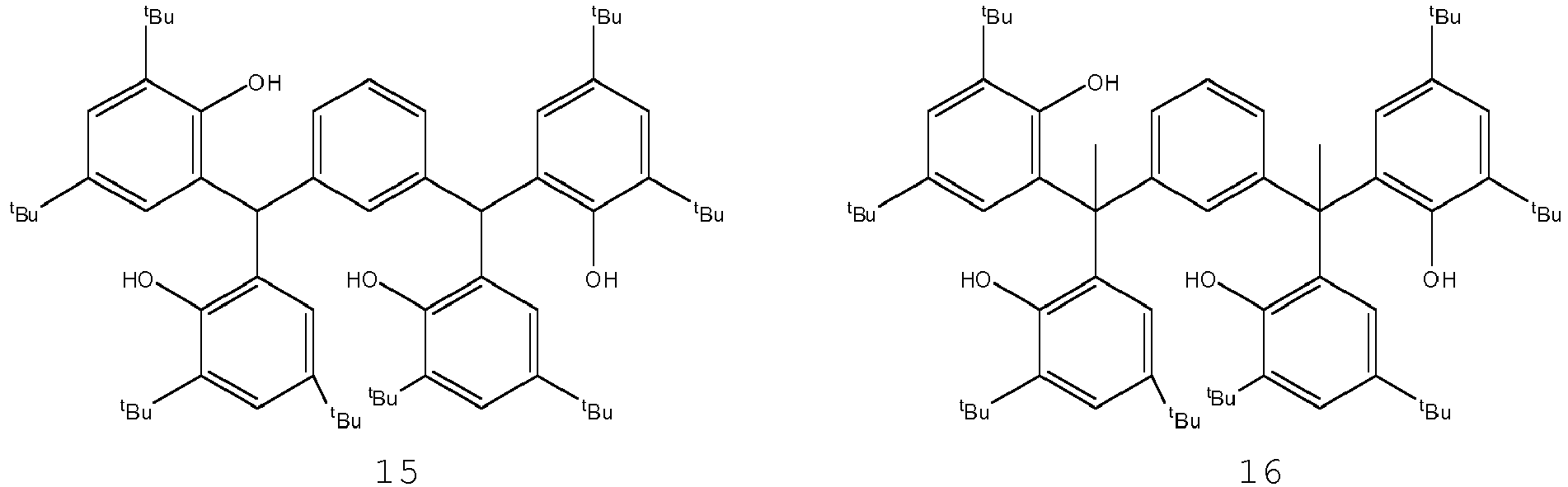
- Claimed representatives of this embodiment are e.g. in formulas 12, 15, 16 and 18 and can be synthesized based on the preparation examples according to the invention.
- the claimed representatives are designated TP0, TP'0 and TP "0 for the sake of clarity.
- the claimed tetraphenol ligands in the production examples according to the invention are designated TP1 to TP7.
- the structures belonging to the claimed tetraphenol ligands are likewise disclosed in Scheme 1 in the preparation examples according to the invention.
- TP G3 and G4 are the same or different and represent an at least monosubstituted cyclic structure, for. B.
- G5 and G6 each represent the same or different monovalent units connected to P selected from the group O-alkyl, O-aryl, O-acyl, O-heteroaryl, O-cycloalkyl, O-silyl, acyl, alkyl, aryl, heteroaryl , Cycloalkyl, perfluoroalkyl, N-acyl, N-alkyl, N-aryl, N-heteroaryl, N-cycloalkyl, N-silyl; z. B. and R z. B. is hydrogen, methyl, trifluoromethyl, or phenyl;
- R in formula 40 exemplifies the following radicals:
- the invention also provides metal complexes containing a metal of the 4th, 5th, 6th, 7th, 8th, 9th or 10th group of the Periodic Table of the Elements and one or more organic phosphorus compounds which in the preparation examples according to the invention have TP1 , TP2, TP3, TP4 or TP5.
- the metal complexes according to the invention are characterized in that the metal is rhodium, palladium, nickel, platinum, cobalt or ruthenium.
- At least one of the organic phosphorus compounds designated TP1, TP2, TP3, TP4 or TP5 in the preparation examples according to the invention and / or a metal complex based on rhodium, palladium, nickel, platinum, cobalt or ruthenium are used catalysis.
- At least one of the organic phosphorus compounds designated TP1, TP2, TP3, TP4 or TP5 in the preparation examples according to the invention and / or a metal complex based on rhodium, palladium, nickel, platinum, cobalt or ruthenium find particular use in homogeneous catalysis.
- At least one of the organic phosphorus compounds designated TP1, TP2, TP3, TP4 or TP5 in the preparation examples according to the invention and / or a metal complex based on rhodium, palladium, nickel, platinum, cobalt or ruthenium are used in a process for the hydroformylation of olefin-containing mixtures.
- An object of the invention is also a process for the hydrocyanation of pentenenitrile-containing streams using a catalytically active composition, characterized in that the catalytically active composition is an organic phosphorus compound which in the production examples according to the invention is designated TP1, TP2, TP3, TP4 or TP5 are, contains. Further details of the disclosure are in the process examples according to the invention.
- Another object of the invention is a process for the hydrocyanation of butadiene-containing streams using a catalytically active composition, characterized in that the catalytically active composition contains an organic phosphorus compound, which is referred to in the inventive production examples with TP2.
- a particular embodiment of the process for the hydrocyanation of butadiene-containing streams is characterized in that butadiene with an n- / iso-selectivity of more than 99% is hydrocyanated to linear pentenenitriles. Further details of the disclosure are in the process examples according to the invention.
- the invention also provides a process for the hydroformylation of unsaturated hydrocarbon mixtures using a catalytically active composition comprising a transition metal of groups 8 to 10, characterized in that the catalytically active composition is an organic phosphorus compound which in the preparation examples according to the invention with TP1, TP2 , TP3, TP4 or TP5.
- a particular embodiment of the process according to the invention for the hydroformylation of unsaturated hydrocarbon mixtures is characterized in that the catalytically active composition contains an organic phosphorus compound which is designated in the preparation examples according to the invention with TP1, TP2, TP3, TP4 or TP5, and rhodium. Further details of the disclosure are in the process examples according to the invention.
- Another subject of the invention is a process for the Hydroaminoalkyltechnik of unsaturated hydrocarbon mixtures using a catalytically active composition containing a transition metal of groups 8 to 10, characterized in that the catalytically active composition is an organic phosphorus compound, which is referred to in the preparation of the invention with TP6 , having.
- a particular embodiment of the process according to the invention for hydroaminoalkylation is characterized in that the catalytically active composition contains an organic phosphorus compound, which is designated TP6 in the preparation examples according to the invention, and rhodium.
- the invention also provides a process for the hydrogenation of unsaturated hydrocarbon mixtures using a catalytically active composition comprising a transition metal of groups 8 to 10, characterized in that the catalytically active composition is an organic phosphorus compound which is designated TP1 in the preparation examples according to the invention , having. Further details of the disclosure are in the process examples according to the invention.
- a further subject of the invention is a process for the hydrosilylation of carbonyl compounds using a catalytically active composition comprising a transition metal of groups 8 to 10, characterized in that the catalytically active composition is an organic phosphorus compound which is designated in the production examples according to the invention with TP3, having.
- Nickel-catalyzed hydrocyanation of 3-pentenenitrile (3PN) The ligand solution (0.018 mmol TP ligand in 2 mL solvent) is added to Ni (cod) 2 (5.0 mg, 0.018 mmol). Thereafter, 3-pentenenitrile (300 ⁇ L, 170 eq.) Is added by means of an Eppendorf pipette, as well as 50 ⁇ L n-decane as internal standard and the Lewis acid (1 eq.). The resulting solution is transferred to a 15 ml Schlenk tube.
- Dibutene obtained from the dimerization of C4 olefins (C8 olefin mixture, linear and branched isomers) was hydroformylated solvent-free with the ligand TP1: ⁇ b> Table 7.
Landscapes
- Chemical & Material Sciences (AREA)
- Organic Chemistry (AREA)
- Health & Medical Sciences (AREA)
- Life Sciences & Earth Sciences (AREA)
- Biochemistry (AREA)
- General Health & Medical Sciences (AREA)
- Molecular Biology (AREA)
- Chemical Kinetics & Catalysis (AREA)
- Toxicology (AREA)
- Organic Low-Molecular-Weight Compounds And Preparation Thereof (AREA)
- Catalysts (AREA)
- Low-Molecular Organic Synthesis Reactions Using Catalysts (AREA)
Abstract
Description
- Die vorliegende Erfindung betrifft neue organische Verbindungen, ihre Phosphorderivate bzw. organische Phosphorverbindungen sowie deren Komplexverbindungen mit Übergangsmetallen, Verfahren zu deren Herstellung und Verwendung in katalytischen Reaktionen.
- Die Reaktionen zwischen Olefinverbindungen, Kohlenmonoxid und Wasserstoff in Gegenwart eines Katalysators zu den um ein C-Atom reicheren Aldehyden ist als Hydroformylierung (Oxierung) bekannt. Als Katalysatoren in diesen Reaktionen werden häufig Verbindungen der Übergangsmetalle der 8. bis 10. Gruppe des Periodensystems der Elemente verwendet, insbesondere Verbindungen des Rhodiums und des Kobalts. Die Hydroformylierung mit Rhodiumverbindungen bietet im Vergleich zur Katalyse mit Kobaltverbindungen in der Regel den Vorteil höherer Selektivität und ist damit meistens wirtschaftlicher. Bei der durch Rhodium katalysierten Hydroformylierung werden zumeist Komplexe eingesetzt, die aus Rhodium und bevorzugt aus trivalenten Phosphorverbindungen als Liganden bestehen. Bekannte Liganden sind beispielsweise Verbindungen aus den Klassen der Phosphine, Phosphite und Phosphonite. Eine Übersicht über Hydroformylierung von Olefinen findet sich in B. CORNILS, W. A. HERRMANN, "Applied Homogeneous Catalysis with Organometallic Compounds", Vol. 1&2, VCH, Weinheim, New York, 1996.
- Jedes Katalysatorsystem (Kobalt oder Rhodium) hat seine spezifischen Vorzüge. Je nach Einsatzstoff und Zielprodukt werden unterschiedliche Katalysatorsysteme verwendet. Arbeitet man mit Rhodium und Triphenylphosphin, lassen sich α-Olefine bei niedrigeren Drücken hydroformylieren. Als phosphorhaltiger Ligand wird in der Regel Triphenylphosphin im Überschuss verwendet, wobei ein hohes Ligand/Rhodium-Verhältnis erforderlich ist, um die Selektivität der Reaktion zum kommerziell erwünschten n-Aldehydprodukt zu erhöhen.
-
US-A-4,694,109 undUS-A-4,879,416 betreffen Bisphosphinliganden und ihren Einsatz in der Hydroformylierung von Olefinen bei niedrigen Synthesegasdrücken. Besonders bei der Hydroformylierung von Propen werden mit Liganden dieses Typs hohe Aktivitäten und hohe n/i-Selektivitäten erreicht. - In
WO-A-95/30680 - Ferrocenverbrückte Bisphosphine werden beispielsweise in
US-A-4,169,861 ,US-A-4,201,714 undUS-A-4,193,943 als Liganden für Hydroformylierungen offenbart. - Der Nachteil von zweizähnigen Phosphinliganden ist die relativ aufwendige Herstellung. Daher ist es oftmals nicht rentabel, solche Systeme in technischen Prozessen einzusetzen.
- Rhodium-Monophosphit-Komplexe sind geeignete Katalysatoren für die Hydroformylierung von verzweigten Olefinen mit innenständigen Doppelbindungen, jedoch ist die Selektivität für endständig hydroformylierte Verbindungen gering.
- Aus
EP-A-0 155 508 ist die Verwendung von bisarylensubstituierten Monophosphiten bei der rhodiumkatalysierten Hydroformylierung von sterisch gehinderten Olefinen, z. B. Isobuten bekannt. - Rhodium-Bisphosphit-Komplexe katalysieren die Hydroformylierung von linearen Olefinen mit end- und innenständigen Doppelbindungen, wobei überwiegend endständig hydroformylierte Produkte entstehen, dagegen werden verzweigte Olefine mit innenständigen Doppelbindungen nur in geringem Maße umgesetzt. Diese Phosphite ergeben bei ihrer Koordination an ein Übergangsmetallzentrum Katalysatoren von gesteigerter Aktivität, doch ist das Standzeitverhalten dieser Katalysatorsysteme, unter anderem wegen der Hydrolyseempfindlichkeit der Phosphitliganden, unbefriedigend. Durch den Einsatz von substituierten Bisaryldiolen als Edukte für die Phosphitliganden, wie in
EP-A-0 214 622 oderEP-A-0 472 071 beschrieben, konnten erhebliche Verbesserungen erreicht werden. - Der Literatur zufolge sind die Rhodiumkomplexe dieser Liganden äußerst aktive Hydroformylierungskatalysatoren für α-Olefine. In
US-A-4,668,651 ,US-A-4,748,261 undUS-A-4,885,401 werden Polyphosphitliganden beschrieben, mit denen α-Olefine, aber auch 2-Buten mit hoher Selektivität zu den terminal hydroformylierten Produkten umgesetzt werden können. InUS-A-5,312,996 werden zweizähnige Liganden dieses Typs auch zur Hydroformylierung von Butadien eingesetzt. - Aus dem Bereich der lichtempfindlichen, filmbildenden Materialien - Photolacke oder auch im Englischen Photoresists genannt - ist eine Substanzklasse bekannt, die unter dem Begriff Tetraphenole zusammengefasst wird. In
JP 05034915 JP 2004277358 JP 2004277358 - In Macromolecules (Washington, DC, United States) (2008), 41(20), 7306-7315 wird z. B. die Verwendung von Tetraphenol-artigen Verbindungen bei der Ring-Öffnungspolymerisation von Ethylenoxid und Propylenoxid beschrieben.
- Obgleich die zuvor genannten Bisphosphite gute Komplexliganden für Rhodium-basierte Hydroformylierungskatalysatorsysteme sind, ist es wünschenswert, neuartige leicht herstellbare Phosphite zur weiteren Verbesserung ihrer Wirksamkeit beispielsweise in der Hydroformylierung zu entwickeln.
- So ist es eine Aufgabe der vorliegenden Erfindung organische Verbindungen, die in ihrer Struktur den Tetraphenolen zugeordnet werden können, herzustellen und in entsprechende Phosphorderivate umzusetzen.
- Dabei ist es mit eine Aufgabe, dass die Herstellung der organischen Verbindungen wie auch der daraus abgeleiteten organischen Phosphorverbindungen technisch und ökonomisch unaufwendig erfolgt. Dabei steht ein modularer Aufbau der organischen Phosphorverbindungen im Vordergrund der Aufgabe, um einerseits variable Strukturen in wenigen Herstellungsschritten zu generieren sowie andererseits dazu auf großtechnisch und günstig verfügbare Ausgangsstoffe bzw. Edukte zuzugreifen.
- Diese Phosphorderivate bzw. die eingangs genannten organischen Phosphorverbindungen werden mit Übergangsmetallen zu katalytisch wirksamen Zusammensetzungen weiter verarbeitet. Weiterhin ist es eine Aufgabe diese katalytisch wirksamen Zusammensetzungen anzuwenden in Reaktionen von kleinen Molekülen, wie z.B. CO, HCN, Wasserstoff oder auch Aminen, in reiner Form wie auch in Gemischen, mit ungesättigten Kohlenwasserstoffverbindungen. Mit ist es eine Aufgabe, dass diese katalytisch wirksamen Zusammensetzungen, z. B. in der Hydroformylierung von ungesättigten Kohlenwasserstoffverbindungen, eine hohe Standzeit und damit verbunden die als Liganden verwendeten organischen Phosphorverbindungen eine geringe Hydrolyseempfindlichkeit sowie eine hohe Selektivität zum linearen, d. h. n-hydroformylierten Produkt, aufweisen.
- Gegenstand der Erfindung sind organische Verbindungen der Formel 1

- G1 eine mindestens zweifach substituierte cyclische Struktur darstellt, welche ausgewählt ist aus der Gruppe der Aromaten, der Heteroaromaten, der kondensierten Aromatensysteme oder der kondensierten heteroaromatischen Systeme mit beliebiger weiterer Substitution, die jeweils monovalent mit G2 verbunden ist;
- G2 einen Alkylrest darstellt und jeweils monovalent mit G1, G3 und/oder G4 verbunden ist; G3 und G4 gleich oder verschieden, mit jeweils einer OH-Gruppe substituiert sind und eine mindestens zweifach substituierte cyclische Struktur darstellen, ausgewählt aus der Gruppe der Aromaten, der Heteroaromaten, der kondensierten Aromatensysteme oder der kondensierten heteroaromatischen Systeme mit beliebiger weiterer Substitution, welche jeweils monovalent mit G2 verbunden sind.
- In einer bevorzugten Ausführungsform reduziert sich die Vielfalt der möglichen Strukturen, die aus der Formel 1 abgeleitet werden können, dadurch, dass folgende Einschränkungen eingeführt werden, wobei:
- G1 ein mindestens disubstituierter 1,2-, 1,3- oder 1,4- Phenylrest ist;
- G2 ein C1-Alkylrest ist, der tertiär oder quartär substituiert ist;
- G3 und G4 gleich sind und einen mindestens disubstituierten aromatischen Rest mit jeweils einer OH-Gruppe darstellen, ausgewählt aus der Gruppe der Aromaten, der Heteroaromaten, der kondensierten Aromatensysteme oder der kondensierten heteroaromatischen Systeme mit beliebiger weiterer Substitution.
- Beispielhaft für diese bevorzugte Ausführungsform sind folgende Strukturen, wobei G1 eine 1,3-Substituierung aufweist:




- Beispielhaft für diese bevorzugte Ausführungsform ist z. B. auch:


- Beispielhafte Vertreter dieser Ausführungsform sind auch folgende Derivate der Formeln 29 bis 38, welche für G1 eine Trisubstitution, einen Heteroaromaten oder ein kondensiertes aromatisches System aufweisen:


- In einer weiteren, bevorzugten Ausführungsform gemäß der Formel 1 ist bzw. sind:
- G1 ein mindestens disubstituierter 1,3- Phenylrest;
- G2 ein C1-Alkylrest, der mit Wasserstoff, Methyl, Ethyl, Isopropyl, Isobutyl, Trifluormethyl, oder Aryl substituiert ist;
- G3 und G4 gleich und ein mindestens disubstituierter mit OH, C1 bis C6 O-Alkyl sowie C1 bis C6-Alkyl versehener aromatischer Rest sind.
- Beispielhafte Vertreter dieser Ausführungsform sind z.B. in den Formeln 11 bis 26 sowie 29 bis 31 wiedergegeben. Die Herstellung erfolgt in der Art und Weise, wie sie in den erfindungsgemäßen Herstellungsbeispielen nachfolgend offenbart wird.
- In einer anderen, bevorzugten Ausführungsform gemäß der Formel 1 ist bzw. sind:
- G1 ein 1,3-disubstituierter Phenylrest;
- G2 ein C1-Alkylrest, der mit Wasserstoff, Methyl, Ethyl, Isopropyl, Isobutyl, Trifluormethyl, oder Aryl substituiert ist;
- G3 und G4 gleich und ein mit OH sowie 2 tert.-Butyl-Gruppen trisubstituierter aromatischer Rest.
- Beanspruchte Vertreter dieser Ausführungsform sind z.B. in den Formeln 12, 15, 16 und 18 offenbart und können auf Basis der erfindungsgemäßen Herstellungsbeispiele synthetisiert werden. In den erfindungsgemäßen Herstellungsbeispielen werden die beanspruchten Vertreter mit TP0, TP'0 und TP"0 der Verständlichkeit halber bezeichnet.
- Weiter sind Gegenstand der Erfindung organische Phosphorverbindungen der Formel 2:

- O jeweils einem Sauerstoffatom und
- P jeweils einem Phosphoratom entsprechen;
- G1 eine mindestens zweifach substituierte cyclische Struktur darstellt, welche ausgewählt ist aus der Gruppe der Aromaten, der Heteroaromaten, der kondensierten Aromatensysteme oder der kondensierten heteroaromatischen Systeme mit beliebiger weiterer Substitution, die jeweils monovalent mit G2 verbunden ist;
- G2 einen Alkylrest darstellt und jeweils monovalent mit G1, G3 und/oder G4 verbunden ist; G3 und G4 gleich oder verschieden sind und eine mindestens einfach substituierte cyclische Struktur darstellen, ausgewählt aus der Gruppe der Aromaten, der Heteroaromaten, der kondensierten Aromatensysteme oder der kondensierten heteroaromatischen Systeme mit beliebiger weiterer Substitution, welche jeweils monovalent mit G2 und O verbunden sind; G5 und G6 jeweils gleiche oder verschiedene monovalent mit P verbundene Einheiten darstellen, ausgewählt aus der Gruppe O-Alkyl, O-Aryl, O-Acyl, O-Heteroaryl, O-Cycloalkyl, O-Silyl, Acyl, Alkyl, Aryl, Heteroaryl, Cycloalkyl, Perfluoralkyl, N-Acyl, N-Alkyl, N-Aryl, N-Heteroaryl, N-Cycloalkyl, N-Silyl.
- In einer besonderen Ausführungsform der Formel 2 ist bzw. sind:
- G1 ein mindestens disubstituierter 1,2-, 1,3- oder 1,4- Phenylrest;
- G2 ein C1-Alkylrest, der tertiär oder quartär substituiert ist;
- G3 und G4 gleich und stellen einen mindestens einfach substituierten aromatischen Rest dar, ausgewählt aus der Gruppe der Aromaten, der Heteroaromaten, der kondensierten Aromatensysteme oder der kondensierten heteroaromatischen Systeme mit beliebiger weiterer Substitution;
- G5 und G6 gleich, ausgewählt aus der Gruppe O-Alkyl, O-Aryl, O-Acyl, O-Heteroaryl, O-Cycloalkyl, O-Silyl, Acyl, Alkyl, Aryl, Heteroaryl, Cycloalkyl, Perfluoralky, N-Alkyl, N-Aryl, N-Heteroaryl, N-Cycloalkyl, N-Silyl.
- In einer besonders bevorzugten Ausführungsform der Formel 2 ist bzw. sind:
- G1 ein 1,3-disubstituierter Phenylrest;
- G2 ein C1-Alkylrest, der mit Wasserstoff oder Methyl substituiert ist;
- G3 und G4 gleich, ausgewählt aus der Gruppe tert.-Butylphenoxy, Methoxy-tert.-Butylphenoxy, oder di-tert.-Butylphenoxy;
- G5 und G6 gleich, ausgewählt aus der Gruppe tert.-Butylphenoxy, Methoxy-tert.-Butylphenoxy, Naphthoxy, di-tert.-Butylphenoxy, Methyl-tert.-Butylphenoxy oder Pyrrol. Die nach diesen Ausführungsformen beanspruchten organischen Phosphorverbindungen - auch Tetraphenol-Liganden oder Tetraphenol substituierte Bisphosphite genannt - sind nachfolgend in den erfindungsgemäßen Herstellungsbeispielen weiter offenbart und charakterisiert.
- Der Verständlichkeit halber werden die beanspruchten Tetraphenol-Liganden in den erfindungsgemäßen Herstellungsbeispielen mit TP1 bis TP7 bezeichnet. Die zu den beanspruchten Tetraphenol-Liganden gehörigen Strukturen sind ebenfalls in den erfindungsgemäßen Herstellungsbeispielen im Schema 1 offenbart.
- Weitere Ausführungsformen der erfindungsgemäßen Formel 2 sind beispielhaft in der nachfolgenden Struktur, die mit TP bezeichnet wird, aufgeführt:

- Wobei gemäß der Formel TP G3 und G4 gleich oder verschieden sind und eine mindestens einfach substituierte cyclische Struktur darstellen, z. B.


- Wobei G5 und G6 jeweils gleiche oder verschiedene monovalent mit P verbundene Einheiten darstellen, ausgewählt aus der Gruppe O-Alkyl, O-Aryl, O-Acyl, O-Heteroaryl, O-Cycloalkyl, O-Silyl, Acyl, Alkyl, Aryl, Heteroaryl, Cycloalkyl, Perfluoralky, N-Acyl, N-Alkyl, N-Aryl, N-Heteroaryl, N-Cycloalkyl, N-Silyl; z. B.


- Sowie R' beispielhaft durch folgende Reste dargestellt wird:


- Auch sind Gegenstand der vorliegenden Erfindung organische Phosphorverbindungen der Formel 3

- O jeweils einem Sauerstoffatom und
- P jeweils einem Phosphoratom entsprechen;
- G1 eine mindestens zweifach substituierte cyclische Struktur darstellt, welche ausgewählt ist aus der Gruppe der Aromaten, der Heteroaromaten, der kondensierten Aromatensysteme oder der kondensierten heteroaromatischen Systeme mit beliebiger weiterer Substitution, die jeweils monovalent mit G2 verbunden ist;
- G2 einen Alkylrest darstellt und jeweils monovalent mit G1, G3 und/oder G4 verbunden ist; G3 mit jeweils einer OH-Gruppe substituiert ist und eine mindestens zweifach substituierte cyclische Struktur darstellt, ausgewählt aus der Gruppe der Aromaten, der Heteroaromaten, der kondensierten Aromatensysteme oder der kondensierten heteroaromatischen Systeme mit beliebiger weiterer Substitution, welche jeweils monovalent mit G2 verbunden ist;
- G4 eine mindestens einfach substituierte cyclische Struktur darstellt, ausgewählt aus der Gruppe der Aromaten, der Heteroaromaten, der kondensierten Aromatensysteme oder der kondensierten heteroaromatischen Systeme mit beliebiger weiterer Substitution, welche jeweils monovalent mit G2 und O verbunden ist;
- G5, G6, G7 und G8 jeweils gleiche oder verschiedene monovalent mit P verbundene Einheiten oder G5 jeweils mit G6 und G7 jeweils mit G8 kovalent verknüpfte und monovalent mit P verbundene Einheiten darstellen, ausgewählt aus der Gruppe O-Alkyl, O-Aryl, O-Acyl, O-Heteroaryl, O-Cycloalkyl, O-Silyl, Acyl, Alkyl, Aryl, Heteroaryl, Cycloalkyl, Perfluoralkyl, N-Acyl, N-Alkyl, N-Aryl, N-Heteroaryl, N-Cycloalkyl, N-Silyl.
- Weiter sind Gegenstand der Erfindung organische Phosphorverbindungen der Formel 4

- O jeweils einem Sauerstoffatom und
- P jeweils einem Phosphoratom entsprechen;
- G1 eine mindestens zweifach substituierte cyclische Struktur darstellt, welche ausgewählt ist aus der Gruppe der Aromaten, der Heteroaromaten, der kondensierten Aromatensysteme oder der kondensierten heteroaromatischen Systeme mit beliebiger weiterer Substitution, die jeweils monovalent mit G2 verbunden ist;
- G2 einen Alkylrest darstellt und jeweils monovalent mit G1, G3 und/oder G4 verbunden ist; G3 mit jeweils einer OH-Gruppe substituiert ist und eine mindestens zweifach substituierte cyclische Struktur darstellt, ausgewählt aus der Gruppe der Aromaten, der Heteroaromaten, der kondensierten Aromatensysteme oder der kondensierten heteroaromatischen Systeme mit beliebiger weiterer Substitution, welche jeweils monovalent mit G2 verbunden ist;
- G4 eine mindestens einfach substituierte cyclische Struktur darstellt, ausgewählt aus der Gruppe der Aromaten, der Heteroaromaten, der kondensierten Aromatensysteme oder der kondensierten heteroaromatischen Systeme mit beliebiger weiterer Substitution, welche jeweils monovalent mit G2 und O verbunden ist;
- G5, G6, G7 und G8 jeweils gleiche oder verschiedene monovalent mit P verbundene Einheiten oder G5 jeweils mit G6 und G7 jeweils mit G8 kovalent verknüpfte und monovalent mit P verbundene Einheiten darstellen, ausgewählt aus der Gruppe O-Alkyl, O-Aryl, O-Acyl, O-Heteroaryl, O-Cycloalkyl, O-Silyl, Acyl, Alkyl, Aryl, Heteroaryl, Cycloalkyl, Perfluoralkyl, N-Acyl, N-Alkyl, N-Aryl, N-Heteroaryl, N-Cycloalkyl, N-Silyl.
- Auch sind Gegenstand der vorliegenden Erfindung organische Phosphorverbindungen der Formel 5

- O jeweils einem Sauerstoffatom und
- P jeweils einem Phosphoratom entsprechen;
- G1 eine mindestens zweifach substituierte cyclische Struktur darstellt, welche ausgewählt ist aus der Gruppe der Aromaten oder der Heteroaromaten, der kondensierten Aromatensysteme oder der kondensierten heteroaromatischen Systeme mit beliebiger weiterer Substitution, die jeweils monovalent mit G2 verbunden ist;
- G2 einen Alkylrest darstellt und jeweils monovalent mit G1, G3 und/oder G4 verbunden ist; G3 und G4 gleich oder verschieden sind und eine mindestens zweifach substituierte cyclische Struktur darstellen, ausgewählt aus der Gruppe der Aromaten, der Heteroaromaten, der kondensierten Aromatensysteme oder der kondensierten heteroaromatischen Systeme mit beliebiger weiterer Substitution, welche jeweils monovalent mit G2 und O verbunden sind;
- G5, G6, G7, G8 und G9 jeweils gleiche oder verschiedene monovalent mit P verknüpfte Einheiten oder G6 jeweils mit G7 und G8 jeweils mit G9 kovalent verknüpfte und monovalent mit P verbundene Einheiten darstellen, ausgewählt aus der Gruppe O-Alkyl, O-Aryl, O-Acyl, O-Heteroaryl, O-Cycloalkyl, O-Silyl, Acyl, Alkyl, Aryl, Heteroaryl, Cycloalkyl, Perfluoralkyl, N-Acyl, N-Alkyl, N-Aryl, N-Heteroaryl, N-Cycloalkyl, N-Silyl.
- Weiter sind Gegenstand der Erfindung organische Phosphorverbindungen der Formel 6

- O jeweils einem Sauerstoffatom und
- P jeweils einem Phosphoratom entsprechen;
- G1 eine mindestens zweifach substituierte cyclische Struktur darstellt, welche ausgewählt ist aus der Gruppe der Aromaten, der Heteroaromaten, der kondensierten Aromatensysteme oder der kondensierten heteroaromatischen Systeme mit beliebiger weiterer Substitution, die jeweils monovalent mit G2 verbunden ist;
- G2 einen Alkylrest darstellt und jeweils monovalent mit G1, G3 und/oder G4 verbunden ist; G3 und G4 gleich oder verschieden sind und eine mindestens zweifach substituierte cyclische Struktur darstellen, ausgewählt sind aus der Gruppe der Aromaten oder der Heteroaromaten, der kondensierten Aromatensysteme oder der kondensierten heteroaromatischen Systeme mit beliebiger weiterer Substitution, welche jeweils monovalent mit G2 und O verbunden sind;
- G5, G6, G7, G8 und G9 jeweils gleiche oder verschiedene monovalent mit P verknüpfte Einheiten oder G6 jeweils mit G7 und G8 jeweils mit G9 kovalent verknüpfte und monovalent mit P verbundene Einheiten darstellen, ausgewählt aus der Gruppe O-Alkyl, O-Aryl, O-Acyl, O-Heteroaryl, O-Cycloalkyl, O-Silyl, Acyl, Alkyl, Aryl, Heteroaryl, Cycloalkyl, Perfluoralkyl, N-Acyl, N-Alkyl, N-Aryl, N-Heteroaryl, N-Cycloalkyl, N-Silyl.
- Auch sind Gegenstand der vorliegenden Erfindung organische Phosphorverbindungen der Formel 7

- O jeweils einem Sauerstoffatom und
- P jeweils einem Phosphoratom entsprechen;
- G1 eine mindestens zweifach substituierte cyclische Struktur darstellt, welche ausgewählt ist aus der Gruppe der Aromaten, der Heteroaromaten, der kondensierten Aromatensysteme oder der kondensierten heteroaromatischen Systeme mit beliebiger weiterer Substitution, die jeweils monovalent mit G2 verbunden ist;
- G2 einen Alkylrest darstellt und jeweils monovalent mit G1, G3 und/oder G4 verbunden ist; G3 und G4 gleich oder verschieden sind und eine mindestens zweifach substituierte cyclische Struktur darstellen, ausgewählt aus der Gruppe der Aromaten, der Heteroaromaten, der kondensierten Aromatensysteme oder der kondensierten heteroaromatischen Systeme mit beliebiger weiterer Substitution, welche jeweils monovalent mit G2 und O verbunden sind;
- G5, G6, G7, G8, G9, G10, G11 und G12 jeweils gleiche oder verschiedene monovalent mit P verknüpfte Einheiten oder G5 jeweils mit G6, G7 jeweils mit G8, G9 jeweils mit G10 und G11 jeweils mit G12 kovalent verknüpfte und monovalent mit P verbundene Einheiten darstellen, ausgewählt aus der Gruppe O-Alkyl, O-Aryl, O-Acyl, O-Heteroaryl, O-Cycloalkyl, O-Silyl, Acyl, Alkyl, Aryl, Heteroaryl, Cycloalkyl, Perfluoralkyl, N-Acyl, N-Alkyl, N-Aryl, N-Heteroaryl, N-Cycloalkyl, N-Silyl.
- In einer besonderen Ausführungsform gemäß der Formel 7 ist bzw. sind:
- G1 ein 1,3-disubstituierter Phenylrest;
- G2 ein C1-Alkylrest, der mit Wasserstoff, Methyl, Ethyl, Isopropyl, Isobutyl, Trifluormethyl oder Aryl substituiert ist;
- G3 und G4 gleich, ausgewählt aus der Gruppe tert.-Butylphenoxy oder di-tert.-Butylphenoxy; G5, G6, G7, G8, G9, G10, G11 und G12 jeweils gleiche oder verschiedene monovalent mit P verknüpfte Einheiten oder G5 jeweils mit G6, G7 jeweils mit G8, G9 jeweils mit G10 und G11 jeweils mit G12 kovalent verknüpfte und monovalent mit P verbundene Einheiten darstellen, ausgewählt aus der Gruppe O-Alkyl, O-Aryl, O-Acyl, O-Heteroaryl, O-Cycloalkyl, O-Silyl, Acyl, Alkyl, Aryl, Heteroaryl, Cycloalkyl, Perfluoralkyl, N-Acyl, N-Alkyl, N-Aryl, N-Heteroaryl, N-Cycloalkyl, N-Silyl.
- Beispielhafte Strukturen dieser Ausführungsform sind:

- Wobei PR2 in der Formel 39 z.B. folgende Substituierung aufweist:


- Wobei R in Formel 40 beispielhaft folgende Reste darstellt:


- Der Vertreter der Formel 40 mit R = 2,4-di-tert.-Butylphenoxy ist eine erfindungsgemäß beanspruchte Ausführungsform und stellt ein Tetraphenol basiertes Tetraphosphit dar, welche unter der Benutzung der Formel TP8 weiter in den erfindungsgemäßen Herstellungsbeispielen offenbart wird.
- Weiter sind Gegenstand der Erfindung organische Phosphorverbindungen der Formel 8

- O jeweils einem Sauerstoffatom und
- P jeweils einem Phosphoratom entsprechen;
- G1 eine mindestens zweifach substituierte cyclische Struktur darstellt, welche ausgewählt ist aus der Gruppe der Aromaten, der Heteroaromaten, der kondensierten Aromatensysteme oder der kondensierten heteroaromatischen Systeme mit beliebiger weiterer Substitution, die jeweils monovalent mit G2 verbunden ist;
- G2 einen Alkylrest darstellt und jeweils monovalent mit G1, G3 und/oder G4 verbunden ist; G3 mit jeweils einer OH-Gruppe substituiert ist und eine mindestens zweifach substituierte cyclische Struktur darstellt, ausgewählt aus der Gruppe der Aromaten, der Heteroaromaten, der kondensierten Aromatensysteme oder der kondensierten heteroaromatischen Systeme mit beliebiger weiterer Substitution, welche monovalent mit G2 verbunden ist;
- G4 eine mindestens einfach substituierte cyclische Struktur darstellt, ausgewählt aus der Gruppe der Aromaten, der Heteroaromaten, der kondensierten Aromatensysteme oder der kondensierten heteroaromatischen Systeme mit beliebiger weiterer Substitution, welche jeweils monovalent mit G2 und O verbunden ist;
- G5, G6, G7, G8, G9 und G10 jeweils gleiche oder verschiedene monovalent mit P verbundene Einheiten oder G5 jeweils mit G6, G7 jeweils mit G8 und G9 jeweils mit G10 kovalent verknüpfte und monovalent mit P verbundene Einheiten darstellen, ausgewählt aus der Gruppe O-Alkyl, O-Aryl, O-Acyl, O-Heteroaryl, O-Cycloalkyl, O-Silyl, Acyl, Alkyl, Aryl, Heteroaryl, Cycloalkyl, Perfluoralkyl, N-Acyl, N-Alkyl, N-Aryl, N-Heteroaryl, N-Cycloalkyl, N-Silyl.
- Auch sind Gegenstand der vorliegenden Erfindung organische Phosphorverbindungen der Formel 9

- O jeweils einem Sauerstoffatom und
- P jeweils einem Phosphoratom entsprechen;
- G1 eine mindestens zweifach substituierte cyclische Struktur darstellt, welche ausgewählt ist aus der Gruppe der Aromaten, der Heteroaromaten, der kondensierten Aromatensysteme oder der kondensierten heteroaromatischen Systeme mit beliebiger weiterer Substitution, die jeweils monovalent mit G2 verbunden ist;
- G2 einen Alkylrest darstellt und jeweils monovalent mit G1, G3 und/oder G4 verbunden ist;
- G3 mit jeweils einer OH-Gruppe substituiert ist und eine mindestens zweifach substituierte cyclische Struktur darstellt, ausgewählt aus der Gruppe der Aromaten, der Heteroaromaten, der kondensierten Aromatensysteme oder der kondensierten heteroaromatischen Systeme mit beliebiger weiterer Substitution, welche monovalent mit G2 verbunden ist;
- G4 eine mindestens einfach substituierte cyclische Struktur darstellt, ausgewählt aus der Gruppe der Aromaten, der Heteroaromaten, der kondensierten Aromatensysteme oder der kondensierten heteroaromatischen Systeme mit beliebiger weiterer Substitution, welche jeweils monovalent mit G2 und O verbunden ist;
- G5 eine monovalent mit P verknüpfte Einheit darstellt, ausgewählt aus der Gruppe O-Alkyl, O-Aryl, O-Acyl, O-Heteroaryl, O-Cycloalkyl, O-Silyl, Acyl, Alkyl, Aryl, Heteroaryl, Cycloalkyl, Perfluoralkyl, N-Acyl, N-Alkyl, N-Aryl, N-Heteroaryl, N-Cycloalkyl, N-Silyl.
- Weiter sind Gegenstand der Erfindung organische Phosphorverbindungen der Formel 10

- O jeweils einem Sauerstoffatom und
- P jeweils einem Phosphoratom entsprechen;
- G1 eine mindestens zweifach substituierte cyclische Struktur darstellt, welche ausgewählt ist aus der Gruppe der Aromaten, der Heteroaromaten, der kondensierten Aromatensysteme oder der kondensierten heteroaromatischen Systeme mit beliebiger weiterer Substitution, die jeweils monovalent mit G2 verbunden ist;
- G2 einen Alkylrest darstellt und jeweils monovalent mit G1, G3 und/oder G4 verbunden ist; G3 mit jeweils einer OH-Gruppe substituiert ist und eine mindestens zweifach substituierte cyclische Struktur darstellt, ausgewählt aus der Gruppe der Aromaten, der Heteroaromaten, der kondensierten Aromatensysteme oder der kondensierten heteroaromatischen Systeme mit beliebiger weiterer Substitution, welche monovalent mit G2 verbunden ist;
- G4 eine mindestens einfach substituierte cyclische Struktur darstellt, ausgewählt aus der Gruppe der Aromaten, der Heteroaromaten, der kondensierten Aromatensysteme oder der kondensierten heteroaromatischen Systeme mit beliebiger weiterer Substitution, welche jeweils monovalent mit G2 und O verbunden ist;
- G5, und G6 jeweils gleiche oder verschiedene monovalent mit P verknüpfte Einheiten oder G5 jeweils mit G6 kovalent verknüpfte und monovalent mit P verbundene Einheiten darstellen, ausgewählt aus der Gruppe O-Alkyl, O-Aryl, O-Acyl, O-Heteroaryl, O-Cycloalkyl, O-Silyl, Acyl, Alkyl, Aryl, Heteroaryl, Cycloalkyl, Perfluoralkyl, N-Acyl, N-Alkyl, N-Aryl, N-Heteroaryl, N-Cycloalkyl, N-Silyl.
- Auch Gegenstand der Erfindung sind Metallkomplexe, enthaltend ein Metall der 4., 5., 6., 7., 8., 9. oder 10. Gruppe des Periodensystems der Elemente und ein oder mehrere organische Phosphorverbindungen, die in den erfindungsgemäßen Herstellungsbeispielen mit TP1, TP2, TP3, TP4 oder TP5 aufgeführt sind.
- In einer besonderen Ausführungsform sind die erfindungsgemäßen Metallkomplexe dadurch gekennzeichnet, dass das Metall Rhodium, Palladium, Nickel, Platin, Kobalt oder Ruthenium ist.
- In einer weiteren Ausführungsform finden mindestens eine der organischen Phosphorverbindungen, die in den erfindungsgemäßen Herstellungsbeispielen mit TP1, TP2, TP3, TP4 oder TP5 bezeichnet sind und/oder ein Metallkomplex, basierend auf Rhodium, Palladium, Nickel, Platin, Kobalt oder Ruthenium, Verwendung in der Katalyse.
- In einer weiteren Ausführungsform finden mindestens eine der organischen Phosphorverbindungen, die in den erfindungsgemäßen Herstellungsbeispielen mit TP1, TP2, TP3, TP4 oder TP5 bezeichnet sind und/oder ein Metallkomplex, basierend auf Rhodium, Palladium, Nickel, Platin, Kobalt oder Ruthenium, spezielle Verwendung in der homogenen Katalyse.
- In einer ganz besonderen Ausführungsform finden mindestens eine der organischen Phosphorverbindungen, die in den erfindungsgemäßen Herstellungsbeispielen mit TP1, TP2, TP3, TP4 oder TP5 bezeichnet sind und/oder ein Metallkomplex, basierend auf Rhodium, Palladium, Nickel, Platin, Kobalt oder Ruthenium, Verwendung in einem Verfahren zur Hydroformylierung von olefinhaltigen Gemischen.
- In den erfindungsgemäßen Herstellungsbeispielen werden die beanspruchten Metallkomplexe weiter offenbart und charakterisiert.
- Auch ein Gegenstand der Erfindung ist ein Verfahren zur Hydrocyanierung von Pentennitril-haltigen Strömen unter Verwendung einer katalytisch wirksamen Zusammensetzung, dadurch gekennzeichnet, dass die katalytisch wirksame Zusammensetzung eine organische Phosphorverbindung, die in den erfindungsgemäßen Herstellungsbeispielen mit TP1, TP2, TP3, TP4 oder TP5 bezeichnet sind, enthält. Weitere Details der Offenbarung befinden sich in den erfindungsgemäßen Verfahrensbeispielen.
- Eine besondere Ausführungsform des erfindungsgemäßen Verfahrens zur Hydrocyanierung ist dadurch gekennzeichnet, dass die Hydrocyanierung unter Ausschluss einer Isomerisierung zu verzweigten Nitrilen erfolgt. Weitere Details der Offenbarung befinden sich in den erfindungsgemäßen Verfahrensbeispielen.
- Ein weiterer Gegenstand der Erfindung ist ein Verfahren zur Hydrocyanierung von Butadien-haltigen Strömen unter Verwendung einer katalytisch wirksamen Zusammensetzung, dadurch gekennzeichnet, dass die katalytisch wirksame Zusammensetzung eine organische Phosphorverbindung, die in den erfindungsgemäßen Herstellungsbeispielen mit TP2 bezeichnet wird, enthält.
- Eine besondere Ausführungsform des Verfahren zur Hydrocyanierung von Butadien-haltigen Strömen ist dadurch gekennzeichnet, dass Butadien mit einer n-/iso-Selektivität von mehr als 99 % zu linearen Pentennitrilen hydrocyaniert wird. Weitere Details der Offenbarung befinden sich in den erfindungsgemäßen Verfahrensbeispielen.
- Auch ein Gegenstand der Erfindung ist ein Verfahren zur Hydroformylierung von ungesättigten Kohlenwasserstoffgemischen unter Verwendung einer katalytisch wirksamen Zusammensetzung, enthaltend ein Übergangsmetall der Gruppen 8 bis 10, dadurch gekennzeichnet, dass die katalytisch wirksame Zusammensetzung eine organische Phosphorverbindung, die in den erfindungsgemäßen Herstellungsbeispielen mit TP1, TP2, TP3, TP4 oder TP5 bezeichnet sind, aufweist.
- Eine besondere Ausführungsform des erfindungsgemäßen Verfahrens zur Hydroformylierung von ungesättigten Kohlenwasserstoffgemischen ist dadurch gekennzeichnet, dass die katalytisch wirksame Zusammensetzung eine organische Phosphorverbindung, die in den erfindungsgemäßen Herstellungsbeispielen mit TP1, TP2, TP3, TP4 oder TP5 bezeichnet sind, und Rhodium enthält. Weitere Details der Offenbarung befinden sich in den erfindungsgemäßen Verfahrensbeispielen.
- Eine weitere Ausführungsform des erfindungsgemäßen Verfahrens zur Hydroformylierung von ungesättigten Kohlenwasserstoffgemischen ist dadurch gekennzeichnet, dass als ungesättigtes Kohlenwasserstoffgemisch ein Strom enthaltend Olefine mit mindestens 4 bis 20 C-Atomen eingesetzt wird.
- In einer bevorzugten Ausführungsform werden als ungesättigtes Kohlenwasserstoffgemisch folgende Ströme eingesetzt:
- Raffinat I in handelsüblicher Zusammensetzung;
- Raffinat III in handelsüblicher Zusammensetzung, enthaltend einen Rest an C4-Alkanen, lineare C4-Alkene sowie Isobuten und C5-Alkane;
- sogenanntes Rohbutan, enthaltend C4-Alkane, lineare C4-Alkene und C5-Alkane; sogenanntes Dibuten, enthaltend mindestens 98 Massen-% C8-Olefine, bezogen auf die Gesamtmenge an C8-Olefinen, ausgewählt aus der Gruppe der Dimethylhexene, der Methylheptene sowie n-Octene;
- sogenannte Tributene, enthaltend ein Gemisch aus mindestens 98 Massen-% C11- und C12-Olefinen, bezogen auf die Gesamtmenge an C11- und C12-Olefinen.
- Weitere Details der Offenbarung befinden sich in den erfindungsgemäßen Verfahrensbeispielen.
- Ein weiterer Gegenstand er Erfindung ist ein Verfahren zur Hydroaminoalkylierung von ungesättigten Kohlenwasserstoffgemischen unter Verwendung einer katalytisch wirksamen Zusammensetzung, enthaltend ein Übergangsmetall der Gruppen 8 bis 10, dadurch gekennzeichnet, dass die katalytisch wirksame Zusammensetzung eine organischen Phosphorverbindung, die in den erfindungsgemäßen Herstellungsbeispielen mit TP6 bezeichnet wird, aufweist.
- Eine besondere Ausführungsform des erfindungsgemäßen Verfahrens zur Hydroaminoalkylierung ist dadurch gekennzeichnet, dass die katalytisch wirksame Zusammensetzung eine organische Phosphorverbindung, die in den erfindungsgemäßen Herstellungsbeispielen mit TP6 bezeichnet wird, und Rhodium enthält.
- Eine weitere Ausführungsform des erfindungsgemäßen Verfahrens zur Hydroaminoalkylierung ist dadurch gekennzeichnet, dass die Chemoselektivität bezüglich des Produktamins größer 90 % ist und die Bildung von Nebenprodukten kleiner 10% ist. Weitere Details der Offenbarung befinden sich in den erfindungsgemäßen Verfahrensbeispielen.
- Auch ein Gegenstand der Erfindung ist ein Verfahren zur Hydrierung von ungesättigten Kohlenwasserstoffgemischen unter Verwendung einer katalytisch wirksamen Zusammensetzung, enthaltend ein Übergangsmetall der Gruppen 8 bis 10, dadurch gekennzeichnet, dass die katalytisch wirksame Zusammensetzung eine organische Phosphorverbindung, die in den erfindungsgemäßen Herstellungsbeispielen mit TP1 bezeichnet wird, aufweist. Weitere Details der Offenbarung befinden sich in den erfindungsgemäßen Verfahrensbeispielen.
- Ein weiterer Gegenstand er Erfindung ist ein Verfahren zur Hydrosilylierung von Carbonylverbindungen unter Verwendung einer katalytisch wirksamen Zusammensetzung, enthaltend ein Übergangsmetall der Gruppen 8 bis 10, dadurch gekennzeichnet, dass die katalytisch wirksame Zusammensetzung eine organische Phosphorverbindung, die in den erfindungsgemäßen Herstellungsbeispielen mit TP3 bezeichnet wird, aufweist.
- Weitere Details der Offenbarung befinden sich in den erfindungsgemäßen Verfahrensbeispielen.
- Die nachfolgenden Beispiele sollen die Erfindung näher erläutern
-

Schema 1: Tetraphenol-Liganden TP1-7 und deren 31P{1H} NMR Verschiebungen. Ligand TP1 TP2 TP3 TP4 TP5 TP6 TP7 R 


R' H H H H H H CH3 31P NMR d 122.1 122.6 119, 129 122.1 172.6 122.8 105.5 -

- Das Tetraphenolgrundgerüst TP0 wurde nach einer modifizierten Literaturvorschrift [C. Gruettner, V. Boehmer, R. Assmus, S. Scherf, J. Chem. Soc. , Perkin Trans. 1 1995, 93-94.] dargestellt:
- Eine Mischung aus 4-tert-Butylphenol (72 g, 0.48 mol) und Isophtaldicarboxaldehyd (8.1 g, 0.06 mol) wird unter Rühren erhitzt, bis eine homogene Schmelze entsteht (100-110 °C). Dann wird HCl (8 ml) zudosiert und weitere 6 Stunden gerührt. Das überschüssige Phenol wird mittels Wasserdampfdestillation entfernt und der Rückstand aus Aceton umkristallisiert. Ausbeute: 0.043 mol, 29.9 g, 71.5%. 1H NMR (CDCl3): δ 7.28-7.24 (m, 1H), 7.11-7.05 (m, 7H), 6.93 (d, J = 2.4 Hz, 4H), 6.71 (d, J = 8.4 Hz, 4H), 5.83 (s, 2H), 5.24 (bs, 4H, -OH), 1.13 (s, 36H). 13C NMR (CDCl3): δ 150.93, 143.65, 141.99, 128.11, 127.28, 124.64, 115.74, 77.66, 77.02, 76.39, 45.14, 34.04, 31.40. Elementaranalyse für C48H58O4*2(CH3)CO: Berechnet (Gefunden): %C 79.57 (79.74), %H 8.66 (8.43).
-

- Eine Mischung aus 4-tert-Butylphenol (138.7 g, 0.924 mol) und 1,3-Diacetylbenzol (10.0 g, 0.0616 mol) wird unter Rühren erhitzt, bis eine homogene Schmelze entsteht (140°C). Danach wird Methansulfonsäure (5.3 g, 0.0553 mol, 3.59 ml) zugegeben und die Reaktionsmischung für 24 h erhitzt. Das überschüssige Phenol wird mittels Wasserdampfdestillation entfernt und der Rückstand aus Aceton umkristallisiert. Ausbeute Rohprodukt: 46.28 mmol, 33.6 g, 75.1 %. 1H NMR (CDCl3): δ 7.44 (bs, 1H), 7.17 (dd, J= 8.4, 2.4 Hz , 2H), 7.10-7.08 (m, 1 H), 6.99-6.96 (m, 8H), 6.94 (d, J = 2.4 Hz, 4H), 4.58 (bs, 4H,-OH), 1.91 (s, 6H), 1.16 (s, 36H).
-

- Eine Mischung aus o-Kresol (52 g, 0.48 mol) und Isophtaldicarboxaldehyd (8.1 g, 0.06 mol) wird unter Rühren erhitzt, bis eine homogene Schmelze entsteht (100-110 °C). Dann wird HCl (8 ml) zudosiert und weitere 6 Stunden gerührt. Danach wird das überschüssige Phenol mittels Wasserdampfdestillation entfernt und das Rohprodukt mittels NMR-Spektroskopie analysiert. Es wurden Reinheiten des Zielproduktes von 90-95 % detektiert. Ausbeute Rohprodukt (enthält noch o-Kresol): 34.3 g, 96 %. 1H NMR (CDCl3): δ 7.16-7.13 (m, 1 H), 7.00-6.88 (m, 4H), 6.84-6.74 (m, 8H), 6.70-6.69 (m, 1 H), 6.65-6.61 (m, 2H), 5.28 (s, 2H), 4.91 (bs, 4H, -OH), 2.16 (s, 12H).
- Zu einer Lösung aus PCl3 (0.6 mg, 6.5 mmol) in 35 ml THF werden das Tetraphenolgrundgerüst TP0 (2.1 g, 3 mmol) und Et3N (5.4 ml, 36 mmol) bei -10°C zugetropft und die Lösung 30 min gerührt. Danach wird 4-tert-Butylphenol (6.05 mmol) gelöst in 10 ml THF bei -10°C zugetropft. Die Lösung wird eine Stunde bei Raumtemperatur gerührt, das Salz über einer Schicht von basischem Aluminiumoxid (4 cm) abfiltriert und das Filtrat zur Trockne eingeengt. Ausbeute: 0.96 mmol, 1.01 g, 32 %. 1H NMR (CDCl3): δ 7.38-7.35 (m, 2H), 7.33-7.30 (m, 2H), 7.24 (d, J = 2.9 Hz, 4H), 7.20-7.06 (m, 8H), 6.99 (dd, J = 8.5, 0.9, 4H), 6.85-6.77 (m, 4H), 5.77 (s, 2H), 1.08 (s, 54H). 13C NMR (CD2Cl2): 150.08, 149.96, 147.34, 146.99, 143.45, 134.50, 128.58, 128.14, 127.94, 126.48, 126.37, 126.24, 126.14, 125.47, 125.31, 123.40, 120.31, 120.22, 120.16, 53.24, 34.32, 34.25, 31.83, 31.14. 31P NMR (CD2Cl2): δ 122.08. Elementaranalyse für C68H80O6P2: Berechnet (Gefunden): %C 77.39 (77.33), %H 7.64 (7.45).
- Vorschrift analog zu TP1, anstelle von 4-tert-Butylphenol wird 4-Hydroxy-3-tert-butylanisol zugegeben.
Ausbeute: 0.84 mmol, 937 mg, 28 %. 1H NMR (CDCl3): δ 7.47-7.43 (m, 2H), 7.33 (s, 4H), 7.11-6.96 (m, 12H), 6.48-6.43 (m, 4H), 5.72 (s, 2H), 3.29 (s, 6H), 1.36 (s, 18H), 1.09 (s, 36H). 13C NMR (CD2Cl2): 155.57, 147.77, 146.54, 146.43, 144.89, 144.60, 141.82, 141.78, 133.76, 128.87, 128.74, 128.06, 127.80, 127.02, 126.48, 125.29, 125.14, 122.93, 120.41, 120.11, 114.32, 109.99, 55.57, 45.57, 34.67, 34.16, 31.11, 29.1462. 31P NMR (CDCl3): δ 122.61. - Vorschrift analog zu TP1, anstelle von 4-tert-Butylphenol wird 1-Naphthol zugegeben.
Ausbeute: 2.1 mmol, 2.2 g, 70.4 %. 1H NMR (CDCl3): δ 8.18 (d, J = 8Hz, 2H), 7.82 (d, J = 8Hz, 2H), 7.68-7.60 (m, 2H), 7.46-7.42 (m, 3H), 7.42-7.47 (m, 8H), 7.28 (s, 4H), 7.09-7.05 (m, 3H), 6.95-6.85 (m, 6H), 5.60 (s, 2H), 1.13 (s, 36H). 13C NMR (CD2Cl2): 147.71, 147.63, 146.44, 146.32, 134.87, 134.59, 128.72, 127.64, 127.52, 127.44, 127.35, 126.62, 126.51, 126.25, 126.08, 125.84, 125.73, 125.58, 125.26, 124.24, 123.82, 123.12, 122.54, 122.28, 115.10, 114.87, 95.04, 34.32, 31.43. 31P NMR (CDCl3): δ 131.38. Elementaranalyse für C68H68O6P2: Berechnet (Gefunden): %C 78.29 (77.93), %H 6.57 (6.23). - Vorschrift analog zu TP1, anstelle von 4-tert-Butylphenol wird 2,4-Di-tert-butylphenol zugegeben.
Ausbeute: 2.4 mmol, 2.8 g, 80.7 %. 1H NMR (CDCl3): δ 7.30 (d, J = 2.5 Hz, 2H), 7.28-7.20 (m, 8H), 7.08-7.01 (m, 6H), 6.78-6.74 (m, 2H), 6.61 (dt, J = 4.9 Hz, 0.8 Hz, 4H), 5.83 (s, 2H), 1.42 (s, 18H), 1.29 (s, 54H). 13C NMR (CD2Cl2): 151.58, 149.08, 147.85, 147.49, 146.54, 146.08, 145.75, 138.95, 133.85, 128.79, 126.45, 125.34, 124.92, 124.53, 124.03, 123.50, 123.02, 119.89, 119.07, 118.84,118.70, 110.41, 45.76, 34.90, 34.82, 34.33, 34.22, 31.18, 29.95. 31P NMR (CD2Cl2): δ 122.12. Elementaranalyse für C76H96O6P2*CH2Cl2: Berechnet (Gefunden): %C 73.84 (74.32), %H 7.89 (8.19). - Vorschrift analog zu TP1, anstelle von 4-tert-Butylphenol wird 2-tert-Butyl-6-methylphenol zugegeben.
Ausbeute: 2.3 mmol, 2.5 g, 77.5 %. 1H NMR (CDCl3): δ 7.30 (d, J = 2.5 Hz, 2H), 7.26-7.20 (m, 6H), 7.13-7.03 (m, 8H), 7.01-6.90 (m, 4H), 6.77-6.65 (m, 2H), 6.22 (s, 2H), 2.52 (s, 6H), 1.49 (s, 54H). 13C NMR (CD2Cl2): 149.44, 149.35, 147.82, 147.53, 146.92, 146.88, 145.97, 145.80, 139.54, 139.30, 139.21, 138.97, 128.70, 127.58, 124.68, 124.57, 124.40, 123.94, 123.16, 120.48, 115.12, 114.88, 35.08, 32.53, 31.27, 30.00, 25.78. 31P NMR (CD2Cl2): δ 172.59. Elementaranalyse für C70H84O6P2*CH2Cl2: Berechnet (Gefunden): %C 72.99 (72.32), %H 7.42 (7.57). - Vorschrift analog zu TP1, anstelle von 4-tert-Butylphenol wird Pyrrol zugegeben. 31P NMR (CD2Cl2): δ 122.77.
- Das Tetraphenolgrundgerüst TP'0 (0.3 g, 0.41 mmol) und Et3N (0.2 ml, 1.4 mmol) werden bei -10 °C zu einer Lösung aus PCl3 (0.1 mg, 1.13 mmol) in 5 ml THF zugetropft und die Reaktionslösung 30 min gerührt. Danach wird 2,4-Di-tert-butylphenol (0.17 g, 0.825 mmol), gelöst in 1 ml THF, bei -10 °C zugetropft und anschließend 1 h bei Raumtemperatur gerührt. Das Salz wird über einer Schicht von basischem Aluminiumoxid (4 cm) abfiltriert und das Filtrat zur Trockne eingeengt. Ausbeute: 0.14 mmol, 0.165 g, 33.3 %. 1H NMR (CDCl3): δ 7.44 (bs, 1H), 7.17 (dd, J= 8.4, 2.4 Hz , 2H), 7.10-7.08 (m, 1H), 6.99-6.96 (m, 12H), 6.93 (d, J = 2.4 Hz, 6H), 1.91 (s, 6H), 1.42 (s, 9H), 1.29 (s, 9H), 1.16 (s, 54H). 31P NMR (CD2Cl2): δ 105.53.
-

- Zu einer Lösung aus PCl3 (0.3 ml, 3.25 mmol) in 30 ml THF werden bei -10 °C nacheinander 2,4-Di-tert-butylphenol (1.355 g, 6.5 mmol) und Et3N (2.4 ml, 16.0 mmol) tropfenweise zugegeben und für 30 min gerührt. Danach wir eine Lösung des Tetraphenolgrundgerüstes TP0 (0.57 g, 0.812 mmol) in 5 ml THF bei -10 °C zugetropft und 1 h bei Raumtemperatur gerührt. Das Salz wird über einer Schicht von basischem Aluminiumoxid (4 cm) abfiltriert und das Filtrat zur Trockne eingeengt. 31P NMR (THF): δ 128.0.
- Pt(cod)Cl2 (35 mg, 94 µmol) und TP1 (121 mg, 113 µmol) wurden in 4 ml CH2Cl2/CH3CN (3/2-Mischung) 1 h bei Raumtemperatur gerührt. Nach einer Woche bei -30 °C wurden für eine Röntgenkristallstrukturanalyse geeignet Kristalle erhalten. Ausbeute: 86.8 mg, 65.7 µmol, 62 %. 1H NMR (CD2Cl2): δ 7.45 (dd, J = 8.7 Hz, 2.0 Hz, 4H), 7.40-7.00 (m, 16H), 6.79-6.81 (m, 4H), 5.56 (s, 2H) 1.41 (s, 18H), 1.32 (s, 36H). 13C NMR (CD2Cl2): δ 154.29, 153.15, 152.15 149.82, 143.32, 138.11, 133.67, 132.97, 132.62, 130.91, 130.68, 130.18, 125.78, 123.63, 61.36, 38.77, 35.46. 31P NMR (CD2Cl2/CH3CN=3/2): δ 45.57 (J Pt-P= 6091.46 Hz).
- 10 mg (0.036 mmol) Ni(cod)2 und 1 Moläquivalent TP-Ligand (0.036 mmol) wurden in 2 mL Toluol gelöst. Die hellgelbe Lösung wurde 30 min mit CO durchströmt und wurde daraufhin farblos. Es wird bis zur Trockne im Vakuum eingeengt und der verbleibende Feststoff mittels ATR-IR spektroskopisch untersucht:
Ligand A1 (cm-1) B1(cm-1) TP1 2043 1995 TP2 2040 1987 TP3 2043 1991 TP4 2041 1990 TP5 2043 2002 a a mehrere Spezies vorhanden - Eine Lösung von TP2 (22.0 mg, 0.018 mmol) in 1 mL Benzol-d6 wurde zu Ni(cod)2 (5.0 mg, 0.018 mmol) gegeben und in einem Schlenkgefäß 30 min gerührt. 1H NMR (500 MHz, C6D6) δ (ppm): 8.75 (d, J = 8.5 Hz), 7.75 (s), 7.48 (d, J = 8.5 Hz), 7.23-7.19 (m), 7.12 (s), 7.07 (s), 7.03 (s), 6.99 (s), 6.44 (d, J = 8.5 Hz), 5.56 (s), 5.27 (s), 3.51 (s), 3.35 (s), 2.11 (s), 1.69 (s), 1.58-1.54 (m), 1.48 (s), 1.42-1.04 (m), 0.99 (s). 31P NMR (202 MHz, CDCl3) δ (ppm): 124.6 (s).
- Eine Lösung von TP2 (89.0 mg, 0.079 mmol) in 3 mL Toluol-d8 wurde zu Ni(cod)2 (22.0 mg, 0.079 mmol) gegeben und in einem Schlenkgefäß 5 min gerührt. 2M3BN (10 µL, 1 eq.) wurde mittels einer Eppendorf-Pipette zugegeben sowie ZnCl2 als Lewis-Säure (22.0 mg, 1 equiv.). Die Lösung wurde 30 min gerührt, eine Probe (800 µL) für die NMR-Analytik entnommen und die verbleibende Lösung im Vakuum zur Trockne eingeengt. Das rotorangefarbene Pulver wurde IR-spektroscopisch untersucht. IR (cm-1) v□ : 3061 [C=(C-H)]; 2150 (CN). 1H NMR (400 MHz, C6D6) δ (ppm): 8.26 (br s), 7.59-6.94 (m), 6.47 (d, J = 8.4 Hz), 6.21-6.10 (m), 5.08 (m), 4.78 (br s), 4.42 (br s), 4.16 (br s), 3.95 (br s), 3.83 (br s), 3.64 (br s), 3.44-3.40 (m), 3.37 (s), 3.36 (d, J = 2 Hz), 3.34-3.30 (m), 3.30 (d, J = 3 Hz), 3.28 (s), 2.92 (br s), 2.62 (br s), 1.59-0.82 (m), 0.64 (d, J = 6.8 Hz), 0.25 (s). 13C NMR (100.6 MHz, C6D6) δ (ppm): 156.46, 153.72, 148.49, 148.27, 146.70, 137.10, 129.15, 128.88, 126.55, 125.29, 124.12, 116.64, 115.94, 114.02, 110.54, 70.49, 69.44, 66.56, 55.71, 54.87, 35.54, 34.26, 33.94, 30.95, 29.95, 29.82, 29.31, 28.91, 27.98, 14.94, 1.01. 31P NMR (400 MHz, C6D6) δ (ppm): 124.6 (bs). Maldi-Tof:1114.39 (TP2), 1172.36 (TP2Ni), 1227.40 (TP2Ni(2M3BN)-CN).
- Nickel-katalysierte Hydrocyanierung von 3-Pentennitril (3PN): Zu Ni(cod)2 (5.0 mg, 0.018 mmol) wird die Ligandlösung (0.018 mmol TP-Ligand in 2 mL Lösungsmittel) gegeben. Danach wird 3-Pentennitril (300 µL, 170 eq.) mittels einer Eppendorf-Pipette zugegeben, sowie 50 µL n-Decan als interner Standard und die Lewis-Säure (1 eq.). Die erhaltene Lösung wird in ein 15 ml Schlenkgefäß überführt. Dann wird Acetoncyanhydrin (400 µL, 250 eq.) mittels einer Eppendorf-Pipette zugegeben und das Schlenkgefäß bis 90 °C im Ölbad erwärmt. Die Lösung wird 4 h gerührt, dann auf 0 °C gekühlt und mit einem Argonstrom für 1 min gestrippt, um HCN-Spuren zu entfernen. Die Proben werden gaschromatographisch mit n-Decan als internem Standard bestimmt. Alle Reactions wurden doppelt durchgeführt, wobei eine Schwankungsbreite von Umsatz und Selektivität von ±2 % bzw. ±1 % festgestellt wurde.
Tabelle 1. Hydrocyanierung von 3PN (3-Pentennitril) mit den Liganden TP1-TP5 Eintrag Ligand Umsatza% 2PNb% 4PNb% Ausbeute DNc % ADN/MGD 1 TP1 24 10 / 14 83/17 2 TP2 39 0 19 20 96/4 3 TP3 15 1 7 7 75/25 4 TP4 14 1 1 12 59/41 5 TP5 15 1 8 6 68/32 Bedingungen: 0.018 mmol Ni(cod)2, Ni :L :Zn :S :ACH=1 :1 :1 :170 :Überschuss, Acetoncyanhydrin (ACH) als HCN-Quelle, T = 90°C, 2 mL Toluol, t = 4h.
a) Gaschromatographische Bestimmung mit n-Decan als internem Standard. Die Umsätze basieren auf der Menge nicht-umgesetzten Substrates [mmol].
b) Ausbeute von 2-Pentennitril bzw. 4-Pentennitril; c) Ausbeute Dinitrile: Adiponitril (ADN) + Methylglutarnitril (MGD).Tabelle 2. Hydrocyanierung von 3PN mit dem Liganden TP2 Eintrag Lewis Säure Umsatza% Andere Nitrileb (%) [2PN-4PN-2M2BN] Ausbeute DNc (%) [ADN/MGD] 6 ZnCl2 (1eq) 41 [4-5-0] 32 [88/12] 7 ZnCl2 (2eq) 40 [4-2-0] 34 [88/12] 8 ZnCl2 (5eq) 14 [1-1-0] 12 [85/15] 9 ZnCl2 (3eq) 53 [3-11-0] 38 [85/15] 10d ZnCl2 (3eq) 29 [3-9-0] 20 [87/13] 11 AlCl3 (1eq) 1 [0.2-0.4-0] 0.1 [100/0] 12e ZnCl2 (3eq) 43 [3-17-1] 22 [82/18] Bedingungen: 0.018 mmol Ni(cod)2, Ni :L :Zn :S :ACH=1 :1 :1 :170 : Überschuss, Acetoncyanhydrin (ACH) als HCN-Quelle, T = 90°C, 2 mL THF, t = 4h, TP2 als Ligand.
a) Gaschromatographische Bestimmung mit n-Decan als internem Standard. Die Umsätze basieren auf der Menge nicht-umgesetzten Substrates [mmol].
b) Ausbeute von 2-Pentennitril, 4-Pentennitril und 2-Methyl-2-Butennitril; c) Ausbeute Dinitrile: Adiponitril + Methylglutarnitril; d) T = 110 °C; e) BIPPP als Benchmark-Ligand mit folgender Struktur:
- Binaphthyl-Phosphitligand (BIPPP) als Benchmark-Ligand
Tabelle 3. Hydrocyanierung von 4PN in THF mit dem Liganden TP2 Eintrag Umsatza% 2PNb% 3PNb% Ausbeute DNc% ADN/MGD 1 98.5 3.6 53 42 89/11 Bedingungen: 0.018 mmol Ni(cod)2, Ni :L :Zn :S :ACH=1 :1 :1 :170 : Überschuss, Acetoncyanhydrin (ACH) als HCN-Quelle, T = 90°C, 2 mL THF, t = 4h, TP2 als Ligand.
a) Gaschromatographische Bestimmung mit n-Decan als internem Standard. Die Umsätze basieren auf der Menge nicht-umgesetzten Substrates [mmol].
b) Ausbeute von 2-Pentennitril bzw. 3-Pentennitril; c) Ausbeute Dinitrile: Adiponitril (ADN) + Methylglutarnitril (MGD).Tabelle 4. Hydrocyanierung von Butadien in Dioxan mit verschiedenen Liganden Eintrag Ligand Umsatza% 3PN % 2M3BN % Andere Nitrile % 1 TP2 1.6 100 / / 2 Phosphitb 78.3 63.2 34.1 2.7 3 Sixantphos 80.2 53.1 41.5 5.4 Bedingungen: 0.018 mmol Ni(cod)2, Ni :L :Zn :S :ACH=1 :1 :1 :125 : Überschuss, Acetoncyanhydrin (ACH) als HCN-Quelle, T = 90 °C, 2 mL Dioxan, t = 5 h.
a) Gaschromatographische Bestimmung mit n-Decan als internem Standard. Die Umsätze basieren auf der Menge nicht-umgesetzten Substrates [mmol]; b) Phosphit = [1,1']-Binaphthenyl-2,2'-bis[di-(2-isopropylphenyl)phosphit - Allgemeine Vorschrift für Isomerisierungsexperimente: Zu Ni(cod)2 (5.0 mg, 0.018 mmol) wird die Ligandlösung (0.018 mmol TP-Ligand in 2 mL Lösungsmittel) gegeben und unter Inertgasatmosphäre 5 min gerührt. 2-Methyl-3-butennitril, 2M3BN, (200 µL, 100 eq.) wird mittels einer Eppendorf-Pipette zugegeben sowie 50 µL n-Decan als interner Standard und ZnCl2 als Lewis-Säure (5.0 mg, 1 eq.). Das Schlenkgefäß wird auf 90 °C im Ölbad erwärmt und es werden regelmäßig Proben für die GC-Analytik entnommen. Die Selektivität wird als 3PN/(Σ nitriles) definiert.
- Beispielhaft sind Reaktionen mit den Modellsubstraten 1-Octen, trans-2-Octen, n-Octengemisch, Dibuten, Isobuten und cis-2-Buten dargestellt. Die Rhodiumkonzentration betrug 40 und 200 ppm.
- Beispielhaft sind im Folgenden die Ergebnisse der Hydroformylierung von 1-Octen und trans-2-Octen dargestellt. Diese Reaktionen wurden in einem AMTEC SPR16 Parallelreaktor durchgeführt. Rh(acac)(CO)2 (3.7 mg, 14.4 µmol) und 4 Moläquivalente Ligand (57.6 µmol) wurden in 5 mL Toluol gelöst und in den Argon-gefüllten Reaktionsbehälter überführt. Dieser wurde auf 80 °C temperiert und mit 20 bar Synthesegas beaufschlagt. Nach 2 h Präformationszeit wurde die Substratmischung (18 mmol 1-Octen und 6 mmol n-Decan als interner Standard) zugegeben. Bei 80 °C und 20 bar Synthesegas wurde die Reaktionslösung 24 h gerührt.
Tabelle 5. Hydroformylierung von 1-Octen Ligand Umsatz (%) linear/verzweigt Aldol-Produkt (%) TOFa TP1 98 4.6 0.1 800 TP2 99 2.7 0.1 1400 TP3 99 12.3 0.3 460 TP4 99 7.4 0.5 300 TP5 99 2.7 0.1 55 Bedingungen: Rh:L:S = 1:4:1250, 80 °C, 20 bar CO/H2 (1:1), Toluol, [Rh] = 1.92 mM, Rh-Precursor = Rh(acac)(CO)2, Vtot = 8 mL, t = 24 h; a) TOF-Bestimmung bei 20% Umsatz. Tabelle 6. Hydroformylierung von trans-2-Octen Ligand Zeit (h) Druck (bar) Temperatur (°C) Umsatz (%) linear/verzweigt Verhältnis TOF a TP2 18 20 80 17 0.18 11 TP3 18 20 80 11 0.67 8 TP2 25 10 140 67 1.27 56 TP3 25 10 140 39 1.92 68 TP3 b 35 10 140 45 1.55 10 Bedingungen: Rh:L:S = 1:4:1250, Toluol, [Rh] = 1.92 mM, Rh-Precursor = Rh(acac)(CO)2; a) TOF-Bestimmung bei 20 % Umsatz; b) Rh:L = 1:20 - Aus der Dimerisierung von C4-Olefinen erhaltenes Dibuten (C8-Olefingemisch, linear und verzweigte Isomere) wurde lösungsmittelfrei mit dem Liganden TP1 hydroformyliert:
Tabelle 7. Hydroformylierung von Dibuten (C8-Olefingemisch, linear und verzweigte Isomere) Ligand Olefin Druck (bar) Temperatur (°C) Umsatz (%) Selektivitäta (%) TP1 Dibuten 60 115 49 99 TP1 Dibuten 260b 135 84 99+ Bedingungen: Rh:L = 1:4; 50 bar CO/H2 (1:1), 6 h, [Rh] = 40 ppm, lösungsmittelfrei, 1 kg Di-n-Buten; a) Chemoselektivität = Aldehyde/Umsatz; b) [Rh] = 20 ppm. - Die folgenden Beispiele zur Hydroformylierung von C4-Olefinen (Tabelle 8) und C8-Olefinen (Tabelle 9) wurden in 100 ml Parr-Autoklaven mit Druckkonstanthaltung, Gasflussmessung und Flügelrührer durchgeführt. Der Autoklav wurde unter Argonatmosphäre mit allen unten genannten Verbindungen, jedoch noch nicht mit dem zu hydroformylierenden Olefingemisch befüllt. Nach Austausch der Argonatmosphäre durch Spülen mit Synthesegas (CO/H2 1:1) wurde das Reaktionsgemisch unter Rühren (1000 U/min) und unter Synthesegasdruck auf die jeweils genannte Temperatur aufgeheizt und danach der genaue Solldruck von 20 bar eingestellt. Anschließend wurde das zu hydroformylierende Olefingemisch zugegeben. Der Synthesegasdruck wurde während der gesamten Reaktionsdauer über einen Druckregler konstant gehalten. Die Reaktionsdauer der Hydroformylierungsversuche betrug jeweils 720 min, wobei zwischenzeitlich Proben aus dem Autoklaven für die GC-Analyse entnommen wurden. Anschließend wurde das Reaktionsgemisch auf Raumtemperatur abgekühlt, der Autoklav entspannt und mit Argon gespült.
Tabelle 8. Hydroformylierung von C4-Olefinen Ligand Olefin Druck (bar) Temperatur (°C) Umsatz (%) n-Selektivitäta (%) k (min-1) TP1 cis-2-Buten 20 120 99 60 0.0089 TP2 cis-2-Buten 20 120 97 38 0.0047 TP4 cis-2-Buten 20 120 98 40 0.0063 TP1 Isobuten 20 120 91 - 0.0043 TP2 Isobuten 20 120 54 - 0.0011 TP4 Isobuten 20 120 60 - 0.0014 Bedingungen: Rh:L = 1:4; 6 g C4-Olefin, 120 °C, 20 bar CO/H2 (1:1), t = 720 min, Toluol, [Rh] = 40 ppm, Rh-Precursor = Rh(acac)(CO)2; a) n-Selektivität = Pentanal/Summe Aldehyde, zum Zeitpunkt t = 720 min Tabelle 9. Hydroformylierung von 1-Octen und n-Octengemisch Ligand Olefin Druck (bar) Temperatur (°C) Umsatz (%) n-Selektivitäta (%) Kb (min-1) TP1 1-Octen 20 100 99 78 0.0009 TP2 1-Octen 20 100 99+ 71 0.0242 TP3 1-Octen 20 100 99 95 0.0056 TP4 1-Octen 20 100 99+ 73 0.0035 TP5 1-Octen 20 100 99 95 0.0063 TP1 n-Octene 20 100 59 47 0.0019 TP2 n-Octene 20 120 58 28 0.0012 TP3 n-Octene 20 120 17 70 0.0004 TP4 n-Octene 20 120 44 31 0,0008 TP5 n-Octene 20 120 16 64 0.0004 Bedingungen: Rh:L = 1:4; 10 g C8-Olefin, 20 bar CO/H2 (1:1), t = 720 min, Toluol, [Rh] = 40 ppm, Rh-Precursor = Rh(acac)(CO)2; a) n-Selektivität = Nonanal/Summe Aldehyde, zum Zeitpunkt t = 720 min; b) k (min-1) nach Isomerisierung, nicht die Anfangsgeschwindigkeit. -

- Für diese Kaskadenreaktion, bestehend aus Hydroformylierung und reduktiver Aminierung, wurde [Rh(cod)2]BF4 als Precursor eingesetzt. Die Reaktion wurde in einem Toluol/Methanol-Gemisch bei 110 °C und 36 bar CO/H2 (1:2) und einer Rührergeschwindigkeit von 800 rpm durchgeführt. Nach 2 h wurde Vollumsatz erreicht, die Aktivität ist außergewöhnlich hoch! Diese Reaktion verläuft schnell und sehr chemoselektiv.
Tabelle 10. Hydroaminomethylierung von 1-Octen und Piperidin mit Ligand TP6 Eintrag t (min) Umsatz (%) Alken-Isomere (%) Linear/ Verzweigta Sel. Amin (%) 1 26 92 2 10.4 48 2 51 98 1 8.5 69 3 96 99+ - 2.2 93 4 124 99+ - 2.0 95 a) bezogen auf die erhaltenen Amine. -

- [Rh(cod)2]BF4 (4 mg, 9.85 µmol) wurde in 2 mL CH2Cl2 gelöst und zu TP1 (10 µmol) gegeben. Die gelbe Katalysatorlösung wurde 30 min bei Raumtemperatur gerührt, bevor sie zu einer Lösung aus Itaconsäuredimethylester (300 mg, 2 mmol) in 3 mL CH2Cl2 dosiert wurde. Diese Lösung wurde bei Raumtemperatur unter 1 bar H2-Atmosphäre für 24 h gerührt. Der Substratumsatz beträgt 100 % (GC).
-

- In einem 50 mL Schlenk-Gefäß werden zu einer Lösung aus [Rh(nbd)2]BF4 (11.5 mg, 4.75 µmol) und TP3 (150 mg, 14.25 µmol) in 3 ml THF 0.36 mL Acetophenon und 0.58 mL Diphenylsilan über eine Spritze zugetropft und die erhaltene Lösung unter Argon für 18 h bei Raumtemperatur gerührt. Danach wurden 6 ml HCl (10 % in H2O) zugegeben und die Lösung zweimal mit jeweils 6 ml Diethylether extrahiert. Der Umsatz betrug 46 % (GC).
Claims (8)
- Verfahren zur Hydrocyanierung von Pentennitril-haltigen Strömen unter Verwendung einer katalytisch wirksamen Zusammensetzung, enthaltend ein Übergangsmetall der Gruppen 8 bis 10, dadurch gekennzeichnet, dass die katalytisch wirksame Zusammensetzung eine organische Phosphorverbindung der Formel 2 aufweist,
 G1 eine mindestens zweifach substituierte cyclische Struktur darstellt, welche ausgewählt ist aus der Gruppe der Aromaten, der Heteroaromaten, der kondensierten Aromatensysteme oder der kondensierten heteroaromatischen Systeme mit beliebiger weiterer Substitution, die jeweils monovalent mit G2 verbunden ist;G2 einen Alkylrest darstellt und jeweils monovalent mit G1, G3 und/oder G4 verbunden ist;G3 und G4 gleich oder verschieden sind und eine mindestens einfach substituierte cyclische Struktur darstellen, ausgewählt aus der Gruppe der Aromaten, der Heteroaromaten, der kondensierten Aromatensysteme oder der kondensierten heteroaromatischen Systeme mit beliebiger weiterer Substitution, welche jeweils monovalent mit G2 und O verbunden sind;G5 und G6 jeweils gleiche oder verschiedene monovalent mit P verbundene Einheiten darstellen, ausgewählt aus der Gruppe O-Alkyl, O-Aryl, O-Acyl, O-Heteroaryl, O-Cycloalkyl, O-Silyl, Acyl, Alkyl, Aryl, Heteroaryl, Cycloalkyl, Perfluoralky, N-Acyl, N-Alkyl, N-Aryl, N-Heteroaryl, N-Cycloalkyl, N-Silyl.
 - Verfahren nach Anspruch 1, dadurch gekennzeichnet, dass die katalytisch wirksame Zusammensetzung eine organische Phosphorverbindung der Formel 2 aufweist,
 G1 ein mindestens disubstituierter 1,2-, 1,3- oder 1,4- Phenylrest ist;G2 ein C1-Alkylrest ist, der tertiär oder quartär substituiert ist;G3 und G4 gleich sind und einen mindestens einfach substituierten aromatischen Rest darstellen, ausgewählt aus der Gruppe der Aromaten, der Heteroaromaten, der kondensierten Aromatensysteme oder der kondensierten heteroaromatischen Systeme;G5 und G6 gleich sind, ausgewählt aus der Gruppe O-Alkyl, O-Aryl, O-Acyl, O-Heteroaryl, O-Cycloalkyl, O-Silyl, Acyl, Alkyl, Aryl, Heteroaryl, Cycloalkyl, Perfluoralky, N-Alkyl, N-Aryl, N-Heteroaryl, N-Cycloalkyl, N-Silyl.
 - Verfahren nach den Ansprüchen 1 und 2, dadurch gekennzeichnet, dass die katalytisch wirksame Zusammensetzung eine organische Phosphorverbindung der Formel 2 aufweist,
 G1 ein 1,3-disubstituierter Phenylrest ist;G2 ein C1-Alkylrest ist, der mit Wasserstoff oder Methyl substituiert ist;G3 und G4 gleich sind, ausgewählt aus der Gruppe tert.-Butylphenoxy, Methoxy-tert.-Butylphenoxy, oder di-tert.-Butylphenoxy;G5 und G6 gleich sind, ausgewählt aus der Gruppe tert.-Butylphenoxy, Methoxy-tert.-Butylphenoxy, Naphthoxy, di-tert.-Butylphenoxy, Methyl-tert.-Butylphenoxy oder Pyrrol; Ni als Übergangsmetall aufweist;und zusätzlich eine Lewis-Säure, ausgewählt aus Zn2+, Al3+ enthält.
 - Verfahren nach mindestens einem der vorhergehenden Ansprüche, dadurch gekennzeichnet, dass die Hydrocyanierung unter Ausschluss einer Isomerisierung zu verzweigten Nitrilen erfolgt.
- Verfahren zur Hydrocyanierung von Butadien-haltigen Strömen unter Verwendung einer katalytisch wirksamen Zusammensetzung, enthaltend ein Übergangsmetall der Gruppen 8 bis 10, dadurch gekennzeichnet, dass die katalytisch wirksame Zusammensetzung eine organische Phosphorverbindung der Formel 2 aufweist,
 G1 eine mindestens zweifach substituierte cyclische Struktur darstellt, welche ausgewählt ist aus der Gruppe der Aromaten, der Heteroaromaten, der kondensierten Aromatensysteme oder der kondensierten heteroaromatischen Systeme mit beliebiger weiterer Substitution, die jeweils monovalent mit G2 verbunden ist;G2 einen Alkylrest darstellt und jeweils monovalent mit G1, G3 und/oder G4 verbunden ist;G3 und G4 gleich oder verschieden sind und eine mindestens einfach substituierte cyclische Struktur darstellen, ausgewählt aus der Gruppe der Aromaten, der Heteroaromaten, der kondensierten Aromatensysteme oder der kondensierten heteroaromatischen Systeme mit beliebiger weiterer Substitution, welche jeweils monovalent mit G2 und O verbunden sind;G5 und G6 jeweils gleiche oder verschiedene monovalent mit P verbundene Einheiten darstellen, ausgewählt aus der Gruppe O-Alkyl, O-Aryl, O-Acyl, O-Heteroaryl, O-Cycloalkyl, O-Silyl, Acyl, Alkyl, Aryl, Heteroaryl, Cycloalkyl, Perfluoralky, N-Acyl, N-Alkyl, N-Aryl, N-Heteroaryl, N-Cycloalkyl, N-Silyl.
 - Verfahren nach Anspruch 5, dadurch gekennzeichnet, dass die katalytisch wirksame
Zusammensetzung eine organische Phosphorverbindung der Formel 2 aufweist, G1 ein mindestens disubstituierter 1,2-, 1,3- oder 1,4- Phenylrest ist;G2 ein C1-Alkylrest ist, der tertiär oder quartär substituiert ist;G3 und G4 gleich sind und einen mindestens einfach substituierten aromatischen Rest darstellen, ausgewählt aus der Gruppe der Aromaten, der Heteroaromaten, der kondensierten Aromatensysteme oder der kondensierten heteroaromatischen Systeme;G5 und G6 gleich sind, ausgewählt aus der Gruppe O-Alkyl, O-Aryl, O-Acyl, O-Heteroaryl, O-Cycloalkyl, O-Silyl, Acyl, Alkyl, Aryl, Heteroaryl, Cycloalkyl, Perfluoralky, N-Alkyl, N-Aryl, N-Heteroaryl, N-Cycloalkyl, N-Silyl.
 - Verfahren nach den Ansprüchen 5 und 6, dadurch gekennzeichnet, dass die katalytisch wirksame Zusammensetzung eine organische Phosphorverbindung der Formel 2 aufweist,
 G1 ein 1,3-disubstituierter Phenylrest ist;G2 ein C1-Alkylrest ist, der mit Wasserstoff oder Methyl substituiert ist;G3 und G4 gleich sind, ausgewählt aus der Gruppe tert.-Butylphenoxy, Methoxy-tert.-Butylphenoxy, oder di-tert.-Butylphenoxy;G5 und G6 gleich sind, ausgewählt aus der Gruppe tert.-Butylphenoxy, Methoxy-tert.-Butylphenoxy, Naphthoxy, di-tert.-Butylphenoxy, Methyl-tert.-Butylphenoxy oder Pyrrol; Ni als Übergangsmetall aufweist;und zusätzlich eine Lewis-Säure, ausgewählt aus Zn2+, Al3+ enthält..
 - Verfahren nach mindestens einem der vorhergehenden Ansprüche, dadurch gekennzeichnet, dass Butadien mit einer n/iso-.Selektivität von mehr als 99 % zu linearen Pentennitrilen hydrocyaniert wird.
Applications Claiming Priority (2)
| Application Number | Priority Date | Filing Date | Title |
|---|---|---|---|
| DE102009029050A DE102009029050A1 (de) | 2009-08-31 | 2009-08-31 | Organophosphorverbindungen basierend auf Tetraphenol(TP)-substituierten Strukturen |
| EP10745266.6A EP2473484B1 (de) | 2009-08-31 | 2010-08-26 | Organophosphorverbindungen basierend auf tetraphenol(tp)-substituierten strukturen |
Related Parent Applications (2)
| Application Number | Title | Priority Date | Filing Date |
|---|---|---|---|
| EP10745266.6A Division-Into EP2473484B1 (de) | 2009-08-31 | 2010-08-26 | Organophosphorverbindungen basierend auf tetraphenol(tp)-substituierten strukturen |
| EP10745266.6A Division EP2473484B1 (de) | 2009-08-31 | 2010-08-26 | Organophosphorverbindungen basierend auf tetraphenol(tp)-substituierten strukturen |
Publications (1)
| Publication Number | Publication Date |
|---|---|
| EP2886533A1 true EP2886533A1 (de) | 2015-06-24 |
Family
ID=43064353
Family Applications (2)
| Application Number | Title | Priority Date | Filing Date |
|---|---|---|---|
| EP10745266.6A Not-in-force EP2473484B1 (de) | 2009-08-31 | 2010-08-26 | Organophosphorverbindungen basierend auf tetraphenol(tp)-substituierten strukturen |
| EP14199205.7A Withdrawn EP2886533A1 (de) | 2009-08-31 | 2010-08-26 | Verwendung von Organophosphorverbindungen basierend auf Tetraphenol(TP)-substituierten Strukturen |
Family Applications Before (1)
| Application Number | Title | Priority Date | Filing Date |
|---|---|---|---|
| EP10745266.6A Not-in-force EP2473484B1 (de) | 2009-08-31 | 2010-08-26 | Organophosphorverbindungen basierend auf tetraphenol(tp)-substituierten strukturen |
Country Status (13)
| Country | Link |
|---|---|
| US (1) | US9000220B2 (de) |
| EP (2) | EP2473484B1 (de) |
| JP (1) | JP5797651B2 (de) |
| KR (1) | KR20120056859A (de) |
| CN (1) | CN102574798A (de) |
| BR (1) | BR112012004426A2 (de) |
| DE (1) | DE102009029050A1 (de) |
| ES (1) | ES2552771T3 (de) |
| MX (1) | MX2012002290A (de) |
| MY (1) | MY157441A (de) |
| SG (1) | SG178519A1 (de) |
| WO (1) | WO2011023756A2 (de) |
| ZA (1) | ZA201202249B (de) |
Families Citing this family (13)
| Publication number | Priority date | Publication date | Assignee | Title |
|---|---|---|---|---|
| DE102009029284A1 (de) | 2009-09-08 | 2011-03-10 | Evonik Oxeno Gmbh | Verfahren zur Oligomerisierung von Olefinen |
| DE102010041821A1 (de) | 2010-09-30 | 2012-04-05 | Evonik Oxeno Gmbh | Einsatz von Supported Ionic Liquid Phase (SILP) Katalysatorsystemen in der Hydroformylierung von olefinhaltigen Gemischen zu Aldehydgemischen mit hohem Anteil von in 2-Stellung unverzweigten Aldehyden |
| DE102010043558A1 (de) | 2010-11-08 | 2012-05-10 | Evonik Oxeno Gmbh | Verfahren zur Hydroformylierung von ungesättigten Verbindungen |
| DE102011085883A1 (de) | 2011-11-08 | 2013-05-08 | Evonik Oxeno Gmbh | Neue Organophosphorverbindungen auf Basis von Anthracentriol |
| DE102012105878A1 (de) | 2012-07-02 | 2014-01-02 | Oxea Gmbh | Verfahren zur Herstellung von Isopentanderivaten |
| DE102013201668B4 (de) * | 2013-02-01 | 2019-05-16 | Evonik Degussa Gmbh | Verfahren zur selektiven Ruthenium-katalysierten Hydroaminomethylierung von Olefinen |
| CN105531257B (zh) * | 2013-07-17 | 2019-12-17 | 英威达纺织(英国)有限公司 | 通过蒸馏将溶剂与镍催化剂分离 |
| DE102014201756A1 (de) | 2014-01-31 | 2015-08-06 | Evonik Degussa Gmbh | Reinigung chlorverschmutzter Organophosphorverbindungen |
| US10266554B2 (en) | 2017-05-31 | 2019-04-23 | Momentive Performance Materials Inc. | Preparation of isocyanatosilanes |
| CN111116415B (zh) * | 2020-01-15 | 2023-02-17 | 安徽中羰碳一工业技术有限责任公司 | 一种己二腈的合成方法 |
| CN114315638B (zh) * | 2020-09-30 | 2024-05-24 | 南开大学 | 一种使用偶氮化合物作为氰化氢替代物合成腈的方法 |
| CN119343357A (zh) * | 2022-05-25 | 2025-01-21 | 迈图高新材料有限责任公司 | 新型取代的亚磷酸酯过渡金属化合物 |
| CN116371474A (zh) * | 2023-04-04 | 2023-07-04 | 福州大学 | 一种低铑流失率的固载型烯烃氢甲酰化反应催化剂的制备方法 |
Citations (15)
| Publication number | Priority date | Publication date | Assignee | Title |
|---|---|---|---|---|
| US4169861A (en) | 1977-08-19 | 1979-10-02 | Celanese Corporation | Hydroformylation process |
| US4193943A (en) | 1976-01-19 | 1980-03-18 | Celanese Corporation | Hydroformylation catalysts |
| US4201714A (en) | 1977-08-19 | 1980-05-06 | Celanese Corporation | Stabilized catalyst complex of rhodium metal, bidentate ligand and monodentate ligand |
| EP0155508A1 (de) | 1984-02-17 | 1985-09-25 | Union Carbide Corporation | Durch Übergangsmetall-Komplexverbindungen katalysierte Reaktionen |
| EP0214622A2 (de) | 1985-09-05 | 1987-03-18 | Union Carbide Corporation | Durch Übergangsmetallkomplexe katalysierte Herstellungsverfahren |
| US4694109A (en) | 1986-06-13 | 1987-09-15 | Eastman Kodak Company | Chelate ligands for low pressure hydroformylation catalyst and process employing same |
| US4748261A (en) | 1985-09-05 | 1988-05-31 | Union Carbide Corporation | Bis-phosphite compounds |
| US4879416A (en) | 1987-11-23 | 1989-11-07 | Eastman Kodak Company | Preparation of bidentate ligands |
| US4885401A (en) | 1985-09-05 | 1989-12-05 | Union Carbide Corporation | Bis-phosphite compounds |
| EP0472071A1 (de) | 1990-08-21 | 1992-02-26 | BASF Aktiengesellschaft | Rhodiumhydroformylierungskatalysatoren mit Bis-phosphit-Liganden |
| JPH0534915B2 (de) | 1984-04-25 | 1993-05-25 | Matsushita Refrigeration | |
| US5312996A (en) | 1992-06-29 | 1994-05-17 | Union Carbide Chemicals & Plastics Technology Corporation | Hydroformylation process for producing 1,6-hexanedials |
| WO1995030680A1 (en) | 1994-05-06 | 1995-11-16 | Dsm N.V. | Bidentate phosphine ligand |
| JP2004277358A (ja) | 2003-03-17 | 2004-10-07 | Asahi Organic Chem Ind Co Ltd | ビスフェノールモノアルデヒド化合物及びその製造方法並びにこれを用いたテトラキスフェノール化合物及びその製造方法 |
| US20060052624A1 (en) * | 2002-07-15 | 2006-03-09 | Jean-Christophe Galland | Making nitrile compounds from ethylenically unsaturated compounds |
Family Cites Families (50)
| Publication number | Priority date | Publication date | Assignee | Title |
|---|---|---|---|---|
| GB942594A (en) * | 1961-06-12 | 1963-11-27 | Ici Ltd | Polyhydric phenols |
| NL279609A (de) * | 1961-06-12 | |||
| US3576920A (en) * | 1968-08-02 | 1971-04-27 | Weston Chemical Corp | Phosphites containing more than two hydrogenated phenolic groups |
| DE2113347C2 (de) * | 1971-03-19 | 1984-04-26 | Bayer Ag, 5090 Leverkusen | Tetraphenol, Verfahren zu seiner Herstellung und Verwendung zur Herstellung von verzweigten Polycarbonaten |
| US4001183A (en) * | 1971-03-19 | 1977-01-04 | Bayer Aktiengesellschaft | Tetraphenol containing polycarbonates |
| US3836590A (en) * | 1972-05-12 | 1974-09-17 | Quaker Oats Co | Alpha,alpha,alpha',alpha'-tetrakis(4-hydroxy-3,5-disubstituted phenyl)xylene |
| US4426513A (en) * | 1979-05-31 | 1984-01-17 | General Electric Company | Polycarbonate resins based on polyphenolic compounds |
| JPH06434B2 (ja) * | 1985-05-24 | 1994-01-05 | 旭電化工業株式会社 | 感熱記録体 |
| JPH02252724A (ja) | 1989-03-28 | 1990-10-11 | Dainippon Ink & Chem Inc | 新規エポキシ樹脂組成物 |
| JPH0336087A (ja) * | 1989-07-03 | 1991-02-15 | Adeka Argus Chem Co Ltd | 感熱記録材料 |
| US5012016A (en) * | 1990-03-20 | 1991-04-30 | Shell Oil Company | Process for preparing tetraphenolic compounds |
| JP2694472B2 (ja) * | 1990-04-18 | 1997-12-24 | 日本ゼオン株式会社 | ポジ型レジスト組成物 |
| JPH0436309A (ja) * | 1990-05-31 | 1992-02-06 | Dainippon Ink & Chem Inc | エポキシ樹脂組成物 |
| JPH04367864A (ja) * | 1991-06-14 | 1992-12-21 | Nippon Zeon Co Ltd | レジスト組成物 |
| JP2661417B2 (ja) * | 1991-07-02 | 1997-10-08 | 日本ゼオン株式会社 | レジスト組成物 |
| JPH0534915A (ja) | 1991-08-01 | 1993-02-12 | Fuji Photo Film Co Ltd | ポジ型フオトレジスト組成物 |
| US5191128A (en) * | 1992-03-12 | 1993-03-02 | Shell Oil Company | Process for preparing tetraphenolic compounds |
| JP3282330B2 (ja) * | 1993-01-13 | 2002-05-13 | 荒川化学工業株式会社 | 多価フェノール系化合物および多価フェノール系化合物の製造方法 |
| JPH0792669A (ja) * | 1993-09-21 | 1995-04-07 | Japan Synthetic Rubber Co Ltd | 感放射線性樹脂組成物 |
| JP3515846B2 (ja) * | 1995-02-06 | 2004-04-05 | 富士写真フイルム株式会社 | ネガ型画像記録材料 |
| JPH08337547A (ja) * | 1995-04-10 | 1996-12-24 | Arakawa Chem Ind Co Ltd | フェノール樹脂オリゴマーの製造方法 |
| US5693843A (en) * | 1995-12-22 | 1997-12-02 | E. I. Du Pont De Nemours And Company | Process for hydrocyanation of diolefins and isomerization of nonconjugated 2 alkyl-3-monoalkenenitriles |
| US5863992A (en) | 1996-07-15 | 1999-01-26 | General Electric Company | Tetraphenols and their use as polycarbonate branching agents |
| HRP970529B1 (en) * | 1997-10-02 | 2003-06-30 | Pliva Pharm & Chem Works | Novel hydroxy and polyhydroxy derivatives of cumarin, preparation thereof and antiviral action thereof |
| DE10053272A1 (de) | 2000-10-27 | 2002-05-08 | Oxeno Olefinchemie Gmbh | Neue Bisphosphitverbindungen und deren Metallkomplexe |
| DE10058383A1 (de) | 2000-11-24 | 2002-05-29 | Oxeno Olefinchemie Gmbh | Neue Phosphininverbindungen und deren Metallkomplexe |
| DE10140083A1 (de) | 2001-08-16 | 2003-02-27 | Oxeno Olefinchemie Gmbh | Neue Phosphitverbindungen und deren Metallkomplexe |
| DE10140086A1 (de) | 2001-08-16 | 2003-02-27 | Oxeno Olefinchemie Gmbh | Neue Phosphitverbindungen und neue Phosphitmetallkomplexe |
| RU2337090C2 (ru) | 2002-08-31 | 2008-10-27 | Оксено Олефинхеми Гмбх | Способ гидроформилирования олефиновых соединений в присутствии циклических эфиров угольной кислоты |
| JP2005537330A (ja) | 2002-08-31 | 2005-12-08 | オクセノ オレフィンヒェミー ゲゼルシャフト ミット ベシュレンクテル ハフツング | 環状カルボン酸エステルの存在で非変性金属錯体により触媒活性されるオレフィン不飽和化合物のヒドロホルミル化によりアルデヒドを製造する方法 |
| DE10322408A1 (de) | 2003-05-16 | 2004-12-02 | Degussa Ag | Stickstoffhaltige monodentate Phosphine und deren Verwendung in der Katalyse |
| DE10360771A1 (de) | 2003-12-23 | 2005-07-28 | Oxeno Olefinchemie Gmbh | Verfahren zur Herstellung von dreiwertigen Organophosphor-Verbindungen |
| DE10360772A1 (de) | 2003-12-23 | 2005-07-28 | Oxeno Olefinchemie Gmbh | Verfahren zur Herstellung von Organoacylphosphiten |
| DE102004013514A1 (de) | 2004-03-19 | 2005-10-06 | Oxeno Olefinchemie Gmbh | Verfahren zur Hydroformylierung von Olefinen in Anwesenheit von neuen phosphororganischen Verbindungen |
| EP1739485B1 (de) * | 2004-04-15 | 2016-08-31 | Mitsubishi Gas Chemical Company, Inc. | Resistzusammensetzung |
| JP5092238B2 (ja) * | 2004-12-24 | 2012-12-05 | 三菱瓦斯化学株式会社 | レジスト用化合物および感放射線性組成物 |
| WO2007029614A1 (ja) * | 2005-09-05 | 2007-03-15 | Asahi Kasei Emd Corporation | ポジ型感光性樹脂組成物 |
| DE102005042464A1 (de) | 2005-09-07 | 2007-03-08 | Oxeno Olefinchemie Gmbh | Carbonylierungsverfahren unter Zusatz von sterisch gehinderten sekundären Aminen |
| DE102005046250B4 (de) | 2005-09-27 | 2020-10-08 | Evonik Operations Gmbh | Anlage zur Abtrennung von organischen Übergangsmetallkomplexkatalysatoren |
| JP4659678B2 (ja) * | 2005-12-27 | 2011-03-30 | 信越化学工業株式会社 | フォトレジスト下層膜形成材料及びパターン形成方法 |
| JP2009098155A (ja) * | 2006-02-08 | 2009-05-07 | Mitsubishi Gas Chem Co Inc | 感放射線性組成物 |
| DE102006034442A1 (de) | 2006-07-26 | 2008-01-31 | Oxeno Olefinchemie Gmbh | Katalysatorvorstufe für einen Rh-Komplexkatalysator |
| JP4858136B2 (ja) * | 2006-12-06 | 2012-01-18 | 三菱瓦斯化学株式会社 | 感放射線性レジスト組成物 |
| DE102006058682A1 (de) | 2006-12-13 | 2008-06-19 | Evonik Oxeno Gmbh | Bisphosphitliganden für die übergangsmetallkatalysierte Hydroformylierung |
| JP5067537B2 (ja) * | 2007-03-02 | 2012-11-07 | 日産化学工業株式会社 | 多核フェノールを含むレジスト下層膜形成組成物 |
| CN101668788B (zh) * | 2007-04-26 | 2011-11-30 | 陶氏环球技术公司 | 用于烯化氧聚合的高活性催化剂 |
| DE102007023514A1 (de) | 2007-05-18 | 2008-11-20 | Evonik Oxeno Gmbh | Stabile Katalysatorvorstufe von Rh-Komplexkatalysatoren |
| US7872157B2 (en) * | 2007-12-26 | 2011-01-18 | Eastman Chemical Company | Phosphonite containing catalysts for hydroformylation processes |
| DE102008002187A1 (de) | 2008-06-03 | 2009-12-10 | Evonik Oxeno Gmbh | Verfahren zur Herstellung von C5-Aldehydgemischen mit hohem n-Pentanalanteil |
| DE102009029284A1 (de) | 2009-09-08 | 2011-03-10 | Evonik Oxeno Gmbh | Verfahren zur Oligomerisierung von Olefinen |
-
2009
- 2009-08-31 DE DE102009029050A patent/DE102009029050A1/de not_active Withdrawn
-
2010
- 2010-08-26 MX MX2012002290A patent/MX2012002290A/es active IP Right Grant
- 2010-08-26 JP JP2012527285A patent/JP5797651B2/ja not_active Expired - Fee Related
- 2010-08-26 KR KR1020127008246A patent/KR20120056859A/ko not_active Ceased
- 2010-08-26 MY MYPI2012000876A patent/MY157441A/en unknown
- 2010-08-26 US US13/393,109 patent/US9000220B2/en not_active Expired - Fee Related
- 2010-08-26 SG SG2012011821A patent/SG178519A1/en unknown
- 2010-08-26 CN CN2010800495288A patent/CN102574798A/zh active Pending
- 2010-08-26 ES ES10745266.6T patent/ES2552771T3/es active Active
- 2010-08-26 BR BR112012004426A patent/BR112012004426A2/pt not_active IP Right Cessation
- 2010-08-26 WO PCT/EP2010/062466 patent/WO2011023756A2/de not_active Ceased
- 2010-08-26 EP EP10745266.6A patent/EP2473484B1/de not_active Not-in-force
- 2010-08-26 EP EP14199205.7A patent/EP2886533A1/de not_active Withdrawn
-
2012
- 2012-03-28 ZA ZA2012/02249A patent/ZA201202249B/en unknown
Patent Citations (16)
| Publication number | Priority date | Publication date | Assignee | Title |
|---|---|---|---|---|
| US4193943A (en) | 1976-01-19 | 1980-03-18 | Celanese Corporation | Hydroformylation catalysts |
| US4201714A (en) | 1977-08-19 | 1980-05-06 | Celanese Corporation | Stabilized catalyst complex of rhodium metal, bidentate ligand and monodentate ligand |
| US4169861A (en) | 1977-08-19 | 1979-10-02 | Celanese Corporation | Hydroformylation process |
| EP0155508A1 (de) | 1984-02-17 | 1985-09-25 | Union Carbide Corporation | Durch Übergangsmetall-Komplexverbindungen katalysierte Reaktionen |
| JPH0534915B2 (de) | 1984-04-25 | 1993-05-25 | Matsushita Refrigeration | |
| EP0214622A2 (de) | 1985-09-05 | 1987-03-18 | Union Carbide Corporation | Durch Übergangsmetallkomplexe katalysierte Herstellungsverfahren |
| US4668651A (en) | 1985-09-05 | 1987-05-26 | Union Carbide Corporation | Transition metal complex catalyzed processes |
| US4748261A (en) | 1985-09-05 | 1988-05-31 | Union Carbide Corporation | Bis-phosphite compounds |
| US4885401A (en) | 1985-09-05 | 1989-12-05 | Union Carbide Corporation | Bis-phosphite compounds |
| US4694109A (en) | 1986-06-13 | 1987-09-15 | Eastman Kodak Company | Chelate ligands for low pressure hydroformylation catalyst and process employing same |
| US4879416A (en) | 1987-11-23 | 1989-11-07 | Eastman Kodak Company | Preparation of bidentate ligands |
| EP0472071A1 (de) | 1990-08-21 | 1992-02-26 | BASF Aktiengesellschaft | Rhodiumhydroformylierungskatalysatoren mit Bis-phosphit-Liganden |
| US5312996A (en) | 1992-06-29 | 1994-05-17 | Union Carbide Chemicals & Plastics Technology Corporation | Hydroformylation process for producing 1,6-hexanedials |
| WO1995030680A1 (en) | 1994-05-06 | 1995-11-16 | Dsm N.V. | Bidentate phosphine ligand |
| US20060052624A1 (en) * | 2002-07-15 | 2006-03-09 | Jean-Christophe Galland | Making nitrile compounds from ethylenically unsaturated compounds |
| JP2004277358A (ja) | 2003-03-17 | 2004-10-07 | Asahi Organic Chem Ind Co Ltd | ビスフェノールモノアルデヒド化合物及びその製造方法並びにこれを用いたテトラキスフェノール化合物及びその製造方法 |
Non-Patent Citations (6)
| Title |
|---|
| ALEXANDER P. V. GÖTHLICH ET AL: "Novel Chelating Phosphonite Ligands: Syntheses, Structures, and Nickel-Catalyzed Hydrocyanation of Olefins", ORGANOMETALLICS, vol. 27, no. 10, 1 May 2008 (2008-05-01), pages 2189 - 2200, XP055108592, ISSN: 0276-7333, DOI: 10.1021/om701140c * |
| B. CORNILS; W. A. HERRMANN: "Applied Homogeneous Catalysis with Organometallic Compounds", vol. 1 &2, 1996, VCH |
| BEUKEN ET AL, J. CHEM. SOC. DALTON TRANS., no. 17, 1996, pages 3561 - 3570, XP008132298 * |
| C. GRUETTNER; V. BOEHMER; R. ASSMUS; S. SCHERF, J. CHEM. SOC. , PERKIN TRANS., vol. 1, 1995, pages 93 - 94 |
| MACROMOLECULES (WASHINGTON, DC, UNITED STATES, vol. 41, no. 20, 2008, pages 7306 - 7315 |
| REETZ ET AL, ANGEW. CHEM. INT. ED., vol. 38, no. 1/2, 1999, pages 179 - 181, XP002619247 * |
Also Published As
| Publication number | Publication date |
|---|---|
| SG178519A1 (en) | 2012-03-29 |
| ES2552771T3 (es) | 2015-12-02 |
| ZA201202249B (en) | 2012-12-27 |
| JP2013503208A (ja) | 2013-01-31 |
| JP5797651B2 (ja) | 2015-10-21 |
| MX2012002290A (es) | 2012-03-19 |
| CN102574798A (zh) | 2012-07-11 |
| BR112012004426A2 (pt) | 2019-09-24 |
| WO2011023756A4 (de) | 2011-08-04 |
| WO2011023756A2 (de) | 2011-03-03 |
| US20120197025A1 (en) | 2012-08-02 |
| MY157441A (en) | 2016-06-15 |
| EP2473484B1 (de) | 2015-08-19 |
| US9000220B2 (en) | 2015-04-07 |
| EP2473484A2 (de) | 2012-07-11 |
| WO2011023756A3 (de) | 2011-06-23 |
| DE102009029050A1 (de) | 2011-03-03 |
| KR20120056859A (ko) | 2012-06-04 |
Similar Documents
| Publication | Publication Date | Title |
|---|---|---|
| EP2473484B1 (de) | Organophosphorverbindungen basierend auf tetraphenol(tp)-substituierten strukturen | |
| EP2091958B1 (de) | Bisphosphitliganden für die übergangsmetallkatalysierte hydroformylierung | |
| DE69829562T2 (de) | Hydrocyanierungsverfahren und darin verwendbare mehrzähnigen phosphit liganden und katalysatorzusammensetzungen aus nickel | |
| DE69507819T2 (de) | Hydrocyanierungsverfahren und darin verwendbare katalysatorzusammensetzungen aus nickel und mehrzähnigen phosphiten | |
| EP1064093B1 (de) | Katalysator, umfassend einen rhodium-komplex auf der basis eines phosphonitliganden und verfahren zur hydroformylierung | |
| EP1417212B1 (de) | NEUE PHOSPHITVERBINDUNGEN UND DEREN Rh-KOMPLEXE | |
| EP1414567B1 (de) | Ni(0) enthaltendes katalysatorsystem für hydrocyanierung | |
| DE69829667T2 (de) | Hydrocyanierungsverfahren | |
| EP3070093B1 (de) | Neue organophosphorverbindungen auf basis von anthracentriol | |
| EP1682559B1 (de) | Sterisch anspruchsvolle chelatphosphinitphosphitliganden, katalysator, umfassend wenigstens einen nickel(0)komplex stabilisiert durch diesen liganden sowie ein verfahren zur herstellung von nitrilen | |
| EP1438132B1 (de) | Phosphonite und deren Verwendung in Katalysatorsystemen für die Addition von Blausäure an eine olefinische Doppelbindung und für die Isomerisierung organischer Nitrile | |
| EP1438317B1 (de) | Phosphonite, ihre verwendung als ligand in übergangsmetall komplexen und verfahren zur herstellung von nitrilen | |
| DE69918093T2 (de) | Hydrocyanierung von olefinen und isomerisierung von nichtkonjugierten 2-alkyl-3-monoalken- nitrilen | |
| DE60132242T2 (de) | Phosphonitliganden, katalysatorzusammensetzungen und dessen verwendung in hydroformylierungsprozess | |
| DE10005794A1 (de) | Verbindungen des Phosphors, Arsens und des Antimons | |
| EP1732872A1 (de) | Verfahren zur hydroformylierung von olefinen in anwesenheit von phosphororganischen verbindungen | |
| EP1163051B1 (de) | Katalysator, umfassend einen rhodium-komplex auf der basis eines phosphinamiditliganden; seine verwendung zur hydroformylierung | |
| DE10150286A1 (de) | Phosphinite | |
| EP3088405B1 (de) | Neue monophosphitverbindungen mit einer methylgruppe | |
| DE102013219512A1 (de) | Gemisch aus verschiedenen unsymmetrischen Bisphosphiten und dessen Verwendung als Katalysatorgemisch in der Hydroformylierung | |
| DE2149175C2 (de) | Verfahren zur Isomerisation von 2-Methyl-3-butennitril | |
| DE19612814C2 (de) | Verfahren zur Herstellung kalamithischer Acylcyclohexane | |
| EP3816174A1 (de) | Benzopinacolphosphite | |
| DE10207165A1 (de) | Phosponite | |
| DE10150281A1 (de) | Phosphonite |
Legal Events
| Date | Code | Title | Description |
|---|---|---|---|
| PUAI | Public reference made under article 153(3) epc to a published international application that has entered the european phase |
Free format text: ORIGINAL CODE: 0009012 |
|
| 17P | Request for examination filed |
Effective date: 20141219 |
|
| AC | Divisional application: reference to earlier application |
Ref document number: 2473484 Country of ref document: EP Kind code of ref document: P |
|
| AK | Designated contracting states |
Kind code of ref document: A1 Designated state(s): AL AT BE BG CH CY CZ DE DK EE ES FI FR GB GR HR HU IE IS IT LI LT LU LV MC MK MT NL NO PL PT RO SE SI SK SM TR |
|
| 17Q | First examination report despatched |
Effective date: 20160616 |
|
| STAA | Information on the status of an ep patent application or granted ep patent |
Free format text: STATUS: THE APPLICATION HAS BEEN WITHDRAWN |
|
| 18W | Application withdrawn |
Effective date: 20160815 |