EP0472071A1 - Rhodiumhydroformylierungskatalysatoren mit Bis-phosphit-Liganden - Google Patents
Rhodiumhydroformylierungskatalysatoren mit Bis-phosphit-Liganden Download PDFInfo
- Publication number
- EP0472071A1 EP0472071A1 EP91113446A EP91113446A EP0472071A1 EP 0472071 A1 EP0472071 A1 EP 0472071A1 EP 91113446 A EP91113446 A EP 91113446A EP 91113446 A EP91113446 A EP 91113446A EP 0472071 A1 EP0472071 A1 EP 0472071A1
- Authority
- EP
- European Patent Office
- Prior art keywords
- formula
- mol
- bis
- mixture
- hydroformylation
- Prior art date
- Legal status (The legal status is an assumption and is not a legal conclusion. Google has not performed a legal analysis and makes no representation as to the accuracy of the status listed.)
- Granted
Links
- 239000003446 ligand Substances 0.000 title claims abstract description 45
- 239000003054 catalyst Substances 0.000 title claims abstract description 29
- 239000010948 rhodium Substances 0.000 title claims description 47
- 238000007037 hydroformylation reaction Methods 0.000 title claims description 31
- 229910052703 rhodium Inorganic materials 0.000 title claims description 18
- MHOVAHRLVXNVSD-UHFFFAOYSA-N rhodium atom Chemical compound [Rh] MHOVAHRLVXNVSD-UHFFFAOYSA-N 0.000 title claims description 17
- 125000002947 alkylene group Chemical group 0.000 claims abstract description 3
- 125000000732 arylene group Chemical group 0.000 claims abstract description 3
- 238000006243 chemical reaction Methods 0.000 claims description 31
- WGLLSSPDPJPLOR-UHFFFAOYSA-N 2,3-dimethylbut-2-ene Chemical group CC(C)=C(C)C WGLLSSPDPJPLOR-UHFFFAOYSA-N 0.000 claims description 12
- 150000001875 compounds Chemical class 0.000 claims description 7
- 150000001336 alkenes Chemical class 0.000 claims description 6
- 125000002030 1,2-phenylene group Chemical group [H]C1=C([H])C([*:1])=C([*:2])C([H])=C1[H] 0.000 claims description 5
- 238000000034 method Methods 0.000 claims description 4
- 125000004432 carbon atom Chemical group C* 0.000 claims description 2
- YXFVVABEGXRONW-UHFFFAOYSA-N Toluene Chemical compound CC1=CC=CC=C1 YXFVVABEGXRONW-UHFFFAOYSA-N 0.000 description 75
- ZMANZCXQSJIPKH-UHFFFAOYSA-N Triethylamine Chemical compound CCN(CC)CC ZMANZCXQSJIPKH-UHFFFAOYSA-N 0.000 description 39
- 239000000203 mixture Substances 0.000 description 29
- QQONPFPTGQHPMA-UHFFFAOYSA-N Propene Chemical compound CC=C QQONPFPTGQHPMA-UHFFFAOYSA-N 0.000 description 18
- ZTQSAGDEMFDKMZ-UHFFFAOYSA-N Butyraldehyde Chemical compound CCCC=O ZTQSAGDEMFDKMZ-UHFFFAOYSA-N 0.000 description 14
- WEVYAHXRMPXWCK-UHFFFAOYSA-N Acetonitrile Chemical compound CC#N WEVYAHXRMPXWCK-UHFFFAOYSA-N 0.000 description 12
- 239000007795 chemical reaction product Substances 0.000 description 12
- 239000007789 gas Substances 0.000 description 12
- 238000010992 reflux Methods 0.000 description 12
- 238000004817 gas chromatography Methods 0.000 description 11
- FAIAAWCVCHQXDN-UHFFFAOYSA-N phosphorus trichloride Chemical compound ClP(Cl)Cl FAIAAWCVCHQXDN-UHFFFAOYSA-N 0.000 description 10
- 239000002904 solvent Substances 0.000 description 10
- 229910052698 phosphorus Inorganic materials 0.000 description 8
- 229910052723 transition metal Inorganic materials 0.000 description 7
- HGBOYTHUEUWSSQ-UHFFFAOYSA-N valeric aldehyde Natural products CCCCC=O HGBOYTHUEUWSSQ-UHFFFAOYSA-N 0.000 description 7
- UGFAIRIUMAVXCW-UHFFFAOYSA-N Carbon monoxide Chemical compound [O+]#[C-] UGFAIRIUMAVXCW-UHFFFAOYSA-N 0.000 description 6
- VQTUBCCKSQIDNK-UHFFFAOYSA-N Isobutene Chemical compound CC(C)=C VQTUBCCKSQIDNK-UHFFFAOYSA-N 0.000 description 6
- OAICVXFJPJFONN-UHFFFAOYSA-N Phosphorus Chemical compound [P] OAICVXFJPJFONN-UHFFFAOYSA-N 0.000 description 6
- 229910002091 carbon monoxide Inorganic materials 0.000 description 6
- 239000011574 phosphorus Substances 0.000 description 6
- 239000000047 product Substances 0.000 description 6
- 150000003624 transition metals Chemical class 0.000 description 6
- 238000010792 warming Methods 0.000 description 6
- POILWHVDKZOXJZ-ARJAWSKDSA-M (z)-4-oxopent-2-en-2-olate Chemical compound C\C([O-])=C\C(C)=O POILWHVDKZOXJZ-ARJAWSKDSA-M 0.000 description 5
- CBYWHFTZNVZQHV-UHFFFAOYSA-N 2-tert-butyl-6-(3-tert-butyl-2-hydroxy-5-methoxyphenyl)-4-methoxyphenol Chemical group CC(C)(C)C1=CC(OC)=CC(C=2C(=C(C=C(OC)C=2)C(C)(C)C)O)=C1O CBYWHFTZNVZQHV-UHFFFAOYSA-N 0.000 description 5
- 229910052799 carbon Inorganic materials 0.000 description 5
- 150000002009 diols Chemical group 0.000 description 5
- 230000003197 catalytic effect Effects 0.000 description 4
- 239000000706 filtrate Substances 0.000 description 4
- 230000007062 hydrolysis Effects 0.000 description 4
- 238000006460 hydrolysis reaction Methods 0.000 description 4
- 238000002844 melting Methods 0.000 description 4
- 230000008018 melting Effects 0.000 description 4
- AQSJGOWTSHOLKH-UHFFFAOYSA-N phosphite(3-) Chemical class [O-]P([O-])[O-] AQSJGOWTSHOLKH-UHFFFAOYSA-N 0.000 description 4
- 239000011541 reaction mixture Substances 0.000 description 4
- 238000003756 stirring Methods 0.000 description 4
- 239000000126 substance Substances 0.000 description 4
- GGQQNYXPYWCUHG-RMTFUQJTSA-N (3e,6e)-deca-3,6-diene Chemical compound CCC\C=C\C\C=C\CC GGQQNYXPYWCUHG-RMTFUQJTSA-N 0.000 description 3
- 238000005810 carbonylation reaction Methods 0.000 description 3
- 230000000052 comparative effect Effects 0.000 description 3
- 238000002474 experimental method Methods 0.000 description 3
- 229910052739 hydrogen Inorganic materials 0.000 description 3
- 239000001257 hydrogen Substances 0.000 description 3
- 238000004519 manufacturing process Methods 0.000 description 3
- 239000012429 reaction media Substances 0.000 description 3
- 239000007787 solid Substances 0.000 description 3
- IAQRGUVFOMOMEM-ONEGZZNKSA-N trans-but-2-ene Chemical compound C\C=C\C IAQRGUVFOMOMEM-ONEGZZNKSA-N 0.000 description 3
- 239000004711 α-olefin Substances 0.000 description 3
- UFHFLCQGNIYNRP-UHFFFAOYSA-N Hydrogen Chemical compound [H][H] UFHFLCQGNIYNRP-UHFFFAOYSA-N 0.000 description 2
- 150000001299 aldehydes Chemical class 0.000 description 2
- 238000010533 azeotropic distillation Methods 0.000 description 2
- 230000006315 carbonylation Effects 0.000 description 2
- YCIMNLLNPGFGHC-UHFFFAOYSA-N catechol Chemical compound OC1=CC=CC=C1O YCIMNLLNPGFGHC-UHFFFAOYSA-N 0.000 description 2
- 238000006482 condensation reaction Methods 0.000 description 2
- 238000001816 cooling Methods 0.000 description 2
- ZUOUZKKEUPVFJK-UHFFFAOYSA-N diphenyl Chemical compound C1=CC=CC=C1C1=CC=CC=C1 ZUOUZKKEUPVFJK-UHFFFAOYSA-N 0.000 description 2
- 238000001035 drying Methods 0.000 description 2
- 229910052751 metal Inorganic materials 0.000 description 2
- 239000002184 metal Substances 0.000 description 2
- SLCVBVWXLSEKPL-UHFFFAOYSA-N neopentyl glycol Chemical compound OCC(C)(C)CO SLCVBVWXLSEKPL-UHFFFAOYSA-N 0.000 description 2
- -1 o-phenylene- Chemical class 0.000 description 2
- 239000003960 organic solvent Substances 0.000 description 2
- 150000003003 phosphines Chemical class 0.000 description 2
- OJMIONKXNSYLSR-UHFFFAOYSA-N phosphorous acid Chemical compound OP(O)O OJMIONKXNSYLSR-UHFFFAOYSA-N 0.000 description 2
- 125000004437 phosphorous atom Chemical group 0.000 description 2
- IVDFJHOHABJVEH-UHFFFAOYSA-N pinacol Chemical compound CC(C)(O)C(C)(C)O IVDFJHOHABJVEH-UHFFFAOYSA-N 0.000 description 2
- 150000003283 rhodium Chemical class 0.000 description 2
- 230000035945 sensitivity Effects 0.000 description 2
- RIOQSEWOXXDEQQ-UHFFFAOYSA-N triphenylphosphine Chemical compound C1=CC=CC=C1P(C=1C=CC=CC=1)C1=CC=CC=C1 RIOQSEWOXXDEQQ-UHFFFAOYSA-N 0.000 description 2
- XLYOFNOQVPJJNP-UHFFFAOYSA-N water Substances O XLYOFNOQVPJJNP-UHFFFAOYSA-N 0.000 description 2
- PJZLSMMERMMQBJ-UHFFFAOYSA-N 3,5-ditert-butylbenzene-1,2-diol Chemical compound CC(C)(C)C1=CC(O)=C(O)C(C(C)(C)C)=C1 PJZLSMMERMMQBJ-UHFFFAOYSA-N 0.000 description 1
- OKTJSMMVPCPJKN-UHFFFAOYSA-N Carbon Chemical compound [C] OKTJSMMVPCPJKN-UHFFFAOYSA-N 0.000 description 1
- 125000003118 aryl group Chemical group 0.000 description 1
- 150000001504 aryl thiols Chemical class 0.000 description 1
- QVGXLLKOCUKJST-UHFFFAOYSA-N atomic oxygen Chemical compound [O] QVGXLLKOCUKJST-UHFFFAOYSA-N 0.000 description 1
- 235000010290 biphenyl Nutrition 0.000 description 1
- 239000004305 biphenyl Substances 0.000 description 1
- 150000001721 carbon Chemical group 0.000 description 1
- 239000012018 catalyst precursor Substances 0.000 description 1
- 239000013522 chelant Substances 0.000 description 1
- 229910017052 cobalt Inorganic materials 0.000 description 1
- 239000010941 cobalt Substances 0.000 description 1
- GUTLYIVDDKVIGB-UHFFFAOYSA-N cobalt atom Chemical compound [Co] GUTLYIVDDKVIGB-UHFFFAOYSA-N 0.000 description 1
- 125000004122 cyclic group Chemical group 0.000 description 1
- SWRNIYAQKATHDJ-UHFFFAOYSA-N dichloro(dichlorophosphanyl)phosphane Chemical compound ClP(Cl)P(Cl)Cl SWRNIYAQKATHDJ-UHFFFAOYSA-N 0.000 description 1
- 238000004821 distillation Methods 0.000 description 1
- 230000000694 effects Effects 0.000 description 1
- 239000011552 falling film Substances 0.000 description 1
- 235000019256 formaldehyde Nutrition 0.000 description 1
- 238000010438 heat treatment Methods 0.000 description 1
- 150000002431 hydrogen Chemical class 0.000 description 1
- 238000011065 in-situ storage Methods 0.000 description 1
- 235000021190 leftovers Nutrition 0.000 description 1
- 239000007788 liquid Substances 0.000 description 1
- 150000002894 organic compounds Chemical class 0.000 description 1
- 229910052760 oxygen Inorganic materials 0.000 description 1
- 239000001301 oxygen Substances 0.000 description 1
- 239000002243 precursor Substances 0.000 description 1
- 239000000376 reactant Substances 0.000 description 1
- 239000007858 starting material Substances 0.000 description 1
- 238000003786 synthesis reaction Methods 0.000 description 1
- 150000004072 triols Chemical group 0.000 description 1
Classifications
-
- C—CHEMISTRY; METALLURGY
- C07—ORGANIC CHEMISTRY
- C07F—ACYCLIC, CARBOCYCLIC OR HETEROCYCLIC COMPOUNDS CONTAINING ELEMENTS OTHER THAN CARBON, HYDROGEN, HALOGEN, OXYGEN, NITROGEN, SULFUR, SELENIUM OR TELLURIUM
- C07F15/00—Compounds containing elements of Groups 8, 9, 10 or 18 of the Periodic Table
- C07F15/0006—Compounds containing elements of Groups 8, 9, 10 or 18 of the Periodic Table compounds of the platinum group
- C07F15/0073—Rhodium compounds
- C07F15/008—Rhodium compounds without a metal-carbon linkage
-
- B—PERFORMING OPERATIONS; TRANSPORTING
- B01—PHYSICAL OR CHEMICAL PROCESSES OR APPARATUS IN GENERAL
- B01J—CHEMICAL OR PHYSICAL PROCESSES, e.g. CATALYSIS OR COLLOID CHEMISTRY; THEIR RELEVANT APPARATUS
- B01J31/00—Catalysts comprising hydrides, coordination complexes or organic compounds
- B01J31/16—Catalysts comprising hydrides, coordination complexes or organic compounds containing coordination complexes
- B01J31/18—Catalysts comprising hydrides, coordination complexes or organic compounds containing coordination complexes containing nitrogen, phosphorus, arsenic or antimony as complexing atoms, e.g. in pyridine ligands, or in resonance therewith, e.g. in isocyanide ligands C=N-R or as complexed central atoms
- B01J31/1845—Catalysts comprising hydrides, coordination complexes or organic compounds containing coordination complexes containing nitrogen, phosphorus, arsenic or antimony as complexing atoms, e.g. in pyridine ligands, or in resonance therewith, e.g. in isocyanide ligands C=N-R or as complexed central atoms the ligands containing phosphorus
- B01J31/185—Phosphites ((RO)3P), their isomeric phosphonates (R(RO)2P=O) and RO-substitution derivatives thereof
-
- C—CHEMISTRY; METALLURGY
- C07—ORGANIC CHEMISTRY
- C07C—ACYCLIC OR CARBOCYCLIC COMPOUNDS
- C07C45/00—Preparation of compounds having >C = O groups bound only to carbon or hydrogen atoms; Preparation of chelates of such compounds
- C07C45/49—Preparation of compounds having >C = O groups bound only to carbon or hydrogen atoms; Preparation of chelates of such compounds by reaction with carbon monoxide
- C07C45/50—Preparation of compounds having >C = O groups bound only to carbon or hydrogen atoms; Preparation of chelates of such compounds by reaction with carbon monoxide by oxo-reactions
-
- C—CHEMISTRY; METALLURGY
- C07—ORGANIC CHEMISTRY
- C07F—ACYCLIC, CARBOCYCLIC OR HETEROCYCLIC COMPOUNDS CONTAINING ELEMENTS OTHER THAN CARBON, HYDROGEN, HALOGEN, OXYGEN, NITROGEN, SULFUR, SELENIUM OR TELLURIUM
- C07F9/00—Compounds containing elements of Groups 5 or 15 of the Periodic Table
- C07F9/02—Phosphorus compounds
- C07F9/547—Heterocyclic compounds, e.g. containing phosphorus as a ring hetero atom
- C07F9/6564—Heterocyclic compounds, e.g. containing phosphorus as a ring hetero atom having phosphorus atoms, with or without nitrogen, oxygen, sulfur, selenium or tellurium atoms, as ring hetero atoms
- C07F9/6571—Heterocyclic compounds, e.g. containing phosphorus as a ring hetero atom having phosphorus atoms, with or without nitrogen, oxygen, sulfur, selenium or tellurium atoms, as ring hetero atoms having phosphorus and oxygen atoms as the only ring hetero atoms
- C07F9/6574—Esters of oxyacids of phosphorus
- C07F9/65746—Esters of oxyacids of phosphorus the molecule containing more than one cyclic phosphorus atom
-
- B—PERFORMING OPERATIONS; TRANSPORTING
- B01—PHYSICAL OR CHEMICAL PROCESSES OR APPARATUS IN GENERAL
- B01J—CHEMICAL OR PHYSICAL PROCESSES, e.g. CATALYSIS OR COLLOID CHEMISTRY; THEIR RELEVANT APPARATUS
- B01J2231/00—Catalytic reactions performed with catalysts classified in B01J31/00
- B01J2231/30—Addition reactions at carbon centres, i.e. to either C-C or C-X multiple bonds
- B01J2231/32—Addition reactions to C=C or C-C triple bonds
- B01J2231/321—Hydroformylation, metalformylation, carbonylation or hydroaminomethylation
-
- B—PERFORMING OPERATIONS; TRANSPORTING
- B01—PHYSICAL OR CHEMICAL PROCESSES OR APPARATUS IN GENERAL
- B01J—CHEMICAL OR PHYSICAL PROCESSES, e.g. CATALYSIS OR COLLOID CHEMISTRY; THEIR RELEVANT APPARATUS
- B01J2531/00—Additional information regarding catalytic systems classified in B01J31/00
- B01J2531/02—Compositional aspects of complexes used, e.g. polynuclearity
- B01J2531/0261—Complexes comprising ligands with non-tetrahedral chirality
- B01J2531/0266—Axially chiral or atropisomeric ligands, e.g. bulky biaryls such as donor-substituted binaphthalenes, e.g. "BINAP" or "BINOL"
-
- B—PERFORMING OPERATIONS; TRANSPORTING
- B01—PHYSICAL OR CHEMICAL PROCESSES OR APPARATUS IN GENERAL
- B01J—CHEMICAL OR PHYSICAL PROCESSES, e.g. CATALYSIS OR COLLOID CHEMISTRY; THEIR RELEVANT APPARATUS
- B01J2531/00—Additional information regarding catalytic systems classified in B01J31/00
- B01J2531/80—Complexes comprising metals of Group VIII as the central metal
- B01J2531/82—Metals of the platinum group
- B01J2531/822—Rhodium
Definitions
- the invention relates to rhodium catalysts with special bisphosphites as ligands and their use in hydroformylation.
- Carbonylation reactions are understood to mean the production of oxygen-containing products by reacting an organic compound with carbon monoxide and preferably another reaction partner - especially hydrogen - in the presence of a catalyst.
- a technically particularly important reaction is the hydroformylation of olefins by reaction with carbon monoxide and hydrogen to form aldehydes which contain one carbon atom more than the starting materials.
- Group VIII transition metal complexes containing phosphorus ligands, e.g. Contain phosphines see J. Falbe, New Syntheses with Carbon Monoxide, Springer Verlag, New York 1980).
- rhodium catalysts for the hydroformylation of lower alpha-olefins have become increasingly important in recent years, since they allow the reaction to be carried out at lower pressures.
- Triphenylphosphine in excess is generally used as the phosphorus ligand, a high ligand / rhodium ratio being required in order to increase the selectivity of the reaction to the commercially desired n-aldehyde product.
- phosphites were also examined for their suitability as catalysts. When coordinated to a transition metal center, phosphites result in catalysts with increased activity, but the service life of these catalyst systems is unsatisfactory because of the strong sensitivity to hydrolysis of the phosphite ligands.
- a dramatically reduced sensitivity to hydrolysis is said to have chelating polyphosphites substituted by bisaryldiols, as described in EP-A-214622. The rhodium complexes of these ligands are said to form extremely active hydroformylation catalysts.
- EP-A-213639 describes chelate bisphosphites which have diorgano functionality on one phosphorus atom and triorganophosphite functionality on the second phosphorus atom.
- EP-A-155508 also describes the use of bisaryldiol-substituted monophosphites in the rhodium-catalyzed hydroformylation of sterically hindered olefins, e.g. B. isobutene known.
- radicals X and W in the formula I are bis-arylene radicals, in particular the radical of the formula 11 and R 2 represents an o-phenylene, 2,2-dimethyl-propylene-1,3- or 1,1,2,2-tetramethyl-ethylene radical.
- W, R 1 and R 2 independently of one another are o-phenylene-, 2,2-dimethyl-propylene-1,3- or 1,1,2,2-tetramethyl-ethylene Leftovers mean.
- Symmetrical connections ie those in which X and R 2 are identical, are preferred because they are can be manufactured particularly easily.
- the bis-phosphites to be used according to the invention can be prepared by methods known per se by a suitably chosen sequence of phosphorus halide-alcohol condensation reactions.
- symmetrically substituted compounds can be prepared by reacting the product from step a) with a corresponding diol in a molar ratio of 2: 1.
- condensation reactions mentioned are usually carried out in a suitable solvent, e.g. Toluene in the presence of an auxiliary base, e.g. Triethylamine, carried out as an HCI acceptor.
- a suitable solvent e.g. Toluene
- an auxiliary base e.g. Triethylamine
- the bisphosphite ligands thus produced are outstandingly suitable for the production of rhodium complexes for processes for carbonylation, especially for hydroformylation. They are characterized by high hydrolysis stability and, especially in connection with rhodium as catalyst metal, by high catalytic activity. Due to their high molecular weight, they are low in volatility and can therefore be easily separated from the volatile reaction products. They are readily soluble in all common organic solvents. They are particularly suitable for the hydroformylation of alpha and internal olefins, including isobutene, and depending on the phosphite used, aldehydes can be adjusted with a wide range of selectivity from low to high proportions of n-product.
- the bisphosphite ligands of this invention are used both as ligands of the Group VIII transition metal complex and as a free phosphorus ligand, which is preferably present in the reaction medium. It is also not necessary for the Group VIII transition metal bisphosphite complex phosphorus ligand and excess free ligand to be identical, although this is usually the case. Mixtures of different ligands can also be present as the free ligand component. The hydroformylation process can be carried out with any excess amount of free bisphosphite ligands; however, the presence of free bisphosphite ligand is not absolutely necessary.
- transition metal bisphosphite complex catalysts can be synthesized before use. In general, however, the catalytically active complexes from a catalyst precursor such as Rh (CO) 2 acetylacetonate, Rh 2 0 3 , Rh 4 (CO), 2 , Rh 6 (C0) 16 , Rh (N0 3 ) 2 , Rh (OAc ) 2 and the bisphosphite ligand formed in the reaction medium.
- a catalyst precursor such as Rh (CO) 2 acetylacetonate, Rh 2 0 3 , Rh 4 (CO), 2 , Rh 6 (C0) 16 , Rh (N0 3 ) 2 , Rh (OAc ) 2 and the bisphosphite ligand formed in the reaction medium.
- Rh (CO) 2 acetylacetonate or Rh (OAc) 2 are preferably used as the rhodium component, which is reacted with the bisphosphite ligand in the presence of a solvent to form the precursor of the catalytically active complex which is introduced into the reactor together with excess ligand, to react there in situ to the active catalyst under reaction conditions.
- the concentration of the Group VIII complex catalyst is generally between 10 and 1000 ppm, calculated as free metal, preferably 10 to 500 ppm Rh and in particular 25 to 350 ppm Rh.
- the olefins to be hydroformylated can be terminally or internally unsaturated, straight-chain, be branched or of a cyclic structure. They can contain 2 to 20 carbon atoms and also have several ethylenically unsaturated groups.
- the carbonylation and preferably hydroformylation is generally carried out in an organic solvent for the Group VIII transition metal complex which is inert under the reaction conditions.
- the amount of solvent is not critical and only has to be sufficient to dissolve the required amount of rhodium in the reaction medium.
- the hydroformylation in the presence of the new phosphites is carried out at temperatures from 30 to 200 ° C. and pressures from 0.05 to 700 bar.
- a pressure of less than 100 bar or, more preferably, less than 35 bar is preferably selected.
- the minimum pressure is mainly through determines the total amount of reactants required to maintain the reaction.
- the H 2 : CO molar ratio is between 1:10 to 100: 1 or higher, but preferably between 1: 1 and 40: 1.
- the reaction temperatures should be 20 to 200 ° C, but generally between 30 and 130 ° C.
- the hydroformylation of alpha-olefins is preferably carried out between 40 and 130 ° C., while less reactive olefins such as isobutene and internal olefins or mixtures of alpha-olefins and internal olefins between 50 and 130 ° C. are hydroformylated.
- the bisphosphites to be used according to the invention can be additionally stabilized by adding an arylthiol of the formula ArSH, in which Ar is a substituted or unsubstituted aryl group, to the hydroformylation medium.
- Propene was hydroformylated in the presence of a mixture of Rh (CO) 2 acetylacetonate and the bisphosphite ligand of the formula (1) in 100 ml Texanol @ in a magnetically stirred 300 ml autoclave, the reaction conditions being as follows: 90 ppm rhodium, 70 C, 10 bar CO: H 2 (molar ratio 1: 1), 30 bar total pressure, 4 h, 1.0 mol propene. The reaction products were determined by gas chromatography.
- the bisphosphite ligand (1) was synthesized in the following manner: from a mixture of 10.0 g (28 mmol) of 2,2'-dihydroxy-3,3'-di-tert-butyl-5,5'-dimethoxy-1 , 1'-biphenyl with 400 ml of toluene, 70 ml of toluene were distilled off for azeotropic removal of water; the resulting solution was mixed with 39 ml (280 mmol) of triethylamine and added dropwise at -20 C to a solution of 3.9 g (28 mmol) of phosphorus trichloride in 100 ml of toluene within 1 h.
- the reaction mixture was filtered off hot and the clear filtrate was freed from the solvent in vacuo.
- the residue was extracted twice with 50 ml each of acetonitrile.
- the remaining white product was (1) (melting point: 207 C), which could be isolated in 58% yield.
- the proposed structure for 1 could be verified spectroscopically and elementarily.
- Propene was hydroformylated in 100 ml of Texanol @ in a magnetically stirred 300 ml autoclave in the presence of a mixture of Rh (CO) 2 acetylacetonate and the bisphosphite ligand of the formula (2), the reaction conditions of Example 1 being observed accordingly.
- the determination of Reaction products were carried out by gas chromatography.
- the bisphosphite ligand (2) was synthesized in the following way: from a mixture of 35.8 g (0.1 mol) of 2,2'-dihydroxy-3,3'-di-tert-butyl-5,5'-dimethoxy -1,1'-biphenyl with 500 ml of toluene, 75 ml of toluene were distilled off for the azeotropic removal of water; 140 ml (1.0 mol) of triethylamine were added to the solution, and the mixture was added dropwise at -40 ° C. to a solution of 13.8 g (0.1 mol) of phosphorus trichloride in 1 l of toluene over the course of 30 minutes.
- Propene was hydroformylated in the presence of a mixture of Rh (CO) 2 -acetylacetonate and the bisphosphite ligand of the formula (3) in 100 ml Texanol @ in a magnetically stirred 300 ml autoclave, the reaction conditions corresponding to those of Example 1.
- the reaction products were determined by gas chromatography.
- the bisphosphite ligand was synthesized in the following way: 13 g (0.11 mol) of 2,3-dimethyl-2,3-butanediol were taken up in 400 ml of toluene and 100 ml of toluene were distilled off for azeotropic drying. After adding 154 ml (1.1 mol) of triethylamine, the solution became 15.1 g (0.11 mol) of phosphorus trichloride dissolved in 1 l of toluene added dropwise at -40 ° C within 30 min. The mixture was then warmed to room temperature and refluxed for 1.5 hours. The mixture was treated at -40 ° C.
- Propene was hydroformylated in the presence of a mixture of Rh (CO) 2 acetylacetonate and the bisphosphite ligand of the formula (4) in 100 ml Texanol @ in a magnetically stirred 300 ml autoclave, the reaction conditions corresponding to those of Example 1.
- the reaction products were determined by gas chromatography.
- the bisphosphite ligand (4) was synthesized in the following manner: A solution of 71.6 g (0.2 mol) of 2,2'-dihydroxy-3,3'-di-tert-butyl-5,5'-dimethoxy 1,1'-biphenyl in 600 ml of toluene was added after the distillation of 75 ml of toluene for azeotropic drying with 280 ml (2.0 mol) of triethylamine and at -30 C within 20 min to a solution of 27.5 g ( 0.2 mol) of phosphorus trichloride added dropwise in 1 l of toluene. After warming to room temperature, the mixture was heated to reflux for 3 h.
- the bisphosphite ligands 5 and 6 were used as described in Example 1 for the batchwise hydroformylation of propene.
- Reaction conditions 90 ppm Rh, 100 ° C, 10 bar CO: H 2 (molar ratio 1: 1), 45 bar total pressure, 4 h, 1.0 mol propene, 100 ml Texanol @
- This example shows the catalytic activity of two bisphosphites described in EP-A-214622 as hydroformylation cocatalysts, which were synthesized and tested for comparison purposes. The experiment was carried out as described in Example 2.
- Reaction conditions 90 ppm rhodium, 70 ° C, 10 bar CO: H 2 (molar ratio 1: 1), 30 bar total pressure, 4 h, 1.0 mol propene, 100 ml Texanol @.
- the reactor was supplied with carbon monoxide-hydrogen gas mixture, hydrogen and circulating gas in an amount such that the carbon monoxide content in the circulating gas 4 at a constant circulating gas quantity of 475 l / h and an exhaust gas quantity of 30 l / h up to 5% by volume.
- the liquid reactor discharge was let down and the aldehyde product was separated off in a falling film evaporator.
- the bottom containing catalyst was continuously returned to the reactor.
- the bisphosphite (1) according to Example 1 was used as catalyst.
- This example shows the catalytic activity of the bisphosphite 8 described in EP-A-214 622.
- the experiment was carried out in accordance with Example 6.
- the carbon monoxide content in the cycle gas was 4 to 5% by volume.
- the results and reaction conditions are shown in Table 5.
- the reaction products were determined by gas chromatography.
- Cycle gas 475 I / h
- exhaust gas 30 I / h
- catalyst return 600 ml / h.
- the bisphosphite ligands 1 to 4 were used as described in Example 1 for the discontinuous hydroformylation of trans-2-butene.
- the reaction conditions and results are shown in Table 6.
- the reaction products were determined by gas chromatography.
- Reaction conditions 90 ppm Rh, 90 ° C, 13 bar CO: H 2 (molar ratio 1: 1), 25 bar total pressure, 4 h, 1.0 mol trans-2-butene; 90 ml Texanol @.
- This example shows the catalytic activity of the bisphosphite 8 described as a hydroformylation catalyst in EP-A-214 622, which was synthesized and tested for comparison purposes.
- Reaction conditions 90 ppm Rh, 90 ° C, 13 bar CO: H 2 (molar ratio 1: 1), 25 bar total pressure, 4 h, 1.0 mol trans-2-butene; 90 ml Texanol @.
Landscapes
- Chemical & Material Sciences (AREA)
- Organic Chemistry (AREA)
- Chemical Kinetics & Catalysis (AREA)
- Health & Medical Sciences (AREA)
- Materials Engineering (AREA)
- Engineering & Computer Science (AREA)
- Inorganic Chemistry (AREA)
- Life Sciences & Earth Sciences (AREA)
- Biochemistry (AREA)
- General Health & Medical Sciences (AREA)
- Molecular Biology (AREA)
- Low-Molecular Organic Synthesis Reactions Using Catalysts (AREA)
- Organic Low-Molecular-Weight Compounds And Preparation Thereof (AREA)
- Catalysts (AREA)
Abstract
Description
- Die Erfindung betrifft Rhodiumkatalysatoren mit speziellen Bisphosphiten als Liganden und deren Verwendung bei der Hydroformylierung.
- Unter Carbonylierungsreaktionen versteht man die Produktion von sauerstoffhaltigen Produkten durch Umsetzung einer organischen Verbindung mit Kohlenmonoxid und vorzugsweise einem weiteren Reaktionspartner - vor allem Wasserstoff - in Anwesenheit eines Katalysators. Eine technisch besonders wichtige Reaktion ist die Hydroformylierung von Olefinen durch Umsetzung mit Kohlenmonoxid und Wasserstoff unter Bildung von Aldehyden, die ein Kohlenstoffatom mehr als die Edukte enthalten. Als Katalysatoren verwendet man Gruppe-VIII-Übergangsmetallkomplexe, die phosphorhaltige Liganden, z.B. Phosphine enthalten (siehe J. Falbe, New Syntheses with Carbon Monoxide, Springer Verlag, New York 1980).
- Neben Kobaltkatalysatoren haben in den letzten Jahren zunehmend Rhodium-Katalysatoren zur Hydroformylierung niederer alpha-Olefine Bedeutung erlangt, da sie eine Reaktionsführung bei niedrigeren Drücken zulassen. Als Phosphorligand wird in der Regel Triphenylphosphin im Überschuß verwendet, wobei ein hohes Ligand/Rhodium-Verhältnis erforderlich ist, um die Selektivität der Reaktion zum kommerziell erwünschten n-Aldehydprodukt zu erhöhen.
- In den letzten Jahren wurde der Versuch unternommen, wirksamere Phosphorliganden für die Hydroformylierung zu finden. Neben unterschiedlich substituierten Phosphinen wurden auch Phosphite auf ihre Eignung als Katalysatoren untersucht. Phosphite ergeben bei ihrer Koordination an ein Übergangsmetallzentrum Katalysatoren von gesteigerter Aktivität, doch ist das Standzeitverhalten dieser Katalysatorsysteme wegen der starken Hydrolyseempfindlichkeit der Phosphitliganden unbefriedigend. Eine drastisch verringerte Hydrolyseempfindlichkeit sollen durch Bisaryldiole substituierte chelatisierende Polyphosphite aufweisen, wie sie in EP-A-214622 beschrieben werden. Die Rhodiumkomplexe dieser Liganden sollen äußerst aktive Hydroformylierungskatalysatoren bilden. EP-A-213639 beschreibt Chelat-Bisphosphite, die an einem Phosphoratom Diorgano-und am zweiten Phosphoratom Triorganophosphitfunktionalität aufweisen. Aus EP-A-155508 ist ferner die Verwendung von bisaryldiolsubstituierten Monophosphiten bei der rhodiumkatalysierten Hydroformylierung von sterisch gehinderten Olefinen, z. B. Isobuten bekannt.
- Diol- und triolsubstituierte Monophosphite und ihr Einsatz bei der Hydroformylierung werden schließlich in EP-A2-149894, EP-A2-096988 und EP-A2-096986, beschrieben.
- Obgleich die genannten Bis-phosphite sehr gute Komplexliganden für RhodiumhydroformylierungsKatalysatoren sind, bestand die Aufgabe, deren Wirksamkeit und Hydrolysebeständigkeit noch weiter zu verbessern.
- Diese Aufgabe wurde mit verbesserten Rhodiumhydroformylierungskatalysatoren mit Bis-phosphit- liganden der Formel I

- -X- einen zweiwertigen Bisarylenrest oder R1,
- W einen zweiwertigen Arylen-, Bisarylen- oder Alkylen-Rest und
- R1 und R2 gleich oder verschieden sind und einen substituierten oder unsubstituierten Alkylen oder ortho-Arylenrest bedeuten.
- Von den Verbindungen der Formel 1 sind solche bevorzugt, bei denen die Reste X und W in der Formel I Bis-arylenreste, insbesondere den Rest der Formel 11

- Symmetrische Verbindungen, d.s. solche bei denen X und R2 identisch sind, sind bevorzugt, da sie sich besonders leicht herstellen lassen.
- Die erfindungsgemäß zu verwendenden Bis-phosphite können nach an sich bekannten Methoden durch eine geeignet gewählte Abfolge von Phosphorhalogenid-Alkoholkondensationsreaktionen hergestellt werden.
-
- a) Beispielsweise setzt man Phosphortrichlorid mit einem Diol unter Bildung eines Monochlorphosphites um;
- b) setzt dieses Zwischenprodukt mit einem weiteren Diol unter Bildung des korrespondierenden hydroxylsubstituierten Diorganophosphites um;
- c) läßt dieses Diorganophosphitzwischenprodukt mit Phosphortrichlorid unter Bildung des korrespondierenden Phosphordichloridzwischenproduktes reagieren;
- d) und schließt mit der Reaktion dieses Dichlorids mit einem entsprechenden Diol unter Bildung des gewünschten Bisphosphites ab.
- Während dieser Syntheseweg für die Herstellung von unsymmetrisch substituierten Phosphiten erforderlich ist, lassen sich symmetrisch substituierte Verbindungen durch Reaktion des Produktes von Schritt a) mit einem entsprechenden Diol im Molverhältnis 2:1 herstellen.
- Die genannten Kondensationsreaktionen werden in der Regel in einem geeigneten Lösungsmittel, z.B. Toluol in Gegenwart einer Hilfsbase, z.B. Triethylamin, als HCI-Akzeptor durchgeführt.
- Die so hergestellten Bisphosphitliganden sind hervorragend geeignet für die Herstellung von Rhodiumkomplexen für Verfahren zur Carbonylierung, besonders für die Hydroformylierung. Sie zeichnen sich durch hohe Hydrolysestabilität und vor allem in Verbindung mit Rhodium als Katalysatormetall durch hohe katalytische Aktivität aus. Aufgrund ihres hohen Molekulargewichtes besitzen sie eine geringe Flüchtigkeit und lassen sich deshalb gut von den leichtflüchtigen Reaktionsprodukten abtrennen. Sie sind in allen gängigen organischen Solventien gut löslich. Sie sind insbesondere geeignet zur Hydroformylierung von alpha- und internen Olefinen einschließlich Isobuten und es lassen sich je nach eingesetztem Phosphit Aldehyde mit einem weiten Bereich der Selektivität von niedrigen bis hohen Anteilen an n-Produkt einstellen.
- Die Bisphosphitliganden dieser Erfindung werden sowohl als Liganden des Gruppe-VIII-Übergangsmetallkomplexes als auch als freier Phosphorligand, der vorzugsweise im Reaktionsmedium vorhanden ist, eingesetzt. Es ist auch nicht erforderlich, daß der Phosphorligand des Gruppe-VIII-Übergangsmetallbisphosphitkomplexes und der überschüssige freie Ligand identisch sind, obgleich dies in der Regel der Fall ist. Ferner können auch Mischungen verschiedener Liganden als freie Ligandkomponente vorhanden sein. Der Hydroformylierungsprozeß kann mit jeder überschüssigen Menge an freien Bisphosphitliganden durchgeführt werden; das Vorhandensein von freiem Bisphosphitliganden ist allerdings nicht unbedingt erforderlich.
- Im allgemeinen werden ungefähr 2 bis 100 und vorzugsweise 3 bis 50 Mol Ligand pro Mol Gruppe-VIII- Übergangsmetall, d.i. die Summe aus dem komplexierten und freien Liganden, eingesetzt. Frischer Ligand kann zu jedem Zeitprodukt der Reaktion zugesetzt werden, um die Konzentration an freiem Liganden konstant zu halten. Die Übergangsmetall-Bisphosphitkomplex-Katalysatoren können vor ihrem Einsatz synthetisiert werden. In der Regel werden aber die katalytisch aktiven Komplexe aus einem Katalysatorvorläufer wie Rh(CO)2acetylacetonat, Rh203, Rh4(CO),2, Rh6(C0)16, Rh(N03)2, Rh(OAc)2 und dem Bisphosphitliganden im Reaktionsmedium gebildet. Vorzugsweise werden Rh(CO)2acetylacetonat oder Rh(OAc)2 als Rhodiumkomponente eingesetzt, die in Gegenwart eines Lösungsmittels mit dem Bisphosphitliganden umgesetzt wird, um den Vorläufer des katalytisch aktiven Komplexes zu bilden, der in den Reaktor zusammen mit überschüssigem Ligand eingebracht wird, um dort unter Reaktionsbedingungen in situ zum aktiven Katalysator abzureagieren.
- Die Konzentration des Gruppe-VIII-Komplexkatalysators beträgt im allgemeinen zwischen 10 und 1000 ppm, berechnet als freies Metall, vorzugsweise 10 bis 500 ppm Rh und insbesondere 25 bis 350 ppm Rh. Die zu hydroformylierenden Olefine, können terminal oder intern ungesättigt sein, geradkettig, verzweigt oder von cyclischer Struktur sein. Sie können 2 bis 20 C-Atome enthalten und auch mehrere ethylenisch ungesättigte Gruppen aufweisen.
- Die Carbonylierung und vorzugsweise Hydroformylierung wird im allgemeinen in einem organischen Lösungsmittel für den Gruppe-VIII-Übergangsmetallkomplex durchgeführt, das unter den Reaktionsbedingungen inert ist. Die Lösungsmittelmenge ist nicht kritisch und muß nur ausreichend sein, um die erforderliche Rhodiummenge im Reaktionsmedium zu lösen.
- Die Hydroformylierung in Gegenwart der neuen Phosphite wird bei Temperaturen von 30 bis 200 °C und Drücken von 0,05 bis 700 bar durchgeführt.
- Im allgemeinen führt der Einsatz der neuen Bisphosphite zu einer Absenkung der erforderlichen Reaktionstemperaturen. Bei der Hydroformylierung von Olefinen wird vorzugsweise ein Druck von weniger als 100 bar gewählt oder noch besser von weniger als 35 bar. Der Minimaldruck wird hauptsächlich durch die Gesamtmenge der Reaktanden bestimmt, die erforderlich ist, um die Reaktion aufrechtzuerhalten.
- Im allgemeinen liegt das H2:CO-Molverhältnis zwischen 1:10 bis 100:1 oder höher, vorzugsweise aber zwischen 1:1 und 40:1. Die Reaktionstemperaturen sollen 20 bis 200 °C betragen, im allgemeinen aber zwischen 30 und 130 °C liegen. Vorzugsweise erfolgt die Hydroformylierung von alpha-Olefinen zwischen 40 und 130 °C, während weniger reaktive Olefine wie Isobuten und interne Olefine oder Mischungen von alpha-Olefinen und internen Olefinen zwischen 50 und 130 °C hydroformyliert werden.
- Eine zusätzliche Stabilisierung der erfindungsgemäß zu verwendenden Bisphosphite kann dadurch erfolgen, daß man dem Hydroformylierungsmedium ein Arylthiol der Formel ArSH, in der Ar eine substituierte oder unsubstituierte Arylgruppe ist, hinzufügt.
- Die folgenden Beispiele sollen zur Erläuterung der vorliegenden Erfindung dienen.
- Propen wurde in Gegenwart einer Mischung aus Rh(CO)2acetylacetonat und dem Bisphosphitliganden der Formel (1) in 100 ml Texanol@ in einem magnetisch gerührten 300 ml-Autoklaven hydroformyliert, wobei die Reaktionsbedingungen wie folgt waren: 90 ppm Rhodium, 70 C, 10 bar CO:H2 (Molverhältnis 1:1), 30 bar Gesamtdruck, 4 h, 1,0 mol Propen. Die Bestimmung der Reaktionsprodukte erfolgte gaschromatographisch.

- Man erhielt bei einem L/Rh-Verhältnis =5,0 (mol/mol) eine Ausbeute an Butyraldehyd von 96 % mit einem n-Anteil von 59 %.
- Der Bisphosphitligand (1) wurde auf folgende Weise synthetisiert: Aus einer Mischung von 10,0 g (28 mmol) 2,2'-Dihydroxy-3,3'-di-tert.-butyl-5,5'-dimethoxy-1,1'-biphenyl mit 400 ml Toluol wurden 70 ml Toluol zur azeotropen Abtrennung von Wasser abdestilliert; die erhaltene Lösung wurde mit 39 ml (280 mmol) Triethylamin versetzt und bei -20 C zu einer Lösung von 3,9 g (28 mmol) Phosphortrichlorid in 100 ml Toluol innerhalb 1 h zugetropft. Anschließend wurde die Mischung auf Raumtemperatur gebracht und nach einstündigem Rühren 2 h zum Rückfluß erhitzt. Zu dieser Reaktionsmischung wurden bei -20 C innerhalb 30 min 10,0 g (28 mmol) 2,2'-Dihydroxy-3,3'-di-tert.-butyl-5,5'-dimethoxy-1,1'-biphenyl und 39 ml (280 mmol) Triethylamin in 200 ml Toluol zugetropft. Die Mischung wurde langsam auf Raumtemperatur gebracht und 4 h zum Rückfluß erhitzt. Anschließend wurden 3,9 g (28 mmol) Phosphortrichlorid in 50 ml Toluol zugetropft. Nach 1 h Rühren bei Raumtemperatur wurde die Mischung 2 h zum Rückfluß erhitzt. Schließlich wurden bei -20 C 3,1 g (28 mmol) 1,2-Dihydroxybenzol und 39 ml (280 mmol) Triethylamin in 200 ml Toluol innerhalb von 30 min zugetropft. Nach einstündigem Rühren bei Raumtemperatur wurde 5 h zum Rückfluß erhitzt.
- Die Reaktionsmischung wurde heiß abfiltriert und das klare Filtrat im Vakuum vom Lösungsmittel befreit. Der Rückstand wurde zweimal mit jeweils 50 ml Acetonitril extrahiert. Bei dem verbleibenden weißen Produkt handelte es sich um (1) (Schmelzpunkt: 207 C), das mit 58 % Ausbeute isoliert werden konnte. Der Strukturvorschlag für 1 konnte spektroskopisch und elementaranalytisch abgesichert werden.
- 31P-NMR-Daten (CDCl3): δ1 = 138 ppm, 52 = 141 ppm. Die chemische Verschiebung wurde gegen H3P04 extern bestimmt.
- Propen wurde in Gegenwart einer Mischung aus Rh(CO)2-acetylacetonat und dem Bisphosphitliganden der Formel (2) in 100 ml Texanol@ in einem magnetisch gerührten 300 ml-Autoklaven hydroformyliert, wobei die Reaktionsbedingungen des Beispiels 1 entsprechend eingehalten wurden. Die Bestimmung der Reaktionsprodukte erfolgte gaschromatographisch.

- Man erhielt bei einem L/Rh-Verhältnis = 4,8 (mol/mol) eine Ausbeute an Butyraldehyd von 95 % mit einem n-Anteil von 66 %.
- Der Bisphosphitligand (2) wurde auf folgende Weise synthetisiert: Aus einer Mischung von 35,8 g (0,1 mol) 2,2'-Dihydroxy-3,3'-di-tert.-butyl-5,5'-dimethoxy-1,1'-biphenyl mit 500 ml Toluol wurden 75 ml Toluol zur azeotropen Abtrennung von Wasser abdestilliert; die Lösung wurde mit 140 ml (1,0 mol) Triethylamin versetzt und bei -40 C zu einer Lösung von 13,8 g (0,1 mol) Phosphortrichlorid in 1 I Toluol innerhalb 30 min zugetropft. Nach langsamem Erwärmen und Rühren (1 h) bei Raumtemperatur erhitzte man 3 h zum Rückfluß. Zu dieser Mischung wurde bei -20 C innerhalb von 30 min eine Lösung aus 35,8 g (0,1 mol) 2,2'-Dihydroxy-3,3'-di-tert.-butyl-5,5'-dimethoxy-1,1'-biphenyl und 70 ml (0,5 mol) Triethylamin in 500 ml Toluol zugesetzt. Die Mischung wurde auf Raumtemperatur gebracht und 3 h am Rückfluß zum Sieden erhitzt. Bei -20 C erfolgte dann der Zusatz von 13,8 g (0,1 mol) Phosphortrichlorid in 100 ml Toluol innerhalb von 30 min. Die Mischung wurde auf Raumtemperatur gebracht und anschließend 1 h am Rückfluß erhitzt. Bei -20 C wurden innerhalb 30 min 22,2 g (0,1 mol) 1,2-Dihydroxy-3,5-di-tert.-butyl-benzol und 140 ml (1,0 mol) Triethylamin in 450 ml Toluol gesetzt. Nach dem Erwärmen auf Raumtemperatur wurde 3 h zum Rückfluß erhitzt.
- Die Reaktionsmischung wurde heiß abfiltriert und das klare Filtrat unter vermindertem Druck vom Lösungsmittel befreit. Der Rückstand wurde in 500 ml heißem Acetonitril gelöst und heiß abfiltriert. In der Kälte kristallisierte (2) als weißer Feststoff aus (Schmelzpunkt: 1620 C), der mit 60 % Ausbeute isoliert werden konnte.
- 31P-NMR (CDCl3): δ1 = 141 ppm, δ2 = 142 ppm. Die chemische Verschiebung wurde gegen H3P04 extern bestimmt.
- Propen wurde in Gegenwart einer Mischung aus Rh(CO)2-acetylacetonat und dem Bisphosphitliganden der Formel (3) in 100 ml Texanol@ in einem magnetisch gerührten 300 ml-Autoklaven hydroformyliert, wobei die Reaktionsbedingungen denen des Beispiels 1 entsprachen. Die Bestimmung der Reaktionsprodukte erfolgte gaschromatographisch.

- Man erhielt bei einem L/Rh-Verhältnis = 4,1 (mol/mol) eine Ausbeute an Butyraldehyd von 81 % mit einem n-Anteil von 91 %.
- Der Bisphosphitligand wurde auf folgende Weise synthetisiert: 13 g (0,11 mol) 2,3-Dimethyl-2,3-butandiol wurden in 400 ml Toluol aufgenommen und 100 ml Toluol zur azeotropen Trocknung abdestilliert. Nach Zusatz von 154 ml (1,1 mol) Triethylamin wurde die Lösung zu 15,1 g (0,11 mol) Phosphortrichlorid gelöst in 1 I Toluol bei -40 ° C innerhalb von 30 min zugetropft. Anschließend wurde die Mischung auf Raumtemperatur erwärmt und 1,5 h zum Rückfluß erhitzt. Die Mischung wurde bei -40 ° C innerhalb 1 h mit 39,4 g (0,11 mol) 2,2'-Dihydroxy-3,3'-di-tert.-butyl-5,5'-dimethoxy-1,1'-biphenyl und 77 ml (0,55 mol) Triethylamin in 450 ml Toluol versetzt, auf Raumtemperatur gebracht und 3 h unter Rückfluß gerührt. Anschließend erfolgte innerhalb von 0,5 h der Zusatz von 15,1 g (0,11 mol) Phosphortrichlorid in 500 ml Toluol bei -40 C. Nach dem Erwärmen auf Raumtemperatur wurde die Mischung 4 h zum Rückfluß erhitzt. Nach Abkühlen auf -40° C ließ man 11,4 g (0,11 mol) 2,2-Dimethyl-1,3-propandiol und 154 ml (1,1 mol) Triethylamin in 400 ml Toluol zu der Reaktionsmischung zutropfen (0,5 h). Nach Erwärmen auf Raumtemperatur wurde 4 h zum Rückfluß erhitzt. Die Mischung wurde heiß filtriert und das klare Filtrat unter vermindertem Druck vom Lösungsmittel befreit. Der Rückstand wurde mit 250 ml Acetonitril extrahiert. Bei dem verbleibenden weißen Feststoff handelte es sich um (3), das mit 47 % Ausbeute isoliert werden konnte. (Schmelzpunkt: 158° C)
- 31P-NMR-Daten (CDCl3): δ1 = 118 ppm, δ2 = 142 ppm. Die chemische Verschiebung wurde gegen H3P04 extern bestimmt.
- Propen wurde in Gegenwart einer Mischung aus Rh(CO)2-acetylacetonat und dem Bisphosphitliganden der Formel (4) in 100 ml Texanol@ in einem magnetisch gerührten 300 ml-Autoklaven hydroformyliert, wobei die Reaktionsbedingungen denen des Beispiels 1 entsprachen. Die Bestimmung der Reaktionsprodukte erfolgte gaschromatographisch.

- Man erhielt bei einem L/Rh-Verhältnis = 4,9 (mol/mol) eine Ausbeute an Butyraldehyd von 94 % mit einem n-Anteil von 68 %.
- Der Bisphosphitligand (4) wurde auf folgende Weise synthetisiert: Eine Lösung von 71,6 g (0,2 mol) 2,2'-Dihydroxy-3,3'-di-tert.-butyl-5,5'-dimethoxy-1,1'-biphenyl in 600 ml Toluol wurde nach der Abdestillation von 75 ml Toluol zur azeotropen Trocknung mit 280 ml (2,0 mol) Triethylamin versetzt und bei -30 C innerhalb von 20 min zu einer Lösung von 27,5 g (0,2 mol) Phosphortrichlorid in 1 I Toluol zugetropft. Nach dem Erwärmen auf Raumtemperatur wurde 3 h zum Rückfluß erhitzt. Anschließend wurde die Mischung bei -20 C mit 71,6 g (0,2 mol) 2,2'-Dihydroxy-3,3'-di-tert.-butyl-5,5'-dimethoxy-1,1'-biphenyl und 140 ml (1,0 mol) Triethylamin in 400 ml Toluol innerhalb 20 min versetzt, auf Raumtemperatur erwärmt und 3 h zum Rückfluß erhitzt. Nach dem Abkühlen auf -25° C wurden 27,5 g (0,2 mol) Phosphortrichlorid in 100 ml Toluol innerhalb von 10 min zugetropft. Nach dem Erwärmen auf Raumtemperatur wurde 2 h zum Rückfluß erhitzt. Dann wurden 20,8 g (0,2 mol) 2,2-Dimethyl-1,3-propandiol und 280 ml (2,0 mol) Triethylamin in 400 ml Toluol bei -20 C innerhalb von 10 min zugetropft. Nach dem Erwärmen auf Raumtemperatur erhitzte man 2,5 h zum Rückfluß. Die Mischung wurde heiß filtriert und das klare Filtrat im Vakuum vom Lösungsmittel befreit. Der Rückstand wurde in 1 I heißem Acetonitril gelöst und filtriert; in der Kälte kristallisierte (4) als weißer Feststoff (Schmelzpunkt: 210° C) aus (Ausbeute: 70 %).
- 31P-NMR-Daten (CDCl3): δ1 = 120 ppm, δ2 = 142 ppm. Die chemische Verschiebung wurde gegen H3P04 extern bestimmt.
- Die Bisphosphitliganden 5 und 6 wurden wie in Beispiel 1 beschrieben bei der diskontinuierlichen Hydroformylierung von Propen eingesetzt.

- Die Reaktionsbedingungen und Ergebnisse sind Tabelle 1 zu entnehmen. Die Bestimmung der Reaktionsprodukte erfolgte gaschromatographisch.

- Reaktionsbedingungen: 90 ppm Rh, 100°C, 10 bar CO:H2 (Molverhältnis 1:1), 45 bar Gesamtdruck, 4 h, 1,0 mol Propen, 100 ml Texanol@
- Dieses Beispiel zeigt die katalytische Aktivität von zwei in EP-A-214622 als Hydroformylierungskokatalysatoren beschriebenen Bisphosphiten, die zu Vergleichszwecken synthetisiert und getestet wurden. Die Versuchsdurchführung erfolgte wie in Beispiel 2 beschrieben.


- Die Reaktionsbedingungen und Ergebnisse sind Tabelle 2 zu entnehmen. Die Bestimmung der Reaktionsprodukte erfolgte gaschromatographisch.

- Reaktionsbedingungen: 90 ppm Rhodium, 70° C, 10 bar CO:H2 (Molverhältnis 1 : 1), 30 bar Gesamtdruck, 4 h, 1,0 mol Propen, 100 ml Texanol@.
- In einem Versuchsreaktor wurde zur kontinuierlichen Hydroformylierung von Propen dem Reaktor Kohlenmonoxid-Wasserstoff-Gasgemisch, Wasserstoff und Kreisgas in einer Menge zugeführt, daß bei einer konstanten Kreisgasmenge von 475 I/h und einer Abgasmenge von 30 I/h der Kohlenmonoxid-Gehalt im Kreisgas 4 bis 5 Vol.-% betrug. Der flüssige Reaktoraustrag wurde entspannt und das Aldehydprodukt in einem Fallfilmverdampfer abgetrennt. Der katalysatorhaltige Sumpf wurde kontinuierlich in den Reaktor zurückgeführt. Als Katalysator wurde das Bisphosphit (1) gemäß Beispiel 1 eingesetzt.
- Die Ergebnisse und Reaktionsbedingungen sind Tabelle 3 zu entnehmen. Die Bestimmung der Reaktionsprodukte erfolgte gaschromatographisch.

- Reaktionsbedingungen: Lösungmittel Texanol@ und Butyraldehyd, 4,14 mmol Rh als [Rh(OAc)2]2, 36,5 g (41,4 mmol) Bisphosphit (1), L/Rh-Verh. = 10 : 1 (mol/mol), T = 60 - 70 °C, p = 20 bar, Kreisgas: 475 I/h, Abgas: 30 I/h, Katalysatorrücklauf: 600 ml/h.
- Die Versuchsdurchführung entsprach der des Beispiels 7. Als Ligand wurde das Bisphosphit 2 eingesetzt. Der Kohlenmonoxid-Gehalt im Kreisgas betrug 13 bis 14 Vol.-%. Die Ergebnisse und Reaktionsbedingungen sind Tabelle 4 zu entnehmen. Die Bestimmung der Reaktionsprodukte erfolgte gaschromatographisch.

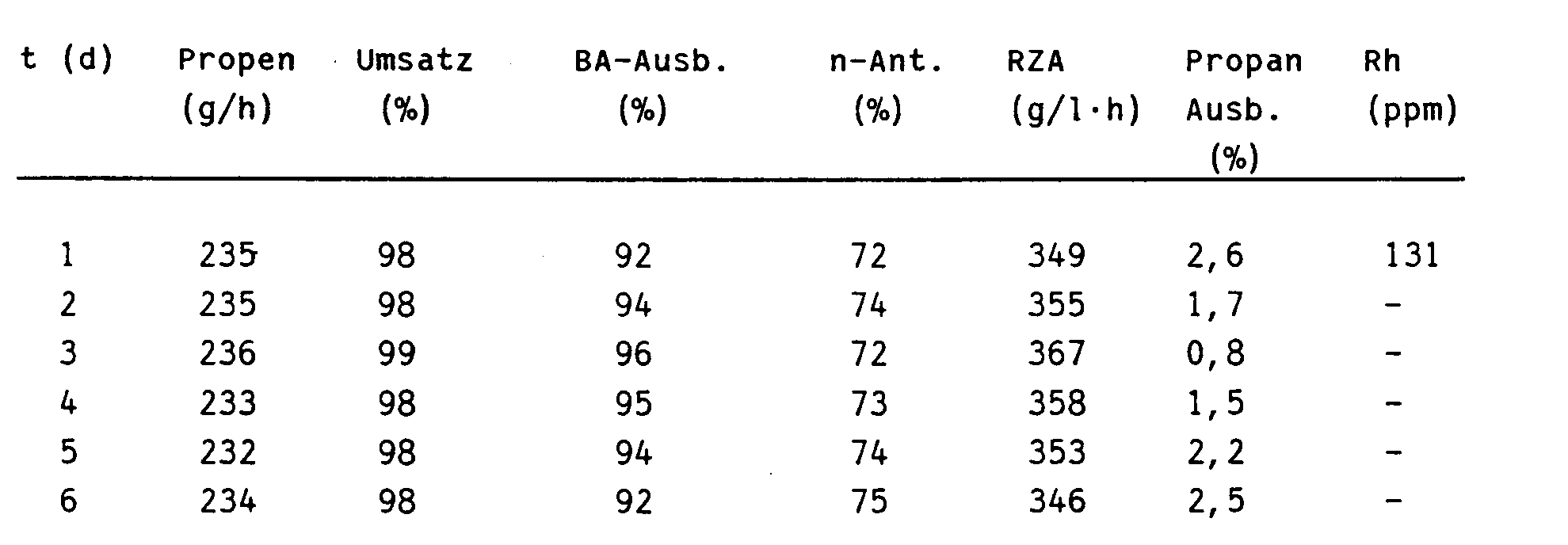
- Reaktionsbedingungen: Lösungsmittel Texanol@ und Butyraldehyd, 4,14 mmol Rh als [Rh(OAc)2]2, 41,2 g (41,4 mmol) Bisphosphit (2), L/Rh-Verh. = 10:1 (mol/mol), T = 70 bis 80°C, p = 20 bar, Kreisgas: 475 I/h, Abgas: 30 I/h, Katalysatorrücklauf: 600 ml/h.
- Dieses Beispiel zeigt die katalytische Aktivität von dem in EP-A-214 622 beschriebenen Bisphosphit 8.
- Die Versuchsdurchführung erfolgte entsprechend Beispiel 6. Der Kohlenmonoxid-Gehalt im Kreisgas betrug 4 bis 5 Vol.-%. Die Ergebnisse und Reaktionsbedingungen sind Tabelle 5 zu entnehmen. Die Bestimmung der Reaktionsprodukte erfolgte gaschromatographisch.

- Reaktionsbedingungen: Lösungsmittel Texanol@ und Butyraldehyd, 4,14 mmol Rh als [Rh(OAc)2]2, 15,9 g (16,56 mmol) Bisphosphit (8),
- L/Rh-Verh. = 4,0:1 (mol/mol), T = 90 bis 95° C, p = 20 bar.
- Kreisgas: 475 I/h, Abgas: 30 I/h, Katalysatorrücklauf: 600 ml/h.
- Die Bisphosphitliganden 1 bis 4 wurden wie in Beispiel 1 beschrieben bei der diskontinuierlichen Hydroformylierung von trans-2-Buten eingesetzt. Die Reaktionsbedingungen und Ergebnisse sind Tabelle 6 zu entnehmen. Die Bestimmung der Reaktionsprodukte erfolgte gaschromatographisch.


- Reaktionsbedingungen: 90 ppm Rh, 90° C, 13 bar CO:H2 (Molverhältnis 1:1), 25 bar Gesamtdruck, 4 h, 1,0 mol trans-2-Buten; 90 ml Texanol@.
- Dieses Beispiel zeigt die katalytische Aktivität von dem in EP-A-214 622 als Hydroformylierungskatalysator beschriebenen Bisphosphit 8, das zu Vergleichszwecken synthetisiert und getestet wurde.
- Die Reaktionsbedingungen und Ergebnisse sind Tabelle 7 zu entnehmen. Die Bestimmung der Reaktionsprodukte erfolgte gaschromatographisch.

- Reaktionsbedingungen: 90 ppm Rh, 90° C, 13 bar CO:H2 (Molverhältnis 1:1), 25 bar Gesamtdruck, 4 h, 1,0 mol trans-2-Buten; 90 ml Texanol@.
Claims (11)


Applications Claiming Priority (2)
| Application Number | Priority Date | Filing Date | Title |
|---|---|---|---|
| DE4026406 | 1990-08-21 | ||
| DE4026406A DE4026406A1 (de) | 1990-08-21 | 1990-08-21 | Rhodiumhydroformylierungskatalysatoren mit bis-phosphit-liganden |
Publications (2)
| Publication Number | Publication Date |
|---|---|
| EP0472071A1 true EP0472071A1 (de) | 1992-02-26 |
| EP0472071B1 EP0472071B1 (de) | 1993-06-30 |
Family
ID=6412617
Family Applications (1)
| Application Number | Title | Priority Date | Filing Date |
|---|---|---|---|
| EP91113446A Expired - Lifetime EP0472071B1 (de) | 1990-08-21 | 1991-08-10 | Rhodiumhydroformylierungskatalysatoren mit Bis-phosphit-Liganden |
Country Status (5)
| Country | Link |
|---|---|
| US (2) | US5202297A (de) |
| EP (1) | EP0472071B1 (de) |
| JP (1) | JPH04290551A (de) |
| DE (2) | DE4026406A1 (de) |
| ES (1) | ES2055948T3 (de) |
Cited By (30)
| Publication number | Priority date | Publication date | Assignee | Title |
|---|---|---|---|---|
| EP0577042A1 (de) * | 1992-06-29 | 1994-01-05 | Union Carbide Coatings Service Technology Corp. | Hydroformylierungsverfahren zur Herstellung von 1,6-Hexandial |
| EP0590611A1 (de) * | 1992-09-29 | 1994-04-06 | Union Carbide Chemicals & Plastics Technology Corporation | Verfahren für die Stabilisierung von Phosphatliganden |
| WO1995028228A1 (en) * | 1994-04-14 | 1995-10-26 | E.I. Du Pont De Nemours And Company | Bidentate phosphite and nickel catalyst compositions for hydrocyanation of monoolefins |
| EP0712828A1 (de) * | 1994-11-17 | 1996-05-22 | Dsm N.V. | Verfahren zur Herstellung eines Aldehyds |
| US5527950A (en) * | 1994-01-06 | 1996-06-18 | Dsm N.V. | Process for the preparation of 5-formylvalerate |
| US5731472A (en) * | 1995-12-06 | 1998-03-24 | Union Carbide Chemicals & Plastics Technology Corporation | Metal-ligand complex catalyzed processes |
| WO1999006418A1 (en) * | 1997-07-29 | 1999-02-11 | E.I. Du Pont De Nemours And Company | Selective synthesis of organodiphosphite compounds |
| US5892125A (en) * | 1994-09-03 | 1999-04-06 | Basf Aktiengesellschaft | Preparation of n-butyraldehyde and/or n-butanol |
| WO1999006146A3 (en) * | 1997-07-29 | 1999-04-08 | Du Pont | Supported diols and supported bis(phosphorus) ligands |
| EP0940407A1 (de) * | 1998-03-06 | 1999-09-08 | General Electric Company | Zyclische Bis-Phosphite |
| US6048997A (en) * | 1996-08-03 | 2000-04-11 | Basf Aktiengesellschaft | Manufacturing process for 6-aminocapronitrile |
| EP1209164A1 (de) * | 2000-11-24 | 2002-05-29 | Oxeno Olefinchemie GmbH | Neue Phosphininverbindung und deren Metallkomplexe |
| US7009068B2 (en) | 2001-08-16 | 2006-03-07 | Oxeno Olefinchemie Gmbh | Phosphite compounds and the metal complexes thereof |
| US7161020B2 (en) | 2001-08-16 | 2007-01-09 | Oxeno Olefinchemie Gmbh | Phosphite compounds and novel phosphite metal complexes |
| US7232931B2 (en) | 2002-05-10 | 2007-06-19 | Oxeno Olefinchemie Gmbh | Method for the rhodium-catalyzed hydroformylation of olefins with reduction of rhodium losses |
| US7317130B2 (en) | 2002-08-31 | 2008-01-08 | Oxeno Olefinchemie Gmbh | Method for the hydroformylation of olefinically unsaturated compounds, especially olefins, in the presence of cyclic carbonic acid esters |
| WO2008071508A1 (de) | 2006-12-13 | 2008-06-19 | Evonik Oxeno Gmbh | Bisphosphitliganden für die übergangsmetallkatalysierte hydroformylierung |
| WO2010057099A1 (en) | 2008-11-14 | 2010-05-20 | University Of Kansas | Polymer-supported transition metal catalyst complexes and methods of use |
| DE102009029050A1 (de) | 2009-08-31 | 2011-03-03 | Evonik Oxeno Gmbh | Organophosphorverbindungen basierend auf Tetraphenol(TP)-substituierten Strukturen |
| DE102011085883A1 (de) | 2011-11-08 | 2013-05-08 | Evonik Oxeno Gmbh | Neue Organophosphorverbindungen auf Basis von Anthracentriol |
| WO2013131936A1 (de) | 2012-03-07 | 2013-09-12 | Basf Se | Verfahren zur wärmeintegration bei der hydrierung und destillation von c3-c20-aldehyden |
| WO2013153136A1 (de) | 2012-04-12 | 2013-10-17 | Basf Se | Verfahren zur ergänzung des katalysators bei der kontinuierlichen hydroformylierung |
| DE102013219508A1 (de) | 2012-10-12 | 2014-04-17 | Evonik Degussa Gmbh | Gemische konstitutionsisomerer Bisphosphite |
| DE102013219512A1 (de) | 2012-10-12 | 2014-04-17 | Evonik Degussa Gmbh | Gemisch aus verschiedenen unsymmetrischen Bisphosphiten und dessen Verwendung als Katalysatorgemisch in der Hydroformylierung |
| WO2014056737A1 (de) | 2012-10-12 | 2014-04-17 | Evonik Degussa Gmbh | Gemisch aus verschiedenen unsymmetrischen bisphosphiten und dessen verwendung als katalysatorgemisch in der hydroformylierung |
| DE102013219510A1 (de) | 2012-10-12 | 2014-04-17 | Evonik Degussa Gmbh | Gemisch von Bisphosphiten und dessen Verwendung als Katalysatorgemisch in der Hydroformylierung |
| US8889917B2 (en) | 2012-04-12 | 2014-11-18 | Basf Se | Method of supplementing the catalyst in continuous hydroformylation |
| WO2015028284A1 (de) * | 2013-08-28 | 2015-03-05 | Evonik Industries Ag | Katalysator und verfahren zur hydroformylierung von ungesättigten verbindungen durch silp-katalyse |
| DE102016205883A1 (de) * | 2016-04-08 | 2017-10-12 | Evonik Degussa Gmbh | Pinakolester von Antracen-9-yloxy substituierten Dioxaphospholanen |
| EP3388413A1 (de) * | 2017-04-11 | 2018-10-17 | Evonik Degussa GmbH | Verfahren zur hydroformylierung von cyclooctadien unter einsatz von 2-(anthracen-9-yloxy)-4,4,5,5-tetramethyl-1,3,2-dioxaphospholan |
Families Citing this family (55)
| Publication number | Priority date | Publication date | Assignee | Title |
|---|---|---|---|---|
| US5360938A (en) * | 1991-08-21 | 1994-11-01 | Union Carbide Chemicals & Plastics Technology Corporation | Asymmetric syntheses |
| DK0730574T3 (da) * | 1993-11-23 | 1999-05-25 | Du Pont | Fremgangsmåder og katalysatorsammensætninger til hydrocyanering af monoolefiner |
| US5512695A (en) * | 1994-04-14 | 1996-04-30 | E. I. Du Pont De Nemours And Company | Bidentate phosphite and nickel catalyst compositions for hydrocyanation of monoolefins |
| TW315370B (de) * | 1994-10-07 | 1997-09-11 | Du Pont | |
| US5512696A (en) * | 1995-07-21 | 1996-04-30 | E. I. Du Pont De Nemours And Company | Hydrocyanation process and multidentate phosphite and nickel catalyst composition therefor |
| US5672766A (en) * | 1994-12-12 | 1997-09-30 | Mitsubishi Chemical Corporation | Method for producing aldehydes |
| US5821378A (en) * | 1995-01-27 | 1998-10-13 | E. I. Du Pont De Nemours And Company | Hydrocyanation of diolefins and isomerization of nonconjugated 2-alkyl-3-monoalkenenitriles |
| IN187044B (de) * | 1995-01-27 | 2002-01-05 | Du Pont | |
| US5648554A (en) * | 1995-04-12 | 1997-07-15 | Mitsubishi Chemical Corporation | Method for producing aldehydes |
| US5721783A (en) * | 1995-06-07 | 1998-02-24 | Anderson; James C. | Hearing aid with wireless remote processor |
| JPH0977713A (ja) * | 1995-09-19 | 1997-03-25 | Mitsubishi Chem Corp | アルデヒド類の製造方法 |
| JPH10130190A (ja) * | 1996-10-29 | 1998-05-19 | Mitsubishi Chem Corp | アルデヒド類の製造方法 |
| DE69802360T2 (de) * | 1997-09-18 | 2002-10-17 | Shell Internationale Research Maatschappij B.V., Den Haag/S'gravenhage | Hydroformylierungsverfahren |
| JP3812095B2 (ja) * | 1997-10-28 | 2006-08-23 | 三菱化学株式会社 | アルデヒド類の製造方法及びこれに用いるビスホスファイト |
| JP3846020B2 (ja) * | 1998-04-07 | 2006-11-15 | 三菱化学株式会社 | ビスホスファイト化合物及び該化合物を用いたアルデヒド類の製造方法 |
| CN1163463C (zh) | 1998-12-10 | 2004-08-25 | 三菱化学株式会社 | 醛的制备方法 |
| JP2000351746A (ja) * | 1999-06-09 | 2000-12-19 | Mitsubishi Chemicals Corp | アルデヒド類の製造法 |
| JP3885414B2 (ja) * | 1999-06-09 | 2007-02-21 | 三菱化学株式会社 | アルデヒド類の製造方法 |
| DE19954510A1 (de) | 1999-11-12 | 2001-05-17 | Oxeno Olefinchemie Gmbh | Verfahren zur katalytischen Herstellung von Aldehyden aus Olefinen unter Einsatz von Ligandenmischungen |
| JP3864669B2 (ja) * | 2000-05-08 | 2007-01-10 | 三菱化学株式会社 | ヒドロホルミル化方法 |
| MY127093A (en) * | 2000-05-17 | 2006-11-30 | Lucite Int Uk Ltd | Bidentate ligands useful in catalyst systems |
| DE10053272A1 (de) * | 2000-10-27 | 2002-05-08 | Oxeno Olefinchemie Gmbh | Neue Bisphosphitverbindungen und deren Metallkomplexe |
| WO2006020287A1 (en) | 2004-08-02 | 2006-02-23 | Union Carbide Chemicals & Plastics Technology Corporation | Stabilization of a hydroformylation process |
| WO2007114445A1 (ja) | 2006-04-04 | 2007-10-11 | Kuraray Co., Ltd. | ビスホスファイトおよび第8~10族金属化合物を用いたアルデヒドの製造方法、並びに該ビスホスファイト |
| JP5400627B2 (ja) * | 2007-03-20 | 2014-01-29 | ダウ テクノロジー インベストメンツ リミティド ライアビリティー カンパニー | 生成物異性体の制御が改善されたヒドロホルミル化方法 |
| DE102008002188A1 (de) * | 2008-06-03 | 2009-12-10 | Evonik Oxeno Gmbh | Verfahren zur Abtrennung von 1-Buten aus C4-haltigen Kohlenwasserstoffströmen durch Hydroformylierung |
| US8404903B2 (en) | 2008-07-03 | 2013-03-26 | Dow Technology Investments, Llc | Process of controlling heavies in a recycle catalyst stream |
| CN102365258B (zh) | 2009-03-31 | 2014-09-10 | 陶氏技术投资有限公司 | 使用双开端二亚磷酸酯配体的加氢甲酰基化方法 |
| EP2488539B2 (de) | 2009-10-16 | 2023-12-20 | Dow Technology Investments LLC | Gasphasenhydroformulierungsverfahren |
| KR101918054B1 (ko) | 2009-12-22 | 2018-11-13 | 다우 테크놀로지 인베스트먼츠 엘엘씨. | 합성 기체 분압의 조절에 의한 혼합된 리간드 하이드로폼일화 공정에서의 노말:아이소 알데하이드 비의 조절 방법 |
| CN102741210B (zh) | 2009-12-22 | 2016-02-24 | 陶氏技术投资有限责任公司 | 控制混合配体加氢甲酰化工艺中的正构∶异构醛比率 |
| WO2011087696A1 (en) | 2009-12-22 | 2011-07-21 | Dow Technology Investments Llc | Controlling the normal:iso aldehyde ratio in a mixed ligand hydroformylation process by controlling the olefin partial pressure |
| EP2624953B1 (de) | 2010-10-05 | 2018-10-24 | Dow Technology Investments LLC | Hydroformylierungsverfahren |
| SA112330271B1 (ar) | 2011-04-18 | 2015-02-09 | داو تكنولوجى انفستمنتس ال ال سى | تخفيف التلوث في عمليات هيدروفورملة عن طريق إضافة الماء |
| US9174907B2 (en) | 2012-06-04 | 2015-11-03 | Dow Technology Investments Llc | Hydroformylation process |
| US9539566B2 (en) | 2012-08-29 | 2017-01-10 | Dow Technology Investments Llc | Catalyst preparation process |
| JP6068652B2 (ja) | 2012-09-25 | 2017-01-25 | ダウ テクノロジー インベストメンツ リミティド ライアビリティー カンパニー | 分解に対してホスフィット配位子を安定化するためのプロセス |
| CN104837800B (zh) | 2012-12-06 | 2017-08-29 | 陶氏技术投资有限责任公司 | 氢甲酰化方法 |
| CN104725170B (zh) | 2013-12-19 | 2019-08-23 | 陶氏技术投资有限责任公司 | 加氢甲酰化方法 |
| WO2015094781A1 (en) | 2013-12-19 | 2015-06-25 | Dow Technology Investments Llc | Hydroformylation process |
| BR112016021934B1 (pt) | 2014-03-31 | 2021-10-13 | Dow Technology Investments Llc | Processo de hidroformilação |
| US10501486B2 (en) | 2014-05-14 | 2019-12-10 | Dow Technology Investments Llc | Stabilized organophosphorous compounds |
| MY184826A (en) | 2014-12-04 | 2021-04-24 | Dow Technology Investments Llc | Hydroformylation process |
| EP3029048B1 (de) * | 2014-12-04 | 2017-04-12 | Evonik Degussa GmbH | Bisphosphite die einen unsymmetrischen Biphenol-Flügel-Baustein aufweisen |
| TWI709568B (zh) | 2015-09-30 | 2020-11-11 | 美商陶氏科技投資公司 | 用於製造有機磷化合物的方法 |
| TWI709566B (zh) | 2015-09-30 | 2020-11-11 | 美商陶氏科技投資公司 | 用於製造有機磷化合物的方法 |
| JP6830477B2 (ja) * | 2016-04-05 | 2021-02-17 | 株式会社クラレ | ビスホスファイトおよびそれを用いた1,9−ノナンジアールの製造方法 |
| US20220143590A1 (en) | 2019-06-27 | 2022-05-12 | Dow Technology Investments Llc | Process to prepare solution from hydroformylation process for precious metal recovery |
| US11976017B2 (en) | 2019-12-19 | 2024-05-07 | Dow Technology Investments Llc | Processes for preparing isoprene and mono-olefins comprising at least six carbon atoms |
| EP4059914A1 (de) * | 2021-03-18 | 2022-09-21 | Evonik Operations GmbH | Bisphosphitliganden auf basis von benzpinakol und 1,3-propandiol |
| EP4430218A1 (de) | 2021-11-11 | 2024-09-18 | Dow Technology Investments LLC | Verfahren zur rückgewinnung von rhodium aus hydroformylierungsverfahren |
| WO2024228768A1 (en) | 2023-05-04 | 2024-11-07 | Dow Technology Investments Llc | Hydroformylation process |
| GB202307175D0 (en) | 2023-05-15 | 2023-06-28 | Johnson Matthey Davy Technologies Ltd | Process for hydrogenating a substrate |
| WO2025029349A1 (en) | 2023-08-03 | 2025-02-06 | Dow Technology Investments Llc | Hydroformylation process |
| GB202404300D0 (en) | 2024-03-26 | 2024-05-08 | Johnson Matthey Davy Technologies Ltd | Process for the production of 2-alkylalkanol |
Citations (4)
| Publication number | Priority date | Publication date | Assignee | Title |
|---|---|---|---|---|
| FR2236856A1 (de) * | 1973-07-09 | 1975-02-07 | Roehm Gmbh | |
| EP0353770A2 (de) * | 1988-08-05 | 1990-02-07 | UNION CARBIDE CHEMICALS AND PLASTICS COMPANY INC. (a New York corporation) | Ionische Phosphite und ihre Verwendung in homogenen übergangsmetallkatalysierten Verfahren |
| EP0213639B1 (de) * | 1985-09-05 | 1991-06-26 | Union Carbide Corporation | Bis-phosphit-Verbindungen |
| EP0214622B1 (de) * | 1985-09-05 | 1992-05-13 | Union Carbide Corporation | Durch Übergangsmetallkomplexe katalysierte Herstellungsverfahren |
Family Cites Families (4)
| Publication number | Priority date | Publication date | Assignee | Title |
|---|---|---|---|---|
| EP0096988B1 (de) * | 1982-06-11 | 1987-07-08 | DAVY McKEE (LONDON) LIMITED | Hydroformylierungsverfahren |
| EP0096986B1 (de) * | 1982-06-11 | 1987-04-22 | DAVY McKEE (LONDON) LIMITED | Hydroformylierungsverfahren |
| GB8334359D0 (en) * | 1983-12-23 | 1984-02-01 | Davy Mckee Ltd | Process |
| US4599206A (en) * | 1984-02-17 | 1986-07-08 | Union Carbide Corporation | Transition metal complex catalyzed reactions |
-
1990
- 1990-08-21 DE DE4026406A patent/DE4026406A1/de not_active Withdrawn
-
1991
- 1991-08-10 DE DE9191113446T patent/DE59100170D1/de not_active Expired - Lifetime
- 1991-08-10 EP EP91113446A patent/EP0472071B1/de not_active Expired - Lifetime
- 1991-08-10 ES ES91113446T patent/ES2055948T3/es not_active Expired - Lifetime
- 1991-08-14 JP JP3204138A patent/JPH04290551A/ja active Pending
- 1991-08-20 US US07/747,596 patent/US5202297A/en not_active Expired - Fee Related
-
1992
- 1992-10-28 US US07/967,433 patent/US5254741A/en not_active Expired - Fee Related
Patent Citations (4)
| Publication number | Priority date | Publication date | Assignee | Title |
|---|---|---|---|---|
| FR2236856A1 (de) * | 1973-07-09 | 1975-02-07 | Roehm Gmbh | |
| EP0213639B1 (de) * | 1985-09-05 | 1991-06-26 | Union Carbide Corporation | Bis-phosphit-Verbindungen |
| EP0214622B1 (de) * | 1985-09-05 | 1992-05-13 | Union Carbide Corporation | Durch Übergangsmetallkomplexe katalysierte Herstellungsverfahren |
| EP0353770A2 (de) * | 1988-08-05 | 1990-02-07 | UNION CARBIDE CHEMICALS AND PLASTICS COMPANY INC. (a New York corporation) | Ionische Phosphite und ihre Verwendung in homogenen übergangsmetallkatalysierten Verfahren |
Cited By (45)
| Publication number | Priority date | Publication date | Assignee | Title |
|---|---|---|---|---|
| EP0577042A1 (de) * | 1992-06-29 | 1994-01-05 | Union Carbide Coatings Service Technology Corp. | Hydroformylierungsverfahren zur Herstellung von 1,6-Hexandial |
| EP0590611A1 (de) * | 1992-09-29 | 1994-04-06 | Union Carbide Chemicals & Plastics Technology Corporation | Verfahren für die Stabilisierung von Phosphatliganden |
| US5527950A (en) * | 1994-01-06 | 1996-06-18 | Dsm N.V. | Process for the preparation of 5-formylvalerate |
| WO1995028228A1 (en) * | 1994-04-14 | 1995-10-26 | E.I. Du Pont De Nemours And Company | Bidentate phosphite and nickel catalyst compositions for hydrocyanation of monoolefins |
| US6646148B1 (en) | 1994-04-14 | 2003-11-11 | E. I. Du Pont De Nemours And Company | Bidentate phosphite and nickel catalyst compositions for hydrocyanation of monoolefins |
| US5892125A (en) * | 1994-09-03 | 1999-04-06 | Basf Aktiengesellschaft | Preparation of n-butyraldehyde and/or n-butanol |
| EP0712828A1 (de) * | 1994-11-17 | 1996-05-22 | Dsm N.V. | Verfahren zur Herstellung eines Aldehyds |
| US5731472A (en) * | 1995-12-06 | 1998-03-24 | Union Carbide Chemicals & Plastics Technology Corporation | Metal-ligand complex catalyzed processes |
| US6048997A (en) * | 1996-08-03 | 2000-04-11 | Basf Aktiengesellschaft | Manufacturing process for 6-aminocapronitrile |
| EP1214975A3 (de) * | 1997-07-29 | 2002-06-26 | E.I. Du Pont De Nemours And Company | Geträgerte Bisphosphor Liganden; deren Verwendung in Hydrocaynierungsverfahren |
| WO1999006146A3 (en) * | 1997-07-29 | 1999-04-08 | Du Pont | Supported diols and supported bis(phosphorus) ligands |
| US6121184A (en) * | 1997-07-29 | 2000-09-19 | E. I. Du Pont De Nemours And Company | Supported bis(phosphorus) ligands |
| WO1999006416A1 (en) * | 1997-07-29 | 1999-02-11 | E.I. Du Pont De Nemours And Company | Selective synthesis of organodiphosphite compounds |
| WO1999006418A1 (en) * | 1997-07-29 | 1999-02-11 | E.I. Du Pont De Nemours And Company | Selective synthesis of organodiphosphite compounds |
| EP0940407A1 (de) * | 1998-03-06 | 1999-09-08 | General Electric Company | Zyclische Bis-Phosphite |
| EP1209164A1 (de) * | 2000-11-24 | 2002-05-29 | Oxeno Olefinchemie GmbH | Neue Phosphininverbindung und deren Metallkomplexe |
| US6818770B2 (en) | 2000-11-24 | 2004-11-16 | Oxeno Olefinchemie Gmbh | Phosphinine compounds and metal complexes thereof |
| US7217828B2 (en) | 2000-11-24 | 2007-05-15 | Oxeno Olefinchemie Gmbh | Phosphinine compounds and metal complexes thereof |
| US7009068B2 (en) | 2001-08-16 | 2006-03-07 | Oxeno Olefinchemie Gmbh | Phosphite compounds and the metal complexes thereof |
| US7161020B2 (en) | 2001-08-16 | 2007-01-09 | Oxeno Olefinchemie Gmbh | Phosphite compounds and novel phosphite metal complexes |
| US7232931B2 (en) | 2002-05-10 | 2007-06-19 | Oxeno Olefinchemie Gmbh | Method for the rhodium-catalyzed hydroformylation of olefins with reduction of rhodium losses |
| US7317130B2 (en) | 2002-08-31 | 2008-01-08 | Oxeno Olefinchemie Gmbh | Method for the hydroformylation of olefinically unsaturated compounds, especially olefins, in the presence of cyclic carbonic acid esters |
| WO2008071508A1 (de) | 2006-12-13 | 2008-06-19 | Evonik Oxeno Gmbh | Bisphosphitliganden für die übergangsmetallkatalysierte hydroformylierung |
| CN101200476B (zh) * | 2006-12-13 | 2014-05-28 | 赢创奥克森诺有限责任公司 | 用于过渡金属催化的加氢甲酰化的双亚磷酸酯配体 |
| US8003816B2 (en) | 2006-12-13 | 2011-08-23 | Evonik Oxeno Gmbh | Bisphosphite ligands for hydroformylation catalyzed by transition metals |
| WO2010057099A1 (en) | 2008-11-14 | 2010-05-20 | University Of Kansas | Polymer-supported transition metal catalyst complexes and methods of use |
| DE102009029050A1 (de) | 2009-08-31 | 2011-03-03 | Evonik Oxeno Gmbh | Organophosphorverbindungen basierend auf Tetraphenol(TP)-substituierten Strukturen |
| WO2011023756A2 (de) | 2009-08-31 | 2011-03-03 | Evonik Oxeno Gmbh | Organophosphorverbindungen basierend auf tetraphenol(tp)-substituierten strukturen |
| EP2886533A1 (de) | 2009-08-31 | 2015-06-24 | Evonik Degussa GmbH | Verwendung von Organophosphorverbindungen basierend auf Tetraphenol(TP)-substituierten Strukturen |
| DE102011085883A1 (de) | 2011-11-08 | 2013-05-08 | Evonik Oxeno Gmbh | Neue Organophosphorverbindungen auf Basis von Anthracentriol |
| WO2013068232A1 (de) | 2011-11-08 | 2013-05-16 | Evonik Oxeno Gmbh | Neue organophosphorverbindungen auf basis von anthracentriol |
| EP3070093A1 (de) | 2011-11-08 | 2016-09-21 | Evonik Degussa GmbH | Neue organophosphorverbindungen auf basis von anthracentriol |
| WO2013131936A1 (de) | 2012-03-07 | 2013-09-12 | Basf Se | Verfahren zur wärmeintegration bei der hydrierung und destillation von c3-c20-aldehyden |
| US8889917B2 (en) | 2012-04-12 | 2014-11-18 | Basf Se | Method of supplementing the catalyst in continuous hydroformylation |
| WO2013153136A1 (de) | 2012-04-12 | 2013-10-17 | Basf Se | Verfahren zur ergänzung des katalysators bei der kontinuierlichen hydroformylierung |
| DE102013219510A1 (de) | 2012-10-12 | 2014-04-17 | Evonik Degussa Gmbh | Gemisch von Bisphosphiten und dessen Verwendung als Katalysatorgemisch in der Hydroformylierung |
| WO2014056735A1 (de) | 2012-10-12 | 2014-04-17 | Evonik Degussa Gmbh | Gemische konstitutionsisomerer bisphosphite |
| WO2014056736A1 (de) | 2012-10-12 | 2014-04-17 | Evonik Degussa Gmbh | Gemisch von bisphosphiten und dessen verwendung als katalysatorgemisch in der hydroformylierung |
| WO2014056737A1 (de) | 2012-10-12 | 2014-04-17 | Evonik Degussa Gmbh | Gemisch aus verschiedenen unsymmetrischen bisphosphiten und dessen verwendung als katalysatorgemisch in der hydroformylierung |
| DE102013219512A1 (de) | 2012-10-12 | 2014-04-17 | Evonik Degussa Gmbh | Gemisch aus verschiedenen unsymmetrischen Bisphosphiten und dessen Verwendung als Katalysatorgemisch in der Hydroformylierung |
| DE102013219508A1 (de) | 2012-10-12 | 2014-04-17 | Evonik Degussa Gmbh | Gemische konstitutionsisomerer Bisphosphite |
| WO2015028284A1 (de) * | 2013-08-28 | 2015-03-05 | Evonik Industries Ag | Katalysator und verfahren zur hydroformylierung von ungesättigten verbindungen durch silp-katalyse |
| DE102016205883A1 (de) * | 2016-04-08 | 2017-10-12 | Evonik Degussa Gmbh | Pinakolester von Antracen-9-yloxy substituierten Dioxaphospholanen |
| EP3388413A1 (de) * | 2017-04-11 | 2018-10-17 | Evonik Degussa GmbH | Verfahren zur hydroformylierung von cyclooctadien unter einsatz von 2-(anthracen-9-yloxy)-4,4,5,5-tetramethyl-1,3,2-dioxaphospholan |
| US10167244B2 (en) | 2017-04-11 | 2019-01-01 | Evonik Degussa Gmbh | Method for hydroformylating cyclooctadiene using 2-(anthracen-9-yloxy)-4,4,5,5-tetramethyl-1,3,2-dioxaphospholane |
Also Published As
| Publication number | Publication date |
|---|---|
| US5254741A (en) | 1993-10-19 |
| DE59100170D1 (de) | 1993-08-05 |
| ES2055948T3 (es) | 1994-09-01 |
| JPH04290551A (ja) | 1992-10-15 |
| EP0472071B1 (de) | 1993-06-30 |
| US5202297A (en) | 1993-04-13 |
| DE4026406A1 (de) | 1992-02-27 |
Similar Documents
| Publication | Publication Date | Title |
|---|---|---|
| EP0472071B1 (de) | Rhodiumhydroformylierungskatalysatoren mit Bis-phosphit-Liganden | |
| DE19717359B4 (de) | Bisphosphitverbindungen und Verfahren zu deren Herstellung | |
| DE60304034T2 (de) | Bisphosphit-ligande für carbonylierungsverfahren | |
| EP0556681B1 (de) | Verfahren zur Herstellung von omega-Formylalkancarbonsäureestern | |
| DE3886577T2 (de) | Verfahren zur Reinigung von tertiären Organophosphiten. | |
| DE69505612T2 (de) | Stabilisierung von Phosphiteliganden in das Hydroformylierungsverfahren | |
| DE69307240T2 (de) | Hydroformylierungsverfahren | |
| EP1201675B1 (de) | Bisphosphitverbindungen und deren Metallkomplexe | |
| EP1209164B1 (de) | Neue Phosphininverbindung und deren Metallkomplexe | |
| EP0435084B1 (de) | Verfahren zur Herstellung von Aldehyden | |
| WO2008071508A1 (de) | Bisphosphitliganden für die übergangsmetallkatalysierte hydroformylierung | |
| EP1924357B1 (de) | Carbonylierungsverfahren unter zusatz von sterisch gehinderten sekundären aminen | |
| WO2003016320A1 (de) | Neue phosphitverbindungen und deren metallkomplexe | |
| EP0705268B1 (de) | Phosphorhaltige calixarene | |
| EP0761635A1 (de) | Verfahren zur Hydroformylierung olefinisch ungesättigter Verbindungen | |
| EP1732872A1 (de) | Verfahren zur hydroformylierung von olefinen in anwesenheit von phosphororganischen verbindungen | |
| DE69916560T2 (de) | Verfahren zur Herstellung von Aldehyden | |
| EP0157316A2 (de) | Verfahren zur Herstellung von Aldehyden | |
| DE19946475A1 (de) | Binuclearer Rhodium-Komplex mit zweizähnigem Chelat-Liganden und dessen Verwendung in einem Verfahren zur Herstellung eines Aldehyds | |
| EP1177163B1 (de) | Verfahren zur herstellung von aldehyden | |
| EP0906261B1 (de) | Verfahren zur hydroformylierung und dafür geeignete katalysatoren, die phosphorverbindungen als liganden enthalten | |
| DE102006034442A1 (de) | Katalysatorvorstufe für einen Rh-Komplexkatalysator | |
| DE60319725T2 (de) | Bischelatligand und seine verwendung in carbonylierungs-verfahren | |
| DE102007023514A1 (de) | Stabile Katalysatorvorstufe von Rh-Komplexkatalysatoren | |
| DE3050815C2 (de) | Polymere, gegebenenfalls über Silicium-, Titan- oder Aluminium-Brückenatome vernetzte Organosiloxanphosphine |
Legal Events
| Date | Code | Title | Description |
|---|---|---|---|
| PUAI | Public reference made under article 153(3) epc to a published international application that has entered the european phase |
Free format text: ORIGINAL CODE: 0009012 |
|
| 17P | Request for examination filed |
Effective date: 19911227 |
|
| AK | Designated contracting states |
Kind code of ref document: A1 Designated state(s): BE CH DE ES FR GB IT LI NL SE |
|
| 17Q | First examination report despatched |
Effective date: 19921023 |
|
| GRAA | (expected) grant |
Free format text: ORIGINAL CODE: 0009210 |
|
| AK | Designated contracting states |
Kind code of ref document: B1 Designated state(s): BE CH DE ES FR GB IT LI NL SE |
|
| ITF | It: translation for a ep patent filed | ||
| REF | Corresponds to: |
Ref document number: 59100170 Country of ref document: DE Date of ref document: 19930805 |
|
| GBT | Gb: translation of ep patent filed (gb section 77(6)(a)/1977) |
Effective date: 19930722 |
|
| ET | Fr: translation filed | ||
| PLBE | No opposition filed within time limit |
Free format text: ORIGINAL CODE: 0009261 |
|
| STAA | Information on the status of an ep patent application or granted ep patent |
Free format text: STATUS: NO OPPOSITION FILED WITHIN TIME LIMIT |
|
| 26N | No opposition filed | ||
| REG | Reference to a national code |
Ref country code: ES Ref legal event code: FG2A Ref document number: 2055948 Country of ref document: ES Kind code of ref document: T3 |
|
| EAL | Se: european patent in force in sweden |
Ref document number: 91113446.8 |
|
| PGFP | Annual fee paid to national office [announced via postgrant information from national office to epo] |
Ref country code: FR Payment date: 20010713 Year of fee payment: 11 |
|
| PGFP | Annual fee paid to national office [announced via postgrant information from national office to epo] |
Ref country code: SE Payment date: 20010716 Year of fee payment: 11 |
|
| PGFP | Annual fee paid to national office [announced via postgrant information from national office to epo] |
Ref country code: NL Payment date: 20010719 Year of fee payment: 11 |
|
| PGFP | Annual fee paid to national office [announced via postgrant information from national office to epo] |
Ref country code: CH Payment date: 20010723 Year of fee payment: 11 |
|
| PGFP | Annual fee paid to national office [announced via postgrant information from national office to epo] |
Ref country code: GB Payment date: 20010801 Year of fee payment: 11 |
|
| PGFP | Annual fee paid to national office [announced via postgrant information from national office to epo] |
Ref country code: ES Payment date: 20010806 Year of fee payment: 11 |
|
| PGFP | Annual fee paid to national office [announced via postgrant information from national office to epo] |
Ref country code: DE Payment date: 20010811 Year of fee payment: 11 |
|
| PGFP | Annual fee paid to national office [announced via postgrant information from national office to epo] |
Ref country code: BE Payment date: 20010912 Year of fee payment: 11 |
|
| REG | Reference to a national code |
Ref country code: GB Ref legal event code: IF02 |
|
| PG25 | Lapsed in a contracting state [announced via postgrant information from national office to epo] |
Ref country code: GB Free format text: LAPSE BECAUSE OF NON-PAYMENT OF DUE FEES Effective date: 20020810 |
|
| PG25 | Lapsed in a contracting state [announced via postgrant information from national office to epo] |
Ref country code: SE Free format text: LAPSE BECAUSE OF NON-PAYMENT OF DUE FEES Effective date: 20020811 Ref country code: ES Free format text: LAPSE BECAUSE OF NON-PAYMENT OF DUE FEES Effective date: 20020811 |
|
| PG25 | Lapsed in a contracting state [announced via postgrant information from national office to epo] |
Ref country code: LI Free format text: LAPSE BECAUSE OF NON-PAYMENT OF DUE FEES Effective date: 20020831 Ref country code: CH Free format text: LAPSE BECAUSE OF NON-PAYMENT OF DUE FEES Effective date: 20020831 Ref country code: BE Free format text: LAPSE BECAUSE OF NON-PAYMENT OF DUE FEES Effective date: 20020831 |
|
| PG25 | Lapsed in a contracting state [announced via postgrant information from national office to epo] |
Ref country code: DE Free format text: LAPSE BECAUSE OF THE APPLICANT RENOUNCES Effective date: 20020924 |
|
| BERE | Be: lapsed |
Owner name: *BASF A.G. Effective date: 20020831 |
|
| PG25 | Lapsed in a contracting state [announced via postgrant information from national office to epo] |
Ref country code: NL Free format text: LAPSE BECAUSE OF NON-PAYMENT OF DUE FEES Effective date: 20030301 |
|
| EUG | Se: european patent has lapsed | ||
| GBPC | Gb: european patent ceased through non-payment of renewal fee |
Effective date: 20020810 |
|
| REG | Reference to a national code |
Ref country code: CH Ref legal event code: PL |
|
| PG25 | Lapsed in a contracting state [announced via postgrant information from national office to epo] |
Ref country code: FR Free format text: LAPSE BECAUSE OF NON-PAYMENT OF DUE FEES Effective date: 20030430 |
|
| NLV4 | Nl: lapsed or anulled due to non-payment of the annual fee |
Effective date: 20030301 |
|
| REG | Reference to a national code |
Ref country code: FR Ref legal event code: ST |
|
| REG | Reference to a national code |
Ref country code: ES Ref legal event code: FD2A Effective date: 20030912 |
|
| PG25 | Lapsed in a contracting state [announced via postgrant information from national office to epo] |
Ref country code: IT Free format text: LAPSE BECAUSE OF NON-PAYMENT OF DUE FEES;WARNING: LAPSES OF ITALIAN PATENTS WITH EFFECTIVE DATE BEFORE 2007 MAY HAVE OCCURRED AT ANY TIME BEFORE 2007. THE CORRECT EFFECTIVE DATE MAY BE DIFFERENT FROM THE ONE RECORDED. Effective date: 20050810 |