EP2814871B1 - Clear semi-crystalline articles with improved heat resistance - Google Patents
Clear semi-crystalline articles with improved heat resistance Download PDFInfo
- Publication number
- EP2814871B1 EP2814871B1 EP13706861.5A EP13706861A EP2814871B1 EP 2814871 B1 EP2814871 B1 EP 2814871B1 EP 13706861 A EP13706861 A EP 13706861A EP 2814871 B1 EP2814871 B1 EP 2814871B1
- Authority
- EP
- European Patent Office
- Prior art keywords
- mole
- polyester
- residues
- strain induced
- article
- Prior art date
- Legal status (The legal status is an assumption and is not a legal conclusion. Google has not performed a legal analysis and makes no representation as to the accuracy of the status listed.)
- Active
Links
Images
Classifications
-
- C—CHEMISTRY; METALLURGY
- C08—ORGANIC MACROMOLECULAR COMPOUNDS; THEIR PREPARATION OR CHEMICAL WORKING-UP; COMPOSITIONS BASED THEREON
- C08L—COMPOSITIONS OF MACROMOLECULAR COMPOUNDS
- C08L67/00—Compositions of polyesters obtained by reactions forming a carboxylic ester link in the main chain; Compositions of derivatives of such polymers
- C08L67/02—Polyesters derived from dicarboxylic acids and dihydroxy compounds
-
- C—CHEMISTRY; METALLURGY
- C08—ORGANIC MACROMOLECULAR COMPOUNDS; THEIR PREPARATION OR CHEMICAL WORKING-UP; COMPOSITIONS BASED THEREON
- C08G—MACROMOLECULAR COMPOUNDS OBTAINED OTHERWISE THAN BY REACTIONS ONLY INVOLVING UNSATURATED CARBON-TO-CARBON BONDS
- C08G63/00—Macromolecular compounds obtained by reactions forming a carboxylic ester link in the main chain of the macromolecule
- C08G63/02—Polyesters derived from hydroxycarboxylic acids or from polycarboxylic acids and polyhydroxy compounds
- C08G63/12—Polyesters derived from hydroxycarboxylic acids or from polycarboxylic acids and polyhydroxy compounds derived from polycarboxylic acids and polyhydroxy compounds
- C08G63/16—Dicarboxylic acids and dihydroxy compounds
- C08G63/18—Dicarboxylic acids and dihydroxy compounds the acids or hydroxy compounds containing carbocyclic rings
- C08G63/199—Acids or hydroxy compounds containing cycloaliphatic rings
-
- C—CHEMISTRY; METALLURGY
- C08—ORGANIC MACROMOLECULAR COMPOUNDS; THEIR PREPARATION OR CHEMICAL WORKING-UP; COMPOSITIONS BASED THEREON
- C08L—COMPOSITIONS OF MACROMOLECULAR COMPOUNDS
- C08L2201/00—Properties
- C08L2201/10—Transparent films; Clear coatings; Transparent materials
-
- C—CHEMISTRY; METALLURGY
- C08—ORGANIC MACROMOLECULAR COMPOUNDS; THEIR PREPARATION OR CHEMICAL WORKING-UP; COMPOSITIONS BASED THEREON
- C08L—COMPOSITIONS OF MACROMOLECULAR COMPOUNDS
- C08L2203/00—Applications
- C08L2203/10—Applications used for bottles
-
- C—CHEMISTRY; METALLURGY
- C08—ORGANIC MACROMOLECULAR COMPOUNDS; THEIR PREPARATION OR CHEMICAL WORKING-UP; COMPOSITIONS BASED THEREON
- C08L—COMPOSITIONS OF MACROMOLECULAR COMPOUNDS
- C08L2205/00—Polymer mixtures characterised by other features
- C08L2205/02—Polymer mixtures characterised by other features containing two or more polymers of the same C08L -group
Definitions
- the present invention generally relates to clear semi-crystalline articles made from polyesters comprising terephthalic acid, or an ester thereof, or mixtures thereof; 1 to 15 mole % 2,2,4,4-tetramethyl-1,3-cyclobutanediol residues and 85 to 99 mole% 1,4-cyclohexanedimethanol residues.
- These polyesters have a surprising combination of a certain crystallization rate along with a certain melting temperatures (Tm) and certain glass transition temperatures (Tg). These polyesters are useful in preparing clear semi-crystalline articles with improved heat resistance by strain induced crystallization processes known in the art.
- copolyester compositions comprising terephthalic acid or an ester thereof or mixtures thereof, 2,2,4,4-tetramethyl-1,3-cyclobutanediol (TMCD) residues and 1,4-cyclohexanedimethanol (CHDM) residues have been focused primarily for use in the injection molding and extrusion of amorphous articles even in relatively thick parts due to slow crystallization rates.
- TMCD 2,2,4,4-tetramethyl-1,3-cyclobutanediol
- CHDM 1,4-cyclohexanedimethanol
- PCT polyester
- TPA terephthalic acid
- DMT dimethyl terephthalate
- CHDM 70/30 trans/cis
- additional dicarboxylic acids or glycols can be used to modify PCT in order to slow down the crystallization rate.
- ethylene glycol or isophthalic acid-modified PCTs are known in the art and are commercially available.
- PET Polyethylene terephthalate
- slightly modified PET's have been proven useful in clear semi-crystalline articles such as soft drink bottles, oriented films, and oriented fibers. These articles from PET are prepared by processes that take advantage of PET's ability to strain induce crystallize above Tg from an amorphous state. These PETs have slower thermal crystallization rates than unmodified PCT allowing them to be used in such processes.
- PCT has to be modified with certain levels, approximately 15 to 30 mole % of the diol fraction coming from ethylene glycol or 15 to 30 mole % of the acid fraction coming from isophthalic acid.
- Tm melting temperatures
- Tg glass transition temperatures
- these modified PCT materials provide little benefit in terms of heat resistance compared to PET and are typically more costly to produce.
- EP 2 332 592 A1 discloses polyester compositions made from terephthalic acid or an ester thereof or mixtures thereof; 2,2,4,4-tetramethyl-1,3-cyclobutanediol; and cyclohexanedimethanol, the polyester having a certain combination of inherent viscosity and glass transition temperature (Tg).
- the compositions have a certain combination of at least two of high impact strengths, moderate glass transition temperature (Tg), toughness, certain inherent viscosities, low ductile-to-brittle transition temperatures, good color and clarity, low densities, chemical resistance, and long crystallization half-times, which allow them to be easily formed into articles.
- the invention relates to a method of making a clear, semicrystalline, strain induced crystallized article comprising at least one polyester which comprises:
- the articles have a strain induced crystallinity of greater than zero when stretched at a temperature above the Tg of the polyester.
- the articles have a strain induced crystallinity of from 5% to 50 % when stretched at a temperature above the Tg of the polyester.
- the articles have a strain induced crystallinity of from 5% to 45 % when stretched at a temperature above the Tg of the polyester.
- the articles have a strain induced crystallinity of from 5% to 40 % when stretched at a temperature above the Tg of the polyester.
- the articles have a strain induced crystallinity of from 5% to 35 % when stretched at a temperature above the Tg of the polyester.
- the articles have a strain induced crystallinity of greater than zero when stretched at a temperature 10°C above the Tg of the polyester.
- the articles have a strain induced crystallinity of from 5% to 50 % when stretched at a temperature 10°C above the Tg of the polyester.
- the articles have a strain induced crystallinity of from 5% to 45 % when stretched at a temperature 10°C above the Tg of the polyester.
- the articles have a strain induced crystallinity of from 5% to 40 % when stretched at a temperature 10°C above the Tg of the polyester.
- the articles have a strain induced crystallinity of from 5% to 35 % when stretched at a temperature 10°C above the Tg of the polyester.
- the articles have a strain induced crystallinity of greater than zero when stretched at a temperature 20°C above the Tg of the polyester.
- the articles have a strain induced crystallinity of from 5% to 50 % when stretched at a temperature 20°C above the Tg of the polyester.
- the articles have a strain induced crystallinity of from 5% to 45 % when stretched at a temperature 20°C above the Tg of the polyester.
- the articles have a strain induced crystallinity of from 5% to 40 % when stretched at a temperature 20 °C above the Tg of the polyester.
- the articles have a strain induced crystallinity of from 5% to 35 % when stretched at a temperature 20°C above the Tg of the polyester.
- the articles have a strain induced crystallinity of from 8% to 35 % when stretched at a temperature 10°C above the Tg of the polyester.
- the article has a strain induced crystallinity of from 8% to 35 % when stretched at a temperature 20 °C above the Tg of the polyester.
- the article has a strain induced crystallinity of from 10% to 35 % when stretched at a temperature 10°C above the Tg of the polyester.
- the article has a strain induced crystallinity of from 10% to 35 % when stretched at a temperature 20°C above the Tg of the polyester.
- the article has a strain induced crystallinity of from 10% to 30 % when stretched at a temperature 10°C above the Tg of the polyester.
- the article has a strain induced crystallinity of from 10% to 30 % when stretched at a temperature 20°C above the Tg of the polyester.
- the clear semi-crystalline article can comprise the polyester having a crystallization half-time of less than 10 minutes but greater than about 30 seconds.
- the clear semi-crystalline article can comprise the polyester having a melting temperature (Tm) from 260°C to 300°C.
- the clear semi-crystalline article can comprise the polyester having a glass transition temperature (Tg) from 90°C to 115°C.
- the clear semi-crystalline article can comprise the polyester having a fastest crystallization half-time of less than 10 minutes but greater than about 30 seconds.
- the clear semi-crystalline article can comprise the polyester having a fastest crystallization half-time of less than 10 minutes but greater than about 30 seconds and a melting temperature from 260 °C to 300°C.
- the clear semi-crystalline article can comprise the polyester having a fastest crystallization half-time of less than 10 minutes but greater than about 30 seconds and a glass transition temperature from 90 °C to 115°C.
- the clear semi-crystalline article can comprise the polyester having a fastest crystallization half-time of less than 10 minutes but greater than about 30 seconds, a glass transition temperature from 90 °C to 115°C, and a melting temperature from 260 °C to 300°C.
- the polyesters useful in the invention contain no branching agent or, alternatively, at least one branching agent is added either prior to or during polymerization of the polyester.
- the polyesters useful in the invention contain at least one branching agent without regard to the method or sequence in which it is added.
- the polyester compositions are useful in clear semi-crystalline articles of manufacture, prepared by orientation processes known in the industry, including but not limited to, blown bottles, oriented films and oriented fibers.
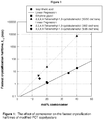
- Figure 1 depicts the effect of comonomer on the fastest crystallization half-times of copolyesters containing terephthalic acid, cyclohexanedimethanol and another monomer (modified PCT copolyesters)
- polystyrene resin is intended to include “copolyesters” and is understood to mean a synthetic polymer prepared by the reaction of one or more difunctional carboxylic acids and/or multifunctional carboxylic acids with one or more difunctional hydroxyl compounds and/or multifunctional hydroxyl compounds.
- the difunctional carboxylic acid can be a dicarboxylic acid and the difunctional hydroxyl compound can be a dihydric alcohol such as, for example, glycols and diols.
- glycocol as used in this application includes, but is not limited to, diols, glycols, and/or multifunctional hydroxyl compounds, for example, branching agents.
- the difunctional carboxylic acid may be a hydroxy carboxylic acid such as, for example, p-hydroxybenzoic acid
- the difunctional hydroxyl compound may be an aromatic nucleus bearing 2 hydroxyl substituents such as, for example, hydroquinone.
- reduce means any organic structure incorporated into a polymer through a polycondensation and/or an esterification reaction from the corresponding monomer.
- peeling unit means an organic structure having a dicarboxylic acid residue and a diol residue bonded through a carbonyloxy group.
- the dicarboxylic acid residues may be derived from a dicarboxylic acid monomer or its associated acid halides, esters, salts, anhydrides, or mixtures thereof.
- dicarboxylic acid is intended to include dicarboxylic acids and any derivative of a dicarboxylic acid, including its associated acid halides, esters, half-esters, salts, half-salts, anhydrides, mixed anhydrides, or mixtures thereof, useful in a reaction process with a diol to make polyester.
- the term "diacid” includes multifunctional acids, for example, branching agents.
- terephthalic acid is intended to include terephthalic acid itself and residues thereof as well as any derivative of terephthalic acid, including its associated acid halides, esters, half-esters, salts, half-salts, anhydrides, mixed anhydrides, or mixtures thereof or residues thereof useful in a reaction process with a diol to make polyester.
- terephthalic acid may be used as the starting material.
- dimethyl terephthalate may be used as the starting material.
- mixtures of terephthalic acid and dimethyl terephthalate may be used as the starting material and/or as an intermediate material.
- the polyesters used in the present invention typically can be prepared from dicarboxylic acids and diols which react in substantially equal proportions and are incorporated into the polyester polymer as their corresponding residues.
- the polyesters therefore, can contain substantially equal molar proportions of acid residues (100 mole%) and diol (and/or multifunctional hydroxyl compounds) residues (100 mole%) such that the total moles of repeating units is equal to 100 mole%.
- the mole percentages provided in the present disclosure therefore, may be based on the total moles of acid residues, the total moles of diol residues, or the total moles of repeating units.
- a polyester containing 30 mole% isophthalic acid means the polyester contains 30 mole% isophthalic acid residues out of a total of 100 mole% acid residues. Thus, there are 30 moles of isophthalic acid residues among every 100 moles of acid residues.
- a polyester containing 15 mole% 2,2,4,4-tetramethyl-1,3-cyclobutanediol means the polyester contains 15 mole% 2,2,4,4-tetramethyl-1,3-cyclobutanediol residues out of a total of 100 mole% diol residues. Thus, there are 15 moles of 2,2,4,4-tetramethyl-1,3-cyclobutanediol residues among every 100 moles of diol residues.
- the Tg of the polyesters useful in the invention can be at least one of the following ranges: 90 to 115°C; 90 to 110°C; 90 to 105°C; 90 to 100°C; 90 to 95°C; 95 to 115°C; 95 to 110°C; 95 to 105°C; 95 to 100°C; 100 to 115°C; 100 to 110°C; 100 to 105°C; 105 to 115°C; 105 to 110°C; and 110 to 115°C.
- the glycol component for the polyesters useful in the invention include but are not limited to at least one of the following combinations of ranges: 1 to 15 mole % 2,2,4,4-tetramethyl-1,3-cyclobutanediol and 85 to 99 mole % 1,4-cyclohexanedimethanol; 1 to 14 mole % 2,2,4,4-tetramethyl-1,3-cyclobutanediol and 86 to 99 mole % 1,4-cyclohexanedimethanol; 1 to 13 mole % 2,2,4,4-tetramethyl-1,3-cyclobutanediol and 87 to 99 mole % 1,4-cyclohexanedimethanol; 1 to 12 mole % 2,2,4,4-tetramethyl-1,3-cyclobutanediol and 88 to 99 mole % 1,4-cyclohexanedimethanol; 1 to 11 mole % 2,2,4,4-tetramethyl
- the glycol component for the polyesters useful in the film or sheet of the invention include but are not limited to at least one of the following combinations of ranges: 5 to 15 mole % 2,2,4,4-tetramethyl-1,3-cyclobutanediol and 85 to 95 mole % 1,4-cyclohexanedimethanol; and 5 to 10 mole % 2,2,4,4-tetramethyl-1,3-cyclobutanediol and 90 to 95 mole % 1,4-cyclohexanedimethanol.
- the polyesters useful in the invention may exhibit at least one of the following inherent viscosities as determined in 60/40 (wt/wt) phenol/ tetrachloroethane at a concentration of 0.5 g/100 ml at 25oC: 0.35 to 1.2 dL/g; 0.35 to 1.1 dL/g; 0.35 to 1 dL/g; 0.35 to less than 1 dL/g; 0.35 to 0.98 dL/g; 0.35 to 0.95 dUg; 0.35 to 0.90 dL/g; 0.35 to 0.85 dL/g; 0.35 to 0.80 dL/g; 0.35 to 0.75 dL/g; 0.35 to less than 0.75 dL/g; 0.35 to 0.72 dL/g; 0.35 to 0.70 dL/g; 0.35 to less than 0.70 dL/g; 0.35 to 0.68 dL/g; 0.35 to less than 0.68 dL/g; 0.35 to less than 0.68
- the polyesters useful in the invention may exhibit at least one of the following inherent viscosities as determined in 60/40 (wt/wt) phenol/ tetrachloroethane at a concentration of 0.5 g/100 ml at 25oC: 0.45 to 1.2 dL/g; 0.45 to 1.1 dL/g; 0.45 to 1 dL/g; 0.45 to 0.98 dL/g; 0.45 to 0.95 dUg; 0.45 to 0.90 dL/g; 0.45 to 0.85 dL/g; 0.45 to 0.80 dL/g; 0.45 to 0.75 dL/g; 0.45 to less than 0.75 dL/g; 0.45 to 0.72 dL/g; 0.45 to 0.70 dL/g; 0.45 to less than 0.70 dL/g; 0.45 to 0.68 dUg; 0.45 to less than 0.68 dL/g; 0.45 to 0.65 dL/g; 0.50 to
- the polyester compositions can posses at least one of the Tg ranges described herein and at least one of the monomer ranges for the compositions described herein unless otherwise stated. It is also contemplated that the polyester compositions can posses at least one of the Tg ranges described herein, at least one of the inherent viscosity ranges described herein, and at least one of the monomer ranges for the compositions described herein unless otherwise stated.
- the molar ratio of cis/trans 2,2,4,4-tetramethyl-1,3-cyclobutanediol can vary from the pure form of each or mixtures thereof.
- the molar percentages for cis and/or trans 2,2,4,4-tetramethyl-1,3-cyclobutanediol are greater than 50 mole % cis and less than 50 mole % trans; or greater than 55 mole % cis and less than 45 mole % trans; or 30 to 70 mole % cis and 70 to 30 % trans; or 40 to 60 mole % cis and 60 to 40 mole % trans; or 50 to 70 mole % trans and 50 to 30 mole % cis; or 50 to 70 mole % cis and 50 to 30 % trans or 60 to 70 mole % cis and 30 to 40 mole % trans; or greater than 70 mole % cis and less than 30 mole % trans;
- terephthalic acid, or an ester thereof makes up most or all of the dicarboxylic acid component used to form the polyesters useful in the invention.
- terephthalic acid residues can make up a portion or all of the dicarboxylic acid component used to form the present polyester at a concentration of at least 70 mole %, such as at least 80 mole %, at least 90 mole%, at least 95 mole%, at least 99 mole%, or the preferred embodiment of 100 mole %.
- polyesters with higher amounts of terephthalic acid can be used in order to produce higher impact strength properties.
- terephthalic acid and "dimethyl terephthalate are used interchangeably herein.
- dimethyl terephthalate is part or all of the dicarboxylic acid component used to make the polyesters useful in the present invention. In all embodiments, ranges of from 70 to 100 mole %; or 80 to 100 mole %; or 90 to 100 mole %; or 99 to 100 mole %; or 100 mole % terephthalic acid and/or dimethyl terephthalate and/or mixtures thereof may be used.
- the dicarboxylic acid component of the polyesters useful in the invention can comprise up to 30 mole %, up to 20 mole %, up to 10 mole %, up to 5 mole %, or up to 1 mole % of one or more modifying aromatic dicarboxylic acids.
- the preferred embodiment contains 0 mole % modifying aromatic dicarboxylic acids.
- the amount of one or more modifying aromatic dicarboxylic acids can range from any of these preceding endpoint values including, for example, from 0.01 to 30 mole %, from 0.01 to 20 mole %, from 0.01 to 10 mole %, from 0.01 to 5 mole %, or from 0.01 to 1 mole % of one or more modifying aromatic dicarboxylic acids.
- modifying aromatic dicarboxylic acids that may be used in the present invention include but are not limited to .those having up to 20 carbon atoms, and that can be linear, para-oriented, or symmetrical.
- modifying aromatic dicarboxylic acids which may be used in this invention include, but are not limited to, isophthalic acid, 4,4'-biphenyldicarboxylic acid, 1,4-, 1,5-, 2,6-, 2,7-naphthalenedicarboxylic acid, and trans-4,4'-stilbenedicarboxylic acid, and esters thereof.
- isophthalic acid is the modifying aromatic dicarboxylic acid.
- the preferred embodiment of the invention is for 100% of the dicarboxylic acid component based on terephthalic acid residues.
- the carboxylic acid component of the polyesters useful in the invention can be further modified with up to 10 mole %, such as up to 5 mole % or up to 1 mole % of one or more aliphatic dicarboxylic acids containing 2-16 carbon atoms, such as, for example, malonic, succinic, glutaric, adipic, pimelic, suberic, azelaic and dodecanedioic dicarboxylic acids. Certain embodiments can also comprise 0.01 or more mole %, such as 0.1 or more mole %, 1 or more mole %, 5 or more mole %, or 10 or more mole % of one or more modifying aliphatic dicarboxylic acids.
- the preferred embodiment contains 0 mole % modifying aliphatic dicarboxylic acids.
- the amount of one or more modifying aliphatic dicarboxylic acids can range from any of these preceding endpoint values including, for example, from 0.01 to 10 mole % and from 0.1 to 10 mole %.
- the total mole % of the dicarboxylic acid component is 100 mole %.
- esters of terephthalic acid and the other modifying dicarboxylic acids or their corresponding esters and/or salts may be used instead of the dicarboxylic acids.
- Suitable examples of dicarboxylic acid esters include, but are not limited to, the dimethyl, diethyl, dipropyl, diisopropyl, dibutyl, and diphenyl esters.
- the esters are chosen from at least one of the following: methyl, ethyl, propyl, isopropyl, and phenyl esters.
- the 1,4-cyclohexanedimethanol may be cis, trans, or a mixture thereof, for example, a cis/trans ratio of 60:40 to 40:60.
- the trans-1,4-cyclohexanedimethanol can be present in the amount of 60 to 80 mole %.
- the glycol component of the polyester portion of the polyester compositions useful in the invention can contain 14 mole % or less of one or more modifying glycols which are not 2,2,4,4-tetramethyl-1,3-cyclobutanediol or 1,4-cyclohexanedimethanol; in another embodiment, the polyesters useful in the invention can contain 10 mole % or less of one or more modifying glycols. In another embodiment, the polyesters useful in the invention can contain 5 mole % or less of one or more modifying glycols. In another embodiment, the polyesters useful in the invention can contain 3 mole % or less of one or more modifying glycols. In the preferred embodiment, the polyesters useful in the invention may contain 0 mole % modifying glycols.
- Certain embodiments can also contain 0.01 or more mole %, such as 0.1 or more mole %, 1 or more mole %, 5 or more mole %, or 10 or more mole % of one or more modifying glycols.
- the amount of one or more modifying glycols can range from any of these preceding endpoint values including, for example, from 0.1 to 10 mole %.
- Modifying glycols useful in the polyesters useful in the invention refer to diols other than 2,2,4,4-tetramethyl-1,3-cyclobutanediol and 1,4-cyclohexanedimethanol and may contain 2 to 16 carbon atoms.
- suitable modifying glycols include, but are not limited to, ethylene glycol, diethylene glycol, 1,2-propanediol, 1,3-propanediol, neopentyl glycol, 1,4-butanediol, 1,5-pentanediol, 1,6-hexanediol, p-xylene glycol or mixtures thereof.
- the modifying glycol is ethylene glycol.
- the modifying glycols include but are not limited to 1,3-propanediol and/or 1,4-butanediol.
- ethylene glycol is excluded as a modifying diol.
- 1,3-propanediol and 1,4-butanediol are excluded as modifying diols.
- 2,2-dimethyl-1,3-propanediol is excluded as a modifying diol.
- the polyesters useful the invention can comprise from 0 to 10 mole percent, for example, from 0.01 to 5 mole percent, from 0.01 to 1 mole percent, from 0.05 to 5 mole percent, from 0.05 to 1 mole percent, or from 0.1 to 0.7 mole percent, or 0.1 to 0.5 mole percent, based the total mole percentages of either the diol or diacid residues; respectively, of one or more residues of a branching monomer, also referred to herein as a branching agent, having 3 or more carboxyl substituents, hydroxyl substituents, or a combination thereof.
- the branching monomer or agent may be added prior to and/or during and/or after the polymerization of the polyester.
- the polyester(s) useful in the invention can thus be linear or branched.
- the branching monomer or agent may be added prior to and/or during and/or after the polymerization.
- branching monomers include, but are not limited to, multifunctional acids or multifunctional alcohols such as trimellitic acid, trimellitic anhydride, pyromellitic dianhydride, trimethylolpropane, glycerol, pentaerythritol, citric acid, tartaric acid, 3-hydroxyglutaric acid and the like.
- the branching monomer residues can comprise 0.1 to 0.7 mole percent of one or more residues chosen from at least one of the following: trimellitic anhydride, pyromellitic dianhydride, glycerol, sorbitol, 1,2,6-hexanetriol, pentaerythritol, trimethylolethane, and/or trimesic acid.
- the branching monomer may be added to the polyester reaction mixture or blended with the polyester in the form of a concentrate as described, for example, in U.S. Patent Nos. 5,654,347 and 5,696,176 .
- the polyesters useful in the invention can be made by processes known from the literature such as, for example, by processes in homogenous solution, by transesterification processes in the melt, and by two phase interfacial processes. Suitable methods include , but are not limited to, the steps of reacting one or more dicarboxylic acids with one or more glycols at a temperature of 100°C to 315°C at a pressure of 0.1 to 760 mm Hg for a time sufficient to form a polyester. See U.S. Patent No. 3,772,405 for methods of producing polyesters.
- the invention discloses a process for producing a polyester.
- the process comprises:
- Suitable catalysts for use in this process include, but are not limited to, organo-zinc or tin compounds.
- organo-zinc or tin compounds include, but are not limited to, organo-zinc or tin compounds.
- the use of this type of catalyst is well known in the art.
- Examples of catalysts useful in the present invention include, but are not limited to, zinc acetate, butyltin tris-2-ethylhexanoate, dibutyltin diacetate, and/or dibutyltin oxide.
- Other catalysts may include, but are not limited to, those based on titanium, zinc, manganese, lithium, germanium, and cobalt.
- Catalyst amounts can range from 10 ppm to 20,000 ppm or 10 to 10,000 ppm, or 10 to 5000 ppm or 10 to 1000 ppm or 10 to 500 ppm, or 10 to 300 ppm or 10 to 250 based on the catalyst metal and based on the weight of the final polymer.
- the process can be carried out in either a batch or continuous process.
- step (I) can be carried out until 50% by weight or more of the 2,2,4,4-tetramethyl-1,3-cyclobutanediol has been reacted.
- Step (I) may be carried out under pressure, ranging from atmospheric pressure to 100 psig.
- reaction product as used in connection with any of the catalysts useful in the invention refers to any product of a polycondensation or esterification reaction with the catalyst and any of the monomers used in making the polyester as well as the product of a polycondensation or esterification reaction between the catalyst and any other type of additive.
- Step (II) and Step (III) can be conducted at the same time. These steps can be carried out by methods known in the art such as by placing the reaction mixture under a pressure ranging from 0.002 psig to below atmospheric pressure, or by blowing hot nitrogen gas over the mixture.
- the polyesters useful in this invention can also be prepared by reactive melt blending and extrusion of two polyesters.
- a polyester containing 100% terephthalic acid residues; 10 mole% 2,2,4,4-tetramethyl-1,3-cyclobutanediol residues, and 90 mole% 1,4-cyclohexanedimethanol can be prepared by reactive melt blending and extrusion of equal amounts of a polyester containing 100 mole% terephthalic residues and 100% 1,4-cyclohexanedimethanol with another polyester containing 100 mole% terephthalic residues; 80 mole % 1,4-cyclohexanedimethanol residues, and 20 mole% 2,2,4,4-tetramethyl-1,3-cyclobutanediol residues.
- polyesters prepared in a reactor or by melt blending/extrusion, can subsequently be crystallized if needed and solid stated by techniques known in the art to further increase the IV.
- Strain induced crystallization refers to a phenomenon in which an initially amorphous solid material undergoes a phase transformation in which some amorphous domains are converted to crystalline domains due to the application of strain. This phenomenon has important effects in strength and fatigue properties.
- the article has a strain induced crystallinity of from 8% to 35 % when stretched at a temperature above the Tg of the polyester.
- the article has a strain induced crystallinity of from 8% to 35 % when stretched at a temperature 10°C above the Tg of the polyester.
- the article has a strain induced crystallinity of from 8% to 35 % when stretched at a temperature 20°C above the Tg of the polyester.
- the article has a strain induced crystallinity of from 10% to 35 % when stretched at a temperature 10°C above the Tg of the polyester.
- the article has a strain induced crystallinity of from 10% to 35 % when stretched at a temperature 20 °C above the Tg of the polyester.
- the article has a strain induced crystallinity of from 10% to 30 % when stretched at a temperature 10°C above the Tg of the polyester.
- the article has a strain induced crystallinity of from 10% to 30 % when stretched at a temperature 20 °C above the Tg of the polyester.
- the article has a strain induced crystallinity of from 10% to 25 % when stretched at a temperature 10°C above the Tg of the polyester.
- the article has a strain induced crystallinity of from 10% to 25 % when stretched at a temperature 20 °C above the Tg of the polyester.
- the article has a strain induced crystallinity of from 15% to 30 % when stretched at a temperature 10°C above the Tg of the polyester.
- the article has a strain induced crystallinity of from 15% to 30 % when stretched at a temperature 20 °C above the Tg of the polyester.
- the polyester useful in this invention may also contain from 0.01 to 25% by weight or 0.01 to 20% by weight or 0.01 to 15% by weight or 0.01 to 10% by weight or 0.01 to 5% by weight of the total weight of the polyester composition of common additives such as colorants, dyes, mold release agents, reheat additives, flame retardants, plasticizers, stabilizers, including but not limited to, UV stabilizers, thermal stabilizers and/or reaction products thereof, fillers, and impact modifiers.
- common additives such as colorants, dyes, mold release agents, reheat additives, flame retardants, plasticizers, stabilizers, including but not limited to, UV stabilizers, thermal stabilizers and/or reaction products thereof, fillers, and impact modifiers.
- Examples of typical commercially available impact modifiers well known in the art and useful in this invention include, but are not limited to, ethylene/propylene terpolymers; functionalized polyolefins,such as those containing methyl acrylate and/or glycidyl methacrylate; styrene-based block copolymeric impact modifiers; and various acrylic core/shell type impact modifiers.
- UV additives can be incorporated into articles of manufacture through addition to the bulk, through application of a hard coat, or through coextrusion of a cap layer. Residues of such additives are also contemplated as part of the polyester composition.
- the polyesters useful in the invention can comprise at least one chain extender.
- Suitable chain extenders include, but are not limited to, multifunctional (including, but not limited to, bifunctional) isocyanates, multifunctional epoxides, including for example ,epoxylated novolacs, and phenoxy resins.
- chain extenders may be added at the end of the polymerization process or after the polymerization process. If added after the polymerization process, chain extenders can be incorporated by compounding or by addition during conversion processes such as injection molding or extrusion.
- the amount of chain extender used can vary depending on the specific monomer composition used and the physical properties desired but is generally about 0.1 percent by weight to about 10 percent by weight, preferably about 0.1 to about 5 percent by weight, based on the total weight of the polyester.
- Thermal stabilizers are compounds that stabilize polyesters during polyester manufacture and/or post polymerization including, but not limited to, phosphorous compounds including but not limited to phosphoric acid, phosphorous acid, phosphonic acid, phosphinic acid, phosphonous acid, and various esters and salts thereof. These can be present in the polyester compositions useful in the invention.
- the esters can be alkyl, branched alkyl, substituted alkyl, difunctional alkyl, alkyl ethers, aryl, and substituted aryl.
- the number of ester groups present in the particular phosphorous compound can vary from zero up to the maximum allowable based on the number of hydroxyl groups present on the thermal stabilizer used.
- thermal stabilizer is intended to include the reaction products thereof.
- reaction product as used in connection with the thermal stabilizers of the invention refers to any product of a polycondensation or esterification reaction between the thermal stabilizer and any of the monomers used in making the polyester as well as the product of a polycondensation or esterification reaction between the catalyst and any other type of additive.
- the reinforcing materials may include, but are not limited to, carbon filaments, silicates, mica, clay, talc, titanium dioxide, Wollastonite, glass flakes, glass beads and fibers, and polymeric fibers and combinations thereof.
- the reinforcing materials are glass, such as, fibrous glass filaments, mixtures of glass and talc, glass and mica, and glass and polymeric fibers.
- the invention further discloses articles of manufacture. These articles include, but are not limited to, injection blow molded articles, injection stretch blow molded articles, extrusion blow molded articles, extrusion stretch blow molded articles, calendered articles, compression molded articles, and solution casted articles. Methods of making the articles of manufacture, include, but are not limited to, extrusion blow molding, extrusion stretch blow molding, injection blow molding, injection stretch blow molding, calendering, compression molding, and solution casting.
- the invention further discloses the film(s) and/or sheet(s) comprising the polyester compositions of the invention.
- the methods of forming the polyesters into film(s) and/or sheet(s) are well known in the art.
- Examples of film(s) and/or sheet(s) of the invention including but not limited to extruded film(s) and/or sheet(s), calendered film(s) and/or sheet(s), compression molded film(s) and/or sheet(s), solution casted film(s) and/or sheet(s).
- Methods of making film and/or sheet include but are not limited to extrusion, calendering, compression molding, and solution casting.
- Examples of potential articles made from film and/or sheet include, but are not limited, to uniaxially stretched film, biaxially stretched film, shrink film (whether or not uniaxially or biaxially stretched), liquid crystal display film (including, but not limited to, diffuser sheets, compensation films and protective films), thermoformed sheet, graphic arts film, outdoor signs, skylights, coating(s), coated articles, painted articles, laminates, laminated articles, and/or multiwall films or sheets.
- compositions of matter of the invention can be made and evaluated, and are intended to be purely exemplary of the invention and are not intended to limit the scope thereof. Unless indicated otherwise, parts are parts by weight, temperature is in degrees C or is at room temperature, and pressure is at or near atmospheric.
- the inherent viscosity of the polyesters was determined in 60/40 (wt/wt) phenol/tetrachloroethane at a concentration of 0.5 g/100 ml at 25°C.
- the glycol content and the cis/trans ratio of the compositions were determined by proton nuclear magnetic resonance (NMR) spectroscopy. All NMR spectra were recorded on a JEOL Eclipse Plus 600MHz nuclear magnetic resonance spectrometer using either chloroform-trifluoroacetic acid (70-30 volume/volume) for polymers or, for oligomeric samples, 60/40(wt/wt) phenol/ tetrachloroethane with deuterated chloroform added for lock. Peak assignments for 2,2,4,4-tetramethyl-1,3-cyclobutanediol resonances were made by comparison to model mono- and dibenzoate esters of 2,2,4,4-tetramethyl-1,3-cyclobutanediol. These model compounds closely approximate the resonance positions found in the polymers and oligomers.
- the crystallization half-time, t 1/2 was determined by measuring the light transmission of a sample via a laser and photo detector as a function of time on a temperature controlled hot stage. This measurement was done by exposing the polymers to a temperature, T max , and then cooling it to the desired temperature. The sample was then held at the desired temperature by a hot stage while transmission measurements were made as a function of time. Initially, the sample was visually clear with high light transmission and became opaque as the sample crystallized. The crystallization half-time was recorded as the time at which the light transmission was halfway between the initial transmission and the final transmission. T max is defined as the temperature required to melt the crystalline domains of the sample (if crystalline domains are present).
- the T max reported in the examples below represents the temperature at which each sample was heated to condition the sample prior to crystallization half time measurement.
- the T max temperature is dependant on composition and is typically different for each polyester. For example, PCT may need to be heated to some temperature greater than 290°C to melt the crystalline domains.
- DSC Differential scanning calorimetry
- T m is the melting point measured during the 2 nd heating scan.
- ⁇ H ch1 (cal/g) is the heat of crystallization measured during the 1 st heating scan.
- ⁇ H m1 is the heat of melting measured during the 1 st heating scan.
- the cis/trans ratio of the 1,4 cyclohexanedimethanol used in the following examples was approximately 30/70, and could range from 35/65 to 25/75.
- the cis/trans ratio of the 2,2,4,4-tetramethyl-1,3-cyclobutanediol used in the following examples was approximately 50/50.
- TPA Terephthalic acid
- DMT Dimethyl therephthalate
- TMCD 2,2,4,4-tetramethyl-1,3-cyclobutanediol
- CHDM 1,4-cyclohexanedimethanol
- EG ethylene glycol
- TMCD is more effective at reducing the crystallization rate of PCT than EG or IPA.
- copolyesters were prepared as described below. These copolyesters were all made with 200 ppm dibutyl tin oxide as the catalyst in order to minimize the effect of catalyst type and concentration on nucleation during crystallization studies.
- the cis/trans ratio of the 1,4-cyclohexanedimethanol was 31/69 while the cis/trans ratio of the 2,2,4,4-tetramethyl-1,3-cyclobutanediol is reported in Table 1.
- the samples had sufficiently similar inherent viscosities thereby effectively eliminating this as a variable in the crystallization rate measurements.
- Crystallization half-time measurements from the melt were made at temperatures from 140 to 200°C at 10°C increments and are reported in Table 1.
- the fastest crystallization half-time for each sample was taken as the minimum value of crystallization half-time as a function of temperature, typically occurring around 170 to 180°C.
- the fastest crystallization half-times for the samples are plotted in Figure 1 as a function of mole% comonomer modification to PCT.
- 2,2,4,4-tetramethyl-1,3-cyclobutanediol is more effective than other comonomers, such ethylene glycol and isophthalic acid, at increasing the crystallization half-time, i.e., the time required for a polymer to reach half of its maximum crystallinity.
- amorphous articles based on 2,2,4,4-tetramethyl-1,3-cyclobutanediol-modified PCT as described herein may be fabricated by methods known in the art. As shown in Table 1, these materials can exhibit higher glass transition temperatures and lower densities than other modified PCT copolyesters.
- This example illustrates the preparation of a copolyester with a target composition of 80 mol% dimethyl terephthalate residues, 20 mol % dimethyl isophthalate residues, and 100 mol% 1,4-cyclohexanedimethanol residues (28/72 cis/trans).
- a mixture of 56.63 g of dimethyl terephthalate, 55.2 g of 1,4-cyclohexanedimethanol, 14.16 g of dimethyl isophthalate, and 0.0419 g of dibutyl tin oxide was placed in a 500-milliliter flask equipped with an inlet for nitrogen, a metal stirrer, and a short distillation column.
- the flask was placed in a Wood's metal bath already heated to 210°C.
- the stirring speed was set to 200 RPM throughout the experiment.
- the contents of the flask were heated at 210°C for 5 minutes and then the temperature was gradually increased to 290°C over 30 minutes.
- the reaction mixture was held at 290°C for 60 minutes and then vacuum was gradually applied over the next 5 minutes until the pressure inside the flask reached 100 mm of Hg.
- the pressure inside the flask was further reduced to 0.3 mm of Hg over the next 5 minutes.
- a pressure of 0.3 mm of Hg was maintained for a total time of 90 minutes to remove excess unreacted diols.
- a high melt viscosity, visually clear and colorless polymer was obtained with a glass transition temperature of 87.5°C and an inherent viscosity of 0.63 dl/g. NMR analysis showed that the polymer was composed of 100 mol% 1,4-cyclohexanedimethanol residues and 20.2 mol% dimethyl isophthalate residues.
- This example illustrates the preparation of a copolyester with a target composition of 100 mol% dimethyl terephthalate residues, 20 mol % ethylene glycol residues, and 80 mol% 1,4-cyclohexanedimethanol residues (32/68 cis/trans).
- a mixture of 77.68 g of dimethyl terephthalate, 50.77 g of 1,4-cyclohexanedimethanol, 27.81 g of ethylene glycol, and 0.0433 g of dibutyl tin oxide was placed in a 500-milliliter flask equipped with an inlet for nitrogen, a metal stirrer, and a short distillation column.
- the flask was placed in a Wood's metal bath already heated to 200°C.
- the stirring speed was set to 200 RPM throughout the experiment.
- the contents of the flask were heated at 200°C for 60 minutes and then the temperature was gradually increased to 210°C over 5 minutes.
- the reaction mixture was held at 210°C for 120 minutes and then heated up to 280°C in 30 minutes.
- This example illustrates the preparation of a copolyester with a target composition of 100 mol% dimethyl terephthalate residues, 20 mol % 2,2,4,4-tetramethyl-1,3-cyclobutanediol residues, and 80 mol% 1,4-cyclohexanedimethanol residues (31/69 cis/trans).
- a mixture of 77.68 g of dimethyl terephthalate, 48.46 g of 1,4-cyclohexanedimethanol, 17.86 g of 2,2,4,4-tetramethyl-1,3-cyclobutanediol, and 0.046 g of dibutyl tin oxide was placed in a 500-milliliter flask equipped with an inlet for nitrogen, a metal stirrer, and a short distillation column.
- This polyester was prepared in a manner similar to that described in Example 1A.
- a high melt viscosity, visually clear and colorless polymer was obtained with a glass transition temperature of 100.5°C and an inherent viscosity of 0.73 dl/g. NMR analysis showed that the polymer was composed of 80.5 mol% 1,4-cyclohexanedimethanol residues and 19.5 mol% 2,2,4,4-tetramethyl-1,3-cyclobutanediol residues.
- This example illustrates the preparation of a copolyester with a target composition of 100 mol% dimethyl terephthalate residues, 40 mol % dimethyl isophthalate residues, and 100 mol% 1,4-cyclohexanedimethanol residues (28/72 cis/trans).
- a mixture of 42.83 g of dimethyl terephthalate, 55.26 g of 1,4-cyclohexanedimethanol, 28.45 g of dimethyl isophthalate, and 0.0419 g of dibutyl tin oxide was placed in a 500-milliliter flask equipped with an inlet for nitrogen, a metal stirrer, and a short distillation column.
- the flask was placed in a Wood's metal bath already heated to 210°C.
- the stirring speed was set to 200 RPM throughout the experiment.
- the contents of the flask were heated at 210°C for 5 minutes and then the temperature was gradually increased to 290°C over 30 minutes.
- the reaction mixture was held at 290°C for 60 minutes and then vacuum was gradually applied over the next 5 minutes until the pressure inside the flask reached 100 mm of Hg.
- the pressure inside the flask was further reduced to 0.3 mm of Hg over the next 5 minutes.
- a pressure of 0.3 mm of Hg was maintained for a total time of 90 minutes to remove excess unreacted diols.
- a high melt viscosity, visually clear and colorless polymer was obtained with a glass transition temperature of 81.2°C and an inherent viscosity of 0.67 dl/g. NMR analysis showed that the polymer was composed of 100 mol% 1,4-cyclohexanedimethanol residues and 40.2 mol% dimethyl isophthalate residues.
- This example illustrates the preparation of a copolyester with a target composition of 100 mol% dimethyl terephthalate residues, 40 mol % ethylene glycol residues, and 60 mol% 1,4-cyclohexanedimethanol residues (31/69 cis/trans).
- a mixture of 81.3 g of dimethyl terephthalate, 42.85 g of 1,4-cyclohexanedimethanol, 34.44 g of ethylene glycol, and 0.0419 g of dibutyl tin oxide was placed in a 500-milliliter flask equipped with an inlet for nitrogen, a metal stirrer, and a short distillation column.
- the flask was placed in a Wood's metal bath already heated to 200°C.
- the stirring speed was set to 200 RPM throughout the experiment.
- the contents of the flask were heated at 200°C for 60 minutes and then the temperature was gradually increased to 210°C over 5 minutes.
- the reaction mixture was held at 210°C for 120 minutes and then heated up to 280°C in 30 minutes.
- This example illustrates the preparation of a copolyester with a target composition of 100 mol% dimethyl terephthalate residues, 40 mol % 2,2,4,4-tetramethyl-1,3-cyclobutanediol residues, and 60 mol% 1,4-cyclohexanedimethanol residues (31/69 cis/trans).
- a mixture of 77.4 g of dimethyl terephthalate, 36.9 g of 1,4-cyclohexanedimethanol, 32.5 g of 2,2,4,4-tetramethyl-1,3-cyclobutanediol, and 0.046 g of dibutyl tin oxide was placed in a 500-milliliter flask equipped with an inlet for nitrogen, a metal stirrer, and a short distillation column. The flask was placed in a Wood's metal bath already heated to 210°C. The stirring speed was set to 200 RPM throughout the experiment. The contents of the flask were heated at 210°C for 3 minutes and then the temperature was gradually increased to 260°C over 30 minutes.
- the reaction mixture was held at 260°C for 120 minutes and then heated up to 290°C in 30 minutes. Once at 290°C, vacuum was gradually applied over the next 5 minutes until the pressure inside the flask reached 100 mm of Hg. The pressure inside the flask was further reduced to 0.3 mm of Hg over the next 5 minutes. A pressure of 0.3 mm of Hg was maintained for a total time of 90 minutes to remove excess unreacted diols. A high melt viscosity, visually clear and colorless polymer was obtained with a glass transition temperature of 122°C and an inherent viscosity of 0.65 dl/g. NMR analysis showed that the polymer was composed of 59.9 mol% 1,4-cyclohexanedimethanol residues and 40.1 mol% 2,2,4,4-tetramethyl-1,3-cyclobutanediol residues.
- This example illustrates the preparation of a copolyester with a target composition of 100 mol% dimethyl terephthalate residues, 20 mol % 2,2,4,4-tetramethyl-1,3-cyclobutanediol residues (98/2 cis/trans), and 80 mol% 1,4-cyclohexanedimethanol residues (31/69 cis/trans).
- a mixture of 77.68 g of dimethyl terephthalate, 48.46 g of 1,4-cyclohexanedimethanol, 20.77 g of 2,2,4,4-tetramethyl-1,3-cyclobutanediol, and 0.046 g of dibutyl tin oxide was placed in a 500-milliliter flask equipped with an inlet for nitrogen, a metal stirrer, and a short distillation column. The flask was placed in a Wood's metal bath already heated to 210°C. The stirring speed was set to 200 RPM throughout the experiment. The contents of the flask were heated at 210°C for 3 minutes and then the temperature was gradually increased to 260°C over 30 minutes.
- the reaction mixture was held at 260°C for 120 minutes and then heated up to 290°C in 30 minutes. Once at 290°C, vacuum was gradually applied over the next 5 minutes until the pressure inside the flask reached 100 mm of Hg and the stirring speed was also reduced to 100 RPM. The pressure inside the flask was further reduced to 0.3 mm of Hg over the next 5 minutes and the stirring speed was reduced to 50 RPM. A pressure of 0.3 mm of Hg was maintained for a total time of 60 minutes to remove excess unreacted diols. A high melt viscosity, visually clear and colorless polymer was obtained with a glass transition temperature of 103°C and an inherent viscosity of 0.65 dl/g. NMR analysis showed that the polymer was composed of 85.7 mol% 1,4-cyclohexanedimethanol residues and 14.3 mol% 2,2,4,4-tetramethyl-1,3-cyclobutanediol residues.
- This example illustrates the preparation of a copolyester with a target composition of 100 mol% dimethyl terephthalate residues, 20 mol % 2,2,4,4-tetramethyl-1,3-cyclobutanediol residues (5/95 cis/trans), and 80 mol% 1,4-cyclohexanedimethanol residues (31/69 cis/trans).
- a mixture of 77.68 g of dimethyl terephthalate, 48.46 g of 1,4-cyclohexanedimethanol, 20.77 g of 2,2,4,4-tetramethyl-1,3-cyclobutanediol, and 0.046 g of dibutyl tin oxide was placed in a 500-milliliter flask equipped with an inlet for nitrogen, a metal stirrer, and a short distillation column. The flask was placed in a Wood's metal bath already heated to 210°C. The stirring speed was set to 200 RPM at the beginning of the experiment. The contents of the flask were heated at 210°C for 3 minutes and then the temperature was gradually increased to 260°C over 30 minutes.
- the reaction mixture was held at 260°C for 120 minutes and then heated up to 290°C in 30 minutes. Once at 290°C, vacuum was gradually applied over the next 5 minutes with a set point of 100 mm of Hg and the stirring speed was also reduced to 100 RPM. The pressure inside the flask was further reduced to a set point of 0.3 mm of Hg over the next 5 minutes and the stirring speed was reduced to 50 RPM. This pressure was maintained for a total time of 60 minutes to remove excess unreacted diols. It was noted that the vacuum system failed to reach the set point mentioned above, but produced enough vacuum to produce a high melt viscosity, visually clear and colorless polymer with a glass transition temperature of 99°C and an inherent viscosity of 0.73 dl/g. NMR analysis showed that the polymer was composed of 85 mol% 1,4-cyclohexanedimethanol residues and 15 mol% 2,2,4,4-tetramethyl-1,3-cyclobutanediol residues.
- TMCD is more effective at reducing the crystallization rate of PCT than EG or IPA.
- This example also illustrates the improvements in heat resistance, as measured by T m and T g , provided by TMCD modification over EG or IPA modification of PCT at similar crystallization rates.
- TritanTM TX1000 and PCT 13787 are produced commercially by Eastman Chemical Company.
- the resulting compositions and IVs are shown as materials A, B, and C in Table 2.
- a portion of materials A, B, and C were solid stated to higher IVs, materials D, E, and F respectively, in a reactor at 225 °C using nitrogen.
- Materials G, H, and I are produced commercially by Eastman Chemical Company.
- Materials J and K were produced in a pilot plant at Eastman Chemical Company.
- Material G is unmodified PCT.
- ⁇ H cc 10 cal/g of heat
- the percent crystallinity formed during cooling is calculated by equation (1).
- X c ⁇ H cc 29 ⁇ 100
- T cc The peak temperature in the crystallization exotherm
- PCT Comonomer modification of PCT will slow down the crystallization rate of PCT.
- modified PCT materials will release less heat during the cooling from the melt at 320 °C to 0 °C than unmodified PCT.
- Table 2 shows that TMCD is more effective than IPA or EG modification of PCT at slowing down the crystallization rate as evidenced by a lower ⁇ H cc on a mole percent modification of PCT.
- unmodified PCT (Material G) releases 10 cal/g during the cooling scan.
- PCT only needs to be modified by approximately 5 mole% TMCD (Materials A, D, and E) to slow down the crystallization rate to achieve a similiar heat release ( ⁇ H cc ⁇ 8.0 cal/g) during the cooling scan compared with ⁇ 17 mole % modification by EG or IPA.
- TMCD similiar heat release
- PCT modified by TMCD have higher melting points (T m ) and glass transition temperatures (T g ) than PCT modified by IPA or EG.
- PCT requires approximately 17 mole% EG or IPA modification resulting in a Tm ⁇ 261 °C and Tg ⁇ 89 °C (Materials I, J, and K).
- PCT requires only about 5 mole% TMCD (Materials A, D, and E) modification resulting in a Tm ⁇ 279 °C and Tg ⁇ 94 °C.
- TMCD Magnetic-Coupled Device
- T cc is also reduced more effectively for PCT modified by TMCD than PCT modified by EG or IPA on a mole % basis.
- TritanTM TX1000 and PCT 13787 are produced commercially by Eastman Chemical Company. The resulting samples are described in Table 3. Table 3 Materials prepared by melt blending TritanTM TX1000 and PCT 13787 Material PCT/TX 1000 Weight Ratio Mole % TMCD Composition by NMR IV (dl/g) A ⁇ 3/1 4.9 0.72 B ⁇ 1/1 10.2 0.72 C ⁇ 1/3 15.5 0.71
- Table 6 shows the various stretched films had developed crystallinity as result of strain induced crystallization for materials with different levels of TMCD with similar IVs (Materials A2, B2, and C2).
- the amount of crystallinity developed in the stretch films was higher for a given material stretched at Tg+20 °C compared to Tg+10 °C.
- materials with higher amounts of TMCD developed less strain induced crystallinity.
- draw ratio from 3 to 4.5 on the amount of crystallinity developed for the various materials and stretching temperature.
- Higher stretching temperatures relative to Tg allowed the films to be stretched to higher draw ratios.
- PCT films modified by TMCD could be extruded into clear amorphous films that could be subsequently stretched above Tg to produce clear semi-crystalline films as a result of strain induced crystallization.
- Table 6 Amount of strain induced crystallinity (X c ) of clear stretched films of PCT modified by TMCD.
- This example illustrates that PCT materials modified by TMCD can be injection molded into an amorphous bottle preform and subsequently reheated above Tg and blown into a bottle with clear semi-crystalline side-walls.
- this example illustrates that similar levels of side wall crystallinity are achieved in comparison to PET and PCT modified by IPA with significantly higher Tm' s than PET and PCT modified by IPA.
- the percentage of strain induced crystallinity (X c ) in the sidewalls of the blown bottle was determined by equation (3) from the first heating scan of films evaluated in a DSC.
- X c ⁇ H m 1 ⁇ ⁇ H CH 1 29 ⁇ 100
- Table 8 The Tm reported in Table 8 was also taken from the first heating scan.
- Table 8 shows that the PCT materials modified by TMCD (Materials A thru F) developed similar levels of crystallinity in the sidewall in comparison to commercial materials G and H. At these similar levels of crystallinity, the PCT modified materials have significantly higher melting points, Tm, than materials commercial materials G and H.
- Table 7 Materials used in the reheat blow molding of 16 oz. Boston round bottles.
- polyesters of the present invention offer a definite advantage over the commercially available polyesters with regard to glass transition temperature, density, slow crystallization rate, melt viscosity, and toughness.
Landscapes
- Chemical & Material Sciences (AREA)
- Health & Medical Sciences (AREA)
- Chemical Kinetics & Catalysis (AREA)
- Medicinal Chemistry (AREA)
- Polymers & Plastics (AREA)
- Organic Chemistry (AREA)
- Polyesters Or Polycarbonates (AREA)
- Compositions Of Macromolecular Compounds (AREA)
- Manufacture Of Macromolecular Shaped Articles (AREA)
Applications Claiming Priority (2)
| Application Number | Priority Date | Filing Date | Title |
|---|---|---|---|
| US13/398,262 US20130217830A1 (en) | 2012-02-16 | 2012-02-16 | Clear Semi-Crystalline Articles with Improved Heat Resistance |
| PCT/US2013/026022 WO2013123110A1 (en) | 2012-02-16 | 2013-02-14 | Clear semi-crystalline articles with improved heat resistance |
Publications (2)
| Publication Number | Publication Date |
|---|---|
| EP2814871A1 EP2814871A1 (en) | 2014-12-24 |
| EP2814871B1 true EP2814871B1 (en) | 2019-11-06 |
Family
ID=47755037
Family Applications (1)
| Application Number | Title | Priority Date | Filing Date |
|---|---|---|---|
| EP13706861.5A Active EP2814871B1 (en) | 2012-02-16 | 2013-02-14 | Clear semi-crystalline articles with improved heat resistance |
Country Status (6)
| Country | Link |
|---|---|
| US (2) | US20130217830A1 (enExample) |
| EP (1) | EP2814871B1 (enExample) |
| JP (1) | JP6251196B2 (enExample) |
| KR (1) | KR102138388B1 (enExample) |
| CN (2) | CN111349220A (enExample) |
| WO (1) | WO2013123110A1 (enExample) |
Families Citing this family (26)
| Publication number | Priority date | Publication date | Assignee | Title |
|---|---|---|---|---|
| US20130217830A1 (en) | 2012-02-16 | 2013-08-22 | Eastman Chemical Company | Clear Semi-Crystalline Articles with Improved Heat Resistance |
| US10301449B2 (en) | 2013-11-29 | 2019-05-28 | Lotte Advanced Materials Co., Ltd. | Thermoplastic resin composition having excellent light stability at high temperature |
| KR101690829B1 (ko) | 2013-12-30 | 2016-12-28 | 롯데첨단소재(주) | 내충격성 및 내광성이 우수한 열가소성 수지 조성물 |
| KR101782204B1 (ko) | 2014-04-01 | 2017-09-26 | 롯데첨단소재(주) | 기계적 물성 및 성형 가공성이 향상된 폴리에스테르 수지 조성물 |
| US10468568B2 (en) * | 2014-04-01 | 2019-11-05 | Lotte Advanced Materials Co., Ltd. | Polyester resin composition having improved mechanical properties and moldability |
| US10636951B2 (en) | 2014-06-27 | 2020-04-28 | Lotte Advanced Materials Co., Ltd. | Thermoplastic resin composition having excellent reflectivity |
| US9840610B2 (en) | 2014-09-30 | 2017-12-12 | Lotte Advanced Materials Co., Ltd. | Thermoplastic resin composition and molded article using the same |
| KR101793319B1 (ko) | 2014-12-17 | 2017-11-03 | 롯데첨단소재(주) | 폴리에스테르 수지 조성물 및 이로부터 제조된 성형품 |
| KR101849830B1 (ko) * | 2015-06-30 | 2018-04-18 | 롯데첨단소재(주) | 내충격성 및 광신뢰성이 우수한 폴리에스테르 수지 조성물 및 이를 이용한 성형품 |
| JP6665512B2 (ja) * | 2015-12-14 | 2020-03-13 | コニカミノルタ株式会社 | 光学フィルムの製造方法 |
| EP3496944A4 (en) | 2016-08-15 | 2020-07-01 | Klöckner Pentaplast of America, Inc. | HOT FILL LAMINATE |
| US20180104930A1 (en) * | 2016-10-17 | 2018-04-19 | Eastman Chemical Company | Metal articles with heat laminated clear semi-crystalline polyesters |
| JP7644602B2 (ja) * | 2017-11-22 | 2025-03-12 | エスケー ケミカルズ カンパニー リミテッド | 二軸延伸ポリエステルフィルム |
| DE102018112817A1 (de) | 2018-05-29 | 2019-12-05 | Klöckner Pentaplast Gmbh | Transparente Polymerfolie mit Verfärbungskompensation |
| WO2019146807A2 (ja) * | 2018-07-11 | 2019-08-01 | 三菱エンジニアリングプラスチックス株式会社 | 熱可塑性樹脂組成物及び成形品の製造方法 |
| WO2020076749A1 (en) * | 2018-10-08 | 2020-04-16 | Eastman Chemical Company | Crystallizable shrinkable films and thermoformable sheets made from resin blends |
| US11198782B2 (en) * | 2018-12-14 | 2021-12-14 | Eastman Chemical Company | Polyvinyl chloride, polycarbonate and copolyester compositions and articles made using these compositions |
| EP3906159A4 (en) | 2018-12-31 | 2022-10-05 | 3M Innovative Properties Company | MULTI-LAYER DENTAL DEVICE |
| WO2021049481A1 (ja) * | 2019-09-10 | 2021-03-18 | 花王株式会社 | 樹脂組成物 |
| CN114787256B (zh) * | 2019-10-25 | 2025-05-09 | 伊士曼化工公司 | 由回收共聚酯生产的共聚酯 |
| CN116615483B (zh) * | 2020-11-17 | 2026-07-24 | 伊士曼化工公司 | 与含萜烯的油一起使用的模塑制品 |
| CA3196216A1 (en) | 2020-11-18 | 2022-05-27 | Wade Jackson Kammauff | Thermoformed packaging and methods of forming the same |
| EP4384564A1 (en) * | 2021-08-12 | 2024-06-19 | Eastman Chemical Company | Molded articles for use with degredation chemicals |
| KR102774023B1 (ko) * | 2022-06-28 | 2025-02-27 | 에스케이마이크로웍스 주식회사 | 폴리에스테르 필름 및 이의 제조방법 |
| CN115716909B (zh) * | 2022-10-31 | 2024-04-05 | 浙江恒逸石化研究院有限公司 | 一种高透明pbat可降解共聚酯及其制备方法 |
| WO2026044602A1 (en) * | 2024-08-29 | 2026-03-05 | Eastman Chemical (China) Co., Ltd. | Polyester resin composition with improved light transmittance |
Family Cites Families (388)
| Publication number | Priority date | Publication date | Assignee | Title |
|---|---|---|---|---|
| NL16356C (enExample) | 1924-07-22 | |||
| GB478303A (en) | 1936-07-13 | 1938-01-13 | Henry Dreyfus | Improvements in the manufacture of ketene, acetic anhydride or a homologue thereof |
| GB478326A (en) | 1936-07-17 | 1938-01-17 | Henry Dreyfus | Improvements in the manufacture of ketene, acetic anhydride or a homologue thereof |
| US2278537A (en) | 1937-10-19 | 1942-04-07 | Celanese Corp | Manufacture of aliphatic compounds |
| US2720507A (en) | 1952-10-03 | 1955-10-11 | Eastman Kodak Co | Organo-metallic tin catalysts for preparation of polyesters |
| US2806064A (en) | 1954-02-23 | 1957-09-10 | Celanese Corp | Production of anhydrous ketenes |
| BE592181A (enExample) | 1955-12-22 | |||
| IT595468A (enExample) | 1957-08-22 | |||
| US2936324A (en) | 1958-04-14 | 1960-05-10 | Eastman Kodak Co | Preparation of 2, 2, 4, 4-tetraalkylcyclobutane-1, 3-diols |
| US3030335A (en) | 1959-01-02 | 1962-04-17 | Gen Electric | Aromatic polycarbonate reaction products |
| GB993121A (en) | 1959-01-21 | 1965-05-26 | Eastman Kodak Co | Linear superpolyester production |
| US3075952A (en) | 1959-01-21 | 1963-01-29 | Eastman Kodak Co | Solid phase process for linear superpolyesters |
| FR1291273A (fr) | 1959-01-21 | 1962-04-20 | Eastman Kodak Co | Nouveau procédé pour la préparation d'un superpolyester linéaire et produit obtenu |
| US3201474A (en) | 1959-09-24 | 1965-08-17 | Eastman Kodak Co | Process of manufacturing dialkyl ketenes |
| FR83790E (fr) | 1959-12-18 | 1964-10-09 | Kodak Pathe | Nouveaux polymères dérivés des 2, 2, 4, 4-tétraalcoyl-1, 3-cyclobutanediols et leurs applications industrielles |
| US3313777A (en) | 1959-12-18 | 1967-04-11 | Eastman Kodak Co | Linear polyesters and polyester-amides from 2, 2, 4, 4-tetraalkyl-1, 3-cyclobutanediols |
| US3062852A (en) | 1960-03-30 | 1962-11-06 | Eastman Kodak Co | Esters of 2, 2, 4, 4-tetraalkylcyclobutane-1, 3-diols |
| BE615850Q (fr) | 1960-12-16 | 1962-07-16 | Eastman Kodak Co | Nouveaux polymères dérivés des 2,2,4,4-tétraalcoyl-1,3-cyclobutanediols et leurs applications industrielles |
| US3227764A (en) | 1960-12-30 | 1966-01-04 | Eastman Kodak Co | Separation of cis and trans isomers of tetraalkyl - 1,3 - cyclobutanediols and novel compound obtained thereby |
| US3207814A (en) | 1961-01-03 | 1965-09-21 | Gen Electric | Carbonate-polyester copolymer resinous compositions |
| US3091600A (en) | 1961-01-05 | 1963-05-28 | Eastman Kodak Co | Linear aromatic acid copolyesters modified with dimer glycols having 36 carbons |
| US3236899A (en) | 1961-02-23 | 1966-02-22 | Eastman Kodak Co | Treatment of 2, 2, 4, 4-tetraalkyl-1, 3-cyclobutanediols |
| US3360547A (en) | 1961-05-01 | 1967-12-26 | Eastman Kodak Co | Polyesters of tetraalkylcyclobutanediol |
| US3259469A (en) | 1961-07-26 | 1966-07-05 | Eastman Kodak Co | Apparatus for manufacturing ketenes |
| GB951818A (en) | 1961-08-18 | 1964-03-11 | Kunoshima Kagaku Kogyo Kabushi | Polyester moulding materials |
| US3287390A (en) | 1961-08-21 | 1966-11-22 | Mcneilab Inc | 2, 2, 4, 4-tetramethylcyclobutyl compounds |
| US3317466A (en) | 1961-09-14 | 1967-05-02 | Eastman Kodak Co | Three-dimensional polycyclic bisphenol polycarbonates and polyesters |
| US3254047A (en) | 1961-09-14 | 1966-05-31 | Eastman Kodak Co | Additives for increasing modulus of elasticity of polycarbonate films |
| US3190928A (en) | 1961-09-27 | 1965-06-22 | Eastman Kodak Co | Preparation of tetraalkylcyclo-butanediols |
| US3249652A (en) | 1962-10-24 | 1966-05-03 | Du Pont | Segmented copolyester of 2, 2, 4, 4-tetramethyl-1, 3-cyclobutylene terephthalate andethylene terephthalate |
| DE1520178A1 (de) | 1963-02-09 | 1969-12-04 | Kalle Ag | Verfahren zur Herstellung von Polyaethylenterephthalat |
| US3312741A (en) | 1963-04-29 | 1967-04-04 | Eastman Kodak Co | 2, 2-dialkyl-3-alkoxy cyclobutanone derivatives |
| US3288854A (en) | 1963-07-05 | 1966-11-29 | Eastman Kodak Co | Addition of dialkylketenes to alkoxyacetylenes |
| US3329722A (en) | 1964-01-10 | 1967-07-04 | Englehard Ind Inc | Production of 3-hydroxy-2, 2, 4, 4-tetraalkyl-cyclobutanones |
| DE1997729U (de) | 1964-05-04 | 1968-12-05 | Eastman Kodak Co | Vorrichtung zur herstellung von ketenen durch pyrolyse von zu ketenen spaltbaren verbindungen |
| FR1434658A (fr) | 1964-05-13 | 1966-04-08 | Eastman Kodak Co | Conducteurs électriques à nouvelle couche isolante |
| GB1090241A (en) | 1964-05-13 | 1967-11-08 | Kodak Ltd | Polyester insulating layers |
| FR1456345A (fr) | 1964-12-07 | 1966-10-21 | Eastman Kodak Co | Nouveau procédé de préparation de polyesters et nouveaux produits obtenus |
| US3544514A (en) | 1965-01-15 | 1970-12-01 | Bayer Ag | Process for the production of thermoplastic polycarbonates |
| US3366689A (en) | 1965-03-31 | 1968-01-30 | Daikin Ind Ltd | Process for manufacturing ketenes |
| FR1432471A (fr) | 1965-05-12 | 1966-03-18 | Eastman Kodak Co | Procédé de préparation de diols cycliques par hydrogénation catalytique des cétones correspondantes |
| US3484339A (en) | 1966-05-02 | 1969-12-16 | Eastman Kodak Co | Blends of polyesters containing free carboxyl groups and laminate thereof |
| US3541059A (en) | 1967-04-19 | 1970-11-17 | Calgon C0Rp | Novel reaction products of glycidyl esters and alkali metal sulfite or bisulfite,and polymers thereof |
| US3502620A (en) | 1967-05-11 | 1970-03-24 | Eastman Kodak Co | Branched polyesters containing terminal carboxyl groups |
| US3546177A (en) | 1968-03-07 | 1970-12-08 | Eastman Kodak Co | Polyesters containing sterically hindered trialkyl phosphates |
| GB1278284A (en) | 1969-08-16 | 1972-06-21 | Norman Wood | Improvements in or relating to the manufacture of resonators of stringed musical instruments |
| US3629202A (en) | 1969-09-12 | 1971-12-21 | Eastman Kodak Co | Treating polyesters with organic acids for improved stability |
| UST873016I4 (en) | 1969-11-28 | 1970-04-28 | Defensive publication | |
| JPS4920078B1 (enExample) | 1970-09-26 | 1974-05-22 | ||
| BR7107279D0 (pt) | 1970-11-02 | 1973-03-29 | Fiber Industries Inc | Um processo para a producao de poliesteres formadores de fibras por polimerizacao de condensacao e composicao formadora de fibra obtida |
| BE794938A (fr) | 1972-02-02 | 1973-08-02 | Eastman Kodak Co | Nouveau procede de preparation de copolyesters et applications |
| US3915913A (en) | 1972-08-15 | 1975-10-28 | Eastman Kodak Co | Hot melt polymer blends |
| US3799953A (en) | 1972-09-01 | 1974-03-26 | Bayer Ag | 1,4-bis(4,'4''-dihydroxy-triphenylmethyl)benzene |
| US3845884A (en) | 1973-06-05 | 1974-11-05 | Hall & Myers | Bottle with an inverted portion support and sealing ring |
| US4056504A (en) | 1974-08-16 | 1977-11-01 | Bayer Aktiengesellschaft | Polycarbonate molding compositions |
| US3962189A (en) | 1974-11-01 | 1976-06-08 | Eastman Kodak Company | Process and catalyst-inhibitor systems for preparing synthetic linear polyesters |
| US4185009A (en) | 1975-01-03 | 1980-01-22 | Bayer Aktiengesellschaft | Branched, high-molecular weight thermoplastic polycarbonates |
| US4001184A (en) | 1975-03-31 | 1977-01-04 | General Electric Company | Process for preparing a branched polycarbonate |
| US4010145A (en) | 1975-05-12 | 1977-03-01 | Eastman Kodak Company | Process and catalyst inhibitor systems for preparing synthetic linear polyesters |
| US4046933A (en) | 1975-09-16 | 1977-09-06 | Ppg Industries, Inc. | Laminated window structure and its method of fabrication |
| US4156069A (en) | 1976-04-02 | 1979-05-22 | Allied Chemical Corporation | Bisphenol-A/terephthalate/carbonate melt processable copolymers |
| US4084889A (en) | 1976-07-28 | 1978-04-18 | Vischer Optics, Inc. | Eyeglass frame |
| US4188314A (en) | 1976-12-14 | 1980-02-12 | General Electric Company | Shaped article obtained from a carbonate-polyester composition |
| US4391954A (en) | 1976-12-14 | 1983-07-05 | General Electric Company | Thermoplastic molding composition |
| US4125572A (en) | 1976-12-14 | 1978-11-14 | General Electric Company | Thermoplastic molding composition |
| US4160383A (en) | 1977-12-27 | 1979-07-10 | Will Ross Inc. | Unitary sample-vent-valve assembly |
| DE2842004A1 (de) | 1978-09-27 | 1980-04-10 | Bayer Ag | Verfahren zur herstellung von modifizierten polycarbonat-formmassen |
| US4194038A (en) | 1979-01-25 | 1980-03-18 | Allied Chemical Corporation | Poly(ester-carbonates) from dicarboxylic acid chlorides |
| DE2921868A1 (de) | 1979-05-30 | 1980-12-04 | Karl Obser | Sportkabine |
| US4263364A (en) | 1979-12-14 | 1981-04-21 | Eastman Kodak Company | Stampable reinforced thermoplastic polyester sheets |
| JPS5688440A (en) | 1979-12-21 | 1981-07-17 | Daicel Chem Ind Ltd | Noval cellulose acetate resin composition |
| US4372455A (en) | 1980-01-18 | 1983-02-08 | National Can Corporation | Thin walled plastic container construction |
| US4264751A (en) | 1980-03-12 | 1981-04-28 | The Goodyear Tire & Rubber Company | Copolyester resin having minimal carboxyl terminated ends and method for producing the same |
| DE3164692D1 (en) | 1980-04-30 | 1984-08-16 | Dainippon Ink & Chemicals | Ultraviolet-transmissible composition |
| EP0078609B1 (en) | 1980-04-30 | 1987-05-06 | Imperial Chemical Industries Plc | 3-hydroxybutyric acid polymers |
| US4430484A (en) | 1981-01-14 | 1984-02-07 | General Electric Company | Polyester-carbonate resin blends |
| US4356299A (en) | 1982-02-04 | 1982-10-26 | Rohm And Haas Company | Catalyst system for a polyethylene terephthalate polycondensation |
| US4384106A (en) | 1982-03-09 | 1983-05-17 | Owens-Illinois, Inc. | Copolyesters |
| US4424140A (en) | 1982-06-03 | 1984-01-03 | Union Carbide Corporation | Stabilization of polycondensation catalysts |
| US4431793A (en) | 1982-06-09 | 1984-02-14 | General Electric Company | Aromatic polycarbonate end capped with branched chain alkyl acyl halide or acid |
| US4786692A (en) | 1982-12-20 | 1988-11-22 | General Electric Company | High strength, reduced heat distortion temperature thermoplastic composition |
| US4469861A (en) | 1982-12-27 | 1984-09-04 | General Electric Company | Polycarbonate composition from branched chain dihydric phenol |
| US4465820A (en) | 1983-06-03 | 1984-08-14 | General Electric Company | Copolyestercarbonates |
| US4426512A (en) | 1983-06-09 | 1984-01-17 | Eastman Kodak Company | Polyester containers having improved gas barrier properties |
| US4452933A (en) | 1983-06-09 | 1984-06-05 | General Electric Company | Stabilized polyester-polycarbonate blends and stabilization process therefor |
| US4578437A (en) | 1983-08-01 | 1986-03-25 | Eastman Kodak Company | Copolyester/polyester blends having reduced carbon dioxide permeability |
| US4480086A (en) | 1983-09-09 | 1984-10-30 | Eastman Kodak Company | Radiation-resistant copolyesters |
| US4525504A (en) | 1983-10-24 | 1985-06-25 | Eastman Kodak Company | Stabilized polyester compositions suitable for outdoor applications |
| US4642959A (en) | 1983-11-29 | 1987-02-17 | Swiech Jr Tom E | Vending machine panels |
| US4939186A (en) | 1984-02-10 | 1990-07-03 | General Electric Company | Enhancing color stability to sterilizing radiation of polymer compositions |
| US4578295A (en) | 1984-07-16 | 1986-03-25 | Owens-Illinois, Inc. | High barrier polymer blend and articles prepared therefrom |
| JPS61213147A (ja) | 1985-03-18 | 1986-09-22 | 鐘淵化学工業株式会社 | 芳香族ポリエステル系積層体及び液晶表示部品 |
| US5239020A (en) | 1985-08-21 | 1993-08-24 | Eastman Kodak Company | Polyester/polycarbonate blends |
| WO1988004279A1 (en) | 1986-12-11 | 1988-06-16 | Larson Raymond L | Container and liquid dispenser |
| EP0273144A3 (en) | 1986-12-15 | 1990-03-21 | General Electric Company | Cross-linked branched polycarbonate composition |
| JPH0741907B2 (ja) | 1986-12-27 | 1995-05-10 | 三菱瓦斯化学株式会社 | 多層容器 |
| GB8705712D0 (en) | 1987-03-11 | 1987-04-15 | Du Pont Canada | Lid for food trays |
| SE8702840D0 (sv) | 1987-07-10 | 1987-07-10 | Plm Ab | Barrierforsterkning |
| US4749773A (en) | 1987-07-27 | 1988-06-07 | Eastman Kodak Company | Condensation polymers containing methine ultraviolet radiation-absorbing residues and shaped articles produced therefrom |
| JP2608429B2 (ja) | 1987-11-09 | 1997-05-07 | 東レ・ダウコーニング・シリコーン株式会社 | パターン形成用材料およびパターン形成方法 |
| US4892922A (en) | 1987-11-30 | 1990-01-09 | Eastman Kodak Company | Polyester polymer containing the residue of a benzopyran colorant compound and shaped articles produced therefrom |
| US4882412A (en) | 1987-11-30 | 1989-11-21 | Eastman Kodak Company | Polyester polymer containing the residue of the UV absorbing benzopyran compound and shaped articles produced therefrom |
| US4846359A (en) | 1987-12-18 | 1989-07-11 | The Procter & Gamble Company | Multi-layered plastic bottle having integrally formed handle and method of making |
| US4981898A (en) | 1987-12-31 | 1991-01-01 | General Electric Company | Polycarbonate-polyester blends |
| US4826903A (en) | 1988-02-22 | 1989-05-02 | Eastman Kodak Company | Condensation polymer containing the residue of an acyloxystyrl compound and shaped articles produced therefrom |
| US4892923A (en) | 1988-02-22 | 1990-01-09 | Eastman Kodak Company | Polyester compositions containing the residue of a naphthopyran compound and shaped articles produced therefrom |
| GB2216919B (en) | 1988-04-08 | 1991-11-13 | Stc Plc | Kiosk housing for telephone equipment |
| US4976057A (en) | 1988-07-21 | 1990-12-11 | Bianchi Dennis R | Simulated neon sign |
| US4845188A (en) | 1988-08-19 | 1989-07-04 | Eastman Kodak Company | Condensation polymers containing methine ultraviolet radiation-absorbing residues and shaped articles produced therefrom |
| CA2004300C (en) | 1988-12-01 | 1999-05-11 | Motoshige Hayashi | Process for producing polyester resin foam and polyester resin foam sheet |
| US4937134A (en) | 1989-04-17 | 1990-06-26 | The Dow Chemical Company | Elastomeric optical interference films |
| US5326584A (en) | 1989-04-24 | 1994-07-05 | Drexel University | Biocompatible, surface modified materials and method of making the same |
| US5191038A (en) | 1989-06-01 | 1993-03-02 | General Electric Company | Preparation of branched polycarbonate composition from cyclic aromatic polycarbonate oligomer, polyhydric phenol and polycarbonate |
| US5017679A (en) | 1989-08-30 | 1991-05-21 | Eastman Kodak Company | Polyesters terminated with carboxycyclohexanecarboxylate groups |
| JPH03207743A (ja) | 1990-01-09 | 1991-09-11 | Mitsubishi Rayon Co Ltd | 光の透過性及び拡散性に優れたメタクリル樹脂成形体 |
| CA2035149A1 (en) | 1990-02-06 | 1991-08-07 | Charles E. Lundy | Blends of polycarbonates and aliphatic polyesters |
| IE65907B1 (en) | 1990-02-26 | 1995-11-29 | Lonza Ag | New 3-hydroxy-2-cyclobuten-1-one salts their preparation and use |
| US5224958A (en) | 1990-05-04 | 1993-07-06 | The Research Foundation Of State University Of New York | Silicone elastomer line prosthetic devices and methods of manufacture |
| US5017680A (en) | 1990-07-03 | 1991-05-21 | Eastman Kodak Company | Process and catalyst-inhibitor systems for preparing poly(ethylene terephthalate) |
| US5486562A (en) | 1990-07-12 | 1996-01-23 | General Electric Company | Modifications of poly(alkylene cyclohexanedicarboxylate) blends |
| AU649710B2 (en) | 1990-09-11 | 1994-06-02 | Mitsubishi Gas Chemical Company, Inc. | Polyamide resin composition and film therefrom |
| US5104450A (en) | 1990-09-26 | 1992-04-14 | Eastman Kodak Company | Formulations of cellulose esters with arylene-bis(diaryl phosphate)s |
| US5219510A (en) | 1990-09-26 | 1993-06-15 | Eastman Kodak Company | Method of manufacture of cellulose ester film |
| DE4036359A1 (de) | 1990-11-15 | 1992-05-21 | Hoechst Ag | Verfahren zur verminderung der verfaerbung einer kunststoff-formmasse bei der verarbeitungstemperatur |
| US6495656B1 (en) | 1990-11-30 | 2002-12-17 | Eastman Chemical Company | Copolyesters and fibrous materials formed therefrom |
| US5292783A (en) | 1990-11-30 | 1994-03-08 | Eastman Kodak Company | Aliphatic-aromatic copolyesters and cellulose ester/polymer blends |
| DE69132548T2 (de) | 1990-11-30 | 2001-06-28 | Eastman Chemical Co., Kingsport | Aliphatisch-aromatische Copolyester |
| US5118760A (en) | 1990-12-26 | 1992-06-02 | Eastman Kodak Company | Impact resistant polymer blends |
| US5142088A (en) | 1991-01-28 | 1992-08-25 | General Electric Company | Preparation of branched polycarbonates and chloroformates, and intermediates therefor |
| US5434227A (en) | 1991-05-08 | 1995-07-18 | Daicel Chemical Industries, Ltd. | Process for producing polycarbonate |
| JP2613502B2 (ja) | 1991-05-31 | 1997-05-28 | 東洋紡績株式会社 | 制振材料用粘弾性樹脂組成物 |
| US5310787A (en) | 1991-06-04 | 1994-05-10 | Du Pont-Mitsui Polychemicals Co., Ltd. | Polyester packaging material |
| US5343317A (en) | 1991-06-17 | 1994-08-30 | Seiko Epson Corporation | Optically compensating film, optical compensator, and liquid crystal display incorporating the same |
| US5169994A (en) | 1991-08-20 | 1992-12-08 | Eastman Kodak Company | Process for the manufacture of 2,2,4,4-tetramethycyclobutanediol |
| US5256761A (en) | 1991-09-23 | 1993-10-26 | Eastman Kodak Company | Polyester coatings containing covalently-bound mesogenic monomers |
| EP0534012A1 (en) | 1991-09-27 | 1993-03-31 | The Procter & Gamble Company | Container of thermoplastic material for containing liquids |
| EP0535930B1 (en) | 1991-10-04 | 1997-01-02 | Oki Electric Industry Co., Ltd. | Thermoreversible recording material, thermoreversible recording medium and recording method |
| US5217128A (en) | 1991-10-28 | 1993-06-08 | Johnson Enterprises, Inc. | Thermoplastic bottle with reinforcing ribs |
| JP2797804B2 (ja) | 1992-01-09 | 1998-09-17 | 日本電気株式会社 | バックライト及び液晶表示装置 |
| US5207967A (en) | 1992-03-02 | 1993-05-04 | Eastman Kodak Company | Multicomponent polyester/polycarbonate blends with improved impact strength and processability |
| JPH0651040A (ja) | 1992-07-29 | 1994-02-25 | Toshiba Corp | 光学式磁界測定装置 |
| US5422189A (en) | 1992-10-01 | 1995-06-06 | Minnesota Mining And Manufacturing Company | Flexible optically uniform sign face substrate |
| BE1006297A3 (nl) | 1992-10-26 | 1994-07-12 | Axxis Nv | Kunststofplaat, een werkwijze voor de vervaardiging daarvan en vormdelen die de plaat bevatten. |
| US5288764A (en) | 1993-01-29 | 1994-02-22 | Amoco Corporation | Increased throughput in foaming and other melt fabrication of polyester |
| US5494992A (en) | 1993-01-29 | 1996-02-27 | Daicel Chemical Industries, Ltd. | (Co)polycarbonate and process for producing the same |
| US5258556A (en) | 1993-02-01 | 1993-11-02 | Eastman Kodak Company | Process for the manufacture of 2,2,4,4-tetramethylcyclobutanediol |
| US5372879A (en) | 1993-02-22 | 1994-12-13 | Teijin Limited | Biaxially oriented polyester film |
| CN1099044A (zh) | 1993-04-16 | 1995-02-22 | 大世吕化学工业株式会社 | (共)聚碳酸酯的制备方法 |
| US5382292A (en) | 1993-07-28 | 1995-01-17 | Eastman Kodak Company | Edge guide lubricating fluid delivery apparatus |
| WO1995005413A1 (en) | 1993-08-12 | 1995-02-23 | Eastman Chemical Company | Water-dispersible acrylic-modified polyester resins used in coatings and process for their preparation |
| US5372864A (en) | 1993-09-03 | 1994-12-13 | Eastman Chemical Company | Toners for polyesters |
| US5474735A (en) | 1993-09-24 | 1995-12-12 | Continental Pet Technologies, Inc. | Pulse blow method for forming container with enhanced thermal stability |
| IL110514A0 (en) | 1993-10-04 | 1994-10-21 | Eastman Chem Co | Concentrates for improving polyester compositions and a method for preparing such compositions |
| US5354791A (en) | 1993-10-19 | 1994-10-11 | General Electric Company | Epoxy-functional polyester, polycarbonate with metal phosphate |
| US5378796A (en) | 1994-02-09 | 1995-01-03 | Eastman Chemical Company | Process for preparing copolyesters |
| US5475144A (en) | 1994-06-08 | 1995-12-12 | The University Of Delaware | Catalyst and process for synthesis of ketenes from carboxylic acids |
| US5750219A (en) | 1994-08-25 | 1998-05-12 | Nkk Corporation | Ester copolymer resin, alloy thereof and packaging material using the same |
| US5442036A (en) | 1994-09-06 | 1995-08-15 | Eastman Chemical Company | Branched copolyesters especially suitable for extrusion blow molding |
| UY24071A1 (es) * | 1994-10-27 | 1996-03-25 | Coca Cola Co | Recipiente y metodo para hacer un recipiente de naftalato de polietileno y copolimeros del mismo |
| US5498668A (en) | 1994-10-31 | 1996-03-12 | Eastman Chemical Company | Blends of certain polyesters with acrylics |
| EP0714764A3 (en) | 1994-12-02 | 1997-03-05 | Gen Electric | Improved impact resistant composite |
| US5534609A (en) | 1995-02-03 | 1996-07-09 | Osi Specialties, Inc. | Polysiloxane compositions |
| CA2171584A1 (en) | 1995-04-11 | 1996-10-12 | James P. Mason | Compositions having low birefringence |
| US5480926A (en) | 1995-04-28 | 1996-01-02 | Eastman Chemical Company | Blends of ultraviolet absorbers and polyesters |
| US5650453A (en) | 1995-04-28 | 1997-07-22 | General Electric Company | UV curable epoxysilicone blend compositions |
| EP0745628B1 (en) | 1995-05-31 | 2002-04-03 | Shell Internationale Researchmaatschappij B.V. | Copolyester composition |
| JP3200338B2 (ja) | 1995-08-30 | 2001-08-20 | 帝人株式会社 | 芳香族ポリカーボネートの製造方法 |
| US5506014A (en) | 1995-09-01 | 1996-04-09 | Eastman Chemical Company | Pet copolyesters containing succinic and naphthalenedicarboxylic acid moieties having improved barrier properties |
| US5868704A (en) | 1995-09-18 | 1999-02-09 | W. L. Gore & Associates, Inc. | Balloon catheter device |
| US5633340A (en) | 1995-09-21 | 1997-05-27 | Eastman Chemical Company | Polyester molding compositions |
| US5696176A (en) | 1995-09-22 | 1997-12-09 | Eastman Chemical Company | Foamable polyester compositions having a low level of unreacted branching agent |
| US5552512A (en) | 1995-10-06 | 1996-09-03 | Eastman Chemical Company | Thermoplastic copolyesters having improved gas barrier properties |
| AUPN605595A0 (en) | 1995-10-19 | 1995-11-09 | Amcor Limited | A hot fill container |
| US5608031A (en) | 1995-11-30 | 1997-03-04 | Eastman Chemical Company | Polyesters modified with 1,4-cyclohexaned imethanol having high clarity prepared utilizing an antimony containing catalyst/stabilizer system |
| US5688874A (en) | 1995-12-22 | 1997-11-18 | Eastman Chemical Company | Process for preparing blends of poly(ethylene terephthalate) and poly(ethylene 2,6-naphthalenedicarboxylate) |
| TW381104B (en) | 1996-02-20 | 2000-02-01 | Eastman Chem Co | Process for preparing copolyesters of terephthalic acid, ethylene glycol, and 1,4-cyclohexanedimethanol |
| US6022603A (en) | 1996-04-05 | 2000-02-08 | Teijin Limited | Ethylene terephthalate/ethylene-2,6-naphthalene-dicarboxylate copolymers for bottles |
| US5912307A (en) * | 1996-05-03 | 1999-06-15 | Bp Amoco Corporation | Polyester compositions |
| US5656715A (en) | 1996-06-26 | 1997-08-12 | Eastman Chemical Company | Copolyesters based on 1,4-cyclohexanedimethanol having improved stability |
| CN1225105A (zh) * | 1996-07-11 | 1999-08-04 | 阿莫科公司 | 共聚酯组合物 |
| US5977347A (en) | 1996-07-30 | 1999-11-02 | Daicel Chemical Industries, Ltd. | Cellulose acetate propionate |
| US5918754A (en) | 1996-08-07 | 1999-07-06 | Graham Packaging Corporation | Blow-molded plastic container with permanently attached separate handle |
| US5814679A (en) | 1996-10-18 | 1998-09-29 | General Electric Company | Premium release photo-curable silicone compositions |
| US5783307A (en) | 1996-11-04 | 1998-07-21 | Eastman Chemical Company | UV stabilized multi-layer structures with detectable UV protective layers and a method of detection |
| US5863622A (en) | 1996-12-05 | 1999-01-26 | Hoechst Celanese Corporation | Polarizer laminates comprising coextruded liquid crystal polymer moieties and integral thermoplastic cover layers |
| US5942585A (en) | 1996-12-28 | 1999-08-24 | Eastman Chemical Company | Polycarbonate and polyester blends |
| US6037424A (en) | 1996-12-28 | 2000-03-14 | Eastman Chemical Company | Clear blends of polycarbonates and polyesters |
| US6043322A (en) | 1996-12-28 | 2000-03-28 | Eastman Chemical Company | Clear polycarbonate and polyester blends |
| US6011124A (en) | 1996-12-28 | 2000-01-04 | Eastman Chemical Company | Blends of bisphenol a polycarbonate and polyesters |
| US6005059A (en) | 1996-12-28 | 1999-12-21 | Eastman Chemical Company | Clear polycarbonate and polyester blends |
| US5989663A (en) | 1996-12-30 | 1999-11-23 | Eastman Chemical Company | Blow-molding polyesters from terephthalic acid, 2, 2, 4, 4-tetramethyl-1,3-cyclobutanediol, and ethylene glycol |
| US6084019A (en) | 1996-12-31 | 2000-07-04 | Eastman Chemical Corporation | High I.V. polyester compositions containing platelet particles |
| US6431401B1 (en) | 1996-12-31 | 2002-08-13 | Lever Brothers Company, A Division Of Conopco, Inc. | Bottle |
| US5859116A (en) | 1997-01-21 | 1999-01-12 | Eastman Chemical Company | Clarity and adjustable shrinkage of shrink films using miscible polyester blends |
| US6114575A (en) | 1997-03-25 | 2000-09-05 | Bp Amoco Corporation | Process for preparing 2,6-naphthalenedicarboxylic acid |
| US5902631A (en) | 1997-06-03 | 1999-05-11 | Wang; Lixiao | Lubricity gradient for medical devices |
| DE19727709A1 (de) | 1997-06-30 | 1999-01-07 | Bayer Ag | Verfahren zur Herstellung von verzweigten Polycarbonaten |
| US6309718B1 (en) | 1997-07-25 | 2001-10-30 | Eastman Chemical Company | Large polyester containers and method for making same |
| FR2766964B1 (fr) | 1997-07-29 | 1999-10-29 | Pixtech Sa | Procede d'assemblage sous vide d'un ecran plat de visualisation |
| US5958539A (en) | 1997-08-26 | 1999-09-28 | Eastman Chemical Company | Thermoplastic article having textile fiber fabric embedded therein |
| US5907026A (en) | 1997-08-27 | 1999-05-25 | General Electric Company | Polycarbonate compositions comprising polyester resins and ultraviolet light absorbers |
| SG70651A1 (en) | 1997-09-15 | 2000-02-22 | Gen Electric | Aliphatic polyester-acrylic blend molding composition having good ductility and weatherability |
| US6030671A (en) | 1998-01-09 | 2000-02-29 | Msc Specialty Films, Inc. | Low emissivity window films |
| US5925507A (en) | 1998-01-14 | 1999-07-20 | Eastman Kodak Company | Photographic film base and photographic elements |
| US5954216A (en) | 1998-01-23 | 1999-09-21 | Great Spring Waters Of America, Inc. | Container with integral ergonomic handle |
| WO1999037340A2 (en) | 1998-01-23 | 1999-07-29 | Pall Corporation | Biological fluid treatment system |
| JP3628165B2 (ja) | 1998-02-05 | 2005-03-09 | 三井化学株式会社 | ポリエステルおよびその用途 |
| US6846440B2 (en) | 1998-03-17 | 2005-01-25 | Eastman Chemical Company | Polyester resin compositions for calendering |
| US6012597A (en) | 1998-03-18 | 2000-01-11 | Mitsubishi Plastics, Inc. | Polyester bottle with a handle and method of manufacturing the same |
| DE19811773A1 (de) | 1998-03-18 | 1999-09-23 | Wolff Walsrode Ag | Thermoplastische, biologisch abbaubare und kompostierbare opake Folie und Verfahren zu deren Herstellung |
| US6063465A (en) | 1998-04-23 | 2000-05-16 | Hna Holdings, Inc. | Polyester container and method for making same |
| US6025061A (en) | 1998-04-23 | 2000-02-15 | Hna Holdings, Inc. | Sheets formed from polyesters including isosorbide |
| US6126992A (en) | 1998-04-23 | 2000-10-03 | E.I. Dupont De Nemours And Company | Optical articles comprising isosorbide polyesters and method for making same |
| US5959066A (en) | 1998-04-23 | 1999-09-28 | Hna Holdings, Inc. | Polyesters including isosorbide as a comonomer and methods for making same |
| US6063495A (en) | 1998-04-23 | 2000-05-16 | Hna Holdings, Inc. | Polyester fiber and methods for making same |
| US6140422A (en) | 1998-04-23 | 2000-10-31 | E.I. Dupont De Nemours And Company | Polyesters including isosorbide as a comonomer blended with other thermoplastic polymers |
| US5958581A (en) | 1998-04-23 | 1999-09-28 | Hna Holdings, Inc. | Polyester film and methods for making same |
| US6063464A (en) | 1998-04-23 | 2000-05-16 | Hna Holdings, Inc. | Isosorbide containing polyesters and methods for making same |
| US6150494A (en) | 1998-04-30 | 2000-11-21 | Eastman Chemical Company | Polymers containing optical brightener compounds copolymerized therein and methods of making and using therefor |
| GB9902808D0 (en) | 1998-05-06 | 1999-03-31 | Dow Corning Sa | Adhesive device |
| TW500765B (en) | 1998-05-13 | 2002-09-01 | Sumitomo Chemical Co | Thermoplastic resin composition and heat-resistant tray for IC |
| US6273282B1 (en) | 1998-06-12 | 2001-08-14 | Graham Packaging Company, L.P. | Grippable container |
| US5962625A (en) | 1998-06-24 | 1999-10-05 | Eastman Chemical Company | High clarity polyester containing sub-visual antimony phosphate derivatives particles |
| US6211309B1 (en) | 1998-06-29 | 2001-04-03 | Basf Corporation | Water-dispersable materials |
| US6727294B2 (en) | 1998-07-28 | 2004-04-27 | Mitsubishi Engineering-Plastics Corporation | Thermoplastic resin composition containing a naphthalene dicarboxylic acid moiety and an aliphatic diol moiety |
| US6639067B1 (en) | 1998-09-09 | 2003-10-28 | Willard C. Brinegar | Continuous process for the production of anhydrosugar alcohols |
| US6255523B1 (en) | 1998-09-18 | 2001-07-03 | Mcwhorter Technologies, Inc. | Power coatings based on branched oligoesters and non-emissive uretdione polyisocyanates |
| JP4021105B2 (ja) | 1998-09-30 | 2007-12-12 | 三井化学株式会社 | ポリエステル樹脂組成物およびそれからなる中空成形容器 |
| JP2001066701A (ja) | 1999-08-25 | 2001-03-16 | Mitsubishi Rayon Co Ltd | 光拡散性シートおよび透過型スクリーン |
| GB9902823D0 (en) | 1998-12-23 | 1999-03-31 | Dow Corning Sa | Biocompatible coatings |
| US6232504B1 (en) | 1998-12-29 | 2001-05-15 | University Of Delaware | Functionalized monolith catalyst and process for production of ketenes |
| WO2000044819A1 (en) | 1999-01-28 | 2000-08-03 | Eastman Chemical Company | Photocurable coatings for polyester articles |
| US6239910B1 (en) | 1999-02-12 | 2001-05-29 | Architectural Energy Corporation | Mini-optical light shelf daylighting system |
| US6320042B1 (en) | 1999-03-03 | 2001-11-20 | Konica Corporation | Polarizing plate protective cellulose triacetate film |
| US6221556B1 (en) | 1999-03-05 | 2001-04-24 | General Electric Company | Article for optical data storage device |
| JP2000352620A (ja) | 1999-03-31 | 2000-12-19 | Konica Corp | 光学フィルム、偏光板及び液晶表示装置 |
| US6001910A (en) | 1999-04-09 | 1999-12-14 | National Starch And Chemical Investment Holding Corporation | Use of anionic or cationic plasticizers with sulfonated polyesters in hot melt formulations |
| US6120889A (en) | 1999-06-03 | 2000-09-19 | Eastman Chemical Company | Low melt viscosity amorphous copolyesters with enhanced glass transition temperatures |
| US6287656B1 (en) | 1999-06-03 | 2001-09-11 | Eastman Chemical Corporation | Low melt viscosity amorphous copolyesters having improved resistance to lipids |
| US6183848B1 (en) | 1999-06-03 | 2001-02-06 | Eastman Chemical Company | Low melt viscosity amorphous copolyesters with enhanced glass transition temperatures having improved gas barrier properties |
| EP1066825A1 (en) | 1999-06-17 | 2001-01-10 | The Procter & Gamble Company | An anti-microbial body care product |
| US20030032737A1 (en) | 1999-06-30 | 2003-02-13 | Stephen Andrews | Polyester compositions of low residual aldehyde content |
| US6191209B1 (en) | 1999-06-30 | 2001-02-20 | Ciba Specialty Chemicals Corporation | Polyester compositions of low residual aldehyde content |
| AU6025700A (en) | 1999-07-26 | 2001-02-13 | Kolon Industries, Inc. | A suckling bottle for baby, and a process of preparing the same |
| US7176252B2 (en) | 1999-07-29 | 2007-02-13 | Dover Chemical Corporation | Solid melt blended phosphite composites |
| DE60016015T2 (de) | 1999-09-27 | 2005-06-02 | Ciba Speciality Chemicals Holding Inc. | Verfahren zur herstellung einer polyesterzusammensetzung mit niedrigem restaldehydgehalt |
| JP2001098086A (ja) | 1999-09-29 | 2001-04-10 | Fuji Photo Film Co Ltd | セルロースエステルフイルムの製造方法およびセルロースエステルフイルムの複屈折率上昇方法 |
| JP4373577B2 (ja) | 1999-11-25 | 2009-11-25 | 帝人化成株式会社 | 光拡散性芳香族ポリカーボネート樹脂組成物 |
| US6576309B2 (en) | 1999-12-02 | 2003-06-10 | Associated Packaging Enterprises | Thermoplastic compositions having high dimensional stability |
| US6352783B1 (en) | 1999-12-13 | 2002-03-05 | Eastman Kodak Company | Copolyester containing 4,4'-biphenyldicarboxylic acid, 1,4-cyclohexanedimethanol and an ultraviolet light absorbing compound and articles made therefrom |
| WO2001058349A1 (en) | 2000-02-11 | 2001-08-16 | U.S. Army Institute Of Surgical Research | Pacifier pulse oximeter sensor |
| US6354986B1 (en) | 2000-02-16 | 2002-03-12 | Gambro, Inc. | Reverse-flow chamber purging during centrifugal separation |
| DE10009756B4 (de) | 2000-03-01 | 2004-03-25 | Ems-Chemie Ag | Farblose, hochtransparente Polyamid-Blends mit verbesserter Spannungsrissbeständigkeit |
| KR20010089942A (ko) | 2000-03-15 | 2001-10-17 | 양갑석 | 고내열성 폴리에스터 병용 수지제조방법 |
| JP2001273723A (ja) | 2000-03-28 | 2001-10-05 | Matsushita Electric Ind Co Ltd | ハードディスク装置、媒体及び情報集合体 |
| US6225436B1 (en) | 2000-04-07 | 2001-05-01 | The Dow Chemical Company | Polycarbonate preparation process |
| US6593425B2 (en) | 2000-05-31 | 2003-07-15 | General Electric Company | Data storage media containing transparent polycarbonate blends |
| WO2001094443A1 (en) | 2000-06-05 | 2001-12-13 | Ftex, Incorporated | Processes for producing polyester resin and molded object thereof using masterbatch |
| FR2810040B1 (fr) | 2000-06-09 | 2004-04-09 | Roquette Freres | Procede de purification d'une composition contenant au moins un produit de deshydratation interne d'un sucre hydrogene |
| US6458915B1 (en) | 2000-10-13 | 2002-10-01 | Eastman Chemical Company | Process for producing poly(1,4-cyclohexylenedimethylene 1,4-cyclohexanedicarboxylate) and the reactor grade polyester therefrom |
| EP1349882A4 (en) | 2000-11-09 | 2006-07-05 | Avery Dennison Corp | POLYMERIC FLUORESCENT ARTICLES WITH PROTECTIVE LAYER FORMED FROM ULTRAVIOLET LIGHT-ABSORBING POLYMER |
| US6448334B1 (en) | 2000-12-19 | 2002-09-10 | General Electric Company | Translucent polycarbonate composition, method for preparation thereof, and articles derived therefrom |
| US6635698B2 (en) | 2000-12-22 | 2003-10-21 | General Electric Company | Flame retardant polycarbonate polyester composition |
| ES2279791T3 (es) | 2000-12-29 | 2007-09-01 | Ciba Specialty Chemicals Holding Inc. | Composiciones de poliester de bajo contenido de aldehido residual. |
| US6573328B2 (en) | 2001-01-03 | 2003-06-03 | Loctite Corporation | Low temperature, fast curing silicone compositions |
| US6323304B1 (en) | 2001-01-12 | 2001-11-27 | General Electric Company | Melt polycarbonate catalyst systems |
| US6551688B2 (en) | 2001-02-28 | 2003-04-22 | Eastman Chemical Company | Calendered polyester films or sheets having a haze value of less than five percent |
| US6908650B2 (en) | 2001-03-02 | 2005-06-21 | Ciba Specialty Chemicals Corporation | Polyester and polyamide compositions of low residual aldehyde content |
| US20020198297A1 (en) | 2001-03-02 | 2002-12-26 | Odorisio Paul A. | Polyester and polyamide compositions of low residual aldehyde content |
| US7205379B2 (en) | 2001-03-28 | 2007-04-17 | Ciba Specialty Chemicals Corp. | Process for preparing a stabilized polyester |
| US7030181B2 (en) * | 2001-04-11 | 2006-04-18 | Eastman Chemical Company | Films prepared from plasticized polyesters |
| US6586165B2 (en) | 2001-04-27 | 2003-07-01 | Eastman Kodak Company | Photographic elements coated on transparent support with reflective protective overcoat |
| US6733716B2 (en) | 2001-05-21 | 2004-05-11 | Sabel Plastechs Inc. | Method of making a stretch/blow molded article (bottle) with an integral projection such as a handle |
| JP3490701B2 (ja) | 2001-07-09 | 2004-01-26 | 株式会社吉野工業所 | 内圧変化への対応手段を備えたpetボトル容器 |
| US6599994B2 (en) | 2001-07-18 | 2003-07-29 | Eastman Chemical Company | Polyester blends and heat shrinkable films made therefrom |
| DE10135465A1 (de) | 2001-07-20 | 2003-02-06 | Bayer Ag | Polycarbonat-Blends |
| US6740377B2 (en) * | 2001-09-14 | 2004-05-25 | Eastman Chemical Company | Polyester having improved crystallization behavior and extrusion blow molded articles made therefrom |
| US6669980B2 (en) | 2001-09-18 | 2003-12-30 | Scimed Life Systems, Inc. | Method for spray-coating medical devices |
| KR100459654B1 (ko) | 2001-10-12 | 2004-12-03 | 에스케이케미칼주식회사 | 1,4-사이클로헥산디메탄올이 공중합된 폴리에스테르수지의 제조방법 |
| US6504002B1 (en) | 2001-12-21 | 2003-01-07 | General Electric Company | Process for the production of branched melt polycarbonate by late addition of fries-inducing catalyst |
| KR20030054611A (ko) | 2001-12-26 | 2003-07-02 | 주식회사 코오롱 | 혈액투석기용 하우징 |
| US6984694B2 (en) | 2002-02-01 | 2006-01-10 | Johnson Polymer, Llc | Oligomeric chain extenders for processing, post-processing and recycling of condensation polymers, synthesis, compositions and applications |
| US7037576B2 (en) | 2002-02-06 | 2006-05-02 | Eastman Chemical Company | Polyester or copolyester/polyolefin laminate structures and methods of making the same |
| US6721102B2 (en) | 2002-03-11 | 2004-04-13 | Eastman Kodak Company | Surface formed complex polymer lenses for visible light diffusion |
| US6723768B2 (en) | 2002-03-27 | 2004-04-20 | Eastman Chemical Company | Polyester/polycarbonate blends with reduced yellowness |
| US20030195295A1 (en) | 2002-04-16 | 2003-10-16 | General Electric Company | Miscible blends of polyesters and polycarbonates with good thermal characteristics, and related processes and articles |
| US6818730B2 (en) | 2002-04-26 | 2004-11-16 | E. I. Du Pont De Nemours And Company | Process to produce polyesters which incorporate isosorbide |
| US6742533B2 (en) | 2002-06-04 | 2004-06-01 | Charles J. Olson | Temporary outdoor shelter |
| US6656577B1 (en) | 2002-06-14 | 2003-12-02 | E. I. Du Pont De Nemours & Company | Process for making poly(ethylene-co-isosorbide) terephthalate polymer |
| EP1553992B1 (en) | 2002-07-24 | 2010-06-09 | Covidien AG | Process for lubricating hypodermic needles with radiation curable silicon material |
| JP2004058565A (ja) | 2002-07-31 | 2004-02-26 | Tahara:Kk | ポリエステル系樹脂製容器の製造方法 |
| JP4052055B2 (ja) | 2002-08-06 | 2008-02-27 | 東洋製罐株式会社 | プラスチックボトル容器の延伸ブロー成形方法 |
| US6832705B2 (en) | 2002-09-19 | 2004-12-21 | Nathan Hollander | Liquid container with handles |
| US6818276B2 (en) | 2002-10-24 | 2004-11-16 | Eastman Kodak Company | Light management film with colorant receiving layer |
| AU2003275715A1 (en) | 2002-10-31 | 2004-05-25 | Mitsubishi Chemical Corporation | Polyester resin, polyester resin composition, sheet or film obtained therefrom and hollow molded container |
| US6914120B2 (en) | 2002-11-13 | 2005-07-05 | Eastman Chemical Company | Method for making isosorbide containing polyesters |
| WO2004044265A2 (en) | 2002-11-13 | 2004-05-27 | Technology Resource International Corporation | Protective coatings and methods of applying and using the same |
| US6896966B2 (en) | 2002-11-22 | 2005-05-24 | Eastman Chemical Company | Articles of manufacture incorporating polyester/polycarbonate blends |
| CN1723247A (zh) | 2002-12-10 | 2006-01-18 | 约翰逊聚合物有限责任公司 | 高流动性工程热塑性组合物及其制品 |
| US20040143041A1 (en) | 2003-01-13 | 2004-07-22 | Pearson Jason Clay | Polyester compositions |
| US7482397B2 (en) | 2003-01-13 | 2009-01-27 | Eastman Chemical Company | Polycarbonate compositions |
| US7004583B2 (en) | 2003-01-29 | 2006-02-28 | East Bay Technologies | Eyewear lenses and methods of manufacturing |
| JP2004244497A (ja) | 2003-02-13 | 2004-09-02 | Konica Minolta Holdings Inc | セルロースエステルフィルム、偏光板及び液晶表示装置 |
| JP2004292558A (ja) | 2003-03-26 | 2004-10-21 | Konica Minolta Holdings Inc | セルロースエステルフィルムとその製造方法および偏光板保護フィルム |
| US6818293B1 (en) | 2003-04-24 | 2004-11-16 | Eastman Chemical Company | Stabilized polyester fibers and films |
| TW200427727A (en) | 2003-05-20 | 2004-12-16 | Mitsubishi Plastics Inc | Aliphatic polyester based resin reflection film and reflection plate |
| US7046439B2 (en) | 2003-05-22 | 2006-05-16 | Eastman Kodak Company | Optical element with nanoparticles |
| US7674506B2 (en) | 2003-06-17 | 2010-03-09 | Teijin Chemicals, Ltd. | Direct back light type liquid crystal display and light diffuse plate |
| US20050010017A1 (en) | 2003-07-11 | 2005-01-13 | Blakely Dale Milton | Addition of UV inhibitors to pet process for maximum yield |
| CA2530484A1 (en) | 2003-07-11 | 2005-01-27 | Eastman Chemical Company | Addition of uv absorbers to pet process for maximum yield |
| JP4275138B2 (ja) | 2003-09-11 | 2009-06-10 | 帝人デュポンフィルム株式会社 | 反射板用ポリエステルフィルム |
| US7237360B2 (en) | 2003-09-23 | 2007-07-03 | Cemusa, Inc. | Shelter |
| CN100427525C (zh) | 2003-09-25 | 2008-10-22 | 大阪瓦斯株式会社 | 聚酯树脂组合物及光学材料 |
| US7051892B1 (en) | 2003-10-28 | 2006-05-30 | O'day Jr William R | Water bottle for a dispenser |
| US7235623B2 (en) | 2003-11-26 | 2007-06-26 | Eastman Chemical Company | Polyester compositions for calendering |
| US7273894B2 (en) | 2003-12-02 | 2007-09-25 | Eastman Chemical Company | Compositions for the preparation of void-containing articles |
| US7169880B2 (en) | 2003-12-04 | 2007-01-30 | Eastman Chemical Company | Shaped articles from cycloaliphatic polyester compositions |
| US8192676B2 (en) | 2004-02-12 | 2012-06-05 | Valspar Sourcing, Inc. | Container having barrier properties and method of manufacturing the same |
| JP4378689B2 (ja) | 2004-03-15 | 2009-12-09 | 帝人化成株式会社 | ポリエチレンナフタレート系樹脂からなる燃料タンク用容器 |
| USD532694S1 (en) | 2004-04-29 | 2006-11-28 | Plastipak Packaging, Inc. | Container |
| US20060004151A1 (en) | 2004-06-30 | 2006-01-05 | General Electric Company | Copolymers containing indan moieties and blends thereof |
| US20060036012A1 (en) | 2004-08-10 | 2006-02-16 | Hayes Richard A | Process for producing a wollastonite containing polyester and products and articles produced therefrom |
| CN100456163C (zh) | 2004-09-08 | 2009-01-28 | 佳能株式会社 | 制造电子照相无接头环形带的方法以及电子照相设备 |
| US20060094858A1 (en) | 2004-10-28 | 2006-05-04 | Turner Sam R | Novel copolyester compositions with improved impact strength at low temperatures |
| US8071695B2 (en) | 2004-11-12 | 2011-12-06 | Eastman Chemical Company | Polyeste blends with improved stress whitening for film and sheet applications |
| US7582690B2 (en) | 2004-11-19 | 2009-09-01 | Eastman Chemical Company | Stabilized aliphatic polyester compositions |
| US7375154B2 (en) | 2004-12-06 | 2008-05-20 | Eastman Chemical Company | Polyester/polyamide blend having improved flavor retaining property and clarity |
| US7524920B2 (en) * | 2004-12-16 | 2009-04-28 | Eastman Chemical Company | Biaxially oriented copolyester film and laminates thereof |
| US20060135668A1 (en) | 2004-12-21 | 2006-06-22 | Hayes Richard A | Polyesters containing natural mineral materials, processes for producing such polyesters, and shaped articles produced therefrom |
| US7114623B2 (en) | 2005-02-04 | 2006-10-03 | John Robinson | Point of purchase display with interchangeable placards |
| US7955533B2 (en) | 2005-03-02 | 2011-06-07 | Eastman Chemical Company | Process for the preparation of transparent shaped articles |
| US7959836B2 (en) | 2005-03-02 | 2011-06-14 | Eastman Chemical Company | Process for the preparation of transparent, shaped articles containing polyesters comprising a cyclobutanediol |
| US7964258B2 (en) | 2005-03-02 | 2011-06-21 | Eastman Chemical Company | Transparent, oxygen-scavenging compositions and articles prepared therefrom |
| US20060287479A1 (en) | 2005-06-17 | 2006-12-21 | Crawford Emmett D | Polyester compositions containing cyclobutanediol and articles made therefrom |
| US7462684B2 (en) | 2005-03-02 | 2008-12-09 | Eastman Chemical Company | Preparation of transparent, multilayered articles containing polyesters comprising a cyclobutanediol and homogeneous polyamide blends |
| US7959998B2 (en) | 2005-03-02 | 2011-06-14 | Eastman Chemical Company | Transparent, oxygen-scavenging compositions containing polyesters comprising a cyclobutanediol and articles prepared therefrom |
| US7968164B2 (en) | 2005-03-02 | 2011-06-28 | Eastman Chemical Company | Transparent polymer blends and articles prepared therefrom |
| US7955674B2 (en) | 2005-03-02 | 2011-06-07 | Eastman Chemical Company | Transparent polymer blends containing polyesters comprising a cyclobutanediol and articles prepared therefrom |
| WO2007126855A1 (en) | 2006-03-28 | 2007-11-08 | Eastman Chemical Company | Polyester compositions which comprise cyclobutanediol and certain thermal stabilizers, and/or reaction products thereof |
| US20060199871A1 (en) | 2005-03-02 | 2006-09-07 | Hale Wesley R | Multilayered, transparent articles and a process for their preparation |
| US20100184940A1 (en) | 2005-03-02 | 2010-07-22 | Eastman Chemical Company | Polyester Compositions Which Comprise Cyclobutanediol and Certain Thermal Stabilizers, and/or Reaction Products Thereof |
| WO2007053549A1 (en) | 2005-10-28 | 2007-05-10 | Eastman Chemical Company | Polyester compositions containing cyclobutanediol having a certain combination of inherent viscosity and moderate glass transition temperature and articles made therefrom |
| ATE381491T1 (de) | 2005-03-15 | 2008-01-15 | Techne Technipack Engineering | Kunststoffflasche mit verstärktem boden |
| US8017065B2 (en) | 2006-04-07 | 2011-09-13 | Graham Packaging Company L.P. | System and method for forming a container having a grip region |
| JP4830410B2 (ja) | 2005-09-05 | 2011-12-07 | 東洋製罐株式会社 | 延伸成形容器及びその製造方法 |
| US20060270773A1 (en) | 2005-05-26 | 2006-11-30 | Hale Wesley R | Polyester-polycarbonate blends for diffuser sheets with improved luminance |
| US20060270806A1 (en) | 2005-05-26 | 2006-11-30 | Hale Wesley R | Miscible high Tg polyester/polymer blend compositions and films formed therefrom |
| US8162837B2 (en) | 2005-06-13 | 2012-04-24 | Spentech, Inc. | Medical doppler ultrasound system for locating and tracking blood flow |
| EP1907181A1 (en) | 2005-06-17 | 2008-04-09 | Eastman Chemical Company | Multilayered, transparent articles containing polyesters comprising a cyclobutanediol and a process for their preparation |
| CN101193945A (zh) | 2005-06-17 | 2008-06-04 | 伊士曼化工公司 | 包含由2,2,4,4-四甲基-1,3-环丁二醇和1,4-环己烷二甲醇形成的聚酯组合物的lcd薄膜或薄板 |
| US7704605B2 (en) | 2006-03-28 | 2010-04-27 | Eastman Chemical Company | Thermoplastic articles comprising cyclobutanediol having a decorative material embedded therein |
| US20130072628A1 (en) | 2005-06-17 | 2013-03-21 | Eastman Chemical Company | Coating compositions containing cyclobutanediol |
| US20110144266A1 (en) | 2005-06-17 | 2011-06-16 | Eastman Chemical Company | Thermoplastic Articles Comprising Cyclobutanediol Having a Decorative Material Embedded Therein |
| US20100298523A1 (en) | 2005-06-17 | 2010-11-25 | Eastman Chemical Company | Polyester Compositions Which Comprise Cyclobutanediol and at Least One Phosphorus Compound |
| EP2156935A3 (en) | 2005-10-28 | 2010-07-28 | Eastman Chemical Company | Restaurant smallware comprising polyester compositions formed from 2,2,4,4-tetramethyl-1,3-cyclobutanediol and 1,4-cyclohexanedimethanol |
| US20070106054A1 (en) | 2005-10-28 | 2007-05-10 | Crawford Emmett D | Polyester compositions containing cyclobutanediol having a certain combination of inherent viscosity and high glass transition temperature and articles made therefrom |
| US20070100122A1 (en) | 2005-10-28 | 2007-05-03 | Crawford Emmett D | Polyester compositions containing cyclobutanediol and articles made therefrom |
| CA2625846A1 (en) | 2005-10-28 | 2007-05-10 | Eastman Chemical Company | Polyester compositions which comprise cyclobutanediol and at least one phosphorus compound |
| US20100096589A1 (en) | 2005-10-28 | 2010-04-22 | Emmett Dudley Crawford | Polyester compositions containing low amounts of cyclobutanediol and articles made therefrom |
| EP2333001B1 (en) * | 2005-10-28 | 2018-07-25 | Eastman Chemical Company | Compositions of polyesters with a high glass transition temperature which comprise 2,2,4,4-tetramethyl-1,3-cyclobutanediol and certain thermal stabilizers and articles thereof |
| US20100087574A1 (en) | 2005-10-28 | 2010-04-08 | Emmett Dudley Crawford | Polyester compositions containing cyclobutanediol having a certain combination of inherent viscosity and moderate glass transition temperature and articles made therefrom |
| US20070100125A1 (en) | 2005-10-28 | 2007-05-03 | Crawford Emmett D | Polyester compositions comprising minimal amounts of cyclobutanediol |
| US8193302B2 (en) | 2005-10-28 | 2012-06-05 | Eastman Chemical Company | Polyester compositions which comprise cyclobutanediol and certain phosphate thermal stabilizers, and/or reaction products thereof |
| US9598533B2 (en) | 2005-11-22 | 2017-03-21 | Eastman Chemical Company | Polyester compositions containing cyclobutanediol having a certain combination of inherent viscosity and moderate glass transition temperature and articles made therefrom |
| US7737246B2 (en) | 2005-12-15 | 2010-06-15 | Eastman Chemical Company | Polyester compositions which comprise cyclobutanediol, cyclohexanedimethanol, and ethylene glycol and manufacturing processes therefor |
| US20070142511A1 (en) | 2005-12-15 | 2007-06-21 | Crawford Emmett D | Polyester compositions which comprise cyclobutanediol ethylene glycol, titanium, and phosphorus with improved color and manufacturing processes therefor |
| US7427430B2 (en) | 2005-12-29 | 2008-09-23 | Honeywell International Inc. | Polyamide blend composition having excellent gas barrier performance |
| JP2007253491A (ja) | 2006-03-24 | 2007-10-04 | Nippon Zeon Co Ltd | ブロー成形容器 |
| US20100300918A1 (en) | 2006-03-28 | 2010-12-02 | Eastman Chemical Company | Bottles comprising polyester compositions which comprise cyclobutanediol |
| US20070232778A1 (en) | 2006-03-28 | 2007-10-04 | Leslie Shane Moody | Certain polyester compositions which comprise cyclobutanediol, cyclohexanedimethanol, and high trans-cyclohexanedicarboxylic acid |
| US9169388B2 (en) | 2006-03-28 | 2015-10-27 | Eastman Chemical Company | Polyester compositions which comprise cyclobutanediol and certain thermal stabilizers, and/or reaction products thereof |
| US20070232779A1 (en) | 2006-03-28 | 2007-10-04 | Leslie Shane Moody | Certain polyester compositions which comprise cyclohexanedimethanol, moderate cyclobutanediol, cyclohexanedimethanol, and high trans cyclohexanedicarboxylic acid |
| US20080092776A1 (en) | 2006-10-19 | 2008-04-24 | Rebecca Reid Stockl | Low-VOC additives for extending wet edge and open times of coatings |
| CN101679619B (zh) * | 2007-05-10 | 2012-04-25 | 伊士曼化工公司 | 制备基于2,2,4,4-四甲基-1,3-环丁二醇和1,4-环己烷二甲醇的共聚聚酯的方法 |
| US8501287B2 (en) | 2007-11-21 | 2013-08-06 | Eastman Chemical Company | Plastic baby bottles, other blow molded articles, and processes for their manufacture |
| CA2705870A1 (en) | 2007-11-21 | 2009-06-04 | Eastman Chemical Company | Plastic baby bottles, other blow molded articles, and processes for their manufacture |
| TWI455967B (zh) | 2008-04-24 | 2014-10-11 | Saudi Basic Ind Corp | 不透明聚酯薄膜的製造方法 |
| US8198371B2 (en) | 2008-06-27 | 2012-06-12 | Eastman Chemical Company | Blends of polyesters and ABS copolymers |
| EP2168752B1 (en) | 2008-09-30 | 2015-01-14 | The Procter & Gamble Company | Stretch blow molding process and container |
| US20100099828A1 (en) | 2008-10-21 | 2010-04-22 | Eastman Chemical Company | Clear Binary Blends of Aliphatic Polyesters and Aliphatic-Aromatic Polyesters |
| US20100159176A1 (en) | 2008-12-18 | 2010-06-24 | Eastman Chemical Company | Miscible blends of terephthalate polyesters containing 1,4-cyclohexanedimethanol and 2,2,4,4-tetramethylcyclobutane-1,3-diol |
| US8324316B2 (en) | 2009-02-06 | 2012-12-04 | Eastman Chemical Company | Unsaturated polyester resin compositions containing 2,2,2,4-tetramethyl-1,3-cyclobutanediol and articles made therefrom |
| US9062197B2 (en) | 2009-03-27 | 2015-06-23 | Eastman Chemical Company | Polyester blends |
| US20100252570A1 (en) | 2009-04-01 | 2010-10-07 | Yui George M | Bottom loading water cooler |
| US20120184669A1 (en) | 2011-01-17 | 2012-07-19 | Eastman Chemical Company | Miscible Blends Comprising Copolyesters of Aromatic Dicarboxylic Acid With CHDM and Either NPG or TMCD |
| US20120318767A1 (en) | 2011-06-01 | 2012-12-20 | Eastman Chemical Company | High strength bottle |
| US20120322951A1 (en) | 2011-06-17 | 2012-12-20 | Eastman Chemical Company | Clear blends of aliphatic-aromatic polyesters and aliphatic polyesters |
| US20130217830A1 (en) | 2012-02-16 | 2013-08-22 | Eastman Chemical Company | Clear Semi-Crystalline Articles with Improved Heat Resistance |
-
2012
- 2012-02-16 US US13/398,262 patent/US20130217830A1/en not_active Abandoned
-
2013
- 2013-02-14 CN CN202010293710.3A patent/CN111349220A/zh active Pending
- 2013-02-14 WO PCT/US2013/026022 patent/WO2013123110A1/en not_active Ceased
- 2013-02-14 CN CN201380009790.3A patent/CN104105735B/zh active Active
- 2013-02-14 EP EP13706861.5A patent/EP2814871B1/en active Active
- 2013-02-14 JP JP2014557752A patent/JP6251196B2/ja not_active Expired - Fee Related
- 2013-02-14 KR KR1020147025822A patent/KR102138388B1/ko active Active
-
2017
- 2017-04-20 US US15/492,685 patent/US9982125B2/en active Active
Non-Patent Citations (1)
| Title |
|---|
| None * |
Also Published As
| Publication number | Publication date |
|---|---|
| KR102138388B1 (ko) | 2020-07-27 |
| WO2013123110A1 (en) | 2013-08-22 |
| US20130217830A1 (en) | 2013-08-22 |
| CN104105735B (zh) | 2022-06-14 |
| JP6251196B2 (ja) | 2017-12-20 |
| US9982125B2 (en) | 2018-05-29 |
| EP2814871A1 (en) | 2014-12-24 |
| CN104105735A (zh) | 2014-10-15 |
| KR20140135752A (ko) | 2014-11-26 |
| CN111349220A (zh) | 2020-06-30 |
| JP2015507074A (ja) | 2015-03-05 |
| US20170218194A1 (en) | 2017-08-03 |
Similar Documents
| Publication | Publication Date | Title |
|---|---|---|
| US9982125B2 (en) | Clear semi-crystalline articles with improved heat resistance | |
| EP2156934B1 (en) | Polyester compositions which comprise cyclobutanediol having certain cis/trans ratios | |
| KR101851013B1 (ko) | 스파이로-글리콜, 사이클로헥산다이메탄올 및 테레프탈산을 포함하는 폴리에스터 조성물 |
Legal Events
| Date | Code | Title | Description |
|---|---|---|---|
| PUAI | Public reference made under article 153(3) epc to a published international application that has entered the european phase |
Free format text: ORIGINAL CODE: 0009012 |
|
| 17P | Request for examination filed |
Effective date: 20140912 |
|
| AK | Designated contracting states |
Kind code of ref document: A1 Designated state(s): AL AT BE BG CH CY CZ DE DK EE ES FI FR GB GR HR HU IE IS IT LI LT LU LV MC MK MT NL NO PL PT RO RS SE SI SK SM TR |
|
| AX | Request for extension of the european patent |
Extension state: BA ME |
|
| DAX | Request for extension of the european patent (deleted) | ||
| STAA | Information on the status of an ep patent application or granted ep patent |
Free format text: STATUS: EXAMINATION IS IN PROGRESS |
|
| 17Q | First examination report despatched |
Effective date: 20170413 |
|
| GRAP | Despatch of communication of intention to grant a patent |
Free format text: ORIGINAL CODE: EPIDOSNIGR1 |
|
| STAA | Information on the status of an ep patent application or granted ep patent |
Free format text: STATUS: GRANT OF PATENT IS INTENDED |
|
| INTG | Intention to grant announced |
Effective date: 20190514 |
|
| GRAS | Grant fee paid |
Free format text: ORIGINAL CODE: EPIDOSNIGR3 |
|
| GRAA | (expected) grant |
Free format text: ORIGINAL CODE: 0009210 |
|
| STAA | Information on the status of an ep patent application or granted ep patent |
Free format text: STATUS: THE PATENT HAS BEEN GRANTED |
|
| AK | Designated contracting states |
Kind code of ref document: B1 Designated state(s): AL AT BE BG CH CY CZ DE DK EE ES FI FR GB GR HR HU IE IS IT LI LT LU LV MC MK MT NL NO PL PT RO RS SE SI SK SM TR |
|
| REG | Reference to a national code |
Ref country code: GB Ref legal event code: FG4D |
|
| REG | Reference to a national code |
Ref country code: CH Ref legal event code: EP Ref country code: AT Ref legal event code: REF Ref document number: 1198649 Country of ref document: AT Kind code of ref document: T Effective date: 20191115 |
|
| REG | Reference to a national code |
Ref country code: IE Ref legal event code: FG4D |
|
| REG | Reference to a national code |
Ref country code: DE Ref legal event code: R096 Ref document number: 602013062499 Country of ref document: DE |
|
| REG | Reference to a national code |
Ref country code: NL Ref legal event code: MP Effective date: 20191106 |
|
| REG | Reference to a national code |
Ref country code: LT Ref legal event code: MG4D |
|
| PG25 | Lapsed in a contracting state [announced via postgrant information from national office to epo] |
Ref country code: ES Free format text: LAPSE BECAUSE OF FAILURE TO SUBMIT A TRANSLATION OF THE DESCRIPTION OR TO PAY THE FEE WITHIN THE PRESCRIBED TIME-LIMIT Effective date: 20191106 Ref country code: PT Free format text: LAPSE BECAUSE OF FAILURE TO SUBMIT A TRANSLATION OF THE DESCRIPTION OR TO PAY THE FEE WITHIN THE PRESCRIBED TIME-LIMIT Effective date: 20200306 Ref country code: NL Free format text: LAPSE BECAUSE OF FAILURE TO SUBMIT A TRANSLATION OF THE DESCRIPTION OR TO PAY THE FEE WITHIN THE PRESCRIBED TIME-LIMIT Effective date: 20191106 Ref country code: FI Free format text: LAPSE BECAUSE OF FAILURE TO SUBMIT A TRANSLATION OF THE DESCRIPTION OR TO PAY THE FEE WITHIN THE PRESCRIBED TIME-LIMIT Effective date: 20191106 Ref country code: NO Free format text: LAPSE BECAUSE OF FAILURE TO SUBMIT A TRANSLATION OF THE DESCRIPTION OR TO PAY THE FEE WITHIN THE PRESCRIBED TIME-LIMIT Effective date: 20200206 Ref country code: BG Free format text: LAPSE BECAUSE OF FAILURE TO SUBMIT A TRANSLATION OF THE DESCRIPTION OR TO PAY THE FEE WITHIN THE PRESCRIBED TIME-LIMIT Effective date: 20200206 Ref country code: LT Free format text: LAPSE BECAUSE OF FAILURE TO SUBMIT A TRANSLATION OF THE DESCRIPTION OR TO PAY THE FEE WITHIN THE PRESCRIBED TIME-LIMIT Effective date: 20191106 Ref country code: PL Free format text: LAPSE BECAUSE OF FAILURE TO SUBMIT A TRANSLATION OF THE DESCRIPTION OR TO PAY THE FEE WITHIN THE PRESCRIBED TIME-LIMIT Effective date: 20191106 Ref country code: GR Free format text: LAPSE BECAUSE OF FAILURE TO SUBMIT A TRANSLATION OF THE DESCRIPTION OR TO PAY THE FEE WITHIN THE PRESCRIBED TIME-LIMIT Effective date: 20200207 Ref country code: SE Free format text: LAPSE BECAUSE OF FAILURE TO SUBMIT A TRANSLATION OF THE DESCRIPTION OR TO PAY THE FEE WITHIN THE PRESCRIBED TIME-LIMIT Effective date: 20191106 Ref country code: LV Free format text: LAPSE BECAUSE OF FAILURE TO SUBMIT A TRANSLATION OF THE DESCRIPTION OR TO PAY THE FEE WITHIN THE PRESCRIBED TIME-LIMIT Effective date: 20191106 |
|
| PG25 | Lapsed in a contracting state [announced via postgrant information from national office to epo] |
Ref country code: HR Free format text: LAPSE BECAUSE OF FAILURE TO SUBMIT A TRANSLATION OF THE DESCRIPTION OR TO PAY THE FEE WITHIN THE PRESCRIBED TIME-LIMIT Effective date: 20191106 Ref country code: RS Free format text: LAPSE BECAUSE OF FAILURE TO SUBMIT A TRANSLATION OF THE DESCRIPTION OR TO PAY THE FEE WITHIN THE PRESCRIBED TIME-LIMIT Effective date: 20191106 Ref country code: IS Free format text: LAPSE BECAUSE OF FAILURE TO SUBMIT A TRANSLATION OF THE DESCRIPTION OR TO PAY THE FEE WITHIN THE PRESCRIBED TIME-LIMIT Effective date: 20200306 |
|
| PG25 | Lapsed in a contracting state [announced via postgrant information from national office to epo] |
Ref country code: AL Free format text: LAPSE BECAUSE OF FAILURE TO SUBMIT A TRANSLATION OF THE DESCRIPTION OR TO PAY THE FEE WITHIN THE PRESCRIBED TIME-LIMIT Effective date: 20191106 |
|
| PG25 | Lapsed in a contracting state [announced via postgrant information from national office to epo] |
Ref country code: RO Free format text: LAPSE BECAUSE OF FAILURE TO SUBMIT A TRANSLATION OF THE DESCRIPTION OR TO PAY THE FEE WITHIN THE PRESCRIBED TIME-LIMIT Effective date: 20191106 Ref country code: CZ Free format text: LAPSE BECAUSE OF FAILURE TO SUBMIT A TRANSLATION OF THE DESCRIPTION OR TO PAY THE FEE WITHIN THE PRESCRIBED TIME-LIMIT Effective date: 20191106 Ref country code: DK Free format text: LAPSE BECAUSE OF FAILURE TO SUBMIT A TRANSLATION OF THE DESCRIPTION OR TO PAY THE FEE WITHIN THE PRESCRIBED TIME-LIMIT Effective date: 20191106 Ref country code: EE Free format text: LAPSE BECAUSE OF FAILURE TO SUBMIT A TRANSLATION OF THE DESCRIPTION OR TO PAY THE FEE WITHIN THE PRESCRIBED TIME-LIMIT Effective date: 20191106 |
|
| REG | Reference to a national code |
Ref country code: DE Ref legal event code: R097 Ref document number: 602013062499 Country of ref document: DE |
|
| REG | Reference to a national code |
Ref country code: AT Ref legal event code: MK05 Ref document number: 1198649 Country of ref document: AT Kind code of ref document: T Effective date: 20191106 |
|
| PG25 | Lapsed in a contracting state [announced via postgrant information from national office to epo] |
Ref country code: SM Free format text: LAPSE BECAUSE OF FAILURE TO SUBMIT A TRANSLATION OF THE DESCRIPTION OR TO PAY THE FEE WITHIN THE PRESCRIBED TIME-LIMIT Effective date: 20191106 Ref country code: SK Free format text: LAPSE BECAUSE OF FAILURE TO SUBMIT A TRANSLATION OF THE DESCRIPTION OR TO PAY THE FEE WITHIN THE PRESCRIBED TIME-LIMIT Effective date: 20191106 |
|
| PLBE | No opposition filed within time limit |
Free format text: ORIGINAL CODE: 0009261 |
|
| STAA | Information on the status of an ep patent application or granted ep patent |
Free format text: STATUS: NO OPPOSITION FILED WITHIN TIME LIMIT |
|
| REG | Reference to a national code |
Ref country code: CH Ref legal event code: PL |
|
| 26N | No opposition filed |
Effective date: 20200807 |
|
| REG | Reference to a national code |
Ref country code: BE Ref legal event code: MM Effective date: 20200229 |
|
| PG25 | Lapsed in a contracting state [announced via postgrant information from national office to epo] |
Ref country code: LU Free format text: LAPSE BECAUSE OF NON-PAYMENT OF DUE FEES Effective date: 20200214 Ref country code: MC Free format text: LAPSE BECAUSE OF FAILURE TO SUBMIT A TRANSLATION OF THE DESCRIPTION OR TO PAY THE FEE WITHIN THE PRESCRIBED TIME-LIMIT Effective date: 20191106 |
|
| PG25 | Lapsed in a contracting state [announced via postgrant information from national office to epo] |
Ref country code: SI Free format text: LAPSE BECAUSE OF FAILURE TO SUBMIT A TRANSLATION OF THE DESCRIPTION OR TO PAY THE FEE WITHIN THE PRESCRIBED TIME-LIMIT Effective date: 20191106 Ref country code: LI Free format text: LAPSE BECAUSE OF NON-PAYMENT OF DUE FEES Effective date: 20200229 Ref country code: CH Free format text: LAPSE BECAUSE OF NON-PAYMENT OF DUE FEES Effective date: 20200229 Ref country code: AT Free format text: LAPSE BECAUSE OF FAILURE TO SUBMIT A TRANSLATION OF THE DESCRIPTION OR TO PAY THE FEE WITHIN THE PRESCRIBED TIME-LIMIT Effective date: 20191106 |
|
| PG25 | Lapsed in a contracting state [announced via postgrant information from national office to epo] |
Ref country code: IE Free format text: LAPSE BECAUSE OF NON-PAYMENT OF DUE FEES Effective date: 20200214 Ref country code: IT Free format text: LAPSE BECAUSE OF FAILURE TO SUBMIT A TRANSLATION OF THE DESCRIPTION OR TO PAY THE FEE WITHIN THE PRESCRIBED TIME-LIMIT Effective date: 20191106 |
|
| PG25 | Lapsed in a contracting state [announced via postgrant information from national office to epo] |
Ref country code: BE Free format text: LAPSE BECAUSE OF NON-PAYMENT OF DUE FEES Effective date: 20200229 |
|
| PG25 | Lapsed in a contracting state [announced via postgrant information from national office to epo] |
Ref country code: TR Free format text: LAPSE BECAUSE OF FAILURE TO SUBMIT A TRANSLATION OF THE DESCRIPTION OR TO PAY THE FEE WITHIN THE PRESCRIBED TIME-LIMIT Effective date: 20191106 Ref country code: MT Free format text: LAPSE BECAUSE OF FAILURE TO SUBMIT A TRANSLATION OF THE DESCRIPTION OR TO PAY THE FEE WITHIN THE PRESCRIBED TIME-LIMIT Effective date: 20191106 Ref country code: CY Free format text: LAPSE BECAUSE OF FAILURE TO SUBMIT A TRANSLATION OF THE DESCRIPTION OR TO PAY THE FEE WITHIN THE PRESCRIBED TIME-LIMIT Effective date: 20191106 |
|
| PG25 | Lapsed in a contracting state [announced via postgrant information from national office to epo] |
Ref country code: MK Free format text: LAPSE BECAUSE OF FAILURE TO SUBMIT A TRANSLATION OF THE DESCRIPTION OR TO PAY THE FEE WITHIN THE PRESCRIBED TIME-LIMIT Effective date: 20191106 |
|
| P01 | Opt-out of the competence of the unified patent court (upc) registered |
Effective date: 20230522 |
|
| PGFP | Annual fee paid to national office [announced via postgrant information from national office to epo] |
Ref country code: GB Payment date: 20260218 Year of fee payment: 14 |
|
| PGFP | Annual fee paid to national office [announced via postgrant information from national office to epo] |
Ref country code: DE Payment date: 20260217 Year of fee payment: 14 |
|
| PGFP | Annual fee paid to national office [announced via postgrant information from national office to epo] |
Ref country code: FR Payment date: 20260213 Year of fee payment: 14 |