EP2660902A1 - Negative Elektrode für Lithium-Sekundärbatterie, wiederaufladbare Lithiumbatterie und Verfahren zur Herstellung einer wiederaufladbaren Lithiumbatterie - Google Patents
Negative Elektrode für Lithium-Sekundärbatterie, wiederaufladbare Lithiumbatterie und Verfahren zur Herstellung einer wiederaufladbaren Lithiumbatterie Download PDFInfo
- Publication number
- EP2660902A1 EP2660902A1 EP13165315.6A EP13165315A EP2660902A1 EP 2660902 A1 EP2660902 A1 EP 2660902A1 EP 13165315 A EP13165315 A EP 13165315A EP 2660902 A1 EP2660902 A1 EP 2660902A1
- Authority
- EP
- European Patent Office
- Prior art keywords
- passivation film
- negative electrode
- layer portion
- lithium battery
- rechargeable lithium
- Prior art date
- Legal status (The legal status is an assumption and is not a legal conclusion. Google has not performed a legal analysis and makes no representation as to the accuracy of the status listed.)
- Granted
Links
Images
Classifications
-
- H—ELECTRICITY
- H01—ELECTRIC ELEMENTS
- H01M—PROCESSES OR MEANS, e.g. BATTERIES, FOR THE DIRECT CONVERSION OF CHEMICAL ENERGY INTO ELECTRICAL ENERGY
- H01M4/00—Electrodes
- H01M4/02—Electrodes composed of, or comprising, active material
- H01M4/36—Selection of substances as active materials, active masses, active liquids
- H01M4/58—Selection of substances as active materials, active masses, active liquids of inorganic compounds other than oxides or hydroxides, e.g. sulfides, selenides, tellurides, halogenides or LiCoFy; of polyanionic structures, e.g. phosphates, silicates or borates
- H01M4/583—Carbonaceous material, e.g. graphite-intercalation compounds or CFx
-
- H—ELECTRICITY
- H01—ELECTRIC ELEMENTS
- H01M—PROCESSES OR MEANS, e.g. BATTERIES, FOR THE DIRECT CONVERSION OF CHEMICAL ENERGY INTO ELECTRICAL ENERGY
- H01M10/00—Secondary cells; Manufacture thereof
- H01M10/05—Accumulators with non-aqueous electrolyte
- H01M10/052—Li-accumulators
- H01M10/0525—Rocking-chair batteries, i.e. batteries with lithium insertion or intercalation in both electrodes; Lithium-ion batteries
-
- H—ELECTRICITY
- H01—ELECTRIC ELEMENTS
- H01M—PROCESSES OR MEANS, e.g. BATTERIES, FOR THE DIRECT CONVERSION OF CHEMICAL ENERGY INTO ELECTRICAL ENERGY
- H01M10/00—Secondary cells; Manufacture thereof
- H01M10/05—Accumulators with non-aqueous electrolyte
- H01M10/058—Construction or manufacture
-
- H—ELECTRICITY
- H01—ELECTRIC ELEMENTS
- H01M—PROCESSES OR MEANS, e.g. BATTERIES, FOR THE DIRECT CONVERSION OF CHEMICAL ENERGY INTO ELECTRICAL ENERGY
- H01M10/00—Secondary cells; Manufacture thereof
- H01M10/05—Accumulators with non-aqueous electrolyte
- H01M10/058—Construction or manufacture
- H01M10/0587—Construction or manufacture of accumulators having only wound construction elements, i.e. wound positive electrodes, wound negative electrodes and wound separators
-
- H—ELECTRICITY
- H01—ELECTRIC ELEMENTS
- H01M—PROCESSES OR MEANS, e.g. BATTERIES, FOR THE DIRECT CONVERSION OF CHEMICAL ENERGY INTO ELECTRICAL ENERGY
- H01M10/00—Secondary cells; Manufacture thereof
- H01M10/42—Methods or arrangements for servicing or maintenance of secondary cells or secondary half-cells
- H01M10/44—Methods for charging or discharging
- H01M10/446—Initial charging measures
-
- H—ELECTRICITY
- H01—ELECTRIC ELEMENTS
- H01M—PROCESSES OR MEANS, e.g. BATTERIES, FOR THE DIRECT CONVERSION OF CHEMICAL ENERGY INTO ELECTRICAL ENERGY
- H01M4/00—Electrodes
- H01M4/02—Electrodes composed of, or comprising, active material
- H01M4/04—Processes of manufacture in general
- H01M4/0402—Methods of deposition of the material
- H01M4/0404—Methods of deposition of the material by coating on electrode collectors
-
- H—ELECTRICITY
- H01—ELECTRIC ELEMENTS
- H01M—PROCESSES OR MEANS, e.g. BATTERIES, FOR THE DIRECT CONVERSION OF CHEMICAL ENERGY INTO ELECTRICAL ENERGY
- H01M4/00—Electrodes
- H01M4/02—Electrodes composed of, or comprising, active material
- H01M4/13—Electrodes for accumulators with non-aqueous electrolyte, e.g. for lithium-accumulators; Processes of manufacture thereof
- H01M4/133—Electrodes based on carbonaceous material, e.g. graphite-intercalation compounds or CFx
-
- H—ELECTRICITY
- H01—ELECTRIC ELEMENTS
- H01M—PROCESSES OR MEANS, e.g. BATTERIES, FOR THE DIRECT CONVERSION OF CHEMICAL ENERGY INTO ELECTRICAL ENERGY
- H01M4/00—Electrodes
- H01M4/02—Electrodes composed of, or comprising, active material
- H01M4/13—Electrodes for accumulators with non-aqueous electrolyte, e.g. for lithium-accumulators; Processes of manufacture thereof
- H01M4/139—Processes of manufacture
- H01M4/1393—Processes of manufacture of electrodes based on carbonaceous material, e.g. graphite-intercalation compounds or CFx
-
- H—ELECTRICITY
- H01—ELECTRIC ELEMENTS
- H01M—PROCESSES OR MEANS, e.g. BATTERIES, FOR THE DIRECT CONVERSION OF CHEMICAL ENERGY INTO ELECTRICAL ENERGY
- H01M4/00—Electrodes
- H01M4/02—Electrodes composed of, or comprising, active material
- H01M4/36—Selection of substances as active materials, active masses, active liquids
- H01M4/362—Composites
- H01M4/366—Composites as layered products
-
- H—ELECTRICITY
- H01—ELECTRIC ELEMENTS
- H01M—PROCESSES OR MEANS, e.g. BATTERIES, FOR THE DIRECT CONVERSION OF CHEMICAL ENERGY INTO ELECTRICAL ENERGY
- H01M4/00—Electrodes
- H01M4/02—Electrodes composed of, or comprising, active material
- H01M4/36—Selection of substances as active materials, active masses, active liquids
- H01M4/58—Selection of substances as active materials, active masses, active liquids of inorganic compounds other than oxides or hydroxides, e.g. sulfides, selenides, tellurides, halogenides or LiCoFy; of polyanionic structures, e.g. phosphates, silicates or borates
- H01M4/583—Carbonaceous material, e.g. graphite-intercalation compounds or CFx
- H01M4/587—Carbonaceous material, e.g. graphite-intercalation compounds or CFx for inserting or intercalating light metals
-
- H—ELECTRICITY
- H01—ELECTRIC ELEMENTS
- H01M—PROCESSES OR MEANS, e.g. BATTERIES, FOR THE DIRECT CONVERSION OF CHEMICAL ENERGY INTO ELECTRICAL ENERGY
- H01M4/00—Electrodes
- H01M4/02—Electrodes composed of, or comprising, active material
- H01M2004/021—Physical characteristics, e.g. porosity, surface area
-
- Y—GENERAL TAGGING OF NEW TECHNOLOGICAL DEVELOPMENTS; GENERAL TAGGING OF CROSS-SECTIONAL TECHNOLOGIES SPANNING OVER SEVERAL SECTIONS OF THE IPC; TECHNICAL SUBJECTS COVERED BY FORMER USPC CROSS-REFERENCE ART COLLECTIONS [XRACs] AND DIGESTS
- Y02—TECHNOLOGIES OR APPLICATIONS FOR MITIGATION OR ADAPTATION AGAINST CLIMATE CHANGE
- Y02E—REDUCTION OF GREENHOUSE GAS [GHG] EMISSIONS, RELATED TO ENERGY GENERATION, TRANSMISSION OR DISTRIBUTION
- Y02E60/00—Enabling technologies; Technologies with a potential or indirect contribution to GHG emissions mitigation
- Y02E60/10—Energy storage using batteries
-
- Y—GENERAL TAGGING OF NEW TECHNOLOGICAL DEVELOPMENTS; GENERAL TAGGING OF CROSS-SECTIONAL TECHNOLOGIES SPANNING OVER SEVERAL SECTIONS OF THE IPC; TECHNICAL SUBJECTS COVERED BY FORMER USPC CROSS-REFERENCE ART COLLECTIONS [XRACs] AND DIGESTS
- Y02—TECHNOLOGIES OR APPLICATIONS FOR MITIGATION OR ADAPTATION AGAINST CLIMATE CHANGE
- Y02P—CLIMATE CHANGE MITIGATION TECHNOLOGIES IN THE PRODUCTION OR PROCESSING OF GOODS
- Y02P70/00—Climate change mitigation technologies in the production process for final industrial or consumer products
- Y02P70/50—Manufacturing or production processes characterised by the final manufactured product
-
- Y—GENERAL TAGGING OF NEW TECHNOLOGICAL DEVELOPMENTS; GENERAL TAGGING OF CROSS-SECTIONAL TECHNOLOGIES SPANNING OVER SEVERAL SECTIONS OF THE IPC; TECHNICAL SUBJECTS COVERED BY FORMER USPC CROSS-REFERENCE ART COLLECTIONS [XRACs] AND DIGESTS
- Y10—TECHNICAL SUBJECTS COVERED BY FORMER USPC
- Y10T—TECHNICAL SUBJECTS COVERED BY FORMER US CLASSIFICATION
- Y10T29/00—Metal working
- Y10T29/49—Method of mechanical manufacture
- Y10T29/49002—Electrical device making
- Y10T29/49108—Electric battery cell making
- Y10T29/49115—Electric battery cell making including coating or impregnating
Definitions
- This disclosure relates to a negative electrode for a rechargeable lithium battery, a rechargeable lithium battery including the same, and a method of preparing a rechargeable lithium battery.
- a rechargeable lithium battery includes a positive electrode (including a positive active material capable of intercalating/deintercalating lithium ions), a negative electrode (including a negative active material capable of intercalating/deintercalating lithium ions), and an electrolyte.
- the negative active material is amorphous carbon and graphite
- lithium ions are intercalated into carbon of a negative electrode and form an SEI (solid electrolyte interface) film on the surface thereof.
- the SEI passivation film can be referred to as a membrane for passing not electrons but lithium ions and helps the negative electrode work properly.
- the SEI passivation film becomes thicker, an insulation layer becomes thicker, thereby increasing interface resistance.
- the SEI passivation film may be broken by a physical impact due to contraction/expansion of negative active material particles during the charge and discharge, thereby exposing the surface of a negative active material layer to an electrolyte solution.
- the exposed surface of the negative active material layer results in a reduction reaction with the electrolyte and forms a new SEI passivation film thereon. Since a high-capacity battery fully charges and fully discharges relatively slowly at a low C-rate up to a range of about 3V to about 4.3V, an active material may not undergo abrupt lattice changes. In addition, the active material has a volume change at a very low rate.
- an additive for preventing decomposition of the electrolyte for example, vinylene carbonate (VC), fluoroethylene carbonate (FEC), and the like should be added to the active material to form a thin SEI passivation film and thus, suppressing the decomposition of the electrolyte.
- VC vinylene carbonate
- FEC fluoroethylene carbonate
- the surface of an active material layer needs to be newly designed because of an increasing request of high rate output/high rate input and the like from consumers.
- a conventional SEI passivation film may suppress a positive lithium source but has a problem of being easily deteriorated by its abrupt volume contraction/expansion on the surface of negative active material particles due to high-rate input and output, which keeps exposing the surface of the negative active material layer. Accordingly, the active material particles have sharply increased interface resistances on their surfaces and thus, deteriorating their cycle-life as well as generating undesired gas.
- An aspect of an embodiment of the present invention is directed toward a negative electrode for a rechargeable lithium battery that may be operated during high-rate charge and discharge without degradation.
- An aspect of an embodiment of the present invention is directed toward a rechargeable lithium battery including the negative electrode for a rechargeable lithium battery.
- An aspect of an embodiment of the present invention is directed toward a method of preparing the negative electrode for a rechargeable lithium battery.
- a negative electrode for a rechargeable lithium battery that includes a negative active material layer including a carbon-based material having a peak of about 20 degrees to 30 degrees at a (002) plane in an X-ray diffraction pattern using a CuK ⁇ ray, and an SEI (solid electrolyte interface) passivation film including at least one material selected from an organic material and an inorganic material and having an average thickness of about 10 nm to about 50 nm on the surface of the negative active material layer of the electrode.
- a negative active material layer including a carbon-based material having a peak of about 20 degrees to 30 degrees at a (002) plane in an X-ray diffraction pattern using a CuK ⁇ ray
- SEI solid electrolyte interface
- the carbon-based material may include at least one selected from soft carbon and graphite, and the carbon-based material may have an average particle diameter of about 1 ⁇ m to about 20 ⁇ m.
- the organic material may include at least one selected from ROCO 2 Li (R is a C 1 to C 10 alkyl group), R 1 (OCO 2 CH 2 CH 2 ) n Li (R 1 is a C 1 to C 10 alkyl group, and n is an integer ranging from about 1 to about 25), R 2 (CH 2 CH 2 O) m Li (R 2 is a C 1 to C 10 alkyl group, and m is an integer ranging from about 1 to about 25), and NR 3 R 4 R 5 (R 3 , R 4 and R 5 are C 1 to C 10 alkyl groups).
- the inorganic material may include at least one selected from LiF, Li 2 O, Li 2 CO 3 and Li x PF y O (0 ⁇ x ⁇ 1, 1 ⁇ y ⁇ 4).
- the SEI passivation film may include about 30 wt% to about 70 wt% of LiF based on the total amount of the SEI passivation film.
- the first layer forms the outer surface of the SEI passivation film, while the second layer is beneath the first layer.
- the first layer may include the inorganic material in an amount of greater than or equal to about 60 wt% and the organic material in an amount of less than or equal to about 40 wt% based on the entire weight of the first layer
- the second layer may include the organic material in an amount of greater than or equal to about 60 wt% and the inorganic material in an amount of less than or equal to about 40 wt% based on the entire weight of the second layer.
- the first layer of the SEI passivation film may include LiF in an amount ranging from about 60 wt% to about 70 wt% based on the entire weight of the first layer, while the second layer thereof may include LiF in an amount ranging from about 0.1 wt% to about 10 wt% based on the entire weight of the second layer.
- a rechargeable lithium battery is provided to include a positive electrode; the negative electrode; and an electrolyte.
- the SEI passivation film on the surface of the negative active material layer of the negative electrode may be formed through a formation process where the rechargeable lithium battery is charged and discharged several times at an about 0.20V to about 1.5V relative to a lithium metal.
- the SEI passivation film may include about 0.1 wt% to about 10 wt% of LiF based on the total amount of the SEI passivation film.
- the SEI passivation film may include about 10 wt% to about 50 wt% of LiF based on the total amount of the SEI passivation film.
- the positive electrode may include a positive active material further including activated carbon.
- a method of preparing a rechargeable lithium battery that includes putting an electrode assembly, comprising a positive electrode and a negative electrode, and an electrolyte into a battery case to fabricate a battery precursor; and performing a formation process where the battery precursor is charged and discharged at about 0.20V to about 1.5V relative to a lithium metal to form an SEI passivation film including at least one selected from an organic material and an inorganic material and having an average thickness of about 10 nm to about 50 nm on a surface of a negative active material layer of the negative electrode, wherein the negative electrode includes the negative active material of the negative electrode including a carbon-based material having a peak of about 20 degrees to 30 degrees at a (002) plane in an X-ray diffraction pattern using a CuK ⁇ ray.
- the rechargeable lithium battery is further charged at about 4.0V to about 4.3V, and the SEI passivation film may include about 0.1 wt% to about 10 wt% based on the total amount of the SEI passivation film.
- the rechargeable lithium battery is further discharged at about 2.7V to about 3.0V, and the SEI passivation film may include about 10 wt% to about 50 wt% based on the total amount of the SEI passivation film.
- the deterioration of the rechargeable lithium battery due to volume changes of the negative active material during the high-rate charge and discharge is negligible, and gas generation, substrate detachment, and the like are suppressed.
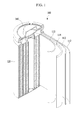
- the drawing is a schematic view showing the rechargeable lithium battery according to one embodiment.
- an SEI passivation film is formed on an active material layer of the negative electrode at about 0.8V and has a biggest volume at about 0.4V thereon.
- the SEI passivation film includes a component such as LiF and the like.
- the LiF is an irreversible material not dissolved in an electrolyte and can easily grow to be relatively thick on the surface of the active material layer of the negative electrode, thereby increasing interface resistance.
- an SEI passivation film may be controlled to have an average thickness within a specific range and also, to have a set or predetermined composition on the surface of the active material layer of the negative electrode through a formation process in which a rechargeable lithium battery is charged and discharged several times in a specific voltage range.
- the SEI passivation film may suppress its components such as LiF and the like from being detached from the surface of the negative active material layer during high-rate charge and discharge and thus, a new SEI passivation film is suppressed from growing thick again on the surface of the negative active material layer exposed to an electrolyte through a reduction reaction with the electrolyte, thereby forming a rechargeable lithium battery having excellent battery performance during high-rate charge and discharge.
- the negative electrode for a rechargeable lithium battery may include an SEI (solid electrolyte interface) film on the surface of the active material layer of the negative electrode.
- SEI solid electrolyte interface
- the SEI passivation film may have an average thickness ranging from about 10 nm to about 50 nm, and specifically about 20 nm to about 50 nm.
- the SEI passivation film having an average thickness within the above range is formed on the surface of the active material layer of the negative electrode, the deterioration of the negative electrode due to volume changes of the negative active material during the charge and discharge at a high-rate of greater than or equal to about 10C is negligible, and gas generation, active material layer detachment, and the like are suppressed, thereby providing a rechargeable lithium battery operated without degradation during repetitive high-rate charge and discharge.
- the SEI passivation film having an average thickness within the range may be formed through a formation process where the rechargeable lithium battery is charged and discharged several times in a region ranging from about 0.20V to about 1.5V relative to a lithium metal.
- the SEI passivation film includes at least one material selected from an organic material and an inorganic material.
- the organic material may include at least one selected from ROCO 2 Li (R is a C 1 to C 10 alkyl group), R 1 (OCO 2 CH 2 CH 2 ) n Li (R 1 is a C 1 to C 10 alkyl group, and n is an integer ranging from about 1 to about 25), R 2 (CH 2 CH 2 O) m Li (R 2 is a C 1 to C 10 alkyl group, and m is an integer ranging from about 1 to about 25), and NR 3 R 4 R 5 (R 3 , R 4 and R 5 are C 1 to C 10 alkyl groups).
- the inorganic material may include at least one selected from LiF, Li 2 O, Li 2 CO 3 and Li x PF y O (0 ⁇ x ⁇ 1, 1 ⁇ y ⁇ 4).
- the SEI passivation film may include LiF.
- the LiF may be included in an amount ranging from about 30 wt% to about 70 wt%, specifically about 30 wt% to about 50 wt%, and more specifically about 30 wt% to about 40 wt% based on the total amount of the SEI passivation film.
- an SEI passivation film component is suppressed from being detached, thereby suppressing newly forming a thicker SEI passivation film again, resultantly suppressing performance degradation of the battery during high-rate charge and discharge.
- the SEI passivation film having the above composition may be formed through a formation process where the rechargeable lithium battery is charged and discharged several times within a region ranging from about 0.20V to about 1.5V relative to a lithium metal.
- the SEI passivation film may include other different components in various suitable amounts depending on thickness thereof through a formation process under a certain condition.
- the first layer may include the inorganic material in an amount of greater than or equal to about 60 wt% and the organic material in an amount of less than or equal to about 40 wt% based on the entire weight of the first layer
- the second layer may include the organic material in an amount of greater than or equal to about 60 wt% and the inorganic material in an amount of less than or equal to about 40 wt% based on the entire weight of the second layer.
- the first layer of the SEI passivation film may include the LiF in an amount of about 60 wt% to about 70 wt% based on the total weight of the first layer
- the second layer of the SEI passivation film may include the LiF in an amount of about 0.1 wt% to about 10 wt% based on the total weight of the second layer.
- the SEI passivation film on the surface of the active material layer of the negative electrode may have an average thickness within the set or predetermined range and with the set or predetermined component and amount, and may be formed through a formation process in which a rechargeable lithium battery including the negative electrode is charged and discharged several times at a voltage within the set or predetermined range.
- the SEI passivation film may be formed through a formation process in which a rechargeable lithium battery is charged and discharged several times in a region ranging from about 0.20V to about 1.5V relative to a lithium metal region for a set or predetermined time. More specifically, the formation process may be performed by about 1 to about 10 times charging and discharging in a region ranging from about 0.35V to 0.8V (and specifically from about 0.35V to about 0.5V) relative to a lithium metal region for about 10 minutes to about 5 hours. The charge may be performed in a method of charge and discharge with a constant current, pulse charge and discharge, and charge and discharge in steps.
- the formation process of charging and discharging a rechargeable lithium battery several times at a voltage within the range may adjust the composition of an SEI passivation film as well as forming the SEI passivation film having an average thickness within the set or predetermined range and with high density. Accordingly, the formation process may suppress components of the SEI passivation film from being detached from the surface of the negative active material layer during high-rate charge and discharge and thus, suppressing the formation of a new thicker SEI passivation film, thereby accomplishing a rechargeable lithium battery having excellent battery performance during high-rate charge and discharge.
- the SEI passivation film may be measured regarding average thickness and composition using a film analyzer.
- the film analyzer may include an inert chamber in which an inert atmosphere controlled to have moisture ranging from about 0 ppm to about 0.1 ppm and oxygen ranging from about 0 ppm to about 0.5 ppm is maintained and a pretreatment of a sample is performed; a first analyzer connected to the inert chamber, provided with the specimen under the inert atmosphere, and including a X-ray photoelectron spectroscopy (XPS) equipment; an inert holder assembled with the sample in the inert chamber and maintaining the inert atmosphere around the sample; and a second analyzer in which the inert holder is mounted inside and which includes a scanning electron microscope (SEM).
- SEM scanning electron microscope
- the film analyzer is used to measure average thickness and composition of the SEI passivation film by the following method.
- the measurement may include pretreating a sample in an inert chamber, transferring the sample into the first analyzer to measure an average thickness and a composition of the SEI passivation film, transferring the sample into the inert chamber to be assembled with the inert holder, and mounting the inert holder on the second analyzer to examine a shape information of the SEI passivation film.
- the pretreatment of the sample may include disassembly of a rechargeable lithium battery after the formation process, cutting an electrode therein into a set or predetermined size to prepare a sample, cleaning the sample, and assembling the sample with a supporting substrate or the inert holder.
- the sample may be ion-etched in the first analyzer before being transferred into the inert chamber.
- an ion beam may be radiated at an accelerating voltage ranging from about 0.3 kV to about 0.5 kV with a current ranging from about 0.2 ⁇ A to about 0.5 ⁇ A.
- a component initially obtained from the ion etching is derived from the only SEI layer, but the component may include both one derived from the SEI layer and one derived from the negative active material layer, as the time for the ion etching increases.
- the ion etching may be performed until the resulting component obtained from the ion etching includes about 50 atom% to about 70 atom% of a component derived from the negative active material layer based on the total weight of the resulting components from the ion etching, and the thickness from the surface to the above point refers to the thickness of the SEI layer.
- the second analyzer may radiate an electron beam at an accelerating voltage ranging from about 0.5kV to about 1.0kV with a current ranging from about 1pA to about 15pA.
- the film analyzer may be used to analyze shape, thickness, and composition of the SEI passivation film without doing damage to the film prepared in the pretreatment with high precision for a short time.
- the negative electrode may include a current collector and a negative active material layer disposed on the current collector.
- the current collector may be a copper foil, a nickel foil, a stainless steel foil, a titanium foil, a nickel foam, a copper foam, a polymer substrate coated with a conductive metal, or a combination thereof, but is not limited thereto.
- the negative active material layer may include a negative active material, a binder, and optionally a conductive material.
- the negative active material includes a carbon-based material, and the carbon-based material has a peak of about 20 degrees to 30 degrees (for example at about 23 degrees to 28 degrees) at a (002) plane in an X-ray diffraction pattern using a CuK ⁇ ray.
- the carbon-based material may include at least one selected from soft carbon and graphite.
- the carbon-based material may have an average particle diameter of about 1 ⁇ m to about 20 ⁇ m, and specifically about 3 ⁇ m to about 15 ⁇ m. In one embodiment, when the carbon-based material has an average particle diameter within the above ranges, the deterioration of the negative active material due to volume changes during the charge and discharge at a high-rate of greater than or equal to about 10C is negligible, and gas generation, substrate detachment, and the like are suppressed.
- the binder improves binding properties of active material particles with one another and with a current collector.
- the binder may include a non-water-soluble binder, a water-soluble binder, or a combination thereof.
- non-water-soluble binder examples include polyvinylchloride, carboxylated polyvinylchloride, polyvinylfluoride, an ethylene oxide-containing polymer, polyvinylpyrrolidone, polyurethane, polytetrafluoroethylene, polyvinylidene fluoride, polyethylene, polypropylene, polyamideimide, polyimide, and combinations thereof.
- the water-soluble binder includes a styrene-butadiene rubber, an acrylated styrene-butadiene rubber, polyvinyl alcohol, sodium polyacrylate, a copolymer including propylene and a C 2 to C8 olefin, a copolymer of (meth)acrylic acid and (meth)acrylic acid alkyl ester, or a combination thereof.
- a cellulose-based compound may be further used to provide viscosity.
- the cellulose-based compound includes one or more of carboxylmethyl cellulose, hydroxypropylmethyl cellulose, methyl cellulose, or alkaline metal salts thereof.
- the alkaline metal may be sodium (Na), potassium (K), or lithium (Li).
- the cellulose-based compound may be included in an amount of 0.1 to 3 parts by weight based on 100 parts by weight of the negative active material.
- the conductive material provides an electrode with conductivity. Any electrically conductive material may be used as a conductive material unless it causes a chemical change.
- the conductive material include a carbon-based material such as natural graphite, artificial graphite, carbon black, acetylene black, ketjen black, a carbon fiber, and the liker, a metal-based material of a metal powder or a metal fiber including copper, nickel, aluminum, silver, and the like; a conductive polymer such as a polyphenylene derivative; and mixtures thereof.
- the drawing is a schematic view showing a rechargeable lithium battery according to one embodiment.
- a rechargeable lithium battery 100 includes an electrode assembly including a positive electrode 114, a negative electrode 112 facing the positive electrode 114, a separator 113 interposed between the positive electrode 114 and negative electrode 112, and an electrolyte impregnating the positive electrode 114, the negative electrode 112, and the separator 113, a battery case 120 housing the electrode assembly, and a sealing member 140 sealing the battery case 120.
- the negative electrode 112 is the same as described above.
- the positive electrode 114 may include a current collector and a positive active material layer disposed on the current collector.
- the positive active material layer may include a positive active material, a binder, and optionally, a conductive material.
- the current collector may be Al (aluminum), but is not limited thereto.
- the positive active material may include at least one selected from activated carbon and lithium composite oxide.
- the activated carbon is a carbon-based material including amorphous carbon in which graphite-shaped flat crystallites are combined, are porous, and have high specific surface area and high adsorption capability.
- the lithium composite oxide may include a composite oxide including at least one of cobalt, manganese, nickel, or combination thereof as well as lithium.
- the following compounds may be used:
- A is Ni, Co, Mn, or a combination thereof
- B is Al, Ni, Co, Mn, Cr, Fe, Mg, Sr, V, a rare earth element, or a combination thereof
- D is O, F, S, P, or a combination thereof
- E is Co, Mn, or a combination thereof
- F is F, S, P, or a combination thereof
- G is Al, Cr, Mn, Fe, Mg, La, Ce, Sr, V, or a combination thereof
- Q is Ti, Mo, Mn, or a combination thereof
- I is Cr, V, Fe, Sc, Y, or a combination thereof
- J is V, Cr, Mn, Co, Ni, Cu, or a combination thereof.
- the compounds may have a coating layer on the surface, or may be mixed with another compound having a coating layer.
- the coating layer may include at least one coating element compound selected from the group consisting of an oxide of a coating element, a hydroxide of a coating element, an oxyhydroxide of a coating element, an oxycarbonate of a coating element, and a hydroxyl carbonate of a coating element.
- the compound for the coating layer may be amorphous or crystalline.
- the coating element included in the coating layer may include Mg, Al, Co, K, Na, Ca, Si, Ti, V, Sn, Ge, Ga, B, As, Zr, or a mixture thereof.
- the coating layer may be disposed in a method having no adverse influence on properties of a positive active material by using these elements in the compound.
- the method may include any coating method such as spray coating, dipping, and the like, and is not illustrated in more detail since it is well-known to those who work in the related field.
- the binder improves binding properties of the positive active material particles to each other and to a current collector.
- the binder include polyvinylalcohol, carboxylmethylcellulose, hydroxypropylcellulose, diacetylcellulose, polyvinylchloride, carboxylated polyvinylchloride, polyvinylfluoride, an ethylene oxide-containing polymer, polyvinylpyrrolidone, polyurethane, polytetrafluoroethylene, polyvinylidene fluoride, polyethylene, polypropylene, a styrene-butadiene rubber, an acrylated styrene-butadiene rubber, an epoxy resin, nylon, and the like, but are not limited thereto.
- the conductive material provides an electrode with conductivity. Any electrically conductive material may be used as a conductive material unless it causes a chemical change. Examples of the conductive material include: one or more of natural graphite, artificial graphite, carbon black, acetylene black, ketjen black, a carbon fiber, copper, a metal powder or a metal fiber (the metal powder or fiber including nickel, aluminum, silver, and the like), and a polyphenylene derivative.
- the positive electrode 114 may be fabricated by a method including mixing an active material, a conductive material, and a binder into an active material composition and coating the composition on a current collector.
- the electrode manufacturing method is well known, and thus is not described in detail in the present specification.
- the solvent can be N-methylpyrrolidone, or water if the negative active material composition uses the water-soluble binder, but it is not limited thereto.
- the electrolyte may include a non-aqueous organic solvent and a lithium salt.
- the non-aqueous organic solvent serves as a medium for transmitting ions taking part in the electrochemical reaction of the battery.
- the non-aqueous organic solvent may include a carbonate-based, ester-based, ether-based, ketone-based, alcohol-based, or aprotic solvent.
- Examples of the carbonate-based solvent may include dimethyl carbonate (DMC), diethyl carbonate (DEC), dipropyl carbonate (DPC), methylpropyl carbonate (MPC), ethylpropyl carbonate (EPC), methylethyl carbonate (MEC), ethylmethyl carbonate (EMC), ethylene carbonate (EC), propylene carbonate (PC), butylene carbonate (BC), and the like.
- DMC dimethyl carbonate
- DEC diethyl carbonate
- DPC dipropyl carbonate
- MPC methylpropyl carbonate
- EPC methylethylpropyl carbonate
- MEC methylethyl carbonate
- EMC ethylmethyl carbonate
- EMC ethylene carbonate
- PC propylene carbonate
- BC butylene carbonate
- ester-based solvent may include methyl acetate, ethyl acetate, n-propyl acetate, dimethylacetate, methylpropionate, ethylpropionate, ⁇ -butyrolactone, decanolide, valerolactone, mevalonolactone, caprolactone, and the like.
- ether-based solvent examples include dibutylether, tetraglyme, diglyme, dimethoxyethane, 2-methyltetrahydrofuran, tetrahydrofuran, and the like
- examples of the ketone-based solvent include cyclohexanone and the like.
- the alcohol-based solvent include ethyl alcohol, isopropyl alcohol, and the like.
- the non-aqueous organic solvent may be used singularly or in a mixture.
- the mixture ratio can be controlled in accordance with a desirable battery performance.
- the non-aqueous electrolyte solution may further include an overcharge-inhibiting compound such as ethylene carbonate, pyrocarbonate, and the like.
- an overcharge-inhibiting compound such as ethylene carbonate, pyrocarbonate, and the like.
- the lithium salt supplies lithium ions in the battery, and performs a basic operation of a rechargeable lithium battery and improves lithium ion transport between positive and negative electrodes.
- lithium salt examples include LiPF 6 , LiBF 4 , LiSbF 6 , LiAsF 6 , LiN(SO 3 C 2 F 5 ) 2 , LiC 4 F 9 SO 3 , LiClO 4 , LiAlO 2 , LiAlCl 4 , LiN(C x F 2x+1 SO 2 )(C y F 2y+1 SO 2 ), where x and y are natural numbers, LiCl, LiI, LiB(C 2 O 4 ) 2 (lithium bisoxalate borate, LiBOB), and the like.
- the lithium salt may be used at a concentration ranging from about 0.1 to about 2.0M.
- electrolyte performance and lithium ion mobility may be enhanced due to desired electrolyte conductivity and viscosity.
- the separator 113 may be formed as a single layer or a multilayer, and may be made of polyethylene, polypropylene, polyvinylidene fluoride, or a combination thereof.
- the rechargeable lithium battery may be fabricated as follows.
- An electrode assembly including the positive electrode, the negative electrode and a separator interposed between the positive electrode and the negative electrode is put into a battery case and then the electrolyte is injected into the case to fabricate a battery precursor.
- the battery precursor undergoes formation process by charging and discharging several times at about 0.20V to about 1.5V relative to a lithium metal, thereby forming the rechargeable lithium battery including an SEI passivation film having a specific average thickness of about 10 nm to about 50 nm.
- the SEI passivation film is formed on the surface of the active material layer of the negative electrode may be fabricated.
- the SEI passivation film has a specific composition as well as a specific ranged average thickness.
- the second layer (or inner layer) of the SEI passivation film may be initially formed to have an increased organic material and LiF at a relatively low amount.
- this second layer of the SEI passivation film may include about 0.1 wt% to 10 wt% of LiF based on the total (entire) weight amount of the second layer of the SEI passivation film.
- the first layer (or outer layer) of the SEI passivation film may then be formed to include about 10 wt% to about 50 wt% of LiF, and specifically about 30 wt% to about 50 wt% based on the total (entire) weight amount of the first layer of the SEI passivation film.
- a composition of each of the first and second layers of the SEI passivation film may be different from each other, and when each layer of the SEI passivation film has a composition at the above ranges, the rechargeable lithium battery may realize excellent battery performance even during high-rate charge and discharge.
- Soft carbon having an average particle diameter of 5 ⁇ m, carbon black, styrene-butadiene rubber, and carboxylmethyl cellulose were respectively mixed in a water solvent, at a weight ratio of 92:4:2:2, thereby preparing a negative active material layer composition.
- the negative active material layer composition was coated on a copper foil, dried, and compressed, thereby fabricating a negative electrode.
- the negative electrode and lithium metal as a counter electrode were housed in a battery container, and an electrolyte was injected therein, thereby fabricating a coin type cell precursor.
- the electrolyte was prepared by mixing ethylenecarbonate (EC), dimethylcarbonate (DMC), and diethylcarbonate (DEC) in a volume ratio of 3:3:4 and dissolving LiPF 6 therein in a concentration of 1.2M.
- EC ethylenecarbonate
- DMC dimethylcarbonate
- DEC diethylcarbonate
- the cell precursor was charged at 0.35V relative to the lithium metal for 3 hours and then, charged and discharged ten times with 0.1C/0.1C in a range of 0.35V to 0.8V in an SEI formation process to fabricate a coin cell.
- a coin cell was fabricated through a formation process according to the same method as Example 1 except for charging the cell precursor at 0.5V relative to a lithium metal for 3 hours and charged and discharged ten times with 0.1C/0.1C in a range of 0.35V to 0.8V.
- a coin cell was fabricated through a formation process according to the same method as Example 1 except for charging the cell precursor at 0.5V relative to a lithium metal for 1 hour and charged and discharged ten times with 0.1C/0.1C in a range of 0.35V to 0.8V.
- a coin cell was fabricated according to the same method as Example 1 except no SEI formation process was performed.
- a coin cell was fabricated through a formation process according to the same method as Example 1 except for charging the cell precursor at 1.6V relative to a lithium metal for 1 hour and then, charged and discharged ten times with 0.1C/0.1C in a range of 0.1V to 1.6V.
- a coin cell was fabricated through a formation process according to the same method as Example 1 except for charging the cell precursor at 0.1V for relative to a lithium metal 1 hour and then, charged and discharged ten times with 0.1C/0.1C in a range of 0.1V to 1.6V.
- a coin cell was fabricated through a formation process according to the same method as Example 1 except for respectively mixing graphite having an average particle diameter of 10 ⁇ m, styrene-butadiene rubber, and carboxylmethylcellulose in a weight ratio of 98:1:1 to prepare a negative active material layer composition.
- a coin cell was fabricated through a formation process according to the same method as Example 4 except for charging the cell precursor at 0.1V relative to a lithium metal for 3 hours and then, charged and discharged ten times with 0.1C/0.1C in a range of 0.35V to 0.8V.
- a coin cell was fabricated through a formation process according to the same method as Example 4 except for charging the cell precursor at 0.5V relative to a lithium metal for 1 hour and then, charged and discharged ten times with 0.1C/0.1C in a range of 0.35V to 0.8V.
- a coin cell was fabricated according to the same method as Example 4 except no SEI formation process was performed.
- Evaluation 1 Composition and thickness of SEI passivation film on surface of the active material layer of the negative electrode
- the compositions and thicknesses of the SEI passivation films were measured using film analysis equipment.
- the film analysis equipment is composed of a first analyzer having an inert chamber and an X-ray Photoelectron Spectroscopy (XPS) equipment, and a second analyzer having an inert holder and a scanning electron microscope (SEM).
- the inert chamber was maintained under an inert atmosphere controlled to have moisture ranging from 0 ppm to 0.1 ppm and oxygen ranging from 0 ppm to 0.5 ppm.
- the first analyzer, the inert holder, and the second analyzer were all maintained under the inert atmosphere.
- the rechargeable lithium battery cells according to Examples 1 to 6 and Comparative Examples 1 to 4 were pretreated under the inert chamber after the formation process.
- the pretreatment was performed by disassembling the rechargeable lithium battery cells, cutting an electrode therein into a set or predetermined size to take a specimen having an SEI passivation film, and cleaning the specimen.
- the specimen was put into the first analyzer and analyzed regarding average thickness and composition of the SEI passivation film through the XPS.
- an ion beam was radiated until the resulting component obtained from the ion etching included 60 atom% of a component derived from the negative active material layer based on the total amount of the resulting components from the ion etching.
- the specimen was transferred to the inert chamber and assembled with the inert holder, and then, the inert holder was mounted on the second analyzer, thereby analyzing the SEI passivation film.
- an electron beam having an accelerating voltage of 1kV was radiated from the second analyzer.
- the rechargeable lithium battery cells were charged and discharged at 0.2C from 1.5V to 0.01V in a constant current and constant voltage method and then, measured regarding their initial discharge capacities.
- the rechargeable lithium battery cells were charged at 0.2C at 0.01V and constant-current discharged at 5C up to 1.5V and measured regarding their discharge capacities to evaluate output characteristics.
- each of the rechargeable lithium battery cells fabricated through a formation process in which it has been charged and discharged several times at a range of about 0.20V to about 1.5V relative to a lithium metal according to Examples 1 to 6 included an SEI passivation film having an average thickness ranging from 10 nm to 50 nm on the surface of the active material of the negative electrode, and the SEI passivation film included a LiF component in a range of 30 to 70 wt%.
- each of the rechargeable lithium battery cells fabricated with no SEI formation process according to Comparative Examples 1 and 4 and the ones fabricated through an SEI formation process out of the voltage region according to Comparative Comparative examples 1 to 4 had an SEI passivation film having an average thickness of greater than 50 nm on the surface of the active material of the negative electrode.
- the rechargeable lithium battery cells according to Examples 1 to 3 had higher 5C discharge capacity than the ones according to Comparative Examples 1 to 3, while the rechargeable lithium battery cells according to Examples 4 to 6 had higher 5C discharge capacity than the ones according to Comparative Example 4, accomplishing excellent battery performance during the high-rate charge and discharge.
- the rechargeable lithium battery cells according to Examples 1 to 3 had higher 5C/0.2C capacity retention than the ones according to Comparative Examples 1 to 3, while the ones according to Examples 4 to 6 had higher 5C/0.2C capacity retention than the one according to Comparative Example 4. Accordingly, a rechargeable lithium battery cell including a negative electrode including an SEI passivation film having a set or predetermined thickness on the surface of its active material layer had less resistance and had excellent cycle-life characteristic.
Landscapes
- Chemical & Material Sciences (AREA)
- Chemical Kinetics & Catalysis (AREA)
- Electrochemistry (AREA)
- General Chemical & Material Sciences (AREA)
- Engineering & Computer Science (AREA)
- Manufacturing & Machinery (AREA)
- Materials Engineering (AREA)
- Composite Materials (AREA)
- Inorganic Chemistry (AREA)
- Secondary Cells (AREA)
- Battery Electrode And Active Subsutance (AREA)
Applications Claiming Priority (1)
| Application Number | Priority Date | Filing Date | Title |
|---|---|---|---|
| KR1020120045832A KR101683206B1 (ko) | 2012-04-30 | 2012-04-30 | 리튬 이차 전지용 음극 및 이를 포함하는 리튬 이차 전지 |
Publications (2)
| Publication Number | Publication Date |
|---|---|
| EP2660902A1 true EP2660902A1 (de) | 2013-11-06 |
| EP2660902B1 EP2660902B1 (de) | 2024-08-07 |
Family
ID=48190221
Family Applications (1)
| Application Number | Title | Priority Date | Filing Date |
|---|---|---|---|
| EP13165315.6A Active EP2660902B1 (de) | 2012-04-30 | 2013-04-25 | Negative Elektrode für Lithium-Sekundärbatterie, wiederaufladbare Lithiumbatterie und Verfahren zur Herstellung einer wiederaufladbaren Lithiumbatterie |
Country Status (7)
| Country | Link |
|---|---|
| US (1) | US9793539B2 (de) |
| EP (1) | EP2660902B1 (de) |
| JP (1) | JP6474190B2 (de) |
| KR (1) | KR101683206B1 (de) |
| CN (1) | CN103378349B (de) |
| HU (1) | HUE068719T2 (de) |
| PL (1) | PL2660902T3 (de) |
Cited By (4)
| Publication number | Priority date | Publication date | Assignee | Title |
|---|---|---|---|---|
| EP3460882A4 (de) * | 2017-01-23 | 2019-06-26 | LG Chem, Ltd. | Negativelektrode für lithiumsekundärbatterie, lithiumsekundärbatterie damit und verfahren zur herstellung davon |
| CN110890516A (zh) * | 2018-09-08 | 2020-03-17 | 江西格林德能源有限公司 | 一种预制锂离子电池sei膜的方法 |
| US11539039B2 (en) | 2017-01-23 | 2022-12-27 | Lg Energy Solution, Ltd. | Negative electrode for lithium secondary battery, lithium secondary battery comprising the same, and preparation method thereof |
| US11735736B2 (en) | 2014-01-23 | 2023-08-22 | Semiconductor Energy Laboratory Co., Ltd. | Electrode, power storage device, and electronic device |
Families Citing this family (35)
| Publication number | Priority date | Publication date | Assignee | Title |
|---|---|---|---|---|
| KR20130122281A (ko) * | 2012-04-30 | 2013-11-07 | 삼성에스디아이 주식회사 | 리튬 이차 전지용 전극 표면의 피막 분석 장치 및 이를 이용한 리튬 이차 전지용 전극 표면의 피막 분석 방법 |
| US9276293B2 (en) * | 2013-08-30 | 2016-03-01 | Southwestern Research Institute | Dynamic formation protocol for lithium-ion battery |
| CN104167566B (zh) * | 2014-08-06 | 2017-03-15 | 星恒电源股份有限公司 | 一种锂离子电池的封口化成方法 |
| JP2016154122A (ja) * | 2015-02-20 | 2016-08-25 | 旭化成株式会社 | 非水電解質二次電池用負極活物質、負極、及び非水電解質二次電池 |
| DE102015214577A1 (de) * | 2015-07-31 | 2017-02-02 | Robert Bosch Gmbh | Verfahren zur Herstellung einer Elektrode eines Lithiumionenakkumulators |
| JP6172309B1 (ja) * | 2016-02-12 | 2017-08-02 | 住友大阪セメント株式会社 | リチウムイオン二次電池 |
| US10297828B2 (en) * | 2016-06-15 | 2019-05-21 | Ricoh Company, Ltd. | Non-aqueous electrolyte storage element including positive electrode having solid electrolyte interface material on surface of carbon material |
| JP2017228513A (ja) * | 2016-06-15 | 2017-12-28 | 株式会社リコー | 非水電解液蓄電素子 |
| KR102290316B1 (ko) * | 2016-10-18 | 2021-08-18 | 삼성에스디아이 주식회사 | 리튬 이차 전지 |
| KR102115596B1 (ko) | 2016-11-24 | 2020-05-26 | 주식회사 엘지화학 | 리튬 전극의 전처리 방법 및 리튬 금속 전지 |
| CN106654353B (zh) * | 2016-11-25 | 2019-01-25 | 清华大学深圳研究生院 | 凝胶聚合物电解质动力电池 |
| KR20180107620A (ko) * | 2017-03-22 | 2018-10-02 | 삼성에스디아이 주식회사 | 리튬 이차 전지 |
| CN108736056B (zh) * | 2017-04-20 | 2020-12-11 | 中国科学院宁波材料技术与工程研究所 | 一种锂金属界面保护结构及其制备和应用 |
| US20190036120A1 (en) * | 2017-07-31 | 2019-01-31 | Robert Bosch Gmbh | Amorphous LiF as an Artificial SEI Layer for Lithium Batteries |
| JP7308847B2 (ja) * | 2017-10-16 | 2023-07-14 | ユミコア | 電池 |
| CN108110232B (zh) * | 2017-12-06 | 2020-05-15 | 成都新柯力化工科技有限公司 | 一种锂电池硬碳负极的表面处理方法 |
| CN108365168A (zh) * | 2018-01-10 | 2018-08-03 | 山东奥冠新能源科技有限公司 | 含膜碳材料制备的锂电池负极片及其制备方法和用途 |
| DE102018210446A1 (de) | 2018-06-27 | 2020-01-02 | Robert Bosch Gmbh | Elektrode einer Batteriezelle sowie Verfahren zur Herstellung derselben |
| US12080880B2 (en) * | 2018-09-25 | 2024-09-03 | Toyota Motor Engineering & Manufacturing North America, Inc. | Nano-alloy interphase for lithium metal solid state batteries |
| KR102400731B1 (ko) * | 2019-01-29 | 2022-05-24 | 한양대학교 산학협력단 | 리튬 금속 전극을 구비하는 리튬 이차 전지 |
| KR102755824B1 (ko) * | 2019-05-24 | 2025-01-17 | 주식회사 엘지에너지솔루션 | 전고체전지용 음극의 제조방법 |
| CN110581277B (zh) * | 2019-09-06 | 2021-01-12 | 河北大学 | 一种锂离子电池正极材料的表面包覆方法 |
| CN111342028B (zh) * | 2020-03-20 | 2021-07-20 | 吉林中溢炭素科技有限公司 | 一种石墨基负极的锂离子电池的化成方法 |
| WO2021192453A1 (ja) * | 2020-03-24 | 2021-09-30 | 株式会社日立製作所 | リチウムイオン二次電池用の負極材料 |
| JP7656836B2 (ja) * | 2020-03-26 | 2025-04-04 | パナソニックIpマネジメント株式会社 | 電気化学デバイス用負極および電気化学デバイス |
| CN115362588A (zh) * | 2020-03-27 | 2022-11-18 | 特拉沃特科技株式会社 | 固体电池的制造方法以及固体电池 |
| CN114788047B (zh) * | 2020-10-05 | 2024-09-10 | 株式会社Lg新能源 | 用于预锂化负极的设备和用于预锂化负极的方法 |
| US11757082B2 (en) * | 2021-02-19 | 2023-09-12 | GM Global Technology Operations LLC | Method for fabricating an anode for a lithium battery cell |
| KR20240004370A (ko) * | 2021-03-26 | 2024-01-11 | 시온 파워 코퍼레이션 | 리튬 금속 배터리에서 향상된 사이클 성능을 위한 고체 전해질 계면의 동일반응계 제어 |
| KR20240141166A (ko) * | 2022-01-24 | 2024-09-25 | 에이일이삼 시스템즈 엘엘씨 | 리튬 이온 배터리 셀용 캐소드 시스템 및 이의 형성 방법 |
| KR102862244B1 (ko) * | 2022-09-19 | 2025-09-18 | 삼성에스디아이 주식회사 | 리튬금속전지용 음극, 이를 포함하는 리튬금속전지, 및 리튬금속전지용 음극 제조방법 |
| CN115498268A (zh) * | 2022-11-16 | 2022-12-20 | 深圳新宙邦科技股份有限公司 | 一种锂离子电池 |
| WO2024166478A1 (ja) | 2023-02-07 | 2024-08-15 | 株式会社レゾナック | リチウムイオン電池用負極および負極材の製造方法、判別方法 |
| CN117133969B (zh) * | 2023-10-24 | 2024-04-12 | 宁德时代新能源科技股份有限公司 | 钠离子电池单体及其制备方法、相关装置 |
| CN120511341A (zh) * | 2024-09-02 | 2025-08-19 | 比亚迪股份有限公司 | 锂离子电池及其制备方法和用电设备 |
Family Cites Families (17)
| Publication number | Priority date | Publication date | Assignee | Title |
|---|---|---|---|---|
| JP3157413B2 (ja) | 1995-03-27 | 2001-04-16 | 三洋電機株式会社 | リチウム二次電池 |
| US6365299B1 (en) | 1995-06-28 | 2002-04-02 | Fuji Photo Film Co., Ltd. | Nonaqueous secondary battery |
| JP5071056B2 (ja) | 1995-06-28 | 2012-11-14 | 宇部興産株式会社 | 非水二次電池 |
| JP2000215918A (ja) | 1999-01-22 | 2000-08-04 | Asahi Glass Co Ltd | 二次電源の製造方法 |
| JP3327468B2 (ja) | 2000-03-07 | 2002-09-24 | 株式会社ユアサコーポレーション | リチウムイオン二次電池及びその製造方法 |
| JP2001250534A (ja) | 2000-03-07 | 2001-09-14 | Yuasa Corp | リチウムイオン二次電池 |
| JP3997711B2 (ja) | 2001-01-10 | 2007-10-24 | トヨタ自動車株式会社 | リチウム二次電池の初期充電方法および製造方法 |
| JP2002373646A (ja) * | 2001-06-14 | 2002-12-26 | Japan Storage Battery Co Ltd | 非水電解質二次電池およびその製造方法 |
| JP2003263984A (ja) | 2002-03-11 | 2003-09-19 | Japan Storage Battery Co Ltd | 非水電解質電池および非水電解質電池の製造法。 |
| KR100467705B1 (ko) | 2002-11-02 | 2005-01-24 | 삼성에스디아이 주식회사 | 무기 보호막을 갖는 세퍼레이타 및 이를 채용한 리튬 전지 |
| KR100544515B1 (ko) * | 2003-02-06 | 2006-01-24 | 주식회사 엘지화학 | 고효율 리튬 이차 전지 |
| KR100471984B1 (ko) | 2003-04-02 | 2005-03-10 | 삼성에스디아이 주식회사 | 비수성 전해질 및 이를 포함하는 리튬 이차 전지 |
| KR100471973B1 (ko) | 2003-04-03 | 2005-03-10 | 삼성에스디아이 주식회사 | 비수성 전해질 및 이를 포함하는 리튬 이차 전지 |
| KR100703845B1 (ko) | 2004-12-28 | 2007-04-04 | 제일모직주식회사 | 리튬이차전지용 비수전해액 및 그를 포함하는 리튬이차전지 |
| KR100684733B1 (ko) * | 2005-07-07 | 2007-02-20 | 삼성에스디아이 주식회사 | 리튬 이차 전지 |
| KR101182273B1 (ko) * | 2010-08-12 | 2012-09-12 | 삼성에스디아이 주식회사 | 리튬 이차 전지용 음극 활물질, 이의 제조 방법 및 이를 포함하는 리튬 이차 전지 |
| KR20120016840A (ko) * | 2010-08-17 | 2012-02-27 | 삼성에스디아이 주식회사 | 리튬 이차 전지용 음극 및 이를 포함하는 리튬 이차 전지 |
-
2012
- 2012-04-30 KR KR1020120045832A patent/KR101683206B1/ko active Active
-
2013
- 2013-04-11 US US13/861,332 patent/US9793539B2/en active Active
- 2013-04-23 CN CN201310142726.4A patent/CN103378349B/zh active Active
- 2013-04-25 EP EP13165315.6A patent/EP2660902B1/de active Active
- 2013-04-25 HU HUE13165315A patent/HUE068719T2/hu unknown
- 2013-04-25 PL PL13165315.6T patent/PL2660902T3/pl unknown
- 2013-04-26 JP JP2013093954A patent/JP6474190B2/ja active Active
Non-Patent Citations (1)
| Title |
|---|
| WANG C ET AL: "Irreversible capacities of graphite anode for lithium-ion batteries", JOURNAL OF ELECTROANALYTICAL CHEMISTRY, ELSEVIER, AMSTERDAM, NL, vol. 519, no. 1-2, 8 February 2002 (2002-02-08), pages 9 - 17, XP027584185, ISSN: 1572-6657, [retrieved on 20020208] * |
Cited By (4)
| Publication number | Priority date | Publication date | Assignee | Title |
|---|---|---|---|---|
| US11735736B2 (en) | 2014-01-23 | 2023-08-22 | Semiconductor Energy Laboratory Co., Ltd. | Electrode, power storage device, and electronic device |
| EP3460882A4 (de) * | 2017-01-23 | 2019-06-26 | LG Chem, Ltd. | Negativelektrode für lithiumsekundärbatterie, lithiumsekundärbatterie damit und verfahren zur herstellung davon |
| US11539039B2 (en) | 2017-01-23 | 2022-12-27 | Lg Energy Solution, Ltd. | Negative electrode for lithium secondary battery, lithium secondary battery comprising the same, and preparation method thereof |
| CN110890516A (zh) * | 2018-09-08 | 2020-03-17 | 江西格林德能源有限公司 | 一种预制锂离子电池sei膜的方法 |
Also Published As
| Publication number | Publication date |
|---|---|
| JP2013232413A (ja) | 2013-11-14 |
| KR20130122469A (ko) | 2013-11-07 |
| US20130288130A1 (en) | 2013-10-31 |
| KR101683206B1 (ko) | 2016-12-06 |
| CN103378349B (zh) | 2017-06-23 |
| US9793539B2 (en) | 2017-10-17 |
| CN103378349A (zh) | 2013-10-30 |
| HUE068719T2 (hu) | 2025-01-28 |
| PL2660902T3 (pl) | 2024-11-25 |
| JP6474190B2 (ja) | 2019-02-27 |
| EP2660902B1 (de) | 2024-08-07 |
Similar Documents
| Publication | Publication Date | Title |
|---|---|---|
| EP2660902B1 (de) | Negative Elektrode für Lithium-Sekundärbatterie, wiederaufladbare Lithiumbatterie und Verfahren zur Herstellung einer wiederaufladbaren Lithiumbatterie | |
| KR101223624B1 (ko) | 리튬 이차 전지용 바인더 조성물, 및 이를 포함하는 음극 활물질 층 형성용 조성물 및 리튬 이차 전지 | |
| KR101288125B1 (ko) | 리튬 전지 및 상기 리튬 전지의 작동 방법 | |
| KR101243906B1 (ko) | 리튬 전지 및 상기 리튬 전지의 제조 방법 | |
| US10461358B2 (en) | Rechargeable lithium battery | |
| EP2538484B1 (de) | Negativ-Aktivmaterial für eine wiederaufladbare Lithiumbatterie, Herstellungsverfahren dafür und negative Elektrode sowie wiederaufladbare Lithiumbatterie damit | |
| KR101117695B1 (ko) | 리튬 전지용 전해액, 이를 포함한 리튬 전지 및 상기 리튬 전지의 작동 방법 | |
| US20130288125A1 (en) | Positive electrode for rechargeable lithium battery, rechargeable lithium battery including same and method of preparing rechargeable lithium battery | |
| KR101775542B1 (ko) | 리튬 이차 전지용 음극 활물질, 이의 제조 방법, 그리고 이를 포함하는 음극 및 리튬 이차 전지 | |
| KR20140139906A (ko) | 리튬전지 전해질용 첨가제, 이를 포함하는 유기전해액 및 상기 전해액을 채용한 리튬 전지 | |
| KR20200073119A (ko) | 리튬 이차전지용 전해액 및 이를 포함하는 리튬 이차전지 | |
| KR20140059119A (ko) | 리튬 이차 전지용 음극 및 이를 포함하는 리튬 이차 전지 | |
| KR101147244B1 (ko) | 리튬 이차 전지 | |
| US20130052533A1 (en) | Negative active material for lithium secondary battery and lithium secondary battery including the same | |
| KR20140026858A (ko) | 리튬 이차 전지용 세퍼레이터 | |
| US10205171B2 (en) | Negative electrode for rechargeable lithium battery and rechargeable lithium battery including same | |
| KR102210219B1 (ko) | 리튬 이차 전지용 음극 및 이를 포함하는 리튬 이차 전지 | |
| KR101117698B1 (ko) | 리튬 전지 및 상기 리튬 전지의 제조 방법 | |
| KR20170015961A (ko) | 리튬 이차 전지용 양극, 이를 포함하는 리튬 이차 전지 및 리튬 이차 전지의 제조 방법 | |
| KR20120125144A (ko) | 리튬 이차 전지용 전해액 및 이를 포함하는 리튬 이차 전지 | |
| US20130034779A1 (en) | Electrolyte for rechargeable lithium battery, and rechargeable lithium battery including the same |
Legal Events
| Date | Code | Title | Description |
|---|---|---|---|
| PUAI | Public reference made under article 153(3) epc to a published international application that has entered the european phase |
Free format text: ORIGINAL CODE: 0009012 |
|
| AK | Designated contracting states |
Kind code of ref document: A1 Designated state(s): AL AT BE BG CH CY CZ DE DK EE ES FI FR GB GR HR HU IE IS IT LI LT LU LV MC MK MT NL NO PL PT RO RS SE SI SK SM TR |
|
| AX | Request for extension of the european patent |
Extension state: BA ME |
|
| 17P | Request for examination filed |
Effective date: 20140506 |
|
| RBV | Designated contracting states (corrected) |
Designated state(s): AL AT BE BG CH CY CZ DE DK EE ES FI FR GB GR HR HU IE IS IT LI LT LU LV MC MK MT NL NO PL PT RO RS SE SI SK SM TR |
|
| STAA | Information on the status of an ep patent application or granted ep patent |
Free format text: STATUS: EXAMINATION IS IN PROGRESS |
|
| 17Q | First examination report despatched |
Effective date: 20161219 |
|
| GRAP | Despatch of communication of intention to grant a patent |
Free format text: ORIGINAL CODE: EPIDOSNIGR1 |
|
| STAA | Information on the status of an ep patent application or granted ep patent |
Free format text: STATUS: GRANT OF PATENT IS INTENDED |
|
| INTG | Intention to grant announced |
Effective date: 20240527 |
|
| GRAS | Grant fee paid |
Free format text: ORIGINAL CODE: EPIDOSNIGR3 |
|
| GRAA | (expected) grant |
Free format text: ORIGINAL CODE: 0009210 |
|
| STAA | Information on the status of an ep patent application or granted ep patent |
Free format text: STATUS: THE PATENT HAS BEEN GRANTED |
|
| AK | Designated contracting states |
Kind code of ref document: B1 Designated state(s): AL AT BE BG CH CY CZ DE DK EE ES FI FR GB GR HR HU IE IS IT LI LT LU LV MC MK MT NL NO PL PT RO RS SE SI SK SM TR |
|
| REG | Reference to a national code |
Ref country code: GB Ref legal event code: FG4D |
|
| REG | Reference to a national code |
Ref country code: CH Ref legal event code: EP |
|
| REG | Reference to a national code |
Ref country code: IE Ref legal event code: FG4D |
|
| REG | Reference to a national code |
Ref country code: DE Ref legal event code: R096 Ref document number: 602013085965 Country of ref document: DE |
|
| REG | Reference to a national code |
Ref country code: SE Ref legal event code: TRGR |
|
| RAP4 | Party data changed (patent owner data changed or rights of a patent transferred) |
Owner name: SAMSUNG SDI CO., LTD. |
|
| REG | Reference to a national code |
Ref country code: LT Ref legal event code: MG9D |
|
| PG25 | Lapsed in a contracting state [announced via postgrant information from national office to epo] |
Ref country code: NO Free format text: LAPSE BECAUSE OF FAILURE TO SUBMIT A TRANSLATION OF THE DESCRIPTION OR TO PAY THE FEE WITHIN THE PRESCRIBED TIME-LIMIT Effective date: 20241107 |
|
| REG | Reference to a national code |
Ref country code: AT Ref legal event code: MK05 Ref document number: 1711953 Country of ref document: AT Kind code of ref document: T Effective date: 20240807 |
|
| PG25 | Lapsed in a contracting state [announced via postgrant information from national office to epo] |
Ref country code: FI Free format text: LAPSE BECAUSE OF FAILURE TO SUBMIT A TRANSLATION OF THE DESCRIPTION OR TO PAY THE FEE WITHIN THE PRESCRIBED TIME-LIMIT Effective date: 20240807 Ref country code: NL Free format text: LAPSE BECAUSE OF FAILURE TO SUBMIT A TRANSLATION OF THE DESCRIPTION OR TO PAY THE FEE WITHIN THE PRESCRIBED TIME-LIMIT Effective date: 20240807 Ref country code: GR Free format text: LAPSE BECAUSE OF FAILURE TO SUBMIT A TRANSLATION OF THE DESCRIPTION OR TO PAY THE FEE WITHIN THE PRESCRIBED TIME-LIMIT Effective date: 20241108 Ref country code: PT Free format text: LAPSE BECAUSE OF FAILURE TO SUBMIT A TRANSLATION OF THE DESCRIPTION OR TO PAY THE FEE WITHIN THE PRESCRIBED TIME-LIMIT Effective date: 20241209 |
|
| PG25 | Lapsed in a contracting state [announced via postgrant information from national office to epo] |
Ref country code: BG Free format text: LAPSE BECAUSE OF FAILURE TO SUBMIT A TRANSLATION OF THE DESCRIPTION OR TO PAY THE FEE WITHIN THE PRESCRIBED TIME-LIMIT Effective date: 20240807 |
|
| PG25 | Lapsed in a contracting state [announced via postgrant information from national office to epo] |
Ref country code: LV Free format text: LAPSE BECAUSE OF FAILURE TO SUBMIT A TRANSLATION OF THE DESCRIPTION OR TO PAY THE FEE WITHIN THE PRESCRIBED TIME-LIMIT Effective date: 20240807 |
|
| PG25 | Lapsed in a contracting state [announced via postgrant information from national office to epo] |
Ref country code: IS Free format text: LAPSE BECAUSE OF FAILURE TO SUBMIT A TRANSLATION OF THE DESCRIPTION OR TO PAY THE FEE WITHIN THE PRESCRIBED TIME-LIMIT Effective date: 20241207 Ref country code: AT Free format text: LAPSE BECAUSE OF FAILURE TO SUBMIT A TRANSLATION OF THE DESCRIPTION OR TO PAY THE FEE WITHIN THE PRESCRIBED TIME-LIMIT Effective date: 20240807 |
|
| PG25 | Lapsed in a contracting state [announced via postgrant information from national office to epo] |
Ref country code: HR Free format text: LAPSE BECAUSE OF FAILURE TO SUBMIT A TRANSLATION OF THE DESCRIPTION OR TO PAY THE FEE WITHIN THE PRESCRIBED TIME-LIMIT Effective date: 20240807 |
|
| PG25 | Lapsed in a contracting state [announced via postgrant information from national office to epo] |
Ref country code: RS Free format text: LAPSE BECAUSE OF FAILURE TO SUBMIT A TRANSLATION OF THE DESCRIPTION OR TO PAY THE FEE WITHIN THE PRESCRIBED TIME-LIMIT Effective date: 20241107 Ref country code: ES Free format text: LAPSE BECAUSE OF FAILURE TO SUBMIT A TRANSLATION OF THE DESCRIPTION OR TO PAY THE FEE WITHIN THE PRESCRIBED TIME-LIMIT Effective date: 20240807 |
|
| REG | Reference to a national code |
Ref country code: HU Ref legal event code: AG4A Ref document number: E068719 Country of ref document: HU |
|
| PG25 | Lapsed in a contracting state [announced via postgrant information from national office to epo] |
Ref country code: RS Free format text: LAPSE BECAUSE OF FAILURE TO SUBMIT A TRANSLATION OF THE DESCRIPTION OR TO PAY THE FEE WITHIN THE PRESCRIBED TIME-LIMIT Effective date: 20241107 Ref country code: PT Free format text: LAPSE BECAUSE OF FAILURE TO SUBMIT A TRANSLATION OF THE DESCRIPTION OR TO PAY THE FEE WITHIN THE PRESCRIBED TIME-LIMIT Effective date: 20241209 Ref country code: NO Free format text: LAPSE BECAUSE OF FAILURE TO SUBMIT A TRANSLATION OF THE DESCRIPTION OR TO PAY THE FEE WITHIN THE PRESCRIBED TIME-LIMIT Effective date: 20241107 Ref country code: NL Free format text: LAPSE BECAUSE OF FAILURE TO SUBMIT A TRANSLATION OF THE DESCRIPTION OR TO PAY THE FEE WITHIN THE PRESCRIBED TIME-LIMIT Effective date: 20240807 Ref country code: LV Free format text: LAPSE BECAUSE OF FAILURE TO SUBMIT A TRANSLATION OF THE DESCRIPTION OR TO PAY THE FEE WITHIN THE PRESCRIBED TIME-LIMIT Effective date: 20240807 Ref country code: IS Free format text: LAPSE BECAUSE OF FAILURE TO SUBMIT A TRANSLATION OF THE DESCRIPTION OR TO PAY THE FEE WITHIN THE PRESCRIBED TIME-LIMIT Effective date: 20241207 Ref country code: HR Free format text: LAPSE BECAUSE OF FAILURE TO SUBMIT A TRANSLATION OF THE DESCRIPTION OR TO PAY THE FEE WITHIN THE PRESCRIBED TIME-LIMIT Effective date: 20240807 Ref country code: GR Free format text: LAPSE BECAUSE OF FAILURE TO SUBMIT A TRANSLATION OF THE DESCRIPTION OR TO PAY THE FEE WITHIN THE PRESCRIBED TIME-LIMIT Effective date: 20241108 Ref country code: FI Free format text: LAPSE BECAUSE OF FAILURE TO SUBMIT A TRANSLATION OF THE DESCRIPTION OR TO PAY THE FEE WITHIN THE PRESCRIBED TIME-LIMIT Effective date: 20240807 Ref country code: ES Free format text: LAPSE BECAUSE OF FAILURE TO SUBMIT A TRANSLATION OF THE DESCRIPTION OR TO PAY THE FEE WITHIN THE PRESCRIBED TIME-LIMIT Effective date: 20240807 Ref country code: BG Free format text: LAPSE BECAUSE OF FAILURE TO SUBMIT A TRANSLATION OF THE DESCRIPTION OR TO PAY THE FEE WITHIN THE PRESCRIBED TIME-LIMIT Effective date: 20240807 Ref country code: AT Free format text: LAPSE BECAUSE OF FAILURE TO SUBMIT A TRANSLATION OF THE DESCRIPTION OR TO PAY THE FEE WITHIN THE PRESCRIBED TIME-LIMIT Effective date: 20240807 |
|
| PG25 | Lapsed in a contracting state [announced via postgrant information from national office to epo] |
Ref country code: DK Free format text: LAPSE BECAUSE OF FAILURE TO SUBMIT A TRANSLATION OF THE DESCRIPTION OR TO PAY THE FEE WITHIN THE PRESCRIBED TIME-LIMIT Effective date: 20240807 Ref country code: RO Free format text: LAPSE BECAUSE OF FAILURE TO SUBMIT A TRANSLATION OF THE DESCRIPTION OR TO PAY THE FEE WITHIN THE PRESCRIBED TIME-LIMIT Effective date: 20240807 Ref country code: SM Free format text: LAPSE BECAUSE OF FAILURE TO SUBMIT A TRANSLATION OF THE DESCRIPTION OR TO PAY THE FEE WITHIN THE PRESCRIBED TIME-LIMIT Effective date: 20240807 |
|
| PG25 | Lapsed in a contracting state [announced via postgrant information from national office to epo] |
Ref country code: EE Free format text: LAPSE BECAUSE OF FAILURE TO SUBMIT A TRANSLATION OF THE DESCRIPTION OR TO PAY THE FEE WITHIN THE PRESCRIBED TIME-LIMIT Effective date: 20240807 |
|
| PG25 | Lapsed in a contracting state [announced via postgrant information from national office to epo] |
Ref country code: CZ Free format text: LAPSE BECAUSE OF FAILURE TO SUBMIT A TRANSLATION OF THE DESCRIPTION OR TO PAY THE FEE WITHIN THE PRESCRIBED TIME-LIMIT Effective date: 20240807 |
|
| PG25 | Lapsed in a contracting state [announced via postgrant information from national office to epo] |
Ref country code: SK Free format text: LAPSE BECAUSE OF FAILURE TO SUBMIT A TRANSLATION OF THE DESCRIPTION OR TO PAY THE FEE WITHIN THE PRESCRIBED TIME-LIMIT Effective date: 20240807 |
|
| REG | Reference to a national code |
Ref country code: DE Ref legal event code: R097 Ref document number: 602013085965 Country of ref document: DE |
|
| PLBE | No opposition filed within time limit |
Free format text: ORIGINAL CODE: 0009261 |
|
| STAA | Information on the status of an ep patent application or granted ep patent |
Free format text: STATUS: NO OPPOSITION FILED WITHIN TIME LIMIT |
|
| PGFP | Annual fee paid to national office [announced via postgrant information from national office to epo] |
Ref country code: DE Payment date: 20250408 Year of fee payment: 13 |
|
| PGFP | Annual fee paid to national office [announced via postgrant information from national office to epo] |
Ref country code: GB Payment date: 20250403 Year of fee payment: 13 |
|
| PGFP | Annual fee paid to national office [announced via postgrant information from national office to epo] |
Ref country code: HU Payment date: 20250429 Year of fee payment: 13 |
|
| 26N | No opposition filed |
Effective date: 20250508 |
|
| PGFP | Annual fee paid to national office [announced via postgrant information from national office to epo] |
Ref country code: FR Payment date: 20250409 Year of fee payment: 13 |
|
| REG | Reference to a national code |
Ref country code: CH Ref legal event code: H13 Free format text: ST27 STATUS EVENT CODE: U-0-0-H10-H13 (AS PROVIDED BY THE NATIONAL OFFICE) Effective date: 20251125 |
|
| PG25 | Lapsed in a contracting state [announced via postgrant information from national office to epo] |
Ref country code: LU Free format text: LAPSE BECAUSE OF NON-PAYMENT OF DUE FEES Effective date: 20250425 |
|
| PG25 | Lapsed in a contracting state [announced via postgrant information from national office to epo] |
Ref country code: MC Free format text: LAPSE BECAUSE OF FAILURE TO SUBMIT A TRANSLATION OF THE DESCRIPTION OR TO PAY THE FEE WITHIN THE PRESCRIBED TIME-LIMIT Effective date: 20240807 |
|
| REG | Reference to a national code |
Ref country code: BE Ref legal event code: MM Effective date: 20250430 |
|
| PG25 | Lapsed in a contracting state [announced via postgrant information from national office to epo] |
Ref country code: BE Free format text: LAPSE BECAUSE OF NON-PAYMENT OF DUE FEES Effective date: 20250430 |
|
| PG25 | Lapsed in a contracting state [announced via postgrant information from national office to epo] |
Ref country code: CH Free format text: LAPSE BECAUSE OF NON-PAYMENT OF DUE FEES Effective date: 20250430 |
|
| PG25 | Lapsed in a contracting state [announced via postgrant information from national office to epo] |
Ref country code: IT Free format text: LAPSE BECAUSE OF FAILURE TO SUBMIT A TRANSLATION OF THE DESCRIPTION OR TO PAY THE FEE WITHIN THE PRESCRIBED TIME-LIMIT Effective date: 20240807 |
|
| PGFP | Annual fee paid to national office [announced via postgrant information from national office to epo] |
Ref country code: SE Payment date: 20260327 Year of fee payment: 14 |
|
| PG25 | Lapsed in a contracting state [announced via postgrant information from national office to epo] |
Ref country code: IE Free format text: LAPSE BECAUSE OF NON-PAYMENT OF DUE FEES Effective date: 20250425 |
|
| PGFP | Annual fee paid to national office [announced via postgrant information from national office to epo] |
Ref country code: PL Payment date: 20260327 Year of fee payment: 14 |