EP2366321B2 - Sac d'aspirateur - Google Patents
Sac d'aspirateur Download PDFInfo
- Publication number
- EP2366321B2 EP2366321B2 EP10163463.2A EP10163463A EP2366321B2 EP 2366321 B2 EP2366321 B2 EP 2366321B2 EP 10163463 A EP10163463 A EP 10163463A EP 2366321 B2 EP2366321 B2 EP 2366321B2
- Authority
- EP
- European Patent Office
- Prior art keywords
- vacuum cleaner
- fold
- folds
- filter bag
- bag
- Prior art date
- Legal status (The legal status is an assumption and is not a legal conclusion. Google has not performed a legal analysis and makes no representation as to the accuracy of the status listed.)
- Active
Links
Images



Classifications
-
- A—HUMAN NECESSITIES
- A47—FURNITURE; DOMESTIC ARTICLES OR APPLIANCES; COFFEE MILLS; SPICE MILLS; SUCTION CLEANERS IN GENERAL
- A47L—DOMESTIC WASHING OR CLEANING; SUCTION CLEANERS IN GENERAL
- A47L9/00—Details or accessories of suction cleaners, e.g. mechanical means for controlling the suction or for effecting pulsating action; Storing devices specially adapted to suction cleaners or parts thereof; Carrying-vehicles specially adapted for suction cleaners
- A47L9/10—Filters; Dust separators; Dust removal; Automatic exchange of filters
- A47L9/14—Bags or the like; Rigid filtering receptacles; Attachment of, or closures for, bags or receptacles
-
- A—HUMAN NECESSITIES
- A47—FURNITURE; DOMESTIC ARTICLES OR APPLIANCES; COFFEE MILLS; SPICE MILLS; SUCTION CLEANERS IN GENERAL
- A47L—DOMESTIC WASHING OR CLEANING; SUCTION CLEANERS IN GENERAL
- A47L11/00—Machines for cleaning floors, carpets, furniture, walls, or wall coverings
- A47L11/40—Parts or details of machines not provided for in groups A47L11/02 - A47L11/38, or not restricted to one of these groups, e.g. handles, arrangements of switches, skirts, buffers, levers
- A47L11/4013—Contaminants collecting devices, i.e. hoppers, tanks or the like
- A47L11/4016—Contaminants collecting devices, i.e. hoppers, tanks or the like specially adapted for collecting fluids
- A47L11/4019—Fill level sensors; Security means to prevent overflow, e.g. float valves
-
- A—HUMAN NECESSITIES
- A47—FURNITURE; DOMESTIC ARTICLES OR APPLIANCES; COFFEE MILLS; SPICE MILLS; SUCTION CLEANERS IN GENERAL
- A47L—DOMESTIC WASHING OR CLEANING; SUCTION CLEANERS IN GENERAL
- A47L5/00—Structural features of suction cleaners
- A47L5/12—Structural features of suction cleaners with power-driven air-pumps or air-compressors, e.g. driven by motor vehicle engine vacuum
- A47L5/22—Structural features of suction cleaners with power-driven air-pumps or air-compressors, e.g. driven by motor vehicle engine vacuum with rotary fans
- A47L5/225—Convertible suction cleaners, i.e. convertible between different types thereof, e.g. from upright suction cleaners to sledge-type suction cleaners
-
- A—HUMAN NECESSITIES
- A47—FURNITURE; DOMESTIC ARTICLES OR APPLIANCES; COFFEE MILLS; SPICE MILLS; SUCTION CLEANERS IN GENERAL
- A47L—DOMESTIC WASHING OR CLEANING; SUCTION CLEANERS IN GENERAL
- A47L9/00—Details or accessories of suction cleaners, e.g. mechanical means for controlling the suction or for effecting pulsating action; Storing devices specially adapted to suction cleaners or parts thereof; Carrying-vehicles specially adapted for suction cleaners
- A47L9/10—Filters; Dust separators; Dust removal; Automatic exchange of filters
- A47L9/12—Dry filters
- A47L9/122—Dry filters flat
-
- A—HUMAN NECESSITIES
- A47—FURNITURE; DOMESTIC ARTICLES OR APPLIANCES; COFFEE MILLS; SPICE MILLS; SUCTION CLEANERS IN GENERAL
- A47L—DOMESTIC WASHING OR CLEANING; SUCTION CLEANERS IN GENERAL
- A47L9/00—Details or accessories of suction cleaners, e.g. mechanical means for controlling the suction or for effecting pulsating action; Storing devices specially adapted to suction cleaners or parts thereof; Carrying-vehicles specially adapted for suction cleaners
- A47L9/10—Filters; Dust separators; Dust removal; Automatic exchange of filters
- A47L9/14—Bags or the like; Rigid filtering receptacles; Attachment of, or closures for, bags or receptacles
- A47L9/1427—Means for mounting or attaching bags or filtering receptacles in suction cleaners; Adapters
- A47L9/1436—Connecting plates, e.g. collars, end closures
-
- B—PERFORMING OPERATIONS; TRANSPORTING
- B01—PHYSICAL OR CHEMICAL PROCESSES OR APPARATUS IN GENERAL
- B01D—SEPARATION
- B01D46/00—Filters or filtering processes specially modified for separating dispersed particles from gases or vapours
- B01D46/52—Particle separators, e.g. dust precipitators, using filters embodying folded corrugated or wound sheet material
- B01D46/521—Particle separators, e.g. dust precipitators, using filters embodying folded corrugated or wound sheet material using folded, pleated material
- B01D46/523—Particle separators, e.g. dust precipitators, using filters embodying folded corrugated or wound sheet material using folded, pleated material with means for maintaining spacing between the pleats or folds
Definitions
- the invention relates to a vacuum cleaner filter bag with a first bag wall comprising a filter material and a second bag wall comprising a filter material, the first and the second bag wall being connected to one another along their circumference in such a way that the vacuum cleaner filter bag is completely closed, the filter material of the first and the second
- the bag wall is formed from non-woven fabric and wherein the vacuum cleaner filter bag has an inlet opening through which the air to be cleaned can flow into the vacuum cleaner filter bag, and a holding plate.
- vacuum cleaner filter bags are mainly made of nonwovens. Due to their excellent dust holding capacity, vacuum cleaner filter bags made of nonwovens have filter bags made of paper, such as those from the U.S. 3,596,443 are known, almost completely displaced.
- the production of filter bags from nonwovens is fundamentally different from the production of paper bags. Therefore, manufacturing processes and features of filter bags made of paper are generally not transferable to filter bags made of nonwovens.
- So-called flat bags are the most common for vacuum cleaner filter bags made of nonwovens. These are formed from a first or upper and a second or lower bag wall. Both bag walls can be welded and / or glued to one another along their circumference by a seam. In the case of a rectangular flat bag, four welded and / or glued seams then form the connection between the first and the second bag wall.
- the seam can also be formed in part by simply folding a piece of filter material.
- the upper and lower bag walls can be formed by folding a single piece of filter material along its axis of symmetry and welding and / or gluing the two bag walls along the edges that are still open after folding.
- the first and the second bag wall are connected by three welded and / or glued seams and a fold.
- a tube can first be formed from a piece of filter material by a so-called longitudinal weld and / or longitudinal glued seam, which is closed perpendicular to this weld and / or glued seam by two further welded and / or glued seams.
- the first and the second bag wall are connected by two welded and / or glued seams and two folds.
- the longitudinal weld and / or longitudinal glued seam can be located either in the first or in the second bag wall (a special case of this configuration would be that the longitudinal weld and / or longitudinal glued seam is so that it connects the first and the second bag wall; this would correspond then the above-described case in which the first and the second bag wall are connected by three welded and / or glued seams and a fold).
- Such flat bags can be produced in a relatively simple manner, although nonwoven material is essentially more difficult to process compared to paper.
- Flat bags are for example from the DE 201 01 466 , the EP 0 161 790 , the EP 0 639 061 , the EP 1 059 056 or the EP 1 661 500 known.
- Such a flat bag is the subject of the preamble of claim 1.
- a disadvantage of these simple flat bags is that this type of bag can only be insufficiently adapted to the space available in the vacuum cleaner.
- fold is defined in the sense of the present invention as a sequence of two or more folds, an individual fold in the sense of the present invention being defined by two fold legs and a fold hinge.
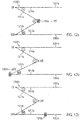
- Figure 12a shows a side fold 1200a as shown in FIG EP 1 683 460 is revealed.
- the vacuum cleaner filter bag according to Figure 12a consists of a first or upper bag wall 1201a and a second or lower bag wall 1202a. These two bag walls are connected to one another by a weld seam 1203a.
- To form the side fold three folds I, II and III are provided. Both fold legs of fold I 1210a and 1211a are formed by the first bag wall and the fold hinge SI of fold I lies in the first bag wall. Both fold legs of fold III 1212a and 1213a are formed by the second bag wall and the fold hinge SIII of fold III lies in the second bag wall.
- the first fold leg of fold II 1211a is formed by the first bag wall (and corresponds to the second fold leg of fold I).
- the second leg of fold II 1212a is formed by the second bag wall (and corresponds to the first leg of fold III).
- the fold hinge SII of the fold II runs along the weld seam 1203a.
- FIG. 12 shows a side fold 1200b according to FIG DE 10 2008 006 769 .
- the vacuum cleaner filter bag according to Figure 12b consists of a first or upper bag wall 1201b and a second or lower bag wall 1202b.
- To form the side fold three folds I, II and III are provided.
- Both fold legs of fold I 1210b and 1211b are formed by the first bag wall and the fold hinge SI of fold I lies in the first bag wall.
- Both fold legs of fold III 1212b and 1213b are formed by the second bag wall and fold hinge SIII of fold III runs along weld seam 1203b.
- first or upper bag wall of the vacuum cleaner filter bag and the second or lower bag wall of the vacuum cleaner filter bag is realized in the embodiment shown by a fold, namely fold II with its first fold leg 1211 b (which corresponds to the second fold leg of fold I) and its second fold leg 1212b (which corresponds to the first fold leg of fold III).
- FIG 12c a further alternative for forming a gusset 1200c according to the prior art is shown.
- the vacuum cleaner filter bag according to Figure 12c there is also a first or upper bag wall 1201c and a second or lower bag wall 1202c.
- three folds I, II and III are also provided.
- Both fold legs of fold I 1210c and 1211c are formed by the upper bag wall and the fold hinge SI of fold I lies in the upper bag wall.
- Both fold legs of fold III 1212c and 1213c are formed by the lower bag wall and the fold hinge SIII of fold III lies in the lower bag wall.
- the first leg of fold II 1211 c is formed by the upper wall of the bag (and corresponds to the second leg of fold I).
- the second leg of fold II 1212c is formed by the lower bag wall (and corresponds to the first leg of fold III).
- the fold legs of fold II and thus the upper and lower bag walls are connected to one another by the fold hinge SII.
- the weld seam 1203a lies in the lower bag wall.
- the WO 2006/025249 shows a filter bag with several side folds.
- Vacuum cleaner filter bags of different sizes can be folded together in such a way that they can be offered in packaging with the same dimensions despite their different dimensions, which leads to considerable advantages for storage and offering in the sales room.
- Flow deflections or flow distributions in the filter bag are, for example, through the EP 1 915 938 , the DE 20 2008 016 300 , the DE 20 2008 007 717 , the DE 20 2006 019 108 , the DE 20 2006 016 304 , the EP 1 787 560 and the EP 1 804 635 suggested.
- the DE 10 2007 060 748 discloses a filter bag in which the nonwoven material is stretched to form a three-dimensionally shaped bag wall.
- the EP 1 982 625 discloses a filter bag, the filter material being at least partially embossed and the effective filter surface being enlarged by profiling the filter material. The profiling can be designed in the form of elongated ribs arranged parallel to one another.
- the DE 20 2005 010 357 discloses a vacuum cleaner filter bag, the bag wall having at least one layer of filter material, at least one layer consisting of creped fiber material.
- a coarse filter layer, a fine filter layer or all layers of the bag can be creped.
- the at least one layer is irregularly crumpled, the volume per unit area of the filter layer in question being increased.
- Such creping changes the weight per unit area of the filter layer and thus its filtration properties.
- the disadvantage of the vacuum cleaner filter bags described above is that the volume flow of air to be cleaned, which is conveyed through the vacuum cleaner, still decreases considerably as the filling level of the vacuum cleaner filter bag increases.
- the dust uptake, i.e. the cleaning effect, of a vacuum cleaner is significantly lower with a partially filled vacuum cleaner bag than with a corresponding empty bag. This decrease in suction power is particularly pronounced in the case of filter bags with a high degree of separation (high particle retention or low penetration).
- the object of the present invention is therefore to provide a vacuum cleaner filter bag by means of which the volume flow of air to be cleaned, which is conveyed through the vacuum cleaner, decreases slightly as the filling level of the vacuum cleaner filter bag increases than in the case of a vacuum cleaner bag according to the prior art.
- the invention provides a vacuum cleaner filter bag according to claim 1, with a first bag wall comprising a filter material and a second bag wall comprising a filter material, the first and second bag walls being connected to one another along their circumference in such a way that the vacuum cleaner filter bag is completely closed, the filter material the first and the second bag wall is formed from nonwoven fabric, the vacuum cleaner filter bag having an inlet opening through which the air to be cleaned can flow into the vacuum cleaner filter bag, a holding plate, and in which the first and / or the second bag wall has at least five folds.
- a fixing device is provided which prevents at least one of the at least five folds from completely unfolding.
- Surface folds can be provided on the surface of the first and / or second bag wall through the at least five folds.
- the surface folding of the filter medium has significant advantages. Due to the folding of the surface, the area through which the air flows is significantly larger than the regular area available for the air flow (inflow area). This can have several positive effects.
- the service life of the filter is extended proportionally to the increase in surface area, as more filter material is available in which dust can be stored.
- the service life is defined as the time after which a specified filter resistance (pressure loss) is reached.
- the speed at which the filter medium flows through decreases.
- the media passage speed ratio of volume flow to the area of the flat bag through which flow occurs
- a media passage speed ratio of volume flow to the area of the flat bag through which flow occurs
- the bag wall is traversed in approx. 0.019 s.
- a bag provided with folds according to the invention with comparable external dimensions can, for example, have a filter surface of 2 ⁇ 300 mm ⁇ 630 mm.
- the result is a media passage speed of 9.3 cm / s and a flow time of 0.034 s.
- the lower media passage speed results in a lower pressure drop across the filter medium, i.e. the initial volume flow (without dust loading of the filter bag) higher than a filter bag without the inventive folding.
- the suction power of the vacuum cleaner motor is converted more effectively into a high suction air flow.
- a vacuum cleaner motor with a lower power consumption can be used.
- each fold comprises two fold legs and a fold hinge.
- a fold hinge is understood to be the point of a fold with the smallest radius of curvature.
- a so-called fold axis is obtained through the imaginary connection of the fold hinges.
- the fold axis is also known as the fold back.
- the fold axis can correspond to the longitudinal axis of a fold.
- fold legs Areas of a fold with a radius of curvature that is greater than the minimum radius of curvature of the fold are referred to as fold legs.
- the area between the legs of a fold is called the fold core.
- the fold legs of a fold can therefore in particular also have a curvature.
- Wrinkles can also have turning points.
- Inflection points are those points of a fold, especially the legs of the fold, at which the curvature of the fold changes from concave to convex.
- a line connecting several turning points of a fold is called an inflexion line (turning line).
- Two adjacent folds can also share a fold leg. If several folds are provided in this way, a package of folds or a train of folds can be implemented.
- Folds can also have legs that run parallel to the bag wall. Such legs can lie between folds which protrude from the plane of the bag wall and thus have an opening on the inflow side in relation to the bag wall.
- the width of the parallel leg can be less than, preferably less than half the or most preferably less than a quarter of the width of the opening of the fold protruding from the bag wall.
- the fold legs of the folds of the first and / or second bag wall can in particular be smooth.
- Smooth is understood here to mean that the fold legs do not have any compression and / or structuring, in particular that are intended to stabilize the shape of the folds.
- One or more fold legs of one or more folds of the first and / or second bag wall can comprise one or more embossed structures, in particular wherein the embossed structures do not serve to stabilize the shape of the folds. This enables a further increase in the area available for filtration will.
- the first and / or the second bag wall can in particular have more than 5, 10, 20, 30, 40 or 50 folds, in particular also folds of these folds.
- the folds of the first and / or second bag wall can have a substantially regular spacing from one another. In other words, the distance between the fold backs in each case of two adjacent folds can be essentially constant.
- Foldings can be made lying or standing. Underlying folds are to be understood as folds, the fold legs of which are arranged essentially parallel to the bag wall. Standing folds are to be understood as folds whose fold legs enclose an angle greater than 0 ° and less than 180 °, in particular greater than 20 ° or greater than 45 °, with the bag wall.
- a standing fold is also understood to mean a fold in which a plane in which both the fold axis and the turning line of the fold lie is arranged with a flat, horizontal surface on the first and / or second bag wall, an angle greater than 45 °, in particular greater than 30 °, in particular greater than 10 °.
- a horizontal fold can be understood to mean a fold in which the plane forms an angle of less than 45 °, in particular less than 30 °, in particular less than 10 °, with this surface.
- the vacuum cleaner filter bag in particular the folded nonwoven material, is arranged on a flat, horizontal surface.
- the vacuum cleaner filter bag can also be cut open and, in particular, arranged on the surface in such a way that the inflow side or inside of the original vacuum cleaner filter bag rests on the surface.
- Lying folds can be designed to be mutually overlapping, non-overlapping and / or partially overlapping.
- the folded nonwoven material can comprise one or more layers of nonwoven material. Several layers of nonwoven material can in particular be folded together.
- the bag wall can in particular also comprise or consist of a laminate of several layers, in particular two or more layers.
- the laminate can be a filament spunbond nonwoven - meltblown spunbond nonwoven - filament spunbond (spunbond) laminate (SMS laminate).
- SMS laminate filament spunbond nonwoven - meltblown spunbond nonwoven - filament spunbond laminate
- Two or more meltblown fleece layers can also be used (SMMS laminate, SnxMS laminate).
- the bag wall can comprise embossed nonwoven material.
- the holding plate is generally regarded here as an element of the vacuum cleaner filter bag which is used to hold the vacuum cleaner filter bag inside a vacuum cleaner housing.
- the holding plate can in particular be connected to the bag wall of the vacuum cleaner filter bag and be arranged in the area of an inflow opening. It can be advantageous to compress the bag wall with folds in a first step, for example by ultrasonic welding, and to weld on the holding plate in a second step.
- the holding plate is connected to a corresponding holding element of the vacuum cleaner, in particular brought into engagement.
- the holding plate can in principle have any shape.
- the retaining plate can be used as a flat, flat component as in FIG EP 1 849 392 shown, be formed.
- the retaining plate can also have a more complex structure, such as in the DE 20 2008 006 904 shown.
- the inflow opening and the holding plate can be positioned anywhere on the surface of the bag wall of the vacuum cleaner filter bag.
- the inflow opening and the holding plate can be arranged centered on the vacuum cleaner filter bag.
- the fold legs of the at least five folds have lines of inflection which are essentially straight.
- a substantially straight line of inflection leaves the crease unstiffened.
- the fold legs can be designed in such a way that their shape is not stabilized. As a result, the vacuum cleaner filter bag remains flexible and the folds can better adapt to the installation space of a vacuum cleaner.
- the at least five folds form at least one surface fold, the maximum height of the surface fold before the vacuum cleaner filter bag is first used in a vacuum cleaner than the maximum width of the surface fold corresponding to the maximum height. How the terms maximum height and maximum width are to be measured is explained in detail below.
- a vacuum cleaner filter bag can also be provided, cumulatively or as an alternative to the development described above, in which before the first start-up of the Vacuum cleaner filter bag in a vacuum cleaner each of the at least five folds has a length that is greater than a third of the total extension of the vacuum cleaner filter bag in the direction of the fold, preferably greater than half the total extension of the vacuum cleaner filter bag in the direction of the fold and most preferably the total extension of the bag in the direction corresponds to the fold.
- the folds, in particular the fold axes, of the nonwoven material can run from a first side of the vacuum cleaner filter bag formed by the edge or the hem to a second side of the vacuum cleaner filter bag, which is opposite the first side and formed by the edge or the hem.
- An edge or a hem of the vacuum cleaner filter bag can in particular be formed by a weld seam.
- the folds, in particular fold axes, of the nonwoven material can be designed in a straight line.
- the fold axes of the folds can also in particular be designed in such a way that they do not have an area in which the nonwoven material is fused, welded or plasticized in any form, in particular that they are not formed by a weld seam.
- This development also provides a very flexible vacuum cleaner filter bag that can be optimally adapted to the installation space in the vacuum cleaner.
- the folds of the first and / or second bag wall can have a fold height between 3 mm and 100 mm, in particular between 3 mm and 50 mm, in particular between 5 mm and 15 mm.
- the fold height can also be greater than 100 mm. This can be the case in particular with large (volume of more than 10 liters), especially commercially used, vacuum cleaner filter bags.
- the folds of the first and / or second bag wall can also have a fold width between 3 mm and 100 mm, in particular between 3 mm and 50 mm, in particular between 5 mm and 15 mm.
- the fold width can also be greater than 100 mm. This can be the case in particular with large (volume of more than 10 liters), especially commercially used, vacuum cleaner filter bags.
- At least two folds of the first and / or second bag wall can have a fold height and / or fold width and / or fold shape that differ from one another.
- several or all of the folds of the first and / or second bag wall can have the same fold heights and / or fold widths.
- Another development of the invention provides that a plurality of folds is provided, which are distributed, preferably essentially uniformly, over the first and / or second bag wall.
- the vacuum cleaner filter bag can also comprise a side fold.
- a particularly preferred side fold results when the bag wall areas from which this side fold is formed also has folds which preferably run at an angle greater than 45 °, most preferably at a substantially right angle, to the side fold.
- the entire filter material can be provided with folds or folds without having to exclude the areas from which the side fold is to be formed.
- the folds and folds of the first and / or second bag wall can have any shape.
- the fold legs can also be curved.
- a preferred fold is the so-called dovetail fold.
- a fold with a dovetail shape is to be understood in particular as a sequence of four folds with the following configuration.
- the first limb of the first fold and the second limb of the fourth fold run parallel to the bag wall, likewise the second limb of the second fold, which is identical to the first limb of the third fold, runs parallel to the bag wall.
- the second leg of the first fold is identical to the first leg of the second fold and the second leg of the third fold is identical to the first leg of the fourth fold.
- the folds or folds of the first and / or second bag wall can each comprise fold legs of different lengths.
- An edge at which the fold legs meet, in particular the fold axis, can be formed by a fold line.
- a dry or wet laid nonwoven or an extrusion nonwoven in particular a melt-spun microfiber spunbond (meltblown nonwoven) or filament spunbond (spunbond) can be used as the nonwoven material.
- melt-spun microfiber spunbond meltblown nonwoven
- filament spunbond spunbond
- nanofiber layers There can also be additional nanofiber layers.
- wet-laid nonwovens or nonwovens and conventional wet-laid paper is based on the definition given below, as used by the International Association Serving the Nonwovens and related Industries (EDANA).
- EDANA International Association Serving the Nonwovens and related Industries
- the nonwoven fabric can comprise staple fibers or continuous fibers.
- several layers of staple fibers or continuous fibers can also be provided, which are consolidated into exactly one layer of nonwoven fabric.
- the bag wall in particular the folded nonwoven material, can comprise a laminate of filament spunbond nonwoven and meltblown nonwoven (SMS, SMMS or SnxMS).
- This laminate can be laminated or calendered by means of a hot glue.
- the layer of meltblown nonwoven fabric can be creped.
- nonwoven is used as defined by ISO standard ISO 9092: 1988 or CEN standard EN29092.
- the terms nonwoven or nonwoven and nonwoven in the field of the production of nonwovens are delimited from one another as follows and are also to be understood in this way in the context of the present invention.
- Fibers and / or filaments are used to produce a nonwoven fabric.
- the loose or loose and as yet unconnected fibers and / or filaments are referred to as fleece or fiber fleece (web).
- fleece binding step a nonwoven fabric of this type is finally created which has sufficient strength to be wound up into rolls, for example.
- a nonwoven fabric is formed to be self-supporting as a result of the consolidation.
- the nonwoven material (before the folds are introduced) for vacuum cleaner filter bags for household use can have a weight per unit area of less than 250 g / m 2 , in particular less than 200 g / m 2 , in particular between 25 g / m 2 and 150 g / m 2 .
- the nonwoven material can (before the folds are introduced) also have a weight per unit area of over 250 g / m 2 . Depending on the mechanical requirements, this can be advantageous in particular for commercial vacuum cleaner filter bags.
- the folds of a bag wall can be at least partially connected to one another by means of a fixing device.
- the fixing device can also keep folds of the first and / or second bag wall at a predetermined distance from one another.
- the fixing device can comprise at least one strip of material, in particular a strip of nonwoven material, or consist of at least one strip of material, in particular at least one strip of nonwoven material. Several strips of material can be arranged at a distance from one another or directly adjoin one another.
- the predetermined angle can be larger than 0 ° and smaller than 180 °, in particular larger than 30 ° and smaller than 150 °.
- the fixing device is preferably arranged on the inflow side with respect to the bag wall. Upstream here means facing the interior of the vacuum cleaner filter bag.
- the fixing device can be at least partially connected, in particular directly connected, in particular glued and / or welded, to the bag wall, in particular to the folds of the first and / or second bag wall. Furthermore, the fixing device can be glued and / or welded on at points at which fold legs of two different folds of the first and / or second bag wall adjoin one another.
- the fixing device can be glued and / or welded to the bag wall in one or more areas of the bag wall, which are each arranged between two folds of the first and / or second bag wall. Particularly in the case of horizontal folds that do not overlap one another, simple manufacture of the vacuum cleaner filter bag can be achieved in this way.
- Two or more folds of the first and / or second bag wall can also be connected to one another by the fixing device, while two or more folds of the first and / or second bag wall are not connected to one another by the fixing device.
- the fixing device can be glued and / or welded to one or more folds of a bag wall in such a way that the connection is released when the vacuum cleaner filter bulge is in operation.
- the air flow within the vacuum cleaner filter bag can thus be influenced by the at least partially detaching fixing device.
- parts of the fixing device can serve as an air distributor when the vacuum cleaner filter bag is in operation.
- the vacuum cleaner filter bag can comprise at least one element for deflecting or distributing the flow in the vacuum cleaner filter bag, in particular wherein the element can move in the air flow of the air flowing into the vacuum cleaner filter bag.
- an element is, for example, from EP 1 787 560 or the EP 1 804 635 known.
- such an element can be designed in the form of at least one material strip attached to the bag wall inside the vacuum cleaner filter bag, or it can comprise such a material strip.
- such an element can correspond to at least one material strip made of nonwoven fabric or filter paper or comprise at least one material strip made of nonwoven fabric or filter paper.
- the at least one strip of material can be at least partially slotted.
- such an element can be in the form of at least one strip of material attached inside the vacuum cleaner filter bag on a side of the bag wall opposite the inlet opening of the vacuum cleaner filter bag.
- the at least one strip of material can be connected, in particular directly, to the folded bag wall. It can thereby be achieved that the at least one material strip can move well in the air flow of the air flowing into the vacuum cleaner filter bag, since the air can get through the fold core of at least one fold under the at least one material strip.
- the fixing device can be designed in such a way that the fold width and / or the distance between the folds or folds, which are connected to one another by the fixing device, is kept essentially constant during operation of the vacuum cleaner filter bag.
- the fixing device can have a predetermined expansion behavior. As a result, better adaptation of the vacuum cleaner filter bag during operation to the installation space available in the vacuum cleaner can be achieved.
- a predetermined expansion behavior is understood here to mean that the length of the fixing device can be changed, in particular increased, in the pulling direction of an acting force.
- the fixing device can be designed in such a way that the width of the folds or the folds and / or their spacing from one another during operation of the bag is caused by a change in an expansion of the fixing device in at least one direction, in particular in a direction perpendicular to the longitudinal direction of the folds, can be enlarged.
- the vacuum cleaner filter bag can utilize the installation space available in the vacuum cleaner as well as possible during operation.
- the change in the extent can in particular correspond to an increase in the extent or length of the fixing device.
- the change in expansion can be achieved by expanding the material of the fixing device.
- the change in expansion can be achieved by geometrically deforming the fixing device.
- the fixing device can be designed in the form of a network, the shape or geometry of the meshes of the network being changeable under tensile loading.
- the fixing device can also be creped, the creping running parallel to the folds of the first and / or second bag wall. As a result, a change in the expansion of the fixing device can be achieved during operation of the vacuum cleaner filter bag.
- the fixing device can also be at least partially folded, in particular the folds running parallel to the folds of the first and / or second bag wall.
- the change in the extent of the fixing device to be achieved can be determined by the fold height of the folds of the fixing device.
- the fixing device can have an elasticity which is selected in such a way that the fixing device after the operation of the vacuum cleaner filter bag, that is to say after switching off the
- Vacuum cleaner returns to its original shape.
- the change in the extent of the fixing device can be designed to be reversible.
- the fixing device can also be formed partly, in particular in partial areas, by stretchable material strips and partly, in particular in other partial areas, by non-stretchable material strips.
- the vacuum cleaner filter bag can be adapted to the installation space of a vacuum cleaner.
- the material of the fixing device can have a high air permeability. If the material of the fixing device is impermeable to air, the fixing device can be perforated and / or slotted.
- the fixing device can be designed in the form of at least one continuous adhesive strip.
- a hotmelt adhesive can be used as the adhesive.
- the fixing device can be designed in the form of a continuous or interrupted weld seam.
- the at least one strip of material can have a width of 0.5 cm to 4 cm, in particular 1 cm to 3 cm, for example 2 cm.
- the at least one strip of material can have a thickness of 0.1 mm to 10 mm, in particular 0.3 mm to 4 mm.
- the fixing device can be designed in the form of one or two strips of material, the width and / or length of which correspond to the width and / or length of the bag wall. In other words, the fixing device can be designed over the entire surface.
- the fixing device can comprise a nonwoven material, a film and / or a paper.
- Filament spunbonded nonwovens, carded or airlaid nonwovens and / or laminates made of several nonwovens are possible as the nonwoven material for the fixing device.
- the different nonwoven layers can have a gradient in the pore diameter.
- the fixing device can also be designed in the form of a fabric or a network.
- the fixing device can be designed in the form of an extruded network.
- the mesh size of the network can be between 0.5 mm and 10 cm, in particular between 3 mm and 6 mm.
- the shape of the holes in the mesh can be square or rectangular.
- One or more holes in the net can also be square and one or more holes in the net can be rectangular.
- the fixing device can also comprise filaments, ropes and / or yarns.
- the fixing device can be arranged parallel to the bag wall, in particular parallel to an outer surface of the bag wall.
- the outer surface of the bag wall can be understood here as a surface in which the fold axes of the folds of the first and / or second bag wall lie, or a surface parallel thereto.
- the fixing device can also correspond to or comprise a holding plate of the vacuum cleaner filter bag.
- the folds of the first and / or second bag wall can be at least partially connected to one another by means of the holding plate of the vacuum cleaner filter bag.
- a nonwoven material of the fixing device can (optionally before folding) have a weight per unit area of 5 g / m 2 to 250 g / m 2 .
- the fixing device can also be designed as a prefilter layer.
- the fixing device itself can be designed as a filter layer.
- the weight per unit area of the fixing device can be less than 200 g / m 2 .
- the fixing device can correspond to a laminate of one or more filament spunbond nonwovens and one or more melt-spun microfiber spunbond nonwovens, in particular wherein the at least one melt-spun microfiber spunbond nonwoven comprises electrostatically charged fibers.
- Fibers and / or absorbents can be arranged in a cavity (fold core) formed by the fixing device and the fold legs of at least one fold of the nonwoven material.
- the fibers can in particular be electrostatically charged fibers. This enables a further filter effect to be achieved.
- the fibers can be coated. Porous polymers and / or activated carbon, for example, can be used as absorbents. Absorbents based on coated polymer fibers are, for example, by the DE 10 2004 009 956 and the EP 1 725 153 disclosed.
- the crosslinked SDVB styrene divinylbenzene
- Impregnated activated carbon, functionalized carbon, hydrophobic zeolites, hydrophobic, porous polymers, bentonites and / or crystalline organometallic complexes can also be used as absorbents.
- an adaptation to the geometry of a construction space of a vacuum cleaner can be optimized.
- a nonwoven web of melt-spun microfiber spunbond nonwoven can be deposited on an at least partially structured surface during the production process.
- a nonwoven web can be formed from a nonwoven material which is at least partially provided with folds.
- the bag wall in particular the folded nonwoven material and / or the fixing device, can be at least partially electrostatically charged.
- the fibers of the nonwoven material can be electrostatically charged before the solidification and / or the nonwoven material, that is to say after the solidification.
- the electrostatic charge can be achieved, for example, by a corona process.
- the nonwoven or nonwoven is centered in an area about 3.8 cm (1.5 inches) to 7.6 cm (3 inches) wide between two DC voltage electrodes for a corona discharge.
- One of the electrodes can have a positive direct voltage of 20 to 30 kV while the second electrode has a negative direct voltage of 20 to 30 kV.
- the vacuum cleaner filter bag can in particular be a disposable vacuum cleaner filter bag.
- the vacuum cleaner filter bag can be designed in such a way that the space utilization of the vacuum cleaner filter bag during operation is greater than 65%, in particular greater than 80%.
- installation space is understood here to mean the ratio of the maximum usable volume of the dust space of the vacuum cleaner filter bag during operation to a theoretical volume of the installation space of the vacuum cleaner used.
- the utilization of the installation space can be influenced by a corresponding selection of one or more properties of the nonwoven material and / or a fixing device used.
- a fold in the sense of the present invention is defined in each case by two fold legs and a fold hinge.
- the length of the fold hinge defines the length of the fold in such a fold.
- a fold in the sense of the present invention is a sequence of two or more folds.
- a side fold is a sequence of folds in the area of the side edge of the vacuum cleaner filter bag.
- the hem along the relevant side edge of the vacuum cleaner filter bag is part of one of the folds forming the side fold; for example, the hem in the area of the relevant side edge is a fold hinge or the hem lies almost completely in a fold leg.
- a surface fold is a sequence of folds provided on the bag wall. Such a one The surface fold is at most fixed by a part of the hem along one side edge. However, this part of the hem is neither a fold hinge nor a component of the fold leg of one of the folds of the fold.
- the air permeability is determined in accordance with DIN EN IS09237: 1995-12. In particular, a differential pressure of 200 Pa and a test area of 20 cm 2 are used .
- the air permeability tester FX3300 from Texttest AG was used to determine the air permeability.
- the basis weight is determined in accordance with DIN EN 29073-1: 1992-08. To determine the thickness of one or more nonwoven layers, the method according to DIN EN ISO 9073-2: 1997-02 is used, method A being used.
- the penetration (NaCl permeability) is determined using a TSI 8130 test device. In particular, 0.3 ⁇ m sodium chloride is used at 86 l / min.
- the width of a surface fold consisting of several folds in the first and / or second bag wall is defined for a given cross section through the fold as a projection of the maximum extent of the surface fold onto the bag wall plane.
- the height of a surface fold consisting of several folds in the first and / or second bag wall is defined for a given cross section through the fold as a projection of the maximum extent of the surface fold on the normal to the bag wall plane.
- the maximum height of a surface fold is defined here as the greatest height of the surface fold along its entire length.
- the maximum width of a surface fold corresponding to the maximum height is the greatest width which the surface fold has in the plane which contains the maximum height and which runs perpendicular to the axis of the surface fold.
- the maximum usable volume of the dust compartment of the vacuum cleaner filter bag is determined in accordance with DIN EN 60312-1: 2009.
- the theoretical volume of the installation space of the vacuum cleaner can be calculated from geometric data of the installation space, in particular whereby the space between ribs in the installation space, which serve to support the vacuum cleaner filter bag and to distance it from the wall surface of the installation space of the vacuum cleaner, is not included in the theoretical volume.
- the theoretical volume of the installation space can be determined, for example, by using a computer to place an area in a computer model of the installation space that rests, in particular directly, on the inner wall surface of the installation space. If the installation space has ribs which serve to support the vacuum cleaner filter bag and to space it from the wall surface of the installation space of the vacuum cleaner, the surface can also correspond to a surface parallel to the inner wall surface that rests, in particular directly, on the upper edges of these ribs. The volume enclosed by this area can correspond to the theoretical volume of the installation space.
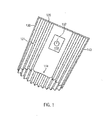
- Figure 1 shows an exemplary vacuum cleaner filter bag in the form of a flat bag, in which one side is shown open for purposes of illustration. In fact, there is a weld seam in the area of the side shown open here.
- the exemplary vacuum cleaner filter bag from Figure 1 comprises first and second bag walls of folded nonwoven material.
- the first and the second bag wall are connected to one another by four weld seams.
- three of these four welds 120, 130, and 140 are shown.
- the folded nonwoven material comprises a plurality, in particular more than two, folds 101.
- the folds 101 here form standing folds.
- the exemplary vacuum cleaner filter bag from Figure 1 also includes an inflow opening 102 through which air to be cleaned can flow into the vacuum cleaner filter bag, as well as a holding plate 103 which is used to fix the vacuum cleaner filter bag in a chamber of a vacuum cleaner and has a through hole in the area of the inflow opening 102.
- the folds 101 are in the exemplary vacuum cleaner filter bag in FIG Figure 1 formed along the entire length of the vacuum cleaner filter bag.
- the vacuum cleaner filter bag can have a long side and a broad side.
- the folds 101 can extend along the longitudinal side or along the broad side, in particular along the entire longitudinal side or broad side.
- the exemplary vacuum cleaner filter bag of Figure 1 is an area 104 of the bag wall free of wrinkles.
- folds of the first and / or second bag wall can also be located on the entire bag wall.
- the bag wall can in particular have two or more filter layers, at least one layer comprising the folded nonwoven material.
- Figure 2 shows an oblique view of an inside of a bag wall of an exemplary vacuum cleaner filter bag.
- the folds 201 of the nonwoven material are connected to one another by a fixing device in the form of a plurality of material strips 205.
- the folds 201 are held at a predetermined distance from one another by the material strips 205.
- the fold width of the folds 201 is fixed by the material strips 205.
- the material strips 205 are connected, for example glued or welded, to the folds 201, in particular to an edge of the folds 201, at connection points 206.
- the arrow 210 indicates the direction of flow of the air to be cleaned through the nonwoven material.
- the material strips 205 can, for example, have a width of 0.5 cm to 4 cm, in particular 1 cm to 3 cm, for example 2 cm.
- the strips of material 205 may comprise a nonwoven material.
- the nonwoven material can in particular comprise an extrusion nonwoven, for example a filament spunbond nonwoven, and / or a carded or airlaid nonwoven.
- the material strips 205 can also comprise a laminate of a plurality of nonwovens, in particular a laminate of filament spunbond nonwoven - melt-spun microfiber spunbond nonwoven - filament spunbond nonwoven.
- the weight per unit area of the material strips 205 can be less than 250 g / m 2 , in particular between 10 g / m 2 and 30 g / m 2 .
- connection points 206 can be designed in such a way that the connection is released during operation of the vacuum cleaner filter bag.
- the at least partially detached material strips 205 can influence the flow behavior of the air flowing into the bag.
- the material strips 205 can also have a predetermined expansion behavior. In this way, a predetermined expansion of the bag can be achieved during operation.
- the material strips 205 can also have an elasticity, so that the expansion of the bag after operation, that is, after switching off the vacuum cleaner, is reduced again by elastic restoring forces. As a result, dust can also be conveyed from the bag wall into the interior of the vacuum cleaner filter bag.
- the fixing device can also be designed as a full-area material strip.
- the fixing device can have a high air permeability, in particular more than 5000 l / (m 2 s).
- the fixing device can also comprise an air-permeable paper, fabric and / or a film. In order to increase the air permeability, the fixing device can also be perforated and / or slotted.
- Figure 3 shows an oblique view of an inside of a bag wall of a further exemplary vacuum cleaner filter bag.
- the fixing device is designed in the form of a network 307, which connects the folds 301 of the nonwoven material to one another in a partial area of the surface. In other areas of the surface, the folds of the first and / or second bag wall are not connected by the fixing device.
- the arrow 310 indicates the direction of flow of the air to be cleaned through the nonwoven material.
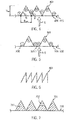
- Figure 4 shows a cross section through a partial area of the bag wall of an exemplary vacuum cleaner filter bag, the cross section running perpendicular to the course of the folds of the first and / or second bag wall.
- Figure 4 a zigzag fold of three folds 401 comprising seven folds I-VII.
- the folds I, III, V and VI I are connected to one another by a fixing device 405.
- the fixing device 405 is connected to the fold hinges of these folds at connection points 406.
- the arrow 410 denotes the direction of flow of the air to be cleaned onto the bag wall.
- the fixing device 405 is therefore on the inflow side with respect to the bag wall.
- Figure 4 also shows the fold width B max and the fold height H max of the folds.
- the fold height and / or the fold width can be between 3 mm and 100 mm, in particular between 5 mm and 15 mm.
- the folds are standing folds; one part of the fold legs here has an angle ⁇ of approximately 64 °, the other part of the fold legs an angle ⁇ of approximately 116 °.
- Figure 5 shows a further cross section through part of a bag wall of an exemplary vacuum cleaner filter bag.
- the detail shows two folds 501 of six folds I-VI and a fixing device 505 arranged on the inflow side with respect to the flow direction 510, which are connected to the folds I, III or IV and VI at connection points 506.
- connection point 506.1 is arranged in the area of the nonwoven material which forms the leg of the folds III and IV and which runs parallel to the bag wall.
- the folds of this vacuum cleaner bag accordingly have legs that run parallel to the bag wall and lie between the folds that protrude from the plane of the bag wall.
- the width of the parallel leg is smaller than the width of the opening of the fold protruding from the bag wall.
- the folds have the shape of isosceles triangles in cross section.
- the heights of these folds are therefore each smaller than the corresponding widths of the folds.
- Figure 6 shows a cross section through a partial area of a bag wall of an exemplary vacuum cleaner filter bag, in which the folds 601 have fold legs of different lengths in cross section.
- the cavities formed between the folds and the fixing device can be filled with fibers, in particular electrostatically charged fibers, and / or with absorbents.
- fibers in particular electrostatically charged fibers, and / or with absorbents.
- Coated fibers, activated carbon and / or porous polymers, for example, can be used as absorbents.
- Figure 7 a cross section of a portion of such a bag wall.
- a plurality of folds 701 are shown forming triangular folds.
- a fixing device 705 is connected to some of the folds.
- Fibers 711 and / or activated carbon 712 are arranged in the cavities between the fold legs and the fixing device 705.
- Figure 8 shows an exemplary vacuum cleaner filter bag in the form of a flat bag in a plan view of an outside of the vacuum cleaner filter bag.
- the upper and lower bag walls comprise a plurality of folds 801.
- Reference numerals 820, 830 and 840 denote three weld seams.
- As in Figure 1 is in Figure 8 one page shown open for illustration purposes. In fact, there is also one, namely the fourth, weld seam in the area of the side shown open here.
- the vacuum cleaner filter bag also includes two side folds 813 and 814. The filter material is not folded in the area of the side folds.
- the side gussets 813 and 814 can be partially or completely turned out.
- the side folds can also have folded filter material. So that the folded filter material does not unfold when the side folds are introduced, it is useful to to provide the side folds at an angle to the folds which is greater than 45 °. If you go from the in Figure 8 vacuum cleaner filter bag shown, in this case the side fold would have to be introduced in the area of the weld seam 820 and / or in the area of the weld seam (not shown).
- the folds have the shape of a triangle.
- the folds can also have any other shape.
- the shape of the folds in the figures is to be understood only schematically.
- the fold legs can also be curved.
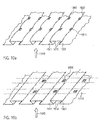
- the fold shape of one or more folds and / or folds of the first and / or second bag wall can have a dovetail shape in a cross section perpendicular to the longitudinal axis of the folds. Examples of folds with a cross-section in a dovetail shape are shown in FIGS Figures 10a and 10b shown.
- the edges 1015 of the fold legs of the folds 1001 pointing toward the inside of the bag are arranged at a distance from one another. This allows the air to be cleaned to easily enter the fold.
- the direction in which the air to be cleaned flows through the bag wall is illustrated by an arrow 1010.
- connection points 1016 have a distance from one another in the longitudinal direction of the folds 1002 which is greater than 1/5, in particular greater than 1/4, of the length of the fold 1002. This allows the air to be cleaned to flow better through the folds 1002 during operation , than with smaller distances between the connection points 1016.
- connection points 1016 can also lie on a continuous weld line.
- a fixing device 1105 is provided in the form of a plurality of material strips, which is glued and / or welded to the at least folded nonwoven material with the fold legs of the folds 1001.
- multiple connection points 1006 are shown.
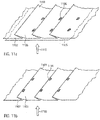
- FIGs 11a and 11b further exemplary sections of a bag wall with a nonwoven material with surface folds are shown.
- the folds from the folds 1101, 1102 and 1103 of the nonwoven material are designed horizontally in these examples, ie the fold legs run essentially parallel to the surface of the bag wall. Since fold legs running essentially parallel to the surface cannot be shown in the drawing, the fold legs are shown here at an angle with respect to the surface of the bag wall.
- a fixing device 1105 is also shown, which is connected, in particular glued and / or welded, to the nonwoven material provided with surface folds in areas of the bag wall which form the fold legs of the folds 1101.
- This type of connection of the fixing device can simplify the manufacture of the vacuum cleaner filter bag.
- a plurality of connection points 1106 are shown between the fixation device and the bag wall.
- the fixing device 1105 is in Figure 11a fully formed.
- the fixing device 1105 could, however, also be in the form of a plurality of strips of material, for example in FIG Figure 2 illustrated, trained.
- connection points 1106 can also lie on a continuous weld line, which preferably runs parallel to the fold axes.
- the folds 1101 of the nonwoven material are each connected to the fold legs of the folds 1102, in particular glued and / or welded, which is arranged between two fold edges of the bag wall.
- the connection points 1116 have a distance from one another in the longitudinal direction of the folds 1101 which is greater than 1/5, in particular greater than 1/4, of the length of the fold 1101. This allows the air to be cleaned to flow better through the folds 1101 during operation , than with smaller distances between the connection points 1116.
- connection points 1116 can also lie on a continuous weld line, which preferably runs perpendicular to the fold axes.
- the area available for filtration can be increased for given dimensions of the vacuum cleaner filter bag. This leads to a high separation efficiency with a low initial pressure loss. This is accompanied by a lower media penetration speed, which increases the separation efficiency, in particular due to the electrostatically charged fibers of the bag wall.
- the vacuum cleaner filter bag can be designed in different geometries and / or sizes.
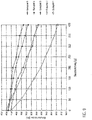
- the vacuum cleaner filter bags with a bag wall comprising a folded nonwoven material have a larger volume flow, even with high dust loads, than a vacuum cleaner filter bag with a bag wall without folds in the nonwoven material.
- Filter medium 1 is an SMMS laminate made from an outer layer made of spunbonded nonwoven (35 g / m 2 ), two layers made of meltblown nonwoven fabric (2 ⁇ 20 g / m 2 ) and an inner layer made of spunbonded nonwoven (17 g / m 2 ).
- Filter medium 2 is a SMMMMS laminate consisting of an outer layer of spunbonded nonwoven (35 g / m 2 ), four layers of meltblown nonwoven (4 x 19 g / m 2 ) and an inner layer of spunbonded nonwoven (17 g / m 2 ).
- Table 1 The different media passage speeds were set by changing the volume flow on TSI 8130. Test objects with an area of 100 cm ⁇ sup> 2 ⁇ /sup> were used.
- TSI 8130 Media passage speed [cm / s] Pressure loss ⁇ P [mm H 2 O] Penetration [%] Filter medium 1 14.3 14.5 32.2 7.15 6.9 18.7 Filter medium 2 14.3 32.1 0.025 7.15 15.5 0.004
- a bag wall with surface folds enables the vacuum cleaner filter bag to be optimally adapted to the given installation space in the vacuum cleaner during operation.
- a space utilization of more than 65% can be achieved.
- a space utilization of more than 80% can be achieved.
Landscapes
- Engineering & Computer Science (AREA)
- Mechanical Engineering (AREA)
- Chemical & Material Sciences (AREA)
- Chemical Kinetics & Catalysis (AREA)
- Filters For Electric Vacuum Cleaners (AREA)
- Filtering Materials (AREA)
- Filtering Of Dispersed Particles In Gases (AREA)
Claims (16)
- Sac filtrant d'aspirateur avec une première paroi de sac comportant un matériau filtrant et une deuxième paroi de sac comportant un matériau filtrant, dans lequel les première et deuxième parois de sac sont connectées entre elles le long de leur pourtour (120, 130, 140 ; 820, 830; 840) de telle manière que le sac filtrant d'aspirateur est entièrement fermé, dans lequel le matériau filtrant des première et deuxième parois de sac est constitué d'un matériau non-tissé, dans lequel le sac filtrant d'aspirateur comporte un orifice d'entrée (102), à travers lequel de l'air à nettoyer peut entrer dans le sac filtrant d'aspirateur, ainsi qu'une plaque de rétention (103),dans lequel les première et/ou deuxième parois de sac comportent au moins cinq plis (101 ; 801) etdans lequel un dispositif de fixation (205; 307) est pourvu pour empêcher qu'au moins un desdits au moins cinq plis ne se déplie entièrement.
- Sac d'aspirateur selon la revendication 1, dans lequel les jambes de pli desdits au moins cinq plis comportent des lignes d'inflexion qui sont essentiellement rectilignes.
- Sac filtrant d'aspirateur selon la revendication 1 ou 2, dans lequel lesdits au moins cinq plis constituent au moins un pliage de surface, dans lequel la hauteur maximale du pliage de surface (Hmax) avant la première mise en service du sac filtrant d'aspirateur dans un aspirateur est inférieure à la largeur maximale du pliage de surface (Bmax) correspondant à ladite hauteur maximale.
- Sac filtrant d'aspirateur selon l'une des revendications précédentes, dans lequel, avant la première mise en service du sac filtrant d'aspirateur dans un aspirateur, chacun desdits au moins cinq plis (101 ; 801) présente une longueur qui est supérieure à un tiers de l'extension totale du sac filtrant d'aspirateur en direction du pli, qui est préférablement supérieure à la moitié de l'extension totale du sac filtrant d'aspirateur en direction du pli, et qui correspond préférablement encore à l'extension totale du sac en direction du pli.
- Sac filtrant d'aspirateur selon l'une des revendications précédentes, dans lequel, avant la première mise en service du sac filtrant d'aspirateur dans un aspirateur, chacun desdits au moins cinq plis présente une hauteur comprise entre 3 mm et 100 mm, en particulier entre 3 mm et 50 mm, et plus en particulier encore entre 5 mm et 15 mm.
- Sac filtrant d'aspirateur selon l'une des revendications précédentes, dans lequel, avant la première mise en service du sac filtrant d'aspirateur dans un aspirateur, chacun desdits au moins cinq plis présente une largeur comprise entre 3 mm et 100 mm, en particulier entre 3 mm et 50 mm, et plus en particulier encore entre 5 mm et 15 mm.
- Sac filtrant d'aspirateur selon l'une des revendications précédentes, dans lequel au moins deux desdits au moins cinq plis présentent des hauteurs et/ou des largeurs et/ou des formes qui diffèrent entre elles.
- Sac d'aspirateur selon l'une des revendications précédentes, dans lequel est pourvue une pluralité de plis (101 ; 801) qui sont distribués sur les première et/ou deuxième parois de sac, de préférence de manière essentiellement uniforme.
- Sac filtrant d'aspirateur selon l'une des revendications précédentes, comportant en outre au moins un pliage latéral (813, 814).
- Sac filtrant d'aspirateur selon la revendication 9, dans lequel ledit au moins un pliage latéral comporte pour sa part au moins un pli qui s'étend préférablement à un angle supérieur à 45° par rapport au pliage latéral, et préférablement encore à un angle essentiellement droit par rapport au pliage latéral.
- Sac filtrant d'aspirateur selon la revendication 1, dans lequel le dispositif de fixation est agencé du côté amont par rapport auxdites première et/ou deuxième parois de sac.
- Sac filtrant d'aspirateur selon la revendication 1 ou 11, dans lequel le dispositif de fixation est collé et/ou soudé audit au moins un pli et/ou à une paroi de sac adjacente audit au moins un pli.
- Sac filtrant d'aspirateur selon l'une des revendications 1, 11 ou 12, dans lequel le dispositif de fixation comporte au moins une bande de matériau (205), en particulier une bande de matériau non tissé, et/ou dans lequel le dispositif de fixation présente un rapport d'extension prédéterminé et/ou un rapport élastique prédéterminé.
- Sac filtrant d'aspirateur selon l'une des revendications 1, 11, 12 ou 13, dans lequel le dispositif de fixation est une couche de matériau non tissé, une couche en treillis (307), un film perforé ou une couche de tissu, qui s'étend sur l'ensemble des première et/ou deuxième parois du sac.
- Sac filtrant d'aspirateur selon l'une des revendications 1, 11, 12, 13 ou 14, dans lequel des fibres et/ou des matières absorbantes sont pourvues dans une cavité qui est constituée par le dispositif de fixation et les jambes de pli dudit au moins un pli.
- Appareil aspirateur avec un sac filtrant d'aspirateur selon l'une des revendications précédentes, dans lequel l'appareil aspirateur et le sac filtrant d'aspirateur sont constitués de telle manière que l'utilisation de l'espace d'installation du sac filtrant d'aspirateur lors du fonctionnement de l'appareil aspirateur est supérieure à 65 %, et en particulier supérieure à 80 %.
Priority Applications (11)
| Application Number | Priority Date | Filing Date | Title |
|---|---|---|---|
| EP10163463.2A EP2366321B2 (fr) | 2010-03-19 | 2010-05-20 | Sac d'aspirateur |
| PL10163463T PL2366321T5 (pl) | 2010-03-19 | 2010-05-20 | Worek filtrujący do odkurzacza |
| US13/635,102 US10182691B2 (en) | 2010-03-19 | 2011-03-09 | Vacuum cleaner filter bag |
| PCT/EP2011/001164 WO2011113543A1 (fr) | 2010-03-19 | 2011-03-09 | Sac d'aspirateur filtrant |
| PCT/EP2011/001166 WO2011113545A2 (fr) | 2010-03-19 | 2011-03-09 | Sac d'aspirateur filtrant |
| CN201180024868.XA CN102905598B (zh) | 2010-03-19 | 2011-03-09 | 真空清洁器过滤袋 |
| CN201180024870.7A CN102905599B (zh) | 2010-03-19 | 2011-03-09 | 真空清洁器过滤袋 |
| US13/635,089 US10188248B2 (en) | 2010-03-19 | 2011-03-09 | Vacuum cleaner filter bag |
| CN201180024800.1A CN102905597B (zh) | 2010-03-19 | 2011-03-09 | 真空清洁器过滤袋 |
| US13/635,001 US10178932B2 (en) | 2010-03-19 | 2011-03-09 | Vacuum cleaner filter bag |
| PCT/EP2011/001165 WO2011113544A2 (fr) | 2010-03-19 | 2011-03-09 | Sac d'aspirateur filtrant |
Applications Claiming Priority (2)
| Application Number | Priority Date | Filing Date | Title |
|---|---|---|---|
| EP10002964.4A EP2366319B1 (fr) | 2010-03-19 | 2010-03-19 | Sac d'aspirateur |
| EP10163463.2A EP2366321B2 (fr) | 2010-03-19 | 2010-05-20 | Sac d'aspirateur |
Publications (3)
| Publication Number | Publication Date |
|---|---|
| EP2366321A1 EP2366321A1 (fr) | 2011-09-21 |
| EP2366321B1 EP2366321B1 (fr) | 2014-03-05 |
| EP2366321B2 true EP2366321B2 (fr) | 2021-12-22 |
Family
ID=42313071
Family Applications (4)
| Application Number | Title | Priority Date | Filing Date |
|---|---|---|---|
| EP13179356.4A Active EP2662010B1 (fr) | 2010-03-19 | 2010-03-19 | Sac d'aspirateur |
| EP10002964.4A Active EP2366319B1 (fr) | 2010-03-19 | 2010-03-19 | Sac d'aspirateur |
| EP10163463.2A Active EP2366321B2 (fr) | 2010-03-19 | 2010-05-20 | Sac d'aspirateur |
| EP10163462.4A Active EP2366320B2 (fr) | 2010-03-19 | 2010-05-20 | Sac d'aspirateur |
Family Applications Before (2)
| Application Number | Title | Priority Date | Filing Date |
|---|---|---|---|
| EP13179356.4A Active EP2662010B1 (fr) | 2010-03-19 | 2010-03-19 | Sac d'aspirateur |
| EP10002964.4A Active EP2366319B1 (fr) | 2010-03-19 | 2010-03-19 | Sac d'aspirateur |
Family Applications After (1)
| Application Number | Title | Priority Date | Filing Date |
|---|---|---|---|
| EP10163462.4A Active EP2366320B2 (fr) | 2010-03-19 | 2010-05-20 | Sac d'aspirateur |
Country Status (7)
| Country | Link |
|---|---|
| US (3) | US10182691B2 (fr) |
| EP (4) | EP2662010B1 (fr) |
| CN (3) | CN102905599B (fr) |
| DK (4) | DK2366319T3 (fr) |
| ES (4) | ES2508291T3 (fr) |
| PL (4) | PL2662010T3 (fr) |
| WO (3) | WO2011113543A1 (fr) |
Families Citing this family (36)
| Publication number | Priority date | Publication date | Assignee | Title |
|---|---|---|---|---|
| US20100098354A1 (en) * | 2008-10-20 | 2010-04-22 | Fraser Robert W | Bag and Methods of Making the Same |
| US9016945B2 (en) * | 2008-10-20 | 2015-04-28 | The Glad Products Company | Bag and method of making the same |
| EP2662010B1 (fr) * | 2010-03-19 | 2014-08-06 | Eurofilters Holding N.V. | Sac d'aspirateur |
| EP2428151B1 (fr) | 2010-09-08 | 2016-11-09 | Eurofilters Holding N.V. | Dispositif destiné à aspirer à l'aide d'un appareil d'aspiration et d'un sac filtrant |
| EP2502538B1 (fr) | 2011-03-22 | 2015-09-23 | Eurofilters Holding N.V. | Sac filtrant d'aspirateur doté d'un dispositif de liaison murale d'un sac filtrant |
| EP2502536B1 (fr) | 2011-03-22 | 2019-01-02 | Eurofilters N.V. | Dispositif efficace au plan écologique destiné à l'aspiration |
| DE102011014682A1 (de) | 2011-03-22 | 2012-09-27 | Eurofilters Holding N.V. | Vorrichtung zum Staubsaugen mit Staubsaugergerät und Filterbeutel |
| PL3072430T3 (pl) * | 2012-03-22 | 2017-10-31 | Eurofilters Holding Nv | Urządzenie do odkurzania z odkurzaczem i workiem filtracyjnym |
| EP2644077A1 (fr) | 2012-03-27 | 2013-10-02 | Jan Schultink | Procédé d'optimisation d'un dispositif d'aspiration doté d'un aspirateur manuel, compact ou vertical et d'un sac filtrant |
| EP2644075A1 (fr) * | 2012-03-27 | 2013-10-02 | Jan Schultink | Procédé d'optimisation d'un dispositif d'aspiration doté d'un aspirateur de sol ou vertical et d'un sac filtrant |
| US9642508B1 (en) * | 2012-04-16 | 2017-05-09 | Billy Goat Indutries, Inc. | Debris-collecting apparatus and method of collecting debris |
| DE102012219344A1 (de) * | 2012-10-23 | 2014-04-24 | BSH Bosch und Siemens Hausgeräte GmbH | Filtersystem für ein Raumpflegegerät |
| US20140208705A1 (en) * | 2013-01-25 | 2014-07-31 | Baldwin Filters, Inc. | Mutli-Pass Fluted Filter |
| PL2777795T3 (pl) | 2013-03-15 | 2016-09-30 | Worek filtrujący do odkurzacza | |
| EP2786689B1 (fr) * | 2013-04-05 | 2019-03-13 | Branofilter Gmbh | Sac de filtre à poussière |
| CN104116462B (zh) * | 2013-04-26 | 2017-06-30 | 天佑电器(苏州)有限公司 | 过滤袋及具有该过滤袋的吸尘器 |
| CN103432846A (zh) * | 2013-06-27 | 2013-12-11 | 中国北方车辆研究所 | 一种平板式滤芯纸褶结构 |
| ES2609483T3 (es) | 2013-08-09 | 2017-04-20 | Eurofilters N.V. | Bolsa de filtro para una aspiradora, así como procedimiento para la determinación de una superficie de una bolsa de filtro de aspiradora en la que incide directamente el flujo de aire |
| EP2835087B1 (fr) * | 2013-08-09 | 2018-10-10 | Eurofilters N.V. | Sac filtrant d'aspirateur avec élément d'écartement |
| EP2926706B1 (fr) | 2014-04-04 | 2024-06-05 | Eurofilters Holding N.V. | Dispositif d'aspiration de poussière |
| EP2926705A1 (fr) | 2014-04-04 | 2015-10-07 | Eurofilters Holding N.V. | Dispositif destiné à aspirer à l'aide d'un aspirateur de chaudière |
| ES2625427T3 (es) | 2014-04-08 | 2017-07-19 | Eurofilters N.V. | Bolsa de filtro para aspiradores de polvo para un aspirador de polvo vertical |
| US20170173500A1 (en) * | 2015-12-21 | 2017-06-22 | Kuss Filtration Inc. | Filter with flexible ribs |
| EP3219237B1 (fr) * | 2016-03-17 | 2018-05-09 | Eurofilters Holding N.V. | Plaque de maintien dotee d'une fermeture amelioree |
| CN106215564A (zh) * | 2016-10-11 | 2016-12-14 | 赵本军 | 一种新型除尘滤袋 |
| PL3354178T3 (pl) | 2017-01-31 | 2022-03-21 | Eurofilters Holding N.V. | Odkurzacz podłogowy |
| RU2661469C1 (ru) * | 2017-06-26 | 2018-07-16 | Общество с ограниченной ответственностью "Топ-маркет" | Мешок для пылесоса |
| KR102619773B1 (ko) * | 2018-03-08 | 2024-01-02 | 쓰리엠 이노베이티브 프로퍼티즈 캄파니 | 필터 및 이를 포함하는 마스크 |
| PL3753463T3 (pl) * | 2019-06-17 | 2023-09-18 | Eurofilters Holding N.V. | Worek filtrujący do odkurzacza ręcznego |
| PL3821776T3 (pl) * | 2019-11-12 | 2025-03-17 | Eurofilters Holding N.V. | Worek filtrujący do odkurzacza ręcznego |
| EP3821777B1 (fr) | 2019-11-12 | 2025-01-01 | Eurofilters Holding N.V. | Sac filtrant d'aspirateur pour un aspirateur à main |
| DE102020100577B4 (de) | 2020-01-13 | 2021-09-23 | Branofilter Gmbh | Staubsaugerfilterbeuteleinrichtung |
| CA3177177A1 (fr) * | 2020-03-26 | 2021-09-30 | 3M Innovative Properties Company | Filtre a air encadre avec volet stabilisateur |
| US20220023784A1 (en) * | 2020-07-23 | 2022-01-27 | Hollingsworth & Vose Company | Filter media comprising a polyethersulfone-based fine fiber layer |
| CN113877317A (zh) * | 2021-10-18 | 2022-01-04 | 嘉兴市小田环保科技有限公司 | 一种立体方形过滤袋及其制备方法 |
| USD1019034S1 (en) * | 2022-01-07 | 2024-03-19 | Haowen Mo | Vacuum cleaner dust storage bag |
Citations (10)
| Publication number | Priority date | Publication date | Assignee | Title |
|---|---|---|---|---|
| US3107989A (en) † | 1961-10-18 | 1963-10-22 | Studley Paper Company Inc | Disposable filter bag |
| WO1995016383A1 (fr) † | 1993-12-16 | 1995-06-22 | Hitachi, Ltd. | Sac en papier collecteur de poussiere pour aspirateur |
| JPH08103404A (ja) † | 1994-10-06 | 1996-04-23 | Mitsubishi Electric Home Appliance Co Ltd | 電気掃除機の集塵袋 |
| DE29704079U1 (de) † | 1997-03-06 | 1997-04-24 | Alfred Kärcher GmbH & Co, 71364 Winnenden | Filterbeutel für Staubsauger |
| WO2000064320A1 (fr) † | 1999-04-28 | 2000-11-02 | Aktiebolaget Electrolux | Sac a poussiere |
| DE10064608A1 (de) † | 2000-09-29 | 2002-04-11 | Vorwerk Co Interholding | Filterbeutel für einen Staubsager |
| EP1091795B1 (fr) † | 1998-06-30 | 2003-04-09 | Otmar Köhler | Filtre a plis |
| EP1683460A1 (fr) † | 2005-01-20 | 2006-07-26 | Branofilter Gmbh | Sac filtrant à poussières |
| US20080257149A1 (en) † | 2007-04-18 | 2008-10-23 | Transweb, Llc | Filtration media having a slit-film layer |
| EP2098153A1 (fr) † | 2008-03-07 | 2009-09-09 | Eurofilters Holding N.V | Sac d'aspirateur |
Family Cites Families (101)
| Publication number | Priority date | Publication date | Assignee | Title |
|---|---|---|---|---|
| DE484759C (de) * | 1927-06-03 | 1929-10-21 | Friedrich Wilhelm Carl Alex Fe | Aus Papier hergestellter Staubbeutel fuer Staubsauger |
| BE364551A (fr) * | 1929-03-18 | |||
| US1878384A (en) * | 1929-04-18 | 1932-09-20 | Hoover Co | Suction cleaner |
| DE656164C (de) * | 1935-11-14 | 1938-01-31 | Siemens Schuckertwerke Akt Ges | Staubsaugerfilter |
| US2514280A (en) * | 1945-03-24 | 1950-07-04 | Eureka Williams Corp | Suction cleaner |
| US2792076A (en) * | 1954-04-22 | 1957-05-14 | Lewyt Corp | Filter bag |
| DE1403128A1 (de) * | 1958-04-22 | 1968-11-28 | Fritz Donner | Staubbeutel aus Papier fuer Staubsauger |
| GB879188A (en) * | 1959-06-01 | 1961-10-04 | Joseph Chadwick & Sons Ltd | Improvements in or relating to manufacturing of paper bags |
| GB1046199A (en) * | 1964-09-08 | 1966-10-19 | Electrolux Ltd | Improvements relating to vacuum cleaners |
| DE1703030A1 (de) * | 1966-08-10 | 1972-01-27 | Eck B | Staubsauger |
| US3416721A (en) | 1967-01-31 | 1968-12-17 | Studley Paper Company Inc | Disposable vacuum cleaner bag |
| US3430843A (en) | 1967-11-13 | 1969-03-04 | Studley Paper Co | Disposable filter bag |
| US3596443A (en) | 1969-10-29 | 1971-08-03 | Modern Dust Bag Co Inc | Vacuum cleaner filter bag |
| US3710948A (en) * | 1970-06-10 | 1973-01-16 | American Air Filter Co | Self-sustaining pocket type filter |
| NO137844C (no) * | 1976-07-16 | 1978-05-24 | Anders Engen | Stoevsugersekk. |
| SE410399B (sv) * | 1976-10-08 | 1979-10-15 | Lectrostatic Ab | Naetfilter avsett att arbeta med hoega pulserande tryck |
| GB1594700A (en) | 1978-05-25 | 1981-08-05 | Marshall D A G | Pleated filtering material |
| DE3129371A1 (de) † | 1981-07-25 | 1983-02-17 | Vorwerk & Co Interholding Gmbh, 5600 Wuppertal | Staubsauger-filtertuete |
| FI73877C (fi) | 1982-09-29 | 1987-12-10 | Raupak Oy | Dammpaose foer anvaendning i en dammsugare. |
| US4589894A (en) | 1984-04-11 | 1986-05-20 | Minnesota Mining And Manufacturing Co. | Disposable filter for a vacuum cleaner |
| GB2162768B (en) * | 1984-08-06 | 1989-01-11 | Tilghman Wheelabrator Ltd | Filtering apparatus |
| DE3812849C3 (de) * | 1988-04-18 | 1996-03-21 | Gessner & Co Gmbh | Staubfilterbeutel, dessen Herstellung und Verwendung |
| US5080702A (en) * | 1990-02-15 | 1992-01-14 | Home Care Industries, Inc. | Disposable two-ply filter |
| DE102004009956A1 (de) | 2004-03-01 | 2005-09-29 | Eurofilters N.V. | Adsorbens für Staubsammelfilter, Staubsammelfilter und Verfahren zur Geruchsadsorption |
| US5181946A (en) * | 1992-02-07 | 1993-01-26 | Home Care Industries, Inc. | Crimped vacuum bag seal and method of making the same |
| DE4214990A1 (de) | 1992-05-06 | 1993-11-11 | Minnesota Mining & Mfg | Staubsaugerbeutel und Verfahren zu seiner Herstellung |
| DE4227744A1 (de) | 1992-08-21 | 1994-02-24 | Knecht Filterwerke Gmbh | Zick-zack-förmig gefaltetes Filterbahnmaterial und daraus gefertigtes Filterelement |
| US5401446A (en) | 1992-10-09 | 1995-03-28 | The University Of Tennessee Research Corporation | Method and apparatus for the electrostatic charging of a web or film |
| DE19713238A1 (de) | 1997-03-29 | 1998-10-01 | Vorwerk Co Interholding | Filterelement aus einem im wesentlichen biegeschlaffen Werkstoff und Verfahren zur Herstellung eines zick-zackförmig gefalteten Filterelementes |
| US5871836A (en) | 1997-08-27 | 1999-02-16 | Airflo Europe N.V. | Composite pleated fibrous structures containing split film fibers |
| DE19752143A1 (de) * | 1997-11-25 | 1999-05-27 | Mann & Hummel Filter | Filterelement |
| DE19820153C1 (de) * | 1998-05-06 | 1999-12-02 | Branofilter Gmbh | Filtervorrichtung für schmutzsaugende Geräte |
| IL139539A0 (en) | 1998-05-11 | 2004-02-08 | Airflo Europe Nv | Vacuum cleaner bag and improved vacuum cleaner bag |
| US6156086A (en) * | 1999-03-22 | 2000-12-05 | 3M Innovative Properties Company | Dual media vacuum filter bag |
| EP1059056B1 (fr) | 1999-06-08 | 2004-11-03 | 3M Innovative Properties Company | Sac à poussières et procédé pour le fabriquer |
| JP2000350685A (ja) * | 1999-06-14 | 2000-12-19 | Hitachi Ltd | 電気掃除機用集塵フィルター |
| DE19941029C2 (de) | 1999-08-28 | 2001-07-26 | Freudenberg Carl Fa | Filtereinsatz aus einem zickzackförmig gefalteten Faltenpack und Verfahren zu seiner Herstellung |
| JP3883767B2 (ja) * | 2000-01-28 | 2007-02-21 | 東芝テック株式会社 | 集塵フィルターおよびこの集塵フィルターを用いた電気掃除機 |
| DE10013315C2 (de) * | 2000-03-17 | 2002-06-06 | Freudenberg Carl Kg | Plissiertes Filter aus einem mehrlagigen Filtermedium |
| US20010047721A1 (en) * | 2000-05-03 | 2001-12-06 | Scanlon John J. | Vacuum collection bag and method of operation |
| ES2258498T3 (es) † | 2000-09-29 | 2006-09-01 | VORWERK & CO. INTERHOLDING GMBH | Bolsa filtro para un aspirador de polvo. |
| DE10061073A1 (de) † | 2000-12-08 | 2002-06-20 | Vorwerk Co Interholding | Filterbeutel für einen Staubsauger |
| DE20101466U1 (de) | 2001-01-27 | 2001-04-19 | Wolf GmbH, 32602 Vlotho | In einen Staubsauger einsetzbare Filtereinrichtung |
| DE10135421A1 (de) * | 2001-07-20 | 2003-02-13 | Hydac Filtertechnik Gmbh | Verfahren zum Herstellen einer Verbindungsstelle bei einem Filterelement und Vorrichtung zum Herstellen derselben |
| US6814773B2 (en) * | 2001-10-09 | 2004-11-09 | Carrier Corporation | Expandable media filter assembly |
| US7147756B2 (en) | 2003-02-11 | 2006-12-12 | Albany International Corp. | Unique fabric structure for industrial fabrics |
| DE10348375B4 (de) † | 2003-10-17 | 2006-05-04 | Eurofilters N.V. | Filterbeutel und Verfahren zu dessen Herstellung |
| ITGE20030025U1 (it) | 2003-11-27 | 2005-05-28 | Filtri Di Padroni Marco Genova | Sacchetto per aspirapolvere realizzato in tessuto non tessuto |
| DE10359948A1 (de) | 2003-12-19 | 2005-07-14 | Eurofilters N.V. | Staubsammelfilter und Verfahren zur Standzeitverlängerung von Staubsammelfiltern |
| US20050204714A1 (en) * | 2004-03-22 | 2005-09-22 | 3M Innovative Properties Company | Self-supporting pleated filter and method of making same |
| US7235115B2 (en) * | 2004-07-09 | 2007-06-26 | 3M Innovative Properties Company | Method of forming self-supporting pleated filter media |
| JP2006061582A (ja) * | 2004-08-30 | 2006-03-09 | Toshiba Tec Corp | 電気掃除機 |
| US20060102275A1 (en) | 2004-11-18 | 2006-05-18 | Jorgen Poulsen | Method of making a filter cartridge |
| AU2005311759B2 (en) * | 2004-12-01 | 2010-11-18 | Concentric Rockford Inc. | Hydraulic power supply system |
| DE202005000918U1 (de) | 2005-01-20 | 2005-03-31 | Branofilter Gmbh | Staubfilterbeutel |
| DE202005010357U1 (de) | 2005-07-01 | 2005-09-08 | Branofilter Gmbh | Staubfilterbeutel |
| DE102005049118B3 (de) * | 2005-10-14 | 2007-02-01 | Papierverarbeitung Görlitz GmbH | Staubfilterbeutel für Staubsauger |
| DE202005016309U1 (de) * | 2005-10-18 | 2005-12-15 | Wolf Gmbh | Staubsaugerbeutel |
| WO2007059939A1 (fr) | 2005-11-22 | 2007-05-31 | Eurofilters Holding N.V. | Sac filtrant d'aspirateur et utilisation d'un sac filtrant d'aspirateur |
| US8382871B2 (en) * | 2005-11-22 | 2013-02-26 | Eurofilters Holding N.V. | Vacuum cleaner filter bag and use of said bag |
| EP1787560B1 (fr) | 2005-11-22 | 2008-05-28 | Eurofilters Holding N.V | Sac à poussières d'aspirateur avec dispositif de déviation |
| US7799107B2 (en) | 2006-03-15 | 2010-09-21 | Techtronic Floor Care Technology Limited | Self-sealing bag arrangement for a floor cleaning device |
| EP1849392B1 (fr) | 2006-04-25 | 2008-10-08 | Eurofilters Holding N.V | Platine de fixation pour un sac à poussière d'un aspirateur |
| DE102006023707B3 (de) | 2006-05-19 | 2008-01-03 | Eurofilters N.V. | Staubfilterbeutel |
| JP2008073683A (ja) * | 2006-07-24 | 2008-04-03 | Sintokogio Ltd | 集塵機用プリーツ型フィルタおよび集塵機 |
| JP4944540B2 (ja) * | 2006-08-17 | 2012-06-06 | 日本バイリーン株式会社 | フィルタエレメント、その製造方法、並びに使用方法 |
| DE202006016304U1 (de) | 2006-10-23 | 2006-12-21 | Wolf Gmbh & Co. Kg | Filterbeutel |
| DE202006016303U1 (de) * | 2006-10-23 | 2006-12-21 | Wolf Gmbh & Co. Kg | Filterbeutel |
| US20080099053A1 (en) * | 2006-10-31 | 2008-05-01 | Michael Loveless | Wet/dry vacuum bag |
| DE502006009062D1 (de) * | 2006-11-03 | 2011-04-21 | Eurofilters Holding Nv | Antibakterieller Staubsaugerfilterbeutel |
| DE202006019108U1 (de) | 2006-12-19 | 2007-02-22 | Branofilter Gmbh | Staubfilterbeutel |
| DE202007000198U1 (de) | 2007-01-05 | 2007-03-08 | Branofilter Gmbh | Staubfilterbeutel für Staubsauger |
| US7942948B2 (en) * | 2007-03-05 | 2011-05-17 | Bha Group, Inc. | Filter element including a composite filter media |
| DE202007005847U1 (de) | 2007-04-20 | 2007-08-02 | Wolf Gmbh & Co. Kg | Filterbeutel für einen Staubsauger |
| DE202007010692U1 (de) | 2007-08-01 | 2007-10-04 | Branofilter Gmbh | Filtervorrichtung in Gestalt eines Staubfilterbeutels oder einer Filtertasche |
| DE202007017064U1 (de) | 2007-12-07 | 2008-03-20 | Branofilter Gmbh | Staubfilterbeutel für Staubsauger |
| DE102007060747B4 (de) | 2007-12-17 | 2022-11-10 | Vorwerk & Co. Interholding Gmbh | Staubfilterbeutel für einen Staubsauger |
| DE102007060748A1 (de) | 2007-12-17 | 2009-06-25 | Vorwerk & Co. Interholding Gmbh | Verfahren zur Herstellung eines Filterbeutels |
| US8157881B1 (en) * | 2007-12-31 | 2012-04-17 | Research Products Corporation | Collapsible extended surface filter and air cleaner system using collapsible extended surface filter |
| DE102008006769B4 (de) | 2008-01-30 | 2013-08-08 | Arwed Löseke Papierverarbeitung und Druckerei GmbH | Verfahren zur Herstellung eines Staubfilterbeutels mit Seitenfalten |
| DE202008003248U1 (de) * | 2008-03-07 | 2008-05-08 | Eurofilters Holding N.V. | Staubsaugerfilterbeutel |
| DE202008006904U1 (de) | 2008-05-21 | 2009-10-15 | Wolf Pvg Gmbh & Co. Kg | Halteplatte für einen Staubsaugerbeutel |
| DE202008007717U1 (de) * | 2008-06-10 | 2008-08-07 | Wolf Pvg Gmbh & Co. Kg | Filterbeutel |
| DE202009002970U1 (de) | 2008-07-02 | 2009-11-19 | Branofilter Gmbh | Staubfilterbeutel mit Pralleinrichtung |
| DE102009009152A1 (de) * | 2009-02-06 | 2010-08-12 | Branofilter Gmbh | Filterbeutel mit äußerem und innerem Beutel zum Einsatz in einem Staubsauger |
| DE102008045683B4 (de) * | 2008-09-04 | 2012-08-16 | Branofilter Gmbh | Staubfilterbeuteleinrichtung für einen Staubsauger |
| GB0819209D0 (en) * | 2008-10-20 | 2008-11-26 | Numatic Int Ltd | Vacuum cleaning filter arrangement |
| KR101672309B1 (ko) * | 2008-10-27 | 2016-11-03 | 세파르 비디에이치 인코포레이티드 | 필터 백, 그 주름형성가능한 필터 재료 및 이를 제조하기 위한 공정 |
| DE202008016300U1 (de) | 2008-12-10 | 2009-02-26 | Wolf Pvg Gmbh & Co. Kg | Staubsaugerbeutel |
| US8209914B2 (en) * | 2010-01-25 | 2012-07-03 | Vermont Slate & Copper Services, Inc. | Roofing grommet forming a seal between a roof-mounted structure and a roof |
| DE202009004433U1 (de) | 2009-03-26 | 2009-06-04 | Branofilter Gmbh | Blockbodenbeutel mit zusätzlicher Schweißnaht und Sollfaltlinien |
| ES2549756T3 (es) * | 2009-06-19 | 2015-11-02 | Eurofilters N.V. | Bolsa plana para aspirador de polvo con al menos dos difusores |
| DK3443880T3 (da) * | 2009-06-19 | 2021-07-26 | Eurofilters Nv | Flad pose til støvsuger |
| ES2607032T3 (es) | 2009-06-24 | 2017-03-28 | Eurofilters N.V. | Bolsa de filtro de fondo macizado para aspirador de polvo |
| DE202009012839U1 (de) | 2009-09-22 | 2009-12-17 | Arwed Löseke Papierverarbeitung und Druckerei GmbH | Staubfilterbeutel |
| DE202009013081U1 (de) * | 2009-09-29 | 2009-12-17 | Sandler Ag | Staubfilterbeutel |
| PL2311360T3 (pl) * | 2009-10-19 | 2015-02-27 | Eurofilters Holding Nv | Worek filtrujący do odkurzacza |
| EP2662010B1 (fr) * | 2010-03-19 | 2014-08-06 | Eurofilters Holding N.V. | Sac d'aspirateur |
| US8372181B2 (en) * | 2010-07-07 | 2013-02-12 | General Electric Company | Pleated walled bag filters for gas turbine inlet systems |
| EP2452603B1 (fr) * | 2010-11-10 | 2015-10-21 | Eurofilters Holding N.V. | Sachet de filtre d'aspirateur plié |
| DE202011000339U1 (de) * | 2011-02-15 | 2011-04-14 | Wolf Pvg Gmbh & Co. Kg | Staubsaugerbeutel |
-
2010
- 2010-03-19 EP EP13179356.4A patent/EP2662010B1/fr active Active
- 2010-03-19 DK DK10002964.4T patent/DK2366319T3/en active
- 2010-03-19 PL PL13179356T patent/PL2662010T3/pl unknown
- 2010-03-19 ES ES13179356.4T patent/ES2508291T3/es active Active
- 2010-03-19 PL PL10002964T patent/PL2366319T3/pl unknown
- 2010-03-19 ES ES10002964.4T patent/ES2537101T3/es active Active
- 2010-03-19 DK DK13179356.4T patent/DK2662010T3/da active
- 2010-03-19 EP EP10002964.4A patent/EP2366319B1/fr active Active
- 2010-05-20 ES ES10163463T patent/ES2451698T5/es active Active
- 2010-05-20 EP EP10163463.2A patent/EP2366321B2/fr active Active
- 2010-05-20 PL PL10163462.4T patent/PL2366320T5/pl unknown
- 2010-05-20 ES ES10163462T patent/ES2537105T5/es active Active
- 2010-05-20 DK DK10163463.2T patent/DK2366321T4/da active
- 2010-05-20 DK DK10163462.4T patent/DK2366320T4/da active
- 2010-05-20 PL PL10163463T patent/PL2366321T5/pl unknown
- 2010-05-20 EP EP10163462.4A patent/EP2366320B2/fr active Active
-
2011
- 2011-03-09 CN CN201180024870.7A patent/CN102905599B/zh active Active
- 2011-03-09 US US13/635,102 patent/US10182691B2/en active Active
- 2011-03-09 WO PCT/EP2011/001164 patent/WO2011113543A1/fr not_active Ceased
- 2011-03-09 WO PCT/EP2011/001166 patent/WO2011113545A2/fr not_active Ceased
- 2011-03-09 US US13/635,001 patent/US10178932B2/en active Active
- 2011-03-09 CN CN201180024868.XA patent/CN102905598B/zh active Active
- 2011-03-09 CN CN201180024800.1A patent/CN102905597B/zh active Active
- 2011-03-09 WO PCT/EP2011/001165 patent/WO2011113544A2/fr not_active Ceased
- 2011-03-09 US US13/635,089 patent/US10188248B2/en active Active
Patent Citations (10)
| Publication number | Priority date | Publication date | Assignee | Title |
|---|---|---|---|---|
| US3107989A (en) † | 1961-10-18 | 1963-10-22 | Studley Paper Company Inc | Disposable filter bag |
| WO1995016383A1 (fr) † | 1993-12-16 | 1995-06-22 | Hitachi, Ltd. | Sac en papier collecteur de poussiere pour aspirateur |
| JPH08103404A (ja) † | 1994-10-06 | 1996-04-23 | Mitsubishi Electric Home Appliance Co Ltd | 電気掃除機の集塵袋 |
| DE29704079U1 (de) † | 1997-03-06 | 1997-04-24 | Alfred Kärcher GmbH & Co, 71364 Winnenden | Filterbeutel für Staubsauger |
| EP1091795B1 (fr) † | 1998-06-30 | 2003-04-09 | Otmar Köhler | Filtre a plis |
| WO2000064320A1 (fr) † | 1999-04-28 | 2000-11-02 | Aktiebolaget Electrolux | Sac a poussiere |
| DE10064608A1 (de) † | 2000-09-29 | 2002-04-11 | Vorwerk Co Interholding | Filterbeutel für einen Staubsager |
| EP1683460A1 (fr) † | 2005-01-20 | 2006-07-26 | Branofilter Gmbh | Sac filtrant à poussières |
| US20080257149A1 (en) † | 2007-04-18 | 2008-10-23 | Transweb, Llc | Filtration media having a slit-film layer |
| EP2098153A1 (fr) † | 2008-03-07 | 2009-09-09 | Eurofilters Holding N.V | Sac d'aspirateur |
Also Published As
Similar Documents
| Publication | Publication Date | Title |
|---|---|---|
| EP2366321B2 (fr) | Sac d'aspirateur | |
| EP2098151B1 (fr) | Sac d'aspirateur | |
| EP0338479B1 (fr) | Sac de filtration de poussière, fabrication et emploi | |
| EP2442703B1 (fr) | Sac plat pour aspirateur avec au moins deux diffuseurs | |
| EP3443880B1 (fr) | Sachet plat pour aspirateur | |
| DE202008003248U1 (de) | Staubsaugerfilterbeutel | |
| EP2613682B1 (fr) | Dispositif d'aspiration comprenant un aspirateur et un sac filtrant | |
| EP2445382B1 (fr) | Filtre sac à fond plat pour aspirateurs | |
| EP2777795B1 (fr) | Sac d'aspirateur | |
| WO2015154963A1 (fr) | Sachet filtrant d'aspirateur pour aspirateur vertical | |
| EP2452603B1 (fr) | Sachet de filtre d'aspirateur plié | |
| EP1740081A1 (fr) | Sac-filtre a poussiere, pourvu d'une couche de mousse | |
| WO2012126612A1 (fr) | Dispositif d'aspiration comprenant un aspirateur et un sac filtrant | |
| DE102011120688B4 (de) | Staubfilterbeutel mit einer Staubfängereinlage | |
| EP2452601B1 (fr) | Sachet de filtre d'aspirateur doté d'un dispositif de fixation supplémentaire | |
| EP2835163B1 (fr) | Sac filtrant pour un aspirateur et procédé de détermination d'une surface d'un sac filtrant d'aspirateur directement en contact avec le flux | |
| EP2502537B1 (fr) | Dispositif efficace au plan écologique destiné à l'aspiration |
Legal Events
| Date | Code | Title | Description |
|---|---|---|---|
| PUAI | Public reference made under article 153(3) epc to a published international application that has entered the european phase |
Free format text: ORIGINAL CODE: 0009012 |
|
| AK | Designated contracting states |
Kind code of ref document: A1 Designated state(s): AL AT BE BG CH CY CZ DE DK EE ES FI FR GB GR HR HU IE IS IT LI LT LU LV MC MK MT NL NO PL PT RO SE SI SK SM TR |
|
| AX | Request for extension of the european patent |
Extension state: BA ME RS |
|
| 17P | Request for examination filed |
Effective date: 20120320 |
|
| 17Q | First examination report despatched |
Effective date: 20131024 |
|
| GRAP | Despatch of communication of intention to grant a patent |
Free format text: ORIGINAL CODE: EPIDOSNIGR1 |
|
| INTG | Intention to grant announced |
Effective date: 20131206 |
|
| GRAS | Grant fee paid |
Free format text: ORIGINAL CODE: EPIDOSNIGR3 |
|
| GRAA | (expected) grant |
Free format text: ORIGINAL CODE: 0009210 |
|
| AK | Designated contracting states |
Kind code of ref document: B1 Designated state(s): AL AT BE BG CH CY CZ DE DK EE ES FI FR GB GR HR HU IE IS IT LI LT LU LV MC MK MT NL NO PL PT RO SE SI SK SM TR |
|
| REG | Reference to a national code |
Ref country code: GB Ref legal event code: FG4D Free format text: NOT ENGLISH |
|
| REG | Reference to a national code |
Ref country code: CH Ref legal event code: EP |
|
| REG | Reference to a national code |
Ref country code: AT Ref legal event code: REF Ref document number: 654285 Country of ref document: AT Kind code of ref document: T Effective date: 20140315 |
|
| REG | Reference to a national code |
Ref country code: ES Ref legal event code: FG2A Ref document number: 2451698 Country of ref document: ES Kind code of ref document: T3 Effective date: 20140328 |
|
| REG | Reference to a national code |
Ref country code: IE Ref legal event code: FG4D Free format text: LANGUAGE OF EP DOCUMENT: GERMAN |
|
| REG | Reference to a national code |
Ref country code: DE Ref legal event code: R096 Ref document number: 502010006238 Country of ref document: DE Effective date: 20140417 |
|
| REG | Reference to a national code |
Ref country code: DK Ref legal event code: T3 Effective date: 20140502 |
|
| REG | Reference to a national code |
Ref country code: NL Ref legal event code: T3 |
|
| REG | Reference to a national code |
Ref country code: SE Ref legal event code: TRGR |
|
| PG25 | Lapsed in a contracting state [announced via postgrant information from national office to epo] |
Ref country code: LT Free format text: LAPSE BECAUSE OF FAILURE TO SUBMIT A TRANSLATION OF THE DESCRIPTION OR TO PAY THE FEE WITHIN THE PRESCRIBED TIME-LIMIT Effective date: 20140305 Ref country code: NO Free format text: LAPSE BECAUSE OF FAILURE TO SUBMIT A TRANSLATION OF THE DESCRIPTION OR TO PAY THE FEE WITHIN THE PRESCRIBED TIME-LIMIT Effective date: 20140605 |
|
| REG | Reference to a national code |
Ref country code: PL Ref legal event code: T3 |
|
| REG | Reference to a national code |
Ref country code: LT Ref legal event code: MG4D |
|
| PG25 | Lapsed in a contracting state [announced via postgrant information from national office to epo] |
Ref country code: FI Free format text: LAPSE BECAUSE OF FAILURE TO SUBMIT A TRANSLATION OF THE DESCRIPTION OR TO PAY THE FEE WITHIN THE PRESCRIBED TIME-LIMIT Effective date: 20140305 Ref country code: CY Free format text: LAPSE BECAUSE OF FAILURE TO SUBMIT A TRANSLATION OF THE DESCRIPTION OR TO PAY THE FEE WITHIN THE PRESCRIBED TIME-LIMIT Effective date: 20140305 |
|
| PG25 | Lapsed in a contracting state [announced via postgrant information from national office to epo] |
Ref country code: HR Free format text: LAPSE BECAUSE OF FAILURE TO SUBMIT A TRANSLATION OF THE DESCRIPTION OR TO PAY THE FEE WITHIN THE PRESCRIBED TIME-LIMIT Effective date: 20140305 Ref country code: LV Free format text: LAPSE BECAUSE OF FAILURE TO SUBMIT A TRANSLATION OF THE DESCRIPTION OR TO PAY THE FEE WITHIN THE PRESCRIBED TIME-LIMIT Effective date: 20140305 |
|
| PG25 | Lapsed in a contracting state [announced via postgrant information from national office to epo] |
Ref country code: IS Free format text: LAPSE BECAUSE OF FAILURE TO SUBMIT A TRANSLATION OF THE DESCRIPTION OR TO PAY THE FEE WITHIN THE PRESCRIBED TIME-LIMIT Effective date: 20140705 Ref country code: CZ Free format text: LAPSE BECAUSE OF FAILURE TO SUBMIT A TRANSLATION OF THE DESCRIPTION OR TO PAY THE FEE WITHIN THE PRESCRIBED TIME-LIMIT Effective date: 20140305 Ref country code: BG Free format text: LAPSE BECAUSE OF FAILURE TO SUBMIT A TRANSLATION OF THE DESCRIPTION OR TO PAY THE FEE WITHIN THE PRESCRIBED TIME-LIMIT Effective date: 20140605 Ref country code: RO Free format text: LAPSE BECAUSE OF FAILURE TO SUBMIT A TRANSLATION OF THE DESCRIPTION OR TO PAY THE FEE WITHIN THE PRESCRIBED TIME-LIMIT Effective date: 20140305 Ref country code: EE Free format text: LAPSE BECAUSE OF FAILURE TO SUBMIT A TRANSLATION OF THE DESCRIPTION OR TO PAY THE FEE WITHIN THE PRESCRIBED TIME-LIMIT Effective date: 20140305 |
|
| PG25 | Lapsed in a contracting state [announced via postgrant information from national office to epo] |
Ref country code: SK Free format text: LAPSE BECAUSE OF FAILURE TO SUBMIT A TRANSLATION OF THE DESCRIPTION OR TO PAY THE FEE WITHIN THE PRESCRIBED TIME-LIMIT Effective date: 20140305 |
|
| REG | Reference to a national code |
Ref country code: DE Ref legal event code: R026 Ref document number: 502010006238 Country of ref document: DE |
|
| PLBI | Opposition filed |
Free format text: ORIGINAL CODE: 0009260 |
|
| PG25 | Lapsed in a contracting state [announced via postgrant information from national office to epo] |
Ref country code: LU Free format text: LAPSE BECAUSE OF FAILURE TO SUBMIT A TRANSLATION OF THE DESCRIPTION OR TO PAY THE FEE WITHIN THE PRESCRIBED TIME-LIMIT Effective date: 20140520 Ref country code: PT Free format text: LAPSE BECAUSE OF FAILURE TO SUBMIT A TRANSLATION OF THE DESCRIPTION OR TO PAY THE FEE WITHIN THE PRESCRIBED TIME-LIMIT Effective date: 20140707 |
|
| REG | Reference to a national code |
Ref country code: CH Ref legal event code: PL |
|
| 26 | Opposition filed |
Opponent name: WOLF PVG GMBH & CO. KG Effective date: 20141203 |
|
| PLAX | Notice of opposition and request to file observation + time limit sent |
Free format text: ORIGINAL CODE: EPIDOSNOBS2 |
|
| PG25 | Lapsed in a contracting state [announced via postgrant information from national office to epo] |
Ref country code: LI Free format text: LAPSE BECAUSE OF NON-PAYMENT OF DUE FEES Effective date: 20140531 Ref country code: CH Free format text: LAPSE BECAUSE OF NON-PAYMENT OF DUE FEES Effective date: 20140531 Ref country code: MC Free format text: LAPSE BECAUSE OF FAILURE TO SUBMIT A TRANSLATION OF THE DESCRIPTION OR TO PAY THE FEE WITHIN THE PRESCRIBED TIME-LIMIT Effective date: 20140305 |
|
| REG | Reference to a national code |
Ref country code: DE Ref legal event code: R026 Ref document number: 502010006238 Country of ref document: DE Effective date: 20141203 |
|
| REG | Reference to a national code |
Ref country code: IE Ref legal event code: MM4A |
|
| PG25 | Lapsed in a contracting state [announced via postgrant information from national office to epo] |
Ref country code: IE Free format text: LAPSE BECAUSE OF NON-PAYMENT OF DUE FEES Effective date: 20140520 |
|
| PLAF | Information modified related to communication of a notice of opposition and request to file observations + time limit |
Free format text: ORIGINAL CODE: EPIDOSCOBS2 |
|
| PG25 | Lapsed in a contracting state [announced via postgrant information from national office to epo] |
Ref country code: SI Free format text: LAPSE BECAUSE OF FAILURE TO SUBMIT A TRANSLATION OF THE DESCRIPTION OR TO PAY THE FEE WITHIN THE PRESCRIBED TIME-LIMIT Effective date: 20140305 |
|
| PLBB | Reply of patent proprietor to notice(s) of opposition received |
Free format text: ORIGINAL CODE: EPIDOSNOBS3 |
|
| PG25 | Lapsed in a contracting state [announced via postgrant information from national office to epo] |
Ref country code: MT Free format text: LAPSE BECAUSE OF FAILURE TO SUBMIT A TRANSLATION OF THE DESCRIPTION OR TO PAY THE FEE WITHIN THE PRESCRIBED TIME-LIMIT Effective date: 20140305 |
|
| PG25 | Lapsed in a contracting state [announced via postgrant information from national office to epo] |
Ref country code: SM Free format text: LAPSE BECAUSE OF FAILURE TO SUBMIT A TRANSLATION OF THE DESCRIPTION OR TO PAY THE FEE WITHIN THE PRESCRIBED TIME-LIMIT Effective date: 20140305 |
|
| REG | Reference to a national code |
Ref country code: FR Ref legal event code: PLFP Year of fee payment: 7 |
|
| PG25 | Lapsed in a contracting state [announced via postgrant information from national office to epo] |
Ref country code: GR Free format text: LAPSE BECAUSE OF FAILURE TO SUBMIT A TRANSLATION OF THE DESCRIPTION OR TO PAY THE FEE WITHIN THE PRESCRIBED TIME-LIMIT Effective date: 20140606 |
|
| REG | Reference to a national code |
Ref country code: AT Ref legal event code: MM01 Ref document number: 654285 Country of ref document: AT Kind code of ref document: T Effective date: 20150520 |
|
| PG25 | Lapsed in a contracting state [announced via postgrant information from national office to epo] |
Ref country code: TR Free format text: LAPSE BECAUSE OF FAILURE TO SUBMIT A TRANSLATION OF THE DESCRIPTION OR TO PAY THE FEE WITHIN THE PRESCRIBED TIME-LIMIT Effective date: 20140305 Ref country code: HU Free format text: LAPSE BECAUSE OF FAILURE TO SUBMIT A TRANSLATION OF THE DESCRIPTION OR TO PAY THE FEE WITHIN THE PRESCRIBED TIME-LIMIT; INVALID AB INITIO Effective date: 20100520 |
|
| PG25 | Lapsed in a contracting state [announced via postgrant information from national office to epo] |
Ref country code: AT Free format text: LAPSE BECAUSE OF NON-PAYMENT OF DUE FEES Effective date: 20150520 |
|
| REG | Reference to a national code |
Ref country code: FR Ref legal event code: PLFP Year of fee payment: 8 |
|
| APAH | Appeal reference modified |
Free format text: ORIGINAL CODE: EPIDOSCREFNO |
|
| APBM | Appeal reference recorded |
Free format text: ORIGINAL CODE: EPIDOSNREFNO |
|
| APBP | Date of receipt of notice of appeal recorded |
Free format text: ORIGINAL CODE: EPIDOSNNOA2O |
|
| APBQ | Date of receipt of statement of grounds of appeal recorded |
Free format text: ORIGINAL CODE: EPIDOSNNOA3O |
|
| REG | Reference to a national code |
Ref country code: FR Ref legal event code: PLFP Year of fee payment: 9 |
|
| PG25 | Lapsed in a contracting state [announced via postgrant information from national office to epo] |
Ref country code: MK Free format text: LAPSE BECAUSE OF FAILURE TO SUBMIT A TRANSLATION OF THE DESCRIPTION OR TO PAY THE FEE WITHIN THE PRESCRIBED TIME-LIMIT Effective date: 20140305 |
|
| PG25 | Lapsed in a contracting state [announced via postgrant information from national office to epo] |
Ref country code: AL Free format text: LAPSE BECAUSE OF FAILURE TO SUBMIT A TRANSLATION OF THE DESCRIPTION OR TO PAY THE FEE WITHIN THE PRESCRIBED TIME-LIMIT Effective date: 20140305 |
|
| APBU | Appeal procedure closed |
Free format text: ORIGINAL CODE: EPIDOSNNOA9O |
|
| APBW | Interlocutory revision of appeal recorded |
Free format text: ORIGINAL CODE: EPIDOSNIRAPO |
|
| PUAH | Patent maintained in amended form |
Free format text: ORIGINAL CODE: 0009272 |
|
| STAA | Information on the status of an ep patent application or granted ep patent |
Free format text: STATUS: PATENT MAINTAINED AS AMENDED |
|
| 27A | Patent maintained in amended form |
Effective date: 20211222 |
|
| AK | Designated contracting states |
Kind code of ref document: B2 Designated state(s): AL AT BE BG CH CY CZ DE DK EE ES FI FR GB GR HR HU IE IS IT LI LT LU LV MC MK MT NL NO PL PT RO SE SI SK SM TR |
|
| REG | Reference to a national code |
Ref country code: DE Ref legal event code: R102 Ref document number: 502010006238 Country of ref document: DE |
|
| REG | Reference to a national code |
Ref country code: NL Ref legal event code: FP |
|
| REG | Reference to a national code |
Ref country code: SE Ref legal event code: RPEO |
|
| REG | Reference to a national code |
Ref country code: DK Ref legal event code: T4 Effective date: 20220302 |
|
| REG | Reference to a national code |
Ref country code: ES Ref legal event code: DC2A Ref document number: 2451698 Country of ref document: ES Kind code of ref document: T5 Effective date: 20220411 |
|
| PGFP | Annual fee paid to national office [announced via postgrant information from national office to epo] |
Ref country code: NL Payment date: 20250523 Year of fee payment: 16 |
|
| PGFP | Annual fee paid to national office [announced via postgrant information from national office to epo] |
Ref country code: DE Payment date: 20250528 Year of fee payment: 16 Ref country code: PL Payment date: 20250506 Year of fee payment: 16 |
|
| PGFP | Annual fee paid to national office [announced via postgrant information from national office to epo] |
Ref country code: GB Payment date: 20250524 Year of fee payment: 16 Ref country code: DK Payment date: 20250520 Year of fee payment: 16 Ref country code: ES Payment date: 20250602 Year of fee payment: 16 |
|
| PGFP | Annual fee paid to national office [announced via postgrant information from national office to epo] |
Ref country code: BE Payment date: 20250520 Year of fee payment: 16 Ref country code: IT Payment date: 20250529 Year of fee payment: 16 |
|
| PGFP | Annual fee paid to national office [announced via postgrant information from national office to epo] |
Ref country code: FR Payment date: 20250520 Year of fee payment: 16 |
|
| PGFP | Annual fee paid to national office [announced via postgrant information from national office to epo] |
Ref country code: SE Payment date: 20250524 Year of fee payment: 16 |