EP2124266B1 - Verfahren zur Bildung einer Quantentopfstruktur und Verfahren zur Herstellung eines lichtemittierenden Halbleiterelements - Google Patents
Verfahren zur Bildung einer Quantentopfstruktur und Verfahren zur Herstellung eines lichtemittierenden Halbleiterelements Download PDFInfo
- Publication number
- EP2124266B1 EP2124266B1 EP09005065A EP09005065A EP2124266B1 EP 2124266 B1 EP2124266 B1 EP 2124266B1 EP 09005065 A EP09005065 A EP 09005065A EP 09005065 A EP09005065 A EP 09005065A EP 2124266 B1 EP2124266 B1 EP 2124266B1
- Authority
- EP
- European Patent Office
- Prior art keywords
- starting material
- layer
- material gas
- well
- grown
- Prior art date
- Legal status (The legal status is an assumption and is not a legal conclusion. Google has not performed a legal analysis and makes no representation as to the accuracy of the status listed.)
- Not-in-force
Links
Images




Classifications
-
- H10P14/3416—
-
- H—ELECTRICITY
- H10—SEMICONDUCTOR DEVICES; ELECTRIC SOLID-STATE DEVICES NOT OTHERWISE PROVIDED FOR
- H10H—INORGANIC LIGHT-EMITTING SEMICONDUCTOR DEVICES HAVING POTENTIAL BARRIERS
- H10H20/00—Individual inorganic light-emitting semiconductor devices having potential barriers, e.g. light-emitting diodes [LED]
- H10H20/01—Manufacture or treatment
- H10H20/011—Manufacture or treatment of bodies, e.g. forming semiconductor layers
- H10H20/013—Manufacture or treatment of bodies, e.g. forming semiconductor layers having light-emitting regions comprising only Group III-V materials
- H10H20/0137—Manufacture or treatment of bodies, e.g. forming semiconductor layers having light-emitting regions comprising only Group III-V materials the light-emitting regions comprising nitride materials
-
- H10P14/24—
-
- H10P14/2908—
-
- H10P14/2926—
-
- H10P14/3216—
-
- H—ELECTRICITY
- H10—SEMICONDUCTOR DEVICES; ELECTRIC SOLID-STATE DEVICES NOT OTHERWISE PROVIDED FOR
- H10H—INORGANIC LIGHT-EMITTING SEMICONDUCTOR DEVICES HAVING POTENTIAL BARRIERS
- H10H20/00—Individual inorganic light-emitting semiconductor devices having potential barriers, e.g. light-emitting diodes [LED]
- H10H20/80—Constructional details
- H10H20/81—Bodies
- H10H20/811—Bodies having quantum effect structures or superlattices, e.g. tunnel junctions
- H10H20/812—Bodies having quantum effect structures or superlattices, e.g. tunnel junctions within the light-emitting regions, e.g. having quantum confinement structures
Definitions
- the present invention relates to a method for forming a quantum well structure and a method for manufacturing a semiconductor light emitting element.
- group III nitride-based semiconductor light emitting element includes an active layer having a multiquantum well (MQW) structure in which well layers each composed of a group III nitride semiconductor which includes indium (hereinafter referred as "In” in some cases) and another group III element (such as gallium) and barrier layers each composed of GaN or InGaN which has a band gap wider than that of each well layer are alternately laminated to each other.
- MQW multiquantum well
- a starting material gas for In such as trimethylindium
- a starting material gas for the other group III element such as trimethylgallium
- a starting material gas for N such as ammonia
- a technique has been disclosed in which a multiquantum well structure including InGaN well layers and GaN barrier layers is formed by a metal organic chemical vapor deposition (MOCVD) method on a GaN layer which has the (0001) plane as a growth surface and which is formed on a sapphire substrate.
- MOCVD metal organic chemical vapor deposition
- PL photoluminescence
- the band gap of the well layer needs to be narrower than that of the barrier layer, in general, an In composition of the well layer is set higher than that of the barrier layer.
- the variation in the In composition of the well layer in a thickness direction thereof is preferably reduced as small as possible. The reason for this is that when the variation in the In composition in the thickness direction of the well layer is reduced, the band gap value becomes stable along the thickness direction, and the spread of light emission wavelength (half bandwidth of a light emission spectrum) can be suppressed.
- the In composition is insufficient at an early growth stage of the well layer. That is, immediately after the well layer (such as InGaN) starts to grow, In is not sufficiently incorporated right on the barrier layer (such as GaN), and the In composition gradually increases as the well layer grows; hence, a desired In composition is realized when the thickness of the well layer reaches a certain level. Accordingly, the variation in the In composition unfavorably occurs in the thickness direction of the well layer, and as a result, it becomes difficult to suppress the spread of light emission wavelength.
- the light emission wavelength of the well layer is set from a green to a red color wavelength range, such as from 450 nm to 650 nm
- a gallium nitride substrate having a primary surface inclined with the (0001) plane is used; however, when the well layer is formed on a gallium nitride substrate having an off-angle as described above, In is not easily incorporated as compared to the growth on the (0001) plane, and as a result, the variation in the In composition apparently occurs in the thickness direction of the well layer.
- the present invention has been conceived in consideration of the above problem, and an object of the present invention is to provide a method for forming a quantum well layer structure that can reduce the variation in the In composition in a thickness direction of a well layer grown on a gallium nitride substrate having an off-angle and to provide a method for manufacturing a semiconductor light emitting element.
- a method for forming a quantum well structure comprises the step of alternately growing barrier layers and well layers on a primary surface of a gallium nitride substrate which is inclined with respect to the (0001) plane so as to form the quantum well structure, and in the above growing step, the well layers are each formed by growing a group III nitride semiconductor including indium and another group III element, the barrier layers are each grown at a first temperature, the well layers are each grown at a second temperature which is lower than the first temperature, and when the well layers are each grown, a starting material gas for indium is supplied before a starting material gas for the other group III element is supplied.
- a method for manufacturing a semiconductor light emitting element according to the present invention is a method for manufacturing a semiconductor light emitting element having a light emission wavelength of 450 to 650 nm, which comprises the step of alternately growing barrier layers and well layers on a primary surface of a gallium nitride substrate which is inclined with respect to the (0001) plane so as to form a quantum well active layer.
- the well layers are each formed by growing a group III nitride semiconductor including indium and another group III element, the barrier layers are each grown at a first temperature, the well layers are each grown at a second temperature which is lower than the first temperature, and when the well layers are each grown, a starting material gas for indium is supplied before a starting material gas for the other group III element is supplied.
- the starting material gas for the other group III element when the well layers are each grown, before the starting material gas for the other group III element is supplied, the starting material gas for In is supplied. Accordingly, until the starting material gas for the other group III element is supplied, In atoms are migrating on each barrier layer.
- the well layer is continuously grown by starting the supply of the starting material gas for the other group III element, the In atoms migrating at an early growth stage are incorporated in the well layer, and a decrease in the In composition at the early growth stage of the well layer is suppressed; hence, the variation in the In composition in the thickness direction of the well layer formed on the primary surface of the gallium nitride substrate which is inclined with respect to the (0001) plane can be reduced.
- the In composition when the In composition is increased by decreasing the growth temperature (second temperature) of the well layer lower than the growth temperature (first temperature) of the barrier layer, the variation in the In composition in the thickness direction can be particularly effectively reduced; hence, a well layer having a relatively long PL wavelength, such as in the range of 450 to 650 nm, can be preferably formed.
- a starting material gas for nitrogen may be supplied together with the starting material gas for indium.
- In atoms and InN molecules are migrating on each barrier layer. Even by the method as described above, the decrease in the In composition at the early growth stage of the well layer can be suppressed.
- the supply of the starting material gas for indium may be started after a substrate temperature reaches the second temperature. Accordingly, In atoms are effectively migrating on the barrier layer at the early growth stage of the well layer, and the effect described above can be preferably obtained.
- the other group III element may include gallium. That is, when the well layers are each formed by growing InGaN, since the supply of the starting material gas for Ga is started after a predetermined time from the start of supplying the starting material gas for In and the starting material gas for nitrogen, the variation in the In composition in the thickness direction of the well layer can be effectively reduced.
- the starting material gas for indium may include trimethylindium (TMI), and the starting material gas for gallium may include trimethylgallium (TMG). That is, since TMI is supplied before TMG is supplied, the variation in the In composition in the thickness direction of the well layer can be effectively reduced.
- TMI trimethylindium
- TMG trimethylgallium
- the In composition of each of the well layers may be 15% or more.
- the well layers are each grown so as to have a relatively high In composition, a well layer having a large thickness must be grown in the past in order to obtain a desired In composition.
- a desired In composition can be obtained even at a smaller thickness of the well layer.
- the variation in the In composition in the thickness direction of the well layer can be reduced.
- Figure 1 is a side cross-sectional view schematically showing the structure of a semiconductor light emitting element manufactured by a method for manufacturing a semiconductor light emitting element according to an embodiment
- Figure 2 is a flowchart showing primary steps of the method for manufacturing a semiconductor light emitting element according to the embodiment
- Figures 3A and 3B are views each illustrating the step shown in Fig. 2 ;
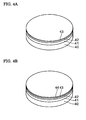
- Figures 4A and 4B are views each illustrating the step shown in Fig. 2 ;
- Figures 5A and 5B are views each illustrating the step shown in Fig. 2 ;
- Part (A) and part (B) of Fig. 6 show the change in substrate temperature (furnace temperature) and the changes in flow rate of starting material gases, respectively, when a multiquantum well structure is formed;
- Part (A) and part (B) of Fig. 7 show the change in substrate temperature (furnace temperature) and the changes in flow rate of starting material gases, respectively, according to a related method for forming a quantum well structure;
- Figure 8A is a graph showing a theoretical relationship between the light emission wavelength and the thickness of a well layer composed of InGaN;
- Figure 8B is a graph showing wavelength properties of a semiconductor light emitting element formed by a related method
- Figure 9A is a graph showing the relationship between the In composition and the thickness direction position of a well layer in the quantum well structure formed by the related method
- Figure 9B is a graph showing the relationship between the band structure and the thickness direction position of the well layer in the quantum well structure formed by the related method
- Figure 10A is a graph showing the relationship between the In composition and the thickness direction position of a well layer in a quantum well structure formed by a method according to the embodiment;
- Figure 10B is a graph showing the relationship between the band structure and the thickness direction position of the well layer in the quantum well structure formed by the method according to the embodiment;
- Figure 11A is a graph showing the relationships between the In composition and the thickness direction position of the well layers in the quantum well structure formed by the related method, the relationships being obtained when targeted In compositions of the well layers are set to 10% (line G21) and 30% (line G22);
- Figure 11B is a graph showing the relationships between the In composition and the thickness direction position of the well layers in the quantum well structure formed by the related method, the relationships being obtained when the barrier layers are composed of InGaN (line G31) and GaN (line G32);
- Figure 12 is a graph showing the relationships between the In composition and the thickness direction position of the well layers in the quantum well structure formed by the related method, the relationships being obtained when inclined angles (off-angle) of a primary surface with respect to the c-plane of a GaN substrate are set to 0° (line G41), 15° or 75° (line G42), 30° or 60° (line G43), and 45° (line G44); and
- Figure 13 is a graph showing the relationship between an In composition ratio in InGaN crystal and the off angle with respect to the c-plane.
- Figure 1 is a side cross-sectional view schematically showing the structure of a semiconductor light emitting element 1 as one example of a semiconductor light emitting element manufactured by the method for manufacturing a semiconductor light emitting element according to this embodiment.
- the semiconductor light emitting element 1 for example, a surface light emitting diode may be mentioned.
- the semiconductor light emitting element 1 includes an n-type gallium nitride-based semiconductor layer such as an n-type GaN semiconductor layer 3, an active layer 5 having a multiquantum well structure, a p-type AlGaN semiconductor layer 7, a p-type gallium nitride-based semiconductor layer such as a p-type GaN semiconductor layer 9, and an electrode 11.
- the active layer 5 is provided on the n-type GaN semiconductor layer 3 and is formed by the method for forming a quantum well structure according to this embodiment.
- the p-type AlGaN semiconductor layer 7 is provided on the active layer 5.
- the p-type GaN semiconductor layer 9 is provided on the p-type AlGaN semiconductor layer 7.
- the electrode 11 is in contact with the p-type GaN semiconductor layer 9 and is, for example, an anode. This contact is preferably an ohmic contact.
- the n-type GaN semiconductor layer 3 functions as a lower clad layer or a buffer layer.
- the thickness of the n-type GaN semiconductor layer 3 is, for example, 2 ⁇ m.
- the p-type AlGaN semiconductor layer 7 functions as an electron block layer for reducing electron leakage from the active layer 5 and for increasing light emission efficiency.
- the thickness of the p-type AlGaN semiconductor layer 7 is, for example, 20 nm.
- the p-type GaN semiconductor layer 9 functions as a contact layer to be electrically connected to the electrode 11.
- the thickness of the p-type GaN semiconductor layer 9 is, for example, 50 nm.
- the semiconductor light emitting element 1 further includes an n-type GaN substrate 15.
- the n-type GaN substrate 15 has a primary surface 15a.
- the primary surface 15a is inclined with respect to the (0001) plane, that is, the c plane, and the inclined angle (so-called off angle) of the primary surface 15a is in the range of 10° to 80° and is, for example, 18°.
- the n-type GaN semiconductor layer 3 is provided on the primary surface 15a of the n-type GaN semiconductor substrate 15, and an electrode 19 (cathode) is in contact with the rear surface of the n-type GaN substrate 15.
- the active layer 5 includes InGaN well layers 5a and barrier layers 5b which are alternately laminated to each other.
- the well layer 5a is a group III nitride semiconductor layer including In and another group III element other than In and may be composed, for example, of InGaN.
- the barrier layer 5b is composed of a gallium nitride-based semiconductor and may be composed, for example, of InGaN in which the In composition is lower than that of the well layer 5a.
- GaN may also be used whenever necessary.
- the structure of the active layer 5 is not limited to a multiquantum well structure and may be a single quantum well structure.
- the thickness of the well layer 5a is preferably in the range of 2 to 6 nm and is for example, 3 nm, and the thickness of the barrier layer 5b is preferably larger than that of the well layer 5a and is, for example, 15 nm.
- Light L from the active layer 5 is emitted through the electrode 11.
- the semiconductor light emitting element 1 further includes an n-type gallium nitride-based buffer layer, such as an n-type InGaN buffer layer 21.
- the n-type InGaN buffer layer 21 is provided between the n-type GaN semiconductor layer 3 and the active layer 5.
- the c-axis lattice constant of the well layer 5a composed of InGaN is larger than the c-axis lattice constant (0.51851 nm) of the n-type GaN semiconductor layer 3 composed of GaN.
- the n-type InGaN buffer layer 21 is provided in order to reduce the strain of the active layer 5 caused by the difference in lattice constant between the n-type GaN semiconductor layer 3 and the active layer 5.
- the n-type InGaN buffer layer 21 is provided in order to reduce the strain of the active layer 5 caused by the difference in lattice constant between the n-type GaN semiconductor layer 3 and the active layer 5.
- the active layer 5 may be grown while the influence
- the n-type InGaN buffer layer 21 is preferably composed of low-temperature grown InGaN, and the thickness thereof is, for example, 50 nm.
- the growth temperature of the low-temperature grown InGaN is preferably, for example, 800°C or less and is also preferably, for example, 300°C or more.
- FIG. 2 is a flowchart showing primary steps of the method for manufacturing the semiconductor light emitting element 1 according to this embodiment.
- Figs. 3A to 5B are views illustrating the steps shown in Fig. 2 .
- Step S101 of Fig. 2 as shown in Fig. 3A , an n-type GaN substrate 40 in the form of a wafer including a primary surface 40a which has an off angle with respect to the c plane is prepared.
- Step S103 a substrate product, which is called an epitaxial wafer, is manufactured.
- Step S103a as shown in Fig.
- an n-type GaN semiconductor layer 41 and an n-type InGaN buffer layer 42 are epitaxially grown in this order on the primary surface 40a of the n-type GaN substrate 40.
- the thicknesses of the n-type GaN semiconductor layer 41 and the n-type InGaN buffer layer 42 are, for example, 2 ⁇ m and 50 nm, respectively.
- the growth of the above layers may be performed, for example, in a metal organic chemical vapor deposition (MOCVD) furnace.
- MOCVD metal organic chemical vapor deposition
- Step S103b by alternately growing barrier layers and well layers, an active layer having a quantum well structure is formed on the n-type InGaN buffer layer 42.
- a barrier layer 43 is epitaxially grown on the n-type InGaN buffer layer 42.
- the barrier layer 43 is composed of a gallium nitride-based semiconductor and is composed, for example, of GaN.
- the barrier layer 43 is composed of InGaN having an indium composition lower than that of a well layer which is to be grown in the following step.
- the thickness of the barrier layer 43 is, for example, 15 nm.
- a well layer 44 shown in Fig. 4B is formed.
- the other group III element is, for example, Ga
- the well layer 44 is composed, for example, of InGaN.
- the thickness of the well layer 44 is preferably in the range of 2 to 6 nm and is, for example, 3 nm.
- a barrier layer 45, a well layer 46, a barrier layer 47, a well layer 48, and a barrier layer 49 are sequentially formed on the well layer 44, so that an active layer 50 having a three-period multiquantum well structure is formed.
- the growth of the layers described above may be performed, for example, in an MOCVD furnace.
- the n-type InGaN buffer layer 42 composed of low-temperature grown InGaN is provided on the n-type GaN semiconductor layer 41 having a thickness of 2 ⁇ m, the influence of the strain of the InGaN well layers of the active layer 50 is reduced.
- the primary surface 40a of the n-type GaN substrate 40 has an off angle with respect to the c-plane. Accordingly, a semiconductor light emitting element that can reduce the influence of a piezoelectric field can be formed.
- a p-type AlGaN semiconductor layer 51 and a p-type GaN semiconductor layer 52 are epitaxially grown on the active layer 50.
- the p-type AlGaN semiconductor layer 51 is, for example, an electron block layer
- the p-type GaN semiconductor layer 52 is, for example, a contact layer.
- the thicknesses of the p-type AlGaN semiconductor layer 51 and the p-type GaN semiconductor layer 52 are, for example, 20 and 50 nm, respectively.
- Step S105 a transparent electrode (anode) is formed on the p-type GaN semiconductor layer 52 of the epitaxial wafer. Furthermore, another electrode (cathode) is formed on the rear surface of the n-type GaN substrate 40. Finally, by dividing this epitaxial wafer into chips, the semiconductor light emitting elements 1 are formed.
- Part (A) of Fig. 6 shows the change in substrate temperature (intra-furnace temperature) when the multiquantum well structure is formed
- part (B) of Fig. 6 shows the changes in flow rate of starting material gases when the multiquantum well structure is formed.
- periods Tb 1 to Tb 4 shown in the parts (A) and (B) of Fig. 6 indicate the periods of growing the barrier layers 43, 45, 47, and 49, respectively
- periods Tw 1 to Tw 3 indicate the periods of growing the well layers 44, 46, and 48, respectively.
- a line G1 indicates the flow rate of TMG which is a starting material gas for Ga
- a line G2 indicates the flow rate of TMI which is a starting material gas for In
- a line G3 indicates the flow rate of NH 3 which is a starting material gas for N.
- the growth temperature that is, the substrate temperature
- a first temperature t 1 such as 880°C.
- TMG which is the starting material gas for Ga
- NH 3 which is the starting material gas for N
- a well layer having a high In composition As described above, a well layer having a PL wavelength from a green to a red color range, for example, in the range of 450 to 650 nm can be preferably formed.
- TMI which is the starting material gas for In
- NH 3 which is the starting material gas for N
- the supply of TMG is started.
- the predetermined time ⁇ t is a time of 1 minute or less and is, for example, 10 seconds.
- the predetermined time ⁇ t is optionally changed in accordance with a necessary thickness, In composition, and the like of the well layer 44. Accordingly, since TMI, TMG, and NH 3 are supplied to the growth furnace, the well layer 44 composed of InGaN is grown. In addition, when the well layer 44 is grown, the supply amount of NH 3 is preferably increased as compared to that for forming the barrier layer 43.
- the well layer 44 is grown to a desired thickness, while the supply of NH 3 is continued, the supply of TMG and that of TMI are stopped, and the growth temperature is again increased to the first temperature t 1 .
- the supply of TMG is again started, and the barrier layer 45 composed of GaN is grown during the period Tb 2 .
- the well layer 46 is grown during the period Tw 2
- the barrier layer 47 is grown during the period Tb 3
- the well layer 48 is grown during the period Tw 3
- the barrier layer 49 is grown during the period Tb 4 .
- Parts (A) and (B) of Fig. 7 show the change in substrate temperature (intra-furnace temperature) and the changes in flow rate of starting material gases, respectively, according to a related method for forming a quantum well structure.
- periods Tb a to Tb d each indicate a period for growing a barrier layer
- periods Tw a to Tw c each indicate a period for growing a well layer.
- a line G4 indicates the flow rate of TMG which is the starting material gas for Ga
- a line G5 indicates the flow rate of TMI which is the starting material gas for In
- a line G6 indicates the flow rate of NH 3 which is the starting material gas for N.
- the inventors of the present invention Through intensive research carried out by the inventors of the present invention, it was found that by the related method shown in the parts (A) and (B) of Fig. 7 , due to the difference in lattice constant between the barrier layer and the well layer, the In composition of the well layer becomes insufficient at an early growth stage thereof. That is, immediately after the start of the growth of the InGaN well layer, In is not sufficiently incorporated right on the GaN barrier layer, and the In composition gradually increases as the well layer grows; hence, a desired In composition is realized when the thickness of the well layer reaches a certain level.
- Figure 8A is a graph showing a theoretical relationship between the light emission wavelength and the thickness of a well layer composed of InGaN.
- a line G12 in the figure the quantum confinement effect decreases as the thickness of the well layer is increased, and the light emission wavelength is increased.
- the band is bent since the piezoelectric field is generated in the thickness direction as the thickness of the well layer is increased, and hence the light emission wavelength is increased as the thickness of the well layer is increased. Accordingly, when these behaviors are combined with each other, the theoretical relationship between the light emission wavelength and the thickness of the well layer is obtained as shown by a line G13 in the figure, and hence it is believed that the light emission wavelength is increased as the thickness of the well layer is increased.
- Figures 9A and 9B show, respectively, the relationship between the In composition and the thickness direction position of the well layer and the relationship between the band structure and the thickness direction position of the well layer of the quantum well structure formed by the related method.
- the In composition is low at the early growth stage of the InGaN well layer, and as the InGaN well layer grows, the strain is reduced, so that the In composition tends to increase ( Fig. 9A ).
- the In composition tends to be suppressed low.
- the band structure of the well layer becomes as shown in Fig.
- the range of the light emission wavelength is increased, so that the half bandwidth of the light emission spectrum is increased.
- the change in band gap at a hetero interface unfavorably becomes slow, and hence there may arise problems, for example, in that the carrier confinement effect is degraded and in that the light emission intensity is decreased since the volume of the well layer which contributes to light emission is decreased.
- the starting material gas for Ga (TMG) when the well layers 44, 46, and 48 composed of InGaN are grown, before the starting material gas for Ga (TMG) is supplied, the starting material gas for In (TMI) and the starting material gas for N (NH 3 ) are supplied as shown in the part (B) of Fig. 6 .
- TMG starting material gas for Ga
- NH 3 starting material gas for N
- the In atoms and the InN molecules migrating at the early stage are incorporated into each of the well layers 44, 46, and 48, so that the decrease in the In composition of the well layers 44, 46, and 48 at the early growth stage can be suppressed.
- the variation in the In composition in the thickness direction of the well layers 44, 46, and 48 can be reduced, and in addition, even when the thicknesses of the well layers 44, 46, and 48 are small, such as 3 nm, a desired In composition can be realized.
- Figures 10A and 10B show, respectively, the relationship between the In composition and the thickness direction position of the well layer and the relationship between the band structure and the thickness direction position of the well layer in the quantum well structure formed by the method according to this embodiment.
- the states in which In is excessively present on the barrier layers 43, 45, and 47 can be formed at the early growth stages of the well layers 44, 46, and 48 composed of InGaN, and hence the amount of In to be incorporated can be increased.
- the band structures of the well layers 44, 46, and 48 become as shown in Fig.
- the piezoelectric field is uniformly generated in the thickness direction, in light emission at a small current at which the piezoelectric effect is not screened, the wavelength is further increased.
- Figure 11A is a graph showing the relationships between the In composition and the thickness direction position of the well layers in the quantum well structure formed by the related method shown in the parts (A) and (B) of Fig. 7 , the relationships being obtained when targeted In compositions of the well layers are set, for example, to 10% and 30%.
- a line G 21 indicates the case in which the targeted In composition of the well layer is set to 10%
- a line G22 indicates the case in which the targeted In composition is set to 30%.
- the rates of change in the In composition with respect to the thickness direction position of the well layer are similar to each other.
- the In composition when the targeted In composition is low (shown by the line G21), the In composition reaches the targeted value when the thickness is still small, and hence the variation in the In composition in the thickness direction of a well layer having a certain thickness (such as 3 nm) is larger when the targeted In composition is high (line G22) than that when the targeted In composition is low (line G21). Hence, as the targeted In composition is higher, it can be said that the effect obtained by the method of this embodiment is significant.
- the variation in the In composition in the thickness direction can be effectively reduced.
- a well layer having a long PL wavelength in the range of, for example, 450 to 650 nm can be preferably formed.
- Fig. 11B shows the relationships between the In composition and the thickness direction position of the well layers in the quantum well structure formed by the related method shown in the parts (A) and (B) of Fig. 7 , the relationships being obtained when the barrier layers are composed of InGaN (line G31) and GaN (line G32).
- the In composition starts to increase when the thickness is still small as compared to the case in which the barrier layer is composed of GaN (line G32).
- the variation in the In composition in the thickness direction is increased in the case in which the barrier layer is composed of GaN; however, when the In composition is excessively increased, the difference in band gap between the well layer and the barrier layer is decreased, and as a result, the carrier confinement effect by the quantum well structure is degraded.
- the variation in the In composition can be effectively reduced; hence, the difference in band gap between the well layer and the barrier layer can be increased, so that the carrier confinement effect can be effectively obtained.
- Fig. 12 is a graph showing the relationships between the In composition and the thickness direction position of the well layers, the relationships being obtained when the inclined angles (off angles) of the primary surface of the GaN substrate with respect to the c-plane are set to 0° (line G41), 15° or 75° (line G42), 30° or 60° (line G43), and 45° (line G44).
- Fig. 13 is a graph showing the relationship between an In composition ratio of the InGaN crystal and the off-angle with respect to the c-plane. As shown in Fig.
- the In composition ratio is decreased when the off-angle is more than 0°, and that as the off-angle is increased, In becomes difficult to be incorporated into the crystal (the In composition ratio is decreased).
- the off angle is closer to 45°, the In composition is more unlikely to increase until the thickness is increased (until the crystal growth reaches a certain advanced level), and the variation in the In composition is increased.
- the method of this embodiment shows a significant effect and can effectively reduce the variation in the In composition. That is, as in this embodiment, the primary surface of the n-type GaN substrate 40 may be inclined with respect to the c-plane.
- the n-type GaN substrate 40 having an off-angle as described above is used; however, according to the method of this embodiment, even in the case as described above, the In amount to be incorporated can be increased, and the variation in the In composition can be effectively reduced.
- the In composition of the well layers 44, 46, and 48 may be 15% or more.
- the well layers 44, 46, and 48 having a relatively high In composition as described above are grown, since the amount of In incorporated at an early growth stage is small in the past, in order to obtain a desired In composition, the growth had to be performed to obtain a large thickness.
- a desired In composition can be obtained even at a small thickness, such as 3 nm.
- the supply of the starting material gas for In (TMI) is preferably started after the substrate temperature reaches the second temperature t 2 . Accordingly, the In atoms and the InN molecules are effectively migrating on each of the barrier layers 43, 45, and 47 at the early growth stages of the well layers 44, 46, and 48, respectively, so that the effect described above can be preferably obtained.
- the starting material gas for N (NH 3 ) is supplied together with the starting material gas for In (TMI) before the starting material gas for Ga (TMG) is supplied in this embodiment
- the supply of NH 3 may be stopped, and only TMI may be supplied.
- In atoms are migrating on each of the barrier layers 43, 45, and 47.
- the decrease in the In composition at the early growth stages of the well layers 44, 46, and 48 can be effectively suppressed.
- a GaN substrate (corresponding to the n-type GaN substrate 40 shown in Fig. 3A ) having a primary surface inclined in an a-axis direction by 18° with respect to the c-plane was placed in a reaction furnace, while the pressure inside the reaction furnace was maintained at 27 kPa and a NH 3 gas and a H 2 gas were supplied thereto, a heat treatment was performed for 10 minutes at a temperature of 1,050°C.
- the substrate temperature in the reaction furnace was set to 1,150°C, and by supplying monomethylsilane (MMSi) functioning as an n-type doping source together with TMG and NH 3 , an n-type GaN layer (corresponding to the n-type GaN semiconductor layer 41 shown in Fig. 3B ) was grown so as to have a thickness of 2 ⁇ m.
- MMSi monomethylsilane
- the substrate temperature was decreased to 800°C, and by supplying TMG, TMI, NH 3 , and MMSi to the reaction furnace, an n-type InGaN buffer layer (corresponding to the n-type InGaN buffer layer 42 shown in Fig. 3B ) was grown so as to have a thickness of 50 nm.
- the In composition of the InGaN buffer layer was set to 5%.
- the substrate temperature was increased to 880°C (first temperature t 1 ), and by supplying TMG and NH 3 to the reaction furnace, a GaN barrier layer (corresponding to the barrier layer 43 shown in Fig. 4A ) was grown on the InGaN buffer layer so as to have a thickness of 15 nm.
- a GaN barrier layer (corresponding to the barrier layer 43 shown in Fig. 4A ) was grown on the InGaN buffer layer so as to have a thickness of 15 nm.
- the substrate temperature was decreased to 700°C (second temperature t 2 )
- TMI and NH 3 or only TMI
- an active layer (corresponding to the active layer 50 shown in Fig. 5A ) having a three-period multiquantum well structure was grown.
- the change in substrate temperature and the change in flow rate of the starting material gases in the steps described above are as shown in the parts (A) and (B) of Fig. 6 , respectively.
- the substrate temperature was increased to 1,000°C, and bis(cyclopentadienyl) magnesium (CP 2 Mg) functioning as a p-type doping source was supplied together with TMG, trimethylaluminum (TMA), and NH 3 , so that a p-type AlGaN layer (corresponding to the p-type AlGaN semiconductor layer 51 shown in Fig. 5B ) was grown so as to have a thickness of 20 nm.
- TMA trimethylaluminum
- NH 3 NH 3
- the wafer formed in accordance with the above example had a narrower half bandwidth and a higher light emission intensity than those of the wafer by the related method.
- the wafer formed in accordance with the above example had a longer light emission wavelength.
- the reason the half bandwidth of the light emission spectrum is narrower is believed that when the well layer is grown, by supplying TMI before TMG is supplied, the uniformity of the In composition of the well layer is improved both in the thickness direction thereof and along the wafer surface direction.
- the reason for this is believed that since the uniformity of the In composition of the well layer is improved, the band structure becomes steep at a hetero interface between the well layer and the barrier layer, and that the carrier confinement effect is enhanced thereby.
- the reason for this is believed that since the uniformity of the In composition of the well layer is improved, a piezoelectric field generated from the difference in lattice constant between the well layer and the barrier layer becomes uniform in the thickness direction.
- the method for forming a quantum well structure and method for manufacturing a semiconductor light emitting element according to the present invention are not limited to the above embodiment and may be variously changed and modified without departing from the spirit and scope of the present invention.
- the well layer formed of a group III nitride semiconductor including In and another group III element the well layer of InGaN has been described by way of example; however, the constituent material for the well layer of the present invention is not limited thereto, and another group III element may be included instead of Ga, or another group III element may be included as well as Ga.
- another group V element may also be included as well as N.
- the GaN substrate having an off angle with respect to the c-plane has been described as the gallium nitride substrate in the above embodiment; however, even when a GaN substrate in which the primary surface is the c-plane is used, the present invention can also provide the effect similar to that described in the above embodiment.
Landscapes
- Led Devices (AREA)
- Semiconductor Lasers (AREA)
Claims (12)
- Verfahren zur Bildung einer Quantentopf-Struktur, umfassend den Schritt:abwechselndes Wachsen von Barrierenschichten und Topfschichten auf einer primären Oberfläche eines Galliumnitridsubstrats, welches in Bezug auf die (0001) Ebene geneigt ist, um so die Quantentopf-Struktur zu bilden,wobei die Topfschichten während des Wachstumsschrittes jeweils gebildet werden, indem ein Gruppe III-Nitridhalbleiter, der Indium und ein anderes Element der Gruppe III enthält, aufgewachsen wird,die Barrierenschichten jeweils bei einer ersten Temperatur wachsen,die Topfschichten jeweils bei einer zweiten Temperatur wachsen, welche niedriger ist als die erste Temperatur, und,wenn die Topfschichten jeweils wachsen, ein Ausgangsmaterial für Indium zugeführt wird, bevor ein Ausgangsmaterialgas für das andere Element der Gruppe III zugeführt wird.
- Verfahren zur Bildung einer Quantentopfstruktur gemäß Anspruch 1, wobei, bevor das Ausgangsmaterialgas für das andere Element der Gruppe III zugeführt wird, ein Ausgangsmaterialgas für Stickstoff zusammen mit dem Ausgangsmaterialgas für Indium zugeführt wird.
- Verfahren zur Bildung einer Quantentopfstruktur nach Anspruch 1 oder 2, wobei, wenn die Topfschichten jeweils wachsen, die Zufuhr des Ausgangsmaterialgases für Indium begonnen wird, nachdem die Substrattemperatur die zweite Temperatur erreicht.
- Verfahren zur Bildung einer Quantentopfstruktur nach einem der Ansprüche 1 bis 3, wobei das andere Element der Gruppe III Gallium umfasst.
- Verfahren zur Herstellung einer Quantentopfstruktur nach Anspruch 4, wobei das Ausgangsmaterialgas für Indium Trimethylindium umfasst und das Ausgangsmaterialgas für Gallium Trimethylgallium.
- Verfahren zur Bildung einer Quantentopfstruktur nach einem der Ansprüche 1 bis 5, wobei der In-Anteil jeder der Topfschichten 15% oder mehr beträgt.
- Verfahren zur Herstellung eines lichtemittierenden Halbleiterelementes mit einer Lichtemissionswellenlänge von 450 bis 650 nm, umfassend die Schritte:abwechselndes Wachsen von Barrierenschichten und Topfschichten auf einer primären Oberfläche eines Galliumnitridsubstrates, welches in Bezug auf die (0001) Ebene geneigt ist, um so eine aktive Quantentopfschicht zu bilden,wobei die Topfschichten während des Wachstumsschrittes jeweils geformt werden, indem ein Gruppe III-Nitridhalbleiter, der Indium und ein weiteres Element der Gruppe III enthält, aufgewachsen wird,die Barrierenschichten jeweils bei einer ersten Temperatur wachsen,die Topfschichten jeweils bei einer zweiten Temperatur wachsen, welche niedriger ist als die erste Temperatur, undwenn die Topfschichten jeweils wachsen, ein Ausgangsmaterialgas für Indium zugeführt wird, bevor ein Ausgangsmaterialgas für das andere Element der Gruppe III zugeführt wird.
- Verfahren zur Herstellung eines lichtemittierenden Halbleiterelementes gemäß Anspruch 7, wobei, bevor das Ausgangsmaterial für das andere Element der Gruppe III zugeführt wird, ein Ausgangsmaterialgas für Stickstoff zusammen mit dem Ausgangsmaterialgas für Indium zugeführt wird.
- Verfahren zur Herstellung eines lichtemittierenden Halbleiterelementes gemäß Anspruch 7 oder 8, wobei, wenn die Topfschichten jeweils wachsen, die Zufuhr des Ausgangsmaterialgases für Indium begonnen wird, nachdem eine Substrattemperatur die zweite Temperatur erreicht.
- Verfahren zur Herstellung eines lichtemittierenden Halbleiterelementes nach einem der Ansprüche 7 bis 9, wobei das andere Element der Gruppe III Gallium umfasst.
- Verfahren zur Herstellung eines lichtemittierenden Halbleiterelementes gemäß Anspruch 10, wobei das Ausgangsmaterialgas für Indium Trimethylindium umfasst und das Ausgangsmaterial für Gallium Trimethylgallium umfasst.
- Verfahren zur Herstellung eines lichtemittierenden Halbleiterelementes nach einem der Ansprüche 7 bis 11, wobei der In-Anteil jeder der Topfschichten 15% oder mehr beträgt.
Applications Claiming Priority (1)
| Application Number | Priority Date | Filing Date | Title |
|---|---|---|---|
| JP2008101781A JP4539752B2 (ja) | 2008-04-09 | 2008-04-09 | 量子井戸構造の形成方法および半導体発光素子の製造方法 |
Publications (2)
| Publication Number | Publication Date |
|---|---|
| EP2124266A1 EP2124266A1 (de) | 2009-11-25 |
| EP2124266B1 true EP2124266B1 (de) | 2010-09-22 |
Family
ID=40911598
Family Applications (1)
| Application Number | Title | Priority Date | Filing Date |
|---|---|---|---|
| EP09005065A Not-in-force EP2124266B1 (de) | 2008-04-09 | 2009-04-06 | Verfahren zur Bildung einer Quantentopfstruktur und Verfahren zur Herstellung eines lichtemittierenden Halbleiterelements |
Country Status (7)
| Country | Link |
|---|---|
| US (1) | US8173458B2 (de) |
| EP (1) | EP2124266B1 (de) |
| JP (1) | JP4539752B2 (de) |
| CN (1) | CN101556917B (de) |
| AT (1) | ATE482475T1 (de) |
| DE (1) | DE602009000219D1 (de) |
| TW (1) | TW200945452A (de) |
Families Citing this family (23)
| Publication number | Priority date | Publication date | Assignee | Title |
|---|---|---|---|---|
| TWI442455B (zh) * | 2010-03-29 | 2014-06-21 | S O I 矽科技絕緣體工業公司 | Iii-v族半導體結構及其形成方法 |
| GB2487531A (en) * | 2011-01-20 | 2012-08-01 | Sharp Kk | Substrate system consisting of a metamorphic transition region comprising a laminate of AlxGa1-x N and the same material as the substrate. |
| EP2667421A1 (de) | 2011-01-21 | 2013-11-27 | Panasonic Corporation | Lichtemittierendes halbleiterelement aus einer galliumnitridverbindung und mit besagtem lichtemittierenden element ausgerüstete lichtquelle |
| CN102208500A (zh) * | 2011-05-20 | 2011-10-05 | 武汉迪源光电科技有限公司 | 一种led外延生长方法和led外延结构 |
| US20130023079A1 (en) * | 2011-07-20 | 2013-01-24 | Sang Won Kang | Fabrication of light emitting diodes (leds) using a degas process |
| WO2013046564A1 (ja) | 2011-09-29 | 2013-04-04 | パナソニック株式会社 | 窒化物半導体発光素子およびledシステム |
| JP5883331B2 (ja) * | 2012-01-25 | 2016-03-15 | 住友化学株式会社 | 窒化物半導体エピタキシャルウェハの製造方法及び電界効果型窒化物トランジスタの製造方法 |
| WO2013132812A1 (ja) | 2012-03-05 | 2013-09-12 | パナソニック株式会社 | 窒化物半導体発光素子、光源及びその製造方法 |
| FR3001334B1 (fr) * | 2013-01-24 | 2016-05-06 | Centre Nat De La Rech Scient (Cnrs) | Procede de fabrication de diodes blanches monolithiques |
| TWI714891B (zh) * | 2014-09-03 | 2021-01-01 | 晶元光電股份有限公司 | 發光元件及其製造方法 |
| TWI612686B (zh) | 2014-09-03 | 2018-01-21 | 晶元光電股份有限公司 | 發光元件及其製造方法 |
| TWI641160B (zh) * | 2014-09-03 | 2018-11-11 | 晶元光電股份有限公司 | 發光元件及其製造方法 |
| KR102238195B1 (ko) | 2014-11-07 | 2021-04-07 | 엘지이노텍 주식회사 | 자외선 발광소자 및 조명시스템 |
| CN106972083B (zh) * | 2017-02-17 | 2019-02-12 | 华灿光电(浙江)有限公司 | 一种发光二极管的外延片的制备方法 |
| CN107634128A (zh) * | 2017-09-14 | 2018-01-26 | 厦门三安光电有限公司 | 氮化物半导体元件 |
| JP7095498B2 (ja) * | 2018-08-31 | 2022-07-05 | 住友電気工業株式会社 | 垂直共振型面発光レーザ、垂直共振型面発光レーザを作製する方法 |
| CZ2018563A3 (cs) * | 2018-10-22 | 2019-10-30 | Fyzikální Ústav Av Čr, V. V. I. | Způsob výroby epitaxní struktury s InGaN kvantovými jamami |
| CN113394313B (zh) * | 2020-03-13 | 2022-12-27 | 华为技术有限公司 | 一种led芯片及其制作方法、显示模组、终端 |
| CN113036600B (zh) * | 2021-03-04 | 2022-08-02 | 东莞理工学院 | 一种氮化镓基绿光激光器及其制备方法 |
| CN113270525A (zh) * | 2021-04-30 | 2021-08-17 | 广东德力光电有限公司 | 一种绿光外延结构的制备方法 |
| CN114481088B (zh) * | 2022-04-18 | 2022-07-01 | 苏州长光华芯光电技术股份有限公司 | 一种超晶格有源层及半导体发光结构的制作方法 |
| CN114975698B (zh) * | 2022-06-02 | 2025-12-02 | 中国科学院苏州纳米技术与纳米仿生研究所 | 一种生长多量子阱的方法、多量子阱 |
| CN116344693B (zh) * | 2023-05-31 | 2023-09-08 | 江西兆驰半导体有限公司 | 一种高光效发光二极管外延片及其制备方法 |
Family Cites Families (22)
| Publication number | Priority date | Publication date | Assignee | Title |
|---|---|---|---|---|
| US6542526B1 (en) | 1996-10-30 | 2003-04-01 | Hitachi, Ltd. | Optical information processor and semiconductor light emitting device suitable for the same |
| JP3577206B2 (ja) * | 1997-12-04 | 2004-10-13 | 昭和電工株式会社 | Iii族窒化物半導体発光素子 |
| JP3454200B2 (ja) * | 1998-09-21 | 2003-10-06 | 日亜化学工業株式会社 | 発光素子 |
| US6614059B1 (en) * | 1999-01-07 | 2003-09-02 | Matsushita Electric Industrial Co., Ltd. | Semiconductor light-emitting device with quantum well |
| JP4505915B2 (ja) | 2000-01-13 | 2010-07-21 | 東京エレクトロン株式会社 | 成膜方法 |
| JP4822608B2 (ja) * | 2001-05-14 | 2011-11-24 | シャープ株式会社 | 窒化物系半導体発光素子およびその製造方法 |
| US6734530B2 (en) * | 2001-06-06 | 2004-05-11 | Matsushita Electric Industries Co., Ltd. | GaN-based compound semiconductor EPI-wafer and semiconductor element using the same |
| CN1259734C (zh) * | 2001-06-13 | 2006-06-14 | 松下电器产业株式会社 | 氮化物半导体、其制造方法以及氮化物半导体元件 |
| US6645885B2 (en) | 2001-09-27 | 2003-11-11 | The National University Of Singapore | Forming indium nitride (InN) and indium gallium nitride (InGaN) quantum dots grown by metal-organic-vapor-phase-epitaxy (MOCVD) |
| JP3926271B2 (ja) * | 2002-01-10 | 2007-06-06 | シャープ株式会社 | Iii族窒化物半導体レーザ素子及びその製造方法 |
| GB2407701A (en) * | 2003-10-28 | 2005-05-04 | Sharp Kk | Manufacture of a semiconductor light-emitting device |
| KR100831956B1 (ko) * | 2004-02-24 | 2008-05-23 | 쇼와 덴코 가부시키가이샤 | 질화갈륨계 화합물 반도체 다층구조 및 그 제조방법 |
| JP2005268581A (ja) * | 2004-03-19 | 2005-09-29 | Matsushita Electric Ind Co Ltd | 窒化ガリウム系化合物半導体発光素子 |
| US7408199B2 (en) * | 2004-04-02 | 2008-08-05 | Nichia Corporation | Nitride semiconductor laser device and nitride semiconductor device |
| KR100513923B1 (ko) * | 2004-08-13 | 2005-09-08 | 재단법인서울대학교산학협력재단 | 질화물 반도체층을 성장시키는 방법 및 이를 이용하는 질화물 반도체 발광소자 |
| US7339255B2 (en) * | 2004-08-24 | 2008-03-04 | Kabushiki Kaisha Toshiba | Semiconductor device having bidirectionally inclined toward <1-100> and <11-20> relative to {0001} crystal planes |
| CN100511737C (zh) * | 2004-09-28 | 2009-07-08 | 住友化学株式会社 | Ⅲ-ⅴ族化合物半导体及其制备方法 |
| WO2006109840A1 (en) | 2005-04-07 | 2006-10-19 | Showa Denko K.K. | Production method of group iii nitride semioconductor element |
| JP2006332258A (ja) * | 2005-05-25 | 2006-12-07 | Matsushita Electric Ind Co Ltd | 窒化物半導体装置及びその製造方法 |
| JP2007087973A (ja) | 2005-09-16 | 2007-04-05 | Rohm Co Ltd | 窒化物半導体素子の製法およびその方法により得られる窒化物半導体発光素子 |
| JP5896442B2 (ja) * | 2006-01-20 | 2016-03-30 | 国立研究開発法人科学技術振興機構 | Iii族窒化物膜の成長方法 |
| JP5025168B2 (ja) * | 2006-06-08 | 2012-09-12 | 昭和電工株式会社 | Iii族窒化物半導体積層構造体の製造方法 |
-
2008
- 2008-04-09 JP JP2008101781A patent/JP4539752B2/ja not_active Expired - Fee Related
-
2009
- 2009-04-02 TW TW098111047A patent/TW200945452A/zh unknown
- 2009-04-03 US US12/417,857 patent/US8173458B2/en not_active Expired - Fee Related
- 2009-04-06 EP EP09005065A patent/EP2124266B1/de not_active Not-in-force
- 2009-04-06 DE DE602009000219T patent/DE602009000219D1/de active Active
- 2009-04-06 AT AT09005065T patent/ATE482475T1/de not_active IP Right Cessation
- 2009-04-09 CN CN200910134808.8A patent/CN101556917B/zh not_active Expired - Fee Related
Also Published As
| Publication number | Publication date |
|---|---|
| JP4539752B2 (ja) | 2010-09-08 |
| CN101556917A (zh) | 2009-10-14 |
| DE602009000219D1 (de) | 2010-11-04 |
| JP2009253164A (ja) | 2009-10-29 |
| ATE482475T1 (de) | 2010-10-15 |
| US8173458B2 (en) | 2012-05-08 |
| US20090258452A1 (en) | 2009-10-15 |
| TW200945452A (en) | 2009-11-01 |
| CN101556917B (zh) | 2013-01-09 |
| EP2124266A1 (de) | 2009-11-25 |
Similar Documents
| Publication | Publication Date | Title |
|---|---|---|
| EP2124266B1 (de) | Verfahren zur Bildung einer Quantentopfstruktur und Verfahren zur Herstellung eines lichtemittierenden Halbleiterelements | |
| EP2164115A1 (de) | Nitridhalbleiter-leuchtelement und verfahren zur herstellung eines nitridhalbleiters | |
| JP4999866B2 (ja) | 窒化ガリウム系半導体ヘテロ構造体の成長方法 | |
| JP4888857B2 (ja) | Iii族窒化物半導体薄膜およびiii族窒化物半導体発光素子 | |
| WO2007083647A1 (ja) | 窒化物半導体発光装置 | |
| WO2013132812A1 (ja) | 窒化物半導体発光素子、光源及びその製造方法 | |
| US20090072221A1 (en) | Nitride semiconductor device and method for fabricating the same | |
| WO2011125449A1 (ja) | 窒素化合物半導体発光素子およびその製造方法 | |
| US7629619B2 (en) | Group III nitride-based compound semiconductor light-emitting device and method for producing the same | |
| JP3509260B2 (ja) | 3−5族化合物半導体と発光素子 | |
| JP4377600B2 (ja) | 3族窒化物半導体の積層構造、その製造方法、及び3族窒化物半導体装置 | |
| JP5048236B2 (ja) | 半導体発光素子、および半導体発光素子を作製する方法 | |
| JP2009238772A (ja) | エピタキシャル基板及びエピタキシャル基板の製造方法 | |
| US8994031B2 (en) | Gallium nitride compound semiconductor light emitting element and light source provided with said light emitting element | |
| JP2006100518A (ja) | 基板表面処理方法及びiii族窒化物系化合物半導体発光素子の製造方法。 | |
| US20040056267A1 (en) | Gallium nitride semiconductor device and method of producing the same | |
| JP2008214132A (ja) | Iii族窒化物半導体薄膜、iii族窒化物半導体発光素子およびiii族窒化物半導体薄膜の製造方法 | |
| JP3543628B2 (ja) | 窒化物系iii−v族化合物半導体の成長方法および半導体発光素子の製造方法 | |
| KR20090107928A (ko) | 양자 우물 구조의 형성 방법 및 반도체 발광 소자의 제조 방법 | |
| JP2008227103A (ja) | GaN系半導体発光素子 | |
| JP2003218468A (ja) | 半導体レーザ素子及びその製造方法 | |
| CN100576586C (zh) | 制造ⅲ族氮化物半导体元件的方法 | |
| JP3556593B2 (ja) | 化合物半導体発光素子およびその製造方法 | |
| JP2011223043A (ja) | 半導体発光素子、および半導体発光素子を作製する方法 | |
| KR20090102204A (ko) | 발광 소자 및 그 제조 방법 |
Legal Events
| Date | Code | Title | Description |
|---|---|---|---|
| PUAI | Public reference made under article 153(3) epc to a published international application that has entered the european phase |
Free format text: ORIGINAL CODE: 0009012 |
|
| AK | Designated contracting states |
Kind code of ref document: A1 Designated state(s): AT BE BG CH CY CZ DE DK EE ES FI FR GB GR HR HU IE IS IT LI LT LU LV MC MK MT NL NO PL PT RO SE SI SK TR |
|
| 17P | Request for examination filed |
Effective date: 20091117 |
|
| GRAP | Despatch of communication of intention to grant a patent |
Free format text: ORIGINAL CODE: EPIDOSNIGR1 |
|
| GRAS | Grant fee paid |
Free format text: ORIGINAL CODE: EPIDOSNIGR3 |
|
| GRAA | (expected) grant |
Free format text: ORIGINAL CODE: 0009210 |
|
| AK | Designated contracting states |
Kind code of ref document: B1 Designated state(s): AT BE BG CH CY CZ DE DK EE ES FI FR GB GR HR HU IE IS IT LI LT LU LV MC MK MT NL NO PL PT RO SE SI SK TR |
|
| REG | Reference to a national code |
Ref country code: GB Ref legal event code: FG4D |
|
| REG | Reference to a national code |
Ref country code: CH Ref legal event code: EP |
|
| REG | Reference to a national code |
Ref country code: IE Ref legal event code: FG4D |
|
| REF | Corresponds to: |
Ref document number: 602009000219 Country of ref document: DE Date of ref document: 20101104 Kind code of ref document: P |
|
| PG25 | Lapsed in a contracting state [announced via postgrant information from national office to epo] |
Ref country code: NO Free format text: LAPSE BECAUSE OF FAILURE TO SUBMIT A TRANSLATION OF THE DESCRIPTION OR TO PAY THE FEE WITHIN THE PRESCRIBED TIME-LIMIT Effective date: 20101222 Ref country code: AT Free format text: LAPSE BECAUSE OF FAILURE TO SUBMIT A TRANSLATION OF THE DESCRIPTION OR TO PAY THE FEE WITHIN THE PRESCRIBED TIME-LIMIT Effective date: 20100922 Ref country code: FI Free format text: LAPSE BECAUSE OF FAILURE TO SUBMIT A TRANSLATION OF THE DESCRIPTION OR TO PAY THE FEE WITHIN THE PRESCRIBED TIME-LIMIT Effective date: 20100922 Ref country code: LT Free format text: LAPSE BECAUSE OF FAILURE TO SUBMIT A TRANSLATION OF THE DESCRIPTION OR TO PAY THE FEE WITHIN THE PRESCRIBED TIME-LIMIT Effective date: 20100922 |
|
| REG | Reference to a national code |
Ref country code: NL Ref legal event code: VDEP Effective date: 20100922 |
|
| LTIE | Lt: invalidation of european patent or patent extension |
Effective date: 20100922 |
|
| PG25 | Lapsed in a contracting state [announced via postgrant information from national office to epo] |
Ref country code: SI Free format text: LAPSE BECAUSE OF FAILURE TO SUBMIT A TRANSLATION OF THE DESCRIPTION OR TO PAY THE FEE WITHIN THE PRESCRIBED TIME-LIMIT Effective date: 20100922 Ref country code: PL Free format text: LAPSE BECAUSE OF FAILURE TO SUBMIT A TRANSLATION OF THE DESCRIPTION OR TO PAY THE FEE WITHIN THE PRESCRIBED TIME-LIMIT Effective date: 20100922 Ref country code: HR Free format text: LAPSE BECAUSE OF FAILURE TO SUBMIT A TRANSLATION OF THE DESCRIPTION OR TO PAY THE FEE WITHIN THE PRESCRIBED TIME-LIMIT Effective date: 20100922 |
|
| PG25 | Lapsed in a contracting state [announced via postgrant information from national office to epo] |
Ref country code: SE Free format text: LAPSE BECAUSE OF FAILURE TO SUBMIT A TRANSLATION OF THE DESCRIPTION OR TO PAY THE FEE WITHIN THE PRESCRIBED TIME-LIMIT Effective date: 20100922 Ref country code: LV Free format text: LAPSE BECAUSE OF FAILURE TO SUBMIT A TRANSLATION OF THE DESCRIPTION OR TO PAY THE FEE WITHIN THE PRESCRIBED TIME-LIMIT Effective date: 20100922 Ref country code: GR Free format text: LAPSE BECAUSE OF FAILURE TO SUBMIT A TRANSLATION OF THE DESCRIPTION OR TO PAY THE FEE WITHIN THE PRESCRIBED TIME-LIMIT Effective date: 20101223 |
|
| PG25 | Lapsed in a contracting state [announced via postgrant information from national office to epo] |
Ref country code: CZ Free format text: LAPSE BECAUSE OF FAILURE TO SUBMIT A TRANSLATION OF THE DESCRIPTION OR TO PAY THE FEE WITHIN THE PRESCRIBED TIME-LIMIT Effective date: 20100922 Ref country code: SK Free format text: LAPSE BECAUSE OF FAILURE TO SUBMIT A TRANSLATION OF THE DESCRIPTION OR TO PAY THE FEE WITHIN THE PRESCRIBED TIME-LIMIT Effective date: 20100922 Ref country code: RO Free format text: LAPSE BECAUSE OF FAILURE TO SUBMIT A TRANSLATION OF THE DESCRIPTION OR TO PAY THE FEE WITHIN THE PRESCRIBED TIME-LIMIT Effective date: 20100922 Ref country code: IT Free format text: LAPSE BECAUSE OF FAILURE TO SUBMIT A TRANSLATION OF THE DESCRIPTION OR TO PAY THE FEE WITHIN THE PRESCRIBED TIME-LIMIT Effective date: 20100922 Ref country code: EE Free format text: LAPSE BECAUSE OF FAILURE TO SUBMIT A TRANSLATION OF THE DESCRIPTION OR TO PAY THE FEE WITHIN THE PRESCRIBED TIME-LIMIT Effective date: 20100922 Ref country code: NL Free format text: LAPSE BECAUSE OF FAILURE TO SUBMIT A TRANSLATION OF THE DESCRIPTION OR TO PAY THE FEE WITHIN THE PRESCRIBED TIME-LIMIT Effective date: 20100922 Ref country code: PT Free format text: LAPSE BECAUSE OF FAILURE TO SUBMIT A TRANSLATION OF THE DESCRIPTION OR TO PAY THE FEE WITHIN THE PRESCRIBED TIME-LIMIT Effective date: 20110124 Ref country code: IS Free format text: LAPSE BECAUSE OF FAILURE TO SUBMIT A TRANSLATION OF THE DESCRIPTION OR TO PAY THE FEE WITHIN THE PRESCRIBED TIME-LIMIT Effective date: 20110122 |
|
| PG25 | Lapsed in a contracting state [announced via postgrant information from national office to epo] |
Ref country code: BE Free format text: LAPSE BECAUSE OF FAILURE TO SUBMIT A TRANSLATION OF THE DESCRIPTION OR TO PAY THE FEE WITHIN THE PRESCRIBED TIME-LIMIT Effective date: 20100922 |
|
| PG25 | Lapsed in a contracting state [announced via postgrant information from national office to epo] |
Ref country code: ES Free format text: LAPSE BECAUSE OF FAILURE TO SUBMIT A TRANSLATION OF THE DESCRIPTION OR TO PAY THE FEE WITHIN THE PRESCRIBED TIME-LIMIT Effective date: 20110102 |
|
| PLBE | No opposition filed within time limit |
Free format text: ORIGINAL CODE: 0009261 |
|
| STAA | Information on the status of an ep patent application or granted ep patent |
Free format text: STATUS: NO OPPOSITION FILED WITHIN TIME LIMIT |
|
| 26N | No opposition filed |
Effective date: 20110623 |
|
| PG25 | Lapsed in a contracting state [announced via postgrant information from national office to epo] |
Ref country code: DK Free format text: LAPSE BECAUSE OF FAILURE TO SUBMIT A TRANSLATION OF THE DESCRIPTION OR TO PAY THE FEE WITHIN THE PRESCRIBED TIME-LIMIT Effective date: 20100922 |
|
| REG | Reference to a national code |
Ref country code: DE Ref legal event code: R097 Ref document number: 602009000219 Country of ref document: DE Effective date: 20110623 |
|
| PG25 | Lapsed in a contracting state [announced via postgrant information from national office to epo] |
Ref country code: MC Free format text: LAPSE BECAUSE OF NON-PAYMENT OF DUE FEES Effective date: 20110430 |
|
| PG25 | Lapsed in a contracting state [announced via postgrant information from national office to epo] |
Ref country code: MT Free format text: LAPSE BECAUSE OF FAILURE TO SUBMIT A TRANSLATION OF THE DESCRIPTION OR TO PAY THE FEE WITHIN THE PRESCRIBED TIME-LIMIT Effective date: 20100922 |
|
| REG | Reference to a national code |
Ref country code: IE Ref legal event code: MM4A |
|
| PG25 | Lapsed in a contracting state [announced via postgrant information from national office to epo] |
Ref country code: IE Free format text: LAPSE BECAUSE OF NON-PAYMENT OF DUE FEES Effective date: 20110406 |
|
| PGFP | Annual fee paid to national office [announced via postgrant information from national office to epo] |
Ref country code: FR Payment date: 20120504 Year of fee payment: 4 |
|
| PG25 | Lapsed in a contracting state [announced via postgrant information from national office to epo] |
Ref country code: MK Free format text: LAPSE BECAUSE OF FAILURE TO SUBMIT A TRANSLATION OF THE DESCRIPTION OR TO PAY THE FEE WITHIN THE PRESCRIBED TIME-LIMIT Effective date: 20100922 |
|
| PG25 | Lapsed in a contracting state [announced via postgrant information from national office to epo] |
Ref country code: LU Free format text: LAPSE BECAUSE OF NON-PAYMENT OF DUE FEES Effective date: 20110406 Ref country code: CY Free format text: LAPSE BECAUSE OF EXPIRATION OF PROTECTION Effective date: 20100922 |
|
| PGFP | Annual fee paid to national office [announced via postgrant information from national office to epo] |
Ref country code: DE Payment date: 20130403 Year of fee payment: 5 |
|
| PG25 | Lapsed in a contracting state [announced via postgrant information from national office to epo] |
Ref country code: TR Free format text: LAPSE BECAUSE OF FAILURE TO SUBMIT A TRANSLATION OF THE DESCRIPTION OR TO PAY THE FEE WITHIN THE PRESCRIBED TIME-LIMIT Effective date: 20100922 Ref country code: BG Free format text: LAPSE BECAUSE OF FAILURE TO SUBMIT A TRANSLATION OF THE DESCRIPTION OR TO PAY THE FEE WITHIN THE PRESCRIBED TIME-LIMIT Effective date: 20101222 |
|
| PG25 | Lapsed in a contracting state [announced via postgrant information from national office to epo] |
Ref country code: HU Free format text: LAPSE BECAUSE OF FAILURE TO SUBMIT A TRANSLATION OF THE DESCRIPTION OR TO PAY THE FEE WITHIN THE PRESCRIBED TIME-LIMIT Effective date: 20100922 |
|
| REG | Reference to a national code |
Ref country code: CH Ref legal event code: PL |
|
| GBPC | Gb: european patent ceased through non-payment of renewal fee |
Effective date: 20130406 |
|
| PG25 | Lapsed in a contracting state [announced via postgrant information from national office to epo] |
Ref country code: CH Free format text: LAPSE BECAUSE OF NON-PAYMENT OF DUE FEES Effective date: 20130430 Ref country code: GB Free format text: LAPSE BECAUSE OF NON-PAYMENT OF DUE FEES Effective date: 20130406 Ref country code: LI Free format text: LAPSE BECAUSE OF NON-PAYMENT OF DUE FEES Effective date: 20130430 |
|
| REG | Reference to a national code |
Ref country code: FR Ref legal event code: ST Effective date: 20131231 |
|
| PG25 | Lapsed in a contracting state [announced via postgrant information from national office to epo] |
Ref country code: FR Free format text: LAPSE BECAUSE OF NON-PAYMENT OF DUE FEES Effective date: 20130430 |
|
| REG | Reference to a national code |
Ref country code: DE Ref legal event code: R119 Ref document number: 602009000219 Country of ref document: DE |
|
| REG | Reference to a national code |
Ref country code: DE Ref legal event code: R119 Ref document number: 602009000219 Country of ref document: DE Effective date: 20141101 |
|
| PG25 | Lapsed in a contracting state [announced via postgrant information from national office to epo] |
Ref country code: DE Free format text: LAPSE BECAUSE OF NON-PAYMENT OF DUE FEES Effective date: 20141101 |