EP2115030B1 - Polyester production system employing hot paste to esterification zone - Google Patents
Polyester production system employing hot paste to esterification zone Download PDFInfo
- Publication number
- EP2115030B1 EP2115030B1 EP08725888.5A EP08725888A EP2115030B1 EP 2115030 B1 EP2115030 B1 EP 2115030B1 EP 08725888 A EP08725888 A EP 08725888A EP 2115030 B1 EP2115030 B1 EP 2115030B1
- Authority
- EP
- European Patent Office
- Prior art keywords
- esterification
- liquid
- product
- zone
- alcohol
- Prior art date
- Legal status (The legal status is an assumption and is not a legal conclusion. Google has not performed a legal analysis and makes no representation as to the accuracy of the status listed.)
- Active
Links
Images
Classifications
-
- C—CHEMISTRY; METALLURGY
- C08—ORGANIC MACROMOLECULAR COMPOUNDS; THEIR PREPARATION OR CHEMICAL WORKING-UP; COMPOSITIONS BASED THEREON
- C08G—MACROMOLECULAR COMPOUNDS OBTAINED OTHERWISE THAN BY REACTIONS ONLY INVOLVING UNSATURATED CARBON-TO-CARBON BONDS
- C08G63/00—Macromolecular compounds obtained by reactions forming a carboxylic ester link in the main chain of the macromolecule
- C08G63/78—Preparation processes
Definitions
- This invention relates to a process for producing melt-phase polyesters.
- the invention concerns esterification employing a reactant-containing paste requiring little or no cooling.
- PET polyethylene terephthalate
- PET is widely used in beverage, food, and other containers, as well as in synthetic fibers and resins. Advances in process technology coupled with increased demand have lead to an increasingly competitive market for the production and sale of PET. Therefore, a low-cost, high-efficiency process for producing PET is desirable.
- rnelt-phase polyester production facilities employ an esterification stage and a polycondensation stage.
- esterification stage polymer raw materials (i.e., reactants) are converted to polyester monomers and/or oligomers.
- polyester monomers exiting the esterification stage are converted into a polymer product having the desired final chain length.
- CSTRs continuous stirred tank reactors
- CSTRs and other mechanically agitated reactors have a number of drawbacks that can result in increased capital, operating, and/or maintenance costs for the overall polyester production facility.
- the mechanical agitators and various control equipment typically associated with CSTRs are complex, expensive, and can require extensive maintenance.
- conventional CSTRs frequently employ internal heat exchange tubes that occupy a portion of the reactor's internal volume. In order to compensate for the loss in effective reactor volume, CSTRs with internal heat exchange tubes require a larger overall volume, which increases capital costs.
- a process comprising: (a) producing an alcohol-containing liquid from a distillation zone; (b) mixing at least a portion of the alcohol-containing liquid with solid particles of an acid to thereby provide a paste; (c) combining the paste with a recirculation liquid to thereby provide an esterification feed; and (d) subjecting at least a portion of the esterification feed to esterification in an esterification zone, wherein the temperature of the paste when combined with the recirculation liquid is not more than 150°C cooler than the temperature of the alcohol-containing liquid when exiting the distillation zone.
- a process comprising: (a) subjecting an esterification feed comprising terephthalic acid and ethylene glycol to esterification in a first esterification zone defined within the tubes of a shell-and-tube heat exchanger to thereby produce a first product having a conversion of at least 50 percent; (b) subjecting at least a portion of the first product to vapor liquid separation in a disengagement zone defined within a disengagement vessel to thereby produce a second liquid product and a second vapor product, wherein the second liquid product has a higher conversion than the first product; (c) subjecting at least a portion of the second vapor product to distillative separation in a distillation zone to thereby produce a third vapor product and a third liquid product, wherein the third vapor product comprises at least mole percent water and the third liquid product comprises at least 50 mole percent ethylene glycol; (d) mixing at least a portion of the third liquid product with solid particles of terephthalic acid to thereby provide a paste; and (e
- polyester also includes polyester derivatives, such as, for example, polyetheresters, polyester amides, and polyetherester amides.
- melt-phase polyesters examples include, but are not limited to, homopolymers and copolymers of polyethylene terephthalate (PET), PETG (PET modified with 1,4-cyclohexane-dimethanol (ICHDM) comonomer), fully aromatic or liquid crystalline polyesters, biodegradable polyesters, such as those comprising butanediol, terephthalic acid and adipic acid residues, poly(cyclohexane-dimethylene terephthalate) homopolymer and copolymers, and homopolymers and copolymers of CHDM and cyclohexane dicarboxylic acid or dimethyl cyclohexanedicarboxylate.
- PET polyethylene terephthalate
- PETG PET modified with 1,4-cyclohexane-dimethanol
- ICHDM 1,4-cyclohexane-dimethanol
- polyester starting materials comprising at least one alcohol and at least one acid are subjected to esterification in an initial stage of the process.
- the acid starting material can be a dicarboxylic acid such that the final polyester product comprises at least one dicarboxylic acid residue having in the range of from 4 to 15 or from 8 to 12 carbon atoms.
- dicarboxylic acids suitable for use in the present invention can include, but are not limited to, terephthalic acid, phthalic acid, isophthalic acid, naphthalene-2,6-dicarboxylic acid, cyclohexanedicarboxylic acid, cyclohexanediacetic acid, diphenyl-4,4'-dicarboxylic acid, dipheny-3,4'-dicarboxylic acid, 2,2,-dimethyl-1,3-propandiol, dicarboxylic acid, succinic acid, glutaric acid, adipic acid, azelaic acid, sebacic acid, and mixtures thereof.
- the acid starting material can be a corresponding ester, such as dimethyl terephthalate instead of terephthalic acid.
- the alcohol starting material can be a diol such that the final polyester product can comprise at least one diol residue, such as, for example, those originating from cycloaliphatic diols having in the range of from 3 to 25 carbon atoms or 6 to 20 carbon atoms.
- Suitable diols can include, but are not limited to, ethylene glycol (EG), diethylene glycol, triethylene glycol, 1,4-cyclohexane-dimethanol, propane-1,3-diol, butane-1,4-diol, pentane-1,5-diol, hexane-1,6-diol, neopentylglycol, 3-methylpentanediol-(2,4), 2-methylpentanediol-(1,4), 2,2,4-trimethylpentane-diol-(1,3), 2-ethylhexanediol-(1,3), 2,2-diethylpropane-diol-(1,3), hexanediol-(1,3), 1,4-di-(hydroxyethoxy)-benzene, 2,2-bis-(4-hydroxycyclohexyl)-propane, 2,4-dihydroxy-1,1,3,
- the starting materials can comprise one or more comonomers.
- Suitable comonomers can include, for example, comonomers comprising terephthalic acid, dimethyl terephthalate, isophthalic acid, dimethyl isophthalate, dimethyl-2,6-naphthalenedicarboxylate,2,6-naphthalene-dicarboxylicacid, ethylene glycol, diethylene glycol, 1,4-cyclohexane-dimethanol(CHDM), 1,4-butanediol, polytetramethyleneglyocl,trans-DMCD, trimellitic anhydride, dimethyl cyclohexane-1,4 dicarboxylate, dimethyl decalin-2,6 dicarboxylate, decalin dimethanol, decahydronaphthalane 2,6-dicarboxylate, 2,6-dihydroxymethyl-decahydronaphthalene, hydroquinone, hydroxybenzoic acid, and mixtures thereof.
- one or more additives can be added to the starting materials, the polyester, and/or the polyester precursors at one or more locations within the process.
- Suitable additives can include, for example, trifunctional or tetrafunctional comonomers, such as trimellitic anhydride, trimethylolpropane, pyromellitic dianhydride, pentaerythritol, or other polyacids or polyols; crosslinking or branching agents; colorant; toner; pigment; carbon black; glass fiber; filler; impact modifier; antioxidant; UV absorbent compound; and oxygen scavenging compound.
- the polyester production process can comprise two main stages.
- the first stage reacts starting materials (also referred to herein as "raw materials” or “reactants”) into monomers and/or oligomers.
- the second stage further reacts the monomers and/or oligomers into the final polyester product.
- the first stage is referred to as esterification. If the starting materials entering the first stage include acid end groups, such as, for example, terephthalic acid or isophthalic acid, the first stage is referred to as esterification. If the starting materials have methyl end graups, such as, for example, dimethyl terephthalate or dimethyl isophthalate, the first stage is referred to as ester exchange or trans-esterification.
- esterification includes both esterification and ester exchange reactions.
- esterification can take place at a temperature in the range of from 220°C to 300°C, or 235°C to 290°C, or 245°C to 280°C and a pressure of less than 172.5 kPa (25 psig), or a pressure in the range of from 6.9 kPa to 69 kPa (1 psig to 10 psig), or 13.8 kPa to 34.5 kPa (2 psig to 5 psig).
- the average chain length of the monomer and/or oligomer exiting the esterification stage can be less than 25, from 1 to 20, or from 5 to 15.
- the second stage of the process can be referred to as the polycondensation stage.
- the polycondensation stage can be a single step process, or can be divided into a prepolycondensation (or prepolymerization) step and a final (or finishing) polycondensation step.
- longer chain polymers can be produced via a multi-stage polycondensation process.
- the polycondensation stage can be carried out at a temperature in the range of from 220°C to 350°C, or 240°C to 320°C and a sub-atmospheric (e.g., vacuum) pressure.
- the prepolymerization (or prepolymer) reactor can convert the monomer exiting the esterification stage into an oligomer having an average chain length in the range of from 2 to 40, from 5 to 35, or from 10 to 30.
- the finisher reactor then converts the oligomer/polymer mixture into a final polymer product having the desired average chain length.
- the esterification stage can be carried out in an esterification system comprising at least one esterification zone and at least one distillation zone.
- reactants are subjected to esterification to thereby produce a vapor byproduct and a liquid product containing polyester monomers and/or oligomers.
- a product portion of the liquid product exiting the esterification zone can exit the esterification system for downstream processing, while a recirculation portion of the liquid product exiting the esterification zone can be recirculated back to the inlet of the esterification zone.
- At least a portion of the vapor byproduct exiting the esterification zone can be routed to the distillation zone, wherein water and alcohol components of the vapor byproduct can be separated.
- a portion of the separated alcohol exiting the distillation zone can be combined with solid acid particles to create a paste, which can then be added to the recirculation portion of the liquid product exiting the esterification zone.
- the resulting combined stream can then be reintroduced into the esterification zone, after receiving additional quantities of reactants and/or additives.
- the esterification zone can be defined by equipment that imparts little or no mechanical agitation to the liquid phase of the reaction medium processed therein.
- the liquid phase of the reaction medium processed in the esterification zone may be somewhat agitated by virtue of flowing through the equipment that defines the esterification zone, in one embodiment, less than 50 percent, less than 25 percent, less than 10 percent, less than percent, or 0 percent of the agitation of the liquid phase reaction medium processed in the esterification zone is provided by mechanical agitation. This is in direct contrast to conventional esterification processes that are carried out in one or more continuous stirred tank reactors (CSTRs) under conditions of extreme mechanical agitation.
- CSTRs continuous stirred tank reactors
- the present process can employ simple, reliable, and inexpensive equipment for carrying out esterification.
- the esterification zone can be defined within a simple, reliable, and relatively inexpensive heater, such as, for example, a shell-and-tube heat exchanger.
- at least a portion of the esterification zone can be defined within a simple, reliable, and relatively inexpensive unagitated esterification vessel.
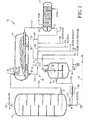
- an esterification system 10 configured in accordance with one embodiment is illustrated as generally comprising a heat exchanger 12, an esterification vessel 14, a distillation column 16, a recirculation loop 18, and a paste tank 50.
- the process carried out in esterification system 10 includes the following broad steps: (1) introducing an esterification feed into heat exchanger 12; (2) heating and partially esterifying the esterification feed in heat exchanger 12; (3) introducing at least a portion of the heated and partially esterified product from heat exchanger 12 into esterification vessel 14; (4) further esterifying the partially esterified product from heat exchanger 12 in esterification vessel 14; (5) separating a liquid product from a vapor byproduct in esterification vessel 14; (6) introducing at least a portion of the vapor byproduct from esterification vessel 14 into distillation column 16; (7) separating the vapor byproduct into a predominately water overhead stream and a predominately alcohol bottom stream in distillation column 16; (8) combining at least
- esterification can be carried out in both heat exchanger 12 and esterification vessel 14 of esterification system 10. Since esterification can be carried out in both heat exchanger 12 and esterification vessel 14, each of these pieces of equipment can be referred to as "esterification reactors" that each define a portion of an "esterification zone.” However, because an additional function of heat exchanger 12 can be to heat the reaction medium processed therein, heat exchanger 12 can also be referred to as a "heater” that defines a "heating zone.” Further, since an additional function of esterification vessel 14 can be to promote vapor/liquid disengagement, esterification vessel 14 can also be referred to as a "disengagement vessel” that defines a "disengagement zone.”
- esterification system 10 illustrated in FIG. 1 , will now be described in greater detail.
- a recirculated liquid product stream is transported through a recirculation conduit 100.
- the following materials can be added to the recirculated liquid product stream flowing through recirculation conduit 100: (a) fresh alcohol introduced via conduit 104, (b) one or more additives introduced via conduit 106, and (c) an acid-containing paste, discussed in further detail below, introduced via conduit 108.
- at least a portion of the streams in conduits 104 and/or 106 can be added to the stream exiting esterification vessel 14 in conduit 114, which will be discussed in detail below.
- At least a portion of the streams in conduits 104 and/or 106 can be introduced directly into a yet-to-be-discussed recirculation pump 40.
- the fresh alcohol in conduit 104 and the acid of the acid-containing paste in conduit 108 can be any of the alcohols and acids, respectively, discussed above as being suitable for use as starting materials in the process.
- the alcohol can be ethylene glycol and the acid can be terephthalic acid.
- the one or more additives in conduit 106 can be any of the additives discussed above as being suitable for used in the process.
- the amount of alcohol and acid-containing paste added to the recirculation stream in recirculation conduit 100 can be any amount necessary to provide the desired production rate and the desired alcohol-to-acid ratio.
- the molar alcohol-to-acid ratio of the esterification feed stream exiting recirculation conduit 100 is in the range of from 1.005:1 to 10:1, 1.01:1 to 8:1, or 1.05:1 to 6:1.
- the combined stream exiting recirculation conduit 100 can be introduced as an esterification feed into an inlet 22 of heat exchanger 12 via a feed conduit 110.
- the esterification feed/reaction medium is heated and subjected to esterification conditions.
- the temperature increase of the reaction medium between the inlet 22 and an outlet 24 of heat exchanger 12 can be at least 10°C (50°F), at least 24°C (75°F), or at least 30°C (85°F).
- the temperature of the esterification feed entering inlet 22 of heat exchanger 12 can be in the range of from 220°C to 260°C, 230°C to 250°C, or 235°C to 245°C.
- the temperature of the esterification product exiting outlet 24 of heat exchanger 12 can be in the range of from 240°C to 320°C, 255°C to 300°C, or 275°C to 290°C.
- the reaction medium in heat exchanger 12 can be maintained at a pressure in the range of from 35 kPa to 350 kPa (5 to 50 psig), from 69 kPa to 241 kPa (10 to 35 psig), or from 103 kPa to 172 kPa (15 to 25 psig).
- heat exchanger 12 can also be considered an esterification reactor because at least a portion of the reaction medium flowing therethrough can undergo esterification.
- the amount of esterification carried out in accordance with the present process can be quantified in terms of "conversion.”
- conversion is used to describe a property of the liquid phase of a stream that has been subjected to esterification, wherein the conversion of the esterified stream indicates the percentage of the original acid end groups that have been converted (i.e., esterified) to ester groups. Conversion can be quantified as the number of converted end groups (i.e., alcohol end groups) divided by the total number of end groups (i.e., alcohol plus acid end groups), expressed as a percentage. While conversion is used herein, it should be understood that average chain length, which describes the average number of monomer units that a compound comprises, could also be appropriate for describing the characteristics of the streams of the present disclosure as well.
- the esterification reaction carried out in heat exchanger 12 can increase the conversion of the reaction medium between inlet 22 and outlet 24 by at least 5, at least 10, at least 15, at least 20, at least 30, or at least 50 percentage points.
- the esterification feed stream introduced into inlet 22 of heat exchanger 12 has a conversion of less than 90 percent, less than 75 percent, less than 50 percent, less than 25 percent, less than 10 percent, or less than 5 percent, while the esterification product stream exiting outlet 24 of heat exchanger 12 has a conversion of at least 50 percent, at least 60 percent, at least 70 percent, at least 75 percent, at least 80 percent, at least 85 percent, at least 95 percent, or at least 98 percent.
- the esterification reaction carried out in heat exchanger 12 takes place at a significantly reduced residence time relative to conventional esterification processes.
- the average residence time of the reaction medium flowing through heat exchanger 12 can be less than 60 minutes, less than 45 minutes, less than 35 minutes, or less than 20 minutes. This relatively short residence time can even be achieved at high, commercial scale production rates.
- the product stream exits outlet 24 of heat exchanger 12 at a flow rate of at least 4,500 kg/h [10,000 pounds per hour (lb/h)], at least 11,340 kg/h (25,000 lb/h), at least 22,680 kg/h (50,000 lb/h), at least 45,400 kg/h (100,000 lb/h), or at least 90,720 kg/h (200,000 lb/h).
- heat exchanger 12 can be a horizontally elongated, shell-and-tube heat exchanger.
- An internal flow passageway through heat exchanger 12 can be defined by the heat exchange tubes through which the reaction medium flows as it is heated and esterified.
- This internal flow passageway can be considered to be a "first esterification zone" of esterification system 10.
- the aggregate volume of the internal flow passageway through heat exchanger can be in the range of from 0.28 m 3 to 42.5 m 3 , 2.83 m 3 to 22.6 m 3 , or 5.7 m 3 to 17.0 m 3 [10 to 1,500 cubic feet (ft 3 ), 100 to 800 ft 3 , or 200 to 600 ft 3 ].
- the average inner diameter of the individual heat exchange tubes can be less than 10 cm (4 inches), or in the range of from 0.64 cm to 7.6 cm [0.25 to 3 inches), or 1.27 cm to 5.1 cm (0.5 to 2 inches).
- a stream of warmed heat transfer medium can enter the shell-side of heat exchanger 12 and at least partly surround at least a portion of the heat exchange tubes in order to heat the reaction medium flowing therethrough.
- the heat transfer coefficient associated with the heating of the reaction medium in heat exchanger 12 can be in the range of from 2.84 W/m 2 k to 1,136 W/m 2 k [0.5 to 200 BTU per hour per °F per square foot (BTU/h•°F-ft 2 )],- 28.4 W/m 2 k to 568 W/m 2 k ( 5 to 100 BTU/h•°F•ft 2 ), or from 56.8 W/m 2 k to 284 W/m 2 k (10 to 50 BTU/h•°F•ft 2 ).
- the total amount of heat transferred to the reaction medium in heat exchanger 12 can be in the range of from 233 kJ/kg to 1,11,630 kJ/kg (100 to 5,000 BTU per pound of reaction medium); (BTU/lb), 930 kJ/kg to 4,652 kJ/kg (400 to 2,000 BTU/lb), or 1,396 kJ/kg to 3,489 kJ/kg (600 to 1,500 BTU/lb).
- the partially esterified product exiting heat exchanger 12 via outlet 24 can be transported to esterification vessel 14 via conduit 112.
- the partially esterified stream in conduit 112 can be introduced into the internal volume of esterification vessel 14 via a fluid inlet 26.
- the partially esterified stream is subjected to further esterification and phase separation.
- the internal volume defined within esterification vessel can be considered to be a "second esterification zone" and/or a "disengagement zone.”
- the reaction medium in esterification vessel 14 flows substantially horizontally through the internal volume. As the reaction medium flows away from fluid inlet 26 and undergoes esterification, vapor byproducts escape the liquid phase and flow generally above the liquid phase.
- the separated liquid product can exit esterification vessel 14 via a liquid outlet 28, while the separated vapor byproduct can exit esterification vessel 14 via vapor outlet 30.
- the esterification reaction carried out in esterification vessel 14 can increase the conversion of the reaction medium processed therein so the liquid product exiting liquid outlet 28 has a conversion that is at least 1 percentage point, at least 2 percentage points, or at least 5 percentage points higher than the conversion of the fluid stream entering fluid inlet 26.
- the liquid product exiting liquid outlet 28 of esterification vessel 14 can have conversion of at least 80 percent, at least 85 percent, at least 90 percent, at least 95 percent, or at least 98 percent.
- the conversion achieved in esterification vessel 14 can occur during a relatively short residence time and with little or no heat input.
- the average residence time of the reaction medium in esterification vessel 12 can be less than 200 minutes, less than 60 minutes, less than 45 minutes, less than 30 minutes, or less than 15 minutes.
- the amount of heat transferred to the reaction medium in esterification vessel 14 can be less than 233 kJ/kg (100 BTU per pound) of reaction medium (BTU/lb), less than 47 kJ/kg (20 BTU/lb), less than 12 kJ/kg (5 BTU/lb), or less than 2.3 kJ/kg (1 BTU/lb).
- the average temperature of the liquid product exiting liquid outlet 28 of esterification vessel 14 can be within 50°C, 30°C, 20°C, or 15°C of the average temperature of the fluid entering esterification vessel 14 via fluid inlet 26.
- the average temperature of the liquid product exiting liquid outlet 28 of esterification vessel 14 can be in the range of from 220°C to 320°C, 240°C to 300°C. or 250°C to 275°C.
- esterification vessel 14 is a substantially empty, unagitated, unheated, generally cylindrical, horizontally elongated vessel. Esterification vessel 14 and can have a length-to-diameter (L:D) ratio of less than 10:1, in the range of from 1.25:1 to 8:1, 1.5:1 to 6:1, or 2:1 to 4.5:1. In one embodiment, fluid inlet 26, liquid outlet 28, and vapor outlet 30 are spaced from one another in a manner that provides sufficient esterification and enhances disengagement/separation of the vapor, liquid, and foam phases.
- L:D length-to-diameter
- liquid outlet 28 and vapor outlet 30 can be horizontally spaced from the fluid inlet 26 by at least 1.25D, at least 1.5D, or at least 2.0D. Further, liquid outlet 28 and vapor outlet 30 can be vertically spaced from one another by at least 0.50. at least 0.750, or at least 0.95D.
- esterification vessel 14 can comprise a fluid distributor 32 to aid in the effective distribution of the feed to esterification vessel 14.
- fluid distributor is simply a substantially horizontally extending pipe having a downwardly curved distal end that defines fluid inlet 26 with a downwardly facing orientation.
- fluid distributor 32 can define a plurality of openings for discharging the partially esterified feed at multiple horizontally spaced locations in esterification vessel 14.
- the average depth of the reaction medium in esterification vessel 14 is maintained at less than 0.75D, less than 0.50D, less than 0.25D, or less than 0.15D as it travels substantially horizontally through esterification vessel 14.
- the reaction medium exiting fluid distributor 32 can begin to foam as the vapor bubbles disengage from the liquid portion of the reaction medium.
- foam production can decrease along the length of esterification vessel 14 as the vapor disengages from the liquid phase of the reaction medium so that, in one embodiment, substantially no foam exits liquid outlet 28 and/or vapor outlet 30 of esterification vessel 14.
- baffle 34 can be employed in esterification vessel 14.
- Baffle 4 can generally be disposed between fluid inlet 26 and vapor outlet 30 of esterification vesse 14, but closer to vapor outlet 30 than to fluid inlet 26.
- Baffle 34 can extend downwardly from the top of esterification vessel 14 proximate vapor outlet 30 and can function to physically block the flow of foam, if any, towards vapor outlet 30.
- baffle 34 can present a bottom edge vertically spaced at least 0.25D, at least 0.5D, or at least 0.75D from the bottom of esterification vessel 14.
- baffle includes a downwardly extending portion 36 and a laterally extending portion 38.
- Downwardly extending portion 36 can extend downwardly from a location proximate vapor outlet 30, while laterally extending portion 38 can extend transversely from the bottom end of downwardly extending portion 36 to a location generally under vapor outlet 30.
- the total internal volume defined within esterification vessel 14 can depend on a number of factors, including, for example, the overall hydrodynamic requirements of esterification system 10. In one embodiment, the total internal volume of esterification vessel 14 can be at least 25 percent, at least 50 percent, at least 75 percent, at least 100 percent, or at least 150 percent of the total internal volume of recirculation loop 18, described in further detail below. In yet another embodiment, the total internal volume of esterification vessel 14 can be at least 25 percent, at least 50 percent, at least 75 percent, or at least 150 percent of the aggregate internal volume of recirculation loop 18, the flow passageway within heat exchanger 12, and product conduit 112.
- a liquid ester product can exit liquid outlet 28 of esterification vessel 14 and can thereafter be introduced into recirculation loop 18.
- Recirculation loop 18 defines a flow passageway from liquid outlet 28 of esterification vessel 14 to inlet 22 of heat exchanger 12.
- Recirculation loop 18 generally comprises a liquid product conduit 114, a recirculation pump 40, a pump discharge conduit 116, recirculation conduit 100, pressure reducer 20, and feed conduit 110.
- the liquid ester product discharged from esterification vessel 14 can flow initially through product conduit 114 to the suction of recirculation pump 40.
- the stream exiting pump 40 can be passed through pump discharge conduit 116 and thereafter split into a product portion transported via ester product conduit 118 and a recirculation portion transported via recirculation conduit 100.
- the splitting of the stream exiting pump 40 can be carried out so that the ratio of the mass flow rate of the recirculation portion in conduit 100 to the mass flow rate of the product portion in conduit 118 can be in the range of from 0.25:1 to 30:1, 0.5:1 to 20:1, or 2:1 to 15:1.
- the recirculation portion in conduit 100 can eventually be employed as the feed to heat exchanger 12, after the addition of fresh alcohol via conduit 104, additive(s) via conduit 106, and/or acid-containing paste via conduit 108.
- the product portion of the liquid ester product in conduit 118 can be routed to a downstream location for further processing, storage, or other use. In one embodiment, at least a fraction of the product portion in conduit 118 can be subjected to further esterification in a second esterification zone. In another embodiment, at least part of the product portion in conduit 118 can be subjected to polycondensation in a downstream polycondensation zone.
- the vapor stream exiting vapor outlet 30 of esterification vessel 14 via conduit 120 can be routed to a fluid inlet 42 of distillation column 16.
- the vapor byproduct stream in conduit 120 can comprise water and alcohol.
- the water and alcohol can be substantially separated from one another in distillation column 16 to thereby produce a predominately water overhead vapor stream exiting distillation column 16 via overhead outlet 44 and a predominately alcohol bottom liquid stream exiting distillation column 16 via lower outlet 46.
- Distillation column 16 can be any device capable of separating a stream into a predominantly vapor overhead product and a predominantly liquid bottoms product based on the relative volatilities of the components of the feed stream.
- Distillation column 16 can comprise internals such as, for example, trays, random packing, structured packing, or any combination thereof.
- the predominantly water overhead vapor stream exiting distillation column 16 via overhead outlet 44 can comprises at least 50 mole percent, at least 60 mole percent, or at least 75 mole percent water.
- the overhead vapor product discharged from outlet 44 of distillation column 16 can be routed via conduit 122 to subsequent processing, storage, or disposal, such as, for example, a wastewater processing unit or a disposal means employing, for example, incineration.
- the predominately alcohol bottom liquid stream exiting distillation column 14 via lower outlet 46 can comprise at least 50 mole percent, at least 60 mole percent, or at least 75 mole percent alcohol (e.g., ethylene glycol).
- the predominantly alcohol stream withdrawn from lower outlet 46 of distillation column 16 can have a temperature of at least 150°C, in the range of from 175°C to 250°C, or 190°C to 230°C and a pressure in the range of from 1,723 Pa to 345 kPa ( 0.25 psig to 50 psig), 3.5 kPa to 241 kPa ( 0.5 psig to 35 psig), or 6,9 kPa to 172 kPa(1 psig to 25 psig).
- the liquid stream discharged from lower outlet 46 of distillation column can be transported in conduit 124 and thereafter split into a first alcohol-containing portion carried in conduit 126 and a second alcohol- containing portion carried in conduit 102.
- the separated liquid stream from conduit 124 can be split in a manner such that the mass flow rate of the second portion of the alcohol-containing stream in conduit 102 can be at least 25 percent, at least 50 percent, or at least 75 percent of the mass flow rate of the liquid product in conduit 124.
- the first alcohol-containing portion in conduit 126 can then be routed downstream for further processing, storage, and/or reuse.
- the alcohol-containing stream in conduit 102 can be mixed with solid acid particles in order to form the previously-discussed acid-containing paste.
- the solid acid particles can be any of the acids discussed above as being suitable for use as starting materials in the process.
- the alcohol-containing stream in conduit 102 can be cooled via indirect heat exchange means 48, as shown in FIG. 2.
- the indirect heat exchange means 48 can be any heat exchange means known in the art capable of reducing the temperature of the alcohol-containing stream in conduit 102 in the range of from 25°C to 150°C, or 50°C to 100°C from the temperature of the stream when it exits distillation column 16.
- the temperature of the cooled alcohol-containing stream in conduit 128 can be in the range of from 80°C to 170°C, 90°C to 150°C, or 100°C to 125°C.
- the cooled alcohol-containing stream in conduit 128 enters a fluid inlet 52 of paste tank 50.
- Solid acid particles i.e., particles of terephthalic acid
- a mechanical agitator 58 thoroughly mixes the solid acid particles and the alcohol-containing stream in order to produce a paste comprising in the range of from 30 to 99 weight percent solids, 50 to 90 weight percent solids, or 55 to 85 weight percent solids.
- Hot paste having a temperature in the range of from 80°C to 170°C, 90°C to 150°C, or 100°C to 125°C exits lower paste outlet 56 of paste tank 50 and enters conduit 108.
- esterification system 10 can employ a temperature control system 60 to ensure the hot paste in conduit 108 is maintained at the proper temperature.
- Temperature control system 60 can be operable to modify the temperature of the hot paste in conduit 108 by adjusting amount of cooling provided by indirect heat exchange means 48 to the alcohol-containing stream in conduit 128. For example, if the temperature of the hot paste in conduit 108 is higher than desired, temperature indicator 62 sends a signal 64 to indirect heat exchange means 48, which subsequently increases the amount of cooling provided to the alcohol containing stream in conduit 102 to thereby ultimately decrease the temperature of the hot paste in conduit 108.
- the hot paste in conduit 108 can be added to recirculation loop 18 downstream of the additional alcohol and additive injection points. Further, it can be advantageous to introduce the paste into the top portion of recirculation conduit 100 in order to expedite the dissolution of the solid acid reactant as it descends into the recirculation stream.
- the presence of polyester monomers and/or oligomers in the recirculation stream can also enhance the dissolution of the solid acid particles added to recirculation conduit 100.
- the stream in recirculation conduit 100 can have an average chain length in the range of from 1 to 20, 2 to 18, or 5 to 15.
- the temperature of the acid containing paste is at least 25°C, at least 40°C, or at least 50°C cooler, but not more than 100°C, not more than 75°C, not more than 60°C, cooler than the temperature of the alcohol stream when it was withdrawn from lower outlet 46 of distillation column 16.
- the temperature of the acid-containing paste when combined with the recirculated ester product stream in recirculation conduit 100 is in the range of from 80°C to 170°C, 90°C to 150°C,or 100°C to 135°C.
- agitation refers to work dissipated into a reaction medium causing fluid flow and/or mixing.
- the term "and/or,” when used in a list of two or more items, means that any one of the listed items can be employed by itself, or any combination of two or more of the listed items can be employed.
- the composition can contain A alone; B alone; C alone; A and B in combination; A and C in combination; B and C in combination; or A, B, and C in combination.
- the terms “comprising,” “comprises,” and “comprise” are open-ended transition terms used to transition from a subject recited before the term to one or elements recited after the term, where the element or elements listed after the transition term are not necessarily the only elements that make up of the subject.
- distillative separation refers to separating one or more chemical substances from one or more other chemical substances based on the relative volatilities of the substances being separated.
- mechanical agitation refers to agitation of a reaction medium caused by physical movement of a rigid or flexible element(s) against or within the reaction medium.
- reaction medium refers to any medium subjected to chemical reaction.
- the term “residue” refers to the moiety that is the resulting product of the chemical species in a particular reaction scheme or subsequent formulation or chemical product, regardless of whether the moiety is actually obtained from the chemical species.
Landscapes
- Chemical & Material Sciences (AREA)
- Health & Medical Sciences (AREA)
- Chemical Kinetics & Catalysis (AREA)
- Medicinal Chemistry (AREA)
- Polymers & Plastics (AREA)
- Organic Chemistry (AREA)
- Polyesters Or Polycarbonates (AREA)
- Organic Low-Molecular-Weight Compounds And Preparation Thereof (AREA)
Priority Applications (3)
| Application Number | Priority Date | Filing Date | Title |
|---|---|---|---|
| SI200831374T SI2115030T1 (sl) | 2007-03-08 | 2008-02-21 | Sistem proizvodnje poliestra z uporabo vroäśe paste v coni za estrenje |
| PL08725888T PL2115030T3 (pl) | 2007-03-08 | 2008-02-21 | Układ wytwarzania poliestrów wykorzystujący gorącą pastę w strefie estryfikacji |
| HRP20150132TT HRP20150132T1 (hr) | 2007-03-08 | 2008-02-21 | Sustav za proizvodnju poliestera u kojem se u zonu esterifikacije dodaje vruä†a pasta |
Applications Claiming Priority (2)
| Application Number | Priority Date | Filing Date | Title |
|---|---|---|---|
| US11/715,564 US7863477B2 (en) | 2007-03-08 | 2007-03-08 | Polyester production system employing hot paste to esterification zone |
| PCT/US2008/002298 WO2008112069A1 (en) | 2007-03-08 | 2008-02-21 | Polyester production system employing hot paste to esterification zone |
Publications (2)
| Publication Number | Publication Date |
|---|---|
| EP2115030A1 EP2115030A1 (en) | 2009-11-11 |
| EP2115030B1 true EP2115030B1 (en) | 2014-11-12 |
Family
ID=39590970
Family Applications (1)
| Application Number | Title | Priority Date | Filing Date |
|---|---|---|---|
| EP08725888.5A Active EP2115030B1 (en) | 2007-03-08 | 2008-02-21 | Polyester production system employing hot paste to esterification zone |
Country Status (13)
| Country | Link |
|---|---|
| US (1) | US7863477B2 (pl) |
| EP (1) | EP2115030B1 (pl) |
| CN (1) | CN101627070B (pl) |
| AR (1) | AR065298A1 (pl) |
| BR (1) | BRPI0808057A2 (pl) |
| ES (1) | ES2529336T3 (pl) |
| HR (1) | HRP20150132T1 (pl) |
| MX (1) | MX2009009257A (pl) |
| PL (1) | PL2115030T3 (pl) |
| PT (1) | PT2115030E (pl) |
| SI (1) | SI2115030T1 (pl) |
| TW (1) | TWI526469B (pl) |
| WO (1) | WO2008112069A1 (pl) |
Families Citing this family (2)
| Publication number | Priority date | Publication date | Assignee | Title |
|---|---|---|---|---|
| US7943094B2 (en) * | 2006-12-07 | 2011-05-17 | Grupo Petrotemex, S.A. De C.V. | Polyester production system employing horizontally elongated esterification vessel |
| CN111957291B (zh) * | 2020-09-27 | 2024-09-03 | 宜昌兴越新材料有限公司 | 酯化塔 |
Family Cites Families (264)
| Publication number | Priority date | Publication date | Assignee | Title |
|---|---|---|---|---|
| US2905707A (en) | 1959-09-22 | Production of bis | ||
| US1422182A (en) * | 1919-06-05 | 1922-07-11 | Union Carbide Corp | Treating gaseous hydrocarbon mixtures |
| US2361717A (en) | 1940-09-12 | 1944-10-31 | Du Pont | Process for making polyamides |
| US2614648A (en) | 1948-04-02 | 1952-10-21 | Maloney Crawford Tank & Mfg Co | Horizontal oil and gas separator |
| US2753249A (en) * | 1950-10-06 | 1956-07-03 | Exxon Research Engineering Co | Catalytic polymerization apparatus |
| US2709642A (en) * | 1951-12-03 | 1955-05-31 | Exxon Research Engineering Co | Chemical reactor |
| US2727882A (en) | 1952-10-14 | 1955-12-20 | Du Pont | Process and apparatus for the continuous polymerization of bis-2-hydroxyethyl terephthalate |
| US2820815A (en) | 1954-04-08 | 1958-01-21 | Exxon Research Engineering Co | Synthetic lubricating compositions and process for their preparation |
| NL198897A (pl) | 1954-08-16 | |||
| NL89785C (pl) | 1955-02-09 | |||
| US2973341A (en) * | 1956-01-25 | 1961-02-28 | Glanzstoff Ag | Continuous process for production of a polyethylene terephthalate condensate |
| BE564025A (pl) | 1957-01-17 | |||
| US2829153A (en) * | 1957-03-04 | 1958-04-01 | Du Pont | Continuous ester interchange process |
| NL96710C (pl) * | 1957-09-28 | |||
| US3254965A (en) * | 1958-11-28 | 1966-06-07 | Phillips Petroleum Co | Polymerization control apparatus |
| US3113843A (en) | 1959-01-27 | 1963-12-10 | Du Pont | Apparatus for separating a vapor from a viscous material such as molten polymer |
| US3192184A (en) * | 1959-03-19 | 1965-06-29 | Du Pont | Prepolymerization process |
| NL255414A (pl) * | 1959-08-31 | |||
| DE1128657B (de) | 1960-02-20 | 1962-04-26 | Glanzstoff Ag | Vorrichtung zur kontinuierlichen Polykondensation von Diolestern der Terephthalsaeure |
| US3052711A (en) | 1960-04-20 | 1962-09-04 | Du Pont | Production of di(beta-hydroxyethyl) terephthalate |
| US3110547A (en) | 1961-07-26 | 1963-11-12 | Du Pont | Polymerization process |
| US3161710A (en) | 1961-07-27 | 1964-12-15 | Du Pont | Polymerization process for polyester films |
| GB988548A (en) * | 1961-08-30 | 1965-04-07 | Goodyear Tire & Rubber | Method for preparing polyester resins |
| US3250747A (en) | 1961-12-07 | 1966-05-10 | Eastman Kodak Co | Polyesterification in two evacuated zones separated by a liquid seal |
| BE632261A (pl) | 1962-05-11 | |||
| NL294427A (pl) * | 1962-06-23 | |||
| LU44479A1 (pl) | 1962-09-24 | 1963-11-21 | ||
| GB1013034A (en) | 1963-01-29 | 1965-12-15 | Goodyear Tire & Rubber | Process for preparing resin |
| NL130338C (pl) | 1963-06-11 | 1900-01-01 | ||
| US3241926A (en) * | 1963-11-15 | 1966-03-22 | Monsanto Co | Apparatus for continuously polycondensing polymethylene glycol esters of aromatic dicarboxylic acids |
| LU48718A1 (pl) * | 1964-06-01 | 1965-12-01 | ||
| DE1240286B (de) * | 1965-01-02 | 1967-05-11 | Basf Ag | Verfahren zur kontinuierlichen Emulsions-polymerisation olefinisch ungesaettigter Verbindungen |
| US3438942A (en) | 1965-06-01 | 1969-04-15 | Vickers Zimmer Ag | Continuous polyester process |
| NL131998C (pl) * | 1965-06-09 | |||
| FR1450577A (fr) * | 1965-06-09 | 1966-06-24 | Rhone Poulenc Sa | Nouveau réacteur étagé |
| US3442868A (en) * | 1965-07-20 | 1969-05-06 | Teijin Ltd | Novel process for the preparation of polyester |
| GB1055918A (en) | 1965-11-03 | 1967-01-18 | Metallgesellschaft Ag | A method of polycondensing bis(2-hydroxyethyl)-terephthalate and apparatus for performing the same |
| CH487345A (de) | 1965-11-11 | 1970-03-15 | Karl Fischer App Und Rohrleitu | Verfahren zur Förderung eines dampfförmigen Stoffes und Anwendung dieses Verfahrens |
| US3534082A (en) | 1965-12-22 | 1970-10-13 | Du Pont | Production of bis(2 - hydroxyethyl) terephthalate through ester interchange |
| ES337977A1 (es) | 1966-03-23 | 1968-03-16 | Fiber Industries Inc | Un procedimiento para la produccion de polimeros lineales de bajo peso molecular de acido tereftalico y etilenglicol. |
| GB1122538A (en) | 1966-03-31 | 1968-08-07 | Fischer Karl | Process for the esterification of terephthalic acid with glycols |
| US3496220A (en) * | 1966-04-04 | 1970-02-17 | Mobil Oil Corp | Esterification process |
| GB1111815A (en) | 1966-04-22 | 1968-05-01 | Ici Ltd | Polyester preparation |
| CH465875A (de) * | 1966-09-16 | 1968-11-30 | Inventa Ag | Verfahren zur kontinuierlichen Herstellung von Polyestern |
| US3590072A (en) * | 1966-11-18 | 1971-06-29 | Monsanto Co | Method for direct esterification of terephthalic acid with ethylene glycol |
| US3484410A (en) * | 1966-11-23 | 1969-12-16 | Allied Chem | Process for preparing polyesters with antimony catalysts |
| US3497473A (en) * | 1966-11-29 | 1970-02-24 | American Enka Corp | Process for the preparation of polyethylene terephthalate |
| US3509203A (en) | 1966-12-16 | 1970-04-28 | Engels Chemiefaserwerk Veb | Transesterification of dicarboxylic alkyl esters with glycols |
| US3639448A (en) * | 1966-12-30 | 1972-02-01 | Mitsubishi Chem Ind | Process for producing bis(beta-hydroxyethyl)-terephthalate and/or prepolymer thereof |
| US3487049A (en) | 1967-01-04 | 1969-12-30 | Du Pont | Process for producing polyethylene terephthalate |
| US3496159A (en) | 1967-03-27 | 1970-02-17 | Spence & Green Chem Co | Esterification of fatty acids of tall oil in a horizontal distillation column and condenser |
| US3522214A (en) * | 1967-04-13 | 1970-07-28 | Mobil Oil Corp | Process and apparatus for polymerizing liquids |
| GB1154538A (en) | 1967-04-19 | 1969-06-11 | Mobil Oil Corp | Esterifying Viscous Reaction Mixtures |
| US3595846A (en) * | 1967-05-02 | 1971-07-27 | Michelin & Cie | Continuous chemical reactions |
| US3496146A (en) * | 1967-08-23 | 1970-02-17 | Du Pont | Preparation of glycol terephthalate linear polyester by direct esterification of terephthalic acid |
| US4020049A (en) * | 1967-09-14 | 1977-04-26 | The Goodyear Tire & Rubber Company | Process for preparing polyester resin |
| US3551396A (en) | 1968-01-05 | 1970-12-29 | Gulf Oil Canada Ltd | Continuous vinyl polymerization process |
| NL6809754A (pl) * | 1968-04-11 | 1969-10-14 | ||
| US3609125A (en) | 1968-04-24 | 1971-09-28 | Asahi Chemical Ind | Polyesterification process and apparatus |
| FR1583867A (pl) | 1968-05-15 | 1969-12-05 | ||
| US3590070A (en) * | 1968-06-03 | 1971-06-29 | Celanese Corp | Recycle of terephthalic acid in the production of a bis(2-hydroxyalkyl) terephthalate |
| US3676485A (en) | 1968-08-12 | 1972-07-11 | Eastman Kodak Co | Method for use in a continuous flow reaction for producing a monomer and or a protopolymer |
| US3651125A (en) * | 1968-08-12 | 1972-03-21 | Eastman Kodak Co | Continuous method for formation of a liquid monomer for a condensation polymer |
| US3646102A (en) * | 1968-08-28 | 1972-02-29 | Idemitsu Kosan Co | Method for continuously preparing polycarbonate oligomer |
| NL160174C (nl) * | 1968-12-12 | 1979-10-15 | Snia Viscosa | Inrichting voor het volumetrisch afvoeren van een viskeuze vloeistof uit een ruimte voor het continu behandelen van polymeren. |
| CH521400A (de) * | 1969-01-24 | 1972-04-15 | Inventa Ag | Verfahren und Vorrichtung zur kontinuierlichen Herstellung von Polylactamen |
| US3689461A (en) | 1969-09-18 | 1972-09-05 | Allied Chem | Process for the preparation of linear condensation polyesters |
| US3697579A (en) | 1969-09-18 | 1972-10-10 | Allied Chem | Method of esterifying a polycarboxylic acid with a glycol |
| DE1957458B2 (de) | 1969-11-15 | 1973-04-19 | Chemische Werke Hüls AG, 4370 Mari | Vorrichtung zur kontinuierlichen durchfuehrung chemischer umsetzungen in fluessiger phase |
| BE759208A (fr) * | 1969-11-22 | 1971-05-21 | Basf Ag | Procede de preparation continue de |
| GB1277376A (en) | 1970-02-02 | 1972-06-14 | Schwarza Chemiefaser | A process and a device for the continuous esterification of di-carboxylic acids with alcohols |
| CH521302A (de) | 1970-03-05 | 1972-04-15 | Inventa Ag | Verfahren zum kontinuierlichen Umestern von Dicarbonsäurealkylestern mit Diolen |
| US3927982A (en) | 1970-03-18 | 1975-12-23 | Du Pont | Recirculating apparatus for continuous esterification reactions |
| US3644096A (en) * | 1970-03-30 | 1972-02-22 | Eastman Kodak Co | Apparatus for use in a continuous flow reaction for producing a monomer and/or a protopolymer |
| US3684459A (en) | 1970-08-20 | 1972-08-15 | Phillips Fibers Corp | Plug metered evaporative reaction tube |
| NL7016364A (pl) | 1970-10-21 | 1972-04-25 | ||
| GB1380266A (en) | 1971-05-21 | 1975-01-08 | Agfa Gevaert | Process for the semi-continuous preparation of high-molecular weight linear polyesters |
| DE2145761C3 (de) * | 1971-09-14 | 1978-06-15 | Davy International Ag, 6000 Frankfurt | Verfahren zur Einführung pulverförmiger Terephthalsäure in ein Reaktionsgemisch aus teilweise mit Diolen veresterter Terephthalsäure |
| US3740267A (en) * | 1971-09-22 | 1973-06-19 | Allied Chem | Method of cleaning apparatus used in processing polyethylene terephthalate |
| US3819585A (en) * | 1971-09-30 | 1974-06-25 | Monsanto Co | Polyester esterification under two different pressures |
| GB1395551A (en) * | 1971-12-29 | 1975-05-29 | Kanebo Ltd | Method of producing polyesters |
| DE2200832A1 (de) | 1972-01-08 | 1973-07-12 | Schwarza Chemiefaser | Verfahren zur kontinuierlichen herstellung von oligomeren des bis - (betahydroxyaethyl) - terephthalates |
| FR2168990A1 (en) | 1972-01-28 | 1973-09-07 | Schwarza Chemiefaser | Bis-(beta-hydroxyethyl) terephthalate oligomers prodn - by continuous reaction in stirred still and flow tube |
| BE780142A (en) | 1972-03-02 | 1972-09-04 | Sandoz Sa | Polyester prepn - by solid phase condensation in heated tubular reactors under vacuum with opt heated transport screws |
| DE2227091A1 (de) * | 1972-06-03 | 1973-12-13 | Davy Ashmore Ag | Verfahren zur herstellung von hochpolymeren, insbesondere spinnfaehigen, polyestermassen |
| US3841836A (en) | 1972-08-10 | 1974-10-15 | Eastman Kodak Co | Apparatus for the production of condensation polymers |
| US4100142A (en) * | 1972-09-13 | 1978-07-11 | Fiber Industries, Inc. | Polyester process and product |
| US4019866A (en) | 1973-03-05 | 1977-04-26 | Du Pont Of Canada Limited | Recirculating reaction apparatus for continuous preparation of a polyamide |
| GB1474524A (pl) * | 1973-07-06 | 1977-05-25 | ||
| US3927983A (en) | 1973-09-19 | 1975-12-23 | Monsanto Co | Continuous staged isobaric stirred polymerization apparatus |
| GB1486409A (en) | 1973-11-06 | 1977-09-21 | Agfa Gevaert | Process for the preparation of high-molecular weight polyesters |
| CA1024294A (en) * | 1974-02-27 | 1978-01-10 | Du Pont Of Canada Limited | Control in preparing polyamides by continuous polymerization |
| US4077945A (en) * | 1974-03-23 | 1978-03-07 | Zimmer Aktiengesellschaft | Process for making linear polyesters from ethylene glycol and terephthalic acid |
| DE2443566A1 (de) | 1974-09-12 | 1976-04-01 | Basf Ag | Verfahren zum kontinuierlichen herstellen von polyamiden |
| DE2449162A1 (de) | 1974-10-16 | 1976-04-22 | Basf Ag | Verfahren zur kontinuierlichen herstellung von linearen polyestern |
| DE2504258A1 (de) | 1975-02-01 | 1976-08-05 | Dynamit Nobel Ag | Verfahren und apparatur zur herstellung von oligomeren alkylenterephthalaten |
| US4148693A (en) * | 1975-02-26 | 1979-04-10 | Williamson William R | Horizontal cylindrical distillation apparatus |
| FR2302778A1 (fr) | 1975-03-05 | 1976-10-01 | Rhone Poulenc Ind | Appareil et procede de preparation de polyesters |
| DE2514116C3 (de) | 1975-03-29 | 1983-03-17 | Basf Ag, 6700 Ludwigshafen | Verfahren zur kontinuierlichen Herstellung von linearen, hochmolekularen Polybutylenterephthalaten |
| JPS51127031A (en) * | 1975-04-23 | 1976-11-05 | Fuji Photo Film Co Ltd | Preparation of polyethylene terephthalate |
| US4028307A (en) * | 1975-05-30 | 1977-06-07 | Fiber Industries, Inc. | Preparation of polyesters using salts of substituted quaternary ammonium bases |
| US4032563A (en) * | 1975-09-02 | 1977-06-28 | Standard Oil Company | Process for the recovery of high purity diesters of terephthalic or isophthalic acids |
| US4118582A (en) | 1975-10-28 | 1978-10-03 | E. I. Du Pont De Nemours And Company | Purification of spent ethylene glycol |
| DE2559290B2 (de) | 1975-12-31 | 1979-08-02 | Davy International Ag, 6000 Frankfurt | Verfahren zur kontinuierlichen Herstellung von hochmolekularem PoIyäthylenterephthalat |
| US4079046A (en) * | 1976-06-03 | 1978-03-14 | Monsanto Company, St. Louis, Missouri | Multiple polyesterification process |
| JPS52150496A (en) | 1976-06-09 | 1977-12-14 | Mitsubishi Gas Chem Co Inc | Preparation of polycaronate oligomers |
| US4046718A (en) | 1976-06-17 | 1977-09-06 | The Dow Chemical Company | Polymerization method employing tubular reactor |
| US4089888A (en) * | 1976-07-12 | 1978-05-16 | Idemitsu Petrochemical Co. Ltd. | Method for producing a polycarbonate oligomer |
| US4097468A (en) * | 1977-03-15 | 1978-06-27 | Allied Chemical Corporation | Process for preparing polyesters |
| US4146729A (en) * | 1977-04-07 | 1979-03-27 | E. I. Du Pont De Nemours And Company | Process for preparing poly(ethylene terephthalate) |
| US4110316A (en) | 1977-04-14 | 1978-08-29 | E. I. Du Pont De Nemours And Company | Improved process for preparing poly(ethylene terephthalate) |
| GB1558910A (en) * | 1977-05-04 | 1980-01-09 | Bayer Ag | Continuous process for the production of polybutylene terephthalates |
| DE2719967A1 (de) | 1977-05-04 | 1978-11-09 | Bayer Ag | Kontinuierliches verfahren zur durchfuehrung von stofftransportbedingten reaktionen |
| IT1097584B (it) | 1977-08-24 | 1985-08-31 | Basf Ag | Processo ed apparecchio per la preparazione di poliesteri macronolecolari linerai |
| CA1115446A (en) | 1977-12-16 | 1981-12-29 | Lawrence E. Shelley | Process |
| US4365078A (en) | 1977-12-16 | 1982-12-21 | The Goodyear Tire & Rubber Company | Process for charging dry terephthalic acid into a reactor |
| US4200145A (en) | 1978-01-12 | 1980-04-29 | The Badger Company, Inc. | Method of preheating a liquid reaction mass of polyolefin dissolved in liquid monomer |
| US4196168A (en) | 1978-05-05 | 1980-04-01 | Eastman Kodak Company | Sloped tray arrangement for polymerization reactor |
| US4230818A (en) | 1979-03-01 | 1980-10-28 | The Goodyear Tire & Rubber Company | Reduction of glycol ethers in polyesters |
| US4254246A (en) * | 1979-03-26 | 1981-03-03 | Davy International Ag | Column system process for polyester plants |
| PL127634B1 (en) | 1979-05-23 | 1983-11-30 | Inst Chemii Przemyslowej | Continuous process for manufacturing polyesters and apparatus therefor |
| US4238593B1 (en) | 1979-06-12 | 1994-03-22 | Goodyear Tire & Rubber | Method for production of a high molecular weight polyester prepared from a prepolymer polyester having an optional carboxyl content |
| US4223124A (en) | 1979-06-22 | 1980-09-16 | The Goodyear Tire & Rubber Company | Method for producing polyesters containing low amounts of ether by-products |
| JPS5645704A (en) | 1979-09-21 | 1981-04-25 | Hitachi Ltd | Method and apparatus for removal of volatile substances from high-viscous substance |
| BR7906279A (pt) | 1979-10-01 | 1981-04-07 | Nippon Ester Co Ltd | Apereicoamento em processo continuo para produzir poliester e em processo para produzir uma fibra fiada a partir de polimero de poli(tereftalato de etileno) |
| US4452956A (en) * | 1979-11-09 | 1984-06-05 | Union Carbide Corporation | Discrete spiral flow imparting device |
| SU973552A1 (ru) | 1980-02-12 | 1982-11-15 | Всесоюзный научно-исследовательский институт синтетических волокон | Непрерывный способ получени полиэтилентерефталата |
| US4289871A (en) | 1980-03-27 | 1981-09-15 | Allied Chemical Corporation | Method to increase reactor capacity for polycondensation of polyesters |
| JPS57101A (en) * | 1980-06-04 | 1982-01-05 | Mitsui Petrochem Ind Ltd | Method and apparatus for polymerization |
| DE3025574A1 (de) * | 1980-07-05 | 1982-02-04 | Bayer Ag, 5090 Leverkusen | Verfahren zur herstellung von polyestern |
| DE3029907A1 (de) | 1980-08-07 | 1982-03-18 | Hoechst Ag, 6000 Frankfurt | Kontinuierliches verfahren und vorrichtung zur herstellung eines vinylchlorid-polymerisates in waessriger suspension |
| DE3047474C2 (de) * | 1980-12-17 | 1983-05-11 | Didier Engineering Gmbh, 4300 Essen | Verfahren und Vorrichtung zur kontinuierlichen Herstellung von Polyestern |
| US4499226A (en) * | 1981-03-20 | 1985-02-12 | The Goodyear Tire & Rubber Company | High clarity colorless polyesters |
| US4346193A (en) | 1981-05-04 | 1982-08-24 | Atlantic Richfield Company | Continuous process for making star-block copolymers |
| JPS5823829A (ja) | 1981-07-17 | 1983-02-12 | イ−・アイ・デユポン・デ・ニモアス・アンド・カンパニ− | 合成重合体仕上げ装置 |
| US4410750A (en) | 1981-12-14 | 1983-10-18 | Exxon Research And Engineering Co. | Preparation of linear olefin products |
| PL136188B1 (en) | 1982-04-16 | 1986-02-28 | Inst Chemii Przemyslowej | Continuous process for manufacturing polyesters and apparatus therefor |
| US4529787A (en) * | 1982-06-15 | 1985-07-16 | S. C. Johnson & Son, Inc. | Bulk polymerization process for preparing high solids and uniform copolymers |
| US5236558A (en) | 1982-09-23 | 1993-08-17 | Allied-Signal Inc. | Method to recycle spent ethylene glycol |
| US4548788A (en) | 1982-09-24 | 1985-10-22 | Cosden Technology, Inc. | Apparatus for producing styrenic/alkenylnitrile copolymers |
| US4555384A (en) | 1982-09-24 | 1985-11-26 | Cosden Technology, Inc. | Apparatus for producing styrenic/alkenylnitrile copolymers |
| US4551510A (en) | 1982-09-24 | 1985-11-05 | Cosden Technology, Inc. | Process for producing styrenic/alkenylnitrile copolymers |
| US4550149A (en) | 1982-09-24 | 1985-10-29 | Cosden Technology, Inc. | Process for producing styrenic/alkenylnitrile copolymers |
| US4542196A (en) | 1982-09-24 | 1985-09-17 | Cosden Technology, Inc. | Process for producing styrenic/alkenylnitrile copolymers |
| US4551309A (en) | 1982-09-24 | 1985-11-05 | Cosden Technology, Inc. | Apparatus for producing styrenic/alkenylnitrile copolymers |
| DE3235531A1 (de) | 1982-09-25 | 1984-03-29 | Chemische Werke Hüls AG, 4370 Marl | Verfahren zur veresterung von essigsaeure mit alkoholen, die 4 und mehr c-atome enthalten, sowie mit glykolethern |
| US4440924A (en) * | 1982-10-05 | 1984-04-03 | Toyo Boseki Kabushiki Kaisha | Process for production of polyester |
| US4831108A (en) | 1983-02-16 | 1989-05-16 | Amoco Corporation | Polycondensation process with mean dispersion residence time |
| US5002116A (en) * | 1983-08-15 | 1991-03-26 | Airxchange, Inc. | Rotary heat regenerator |
| US4588560A (en) | 1984-06-29 | 1986-05-13 | Mobil Oil Corporation | Hydroprocessing reactor for catalytically dewaxing liquid petroleum feedstocks |
| JPH0641513B2 (ja) | 1984-11-20 | 1994-06-01 | 三菱レイヨン株式会社 | ポリエステルの製造法 |
| US4554343A (en) | 1984-11-23 | 1985-11-19 | Eastman Kodak Company | Process for the production of high molecular weight polyester |
| US4675377A (en) * | 1985-03-11 | 1987-06-23 | General Electric Company | Process for continuous preparation of polyphenylene oxide in agitated reaction zones |
| US4680345A (en) | 1985-06-05 | 1987-07-14 | Toyo Boseki Kabushiki Kaisha | Continuous production of elastic polyesters |
| DE3544551C2 (de) * | 1985-12-17 | 2002-02-28 | Zimmer Ag | Verfahren zur kontinuierlichen Herstellung von hochmolekularem Polybutylenterephthalat |
| US4670580A (en) * | 1986-03-31 | 1987-06-02 | Celanese Corporation | Process for preparing oligomeric glycol esters of dicarboxylic acids |
| US4721575A (en) * | 1986-04-03 | 1988-01-26 | Vertech Treatment Systems, Inc. | Method and apparatus for controlled chemical reactions |
| DE3750561T2 (de) | 1986-07-25 | 1995-03-02 | Dainippon Ink & Chemicals | Verfahren zur Herstellung von schlagfesten Polystyrenharzen durch kontinuierliche Massepolymerisation. |
| DE3820362A1 (de) | 1988-06-15 | 1990-03-15 | Basf Ag | Verfahren zur kontinuierlichen herstellung von linearen thermoplastischen polyestern |
| US5041525A (en) | 1988-09-30 | 1991-08-20 | E. I. Du Pont De Nemours And Company | Process for manufacture of shaped polyethylene terephthalate structures in the presence of molecular sieve catalyst |
| US5413861A (en) | 1988-10-17 | 1995-05-09 | Dextor Corporation | Semiconductor device encapsulated with a flame retardant epoxy molding compound |
| US5194525A (en) * | 1988-12-12 | 1993-03-16 | Dainippon Ink And Chemicals, Inc. | Continuous mass polymerization process for making styrene copolymers |
| US5162488A (en) | 1989-05-22 | 1992-11-10 | Hoechst Celanese Corporation | Catalyst system and process for preparing polyethylene terephthalate |
| FR2660663B1 (fr) | 1990-04-05 | 1993-05-21 | Rhone Poulenc Fibres | Procede pour l'obtention de polyterephtalate d'ethylene modifie, fibres exemptes de boulochage issues du polymere ainsi modifie. |
| US5110325A (en) * | 1990-04-20 | 1992-05-05 | Lerner Bernard J | Recycle spray gas-liquid contactor |
| US5037955A (en) | 1990-06-07 | 1991-08-06 | The Dow Chemical Company | Method for heating a viscous polyethylene solution |
| US5245057A (en) | 1990-07-20 | 1993-09-14 | The Dow Chemical Company | Horizontal continuous reactor and processes |
| US5064935A (en) | 1990-08-01 | 1991-11-12 | E. I. Dupont De Nemours And Company | Continuous process for preparing poly(butylene terephthalate) oligomer or poly(butylene isophthalate) oligomer |
| KR940009419B1 (ko) | 1991-02-07 | 1994-10-13 | 한국과학기술연구원 | 색조가 우수한 폴리에스테르의 제조방법 |
| DE69214686T2 (de) * | 1991-02-28 | 1997-06-05 | Agfa Gevaert Nv | Verfahren zur Herstellung von Polyestern mit verbesserter thermooxydativer Stabilität |
| EP0501543B1 (en) | 1991-02-28 | 1998-05-20 | Agfa-Gevaert N.V. | Process for the production of polyesters with increased electroconductivity |
| US5202463A (en) * | 1991-09-10 | 1993-04-13 | Arco Chemical Technology, L.P. | Process for the preparation of a glycol ether ester |
| JPH05222180A (ja) | 1992-02-17 | 1993-08-31 | Fuji Photo Film Co Ltd | ポリエステルの製造法 |
| DE4235785A1 (de) | 1992-10-23 | 1994-05-11 | Basf Ag | Verfahren und Vorrichtung zur kontinuierlichen Polymerisation |
| DE4240588A1 (de) | 1992-12-03 | 1994-06-09 | Bayer Ag | Verfahren zur Herstellung von Polycarbonaten |
| US5650536A (en) | 1992-12-17 | 1997-07-22 | Exxon Chemical Patents Inc. | Continuous process for production of functionalized olefins |
| US5324853A (en) | 1993-01-19 | 1994-06-28 | Exxon Chemical Patents Inc. | Process for the production of plasticizer and polyolesters |
| US5385773A (en) | 1993-04-27 | 1995-01-31 | Eastman Chemical Company | Copolyester of cyclohexanenedimethanol and process for producing such polyester |
| US5294305A (en) * | 1993-05-06 | 1994-03-15 | Mobile Process Technology, Inc. | Ethylene glycol recovery process |
| US5340907A (en) | 1993-06-28 | 1994-08-23 | Eastman Chemical Company | Copolyester of cyclohexanedimethanol and process for producing such polyester |
| JP3309502B2 (ja) | 1993-07-12 | 2002-07-29 | 大日本インキ化学工業株式会社 | 生分解性ポリエステル系ポリマーの連続製造法 |
| US5411665A (en) | 1993-07-20 | 1995-05-02 | Scraggs; Charles R. | Methods for reducing and separating emulsions and homogeneous components from contaminated water |
| US5434239A (en) | 1993-10-18 | 1995-07-18 | E. I. Du Pont De Nemours And Company | Continuous polyester process |
| US5599900A (en) | 1993-10-18 | 1997-02-04 | E. I. Du Pont De Nemours And Company | Polyesters production process |
| DE59409048D1 (de) | 1993-11-02 | 2000-02-10 | Bayer Ag | Verfahren zur Herstellung von Asparaginsäure-haltigen Polymeren |
| TW330940B (en) | 1993-12-22 | 1998-05-01 | Mitsui Petroleum Chemicals Ind | A method of manufacturing polyesters |
| NO307467B1 (no) | 1993-12-27 | 2000-04-10 | Shinetsu Chemical Co | Polymeriseringsapparat og anvendelse derav i en fremgangsmõte til fremstilling av polymer av vinylkloridtypen |
| CA2139061C (en) | 1993-12-28 | 1998-12-08 | Mitsui Chemicals, Inc. | Process for preparing polyester |
| US5466419A (en) | 1994-05-02 | 1995-11-14 | Yount; Thomas L. | Split flow reactor trays for vertical staged polycondensation reactors |
| US5464590A (en) | 1994-05-02 | 1995-11-07 | Yount; Thomas L. | Reactor trays for a vertical staged polycondensation reactor |
| DE4419397A1 (de) | 1994-06-03 | 1995-12-14 | Zimmer Ag | Verfahren zur mehrstufigen Vakuumerzeugung bei der Polyester-Herstellung |
| US5811496A (en) | 1995-12-21 | 1998-09-22 | E.I. Du Pont De Nemours And Company | Process for polymerization of polyester oligomers |
| US5476919A (en) | 1995-02-21 | 1995-12-19 | Minnesota Mining And Manufacturing Company | Process for esterification |
| US5466765A (en) | 1995-03-09 | 1995-11-14 | Eastman Chemical Company | Vaccum system for controlling pressure in a polyester process |
| DE19511483A1 (de) | 1995-03-29 | 1996-10-02 | Bayer Ag | Verfahren zur Herstellung von thermoplastischem Polycarbonat |
| JPH08283394A (ja) | 1995-04-10 | 1996-10-29 | Mitsui Petrochem Ind Ltd | ポリエチレンテレフタレートの製造方法 |
| DE19524181A1 (de) * | 1995-07-03 | 1997-01-09 | Basf Ag | Verfahren und Vorrichtung zur kontinuierlichen Herstellung von Polymeren |
| DE19524180A1 (de) | 1995-07-03 | 1997-01-09 | Basf Ag | Verfahren und Vorrichtung zur kontinuierlichen Herstellung von Polymeren |
| DE19525579C1 (de) | 1995-07-13 | 1996-12-19 | Rieter Automatik Gmbh | Autoklav zur Herstellung von Kunststoffen |
| DE59504339D1 (de) | 1995-07-26 | 1999-01-07 | Sulzer Chemtech Ag | Verfahren und Einrichtung zum Durchführen einer Polymerisation in einem Rohrreaktor |
| DE19530765A1 (de) * | 1995-08-22 | 1997-02-27 | Basf Ag | Kontinuierliches Verfahren zur Herstellung von expandierbaren Styrolpolymerisaten |
| DE19537930B4 (de) | 1995-10-12 | 2006-02-23 | Zimmer Ag | Verfahren zur Herstellung von klarsichtigem Polyester |
| US5816700A (en) | 1995-10-26 | 1998-10-06 | E. I. Du Pont De Nemours And Company | Process and apparatus for mechanically mixing polymers and lower viscosity fluids |
| EP0866821B1 (en) * | 1995-12-14 | 2002-06-05 | E.I. Du Pont De Nemours And Company | Process of making polyester prepolymer |
| TW381104B (en) | 1996-02-20 | 2000-02-01 | Eastman Chem Co | Process for preparing copolyesters of terephthalic acid, ethylene glycol, and 1,4-cyclohexanedimethanol |
| DE19608614A1 (de) * | 1996-03-06 | 1997-09-11 | Basf Ag | Verfahren zur Aufarbeitung von Dihydroxyverbindungen enthaltenden Rückständen |
| DE19618678A1 (de) * | 1996-05-09 | 1997-11-13 | Basf Ag | Verfahren zur Herstellung von Polystyrol durch kontinuierliche anionische Polymerisation |
| US5898058A (en) * | 1996-05-20 | 1999-04-27 | Wellman, Inc. | Method of post-polymerization stabilization of high activity catalysts in continuous polyethylene terephthalate production |
| DE19634450A1 (de) * | 1996-08-26 | 1998-03-05 | Basf Ag | Vorrichtung zur kontinuierlichen Durchführung chemischer Reaktionen |
| US5922828A (en) * | 1996-09-03 | 1999-07-13 | Hoechst Celanese Corp. | Process for producing polyethylene terephthalate using a specific catalyst stabilizer system |
| TW541321B (en) | 1996-09-04 | 2003-07-11 | Hitachi Ltd | Process and apparatus for continuous polycondensation |
| JP3836228B2 (ja) | 1996-12-26 | 2006-10-25 | 三井化学株式会社 | 分離流による重合方法 |
| US6103859A (en) | 1997-04-09 | 2000-08-15 | Eastman Chemical Company | Late addition of supplemental ethylene glycol in the preparation of copolyesters |
| TW482790B (en) | 1997-05-06 | 2002-04-11 | Teijin Ltd | Method for continuous production of polyester |
| US5932105A (en) | 1997-10-01 | 1999-08-03 | Mobile Process Technology, Co. | Method of polyester manufacturing using crossflow membrane filtration |
| US5889127A (en) * | 1997-11-18 | 1999-03-30 | Daicel Chemical Industries, Ltd. | Continuous process for the preparation of a polyester-based polymer |
| US6029956A (en) | 1998-02-06 | 2000-02-29 | Foster Wheeler Usa Corporation | Predominantly liquid filled vapor-liquid chemical reactor |
| KR100348238B1 (ko) * | 1998-02-27 | 2002-08-09 | 미쓰이 가가쿠 가부시키가이샤 | 신규 폴리에스테르 및 그의 제조방법 |
| US6113997A (en) | 1998-05-26 | 2000-09-05 | Shell Oil Company | Process to prepare a polyester resin |
| US6252034B1 (en) * | 1998-06-04 | 2001-06-26 | Teljin Limited | Process for producing a polycarbonate resin |
| FR2780986B1 (fr) * | 1998-07-10 | 2000-09-29 | Electrolyse L | Procede de transformation de structures chimiques dans un fluide sous pression et en temperature et dispositif pour sa mise en oeuvre |
| JP4685239B2 (ja) * | 1998-07-10 | 2011-05-18 | バスフ コーポレーション | 連続バルク重合およびエステル化方法ならびに重合製品を含む組成物 |
| US6069228A (en) * | 1998-08-17 | 2000-05-30 | E. I. Du Pont De Nemours And Company | Process for preparing polyamides |
| US6631892B1 (en) | 1998-08-25 | 2003-10-14 | Donald C. Erickson | Tray contactor with same direction liquid flow |
| JP2000095851A (ja) | 1998-09-22 | 2000-04-04 | Hitachi Ltd | ポリエチレンテレフタレートの製造方法 |
| US6127493A (en) | 1998-11-04 | 2000-10-03 | Arteva North America S.A.R.L. | Pressure polymerization of polyester |
| ATE220657T1 (de) | 1998-11-04 | 2002-08-15 | Rohm & Haas | Verfahren zum herstellen mit grosser ausbeute von methylmethacrylat oder methacrylsäure |
| US6111064A (en) | 1998-11-04 | 2000-08-29 | The Regents Of The University Of California | Pressure polymerization of polyester |
| US6339031B1 (en) * | 1998-12-29 | 2002-01-15 | Seng C. Tan | Microcellular carbon foams and microcellular C/C composites fabricated therefrom |
| WO2000048261A1 (en) | 1999-02-10 | 2000-08-17 | Kabushiki Kaisha Toshiba | Carbon monoxide converting apparatus for fuel cell and generating system of fuel cell |
| AR025176A1 (es) | 1999-06-15 | 2002-11-13 | Dow Global Technologies Inc | Proceso y aparato para el monitoreo y control en linea de una planta de procesos |
| BE1012770A3 (nl) | 1999-07-02 | 2001-03-06 | Ineos Nv | Werkijze en inrichting voor het industrieel aanmaken van producten door middel van een alkoxylatiereactie. |
| US6623643B2 (en) | 1999-11-19 | 2003-09-23 | Microtek Medical Holdings, Inc. | Process for treatment of aqueous environments containing a water soluble polymer |
| KR100723371B1 (ko) | 1999-12-28 | 2007-05-31 | 다이킨 고교 가부시키가이샤 | 변성장치 |
| US6359106B1 (en) * | 2000-03-09 | 2002-03-19 | Hitachi, Ltd. | Production process and production apparatus for polybutylene terephthalate |
| DE60112885T2 (de) | 2000-04-27 | 2006-06-01 | Teijin Ltd. | Verfahren zur kontinuierlichen herstellung von polyester |
| US6576774B2 (en) * | 2000-07-20 | 2003-06-10 | Shell Oil Company | Process for recycling polytrimethylene terephthalate cyclic dimer |
| KR100818950B1 (ko) | 2000-08-11 | 2008-04-04 | 가부시끼가이샤 구레하 | 환상 에스테르의 제조방법 및 정제방법 |
| DE10048003A1 (de) | 2000-09-26 | 2002-04-11 | Basell Polypropylen Gmbh | Verfahren zur Voraktivierung von Katalysatoren |
| JP2002161071A (ja) * | 2000-11-28 | 2002-06-04 | Nippon Shokubai Co Ltd | 脱水反応生成物の製造方法及びそれに用いられる脱水反応装置 |
| US6906164B2 (en) | 2000-12-07 | 2005-06-14 | Eastman Chemical Company | Polyester process using a pipe reactor |
| PL217902B1 (pl) * | 2000-12-07 | 2014-09-30 | Eastman Chem Co | Sposób wytwarzania monomeru poliestru i urządzenie do wytwarzania monomeru poliestru |
| US6642407B2 (en) | 2001-05-18 | 2003-11-04 | Exxon Mobil Chemical Patents Inc. | Production, purification and polymerization of aromatic dicarboxylic acids |
| DE10126133B4 (de) | 2001-05-29 | 2007-03-29 | Karl-Heinz Wiltzer | Verfahren und Vorrichtung zur Herstellung von hochviskosen oder hochstabilisierten Polykondensaten und entmonomerisiertem PA 6 |
| DE60227813D1 (de) | 2001-07-10 | 2008-09-04 | Kureha Corp | Verfahren und vorrichtung zur herstellung von polyester |
| DE10224883B4 (de) * | 2001-07-27 | 2010-07-29 | Heidelberger Druckmaschinen Ag | Trockenstation und Verfahren zum Trocknen von bedruckten Bogen |
| US6672373B2 (en) * | 2001-08-27 | 2004-01-06 | Idalex Technologies, Inc. | Method of action of the pulsating heat pipe, its construction and the devices on its base |
| US6458916B1 (en) | 2001-08-29 | 2002-10-01 | Hitachi, Ltd. | Production process and production apparatus for polybutylene terephthalate |
| US6649263B2 (en) * | 2001-11-16 | 2003-11-18 | Honeywell International Inc. | Polyester resin and industrial yarn process |
| US7067088B2 (en) * | 2002-01-12 | 2006-06-27 | Saudi Basic Industries Corporation | Stratified flow chemical reactor |
| DE10219671A1 (de) | 2002-05-02 | 2003-11-20 | Zimmer Ag | Verfahren und Vorrichtung zur Herstellung von Polyestern, Copolyestern und Polycarbonaten |
| US20040068070A1 (en) | 2002-07-17 | 2004-04-08 | Basf Aktiengesellcschaft | Preparation of readily polymerizable compounds |
| US7008546B2 (en) * | 2003-01-07 | 2006-03-07 | Jerry M Edmondson | Oil, water and gas separator for swaying service |
| JP4262995B2 (ja) | 2003-02-06 | 2009-05-13 | 帝人ファイバー株式会社 | ポリエステル原料に適したテレフタル酸ケークの製造方法 |
| US7074879B2 (en) | 2003-06-06 | 2006-07-11 | Eastman Chemical Company | Polyester process using a pipe reactor |
| US7135541B2 (en) | 2003-06-06 | 2006-11-14 | Eastman Chemical Company | Polyester process using a pipe reactor |
| WO2005057630A2 (en) | 2003-08-01 | 2005-06-23 | The Regents Of The University Of California | Manufacturable low-temperature silicon carbide deposition technology |
| DE10336164B4 (de) | 2003-08-07 | 2005-08-25 | Zimmer Ag | Verfahren und Vorrichtung zur kontinuierlichen Herstellung von Polymeren durch Schmelzkondensation |
| DE102004034708B4 (de) | 2004-07-17 | 2008-04-10 | Lurgi Zimmer Gmbh | Verfahren zur absatzweisen Herstellung von Polymeren durch Schmelzekondensation |
| DE102004038466B4 (de) | 2004-08-07 | 2014-08-28 | Lurgi Zimmer Gmbh | Verfahren und Vorrichtung zur kontinuierlichen Vorpolykondensation von Ver-/Umesterungsprodukten |
| WO2006083250A1 (en) | 2005-02-03 | 2006-08-10 | Stepan Company | Continuous segmented plug flow reactor |
| US7435393B2 (en) | 2005-05-05 | 2008-10-14 | Eastman Chemical Company | Baffle assembly module for vertical staged polymerization reactors |
| US20060251547A1 (en) | 2005-05-05 | 2006-11-09 | Windes Larry C | Family of stationary film generators and film support structures for vertical staged polymerization reactors |
| TW200738330A (en) | 2005-12-06 | 2007-10-16 | Acqua Internat Group Inc | Modular chemical reactor |
-
2007
- 2007-03-08 US US11/715,564 patent/US7863477B2/en active Active
-
2008
- 2008-02-11 AR ARP080100582A patent/AR065298A1/es active IP Right Grant
- 2008-02-21 BR BRPI0808057-7A patent/BRPI0808057A2/pt active IP Right Grant
- 2008-02-21 HR HRP20150132TT patent/HRP20150132T1/hr unknown
- 2008-02-21 MX MX2009009257A patent/MX2009009257A/es active IP Right Grant
- 2008-02-21 CN CN200880007607.5A patent/CN101627070B/zh active Active
- 2008-02-21 PT PT87258885T patent/PT2115030E/pt unknown
- 2008-02-21 EP EP08725888.5A patent/EP2115030B1/en active Active
- 2008-02-21 WO PCT/US2008/002298 patent/WO2008112069A1/en not_active Ceased
- 2008-02-21 PL PL08725888T patent/PL2115030T3/pl unknown
- 2008-02-21 SI SI200831374T patent/SI2115030T1/sl unknown
- 2008-02-21 ES ES08725888.5T patent/ES2529336T3/es active Active
- 2008-03-07 TW TW097108245A patent/TWI526469B/zh active
Also Published As
| Publication number | Publication date |
|---|---|
| PL2115030T3 (pl) | 2015-04-30 |
| TW200902586A (en) | 2009-01-16 |
| HRP20150132T1 (hr) | 2015-07-03 |
| BRPI0808057A2 (pt) | 2014-07-01 |
| TWI526469B (zh) | 2016-03-21 |
| SI2115030T1 (sl) | 2015-03-31 |
| ES2529336T3 (es) | 2015-02-19 |
| EP2115030A1 (en) | 2009-11-11 |
| PT2115030E (pt) | 2015-02-18 |
| AR065298A1 (es) | 2009-05-27 |
| CN101627070B (zh) | 2014-12-31 |
| WO2008112069A1 (en) | 2008-09-18 |
| CN101627070A (zh) | 2010-01-13 |
| US20080221297A1 (en) | 2008-09-11 |
| MX2009009257A (es) | 2009-09-08 |
| US7863477B2 (en) | 2011-01-04 |
Similar Documents
| Publication | Publication Date | Title |
|---|---|---|
| US8470250B2 (en) | Polyester production system employing horizontally elongated esterification vessel | |
| US8192694B2 (en) | Polyester production system employing an unagitated esterification reactor | |
| EP2089152B1 (en) | Polyester production system employing recirculation of hot alcohol to esterification zone | |
| EP2099558A2 (en) | Polyester production system employing short residence time esterification | |
| CA2706838C (en) | Process for esterification comprising a heat exchanger | |
| EP2115030B1 (en) | Polyester production system employing hot paste to esterification zone |
Legal Events
| Date | Code | Title | Description |
|---|---|---|---|
| PUAI | Public reference made under article 153(3) epc to a published international application that has entered the european phase |
Free format text: ORIGINAL CODE: 0009012 |
|
| 17P | Request for examination filed |
Effective date: 20090807 |
|
| AK | Designated contracting states |
Kind code of ref document: A1 Designated state(s): AT BE BG CH CY CZ DE DK EE ES FI FR GB GR HR HU IE IS IT LI LT LU LV MC MT NL NO PL PT RO SE SI SK TR |
|
| DAX | Request for extension of the european patent (deleted) | ||
| RAP1 | Party data changed (applicant data changed or rights of an application transferred) |
Owner name: GRUPO PETROTEMEX, S.A. DE C.V. |
|
| 17Q | First examination report despatched |
Effective date: 20120813 |
|
| RAP1 | Party data changed (applicant data changed or rights of an application transferred) |
Owner name: GRUPO PETROTEMEX, S.A. DE C.V. |
|
| GRAP | Despatch of communication of intention to grant a patent |
Free format text: ORIGINAL CODE: EPIDOSNIGR1 |
|
| INTG | Intention to grant announced |
Effective date: 20140721 |
|
| GRAS | Grant fee paid |
Free format text: ORIGINAL CODE: EPIDOSNIGR3 |
|
| GRAA | (expected) grant |
Free format text: ORIGINAL CODE: 0009210 |
|
| AK | Designated contracting states |
Kind code of ref document: B1 Designated state(s): AT BE BG CH CY CZ DE DK EE ES FI FR GB GR HR HU IE IS IT LI LT LU LV MC MT NL NO PL PT RO SE SI SK TR |
|
| REG | Reference to a national code |
Ref country code: GB Ref legal event code: FG4D |
|
| REG | Reference to a national code |
Ref country code: CH Ref legal event code: EP |
|
| REG | Reference to a national code |
Ref country code: AT Ref legal event code: REF Ref document number: 695729 Country of ref document: AT Kind code of ref document: T Effective date: 20141115 |
|
| REG | Reference to a national code |
Ref country code: IE Ref legal event code: FG4D |
|
| REG | Reference to a national code |
Ref country code: DE Ref legal event code: R096 Ref document number: 602008035297 Country of ref document: DE Effective date: 20141224 |
|
| REG | Reference to a national code |
Ref country code: HR Ref legal event code: TUEP Ref document number: P20150132 Country of ref document: HR |
|
| REG | Reference to a national code |
Ref country code: RO Ref legal event code: EPE |
|
| REG | Reference to a national code |
Ref country code: NL Ref legal event code: T3 Ref country code: PT Ref legal event code: SC4A Free format text: AVAILABILITY OF NATIONAL TRANSLATION Effective date: 20150211 |
|
| REG | Reference to a national code |
Ref country code: ES Ref legal event code: FG2A Ref document number: 2529336 Country of ref document: ES Kind code of ref document: T3 Effective date: 20150219 |
|
| REG | Reference to a national code |
Ref country code: EE Ref legal event code: FG4A Ref document number: E010186 Country of ref document: EE Effective date: 20150202 |
|
| REG | Reference to a national code |
Ref country code: GR Ref legal event code: EP Ref document number: 20150400268 Country of ref document: GR Effective date: 20150318 |
|
| PG25 | Lapsed in a contracting state [announced via postgrant information from national office to epo] |
Ref country code: FI Free format text: LAPSE BECAUSE OF FAILURE TO SUBMIT A TRANSLATION OF THE DESCRIPTION OR TO PAY THE FEE WITHIN THE PRESCRIBED TIME-LIMIT Effective date: 20141112 Ref country code: IS Free format text: LAPSE BECAUSE OF FAILURE TO SUBMIT A TRANSLATION OF THE DESCRIPTION OR TO PAY THE FEE WITHIN THE PRESCRIBED TIME-LIMIT Effective date: 20150312 Ref country code: NO Free format text: LAPSE BECAUSE OF FAILURE TO SUBMIT A TRANSLATION OF THE DESCRIPTION OR TO PAY THE FEE WITHIN THE PRESCRIBED TIME-LIMIT Effective date: 20150212 |
|
| REG | Reference to a national code |
Ref country code: PL Ref legal event code: T3 |
|
| PG25 | Lapsed in a contracting state [announced via postgrant information from national office to epo] |
Ref country code: SE Free format text: LAPSE BECAUSE OF FAILURE TO SUBMIT A TRANSLATION OF THE DESCRIPTION OR TO PAY THE FEE WITHIN THE PRESCRIBED TIME-LIMIT Effective date: 20141112 Ref country code: CY Free format text: LAPSE BECAUSE OF FAILURE TO SUBMIT A TRANSLATION OF THE DESCRIPTION OR TO PAY THE FEE WITHIN THE PRESCRIBED TIME-LIMIT Effective date: 20141112 |
|
| REG | Reference to a national code |
Ref country code: SK Ref legal event code: T3 Ref document number: E 18184 Country of ref document: SK |
|
| REG | Reference to a national code |
Ref country code: HR Ref legal event code: T1PR Ref document number: P20150132 Country of ref document: HR |
|
| PG25 | Lapsed in a contracting state [announced via postgrant information from national office to epo] |
Ref country code: DK Free format text: LAPSE BECAUSE OF FAILURE TO SUBMIT A TRANSLATION OF THE DESCRIPTION OR TO PAY THE FEE WITHIN THE PRESCRIBED TIME-LIMIT Effective date: 20141112 |
|
| REG | Reference to a national code |
Ref country code: DE Ref legal event code: R097 Ref document number: 602008035297 Country of ref document: DE |
|
| PLBE | No opposition filed within time limit |
Free format text: ORIGINAL CODE: 0009261 |
|
| STAA | Information on the status of an ep patent application or granted ep patent |
Free format text: STATUS: NO OPPOSITION FILED WITHIN TIME LIMIT |
|
| REG | Reference to a national code |
Ref country code: HU Ref legal event code: AG4A Ref document number: E023627 Country of ref document: HU |
|
| PG25 | Lapsed in a contracting state [announced via postgrant information from national office to epo] |
Ref country code: LU Free format text: LAPSE BECAUSE OF FAILURE TO SUBMIT A TRANSLATION OF THE DESCRIPTION OR TO PAY THE FEE WITHIN THE PRESCRIBED TIME-LIMIT Effective date: 20150221 |
|
| REG | Reference to a national code |
Ref country code: CH Ref legal event code: PL |
|
| 26N | No opposition filed |
Effective date: 20150813 |
|
| PG25 | Lapsed in a contracting state [announced via postgrant information from national office to epo] |
Ref country code: CH Free format text: LAPSE BECAUSE OF NON-PAYMENT OF DUE FEES Effective date: 20150228 Ref country code: MC Free format text: LAPSE BECAUSE OF FAILURE TO SUBMIT A TRANSLATION OF THE DESCRIPTION OR TO PAY THE FEE WITHIN THE PRESCRIBED TIME-LIMIT Effective date: 20141112 Ref country code: LI Free format text: LAPSE BECAUSE OF NON-PAYMENT OF DUE FEES Effective date: 20150228 |
|
| REG | Reference to a national code |
Ref country code: IE Ref legal event code: MM4A |
|
| REG | Reference to a national code |
Ref country code: FR Ref legal event code: PLFP Year of fee payment: 9 |
|
| PG25 | Lapsed in a contracting state [announced via postgrant information from national office to epo] |
Ref country code: IE Free format text: LAPSE BECAUSE OF NON-PAYMENT OF DUE FEES Effective date: 20150221 |
|
| REG | Reference to a national code |
Ref country code: AT Ref legal event code: UEP Ref document number: 695729 Country of ref document: AT Kind code of ref document: T Effective date: 20141112 |
|
| PG25 | Lapsed in a contracting state [announced via postgrant information from national office to epo] |
Ref country code: MT Free format text: LAPSE BECAUSE OF FAILURE TO SUBMIT A TRANSLATION OF THE DESCRIPTION OR TO PAY THE FEE WITHIN THE PRESCRIBED TIME-LIMIT Effective date: 20141112 |
|
| REG | Reference to a national code |
Ref country code: FR Ref legal event code: PLFP Year of fee payment: 10 |
|
| PG25 | Lapsed in a contracting state [announced via postgrant information from national office to epo] |
Ref country code: BG Free format text: LAPSE BECAUSE OF FAILURE TO SUBMIT A TRANSLATION OF THE DESCRIPTION OR TO PAY THE FEE WITHIN THE PRESCRIBED TIME-LIMIT Effective date: 20141112 |
|
| REG | Reference to a national code |
Ref country code: FR Ref legal event code: PLFP Year of fee payment: 11 |
|
| REG | Reference to a national code |
Ref country code: HR Ref legal event code: ODRP Ref document number: P20150132 Country of ref document: HR Payment date: 20190109 Year of fee payment: 12 |
|
| REG | Reference to a national code |
Ref country code: HR Ref legal event code: ODRP Ref document number: P20150132 Country of ref document: HR Payment date: 20200103 Year of fee payment: 13 |
|
| PGFP | Annual fee paid to national office [announced via postgrant information from national office to epo] |
Ref country code: RO Payment date: 20200114 Year of fee payment: 13 Ref country code: HU Payment date: 20200124 Year of fee payment: 13 Ref country code: EE Payment date: 20200123 Year of fee payment: 13 Ref country code: AT Payment date: 20200127 Year of fee payment: 13 Ref country code: LV Payment date: 20200129 Year of fee payment: 13 |
|
| PGFP | Annual fee paid to national office [announced via postgrant information from national office to epo] |
Ref country code: SK Payment date: 20200115 Year of fee payment: 13 Ref country code: CZ Payment date: 20200129 Year of fee payment: 13 Ref country code: HR Payment date: 20200103 Year of fee payment: 13 Ref country code: SI Payment date: 20200122 Year of fee payment: 13 |
|
| PGFP | Annual fee paid to national office [announced via postgrant information from national office to epo] |
Ref country code: FR Payment date: 20200113 Year of fee payment: 13 |
|
| REG | Reference to a national code |
Ref country code: EE Ref legal event code: MM4A Ref document number: E010186 Country of ref document: EE Effective date: 20210228 |
|
| REG | Reference to a national code |
Ref country code: HR Ref legal event code: PBON Ref document number: P20150132 Country of ref document: HR Effective date: 20210221 |
|
| REG | Reference to a national code |
Ref country code: AT Ref legal event code: MM01 Ref document number: 695729 Country of ref document: AT Kind code of ref document: T Effective date: 20210221 |
|
| REG | Reference to a national code |
Ref country code: SK Ref legal event code: MM4A Ref document number: E 18184 Country of ref document: SK Effective date: 20210221 |
|
| PG25 | Lapsed in a contracting state [announced via postgrant information from national office to epo] |
Ref country code: EE Free format text: LAPSE BECAUSE OF NON-PAYMENT OF DUE FEES Effective date: 20210228 Ref country code: CZ Free format text: LAPSE BECAUSE OF NON-PAYMENT OF DUE FEES Effective date: 20210221 Ref country code: HU Free format text: LAPSE BECAUSE OF NON-PAYMENT OF DUE FEES Effective date: 20210222 Ref country code: AT Free format text: LAPSE BECAUSE OF NON-PAYMENT OF DUE FEES Effective date: 20210221 |
|
| PG25 | Lapsed in a contracting state [announced via postgrant information from national office to epo] |
Ref country code: SK Free format text: LAPSE BECAUSE OF NON-PAYMENT OF DUE FEES Effective date: 20210221 Ref country code: LV Free format text: LAPSE BECAUSE OF NON-PAYMENT OF DUE FEES Effective date: 20210221 Ref country code: RO Free format text: LAPSE BECAUSE OF NON-PAYMENT OF DUE FEES Effective date: 20210221 |
|
| REG | Reference to a national code |
Ref country code: SI Ref legal event code: KO00 Effective date: 20211125 |
|
| PG25 | Lapsed in a contracting state [announced via postgrant information from national office to epo] |
Ref country code: HR Free format text: LAPSE BECAUSE OF NON-PAYMENT OF DUE FEES Effective date: 20210221 Ref country code: FR Free format text: LAPSE BECAUSE OF NON-PAYMENT OF DUE FEES Effective date: 20210228 |
|
| PG25 | Lapsed in a contracting state [announced via postgrant information from national office to epo] |
Ref country code: SI Free format text: LAPSE BECAUSE OF NON-PAYMENT OF DUE FEES Effective date: 20210222 |
|
| PGFP | Annual fee paid to national office [announced via postgrant information from national office to epo] |
Ref country code: PT Payment date: 20250220 Year of fee payment: 18 Ref country code: DE Payment date: 20241231 Year of fee payment: 18 |
|
| PGFP | Annual fee paid to national office [announced via postgrant information from national office to epo] |
Ref country code: LT Payment date: 20250120 Year of fee payment: 18 |
|
| PGFP | Annual fee paid to national office [announced via postgrant information from national office to epo] |
Ref country code: ES Payment date: 20250306 Year of fee payment: 18 |
|
| PGFP | Annual fee paid to national office [announced via postgrant information from national office to epo] |
Ref country code: GR Payment date: 20250116 Year of fee payment: 18 Ref country code: BE Payment date: 20250107 Year of fee payment: 18 |
|
| PGFP | Annual fee paid to national office [announced via postgrant information from national office to epo] |
Ref country code: IT Payment date: 20250110 Year of fee payment: 18 Ref country code: GB Payment date: 20250102 Year of fee payment: 18 |
|
| PGFP | Annual fee paid to national office [announced via postgrant information from national office to epo] |
Ref country code: TR Payment date: 20250204 Year of fee payment: 18 |
|
| PGFP | Annual fee paid to national office [announced via postgrant information from national office to epo] |
Ref country code: PL Payment date: 20251230 Year of fee payment: 19 |
|
| PGFP | Annual fee paid to national office [announced via postgrant information from national office to epo] |
Ref country code: NL Payment date: 20260106 Year of fee payment: 19 |