EP1569751B1 - Verfahren zur herstellung von katalysatoren - Google Patents
Verfahren zur herstellung von katalysatoren Download PDFInfo
- Publication number
- EP1569751B1 EP1569751B1 EP03767569.1A EP03767569A EP1569751B1 EP 1569751 B1 EP1569751 B1 EP 1569751B1 EP 03767569 A EP03767569 A EP 03767569A EP 1569751 B1 EP1569751 B1 EP 1569751B1
- Authority
- EP
- European Patent Office
- Prior art keywords
- group
- support
- organic
- metal
- catalyst
- Prior art date
- Legal status (The legal status is an assumption and is not a legal conclusion. Google has not performed a legal analysis and makes no representation as to the accuracy of the status listed.)
- Expired - Lifetime
Links
Images



Classifications
-
- B—PERFORMING OPERATIONS; TRANSPORTING
- B01—PHYSICAL OR CHEMICAL PROCESSES OR APPARATUS IN GENERAL
- B01J—CHEMICAL OR PHYSICAL PROCESSES, e.g. CATALYSIS OR COLLOID CHEMISTRY; THEIR RELEVANT APPARATUS
- B01J37/00—Processes, in general, for preparing catalysts; Processes, in general, for activation of catalysts
- B01J37/02—Impregnation, coating or precipitation
-
- C—CHEMISTRY; METALLURGY
- C10—PETROLEUM, GAS OR COKE INDUSTRIES; TECHNICAL GASES CONTAINING CARBON MONOXIDE; FUELS; LUBRICANTS; PEAT
- C10G—CRACKING HYDROCARBON OILS; PRODUCTION OF LIQUID HYDROCARBON MIXTURES, e.g. BY DESTRUCTIVE HYDROGENATION, OLIGOMERISATION, POLYMERISATION; RECOVERY OF HYDROCARBON OILS FROM OIL-SHALE, OIL-SAND, OR GASES; REFINING MIXTURES MAINLY CONSISTING OF HYDROCARBONS; REFORMING OF NAPHTHA; MINERAL WAXES
- C10G2/00—Production of liquid hydrocarbon mixtures of undefined composition from oxides of carbon
- C10G2/30—Production of liquid hydrocarbon mixtures of undefined composition from oxides of carbon from carbon monoxide with hydrogen
- C10G2/32—Production of liquid hydrocarbon mixtures of undefined composition from oxides of carbon from carbon monoxide with hydrogen with the use of catalysts
- C10G2/33—Production of liquid hydrocarbon mixtures of undefined composition from oxides of carbon from carbon monoxide with hydrogen with the use of catalysts characterised by the catalyst used
- C10G2/331—Production of liquid hydrocarbon mixtures of undefined composition from oxides of carbon from carbon monoxide with hydrogen with the use of catalysts characterised by the catalyst used containing group VIII-metals
-
- B—PERFORMING OPERATIONS; TRANSPORTING
- B01—PHYSICAL OR CHEMICAL PROCESSES OR APPARATUS IN GENERAL
- B01J—CHEMICAL OR PHYSICAL PROCESSES, e.g. CATALYSIS OR COLLOID CHEMISTRY; THEIR RELEVANT APPARATUS
- B01J20/00—Solid sorbent compositions or filter aid compositions; Sorbents for chromatography; Processes for preparing, regenerating or reactivating thereof
- B01J20/02—Solid sorbent compositions or filter aid compositions; Sorbents for chromatography; Processes for preparing, regenerating or reactivating thereof comprising inorganic material
-
- B—PERFORMING OPERATIONS; TRANSPORTING
- B01—PHYSICAL OR CHEMICAL PROCESSES OR APPARATUS IN GENERAL
- B01J—CHEMICAL OR PHYSICAL PROCESSES, e.g. CATALYSIS OR COLLOID CHEMISTRY; THEIR RELEVANT APPARATUS
- B01J20/00—Solid sorbent compositions or filter aid compositions; Sorbents for chromatography; Processes for preparing, regenerating or reactivating thereof
- B01J20/02—Solid sorbent compositions or filter aid compositions; Sorbents for chromatography; Processes for preparing, regenerating or reactivating thereof comprising inorganic material
- B01J20/06—Solid sorbent compositions or filter aid compositions; Sorbents for chromatography; Processes for preparing, regenerating or reactivating thereof comprising inorganic material comprising oxides or hydroxides of metals not provided for in group B01J20/04
- B01J20/08—Solid sorbent compositions or filter aid compositions; Sorbents for chromatography; Processes for preparing, regenerating or reactivating thereof comprising inorganic material comprising oxides or hydroxides of metals not provided for in group B01J20/04 comprising aluminium oxide or hydroxide; comprising bauxite
-
- B—PERFORMING OPERATIONS; TRANSPORTING
- B01—PHYSICAL OR CHEMICAL PROCESSES OR APPARATUS IN GENERAL
- B01J—CHEMICAL OR PHYSICAL PROCESSES, e.g. CATALYSIS OR COLLOID CHEMISTRY; THEIR RELEVANT APPARATUS
- B01J20/00—Solid sorbent compositions or filter aid compositions; Sorbents for chromatography; Processes for preparing, regenerating or reactivating thereof
- B01J20/02—Solid sorbent compositions or filter aid compositions; Sorbents for chromatography; Processes for preparing, regenerating or reactivating thereof comprising inorganic material
- B01J20/10—Solid sorbent compositions or filter aid compositions; Sorbents for chromatography; Processes for preparing, regenerating or reactivating thereof comprising inorganic material comprising silica or silicate
- B01J20/103—Solid sorbent compositions or filter aid compositions; Sorbents for chromatography; Processes for preparing, regenerating or reactivating thereof comprising inorganic material comprising silica or silicate comprising silica
-
- B—PERFORMING OPERATIONS; TRANSPORTING
- B01—PHYSICAL OR CHEMICAL PROCESSES OR APPARATUS IN GENERAL
- B01J—CHEMICAL OR PHYSICAL PROCESSES, e.g. CATALYSIS OR COLLOID CHEMISTRY; THEIR RELEVANT APPARATUS
- B01J20/00—Solid sorbent compositions or filter aid compositions; Sorbents for chromatography; Processes for preparing, regenerating or reactivating thereof
- B01J20/22—Solid sorbent compositions or filter aid compositions; Sorbents for chromatography; Processes for preparing, regenerating or reactivating thereof comprising organic material
- B01J20/223—Solid sorbent compositions or filter aid compositions; Sorbents for chromatography; Processes for preparing, regenerating or reactivating thereof comprising organic material containing metals, e.g. organo-metallic compounds, coordination complexes
-
- B—PERFORMING OPERATIONS; TRANSPORTING
- B01—PHYSICAL OR CHEMICAL PROCESSES OR APPARATUS IN GENERAL
- B01J—CHEMICAL OR PHYSICAL PROCESSES, e.g. CATALYSIS OR COLLOID CHEMISTRY; THEIR RELEVANT APPARATUS
- B01J20/00—Solid sorbent compositions or filter aid compositions; Sorbents for chromatography; Processes for preparing, regenerating or reactivating thereof
- B01J20/30—Processes for preparing, regenerating, or reactivating
-
- B—PERFORMING OPERATIONS; TRANSPORTING
- B01—PHYSICAL OR CHEMICAL PROCESSES OR APPARATUS IN GENERAL
- B01J—CHEMICAL OR PHYSICAL PROCESSES, e.g. CATALYSIS OR COLLOID CHEMISTRY; THEIR RELEVANT APPARATUS
- B01J20/00—Solid sorbent compositions or filter aid compositions; Sorbents for chromatography; Processes for preparing, regenerating or reactivating thereof
- B01J20/30—Processes for preparing, regenerating, or reactivating
- B01J20/32—Impregnating or coating ; Solid sorbent compositions obtained from processes involving impregnating or coating
- B01J20/3202—Impregnating or coating ; Solid sorbent compositions obtained from processes involving impregnating or coating characterised by the carrier, support or substrate used for impregnation or coating
- B01J20/3204—Inorganic carriers, supports or substrates
-
- B—PERFORMING OPERATIONS; TRANSPORTING
- B01—PHYSICAL OR CHEMICAL PROCESSES OR APPARATUS IN GENERAL
- B01J—CHEMICAL OR PHYSICAL PROCESSES, e.g. CATALYSIS OR COLLOID CHEMISTRY; THEIR RELEVANT APPARATUS
- B01J20/00—Solid sorbent compositions or filter aid compositions; Sorbents for chromatography; Processes for preparing, regenerating or reactivating thereof
- B01J20/30—Processes for preparing, regenerating, or reactivating
- B01J20/32—Impregnating or coating ; Solid sorbent compositions obtained from processes involving impregnating or coating
- B01J20/3231—Impregnating or coating ; Solid sorbent compositions obtained from processes involving impregnating or coating characterised by the coating or impregnating layer
- B01J20/3234—Inorganic material layers
- B01J20/3236—Inorganic material layers containing metal, other than zeolites, e.g. oxides, hydroxides, sulphides or salts
-
- B—PERFORMING OPERATIONS; TRANSPORTING
- B01—PHYSICAL OR CHEMICAL PROCESSES OR APPARATUS IN GENERAL
- B01J—CHEMICAL OR PHYSICAL PROCESSES, e.g. CATALYSIS OR COLLOID CHEMISTRY; THEIR RELEVANT APPARATUS
- B01J23/00—Catalysts comprising metals or metal oxides or hydroxides, not provided for in group B01J21/00
- B01J23/38—Catalysts comprising metals or metal oxides or hydroxides, not provided for in group B01J21/00 of noble metals
- B01J23/40—Catalysts comprising metals or metal oxides or hydroxides, not provided for in group B01J21/00 of noble metals of the platinum group metals
- B01J23/46—Ruthenium, rhodium, osmium or iridium
- B01J23/462—Ruthenium
-
- B—PERFORMING OPERATIONS; TRANSPORTING
- B01—PHYSICAL OR CHEMICAL PROCESSES OR APPARATUS IN GENERAL
- B01J—CHEMICAL OR PHYSICAL PROCESSES, e.g. CATALYSIS OR COLLOID CHEMISTRY; THEIR RELEVANT APPARATUS
- B01J23/00—Catalysts comprising metals or metal oxides or hydroxides, not provided for in group B01J21/00
- B01J23/70—Catalysts comprising metals or metal oxides or hydroxides, not provided for in group B01J21/00 of the iron group metals or copper
- B01J23/74—Iron group metals
- B01J23/75—Cobalt
-
- B—PERFORMING OPERATIONS; TRANSPORTING
- B01—PHYSICAL OR CHEMICAL PROCESSES OR APPARATUS IN GENERAL
- B01J—CHEMICAL OR PHYSICAL PROCESSES, e.g. CATALYSIS OR COLLOID CHEMISTRY; THEIR RELEVANT APPARATUS
- B01J23/00—Catalysts comprising metals or metal oxides or hydroxides, not provided for in group B01J21/00
- B01J23/70—Catalysts comprising metals or metal oxides or hydroxides, not provided for in group B01J21/00 of the iron group metals or copper
- B01J23/76—Catalysts comprising metals or metal oxides or hydroxides, not provided for in group B01J21/00 of the iron group metals or copper combined with metals, oxides or hydroxides provided for in groups B01J23/02 - B01J23/36
- B01J23/84—Catalysts comprising metals or metal oxides or hydroxides, not provided for in group B01J21/00 of the iron group metals or copper combined with metals, oxides or hydroxides provided for in groups B01J23/02 - B01J23/36 with arsenic, antimony, bismuth, vanadium, niobium, tantalum, polonium, chromium, molybdenum, tungsten, manganese, technetium or rhenium
- B01J23/889—Manganese, technetium or rhenium
- B01J23/8896—Rhenium
-
- B—PERFORMING OPERATIONS; TRANSPORTING
- B01—PHYSICAL OR CHEMICAL PROCESSES OR APPARATUS IN GENERAL
- B01J—CHEMICAL OR PHYSICAL PROCESSES, e.g. CATALYSIS OR COLLOID CHEMISTRY; THEIR RELEVANT APPARATUS
- B01J37/00—Processes, in general, for preparing catalysts; Processes, in general, for activation of catalysts
-
- B—PERFORMING OPERATIONS; TRANSPORTING
- B01—PHYSICAL OR CHEMICAL PROCESSES OR APPARATUS IN GENERAL
- B01J—CHEMICAL OR PHYSICAL PROCESSES, e.g. CATALYSIS OR COLLOID CHEMISTRY; THEIR RELEVANT APPARATUS
- B01J37/00—Processes, in general, for preparing catalysts; Processes, in general, for activation of catalysts
- B01J37/02—Impregnation, coating or precipitation
- B01J37/0201—Impregnation
- B01J37/0203—Impregnation the impregnation liquid containing organic compounds
-
- B—PERFORMING OPERATIONS; TRANSPORTING
- B01—PHYSICAL OR CHEMICAL PROCESSES OR APPARATUS IN GENERAL
- B01J—CHEMICAL OR PHYSICAL PROCESSES, e.g. CATALYSIS OR COLLOID CHEMISTRY; THEIR RELEVANT APPARATUS
- B01J37/00—Processes, in general, for preparing catalysts; Processes, in general, for activation of catalysts
- B01J37/08—Heat treatment
-
- B—PERFORMING OPERATIONS; TRANSPORTING
- B01—PHYSICAL OR CHEMICAL PROCESSES OR APPARATUS IN GENERAL
- B01J—CHEMICAL OR PHYSICAL PROCESSES, e.g. CATALYSIS OR COLLOID CHEMISTRY; THEIR RELEVANT APPARATUS
- B01J37/00—Processes, in general, for preparing catalysts; Processes, in general, for activation of catalysts
- B01J37/08—Heat treatment
- B01J37/082—Decomposition and pyrolysis
-
- C—CHEMISTRY; METALLURGY
- C07—ORGANIC CHEMISTRY
- C07C—ACYCLIC OR CARBOCYCLIC COMPOUNDS
- C07C7/00—Purification; Separation; Use of additives
- C07C7/12—Purification; Separation; Use of additives by adsorption, i.e. purification or separation of hydrocarbons with the aid of solids, e.g. with ion-exchangers
-
- C—CHEMISTRY; METALLURGY
- C10—PETROLEUM, GAS OR COKE INDUSTRIES; TECHNICAL GASES CONTAINING CARBON MONOXIDE; FUELS; LUBRICANTS; PEAT
- C10G—CRACKING HYDROCARBON OILS; PRODUCTION OF LIQUID HYDROCARBON MIXTURES, e.g. BY DESTRUCTIVE HYDROGENATION, OLIGOMERISATION, POLYMERISATION; RECOVERY OF HYDROCARBON OILS FROM OIL-SHALE, OIL-SAND, OR GASES; REFINING MIXTURES MAINLY CONSISTING OF HYDROCARBONS; REFORMING OF NAPHTHA; MINERAL WAXES
- C10G25/00—Refining of hydrocarbon oils in the absence of hydrogen, with solid sorbents
- C10G25/003—Specific sorbent material, not covered by C10G25/02 or C10G25/03
-
- C—CHEMISTRY; METALLURGY
- C10—PETROLEUM, GAS OR COKE INDUSTRIES; TECHNICAL GASES CONTAINING CARBON MONOXIDE; FUELS; LUBRICANTS; PEAT
- C10G—CRACKING HYDROCARBON OILS; PRODUCTION OF LIQUID HYDROCARBON MIXTURES, e.g. BY DESTRUCTIVE HYDROGENATION, OLIGOMERISATION, POLYMERISATION; RECOVERY OF HYDROCARBON OILS FROM OIL-SHALE, OIL-SAND, OR GASES; REFINING MIXTURES MAINLY CONSISTING OF HYDROCARBONS; REFORMING OF NAPHTHA; MINERAL WAXES
- C10G29/00—Refining of hydrocarbon oils, in the absence of hydrogen, with other chemicals
- C10G29/04—Metals, or metals deposited on a carrier
Definitions
- the present invention relates to processes for the manufacture of supported catalysts and in particular to processes for the manufacture of supported catalysts comprising one or more active metals deposited on a support.
- Supported catalysts in particular supported metal or metal oxide catalysts, are well known in the art. Dispersions of small metal particles on metal oxide substrates are commonly used as catalytic materials. The physical and chemical properties of the final catalyst can depend strongly on the preparation of the substrate prior to deposition of the metal particles, on the methods of deposition used and on any subsequent treatments of the metal/oxide system.
- multifunctional carboxylic acids having from about 3 to 6 total carbon atoms are co-deposited with sources of catalytically active metal onto a refractory metal oxide followed by calcination to prepare Fischer-Tropsch catalysts.
- Examples of the multifunctional carboxylic acids include various amino acids.
- carbohydrate or sugars are either co-deposited with sources of catalytically active metal or are applied after deposition of the source of catalytically active metal onto a refractory metal oxide followed by calcination to prepare Fischer-Tropsch catalysts.
- polyols are co-deposited with sources of catalytically active metal onto a refractory metal oxide followed by calcination to prepare Fischer-Tropsch catalysts.
- platinium and iridium are deposited on a support using an aminoalcohol solution.
- Activation of the resultant catalyst is for example by heating at 526°C/4 hours (col.4 line 7 and col. 6 lines 53-54).
- JP-A-06182208 Patent Abstracts of Japan Vol. 018, No. 525 (C-1257), 5 October 1994 )
- an aminoacid such as glutamic acid as a stabilizing agent.
- the carrier is contacted with the impregnating liquid then dried and fired to produce the catalyst. Calcination temperatures of 500-600°C are preferred.
- a nickel precursor such as nickel nitrate is dispersed on a support in a non-aqueous solvent. The solvent is then evaporated and the nickel precursor is reduced with hydrogen to disperse the nickel.
- US-A-4634515 teaches that nickel on alumina catalyst, where the average crystallite size of the nickel is at least 75 Angstrom, may be used as a sulphur trap for a reformer feed.
- US-A-6118037 teaches that a metal-modified silica gel may be used to absorb contaminants from feedstock streams.
- the present invention provides a process for the manufacture of a catalyst comprising a catalytically active metal dispersed on a support, which process comprises:
- step (a) of the process comprises
- the support with one or more catalytic metal precursors deposited thereon may be thermally treated by calcination or pyrolysis.
- steps (a1) and (a2) may be reversed; the support may be treated in a first step with one or more of the specified organic compounds and the support with one or more of the specified organic compounds deposited thereon may be treated with a compound, or salt, of one or more catalytically active metals to form one or more organic complexes on the support, followed by said partial decomposition of the one or more organic complexes and conversion to catalytically active metal.
- the conversion to catalytically active metal may be carried out under reducing conditions e.g. in the presence of a source of hydrogen or CO.
- the organic compounds are the specified nitrogen containing organic compounds.
- either the treatment with one or more of said organic compounds or the treatment with one or more compounds, or salts, of one or more catalytically active metals may be omitted if either of these compounds is introduced to the support during its preparation or synthesis.
- the first stage of the process may be achieved by formation of one or more organic complexes during the manufacture or synthesis of the support material.
- the individual components required to form the complex may be incorporated into or within the support during its manufacture or synthesis, with formation of the organic complex occurring during a subsequent process step e.g. such as thermal treatment of such a support incorporating the components.
- the catalyst formed by the process comprises one or more catalytically active metals deposited on one or more support materials wherein the total metal dispersion is 45% or more and the metal dispersion relating to a strongly chemisorbed component of the total metal dispersion is 20% or greater.
- the invention provides a process for the production of C 5 + liquid hydrocarbons from a hydrogen and carbon monoxide synthesis gas by contact of the said gas at reaction conditions with a catalyst.
- the process of the present invention has been found to be effective in producing supported metal catalysts with good levels of metal dispersion and distribution of the catalytically active metal in the final catalyst.
- An important feature of the processes of the present invention is the selection of the components used in the preparation of the supported metal catalysts and the sequence of process steps used in arriving at the final catalyst composition.
- the processes may utilize a wide variety of inorganic support materials in preparation of the catalysts.
- These materials may be refractory inorganic oxides and may be selected from a wide variety of porous and non-porous support materials well known in the art. These include but are not limited to all forms of alumina, especially gamma alumina, all forms of silica, all forms of TiO 2 (both anatase and rutile or mixtures thereof), ZrO 2 , activated carbon, silicon carbide, magnesium oxide, zinc oxide and similar metal oxides.
- the supports may be any combination or mixture of two or more of these materials. The exact nature of the support material used will depend on the proposed use of the catalyst.
- the most preferred supports are amorphous supports.
- Particularly preferred supports are silica supports especially supports comprising amorphous silica.
- one preferred support is a titanium oxide support modified with zirconium dioxide.
- a further class of preferred supports in all aspects of the present invention are porous supports especially supports having mesopores, macropores and mixtures thereof.
- macropores and “mesopores” are used as they are defined in Pure Appl. Chem., 45 (1976), 79, namely as pores whose diameter is above 50 nm (macropores) or whose diameter is from 2 nm to 50 nm (mesopores).
- the support may be a molecular sieve material such as for example a zeolite or zeolite like material.
- molecular sieves there may be mentioned silicates, aluminosilicates, aluminophosphates, silicoaluminophosphates, metalloaluminophosphates, metalloaluminophosphosilicates, or a stannosilicates.
- the preferred molecular sieve as catalyst support will depend on the chosen application such as for example separations, catalytic applications, and combined reaction and separation applications. These are many known ways to tailor the properties of the molecular sieves, for example, structure type, chemical composition, ion-exchange, and activation procedures.
- molecular sieves/zeolites of the structure types AFI, AEL, BEA, CHA, EUO, FAU, FER, KFI, LTA, LTL, MAZ, MOR, MEL, MTW, OFF, TON and MFI.
- molecular sieve material that may be used as catalyst supports in all aspects of the present invention are those materials that may be synthesized using amphiphilic compounds as directing agents. Examples of such materials are described in U.S. Patent No. 5 250 282 . Examples of amphiphilic compounds are also provided in Winsor, Chemical Reviews, 68(1), 1968 . Other suitable molecular sieve materials of this type are also described in " Review of Ordered Mesoporous Materials", U. Ciesla and F. Schuth, Microporous and Mesoporous Materials, 27, (1999), 131-49 .
- Such materials include but are not limited to materials designated as SBA (Santa Barbara) such as SBA-2, SBA-15 and SBA-16, materials designated as FSM (Folding Sheet Mechanism) such as FSM-16 and KSW-2, materials designated as MSU (Michigan State) such as MSU-S and MSU-X, materials designated as TMS or Transition Metal Sieves, materials designated as FMMS or functionalized monolayers on mesoporous supports and materials designated as APM or Acid Prepared Mesostructure.
- Particularly preferred crystalline molecular sieve materials of this class are the silicate or aluminosilicate mesoporous molecular sieve materials designated as M41 S such as MCM-41, MCM-48, and MCM-50.
- MCM-41 and MCM-48 are the mesoporous silicas designated as MCM-41 and MCM-48.
- MCM-41 is particularly preferred and has a hexagonal arrangement of uniformly sized mesopores.
- MCM-41 molecular sieve materials are described in detail in US 5 098 684 .
- the MCM-41 molecular sieves have a SiO 2 /Al 2 O 3 molar ratio when alumina is present that is greater than 100, more preferably greater than 200, and most preferably greater than 300.
- molecular sieves that may be used in all aspects of the present invention include those molecular sieves designated as MCM-1, MCM-2, MCM-3, MCM-4, MCM-5, MCM-9, MCM-10, MCM-14, MCM-22, and MCM-49.
- the preferred ordered mesoporous materials for use in all aspects of the present invention are the ordered mesoporous silicas.
- the most preferred ordered mesoporous silicas are those designated as MCM-41.
- mesoporous materials that may be used in the processes of the present invention are the mesoporous silicas as described in and prepared according to United States Patent No. 5,951,962 .
- mesoporous silica is prepared by converting a silica precursor in a water and polymer dispersion containing reaction medium.
- the preferred polymer dispersion is a cationic polymer.
- High surface area mesoporous alumina solids may be also be used in preparing the catalyst supports for use in the processes of the present invention; such high surface area mesoporous alumina solids may be prepared according to the methods described in U.S. Patent No. 6,238,701 .
- the support may consist of macroporous materials or materials that are both macroporous and mesoporous, such as those described in U.S. Patent Nos. 5,936,126 , 6,248,924 and 6,284,917 .
- One or more of the support materials may be of mixed porosity and may be used in addition to other support materials that have either mesopores or macropores. These materials of mixed porosity may possess mesopores in addition to their macropores. Examples of such material are described in U.S. Patent No. 6, 248,924 and 6,284,917 .
- the final catalyst may consist solely of one or more active metals deposited on the surfaces of one or more support materials.
- the catalyst in these embodiments is free of added inorganic binder.
- the supports with or without active metal deposited thereon may be shaped into a wide variety of particle sizes.
- the particles can be in the form of a powder, a granule, or a molded product, such as an extrudate having particle size sufficient to pass through a 12.7 ⁇ m [2 mesh (Tyler)] screen and be retained on a 40 ⁇ m [400 mesh (Tyler)] screen.
- the catalyst is molded, such as by extrusion, the catalyst can be extruded before drying or partially dried and then extruded.
- various extrusion or forming aids may be used in the extrusion or forming process along with one or more solvents.
- the support material with one or more active metals deposited thereon may be formed into composites with inorganic binder or matrix materials that are resistant to the temperatures and other conditions employed in the catalytic processes envisaged for the catalyst. Such materials may also aid in the formation and manufacture of the final catalyst.
- Such materials include active and inactive materials and synthetic or naturally occurring zeolites as well as inorganic materials such as clays and/or oxides such as alumina, silica or silica-alumina. The latter may be either naturally occurring or in the form of gelatinous precipitates or gels including mixtures of silica and metal oxides.
- a material in conjunction with the zeolite, i.e., combined therewith or present during its synthesis, which itself is catalytically active may change the conversion and/or selectivity of the catalyst.
- These materials may be incorporated into naturally occurring clays, e.g., bentonite and kaolin, to improve the crush strength of the catalyst under commercial operating conditions and function as binders or matrices for the catalyst.
- the support comprising one or more catalytically active metals may be formed into a composition comprising the matrix material in amounts from 99:01 to 05:95 by weight, preferably from 99:01 to 10:90, more preferably from 99:01 to 20:80, and most preferably from 99:01 to 50:50, catalyst support to matrix material.
- the additional matrix material is kept to a minimum typically less than 50 wt % of the combined weight of catalyst support and matrix material, ideally less than 40 wt%, preferably less than 30 wt%, more preferably less than 20 wt%, more preferably less than 15 wt%, most preferably less than 10 wt% and in a most preferred embodiment less than 5 wt%.
- Formation of the composition maybe achieved by conventional means including mulling the materials together followed by extrusion and pelletizing into the desired finished catalyst particles.
- the additional matrix material is macroporous or is a material of mixed porosity i.e. both macroporous and mesoporous.
- the materials of mixed porosity may have a pore distribution in which from about 5 to about 50%, preferably from about 10 to about 45%, more preferably from about 10 to about 30 and in particular from about 15 to about 25%, of the pore volume is formed by macropores having pore diameters in the range from about 50 nm to about 10,000 nm and from about 50 to about 95%, preferably from about 55 to about 90%, more preferably from about 70 to about 90% and in particular from about 75 to about 85%, of the pore volume is formed by mesopores having a pore diameter of from about 2 to about 50 nm where in each case the sum of the pore volumes adds up to 100%.
- the process may be used to manufacture catalysts that are suitable for conducting carbon monoxide hydrogenation reactions especially Fischer-Tropsch reactions.
- support materials may be utilized such as those described above.
- Preferred support materials are titanium dioxide (both anatase and rutile), silica, silica-alumina, alumina and mixtures of titanium dioxide and zirconium dioxide. Supports comprising mixtures of titanium dioxide and zirconium dioxide are preferred.
- the titanium dioxide is first washed to ensure that it is substantially chloride free and is then impregnated with a solution of a zirconium dioxide precursor such as ZrO(NO 3 ) 2 ⁇ 4H 2 O, optionally dried and calcined to form the ZrO 2 /TiO 2 support.
- the final support may comprise up to 50 wt % zirconium dioxide, preferably up to 35 wt%, more preferably up to 20 wt %, even more preferably up to 10 wt % and most preferably within the range of 0.1 to 5 wt % of zirconium dioxide based on the total weight of the support.
- additional components are often used such as promoters or modifiers.
- rhenium ruthenium, hafnium, zirconium, titanium, chromium, thoria and copper etc.
- a particularly preferred promoter or modifier is rhenium, which exhibits important properties during calcination of the catalyst after deposition of the one or more catalytically active metals especially and preferably when one of these metals is cobalt. During the calcination stage the rhenium assists in ensuring that the cobalt is highly dispersed and it also helps to preserve the cobalt oxide formed in a highly dispersed state.
- rhenium lowers the temperature of reduction of the cobalt oxide to its zero valence state, which is its most catalytically active state; in this way rhenium makes it easier to more fully reduce the cobalt.
- One problem with the use of rhenium in these catalysts is that it is an expensive material. Therefore, there exists a need for means to achieve good cobalt dispersion in these catalysts whilst at the same time reducing or eliminating the amount of rhenium needed to achieve full activity of the catalyst.
- the process of the present invention according to the first or second aspect it is possible to manufacture Fischer-Tropsch catalysts with good cobalt dispersion using reduced amounts of rhenium and/or to achieve higher levels of cobalt dispersion at any given level of rhenium.
- cobalt or in addition to cobalt other catalytically active metals may be used in preparing the catalyst such as other iron group metals and copper.
- the titania support with or without zirconium dioxide may be used in combination with an inorganic binder such as alumina, silica or mixtures of alumina and silica.
- the process of the invention may be used to manufacture catalysts that are suitable for the removal of organosulfur contaminants from hydrocarbon streams.
- the catalysts may be used in the absence of hydrogen to remove sulfur species from a hydrocarbon stream.
- the level of metal dispersion in the catalyst is a critical factor in the effectiveness of the catalyst in removing the sulfur species.
- highly effective sulfur adsorption catalysts may be obtained by using the processes according to the first or second aspect of the present invention. By using these processes it has been possible to highly disperse metals with sulfur adsorption activity on suitable supports.
- a wide variety of support materials may be utilized such as those described above.
- a preferred support material is silica.
- active metals suitable for sulfur treatment catalysts may be used; the preferred active metal is nickel.
- a preferred application is the removal sulfur in a process referred to in the art as Sulfur Trim.
- the process produces a final catalyst that comprises one or more active metals deposited on one or more support materials.
- active metals may be used in all aspects of the present invention. The choice of active metal is dependent on the intended use of the final catalyst and such correlations between active metal and catalyst use are well known in the art.
- active metals examples include but are not limited to one or more of the following: Group 1 (Group IA) such as Li, Na or K; Group 2 (Group IIA) such as Mg, Ca and Sr; Group 3 (Group IIIA, IIIB) such as Sc, Y and La; Group 4 (Group IVA, IVB) such as Ti, Zr and Hf; Group 5 (Group VA,VB) such as V, Nb and Ta; Group 6 (Group VIA, VIB) such as Cr, Mo and W; Group 7 (VIIA, VIIB) such as Mn, Tc, and Re; Groups 8, 9 and 10 (Group VIII, VIIIA) such as Fe, Ru, Os, Co, Rh, Ir, Ni, Pd, and Pt; Group 11 (Group IB) such as Cu, Ag, and Au; Group 12 (Group IIB) such as Zn; Group 13 (Group IIIA, IIIB) such as Ga and In; and Group 14 (Group IVA, IVB) such as Ge and Sn
- a particularly preferred active metal is ruthenium.
- the content of the metal component will vary according to its catalytic activity and the proposed use of the catalyst.
- the highly active noble metals may be used in smaller amounts than the less active base metals. For example, about 1 wt. percent or less of ruthenium, palladium or platinum will be effective.
- the metal component may exceed about 30 percent in a monolayer.
- the active metal is a highly active noble metal its content in the catalyst in all aspects of the present invention is generally from about 0.01 to about 30% by weight, preferably from about 0.01 to about 20% by weight and in particular from about 0.1 to about 10% by weight, more preferably 1 to 5% by weight in each case based on the total weight of the catalyst used.
- One preferred catalyst manufactured by the process of the present invention is one that comprises ruthenium alone or in combination with one or more additional active metals at a total content of less than 5% by weight of active metal and preferably at a total content of less than 2% by weight of active metal.
- the content of ruthenium is from about 0.01 to 2%, more preferably 0.1 to 1% by weight of the total catalyst.
- the active metal when the active metal is not particularly active or given the nature of the proposed application, such as in sulfur removal, high levels are required, in all aspects of the present invention the active metal maybe present at levels of 10 wt % or more, preferably 15 wt % or more, more preferably 20 wt % or more and most preferably within the range of 15 to 45 wt % based on the total weight of catalyst used.
- the catalyst is manufactured via a process in which a support is provided with one or more catalytically active metal sites through the use of a specific sequence of process steps.
- the process has as a first stage the formation of one or more organic complexes.
- the formation of the organic complex may be achieved through the simultaneous application of the one or more compounds or salts of the catalytically active metals with, preferably in a admixture with, one or more of the specified organic compounds capable of forming a complex with the one or more metals or salts or compounds of the metals.
- the one or more organic complexes may be formed during the manufacture or synthesis of the support; in this embodiment the support comprises organic complex formed in-situ.
- the components required to form the organic complex are incorporated into or within the support during its manufacture or synthesis with formation of the organic complex occurring during a subsequent process step such as thermal treatment of the support comprising the components.
- the organic complex is formed in two distinct stages, the first being deposition of a salt or compound of one or more catalytically active metals and the second stage being the application of one or more of the specified organic compounds capable of forming a complex with the one or more metals or salts or compounds of the metals.
- the stage requiring either the deposition of a salt or compound of one or more catalytically active metals, or the stage requiring the deposition of one or more of the specified organic compounds capable of forming the complex may be omitted if the compounds of either stage have been introduced into the support used during its manufacture or synthesis.
- a compound, or salt, of one or more catalytically active metals is combined with one or more of the specified organic compounds to form a mixture which is then contacted with a support to deposit the organic complex.
- the complex may be formed on formation of the mixture or may be formed after contact with the support and after removal of any solvent or solvents used during formation of the mixture.
- one or more of the specified organic compounds and a compound, or salt, of one or more catalytically active metals are contacted simultaneously with the support to form the organic complex.
- a suitable organic complex of the desired metal may be synthesised and applied to the support via solution of the complex in a suitable solvent for the complex.
- the organic complex may be formed in-situ during the manufacture or synthesis of the support material or from components required for formation of the organic complex, that have been incorporated into or within the support during its manufacture or synthesis.
- the support is first contacted with a compound, or salt, of one or more catalytically active metals followed by treatment with one or more of the specified organic compounds to form the organic complex on the support.
- the support is first contacted with one or more of the specified organic compounds followed by treatment with a compound, or salt, of one or more catalytically active metals to form the organic complex on the support.
- the compounds may be introduced during manufacture or synthesis of the support.
- the one or more catalytically active metals may be exchanged onto the support material, impregnated into it or physically admixed with it.
- the application of the individual components or mixture of components may be achieved by steeping the support in an aqueous metal salt solution, or a solution in a suitable solvent of a compound of the metal.
- a mixture of a compound, or salt, of one or more catalytically active metals with one or more of the specified organic compounds may be brought into contact with the support to form the organic complex.
- one or more of the components or mixtures of components may be brought into contact with the support materials using such methods as dipping, spraying, slurry techniques or any other suitable method.
- suitable metal salts for preparing the metal salt solutions for use in preparing the mixtures are for example nitrates, nitrosyl nitrates, halides, carbonates, carboxylates, acetylacetonates, chloro complexes, nitrito complexes or ammine complexes of the corresponding metals, with preference being given to the nitrates and nitrosyl nitrates and most preferably the nitrosyl nitrates:
- the specified organic compounds are present in addition to the normal counter ion or moiety of the salt or compound of the active metal.
- the organic complex is prepared in a separate procedure for use in the processes of the present invention; in these circumstances the original counter-ions or moieties for the salt or compound of the metal will have been removed from the purified organic metal complex.
- the original counter ion may also be absent when the organic complex is prepared in-situ during the manufacture or synthesis of the support or where the components required to form the complex are incorporated into or within the support during its manufacture or synthesis; in these embodiments the counter-ion to the metal may be provided by a charge associated with the support structure or the organic moiety or moieties of the organic complex.
- Pt is the active metal it is preferred that it is not complexed with the organic compound as its nitrate salt, preferably it is complexed as a chloride or hydroxide salt.
- catalysts that have a plurality of active metals applied to the support may have these metals applied simultaneously using the process of the present invention or the process steps may be repeated to apply the metals in sequence.
- the nitrogen-containing organic compounds employed are capable of forming organic complexes with the one or more catalytically active metals.
- these will be organic compounds that are capable of forming complexes that are stable under the conditions that are normally used for depositing catalytically active metals.
- the organic compounds are selected to provide metal organic complexes that are stable under the conditions normally used for drying catalyst supports after impregnation with one or more catalytically active metals.
- the organic compound may be one or more organic compounds used in the manufacture of the support or present during its synthesis, such as for example organic templates used in the manufacture of molecular sieve supports.
- the nitrogen-containing organic compounds are (i) amino acids or (ii) compounds that contain both amino and alcohol groups within the compound.
- Such above-specified compounds having one or more amino groups may be aliphatic amines, cycloaliphatic amines, aralkyl amines and alkylaryl amines. These may be primary, secondary and tertiary amines. It is preferred that the nitrogen-containing compound is one or more primary, secondary or tertiary amine, preferably one or more aliphatic amines containing one or more alcohol groups such as for example those found in hydroxyalkylamines.
- the nitrogen-containing compound used according to the present invention has the following general formula: NR 1 R 2 R 3 (I) wherein, provided the compound is selected from compounds containing both an amino group and an alcohol group, R 1 , R 2 and R 3 independently are one or more of the following groups: C 1 -C 50 -alkyl, C 3 -C 50 -cycloalkyl, aromatic, alkylsubstituted aromatic, such as C 1 -C 50 -alkyl substituted aromatic, aromatic substituted aliphatic moieties such as C 1 -C 50 -alkylene moieties substituted with one or more aromatic groups, C 1 - C 50 -hydroxyalkyl, amino- and/or hydroxyl-substituted C 1 -C 50 -alkyl, alkoxyalkyl such as C 2 -C 50 -alkoxyalkyl, dialkylaminoalkyl such as C 3 -C 50 -dialkylaminoalkyl, alkylamino
- alkyl groups include; methyl, ethyl, n-propyl, isopropyl, n-butyl isobutyl, sec-butyl, tert-butyl, n-pentyl, isopentyl, sec-pentyl, neopentyl, 1,2-dimethylpropyl, n-hexyl, isohexyl, sec-hexyl, n-heptyl, isoheptyl, n-octyl, isooctyl, 2-ethylhexyl, n-decyl, 2-n-propyl-n-heptyl, n-tridecyl, 2-n-butyl-n-nonyl and 3-n-butyl-n-nonyl, particularly preferably ethyl, isopropyl, 2-ethylhexyl, n-decyl, 2-n-propyl
- cycloalkyl groups include C 3 -C 12 -cycloalkyl, preferably C 3 -C 8 -cycloalkyl such as cyclopropyl, cyclobutyl, cyclopentyl, cyclohexyl, cycloheptyl and cyclooctyl.
- aromatic groups include; phenyl, 1-naphthyl, 2-naphthyl, 1-anthryl, 2-anthryl and 9-anthryl, 1-phenanthryl, 2-phenanthryl, 3-phenanthryl, 4-phenanthryl and 9-phenanthryl.
- alkyl substituted aromatic groups include C 7 -C 50 alkyl aromatic groups, preferably C 7 -C 40 -alkylphenyl such as 2-nonylphenyl, 3-nonlyphenyl, 4-nonylphenyl, 2-decylphenyl, 3-decylphenyl, 4-decylphenyl, 2,3-dinonylphenyl, 2,4-dinonylphenyl, 2,5- dinonylphenyl, 3,4- dinonylphenyl, 3,5-dinonylphenyl, 2,3-didecylphenyl, 2,4- didecylphenyl, 2,5- didecylphenyl, 3,4- didecylphenyl and 3,5-didecylphenyl, more preferably C 7 - C 12 alkylphenyl such as 2-methylphenyl, 3-methylphenyl, 4-methylphenyl, 2,4-dimethylphenyl, 2,5-di
- aromatic substituted aliphatic moieties include C 7 -C 50 alkylene moieties substituted with one or more aromatic substituents, preferably C 7 -C 12 - phenylalkyl such as benzyl, 1-phenethyl, 2-phenethyl, 1-phenylpropyl, 2-phenylpropyl, 3-phenylpropyl, 1-phenylbutyl, 2-phenylbutyl, 3-phenylbutyl and 4-phenylbutyl, particularly preferably benzyl, 1-phenethyl and 2-phenethyl.
- hydroxyalkyl groups include amines having one or more C 1 -C 50 -hydroxyalkyl groups, preferably C 1 -C 8 -hydroxyalkyl groups, particularly preferably C 1 -C 4 -hydroxyalkyl groups such as hydroxymethyl, 1-hydroxyethyl, 2-hydroxyethyl, 1-hydroxy-n-propyl, 2-hydroxy-n-propyl, 3-hydroxy-n-propyl and 1-hydroxy-methyl-ethyl.
- Particularly preferred hydoxyalkyl group containing nitrogen compounds include the mon-, di-, and tri-, substituted aliphatic hydroxyalkylamines such as methanolamine, di-methanolamine, tri-methanolamine, ethanolamine, diethanolamine, tri-ethanolamine, butanolamine, di-butanolamine, tri-butanolamine, propanolamine, di-propanaolamine, and tri-propanolamine.
- N,N,-dialkyl-ethanolamines N-alkyl-diethanolamines, N-alkyl-ethanolamines, N,N,-dialkyl-methanolamines, N-alkyl-dimethanolamines, N-alkyl-methanolamines and equivalent propanolamines, butanolamines, hexanolamines and heptanolamines.
- the N-alkyl group may be a hydrocarbon or substituted hydrocarbon group containing from 1 to 50 carbon atoms, preferably 1 to 8 carbon atoms and most preferably 1 to 4 carbons atoms such as methyl, ethyl, n-propyl, isopropyl, n-butyl, isobutyl, n-pentyl, isopentyl, n-hexyl, isohexyl etc.
- amino- and hydroxyalkyl groups include C 1 -Cso -alkyl, preferably amino- and/or hydroxyl-substituted C 1 -C 8 -alkyl, particularly preferably amino and/or hydroxyl-substituted C 1 -C 4 -alkyl such as N-(hydroxyethyl)aminoethyl and N-(aminoethyl)aminoethyl.
- alkoxyalkyl groups include C 2 -C 50 -alkoxyalkyl, preferably C 2 - C 20 -alkoxyalkyl, particularly preferably C 2 -C 8 -alkoxyalkyl such as methoxymethyl, ethoxymethyl, n-propoxymethyl, isopropoxymethyl, n-butoxymethyl, isobutoxymethyl, sec-butoxymethyl, tert-butoxymethyl, 1-methoxyethyl and 2-methoxyethyl, particularly preferably C 2 -C 4 -alkoxyalkyl such as methoxymethyl, ethoxymethyl, n-propoxymethyl, isopropoxymethyl, n-butoxymethyl, isobutoxymethyl, sec-butoxymethyl, tert-butoXymethyl, 1-methoxyethyl and 2-methoxyethyl.
- dialkylamino groups include C 3 -C 50 -dialkylaminoalkyl, preferably C 3 -C 20 -dialkylaminoalkyl, particularly preferably C 3 -C 10 - dialkylaminoalkyl such as dimethylaminomethyl, dimethylaminoethyl, diethylaminoethyl, di-n-propylaminoethyl and diisopropylaminoethyl.
- alkylaminoalkyl groups include C 2 -C 50 -alkylaminoalkyl, preferably C 2 -C 20 -alkylaminoalkyl, particularly preferably C 2 -C 8 -alkylaminoalkyl such as methylaminomethyl, methylaminoethyl, ethylaminomethyl, ethylaminoethyl and iso-propylaminoethyl.
- aromatic heterocycles examples include 2-pyridinyl, 3-pyridinyl, 4-pyridinyl, pyrazinyl, 3 pyrrolyl, 2-imidazolyl, 2-furanyl and 3-furanyl.
- alkyl substituted aromatic heterocycles include C 4 -C 50 mono-hetarylalkyl, such as 2-pyridylmethyl, 2-furanyl-methyl, 3-pyrrolylmethyl and 2-imidazolylmethyl, and C 4 -C 50 -alkylhetaryl such as 2-methyl-3-pyridinyl, 4,5-dimethyl-2-imidazolyl, 3-methyl-2-furanyl and 5-methyl-2-pyrazinyl.
- alkylaminoalkyl groups include C 2 -C 50 -alkylaminoalkyl, preferably C 2 -C 16 -alkylaminoalkyl such as methylaminomethyl, methylaminoethyl, ethylaminomethyl, ethylaminoethyl and isopropylaminoethyl.
- dialkylaminoalkyl groups include C 3 -C 50 -dialkylaminoalkyl, preferably C 3 -C 16 -dialkylaminoalkyl such as dimethylaminoraethyl, dimethylaminoethyl, diethylaminoethyl, di-n-propylaminoethyl and diisopropylaminoethyl.
- heterocyclic compounds examples include pyridine, pyrrole, imidazole, oxazole, thiazole, pyrazole, 3-pyrroline, pyrrolidine, pyrimidine, and substituted examples of these heterocyclic compounds.
- organonitrile compounds include acrylonitrile; alkyl nitrites such as for example methyl nitrile, and ethyl nitrile.
- Suitable amino acids include natural and synthetic amino acids.
- the natural amino acids include all isomers of the following: alanine, arginine, asparagines, aspartic acid, cysteine, cystine, 3, 5-dibromotyrosine, 3,5, diiodotyrosine, glutamic acid, glutamine, glycine, histidine, hydroxylysine, hydroxyproline, isoleucine, leucine, lysine, methionine, phenylalanine, proline, serine, threonine, thyroxine, tryptophane, tyrosine and valine.
- a particularly preferred amino acid is L-arginine.
- the organic nitrogen containing compounds preferably are amines containing one or more alcohol groups.
- the specified organic compound may be introduced into the manufacture or synthesis of the support.
- the organic compound may be an organic template as used in the synthesis of the support when the support is a molecular sieve. Such organic templates are well known in the art.
- the organic compound may be introduced in addition to any organic template during the manufacture or synthesis of the support.
- the support may be used in the green statue.
- the specified organic compound may be used at any suitable level in relation to the amount of salt or compound of the catalytically active metal.
- the organic compound maybe present in excess of that required to form the organic complex.
- the compounds are used at an appropriate mole ratio to convert all of the salt or compound of the catalytically active metal to one or more organic complexes. This may be a molar ratio of 1:1 or higher depending on the capacity of the metal to complex with the organic compound, the capacity of the organic compound to complex with the metal and the presence of other complexing ligands such as monodentate ligands.
- the mole ratio of organic compound to catalytically active metal is within the molar ratio range of 0.1 : 1 to 40:1, preferably, 0.1 :1 to 30:1, more preferably 0.2 :1 to 25:1, even more preferably 0.5 :1 to 10:1, most preferably 0.5 : 1 to 5:1.
- Excess organic compound may be present when the organic compound is incorporated into or within the support during manufacture or synthesis of the support.
- the mixture When the complex is formed in a mixture before contact with the support the mixture is usually and preferably formed in combination with a solvent, which may be water or an organic solvent or a mixture of water and solvent.
- a solvent which may be water or an organic solvent or a mixture of water and solvent.
- the amount of solvent used may vary within wide ranges but is typically sufficient to ensure that the mixture may be effectively contacted with the support so as to wet the support and when the support is porous to allow penetration of the mixture into the porous support.
- the salt or compound of one or more catalytically active metals and the organic compound(s) are used in amounts which depending on their form allow the required mole ratios indicated above to be achieved in the mixture.
- the remainder of the mixture comprises one or more solvents which may be present in an amount from 1 to 99 wt % of the weight of the total mixture, preferably 5 to 90 wt % of the weight of the total mixture, more preferably 5 to 80 wt% of the weight of the total mixture, even more preferably 10 to 70 wt % of the weight of the total mixture and most preferably 10 to 65 wt % of the weight of the total mixture.
- Additional solvents may also be used in the second aspect of the present invention in order to facilitate application of one or more of the components required to manufacture the catalyst.
- the support may and preferably is dried to remove most of the solvent and/or water present during formation of the complex. Drying may be achieved under ambient conditions such as room temperature or this may be achieved at elevated temperatures. Preferably drying is at a temperature from 100 to 150° C. Preferably, little or no decomposition of the organic complex occurs during the drying phase and drying merely results in the removal of non-complexed volatile materials.
- the support may be dried after each or all deposition stages. Drying may be achieved under ambient conditions such as room temperature or this may be achieved at elevated temperatures. Preferably drying is at a temperature from 100 to 150° C. Preferably, for the drying stage which follows formation of the complex little or no decomposition of the organic complex occurs during the drying phase and drying merely results in the removal of non-complexed volatile materials.
- the support is treated so as to partially decompose the organic complex on the support.
- this partial decomposition results in the formation in-situ of one or more precursors to the catalytically active metal sites. It is believed that it is, in part, the formation of these precursors and their subsequent conversion that ensures that in these aspects the final catalyst exhibits a high degree of catalytic activity and has high levels of metal dispersion within the catalyst.
- An important parameter in the activity of catalytically active metals is the form of the metal on the support and the level of dispersion of the metal on the support.
- the process of the present invention produces catalysts that comprise catalytically active metal sites that are relatively small and highly dispersed. In addition the level of dispersion is relatively stable.
- metal particles with an average particle size of 10nm or less, preferably 8nm or less, and most preferably 6nm or less.
- Chemisorption measurements are commonly used to estimate the size of supported metal catalysts and metal surface area.
- the general method for measuring metal surface area by chemisorption is described in J. Lemaitre et al., "Characterization of Heterogenous Catalysts", edited by Francis Delanney, Marcel Dekker, New York (1984), pp. 310-324 .
- the total metal surface area is ideally within the range from 0.01 to 30 m 2 /g, preferably from 0.05 to 25 m 2 /g, more preferably from 0.05 to 20 m 2 /g, even more preferably from 0.05 to 15 m 2 /g, more preferably from 0.05 to 10 m 2 /g, even more preferably from 0.05 to 5 m 2 /g and most preferably from 0.05 to 3 m 2 /g of the catalyst. From chemisorption measurements, the % dispersion (% of metal atoms that populate the surface of the metal particles) can be estimated since a properly chosen titrant used in the chemisorption measurements adsorbs only on metal atoms populating the surface.
- the preferred method for determining metal dispersion is by using hydrogen as the chemisorption probe molecule under high vacuum static conditions as follows. The sample is held at a temperature of 40°C and an 8-point isotherm (with pressures between 10.6 and 53.3 kPa (80 and 400 torr)) is obtained using H 2 as the chemisorption probe molecule. The linear portion of this isotherm is extrapolated to zero pressure to obtain the total quantity of hydrogen chemisorbed; this is the combined dispersion.
- the sample is then evacuated at 40°C to remove any weakly adsorbed hydrogen and the titration repeated to determine what is referred to as weak adsorption isotherm.
- the linear portion of this weak adsorption isotherm is extrapolated to zero pressure to obtain the quantity of weakly chemisorbed hydrogen. Subtraction of these two values for combined dispersion and weak dispersion yields the strongly held chemisorbed quantity.
- this method provides values for the total metal dispersion, the dispersion due to weakly chemisorbed hydrogen and dispersion due to strongly chemisorbed hydrogen.
- the value for the strongly chemisorbed hydrogen is an accurate indication of metal dispersion.
- the metal dispersion figures provided are based on the total chemisorbed probe and are not split into strong and weak components.
- the hydrogenation catalysts used have dispersion values relating to the strongly chemisorbed component in excess of 20% morse preferably in excess of 25% and most preferably in excess of 30%.
- total dispersion values in excess of 45% preferably in excess of 50%, more preferably in excess of 55%, and most preferably in excess of 60% are achieved.
- 40% or more of the total metal dispersion relates to the strongly chemisorbed component, more preferably 45 % or more and most preferably 50% or more.
- the organic complex is at least partially decomposed.
- partial decomposition means that the chemical composition of the organic complex is varied; this may be due to a change in the structure of the organic complex or may be due to the chemical destruction of part of or a component of the complex. The method of destruction is selected to ensure that the removal of non-metal chemical species associated with the complex is incomplete.
- the partial decomposition is due to variations in structure and/or composition that do not normally occur under the drying conditions typically used in catalyst preparation methods.
- the changes of structure and/or composition under the conditions of the second stage may be detected and monitored using various analytical techniques that are well known in the art such as infra-red spectroscopy, mass spectroscopy, thermogravimetric analysis, gas or liquid chromatography and spectroscopy.
- a variety of methods may be used to induce partial or full destruction of the organic complex. These include chemical methods such as chemically induced hydrolysis or decomposition such as by the treatment with acid or base or ozone or similar chemical active materials. Other methods for inducing partial decomposition include thermal methods such as pyrolysis and/or calcination, both of which are the preferred methods with particular preference being given to calcination. A further method is treatment with steam. In one embodiment the pyrolysis maybe carried out in the presence of hydrogen; in this embodiment any subsequent treatment with hydrogen may be omitted. Other methods that may be used are those that would ensure that the organic complex is converted to catalytically active metal such as for example under reducing conditions in the presence of hydrogen and/or CO.
- the partial decomposition may be achieved by introducing the support comprising organic complex into the intended catalyzed process itself.
- the organic complex is decomposed under the process conditions of use if the support comprising organic complex is introduced directly into the catalyzed process or under the conditions used at any point of introduction of catalyst into the process plant such as the conditions in a catalyst regeneration unit or catalyst recycle unit.
- the conversion of the partially decomposed organic complex to catalytically active metal is also achieved in the same process either during the decomposition or subsequent to the decomposition in a separate conversion stage or unit where the conditions may be different from those of the process; such as those present in a catalyst regeneration or recycle unit.
- the destruction and conversion may be achieved in subsequent catalyst processing steps such as when the catalyst support comprising organic complex is formulated into a final catalyst composition that may comprise one or more binders and/or other formulated components. In these additional steps process conditions may be used that result in decomposition and/or conversion.
- thermogravimetric methods or mass spectroscopy linked with controlled thermal decomposition of the organic complex it is possible to determine at what temperature either under calcination conditions or pyrolysis conditions the initial decomposition of the organic complex occurs. This indicates the temperature range at which this partial decomposition stage should be undertaken.
- infrared spectroscopy it may be determined at what point in the treatment that a certain functional group is either removed from or formed in the organic complex; the temperature at which this occurs if below the total decomposition temperature may be selected as the temperature for the partial decomposition.
- the calcination temperatures used are typically within the range of 200 to 1000° C, preferably from 250 to 600° C.
- the exact temperature used will depend on the nature of the organic complex. Factors that may affect the decomposition temperature of the organic metal complex include the nature of the metal and/or organic compound within the complex. Another factor may be the nature of the counter-ion present when the metal is introduced in the form of a salt.
- the support with the organic complex deposited thereon is calcined at a temperature that is less than the temperature as determined by TGA in air, at which total weight loss of the organic complex occurs.
- oxygen is present either as a component of an otherwise inert diluent or as a consequence of calcination being undertaken in air.
- the pyrolysis may be undertaken in an inert atmosphere free of oxygen or in an atmosphere that also results in conversion to catalytically active metal such as a hydrogen or a CO containing atmosphere that may be and preferably is free of oxygen.
- catalytically active metal such as a hydrogen or a CO containing atmosphere that may be and preferably is free of oxygen.
- the organic complexes may decompose at higher temperatures than those observed under calcinations conditions.
- the temperature, under pyrolysis conditions, for partial decomposition may be determined using a variety of methods of which TGA is preferred.
- TGA temperature as determined by TGA in an inert atmosphere or under hydrogen
- the support with the organic complex deposited thereon is pyrolysed in an inert atmosphere or under hydrogen at a temperature that is less than the temperature as determined by TGA in an inert atmosphere or under hydrogen, at which total weight loss of the organic complex occurs.
- it is between 200 °C and the temperature at which total weight loss of the organic complex occurs under pyrolysis conditions in an inert atmosphere or under hydrogen.
- the support comprising organic complex may be calcined or pyrolysed at the partial decomposition temperature for a period of time that is sufficient to ensure the partial decomposition of the organic complex occurs. Typically this will be for a period of at least 20 minutes, preferably at least 30, more preferably at least 45 minutes and most preferably for 1 hour or more. Typically the period of time is 48 hours or less, preferably 24 hours or less and most preferably 12 hours or less.
- the support comprising the decomposition product of the organic complex is a catalyst precursor comprising at least one support material and at least one source of one or more catalytically active metals deposited on the support material, wherein the source of one or more catalytically active metals is the partially decomposed product of one or more metal containing organic complexes.
- the catalyst precursor exhibits dispersion values, when using hydrogen as the titrant, relating to the strongly chemisorbed component that are less than 1%, more preferably less than 0.75%, yet preferably less than 0.5%, even more preferably less than 0.25% and most preferably 0%.
- the precursors also exhibit unique absorption bands in their infra-red spectra; the precursors comprise one or more infra-red absorption bands within the range 2100-2200 cm -1 not present in the pre-decomposed organic complex.
- the precursor also retains a significant proportion of the weight of the original organic complex; the precursor retains between 10 and 95% by weight of the weight attributed to the organic complex after drying the support with complex formed thereon; the precursor preferably retains between 20 and 75% by weight of the weight of the original complex, more preferably it retains up to 60%, even more preferably up to 50%, and most preferably up to 40%.
- its reduction temperature to form the catalytically active metal is in excess of the normal reduction temperature required to reduce the fully oxidized metal complex to catalytically active metal, preferably it is at least 5% in excess, more preferably 10% in excess, even more preferably 15% in excess and most preferably 20% in excess of the normal reduction temperature.
- the partially decomposed complex is converted to catalytically active metal.
- the conversion is achieved via treatment of the partially decomposed complex under conditions to reduce the partially decomposed complex in the presence of a reductant source.
- the reductant source is a source of hydrogen and/or carbon monoxide.
- the conversion may be achieved by introduction of the support comprising one or more partially decomposed organic complexes into a process designed to use the final catalyst; in this embodiment the conversion occurs under the process conditions or the conditions present in a catalyst regeneration or recycle unit associated with the process. In a preferred embodiment this treatment is undertaken using conditions and methods normally used for the activation of catalysts.
- the treatment with reductant e.g. source of hydrogen and/or CO is carried out by contacting the support comprising partially decomposed complex with a gas stream comprising reductant e.g. a source of hydrogen and/or CO at from 30 to 600° C, preferably from 100 to 550° C, even more preferably from 200 to 500° C, and most preferably from 200 to 450° C.
- reductant stream comprises free hydrogen it preferably consists of from 50 to 100% by volume of H 2 and from 0 to 50% by volume of N 2 .
- the treatment may be carried our under a continuous flow of reductant e.g.
- the support comprising partially decomposed complex is exposed to reductant e.g. source of hydrogen and/or CO at atmospheric pressure and the temperature raised at a rate of 2° C min -1 to the treatment temperature where reductant treatment is continued for a further 1 to 10 hours, preferably 2 to 8 hours and most preferably 3 to 6 hours.
- reductant e.g. source of hydrogen and/or CO at atmospheric pressure and the temperature raised at a rate of 2° C min -1 to the treatment temperature where reductant treatment is continued for a further 1 to 10 hours, preferably 2 to 8 hours and most preferably 3 to 6 hours.
- the exact temperature and time are selected to ensure that under the reductant treatment any residual partially decomposed organic complex is removed; therefore the reductant treatment temperature is generally higher than the decomposition temperature of the organic complex and especially the partially decomposed organic complex.
- the various process stages of the present invention may be repeated in order to deposit each metal in sequence.
- the total metal surface area is ideally within the range from 0.01 to 30 m 2 /g, preferably from 0.05 to 25 m 2 /g, more preferably from 0.05 to 20 m 2 /g, even more preferably from 0.05 to 15 m 2 /g, more preferably from 0.05 to 10 m 2 /g, even more preferably from 0.05 to 5 m 2 /g and most preferably from 0.05 to 3 m 2 /g of the catalyst.
- the metal surface area may be measured by the chemisorption method as herein described.
- the catalysts obtained from the processes of the present invention may be used in a wide variety of processes for the conversion or organic compounds where a chemical reaction occurs and is catalyzed.
- the materials obtained from the first and second aspects of the present invention may be used in a wide variety of processes for the treatment of organic compounds or mixtures of organic compounds in order to convert or remove relatively small amounts of impurities; in this application the materials obtained from the processes of the present invention may be acting as adsorbents.
- Example 1 Hydrogen treatment and Measurement of H chemisorption values for supported Ru catalysts of Examples 2 to 10.
- Example 2 A portion of sample from Example 2 was calcined in flowing air as the temperature was ramped 1 °C/minute to 300°C and held for one hour at that temperature. This treatment resulted in the partial decomposition of the organic complex. A chemisorption measurement was made on this sample after hydrogen treatment.
- Example 2 A portion of sample from Example 2 was further calcined in air at a heating rate of 1 °C/min to 400°C and held at that temperature for 3 hours. This resulted in the complete decomposition of the organic complex. A chemisorption measurement was made on this sample after hydrogen treatment.
- Table 1 compares the dispersion measurements by H chemisorption of the catalysts of Examples 3 and 4. This comparison shows that the highest dispersions are obtained when the Ru-TEA on silica catalyst is calcined at 300°C, which partially decomposes the complex. After 400°C calcination the organic complex is totally destroyed before hydrogen treatment and it can be seen that the chemisorption values are substantially lower and are unstable as they decrease as the reduction temperature is increased above 250°C. The higher values in Example 3 catalyst remain stable during reduction at 400°C.
- Example 6 Calcination of catalyst of Example 9 to 275°C
- Example 5 A portion of sample from Example 5 was calcined in flowing air as the temperature was ramped 1°C/minute to 275°C and held at that temperature for one hour. This treatment resulted in the partial decomposition of the organic complex. A chemisorption measurement was made on this sample after hydrogen treatment.
- Example 7 Pyrolyzing catalyst of Example 5 in oxygen-free environment
- Example 5 A portion of the sample from Example 5 was heated in flowing nitrogen as the temperature was ramped 2°C/minute to 400°C and held at that temperature for one hour. A chemisorption measurement was made on this sample after hydrogen treatment.
- Table 2 compares the dispersion measurements by H chemisorption of the catalysts of Examples 6 and 7. Both treatments generate a remnant of the starting Ru-triethanolamine complex. This comparison shows that the partial decomposition may be achieved at higher temperatures when under inert pyrolysis conditions (absence of oxygen) to form the Ru- organic precursor that gives high dispersion as well as when produced via oxidation.
- Table 3 compares the dispersion measurements by H chemisorption of the catalysts of Examples 3, 8 and 9. Only the catalyst prepared according to Example 7 in the Table is an object of this invention and has the remnant of the starting Ru-triethanolamine complex. This comparison shows that a high initial dispersion can be obtained on a catalyst that is simply impregnated with an aqueous solution of the ruthenium salt and then dried at low temperature if it is reduced at temperatures as low as 150° C. On reduction at higher temperatures the dispersion numbers decrease dramatically, most probably as a result of sintering. This does not happen with the catalyst of Example 3, which remains stable at 400° C reduction temperatures. If the aqueous salt solution of Ru is calcined first to 300°C the dispersion numbers are very low (Example 9).
- the sample was dried at 100°C for four hours and the temperature was then ramped 1°C/minute to 250°C and held at that temperature for one hour. A chemisorption measurement was made on this sample after hydrogen treatment.
- Table 4 compares the dispersion measurements by H chemisorption of the catalysts of Examples 3 and 10. Both calcined samples leave a remnant of the starting Ru-amino complexes. This comparison shows that high dispersions are obtained when using either aminoalcohols or aminoacids in the impregnation solution.
- Example 5 shows the chemisorption data for Examples 5 and 6. This comparison shows that the dried catalyst with the amino complex (Example 5) gives a good dispersion value if directly reduced in hydrogen that is superior to the sample where the complex is completely oxidized to remove the complex (Example 4 see Table 1). However, the dispersion is not as good as that obtained if the organic complex is either partially oxidized or pyrolyzed.
- Example 11 Measurement of Decomposition Products of Catalyst Precursor formed by partial oxidation of Ru-Triethanolamine complex.
- FIG. 1 shows that a water peak is released slightly below 200°C and then there is formation of CO 2 , NO 2 and H 2 O as the organic complex is completely oxidized near to 350°C. This shows that the complex contained C, N and H. There may also be O present but this could not be determined using this experiment as the conditions used were oxidizing conditions.
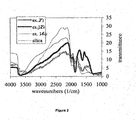
- Example 3 The samples containing partially decomposed organic complex derived from Ru-triethanolamine and Ru-arginine were also analyzed using infrared spectroscopy. Approximately 25mg of the materials of Example 3, (TEA, cale 300°C), Example 8 (no organic, dry 100°C) and Example 10 (L-arginine, calc 250C) were separately formed into 13mm pellets and loaded into an IR spectrometer operating in transmission mode. The samples were heated in vacuum to 150°C before the spectra were obtained.
- the data are shown in Fig. 2 .
- the data shows the plot of transmittance vs. wave number of the IR radiation.
- the transmittance decreases where the catalyst absorbs infrared radiation due to a characteristic stretching of a molecular species.
- the peaks between 1500 and 2000 cm -1 are primarily silica stretching bands.
- the presence of absorption features around 2100-2200 cm -1 present on samples from Examples 3 and 10 are reported to be features of complexed carbon nitrogen species such as nitriles and isonitriles (see: Infrared and Raman Spectra of Inorganic and Coordination Compounds, by K. Nakamoto, John Wiley publishers, 3rd edition, 1978; ISBN: 0-471-62979-0, pages 267-269 ).
- peaks are absent on the starting silica as well as on the sample prepared by aqueous impregnation of the ruthenium complex with no amino alcohol or amino acids present. Consequently these peaks are an indication of the remnant of the starting Ru-triethanolamine and Ru-arginine complexes present after partial decomposition of the organic complex.
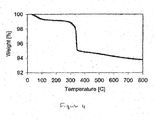
- FIG. 3 shows the air treatment TGA plot for a catalyst sample (0.5 wt% Ru on SiO 2 ), which had been prepared with triethanolamine as the organic compound and dried at 100° C prior to analysis.
- the TGA plot shows weight loss at temperatures below 300° C due to loss of water and partial oxidation of the complex with triethanolamine. In addition there is a further weight loss at approximately 325° C, which is believed to be due to the complete oxidation of the organic complex.
- Figure 4 shows the air treatment TGA plot for a similar catalyst to that used in Figure 1 (0.5 wt% Ru on SiO 2 ), which had previously been calcined at 300° C.
- the majority of the weight loss in the sample is due to the partially decomposed organic complex, which is oxidized at approximately 325° C. This results shows that that calcination below the decomposition temperature is necessary to form the partially decomposed organic complex.
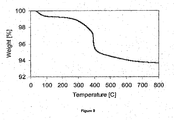
- FIG. 5 shows the hydrogen treatment TGA for the catalyst sample (0.5 wt% Ru on SiO 2 ), which had previously been calcined at 300° C.
- This TGA analysis shows that the partially oxidised organic complex is fully decomposed under the hydrogen treatment conditions at a higher temperature ( ⁇ 400° C) than under calcination conditions:
- Example 14 Determination of the decomposition temperature for various organic complexes.
- TGA air treatment
- TEA triethanolamine
- arg L-arginine
- arg(TPA-CI2) is arginine complex with tetramine Pt dichloride as Pt salt.
Landscapes
- Chemical & Material Sciences (AREA)
- Organic Chemistry (AREA)
- Chemical Kinetics & Catalysis (AREA)
- Engineering & Computer Science (AREA)
- Analytical Chemistry (AREA)
- Materials Engineering (AREA)
- Oil, Petroleum & Natural Gas (AREA)
- Inorganic Chemistry (AREA)
- General Chemical & Material Sciences (AREA)
- Thermal Sciences (AREA)
- Physics & Mathematics (AREA)
- Water Supply & Treatment (AREA)
- Catalysts (AREA)
- Organic Low-Molecular-Weight Compounds And Preparation Thereof (AREA)
- Solid-Sorbent Or Filter-Aiding Compositions (AREA)
Claims (38)
- Verfahren zur Herstellung eines Katalysators, der auf einem Träger verteiltes katalytisch aktives Metall umfasst, bei welchem Verfahren:a) ein Träger hergestellt wird, der einen darauf abgeschiedenen organischen Komplex des katalytisch aktiven Metalls aufweist, indem ein poröser Träger mit einer Verbindung oder einem Salz des Metalls und Stickstoff enthaltender organischer Verbindung ausgewählt aus (i) Aminosäuren und (ii) Verbindungen, die sowohl eine Aminogruppe als auch eine Alkoholgruppe enthalten, behandelt wird, so dass der organische Metallkomplex aus dem Träger gebildet wird,b) der organische Metallkomplex auf den Träger in einem Ausmaß teilweise zersetzt wird, dass das teilweise zersetzte Produkt (I) zwischen 10 und 95 Gew.-% des Trockengewichts, das dem organischen Komplex vor der teilweisen Zersetzung zugeschrieben wird, umfasst, und (II) ein oder mehrere Infrarotabsorptionsbanden zwischen 2100 und 2200 cm-1 aufweist, die im organischen Komplex vor der teilweisen Zersetzung nicht vorliegen, undc) der teilweise zersetzte organische Metallkomplex in katalytisch aktives Metall umgewandelt wird.
- Verfahren nach Anspruch 1, bei dem die Umwandlung in katalytisch aktives Metall erzielt wird, indem der Träger, der den teilweise zersetzten organischen Metallkomplex umfasst, mit einem Reduktionsmittel behandelt wird.
- Verfahren wie in Anspruch 2 beansprucht, bei dem das Reduktionsmittel eine Quelle von Wasserstoff und/oder CO ist.
- Verfahren wie in Anspruch 2 oder 3 beansprucht, bei dem die Quelle des Reduktionsmittels in einem katalysierten Verfahren in-situ zur Verfügung gestellt wird.
- Verfahren wie in einem der Ansprüche 2 bis 4 beansprucht, bei dem die Quelle des Reduktionsmittels in einem Katalysator-Regenerationsverfahren zur Verfügung gestellt wird.
- Verfahren wie in einem der Ansprüche 2 bis 5 beansprucht, bei dem die Quelle des Reduktionsmittels in einem Katalysator-Regenerationsverfahren oder einem Verfahren zur Katalysator-Rückführung zur Verfügung gestellt wird, das mit dem katalysierten Verfahren verbunden ist.
- Verfahren wie in einem der vorhergehenden Ansprüche beansprucht, bei dem die Stickstoff enthaltende organische Verbindung in den oder innerhalb des Trägers während seiner Herstellung oder Synthese eingebaut worden ist.
- Verfahren wie in einem der vorhergehenden Ansprüche beansprucht, bei dem die Stickstoff enthaltende organische Verbindung ein aliphatisches Amin ist, das eine oder mehrere Hydroxygruppen enthält.
- Verfahren wie in Anspruch 8 beansprucht, bei dem das Amin eine Hydroxyalkylgruppe umfasst.
- Verfahren wie in Anspruch 9 beansprucht, bei dem die Hydroxyalkylgruppe C1- bis C50-Hydroxyalkyl ist.
- Verfahren wie in Anspruch 10 beansprucht, bei dem die Hydroxyalkylgruppe C1- bis C8-Hydroxyalkyl ist.
- Verfahren wie in Anspruch 11 beansprucht, bei dem die Hydroxyalkylgruppe C1- bis C4-Hydroxyalkyl ist.
- Verfahren wie in Anspruch 12 beansprucht, bei dem die Hydroxyalkylgruppe ausgewählt ist aus Hydroxymethyl, 1-Hydroxymethyl, 2-Hydroxymethyl, 1-Hydroxy-n-propyl, 2-Hydroxy-n-propyl, 3-Hydroxy-n-propyl und 1-Hydroxy-methylethyl.
- Verfahren wie in Anspruch 13 beansprucht, bei dem die Stickstoff enthaltende organische Verbindung ein einfach, zweifach oder dreifach substituiertes aliphatisches Hydroxyalkylamin umfasst.
- Verfahren wie in Anspruch 14 beansprucht, bei dem das Hydroxyalkylamin eines oder mehrere von: Methanolamin, Dimethanolamin, Trimethanolamin, Ethanolamin, Diethanolamin, Triethanolamin, Butanolamin, Dibutanolamin Tributanolamin, Propanolamin, Dipropanolamin, Dimethylethanoalmin, Diisopropylethanolamin, Methyldiethanolamin, Dimethylamino-2-propanol und Tripropanolamin umfasst.
- Verfahren nach einem der Ansprüche 1 bis 7, bei dem die Aminosäure L-Arginin ist.
- Verfahren wie in einem der Ansprüche 1 bis 7 beansprucht, bei dem die Aminosäure ausgewählt ist aus allen Isomeren der folgenden: Alanin, Arginin, Asparagine, Aspartamsäure, Cystein, Cystin, 3,5-Dibromtyrosin, 3,5-Diiodtyrosin, Glutaminsäure, Glutamin, Glycin, Histidin, Hydroxylysin, Hydroxyprolin, Isoleucin, Leucin, Lysin, Methionin, Phenylalanin, Prolin, Serin, Threonin, Thyroxin, Tryptophan, Tyrosin, und Valin.
- Verfahren nach einem der vorhergehenden Ansprüche, bei dem der organische Metallkomplex durch Calcinierung oder Pyrolyse teilweise zersetzt wird.
- Verfahren wie in Anspruch 18 beansprucht, bei dem die Calcinierungstemperatur niedriger ist als die Temperatur, wie mittels TGA in Luft bestimmt, bei der ein vollständiger Gewichtsverlust des organischen Komplexes erfolgt, oder die Pyrolyse-Temperatur niedriger ist als die Temperatur, wie mittels TGA in einer inerten Atmosphäre von Wasserstoff bestimmt, bei der ein vollständiger Gewichtsverlust des organischen Komplexes erfolgt.
- Verfahren wie in Anspruch 19 beansprucht, bei dem die Calcinierung oder Pyrolyse-Temperatur zwischen 200°C und der Temperatur liegt, bei der ein vollständiger Gewichtsverlust des organischen Komplexes erfolgt.
- Verfahren wie in einem der Ansprüche 18 bis 20 beansprucht, bei dem die teilweise Zersetzung erfolgt, indem der Träger, der den organischen Metallkomplex umfasst, in ein katalysiertes Verfahren, ein Verfahren zur Katalysator-Regeneration oder ein Verfahren zur Rückführung des Katalysators eingebracht wird.
- Verfahren wie in einem der vorhergehenden Ansprüche beansprucht, bei dem in dem durch das Verfahren gebildeten Katalysator die gesamte Metallverteilung 45% oder mehr beträgt und die Metallverteilung bezogen auf eine stark chemisorbierte Komponente der Gesamtmetallverteilung 20% oder größer ist.
- Verfahren wie in einem der vorhergehenden Ansprüche beansprucht, bei dem das Produkt aus Stufe (b) bezogen auf die starke Verteilungskomponente Verteilungswerte von weniger als 1% aufweist.
- Verfahren wie in Anspruch 23 beansprucht, bei dem die Verteilung weniger als 0,5% beträgt.
- Verfahren wie in einem der vorhergehenden Ansprüche beansprucht, bei dem Stufe (b) soweit ausgeführt wird, dass das teilweise zersetzte Produkt zwischen 20 und 25 Gew.-% des dem organischen Komplex vor der teilweisen Zersetzung zugeordneten Gewichts behält.
- Verfahren wie in einem der vorhergehenden Ansprüche beansprucht, bei dem der Katalysatorträger Siliciumdioxid umfasst.
- Verfahren wie in Anspruch 26 beansprucht, bei dem das Siliciumdioxid amorph ist.
- Verfahren wie in einem der vorhergehenden Ansprüche beansprucht, bei dem der Träger geordnetes mesoporöses Material und/oder makroporöses Material umfasst.
- Verfahren wie in einem der vorhergehenden Ansprüche beansprucht, bei dem der Träger ein Material umfasst, das als M41S bezeichnet wird.
- Verfahren wie in Anspruch 29 beansprucht, bei dem das Trägermaterial MCM-41 ist.
- Verfahren nach einem der vorhergehenden Ansprüche, bei dem der Träger Aluminiumoxid umfasst.
- Verfahren wie in einem der vorhergehenden Ansprüche beansprucht, bei dem der Träger Rutin-Titandioxid, Anatas-Titandioxid oder Mischungen davon umfasst.
- Verfahren wie in Anspruch 32 beansprucht, bei dem der Träger Zirconiumdioxid umfasst.
- Verfahren wie in einem der vorhergehenden Ansprüche beansprucht, bei dem das Salz oder die Verbindung des einen oder der mehreren katalytisch aktiven Metalle ein Salz oder eine Verbindung von einem oder mehreren Metallen ausgewählt aus der Gruppe: Gruppe 1 (Gruppe IA) wie Li, Na oder K; Gruppe 2 (Gruppe IIA) wie Mg, Ca und Sr; Gruppe 3 (Gruppe IIIA, IIIB) wie Sc, Y und La; Gruppe 4 (Gruppe IVA, IVB) wie Ti, Zr und Hf; Gruppe 5 (Gruppe VA, VB) wie V, Nb und Ta; Gruppe 6 (Gruppe VIA, VIB) wie Cr, Mo und W; Gruppe 7 (VIIA, VIIB) wie Mn, Tc, und Re; Gruppen 8, 9 und 10 (Gruppe VIII, VIIIA) wie Fe, Ru, Os, Co, Rh, Ir, Ni, Pd und Pt; Gruppe 11 (Gruppe IB) wie Cu, Ag und Au; Gruppe 12 (Gruppe IIB) wie Zn; Gruppe 13 (Gruppe IIIA, IIIB) wie Ga und In; und Gruppe 14 (Gruppe IVA, IVB) wie Ge und Sn ist.
- Verfahren wie in Anspruch 34 beansprucht, bei dem das Salz oder die Verbindung des einen oder der mehreren katalytisch aktiven Metalle ein Salz oder eine Verbindung von einem oder mehreren der folgenden Metalle: Kupfer, Platin, Rhodium, Palladium, Cobalt, Eisen, Nickel, Rhenium, Ruthenium oder Mischungen von zwei oder mehr davon als aktivem Metall ist.
- Verfahren nach einem der vorhergehenden Ansprüche, bei dem die Verbindung oder das Salz des katalytisch aktiven Metalls ein Nitrat oder Nitrosylnitrat ist.
- Verfahren zur Herstellung von flüssigen C5+-Kohlen-wasserstoffen, bei dem ein Katalysator gemäß dem Verfahren eines der vorhergehenden Ansprüche hergestellt wird und Wasserstoff- und Kohlenmonoxid-Synthesegas bei Reaktionsbedingungen mit dem Katalysator kontaktiert wird, so dass die flüssigen C5+-Kohlenwasserstoffe hergestellt werden.
- Verfahren zur Entfernung von Schwefel aus einer Mischung, die eine und mehrere organische Verbindungen und eine oder mehrere Schwefel enthaltende Verbindungen umfasst, bei welchen Verfahren ein Katalysator, in Form eines Materials, das auf einem Träger verteiltes Metall umfasst, durch ein Verfahren gemäß einem der Ansprüche 1 bis 36 hergestellt wird, und die Mischung mit dem Material, das auf einem anorganischen Träger verteiltes aktives Metall umfasst, unter solchen Bedingungen kontaktiert wird, dass Schwefel auf dem Material, das auf einem anorganischen Träger verteiltes aktives Metall umfasst, absorbiert wird.
Applications Claiming Priority (3)
| Application Number | Priority Date | Filing Date | Title |
|---|---|---|---|
| GBGB0227081.7A GB0227081D0 (en) | 2002-11-20 | 2002-11-20 | Methods for preparing catalysts |
| GB0227081 | 2002-11-20 | ||
| PCT/EP2003/012884 WO2004045767A2 (en) | 2002-11-20 | 2003-11-18 | Methods for preparing catalysts |
Publications (2)
| Publication Number | Publication Date |
|---|---|
| EP1569751A2 EP1569751A2 (de) | 2005-09-07 |
| EP1569751B1 true EP1569751B1 (de) | 2015-10-07 |
Family
ID=9948192
Family Applications (1)
| Application Number | Title | Priority Date | Filing Date |
|---|---|---|---|
| EP03767569.1A Expired - Lifetime EP1569751B1 (de) | 2002-11-20 | 2003-11-18 | Verfahren zur herstellung von katalysatoren |
Country Status (11)
| Country | Link |
|---|---|
| US (1) | US7585808B2 (de) |
| EP (1) | EP1569751B1 (de) |
| JP (1) | JP4504815B2 (de) |
| KR (1) | KR20050083911A (de) |
| CN (1) | CN1717278B (de) |
| AU (1) | AU2003292042A1 (de) |
| CA (1) | CA2503515C (de) |
| GB (1) | GB0227081D0 (de) |
| NO (1) | NO20053025L (de) |
| WO (1) | WO2004045767A2 (de) |
| ZA (1) | ZA200503619B (de) |
Families Citing this family (95)
| Publication number | Priority date | Publication date | Assignee | Title |
|---|---|---|---|---|
| GB0107908D0 (en) | 2001-03-29 | 2001-05-23 | Bp Oil Int | Decolourisation method |
| GB0227086D0 (en) * | 2002-11-20 | 2002-12-24 | Exxonmobil Res & Eng Co | Hydrogenation processes |
| KR101148505B1 (ko) | 2004-02-17 | 2012-05-24 | 엑손모빌 리서치 앤드 엔지니어링 컴퍼니 | 고활성 분말 촉매를 사용하는 고도의 입체 장애아미노-에테르 알콜 및 다이아미노폴리알케닐에테르의개선된 합성 방법 |
| WO2005082834A1 (en) | 2004-02-17 | 2005-09-09 | Exxonmobil Research And Engineering Company | Catalytic preparation of severely sterically hindered amino-ether alcohols using a metal loaded catalyst |
| US20050195966A1 (en) * | 2004-03-03 | 2005-09-08 | Sigma Dynamics, Inc. | Method and apparatus for optimizing the results produced by a prediction model |
| JP5031185B2 (ja) * | 2004-08-31 | 2012-09-19 | 日揮触媒化成株式会社 | 燃料処理剤の製造方法 |
| US20060223704A1 (en) * | 2005-03-30 | 2006-10-05 | Tiejun Zhang | Activated carbon for fuel purification |
| US7745373B2 (en) * | 2005-04-08 | 2010-06-29 | Exxonmobil Research And Engineering Company | Single step decomposition and activation of noble metal complexes on catalytic supports |
| JP4827432B2 (ja) * | 2005-04-20 | 2011-11-30 | 新日本製鐵株式会社 | F−t合成反応用触媒 |
| US7718564B2 (en) | 2005-06-24 | 2010-05-18 | Exxonmobil Research And Engineering Company | Partially decomposed catalyst and hydrocarbon oxidation processes using the same |
| EP1965908A1 (de) * | 2005-12-22 | 2008-09-10 | Shell Internationale Research Maatschappij B.V. | Zirconium-stabilisierter fischer-tropsch-katalysator und katalysatorträger |
| US7674369B2 (en) * | 2006-12-29 | 2010-03-09 | Chevron U.S.A. Inc. | Process for recovering ultrafine solids from a hydrocarbon liquid |
| JP4924709B2 (ja) * | 2007-03-19 | 2012-04-25 | 宇部興産株式会社 | シリカ基複合酸化物繊維及びそれを用いた触媒繊維並びにその製造方法 |
| US7813523B1 (en) * | 2007-04-03 | 2010-10-12 | Nanostellar, Inc. | Dispersion and metal particle size characterization of nanocatalysts |
| US7817819B1 (en) * | 2007-04-03 | 2010-10-19 | Nanostellar, Inc. | Characterization of metal particle distributions in a supported catalyst |
| US7833316B2 (en) * | 2007-05-01 | 2010-11-16 | Auburn University | Doped supported zinc oxide sorbents for regenerable desulfurization applications |
| US20080283446A1 (en) | 2007-05-01 | 2008-11-20 | Auburn University | Silver-based sorbents |
| JP5275342B2 (ja) | 2007-05-11 | 2013-08-28 | エスディーシー マテリアルズ インコーポレイテッド | 粒子生産システム及び粒子生産方法 |
| US8158545B2 (en) * | 2007-06-18 | 2012-04-17 | Battelle Memorial Institute | Methods, systems, and devices for deep desulfurization of fuel gases |
| US8252255B2 (en) * | 2007-09-10 | 2012-08-28 | Shell Oil Company | Process for producing purified synthesis gas from synthesis gas comprising trace amounts of sulphur contaminants with a metal-organic framework |
| US8507401B1 (en) | 2007-10-15 | 2013-08-13 | SDCmaterials, Inc. | Method and system for forming plug and play metal catalysts |
| CN102015588B (zh) * | 2008-04-25 | 2013-09-25 | 埃克森美孚化学专利公司 | 生产苯酚和/或环己酮的方法 |
| US20100022388A1 (en) * | 2008-07-25 | 2010-01-28 | Soled Stuart L | Preparation of high activity cobalt catalysts, the catalysts and their use |
| US8148292B2 (en) | 2008-07-25 | 2012-04-03 | Exxonmobil Research And Engineering Company | Preparation of high activity cobalt catalysts, the catalysts and their use |
| JP5411664B2 (ja) * | 2008-11-18 | 2014-02-12 | 大阪瓦斯株式会社 | 高カロリーガス製造用触媒およびその製造方法および高カロリーガス製造用触媒を用いた高カロリーガス製造方法 |
| US8105969B2 (en) * | 2008-12-29 | 2012-01-31 | Fina Technology Inc. | Catalyst with an ion-modified binder |
| KR101841689B1 (ko) * | 2009-10-30 | 2018-03-29 | 삼성전자주식회사 | 메조 기공성 복합 촉매 및 그의 제조방법 |
| US8557727B2 (en) | 2009-12-15 | 2013-10-15 | SDCmaterials, Inc. | Method of forming a catalyst with inhibited mobility of nano-active material |
| US8921590B2 (en) | 2009-12-15 | 2014-12-30 | Exxonmobil Chemical Patents Inc. | Oligomerisation process |
| US9126191B2 (en) | 2009-12-15 | 2015-09-08 | SDCmaterials, Inc. | Advanced catalysts for automotive applications |
| US20110143930A1 (en) * | 2009-12-15 | 2011-06-16 | SDCmaterials, Inc. | Tunable size of nano-active material on nano-support |
| US8803025B2 (en) * | 2009-12-15 | 2014-08-12 | SDCmaterials, Inc. | Non-plugging D.C. plasma gun |
| US9119309B1 (en) | 2009-12-15 | 2015-08-25 | SDCmaterials, Inc. | In situ oxide removal, dispersal and drying |
| US8652992B2 (en) | 2009-12-15 | 2014-02-18 | SDCmaterials, Inc. | Pinning and affixing nano-active material |
| US8545652B1 (en) | 2009-12-15 | 2013-10-01 | SDCmaterials, Inc. | Impact resistant material |
| US8470112B1 (en) | 2009-12-15 | 2013-06-25 | SDCmaterials, Inc. | Workflow for novel composite materials |
| US9149797B2 (en) | 2009-12-15 | 2015-10-06 | SDCmaterials, Inc. | Catalyst production method and system |
| US20110152547A1 (en) * | 2009-12-17 | 2011-06-23 | Sumitomo Chemical Company, Limited | Process for producing olefin oxide |
| US8476187B2 (en) * | 2010-01-06 | 2013-07-02 | General Electric Company | Process for preparing catalyst powder |
| US8969639B2 (en) | 2010-02-05 | 2015-03-03 | Exxonmobil Chemical Patents Inc. | Dehydrogenation process |
| WO2011096995A1 (en) | 2010-02-05 | 2011-08-11 | Exxonmobil Chemical Patents Inc. | Dehydrogenation process |
| US8884088B2 (en) | 2010-02-05 | 2014-11-11 | Exxonmobil Chemical Patents Inc. | Dehydrogenation process |
| CN102711988B (zh) * | 2010-02-05 | 2015-11-25 | 埃克森美孚化学专利公司 | 含铱催化剂、它们的制备和用途 |
| JP5676120B2 (ja) * | 2010-02-26 | 2015-02-25 | Jx日鉱日石エネルギー株式会社 | 活性化フィッシャー・トロプシュ合成触媒の製造方法及び炭化水素の製造方法 |
| KR101172159B1 (ko) | 2010-06-01 | 2012-08-07 | 순천향대학교 산학협력단 | 열분해를 이용한 아민 공급 장치 및 방법 |
| CN102294260B (zh) * | 2010-06-24 | 2013-12-18 | 中国石油化工股份有限公司 | 由合成气制低碳含氧化合物的方法 |
| CN102294259A (zh) * | 2010-06-24 | 2011-12-28 | 中国石油化工股份有限公司 | 由合成气制低碳含氧化合物的催化剂及其制备方法 |
| US9486786B2 (en) | 2010-07-02 | 2016-11-08 | Savannah River Nuclear Solutions, Llc | Highly dispersed metal catalyst |
| US9376637B2 (en) | 2010-08-13 | 2016-06-28 | Shell Oil Company | Method of making a hydroprocessing catalyst with a single step metal and chelant incorporation, the catalyst, and the use of the catalyst |
| CN102452036B (zh) * | 2010-10-29 | 2016-08-24 | 安集微电子(上海)有限公司 | 一种钨化学机械抛光方法 |
| US8445550B2 (en) * | 2010-11-23 | 2013-05-21 | Chevron U.S.A. Inc. | Ruthenium hybrid fischer-tropsch catalyst, and methods for preparation and use thereof |
| US8669202B2 (en) | 2011-02-23 | 2014-03-11 | SDCmaterials, Inc. | Wet chemical and plasma methods of forming stable PtPd catalysts |
| JP2014522382A (ja) | 2011-03-28 | 2014-09-04 | エクソンモービル ケミカル パテンツ インコーポレイテッド | 脱水素化法 |
| HK1199222A1 (en) | 2011-08-19 | 2015-06-26 | SDCmaterials, Inc. | Coated substrates for use in catalysis and catalytic converters and methods of coating substrates with washcoat compositions |
| CN102989511B (zh) * | 2011-09-08 | 2015-04-29 | 中国石油化工股份有限公司 | 一种费托合成催化剂及其制备和应用 |
| CN102989458B (zh) * | 2011-09-08 | 2015-03-18 | 中国石油化工股份有限公司 | 一种费托合成催化剂的制备方法以及由该方法制备的催化剂 |
| RU2638663C2 (ru) | 2012-07-17 | 2017-12-15 | Сименс Акциенгезелльшафт | Промывочный раствор для абсорбции диоксида углерода и способ ускорения абсорбции посредством диоксида германия |
| US9511352B2 (en) | 2012-11-21 | 2016-12-06 | SDCmaterials, Inc. | Three-way catalytic converter using nanoparticles |
| US9156025B2 (en) | 2012-11-21 | 2015-10-13 | SDCmaterials, Inc. | Three-way catalytic converter using nanoparticles |
| AP2016008995A0 (en) | 2013-07-24 | 2016-01-31 | Shell Int Research | Process for preparing a chlorine comprising catalyst, the prepared catalyst, and its use |
| US10035138B2 (en) * | 2013-07-24 | 2018-07-31 | Shell Oil Company | Process for preparing a chlorine comprising catalyst, the prepared catalyst, and its use |
| CN105592921A (zh) | 2013-07-25 | 2016-05-18 | Sdc材料公司 | 用于催化转化器的洗涂层和经涂覆基底及其制造和使用方法 |
| WO2015057312A1 (en) | 2013-10-18 | 2015-04-23 | Exxonmobil Chemical Patents Inc. | A hydrogenation catalyst, its method of preparation and use |
| WO2015057311A1 (en) | 2013-10-18 | 2015-04-23 | Exxonmobile Chemical Patents Inc. | A hydrogenation catalyst, its method of preparation and use |
| WO2015057313A1 (en) | 2013-10-18 | 2015-04-23 | Exxonmobil Chemical Patents Inc. | A hydrogenation catalyst, its method of preparation and use |
| CA2926135A1 (en) | 2013-10-22 | 2015-04-30 | SDCmaterials, Inc. | Compositions of lean nox trap |
| CN106061600A (zh) | 2013-10-22 | 2016-10-26 | Sdc材料公司 | 用于重型柴油机的催化剂设计 |
| CN104667991B (zh) * | 2013-11-29 | 2017-04-12 | 中国石油化工股份有限公司 | 催化湿式氧化催化剂载体的制法 |
| CN104667989B (zh) * | 2013-11-29 | 2017-04-12 | 中国石油化工股份有限公司 | 湿式氧化催化剂载体的制备方法 |
| US9687811B2 (en) | 2014-03-21 | 2017-06-27 | SDCmaterials, Inc. | Compositions for passive NOx adsorption (PNA) systems and methods of making and using same |
| CN105318711B (zh) * | 2014-07-22 | 2017-11-03 | 中国石油化工股份有限公司 | 一种固相粉体混合焙烧设备及催化剂制备方法 |
| US10017448B2 (en) | 2014-10-29 | 2018-07-10 | Exxonmobil Chemical Patents Inc. | Process for hydrogenation of benzenepolycarboxylic acids and derivatives thereof |
| JP7005829B2 (ja) * | 2015-02-27 | 2022-01-24 | 国立大学法人九州大学 | 後周期遷移金属微粒子担持体の製造方法 |
| CN104862083A (zh) * | 2015-04-08 | 2015-08-26 | 南昌大学 | 一种降低氢化油脂反式脂肪酸含量的方法 |
| CN105498759B (zh) * | 2015-12-01 | 2018-03-16 | 中国科学院大连化学物理研究所 | 一种乙炔环三聚制备苯高性能催化剂及其制备方法和应用 |
| US20190185404A1 (en) | 2016-09-09 | 2019-06-20 | Nicolaas A. de Munck | Processes for the hydrogenation of phthalate esters |
| CN107224962A (zh) * | 2017-06-29 | 2017-10-03 | 安徽天顺环保设备股份有限公司 | 一种乙醇胺负载改性的氧化镁基烟气干法脱硫吸附剂及制备方法 |
| CN107930630A (zh) * | 2017-11-23 | 2018-04-20 | 西北大学 | 一种高活性高稳定性费‑托合成钴基催化剂的制备方法 |
| CN107899579A (zh) * | 2017-11-23 | 2018-04-13 | 西北大学 | 一种高活性费‑托合成钴基催化剂的制备方法 |
| US10722874B2 (en) | 2018-04-16 | 2020-07-28 | Chevron Phillips Chemical Company Lp | Methods of preparing a catalyst utilizing hydrated reagents |
| US10543480B2 (en) * | 2018-04-16 | 2020-01-28 | Chevron Phillips Chemical Company Lp | Methods of preparing a catalyst utilizing hydrated reagents |
| CN110496614A (zh) * | 2018-05-16 | 2019-11-26 | 中国科学院大连化学物理研究所 | 金属催化剂、其制备方法及在水相催化糠醛加氢制备糠醇中的应用 |
| WO2020028518A1 (en) * | 2018-07-31 | 2020-02-06 | Boards Of Regents Of The University Of Texas System | Methods for preparation and use of liquid synthesis catalysts |
| CN110416555A (zh) * | 2019-06-28 | 2019-11-05 | 北京航天石化技术装备工程有限公司 | 一种Pt-Ni合金催化剂及其制备方法与应用 |
| KR102248115B1 (ko) | 2019-07-01 | 2021-05-03 | 한국화학연구원 | 피셔―트롭쉬 합성반응용 촉매 및 그 제조방법 |
| KR102949671B1 (ko) * | 2019-07-16 | 2026-04-06 | 삼성전자주식회사 | 전이금속 칼코겐 화합물 박막의 형성방법 |
| KR102284848B1 (ko) | 2019-10-11 | 2021-08-02 | 한국화학연구원 | 피셔-트롭시 합성촉매의 제조방법 및 피셔-트롭시 합성촉매를 이용한 액체연료의 제조방법 |
| CN112916007A (zh) * | 2019-12-05 | 2021-06-08 | 中国科学院大连化学物理研究所 | 一种费托合成催化剂的制备方法 |
| US11715834B2 (en) | 2019-12-27 | 2023-08-01 | Toyota Motor Engineering And Manufacturing North America, Inc. | Fuel cell cathode catalyst |
| GB202014184D0 (en) | 2020-09-09 | 2020-10-21 | Johnson Matthey Plc | Modifed catalyst supports and catalysts supported thereon |
| CN114425337B (zh) * | 2020-10-10 | 2024-01-30 | 中国石油化工股份有限公司 | 一种甲醇胺化催化剂及其应用 |
| CN112121848B (zh) * | 2020-10-30 | 2022-08-05 | 万华化学集团股份有限公司 | 改性多级孔分子筛催化剂及其制备方法、3-甲基-2-丁烯-1-醇的生产方法 |
| CN113663707A (zh) * | 2021-08-13 | 2021-11-19 | 中山大学 | 一种宏量制备多种甲醛分解催化剂的方法 |
| CN115337933B (zh) * | 2022-07-11 | 2024-03-22 | 华东理工大学 | 一种高效光催化还原co2的锡掺杂带有氧空位的四氧化三钴材料的制备方法及其应用 |
| CN120361906A (zh) * | 2025-03-12 | 2025-07-25 | 北京市科学技术研究院资源环境研究所(北京市土地修复工程技术研究中心) | 一种氧化铈负载金属单原子催化剂及其制备方法和应用 |
Family Cites Families (12)
| Publication number | Priority date | Publication date | Assignee | Title |
|---|---|---|---|---|
| NL68368C (de) * | 1949-03-31 | |||
| US2889287A (en) | 1954-10-04 | 1959-06-02 | California Research Corp | Catalyst and method of catalyst preparation |
| FR2080099A5 (de) * | 1970-02-23 | 1971-11-12 | Inst Francais Du Petrole | |
| US3953368A (en) * | 1971-11-01 | 1976-04-27 | Exxon Research And Engineering Co. | Polymetallic cluster compositions useful as hydrocarbon conversion catalysts |
| US4073750A (en) | 1976-05-20 | 1978-02-14 | Exxon Research & Engineering Co. | Method for preparing a highly dispersed supported nickel catalyst |
| FR2505205B1 (fr) * | 1981-05-05 | 1986-05-23 | Inst Francais Du Petrole | Nouveaux catalyseurs de metaux nobles du groupe viii supportes a haute dispersion et grande activite leur fabrication et leur utilisation notamment dans les reactions d'hydrogenation |
| US4634515A (en) * | 1985-10-25 | 1987-01-06 | Exxon Research And Engineering Company | Nickel adsorbent for sulfur removal from hydrocarbon feeds |
| US5332705A (en) * | 1992-06-19 | 1994-07-26 | Exxon Chemical Patents Inc. | Regeneration of acetylene converter catalysts by hydrogen stripping |
| JP2771749B2 (ja) | 1992-12-17 | 1998-07-02 | 出光興産株式会社 | 水素化触媒製造用含浸液及び水素化触媒の製造方法 |
| US5344553A (en) * | 1993-02-22 | 1994-09-06 | Mobil Oil Corporation | Upgrading of a hydrocarbon feedstock utilizing a graded, mesoporous catalyst system |
| US5863856A (en) * | 1997-04-22 | 1999-01-26 | Exxon Research And Engineering Company | Preparation of high activity catalysts the catalysts and their use |
| US6118037A (en) * | 1997-04-22 | 2000-09-12 | Snamprogetti S.P.A. | Process for the removal of contaminant compounds containing one or more heteroatoms of sulfur, nitrogen and/or oxygen from hydrocarbon streams |
-
2002
- 2002-11-20 GB GBGB0227081.7A patent/GB0227081D0/en not_active Ceased
-
2003
- 2003-11-18 KR KR1020057009065A patent/KR20050083911A/ko not_active Withdrawn
- 2003-11-18 WO PCT/EP2003/012884 patent/WO2004045767A2/en not_active Ceased
- 2003-11-18 EP EP03767569.1A patent/EP1569751B1/de not_active Expired - Lifetime
- 2003-11-18 JP JP2004552639A patent/JP4504815B2/ja not_active Expired - Fee Related
- 2003-11-18 US US10/534,072 patent/US7585808B2/en not_active Expired - Fee Related
- 2003-11-18 CA CA2503515A patent/CA2503515C/en not_active Expired - Fee Related
- 2003-11-18 AU AU2003292042A patent/AU2003292042A1/en not_active Abandoned
- 2003-11-18 CN CN2003801044810A patent/CN1717278B/zh not_active Expired - Fee Related
-
2005
- 2005-05-05 ZA ZA200503619A patent/ZA200503619B/en unknown
- 2005-06-20 NO NO20053025A patent/NO20053025L/no not_active Application Discontinuation
Also Published As
| Publication number | Publication date |
|---|---|
| ZA200503619B (de) | 2006-08-30 |
| GB0227081D0 (en) | 2002-12-24 |
| WO2004045767A2 (en) | 2004-06-03 |
| KR20050083911A (ko) | 2005-08-26 |
| JP2006506224A (ja) | 2006-02-23 |
| CA2503515A1 (en) | 2004-06-03 |
| CN1717278A (zh) | 2006-01-04 |
| CN1717278B (zh) | 2011-07-13 |
| WO2004045767A3 (en) | 2004-07-22 |
| JP4504815B2 (ja) | 2010-07-14 |
| CA2503515C (en) | 2010-08-24 |
| NO20053025L (no) | 2005-06-20 |
| US7585808B2 (en) | 2009-09-08 |
| AU2003292042A1 (en) | 2004-06-15 |
| US20060166809A1 (en) | 2006-07-27 |
| EP1569751A2 (de) | 2005-09-07 |
Similar Documents
| Publication | Publication Date | Title |
|---|---|---|
| US7585808B2 (en) | Methods for preparing catalysts | |
| US8143438B2 (en) | Hydrogenation processes | |
| JP2006506224A5 (de) | ||
| Okumura et al. | A career in catalysis: Masatake Haruta | |
| KR940004160B1 (ko) | 고도로 분산된 구리 조성물을 이용한 분리방법 | |
| JP4604051B2 (ja) | 金属装填触媒を用いた立体障害の大きなアミノ−エーテルアルコール類の触媒的調製 | |
| Veefkind et al. | Zeolite catalysts for the selective synthesis of mono-and diethylamines | |
| Bell | Molecular design of highly active methanol synthesis catalysts | |
| JPH0463140A (ja) | ゼオライト触媒 | |
| CN109465025B (zh) | 一种以*bea型结构分子筛为载体的异构化催化剂制备方法 | |
| JP2019529297A (ja) | モレキュラーシーブssz−107、その合成および使用 | |
| Madduluri et al. | Highly Effective Zirconia/γ-Alumina for Continuous Vapor Phase N-methylation of Aniline | |
| CN109465026B (zh) | 一种以ton型结构分子筛为载体的异构化催化剂制备方法 | |
| KR20250027579A (ko) | 아다만탄의 제조 방법 | |
| CN115501905A (zh) | 具有脱氢功能的催化剂及其制备方法和应用以及制备小分子烯烃的方法 |
Legal Events
| Date | Code | Title | Description |
|---|---|---|---|
| PUAI | Public reference made under article 153(3) epc to a published international application that has entered the european phase |
Free format text: ORIGINAL CODE: 0009012 |
|
| 17P | Request for examination filed |
Effective date: 20050615 |
|
| AK | Designated contracting states |
Kind code of ref document: A2 Designated state(s): AT BE BG CH CY CZ DE DK EE ES FI FR GB GR HU IE IT LI LU MC NL PT RO SE SI SK TR |
|
| AX | Request for extension of the european patent |
Extension state: AL LT LV MK |
|
| DAX | Request for extension of the european patent (deleted) | ||
| RIN1 | Information on inventor provided before grant (corrected) |
Inventor name: MALEK, ANDRZEJ Inventor name: RAGOMO, STEVEN, T. Inventor name: BAUMGARTNER, JOSEPH, ERNEST Inventor name: SOLED, STUART, LEON Inventor name: FEELEY, JENNIFER, SCHAEFER Inventor name: KISS, GABOR Inventor name: KLIEWER, CHRISTINE, E. Inventor name: CASTY, GARY, L. Inventor name: DYSARD, JEFFREY, M. Inventor name: VARTULI, JAMES, CLARKE Inventor name: MISEO, SABATO |
|
| 17Q | First examination report despatched |
Effective date: 20090518 |
|
| GRAP | Despatch of communication of intention to grant a patent |
Free format text: ORIGINAL CODE: EPIDOSNIGR1 |
|
| RIC1 | Information provided on ipc code assigned before grant |
Ipc: B01J 20/02 20060101ALN20140711BHEP Ipc: C10G 2/00 20060101AFI20140711BHEP Ipc: C10G 29/04 20060101ALI20140711BHEP Ipc: B01J 23/889 20060101ALN20140711BHEP Ipc: B01J 37/08 20060101ALI20140711BHEP Ipc: C10G 25/00 20060101ALI20140711BHEP Ipc: B01J 23/46 20060101ALN20140711BHEP Ipc: B01J 23/75 20060101ALN20140711BHEP Ipc: B01J 37/02 20060101ALI20140711BHEP Ipc: B01J 20/32 20060101ALN20140711BHEP |
|
| INTG | Intention to grant announced |
Effective date: 20140820 |
|
| GRAP | Despatch of communication of intention to grant a patent |
Free format text: ORIGINAL CODE: EPIDOSNIGR1 |
|
| INTG | Intention to grant announced |
Effective date: 20150122 |
|
| RIC1 | Information provided on ipc code assigned before grant |
Ipc: C10G 25/00 20060101ALI20150112BHEP Ipc: C10G 29/04 20060101ALI20150112BHEP Ipc: C10G 2/00 20060101AFI20150112BHEP Ipc: B01J 37/02 20060101ALI20150112BHEP Ipc: B01J 37/08 20060101ALI20150112BHEP Ipc: B01J 20/02 20060101ALN20150112BHEP Ipc: B01J 20/32 20060101ALN20150112BHEP Ipc: B01J 23/75 20060101ALN20150112BHEP Ipc: B01J 23/889 20060101ALN20150112BHEP Ipc: B01J 23/46 20060101ALN20150112BHEP |
|
| REG | Reference to a national code |
Ref country code: DE Ref legal event code: R079 Ref document number: 60348122 Country of ref document: DE Free format text: PREVIOUS MAIN CLASS: B01J0037000000 Ipc: C10G0002000000 |
|
| GRAP | Despatch of communication of intention to grant a patent |
Free format text: ORIGINAL CODE: EPIDOSNIGR1 |
|
| RIC1 | Information provided on ipc code assigned before grant |
Ipc: B01J 37/02 20060101ALI20150414BHEP Ipc: C10G 25/00 20060101ALI20150414BHEP Ipc: B01J 20/32 20060101ALN20150414BHEP Ipc: C10G 2/00 20060101AFI20150414BHEP Ipc: B01J 20/02 20060101ALN20150414BHEP Ipc: B01J 23/889 20060101ALN20150414BHEP Ipc: B01J 37/08 20060101ALI20150414BHEP Ipc: B01J 23/75 20060101ALN20150414BHEP Ipc: B01J 23/46 20060101ALN20150414BHEP Ipc: C10G 29/04 20060101ALI20150414BHEP |
|
| INTG | Intention to grant announced |
Effective date: 20150429 |
|
| GRAS | Grant fee paid |
Free format text: ORIGINAL CODE: EPIDOSNIGR3 |
|
| GRAA | (expected) grant |
Free format text: ORIGINAL CODE: 0009210 |
|
| AK | Designated contracting states |
Kind code of ref document: B1 Designated state(s): AT BE BG CH CY CZ DE DK EE ES FI FR GB GR HU IE IT LI LU MC NL PT RO SE SI SK TR |
|
| REG | Reference to a national code |
Ref country code: GB Ref legal event code: FG4D |
|
| REG | Reference to a national code |
Ref country code: AT Ref legal event code: REF Ref document number: 753766 Country of ref document: AT Kind code of ref document: T Effective date: 20151015 Ref country code: CH Ref legal event code: EP |
|
| REG | Reference to a national code |
Ref country code: IE Ref legal event code: FG4D |
|
| REG | Reference to a national code |
Ref country code: DE Ref legal event code: R096 Ref document number: 60348122 Country of ref document: DE |
|
| REG | Reference to a national code |
Ref country code: AT Ref legal event code: MK05 Ref document number: 753766 Country of ref document: AT Kind code of ref document: T Effective date: 20151007 |
|
| REG | Reference to a national code |
Ref country code: NL Ref legal event code: FP |
|
| PG25 | Lapsed in a contracting state [announced via postgrant information from national office to epo] |
Ref country code: IT Free format text: LAPSE BECAUSE OF FAILURE TO SUBMIT A TRANSLATION OF THE DESCRIPTION OR TO PAY THE FEE WITHIN THE PRESCRIBED TIME-LIMIT Effective date: 20151007 Ref country code: ES Free format text: LAPSE BECAUSE OF FAILURE TO SUBMIT A TRANSLATION OF THE DESCRIPTION OR TO PAY THE FEE WITHIN THE PRESCRIBED TIME-LIMIT Effective date: 20151007 |
|
| PG25 | Lapsed in a contracting state [announced via postgrant information from national office to epo] |
Ref country code: AT Free format text: LAPSE BECAUSE OF FAILURE TO SUBMIT A TRANSLATION OF THE DESCRIPTION OR TO PAY THE FEE WITHIN THE PRESCRIBED TIME-LIMIT Effective date: 20151007 Ref country code: SE Free format text: LAPSE BECAUSE OF FAILURE TO SUBMIT A TRANSLATION OF THE DESCRIPTION OR TO PAY THE FEE WITHIN THE PRESCRIBED TIME-LIMIT Effective date: 20151007 Ref country code: GR Free format text: LAPSE BECAUSE OF FAILURE TO SUBMIT A TRANSLATION OF THE DESCRIPTION OR TO PAY THE FEE WITHIN THE PRESCRIBED TIME-LIMIT Effective date: 20160108 Ref country code: PT Free format text: LAPSE BECAUSE OF FAILURE TO SUBMIT A TRANSLATION OF THE DESCRIPTION OR TO PAY THE FEE WITHIN THE PRESCRIBED TIME-LIMIT Effective date: 20160208 Ref country code: FI Free format text: LAPSE BECAUSE OF FAILURE TO SUBMIT A TRANSLATION OF THE DESCRIPTION OR TO PAY THE FEE WITHIN THE PRESCRIBED TIME-LIMIT Effective date: 20151007 |
|
| REG | Reference to a national code |
Ref country code: CH Ref legal event code: PL |
|
| REG | Reference to a national code |
Ref country code: DE Ref legal event code: R097 Ref document number: 60348122 Country of ref document: DE |
|
| PG25 | Lapsed in a contracting state [announced via postgrant information from national office to epo] |
Ref country code: CH Free format text: LAPSE BECAUSE OF NON-PAYMENT OF DUE FEES Effective date: 20151130 Ref country code: LI Free format text: LAPSE BECAUSE OF NON-PAYMENT OF DUE FEES Effective date: 20151130 Ref country code: CZ Free format text: LAPSE BECAUSE OF FAILURE TO SUBMIT A TRANSLATION OF THE DESCRIPTION OR TO PAY THE FEE WITHIN THE PRESCRIBED TIME-LIMIT Effective date: 20151007 Ref country code: MC Free format text: LAPSE BECAUSE OF FAILURE TO SUBMIT A TRANSLATION OF THE DESCRIPTION OR TO PAY THE FEE WITHIN THE PRESCRIBED TIME-LIMIT Effective date: 20151007 |
|
| PLBE | No opposition filed within time limit |
Free format text: ORIGINAL CODE: 0009261 |
|
| STAA | Information on the status of an ep patent application or granted ep patent |
Free format text: STATUS: NO OPPOSITION FILED WITHIN TIME LIMIT |
|
| REG | Reference to a national code |
Ref country code: IE Ref legal event code: MM4A |
|
| REG | Reference to a national code |
Ref country code: FR Ref legal event code: ST Effective date: 20160729 |
|
| PG25 | Lapsed in a contracting state [announced via postgrant information from national office to epo] |
Ref country code: DK Free format text: LAPSE BECAUSE OF FAILURE TO SUBMIT A TRANSLATION OF THE DESCRIPTION OR TO PAY THE FEE WITHIN THE PRESCRIBED TIME-LIMIT Effective date: 20151007 Ref country code: EE Free format text: LAPSE BECAUSE OF FAILURE TO SUBMIT A TRANSLATION OF THE DESCRIPTION OR TO PAY THE FEE WITHIN THE PRESCRIBED TIME-LIMIT Effective date: 20151007 Ref country code: RO Free format text: LAPSE BECAUSE OF FAILURE TO SUBMIT A TRANSLATION OF THE DESCRIPTION OR TO PAY THE FEE WITHIN THE PRESCRIBED TIME-LIMIT Effective date: 20151007 Ref country code: SK Free format text: LAPSE BECAUSE OF FAILURE TO SUBMIT A TRANSLATION OF THE DESCRIPTION OR TO PAY THE FEE WITHIN THE PRESCRIBED TIME-LIMIT Effective date: 20151007 |
|
| 26N | No opposition filed |
Effective date: 20160708 |
|
| PG25 | Lapsed in a contracting state [announced via postgrant information from national office to epo] |
Ref country code: IE Free format text: LAPSE BECAUSE OF NON-PAYMENT OF DUE FEES Effective date: 20151118 |
|
| PG25 | Lapsed in a contracting state [announced via postgrant information from national office to epo] |
Ref country code: SI Free format text: LAPSE BECAUSE OF FAILURE TO SUBMIT A TRANSLATION OF THE DESCRIPTION OR TO PAY THE FEE WITHIN THE PRESCRIBED TIME-LIMIT Effective date: 20151007 Ref country code: FR Free format text: LAPSE BECAUSE OF NON-PAYMENT OF DUE FEES Effective date: 20151207 |
|
| PG25 | Lapsed in a contracting state [announced via postgrant information from national office to epo] |
Ref country code: BG Free format text: LAPSE BECAUSE OF FAILURE TO SUBMIT A TRANSLATION OF THE DESCRIPTION OR TO PAY THE FEE WITHIN THE PRESCRIBED TIME-LIMIT Effective date: 20151007 Ref country code: HU Free format text: LAPSE BECAUSE OF FAILURE TO SUBMIT A TRANSLATION OF THE DESCRIPTION OR TO PAY THE FEE WITHIN THE PRESCRIBED TIME-LIMIT; INVALID AB INITIO Effective date: 20031118 |
|
| PG25 | Lapsed in a contracting state [announced via postgrant information from national office to epo] |
Ref country code: CY Free format text: LAPSE BECAUSE OF FAILURE TO SUBMIT A TRANSLATION OF THE DESCRIPTION OR TO PAY THE FEE WITHIN THE PRESCRIBED TIME-LIMIT Effective date: 20151007 |
|
| PG25 | Lapsed in a contracting state [announced via postgrant information from national office to epo] |
Ref country code: TR Free format text: LAPSE BECAUSE OF FAILURE TO SUBMIT A TRANSLATION OF THE DESCRIPTION OR TO PAY THE FEE WITHIN THE PRESCRIBED TIME-LIMIT Effective date: 20151007 |
|
| PG25 | Lapsed in a contracting state [announced via postgrant information from national office to epo] |
Ref country code: LU Free format text: LAPSE BECAUSE OF NON-PAYMENT OF DUE FEES Effective date: 20151118 |
|
| PGFP | Annual fee paid to national office [announced via postgrant information from national office to epo] |
Ref country code: DE Payment date: 20191017 Year of fee payment: 17 Ref country code: NL Payment date: 20191030 Year of fee payment: 17 |
|
| PGFP | Annual fee paid to national office [announced via postgrant information from national office to epo] |
Ref country code: BE Payment date: 20191021 Year of fee payment: 17 |
|
| PGFP | Annual fee paid to national office [announced via postgrant information from national office to epo] |
Ref country code: GB Payment date: 20191029 Year of fee payment: 17 |
|
| REG | Reference to a national code |
Ref country code: DE Ref legal event code: R119 Ref document number: 60348122 Country of ref document: DE |
|
| REG | Reference to a national code |
Ref country code: NL Ref legal event code: MM Effective date: 20201201 |
|
| GBPC | Gb: european patent ceased through non-payment of renewal fee |
Effective date: 20201118 |
|
| REG | Reference to a national code |
Ref country code: BE Ref legal event code: MM Effective date: 20201130 |
|
| PG25 | Lapsed in a contracting state [announced via postgrant information from national office to epo] |
Ref country code: NL Free format text: LAPSE BECAUSE OF NON-PAYMENT OF DUE FEES Effective date: 20201201 |
|
| PG25 | Lapsed in a contracting state [announced via postgrant information from national office to epo] |
Ref country code: DE Free format text: LAPSE BECAUSE OF NON-PAYMENT OF DUE FEES Effective date: 20210601 Ref country code: GB Free format text: LAPSE BECAUSE OF NON-PAYMENT OF DUE FEES Effective date: 20201118 |
|
| PG25 | Lapsed in a contracting state [announced via postgrant information from national office to epo] |
Ref country code: BE Free format text: LAPSE BECAUSE OF NON-PAYMENT OF DUE FEES Effective date: 20201130 |