EP1547792A1 - Dispositif de formation d'images - Google Patents
Dispositif de formation d'images Download PDFInfo
- Publication number
- EP1547792A1 EP1547792A1 EP04258125A EP04258125A EP1547792A1 EP 1547792 A1 EP1547792 A1 EP 1547792A1 EP 04258125 A EP04258125 A EP 04258125A EP 04258125 A EP04258125 A EP 04258125A EP 1547792 A1 EP1547792 A1 EP 1547792A1
- Authority
- EP
- European Patent Office
- Prior art keywords
- image
- forming device
- disposed
- unit
- control board
- Prior art date
- Legal status (The legal status is an assumption and is not a legal conclusion. Google has not performed a legal analysis and makes no representation as to the accuracy of the status listed.)
- Granted
Links
- 230000007246 mechanism Effects 0.000 claims description 31
- 239000011521 glass Substances 0.000 claims description 25
- 239000002699 waste material Substances 0.000 claims description 24
- 238000006243 chemical reaction Methods 0.000 claims description 7
- 238000004891 communication Methods 0.000 claims description 4
- 239000012530 fluid Substances 0.000 claims description 2
- 238000010276 construction Methods 0.000 description 20
- 230000006870 function Effects 0.000 description 15
- 238000012423 maintenance Methods 0.000 description 10
- 238000012986 modification Methods 0.000 description 8
- 230000004048 modification Effects 0.000 description 8
- 238000003780 insertion Methods 0.000 description 7
- 230000037431 insertion Effects 0.000 description 7
- 238000007639 printing Methods 0.000 description 7
- 238000000926 separation method Methods 0.000 description 7
- 238000005452 bending Methods 0.000 description 5
- 238000007599 discharging Methods 0.000 description 5
- 230000000694 effects Effects 0.000 description 4
- 238000003825 pressing Methods 0.000 description 4
- 230000001681 protective effect Effects 0.000 description 4
- 230000002411 adverse Effects 0.000 description 3
- 239000003086 colorant Substances 0.000 description 3
- 239000000428 dust Substances 0.000 description 3
- 239000007788 liquid Substances 0.000 description 3
- 238000004140 cleaning Methods 0.000 description 2
- 239000006059 cover glass Substances 0.000 description 1
- 238000011161 development Methods 0.000 description 1
- 239000000835 fiber Substances 0.000 description 1
- 238000007641 inkjet printing Methods 0.000 description 1
- 239000004973 liquid crystal related substance Substances 0.000 description 1
- 239000000463 material Substances 0.000 description 1
- 239000002184 metal Substances 0.000 description 1
- 238000000034 method Methods 0.000 description 1
- 230000002093 peripheral effect Effects 0.000 description 1
- 230000008569 process Effects 0.000 description 1
- 230000003068 static effect Effects 0.000 description 1
- 239000000758 substrate Substances 0.000 description 1
- 229920003002 synthetic resin Polymers 0.000 description 1
- 239000000057 synthetic resin Substances 0.000 description 1
- 238000011144 upstream manufacturing Methods 0.000 description 1
Images








Classifications
-
- B—PERFORMING OPERATIONS; TRANSPORTING
- B41—PRINTING; LINING MACHINES; TYPEWRITERS; STAMPS
- B41J—TYPEWRITERS; SELECTIVE PRINTING MECHANISMS, i.e. MECHANISMS PRINTING OTHERWISE THAN FROM A FORME; CORRECTION OF TYPOGRAPHICAL ERRORS
- B41J29/00—Details of, or accessories for, typewriters or selective printing mechanisms not otherwise provided for
- B41J29/02—Framework
Definitions
- the present invention relates to an image-forming device for forming images on a recording medium.
- image-forming devices that include a printer function, a facsimile function, a copier function, and the like.
- One such image-forming device well known in the art is provided with an inkjet printing unit on its lower frame and a flatbed scanning unit on its upper frame.
- the flatbed scanning unit has an image-scanning function implemented by a contact image sensor (CIS), a charge-coupled device (CCD), or the like.
- an image-forming device disclosed in Japanese unexamined patent application publication No. 2003-298790 includes a main casing (lower frame) formed with a discharge opening in its front side, a printing unit disposed in the main casing and including an inkjet head for ejecting ink onto a recording sheet, a backward-tilting sheet supply tray disposed on the rear side of the main casing, an ink cartridge for storing ink to be supplied to the inkjet head, and a scanner disposed on top of the main casing.
- the inkjet head is a serial-type inkjet head capable of reciprocal movement in a right and left direction (widthwise direction of recording sheet) orthogonal to the front-to-rear direction in which a recording sheet is transported.
- a recording sheet is stacked at a downward slant in the sheet supply tray.
- An image is formed on the recording sheet as the sheet is conveyed in a substantially horizontal orientation past the printing unit in the main casing.
- the recording sheet is subsequently discharged frontward through the discharge opening.
- the ink cartridge is inserted through the front side of the main casing below the discharge opening.
- the scanner includes a flatbed scanning unit having a close-contact type image sensor, a flatbed glass on which an original document is placed, and a cover that covers the top surface of the flatbed glass.
- the flatbed scanning unit is configured to pivot toward the top surface of the sheet supply tray about a pivotal axis on the rear end.
- the image sensor extends in a direction orthogonal to the pivotal axis and is supported on a base member positioned directly beneath the image sensor. The image sensor moves together with the base member in a direction parallel to the pivotal axis.
- the image-forming device further includes a media board disposed on the side of the discharge opening.
- the media board is provided with media slots through which an external storage medium can be inserted.
- an image-forming device disclosed in Japanese patent No. 3376216 has an upper frame, a lower frame, and a sheet supply tray disposed in the bottom of the lower frame.
- the sheet supply tray can be pulled out of the lower frame in order to stack sheets of cut paper therein.
- a recording sheet is conveyed to a printing unit along a conveying path that doubles back in a sideways U-shape. After an image is formed on the recording sheet in the printing unit, the sheet is discharged out of the device in a substantially horizontal orientation.
- the upper frame is mounted on the lower frame so as to be able to open and close with respect to the lower frame so that pivoting the upper frame upward reveals a large area on the top surface of the lower frame.
- This construction facilitates operations for clearing paper jams occurring along the sheet conveying path and for replacing ink cartridges accommodated in the lower frame, as well as aids the operator in seeing the objects of these operations.
- a line-type image sensor in a scanning unit is configured to scan an original document one line at a time while being moved in a direction orthogonal to the pivotal axis of the upper frame.
- the control board is disposed on the other side of the pivotal axis from the image sensor in the lower frame (main casing) just below the pivotal axis such that a side of the control board runs parallel to the pivotal axis.
- one end of the flexible flat cable is connected to a longitudinal side of the image sensor, and the other end of the flexible flat cable is connected to the side of the control board parallel to the pivotal axis.
- the flexible flat cable extends in a direction in which the image sensor moves and across the pivotal axis.
- a flexible flat cable with numerous wires is normally used to connect the image sensor and the control board, and this flexible flat cable is flexible enough to bend back on itself in a direction substantially parallel to the longitudinal direction of the wiring, but not flexible enough to bend back on itself in a direction orthogonal to the longitudinal direction of the wiring.
- the flexible flat cable is connected between the image sensor and the control board in the above-described manner, the side of the image sensor to which the one end of the flexible flat cable is connected is orthogonal to the side of the control board to which the other end of the flexible flat cable is connected.
- the middle portion of the flexible flat cable is twisted about its width, and the angle of curvature in the middle portion of the flexible flat cable greatly fluctuates as the image sensor moves.
- the scanning unit upper frame
- repeated bending of the flexible flat cable tends to result in wearing out and breakage of the twisted portion (broken or disconnected wiring).
- the middle portion of the cable can be bent back at right angles and the cable can be laid out orthogonal to the pivotal axis.
- the movement of the image sensor applies a large force to the bent portions of the cable, bending these portions repeatedly and resulting in wire breakage. Hence, this problem has yet to be resolved.
- Another problem is that, when the media board and the main control board are disposed at separate locations, wiring is needed to connect these two boards.
- the image-forming device disclosed in Japanese unexamined patent application publication No. 2003-298790 is provided with the sheet supply tray on the rear side of the recording unit and the discharge portion and the ink cartridge on the front side thereof, the front-to-back dimension of the image-forming device is large. Further, being a serial head, the inkjet head is configured to move beyond both widthwise edges of the recording sheet, leaving wasted space on both sides of the sheet conveying path.
- an image-forming device including a conveying mechanism that conveys a recording medium in a first direction, a recording unit that records an image on the recording medium conveyed by the conveying mechanism, a casing that accommodates the conveying mechanism and the recording unit, a control board that controls operations of the recording unit, and a cartridge accommodating unit in which an ink cartridge is accommodated.
- a medium conveying space is formed in the casing on one side of the recording unit with respect to the first direction.
- the medium conveying space has a discharge space in which the recording medium is discharged after being recorded with the image by the recording unit.
- the control board is horizontally disposed above the medium conveying space.
- a topmost part of the recording unit is positioned at substantially the same height as the control board. At least a portion of the cartridge accommodating unit is positioned on one side of the medium conveying space with respect to a second direction orthogonal to the first direction. The cartridge accommodating unit is positioned and between the topmost part of the control board and a bottommost part of the medium conveying space with respect to a vertical direction.
- the space above the medium conveying space is effectively used. Also, the height of the image-forming device can be made small, enabling the image-forming device to be made even more compact.
- the control board is preferably out of overlap with the cartridge accommodating unit with respect to the vertical direction. With this configuration, the control board does not hinder operations for mounting ink cartridges into the cartridge accommodating unit from above.
- the image-forming device further include a power supply unit disposed on the other side of the medium conveying space with respect to the second direction.
- a power supply unit disposed on the other side of the medium conveying space with respect to the second direction.
- the control board preferably overlaps with the power supply unit with respect to the first direction.
- the control board can still be disposed above the medium conveying space by extending the control board over the power supply unit.
- the image-forming device can be made compact by effectively using the space above the medium conveying space.
- the medium conveying space have a supply space, through which a recording medium is supplied to the conveying mechanism, located below the discharge space, that a U-shaped conveying path be defined in the casing on the other side of the recording unit with respect to the first direction, the U-shaped conveying path being in fluid communication with the supply space, that the conveying mechanism convey the recording medium, that was supplied through the supply space, through the U-shaped conveying path and then discharges the recording medium through the discharge space, that the recording unit include an inkjet head that ejects ink onto the recording medium, and that the inkjet head be movable in the second direction beyond both edges of the recording medium in the second direction.
- the dimension of the image-forming device can be made shorter than a image-forming device configured to feed a recording medium from one side of a casing and discharge the recording medium toward the other side of the casing.
- the image-forming device preferably further include a waste ink collecting member that is disposed above the U-shaped conveying path and on the other side of the recording unit with respect to the first direction, the waste ink collecting member collecting waste ink discharged from the inkjet head. This makes effective use of the space above the U-shaped conveying path and on the other side of the recording unit with respect to the first direction.
- the image-forming device further include a medium holding unit that holds the recording medium, that the casing have a recessed portion formed in the bottom of the casing, that the medium conveying space be defined within the recessed portion and in the center of the casing with respect to the second direction, that the casing have a first side and a second side opposite to the first side with respect to the first direction, that the medium holding unit be detachably mounted in the recessed portion from the first side of the casing, and that the medium holding unit block the bottom of the recessed portion when mounted in the recessed portion.
- a bottom surface of the medium conveying space can be eliminated by configuring the medium holding unit to serve as the bottom surface, thereby reducing the height of the image-forming device.
- This construction also facilitates maintenance work for paper jams and the like since the bottom of the medium conveying space can be opened simply by removing the medium holding unit from the medium conveying space.
- the image-forming device further include an image reading unit having a glass plate on which an original document is placed and a scanning unit capable of scanning an image from the original document, that the casing have a lower frame and an upper frame pivotably supported on an edge of the lower frame opposite the cartridge accommodating unit, the upper frame being pivotable about a first axis extending in the first direction, and that the image reading unit be disposed on the upper frame.
- pivoting the upper frame reliably reveals the top of the cartridge accommodating unit, enabling an ink cartridge to be easily mounted into the cartridge accommodating unit from above.
- the image-forming device may further include a wiring member that connects the scanning unit and the control board and extends from a side on which the first axis is disposed.
- the scanning unit may be movable in the second direction.
- the control board may extend to a location near the first axis. With this configuration, the wiring member can be short.
- the image reading unit may have a document cover that is pivotably disposed on the upper frame and that covers the top of the glass plate, the document cover being pivotable about a second axis extending in the second direction.
- the second axis extends orthogonal to the first axis, and therefore, when the upper frame is pivoted open on the lower frame, the document cover is prevented from opening simultaneously.
- the image reading unit may have a document conveying motor disposed near the first axis. This configuration minimizes the potential for damage to the wiring member.
- a U-shaped conveying path may be defined in the casing on the other side of the recording unit with respect to the first direction, and the image reading unit may have a drive motor that moves the scanning unit in the second direction.
- the drive motor may be disposed above the U-shaped conveying path and on the other side of the recording unit with respect to the first direction. This makes effective use of the space above the U-shaped conveying path and on the other side of the recording unit with respect to the first direction. Also, adverse effects of noise generated when operating the drive motor on the control board can be minimized.
- the casing has a first side and a second side opposite to the first side with respect to the first direction, and the control board preferably includes a connector, to which external storage media is connected from the first side of the casing. With this configuration facilitates connection of the external storage media.
- the image-forming device preferably includes a scanning unit.
- the casing preferably has a lower frame and an upper frame capable of pivoting open and closed with respect to the lower frame about an axis extending in the first direction.
- the scanning unit may be disposed in the upper frame and scans an original document while reciprocally moving in the second direction.
- One side of the control board preferably extends in the first direction.
- This configuration makes it possible to connect the scanning unit and the control board with a flat cable without twisting the flat cable.
- the scanning unit preferably include a plurality of photoelectric conversion elements aligned in the first direction.
- the image-forming device preferably further include a flexible flat cable having a first end connected to one side of the scanning unit extending in the first direction and a second end connected to the one side of the control board.
- the flat cable connects the scanning unit and the control board without being twisted. Therefore, the potential for damage to the flat cable can be minimized.
- a media slot, to which a storage medium is inserted may be formed as an opening in a first surface of the lower frame, and the control board may be disposed near the media slot and have a connector that connects to the storage medium inserted through the media slot.
- the flexible flat cable may run around the periphery of the axis with a flat surface of the flexible flat cable positioned substantially in opposition to the axis. With this configuration, the flat cable runs across the axis and connects the scanning unit and the control board without being twisted.
- the lower frame has a second surface extending in the first direction, and the control board has a surface on which a connector is disposed.
- the surface of the control board is preferably substantially parallel to the second surface of the lower frame. Also, the surface of the control board may be substantially parallel to a plane on which the scanning unit moves.
- a standby position for the scanning unit in the upper frame may be set in one side of 'the upper frame near the axis. With this construction, the standby position for the heavy scanning unit is set near the axis, enabling the upper frame to be opened with little force.
- the image-forming device may further include a support that is disposed between the upper frame and the lower frame and supports the upper frame in a prescribed open position. This configuration facilitates insertion of an ink cartridge to the accommodating section.
- the recording unit is preferably disposed in the lower frame and that forms an image on a recording medium
- the accommodating section is preferably disposed in a side of the lower frame farthest separated from the axis. This configuration enables an ink cartridge to be easily mounted into the accommodating section from above.
- a distance between a side farthest from the axis of the upper frame maintained in the prescribed open position and the side farthest from the axis of the lower frame with respect to the second direction is preferably set equivalent to or greater than a dimension of the ink cartridge with respect to the second direction.
- the image-forming device include a medium holding unit that is disposed in the bottom of the lower frame and holds a recording medium and a cover that is detachably mounted on the lower frame, that the conveying mechanism be disposed in the lower frame and convey the recording medium along a conveying path, that the recording unit be disposed in the lower frame and form an image on the recording medium conveyed by the conveying mechanism, that a part of the conveying path be shaped as a sideways U letter, and that the part of the conveying path be exposed when the cover is removed from the lower frame.
- the image-forming device may include a replaceable member mounted on the cover. This construction makes effective use of space in the cover and facilitates operations for replacing the replaceable member.
- the image-forming device may include a power board mounted on the cover. This construction makes effective use of space in the cover and facilitates operations for replacing the power board.
- the image-forming device may include a waste ink accumulating member mounted on the cover, and the waste ink accumulating member stores waste ink. This construction makes effective use of space in cover and facilitates operations for replacing the waste ink accumulating member.
- the image-forming device may include a replaceable member disposed inside the cover and an inner cover that defines the part of the conveying path and that covers the replaceable member. This configuration enables the replaceable member to be replaced safely and preventing dust and the like from entering the replaceable member.
- the image-forming device may include a separating member that is disposed on the cover and separates one recording medium from a stack of recording medium held in the medium holding unit. With this configuration, operations for maintaining of the separating member or for replacing the separating member are facilitated.
- the image-forming device may include an inkjet recording head disposed in the recording unit.
- the present invention is applied to a multifunctional device including a printer function, a facsimile function, a copier function, and a scanner function.
- a printer function a facsimile function
- a copier function a copier function
- a scanner function a scanner function.
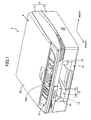
- the near side of a multifunctional device 1 in Fig. 1 is defined as the front
- left and right directions when viewing from the front of the multifunctional device 1 are defined as the left and right directions.
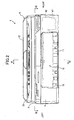
- the multifunctional device 1 includes a main casing 2 having an upper frame 5 and a lower frame 6.
- the lower frame 6 is formed in a substantially square shape in a plan view.
- a sheet accommodating section 10 is formed as a recess in the front bottom portion of the lower frame 6 and centered left-to-right, providing an arch-like front appearance to the lower frame 6.
- a conveying space 12 is defined inside the sheet accommodating section 10 for conveying a recording sheet P (see Fig. 12) in the front-to-rear direction.
- a sheet supply tray 11 for holding the recording sheets P is detachably inserted into the sheet accommodating section 10 and is capable of moving in the front-to-rear direction within the conveying space 12.
- the sheet supply tray 11 blocks the bottom of the sheet accommodating section 10.
- This construction also facilitates maintenance work for paper jams and the like since the bottom of the lower frame 6 can be opened simply by removing the sheet supply tray 11 from the sheet accommodating section 10.
- Guide pieces 13 formed in arch shapes are disposed near the front part of the sheet supply tray 11 to extend from the left and right edges of the sheet accommodating section 10 to cover the top of the recording sheet P loaded in the sheet supply tray 11.
- the guide pieces 13 determine the left-to-right position of the recording sheet P on the sheet supply tray 11.
- the guide pieces 13 also function as a discharge tray. After an image is formed on the recording sheet P in a recording unit 21 described later, the recording sheet P is discharged forward onto the top surfaces of the guide pieces 13.
- the guide pieces 13 divide the conveying space 12 into a lower supply space 12a for supplying the recording sheet P and an upper discharge space 12b for discharging the recording sheet P. Note that the guide pieces 13 have been omitted from Figs. 2-4.
- a printing unit 3 is accommodated in the lower frame 6.
- the printing unit 3 includes a conveying mechanism 20 for conveying the recording sheets P accommodated in the sheet supply tray 11 in the front-to-rear direction, and the recording unit 21 disposed in the rear section of the lower frame 6 for recording images on the recording sheets P.
- a cover 22 (Fig. 10) formed of a synthetic resin is mounted on the lower frame 6 for covering the conveying mechanism 20 and the recording unit 21.
- the conveying mechanism 20 includes an arm 23, a supply roller 24, a plate 25, a registration roller 26, a follow roller 27, and a discharge roller 28.
- the arm 23 is disposed above the rear end of the sheet supply tray 11 and extends downward from an engine frame 33 of the recording unit 21.
- the supply roller 24 is rotatably supported on the lower end of the arm 23.
- the plate 25 is disposed in a space in the rear of the sheet accommodating section 10 and has a U-shaped conveying part 25a.
- the registration roller 26 is disposed at a position farther forward than the plate 25 and farther rearward than the recording unit 21.
- the follow roller 27 is disposed in opposition to the registration roller 26.
- the discharge roller 28 is disposed in the front section of the recording unit 21.
- a motor (not shown) drives each of the supply roller 24, the registration roller 26, and the discharge roller 28 to rotate.
- the supply roller 24 picks up a recording sheet P from the sheet supply tray 11 one sheet at a time and conveys the recording sheet P to the U-shaped conveying part 25a formed in the plate 25.
- the recording sheet P is flipped over in the U-shaped conveying part 25a so as to be moving forward and is conveyed to the recording unit 21 by the registration roller 26 and the follow roller 27.
- the recording sheet P is discharged into the upper discharge space 12b by the discharge roller 28.
- the front-to-rear dimension of the multifunctional device 1 can be made shorter than a multifunctional device configured to feed a recording sheet P from the rear and discharge the recording sheet P toward the front.
- the recording unit 21 includes a carriage 30, an inkjet head 31, a platen 32, the engine frame 33, a timing belt 34, and a motor 39.
- the inkjet head 31 is attached to the bottom section of the carriage 30.
- the platen 32 is disposed below the carriage 30.
- the engine frame 33 supports the carriage 30 and the platen 32.
- a pair of front and rear guide plates 35 and 36 extending left-to-right are disposed above the engine frame 33.
- the carriage 30 is coupled with the motor 39 via the timing belt 34 and can be moved reciprocatingly left and right over the guide plates 35 and 36 to positions beyond both widthwise edges of the recording sheet P.
- the motor 39 moves the carriage 30 reciprocatingly left and right along the pair of guide plates 35 and 36, while ink is ejected from the inkjet head 31 disposed on the carriage 30 onto the recording sheet P being conveyed forward in the space below the inkjet head 31. In this manner, an image is formed on the recording sheet P.
- a maintenance unit 37 for cleaning the inkjet head 31 is provided below the right edge of the recording unit 21.
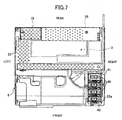
- a waste liquid absorbing member 38 is disposed in the space above the plate 25 and behind the carriage 30, occupying approximately the right two-thirds of the space.
- the waste liquid absorbing member 38 is for absorbing waste ink discharged from nozzles in the inkjet head 31 when the maintenance unit 37 performs maintenance operations. This makes effective use of the space in the lower frame 6.
- the inkjet head 31 is a serial head capable of moving beyond both widthwise edges of the recording sheet P.
- the recording unit 21 extends further in the left and right directions than the sheet accommodating section 10, thereby forming spaces on the left and right sides of the sheet accommodating section 10. Therefore, in the present embodiment, a cartridge holder 41 for holding ink cartridges 40 is disposed on the right side of the sheet accommodating section 10, and a power supply unit 60 is disposed on the left side of the sheet accommodating section 10, thereby making effective use of the spaces on both sides of the sheet accommodating section 10.
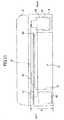
- the ceiling of the upper discharge space 12b (sheet accommodating section 10) need only be higher than the position at which the recording sheet P is discharged from the recording unit 21 (the top point of the discharge roller 28). Hence, the upper discharge space 12b need not be formed unnecessarily high. Therefore, as shown in Fig. 6, a main control board 50 for controlling operations of the multifunctional device 1 is disposed horizontally in a space above the sheet accommodating section 10. Also, the recording unit 21 is disposed behind the sheet accommodating section 10 such that the top portion of the recording unit 21 is substantially the same height as the main control board 50.
- the top of the main control board 50 and the top of the recording unit 21 are positioned in approximately the same plane as shown in Fig. 11. Accordingly, the space above the sheet accommodating section 10 is effectively used, while not increasing the height of the multifunctional device 1. Further, as shown in Fig. 11, the cartridge holder 41, the ink cartridges 40, and the power supply unit 60 fit vertically between the top of the main control board 50 (a connector 51 disposed on the main control board 50) and the bottom of the sheet accommodating section 10, indicated by "H" in Fig. 11. Hence, the height of the multifunctional device 1 can be made small, enabling the multifunctional device 1 to be made even more compact.
- the cartridge holder 41, the main control board 50, and the power supply unit 60 will be described further.
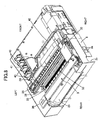
- ink cartridges 40 each accommodating ink for one of four colors (yellow, magenta, cyan, and black), are inserted into the cartridge holder 41 from the top of the cover 22 via an insertion hole 22a formed in the cover 22 and are aligned in the front-to-rear direction.
- the ink cartridges 40 are connected to the inkjet head 31 via flexible tubes 42 shown in Fig. 8.
- ink is supplied to the inkjet head 31 from the ink cartridges 40 via the flexible tubes 42.
- the ink cartridges 40 in this embodiment accommodate ink of the four colors black, cyan, magenta, and yellow, the ink cartridges 40 may accommodate ink for more colors.
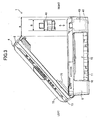
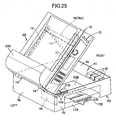
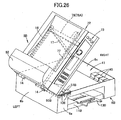
- the upper frame 5 is pivotably supported on the left edge of the lower frame 6 via shafts 14, such as hinges.
- the upper frame 5 can pivot open sideways about the side edge opposite the position of the cartridge holder 41. Pivoting the upper frame 5 in this way reliably reveals the top of the cartridge holder 41, enabling ink cartridges 40 to be easily mounted into the cartridge holder 41 from above.
- a guide rail 16 extending in the left-to-right direction is fixed to the bottom surface in the rear portion of the upper frame 5.
- the guide rail 16 is formed with a guide groove 16a extending left-to-right.
- a support rod 17 is pivotably attached to the lower frame 6 so as to be able to pivot about its lower right end.
- a guide pin 17a is provided on the free end of the support rod 17. The guide pin 17a is slidably engaged with the guide groove 16a.
- the support rod 17 supports the upper frame 5 in an open state.
- the upper frame 5 can be maintained in an open state with respect to the lower frame 6 at a large included angle ⁇ .
- the means for holding the upper frame 5 at a large included angle ⁇ with respect to the lower frame 6 may include arced guard rails disposed near the shafts 14 and guide pins that are guided by these rails.
- urging means may be provided for urging the upper frame 5 upward in order to maintain the upper frame 5 in the open state.
- the top surface of the lower frame 6 can be opened wide, improving visibility and facilitating such operations as maintenance of the inkjet head 31 and the like, clearing of paper jams along the conveying path, and replacing of the ink cartridges 40.
- a distance A between the right edge of the upper frame 5 in its uppermost position and the right edge of the lower frame 6 when viewed from the front is set either equal to or greater than a width dimension B of the ink cartridges 40, then the ink cartridges 40 can be almost vertically lifted out of or inserted into the cartridge holder 41 on the side of the lower frame 6, improving visibility and facilitating mounting and removal operations of the ink cartridges 40.
- the main control board 50 has a flat substantially rectangular shape and extends to the left side above the power supply unit 60. Accordingly, even when a main control board 50 having a relatively large surface area is required due to a large number of electronic parts or terminals mounted thereon, for example, the main control board 50 can still be disposed above the sheet accommodating section 10 by extending the main control board 50 over the power supply unit 60. Hence, the multifunctional device 1 can be made compact by effectively using the space above the sheet accommodating section 10. Also, because the power supply unit 60 is positioned nearly directly below the main control board 50, a wire connecting the main control board 50 and the power board 62 can be very short.
- the main control board 50 does not extend to the right above the cartridge holder 41 so that the main control board 50 does not hinder operations for mounting the ink cartridges 40 into the cartridge holder 41 from above.
- main control board 50 As shown in Fig. 10, electronic parts I and various connectors are provided on the main control board 50. Specifically, two connectors 51 and 52 for connecting to a media card are disposed in the front left region of the main control board 50.
- a front cover 53 is disposed on the front surface of the lower frame 6.
- the front cover 53 is formed with two slots 53a and 53b through which media cards are inserted.
- the media cards inserted into the slots 53a and 53b form an electrical connection with the respective connectors 51 and 52 on the main control board 50. Since the main control board 50 is disposed above the sheet accommodating section 10 as shown in Fig. 11, the slots 53a and 53b (and the connectors 51 and 52) are disposed at a relatively high position, facilitating insertion of the media cards in the slots 53a and 53b.
- a connector 54 for connecting to a personal computer or other external device and a LAN connector 55 for connecting to a LAN are disposed on the rear right region of the main control board 50. Further, a connector 56 for connecting to a network board 61 described later is mounted on the rear left region of the main control board 50. A plurality of other connectors is also provided along the peripheral edge of the main control board 50.
- the power supply unit 60 has a block shape elongated in the front-to-rear direction.
- the power supply unit 60 houses a power board 62 that uses commercial AC power sources to generate 5 volt DC power used to power a CPU, a memory, and the like, and 30 volt DC power for operating motors and other actuators.
- Wiring materials (not shown) connect the power board 62 to the main control board 50 or the power board 62 to various motors so that voltages generated by the power board 62 can be applied to the main control board 50 and the motors.
- the network board 61 is disposed in a space behind the power supply unit 60 and below the left edge of the recording unit 21.
- the network board 61 is a circuit board functioning to perform wired communications via a telephone line.
- two modular connectors 63 are provided on the network board 61 for connecting to a telephone line and an external handset.
- the network board 61 enables data communications with another facsimile device and a phone call using the external handset (not shown).
- the power supply unit 60 and the network board 61 are both mounted on a metal plate fixture 64 and attached to the lower frame 6 as an integral unit.
- the plate fixture 64 has a flat base 64a extending in the front-to-rear direction, and a side wall 64b disposed along rear and right edges of the flat base 64a.
- the power supply unit 60 is mounted in the front area of the plate fixture 64, while the network board 61 is mounted in the rear area.
- Special protective covers 65 and 66 are mounted over the power supply unit 60 and the network board 61, respectively.
- a plurality of holes 65a are formed in the protective cover 65 in order to release heat generated by the power supply unit 60.
- Escape holes 66a are formed in the protective cover 66 at positions opposing the modular connectors 63.
- An opening 66b is formed in the protective cover 66 at a position facing the power supply unit 60, enabling the passage of the electric wires used to connect the main control board 50.
- An opening (not shown) is formed in the bottom surface of the lower frame 6 on the left side of the sheet accommodating section 10, and the integrated power supply unit 60 and the network board 61 are mounted in the lower frame 6 through the opening. Hence, it is possible to remove the power supply unit 60 and the network board 61 from the lower frame 6 alone, facilitating maintenance.
- Insertion slots 2a are formed in the left wall of the lower frame 6 at points opposing the modular connectors 63 of the network board 61 for inserting modular jacks.
- a cord outlet 2b is formed in the same side of the lower frame 6 rearward of the insertion slots 2a for running a power cord out of the device.
- a control panel 73 is disposed in the front area on top of the upper frame 5, and a scanner 4 is disposed in the area behind the control panel 73.
- the control panel 73 includes various buttons, such as the numerical buttons 0-9, a Start button, and function buttons that can be pressed to perform various operations.
- the control panel 73 is also provided with a display portion 73A, such as a liquid crystal display, for displaying settings for the multifunctional device 1, messages, or the like according to need.
- the scanner 4 functions to scan images from a facsimile original to be transmitted to another facsimile device when using the facsimile function, or images of an original to be copied when using the copier function.
- the scanner 4 includes a glass plate 70 mounted on the upper frame 5 to support original documents, a scanning unit 71 for scanning images of documents placed on the glass plate 70, and a document cover 72 for covering the glass plate 70.
- the scanning unit 71 is disposed directly below the glass plate 70 so that the glass plate 70 is interposed between the scanning unit 71 and an original document placed on the top surface of the glass plate 70.
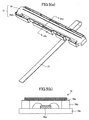
- the scanning unit 71 includes a line-type contact image sensor (CIS) 79 and a frame 79A on which the contact image sensor 79 is supported.
- the frame 79A and the contact image sensor 79 extend in the front-to-rear direction parallel to the shafts 14.
- the contact image sensor 79 has a cover glass 79a, a frame 79b, a substrate 79c, and a plurality of photoelectric conversion elements 79d (only one photoelectric conversion element 79d is shown in Fig.5(b)).
- the photoelectric conversion elements 79d are for reading images from the surface of the document on the glass plate 70.
- the photoelectric conversion elements 79d are aligned in the longitudinal direction of the contact image sensor 79, that is, in the front-to-rear direction of the multifunctional device 1.
- sliders 74 are disposed on the front and rear ends of the scanning unit 71.
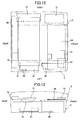
- the scanning unit 71 is coupled with a drive motor 75 shown in Fig. 12 and scans images of a document on the glass plate 70 while the drive motor 75 and a timing belt (not shown) move the scanning unit 71 reciprocatingly left and right with respect to the upper frame 5 via the sliders 74.
- a depression 71a is formed on the bottom of and in the front-to-rear center portion of the scanning unit 71.
- a guide shaft 76 extending in the left-to-right direction is fitted into the depression 71a for guiding the scanning unit 71 left and right.
- the frame 79A with the contact image sensor 79 mounted thereon is capable of moving reciprocatingly in a direction perpendicular to the shafts 14.
- a flexible wiring member 77 such as a flexible flat cable, connects the contact image sensor 79 to the main control board 50.
- the main control board 50 extends to a point near the pivotal axis of the upper frame 5 (the left edge of the lower frame 6), while the wiring member 77 extends from a portion of the main control board 50 near the pivotal axis of the upper frame 5 to the scanning unit 71.
- one end of the wiring member 77 is connected to a mid-portion of the contact image sensor 79 in the longitudinal direction, while the other end is connected to the left edge of the main control board 50 parallel to the shafts 14.
- the wiring member 77 runs around the periphery of the shaft 14 so that the flat surface (widthwise surface) of the wiring member 77 confronts the pivotal axis of the upper frame 5 and so that the longitudinal direction of the wiring member 77 is orthogonal to the pivotal axis of the upper frame 5 and parallel to the direction in which the contact image sensor 79 moves.
- the edges at both connecting ends of the wiring member 77 are arranged parallel to the pivotal axis of the upper frame 5.
- the widthwise surface of the wiring member 77 includes a large curved section near the shaft 14 that is not twisted when the upper frame 5 is closed over the lower frame 6 or when the upper frame 5 is opened wide.
- the widthwise surface of the wiring member 77 at a midpoint in the longitudinal direction does not twist, even when the contact image sensor 79 is in a standby position, that is, near the shafts 14. Accordingly, an unreasonable force is not applied to the wiring member 77, making it possible to minimize the potential for damage to the wiring member 77, even when the multifunctional device 1 is used over a long period of time and the upper frame 5 is repeatedly opened and closed.
- the document cover 72 is pivotably attached to the rear end of the upper frame 5 via hinges 78.
- the pivotal axis of the upper frame 5 with respect to the lower frame 6 is orthogonal to the pivotal axis of the document cover 72 with respect to the upper frame 5. Therefore, when the upper frame 5 is pivoted open on the lower frame 6, the document cover 72 is prevented from opening simultaneously.
- the drive motor 75 is accommodated in a portion protruding downward from the left rear of the upper frame 5, so the drive motor 75 protrudes downward from the bottom of the upper frame 5.
- the drive motor 75 occupies approximately one-third of the space on the left side above the plate 25 (the recessed portion adjacent to the waste liquid absorbing member 38) as shown in Fig. 7, thereby effectively using the space behind the recording unit 21. Since the main control board 50 is disposed in the front of the main casing 2 while the drive motor 75 is disposed in the rear, adverse effects of noise generated when operating the drive motor 75 on the main control board 50 can be minimized.
- the multifunctional device 1A includes an upper frame 5A and a scanner 4A.
- the upper frame 5A is pivotably supported on the left end of the lower frame 6 in the same manner as the upper frame 5 of the first embodiment.
- the scanner 4A includes a document cover 72A, a document supply tray 80, a discharge tray 81, and an automatic document feeder 82.
- the document cover 72A is pivotably attached to the rear edge of the upper frame 5A.
- the document supply tray 80 is disposed on the top surface of the document cover 72A, and the discharge tray 81 is disposed above the document supply tray 80.
- the document supply tray 80 guides an original document into the automatic document feeder 82 on the left.
- the automatic document feeder 82 automatically conveys an original document from the document supply tray 80 to a scanning position to be scanned by the scanning unit 71. After the scanning unit 71 scans an image from the document, the document is discharged onto the discharge tray 81, and the discharge tray 81 guides the original document toward the right.
- a document stopper 83 is disposed on the right edge of the document cover 72A for receiving the discharged documents.
- the automatic document feeder 82 includes a cover 84, a pressing plate 85, a pickup roller 86, a separation roller 87, and a reversing roller 88.
- the cover 84 is disposed at the left end of the document cover 72A to be freely opened and closed.
- the pressing plate 85 is disposed above the glass plate 70 (see Fig. 6) for pressing an original document against the glass plate 70.
- the pickup roller 86 and the separation roller 87 are rotatably supported on the pressing plate 85 for feeding original documents one at a time inside the cover 84.
- the reversing roller 88 is for reversing the feeding direction of original documents fed inside the cover 84, and is rotatably supported on the cover 72A via a drive shaft 89.
- pad members 90 and 91 capable of resiliently contacting the pickup roller 86 and the separation roller 87, respectively, and follow rollers 92 and 93 capable of resiliently contacting the reversing roller 88.
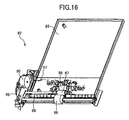
- a casing 94 is disposed behind the cover 84. As shown in Fig. 16, the casing 94 houses a document feeding motor 95 and a gear mechanism 96.
- the document feeding motor 95 is connected to the main control board 50 via a cable 97.
- the gear mechanism 96 is for transferring the rotational drive force of the document feeding motor 95 to the pickup roller 86, the separation roller 87, and the drive shaft 89.
- the rotational driving force transferred from the document feeding motor 95 drives the pickup roller 86 and the separation roller 87 to rotate and feed an original document from the document supply tray 80 into the cover 84 one sheet at a time.
- the document feeding motor 95 also drives the reversing roller 88 to rotate.
- the reversing roller 88 inverts the document fed by the pickup roller 86 and the separation roller 87 and changes the direction in which the document is conveyed from a leftward direction to a rightward direction.
- the scanning unit 71 disposed at a scanning position below the reversing roller 88 scans the image on the original document. After being scanned, the document is discharged onto the discharge tray 81.
- the document feeding motor 95 is disposed near the pivotal axis of the upper frame 5A at the left end of the upper frame 5A, an unreasonable force is not applied to a wiring member (not shown) connecting the document feeding motor 95 and the main control board 50 (Fig. 6) and the cable 97 connecting the document feeding motor 95 to the power supply unit 60 (see Fig. 9) when the upper frame 5A is pivoted on the lower frame 6, thereby minimizing the potential for damage to the wiring member and the cable 97. Further, since the document feeding motor 95 is disposed on the rear edge of the multifunctional device 1A, opposite the side on which the main control board 50 is disposed, adverse effects of noise generated by the document feeding motor 95 on the main control board 50 can be minimized.
- the sheet supply tray 11 mounted on the sheet accommodating section 10 also functions as a discharge tray, wherein the recording sheet P supplied from the lower supply space 12a on the front is reversed in the lower frame 6 and discharged into the upper discharge space 12b on the front.
- the sheet supply tray 11 may also be configured of only the upper discharge space 12b in the sheet accommodating section 10, such that the recording sheet P is supplied from the rear and discharged into the upper discharge space 12b on the front, for example.
- the positions of the cartridge holder 41 and the power supply unit 60 on the right and left sides of the sheet accommodating section 10 may be switched.
- the cartridge holder 41 is configured so that the ink cartridges 40 are mounted and removed through the top thereof, as in the multifunctional device 1 of the preferred embodiment described above, the cartridge holder 41 is preferably disposed on the side opposite the pivotal axis of the upper frame 5 in order to facilitate this replacement operation.
- the cartridge holder 41 may be disposed on either the left or right side of the sheet accommodating section 10.
- the multifunctional device 1B includes an upper frame 5B and a lower frame 6B.
- the lower frame 6B is formed in an open-top box shape and includes a front plate 6a, side plates 6b, 6c, and a bottom plate 6d (Fig. 21).
- the upper frame 5B is pivotably supported by the side plate 6b via the shafts 14.
- the rear end of the bottom frame 6B is covered with a rear cover 19 shown in Fig. 21.
- a sheet supply tray 11B is disposed in the left-to-right center region of the lower frame 6B and accommodates a stack of recording sheets P.
- the sheet supply tray 11B can be pulled out from the front surface of the lower frame 6B.
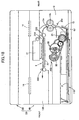
- a conveying mechanism 20B disposed inside the lower frame 6B are a conveying mechanism 20B, a U-shaped conveying part 25a, a conveying path 9, and a recording section 21A.
- the conveying mechanism 20B includes a supply roller 24, a drive shaft 98, a gear mechanism 99, a separation plate 15, and a discharge section 13B.
- the recording section 21A includes a flat platen 32 and an inkjet head 31 for forming color images on a sheet P supported on the platen 32 by ejecting ink thereon.
- the supply roller 24 is disposed above the supply tray 11B and driven to rotate in a counterclockwise direction in Fig. 18 by the gear mechanism 99.
- the drive shaft 98 is rotated by a drive motor via a gear mechanism (not shown).
- a casing for the conveying mechanism 20B is rotatable with respect to the drive shaft 98.
- the U-shaped conveying part 25a is disposed in the rear section of the lower frame 6B and is formed in the shape of a sideways "U" letter.
- a conveying roller 18a and a follow roller 18b are disposed in the U-shaped conveying part 25a.
- the conveying roller 18a and the follow roller 18b are maintained in contact with one another with an appropriate amount of pressure.
- the conveying path 9 is formed to convey the recording sheet P forward in a substantially horizontal state.
- the discharge rollers 28B are a driven discharge roller and a spur.
- the separating plate 15 has a banked surface with a large frictional coefficient.
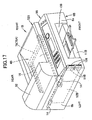
- the discharging section 13B is formed as an opening in the front surface of the lower frame 6B above the sheet supply tray 11B (see Fig. 17).
- the supply roller 24 rotates, the topmost one of the recording sheets P stacked in the sheet supply tray 11B is separated by the separating plate 15 and fed between the conveying roller 18a and the follow roller 18b.
- the recording sheet P is discharged to the discharging section 13B.
- media slots 106 are formed as longitudinal openings in the left side of the front plate 6a (farther left from the discharging section 13B).
- the media slots 106 accept the insertion of an external storage medium capable of storing image data or the like, such as a SmartMedia (registered trademark) card, a CompactFlash (registered trademark) card, a Memory Stick (registered trademark), or a SD Card, XD Card, or the like.
- a main control board 50B having connectors 51B that connect to the media slots 106 is disposed near the inner surface of the side plate 6b and substantially parallel thereto.
- a cartridge holder 41 is disposed near the inner surface of the side plate 6c inside the lower frame 6B. Ink cartridges 40 can be mounted into the cartridge holder 41 from above.
- the multifunctional device 1B further includes a scanner 4B.
- the scanner 4B includes a flatbed scanning unit and an automatic scanning unit.
- the flatbed scanning unit functions to scan an image from an original document placed on a large glass plate (not shown; a second glass plate described later).
- the construction of the flatbed scanning unit is nearly identical to the scanner 4 described in the first embodiment. Therefore, a detailed description of the flatbed scanning unit has been omitted.
- the automatic scanning unit is for scanning images from an original document fed by an automatic document feeder 82B.
- a discharging unit 81B shown in Fig. 20 is formed on the top surface of the document cover 72B for receiving an original document that is discharged after being supplied by the automatic document feeder 82B and scanned.
- a document cover 72B may be configured to pivot open and closed on the rear surface of the multifunctional device 1B about hinges or may be configured to pivot open and closed about an axis parallel to the shafts 14.
- the multifunctional device 1B further includes a first glass plate that contacts the image surface of original documents fed by the automatic document feeder 82B, and the second glass plate having a larger surface area than the first glass plate for contacting the image surface of original documents laid flat in a static position.
- the first and second glass plates are disposed parallel to one another, but separated in the right-to-left direction which is orthogonal to the document conveying direction.
- the bottom surfaces of the glass plates are linked by a guide rail extending in the right-to-left direction.
- the first glass plate is disposed near the shafts 14.
- the standby position of the contact image sensor 79 for scanning an image with the flatbed scanning unit is set directly below the first glass plate.
- the contact image sensor 79 remains in this standby position when images are scanned with the automatic scanning unit.
- the standby position of the heavy contact image sensor 79 is set near the pivotal axis of the upper frame 5B, enabling the upper frame 5B to be opened with little force.
- the main control board 50B is connected to the image sensor 79 by the flexible wiring member 77.
- one end of the wiring member 77 is connected to a mid-portion of the image sensor 79 in the longitudinal direction, while the other end is connected to the upper edge of the main control board 50B.
- the widthwise surface of the wiring member 77 at a midpoint in the longitudinal direction does not twist, and an unreasonable force is not applied to the wiring member 77, even when the multifunctional device 1B is used over a long period of time and the upper frame 5B is repeatedly opened and closed. This makes it possible to minimize the potential for damage to the wiring member 77.
- the main control board 50B is positioned near the shafts 14 and the wiring member 77 is laid out so as to curve near the shaft 14 without its widthwise surface twisting, the mid-portion of the wiring member 77 does not incur an unreasonable bending force.
- unused space in the lower frame 6B near the shafts 14 can be effectively used for accommodating the main control board 50B.
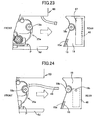
- the rear cover 19 is detachably inserted into the rear side of the lower frame 6B.
- the widthwise dimension of the rear cover 19 may be equal to or shorter than the widthwise dimension of the lower frame 6B on the rear surface side.
- the follow roller 18b is rotatably disposed on the inside of the rear cover 19, and the rear cover 19 is fitted between the lower frame 6B and the bottom plate 6d.
- One side of the U-shaped conveying part 25a can be exposed by pulling the rear cover 19 from the rear surface of the lower frame 6B in a substantially horizontal direction. Since the follow roller 18b rotates on the inside of the rear cover 19, a considerable space can be opened between the conveying roller 18a and the follow roller 18b by pulling out the rear cover 19, greatly facilitating operations for removing jammed recording sheet P.
- the separating plate 15 is also mounted on the inside of the rear cover 19. Hence, by pulling the rear cover 19 out of the rear surface of the lower frame 6B, a sheet jammed between the supply roller 24 and the separating plate 15 can be easily removed and operations for maintaining a surface 15a of the separating plate 15 or for replacing the separating plate 15 are facilitated.
- the conveying roller 18a and the follow roller 18b could be configured to remain inside the lower frame 6B when the rear cover 19 is removed. This simplifies the construction of the rear cover 19, since the rotating portion for the follow roller 18b need not be provided in the rear cover 19.
- a power board 46 may be provided inside the rear cover 19. This construction makes effective use of space in the rear cover 19 and facilitates operations for replacing the power board 46.
- an inner cover 47 may also be detachably disposed in the rear cover 19 for covering the surface of the power board 46. This construction prevents the power board 46 from being exposed when the rear cover 19 is removed, thereby enabling the power board 46 to be replaced safely and preventing dust and the like from entering the power board 46.
- the inner cover 47 may also be formed in a curved shape to form one surface of the U-shaped conveying part 25a.
- an accumulating member 48 such as a porous fiber mat or a tank, may be disposed inside the rear cover 19 for accumulating and holding waste ink.
- a waste ink tube 49 may be connected to a maintenance unit (not shown) used for regularly cleaning ink from nozzles in the inkjet head 31 in a nozzle restoring process or the like, and a connecting hole 19b may be formed in the rear cover 19 for detachably connecting the other end of the waste ink tube 49.
- the media slots 106 could be formed in the front plate 6a of the lower frame 6B to extend in a horizontal direction
- the main control board 50B could be disposed in the lower frame 6B near the inside surface of the side plate 6b at a substantially horizontal orientation so that the longitudinal direction of the main control board 50 extends in the left-to-right direction of the multifunctional device 1B.
- the power board 46 may also be disposed in the front-to-rear direction near the inner surface of the side plate 6b and substantially parallel to the side plate 6b.
- the media slots 106 could be formed in the lower frame 6B to extend in the widthwise direction of the front plate 6a, and the main control board 50B could be disposed inside the lower frame 6B near the inner surface of the side plate 6b so that the longitudinal direction of the main control board 50B extends in the front-to-rear direction.
- the shafts 14 may be disposed on the right edge of the multifunctional device rather than on the left edge thereof.
- an image-forming device includes a lower frame, an upper frame capable of pivoting open and closed with respect to the lower frame about an axis extending in a first direction, a scanning unit that is disposed in the upper frame and scans an original document while reciprocally moving in a second direction orthogonal to the first direction, and a control board having one side extending in the first direction.
- This configuration makes it possible to connect the scanning unit and a control board disposed inside the lower frame with a flat cable without twisting the flat cable.
- the scanning unit preferably includes a plurality of photoelectric conversion elements aligned in the first direction.
- the image-forming device preferably further include a flexible flat cable having a first end connected to one side of the scanning unit extending in the first direction and a second end connected to the one side of the control board.
- the flat cable connects the scanning unit and the control board without being twisted. Therefore, the potential for damage to the flat cable can be minimized.
- a media slot, to which a storage medium is inserted may be formed as an opening in a first surface of the lower frame, and the control board may be disposed near the media slot and have a connector that connects to the storage medium inserted through the media slot.
- the flexible flat cable may run around the periphery of the axis with a flat surface of the flexible flat cable positioned substantially in opposition to the axis. With this configuration, the flat cable runs across the axis and connects the scanning unit and the control board without being twisted.
- the lower frame has a second surface extending in the first direction, and the control board has a surface on which a connector is disposed.
- the surface of the control board is preferably substantially parallel to the second surface of the lower frame. Also, the surface of the control board may be substantially parallel to a plane on which the scanning unit moves.
- a standby position for the scanning unit in the upper frame may be set in one side of the upper frame near the axis.
- the standby position for the heavy scanning unit is set near the axis, enabling the upper frame to be opened with little force.
- the image-forming device may further include a support that is disposed between the upper frame and the lower frame and supports the upper frame in a prescribed open position. This configuration facilitates insertion of an ink cartridge to the accommodating section.
- the image-forming device may further include a recording unit that is disposed in the lower frame and that forms an image on a recording medium, the recording unit having an accommodating section in which an ink cartridge is accommodated, the accommodating section being disposed in a side of the lower frame farthest separated from the axis. This configuration enables an ink cartridge to be easily mounted into the accommodating section from above.
- a distance between a side farthest from the axis of the upper frame maintained in the prescribed open position and the side farthest from the axis of the lower frame with respect to the second direction is preferably set equivalent to or greater than a dimension of the ink cartridge with respect to the second direction.
- the image-forming device include a medium holding unit that is disposed in the bottom of the lower frame and holds a recording medium, a conveying mechanism that is disposed in the lower frame and conveys the recording medium along a conveying path, a recording unit that is disposed in the lower frame and forms an image on the recording medium conveyed by the conveying mechanism, and a cover that is detachably mounted on the lower frame, that a part of the conveying path is shaped as a sideways U letter, and that the part of the conveying path is exposed when the cover is removed from the lower frame.
- the image-forming device may include a replaceable member mounted on the cover. This construction makes effective use of space in the cover and facilitates operations for replacing the replaceable member.
- the image-forming device may include a power board mounted on the cover. This construction makes effective use of space in the cover and facilitates operations for replacing the power board.
- the image-forming device may include a waste ink accumulating member mounted on the cover, and the waste ink accumulating member stores waste ink. This construction makes effective use of space in cover and facilitates operations for replacing the waste ink accumulating member.
- the image-forming device may include a replaceable member disposed inside the cover and an inner cover that defines the part of the conveying path and that covers the replaceable member. This configuration enables the replaceable member to be replaced safely and preventing dust and the like from entering the replaceable member.
- the image-forming device may include a separating member that is disposed on the cover and separates one recording medium from a stack of recording medium held in the medium holding unit. With this configuration, operations for maintaining of the separating member or for replacing the separating member are facilitated.
- the image-forming device may include an inkjet recording head disposed in the recording unit.
Landscapes
- Accessory Devices And Overall Control Thereof (AREA)
- Facsimiles In General (AREA)
- Ink Jet (AREA)
Applications Claiming Priority (4)
| Application Number | Priority Date | Filing Date | Title |
|---|---|---|---|
| JP2003434532A JP4386173B2 (ja) | 2003-12-26 | 2003-12-26 | 画像形成装置 |
| JP2003434532 | 2003-12-26 | ||
| JP2004219567 | 2004-07-28 | ||
| JP2004219567A JP4595425B2 (ja) | 2004-07-28 | 2004-07-28 | 記録装置 |
Publications (2)
| Publication Number | Publication Date |
|---|---|
| EP1547792A1 true EP1547792A1 (fr) | 2005-06-29 |
| EP1547792B1 EP1547792B1 (fr) | 2006-07-19 |
Family
ID=34554888
Family Applications (1)
| Application Number | Title | Priority Date | Filing Date |
|---|---|---|---|
| EP04258125A Expired - Lifetime EP1547792B1 (fr) | 2003-12-26 | 2004-12-24 | Dispositif de formation d'images |
Country Status (4)
| Country | Link |
|---|---|
| US (2) | US7712891B2 (fr) |
| EP (1) | EP1547792B1 (fr) |
| CN (1) | CN1325275C (fr) |
| DE (1) | DE602004001570T2 (fr) |
Families Citing this family (45)
| Publication number | Priority date | Publication date | Assignee | Title |
|---|---|---|---|---|
| TW592174U (en) * | 2003-04-01 | 2004-06-11 | Lite On Technology Corp | Multi-functional office machine |
| EP1642736B1 (fr) | 2004-09-27 | 2008-04-09 | Seiko Epson Corporation | Appareil d'éjection de liquide |
| US8040575B2 (en) * | 2005-05-14 | 2011-10-18 | Wisecube Co., Ltd. | Double side image scanner |
| EP1748637A1 (fr) * | 2005-07-26 | 2007-01-31 | Brother Kogyo Kabushiki Kaisha | Dispositif de balayage d'image et dispositif à fonctions multiples avec dispositif d'affichage à charnière |
| US7971989B2 (en) * | 2005-12-07 | 2011-07-05 | Seiko Epson Corporation | Printer used with rolled sheet |
| JP4321531B2 (ja) * | 2006-02-01 | 2009-08-26 | ブラザー工業株式会社 | 画像読取装置 |
| JP4525620B2 (ja) * | 2006-03-07 | 2010-08-18 | ブラザー工業株式会社 | 画像記録装置、多機能装置 |
| US7675536B2 (en) * | 2006-04-19 | 2010-03-09 | Lexmark International, Inc. | Architectures for multi-functional image forming devices |
| JP5114878B2 (ja) * | 2006-06-30 | 2013-01-09 | ブラザー工業株式会社 | インクジェット記録装置 |
| JP2008012677A (ja) * | 2006-06-30 | 2008-01-24 | Brother Ind Ltd | 画像記録装置 |
| JP4952093B2 (ja) * | 2006-06-30 | 2012-06-13 | ブラザー工業株式会社 | インクジェット記録装置 |
| JP4935208B2 (ja) * | 2006-07-01 | 2012-05-23 | ブラザー工業株式会社 | 画像記録装置 |
| JP4941110B2 (ja) * | 2007-06-01 | 2012-05-30 | ブラザー工業株式会社 | インクジェットプリンタ |
| JP4905287B2 (ja) * | 2007-08-02 | 2012-03-28 | ブラザー工業株式会社 | プリンタ |
| JP2009086403A (ja) * | 2007-10-01 | 2009-04-23 | Brother Ind Ltd | 画像表示装置 |
| KR100997239B1 (ko) * | 2008-03-03 | 2010-11-29 | 삼성전자주식회사 | Crum 유닛, 교체가능유닛 및 이를 이용하는 화상형성장치와, 그 인증 및 암호화 데이터 통신 방법 |
| JP4983831B2 (ja) * | 2009-03-25 | 2012-07-25 | ブラザー工業株式会社 | 記録装置 |
| JP4858590B2 (ja) * | 2009-09-30 | 2012-01-18 | ブラザー工業株式会社 | 画像処理装置 |
| WO2011105819A2 (fr) * | 2010-02-26 | 2011-09-01 | 탐투스(주) | Dispositif de capture numérique pour apprentissage |
| IN2012DN01303A (fr) * | 2010-07-15 | 2015-06-05 | Seiko Epson Corp | |
| JP5056924B2 (ja) * | 2010-08-30 | 2012-10-24 | ブラザー工業株式会社 | 画像読取装置 |
| JP5327256B2 (ja) | 2011-03-30 | 2013-10-30 | ブラザー工業株式会社 | 入力装置及び画像表示装置 |
| US8814327B2 (en) | 2011-07-01 | 2014-08-26 | Canon Kabushiki Kaisha | Power supply apparatus and printing apparatus |
| US8696610B2 (en) | 2011-07-21 | 2014-04-15 | Clifford T. Solomon | Magnetorheological medical brace |
| JP5790351B2 (ja) | 2011-09-09 | 2015-10-07 | ブラザー工業株式会社 | インクジェット記録装置 |
| JP5906622B2 (ja) | 2011-09-09 | 2016-04-20 | ブラザー工業株式会社 | インクジェット記録装置 |
| JP5782961B2 (ja) | 2011-09-27 | 2015-09-24 | ブラザー工業株式会社 | 液滴噴射装置 |
| JP6161869B2 (ja) | 2012-03-05 | 2017-07-12 | セイコーエプソン株式会社 | 液体噴射装置 |
| CN103722891B (zh) * | 2012-10-15 | 2015-11-18 | 精工爱普生株式会社 | 记录装置 |
| US9421781B2 (en) | 2012-10-15 | 2016-08-23 | Seiko Epson Corporation | Recording apparatus |
| US9409407B2 (en) * | 2013-01-18 | 2016-08-09 | Seiko Epson Corporation | Liquid ejection apparatus and tank |
| JP6064687B2 (ja) * | 2013-03-07 | 2017-01-25 | セイコーエプソン株式会社 | 画像形成システム |
| CN104228340B (zh) | 2013-06-05 | 2016-05-18 | 精工爱普生株式会社 | 记录装置 |
| JP6291914B2 (ja) * | 2014-03-05 | 2018-03-14 | セイコーエプソン株式会社 | 記録装置 |
| JP6128035B2 (ja) | 2014-03-28 | 2017-05-17 | ブラザー工業株式会社 | 画像形成装置 |
| JP6075318B2 (ja) * | 2014-03-28 | 2017-02-08 | ブラザー工業株式会社 | 画像形成装置 |
| JP6805498B2 (ja) * | 2016-01-29 | 2020-12-23 | セイコーエプソン株式会社 | 複合機 |
| WO2018003473A1 (fr) | 2016-06-28 | 2018-01-04 | セイコーエプソン株式会社 | Récipient de liquide et appareil d'injection de liquide |
| JP6969151B2 (ja) * | 2017-05-11 | 2021-11-24 | セイコーエプソン株式会社 | 液体噴射装置 |
| JP7256446B2 (ja) | 2019-03-13 | 2023-04-12 | セイコーエプソン株式会社 | 液体噴射装置 |
| JP7314541B2 (ja) | 2019-03-13 | 2023-07-26 | セイコーエプソン株式会社 | 液体噴射装置 |
| JP7278835B2 (ja) * | 2019-03-29 | 2023-05-22 | キヤノン株式会社 | 記録システム、読取装置、読取装置の保持装置 |
| JP7188263B2 (ja) * | 2019-04-24 | 2022-12-13 | セイコーエプソン株式会社 | 記録装置 |
| JP7247746B2 (ja) * | 2019-05-21 | 2023-03-29 | セイコーエプソン株式会社 | 記録装置 |
| JP7501006B2 (ja) * | 2020-03-11 | 2024-06-18 | セイコーエプソン株式会社 | 記録装置 |
Citations (3)
| Publication number | Priority date | Publication date | Assignee | Title |
|---|---|---|---|---|
| US5909226A (en) * | 1995-07-18 | 1999-06-01 | Canon Kabushiki Kaisha | Apparatus for forming images |
| US6113217A (en) * | 1997-10-02 | 2000-09-05 | Canon Kabushiki Kaisha | Ink-jet printing apparatus |
| JP2003298790A (ja) | 2002-03-29 | 2003-10-17 | Brother Ind Ltd | 記録装置 |
Family Cites Families (23)
| Publication number | Priority date | Publication date | Assignee | Title |
|---|---|---|---|---|
| DE3521514A1 (de) * | 1984-06-18 | 1985-12-19 | Kabushiki Kaisha Toshiba, Kawasaki, Kanagawa | Bildinformation-lesevorrichtung |
| JPS6467069A (en) * | 1987-09-07 | 1989-03-13 | Toshiba Corp | Image information reader |
| JPH0327665A (ja) * | 1989-06-23 | 1991-02-06 | Toshiba Corp | 画像情報読取り装置 |
| JPH0746843Y2 (ja) | 1990-01-12 | 1995-10-25 | 内山工業株式会社 | ガスケット付シール |
| JPH04213466A (ja) | 1990-12-11 | 1992-08-04 | Ricoh Co Ltd | 画像形成装置 |
| JPH05307293A (ja) | 1992-04-24 | 1993-11-19 | Sharp Corp | 原稿読み取り装置の駆動方法及び原稿読み取り装置 |
| JPH0789161A (ja) * | 1993-04-28 | 1995-04-04 | Canon Inc | 画像形成装置および画像形成方法 |
| US5574274A (en) * | 1995-02-21 | 1996-11-12 | Microtek International, Inc. | Transmissive/reflective optical scanning apparatus |
| US6685313B2 (en) * | 1997-06-30 | 2004-02-03 | Hewlett-Packard Development Company, L.P. | Early transparency detection routine for inkjet printing |
| JP3402593B2 (ja) | 2000-11-13 | 2003-05-06 | セイコーエプソン株式会社 | 画像入出力装置 |
| JP2002284455A (ja) | 2001-03-22 | 2002-10-03 | Ricoh Co Ltd | 画像形成装置 |
| US7137689B2 (en) | 2002-03-28 | 2006-11-21 | Brother Kogyo Kabushiki Kaisha | Ink cartridge |
| JP4193435B2 (ja) | 2002-07-23 | 2008-12-10 | ブラザー工業株式会社 | インクカートリッジ、および、そのインク充填方法 |
| US6860594B2 (en) * | 2001-04-11 | 2005-03-01 | Canon Kabushiki Kaisha | Image forming apparatus with improved jam removal |
| JP3642295B2 (ja) | 2001-05-30 | 2005-04-27 | 村田機械株式会社 | レーザプリンタ |
| JP4065499B2 (ja) * | 2001-07-24 | 2008-03-26 | キヤノン株式会社 | 画像読取装置 |
| JP4552370B2 (ja) | 2001-09-27 | 2010-09-29 | ブラザー工業株式会社 | 開閉機構 |
| JP4035340B2 (ja) | 2002-02-07 | 2008-01-23 | キヤノン株式会社 | 画像読取装置 |
| US6976749B2 (en) | 2002-03-28 | 2005-12-20 | Brother Kogyo Kabushiki Kaisha | Ink cartridge and recording device |
| AU2003219553A1 (en) | 2002-03-28 | 2003-10-13 | Brother Kogyo Kabushiki Kaisha | Printing device |
| US6886928B2 (en) | 2002-03-28 | 2005-05-03 | Brother Kogyo Kabushiki Kaisha | Ink cartridge and method of production thereof |
| US7547092B2 (en) * | 2004-01-21 | 2009-06-16 | Silverbrook Research Pty Ltd | Method for facilitating the upgrade of an inkjet printer |
| JP4431961B2 (ja) | 2004-03-05 | 2010-03-17 | ブラザー工業株式会社 | 画像記録装置 |
-
2004
- 2004-12-23 US US11/019,476 patent/US7712891B2/en not_active Expired - Lifetime
- 2004-12-24 EP EP04258125A patent/EP1547792B1/fr not_active Expired - Lifetime
- 2004-12-24 CN CNB2004100615568A patent/CN1325275C/zh not_active Expired - Fee Related
- 2004-12-24 DE DE602004001570T patent/DE602004001570T2/de not_active Expired - Lifetime
-
2007
- 2007-06-11 US US11/808,550 patent/US7784893B2/en not_active Expired - Fee Related
Patent Citations (3)
| Publication number | Priority date | Publication date | Assignee | Title |
|---|---|---|---|---|
| US5909226A (en) * | 1995-07-18 | 1999-06-01 | Canon Kabushiki Kaisha | Apparatus for forming images |
| US6113217A (en) * | 1997-10-02 | 2000-09-05 | Canon Kabushiki Kaisha | Ink-jet printing apparatus |
| JP2003298790A (ja) | 2002-03-29 | 2003-10-17 | Brother Ind Ltd | 記録装置 |
Non-Patent Citations (1)
| Title |
|---|
| PATENT ABSTRACTS OF JAPAN vol. 2003, no. 12 5 December 2003 (2003-12-05) * |
Also Published As
| Publication number | Publication date |
|---|---|
| DE602004001570D1 (de) | 2006-08-31 |
| CN1325275C (zh) | 2007-07-11 |
| DE602004001570T2 (de) | 2007-06-28 |
| EP1547792B1 (fr) | 2006-07-19 |
| US7712891B2 (en) | 2010-05-11 |
| US20050151782A1 (en) | 2005-07-14 |
| CN1636750A (zh) | 2005-07-13 |
| US7784893B2 (en) | 2010-08-31 |
| US20080030530A1 (en) | 2008-02-07 |
Similar Documents
| Publication | Publication Date | Title |
|---|---|---|
| EP1547792B1 (fr) | Dispositif de formation d'images | |
| JP4595425B2 (ja) | 記録装置 | |
| US8514463B2 (en) | Image processing apparatus | |
| JP4306686B2 (ja) | 画像読取装置 | |
| JP4386173B2 (ja) | 画像形成装置 | |
| US8262048B2 (en) | Display supports and electronic devices including such display supports | |
| US7871140B2 (en) | Image recording apparatus | |
| CN101127817B (zh) | 图像读取设备和成像设备 | |
| US7808683B2 (en) | Electrical appliance equipped with liquid crystal display | |
| US6965392B2 (en) | Image reading and recording apparatus | |
| JP4569757B2 (ja) | 画像記録装置 | |
| JP3880363B2 (ja) | 画像処理装置 | |
| JP4446178B2 (ja) | 電気製品 | |
| US7525683B2 (en) | Image forming apparatus | |
| CN116208714B (zh) | 图像读取装置及记录装置 | |
| JP4314484B2 (ja) | 電気製品 | |
| JP4720811B2 (ja) | インクジェット記録装置 | |
| JP2006086698A (ja) | 画像処理装置 | |
| JP3514126B2 (ja) | 画像形成装置 | |
| JP2006218651A (ja) | 画像記録装置 | |
| JP2004235830A (ja) | 画像読取記録装置 | |
| JP2006165637A (ja) | 画像読取記録装置 | |
| JP2007259234A (ja) | 画像読取記録装置 | |
| JPH11227277A (ja) | 画像処理装置 | |
| JPH11278719A (ja) | 画像形成装置 |
Legal Events
| Date | Code | Title | Description |
|---|---|---|---|
| PUAI | Public reference made under article 153(3) epc to a published international application that has entered the european phase |
Free format text: ORIGINAL CODE: 0009012 |
|
| AK | Designated contracting states |
Kind code of ref document: A1 Designated state(s): AT BE BG CH CY CZ DE DK EE ES FI FR GB GR HU IE IS IT LI LT LU MC NL PL PT RO SE SI SK TR |
|
| AX | Request for extension of the european patent |
Extension state: AL BA HR LV MK YU |
|
| 17P | Request for examination filed |
Effective date: 20050714 |
|
| GRAP | Despatch of communication of intention to grant a patent |
Free format text: ORIGINAL CODE: EPIDOSNIGR1 |
|
| AKX | Designation fees paid |
Designated state(s): AT BE BG CH CY CZ DE DK EE ES FI FR GB GR HU IE IS IT LI LT LU MC NL PL PT RO SE SI SK TR |
|
| GRAS | Grant fee paid |
Free format text: ORIGINAL CODE: EPIDOSNIGR3 |
|
| GRAA | (expected) grant |
Free format text: ORIGINAL CODE: 0009210 |
|
| RIN1 | Information on inventor provided before grant (corrected) |
Inventor name: DESHIMARU, TERUOTECH. PLANNING & IP DEPT. Inventor name: ISHIDA, KAZUHITOTECH. PLANNING & IP DEPT. Inventor name: SAWAKI, YUKICHITECH. PLANNING & IP DEPT. Inventor name: ASADA, TETSUOTECH. PLANNING & IP DEPT. Inventor name: OHAMA, TAKASHITECH. PLANNING & IP DEPT. |
|
| AK | Designated contracting states |
Kind code of ref document: B1 Designated state(s): AT BE BG CH CY CZ DE DK EE ES FI FR GB GR HU IE IS IT LI LT LU MC NL PL PT RO SE SI SK TR |
|
| PG25 | Lapsed in a contracting state [announced via postgrant information from national office to epo] |
Ref country code: IT Free format text: LAPSE BECAUSE OF FAILURE TO SUBMIT A TRANSLATION OF THE DESCRIPTION OR TO PAY THE FEE WITHIN THE PRESCRIBED TIME-LIMIT;WARNING: LAPSES OF ITALIAN PATENTS WITH EFFECTIVE DATE BEFORE 2007 MAY HAVE OCCURRED AT ANY TIME BEFORE 2007. THE CORRECT EFFECTIVE DATE MAY BE DIFFERENT FROM THE ONE RECORDED. Effective date: 20060719 Ref country code: SK Free format text: LAPSE BECAUSE OF FAILURE TO SUBMIT A TRANSLATION OF THE DESCRIPTION OR TO PAY THE FEE WITHIN THE PRESCRIBED TIME-LIMIT Effective date: 20060719 Ref country code: AT Free format text: LAPSE BECAUSE OF FAILURE TO SUBMIT A TRANSLATION OF THE DESCRIPTION OR TO PAY THE FEE WITHIN THE PRESCRIBED TIME-LIMIT Effective date: 20060719 Ref country code: SI Free format text: LAPSE BECAUSE OF FAILURE TO SUBMIT A TRANSLATION OF THE DESCRIPTION OR TO PAY THE FEE WITHIN THE PRESCRIBED TIME-LIMIT Effective date: 20060719 Ref country code: BE Free format text: LAPSE BECAUSE OF FAILURE TO SUBMIT A TRANSLATION OF THE DESCRIPTION OR TO PAY THE FEE WITHIN THE PRESCRIBED TIME-LIMIT Effective date: 20060719 Ref country code: IS Free format text: LAPSE BECAUSE OF FAILURE TO SUBMIT A TRANSLATION OF THE DESCRIPTION OR TO PAY THE FEE WITHIN THE PRESCRIBED TIME-LIMIT Effective date: 20060719 Ref country code: LT Free format text: LAPSE BECAUSE OF FAILURE TO SUBMIT A TRANSLATION OF THE DESCRIPTION OR TO PAY THE FEE WITHIN THE PRESCRIBED TIME-LIMIT Effective date: 20060719 Ref country code: LI Free format text: LAPSE BECAUSE OF FAILURE TO SUBMIT A TRANSLATION OF THE DESCRIPTION OR TO PAY THE FEE WITHIN THE PRESCRIBED TIME-LIMIT Effective date: 20060719 Ref country code: FI Free format text: LAPSE BECAUSE OF FAILURE TO SUBMIT A TRANSLATION OF THE DESCRIPTION OR TO PAY THE FEE WITHIN THE PRESCRIBED TIME-LIMIT Effective date: 20060719 Ref country code: RO Free format text: LAPSE BECAUSE OF FAILURE TO SUBMIT A TRANSLATION OF THE DESCRIPTION OR TO PAY THE FEE WITHIN THE PRESCRIBED TIME-LIMIT Effective date: 20060719 Ref country code: PL Free format text: LAPSE BECAUSE OF FAILURE TO SUBMIT A TRANSLATION OF THE DESCRIPTION OR TO PAY THE FEE WITHIN THE PRESCRIBED TIME-LIMIT Effective date: 20060719 Ref country code: CZ Free format text: LAPSE BECAUSE OF FAILURE TO SUBMIT A TRANSLATION OF THE DESCRIPTION OR TO PAY THE FEE WITHIN THE PRESCRIBED TIME-LIMIT Effective date: 20060719 Ref country code: CH Free format text: LAPSE BECAUSE OF FAILURE TO SUBMIT A TRANSLATION OF THE DESCRIPTION OR TO PAY THE FEE WITHIN THE PRESCRIBED TIME-LIMIT Effective date: 20060719 Ref country code: NL Free format text: LAPSE BECAUSE OF FAILURE TO SUBMIT A TRANSLATION OF THE DESCRIPTION OR TO PAY THE FEE WITHIN THE PRESCRIBED TIME-LIMIT Effective date: 20060719 |
|
| REG | Reference to a national code |
Ref country code: GB Ref legal event code: FG4D |
|
| REG | Reference to a national code |
Ref country code: CH Ref legal event code: EP |
|
| REG | Reference to a national code |
Ref country code: IE Ref legal event code: FG4D |
|
| REF | Corresponds to: |
Ref document number: 602004001570 Country of ref document: DE Date of ref document: 20060831 Kind code of ref document: P |
|
| PG25 | Lapsed in a contracting state [announced via postgrant information from national office to epo] |
Ref country code: SE Free format text: LAPSE BECAUSE OF FAILURE TO SUBMIT A TRANSLATION OF THE DESCRIPTION OR TO PAY THE FEE WITHIN THE PRESCRIBED TIME-LIMIT Effective date: 20061019 Ref country code: BG Free format text: LAPSE BECAUSE OF FAILURE TO SUBMIT A TRANSLATION OF THE DESCRIPTION OR TO PAY THE FEE WITHIN THE PRESCRIBED TIME-LIMIT Effective date: 20061019 Ref country code: DK Free format text: LAPSE BECAUSE OF FAILURE TO SUBMIT A TRANSLATION OF THE DESCRIPTION OR TO PAY THE FEE WITHIN THE PRESCRIBED TIME-LIMIT Effective date: 20061019 |
|
| PG25 | Lapsed in a contracting state [announced via postgrant information from national office to epo] |
Ref country code: ES Free format text: LAPSE BECAUSE OF FAILURE TO SUBMIT A TRANSLATION OF THE DESCRIPTION OR TO PAY THE FEE WITHIN THE PRESCRIBED TIME-LIMIT Effective date: 20061030 |
|
| PG25 | Lapsed in a contracting state [announced via postgrant information from national office to epo] |
Ref country code: PT Free format text: LAPSE BECAUSE OF FAILURE TO SUBMIT A TRANSLATION OF THE DESCRIPTION OR TO PAY THE FEE WITHIN THE PRESCRIBED TIME-LIMIT Effective date: 20061219 |
|
| PG25 | Lapsed in a contracting state [announced via postgrant information from national office to epo] |
Ref country code: IE Free format text: LAPSE BECAUSE OF NON-PAYMENT OF DUE FEES Effective date: 20061228 |
|
| PG25 | Lapsed in a contracting state [announced via postgrant information from national office to epo] |
Ref country code: MC Free format text: LAPSE BECAUSE OF NON-PAYMENT OF DUE FEES Effective date: 20061231 |
|
| NLV1 | Nl: lapsed or annulled due to failure to fulfill the requirements of art. 29p and 29m of the patents act | ||
| ET | Fr: translation filed | ||
| PLBE | No opposition filed within time limit |
Free format text: ORIGINAL CODE: 0009261 |
|
| STAA | Information on the status of an ep patent application or granted ep patent |
Free format text: STATUS: NO OPPOSITION FILED WITHIN TIME LIMIT |
|
| 26N | No opposition filed |
Effective date: 20070420 |
|
| PG25 | Lapsed in a contracting state [announced via postgrant information from national office to epo] |
Ref country code: GR Free format text: LAPSE BECAUSE OF FAILURE TO SUBMIT A TRANSLATION OF THE DESCRIPTION OR TO PAY THE FEE WITHIN THE PRESCRIBED TIME-LIMIT Effective date: 20061020 |
|
| PG25 | Lapsed in a contracting state [announced via postgrant information from national office to epo] |
Ref country code: EE Free format text: LAPSE BECAUSE OF FAILURE TO SUBMIT A TRANSLATION OF THE DESCRIPTION OR TO PAY THE FEE WITHIN THE PRESCRIBED TIME-LIMIT Effective date: 20060719 |
|
| PG25 | Lapsed in a contracting state [announced via postgrant information from national office to epo] |
Ref country code: LU Free format text: LAPSE BECAUSE OF NON-PAYMENT OF DUE FEES Effective date: 20061224 Ref country code: HU Free format text: LAPSE BECAUSE OF FAILURE TO SUBMIT A TRANSLATION OF THE DESCRIPTION OR TO PAY THE FEE WITHIN THE PRESCRIBED TIME-LIMIT Effective date: 20070120 Ref country code: TR Free format text: LAPSE BECAUSE OF FAILURE TO SUBMIT A TRANSLATION OF THE DESCRIPTION OR TO PAY THE FEE WITHIN THE PRESCRIBED TIME-LIMIT Effective date: 20060719 |
|
| PG25 | Lapsed in a contracting state [announced via postgrant information from national office to epo] |
Ref country code: CY Free format text: LAPSE BECAUSE OF FAILURE TO SUBMIT A TRANSLATION OF THE DESCRIPTION OR TO PAY THE FEE WITHIN THE PRESCRIBED TIME-LIMIT Effective date: 20060719 |
|
| REG | Reference to a national code |
Ref country code: FR Ref legal event code: PLFP Year of fee payment: 12 |
|
| REG | Reference to a national code |
Ref country code: FR Ref legal event code: PLFP Year of fee payment: 13 |
|
| REG | Reference to a national code |
Ref country code: FR Ref legal event code: PLFP Year of fee payment: 14 |
|
| PGFP | Annual fee paid to national office [announced via postgrant information from national office to epo] |
Ref country code: FR Payment date: 20171120 Year of fee payment: 14 |
|
| PGFP | Annual fee paid to national office [announced via postgrant information from national office to epo] |
Ref country code: GB Payment date: 20171128 Year of fee payment: 14 |
|
| GBPC | Gb: european patent ceased through non-payment of renewal fee |
Effective date: 20181224 |
|
| PG25 | Lapsed in a contracting state [announced via postgrant information from national office to epo] |
Ref country code: FR Free format text: LAPSE BECAUSE OF NON-PAYMENT OF DUE FEES Effective date: 20181231 |
|
| PG25 | Lapsed in a contracting state [announced via postgrant information from national office to epo] |
Ref country code: GB Free format text: LAPSE BECAUSE OF NON-PAYMENT OF DUE FEES Effective date: 20181224 |
|
| PGFP | Annual fee paid to national office [announced via postgrant information from national office to epo] |
Ref country code: DE Payment date: 20211110 Year of fee payment: 18 |
|
| REG | Reference to a national code |
Ref country code: DE Ref legal event code: R119 Ref document number: 602004001570 Country of ref document: DE |
|
| PG25 | Lapsed in a contracting state [announced via postgrant information from national office to epo] |
Ref country code: DE Free format text: LAPSE BECAUSE OF NON-PAYMENT OF DUE FEES Effective date: 20230701 |