EP1417097B1 - Evoh und evm in ein- oder mehrschichtigen erzeugnissen - Google Patents
Evoh und evm in ein- oder mehrschichtigen erzeugnissen Download PDFInfo
- Publication number
- EP1417097B1 EP1417097B1 EP02762403A EP02762403A EP1417097B1 EP 1417097 B1 EP1417097 B1 EP 1417097B1 EP 02762403 A EP02762403 A EP 02762403A EP 02762403 A EP02762403 A EP 02762403A EP 1417097 B1 EP1417097 B1 EP 1417097B1
- Authority
- EP
- European Patent Office
- Prior art keywords
- vinyl acetate
- olefin
- layer
- ethylene
- films
- Prior art date
- Legal status (The legal status is an assumption and is not a legal conclusion. Google has not performed a legal analysis and makes no representation as to the accuracy of the status listed.)
- Expired - Lifetime
Links
- 229920001577 copolymer Polymers 0.000 claims abstract description 84
- XTXRWKRVRITETP-UHFFFAOYSA-N Vinyl acetate Chemical group CC(=O)OC=C XTXRWKRVRITETP-UHFFFAOYSA-N 0.000 claims abstract description 47
- 238000000034 method Methods 0.000 claims abstract description 27
- 230000008569 process Effects 0.000 claims abstract description 15
- 239000004711 α-olefin Substances 0.000 claims abstract description 15
- 239000010410 layer Substances 0.000 claims description 126
- 229920000219 Ethylene vinyl alcohol Polymers 0.000 claims description 103
- 229920001200 poly(ethylene-vinyl acetate) Polymers 0.000 claims description 91
- 239000005038 ethylene vinyl acetate Substances 0.000 claims description 77
- 239000000203 mixture Substances 0.000 claims description 63
- 229920002647 polyamide Polymers 0.000 claims description 50
- 239000004952 Polyamide Substances 0.000 claims description 47
- VGGSQFUCUMXWEO-UHFFFAOYSA-N Ethene Chemical compound C=C VGGSQFUCUMXWEO-UHFFFAOYSA-N 0.000 claims description 29
- -1 polypropylene Polymers 0.000 claims description 27
- 239000004743 Polypropylene Substances 0.000 claims description 26
- 239000005977 Ethylene Substances 0.000 claims description 25
- 229920001155 polypropylene Polymers 0.000 claims description 25
- 229920000642 polymer Polymers 0.000 claims description 18
- 239000002131 composite material Substances 0.000 claims description 15
- 239000002356 single layer Substances 0.000 claims description 14
- QQONPFPTGQHPMA-UHFFFAOYSA-N Propene Chemical compound CC=C QQONPFPTGQHPMA-UHFFFAOYSA-N 0.000 claims description 13
- LIKMAJRDDDTEIG-UHFFFAOYSA-N 1-hexene Chemical compound CCCCC=C LIKMAJRDDDTEIG-UHFFFAOYSA-N 0.000 claims description 12
- KWKAKUADMBZCLK-UHFFFAOYSA-N 1-octene Chemical compound CCCCCCC=C KWKAKUADMBZCLK-UHFFFAOYSA-N 0.000 claims description 12
- 238000002844 melting Methods 0.000 claims description 9
- 230000008018 melting Effects 0.000 claims description 9
- 229920001169 thermoplastic Polymers 0.000 claims description 9
- ZGEGCLOFRBLKSE-UHFFFAOYSA-N methylene hexane Natural products CCCCCC=C ZGEGCLOFRBLKSE-UHFFFAOYSA-N 0.000 claims description 8
- 238000003475 lamination Methods 0.000 claims description 6
- VQTUBCCKSQIDNK-UHFFFAOYSA-N Isobutene Chemical compound CC(C)=C VQTUBCCKSQIDNK-UHFFFAOYSA-N 0.000 claims description 5
- VXNZUUAINFGPBY-UHFFFAOYSA-N 1-Butene Chemical compound CCC=C VXNZUUAINFGPBY-UHFFFAOYSA-N 0.000 claims description 4
- TVMXDCGIABBOFY-UHFFFAOYSA-N n-Octanol Natural products CCCCCCCC TVMXDCGIABBOFY-UHFFFAOYSA-N 0.000 claims description 4
- YWAKXRMUMFPDSH-UHFFFAOYSA-N pentene Chemical compound CCCC=C YWAKXRMUMFPDSH-UHFFFAOYSA-N 0.000 claims description 4
- 239000005022 packaging material Substances 0.000 claims description 3
- 239000000470 constituent Substances 0.000 claims description 2
- 238000012545 processing Methods 0.000 abstract description 10
- 229920006280 packaging film Polymers 0.000 abstract description 7
- 239000012785 packaging film Substances 0.000 abstract description 7
- 238000003856 thermoforming Methods 0.000 abstract description 2
- 239000010408 film Substances 0.000 description 133
- 239000004715 ethylene vinyl alcohol Substances 0.000 description 84
- RZXDTJIXPSCHCI-UHFFFAOYSA-N hexa-1,5-diene-2,5-diol Chemical compound OC(=C)CCC(O)=C RZXDTJIXPSCHCI-UHFFFAOYSA-N 0.000 description 83
- 239000000047 product Substances 0.000 description 56
- 230000004888 barrier function Effects 0.000 description 42
- 230000035699 permeability Effects 0.000 description 24
- QVGXLLKOCUKJST-UHFFFAOYSA-N atomic oxygen Chemical compound [O] QVGXLLKOCUKJST-UHFFFAOYSA-N 0.000 description 23
- 239000001301 oxygen Substances 0.000 description 23
- 229910052760 oxygen Inorganic materials 0.000 description 23
- 229920003346 Levapren® Polymers 0.000 description 17
- 238000004519 manufacturing process Methods 0.000 description 17
- 238000001125 extrusion Methods 0.000 description 16
- 239000000463 material Substances 0.000 description 15
- 239000011888 foil Substances 0.000 description 14
- 239000003795 chemical substances by application Substances 0.000 description 13
- 238000002156 mixing Methods 0.000 description 12
- 239000002245 particle Substances 0.000 description 11
- 229920000573 polyethylene Polymers 0.000 description 10
- 229920002292 Nylon 6 Polymers 0.000 description 9
- 238000000576 coating method Methods 0.000 description 9
- 238000012360 testing method Methods 0.000 description 9
- 239000004698 Polyethylene Substances 0.000 description 8
- 238000007792 addition Methods 0.000 description 8
- 229920006233 biaxially oriented polyamide Polymers 0.000 description 8
- 239000011248 coating agent Substances 0.000 description 8
- 239000008187 granular material Substances 0.000 description 8
- 238000005259 measurement Methods 0.000 description 8
- 238000006116 polymerization reaction Methods 0.000 description 8
- 239000000243 solution Substances 0.000 description 8
- XLYOFNOQVPJJNP-UHFFFAOYSA-N water Chemical compound O XLYOFNOQVPJJNP-UHFFFAOYSA-N 0.000 description 7
- 239000012790 adhesive layer Substances 0.000 description 6
- 230000000694 effects Effects 0.000 description 6
- 238000005191 phase separation Methods 0.000 description 6
- 238000004804 winding Methods 0.000 description 6
- 229920006055 Durethan® Polymers 0.000 description 5
- 241001441571 Hiodontidae Species 0.000 description 5
- 229920002302 Nylon 6,6 Polymers 0.000 description 5
- 239000000654 additive Substances 0.000 description 5
- 238000010276 construction Methods 0.000 description 5
- 238000001816 cooling Methods 0.000 description 5
- 238000007334 copolymerization reaction Methods 0.000 description 5
- 239000000155 melt Substances 0.000 description 5
- 239000000178 monomer Substances 0.000 description 5
- 229920000098 polyolefin Polymers 0.000 description 5
- 229920002635 polyurethane Polymers 0.000 description 5
- 239000004814 polyurethane Substances 0.000 description 5
- 239000000758 substrate Substances 0.000 description 5
- OKTJSMMVPCPJKN-UHFFFAOYSA-N Carbon Chemical compound [C] OKTJSMMVPCPJKN-UHFFFAOYSA-N 0.000 description 4
- DKGAVHZHDRPRBM-UHFFFAOYSA-N Tert-Butanol Chemical compound CC(C)(C)O DKGAVHZHDRPRBM-UHFFFAOYSA-N 0.000 description 4
- 229920001971 elastomer Polymers 0.000 description 4
- 239000000446 fuel Substances 0.000 description 4
- 239000007789 gas Substances 0.000 description 4
- 239000011159 matrix material Substances 0.000 description 4
- 238000002360 preparation method Methods 0.000 description 4
- 230000005855 radiation Effects 0.000 description 4
- 239000000126 substance Substances 0.000 description 4
- 239000004677 Nylon Substances 0.000 description 3
- 238000000137 annealing Methods 0.000 description 3
- 229920005549 butyl rubber Polymers 0.000 description 3
- 239000003054 catalyst Substances 0.000 description 3
- 239000007795 chemical reaction product Substances 0.000 description 3
- 230000000052 comparative effect Effects 0.000 description 3
- 239000003431 cross linking reagent Substances 0.000 description 3
- 238000009826 distribution Methods 0.000 description 3
- 239000000806 elastomer Substances 0.000 description 3
- 238000002474 experimental method Methods 0.000 description 3
- 239000000945 filler Substances 0.000 description 3
- 230000009477 glass transition Effects 0.000 description 3
- 238000010438 heat treatment Methods 0.000 description 3
- 239000003999 initiator Substances 0.000 description 3
- 229920001778 nylon Polymers 0.000 description 3
- 238000006068 polycondensation reaction Methods 0.000 description 3
- 229920000139 polyethylene terephthalate Polymers 0.000 description 3
- 239000005020 polyethylene terephthalate Substances 0.000 description 3
- 239000012798 spherical particle Substances 0.000 description 3
- OZAIFHULBGXAKX-UHFFFAOYSA-N 2,2'-azo-bis-isobutyronitrile Substances N#CC(C)(C)N=NC(C)(C)C#N OZAIFHULBGXAKX-UHFFFAOYSA-N 0.000 description 2
- JCUZDQXWVYNXHD-UHFFFAOYSA-N 2,2,4-trimethylhexane-1,6-diamine Chemical compound NCCC(C)CC(C)(C)CN JCUZDQXWVYNXHD-UHFFFAOYSA-N 0.000 description 2
- SMZOUWXMTYCWNB-UHFFFAOYSA-N 2-(2-methoxy-5-methylphenyl)ethanamine Chemical compound COC1=CC=C(C)C=C1CCN SMZOUWXMTYCWNB-UHFFFAOYSA-N 0.000 description 2
- NIXOWILDQLNWCW-UHFFFAOYSA-N 2-Propenoic acid Natural products OC(=O)C=C NIXOWILDQLNWCW-UHFFFAOYSA-N 0.000 description 2
- RNLHGQLZWXBQNY-UHFFFAOYSA-N 3-(aminomethyl)-3,5,5-trimethylcyclohexan-1-amine Chemical compound CC1(C)CC(N)CC(C)(CN)C1 RNLHGQLZWXBQNY-UHFFFAOYSA-N 0.000 description 2
- IKHGUXGNUITLKF-UHFFFAOYSA-N Acetaldehyde Chemical class CC=O IKHGUXGNUITLKF-UHFFFAOYSA-N 0.000 description 2
- CSCPPACGZOOCGX-UHFFFAOYSA-N Acetone Chemical compound CC(C)=O CSCPPACGZOOCGX-UHFFFAOYSA-N 0.000 description 2
- KWOLFJPFCHCOCG-UHFFFAOYSA-N Acetophenone Chemical compound CC(=O)C1=CC=CC=C1 KWOLFJPFCHCOCG-UHFFFAOYSA-N 0.000 description 2
- IJGRMHOSHXDMSA-UHFFFAOYSA-N Atomic nitrogen Chemical compound N#N IJGRMHOSHXDMSA-UHFFFAOYSA-N 0.000 description 2
- IMROMDMJAWUWLK-UHFFFAOYSA-N Ethenol Chemical compound OC=C IMROMDMJAWUWLK-UHFFFAOYSA-N 0.000 description 2
- JHWNWJKBPDFINM-UHFFFAOYSA-N Laurolactam Chemical compound O=C1CCCCCCCCCCCN1 JHWNWJKBPDFINM-UHFFFAOYSA-N 0.000 description 2
- BAPJBEWLBFYGME-UHFFFAOYSA-N Methyl acrylate Chemical compound COC(=O)C=C BAPJBEWLBFYGME-UHFFFAOYSA-N 0.000 description 2
- 229920000305 Nylon 6,10 Polymers 0.000 description 2
- 229920000572 Nylon 6/12 Polymers 0.000 description 2
- 229920000577 Nylon 6/66 Polymers 0.000 description 2
- 239000004372 Polyvinyl alcohol Substances 0.000 description 2
- KKEYFWRCBNTPAC-UHFFFAOYSA-N Terephthalic acid Chemical compound OC(=O)C1=CC=C(C(O)=O)C=C1 KKEYFWRCBNTPAC-UHFFFAOYSA-N 0.000 description 2
- 238000010521 absorption reaction Methods 0.000 description 2
- 239000002253 acid Substances 0.000 description 2
- 150000007513 acids Chemical class 0.000 description 2
- 230000000996 additive effect Effects 0.000 description 2
- WNLRTRBMVRJNCN-UHFFFAOYSA-N adipic acid Chemical compound OC(=O)CCCCC(O)=O WNLRTRBMVRJNCN-UHFFFAOYSA-N 0.000 description 2
- TZYHIGCKINZLPD-UHFFFAOYSA-N azepan-2-one;hexane-1,6-diamine;hexanedioic acid Chemical compound NCCCCCCN.O=C1CCCCCN1.OC(=O)CCCCC(O)=O TZYHIGCKINZLPD-UHFFFAOYSA-N 0.000 description 2
- 230000008901 benefit Effects 0.000 description 2
- HUMNYLRZRPPJDN-UHFFFAOYSA-N benzaldehyde Chemical compound O=CC1=CC=CC=C1 HUMNYLRZRPPJDN-UHFFFAOYSA-N 0.000 description 2
- 150000004985 diamines Chemical class 0.000 description 2
- 150000001991 dicarboxylic acids Chemical class 0.000 description 2
- 238000005516 engineering process Methods 0.000 description 2
- JBKVHLHDHHXQEQ-UHFFFAOYSA-N epsilon-caprolactam Chemical compound O=C1CCCCCN1 JBKVHLHDHHXQEQ-UHFFFAOYSA-N 0.000 description 2
- 229920006228 ethylene acrylate copolymer Polymers 0.000 description 2
- 238000011156 evaluation Methods 0.000 description 2
- NAQMVNRVTILPCV-UHFFFAOYSA-N hexane-1,6-diamine Chemical compound NCCCCCCN NAQMVNRVTILPCV-UHFFFAOYSA-N 0.000 description 2
- 229930195733 hydrocarbon Natural products 0.000 description 2
- 239000004615 ingredient Substances 0.000 description 2
- 230000001788 irregular Effects 0.000 description 2
- QQVIHTHCMHWDBS-UHFFFAOYSA-N isophthalic acid Chemical compound OC(=O)C1=CC=CC(C(O)=O)=C1 QQVIHTHCMHWDBS-UHFFFAOYSA-N 0.000 description 2
- 150000003951 lactams Chemical class 0.000 description 2
- 229920000092 linear low density polyethylene Polymers 0.000 description 2
- 239000004707 linear low-density polyethylene Substances 0.000 description 2
- KWGKDLIKAYFUFQ-UHFFFAOYSA-M lithium chloride Chemical compound [Li+].[Cl-] KWGKDLIKAYFUFQ-UHFFFAOYSA-M 0.000 description 2
- 230000006855 networking Effects 0.000 description 2
- BDJRBEYXGGNYIS-UHFFFAOYSA-N nonanedioic acid Chemical compound OC(=O)CCCCCCCC(O)=O BDJRBEYXGGNYIS-UHFFFAOYSA-N 0.000 description 2
- 238000005457 optimization Methods 0.000 description 2
- 239000011990 phillips catalyst Substances 0.000 description 2
- 239000000049 pigment Substances 0.000 description 2
- 229920000728 polyester Polymers 0.000 description 2
- 229920002451 polyvinyl alcohol Polymers 0.000 description 2
- 235000019422 polyvinyl alcohol Nutrition 0.000 description 2
- KIDHWZJUCRJVML-UHFFFAOYSA-N putrescine Chemical compound NCCCCN KIDHWZJUCRJVML-UHFFFAOYSA-N 0.000 description 2
- 238000007127 saponification reaction Methods 0.000 description 2
- CXMXRPHRNRROMY-UHFFFAOYSA-N sebacic acid Chemical compound OC(=O)CCCCCCCCC(O)=O CXMXRPHRNRROMY-UHFFFAOYSA-N 0.000 description 2
- 229920006300 shrink film Polymers 0.000 description 2
- 239000007858 starting material Substances 0.000 description 2
- 125000001424 substituent group Chemical group 0.000 description 2
- 239000004416 thermosoftening plastic Substances 0.000 description 2
- 238000004627 transmission electron microscopy Methods 0.000 description 2
- 125000003866 trichloromethyl group Chemical group ClC(Cl)(Cl)* 0.000 description 2
- 238000009966 trimming Methods 0.000 description 2
- 238000004383 yellowing Methods 0.000 description 2
- GUOSQNAUYHMCRU-UHFFFAOYSA-N 11-Aminoundecanoic acid Chemical compound NCCCCCCCCCCC(O)=O GUOSQNAUYHMCRU-UHFFFAOYSA-N 0.000 description 1
- QFGCFKJIPBRJGM-UHFFFAOYSA-N 12-[(2-methylpropan-2-yl)oxy]-12-oxododecanoic acid Chemical compound CC(C)(C)OC(=O)CCCCCCCCCCC(O)=O QFGCFKJIPBRJGM-UHFFFAOYSA-N 0.000 description 1
- 238000005160 1H NMR spectroscopy Methods 0.000 description 1
- DPQHRXRAZHNGRU-UHFFFAOYSA-N 2,4,4-trimethylhexane-1,6-diamine Chemical compound NCC(C)CC(C)(C)CCN DPQHRXRAZHNGRU-UHFFFAOYSA-N 0.000 description 1
- JSLWEMZSKIWXQB-UHFFFAOYSA-N 2-dodecylthioxanthen-9-one Chemical compound C1=CC=C2C(=O)C3=CC(CCCCCCCCCCCC)=CC=C3SC2=C1 JSLWEMZSKIWXQB-UHFFFAOYSA-N 0.000 description 1
- KTALPKYXQZGAEG-UHFFFAOYSA-N 2-propan-2-ylthioxanthen-9-one Chemical compound C1=CC=C2C(=O)C3=CC(C(C)C)=CC=C3SC2=C1 KTALPKYXQZGAEG-UHFFFAOYSA-N 0.000 description 1
- DZIHTWJGPDVSGE-UHFFFAOYSA-N 4-[(4-aminocyclohexyl)methyl]cyclohexan-1-amine Chemical compound C1CC(N)CCC1CC1CCC(N)CC1 DZIHTWJGPDVSGE-UHFFFAOYSA-N 0.000 description 1
- 239000005995 Aluminium silicate Substances 0.000 description 1
- 229920002799 BoPET Polymers 0.000 description 1
- 241000761389 Copa Species 0.000 description 1
- 239000004971 Cross linker Substances 0.000 description 1
- 229920000089 Cyclic olefin copolymer Polymers 0.000 description 1
- 229920002943 EPDM rubber Polymers 0.000 description 1
- 241001465754 Metazoa Species 0.000 description 1
- DFPAKSUCGFBDDF-UHFFFAOYSA-N Nicotinamide Chemical group NC(=O)C1=CC=CN=C1 DFPAKSUCGFBDDF-UHFFFAOYSA-N 0.000 description 1
- 229920000571 Nylon 11 Polymers 0.000 description 1
- 229920000299 Nylon 12 Polymers 0.000 description 1
- 229920003189 Nylon 4,6 Polymers 0.000 description 1
- 229920000393 Nylon 6/6T Polymers 0.000 description 1
- 229920000007 Nylon MXD6 Polymers 0.000 description 1
- 239000004793 Polystyrene Substances 0.000 description 1
- 239000005700 Putrescine Substances 0.000 description 1
- 229910004298 SiO 2 Inorganic materials 0.000 description 1
- FDLQZKYLHJJBHD-UHFFFAOYSA-N [3-(aminomethyl)phenyl]methanamine Chemical compound NCC1=CC=CC(CN)=C1 FDLQZKYLHJJBHD-UHFFFAOYSA-N 0.000 description 1
- 230000004913 activation Effects 0.000 description 1
- 235000011037 adipic acid Nutrition 0.000 description 1
- 239000001361 adipic acid Substances 0.000 description 1
- 150000001299 aldehydes Chemical class 0.000 description 1
- XAGFODPZIPBFFR-UHFFFAOYSA-N aluminium Chemical compound [Al] XAGFODPZIPBFFR-UHFFFAOYSA-N 0.000 description 1
- 229910052782 aluminium Inorganic materials 0.000 description 1
- 235000012211 aluminium silicate Nutrition 0.000 description 1
- PYKYMHQGRFAEBM-UHFFFAOYSA-N anthraquinone Natural products CCC(=O)c1c(O)c2C(=O)C3C(C=CC=C3O)C(=O)c2cc1CC(=O)OC PYKYMHQGRFAEBM-UHFFFAOYSA-N 0.000 description 1
- 150000004056 anthraquinones Chemical class 0.000 description 1
- 230000000181 anti-adherent effect Effects 0.000 description 1
- 239000003963 antioxidant agent Substances 0.000 description 1
- 239000012298 atmosphere Substances 0.000 description 1
- TZCXTZWJZNENPQ-UHFFFAOYSA-L barium sulfate Chemical compound [Ba+2].[O-]S([O-])(=O)=O TZCXTZWJZNENPQ-UHFFFAOYSA-L 0.000 description 1
- 239000010428 baryte Substances 0.000 description 1
- 229910052601 baryte Inorganic materials 0.000 description 1
- 150000007514 bases Chemical class 0.000 description 1
- RWCCWEUUXYIKHB-UHFFFAOYSA-N benzophenone Chemical compound C=1C=CC=CC=1C(=O)C1=CC=CC=C1 RWCCWEUUXYIKHB-UHFFFAOYSA-N 0.000 description 1
- 239000012965 benzophenone Substances 0.000 description 1
- 150000004054 benzoquinones Chemical class 0.000 description 1
- 229920006378 biaxially oriented polypropylene Polymers 0.000 description 1
- 239000011127 biaxially oriented polypropylene Substances 0.000 description 1
- 230000015572 biosynthetic process Effects 0.000 description 1
- 238000005422 blasting Methods 0.000 description 1
- 239000006229 carbon black Substances 0.000 description 1
- 238000005266 casting Methods 0.000 description 1
- 235000013351 cheese Nutrition 0.000 description 1
- 238000006243 chemical reaction Methods 0.000 description 1
- 150000001875 compounds Chemical class 0.000 description 1
- 238000003851 corona treatment Methods 0.000 description 1
- 238000004132 cross linking Methods 0.000 description 1
- 238000002425 crystallisation Methods 0.000 description 1
- 230000008025 crystallization Effects 0.000 description 1
- 230000001419 dependent effect Effects 0.000 description 1
- GDVKFRBCXAPAQJ-UHFFFAOYSA-A dialuminum;hexamagnesium;carbonate;hexadecahydroxide Chemical compound [OH-].[OH-].[OH-].[OH-].[OH-].[OH-].[OH-].[OH-].[OH-].[OH-].[OH-].[OH-].[OH-].[OH-].[OH-].[OH-].[Mg+2].[Mg+2].[Mg+2].[Mg+2].[Mg+2].[Mg+2].[Al+3].[Al+3].[O-]C([O-])=O GDVKFRBCXAPAQJ-UHFFFAOYSA-A 0.000 description 1
- KPUWHANPEXNPJT-UHFFFAOYSA-N disiloxane Chemical class [SiH3]O[SiH3] KPUWHANPEXNPJT-UHFFFAOYSA-N 0.000 description 1
- 239000006185 dispersion Substances 0.000 description 1
- 238000001035 drying Methods 0.000 description 1
- 239000000975 dye Substances 0.000 description 1
- 239000003995 emulsifying agent Substances 0.000 description 1
- 239000000839 emulsion Substances 0.000 description 1
- 230000006353 environmental stress Effects 0.000 description 1
- 229920006242 ethylene acrylic acid copolymer Polymers 0.000 description 1
- 229920001038 ethylene copolymer Polymers 0.000 description 1
- 229920006225 ethylene-methyl acrylate Polymers 0.000 description 1
- 238000001704 evaporation Methods 0.000 description 1
- 230000008020 evaporation Effects 0.000 description 1
- 230000002349 favourable effect Effects 0.000 description 1
- 239000000796 flavoring agent Substances 0.000 description 1
- 235000019634 flavors Nutrition 0.000 description 1
- 230000009975 flexible effect Effects 0.000 description 1
- 238000010528 free radical solution polymerization reaction Methods 0.000 description 1
- 230000004313 glare Effects 0.000 description 1
- 239000011521 glass Substances 0.000 description 1
- 229920001112 grafted polyolefin Polymers 0.000 description 1
- 239000008202 granule composition Substances 0.000 description 1
- 238000007756 gravure coating Methods 0.000 description 1
- 238000009499 grossing Methods 0.000 description 1
- 239000008240 homogeneous mixture Substances 0.000 description 1
- 229920001519 homopolymer Polymers 0.000 description 1
- 229910001701 hydrotalcite Inorganic materials 0.000 description 1
- 229960001545 hydrotalcite Drugs 0.000 description 1
- 230000006872 improvement Effects 0.000 description 1
- 230000000977 initiatory effect Effects 0.000 description 1
- 238000002347 injection Methods 0.000 description 1
- 239000007924 injection Substances 0.000 description 1
- 229910052500 inorganic mineral Inorganic materials 0.000 description 1
- 238000007689 inspection Methods 0.000 description 1
- 239000011229 interlayer Substances 0.000 description 1
- 229920000554 ionomer Polymers 0.000 description 1
- NLYAJNPCOHFWQQ-UHFFFAOYSA-N kaolin Chemical compound O.O.O=[Al]O[Si](=O)O[Si](=O)O[Al]=O NLYAJNPCOHFWQQ-UHFFFAOYSA-N 0.000 description 1
- 150000002576 ketones Chemical class 0.000 description 1
- 238000010030 laminating Methods 0.000 description 1
- 239000000314 lubricant Substances 0.000 description 1
- FPYJFEHAWHCUMM-UHFFFAOYSA-N maleic anhydride Chemical compound O=C1OC(=O)C=C1 FPYJFEHAWHCUMM-UHFFFAOYSA-N 0.000 description 1
- 239000011707 mineral Substances 0.000 description 1
- 238000012986 modification Methods 0.000 description 1
- 230000004048 modification Effects 0.000 description 1
- 238000000465 moulding Methods 0.000 description 1
- 229910052757 nitrogen Inorganic materials 0.000 description 1
- 239000003921 oil Substances 0.000 description 1
- 230000003287 optical effect Effects 0.000 description 1
- 230000010355 oscillation Effects 0.000 description 1
- 238000004806 packaging method and process Methods 0.000 description 1
- QNGNSVIICDLXHT-UHFFFAOYSA-N para-ethylbenzaldehyde Natural products CCC1=CC=C(C=O)C=C1 QNGNSVIICDLXHT-UHFFFAOYSA-N 0.000 description 1
- 239000000546 pharmaceutical excipient Substances 0.000 description 1
- XNGIFLGASWRNHJ-UHFFFAOYSA-L phthalate(2-) Chemical compound [O-]C(=O)C1=CC=CC=C1C([O-])=O XNGIFLGASWRNHJ-UHFFFAOYSA-L 0.000 description 1
- 239000004014 plasticizer Substances 0.000 description 1
- 229920006111 poly(hexamethylene terephthalamide) Polymers 0.000 description 1
- 229920013639 polyalphaolefin Polymers 0.000 description 1
- 229920006122 polyamide resin Polymers 0.000 description 1
- 229920001707 polybutylene terephthalate Polymers 0.000 description 1
- 229920000515 polycarbonate Polymers 0.000 description 1
- 239000004417 polycarbonate Substances 0.000 description 1
- 229920002959 polymer blend Polymers 0.000 description 1
- 229920005606 polypropylene copolymer Polymers 0.000 description 1
- 229920002223 polystyrene Polymers 0.000 description 1
- 229920001343 polytetrafluoroethylene Polymers 0.000 description 1
- 239000004810 polytetrafluoroethylene Substances 0.000 description 1
- 229920000036 polyvinylpyrrolidone Polymers 0.000 description 1
- 239000001267 polyvinylpyrrolidone Substances 0.000 description 1
- 235000013855 polyvinylpyrrolidone Nutrition 0.000 description 1
- 238000004321 preservation Methods 0.000 description 1
- 238000003825 pressing Methods 0.000 description 1
- 239000010734 process oil Substances 0.000 description 1
- 125000004805 propylene group Chemical group [H]C([H])([H])C([H])([*:1])C([H])([H])[*:2] 0.000 description 1
- 239000011241 protective layer Substances 0.000 description 1
- 150000004053 quinones Chemical class 0.000 description 1
- 230000009467 reduction Effects 0.000 description 1
- 229920005989 resin Polymers 0.000 description 1
- 239000011347 resin Substances 0.000 description 1
- 238000005070 sampling Methods 0.000 description 1
- 239000000565 sealant Substances 0.000 description 1
- 238000007789 sealing Methods 0.000 description 1
- 229920006012 semi-aromatic polyamide Polymers 0.000 description 1
- 238000000926 separation method Methods 0.000 description 1
- 239000007787 solid Substances 0.000 description 1
- 239000007921 spray Substances 0.000 description 1
- 239000003381 stabilizer Substances 0.000 description 1
- 238000003860 storage Methods 0.000 description 1
- 229920001935 styrene-ethylene-butadiene-styrene Polymers 0.000 description 1
- 238000004381 surface treatment Methods 0.000 description 1
- 239000000725 suspension Substances 0.000 description 1
- 230000008961 swelling Effects 0.000 description 1
- 239000000454 talc Substances 0.000 description 1
- 229910052623 talc Inorganic materials 0.000 description 1
- 238000009864 tensile test Methods 0.000 description 1
- 229920001897 terpolymer Polymers 0.000 description 1
- 238000007669 thermal treatment Methods 0.000 description 1
- 229920002725 thermoplastic elastomer Polymers 0.000 description 1
- 239000010409 thin film Substances 0.000 description 1
- 238000012549 training Methods 0.000 description 1
- 150000003918 triazines Chemical class 0.000 description 1
- 238000011144 upstream manufacturing Methods 0.000 description 1
- 238000007666 vacuum forming Methods 0.000 description 1
- 235000013311 vegetables Nutrition 0.000 description 1
- 229920002554 vinyl polymer Polymers 0.000 description 1
Images

Classifications
-
- B—PERFORMING OPERATIONS; TRANSPORTING
- B32—LAYERED PRODUCTS
- B32B—LAYERED PRODUCTS, i.e. PRODUCTS BUILT-UP OF STRATA OF FLAT OR NON-FLAT, e.g. CELLULAR OR HONEYCOMB, FORM
- B32B27/00—Layered products comprising a layer of synthetic resin
- B32B27/06—Layered products comprising a layer of synthetic resin as the main or only constituent of a layer, which is next to another layer of the same or of a different material
- B32B27/08—Layered products comprising a layer of synthetic resin as the main or only constituent of a layer, which is next to another layer of the same or of a different material of synthetic resin
-
- B—PERFORMING OPERATIONS; TRANSPORTING
- B32—LAYERED PRODUCTS
- B32B—LAYERED PRODUCTS, i.e. PRODUCTS BUILT-UP OF STRATA OF FLAT OR NON-FLAT, e.g. CELLULAR OR HONEYCOMB, FORM
- B32B27/00—Layered products comprising a layer of synthetic resin
- B32B27/30—Layered products comprising a layer of synthetic resin comprising vinyl (co)polymers; comprising acrylic (co)polymers
-
- Y—GENERAL TAGGING OF NEW TECHNOLOGICAL DEVELOPMENTS; GENERAL TAGGING OF CROSS-SECTIONAL TECHNOLOGIES SPANNING OVER SEVERAL SECTIONS OF THE IPC; TECHNICAL SUBJECTS COVERED BY FORMER USPC CROSS-REFERENCE ART COLLECTIONS [XRACs] AND DIGESTS
- Y10—TECHNICAL SUBJECTS COVERED BY FORMER USPC
- Y10T—TECHNICAL SUBJECTS COVERED BY FORMER US CLASSIFICATION
- Y10T428/00—Stock material or miscellaneous articles
- Y10T428/31504—Composite [nonstructural laminate]
- Y10T428/31725—Of polyamide
- Y10T428/31739—Nylon type
- Y10T428/31743—Next to addition polymer from unsaturated monomer[s]
-
- Y—GENERAL TAGGING OF NEW TECHNOLOGICAL DEVELOPMENTS; GENERAL TAGGING OF CROSS-SECTIONAL TECHNOLOGIES SPANNING OVER SEVERAL SECTIONS OF THE IPC; TECHNICAL SUBJECTS COVERED BY FORMER USPC CROSS-REFERENCE ART COLLECTIONS [XRACs] AND DIGESTS
- Y10—TECHNICAL SUBJECTS COVERED BY FORMER USPC
- Y10T—TECHNICAL SUBJECTS COVERED BY FORMER US CLASSIFICATION
- Y10T428/00—Stock material or miscellaneous articles
- Y10T428/31504—Composite [nonstructural laminate]
- Y10T428/31725—Of polyamide
- Y10T428/3175—Next to addition polymer from unsaturated monomer[s]
-
- Y—GENERAL TAGGING OF NEW TECHNOLOGICAL DEVELOPMENTS; GENERAL TAGGING OF CROSS-SECTIONAL TECHNOLOGIES SPANNING OVER SEVERAL SECTIONS OF THE IPC; TECHNICAL SUBJECTS COVERED BY FORMER USPC CROSS-REFERENCE ART COLLECTIONS [XRACs] AND DIGESTS
- Y10—TECHNICAL SUBJECTS COVERED BY FORMER USPC
- Y10T—TECHNICAL SUBJECTS COVERED BY FORMER US CLASSIFICATION
- Y10T428/00—Stock material or miscellaneous articles
- Y10T428/31504—Composite [nonstructural laminate]
- Y10T428/31725—Of polyamide
- Y10T428/3175—Next to addition polymer from unsaturated monomer[s]
- Y10T428/31757—Polymer of monoethylenically unsaturated hydrocarbon
-
- Y—GENERAL TAGGING OF NEW TECHNOLOGICAL DEVELOPMENTS; GENERAL TAGGING OF CROSS-SECTIONAL TECHNOLOGIES SPANNING OVER SEVERAL SECTIONS OF THE IPC; TECHNICAL SUBJECTS COVERED BY FORMER USPC CROSS-REFERENCE ART COLLECTIONS [XRACs] AND DIGESTS
- Y10—TECHNICAL SUBJECTS COVERED BY FORMER USPC
- Y10T—TECHNICAL SUBJECTS COVERED BY FORMER US CLASSIFICATION
- Y10T428/00—Stock material or miscellaneous articles
- Y10T428/31504—Composite [nonstructural laminate]
- Y10T428/31855—Of addition polymer from unsaturated monomers
- Y10T428/31909—Next to second addition polymer from unsaturated monomers
- Y10T428/31913—Monoolefin polymer
-
- Y—GENERAL TAGGING OF NEW TECHNOLOGICAL DEVELOPMENTS; GENERAL TAGGING OF CROSS-SECTIONAL TECHNOLOGIES SPANNING OVER SEVERAL SECTIONS OF THE IPC; TECHNICAL SUBJECTS COVERED BY FORMER USPC CROSS-REFERENCE ART COLLECTIONS [XRACs] AND DIGESTS
- Y10—TECHNICAL SUBJECTS COVERED BY FORMER USPC
- Y10T—TECHNICAL SUBJECTS COVERED BY FORMER US CLASSIFICATION
- Y10T428/00—Stock material or miscellaneous articles
- Y10T428/31504—Composite [nonstructural laminate]
- Y10T428/31855—Of addition polymer from unsaturated monomers
- Y10T428/31909—Next to second addition polymer from unsaturated monomers
- Y10T428/31928—Ester, halide or nitrile of addition polymer
-
- Y—GENERAL TAGGING OF NEW TECHNOLOGICAL DEVELOPMENTS; GENERAL TAGGING OF CROSS-SECTIONAL TECHNOLOGIES SPANNING OVER SEVERAL SECTIONS OF THE IPC; TECHNICAL SUBJECTS COVERED BY FORMER USPC CROSS-REFERENCE ART COLLECTIONS [XRACs] AND DIGESTS
- Y10—TECHNICAL SUBJECTS COVERED BY FORMER USPC
- Y10T—TECHNICAL SUBJECTS COVERED BY FORMER US CLASSIFICATION
- Y10T428/00—Stock material or miscellaneous articles
- Y10T428/31504—Composite [nonstructural laminate]
- Y10T428/31855—Of addition polymer from unsaturated monomers
- Y10T428/31935—Ester, halide or nitrile of addition polymer
Definitions
- the present invention relates to a single or multi-layered product containing ⁇ -olefin-vinyl alcohol copolymers and at least one ⁇ -olefin-vinyl acetate copolymer, characterized in that the ⁇ -olefin-vinyl acetate copolymer in the range of 35 to 99.99 wt% of vinyl acetate repeat units contains, which have a good flexibility, the processing to Movies or other thin-walled articles allowed after stretching or deep drawing are transparent, a process for their preparation and use as packaging films.
- EVOH is a very brittle material and the corresponding films have poor flexible properties.
- EVOH films have excellent gas barrier properties, making EVOH the preferred one Material for boundary layers in multilayer films is. EVOH is too been proposed for fuel hoses.
- WO-99/28124-A1 shows that stress-strain curves are highly dependent on Depend on the structure of the film. High elongation values can be multilayered Abutments of up to 61 layers can be achieved, compared with three layers become. However, the technical requirements for the production of such a Film high and therefore difficult to realize with EVOH-containing films.
- miscible EVOH / polyvinyl pyrrolidone blends are disclosed in Ahn, So-Bong, Jeong, Han MO. Department of Chemistry, University of Ulsan, Ulsan, S. Korea, Korea Polym. J. (1998), 6 (5), 389-395.
- EP-A1-0 309 095 describes blends of EVOH with certain amorphous ones Polyamides, an increase in the flexibility of these blends compared to the pure EVOH is not reported there.
- EP-A2-0 820 381 describes mixtures of EVOH and polar copolymers such as Ethylene-acrylate copolymer and ethylene copolymer with maleic anhydride were modified.
- EP-A1-0 440 535 describes mixtures of EVOH, a PE of density 0.900 to 0.940 and the reaction product of a carboxylic acid-grafted polyolefin and an oligomeric polyamide.
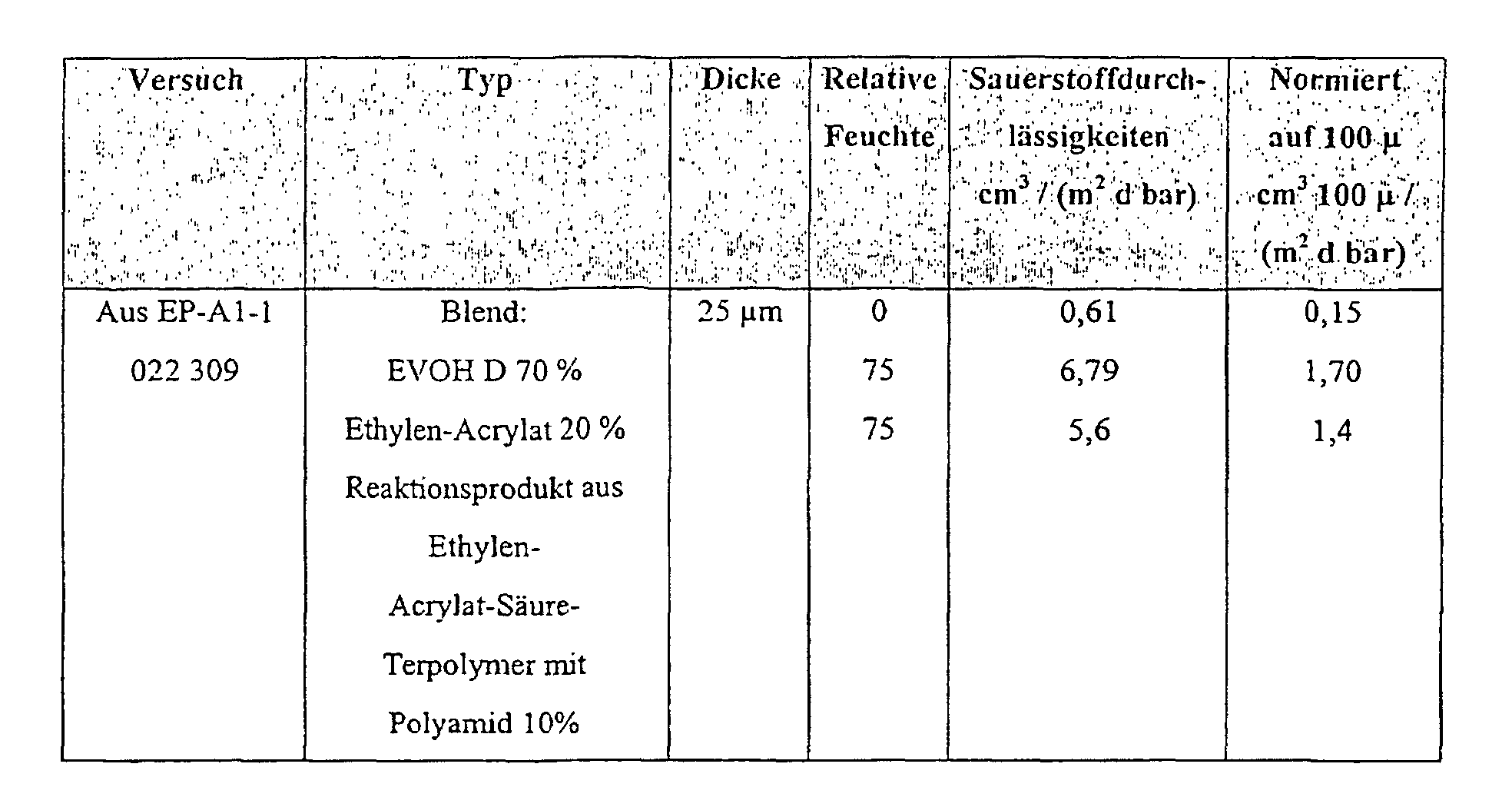
- EP-A1-1 022 309 describes mixtures of EVOH, ethylene-acrylate copolymer and ethylene-acrylate acid anhydride copolymer reacted with polyamides was for the purpose of co-injection with PET for the production of preforms of bioriented bottles.
- WO-98/45367-A1 claims mixtures of EVOH and ethylene-vinyl acetate copolymers for producing articles with increased environmental stress crack resistance wherein the ethylene-vinyl acetate copolymers used VA contents up to about 30%. Special requirements for the oxygen permeability or the permeability is not provided there.
- US Pat. No. 5,993,977 describes multilayer composites which, in addition to a watertight PE layer and a paper layer also have a gas-tight layer, which consists of a Blend of EVOH and a polar ethylene polymer exist.
- This polar Ethylene polymer is considered a modified PE.
- the invention claimed Blend component is a vinyl acetate polymer, which is nonpolar (with Ethylene) has been modified. It is in no way with that in US 5,993,977 claimed polymer to compare.
- EP-A 0 333 443 discloses multilayer products whose layer structure three different ethylene-vinyl acetate copolymer (EVM) layers, a barrier layer, an adhesive layer and a copolyamide layer.
- EVM ethylene-vinyl acetate copolymer
- DE-A 26 44 209 discloses a composite film of a polypropylene (PP) base film, an intermediate layer of modified polyethylene (PE) and finally a Outer layer of ethylene-vinyl alcohol copolymer (EVOH).
- PP polypropylene
- PE polyethylene
- EVOH ethylene-vinyl alcohol copolymer
- the well-known Difficulties in stretching an EVOH layer are bypassed there by the EVOH and the intermediate layer can only be stretched in one direction while the PP film is biaxially stretched.
- This method has the disadvantage of consisting of several process steps. A biaxial stretching is not possible by this method.
- US-A 4,400,428 discloses composite films, the biaxial polyamide films and ethylene-vinyl alcohol copolymer layers and sealant layers.
- JP-A 2001 277 419 discloses films usable for the packaging industry biaxially oriented nylon 6 films and a composition consisting of polyurethanes, a two-layered polyurethane component and an LLDPE film, described. They are characterized by a good clamping force and a low Permeability.
- JP-A 2001 294 279 where a biaxially stretched nylon layer with a polyurethane anchor layer, with polyvinyl alcohol and provided with protective layers.
- JP-A-09039172 EVOH is first biaxially stretched and then subjected to corona surface treatment subjected, laminated on both sides with PE and with a biaxial provided stretched polyamide layer.
- JP-A 09 039 182 discloses the coextrusion of polyamide (PA) with PE for biaxial stretched films and lamination with EVOH, which is still some polyamide contains, with no anchor layers are necessary, the barrier layer but still corona must be treated.
- WO 9 703 822 discloses films of high strength and low moisture permeability, consisting of a monoaxially stretched layer of polyamide and EVOH and a biaxially oriented LLDPE layer, the two layers must be bound by means of a polyurethane intermediate layer.
- Paper-like composite sheets without aluminum foil are disclosed in JP-A 08 207 927 by bonding a thermoplastic layer to a biaxially oriented polyamide, PET or polypropylene layer. This is followed by SiO 2 evaporation.
- the further layer structure contains an EVOH or PVOH layer, which is finally bound to a plurality of paper layers.
- JP-A 01 255 535 a biaxially oriented polyamide film with a coextruded Film of ethylene-vinyl alcohol copolymer and an ionomer (adhesive layer) laminated to obtain a shrink film.
- JP-A 06255054 discloses 3-layer films whose first layer is polyamide 6, the second a blend of partially aromatic polyamide of type MXD nylon 6007 with ethylene-vinyl acetate copolymer and the third a mixture of the materials of the first contains both layers.
- the polyamide layers is still a small amount added to maleic anhydride-grafted ethylene-propylene copolymer to the Improve kink resistance.
- Biaxially oriented polyamide blends are also disclosed in EP-A 0 540 293, because they have better tailor-made by trimming.
- JP-A 04 169 231 discloses a 3-layer film construction with a copolyamide layer, an ethylene-vinyl alcohol copolymer layer and another Copolyamide.
- This film can be stretched biaxially, but only in the Ratio 3: 1.
- the film is after the Stretching wrinkled. Accordingly, combinations of refractory Do not biaxially stretch polyamide and EVOH without phase separation.
- JP-A 04 131 237 discloses films of ethylene-vinyl alcohol copolymer and Polyamide 6/12 blends including a quantity of LiCl containing biaxially oriented Polyamide 6 and unstretched polypropylene are laminated to be water vapor impermeable Get slides.
- JP-A 01 221 241 a PET film is first stretched biaxially and then with a Composite film of EVA / EVOH / nylon / EVA laminated, the composite films still undergoes a corona treatment.
- EVA is meant here an ethylene-vinyl acetate copolymer which has a Vinyl acetate contents up to 35 wt .-% has.
- JP-A 62 083 144 discloses a packaging film of a biaxially stretched ethylene-vinyl alcohol copolymer film, which after a thermal treatment with a biaxially oriented polypropylene film is laminated, wherein still a polyurethane layer is required as an adhesive layer.
- JP-A 09 220 761 discloses stretched PA / EVOH / PA films, wherein before the stretching step a special tempering program must be adhered to.
- JP-A 1998 003 5669 discloses film extrusions of PA and EVOH, however only double layers are obtained, which then only after treatment in water can be stretched.
- thermoplastic Elastomer such as polyamide or polypropylene and ethylene-vinyl alcohol copolymer (EVOH)
- EVOH ethylene-vinyl alcohol copolymer
- the object of the present invention was to blend components for EVOH Find a stretching of the mixture containing a blend component and EVOH contains, allowing the basic mechanical properties of the EVOH and its good barrier properties.
- a good barrier property is understood to mean that Product does not show good oxygen permeability. Under good barrier property But it is also the ability to understand other molecules like flavoring ingredients and Keep chemical media as far away as possible from the material to be protected.
- Another object of the present invention is a multilayered Produce the product without further pretreatment Stretching is transparent and additionally has low oxygen permeability.
- the object is achieved by a single- or multi-layer product containing a or more ⁇ -olefin-vinyl alcohol copolymers and at least one ⁇ -olefin-vinyl acetate copolymer, characterized in that the ⁇ -olefin-vinyl acetate copolymer in the range of 35 to 99.99 wt% of vinyl acetate repeat units contains.
- the films of the monolayer product according to the invention contain as ⁇ -olefin ethylene, propene, n-butene, i-butene, pentene, hexene, 1-hexene, heptene, octene, 1-octene and their mixtures.
- the films of the monolayer product according to the invention preferably contain ⁇ -olefin-vinyl acetate copolymer with at least 45% by weight of vinyl acetate repeat units.
- the films of the single-layer product according to the invention contain in particular preferably ⁇ -olefin-vinyl acetate copolymer having at least 65 wt.% of vinyl acetate repeat units.
- the copolymer is mixed in a mixing device with the other constituents.
- thermoplastic is Polymer preferably polyamide or polypropylene.
- ⁇ -olefin-vinyl alkanol copolymer Ethylene-vinyl alcohol copolymer having an ethylene content in the range of 20 to 75 mol% used.
- ⁇ -olefin-vinyl acetate copolymer Ethylene-vinyl acetate copolymer used.
- the preferred layer sequence in the multilayer product according to the invention is A, B, A.
- the layer sequence of the multilayer according to the invention Product Polyamide B-layer Polyamide.
- the layer sequence of the multilayer according to the invention Produced polypropylene B-layer polypropylene.
- the multilayer product according to the invention has a layer sequence of polypropylene B-layer polypropylene, being between the layers in each case a further layer of a polymer is added, the improvement the cohesion of the network serves.
- the multilayer product according to the invention by coextrusion or produced by lamination.
- the single-layer or multi-layer product according to the invention is preferred as packaging material used.
- the multi-layered product can be stretched well into thin films and has after stretching a high oxygen barrier, as well as tear strength, puncture resistance and chemical resistance.
- the multi-layered product shows while a chemical resistance to both animal and vegetable Greases and oils, as well as to fuels and lubricants. Farther good mechanical properties such as high tensile strength, elongation, Elastic moduli and flexural strengths observed.
- Another advantage of the multi-layered product is that it is more Processing options such as vacuum forming, blown film processing and deep drawing allows, so that three-dimensional molded body of the invention Product can be molded.
- the barrier layer according to the invention can be extruded more easily with other layers as a even distribution over flat nozzles is achieved.
- the invention Product has a reduced brittleness of the barrier layer on which a better kink resistance is achieved.
- ⁇ -olefin-vinyl alcohol copolymers of the invention on or multi-layered product are copolymers of ⁇ -olefins and vinyl alcohol Understood. These are preferred by saponification of ⁇ -olefin-vinyl acetate copolymers produced.
- the selection of the ⁇ -olefin-vinyl alcohol copolymer is preferably carried out according to requirements for the barrier property of the produced Article.
- the ⁇ -olefin-vinyl alcohol copolymers preferably have ⁇ -olefin contents from 20 to 75 mole%, more preferably from 25 to 60 mole%, and most especially preferably from 25 to 50 mol%.
- Suitable ⁇ -olefins are all ⁇ -olefins known to those skilled in the art, such as ethene, propene, n-butene, isobutene, pentene, hexene, 1-hexene, heptene, octene, 1-octene and their higher homologs. These may also carry substituents, in particular C 1 -C 5 hydrocarbons. Particularly preferred ⁇ -olefins are ethene and propene.
- ethylene-vinyl alcohol copolymers in addition to ethylene and vinyl alcohol units contain other ⁇ -olefins or derived monomers, but in amounts below 10 mol%.
- the molecular weight of the ⁇ -olefin-vinyl alcohol copolymer is preferably made indirect determined by MFI measurements and is important for the processing behavior.
- the Flowability of the product expressed as MFI is preferably between 0.5 and 100 g / 10 min, more preferably between 1 and 50 g / 10 mm.
- the selection of the ⁇ -olefin-vinyl acetate copolymers according to the invention depends according to the requirements of oxygen permeability. This will be lower if an ethylene-vinyl acetate copolymer having a higher VA content is used. A particularly high flexibility and thus stretchability or deep drawability is achieved if the VA content is not too high. For example, a pure vinyl acetate homopolymer prove too brittle for some applications.
- a particularly high flavor resistance can be achieved with ethylene-vinyl acetate copolymers according to the invention be achieved as a blend component, preferably when high-VA-containing Types are used. These have a low swelling and thus also a low permeability for nonpolar or less polar compounds on.
- those ⁇ -olefin-vinyl acetate copolymers are used which have little or no residual crystallinity of poly- ⁇ -olefin sequences.
- the ⁇ -olefin-vinyl acetate copolymers of the monolayer or multilayer according to the invention preferably contain 35 to 98% of vinyl acetate repeat units.
- Suitable ⁇ -olefins are all ⁇ -olefins known to those skilled in the art, such as ethylene, propene, n-butene, i-butene, pentene, hexene, 1-hexene, heptene, octene, 1-octene and their higher homologs. Of course, these may also carry substituents, in particular C 1 -C 5 hydrocarbons. Particularly preferred are ethylene and propene.
- Preferred ethylene-vinyl acetate copolymers are, for example, under the trade name LEVAPREN® or Levamelt® from Bayer AG are commercially available.
- Preferred ⁇ -olefin-vinyl acetate copolymers are Levapren® 500 HV, Levapren® 600 HV, Levapren® 700 HV and Levapren® 800 HV. These polymers contain in each case 50 ⁇ 1.5% by weight of vinyl acetate, or 60 ⁇ 1.5% by weight of vinyl acetate, or 70 ⁇ 1.5% by weight of vinyl acetate, or 80 ⁇ 2.0% by weight of vinyl acetate.
- the ethylene-vinyl acetate copolymers which can be used according to the invention have MFI values from 0.5 to 150, preferably 1 to 100, particularly preferably 1 to 50 measured according to DIN 53 735 at 130 ° C and a load of 2.16 kg.
- the selection of the MFI value depends on the requirements of the processing.
- Preferred ⁇ -olefin-vinyl acetate copolymers have an average molecular weight (Number average) (determined by GPC) in the range of 50 kg / mol to 500 kg / mol and Mooney viscosities according to DIN 53 523 ML 1 + 4 at 100 ° C in Range of 3 to 50, especially 4 to 35 Mooney units.
- Number average determined by GPC
- the ⁇ -olefin-vinyl acetate copolymers may also be in the form of a mixture of two or more different of said ⁇ -olefin-vinyl acetate copolymers be used.
- ⁇ -olefin-vinyl alcohol copolymer ⁇ -olefin-vinyl acetate copolymer blends according to the invention to be used ⁇ -olefin-vinyl acetate copolymers are preferably prepared by the solution process as described in EP 341 499, EP 510 478 and DE 3 825 450. It's about a Solution method at pressures of 100 to 700 bar and temperatures between 50 and 150 ° C, wherein radical initiators are used. This procedure has the advantage of delivering gel-free products, which also contain no other excipients Contain emulsifiers.
- the ⁇ -olefin-vinyl alcohol copolymer ⁇ -olefin-vinyl acetate copolymer blends of the monolayer or multilayer product according to the invention preferably 50 to 95 wt .-% ⁇ -olefin-vinyl alcohol copolymers and 5 bis 50 wt .-% ⁇ -olefin-vinyl acetate copolymers.
- the ⁇ -olefin-vinyl acetate copolymers in layer B of the invention preferably contain 35 to 98% of vinyl acetate repeat units.
- the preparation of ⁇ -olefin-vinyl acetate copolymers is carried out with in the Technology customary copolymerization, for example by high-pressure copolymerization with the help of radically decomposing initiators, by copolymerization with Ziegler, or with Ziegler-Natta catalysts or with Phillips catalysts, or by copolymerization with metallocene-containing catalysts.
- the Copolymerization can be carried out in the gas phase, in solution or in a suspension be carried out both continuously and discontinuously.
- the ⁇ -olefin-vinyl acetate copolymer / ⁇ -olefin-vinyl alcohol copolymers are preferably used in pure form. However, also blends with other polymers, such as polyamides are used. To address are polyamide resins nylon 6, nylon 66, nylon 46, nylon 11, nylon 12, nylon 610, Nylon 612, nylon 6/66 copolymer, nylon 6/66/610 copolymer, nylon MXD6, Nylon 6T, nylon 6 / 6T copolymer, nylon 66 / PP copolymer and nylon 66 / PPS. To think also of additions of suitable polyesters e.g. of the phthalate type.
- additives can make up to 30% of the blend of the invention.
- the ⁇ -olefin-vinyl acetate copolymers / ⁇ -olefin-vinyl alcohol copolymers also added elastomers which should have the lowest possible gas permeability.
- This can For example, butyl rubber, butyl rubber with p-alkylstyrene and their be halogenated derivatives. The content should not be 30% in the mixture exceed. It may then be necessary to use other compatibilizers, as it is e.g. in EP-A1-0 722 850 is described.
- Additives can also be used to produce single or multi-layered products for special end uses.
- Such additives may include pigments, dyes, plasticizers, fillers, stabilizers, agents for absorption of UV radiation, antioxidants, process oils and the like lock in.
- the amount of additive used may vary depending on the intended end use Range from 0.1 to 50 wt.%.
- none of the used Additive radiation near the wavelength of maximum absorption of an in The film will continue to absorb any photo-crosslinking agent that may be present.
- the single-layer or multi-layer product according to the invention may also be customary Fillers such as talc, barite or kaolin or carbon black included.
- Blends can be such irradiation crosslinking, as in DE-A1-198 34 580 described, perform particularly well.
- the barrier properties of the films according to the invention can be achieved by application a siloxane-based coating as described in EP-A1-0 476 202, even better.
- the film also contains a photocrosslinking agent, the is activated by actinic radiation, typically after the coating of the Polymers.
- Suitable photocrosslinking agents include, but are not limited to on (a) aldehydes such as benzaldehyde, chromophore substituted acetaldehyde and their substituted derivatives, (b) ketones such as acetophenone, benzophenone and theirs substituted derivatives, e.g.
- Sandoray TM 1000 (Sandoz Chemicals, Inc., Charlotte, NC), (c) quinones such as the benzoquinones, anthraquinone and their substituted ones Derivatives, (d) thioxanthones such as 2-isopropylthioxanthone and 2-dodecylthioxanthone and (e) certain halomethyl-sym-triazines substituted with a chromophore such as 2,4-bis (trichloromethyl) -6-4'-methoxyphenyl-s-triazine and 2,4-bis (trichloromethyl) -6-3 ', 4'-dimethoxyphenyl-s-triazine.
- quinones such as the benzoquinones, anthraquinone and their substituted ones Derivatives
- thioxanthones such as 2-isopropylthioxanthone and 2-dodecylthioxanthone
- the photoactive crosslinking agent is usually in a range of 0.005 to 2 wt.%, Preferably from 0.01 to 0.5% by weight and more preferably from 0.05 to 0.15% by weight of the copolymer in front.
- any networking that may be required can also be achieved by means of high-energy Radiation, such as ⁇ -, ⁇ - or ⁇ -radiation in the absence of a crosslinking agent.
- Another object of the invention is a process for the preparation of the inventive single or multi-layered product, characterized in that in a first step, the ⁇ -olefin Vinylaeetat copolymerisat with the ⁇ -olefin-vinyl alcohol copolymer in a mixing device with the other ingredients is mixed.
- Suitable mixtures of the ⁇ -olefin-vinyl acetate copolymers and ⁇ -olefin-vinyl alcohol copolymers can be prepared by any suitable mixing method, as long as macroscopically homogeneous mixtures are obtained.
- suitable mixing apparatuses are Banbury mixers, rollers and preferably extruders. Particularly advantageous are on-line mixing courses, e.g. in the mixing zone of a Foil extruder without special further precautions. By appropriate preliminary tests If necessary, the suitability of the planned mixing step must be checked become. To ensure a constant mixing ratio is a dry Glare the materials as granules advantageous.
- the single-layer or multi-layer product according to the invention is suitable for application to a suitable substrate for the production of packaging films, in particular Barrier films.
- a suitable substrate for the production of packaging films in particular Barrier films.
- a 5-layer film are extruded, the innermost layer of the inventive product, on both sides of each other Intermediate layer and an outer layer is surrounded.
- These layers may e.g. from non-inventive ethylene-vinyl acetate copolymers with VA contents of 5 to 30%.
- Suitable substrates include polyolefin films (e.g., polyethylene and propylene films), especially corona-treated polyolefin films and ⁇ -olefin-vinyl alcohol films, in particular, ethylene vinyl alcohol (EVOH) films.
- polyolefin films e.g., polyethylene and propylene films
- corona-treated polyolefin films e.g., corona-treated polyolefin films
- ⁇ -olefin-vinyl alcohol films in particular, ethylene vinyl alcohol (EVOH) films.
- EVOH ethylene vinyl alcohol
- the Copolymerisatmischung invention as a barrier layer has a higher Adhesion to such intermediate or outer layers, so that it is possible by Omitting a layer to simplify the film construction.
- a complicated multilayer film can, as described in EP-A1-0 792 740 on Example of a packaging film for cheese, consisting of 9 layers.
- the invention single-layer product allows for the possibility of adequate liability Carrier films and other processing functionalities such as sealability with significantly to reach fewer layers.
- the products according to the invention can also be used as layers be used in addition to the barrier layer. Due to the high stickiness can be especially good bonds with non-polar carrier films such as PP or generally polyolefins getting produced.
- the single-layer products of the invention as an adhesive layer to use.
- This can be used as an intermediate layer between EVOH and For example, a Polyolefinivatik be used.
- For this application aspect can the mixing ratio in the direction of ethylene-vinyl acetate copolymers (EVM) 20/80 to 80/20 EVM / EVOH.
- EVM ethylene-vinyl acetate copolymers
- This adhesive layer then also contributes much more to a barrier effect than typical EVA adhesive layers with VA contents up to 30%.
- the scope of the mono- or multilayer products according to the invention also extends generally to layers having a barrier effect.
- layers having a barrier effect include also hoses, or pipes for organic media such as fuels.
- Advantageously, can a subsequent networking done by blasting to higher restoring forces and To achieve elasticity.
- inventive single or multilayer product for the Production of tank linem used for this purpose, the preferably single-layered product before a possible crosslinker on the, preferably primed, surface of a suitable backing (i.e. Substrate) applied.
- a suitable backing i.e. Substrate
- the preferred single-layer product can be made up of many different methods a substrate (e.g., a tape backing) may be applied, including solution coating, Solution spray, emulsion coating, gravure coating or other methods known to those skilled in the art.
- a substrate e.g., a tape backing
- solution coating e.g., Solution spray, emulsion coating, gravure coating or other methods known to those skilled in the art.
- Another preferred method for producing the single or multilayer Product is the coextrusion coating, usually in a coating plant with a melt film of the ⁇ -olefin-vinyl acetate copolymer / ⁇ -olefin-vinyl alcohol copolymer, which melted in an extruder and via a slot die on a substrate, which consists of one or more polymer layers exist, is discharged.
- the ensuing composite becomes then cooled in a cooling-pressure roller unit and smoothed. After that the winding of the composite web takes place in a corresponding winding station.
- the coating process is analogous also the operations applying the coating mass on the Carrier web, smoothing and cooling, peeling and winding performed.
- the actual extrusion lamination leaves a prefabricated carrier web in one Glätttechnikwalzenstuhl, which has 4 rolls shrink. This is the carrier web before the first nip with a melt film, which is melted in an extruder and discharged via a slot die, coated.
- the second nip is allowed to run a second prefabricated web. The case resulting composite is smoothed as it passes through the second nip, then cooled, withdrawn and wound up in a winding station.
- the ⁇ -olefin-vinyl acetate copolymer / ⁇ -olefin-vinylalkahol copolymer and various polymers in different extruders melted suitable conditions and then in the form of the melt streams forming a multilayer melt stream in the extrusion die merged. Thereafter, the discharge, removal and cooling of the the film containing multilayer melt web and the winding of the composite. In this way, you get a composite film.
- the slit extrusion process is preferably used.
- Suitable polymers for these processes include, in particular, ⁇ -olefin-vinyl alcohol copolymer- ⁇ -olefin-vinyl acetate copolymer blends with thermoplastic Polymers.
- the multilayer product according to the invention contains at least one layer A and one layer B, wherein A is a thermoplastic polymer contains.
- Thermoplastic polymers are any polymers, preferably those who stretch biaxially.
- thermoplastic polymers are polyamides, polypropylene, Polystyrene, polycarbonates, polyesters, polyethylene terephthalate and polybutylene terephthalate.
- polyamides or polypropylene refers is a layer A with more than 50 wt .-% polyamide or more than 50% by weight of polypropylene. Particularly preferred is a layer A 60 to 100% by weight of polyamide or 60 to 100% by weight of polypropylene.
- the layer A contains preferably polypropylene having a melting temperature in the range of 130 ° C to 165 ° C. Particularly preferred is isotactic polypropylene with a crystalline Share of more than 50%.
- the layer A preferably contains polyamides having a melting point in the range of 170 to 230 ° C.
- Preferred polyamides are conventional polyamides, especially polyamide-6 but also Copolyamides and mixtures of polyamide 6 and copolyamides by Polycondensation or polymerization of polyamide-forming starting materials produced are.
- Preferred polyamide-forming starting materials are further caprolactam in addition Lactams, such as laurolactam, ⁇ -aminocarboxylic acids, 11-aminoundecanoic acid and Mixtures of equivalent amounts of one or more dicarboxylic acids, in particular Adipic acid, sebacic acid, azelaic acid, dodecanedioic acid, isophthalic acid or terephthalic acid and one or more diamines, such as hexamethylenediamine, 1,4-diaminobutane, 3-aminomethyl-3,5,5-trimethylcyclohexylamine (isophoronediamine), 4,4'-diaminodicyclohexylmethane, 4,4'-diaminodicyclohexylpropane (2,2), m-xylylenediamine, 1,6-diamino-2,2,4-trimethylhexane, 2,2,4-trimethylhexamethylenedi
- polystyrene-containing catalysts The preparation of such polyolefins can be carried out by those skilled in the art Types of polymerization are carried out, for example by Ziegler-Natta polymerization, by polymerization with the aid of Phillips catalysts, by high-pressure polymerization or by polymerization with the aid of metallocene-containing catalysts.
- the coating / extrusion processes are usually at temperatures in the Range of 170 to 300 ° C, pressures of 250 to 400 bar and medium cycle times from 5 to 20 min. stirred. Since the ⁇ -olefin-vinyl acetate copolymers / ⁇ -olefin-vinyl alcohol copolymers in the melt and in the invention single- or multi-layered product a high tendency to stick to all Have contact surfaces, it may be advantageous for the production of the composites Rolls used and the take-off rolls with a relation to the Copolymers anti-adhesive material, e.g. coat with polytetrafluoroethylene. This allows u.a. corresponding to the proper winding of the composites Comply with web tension.
- the films obtainable in this way can be advantageously used as packaging films with barrier properties to air, oxygen, flavorings, etc.
- the films are stretched to produce the transparent films.
- In addition to the preferred biaxial simultaneous stretching can also be stretched sequentially.
- Stretched products of the invention can also be a downstream Heat treatment step are subjected to the shrinkage (especially the Hot water shrinkage). This step can also be done under an inert atmosphere be carried out as described in DE-A 3 042 884 to to prevent yellowing.
- control of shrinkage may be in the case of a biaxially stretched product by means of a special cooling program as described in DE-A 2 845 793, be achieved.
- packaging material from the product according to the invention can also be a Stretching out of the tube ("double-bubble").
- This layer C preferably contains a copolymer of ethylene and a broad monomer selected from the group consisting of ⁇ -olefins, vinyl acetate and acrylic acid. Preference is given to ethylene- ⁇ -olefin copolymers which have a density below 0.92 g / cm 3 .
- ethylene-vinyl acetate copolymers preferred are those having a vinyl acetate content of not more than 20% by weight.
- Preferred ethylene-acrylic acid copolymers have an acrylic acid content of not more than 10% by weight.
- the sealing layers can be applied subsequently, preferably by lamination, but also be inserted from the outset by coextrusion and then run through the stretching process.
- the MFI was measured according to DIN 53735 under the conditions 190 ° C and 2.16 kp.
- Extruder Borabender Plasti-Corder and measuring extruder with an L / D ratio of 30/25 D with slot die.
- the materials used were in granular form metered and set a temperature profile of 165 ° C, 170 ° C, 175 ° C and 180 ° C. and pressures from 45 to 60 bar.
- the thickness of the films was over the Throughput and over which the take-off speed is set.
- the film was on cooled a cooling roller (water cooling) and wound over several guide rollers or removed as a single strip.
- Polymer blends were prepared as granule blends and directly to the extruder fed. It could be already by the mixing effect in which as a conveying member designed extruder sufficiently homogeneous blends achieve.
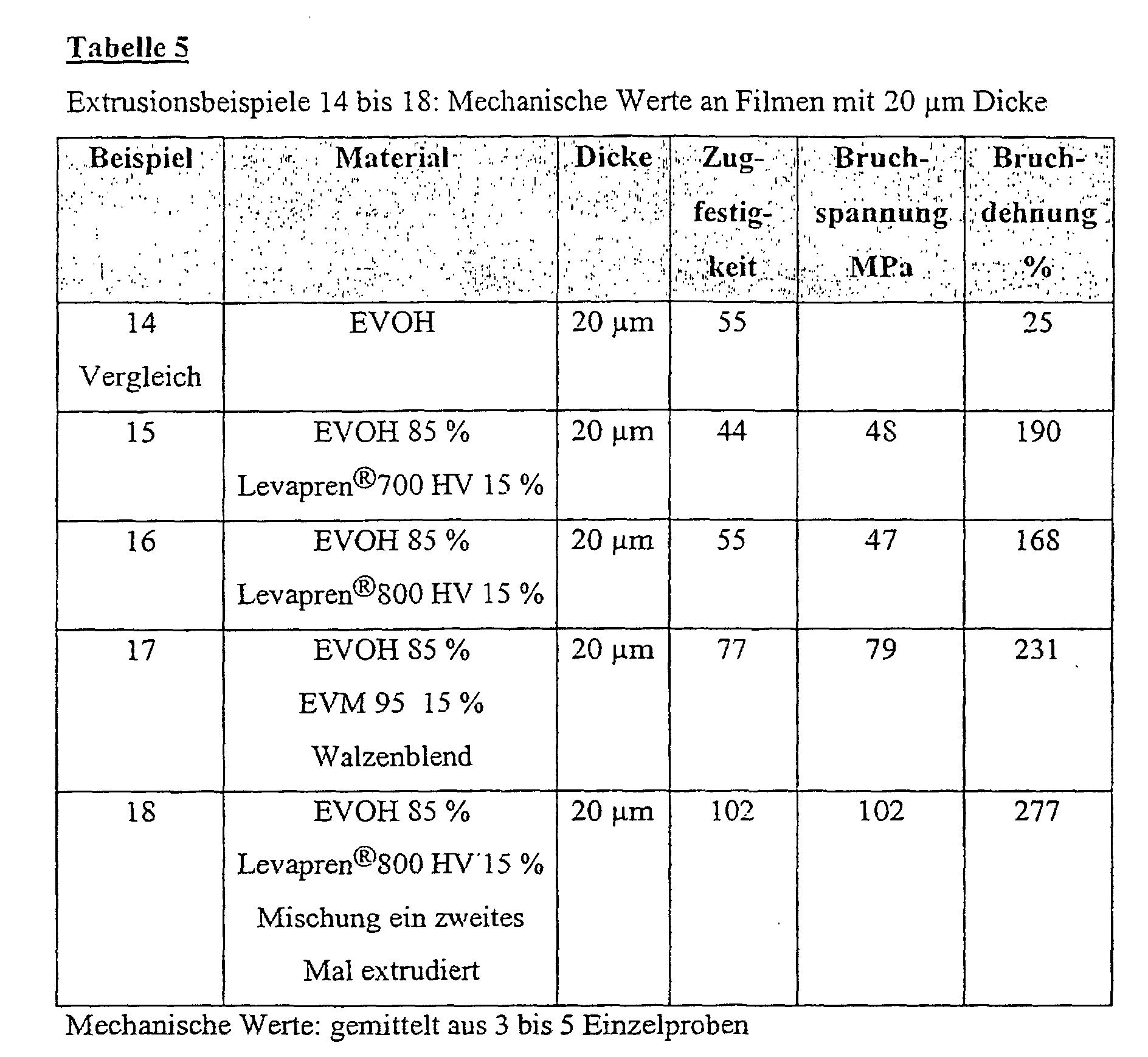
- the resulting films were tested mechanically and for oxygen permeability.
- Example 4 (blend 70% EVOH and 30% Levapren® 400) had one clearly sticky handle.
- the surface of the film was examined by IR and By comparison with the individual components determined that almost exclusively Levapren®400 was on the surface. It can be concluded that at least for EVA with 40% VA as blend component in EVOH a partial incompatibility at least under extrusion conditions and thus this mixture not to be preferred.
- the measurements were carried out using a measuring device from Mocon, type Oxtran according to DIN 53380 Part III.
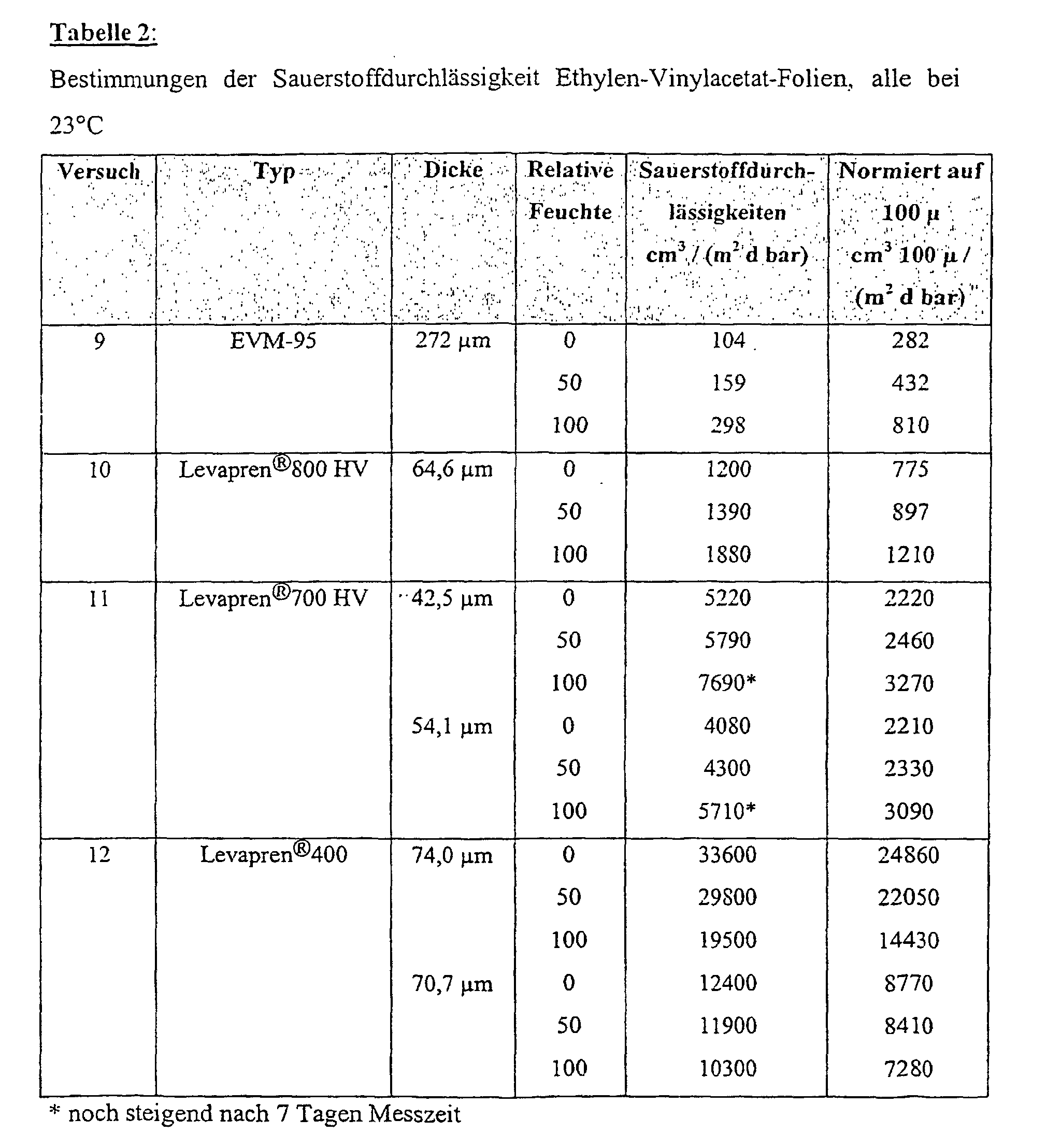
- Table 2 first shows the oxygen permeabilities of various ethylene vinyl acetate copolymers at various relative humidities, varying the vinyl acetate contents. The oxygen permeabilities decrease with increasing vinyl acetate content, however, the value level of EVOH is not reached.
- the films according to the invention allow a much easier achievement of stretchablity than for example given in EP-A1-0 483 695, where multiple films of EVOH with modified polyolefins and reaction products with polyamide must be used.
- Example 16 is a repeat of Example 3 and confirms the oxygen permeabilities found.
- the EVMs to be used in the films according to the invention may well have glass transition temperatures from around room temperature and higher, without the flexibilization and better drawability of the slides is lost.
- the EVOH-EVM films used here were examined by DSC.
- the melting endotherm of the EVOH is enhanced by the addition of EVM hardly influenced. It is obviously advantageous that the EVM according to the invention the Increased flexibility to the desired extent, but at the same time the EVOH crystallinity does not diminish, so that remain high permeation barriers.
- copolyamides were added to check if they can work in the sense of compatibilizers.
- the blend materials were easily extruded into strands and allowed to pass be chopped by a water bath to granules.
- Blend 8 of Table 7 showed in the Heat surface tack and showed cold flow on storage. It were blends containing a majority of ethylene-vinyl acetate copolymer for further processing in the sense of a dosage as granules cooled or there is an on-line dosage in corresponding film extruders.
- the layer thicknesses were measured on-line by a radiometric thickness measurement determined, whereby the calibration by means of an off-line measurement (micrometer) he follows.
- the thicknesses were mainly due to the extruder speeds and the Discharge speed varies.
- the thickness of each layer was through targeted switching off and on of the respective layer influenced.
- the thickness of this Layer was characterized by the difference in thickness before and after thickness Hit the layer determined.
- the on-line thickness measurement also served to monitor the uniformity of the layer thicknesses.
- the slot die was initially set to the greatest possible uniformity.
- the films were produced with a casting roll temperature of 80 to 100 ° C, passed over the on-line thickness measurement and, after the edge trimming, wound up.
- Viscosities of the EVOH used or of the blends from test series A Viscosities of the EVOH used or of the blends from test series A
- the shear rate in extrusions of films or thin moldings through nozzles is in the range of 1 to 100 s -1 .
- low viscosity materials are preferred. Therefore, according to Table 9, the viscosities of blends having different EVM contents are measured at optimum extrusion shear rates.
- Viscosity ⁇ * in Pa.s is plotted against the shear rate (shown as angular velocity omega in 1 / s).
- the samples were initially longer than 16 hours at 80 ° C in a vacuum oven dried and then pressed with the laboratory press at 200 ° C to test specimens.
- the measurements were carried out in the ARES oscillation rheometer from the company Rheometric with the plate-plate geometry PP25 in the frequency range of 10 to 0.1 Hz and at Temperatures of 180 ° C to 260 ° C performed.
- oxygen permeabilities were determined by OX-TRAN instrument from Mocon with electrochemical O 2 detector. measurement parameters print 1000 mbar O 2 gas humidity dry temperature 23 degrees Celsius
- thermoformability of the films was qualitatively determined by an apparatus at a film piece of about 10x10 cm was stretched in a frame, by means of a Warmed up the IR lamp and then pulled through vacuum into a mold made of a round stepped pyramid (4 x 1.5 cm high steps) existed. Were realized different strains.
- Slide 5 elongated particles (EVM, proportion 15 wt .-%) of about 0.5 x 5 microns and smaller Slide 7 elongated particles or lamellae of approx. 1 ⁇ m (EVM content: 30 wt.%)
- Foils 8 after stretching oval particles partly with inclusions of EVOH up to approx. 2 ⁇ m (EVM content 30% by weight)
- Slide 9 elongated lamellae up to 2 ⁇ m thick and small particles with a diameter of 0.4 to 1 ⁇ m (EVM content 40% by weight)
- Slide 11 EVM forms the continuous phase with EVOH particles of size 2 ⁇ m (EVM content 60% by weight)
- the films 1 to 4 were transparent and could visually like films similar thickness of pure polyamide can be assessed.
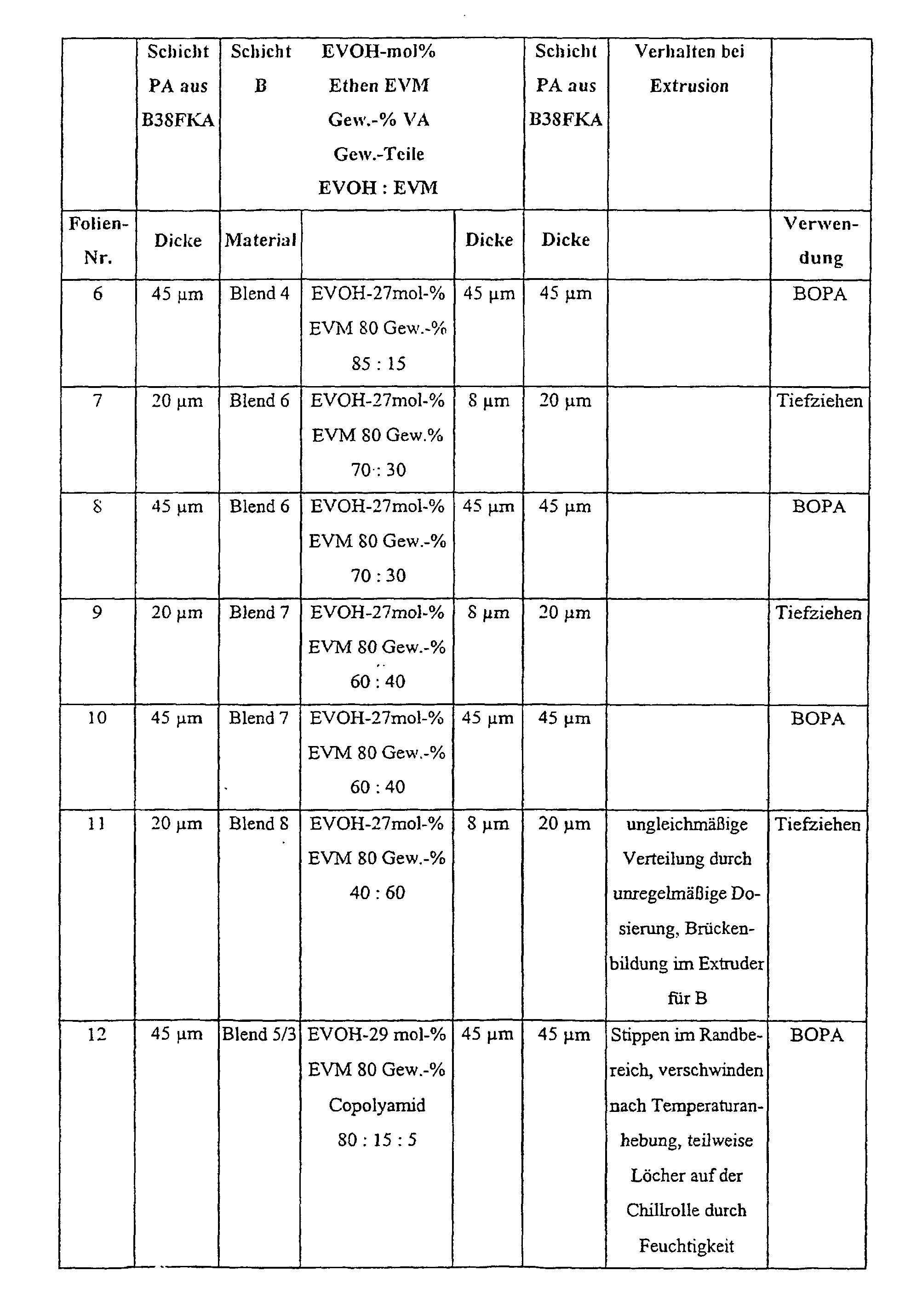
- the films 5 to 14b are opaque to slightly cloudy, the thick films (determined for stretching) were significantly less transparent than the thinner variants.
- Film 8 was obtained due to irregularities in the granule dosage (stickiness of the granules) only with irregular thicknesses of the barrier layer.
- Sheet 12 had holes due to moisture in the blend material could become.
- Foils 14 had specks in the edge area due to variation in temperature these are eliminated.
- the ethylene-vinyl acetate copolymer Levamelt® 800 Compared to the pure EVOH, the ethylene-vinyl acetate copolymer Levamelt® 800 a much greater viscosity reduction by shear thinning.
- the addition of Levamelt to the EVOH resulted in a significant shear thinning in the mix, although the levamelt only as a separate Phase dispersed in the EVOH matrix. This resulted in a relieved Extrusion behavior of the blends of the invention over pure EVOH especially under the conditions of film extrusion, where the material is evenly through had to kick very thin column.
- the films with the barrier layer according to the invention were by the stretching transparent. For all stretching experiments was that the setting of the optimal stretching conditions required longer trials and depended strongly on the temperature. The Stretching speed has not been varied here. The films of the invention with the barrier blends were still not stretched, so another Optimization to larger stretching ratios will still be possible.
- the films of the invention had in comparison to the films with the pure EVOH barrier layers unchanged, excellent barrier values. Only at one Admixture of ethylene-vinyl acetate copolymer of 60 wt .-% increase the oxygen permeabilities at. Therefore, the proportion of ethylene-vinyl acetate copolymer in the barrier layer does not significantly exceed 50% by weight.
- EVM formed particles that were elongated in a matrix of EVOH Have shape.
- the increase in the share of EVM led to partially lamellar Structures, which is advantageous for the preservation of barrier properties.
- Stretching which consisted of an annealing step, changed the shape of the EVM particles, in that the lamellar particles are more spherical particles become.
- the matrix of EVOH determines the Barrier properties.
- copolyamides as the third component in the barrier layer could especially to stabilize the distribution of the EVM. This could at a multiple processing (use of recycled material) and annealing the stability of the morphology can be ensured. This left the dispersion of the EVM in the EVOH matrix finely divided, thus ensuring transparency.
- the better stretchability of the films with the barrier layers according to the invention is particularly pronounced when using the EVM type with 80% by weight of vinyl acetate and less pronounced when using the EVM type with 45% by weight of vinyl acetate. This may be related to the much-stretched structure of the EVM phase, which causes a particularly pronounced flexibilization.
Landscapes
- Laminated Bodies (AREA)
- Wrappers (AREA)
- Compositions Of Macromolecular Compounds (AREA)
- Extrusion Moulding Of Plastics Or The Like (AREA)
Description
wobei
- A
- ein thermoplastisches Polymer enthält und
- B
- ein α-Olefin-Vinylalkohol-Copolymer und ein α-Olefin-Vinylacetat-Copolymer mit einem Vinylacetatgehalt im Bereich von 35 bis 95 Gew.-% enthält.





- Eval® L101B:
- Ethylen-Vinylalkohol-Copolymer mit einem Ethylengehalt von 27 mol-% und einem MFI-Wert von 3,9 nach ASTM 1238 (210°C, 2160 g) (der Fa. Kuraray).
- Eval® F101B:
- Ethylen-Vinylalkohol-Copolymer mit einem Ethylengehalt von 32 mol-%. und einem MFI-Wert von 3,8 nach ASTM 1238 (210°C, 2160g) (der Fa. Kuraray).
- Eval® G156B:
- Ethylen-Vinylalkohol-Copolymer mit einem Ethylengehalt von 47 mol-%. und einem MFI-Wert von 14,7 nach ASTM 1238 (210°C, 2160g) (der Fa. Kuraray).
- Soarnol® DT2903:
- Ethylen-Vinylalkohol-Copolymer mit einem Ethylengehalt von 29 mol-%. und einem MFI-Wert von 3,2 nach ASTM 1238 (bei 210°C) (der Fa. Nippon Gohsei).
- Soarnol® AT4403:
- Ethylen-Vinylalkohol-Copolymer der Fa. Nippon Gohsei mit einem Ethylengehalt von 44 mol-%. und einem MFI-Wert von 3 nach ASTM 1238 (bei 210°C).
- Soarnol® H4815:
- Ethylen-Vinylalkohol-Copolymer mit einem Ethylengehalt von 48 mol-%. und einem MFI-Wert von 16 nach ASTM 1238 (bei 210°C) (der Fa. Nippon Gohsei)
- EVOH-30:
- Ethylen-Vinylalkohol-Copolymer mit einem Ethylengehalt von 30 mol-%. und einem MFI-Wert von 10 nach ASTM 1238 (bei 210°C).
- Levamelt® 800:
- Ethylen-Vinylacetat-Copolymer mit einem Vinylacetatgehalt von 80 Gew.-% und einem MFI-Wert von 4 bis 5 nach ASTM 1238.
- Vestamelt® 722:
- Polyamidcopolymer mit einem MFI von 300 nach ASTM 1238 (160°C, 2,16 kg) und einem Schmelzpunkt von 107°C (der Fa. Degussa).
- Vestamelt® 471:
- Polyamidcopolymer mit einem MFI von 20 nach ASTM 1238 (160°C, 2,16 kg) und einem Schmelzpunkt von 119°C (der Fa. Degussa)
- Durethan® CI31F:
- Polyamidcopolymer mit einem Schmelzpunkt von 187-191°C (der Fa. Bayer AG)
- Durethan® B38FKA:
- Polyamid mit einem Schmelzpunkt von 222°C (der Fa. Bayer AG)
- Versuchsapparatur:
- Zweischneckenkneter (ZSK) vom Typ ZSK 53 Drehzahl 165 U/min; die Massetemperatur wird mittels der Temperaturen in den Extrusionszonen eingestellt (200 bis 215°C)
Unter C2 wird in der Tabelle 7 Ethylen verstanden.
| Blends mit ZSK-Maschine, Durchsatz 50 kg/h, Verweilzeit ca. 35 s, Düsentemperatur 200°C, 14 bar | |||||||
| Massetemperatur 215°C bei den F und G-Typen, 240°C bei dem L-Typ, Angaben in Gewichtsteilen | |||||||
| Blend- Nr | EVOH | Anteil | EVM | Anteil | Kompat. | Anteil | Granulat |
| 1 | G156B 47 mol-% C2 | 85 | L800 | 15 | Hart | ||
| 2 | F101B 32 mol-% C2 | 85 | L800 | 15 | Hart | ||
| 4 | L101B 27 mol-% C2 | 85 | L800 | 15 | Hart | ||
| 5/1 | DT2903 29 mol-% C2 | 80 | L800 | 15 | V471 | 5 | Hart |
| 5/2 | DT2903 29 mol-% C2 | 80 | L800 | 15 | V722 | 5 | Hart |
| 5/3 | DT2903 29 mol-% C2 | 80 | L800 | 15 | CI31F | 5 | Hart |
| 6 | L101B 27 mol-% C2 | 70 | L800 | 30 | Etwas weich | ||
| 7 | L101B-27 mol-% C2 | 60 | L800 | 40 | Weich | ||
| 8 | L101B 27 mol-% C2 | 40 | L800 | 60 | Cold flow, klebt | ||
| 12 | AT4403 44 mol-% C2 | 85 | L450 | 15 5 | Hart | ||
| 13 | EVOH-30 30 mol-% C2 | 85 | L800 | 15 5 | Hart |


| Blend Nr. | %-Anteil Levamelt® 800 in Blend mit L101B | Viskosität η* bei 300 s -1 in Pa.s |
| - | 0 | 800 |
| 4 | 15 | 620 |
| 6 | 30 | 420 |
| 7 | 40 | 400 |
| 8 | 60 | 290 |
| - | 100 | 150 |
Reckungen bi-axial simultan.

| BOPA- Nr. | Barriereschicht EVOH mol-% Ethen EWM Gew.-% VA Gew.-Teile EVOH : EVM | Optik vorher | Optik nach Reckg. | Bemerkung |
| 2 | EVOH27mol-% Kein EVM Vergleich | transp. | Folie gerissen mit den Startbedingungen, keine Reckung erzielt. Temperatur auf 240°C erhöht, Aufheizzeit auf 120 s verlängert | |
| 6-I | EVOH48mol-% Kein EVM Vergleich | Opak | transp. | Folie gerissen, Temperatur auf 250°C erhöht und Aufheizzeit auf 150 s verlängert |
| 6-II | Wie bei 6-I | Opak | transp. | Gelbfärbung der Folie |
| 6-III | Wie bei 6-I | Opak | transp. | Folienaufriss |
| 6-IV | Wie bei 6-1 | Opak | transp. | Folie intakt reckbar jedoch teilweise trüb, Aussehen etwas inhomogen |
| 6-V | Wie bei 6-I | Opak | transp. | Folie intakt reckbar, es wurden Löcher gefunden, teilweise trüb, Aussehen etwas inhomogen, Folie weist Spuren von Abdrücken auf, daher die weiteren Folien mit Aceton gereinigt |
| 6-VI | Wie bei 6-I | Opak | transp. | Folie intakt reckbar. Es sind ungereckte Flächen erkennbar, daher kann das Reckverhältnis noch erhöht werden |
| 6-VII | Wie bei 4 | Opak | transp. | Reproduktion, weitere Reckung möglich |
| 6-VIII | Wie bei 4 | Opak | transp. | Weiter gereckt, dennoch nicht vollständig ausgereckt |
| BOPA- Nr. | Barriereschicht EVOH mol-% Ethen EVM Gew.-% VA Gew.-Teile EVOH : EVM | Optik vorher | Optik nach Reckg. | Bemerkung |
| 8-I | EVOH27mol-% EVM 80Gew.% 85 : 15 | Opak | transp. | Noch nicht vollständig ausgereckt |
| 8-II | Wie bei 8-I | Opak | transp. | Aufriss |
| 8-IIa | Wie bei 8-I | Opak | transp. | Aufriss, Temperatur nicht hoch genug |
| 8-III | Wie bei 8-I | Opak | transp. | Folienabriss, Reckverhältnis muss etwas abgesenkt werden |
| 8-IV | Wie bei 8-I | Opak | transp. | Folienabriss, evt. zu hohe Temperatur |
| 8-V | Wie bei 8-I | Opak | transp. | Folieneinriss |
| 2-Ib | EVOH27mol-% Kein EVM Vergleich | transp. | trüb, | Folieneinriss, Phasentrennung |
| 2-IIb | EVOH27mol-% Kein EVM Vergleich | transp. | trüb | Folie intakt, Schichtstrukturen, "Türkensäbel" |
| 4-II | EVOH48mol-% Kein EVM Vergleich | transp. | trüb | Keine Einrisse, aber Phasentrennung |
| 4-II | EVOH48mol-% Kein EVM Vergleich | transp. | trüb | Keine Einrisse, Folie wird trüb, sehr schlierig, Phasentrennung |
| 14-I | EVOH44mol-% EVM45 Gew.% 85 : 15 | Opak | Keine Einrisse, Folie etwas schlierig | |
| 14-II | EVOH44mol-% EVM 45Gew.% 85 : 15 | Opak | Teilweise eingerissen, etwas Fließstrukturen | |
| 14-III | wie bei 14-III | Opak | Teilweise eingerissen, etwas Fließstrukturen |
| Messparameter | Druck | 1000 mbar O2 |
| Gasfeuchte | trocken | |
| Temperatur | 23 Grad Celsius |


Dabei wurden folgende Folie verwendet und jeweils die Morphologie der inneren Barrieschicht untersucht mit Vergrößerungen von 3500 und 10000.
Folie 4 (Vergleich): keine Strukturierung erkennbar
| Folie 5 | langgestreckte Partikel (EVM, Anteil 15 Gew.-%) von ca. 0,5 x 5 µm und kleiner |
| Folie 7 | langgestreckte Partikel bzw. Lamellen von ca. 1 µm (EVM-Anteil 30 Gew.-%) |
| Folien 8 nach Reckung | ovale Partikel zum Teil mit Einschlüssen von EVOH bis ca. 2 µm (EVM-Anteil 30 Gew.-%) |
| Folie 9 | langgestreckte Lamellen bis 2 µm Dicke und kleine Partikel mit einem Durchmesser von 0,4 bis 1 µm (EVM-Anteil 40 Gew.-%) |
| Folie 11 | EVM bildet die kontinuierliche Phase mit EVOH-Partikeln der Größe 2 µm (EVM-Anteil 60 Gew.-%) |
| Folie 13 | kugelförmige Partikel der Größe 0,4 bis 1 µm (EVM-Anteil 15 Gew.%, 5 Gew.-% Copa) |
| Folie 14 | kugelförmige Partikel der Größe 0,2 bis 0,8 µm, relativ eng verteilt |
Folie 8 wurde wegen Unregelmäßigkeiten in der Granulat-Dosierung (Klebrigkeit des Granulats) nur mit unregelmäßigen Dicken der Barriereschicht erhalten.
Claims (14)
- Ein- oder mehrschichtiges Erzeugnis nach Anspruch 1, wobei das Erzeugnis eine Folie ist, enthaltend α-Olefin-Vinylalkohol-Copolymere und wenigstens ein α-Olefin-Vinylacetat-Copolymerisat, dadurch gekennzeichnet, dass das α-Olefin-Vinylacetat-Copolymerisat im Bereich von 35 bis 99,99 Gew.% an Vinylacetat-Wiederholungseinheiten enthält und dass das α-Olefin ausgewählt wird aus Ethylen, Propen, n-Buten, 1-Buten, Penten, Hexen, 1-Hexen, Hepten, Octen, 1-Octen und deren Gemischen.
- Folien gemäss Anspruch 1, dadurch gekennzeichnet, dass das α-Olefin-Vinylacetat-Copolymerisat mindestens 45 Gew.% an Vinylacetat-Wiederholungseinheiten enthält.
- Folien gemäss Anspruch 2, dadurch gekennzeichnet, dass das α-Olefin-Vinylacetat-Copolymerisat mindestens 65 Gew.% an Vinylacetat-Wiederholungseinheiten enthält.
- Verfahren zur Herstellung des einschichten Erzeugnisses gemäss einem der Ansprüche 1-3, dadurch gekennzeichnet, dass das Copolymerisat in einem Mischorgan mit den übrigen Bestandteilen vermischt wird.
- Ein mehrschichtiges Erzeugnis , enthaltend mindestens eine Schicht A und mindestens eine Schicht B,
wobei- A
- ein thermoplastisches Polymer enthält und
- B
- ein α-Olefin-Vinylalkohol-Copolymer und ein α-Olefin-Vinylacetat-Copolymer mit einem Vinylacetatgehalt im Bereich von 35 bis 95 Gew.-% enthält und wobei das α-Olefin-Vinylalkohol-Copolymer ein Ethylen-Vinylalkohol-Copolymerisat mit einem Ethylengehalt im Bereich von 20 bis 75 Mol-% ist.
- Ein mehrschichtiges Erzeugnis nach Anspruch 5, wobei das thermoplastische Polymer Polyamid oder Polypropylen ist.
- Das mehrschichtige Erzeugnis nach einem der Ansprüche 5 und 6, wobei das α-Olefin-Vinylacetat-Copolymer Ethylen-Vinylacetat-Copolymer ist.
- Das mehrschichtige Erzeugnis nach einem der Ansprüche 5 bis 7, wobei die Schichtabfolge A,B,A ist.
- Das mehrschichtige Erzeugnis nach Anspruch 8, wobei die Schichtabfolge Polyamid B-Schicht Polyamid ist.
- Das mehrschichtige Erzeugnis nach Anspruch 8, wobei die Schichtabfolge Polypropylen B-Schicht Polypropylen ist.
- Das mehrschichtige Erzeugnis nach einem der Ansprüche 5 bis 10, wobei die Schicht B zusätzlich bis zu 25 Gew.-% eines Copolyamids mit einem Schmelzpunkt im Bereich von 70 bis 200°C enthält.
- Das mehrschichtige Erzeugnis nach Anspruch 8, wobei die Schichtabfolge Polypropylen B-Schicht Polypropylen ist und zwischen den Schichten jeweils noch eine weitere Schicht eines Polymers eingefügt ist, die der Verbesserung des Zusammenhaltes des Verbundes dient.
- Verfahren zur Herstellung des mehrschichtigen Erzeugnisses nach einem der Ansprüche 5 bis 11 durch Coextrusion oder durch Laminierung.
- Verpackungsmaterial enthaltend das ein- oder mehrschichtige Erzeugnis nach einem der Ansprüche 1 bis 12.
Applications Claiming Priority (5)
| Application Number | Priority Date | Filing Date | Title |
|---|---|---|---|
| DE10137972 | 2001-08-08 | ||
| DE2001137972 DE10137972A1 (de) | 2001-08-08 | 2001-08-08 | Verpackungsfolien |
| DE10215293 | 2002-04-08 | ||
| DE10215293 | 2002-04-08 | ||
| PCT/EP2002/008381 WO2003013851A1 (de) | 2001-08-08 | 2002-07-26 | Evoh und evm in ein- oder mehrschichtigen erzeugnissen |
Publications (3)
| Publication Number | Publication Date |
|---|---|
| EP1417097A1 EP1417097A1 (de) | 2004-05-12 |
| EP1417097B1 true EP1417097B1 (de) | 2005-06-22 |
| EP1417097B8 EP1417097B8 (de) | 2005-09-21 |
Family
ID=26009861
Family Applications (1)
| Application Number | Title | Priority Date | Filing Date |
|---|---|---|---|
| EP02762403A Expired - Lifetime EP1417097B8 (de) | 2001-08-08 | 2002-07-26 | Evoh und evm in ein- oder mehrschichtigen erzeugnissen |
Country Status (11)
| Country | Link |
|---|---|
| US (1) | US6727002B2 (de) |
| EP (1) | EP1417097B8 (de) |
| JP (1) | JP2004537616A (de) |
| KR (1) | KR20040026704A (de) |
| CN (1) | CN1564741A (de) |
| AT (1) | ATE298282T1 (de) |
| CA (1) | CA2456529A1 (de) |
| DE (1) | DE50203463D1 (de) |
| ES (1) | ES2243758T3 (de) |
| TW (1) | TW574100B (de) |
| WO (1) | WO2003013851A1 (de) |
Cited By (1)
| Publication number | Priority date | Publication date | Assignee | Title |
|---|---|---|---|---|
| DE102009022125A1 (de) | 2009-05-20 | 2011-02-10 | Energetica Holding Gmbh | Isolierglasverbund mit schräg angeordneten Photovoltaik Zellen und Verfahren zur Herstellung und Anwendung |
Families Citing this family (14)
| Publication number | Priority date | Publication date | Assignee | Title |
|---|---|---|---|---|
| DE102004058063A1 (de) * | 2004-12-02 | 2006-06-08 | Lanxess Deutschland Gmbh | Mischungen aus Ethylen-Vinylalkohol-Copolymerisaten und vernetzbaren Kautschuken mit reaktiven Gruppierungen sowie deren Verwendung zur Herstellung von geformten Artikeln mit guten Barriere-Eigenschaften |
| US8394896B2 (en) * | 2004-12-06 | 2013-03-12 | Lanxess Inc. | Liquid α-olefin vinyl acetate compounds |
| US7558587B2 (en) * | 2005-12-12 | 2009-07-07 | Motorola, Inc. | System and method for dynamically selecting wireless information communication modes for a wireless communication device |
| JP2008150095A (ja) * | 2006-12-20 | 2008-07-03 | Dainippon Printing Co Ltd | バッグインボックス用包装袋 |
| US8377529B2 (en) * | 2009-07-28 | 2013-02-19 | Cryovac, Inc. | Ultra high barrier aseptic film and package |
| JP5574174B2 (ja) * | 2009-09-11 | 2014-08-20 | 共同印刷株式会社 | 樹脂組成物、シーラントフィルム、積層フィルム、包装袋及びチューブ容器 |
| EP2336229A1 (de) * | 2009-12-21 | 2011-06-22 | LANXESS Deutschland GmbH | Flammgeschützte Polymerzusammensetzungen |
| CN110573339A (zh) | 2017-04-28 | 2019-12-13 | 3M创新有限公司 | 多层psa泡沫制品 |
| WO2019231442A1 (en) * | 2018-05-30 | 2019-12-05 | Bemis Company, Inc. | Packaging films with recycled polyamide content |
| JP7585615B2 (ja) * | 2019-03-25 | 2024-11-19 | 東ソー株式会社 | 樹脂組成物および蓋材用フィルム |
| AU2020474491A1 (en) | 2020-10-30 | 2023-06-01 | Amcor Flexibles North America, Inc. | Oriented film containing recycled polyamide |
| EP4405173A4 (de) * | 2021-09-24 | 2025-05-28 | Amcor Flexibles North America, Inc. | Wiederverwendbare thermoformbare folie |
| CN118355057A (zh) * | 2021-10-08 | 2024-07-16 | 株式会社可乐丽 | 含有乙烯-乙烯醇共聚物的粒料及其制造方法 |
| CN113897147B (zh) * | 2021-10-19 | 2023-09-05 | 铱格斯曼航空科技集团股份有限公司 | 一种轻质高强的浮空器蒙皮及其制备方法 |
Family Cites Families (41)
| Publication number | Priority date | Publication date | Assignee | Title |
|---|---|---|---|---|
| JPS5254784A (en) | 1975-10-31 | 1977-05-04 | Toray Ind Inc | Composite film |
| US4389450A (en) * | 1981-02-26 | 1983-06-21 | American Can Company | Multiple layer packaging film |
| DE3114171A1 (de) | 1981-04-08 | 1982-10-28 | Wolff Walsrode Ag, 3030 Walsrode | Siegelbare mehrschichtfolien |
| US5055355A (en) | 1983-08-01 | 1991-10-08 | Allied-Signal Inc. | Oriented film laminates of polyamides and ethylene vinyl alcohol copolymers |
| US4587295A (en) * | 1985-01-02 | 1986-05-06 | General Electric Company | Polycarbonate composition |
| JPS6283144A (ja) | 1985-10-08 | 1987-04-16 | 三菱化成ポリテック株式会社 | ガスバリヤ性の優れたプラスチツクフイルム積層物 |
| JPH0645225B2 (ja) * | 1986-11-01 | 1994-06-15 | 日本合成化学工業株式会社 | 積層構造物 |
| JPH0717806B2 (ja) * | 1986-12-30 | 1995-03-01 | 株式会社クラレ | 樹脂組成物 |
| US4952628A (en) | 1987-08-24 | 1990-08-28 | E. I. Du Pont De Nemours And Company | Barrier blends based on amorphous polyamide and ethylene/vinyl alcohol, unaffected by humidity |
| US5110855A (en) | 1987-08-24 | 1992-05-05 | E. I. Du Pont De Nemours And Company | Barrier blends based on amorphous polyamide and ethylene/vinyl alcohol, unaffected by humidity |
| US5194306A (en) | 1987-08-24 | 1993-03-16 | E. I. Du Pont De Nemours And Company | Barrier blends based on amorphous polyamide and ethylene/vinyl alcohol, unaffected by humidity |
| CA1335424C (en) * | 1987-12-29 | 1995-05-02 | Tohei Moritani | Multilayered packaging materials having high gas barrier property |
| DK730288A (da) * | 1988-01-15 | 1989-07-16 | Kuraray Co | Harpikskompositioner og flerlagede strukturer indeholdende disse |
| JPH01221241A (ja) | 1988-02-29 | 1989-09-04 | Mitsubishi Plastics Ind Ltd | 印刷積層包材 |
| US4939076A (en) | 1988-03-15 | 1990-07-03 | W. R. Grace & Co.-Conn. | Barrier stretch film |
| US4977022A (en) | 1988-03-15 | 1990-12-11 | W. R. Grace & Co.-Conn. | Barrier stretch film |
| JPH01255535A (ja) | 1988-04-06 | 1989-10-12 | Sumitomo Bakelite Co Ltd | 積層体 |
| US5089353A (en) * | 1988-10-14 | 1992-02-18 | Kuraray Co., Ltd. | Multi-layer material having gas barrier properties |
| US5077135A (en) | 1989-04-12 | 1991-12-31 | Energy Sciences Inc. | Siloxane polymers and copolymers as barrier coatings and method of producing barrier coating properties therewith |
| EP0454850A4 (en) * | 1989-11-20 | 1992-01-02 | Showa Denko Kabushiki Kaisha | Polyvinyl alcohol copolymer resin composition and multilayered laminate |
| US5214090A (en) | 1990-02-01 | 1993-05-25 | Nippon Gohsei Kagaku Kogyo Kabushiki Kaisha | Resin composition and use thereof |
| US5177138A (en) | 1990-02-01 | 1993-01-05 | Nippon Gohsei Kagaku Kogyo Kabushiki Kaisha | Resin composition including a saponified ethylene-vinyl acetate copolymer, polyolefin, a graft copolymer and hydrotalcite |
| US5298334A (en) | 1990-02-01 | 1994-03-29 | Nippon Gohsei Kagaku Kogyo Kabushiki Kaisha | Saponified ethylene-vinyl acetate copolymer composition and the use thereof |
| US5280065A (en) | 1990-02-01 | 1994-01-18 | Nippon Gohsei Kagaku Kogyo Kabushiki Kaisha | Saponified ethylene-vinyl acetate copolymer composition and the use thereof |
| JP3066052B2 (ja) | 1990-09-21 | 2000-07-17 | 株式会社クラレ | 多層包装体 |
| JPH04169231A (ja) | 1990-11-02 | 1992-06-17 | Sumitomo Bakelite Co Ltd | 内層延伸フィルム及びその製造方法 |
| AU2734992A (en) | 1991-10-28 | 1993-04-29 | Idemitsu Petrochemical Co., Ltd. | Oriented film easy to split and method of producing the same |
| US5344715A (en) | 1991-11-29 | 1994-09-06 | Kuraray Co., Ltd. | Heat shrinkable film and multilayered film |
| JP2666663B2 (ja) | 1992-09-22 | 1997-10-22 | 三菱化学株式会社 | ポリアミド系積層二軸延伸フイルム |
| US5399619A (en) * | 1993-08-24 | 1995-03-21 | E. I. Du Pont De Nemours And Company | Laminar articles from a polyolefin matrix, ethylene-vinyl alcohol copolymers and a compatibilizer |
| FI942416A7 (fi) | 1994-05-25 | 1995-11-26 | Enso Gutzeit Oy | Polymeerimateriaali ja sen käyttö monikerrostuotteissa |
| US6079465A (en) | 1995-01-23 | 2000-06-27 | The Yokohama Rubber Co., Ltd. | Polymer composition for tire and pneumatic tire using same |
| JP2895767B2 (ja) | 1995-02-06 | 1999-05-24 | 昭和高分子株式会社 | 液体用紙製容器 |
| WO1996030220A1 (en) | 1995-03-24 | 1996-10-03 | The Yokohama Rubber Co., Ltd. | Pneumatic tire |
| US20020004112A1 (en) | 1995-07-24 | 2002-01-10 | Harry Muller | Composite films having biaxially oriented polyethylene sealing layers |
| JP3379293B2 (ja) | 1995-08-02 | 2003-02-24 | 三菱化学株式会社 | 易裂性ラミネートフィルム及び易裂性袋 |
| JP3379294B2 (ja) | 1995-08-02 | 2003-02-24 | 三菱化学株式会社 | 易裂性ラミネートフィルム及び易裂性袋 |
| US6054529A (en) * | 1997-04-08 | 2000-04-25 | The Procter & Gamble Co. | Blends of and methods of blending EVOH polymers and ethylene based polymers having improved environmental stress cracking or environmental fatigue resistance, and products therefrom |
| US6045895A (en) | 1997-12-01 | 2000-04-04 | 3M Innovative Properties Company | Multilayer films having pressure sensitive adhesive layers |
| JPH11227118A (ja) | 1998-02-18 | 1999-08-24 | Unitika Ltd | ガスバリア性複層フィルム |
| EP1022309A1 (de) | 1999-01-19 | 2000-07-26 | Elf Atochem S.A. | Ethylen-Vinylalkohol-Copolymer-Zusammensetzung und deren Verwendung |
-
2002
- 2002-07-26 JP JP2003518823A patent/JP2004537616A/ja active Pending
- 2002-07-26 DE DE50203463T patent/DE50203463D1/de not_active Expired - Fee Related
- 2002-07-26 ES ES02762403T patent/ES2243758T3/es not_active Expired - Lifetime
- 2002-07-26 WO PCT/EP2002/008381 patent/WO2003013851A1/de not_active Ceased
- 2002-07-26 KR KR10-2004-7001835A patent/KR20040026704A/ko not_active Withdrawn
- 2002-07-26 CN CNA028198387A patent/CN1564741A/zh active Pending
- 2002-07-26 EP EP02762403A patent/EP1417097B8/de not_active Expired - Lifetime
- 2002-07-26 AT AT02762403T patent/ATE298282T1/de not_active IP Right Cessation
- 2002-07-26 CA CA 2456529 patent/CA2456529A1/en not_active Abandoned
- 2002-08-05 US US10/212,314 patent/US6727002B2/en not_active Expired - Fee Related
- 2002-08-07 TW TW91117724A patent/TW574100B/zh active
Cited By (1)
| Publication number | Priority date | Publication date | Assignee | Title |
|---|---|---|---|---|
| DE102009022125A1 (de) | 2009-05-20 | 2011-02-10 | Energetica Holding Gmbh | Isolierglasverbund mit schräg angeordneten Photovoltaik Zellen und Verfahren zur Herstellung und Anwendung |
Also Published As
| Publication number | Publication date |
|---|---|
| CN1564741A (zh) | 2005-01-12 |
| JP2004537616A (ja) | 2004-12-16 |
| CA2456529A1 (en) | 2003-02-20 |
| EP1417097B8 (de) | 2005-09-21 |
| ES2243758T3 (es) | 2005-12-01 |
| TW574100B (en) | 2004-02-01 |
| EP1417097A1 (de) | 2004-05-12 |
| KR20040026704A (ko) | 2004-03-31 |
| WO2003013851A1 (de) | 2003-02-20 |
| ATE298282T1 (de) | 2005-07-15 |
| DE50203463D1 (de) | 2005-07-28 |
| US20030134982A1 (en) | 2003-07-17 |
| US6727002B2 (en) | 2004-04-27 |
Similar Documents
| Publication | Publication Date | Title |
|---|---|---|
| DE3650251T2 (de) | Sperrschichten aus plastik. | |
| DE69815903T2 (de) | Klebstoffzusammensetzungen, Laminate, verstreckte Folien und Verfahren zu ihrer Herstellung | |
| DE69414265T2 (de) | Sterilisierbare polymerfilme | |
| DE69219045T2 (de) | Verbundfolien | |
| EP0937576B1 (de) | Flexible, polyamidhaltige Mehrschichtfolie mit verbesserter Thermoformbarkeit durch Befeuchtung | |
| DE602005000305T2 (de) | Coextrudierte Verpackungsfilme enthaltend Polyamid- und Polyesterschichten | |
| DE3789629T2 (de) | Verpackungssauerstoffsperrfilm. | |
| EP0118060B1 (de) | Mehrschichtige Folie mit einer Gas- und Aroma-Sperrschicht, Verfahren zu ihrer Herstellung und ihre Verwendung | |
| DE69116266T2 (de) | Harzzusammensetzung und wärmeschrumpfbare Folie mit einer Schicht aus dieser Zusammensetzung | |
| DE69423791T2 (de) | Mehrschichtige Folie und Verfahren zu ihrer Herstellung | |
| DE69701751T2 (de) | Film mit niedriger Kohlenwasserstoff-Durchlässigkeit | |
| US5529834A (en) | Heat sealable muliilayer film comprising evoh skin and acrylic coating and its method of preparation | |
| DE69731631T2 (de) | Dreischichtfoliestrukturen aus Polyamid | |
| DE69502999T2 (de) | Verschliessbeständige Schrumpffolie | |
| DE69503146T2 (de) | Sterilisierbare, sauerstoffundurchlässige polymerfilme | |
| HK1006824B (en) | Low coefficient of friction oriented film | |
| HK1006824A1 (en) | Low coefficient of friction oriented film | |
| DE69925554T2 (de) | Folie mit Polyolefinmittelschicht und zwei äusseren Schichten aus einer Polyamid/Polyolefinzusammensetzung | |
| EP1417097A1 (de) | Evoh und evm in ein- oder mehrschichtigen erzeugnissen | |
| WO1999046333A1 (en) | Nylon 6 or 66 based compositions and films formed therefrom | |
| EP0920991A1 (de) | Flexible, mehrschichtige Folie mit hoher Steifigkeit, Formstabilität und Knickbruchbeständigkeit | |
| DE69033230T2 (de) | Verfahren zur Herstellung eines Schichtstoffes | |
| EP0613774B1 (de) | Mehrschichtige, leicht tiefziehfähige, Polyamid enthaltende Folie mit verbesserter Durchstichfestigkeit | |
| EP0755777B1 (de) | Gleitfähige, siegelbare Mehrschichtfolie mit verbesserter Tiefziehbarkeit auf Basis von Polyamid und Polyolefinen | |
| DE3828355A1 (de) | Mehrschichtige verpackungsfolie mit gasbarriere |
Legal Events
| Date | Code | Title | Description |
|---|---|---|---|
| PUAI | Public reference made under article 153(3) epc to a published international application that has entered the european phase |
Free format text: ORIGINAL CODE: 0009012 |
|
| 17P | Request for examination filed |
Effective date: 20040308 |
|
| AK | Designated contracting states |
Kind code of ref document: A1 Designated state(s): AT BE BG CH CY CZ DE DK EE ES FI FR GB GR IE IT LI LU MC NL PT SE SK TR |
|
| AX | Request for extension of the european patent |
Extension state: AL LT LV MK RO SI |
|
| RIN1 | Information on inventor provided before grant (corrected) |
Inventor name: WRANA, CLAUS Inventor name: ULRICH, RALPH Inventor name: ITTER, ULRICH Inventor name: SCHWARZ, PETER Inventor name: PARG, ROLAND Inventor name: SCHULTE, HELMUT Inventor name: HOCH, MARTIN |
|
| 17Q | First examination report despatched |
Effective date: 20040824 |
|
| GRAP | Despatch of communication of intention to grant a patent |
Free format text: ORIGINAL CODE: EPIDOSNIGR1 |
|
| GRAS | Grant fee paid |
Free format text: ORIGINAL CODE: EPIDOSNIGR3 |
|
| GRAA | (expected) grant |
Free format text: ORIGINAL CODE: 0009210 |
|
| AK | Designated contracting states |
Kind code of ref document: B1 Designated state(s): AT BE BG CH CY CZ DE DK EE ES FI FR GB GR IE IT LI LU MC NL PT SE SK TR |
|
| PG25 | Lapsed in a contracting state [announced via postgrant information from national office to epo] |
Ref country code: CZ Free format text: LAPSE BECAUSE OF FAILURE TO SUBMIT A TRANSLATION OF THE DESCRIPTION OR TO PAY THE FEE WITHIN THE PRESCRIBED TIME-LIMIT Effective date: 20050622 Ref country code: EE Free format text: LAPSE BECAUSE OF FAILURE TO SUBMIT A TRANSLATION OF THE DESCRIPTION OR TO PAY THE FEE WITHIN THE PRESCRIBED TIME-LIMIT Effective date: 20050622 Ref country code: FI Free format text: LAPSE BECAUSE OF FAILURE TO SUBMIT A TRANSLATION OF THE DESCRIPTION OR TO PAY THE FEE WITHIN THE PRESCRIBED TIME-LIMIT Effective date: 20050622 Ref country code: IE Free format text: LAPSE BECAUSE OF FAILURE TO SUBMIT A TRANSLATION OF THE DESCRIPTION OR TO PAY THE FEE WITHIN THE PRESCRIBED TIME-LIMIT Effective date: 20050622 Ref country code: SK Free format text: LAPSE BECAUSE OF FAILURE TO SUBMIT A TRANSLATION OF THE DESCRIPTION OR TO PAY THE FEE WITHIN THE PRESCRIBED TIME-LIMIT Effective date: 20050622 Ref country code: TR Free format text: LAPSE BECAUSE OF FAILURE TO SUBMIT A TRANSLATION OF THE DESCRIPTION OR TO PAY THE FEE WITHIN THE PRESCRIBED TIME-LIMIT Effective date: 20050622 |
|
| REG | Reference to a national code |
Ref country code: GB Ref legal event code: FG4D Free format text: NOT ENGLISH |
|
| REG | Reference to a national code |
Ref country code: SE Ref legal event code: TRGR |
|
| REG | Reference to a national code |
Ref country code: CH Ref legal event code: EP |
|
| PG25 | Lapsed in a contracting state [announced via postgrant information from national office to epo] |
Ref country code: LU Free format text: LAPSE BECAUSE OF NON-PAYMENT OF DUE FEES Effective date: 20050726 Ref country code: CY Free format text: LAPSE BECAUSE OF FAILURE TO SUBMIT A TRANSLATION OF THE DESCRIPTION OR TO PAY THE FEE WITHIN THE PRESCRIBED TIME-LIMIT Effective date: 20050726 Ref country code: AT Free format text: LAPSE BECAUSE OF NON-PAYMENT OF DUE FEES Effective date: 20050726 |
|
| RAP2 | Party data changed (patent owner data changed or rights of a patent transferred) |
Owner name: LANXESS DEUTSCHLAND GMBH |
|
| REG | Reference to a national code |
Ref country code: IE Ref legal event code: FG4D Free format text: LANGUAGE OF EP DOCUMENT: GERMAN |
|
| REF | Corresponds to: |
Ref document number: 50203463 Country of ref document: DE Date of ref document: 20050728 Kind code of ref document: P |
|
| PG25 | Lapsed in a contracting state [announced via postgrant information from national office to epo] |
Ref country code: MC Free format text: LAPSE BECAUSE OF NON-PAYMENT OF DUE FEES Effective date: 20050731 Ref country code: BE Free format text: LAPSE BECAUSE OF NON-PAYMENT OF DUE FEES Effective date: 20050731 |
|
| PG25 | Lapsed in a contracting state [announced via postgrant information from national office to epo] |
Ref country code: GR Free format text: LAPSE BECAUSE OF FAILURE TO SUBMIT A TRANSLATION OF THE DESCRIPTION OR TO PAY THE FEE WITHIN THE PRESCRIBED TIME-LIMIT Effective date: 20050922 Ref country code: BG Free format text: LAPSE BECAUSE OF FAILURE TO SUBMIT A TRANSLATION OF THE DESCRIPTION OR TO PAY THE FEE WITHIN THE PRESCRIBED TIME-LIMIT Effective date: 20050922 Ref country code: DK Free format text: LAPSE BECAUSE OF FAILURE TO SUBMIT A TRANSLATION OF THE DESCRIPTION OR TO PAY THE FEE WITHIN THE PRESCRIBED TIME-LIMIT Effective date: 20050922 |
|
| NLT2 | Nl: modifications (of names), taken from the european patent patent bulletin |
Owner name: LANXESS DEUTSCHLAND GMBH Effective date: 20050727 |
|
| GBT | Gb: translation of ep patent filed (gb section 77(6)(a)/1977) |
Effective date: 20051012 |
|
| PG25 | Lapsed in a contracting state [announced via postgrant information from national office to epo] |
Ref country code: PT Free format text: LAPSE BECAUSE OF FAILURE TO SUBMIT A TRANSLATION OF THE DESCRIPTION OR TO PAY THE FEE WITHIN THE PRESCRIBED TIME-LIMIT Effective date: 20051129 |
|
| REG | Reference to a national code |
Ref country code: ES Ref legal event code: FG2A Ref document number: 2243758 Country of ref document: ES Kind code of ref document: T3 |
|
| REG | Reference to a national code |
Ref country code: IE Ref legal event code: FD4D |
|
| ET | Fr: translation filed | ||
| PLBE | No opposition filed within time limit |
Free format text: ORIGINAL CODE: 0009261 |
|
| STAA | Information on the status of an ep patent application or granted ep patent |
Free format text: STATUS: NO OPPOSITION FILED WITHIN TIME LIMIT |
|
| 26N | No opposition filed |
Effective date: 20060323 |
|
| PGFP | Annual fee paid to national office [announced via postgrant information from national office to epo] |
Ref country code: NL Payment date: 20060703 Year of fee payment: 5 |
|
| PGFP | Annual fee paid to national office [announced via postgrant information from national office to epo] |
Ref country code: SE Payment date: 20060705 Year of fee payment: 5 |
|
| PGFP | Annual fee paid to national office [announced via postgrant information from national office to epo] |
Ref country code: FR Payment date: 20060719 Year of fee payment: 5 |
|
| PGFP | Annual fee paid to national office [announced via postgrant information from national office to epo] |
Ref country code: DE Payment date: 20060720 Year of fee payment: 5 |
|
| PGFP | Annual fee paid to national office [announced via postgrant information from national office to epo] |
Ref country code: GB Payment date: 20060726 Year of fee payment: 5 |
|
| PG25 | Lapsed in a contracting state [announced via postgrant information from national office to epo] |
Ref country code: CH Free format text: LAPSE BECAUSE OF NON-PAYMENT OF DUE FEES Effective date: 20060731 Ref country code: LI Free format text: LAPSE BECAUSE OF NON-PAYMENT OF DUE FEES Effective date: 20060731 |
|
| PGFP | Annual fee paid to national office [announced via postgrant information from national office to epo] |
Ref country code: IT Payment date: 20060731 Year of fee payment: 5 |
|
| PGFP | Annual fee paid to national office [announced via postgrant information from national office to epo] |
Ref country code: ES Payment date: 20060825 Year of fee payment: 5 |
|
| REG | Reference to a national code |
Ref country code: CH Ref legal event code: PL |
|
| BERE | Be: lapsed |
Owner name: BAYER A.G. Effective date: 20050731 |
|
| EUG | Se: european patent has lapsed | ||
| GBPC | Gb: european patent ceased through non-payment of renewal fee |
Effective date: 20070726 |
|
| NLV4 | Nl: lapsed or anulled due to non-payment of the annual fee |
Effective date: 20080201 |
|
| PG25 | Lapsed in a contracting state [announced via postgrant information from national office to epo] |
Ref country code: SE Free format text: LAPSE BECAUSE OF NON-PAYMENT OF DUE FEES Effective date: 20070727 Ref country code: NL Free format text: LAPSE BECAUSE OF NON-PAYMENT OF DUE FEES Effective date: 20080201 Ref country code: DE Free format text: LAPSE BECAUSE OF NON-PAYMENT OF DUE FEES Effective date: 20080201 |
|
| PG25 | Lapsed in a contracting state [announced via postgrant information from national office to epo] |
Ref country code: GB Free format text: LAPSE BECAUSE OF NON-PAYMENT OF DUE FEES Effective date: 20070726 |
|
| REG | Reference to a national code |
Ref country code: FR Ref legal event code: ST Effective date: 20080331 |
|
| PG25 | Lapsed in a contracting state [announced via postgrant information from national office to epo] |
Ref country code: FR Free format text: LAPSE BECAUSE OF NON-PAYMENT OF DUE FEES Effective date: 20070731 |
|
| REG | Reference to a national code |
Ref country code: ES Ref legal event code: FD2A Effective date: 20070727 |
|
| PG25 | Lapsed in a contracting state [announced via postgrant information from national office to epo] |
Ref country code: ES Free format text: LAPSE BECAUSE OF NON-PAYMENT OF DUE FEES Effective date: 20070727 |
|
| PG25 | Lapsed in a contracting state [announced via postgrant information from national office to epo] |
Ref country code: IT Free format text: LAPSE BECAUSE OF NON-PAYMENT OF DUE FEES Effective date: 20070726 |