EP0629636B1 - Lipopeptide aus Actinoplanes sp. mit pharmakologischer Wirkung, Verfahren zu ihrer Herstellung und Verwendung derselben - Google Patents
Lipopeptide aus Actinoplanes sp. mit pharmakologischer Wirkung, Verfahren zu ihrer Herstellung und Verwendung derselben Download PDFInfo
- Publication number
- EP0629636B1 EP0629636B1 EP94108443A EP94108443A EP0629636B1 EP 0629636 B1 EP0629636 B1 EP 0629636B1 EP 94108443 A EP94108443 A EP 94108443A EP 94108443 A EP94108443 A EP 94108443A EP 0629636 B1 EP0629636 B1 EP 0629636B1
- Authority
- EP
- European Patent Office
- Prior art keywords
- lipopeptides
- lipopeptide
- actinoplanes
- fatty acid
- acid
- Prior art date
- Legal status (The legal status is an assumption and is not a legal conclusion. Google has not performed a legal analysis and makes no representation as to the accuracy of the status listed.)
- Expired - Lifetime
Links
Classifications
-
- C—CHEMISTRY; METALLURGY
- C07—ORGANIC CHEMISTRY
- C07K—PEPTIDES
- C07K7/00—Peptides having 5 to 20 amino acids in a fully defined sequence; Derivatives thereof
- C07K7/50—Cyclic peptides containing at least one abnormal peptide link
- C07K7/54—Cyclic peptides containing at least one abnormal peptide link with at least one abnormal peptide link in the ring
- C07K7/60—Cyclic peptides containing at least one abnormal peptide link with at least one abnormal peptide link in the ring the cyclisation occurring through the 4-amino group of 2,4-diamino-butanoic acid
-
- A—HUMAN NECESSITIES
- A61—MEDICAL OR VETERINARY SCIENCE; HYGIENE
- A61P—SPECIFIC THERAPEUTIC ACTIVITY OF CHEMICAL COMPOUNDS OR MEDICINAL PREPARATIONS
- A61P31/00—Antiinfectives, i.e. antibiotics, antiseptics, chemotherapeutics
- A61P31/04—Antibacterial agents
-
- A—HUMAN NECESSITIES
- A61—MEDICAL OR VETERINARY SCIENCE; HYGIENE
- A61K—PREPARATIONS FOR MEDICAL, DENTAL OR TOILETRY PURPOSES
- A61K38/00—Medicinal preparations containing peptides
-
- Y—GENERAL TAGGING OF NEW TECHNOLOGICAL DEVELOPMENTS; GENERAL TAGGING OF CROSS-SECTIONAL TECHNOLOGIES SPANNING OVER SEVERAL SECTIONS OF THE IPC; TECHNICAL SUBJECTS COVERED BY FORMER USPC CROSS-REFERENCE ART COLLECTIONS [XRACs] AND DIGESTS
- Y10—TECHNICAL SUBJECTS COVERED BY FORMER USPC
- Y10S—TECHNICAL SUBJECTS COVERED BY FORMER USPC CROSS-REFERENCE ART COLLECTIONS [XRACs] AND DIGESTS
- Y10S435/00—Chemistry: molecular biology and microbiology
- Y10S435/8215—Microorganisms
- Y10S435/822—Microorganisms using bacteria or actinomycetales
- Y10S435/827—Actinoplanes
Definitions
- the invention relates to lipopeptides with very homologous amino acid sequences, however different fatty acid residues (lipid content), which are from Actinoplanes sp. synthesized during fermentation and released into the culture medium a method for isolating the lipopeptides from the culture medium and their purification, the use of lipopeptides as pharmacological Active substances, especially against gram-positive bacteria, and Actinoplanes sp. DSM 7358 for the production of the above Lipopeptides.
- Secondary metabolites from microorganisms are successfully used for treatment used by infectious diseases. Secondary metabolites are to low molecular weight compounds whose formation in "biosynthetic One-way streets "that branch off from primary metabolism, and their Function for the respective producer is unclear. To date, there are approximately 8,000 from cultures of various microorganisms (especially fungi and bacteria of the Streptomyces genus) isolated secondary metabolites known.
- the area of indication for microbial agents has also expanded Diseases that are not infectious diseases (e.g. tumor therapy, Immunomodulation or to regulate fat metabolism) and on the Plant protection (herbicides and insecticides) expanded.
- infectious diseases e.g. tumor therapy, Immunomodulation or to regulate fat metabolism
- Plant protection e.g. insecticides and insecticides
- the used Active ingredients are often still defective, characterized by unsatisfactory levels of action, excessive toxicity and / or undesirable Side effects.
- Lipopeptides are described in the literature, their amino acid content in relation the sequence is identical to or in relation to the amino acid composition is the same or very similar to the lipopeptides according to the invention. This However, lipopeptides differ fundamentally from those Lipopeptides according to the invention in the lipid portion.
- lipopeptides which are called amphomycin-type lipopeptides
- amphomycin-type lipopeptides are synthesized by microorganisms of the genus Streptomyces. Your they develop antibiotic activity against gram-positive bacteria, e.g. Strepto-, Staphylo- and Enterococcen. In particular, strains of the genera Staphylococcus and Enterococcus have recently emerged as Problem germs. The person skilled in the art understands problem germs as such Microorganisms, whose effective control is now due to Resistance to common antibiotics (e.g. ⁇ -lactam antibiotics or Glycopeptide antibiotics such as vancomycin or teicoplanin) are not is possible.
- common antibiotics e.g. ⁇ -lactam antibiotics or Glycopeptide antibiotics such as vancomycin or teicoplanin
- MRSA strains A group of microorganism strains that have developed resistance are e.g. the methicillin-resistant Staphylococcus aureus strains, or MRSA strains for short called. It is now known that these MRSA strains are often not only against methicillin but also against other antibiotics (e.g. Vancomycin) have developed resistance.
- the object of the invention is to improve microbial natural products Provide properties.
- this object is achieved by fermentation of actinoplanes sp. in a nutrient solution with a carbon and nitrogen source as well as the usual inorganic salts until lipopeptides, preferably those detailed below designated lipopeptides, in the culture medium, subsequent Isolation of the lipopeptides from the culture medium and separation of the mixture into its individual components.
- the isolated lipopeptides have pharmacological Activity and thus therapeutic effectiveness and can be used as antibiotics Action against gram-positive bacteria, preferably against glycopeptide-resistant Tribes.
- the process according to the invention can be used for fermentation on a laboratory scale (Milliliter to liter range) and for the industrial scale (Cubic meter scale) can be used.
- Actinoplanes sp. is isolated from an earth sample. For the purification from the earth, this is suspended with a series of dilutions with a physiological NaCl solution (0.9%). The various dilutions (10 0 -10 6 ) are then plated onto Actinomycetes nutrient media. After incubation of the cultures at 30 ° C. for 2 to 14 days, colonies of actinomycetes are formed, which can be isolated and isolated by several successive purification steps.
- the determination of the genera is based on morphological and Taxonomic criteria made according to methods known to those skilled in the art.
- the moveable ones are particularly characteristic of the genus Actinoplanes Spores.
- Actinoplanes sp. isolate a colony that has one or more Compounds of lipopeptides, preferably lipopeptides A 1437 A, B, C, D, E, F, G, H, K, L and / or M releases very efficiently into the culture medium and as Main producer is called.
- the main producer is an isolate that contains one or more compounds of the lipopeptides according to the invention in a 10 to 100 times increased amount in Compared to isolates of the same Actinoplanesart produced or in that Releases culture medium.
- Actinoplanes sp. DSM 7358 has an orange mycelium and is globose Characterized sporangia.
- a nutrient solution also called a culture medium
- a nitrogen source and the usual inorganic salts Actinoplanes sp.
- DSM 7358 one or more compounds of lipopeptides according to the invention.
- strain DSM 7358 its mutants and variants can also be used are used, the one or more compounds of the invention Synthesize lipopeptides.
- Such mutants can be in a manner known per se by physical means, for example radiation, such as with ultraviolet or X-rays, or chemical mutagens, such as Ethyl methanesulfonate (EMS), 2-hydroxy-4-methoxy-benzophenone (MOB) or N-methyl-N'-nitro-N-nitrosoguanidine (MNNG) are generated.
- EMS Ethyl methanesulfonate
- MOB 2-hydroxy-4-methoxy-benzophenone
- MNNG N-methyl-N'-nitro-N-nitrosoguanidine
- Actinoplanes sp. preferably DSM 7358, preferably the lipopeptides A 1437 A-H and K, L, M.
- Suitable carbon sources for aerobic fermentation are suitable assimilable carbohydrates and sugar alcohols, such as glucose, lactose or D-mannitol and carbohydrate-containing natural products such as Malt extract.
- Nitrogen-containing nutrients come into consideration: amino acids, peptides and proteins as well as their breakdown products, such as peptones or tryptones, as well as meat extracts, ground seeds, for example of corn, wheat, beans, Soy or the cotton plant, distillation residues from alcohol production, Meat flours or yeast extracts, but also ammonium salts and nitrates.
- the nutrient solution can include chlorides, carbonates, Sulphates or phosphates of alkali or alkaline earth metals, iron, zinc, cobalt and Manganese included.
- the formation of the lipopeptides according to the invention proceeds particularly well in one Nutrient solution containing about 0.1 to 5%, preferably 0.3 to 2% meat extract and 0.2 to 5 %, preferably 0.5 to 2% sucrose and 0.05 to 5 g / l, preferably 0.1 to 0.5 g / l Yeast extract and 0.05 to 2 g / l, preferably 0.1 to 1 g / l magnesium sulfate and 0.05 to 10 g / l, preferably 0.1 to 1 g / l potassium or sodium dihydrogen phosphate and 0 to Contain 100 ⁇ M, preferably 5 to 20 ⁇ M iron III chloride.
- the information in percent are each based on the weight of the entire nutrient solution.
- Actinoplanes sp. Preferably Actinoplanes DSM 7358, forms a mixture of lipopeptides in this nutrient solution.
- the mixture preferably consists of 11 different, detectable lipopeptides.
- lipopeptides according to the present invention are the lipopeptides of the formula I characterized below, which were called A 1437 C, D, F and H.
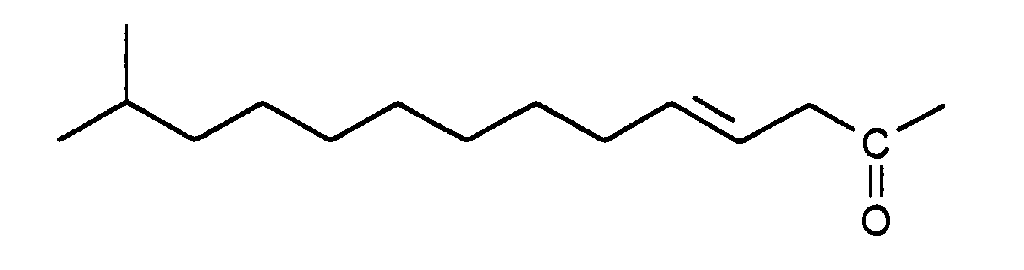
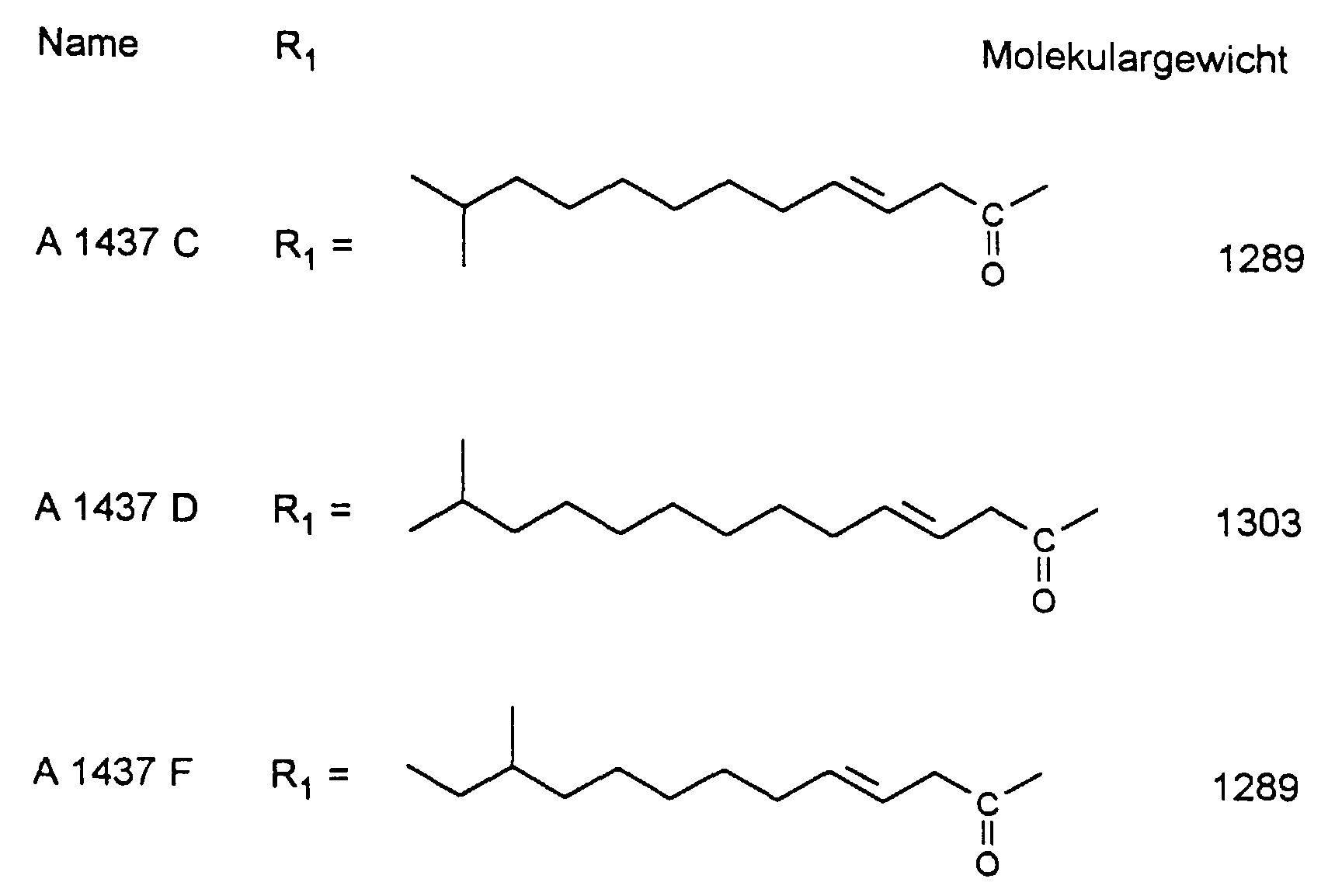
- Lipopeptide A 1437 C has an iso-C 13 fatty acid which is not yet known in lipopeptides of the amphomycin type. The amino acid composition and sequence of A 1437 C is not known from other lipopeptides.
- a 1437 D has a fatty acid of the type iso-C 14 and thus the fatty acid known from Tsushimycin (Shoji et al., The Jounal of Antibiotics 21, 439 (1968)).
- a 1437 D differs in its amino acid composition and sequence from the lipopeptides known to date from the prior art. According to the literature, the amino acid composition of amphomycin, glumamycin, zaomycin and tsushimycin is identical (Strong et al., Antimicrobial Agents and Chemotherapy 1970, 42; Bodanszley et al., J. Am. Chem. Soc. 95, 2352 (1973), Inoue , Bull. Chem. Soc. Jap. 35, 1556 (1962)).
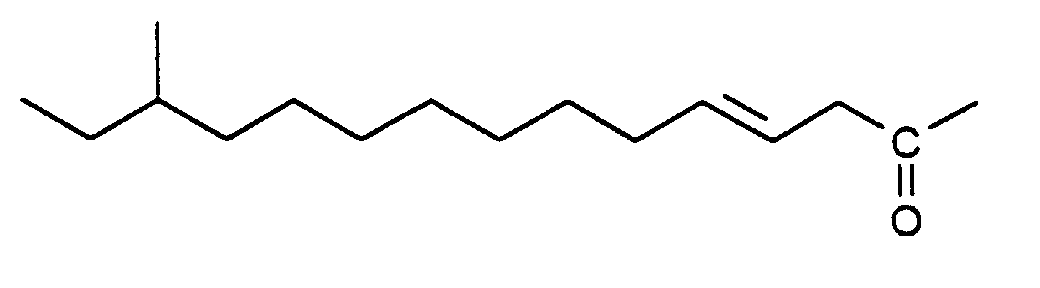
- a 1437 F consists of an ante-iso-C 13 fatty acid, and therefore has the same type of fatty acid as known from amphomycin. Its amino acid sequence and composition is unknown from the prior art.
- the lipopeptide A 1437 H like aspartocin, has an ante-iso-C 15 fatty acid.
- the amino acid sequence and composition of A 1437 H is unknown from the prior art.
- Actinoplanes sp. Preferably Actinoplanes DSM 7358, forms the lipopeptides A, B, E, G, K, L and M of the formula II characterized below:
- Lipopeptide A 1437 A has an ante-iso-C 13 fatty acid which is not yet known in lipopeptides of the amphomycin type.
- the amino acid sequence of A 1437 A corresponds to that of amphomycin, but which has an ante-iso-C 13 fatty acid (Bodanszky et al. J. Am. Chem. Soc. 95, 2352 (1973)).
- a 1437 B has a fatty acid of the type iso-C 14 and thus the fatty acid known from Tsushimycin (Shoji et al., J. of Antibiotics 21, 439 (1968)) and has the amino acid sequence of the amphomycin (Bodanszky et al., J Am. Chem. Soc. 95, 2352 (1973)).
- a 1437 E is identical to the amphomycin known from Streptomycetes.
- the lipopeptide A 1437 G like aspartocin (Hausmann et al., Antimicrobial Agents and Chemotherapy 1963, 352), has an ante-iso-C 15 fatty acid.
- the amino acid sequence of A 1437 G corresponds to that of amphomycin (Bodansky et al., J. Am. Chem. Soc. 95, 2352 (1973)).
- a 1437 K, L and M have unbranched fatty acids with a chain length of C 12 -C 14 .
- the amino acid sequence of the three lipopeptides mentioned corresponds to that of the amphomycin.
- Lipopeptides A 1437 A, B, E and G all have a link between the carboxy function of the C-terminal proline and the ⁇ -amino function of the amino-terminally located Dab. This link is through " " represented in Formula II.
- the quantitative proportion of a or more of the lipopeptides according to the invention vary.
- the media composition controlled the synthesis of individual lipopeptides be so that a lipopeptide not at all or in an amount below the Detection limit is produced by the microorganism.
- the culture medium from Actinoplanes sp. contains Lipopeptides with a mono- or polyunsaturated, saturated or regardless of a branched or unbranched fatty acid or Hydroxy fatty acid with a chain length of 6 up to and including 22 Carbon atoms, preferably from 10 to 20 carbon atoms inclusive, particularly preferably of 13, 14 or 15 carbon atoms.
- Such fatty acids are known to the person skilled in the art, e.g. from Römpp Chemie Lexicon, Prof. Falbe and Prof. Regitz, 9th ed. Georg Thieme Verlag Stuttgart, New York or from The Encyclopedia of Chemistry C.A. Hampel and G.G. Hawley, 3rd ed. Van Nostrand Reinhold Company, New York.
- Saturated, unbranched fatty acids on the lipopeptides according to the invention are, for example, the Capron, ⁇ nanth, Capryl, Pelargon, Caprin, Undecan, Laurin, tridecane, myristine, pentadecane, palmitin, margarine, stearin, Nonadecane, arachinic, behenic acid.
- Saturated, branched fatty acids on the lipopeptides according to the invention are for example isobutter or isovaleric acid or the corresponding Acids in the "ante-iso" configuration.
- Monounsaturated, unbranched fatty acids on the inventive Lipopeptides are, for example, acrylic or crotonic acid.
- Lipopeptides are, for example, sorbic acid.
- Tri-unsaturated, unbranched fatty acids on the inventive Lipopeptides are, for example, linolenic or elaeostearic acid.
- Lipopeptides are, for example, arachidonic acid.
- Lipopeptides are, for example, clupanode acid.
- Lipopeptides are, for example, docosahexaenoic acid.
- lipopeptides with multiple branches can be found in the culture medium Fatty acids such as the 2 ', 4', 6 ', 8'-tetramethyldecanoic acid occur.
- Hydroxy fatty acids on the lipopeptides according to the invention are, for example those hydroxylated at the 2 'and 3' positions and / or at the end of the carbon chain Fatty acids in the "iso" or "ante-iso" configuration.
- the strain Actinoplanes sp. When 0.01 to 5%, preferably 0.02 to 0.1% L-valine is added to the nutrient solution described above, the strain Actinoplanes sp. preferably the lipopeptides A 1437 B and D. When 0.01 to 5%, preferably 0.1 to 0.5% L-leucine is added to the nutrient solution described above, the strain Actinoplanes sp. prefers the lipopeptides A 1437 A and C. When 0.01 to 5%, preferably 0.05 to 0.5% L-isoleucine is added to the nutrient solution described above, the strain Actinoplanes sp. especially the lipopeptides A 1437 E, F, G and H.
- the Actinoplanes sp. preferably the lipopeptide K.
- the strain Actinoplanes sp. preferably the lipopeptides L and / or M. The same applies to the preferred strain DSM 7358.
- the corresponding ⁇ -keto acids of the mentioned amino acids ( ⁇ -ketoisovalerate, ⁇ -ketoisocaproate, ⁇ -keto- ⁇ -methylvalerate, ⁇ -ketovalerate) or their corresponding acids (isobutyrate, Isovalerate, ⁇ -methylbutyrate, n-butyrate, propionate, valerate) in the corresponding concentrations or other substances contained in the Fatty acid biosynthesis can be used.
- the microorganism is cultivated aerobically, for example submerged with shaking or stirring in shake flasks or fermenters, if necessary with the introduction of air or oxygen.
- the microorganism is cultivated under these conditions generally over a period of 24 to 300 hours, preferably 36 to 140 hours.
- Cultivation is advantageously carried out in several stages, i. H. you first put an or several precultures in a liquid nutrient medium, which are then in the actual production medium, the main culture, for example in Volume ratio 1:10, inoculated.
- the preculture is obtained, e.g. by you inoculate a mycelium into a nutrient solution and about 36 to 120 hours, preferably 48 to 72 hours.
- the mycelium can for example, by keeping the stem for about 3 to 40 days, preferably 4 to 10 days, on a solid or liquid nutrient medium, for example yeast-malt agar or nutrient-broth agar (standard medium for Microorganisms with the main components peptone, table salt and agar, e.g. from Difco) grows.
- the fermentation process can be based on the pH of the cultures or Mycelium volume as well as by chromatographic methods, e.g. Thin Layer Chromatography or High Pressure Liquid Chromatography or Checking biological activity will be monitored.
- An inventive Compound is contained in both the mycelium and the culture filtrate, the largest part ( ⁇ 90%) is however in the culture filtrate.
- the insulation process described below is used to purify the Lipopeptides according to the invention, but preferably for lipopeptides A 1437 C, A 1437 D, A 1437 F and A 1437 H.
- a lipopeptide according to the invention is isolated or purified from the culture medium by known methods, taking into account the chemical, physical and biological properties of the natural products.
- thin layer chromatography for example on silica gel with isopropanol / 25% NH 3 as eluent or HPLC, can be used.
- Detection in thin-layer chromatographic separation can be carried out, for example, by means of coloring reagents such as anisaldehyde, the amount of the substance formed being expediently compared with a calibration solution.
- the mycelium is first separated from the culture broth by the usual methods and then the culture filtrate, preferably at 4 ° C to a pH of pH 0.5 to including pH 4, preferably from pH 1.5 to pH 2.5 inclusive set.
- the adjustment of the pH and thus the precipitation of the lipopeptides A 1437 can be used with all commercially available acids.
- the solution will be up to 16 hours, preferably up to 4 hours, and then the centrifuged precipitate.
- the precipitate which contains the entire lipopeptides, is in 1/20 of original volume Aqua bidest. resuspended and with NaOH to pH 6 to 7 set. The precipitate completely dissolves; the solution will be Chilled to -20 ° C and lyophilized.
- the lyophilisate subsequently as a raw product called, contains 5 to 30% lipopeptides and is used for further isolation used.
- lipopeptides The further purification of one or more lipopeptides according to the invention is carried out by chromatography on suitable materials, preferably e.g. on Silica gel, aluminum oxide, ion exchangers or adsorber resins and all particularly preferred on strong or weakly basic anion exchangers. With the help of this chromatography, the lipopeptides are separated, the Asp or
- the lipopeptides are made with buffered aqueous solutions or mixtures of aqueous and alcoholic solutions.
- Buffered aqueous solutions are e.g. Water, Phosphate buffer, ammonium acetate, citrate buffer, borate buffer in one Concentration from 0 to 1 M, preferably 1 to 100 mM, particularly preferred become phosphate buffered solutions in a concentration of 1 to 100 mM used.
- Mixtures of aqueous or alcoholic solutions mean all water-miscible organic solvents, preferably methanol, Acetonitrile, in a concentration of 10 to 80% solvent, preferably 40 to 60% solvent or all buffered aqueous solutions containing organic solvents are miscible.
- the buffers to be used are same as above.
- the lipopeptides are separated on the basis of their different fatty acids with the help of reversed phase chromatography, for example on MCI® (Adsorbent resin from Mitsubishi, Japan). Reversed is particularly preferred Phase chromatography on hydrophobic materials, preferably RP-8 or RP-18 phase chromatography. The separation can also be done with the help of Silica gel chromatography done.
- the lipopeptides are chromatographed with buffered or acidified aqueous solutions or mixtures of aqueous solutions with alcohols or other water-miscible organic solvents.
- organic Solvent is preferably used acetonitrile.
- Buffered or acidified aqueous solutions are e.g. Water, phosphate buffer, ammonium acetate, citrate buffer, borate buffer in one Concentration from 0 to 0.5 M as well as formic acid, acetic acid, Trifluoroacetic acid or all commercially available acids known to the person skilled in the art, preferably in a concentration of 0 to 1%. Is particularly preferred 0.1%.
- Chromatography is carried out using a gradient which begins with 100% water and ends with 100% solvent, preferably a linear gradient of 40 to 60% acetonitrile.
- gel chromatography or chromatography can also be used hydrophobic phases take place.
- Gel chromatography is performed on polyacrylamide or mixed polymer gels carried out, e.g. Biogel-P 2® (from Biorad) or Fractogel TSK HW 40® (Merck, Germany or Toso Haas, USA).
- Biogel-P 2® from Biorad
- Fractogel TSK HW 40® Merck, Germany or Toso Haas, USA.
- the lipopeptides according to the invention are in the solid state and in solutions in pH range between 4 and 8, especially 5 and 7, stable and can be work it into common galenical preparations.
- One or more compounds of the lipopeptides according to the invention are suitable due to their valuable pharmacological properties for use as Drug.
- the substances according to the invention have pharmacological activity especially preferred as an antibiotic against gram-positive bacteria against strains resistant to glycopeptides.
- the invention also relates to pharmaceutical preparations of one or more Compounds of the lipopeptides according to the invention.
- One or more compounds of the lipopeptides according to the invention can are basically administered as such in substance.
- Carrier material for veterinary medicinal products can be the usual feed mixtures or in humans all pharmacologically acceptable carrier materials and / or auxiliary substances are used.
- Suitable solid or liquid pharmaceutical preparation forms are, for example, granules, Powder, tablets, coated tablets, (micro) capsules, suppositories, syrups, emulsions, Suspensions, aerosols, drops or injectable solutions in Ampoule shape and preparations with protracted release of active ingredient, in their Manufacture usually carriers and additives and / or auxiliaries such as Explosives, binders, coatings, swelling agents, lubricants or lubricants, Flavors, sweeteners or solubilizers are used. As commonly used carriers or auxiliaries are e.g.
- the dosage units can be used for oral administration microencapsulated to delay delivery or over a longer period Extend the period, such as by covering or embedding the Active ingredient in particle form in suitable polymers, waxes or the like.
- the pharmaceutical preparations are preferably in dosage units manufactured and administered, each unit as an active ingredient certain dose of one or more compounds of the invention Contains lipopeptides.
- certain dose of one or more compounds of the invention Contains lipopeptides.
- For fixed dosage units such as tablets, capsules and Suppositories can take this dose up to about 200 mg, but preferably about 0.1 to 100 mg, and for ampoule solutions up to about 200 mg, but preferably about 0.5 to 100 mg, per day.
- the daily dose to be administered depends on body weight, age, Sex and condition of the mammal. Under certain circumstances, however, can also higher or lower daily doses may be appropriate.
- the administration of the Daily dose can be given both as a single dose Dosage unit or in several smaller dosage units as well by giving divided doses several times at certain intervals.
- the pharmaceuticals according to the invention are produced by one or more compounds of the lipopeptides according to the invention with usual Carriers and optionally additives and / or auxiliaries in the or brings suitable dosage form.
- the maximum production of one or more compounds of the lipopeptides according to the invention is reached after about 120 hours.
- a 48 to 96 hour old submerged culture (inoculation amount approx. 10%) from the same nutrient solution is sufficient for inoculating 10 and 200 l fermenters.
- the production maximum is approx. 96 to 120 hours reached.
- filter aid for example Celite ®
- a 3.2 l chromatography column (10 cm ID x 40 cm H) is filled with DEAE- ® Sepharose Fast Flow and equilibrated with 10 mM potassium phosphate buffer, pH 7.0 in 40% methanol (buffer A). Then 25 g of A 1437 B crude product (obtained according to Example 3a), dissolved in 3.5 l of water, applied to the column and washed with 1 l of water and then with 6 l of buffer A. There are impurities in the raw product in the pass and in the wash water. A 10 to 100 mM potassium phosphate, pH 7.0 gradient in 40% methanol is then applied.
- the A 1437 D peptide is eluted with 25 to 35 mM potassium phosphate and the antibiotic A 1437 B is obtained with 40 to 55 mM potassium phosphate.
- the corresponding fractions are freed of methanol in vacuo.
- a 1 liter ®Dianion HP-20 column (Mitsubishi, Japan) is used for desalination. Now the fractions containing 9 l of pure B-peptide are applied to the column and then washed with 3 l of deionized water. Elution is carried out with water-isopropanol using the gradient method (0 to 50% alcohol content).
- the pure A 1437 B is washed off the support with 15 to 25% isopropanol.
- the preparation is as described under 3a, only the L-valine is in Production medium replaced by 4 g / l L-leucine and the fermentation in one 50 l bioreactor carried out.
- Example 3a The preparation takes place as described in Example 3a, only the L-valine in the production medium by 1.5 g / l L-isoleucine and the fermentation in a 50 l bioreactor.
- the yield is 1.4 g / l crude peptide (70g).
- a 500 ml preparative HPLC column (5.1 cm (ID) x 25 cm H) filled with ®LiChrosorbG RP-18, 10 ⁇ m, and the saline A 1437 G containing solution applied with 1.9 g of the antibiotic. Is eluted in Gradient method with 5% acetonitrile in 10 mM potassium phosphate buffer, pH 7.0 to 36% acetonitrile in 10 mM potassium phosphate buffer, pH 7.0. With The lipopeptide A 1437 G is obtained from 24 to 26% acetonitrile.
- the corresponding post-cleaning of the A 1437 H solution obtained according to Example 5b happens with the solvent gradient in 10 to 50% acetonitrile 10 mM potassium phosphate buffer, pH 7.0.
- the antibiotic is eluted with 37 to 39% solvent content.
- Concentration of the corresponding Fractions and desalination on ®Dianion HP-20 and freeze drying result 2.2 g of lipopeptide A 1437 H in over 98% purity.
- the saline A 1437 F solution obtained according to Example 5b with 1.8 g of the Antibiotic is applied to 1 l of MCI gel CHP 20P (Mitsubishi Kasei Corp.) applied.
- the column dimensions are 6 cm ID x 35 cm H.
- buffer A 5 mM Potassium phosphate buffer pH 7.0 with 20% acetonitrile
- Gradient method against buffer B 5 mM potassium phosphate buffer, pH 7.0 with 70% acetonitrile.
- 34 to 35% solvent content lead to Elution of the pure antibiotic.
- Concentrate in vacuum and desalination ®Dianion HP-20 yield 1.4 g of lipopeptide A 1437 F in over 98% purity.
- the analogous procedure with the A 1437 E crude product from Example 5a results 1 g of lipopeptide A 1437 E in over 98% purity.
- the preparation takes place as described under 4a, only the L-valine is in the Production medium through 500 mg / l L- ⁇ -aminobutyric acid (or 1 g / l des Racemats) and the fermentation was carried out in a 10 l bioreactor.
- the preparation takes place as described under 4a, only the L-valine is in the Production mixture replaced by 500 mg / l L-norvaline (or 1 g / l of the racemate) and the fermentation was carried out in a 10 l bioreactor.
- the sensitivity of relevant germs to the A 1437 lipopeptides is determined using an agar dilution test.
- Müller-Hinton agar is used as agar, to which 10% horse blood is added in the case of S. pyogenes and enterococci.
- the antibiotic-containing plates are inoculated with a multi-channel vaccination device (5 x 10 4 cfu / vaccination site, a stationary culture of the respective strain).
- the MIC values minimum inhibitory concentration
- the MIC value is defined as the concentration of the antibiotic at which no visible growth of the germs is detectable after 24 hours of incubation.
- Table 2 The results are summarized in Table 2.
- the amphomycin used as a control was obtained from Boehringer Mannheim (Germany).
- Amphomycin is available there as a fine chemical.
- a 1437 substances In vitro activity (AB spectrum); Concentration in ⁇ g / ml A 1437 A 0.391 0.781 0.391 1.56 0.391 3.13 A 1437 B 0.098 0.195 0.098 0.195 0.049 0.391 A 1437 C. 0.195 0.781 0.391 3.13 0.781 3.13 A 1437 D. 0.049 0.195 0.049 0.781 0.391 0.781 A 1437 E. 0.098 0.195 0.094 0.098 0.025 0.195 A 1437 F 0.098 0.391 0.195 1.56 0.781 1.56 A 1437 G 0.098 0.195 0.049 0.088 0.025 0.195 A 1437 H.
- a 1437 substances In vitro activity (vancomycin-resistant strains); Concentration in ⁇ g / ml Enterococcus faecium VR1 Enterococcus faecium VR2 Streptococcus pyogenes A 1437 A not determined A 1437 B 1 1 0.5 A 1437 C. 4th 4th 4th A 1437 D. 2nd 2nd 1 A 1437 E. 4th 4th 1 A 1437 F 4th 4th 1 A 1437 G 0.25 0.25 0.125 A 1437 H. 1 1 0.5 Amphomycin 4th 4th 2nd The compounds K, L, M have an in vitro activity comparable to the compounds AH.
- the table shows the C13-chem. Shifts in CH signals from A 1437B
- the NH chemical shifts were made of the NH signals or, for Pip and Pro, the C ⁇ H shifts of the corresponding spin systems.
Landscapes
- Chemical & Material Sciences (AREA)
- Organic Chemistry (AREA)
- Health & Medical Sciences (AREA)
- Life Sciences & Earth Sciences (AREA)
- General Health & Medical Sciences (AREA)
- Medicinal Chemistry (AREA)
- Biochemistry (AREA)
- Biophysics (AREA)
- Genetics & Genomics (AREA)
- Molecular Biology (AREA)
- Proteomics, Peptides & Aminoacids (AREA)
- Oncology (AREA)
- Public Health (AREA)
- Chemical Kinetics & Catalysis (AREA)
- General Chemical & Material Sciences (AREA)
- Nuclear Medicine, Radiotherapy & Molecular Imaging (AREA)
- Pharmacology & Pharmacy (AREA)
- Animal Behavior & Ethology (AREA)
- Communicable Diseases (AREA)
- Veterinary Medicine (AREA)
- Peptides Or Proteins (AREA)
- Preparation Of Compounds By Using Micro-Organisms (AREA)
- Medicines Containing Material From Animals Or Micro-Organisms (AREA)
- Medicines That Contain Protein Lipid Enzymes And Other Medicines (AREA)
- Micro-Organisms Or Cultivation Processes Thereof (AREA)
Description
- Amphomycin Antibiot. [J. Antibiotics, 38, S. 517 (1965)];
- Glumamycin [J. Antibiotics, 38, S. 517 (1965)];
- Zaomycin [J. Antibiot. Ann., S. 194 (1960)];
- Aspartocin [Antibiot. Ann., 194 (1960)];
- Tsuhimycin [J. Antibiotics, 21, S. 439 (1968)];
- Laspartomycin [J. Antibiotics 21, S. 55 (1968)].

- R1
- eine einfach oder mehrfach ungesättigte, gesättigte, oder unabhängig davon eine verzweigte oder unverzweigte Fettsäure oder Hydroxyfettsäure mit einer Kettenlänge von 6 bis einschließlich 22 Kohlenstoffatomen bedeutet.
R1 =

R1 =
R1 =

R1 =
- Dab bedeutet 2,3-Diamino-buttersäure;
- Pip bedeutet Pipecolinsäure (Synonym = Homoprolin);
- MeAsp bedeutet β-Methylaspartat;
- Gly bedeutet Glycin;
- Asn bedeutet Asparagin;
- Asp bedeutet Asparaginsäure;
- Val bedeutet Valin;
- Pro bedeutet Prolin;
- n bedeutet normal/unverzweigt und
- CID bedeutet "collisional induced decay".
- Abtrennung des Mycels nach der Fermentation;
- Fällung der Lipopeptide bei pH 1 bis 2 (4°C);
- Aufnehmen des Niederschlages in H2O/MeOH (1:1);
- Analytik mittels HPLC, DC oder Hemmhoftest.



Bei Zugabe von 0,01 bis 5 %, vorzugsweise 0,05 bis 0,5 % L-Isoleucin zur oben beschriebenen Nährlösung bildet der Stamm Actinoplanes sp. vor allem die Lipopeptide A 1437 E, F, G und H. Bei Zugabe von 0,01 bis 5 %, vorzugsweise 0,05 bis 0,5 % L-α-Aminobuttersäure zur oben beschriebenen Nährlösung bildet der Stamm Actinoplanes sp. bevorzugt das Lipopeptid K. Bei Zugabe von 0,01 bis 5 %, vorzugsweise 0,05 bis 0,5 % L-Norvalin zur oben beschriebenen Nährlösung bildet der Stamm Actinoplanes sp. bevorzugt die Lipopeptide L und/oder M. Gleiches gilt für den bevorzugten Stamm DSM 7358.
| Actinoplanes sp. DSM 7358 | A.utahensis NRRL 12052 | A.brasiliensis ATCC 25844 | A.nipponensis ATCC 311455 | |
| Luftmycel | - | - | + (ISP 3) | - |
| Sporangien | + | + | + | + |
| Medium | ||||
| ISP 2 | orange | orange | gelborange | orange |
| ISP 3 | orange | orange | gelborange | orange |
| ISP 4 | orange | orange | gelborange | orange |
| ISP 5 | orange | orange | gelborange | orange |
| ISP 6 | orange | orange | gelborange | orange |
| rotes | braunrotes | rotes | rotes | |
| Exopigment | Exopigment | Exopigment | Exopigment | |
| Melanin | - | - | (+) | (+) |
| Glucose | + | + | + | + |
| Arabinose | + | + | + | + |
| Saccharose | + | + | + | + |
| Xylose | + | + | (+) | - |
| Inosit | + | + | (+) | (+) |
| Mannit | + | + | + | - |
| Fructose | + | + | + | - |
| Rhamnose | + | + | + | + |
| Raffinose | + | + | (+) | - |
| Cellulose | + | + | (+) | - |
| Melibiose | - | - | - | - |
| Amygdalin | - | + | + | + |
| Gelatine (Hydrolyse) | + | + | + | + |
| Citrat (Hydrolyse) | - | - | + | - |
| Harnstoff (hydrolyse) | + | - | - | - |
| Arginin hydrolase | + | - | - | - |
| ß-Galactosidase | - | - | - | - |
| Tryptophanase | - | - | - | - |
| Lysindecarboxylase | + | - | - | - |
| Acetoin (Bildung) | + | + | + | + |
| Indol (Bildung) | - | - | - | - |
| H2S (Bildung) | - | - | - | - |
| NaCl Toleranz | 0 - 2,5 % | 0 - 2,5 % | 0 - 2,5 % | 0 - 2,5 % |
- Nährmedium:
- 11 g/l Saccharose
6 g/l Fleischextrakt
0,3 g/l Hefeextrakt
0,6 g/l MgSO4
0,1 g/l KH2PO4
10 µM FeCl3 x 6H2O
0,6 g/l L-Valin
pH 7,3 (vor der Sterilisation) - Inkubationszeit:
- 120 Stunden
- Inkubationstemperatur:
- 30°C
- Rührergeschwindigkeit:
- 50 UpM
- Belüftung:
- 150 1 Min-1

- 10 g Rohpeptid in 100 ml aqua dest.
- Adsorption an Q-Sepharose fast flow (3,5 x 17 cm Säule)
- Elution mit folgendem Gradienten
- Puffer A: NaH2PO4 1 mM in 50 % Methanol, pH 5,9
- Puffer B: NaH2PO4 100 mM in 50 % Methanol, pH 5,3
- 20 Min: Puffer A --→ in 45 Min. auf 25 % Puffer B, weitere 45 Min. bei
- 25 % Puffer B
- Lyophilisation der A 1437 K Fraktionen
- Entsalzung an Biogel P2 (100-200 mesh)
- (7 x 20 cm Säule)
- 700 mg A 1437 K (60 %ig)
- RP-Chromatographie an Nucleosil C18 7 µm (20 x 250 mm Säule)
- Auftrag: 50 mg des vorgereinigten Produkts
- Elution mit folgendem Gradient
- Puffer A: aqua bidest., 0,1 % TFA
- Puffer B: Acetonitril
- 10 Min.: Puffer A / 5 % Puffer B -- in 60 Min. auf 70 % Puffer B bei
- 10 ml/Minute Fluß
- Lyophilisation der A 1437 K Fraktionen
- 5,6 mg A 1437 K (> 95 %ig)
- 10 g Rohpeptid in 100 ml aqua dest.
- Adsorption an Q-Sepharose fast flow
- (3,5 x 17 cm Säule)
- Elution mit folgendem Gradient
- Puffer A: NaH2PO4 1 mM in 50 % Methanol, pH 5,9
- Puffer B: NaH2PO4 100 mM in 50 % Methanol, pH 5,3
- 20 Min: Puffer A --- in 45 Min. auf 25 % Puffer B, weitere 45 Min. bei
- 25 % Puffer B
- Lyophilisation der A 1437 L und M Fraktionen
- Entsalzung an Biogel P2 (100-200 mesh)
- (7 x 20 cm Säule)
- 900 mg A 1437 L und M (ca. 60 %ig)
- RP-Chromatographie an Nucleosil C18 7 µm (20 x 250 mm Säule)
- Auftrag: 50 mg des vorgereinigten Produkts
- Elution mit folgendem Gradient
- Puffer A: aqua bidest., 0,1 % TFA
- Puffer B: Acetonitril
- 10 Min.: Puffer A / 5 % Puffer B --→ in 60 Min. auf 70 % Puffer B bei
- 10 ml/Minute Fluß
- Lyophilisation der A 1437 L und M Fraktionen
- 5,8 mg A 1437 L (> 95 %ig) 6,7 mg A 1437 M ( > 95 %ig)
| Laufmittel | A | Kalium-Phosphatpuffer pH 7,0, 10 mM |
| B | Acetonitril |
| Gradient | t[Min] | Fluß[ml/min] | A[%] | B[%] |
| 0 | 1,5 | 80 | 20 | |
| 15 | 1,5 | 50 | 50 | |
| 15,5 | 2 | 00 | 100 | |
| 16,5 | 2 | 00 | 100 | |
| 17 | 1,5 | 80 | 20 | |
| 22 | 1,5 | 80 | 20 |
- Säule:
- Shandon ODS Hypersil RP 18 (120 x 4,6 mm mit 20 x 4,6 mm Vorsäule) oder
Nucleosil 120 RP 18 (120 x 4,6 mm mit 20 x 4,6 mm Vorsäule) - Fluß:
- 1,5 ml/min
- Detektion:
- 210 nm
- Injektion:
- 10 µl
- Medium 1:
- wie in Beispiel 3a beschrieben
- Medium 2:
- wie Medium 1 jedoch ohne L-Valin
- Medium 3:
- Glucose 30 g/l; Sojamehl 20 g/l; Fe2(SO4)3 0,3 g/l; MnCl2x4H2O 0,3 g/l und CoCl2x6 H2O pH 7,3
Die Ergebnisse sind in Tabelle 2 zusammengefaßt. Das als Kontrolle verwendete Amphomycin wurde von Boehringer Mannheim (Deutschland) bezogen. Amphomycin ist dort als Feinchemikalie erhältlich.
| A 1437 Substanzen: In vitro Aktivität (AB-Spektrum); Konzentration in µg/ml | ||||||
| A 1437 A | 0.391 | 0.781 | 0.391 | 1.56 | 0.391 | 3.13 |
| A 1437 B | 0.098 | 0.195 | 0.098 | 0.195 | 0.049 | 0.391 |
| A 1437 C | 0.195 | 0.781 | 0.391 | 3.13 | 0.781 | 3.13 |
| A 1437 D | 0.049 | 0.195 | 0.049 | 0.781 | 0.391 | 0.781 |
| A 1437 E | 0.098 | 0.195 | 0.094 | 0.098 | 0.025 | 0.195 |
| A 1437 F | 0.098 | 0.391 | 0.195 | 1.56 | 0.781 | 1.56 |
| A 1437 G | 0.098 | 0.195 | 0.049 | 0.088 | 0.025 | 0.195 |
| A 1437 H | 0.049 | 0.098 | 0.049 | 0.195 | 0.049 | 0.195 |
| Amphomycin | 0.195 | 0.781 | 0.391 | 1.56 | 0.391 | 1.56 |
| A 1437 Substanzen: In vitro Aktivität (Vancomycin-resistente Stämme); Konzentration in µg/ml | |||
| Enterococcus faecium VR1 | Enterococcus faecium VR2 | Streptococcus pyogenes | |
| A 1437 A | nicht bestimmt | ||
| A 1437 B | 1 | 1 | 0.5 |
| A 1437 C | 4 | 4 | 4 |
| A 1437 D | 2 | 2 | 1 |
| A 1437 E | 4 | 4 | 1 |
| A 1437 F | 4 | 4 | 1 |
| A 1437 G | 0.25 | 0.25 | 0.125 |
| A 1437 H | 1 | 1 | 0.5 |
| Amphomycin | 4 | 4 | 2 |
Drehwert: +35° (c = 0,1; Methanol)
HPLC: Retentionszeit: 15,1 Minuten
- Aminosäuren:
- 2 Asparaginsäuren
1 Asparagin
1 β-Methylaspartat
2 Glycin
2 2,3-Diaminobuttersäure
1 Prolin
1 Pipecolinsäure
1 Valin
Molmasse: 1302, 6884 (C59H94N14O19)
CID-MS: m/z = 356, 491, 517, 520, 741, 761, 938, 982
IR (KBr): v = 3420 (br) cm-1, 2930, 1660, 1530, 1450, 1400.
Drehwert: + 27° (c = 0,1; Methanol)
HPLC: Retentionszeit: 12,8 Minuten
- Aminosäuren:
- 3 Asparaginsäuren
1 β-Methylaspartat
2 Glycin
2 2,3-Diaminobuttersäure
1 Prolin
1 Pipecolinsäure
1 Valin
Molmasse: 1303 (C59H93N13O20)
CID-MS: m/z = 356, 407, 518, 521, 741, 762, 938, 982
IR (KBr): v = 3420 (br) cm-1, 2925, 1650, 1535, 1450, 1400.
Drehwert: +30° (c = 0,1; Methanol)
HPLC: Retentionszeit: 14,1 Minuten
- Aminosäuren:
- 2 Asparaginsäuren
1 Asparagin
1 β-Methylaspartat
2 Glycin
2 2,3-Diaminobuttersäure
1 Prolin
1 Pipecolinsäure
1 Valin
CID-MS: m/z = 356, 392, 503, 503, 741, 747, 938, 981
IR (KBr): v = 3420 (br) cm-1, 2930, 1660, 1530, 1450, 1400.
Drehwert: +30° (c = 0,1; Methanol)
HPLC: Retentionszeit: 11,8 Minuten
- Aminosäuren:
- 3 Asparaginsäuren
1 β-Methylaspartat
2 Glycin
2 2,3-Diaminobuttersäure
1 Prolin
1 Pipecolinsäure
1 Valin
CID-MS: m/z = 356,478, 504, 507, 741, 748, 938, 981
IR (KBr): v = 3420 (br) cm-1, 2925, 1650, 1535, 1450, 1400.
Drehwert: +31° (c = 0,1; Methanol)
HPLC: Retentionszeit: 13,8 Minuten
- Aminosäuren:
- 2 Asparaginsäuren
1 Asparagin
1 β-Methylaspartat
2 Glycin
2 2,3-Diaminobuttersäure
1 Prolin
1 Pipecolinsäure
1 Valin
CID-MS: m/z = 356, 392, 503, 506, 741, 747, 938, 981
IR (KBr): v = 3420 (br) cm-1, 2930, 1660, 1530, 1450, 1400.
HPLC: Retentionszeit: 11,5 Minuten
- Aminosäuren:
- 3 Asparaginsäuren
1 β-Methylaspartat
2 Glycin
2 2,3-Diaminobuttersäure
1 Prolin
1 Pipecolinsäure
1 Valin
CID-MS: m/z = 356, 393, 504, 507, 741, 748, 938, 981
IR (KBr): v = 3420 (br) cm-1, 2925, 1650, 1535, 1450, 1400.
Drehwert: + 32° (c = 0,1; Methanol)
HPLC: Retentionszeit: 15,9 Minuten
- Aminosäuren:
- 2 Asparaginsäuren
1 Asparagin
1 β-Methylaspartat
2 Glycin
2 2,3-Diaminobuttersäure
1 Prolin
1 Pipecolinsäure
1 Valin
CID-MS: m/z = 356, 420, 531, 534, 741, 775, 938, 981
IR (KBr): v = 3420 (br) cm-1, 2930, 1660, 1530, 1450, 1400.
Drehwert: + 34° (c = 0,1; Methanol)
HPLC: Retentionszeit: 13,6 Minuten
- Aminosäuren:
- 3 Asparaginsäuren
1 β-Methylaspartat
2 Glycin
2 2,3-Diaminobuttersäure
1 Prolin
1 Pipecolinsäure
1 Valin
CID-MS: m/z = 356, 421, 532, 535, 741, 776, 938, 981
IR (KBr): v = 3420 (br) cm-1, 2925, 1650, 1535, 1450, 1400.
HPLC: Retentionszeit: 12,5 Minuten
- Aminosäuren:
- 3 Asparaginsäuren
1 β-Methylaspartat
2 Glycin
2 2,3-Diaminobuttersäure
1 Prolin
1 Pipecolinsäure
1 Valin
Molmasse: 1299 (C58H91N13O20)
CID-MS: m/z = 393, 504, 507, 741, 748, 938, 981
IR (KBr): v = 3420 (br) cm-1, 2925, 1650, 1535, 1450, 1400.
HPLC: Retentionszeit: 13,0 Minuten
- Aminosäuren:
- 3 Asparaginsäuren
1 β-Methylaspartat
2 Glycin
2 2,3-Diaminobuttersäure
1 Prolin
1 Pipecolinsäure
1 Valin
Molmasse: 1289 (C59H93N13O20)
CID-MS: m/z = 407, 518, 741, 761, 938, 981
IR (KBr): v = 3420 (br) cm-1, 2925, 1650, 1535, 1450, 1400.
HPLC: Retentionszeit: 9,8 Minuten
- Aminosäuren:
- 3 Asparaginsäuren
1 β-Methylaspartat
2 Glycin
2 2,3-Diaminobuttersäure
1 Prolin
1 Pipecolinsäure
1 Valin
Molmasse: 1275 (C57H89N13O20)
CID-MS: m/z = 379, 490, 493, 724, 741, 938, 981
IR (KBr): v = 3420 (br) cm-1, 2925, 1650, 1535, 1450, 1400.

Claims (15)
- Lipopeptide der Formel I,in der

- R1
- eine einfach oder mehrfach ungesättigte, gesättigte oder unabhängig davon eine verzweigte oder unverzweigte Fettsäure oder Hydroxyfettsäure mit einer Kettenlänge von 6 bis einschließlich 22 Kohlenstoffatomen bedeutet.
- Lipopeptid nach Anspruch 1, dadurch gekennzeichnet, daß R1 eine Kettenlänge von 10 bis einschließlich 20 Kohlenstoffatomen aufweist.
- Lipopeptid nach Anspruch 1, dadurch gekennzeichnet, daß R1 eine Kettenlänge von 12,13,14 oder 15 Kohlenstoffatomen aufweist.
- Lipopeptid nach Anspruch 1, dadurch gekennzeichnet, daß R1 einea) iC13-Fettsäure,b) iC14-Fettsäure,c) aiC13-Fettsäure oder eined) aiC15-Fettsäure bedeutet.
- Lipopeptid nach Anspruch 4, dadurch gekennzeichnet, daß
R1 =bedeutet.
- Lipopeptid nach Anspruch 4, dadurch gekennzeichnet, daß
R1 =bedeutet.
- Lipopeptid nach Anspruch 4, dadurch gekennzeichnet, daß
R1 =bedeutet.
- Lipopeptid nach Anspruch 4, dadurch gekennzeichnet, daß
R1 =bedeutet.
- Verfahren zur Herstellung eines Lipopeptides der Formel I gemäß einem oder mehreren der Ansprüche 1 bis 8, dadurch gekennzeichnet, daß man Actinoplanes sp. in einem Kulturmedium fermentiert, bis sich ein oder mehrere Lipopeptide in dem Kulturmedium anhäufen und man das Lipopeptid der Formel I aus dem Kulturmedium aufreinigt.
- Verfahren nach Anspruch 9, dadurch gekennzeichnet, daß die Aufreinigung erfolgt, indem man die Lipopeptide aus dem Kulturmedium unter Verwendung von Säuren bei pH 0,5 bis einschließlich pH 4 fällt, man dann gegebenenfalls die aus der Fällung erhaltenen Lipopeptide durch Chromatographie an Anionenaustauschern oder Chromatographie an hydrophober Matrix aufreinigt, wobei die beiden Chromatographien alternativ oder nachfolgend in beliebiger Reihenfolge durchgeführt werden können.
- Verfahren nach Anspruch 9 oder 10, dadurch gekennzeichnet, daß man Actinoplanes sp. DSM 7358 fermentiert.
- Arzneimittel, enthaltend ein oder mehrere Lipopeptide der Formel I gemäß einem oder mehreren der Ansprüche 1 bis 8 und gegebenenfalls pharmazeutische Träger.
- Verwendung eines Lipopeptids der Formel I gemäß einem der Ansprüche 1 bis 8 zur Herstellung eines Antibiotikums gegen gram-positive Bakterien.
- Verwendung nach Anspruch 13, dadurch gekennzeichnet, daß die Bakterien glycopeptidresistente Bakterien sind.
- Actinoplanes sp. DSM 7358.
Priority Applications (2)
| Application Number | Priority Date | Filing Date | Title |
|---|---|---|---|
| EP98110484A EP0864584B1 (de) | 1993-06-08 | 1994-06-01 | Lipopeptide aus Actinoplanes sp. mit pharmakologischer Wirkung, Verfahren zu ihrer Herstellung und Verwendung derselben |
| GR20010400022T GR3035204T3 (en) | 1993-06-08 | 2001-01-10 | Lipopetide from Actinoplanes sp. with pharmacological properties, process for its preparation and its use |
Applications Claiming Priority (2)
| Application Number | Priority Date | Filing Date | Title |
|---|---|---|---|
| DE4319007 | 1993-06-08 | ||
| DE4319007 | 1993-06-08 |
Related Child Applications (1)
| Application Number | Title | Priority Date | Filing Date |
|---|---|---|---|
| EP98110484A Division EP0864584B1 (de) | 1993-06-08 | 1994-06-01 | Lipopeptide aus Actinoplanes sp. mit pharmakologischer Wirkung, Verfahren zu ihrer Herstellung und Verwendung derselben |
Publications (2)
| Publication Number | Publication Date |
|---|---|
| EP0629636A1 EP0629636A1 (de) | 1994-12-21 |
| EP0629636B1 true EP0629636B1 (de) | 1998-12-16 |
Family
ID=6489896
Family Applications (2)
| Application Number | Title | Priority Date | Filing Date |
|---|---|---|---|
| EP98110484A Expired - Lifetime EP0864584B1 (de) | 1993-06-08 | 1994-06-01 | Lipopeptide aus Actinoplanes sp. mit pharmakologischer Wirkung, Verfahren zu ihrer Herstellung und Verwendung derselben |
| EP94108443A Expired - Lifetime EP0629636B1 (de) | 1993-06-08 | 1994-06-01 | Lipopeptide aus Actinoplanes sp. mit pharmakologischer Wirkung, Verfahren zu ihrer Herstellung und Verwendung derselben |
Family Applications Before (1)
| Application Number | Title | Priority Date | Filing Date |
|---|---|---|---|
| EP98110484A Expired - Lifetime EP0864584B1 (de) | 1993-06-08 | 1994-06-01 | Lipopeptide aus Actinoplanes sp. mit pharmakologischer Wirkung, Verfahren zu ihrer Herstellung und Verwendung derselben |
Country Status (27)
| Country | Link |
|---|---|
| US (1) | US6194383B1 (de) |
| EP (2) | EP0864584B1 (de) |
| JP (1) | JP2660161B2 (de) |
| KR (2) | KR0174264B1 (de) |
| AT (2) | ATE198209T1 (de) |
| AU (1) | AU672691B2 (de) |
| CA (1) | CA2125376C (de) |
| CY (1) | CY2190B1 (de) |
| CZ (1) | CZ285322B6 (de) |
| DE (2) | DE59409616D1 (de) |
| DK (2) | DK0864584T3 (de) |
| ES (2) | ES2153224T3 (de) |
| FI (1) | FI942660L (de) |
| GR (2) | GR3029591T3 (de) |
| HU (1) | HU217177B (de) |
| IL (2) | IL109917A (de) |
| MA (1) | MA23216A1 (de) |
| NO (1) | NO942110L (de) |
| NZ (1) | NZ260682A (de) |
| OA (1) | OA10066A (de) |
| PL (2) | PL180230B1 (de) |
| PT (1) | PT864584E (de) |
| RU (1) | RU2117672C1 (de) |
| SK (1) | SK281830B6 (de) |
| TW (1) | TW455591B (de) |
| UY (1) | UY23762A1 (de) |
| ZA (1) | ZA943983B (de) |
Cited By (2)
| Publication number | Priority date | Publication date | Assignee | Title |
|---|---|---|---|---|
| WO2003057724A1 (en) | 2002-01-03 | 2003-07-17 | Micrologix Biotech Inc. | Dab9 DERIVATIVES OF LIPOPEPTIDE ANTIBIOTICS AND METHODS OF MAKING AND USING THE SAME |
| EP2147925A1 (de) | 2003-07-17 | 2010-01-27 | Migenix Inc. | Zusammensetzungen von Lipopeptidantibiotika-Derivaten und Verfahren zu deren Verwendung |
Families Citing this family (20)
| Publication number | Priority date | Publication date | Assignee | Title |
|---|---|---|---|---|
| DE4411025A1 (de) * | 1994-03-30 | 1995-10-05 | Hoechst Ag | Lipopeptid-Derivate, Verfahren zu ihrer Herstellung und ihre Verwendung |
| DE19807972A1 (de) | 1998-02-25 | 1999-08-26 | Hoechst Marion Roussel De Gmbh | Lipopeptidantibiotika-Calciumsalze, Verfahren zu ihrer Herstellung und Verwendung |
| KR100291406B1 (ko) * | 1999-05-13 | 2001-05-15 | 이길정 | 직거 염색기용 기어박스 |
| KR100423751B1 (ko) * | 1999-05-18 | 2004-03-22 | 심선희 | 지그염색기의 직물이송속도 유지장치 |
| KR100331966B1 (ko) * | 1999-10-23 | 2002-04-10 | 윤기룡 | 염색된 직물의 직물권취장치 |
| US6696412B1 (en) | 2000-01-20 | 2004-02-24 | Cubist Pharmaceuticals, Inc. | High purity lipopeptides, Lipopeptide micelles and processes for preparing same |
| US6511962B1 (en) | 2000-07-17 | 2003-01-28 | Micrologix Biotech Inc. | Derivatives of laspartomycin and preparation and use thereof |
| US6737403B2 (en) | 2000-07-17 | 2004-05-18 | Micrologix Biotech Inc. | Derivatives of laspartomycin and preparation and use thereof |
| US6750199B2 (en) | 2000-07-17 | 2004-06-15 | Micrologix Biotech Inc. | Antimicrobial sulfonamide derivatives of lipopeptide antibiotics |
| US20060014674A1 (en) | 2000-12-18 | 2006-01-19 | Dennis Keith | Methods for preparing purified lipopeptides |
| US20040157803A1 (en) * | 2002-03-04 | 2004-08-12 | Williams Deryck J. | Nematicidal fatty acid and fatty acid ester related compounds |
| US6887900B2 (en) * | 2002-03-04 | 2005-05-03 | Divergence, Inc. | Nematicidal compositions and methods |
| US7368629B2 (en) * | 2004-02-04 | 2008-05-06 | Divergence, Inc. | Nucleic acids encoding anthelmintic agents and plants made therefrom |
| DE102004060750A1 (de) | 2004-12-15 | 2006-07-13 | Sanofi-Aventis Deutschland Gmbh | Verfahren zur Deacylierung von Lipopeptiden |
| US20080057047A1 (en) * | 2005-11-29 | 2008-03-06 | Benedikt Sas | Use of bacillus amyloliquefaciens PB6 for the prophylaxis or treatment of gastrointestinal and immuno-related diseases |
| GB0821540D0 (en) * | 2008-11-25 | 2008-12-31 | Merlion Pharmaceuticals Pte Ltd | Lipopeptide compounds and their use |
| PT2504353T (pt) | 2009-11-23 | 2018-10-18 | Cubist Pharmaceuticals Llc | Composições de lipopéptido e métodos relacionados |
| KR101151878B1 (ko) | 2010-06-08 | 2012-05-31 | 미원상사주식회사 | 지방산 트리펩타이드염 및 이를 함유하는 항균 조성물 |
| WO2013012101A1 (ko) * | 2011-07-15 | 2013-01-24 | 미원상사주식회사 | 지방산 트리펩타이드염 및 이를 함유하는 항균 조성물 |
| FR2980802B1 (fr) * | 2011-10-03 | 2014-12-26 | Univ Lille 1 Sciences Et Technologies Ustl | Procede de production de biosurfactants et dispositif de mise en œuvre |
Family Cites Families (4)
| Publication number | Priority date | Publication date | Assignee | Title |
|---|---|---|---|---|
| US4000397A (en) | 1975-03-21 | 1976-12-28 | Spectra-Physics, Inc. | Signal processor method and apparatus |
| US4001397A (en) * | 1975-08-11 | 1977-01-04 | Pfizer Inc. | Antibiotic compound 41,012 |
| IL97347A0 (en) * | 1990-03-19 | 1992-05-25 | Merck & Co Inc | Lipopeptide derivatives and antimicrobial compositions containing them |
| DE4411025A1 (de) * | 1994-03-30 | 1995-10-05 | Hoechst Ag | Lipopeptid-Derivate, Verfahren zu ihrer Herstellung und ihre Verwendung |
-
1993
- 1993-12-17 TW TW082110700A patent/TW455591B/zh not_active IP Right Cessation
-
1994
- 1994-04-25 UY UY23762A patent/UY23762A1/es not_active IP Right Cessation
- 1994-05-06 HU HU9401465A patent/HU217177B/hu not_active IP Right Cessation
- 1994-06-01 AT AT98110484T patent/ATE198209T1/de not_active IP Right Cessation
- 1994-06-01 DE DE59409616T patent/DE59409616D1/de not_active Expired - Lifetime
- 1994-06-01 DK DK98110484T patent/DK0864584T3/da active
- 1994-06-01 ES ES98110484T patent/ES2153224T3/es not_active Expired - Lifetime
- 1994-06-01 PT PT98110484T patent/PT864584E/pt unknown
- 1994-06-01 AT AT94108443T patent/ATE174604T1/de not_active IP Right Cessation
- 1994-06-01 EP EP98110484A patent/EP0864584B1/de not_active Expired - Lifetime
- 1994-06-01 ES ES94108443T patent/ES2127312T3/es not_active Expired - Lifetime
- 1994-06-01 EP EP94108443A patent/EP0629636B1/de not_active Expired - Lifetime
- 1994-06-01 DE DE59407475T patent/DE59407475D1/de not_active Expired - Lifetime
- 1994-06-01 DK DK94108443T patent/DK0629636T3/da active
- 1994-06-03 NZ NZ260682A patent/NZ260682A/en unknown
- 1994-06-06 PL PL94334634A patent/PL180230B1/pl unknown
- 1994-06-06 MA MA23529A patent/MA23216A1/fr unknown
- 1994-06-06 FI FI942660A patent/FI942660L/fi unknown
- 1994-06-06 AU AU64620/94A patent/AU672691B2/en not_active Ceased
- 1994-06-06 SK SK685-94A patent/SK281830B6/sk unknown
- 1994-06-06 PL PL94303716A patent/PL179581B1/pl unknown
- 1994-06-06 CZ CZ941381A patent/CZ285322B6/cs not_active IP Right Cessation
- 1994-06-07 IL IL10991794A patent/IL109917A/en not_active IP Right Cessation
- 1994-06-07 JP JP6125062A patent/JP2660161B2/ja not_active Expired - Fee Related
- 1994-06-07 RU RU94022485/04A patent/RU2117672C1/ru not_active IP Right Cessation
- 1994-06-07 CA CA002125376A patent/CA2125376C/en not_active Expired - Lifetime
- 1994-06-07 ZA ZA943983A patent/ZA943983B/xx unknown
- 1994-06-07 NO NO942110A patent/NO942110L/no not_active Application Discontinuation
- 1994-06-08 KR KR1019940012795A patent/KR0174264B1/ko not_active Expired - Fee Related
- 1994-06-08 OA OA60522A patent/OA10066A/fr unknown
-
1997
- 1997-03-05 US US08/811,843 patent/US6194383B1/en not_active Expired - Lifetime
-
1998
- 1998-07-11 KR KR1019980028496A patent/KR100319563B1/ko not_active Expired - Fee Related
- 1998-07-21 IL IL12545098A patent/IL125450A0/xx unknown
-
1999
- 1999-03-05 GR GR990400678T patent/GR3029591T3/el unknown
-
2000
- 2000-06-16 CY CY0000024A patent/CY2190B1/xx unknown
-
2001
- 2001-01-10 GR GR20010400022T patent/GR3035204T3/el not_active IP Right Cessation
Cited By (4)
| Publication number | Priority date | Publication date | Assignee | Title |
|---|---|---|---|---|
| WO2003057724A1 (en) | 2002-01-03 | 2003-07-17 | Micrologix Biotech Inc. | Dab9 DERIVATIVES OF LIPOPEPTIDE ANTIBIOTICS AND METHODS OF MAKING AND USING THE SAME |
| US7125844B2 (en) | 2002-01-03 | 2006-10-24 | Migenix Inc. | Dab9 derivatives of lipopeptide antibiotics and methods of making and using the same |
| US7868135B2 (en) | 2003-06-26 | 2011-01-11 | Biowest Therapeutics Inc. | Compositions of lipopeptide antibiotic derivatives and methods of use thereof |
| EP2147925A1 (de) | 2003-07-17 | 2010-01-27 | Migenix Inc. | Zusammensetzungen von Lipopeptidantibiotika-Derivaten und Verfahren zu deren Verwendung |
Also Published As
Similar Documents
| Publication | Publication Date | Title |
|---|---|---|
| EP0864584B1 (de) | Lipopeptide aus Actinoplanes sp. mit pharmakologischer Wirkung, Verfahren zu ihrer Herstellung und Verwendung derselben | |
| DE68905119T2 (de) | Methode zur kontrolle von pneumocystis carinii. | |
| EP0916680B1 (de) | Lantibiotikum verwandt mit Actagardine, Verfahren zur Herstellung und Verwendung desselben | |
| EP1175435B1 (de) | Cephaibole, antiparasitika aus acremonium tubakii, verfahren zu ihrer herstellung und verwendung derselben | |
| DE69224497T2 (de) | Faktor C2a des Antibiotikums CE 2270 | |
| DE60110908T2 (de) | Antibiotische tripropeptine und verfahren ihrer herstellung | |
| DE69927306T2 (de) | Antibakterielle Verbindungen | |
| SU1039446A3 (ru) | Способ получени антибиотического комплекса | |
| DE60116063T2 (de) | Memno-peptide, verfahren zu ihrer herstellung und ihre verwendung | |
| DE69317058T2 (de) | Die antibiotika ge 37468 a, b und c | |
| DE3136675A1 (de) | Neues peptid und dessen herstellung | |
| DE69709802T2 (de) | Amythiamicin Amid-Derivate | |
| DE68918071T2 (de) | Antibiotikum A80915 und Verfahren zu seiner Herstellung. | |
| EP0848064B1 (de) | Neues Antibiotikum, Feglymycin, Verfahren zu seiner Herstellung und Verwendung | |
| DE4305249A1 (de) | Galaktosylbrefeldin A, ein neuer Metabolit mit pharmakologischer Wirkung, ein Verfahren zu seiner Herstellung und seine Verwendung | |
| EP1049707B1 (de) | Ustilipide, verfahren zu deren herstellung sowie deren verwendung | |
| EP1519909B1 (de) | Polyencarbonsäure-derivate, verfahren zu ihrer herstellung und ihre verwendung | |
| EP0622375A1 (de) | Chrysospermine, Peptidwirkstoffe aus Apiocrea chrysosperma mit pharmakologischer Wirkung, ein Verfahren zu Herstellung und Verwendung derselben | |
| DE19740030A1 (de) | Ampullosporin, Verfahren zu dessen Herstellung und dessen Verwendung | |
| EP0259778B1 (de) | Antibiotisch wirksames Gentisinsäurederivat | |
| DE69107083T2 (de) | Antibiotikum ge1655-komplex und seine faktoren a,b und c. | |
| HK1012009B (en) | Lipopeptides from actinoplanes sp. endowed with pharmacological activity, process for their preparation and their use | |
| EP1125944A1 (de) | Pluraflavine und Derivate davon, Verfahren zu ihrer Herstellung und Verwendung derselben | |
| DE19612807A1 (de) | Neue Benzaldehyd-Derivate aus Hericeum erinaceus | |
| DE4415344A1 (de) | Aurantimycin B, Peptidantibiotikum aus Streptomyces aurantiacus, ein Verfahren zur Herstellung und Verwendung desselben |
Legal Events
| Date | Code | Title | Description |
|---|---|---|---|
| PUAI | Public reference made under article 153(3) epc to a published international application that has entered the european phase |
Free format text: ORIGINAL CODE: 0009012 |
|
| AK | Designated contracting states |
Kind code of ref document: A1 Designated state(s): AT BE CH DE DK ES FR GB GR IE IT LI LU MC NL PT SE |
|
| 17P | Request for examination filed |
Effective date: 19950621 |
|
| 17Q | First examination report despatched |
Effective date: 19970401 |
|
| GRAG | Despatch of communication of intention to grant |
Free format text: ORIGINAL CODE: EPIDOS AGRA |
|
| GRAG | Despatch of communication of intention to grant |
Free format text: ORIGINAL CODE: EPIDOS AGRA |
|
| GRAH | Despatch of communication of intention to grant a patent |
Free format text: ORIGINAL CODE: EPIDOS IGRA |
|
| GRAH | Despatch of communication of intention to grant a patent |
Free format text: ORIGINAL CODE: EPIDOS IGRA |
|
| GRAA | (expected) grant |
Free format text: ORIGINAL CODE: 0009210 |
|
| AK | Designated contracting states |
Kind code of ref document: B1 Designated state(s): AT BE CH DE DK ES FR GB GR IE IT LI LU MC NL PT SE |
|
| REF | Corresponds to: |
Ref document number: 174604 Country of ref document: AT Date of ref document: 19990115 Kind code of ref document: T |
|
| REG | Reference to a national code |
Ref country code: CH Ref legal event code: EP |
|
| REF | Corresponds to: |
Ref document number: 59407475 Country of ref document: DE Date of ref document: 19990128 |
|
| REG | Reference to a national code |
Ref country code: IE Ref legal event code: FG4D Free format text: GERMAN |
|
| ITF | It: translation for a ep patent filed | ||
| GBT | Gb: translation of ep patent filed (gb section 77(6)(a)/1977) |
Effective date: 19990217 |
|
| ET | Fr: translation filed | ||
| REG | Reference to a national code |
Ref country code: ES Ref legal event code: FG2A Ref document number: 2127312 Country of ref document: ES Kind code of ref document: T3 |
|
| REG | Reference to a national code |
Ref country code: PT Ref legal event code: SC4A Free format text: AVAILABILITY OF NATIONAL TRANSLATION Effective date: 19990205 |
|
| REG | Reference to a national code |
Ref country code: DK Ref legal event code: T3 |
|
| PLBE | No opposition filed within time limit |
Free format text: ORIGINAL CODE: 0009261 |
|
| STAA | Information on the status of an ep patent application or granted ep patent |
Free format text: STATUS: NO OPPOSITION FILED WITHIN TIME LIMIT |
|
| 26N | No opposition filed | ||
| REG | Reference to a national code |
Ref country code: GB Ref legal event code: IF02 |
|
| PGFP | Annual fee paid to national office [announced via postgrant information from national office to epo] |
Ref country code: NL Payment date: 20020422 Year of fee payment: 9 Ref country code: DK Payment date: 20020422 Year of fee payment: 9 Ref country code: AT Payment date: 20020422 Year of fee payment: 9 |
|
| PGFP | Annual fee paid to national office [announced via postgrant information from national office to epo] |
Ref country code: SE Payment date: 20020423 Year of fee payment: 9 Ref country code: PT Payment date: 20020423 Year of fee payment: 9 |
|
| PGFP | Annual fee paid to national office [announced via postgrant information from national office to epo] |
Ref country code: CH Payment date: 20020424 Year of fee payment: 9 |
|
| PGFP | Annual fee paid to national office [announced via postgrant information from national office to epo] |
Ref country code: GR Payment date: 20020425 Year of fee payment: 9 |
|
| PGFP | Annual fee paid to national office [announced via postgrant information from national office to epo] |
Ref country code: MC Payment date: 20020516 Year of fee payment: 9 |
|
| PGFP | Annual fee paid to national office [announced via postgrant information from national office to epo] |
Ref country code: BE Payment date: 20020521 Year of fee payment: 9 |
|
| PGFP | Annual fee paid to national office [announced via postgrant information from national office to epo] |
Ref country code: IE Payment date: 20020531 Year of fee payment: 9 |
|
| PGFP | Annual fee paid to national office [announced via postgrant information from national office to epo] |
Ref country code: LU Payment date: 20020604 Year of fee payment: 9 |
|
| PG25 | Lapsed in a contracting state [announced via postgrant information from national office to epo] |
Ref country code: LU Free format text: LAPSE BECAUSE OF NON-PAYMENT OF DUE FEES Effective date: 20030601 Ref country code: AT Free format text: LAPSE BECAUSE OF NON-PAYMENT OF DUE FEES Effective date: 20030601 |
|
| PG25 | Lapsed in a contracting state [announced via postgrant information from national office to epo] |
Ref country code: SE Free format text: LAPSE BECAUSE OF NON-PAYMENT OF DUE FEES Effective date: 20030602 Ref country code: IE Free format text: LAPSE BECAUSE OF NON-PAYMENT OF DUE FEES Effective date: 20030602 |
|
| PG25 | Lapsed in a contracting state [announced via postgrant information from national office to epo] |
Ref country code: MC Free format text: LAPSE BECAUSE OF NON-PAYMENT OF DUE FEES Effective date: 20030630 Ref country code: LI Free format text: LAPSE BECAUSE OF NON-PAYMENT OF DUE FEES Effective date: 20030630 Ref country code: DK Free format text: LAPSE BECAUSE OF NON-PAYMENT OF DUE FEES Effective date: 20030630 Ref country code: CH Free format text: LAPSE BECAUSE OF NON-PAYMENT OF DUE FEES Effective date: 20030630 Ref country code: BE Free format text: LAPSE BECAUSE OF NON-PAYMENT OF DUE FEES Effective date: 20030630 |
|
| BERE | Be: lapsed |
Owner name: *HOECHST A.G. Effective date: 20030630 |
|
| PG25 | Lapsed in a contracting state [announced via postgrant information from national office to epo] |
Ref country code: PT Free format text: LAPSE BECAUSE OF NON-PAYMENT OF DUE FEES Effective date: 20031231 |
|
| PG25 | Lapsed in a contracting state [announced via postgrant information from national office to epo] |
Ref country code: NL Free format text: LAPSE BECAUSE OF NON-PAYMENT OF DUE FEES Effective date: 20040101 |
|
| PG25 | Lapsed in a contracting state [announced via postgrant information from national office to epo] |
Ref country code: GR Free format text: LAPSE BECAUSE OF NON-PAYMENT OF DUE FEES Effective date: 20040107 |
|
| EUG | Se: european patent has lapsed | ||
| REG | Reference to a national code |
Ref country code: DK Ref legal event code: EBP |
|
| REG | Reference to a national code |
Ref country code: CH Ref legal event code: PL |
|
| NLV4 | Nl: lapsed or anulled due to non-payment of the annual fee |
Effective date: 20040101 |
|
| REG | Reference to a national code |
Ref country code: PT Ref legal event code: MM4A Free format text: LAPSE DUE TO NON-PAYMENT OF FEES Effective date: 20031231 |
|
| REG | Reference to a national code |
Ref country code: IE Ref legal event code: MM4A |
|
| PGFP | Annual fee paid to national office [announced via postgrant information from national office to epo] |
Ref country code: ES Payment date: 20120726 Year of fee payment: 19 |
|
| PGFP | Annual fee paid to national office [announced via postgrant information from national office to epo] |
Ref country code: DE Payment date: 20130529 Year of fee payment: 20 Ref country code: GB Payment date: 20130529 Year of fee payment: 20 |
|
| PGFP | Annual fee paid to national office [announced via postgrant information from national office to epo] |
Ref country code: IT Payment date: 20130620 Year of fee payment: 20 Ref country code: FR Payment date: 20130624 Year of fee payment: 20 |
|
| REG | Reference to a national code |
Ref country code: DE Ref legal event code: R071 Ref document number: 59407475 Country of ref document: DE |
|
| REG | Reference to a national code |
Ref country code: GB Ref legal event code: PE20 Expiry date: 20140531 |
|
| PG25 | Lapsed in a contracting state [announced via postgrant information from national office to epo] |
Ref country code: GB Free format text: LAPSE BECAUSE OF EXPIRATION OF PROTECTION Effective date: 20140531 |
|
| REG | Reference to a national code |
Ref country code: ES Ref legal event code: FD2A Effective date: 20140808 |
|
| PG25 | Lapsed in a contracting state [announced via postgrant information from national office to epo] |
Ref country code: DE Free format text: LAPSE BECAUSE OF EXPIRATION OF PROTECTION Effective date: 20140603 |
|
| PG25 | Lapsed in a contracting state [announced via postgrant information from national office to epo] |
Ref country code: ES Free format text: LAPSE BECAUSE OF EXPIRATION OF PROTECTION Effective date: 20140602 |