EP0473341A2 - Mémoires d'image compressées pour graphiques haute-résolution par calculateur - Google Patents
Mémoires d'image compressées pour graphiques haute-résolution par calculateur Download PDFInfo
- Publication number
- EP0473341A2 EP0473341A2 EP91307564A EP91307564A EP0473341A2 EP 0473341 A2 EP0473341 A2 EP 0473341A2 EP 91307564 A EP91307564 A EP 91307564A EP 91307564 A EP91307564 A EP 91307564A EP 0473341 A2 EP0473341 A2 EP 0473341A2
- Authority
- EP
- European Patent Office
- Prior art keywords
- image
- data
- store
- compressed
- buffer
- Prior art date
- Legal status (The legal status is an assumption and is not a legal conclusion. Google has not performed a legal analysis and makes no representation as to the accuracy of the status listed.)
- Granted
Links
Images





Classifications
-
- G—PHYSICS
- G06—COMPUTING OR CALCULATING; COUNTING
- G06T—IMAGE DATA PROCESSING OR GENERATION, IN GENERAL
- G06T9/00—Image coding
- G06T9/007—Transform coding, e.g. discrete cosine transform
-
- G—PHYSICS
- G06—COMPUTING OR CALCULATING; COUNTING
- G06K—GRAPHICAL DATA READING; PRESENTATION OF DATA; RECORD CARRIERS; HANDLING RECORD CARRIERS
- G06K15/00—Arrangements for producing a permanent visual presentation of the output data, e.g. computer output printers
- G06K15/02—Arrangements for producing a permanent visual presentation of the output data, e.g. computer output printers using printers
- G06K15/18—Conditioning data for presenting it to the physical printing elements
- G06K15/1848—Generation of the printable image
- G06K15/1849—Generation of the printable image using an intermediate representation, e.g. a list of graphical primitives
- G06K15/1851—Generation of the printable image using an intermediate representation, e.g. a list of graphical primitives parted in a plurality of segments per page
-
- G—PHYSICS
- G06—COMPUTING OR CALCULATING; COUNTING
- G06K—GRAPHICAL DATA READING; PRESENTATION OF DATA; RECORD CARRIERS; HANDLING RECORD CARRIERS
- G06K15/00—Arrangements for producing a permanent visual presentation of the output data, e.g. computer output printers
- G06K15/02—Arrangements for producing a permanent visual presentation of the output data, e.g. computer output printers using printers
- G06K15/18—Conditioning data for presenting it to the physical printing elements
- G06K15/1848—Generation of the printable image
- G06K15/1856—Generation of the printable image characterized by its workflow
- G06K15/1861—Generation of the printable image characterized by its workflow taking account of a limited available memory space or rasterization time
- G06K15/1863—Generation of the printable image characterized by its workflow taking account of a limited available memory space or rasterization time by rasterizing in sub-page segments
-
- G—PHYSICS
- G06—COMPUTING OR CALCULATING; COUNTING
- G06K—GRAPHICAL DATA READING; PRESENTATION OF DATA; RECORD CARRIERS; HANDLING RECORD CARRIERS
- G06K15/00—Arrangements for producing a permanent visual presentation of the output data, e.g. computer output printers
- G06K15/02—Arrangements for producing a permanent visual presentation of the output data, e.g. computer output printers using printers
- G06K15/18—Conditioning data for presenting it to the physical printing elements
- G06K15/1848—Generation of the printable image
- G06K15/1856—Generation of the printable image characterized by its workflow
- G06K15/1861—Generation of the printable image characterized by its workflow taking account of a limited available memory space or rasterization time
- G06K15/1865—Generation of the printable image characterized by its workflow taking account of a limited available memory space or rasterization time by compressing the rasterized print data
-
- G—PHYSICS
- G06—COMPUTING OR CALCULATING; COUNTING
- G06T—IMAGE DATA PROCESSING OR GENERATION, IN GENERAL
- G06T11/00—Two-dimensional [2D] image generation
- G06T11/40—Filling planar surfaces by adding surface attributes, e.g. adding colours or textures
-
- H—ELECTRICITY
- H04—ELECTRIC COMMUNICATION TECHNIQUE
- H04N—PICTORIAL COMMUNICATION, e.g. TELEVISION
- H04N1/00—Scanning, transmission or reproduction of documents or the like, e.g. facsimile transmission; Details thereof
- H04N1/387—Composing, repositioning or otherwise geometrically modifying originals
-
- H—ELECTRICITY
- H04—ELECTRIC COMMUNICATION TECHNIQUE
- H04N—PICTORIAL COMMUNICATION, e.g. TELEVISION
- H04N1/00—Scanning, transmission or reproduction of documents or the like, e.g. facsimile transmission; Details thereof
- H04N1/46—Colour picture communication systems
- H04N1/64—Systems for the transmission or the storage of the colour picture signal; Details therefor, e.g. coding or decoding means therefor
- H04N1/646—Transmitting or storing colour television type signals, e.g. PAL, Lab; Their conversion into additive or subtractive colour signals or vice versa therefor
Definitions
- the present invention relates to computer graphics, and in particular, discloses apparatus that alleviates the need for large image stores.
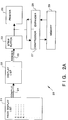
- Fig. 1A shows schematically a computer based graphics system 10 which has graphics commands arranged within a page display list (PDL) 1.
- the commands of the PDL 1 are high level commands that described certain images to be created by the user such as DRAW CIRCLE or WRITE TEXT for example, the type of commands and language representation not being important for this illustration.
- the commands in the PDL 1 are interpreted 4 and the image is created sequentially on a pixel-by-pixel basis and stored in a full page memory 2. Once the entire image is stored in the memory 2 it can be printed by outputting 5 the stored data to a printer 3.
- rendering The formation of pixel Image data from object based data is known in the art as rendering.
- rendering opaque images involves writing pixel image data into memory.
- Compositing involves the combining of pixel images, generally by controlling the proportion of two or more source images in a destination or composited image.
- rendering transparent images involves compositing newly rendered objects with existing pixel image data.
- Fig.1B shows a full colour graphics system 10 having an image store 6 having a capacity of 96 MBytes capable of storing a full colour image for an A3 page.
- the image store 6 includes 1 byte of semiconductor memory for each of red, green, and blue (RGB) components for every pixel of the image.
- RGB red, green, and blue
- the size of an A3 page is 4,632 x 6,480 pixels for an image density of 400 dpi.
- the image store 6 is connected via a 24 bit RGB bus 8 to a system bus 7 which links the store 6 with a computer 11, a hard disk data storage unit 12 and a data transmission unit 13 for interconnection with other devices.
- the computer 11 performs calculations necessary to form the graphics image under the interpretation step 4 of Fig. 1A.
- the image store 6 is also connected to a converter 14 which converts RGB data into MCYK (magenta, cyan, yellow and black) data ready for reproduction preferably on a colour laser printer 15 such as that included in the CANON (Registered Trade Mark) Colour Laser Copier available from Canon KK of Japan. Reproduction on a video display (not shown illustrated) can also be readily achieved in a known manner.
- a converter 14 which converts RGB data into MCYK (magenta, cyan, yellow and black) data ready for reproduction preferably on a colour laser printer 15 such as that included in the CANON (Registered Trade Mark) Colour Laser Copier available from Canon KK of Japan.
- CANON Registered Trade Mark
- Reproduction on a video display (not shown illustrated) can also be readily achieved in a known manner.
- Fig. 1 The general arrangement of Fig. 1 is currently cost effective for full colour images of up to approximately 2 million pixels (6 MBytes). Pixel mapped image stores are also cost effective for binary images up to 32 million pixels, where only one bit per pixel is required, giving a total of 4 MBytes. However, for large colour images, the memory requirement becomes excessive as seen in the 96 MBytes shown in Fig. 1. This is very expensive.
- the image store 6 is generally manufactured from semiconductor memories, generally being dynamic random access memory (DRAM) which costs approximately 0.5 millicents per bit (as of the date of this application). This represents almost $4,000 of direct component costs for the store 6 within the graphics system 10. In many systems, an image store of this size represents the single largest cost element.
- DRAM dynamic random access memory
- the prior art system of Fig. 1B requires 96 MBytes of data storage for each image within the data storage unit 12, which is generally a hard disk drive. Also, 96 MBytes of information must be transferred from the storage device 12 to the image store 6 for each image to be printed on the printer 15. Also, the computer 11 must calculate 32 million pixels, each with 24 bits of information, in order to generate a single A3 image. The calculation of such images is inherently slow.
- ADCT Adaptive Discrete Cosine Transform
- ADCT processing devised by the CCITT/ISO Joint Photographic Expert's Group (JPEG) based on Discrete Cosine Transform and Huffman encoding processes and published in ISO/IEO JTC1/5C2/WG8 JPEG Technical Specification Rev 5 January 16, 1990.
- JPEG Joint Photographic Expert's Group
- An ADCT processor system has been implemented in silicon by C-Cube Microsystems as the CL550B device.
- Figs. 2A and 2B show a graphics system 20, similar to that of Fig. 1, that uses ADCT compression for storage of images.
- a PDL 21 is provided in a manner similar to that of Fig. 1A. However, rather than directly calculating the image, the entire PDL 21 is compiled 24 to provide a display list 22 of low level commands.
- the image is realized by rendering 25 the display list 22 in bands into a strip buffer 23 whereby the image data stored in the strip buffer 23 represents a strip or band of the total image.
- each strip is calculated (rendered) it can be printed directly by a printer 15 or compressed by a compressor 27 for storage in a (compressed) image memory 29. Data from the memory 29 can be expanded by an expander 28 for printing.
- the graphics system 20 of Fig. 2B utilizes an ADCT processor 30 including compression and expansion functions connected to a compressed image store 31 having a capacity of 4 MBytes.
- a virtual image store 33 formed of a hard disk drive acts as a permanent store of a full image (96 MBytes).
- the system 20 also includes a strip buffer 23 which is used to store a band of the image as it is calculated by the computer 11.
- the size of the strip buffer 23 is a compromise between cost and speed. A larger strip buffer is more expensive, but reduces the number of bands which must be calculated and therefore the time taken to calculate the image using conventional 2D object graphics techniques.
- sections or bands of the image are calculated by the computer 11 and written into the strip buffer 23. This is achieved using object based display lists generally retained in the data storage 12 which are traversed for each band to be calculated. Such an operation is supported by many graphics systems, for example, in the Postscript language it can be achieved using the BANDDEVICE function.
- the calculated data is written into the virtual image store 33 or directly into the compressed image store 31 via the ADCT processor 30. This is repeated until the entire image is calculated. If the strip buffer 23 has a capacity of 1 MByte, and the image to be calculated comprises 96 MBytes, then 96 bands are required to be calculated.
- the CL550B ADCT processor device includes parallel MCYK outputs, and in some circumstances it is possible to omit the RGB to MCYK conversion and replace it with a simple data multiplexer.
- the ADCT processor 30 is required because, when the entire image is stored in the virtual image store 33, which is a hard disk drive, it cannot be read rapidly enough to drive currently available colour laser printers, such as the Canon CLC500.
- Such printers require 4 passes of colour data (magenta, cyan, yellow and black) each of approximately 32 MBytes, at a data rate of 13.35 MBytes per second. If the data were to be stored on the disk in RGB format as indicated in Fig. 2B, then the data would have to be read from the disk four times at a rate of 40.05 MBytes per second (RGB at 13.35 MBytes per second each) and converted into MCYK. This needs to be done for every copy of every page to be printed. Such a data rate cannot be achieved using currently available cost effective hard disk drives. This problem is overcome using a complete image buffer, which in this case, is achieved using a compressed image store of 4 MBytes.
- the graphics system 20 of Fig. 2 has serious limitations in image calculation speed.
- the image generation time cannot be less than the time taken to transfer the entire image into and out the virtual image store 33.
- Most currently available cost effective disk drives are limited to continuous transfer rates of less than 1 MByte per second. For 96 MBytes to be transferred into and out of an appropriately configured disk drive, a theoretical minimum time of 3.2 minutes is required. In practice, the time required to perform this function is much greater.
- the system of Fig. 2 does not remove the necessity to calculate every pixel of the image. For example, if 100 pixels can be calculated every millisecond, the time required to calculate 32 million pixels is at least 320 seconds. With other associated overheads, the time required to calculate a full colour A3 page is generally more than 10 minutes.
- a graphics system comprising: computer means connected to a bus, said computer means calculating at least one image from input data supplied via said bus; a memory buffer connected to said bus for storing d portion of said one image as said portion is calculated; processor means connected to said memory buffer and an image store to
- the problems associated with the virtual image store 33 of Fig. 2B can be avoided by omitting its presence and altering the data flow of pixel information as it is calculated by the computer 11. In this manner, as data is calculated by the computer 11 and temporarily stored in the strip buffer 23, data output from the strip buffer 23 is directly compressed and stored in the compressed image store 31.
- a PDL 51 has a series of high level commands a to z for example.
- the PDL 51 commands are compiled 52 into a display list 53 of limited size and the compilation stops when the display list 53 is full, in this case corresponding to a first set of commands a to m for example.
- the display list 53 is full, its objects are rendered into a composite memory or compositor 55 (acting as the strip buffer 23 in Fig. 2), from where the data is passed through a composite line store 56 to a compressor 58 for storing in compressed memory 59.
- the remaining second set of commands n to z of the PDL 51 can be compiled 52 into the display list 53.
- the rendering of the objects in the first set of commands a to m results in the creation of a full image including only about one half of all the objects desired. So as to obtain correct placement of the new objects (n to z) with respect to the old (existing) objects (a to m) it is necessary to combine the objects at a pixel level as this is not possible to edit a compressed image directly.
- the graphics system 50 processes data in strips or bands, (as will be later described), whereby as a new band of pixel data is rendered 54 into the composite memory 55, a corresponding band of the existing image is expanded 57 from the memory 55 into the line store 56. These two bands are then composited together in the composite memory 55 to generate one band of pixel image information including all objects (a to z) from the PDL51.
- the new band can then be compressed 58 and stored in the memory 59. In this manner the memory 59 can include portions of new image 60 as well as portions of old image 61.
- Fig. 13A represents a full page image 300 including six objects such as a large triangle 310, a circle 302, a rectangle 303, another rectangle 304, a square 305 and a small triangle 306.
- Fig. 13A shows a plan view of the image in X-Y co-ordinates but, the image 300, although flat, can be considered in pseudo-cross-section as in Fig. 13B in X-Z co-ordinates where the objects 301-306 are shown layered across one another.
- the first set of objects (301,303,305) are rendered onto a background directly from the display list. Rendering takes place in bands as previously discussed, of which only one band 310 is illustrated for clarity. Generally 810 bands are used for an A3 image.
- the objects 301, 303 and 305 are displaced "vertically" in this representation, as it is possible, as in the case of objects 303 and 305, for them to "overlap".
- the second set of objects (302,304,306) are rendered, these overlay the first set and are combined therewith to create the entire image 300, at a pixel level.
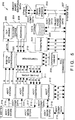
- Fig. 4 shows one exemplary embodiment of a graphics system 100.
- the graphics system 100 includes a compositor 55 and a line store 56 which together replace and perform the function of the strip buffer 23 of Fig. 2B.
- the line store 56 preferably can store up to 24 lines each of 4,632 pixels (on an A3 page) and connects to ADCT units 57 and 58 which exclusively perform expansion and compression functions respectively.
- the ADCT units 57 and 58 connect to a compressed image store 59.
- An additional ADCT processor 62 connects to its own compressed image store 63 which provides a total of 8 MBytes of compressed image storage. This arrangement permits RGB data to be compressed or expanded directly onto the system bus 7 which also connects 64 to the compressed store 63 for the transfer of compressed images onto a hard disk 12 or to other systems via data transmission unit 13 together with object based data 32.
- the ADCT units 57 and 58 provide a bi-directional coupling with the line store 56 and the compositor 55 which permit portions of the compressed image to be expanded into the compositor 55 and then modified by the computer 11. The modified portions can then be compressed and restored as compressed images in the store 59. This arrangement is used because it is extremely difficult to modify parts of an ADCT compressed image without first expanding it into pixels.
- Such an arrangement is necessary for editing JPEG ADCT compressed data because that data is of variable length, in which all of the image up to the portion to be modified must be expanded and the entire image must be compressed again so as reconstruct the image.
- the line store 56 is used so that as the image is expanded, it can be automatically buffered into and out of the compositor 55 until the portion required to be modified is identified. Those portions having already passed through the compositor are returned, via the ADCT compressor 58, to the image store 59.
- the selected portion can then be recompressed via the ADCT unit 58 and stored in the image store 59 whereby the remaining portion of the image is buffered out of the store 59 through the expander 57, and back through the compressor 58 via the compositor 55.
- the order of the ADCT compressed image is not upset by having to modify a particular portion of that image. This arrangement is practical as the time required to transfer the image is substantially less than the time required to recalculate and modify the portion under consideration.
- the minimum size of the buffer formed by the line store 56 when using the JPEG ADCT compression system is a square array of 8 x 8 pixels. This is an inefficient format to calculate an image because many calculations are required to be repeated for each 8 x 8 pixel cell.
- the line store 56 contains 8 scan lines, allowing it to be filled by ADCT 8 x 8 pixels blocks and modified using scan line graphics algorithms.
- the Canon CLC500 colour laser copier useful as the print engine 5 in Fig. 4 has 4.632 pixels in a scanned line.
- 579 blocks of 8 x 8 pixels are expanded, composited and compressed.
- three buffers are provided, an expansion buffer, a compositing buffer and a compression buffer.
- the expansion and compression buffers are formed within the line store 56 and the compositing-buffer formed within the compositor 55. These can all be implemented in the same block of memory so that data can be transferred from one buffer to the other merely by changing addresses.
- the compressed image stores 59 and 63 can be configured in a similar way.
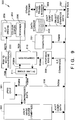
- Fig. 5 shows a graphics system 200 which includes features additional to those of the system 100 of Fig. 4.
- the colour laser printer engine 15 has been included as an engine 205 within a colour laser copier 204 such as the the Canon CLC500.
- the copier 204 also includes a scanner 206 which outputs scanned RGB data that is input to a compositor 210.
- the graphics system 200 also includes a graphics engine 209 such as that disclosed in European Patent Application No. 91306080-2.
- the graphics engine 209 permits object based images and text to be generated quickly.
- the graphics engine 209 expands graphic engine commands derived from a controlling computer 201 into pixel colours and transparencies, and composites these pixels into the line store 211.
- the graphics engine 209 provides direct support for black text, coloured text, transparency, colour runs, colour blends, transparency blends, textures and direct colour pixels from stored images.
- the graphics system 200 includes matte data transmitted in parallel with red, green and blue as RGBM 208.
- matte data transmitted in parallel with red, green and blue as RGBM 208.
- the addition of a matte plane to the stored image allows the transparency of scanned images and graphics which are to be composited with the image to be controlled by a matte.
- the JPEG standard does not specify mattes, however, the matte plane can be associated with the RGB data by compressing the matte in a second pass. This can be used directly for expanding and compressing the matte.
- the graphics system 200 also has an additional ADCT expansion unit 215 with its own associated-compressed image store 218. With this arrangement, data can be transferred from the store 218 for printing simultaneously with separate compositing operations using ADCT units 213 and 214 and the compositor 210. Such an arrangement reduces the time taken in image generation and printing of various images.
- Each of the compressed image stores (216, 217, 218) can be implemented in a commonly addressable block of semiconductor memory. Accordingly, when the calculation of an image is completed, the ADCT image data can be transferred to the image store 218 for printing simply by altering the addresses of the ADCT processor accesses. This is because the data rates of the four ADCT processors (212, 213, 213, 215) operating simultaneously is low enough that the same physical block of memory can be used.
- the ADCT image must be expanded synchronously with the colour laser printing process. Also, the data must be expanded four times for each copy of each page to be printed: once for each of magenta, cyan, yellow and black passes.
- ADCT compressed image requires that the image must always be calculated in essentially the same order as the printer requires the output data for printing.
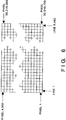
- the printing process used in the Canon colour laser copier CLC500 is shown in Fig. 6 which prints pixels from the bottom left to the top right of an A3 page in landscape mode. This requirement for scan-line ordered image creation is different from usual methods of creating two dimensional object-based graphic images.
- This method has the advantage of simplicity in that the image generation process need only consider each object in turn. This simplicity makes the method relatively simple to optimize speed. However, a complete pixel mapped image store is required, such as that shown in Fig. 1B. For full colour A3 images at 400 dpi, again, 96 MBytes per page are required.
- This system has the disadvantage of complexity as all the objects must be stored, usually in a display list, and the appropriate band of each object must be created for each band. Accordingly, with reference to Fig. 8, in order to create each band, the various objects are divided into bands and the respective bands combined simultaneously. This is usually substantially slower than the painter's algorithm, as each object must be interpreted and clipped to each band.
- the ADCT image compression system works on blocks of 8 x 8 pixels.
- An A3 image with 6,480 lines x 4,632/8 pixels contains 810 x 579 pixel blocks.
- the rendering system required for a compressed frame store system such as those of the preferred embodiment renders bands of 579 pixel blocks (8 vertical scan lines) in one pass. This rendering process must be repeated for 810 bands in order to render an entire A3 image.
- Fig. 9 shows a graphics system 300 similar to system 200 of Fig. 5 excepting that only a single ADCT processor comprising a JPEG chip 301 is used. This arrangement reduces the cost of the system and maintains versatility as it is possible to suspend operations of the JPEG Chip 301 essentially midstream, and perform other operations by switching control in a manner now to be described.
- the JPEG standard is based upon calculations that consider an 8 x 8 RBG pixel cell. Accordingly, for each cell, the following is obtained: ⁇ (8 x 8) Y (luminance), (A) ⁇ 1/2 (8 x 8) U (red - luminance), and ⁇ 1/2 (8 x 8) V (blue - luminance)
- compressed data is derived in the following way: ⁇ 2(8x8)Y ⁇ n1x Huffman Codes and 1 x DPCM DC component (B) ⁇ ( (8x8)V ⁇ n2x Huffman Codes and 1 x DPCM DC component ⁇ (8x8)U ⁇ n3x Huffman Codes and 1 x DPCM DC component where 1 ⁇ n1, n2, n3 ⁇ 64 where n is determined by the run length and a DPCM (differential pulse code modulation) DC component which is the predicted difference in the DC component of intensity between adjacent cells within a strip. For the first cell in an image, this is set to zero.
- DPCM differential pulse code modulation
- JPEG For each strip of 8 lines (i.e. cells), JPEG gives 290 sets of (B) above. JPEG provides that a marker be inserted at the end of the compressed image data string for organizational purposes such as indicating the end of a single print run.
- the present inventor has chosen, in this embodiment, to force a situation, either in the JPEG chip 301, or in software for otherwise encoded images, to insert a marker code at the end of each strip.
- This strip marker code is used to force the next DC component to be relative to zero (as with the first for the image) rather than a differential with respect to the previous DC component.
- Such an arrangement permits the detection of image data on a strip-by-strip basis which thereby permits the context of the JPEG chip 301 (i.e. compression, expansion, file selection) to be changed within the processing of a single image.
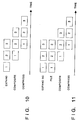
- FIG. 10 which illustrates processing using multiple ADCT processors.
- Each numbered square represents an image band (8 lines) for creating object graphics.
- band 1 is expanded into the compositor.
- band 2 is simultaneously expanded into the line store.
- band 3 is expanded and the composited (revised) band 1 is compressed.
- Fig. 11 illustrates compositing a background image (BG) with a file image to give a new background.
- the background image is expanded from the compressed store into the line store and the file image is rendered to the composition.
- band 1 of the background and file are composited together whilst band 2 for each is expanded and rendered respectively.
- the composited band 1 is compressed for storage, band 2 composited and band 3 rendered, and so on.
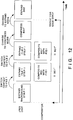
- Fig. 12 however illustrates the process of Fig. 11 using two files but only a single ADCT processor such as the JPEG chip 301 of Fig. 9.
- the JPEG chip 301 expands a first band of the background (BGl) into the compositor.
- the JPEG chip 301 then switches context to extract a first band of a first file image (FlBl) from the bus and expand it into the compositor for combining with background band to give an initial first band composite background (BG1′).
- the JPEG chip 301 then switches context to a first band of a second file image (F2Bl) and composites this with BG1′ to give BG1 ⁇ .
- the context is again changed to compress BG1 ⁇ into the compressed store.
- the context changes again then to expand BG2, and so on.
- Fig. 9 allows for having performed an expansion on an image and a file, those can be composited and then compressed on a strip-by-strip basis on a single chip thereby averting the additional expense of multiple ADCT JPEG processors.
Landscapes
- Engineering & Computer Science (AREA)
- Physics & Mathematics (AREA)
- General Physics & Mathematics (AREA)
- Theoretical Computer Science (AREA)
- Multimedia (AREA)
- General Engineering & Computer Science (AREA)
- Signal Processing (AREA)
- Discrete Mathematics (AREA)
- Image Processing (AREA)
- Compression Of Band Width Or Redundancy In Fax (AREA)
- Image Generation (AREA)
- Processing Or Creating Images (AREA)
- Controls And Circuits For Display Device (AREA)
- Document Processing Apparatus (AREA)
- Editing Of Facsimile Originals (AREA)
- Record Information Processing For Printing (AREA)
Applications Claiming Priority (6)
| Application Number | Priority Date | Filing Date | Title |
|---|---|---|---|
| AU1784/90 | 1990-08-16 | ||
| AU1785/90 | 1990-08-16 | ||
| AUPK178490 | 1990-08-16 | ||
| AUPK178590 | 1990-08-16 | ||
| AU3418/90 | 1990-11-19 | ||
| AUPK341890 | 1990-11-19 |
Publications (3)
| Publication Number | Publication Date |
|---|---|
| EP0473341A2 true EP0473341A2 (fr) | 1992-03-04 |
| EP0473341A3 EP0473341A3 (en) | 1993-02-24 |
| EP0473341B1 EP0473341B1 (fr) | 1997-04-09 |
Family
ID=27157576
Family Applications (3)
| Application Number | Title | Priority Date | Filing Date |
|---|---|---|---|
| EP91307564A Expired - Lifetime EP0473341B1 (fr) | 1990-08-16 | 1991-08-15 | Mémoires d'image compressées pour graphiques haute-résolution par calculateur |
| EP91307565A Expired - Lifetime EP0475601B1 (fr) | 1990-08-16 | 1991-08-15 | Système en couleur de publication assisté par ordinateur |
| EP91307563A Expired - Lifetime EP0473340B1 (fr) | 1990-08-16 | 1991-08-15 | Structures pipeline pour traitement graphique par ordinateur en couleur |
Family Applications After (2)
| Application Number | Title | Priority Date | Filing Date |
|---|---|---|---|
| EP91307565A Expired - Lifetime EP0475601B1 (fr) | 1990-08-16 | 1991-08-15 | Système en couleur de publication assisté par ordinateur |
| EP91307563A Expired - Lifetime EP0473340B1 (fr) | 1990-08-16 | 1991-08-15 | Structures pipeline pour traitement graphique par ordinateur en couleur |
Country Status (4)
| Country | Link |
|---|---|
| US (4) | US5329616A (fr) |
| EP (3) | EP0473341B1 (fr) |
| JP (3) | JP2922680B2 (fr) |
| DE (3) | DE69131370T2 (fr) |
Cited By (2)
| Publication number | Priority date | Publication date | Assignee | Title |
|---|---|---|---|---|
| WO1996039680A1 (fr) * | 1995-06-06 | 1996-12-12 | Apple Computer, Inc. | Systeme et procede pour generer des images, utilisant une compression |
| WO1997002542A1 (fr) * | 1995-07-03 | 1997-01-23 | Electronics For Imaging, Inc. | Rendu d'image pour imprimantes par pages |
Families Citing this family (109)
| Publication number | Priority date | Publication date | Assignee | Title |
|---|---|---|---|---|
| US5329616A (en) | 1990-08-16 | 1994-07-12 | Canon Kabushiki Kaisha | Compressed image stores for high resolution computer graphics |
| EP0506482B1 (fr) * | 1991-03-29 | 1998-11-25 | Canon Kabushiki Kaisha | Traitement d'images |
| US5225911A (en) * | 1991-05-07 | 1993-07-06 | Xerox Corporation | Means for combining data of different frequencies for a raster output device |
| AU3274593A (en) * | 1991-12-13 | 1993-07-19 | Avid Technology, Inc. | Quantization table adjustment |
| US5355450A (en) * | 1992-04-10 | 1994-10-11 | Avid Technology, Inc. | Media composer with adjustable source material compression |
| WO1994001971A2 (fr) * | 1992-07-01 | 1994-01-20 | Avid Technology, Inc. | Systeme de montage electronique de film utilisant a la fois des formats de film et de bande magnetoscopique |
| US5638498A (en) * | 1992-11-10 | 1997-06-10 | Adobe Systems Incorporated | Method and apparatus for reducing storage requirements for display data |
| US5991515A (en) * | 1992-11-10 | 1999-11-23 | Adobe Systems Incorporated | Method and apparatus for compressing and decompressing data prior to display |
| US5539865A (en) * | 1992-11-10 | 1996-07-23 | Adobe Systems, Inc. | Method and apparatus for processing data for a visual-output device with reduced buffer memory requirements |
| JPH06274612A (ja) * | 1993-03-17 | 1994-09-30 | Matsushita Electric Ind Co Ltd | 画像処理装置 |
| US5850540A (en) * | 1993-07-02 | 1998-12-15 | Sony Corporation | Method and apparatus for time-sharing CPU system bus in image generation system |
| EP0650140B1 (fr) * | 1993-10-18 | 1999-08-25 | Hewlett-Packard Company | Auvrissement de la densité de points imprimés dans une matrice de points |
| US6323958B1 (en) * | 1993-11-19 | 2001-11-27 | Canon Kabushiki Kaisha | Printing apparatus |
| JP2611637B2 (ja) * | 1993-11-22 | 1997-05-21 | 日本電気株式会社 | 画像圧縮伸長装置 |
| US6006013A (en) * | 1994-05-18 | 1999-12-21 | Xerox Corporation | Object optimized printing system and method |
| US6327043B1 (en) | 1994-05-18 | 2001-12-04 | Xerox Corporation | Object optimized printing system and method |
| US5672357A (en) * | 1994-07-01 | 1997-09-30 | Monsanto Company | Method and device for implantation of large diameter objects in bovines |
| US5595752A (en) * | 1994-07-01 | 1997-01-21 | Monsanto Company | Increasing dressing percentage and carcass weight in finishing beef cattle |
| TW304254B (fr) * | 1994-07-08 | 1997-05-01 | Hitachi Ltd | |
| US5784503A (en) * | 1994-08-26 | 1998-07-21 | Unisys Corp | Check reader utilizing sync-tags to match the images at the front and rear faces of a check |
| JP3554034B2 (ja) * | 1994-09-02 | 2004-08-11 | キヤノン株式会社 | カラー印刷装置及びその方法 |
| AUPM822394A0 (en) * | 1994-09-16 | 1994-10-13 | Canon Inc. | Object based rendering system |
| US5805781A (en) * | 1994-12-07 | 1998-09-08 | Hewlett-Packard Company | Printer method and apparatus for combining sub-images to eliminate image artifacts |
| US6243172B1 (en) * | 1995-01-18 | 2001-06-05 | Varis Corporation | Method and system for merging variable text and images into bitmaps defined by a page description language |
| US5729665A (en) | 1995-01-18 | 1998-03-17 | Varis Corporation | Method of utilizing variable data fields with a page description language |
| EP0770300A2 (fr) * | 1995-04-12 | 1997-05-02 | Eastman Kodak Company | Stockage a grande capacite d'images de documents comprimees pour imprimantes couleurs numeriques |
| AUPN229195A0 (en) * | 1995-04-12 | 1995-05-04 | Eastman Kodak Company | A color plotter using lift printing technology |
| US7715642B1 (en) * | 1995-06-06 | 2010-05-11 | Hewlett-Packard Development Company, L.P. | Bitmap image compressing |
| JPH0944130A (ja) * | 1995-07-28 | 1997-02-14 | Sony Corp | 映像装置 |
| US5708717A (en) * | 1995-11-29 | 1998-01-13 | Alasia; Alfred | Digital anti-counterfeiting software method and apparatus |
| TW348239B (en) * | 1996-06-28 | 1998-12-21 | Cirrus Logic Inc | Embedding a transparency enable bit as part of a resizing bit block transfer operation |
| US6269190B1 (en) | 1996-09-24 | 2001-07-31 | Electronics For Imaging, Inc. | Computer system for processing images using a virtual frame buffer |
| US6094453A (en) * | 1996-10-11 | 2000-07-25 | Digital Accelerator Corporation | Digital data compression with quad-tree coding of header file |
| US6023556A (en) * | 1997-01-29 | 2000-02-08 | Gammagrapnx, Inc. | Processing print job image data |
| US5835104A (en) * | 1997-04-23 | 1998-11-10 | S3 Incorporated | Variable band size compositing buffer method and apparatus |
| US6487568B1 (en) * | 1997-07-18 | 2002-11-26 | Tesseron, Ltd. | Method and system for flowing data to an arbitrary path defined by a page description language |
| US7302438B1 (en) | 1997-07-18 | 2007-11-27 | Tesseron Ltd. | Method and system for flowing data to an arbitrary path defined by a page description language |
| US6049390A (en) * | 1997-11-05 | 2000-04-11 | Barco Graphics Nv | Compressed merging of raster images for high speed digital printing |
| US6247011B1 (en) * | 1997-12-02 | 2001-06-12 | Digital-Net, Inc. | Computerized prepress authoring for document creation |
| US6115134A (en) * | 1997-12-05 | 2000-09-05 | Hewlett-Packard Company | Scan line splitting in a multi-staged image processing pipeline |
| US6289364B1 (en) * | 1997-12-22 | 2001-09-11 | Adobe Systems, Inc. | Transparency processing in a page description language |
| US6466210B1 (en) * | 1997-12-22 | 2002-10-15 | Adobe Systems Incorporated | Blending image data using layers |
| US6323858B1 (en) * | 1998-05-13 | 2001-11-27 | Imove Inc. | System for digitally capturing and recording panoramic movies |
| AU4184399A (en) | 1998-05-13 | 1999-11-29 | Infinite Pictures Inc. | Panoramic movies which simulate movement through multidimensional space |
| US6606413B1 (en) * | 1998-06-01 | 2003-08-12 | Trestle Acquisition Corp. | Compression packaged image transmission for telemicroscopy |
| US20040083085A1 (en) * | 1998-06-01 | 2004-04-29 | Zeineh Jack A. | Integrated virtual slide and live microscope system |
| US7315979B1 (en) | 1998-11-09 | 2008-01-01 | Tesseron Ltd. | Method and system for dynamic flowing data to an arbitrary path defined by a page description language |
| US6249290B1 (en) * | 1998-12-14 | 2001-06-19 | Sony Corporation | Object oriented zooming graphical user interface |
| US7050085B1 (en) | 2000-10-26 | 2006-05-23 | Imove, Inc. | System and method for camera calibration |
| US6690374B2 (en) | 1999-05-12 | 2004-02-10 | Imove, Inc. | Security camera system for tracking moving objects in both forward and reverse directions |
| US6738073B2 (en) * | 1999-05-12 | 2004-05-18 | Imove, Inc. | Camera system with both a wide angle view and a high resolution view |
| US6411301B1 (en) | 1999-10-28 | 2002-06-25 | Nintendo Co., Ltd. | Graphics system interface |
| US6452600B1 (en) | 1999-10-28 | 2002-09-17 | Nintendo Co., Ltd. | Graphics system interface |
| US6618048B1 (en) | 1999-10-28 | 2003-09-09 | Nintendo Co., Ltd. | 3D graphics rendering system for performing Z value clamping in near-Z range to maximize scene resolution of visually important Z components |
| US7050639B1 (en) * | 1999-11-24 | 2006-05-23 | General Electric Company | Image data compression employing multiple compression code tables |
| EP1109093A1 (fr) * | 1999-12-14 | 2001-06-20 | Sun Microsystems, Inc. | Méthode et dispositif d'impression de graphique transparent |
| US6490696B1 (en) | 1999-12-15 | 2002-12-03 | Electronics For Imaging, Inc. | System and method for printer output regression testing using display lists |
| US7505046B1 (en) | 2000-05-02 | 2009-03-17 | Adobe Systems Incorporated | Preserving opaque-like rendering in transparent 2D graphics using knockout groups |
| US7483042B1 (en) * | 2000-01-13 | 2009-01-27 | Ati International, Srl | Video graphics module capable of blending multiple image layers |
| CA2398171C (fr) * | 2000-01-25 | 2016-04-05 | Vistaprint Usa, Inc. | Gestion d'impressions |
| FR2804231B1 (fr) | 2000-01-25 | 2002-11-08 | Vistaprint Usa Inc | Impression centralisee de documents commerciaux en faibles volumes sur des machines auparavant limitees a des tres gros tirages |
| US6859862B1 (en) | 2000-04-07 | 2005-02-22 | Nintendo Co., Ltd. | Method and apparatus for software management of on-chip cache |
| US6857061B1 (en) | 2000-04-07 | 2005-02-15 | Nintendo Co., Ltd. | Method and apparatus for obtaining a scalar value directly from a vector register |
| US7062087B1 (en) | 2000-05-16 | 2006-06-13 | International Busniness Machines Corporation | System and method for optimizing color compression using transparency control bits |
| US7167259B2 (en) | 2000-05-16 | 2007-01-23 | International Business Machines Corporation | System and method for merging line work objects using tokenization and selective compression |
| US7119813B1 (en) | 2000-06-02 | 2006-10-10 | Nintendo Co., Ltd. | Variable bit field encoding |
| US7032180B2 (en) * | 2000-08-14 | 2006-04-18 | Twin Communications Of America, Inc. | User interface rendering component environment |
| US6609977B1 (en) | 2000-08-23 | 2003-08-26 | Nintendo Co., Ltd. | External interfaces for a 3D graphics system |
| US6867781B1 (en) | 2000-08-23 | 2005-03-15 | Nintendo Co., Ltd. | Graphics pipeline token synchronization |
| US7196710B1 (en) | 2000-08-23 | 2007-03-27 | Nintendo Co., Ltd. | Method and apparatus for buffering graphics data in a graphics system |
| US6999100B1 (en) | 2000-08-23 | 2006-02-14 | Nintendo Co., Ltd. | Method and apparatus for anti-aliasing in a graphics system |
| US6707458B1 (en) | 2000-08-23 | 2004-03-16 | Nintendo Co., Ltd. | Method and apparatus for texture tiling in a graphics system |
| US6664962B1 (en) | 2000-08-23 | 2003-12-16 | Nintendo Co., Ltd. | Shadow mapping in a low cost graphics system |
| US6580430B1 (en) | 2000-08-23 | 2003-06-17 | Nintendo Co., Ltd. | Method and apparatus for providing improved fog effects in a graphics system |
| US7002591B1 (en) | 2000-08-23 | 2006-02-21 | Nintendo Co., Ltd. | Method and apparatus for interleaved processing of direct and indirect texture coordinates in a graphics system |
| US6937245B1 (en) | 2000-08-23 | 2005-08-30 | Nintendo Co., Ltd. | Graphics system with embedded frame buffer having reconfigurable pixel formats |
| US6980218B1 (en) | 2000-08-23 | 2005-12-27 | Nintendo Co., Ltd. | Method and apparatus for efficient generation of texture coordinate displacements for implementing emboss-style bump mapping in a graphics rendering system |
| US6825851B1 (en) | 2000-08-23 | 2004-11-30 | Nintendo Co., Ltd. | Method and apparatus for environment-mapped bump-mapping in a graphics system |
| US7184059B1 (en) | 2000-08-23 | 2007-02-27 | Nintendo Co., Ltd. | Graphics system with copy out conversions between embedded frame buffer and main memory |
| US6606689B1 (en) | 2000-08-23 | 2003-08-12 | Nintendo Co., Ltd. | Method and apparatus for pre-caching data in audio memory |
| US6636214B1 (en) | 2000-08-23 | 2003-10-21 | Nintendo Co., Ltd. | Method and apparatus for dynamically reconfiguring the order of hidden surface processing based on rendering mode |
| US6700586B1 (en) | 2000-08-23 | 2004-03-02 | Nintendo Co., Ltd. | Low cost graphics with stitching processing hardware support for skeletal animation |
| US7134960B1 (en) | 2000-08-23 | 2006-11-14 | Nintendo Co., Ltd. | External interfaces for a 3D graphics system |
| US6811489B1 (en) | 2000-08-23 | 2004-11-02 | Nintendo Co., Ltd. | Controller interface for a graphics system |
| US6639595B1 (en) | 2000-08-23 | 2003-10-28 | Nintendo Co., Ltd. | Achromatic lighting in a graphics system and method |
| US6664958B1 (en) | 2000-08-23 | 2003-12-16 | Nintendo Co., Ltd. | Z-texturing |
| US7538772B1 (en) | 2000-08-23 | 2009-05-26 | Nintendo Co., Ltd. | Graphics processing system with enhanced memory controller |
| US7034828B1 (en) | 2000-08-23 | 2006-04-25 | Nintendo Co., Ltd. | Recirculating shade tree blender for a graphics system |
| US6697074B2 (en) | 2000-11-28 | 2004-02-24 | Nintendo Co., Ltd. | Graphics system interface |
| US7003588B1 (en) | 2001-08-22 | 2006-02-21 | Nintendo Co., Ltd. | Peripheral devices for a video game system |
| US6920618B2 (en) * | 2001-12-21 | 2005-07-19 | Hewlett-Packard Development Company, L.P. | System and method for configuring graphics pipelines in a computer graphical display system |
| US6621586B1 (en) * | 2002-04-10 | 2003-09-16 | Texas Instruments Incorporated | Accurately scheduling rendering of bands in a printer |
| US7317547B2 (en) * | 2002-05-07 | 2008-01-08 | Hewlett-Packard Development Company, L.P. | Single compressor with plural decompressors for multi-laser printing |
| US6982727B2 (en) * | 2002-07-23 | 2006-01-03 | Broadcom Corporation | System and method for providing graphics using graphical engine |
| US8045215B2 (en) * | 2002-10-18 | 2011-10-25 | Hewlett-Packard Development Company, L.P. | Printer object list resolutions |
| DE10329372A1 (de) * | 2003-06-30 | 2005-02-10 | Siemens Ag | Rechnergestütztes Bearbeitungsverfahren für ein über eine Anzeigeeinrichtung an einen Betrachter ausgebbares Bild |
| EP1524865A1 (fr) * | 2003-10-17 | 2005-04-20 | Nederlandse Organisatie Voor Toegepast-Natuurwetenschappelijk Onderzoek Tno | Dispositif d'affichage multi-plans pour l'affichage d'images se chevauchant |
| US7450775B2 (en) * | 2004-03-12 | 2008-11-11 | Kabushiki Kaisha Toshiba | Image processing apparatus for efficient storage of variable block length data |
| CN1728761A (zh) | 2004-06-16 | 2006-02-01 | 株式会社理光 | 图像处理装置,图像处理方法及图像处理用程序 |
| WO2007115321A2 (fr) | 2006-04-04 | 2007-10-11 | Photonic Biosystems, Inc. | Mesure visuelle, continue et simultanée de la concentration d'ammoniac en solution et des ions hydrogène |
| JP5331175B2 (ja) | 2011-08-24 | 2013-10-30 | 出光工業株式会社 | 絶縁スペーサの溝加工装置及びその溝加工方法 |
| JP5436526B2 (ja) | 2011-12-06 | 2014-03-05 | 株式会社ソニー・コンピュータエンタテインメント | グラフィックスコマンド生成装置、グラフィックスコマンド生成方法、サーバ装置、およびクライアント装置 |
| KR20130094447A (ko) * | 2012-02-16 | 2013-08-26 | 한국전자통신연구원 | 컷스루 메모리를 이용한 이미지 데이터 처리 장치 및 그 방법 |
| US8994750B2 (en) | 2012-06-11 | 2015-03-31 | 2236008 Ontario Inc. | Cell-based composited windowing system |
| JP2015084172A (ja) * | 2013-10-25 | 2015-04-30 | キヤノン株式会社 | 情報処理装置及びプログラム、制御方法 |
| CN104361556B (zh) * | 2014-10-22 | 2017-11-28 | 华为技术有限公司 | 一种图像合成方法和图像芯片以及图像设备 |
| US20180181269A1 (en) * | 2016-12-23 | 2018-06-28 | tronc, Inc. | Systems and methods for online-content and print-content assembly |
| US11488349B2 (en) | 2019-06-28 | 2022-11-01 | Ati Technologies Ulc | Method and apparatus for alpha blending images from different color formats |
| JP7531281B2 (ja) | 2020-01-24 | 2024-08-09 | キヤノン株式会社 | 画像処理装置、画像処理方法 |
Family Cites Families (29)
| Publication number | Priority date | Publication date | Assignee | Title |
|---|---|---|---|---|
| US3916095A (en) * | 1972-02-17 | 1975-10-28 | Dacom Inc | Dual-line data compression method and system for compressing, transmitting and reproducing facsimile data |
| US4271476A (en) * | 1979-07-17 | 1981-06-02 | International Business Machines Corporation | Method and apparatus for rotating the scan format of digital images |
| US4679038A (en) * | 1983-07-18 | 1987-07-07 | International Business Machines Corporation | Band buffer display system |
| US4568983A (en) * | 1983-12-07 | 1986-02-04 | The Mead Corporation | Image data compression/decompression |
| US4791680A (en) * | 1986-03-25 | 1988-12-13 | Matsushita Electric Industrial Co. | Image data converter |
| US4843632A (en) * | 1986-05-09 | 1989-06-27 | Prodigy Systems Corporation | Compressed image expansion system |
| JPS62272366A (ja) * | 1986-05-21 | 1987-11-26 | Hitachi Ltd | 図形情報処理装置 |
| US4868557A (en) * | 1986-06-04 | 1989-09-19 | Apple Computer, Inc. | Video display apparatus |
| JPS63106080A (ja) * | 1986-06-27 | 1988-05-11 | Hitachi Ltd | 画像表示方式 |
| DE3735349A1 (de) * | 1986-10-18 | 1988-04-28 | Toshiba Kawasaki Kk | Bildpresservorrichtung |
| US4862154A (en) * | 1986-10-31 | 1989-08-29 | International Business Machines Corporation | Image display processor for graphics workstation |
| US4896275A (en) * | 1987-07-10 | 1990-01-23 | Bull Hn Information Systems Inc. | Full page graphics image display data reduction |
| ATE115749T1 (de) * | 1987-07-31 | 1994-12-15 | Qms Inc | Seitendrucksystem mit virtuellem speicher. |
| US4823201A (en) * | 1987-11-16 | 1989-04-18 | Technology, Inc. 64 | Processor for expanding a compressed video signal |
| EP0326137A3 (fr) * | 1988-01-27 | 1991-10-02 | Fuji Photo Film Co., Ltd. | Système de traitement d'image |
| US4897717A (en) * | 1988-03-30 | 1990-01-30 | Starsignal, Inc. | Computer-based video compression system |
| JP2787830B2 (ja) | 1988-06-10 | 1998-08-20 | キヤノン株式会社 | 画像処理装置及び方法 |
| JPH02195480A (ja) * | 1989-01-25 | 1990-08-02 | Hitachi Ltd | 画像データの検索方式 |
| US5526128A (en) * | 1989-06-19 | 1996-06-11 | Matsushita Electric Industrial Co., Ltd. | Image producing apparatus with memory unit having an image memory area of changeable storage capacity |
| US5241653A (en) * | 1990-04-12 | 1993-08-31 | Adobe Systems Incorporated | Apparatus and method for adjusting and displaying scaled, rasterized characters |
| US5191406A (en) * | 1990-04-20 | 1993-03-02 | Nikon Corporation | Method and apparatus for rapid scanning of color images |
| JPH0447376A (ja) * | 1990-06-12 | 1992-02-17 | Toshiba Corp | 情報処理装置および情報処理方法 |
| JP3043469B2 (ja) | 1990-07-05 | 2000-05-22 | キヤノン株式会社 | 大容量カラーレーザプリントシステム |
| US5459823A (en) | 1990-07-05 | 1995-10-17 | Canon Kabushiki Kaisha | Graphics engine for true colour 2D graphics |
| DE69132625T2 (de) | 1990-07-31 | 2001-10-31 | Canon K.K., Tokio/Tokyo | Gerät zur Bildverarbeitung |
| US5509115A (en) * | 1990-08-08 | 1996-04-16 | Peerless Systems Corporation | Method and apparatus for displaying a page with graphics information on a continuous synchronous raster output device |
| US5329616A (en) | 1990-08-16 | 1994-07-12 | Canon Kabushiki Kaisha | Compressed image stores for high resolution computer graphics |
| JP3256982B2 (ja) * | 1991-05-14 | 2002-02-18 | 富士ゼロックス株式会社 | 画像処理装置 |
| US5838334A (en) * | 1994-11-16 | 1998-11-17 | Dye; Thomas A. | Memory and graphics controller which performs pointer-based display list video refresh operations |
-
1991
- 1991-08-13 US US07/744,703 patent/US5329616A/en not_active Expired - Lifetime
- 1991-08-13 US US07/744,540 patent/US5801716A/en not_active Expired - Lifetime
- 1991-08-13 US US07/744,522 patent/US6020894A/en not_active Expired - Lifetime
- 1991-08-15 DE DE69131370T patent/DE69131370T2/de not_active Expired - Lifetime
- 1991-08-15 EP EP91307564A patent/EP0473341B1/fr not_active Expired - Lifetime
- 1991-08-15 EP EP91307565A patent/EP0475601B1/fr not_active Expired - Lifetime
- 1991-08-15 DE DE69128063T patent/DE69128063T2/de not_active Expired - Lifetime
- 1991-08-15 DE DE69125549T patent/DE69125549T2/de not_active Expired - Lifetime
- 1991-08-15 EP EP91307563A patent/EP0473340B1/fr not_active Expired - Lifetime
- 1991-08-16 JP JP3206049A patent/JP2922680B2/ja not_active Expired - Lifetime
- 1991-08-16 JP JP20605091A patent/JP3255943B2/ja not_active Expired - Lifetime
- 1991-08-16 JP JP20605491A patent/JP3166977B2/ja not_active Expired - Lifetime
-
1999
- 1999-08-06 US US09/369,281 patent/US7012620B1/en not_active Expired - Fee Related
Cited By (3)
| Publication number | Priority date | Publication date | Assignee | Title |
|---|---|---|---|---|
| WO1996039680A1 (fr) * | 1995-06-06 | 1996-12-12 | Apple Computer, Inc. | Systeme et procede pour generer des images, utilisant une compression |
| WO1997002542A1 (fr) * | 1995-07-03 | 1997-01-23 | Electronics For Imaging, Inc. | Rendu d'image pour imprimantes par pages |
| US6238105B1 (en) | 1995-07-03 | 2001-05-29 | Electronics For Imaging, Inc. | Processor/memory non-intensive rendering for page printers |
Also Published As
| Publication number | Publication date |
|---|---|
| EP0473340B1 (fr) | 1999-06-23 |
| JP3166977B2 (ja) | 2001-05-14 |
| EP0475601A3 (en) | 1993-02-24 |
| US5801716A (en) | 1998-09-01 |
| JP3255943B2 (ja) | 2002-02-12 |
| US5329616A (en) | 1994-07-12 |
| EP0475601A2 (fr) | 1992-03-18 |
| US6020894A (en) | 2000-02-01 |
| US7012620B1 (en) | 2006-03-14 |
| DE69125549T2 (de) | 1997-09-04 |
| DE69125549D1 (de) | 1997-05-15 |
| EP0473341B1 (fr) | 1997-04-09 |
| JPH06261202A (ja) | 1994-09-16 |
| DE69128063D1 (de) | 1997-12-04 |
| EP0475601B1 (fr) | 1997-10-29 |
| JP2922680B2 (ja) | 1999-07-26 |
| JPH06243243A (ja) | 1994-09-02 |
| EP0473340A3 (en) | 1993-02-24 |
| DE69131370T2 (de) | 1999-11-18 |
| EP0473340A2 (fr) | 1992-03-04 |
| JPH0793559A (ja) | 1995-04-07 |
| EP0473341A3 (en) | 1993-02-24 |
| DE69131370D1 (de) | 1999-07-29 |
| DE69128063T2 (de) | 1998-03-19 |
Similar Documents
| Publication | Publication Date | Title |
|---|---|---|
| EP0473341B1 (fr) | Mémoires d'image compressées pour graphiques haute-résolution par calculateur | |
| US5838333A (en) | Image processing device and image processing method | |
| US5225911A (en) | Means for combining data of different frequencies for a raster output device | |
| JP2830690B2 (ja) | 画像処理装置 | |
| JP4035907B2 (ja) | 画像形成システム及びその制御方法 | |
| US6570665B1 (en) | Method for printing multi-page images | |
| JP3346051B2 (ja) | 画像処理装置 | |
| JP3203660B2 (ja) | 画像記録装置 | |
| JP3695498B2 (ja) | 画像処理装置 | |
| JPH07135575A (ja) | カラー画像情報出力装置 | |
| JP3496384B2 (ja) | 画像出力装置 | |
| JP3757297B2 (ja) | 印字装置 | |
| JP2003036445A (ja) | 画像処理装置 | |
| JP3093245B2 (ja) | 画像処理装置および出力制御装置および画像処理システム及びその方法 | |
| JPH07112230B2 (ja) | 画像処理装置 | |
| JPH05250109A (ja) | カラー画像出力装置 | |
| JP2005244748A (ja) | 画像処理方法及び画像処理装置 | |
| JPS635485A (ja) | イメ−ジデ−タ圧縮回路 | |
| JPH0766965A (ja) | 画像処理装置 | |
| JPS6370671A (ja) | 文書通信方法 | |
| JPH06350857A (ja) | 画像処理方法 | |
| JPH01184142A (ja) | 画像処理装置 | |
| JPH01133097A (ja) | 文字信号発生装置 | |
| JPH10224617A (ja) | 画像処理装置 |
Legal Events
| Date | Code | Title | Description |
|---|---|---|---|
| PUAI | Public reference made under article 153(3) epc to a published international application that has entered the european phase |
Free format text: ORIGINAL CODE: 0009012 |
|
| AK | Designated contracting states |
Kind code of ref document: A2 Designated state(s): DE FR GB IT |
|
| PUAL | Search report despatched |
Free format text: ORIGINAL CODE: 0009013 |
|
| AK | Designated contracting states |
Kind code of ref document: A3 Designated state(s): DE FR GB IT |
|
| 17P | Request for examination filed |
Effective date: 19930709 |
|
| 17Q | First examination report despatched |
Effective date: 19950718 |
|
| GRAG | Despatch of communication of intention to grant |
Free format text: ORIGINAL CODE: EPIDOS AGRA |
|
| GRAH | Despatch of communication of intention to grant a patent |
Free format text: ORIGINAL CODE: EPIDOS IGRA |
|
| GRAH | Despatch of communication of intention to grant a patent |
Free format text: ORIGINAL CODE: EPIDOS IGRA |
|
| GRAA | (expected) grant |
Free format text: ORIGINAL CODE: 0009210 |
|
| AK | Designated contracting states |
Kind code of ref document: B1 Designated state(s): DE FR GB IT |
|
| REF | Corresponds to: |
Ref document number: 69125549 Country of ref document: DE Date of ref document: 19970515 |
|
| ET | Fr: translation filed | ||
| PLBE | No opposition filed within time limit |
Free format text: ORIGINAL CODE: 0009261 |
|
| STAA | Information on the status of an ep patent application or granted ep patent |
Free format text: STATUS: NO OPPOSITION FILED WITHIN TIME LIMIT |
|
| 26N | No opposition filed | ||
| REG | Reference to a national code |
Ref country code: GB Ref legal event code: 732E |
|
| REG | Reference to a national code |
Ref country code: FR Ref legal event code: TP |
|
| REG | Reference to a national code |
Ref country code: GB Ref legal event code: IF02 |
|
| PGFP | Annual fee paid to national office [announced via postgrant information from national office to epo] |
Ref country code: FR Payment date: 20090821 Year of fee payment: 19 |
|
| PGFP | Annual fee paid to national office [announced via postgrant information from national office to epo] |
Ref country code: DE Payment date: 20090831 Year of fee payment: 19 Ref country code: GB Payment date: 20090827 Year of fee payment: 19 |
|
| PGFP | Annual fee paid to national office [announced via postgrant information from national office to epo] |
Ref country code: IT Payment date: 20090812 Year of fee payment: 19 |
|
| GBPC | Gb: european patent ceased through non-payment of renewal fee |
Effective date: 20100815 |
|
| REG | Reference to a national code |
Ref country code: FR Ref legal event code: ST Effective date: 20110502 |
|
| PG25 | Lapsed in a contracting state [announced via postgrant information from national office to epo] |
Ref country code: IT Free format text: LAPSE BECAUSE OF NON-PAYMENT OF DUE FEES Effective date: 20100815 |
|
| REG | Reference to a national code |
Ref country code: DE Ref legal event code: R119 Ref document number: 69125549 Country of ref document: DE Effective date: 20110301 |
|
| PG25 | Lapsed in a contracting state [announced via postgrant information from national office to epo] |
Ref country code: FR Free format text: LAPSE BECAUSE OF NON-PAYMENT OF DUE FEES Effective date: 20100831 Ref country code: DE Free format text: LAPSE BECAUSE OF NON-PAYMENT OF DUE FEES Effective date: 20110301 |
|
| PG25 | Lapsed in a contracting state [announced via postgrant information from national office to epo] |
Ref country code: GB Free format text: LAPSE BECAUSE OF NON-PAYMENT OF DUE FEES Effective date: 20100815 |