EP0337610B1 - Appareil fac-similé - Google Patents
Appareil fac-similé Download PDFInfo
- Publication number
- EP0337610B1 EP0337610B1 EP89302477A EP89302477A EP0337610B1 EP 0337610 B1 EP0337610 B1 EP 0337610B1 EP 89302477 A EP89302477 A EP 89302477A EP 89302477 A EP89302477 A EP 89302477A EP 0337610 B1 EP0337610 B1 EP 0337610B1
- Authority
- EP
- European Patent Office
- Prior art keywords
- signal
- isdn
- mode
- network
- facsimile
- Prior art date
- Legal status (The legal status is an assumption and is not a legal conclusion. Google has not performed a legal analysis and makes no representation as to the accuracy of the status listed.)
- Expired - Lifetime
Links
- 238000004891 communication Methods 0.000 claims description 29
- 238000001514 detection method Methods 0.000 claims description 15
- 238000000034 method Methods 0.000 description 14
- 230000005540 biological transmission Effects 0.000 description 3
- 238000006243 chemical reaction Methods 0.000 description 2
- 238000010586 diagram Methods 0.000 description 2
- 230000005236 sound signal Effects 0.000 description 1
Images


Classifications
-
- H—ELECTRICITY
- H04—ELECTRIC COMMUNICATION TECHNIQUE
- H04N—PICTORIAL COMMUNICATION, e.g. TELEVISION
- H04N1/00—Scanning, transmission or reproduction of documents or the like, e.g. facsimile transmission; Details thereof
- H04N1/32—Circuits or arrangements for control or supervision between transmitter and receiver or between image input and image output device, e.g. between a still-image camera and its memory or between a still-image camera and a printer device
- H04N1/327—Initiating, continuing or ending a single-mode communication; Handshaking therefor
- H04N1/32704—Establishing a communication with one of a facsimile and another telecommunication apparatus sharing a single line
- H04N1/32706—Type of the other apparatus
- H04N1/32708—Telephone
-
- H—ELECTRICITY
- H04—ELECTRIC COMMUNICATION TECHNIQUE
- H04N—PICTORIAL COMMUNICATION, e.g. TELEVISION
- H04N1/00—Scanning, transmission or reproduction of documents or the like, e.g. facsimile transmission; Details thereof
- H04N1/32—Circuits or arrangements for control or supervision between transmitter and receiver or between image input and image output device, e.g. between a still-image camera and its memory or between a still-image camera and a printer device
- H04N1/327—Initiating, continuing or ending a single-mode communication; Handshaking therefor
- H04N1/32704—Establishing a communication with one of a facsimile and another telecommunication apparatus sharing a single line
-
- H—ELECTRICITY
- H04—ELECTRIC COMMUNICATION TECHNIQUE
- H04N—PICTORIAL COMMUNICATION, e.g. TELEVISION
- H04N1/00—Scanning, transmission or reproduction of documents or the like, e.g. facsimile transmission; Details thereof
- H04N1/32—Circuits or arrangements for control or supervision between transmitter and receiver or between image input and image output device, e.g. between a still-image camera and its memory or between a still-image camera and a printer device
- H04N1/327—Initiating, continuing or ending a single-mode communication; Handshaking therefor
- H04N1/32704—Establishing a communication with one of a facsimile and another telecommunication apparatus sharing a single line
- H04N1/32715—Detecting
- H04N1/32719—Detecting a facsimile calling signal, e.g. CNG
-
- H—ELECTRICITY
- H04—ELECTRIC COMMUNICATION TECHNIQUE
- H04N—PICTORIAL COMMUNICATION, e.g. TELEVISION
- H04N1/00—Scanning, transmission or reproduction of documents or the like, e.g. facsimile transmission; Details thereof
- H04N1/32—Circuits or arrangements for control or supervision between transmitter and receiver or between image input and image output device, e.g. between a still-image camera and its memory or between a still-image camera and a printer device
- H04N1/327—Initiating, continuing or ending a single-mode communication; Handshaking therefor
- H04N1/32704—Establishing a communication with one of a facsimile and another telecommunication apparatus sharing a single line
- H04N1/32747—Controlling the connection of the apparatus
- H04N1/3275—Giving priority to one of the apparatus
-
- H—ELECTRICITY
- H04—ELECTRIC COMMUNICATION TECHNIQUE
- H04N—PICTORIAL COMMUNICATION, e.g. TELEVISION
- H04N1/00—Scanning, transmission or reproduction of documents or the like, e.g. facsimile transmission; Details thereof
- H04N1/32—Circuits or arrangements for control or supervision between transmitter and receiver or between image input and image output device, e.g. between a still-image camera and its memory or between a still-image camera and a printer device
- H04N1/333—Mode signalling or mode changing; Handshaking therefor
- H04N1/33307—Mode signalling or mode changing; Handshaking therefor prior to start of transmission, input or output of the picture signal only
- H04N1/33323—Mode signalling or mode changing; Handshaking therefor prior to start of transmission, input or output of the picture signal only transmission mode only, e.g. speed
-
- H—ELECTRICITY
- H04—ELECTRIC COMMUNICATION TECHNIQUE
- H04N—PICTORIAL COMMUNICATION, e.g. TELEVISION
- H04N1/00—Scanning, transmission or reproduction of documents or the like, e.g. facsimile transmission; Details thereof
- H04N1/32—Circuits or arrangements for control or supervision between transmitter and receiver or between image input and image output device, e.g. between a still-image camera and its memory or between a still-image camera and a printer device
- H04N1/333—Mode signalling or mode changing; Handshaking therefor
- H04N1/33338—Mode signalling or mode changing; Handshaking therefor adapting to particular facsimile group, e.g. G3
-
- H—ELECTRICITY
- H04—ELECTRIC COMMUNICATION TECHNIQUE
- H04N—PICTORIAL COMMUNICATION, e.g. TELEVISION
- H04N1/00—Scanning, transmission or reproduction of documents or the like, e.g. facsimile transmission; Details thereof
- H04N1/32—Circuits or arrangements for control or supervision between transmitter and receiver or between image input and image output device, e.g. between a still-image camera and its memory or between a still-image camera and a printer device
- H04N1/333—Mode signalling or mode changing; Handshaking therefor
- H04N1/33353—Mode signalling or mode changing; Handshaking therefor according to the available bandwidth used for a single communication, e.g. the number of ISDN channels used
-
- H—ELECTRICITY
- H04—ELECTRIC COMMUNICATION TECHNIQUE
- H04N—PICTORIAL COMMUNICATION, e.g. TELEVISION
- H04N1/00—Scanning, transmission or reproduction of documents or the like, e.g. facsimile transmission; Details thereof
- H04N1/32—Circuits or arrangements for control or supervision between transmitter and receiver or between image input and image output device, e.g. between a still-image camera and its memory or between a still-image camera and a printer device
- H04N1/333—Mode signalling or mode changing; Handshaking therefor
- H04N1/33392—Details of handshaking
-
- H—ELECTRICITY
- H04—ELECTRIC COMMUNICATION TECHNIQUE
- H04Q—SELECTING
- H04Q11/00—Selecting arrangements for multiplex systems
- H04Q11/04—Selecting arrangements for multiplex systems for time-division multiplexing
- H04Q11/0428—Integrated services digital network, i.e. systems for transmission of different types of digitised signals, e.g. speech, data, telecentral, television signals
- H04Q11/0435—Details
- H04Q11/0471—Terminal access circuits
-
- H—ELECTRICITY
- H04—ELECTRIC COMMUNICATION TECHNIQUE
- H04N—PICTORIAL COMMUNICATION, e.g. TELEVISION
- H04N2201/00—Indexing scheme relating to scanning, transmission or reproduction of documents or the like, and to details thereof
- H04N2201/32—Circuits or arrangements for control or supervision between transmitter and receiver or between image input and image output device, e.g. between a still-image camera and its memory or between a still-image camera and a printer device
- H04N2201/333—Mode signalling or mode changing; Handshaking therefor
- H04N2201/33307—Mode signalling or mode changing; Handshaking therefor of a particular mode
- H04N2201/33342—Mode signalling or mode changing; Handshaking therefor of a particular mode of transmission mode
- H04N2201/33371—Mode signalling or mode changing; Handshaking therefor of a particular mode of transmission mode using test signals, e.g. checking error occurrences
-
- H—ELECTRICITY
- H04—ELECTRIC COMMUNICATION TECHNIQUE
- H04Q—SELECTING
- H04Q2213/00—Indexing scheme relating to selecting arrangements in general and for multiplex systems
- H04Q2213/179—Facsimile; Fax, e.g. still picture
-
- H—ELECTRICITY
- H04—ELECTRIC COMMUNICATION TECHNIQUE
- H04Q—SELECTING
- H04Q2213/00—Indexing scheme relating to selecting arrangements in general and for multiplex systems
- H04Q2213/204—ISDN protocol; ISO 7
-
- H—ELECTRICITY
- H04—ELECTRIC COMMUNICATION TECHNIQUE
- H04Q—SELECTING
- H04Q2213/00—Indexing scheme relating to selecting arrangements in general and for multiplex systems
- H04Q2213/297—Coupling circuits between different (rate) TDM systems
-
- Y—GENERAL TAGGING OF NEW TECHNOLOGICAL DEVELOPMENTS; GENERAL TAGGING OF CROSS-SECTIONAL TECHNOLOGIES SPANNING OVER SEVERAL SECTIONS OF THE IPC; TECHNICAL SUBJECTS COVERED BY FORMER USPC CROSS-REFERENCE ART COLLECTIONS [XRACs] AND DIGESTS
- Y10—TECHNICAL SUBJECTS COVERED BY FORMER USPC
- Y10S—TECHNICAL SUBJECTS COVERED BY FORMER USPC CROSS-REFERENCE ART COLLECTIONS [XRACs] AND DIGESTS
- Y10S379/00—Telephonic communications
- Y10S379/902—Auto-switch for an incoming voice data, or fax telephone call, e.g. comp/fax/tel
Definitions
- This invention relates to a facsimile apparatus and, more particularly, to a facsimile apparatus connected on the ISDN side in a communication network in which the ISDN is connected to a telephone network.
- French patent application FR-A-2578374 discusses the problem of communication between future all-digital (G4) facsimile apparatuses, and conventional (G3) apparatuses. This document proposes that for this purpose each G4 apparatus must be connected separately to both a digital type network and the conventional telephone network.
- an ISDN is a communication network which provides a wide variety of services, such as telephone, data and facsimile communication services, wherein information such as voice and image data is communicated in the form of a 64 Kbps digital signal by an information channel referred to as a B channel.
- Signal-converted information for link control, call control, etc., used in communicating with a network is transferred over a 16 Kbps D channel.
- a procedure signal employs a CCITT V.21 300 bps modem
- a picture signal employs a CCITT v.299 600 bps modem
- the bandwidth used is 300 Hz - 3.3 KHz.
- an ISDN facsimile converts the transmission analog signal of both modems into a digital signal by CCITT G.711 u-law or A-law coding and then transmits the analog signal, and converts a received digital signal into an analog signal by the above-mentioned coding.
- the transmitted and received digital signals are transferred to or from a telephone network through the B channel of the ISDN.
- An ISDN bearer service which is defined by CCITT advisory I.211, is classified into voice, 3.1 KHz audio and 64 KHz unlimited digital.
- Voice refers to a telephone signal, 3.1 KHz audio to a 3.1 KHz band data signal, such as in a G3 facsimile, and 64 KHz unlimited digital to a digital signal such as in a G4 facsimile.
- the information which flows through the network is recognized as being a telephone voice or facsimile image data.
- a terminating procedure of the kind shown in Fig. 3 is executed.
- the network indicates to a called terminal the classification of the transfer capability, namely the voice signal, 3.1 KHz audio signal or 64 KHz unlimited digital signal.
- the called terminal checks the abovementioned transfer capability and decides whether a response is allowed.
- an end-to-end bus is connected in accordance with a telephone number requested by the calling terminal, and whether the information which flows through the network is a voice signal or facsimile image signal cannot be identified. Accordingly, in a case where a call is placed from a telephone network to the ISDN in a network connection between the telephone network and the ISDN, it is no longer possible to distinguish between a voice and 3.1 KHz audio. This means that an ISDN facsimile will be incapable of recognizing whether a calling terminal is a telephone or a facsimile.
- the ISDN terminal when a call is received from a PSTN or G3 facsimile, the ISDN terminal is unclear as to whether the call is from a telephone or a facsimile.
- the problem that results is that the called terminal cannot decide whether to respond with a facsimile signal or inform the operator of the fact that a call has been received from a telephone.
- the invention provides a facsimile apparatus for connection to an integrated services digital network (ISDN), which network is also connected to an analogue telephone network, the apparatus comprising first communication means for communication with a facsimile apparatus of Group 4 or above (hereinafter "G4") via the ISDN in a G4 facsmile mode, characterised by further comprising: second communication means for communicating with a facsimile apparatus of Group 3 or lower (hereinafter "G3") via the ISDN in a G3 facsimile mode; network identifying means for identifying whether data received via the ISDN is sent from an ISDN terminal or an analogue network terminal; setting means for selecting either an automatic response mode or a manual response mode of the apparatus; and detecting means for detecting when a signal received via a B channel of the ISDN comes from a G3 facsmile apparatus, wherein when said network identifying means identifies that received data is sent from an analogue telephone network terminal, in a case where said detection means detects that the signal proceeds from a G3 facsi
- a response is made in a facsimile mode.
- a response is made in a facsimile mode if automatic reception prevails and in a telephone mode if manual reception prevails.
- a facsimile apparatus which eliminates or reduces communication failure due to a difference in mode between a calling side and a called side regardless of the network terminal from which a call is received.
- Fig. 1 is an embodiment of a block diagram illustrating a facsimile apparatus according to the present invention.
- the facsimile apparatus includes a reader 1 for reading an original manuscript, a main controller 2 for administering overall control of the apparatus, a printer 3 for performing printing, an ISDN interface 4 for controlling transmission and reception with regard to an ISDN, a G4 CCU 5 for implementing B-channel protocol of a G4 facsimile, a G3 CCU 6 for implementing T.30 protocol of a G3 facsimile, and a modem 7 for modulating/demodulating a T.30 protocol signal and a G3 picture signal, the modem having a CNG detector 7a for detecting a CNG signal.
- the apparatus further includes a G.711 codec 8 for analog signal and digital signal conversion, a telephone handset 9, a G.711 codec 10 for voice signal and digital signal conversion, an ISDN line 11, and an automatic reception switch 12.
- Image data read by the reader 1 is transferred to the G4 CCU 5 if the G4 mode is in effect and to the G3 CCU 6 if the G3 mode is in effect.
- the G4 CCU 5 transfers the image data to the ISDN interface 4 as a B-channel signal B1 with a B-channel protocol.
- the G3 CCU 6 attaches a G3 facsimile protocol T.30 to the image data, which is modulated by the modem 7 and converted into a PCM signal by the codec 8. This signal is transferred to the ISDN interface 4 as a B-channel signal B2.
- the handset 9 converts a voice into an electric signal, which is transferred to the ISDN interface 4 as a B-channel signal B3 by the codec 10.
- the ISDN interface 4 executes procedures in accordance with an ISDN D-channel protocol layer 1 (CCITT advisory I.430), layer 2 (CCITT advisory I.441), layer 3 (CCITT advisory I.451) and B-channel protocol layer 1 (CCITT advisory I.430).
- the D-channel protocol layer 1 and B-channel protocol layer 1 are a physical electrical stipulation and channel multiplexing stipulation.
- the D-channel protocol layer 2 is a link control procedure stipulation for network linkage.
- the D-channel protocol layer 3 is a call control procedure stipulation for connection with the communicating party.
- the ISDN interface 4 is such that a connection is made with the communicting party by the D-channel protocol, after which the information from the G4 CCU 5, G3 CCU 6 or handset 9 is transmitted from the ISDN line 11 via the B channel.
- a signal received from the ISDN line 11 is separated into a D channel and B channel by the ISDN interface 4.
- the B-channel information is converted into an analog signal by the G4 CCU 5 or codec 8.
- the analog signal from the codec 8 is transferred to the G3 CCU 6 via the modem 7 and CNG detector 7a.
- the B-channel information is converted into an analog signal by the codec 10 and then transferred to the handset 9.
- Picture signals from the G4 CCU 5 and G3 CCU 6 are printed out by the printer 3 under the control of the main controller 2.
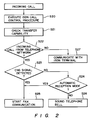
- Fig. 2 is a flowchart of a terminating operation in the facsimile apparatus of the present embodiment.
- step S20 of the flowchart the ISDN call control procedure is executed by the ISDN interface 4 of Fig. 1.
- step S21 at which a voice, 3.1 KHz audio or 64 KHz unlimited digital is recognized by a transfer capability information element in the SET-UP message of Fig. 3.
- Whether the call has been received from a telephone network is identified by an interum identifier information element in the abovementioned SET-UP message.
- steps S21 and S22 are executed by the ISDN interface 4 of Fig. 1.
- step S27 When a call is not received from the telephone network, the program proceeds to step S27, at which the apparatus communicates with an ISDN terminal.
- CNG signal detection is performed by the CNG detector 7a (Fig. 1) at step S23.
- the G3 CCU 6 and the main controller 2 are informed of the results of detection.
- the CNG signal will now be described.
- CCITT advisory T.30 stipulates the protocols of the telephone network G2, G3 facsimiles.
- the communication procedure of the G3 facsimile is illustrated in Fig. 4.
- the CNG signal is defined as follows:
- Detection of the CNG signal at step S23 is performed in the following manner, by way of example:
- the first entails comparing the analog waveform of the input signal with a reference potential by means of a comparator, differentiating the output of the comparator by a differentiating circuit, and detecting frequency by counting intervals between differentiated pulses at times that the input signal crosses the reference potential.
- the other method is to detect the 1100 Hz frequency by a PLL circuit.
- the on time of 0.5 sec and off time of 3 sec are detected.
- One method of accomplishing this in a case where the frequency is detected based on the aforementioned differentiating pulses is to measure the time during which the differentiated pulses are inputted within a predetermined interval.
- Another method in a case where the PLL circuit is used is to measure the length of time of the output waveform.
- the on time of 0.5 sec is detected, but the subsequent off time of 3 sec can be detected in a similar manner.
- the conditions for detecting CNG are the two conditions (3), (4) mentioned above, in actuality it is sufficient to rely solely upon detection based on the frequency of condition (3). If the CNG signal has been detected, the program proceeds to step S25, where the communicating part is judged to be a G3 facsimile and communication is performed in accordance with the G3 communication procedure of Fig. 4.
- step S24 it is determined by the main controller 2 of Fig. 1 whether the automatic reception switch 12 is in the ON state. If the automatic mode is in effect, the program proceeds to the step S25; if not, the program proceeds to step S26, at which the operator is informed of the fact that a telephone call has arrived.
- the facsimile connected to the telephone network is a G3 facsimile.
- the facsimile of the telephone network can be a G1 or G2 facsimile.
- the reason is that these facsimiles also transmit a CNG signal just as the G3 facsimile does.
- the discrimination of the incoming data by detection of the CNG signal in the present embodiment is effective even in communication between G3 facsimiles.
- the CNG detector is provided in the modem in order to simplify the circuitry.
- the invention is not limited to such an arrangement.
- CNG signal detection is performed when a call is received from a telephone network. If the CNG signal is detected, a decision is rendered to the effect that the communication party is a telephone network facsimile. This is effective in reducing communication failure due to non-agreement between telephone and facsimile communication modes.
Landscapes
- Engineering & Computer Science (AREA)
- Multimedia (AREA)
- Signal Processing (AREA)
- Computer Networks & Wireless Communication (AREA)
- Facsimile Transmission Control (AREA)
- Facsimiles In General (AREA)
- Data Exchanges In Wide-Area Networks (AREA)
Claims (3)
- Appareil de télécopie destiné à être raccordé à un réseau numérique à intégration de services (RNIS), lequel réseau est également raccordé à un réseau téléphonique analogique, l'appareil comprenant un premier moyen de communication (5) pour communiquer avec un appareil de télécopie du Groupe 4 ou supérieur (désigné ci-après "G4") par l'intermédiaire du RNIS dans un mode de télécopie G4,
caractérisé par le fait qu'il comprend en outre: un second moyen de communication (6) pour communiquer avec un appareil de télécopie du Groupe 3 ou inférieur (désigné ciaprès "G3") par l'intermédiaire du RNIS dans un mode de télécopie G3;
un moyen d'identification de réseau pour identifier (S22) si les données reçues par l'intermédiaire du RNIS sont envoyées d'un terminal RNIS ou d'un terminal de réseau analogique;
un moyen de sélection pour sélectionner soit un mode de réponse automatique, soit un mode de réponse manuelle de l'appareil; et
un moyen de détection pour détecter (S23) l'instant où un signal reçu par l'intermédiaire d'un canal B du RNIS provient d'un appareil de télécopie G3,
dans lequel, lorsque ledit moyen d'identification de réseau identifie le fait que la donnée reçue est envoyée par un terminal de réseau téléphonique analogique: dans un cas où ledit moyen de détection détecte le fait que le signal provient d'un appareil de télécopie G3, la communication s'effectue en mode de télécopie G3 (S25); dans un cas où ledit moyen de détection ne détecte pas le signal de télécopie et où un mode automatique est sélectionné, la communication s'effectue en mode de télécopie G3 (S25); et dans un cas où ledit moyen de détection ne détecte pas un signal de télécopie et où un mode manuel est sélectionné, la communication s'effectue en mode téléphonique (vocal) (S26). - Appareil selon la revendication 1, dans lequel ledit moyen de détection détecte si le signal provient ou non d'un appareil de télécopie G3 par détection d'un signal CNG.
- Appareil selon la revendication 1 ou 2, dans lequel, lorsque ledit moyen d'identification de réseau identifie le fait que la donnée reçue est envoyée d'un terminal RNIS, ledit premier moyen de communication effectue une communication avec le terminal émetteur en tant qu'appareil de télécopie G4.
Applications Claiming Priority (2)
| Application Number | Priority Date | Filing Date | Title |
|---|---|---|---|
| JP59248/88 | 1988-03-15 | ||
| JP63059248A JP2575169B2 (ja) | 1988-03-15 | 1988-03-15 | フアクシミリ装置 |
Publications (3)
| Publication Number | Publication Date |
|---|---|
| EP0337610A2 EP0337610A2 (fr) | 1989-10-18 |
| EP0337610A3 EP0337610A3 (en) | 1990-01-31 |
| EP0337610B1 true EP0337610B1 (fr) | 1994-06-08 |
Family
ID=13107895
Family Applications (1)
| Application Number | Title | Priority Date | Filing Date |
|---|---|---|---|
| EP89302477A Expired - Lifetime EP0337610B1 (fr) | 1988-03-15 | 1989-03-14 | Appareil fac-similé |
Country Status (4)
| Country | Link |
|---|---|
| US (1) | US5050005A (fr) |
| EP (1) | EP0337610B1 (fr) |
| JP (1) | JP2575169B2 (fr) |
| DE (1) | DE68915848T2 (fr) |
Families Citing this family (45)
| Publication number | Priority date | Publication date | Assignee | Title |
|---|---|---|---|---|
| US5297146A (en) * | 1988-07-01 | 1994-03-22 | Kabushiki Kaisha Toshiba | Communication terminal apparatus and its control method |
| JPH02302143A (ja) * | 1989-05-17 | 1990-12-14 | Canon Inc | フアクシミリ装置 |
| US5408527A (en) * | 1989-06-28 | 1995-04-18 | Canon Kabushiki Kaisha | Exchange system and method of connecting calls in said exchange system |
| JP2837877B2 (ja) * | 1989-07-04 | 1998-12-16 | キヤノン株式会社 | 通信装置および通信方法 |
| EP0420623B1 (fr) * | 1989-09-28 | 1995-11-22 | Canon Kabushiki Kaisha | Dispositif et procédé de communication |
| EP0506717B1 (fr) * | 1989-12-22 | 1997-10-22 | PERKINS, John Leslie | Systeme integre de communication de donnees |
| JPH0828756B2 (ja) * | 1990-04-17 | 1996-03-21 | ヤマハ株式会社 | データ転送方法 |
| JPH04117067A (ja) * | 1990-06-11 | 1992-04-17 | Fujitsu Ltd | ファクシミリ装置 |
| US5166975A (en) * | 1990-08-09 | 1992-11-24 | Fuji Xerox Co., Ltd. | Communication terminal equipment |
| JPH0787497B2 (ja) * | 1990-09-10 | 1995-09-20 | 富士ゼロックス株式会社 | 通信端末装置 |
| KR950006030B1 (ko) * | 1990-10-19 | 1995-06-07 | 가부시끼가이샤 닛뽄곤락스 | 팩시밀리어댑터장치 |
| EP0489619B2 (fr) * | 1990-11-27 | 2007-01-24 | Canon Kabushiki Kaisha | Autocommutateur téléphonique privé |
| JPH071908B2 (ja) * | 1991-01-28 | 1995-01-11 | 富士ゼロックス株式会社 | データ通信装置 |
| JPH04287478A (ja) * | 1991-03-15 | 1992-10-13 | Canon Inc | ファクシミリ装置及び電話機 |
| FI91203C (fi) * | 1991-06-17 | 1994-05-25 | Telenokia Oy | Menetelmä digitaalisen siirtojärjestelmän päätelaitteistolle tulevan puhelun käsittelemiseksi sekä radiopuhelin |
| US5428457A (en) * | 1991-06-18 | 1995-06-27 | Matsushita Graphic Communication Systems, Inc. | Image communication apparatus |
| DE69231631T2 (de) * | 1991-06-21 | 2001-09-06 | Koninklijke Philips Electronics N.V., Eindhoven | Digitales Kommunikationssystem mit Programmierungsinformation über den B-Kanal |
| US5488653A (en) * | 1991-09-04 | 1996-01-30 | Comsat Corporation | Facsimile interface unit (FIU) enhanced capabilities negotiation |
| JP2771369B2 (ja) * | 1991-10-24 | 1998-07-02 | 日本電気株式会社 | 音声符号化復号化装置 |
| EP0541087A1 (fr) * | 1991-11-08 | 1993-05-12 | Hitachi, Ltd. | Méthode de réception de facsimile et télécopieur fonctionnant selon la méthode |
| FR2684255A1 (fr) * | 1991-11-27 | 1993-05-28 | Sagem | Terminal telematique a debit utile d'informations plein ou reduit. |
| JP3101051B2 (ja) * | 1992-01-29 | 2000-10-23 | 富士通株式会社 | 同期確立方法 |
| US5289472A (en) * | 1992-02-05 | 1994-02-22 | At&T Bell Laboratories | Method for the tranmission of message associated user-to-user information |
| US5375124A (en) * | 1992-02-20 | 1994-12-20 | At&T Corp. | Method and apparatus for providing ISDN access |
| US5444699A (en) * | 1992-03-19 | 1995-08-22 | Fujitsu Limited | Call and connection set up system in transmission network |
| US5208682A (en) * | 1992-04-23 | 1993-05-04 | Ricoh Company Ltd. | Method and apparatus for an auto handshake capable facsimile machine using digital sync fax protocols |
| JPH05308500A (ja) * | 1992-04-28 | 1993-11-19 | Canon Inc | ファクシミリ装置 |
| JP2868669B2 (ja) * | 1992-05-29 | 1999-03-10 | シャープ株式会社 | ファクシミリ装置 |
| JPH06132998A (ja) * | 1992-10-20 | 1994-05-13 | Fujitsu Ltd | デジタル伝送・アナログ伝送切換装置 |
| JPH06178011A (ja) * | 1992-12-02 | 1994-06-24 | Canon Inc | ファクシミリ装置 |
| JP3315475B2 (ja) * | 1993-05-28 | 2002-08-19 | キヤノン株式会社 | データ通信装置 |
| US5495485A (en) * | 1993-08-31 | 1996-02-27 | Canon Inc. | Transmission of analog and digital information across a single line |
| JPH07193619A (ja) * | 1993-10-27 | 1995-07-28 | Canon Inc | デジタル電話機及びその動作方法 |
| US6111935A (en) * | 1993-10-27 | 2000-08-29 | Canon Kabushiki Kaisha | Adaptive expansion table in a digital telephone receiver |
| US5737094A (en) * | 1995-08-09 | 1998-04-07 | Ricoh Company, Ltd. | Secure fax adapter method and apparatus |
| US5815669A (en) * | 1996-05-17 | 1998-09-29 | Nko, Inc. | Method of routing a data transmission |
| US6023470A (en) * | 1996-05-17 | 2000-02-08 | Lee; Warren S. | Point of presence (POP) for digital facsimile network with virtual POPs used to communicate with other networks |
| US5739919A (en) * | 1996-05-17 | 1998-04-14 | Nko, Inc. | Point of presence (POP) for digital facsimile network |
| US6075849A (en) * | 1996-05-17 | 2000-06-13 | Nko, Inc. | Method of monitoring a data transmission |
| US5999274A (en) * | 1996-05-17 | 1999-12-07 | Nko, Inc. | Apparatus and method for transmitting facsimile data |
| US5828468A (en) * | 1996-05-17 | 1998-10-27 | Nko, Inc. | Point of presence (POP) for digital facsimile network with spoofing capability to maintain fax session |
| US5905782A (en) * | 1996-05-17 | 1999-05-18 | Nko, Inc. | Facsimile jack for selectively routing transmissions through a facsimile network |
| JPH10341326A (ja) * | 1997-06-09 | 1998-12-22 | Murata Mach Ltd | G4ファクシミリアダプタ |
| JPH11298630A (ja) * | 1998-04-14 | 1999-10-29 | Sharp Corp | Isdn端末装置 |
| JP3527725B2 (ja) * | 2002-03-15 | 2004-05-17 | 株式会社エヌ・ティ・ティ・ドコモ | 通信端末、操作装置、通信システム、及び、通信制御方法 |
Family Cites Families (15)
| Publication number | Priority date | Publication date | Assignee | Title |
|---|---|---|---|---|
| JPS57111154A (en) * | 1980-12-27 | 1982-07-10 | Hitachi Ltd | Inter-facsimile terminal network connecting system |
| US4773080A (en) * | 1984-04-25 | 1988-09-20 | Canon Kabushiki Kaisha | Data communication equipment |
| US4677492A (en) * | 1984-07-06 | 1987-06-30 | Siemens Aktiengesellschaft | Method for the intermediate storage of facsimile data of groups 2 and 3 |
| US4677257A (en) * | 1984-10-04 | 1987-06-30 | Ricoh Co., Ltd. | Telematic system and method of controlling the same |
| JPS61200763A (ja) * | 1985-03-04 | 1986-09-05 | Ricoh Co Ltd | 複合フアクシミリ装置 |
| JP2550937B2 (ja) * | 1985-03-04 | 1996-11-06 | 国際電信電話株式会社 | Isdn加入者系端末制御方式 |
| US4746986A (en) * | 1985-03-04 | 1988-05-24 | Ricoh Company, Ltd. | Manifold analog/digital facsimile apparatus |
| JPS61212956A (ja) * | 1985-03-18 | 1986-09-20 | Nippon Telegr & Teleph Corp <Ntt> | デイジタル電話機 |
| JPS62116077A (ja) * | 1985-11-15 | 1987-05-27 | Fujitsu Ltd | フアクシミリ制御方式 |
| JP2649795B2 (ja) * | 1986-02-26 | 1997-09-03 | キヤノン株式会社 | 通信装置 |
| JPS63104542A (ja) * | 1986-10-22 | 1988-05-10 | Ricoh Co Ltd | テレマテイ−ク受信端末 |
| US4958153A (en) * | 1987-04-08 | 1990-09-18 | Nec Corporation | Method and apparatus for priority control of incoming calls at ISDN terminals |
| JPH07118754B2 (ja) * | 1987-04-15 | 1995-12-18 | キヤノン株式会社 | 画像通信装置 |
| US4922484A (en) * | 1987-07-22 | 1990-05-01 | Nec Corporation | ISDN remote switching unit for accommodating analog and digital lines |
| US4922348B1 (en) * | 1989-02-10 | 1994-10-11 | Bell Telephone Labor Inc | Facsimile service |
-
1988
- 1988-03-15 JP JP63059248A patent/JP2575169B2/ja not_active Expired - Fee Related
-
1989
- 1989-03-07 US US07/320,058 patent/US5050005A/en not_active Expired - Lifetime
- 1989-03-14 EP EP89302477A patent/EP0337610B1/fr not_active Expired - Lifetime
- 1989-03-14 DE DE68915848T patent/DE68915848T2/de not_active Expired - Fee Related
Also Published As
| Publication number | Publication date |
|---|---|
| JP2575169B2 (ja) | 1997-01-22 |
| EP0337610A2 (fr) | 1989-10-18 |
| DE68915848D1 (de) | 1994-07-14 |
| JPH01233856A (ja) | 1989-09-19 |
| US5050005A (en) | 1991-09-17 |
| DE68915848T2 (de) | 1994-10-27 |
| EP0337610A3 (en) | 1990-01-31 |
Similar Documents
| Publication | Publication Date | Title |
|---|---|---|
| EP0337610B1 (fr) | Appareil fac-similé | |
| US5113396A (en) | Interface for isdn channels | |
| US5752199A (en) | Method and apparatus for sending faxes over analog cellular | |
| US6011968A (en) | Cellular modem pool for sending faxes over cellular communications channels | |
| AU646115B2 (en) | A communication system and a method for controlling a connection in the communication system | |
| US6927878B2 (en) | Method for eliminating multiple modulating and demodulating of group 3 fax over packet and low data rate digital networks | |
| US6222645B1 (en) | Facsimile apparatus and communication method therefor | |
| US6463132B1 (en) | Communication system having the capability of selecting an optimum communication mode from a plurality of modes, depending on the type of equipment at a party to be communicated with | |
| US7310160B2 (en) | Facsimile communication apparatus and method permitting reliable V.17 communication | |
| US5920402A (en) | Use of compression to improve the sending of faxes over analog cellular | |
| US6473493B2 (en) | Communication apparatus for receiving identification information of partner station, and executing communication operation in accordance with received identification information | |
| JPH0273762A (ja) | ファクシミリ装置 | |
| JP3384275B2 (ja) | 通信端末装置 | |
| JP3511839B2 (ja) | 通信端末装置 | |
| JP3056269U (ja) | サービス総合ディジタル通信網を用いたファクシミリ通信装置 | |
| JP3708377B2 (ja) | 音声周波数帯域内信号伝送装置及び音声周波数帯域内信号伝送方法 | |
| JP3475705B2 (ja) | 通信端末装置 | |
| JPS63196160A (ja) | フアクシミリ通信方法 | |
| JPH0347618B2 (fr) | ||
| JPH07202985A (ja) | 通信端末装置 | |
| JPH10271306A (ja) | 通信端末装置 | |
| JPH0779297A (ja) | ターミナルアダプタ装置 | |
| JPS6187463A (ja) | ファクシミリ画像の正常性チェック結果通知方法 | |
| JPH02237338A (ja) | ファクシミリ中継伝送装置 | |
| JPH01175339A (ja) | データ通信装置 |
Legal Events
| Date | Code | Title | Description |
|---|---|---|---|
| PUAI | Public reference made under article 153(3) epc to a published international application that has entered the european phase |
Free format text: ORIGINAL CODE: 0009012 |
|
| AK | Designated contracting states |
Kind code of ref document: A2 Designated state(s): DE FR GB |
|
| PUAL | Search report despatched |
Free format text: ORIGINAL CODE: 0009013 |
|
| AK | Designated contracting states |
Kind code of ref document: A3 Designated state(s): DE FR GB |
|
| RHK1 | Main classification (correction) |
Ipc: H04N 1/00 |
|
| 17P | Request for examination filed |
Effective date: 19900618 |
|
| 17Q | First examination report despatched |
Effective date: 19921105 |
|
| GRAA | (expected) grant |
Free format text: ORIGINAL CODE: 0009210 |
|
| AK | Designated contracting states |
Kind code of ref document: B1 Designated state(s): DE FR GB |
|
| REF | Corresponds to: |
Ref document number: 68915848 Country of ref document: DE Date of ref document: 19940714 |
|
| ET | Fr: translation filed | ||
| PLBE | No opposition filed within time limit |
Free format text: ORIGINAL CODE: 0009261 |
|
| STAA | Information on the status of an ep patent application or granted ep patent |
Free format text: STATUS: NO OPPOSITION FILED WITHIN TIME LIMIT |
|
| 26N | No opposition filed | ||
| REG | Reference to a national code |
Ref country code: GB Ref legal event code: IF02 |
|
| PGFP | Annual fee paid to national office [announced via postgrant information from national office to epo] |
Ref country code: GB Payment date: 20070319 Year of fee payment: 19 |
|
| PGFP | Annual fee paid to national office [announced via postgrant information from national office to epo] |
Ref country code: DE Payment date: 20070523 Year of fee payment: 19 |
|
| PGFP | Annual fee paid to national office [announced via postgrant information from national office to epo] |
Ref country code: FR Payment date: 20070319 Year of fee payment: 19 |
|
| GBPC | Gb: european patent ceased through non-payment of renewal fee |
Effective date: 20080314 |
|
| REG | Reference to a national code |
Ref country code: FR Ref legal event code: ST Effective date: 20081125 |
|
| PG25 | Lapsed in a contracting state [announced via postgrant information from national office to epo] |
Ref country code: DE Free format text: LAPSE BECAUSE OF NON-PAYMENT OF DUE FEES Effective date: 20081001 |
|
| PG25 | Lapsed in a contracting state [announced via postgrant information from national office to epo] |
Ref country code: FR Free format text: LAPSE BECAUSE OF NON-PAYMENT OF DUE FEES Effective date: 20080331 |
|
| PG25 | Lapsed in a contracting state [announced via postgrant information from national office to epo] |
Ref country code: GB Free format text: LAPSE BECAUSE OF NON-PAYMENT OF DUE FEES Effective date: 20080314 |