EP0290679B2 - Einrichtung für Empfang und Verarbeitung von Strassennachrichtenmeldungen - Google Patents
Einrichtung für Empfang und Verarbeitung von Strassennachrichtenmeldungen Download PDFInfo
- Publication number
- EP0290679B2 EP0290679B2 EP87200845A EP87200845A EP0290679B2 EP 0290679 B2 EP0290679 B2 EP 0290679B2 EP 87200845 A EP87200845 A EP 87200845A EP 87200845 A EP87200845 A EP 87200845A EP 0290679 B2 EP0290679 B2 EP 0290679B2
- Authority
- EP
- European Patent Office
- Prior art keywords
- message
- road
- messages
- region
- zone
- Prior art date
- Legal status (The legal status is an assumption and is not a legal conclusion. Google has not performed a legal analysis and makes no representation as to the accuracy of the status listed.)
- Expired - Lifetime
Links
- 238000012545 processing Methods 0.000 title claims abstract description 85
- 230000015654 memory Effects 0.000 claims abstract description 58
- 238000004458 analytical method Methods 0.000 claims abstract description 34
- 238000012546 transfer Methods 0.000 claims abstract description 3
- 238000006243 chemical reaction Methods 0.000 claims description 11
- 238000012795 verification Methods 0.000 claims description 9
- 230000008030 elimination Effects 0.000 claims description 2
- 238000003379 elimination reaction Methods 0.000 claims description 2
- 230000003213 activating effect Effects 0.000 claims 1
- 238000012360 testing method Methods 0.000 description 36
- 101100533725 Mus musculus Smr3a gene Proteins 0.000 description 19
- 101100149716 Rattus norvegicus Vcsa1 gene Proteins 0.000 description 19
- 101150037481 SMR1 gene Proteins 0.000 description 19
- 101100286750 Saccharomyces cerevisiae (strain ATCC 204508 / S288c) ILV2 gene Proteins 0.000 description 19
- 101100028962 Saccharomyces cerevisiae (strain ATCC 204508 / S288c) PDR1 gene Proteins 0.000 description 19
- 101150096622 Smr2 gene Proteins 0.000 description 19
- 238000000034 method Methods 0.000 description 15
- 230000008569 process Effects 0.000 description 14
- 101150039239 LOC1 gene Proteins 0.000 description 10
- 101150022075 ADR1 gene Proteins 0.000 description 4
- 102100034033 Alpha-adducin Human genes 0.000 description 4
- 101000799076 Homo sapiens Alpha-adducin Proteins 0.000 description 4
- 101000629598 Rattus norvegicus Sterol regulatory element-binding protein 1 Proteins 0.000 description 4
- 230000008901 benefit Effects 0.000 description 4
- 230000006378 damage Effects 0.000 description 4
- 229940082150 encore Drugs 0.000 description 3
- 230000006870 function Effects 0.000 description 3
- 238000003825 pressing Methods 0.000 description 3
- 230000003936 working memory Effects 0.000 description 3
- 101100490566 Arabidopsis thaliana ADR2 gene Proteins 0.000 description 2
- 102100024348 Beta-adducin Human genes 0.000 description 2
- 101000689619 Homo sapiens Beta-adducin Proteins 0.000 description 2
- 241000135309 Processus Species 0.000 description 2
- 101100269260 Saccharomyces cerevisiae (strain ATCC 204508 / S288c) ADH2 gene Proteins 0.000 description 2
- 238000013461 design Methods 0.000 description 2
- 230000004807 localization Effects 0.000 description 2
- 230000004044 response Effects 0.000 description 2
- 238000012552 review Methods 0.000 description 2
- 230000003068 static effect Effects 0.000 description 2
- 238000003860 storage Methods 0.000 description 2
- 238000012800 visualization Methods 0.000 description 2
- 101000912181 Arabidopsis thaliana Cysteine synthase, mitochondrial Proteins 0.000 description 1
- 208000009989 Posterior Leukoencephalopathy Syndrome Diseases 0.000 description 1
- 241001080024 Telles Species 0.000 description 1
- 230000015572 biosynthetic process Effects 0.000 description 1
- 230000008859 change Effects 0.000 description 1
- 238000010586 diagram Methods 0.000 description 1
- 238000006073 displacement reaction Methods 0.000 description 1
- 230000008014 freezing Effects 0.000 description 1
- 238000007710 freezing Methods 0.000 description 1
- 238000004519 manufacturing process Methods 0.000 description 1
- 239000011159 matrix material Substances 0.000 description 1
- 239000013589 supplement Substances 0.000 description 1
- 238000003786 synthesis reaction Methods 0.000 description 1
- 230000000007 visual effect Effects 0.000 description 1
Images


Classifications
-
- H—ELECTRICITY
- H04—ELECTRIC COMMUNICATION TECHNIQUE
- H04H—BROADCAST COMMUNICATION
- H04H20/00—Arrangements for broadcast or for distribution combined with broadcast
- H04H20/53—Arrangements specially adapted for specific applications, e.g. for traffic information or for mobile receivers
- H04H20/55—Arrangements specially adapted for specific applications, e.g. for traffic information or for mobile receivers for traffic information
-
- G—PHYSICS
- G08—SIGNALLING
- G08G—TRAFFIC CONTROL SYSTEMS
- G08G1/00—Traffic control systems for road vehicles
- G08G1/09—Arrangements for giving variable traffic instructions
- G08G1/091—Traffic information broadcasting
- G08G1/092—Coding or decoding of the information
-
- G—PHYSICS
- G08—SIGNALLING
- G08G—TRAFFIC CONTROL SYSTEMS
- G08G1/00—Traffic control systems for road vehicles
- G08G1/09—Arrangements for giving variable traffic instructions
- G08G1/091—Traffic information broadcasting
- G08G1/093—Data selection, e.g. prioritizing information, managing message queues, selecting the information to be output
-
- G—PHYSICS
- G08—SIGNALLING
- G08G—TRAFFIC CONTROL SYSTEMS
- G08G1/00—Traffic control systems for road vehicles
- G08G1/09—Arrangements for giving variable traffic instructions
- G08G1/0962—Arrangements for giving variable traffic instructions having an indicator mounted inside the vehicle, e.g. giving voice messages
- G08G1/0968—Systems involving transmission of navigation instructions to the vehicle
- G08G1/0969—Systems involving transmission of navigation instructions to the vehicle having a display in the form of a map
-
- G—PHYSICS
- G08—SIGNALLING
- G08G—TRAFFIC CONTROL SYSTEMS
- G08G1/00—Traffic control systems for road vehicles
- G08G1/123—Traffic control systems for road vehicles indicating the position of vehicles, e.g. scheduled vehicles; Managing passenger vehicles circulating according to a fixed timetable, e.g. buses, trains, trams
-
- H—ELECTRICITY
- H04—ELECTRIC COMMUNICATION TECHNIQUE
- H04H—BROADCAST COMMUNICATION
- H04H60/00—Arrangements for broadcast applications with a direct linking to broadcast information or broadcast space-time; Broadcast-related systems
- H04H60/27—Arrangements for recording or accumulating broadcast information or broadcast-related information
-
- H—ELECTRICITY
- H04—ELECTRIC COMMUNICATION TECHNIQUE
- H04H—BROADCAST COMMUNICATION
- H04H2201/00—Aspects of broadcast communication
- H04H2201/10—Aspects of broadcast communication characterised by the type of broadcast system
- H04H2201/13—Aspects of broadcast communication characterised by the type of broadcast system radio data system/radio broadcast data system [RDS/RBDS]
Definitions
- the present invention as defined in the claims relate to a device for receiving and processing traffic information messages sent in digital form, each message comprising at least a first section for indicate the area of the road network to which the message relates, which device includes for data processing control a data processing unit (33) which is connected to a bus (32) for data transfer, to which buses are also connected a reception memory (31) for temporarily storing the messages received, a selection unit for selecting from the stored messages those concerning a designated area and a presentation unit for presenting messages selected, the device comprises a message analysis unit which includes a memory-table of zones, which analysis unit is provided to recognize each reception of a message the zone in question on the basis of said first section of the message received and to store in the zone table an indicator for each message according to the zone to which said message belongs to, which selection unit is provided to have access to the table of zones and to carry out said selection by withdrawing by means of the indicator in the table of zones, messages from the reception memory for the designated zone.
- the nearby device is known from the article entitled "Design FM receivers that implement the system for data dissemination "by S.R. Ely and D. Kopitz and published in the EBU-Technical Review n ° 204, April 1984, p. 50-58.
- traffic information are coded according to specifications of the RDS data broadcasting system (Radio Data System) and transmitted from a radio station.
- a first section of each message sent indicates the area of the road network to which it relates the message. This area can be formed by a road or by a region of a country.
- the device receives a traffic information message it goes under control of the data processing unit, temporarily store the message in the reception memory.
- the user who wants traffic information messages for an area according to his choice will use the unit of selection to indicate the zone chosen to the central unit. Under the control of this data processing unit the content of the reception memory will be scanned fully looking for messages regarding the designated area. Each message so identified will be forwarded to the message presentation unit that presentation to the user. So the user is able to receive information messages only which relates to the area of your choice.
- a disadvantage of the known system is that when each user request, memory reception is traversed entirely. This requires of each request a heavy load on the processing unit data and can, when there is a large quantity of messages stored in the memory of reception, impose a search time relatively long.
- European patent application EP 188 364 describes a system receiving messages, said messages including a code and text.
- the received messages are stored in a memory.
- Memory is analyzed by an analysis unit of a user device, in order to find messages with a given code. Messages found are presented to the user.
- the object of the invention is to provide a device for receiving and processing information messages road where storing and retrieving information are organized in a more efficient way.
- a device for receiving and processing road information messages is characterized in that the device is connected to a road navigation system for vehicles, which navigation system is equipped with means for determining a route between a point of departure and a destination, the navigation system is equipped with means for transmitting to the selection unit at least one area crossed by said route and for receiving messages relating to the designated area, said means for determining a route being provided for analyzing the message received and to recognize in the message received if in the designated area there is a traffic problem and to determine in case of traffic problem a new route.
- the message analysis unit will, after each reception of a message, analyze the first section of the message in order to recognize the area to which it relates.
- the analysis unit When the analysis unit has recognized the zone to which the received message relates, it will store at least one indicator for this message in the zone table at a location designated for this zone. This indicator is for example formed by the address where the message in question is stored in the reception memory.
- the selection unit When the user has indicated his choice, the selection unit will select from the zone table only the place designated for the requested zone. Thus, the selection takes place more quickly since it is no longer necessary, during each request, to browse the entire content of the reception memory but only to take the indicators stored in the place designated for the requested area.
- a first preferred form of a device according to the invention is characterized in that the memory-table zones has a route table where the messages are ordered by the routes they relate and in that the indicators are made up by the addresses to which messages in question are stored in the reception memory.
- selection and storage in the route table can be done based on category and number roads.
- a second preferred form of a device according to the invention is characterized in that the device is equipped with a tracking unit for locating in a received message the region to which it relates, which message analysis unit is linked to the tracking unit and in that the memory table of the zones includes a table of regions where the messages are arranged according to the regions to which they relate and in that the indicators consist of the addresses to which the messages in question are stored in the reception memory.
- the locating unit makes it possible to locate in a received message the region to which it relates and thus offers the possibility of carrying out a selection and storage based on the regions.
- the device comprises a correspondence-routes-regions table for storing for a predetermined number of roads in the road network to which the correspondence-routes-regions table relates an overflow index indicating the maximum number of traffic messages for each of the routes. of said predetermined number, said device being equipped with a verification unit connected to the correspondence-routes-regions table and to the routes table to verify whether the number of messages stored for each route does not reach the number indicated by l overflow index for the route in question, and to eliminate the presence of a message for a route for which the number of messages stored in the route table has reached the number indicated by the overflow index.
- the use of an overflow index and the verification unit makes it possible to limit the number of messages to be memorized and to better share the content of the reception memory between the different zones.
- the verification unit is provided for carrying out said elimination of the presence of the oldest message among said number of messages.
- the oldest messages are thus regularly eliminated, thus not obstructing the reception memory for the reception of new messages.
- the tracking unit includes a table of correspondence-routes-regions where are stored for each route of a predetermined number of roads in a road network at least one index indicating at least one region crossed by the road in question.
- a correspondence-routes-regions table allows a certain freedom in the choice of division from one or more countries into a number of regions. So it is possible either to divide a country according to existing provinces or departments, either to take for each region a predetermined area.
- a third preferred form of a device according to the invention is characterized in that the verification unit is also provided for locating with the aid of the correspondence-routes-regions table respectively of the correspondence table-regions-routes to which region respectively to which route the message whose presence has been eliminated relates to and also to eliminate from the table of regions respectively of the table of routes the message whose presence in the table of routes respectively of the regions has been eliminated.
- the device is provided with a route table and a region table, it is essential when the presence of a message has been eliminated in one of the two tables, to also eliminate the presence of this message in the 'another table.
- each message message comprises at least one sequence made up of two blocks, and where each block comprises an information part and a control part, the control part further comprising an offset word for the synchronization of the blocks, and where for a predetermined block a first and a second shift word is usable
- a preferred form of this device is characterized in that, for the first sequence of a message the first shift word is used and for the other sequences of this same message the second offset word is used, and in that the device is provided with a decoder for decoding the offset word of a received message and generating a positioning signal when decoding a first offset word, which device comprises a sequence counter connected to the decoder, which sequence counter is positionable under the control of a positioning signal.
- the sequence counter makes it possible to check the correct order of reception of the sequences.
- the selection unit is provided with means allowing the selection between an intersection and / or a union of at least two zones.
- means allowing the selection between an intersection and / or a union of at least two zones.
- the device is provided with a conversion memory connected to the presentation unit and which is addressable by different code words and where other code words are stored for the presentation of the message.
- a conversion memory connected to the presentation unit and which is addressable by different code words and where other code words are stored for the presentation of the message.
- each message has a third section where an offset value is adopted allowing to indicate another place relative to the place listed in the second section, and that the device is provided with an address generator for form an address for the conversion memory on basis of the second and third section of the message. So it is possible to designate two different places in the same message while limiting the number of bit used in the message.
- the device according to the invention being connected to a road navigation system for vehicles, which navigation system is equipped with means for determining a route between a starting point and a destination, it is advantageous that the navigation system is equipped with means for transmitting to the selection unit at least one area traversed by said route and for receiving the messages relating to the designated area, said means for determining a route being provided for analyzing the received message and for recognizing in the received message if in the area designated there is a traffic problem and to determine a new route in the event of a traffic problem.
- the road navigation system being connected to the device according to the invention it can itself select the messages for the zone or zones crossed by the route which it has just determined. When it now appears that there is a traffic problem on the initially determined route, the means for determining a route can then determine a new route, in order to circumvent the traffic problem.
- the device according to the invention can contribute to improving road safety.
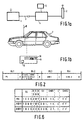
- FIG. 1 illustrates the environment in which a device according to the invention is used.
- a national (or regional) road information center (1) collects all the road information (accident, roadworks, traffic jam, freezing weather, etc.) transmitted to it. This traffic information is then selected and those which have a value for the proper functioning of road traffic are transmitted by means of a link 3 to a radio station 4.
- the radio station is equipped to code the messages and transmit them in accordance RDS (Radio Data System).
- RDS Radio Data System
- the radio station can also add other messages, to those supplied to it by the traffic information center, for example the presence of radar control at a determined location.
- the radio station is equipped with a unit 5 formed for example by a keyboard and an RDS encoder. The messages in RDS format are then transmitted on the air using transmitter 2 of the radio station.
- a vehicle 7 To receive messages in RDS format, a vehicle 7 must be equipped with a receiving antenna 8 and a radio receiver 9 capable of receiving and decoding messages sent in RDS format.
- Radio receiver 9 further includes a radio (cassette player) 10 a keyboard 11.
- a person circulating on board a vehicle 7 fitted with a radio receiver 9 is able to receive information in RDS formats issued by the transmitter 2.
- the RDS system offers the user the possibility of disposing at any time of the road information day of a route or of a region according to his own choice and to hear this traffic information in your own language.
- the messages if they remain current, are repeated and otherwise updated approximately every five minutes. In this period of roughly five minutes the transmitter can send 420 messages RDS format road information using 25% of the total capacity of the RDS resource.
- the SMR2 sub-sequence illustrated in Figure 3b is composed only by PR-LOC information.
- This PR-LOC information is composed of 16 bits and indicates the place or the surroundings to which the message (e.g. tunnel, highway exit or the name of a city).
- the SMR1 sub-sequence illustrated in Figure 3e includes the PA, STT and DAV sections.
- the STT section (6 bits) indicates a start time (for example from from "22.00 hours").
- the PA section has 4 bits and is used to indicate another country than that covered by the station Issuer.
- FIG. 4 schematically illustrates an example of a device according to the invention.
- the device includes data collector terminal equipment (DCE) which further comprises a radio receiver 30 connected to a antenna 38 and provided for receiving coded messages RDS format.
- the DCE is linked to equipment data processing terminal (DTE) which includes in addition to a reception memory 31 for storing the messages received by the DCE, which memory is in turn linked to a bus 32 for transporting information (addresses + data).
- DTE equipment data processing terminal
- Bus 32 is also connected a data processing unit 33, for example a microprocessor, a read only memory 35 a working memory 34, an extension table 36 and a table of places, a presentation unit formed by a speech generator 39 and an image generator 40 and a selection unit further comprising a keyboard 43, all these elements are part of the equipment data processing terminal.
- Generator output of words 39 respectively from the generator 40 is connected to a speaker 41 (which can be the same as the one used by the radio) respectively to a display unit.
- the image generator and its display unit are optional.
- the message MB comprises two sequences and only the last sequence of the message MA is repeated in order to illustrate the change of the link bit BB.
- the radio receiver When the radio receiver has received the first group of the message MB, it informs the data processing unit which starts (50) the analysis process.
- step 55 (OFF-C '?).
- step 58 the address ADD1 is formed and where the parts SMR1 are stored ( YY) and SMR2 (Y'Y ') at the address ADD1.
- the value FF being the address of the first free location in the reception memory, this value is for example stored in a second buffer register of the data processing unit. (The values YY and Y'Y 'represent the content of the parts SMR1 and SMR2).
- the data processing unit After storing in reception memory a message received, the data processing unit will analyze the content of the message in order to detect at which zone (road, region) the message relates. At this end the data processing unit uses a memory zone table formed by two tables which are illustrated in Figures 7 a and b. These tables make, in a form of the device according to the invention, part of the working memory (34, figure 4) of the device. It will be clear that these tables can also be formed by two memories (RAM type) connected to bus 32.
- the figure 7a illustrates the table of regions which is used for classify messages according to geographic regions to which it relates. These regions can correspond to the geographic division of the country (province, department) or be formed by an arbitrary division from the country.
- the table is in matrix form and is addressable by row and by column.
- the columns called ADD-MES are used to store indicators, for example the addresses (ADD) to which are stored in the reception memory messages belonging to the region of their respective rank.
- ADD addresses
- FIG. 7a there are at addresses 12, 21, 34 and 38 messages for region B2 and for the region B5 there is a message at address 50.
- the column CS / R indicates the number of messages for the region in question (four for B2, one for B5) and the DEB column indicates the overflow index for the region in question.
- the overflow index for the region is a number assigned to this region which indicates the maximum number of messages allocated for the region in question.
- this overflow index is the same for each region and the column DEG-REG is not included in the table of regions.
- a dedicated overflow index is assigned to each region.
- the advantage of this preferred form is that the density of road traffic varies from region to region and from road to road. In France, for example, the Paris region, with high traffic density, will have a higher overflow index than that of Auvergne. Obviously, the higher the density of traffic, the greater the probability that there will be a or several traffic announcements.
- the overflow index thus makes it possible to equitably share the present capacity of the tables and of the reception memory.
- the different overflow indices are for example stored in a table as described below.
- Figure 7b illustrates the route table that is used to classify messages according to numbering routes (class + number, CLR, RNN) to which they relate.
- the route table is organized from the same way as that of the regions.
- the CS / RNN column indicates the number of messages for the route in question and the DEB-RN column indicates the overflow index for the route in question.
- the device uses, to recognize to which region a received message relates, a correspondence-route-regions table, which is illustrated in Figure 8a.
- This correspondence-routes-region table can be used in ROM 35 DTE or be made up of an independent memory connected to the bus, which could even, if necessary, be in the form of a cassette or a memory card, allowing a regular update of the correspondence-routes-regions table.
- the road-regions correspondence table is addressable using the CLR-RNN part of the message.
- the correspondence-routes-regions table includes a REG-ALL column where the regions are mentioned crossed by the road in question, and a column DEB where the overflow index of is mentioned the road in question. So for example the A1 motorway crosses regions B8 and B9 and has an index of overflow equal to 8.
- the device according to the invention also comprises a correspondence-regions-routes table which is illustrated in Figure 8b and which, like the table correspondence-routes-regions, can be included in DTE read only memory 35 or be formed from a memory independent connected to the bus.
- the correspondence-regions-routes table is addressable by means the region code (REG) and has a column RNN-ALL where the roads crossing are mentioned the region in question, and a DEB column where is mentioned the overflow index for the region in question.
- REG region code
- the data processing unit goes into its tracking unit function, now proceed with the as described below.
- the processing unit is informed that the message is referring to the A2 motorway also refers to the regions B3 and B4.
- the data processing unit will take this data in rows B3 and B4 of the correspondence table of regions.
- FIG 10 illustrates an example of a keyboard control forming part of the device according to the invention.
- the control keyboard has a display unit, for example an LCD 91 unit which displays numbers and letters to indicate categories of roads (motorway, national road, departmental road) or regions (area, department) from one or more countries.
- the CLR / RNN key used to indicate the choice of a route and the REG key to indicate the choice of a region.
- the + / + key is used in selection mode on the one hand to increment the number displayed on the display unit 91 and on the other hand to indicate a union operation, i.e. the user wants information on one or more routes and regions.
- presentation mode i.e.
- this + / + key is used to move positive of a pointer in a selection table.
- the - / VAL key is used in selection mode on the one hand to indicate an intersection between a road and a region and secondly to validate the number displayed on the unit display. In presentation mode this key - / VAL be at a negative displacement of the pointer in the table Selection.
- the ENT key is used to enter the choice that we operated on.
- the REP key repeats the last message presented.
- the ST key stops of the presentation.
- the EJ key cancels a message.
- the TDC key is used for transparency.
- Each button is provided with a diode (LED, indicated by a point) which lights up temporarily when you press the key in question.
- the control keyboard also has a encoder (not shown in figure 10) which encodes between others the signal produced when a key is pressed ENT to form a digital word which is transmitted via bus 32 to the data processing unit.
- the CLR / RNN key When a driver or other user wishes traffic information on a route of his choice, he will press the CLR / RNN key, which will cause the display of a first class of routes, for example the letter A indicating a highway, on the display unit. If the required route class is displayed, the user will press the ENT key so as to send his choice to the data processing unit. If a road class other than that required is displayed, the user will press the + / + key to display other road classes. After entering the required road class, the user will again press the CLR / RNN key, which will cause the display of figures on the display unit. By means of the + / + key the user will increment the number displayed until the number of the required route appears, and he will then enter this number by means of the ENT key. If the user wants road information on a region, he will operate in the same way as choosing a route by pressing the REG key, however. The indication of a specific region can be done for example by means of a number, for example 75 for
- the choice of a number can be done decimal by decimal using the - / VAL key each time to validate the decimal displayed.
- the keyboard will encode the signals of these keys and form one or more binary words that it sends to the data processing unit, which will then start execution of the selection program by deleting the contents of the selection table (step 101).
- Unit of data processing will then read part A8 of the choice and content of the selection table. Since the first part of the driver choice is always a union operation, the data processing unit goes, after performing step 104, go to step 107 where she will check if there are messages for the highway A8 stored in the route table and where it will find these messages in the first row.
- the treatment unit will take these addresses 12, 13, 28, 34, 38, 52, 71 and store them in the selection table (step 108).
- step 109 the processing unit finds that all the choice has not yet been taken into consideration and she will go to step 111 where it will locate the intersection operation. She then go back to step 102 to read the choice B2 and in step 103 to read the content of the selection table.
- step 104 the unit observes while an intersection operation is required and passes in step 105 where she finds that there are messages for region B2 and collect addresses 12, 21, 34, 38.
- step 106 the intersection operation is carried out and the addresses 12, 34, 38, which form the intersection between A8 and B2, are kept in the selection table, while that the other addresses are deleted. Since everyone choice has now been taken into account (step 109) the data processing unit goes to the subroutine 110 to present messages to the driver stored in addresses 12, 34 and 38 of the memory reception. Since the TDC key was not used the selection program is finished.
- a union or intersection operation is not limited to a region and a route but that it can be extended to several choices, such as for example (B2 U B5) (A8 U RN64) or the symbol U indicates a union operation and the symbol ⁇ an intersection operation. Such a choice will then require several routes of the selection program.
- Road information plays a role in the programming of a route such as realized by a road navigation system for vehicles.
- road navigation systems are for example described in the article "Elektronische Lotsen” published in Funkschau n ° 22, 1986, p. 99-102.
- a navigation system road vehicle is equipped with means to determine a route between a starting point and a destination.
- the device according to the invention is connected to a road navigation system and so means to determine the route take into account counts the road traffic information that make up the journey.
- the navigation system must determine a route between a starting point and a destination entered by the driver and the route as determined first comprises between others a highway whose exit to borrow would be blocked due to work.
- the navigation system determined his route so he goes for each route or only for the main routes of his route, ask the device according to the invention traffic announcements. This can be done for example by transmitting to the data processing unit a call indicating that traffic information is requested, and the binary code of the route (s) in question.
- the data processing unit will then process these queries similarly to the one used for commands from the keyboard, and transmit the information required by the navigation system.
- the navigation system will now detect that the highway exit to be used according to the initially planned blocked route, and will ask the means to determine a route to determine a new route where the exit in question will be avoided.
- the navigation system in cooperation with the device according to the invention thus allows the driver to avoid obstacles or traffic jams.
- each message has an ST part, indicating a likely duration of the problem, this part ST can also be taken into account in the determining the route.
- the ST section indicates "until 4 pm" and that the motorist leaves at 3 p.m. 30 and that the output in question is is 150 km from the starting point.
- the navigation system will then be equipped with means to take consider this information. So it will be equipped with a calculator which will tell him that at an average speed of 100 km / h on the highway it will need an hour and half to reach this exit. This value of one hour and a half will then be added to the present time (3.30 p.m.) indicated by the car clock (3.30 p.m.
- the navigation system will be equipped to compare this calculated hour (5 p.m. oo) to the hour indicated in ST (4:00 p.m.) and she will find that for the time the motorist has reached the exit in question this will be opened again. Means to determine a route will not receive in this case there orders to determine a new route. In a way analogous to the navigation system in cooperation with the device according to the invention can also take Consider the STT section when determining of an itinerary.
- the device according to the invention uses to allow the presentation of a message, an extension table (36, figure 4) and a table of places (37, figure 4), which are illustrated in Figures 12a and b respectively.
- This extension table and this place table can also be included in ROM 35 and ET-TD. In case they are made up of independent memories connected to the bus, they could even, if if necessary, be in the form of cassettes or cards with memory.
- the extension table (figure 12a) can be addressed to using the CLR-RNN part of the message and the PR-LOC part.
- a row also has a ADR part indicating a place in the table of places.
- each row is not necessarily filled with information, this allows the case there is possibility of entering in the table (memory EEPROM, or magnetic strip) to add to it in places required new information, for example new motorway exits.
- the table of places is addressable by means of the address taken from the extension table (column ADR), and has a TXT APP column reserved for the designation from the place indicated, a PAR or column is memorized the code to train the speech generator to form a word as words, and a column REG indicates the region to which the indicated place belongs.
- the parts CLR-RNN, PR-LOC now form an address A7.2 to address a place in the extension table.
- the data processing unit will address this location A7.2 and take there data 1024 which it will use to address the table of places. At the bearing place address 1024 from the table of places she will find the code 022c which it presents to the speech generator who will form "HAMBURG" in the form of lyrics.
- this DIR-OFFS section indicates the binary value 0 1010 indicating a positive offset of 10 to add to PR-LOC.
- the value is stored 1247 and at the address 1247 of the places table is stored the code 021Q.
- the data processing unit presents then this value 021Q to the speech generator which will form "KIEL" in the form of lyrics.
- the use of the DIR-OFFS part allows to indicate a second place in the message while limiting the number of bits required for this operation since the DIR-OFFS part always indicates a value relative to the PR-LOC value. So it is not necessary to mention a second value for CLR-RNN (16 bits) nor to mention a second value for PR-LOC (16 bit).
- the OFFS part thus compresses into 5 bits the information from that second place.
- the extension table and the table of places then allow to return this second place as described above.
- the section DIR-OFFS, the extension table and the places table offer the same benefit when presenting messages as will be described later in the description.
- Figures 14a and b illustrate an alternative form SMR2 subsequences from two successive groups.
- the sub-sequence illustrated in Figure 14a includes a LOC1 part (8 bits) and a LOC2 part (8 bits) which each indicate a respective location to which it relates the message.
- the parts DIR, ST and SAV are analogous to those of the groups illustrated in figure 3d, and the part SCTN represents a section of the road, mentioned in the CLR-RNN part of the message, for example the section between Düsseldorf and Strass Victoria exits on the A8 motorway in federal Germany.
- each road network road has been divided into different sections (32 sections maximum if the SCTN section has 5 bits) and locations LOC1 and LOC2 refer to then to the section mentioned in SCTN.
Landscapes
- Engineering & Computer Science (AREA)
- Physics & Mathematics (AREA)
- General Physics & Mathematics (AREA)
- Signal Processing (AREA)
- Multimedia (AREA)
- Radar, Positioning & Navigation (AREA)
- Remote Sensing (AREA)
- Traffic Control Systems (AREA)
- Devices For Checking Fares Or Tickets At Control Points (AREA)
- Crystals, And After-Treatments Of Crystals (AREA)
- Information Retrieval, Db Structures And Fs Structures Therefor (AREA)
- Mobile Radio Communication Systems (AREA)
Claims (18)
- Einrichtung für den Empfang und die Verarbeitung digital übertragener Straßennachrichtenmeldungen, wobei jede Meldung mindestens einen ersten Abschnitt für die Anzeige der Zone des Straßennetzes enthält, auf den sich die Meldung bezieht, und diese Einrichtung für die Steuerung der Datenverarbeitung eine Datenverarbeitungseinheit (33) enthält, die an einen Datentransferbus (32) angeschlossen ist, und an diesen Bus zugleich ein Empfangsspeicher (31) für die zeitweilige Speicherung der erhaltenen Meldungen, eine Empfangseinheit, die es ermöglicht, zwischen den gespeicherten Meldungen diejenigen auszuwählen, welche die zu bestimmende Zone betreffen, und eine Bestimmungseinheit angeschlossen sind, um die ausgewählten Meldungen zu bestimmen, wobei die Einrichtung eine Meldungsanalyseneinheit enthält, die einen Zonentabellenspeicher enthält, und die besagte Analyseneinheit vorgesehen ist, um bei jedem Erhalt einer Meldung auf der Grundlage des besagten ersten Abschnitts der erhaltenen Meldung die betreffende Zone zu erkennen und um unter Verwendung mindestens eines Anzeigers für jede Meldung die erhaltenen Meldungen nach den Zonen, zu denen sie gehören, in die Zonentabelle einzuordnen, wobei die Auswahleinheit vorgesehen ist, um zur Zonentabelle Zugang zu haben und die besagte Auswahl durch die Entnahme der Meldungen für die bestimmte Zone aus der Zonentabelle durchzuführen, dadurch gekennzeichnet, dass die Einrichtung mit einem Navigationssystem für Fahrzeuge gekoppelt ist, wobei dieses Navigationssystem mit Mitteln versehen ist um zwischen einem Abfahrtpunkt und einem Bestimmungspunkt eine Reiseroute zu ermitteln, wobei das Navigationssystem mit Mitteln versehen ist um mit einer Selektionseinheit wenigstens eine durchfahrene Zone zu senden und um diejenigen Nachrichten zu empfangen, welche die bezeichnete Zone betreffen, wobei die genannten Mittel zum Bestimmen einer Reiseroute vorgesehen sind zum Analysieren der empfangenen Nachricht und um in der empfangenen Nachricht wiederzuerkennen, ob es in der betreffenden Zone ein Verkehrsproblem gibt und um zu bestimmen im Falle eines Verkehrsproblems eine neue Reiseroute zu ermitteln.
- Einrichtung nach dem ersten Anspruch, in der die verschiedenen Zonen eines Straßennetzes den Straßen entsprechen und mit einer Straßenkategorie und Straßennummer angezeigt sind, mit dem Merkmal, daß der Tabellenspeicher der Zonen (34) eine Straßentabelle enthält, in der Meldungen entsprechen der Straßen geordnet sind, auf die sie sich beziehen, und daß die Anzeiger von den Adressen gebildet werden, unter denen die betreffenden Meldungen im Empfangsspeicher (31) gespeichert sind.
- Empfangseinrichtung nach Anspruch 1 oder 2, in der die verschiedenen Zonen eines Straßennetzes den Regionen mindestens eines Landes entsprechen, mit dem Merkmal, daß die Einrichtung mit einer Ortungseinheit ausgerüstet ist, um in einer empfangenen Meldung die Region zu orten, auf die sie sich bezieht, wobei die Meldungsanalyseeinheit mit der Ortungseinheit verbunden ist, und daß die Zonenspeichertabelle eine Tabelle der Regionen enthält, auf die sie sich beziehen, und daß die Anzeiger von den Adressen gebildet werden, unter denen die betreffenden Meldungen im Empfangsspeicher gespeichert sind.
- Einrichtung nach Anspruch 2, mit dem Merkmal, daß die Einrichtung eine Regionen-Straßen-Entsprechungstabelle (34) enthält, um für eine vorbestimmte Anzahl Straßen des Straßennetzes, auf das sich die Regionen-Straßen-Entsprechungstabelle bezieht, einen Überlaufindex zu speichern, der die Höchstzahl Straßenmeldungen für jede der Straßen der besagten vorbestimmten Anzahl anzeigt, und die besagte Einrichtung mit einer Prüfeinheit ausgerüstet ist, die mit der Regionen-Straßen-Entsprechungstabelle (34) und der Straßentabelle verbunden ist, um zu prüfen, ob die Anzahl für jede Straße eingeordneter Meldungen für die betreffende Straße nicht die vom Überlaufanzeiger angezeigte Anzahl erreicht, und um eine vorhandene Meldung zu eine Straße zu löschen, deren Anzahl in der Speichertabelle eingeordneten Meldungen die vom Überlaufanzeiger angezeigte Anzahl erreicht.
- Einrichtung nach Anspruch 4, mit dem Merkmal, daß die Ortungseinheit eine Regionen-Straßen-Entsprechungstabelle (34) enthält, in der fiir jede der Straßen einer vorbestimmten Anzahl Straßen eines Straßennetzes mindestens ein Anzeiger gespeichert wird, der mindestens eine über die betreffende Straße durchquerte Region anzeigt.
- Einrichtung nach Anspruch 3 oder 5, mit dem Merkmal, daß die Einrichtung eine Straßen-Regionen-Entsprechungstabelle (34) enthält, um für eine vorbestimmte Anzahl Regionen einen Überlaufindex zu speichern, der die Höchstzahl Straßenmeldungen für jede der Regionen der besagten vorbestimmten Anzahl anzeigt, und die besagte Einrichtung mit einer Prüfeinheit ausgerüstet ist, die mit der Straßen-Regionen-Entsprechungstabelle (34) und der Regionentabelle verbunden ist, und prüfen kann, ob die Anzahl für jede Region eingeordneter Meldungen für die betreffende Region nicht die vom Überlaufanzeiger angezeigte Anzahl erreicht, und um eine vorhandene Meldung zu einer Region zu löschen, deren Anzahl in der Regionentabelle eingeordneter Meldungen die vom Überlaufanzeiger angezeigte Anzahl erreicht.
- Einrichtung nach einem der Ansprüche 4 oder 6, mit dem Merkmal, daß die Prüfeinheit vorgesehen ist, um die besagte Beseitigung der ältesten anwesenden Meldung unter der besagten Anzahl Meldungen vorzunehmen.
- Einrichtung nach Anspruch 6, mit dem Merkmal, daß die Straßen-Regionen-Entsprechungstabelle (34) für jede aufgenommene Region mindestens eine die Region durchquerende Straße enthält.
- Einrichtung nach den Ansprüchen 5 und 8, mit dem Merkmal, daß auch die Prüfeinheit vorgesehen ist, um mit der Regionen-Straßen-Entsprechungstabelle (34) bzw. der Straßen-Regionen-Entsprechungstabelle (34) zu orten, auf welche Region bzw. auf welche Straße sich die Meldung bezieht, deren Anwesenheit beseitigt wurde, und um zugleich aus der Regionentabelle bzw. der Straßentabelle die Meldung zu entfernen, deren Anwesenheit aus der Straßentabelle bzw. der Regionentabelle beseitigt wurde.
- Einrichtung nach einem der Ansprüche 4 oder 6, mit dem Merkmal, daß jede Straße bzw. jede Region in der Regionen-Straßen-Entsprechungstabelle (34) bzw. der Straßen-Regionen-Entsprechungstabelle (34) einem eigenen Überlaufindex zugeteilt ist, der in der Regionen-Straßen-Entsprechungstabelle (34) bzw. der Straßen-Regionen-Entsprechungstabelle (34) gespeichert wird.
- Einrichtung nach einem der vorhergehenden Ansprüche, in der jede Meldung mindestens eine aus zwei Blöcken bestehende Sequenz enthält und in der jeder Block einen Informationsteil und einen Kontrollteil enthält, wobei der Kontrollteil außerdem ein Versetzungswort für die Synchronisation der Blöcke enthält und wo für jeden bestimmten Block ein erstes und ein zweites Versetzungswort verwendbar ist, mit dem Merkmal, daß für die erste Sequenz einer Meldung das erste Versetzungswort verwendet wird und fiir die anderen Sequenz dieser Meldung das zweite Versetzungswort verwendet wird, und daß diese Einrichtung mit einem Decodierer versehen ist, um das Versetzungswort einer erhaltenen Meldung zu decodieren und um bei der Decodierung eines ersten Versetzungsworts ein Positioniersignal zu erzeugen, und die Einrichtung einem mit dem Decodierer verbundenen Sequenzzähler enthält und der Sequenzzähler unter der Kontrolle eines Positioniersignals positionierbar ist.
- Einrichtung nach Anspruch 1, mit dem Merkmal, daß die Auswahleinheit (43) mit Mitteln versehen ist, die die Auswahl zwischen einem Schnittpunkt und/oder einer Verbindung von mindestens zwei Zonen ermöglichen.
- Einrichtung nach Anspruch 1, mit dem Merkmal, daß die Auswahleinheit (43) mit einer Taste versehen ist, um nach dem Erhalt einer Meldung für eine ausgewählten Zone die direkte Übermittlung zu aktivieren.
- Einrichtung nach Anspruch 1, in der die Meldung mehrere Abschnitte enthält, in denen jeweils Codewörter enthalten sind, die verschiedene Teile der Information der Meldung verkörpern, mit dem Merkmal, daß die Einrichtung mit einem Umcodierspeicher versehen ist, der mit der Anzeigeeinheit verbunden und von verschiedenen Codewörtern adressierbar ist und in dem die anderen Codewörter für die Anzeige der Meldung gespeichert werden.
- Einrichtung nach Anspruch 14, in der ein zweiter Abschnitt der Meldung in einem Bereich in der Zone aufgenommen ist, auf die sich die Meldung bezieht, mit dem Merkmal, daß in der Umcodiertabelle in der Form anderer Codewörter Bereiche mindestens eines Landes gespeichert sind, auf das sich die Straßennachricht bezieht.
- Einrichtung nach Anspruch 15, mit dem Merkmal, daß jede Meldung einen dritten Abschnitt enthält, der einen Versetzungswert enthält, um einen anderen relativen Bereich in bezug auf den im zweiten Abschnitt aufgenommenen Bereich anzeigen zu können, und ist die Einrichtung mit einem Adressengenerator versehen, um für den Umcodierspeicher auf der Grundlage des zweiten und dritten Abschnitts der Meldung eine Adresse zu bilden.
- Einrichtung nach Anspruch 15, mit dem Merkmal, daß der zweite Abschnitt in einen ersten Unterabschnitt unterteilt ist, der einen Streckenabschnitt in der im ersten Abschnitt aufgenommenen Zone anzeigt, wobei ein zweiter bzw. ein dritter Unterabschnitt einen ersten bzw. zweiten Bereich auf dem im ersten Abschnitt angezeigten Unterabschnitt anzeigt, und daß der Umcodierspeicher in n Abschnitte unterteilt ist und eine erste Adressenliste enthält, welche die erste Adresse jedes der n Abschnitte anzeigt, wobei ein Bereich in der ersten Adressenliste durch den ersten Abschnitt der Meldung adressierbar ist, jeder der n Abschnitte in m Unterabschnitte unterteilt ist und eine zweite Adressenliste enthält, die vom besagten ersten Unterabschnitt adressierbar ist, und erste Adressen jedes der m Unterabschnitte enthält, wobei ein Bereich in den m Unterabschnitten vom zweiten oder dritten Unterabschnitt adressierbar ist.
- Einrichtung nach Anspruch 16 oder 17, mit dem Merkmal, daß der Umcodierspeicher eine Erweiterungstabelle und eine Ortstabelle enthält, die Erweiterungstabelle für jede vom ersten und dem zweiten und/oder auf Grundlage des ersten, zweiten und dritten Abschnitts gebildete Adresse eine Adresse enthält, die einen Bereich in der Ortstabelle anzeigt.
Priority Applications (7)
| Application Number | Priority Date | Filing Date | Title |
|---|---|---|---|
| DE3752122T DE3752122T3 (de) | 1987-05-09 | 1987-05-09 | Einrichtung für Empfang und Verarbeitung von Strassennachrichtenmeldungen |
| EP87200845A EP0290679B2 (de) | 1987-05-09 | 1987-05-09 | Einrichtung für Empfang und Verarbeitung von Strassennachrichtenmeldungen |
| AT87200845T ATE158886T1 (de) | 1987-05-09 | 1987-05-09 | Einrichtung für empfang und verarbeitung von strassennachrichtenmeldungen |
| CA000566001A CA1323426C (en) | 1987-05-09 | 1988-05-05 | Device for receiving and processing road information |
| US07/190,542 US4907159A (en) | 1987-05-09 | 1988-05-05 | Device for receiving and processing road information |
| JP63110638A JP2720975B2 (ja) | 1987-05-09 | 1988-05-09 | 道路情報メッセージ受信処理装置 |
| AU15840/88A AU614745B2 (en) | 1987-05-09 | 1988-05-09 | Device for receiving and processing road information |
Applications Claiming Priority (1)
| Application Number | Priority Date | Filing Date | Title |
|---|---|---|---|
| EP87200845A EP0290679B2 (de) | 1987-05-09 | 1987-05-09 | Einrichtung für Empfang und Verarbeitung von Strassennachrichtenmeldungen |
Publications (3)
| Publication Number | Publication Date |
|---|---|
| EP0290679A1 EP0290679A1 (de) | 1988-11-17 |
| EP0290679B1 EP0290679B1 (de) | 1997-10-01 |
| EP0290679B2 true EP0290679B2 (de) | 2003-08-06 |
Family
ID=8197615
Family Applications (1)
| Application Number | Title | Priority Date | Filing Date |
|---|---|---|---|
| EP87200845A Expired - Lifetime EP0290679B2 (de) | 1987-05-09 | 1987-05-09 | Einrichtung für Empfang und Verarbeitung von Strassennachrichtenmeldungen |
Country Status (7)
| Country | Link |
|---|---|
| US (1) | US4907159A (de) |
| EP (1) | EP0290679B2 (de) |
| JP (1) | JP2720975B2 (de) |
| AT (1) | ATE158886T1 (de) |
| AU (1) | AU614745B2 (de) |
| CA (1) | CA1323426C (de) |
| DE (1) | DE3752122T3 (de) |
Cited By (1)
| Publication number | Priority date | Publication date | Assignee | Title |
|---|---|---|---|---|
| US8195188B2 (en) | 1997-08-04 | 2012-06-05 | Enovsys Llc | Location reporting satellite paging system with optional blocking of location reporting |
Families Citing this family (131)
| Publication number | Priority date | Publication date | Assignee | Title |
|---|---|---|---|---|
| US5247439A (en) * | 1982-11-08 | 1993-09-21 | Hailemichael Gurmu | Vehicle guidance system |
| US5297049A (en) * | 1982-11-08 | 1994-03-22 | Hailemichael Gurmu | Vehicle guidance system |
| US5126941A (en) * | 1982-11-08 | 1992-06-30 | Hailemichael Gurmu | Vehicle guidance system |
| US5422812A (en) * | 1985-05-30 | 1995-06-06 | Robert Bosch Gmbh | Enroute vehicle guidance system with heads up display |
| DE3824309A1 (de) * | 1988-07-18 | 1990-01-25 | Bosch Gmbh Robert | Verfahren zur auswertung von in einem datentelegramm digital codiert empfangener verkehrsnachrichten, sowie rundfunkempfaenger |
| GB8826624D0 (en) * | 1988-11-14 | 1988-12-21 | Martell D K | Traffic congestion monitoring system |
| GB8829274D0 (en) * | 1988-12-15 | 1989-01-25 | British Broadcasting Corp | Improvements to rds radio systems |
| FR2642875B1 (fr) * | 1989-02-03 | 1994-02-18 | Urba 2000 | Systeme de collecte et de diffusion d'informations pour automobilistes |
| DE3914104A1 (de) * | 1989-04-28 | 1990-11-15 | Bosch Gmbh Robert | Rundfunkempfaenger, insbesondere fahrzeugempfaenger |
| DE3925057A1 (de) * | 1989-07-28 | 1991-01-31 | Bosch Gmbh Robert | Verfahren und vorrichtung zur steuerung einer wiedergabeeinrichtung fuer ortsabhaengige informationen |
| DE3936577A1 (de) * | 1989-11-03 | 1991-05-08 | Bosch Gmbh Robert | Rundfunkempfaenger, insbesondere fahrzeugempfaenger |
| US5095532A (en) * | 1989-12-29 | 1992-03-10 | Robert Bosch Gmbh | Method and apparatus for route-selective reproduction of broadcast traffic announcements |
| US5193214A (en) * | 1989-12-29 | 1993-03-09 | Robert Bosch Gmbh | Vehicular radio receiver with standard traffic problem database |
| NL9000533A (nl) * | 1990-03-07 | 1991-10-01 | Philips Nv | Werkwijze voor de overdracht van radio-data-systeemsignalen met verkeersprogramma-identificatie en ontvanger voor dergelijke radio-data-systeemsignalen. |
| DE4008460A1 (de) * | 1990-03-16 | 1991-09-19 | Bosch Gmbh Robert | Navigationssystem |
| FR2660782B1 (fr) * | 1990-04-10 | 1995-02-10 | Cga Hbs | Systeme pour l'information des usagers d'un reseau d'autobus. |
| US5182555A (en) * | 1990-07-26 | 1993-01-26 | Farradyne Systems, Inc. | Cell messaging process for an in-vehicle traffic congestion information system |
| US5164904A (en) * | 1990-07-26 | 1992-11-17 | Farradyne Systems, Inc. | In-vehicle traffic congestion information system |
| US5173691A (en) * | 1990-07-26 | 1992-12-22 | Farradyne Systems, Inc. | Data fusion process for an in-vehicle traffic congestion information system |
| FR2668632A1 (fr) * | 1990-10-31 | 1992-04-30 | Electricite De France | Installation d'aide a la conduite des vehicules automobiles. |
| KR930010426B1 (ko) * | 1990-11-26 | 1993-10-23 | 현대전자산업 주식회사 | 차량의 위험지역 주행시 주의방송 송,수신장치 |
| US5748840A (en) * | 1990-12-03 | 1998-05-05 | Audio Navigation Systems, Inc. | Methods and apparatus for improving the reliability of recognizing words in a large database when the words are spelled or spoken |
| US5592389A (en) * | 1990-12-03 | 1997-01-07 | Ans, Llp | Navigation system utilizing audio CD player for data storage |
| US5274560A (en) | 1990-12-03 | 1993-12-28 | Audio Navigation Systems, Inc. | Sensor free vehicle navigation system utilizing a voice input/output interface for routing a driver from his source point to his destination point |
| US5454062A (en) * | 1991-03-27 | 1995-09-26 | Audio Navigation Systems, Inc. | Method for recognizing spoken words |
| JP2655953B2 (ja) * | 1991-07-19 | 1997-09-24 | 株式会社日立製作所 | 交通制御システム |
| US10361802B1 (en) | 1999-02-01 | 2019-07-23 | Blanding Hovenweep, Llc | Adaptive pattern recognition based control system and method |
| US8352400B2 (en) | 1991-12-23 | 2013-01-08 | Hoffberg Steven M | Adaptive pattern recognition based controller apparatus and method and human-factored interface therefore |
| US5334974A (en) * | 1992-02-06 | 1994-08-02 | Simms James R | Personal security system |
| FR2700629B1 (fr) * | 1993-01-15 | 1995-02-24 | Renault | Procédé de sélection d'informations routières, et système pour sa mise en Óoeuvre. |
| FR2701144B1 (fr) * | 1993-01-29 | 1995-03-03 | Renault | Procédé et dispositif de consultation d'informations de trafic. |
| US6330334B1 (en) | 1993-03-15 | 2001-12-11 | Command Audio Corporation | Method and system for information dissemination using television signals |
| US5406626A (en) * | 1993-03-15 | 1995-04-11 | Macrovision Corporation | Radio receiver for information dissemenation using subcarrier |
| DE4344173A1 (de) * | 1993-12-23 | 1995-06-29 | Philips Patentverwaltung | Bedienteil für einen RDS-TMC-Rundfunkempfänger |
| FR2716994B1 (fr) * | 1994-03-04 | 1996-03-29 | Renault | Procédé et dispositif de sélection d'informations routières. |
| US5572201A (en) * | 1994-08-05 | 1996-11-05 | Federal Signal Corporation | Alerting device and system for abnormal situations |
| DE4433982C1 (de) * | 1994-09-23 | 1995-10-19 | Bosch Gmbh Robert | Vorrichtung zum Auffinden eines verfügbaren Parkplatzes oder Parkhauses |
| DE19503415A1 (de) * | 1995-02-03 | 1996-08-08 | Bosch Gmbh Robert | Einrichtung zur Verwaltung von digital codierten Verkehrsmeldungen in Empfangsgeräten |
| DE19503414A1 (de) * | 1995-02-03 | 1996-08-08 | Bosch Gmbh Robert | Einrichtung zur Ausgabe von empfangenen digital codierten Verkehrsmeldungen |
| DE19516477A1 (de) * | 1995-05-05 | 1996-11-07 | Bosch Gmbh Robert | Einrichtung zur Aufbereitung und Ausgabe von Informationen für einen Fahrzeugführer |
| DE19518173A1 (de) * | 1995-05-19 | 1996-11-21 | Bosch Gmbh Robert | Verfahren zur drahtlosen Übertragung von digital codierten Schiffahrts/Wasserstraßenmeldungen und Vorrichtung zum Empfang von Schiffahrts-/Wasserstraßenmeldungen |
| DE19538453A1 (de) * | 1995-10-16 | 1997-04-17 | Bayerische Motoren Werke Ag | Funksignalempfänger für Kraftfahrzeuge mit einem RDS-Dekoder für digitale Signale |
| DE19606010A1 (de) * | 1996-02-17 | 1997-08-21 | Bosch Gmbh Robert | Ortsdatenbank für die Ermittlung von Routen innerhalb eines Verkehrswegenetzes |
| US6088636A (en) * | 1996-03-11 | 2000-07-11 | Chigumira; Ishmael | Vehicle trip data computer |
| US5900825A (en) * | 1996-08-01 | 1999-05-04 | Manitto Technologies, Inc. | System and method for communicating location and direction specific information to a vehicle |
| EP0849718A1 (de) * | 1996-12-16 | 1998-06-24 | MANNESMANN Aktiengesellschaft | Verfahren und Vorrichtung zum Übermitteln von ein Verkehrsnetz betreffenden, die Verkehrssituation repräsentierenden Verkehrsinformationen von einer Verkehrszentrale an ein Endgerät eines Fahrzeuges |
| JP4121157B2 (ja) * | 1997-07-01 | 2008-07-23 | マネスマン ファウデーオー アーゲー | 車両用ナビゲーションシステム |
| JP3509511B2 (ja) * | 1997-11-20 | 2004-03-22 | トヨタ自動車株式会社 | 車両用情報取得装置 |
| DE69817306T2 (de) * | 1997-12-02 | 2004-06-24 | Siemens Ag | Gerät zur Verarbeitung einer Verkehrsmeldung |
| US7268700B1 (en) | 1998-01-27 | 2007-09-11 | Hoffberg Steven M | Mobile communication device |
| GB2333672B (en) * | 1998-01-27 | 2003-06-25 | Stasys Ltd | Analysing tactical data link messages |
| US6081803A (en) * | 1998-02-06 | 2000-06-27 | Navigation Technologies Corporation | Support for alternative names in a geographic database used with a navigation program and methods for use and formation thereof |
| WO1999048073A1 (en) * | 1998-03-19 | 1999-09-23 | Mannesmann Vdo Ag | Traffic event processing navigation system |
| JPH11311538A (ja) * | 1998-04-28 | 1999-11-09 | Honda Motor Co Ltd | 車両共用システム |
| US6438561B1 (en) * | 1998-11-19 | 2002-08-20 | Navigation Technologies Corp. | Method and system for using real-time traffic broadcasts with navigation systems |
| ES2181497T3 (es) * | 1998-12-14 | 2003-02-16 | Vodafone Ag | Procedimiento para la identificacion mediante segmentos de sucesos que cubren varios segmentos. |
| US7966078B2 (en) | 1999-02-01 | 2011-06-21 | Steven Hoffberg | Network media appliance system and method |
| DE19933970A1 (de) * | 1999-07-20 | 2001-01-25 | Bosch Gmbh Robert | Verfahren zur Codierung straßenübergreifender Verkehrsbehinderungen |
| DE19940266A1 (de) * | 1999-08-25 | 2001-03-22 | Bosch Gmbh Robert | Verfahren zur Abfrage von Radiotext in einem Rundfunkempfänger und Rundfunkempfänger mit einer Leitung |
| US6919821B1 (en) | 2000-05-19 | 2005-07-19 | Navteq North America, Llc | Method and system for collecting meteorological data using in-vehicle systems |
| ATE417424T1 (de) * | 2000-06-02 | 2008-12-15 | Continental Automotive Gmbh | Verfahren und einrichtung zur bearbeitung von zyklusstruktierten datennachrichten |
| US8060389B2 (en) * | 2000-06-07 | 2011-11-15 | Apple Inc. | System and method for anonymous location based services |
| US8073565B2 (en) | 2000-06-07 | 2011-12-06 | Apple Inc. | System and method for alerting a first mobile data processing system nearby a second mobile data processing system |
| US6456234B1 (en) * | 2000-06-07 | 2002-09-24 | William J. Johnson | System and method for proactive content delivery by situation location |
| JP2004512589A (ja) * | 2000-10-18 | 2004-04-22 | コーニンクレッカ フィリップス エレクトロニクス エヌ ヴィ | 情報ユニットを記憶及びアクセスするシステム |
| US10298735B2 (en) | 2001-04-24 | 2019-05-21 | Northwater Intellectual Property Fund L.P. 2 | Method and apparatus for dynamic configuration of a multiprocessor health data system |
| US7146260B2 (en) * | 2001-04-24 | 2006-12-05 | Medius, Inc. | Method and apparatus for dynamic configuration of multiprocessor system |
| US6792351B2 (en) * | 2001-06-26 | 2004-09-14 | Medius, Inc. | Method and apparatus for multi-vehicle communication |
| US7178049B2 (en) | 2002-04-24 | 2007-02-13 | Medius, Inc. | Method for multi-tasking multiple Java virtual machines in a secure environment |
| US20060075137A1 (en) * | 2002-09-30 | 2006-04-06 | Hajime Maekawa | Information processing apparatus and receiving apparatus |
| US9818136B1 (en) | 2003-02-05 | 2017-11-14 | Steven M. Hoffberg | System and method for determining contingent relevance |
| US7251558B1 (en) | 2003-09-23 | 2007-07-31 | Navteq North America, Llc | Method and system for developing traffic messages |
| US7450029B2 (en) * | 2003-12-18 | 2008-11-11 | George Vickas | Incursion collision avoidance system for vehicle traffic control |
| US7414545B2 (en) * | 2003-12-18 | 2008-08-19 | George Vickas | Incursion collision avoidance system for vehicle traffic control |
| US7349799B2 (en) * | 2004-04-23 | 2008-03-25 | Lg Electronics Inc. | Apparatus and method for processing traffic information |
| DE102004035983A1 (de) * | 2004-07-23 | 2006-02-16 | Robert Bosch Gmbh | Verfahren zur Übertragung von digital codierten Meldungen in Datengruppen und Empfänger |
| US7337650B1 (en) | 2004-11-09 | 2008-03-04 | Medius Inc. | System and method for aligning sensors on a vehicle |
| US7353034B2 (en) | 2005-04-04 | 2008-04-01 | X One, Inc. | Location sharing and tracking using mobile phones or other wireless devices |
| KR20060119742A (ko) * | 2005-05-18 | 2006-11-24 | 엘지전자 주식회사 | 도로 정보를 제공하고 이를 이용하는 방법 및 장치 |
| KR101061460B1 (ko) * | 2005-05-18 | 2011-09-02 | 엘지전자 주식회사 | 소통상태에 대한 예측정보를 제공하고 이를 이용하는 방법및 장치 |
| KR20060119743A (ko) * | 2005-05-18 | 2006-11-24 | 엘지전자 주식회사 | 구간 속도에 대한 예측정보를 제공하고 이를 이용하는 방법및 장치 |
| KR20060119746A (ko) * | 2005-05-18 | 2006-11-24 | 엘지전자 주식회사 | 교통상태에 대한 정보를 제공하고 이를 이용하는 방법 및장치 |
| US7729335B2 (en) * | 2005-05-18 | 2010-06-01 | Lg Electronics Inc. | Providing traffic information relating to a prediction of congestion status and using the same |
| KR20060119741A (ko) * | 2005-05-18 | 2006-11-24 | 엘지전자 주식회사 | 소통상태의 추이정보를 제공하고 이를 이용하는 방법 및장치 |
| KR20060119739A (ko) * | 2005-05-18 | 2006-11-24 | 엘지전자 주식회사 | 구간 통과시간에 대한 예측정보를 제공하고 이를 이용하는방법 및 장치 |
| KR20060122668A (ko) * | 2005-05-27 | 2006-11-30 | 엘지전자 주식회사 | 교통 정보 제공 방법 및 수신 장치 |
| US8711850B2 (en) | 2005-07-08 | 2014-04-29 | Lg Electronics Inc. | Format for providing traffic information and a method and apparatus for using the format |
| KR101254219B1 (ko) * | 2006-01-19 | 2013-04-23 | 엘지전자 주식회사 | 링크 식별 방법 및 링크 식별 장치 |
| DE102005050575A1 (de) * | 2005-10-21 | 2007-04-26 | Robert Bosch Gmbh | Verfahren zur Codierung von Verkehrsstörungen und Berechnung einer Route |
| US8046162B2 (en) * | 2005-11-04 | 2011-10-25 | Honda Motor Co., Ltd. | Data broadcast method for traffic information |
| ATE472148T1 (de) * | 2006-01-19 | 2010-07-15 | Lg Electronics Inc | Verfahren zum bereitstellen und benutzen von informationen für fahrzeugbewegung |
| KR101128806B1 (ko) * | 2006-09-25 | 2012-03-23 | 엘지전자 주식회사 | 교통정보를 수신하는 방법 및 장치, 그리고 제공하는 방법 |
| US8204684B2 (en) | 2007-06-28 | 2012-06-19 | Apple Inc. | Adaptive mobile device navigation |
| US8275352B2 (en) | 2007-06-28 | 2012-09-25 | Apple Inc. | Location-based emergency information |
| US8108144B2 (en) | 2007-06-28 | 2012-01-31 | Apple Inc. | Location based tracking |
| US8311526B2 (en) | 2007-06-28 | 2012-11-13 | Apple Inc. | Location-based categorical information services |
| US8175802B2 (en) | 2007-06-28 | 2012-05-08 | Apple Inc. | Adaptive route guidance based on preferences |
| US8290513B2 (en) | 2007-06-28 | 2012-10-16 | Apple Inc. | Location-based services |
| US8774825B2 (en) * | 2007-06-28 | 2014-07-08 | Apple Inc. | Integration of map services with user applications in a mobile device |
| US8385946B2 (en) | 2007-06-28 | 2013-02-26 | Apple Inc. | Disfavored route progressions or locations |
| US8762056B2 (en) | 2007-06-28 | 2014-06-24 | Apple Inc. | Route reference |
| US9109904B2 (en) | 2007-06-28 | 2015-08-18 | Apple Inc. | Integration of map services and user applications in a mobile device |
| US8332402B2 (en) * | 2007-06-28 | 2012-12-11 | Apple Inc. | Location based media items |
| US20090005964A1 (en) * | 2007-06-28 | 2009-01-01 | Apple Inc. | Intelligent Route Guidance |
| US9066199B2 (en) | 2007-06-28 | 2015-06-23 | Apple Inc. | Location-aware mobile device |
| US20090005018A1 (en) * | 2007-06-28 | 2009-01-01 | Apple Inc. | Route Sharing and Location |
| US8977294B2 (en) | 2007-10-10 | 2015-03-10 | Apple Inc. | Securely locating a device |
| US8355862B2 (en) | 2008-01-06 | 2013-01-15 | Apple Inc. | Graphical user interface for presenting location information |
| US9250092B2 (en) | 2008-05-12 | 2016-02-02 | Apple Inc. | Map service with network-based query for search |
| US8644843B2 (en) | 2008-05-16 | 2014-02-04 | Apple Inc. | Location determination |
| US8369867B2 (en) | 2008-06-30 | 2013-02-05 | Apple Inc. | Location sharing |
| US20100015991A1 (en) * | 2008-07-15 | 2010-01-21 | Kota Enterprises, Llc | System and method for calling a geosoc |
| US8504073B2 (en) | 2008-08-12 | 2013-08-06 | Teaneck Enterprises, Llc | Customized content delivery through the use of arbitrary geographic shapes |
| US8359643B2 (en) | 2008-09-18 | 2013-01-22 | Apple Inc. | Group formation using anonymous broadcast information |
| US8260320B2 (en) * | 2008-11-13 | 2012-09-04 | Apple Inc. | Location specific content |
| US7921223B2 (en) | 2008-12-08 | 2011-04-05 | Lemi Technology, Llc | Protected distribution and location based aggregation service |
| US8666367B2 (en) | 2009-05-01 | 2014-03-04 | Apple Inc. | Remotely locating and commanding a mobile device |
| US8670748B2 (en) | 2009-05-01 | 2014-03-11 | Apple Inc. | Remotely locating and commanding a mobile device |
| US8660530B2 (en) | 2009-05-01 | 2014-02-25 | Apple Inc. | Remotely receiving and communicating commands to a mobile device for execution by the mobile device |
| US9358924B1 (en) | 2009-05-08 | 2016-06-07 | Eagle Harbor Holdings, Llc | System and method for modeling advanced automotive safety systems |
| US8417490B1 (en) | 2009-05-11 | 2013-04-09 | Eagle Harbor Holdings, Llc | System and method for the configuration of an automotive vehicle with modeled sensors |
| US8886392B1 (en) | 2011-12-21 | 2014-11-11 | Intellectual Ventures Fund 79 Llc | Methods, devices, and mediums associated with managing vehicle maintenance activities |
| US9646493B2 (en) | 2015-06-19 | 2017-05-09 | International Business Machines Corporation | Management of moving objects |
| US10749734B2 (en) | 2015-07-07 | 2020-08-18 | International Business Machines Corporation | Management of events and moving objects |
| US10535266B2 (en) | 2017-06-21 | 2020-01-14 | International Business Machines Corporation | Management of mobile objects |
| US10504368B2 (en) | 2017-06-21 | 2019-12-10 | International Business Machines Corporation | Management of mobile objects |
| US10540895B2 (en) | 2017-06-21 | 2020-01-21 | International Business Machines Corporation | Management of mobile objects |
| US10546488B2 (en) | 2017-06-21 | 2020-01-28 | International Business Machines Corporation | Management of mobile objects |
| US10585180B2 (en) | 2017-06-21 | 2020-03-10 | International Business Machines Corporation | Management of mobile objects |
| US10600322B2 (en) | 2017-06-21 | 2020-03-24 | International Business Machines Corporation | Management of mobile objects |
| CN114708726B (zh) * | 2022-03-18 | 2023-12-01 | 北京百度网讯科技有限公司 | 交通限制的处理方法、装置、设备以及存储介质 |
Family Cites Families (11)
| Publication number | Priority date | Publication date | Assignee | Title |
|---|---|---|---|---|
| US3845289A (en) * | 1972-07-18 | 1974-10-29 | Avon Inc | Method and apparatus employing automatic route control system |
| US4092718A (en) * | 1974-03-21 | 1978-05-30 | Wendt Hans J | Computerized dispatching system |
| FR2388357A1 (fr) * | 1977-04-21 | 1978-11-17 | Electronique Vehicules Reseaux | Dispositif de controle de la circulation de vehicules de transports urbains |
| DE2919664C2 (de) * | 1979-05-16 | 1982-10-14 | Blaupunkt-Werke Gmbh, 3200 Hildesheim | Anzeigevorrichtung für Verkehrsinformationen |
| DE2930509C2 (de) * | 1979-07-27 | 1985-02-14 | ANT Nachrichtentechnik GmbH, 7150 Backnang | Verfahren zur Informationsübertragung |
| DE2945852A1 (de) * | 1979-11-13 | 1981-05-21 | Siemens AG, 1000 Berlin und 8000 München | Verfahren zur verkehrserfassung in einem leit- und informationssystem fuer den individualverkehr |
| US4301506A (en) * | 1980-07-07 | 1981-11-17 | Turco Daniel J | Auto routing computer for eliminating the need for maps or travel instructions |
| FR2554618A1 (fr) * | 1983-11-04 | 1985-05-10 | Thomson Brandt | Procede et systeme pour la communication d'informations relatives a la circulation routiere |
| US4713661A (en) * | 1985-08-16 | 1987-12-15 | Regency Electronics, Inc. | Transportation vehicle location monitor generating unique audible messages |
| DE3536820A1 (de) * | 1985-10-16 | 1987-04-16 | Bosch Gmbh Robert | Verkehrfunk-decoder |
| EP0219859B1 (de) * | 1985-10-25 | 1993-10-06 | Mitsubishi Denki Kabushiki Kaisha | Autobusdienststeuerungssystem |
-
1987
- 1987-05-09 AT AT87200845T patent/ATE158886T1/de active
- 1987-05-09 EP EP87200845A patent/EP0290679B2/de not_active Expired - Lifetime
- 1987-05-09 DE DE3752122T patent/DE3752122T3/de not_active Expired - Fee Related
-
1988
- 1988-05-05 US US07/190,542 patent/US4907159A/en not_active Expired - Lifetime
- 1988-05-05 CA CA000566001A patent/CA1323426C/en not_active Expired - Fee Related
- 1988-05-09 AU AU15840/88A patent/AU614745B2/en not_active Ceased
- 1988-05-09 JP JP63110638A patent/JP2720975B2/ja not_active Expired - Fee Related
Cited By (1)
| Publication number | Priority date | Publication date | Assignee | Title |
|---|---|---|---|---|
| US8195188B2 (en) | 1997-08-04 | 2012-06-05 | Enovsys Llc | Location reporting satellite paging system with optional blocking of location reporting |
Also Published As
| Publication number | Publication date |
|---|---|
| EP0290679A1 (de) | 1988-11-17 |
| ATE158886T1 (de) | 1997-10-15 |
| DE3752122T3 (de) | 2004-07-29 |
| JP2720975B2 (ja) | 1998-03-04 |
| DE3752122T2 (de) | 1998-04-02 |
| JPS63294022A (ja) | 1988-11-30 |
| US4907159A (en) | 1990-03-06 |
| AU614745B2 (en) | 1991-09-12 |
| CA1323426C (en) | 1993-10-19 |
| DE3752122D1 (de) | 1997-11-06 |
| EP0290679B1 (de) | 1997-10-01 |
| AU1584088A (en) | 1988-11-10 |
Similar Documents
| Publication | Publication Date | Title |
|---|---|---|
| EP0290679B1 (de) | Einrichtung für Empfang und Verarbeitung von Strassennachrichtenmeldungen | |
| US12359924B2 (en) | Systems and methods for generating scenic routes | |
| US10101165B2 (en) | Electronic device and method for planning tour route | |
| JPH06507747A (ja) | 交通無線受信機 | |
| US20080071586A1 (en) | Computerized locus investigation system | |
| US20040244568A1 (en) | Automatic music selecting system in mobile unit | |
| CN109844836A (zh) | 用于在地图上呈现车道和车辆类型特定的交通信息的方法和设备 | |
| JP2004213129A (ja) | 画像分類方法および装置並びにプログラム | |
| CN102314913A (zh) | 媒体内容重放 | |
| CN106708986A (zh) | 一种多媒体信息推荐方法及装置 | |
| CN102636176A (zh) | 车辆导航装置和方法 | |
| CN102063512B (zh) | 虚拟地球 | |
| CN101540111A (zh) | 在交通消息旁边提供赞助信息 | |
| CN101908057A (zh) | 信息处理装置与信息处理方法 | |
| CN112182135A (zh) | 路书生成方法、终端及计算机可读存储介质 | |
| JP2004094444A (ja) | 交通事故防止のための情報処理方法 | |
| JP5125676B2 (ja) | 情報配信システム、センター装置、アンケート回答取得方法 | |
| JP2000347563A (ja) | 地理情報処理装置 | |
| EP2015187A1 (de) | Inhaltsdateiverarbeitungsvorrichtung zur montage in einem fahrzeug | |
| KR100591861B1 (ko) | 버스단말기 및 임시운행데이타의 생성방법 | |
| CN106897302B (zh) | 一种兴趣点更新出品方法及装置 | |
| FR2973924A1 (fr) | Procede et dispositif de preparation d'un signal vocal concernant un trajet | |
| CN113505188A (zh) | 一种基于大数据的城市地图测绘更新系统及方法 | |
| CN112528137A (zh) | 垃圾投放点推荐方法和系统、服务器、终端 | |
| WO1998041961A1 (fr) | Dispositif d'information routiere |
Legal Events
| Date | Code | Title | Description |
|---|---|---|---|
| PUAI | Public reference made under article 153(3) epc to a published international application that has entered the european phase |
Free format text: ORIGINAL CODE: 0009012 |
|
| AK | Designated contracting states |
Kind code of ref document: A1 Designated state(s): AT BE CH DE ES FR GB IT LI LU NL SE |
|
| 17P | Request for examination filed |
Effective date: 19890511 |
|
| 17Q | First examination report despatched |
Effective date: 19910911 |
|
| GRAG | Despatch of communication of intention to grant |
Free format text: ORIGINAL CODE: EPIDOS AGRA |
|
| GRAH | Despatch of communication of intention to grant a patent |
Free format text: ORIGINAL CODE: EPIDOS IGRA |
|
| GRAH | Despatch of communication of intention to grant a patent |
Free format text: ORIGINAL CODE: EPIDOS IGRA |
|
| GRAA | (expected) grant |
Free format text: ORIGINAL CODE: 0009210 |
|
| AK | Designated contracting states |
Kind code of ref document: B1 Designated state(s): AT BE CH DE ES FR GB IT LI LU NL SE |
|
| PG25 | Lapsed in a contracting state [announced via postgrant information from national office to epo] |
Ref country code: NL Free format text: LAPSE BECAUSE OF FAILURE TO SUBMIT A TRANSLATION OF THE DESCRIPTION OR TO PAY THE FEE WITHIN THE PRESCRIBED TIME-LIMIT Effective date: 19971001 Ref country code: AT Free format text: LAPSE BECAUSE OF FAILURE TO SUBMIT A TRANSLATION OF THE DESCRIPTION OR TO PAY THE FEE WITHIN THE PRESCRIBED TIME-LIMIT Effective date: 19971001 |
|
| REF | Corresponds to: |
Ref document number: 158886 Country of ref document: AT Date of ref document: 19971015 Kind code of ref document: T |
|
| REG | Reference to a national code |
Ref country code: CH Ref legal event code: EP |
|
| REF | Corresponds to: |
Ref document number: 3752122 Country of ref document: DE Date of ref document: 19971106 |
|
| ITF | It: translation for a ep patent filed | ||
| GBT | Gb: translation of ep patent filed (gb section 77(6)(a)/1977) |
Effective date: 19971201 |
|
| PG25 | Lapsed in a contracting state [announced via postgrant information from national office to epo] |
Ref country code: SE Effective date: 19980101 |
|
| NLV1 | Nl: lapsed or annulled due to failure to fulfill the requirements of art. 29p and 29m of the patents act | ||
| PG25 | Lapsed in a contracting state [announced via postgrant information from national office to epo] |
Ref country code: ES Free format text: LAPSE BECAUSE OF FAILURE TO SUBMIT A TRANSLATION OF THE DESCRIPTION OR TO PAY THE FEE WITHIN THE PRESCRIBED TIME-LIMIT Effective date: 19980423 |
|
| PG25 | Lapsed in a contracting state [announced via postgrant information from national office to epo] |
Ref country code: LU Free format text: LAPSE BECAUSE OF NON-PAYMENT OF DUE FEES Effective date: 19980509 |
|
| PG25 | Lapsed in a contracting state [announced via postgrant information from national office to epo] |
Ref country code: LI Free format text: LAPSE BECAUSE OF NON-PAYMENT OF DUE FEES Effective date: 19980531 Ref country code: CH Free format text: LAPSE BECAUSE OF NON-PAYMENT OF DUE FEES Effective date: 19980531 Ref country code: BE Free format text: LAPSE BECAUSE OF NON-PAYMENT OF DUE FEES Effective date: 19980531 |
|
| PLBQ | Unpublished change to opponent data |
Free format text: ORIGINAL CODE: EPIDOS OPPO |
|
| PLBI | Opposition filed |
Free format text: ORIGINAL CODE: 0009260 |
|
| PLBF | Reply of patent proprietor to notice(s) of opposition |
Free format text: ORIGINAL CODE: EPIDOS OBSO |
|
| 26 | Opposition filed |
Opponent name: INTERESSENGEMEINSCHAFT FUER RUNDFUNKSCHUTZRECHTE G Effective date: 19980701 |
|
| RAP4 | Party data changed (patent owner data changed or rights of a patent transferred) |
Owner name: KONINKLIJKE PHILIPS ELECTRONICS N.V. |
|
| REG | Reference to a national code |
Ref country code: FR Ref legal event code: CD |
|
| BERE | Be: lapsed |
Owner name: PHILIPS ELECTRONICS N.V. Effective date: 19980531 |
|
| PLBF | Reply of patent proprietor to notice(s) of opposition |
Free format text: ORIGINAL CODE: EPIDOS OBSO |
|
| REG | Reference to a national code |
Ref country code: CH Ref legal event code: PL |
|
| RDAH | Patent revoked |
Free format text: ORIGINAL CODE: EPIDOS REVO |
|
| APAC | Appeal dossier modified |
Free format text: ORIGINAL CODE: EPIDOS NOAPO |
|
| APAE | Appeal reference modified |
Free format text: ORIGINAL CODE: EPIDOS REFNO |
|
| APAC | Appeal dossier modified |
Free format text: ORIGINAL CODE: EPIDOS NOAPO |
|
| REG | Reference to a national code |
Ref country code: GB Ref legal event code: IF02 |
|
| REG | Reference to a national code |
Ref country code: FR Ref legal event code: D6 |
|
| REG | Reference to a national code |
Ref country code: GB Ref legal event code: 746 Effective date: 20021107 |
|
| APAC | Appeal dossier modified |
Free format text: ORIGINAL CODE: EPIDOS NOAPO |
|
| PLAW | Interlocutory decision in opposition |
Free format text: ORIGINAL CODE: EPIDOS IDOP |
|
| PUAH | Patent maintained in amended form |
Free format text: ORIGINAL CODE: 0009272 |
|
| STAA | Information on the status of an ep patent application or granted ep patent |
Free format text: STATUS: PATENT MAINTAINED AS AMENDED |
|
| 27A | Patent maintained in amended form |
Effective date: 20030806 |
|
| AK | Designated contracting states |
Designated state(s): AT BE CH DE ES FR GB IT LI LU NL SE |
|
| GBTA | Gb: translation of amended ep patent filed (gb section 77(6)(b)/1977) | ||
| PGFP | Annual fee paid to national office [announced via postgrant information from national office to epo] |
Ref country code: DE Payment date: 20050719 Year of fee payment: 19 |
|
| APAH | Appeal reference modified |
Free format text: ORIGINAL CODE: EPIDOSCREFNO |
|
| PGFP | Annual fee paid to national office [announced via postgrant information from national office to epo] |
Ref country code: GB Payment date: 20060525 Year of fee payment: 20 |
|
| PGFP | Annual fee paid to national office [announced via postgrant information from national office to epo] |
Ref country code: FR Payment date: 20060530 Year of fee payment: 20 |
|
| PGFP | Annual fee paid to national office [announced via postgrant information from national office to epo] |
Ref country code: IT Payment date: 20060531 Year of fee payment: 20 |
|
| PG25 | Lapsed in a contracting state [announced via postgrant information from national office to epo] |
Ref country code: DE Free format text: LAPSE BECAUSE OF NON-PAYMENT OF DUE FEES Effective date: 20061201 |
|
| REG | Reference to a national code |
Ref country code: GB Ref legal event code: PE20 |
|
| PG25 | Lapsed in a contracting state [announced via postgrant information from national office to epo] |
Ref country code: GB Free format text: LAPSE BECAUSE OF EXPIRATION OF PROTECTION Effective date: 20070508 |