EP0188197B1 - Orientierte Kunststoffolie - Google Patents
Orientierte Kunststoffolie Download PDFInfo
- Publication number
- EP0188197B1 EP0188197B1 EP86100071A EP86100071A EP0188197B1 EP 0188197 B1 EP0188197 B1 EP 0188197B1 EP 86100071 A EP86100071 A EP 86100071A EP 86100071 A EP86100071 A EP 86100071A EP 0188197 B1 EP0188197 B1 EP 0188197B1
- Authority
- EP
- European Patent Office
- Prior art keywords
- film
- unsaturated
- polymer particles
- polyester
- particles
- Prior art date
- Legal status (The legal status is an assumption and is not a legal conclusion. Google has not performed a legal analysis and makes no representation as to the accuracy of the status listed.)
- Expired - Lifetime
Links
Images
Classifications
-
- C—CHEMISTRY; METALLURGY
- C08—ORGANIC MACROMOLECULAR COMPOUNDS; THEIR PREPARATION OR CHEMICAL WORKING-UP; COMPOSITIONS BASED THEREON
- C08J—WORKING-UP; GENERAL PROCESSES OF COMPOUNDING; AFTER-TREATMENT NOT COVERED BY SUBCLASSES C08B, C08C, C08F, C08G or C08H
- C08J5/00—Manufacture of articles or shaped materials containing macromolecular substances
- C08J5/18—Manufacture of films or sheets
-
- B—PERFORMING OPERATIONS; TRANSPORTING
- B29—WORKING OF PLASTICS; WORKING OF SUBSTANCES IN A PLASTIC STATE IN GENERAL
- B29C—SHAPING OR JOINING OF PLASTICS; SHAPING OF MATERIAL IN A PLASTIC STATE, NOT OTHERWISE PROVIDED FOR; AFTER-TREATMENT OF THE SHAPED PRODUCTS, e.g. REPAIRING
- B29C33/00—Moulds or cores; Details thereof or accessories therefor
- B29C33/02—Moulds or cores; Details thereof or accessories therefor with incorporated heating or cooling means
- B29C33/06—Moulds or cores; Details thereof or accessories therefor with incorporated heating or cooling means using radiation, e.g. electro-magnetic waves, induction heating
-
- B—PERFORMING OPERATIONS; TRANSPORTING
- B29—WORKING OF PLASTICS; WORKING OF SUBSTANCES IN A PLASTIC STATE IN GENERAL
- B29C—SHAPING OR JOINING OF PLASTICS; SHAPING OF MATERIAL IN A PLASTIC STATE, NOT OTHERWISE PROVIDED FOR; AFTER-TREATMENT OF THE SHAPED PRODUCTS, e.g. REPAIRING
- B29C48/00—Extrusion moulding, i.e. expressing the moulding material through a die or nozzle which imparts the desired form; Apparatus therefor
- B29C48/16—Articles comprising two or more components, e.g. co-extruded layers
- B29C48/18—Articles comprising two or more components, e.g. co-extruded layers the components being layers
-
- B—PERFORMING OPERATIONS; TRANSPORTING
- B29—WORKING OF PLASTICS; WORKING OF SUBSTANCES IN A PLASTIC STATE IN GENERAL
- B29C—SHAPING OR JOINING OF PLASTICS; SHAPING OF MATERIAL IN A PLASTIC STATE, NOT OTHERWISE PROVIDED FOR; AFTER-TREATMENT OF THE SHAPED PRODUCTS, e.g. REPAIRING
- B29C55/00—Shaping by stretching, e.g. drawing through a die; Apparatus therefor
- B29C55/005—Shaping by stretching, e.g. drawing through a die; Apparatus therefor characterised by the choice of materials
-
- B—PERFORMING OPERATIONS; TRANSPORTING
- B29—WORKING OF PLASTICS; WORKING OF SUBSTANCES IN A PLASTIC STATE IN GENERAL
- B29C—SHAPING OR JOINING OF PLASTICS; SHAPING OF MATERIAL IN A PLASTIC STATE, NOT OTHERWISE PROVIDED FOR; AFTER-TREATMENT OF THE SHAPED PRODUCTS, e.g. REPAIRING
- B29C55/00—Shaping by stretching, e.g. drawing through a die; Apparatus therefor
- B29C55/02—Shaping by stretching, e.g. drawing through a die; Apparatus therefor of plates or sheets
- B29C55/10—Shaping by stretching, e.g. drawing through a die; Apparatus therefor of plates or sheets multiaxial
- B29C55/12—Shaping by stretching, e.g. drawing through a die; Apparatus therefor of plates or sheets multiaxial biaxial
-
- B—PERFORMING OPERATIONS; TRANSPORTING
- B32—LAYERED PRODUCTS
- B32B—LAYERED PRODUCTS, i.e. PRODUCTS BUILT-UP OF STRATA OF FLAT OR NON-FLAT, e.g. CELLULAR OR HONEYCOMB, FORM
- B32B27/00—Layered products comprising a layer of synthetic resin
- B32B27/06—Layered products comprising a layer of synthetic resin as the main or only constituent of a layer, which is next to another layer of the same or of a different material
- B32B27/08—Layered products comprising a layer of synthetic resin as the main or only constituent of a layer, which is next to another layer of the same or of a different material of synthetic resin
-
- B—PERFORMING OPERATIONS; TRANSPORTING
- B32—LAYERED PRODUCTS
- B32B—LAYERED PRODUCTS, i.e. PRODUCTS BUILT-UP OF STRATA OF FLAT OR NON-FLAT, e.g. CELLULAR OR HONEYCOMB, FORM
- B32B27/00—Layered products comprising a layer of synthetic resin
- B32B27/36—Layered products comprising a layer of synthetic resin comprising polyesters
-
- C—CHEMISTRY; METALLURGY
- C08—ORGANIC MACROMOLECULAR COMPOUNDS; THEIR PREPARATION OR CHEMICAL WORKING-UP; COMPOSITIONS BASED THEREON
- C08L—COMPOSITIONS OF MACROMOLECULAR COMPOUNDS
- C08L67/00—Compositions of polyesters obtained by reactions forming a carboxylic ester link in the main chain; Compositions of derivatives of such polymers
-
- B—PERFORMING OPERATIONS; TRANSPORTING
- B29—WORKING OF PLASTICS; WORKING OF SUBSTANCES IN A PLASTIC STATE IN GENERAL
- B29K—INDEXING SCHEME ASSOCIATED WITH SUBCLASSES B29B, B29C OR B29D, RELATING TO MOULDING MATERIALS OR TO MATERIALS FOR MOULDS, REINFORCEMENTS, FILLERS OR PREFORMED PARTS, e.g. INSERTS
- B29K2067/00—Use of polyesters or derivatives thereof, as moulding material
-
- B—PERFORMING OPERATIONS; TRANSPORTING
- B29—WORKING OF PLASTICS; WORKING OF SUBSTANCES IN A PLASTIC STATE IN GENERAL
- B29K—INDEXING SCHEME ASSOCIATED WITH SUBCLASSES B29B, B29C OR B29D, RELATING TO MOULDING MATERIALS OR TO MATERIALS FOR MOULDS, REINFORCEMENTS, FILLERS OR PREFORMED PARTS, e.g. INSERTS
- B29K2105/00—Condition, form or state of moulded material or of the material to be shaped
- B29K2105/06—Condition, form or state of moulded material or of the material to be shaped containing reinforcements, fillers or inserts
- B29K2105/16—Fillers
-
- Y—GENERAL TAGGING OF NEW TECHNOLOGICAL DEVELOPMENTS; GENERAL TAGGING OF CROSS-SECTIONAL TECHNOLOGIES SPANNING OVER SEVERAL SECTIONS OF THE IPC; TECHNICAL SUBJECTS COVERED BY FORMER USPC CROSS-REFERENCE ART COLLECTIONS [XRACs] AND DIGESTS
- Y10—TECHNICAL SUBJECTS COVERED BY FORMER USPC
- Y10S—TECHNICAL SUBJECTS COVERED BY FORMER USPC CROSS-REFERENCE ART COLLECTIONS [XRACs] AND DIGESTS
- Y10S428/00—Stock material or miscellaneous articles
- Y10S428/91—Product with molecular orientation
-
- Y—GENERAL TAGGING OF NEW TECHNOLOGICAL DEVELOPMENTS; GENERAL TAGGING OF CROSS-SECTIONAL TECHNOLOGIES SPANNING OVER SEVERAL SECTIONS OF THE IPC; TECHNICAL SUBJECTS COVERED BY FORMER USPC CROSS-REFERENCE ART COLLECTIONS [XRACs] AND DIGESTS
- Y10—TECHNICAL SUBJECTS COVERED BY FORMER USPC
- Y10T—TECHNICAL SUBJECTS COVERED BY FORMER US CLASSIFICATION
- Y10T428/00—Stock material or miscellaneous articles
- Y10T428/30—Self-sustaining carbon mass or layer with impregnant or other layer
-
- Y—GENERAL TAGGING OF NEW TECHNOLOGICAL DEVELOPMENTS; GENERAL TAGGING OF CROSS-SECTIONAL TECHNOLOGIES SPANNING OVER SEVERAL SECTIONS OF THE IPC; TECHNICAL SUBJECTS COVERED BY FORMER USPC CROSS-REFERENCE ART COLLECTIONS [XRACs] AND DIGESTS
- Y10—TECHNICAL SUBJECTS COVERED BY FORMER USPC
- Y10T—TECHNICAL SUBJECTS COVERED BY FORMER US CLASSIFICATION
- Y10T428/00—Stock material or miscellaneous articles
- Y10T428/31504—Composite [nonstructural laminate]
- Y10T428/31551—Of polyamidoester [polyurethane, polyisocyanate, polycarbamate, etc.]
- Y10T428/31565—Next to polyester [polyethylene terephthalate, etc.]
-
- Y—GENERAL TAGGING OF NEW TECHNOLOGICAL DEVELOPMENTS; GENERAL TAGGING OF CROSS-SECTIONAL TECHNOLOGIES SPANNING OVER SEVERAL SECTIONS OF THE IPC; TECHNICAL SUBJECTS COVERED BY FORMER USPC CROSS-REFERENCE ART COLLECTIONS [XRACs] AND DIGESTS
- Y10—TECHNICAL SUBJECTS COVERED BY FORMER USPC
- Y10T—TECHNICAL SUBJECTS COVERED BY FORMER US CLASSIFICATION
- Y10T428/00—Stock material or miscellaneous articles
- Y10T428/31504—Composite [nonstructural laminate]
- Y10T428/31551—Of polyamidoester [polyurethane, polyisocyanate, polycarbamate, etc.]
- Y10T428/31573—Next to addition polymer of ethylenically unsaturated monomer
-
- Y—GENERAL TAGGING OF NEW TECHNOLOGICAL DEVELOPMENTS; GENERAL TAGGING OF CROSS-SECTIONAL TECHNOLOGIES SPANNING OVER SEVERAL SECTIONS OF THE IPC; TECHNICAL SUBJECTS COVERED BY FORMER USPC CROSS-REFERENCE ART COLLECTIONS [XRACs] AND DIGESTS
- Y10—TECHNICAL SUBJECTS COVERED BY FORMER USPC
- Y10T—TECHNICAL SUBJECTS COVERED BY FORMER US CLASSIFICATION
- Y10T428/00—Stock material or miscellaneous articles
- Y10T428/31504—Composite [nonstructural laminate]
- Y10T428/31652—Of asbestos
- Y10T428/31663—As siloxane, silicone or silane
Definitions
- the present invention relates to a biaxially or multiaxially stretched, heat-fixed film made of thermoplastic material, which has numerous bumps on its surface, which consist of fine projections and recesses formed around them.
- Biaxial or multiaxially oriented films made of thermoplastic polyester, preferably polyethylene terephthalate, are used because of their superior properties such as their tensile strength, their tear strength, their elastic modulus, their transparency, their chemical and thermal resistance, etc. in various technical fields such as the reprographic sector as a dielectric for capacitors, as carrier films for magnetic recording media such as used for video, audio and computer tapes, for magnetic cards and floppy disks and the like.
- polyester films must meet specific requirements for the various areas of application, which can be set via the raw material formulation or the process parameters during film production.
- fine particles are normally used, which in the simplest case are applied loosely to the surface (powdering process).
- the particles can also be embedded in the smooth surface in such a way that microfine, more or less irregular elevations arise, as a result of which the previously smooth surface is given a certain roughness profile.
- the embedding of particles in foils made of thermoplastic material can be done by two general methods; either insoluble, mostly inorganic, finely divided substances are added to the polymer, or substances dissolved in the polymer, e.g. Residues of the transesterification catalyst, specifically precipitated (precipitate formation).
- DE-A-26 33 358 even discloses a method by which both variants can be combined.
- the films For use as magnetic tapes, in particular as video tapes, the films must on the one hand have a smooth surface in order to adjust their electromagnetic conversion properties within a range required for the intended purpose, and on the other hand they must have a low coefficient of friction in order to ensure that the tapes have good running properties in the playback device, to ensure high abrasion resistance and durability.
- the DE-A-31 40 851 discloses a film which contains inert additives or catalyst residues, as a result of which numerous uneven individual parts are formed on the surface of the film, but each of these individual parts is built up from a fine projection and a depression present around it.
- inorganic pigments during the stretching process easily leads to the formation of voids at the points at which the matrix breaks away from the pigment grain.
- parts of the polymer coating can then peel off in the area near the surface and, due to the abrasion caused thereby, the quality of the tapes in the coating and thus their electromagnetic properties deteriorate in an uncontrolled manner.
- U.S. Patent 4,320,207 (Watanabe et al.) Describes the addition of a fine powder of cross-linked polymer in polyester films to provide a low coefficient of friction surface.
- the crosslinked polymers are prepared by copolymerizing at least one monovinyl component in an organic solvent. The polymer is then pulverized in order to obtain the desired particle size distribution. The crosslinked polymers must be able to create a covalent bond to the polyester films.
- the film raw material to add finely divided, essentially homodisperse, crosslinked polymer particles which have been prepared by an emulsion polymerization process and which have a narrow particle size distribution. Due to their chemical structure, the particles are more closely linked to the film matrix. However, the films made from these raw materials still show unsatisfactory running and abrasion behavior.
- the present invention has therefore set itself the task of producing a film which exhibits good running and abrasion behavior and which, when used as a carrier film for magnetic recording media, also has excellent electromagnetic conversion properties.
- a biaxially or multi-axially stretched, heat-fixed film made of a thermoplastic polyester raw material with 0.005 to 5.0% by weight, based on the weight of the film, of finely divided, organic crosslinked, or finely distributed, organic hardened polymer particles, which are integrated into the polyester raw material via reactive groups, the polymer particles being spherical and having an average diameter of 0.01 to 5.0 ⁇ m, with a quotient of the weight average of the particle diameter (D w ) and the number average of the particle diameter (D n ) ⁇ 1.1, the surface of the film having numerous unevennesses of approximately the same size, which are formed from a depression around a projection and the projections consist of the polymer particles mentioned, and the average roughness value R a in the range from 0.005 to 0.10 ⁇ m.
- Film of the type mentioned the characteristic feature of which can be seen in the fact that the projections consist of crosslinked or hardened organic particles.
- the hardened particles can consist of, for example, melamine-formaldehyde resin, benzoguanamine-formaldehyde resin or an epoxy resin.
- the crosslinked organic particles can be used as building blocks unsaturated non-ionic monomers such as esters of acrylic and methacrylic acid such as methyl methacrylate and butyl acrylate, the esters of unsaturated dicarboxylic acids such as maleic acid dialkyl esters, unsaturated vinyl compounds such as styrene, unsaturated nitriles such as acrylonitrile, functional Contain monomers such as unsaturated carboxylic acids, hydroxyl-containing monomers such as hydroxyethyl methacrylate, monomers containing epoxy groups such as glycidyl methacrylate, unsaturated sulfonic acids and others.
- unsaturated non-ionic monomers such as esters of acrylic and methacrylic acid such as methyl methacrylate and butyl acrylate
- crosslinking components are diallyl phthalate, divinylbenzene and others Components which carry functional groups and are polymerized into the particles for this purpose so that they can preferably form covalent bonds between the polyester matrix and crosslinked particles in polyester synthesis are hydroxyethyl methacrylate, acrylic acid and methacrylic acid.
- the degree of hardening and crosslinking of the particles can be varied within wide limits by the composition, in particular the hardening and crosslinking component, that is to say they can be adapted to the requirements. It is essential that the hardened or crosslinked particles are insoluble and not meltable during polymer synthesis and are also retained when the polymer is melted, in particular in the production of moldings such as films or the regeneration of waste.
- the particles can be produced by the known methods both by emulsion and by suspension polymerization. They can be incorporated into the polymer matrix during polymer production in the form of aqueous or glycolic dispersions or via a concentrate. The incorporation during the polymer synthesis leads to a particularly good integration into the Matrix as well as a good distribution in the polymer itself.
- the film contains the particles described above in an amount of 0.005 to 5% by weight, preferably 0.02 to 1% by weight, based on the weight of the film. Either only particles of uniform size or mixtures of particles of different sizes can be used.
- the polymer particles are essentially spherical in shape.
- the particles have average diameters in the range from 0.01 to 5.0 ⁇ m, preferably from 0.02 to 3 ⁇ m.
- the quotient of the weight average of the particle diameter (D w ) and the number average of the particle diameter (D n ) is preferably ⁇ 1.1.
- D w and D n see UE Woods, JS Dodge, IM Krieger, P. Pierce, Journal of Paint Technology, Vol. 40 , No. 527, page 545 (1968).
- the film is made from a thermoplastic polyester.
- Polyester raw materials are to be understood as polyester homopolymers and copolymers, mixtures of different polyesters and blends and blends of polyesters with other polymers.
- the polyesters can be produced either by the transesterification process using the known catalysts, such as, for example, Zn, Ca, Mn, Mg, Li or Ge salts, or by the direct esterification process.
- Examples of polyester are polyethylene terephthalate, polytetramethylene terephthalate, poly-1,4-cyclohexylenedimethyl terephthalate, polyethylene-2,6-naphthalate.
- the copolyesters can contain adipic acid, sebacic acid, phthalic acid, isophthalic acid, sulfoisophthalic acid and others as building blocks.
- the polyesters produced by the transesterification process can contain so-called internal particles, catalyst residue particles.
- Examples of polymers which can be incorporated into the polyester are polyolefin homo- or copolymers such as polypropylene, poly-4-methylpentene, ethylene-vinyl acetate copolymers, which in turn can be saponified, ionomers, polyamides, polycarbonates, fluorine-containing polymers.
- the film can contain inorganic or organic additives, which are based on their properties, e.g. the static and sliding friction and the abrasion resistance as well as the running behavior have a positive effect.
- additives are pigments such as CaCO3, SiO2, TiO2, kaolin and others, fatty acid esters, polysiloxanes, nucleating agents such as alkali or alkaline earth metal salts of ester waxes or partially saponified products thereof, benzoates and stearates.
- the polymers and additives can be incorporated via a concentrate by methods known per se, which need not be described in more detail. Alternatively, they can be used during the manufacture of the polyester be added.
- a decisive disadvantage of the methods for producing the surface structures according to the prior art is that a certain particle size distribution with the problems of oversize particles and agglomerate formation is unavoidable in the way of adjusting the particle size of the particles.
- the main advantage compared to the known films and processes is that a raw material is used which contains finely divided, crosslinked or hardened polymer particles, which have a narrow particle size distribution, have a good affinity for the raw material and are virtually integrated into the raw material via reactive groups can.
- the surface roughness of the film can be compared to the frequency and size of the bumps and the height of the elevations in the middle of the wells, which in turn are determined by the particle size, the particle frequency and the process parameters
- State of the art can be set more specifically by means of the hardened or crosslinked particles.
- the average surface roughness is in the range of an average roughness R a (DIN 4762) of 0.005 to 0.10 ⁇ m, preferably 0.005 to 0.06 ⁇ m, with a cut off of 0.25 mm.
- the surface properties and surface roughness can be covered by additional coating of the films with solutions or dispersions, which include can contain crosslinkable, curable, hardened or crosslinked substances. Examples of these are copolyesters, polyurethanes, acrylic acid derivatives, polysiloxanes, styrene-butadiene rubbers or already crosslinked or hardened substances which are present, for example, in the form of individual particles in the solutions or dispersions.
- the coatings can be in line, i.e. between the drawing stages, or off line, i.e. after the film is finished, applied.
- This film is subjected to a defined heating, for example by means of an IR radiator, and then in both the longitudinal and transverse directions is stretched at temperatures between the glass point of the polyester and 160 ° C and a stretching ratio of preferably 2.0 to 6, with additional coating possibly between the individual stretching stages and then heat-setting at temperatures between 150 and 240 ° C.
- the number and sequence of the longitudinal and transverse stretching stages is not test-specified.
- the individual stretching processes "lengthwise” and “crosswise” can also be carried out in one or more stages. Simultaneous stretching processes (simultaneous longitudinal and transverse stretching) are also possible.
- the films with the surface structures can accordingly have properties balanced in both directions (balanced types) or higher strengths in one direction.
- the F-5 values are therefore in the range from 50 to 300 N / mm, preferably from 90 to 250 N / mm.
- the term "F-5 value” used here means a tensile stress corresponding to an elongation of 5%.
- the foils can be calendered between the individual stretch mares or before being fixed at temperatures above the glass point of the polyester and at a roller pressure in the range from 1,000 to 10,000 N / cm.
- the films Before the first stretching or between the stretching stages, the films can be treated briefly at room temperature or at temperatures up to 50 ° C. with an organic solvent such as methanol, ethanol and others.
- an organic solvent such as methanol, ethanol and others.
- the films produced by means of the hardened or crosslinked particles can have the projections and depressions on both one and both surfaces.
- a film with the projections and recesses on only one surface can be produced, for example, by heating the film on one side before or between the stretching stages or by coextrusion. Coextrusion results in a multilayer film which only contains a layer close to the surface with the crosslinked or hardened particles.
- This process also offers the possibility of using different thermoplastics. This means, among other things, the possibility of improving the adhesion to subsequently applied layers by carefully selecting the copolymers. Examples of such copolymers are copolyesters, a polyester modified with sulfoisophthalic acid sodium salt, phospholane-containing polyester and others.
- the films according to the invention can be used both in the technical sector, e.g. as magnetic tape carrier films, for reprographic, photographic purposes, etc., as well as in the packaging sector
- a raw material is used that contains finely divided, crosslinked acrylate-based polymer particles that have a narrow particle size distribution and by emulsion polymerization were manufactured. They were incorporated into the raw material via dispersions during the manufacture of the polyester.
- the abrasion behavior of the foils was determined on a measuring device in which a 12.5 mm wide foil strip with a constant web tension (1N) was first pulled over a cleaning roller made of special rubber in order to remove the dirt, then over a fixed deflection pin from a cassette, and then passed over two rubber rollers serving as measuring rollers and then rolled up.
- the loading of the rubber rolls with abraded material was assessed on a scale from 1 to 5 from very good to poor.
- Polyethylene terephthalate which contained 1000 ppm of a crosslinked organic pigment of methyl methacrylate, butyl acrylate and hydroxymethyl acrylate with an average particle diameter of 0.6 ⁇ m, was melted at 280 ° C., formed into a film by means of a T-nozzle and onto a casting drum, which had a temperature of approx. 40 ° C.
- the cooled pre-film was guided past an IR radiator at approx. 10 m / min and then stretched biaxially in stages, the stretching temperature being 95 ° C. in the machine direction and approx. 110 ° C. in the transverse direction.
- the area stretch ratio ⁇ was 3.6 x 3.4.
- the film was then heat set in the stenter at 195 ° C.
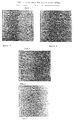
- the obtained film with a total thickness of 12 ⁇ m was of the balanced type and had structures on both surfaces, which consist of depressions around projections. Such structures are shown in Fig. 1.
- a polyethylene terephthalate raw material containing 500 ppm of crosslinked organic particles of the composition as in Example 1 and 0.4% by weight (based on the weight of the polymer) of sodium montanate was melted, formed into a film in a slot die and extruded onto a highly polished roller .
- the biaxially oriented film was heat set at 195 ° C.
- the film had depressions around the both surfaces Polymer particles. Such structures are shown in Fig. 3, for example. Their abrasion behavior, which was tested as described above, was very good.
- a completely pigment-free polyester raw material containing 1000 ppm of a crosslinked organic pigment was melted in separate extruders and, after passing through an adapter and a subsequent extrusion nozzle system, extruded onto a cooling roll.
- the film obtained was guided past an infrared radiator system at a speed of approximately 10 m / min, the pigmented layer facing the radiator system.
- the film was then gradually biaxially stretched and heat set at 195 ° C.
- the 14.5 ⁇ m thick biaxially oriented film had a 1 ⁇ m thick layer made of the pigmented raw material.
- the surface of this layer showed structures as already described in the examples above.
Landscapes
- Engineering & Computer Science (AREA)
- Chemical & Material Sciences (AREA)
- Mechanical Engineering (AREA)
- Manufacturing & Machinery (AREA)
- Health & Medical Sciences (AREA)
- Chemical Kinetics & Catalysis (AREA)
- Medicinal Chemistry (AREA)
- Polymers & Plastics (AREA)
- Organic Chemistry (AREA)
- Materials Engineering (AREA)
- Toxicology (AREA)
- Shaping By String And By Release Of Stress In Plastics And The Like (AREA)
- Manufacture Of Macromolecular Shaped Articles (AREA)
- Compositions Of Macromolecular Compounds (AREA)
- Laminated Bodies (AREA)
Applications Claiming Priority (2)
| Application Number | Priority Date | Filing Date | Title |
|---|---|---|---|
| DE19853501017 DE3501017A1 (de) | 1985-01-15 | 1985-01-15 | Orientierte kunststoffolie |
| DE3501017 | 1985-01-15 |
Publications (3)
| Publication Number | Publication Date |
|---|---|
| EP0188197A2 EP0188197A2 (de) | 1986-07-23 |
| EP0188197A3 EP0188197A3 (en) | 1988-12-28 |
| EP0188197B1 true EP0188197B1 (de) | 1996-04-17 |
Family
ID=6259803
Family Applications (1)
| Application Number | Title | Priority Date | Filing Date |
|---|---|---|---|
| EP86100071A Expired - Lifetime EP0188197B1 (de) | 1985-01-15 | 1986-01-04 | Orientierte Kunststoffolie |
Country Status (5)
| Country | Link |
|---|---|
| US (1) | US4746703A (enExample) |
| EP (1) | EP0188197B1 (enExample) |
| JP (1) | JP2606818B2 (enExample) |
| KR (1) | KR930007275B1 (enExample) |
| DE (2) | DE3501017A1 (enExample) |
Families Citing this family (28)
| Publication number | Priority date | Publication date | Assignee | Title |
|---|---|---|---|---|
| JPH0621171B2 (ja) * | 1986-03-31 | 1994-03-23 | ユニチカ株式会社 | 粗面化フイルム |
| JPS63178144A (ja) * | 1987-01-20 | 1988-07-22 | Teijin Ltd | 二軸配向ポリエステルフイルム |
| JPH0621172B2 (ja) * | 1987-05-11 | 1994-03-23 | 東レ株式会社 | 二軸配向ポリエステルフイルム |
| JPH0747649B2 (ja) * | 1987-11-10 | 1995-05-24 | 帝人株式会社 | 二軸配向ポリエステルフイルム |
| JP2650928B2 (ja) * | 1987-11-12 | 1997-09-10 | 帝人株式会社 | 二軸配向ポリエステルフイルム |
| JPH01232021A (ja) * | 1987-11-20 | 1989-09-18 | Toray Ind Inc | 二軸配向ポリエステルフイルム |
| JPH07119294B2 (ja) * | 1988-02-12 | 1995-12-20 | ダイアホイルヘキスト株式会社 | 磁気記録媒体用二軸延伸ポリエステルフィルム |
| JP2643309B2 (ja) * | 1988-05-31 | 1997-08-20 | 東レ株式会社 | ポリエステル組成物およびそれからなるフィルム |
| JP2643311B2 (ja) * | 1988-06-03 | 1997-08-20 | 東レ株式会社 | ポリエステル組成物およびそれからなるフィルム |
| JPH0231321A (ja) * | 1988-07-21 | 1990-02-01 | Diafoil Co Ltd | 磁気記録媒体用二軸配向ポリエステルフィルム |
| JPH0781021B2 (ja) * | 1988-06-29 | 1995-08-30 | 東レ株式会社 | 二軸配向ポリエステルフイルム |
| GB8820547D0 (en) * | 1988-08-31 | 1988-09-28 | Vickers Plc | Improvements in/relating to polymeric compounds |
| NL8803173A (nl) * | 1988-12-27 | 1990-07-16 | Gen Electric | Polymeermengsel dat een aromatisch polycarbonaat en een polyalkyleentereftalaat bevat en daaruit gevormde voorwerpen. |
| JP2639044B2 (ja) * | 1989-01-18 | 1997-08-06 | 東レ株式会社 | ポリエステル組成物、その製造方法およびそれからなるフィルム |
| JP2692272B2 (ja) * | 1989-06-21 | 1997-12-17 | 東レ株式会社 | ポリエステル組成物,その製造方法およびそれからなるフィルム |
| JPH0778133B2 (ja) * | 1989-12-14 | 1995-08-23 | ダイアホイルヘキスト株式会社 | 二軸配向ポリエステルフィルム |
| JPH0639538B2 (ja) * | 1989-12-14 | 1994-05-25 | ダイアホイルヘキスト株式会社 | 二軸配向ポリエステルフィルム |
| US5266376A (en) * | 1989-12-25 | 1993-11-30 | Toray Industries, Inc. | Magnetic recording medium |
| JP2682178B2 (ja) * | 1990-01-12 | 1997-11-26 | 東レ株式会社 | 二軸配向熱可塑性樹脂フィルムおよびその製造方法 |
| JPH0661919B2 (ja) * | 1990-02-23 | 1994-08-17 | ダイアホイルヘキスト株式会社 | 磁気記録媒体用ポリエステルフィルム |
| JPH089674B2 (ja) * | 1990-08-31 | 1996-01-31 | ダイアホイルヘキスト株式会社 | 二軸配向ポリエステルフィルム |
| JPH05320396A (ja) * | 1991-01-31 | 1993-12-03 | Unitika Ltd | 軽量化ポリエステルフイルムおよびその製造方法 |
| EP0543600B1 (en) * | 1991-11-18 | 1998-10-21 | Toray Industries, Inc. | Biaxially oriented thermoplastic resin film |
| DE9210223U1 (de) * | 1992-07-30 | 1993-07-01 | SLT Lining Technology GmbH, 2102 Hamburg | Beiderseits rauhe Folie aus Polymer-Werkstoff |
| DE59710735D1 (de) * | 1996-09-24 | 2003-10-16 | Mitsubishi Polyester Film Gmbh | Biaxial orientierte pet-folie mit verbesserten mechanischen und schrumpfeigenschaften zur verwendung für smd-fähige folienkondensatoren und verfahren zur herstellung dieser folie |
| JP2002254583A (ja) * | 2001-03-02 | 2002-09-11 | Mitsubishi Polyester Film Copp | 積層ポリエステルフィルム |
| KR100843397B1 (ko) * | 2002-10-03 | 2008-07-03 | 도레이 가부시끼가이샤 | 폴리에스테르 수지 조성물, 폴리에스테르 제조용 촉매,폴리에스테르 필름 및 자기기록매체 |
| JP2008130626A (ja) * | 2006-11-17 | 2008-06-05 | Nichicon Corp | 電子部品用被覆チューブおよび該被覆チューブを被覆したアルミニウム電解コンデンサ |
Citations (3)
| Publication number | Priority date | Publication date | Assignee | Title |
|---|---|---|---|---|
| DE3140851A1 (de) * | 1980-10-15 | 1982-05-13 | Teijin Ltd., Osaka | Polyesterfolie und verfahren zu deren herstellung |
| DE3313923A1 (de) * | 1983-04-16 | 1984-10-18 | Hoechst Ag, 6230 Frankfurt | Polyesterrohstoff, daraus hergestellte formkoerper, vorzugsweise eine folie, sowie verwendung der formkoerper |
| EP0188198A2 (de) * | 1985-01-15 | 1986-07-23 | Hoechst Aktiengesellschaft | Polyesterfolie |
Family Cites Families (24)
| Publication number | Priority date | Publication date | Assignee | Title |
|---|---|---|---|---|
| DE3033865A1 (de) * | 1979-09-10 | 1981-04-02 | Fuji Photo Film Co. Ltd., Minami-Ashigara, Kanagawa | Farbfotografische silberhalogenidmaterialien |
| US4104261A (en) * | 1974-01-17 | 1978-08-01 | Chemische Werke Huls, Ag | Low pilling polyester fibers and process for their manufacture |
| GB1541014A (en) * | 1975-02-18 | 1979-02-21 | Flecto Coatings Ltd | Stable aqueous polymer emulsions preparation and uses thereof |
| US4172859A (en) * | 1975-05-23 | 1979-10-30 | E. I. Du Pont De Nemours And Company | Tough thermoplastic polyester compositions |
| DE2614980C2 (de) * | 1976-04-07 | 1987-05-27 | Chemische Werke Hüls AG, 4370 Marl | Verfahren zur Herstellung von gesättigten, hochmolekularen Polyestern |
| DE2633358C2 (de) * | 1976-07-24 | 1986-10-30 | Hoechst Ag, 6230 Frankfurt | Verwendung von Polyäthylenterephthalat zur Herstellung gereckter Folien |
| US4125700A (en) * | 1977-03-22 | 1978-11-14 | E. I. Du Pont De Nemours And Company | Preparation of methyl methacrylate polymer powders for use in plastisols |
| JPS6035267B2 (ja) * | 1978-01-09 | 1985-08-13 | 東レ株式会社 | 表面の改質されたポリエステルフイルム |
| US4320207A (en) * | 1979-01-25 | 1982-03-16 | Diafoil Company Limited | Polyester film containing fine powder of crosslinked polymer |
| JPS55155029A (en) * | 1979-05-19 | 1980-12-03 | Diafoil Co Ltd | Polyester film |
| JPS55158937A (en) * | 1979-05-30 | 1980-12-10 | Diafoil Co Ltd | Polyester film |
| DE2927576A1 (de) * | 1979-07-07 | 1981-01-15 | Bayer Ag | Hochschlagzaehes polybutylenterephthalat |
| GB2064562B (en) * | 1979-12-06 | 1983-04-07 | Ici Ltd | Production of non-aqueous polymer microparticle dispersions |
| JPS56139551A (en) * | 1980-04-03 | 1981-10-31 | Teijin Ltd | Transparent, easily slipping polyethylene terephthalate film |
| JPS5720923A (en) * | 1980-07-15 | 1982-02-03 | Diafoil Co Ltd | Biaxially oriented polyester film for magnetic film |
| JPS5722021A (en) * | 1980-07-15 | 1982-02-04 | Diafoil Co Ltd | Biaxially-elongated polyester film useful as dielectric of capacitor |
| JPS5722235A (en) * | 1980-07-17 | 1982-02-05 | Diafoil Co Ltd | Polyester film |
| DE3039114A1 (de) * | 1980-10-16 | 1982-05-13 | Bayer Ag, 5090 Leverkusen | Thermoplastische polyester-formmassen mit verbesserter zaehigkeit |
| DE3039115A1 (de) * | 1980-10-16 | 1982-05-13 | Bayer Ag, 5090 Leverkusen | Thermoplastische polyester-formmassen mit verbesserter zaehigkeit |
| DE3117052A1 (de) * | 1981-04-29 | 1982-11-18 | Bayer Ag, 5090 Leverkusen | "alterungsbestaendige, verarbeitungsstabile mischungen hoher zaehigkeit auf basis thermoplastischer polyester" |
| JPS58124620A (ja) * | 1982-01-20 | 1983-07-25 | Teijin Ltd | 易滑性二軸延伸ポリエステルフイルムの製造法 |
| DE3368805D1 (en) * | 1982-03-10 | 1987-02-05 | Toray Industries | Laminated film and magnetic recording medium made therewith |
| JPS595216A (ja) * | 1982-06-30 | 1984-01-12 | Fujitsu Ltd | 光フアイバコネクタ |
| JPS59111848A (ja) * | 1982-12-17 | 1984-06-28 | 帝人株式会社 | 易滑性ポリエステルフイルム |
-
1985
- 1985-01-15 DE DE19853501017 patent/DE3501017A1/de not_active Withdrawn
-
1986
- 1986-01-04 EP EP86100071A patent/EP0188197B1/de not_active Expired - Lifetime
- 1986-01-04 DE DE3650512T patent/DE3650512D1/de not_active Expired - Fee Related
- 1986-01-08 US US06/817,214 patent/US4746703A/en not_active Expired - Lifetime
- 1986-01-14 KR KR1019860000171A patent/KR930007275B1/ko not_active Expired - Lifetime
- 1986-01-16 JP JP61005163A patent/JP2606818B2/ja not_active Expired - Lifetime
Patent Citations (3)
| Publication number | Priority date | Publication date | Assignee | Title |
|---|---|---|---|---|
| DE3140851A1 (de) * | 1980-10-15 | 1982-05-13 | Teijin Ltd., Osaka | Polyesterfolie und verfahren zu deren herstellung |
| DE3313923A1 (de) * | 1983-04-16 | 1984-10-18 | Hoechst Ag, 6230 Frankfurt | Polyesterrohstoff, daraus hergestellte formkoerper, vorzugsweise eine folie, sowie verwendung der formkoerper |
| EP0188198A2 (de) * | 1985-01-15 | 1986-07-23 | Hoechst Aktiengesellschaft | Polyesterfolie |
Also Published As
| Publication number | Publication date |
|---|---|
| KR930007275B1 (ko) | 1993-08-04 |
| EP0188197A3 (en) | 1988-12-28 |
| DE3650512D1 (de) | 1996-05-23 |
| JP2606818B2 (ja) | 1997-05-07 |
| EP0188197A2 (de) | 1986-07-23 |
| JPS61217229A (ja) | 1986-09-26 |
| DE3501017A1 (de) | 1986-07-17 |
| KR860005845A (ko) | 1986-08-13 |
| US4746703A (en) | 1988-05-24 |
Similar Documents
| Publication | Publication Date | Title |
|---|---|---|
| EP0188197A2 (de) | Orientierte Kunststoffolie | |
| EP0188198B1 (de) | Polyesterfolie | |
| DE69133289T2 (de) | Poröser Polyesterfilm und Laminat daraus | |
| DE3855033T2 (de) | Flüssigkristallpolymere enthaltende Filme | |
| EP0144948B2 (de) | Polyesterfolie mit vernetzter acrylischer Haftvermittlerbeschichtung | |
| DE2034407C3 (de) | Verfahren zur Herstellung von Polyesterfolien | |
| DE69927202T2 (de) | Polyesterfolie für Bildträger | |
| DE69124351T2 (de) | Polyesterfilm | |
| DE69621858T2 (de) | Folie mit verbessertem Haftvermögen und Verfahren zu ihrer Herstellung | |
| DE69025568T2 (de) | Biaxial orientierter Polyesterfilm | |
| DE69127188T2 (de) | Thermoplastische polyesterzusammensetzung und daraus hergestellter film | |
| EP0146066B1 (de) | Polyesterfolie mit vernetzter Haftvermittlerbeschichtung aus Vinylacetatpolymeren | |
| DD291049A5 (de) | Polyesterverbundfilme, gegebenenfalls mit magnetischer beschichtung | |
| DE69220423T2 (de) | Polyestermischung, Verfahren zu ihrer Herstellung und daraus geformter Film | |
| DE69213922T2 (de) | Film aus polyethylen-2,6-naphthalendicarboxylat | |
| DE69124793T2 (de) | Polyesterfolie für magnetische aufzeichnungsträger | |
| DE69233066T2 (de) | Magnetband, hergestellt aus einem biaxial ausgerichteten,in eine Richtung ausge-dehnten Polyethylen -2,6- naphthalat-film | |
| DE69721701T2 (de) | Verbundfilm | |
| DE2359060A1 (de) | Matte und kratzfeste folien und verfahren zu ihrer herstellung | |
| DE69331627T2 (de) | Polyester Folien für magnetische Aufzeichnungen | |
| DE69327489T2 (de) | Biaxial orientierte Folie | |
| DE60023298T2 (de) | Magnetaufzeichnungsfilm und basisfilm dafür | |
| DE69220932T2 (de) | Polyesterzusammensetzung und daraus hergestellter biaxial orientierter polyesterfilm | |
| DE69324303T2 (de) | Thermoplastische polyesterzusammensetzung und daraus hergestellter film | |
| DE69200110T2 (de) | Polyäthylentherephthalatfilm für magnetische Aufzeichnungsträger. |
Legal Events
| Date | Code | Title | Description |
|---|---|---|---|
| PUAI | Public reference made under article 153(3) epc to a published international application that has entered the european phase |
Free format text: ORIGINAL CODE: 0009012 |
|
| AK | Designated contracting states |
Kind code of ref document: A2 Designated state(s): DE FR GB IT LU NL |
|
| PUAL | Search report despatched |
Free format text: ORIGINAL CODE: 0009013 |
|
| AK | Designated contracting states |
Kind code of ref document: A3 Designated state(s): DE FR GB IT LU NL |
|
| 17P | Request for examination filed |
Effective date: 19890615 |
|
| 17Q | First examination report despatched |
Effective date: 19910205 |
|
| GRAA | (expected) grant |
Free format text: ORIGINAL CODE: 0009210 |
|
| AK | Designated contracting states |
Kind code of ref document: B1 Designated state(s): DE FR GB IT LU NL |
|
| REF | Corresponds to: |
Ref document number: 3650512 Country of ref document: DE Date of ref document: 19960523 |
|
| ET | Fr: translation filed | ||
| GBT | Gb: translation of ep patent filed (gb section 77(6)(a)/1977) |
Effective date: 19960509 |
|
| ITF | It: translation for a ep patent filed | ||
| GRAH | Despatch of communication of intention to grant a patent |
Free format text: ORIGINAL CODE: EPIDOS IGRA |
|
| PLBE | No opposition filed within time limit |
Free format text: ORIGINAL CODE: 0009261 |
|
| STAA | Information on the status of an ep patent application or granted ep patent |
Free format text: STATUS: NO OPPOSITION FILED WITHIN TIME LIMIT |
|
| 26N | No opposition filed | ||
| REG | Reference to a national code |
Ref country code: GB Ref legal event code: IF02 |
|
| PGFP | Annual fee paid to national office [announced via postgrant information from national office to epo] |
Ref country code: FR Payment date: 20020111 Year of fee payment: 17 |
|
| PGFP | Annual fee paid to national office [announced via postgrant information from national office to epo] |
Ref country code: NL Payment date: 20020117 Year of fee payment: 17 Ref country code: LU Payment date: 20020117 Year of fee payment: 17 |
|
| PGFP | Annual fee paid to national office [announced via postgrant information from national office to epo] |
Ref country code: GB Payment date: 20020118 Year of fee payment: 17 |
|
| PGFP | Annual fee paid to national office [announced via postgrant information from national office to epo] |
Ref country code: DE Payment date: 20020211 Year of fee payment: 17 |
|
| PG25 | Lapsed in a contracting state [announced via postgrant information from national office to epo] |
Ref country code: LU Free format text: LAPSE BECAUSE OF NON-PAYMENT OF DUE FEES Effective date: 20030104 Ref country code: GB Free format text: LAPSE BECAUSE OF NON-PAYMENT OF DUE FEES Effective date: 20030104 |
|
| PG25 | Lapsed in a contracting state [announced via postgrant information from national office to epo] |
Ref country code: NL Free format text: LAPSE BECAUSE OF NON-PAYMENT OF DUE FEES Effective date: 20030801 Ref country code: DE Free format text: LAPSE BECAUSE OF NON-PAYMENT OF DUE FEES Effective date: 20030801 |
|
| GBPC | Gb: european patent ceased through non-payment of renewal fee |
Effective date: 20030104 |
|
| PG25 | Lapsed in a contracting state [announced via postgrant information from national office to epo] |
Ref country code: FR Free format text: LAPSE BECAUSE OF NON-PAYMENT OF DUE FEES Effective date: 20030930 |
|
| NLV4 | Nl: lapsed or anulled due to non-payment of the annual fee |
Effective date: 20030801 |
|
| REG | Reference to a national code |
Ref country code: FR Ref legal event code: ST |
|
| PG25 | Lapsed in a contracting state [announced via postgrant information from national office to epo] |
Ref country code: IT Free format text: LAPSE BECAUSE OF NON-PAYMENT OF DUE FEES;WARNING: LAPSES OF ITALIAN PATENTS WITH EFFECTIVE DATE BEFORE 2007 MAY HAVE OCCURRED AT ANY TIME BEFORE 2007. THE CORRECT EFFECTIVE DATE MAY BE DIFFERENT FROM THE ONE RECORDED. Effective date: 20050104 |