EP0136658A2 - 1-Benzyl-aminoalkyl-pyrrolidinone und ihre Säureadditionssalze, Verfahren zu ihrer Herstellung und Arzneimittel - Google Patents
1-Benzyl-aminoalkyl-pyrrolidinone und ihre Säureadditionssalze, Verfahren zu ihrer Herstellung und Arzneimittel Download PDFInfo
- Publication number
- EP0136658A2 EP0136658A2 EP84111512A EP84111512A EP0136658A2 EP 0136658 A2 EP0136658 A2 EP 0136658A2 EP 84111512 A EP84111512 A EP 84111512A EP 84111512 A EP84111512 A EP 84111512A EP 0136658 A2 EP0136658 A2 EP 0136658A2
- Authority
- EP
- European Patent Office
- Prior art keywords
- pyrrolidin
- general formula
- benzyl
- oder
- addition salts
- Prior art date
- Legal status (The legal status is an assumption and is not a legal conclusion. Google has not performed a legal analysis and makes no representation as to the accuracy of the status listed.)
- Granted
Links
Classifications
-
- C—CHEMISTRY; METALLURGY
- C07—ORGANIC CHEMISTRY
- C07D—HETEROCYCLIC COMPOUNDS
- C07D207/00—Heterocyclic compounds containing five-membered rings not condensed with other rings, with one nitrogen atom as the only ring hetero atom
- C07D207/02—Heterocyclic compounds containing five-membered rings not condensed with other rings, with one nitrogen atom as the only ring hetero atom with only hydrogen or carbon atoms directly attached to the ring nitrogen atom
- C07D207/18—Heterocyclic compounds containing five-membered rings not condensed with other rings, with one nitrogen atom as the only ring hetero atom with only hydrogen or carbon atoms directly attached to the ring nitrogen atom having one double bond between ring members or between a ring member and a non-ring member
- C07D207/22—Heterocyclic compounds containing five-membered rings not condensed with other rings, with one nitrogen atom as the only ring hetero atom with only hydrogen or carbon atoms directly attached to the ring nitrogen atom having one double bond between ring members or between a ring member and a non-ring member with hetero atoms or with carbon atoms having three bonds to hetero atoms with at the most one bond to halogen, e.g. ester or nitrile radicals, directly attached to ring carbon atoms
- C07D207/24—Oxygen or sulfur atoms
- C07D207/26—2-Pyrrolidones
-
- A—HUMAN NECESSITIES
- A61—MEDICAL OR VETERINARY SCIENCE; HYGIENE
- A61P—SPECIFIC THERAPEUTIC ACTIVITY OF CHEMICAL COMPOUNDS OR MEDICINAL PREPARATIONS
- A61P25/00—Drugs for disorders of the nervous system
- A61P25/02—Drugs for disorders of the nervous system for peripheral neuropathies
-
- A—HUMAN NECESSITIES
- A61—MEDICAL OR VETERINARY SCIENCE; HYGIENE
- A61P—SPECIFIC THERAPEUTIC ACTIVITY OF CHEMICAL COMPOUNDS OR MEDICINAL PREPARATIONS
- A61P25/00—Drugs for disorders of the nervous system
- A61P25/04—Centrally acting analgesics, e.g. opioids
-
- A—HUMAN NECESSITIES
- A61—MEDICAL OR VETERINARY SCIENCE; HYGIENE
- A61P—SPECIFIC THERAPEUTIC ACTIVITY OF CHEMICAL COMPOUNDS OR MEDICINAL PREPARATIONS
- A61P25/00—Drugs for disorders of the nervous system
- A61P25/28—Drugs for disorders of the nervous system for treating neurodegenerative disorders of the central nervous system, e.g. nootropic agents, cognition enhancers, drugs for treating Alzheimer's disease or other forms of dementia
-
- C—CHEMISTRY; METALLURGY
- C07—ORGANIC CHEMISTRY
- C07D—HETEROCYCLIC COMPOUNDS
- C07D231/00—Heterocyclic compounds containing 1,2-diazole or hydrogenated 1,2-diazole rings
- C07D231/02—Heterocyclic compounds containing 1,2-diazole or hydrogenated 1,2-diazole rings not condensed with other rings
- C07D231/10—Heterocyclic compounds containing 1,2-diazole or hydrogenated 1,2-diazole rings not condensed with other rings having two or three double bonds between ring members or between ring members and non-ring members
- C07D231/12—Heterocyclic compounds containing 1,2-diazole or hydrogenated 1,2-diazole rings not condensed with other rings having two or three double bonds between ring members or between ring members and non-ring members with only hydrogen atoms, hydrocarbon or substituted hydrocarbon radicals, directly attached to ring carbon atoms
-
- C—CHEMISTRY; METALLURGY
- C07—ORGANIC CHEMISTRY
- C07D—HETEROCYCLIC COMPOUNDS
- C07D233/00—Heterocyclic compounds containing 1,3-diazole or hydrogenated 1,3-diazole rings, not condensed with other rings
- C07D233/54—Heterocyclic compounds containing 1,3-diazole or hydrogenated 1,3-diazole rings, not condensed with other rings having two double bonds between ring members or between ring members and non-ring members
- C07D233/56—Heterocyclic compounds containing 1,3-diazole or hydrogenated 1,3-diazole rings, not condensed with other rings having two double bonds between ring members or between ring members and non-ring members with only hydrogen atoms or radicals containing only hydrogen and carbon atoms, attached to ring carbon atoms
-
- C—CHEMISTRY; METALLURGY
- C07—ORGANIC CHEMISTRY
- C07D—HETEROCYCLIC COMPOUNDS
- C07D249/00—Heterocyclic compounds containing five-membered rings having three nitrogen atoms as the only ring hetero atoms
- C07D249/02—Heterocyclic compounds containing five-membered rings having three nitrogen atoms as the only ring hetero atoms not condensed with other rings
- C07D249/08—1,2,4-Triazoles; Hydrogenated 1,2,4-triazoles
-
- C—CHEMISTRY; METALLURGY
- C07—ORGANIC CHEMISTRY
- C07D—HETEROCYCLIC COMPOUNDS
- C07D401/00—Heterocyclic compounds containing two or more hetero rings, having nitrogen atoms as the only ring hetero atoms, at least one ring being a six-membered ring with only one nitrogen atom
- C07D401/02—Heterocyclic compounds containing two or more hetero rings, having nitrogen atoms as the only ring hetero atoms, at least one ring being a six-membered ring with only one nitrogen atom containing two hetero rings
- C07D401/06—Heterocyclic compounds containing two or more hetero rings, having nitrogen atoms as the only ring hetero atoms, at least one ring being a six-membered ring with only one nitrogen atom containing two hetero rings linked by a carbon chain containing only aliphatic carbon atoms
Definitions
- the invention relates to new 1-benzyl-aminoalkyl-pyrrolidinones and their acid addition salts, processes for their preparation and medicaments which contain these compounds as an active ingredient.
- the new compounds are able to counteract the short-term memory restriction after administration of muscarinic cholinergic antagonists and also have a pronounced antihypoxia activity.
- nootropics are l-carbamoylmethyl-pyrrolidin-2-one (piracetam), 1- (p-methoxybenzoyl) -pyrrolidin-2-one (aniracetam) and 1-carbamoylmethyl-4-hydroxy-pyrrolidin-2 -on (oxiracetam) already described in the literature, see BJR Nicolaus, Drug Development Res. 2, 464 (1982), PL Paytasch, J. Amer. Chem. Soc. 72, 1415 (1950).
- alkyl stands for a straight-chain or branched alkyl group with 1-4 carbon atoms and the term “alkoxy” for a residue with 1-2 carbon atoms; the pyrid ring mentioned as meaning for R 2 can be linked in the 2-, 3- or 4-position with the methylene bridge.
- the end products of the general formula I can be converted into their physiologically acceptable acid addition salts by customary methods.
- Suitable acids for this purpose are both inorganic acids such as hydrohalic acids, sulfuric acid, phosphoric acid and aminosulfonic acid, and also organic acids such as formic acid, acetic acid, propionic acid, lactic acid, glycolic acid, gluconic acid, maleic acid, fumaric acid, succinic acid, tartaric acid, benzoic acid, salicylic acid, citric acid, ascorbic acid, asic acid p-toluenesulfonic acid or oxyethanesulfonic acid.
- inorganic acids such as hydrohalic acids, sulfuric acid, phosphoric acid and aminosulfonic acid
- organic acids such as formic acid, acetic acid, propionic acid, lactic acid, glycolic acid, gluconic acid, maleic acid, fumaric acid, succinic acid, tartaric acid, benzoic acid, salicylic acid, citric acid, ascorbic acid, asic acid p-toluenesulfonic acid or oxy
- Preferred compounds of the general formula I are those in which R 1 is hydrogen, R 2 is a phenyl radical which is optionally substituted by fluorine, chlorine, methyl or methoxy in the o- or p-position and R 3 and R 4 are hydrogen or methyl.
- a compound of the general formula II is converted either to the corresponding 4-halomethyl compound using a thionyl or phosphorus halide or to the corresponding 4-tosyl or 4-mesyl ester using a tosyl or mesyl halide.
- the reaction preferably takes place using an inert organic solvent such as chloroform, methylene chloride, tetrahydrofuran or dimethylformamide at temperatures between room temperature and the boiling point of the solvent used.
- an inert organic solvent such as chloroform, methylene chloride, tetrahydrofuran or dimethylformamide at temperatures between room temperature and the boiling point of the solvent used.
- a tertiary organic base for example triethylamine or pyridine, is expediently added.
- the 4-halomethyl compounds or the 4-tosyl or 4-mesyl esters formed as intermediates can be isolated or further reacted in situ. When they are treated with primary or secondary amines, the corresponding end products of the general formula I are obtained.
- the reaction can be carried out in tetrahydrofuran, dioxane, acetonitrile or preferably in dimethylformamide; the temperatures are approximately between 50 and 150 ° C, the individual reaction conditions depending on the basicity and the boiling point of the amine; the reaction can also be carried out in excess of the amine without using a solvent. In the case of low-boiling amines, the reaction may have to take place in an autoclave.
- the end products of the general formula I having a free amino group are preferably synthesized by reacting a compound of the general formula III with phthalimide or an alkali salt of phthalimide and cleaving the 4-phthalimidomethyl compound thus obtained with hydrazine.
- the reaction with phthalimide takes place in an inert organic solvent such as acetonitrile or an alcohol or preferably in dimethylformamide at elevated temperature - up to the boiling point of the reaction mixture.
- the 4-phthalimidomethyl compound can be isolated or further reacted in situ; the phthalimide group can be split off with hydrazine.
- Alcohols, tetrahydrofuran, dioxane or dimethylformamide or mixtures of alcohols and dimethylformamide can be used as solvents for the cleavage.
- the reaction often takes place at room temperature; if necessary, a higher temperature is chosen to accelerate the reaction.
- an inert organic solvent for example an alcohol or an ether such as tetrahydrofuran or dioxane.
- the new compounds of general formula I have an asymmetry center and are therefore present as racemates. These racemates can be used in a conventional manner, e.g. by salt formation with optically active acids, are converted into the corresponding diastereomers, which can then be converted into the optically active end products.
- the alcohols of the general formula II can be converted into the corresponding diastereomer mixtures by ester formation with optically active acids, which can then be converted in a customary manner, e.g. separated by column chromatography or fractional crystallization into the corresponding diastereomers. After saponification of these esters, the enantiomeric alcohols are obtained, from which the corresponding amines are prepared by one of processes a) or b).
- the corresponding optically pure diethyl compounds can be obtained by reductive alkylation, for example with acetaldehyde / H 2 / catalyst, or the corresponding optically pure dimethyl compounds can be obtained with formaldehyde / formic acid.
- the starting materials for the processes described above are known or can be obtained by known processes.
- the pyrrolidinone carboxylic acid of the general formula VI is prepared by reacting equimolar amounts of itaconic acid and a corresponding amine.
- the starting compound II can be obtained from the acid via the ester by selective reduction with a complex alkali metal borohydride (cf. German patent application P 33 26724.3).
- 5-aminoalkyl compounds In the case of 5-aminoalkyl compounds, one can start from the commercially available 5-pyrrolidinocarboxylic acids, esterify them, alkylate them on nitrogen with optionally substituted benzyl halide and, as described above, react further.
- the new pyrrolidinone derivatives were investigated in animal experiments with regard to their effectiveness in eliminating or reducing states of restricted cerebral performance.
- the compounds did not show any acute toxicity (14 days follow-up) in orientative tolerance studies on the mouse in doses up to 2 g / kg (single oral application). They show excellent effects on spontaneous cognitive performance in animal experiments, such as experimentally restricted learning and memory processes.
- a muscarinic cholinergic antagonist SApolamine 0.6 mg / kg ip; see also Psychopharmacology 78, 104-111 (1982)
- the compounds in FIG Able to counteract or eliminate this pharmacologically induced cerebral insufficiency.
- the new compounds are clearly superior to the substances mentioned both in terms of the effective dose and the performance improvement achieved in animal experiments.
- the new compounds can be used alone or in combination with other active substances according to the invention, optionally also in combination with other pharmacologically active substances, e.g. other cerebroactivators are used.
- Suitable forms of use are, for example, tablets, capsules, suppositories, solutions, juices, emulsions or dispersible powders.
- Corresponding tablets can be obtained, for example, by mixing the active ingredient (s) with known auxiliaries, for example inert diluents, such as calcium carbonate, calcium phosphate or lactose, disintegrants, such as corn starch or alginic acid, binders, such as starch or gelatin, lubricants, such as magnesium stearate or talc, and / or agents to achieve the depot effect, such as carboxypolymethylene, carboxymethyl cellulose, cellulose acetate phthalate, or polyvinyl acetate.
- auxiliaries for example inert diluents, such as calcium carbonate, calcium phosphate or lactose, disintegrants, such as corn starch or alginic acid, binders, such as starch or gelatin, lubricants, such as magnesium stearate or talc, and / or agents to achieve the depot effect, such as carboxypolymethylene, carboxymethyl cellulose, cellulose acetate phthalate
- coated tablets can be produced by coating cores produced analogously to the tablets with agents conventionally used in tablet coatings, for example collidone or shellac, gum arabic, talc, titanium dioxide or sugar.
- the core can also consist of several layers to achieve a deposit effect or to avoid incompatibilities.
- the coated tablet shell can also consist of several layers in order to achieve a depot effect, it being possible to use the auxiliaries mentioned above for the tablets.
- Juices of the active substances or combinations of active substances according to the invention can additionally contain a sweetener such as saccharin, cyclamate, glycerol or sugar as well as a taste-improving agent, e.g. Flavorings, such as vanillin or orange extract, contain. They can also contain suspending aids or thickeners, such as sodium carboxymethyl cellulose, wetting agents, for example condensation products of fatty alcohols with ethylene oxide, or protective agents, such as p-hydroxybenzoates.
- a sweetener such as saccharin, cyclamate, glycerol or sugar
- a taste-improving agent e.g.
- Flavorings such as vanillin or orange extract
- suspending aids or thickeners such as sodium carboxymethyl cellulose, wetting agents, for example condensation products of fatty alcohols with ethylene oxide, or protective agents, such as p-hydroxybenzoates.
- Injection solutions are used in the usual way, e.g. with the addition of preservatives, such as p-hydroxybenzoates, or stabilizers, such as alkali metal salts of ethylenediaminetetraacetic acid, and filled into injection bottles or ampoules.
- preservatives such as p-hydroxybenzoates, or stabilizers, such as alkali metal salts of ethylenediaminetetraacetic acid, and filled into injection bottles or ampoules.
- the capsules containing one or more active ingredients or combinations of active ingredients can be produced, for example, by mixing the active ingredients with inert carriers, such as milk sugar or sorbitol, and encapsulating them in gelatin capsules.
- inert carriers such as milk sugar or sorbitol
- Suitable suppositories can be produced, for example, by mixing them with carrier agents such as neutral fats or polyethylene glycol or its derivatives.
- the title compound can also be obtained by dissolving 5 g (16 mmol) of mesyl ester (see Example 7) in 100 ml of dimethylformamide and, after adding 1.3 g of sodium azide, heating at 100 ° C. for 2 hours, which is obtained after appropriate work-up Oil in methanol hydrogenated with Raney nickel and the base converted to the fumarate as above. Yield: 4.2 g (90% of theory)
- the finely ground active ingredient, milk sugar and part of the corn starch are mixed together.
- the mixture is sieved, whereupon it is moistened with a solution of polyvinylpyrrolidone in water, kneaded, wet-granulated and dried.
- the granules, the rest of the corn starch and the magnesium stearate are sieved and mixed together.
- the mixture is compressed into tablets of suitable shape and size.
- the finely ground active ingredient, part of the corn starch, milk sugar, microcrystalline cellulose and polyvinylpyrrolidone are mixed together, the mixture is sieved and processed with the rest of the corn starch and water to form a granulate which is dried and sieved.
- the sodium carboxymethyl starch and the magnesium stearate are added, the mixture is mixed and pressed into tablets of a suitable size.
- the active ingredient and sodium chloride are dissolved in bidistilled water and the solution is filled sterile in ampoules.
- the active ingredient and the preservatives are dissolved in demineralized water and the solution is filtered and filled into bottles of 100 ml each.
Landscapes
- Chemical & Material Sciences (AREA)
- Organic Chemistry (AREA)
- Health & Medical Sciences (AREA)
- Engineering & Computer Science (AREA)
- Bioinformatics & Cheminformatics (AREA)
- Biomedical Technology (AREA)
- Neurology (AREA)
- Neurosurgery (AREA)
- Nuclear Medicine, Radiotherapy & Molecular Imaging (AREA)
- Public Health (AREA)
- General Chemical & Material Sciences (AREA)
- Medicinal Chemistry (AREA)
- Veterinary Medicine (AREA)
- Chemical Kinetics & Catalysis (AREA)
- Pharmacology & Pharmacy (AREA)
- Life Sciences & Earth Sciences (AREA)
- Animal Behavior & Ethology (AREA)
- General Health & Medical Sciences (AREA)
- Hospice & Palliative Care (AREA)
- Psychiatry (AREA)
- Pain & Pain Management (AREA)
- Pharmaceuticals Containing Other Organic And Inorganic Compounds (AREA)
- Plural Heterocyclic Compounds (AREA)
- Pyrrole Compounds (AREA)
Abstract
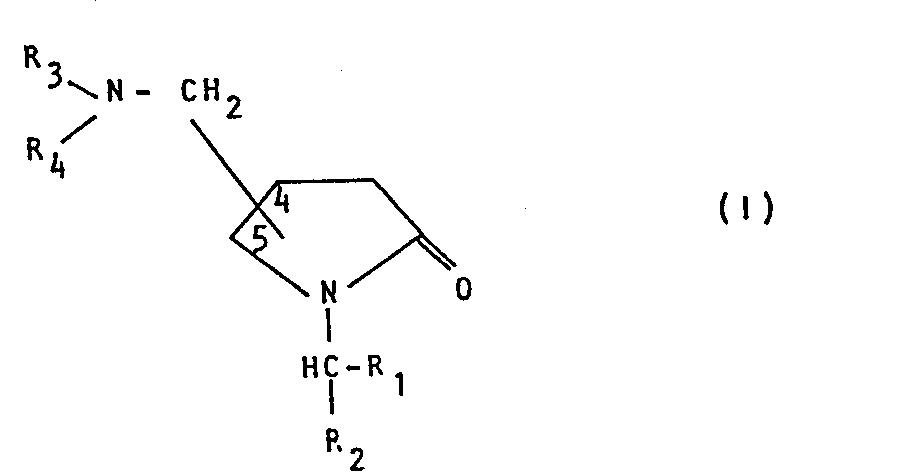
- R, Wasserstoff oder einen Alkylrest,
- R2 einen Phenylrest, der ein- oder zweifach durch Alkoxy, Fluor, Chlor, Brom, Trifluormethyl, Alkyl, Hydroxy oder nitro substituiert sein kann oder einen Pyridylrest und
- R3 und R4, die gleich oder verschieden sein können, Wasserstoff oder einen Alkylrest bedeuten oder beide Reste
- R3 and R4 zusammen mit dem Stickstoffatom einen gesättigten 5- oder 6-Ring, der als weiteres Heteroatom ein 0- oder N-Atom enthalten und gegebenenfalls durch Methyl substituiert sein kann oder einen Imidazolring bilden und wobei die Aminoalkylgruppe in 4- oder 5-Stellung steht und deren Säureadditionssalze.
Description
- Die Erfindung betrifft neue 1-Benzyl-aminoalkyl-pyrrolidinone und deren Säureadditionssalze, Verfahren zu ihrer Herstellung und Arzneimittel, die diese Verbindungen als Wirkstoff enthalten.
- Die neuen Verbindungen vermögen der Einschränkung des Kurzzeitgedächtnisses nach Gabe von muscarinen cholinergen Antagonisten entgegenzuwirken und besitzen darüber hinaus eine ausgeprägte Antihypoxie-Aktivität.
- Als strukturell ähnlich gebaute Nootropica sind das l-Carbamoylmethyl-pyrrolidin-2-on (Piracetam), das 1-(p-Methoxybenzoyl)-pyrrolidin-2-on (Aniracetam) und das 1-Carbamoylmethyl-4-hydroxy-pyrrolidin-2-on (Oxiracetam) bereits in der Literatur beschrieben, siehe B. J. R. Nicolaus, Drug Development Res. 2, 464 (1982), P. L. Paytasch, J. Amer. Chem. Soc. 72, 1415 (1950).
- Es wurde nun gefunden, daß die Einführung einer Aminomethylgruppe in das Pyrrolidinonmolekül eine gegenüber den bekannten Stoffen wesentliche Verbesserung der Wirkung mit sich bringt.
- Gegenstand der Erfindung sind neue 1-Benzyl-aminoalkyl-pyrrolidinone der allgemeinen Formel

- R1 Wasserstoff oder einen Alkylrest,
- R2 einen Phenylrest, der ein- oder zweifach durch Alkoxy, Fluor, Chlor, Brom, Trifluormethyl, Alkyl, Hydroxy oder Nitro substituiert sein kann oder einen Pyridylrest und
- R3 und R4, die gleich oder verschieden sein können, Wasserstoff oder einen Alkylrest bedeuten oder beide Reste R3 und R4 zusammen mit dem Stickstoffatom einen gesättigten 5- oder 6-Ring, der als weiteres Heteroatom ein 0- oder N-Atom enthalten und gegebenenfalls durch Methyl substituiert sein kann oder einen Imidazolring bilden, und wobei die Aminoalkylgruppe in 4- oder 5-Stellung steht und deren Säureadditionssalze.
- In der allgemeinen Formel I steht die Bezeichnung "Alkyl" für eine geradkettige oder verzweigte Alkylgruppe mit 1 - 4 Kohlenstoffatomen und die Bezeichnung "Alkoxy" für einen Rest mit 1 - 2 Kohlenstoffatomen; der als Bedeutung für R2 genannte Pyridplring kann in 2-, 3- oder 4-Stellung mit der Methylenbrücke verknüpft sein.
- Die Endprodukte der allgemeinen Formel I können gewünschtenfalls nach üblichen Methoden in ihre physiologisch unbedenklichen Säureadditionssalze überführt werden.
- Als Säuren eignen sich hierfür sowohl anorganische Säuren wie Halogenwasserstoffsäuren, Schwefelsäure, Phosphorsäure und Aminosulfonsäure, als auch organische Säuren wie Ameisensäure, Essigsäure, Propionsäure, Milchsäure, Glykolsäure, Glukonsäure, Maleinsäure, Fumarsäure, Bernsteinsäure, Weinsäure, Benzoesäure, Salicylsäure, Zitronensäure, Ascorbinsäure, p-Toluolsulfonsäure oder Oxyäthansulfonsäure.
- Bevorzugte Verbindungen der allgemeinen Formel I sind solche, bei denen R1 Wasserstoff, R2 einen gegebenenfalls durch Fluor, Chlor, Methyl oder Methoxy in o- oder p-Stellung substituierten Phenylrest und R3 und R4 Wasserstoff oder Methyl bedeuten.
- Gegenstand der Erfindung sind ferner Verfahren zur Herstellung der Verbindungen Yerb:.ndungen der allgemeinen Formel I. Verbindungen, in denen die Reste R3 und/oder R4 von Wasserstoff verschieden sind, erhält man beispielsweise ausgehend von Hydroxymethyl-Pyrrolidinonen der allgemeinen Formel

- R1 und R2 die oben angegebene Bedeutung haben, durch Umsetzung mit einem Thionyl- oder einem Phosphor-Halogenid oder einem Tosyl- oder Mesylhalogenid zu einer Verbindung der allgemeinen Formel III

- R1 und R2 die oben angegebene Bedeutung haben und X ein Halogenatom oder den Tosyloxy- beziehungsweise Mesyloxyrest bedeutet und anschließender Reaktion mit einem primären oder sekundären Amin der allgemeinen Formel

- R3 und R4 die oben angegebene Bedeutung haben.
- Hierbei wird eine Verbindung der allgemeinen Formel II entweder mit einem Thionyl- oder Phosphor-Halogenid in die entsprechende 4-Halogenmethylverbindung beziehungsweise mit einem Tosyl- oder Mesyl-Halogenid in den entsprechenden 4-Tosyl- beziehungsweise 4-Mesyl-ester überführt. Die Reaktion findet vorzugsweise unter Verwendung eines inerten organischen Lösungsmittels, wie zum Beispiel Chloroform, Methylenchlorid, Tetrahydrofuran oder Dimethylformamid bei Temperaturen zwischen Raumtemperatur und dem Siedepunkt des verwendeten Lösungsmittels statt. Im Falle der Veresterung wird zweckmäßigerweise eine tertiäre organische Base, zum Beispiel Triäthylamin oder Pyridin, zugesetzt. Die als Zwischenprodukte entstehenden 4-Halogenmethylverbindungen beziehungsweise die 4-Tosyl- oder 4-Mesyl-ester können isoliert oder aber in situ weiter umgesetzt werden. Man erhält bei ihrer Behandlung mit primären oder sekundären Aminen die entsprechenden Endprodukte der allgemeinen Formel I. Die Reaktion kann in Tetrahydrofuran, Dioxan, Acetonitril oder vorzugsweise in Dimethylformamid durchgeführt werden; die Temperaturen liegen etwa zwischen 50 und 150°C, wobei die einzelnen Reaktionsbedingungen von der Basizität und dem Siedepunkt des Amins abhängen; die Umsetzung kann auch ohne Verwendung eines Lösungsmittels in einem Überschuß des Amins durchgeführt werden. Bei niedrig siedenden Aminen muß die Reaktion unter Umständen im Autoklaven erfolgen.
- Die Synthese von Endprodukten der allgemeinen Formel I mit freier Aminogruppe erfolgt vorzugsweise durch Umsetzung einer Verbindung der allgemeinen Formel III mit Phthalimfd beziehungsweise einem Alkalisalz des Phthalimids und Spaltung der so erhaltenen 4-Phthalimidomethylverbindung mit Hydrazin.
- Die Umsetzung mit Phthalimid findet in einem inerten organischen Lösungsmittel wie Acetonitril oder einem Alkohol oder bevorzugt in Dimethylformamid bei erhöhter Temperatur - bis zum Siedepunkt des Reaktionsgemisches - statt. Die 4-Phthalimidomethylverbindung kann isoliert oder in situ weiter umgesetzt werden; die Abspaltung der Phthalimidgruppe kann mit Hydrazin erfolgen.
- Bei der Abspaltung können Alkohole, Tetrahydrofuran, Dioxan oder Dimethylformamid oder Mischungen aus Alkoholen und Dimethylformamid als Lösungsmittel dienen. Oft läuft die Reaktion bereits bei Raumtemperatur ab; gegebenenfalls wird eine höhere Temperatur gewählt, um die Reaktion zu beschleunigen.
- Eine weitere Herstellungsmöglichkeit für die Norverbindung besteht in der Hydrierung einer Verbindung der allgemeinen Formel V

- R1 und R2 die oben angegebene Bedeutung haben und Y einen der Reste -CH2N3 oder. -CN bedeutet.
- Die Hydrierung erfolgt vorzugsweise mittels Raney-Nickel in Methanol oder auch mit Palladium in Methanol/Wasser, im Fall der Hydrierung des Nitrils gegebenenfalls unter Ammoniakzugabe.
- Ein Azid der allgemeinen Formel V (Y = -CH2N3) erhält man durch Umsetzung einer Verbindung der allgemeinen Formel III, worin X ein Halogenatom oder die Tosylbeziehungsweise Mesylgruppe bedeutet, mit Natriumazid in einem inerten organischen Lösungsmittel, beispielsweise einem Alkohol oder einem Äther wie Tetrahydrofuran oder Dioxan.
- Ein Nitril der allgemeinen Formel V (Y = -CN) wird zum Beispiel durch Umsetzung einer in Acetonitril gelösten Säure der allgemeinen Formel

- Rl und R2 die oben genannte Bedeutung haben mit Chlorsulfonylisocyanat und anschließend mit Triäthylamin oder durch Dehydratisierung des entsprechenden Carbonsäureamids mit z.B. POCl3 hergestellt (vgl. H. Vorbrüggen, Tetrahedron Leiters 1968, S. 1631 - 1634).
- Die neuen Verbindungen der allgemeinen Formel I besitzen ein Asymmetriezentrum und liegen daher als Racemate vor. Diese Racemate können in üblicher Weise, z.B. durch Salzbildung mit optisch aktiven Säuren, in die entsprechenden Diastereomeren überführt werden, die dann in die optisch aktiven Endprodukte umgewandelt werden können.
- Gegebenenfalls können die Alkohole der allgemeinen Formel II durch Esterbildung mit optisch aktiven Säuren in die entsprechenden Diastereomerengemische überführt werden, die sich dann auf übliche Weise, z.B. durch Säulenchromatographie oder fraktionierte Kristallisation, in die entsprechenden Diastereomeren auftrennen lassen. Nach Verseifung dieser Ester erhält man die enantiomeren Alkohole, aus denen nach einem der Verfahren a) oder b) die entsprechenden Amine hergestellt werden.
- Ausgehend von den reinen enantiomeren Nor-Verbindungen können durch reduktive Alkylierung, z.B. mit Acet- aldehyd/H2/Katalysator die entsprechenden optisch reinen Diäthylverbindungen oder mit Formaldehyd/Ameisensäure die entsprechenden optisch reinen Dimethylverbindungen erhalten werden.
- Die Ausgangsstoffe für die vorstehend geschilderten Verfahren sind bekannt oder können nach bekannten Verfahren erhalten werden. So wird die Pyrrolidinoncarbonsäure der allgemeinen Formel VI durch Umsetzung äquimolarer Mengen Itaconsäure und eines entsprechenden Amins hergestellt. Aus der Säure kann über den Ester durch selektive Reduktion mit einem komplexen Alkaliborhydrid die Ausgangsverbindung II erhalten werden (vgl. Deutsche Patentanmeldung P 33 26724.3).
- Im Falle der 5-Aminoalkylverbindungen kann man von den käuflichen 5-Pyrrolidinocarbonsäuren ausgehen, diese verestern, am Stickstoff mit gegebenenfalls substituiertem Benzylhalogenid alkylieren und, wie oben beschrieben, weiter umsetzen.
- Nach den geschilderten Verfahren können beispielsweise die folgenden Endprodukte, gegebenenfalls in Form ihrer Säureadditionssalze und gegebenenfalls in Form ihrer reinen Enantiomeren, erhalten werden:
- 1-Benzyl-4-aminomethyl-pyrrolidin-2-on
- 1-(4-Methoxybenzyl)-4-aminomethyl-pyrrolidin-2-on
- 1-(3,4-Dimethoxybenzyl)-4-aminomethyl-pyrrolidin-2-on
- 1-(4-Methylbenzyl)-4-aminomethyl-pyrrolidin-2-on
- 1-(4-Fluorbenzyl)-4-aminomethyl-pyrrolidin-2-on
- 1-(4-Chlorbenzyl)-4-aminomethyl-pyrrolidin-2-on
- 1-(3-Trifluormethylbenzyl)-4-aminomethyl-pyrrolidin-2-on
- l-(4-Pyridylmethyl)-4-aminomethyl-pyrrolidin-2-on
- 1-(α-Methylbenzyl)-4-aminomethyl-pyrrolidin-2-on
- l-Benzyl-4-piperidinomethyl-pyrrolidin-2-on
- 1-(4-Fluorbenzyl)-4-morpholino-pyrrolidin-2-on
- 1-Benzyl-4-(N-methylpiperazino)-pyrrolidin-2-on
- 1-Benzyl-4-imiciazol-1-yl-pyrrolidin-2-on
- 1-Benzyl-4-methylaminomethyl-pyrrolidin-2-on
- 1-(p-Fluorbenzyl)-4-dimethylaminomethyl-pyrrolidin-2-on
- 1-Benzyl-4-diäthylaminomethyl-pyrrolidin-2-on
- 1-(4-Nitrobenzyl)-4-aminomethyl-pyrrolidin-2-on
- 1-(4-Hydroxybenzyl)-4-aminomethyl-pyrrolidin-2-on
- 1-(o-Chlorbenzyl)-4-aminomethyl-pyrrolidin-2-on
- 1-(o-Chlorbenzyl)-4-diäthylaminomethyl-pyrrolidin-2-on
- 1-Benzyl-4-isopropylaminomethyl-pyrrolidin-2-on
- 1-(p-Methylbenzyl)-4-diäthylaminomethyl-pyrrolidin-2-on
- 1-Benzyl-5-dimethylaminomethyl-pyrrolidin-2-on
- 1-Benzyl-5-diäthylaminomethyl-pyrrolidin-2-on
- l-Benzyl-5-morpholinomethyl-pyrrolidin-2-on
- 1-Benzyl-5-(4-methylpiperazino)-methyl-pyrrolidin-2-on
- 1-Benzyl-5-pyrrolidinomethyl-pyrrolidin-2-on
- 1-(4-Methylbenzyl)-5-dimethylaminomethyl-pyrrolidin-2-on
- 1-(4-Methylbenzyl)-5-diäthylaminomethyl-pyrrolidin-2-on
- 1-(p-Chlorbenzyl)-5-dimethylaminomethyl-pyrrolidin-2-on
- 1-(p-Chlorbenzyl)-5-diäthylaminomethyl-pyrrolidin-2-on
- 1-(3,4-Dichlorbenzyl)-5-dimethylaminomethyl-pyrrolidin-2-on
- 1-(3,4-Dichlorbenzyl)-5-diäthylaminomethyl-pyrrolidin-2-on
- 1-(p-Methoxybenzyl)-5-dimethylaminomethyl-pyrrolidin-2-on
- 1-(p-Methoxybenzyl)-5-diäthylaminomethyl-pyrrolidin-2-on
- l-Benzyl-5-aminomethyl-pyrrolidin-2-on
- Die neuen Pyrrolidinon-Derivate wurden in Tierexperimenten bezüglich ihrer Wirksamkeit untersucht, Zustandsformen eingeschränkter cerebraler Leistungsfähigkeit aufzuheben beziehungsweise zu mindern.
- Die Verbindungen weisen in orientierenden Verträglichkeitsuntersuchungen an der Maus in Dosierungen bis zu 2 g/kg (einmalige orale Applikation) keine akute Toxizität (14 Tage Nachbeobachtung) auf. Sie zeigen tierexperimentell ausgezeichnete Wirkungen auf spontane kognitive Leistungen, wie experimentell eingeschränkte Lern- und Gedächtnisvorgänge. In Versuchen mit Einschränkung des Kurzzeitgedächtnisses beziehungsweise Behinderung des Übergangs von Inhalten des Kurzzeitin das Langzeitgedächtnis durch Gabe eines muscarinen cholinergen Antagonisten (Scopolamin 0,6 mg/kg i.p.; siehe auch Psychopharmacology 78, 104 - 111 (1982)), sind die Verbindungen in der Lage, dieser pharmakologisch induzierten cerebralen Insuffizienz entgegenzuwirken, beziehungsweise sie aufzuheben.
- Die Lernfähigkeit von Ratten in einer aktiven Vermeidedressur (J. pharmacol. Methods, 8, 255 - 263 (1983)) wird ebenso verbessert wie ihre spontane Habituation beziehungsweise explorierende Orientierungsaktivität in einer neuen Umgebung.
- Bei der Prüfung der Überlebensfähigkeit von Tieren in einer geschlossenen Kammer (Hypoxie-Toleranztest), welche mit einem Gasgemisch bestehend aus 96,5 % N2 und 3,5 % 02 durchströmt wurde, wiesen die mit den neuen Substanzen vorbehandelten Tiere eine statistisch hochsignifikant größere Überlebensfähigkeit auf als Kontrolltiere beziehungsweise mit Piracetam vorbehandelte Tiere. Darüber hinaus war die mit dieser Methode geprüfte hirnprotektive Wirkung der Substanzen bereits in einer Dosis von 50 mg/kg p.o. ausgeprägt.
- Die neuen Pyrrolidinon-Derivate-wurden in ihrer Wirksamkeit mit andersstrukturierten Pyrrolidinonen verglichen, welche im Rahmen der cerebralen Insuffizienz beziehungsweise des hirnorganischen Psychodroms, der posttraumatischen und alkoholischen Hirnschädigung usw., in der Humanmedizin bereits als Arzneimittel Anwendung finden (Piracetam) beziehungsweise zur Zeit klinisch erprobt werden (Aninacetam).
- Die neuen Verbindungen sind sowohl bezüglich der wirksamen Dosis als auch der im Tierexperiment erzielten Leistungsverbesserung den genannten Substanzen deutlich überlegen.
- Die neuen Verbindungen können allein oder in Kombination mit anderen erfindungsgemäßen Wirkstoffen, gegebenenfalls auch in Kombination mit weiteren pharmakologisch aktiven Wirkstoffen, z.3. weiteren Cerebroaktivatoren zur Anwendung gelangen. Geeignete Anwendungsformen sind beispielsweise Tabletten, Kapseln, Zäpfchen, Lösungen, Säfte, Emulsionen oder dispersible Pulver. Entsprechende Tabletten können beispielsweise durch Mischen des oder der Wirkstoffe mit bekannten Hilfsstoffen, beispielsweise inerten Verdünnungsmitteln, wie Calciumcarbonat, Calciumphosphat oder Milchzucker, Sprengmitteln, wie Maisstärke oder Alginsäure, Bindemitteln, wie Stärke oder Gelatine, Schmiermitteln, wie Magnesiumstearat oder Talk, und/oder Mitteln zur Erzielung des Depoteffektes, wie Carboxypolymethylen, Carboxymethylcellulose, Celluloseacetatphthalat, oder Polyvinylacetat erhalten werden. Die Tabletten können auch aus mehreren Schichten bestehen.
- Entsprechend können Dragees durch Überziehen von analog den Tabletten hergestellten Kernen mit üblicherweise in Drageeüberzügen verwendeten Mitteln, beispielsweise Kollidon oder Schellack, Gummi arabicum, Talk, Titandioxid oder Zucker, hergestellt werden. Zur Erzielung eines Depoteffektes oder zur Vermeidung von Inkompatibilitäten kann der Kern auch aus mehreren Schichten bestehen. Desgleichen kann auch die Drageehülle zur Erzielung eines Depoteffektes aus mehreren Schichten bestehen, wobei die oben bei den Tabletten erwähnten Hilfsstoffe verwendet werden können.
- Säfte der erfindungsgemäßen Wirkstoffe beziehungsweise Wirkstoffkombinationen können zusätzlich noch ein Süßungsmittel, wie Saccharin, Cyclamat, Glycerin oder Zucker sowie ein geschmacksverbesserndes Mittel, z.B. Aromastoffe, wie Vanillin oder Orangenextrakt, enthalten. Sie können außerdem Suspendierhilfsstoffe oder Dickungsmittel, wie Natriumcarboxymethylcellulose, Netzmittel, beispielsweise Kondensationsprodukte von Fettalkoholen mit Äthylenoxid, oder Schutzstoffe, wie p-Hydroxybenzoate, enthalten.
- Injektionslösurgen werden in üblicher Weise, z.B. unter Zusatz von Konservierungsmitteln, wie p-Hydroxybenzoaten, oder Stabilisatoren, wie Alkalisalzen der Äthylendiamintetraessigsäure hergestellt und in Injektionsflaschen oder Ampullen abgefüllt.
- Die eine oder mehrere Wirkstoffe beziehungsweise Wirkstoffkombinationen enthaltenden Kapseln können beispielsweise hergestellt werden, indem man die Wirkstoffe mit inerten Trägern, wie Milchzucker oder Sorbit, mischt und in Gelatinekapseln einkapselt.
- Geeignete Zäpfchen lassen sich beispielsweise durch Vermischen mit dafür vorgesehenen Trägermitteln, wie Neutralfetten oder Polyäthylenglykol beziehungsweise dessen Derivaten, herstellen.
- Die nachfolgenden Beispiele illustrieren die vorliegende Erfindung, ohne sie jedoch in ihrem Umfang zu' beschränken:
- 54 g (0,16 Mol) 4-Phthalimidomathyl-1-benzyl- pyrrolidin-2-on werden in 1,3 1 Äthylalkohol nach Zusatz von 32 g Hydrazinhydrat 4 Stunden bei Raumtemperatur gerührt. Der Niederschlag(Phthalsäure- hydrazid) wird abgesaugt und das Filtrat eingedampft. Man setzt 500 ml Methylenchlorid zu dem Rückstand und schüttelt dreimal mit 100 ml Wasser aus. Die organische Phase wird getrocknet und eingedampft. Den verbleibenden Rückstand löst man in 500 ml Methanol und fügt bei Siedehitze unter Rühren 20 g (0,17 Mol) feste Fumarsäure portionsweise hinzu. Beim Abkühlen scheiden sich farblose Kristalle ab, die man absaugt und mit Methanol und Äther nachwäscht. Ausbeute: 20 - 25 g (48 - 60 % d.Th.) vom Fp. 209 - 211°C. Die Verbindung enthält 1/2 Mol Fumarsäure.
- Das Ausgangsmaterial wird wie folgt erhalten:
- a) 94 g (0,46 Mol) 1-Benzyl-4-hydroxymethyl-pyrrolidin-2-on werden mit 700 m1 Methylenchlorid und 40 ml (0,54 Mol) Thionylchlorid 25 Stunden unter Rückflußkochen gerührt und das Reaktionsgemisch anschließend unter Kühlung mit verdünntem Ammoniak neutralisiert. Nach Abtrennen, Trocknen und Eindampfen hinterbleiben 85 - 90 g eines dunkeln Öls, welches direkt zur weiteren Umsetzung verwendet wird.
- b) 43,5 g (0,195 Mol) rohes 1-Benzyl-4-chlormethyl- pyrrolidin-2-on, 36 g (0,195 Mol) Phthalimidkalium und 700 ml Dimethylformamid werden 2 Stunden unter Rückfluß gekocht. Das Reaktionsgemisch wird anschließend im Vakuum eingedampft und der Rückstand in Methylenchlorid aufgenommen. Man schüttelt mehrmals mit Wasser aus, trocknet die organische Phase und erhält nach Chromatographie über Si02 45 g (70 % d.Th.) der Phthalimidoverbindung vom Fp. 108 - 109°C.
-
- a) 58 g (0,29 Mol) l-Benzyl-4-nitrilo-pyrrolidin-2-on werden in Methanol gelöst und unter Zusatz von flüssigem Ammoniak über Raney-Nickel katalytisch hydriert. Nach dem Einengen der Reaktionslösung wird in Methanol gelöst, von Katalysatorresten abfiltriert und nach dem Erwärmen auf ca. 50°C mit 17 g Fumarsäure versetzt. Unter Rühren geht die Fumarsäure kurzzeitig in Lösung, danach beginnt die Kristallisation des 1-Benzyl-4-aminomethyl-pyrrelidin-2-on- fumarats.
Ausbeute: 68 g (= 91 % d.Th.); Fp. 192 - 194°C. - b) Die Nitriloverbindung wird in 96 % Ausbeute aus dem entsprechenden Amid vom Fp. 162 - 166°C durch Dehydratisierung mittels POCl3 in Dimethylformamid bei ca. 60°C als Öl erhalten.
-
- a) 24,0 g (0,117 Mol) 1-Benzyl-4-aminomethyl-pyrrolidin-2-on werden in 200 ml heißem Methanol gelöst, 17,6 g (0,117 Mol) L(+)-Weinsäure werden ebenfalls in 200.ml heißem Methanol gelöst. Die beiden Lösungen werden. zusammengegeben und unter Rühren auf Raumtemperatur abkühlen lassen, wobei das Salz auskristallisiert. Die Kristalle werden kalt abgesaugt, mit kaltem Methanol nachgewaschen und getrocknet. Ausbeute: 18,0 g 4-Aminomethyl-l-benzyl-pyrrolidin-2-on-tartrat, Fp. 204 - 206°C (aus Methanol), aD = +6,3° (c = 1,0; Wasser).
- b) Zur Umwandlung des Tartrats in die Base wird das Tartrat kalt in 20 ml Wasser und 10 ml konzentrierter Natronlauge gelöst, dreimal mit Methylenchlorid extrahiert, die vereinigten Methylenchloridphasen über MgS04 getrocknet und das Lösungsmittel i.V. abgezogen. Man erhält das (-)-4-Aminomethyl-l-benzyl-pyrrolidin-2-on, aD = -8,4° (c = 1,0; Wasser).
- c) Die bei der unter a) angegebenen Aufarbeitung anfallenden Mutterlaugen werden i.V. eingeengt. Man erhält 38,0 g des Tartrats, das kalt in 140 ml Wasser und 50 ml konzentrierter Natronlauge aufgenommen und dreimal mit Methylenchlorid ausgeschüttelt wird. Die vereinigten Methylenchloridphasen werden über MgS04 getrocknet und das Lösungsmittel i.V. abgezogen. Man erhält: 19,3 g Base, die, wie unter a) beschrieben, mit D-(-)-Weinsäure in das entsprechende Tartrat überführt wird. Ausbeute: 19,0 g vom Fp. 204 - 205°C.
- d) Die Umwandlung des Tartrats in die Base erfolgt wie unter b) beschrieben. Man erhält 5,7 g (+)-4-Aminomethyl-l-benzyl- pyrrolidin-2-on mit einem Drehwert αD = +8,40 (c = 1,0; Wasser).
- 4,0 g (0,02 Mol) (-)-l-Benzyl-4-aminomethyl-pyrrolidin-2-on und 5,4 g 85%ige Ameisensäure werden mit 4,8 ml Formalinlösung versetzt und über Nacht bei 100°C (Ölbad) gerührt. Danach wird die überschüssige Säure i.V. abdestilliert, der Rückstand in Wasser aufgenommen, mit konzentrierter Natronlauge alkalisch gestellt und dreimal mit Methylenchlorid ausgeschüttelt. Die vereinigten Methylenchloridphasen werden mit Wasser gewaschen, über Natriumsulfat getrocknet, das Lösungsmittel i.V. eingeengt und der Rückstand über eine SiO2-Säule filtriert (Fließmittel: Methylenchlorid: Methanol = 97:3). Die einheitliche Fraktion wird i.V. eingeengt.
- Man erhält die Titelverbindung in einer Ausbeute von 3,5 g (als Öl). aD = -7,6° (c = 1,0; Methanol) aD = -16,8° (c = 1,0; Wasser).
- Analog Beispiel 4 erhält man aus 5,8 g (0,028 Mol) (+)-1-Benzyl-4-aminomethyl-pyrrolidin-2-on, 7,9 g 85%iger Ameisensäure und 7 ml Formalinlösung 6,1 g (+)-1-Benzyl-4-dimethylaminomethyl-pyrrolidin-2-on, αD = +7,90 (c = 1,0; Methanol).
- 14 g (0,06 Mol) rohes l-Benzyl-4-chlormethyl- pyrrolidin-2-on, hergestellt nach Beispiel la), 10 g Diäthylamin und 50 ml Dimethylformamid werden 2 Stunden bei 150°C im Autoklaven gerührt oder geschüttelt. Man dampft im Vakuum zur Trockne, nimmt den Rückstand in Methylenchlorid auf, wäscht zunächst mit Wasser und extrahiert anschließend die Titelverbindung mit zweimal 25 ml 2 N HC1. Die wäßrige Phase wird abgetrennt, mit Natronlauge alkalisch gestellt und die organische Base mit Methylenchlorid ausgeschüttelt. Die Methylenchloridphase wird eingedampft und der Rückstand im Vakuum destilliert.
- Ausbeute: 10 g (61 % d.Th.) vom Kp0,05 = 155 - 158°C.
- 11,5 g (0,056 Mol) (-)-l-Benzyl-4-aminomethyl-pyrrolidin-2-on, 130 ml Wasser, 13 g Acetaldehyd, 5,8 ml konzentrierte Salzsäure und 6,5 g Pd/C 20 % werden 5 1/4 Stunden bei 5 bar und 25°C hydriert. Der Rückstand wird eingedampft, in 30 ml Wasser aufgenommen und mit Methylenchlorid ausgeschüttelt. Die salzsaure, wäßrige Lösung wird alkalisch gestellt und ebenfalls mit Methylenchlorid extrahiert.
- Durch Destillation im Kugelrohr erhält man 11,2 g (76,4 % d.Th.) der Titelverbindung aD = -9,4 (c = 1,0; Methanol).
- Analog Beispiel 6 erhält man durch Hydrierung von 8,4 g (0,041 Mol) (+)-1-Benzyl-4-aminomethyl-pyrrolidin-2-on, 95 ml Wasser, 9,5 Acetaldehyd, 4,2 ml konzentrierte Salzsäure und 4,7 g Pd/C 20 % das (+)-1-Benzyl-4-diäthylaminomethyl-pyrrolidin-2-on, aD = +9,4 (c = 1,0; Methanol).
-
- a) 24 g (0,11 Mol) 1-(4-Fluor-benzyl)-4-hydroxymethyl- pyrrolidin-2-on werden mit 10 ml (0,14 Mol) Thionylchlorid in 200 ml Methylenchlorid zunächst 10 Stunden und nach Zugabe von weiteren 10 ml Thionylchlorid weitere 6 Stunden unter Rückfluß gekocht. Unter Eiskühlung wird mit Ammoniak neutralisiert und nach dem Abtrennen der organischen Phase diese getrocknet und eingedampft. Es hinterbleiben 23 g (92 % d.Th.) eines rotbraunen Öls, das ohne weitere Reinigung verwendet wird.
- b) 5 g (0,002 Mol) des obigen Öls werden mit 4,4 g (0,04 Mol) 1-Methyl-piperazin in 30 ml Dimethylformamid 1 - 2 Stunden unter Rückfluß gekocht. Man destilliert anschließend das Dimethylformamid weitgehend im Vakuum ab, nimmt den Rückstand in Methylenchlorid auf, wäscht mit Wasser, trocknet die organische Phase und dampft erneut ein. Der Rückstand wird über Si02 mit Methylenchlorid/ Methanol 95:5 als Fließmittel chromatographiert. Die Hauptfraktion wird eingedampft und der Rückstand (5 g) in 30 ml Methanol gelöst. Zu dieser Lösung werden 2,8 g Fumarsäure gegeben. 5,2 g (48 % d.Th.) der Titelverbindung scheiden sich kristallin als Fumarat ab. Fp. 179 - 180°C.
-
- a) 8,9 g (0,04 Mol) l-(4-Fluorbenzyl)-4-hydroxymethyl-. pyrrolidin-2-on in 100 ml absolutem Methylenchlorid und 4,8 g Pyridin werden mit 6,9 g (0,06 Mol) Methansulfonsäurechlorid versetzt. Man kocht 2,5 Stunden unter Rückfluß, kühlt ab und schüttelt mit verdünntem Ammoniak und Wasser. Die organische Phase wird getrocknet und eingedampft. Man erhält 11 g (93 % d.Th.) rohen Ester vom Fp. 84 - 86°C.
- b) 6,7 g (0,023 Mol) Ester und 2,6 g (0,03 Mol) Morpholin werden in 20 ml Dioxan 2 Stunden unter Rückfluß gekocht. Man dampft das Lösungsmittel im Vakuum ab, nimmt den Rückstand in Methylenchlorid auf und extrahiert mit 50 ml 2 n Salzsäure. Die wäßrigen Auszüge werden mit Ammoniak alkalisch gestellt und die ölige Base mit Methylenchlorid ausgeschüttelt. Die Methylenchloridphase wird getrocknet und eingedampft. Den Rückstand (4,2 g) nimmt man in 30 ml Methanol auf und fügt in der Wärme 1,2 g Fumarsäure hinzu. Nach dem Abkühlen fällt das Fumarat der Titelverbindung kristallin aus.
- Ausbeute: 7 g = 57 % d.Th. farblose Kristalle vom Fp. 175 - 176°C.
-
- a) 4,0 g (0,013 Mol) Mesyl-Ester, hergestellt nach Beispiel 7, werden mit 2,8 g (0,015 Mol) Phthalimidkalium in 50 ml Dimethylformamid 30 Minuten unter Rückfluß gekocht. Man dampft im Vakuum ein, nimmt den Rückstand in Methylenchlorid auf, wäscht mit Wasser, trocknet die organische Phase und dampft erneut ein. Der Rückstand wird mit Äther verrieben und ergibt 3,6 g (78 % d.Th.) hellgraue Kristalle vom Fp. 124 - 125°C.
- b) 3,5 g (0,1 Mol) obiger Phthalimidverbindung werden zusammen mit 5,5 g Hydrazinhydrat in 200 ml Alkohol 4 Stunden bei Raumtemperatur gerührt. Die Aufarbeitung erfolgt wie in Beispiel 1 beschrieben. Es werden 2,5 g (89 % d.Th.) Fumarat der Titelverbindung vom Fp. 214 - 215°C erhalten.
- Die Titelverbindung kann auch erhalten werden, indem man 5 g (16 mMol) Mesyl-Ester (siehe Beispiel 7) in 100 ml Dimethylformamid löst und nach Zugabe von 1,3 g Natriumazid 2 Stunden auf 100°C erwärmt, das nach entsprechender Aufarbeitung erhaltene Öl in Methanol mit Raney-Nickel hydriert und die Base wie oben in das Fumarat umwandelt. Ausbeute: 4,2 g (90 % d.Th.)
- Analog der in den vorstehenden Beispielen beschriebenen Arbeitsweise wurden ferner die folgenden Endprodukte erhalten:


-
- a) Eine Lösung von 10,26 g (0,05 Mol) l-Benzyl-5-hydroxymethyl-pyrrolidin-2-on (Fp. 76 - 77°C) und 5,6 g (0,055 Mol) Triäthylamin in 80 ml Methylenchlorid wird mit 6,3 g (0,055 Mol) Methansulfonsäurechlorid in 20 ml Methylenchlorid versetzt. Das Reaktionsgemisch wird anschließend 1 Stunde unter Rückfluß erhitzt und nach dem Abkühlen mit Wasser ausgeschüttelt. Die organische Phase wird nach dem Trocknen über wasserfreiem Natriumsulfat am Rotationsverdampfer eingedampft. Man erhält 14,1 g (gelbes Öl) rohen l-Benzyl-5-hydroxymethyl-pyrrolidin-2-on- methansulfonsäureester, der ohne weitere Reinigung in die nächste Reaktionsstufe eingesetzt wird. b) 8,5 g (0,03 Mol) des nach a) erhaltenen Mesylats werden mit einer Lösung von 10 g Dimethylamin in 60 ml Dioxan in einem Autoklaven 3 Stunden auf 150°C erhitzt. Die abgekühlte Reaktionsmischung wird im Vakuum zur Trockne eingeengt. Man löst den Rückstand in 2 n Salzsäure und extrahiert mit Äther. Die saure wäßrige Phase wird mit konzentriertem Ammoniak alkalisch gestellt und mit Methylenchlorid ausgeschüttelt. Die Methylenchloridlösung wird getrocknet und eingedampft. Der Rückstand (6,5 g) wird mit einer äquivalenten Menge Fumarsäure in das saure Fumarat der Titelverbindung überführt.
- Ausbeute: 6,4 g (61 % d.Th.); Fp. 137 - 138°C. Analog Beispiel 25 wurden ferner hergestellt:


- 16,4 g (0,07 Mol) l-Benzyl-5-hydroxymethyl-pyrrolidin-2-on-methansulfonsäureester (siehe Beispiel 25 a)) werden in 200 ml Dimethylformamid gelöst und nach Zugabe von 4,6 g (0,07 Mol) Natriumazid 90 Minuten bei 100°C gerührt. Nach Eindampfen, Verteilen zwischen Wasser und Methylenchlorid und Aufarbeiten der organischen Phase erhält man 13,8 g (92 % d.Th.) Ö1, das roh weiter umgesetzt werden kann. Es wird in 200 ml Methanol gelöst und nach Zugabe von Raney-Nickel bei 20°C und 5 bar hydriert. Nach Absaugen des Katalysators und Eindampfen des Filtrats werden 11 g (85 % d.Th.) Ö1 erhalten, die gelöst in Methanol und nach Zugabe von Fumarsäure das gewünschte Hemifumarat der Titelverbindung ergeben (Fp. 187 - 188°C).
-

- Der feingemahlene Wirkstoff, Milchzucker und ein Teil der Maisstärke werden miteinander vermischt. Die Mischung wird gesiebt, worauf man sie mit einer Lösung von Polyvinylpyrrolidon in Wasser befeuchtet, knetet, feuchtgranuliert und trocknet. Das Granulat, der Rest der Maisstärke und das Magnesiumstearat werden gesiebt und miteinander vermischt. Das Gemisch .wird zu Tabletten geeigneter Form und Größe verpreßt.

- Der feingemahlene Wirkstoff, ein Teil der Maisstärke, Milchzucker, mikrokristalline Cellulose und Polyvinylpyrrolidon werden miteinander vermischt, die Mischung gesiebt und mit dem Rest der Maisstärke und Wasser zu einem Granulat verarbeitet, welches getrocknet und gesiebt wird. Dazu gibt man die Natrium-carboxymethylstärke und das Magnesiumstearat, vermischt und verpreßt das Gemisch zu Tabletten geeigneter Größe.
-

- Der Wirkstoff und das Natriumchlorid werden in bidestilliertem Wasser gelöst und die Lösung in Ampullen steril abgefüllt.
-

- Der Wirkstoff und die Konservierungsmittel werden in demineralisiertem Wasser gelöst und die Lösung filtriert und in Flaschen zu je 100 ml abgefüllt.
Claims (12)


Priority Applications (2)
| Application Number | Priority Date | Filing Date | Title |
|---|---|---|---|
| AT84111512T ATE42544T1 (de) | 1983-10-04 | 1984-09-27 | 1-benzyl-aminoalkyl-pyrrolidinone und ihre saeureadditionssalze, verfahren zu ihrer herstellung und arzneimittel. |
| MX9203259A MX9203259A (es) | 1983-10-04 | 1992-06-24 | 1-bencil-aminoalquil-pirrolidinona y sus sales de adicion de acido y composiciones farmaceuticas que las contienen. |
Applications Claiming Priority (2)
| Application Number | Priority Date | Filing Date | Title |
|---|---|---|---|
| DE19833336024 DE3336024A1 (de) | 1983-10-04 | 1983-10-04 | 4-amino-l-benzyl-pyrrolidinone und ihre saeureadditionssalze, verfahren zu ihrer herstellung und arzneimittel |
| DE3336024 | 1983-10-04 |
Publications (3)
| Publication Number | Publication Date |
|---|---|
| EP0136658A2 true EP0136658A2 (de) | 1985-04-10 |
| EP0136658A3 EP0136658A3 (de) | 1985-06-05 |
| EP0136658B1 EP0136658B1 (de) | 1989-04-26 |
Family
ID=6210932
Family Applications (1)
| Application Number | Title | Priority Date | Filing Date |
|---|---|---|---|
| EP84111512A Expired EP0136658B1 (de) | 1983-10-04 | 1984-09-27 | 1-Benzyl-aminoalkyl-pyrrolidinone und ihre Säureadditionssalze, Verfahren zu ihrer Herstellung und Arzneimittel |
Country Status (27)
| Country | Link |
|---|---|
| US (4) | US4767759A (de) |
| EP (1) | EP0136658B1 (de) |
| JP (2) | JPS6094959A (de) |
| KR (1) | KR910007882B1 (de) |
| AR (1) | AR243503A1 (de) |
| AU (1) | AU565839B2 (de) |
| CA (1) | CA1242193A (de) |
| CS (2) | CS244148B2 (de) |
| DD (1) | DD227963A5 (de) |
| DE (2) | DE3336024A1 (de) |
| DK (1) | DK164049C (de) |
| ES (3) | ES8505652A1 (de) |
| FI (1) | FI78464C (de) |
| GR (1) | GR80546B (de) |
| HK (1) | HK75892A (de) |
| HU (1) | HU193229B (de) |
| IE (1) | IE58155B1 (de) |
| IL (1) | IL73125A (de) |
| NO (1) | NO165239C (de) |
| NZ (1) | NZ209759A (de) |
| PH (1) | PH23764A (de) |
| PL (2) | PL145637B1 (de) |
| PT (1) | PT79306B (de) |
| SG (1) | SG44192G (de) |
| SU (2) | SU1373318A3 (de) |
| YU (2) | YU43858B (de) |
| ZA (1) | ZA847755B (de) |
Cited By (9)
| Publication number | Priority date | Publication date | Assignee | Title |
|---|---|---|---|---|
| US4767759A (en) * | 1983-10-04 | 1988-08-30 | Boehringer Ingelheim Kg | Piperazinyl and morpholinyl substituted 1-(benzyl or pyridylmethyl)-4-or-5-aminomethyl-pyrrolidin-2-ones and their nootropic use |
| EP0280290A3 (en) * | 1987-02-27 | 1989-08-09 | Boehringer Ingelheim Kg | Agent having an antidepressive activity |
| EP0266563A3 (en) * | 1986-10-08 | 1990-06-13 | Boehringer Ingelheim Kg | Use of 1-benzyl-amino-alkyl-pyrrolidinones as antidepressants |
| EP0381959A1 (de) * | 1989-01-17 | 1990-08-16 | F. Hoffmann-La Roche Ag | Cyclohexanacetamid-Derivate |
| EP0325984A3 (de) * | 1988-01-25 | 1991-01-02 | Hoechst-Roussel Pharmaceuticals Incorporated | 5-Substituierte 1-/4-(1-Pyrrolidinyl)-2-butynyl/-2-pyrrolidone und ihre Derivate, Verfahren zu ihrer Herstellung und Verwendung als Arzneimittel |
| EP0668275A1 (de) * | 1994-01-27 | 1995-08-23 | Mitsui Toatsu Chemicals, Incorporated | Pyrrolidinon-Derivate |
| WO2000051609A1 (en) * | 1999-03-02 | 2000-09-08 | Merck & Co., Inc. | 3-alkyl substituted pyrrolidine modulators of chemokine receptor activity |
| WO2000051610A1 (en) * | 1999-03-02 | 2000-09-08 | Merck & Co., Inc. | Pyrrolidine modulators of chemokine receptor activity |
| US6362201B1 (en) | 1999-03-02 | 2002-03-26 | Merck & Co., Inc. | 3-cyclopropyl and 3-cyclobutyl pyrrolidine modulators of chemokine receptor activity |
Families Citing this family (22)
| Publication number | Priority date | Publication date | Assignee | Title |
|---|---|---|---|---|
| DE3326724A1 (de) * | 1983-07-25 | 1985-02-07 | Boehringer Ingelheim KG, 6507 Ingelheim | In 1-stellung substituierte 4-hydroxymethyl-pyrrolidinone, verfahren zu ihrer herstellung, pharmazeutische zusammensetzungen und zwischenprodukte |
| DE3420193A1 (de) * | 1984-05-30 | 1985-12-05 | Boehringer Ingelheim KG, 6507 Ingelheim | Neue substituierte pyrrolidinone, verfahren zu ihrer herstellung und arzneimittel |
| EP0317588B1 (de) * | 1987-05-20 | 1991-08-07 | ZAMBON GROUP S.p.A. | Isoxazole mit nootropischer wirkung |
| CA1336333C (en) * | 1988-05-20 | 1995-07-18 | Davide Della Bella | Pyrrolidone-2 compounds and their use for central analgesic activity |
| IT1231477B (it) * | 1989-07-12 | 1991-12-07 | Sigma Tau Ind Farmaceuti | (pirrolidin-2-one-1-il) acetammidi quali attivatori dei processi di apprendimento e della memoria e composizioni farmaceutiche comprendenti tali composti |
| US5066663A (en) * | 1990-05-21 | 1991-11-19 | Warner-Lambert Company | Substituted-hetero-cyclopentanones and cyclopentenones and derivatives thereof acting at muscarinic receptors |
| JPH083023Y2 (ja) * | 1991-05-21 | 1996-01-29 | 株式会社四国総合研究所 | 太陽電池モジュール用架台 |
| AU715603B2 (en) * | 1996-04-03 | 2000-02-03 | Merck & Co., Inc. | Inhibitors of farnesyl-protein transferase |
| US6001835A (en) * | 1996-04-03 | 1999-12-14 | Merck & Co., Inc. | Inhibitors of farnesyl-protein transferase |
| AU740616B2 (en) * | 1996-06-21 | 2001-11-08 | Syntroleum Corporation | Synthesis gas production system and method |
| PE17599A1 (es) | 1996-07-09 | 1999-02-22 | Syntroleum Corp | Procedimiento para convertir gases a liquidos |
| US5969138A (en) * | 1996-11-01 | 1999-10-19 | Mitsui Chemicals, Inc. | Pyrrolidinone derivatives |
| US5950732A (en) * | 1997-04-02 | 1999-09-14 | Syntroleum Corporation | System and method for hydrate recovery |
| US6011073A (en) * | 1997-10-10 | 2000-01-04 | Syntroleum Corporation | System and method for converting light hydrocarbons to heavier hydrocarbons with separation of water into oxygen and hydrogen |
| RU2195447C1 (ru) * | 2001-07-31 | 2002-12-27 | Кубанский государственный технологический университет | 1-(4-нитрофенил)-4-n-x-аминопирролидоны-2, проявляющие рострегулирующую и антистрессовую активность, и способ их получения |
| US6794417B2 (en) | 2002-06-19 | 2004-09-21 | Syntroleum Corporation | System and method for treatment of water and disposal of contaminants produced by converting lighter hydrocarbons into heavier hydrocarbon |
| ATE539077T1 (de) * | 2003-09-03 | 2012-01-15 | Pfizer | Benzimidazolonverbindungen mit agonistischer wirkung am 5-ht4 rezeptor |
| BRPI0512046A (pt) | 2004-06-15 | 2008-02-06 | Pfizer | derivados de ácido benzimidazolona carboxìlico |
| GR1004905B (el) * | 2004-07-14 | 2005-05-27 | Ε.Ι.Ε. (Εθνικο Ιδρυμα Ερευνων) | Καινοτομα αντιυπερτασικα προιοντα |
| RU2330660C2 (ru) * | 2005-12-01 | 2008-08-10 | ГОУ ВПО Военно-медицинская академия им. С.М. Кирова | ПРИМЕНЕНИЕ ИМИДАЗО[4,5-b]ИНДОЛ-2-ТИОНА ДЛЯ ЗАЩИТЫ ОТ ВОЗДЕЙСТВИЯ ГЕМИЧЕСКОЙ ГИПОКСИИ |
| RU2327458C1 (ru) * | 2007-02-19 | 2008-06-27 | Открытое акционерное общество "Щелковский витаминный завод" | Новая препаративная форма вещества, обладающего ноотропной и нейромодуляторной активностью, и способ ее получения |
| FR2940609B1 (fr) * | 2008-12-30 | 2011-05-06 | Oreal | Association de monosaccharides et d'agents desquamants et son utilisation en cosmetique |
Family Cites Families (19)
| Publication number | Priority date | Publication date | Assignee | Title |
|---|---|---|---|---|
| US3133082A (en) * | 1960-06-09 | 1964-05-12 | Mead Johnson & Co | 1-substituted-3-pyrrolidylmethylamines |
| NL295221A (de) * | 1962-07-13 | |||
| GB1039113A (en) * | 1964-08-06 | 1966-08-17 | Ucb Sa | New n-substituted lactams |
| BE791606A (fr) * | 1972-07-10 | 1973-03-16 | Pilot Pen Co Ltd | Procede et appareil pour aspirer et soulever la feuille la plussuperieure d'une pile de feuilles de ce type |
| JPS5346966A (en) * | 1976-10-06 | 1978-04-27 | Teijin Ltd | Lactamamines and their preparation |
| JPS5344559A (en) * | 1976-10-06 | 1978-04-21 | Teijin Ltd | New urethanes and their preparation |
| FR2387218A1 (fr) * | 1977-04-15 | 1978-11-10 | Ile De France | Nouveaux n-(1'-ethyl 2'-oxo 5'-pyrrolidinyl methyl) benzamides, leurs procedes de preparation et leur application comme modificateurs du comportement |
| AU518986B2 (en) * | 1977-10-11 | 1981-10-29 | Takeda Chemical Industries Ltd. | Lactams |
| CU21107A3 (es) * | 1978-02-10 | 1988-02-01 | Hoffmann La Roche | Pyrrolidines derivatives |
| CA1115212A (en) * | 1978-02-10 | 1981-12-29 | Emilio Kyburz | Pyrrolidine derivatives |
| DE2924011C2 (de) * | 1979-06-13 | 1982-04-08 | A. Nattermann & Cie GmbH, 5000 Köln | Pyrrolidin-(2)-on-(1)-ylessigsäure-2,6,-dimethylanilid, Verfahren zur Herstellung und Arzneimittel, welche diese Verbindung enthalten |
| DE2923975A1 (de) * | 1979-06-13 | 1980-12-18 | Nattermann A & Cie | Pyrrolidinone, verfahren zu deren herstellung und diese enthaltende arzneimittel |
| CH657527A5 (de) * | 1980-02-13 | 1986-09-15 | Ciba Geigy Ag | Verwendung von zentralnervoes-wirksamen verbindungen in einem mittel, welches zur verhinderung oder linderung von nebenwirkungen bestimmt ist. |
| CH646149A5 (de) * | 1981-02-05 | 1984-11-15 | Hoffmann La Roche | Pyrrolidin-derivat. |
| EP0089900B1 (de) * | 1982-03-24 | 1985-12-27 | Prodes S.A. | N-((2-oxo-1-pyrrolidinyl)acetyl)Piperazine, Verfahren zu ihrer Herstellung sowie ihre Salze und ihre Verwendung in pharmazeutischen Zubereitungen |
| FR2549053B1 (fr) * | 1983-07-12 | 1985-12-27 | Sanofi Sa | Nouveaux derives de la pyrrolidine actifs sur le systeme nerveux central, leur procede de preparation, les medicaments en contenant |
| DE3326724A1 (de) * | 1983-07-25 | 1985-02-07 | Boehringer Ingelheim KG, 6507 Ingelheim | In 1-stellung substituierte 4-hydroxymethyl-pyrrolidinone, verfahren zu ihrer herstellung, pharmazeutische zusammensetzungen und zwischenprodukte |
| DE3336024A1 (de) * | 1983-10-04 | 1985-04-18 | Boehringer Ingelheim KG, 6507 Ingelheim | 4-amino-l-benzyl-pyrrolidinone und ihre saeureadditionssalze, verfahren zu ihrer herstellung und arzneimittel |
| DE3420193A1 (de) * | 1984-05-30 | 1985-12-05 | Boehringer Ingelheim KG, 6507 Ingelheim | Neue substituierte pyrrolidinone, verfahren zu ihrer herstellung und arzneimittel |
-
1983
- 1983-10-04 DE DE19833336024 patent/DE3336024A1/de not_active Withdrawn
-
1984
- 1984-09-27 EP EP84111512A patent/EP0136658B1/de not_active Expired
- 1984-09-27 DE DE8484111512T patent/DE3477922D1/de not_active Expired
- 1984-09-30 IL IL73125A patent/IL73125A/xx not_active IP Right Cessation
- 1984-10-02 YU YU1696/84A patent/YU43858B/xx unknown
- 1984-10-02 FI FI843856A patent/FI78464C/fi not_active IP Right Cessation
- 1984-10-02 DD DD84267910A patent/DD227963A5/de not_active IP Right Cessation
- 1984-10-03 IE IE251984A patent/IE58155B1/en not_active IP Right Cessation
- 1984-10-03 JP JP59207918A patent/JPS6094959A/ja active Granted
- 1984-10-03 ES ES536469A patent/ES8505652A1/es not_active Expired
- 1984-10-03 PL PL1984253280A patent/PL145637B1/pl unknown
- 1984-10-03 SU SU843796136A patent/SU1373318A3/ru active
- 1984-10-03 ZA ZA847755A patent/ZA847755B/xx unknown
- 1984-10-03 PL PL1984249852A patent/PL145630B1/pl unknown
- 1984-10-03 CA CA000464585A patent/CA1242193A/en not_active Expired
- 1984-10-03 HU HU843741A patent/HU193229B/hu not_active IP Right Cessation
- 1984-10-03 PT PT79306A patent/PT79306B/de not_active IP Right Cessation
- 1984-10-03 DK DK474684A patent/DK164049C/da not_active IP Right Cessation
- 1984-10-03 GR GR80546A patent/GR80546B/el unknown
- 1984-10-03 NO NO843979A patent/NO165239C/no not_active IP Right Cessation
- 1984-10-03 CS CS851537A patent/CS244148B2/cs unknown
- 1984-10-03 NZ NZ209759A patent/NZ209759A/xx unknown
- 1984-10-04 AR AR84298171A patent/AR243503A1/es active
- 1984-10-04 AU AU33834/84A patent/AU565839B2/en not_active Ceased
- 1984-10-04 KR KR1019840006136A patent/KR910007882B1/ko not_active Expired
-
1985
- 1985-01-28 ES ES539883A patent/ES539883A0/es active Granted
- 1985-01-28 ES ES539884A patent/ES539884A0/es active Granted
- 1985-04-05 SU SU853873456A patent/SU1306472A3/ru active
-
1986
- 1986-06-26 US US06/878,828 patent/US4767759A/en not_active Expired - Lifetime
- 1986-11-13 PH PH34476A patent/PH23764A/en unknown
- 1986-11-21 YU YU1990/86A patent/YU43901B/xx unknown
-
1988
- 1988-05-26 US US07/199,291 patent/US4833140A/en not_active Expired - Lifetime
-
1989
- 1989-05-11 US US07/350,597 patent/US4996224A/en not_active Expired - Lifetime
-
1990
- 1990-12-21 US US07/632,351 patent/US5073671A/en not_active Expired - Fee Related
-
1991
- 1991-04-16 JP JP3084169A patent/JPH0739387B2/ja not_active Expired - Lifetime
- 1991-12-27 CS CS914108A patent/CS410891A3/cs unknown
-
1992
- 1992-04-22 SG SG441/92A patent/SG44192G/en unknown
- 1992-10-01 HK HK758/92A patent/HK75892A/xx not_active IP Right Cessation
Cited By (14)
| Publication number | Priority date | Publication date | Assignee | Title |
|---|---|---|---|---|
| US4767759A (en) * | 1983-10-04 | 1988-08-30 | Boehringer Ingelheim Kg | Piperazinyl and morpholinyl substituted 1-(benzyl or pyridylmethyl)-4-or-5-aminomethyl-pyrrolidin-2-ones and their nootropic use |
| EP0266563A3 (en) * | 1986-10-08 | 1990-06-13 | Boehringer Ingelheim Kg | Use of 1-benzyl-amino-alkyl-pyrrolidinones as antidepressants |
| AU605554B2 (en) * | 1987-02-27 | 1991-01-17 | Boehringer Ingelheim International Gmbh | Antidepressant compositions |
| US4931435A (en) * | 1987-02-27 | 1990-06-05 | Boehringer Ingelheim Kg | Agent with an antidepressant activity |
| EP0280290A3 (en) * | 1987-02-27 | 1989-08-09 | Boehringer Ingelheim Kg | Agent having an antidepressive activity |
| EP0325984A3 (de) * | 1988-01-25 | 1991-01-02 | Hoechst-Roussel Pharmaceuticals Incorporated | 5-Substituierte 1-/4-(1-Pyrrolidinyl)-2-butynyl/-2-pyrrolidone und ihre Derivate, Verfahren zu ihrer Herstellung und Verwendung als Arzneimittel |
| EP0381959A1 (de) * | 1989-01-17 | 1990-08-16 | F. Hoffmann-La Roche Ag | Cyclohexanacetamid-Derivate |
| EP0668275A1 (de) * | 1994-01-27 | 1995-08-23 | Mitsui Toatsu Chemicals, Incorporated | Pyrrolidinon-Derivate |
| US5538985A (en) * | 1994-01-27 | 1996-07-23 | Mitsui Toatsu Chemicals, Inc. | Pyrrolidinone derivatives |
| WO2000051609A1 (en) * | 1999-03-02 | 2000-09-08 | Merck & Co., Inc. | 3-alkyl substituted pyrrolidine modulators of chemokine receptor activity |
| WO2000051610A1 (en) * | 1999-03-02 | 2000-09-08 | Merck & Co., Inc. | Pyrrolidine modulators of chemokine receptor activity |
| US6362201B1 (en) | 1999-03-02 | 2002-03-26 | Merck & Co., Inc. | 3-cyclopropyl and 3-cyclobutyl pyrrolidine modulators of chemokine receptor activity |
| US6372764B1 (en) | 1999-03-02 | 2002-04-16 | Merck & Co., Inc. | Pyrrolidine modulators of chemokine receptor activity |
| US6489354B1 (en) | 1999-03-02 | 2002-12-03 | Merck & Co., Inc. | 3-alkyl substituted pyrrolidine modulators of chemokine receptor activity |
Also Published As
Similar Documents
| Publication | Publication Date | Title |
|---|---|---|
| EP0136658B1 (de) | 1-Benzyl-aminoalkyl-pyrrolidinone und ihre Säureadditionssalze, Verfahren zu ihrer Herstellung und Arzneimittel | |
| DE1695556C3 (de) | 3-Alkyl-1,2,3,4,4a,9-hexahydropyrazino[1,2-f]morphanthridinderivate | |
| EP0163260B1 (de) | Neue substituierte Pyrrolidinone, Verfahren zu ihrer Herstellung und Arzneimittel | |
| CH494234A (de) | Verfahren zur Herstellung von Pyridoindolderivaten | |
| DD149071A5 (de) | Herstellung 2-substituierter trans-5-aryl-2,3,4,4a,5,9b-hexahydro-1h-pyrido eckige klammer auf 4,3-b eckige klammer zu indole | |
| CH675418A5 (de) | ||
| EP0132811B1 (de) | In 1-Stellung substituierte 4-Hydroxymethyl-pyrrolidinone, Verfahren zu ihrer Herstellung, pharmazeutische Zusammensetzungen und Zwischenprodukte | |
| EP0019172A1 (de) | 6-Substituierte 11-Alkylen-morphantridine, Verfahren zu ihrer Herstellung und diese enthaltende therapeutische Mittel | |
| EP0072960B1 (de) | 1,5-Diphenylpyrazolin-3-on-Verbindungen sowie Verfahren und Zwischenprodukte zu ihrer Herstellung und diese Verbindungen enthaltende Arzneimittel | |
| DD151408A5 (de) | Verfahren zur herstellung neuer pharmazeutisch aktiver phenylpiperazinderivate | |
| EP0065295A1 (de) | Substituierte Tryptaminderivate von Thienyloxypropanolaminen, Verfahren zu ihrer Herstellung, pharmazeutische Präparate auf Basis dieser Verbindungen sowie ihre Verwendung | |
| EP0266308B1 (de) | Indolo-pyrazino-benzodiazepin-Derivate | |
| EP0280290B1 (de) | Mittel mit antidepressiver Wirkung | |
| EP0266563B1 (de) | Verwendung von 1-Benzyl-amino-alkyl-pyrrolidinonen als Antidepressiva | |
| DE2609862C2 (de) | ||
| EP0037990A1 (de) | Phenyl-chinolizidine, entsprechende pharmazeutische Präparate, die Herstellung der Wirkstoffe sowie entsprechende Ausgangsverbindungen | |
| DE2756852A1 (de) | 1-amino-niedrig-alkyl-3,4-diphenyl- 1h-pyrazole | |
| DD210266A5 (de) | Verfahren zur herstellung von 3-(ureidocyclohexylamino)-propan-1,2-diolderivaten | |
| EP0187619A2 (de) | 1,3-disubstituierte Tetrahydropyridine | |
| DE3813416A1 (de) | 3,4-dihydroxypyrrolidin-2-on-derivate, verfahren zu ihrer herstellung, diese enthaltende mittel und ihre verwendung sowie die bei der herstellung anfallenden neuen zwischenprodukte | |
| DE1445729A1 (de) | Verfahren zur Herstellung von Hexahydro-1-aryl-3-imino-3H-oxazolo-[3,4-a]pyridinen | |
| DE1802728A1 (de) | Neue 11-Piperazinyl-dibenz [b,f][1,4] oxazepine und analoge -thiazepine | |
| DE1643265C3 (de) | Kernsubstituierte 2-Aminomethylbenzhydrole, Verfahren zu deren Herstellung und Arzneimittel auf der Basis dieser Verbindungen | |
| AT387964B (de) | Verfahren zur herstellung von neuen piperazinderivaten und von enantiomeren oder diastereomeren davon | |
| AT375079B (de) | Verfahren zur herstellung von neuen trans-2,3,4,4a ,5,9b-hexahydro-1h-pyrido(4,3-b)indolen und ihren pharmazeutisch annehmbaren salzen |
Legal Events
| Date | Code | Title | Description |
|---|---|---|---|
| PUAI | Public reference made under article 153(3) epc to a published international application that has entered the european phase |
Free format text: ORIGINAL CODE: 0009012 |
|
| PUAL | Search report despatched |
Free format text: ORIGINAL CODE: 0009013 |
|
| AK | Designated contracting states |
Designated state(s): AT BE CH DE FR GB IT LI LU NL SE |
|
| AK | Designated contracting states |
Designated state(s): AT BE CH DE FR GB IT LI LU NL SE |
|
| RTI1 | Title (correction) | ||
| 17P | Request for examination filed |
Effective date: 19850617 |
|
| 17Q | First examination report despatched |
Effective date: 19860609 |
|
| GRAA | (expected) grant |
Free format text: ORIGINAL CODE: 0009210 |
|
| RAP1 | Party data changed (applicant data changed or rights of an application transferred) |
Owner name: BOEHRINGER INGELHEIM INTERNATIONAL G.M.B.H. Owner name: BOEHRINGER INGELHEIM KG |
|
| AK | Designated contracting states |
Kind code of ref document: B1 Designated state(s): AT BE CH DE FR GB IT LI LU NL SE |
|
| REF | Corresponds to: |
Ref document number: 42544 Country of ref document: AT Date of ref document: 19890515 Kind code of ref document: T |
|
| REF | Corresponds to: |
Ref document number: 3477922 Country of ref document: DE Date of ref document: 19890601 |
|
| ITF | It: translation for a ep patent filed | ||
| GBT | Gb: translation of ep patent filed (gb section 77(6)(a)/1977) | ||
| ET | Fr: translation filed | ||
| PLBE | No opposition filed within time limit |
Free format text: ORIGINAL CODE: 0009261 |
|
| STAA | Information on the status of an ep patent application or granted ep patent |
Free format text: STATUS: NO OPPOSITION FILED WITHIN TIME LIMIT |
|
| 26N | No opposition filed | ||
| ITTA | It: last paid annual fee | ||
| EPTA | Lu: last paid annual fee | ||
| EAL | Se: european patent in force in sweden |
Ref document number: 84111512.4 |
|
| PGFP | Annual fee paid to national office [announced via postgrant information from national office to epo] |
Ref country code: GB Payment date: 20010814 Year of fee payment: 18 |
|
| PGFP | Annual fee paid to national office [announced via postgrant information from national office to epo] |
Ref country code: CH Payment date: 20010816 Year of fee payment: 18 |
|
| PGFP | Annual fee paid to national office [announced via postgrant information from national office to epo] |
Ref country code: LU Payment date: 20010823 Year of fee payment: 18 |
|
| PGFP | Annual fee paid to national office [announced via postgrant information from national office to epo] |
Ref country code: AT Payment date: 20010824 Year of fee payment: 18 |
|
| PGFP | Annual fee paid to national office [announced via postgrant information from national office to epo] |
Ref country code: SE Payment date: 20010827 Year of fee payment: 18 Ref country code: NL Payment date: 20010827 Year of fee payment: 18 |
|
| PGFP | Annual fee paid to national office [announced via postgrant information from national office to epo] |
Ref country code: DE Payment date: 20010903 Year of fee payment: 18 |
|
| PGFP | Annual fee paid to national office [announced via postgrant information from national office to epo] |
Ref country code: FR Payment date: 20010904 Year of fee payment: 18 |
|
| PGFP | Annual fee paid to national office [announced via postgrant information from national office to epo] |
Ref country code: BE Payment date: 20010919 Year of fee payment: 18 |
|
| REG | Reference to a national code |
Ref country code: GB Ref legal event code: IF02 |
|
| PG25 | Lapsed in a contracting state [announced via postgrant information from national office to epo] |
Ref country code: LU Free format text: LAPSE BECAUSE OF NON-PAYMENT OF DUE FEES Effective date: 20020927 Ref country code: GB Free format text: LAPSE BECAUSE OF NON-PAYMENT OF DUE FEES Effective date: 20020927 Ref country code: AT Free format text: LAPSE BECAUSE OF NON-PAYMENT OF DUE FEES Effective date: 20020927 |
|
| PG25 | Lapsed in a contracting state [announced via postgrant information from national office to epo] |
Ref country code: SE Free format text: LAPSE BECAUSE OF NON-PAYMENT OF DUE FEES Effective date: 20020928 |
|
| PG25 | Lapsed in a contracting state [announced via postgrant information from national office to epo] |
Ref country code: LI Free format text: LAPSE BECAUSE OF NON-PAYMENT OF DUE FEES Effective date: 20020930 Ref country code: CH Free format text: LAPSE BECAUSE OF NON-PAYMENT OF DUE FEES Effective date: 20020930 Ref country code: BE Free format text: LAPSE BECAUSE OF NON-PAYMENT OF DUE FEES Effective date: 20020930 |
|
| BERE | Be: lapsed |
Owner name: *BOEHRINGER INGELHEIM K.G. Effective date: 20020930 |
|
| PG25 | Lapsed in a contracting state [announced via postgrant information from national office to epo] |
Ref country code: NL Free format text: LAPSE BECAUSE OF NON-PAYMENT OF DUE FEES Effective date: 20030401 Ref country code: DE Free format text: LAPSE BECAUSE OF NON-PAYMENT OF DUE FEES Effective date: 20030401 |
|
| EUG | Se: european patent has lapsed | ||
| GBPC | Gb: european patent ceased through non-payment of renewal fee |
Effective date: 20020927 |
|
| REG | Reference to a national code |
Ref country code: CH Ref legal event code: PL |
|
| PG25 | Lapsed in a contracting state [announced via postgrant information from national office to epo] |
Ref country code: FR Free format text: LAPSE BECAUSE OF NON-PAYMENT OF DUE FEES Effective date: 20030603 |
|
| REG | Reference to a national code |
Ref country code: FR Ref legal event code: ST |