EP0101552B1 - Matériaux magnétiques, aimants permanents et procédés pour leur production - Google Patents
Matériaux magnétiques, aimants permanents et procédés pour leur production Download PDFInfo
- Publication number
- EP0101552B1 EP0101552B1 EP83106573A EP83106573A EP0101552B1 EP 0101552 B1 EP0101552 B1 EP 0101552B1 EP 83106573 A EP83106573 A EP 83106573A EP 83106573 A EP83106573 A EP 83106573A EP 0101552 B1 EP0101552 B1 EP 0101552B1
- Authority
- EP
- European Patent Office
- Prior art keywords
- permanent magnet
- rare earth
- grain size
- sintered
- crystal grain
- Prior art date
- Legal status (The legal status is an assumption and is not a legal conclusion. Google has not performed a legal analysis and makes no representation as to the accuracy of the status listed.)
- Expired
Links
- 0 C1CC*CC1 Chemical compound C1CC*CC1 0.000 description 5
Images




Classifications
-
- H—ELECTRICITY
- H01—ELECTRIC ELEMENTS
- H01F—MAGNETS; INDUCTANCES; TRANSFORMERS; SELECTION OF MATERIALS FOR THEIR MAGNETIC PROPERTIES
- H01F1/00—Magnets or magnetic bodies characterised by the magnetic materials therefor; Selection of materials for their magnetic properties
- H01F1/01—Magnets or magnetic bodies characterised by the magnetic materials therefor; Selection of materials for their magnetic properties of inorganic materials
- H01F1/03—Magnets or magnetic bodies characterised by the magnetic materials therefor; Selection of materials for their magnetic properties of inorganic materials characterised by their coercivity
- H01F1/032—Magnets or magnetic bodies characterised by the magnetic materials therefor; Selection of materials for their magnetic properties of inorganic materials characterised by their coercivity of hard-magnetic materials
- H01F1/04—Magnets or magnetic bodies characterised by the magnetic materials therefor; Selection of materials for their magnetic properties of inorganic materials characterised by their coercivity of hard-magnetic materials metals or alloys
- H01F1/047—Alloys characterised by their composition
- H01F1/053—Alloys characterised by their composition containing rare earth metals
- H01F1/055—Alloys characterised by their composition containing rare earth metals and magnetic transition metals, e.g. SmCo5
- H01F1/057—Alloys characterised by their composition containing rare earth metals and magnetic transition metals, e.g. SmCo5 and IIIa elements, e.g. Nd2Fe14B
- H01F1/0571—Alloys characterised by their composition containing rare earth metals and magnetic transition metals, e.g. SmCo5 and IIIa elements, e.g. Nd2Fe14B in the form of particles, e.g. rapid quenched powders or ribbon flakes
- H01F1/0575—Alloys characterised by their composition containing rare earth metals and magnetic transition metals, e.g. SmCo5 and IIIa elements, e.g. Nd2Fe14B in the form of particles, e.g. rapid quenched powders or ribbon flakes pressed, sintered or bonded together
- H01F1/0577—Alloys characterised by their composition containing rare earth metals and magnetic transition metals, e.g. SmCo5 and IIIa elements, e.g. Nd2Fe14B in the form of particles, e.g. rapid quenched powders or ribbon flakes pressed, sintered or bonded together sintered
-
- H—ELECTRICITY
- H01—ELECTRIC ELEMENTS
- H01F—MAGNETS; INDUCTANCES; TRANSFORMERS; SELECTION OF MATERIALS FOR THEIR MAGNETIC PROPERTIES
- H01F1/00—Magnets or magnetic bodies characterised by the magnetic materials therefor; Selection of materials for their magnetic properties
- H01F1/01—Magnets or magnetic bodies characterised by the magnetic materials therefor; Selection of materials for their magnetic properties of inorganic materials
- H01F1/03—Magnets or magnetic bodies characterised by the magnetic materials therefor; Selection of materials for their magnetic properties of inorganic materials characterised by their coercivity
- H01F1/032—Magnets or magnetic bodies characterised by the magnetic materials therefor; Selection of materials for their magnetic properties of inorganic materials characterised by their coercivity of hard-magnetic materials
- H01F1/04—Magnets or magnetic bodies characterised by the magnetic materials therefor; Selection of materials for their magnetic properties of inorganic materials characterised by their coercivity of hard-magnetic materials metals or alloys
- H01F1/047—Alloys characterised by their composition
- H01F1/053—Alloys characterised by their composition containing rare earth metals
- H01F1/055—Alloys characterised by their composition containing rare earth metals and magnetic transition metals, e.g. SmCo5
- H01F1/057—Alloys characterised by their composition containing rare earth metals and magnetic transition metals, e.g. SmCo5 and IIIa elements, e.g. Nd2Fe14B
Definitions
- the present invention relates to novel magnetic materials and permanent magnets based on rare earth elements and iron without recourse to cobalt which is relatively rare and expensive.
- R denotes rare earth elements inclusive yttrium.
- Magnetic materials and permanent magnets are one of the important electric and electronic materials applied in an extensive range from various electrical appliances for domestic use to peripheral terminal devices of large-scaled computers. In view of recent needs for miniaturization and high efficiency of electric and electronic equipment, there has been an increasing demand for upgrading of permanent magnets and in general magnetic materials.
- typical permanent magnet materials currently in use are alnico, hard ferrite and rare earth-cobalt magnets.
- alnico magnets containing 20-30 wt % of cobalt.
- inexpensive hard'ferrite containing iron oxides as the main component has showed up as major magnet materials.
- Rare earth-cobalt magnets are very expensive, since they contain 50-65 wt % of cobalt and make use of Sm that is not much found in rare earth ores.
- such magnets have often been used primarily for miniaturized magnetic circuits of high added value, becuase they are by much superior to other magnets in magnetic properties.
- the rare earth magnets could be used abundantly and with less expense in a wider range.
- R-Fe 2 base compounds wherein R is at least one of the rare earth metals, have been investigated.
- the non-prepublished EP-A-108474 describes permanent magnetic materials with substantially elevated Curie temperature derived by spinning or quenching a melt of FE, B and R having a substantially "amorphous to finely crystalline structure", which term refers to solids having X-ray diffraction patterns which do not indicate the presence of fully crystalline phases.
- melt-quenched ribbons or sputtered thin films derived by the prior art are not any practical permanent magnets (bodies) that can be used as such. It would be practically impossible to obtain practical permanent magnets from these ribbons or thin films.
- rare earth cobalt magnets which result from compacting a powder of an intermetallic compound comprising 32-42 weight % of rare earth elements and 58-68 weight % of the sum of Co, Fe and Ni, to which at least one of Ta, V, B, Mn, Cr, Zr, Ti and Nb is added in an amount of no more than 2.0 weight %, and sintering the resultant compact. All of these compounds contain Co.
- An essential object of the present invention is to provide novel Co-free magnetic materials and permanent magnets.
- Another object of the present invention is to provide practical permanent magnets from which the aforesaid disadvantages are removed.
- a further object of the present invention is to provide magnetic materials and permanent magnets showing good magnetic properties at room temperature.
- a still further object of the present invention is to provide permanent magnets capable of achieving such high magnetic properties that could not be achieved by R-Co permanent magnets.
- a still further object of the present invention is to provide magnetic materials and permanent magnets which can be formed into any desired shape and size.
- a still further object of the present invention is to provide permanent magnets having magnetic anisotropy, good magnetic properties and excellent mechanical strength.
- a still further object of the present invention is to provide magnetic materials and permanent magnets obtained by making effective use of light rare earth elements occurring abundantly in nature.
- the present invention provides an alloy comprising Fe-B-R characterized by containing at least one stable compound of the ternary Fe-B-R type, which compound can be magnetized to become a permanent magnet at room temperature and above, wherein R stands for at least one rare earth element including yttrium.
- the present invention further provides a process for preparing such alloys according to claim 13 and use of these alloys according to claim 17. Besides this, the invention provides a permanent magnet material according to claim 18 and a process of making same according to claim 30. Furthermore, the invention provides a magnetic material according to claim 36 comprising at least 50 vol.
- % of a phase comprising at least one Fe-B-R type compound having a tetragonal structure, wherein R is at least one rare earth element including Y, a sintered magnetic material of a special composition according to claim 48, and a process of making a magnetic material powder showing a tetragonal structure according to claim 49 as well as permanent magnets according to claims 51 and 55, sintered permanent magnets according to claim 68 and a process for preparing same according to claim 87.
- novel magnetic materials and permanent magnets according to the present invention are essentially comprised of alloys essentially formed of novel intermetallic compounds and are substantially crystalline, said intermetallic compounds being at least characterized by their novel Curie points Tc.
- a magnetic material which comprises as indispensable components Fe, B and R (at least one of rare earth elements inclusive of Y), and in which a major phase is formed of an intermetallic compound(s) of the Fe-B-R type having a crystal structure of the substantially tetragonal system.
- a sintered magnetic material having a major phase formed of an intermetallic compound(s) consisting essentially of, by atomic percent, 8-30% R (at least one of rare earth elements inclusive of Y), 2-28% B and the balance being Fe with impurities.
- a sintered magnetic material having the same composition as the second embodiment, and having a major phase formed of an intermetallic compound(s) of the substantially tetragonal system.
- a sintered anisotropic permanent magnet consisting essentially of, by atomic percent, 8-30% R (at least one of rare earth elements inclusive of Y), 2-28% B and the balance being Fe with impurities.
- the fifth embodiment thereof provides a sintered anisotropic permanent magnet having a major phase formed of an intermetallic compound(s) of the Fe-B-R type having a crystal structure of the substantially tetragonal system, and consisting essentially of, by atomic percent 8-30% R (at least one of rare earth elements inclusive of Y), 2-28% B and the balance being Fe with impurities.
- % denotes atomic % in the present disclosure if not otherwise specified.
- the magnetic materials of the 1st to 3rd embodiments according to the present invention may contain as additional components at least one of elements M selected from the group given below in the amounts of no more than the values specified below, provided that the sum of M is no more than the maximum value among the values specified below of said elements M actually added and the amount of M is more than zero: These constitute the 6th-8th embodiments (Fe-B-R-M type) of the present invention, respectively.
- the permanent magnets (the 4th and 5th embodiments) of the present invention may further contain at least one of said additional elements M selected from the group given hereinabove in the amounts of no more than the values specified hereinabove, provided that the amount of M is not zero and the sum of M is no more than the maximum value among the values specified above of said elements M actually added.
- These embodiments constitute the 9th and 10th embodiments (Fe-B-R-M type) of the present invention.
- inventive permanent magnets can exhibit good magnet properties by containing 1 vol % or higher of nonmagnetic intermetallic compound phases.
- inventive magnetic materials are advantageous in that they can be obtained in the form of at least as-cast alloys, or powdery or granular alloys or a sintered mass, and applied to magnetic recording media (such as magnetic recording tapes) as well as magnetic paints, temperature-sensitive materials and the like. Besides the inventive magnetic materials are useful as the intermediaries for the production of permanent magnets.
- R-Fe base compounds provide Co-free permanent magnet materials showing large magnetic anisotropies and magnetic moments.
- R-Fe base compounds containing as R light rare earth elements have extremely low Curie temperatures, and cannot occur in a stable state.
- PrFe 2 is unstable and difficulty is involved in the preparation thereof since a large amount of Pr is required.
- studies have been made with a view to preparing novel compounds which are stable at room or elevated temperatures and have high Curie points on the basis of R and Fe.
- the Fe-B-R base alloys have been found to have a high crystal magnetic anisotropy constant Ku and an anisotropy field Ha standing comparison with that of the conventional SmCo type magnet.
- the permanent magnets according to the present invention are prepared by a so-called powder metallurgical process, i.e., sintering, and can be formed into any desired shape and size, as already mentioned.
- desired practical permanent magnets were not obtained by such a melt-quenching process as applied in the preparation of amorphous thin film alloys, resulting in no practical coercive force at all.
- the sintered bodies can be used in the as-sintered state as useful permanent magnets, and may of course be subjected to aging usually applied to conventional magnets.
- the permanent magnets according to the present invention are based on the Fe-B-R system, they need not contain Co.
- the starting materials are not expensive, since it is possible to use as R light rare earth elements that occur abundantly in view of the natural resource, whereas it is not necessarily required to use Sm or to use Sm as the main component. In this respect, the invented magnets are prominently useful.
- magnetic substances having high anisotropy field Ha potentially provide fine particle type magnets with high-performance as is the case with the hard ferrite or SmCo base magnets.
- sintered, fine particle type magnets were prepared with wide ranges of composition and varied crystal grain size after sintering to determine the permanent magnet properties thereof.
- the obtained magnet properties correlate closely with the mean crystal grain size after sintering.
- fine particle type magnets have magnetic walls which are formed within each of the particles, if the particles are large. For this reason, inversion of magnetization easily takes place due to shifting of the magnetic walls, resulting in a low Hc.
- the particles are reduced in size to below a certain value, no magnetic walls are formed within the particles. For this reason, the inversion of magnetization proceeds only by rotation, resulting in high Hc.
- the critical size defining the single magnetic domain varies depending upon diverse materials, and has been thought to be about 0.01 um for iron, about 1 11m for hard ferrite, and about 4 11m for SmCo.
- Hc of various materials increases around their critical size.
- Hc of 1 kOe or higher is obtained when the mean crystal grain size ranges from 1 to 80 pm, while Hc of 4 kOe or higher is obtained in a range of 2 to 40 ⁇ m.
- the permanent magnets according to the present invention are obtained as a sintered body, which enables production with any desired shape and size.
- the crystal grain size of the sintered body after sintering is of the primary concern. It has experimentally been ascertained that, in order to allow the Hc of the sintered compact to exceed 1 kOe, the mean crystal grain size should be no less than about 1 pm, preferably 1.5 11m, after sintering. In order to obtain sintered bodies having a smaller crystal grain size than this, still finer powders should be prepared prior to sintering.
- the Hc of the sintered bodies decrease considerably, since the fine powders of the Fe-B-R alloys are susceptible to oxidation, the influence of distortion applied upon the fine particles increases, superparamagnetic substances rather than ferromagnetic substances are obtained when the grain size is excessively reduced, or the like.
- the crystal grain size exceeds 80 ⁇ m, the obtained particles are not single magnetic domain particles, and include magnetic walls therein, so that the inversion of magnetization easily takes place, thus leading to a drop in Hc.
- a grain size of no more than 80 ⁇ m is required to obtain Hc of no less than 1 kOe. Refer to Fig. 6.
- the compounds should have mean crystal grain size ranging from 1 to 90 pm (preferably 1.5 to 80 pm, more preferably 2 to 40 pm). Beyond this range, Hc of below 1 kOe will result.
- the fine particles having a high anisotropy constant are ideally separated individually from one another by nonmagnetic phases, since a high Hc is then obtained.
- the presence of 1 vol % or higher of nonmagnetic phases contributes to the high Hc.
- the nonmagnetic phases should be present in a volume ratio of at least 1 %.
- the presence of 45% or higher of the nonmagnetic phases is not preferable.
- a preferable range is thus 2 to 10 vol %.
- the nonmagnetic phases are mainly comprised of intermetallic compound phases containing much of R, while the presence of a partial oxide phase serves effectively as the nonmagnetic phases.
- the magnetic materials of the present invention may be prepared by the process forming the previous stage of the powder metallurgical process for the preparation of the permanent magnets of the present invention. For example, various elemental metals are melted and cast into alloys having a tetragonal system crystal structure, which are then finely ground into fine powders.
- the magnetic material use may be made of the powdery rare earth oxide R 2 0 3 (a raw material for R). This may be heated with powdery Fe, powdery FeB and a reducing agent (Ca, etc.) for direct reduction.
- the resultant powder alloys show a tetragonal system as well.
- the powder alloys can further be sintered into magnetic materials. This is true for both the Fe-B-R base and the Fe-B-R-M base magnetic materials.
- the rare earth elements used in the magnetic materials and the permanent magnets according to the present invention include light- and heavy-rare earth elements inclusive of Y, and may be applied alone or in combination.
- R includes Nd, Pr, La, Ce, Tb, Dy, Ho, Er, Eu, Sm, Gd, Pm, Tm, Yb, Lu and Y.
- the light rare earth elements amount to no less than 50 at % of the overall rare earth elements R, and particular preference is given to Nd and Pr. More preferably Nd and/or Pr amounts to no less than 50 at % of the overall R.
- the use of one rare earth element will suffice, but, practically, mixtures of two or more rare earth elements such as mischmetal, didymium, etc.
- rare earth elements R are not always pure rare earth elements and, hence, may contain impurities which are inevitably entrained in the production process, as long as they are technically available.
- Boron represented by B may be pure boron or ferroboron, and those containing as impurities AI, Si, C etc. may be used.
- the typical impurities contained in magnetic materials or magnets include Cu, S, C, P, 0 and may be present in total up to 4.0, preferably 3.0, at %.
- Ca, Mg and Si they are allowed to exist each in an amount up to about 8 at %, preferably with the proviso that their total amount shall not exceed about 8 at %.
- Si has an effect upon increases in Curie point, its amount is preferably about 5 at % or less, since iHc decreases sharply in an amount exceeding 5 at %.
- Ca and Mg may abundantly be contained in R raw materials such as commercially available Neodymium or the like.
- the permanent magnets according to the present invention have magnetic properties such as coercive force Hc of >1 kOe, and residual magnetic flux density Br of >4 kG, and provide a maximum energy product (BH)max value which is at least equivalent or superior to the hard ferrite (on the order of up to 4 MGOe).
- the permanent magnet according to the present invention may be subjected to aging and other heat treatments ordinarily applied to conventional permanent magnets, which is understood to be within the concept of the present invention.
- Table 1 shows the magnetization 4 ⁇ l 16K , as measured at the normal temperature and 16 kOe, and Curie points Tc, as measured at 10 kOe, of various Fe-B-R type alloys. These alloys were prepared by high-frequency melting. After cooling, an ingot was cut into blocks weighing about 0.1 gram. Changes depending on temperature in 4 ⁇ l 10K (magnetization at 10 kOe) of those blocks was measured on a vibrating sample type magnetometer (VSM) to determine their Curie points.
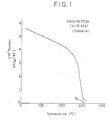
- Fig. 1 is a graphical view showing the change depending on temperature in magnetization of the ingot of 66Fe-14B-20Nd (sample 7 in Table 1), from which Tc is found to be 310°C.
- Table 1 shows high-performance permanent magnets by powder metallurgical sintering.
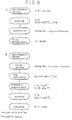
- Table 2 shows the characteristics of the permanent magnets consisting of various Fe-B-R type compounds prepared by the following steps. For the purpose of comparison, control magnets departing from the scope of the present invention are also described.
- the B-free compounds have a coercive force close to zero or of so small a value that high Hc measuring meters could not be applied, and thus provide no permanent magnets.
- the addition of 4 at % or only 0.64 wt % of B raises Hc to 2.8 kOe (sample No. 4), and there is a sharp increase in Hc with an increase in the amount of B.
- (BH)max increases to 7-20 MGOe and even reaches 35 MGOe or higher.
- the presently invented magnets exhibit high magnetic properties exceeding those of SmCo magnets currently known to be the highest grade magnets.
- Table 2 mainly shows Nd- and Pr-containing compounds but, as shown in the lower part of Table 2, the Fe-B-R type compounds wherein R stands for other rare earth elements or various combinations of rare earth elements also exhibit good permanent magnet properties.
- Fig. 5 illustrates the relationship between (BH)max measured in a similar manner and the Fe-B-Nd composition in the Fe-B-R ternary system.
- the Fe-B-R type compounds exhibit good permanent magnet properties when the amounts of B and R are in a suitable range.
- Hc increases as B increases from zero as shown in Fig. 3.
- Br increases rather steeply, and peaks in the vicinity of 5-7 at % B. A further increase in the amount of B causes Br to decrease.
- the amount of B should be at least 2 at % (preferably at least 3 at %).
- the instantly invented permanent magnets are characterized by possessing high Br after sintering, and often suitable for uses where high magnetic flux densities are needed.
- the Fe-B-R type compounds should contain at most 28 at % B. It is understood that B ranges of 3-27 at % and 4-24 at % are preferable, or the optimum, ranges for attaining (BH)max of ⁇ 7 MGOe and ⁇ 10 MGOe, respectively.
- the optimum amount range for R will now be considered. As shown in Table 2 and Fig. 4, the more the amount of R, the higher Hc will be. Since it is required that permanent magnet materials-have Hc of no less than 1 kOe as mentioned in the foregoing, the amount of R should be 8 at % or higher for that purpose. However, the increase in the amount of R is favourable to increase Hc, but incurs a handling problem since the powders of alloys having a high R content are easy to burn owing to the fact that R is very susceptible to oxidation. In consideration of mass production, it is thus desired that the amount of R be no more than 30 at %. When the amount of R exceeds the upper limit, difficulties would be involved in mass production since alloy powders are easy to burn.
- the amounts of B and R to be applied should be selected from the aforesaid ranges in such a manner that the magnetic properties as aimed at in the present invention are obtained.
- the most preferable magnetic properties are obtained when they are composed of about 8% B, about 15% R and the balance being Fe with impurities, as illustrated in Figs. 3-5 as an embodiment.
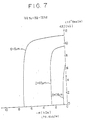
- Fig. 2 shows an initial magnetization curve 1, and a demagnetization curve 2 running through the first to the second quadrant, for 68Fe17B15Nd (having the same composition as sample No. 10 of Table 2).
- the initial magnetization curve 1 rises steeply in a low magnetic field, and reaches saturation.
- the demagnetization curve 2 shows very high loop rectangularity. From the form of the initial magnetization curve 1, it is thought that this magnet is a so-called nucleation type permanent magnet since the SmCo type magnets of the nucleation type shows an analogous curve, wherein the coercive force of which is determined by nucleation occurring in the inverted magnetic domain.
- the high loop rectangularity of the demagnetization curve 2 indicates that this magnet is a typical high-performance anisotropic magnet.
- Pulverization (2) in the experimental procedures as aforementioned was carried out for varied periods of time selected in such a manner that the measured mean particle sizes of the powder ranged from 0.5 to 100 ⁇ m, as measured with a sub-sieve-sizer manufactured by Fisher. In this manner, various samples having the compositions as specified in Table 3 were obtained.
- the samples were polished and corroded on their surfaces, and photographed through an optical microscope at a magnification ranging from x 100 to x 1000. Circles having known areas were drawn on the photographs, and divided by lines into eight equal sections. The number of grains present on the diameters were counted and averaged. However, grains on the borders (circumferences) were counted as half grains (this method is known as Heyn's method). Pores were omitted from calculation.
- an alloy having the same composition as Sample No. 8 of Table 3 was prepared by high-frequency melting and casting in a water cooled copper mold.
- the thus cast alloy had Hc of less than 1 kOe in spite of its mean crystal grain size being in a range of 20-80 um.
- the composition comes within the range as defined in the present invention and the mean crystal grain size is 1-80 um, and that, in order to obtain Hc of no less than 4 kOe, the mean crystal grain size should be in a range of 2-40 ⁇ m.
- Control of the crystal grain size of the sintered compact can be carried out by controlling process conditions such as pulverization, sintering, post heat treatment, etc.
- the magnetic material and permanent magnets based on the Fe-B-R alloy according to the present invention can satisfactorily exhibit their own magnetic properties due to the fact that the major phase is formed by the substantially tetragonal crystals of the Fe-B-R type.
- the Fe-B-R type alloy is a novel alloy in view of its Curie point.
- it has further been experimentally ascertained that the presence of the substantially tetragonal crystals of the Fe-B-R type contributes to the exhibition of magnetic properties.
- the Fe-B-R base tetragonal system alloy is unknown in the art, and serves to provide a vital guiding principle for the production of magnetic materials and permanent magnets having high magnetic properties as aimed at in the present invention.
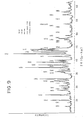
- indices are given at the respective X-ray peaks.
- This structure is characterized by its extremely large lattice constants. No tetragonal system compounds having such large lattice constants are found in any one of the binary system compounds such as R-Fe, Fe-B and B-R.
- Fe-B-R base permanent magnets having various compositions and prepared by the aforesaid manner as well as other various manners were examined with an X-ray diffractometer, XMA and optical microscopy. As a result, the following matters have turned out:
- a tetragonal system compound having macro unit cells which contains as the essential components R, Fe and B and has lattice constants a o of about 0.8 nm (8 A) and Co of about 1.2 nm (12 A), good properties suitable for permanent magnets are obtained.
- Table 4 shows the lattice constants of tetragonal system compounds which'constitute the major phase of typical Fe-B-R type magnets, i.e., occupy 50 vol % or more of the crystal structure.
- the said Fe-B-R tetragonal system compounds are present in a wide compositional range, and may be present in a stable state upon addition of certain elements other than R, Fe and B.
- the Fe-B-R type tetragonal crystal may be substantially tetragonal for producing the desired magnetic properties.
- substantially tetragonal encompasses ones that have a slightly deflected angle between a, b and c axes, i.e., within 1°, or ones that have a. slightly different from b o , e.g., within 1%.
- An alloy of 8 at % B, 16 at % Pr and the balance Fe was pulverized to prepare powders having an average particle size of 15 pm.
- the powders were compacted under a pressure of 19.62x 10 7 Pa (2 t/cm 2 ) and in a magnetic field of 10 kOe, and the resultant compact was sintered at 1090°C for 1 hour in argon of 26.6 Pa (2x10 -1 Torr).
- the major phase contains simultaneously Fe, B and Pr, which amount to 90 vol % thereof.
- the mean crystal grain size was 25 ⁇ m.
- An alloy of 8 at % B, 15 at % Nd and the balance Fe was pulverized to prepare powders having an average particle size of 3 um.
- the powders were compacted in a magnetic field of 10 kOe under a pressure of 19.62x10 7 Pa (2 t/cm 2 ), and sintered at 1100°C for 1 hour in argon of 2666 Pa (2x10 Torr).
- the major phase contains simultaneously Fe, B and Nd, which amount to 90.5 vol % thereof.
- Nonmagnetic compound phases having a R content of no less than 80% were 4% with the remainder being virtually oxides and pores.
- the mean crystal grain size was 15 ⁇ m.
- additional elements M can be applied to the magnetic materials and permanent magnets of the Fe-B-R type, the additional elements M including Ti, Ni, Bi, V, Nb, Ta, Cr, Mo, W, Mn, Al, Sb, Ge, Sn, Zr and Hf, which provides further magnetic materials and permanent magnets of the Fe-B-R-M system.
- Limitation is of course imposed upon the amount of these elements.
- the addition of these elements contribute to the increase in Hc compared with the Fe-R-B ternary system compounds.
- W, Mo, V, AI and Nb have a great effect in this respect.
- the addition of these elements incurs a reduction of Br and, hence, their total amounts should be controlled depending upon the requisite properties.
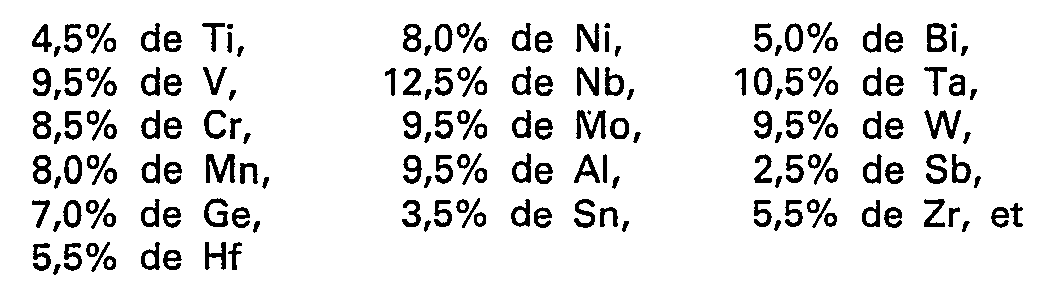
- the amounts of these elements are respectively limited to no more than the values specified hereinbelow by atomic percent: wherein, when two or more of M are applied, the total amount of M shall be no more than the maximum value among the values specified hereinabove of the M actually added.
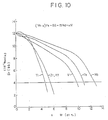
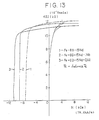
- Figs. 10 to 12 the upper limits of the additional elements M (Ti, Zr, Hf, V, Ta, Nb, Cr, W, Mo, Sb, Sn, Ge and Al) other than Bi, Ni, and Mn may be chosen such that Br is at least equivalent to about 4 kG of hard ferrite.
- M Ti, Zr, Hf, V, Ta, Nb, Cr, W, Mo, Sb, Sn, Ge and Al
- the resulting characteristic curve will be depicted between the characteristic curves of the individual elements in Figs. 10 to 12.
- the amounts of the individual elements M are within the aforesaid ranges, and the total amount thereof is no more than the maximum values allowed for the individual elements which are added and present.
- the total amount of Ti plus V allowed is 9.5 at %, wherein no more than 4.5 at % Ti and no more than 9.5 at % of V can be used.
- a composition comprised of 12-24% R, 3-27% B and the balance being (Fe+M) is preferred for providing (BH)max2:7 MGOe.
- compositions comprised of 12-20% R, 4-24% B and the balance being (Fe+M) for providing (BH)max*10 MGOe wherein (BH)max achieves maximum values of 35 MGOe or higher. Still more preferred compositional ranges are defined principally on the same basis as is the case in the Fe-B-R ternary system.
- (BH)max assumes a value practically similar to that obtained with the case where no M is applied, through the addition of an appropriate amount of M.
- the increase in coercive force serves to stabilize the magnetic properties, so that permanent magnets are obtained which are practically very stable and have a high energy product.
- Ni is a ferromagnetic element. Therefore, the upper limit of Ni is 8%, preferably 4.5%, in view of Hc.
- Mn upon decrease in Br is not strong but larger than is the case with Ni.
- the upper limit of Mn is 8%, preferably 3.5%, in view of iHc.
- Permanent magnet materials were prepared in the following manner.
- the additional elements M are found to be effective for all the Fe-B-R ternary systems wherein R ranges from 8 to 30 at %, B ranges from 2 to 28 at %, with the balance being Fe.
- the elements M are ineffective ( * 12, *13-R is too low-, *14-B is in excess-, *15-R is in excess, and *8 ⁇ *11 ⁇ is without B-).
- Samples 1, and 3 (curves 1, and 3) were obtained based on the samples identical with sample No. 1 (Table 6), sample No. 5 and sample No. 21 (Table 5), respectively.
- the curves 2 and 3 also show the rectangularity or loop squareness in the second quadrant useful for permanent magnets.
- samples Nos. 37-42 51 and 52 Pr as R was used, samples Nos. 48-50 were based on 67Fe-12B-20Nd-1M, and samples Nos. 51 and 52 based on 67Fe-12B-20Pr-1M. Samples Nos. 40, 42-47, 53-58 and 60-65 indicate that even the addition of two or more elements M gives good results.
- Samples No. 56 shows iHc of 4.3 kOe, which is higher than 2.8 kOe of * 16, and sample No. 59 shows iHc of 7.3 kOe which is higher than 5.1 kOe of No. 7.
- the addition of M is effective on both samples.
- the Fe-B-R-M base permanent magnets may contain, in addition to Fe, B, R and M, impurities which are entrained in the process of industrial production.
- Pulverization in the experimental procedures as aforementioned was carried out for varied periods of time selected in such a manner that the measured average particle sizes of the powder ranges from 0.5 to 100 um, as measured with a sub-sieve-sizer manufactured by Fisher. In this manner, various samples having the compositions as specified in Tables 7 and 8 were obtained.
- the Fe-B-R-M system magnetic materials and permanent magnets have basically the same crystal structure as the Fe-B-R system as shown in Table 4, Nos. 13-21, and permit substantially the same impurities as in the case of the Fe-B-R system (see Table 10).
- Table 9 shows the magnetic and physical properties of the typical example according to the present invention and the prior art permanent magnets.
- the present invention provides Co-free, Fe base inexpensive alloys, magnetic materials having high magnetic properties, and sintered, magnetic anisotropic permanent magnets having high remanence, high coercive force, high energy product and high mechanical strength, and thus present a technical breakthrough.
Landscapes
- Chemical & Material Sciences (AREA)
- Engineering & Computer Science (AREA)
- Crystallography & Structural Chemistry (AREA)
- Inorganic Chemistry (AREA)
- Power Engineering (AREA)
- Hard Magnetic Materials (AREA)
- Materials Engineering (AREA)
- Mechanical Engineering (AREA)
- Metallurgy (AREA)
- Organic Chemistry (AREA)
Claims (102)




Applications Claiming Priority (21)
| Application Number | Priority Date | Filing Date | Title |
|---|---|---|---|
| JP145072/82 | 1982-08-21 | ||
| JP57145072A JPS5946008A (ja) | 1982-08-21 | 1982-08-21 | 永久磁石 |
| JP14507282 | 1982-08-21 | ||
| JP57200204A JPS5989401A (ja) | 1982-11-15 | 1982-11-15 | 永久磁石 |
| JP200204/82 | 1982-11-15 | ||
| JP20020482 | 1982-11-15 | ||
| JP581483 | 1983-01-19 | ||
| JP5814/83 | 1983-01-19 | ||
| JP58005814A JPS59132105A (ja) | 1983-01-19 | 1983-01-19 | 永久磁石用合金 |
| JP3789883 | 1983-03-08 | ||
| JP3789683 | 1983-03-08 | ||
| JP37898/83 | 1983-03-08 | ||
| JP37896/83 | 1983-03-08 | ||
| JP58037898A JPS59163804A (ja) | 1983-03-08 | 1983-03-08 | 永久磁石用合金 |
| JP58037896A JPS59163802A (ja) | 1983-03-08 | 1983-03-08 | 永久磁石材料 |
| JP8485983 | 1983-05-14 | ||
| JP58084859A JPS59211558A (ja) | 1983-05-14 | 1983-05-14 | 永久磁石材料 |
| JP84859/83 | 1983-05-14 | ||
| JP94876/83 | 1983-05-31 | ||
| JP9487683 | 1983-05-31 | ||
| JP58094876A JPH0778269B2 (ja) | 1983-05-31 | 1983-05-31 | 永久磁石用希土類・鉄・ボロン系正方晶化合物 |
Publications (4)
| Publication Number | Publication Date |
|---|---|
| EP0101552A2 EP0101552A2 (fr) | 1984-02-29 |
| EP0101552A3 EP0101552A3 (en) | 1985-03-20 |
| EP0101552B1 true EP0101552B1 (fr) | 1989-08-09 |
| EP0101552B2 EP0101552B2 (fr) | 2002-12-11 |
Family
ID=27563324
Family Applications (1)
| Application Number | Title | Priority Date | Filing Date |
|---|---|---|---|
| EP83106573A Expired - Lifetime EP0101552B2 (fr) | 1982-08-21 | 1983-07-05 | Matériaux magnétiques, aimants permanents et procédés pour leur production |
Country Status (6)
| Country | Link |
|---|---|
| US (2) | US4770723A (fr) |
| EP (1) | EP0101552B2 (fr) |
| CA (1) | CA1316375C (fr) |
| DE (2) | DE3380376D1 (fr) |
| HK (1) | HK68290A (fr) |
| SG (1) | SG48490G (fr) |
Cited By (63)
| Publication number | Priority date | Publication date | Assignee | Title |
|---|---|---|---|---|
| US4541877A (en) * | 1984-09-25 | 1985-09-17 | North Carolina State University | Method of producing high performance permanent magnets |
| JPS6131303A (ja) * | 1984-06-29 | 1986-02-13 | セントル・ナシヨナル・ド・ラ・ルシエルシエ・サイエンテイフイク | 磁性を有する希土類/鉄/ホウ素水素化物および希土類/コバルト/ホウ素水素化物、それらの製法および用途 |
| US4585473A (en) * | 1984-04-09 | 1986-04-29 | Crucible Materials Corporation | Method for making rare-earth element containing permanent magnets |
| US4588439A (en) * | 1985-05-20 | 1986-05-13 | Crucible Materials Corporation | Oxygen containing permanent magnet alloy |
| EP0184722A1 (fr) * | 1984-11-27 | 1986-06-18 | Sumitomo Special Metals Co., Ltd. | Poudres consistant en alliage de terres rares et leur procédé de préparation |
| EP0124655A3 (en) * | 1983-05-06 | 1986-09-10 | Sumitomo Special Metals Co., Ltd. | Isotropic permanent magnets and process for producing same |
| EP0197712A1 (fr) * | 1985-03-28 | 1986-10-15 | Kabushiki Kaisha Toshiba | Aimant permanent à base de terre rare, de fer et de bore |
| EP0208807A1 (fr) * | 1985-06-14 | 1987-01-21 | Union Oil Company Of California | Aimants permanents terre rare, fer, bore |
| DE3626406A1 (de) * | 1985-08-13 | 1987-02-26 | Seiko Epson Corp | Verfahren zur herstellung von dauermagneten auf der basis von seltenerdmetallen |
| EP0216254A1 (fr) * | 1985-09-10 | 1987-04-01 | Kabushiki Kaisha Toshiba | Aimant permanent |
| US4664724A (en) * | 1984-09-14 | 1987-05-12 | Kabushiki Kaisha Toshiba | Permanent magnetic alloy and method of manufacturing the same |
| EP0237416A1 (fr) * | 1986-03-06 | 1987-09-16 | Shin-Etsu Chemical Co., Ltd. | Aimant permanent à base de terres rares |
| EP0237587A1 (fr) * | 1986-03-06 | 1987-09-23 | Sumitomo Special Metals Co., Ltd. | Procédé de préparation d'un alliage de terres rares et alliage de terres rares |
| EP0242187A1 (fr) * | 1986-04-15 | 1987-10-21 | TDK Corporation | Aimant permanent et sa méthode de fabrication |
| US4721538A (en) * | 1984-07-10 | 1988-01-26 | Crucible Materials Corporation | Permanent magnet alloy |
| EP0261579A1 (fr) * | 1986-09-16 | 1988-03-30 | Tokin Corporation | Méthode pour la fabrication d'un aimant permanent terre métal rare-fer-bore utilisant une poudre en alliage refroidi brusquement |
| GB2196479A (en) * | 1986-10-20 | 1988-04-27 | Philips Electronic Associated | Method and apparatus for the manufacture of rare earth transition metal alloy magnets |
| USRE32714E (en) * | 1984-09-25 | 1988-07-19 | North Carolina State University | Method of producing high performance permanent magnets |
| US4765848A (en) * | 1984-12-31 | 1988-08-23 | Kaneo Mohri | Permanent magnent and method for producing same |
| EP0280372A1 (fr) * | 1987-02-27 | 1988-08-31 | Philips Electronics Uk Limited | Procédé pour la fabrication d'aimants en alliage de métal de transition et/de terre rare |
| EP0285990A1 (fr) * | 1987-03-31 | 1988-10-12 | Seiko Epson Corporation | Aimant permanent de terre rare |
| EP0286324A1 (fr) * | 1987-04-02 | 1988-10-12 | The University Of Birmingham | Aimants |
| US4792367A (en) * | 1983-08-04 | 1988-12-20 | General Motors Corporation | Iron-rare earth-boron permanent |
| US4814139A (en) * | 1986-01-16 | 1989-03-21 | Hitachi Metals, Ltd. | Permanent magnet having good thermal stability and method for manufacturing same |
| US4844754A (en) * | 1983-08-04 | 1989-07-04 | General Motors Corporation | Iron-rare earth-boron permanent magnets by hot working |
| WO1989008318A1 (fr) * | 1988-02-29 | 1989-09-08 | Sumitomo Special Metals Company Limited | Aimants frittes magnetiquement anisotropes |
| US4878958A (en) * | 1986-05-30 | 1989-11-07 | Union Oil Company Of California | Method for preparing rare earth-iron-boron permanent magnets |
| US4881986A (en) * | 1986-11-26 | 1989-11-21 | Tokin Corporation | Method for producing a rare earth metal-iron-boron anisotropic sintered magnet from rapidly-quenched rare earth metal-iron-boron alloy ribbon-like flakes |
| US4888506A (en) * | 1987-07-09 | 1989-12-19 | Hitachi Metals, Ltd. | Voice coil-type linear motor |
| US4891078A (en) * | 1984-03-30 | 1990-01-02 | Union Oil Company Of California | Rare earth-containing magnets |
| US4892596A (en) * | 1988-02-23 | 1990-01-09 | Eastman Kodak Company | Method of making fully dense anisotropic high energy magnets |
| US4898613A (en) * | 1985-02-26 | 1990-02-06 | Sumitomo Special Metals Co. Ltd. | Rare earth alloy powder used in production of permanent magnets |
| US4902360A (en) * | 1987-02-04 | 1990-02-20 | Crucible Materials Corporation | Permanent magnet alloy for elevated temperature applications |
| US4908076A (en) * | 1984-04-24 | 1990-03-13 | Yamaha Corporation | FE-B magnets containing Nd-Pr-Ce rare earth elements |
| US4921551A (en) * | 1986-01-29 | 1990-05-01 | General Motors Corporation | Permanent magnet manufacture from very low coercivity crystalline rare earth-transition metal-boron alloy |
| US4933009A (en) * | 1985-06-14 | 1990-06-12 | Union Oil Company Of California | Composition for preparing rare earth-iron-boron-permanent magnets |
| US4935075A (en) * | 1986-06-12 | 1990-06-19 | Kabushiki Kaisha Toshiba | Permanent magnet |
| US4942098A (en) * | 1987-03-26 | 1990-07-17 | Sumitomo Special Metals, Co., Ltd. | Corrosion resistant permanent magnet |
| US4952252A (en) * | 1985-06-14 | 1990-08-28 | Union Oil Company Of California | Rare earth-iron-boron-permanent magnets |
| US4959273A (en) * | 1988-09-20 | 1990-09-25 | Sumitomo Special Metals Co., Ltd. | Corrosion-resistant permanent magnet and method for preparing the same |
| US4983232A (en) * | 1987-01-06 | 1991-01-08 | Hitachi Metals, Ltd. | Anisotropic magnetic powder and magnet thereof and method of producing same |
| US4985085A (en) * | 1988-02-23 | 1991-01-15 | Eastman Kodak Company | Method of making anisotropic magnets |
| US4985086A (en) * | 1987-09-10 | 1991-01-15 | Hitachi Metals, Ltd. | Method and apparatus for producing magnetically anisotropic Nd-Fe-B magnet material |
| DE3928389A1 (de) * | 1989-08-28 | 1991-03-14 | Schramberg Magnetfab | Permanentmagnet |
| US5000796A (en) * | 1988-02-23 | 1991-03-19 | Eastman Kodak Company | Anisotropic high energy magnets and a process of preparing the same |
| GB2238797A (en) * | 1989-12-08 | 1991-06-12 | Philips Electronic Associated | Manufacture of rare-earth materials and permanent magnets |
| US5041171A (en) * | 1986-07-18 | 1991-08-20 | U.S. Philips Corporation | Hard magnetic material |
| US5055146A (en) * | 1984-07-10 | 1991-10-08 | Crucible Materials Corporation | Permanent magnet alloy |
| US5110377A (en) * | 1984-02-28 | 1992-05-05 | Sumitomo Special Metals Co., Ltd. | Process for producing permanent magnets and products thereof |
| US5286307A (en) * | 1989-09-06 | 1994-02-15 | Sps Technologies, Inc. | Process for making Nd-B-Fe type magnets utilizing a hydrogen and oxygen treatment |
| US5292380A (en) * | 1987-09-11 | 1994-03-08 | Hitachi Metals, Ltd. | Permanent magnet for accelerating corpuscular beam |
| US5354354A (en) * | 1991-10-22 | 1994-10-11 | Th. Goldschmidt Ag | Method for producing single-phase, incongruently melting intermetallic phases |
| USRE34838E (en) * | 1984-12-31 | 1995-01-31 | Tdk Corporation | Permanent magnet and method for producing same |
| AT398861B (de) * | 1991-02-11 | 1995-02-27 | Boehler Ybbstalwerke | Gesinterter permanentmagnet(-werkstoff) sowie verfahren zu dessen herstellung |
| EP0522177B1 (fr) * | 1991-01-28 | 1995-07-12 | Mitsubishi Materials Corporation | Aimant ayant des propriétés anisotropiques à base de terres rares |
| JPH07183149A (ja) * | 1994-10-24 | 1995-07-21 | Toshiba Corp | 永久磁石の製造方法 |
| US5449417A (en) * | 1988-10-04 | 1995-09-12 | Hitachi Metals, Ltd. | R-Fe-B magnet alloy, isotropic bonded magnet and method of producing same |
| US5478411A (en) * | 1990-12-21 | 1995-12-26 | Provost, Fellows And Scholars Of The College Of The Holy And Undivided Trinity Of Queen Elizabeth Near Dublin | Magnetic materials and processes for their production |
| US5630885A (en) * | 1992-02-15 | 1997-05-20 | Santoku Metal Industry, Co., Ltd. | Alloy ingot for permanent magnet, anisotropic powders for permanent magnet, method for producing same and permanent magnet |
| US5634987A (en) * | 1992-07-16 | 1997-06-03 | The University Of Sheffield | Magnetic materials and method of making them |
| US6136099A (en) * | 1985-08-13 | 2000-10-24 | Seiko Epson Corporation | Rare earth-iron series permanent magnets and method of preparation |
| EP0571002B2 (fr) † | 1989-08-25 | 2003-01-02 | Dowa Mining Co., Ltd. | Alliage pour aimant permanent à résistance contré l'oxydation améliorée et procédé de fabrication |
| USRE38042E1 (en) * | 1987-01-06 | 2003-03-25 | Hitachi Metals, Ltd. | Anisotropic magnetic powder and magnet thereof and method of producing same |
Families Citing this family (130)
| Publication number | Priority date | Publication date | Assignee | Title |
|---|---|---|---|---|
| US5194098A (en) * | 1982-08-21 | 1993-03-16 | Sumitomo Special Metals Co., Ltd. | Magnetic materials |
| US5466308A (en) * | 1982-08-21 | 1995-11-14 | Sumitomo Special Metals Co. Ltd. | Magnetic precursor materials for making permanent magnets |
| CA1316375C (fr) * | 1982-08-21 | 1993-04-20 | Masato Sagawa | Materiaux magnetiques et aimants permanents |
| DE3379084D1 (en) * | 1982-09-27 | 1989-03-02 | Sumitomo Spec Metals | Permanently magnetizable alloys, magnetic materials and permanent magnets comprising febr or (fe,co)br (r=vave earth) |
| DE3381482D1 (de) * | 1983-05-06 | 1990-05-23 | Sumitomo Spec Metals | Isotrope magneten und verfahren zu ihrer herstellung. |
| US4597938A (en) * | 1983-05-21 | 1986-07-01 | Sumitomo Special Metals Co., Ltd. | Process for producing permanent magnet materials |
| JPS6032306A (ja) * | 1983-08-02 | 1985-02-19 | Sumitomo Special Metals Co Ltd | 永久磁石 |
| CA1236381A (fr) * | 1983-08-04 | 1988-05-10 | Robert W. Lee | Aimants permanents a base de fer, terre rare et bore, ouvres a chaud |
| DE3479940D1 (en) * | 1983-10-26 | 1989-11-02 | Gen Motors Corp | High energy product rare earth-transition metal magnet alloys containing boron |
| CA1271394A (fr) * | 1985-02-25 | 1990-07-10 | Karen S. Canavan | Alliage magnetique permanent a remanence accrue et composes et methode de fabrication de cet alliage |
| US5538565A (en) * | 1985-08-13 | 1996-07-23 | Seiko Epson Corporation | Rare earth cast alloy permanent magnets and methods of preparation |
| US4747874A (en) * | 1986-05-30 | 1988-05-31 | Union Oil Company Of California | Rare earth-iron-boron permanent magnets with enhanced coercivity |
| US4954186A (en) * | 1986-05-30 | 1990-09-04 | Union Oil Company Of California | Rear earth-iron-boron permanent magnets containing aluminum |
| EP0258609B1 (fr) * | 1986-07-23 | 1993-02-03 | Hitachi Metals, Ltd. | Aimant permanent à bonne stabilité thermique |
| CN1012477B (zh) * | 1987-08-19 | 1991-05-01 | 三菱金属株式会社 | 稀土-铁-硼磁体粉末及其制备方法 |
| DE3740157A1 (de) * | 1987-11-26 | 1989-06-08 | Max Planck Gesellschaft | Sintermagnet auf basis von fe-nd-b |
| JPH01139738A (ja) * | 1987-11-27 | 1989-06-01 | Hitachi Metals Ltd | 磁気異方性磁石材料の製造方法及びその装置 |
| JP2970809B2 (ja) * | 1987-12-28 | 1999-11-02 | 信越化学工業株式会社 | 希土類永久磁石 |
| US5000800A (en) * | 1988-06-03 | 1991-03-19 | Masato Sagawa | Permanent magnet and method for producing the same |
| IE891581A1 (en) * | 1988-06-20 | 1991-01-02 | Seiko Epson Corp | Permanent magnet and a manufacturing method thereof |
| JP2787580B2 (ja) * | 1988-10-06 | 1998-08-20 | 眞人 佐川 | 熱処理性がすぐれたNd−Fe−B系焼結磁石 |
| US4931092A (en) * | 1988-12-21 | 1990-06-05 | The Dow Chemical Company | Method for producing metal bonded magnets |
| US5244510A (en) * | 1989-06-13 | 1993-09-14 | Yakov Bogatin | Magnetic materials and process for producing the same |
| US5122203A (en) * | 1989-06-13 | 1992-06-16 | Sps Technologies, Inc. | Magnetic materials |
| US5266128A (en) * | 1989-06-13 | 1993-11-30 | Sps Technologies, Inc. | Magnetic materials and process for producing the same |
| US5114502A (en) * | 1989-06-13 | 1992-05-19 | Sps Technologies, Inc. | Magnetic materials and process for producing the same |
| US5183630A (en) * | 1989-08-25 | 1993-02-02 | Dowa Mining Co., Ltd. | Process for production of permanent magnet alloy having improved resistence to oxidation |
| US5269855A (en) * | 1989-08-25 | 1993-12-14 | Dowa Mining Co., Ltd. | Permanent magnet alloy having improved resistance |
| DE69126867T2 (de) * | 1990-03-06 | 1998-03-05 | Evans David Charles | Metallpulverzusammenstellungen |
| US5250206A (en) * | 1990-09-26 | 1993-10-05 | Mitsubishi Materials Corporation | Rare earth element-Fe-B or rare earth element-Fe-Co-B permanent magnet powder excellent in magnetic anisotropy and corrosion resistivity and bonded magnet manufactured therefrom |
| DE4133214C2 (de) * | 1990-10-05 | 1996-11-07 | Hitachi Metals Ltd | Aus Eisen-Seltenerdmetall-Legierung bestehendes Dauermagnetmaterial |
| US5242508A (en) * | 1990-10-09 | 1993-09-07 | Iowa State University Research Foundation, Inc. | Method of making permanent magnets |
| US5240513A (en) * | 1990-10-09 | 1993-08-31 | Iowa State University Research Foundation, Inc. | Method of making bonded or sintered permanent magnets |
| US5427734A (en) * | 1992-06-24 | 1995-06-27 | Sumitomo Special Metals Co., Ltd. | Process for preparing R-Fe-B type sintered magnets employing the injection molding method |
| US5403408A (en) * | 1992-10-19 | 1995-04-04 | Inland Steel Company | Non-uniaxial permanent magnet material |
| ATE165477T1 (de) * | 1993-07-06 | 1998-05-15 | Sumitomo Spec Metals | R-fe-b dauermagnetmaterialien und ihre herstellungsverfahren |
| US5454998A (en) * | 1994-02-04 | 1995-10-03 | Ybm Technologies, Inc. | Method for producing permanent magnet |
| US5666635A (en) | 1994-10-07 | 1997-09-09 | Sumitomo Special Metals Co., Ltd. | Fabrication methods for R-Fe-B permanent magnets |
| RU2118007C1 (ru) * | 1997-05-28 | 1998-08-20 | Товарищество с ограниченной ответственностью "Диполь-М" | Материал для постоянных магнитов |
| US6261386B1 (en) * | 1997-06-30 | 2001-07-17 | Wisconsin Alumni Research Foundation | Nanocrystal dispersed amorphous alloys |
| US6332933B1 (en) | 1997-10-22 | 2001-12-25 | Santoku Corporation | Iron-rare earth-boron-refractory metal magnetic nanocomposites |
| JPH11307327A (ja) * | 1998-04-22 | 1999-11-05 | Sanei Kasei Kk | 永久磁石用組成物 |
| CN1265401C (zh) | 1998-07-13 | 2006-07-19 | 株式会社三德 | 制造纳米复合磁性材料的方法以及制造粘结磁体的方法 |
| TW383249B (en) | 1998-09-01 | 2000-03-01 | Sumitomo Spec Metals | Cutting method for rare earth alloy by annular saw and manufacturing for rare earth alloy board |
| CN1187152C (zh) * | 1999-03-03 | 2005-02-02 | 株式会社新王磁材 | 稀土磁铁烧结用烧结箱及用该箱烧结处理的稀土磁铁制法 |
| US7195661B2 (en) * | 1999-03-05 | 2007-03-27 | Pioneer Metals And Technology, Inc. | Magnetic material |
| US6524399B1 (en) | 1999-03-05 | 2003-02-25 | Pioneer Metals And Technology, Inc. | Magnetic material |
| US6352598B1 (en) * | 1999-05-11 | 2002-03-05 | Sumitomo Special Metals Co., Ltd. | Rare-earth alloy powder pressing apparatus and rare-earth alloy powder pressing method |
| TW440494B (en) | 1999-05-13 | 2001-06-16 | Sumitomo Spec Metals | Machining method of rare earth alloy and manufacture of rare earth magnet using it |
| JP2001123201A (ja) | 1999-08-17 | 2001-05-08 | Sanei Kasei Kk | 焼結永久磁石の製造方法 |
| US6344168B1 (en) | 1999-08-30 | 2002-02-05 | Sumitomo Special Metals Co., Ltd. | Method of producing R-Fe-B type sintered magnet, method of preparing alloy powder material for R-Fe-B type sintered magnet, and method of preserving the same |
| US6261387B1 (en) | 1999-09-24 | 2001-07-17 | Magnequench International, Inc. | Rare-earth iron-boron magnet containing cerium and lanthanum |
| US6277211B1 (en) | 1999-09-30 | 2001-08-21 | Magnequench Inc. | Cu additions to Nd-Fe-B alloys to reduce oxygen content in the ingot and rapidly solidified ribbon |
| US6432158B1 (en) | 1999-10-25 | 2002-08-13 | Sumitomo Special Metals Co., Ltd. | Method and apparatus for producing compact of rare earth alloy powder and rare earth magnet |
| US6482353B1 (en) * | 1999-11-12 | 2002-11-19 | Sumitomo Special Metals Co., Ltd. | Method for manufacturing rare earth magnet |
| MY126994A (en) * | 1999-12-14 | 2006-11-30 | Hitachi Metals Ltd | Method and apparatus for cutting a rare earth alloy |
| EP1136587B1 (fr) * | 2000-03-23 | 2013-05-15 | Hitachi Metals, Ltd. | Dispositif pour la déposition des films |
| KR100562681B1 (ko) | 2000-05-24 | 2006-03-23 | 가부시키가이샤 네오맥스 | 복수의 강자성상을 포함하는 영구자석 및 그 제조방법 |
| US6558230B2 (en) | 2000-06-23 | 2003-05-06 | Sumitomo Special Metals Co., Ltd. | Method for polishing and chamfering rare earth alloy, and method and machine for sorting out ball media |
| EP1299570B1 (fr) * | 2000-07-10 | 2013-02-27 | Hitachi Metals, Ltd. | Procede d'inhibition de la production d'asperites dans un film revetu d'un depot metallique |
| US6527874B2 (en) | 2000-07-10 | 2003-03-04 | Sumitomo Special Metals Co., Ltd. | Rare earth magnet and method for making same |
| AU2001275775A1 (en) * | 2000-08-03 | 2002-02-18 | Sanei Kasei Co., Limited | Nanocomposite permanent magnet |
| WO2002030595A1 (fr) * | 2000-10-06 | 2002-04-18 | Santoku Corporation | Procede de fabrication par coulee de bandes d'un alliage brut pour aimant permanent nanocomposite |
| US7037465B2 (en) * | 2000-11-06 | 2006-05-02 | Neomax Co., Ltd. | Powder compacting method, powder compacting apparatus and method for producing rare earth magnet |
| US7217328B2 (en) * | 2000-11-13 | 2007-05-15 | Neomax Co., Ltd. | Compound for rare-earth bonded magnet and bonded magnet using the compound |
| US6790296B2 (en) * | 2000-11-13 | 2004-09-14 | Neomax Co., Ltd. | Nanocomposite magnet and method for producing same |
| CN1228162C (zh) | 2000-11-24 | 2005-11-23 | 株式会社新王磁材 | 稀土合金的切断方法和稀土磁铁的制造方法 |
| KR100535946B1 (ko) | 2001-02-07 | 2005-12-12 | 가부시키가이샤 네오맥스 | 철기재 희토류자석 원료합금의 제조방법 |
| RU2202134C2 (ru) * | 2001-03-02 | 2003-04-10 | Государственное предприятие "Всероссийский научно-исследовательский институт авиационных материалов" | Магнитный материал и изделие, выполненное из него |
| JP4698867B2 (ja) * | 2001-03-29 | 2011-06-08 | 日立金属株式会社 | R−Fe−B系合金の造粒粉の製造方法およびR−Fe−B系合金焼結体の製造方法 |
| EP1377691B1 (fr) * | 2001-03-30 | 2005-09-07 | Neomax Co., Ltd. | Procede de fabrication d'un agregat fritte d'alliage de terres rares |
| EP1388152A2 (fr) * | 2001-05-15 | 2004-02-11 | Sumitomo Special Metals Company Limited | Aimant nanocomposite d'un alliage des terres rares a base de fer et son procede de production |
| CN1212625C (zh) * | 2001-05-30 | 2005-07-27 | 株式会社新王磁材 | 稀土磁体用烧结压制体的制备方法 |
| DE60118982T2 (de) * | 2001-06-19 | 2006-11-30 | Mitsubishi Denki K.K. | Seltenerdelement-permanentmagnetmaterial |
| DE10291914B3 (de) * | 2001-06-29 | 2013-03-28 | Hitachi Metals, Ltd. | Vorrichtung, um eine Seltenerdmetall-Legierung einem Hydrierungsverfahren zu unterziehen |
| DE10292402T5 (de) * | 2001-07-02 | 2004-07-01 | Sumitomo Special Metals Co., Ltd. | Verfahren zur Herstellung von Seltenerdmetall-Sintermagneten |
| DE60215665T2 (de) * | 2001-07-31 | 2007-02-08 | Neomax Co., Ltd. | Verfahren zum herstellen eines nanozusammensetzungsmagneten unter verwendung eines atomisierungsverfahrens |
| CN1203966C (zh) * | 2001-10-17 | 2005-06-01 | 株式会社新王磁材 | 使用线状锯的切断方法和线状锯装置以及稀土类磁体的制造方法 |
| WO2003044812A1 (fr) * | 2001-11-22 | 2003-05-30 | Sumitomo Special Metals Co., Ltd. | Aimant nanocomposite |
| DE10297484B4 (de) * | 2001-11-28 | 2006-10-19 | Neomax Co., Ltd. | Verfahren und Vorrichtung zur Herstellung eines granulierten Seltenerdmetall-Legierungspulvers und Verfahren zur Herstellung eines Seltenerdmetall-Legierungssinterkörpers |
| WO2003058648A1 (fr) * | 2001-12-28 | 2003-07-17 | Shin-Etsu Chemical Co., Ltd. | Aimant fritte d'element de terre rare et procede de production d'un aimant fritte d'element de terre rare |
| WO2003068066A1 (fr) * | 2002-02-15 | 2003-08-21 | Sumitomo Special Metals Co., Ltd. | Generateur de champ magnetique et son procede de fabrication |
| US7025054B2 (en) * | 2002-03-01 | 2006-04-11 | Neomax Co., Ltd. | Method of cutting rare-earth alloy |
| AU2003236275A1 (en) * | 2002-04-12 | 2003-10-27 | Sumitomo Special Metals Co., Ltd. | Method for press molding rare earth alloy powder and method for producing sintered object of rare earth alloy |
| US6994755B2 (en) * | 2002-04-29 | 2006-02-07 | University Of Dayton | Method of improving toughness of sintered RE-Fe-B-type, rare earth permanent magnets |
| US6966953B2 (en) * | 2002-04-29 | 2005-11-22 | University Of Dayton | Modified sintered RE-Fe-B-type, rare earth permanent magnets with improved toughness |
| RU2204870C1 (ru) * | 2002-04-30 | 2003-05-20 | Московский государственный институт стали и сплавов (технологический университет) | Способ изготовления плоских пленочных магнитов |
| RU2204177C1 (ru) * | 2002-04-30 | 2003-05-10 | Московский государственный институт стали и сплавов (технологический университет) | Способ изготовления пленочных магнитов |
| EP1494250B1 (fr) | 2002-06-13 | 2014-12-31 | Hitachi Metals, Ltd. | Aimant fritte des terres rares et son procede de preparation |
| US6828891B2 (en) | 2002-07-25 | 2004-12-07 | Ge Medical Systems Global Technology Company, Llc | Method for assembling magnetic members for magnetic resonance imaging magnetic field generator |
| US6664878B1 (en) | 2002-07-26 | 2003-12-16 | Ge Medical Systems Global Technology Company, Llc | Method for assembling magnetic members for magnetic resonance imaging magnetic field generator |
| RU2311698C2 (ru) * | 2002-10-17 | 2007-11-27 | Неомакс Ко., Лтд. | Нанокомпозитный магнит и способ его изготовления |
| US6825666B2 (en) * | 2002-12-23 | 2004-11-30 | General Electric Company | Pole face for permanent magnet MRI with laminated structure |
| US7071591B2 (en) * | 2003-01-02 | 2006-07-04 | Covi Technologies | Electromagnetic circuit and servo mechanism for articulated cameras |
| US20040169434A1 (en) * | 2003-01-02 | 2004-09-02 | Washington Richard G. | Slip ring apparatus |
| US7199690B2 (en) * | 2003-03-27 | 2007-04-03 | Tdk Corporation | R-T-B system rare earth permanent magnet |
| EP1632299B1 (fr) * | 2003-04-22 | 2019-06-05 | Hitachi Metals, Ltd. | Procede d'elaboration de poudre d'alliage a base de terres rares, et procede d'elaboration d'aimant fritte a base de terres rares |
| WO2005015580A1 (fr) * | 2003-08-12 | 2005-02-17 | Neomax Co., Ltd. | Aimant fritte r-t-b, et alliage de terres rares |
| US20050062572A1 (en) * | 2003-09-22 | 2005-03-24 | General Electric Company | Permanent magnet alloy for medical imaging system and method of making |
| CN100541676C (zh) * | 2003-12-10 | 2009-09-16 | 日立金属株式会社 | 纳米复合磁体、纳米复合磁体用急冷合金以及它们的制造方法和判别方法 |
| US20060054245A1 (en) * | 2003-12-31 | 2006-03-16 | Shiqiang Liu | Nanocomposite permanent magnets |
| WO2005100641A1 (fr) | 2004-04-15 | 2005-10-27 | Neomax Co., Ltd. | Procédé pour conférer une excellente résistance à l’hydrogène à un article et article démontrant une excellente résistance à l’hydrogène |
| JPWO2005123974A1 (ja) | 2004-06-22 | 2008-04-10 | 信越化学工業株式会社 | R−Fe−B系希土類永久磁石材料 |
| EP1766641A2 (fr) * | 2004-06-30 | 2007-03-28 | University Of Dayton | Aimants permanents a terres rares nanocomposites anisotropes et procede de fabrication |
| JP4260087B2 (ja) * | 2004-09-27 | 2009-04-30 | 日立金属株式会社 | 希土類焼結磁石及びその製造方法 |
| US9551052B2 (en) * | 2005-07-15 | 2017-01-24 | Hitachi Metals, Ltd. | Rare earth sintered magnet and method for production thereof |
| WO2007114336A1 (fr) | 2006-03-31 | 2007-10-11 | Hitachi Metals, Ltd. | Procede pour la fabrication d'un aimant permanent en terre rare |
| CN101657863B (zh) * | 2007-05-02 | 2012-11-07 | 日立金属株式会社 | R-t-b系烧结磁体 |
| KR101378090B1 (ko) * | 2007-05-02 | 2014-03-27 | 히다찌긴조꾸가부시끼가이사 | R-t-b계 소결 자석 |
| EP2302646B1 (fr) * | 2008-06-13 | 2018-10-31 | Hitachi Metals, Ltd. | Aimant fritté de type r-t-cu-mn-b |
| US20090320184A1 (en) * | 2008-06-27 | 2009-12-31 | Brain Schaefer | Underwear |
| CN102084438B (zh) | 2008-07-04 | 2012-11-21 | 日立金属株式会社 | 耐腐蚀性磁铁及其制造方法 |
| JP2010215972A (ja) * | 2009-03-17 | 2010-09-30 | Toyota Motor Corp | NdFeBCu磁石材料 |
| US8821650B2 (en) * | 2009-08-04 | 2014-09-02 | The Boeing Company | Mechanical improvement of rare earth permanent magnets |
| KR20120082878A (ko) * | 2009-08-28 | 2012-07-24 | 프리메트 프리시젼 머테리알스, 인크. | 조성물 및 그의 제조 방법 |
| JP2012099523A (ja) * | 2010-10-29 | 2012-05-24 | Shin Etsu Chem Co Ltd | 異方性希土類焼結磁石及びその製造方法 |
| JP6256140B2 (ja) | 2013-04-22 | 2018-01-10 | Tdk株式会社 | R−t−b系焼結磁石 |
| JP6330254B2 (ja) | 2013-04-22 | 2018-05-30 | Tdk株式会社 | R−t−b系焼結磁石 |
| JP5370609B1 (ja) | 2013-04-25 | 2013-12-18 | Tdk株式会社 | R−t−b系永久磁石 |
| JP5565497B1 (ja) | 2013-04-25 | 2014-08-06 | Tdk株式会社 | R−t−b系永久磁石 |
| JP5565498B1 (ja) | 2013-04-25 | 2014-08-06 | Tdk株式会社 | R−t−b系永久磁石 |
| JP5565499B1 (ja) | 2013-04-25 | 2014-08-06 | Tdk株式会社 | R−t−b系永久磁石 |
| AU2014281646A1 (en) | 2013-06-17 | 2016-02-11 | Urban Mining Technology Company, Llc | Magnet recycling to create Nd-Fe-B magnets with improved or restored magnetic performance |
| JP5729511B1 (ja) | 2014-04-21 | 2015-06-03 | Tdk株式会社 | R−t−b系永久磁石、及び、回転機 |
| JP6380738B2 (ja) | 2014-04-21 | 2018-08-29 | Tdk株式会社 | R−t−b系永久磁石、r−t−b系永久磁石用原料合金 |
| US9336932B1 (en) | 2014-08-15 | 2016-05-10 | Urban Mining Company | Grain boundary engineering |
| CN104575902A (zh) * | 2014-11-26 | 2015-04-29 | 宁波格荣利磁业有限公司 | 一种添加铈的钕铁硼磁体及其制备方法 |
| JP6468435B2 (ja) * | 2015-04-15 | 2019-02-13 | Tdk株式会社 | R−t−b系焼結磁石 |
| WO2022055919A1 (fr) | 2020-09-09 | 2022-03-17 | Ut-Battelle, Llc | Aimant à haute température à terres rares critiques réduites |
| CN119314770A (zh) * | 2024-10-11 | 2025-01-14 | 北京机科国创轻量化科学研究院有限公司 | 一种稀土高熵合金、环形磁体及其制备方法 |
Family Cites Families (36)
| Publication number | Priority date | Publication date | Assignee | Title |
|---|---|---|---|---|
| US2167240A (en) * | 1937-09-30 | 1939-07-25 | Mallory & Co Inc P R | Magnet material |
| GB734597A (en) * | 1951-08-06 | 1955-08-03 | Deutsche Edelstahlwerke Ag | Permanent magnet alloys and the production thereof |
| US4063970A (en) * | 1967-02-18 | 1977-12-20 | Magnetfabrik Bonn G.M.B.H. Vormals Gewerkschaft Windhorst | Method of making permanent magnets |
| US3560200A (en) * | 1968-04-01 | 1971-02-02 | Bell Telephone Labor Inc | Permanent magnetic materials |
| US3684593A (en) * | 1970-11-02 | 1972-08-15 | Gen Electric | Heat-aged sintered cobalt-rare earth intermetallic product and process |
| JPS5648961B2 (fr) * | 1973-05-10 | 1981-11-19 | ||
| JPS5250598A (en) * | 1975-10-20 | 1977-04-22 | Seiko Instr & Electronics Ltd | Rare earth-cobalt magnet |
| JPS5328018A (en) * | 1976-08-27 | 1978-03-15 | Furukawa Electric Co Ltd:The | Unticorrosive alloy having high permeability |
| JPS5476419A (en) * | 1977-11-30 | 1979-06-19 | Hitachi Metals Ltd | High magnetic stress material |
| JPS5814865B2 (ja) * | 1978-03-23 | 1983-03-22 | セイコーエプソン株式会社 | 永久磁石材料 |
| JPS55132004A (en) * | 1979-04-02 | 1980-10-14 | Seiko Instr & Electronics Ltd | Manufacture of rare earth metal and cobalt magnet |
| JPS5629639A (en) * | 1979-08-17 | 1981-03-25 | Seiko Instr & Electronics Ltd | Amorphous rare earth magnets and producing thereof |
| JPS5647542A (en) * | 1979-09-27 | 1981-04-30 | Hitachi Metals Ltd | Alloy for permanent magnet |
| JPS5647538A (en) * | 1979-09-27 | 1981-04-30 | Hitachi Metals Ltd | Alloy for permanent magnet |
| JPS5665954A (en) * | 1979-11-02 | 1981-06-04 | Seiko Instr & Electronics Ltd | Rare earth element magnet and its manufacture |
| JPS6020882B2 (ja) * | 1980-02-01 | 1985-05-24 | 東北大学金属材料研究所長 | 高透磁率アモルフアス合金を用いてなる磁気ヘツドの製造法 |
| JPS56116844A (en) * | 1980-02-15 | 1981-09-12 | Seiko Instr & Electronics Ltd | Manufacture of amorphous magnetic material and rare earth element magnet |
| US4401482A (en) * | 1980-02-22 | 1983-08-30 | Bell Telephone Laboratories, Incorporated | Fe--Cr--Co Magnets by powder metallurgy processing |
| JPS601940B2 (ja) * | 1980-08-11 | 1985-01-18 | 富士通株式会社 | 感温素子材料 |
| JPS57141901A (en) * | 1981-02-26 | 1982-09-02 | Mitsubishi Steel Mfg Co Ltd | Permanent magnet powder |
| US4496395A (en) * | 1981-06-16 | 1985-01-29 | General Motors Corporation | High coercivity rare earth-iron magnets |
| US4533408A (en) * | 1981-10-23 | 1985-08-06 | Koon Norman C | Preparation of hard magnetic alloys of a transition metal and lanthanide |
| US4402770A (en) * | 1981-10-23 | 1983-09-06 | The United States Of America As Represented By The Secretary Of The Navy | Hard magnetic alloys of a transition metal and lanthanide |
| JPS58123853A (ja) * | 1982-01-18 | 1983-07-23 | Fujitsu Ltd | 希土類−鉄系永久磁石およびその製造方法 |
| CA1316375C (fr) * | 1982-08-21 | 1993-04-20 | Masato Sagawa | Materiaux magnetiques et aimants permanents |
| EP0108474B2 (fr) * | 1982-09-03 | 1995-06-21 | General Motors Corporation | Alliages de RE-TM-B, procédé de production et aimants permanents contenant tels alliages |
| DE3379084D1 (en) * | 1982-09-27 | 1989-03-02 | Sumitomo Spec Metals | Permanently magnetizable alloys, magnetic materials and permanent magnets comprising febr or (fe,co)br (r=vave earth) |
| US4840684A (en) * | 1983-05-06 | 1989-06-20 | Sumitomo Special Metals Co, Ltd. | Isotropic permanent magnets and process for producing same |
| US4684406A (en) * | 1983-05-21 | 1987-08-04 | Sumitomo Special Metals Co., Ltd. | Permanent magnet materials |
| US4597938A (en) * | 1983-05-21 | 1986-07-01 | Sumitomo Special Metals Co., Ltd. | Process for producing permanent magnet materials |
| US4601875A (en) * | 1983-05-25 | 1986-07-22 | Sumitomo Special Metals Co., Ltd. | Process for producing magnetic materials |
| US4773450A (en) * | 1983-12-19 | 1988-09-27 | Robert K. Stanley | Interlining of fluid transport pipelines, pipes, and the like |
| FR2566758B1 (fr) * | 1984-06-29 | 1990-01-12 | Centre Nat Rech Scient | Nouveaux hydrures de terre rare/fer/bore et terre rare/cobalt/bore magnetiques, leur procede de fabrication et de fabrication des produits deshydrures pulverulents correspondants, leurs applications |
| US4721538A (en) * | 1984-07-10 | 1988-01-26 | Crucible Materials Corporation | Permanent magnet alloy |
| US4767450A (en) * | 1984-11-27 | 1988-08-30 | Sumitomo Special Metals Co., Ltd. | Process for producing the rare earth alloy powders |
| US4765848A (en) * | 1984-12-31 | 1988-08-23 | Kaneo Mohri | Permanent magnent and method for producing same |
-
1983
- 1983-07-04 CA CA000431730A patent/CA1316375C/fr not_active Expired - Lifetime
- 1983-07-05 EP EP83106573A patent/EP0101552B2/fr not_active Expired - Lifetime
- 1983-07-05 DE DE8383106573T patent/DE3380376D1/de not_active Expired
- 1983-07-05 DE DE198383106573T patent/DE101552T1/de active Pending
-
1987
- 1987-02-10 US US07/013,165 patent/US4770723A/en not_active Expired - Lifetime
-
1988
- 1988-07-26 US US07/224,411 patent/US5096512A/en not_active Expired - Lifetime
-
1990
- 1990-07-02 SG SG48490A patent/SG48490G/en unknown
- 1990-08-30 HK HK682/90A patent/HK68290A/en not_active IP Right Cessation
Cited By (79)
| Publication number | Priority date | Publication date | Assignee | Title |
|---|---|---|---|---|
| EP0124655A3 (en) * | 1983-05-06 | 1986-09-10 | Sumitomo Special Metals Co., Ltd. | Isotropic permanent magnets and process for producing same |
| US4844754A (en) * | 1983-08-04 | 1989-07-04 | General Motors Corporation | Iron-rare earth-boron permanent magnets by hot working |
| US4792367A (en) * | 1983-08-04 | 1988-12-20 | General Motors Corporation | Iron-rare earth-boron permanent |
| US5110377A (en) * | 1984-02-28 | 1992-05-05 | Sumitomo Special Metals Co., Ltd. | Process for producing permanent magnets and products thereof |
| US4891078A (en) * | 1984-03-30 | 1990-01-02 | Union Oil Company Of California | Rare earth-containing magnets |
| US4585473A (en) * | 1984-04-09 | 1986-04-29 | Crucible Materials Corporation | Method for making rare-earth element containing permanent magnets |
| US4908076A (en) * | 1984-04-24 | 1990-03-13 | Yamaha Corporation | FE-B magnets containing Nd-Pr-Ce rare earth elements |
| JPS6131303A (ja) * | 1984-06-29 | 1986-02-13 | セントル・ナシヨナル・ド・ラ・ルシエルシエ・サイエンテイフイク | 磁性を有する希土類/鉄/ホウ素水素化物および希土類/コバルト/ホウ素水素化物、それらの製法および用途 |
| US4663066A (en) * | 1984-06-29 | 1987-05-05 | Centre National De La Recherche Scientifique | Magnetic rare earth/iron/boron and rare earth/cobalt/boron hydrides, the process for their manufacture of the corresponding pulverulent dehydrogenated products |
| US5055146A (en) * | 1984-07-10 | 1991-10-08 | Crucible Materials Corporation | Permanent magnet alloy |
| US4721538A (en) * | 1984-07-10 | 1988-01-26 | Crucible Materials Corporation | Permanent magnet alloy |
| US4878964A (en) * | 1984-09-14 | 1989-11-07 | Kabushiki Kaisha Toshiba | Permanent magnetic alloy and method of manufacturing the same |
| US4664724A (en) * | 1984-09-14 | 1987-05-12 | Kabushiki Kaisha Toshiba | Permanent magnetic alloy and method of manufacturing the same |
| US4793874A (en) * | 1984-09-14 | 1988-12-27 | Kabushiki Kaisha Toshiba | Permanent magnetic alloy and method of manufacturing the same |
| US4541877A (en) * | 1984-09-25 | 1985-09-17 | North Carolina State University | Method of producing high performance permanent magnets |
| USRE32714E (en) * | 1984-09-25 | 1988-07-19 | North Carolina State University | Method of producing high performance permanent magnets |
| US4767450A (en) * | 1984-11-27 | 1988-08-30 | Sumitomo Special Metals Co., Ltd. | Process for producing the rare earth alloy powders |
| EP0184722A1 (fr) * | 1984-11-27 | 1986-06-18 | Sumitomo Special Metals Co., Ltd. | Poudres consistant en alliage de terres rares et leur procédé de préparation |
| US4765848A (en) * | 1984-12-31 | 1988-08-23 | Kaneo Mohri | Permanent magnent and method for producing same |
| USRE34838E (en) * | 1984-12-31 | 1995-01-31 | Tdk Corporation | Permanent magnet and method for producing same |
| US4898613A (en) * | 1985-02-26 | 1990-02-06 | Sumitomo Special Metals Co. Ltd. | Rare earth alloy powder used in production of permanent magnets |
| EP0197712A1 (fr) * | 1985-03-28 | 1986-10-15 | Kabushiki Kaisha Toshiba | Aimant permanent à base de terre rare, de fer et de bore |
| US5071493A (en) * | 1985-03-28 | 1991-12-10 | Kabushiki Kaisha Toshiba | Rare earth-iron-boron-based permanent magnet |
| US4588439A (en) * | 1985-05-20 | 1986-05-13 | Crucible Materials Corporation | Oxygen containing permanent magnet alloy |
| US4933009A (en) * | 1985-06-14 | 1990-06-12 | Union Oil Company Of California | Composition for preparing rare earth-iron-boron-permanent magnets |
| US4952252A (en) * | 1985-06-14 | 1990-08-28 | Union Oil Company Of California | Rare earth-iron-boron-permanent magnets |
| EP0208807A1 (fr) * | 1985-06-14 | 1987-01-21 | Union Oil Company Of California | Aimants permanents terre rare, fer, bore |
| US6136099A (en) * | 1985-08-13 | 2000-10-24 | Seiko Epson Corporation | Rare earth-iron series permanent magnets and method of preparation |
| DE3626406A1 (de) * | 1985-08-13 | 1987-02-26 | Seiko Epson Corp | Verfahren zur herstellung von dauermagneten auf der basis von seltenerdmetallen |
| EP0216254A1 (fr) * | 1985-09-10 | 1987-04-01 | Kabushiki Kaisha Toshiba | Aimant permanent |
| US4859254A (en) * | 1985-09-10 | 1989-08-22 | Kabushiki Kaisha Toshiba | Permanent magnet |
| US5041172A (en) * | 1986-01-16 | 1991-08-20 | Hitachi Metals, Ltd. | Permanent magnet having good thermal stability and method for manufacturing same |
| US4814139A (en) * | 1986-01-16 | 1989-03-21 | Hitachi Metals, Ltd. | Permanent magnet having good thermal stability and method for manufacturing same |
| US4921551A (en) * | 1986-01-29 | 1990-05-01 | General Motors Corporation | Permanent magnet manufacture from very low coercivity crystalline rare earth-transition metal-boron alloy |
| US4769063A (en) * | 1986-03-06 | 1988-09-06 | Sumitomo Special Metals Co., Ltd. | Method for producing rare earth alloy |
| EP0237416A1 (fr) * | 1986-03-06 | 1987-09-16 | Shin-Etsu Chemical Co., Ltd. | Aimant permanent à base de terres rares |
| EP0237587A1 (fr) * | 1986-03-06 | 1987-09-23 | Sumitomo Special Metals Co., Ltd. | Procédé de préparation d'un alliage de terres rares et alliage de terres rares |
| EP0242187A1 (fr) * | 1986-04-15 | 1987-10-21 | TDK Corporation | Aimant permanent et sa méthode de fabrication |
| US4878958A (en) * | 1986-05-30 | 1989-11-07 | Union Oil Company Of California | Method for preparing rare earth-iron-boron permanent magnets |
| US4935075A (en) * | 1986-06-12 | 1990-06-19 | Kabushiki Kaisha Toshiba | Permanent magnet |
| US5041171A (en) * | 1986-07-18 | 1991-08-20 | U.S. Philips Corporation | Hard magnetic material |
| US4898625A (en) * | 1986-09-16 | 1990-02-06 | Tokin Corporation | Method for producing a rare earth metal-iron-boron permanent magnet by use of a rapidly-quenched alloy powder |
| US5011552A (en) * | 1986-09-16 | 1991-04-30 | Tokin Corporation | Method for producing a rare earth metal-iron-boron permanent magnet by use of a rapidly-quenched alloy powder |
| EP0261579A1 (fr) * | 1986-09-16 | 1988-03-30 | Tokin Corporation | Méthode pour la fabrication d'un aimant permanent terre métal rare-fer-bore utilisant une poudre en alliage refroidi brusquement |
| GB2196479B (en) * | 1986-10-20 | 1990-03-28 | Philips Electronic Associated | Method and apparatus for the manufacture of rare earth transition metal alloy magnets |
| GB2196479A (en) * | 1986-10-20 | 1988-04-27 | Philips Electronic Associated | Method and apparatus for the manufacture of rare earth transition metal alloy magnets |
| US4881986A (en) * | 1986-11-26 | 1989-11-21 | Tokin Corporation | Method for producing a rare earth metal-iron-boron anisotropic sintered magnet from rapidly-quenched rare earth metal-iron-boron alloy ribbon-like flakes |
| USRE38042E1 (en) * | 1987-01-06 | 2003-03-25 | Hitachi Metals, Ltd. | Anisotropic magnetic powder and magnet thereof and method of producing same |
| US4983232A (en) * | 1987-01-06 | 1991-01-08 | Hitachi Metals, Ltd. | Anisotropic magnetic powder and magnet thereof and method of producing same |
| USRE38021E1 (en) | 1987-01-06 | 2003-03-11 | Hitachi Metals, Ltd. | Anisotropic magnetic powder and magnet thereof and method of producing same |
| US4902360A (en) * | 1987-02-04 | 1990-02-20 | Crucible Materials Corporation | Permanent magnet alloy for elevated temperature applications |
| EP0280372A1 (fr) * | 1987-02-27 | 1988-08-31 | Philips Electronics Uk Limited | Procédé pour la fabrication d'aimants en alliage de métal de transition et/de terre rare |
| US4942098A (en) * | 1987-03-26 | 1990-07-17 | Sumitomo Special Metals, Co., Ltd. | Corrosion resistant permanent magnet |
| US4968529A (en) * | 1987-03-26 | 1990-11-06 | Sumitomo Special Metals Co., Ltd. | Process for producing a corrosion resistant permanent magnet |
| EP0285990A1 (fr) * | 1987-03-31 | 1988-10-12 | Seiko Epson Corporation | Aimant permanent de terre rare |
| US4865915A (en) * | 1987-03-31 | 1989-09-12 | Seiko Epson Corporation | Resin coated permanent magnet |
| EP0286324A1 (fr) * | 1987-04-02 | 1988-10-12 | The University Of Birmingham | Aimants |
| US4888506A (en) * | 1987-07-09 | 1989-12-19 | Hitachi Metals, Ltd. | Voice coil-type linear motor |
| US4985086A (en) * | 1987-09-10 | 1991-01-15 | Hitachi Metals, Ltd. | Method and apparatus for producing magnetically anisotropic Nd-Fe-B magnet material |
| US5292380A (en) * | 1987-09-11 | 1994-03-08 | Hitachi Metals, Ltd. | Permanent magnet for accelerating corpuscular beam |
| US5000796A (en) * | 1988-02-23 | 1991-03-19 | Eastman Kodak Company | Anisotropic high energy magnets and a process of preparing the same |
| US4892596A (en) * | 1988-02-23 | 1990-01-09 | Eastman Kodak Company | Method of making fully dense anisotropic high energy magnets |
| US4985085A (en) * | 1988-02-23 | 1991-01-15 | Eastman Kodak Company | Method of making anisotropic magnets |
| WO1989008318A1 (fr) * | 1988-02-29 | 1989-09-08 | Sumitomo Special Metals Company Limited | Aimants frittes magnetiquement anisotropes |
| US4959273A (en) * | 1988-09-20 | 1990-09-25 | Sumitomo Special Metals Co., Ltd. | Corrosion-resistant permanent magnet and method for preparing the same |
| US5449417A (en) * | 1988-10-04 | 1995-09-12 | Hitachi Metals, Ltd. | R-Fe-B magnet alloy, isotropic bonded magnet and method of producing same |
| EP0571002B2 (fr) † | 1989-08-25 | 2003-01-02 | Dowa Mining Co., Ltd. | Alliage pour aimant permanent à résistance contré l'oxydation améliorée et procédé de fabrication |
| DE3928389A1 (de) * | 1989-08-28 | 1991-03-14 | Schramberg Magnetfab | Permanentmagnet |
| US5286307A (en) * | 1989-09-06 | 1994-02-15 | Sps Technologies, Inc. | Process for making Nd-B-Fe type magnets utilizing a hydrogen and oxygen treatment |
| GB2238797A (en) * | 1989-12-08 | 1991-06-12 | Philips Electronic Associated | Manufacture of rare-earth materials and permanent magnets |
| US5478411A (en) * | 1990-12-21 | 1995-12-26 | Provost, Fellows And Scholars Of The College Of The Holy And Undivided Trinity Of Queen Elizabeth Near Dublin | Magnetic materials and processes for their production |
| EP0522177B1 (fr) * | 1991-01-28 | 1995-07-12 | Mitsubishi Materials Corporation | Aimant ayant des propriétés anisotropiques à base de terres rares |
| AT398861B (de) * | 1991-02-11 | 1995-02-27 | Boehler Ybbstalwerke | Gesinterter permanentmagnet(-werkstoff) sowie verfahren zu dessen herstellung |
| US5354354A (en) * | 1991-10-22 | 1994-10-11 | Th. Goldschmidt Ag | Method for producing single-phase, incongruently melting intermetallic phases |
| US5656100A (en) * | 1992-02-15 | 1997-08-12 | Santoku Metal Industry Co., Ltd. | Alloy ingot for permanent magnet, anisotropic powders for permanent magnet, method for producing same and permanent magnet |
| US5674327A (en) * | 1992-02-15 | 1997-10-07 | Santoku Metal Industry Co., Ltd. | Alloy ingot for permanent magnet, anisotropic powders for permanent magnet, method for producing same and permanent magnet |
| US5630885A (en) * | 1992-02-15 | 1997-05-20 | Santoku Metal Industry, Co., Ltd. | Alloy ingot for permanent magnet, anisotropic powders for permanent magnet, method for producing same and permanent magnet |
| US5634987A (en) * | 1992-07-16 | 1997-06-03 | The University Of Sheffield | Magnetic materials and method of making them |
| JPH07183149A (ja) * | 1994-10-24 | 1995-07-21 | Toshiba Corp | 永久磁石の製造方法 |
Also Published As
| Publication number | Publication date |
|---|---|
| US4770723A (en) | 1988-09-13 |
| DE101552T1 (de) | 1989-06-22 |
| HK68290A (en) | 1990-09-07 |
| CA1316375C (fr) | 1993-04-20 |
| US5096512A (en) | 1992-03-17 |
| SG48490G (en) | 1991-02-14 |
| EP0101552A2 (fr) | 1984-02-29 |
| EP0101552B2 (fr) | 2002-12-11 |
| DE3380376D1 (en) | 1989-09-14 |
| EP0101552A3 (en) | 1985-03-20 |
Similar Documents
| Publication | Publication Date | Title |
|---|---|---|
| EP0101552B2 (fr) | Matériaux magnétiques, aimants permanents et procédés pour leur production | |
| EP0106948B1 (fr) | alliages magnétisables permanentement, matériaux magnétiques et aimant permanent contenant FeBR ou (Fe,Co)BR (R=terre rare) | |
| US4792368A (en) | Magnetic materials and permanent magnets | |
| US5766372A (en) | Method of making magnetic precursor for permanent magnets | |
| US4767474A (en) | Isotropic magnets and process for producing same | |
| EP0126179B2 (fr) | Procédé de fabrication de matériaux magnétiques permanents | |
| EP0134304B1 (fr) | Aimants permanents | |
| EP0261579B1 (fr) | Méthode pour la fabrication d'un aimant permanent terre métal rare-fer-bore utilisant une poudre en alliage refroidi brusquement | |
| HK75390A (en) | Process for producing of a permanent magnet | |
| EP0124655B1 (fr) | Aimants permanents isotropes et procédé pour leur fabrication | |
| US4840684A (en) | Isotropic permanent magnets and process for producing same | |
| US5230749A (en) | Permanent magnets | |
| JP2513994B2 (ja) | 永久磁石 | |
| JPH0316761B2 (fr) | ||
| US5194098A (en) | Magnetic materials | |
| US5183516A (en) | Magnetic materials and permanent magnets | |
| JPH0474426B2 (fr) | ||
| US5192372A (en) | Process for producing isotropic permanent magnets and materials | |
| JP2684140B2 (ja) | 希土類・鉄・コバルト・ボロン系正方晶化合物 | |
| JPH085664B2 (ja) | 希土類・鉄・ボロン系正方晶化合物 | |
| JPH0325922B2 (fr) | ||
| JPH052735B2 (fr) | ||
| JP2720027B2 (ja) | 超低温用永久磁石材料 | |
| JPH0467324B2 (fr) | ||
| JPS6365742B2 (fr) |
Legal Events
| Date | Code | Title | Description |
|---|---|---|---|
| PUAI | Public reference made under article 153(3) epc to a published international application that has entered the european phase |
Free format text: ORIGINAL CODE: 0009012 |
|
| AK | Designated contracting states |
Designated state(s): BE CH DE FR GB IT LI NL SE |
|
| 17P | Request for examination filed |
Effective date: 19840626 |
|
| PUAL | Search report despatched |
Free format text: ORIGINAL CODE: 0009013 |
|
| AK | Designated contracting states |
Designated state(s): BE CH DE FR GB IT LI NL SE |
|
| 17Q | First examination report despatched |
Effective date: 19860820 |
|
| D17Q | First examination report despatched (deleted) | ||
| ITF | It: translation for a ep patent filed | ||
| DET | De: translation of patent claims | ||
| GRAA | (expected) grant |
Free format text: ORIGINAL CODE: 0009210 |
|
| AK | Designated contracting states |
Kind code of ref document: B1 Designated state(s): BE CH DE FR GB IT LI NL SE |
|
| REF | Corresponds to: |
Ref document number: 3380376 Country of ref document: DE Date of ref document: 19890914 |
|
| RAP2 | Party data changed (patent owner data changed or rights of a patent transferred) |
Owner name: SUMITOMO SPECIAL METALS CO., LTD. |
|
| PLBI | Opposition filed |
Free format text: ORIGINAL CODE: 0009260 |
|
| ET | Fr: translation filed | ||
| 26 | Opposition filed |
Opponent name: THYSSEN EDELSTAHLWERKE AG, DUESSELDORF Effective date: 19891018 |
|
| NLR1 | Nl: opposition has been filed with the epo |
Opponent name: THYSSEN EDELSTAHLWERKE AG. |
|
| PLBI | Opposition filed |
Free format text: ORIGINAL CODE: 0009260 |
|
| PLBI | Opposition filed |
Free format text: ORIGINAL CODE: 0009260 |
|
| 26 | Opposition filed |
Opponent name: MAGNETFABRIK SCHRAMBERG GMBH & CO. Effective date: 19900508 Opponent name: TREIBACHER CHEMISCHE WERKE AG Effective date: 19900508 Opponent name: THYSSEN EDELSTAHLWERKE AG, DUESSELDORF Effective date: 19891018 |
|
| 26 | Opposition filed |
Opponent name: GFE GESELLSCHAFT FUER ELEKTROMETALLURGIE MBH Effective date: 19900509 Opponent name: PFOEHS, ERWIN DIPL. ING. Effective date: 19900509 Opponent name: INGENIEURBUERO LEBLING Effective date: 19900508 Opponent name: MAGNETFABRIK SCHRAMBERG GMBH & CO. Effective date: 19900508 Opponent name: TREIBACHER CHEMISCHE WERKE AG Effective date: 19900508 Opponent name: THYSSEN EDELSTAHLWERKE AG, DUESSELDORF Effective date: 19891018 |
|
| NLR1 | Nl: opposition has been filed with the epo |
Opponent name: GFE GESELLSCHAFT FUER ELEKTROMETALLURGIE MBH. Opponent name: MAGNETFABRIK SCHRAMBERG GMBH & CO. Opponent name: TREIBACHER CHEMISCHE WERKE AG |
|
| NLR1 | Nl: opposition has been filed with the epo |
Opponent name: DIPL. ING. ERWIN PFOEHS. Opponent name: INGENIEURBUERO LEBLING. |
|
| ITTA | It: last paid annual fee | ||
| REG | Reference to a national code |
Ref country code: GB Ref legal event code: 771G |
|
| PLBI | Opposition filed |
Free format text: ORIGINAL CODE: 0009260 |
|
| 26 | Opposition filed |
Opponent name: JOHNSON MATTHEY TECHNOLOGY CENTRE Effective date: 19911108 Opponent name: GFE GESELLSCHAFT FUER ELEKTROMETALLURGIE MBH Effective date: 19900509 Opponent name: PFOEHS, ERWIN DIPL. ING. Effective date: 19900509 Opponent name: INGENIEURBUERO LEBLING Effective date: 19900508 Opponent name: MAGNETFABRIK SCHRAMBERG GMBH & CO. Effective date: 19900508 Opponent name: TREIBACHER CHEMISCHE WERKE AG Effective date: 19900508 Opponent name: THYSSEN EDELSTAHLWERKE AG, DUESSELDORF Effective date: 19891018 |
|
| REG | Reference to a national code |
Ref country code: GB Ref legal event code: 772C |
|
| REG | Reference to a national code |
Ref country code: GB Ref legal event code: 771F |
|
| REG | Reference to a national code |
Ref country code: GB Ref legal event code: 772S |
|
| EAL | Se: european patent in force in sweden |
Ref document number: 83106573.5 |
|
| PLAW | Interlocutory decision in opposition |
Free format text: ORIGINAL CODE: EPIDOS IDOP |
|
| APAE | Appeal reference modified |
Free format text: ORIGINAL CODE: EPIDOS REFNO |
|
| APAC | Appeal dossier modified |
Free format text: ORIGINAL CODE: EPIDOS NOAPO |
|
| APAC | Appeal dossier modified |
Free format text: ORIGINAL CODE: EPIDOS NOAPO |
|
| PLAB | Opposition data, opponent's data or that of the opponent's representative modified |
Free format text: ORIGINAL CODE: 0009299OPPO |
|
| PLBQ | Unpublished change to opponent data |
Free format text: ORIGINAL CODE: EPIDOS OPPO |
|
| R26 | Opposition filed (corrected) |
Opponent name: THYSSEN EDELSTAHLWERKE AG, DUESSELDORF - RECHTE/PA Effective date: 19891018 |
|
| NLR1 | Nl: opposition has been filed with the epo |
Opponent name: JOHNSON MATTHEY TECHNOLOGY CENTRE Opponent name: GFE GESELLSCHAFT FUER ELEKTROMETALLURGIE MBH Opponent name: PFOEHS, ERWIN DIPL. ING. Opponent name: INGENIEURBUERO LEBLING Opponent name: MAGNETFABRIK SCHRAMBERG GMBH & CO. Opponent name: TREIBACHER CHEMISCHE WERKE AG Opponent name: THYSSEN EDELSTAHLWERKE AG, DUESSELDORF - RECHTE/PA |
|
| PLAV | Examination of admissibility of opposition |
Free format text: ORIGINAL CODE: EPIDOS OPEX |
|
| PLBQ | Unpublished change to opponent data |
Free format text: ORIGINAL CODE: EPIDOS OPPO |
|
| PLAB | Opposition data, opponent's data or that of the opponent's representative modified |
Free format text: ORIGINAL CODE: 0009299OPPO |
|
| R26 | Opposition filed (corrected) |
Opponent name: THYSSEN EDELSTAHLWERKE AG, DUESSELDORF - RECHTE/PA Effective date: 19891018 |
|
| NLR1 | Nl: opposition has been filed with the epo |
Opponent name: JOHNSON MATTHEY TECHNOLOGY CENTRE Opponent name: GFE GESELLSCHAFT FUER ELEKTROMETALLURGIE MBH Opponent name: PFOEHS, ERWIN DIPL. ING. Opponent name: INGENIEURBUERO LEBLING Opponent name: MAGNETFABRIK SCHRAMBERG GMBH & CO. Opponent name: TREIBACHER CHEMISCHE WERKE AG Opponent name: THYSSEN EDELSTAHLWERKE AG, DUESSELDORF - RECHTE/PA |
|
| PLAC | Information related to filing of opposition modified |
Free format text: ORIGINAL CODE: 0008299OPPO |
|
| PLAB | Opposition data, opponent's data or that of the opponent's representative modified |
Free format text: ORIGINAL CODE: 0009299OPPO |
|
| R26 | Opposition filed (corrected) |
Opponent name: THYSSEN EDELSTAHLWERKE AG, DUESSELDORF - RECHTE/PA Effective date: 19891018 |
|
| NLR1 | Nl: opposition has been filed with the epo |
Opponent name: JOHNSON MATTHEY TECHNOLOGY CENTRE Opponent name: GFE GESELLSCHAFT FUER ELEKTROMETALLURGIE MBH Opponent name: PFOEHS, ERWIN DIPL. ING. Opponent name: INGENIEURBUERO LEBLING Opponent name: TREIBACHER CHEMISCHE WERKE AG Opponent name: THYSSEN EDELSTAHLWERKE AG, DUESSELDORF - RECHTE/PA |
|
| REG | Reference to a national code |
Ref country code: GB Ref legal event code: IF02 |
|
| APAC | Appeal dossier modified |
Free format text: ORIGINAL CODE: EPIDOS NOAPO |
|
| APAE | Appeal reference modified |
Free format text: ORIGINAL CODE: EPIDOS REFNO |
|
| PLAW | Interlocutory decision in opposition |
Free format text: ORIGINAL CODE: EPIDOS IDOP |
|
| PGFP | Annual fee paid to national office [announced via postgrant information from national office to epo] |
Ref country code: FR Payment date: 20020621 Year of fee payment: 20 |
|
| PGFP | Annual fee paid to national office [announced via postgrant information from national office to epo] |
Ref country code: BE Payment date: 20020701 Year of fee payment: 20 |
|
| PGFP | Annual fee paid to national office [announced via postgrant information from national office to epo] |
Ref country code: CH Payment date: 20020716 Year of fee payment: 20 |
|
| PGFP | Annual fee paid to national office [announced via postgrant information from national office to epo] |
Ref country code: GB Payment date: 20020729 Year of fee payment: 20 |
|
| PGFP | Annual fee paid to national office [announced via postgrant information from national office to epo] |
Ref country code: SE Payment date: 20020730 Year of fee payment: 20 |
|
| PGFP | Annual fee paid to national office [announced via postgrant information from national office to epo] |
Ref country code: NL Payment date: 20020731 Year of fee payment: 20 Ref country code: DE Payment date: 20020731 Year of fee payment: 20 |
|
| PUAH | Patent maintained in amended form |
Free format text: ORIGINAL CODE: 0009272 |
|
| STAA | Information on the status of an ep patent application or granted ep patent |
Free format text: STATUS: PATENT MAINTAINED AS AMENDED |
|
| 27A | Patent maintained in amended form |
Effective date: 20021211 |
|
| AK | Designated contracting states |
Kind code of ref document: B2 Designated state(s): BE CH DE FR GB IT LI NL SE |
|
| REG | Reference to a national code |
Ref country code: CH Ref legal event code: AEN Free format text: AUFRECHTERHALTUNG DES PATENTES IN GEAENDERTER FORM |
|
| NLR2 | Nl: decision of opposition |
Effective date: 20021211 |
|
| ET3 | Fr: translation filed ** decision concerning opposition | ||
| NLR3 | Nl: receipt of modified translations in the netherlands language after an opposition procedure | ||
| PG25 | Lapsed in a contracting state [announced via postgrant information from national office to epo] |
Ref country code: LI Free format text: LAPSE BECAUSE OF EXPIRATION OF PROTECTION Effective date: 20030704 Ref country code: GB Free format text: LAPSE BECAUSE OF EXPIRATION OF PROTECTION Effective date: 20030704 Ref country code: CH Free format text: LAPSE BECAUSE OF EXPIRATION OF PROTECTION Effective date: 20030704 |
|
| PG25 | Lapsed in a contracting state [announced via postgrant information from national office to epo] |
Ref country code: NL Free format text: LAPSE BECAUSE OF EXPIRATION OF PROTECTION Effective date: 20030705 |
|
| REG | Reference to a national code |
Ref country code: GB Ref legal event code: PE20 |
|
| REG | Reference to a national code |
Ref country code: CH Ref legal event code: PL |
|
| NLV7 | Nl: ceased due to reaching the maximum lifetime of a patent |
Effective date: 20030705 |
|
| EUG | Se: european patent has lapsed | ||
| APAH | Appeal reference modified |
Free format text: ORIGINAL CODE: EPIDOSCREFNO |
|
| PLAB | Opposition data, opponent's data or that of the opponent's representative modified |
Free format text: ORIGINAL CODE: 0009299OPPO |
|
| PLAB | Opposition data, opponent's data or that of the opponent's representative modified |
Free format text: ORIGINAL CODE: 0009299OPPO |