EP0064158B1 - Omega-Cyan-1, omega-diphenyl-azaalkan-derivate, ihre Herstellung und diese enthaltende Arzneimittel - Google Patents
Omega-Cyan-1, omega-diphenyl-azaalkan-derivate, ihre Herstellung und diese enthaltende Arzneimittel Download PDFInfo
- Publication number
- EP0064158B1 EP0064158B1 EP82102699A EP82102699A EP0064158B1 EP 0064158 B1 EP0064158 B1 EP 0064158B1 EP 82102699 A EP82102699 A EP 82102699A EP 82102699 A EP82102699 A EP 82102699A EP 0064158 B1 EP0064158 B1 EP 0064158B1
- Authority
- EP
- European Patent Office
- Prior art keywords
- methylaza
- formula
- cyan
- methoxyphenyl
- cyano
- Prior art date
- Legal status (The legal status is an assumption and is not a legal conclusion. Google has not performed a legal analysis and makes no representation as to the accuracy of the status listed.)
- Expired
Links
- 238000002360 preparation method Methods 0.000 title claims description 4
- 239000004305 biphenyl Substances 0.000 title 1
- 239000000825 pharmaceutical preparation Substances 0.000 title 1
- 150000001875 compounds Chemical class 0.000 claims description 38
- -1 methylenedioxy, ethylenedioxy Chemical group 0.000 claims description 36
- SUSQOBVLVYHIEX-UHFFFAOYSA-N phenylacetonitrile Chemical compound N#CCC1=CC=CC=C1 SUSQOBVLVYHIEX-UHFFFAOYSA-N 0.000 claims description 16
- 239000002253 acid Substances 0.000 claims description 15
- 238000000034 method Methods 0.000 claims description 13
- 230000008569 process Effects 0.000 claims description 9
- 150000003839 salts Chemical class 0.000 claims description 7
- 125000004435 hydrogen atom Chemical class [H]* 0.000 claims description 5
- 125000004432 carbon atom Chemical group C* 0.000 claims description 4
- 125000004178 (C1-C4) alkyl group Chemical group 0.000 claims description 3
- 125000003545 alkoxy group Chemical group 0.000 claims description 3
- 238000005661 deetherification reaction Methods 0.000 claims description 3
- 125000002485 formyl group Chemical class [H]C(*)=O 0.000 claims description 3
- 239000001257 hydrogen Substances 0.000 claims description 3
- 229910052739 hydrogen Inorganic materials 0.000 claims description 3
- 125000002887 hydroxy group Chemical group [H]O* 0.000 claims description 3
- 229940079593 drug Drugs 0.000 claims description 2
- 239000003814 drug Substances 0.000 claims description 2
- 229910052736 halogen Inorganic materials 0.000 claims description 2
- 150000002367 halogens Chemical class 0.000 claims description 2
- 125000000449 nitro group Chemical group [O-][N+](*)=O 0.000 claims description 2
- 125000003884 phenylalkyl group Chemical group 0.000 claims description 2
- 229920006395 saturated elastomer Polymers 0.000 claims description 2
- 125000002023 trifluoromethyl group Chemical group FC(F)(F)* 0.000 claims description 2
- 125000004417 unsaturated alkyl group Chemical group 0.000 claims description 2
- 125000000229 (C1-C4)alkoxy group Chemical group 0.000 claims 1
- 238000004458 analytical method Methods 0.000 description 92
- YXFVVABEGXRONW-UHFFFAOYSA-N Toluene Chemical compound CC1=CC=CC=C1 YXFVVABEGXRONW-UHFFFAOYSA-N 0.000 description 77
- XEKOWRVHYACXOJ-UHFFFAOYSA-N Ethyl acetate Chemical compound CCOC(C)=O XEKOWRVHYACXOJ-UHFFFAOYSA-N 0.000 description 33
- RTZKZFJDLAIYFH-UHFFFAOYSA-N Diethyl ether Chemical compound CCOCC RTZKZFJDLAIYFH-UHFFFAOYSA-N 0.000 description 30
- 125000004207 3-methoxyphenyl group Chemical group [H]C1=C([H])C(*)=C([H])C(OC([H])([H])[H])=C1[H] 0.000 description 27
- OKKJLVBELUTLKV-UHFFFAOYSA-N Methanol Chemical compound OC OKKJLVBELUTLKV-UHFFFAOYSA-N 0.000 description 27
- 239000000243 solution Substances 0.000 description 26
- 239000002585 base Substances 0.000 description 19
- 238000006243 chemical reaction Methods 0.000 description 19
- LFQSCWFLJHTTHZ-UHFFFAOYSA-N Ethanol Chemical compound CCO LFQSCWFLJHTTHZ-UHFFFAOYSA-N 0.000 description 17
- VLKZOEOYAKHREP-UHFFFAOYSA-N n-Hexane Chemical compound CCCCCC VLKZOEOYAKHREP-UHFFFAOYSA-N 0.000 description 16
- XLYOFNOQVPJJNP-UHFFFAOYSA-N water Substances O XLYOFNOQVPJJNP-UHFFFAOYSA-N 0.000 description 16
- VEXZGXHMUGYJMC-UHFFFAOYSA-N Hydrochloric acid Chemical compound Cl VEXZGXHMUGYJMC-UHFFFAOYSA-N 0.000 description 15
- SGTNSNPWRIOYBX-UHFFFAOYSA-N 2-(3,4-dimethoxyphenyl)-5-{[2-(3,4-dimethoxyphenyl)ethyl](methyl)amino}-2-(propan-2-yl)pentanenitrile Chemical compound C1=C(OC)C(OC)=CC=C1CCN(C)CCCC(C#N)(C(C)C)C1=CC=C(OC)C(OC)=C1 SGTNSNPWRIOYBX-UHFFFAOYSA-N 0.000 description 13
- 239000000126 substance Substances 0.000 description 13
- 229960001722 verapamil Drugs 0.000 description 13
- 125000003762 3,4-dimethoxyphenyl group Chemical group [H]C1=C([H])C(OC([H])([H])[H])=C(OC([H])([H])[H])C([H])=C1* 0.000 description 12
- BWHMMNNQKKPAPP-UHFFFAOYSA-L potassium carbonate Chemical compound [K+].[K+].[O-]C([O-])=O BWHMMNNQKKPAPP-UHFFFAOYSA-L 0.000 description 12
- 239000000203 mixture Substances 0.000 description 11
- VYPSYNLAJGMNEJ-UHFFFAOYSA-N Silicium dioxide Chemical compound O=[Si]=O VYPSYNLAJGMNEJ-UHFFFAOYSA-N 0.000 description 10
- 239000000741 silica gel Substances 0.000 description 10
- 229910002027 silica gel Inorganic materials 0.000 description 10
- YMWUJEATGCHHMB-UHFFFAOYSA-N Dichloromethane Chemical compound ClCCl YMWUJEATGCHHMB-UHFFFAOYSA-N 0.000 description 9
- KWYUFKZDYYNOTN-UHFFFAOYSA-M Potassium hydroxide Chemical compound [OH-].[K+] KWYUFKZDYYNOTN-UHFFFAOYSA-M 0.000 description 9
- 239000002904 solvent Substances 0.000 description 9
- WSFSSNUMVMOOMR-UHFFFAOYSA-N Formaldehyde Chemical compound O=C WSFSSNUMVMOOMR-UHFFFAOYSA-N 0.000 description 8
- 241001465754 Metazoa Species 0.000 description 8
- 241000700159 Rattus Species 0.000 description 8
- CBFCDTFDPHXCNY-UHFFFAOYSA-N icosane Chemical compound CCCCCCCCCCCCCCCCCCCC CBFCDTFDPHXCNY-UHFFFAOYSA-N 0.000 description 8
- 230000002829 reductive effect Effects 0.000 description 7
- 238000010992 reflux Methods 0.000 description 7
- ODZPKZBBUMBTMG-UHFFFAOYSA-N sodium amide Chemical compound [NH2-].[Na+] ODZPKZBBUMBTMG-UHFFFAOYSA-N 0.000 description 7
- QGZKDVFQNNGYKY-UHFFFAOYSA-N Ammonia Chemical compound N QGZKDVFQNNGYKY-UHFFFAOYSA-N 0.000 description 6
- UHOVQNZJYSORNB-UHFFFAOYSA-N Benzene Chemical compound C1=CC=CC=C1 UHOVQNZJYSORNB-UHFFFAOYSA-N 0.000 description 6
- DRBBFCLWYRJSJZ-UHFFFAOYSA-N N-phosphocreatine Chemical compound OC(=O)CN(C)C(=N)NP(O)(O)=O DRBBFCLWYRJSJZ-UHFFFAOYSA-N 0.000 description 6
- MUBZPKHOEPUJKR-UHFFFAOYSA-N Oxalic acid Chemical compound OC(=O)C(O)=O MUBZPKHOEPUJKR-UHFFFAOYSA-N 0.000 description 6
- HEMHJVSKTPXQMS-UHFFFAOYSA-M Sodium hydroxide Chemical compound [OH-].[Na+] HEMHJVSKTPXQMS-UHFFFAOYSA-M 0.000 description 6
- DTQVDTLACAAQTR-UHFFFAOYSA-N Trifluoroacetic acid Chemical compound OC(=O)C(F)(F)F DTQVDTLACAAQTR-UHFFFAOYSA-N 0.000 description 6
- 150000007962 benzene acetonitriles Chemical class 0.000 description 6
- ZCSHNCUQKCANBX-UHFFFAOYSA-N lithium diisopropylamide Chemical compound [Li+].CC(C)[N-]C(C)C ZCSHNCUQKCANBX-UHFFFAOYSA-N 0.000 description 6
- BDAGIHXWWSANSR-UHFFFAOYSA-N methanoic acid Natural products OC=O BDAGIHXWWSANSR-UHFFFAOYSA-N 0.000 description 6
- LQERIDTXQFOHKA-UHFFFAOYSA-N nonadecane Chemical compound CCCCCCCCCCCCCCCCCCC LQERIDTXQFOHKA-UHFFFAOYSA-N 0.000 description 6
- 229910000027 potassium carbonate Inorganic materials 0.000 description 6
- IIACRCGMVDHOTQ-UHFFFAOYSA-N sulfamic acid Chemical compound NS(O)(=O)=O IIACRCGMVDHOTQ-UHFFFAOYSA-N 0.000 description 6
- 239000003826 tablet Substances 0.000 description 6
- FYSNRJHAOHDILO-UHFFFAOYSA-N thionyl chloride Chemical compound ClS(Cl)=O FYSNRJHAOHDILO-UHFFFAOYSA-N 0.000 description 6
- 230000003276 anti-hypertensive effect Effects 0.000 description 5
- 239000003054 catalyst Substances 0.000 description 5
- 238000004440 column chromatography Methods 0.000 description 5
- 239000000256 polyoxyethylene sorbitan monolaurate Substances 0.000 description 5
- TYJJADVDDVDEDZ-UHFFFAOYSA-M potassium hydrogencarbonate Chemical compound [K+].OC([O-])=O TYJJADVDDVDEDZ-UHFFFAOYSA-M 0.000 description 5
- 239000000843 powder Substances 0.000 description 5
- 239000011541 reaction mixture Substances 0.000 description 5
- 239000013558 reference substance Substances 0.000 description 5
- 125000005809 3,4,5-trimethoxyphenyl group Chemical group [H]C1=C(OC([H])([H])[H])C(OC([H])([H])[H])=C(OC([H])([H])[H])C([H])=C1* 0.000 description 4
- 125000004179 3-chlorophenyl group Chemical group [H]C1=C([H])C(*)=C([H])C(Cl)=C1[H] 0.000 description 4
- XFSBVAOIAHNAPC-UHFFFAOYSA-N Aconitin Natural products CCN1CC(C(CC2OC)O)(COC)C3C(OC)C(C(C45)(OC(C)=O)C(O)C6OC)C1C32C4CC6(O)C5OC(=O)C1=CC=CC=C1 XFSBVAOIAHNAPC-UHFFFAOYSA-N 0.000 description 4
- 206010021143 Hypoxia Diseases 0.000 description 4
- MZRVEZGGRBJDDB-UHFFFAOYSA-N N-Butyllithium Chemical compound [Li]CCCC MZRVEZGGRBJDDB-UHFFFAOYSA-N 0.000 description 4
- 230000009471 action Effects 0.000 description 4
- 150000001299 aldehydes Chemical class 0.000 description 4
- 230000003288 anthiarrhythmic effect Effects 0.000 description 4
- 230000003266 anti-allergic effect Effects 0.000 description 4
- 230000003293 cardioprotective effect Effects 0.000 description 4
- MUBZPKHOEPUJKR-UHFFFAOYSA-M oxalate(1-) Chemical compound OC(=O)C([O-])=O MUBZPKHOEPUJKR-UHFFFAOYSA-M 0.000 description 4
- 238000003756 stirring Methods 0.000 description 4
- XFSBVAOIAHNAPC-XTHSEXKGSA-N 16-Ethyl-1alpha,6alpha,19beta-trimethoxy-4-(methoxymethyl)-aconitane-3alpha,8,10alpha,11,18alpha-pentol, 8-acetate 10-benzoate Chemical compound O([C@H]1[C@]2(O)C[C@H]3[C@@]45C6[C@@H]([C@@]([C@H]31)(OC(C)=O)[C@@H](O)[C@@H]2OC)[C@H](OC)[C@@H]4[C@]([C@@H](C[C@@H]5OC)O)(COC)CN6CC)C(=O)C1=CC=CC=C1 XFSBVAOIAHNAPC-XTHSEXKGSA-N 0.000 description 3
- 125000004208 3-hydroxyphenyl group Chemical group [H]OC1=C([H])C([H])=C([H])C(*)=C1[H] 0.000 description 3
- OSWFIVFLDKOXQC-UHFFFAOYSA-N 4-(3-methoxyphenyl)aniline Chemical compound COC1=CC=CC(C=2C=CC(N)=CC=2)=C1 OSWFIVFLDKOXQC-UHFFFAOYSA-N 0.000 description 3
- QTBSBXVTEAMEQO-UHFFFAOYSA-N Acetic acid Chemical compound CC(O)=O QTBSBXVTEAMEQO-UHFFFAOYSA-N 0.000 description 3
- CSCPPACGZOOCGX-UHFFFAOYSA-N Acetone Chemical compound CC(C)=O CSCPPACGZOOCGX-UHFFFAOYSA-N 0.000 description 3
- WEVYAHXRMPXWCK-UHFFFAOYSA-N Acetonitrile Chemical compound CC#N WEVYAHXRMPXWCK-UHFFFAOYSA-N 0.000 description 3
- 102000008186 Collagen Human genes 0.000 description 3
- 108010035532 Collagen Proteins 0.000 description 3
- OFOBLEOULBTSOW-UHFFFAOYSA-N Malonic acid Chemical compound OC(=O)CC(O)=O OFOBLEOULBTSOW-UHFFFAOYSA-N 0.000 description 3
- ZMXDDKWLCZADIW-UHFFFAOYSA-N N,N-Dimethylformamide Chemical compound CN(C)C=O ZMXDDKWLCZADIW-UHFFFAOYSA-N 0.000 description 3
- QAOWNCQODCNURD-UHFFFAOYSA-N Sulfuric acid Chemical compound OS(O)(=O)=O QAOWNCQODCNURD-UHFFFAOYSA-N 0.000 description 3
- ZMANZCXQSJIPKH-UHFFFAOYSA-N Triethylamine Chemical compound CCN(CC)CC ZMANZCXQSJIPKH-UHFFFAOYSA-N 0.000 description 3
- 150000007513 acids Chemical class 0.000 description 3
- 229940039750 aconitine Drugs 0.000 description 3
- STDXGNLCJACLFY-UHFFFAOYSA-N aconitine Natural products CCN1CC2(COC)C(O)CC(O)C34C5CC6(O)C(OC)C(O)C(OC(=O)C)(C5C6OC(=O)c7ccccc7)C(C(OC)C23)C14 STDXGNLCJACLFY-UHFFFAOYSA-N 0.000 description 3
- 229910021529 ammonia Inorganic materials 0.000 description 3
- 239000000010 aprotic solvent Substances 0.000 description 3
- 210000004369 blood Anatomy 0.000 description 3
- 239000008280 blood Substances 0.000 description 3
- KRKNYBCHXYNGOX-UHFFFAOYSA-N citric acid Chemical compound OC(=O)CC(O)(C(O)=O)CC(O)=O KRKNYBCHXYNGOX-UHFFFAOYSA-N 0.000 description 3
- 229920001436 collagen Polymers 0.000 description 3
- 208000037265 diseases, disorders, signs and symptoms Diseases 0.000 description 3
- 235000019253 formic acid Nutrition 0.000 description 3
- 229940038384 octadecane Drugs 0.000 description 3
- KDLHZDBZIXYQEI-UHFFFAOYSA-N palladium Substances [Pd] KDLHZDBZIXYQEI-UHFFFAOYSA-N 0.000 description 3
- FVAUCKIRQBBSSJ-UHFFFAOYSA-M sodium iodide Chemical compound [Na+].[I-] FVAUCKIRQBBSSJ-UHFFFAOYSA-M 0.000 description 3
- 208000010110 spontaneous platelet aggregation Diseases 0.000 description 3
- BFDNZQUBFCYTIC-UHFFFAOYSA-N 1-bromotridecane Chemical compound CCCCCCCCCCCCCBr BFDNZQUBFCYTIC-UHFFFAOYSA-N 0.000 description 2
- JYILLTISBVIPCE-UHFFFAOYSA-N 2-(3,4-dimethoxyphenyl)tetradecanenitrile Chemical compound CCCCCCCCCCCCC(C#N)C1=CC=C(OC)C(OC)=C1 JYILLTISBVIPCE-UHFFFAOYSA-N 0.000 description 2
- LFVQQGLSBGESDZ-UHFFFAOYSA-N 2-(3-chloropropyl)-2-(3-methoxyphenyl)tetradecanenitrile Chemical compound CCCCCCCCCCCCC(CCCCl)(C#N)C1=CC=CC(OC)=C1 LFVQQGLSBGESDZ-UHFFFAOYSA-N 0.000 description 2
- 125000004180 3-fluorophenyl group Chemical group [H]C1=C([H])C(*)=C([H])C(F)=C1[H] 0.000 description 2
- FVIXMJHVWQCIJN-UHFFFAOYSA-N 5-cyano-5-(3-methoxyphenyl)heptadecanoic acid Chemical compound CCCCCCCCCCCCC(CCCC(O)=O)(C#N)C1=CC=CC(OC)=C1 FVIXMJHVWQCIJN-UHFFFAOYSA-N 0.000 description 2
- 206010002091 Anaesthesia Diseases 0.000 description 2
- 206010002198 Anaphylactic reaction Diseases 0.000 description 2
- IJGRMHOSHXDMSA-UHFFFAOYSA-N Atomic nitrogen Chemical compound N#N IJGRMHOSHXDMSA-UHFFFAOYSA-N 0.000 description 2
- VTYYLEPIZMXCLO-UHFFFAOYSA-L Calcium carbonate Chemical compound [Ca+2].[O-]C([O-])=O VTYYLEPIZMXCLO-UHFFFAOYSA-L 0.000 description 2
- CURLTUGMZLYLDI-UHFFFAOYSA-N Carbon dioxide Chemical compound O=C=O CURLTUGMZLYLDI-UHFFFAOYSA-N 0.000 description 2
- 229920002261 Corn starch Polymers 0.000 description 2
- IAZDPXIOMUYVGZ-UHFFFAOYSA-N Dimethylsulphoxide Chemical compound CS(C)=O IAZDPXIOMUYVGZ-UHFFFAOYSA-N 0.000 description 2
- VZCYOOQTPOCHFL-OWOJBTEDSA-N Fumaric acid Chemical compound OC(=O)\C=C\C(O)=O VZCYOOQTPOCHFL-OWOJBTEDSA-N 0.000 description 2
- XQLWNAFCTODIRK-UHFFFAOYSA-N Gallopamil Chemical compound C1=C(OC)C(OC)=CC=C1CCN(C)CCCC(C#N)(C(C)C)C1=CC(OC)=C(OC)C(OC)=C1 XQLWNAFCTODIRK-UHFFFAOYSA-N 0.000 description 2
- GUBGYTABKSRVRQ-QKKXKWKRSA-N Lactose Chemical compound OC[C@H]1O[C@@H](O[C@H]2[C@H](O)[C@@H](O)C(O)O[C@@H]2CO)[C@H](O)[C@@H](O)[C@H]1O GUBGYTABKSRVRQ-QKKXKWKRSA-N 0.000 description 2
- CSNNHWWHGAXBCP-UHFFFAOYSA-L Magnesium sulfate Chemical compound [Mg+2].[O-][S+2]([O-])([O-])[O-] CSNNHWWHGAXBCP-UHFFFAOYSA-L 0.000 description 2
- PXHVJJICTQNCMI-UHFFFAOYSA-N Nickel Chemical compound [Ni] PXHVJJICTQNCMI-UHFFFAOYSA-N 0.000 description 2
- NBIIXXVUZAFLBC-UHFFFAOYSA-N Phosphoric acid Chemical compound OP(O)(O)=O NBIIXXVUZAFLBC-UHFFFAOYSA-N 0.000 description 2
- FAPWRFPIFSIZLT-UHFFFAOYSA-M Sodium chloride Chemical compound [Na+].[Cl-] FAPWRFPIFSIZLT-UHFFFAOYSA-M 0.000 description 2
- 239000004480 active ingredient Substances 0.000 description 2
- 150000001338 aliphatic hydrocarbons Chemical class 0.000 description 2
- 230000029936 alkylation Effects 0.000 description 2
- 238000005804 alkylation reaction Methods 0.000 description 2
- 230000037005 anaesthesia Effects 0.000 description 2
- 230000036783 anaphylactic response Effects 0.000 description 2
- 208000003455 anaphylaxis Diseases 0.000 description 2
- 230000006502 antiplatelets effects Effects 0.000 description 2
- 150000004945 aromatic hydrocarbons Chemical class 0.000 description 2
- 206010003119 arrhythmia Diseases 0.000 description 2
- 230000006793 arrhythmia Effects 0.000 description 2
- 230000015572 biosynthetic process Effects 0.000 description 2
- 230000037396 body weight Effects 0.000 description 2
- RRKTZKIUPZVBMF-IBTVXLQLSA-N brucine Chemical compound O([C@@H]1[C@H]([C@H]2C3)[C@@H]4N(C(C1)=O)C=1C=C(C(=CC=11)OC)OC)CC=C2CN2[C@@H]3[C@]41CC2 RRKTZKIUPZVBMF-IBTVXLQLSA-N 0.000 description 2
- 239000007795 chemical reaction product Substances 0.000 description 2
- 239000000460 chlorine Substances 0.000 description 2
- 238000009833 condensation Methods 0.000 description 2
- 230000005494 condensation Effects 0.000 description 2
- 238000001816 cooling Methods 0.000 description 2
- 239000008120 corn starch Substances 0.000 description 2
- 208000035475 disorder Diseases 0.000 description 2
- 238000001035 drying Methods 0.000 description 2
- 230000000694 effects Effects 0.000 description 2
- 238000005516 engineering process Methods 0.000 description 2
- 229960000457 gallopamil Drugs 0.000 description 2
- DKAGJZJALZXOOV-UHFFFAOYSA-N hydrate;hydrochloride Chemical compound O.Cl DKAGJZJALZXOOV-UHFFFAOYSA-N 0.000 description 2
- 230000001146 hypoxic effect Effects 0.000 description 2
- 238000001802 infusion Methods 0.000 description 2
- JVTAAEKCZFNVCJ-UHFFFAOYSA-N lactic acid Chemical compound CC(O)C(O)=O JVTAAEKCZFNVCJ-UHFFFAOYSA-N 0.000 description 2
- 239000007788 liquid Substances 0.000 description 2
- 239000000155 melt Substances 0.000 description 2
- 210000004165 myocardium Anatomy 0.000 description 2
- 235000006408 oxalic acid Nutrition 0.000 description 2
- 229910052760 oxygen Inorganic materials 0.000 description 2
- DTUQWGWMVIHBKE-UHFFFAOYSA-N phenylacetaldehyde Chemical compound O=CCC1=CC=CC=C1 DTUQWGWMVIHBKE-UHFFFAOYSA-N 0.000 description 2
- 239000000376 reactant Substances 0.000 description 2
- 229910000033 sodium borohydride Inorganic materials 0.000 description 2
- 239000012279 sodium borohydride Substances 0.000 description 2
- 238000011699 spontaneously hypertensive rat Methods 0.000 description 2
- 239000000725 suspension Substances 0.000 description 2
- 230000035488 systolic blood pressure Effects 0.000 description 2
- DPKBAXPHAYBPRL-UHFFFAOYSA-M tetrabutylazanium;iodide Chemical compound [I-].CCCC[N+](CCCC)(CCCC)CCCC DPKBAXPHAYBPRL-UHFFFAOYSA-M 0.000 description 2
- 238000004809 thin layer chromatography Methods 0.000 description 2
- VZCYOOQTPOCHFL-UHFFFAOYSA-N trans-butenedioic acid Natural products OC(=O)C=CC(O)=O VZCYOOQTPOCHFL-UHFFFAOYSA-N 0.000 description 2
- 238000009423 ventilation Methods 0.000 description 2
- PAAZPARNPHGIKF-UHFFFAOYSA-N 1,2-dibromoethane Chemical compound BrCCBr PAAZPARNPHGIKF-UHFFFAOYSA-N 0.000 description 1
- PBLNBZIONSLZBU-UHFFFAOYSA-N 1-bromododecane Chemical compound CCCCCCCCCCCCBr PBLNBZIONSLZBU-UHFFFAOYSA-N 0.000 description 1
- RZWHKKIXMPLQEM-UHFFFAOYSA-N 1-chloropropan-1-ol Chemical compound CCC(O)Cl RZWHKKIXMPLQEM-UHFFFAOYSA-N 0.000 description 1
- PUVZJHFDMGNLRT-UHFFFAOYSA-N 2-(2-bromoethyl)-2-(3,4-dimethoxyphenyl)tetradecanenitrile Chemical compound CCCCCCCCCCCCC(CCBr)(C#N)C1=CC=C(OC)C(OC)=C1 PUVZJHFDMGNLRT-UHFFFAOYSA-N 0.000 description 1
- ACFJNTXCEQCDBX-UHFFFAOYSA-N 2-(3,4,5-trimethoxyphenyl)acetonitrile Chemical compound COC1=CC(CC#N)=CC(OC)=C1OC ACFJNTXCEQCDBX-UHFFFAOYSA-N 0.000 description 1
- MNTAZCZMRASSPK-UHFFFAOYSA-N 2-(3-ethoxyphenyl)-n-methylethanamine Chemical compound CCOC1=CC=CC(CCNC)=C1 MNTAZCZMRASSPK-UHFFFAOYSA-N 0.000 description 1
- MBJQDUQVRZNFHX-UHFFFAOYSA-N 2-(3-ethoxyphenyl)acetonitrile Chemical compound CCOC1=CC=CC(CC#N)=C1 MBJQDUQVRZNFHX-UHFFFAOYSA-N 0.000 description 1
- MFJYKVZKDGMECQ-UHFFFAOYSA-N 2-(3-methoxyphenyl)-2-(3-oxopropyl)pentadecanenitrile Chemical compound CCCCCCCCCCCCCC(CCC=O)(C#N)C1=CC=CC(OC)=C1 MFJYKVZKDGMECQ-UHFFFAOYSA-N 0.000 description 1
- HAGNKTYUCZPIGF-UHFFFAOYSA-N 2-(3-methoxyphenyl)-2-[3-(methylamino)propyl]tetradecanenitrile Chemical compound CCCCCCCCCCCCC(CCCNC)(C#N)C1=CC=CC(OC)=C1 HAGNKTYUCZPIGF-UHFFFAOYSA-N 0.000 description 1
- MCGDBHZRFQKLBT-UHFFFAOYSA-N 2-(3-methoxyphenyl)-n-methylethanamine Chemical compound CNCCC1=CC=CC(OC)=C1 MCGDBHZRFQKLBT-UHFFFAOYSA-N 0.000 description 1
- WJBMRZAHTUFBGE-UHFFFAOYSA-N 2-(3-methoxyphenyl)ethanamine Chemical compound COC1=CC=CC(CCN)=C1 WJBMRZAHTUFBGE-UHFFFAOYSA-N 0.000 description 1
- XQFUAOZYESVVFL-UHFFFAOYSA-N 2-(3-methoxyphenyl)tetradecanenitrile Chemical compound CCCCCCCCCCCCC(C#N)C1=CC=CC(OC)=C1 XQFUAOZYESVVFL-UHFFFAOYSA-N 0.000 description 1
- 125000004182 2-chlorophenyl group Chemical group [H]C1=C([H])C(Cl)=C(*)C([H])=C1[H] 0.000 description 1
- 125000004204 2-methoxyphenyl group Chemical group [H]C1=C([H])C(*)=C(OC([H])([H])[H])C([H])=C1[H] 0.000 description 1
- WLJVXDMOQOGPHL-PPJXEINESA-N 2-phenylacetic acid Chemical compound O[14C](=O)CC1=CC=CC=C1 WLJVXDMOQOGPHL-PPJXEINESA-N 0.000 description 1
- WTKWGWKBRCLEDE-UHFFFAOYSA-N 2-phenyltetradecanenitrile Chemical compound CCCCCCCCCCCCC(C#N)C1=CC=CC=C1 WTKWGWKBRCLEDE-UHFFFAOYSA-N 0.000 description 1
- 125000004189 3,4-dichlorophenyl group Chemical group [H]C1=C([H])C(Cl)=C(Cl)C([H])=C1* 0.000 description 1
- BMYNFMYTOJXKLE-UHFFFAOYSA-N 3-azaniumyl-2-hydroxypropanoate Chemical compound NCC(O)C(O)=O BMYNFMYTOJXKLE-UHFFFAOYSA-N 0.000 description 1
- NXHONHDWVLPPCS-UHFFFAOYSA-N 3-chloro-1,1-diethoxypropane Chemical compound CCOC(CCCl)OCC NXHONHDWVLPPCS-UHFFFAOYSA-N 0.000 description 1
- HJBBKVHYQQUPQW-UHFFFAOYSA-N 3-chloro-n-[2-(3,4-dimethoxyphenyl)ethyl]-n-methylpropan-1-amine Chemical compound COC1=CC=C(CCN(C)CCCCl)C=C1OC HJBBKVHYQQUPQW-UHFFFAOYSA-N 0.000 description 1
- OUGQWYMAPXTXDV-UHFFFAOYSA-N 4-(2-chloroethyl)-1-methoxy-2-nitrobenzene Chemical compound COC1=CC=C(CCCl)C=C1[N+]([O-])=O OUGQWYMAPXTXDV-UHFFFAOYSA-N 0.000 description 1
- 125000004800 4-bromophenyl group Chemical group [H]C1=C([H])C(*)=C([H])C([H])=C1Br 0.000 description 1
- 125000001255 4-fluorophenyl group Chemical group [H]C1=C([H])C(*)=C([H])C([H])=C1F 0.000 description 1
- 125000004172 4-methoxyphenyl group Chemical group [H]C1=C([H])C(OC([H])([H])[H])=C([H])C([H])=C1* 0.000 description 1
- ABCKSOHXNGLJEA-UHFFFAOYSA-N 5-oxo-2-phenylpentanenitrile Chemical compound O=CCCC(C#N)C1=CC=CC=C1 ABCKSOHXNGLJEA-UHFFFAOYSA-N 0.000 description 1
- NLHHRLWOUZZQLW-UHFFFAOYSA-N Acrylonitrile Chemical compound C=CC#N NLHHRLWOUZZQLW-UHFFFAOYSA-N 0.000 description 1
- 206010059245 Angiopathy Diseases 0.000 description 1
- ZOXJGFHDIHLPTG-UHFFFAOYSA-N Boron Chemical compound [B] ZOXJGFHDIHLPTG-UHFFFAOYSA-N 0.000 description 1
- WKBOTKDWSSQWDR-UHFFFAOYSA-N Bromine atom Chemical compound [Br] WKBOTKDWSSQWDR-UHFFFAOYSA-N 0.000 description 1
- RNZHNTWJFWKVNR-UHFFFAOYSA-N C(C(=O)O)(=O)O.COC=1C=C(C=CC1)CCNCCCC(CCCCCCCCCCCC)(C#N)C1=CC(=CC=C1)OC Chemical compound C(C(=O)O)(=O)O.COC=1C=C(C=CC1)CCNCCCC(CCCCCCCCCCCC)(C#N)C1=CC(=CC=C1)OC RNZHNTWJFWKVNR-UHFFFAOYSA-N 0.000 description 1
- COXVTLYNGOIATD-HVMBLDELSA-N CC1=C(C=CC(=C1)C1=CC(C)=C(C=C1)\N=N\C1=C(O)C2=C(N)C(=CC(=C2C=C1)S(O)(=O)=O)S(O)(=O)=O)\N=N\C1=CC=C2C(=CC(=C(N)C2=C1O)S(O)(=O)=O)S(O)(=O)=O Chemical compound CC1=C(C=CC(=C1)C1=CC(C)=C(C=C1)\N=N\C1=C(O)C2=C(N)C(=CC(=C2C=C1)S(O)(=O)=O)S(O)(=O)=O)\N=N\C1=CC=C2C(=CC(=C(N)C2=C1O)S(O)(=O)=O)S(O)(=O)=O COXVTLYNGOIATD-HVMBLDELSA-N 0.000 description 1
- VEXZGXHMUGYJMC-UHFFFAOYSA-M Chloride anion Chemical compound [Cl-] VEXZGXHMUGYJMC-UHFFFAOYSA-M 0.000 description 1
- ZAMOUSCENKQFHK-UHFFFAOYSA-N Chlorine atom Chemical compound [Cl] ZAMOUSCENKQFHK-UHFFFAOYSA-N 0.000 description 1
- FEWJPZIEWOKRBE-JCYAYHJZSA-N Dextrotartaric acid Chemical compound OC(=O)[C@H](O)[C@@H](O)C(O)=O FEWJPZIEWOKRBE-JCYAYHJZSA-N 0.000 description 1
- UFHFLCQGNIYNRP-UHFFFAOYSA-N Hydrogen Chemical compound [H][H] UFHFLCQGNIYNRP-UHFFFAOYSA-N 0.000 description 1
- YZCKVEUIGOORGS-UHFFFAOYSA-N Hydrogen atom Chemical compound [H] YZCKVEUIGOORGS-UHFFFAOYSA-N 0.000 description 1
- 206010020751 Hypersensitivity Diseases 0.000 description 1
- 206010020772 Hypertension Diseases 0.000 description 1
- MFESCIUQSIBMSM-UHFFFAOYSA-N I-BCP Chemical compound ClCCCBr MFESCIUQSIBMSM-UHFFFAOYSA-N 0.000 description 1
- AFVFQIVMOAPDHO-UHFFFAOYSA-N Methanesulfonic acid Chemical class CS(O)(=O)=O AFVFQIVMOAPDHO-UHFFFAOYSA-N 0.000 description 1
- 208000007101 Muscle Cramp Diseases 0.000 description 1
- WHNWPMSKXPGLAX-UHFFFAOYSA-N N-Vinyl-2-pyrrolidone Chemical compound C=CN1CCCC1=O WHNWPMSKXPGLAX-UHFFFAOYSA-N 0.000 description 1
- 108010058846 Ovalbumin Proteins 0.000 description 1
- 229910019142 PO4 Inorganic materials 0.000 description 1
- 206010070834 Sensitisation Diseases 0.000 description 1
- KEAYESYHFKHZAL-UHFFFAOYSA-N Sodium Chemical compound [Na] KEAYESYHFKHZAL-UHFFFAOYSA-N 0.000 description 1
- 208000005392 Spasm Diseases 0.000 description 1
- KDYFGRWQOYBRFD-UHFFFAOYSA-N Succinic acid Natural products OC(=O)CCC(O)=O KDYFGRWQOYBRFD-UHFFFAOYSA-N 0.000 description 1
- 229930006000 Sucrose Natural products 0.000 description 1
- CZMRCDWAGMRECN-UGDNZRGBSA-N Sucrose Chemical compound O[C@H]1[C@H](O)[C@@H](CO)O[C@@]1(CO)O[C@@H]1[C@H](O)[C@@H](O)[C@H](O)[C@@H](CO)O1 CZMRCDWAGMRECN-UGDNZRGBSA-N 0.000 description 1
- 208000001871 Tachycardia Diseases 0.000 description 1
- FEWJPZIEWOKRBE-UHFFFAOYSA-N Tartaric acid Natural products [H+].[H+].[O-]C(=O)C(O)C(O)C([O-])=O FEWJPZIEWOKRBE-UHFFFAOYSA-N 0.000 description 1
- 208000025865 Ulcer Diseases 0.000 description 1
- QMPUPPLNURLCMU-UHFFFAOYSA-N [NH2-].[Na+].CC1=CC=CC=C1 Chemical compound [NH2-].[Na+].CC1=CC=CC=C1 QMPUPPLNURLCMU-UHFFFAOYSA-N 0.000 description 1
- 238000002835 absorbance Methods 0.000 description 1
- XFSBVAOIAHNAPC-NPVHKAFCSA-N aconitin Chemical compound O([C@H]1[C@]2(O)C[C@H]3[C@@]45[C@H]6[C@@H]([C@@]([C@H]31)(OC(C)=O)[C@@H](O)[C@@H]2OC)[C@H](OC)[C@@H]4[C@]([C@@H](C[C@@H]5OC)O)(COC)CN6CC)C(=O)C1=CC=CC=C1 XFSBVAOIAHNAPC-NPVHKAFCSA-N 0.000 description 1
- 239000013543 active substance Substances 0.000 description 1
- 239000000443 aerosol Substances 0.000 description 1
- 230000002776 aggregation Effects 0.000 description 1
- 238000004220 aggregation Methods 0.000 description 1
- 150000001298 alcohols Chemical class 0.000 description 1
- 150000001335 aliphatic alkanes Chemical class 0.000 description 1
- 229910052783 alkali metal Inorganic materials 0.000 description 1
- 229910000102 alkali metal hydride Inorganic materials 0.000 description 1
- 150000008046 alkali metal hydrides Chemical class 0.000 description 1
- 150000001340 alkali metals Chemical class 0.000 description 1
- 150000003973 alkyl amines Chemical class 0.000 description 1
- 150000001350 alkyl halides Chemical class 0.000 description 1
- 229910000147 aluminium phosphate Inorganic materials 0.000 description 1
- 150000001408 amides Chemical class 0.000 description 1
- 150000001412 amines Chemical class 0.000 description 1
- 150000001413 amino acids Chemical class 0.000 description 1
- 150000008064 anhydrides Chemical class 0.000 description 1
- 230000002744 anti-aggregatory effect Effects 0.000 description 1
- 239000003416 antiarrhythmic agent Substances 0.000 description 1
- 239000000427 antigen Substances 0.000 description 1
- 102000036639 antigens Human genes 0.000 description 1
- 108091007433 antigens Proteins 0.000 description 1
- 239000003963 antioxidant agent Substances 0.000 description 1
- 230000003126 arrythmogenic effect Effects 0.000 description 1
- QVGXLLKOCUKJST-UHFFFAOYSA-N atomic oxygen Chemical compound [O] QVGXLLKOCUKJST-UHFFFAOYSA-N 0.000 description 1
- 239000011230 binding agent Substances 0.000 description 1
- 238000009835 boiling Methods 0.000 description 1
- 229910052796 boron Inorganic materials 0.000 description 1
- GDTBXPJZTBHREO-UHFFFAOYSA-N bromine Substances BrBr GDTBXPJZTBHREO-UHFFFAOYSA-N 0.000 description 1
- 229910052794 bromium Inorganic materials 0.000 description 1
- 210000000621 bronchi Anatomy 0.000 description 1
- RRKTZKIUPZVBMF-UHFFFAOYSA-N brucine Natural products C1=2C=C(OC)C(OC)=CC=2N(C(C2)=O)C3C(C4C5)C2OCC=C4CN2C5C31CC2 RRKTZKIUPZVBMF-UHFFFAOYSA-N 0.000 description 1
- KDYFGRWQOYBRFD-NUQCWPJISA-N butanedioic acid Chemical compound O[14C](=O)CC[14C](O)=O KDYFGRWQOYBRFD-NUQCWPJISA-N 0.000 description 1
- 229910000019 calcium carbonate Inorganic materials 0.000 description 1
- 239000002775 capsule Substances 0.000 description 1
- 229910052799 carbon Inorganic materials 0.000 description 1
- 239000001569 carbon dioxide Substances 0.000 description 1
- 229910002092 carbon dioxide Inorganic materials 0.000 description 1
- 210000000748 cardiovascular system Anatomy 0.000 description 1
- 238000005119 centrifugation Methods 0.000 description 1
- 230000008859 change Effects 0.000 description 1
- 239000003638 chemical reducing agent Substances 0.000 description 1
- 229910052801 chlorine Inorganic materials 0.000 description 1
- KMPWYEUPVWOPIM-UHFFFAOYSA-N cinchonidine Natural products C1=CC=C2C(C(C3N4CCC(C(C4)C=C)C3)O)=CC=NC2=C1 KMPWYEUPVWOPIM-UHFFFAOYSA-N 0.000 description 1
- KMPWYEUPVWOPIM-LSOMNZGLSA-N cinchonine Chemical compound C1=CC=C2C([C@@H]([C@H]3N4CC[C@H]([C@H](C4)C=C)C3)O)=CC=NC2=C1 KMPWYEUPVWOPIM-LSOMNZGLSA-N 0.000 description 1
- LOUPRKONTZGTKE-UHFFFAOYSA-N cinchonine Natural products C1C(C(C2)C=C)CCN2C1C(O)C1=CC=NC2=CC=C(OC)C=C21 LOUPRKONTZGTKE-UHFFFAOYSA-N 0.000 description 1
- 235000015165 citric acid Nutrition 0.000 description 1
- 238000003776 cleavage reaction Methods 0.000 description 1
- 229910017052 cobalt Inorganic materials 0.000 description 1
- 239000010941 cobalt Substances 0.000 description 1
- GUTLYIVDDKVIGB-UHFFFAOYSA-N cobalt atom Chemical compound [Co] GUTLYIVDDKVIGB-UHFFFAOYSA-N 0.000 description 1
- 230000000052 comparative effect Effects 0.000 description 1
- 239000000470 constituent Substances 0.000 description 1
- 229920001577 copolymer Polymers 0.000 description 1
- 150000003983 crown ethers Chemical class 0.000 description 1
- 239000013078 crystal Substances 0.000 description 1
- 238000002425 crystallisation Methods 0.000 description 1
- 230000008025 crystallization Effects 0.000 description 1
- 230000006378 damage Effects 0.000 description 1
- 230000003111 delayed effect Effects 0.000 description 1
- 150000008050 dialkyl sulfates Chemical class 0.000 description 1
- 235000014113 dietary fatty acids Nutrition 0.000 description 1
- 201000010099 disease Diseases 0.000 description 1
- 239000002270 dispersing agent Substances 0.000 description 1
- 239000008298 dragée Substances 0.000 description 1
- 230000000001 effect on platelet aggregation Effects 0.000 description 1
- 239000003995 emulsifying agent Substances 0.000 description 1
- 239000002702 enteric coating Substances 0.000 description 1
- 238000009505 enteric coating Methods 0.000 description 1
- 230000002255 enzymatic effect Effects 0.000 description 1
- 150000002170 ethers Chemical class 0.000 description 1
- ZKQFHRVKCYFVCN-UHFFFAOYSA-N ethoxyethane;hexane Chemical compound CCOCC.CCCCCC ZKQFHRVKCYFVCN-UHFFFAOYSA-N 0.000 description 1
- RIFGWPKJUGCATF-UHFFFAOYSA-N ethyl chloroformate Chemical compound CCOC(Cl)=O RIFGWPKJUGCATF-UHFFFAOYSA-N 0.000 description 1
- 229960003699 evans blue Drugs 0.000 description 1
- 239000000194 fatty acid Substances 0.000 description 1
- 229930195729 fatty acid Natural products 0.000 description 1
- 150000004665 fatty acids Chemical class 0.000 description 1
- 239000000945 filler Substances 0.000 description 1
- 239000007941 film coated tablet Substances 0.000 description 1
- 239000000706 filtrate Substances 0.000 description 1
- 239000001530 fumaric acid Substances 0.000 description 1
- 239000007789 gas Substances 0.000 description 1
- 210000004211 gastric acid Anatomy 0.000 description 1
- 210000001035 gastrointestinal tract Anatomy 0.000 description 1
- 239000008187 granular material Substances 0.000 description 1
- 150000004820 halides Chemical class 0.000 description 1
- 150000008282 halocarbons Chemical class 0.000 description 1
- 125000005843 halogen group Chemical group 0.000 description 1
- 238000010438 heat treatment Methods 0.000 description 1
- 150000004678 hydrides Chemical class 0.000 description 1
- 150000004679 hydroxides Chemical class 0.000 description 1
- 230000007954 hypoxia Effects 0.000 description 1
- 239000005457 ice water Substances 0.000 description 1
- 239000012442 inert solvent Substances 0.000 description 1
- 230000002401 inhibitory effect Effects 0.000 description 1
- 230000005764 inhibitory process Effects 0.000 description 1
- 238000002347 injection Methods 0.000 description 1
- 239000007924 injection Substances 0.000 description 1
- 239000013067 intermediate product Substances 0.000 description 1
- 238000002955 isolation Methods 0.000 description 1
- 239000000644 isotonic solution Substances 0.000 description 1
- 239000004310 lactic acid Substances 0.000 description 1
- 235000014655 lactic acid Nutrition 0.000 description 1
- 230000005923 long-lasting effect Effects 0.000 description 1
- 229910052943 magnesium sulfate Inorganic materials 0.000 description 1
- 235000019341 magnesium sulphate Nutrition 0.000 description 1
- VZCYOOQTPOCHFL-UPHRSURJSA-N maleic acid Chemical compound OC(=O)\C=C/C(O)=O VZCYOOQTPOCHFL-UPHRSURJSA-N 0.000 description 1
- 239000011976 maleic acid Substances 0.000 description 1
- 230000004060 metabolic process Effects 0.000 description 1
- 229910052751 metal Inorganic materials 0.000 description 1
- 239000002184 metal Substances 0.000 description 1
- 229910052987 metal hydride Inorganic materials 0.000 description 1
- 150000004681 metal hydrides Chemical class 0.000 description 1
- 125000002496 methyl group Chemical group [H]C([H])([H])* 0.000 description 1
- 230000011987 methylation Effects 0.000 description 1
- 238000007069 methylation reaction Methods 0.000 description 1
- 210000003205 muscle Anatomy 0.000 description 1
- 230000003680 myocardial damage Effects 0.000 description 1
- 208000031225 myocardial ischemia Diseases 0.000 description 1
- ZYKGFMGIBSMFRZ-UHFFFAOYSA-N n-(4-chlorobutyl)acetamide Chemical compound CC(=O)NCCCCCl ZYKGFMGIBSMFRZ-UHFFFAOYSA-N 0.000 description 1
- SASNBVQSOZSTPD-UHFFFAOYSA-N n-methylphenethylamine Chemical class CNCCC1=CC=CC=C1 SASNBVQSOZSTPD-UHFFFAOYSA-N 0.000 description 1
- 230000007935 neutral effect Effects 0.000 description 1
- 229910052759 nickel Inorganic materials 0.000 description 1
- 229910052757 nitrogen Inorganic materials 0.000 description 1
- 230000003287 optical effect Effects 0.000 description 1
- 150000002902 organometallic compounds Chemical class 0.000 description 1
- 229940092253 ovalbumin Drugs 0.000 description 1
- 239000001301 oxygen Substances 0.000 description 1
- 125000003854 p-chlorophenyl group Chemical group [H]C1=C([H])C(*)=C([H])C([H])=C1Cl 0.000 description 1
- 239000008194 pharmaceutical composition Substances 0.000 description 1
- 230000000144 pharmacologic effect Effects 0.000 description 1
- 229940100595 phenylacetaldehyde Drugs 0.000 description 1
- 235000021317 phosphate Nutrition 0.000 description 1
- 150000004714 phosphonium salts Chemical class 0.000 description 1
- 150000003013 phosphoric acid derivatives Chemical class 0.000 description 1
- 239000004014 plasticizer Substances 0.000 description 1
- 210000004623 platelet-rich plasma Anatomy 0.000 description 1
- 229920000191 poly(N-vinyl pyrrolidone) Polymers 0.000 description 1
- 239000002244 precipitate Substances 0.000 description 1
- 239000003755 preservative agent Substances 0.000 description 1
- 230000001681 protective effect Effects 0.000 description 1
- 150000003242 quaternary ammonium salts Chemical class 0.000 description 1
- 239000002516 radical scavenger Substances 0.000 description 1
- 150000003254 radicals Chemical class 0.000 description 1
- 238000001953 recrystallisation Methods 0.000 description 1
- 230000009467 reduction Effects 0.000 description 1
- 238000006722 reduction reaction Methods 0.000 description 1
- 238000006268 reductive amination reaction Methods 0.000 description 1
- 230000033764 rhythmic process Effects 0.000 description 1
- 238000007127 saponification reaction Methods 0.000 description 1
- 230000007017 scission Effects 0.000 description 1
- 230000003248 secreting effect Effects 0.000 description 1
- 230000008313 sensitization Effects 0.000 description 1
- 238000000926 separation method Methods 0.000 description 1
- 210000002460 smooth muscle Anatomy 0.000 description 1
- 239000011780 sodium chloride Substances 0.000 description 1
- 239000012312 sodium hydride Substances 0.000 description 1
- 229910000104 sodium hydride Inorganic materials 0.000 description 1
- 235000009518 sodium iodide Nutrition 0.000 description 1
- SLZHLQUFNFXTHB-UHFFFAOYSA-M sodium;5-butan-2-yl-5-ethyl-2-sulfanylidenepyrimidin-3-ide-4,6-dione Chemical compound [Na+].CCC(C)C1(CC)C([O-])=NC(=S)NC1=O SLZHLQUFNFXTHB-UHFFFAOYSA-M 0.000 description 1
- 239000007787 solid Substances 0.000 description 1
- 239000011877 solvent mixture Substances 0.000 description 1
- 238000013222 sprague-dawley male rat Methods 0.000 description 1
- 238000012453 sprague-dawley rat model Methods 0.000 description 1
- 239000007858 starting material Substances 0.000 description 1
- 229960004793 sucrose Drugs 0.000 description 1
- 239000000829 suppository Substances 0.000 description 1
- 238000003786 synthesis reaction Methods 0.000 description 1
- 239000007885 tablet disintegrant Substances 0.000 description 1
- 230000006794 tachycardia Effects 0.000 description 1
- 239000000454 talc Substances 0.000 description 1
- 229910052623 talc Inorganic materials 0.000 description 1
- 239000011975 tartaric acid Substances 0.000 description 1
- 235000002906 tartaric acid Nutrition 0.000 description 1
- IDELNEDBPWKHGK-UHFFFAOYSA-N thiobutabarbital Chemical compound CCC(C)C1(CC)C(=O)NC(=S)NC1=O IDELNEDBPWKHGK-UHFFFAOYSA-N 0.000 description 1
- 229940026152 thiobutabarbital Drugs 0.000 description 1
- 125000005490 tosylate group Chemical group 0.000 description 1
- 150000008648 triflates Chemical class 0.000 description 1
- 231100000397 ulcer Toxicity 0.000 description 1
- 210000000626 ureter Anatomy 0.000 description 1
- 239000000080 wetting agent Substances 0.000 description 1
Classifications
-
- C—CHEMISTRY; METALLURGY
- C07—ORGANIC CHEMISTRY
- C07C—ACYCLIC OR CARBOCYCLIC COMPOUNDS
- C07C255/00—Carboxylic acid nitriles
-
- A—HUMAN NECESSITIES
- A61—MEDICAL OR VETERINARY SCIENCE; HYGIENE
- A61P—SPECIFIC THERAPEUTIC ACTIVITY OF CHEMICAL COMPOUNDS OR MEDICINAL PREPARATIONS
- A61P37/00—Drugs for immunological or allergic disorders
- A61P37/08—Antiallergic agents
-
- A—HUMAN NECESSITIES
- A61—MEDICAL OR VETERINARY SCIENCE; HYGIENE
- A61P—SPECIFIC THERAPEUTIC ACTIVITY OF CHEMICAL COMPOUNDS OR MEDICINAL PREPARATIONS
- A61P9/00—Drugs for disorders of the cardiovascular system
- A61P9/06—Antiarrhythmics
-
- A—HUMAN NECESSITIES
- A61—MEDICAL OR VETERINARY SCIENCE; HYGIENE
- A61P—SPECIFIC THERAPEUTIC ACTIVITY OF CHEMICAL COMPOUNDS OR MEDICINAL PREPARATIONS
- A61P9/00—Drugs for disorders of the cardiovascular system
- A61P9/10—Drugs for disorders of the cardiovascular system for treating ischaemic or atherosclerotic diseases, e.g. antianginal drugs, coronary vasodilators, drugs for myocardial infarction, retinopathy, cerebrovascula insufficiency, renal arteriosclerosis
-
- C—CHEMISTRY; METALLURGY
- C07—ORGANIC CHEMISTRY
- C07D—HETEROCYCLIC COMPOUNDS
- C07D317/00—Heterocyclic compounds containing five-membered rings having two oxygen atoms as the only ring hetero atoms
- C07D317/08—Heterocyclic compounds containing five-membered rings having two oxygen atoms as the only ring hetero atoms having the hetero atoms in positions 1 and 3
- C07D317/44—Heterocyclic compounds containing five-membered rings having two oxygen atoms as the only ring hetero atoms having the hetero atoms in positions 1 and 3 ortho- or peri-condensed with carbocyclic rings or ring systems
- C07D317/46—Heterocyclic compounds containing five-membered rings having two oxygen atoms as the only ring hetero atoms having the hetero atoms in positions 1 and 3 ortho- or peri-condensed with carbocyclic rings or ring systems condensed with one six-membered ring
- C07D317/48—Methylenedioxybenzenes or hydrogenated methylenedioxybenzenes, unsubstituted on the hetero ring
- C07D317/50—Methylenedioxybenzenes or hydrogenated methylenedioxybenzenes, unsubstituted on the hetero ring with only hydrogen atoms, hydrocarbon or substituted hydrocarbon radicals, directly attached to atoms of the carbocyclic ring
- C07D317/58—Radicals substituted by nitrogen atoms
-
- C—CHEMISTRY; METALLURGY
- C07—ORGANIC CHEMISTRY
- C07D—HETEROCYCLIC COMPOUNDS
- C07D317/00—Heterocyclic compounds containing five-membered rings having two oxygen atoms as the only ring hetero atoms
- C07D317/08—Heterocyclic compounds containing five-membered rings having two oxygen atoms as the only ring hetero atoms having the hetero atoms in positions 1 and 3
- C07D317/44—Heterocyclic compounds containing five-membered rings having two oxygen atoms as the only ring hetero atoms having the hetero atoms in positions 1 and 3 ortho- or peri-condensed with carbocyclic rings or ring systems
- C07D317/46—Heterocyclic compounds containing five-membered rings having two oxygen atoms as the only ring hetero atoms having the hetero atoms in positions 1 and 3 ortho- or peri-condensed with carbocyclic rings or ring systems condensed with one six-membered ring
- C07D317/48—Methylenedioxybenzenes or hydrogenated methylenedioxybenzenes, unsubstituted on the hetero ring
- C07D317/50—Methylenedioxybenzenes or hydrogenated methylenedioxybenzenes, unsubstituted on the hetero ring with only hydrogen atoms, hydrocarbon or substituted hydrocarbon radicals, directly attached to atoms of the carbocyclic ring
- C07D317/60—Radicals substituted by carbon atoms having three bonds to hetero atoms with at the most one bond to halogen, e.g. ester or nitrile radicals
-
- C—CHEMISTRY; METALLURGY
- C07—ORGANIC CHEMISTRY
- C07D—HETEROCYCLIC COMPOUNDS
- C07D319/00—Heterocyclic compounds containing six-membered rings having two oxygen atoms as the only ring hetero atoms
- C07D319/10—1,4-Dioxanes; Hydrogenated 1,4-dioxanes
- C07D319/14—1,4-Dioxanes; Hydrogenated 1,4-dioxanes condensed with carbocyclic rings or ring systems
- C07D319/16—1,4-Dioxanes; Hydrogenated 1,4-dioxanes condensed with carbocyclic rings or ring systems condensed with one six-membered ring
- C07D319/18—Ethylenedioxybenzenes, not substituted on the hetero ring
Definitions
- the present invention relates to novel omega-cyan-1, omega-diphenylazaalkane derivatives, their preparation and pharmaceutical compositions which contain these substances.
- R 1 to R 3 and R 6 to R 8 preferably represent hydrogen atoms or alkoxy radicals, in particular methoxy radicals, R 4 preferably represents a straight-chain alkyl radical having 9 to 14, in particular 11 to 13 carbon atoms and R 5 preferably represents the methyl group.
- the new compounds have an asymmetric carbon atom. They can therefore be produced in the form of their antipodes, cf. DE-PS 20 59 923 and DE-PS 20 59 985.
- the reaction a) can be carried out, for example, by metalizing a CH-acidic phenylacetonitrile of the formula II in an inert solvent with a base and then reacting it with compounds of the formula III. If appropriate, the procedure can also be such that the base is added to a solution of compounds of the formula II and III.
- Possible bases are: alkali metal hydrides, hydroxides, alcoholates, amides and organometallic compounds.
- Aromatic and aliphatic hydrocarbons are suitable as solvents for the reaction, but higher-boiling aliphatic ethers and dipolar aprotic solvents are also suitable. It is preferred to work with toluene.
- Reaction a) can also be carried out by a phase transfer-catalyzed process. Quaternary ammonium and phosphonium salts or crown ethers are used as catalysts.
- reaction temperatures depend on the bases used, e.g. B. is worked with butyllithium at temperatures between 0 ° and - 100 ° C and when using sodium amide preferably at 50 ° to 150 ° C.
- process b The reaction of compounds of formula IV to the compounds according to the invention is carried out in a similar manner to that of process a).
- Possible reaction partners of the formula IV are, for example: alkane derivatives with a leaving group, such as halides, sulfuric acid esters, tosylates, mesylates or triflates.
- process c the order of addition of the compounds 111, V and VI can be chosen arbitrarily and isolation of intermediate products can be dispensed with.
- the reaction d) is carried out by simply heating the reactants to preferably 120 to 180 ° C. It can also be done in a solvent, but this is not necessary.
- Z is suitable as halogen, preferably chlorine and bromine.
- the alkylation f) succeeds with dialkyl sulfates or alkyl halides in the presence of an acid scavenger, such as triethylamine or potassium carbonate. It is expedient to work in a solvent, such as toluene, or in a dipolar aprotic solvent, such as dimethylformamide.
- the methylation can also be carried out according to Leuckart-Wallach with formaldehyde / formic acid.
- Aliphatic and aromatic hydrocarbons, halogenated hydrocarbons, ethers, alcohols or lower fatty acids are suitable as solvents.
- the reaction temperatures are between 0 and 150 ° C, preferably 20 to 70 ° C.
- Possible reducing agents are: hydrogen in the presence of a catalyst, e.g. B. Pt0 2 , Pd / C, nickel or cobalt catalysts, nascent hydrogen, which is obtained from metal and acid, complex metal hydrides (2. B. NaBH 4 ) or hydride donors (2. B. formic acid).
- a catalyst e.g. B. Pt0 2 , Pd / C, nickel or cobalt catalysts
- nascent hydrogen which is obtained from metal and acid, complex metal hydrides (2. B. NaBH 4 ) or hydride donors (2. B. formic acid).
- the process is preferably carried out at atmospheric pressure.
- the compounds VII can be prepared by reacting 1-cyano-1-phenylalkanes (II) with chloropropanol and then reacting the alcohol thus obtained with, for example, thionyl chloride.
- the compounds IX are obtained from the phenylacetonitrile derivatives Vil by reaction with alkylamines.
- the substances of formula X are prepared by e.g. B. the phenylacetonitrile VI hydrolyzed to phenylacetic acid, the latter reduced to the corresponding alcohol and chlorinated, for example with thionyl chloride.
- the compounds XIII are obtained by reacting 1-cyano-1-phenylalkanes (II) with omega-halogeno-aldehyde diethylacetals in the presence of sodium amide in toluene and then treating the reaction product thus obtained with acid.
- Omega-cyan-1, omega-diphenyl-azaalkane derivatives of the formula I which are substituted by hydroxyl groups can be obtained from the corresponding alkoxy derivatives by subjecting them to ether cleavage, which is carried out with concentrated hydrobromic acid, trifluoroacetic acid, boron trihalides (chloride or - bromide) or with alkali metal mercaptides in dipolar aprotic solvents.
- the new compounds are suitable for the treatment of serious functional diseases of the cardiovascular system as well as cardiomyo- and angiopathies. They have a cardioprotective effect in hypoxic or ischemic heart diseases and in non-coronarogenic myocardial damage as well as in tachycardia and rhythm disorders. Because of their anti-hypertensive and anti-aggregating active components, they can also be used to treat high blood pressure and circulatory disorders. They relax the smooth muscles and can therefore be used, for example, to resolve spasms of the vessels, bronchi, ureter and gastrointestinal tract, as well as for tocolysis. They also inhibit secretory processes that play a role in ulcer genesis (gastric acid release), as well as allergic reactions.
- the new compounds are characterized by good oral activity and a long duration of action.
- the substances were administered orally to spontaneously hypertensive rats (SHR) from the Okamoto strain (weight 300-400 g).
- SHR spontaneously hypertensive rats
- the systolic blood pressure was determined before and 2, 6, 24 and, if appropriate, 30 h after the application without blood on the rat tail with the aid of piezo crystal sensors.
- the ED 20% was determined taking into account the values of untreated control animals, the dose which reduces the systolic pressure by 20%.
- Verapamil served as the reference substance.
- the substances were administered orally to rats (strain: Sprague-Dawley, weight: 200-250 g). 5 h later, the animals were treated with sodium thiobutabarbital (100 mg / kg) i. p.) anesthetized. Aconitin was used as the arrhythmogenic substance, i. 6 h after substance application. v. was infused (dosing rate: 0.005 mg / kg.min). In untreated animals, arrhythmias occurred after 2.74 ⁇ 0.07 min on the ECG, the onset of which can be delayed by antiarrhythmics depending on the dose. The relative prolongation of the aconitine infusion duration ( ⁇ %) was determined by the test substances in the dosage of 46.4 mg / kg each
- Verapamil served as the reference substance.
- test substances were applied to the animals which were still awake 6 hours before the lack of oxygen ventilation.
- the percentage difference in creatine phosphate concentration in the myocardium was determined in animals pretreated with test substance compared to untreated hypoxia control animals.
- Verapamil served as the reference substance.
- the substances were administered orally to male Sprague-Dawley rats (200-250 g). 1 h after the application, blood was taken under ether anesthesia and platelet-rich plasma was obtained by centrifugation (300 g, 10 min duration at 4 ° C.). The platelet aggregation was measured photometrically with the addition of MgCl 2 (final concentration 10 mmol / l) and collagen Stago (final concentration 0.02 mg / ml) in the Born aggregometer Mk3. The maximum absorbance change / sec was used as an aggregation measure.
- the ED 33% was determined as the dose which inhibits the platelet aggregation induced by collagen by 33%.
- Verapamil served as the reference substance.
- PCA passive cutaneous anaphylaxis
- Anesthetized male rats (100-140 g) were sensitized by intradermal injection (shaved dorsal skin) of 0.1 ml of an ovalbumin antiserum. After a sensitization period of approx. 48 h, the treatment (oral application) with the test substances was carried out. After different latencies (2, 6, 12 and 24 h) an antigen / Evans blue solution was injected intravenously into the test animals. The animals were sacrificed 30 minutes later, the dorsal skin was removed and the circular blue color was measured on the inner surface.
- the anti-allergic effect was stated as a relative inhibition ( ⁇ %) of the diameter of the color spots.
- Verapamil served as the reference substance.
- the antihypertensive effect on SH rats is generally more pronounced with the compounds according to the invention (Table 1) than with verapamil. There is also a significant increase in the duration of action. In contrast to verapamil, which was ineffective in the sublethal dose of 100 mg / kg after 24 h, the other substances (in particular examples 3 and 20) are still antihypertensive at this time.
- verapamil which has no significant influence on aconitine-induced arrhythmias in rats at a dose of 46.4 mg / kg.
- Examples 3, 5 and 75 are particularly strong. Verapamil is up to 40 mg / kg p. o. under the chosen test conditions without significant protective effect.
- the compound according to the invention (Example 3) has a long-lasting anti-allergic effect after oral administration on the model of passive cutaneous anaphylaxis in the rat (Table 5). Examination of the duration of action showed that the compound was much more effective after latency periods of 12 and 24 hours than the comparative compound verapamil and was therefore distinguished by a comparatively longer duration of action.
- the new compounds can be administered orally or parenterally in the usual way.
- the dosage depends on the age, condition and weight of the patient as well as the type of application.
- the daily dose of active substance is between approximately 0.1 and 10 mg / kg body weight when administered orally and between 0.01 and 1.0 mg / kg body weight when administered parenterally.
- daily doses of 1 to 5 mg / kg orally and 0.05 to 0.25 mg / kg parenterally are used.
- the new compounds can be applied in the customary pharmaceutical application forms solid or liquid, for. B. as tablets, film-coated tablets, capsules, powders, granules, dragees, suppositories, solutions or metered dose aerosols. These are manufactured in the usual way.
- the active ingredients can be processed with the usual pharmaceutical auxiliaries, such as tablet binders, fillers, preservatives, tablet disintegrants, flow regulators, plasticizers, wetting agents, dispersants, emulsifiers, solvents, retardants and / or antioxidants (see H. Sucker, P. Fuchs, P Suiter: Pharmaceutical Technology, Thieme-Verlag, Stuttgart).
- the preparations thus obtained normally contain the active ingredient in an amount of 0.1 and 99% by weight.
- reaction solution obtained was poured into 200 ml of ice water, the toluene phase was separated off and washed twice with water.
- the required amount of hydrochloric acid was added to the toluene solution, the toluene was distilled off under reduced pressure and the remaining residue was recrystallized from acetone. 29.7 g (82%) of the hydrochloride were obtained, mp 132-134 ° C.
- the cooled reaction solution is mixed with aqueous potassium carbonate solution, the amine released is extracted with an ether / hexane mixture and then extracted with aqueous amidosulfonic acid.
- the amidosulfonate solution is extracted several times with ether, the base is released with potassium carbonate solution and extracted with ether.
- the ethereal solution is distilled off in vacuo and the oily residue is purified by salt formation and crystallization or by column chromatography (silica gel, ethyl acetate). The yields are around 85%.
- the separated amidosulfonic acid phase was made alkaline with aqueous potassium carbonate solution and the base which had separated out was extracted with ether. After drying with potassium carbonate and distilling off the ether, the oily residue was purified by column chromatography (silica gel, ethyl acetate).
- a mixture of 0.5 mol of alpha-dodecyl-alpha (delta-methylaminobutyl) -phenyl-acetonitrile prepared by reacting alpha-dodecyl-phenylacetonitrile and 4-methylformamido-1-chlorobutane in the presence of sodium hydride and subsequent cleavage of the formyl group by means of Hydrochloric acid
- 0.5 mol of phenylacetaldehyde, 2 g of 5% palladium on carbon and 500 ml of toluene were reduced catalytically under atmospheric pressure at 25 to 30 ° C. for 20 h.
- the base was extracted with aqueous amidosulfonic acid solution, the acid solution was washed with ether and then the base was released again with aqueous potassium carbonate solution. This was extracted with ether, the extract was dried with potassium carbonate and then the ether was distilled off.
- the base obtained was purified by column chromatography (silica gel, ethyl acetate).
- Example 78 The further synthesis steps were carried out analogously to Example 78.
- Tablets of the following composition are pressed in a conventional manner on a tablet press:
- the core consists of 9 parts of corn starch, 3 parts of milk sugar and 1 part of Luviskol® VA 64 (vinyl pyrrolidone-vinyl acetate copolymer 60:40, see Pharm. Ind. 1962, 586).
- the saccharification mass consists of 5 parts of cane sugar, 2 parts of corn starch, 2 parts of calcium carbonate and 1 part of talc.
- the coated tablets produced in this way are then coated with an enteric coating.
- Example 3 10 g of the substance of Example 3 are dissolved in 5000 ml of water with the addition of NaCl and adjusted to pH 6.0 with 0.1 N NaOH, so that a blood isotonic solution is formed. 5 ml portions of this solution are filled into ampoules and sterilized.
Landscapes
- Chemical & Material Sciences (AREA)
- Organic Chemistry (AREA)
- Health & Medical Sciences (AREA)
- Engineering & Computer Science (AREA)
- Bioinformatics & Cheminformatics (AREA)
- Life Sciences & Earth Sciences (AREA)
- Veterinary Medicine (AREA)
- General Chemical & Material Sciences (AREA)
- Medicinal Chemistry (AREA)
- Nuclear Medicine, Radiotherapy & Molecular Imaging (AREA)
- Chemical Kinetics & Catalysis (AREA)
- Pharmacology & Pharmacy (AREA)
- Public Health (AREA)
- Animal Behavior & Ethology (AREA)
- General Health & Medical Sciences (AREA)
- Cardiology (AREA)
- Heart & Thoracic Surgery (AREA)
- Pulmonology (AREA)
- Immunology (AREA)
- Urology & Nephrology (AREA)
- Vascular Medicine (AREA)
- Pharmaceuticals Containing Other Organic And Inorganic Compounds (AREA)
- Acyclic And Carbocyclic Compounds In Medicinal Compositions (AREA)
- Organic Low-Molecular-Weight Compounds And Preparation Thereof (AREA)
- Nitrogen Condensed Heterocyclic Rings (AREA)
- Hydrogenated Pyridines (AREA)
Description
- Die vorliegende Erfindung betrifft neue omega-Cyan-1, omega-diphenylazaalkan-derivate, deren Herstellung sowie A.zneimittel, welche diese Substanzen enthalten.
- Es sind bereits eine Reihe von 7-Cyan-1,7-diphenyl-3-azaalkan-derivate bekannt (vgl. DE-PS 11 54 810). Als wirksamste dieser Verbindungen haben sich bislang das Verapamil (1,7-Bis-(3,4-dimethoxyphenyl)-3-methylaza-7-cyan-8-methyl-nonan) und das Gallopamil (1-(3,4-Dimethoxyphenyl)-3-methylaza-7-cyan-7-(3,4,5-trimethoxyphenyl)-8-methyi-nonan) erwiesen.
- Es wurden nun neue Verbindungen gefunden, die dem Verapamil und Gallopamil überlegen sind.
- Gegenstand der Erfindung sind omega-Cyan-1, omega-diphenylazaalkan-derivate der Formel I,

- R 1, R2, R3, R 6, R7, R8 gleich oder verschieden sind und Wasserstoffatome, Halogenatome, Hydroxylgruppen, Trifluormethylgruppen, C1-C4-Alkylgruppen, Nitrogruppen, C1-C4-Alkoxygruppen oder C1-C4-Alkylmercaptogruppen bedeuten, wobei auch jeweils zwei Reste in Nachbarstellung zusammen Methylendioxy-, Ethylendioxy- oder 1,3-Dioxatetramethylengruppen bilden können,
- R4 eine gerade oder verzweigte, gesättigte oder ungesättigte Alkylgruppe mit 9 bis 20 Kohlenstoffatomen ist,
- R5 ein Wasserstoffatom oder einen C1-C4-Alkylrest darstellt und
- m und n gleich oder verschieden sind und die Zahlen 2 bis 4 bedeuten,
- Als physiologisch verträgliche Säuren kommen z. B. in Frage : Salzsäure, Schwefelsäure, Phosphorsäure, Essigsäure, Malonsäure, Bernsteinsäure, Fumarsäure, Maleinsäure, Zitronensäure, Weinsäure, Milchsäure, Amidosulfonsäure und Oxalsäure.
- R1 bis R3 sowie R6 bis R8 stellen vorzugsweise Wasserstoffatome oder Alkoxyreste, insbesondere Methoxyreste dar, R4 stellt vorzugsweise einen geradkettigen Alkylrest mit 9 bis 14, insbesondere 11 bis 13 Kohlenstoffatomen und R5 vorzugsweise die Methylgruppe dar.
- Die neuen Verbindungen besitzen ein asymmetrisches C-Atom. Sie können daher in Form ihrer Antipoden hergestellt werden, vgl. DE-PS 20 59 923 und DE-PS 20 59 985.
- Die neuen Verbindungen werden hergestellt, indem man
- a) Phenylacetonitrile der Formel II,


- b) omega-Cyan-1, omega-diphenyl-azaalkan-derivate der Formel IV,


- c) Phenylacetonitrile der Formel VI,
- d) Phenylacetonitrile der Formel VII,


- e) omega-Amino-alkyl-phenylacetonitrile der Formel IX,


- f) omega-Cyan-1, omega-diphenyl-azaalkan-derivate der Formel XI,

- g) omega-Aminoalkyl-phenylacetonitrile der Formel IX mit Aldehyden der Formel XII,

- h) Aldehyde der Formel XIII,

- Die Umsetzung a) kann beispielsweise durchgeführt werden, indem man ein CH-acides Phenylacetonitril der Formel II in einem inerten Lösungsmittel mit einer Base metalliert und anschließend mit Verbindungen der Formel III umsetzt. Gegebenenfalls kann auch so verfahren werden, daß die Base zu einer Lösung von Verbindungen der Formel II und III zugegeben wird.
- Als Basen kommen in Betracht : Alkalimetall-hydride, -hydroxide, -alkoholate, -amide und metallorganische Verbindungen. Vorzugsweise werden verwendet : Natriumamidpulver und -suspension, Kaliumhydroxidpulver, Butyllithium, Lithiumdiisopropylamid.
- Als Lösungsmittel für die Reaktion eignen sich aromatische und aliphatische Kohlenwasserstoffe, jedoch sind auch höhersiedende aliphatische Ether und dipolar aprotische Lösungsmittel geeignet. Bevorzugt wird mit Toluol gearbeitet.
- Reaktion a) kann auch nach einen phasentransferkatalysierten Verfahren durchführt werden. Als Katalysatoren finden quartäre Ammonium- und Phosphoniumsalze oder Kronenether Verwendung.
- Die Reaktionstemperaturen sind von den eingesetzten Basen abhängig, z. B. wird mit Butyllithium bei Temperaturen zwischen 0° und - 100 °C und bei Verwendung von Natriumamid vorzugsweise bei 50° bis 150°C gearbeitet.
- Die Umsetzung von Verbindungen der Formel IV zu den erfindungsgemäßen Verbindungen (Verfahren b) erfolgt in ähnlicher Weise wie bei Verfahren a).
- Als Reaktionspartner der Formel IV kommen beispielsweise in Frage : Alkanderivate mit einer Austrittsgruppe, wie Halogenide, Schwefelsäureester, Tosylate, Mesylate oder Triflate.
- Bei Verfahren c) kann die Reihenfolge der Zugabe der Verbindungen 111, V und VI beliebig gewählt und auf eine Isolierung von Zwischenprodukten verzichtet werden.
- Die Reaktion d) erfolgt durch einfaches Erhitzen der Reaktionspartner auf vorzugsweise 120 bis 180 °C. Sie kann auch in einem Lösungsmittel erfolgen, doch ist dieses nicht erforderlich. Dasselbe gilt für die Umsetzung e). Als Z eignet sich in beiden Fällen Halogen, vorzugsweise Chlor und Brom.
- Die Alkylierung f) gelingt mit Dialkylsulfaten oder Alkylhalogeniden in Gegenwart eines Säurefängers, wie Triethylamin oder Kaliumcarbonat. Zweckmäßigerweise arbeitet man in einem Lösungsmittel, wie Toluol oder in einem dipolar aprotischen Lösungsmittel, wie Dimethylformamid. Die Methylierung kann auch nach Leuckart-Wallach mit Formaldehyd/Ameisensäure durchgeführt werden.
- Beim Verfahren g) und h) werden die beiden Reaktionspartner der Formel IX und XII bzw. XIII und VIII in einer Kondensation unter reduktiven Bedingungen umgesetzt.
- Als Lösungsmittel sind aliphatische und aromatische Kohlenwasserstoffe, halogenierte Kohlenwasserstoffe, Ether, Alkohole oder niedrige Fettsäuren geeignet. Die Reaktionstemperaturen liegen zwischen 0 und 150 °C, vorzugsweise 20 bis 70 °C.
- Als Reduktionsmittel kommen in Betracht : Wasserstoff in Gegenwart eines Katalysators, z. B. Pt02, Pd/C, Nickel- oder Kobalt-Katalysatoren, nascierender Wasserstoff, den man aus Metall und Säure erhält, komplexe Metallhydride (2. B. NaBH4) oder Hydpiddonatoren (2. B. Ameisensäure).
- Wird die Reduktion in Gegenwart eines Katalysators durchgeführt, so arbeitet man bevorzugt bei Atmosphärendruck.
- Die Reaktionen a) bis h) sind beschrieben in DE-PS 11 54 810, DE-PS 11 58 083, DE-PS 20 59 923, DE-AS 22 63 527, DE-PS 26 31 222 und DE-OS 30 34 221.
- Die bislang nicht beschriebenen Ausgangsstoffe der Formeln IV, VII, IX, X, XI und XIII lassen sich wie folgt herstellen :
- Durch Umsetzen von Phenylacetonitrilen (VI) mit 1-Phenyl-omega-halogen-azaalkanen (vgl. III) in Gegenwart von Natriumamid in Toluol erhält man die Verbindungen IV.
- Die Verbindungen VII lassen sich durch Umsetzen von 1-Cyan-1-phenyl-alkanen (II) mit Chlorpropanol und anschließende Reaktion des so erhaltenen Alkohols mit beispielsweise Thionylchlorid darstellen.
- Die Verbindungen IX gewinnt man aus den Phenylacetonitrilderivaten Vil durch Umsetzen mit Alkylaminen.
- Die Substanzen der Formel X werden hergestellt, indem man z. B. die Phenylacetonitrile VI zu Phenylessigsäure hydrolysiert, letztere zum entsprechenden Alkohol reduziert und diesen beispielsweise mit Thionylchlorid chloriert.
- Die Umsetzung von 1-Cyan-1-phenyl-alkanen (II) mit 1-Phenyl-omega-halogen-aza-alkanen (vgl. 111) in Gegenwart von Natriumamid in Toluol führt zu den Verbindungen XI.
- Durch Umsetzung von 1-Cyan-1-phenyl-alkanen (II) mit omega-Halogen-Aldehyddiethylacetalen in Gegenwart von Natriumamid in Tolüol und anschließende Behandlung des so erhaltenen Reaktionsproduktes mit Säure gewinnt man die Verbindungen XIII.
- Omega-Cyan-1, omega-diphenyl-azaalkanderivate der Formel I, welche durch Hydroxylgruppen substituiert sind, können aus den entsprechenden Alkoxyderivaten dadurch erhalten werden, daß man diese einer Etherspaltung unterwirft, die mit konzentrierter Bromwasserstoffsäure, Trifluoressigsäure, Bortrihalogeniden (-chlorid oder -bromid) oder mit Alkalimetallmercaptiden in dipolar-aprotischen Lösungsmitteln durchgeführt werden kann.
- Die neuen Verbindungen sind geeignet zur Behandlung von schwerwiegenden funktionellen Erkrankungen des Herz-Kreislauf-Systems sowie von Kardiomyo- und Angiopathien. Sie wirken kardioprotektiv bei hypoxischen bzw. ischämischen Herzerkrankungen und bei nichtkoronarogenen Myokardschädigungen sowie bei Tachykardien und Rhythmusstörungen. Aufgrund ihrer antihypertensiven und antiaggregierenden Wirkkomponenten können sie auch zur Behandlung des hohen Blutdrucks und von Durchblutungsstörungen eingesetzt werden. Sie relaxieren die glatte Muskulatur und können daher zum Beispiel zur Lösung von Spasmen der Gefäße, der Bronchien, des Ureters und des Magen-Darm-Trakts sowie bei der Tokolyse verwendet werden. Ferner hemmen sie sekretorische Prozesse, die beispielsweise bei der Ulcusgenese (Magensäurefreisetzung) eine Rolle spielen, sowie allergische Reaktionen. Die neuen Verbindungen zeichnen sich durch eine gute orale Wirksamkeit und eine lange Wirkdauer aus.
- Zum Nachweis der pharmakologischen Wirkungen wurden folgende Methoden verwendet :
- Die Substanzen wurden männlichen spontan hypertensiven Ratten (SHR) vom Okamoto-Stamm (Gewicht 300-400 g) oral appliziert. Der systolische Blutdruck wurde vor und 2, 6, 24 und gegebenenfalls 30 h nach der Applikation unblutig am Rattenschwanz mit Hilfe von Piezokristallaufnehmern ermittelt.
- Als ED 20 % wurde unter Berücksichtigung der Werte unbehandelter Kontrolltiere die Dosis bestimmt, welche den systolischen Druck um 20 % senkt.
- Als Vergleichssubstanz diente Verapamil.
- Zur Bestimmung der antiarrhythmischen Wirksamkeit wurden die Substanzen Ratten (Stamm : Sprague-Dawley, Gewicht : 200-250 g) oral appliziert. 5 h später wurden die Tiere mit Thiobutabarbital-Natrium (100 mg/kg) i. p.) narkotisiert. Als arrhythmogene Substanz diente Aconitin, das 6 h nach Substanzapplikation i. v. infudiert wurde (Dosierungsgeschwindigkeit : 0.005 mg/kg.min). Bei nichtbehandelten Tieren traten nach 2,74 ± 0,07 min im EKG Arrhythmien auf, deren Eintritt durch Antiarrhythmika dosisabhängig verzögert werden kann. Bestimmt wurde die relative Verlängerung der Aconitininfusionsdauer (Δ %) durch die Prüfsubstanzen in der Dosierung von jeweils 46,4 mg/kg
- Als Vergleichssubstanz diente Verapamil.
- An narkotisierten Ratten (Stamm : Wistar, Gewicht : 250-350 g, Narkose : Thiobutabarbital 100 mg/kg i. p.) wurde durch standardisierte Beatmung mit einem Sauerstoffmangelgemisch (2 % O2 eine drastische Verarmung des Myocards an energiereichen Phosphaten erzeugt. Die Bestimmung von Kreatinphosphat erfolgte unter Anwendung von Gefrierstoptechnik (flüssiger Stickstoff) in Muskelproben der Herzspitze nach der Methode von Lamprecht et al., 1974 (Lamprecht, W., P. Stein, F. Heinz, H. Weissner: Creatinphosphat in : Bergmeyer, H. U., Methoden der enzymatischen Analyse, Verlag Chemie, Weinheim, 2, 1825-1829, (1974).
- Die Applikation der Prüfsubstanzen erfolgte 6 h vor der Sauerstoffmangelbeatmung an die noch wachen Tiere. Bestimmt wurde der prozentuale Unterschied der Kreatinphosphat-Konzentration im Myocard bei mit Prüfsubstanz vorbehandelten Tieren im Vergleich zu unbehandelten Hypoxie-Kontrolltieren.
- Als Vergleichssubstanz diente Verapamil.
- Die Substanzen wurden männlichen Sprague-Dawley-Ratten (200-250 g) oral appliziert. 1 h nach der Applikation wurde in Ether-Narkose Blut entnommen und durch Zentrifugation (300 g, 10 min Dauer bei 4 °C) thrombozytenreiches Plasma gewonnen. Die photometrische Messung der Thrombozytenaggregation erfolgte unter Zusatz von MgCI2 (Endkonzentration 10 mmol/l) und von Collagen Stago (Endkonzentration 0,02 mg/ml) im Born-Aggregometer Mk3. Als Aggregationsmaß fand die maximale Extinktionsänderung/sec Verwendung.
- Als ED 33 % wurde die Dosis bestimmt, welche die durch Collagen induzierte Thrombozytenaggregation um 33 % hemmt.
- Als Vergleichssubstanz diente Verapamil.
- Zur Prüfung wurde das Modell der passiven cutanen Anaphylaxie (PCA) verwendet.
- Narkotisierte männliche Ratten (100-140 g) wurden durch intradermale Injektion (rasierte Rückenhaut) von 0,1 ml eines Ovalbumin-Antiserums sensibilisiert. Nach einer Sensibilisierungsperiode von ca. 48 h erfolgte die Behandlung (orale Applikation) mit den Prüfsubstanzen. Nach unterschiedlichen Latenzzeiten (2, 6, 12 und 24 h) wurde eine Antigen/Evansblau-Lösung den Versuchstieren intravenös injiziert. Jeweils 30 min später wurden die Tiere getötet, die Rückenhaut abgezogen und auf der inneren Oberfläche die kreisförmige Blaufärbung gemessen.
- Die antiallergische Wirkung wurde als relative Hemmung (Δ%) des Durchmessers der Farbflecke angegeben. Als Vergleichssubstanz diente Verapamil.

-


- Die erfindungsgemäßen Verbindungen zeichnen sich durch folgende Wirkungen aus :
- Die antihypertensive Wirkung an SH-Ratten ist bei den erfindungsgemäßen Verbindungen (Tabelle 1) im allgemeinen stärker ausgeprägt als bei Verapamil. Hinzu kommt eine deutliche Zunahme der Wirkungsdauer. Im Gegensatz zu Verapamil, das in der subletalen Dosis von 100 mg/kg nach 24 h unwirksam war, sind die übrigen Substanzen (insbesondere Beispiel 3 und 20) auch noch zu diesem Zeitpunkt antihypertensiv aktiv.
- Die in Tabelle 2 aufgeführten erfindungsgemäßen Verbindungen verlängern die Aconitininfusionsdauer um 50 % (Beispiel Nr. 19) bis 188 % (Beispiel 13).
- Sie unterscheiden sich damit deutlich von Verapamil, das in der Dosis von 46,4 mg/kg keinen signifikaten Einfluß auf aconitininduzierte Arrhythmien bei Ratten hat.
- Die in Tabelle 3 zusammengefaßten Beispiele zeigen, daß die erfindungsgemäßen Verbindungen in Dosen von 2-40 mg/kg p. o. eine deutliche kardioprotektive Wirkung aufweisen.
- Besonders stark wirken die Beispiele 3, 5 und 75. Verapamil ist bis 40 mg/kg p. o. unter den gewählten Versuchsbedingungen ohne signifikante Schutzwirkung.
- Unter den neuen Verbindungen fallen die der Beispiele 3, 70 und 75 durch eine bei oraler Zufuhr an der Ratte nachweisbare Hemmwirkung an der durch Collagen induzierten Thrombozytenaggregation auf (Tabelle 4). Verapamil ist unter gleichen experimentellen Bedingungen bis zu maximal tolerablen Dosis von 46,4 mg/kg ohne Einfluß auf die Thrombozytenaggregation.
- Die erfindungsgemäße Verbindung (Beispiel 3) ist nach oraler Gabe am Modell der passiven cutanen Anaphylaxie der Ratte langanhaltend antiallergisch wirksam (Tabelle 5). Die Überprüfung der Wirkdauer ergab, daß die Verbindung nach Latenzzeiten von 12 und 24 h wesentlich stärker wirksam ist als die Vergleichsverbindung Verapamil und sich damit durch eine vergleichsweise längere Wirkungsdauer auszeichnet.
- Die neuen Verbindungen können in üblicher Weise oral oder parenteral verabfolgt werden.
- Die Dosierung hängt vom Alter, Zustand und Gewicht des Patienten sowie von der Applikationsart ab. In der Regel beträgt die tägliche Wirstoffdosis zwischen etwa 0,1 und 10 mg/kg Körpergewicht bei oraler Gabe und zwischen 0,01 und 1,0 mg/kg Körpergewicht bei parenteraler Gabe. Im Normalfall werden tägliche Dosen von 1 bis 5 mg/kg oral und 0,05 bis 0,25 mg/kg parenteral angewendet.
- Die neuen Verbindungen können in den gebräuchlichen galenischen Applikationsformen fest oder flüssig angewendet werden, z. B. als Tabletten, Filmtabletten, Kapseln, Pulver, Granulate, Dragees, Suppositorien, Lösungen oder Dosieraerosole. Diese werden in üblicher Weise hergestellt. Die Wirkstoffe können dabei mit den gebräuchlichen galenischen Hilfsmitteln, wie Tablettenbindern, Füllstoffen, Konservierungsmitteln, Tablettensprengmitteln, Fließregulierungsmitteln, Weichmachern, Netzmitteln, Dispergiermitteln, Emulgatoren, Lösungsmitteln, Retardierungsmitteln und/oder Antioxidantien verarbeitet werden (vgl. H. Sucker, P. Fuchs, P. Speiser: Pharmazeutische Technologie, Thieme-Verlag, Stuttgart). Die so erhaltenen Zubereitungen enthalten den Wirkstoff normalerweise in einer Menge von 0,1 und 99 Gew.-%.
- Die Erfindung wird nachstehend anhand von Beispielen erläutert. Die Dünnschichtchromatographien wurden an DC-Fertigplatten mit Konzentrierungszone der Firma E. Merk mit Kiesegel 60 F 254 durchgeführt.
- In einem Dreihalskolben, der mit Rührer, Tropftrichter, Rückflußkühler und Thermometer versehen ist, wurden 20,4 g (0,06 Mol) 1-Cyan-1-(3)-ethoxyphenyl)-tridecan (hergestellt durch phasentransferkatalysierte Alkylierung von 3-Ethoxyphenylacetonitril mit 1-Bromdodecan) und 16,9 g (0,06 Mol) 1-Chlor-4-methylaza-6-(3-ethoxyphenyl)-hexan [hergestellt anlog Arzneim.-Forsch. 28 (11), 2048 (1978) aus N-Methyl-beta-(3-ethoxyphenyl)-ethylamin und 1-Brom-3-chlorpropan] in 100 ml trockenem Toluol gelöst. Anschließend wurden bei 100 bis 110 °C unter Rühren innerhalb von 30 min 9,3 g (0,07 Mol) 30 %ige toluolische Natriumamidsuspension zugetropft und weitere 90 min unter Rückfluß nachgerührt.
- Die erhaltene Reaktionslösung wurde in 200 ml Eiswasser gegeben, die Toluolphase abgetrennt und zweimal mit Wasser gewaschen. Die Toluollösung wurde mit der erforderlichen Menge Salzsäure versetzt, das Toluol unter vermindertem Druck abdestilliert und der verbleibende Rückstand aus Aceton umkristallisiert. Es wurden 29,7 g (82 %) des Hydrochlorids erhalten, Fp. 132-134 °C.
- In analoger Weise wurden erhalten :
- 2. 1,7-Bis-(2-methoxyphenyl)-3-methylaza-7-cyan-nonadecan-hydrochlorid, Fp = 60 bis 69,5 °C.
- 3. 1,7-Bis-(3-methoxyphenyl)-3-methylaza-7-cyan-nonadecan-hydrogenoxalat, Fp = 97 bis 98 °C. Das Hydrochlorid-monohydrat schmilzt bei 60 bis 60,5 °C.
- 4. 1,7-Bis-(4-methoxyphenyl)-3-methylaza-7-cyan-nonadecan-hydrochlorid, Fp = 114 bis 116 °C.
- 5. 1,7-Diphenyl-3-methylaza-7-cyan-nonadecan-hydrochlorid, Fp = 112 bis 115 °C.
- 6. 1,7-Bis-(3-methoxyphenyl)-3-methylaza-7-cyan-docosanhydrogenoxalat, Fp = 100 bis 102 °C.
- 7. 1-Phenyl-3-methylaza-7-cyan-7-(3-methoxyphenyl)-nonadecan-hydrogenoxalat, Fp = 91 bis 93 °C.
- 8. 1-(3-Methoxyphenyl)-3-methylaza-7-cyan-7-phenyl-nonadecan-hydrogenoxalat, Fp = 100 bis 102°C.
- 9. 1,7-Bis-(3-ethoxyphenyl)-3-methylaza-7-cyan-docosanhydrochlorid, Fp = 110 bis 113°C.
- 10. 1,7-Diphenyl-3-methylaza-7-cyan-hexadecan-hydrochlorid, Fp = 109 bis 111 °C.
- 11. 1-(3-Methoxyphenyl)-3-methylaza-7-cyan-7-phenyl-hexadecan.
Analyse:
- 12. 1-Phenyl-3-methylaza-7-cyan-7-(3-methoxyphenyl)-hexadecan
Analyse :
- 13. 1,7-8is-(3-methoxyphenyl)-3-methylaza-7-cyan-hexadecan
Analyse :
- 14. 1-(3-Chlorphenyl)-3-methylaza-7-cyan-7-(3-methoxyphenyl)-nonadecan-hydrochlorid-monohydrat, Fp = 68 bis 71 °C.
- 15. 1-(3-Methoxyphenyl)-3-methylaza-7-cyan-7-(4-chlorphenyl)-nonadecan
Analyse :
- 16. 1-(3-Methoxyphenyl)-3-methylaza-7-cyan-7-(1,3-benzodioxanyl-6)-nonadecan Analyse :

- 17. 1-Phenyl-3-methylaza-7-cyan-7-(1,3-benzodioxanyl-6)-nonadecan
Analyse :
- 18. 1-(3-Methoxyphenyl)-3-methylaza-7-cyan-7-(3-trifluormethyl-phenyl)-nonadecan Analyse :

- 19. 1-(3-Methoxyphenyl)-3-methylaza-7-cyan-7-(3,4-dimethoxyphenyl)-nonadecan-hydrochlorid Fp = 96 bis 98 °C.
- 20. 1-(3-Methoxyphenyl)-3-methylaza-7-cyan-7-(3,4,5-trimethoxyphenyl)-nonadecan-hydrochlorid, Fp = 93 bis 95°C.
- 21. 1,7-Bis-Z(3-chlorphenyl)-3-methylaza-7-cyan-nonadecar
Analyse :
- 22. 1-(3-Methoxyphenyl)-3-methylaza-7-cyan-7-(3-chlorphenyl)-nonadecan Analyse :

- 23. 1-(3-Methoxyphenyl)-3-methylaza-7-cyan-7-(3,4-ethylendioxyphenyl)-nonadecan Analyse :

- 24. 1-(3-Methoxyphenyi)-3-methylaza-7-cyan-7-(3-tolyl)-nonadecan Analyse :

- 25. 1,7-Bis-(3-Methoxyphenyl)-3-methylaza-7-cyan-octadecan Analyse :

- 26. 1.7-Bis-(3-Methoxyphenyl)-3-methylaza-7-cyan-8-(n-butyl)-dodecan Analyse :

- 27. 1,7-Bis-(3-Methoxyphanyl)-3-methylaza-7-cyan-8-(n-pentyl)-tridecan Analyse :

- 28. 1,7-Bis-(3-Methoxyphenyl)-3-methylaza-7-cyan-8-(n-hexyl)-tetradecan Analyse :

- 29. 1-(3-Methoxyphenyl)-3-methylaza-7-cyan-7-(3-n-butoxyphenyl)-nonadecan Analyse :

- 30. 1-(3-n-Butoxyphenyl)-3-methylaza-7-cyan-7-(3-methoxyphenyl)-nonadecan Analyse :

- 31. 1,7-Bis-(3-n-butoxyphenyl)-3-methylaza-7-cyan-nonadecanhydrochlorid Fp = 127-129 °C
- 32. 1.7-Bis-(3-Methoxypheny!)-3-methylaza-7-cyan-17-octadecan
Analyse :
- 33. 1-(3-Methoxyphenyl)-3-methylazä-7-cyan-(3-fluorphenyl)-nonadecan Analyse :

- 34. 1-(3-Fiuorphenyi)-3-methylaza-7-cyan-7-(3-methoxyphenyl)-nonadecan Analyse :

- 35. 1.7-Bis-(3-Fluorphenyl)-3-methylaza-7-cyan-nonadecan
Analyse :
- 36. 1-(3-Methoxyphenyl)-3-methylaza-7-cyan-7-(3-tert.-butoxyphenyl)-nonadecan Analyse :

- 37. 1-(3-tert.-Butoxyphenyl)-3-methylaza-7-cyan-7-(3-methoxyphenyl)-nonadeca Analyse :

- 38. 1.7-Bis-(3-tert.-Butoxyphenyl)-3-methylaza-7-cyan-nonadecan
Analyse :
- In analoger Weise können erhalten werden :
- 39. 1-(4-tert-Butylphenyl)-3-methylaza-7-cyan-7-(3-methoxyphenyl)-nonadecan
- 40. 1-(4-Fluorphenyl)-3-methylaza-7-cyan-7-(3-methoxyphenyl)-nonadecan
- 41. 1-(3,4-Dimethoxyphenyl)-3-methylaza-7-cyan-7-(4-bromphenyl)-eicosan
- 42. 1-(4-Ethyimercaptophenyl)-3-methylaza-7-cyan-7-(3-methoxyphenyl)-nonadecan
- 43. 1,7-Bis-(3-methylmercaptophenyl)-3-methylaza-7-cyan-nonadecan
- 44. 1-(3,4-Dichlorphenyl)-3-methylaza-7-cyan-7-(3-methoxyphenyl)-nonadecan
- 45. 1-(3-Fluorphenyl)-3-methylaza-7-cyan-7-(3-chlorphenyl)-nonadecan
- In einem Dreihalskolben, der mit Rührer, Tropftrichter und Rückflußkühler versehen war, wurden 34,5 g (0,1 mol) alpha-Dodecylveratrylcyanid in 15 ml Toluol bei 40 °C gelöst. Zu dieser Lösung gab man 26 g Kaliumhydroxidpulver und 0,2 g Tetrabutylammoniumiodid. Anschließend wurde unter Rühren eine Lösung von 27 g (0,1 Mol) N-Methyl-N-homoveratryl-amino-gamma-chlorpropan in 20 ml Toluol in dem Maße zugegeben, daß die Reaktionstemperatur 90 °C nicht überstieg. Nach beendeter Zugabe wurde weitere 2,5 h bei dieser Temperatur nachgerührt. Das erkaltete Reaktionsgemisch wurde mit 100 ml Wasser gewaschen. Nach dem Abdestillieren des Lösungsmittels erhielt man 55 g Endprodukt als gelbes Öl. Dessen Hydrogenoxalat schmilzt bei 93 bis 96 °C.
- In analoger Weise wurden erhalten :
- 47. 1-(3,4-Dimethoxyphenyl)-3-methylaza-7-cyan-7(3-chlorphenyl)-nonadecan
Analyse :
- 48. 1-(3,4-Dilmethoxyphenyl)-3-methylaza-7-cyan-7-(1,3-benzodioxanyl-6)-nonadecan Analyse :

- 49. 1-(3,4-Dimethoxyphenyl)-3-methylaza-7-cyan-7-(3,4,5-trimethoxyphenyl)-nonadecan-amidosulfo- nat Fp = 99 bis 102°C.
- 50. 1-(3,4-Dimethoxyphenyl)-3-methylaza-7-cyan-7-(3-ethoxyphenyl)-docosan-hydrochlorid, Fp = 109 bis 112°C.
- 51. 1-(3,4-Dimethoxyphenyl)-3-methyiaza-7-cyan-7-(3-ethoxyphenyl)-nonadecan-hydrochlorid, Fp = 111 bis 113°C.
- 52. 1-(3,4-Dimethoxyphenyl)-3-methylaza-7-cyan-7-(3,4,5-trimethoxy-phenyl)-pentacosan-hydrochlorid, Fp = 98 bis 101 °C.
- 53. 1-(3,4-Dimethoxyphenyl)-3-methylaza-7-cyan-(3,4,5-trimethoxyphenyl)-heptadecan-amidosulfo- nat Fp = 97 bis 100°C.
- 45,2 g (0,1 Mol) alpha-(n-Dodecyl)-alpha-(2-bromethyl)-3,4-dimethoxyphenyl-acetonitril (erhalten durch Kondensation von alpha-Dodecyl-3,4-dimethoxy-phenylacetonitril mit 1,2-Dibromethan in toluolischer Lösung in Gegenwart von Lithiumdiisopropylamid) und 41,8 g beta-(N-Ethyl)-3,4-dimethoxyphe- nethylamin wurden'zwei h im Ölbad auf 150 °C erhitzt. Man versetzte noch heiß mit 250 ml Toluol und saugte den sich abscheidenden Niederschlag von beta-(N-Ethyl)-3,4-dimethoxy-phenethylamin-hydrobromid ab.
- Das Filtrat wurde mit 2N-Natronlauge gewaschen, dann die Base mit methanolischer wäßriger amidosulfonsäure ausgeschüttelt und diese mehrfach mit Ether gewaschen. Die Base wurde durch Zugabe von Kaliumcarbonatlösung freigesetzt, in Ether aufgenommen und die Lösung mit wasserfreiem Kaliumcarbonat getrocknet. Nach dem Abdestillieren des Lösungsmittels hinterblieben 42 g (72 %) zähflüssiges gelbes Öl, das säulenchromatographisch (Kieselgel, Essigsäureethylester) gereinigt wurde.
- Analyse :

- In analoger Weise erhielt man :
- 55. 1,7-Bis-(3,5-di-n-butoxyphenyl)-3-methylaza-7-cyan-nonadecan
Analyse :
- 56. 1,7-Bis-(3,5-di-isopropoxyphenyl)-3-methylaza-7-cyan-nonadeca Analyse :

- 57. 1,7-Bis-(3,5-di-n-propoxyphenyl)-3-methylaza-7-cyan-nonadecan Analyse :

- 58. i-(3-Chlorphenyl)-3-methylaza-7-cyan-7-(1,3-benzodioxanyl-6)-nonadecan Analyse :

- 59. 1-(3-Trifluormethylphenyl)-3-methylaza-7-cyan-7-(3-methoxyphenyl)-nonadecan Analyse :

- 60. 1-(3-Chlorphenyl)-3-methylaza-7-cyan-7-(3,4-dimethoxyphenyl)-nonadecan Analyse :

- 61. 1-(3,5-Dimethoxyphenyl)-3-methylaza-7-cyan-7-(3-trifluormethylphenyl)-nonadecan Analyse :

- 62. 1-(3,4-Methylendioxyphenyl)-3-methylaza-7-cyan-7-(3,4-dimethoxyphenyl)-nonadecan Analyse :

- 63. 1-(3,4-Ethylendioxyphenyl)-3-methylaza-7-cyan-7-(3-methoxyphenyl)-nonadecan Analyse :

- 64. 1-(1,3-Benzodioxanyl-6)-3-methylaza-7-cyan-7-(3,5-diethoxyphenyl)-nonadecan Analyse :

- 65. 1-(3-Nitrophenyl)-3-methylaza-7-cyan-7-(3-methoxyphenyl)-nonadecan Analyse :

- 66. 1.7-Bis-(3,5-diethoxyphenyl)-3-methylaza-7-cyan-nonadecan
Analyse :
- Reduktive Aminierung von alpha-Alkyl-alpha-(gamma-oxopropyl)-phenylacetonitrilen mit N-Methyl-betaphenethylaminen.
- 0,5 Mol des entsprechenden alpha-Alkyl-alpha-(gamma-oxopropyl)-phenylacetonitrils (hergestellt aus den alpha-Alkyl-phenylacetonitrilen und beta-Chlorpropionaldehyddiethylacetal in Gegenwart von Lithium-diisopropylamid und anschließende Freisetzung des Aldehyds mit wäßriger Oxalsäurelösung) und 0,5 Mol N-Alkyl-beta-phenethylamin werden in 500 ml Toluol gelöst. Dazu gibt man in der Kälte 0,55 Mol Ameinsäure (98 bis 100 %ig). Das Reaktionsgemisch wird bis zum Abklingen der Gasentwicklung unter Rückfluß erhitzt.
- Die erkaltete Reaktionslösung wird mit wäßriger Kaliumcarbonatlösung versetzt, das freigesetzte Amin mit einem Ether/Hexan-Gemisch extrahiert und daraus anschließend mit wäßriger Amidosulfonsäure ausgezogen. Zur Entfernen von Neutralbestandteilen wird die Amidosulfonatlösung mehrmals mit Ether extrahiert, die Base mit Kaliumcarbonatlösung freigesetzt und mit Ether extrahiert. Die etherische Lösung wird nach dem Trocknen mit Kaliumcarbonat im Vakuum abdestilliert und der ölige Rückstand über Salzbildung und Kristallisation bzw. durch Säulenchromatographie (Kieselgel, Essigsäureethylester) gereinigt. Die Ausbeuten liegen um 85 %.
- Nach diesem Verfahren wurden die folgenden Verbindungen hergestellt :
- 67. 1-(4-Chlorphenyl)-3-methylaza-7-cyan-7-(3-methoxyphenyl)-nonadecan-hydrochlorid, Fp = 89 bis 90 °C.
- 68. 1-(3,5-Diethoxyphenyl)-3-methylaza-7-cyan-7-(3-ethoxyphenyl)-docosan-hydrochlorid, Fp = 80 bis 83 °C.
- 69. 1-(3,5-Dimethoxyphenyl)-3-methylaza-7-cyan-7-(3-ethoxyphenyl)-docosan-hydrochlorid, Fp = 83 bis 86 °C.
- 70. 1-(3,5-Dimethoxyphenyl)-3-methylaza-7-cyan-7-(3-ethoxyphenyl)-nonadecan-hydrochlorid, Fp = 82 bis 85 °C.
- 71. 1-(3,4,5-Trimethoxyphenyl)-3-methylaza-7-cyan-7-(3-ethoxyphenyl)-docosan-hydrochlorid, Fp=119 bis 120°C.
- 72. 1-(3,4,5-Trimethoxyphenyl)-3-methylaza-7-cyan-7-(3-ethoxyphenyl)-nonadecan-hydrochlorid, Fp = 116 bis 118 °C.
- 73. 1-(3,5-Diethoxyphenyl)-3-methylaza-7-cyan-7-(3-ethoxyphenyl)-nonadecan-hydrochlorid, Fp = 77 bis 79 °C.
- 37 g alpha-Tridecyl-alpha-(gamma-oxopropyl)-3-methoxyphenyl-acetonitril und 15 g beta-(3-Methoxyphenyl)-ethylamin wurden in 500 ml Toluol gelöst und so lange unter Rückfluß gekocht, bis am Wasserabscheider keine Abscheidung von Wasser mehr feststellbar war. Anschließend wurde das Toluol abdestilliert, der ölige Rückstand in 500 ml Methanol gelöst und unter Rühren bei Raumtemperatur mit 3,8 g Natriumborhydrid versetzt. Nach weiteren 5 h Rühren wurde Wasser zugegeben, mit einem Etherhexan-Gemisch extrahiert und mit wäßriger Amidosulfonsäurelösung geschüttelt. Die abgetrennte Amidosulfonsäurephase wurde mit wäßriger Kaliumcarbonatlösung alkalisiert und die ausgeschiedene Base mit Ether extrahiert. Nach Trocknen mit Kaliumcarbonat und Abdestillieren des Ethers wurde der ölige Rückstand säulenchromatographisch (Kieselgel, Essigsäure-ethylester) gereinigt.
- Analyse :

- In analoger Weise wurde erhalten :
- 75. 1,7-Bis-(3-methoxyphenyl)-3-aza-7-cyan-nonadecan-hydrogenoxalat Fp = 121 bis 123 °C.
- Ein Gemisch aus 0,5 Mol Alpha-Dodecyl-alpha-(delta-methylaminobutyl)-phenyl-acetonitril (hergestellt durch Umsetzung von alpha-Dodecyl-phenylacetonitril und 4-Methylformamido-1-chlorbutan in Gegenwart von Natriumhydrid und anschließende Abspaltung der Formylgruppe mittels Salzsäure), 0,5 Mol Phenylacetaldehyd, 2 g 5 %igem Palladium auf Kohle und 500 ml Toluol wurde katalytisch unter Atmosphärendruck bei 25 bis 30 °C während 20 h reduziert. Nach Entfernung des Katalysators wurde die Base mit wäßriger Amidosulfonsäurelösung extrahiert, die Säurelösung mit Ether gewaschen und anschließend mit wäßriger Kaliumcarbonatlösung die Base wieder freigesetzt. Diese wurde mit Ether extrahiert, der Extrakt mit Kaliumcarbonat getrocknet und anschließend der Ether abdestilliert. Die erhaltene Base wurde durch Säulenchromatographie (Kieselgel, Essigsäureethylester) gereinigt.
- Analyse :

- Analog erhält man :
- 77. 1,8-Diphenyl-4-methylaza-8-cyan-eicosan.
Anaiyse :
- 38,7 g (0,1 Mol) 4-Cyan-4-(3-methoxyphenyl)-hexadecancarbonsäure (Fp. 36-38 °C, hergestellt durch Anlagerung von Acrylnitril an alpha-Dodecyl-3-methoxybenzylcyanid und anschließende Verseifung) wurden mit 29,4 g (0,1 Mol) Cinchonin in 200 ml Methanol gelöst. Nach einiger Zeit kristallisierte das Salz der rechtsdrehenden Säure aus, welches abgesaugt und mehrmals bis zur Drehwertkonstanz aus 3 Teilen Methanol umkristallisiert wurde. Ausbeute nach zweimaligem Umkristallisieren 12 g (35 %), Fp = 125-127 °C,

- Aus dem Salz erhält man in üblicher Weise die freie rechtsdrehende Säure, Fp. 41 °C,

- Die Säure wurde durch Umsetzung mit Chlorameisensäureethylester in das gemischte Anhydrid überführt, welches in guter Ausbeute mit Natriumborhydrid zu (+)-4-(3-Methoxyphenyl)-4-cyan-hexedeca- nol reduziert wurde. Diese wurde roh mit Thionylchlorid zu (+)-4-(3-Methoxyphenyl)-4-cyan-1-chlorhexa- decan umgesetzt. Beide Umsetzungen erfolgten in analoger Weise wie in den DE-PS 20 59 923 und DE-PS 20 59 985 beschrieben.
- 5 g (0,012 8 Mol) rohes (+)-4-(3-Methoxyphenyl)-4-cyan-1-chlorhexadecan wurden sodann mit 4,2 g (0,025 4 Mol) N-Methyl-3-methoxyphenethylamin 1 h auf 160 °C erhitzt, die erkaltete Reaktionsmischung mit Ether versetzt, vom ausgeschiedenen Hydrochlorid abgesaugt, die Lösung mit Wasser gewaschen, getrocknet und eingedampft. Der Rückstand wurde säulenchromatographisch (Kieselgel, Essigsäureethylester) gereinigt. Ausbeute : 4,8 g (69,5 %) gelbliches Öl, Rf = 0,8 (CH3Cl/Methanol 9:1), 0,2 (Hexan/Essigsäureethylester 6 : 4),

- Aus den Mutterlaugen der 1. Stufe des Beispiels 78 wurde die linksdrehende Säure (-)-4-Cyan-4-(3-methoxyphenyl)hexadecan-carbonsäure in geringer optischer Reinheit erhalten. Diese wurde mit Brucin in 90%igem wäßrigem Methanol zur Kristallisation angesetzt und das Brucinsalz der linksdrehenden Saüre erhalten, das ebenfalls bis zur Drehwertkonstanz umkristallisiert wurde. Fp. 61 °C,

- Daraus wurde die linksdrehende Säure rein isoliert :
- Fp. 41 °C,

- Die weiteren Syntheseschritte wurden analog Beispiel 78 durchgeführt. Die Eigenschaften der gewünschten Verbindung stimmten auf den spezifischen Drehwert

- 60,5 g (0,1 Mol) 1,7-Bis-(3-tert.-butoxyphenyl)-3-methylaza-7-cyan-nonadecan (Beispiel 38) wurden mit 200 ml wasserfreier Trifluoressigsäure übergossen und 4 h bei Raumtemperatur stehengelassen. Anschließend wurde wie Trifluoressigsäure im Vakuum abdestilliert, der Rückstand mit 500 ml Wasser versetzt und mit Ammoniak die Base freigesetzt. Die Base wurde mit 200 ml Ether aufgenommen, mit Wasser gewaschen und mit Magnesiumsulfat getrocknet. Nach Abdestillieren des Ethers wurde die als öliger Rückstand erhaltene Base an Kieselgel mit Essigester/Methanol (95/5) chromatographiert.
- Analyse :

- Analog wurden erhalten :
- 81. 1-(3-Methoxyphenyl)-3-methylaza-7-cyan-7-(3-hydroxyphenyl)-nonadeca Analyse :

- 82. 1-(3-Hydroxyphenyl)-3-methylaza-7-cyan-7-(3-methoxyphenyl)-nonadecan Analyse :

- 20,0 g (0,054 Mol) N-Methyl-4-cyano-4-(3-methoxyphenyl)-hexadecylamin (Hydrochlorid : Fp = 112 bis 114°C), 5,8 g (0,027 Mol) 3-Nitro-4-methoxyphenethylchlorid und 0,25 g Natriumiodid wurden in einem Lösungsmittelgemisch aus 50 ml Acetonitril und 10 mi Dimethylsulfoxid 60 h auf 50 bis 55 °C erwärmt. Nach Zugabe von 100 ml Wasser wurde die Reaktionslösung mit Ammoniak alkalisch gemacht und anschließend die Base mit einem Gemisch aus 350 ml n-Hexan und 50 ml Ether extrahiert. Nach Abdestillieren der Lösungsmittel wird die als öliger Rückstand erhaltene Base an Kieselgel mit Essigester chromatographiert.
- Analyse :

- Analog wurde erhalten :
- 84. 1-(2-Chlorphenyl)-3-methylaza-7-cyan-7-(3-methoxyphenyl)-nonadecan Analyse :

- 20,7 g (0,1 Mol) 3,4,5-Trimethoxyphenylacetonitril werden bei 40 °C in 15 ml Toluol gelöst und mit 52 g (0,8 Mol) 85 %igem Kaliumhydroxidpulver und 0,2 g Tetrabutylammoniumiodid versetzt. Anschließend wurde unter Rühren eine Lösung von 26,3 g (0,1 Mol) Tridecylbromid in 20 ml Toluol so zugegeben, daß die Reaktionstemperatur 90 °C nicht überstieg. Nach beendeter Zugabe wurde 2 h bei dieser Temperatur nachgerührt und anschließend eine Lösung von 24,2 g (0,1 Mol) 1-Chlor-4-methylaza-6-(3-methoxyphenyl)-hexan in 20 ml Toluol bei 90 °C zugegeben. Die Reaktionsmischung wurde weitere 3 h bei 90 °C gerührt, nach Erkalten mit 100 ml Wasser versetzt und die Toluolphase abgetrennt. Nach Abdestillieren des Lösungsmittels erhielt man die Rohbase als gelbes Öl, das an Kieselgel mit Essigester chromatographiert wird.
- Rf-Wert (Methylenchlorid/Methanol 93/7) : 0,44.
- Analyse :

- 38,3 g (0,1 Mol) 1-(3-Methoxyphenyl)-3-methylaza-7-cyan-7-(3,4-dimethoxyphenyl)-heptan wurden in 200 ml Toluol gelöst und mit 4,7 g (0,12 Mol) pulverisiertem Natriumamid 1 h unter Rühren und Rückfluß gekocht. Anschließend tropfte man innerhalb von 60 min die Lösung von 26,3 g (0,1 Mol) Tridecylbromid in 50 ml Toluol hinzu und erhitzte noch 2 h unter Rückfluß. Die erkaltete Reaktionsmischung wurde in Wasser gegossen, die Toluolphase mehrmals mit Wasser gewaschen und anschließend das Toluol abdestilliert. Der erhaltene Rückstand wurde an Kieselgel mit Essigester chromatographiert.
- Rf-Wert (Methylenchlorid/Methanol = 93/7) : 0,44
- Analyse :

- 52,1 g (0,1 Mol) der nach Beispiel 74 erhaltenen Verbindung wurden in der Kälte in 23 g (0,5 Mol) Ameisensäure gelöst und nach Zugabe von 11,9 ml 35%iger wäßriger Formalinlösung (0,15 Mol Formaldehyd) bis zur Beendigung der Kohlendioxidentwicklung auf dem Wasserbad erhitzt. Nach dem Abkühlen wurde die Reaktionslösung mit Wasser verdünnt, durch Zugabe von Ammoniak alkalisch gemacht und mit n-Hexan die abgeschiedene Base extrahiert. Die n-Hexanlösung wurde mehrmals mit Wasser gewaschen, mit Kaliumcarbonat getrocknet und anschließend das n-Hexan abdestilliert.
- Man chromatographierte den Rückstand an Kieselgel (Essigester/ n-Hexan = 7/3) und erhielt nach Einengung der Hauptfraktion die Base als zähviskoses Öl.
- Rf-Wert (Methylenchlorid/Methanol = 93/7): 0,53.
- Analyse :

- Auf einer Tablettenpresse werden in üblicher Weise Tabletten folgender Zusammensetzung gepreßt :

- In üblicher Weise werden Dragees folgender Zusammensetzung hergestellt :

- Die Kernmasse besteht aus 9 Teilen Maisstärke, 3 Teilen Milchzucker und 1 Teil Luviskol® VA 64 (Vinylpyrrolidon-Vinylacetat-Mischpolymerisat 60 : 40, vgl. Pharm. Ind. 1962, 586). Die Verzuckerungsmasse besteht aus 5 Teilen Rohrucker, 2 Teilen Maisstärke, 2 Teilen Calciumcarbonat und 1 Teil Talk. Die so hergestellten Dragees werden anschließend mit einem magensaftresistenten Überzug versehen.
- 10 g Substanz des Beispiels 3 werden in 5 000 ml Wasser unter Zusatz von NaCI gelöst und mit 0,1 N NaOH auf pH 6,0 eingestellt, so daß eine blutisotonische Lösung entsteht. Jeweils 5 ml dieser Lösung werden in Ampullen gefüllt und sterilisiert.
sowie deren Salze mit physiologisch verträglichen Säuren.
und die so erhaltenen Verbindungen, falls gewünscht und falls einer oder mehrere der Reste R1, R2, R3, R6, R7 oder R8 Alkoxygruppen sind, diese einer Etherspaltung unterwirft und/oder die so erhaltenen Verbindungen gegebenenfalls in ihre Salze mit physiologisch verträglichen Säuren überführt.
Claims (8)

sowie deren Salze mit physiologisch verträglichen Säuren.




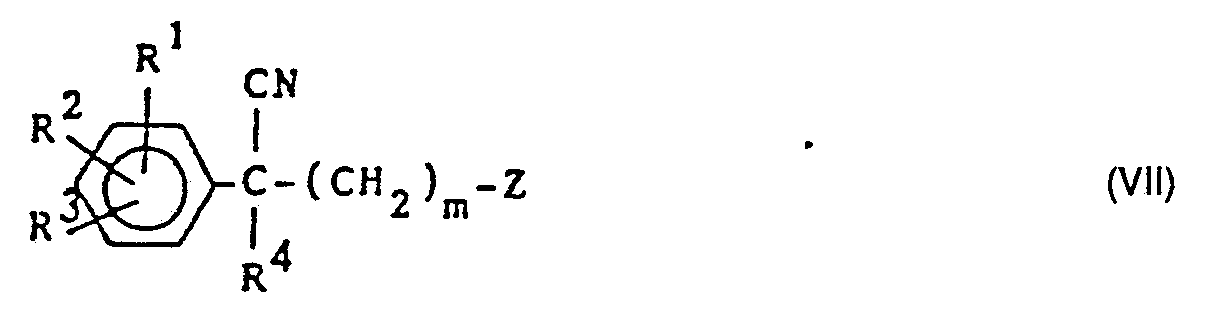


und die so erhaltenen Verbindungen, falls gewünscht und falls einer oder mehrere der Reste R1, R2, R3, R6, R7 oder R8 Alkoxygruppen sind, diese einer Etherspaltung unterwirft und/oder die so erhaltenen Verbindungen gegebenenfalls in ihre Salze mit physiologisch verträglichen Säuren überführt.
Priority Applications (1)
| Application Number | Priority Date | Filing Date | Title |
|---|---|---|---|
| AT82102699T ATE12099T1 (de) | 1981-04-10 | 1982-03-31 | Omega-cyan-1, omega-diphenyl-azaalkan-derivate, ihre herstellung und diese enthaltende arzneimittel. |
Applications Claiming Priority (4)
| Application Number | Priority Date | Filing Date | Title |
|---|---|---|---|
| DE3114497 | 1981-04-10 | ||
| DE3114497 | 1981-04-10 | ||
| DE3144150 | 1981-11-06 | ||
| DE19813144150 DE3144150A1 (de) | 1981-04-10 | 1981-11-06 | (omega)-cyan-1,(omega)-diphenyl-azaalkan-derivate, ihre herstellung und diese enthaltende arzneimittel |
Publications (2)
| Publication Number | Publication Date |
|---|---|
| EP0064158A1 EP0064158A1 (de) | 1982-11-10 |
| EP0064158B1 true EP0064158B1 (de) | 1985-03-13 |
Family
ID=25792602
Family Applications (1)
| Application Number | Title | Priority Date | Filing Date |
|---|---|---|---|
| EP82102699A Expired EP0064158B1 (de) | 1981-04-10 | 1982-03-31 | Omega-Cyan-1, omega-diphenyl-azaalkan-derivate, ihre Herstellung und diese enthaltende Arzneimittel |
Country Status (19)
| Country | Link |
|---|---|
| US (1) | US4438131A (de) |
| EP (1) | EP0064158B1 (de) |
| AU (1) | AU546383B2 (de) |
| CA (1) | CA1184186A (de) |
| CS (4) | CS238636B2 (de) |
| DD (1) | DD201778A5 (de) |
| DE (2) | DE3144150A1 (de) |
| DK (1) | DK156513C (de) |
| ES (4) | ES511260A0 (de) |
| FI (1) | FI76550C (de) |
| GB (1) | GB2100252B (de) |
| GR (1) | GR75531B (de) |
| HU (1) | HU186058B (de) |
| IE (1) | IE54044B1 (de) |
| MX (1) | MX9203501A (de) |
| NO (1) | NO152129C (de) |
| PH (1) | PH19739A (de) |
| SG (1) | SG78584G (de) |
| SU (1) | SU1308195A3 (de) |
Cited By (2)
| Publication number | Priority date | Publication date | Assignee | Title |
|---|---|---|---|---|
| US9504747B2 (en) | 2013-03-08 | 2016-11-29 | Novartis Ag | Lipids and lipid compositions for the delivery of active agents |
| US10124065B2 (en) | 2013-03-08 | 2018-11-13 | Novartis Ag | Lipids and lipid compositions for the delivery of active agents |
Families Citing this family (22)
| Publication number | Priority date | Publication date | Assignee | Title |
|---|---|---|---|---|
| DE3344755A1 (de) * | 1983-12-10 | 1985-06-20 | Basf Ag, 6700 Ludwigshafen | 1,7-diphenyl-3-methylaza-7-cyan-8-methyl-nonan zur verwendung bei der bekaempfung von krankheiten |
| DE3433383A1 (de) * | 1984-09-12 | 1986-03-20 | Boehringer Mannheim Gmbh, 6800 Mannheim | Neue phenyl-acetonitril-derivate |
| US4612329A (en) * | 1984-10-17 | 1986-09-16 | Hokuriku Pharmaceutical Co., Ltd. | Pharmaceutical alpha-aminoalkyl-alpha-alkylphenylacetonitriles |
| US4760089A (en) * | 1985-09-09 | 1988-07-26 | Smithkline Beckman Corporation | Irreversible dopamine-β-hydroxylase inhibitors |
| FR2588258B1 (fr) * | 1985-10-04 | 1989-12-15 | Adir | Nouveaux derives d'amino-5 valeronitrile, leurs procedes de preparation et les compositions pharmaceutiques les renfermant |
| DE3535950A1 (de) * | 1985-10-09 | 1987-04-09 | Basf Ag | Kombinationspraeparat |
| DE3535949A1 (de) * | 1985-10-09 | 1987-04-09 | Basf Ag | Kombinationspraeparat |
| US4593042A (en) * | 1985-10-18 | 1986-06-03 | G. D. Searle & Co. | Bicyclo-substituted phenylacetonitrile derivatives |
| PH23152A (en) * | 1985-10-18 | 1989-05-19 | Searle & Co | Bicyclo-substituted phenylacetonitrile derivatives |
| DE3542994A1 (de) * | 1985-12-05 | 1987-06-11 | Basf Ag | Basisch substituierte phenylacetaldehyde, ihre herstellung und diese enthaltende arzneimittel |
| DE3603032A1 (de) * | 1986-01-31 | 1987-08-06 | Basf Ag | Basisch substituierte phenylacetonitrile, ihre herstellung und diese enthaltende arzneimittel |
| CS258534B1 (en) * | 1986-07-18 | 1988-08-16 | Ludvik Blaha | Derivatives of valeronitrile and method of their preparation |
| DE3634389A1 (de) * | 1986-10-09 | 1988-04-21 | Knoll Ag | Verwendung von anipamil |
| DE3642331A1 (de) * | 1986-12-11 | 1988-06-23 | Basf Ag | Basisch substituierte phenylacetonitrile, ihre herstellung und diese enthaltende arzneimittel |
| ES2011011B3 (es) * | 1986-12-13 | 1989-12-16 | Basf Ag | Preparado de combinacion |
| US5486539A (en) * | 1989-12-21 | 1996-01-23 | G. D. Searle & Co. | Method of using phenylacetonitrilealkylaminoalkyl-ortho-substituted aryl compounds as immunosuppressives |
| US5247119A (en) * | 1990-12-12 | 1993-09-21 | G. D. Searle & Co. | Phenylacetonitrilehydroxyalkylaminoalkyl-ortho-substituted aryl compounds as immunosuppressives |
| CS164891A3 (en) * | 1991-05-31 | 1992-12-16 | Vyzk Ustav Farm Biochem Sp | N-arylalkyl derivatives of 2-aminomethyl-1,4-benzodioxan, and process forpreparing thereof |
| DE4124252A1 (de) * | 1991-07-22 | 1993-01-28 | Knoll Ag | Verfahren zur herstellung einer sterilfiltrierbaren wirkstoffloesung |
| DE4234000A1 (de) * | 1992-10-09 | 1994-04-14 | Knoll Ag | Verfahren zur Racemattrennung von Anipamil |
| JP5421908B2 (ja) | 2007-06-20 | 2014-02-19 | マイルストーン ファーマシューティカルズ インコーポレーテッド | 短時間作用型フェニルアルキルアミンカルシウムチャネルブロッカーおよびその使用 |
| EP3169309B1 (de) | 2014-07-16 | 2023-05-10 | Novartis AG | Verfahren zur verkapselung einer nukleinsäure in einem lipidnanopartikelhost |
Family Cites Families (8)
| Publication number | Priority date | Publication date | Assignee | Title |
|---|---|---|---|---|
| CA916719A (en) | 1972-12-12 | Dengel Ferdinand | Basically substituted phenylacetonitriles and method for their preparation | |
| DE1154810B (de) | 1961-04-01 | 1963-09-26 | Knoll Ag | Verfahren zur Herstellung basisch substituierter Phenylacetonitrile |
| DE1643429A1 (de) * | 1967-09-20 | 1971-01-28 | Knoll Ag | Basisch substituierte Phenylacetonitrile und Verfahren zu deren Herstellung |
| GB1202500A (en) | 1967-12-08 | 1970-08-19 | Knoll Ag | Substituted phenylacetonitriles |
| GB1202750A (en) | 1967-12-11 | 1970-08-19 | Knoll Ag | Substituted phenylacetonitriles |
| DE2059923C3 (de) | 1970-12-05 | 1979-01-25 | Knoll Ag, 6700 Ludwigshafen | l-a-Isopropyl-o-[(N-methyl-N-homoveratryl)v-aminopropyl] -3,4-dimethoxyphenylacetonitril, Verfahren zu dessen Herstellung und dieses enthaltende Arzneimittel |
| DE2059985C3 (de) | 1970-12-05 | 1979-10-04 | Knoll Ag, 6700 Ludwigshafen | Rechtsdrehende, basisch substituierte Phenylacetonitrile, Verfahren zu deren Herstellung und diese Verbindungen enthaltende Arzneimittel |
| DE2946545A1 (de) | 1979-11-17 | 1981-05-27 | Basf Ag, 6700 Ludwigshafen | Verfahren zur gewinnung der enantiomeren formen von 4-cyan-1-(n-methyl-n-(2'-((3'',4'',-dimethoxyphenyl))-aethyl)-amino)-5-methyl-4-(3',4',5'-trimethoxyphenyl)-hexan und dessen salzen |
-
1981
- 1981-11-06 DE DE19813144150 patent/DE3144150A1/de not_active Withdrawn
-
1982
- 1982-03-17 GR GR67618A patent/GR75531B/el unknown
- 1982-03-23 CA CA000399115A patent/CA1184186A/en not_active Expired
- 1982-03-30 US US06/363,501 patent/US4438131A/en not_active Expired - Lifetime
- 1982-03-31 DE DE8282102699T patent/DE3262516D1/de not_active Expired
- 1982-03-31 NO NO821085A patent/NO152129C/no unknown
- 1982-03-31 EP EP82102699A patent/EP0064158B1/de not_active Expired
- 1982-04-06 PH PH27104A patent/PH19739A/en unknown
- 1982-04-06 CS CS827839A patent/CS238636B2/cs unknown
- 1982-04-06 CS CS827838A patent/CS238635B2/cs unknown
- 1982-04-06 CS CS827837A patent/CS238634B2/cs unknown
- 1982-04-06 CS CS822458A patent/CS238621B2/cs unknown
- 1982-04-07 FI FI821252A patent/FI76550C/fi not_active IP Right Cessation
- 1982-04-07 DK DK159882A patent/DK156513C/da not_active IP Right Cessation
- 1982-04-07 ES ES511260A patent/ES511260A0/es active Granted
- 1982-04-07 DD DD82238830A patent/DD201778A5/de not_active IP Right Cessation
- 1982-04-08 AU AU82490/82A patent/AU546383B2/en not_active Ceased
- 1982-04-08 GB GB8210449A patent/GB2100252B/en not_active Expired
- 1982-04-08 IE IE856/82A patent/IE54044B1/en not_active IP Right Cessation
- 1982-04-09 SU SU823419898A patent/SU1308195A3/ru active
- 1982-04-09 HU HU821109A patent/HU186058B/hu not_active IP Right Cessation
-
1983
- 1983-04-15 ES ES521545A patent/ES521545A0/es active Granted
- 1983-04-15 ES ES521544A patent/ES521544A0/es active Granted
- 1983-04-15 ES ES521543A patent/ES8402560A1/es not_active Expired
-
1984
- 1984-11-05 SG SG785/84A patent/SG78584G/en unknown
-
1992
- 1992-06-26 MX MX9203501A patent/MX9203501A/es unknown
Cited By (3)
| Publication number | Priority date | Publication date | Assignee | Title |
|---|---|---|---|---|
| US9504747B2 (en) | 2013-03-08 | 2016-11-29 | Novartis Ag | Lipids and lipid compositions for the delivery of active agents |
| US10124065B2 (en) | 2013-03-08 | 2018-11-13 | Novartis Ag | Lipids and lipid compositions for the delivery of active agents |
| US10792361B2 (en) | 2013-03-08 | 2020-10-06 | Novartis Ag | Lipids and lipid compositions for the delivery of active agents |
Also Published As
Similar Documents
| Publication | Publication Date | Title |
|---|---|---|
| EP0064158A1 (de) | Omega-Cyan-1, omega-diphenyl-azaalkan-derivate, ihre Herstellung und diese enthaltende Arzneimittel | |
| DE2558501C2 (de) | ||
| EP0253327B1 (de) | Neue Diphenylpropylamin-Derivate, ihre Herstellung sowie ihre pharmazeutische Verwendung | |
| DE2434911A1 (de) | Phenylaethylamin-derivate | |
| EP0271013B1 (de) | Basisch substituierte Phenylacetonitrile, ihre Herstellung und diese enthaltende Arzneimittel | |
| DE2830884C2 (de) | ||
| EP0231003B1 (de) | Basisch substituierte Phenylacetonitrile, ihre Herstellung und diese enthaltende Arzneimittel | |
| EP0259782A1 (de) | Neue Naphtalin- und Indanderivate, diese Verbindungen enthaltende Arzneimittel und Verfahren zu deren Herstellung | |
| EP0082461B1 (de) | Substituierte Phenoxyalkanolamine und Phenoxyalkanol-cycloalkylamine, Verfahren zu ihrer Herstellung, diese Verbindungen enthaltende pharmazeutische Zubereitungen und Zwischenprodukte | |
| EP0303920B1 (de) | Neue Benzofuranderivate und diese enthaltende therapeutische Mittel | |
| DD153550A5 (de) | Verfahren zur herstellung von neuer 1,2,4-oxadiazolin-5-on-derivaten | |
| EP0054873A1 (de) | 3,4-Disubstituierte 1,2,5-Oxadiazol-2-oxide, Verfahren zu ihrer Herstellung und sie enthaltende pharmazeutische Zubereitungen | |
| EP0225543B1 (de) | Basisch substituierte Phenylacetaldehyde, ihre Herstellung und diese enthaltende Arzneimittel | |
| EP0175249A2 (de) | Neue Phenyl-acetonitril-Derivate | |
| DD216454A5 (de) | Verfahren zur herstellung neuer dihydropyridine | |
| DE2536170C3 (de) | Flavonderivate, Verfahren zu ihrer Herstellung und diese Verbindungen enthaltende Arzneimittel | |
| DE2304414C3 (de) | 1-[3-(trifluormethyl)phenyl]-2-[(cyanoalkyl)amino]-propane, verfahren zu deren herstellung und diese enthaltende arzneimittel | |
| DD148633A5 (de) | Verfahren zur herstellung von hexahydro-1,4-oxazepinen | |
| EP0030343A1 (de) | Substituierte 2-Amino-3,4-dihydropyridinderivate, Verfahren zu ihrer Herstellung und ihre Verwendung als Arzneimittel | |
| EP0027928A2 (de) | Piperidinderivate von 4,5-Dialkyl-3-hydroxy-pyrrol-2-carbonsäureestern, ihre Herstellung und diese enthaltende pharmazeutische Zubereitungen | |
| EP0082266B1 (de) | Substituierte 1,5-Diaminopentane, ihre Herstellung und diese enthaltende Arzneimittel | |
| DE1593782A1 (de) | Neue nitrilsubstituierte 1-Phenoxy-2-hydroxy-3-tert.-butylaminopropane und Verfahren zu ihrer Herstellung | |
| DE2126169C3 (de) | Alkanolaminderivate und sie enthaltende pharmazeutische Zusammensetzungen | |
| DE2229931A1 (de) | Verfahren zur herstellung von neuen o-substituierten phenylaethylguanidinen | |
| EP0329010B1 (de) | Noremopamil, seine Herstellung und Verwendung |
Legal Events
| Date | Code | Title | Description |
|---|---|---|---|
| PUAI | Public reference made under article 153(3) epc to a published international application that has entered the european phase |
Free format text: ORIGINAL CODE: 0009012 |
|
| AK | Designated contracting states |
Designated state(s): AT BE CH DE FR IT LU NL SE |
|
| 17P | Request for examination filed |
Effective date: 19821116 |
|
| ITF | It: translation for a ep patent filed | ||
| GRAA | (expected) grant |
Free format text: ORIGINAL CODE: 0009210 |
|
| AK | Designated contracting states |
Designated state(s): AT BE CH DE FR IT LI LU NL SE |
|
| REF | Corresponds to: |
Ref document number: 12099 Country of ref document: AT Date of ref document: 19850315 Kind code of ref document: T |
|
| PG25 | Lapsed in a contracting state [announced via postgrant information from national office to epo] |
Ref country code: LU Free format text: LAPSE BECAUSE OF NON-PAYMENT OF DUE FEES Effective date: 19850331 |
|
| REF | Corresponds to: |
Ref document number: 3262516 Country of ref document: DE Date of ref document: 19850418 |
|
| ET | Fr: translation filed | ||
| RIN2 | Information on inventor provided after grant (corrected) |
Free format text: EHRMANN, OSKAR, DR. * RASCHACK, MANFRED, DR. * GRIES, JOSEF, DR. * KRETZSCHMAR, ROLF, PROF. DR. * LEHMANN, HANS DIETER, PROF. DR. * FRIEDRICH, LUDWIG, DR. * WUPPERMANN, DIRK, DR. * ZIMMERMANN, FRANK, DR. * SEITZ, WERNER, DR. * TREIBER, HANS JOERG, DR. * DENGEL, FERDINAND, DR. * FRANK, WOLFRAM, DR. * KURBJUWEIT, HANS-GEORG, DR. * MUELLER, CLAUS D., DR. |
|
| PLBE | No opposition filed within time limit |
Free format text: ORIGINAL CODE: 0009261 |
|
| STAA | Information on the status of an ep patent application or granted ep patent |
Free format text: STATUS: NO OPPOSITION FILED WITHIN TIME LIMIT |
|
| 26N | No opposition filed | ||
| ITTA | It: last paid annual fee | ||
| EAL | Se: european patent in force in sweden |
Ref document number: 82102699.4 |
|
| PGFP | Annual fee paid to national office [announced via postgrant information from national office to epo] |
Ref country code: SE Payment date: 19970225 Year of fee payment: 16 |
|
| PGFP | Annual fee paid to national office [announced via postgrant information from national office to epo] |
Ref country code: AT Payment date: 19970306 Year of fee payment: 16 |
|
| PGFP | Annual fee paid to national office [announced via postgrant information from national office to epo] |
Ref country code: BE Payment date: 19970318 Year of fee payment: 16 |
|
| PG25 | Lapsed in a contracting state [announced via postgrant information from national office to epo] |
Ref country code: BE Free format text: LAPSE BECAUSE OF NON-PAYMENT OF DUE FEES Effective date: 19980331 Ref country code: AT Free format text: LAPSE BECAUSE OF NON-PAYMENT OF DUE FEES Effective date: 19980331 |
|
| PG25 | Lapsed in a contracting state [announced via postgrant information from national office to epo] |
Ref country code: SE Free format text: LAPSE BECAUSE OF NON-PAYMENT OF DUE FEES Effective date: 19980401 |
|
| BERE | Be: lapsed |
Owner name: BASF A.G. Effective date: 19980331 |
|
| EUG | Se: european patent has lapsed |
Ref document number: 82102699.4 |
|
| PGFP | Annual fee paid to national office [announced via postgrant information from national office to epo] |
Ref country code: FR Payment date: 20010219 Year of fee payment: 20 |
|
| PGFP | Annual fee paid to national office [announced via postgrant information from national office to epo] |
Ref country code: NL Payment date: 20010228 Year of fee payment: 20 Ref country code: CH Payment date: 20010228 Year of fee payment: 20 |
|
| PGFP | Annual fee paid to national office [announced via postgrant information from national office to epo] |
Ref country code: DE Payment date: 20010316 Year of fee payment: 20 |
|
| PG25 | Lapsed in a contracting state [announced via postgrant information from national office to epo] |
Ref country code: LI Free format text: LAPSE BECAUSE OF EXPIRATION OF PROTECTION Effective date: 20020330 Ref country code: CH Free format text: LAPSE BECAUSE OF EXPIRATION OF PROTECTION Effective date: 20020330 |
|
| PG25 | Lapsed in a contracting state [announced via postgrant information from national office to epo] |
Ref country code: NL Free format text: LAPSE BECAUSE OF EXPIRATION OF PROTECTION Effective date: 20020331 |
|
| REG | Reference to a national code |
Ref country code: CH Ref legal event code: PL |
|
| NLV7 | Nl: ceased due to reaching the maximum lifetime of a patent |
Effective date: 20020331 |
|
| NLV7 | Nl: ceased due to reaching the maximum lifetime of a patent |
Effective date: 20020331 |