WO2022014395A1 - 精製方法 - Google Patents
精製方法 Download PDFInfo
- Publication number
- WO2022014395A1 WO2022014395A1 PCT/JP2021/025388 JP2021025388W WO2022014395A1 WO 2022014395 A1 WO2022014395 A1 WO 2022014395A1 JP 2021025388 W JP2021025388 W JP 2021025388W WO 2022014395 A1 WO2022014395 A1 WO 2022014395A1
- Authority
- WO
- WIPO (PCT)
- Prior art keywords
- wavelength
- infrared
- solvent
- infrared rays
- compound
- Prior art date
- Legal status (The legal status is an assumption and is not a legal conclusion. Google has not performed a legal analysis and makes no representation as to the accuracy of the status listed.)
- Ceased
Links
Images

Classifications
-
- C—CHEMISTRY; METALLURGY
- C07—ORGANIC CHEMISTRY
- C07D—HETEROCYCLIC COMPOUNDS
- C07D277/00—Heterocyclic compounds containing 1,3-thiazole or hydrogenated 1,3-thiazole rings
- C07D277/02—Heterocyclic compounds containing 1,3-thiazole or hydrogenated 1,3-thiazole rings not condensed with other rings
- C07D277/20—Heterocyclic compounds containing 1,3-thiazole or hydrogenated 1,3-thiazole rings not condensed with other rings having two or three double bonds between ring members or between ring members and non-ring members
- C07D277/32—Heterocyclic compounds containing 1,3-thiazole or hydrogenated 1,3-thiazole rings not condensed with other rings having two or three double bonds between ring members or between ring members and non-ring members with hetero atoms or with carbon atoms having three bonds to hetero atoms with at the most one bond to halogen, e.g. ester or nitrile radicals, directly attached to ring carbon atoms
- C07D277/56—Carbon atoms having three bonds to hetero atoms with at the most one bond to halogen
-
- B—PERFORMING OPERATIONS; TRANSPORTING
- B01—PHYSICAL OR CHEMICAL PROCESSES OR APPARATUS IN GENERAL
- B01D—SEPARATION
- B01D9/00—Crystallisation
- B01D9/005—Selection of auxiliary, e.g. for control of crystallisation nuclei, of crystal growth, of adherence to walls; Arrangements for introduction thereof
-
- B—PERFORMING OPERATIONS; TRANSPORTING
- B01—PHYSICAL OR CHEMICAL PROCESSES OR APPARATUS IN GENERAL
- B01D—SEPARATION
- B01D9/00—Crystallisation
- B01D9/0063—Control or regulation
-
- C—CHEMISTRY; METALLURGY
- C07—ORGANIC CHEMISTRY
- C07C—ACYCLIC OR CARBOCYCLIC COMPOUNDS
- C07C227/00—Preparation of compounds containing amino and carboxyl groups bound to the same carbon skeleton
- C07C227/38—Separation; Purification; Stabilisation; Use of additives
- C07C227/40—Separation; Purification
- C07C227/42—Crystallisation
-
- C—CHEMISTRY; METALLURGY
- C07—ORGANIC CHEMISTRY
- C07C—ACYCLIC OR CARBOCYCLIC COMPOUNDS
- C07C51/00—Preparation of carboxylic acids or their salts, halides or anhydrides
- C07C51/42—Separation; Purification; Stabilisation; Use of additives
- C07C51/43—Separation; Purification; Stabilisation; Use of additives by change of the physical state, e.g. crystallisation
-
- C—CHEMISTRY; METALLURGY
- C07—ORGANIC CHEMISTRY
- C07D—HETEROCYCLIC COMPOUNDS
- C07D223/00—Heterocyclic compounds containing seven-membered rings having one nitrogen atom as the only ring hetero atom
- C07D223/14—Heterocyclic compounds containing seven-membered rings having one nitrogen atom as the only ring hetero atom condensed with carbocyclic rings or ring systems
- C07D223/18—Dibenzazepines; Hydrogenated dibenzazepines
- C07D223/22—Dibenz [b, f] azepines; Hydrogenated dibenz [b, f] azepines
- C07D223/24—Dibenz [b, f] azepines; Hydrogenated dibenz [b, f] azepines with hydrocarbon radicals, substituted by nitrogen atoms, attached to the ring nitrogen atom
- C07D223/26—Dibenz [b, f] azepines; Hydrogenated dibenz [b, f] azepines with hydrocarbon radicals, substituted by nitrogen atoms, attached to the ring nitrogen atom having a double bond between positions 10 and 11
-
- C—CHEMISTRY; METALLURGY
- C30—CRYSTAL GROWTH
- C30B—SINGLE-CRYSTAL GROWTH; UNIDIRECTIONAL SOLIDIFICATION OF EUTECTIC MATERIAL OR UNIDIRECTIONAL DEMIXING OF EUTECTOID MATERIAL; REFINING BY ZONE-MELTING OF MATERIAL; PRODUCTION OF A HOMOGENEOUS POLYCRYSTALLINE MATERIAL WITH DEFINED STRUCTURE; SINGLE CRYSTALS OR HOMOGENEOUS POLYCRYSTALLINE MATERIAL WITH DEFINED STRUCTURE; AFTER-TREATMENT OF SINGLE CRYSTALS OR A HOMOGENEOUS POLYCRYSTALLINE MATERIAL WITH DEFINED STRUCTURE; APPARATUS THEREFOR
- C30B29/00—Single crystals or homogeneous polycrystalline material with defined structure characterised by the material or by their shape
- C30B29/54—Organic compounds
-
- C—CHEMISTRY; METALLURGY
- C30—CRYSTAL GROWTH
- C30B—SINGLE-CRYSTAL GROWTH; UNIDIRECTIONAL SOLIDIFICATION OF EUTECTIC MATERIAL OR UNIDIRECTIONAL DEMIXING OF EUTECTOID MATERIAL; REFINING BY ZONE-MELTING OF MATERIAL; PRODUCTION OF A HOMOGENEOUS POLYCRYSTALLINE MATERIAL WITH DEFINED STRUCTURE; SINGLE CRYSTALS OR HOMOGENEOUS POLYCRYSTALLINE MATERIAL WITH DEFINED STRUCTURE; AFTER-TREATMENT OF SINGLE CRYSTALS OR A HOMOGENEOUS POLYCRYSTALLINE MATERIAL WITH DEFINED STRUCTURE; APPARATUS THEREFOR
- C30B7/00—Single-crystal growth from solutions using solvents which are liquid at normal temperature, e.g. aqueous solutions
- C30B7/02—Single-crystal growth from solutions using solvents which are liquid at normal temperature, e.g. aqueous solutions by evaporation of the solvent
-
- C—CHEMISTRY; METALLURGY
- C30—CRYSTAL GROWTH
- C30B—SINGLE-CRYSTAL GROWTH; UNIDIRECTIONAL SOLIDIFICATION OF EUTECTIC MATERIAL OR UNIDIRECTIONAL DEMIXING OF EUTECTOID MATERIAL; REFINING BY ZONE-MELTING OF MATERIAL; PRODUCTION OF A HOMOGENEOUS POLYCRYSTALLINE MATERIAL WITH DEFINED STRUCTURE; SINGLE CRYSTALS OR HOMOGENEOUS POLYCRYSTALLINE MATERIAL WITH DEFINED STRUCTURE; AFTER-TREATMENT OF SINGLE CRYSTALS OR A HOMOGENEOUS POLYCRYSTALLINE MATERIAL WITH DEFINED STRUCTURE; APPARATUS THEREFOR
- C30B7/00—Single-crystal growth from solutions using solvents which are liquid at normal temperature, e.g. aqueous solutions
- C30B7/02—Single-crystal growth from solutions using solvents which are liquid at normal temperature, e.g. aqueous solutions by evaporation of the solvent
- C30B7/06—Single-crystal growth from solutions using solvents which are liquid at normal temperature, e.g. aqueous solutions by evaporation of the solvent using non-aqueous solvents
-
- B—PERFORMING OPERATIONS; TRANSPORTING
- B01—PHYSICAL OR CHEMICAL PROCESSES OR APPARATUS IN GENERAL
- B01D—SEPARATION
- B01D9/00—Crystallisation
- B01D9/0018—Evaporation of components of the mixture to be separated
- B01D9/0031—Evaporation of components of the mixture to be separated by heating
-
- B—PERFORMING OPERATIONS; TRANSPORTING
- B01—PHYSICAL OR CHEMICAL PROCESSES OR APPARATUS IN GENERAL
- B01D—SEPARATION
- B01D9/00—Crystallisation
- B01D9/0077—Screening for crystallisation conditions or for crystal forms
-
- C—CHEMISTRY; METALLURGY
- C07—ORGANIC CHEMISTRY
- C07B—GENERAL METHODS OF ORGANIC CHEMISTRY; APPARATUS THEREFOR
- C07B2200/00—Indexing scheme relating to specific properties of organic compounds
- C07B2200/13—Crystalline forms, e.g. polymorphs
-
- C—CHEMISTRY; METALLURGY
- C07—ORGANIC CHEMISTRY
- C07C—ACYCLIC OR CARBOCYCLIC COMPOUNDS
- C07C2601/00—Systems containing only non-condensed rings
- C07C2601/06—Systems containing only non-condensed rings with a five-membered ring
- C07C2601/08—Systems containing only non-condensed rings with a five-membered ring the ring being saturated
-
- C—CHEMISTRY; METALLURGY
- C07—ORGANIC CHEMISTRY
- C07D—HETEROCYCLIC COMPOUNDS
- C07D277/00—Heterocyclic compounds containing 1,3-thiazole or hydrogenated 1,3-thiazole rings
- C07D277/02—Heterocyclic compounds containing 1,3-thiazole or hydrogenated 1,3-thiazole rings not condensed with other rings
- C07D277/20—Heterocyclic compounds containing 1,3-thiazole or hydrogenated 1,3-thiazole rings not condensed with other rings having two or three double bonds between ring members or between ring members and non-ring members
- C07D277/22—Heterocyclic compounds containing 1,3-thiazole or hydrogenated 1,3-thiazole rings not condensed with other rings having two or three double bonds between ring members or between ring members and non-ring members with only hydrogen atoms, hydrocarbon or substituted hydrocarbon radicals, directly attached to ring carbon atoms
- C07D277/30—Radicals substituted by carbon atoms having three bonds to hetero atoms with at the most one bond to halogen, e.g. ester or nitrile radicals
Definitions
- the present invention relates to a purification method.
- Patent Document 1 discloses a method for purifying an organic compound using laser light.
- a semistable substance is selectively produced from a solution of a substance containing a stable form and a metastable form as a crystalline form
- a laser beam is irradiated into the solution to generate bubbles to generate metastable.
- Metastable crystals are selectively produced by generating shaped crystal nuclei.
- Patent Document 1 laser light irradiation is performed to generate bubbles in the solution, and attention is not paid to infrared absorption wavelength light.
- the present invention has been made to solve such a problem, and an object of the present invention is to obtain a specific crystalline form from a solution in which a compound is dissolved in a solvent.
- the purification method of the present invention A purification method for crystallizing a compound having at least one crystalline form.
- a specific infrared wavelength at which a specific crystal form is precipitated from a solution in which the compound is dissolved in a solvent is set as a target wavelength, and an infrared emitting device capable of emitting infrared rays including the target wavelength is used to prepare the target in the solution.
- the solvent is evaporated while irradiating with infrared rays including a wavelength to precipitate the specific crystal form. It is a thing.
- a specific crystal form can be precipitated from the solution in which the compound is dissolved in the solvent.
- the reason why a specific crystal form is precipitated is not clear, but it is considered as follows.
- the dissolution rate of the compound usually differs depending on the type of solvent.
- the dissolution rate is considered to be related to the ease of crystal precipitation. Further, it is considered that the higher the absorption rate of the irradiated infrared rays, the more active the thermal vibration and the less likely it is that crystal nuclei are generated. From these facts, it is considered that the conditions suitable for the precipitation of a specific crystal form are determined by the solvent for dissolving the compound and the infrared rays irradiating the solution.
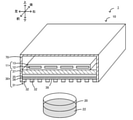
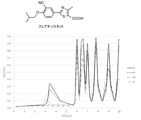
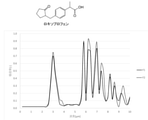
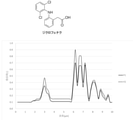
- FIG. 1 Perspective view of the purification apparatus 1 (partially shown in cross section). Partial bottom view of the infrared heater 10. Graph showing infrared absorption spectrum of febuxostat. The graph which shows the infrared absorption spectrum of loxoprofen. The graph which shows the infrared absorption spectrum of diclofenac.
- the purification method of the present embodiment is a purification method for crystallizing a compound having at least one crystal form, and a target wavelength is a specific infrared wavelength at which a specific crystal form is precipitated from a solution in which the compound is dissolved in a solvent.
- a target wavelength is a specific infrared wavelength at which a specific crystal form is precipitated from a solution in which the compound is dissolved in a solvent.
- the solvent is evaporated while irradiating the solution with infrared rays containing the target wavelength to precipitate a specific crystal form.
- the compound may have a plurality of crystal forms or may have a single crystal form.
- the crystalline form b2 is precipitated when the solvent p2 is evaporated while irradiating the solution in which the raw material of the organic compound X is dissolved in the solvent p2 with infrared rays containing the wavelength ⁇ 2 [ ⁇ m].
- infrared rays containing the solvent p1 used in the first preliminary experiment and the wavelength ⁇ 1 [ ⁇ m] are adopted.
- the infrared ray containing the solvent p1 and the wavelength ⁇ 2 [ ⁇ m] used in the second preliminary experiment is adopted.
- the infrared ray containing the solvent p2 and the wavelength ⁇ 1 [ ⁇ m] used in the third preliminary experiment is adopted. If it is desired to precipitate the crystalline form b2, the infrared ray containing the solvent p2 and the wavelength ⁇ 2 [ ⁇ m] used in the fourth preliminary experiment is adopted.
- the wavelength ⁇ 1 [ ⁇ m] or the wavelength ⁇ 2 [ ⁇ m] when setting the wavelength ⁇ 1 [ ⁇ m] or the wavelength ⁇ 2 [ ⁇ m], it is preferable to set the wavelength ⁇ 1 [ ⁇ m] or the wavelength ⁇ 2 [ ⁇ m] based on the infrared absorption spectrum of the crystal form and the dissolution rate of the raw material in the solvent, and it is preferable to set the stability of the crystal form and the crystal. It is more preferable to set based on the infrared absorption spectrum of the shape and the dissolution rate of the raw material in the solvent.
- the infrared absorption spectra of each crystal form are often different, and the absorption rate of each crystal form for a certain wavelength is often different.
- the crystal form with a high absorption rate for that wavelength becomes more active in thermal vibration than the crystal form with a low absorption rate, and crystal nuclei are less likely to be generated, so that precipitation is less likely to occur.
- the crystal form in which the crystal nuclei are easily formed differs between the solvent having a high dissolution rate of the raw material and the solvent having a slow dissolution rate.
- a crystal form having high stability often has a property of being more difficult to dissolve than other crystal forms, and therefore, there is a high possibility that it will be selectively precipitated when a solvent having a high dissolution rate is used.
- Crystal forms with low stability are likely to selectively precipitate when a solvent with a slow dissolution rate is used. Therefore, it is preferable to set the wavelength ⁇ 1 [ ⁇ m] and the wavelength ⁇ 2 [ ⁇ m] based on the infrared absorption spectrum of the crystalline form and the dissolution rate of the raw material in the solvent, and the stability of the crystalline form and the infrared absorption spectrum of the crystalline form. It is more preferable to set it based on the dissolution rate of the raw material in the solvent.
- an infrared ray having a peak at a wavelength ⁇ 1 [ ⁇ m] may be used as an infrared ray containing a wavelength ⁇ 1 [ ⁇ m]
- an infrared ray having a peak at a wavelength ⁇ 2 [ ⁇ m] may be used as an infrared ray containing a wavelength ⁇ 2 [ ⁇ m].
- the solvent q may be evaporated while irradiating the solution in which the organic compound Y is dissolved in the solvent q with infrared rays containing the wavelength ⁇ [ ⁇ m].
- infrared rays having a peak at the wavelength ⁇ [ ⁇ m] may be used as the infrared rays including the wavelength ⁇ [ ⁇ m].
- the compound that can be purified by the purification method of the present embodiment is not particularly limited, and examples thereof include febuxostat, terfenazine, indomethacin, ibuprofen, loxoprofen, caffeine, diclofenac, and carbamazepine.
- the solvent for dissolving the raw material of the compound is not particularly limited, but for example, methanol, ethanol, 1-propanol, 2-propanol (isopropanol (IPA)), 1-butanol, 2-butanol, and isobutanol.
- Turt-alcohol solvents such as butanol; nitrile solvents such as acetonitrile and propionitrile; ether solvents such as diethyl ether and tetrahydrofuran; ketone solvents such as acetone and methyl ethyl ketone; halogen solvents such as dichloromethane and chloroform; acetic acid Ester-based solvents such as ethyl and methyl acetate; aliphatic hydrocarbon-based solvents such as pentane, hexane, heptane, octane and cyclohexane; aromatic hydrocarbon-based solvents such as benzene, toluene and xylene; Examples include solvents.
- any infrared emitting device capable of emitting infrared rays including a wavelength ⁇ [ ⁇ m] can be used.
- the infrared emitting device a device having a plate-shaped radiator and a planar heater as a heat source can be used.
- the infrared emitting device it is preferable to use an infrared emitting device capable of emitting infrared rays having a peak at a wavelength ⁇ [ ⁇ m], particularly an infrared ray having a peak at a wavelength ⁇ [ ⁇ m] and having a narrow half width.
- Examples of such an infrared emitting device include a metamaterial emitter and an infrared emitting device with a filter.
- Examples of the metamaterial emitter include a MIM (Metal-Insulator-Metal) type, a microcavity type, a metaatom type, and a laminated type.
- MIM Metal-Insulator-Metal
- microcavity type for example, the one described in Reference 1 (JSME TED Newsletter, No. 74, pp.7-10, 2014) can be used. This MIM type will be described in detail later.
- As the microcavity type and the metaatom type for example, those described in Reference 2 (JSME TED Newsletter, No. 74, pp. 2-6, 2014) can be used.
- the laminated type for example, the one described in Reference 3 (ACS Cent. Sci., Vol. 5, pp319-326, 2019) can be used.
- the infrared emitting device with a filter for example, the infrared heater described in Japanese Patent No. 6442355 can be used.
- FIG. 1 is a perspective view of the purification apparatus 1, and a part thereof is shown in a cross section.
- FIG. 2 is a partial bottom view of the infrared heater 10. The left-right direction, front-back direction, and up-down direction are as shown in FIG.
- the purification device 1 is a device that precipitates a specific crystal form from the solution 22 in the flat petri dish 20 using an infrared heater 10.
- Solution 22 is a compound in which a compound having a plurality of crystalline forms is dissolved in a solvent.
- the infrared heater 10 is an example of a MIM type metamaterial emitter, and includes a heater main body 11, a structure 30, and a casing 70.
- the infrared heater 10 radiates infrared rays toward the solution 22 in the flat petri dish 20 arranged below.
- the heater main body 11 is configured as a so-called planar heater, and is a heating element 12 in which a linear member is curved in a zigzag manner, and a protective member which is an insulator that comes into contact with the heating element 12 and covers the periphery of the heating element 12. It is equipped with 13.
- Examples of the material of the heating element 12 include W, Mo, Ta, Fe—Cr—Al alloy and Ni—Cr alloy.
- Examples of the material of the protective member 13 include an insulating resin such as polyimide and ceramics.
- the heater main body 11 is arranged inside the casing 70. Both ends of the heating element 12 are connected to a pair of input terminals (not shown) attached to the casing 70, respectively. Electric power can be supplied to the heating element 12 from the outside via the pair of input terminals.
- the heater main body 11 may be a planar heater having a ribbon-shaped heating element wound around an insulator.
- the structure 30 is a plate-shaped radiator arranged below the heating element 12.
- the structure 30 has a first conductor layer 31 (metal pattern), a dielectric layer 34, a second conductor layer 35 (metal substrate), and a support substrate 37 from the lower outside to the inside of the infrared heater 10. They are stacked in this order.
- the structure 30 is arranged so as to close the opening below the casing 70.
- the first conductor layer 31 is configured as a metal pattern having a periodic structure in which metal electrodes 32 having the same shape and the same size are arranged at equal intervals on the dielectric layer 34.
- a plurality of square metal electrodes 32 are arranged on the dielectric layer 34 at intervals D1 in the left-right direction at equal intervals and at equal intervals D2 in the front-rear direction. It is configured as a metal pattern that is spaced apart and evenly spaced from each other.
- the metal electrode 32 has a shape in which the thickness (vertical height) is smaller than the horizontal width W1 (horizontal width) and the vertical width W2 (front-back width).
- D1 and D2 are equal, and W1 and W2 are equal.
- the material of the metal electrode 32 include gold and aluminum (Al).
- the metal electrode 32 is bonded to the dielectric layer 34 via an adhesive layer (not shown).
- the material of the adhesive layer include chromium (Cr), titanium (Ti), ruthenium (Ru) and the like.
- the dielectric layer 34 is a flat plate-shaped member whose upper surface is joined to the second conductor layer 35.
- the dielectric layer 34 is sandwiched between the first conductor layer 31 and the second conductor layer 35.
- the portion of the lower surface of the dielectric layer 34 where the metal electrode 32 is not arranged is a radiation surface 38 that radiates infrared rays to the object.
- Examples of the material of the dielectric layer 34 include alumina (Al 2 O 3 ) and silica (SiO 2 ).
- the second conductor layer 35 is a metal plate whose upper surface is joined to the support substrate 37 via an adhesive layer (not shown).
- an adhesive layer (not shown).
- the material of the second conductor layer 35 the same material as that of the first conductor layer 31 can be used.
- the material of the adhesive layer include chromium (Cr), titanium (Ti), ruthenium (Ru) and the like.
- the support substrate 37 is a flat plate-shaped member fixed inside the casing 70 by a fixture or the like (not shown), and supports the first conductor layer 31, the dielectric layer 34, and the second conductor layer 35.
- Examples of the material of the support substrate 37 include materials such as Si wafers and glass, which can easily maintain a smooth surface, have high heat resistance, and have low thermal warpage.
- the support substrate 37 may be in contact with the lower surface of the heater main body 11 or may be arranged vertically and vertically separated through a space without contacting the lower surface of the heater main body 11. When the support substrate 37 and the heater main body 11 are in contact with each other, they may be joined.
- Such a structure 30 functions as a metamaterial emitter having a property of selectively emitting infrared rays having a specific wavelength. This property is believed to be due to the resonance phenomenon described by Magneticpolariton.
- the magnetic polariton is a resonance phenomenon in which a strong electromagnetic field confinement effect is obtained in the dielectric (dielectric layer 34) between the upper and lower two conductors (first conductor layer 31 and second conductor layer 35). be.
- the portion of the dielectric layer 34 sandwiched between the second conductor layer 35 and the metal electrode 32 becomes the radiation source of infrared rays.
- the infrared rays emitted from the radiation source go around the metal electrode 32 and are radiated to the surrounding environment from the portion of the dielectric layer 34 where the metal electrode 32 is not arranged (that is, the radiation surface 38).
- the resonance wavelength is adjusted by adjusting the materials of the first conductor layer 31, the dielectric layer 34 and the second conductor layer 35, and the shape and periodic structure of the first conductor layer 31. Can be done.
- the infrared rays emitted from the radiation surface 38 of the structure 30 exhibit a characteristic that the emissivity of infrared rays having a specific wavelength is increased.
- the above-mentioned material so as to have the property of radiating infrared rays having a maximum peak of 0.7 or more (preferably 0.8 or more) and an emissivity of 0.7 or more (preferably 0.8 or more) from the radiation surface 38 at 5 ⁇ m or less, more preferably 1.0 ⁇ m or less).
- the shape and periodic structure are adjusted.
- the structure 30 has a characteristic of emitting infrared rays having a steep maximum peak having a relatively small half-value width and a relatively high emissivity.
- the half width is not particularly limited, but is preferably 2.0 ⁇ m or less, more preferably 1.5 ⁇ m or less, still more preferably 1.0 ⁇ m or less.
- the casing 70 has a substantially rectangular parallelepiped shape with a space inside and an open bottom surface.
- the heater main body 11 and the structure 30 are arranged in the space inside the casing 70.
- the casing 70 is made of metal (for example, SUS or aluminum) so as to reflect infrared rays emitted from the heating element 12.
- a flat petri dish 20 containing the solution 22 is placed at a position below the first conductive layer 31 of the infrared heater 10.
- the solution 22 is the organic compound X dissolved in the solvent p1.
- electric power is supplied to both ends of the heating element 12 from a power source (not shown) via an input terminal.
- the electric power is supplied so that the temperature of the heating element 12 becomes a preset temperature (for example, several hundred ° C., although not particularly limited).
- a preset temperature for example, several hundred ° C., although not particularly limited.
- energy is transferred to the surroundings by one or more of the three forms of heat transfer of conduction, convection, and radiation, and the structure 30 is heated.
- the structure 30 rises to a predetermined temperature, becomes a secondary radiator, and emits infrared rays.
- a predetermined wavelength ⁇ 1 [ ⁇ m] is set as the target wavelength, and infrared rays having a peak at the wavelength ⁇ 1 [ ⁇ m] are set so as to be emitted from the structure 30.
- the distances D1 and D2 of the metal electrodes 32 of the structure 30 and the width W1 of the metal electrodes 32 are such that the infrared rays emitted from the structure 30 become infrared rays having a peak at a predetermined wavelength ⁇ 1 [ ⁇ m].
- W2 and the period ⁇ 1, ⁇ 2 of the metal pattern are set.
- the solvent p1 of the solution 22 evaporates with the passage of time, and finally the crystal of the organic compound X having the crystal form a1 is selectively selected. Precipitate in.
- the infrared heater 10 is designed to mainly emit infrared rays of a target wavelength, it is difficult to exclude all radiation other than the target wavelength in the infrared radiation of the structure 30, and the atmosphere is the same. Then, convection radiation from each part of the heater to the surroundings is also predicted. Therefore, when constructing an actual process, various considerations should be given to the shape of the device and the like so that the temperature of the raw material and the like does not rise excessively due to the accompanying heat flow.
- the purification method of the present embodiment described in detail above a specific crystal form is precipitated from the solution in which the compound is dissolved by adjusting the solvent for dissolving the compound and the peak wavelength of the infrared rays irradiating the solution.
- the MIM type infrared heater 10 since the MIM type infrared heater 10 is used, it can be designed so that the peak wavelength of the emitted infrared rays matches the target wavelength with high accuracy.
- the first conductor layer 31 of the infrared heater 10 is configured as a metal pattern having a periodic structure in which metal electrodes 32 having the same shape and the same size are arranged at equal intervals from each other.
- the infrared heater 10 changes the peak wavelength of infrared rays emitted according to the horizontal width W1 and the vertical width W2 of the metal electrode 32.
- the horizontal width W1 and the vertical width W2 of the metal electrode 32 can be accurately manufactured according to the design values, for example, by drawing with a well-known electron beam drawing device and lifting off. Therefore, the work of adjusting the peak wavelength of the infrared rays radiated from the infrared heater 10 to the target wavelength can be performed relatively easily and accurately.
- the metal electrode 32 has a rectangular shape, but it may have a circular shape.
- the diameter of the circular metal electrode 32 corresponds to the horizontal width W1 and the vertical width W2.
- the petri dish was placed on a heating stage, and the time from the time when the petri dish was placed to the time when it was confirmed by a stereomicroscope that there was no undissolved residue of febuxostat in the solvent was defined as the dissolution time.
- the dissolution time As a result, ethanol, 2-propanol, and acetonitrile were obtained in order from the one with the shortest dissolution time (in other words, the one with the fastest dissolution rate). The results are shown in Table 1.
- Febuxostat is known to have a plurality of crystal forms F1, F2, Q, H1.
- a graph of the infrared absorption spectrum of each crystal form is shown in FIG.
- Loxoprofen is known to have crystalline forms F1 and F2.
- a graph of the infrared absorption spectrum of each crystal form is shown in FIG.
- Diclofenac is known to have crystalline forms F1 and F2.
- a graph of the infrared absorption spectrum of each crystal form is shown in FIG. Table 2 shows the absorption rates of febuxostat, loxoprofen, and diclofenac in the infrared absorption spectra of each crystal form at wavelengths of 3.7 ⁇ m and 6.7 ⁇ m.
- Example 1 Weigh 25 mg of febuxostat (product code F0847, Tokyo Chemical Industry) into a flat petri dish ( ⁇ 32 mm ⁇ 16 mm), add 1 mL of ethanol (Kanto Chemical), and heat on a hot plate adjusted to 80 ° C for 2 minutes. A test sample was prepared by dissolving with light stirring. The solvent was evaporated and crystals were precipitated by radiating the test sample with infrared rays having a wavelength of 3.7 ⁇ m (here, infrared rays having a peak at a wavelength of 3.7 ⁇ m) (radiation source temperature 400 ° C.) for 30 minutes. Infrared rays were radiated using the MIM type infrared heater 10.
- the height h of the first conductor layer 31 (metal electrode 32) made of Au is 100 nm
- the thickness d of the dielectric layer 34 made of Al 2 O 3 is 100 nm
- the height f of the second conductor layer 35 made of Au is 200 nm.
- the width W1 and length W2 of the metal electrode 32 are set to 840 nm
- the intervals D1 and D2 are set to 1160 nm
- the periods ⁇ 1 and ⁇ 2 are set to 2000 nm
- infrared rays (half-value width 0.5 ⁇ m) having a peak at a wavelength of 3.7 ⁇ m are emitted. rice field.
- the crystal form of the precipitated crystal was identified by XRD analysis, the crystal form was F1.
- XRD analysis was performed using an X-ray diffractometer (product names: Ultra IV, Rigaku).
- Example 2 A test sample was prepared in the same manner as in Example 1 except that infrared rays having a wavelength of 6.7 ⁇ m (here, infrared rays having a peak at a wavelength of 6.7 ⁇ m) were used instead of infrared rays having a wavelength of 3.7 ⁇ m, and XRD was used.
- the crystal form was identified by analysis. As a result, the crystal form was F2.
- the height h of the first conductor layer 31 (here, the layer having the circular metal electrode 32) of the infrared heater 10 is 50 nm
- the thickness d of the dielectric layer 34 is 190 nm
- the height of the second conductor layer 35 is high.
- the f is 100 nm
- the diameter of the circular metal electrodes 32 (corresponding to W1 and W2) is 2.16 ⁇ m
- the distance between the metal electrodes (corresponding to D1 and D2) is 1.84 ⁇ m
- the period (corresponding to ⁇ 1, ⁇ 2).
- the setting was set to 4.0 ⁇ m, and infrared rays (half-value width 0.5 ⁇ m) having a peak at a wavelength of 6.7 ⁇ m were emitted.
- Example 3 A test sample was prepared in the same manner as in Example 1 except that 1 mL of 2-propanol (sigma-aldrich) was used instead of 1 mL of ethanol, and the crystal form was identified by XRD analysis. As a result, the crystal form was H1.
- Example 4 Same as Example 1 except that 2 mL of acetonitrile (Kishida chemistry) was used instead of 1 mL of ethanol and infrared rays having a peak at a wavelength of 6.7 ⁇ m were used instead of infrared rays having a peak at a wavelength of 3.7 ⁇ m. A test sample was prepared and the crystal form was identified by XRD analysis. As a result, the crystal form was Q.
- the combination of the solvent and the peak wavelength of infrared rays may be determined depending on which of the four crystal forms F1, F2, H1, and Q is desired to be deposited.
- ethanol may be used as a solvent and infrared rays having a peak wavelength of 3.7 ⁇ m may be irradiated as in Example 1.
- ethanol may be used as a solvent and infrared rays having a peak wavelength of 6.7 ⁇ m may be irradiated as in Example 2.
- febuxostat of crystalline form H1 When it is desired to precipitate febuxostat of crystalline form H1, 2-propanol may be used as a solvent and infrared rays having a peak wavelength of 3.7 ⁇ m may be irradiated as in Example 3.
- acetonitrile When it is desired to precipitate febuxostat of crystalline form Q, acetonitrile may be used as a solvent and infrared rays having a peak wavelength of 6.7 ⁇ m may be irradiated as in Example 4.
- the stability of the crystal form of febuxostat is F1, F2, Q, H1 in the order of stability.
- Febuxostat F1 is considered to be the most stable crystalline form, that is, the most stable form.
- the most stable form is less soluble in solvent than other crystalline forms. Therefore, when a solvent having a high dissolution rate is used, the most stable form is basically precipitated. That is, in the case of precipitating the most stable form, it is preferable to use a solvent having a high dissolution rate. Since the other crystal forms are more soluble than the most stable form, they tend to be more difficult to precipitate than the most stable form when a solvent having a high dissolution rate is used.
- the absorption spectrum of the most stable form F1 When precipitating the most stable form, select a wavelength that is difficult for the most stable form to absorb.
- the absorption rate is high over all wavelengths as shown in FIG. 3 as compared with other crystal forms, but 3.7 ⁇ m, which is a wavelength that is relatively difficult to absorb, is selected. Since the wavelength of 3.7 ⁇ m also absorbs F2, it is considered that the generation of F2 is hindered to some extent. From the above, when the most stable form of febuxostat, F1, is selectively precipitated, ethanol having a high dissolution rate is selected as the solvent, and 3.7 ⁇ m, which is relatively difficult to absorb, is selected as the wavelength.
- Febuxostat H1 is considered to be the crystal form with the least stability, that is, the metastable form.
- the metastable form is more soluble in solvent than other crystalline forms. Therefore, the metastable form is less likely to precipitate than other crystalline forms unless the degree of supersaturation is increased by using a solvent having a slow dissolution rate. That is, in the case of precipitating the metastable form, it is preferable to use a solvent having a slow dissolution rate.
- a solvent having a slow dissolution rate When precipitating the metastable form, select a wavelength that is difficult for the metastable form to absorb and easily absorbed by other crystal forms. In this way, other crystal forms are less likely to precipitate because thermal vibration becomes active and crystal nuclei are less likely to be generated.
- the stability of F2 and Q of febuxostat is located between the metastable H1 and the most stable F1. Therefore, it is preferable to select a dissolution rate and an infrared wavelength having properties intermediate between H1 and F1.
- Example 5 Weigh 25 mg of loxoprofen (product code L0244, Tokyo Chemical Industry) into a flat petri dish ( ⁇ 32 mm ⁇ 16 mm), add 1 mL of 2-propanol, heat on a hot plate adjusted to 80 ° C for 1 minute, and stir lightly. A test sample was prepared by dissolving. The solvent was evaporated and crystals were precipitated by radiating the test sample with infrared rays having a wavelength of 6.7 ⁇ m (here, infrared rays having a peak at a wavelength of 6.7 ⁇ m). When the crystal form of the precipitated crystal was identified by XRD analysis, the crystal form was F1.
- Example 6 Performed except that ethanol was used as the solvent instead of 2-propanol, and infrared rays having a wavelength of 3.7 ⁇ m (here, infrared rays having a peak at wavelength 3.7) were used instead of infrared rays having a wavelength of 6.7 ⁇ m. Crystals were precipitated in the same manner as in Example 5. When the crystal form of the precipitated crystal was identified by XRD analysis, the crystal form was F2.
- the combination of the solvent and the peak wavelength of infrared rays may be determined depending on which of the two crystal forms F1 and F2 of loxoprofen is desired to be precipitated. Specifically, when it is desired to precipitate loxoprofen in crystalline form F1, 2-propanol may be used as a solvent and infrared rays having a peak wavelength of 6.7 ⁇ m may be irradiated. When it is desired to precipitate loxoprofen in crystalline form F2, ethanol may be used as a solvent and infrared rays having a peak wavelength of 3.7 ⁇ m may be irradiated.
- the stability of the crystal form of loxoprofen is considered to be F2 and F1 in the order of stability, F2 is the most stable form, and F1 is the metastable form.
- F2 is the most stable form
- F1 is the metastable form.
- the metastable form When precipitating the metastable form, it is preferable to use a solvent having a slow dissolution rate, and it is preferable to select a wavelength at which the metastable form is difficult to absorb and other crystal forms are easily absorbed. From the above, when selectively precipitating the semi-stable form of loxoprofen, 2-propanol, which has a slow dissolution rate, is selected as the solvent, and the wavelength is 6.7 ⁇ m, which is harder to absorb than other crystalline forms. Select.
- a test sample was prepared by heating on a temperature-controlled hot plate for 1 minute and dissolving with light stirring. The solvent was evaporated and crystals were precipitated by radiating the test sample with infrared rays having a wavelength of 6.7 ⁇ m (here, infrared rays having a peak at a wavelength of 6.7 ⁇ m). When the crystal form of the precipitated crystal was identified by XRD analysis, the crystal form was F1.
- Example 8 Examples except that ethanol was used as the solvent instead of the mixed solvent, and infrared rays having a wavelength of 3.7 ⁇ m (here, infrared rays having a peak at wavelength 3.7) were used instead of infrared rays having a wavelength of 6.7 ⁇ m. Crystals were precipitated in the same manner as in 7. When the crystal form of the precipitated crystal was identified by XRD analysis, the crystal form was F2.
- the stability of the crystal form of diclofenac is considered to be F2 and F1 in the order of stability, F2 is the most stable form, and F1 is the metastable form.
- F2 is the most stable form
- F1 is the metastable form.
- the present invention can be used, for example, to selectively obtain a specific crystal form of a compound having a plurality of crystal forms.
Landscapes
- Chemical & Material Sciences (AREA)
- Organic Chemistry (AREA)
- Crystallography & Structural Chemistry (AREA)
- Engineering & Computer Science (AREA)
- Materials Engineering (AREA)
- Metallurgy (AREA)
- Oil, Petroleum & Natural Gas (AREA)
- Chemical Kinetics & Catalysis (AREA)
- Physical Or Chemical Processes And Apparatus (AREA)
- Investigating Or Analysing Materials By Optical Means (AREA)
- Organic Low-Molecular-Weight Compounds And Preparation Thereof (AREA)
- Pharmaceuticals Containing Other Organic And Inorganic Compounds (AREA)
- Acyclic And Carbocyclic Compounds In Medicinal Compositions (AREA)
Priority Applications (4)
| Application Number | Priority Date | Filing Date | Title |
|---|---|---|---|
| CN202180023513.2A CN115315298B (zh) | 2020-07-13 | 2021-07-06 | 精制方法 |
| EP21841440.7A EP4180104A4 (en) | 2020-07-13 | 2021-07-06 | Refining method |
| JP2022517273A JP7096957B2 (ja) | 2020-07-13 | 2021-07-06 | 精製方法 |
| US18/147,229 US20230150957A1 (en) | 2020-07-13 | 2022-12-28 | Refining method |
Applications Claiming Priority (2)
| Application Number | Priority Date | Filing Date | Title |
|---|---|---|---|
| JP2020027266 | 2020-07-13 | ||
| JPPCT/JP2020/027266 | 2020-07-13 |
Related Child Applications (1)
| Application Number | Title | Priority Date | Filing Date |
|---|---|---|---|
| US18/147,229 Continuation US20230150957A1 (en) | 2020-07-13 | 2022-12-28 | Refining method |
Publications (1)
| Publication Number | Publication Date |
|---|---|
| WO2022014395A1 true WO2022014395A1 (ja) | 2022-01-20 |
Family
ID=79555315
Family Applications (3)
| Application Number | Title | Priority Date | Filing Date |
|---|---|---|---|
| PCT/JP2021/025388 Ceased WO2022014395A1 (ja) | 2020-07-13 | 2021-07-06 | 精製方法 |
| PCT/JP2021/025389 Ceased WO2022014396A1 (ja) | 2020-07-13 | 2021-07-06 | 精製方法 |
| PCT/JP2021/025390 Ceased WO2022014397A1 (ja) | 2020-07-13 | 2021-07-06 | 精製方法 |
Family Applications After (2)
| Application Number | Title | Priority Date | Filing Date |
|---|---|---|---|
| PCT/JP2021/025389 Ceased WO2022014396A1 (ja) | 2020-07-13 | 2021-07-06 | 精製方法 |
| PCT/JP2021/025390 Ceased WO2022014397A1 (ja) | 2020-07-13 | 2021-07-06 | 精製方法 |
Country Status (5)
| Country | Link |
|---|---|
| US (4) | US20230167577A1 (enExample) |
| EP (3) | EP4180106A4 (enExample) |
| JP (5) | JP7096958B2 (enExample) |
| CN (3) | CN115315298B (enExample) |
| WO (3) | WO2022014395A1 (enExample) |
Cited By (1)
| Publication number | Priority date | Publication date | Assignee | Title |
|---|---|---|---|---|
| WO2025062998A1 (ja) * | 2023-09-20 | 2025-03-27 | 日本碍子株式会社 | 結晶化装置および結晶化方法 |
Families Citing this family (3)
| Publication number | Priority date | Publication date | Assignee | Title |
|---|---|---|---|---|
| KR102485717B1 (ko) * | 2017-09-01 | 2023-01-09 | 삼성전자주식회사 | 공기조화기 |
| WO2025182996A1 (ja) * | 2024-02-28 | 2025-09-04 | 日本碍子株式会社 | 結晶化方法 |
| WO2025181982A1 (ja) * | 2024-02-28 | 2025-09-04 | 日本碍子株式会社 | 結晶化方法 |
Citations (4)
| Publication number | Priority date | Publication date | Assignee | Title |
|---|---|---|---|---|
| JPH0142355B2 (enExample) | 1982-04-19 | 1989-09-12 | Taiyo Sanso Co Ltd | |
| JP2004267114A (ja) * | 2003-03-10 | 2004-09-30 | Ishii Iron Works Co Ltd | 酒石酸塩の析出分離方法及びその方法を用いて得られた赤外線照射飲料 |
| JP2012529537A (ja) * | 2009-06-10 | 2012-11-22 | テバ ファーマシューティカル インダストリーズ リミティド | フェブキソスタットの結晶形 |
| WO2018034305A1 (ja) * | 2016-08-19 | 2018-02-22 | 日本碍子株式会社 | 有機化合物の精製方法 |
Family Cites Families (32)
| Publication number | Priority date | Publication date | Assignee | Title |
|---|---|---|---|---|
| GB2122602B (en) * | 1982-06-07 | 1985-06-05 | Hisamitsu Pharmaceutical Co | Novel 2 3-dihydro-indene derivatives |
| JPH0744154B2 (ja) * | 1987-12-16 | 1995-05-15 | 株式会社豊田中央研究所 | 光照射型低温mocvd方法および装置 |
| JP3805533B2 (ja) * | 1998-07-21 | 2006-08-02 | 東京瓦斯株式会社 | 同位体分離方法 |
| AU3469800A (en) * | 1999-07-06 | 2001-01-22 | Bruce A. Garetz | Method for using laser light to control crystal form |
| RU2160795C1 (ru) * | 1999-07-07 | 2000-12-20 | Уральский государственный технический университет | Способ получения высокочистых веществ |
| JP2001247526A (ja) * | 2000-03-06 | 2001-09-11 | Toyobo Co Ltd | 近赤外線吸収化合組成物および近赤外線吸収フィルター |
| EP1172646A1 (en) * | 2000-07-13 | 2002-01-16 | Universiteit Leiden | Screening crystallisation conditions of organic compounds |
| AU2003251288A1 (en) * | 2002-03-21 | 2003-11-03 | Berkshire Laboratories, Inc. | Methods for controlling crystal growth, crystallization, structures and phases in materials and systems |
| JP2003319800A (ja) * | 2002-05-07 | 2003-11-11 | Itochu Seito Kk | 砂糖の製造方法 |
| JP2004226277A (ja) * | 2003-01-23 | 2004-08-12 | Bios Ikagaku Kenkyusho:Kk | 生体物質および化学物質の光学的測定方法および光学的測定装置 |
| EP1948655A1 (en) * | 2005-10-03 | 2008-07-30 | Mallinckrodt, Inc. | Process for preparing zolpidem hemitartrate and tartrate polymorphs |
| CN100417750C (zh) * | 2006-05-23 | 2008-09-10 | 青岛大学 | 溶液法晶体快速生长装置 |
| EP1887004A1 (en) * | 2006-08-07 | 2008-02-13 | Palau Pharma, S.A. | Crystalline forms of (1R,2R)-7-Chloro-3-[2-(2,4-difluorophenyl)-2-hydroxy-1-methyl-3-(1H-1,2,4-triazol-1-yl)propyl]quinazolin-4(3H)-one |
| NZ577502A (en) * | 2006-12-28 | 2012-02-24 | Hoffmann La Roche | Crystalline forms glyt1 |
| JP2010075838A (ja) * | 2008-09-25 | 2010-04-08 | Itaken:Kk | 気泡発生ノズル |
| KR20130129070A (ko) * | 2010-07-12 | 2013-11-27 | 융신 파마슈티칼 인더스트리얼 컴파니 리미티드 | 트라마돌의 디클로페낙 염 |
| CN102267957B (zh) * | 2011-08-24 | 2013-04-24 | 山东齐都药业有限公司 | 非布司他a晶型的制备方法 |
| JP5848621B2 (ja) * | 2012-01-25 | 2016-01-27 | 浜松ホトニクス株式会社 | 薬物評価方法及び薬物評価装置 |
| JP2014189462A (ja) | 2013-03-27 | 2014-10-06 | Osaka Univ | 結晶製造方法、準安定形結晶、医薬の製造方法および医薬 |
| JP2014214299A (ja) * | 2013-04-30 | 2014-11-17 | 旭硝子株式会社 | 近赤外線吸収粒子、その製造方法、分散液およびその物品 |
| CN103333064B (zh) * | 2013-07-17 | 2014-04-23 | 珠海金鸿药业股份有限公司 | 洛索洛芬钠化合物及其药物组合物 |
| AU2014332960B2 (en) * | 2013-10-08 | 2018-03-29 | Meiji Seika Pharma Co., Ltd. | Crystals of diazabicyclooctane derivative and production method for crystals of diazabicyclooctane derivative |
| JP6270402B2 (ja) * | 2013-10-17 | 2018-01-31 | 株式会社アスプ | 気体含有液生成装置および気体含有液噴射機構 |
| JP2017061582A (ja) * | 2014-02-07 | 2017-03-30 | 国立研究開発法人産業技術総合研究所 | 蛍光体微粒子の製造方法、蛍光体薄膜、波長変換膜、波長変換デバイス及び太陽電池 |
| WO2015140062A1 (de) * | 2014-03-19 | 2015-09-24 | Basf Se | Verfahren und vorrichtung zum abtrennen eines stoffes aus einer lösung |
| JPWO2016133170A1 (ja) * | 2015-02-20 | 2017-12-07 | 株式会社クラレ | イオン交換膜 |
| US20160289173A1 (en) * | 2015-04-02 | 2016-10-06 | Massachusetts Institute Of Technology | Devices and methods for crystallizing a compound |
| GB2548342B (en) * | 2016-03-10 | 2021-04-07 | Rotam Agrochem Int Co Ltd | A novel form of amicarbazone, a process for its preparation and use of the same |
| CN107216339B (zh) * | 2016-03-22 | 2021-05-04 | 中国科学院上海药物研究所 | 一种dppiv抑制剂马来酸盐的多晶型及其制备方法 |
| CN105753733B (zh) * | 2016-04-15 | 2019-06-18 | 苏州晶云药物科技股份有限公司 | Ahu377的晶型及其制备方法与用途 |
| CN110799264A (zh) * | 2017-07-05 | 2020-02-14 | 日本碍子株式会社 | 红外线处理装置 |
| CN108530382A (zh) * | 2018-03-20 | 2018-09-14 | 华南理工大学 | 一种非布索坦川芎嗪共晶体及其制备方法和用途 |
-
2021
- 2021-07-06 JP JP2022517274A patent/JP7096958B2/ja active Active
- 2021-07-06 EP EP21843513.9A patent/EP4180106A4/en active Pending
- 2021-07-06 WO PCT/JP2021/025388 patent/WO2022014395A1/ja not_active Ceased
- 2021-07-06 CN CN202180023513.2A patent/CN115315298B/zh active Active
- 2021-07-06 CN CN202180023519.XA patent/CN115315299B/zh active Active
- 2021-07-06 JP JP2022517273A patent/JP7096957B2/ja active Active
- 2021-07-06 EP EP21843135.1A patent/EP4180105A4/en active Pending
- 2021-07-06 WO PCT/JP2021/025389 patent/WO2022014396A1/ja not_active Ceased
- 2021-07-06 CN CN202180023504.3A patent/CN115315297B/zh active Active
- 2021-07-06 EP EP21841440.7A patent/EP4180104A4/en active Pending
- 2021-07-06 JP JP2022517272A patent/JP7096956B2/ja active Active
- 2021-07-06 WO PCT/JP2021/025390 patent/WO2022014397A1/ja not_active Ceased
-
2022
- 2022-06-20 JP JP2022098548A patent/JP2022125073A/ja active Pending
- 2022-12-28 US US18/147,198 patent/US20230167577A1/en active Pending
- 2022-12-28 US US18/147,251 patent/US20230150958A1/en active Pending
- 2022-12-28 US US18/147,229 patent/US20230150957A1/en active Pending
-
2025
- 2025-02-11 US US19/050,247 patent/US20250179038A1/en active Pending
- 2025-09-02 JP JP2025145228A patent/JP2025176115A/ja active Pending
Patent Citations (4)
| Publication number | Priority date | Publication date | Assignee | Title |
|---|---|---|---|---|
| JPH0142355B2 (enExample) | 1982-04-19 | 1989-09-12 | Taiyo Sanso Co Ltd | |
| JP2004267114A (ja) * | 2003-03-10 | 2004-09-30 | Ishii Iron Works Co Ltd | 酒石酸塩の析出分離方法及びその方法を用いて得られた赤外線照射飲料 |
| JP2012529537A (ja) * | 2009-06-10 | 2012-11-22 | テバ ファーマシューティカル インダストリーズ リミティド | フェブキソスタットの結晶形 |
| WO2018034305A1 (ja) * | 2016-08-19 | 2018-02-22 | 日本碍子株式会社 | 有機化合物の精製方法 |
Non-Patent Citations (4)
| Title |
|---|
| ACS CENT. SCI., vol. 5, 2019, pages 319 - 326 |
| JSME TED NEWSLETTER, no. 74, 10 July 2014 (2014-07-10) |
| JSME TED NEWSLETTER, no. 74, 2014, pages 2 - 6 |
| See also references of EP4180104A4 |
Cited By (1)
| Publication number | Priority date | Publication date | Assignee | Title |
|---|---|---|---|---|
| WO2025062998A1 (ja) * | 2023-09-20 | 2025-03-27 | 日本碍子株式会社 | 結晶化装置および結晶化方法 |
Also Published As
| Publication number | Publication date |
|---|---|
| CN115315299B (zh) | 2024-06-04 |
| JP7096956B2 (ja) | 2022-07-06 |
| EP4180106A4 (en) | 2024-08-28 |
| CN115315299A (zh) | 2022-11-08 |
| CN115315298A (zh) | 2022-11-08 |
| US20230150958A1 (en) | 2023-05-18 |
| US20250179038A1 (en) | 2025-06-05 |
| US20230167577A1 (en) | 2023-06-01 |
| EP4180104A4 (en) | 2024-08-28 |
| JP7096957B2 (ja) | 2022-07-06 |
| US20230150957A1 (en) | 2023-05-18 |
| CN115315297B (zh) | 2024-06-04 |
| EP4180104A1 (en) | 2023-05-17 |
| EP4180105A4 (en) | 2024-08-28 |
| WO2022014396A1 (ja) | 2022-01-20 |
| CN115315298B (zh) | 2023-09-15 |
| JP7096958B2 (ja) | 2022-07-06 |
| WO2022014397A1 (ja) | 2022-01-20 |
| JPWO2022014395A1 (enExample) | 2022-01-20 |
| EP4180105A1 (en) | 2023-05-17 |
| JP2022125073A (ja) | 2022-08-26 |
| EP4180106A1 (en) | 2023-05-17 |
| CN115315297A (zh) | 2022-11-08 |
| JPWO2022014397A1 (enExample) | 2022-01-20 |
| JP2025176115A (ja) | 2025-12-03 |
| JPWO2022014396A1 (enExample) | 2022-01-20 |
Similar Documents
| Publication | Publication Date | Title |
|---|---|---|
| JP7096957B2 (ja) | 精製方法 | |
| JP7242806B2 (ja) | 有機化合物の精製方法 | |
| TWI270527B (en) | Synthesis method for carbon nanotubes arranged in high orientation made from organic liquid and synthesis apparatus for the same | |
| Yu et al. | Programmable and coherent crystallization of semiconductors | |
| US20190152881A1 (en) | Method for producing reaction product | |
| US20130037843A1 (en) | Light emitting transistor | |
| CN110616404B (zh) | 一种插拔式高真空蒸发源 | |
| JP7506883B2 (ja) | 精製方法 | |
| JP6977943B2 (ja) | 赤外線放射装置 | |
| JP2009228120A (ja) | 成膜装置、及び成膜方法 | |
| Borhade et al. | Synthesis, characterization and gas sensing performance of aluminosilicate azide cancrinite | |
| JP2004315911A (ja) | 蒸発装置、蒸発方法及びそれによる生成物 | |
| WO2023062715A1 (ja) | 低アルコール飲料の製法 | |
| Shen | A Novel nonlithographic method to fabricate nanoparticles and its application in crystallization of amorphous silicon thin films |
Legal Events
| Date | Code | Title | Description |
|---|---|---|---|
| 121 | Ep: the epo has been informed by wipo that ep was designated in this application |
Ref document number: 21841440 Country of ref document: EP Kind code of ref document: A1 |
|
| ENP | Entry into the national phase |
Ref document number: 2022517273 Country of ref document: JP Kind code of ref document: A |
|
| NENP | Non-entry into the national phase |
Ref country code: DE |
|
| ENP | Entry into the national phase |
Ref document number: 2021841440 Country of ref document: EP Effective date: 20230213 |