WO2020235677A1 - ポリウレタン樹脂溶液及びフィルム状部材 - Google Patents
ポリウレタン樹脂溶液及びフィルム状部材 Download PDFInfo
- Publication number
- WO2020235677A1 WO2020235677A1 PCT/JP2020/020316 JP2020020316W WO2020235677A1 WO 2020235677 A1 WO2020235677 A1 WO 2020235677A1 JP 2020020316 W JP2020020316 W JP 2020020316W WO 2020235677 A1 WO2020235677 A1 WO 2020235677A1
- Authority
- WO
- WIPO (PCT)
- Prior art keywords
- polyurethane resin
- organic solvent
- constituent unit
- resin solution
- polyol
- Prior art date
- Legal status (The legal status is an assumption and is not a legal conclusion. Google has not performed a legal analysis and makes no representation as to the accuracy of the status listed.)
- Ceased
Links
Images

Classifications
-
- C—CHEMISTRY; METALLURGY
- C08—ORGANIC MACROMOLECULAR COMPOUNDS; THEIR PREPARATION OR CHEMICAL WORKING-UP; COMPOSITIONS BASED THEREON
- C08G—MACROMOLECULAR COMPOUNDS OBTAINED OTHERWISE THAN BY REACTIONS ONLY INVOLVING UNSATURATED CARBON-TO-CARBON BONDS
- C08G18/00—Polymeric products of isocyanates or isothiocyanates
- C08G18/06—Polymeric products of isocyanates or isothiocyanates with compounds having active hydrogen
- C08G18/28—Polymeric products of isocyanates or isothiocyanates with compounds having active hydrogen characterised by the compounds used containing active hydrogen
- C08G18/65—Low-molecular-weight compounds having active hydrogen with high-molecular-weight compounds having active hydrogen
- C08G18/66—Compounds of groups C08G18/42, C08G18/48, or C08G18/52
- C08G18/6603—Compounds of groups C08G18/42, C08G18/48, or C08G18/52 with compounds of group C08G18/32 or polyamines of C08G18/38
- C08G18/6607—Compounds of groups C08G18/42, C08G18/48, or C08G18/52 with compounds of group C08G18/32 or polyamines of C08G18/38 with compounds of group C08G18/3203
-
- B—PERFORMING OPERATIONS; TRANSPORTING
- B29—WORKING OF PLASTICS; WORKING OF SUBSTANCES IN A PLASTIC STATE IN GENERAL
- B29C—SHAPING OR JOINING OF PLASTICS; SHAPING OF MATERIAL IN A PLASTIC STATE, NOT OTHERWISE PROVIDED FOR; AFTER-TREATMENT OF THE SHAPED PRODUCTS, e.g. REPAIRING
- B29C41/00—Shaping by coating a mould, core or other substrate, i.e. by depositing material and stripping-off the shaped article; Apparatus therefor
- B29C41/02—Shaping by coating a mould, core or other substrate, i.e. by depositing material and stripping-off the shaped article; Apparatus therefor for making articles of definite length, i.e. discrete articles
- B29C41/12—Spreading-out the material on a substrate, e.g. on the surface of a liquid
-
- C—CHEMISTRY; METALLURGY
- C08—ORGANIC MACROMOLECULAR COMPOUNDS; THEIR PREPARATION OR CHEMICAL WORKING-UP; COMPOSITIONS BASED THEREON
- C08G—MACROMOLECULAR COMPOUNDS OBTAINED OTHERWISE THAN BY REACTIONS ONLY INVOLVING UNSATURATED CARBON-TO-CARBON BONDS
- C08G18/00—Polymeric products of isocyanates or isothiocyanates
- C08G18/06—Polymeric products of isocyanates or isothiocyanates with compounds having active hydrogen
- C08G18/28—Polymeric products of isocyanates or isothiocyanates with compounds having active hydrogen characterised by the compounds used containing active hydrogen
- C08G18/30—Low-molecular-weight compounds
- C08G18/32—Polyhydroxy compounds; Polyamines; Hydroxyamines
-
- C—CHEMISTRY; METALLURGY
- C08—ORGANIC MACROMOLECULAR COMPOUNDS; THEIR PREPARATION OR CHEMICAL WORKING-UP; COMPOSITIONS BASED THEREON
- C08G—MACROMOLECULAR COMPOUNDS OBTAINED OTHERWISE THAN BY REACTIONS ONLY INVOLVING UNSATURATED CARBON-TO-CARBON BONDS
- C08G18/00—Polymeric products of isocyanates or isothiocyanates
- C08G18/06—Polymeric products of isocyanates or isothiocyanates with compounds having active hydrogen
- C08G18/28—Polymeric products of isocyanates or isothiocyanates with compounds having active hydrogen characterised by the compounds used containing active hydrogen
- C08G18/30—Low-molecular-weight compounds
- C08G18/32—Polyhydroxy compounds; Polyamines; Hydroxyamines
- C08G18/3203—Polyhydroxy compounds
- C08G18/3206—Polyhydroxy compounds aliphatic
-
- C—CHEMISTRY; METALLURGY
- C08—ORGANIC MACROMOLECULAR COMPOUNDS; THEIR PREPARATION OR CHEMICAL WORKING-UP; COMPOSITIONS BASED THEREON
- C08G—MACROMOLECULAR COMPOUNDS OBTAINED OTHERWISE THAN BY REACTIONS ONLY INVOLVING UNSATURATED CARBON-TO-CARBON BONDS
- C08G18/00—Polymeric products of isocyanates or isothiocyanates
- C08G18/06—Polymeric products of isocyanates or isothiocyanates with compounds having active hydrogen
- C08G18/28—Polymeric products of isocyanates or isothiocyanates with compounds having active hydrogen characterised by the compounds used containing active hydrogen
- C08G18/40—High-molecular-weight compounds
- C08G18/42—Polycondensates having carboxylic or carbonic ester groups in the main chain
-
- C—CHEMISTRY; METALLURGY
- C08—ORGANIC MACROMOLECULAR COMPOUNDS; THEIR PREPARATION OR CHEMICAL WORKING-UP; COMPOSITIONS BASED THEREON
- C08G—MACROMOLECULAR COMPOUNDS OBTAINED OTHERWISE THAN BY REACTIONS ONLY INVOLVING UNSATURATED CARBON-TO-CARBON BONDS
- C08G18/00—Polymeric products of isocyanates or isothiocyanates
- C08G18/06—Polymeric products of isocyanates or isothiocyanates with compounds having active hydrogen
- C08G18/28—Polymeric products of isocyanates or isothiocyanates with compounds having active hydrogen characterised by the compounds used containing active hydrogen
- C08G18/40—High-molecular-weight compounds
- C08G18/42—Polycondensates having carboxylic or carbonic ester groups in the main chain
- C08G18/4266—Polycondensates having carboxylic or carbonic ester groups in the main chain prepared from hydroxycarboxylic acids and/or lactones
- C08G18/4269—Lactones
- C08G18/4277—Caprolactone and/or substituted caprolactone
-
- C—CHEMISTRY; METALLURGY
- C08—ORGANIC MACROMOLECULAR COMPOUNDS; THEIR PREPARATION OR CHEMICAL WORKING-UP; COMPOSITIONS BASED THEREON
- C08G—MACROMOLECULAR COMPOUNDS OBTAINED OTHERWISE THAN BY REACTIONS ONLY INVOLVING UNSATURATED CARBON-TO-CARBON BONDS
- C08G18/00—Polymeric products of isocyanates or isothiocyanates
- C08G18/06—Polymeric products of isocyanates or isothiocyanates with compounds having active hydrogen
- C08G18/28—Polymeric products of isocyanates or isothiocyanates with compounds having active hydrogen characterised by the compounds used containing active hydrogen
- C08G18/40—High-molecular-weight compounds
- C08G18/48—Polyethers
-
- C—CHEMISTRY; METALLURGY
- C08—ORGANIC MACROMOLECULAR COMPOUNDS; THEIR PREPARATION OR CHEMICAL WORKING-UP; COMPOSITIONS BASED THEREON
- C08G—MACROMOLECULAR COMPOUNDS OBTAINED OTHERWISE THAN BY REACTIONS ONLY INVOLVING UNSATURATED CARBON-TO-CARBON BONDS
- C08G18/00—Polymeric products of isocyanates or isothiocyanates
- C08G18/06—Polymeric products of isocyanates or isothiocyanates with compounds having active hydrogen
- C08G18/28—Polymeric products of isocyanates or isothiocyanates with compounds having active hydrogen characterised by the compounds used containing active hydrogen
- C08G18/65—Low-molecular-weight compounds having active hydrogen with high-molecular-weight compounds having active hydrogen
- C08G18/66—Compounds of groups C08G18/42, C08G18/48, or C08G18/52
-
- C—CHEMISTRY; METALLURGY
- C08—ORGANIC MACROMOLECULAR COMPOUNDS; THEIR PREPARATION OR CHEMICAL WORKING-UP; COMPOSITIONS BASED THEREON
- C08G—MACROMOLECULAR COMPOUNDS OBTAINED OTHERWISE THAN BY REACTIONS ONLY INVOLVING UNSATURATED CARBON-TO-CARBON BONDS
- C08G18/00—Polymeric products of isocyanates or isothiocyanates
- C08G18/06—Polymeric products of isocyanates or isothiocyanates with compounds having active hydrogen
- C08G18/70—Polymeric products of isocyanates or isothiocyanates with compounds having active hydrogen characterised by the isocyanates or isothiocyanates used
- C08G18/72—Polyisocyanates or polyisothiocyanates
- C08G18/74—Polyisocyanates or polyisothiocyanates cyclic
- C08G18/76—Polyisocyanates or polyisothiocyanates cyclic aromatic
-
- C—CHEMISTRY; METALLURGY
- C08—ORGANIC MACROMOLECULAR COMPOUNDS; THEIR PREPARATION OR CHEMICAL WORKING-UP; COMPOSITIONS BASED THEREON
- C08G—MACROMOLECULAR COMPOUNDS OBTAINED OTHERWISE THAN BY REACTIONS ONLY INVOLVING UNSATURATED CARBON-TO-CARBON BONDS
- C08G18/00—Polymeric products of isocyanates or isothiocyanates
- C08G18/06—Polymeric products of isocyanates or isothiocyanates with compounds having active hydrogen
- C08G18/70—Polymeric products of isocyanates or isothiocyanates with compounds having active hydrogen characterised by the isocyanates or isothiocyanates used
- C08G18/72—Polyisocyanates or polyisothiocyanates
- C08G18/74—Polyisocyanates or polyisothiocyanates cyclic
- C08G18/76—Polyisocyanates or polyisothiocyanates cyclic aromatic
- C08G18/7614—Polyisocyanates or polyisothiocyanates cyclic aromatic containing only one aromatic ring
- C08G18/7621—Polyisocyanates or polyisothiocyanates cyclic aromatic containing only one aromatic ring being toluene diisocyanate including isomer mixtures
-
- C—CHEMISTRY; METALLURGY
- C08—ORGANIC MACROMOLECULAR COMPOUNDS; THEIR PREPARATION OR CHEMICAL WORKING-UP; COMPOSITIONS BASED THEREON
- C08G—MACROMOLECULAR COMPOUNDS OBTAINED OTHERWISE THAN BY REACTIONS ONLY INVOLVING UNSATURATED CARBON-TO-CARBON BONDS
- C08G18/00—Polymeric products of isocyanates or isothiocyanates
- C08G18/06—Polymeric products of isocyanates or isothiocyanates with compounds having active hydrogen
- C08G18/70—Polymeric products of isocyanates or isothiocyanates with compounds having active hydrogen characterised by the isocyanates or isothiocyanates used
- C08G18/72—Polyisocyanates or polyisothiocyanates
- C08G18/74—Polyisocyanates or polyisothiocyanates cyclic
- C08G18/76—Polyisocyanates or polyisothiocyanates cyclic aromatic
- C08G18/7657—Polyisocyanates or polyisothiocyanates cyclic aromatic containing two or more aromatic rings
- C08G18/7664—Polyisocyanates or polyisothiocyanates cyclic aromatic containing two or more aromatic rings containing alkylene polyphenyl groups
- C08G18/7671—Polyisocyanates or polyisothiocyanates cyclic aromatic containing two or more aromatic rings containing alkylene polyphenyl groups containing only one alkylene bisphenyl group
-
- C—CHEMISTRY; METALLURGY
- C08—ORGANIC MACROMOLECULAR COMPOUNDS; THEIR PREPARATION OR CHEMICAL WORKING-UP; COMPOSITIONS BASED THEREON
- C08J—WORKING-UP; GENERAL PROCESSES OF COMPOUNDING; AFTER-TREATMENT NOT COVERED BY SUBCLASSES C08B, C08C, C08F, C08G or C08H
- C08J3/00—Processes of treating or compounding macromolecular substances
- C08J3/02—Making solutions, dispersions, lattices or gels by other methods than by solution, emulsion or suspension polymerisation techniques
- C08J3/09—Making solutions, dispersions, lattices or gels by other methods than by solution, emulsion or suspension polymerisation techniques in organic liquids
- C08J3/091—Making solutions, dispersions, lattices or gels by other methods than by solution, emulsion or suspension polymerisation techniques in organic liquids characterised by the chemical constitution of the organic liquid
- C08J3/095—Oxygen containing compounds
-
- C—CHEMISTRY; METALLURGY
- C08—ORGANIC MACROMOLECULAR COMPOUNDS; THEIR PREPARATION OR CHEMICAL WORKING-UP; COMPOSITIONS BASED THEREON
- C08J—WORKING-UP; GENERAL PROCESSES OF COMPOUNDING; AFTER-TREATMENT NOT COVERED BY SUBCLASSES C08B, C08C, C08F, C08G or C08H
- C08J3/00—Processes of treating or compounding macromolecular substances
- C08J3/02—Making solutions, dispersions, lattices or gels by other methods than by solution, emulsion or suspension polymerisation techniques
- C08J3/09—Making solutions, dispersions, lattices or gels by other methods than by solution, emulsion or suspension polymerisation techniques in organic liquids
- C08J3/091—Making solutions, dispersions, lattices or gels by other methods than by solution, emulsion or suspension polymerisation techniques in organic liquids characterised by the chemical constitution of the organic liquid
- C08J3/096—Nitrogen containing compounds
-
- C—CHEMISTRY; METALLURGY
- C08—ORGANIC MACROMOLECULAR COMPOUNDS; THEIR PREPARATION OR CHEMICAL WORKING-UP; COMPOSITIONS BASED THEREON
- C08L—COMPOSITIONS OF MACROMOLECULAR COMPOUNDS
- C08L75/00—Compositions of polyureas or polyurethanes; Compositions of derivatives of such polymers
- C08L75/04—Polyurethanes
-
- C—CHEMISTRY; METALLURGY
- C09—DYES; PAINTS; POLISHES; NATURAL RESINS; ADHESIVES; COMPOSITIONS NOT OTHERWISE PROVIDED FOR; APPLICATIONS OF MATERIALS NOT OTHERWISE PROVIDED FOR
- C09D—COATING COMPOSITIONS, e.g. PAINTS, VARNISHES OR LACQUERS; FILLING PASTES; CHEMICAL PAINT OR INK REMOVERS; INKS; CORRECTING FLUIDS; WOODSTAINS; PASTES OR SOLIDS FOR COLOURING OR PRINTING; USE OF MATERIALS THEREFOR
- C09D11/00—Inks
- C09D11/02—Printing inks
- C09D11/10—Printing inks based on artificial resins
- C09D11/102—Printing inks based on artificial resins containing macromolecular compounds obtained by reactions other than those only involving unsaturated carbon-to-carbon bonds
-
- C—CHEMISTRY; METALLURGY
- C09—DYES; PAINTS; POLISHES; NATURAL RESINS; ADHESIVES; COMPOSITIONS NOT OTHERWISE PROVIDED FOR; APPLICATIONS OF MATERIALS NOT OTHERWISE PROVIDED FOR
- C09D—COATING COMPOSITIONS, e.g. PAINTS, VARNISHES OR LACQUERS; FILLING PASTES; CHEMICAL PAINT OR INK REMOVERS; INKS; CORRECTING FLUIDS; WOODSTAINS; PASTES OR SOLIDS FOR COLOURING OR PRINTING; USE OF MATERIALS THEREFOR
- C09D175/00—Coating compositions based on polyureas or polyurethanes; Coating compositions based on derivatives of such polymers
- C09D175/04—Polyurethanes
- C09D175/08—Polyurethanes from polyethers
-
- C—CHEMISTRY; METALLURGY
- C09—DYES; PAINTS; POLISHES; NATURAL RESINS; ADHESIVES; COMPOSITIONS NOT OTHERWISE PROVIDED FOR; APPLICATIONS OF MATERIALS NOT OTHERWISE PROVIDED FOR
- C09J—ADHESIVES; NON-MECHANICAL ASPECTS OF ADHESIVE PROCESSES IN GENERAL; ADHESIVE PROCESSES NOT PROVIDED FOR ELSEWHERE; USE OF MATERIALS AS ADHESIVES
- C09J175/00—Adhesives based on polyureas or polyurethanes; Adhesives based on derivatives of such polymers
- C09J175/04—Polyurethanes
-
- C—CHEMISTRY; METALLURGY
- C09—DYES; PAINTS; POLISHES; NATURAL RESINS; ADHESIVES; COMPOSITIONS NOT OTHERWISE PROVIDED FOR; APPLICATIONS OF MATERIALS NOT OTHERWISE PROVIDED FOR
- C09J—ADHESIVES; NON-MECHANICAL ASPECTS OF ADHESIVE PROCESSES IN GENERAL; ADHESIVE PROCESSES NOT PROVIDED FOR ELSEWHERE; USE OF MATERIALS AS ADHESIVES
- C09J175/00—Adhesives based on polyureas or polyurethanes; Adhesives based on derivatives of such polymers
- C09J175/04—Polyurethanes
- C09J175/08—Polyurethanes from polyethers
-
- D—TEXTILES; PAPER
- D06—TREATMENT OF TEXTILES OR THE LIKE; LAUNDERING; FLEXIBLE MATERIALS NOT OTHERWISE PROVIDED FOR
- D06N—WALL, FLOOR, OR LIKE COVERING MATERIALS, e.g. LINOLEUM, OILCLOTH, ARTIFICIAL LEATHER, ROOFING FELT, CONSISTING OF A FIBROUS WEB COATED WITH A LAYER OF MACROMOLECULAR MATERIAL; FLEXIBLE SHEET MATERIAL NOT OTHERWISE PROVIDED FOR
- D06N3/00—Artificial leather, oilcloth or other material obtained by covering fibrous webs with macromolecular material, e.g. resins, rubber or derivatives thereof
- D06N3/12—Artificial leather, oilcloth or other material obtained by covering fibrous webs with macromolecular material, e.g. resins, rubber or derivatives thereof with macromolecular compounds obtained otherwise than by reactions only involving carbon-to-carbon unsaturated bonds, e.g. gelatine proteins
- D06N3/14—Artificial leather, oilcloth or other material obtained by covering fibrous webs with macromolecular material, e.g. resins, rubber or derivatives thereof with macromolecular compounds obtained otherwise than by reactions only involving carbon-to-carbon unsaturated bonds, e.g. gelatine proteins with polyurethanes
-
- H—ELECTRICITY
- H04—ELECTRIC COMMUNICATION TECHNIQUE
- H04R—LOUDSPEAKERS, MICROPHONES, GRAMOPHONE PICK-UPS OR LIKE ACOUSTIC ELECTROMECHANICAL TRANSDUCERS; ELECTRIC HEARING AIDS; PUBLIC ADDRESS SYSTEMS
- H04R7/00—Diaphragms for electromechanical transducers; Cones
- H04R7/16—Mounting or tensioning of diaphragms or cones
- H04R7/18—Mounting or tensioning of diaphragms or cones at the periphery
- H04R7/20—Securing diaphragm or cone resiliently to support by flexible material, springs, cords, or strands
Definitions
- the present invention relates to a polyurethane resin solution capable of producing a polyurethane resin film-like member having a small modulus fluctuation in a wide temperature range, and a film-like member produced by using the polyurethane resin solution.
- Polyurethane resin is a resin that is sensitive to melt viscosity (heat softening) behavior with respect to temperature changes. Taking advantage of these characteristics, polyurethane resin is used, for example, as a main component of a hot melt adhesive (Patent Document 1). Further, among polyurethane resins, one-component polyurethane resin is used, for example, as a constituent material of synthetic leather (Patent Document 2).
- the one-component polyurethane resin is a resin that is sensitive to heat softening behavior to temperature changes and is easily heat softened. Therefore, it is not very suitable as a material for constituting an article or the like exposed to a wide range of temperature changes from a low temperature range to a high temperature range. Further, when trying to adjust the thermal softening behavior of the one-component polyurethane resin by molecular design, there is a problem that the texture is likely to be sacrificed especially under low temperature conditions.
- the two-component polyurethane resin is generally a thermosetting type, so it is difficult to heat soften and is not a material that is so sensitive to temperature changes.
- the polyurethane resin is generally a resin that softens under high temperature conditions and easily changes its shape. For this reason, it is not very suitable as a resin material for constituting an article or the like that is placed in a high temperature environment or generates heat due to use.
- the solution casting method in which a fluid resin solution in which a resin is dissolved in an organic solvent is applied in a film form and dried is useful as a method for producing a thin film-like member whose thickness is precisely controlled.
- the stability of the resin solution containing polyurethane resin may be easily lowered depending on the monomer composition of the polyurethane resin and the like. is there.
- the homogeneity of the obtained film-like member may be impaired, or it may be difficult to precisely control the desired thickness. was there.
- the present invention has been made in view of the problems of the prior art, and the problem thereof is that it is excellent in heat-resistant softening property and changes in physical properties such as modulus from a low temperature range to a high temperature range.
- Made of high quality polyurethane resin which is arranged in the speaker of a portable device that is small and is expected to be used in a wide temperature range, and has a small amount of residual organic solvent or substantially no residual organic solvent.
- a polyurethane resin solution with excellent solution stability which is useful as a resin solution (dope) that can easily produce a solid film-like member by the solution casting method even when the production conditions are restricted to some extent. Is to provide.
- Another object of the present invention is to provide a solid polyurethane resin-made member to be arranged in a speaker of a portable device, which is obtained by using the above-mentioned polyurethane resin solution.
- a polyurethane resin solution used for producing a solid film-like member disposed in a speaker of a portable device by a solution casting method which comprises a polyurethane resin and an organic solvent for dissolving the polyurethane resin.
- the polyurethane resin is composed of only the following structural units (A), (B), and (C), and the structural unit with respect to the structural unit (A) constituting the polyurethane resin.
- R 1 represents a hydrocarbon group having 1 or 2 carbon atoms
- R 2 represents a hydrogen atom or an alkyl group having 6 or less carbon atoms
- the polyurethane resin solution according to. [3] of the polyurethane resin, relative to 100% modulus M M at 25 ° C. (MPa), the ratio Y (%) of the 100% modulus M H at 40 ° C. (MPa) is the 50% or more [1] or The polyurethane resin solution according to [2].
- the ketone-based organic solvent is at least one selected from the group consisting of methyl ethyl ketone, acetone, cyclohexanone, methyl isobutyl ketone, diethyl ketone, and isophorone
- the ester-based organic solvent is ethyl acetate, propyl acetate, butyl acetate.
- the polyurethane resin solution according to any one of the above [1] to [5], which is at least one selected from the group consisting of, ethyl formate, and methyl butyrate.
- the film-like structure in which the molar ratio ((B) / (A)) of the structural unit (B) to the structural unit (A) constituting the polyurethane resin is 1.0 to 2.5. Element.
- R 1 represents a hydrocarbon group having 1 or 2 carbon atoms
- R 2 represents a hydrogen atom or an alkyl group having 6 or less carbon atoms
- the present invention is arranged in a speaker of a portable device which is expected to be used in a wide temperature range because it has excellent heat resistance and softness, and fluctuations in physical properties such as modulus are small from a low temperature range to a high temperature range.
- the polyurethane resin solution of the present invention is a resin solution (dope) used for producing a solid film-like member arranged in a speaker of a portable device by a solution casting method, and comprises a polyurethane resin and a polyurethane resin. Contains a soluble organic solvent.
- the polyurethane resin is composed of only the following structural units (A), (B), and (C), and the molar ratio of the structural unit (B) to the structural unit (A) constituting the polyurethane resin ((B). ) / (A)) is 1.0 to 2.5.
- the organic solvent is a mixed solvent containing 25 to 65% by mass of an amide-based organic solvent.
- Constituent unit (A) Constituent unit (B) derived from a polyol having a hydroxyl value of 150.0 mgKOH / g or less, which is at least one selected from the group consisting of polyether polyols, polycaprolactone polyols, and caprolactone-modified polyols.
- R 1 represents a hydrocarbon group having 1 or 2 carbon atoms
- R 2 represents a hydrogen atom or an alkyl group having 6 or less carbon atoms
- the structural unit (A) is a structural unit (unit) derived from at least one polyol selected from the group consisting of a polyether polyol, a polycaprolactone polyol, and a caprolactone-modified polyol. Since the polyurethane resin has this structural unit (A), its physical properties such as modulus are unlikely to fluctuate particularly from room temperature (about 25 ° C.) to low temperature range (about ⁇ 10 ° C.).
- a polyurethane resin that does not have the above-mentioned structural unit (A) and has a structural unit derived from a polyol such as a polyester polyol or a polycarbonate polyol is highly temperature-dependent, especially in a low temperature range.
- the hydroxyl value of the polyol constituting the structural unit (A) is 150.0 mgKOH / g or less, preferably 35.0 to 125.0 mgKOH / g.
- the soft segment can be made to have a sufficient length, and in particular, physical properties such as modulus from room temperature (about 25 ° C) to low temperature (about -10 ° C).
- the hydroxyl value of the polyol is more than 150.0 mgKOH / g, the temperature dependence in the low temperature range becomes high because the soft segment is short.
- polyether polyol examples include polypropylene glycol, polyethylene glycol, polytetramethylene glycol ether, polyoxytetramethylene polyoxyethylene glycol and the like. Of these, polytetramethylene glycol ether is preferable because it can be a polyurethane resin having a reduced temperature dependence in a high temperature range.
- polycaprolactone polyol examples include polycaprolactone diol.
- the caprolactone-modified polyol is a polyol obtained by modifying a polyol component such as a polyether polyol, a polyester polyol, or a polycarbonate polyol with caprolactone.
- the polyol component modified with caprolactone is not particularly limited.
- the polyurethane resin has a structural unit (B) derived from the diol represented by the above-mentioned general formula (1) or a diol containing a benzene ring and an ether bond in the main chain.
- FIG. 1 is a schematic view illustrating a state in which a polyurethane resin is stretched and broken. As shown in FIG. 1, the upper end of the polyurethane resin 10 is fixed to the jig 5, and a weight 15 is attached to the lower end of the polyurethane resin 10 (FIG. 1 (A)). When the temperature is gradually raised in this state, the conventional polyurethane resin 10 is thermally softened and gradually elongated (FIG. 1 (B)), and breaks at a certain point (FIG.
- the polyurethane resin having the above-mentioned structural unit (B) is less likely to change its shape due to heat softening, and is suitable as a resin material for constituting an article or the like which is placed in a high temperature environment or generates heat due to use.
- the diol used as the chain extender constituting the structural unit (B) is a diol represented by the general formula (1) or a diol containing a benzene ring and an ether bond in the main chain.
- the general formula (1) As the number of carbon atoms of the group represented by R 1 increases, the shape change tends to occur easily due to thermal softening, and the temperature dependence in the low temperature range tends to increase.
- the general formula (1) as the number of carbon atoms of the group represented by R 1 decreases, the shape change due to thermal softening is less likely to occur, and the temperature dependence in the low temperature range tends to be further reduced. It is in.
- the diol represented by the general formula (1) examples include ethylene glycol, 1,2-propanediol, 1,2-hexanediol and the like.
- Examples of the diol containing a benzene ring and an ether bond in the main chain include 1,4-bis (2-hydroxyethoxy) benzene and 2,2'-[(1,1'-biphenyl) -4,4'-diylbis. (Oxy)] Bisethanol and the like can be mentioned.
- the diol constituting the structural unit (B) is preferably a diol represented by the general formula (1) in order to further improve the heat-resistant softening property of the polyurethane resin.
- the molar ratio ((B) / (A)) of the structural unit (B) to the structural unit (A) constituting the polyurethane resin is 1.0 to 2.5, preferably 1.5 to 2. 5, more preferably 1.5 to 2.2.
- the molar ratio ((B) / (A)) is 1.0 or more, it is possible to obtain a polyurethane resin in which the shape change due to thermal softening is unlikely to occur and the temperature dependence in a high temperature range is reduced.
- the above molar ratio ((B) / (A)) to 2.5 or less, it is difficult for foreign substances to be generated even when the temperature is liable to fluctuate, and the solution is stable. It can be a polyurethane resin solution having excellent properties. Then, by using the polyurethane resin solution having excellent solution stability as described above, it is possible to easily produce a solid film-like member which is homogeneous and is precisely controlled to a desired thickness.
- the structural unit (C) is a structural unit (unit) derived from an aromatic diisocyanate. Since the polyurethane resin has this structural unit (C), its physical properties such as modulus are unlikely to fluctuate particularly from room temperature (about 25 ° C.) to a high temperature range (about 40 ° C.). On the other hand, it does not have the above-mentioned structural unit (C) and is derived from an aliphatic diisocyanate such as hexamethylene diisocyanate (HDI), isophorone diisocyanate (IPDI), and 4,4'-dicyclohexylmethane diisocyanate (H12MDI).
- the polyurethane resin having a structural unit is highly temperature-dependent, especially in a high temperature region. Furthermore, it tends to soften under high temperature conditions and easily change its shape.
- aromatic diisocyanis constituting the structural unit (C) examples include 4,4'-diphenylmethane diisocyanate (4,4'-MDI), 2,4-diphenylmethane diisocyanate (2,4'-MDI), and toluene diisocyanate (TDI). , Xylylene diisocyanate (XDI), naphthalene diisocyanate (NDI) and the like. Among them, 4,4'-diphenylmethane diisocyanate (4,4'-MDI) has less temperature dependence in the high temperature range and is less likely to change its shape due to softening even under high temperature conditions. It is preferable because it can be a polyurethane resin.
- the polyurethane resin used in the polyurethane resin solution of the present invention is composed of only the above-mentioned structural units (A), (B), and (C), it has excellent heat-resistant softening properties and is in a low temperature range to a high temperature range. Fluctuations in physical properties such as modulus are small. Therefore, this polyurethane resin is suitable as a material for forming a solid film-like member to be arranged in a speaker of a portable device that is expected to be used in a wide temperature range.
- the polyurethane resin used in the polyurethane resin solution of the present invention has a small change in physical properties from a low temperature range to a high temperature range.
- polyurethane resin relative to 100% modulus M M at 25 ° C. (MPa), is -10 ° C.
- 100% modulus at M L ratio X (%) of (MPa) is preferably 200% or less, It is more preferably 180% or less, and particularly preferably 170% or less.
- polyurethane resin relative to 100% modulus M M at 25 ° C. (MPa), 100% modulus M H at 40 ° C.
- Ratio Y (%) of (MPa) is preferably 50% or more, more preferably 70 % Or more, and particularly preferably 80% or more.
- the difference (XY) between the ratio X (%) and the ratio Y (%) is preferably 100% or less, more preferably 90% or less, and particularly preferably 80% or less. is there.
- the polyurethane resin in which the difference (XY) between the ratio X (%) and the ratio Y (%) is in the above numerical range has a wide temperature range from a low temperature range (about -10 ° C) to a high temperature range (about 40 ° C). Physical properties are less likely to fluctuate.
- the polyurethane resin used in the polyurethane resin solution of the present invention is unlikely to change in shape due to heat softening.
- the polyurethane resin is preferably broken by stretching less than 25% of the length before stretching when heated at a heating rate of 3 ° C./min while applying a load of 450 g / cm 2. Is what you do.
- the molecular weight of the polyurethane resin is not particularly limited and can be set as appropriate. Specifically, the polystyrene-equivalent weight average molecular weight (Mw) of the polyurethane resin measured by gel permeation chromatography (GPC) is usually 2,000 to 400,000, preferably 3,000 to 3,000. It is 250,000, more preferably 4,000 to 100,000.
- Mw polystyrene-equivalent weight average molecular weight
- the 100% modulus of the polyurethane resin can be appropriately adjusted by setting the molar ratio ((B) / (A)) of the structural unit (B) to the structural unit (A). It can also be adjusted by the ratio of the constituent unit (C). Depending on the composition of each constituent unit, 100% modulus M M at 25 ° C., preferably from 5.0 ⁇ 50.0MPa, further preferably 5.0 ⁇ 20.0 MPa.
- 100% modulus M L at -10 ° C. of the polyurethane resin is preferably 100.0MPa less from within the preferred range of 100% modulus M M in the above 25 ° C., more preferably not more than 40.0MPa .
- the 100% modulus M H at 40 ° C. of the polyurethane resin is preferably 2.5MPa or more from the preferred range of 100% modulus M M in the above 25 ° C..
- the polyurethane resin solution of the present invention contains an organic solvent that dissolves the polyurethane resin.
- the organic solvent is a mixed solvent containing 25 to 65% by mass, preferably 25 to 60% by mass, and more preferably 28 to 50% by mass of an amide-based organic solvent.
- the content of the amide-based organic solvent in the organic solvent that dissolves the polyurethane resin is less than 25% by mass, the solution stability of the polyurethane resin solution is low. For this reason, it becomes difficult to form a solid film-like member by the solution casting method, the solid film-like member has excellent heat-resistant softening property, and the fluctuation of physical properties such as modulus is small from the low temperature range to the high temperature range. Cannot be manufactured.
- the content of the amide-based organic solvent in the organic solvent is more than 65% by mass, the solution stability of the polyurethane resin solution is improved, but the drying property when producing a film-like member by the solution casting method is improved. descend.
- the organic solvent tends to remain in the obtained film-shaped member, and the properties such as heat resistance of the film-shaped member deteriorate. That is, when the content of the amide-based organic solvent in the organic solvent (mixed solvent) is set to a predetermined amount or less, the production conditions such as a low drying temperature or a short drying time are restricted. However, it is possible to easily produce a high-quality film-like member in which the amount of residual organic solvent is small or substantially not contained.
- the organic solvent is preferably a mixed solvent of an amide-based organic solvent and a ketone-based organic solvent or an ester-based organic solvent.
- the amide-based organic solvent include N, N-dimethylformamide, N, N-dimethylacetamide, N-methyl-2-pyrrolidone, 1,3-dimethyl-2-imidazolidinone, N-ethyl-2-pyrrolidone, and N. , N'-dimethylpropylene urea and the like. Of these, N, N-dimethylformamide is preferable as the amide-based organic solvent.
- Examples of the ketone-based organic solvent include methyl ethyl ketone, acetone, cyclohexanone, methyl isobutyl ketone, diethyl ketone, isophorone and the like. Of these, methyl ethyl ketone is preferable as the ketone-based organic solvent.
- examples of the ester-based organic solvent include ethyl acetate, propyl acetate, butyl acetate, ethyl formate, methyl butyrate and the like. Of these, ethyl acetate is preferable as the ester-based organic solvent.
- the content (concentration) of the polyurethane resin in the polyurethane resin solution is preferably a content (concentration) suitable for producing a film-like member by the solution casting method. If the content of the polyurethane resin is too small, the leveling property when the film-like member is manufactured by the solution casting method may be slightly affected. On the other hand, if the content of the polyurethane resin is too large, the accuracy of the film thickness of the obtained film-like member may be slightly affected.
- the content (concentration) of the polyurethane resin in the polyurethane resin solution is preferably, for example, 0.1 to 50% by mass. Further, when producing a thin film-like member or when producing a thick film-like member by recoating, the thickness may be 1 to 30% by mass from the viewpoint of precisely controlling the film thickness. More preferred.
- the polyurethane resin can be synthesized (manufactured) by applying conventionally known urethanization reaction conditions. For example, in the presence or absence of a solvent containing no active hydrogen, a polyol and a diol having 2 or less carbon atoms in the main chain, or a diol (chain extender) containing a benzene ring and an ether bond in the main chain, By reacting with diisocyanate, a polyurethane resin having a structural unit (A), a structural unit (B), and a structural unit (C) can be obtained.
- the reaction may be either a one-shot method or a multi-step method.
- the isocyanate terminal termination reaction may be carried out.
- a monofunctional compound such as monoalcohol or monoamine; a compound having two kinds of functional groups having different reactivity with isocyanate may be used.
- monoalcohols such as methyl alcohol, ethyl alcohol, n-propyl alcohol, isopropyl alcohol, n-butyl alcohol, isobutyl alcohol, tert-butyl alcohol; monoethylamine, n-propylamine, diethylamine.
- Monoamines such as di-n-propylamine and di-n-butylamine; alkanolamines such as monoethanolamine and diethanolamine; and the like.
- the polyurethane resin may be synthesized without a solvent or in the presence of an organic solvent.
- an organic solvent one that is inactive with respect to the isocyanate group or has a lower activity than the reaction component can be used.
- organic solvent include ketone organic solvents such as acetone, methyl ethyl ketone, methyl isobutyl ketone and cyclohexanone; aromatic hydrocarbon solvents such as toluene and xylene; aliphatic hydrocarbon solvents such as n-hexane; dioxane, Ether-based organic solvents such as tetrahydrofuran; Ester-based organic solvents such as ethyl acetate, butyl acetate, isobutyl acetate; ethylene glycol ethyl ether acetate, propylene glycol methyl ether acetate, 3-methyl-3-methoxybutyl acetate, ethyl-3-ethoxy Glycol
- a catalyst can be used when synthesizing the polyurethane resin, if necessary.
- the catalyst include salts of metals such as dibutyltin laurate, dioctyltin laurate, stanas octoate, zinc octylate, tetra n-butyl titanate and organic or inorganic acids; organometallic derivatives; triethylamine and the like.
- Organic amines; diazabicycloundecene-based catalysts; and the like can be mentioned.
- fillers and additives are also possible to add various components such as fillers and additives to the polyurethane resin to obtain a resin composition having adjusted physical properties or imparted with properties such as durability.
- the filler either an organic filler or an inorganic filler can be used.
- the filler include silica, silicone resin fine particles, fluororesin fine particles, acrylic resin fine particles, urethane resin fine particles, silicone-modified urethane resin fine particles, polyethylene fine particles, polycarbonate resin fine particles, and the like.
- Additives include, for example, antioxidants, light stabilizers, UV absorbers, gas discoloration stabilizers, metal deactivators, colorants, fungicides, flame retardants, matting agents, defoamers, lubricants, etc. Can be mentioned.
- the polyurethane resin solution of the present invention is excellent in solution stability because foreign substances and the like are less likely to be generated even when the polyurethane resin solution of the present invention is placed under a condition where the temperature is liable to fluctuate. Therefore, the polyurethane resin solution of the present invention is a solid film-like member disposed in a speaker of a portable device, which is homogeneous and precisely controlled to a desired thickness, by a solution casting method. It is used as a material for manufacturing.
- the film-like member of the present invention is a solid film-like member made of polyurethane resin arranged in a speaker of a portable device, and can be produced, for example, by a solution casting method using the above-mentioned polyurethane resin solution. it can. That is, the polyurethane resin constituting the film-like member of the present invention is composed of only the following structural units (A), (B), and (C), with respect to the structural unit (A) constituting the polyurethane resin.
- the molar ratio ((B) / (A)) of the structural unit (B) is 1.0 to 2.5.
- R 1 represents a hydrocarbon group having 1 or 2 carbon atoms
- R 2 represents a hydrogen atom or an alkyl group having 6 or less carbon atoms
- portable devices such as smartphones are portable devices, they are expected to be used in a wide range of temperature environments from high temperature to low temperature.
- a solid film-like member is generally arranged adjacent to the speaker.
- this film-like member is made of a resin material with high temperature dependence or a resin material that is easily heat-softened, the sound characteristics of the speaker become remarkable depending on the temperature environment in which the portable device is placed. Problems such as fluctuations occur.
- the film-like member of the present invention is a solid film composed of the above-mentioned polyurethane resin.
- this polyurethane resin is a resin in which fluctuations in physical properties such as modulus are small from a low temperature range to a high temperature range, that is, the temperature dependence is low. Therefore, the film-like member substantially formed of this polyurethane resin has little fluctuation in physical properties from a low temperature range to a high temperature range, and can be used in a wide temperature range.
- the film-like member composed of the polyurethane resin having the structural unit (B), preferably substantially formed of the polyurethane resin does not easily change its shape due to heat softening, and therefore is subjected to a high temperature environment. It is suitable as a member arranged adjacent to a speaker of a portable device such as a mobile phone, a smartphone, or a music player, which is heated or generates heat with use.
- the thickness of the film-like member is appropriately designed according to the type and size of the portable device and speaker. Specifically, the thickness of the film-like member may be about 5 to 200 ⁇ m, preferably 10 to 100 ⁇ m.
- the film-like member of the present invention can be produced, for example, by a solution casting method using the above-mentioned polyurethane resin solution.
- the solution casting method may be carried out according to a conventionally known procedure.
- a polyurethane resin solution is applied on a base material such as a casting drum, a belt, or a paper pattern to form a coating layer having a desired thickness.
- the thickness of the coating layer may be appropriately set in consideration of the thickness of the finally obtained film-like member.
- the formed coating layer is dried at an appropriate temperature and aged if necessary to obtain a desired film-like member.
- the temperature at which the coating layer is dried may be appropriately set in consideration of the boiling point of the organic solvent contained in the polyurethane resin solution and the like. Specifically, it may be dried for about 0.5 to 30 minutes under a temperature condition of room temperature (25 ° C.) to 150 ° C.
- Test 2 Heat resistance softening test
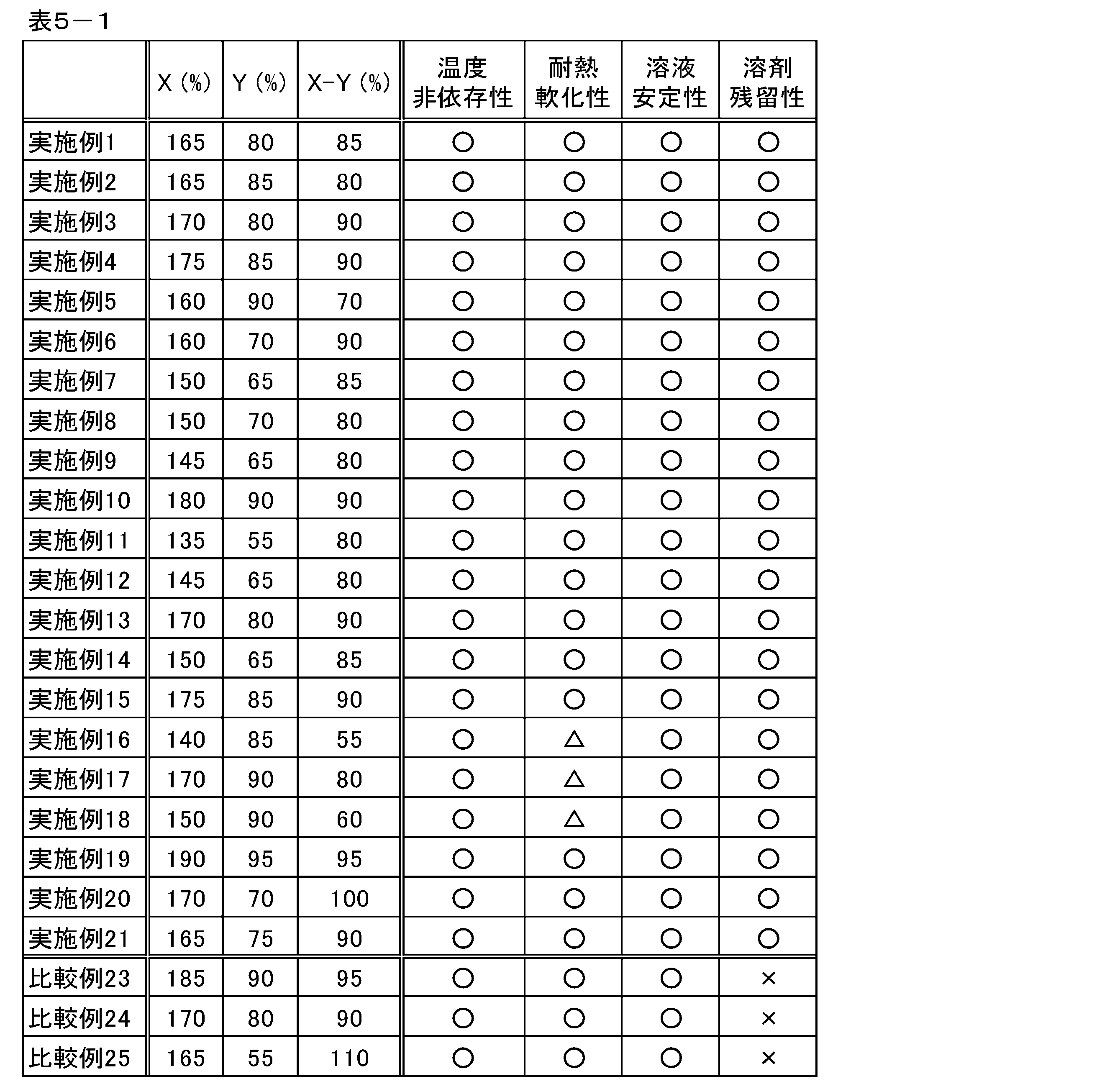
- the coating film obtained in the above-mentioned "Test 1" was used as a test piece for measurement. While applying a load of 450 g / cm 2 to the test piece, the test piece was heated at a heating rate of 3 ° C./min, the state of the test piece was observed, and the heat softening property was evaluated according to the evaluation criteria shown below. The results are shown in Tables 5-1 and 5-2.
- ⁇ Breakage occurred when the length was less than 25% of the length before stretching.
- ⁇ Fracture was performed by stretching 25% or more and less than 50% of the length before stretching.
- X Broken or melted down by heat melting when the length was 50% or more of the length before stretching.
- Test 3 Solution stability test
- ⁇ No change in appearance (transparent, fluid).
- X Whitened or solidified.
- XX Whitened or solidified at the stage of manufacture.
- Test 4 Solvent persistence test
- the polyurethane resin solutions of Examples 1 to 21 and Comparative Examples 23 to 25 were applied onto the paper pattern. Drying at 100 ° C. for 1 minute gave a coating film having a thickness of about 10 ⁇ m. The obtained coating film was used as a test piece for measurement, and the same tests as in Tests 1 and 2 were carried out. The 100% modulus value measured in Test 1 and the fracture / melting state observed in Test 2 do not depend on the film thickness of the test piece. Then, the solvent persistence was evaluated according to the evaluation criteria shown below. The results are shown in Table 5-1.
- ⁇ Both temperature-independent and heat-resistant softening properties were “ ⁇ ”.
- X At least one of temperature-independent and heat-resistant softening was "x".
- the polyurethane resin solution of the present invention is a resin solution having excellent heat-resistant and softening properties and containing a resin having a small change in physical properties such as modulus from a low temperature range to a high temperature range, and has excellent solvent stability. Therefore, the polyurethane resin solution of the present invention is a material for producing a solid film-like member disposed in a speaker of a portable device used in a wide temperature range including a high temperature range by a solution casting method. It is useful as.
Landscapes
- Chemical & Material Sciences (AREA)
- Organic Chemistry (AREA)
- Chemical Kinetics & Catalysis (AREA)
- Health & Medical Sciences (AREA)
- Medicinal Chemistry (AREA)
- Polymers & Plastics (AREA)
- Engineering & Computer Science (AREA)
- Dispersion Chemistry (AREA)
- General Chemical & Material Sciences (AREA)
- Multimedia (AREA)
- Mechanical Engineering (AREA)
- Physics & Mathematics (AREA)
- Acoustics & Sound (AREA)
- Signal Processing (AREA)
- Life Sciences & Earth Sciences (AREA)
- Materials Engineering (AREA)
- Wood Science & Technology (AREA)
- Textile Engineering (AREA)
- Polyurethanes Or Polyureas (AREA)
- Moulding By Coating Moulds (AREA)
- Materials For Medical Uses (AREA)
Abstract
耐熱軟化性に優れているとともに、低温域から高温域にかけてモジュラスなどの物性の変動が小さく、広範な温度域下での使用が想定される携帯型デバイスのスピーカーに配設されるポリウレタン樹脂製の中実なフィルム状部材を溶液流延法によって製造しうる樹脂溶液(ドープ)として有用な、溶液安定性に優れたポリウレタン樹脂溶液を提供する。携帯型デバイスのスピーカーに配設される中実なフィルム状部材を溶液流延法によって製造するために用いるポリウレタン樹脂溶液である。ポリウレタン樹脂と、ポリウレタン樹脂を溶解する有機溶剤とを含有し、ポリウレタン樹脂が、ポリエーテルポリオール等のポリオールに由来する構成単位(A)、短鎖ジオールに由来する構成単位(B)、及び芳香族ジイソシアネートに由来する構成単位のみで構成されており、有機溶剤が、アミド系有機溶剤を25~65質量%含む混合溶媒である。
Description
本発明は、広範な温度域におけるモジュラスの変動が小さいポリウレタン樹脂製のフィルム状部材を製造しうるポリウレタン樹脂溶液、及びそれを用いて製造されるフィルム状部材に関する。
ポリウレタン樹脂は、温度変化に対する溶融粘度(熱軟化)挙動が敏感な樹脂である。このような特性を生かし、ポリウレタン樹脂は、例えば、ホットメルト接着剤の主成分として用いられている(特許文献1)。また、ポリウレタン樹脂のうち、1液型ポリウレタン樹脂は、例えば、合成皮革の構成材料等として用いられている(特許文献2)。
しかし、1液型ポリウレタン樹脂は、上述の通り、温度変化に対する熱軟化挙動が敏感であり、熱軟化しやすい樹脂である。このため、低温域から高温域にかけての広範な温度変化に曝される物品等を構成する材料としては、さほど適したものではなかった。また、分子設計により1液型ポリウレタン樹脂の熱軟化挙動を調整しようとすると、特に低温条件下での風合いが犠牲になりやすいといった課題があった。
これに対して、2液型ポリウレタン樹脂は、一般的に熱硬化型であることから熱軟化しにくく、温度変化に対してそれほど敏感な材料ではない。しかし、2液型ポリウレタン樹脂は高温条件下でも溶融しにくいため、加工性が良好であるとは言えない。また、ポリウレタン樹脂は、一般的に、高温条件下で軟化して形状変化しやすい樹脂である。このため、高温環境下におかれる、又は使用に伴い発熱する物品等を構成する樹脂材料としては、さほど適したものではなかった。
ところで、フィルムやシート等の薄膜状の樹脂成形体を製造する方法としては、押出成型法、カレンダー法、溶液流延法等の様々な方法がある。なかでも、樹脂を有機溶剤に溶解した流動性の樹脂溶液を膜状に塗工して乾燥させる溶液流延法は、その厚さが精密に制御された薄いフィルム状部材を製造する方法として有用である。しかし、ポリウレタン樹脂製の薄いフィルム状部材を溶液流延法によって製造しようとする場合、ポリウレタン樹脂のモノマー組成等にもよるが、ポリウレタン樹脂を含有する樹脂溶液の安定性が低下しやすくなることがある。特に、温度が変動しやすい状況下に置かれた樹脂溶液を用いると、得られるフィルム状部材の均質性が損なわれたり、所望とする厚さに精密に制御することが困難になったりすることがあった。
本発明は、このような従来技術の有する問題点に鑑みてなされたものであり、その課題とするところは、耐熱軟化性に優れているとともに、低温域から高温域にかけてモジュラスなどの物性の変動が小さく、広範な温度域下での使用が想定される携帯型デバイスのスピーカーに配設される、残存する有機溶剤の量が少ない又は有機溶剤が実質的に残存しない高品質なポリウレタン樹脂製の中実なフィルム状部材を、製造条件がある程度制約されるような場合であっても溶液流延法によって容易に製造しうる樹脂溶液(ドープ)として有用な、溶液安定性に優れたポリウレタン樹脂溶液を提供することにある。また、本発明の課題とするところは、上記のポリウレタン樹脂溶液を用いて得られる、携帯型デバイスのスピーカーに配設されるポリウレタン樹脂製の中実なフィルム状部材を提供することにある。
すなわち、本発明によれば、以下に示すポリウレタン樹脂溶液が提供される。
[1]携帯型デバイスのスピーカーに配設される中実なフィルム状部材を溶液流延法によって製造するために用いるポリウレタン樹脂溶液であって、ポリウレタン樹脂と、前記ポリウレタン樹脂を溶解する有機溶剤と、を含有し、前記ポリウレタン樹脂が、下記構成単位(A)、(B)、及び(C)のみで構成されており、前記ポリウレタン樹脂を構成する、前記構成単位(A)に対する、前記構成単位(B)のモル比((B)/(A))が、1.0~2.5であり、前記有機溶剤が、アミド系有機溶剤を25~65質量%含む混合溶媒であるポリウレタン樹脂溶液。
構成単位(A):ポリエーテルポリオール、ポリカプロラクトンポリオール、及びカプロラクトン変性ポリオールからなる群より選択される少なくとも一種の、その水酸基価が150.0mgKOH/g以下のポリオールに由来する構成単位
構成単位(B):下記一般式(1)で表されるジオール、又はベンゼン環及びエーテル結合を主鎖に含むジオールに由来する構成単位
構成単位(C):4,4’-ジフェニルメタンジイソシアネート及びトルエンジイソシアネートの少なくともいずれかの芳香族ジイソシアネートに由来する構成単位
[1]携帯型デバイスのスピーカーに配設される中実なフィルム状部材を溶液流延法によって製造するために用いるポリウレタン樹脂溶液であって、ポリウレタン樹脂と、前記ポリウレタン樹脂を溶解する有機溶剤と、を含有し、前記ポリウレタン樹脂が、下記構成単位(A)、(B)、及び(C)のみで構成されており、前記ポリウレタン樹脂を構成する、前記構成単位(A)に対する、前記構成単位(B)のモル比((B)/(A))が、1.0~2.5であり、前記有機溶剤が、アミド系有機溶剤を25~65質量%含む混合溶媒であるポリウレタン樹脂溶液。
構成単位(A):ポリエーテルポリオール、ポリカプロラクトンポリオール、及びカプロラクトン変性ポリオールからなる群より選択される少なくとも一種の、その水酸基価が150.0mgKOH/g以下のポリオールに由来する構成単位
構成単位(B):下記一般式(1)で表されるジオール、又はベンゼン環及びエーテル結合を主鎖に含むジオールに由来する構成単位
構成単位(C):4,4’-ジフェニルメタンジイソシアネート及びトルエンジイソシアネートの少なくともいずれかの芳香族ジイソシアネートに由来する構成単位

[2]前記ポリウレタン樹脂の、25℃における100%モジュラスMM(MPa)に対する、-10℃における100%モジュラスML(MPa)の比率X(%)が、200%以下である前記[1]に記載のポリウレタン樹脂溶液。
[3]前記ポリウレタン樹脂の、25℃における100%モジュラスMM(MPa)に対する、40℃における100%モジュラスMH(MPa)の比率Y(%)が、50%以上である前記[1]又は[2]に記載のポリウレタン樹脂溶液。
[4]前記ポリウレタン樹脂の、前記比率X(%)と前記比率Y(%)の差(X-Y)が、100%以下である前記[3]に記載のポリウレタン樹脂溶液。
[5]前記ポリウレタン樹脂が、450g/cm2の荷重をかけながら昇温速度3℃/minで加熱して延伸した場合に、延伸前の長さの25%未満の延伸で破断する前記[4]に記載のポリウレタン樹脂溶液。
[6]前記有機溶剤が、前記アミド系有機溶剤と、ケトン系有機溶剤又はエステル系有機溶剤との混合溶媒であり、前記アミド系有機溶剤が、N,N-ジメチルホルムアミド、N,N-ジメチルアセトアミド、N-メチル-2-ピロリドン、1,3-ジメチル-2-イミダゾリジノン、N-エチル-2-ピロリドン、及びN,N’-ジメチルプロピレン尿素からなる群より選択される少なくとも一種であり、前記ケトン系有機溶剤が、メチルエチルケトン、アセトン、シクロヘキサノン、メチルイソブチルケトン、ジエチルケトン、及びイソホロンからなる群より選択される少なくとも一種であり、前記エステル系有機溶剤が、酢酸エチル、酢酸プロピル、酢酸ブチル、ギ酸エチル、及び酪酸メチルからなる群より選択される少なくとも一種である前記[1]~[5]のいずれかに記載のポリウレタン樹脂溶液。
[3]前記ポリウレタン樹脂の、25℃における100%モジュラスMM(MPa)に対する、40℃における100%モジュラスMH(MPa)の比率Y(%)が、50%以上である前記[1]又は[2]に記載のポリウレタン樹脂溶液。
[4]前記ポリウレタン樹脂の、前記比率X(%)と前記比率Y(%)の差(X-Y)が、100%以下である前記[3]に記載のポリウレタン樹脂溶液。
[5]前記ポリウレタン樹脂が、450g/cm2の荷重をかけながら昇温速度3℃/minで加熱して延伸した場合に、延伸前の長さの25%未満の延伸で破断する前記[4]に記載のポリウレタン樹脂溶液。
[6]前記有機溶剤が、前記アミド系有機溶剤と、ケトン系有機溶剤又はエステル系有機溶剤との混合溶媒であり、前記アミド系有機溶剤が、N,N-ジメチルホルムアミド、N,N-ジメチルアセトアミド、N-メチル-2-ピロリドン、1,3-ジメチル-2-イミダゾリジノン、N-エチル-2-ピロリドン、及びN,N’-ジメチルプロピレン尿素からなる群より選択される少なくとも一種であり、前記ケトン系有機溶剤が、メチルエチルケトン、アセトン、シクロヘキサノン、メチルイソブチルケトン、ジエチルケトン、及びイソホロンからなる群より選択される少なくとも一種であり、前記エステル系有機溶剤が、酢酸エチル、酢酸プロピル、酢酸ブチル、ギ酸エチル、及び酪酸メチルからなる群より選択される少なくとも一種である前記[1]~[5]のいずれかに記載のポリウレタン樹脂溶液。
さらに、本発明によれば、以下に示すフィルム状部材が提供される。
[7]携帯型デバイスのスピーカーに配設されるポリウレタン樹脂製の中実なフィルム状部材であって、前記ポリウレタン樹脂が、下記構成単位(A)、(B)、及び(C)のみで構成されており、前記ポリウレタン樹脂を構成する、前記構成単位(A)に対する、前記構成単位(B)のモル比((B)/(A))が、1.0~2.5であるフィルム状部材。
構成単位(A):ポリエーテルポリオール、ポリカプロラクトンポリオール、及びカプロラクトン変性ポリオールからなる群より選択される少なくとも一種の、その水酸基価が150.0mgKOH/g以下のポリオールに由来する構成単位
構成単位(B):下記一般式(1)で表されるジオール、又はベンゼン環及びエーテル結合を主鎖に含むジオールに由来する構成単位
構成単位(C):4,4’-ジフェニルメタンジイソシアネート及びトルエンジイソシアネートの少なくともいずれかの芳香族ジイソシアネートに由来する構成単位
[7]携帯型デバイスのスピーカーに配設されるポリウレタン樹脂製の中実なフィルム状部材であって、前記ポリウレタン樹脂が、下記構成単位(A)、(B)、及び(C)のみで構成されており、前記ポリウレタン樹脂を構成する、前記構成単位(A)に対する、前記構成単位(B)のモル比((B)/(A))が、1.0~2.5であるフィルム状部材。
構成単位(A):ポリエーテルポリオール、ポリカプロラクトンポリオール、及びカプロラクトン変性ポリオールからなる群より選択される少なくとも一種の、その水酸基価が150.0mgKOH/g以下のポリオールに由来する構成単位
構成単位(B):下記一般式(1)で表されるジオール、又はベンゼン環及びエーテル結合を主鎖に含むジオールに由来する構成単位
構成単位(C):4,4’-ジフェニルメタンジイソシアネート及びトルエンジイソシアネートの少なくともいずれかの芳香族ジイソシアネートに由来する構成単位

本発明によれば、耐熱軟化性に優れているとともに、低温域から高温域にかけてモジュラスなどの物性の変動が小さく、広範な温度域下での使用が想定される携帯型デバイスのスピーカーに配設される、残存する有機溶剤の量が少ない又は有機溶剤が実質的に残存しない高品質なポリウレタン樹脂製の中実なフィルム状部材を、製造条件がある程度制約されるような場合であっても溶液流延法によって容易に製造しうる樹脂溶液(ドープ)として有用な、溶液安定性に優れたポリウレタン樹脂溶液を提供することができる。また、本発明によれば、このポリウレタン樹脂溶液を用いて得られる、携帯型デバイスのスピーカーに配設されるポリウレタン樹脂製の中実なフィルム状部材を提供することができる。
<ポリウレタン樹脂溶液>
以下、本発明の実施の形態について説明するが、本発明は以下の実施の形態に限定されるものではない。本発明のポリウレタン樹脂溶液は、携帯型デバイスのスピーカーに配設される中実なフィルム状部材を溶液流延法によって製造するために用いる樹脂溶液(ドープ)であり、ポリウレタン樹脂と、ポリウレタン樹脂を溶解する有機溶剤とを含有する。ポリウレタン樹脂は、下記構成単位(A)、(B)、及び(C)のみで構成されており、ポリウレタン樹脂を構成する、構成単位(A)に対する、構成単位(B)のモル比((B)/(A))が、1.0~2.5である。そして、有機溶剤は、アミド系有機溶剤を25~65質量%含む混合溶媒である。以下、本発明のポリウレタン樹脂の詳細について説明する。
構成単位(A):ポリエーテルポリオール、ポリカプロラクトンポリオール、及びカプロラクトン変性ポリオールからなる群より選択される少なくとも一種の、その水酸基価が150.0mgKOH/g以下のポリオールに由来する構成単位
構成単位(B):下記一般式(1)で表されるジオール、又はベンゼン環及びエーテル結合を主鎖に含むジオールに由来する構成単位
構成単位(C):芳香族ジイソシアネートに由来する構成単位
以下、本発明の実施の形態について説明するが、本発明は以下の実施の形態に限定されるものではない。本発明のポリウレタン樹脂溶液は、携帯型デバイスのスピーカーに配設される中実なフィルム状部材を溶液流延法によって製造するために用いる樹脂溶液(ドープ)であり、ポリウレタン樹脂と、ポリウレタン樹脂を溶解する有機溶剤とを含有する。ポリウレタン樹脂は、下記構成単位(A)、(B)、及び(C)のみで構成されており、ポリウレタン樹脂を構成する、構成単位(A)に対する、構成単位(B)のモル比((B)/(A))が、1.0~2.5である。そして、有機溶剤は、アミド系有機溶剤を25~65質量%含む混合溶媒である。以下、本発明のポリウレタン樹脂の詳細について説明する。
構成単位(A):ポリエーテルポリオール、ポリカプロラクトンポリオール、及びカプロラクトン変性ポリオールからなる群より選択される少なくとも一種の、その水酸基価が150.0mgKOH/g以下のポリオールに由来する構成単位
構成単位(B):下記一般式(1)で表されるジオール、又はベンゼン環及びエーテル結合を主鎖に含むジオールに由来する構成単位
構成単位(C):芳香族ジイソシアネートに由来する構成単位

(ポリウレタン樹脂)
[構成単位(A)]
構成単位(A)は、ポリエーテルポリオール、ポリカプロラクトンポリオール、及びカプロラクトン変性ポリオールからなる群より選択される少なくとも一種のポリオールに由来する構成単位(ユニット)である。ポリウレタン樹脂は、この構成単位(A)を有するために、特に室温(約25℃)から低温域(約-10℃)にかけてモジュラスなどの物性が変動しにくい。これに対して、上記の構成単位(A)を有さず、ポリエステルポリオールやポリカーボネートポリオールなどのポリオールに由来する構成単位を有するポリウレタン樹脂は、特に低温域において温度依存性が高い。
[構成単位(A)]
構成単位(A)は、ポリエーテルポリオール、ポリカプロラクトンポリオール、及びカプロラクトン変性ポリオールからなる群より選択される少なくとも一種のポリオールに由来する構成単位(ユニット)である。ポリウレタン樹脂は、この構成単位(A)を有するために、特に室温(約25℃)から低温域(約-10℃)にかけてモジュラスなどの物性が変動しにくい。これに対して、上記の構成単位(A)を有さず、ポリエステルポリオールやポリカーボネートポリオールなどのポリオールに由来する構成単位を有するポリウレタン樹脂は、特に低温域において温度依存性が高い。
構成単位(A)を構成するポリオールの水酸基価は150.0mgKOH/g以下であり、好ましくは35.0~125.0mgKOH/gである。その水酸基価が150.0mgKOH/g以下のポリオールを用いることで、ソフトセグメントを十分な長さとすることができ、特に室温(約25℃)から低温域(約-10℃)にかけてモジュラスなどの物性が変動しにくいポリウレタン樹脂とすることができる。なお、ポリオールの水酸基価が150.0mgKOH/g超であると、ソフトセグメントが短いために低温域下における温度依存性が高くなる。
ポリエーテルポリオールとしては、ポリプロピレングリコール、ポリエチレングリコール、ポリテトラメチレングリコールエーテル、ポリオキシテトラメチレンポリオキシエチレングリコールなどを挙げることができる。なかでも、ポリテトラメチレングリコールエーテルが、高温域下における温度依存性がより低減されたポリウレタン樹脂とすることができるために好ましい。ポリカプロラクトンポリオールとしては、ポリカプロラクトンジオールなどを挙げることができる。また、カプロラクトン変性ポリオールは、ポリエーテルポリオール、ポリエステルポリオール、ポリカーボネートポリオールなどのポリオール成分をカプロラクトンで変性したポリオールである。カプロラクトンで変性するポリオール成分は特に限定されない。
[構成単位(B)]
前述の通り、一般的なポリウレタン樹脂は、高温条件下で軟化して形状変化しやすく、耐熱軟化性の良好な樹脂材料であるとは言えなかった。このため、高温環境下におかれる、又は使用に伴い発熱する物品等を構成する樹脂材料としては、さほど適したものではなかった。本発明者らは、熱軟化による形状変化が生じにくいポリウレタン樹脂の構成について検討した。その結果、主鎖の炭素原子数が比較的少ない短鎖ジオールや、ベンゼン環及びエーテル結合を主鎖に含むジオールに由来する構成単位を有する構成とすることで、熱軟化による形状変化が生じにくいポリウレタン樹脂が得られることを見出した。
前述の通り、一般的なポリウレタン樹脂は、高温条件下で軟化して形状変化しやすく、耐熱軟化性の良好な樹脂材料であるとは言えなかった。このため、高温環境下におかれる、又は使用に伴い発熱する物品等を構成する樹脂材料としては、さほど適したものではなかった。本発明者らは、熱軟化による形状変化が生じにくいポリウレタン樹脂の構成について検討した。その結果、主鎖の炭素原子数が比較的少ない短鎖ジオールや、ベンゼン環及びエーテル結合を主鎖に含むジオールに由来する構成単位を有する構成とすることで、熱軟化による形状変化が生じにくいポリウレタン樹脂が得られることを見出した。
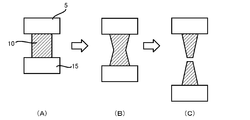
すなわち、ポリウレタン樹脂は、前述の一般式(1)で表されるジオール、又はベンゼン環及びエーテル結合を主鎖に含むジオールに由来する構成単位(B)を有する。図1は、ポリウレタン樹脂が延伸して破断する状態を説明する模式図である。図1に示すように、ポリウレタン樹脂10の上端を治具5に固定するとともに、ポリウレタン樹脂10の下端に錘15をつける(図1(A))。この状態で徐々に昇温すると、従来のポリウレタン樹脂10は熱軟化して徐々に伸長するとともに(図1(B))、ある時点で破断する(図1(C))、又は破断することなく伸び切った状態となる。これに対して、一般式(1)で表されるジオール、又はベンゼン環及びエーテル結合を主鎖に含むジオールに由来する構成単位(B)を有する実施形態のポリウレタン樹脂20は、図2に示すように、荷重をかけながら(図2(A))徐々に昇温した場合であっても、ほとんど伸長しないか、僅かに伸長し(図2(B))、そして、ある時点で破断する(図2(C))。このため、上記の構成単位(B)を有するポリウレタン樹脂は、熱軟化による形状変化が生じにくく、高温環境下におかれる、又は使用に伴い発熱する物品等を構成する樹脂材料として好適である。
構成単位(B)を構成する、鎖延長剤として用いられるジオールは、一般式(1)で表されるジオールであるか、ベンゼン環及びエーテル結合を主鎖に含むジオールである。一般式(1)中、R1で表される基の炭素原子数が多くなるほど、熱軟化による形状変化が生じやすくなるとともに、低温域における温度依存性が高くなる傾向にある。これに対して、一般式(1)中、R1で表される基の炭素原子数が少なくなるほど、熱軟化による形状変化がより生じにくくなるとともに、低温域における温度依存性がさらに低くなる傾向にある。また、分子量がある程度大きい場合であっても、主鎖にベンゼン環及びエーテル結合が含まれていると、熱軟化による形状変化が生じにくくなるとともに、低温域における温度依存性が低くなる傾向にある。一般式(1)で表されるジオールとしては、エチレングリコール、1,2-プロパンジオール、1,2-ヘキサンジオールなどを挙げることができる。また、ベンゼン環及びエーテル結合を主鎖に含むジオールとしては、1,4-ビス(2-ヒドロキシエトキシ)ベンゼン、2,2’-[(1,1’-ビフェニル)-4,4’-ジイルビス(オキシ)]ビスエタノールなどを挙げることができる。構成単位(B)を構成するジオールは一般式(1)で表されるジオールであることが、ポリウレタン樹脂の耐熱軟化性がより向上するために好ましい。
ポリウレタン樹脂を構成する、構成単位(A)に対する、構成単位(B)のモル比((B)/(A))は、1.0~2.5であり、好ましくは1.5~2.5、さらに好ましくは1.5~2.2である。上記のモル比((B)/(A))を1.0以上とすることで、熱軟化による形状変化が生じにくく、高温域における温度依存性が低減されたポリウレタン樹脂とすることができる。一方、上記のモル比((B)/(A))を2.5以下とすることで、温度が変動しやすい状況下に置かれた場合であっても異物等が生成しにくい、溶液安定性に優れたポリウレタン樹脂溶液とすることができる。そして、このように溶液安定性に優れたポリウレタン樹脂溶液を用いれば、均質であるとともに、所望とする厚さに精密に制御された中実なフィルム状部材を容易に製造することができる。
[構成単位(C)]
構成単位(C)は、芳香族ジイソシアネートに由来する構成単位(ユニット)である。ポリウレタン樹脂は、この構成単位(C)を有するために、特に室温(約25℃)から高温域(約40℃)にかけてモジュラスなどの物性が変動しにくい。これに対して、上記の構成単位(C)を有さず、ヘキサメチレンジイソシアネート(HDI)、イソホロンジイソシアネート(IPDI)、及び4,4’-ジシクロヘキシルメタンジイソシアネート(H12MDI)などの脂肪族ジイソシアネートに由来する構成単位を有するポリウレタン樹脂は、特に高温域において温度依存性が高い。さらには、高温条件下で軟化して形状変化しやすくなる傾向にある。
構成単位(C)は、芳香族ジイソシアネートに由来する構成単位(ユニット)である。ポリウレタン樹脂は、この構成単位(C)を有するために、特に室温(約25℃)から高温域(約40℃)にかけてモジュラスなどの物性が変動しにくい。これに対して、上記の構成単位(C)を有さず、ヘキサメチレンジイソシアネート(HDI)、イソホロンジイソシアネート(IPDI)、及び4,4’-ジシクロヘキシルメタンジイソシアネート(H12MDI)などの脂肪族ジイソシアネートに由来する構成単位を有するポリウレタン樹脂は、特に高温域において温度依存性が高い。さらには、高温条件下で軟化して形状変化しやすくなる傾向にある。
構成単位(C)を構成する芳香族ジイソシアネートとしては、4,4’-ジフェニルメタンジイソシアネート(4,4’-MDI)、2,4-ジフェニルメタンジイソシアネート(2,4’-MDI)、トルエンジイソシアネート(TDI)、キシリレンジイソシアナート(XDI)、ナフタレンジイソシアネート(NDI)などを挙げることができる。なかでも、4,4’-ジフェニルメタンジイソシアネート(4,4’-MDI)が、高温域下における温度依存性がより低減されているとともに、高温条件下であっても軟化による形状変化がより生じにくいポリウレタン樹脂とすることができるために好ましい。
[ポリウレタン樹脂の物性]
本発明のポリウレタン樹脂溶液に用いるポリウレタン樹脂は、上述の構成単位(A)、(B)、及び(C)のみで構成されているため、耐熱軟化性に優れているとともに、低温域から高温域にかけてモジュラスなどの物性の変動が小さい。このため、このポリウレタン樹脂は、広範な温度域下での使用が想定される携帯型デバイスのスピーカーに配設される中実なフィルム状部材を構成するための材料として好適である。なお、本明細書における「構成単位(A)、(B)、及び(C)のみで構成され」ているとは、「構成単位(A)、(B)、及び(C)のみで『実質的に』構成され」ていることを意味し、所望とする効果が損なわれない範囲で、他の構成単位や不可避的な成分等が微かに含まれていてもよい。また、本明細書における「中実な」とは、その内部に空隙等を有する、いわゆる多孔質体が含まれないことを意味する。
本発明のポリウレタン樹脂溶液に用いるポリウレタン樹脂は、上述の構成単位(A)、(B)、及び(C)のみで構成されているため、耐熱軟化性に優れているとともに、低温域から高温域にかけてモジュラスなどの物性の変動が小さい。このため、このポリウレタン樹脂は、広範な温度域下での使用が想定される携帯型デバイスのスピーカーに配設される中実なフィルム状部材を構成するための材料として好適である。なお、本明細書における「構成単位(A)、(B)、及び(C)のみで構成され」ているとは、「構成単位(A)、(B)、及び(C)のみで『実質的に』構成され」ていることを意味し、所望とする効果が損なわれない範囲で、他の構成単位や不可避的な成分等が微かに含まれていてもよい。また、本明細書における「中実な」とは、その内部に空隙等を有する、いわゆる多孔質体が含まれないことを意味する。
本発明のポリウレタン樹脂溶液に用いるポリウレタン樹脂は、低温域から高温域にかけての物性の変動が小さい。具体的には、ポリウレタン樹脂は、25℃における100%モジュラスMM(MPa)に対する、-10℃における100%モジュラスML(MPa)の比率X(%)が、好ましくは200%以下であり、さらに好ましくは180%以下であり、特に好ましくは170%以下である。このように、比率X(=(ML/MM)×100(%))が上記の数値範囲であるポリウレタン樹脂は、特に室温(約25℃)から低温域(約-10℃)にかけての物性が変動しにくい。
また、ポリウレタン樹脂は、25℃における100%モジュラスMM(MPa)に対する、40℃における100%モジュラスMH(MPa)の比率Y(%)が、好ましくは50%以上であり、さらに好ましくは70%以上であり、特に好ましくは80%以上である。このように、比率Y(=(MH/MM)×100(%))が上記の数値範囲であるポリウレタン樹脂は、特に室温(約25℃)から高温域(約40℃)にかけての物性が変動しにくい。
さらに、ポリウレタン樹脂は、比率X(%)と比率Y(%)の差(X-Y)が、好ましくは100%以下であり、さらに好ましくは90%以下であり、特に好ましくは80%以下である。比率X(%)と比率Y(%)の差(X-Y)が上記の数値範囲であるポリウレタン樹脂は、低温域(約-10℃)から高温域(約40℃)の広範な温度域にかけて物性が変動しにくい。
また、本発明のポリウレタン樹脂溶液に用いるポリウレタン樹脂は、熱軟化による形状変化が生じにくいものである。具体的には、ポリウレタン樹脂は、好ましくは、450g/cm2の荷重をかけながら昇温速度3℃/minで加熱して延伸した場合に、延伸前の長さの25%未満の延伸で破断するものである。
ポリウレタン樹脂の分子量は特に限定されず、適宜設定することができる。具体的には、ゲルパーミエーションクロマトグラフィー(GPC)により測定される、ポリウレタン樹脂のポリスチレン換算の重量平均分子量(Mw)は、通常、2,000~400,000であり、好ましくは3,000~250,000、さらに好ましくは4,000~100,000である。
ポリウレタン樹脂の100%モジュラスは、構成単位(A)に対する、構成単位(B)のモル比((B)/(A))を設定することで適宜調整することができる。また、構成単位(C)の割合によっても調整することができる。それぞれの構成単位の組成にもよるが、25℃における100%モジュラスMMは、5.0~50.0MPaであることが好ましく、5.0~20.0MPaであることがさらに好ましい。
ポリウレタン樹脂の-10℃における100%モジュラスMLは、上記の25℃における100%モジュラスMMの好適な範囲内から100.0MPa以下であることが好ましく、40.0MPa以下であることがさらに好ましい。同様に、ポリウレタン樹脂の40℃における100%モジュラスMHは、上記の25℃における100%モジュラスMMの好適な範囲内から2.5MPa以上であることが好ましい。
(有機溶剤)
本発明のポリウレタン樹脂溶液は、ポリウレタン樹脂を溶解する有機溶剤を含有する。そして、この有機溶剤は、アミド系有機溶剤を25~65質量%、好ましくは25~60質量%、さらに好ましくは28~50質量%含む混合溶媒である。このような有機溶剤を含有することで、上述の特定の組成のポリウレタン樹脂を有効に溶解させることができるとともに、温度が変動しやすい状況下に置かれた場合であっても異物等が生成しにくい、溶液安定性に優れたポリウレタン樹脂溶液とすることができる。ポリウレタン樹脂を溶解する有機溶剤中のアミド系有機溶剤の含有量が25質量%未満であると、ポリウレタン樹脂溶液の溶液安定性が低い。このため、溶液流延法によって中実なフィルム状部材を成膜することが困難になり、耐熱軟化性に優れ、低温域から高温域にかけてモジュラスなどの物性の変動が小さい中実なフィルム状部材を製造することができない。一方、有機溶剤中のアミド系有機溶剤の含有量が65質量%超であると、ポリウレタン樹脂溶液の溶液安定性は向上するが、溶液流延法によってフィルム状部材を製造する際の乾燥性が低下する。このため、得られるフィルム状部材に有機溶剤が残留しやすく、フィルム状部材の耐熱性等の特性が低下する。すなわち、有機溶剤(混合溶媒)中のアミド系有機溶剤の含有量を所定量以下とすることで、乾燥温度が低い、又は乾燥時間が短い等の製造条件が制約されるような場合であっても、残存する有機溶剤の量が少ない又は実質的に含有しない高品質なフィルム状部材を容易に製造することができる。
本発明のポリウレタン樹脂溶液は、ポリウレタン樹脂を溶解する有機溶剤を含有する。そして、この有機溶剤は、アミド系有機溶剤を25~65質量%、好ましくは25~60質量%、さらに好ましくは28~50質量%含む混合溶媒である。このような有機溶剤を含有することで、上述の特定の組成のポリウレタン樹脂を有効に溶解させることができるとともに、温度が変動しやすい状況下に置かれた場合であっても異物等が生成しにくい、溶液安定性に優れたポリウレタン樹脂溶液とすることができる。ポリウレタン樹脂を溶解する有機溶剤中のアミド系有機溶剤の含有量が25質量%未満であると、ポリウレタン樹脂溶液の溶液安定性が低い。このため、溶液流延法によって中実なフィルム状部材を成膜することが困難になり、耐熱軟化性に優れ、低温域から高温域にかけてモジュラスなどの物性の変動が小さい中実なフィルム状部材を製造することができない。一方、有機溶剤中のアミド系有機溶剤の含有量が65質量%超であると、ポリウレタン樹脂溶液の溶液安定性は向上するが、溶液流延法によってフィルム状部材を製造する際の乾燥性が低下する。このため、得られるフィルム状部材に有機溶剤が残留しやすく、フィルム状部材の耐熱性等の特性が低下する。すなわち、有機溶剤(混合溶媒)中のアミド系有機溶剤の含有量を所定量以下とすることで、乾燥温度が低い、又は乾燥時間が短い等の製造条件が制約されるような場合であっても、残存する有機溶剤の量が少ない又は実質的に含有しない高品質なフィルム状部材を容易に製造することができる。
有機溶剤は、アミド系有機溶剤と、ケトン系有機溶剤又はエステル系有機溶剤との混合溶媒であることが好ましい。アミド系有機溶剤としては、N,N-ジメチルホルムアミド、N,N-ジメチルアセトアミド、N-メチル-2-ピロリドン、1,3-ジメチル-2-イミダゾリジノン、N-エチル-2-ピロリドン、N,N’-ジメチルプロピレン尿素等を挙げることができる。なかでも、アミド系有機溶剤としてはN,N-ジメチルホルムアミドが好ましい。また、ケトン系有機溶剤としては、メチルエチルケトン、アセトン、シクロヘキサノン、メチルイソブチルケトン、ジエチルケトン、イソホロン等を挙げることができる。なかでも、ケトン系有機溶剤としてはメチルエチルケトンが好ましい。さらに、エステル系有機溶剤としては、酢酸エチル、酢酸プロピル、酢酸ブチル、ギ酸エチル、酪酸メチル等を挙げることができる。なかでも、エステル系有機溶剤としては酢酸エチルが好ましい。
ポリウレタン樹脂溶液中のポリウレタン樹脂の含有量(濃度)は、溶液流延法によってフィルム状部材を製造するのに適した含有量(濃度)であることが好ましい。ポリウレタン樹脂の含有量が少なすぎると、溶液流延法によってフィルム状部材を製造する際のレベリング性にやや影響が及ぶ場合がある。一方、ポリウレタン樹脂の含有量が多すぎると、得られるフィルム状部材の膜厚の精度にやや影響が及ぶ場合がある。ポリウレタン樹脂溶液中のポリウレタン樹脂の含有量(濃度)は、例えば、0.1~50質量%であることが好ましい。また、薄膜状のフィルム状部材を製造する場合、又は重ね塗りにより厚膜状のフィルム状部材を製造する場合には、膜厚を精密に制御する観点から、1~30質量%であることがさらに好ましい。
(ポリウレタン樹脂の合成(製造)方法)
ポリウレタン樹脂は、従来公知のウレタン化反応の条件を適用させて合成(製造)することができる。例えば、活性水素を含まない溶剤の存在下又は非存在下、ポリオールと、主鎖の炭素原子数が2以下のジオール、又はベンゼン環及びエーテル結合を主鎖に含むジオール(鎖延長剤)と、ジイソシアネートとを反応させることで、構成単位(A)構成単位(B)、及び構成単位(C)を有するポリウレタン樹脂を得ることができる。反応は、ワンショット法と多段法のいずれの方式であってもよい。
ポリウレタン樹脂は、従来公知のウレタン化反応の条件を適用させて合成(製造)することができる。例えば、活性水素を含まない溶剤の存在下又は非存在下、ポリオールと、主鎖の炭素原子数が2以下のジオール、又はベンゼン環及びエーテル結合を主鎖に含むジオール(鎖延長剤)と、ジイソシアネートとを反応させることで、構成単位(A)構成単位(B)、及び構成単位(C)を有するポリウレタン樹脂を得ることができる。反応は、ワンショット法と多段法のいずれの方式であってもよい。
重合反応によって得られたポリマーの末端にイソシアネート基が残った場合、イソシアネート末端の停止反応を行ってもよい。具体的には、モノアルコールやモノアミン等の単官能性の化合物;イソシアネートに対して異なる反応性を有する二種の官能基を有する化合物を使用すればよい。このような化合物の具体例としては、メチルアルコール、エチルアルコール、n-プロピルアルコール、イソプロピルアルコール、n-ブチルアルコール、イソブチルアルコール、tert-ブチルアルコール等のモノアルコール;モノエチルアミン、n-プロピルアミン、ジエチルアミン、ジ-n-プロピルアミン、ジ-n-ブチルアミン等のモノアミン;モノエタノールアミン、ジエタノールアミン等のアルカノールアミン;等を挙げることができる。
ポリウレタン樹脂は、無溶剤で合成しても、有機溶剤の存在下で合成してもよい。有機溶剤としては、イソシアネート基に対して不活性であるか、又は反応成分よりも低活性なものなどを用いることができる。このような有機溶剤としては、アセトン、メチルエチルケトン、メチルイソブチルケトン、シクロヘキサノン等のケトン系有機溶剤;トルエン、キシレン等の芳香族系炭化水素溶剤;n-ヘキサン等の脂肪族系炭化水素溶剤;ジオキサン、テトラヒドロフラン等のエーテル系有機溶剤;酢酸エチル、酢酸ブチル、酢酸イソブチル等のエステル系有機溶剤;エチレングリコールエチルエーテルアセテート、プロピレングリコールメチルエーテルアセテート、3-メチル-3-メトキシブチルアセテート、エチル-3-エトキシプロピオネート等のグリコールエーテルエステル系有機溶剤;N,N-ジメチルホルムアミド、N,N-ジメチルアセトアミド、N-メチル-2-ピロリドン等のアミド系有機溶剤;等を挙げることができる。これらの有機溶剤は、1種単独で又は2種以上を組み合わせて用いることができる。なかでも、得られるポリウレタン樹脂を溶解する、アミド系有機溶剤を25質量%以上含む前述の有機溶剤を用いることが好ましい。
ポリウレタン樹脂の合成に際しては、必要に応じて触媒を用いることができる。触媒の具体例としては、ジブチルチンラウレート、ジオクチルチンラウレート、スタナスオクトエート、オクチル酸亜鉛、テトラn-ブチルチタネート等の金属と有機又は無機酸との塩;有機金属誘導体;トリエチルアミンなどの有機アミン;ジアザビシクロウンデセン系触媒;等を挙げることができる。
ポリウレタン樹脂にフィラーや添加剤などの各種成分を添加して、物性が調整された又は耐久性などの特性が付与された樹脂組成物とすることもできる。フィラーとしては、有機フィラー及び無機フィラーのいずれを用いることもできる。フィラーの具体例としては、シリカ、シリコーン樹脂微粒子、フッ素樹脂微粒子、アクリル樹脂微粒子、ウレタン系樹脂微粒子、シリコーン変性ウレタン系樹脂微粒子、ポリエチレン微粒子、ポリカーボネート系樹脂微粒子などを挙げることができる。添加剤としては、例えば、酸化防止剤、光安定剤、紫外線吸収剤、ガス変色安定剤、金属不活性剤、着色剤、防黴剤、難燃剤、艶消し剤、消泡剤、滑剤などを挙げることができる。
(ポリウレタン樹脂溶液の用途)
上述の通り、本発明のポリウレタン樹脂溶液は、温度が変動しやすい状況下に置かれた場合であっても異物等が生成しにくく、溶液安定性に優れている。このため、本発明のポリウレタン樹脂溶液は、携帯型デバイスのスピーカーに配設される、均質であるとともに、所望とする厚さに精密に制御された中実なフィルム状部材を溶液流延法によって製造するための材料として用いられる。
上述の通り、本発明のポリウレタン樹脂溶液は、温度が変動しやすい状況下に置かれた場合であっても異物等が生成しにくく、溶液安定性に優れている。このため、本発明のポリウレタン樹脂溶液は、携帯型デバイスのスピーカーに配設される、均質であるとともに、所望とする厚さに精密に制御された中実なフィルム状部材を溶液流延法によって製造するための材料として用いられる。
<フィルム状部材>
本発明のフィルム状部材は、携帯型デバイスのスピーカーに配設されるポリウレタン樹脂製の中実なフィルム状部材であり、例えば、上述のポリウレタン樹脂溶液を用いて溶液流延法によって製造することができる。すなわち、本発明のフィルム状部材を構成するポリウレタン樹脂は、下記構成単位(A)、(B)、及び(C)のみで構成されており、ポリウレタン樹脂を構成する、構成単位(A)に対する、構成単位(B)のモル比((B)/(A))が、1.0~2.5である。
構成単位(A):ポリエーテルポリオール、ポリカプロラクトンポリオール、及びカプロラクトン変性ポリオールからなる群より選択される少なくとも一種の、その水酸基価が150.0mgKOH/g以下のポリオールに由来する構成単位
構成単位(B):下記一般式(1)で表されるジオール、又はベンゼン環及びエーテル結合を主鎖に含むジオールに由来する構成単位
構成単位(C):芳香族ジイソシアネートに由来する構成単位
本発明のフィルム状部材は、携帯型デバイスのスピーカーに配設されるポリウレタン樹脂製の中実なフィルム状部材であり、例えば、上述のポリウレタン樹脂溶液を用いて溶液流延法によって製造することができる。すなわち、本発明のフィルム状部材を構成するポリウレタン樹脂は、下記構成単位(A)、(B)、及び(C)のみで構成されており、ポリウレタン樹脂を構成する、構成単位(A)に対する、構成単位(B)のモル比((B)/(A))が、1.0~2.5である。
構成単位(A):ポリエーテルポリオール、ポリカプロラクトンポリオール、及びカプロラクトン変性ポリオールからなる群より選択される少なくとも一種の、その水酸基価が150.0mgKOH/g以下のポリオールに由来する構成単位
構成単位(B):下記一般式(1)で表されるジオール、又はベンゼン環及びエーテル結合を主鎖に含むジオールに由来する構成単位
構成単位(C):芳香族ジイソシアネートに由来する構成単位

スマートフォン等の携帯型デバイスは、持ち運び自由な装置であるが故に、高温~低温にかけての広範な温度環境下での使用が想定される。このような携帯型デバイス用のスピーカーには、スピーカーに隣接して中実なフィルム状部材が一般的に配設されている。しかし、このフィルム状部材が、温度依存性の高い樹脂材料で形成されていたり、熱軟化しやすい樹脂材料で形成されていたりすると、携帯型デバイスが置かれる温度環境によってスピーカーの音特性が顕著に変動するといった不具合が発生する。
本発明のフィルム状部材は、前述のポリウレタン樹脂で構成される中実なフィルムである。前述の通り、このポリウレタン樹脂は、低温域から高温域にかけてモジュラスなどの物性の変動が小さい、すなわち、温度依存性が低い樹脂である。このため、このポリウレタン樹脂で実質的に形成されるフィルム状部材は、低温域から高温域にかけて物性の変動が小さく、広範な温度域下で用いることが可能である。また、構成単位(B)を有するポリウレタン樹脂を含んで構成される、好ましくはこのポリウレタン樹脂で実質的に形成されるフィルム状部材は、熱軟化による形状変化が生じにくいため、高温環境下におかれる、又は使用に伴い発熱する、携帯電話、スマートフォン、音楽プレーヤーなどの携帯型デバイスのスピーカーに隣接して配設される部材として好適である。
フィルム状部材の厚さは、携帯型デバイスやスピーカーの種類・サイズ等によって適宜設計される。具体的には、フィルム状部材の厚さは5~200μm程度とすればよく、10~100μmとすることが好ましい。
本発明のフィルム状部材は、例えば、上述のポリウレタン樹脂溶液を用いて溶液流延法によって製造することができる。溶液流延法は、従来公知の手順にしたがって実施すればよい。溶液流延法によってフィルム状部材を製造するには、まず、キャスティングドラム、ベルト、離型紙等の基材上にポリウレタン樹脂溶液を塗布して、所望とする厚さの塗工層を形成する。塗工層の厚さは、最終的に得られるフィルム状部材の厚さを勘案して適宜設定すればよい。次いで、形成した塗工層を適当な温度で乾燥し、必要に応じてエージングすれば、目的とするフィルム状部材を得ることができる。塗工層を乾燥させる温度は、ポリウレタン樹脂溶液に含まれる有機溶剤の沸点等を勘案して適宜設定すればよい。具体的には、室温(25℃)~150℃の温度条件で、0.5~30分程度乾燥させればよい。
以下、本発明を実施例に基づいて具体的に説明するが、本発明はこれらの実施例に限定されるものではない。なお、実施例、比較例中の「部」及び「%」は、特に断らない限り質量基準である。
<ポリウレタン樹脂溶液の製造>
(製造例1:実施例1のポリウレタン樹脂溶液の製造)
撹拌機、還流冷却管、温度計、窒素吹き込み管、及びマンホールを備えた反応容器を用意した。この反応容器の内部を窒素ガスで置換しながら、ポリエーテルポリオール1(PET1、商品名「ポリテトラヒドロフラン1000」、BASF社製、水酸基価:112.4mgKOH/g)100g、エチレングリコール(EG)12.4g、及びN,N-ジメチルホルムアミド(DMF)281.3gを仕込んだ。50℃に加熱しながら撹拌して系内が均一となった後、4,4’-ジフェニルメタンイソシアネート(MDI)75.1gを添加した。80℃に昇温し、赤外吸収スペクトル分析で測定される遊離イソシアネート基による2,270cm-1の吸収が消失するまで反応させた。その後、メチルエチルケトン(MEK)468.9gを添加して、実施例1のポリウレタン樹脂溶液(固形分20%)を得た。ポリオールに由来する構成単位(A)に対する、ジオールに由来する構成単位(B)のモル比((B)/(A))は、2.0であった。また、全有機溶剤中のアミド系有機溶剤の含有量は、37.5%であった。
(製造例1:実施例1のポリウレタン樹脂溶液の製造)
撹拌機、還流冷却管、温度計、窒素吹き込み管、及びマンホールを備えた反応容器を用意した。この反応容器の内部を窒素ガスで置換しながら、ポリエーテルポリオール1(PET1、商品名「ポリテトラヒドロフラン1000」、BASF社製、水酸基価:112.4mgKOH/g)100g、エチレングリコール(EG)12.4g、及びN,N-ジメチルホルムアミド(DMF)281.3gを仕込んだ。50℃に加熱しながら撹拌して系内が均一となった後、4,4’-ジフェニルメタンイソシアネート(MDI)75.1gを添加した。80℃に昇温し、赤外吸収スペクトル分析で測定される遊離イソシアネート基による2,270cm-1の吸収が消失するまで反応させた。その後、メチルエチルケトン(MEK)468.9gを添加して、実施例1のポリウレタン樹脂溶液(固形分20%)を得た。ポリオールに由来する構成単位(A)に対する、ジオールに由来する構成単位(B)のモル比((B)/(A))は、2.0であった。また、全有機溶剤中のアミド系有機溶剤の含有量は、37.5%であった。
(製造例2~21:実施例2~21のポリウレタン樹脂溶液の製造)
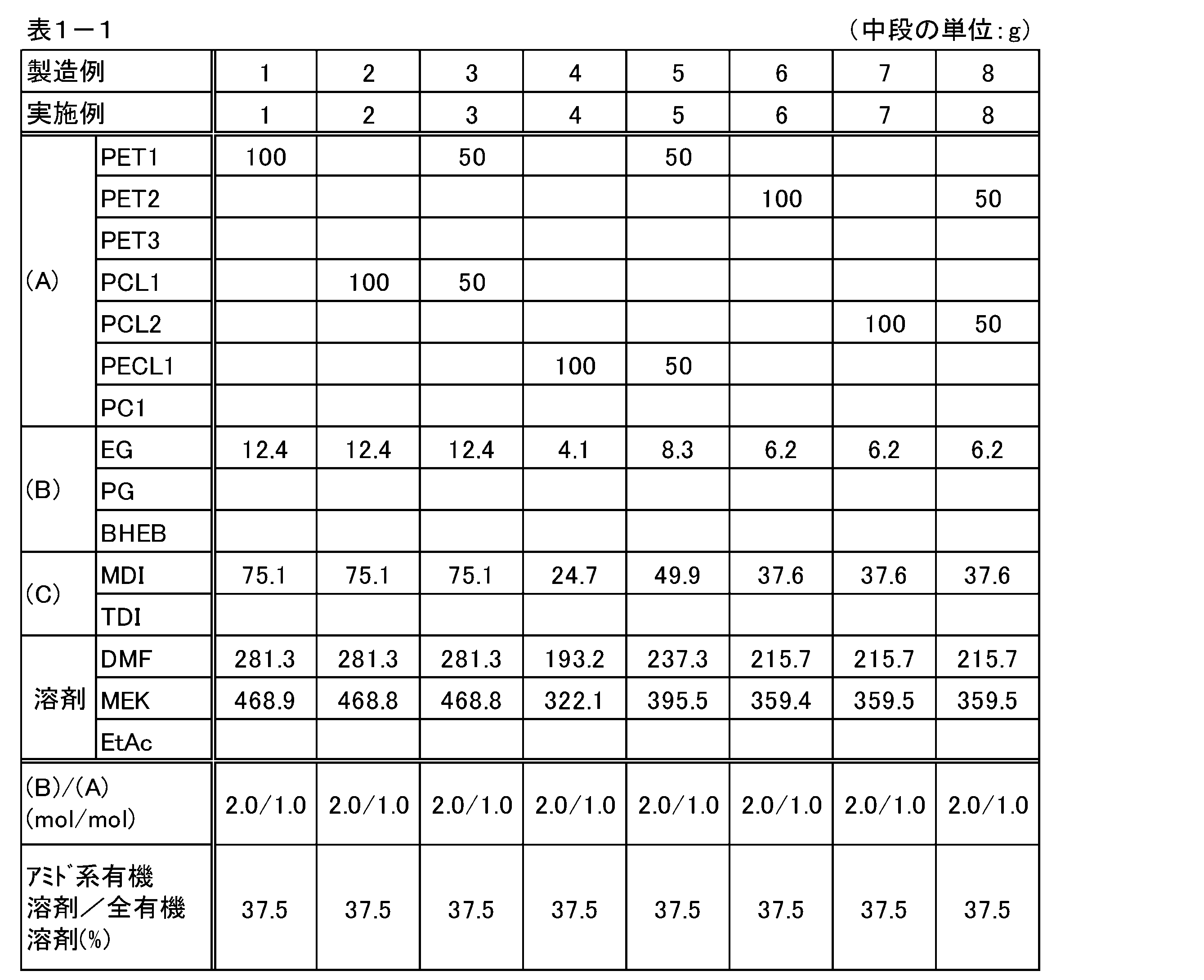
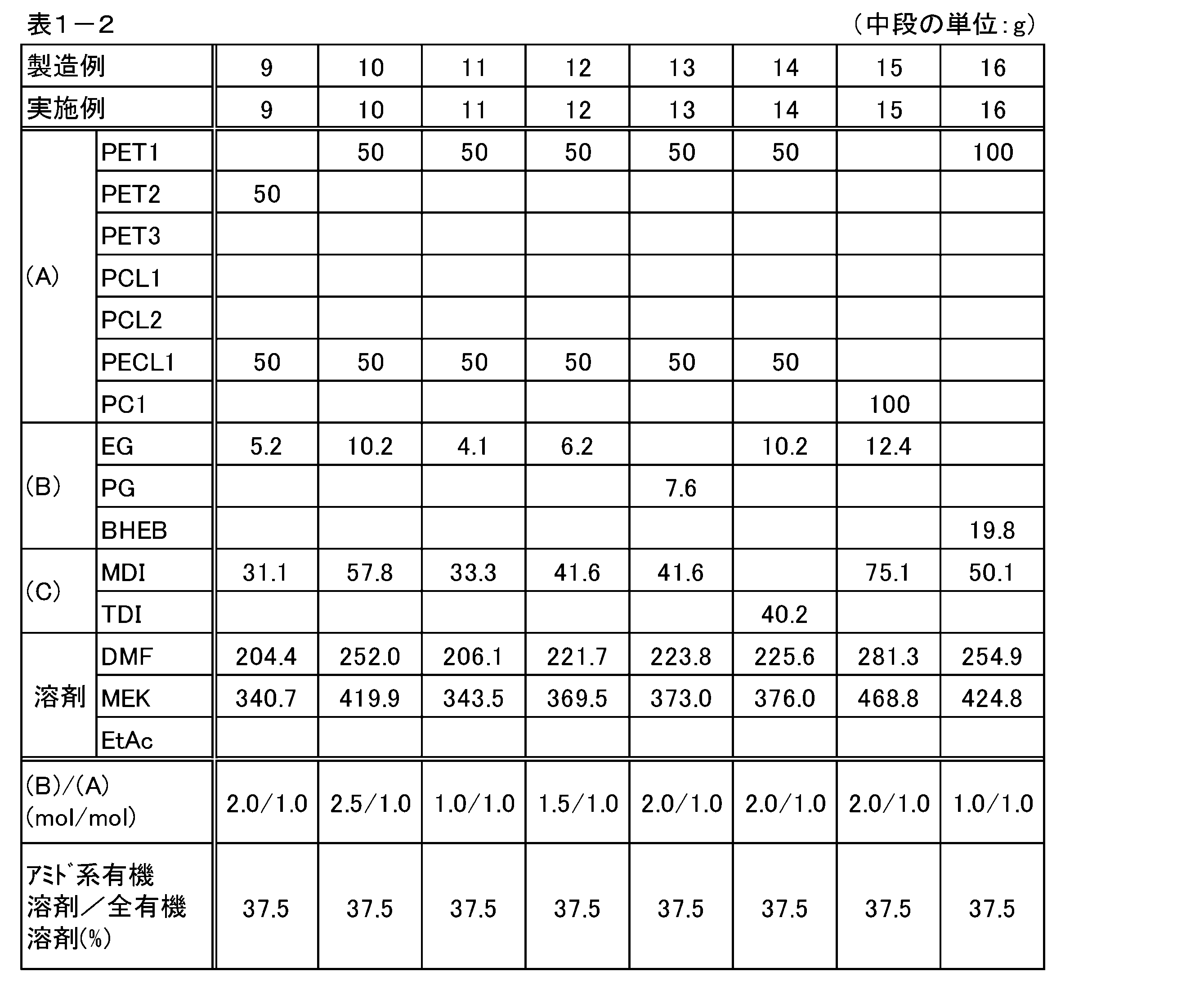
表1-1~1-3の中段に示す種類及び量の各成分を用いたこと以外は、前述の製造例1と同様にして、実施例2~21のポリウレタン樹脂溶液(固形分20%)を得た。構成単位(A)に対する、構成単位(B)のモル比((B)/(A)(mol/mol))、及び全有機溶剤中のアミド系有機溶剤の含有量(%)を表1-1~1-3の下段に示す。また、表1-1~1-3中の各成分を表す略号の詳細を表3及び4に示す。
表1-1~1-3の中段に示す種類及び量の各成分を用いたこと以外は、前述の製造例1と同様にして、実施例2~21のポリウレタン樹脂溶液(固形分20%)を得た。構成単位(A)に対する、構成単位(B)のモル比((B)/(A)(mol/mol))、及び全有機溶剤中のアミド系有機溶剤の含有量(%)を表1-1~1-3の下段に示す。また、表1-1~1-3中の各成分を表す略号の詳細を表3及び4に示す。
(製造例22~46:比較例1~25のポリウレタン樹脂溶液の製造)
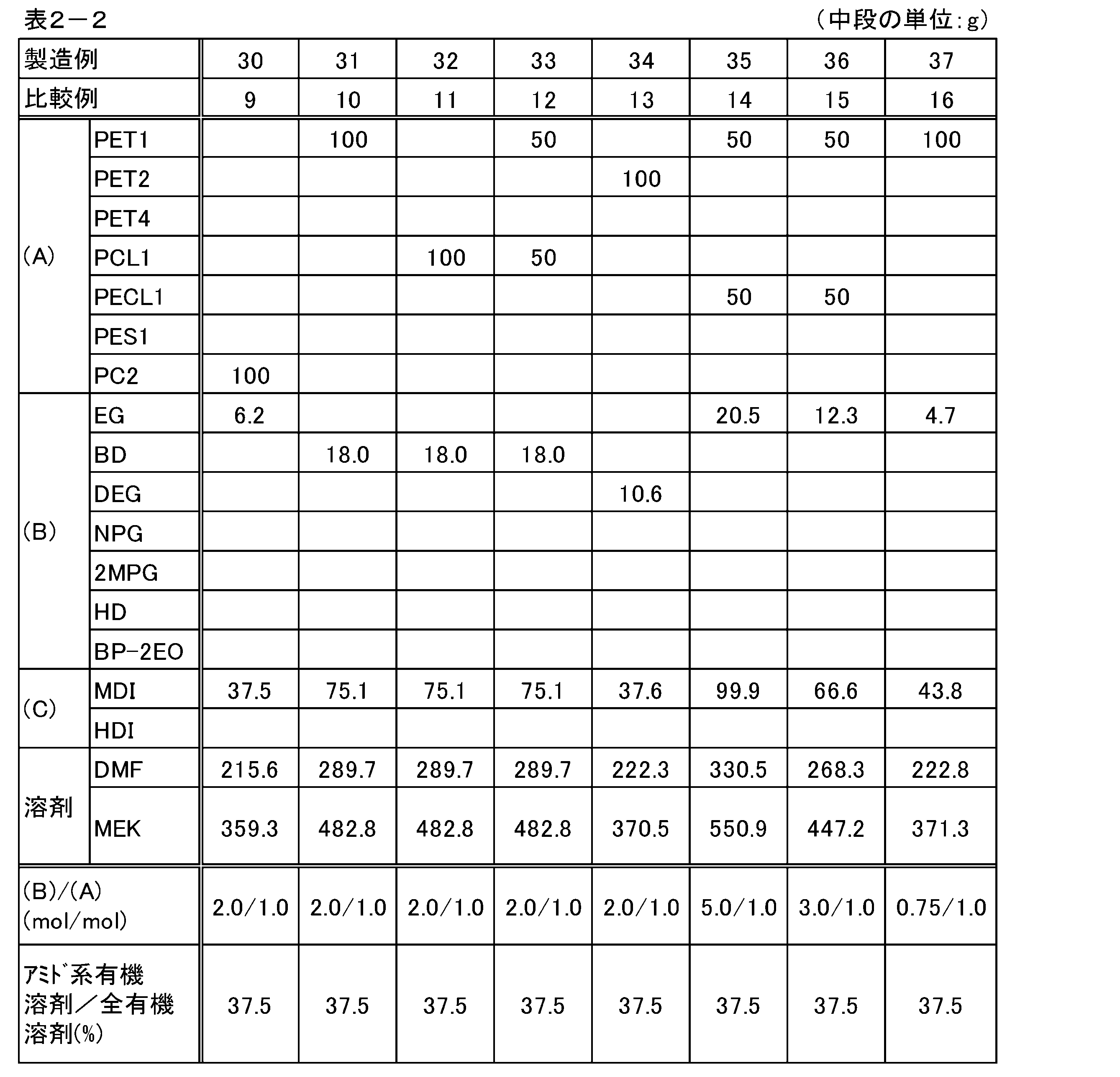
表2-1~2-3の中段に示す種類及び量の各成分を用いたこと以外は、前述の製造例1と同様にして、比較例1~25のポリウレタン樹脂の溶液(固形分20%)を得た。構成単位(A)に対する、構成単位(B)のモル比((B)/(A)(mol/mol))、及び全有機溶剤中のアミド系有機溶剤の含有量(%)を表2-1~2-3の下段に示す。表1-1~1-3中の「EtAc」は、酢酸エチルを意味する。また、表2-1~2-3中の各成分を表す略号の詳細を表3及び4に示す。
表2-1~2-3の中段に示す種類及び量の各成分を用いたこと以外は、前述の製造例1と同様にして、比較例1~25のポリウレタン樹脂の溶液(固形分20%)を得た。構成単位(A)に対する、構成単位(B)のモル比((B)/(A)(mol/mol))、及び全有機溶剤中のアミド系有機溶剤の含有量(%)を表2-1~2-3の下段に示す。表1-1~1-3中の「EtAc」は、酢酸エチルを意味する。また、表2-1~2-3中の各成分を表す略号の詳細を表3及び4に示す。




<評価>
(試験1:温度非依存性(温感性)試験)
各ポリウレタン樹脂溶液を離型紙上に塗工した。80℃で10分間、次いで120℃で10分間乾燥した後、25℃で2日間エージングして、厚さ約40μmの塗工フィルムを得た。得られた塗工フィルムを測定用の試験片とし、引張試験装置(型名「オートグラフ AGS-100A」、島津製作所社製)を使用して、引張速度100mm/minの条件で、-10℃における100%モジュラス(ML(MPa))、25℃における100%モジュラス(MM(MPa))、及び40℃における100%モジュラス(MH(MPa))を測定した。そして、測定した各温度における100%モジュラスより、比率X(=(ML/MM)×100(%))、比率Y(=(MH/MM)×100(%))、及び比率Xと比率Yの差(=X-Y(%))を算出し、以下に示す評価基準にしたがって温度非依存性を評価した。結果を表5-1及び5-2に示す。
○:Xが200%以下、Yが50%以上、かつ、X-Yが100%以下であった。
△:Xが200%超、Yが50%未満、かつ、X-Yが100%以下であった。
×:Xが200%超、Yが50%未満、又は、X-Yが100%超であった。
(試験1:温度非依存性(温感性)試験)
各ポリウレタン樹脂溶液を離型紙上に塗工した。80℃で10分間、次いで120℃で10分間乾燥した後、25℃で2日間エージングして、厚さ約40μmの塗工フィルムを得た。得られた塗工フィルムを測定用の試験片とし、引張試験装置(型名「オートグラフ AGS-100A」、島津製作所社製)を使用して、引張速度100mm/minの条件で、-10℃における100%モジュラス(ML(MPa))、25℃における100%モジュラス(MM(MPa))、及び40℃における100%モジュラス(MH(MPa))を測定した。そして、測定した各温度における100%モジュラスより、比率X(=(ML/MM)×100(%))、比率Y(=(MH/MM)×100(%))、及び比率Xと比率Yの差(=X-Y(%))を算出し、以下に示す評価基準にしたがって温度非依存性を評価した。結果を表5-1及び5-2に示す。
○:Xが200%以下、Yが50%以上、かつ、X-Yが100%以下であった。
△:Xが200%超、Yが50%未満、かつ、X-Yが100%以下であった。
×:Xが200%超、Yが50%未満、又は、X-Yが100%超であった。
(試験2:耐熱軟化性試験)
上述の「試験1」で得た塗工フィルムを測定用の試験片とした。450g/cm2の荷重を試験片にかけながら昇温速度3℃/minで加温して、試験片の状態を観察し、以下に示す評価基準にしたがって耐熱軟化性を評価した。結果を表5-1及び5-2に示す。
○:延伸前の長さの25%未満の延伸で破断した。
△:延伸前の長さの25%以上50%未満の延伸で破断した。
×:延伸前の長さの50%以上の延伸で破断した、又は、熱溶融して溶け落ちた。
上述の「試験1」で得た塗工フィルムを測定用の試験片とした。450g/cm2の荷重を試験片にかけながら昇温速度3℃/minで加温して、試験片の状態を観察し、以下に示す評価基準にしたがって耐熱軟化性を評価した。結果を表5-1及び5-2に示す。
○:延伸前の長さの25%未満の延伸で破断した。
△:延伸前の長さの25%以上50%未満の延伸で破断した。
×:延伸前の長さの50%以上の延伸で破断した、又は、熱溶融して溶け落ちた。
(試験3:溶液安定性試験)
各ポリウレタン樹脂溶液を0℃の温度条件下で1週間保存する試験(促進試験)を行った。試験後の各ポリウレタン樹脂溶液を目視にて観察し、以下に示す評価基準にしたがって溶液安定性を評価した。結果を表5-1及び5-2に示す。
○:外観に変化なし(透明、流動性あり)。
×:白化又は固化した。
××:製造した段階で白化又は固化していた。
各ポリウレタン樹脂溶液を0℃の温度条件下で1週間保存する試験(促進試験)を行った。試験後の各ポリウレタン樹脂溶液を目視にて観察し、以下に示す評価基準にしたがって溶液安定性を評価した。結果を表5-1及び5-2に示す。
○:外観に変化なし(透明、流動性あり)。
×:白化又は固化した。
××:製造した段階で白化又は固化していた。
(試験4:溶剤残留性試験)
実施例1~21及び比較例23~25の各ポリウレタン樹脂溶液を離型紙上に塗工した。100℃で1分間乾燥して、厚さ約10μmの塗工フィルムを得た。得られた塗工フィルムを測定用の試験片とし、試験1及び2と同様の試験を実施した。なお、試験1で測定される100%モジュラスの値、及び試験2で観察される破断・溶融状態は、いずれも、試験片の膜厚に依存しない。そして、以下に示す評価基準にしたがって溶剤残留性を評価した。結果を表5-1に示す。
○:温度非依存性及び耐熱軟化性がいずれも「〇」であった。
×:温度非依存性及び耐熱軟化性の少なくともいずれかが「×」であった。
実施例1~21及び比較例23~25の各ポリウレタン樹脂溶液を離型紙上に塗工した。100℃で1分間乾燥して、厚さ約10μmの塗工フィルムを得た。得られた塗工フィルムを測定用の試験片とし、試験1及び2と同様の試験を実施した。なお、試験1で測定される100%モジュラスの値、及び試験2で観察される破断・溶融状態は、いずれも、試験片の膜厚に依存しない。そして、以下に示す評価基準にしたがって溶剤残留性を評価した。結果を表5-1に示す。
○:温度非依存性及び耐熱軟化性がいずれも「〇」であった。
×:温度非依存性及び耐熱軟化性の少なくともいずれかが「×」であった。

本発明のポリウレタン樹脂溶液は、耐熱軟化性に優れているとともに、低温域から高温域にかけてモジュラスなどの物性の変動が小さい樹脂を含有する、溶剤安定性に優れた樹脂溶液である。このため、本発明のポリウレタン樹脂溶液は、高温域を含む広範な温度域下で用いられる携帯型デバイスのスピーカーに配設される中実なフィルム状部材を溶液流延法によって製造するための材料として有用である。
5:治具
10,20:ポリウレタン樹脂
15:錘
10,20:ポリウレタン樹脂
15:錘
Claims (7)
- 携帯型デバイスのスピーカーに配設される中実なフィルム状部材を溶液流延法によって製造するために用いるポリウレタン樹脂溶液であって、
ポリウレタン樹脂と、前記ポリウレタン樹脂を溶解する有機溶剤と、を含有し、
前記ポリウレタン樹脂が、下記構成単位(A)、(B)、及び(C)のみで構成されており、
前記ポリウレタン樹脂を構成する、前記構成単位(A)に対する、前記構成単位(B)のモル比((B)/(A))が、1.0~2.5であり、
前記有機溶剤が、アミド系有機溶剤を25~65質量%含む混合溶媒であるポリウレタン樹脂溶液。
構成単位(A):ポリエーテルポリオール、ポリカプロラクトンポリオール、及びカプロラクトン変性ポリオールからなる群より選択される少なくとも一種の、その水酸基価が150.0mgKOH/g以下のポリオールに由来する構成単位
構成単位(B):下記一般式(1)で表されるジオール、又はベンゼン環及びエーテル結合を主鎖に含むジオールに由来する構成単位
構成単位(C):4,4’-ジフェニルメタンジイソシアネート及びトルエンジイソシアネートの少なくともいずれかの芳香族ジイソシアネートに由来する構成単位
(前記一般式(1)中、R1は、炭素数1又は2の炭化水素基を示し、R2は、水素原子又は炭素数6以下のアルキル基を示す)
- 前記ポリウレタン樹脂の、25℃における100%モジュラスMM(MPa)に対する、-10℃における100%モジュラスML(MPa)の比率X(%)が、200%以下である請求項1に記載のポリウレタン樹脂溶液。
- 前記ポリウレタン樹脂の、25℃における100%モジュラスMM(MPa)に対する、40℃における100%モジュラスMH(MPa)の比率Y(%)が、50%以上である請求項1又は2に記載のポリウレタン樹脂溶液。
- 前記ポリウレタン樹脂の、前記比率X(%)と前記比率Y(%)の差(X-Y)が、100%以下である請求項3に記載のポリウレタン樹脂溶液。
- 前記ポリウレタン樹脂が、450g/cm2の荷重をかけながら昇温速度3℃/minで加熱して延伸した場合に、延伸前の長さの25%未満の延伸で破断する請求項4に記載のポリウレタン樹脂溶液。
- 前記有機溶剤が、前記アミド系有機溶剤と、ケトン系有機溶剤又はエステル系有機溶剤との混合溶媒であり、
前記アミド系有機溶剤が、N,N-ジメチルホルムアミド、N,N-ジメチルアセトアミド、N-メチル-2-ピロリドン、1,3-ジメチル-2-イミダゾリジノン、N-エチル-2-ピロリドン、及びN,N’-ジメチルプロピレン尿素からなる群より選択される少なくとも一種であり、
前記ケトン系有機溶剤が、メチルエチルケトン、アセトン、シクロヘキサノン、メチルイソブチルケトン、ジエチルケトン、及びイソホロンからなる群より選択される少なくとも一種であり、
前記エステル系有機溶剤が、酢酸エチル、酢酸プロピル、酢酸ブチル、ギ酸エチル、及び酪酸メチルからなる群より選択される少なくとも一種である請求項1~5のいずれか一項に記載のポリウレタン樹脂溶液。 - 携帯型デバイスのスピーカーに配設されるポリウレタン樹脂製の中実なフィルム状部材であって、
前記ポリウレタン樹脂が、下記構成単位(A)、(B)、及び(C)のみで構成されており、
前記ポリウレタン樹脂を構成する、前記構成単位(A)に対する、前記構成単位(B)のモル比((B)/(A))が、1.0~2.5であるフィルム状部材。
構成単位(A):ポリエーテルポリオール、ポリカプロラクトンポリオール、及びカプロラクトン変性ポリオールからなる群より選択される少なくとも一種の、その水酸基価が150.0mgKOH/g以下のポリオールに由来する構成単位
構成単位(B):下記一般式(1)で表されるジオール、又はベンゼン環及びエーテル結合を主鎖に含むジオールに由来する構成単位
構成単位(C):4,4’-ジフェニルメタンジイソシアネート及びトルエンジイソシアネートの少なくともいずれかの芳香族ジイソシアネートに由来する構成単位
(前記一般式(1)中、R1は、炭素数1又は2の炭化水素基を示し、R2は、水素原子又は炭素数6以下のアルキル基を示す)
Priority Applications (2)
| Application Number | Priority Date | Filing Date | Title |
|---|---|---|---|
| CN202080037375.9A CN113905868B (zh) | 2019-05-23 | 2020-05-22 | 聚氨酯树脂溶液和薄膜状构件 |
| KR1020217041417A KR102447730B1 (ko) | 2019-05-23 | 2020-05-22 | 폴리우레탄 수지 용액 및 필름상 부재 |
Applications Claiming Priority (4)
| Application Number | Priority Date | Filing Date | Title |
|---|---|---|---|
| JP2019-096662 | 2019-05-23 | ||
| JP2019096662A JP6759415B1 (ja) | 2019-05-23 | 2019-05-23 | ポリウレタン樹脂及び物品 |
| JP2020000932A JP6707213B1 (ja) | 2019-05-23 | 2020-01-07 | ポリウレタン樹脂溶液及びフィルム状部材 |
| JP2020-000932 | 2020-01-07 |
Publications (1)
| Publication Number | Publication Date |
|---|---|
| WO2020235677A1 true WO2020235677A1 (ja) | 2020-11-26 |
Family
ID=70976325
Family Applications (2)
| Application Number | Title | Priority Date | Filing Date |
|---|---|---|---|
| PCT/JP2020/020317 Ceased WO2020235678A1 (ja) | 2019-05-23 | 2020-05-22 | ポリウレタン樹脂及び物品 |
| PCT/JP2020/020316 Ceased WO2020235677A1 (ja) | 2019-05-23 | 2020-05-22 | ポリウレタン樹脂溶液及びフィルム状部材 |
Family Applications Before (1)
| Application Number | Title | Priority Date | Filing Date |
|---|---|---|---|
| PCT/JP2020/020317 Ceased WO2020235678A1 (ja) | 2019-05-23 | 2020-05-22 | ポリウレタン樹脂及び物品 |
Country Status (4)
| Country | Link |
|---|---|
| JP (2) | JP6759415B1 (ja) |
| KR (1) | KR102447730B1 (ja) |
| CN (1) | CN113905868B (ja) |
| WO (2) | WO2020235678A1 (ja) |
Citations (4)
| Publication number | Priority date | Publication date | Assignee | Title |
|---|---|---|---|---|
| JP2001204093A (ja) * | 1999-03-03 | 2001-07-27 | Onkyo Corp | スピーカー用部材およびその製造方法 |
| JP2007020139A (ja) * | 2005-06-08 | 2007-01-25 | Onkyo Corp | スピーカー用部材およびその製造方法 |
| JP2016164258A (ja) * | 2015-02-27 | 2016-09-08 | 三洋化成工業株式会社 | 透湿防水素材用ポリウレタン樹脂 |
| JP2017155082A (ja) * | 2016-02-29 | 2017-09-07 | 日本マタイ株式会社 | 機能性フィルム |
Family Cites Families (26)
| Publication number | Priority date | Publication date | Assignee | Title |
|---|---|---|---|---|
| JPS5216596A (en) * | 1975-07-31 | 1977-02-07 | Kao Corp | Process for preparing amphoteric polyurethane emulsions |
| JPS589500A (ja) * | 1981-07-09 | 1983-01-19 | Onkyo Corp | スピ−カ−用振動板の製造方法 |
| JPS5859212A (ja) * | 1981-10-02 | 1983-04-08 | Daicel Chem Ind Ltd | 弾性回復性のすぐれたポリウレタンの製造方法 |
| JPS6172032A (ja) * | 1984-09-17 | 1986-04-14 | Dainichi Seika Kogyo Kk | 多孔性シ−ト材料およびその製造方法 |
| JPS61250019A (ja) * | 1985-04-27 | 1986-11-07 | Bridgestone Corp | 微小気泡質状ポリウレタンエラストマ−の製造方法 |
| JPH01138263A (ja) * | 1987-11-26 | 1989-05-31 | Dainichiseika Color & Chem Mfg Co Ltd | ポリウレタン乳濁液 |
| JPH0669294A (ja) | 1992-08-19 | 1994-03-11 | Fuji Electric Co Ltd | 集積回路用試験プローブ装置 |
| JP3794717B2 (ja) | 1993-09-29 | 2006-07-12 | 日本ミラクトラン株式会社 | 熱可塑性ポリウレタン樹脂系ホットメルト接着剤 |
| JP3952526B2 (ja) * | 1996-11-20 | 2007-08-01 | 大日本インキ化学工業株式会社 | 防水布用ポリウレタン樹脂組成物及びこれを使用した防水布 |
| JP2000327759A (ja) * | 1999-05-20 | 2000-11-28 | Daicel Chem Ind Ltd | ポリエステルジオール、それから得られるポリウレタン及びそのスパンデックス(登録商標)フィラメント |
| JP4860073B2 (ja) * | 2001-09-18 | 2012-01-25 | コニシ株式会社 | シリル化ウレタン系速硬化型水性組成物及び該水性組成物を含有する水性接着剤並びに水性コーティング剤 |
| JP4073246B2 (ja) * | 2002-05-10 | 2008-04-09 | 横浜ゴム株式会社 | ポリウレタンアイオノマーおよびその製造方法 |
| DE10316573A1 (de) * | 2003-04-10 | 2004-11-04 | Mnemoscience Gmbh | Blends mit Form-Gedächtnis-Eigenschaften |
| JP4904703B2 (ja) * | 2004-03-24 | 2012-03-28 | Dic株式会社 | 耐熱性ポリウレタンフィルム |
| JP4299204B2 (ja) * | 2004-07-15 | 2009-07-22 | 株式会社タチエス | シート音響システム |
| CN1972977B (zh) * | 2004-10-20 | 2010-12-15 | 旭硝子株式会社 | 聚氨酯树脂溶液及其制造方法以及聚氨酯树脂的制造方法 |
| JP5057827B2 (ja) * | 2006-04-27 | 2012-10-24 | 三菱レイヨン株式会社 | 活性エネルギー線硬化型塗料組成物および該組成物の硬化被膜を有する成形品 |
| JP4851401B2 (ja) * | 2006-08-11 | 2012-01-11 | 三洋化成工業株式会社 | 反応性ホットメルト接着剤 |
| JP2010189544A (ja) * | 2009-02-18 | 2010-09-02 | Arakawa Chem Ind Co Ltd | ポリウレタン樹脂、印刷インキ用組成物、コーティング剤組成物及び接着剤組成物 |
| ES2899884T3 (es) * | 2012-03-13 | 2022-03-15 | Basf Se | Poliuretano termoplástico ignífugo que contiene hidróxidos metálicos recubiertos a base de aluminio |
| WO2014192460A1 (ja) * | 2013-05-27 | 2014-12-04 | Dic株式会社 | 両面粘着テープ |
| JP2015224310A (ja) * | 2014-05-29 | 2015-12-14 | 三洋化成工業株式会社 | 膠着防止剤及びその樹脂組成物 |
| JP6597007B2 (ja) * | 2015-07-16 | 2019-10-30 | Dic株式会社 | 凝固物の製造方法 |
| JP6492183B2 (ja) * | 2015-09-01 | 2019-03-27 | 三井化学株式会社 | 緩衝材、塗装用自動運動装置用緩衝材、緩衝材付自動運動装置および緩衝材付塗装用自動運動装置 |
| WO2017050738A1 (de) * | 2015-09-24 | 2017-03-30 | Basf Se | Thermoplastische polyurethane |
| EP3663343A4 (en) * | 2017-08-03 | 2021-04-28 | DIC Corporation | Porous-object production method |
-
2019
- 2019-05-23 JP JP2019096662A patent/JP6759415B1/ja active Active
-
2020
- 2020-01-07 JP JP2020000932A patent/JP6707213B1/ja active Active
- 2020-05-22 WO PCT/JP2020/020317 patent/WO2020235678A1/ja not_active Ceased
- 2020-05-22 KR KR1020217041417A patent/KR102447730B1/ko active Active
- 2020-05-22 CN CN202080037375.9A patent/CN113905868B/zh active Active
- 2020-05-22 WO PCT/JP2020/020316 patent/WO2020235677A1/ja not_active Ceased
Patent Citations (4)
| Publication number | Priority date | Publication date | Assignee | Title |
|---|---|---|---|---|
| JP2001204093A (ja) * | 1999-03-03 | 2001-07-27 | Onkyo Corp | スピーカー用部材およびその製造方法 |
| JP2007020139A (ja) * | 2005-06-08 | 2007-01-25 | Onkyo Corp | スピーカー用部材およびその製造方法 |
| JP2016164258A (ja) * | 2015-02-27 | 2016-09-08 | 三洋化成工業株式会社 | 透湿防水素材用ポリウレタン樹脂 |
| JP2017155082A (ja) * | 2016-02-29 | 2017-09-07 | 日本マタイ株式会社 | 機能性フィルム |
Also Published As
| Publication number | Publication date |
|---|---|
| KR20220002682A (ko) | 2022-01-06 |
| KR102447730B1 (ko) | 2022-09-28 |
| JP6707213B1 (ja) | 2020-06-10 |
| JP6759415B1 (ja) | 2020-09-23 |
| CN113905868A (zh) | 2022-01-07 |
| JP2020193319A (ja) | 2020-12-03 |
| CN113905868B (zh) | 2022-07-12 |
| WO2020235678A1 (ja) | 2020-11-26 |
Similar Documents
| Publication | Publication Date | Title |
|---|---|---|
| JP5126455B1 (ja) | ラジカル硬化性ホットメルトウレタン樹脂組成物、及び光学用成形体 | |
| JP6413298B2 (ja) | ポリウレタン及び、ポリウレタンの製造方法 | |
| JP2885872B2 (ja) | 脂肪族コポリカーボネート及び該単位を含有するポリウレタン | |
| JP5473147B2 (ja) | ポリウレタン樹脂位相差フィルム | |
| JP6683298B1 (ja) | 合成皮革 | |
| WO2019098039A1 (ja) | 発泡ウレタンシート、及び、合成皮革 | |
| JP6582515B2 (ja) | ポリウレタン樹脂および該組成物を用いた皮革用接着剤 | |
| JP2020084163A (ja) | ポリカーボネートポリオール及びポリウレタン樹脂形成用組成物 | |
| JP6025333B2 (ja) | 水系アクリルウレタン樹脂組成物の製造方法、該方法によって製造してなる水系アクリルウレタン樹脂組成物、該樹脂組成物を硬化させてなる硬化物及び該硬化物によって表面保護された物品 | |
| JP6707213B1 (ja) | ポリウレタン樹脂溶液及びフィルム状部材 | |
| JP6756353B2 (ja) | 2液硬化型接着剤組成物 | |
| JP2016008271A (ja) | 光学用ポリウレタン組成物、薄膜成形体、光学フィルム、及び薄膜成形体の製造方法 | |
| CA3028104A1 (en) | Thermoplastic polyurethanes with reduced tackiness | |
| JP6989058B2 (ja) | ウレタン樹脂水分散体、合成皮革、及び、合成皮革の製造方法 | |
| TW202000781A (zh) | 合成皮革 | |
| AU2015259178A1 (en) | Digitally printable topcoat | |
| TWI572670B (zh) | 樹枝狀水性聚胺酯組成物及包含該聚胺酯之薄膜 | |
| JP5294032B2 (ja) | ワンショット成形用ポリエステルポリオール組成物、及びそれを用いたポリウレタン樹脂組成物 | |
| JP2001002752A (ja) | 難燃性ポリウレタン発泡シートおよび該シートを用いた合成皮革 | |
| JP2019137755A (ja) | ポリウレタン樹脂、ポリウレタン樹脂組成物、及び光学フィルム | |
| JP5756678B2 (ja) | 導光性ポリウレタン樹脂および導光部材 | |
| WO2020067534A1 (ja) | 2液硬化型接着剤組成物 | |
| JP2005307182A (ja) | 耐熱性ポリウレタンフィルム | |
| JP4616977B2 (ja) | ポリウレタン樹脂溶液の製造方法 | |
| JPS60197717A (ja) | ポリウレタンの製造方法 |
Legal Events
| Date | Code | Title | Description |
|---|---|---|---|
| 121 | Ep: the epo has been informed by wipo that ep was designated in this application |
Ref document number: 20810292 Country of ref document: EP Kind code of ref document: A1 |
|
| NENP | Non-entry into the national phase |
Ref country code: DE |
|
| ENP | Entry into the national phase |
Ref document number: 20217041417 Country of ref document: KR Kind code of ref document: A |
|
| 122 | Ep: pct application non-entry in european phase |
Ref document number: 20810292 Country of ref document: EP Kind code of ref document: A1 |