WO2019021606A1 - 衣材用酸化澱粉の製造方法 - Google Patents
衣材用酸化澱粉の製造方法 Download PDFInfo
- Publication number
- WO2019021606A1 WO2019021606A1 PCT/JP2018/019771 JP2018019771W WO2019021606A1 WO 2019021606 A1 WO2019021606 A1 WO 2019021606A1 JP 2018019771 W JP2018019771 W JP 2018019771W WO 2019021606 A1 WO2019021606 A1 WO 2019021606A1
- Authority
- WO
- WIPO (PCT)
- Prior art keywords
- starch
- oxidized starch
- slurry
- mass
- raw material
- Prior art date
- Legal status (The legal status is an assumption and is not a legal conclusion. Google has not performed a legal analysis and makes no representation as to the accuracy of the status listed.)
- Ceased
Links
Classifications
-
- A—HUMAN NECESSITIES
- A23—FOODS OR FOODSTUFFS; TREATMENT THEREOF, NOT COVERED BY OTHER CLASSES
- A23L—FOODS, FOODSTUFFS OR NON-ALCOHOLIC BEVERAGES, NOT OTHERWISE PROVIDED FOR; PREPARATION OR TREATMENT THEREOF
- A23L5/00—Preparation or treatment of foods or foodstuffs, in general; Food or foodstuffs obtained thereby; Materials therefor
- A23L5/10—General methods of cooking foods, e.g. by roasting or frying
-
- A—HUMAN NECESSITIES
- A23—FOODS OR FOODSTUFFS; TREATMENT THEREOF, NOT COVERED BY OTHER CLASSES
- A23L—FOODS, FOODSTUFFS OR NON-ALCOHOLIC BEVERAGES, NOT OTHERWISE PROVIDED FOR; PREPARATION OR TREATMENT THEREOF
- A23L7/00—Cereal-derived products; Malt products; Preparation or treatment thereof
- A23L7/10—Cereal-derived products
- A23L7/157—Farinaceous granules for dressing meat, fish or the like
-
- C—CHEMISTRY; METALLURGY
- C08—ORGANIC MACROMOLECULAR COMPOUNDS; THEIR PREPARATION OR CHEMICAL WORKING-UP; COMPOSITIONS BASED THEREON
- C08B—POLYSACCHARIDES; DERIVATIVES THEREOF
- C08B31/00—Preparation of derivatives of starch
- C08B31/18—Oxidised starch
Definitions
- the present invention relates to a method of producing oxidized starch for dressings.
- Patent Documents 1 to 3 disclose techniques using oxidized starch as a coating material for fried foods.
- Patent Document 1 Japanese Patent Application Laid-Open No. 6-30713
- a coating material containing hypochlorous acid-processed modified starch, roasted dextrin, oxidized starch, low viscosity acid-treated starch, etherified starch or esterified starch is used.
- Techniques for dry tempura have been described.
- when dried tempura obtained by using a tempura powder containing a specific amount of hypochlorinated processed starch is immersed in boiling water, it is completely restored and becomes a tempura with a good flavor, texture and color tone. Is described.
- Patent Document 2 Japanese Patent Application Laid-Open No. 8-131109 describes a technique relating to a fried food batter composition containing oxidized starch and waxy starch, and when such a composition is used, there is no tackiness, It is said that it is possible to make fried foods such as tempura having excellent texture and excellent in texture and softness and good mouth melting. Moreover, it is described in the same document that it is preferable to use oxidized starch obtained by treating corn starch with sodium hypochlorite among oxidized starches in terms of stability, whiteness, availability, etc. It is done.
- Patent Document 3 Japanese Patent Application Laid-Open No. 2011-254785 describes a flour, a starch-containing starch with a carboxyl group content in a specific range, and a frying material containing a swelling-inhibited starch in a specific ratio. Such clothing materials are considered to be able to form clothing that is excellent in savoriness, crisp, and less oily. Also, in the same literature, for preparation of oxidized starch, water is added to a specific amount of raw tapioca to prepare a specific amount of starch suspension, to which a specific amount of sodium hypochlorite and an alkali agent are added. After the pH is kept alkaline, stirring is maintained for a predetermined time to carry out an oxidation reaction.
- the present invention provides a technique for imparting a desired hardness and crispiness to fried food and maintaining its preference after storage.
- a method of producing fry food comprising:
- a method of maintaining the crispness of the fry food batter or the hard food batter of the fry food using the oxidized starch produced in the method according to the present invention as a fry food batter. Methods are provided to maintain
- the oxidized starch for clothing material obtained by the production method according to the present invention for the production of a clothing material or a fried food.
- a step of obtaining a fry food batter by the method of producing a fry food batter according to the present invention a step of covering a seed with the fry food batter, and the fry food
- a method for producing a fry food product comprising the step of heat-treating the dressing-coated seed material, and a fry food product obtained by the production method.
- each component can be used individually or in combination of 2 or more types.
- the method for producing the oxidized starch for coating material includes the following steps 1 and 2.
- Step 1) Step of Preparing Slurry Containing Raw Material Starch
- Step 2) Step of Oxidation of Raw Material Starch in the Slurry to Obtain Oxidized Starch
- Step 2 of the step of obtaining starch oxide is the following step 2-1 And step 2-2.
- Step 2-1 Step of Adding an Oxidizing Agent to the Slurry
- Step 2-2 Raw Material Starch by Maintaining the Slurry for a Specified Time under the Condition that the pH of the Slurry is 9.2 to 11.7 Process of oxidizing
- step 2-2 the pH of the slurry obtained in step 1 is controlled to be within a specific range of conditions, and the slurry is maintained under such conditions for a predetermined time. More specifically, in step 2-2, control is performed so as to have a high pH condition as compared to the conditions described in the above-mentioned Patent Document 3, and the condition is maintained for a predetermined time.
- control is performed so as to have a high pH condition as compared to the conditions described in the above-mentioned Patent Document 3, and the condition is maintained for a predetermined time.
- Step 1 a slurry of raw material starch is prepared.
- the slurry specifically contains raw material starch and water.
- Specific examples of the plant from which the raw material starch is derived include corn, glutinous corn, rice, glutinous rice, wheat, sweet potato, potato, glutinous potato, tapioca, sago palm and the like.
- the raw material starch is preferably selected from corn starch, waxy corn starch, rice starch, glutinous rice starch, wheat starch, sweet potato starch, potato starch, waxy potato starch, tapioca starch, sago starch and acetylated starch and hydroxypropylated starch thereof.
- the raw material starch is preferably an unmodified starch, and more preferably an unmodified tapioca starch It is.
- the dry matter equivalent mass concentration of the raw material starch in the slurry is, for example, 20% by mass or more, preferably 30% by mass or more, with respect to the entire slurry, from the viewpoint of enhancing the efficiency of the oxidation reaction in Step 2. Further, from the viewpoint of enhancing the stability of the oxidation reaction in step 2, the dry matter equivalent mass concentration of the raw material starch in the slurry is, for example, 50 mass% or less, preferably 45 mass% or less, with respect to the entire slurry.
- the dry matter equivalent mass concentration of the raw material starch in the slurry is the amount of dry matter obtained by subtracting the mass of water calculated from the mass of starch (mass%) from the mass of starch, the above mass of starch and water added at the time of slurry preparation After dividing by the total mass which added with the mass of, it can calculate 100 times.
- Step 2 is a step of obtaining oxidized starch, and includes the steps 2-1 and 2-2 described above.
- Step 2-1 may be performed once during step 2 or may be divided into two or more steps, and the second and subsequent steps 2-1 may be performed during step 2-2.
- step 2-1 is performed once during step 2. More preferably, step 2-1 is performed before step 2-2.
- Examples of the oxidizing agent used in step 2-1 include chlorine-based oxidizing agents having effective chlorine in an aqueous solution such as hypochlorite and bleached powder; hydrogen peroxide; permanganate etc., but the oxidation reaction is stable From the viewpoint of promoting the reaction, preferably one or two selected from the group consisting of hypochlorite and bleached powder, more preferably sodium hypochlorite, potassium hypochlorite, hypochlorous acid It is a hypochlorite such as calcium, and more preferably sodium hypochlorite.
- an oxidizing agent may contain 1 type of hypochlorite, and may contain 2 or more types.
- an aqueous solution having an effective chlorine concentration of 4% by mass to 18% by mass can be used as the concentration of the oxidizing agent used in Step 2-1.
- the above-mentioned effective chlorine concentration refers to the concentration of effective chlorine which is an oxidizing chlorine compound such as hypochlorous acid or hypochlorite ion in an aqueous solution, and, for example, the fifth edition food additive official document It can be measured by the method described in D-383 to D-384 of the manual (Ashikawa Shoten, 1987).
- the effective chlorine concentration relative to the dry matter equivalent mass of the raw material starch in the slurry at the start of step 2-2 is preferably from the viewpoint of enhancing the efficiency of the oxidation reaction. It is 1% by mass / g or more, more preferably 1.2% by mass / g or more, further preferably 1.4% by mass / g or more, and even more preferably 1.6% by mass / g or more. Further, from the viewpoint of enhancing the stability of the oxidation reaction, the effective chlorine concentration relative to the dry matter equivalent mass of the raw material starch is preferably 3.5% by mass / g or less, more preferably 3.0% by mass / g or less.
- the effective chlorine concentration with respect to the dry matter equivalent mass of the raw material starch refers to the effective chlorine concentration of the oxidizing agent with respect to 1 g of the dry matter equivalent mass of the raw material starch, and decreases as the oxidation reaction proceeds.
- the oxidation conditions in step 2-2 satisfy the following conditions for pH. That is, the pH of the slurry is 9.2 or more, preferably 9.4 or more, from the viewpoint of maintaining the preferable hardness and crispiness of the batter when used as a fry food batter. Further, from the viewpoint of suppressing excessive oxidation of the raw material starch and gelatinization of the slurry, the pH of the slurry is 11.7 or less, preferably 11.5 or less, more preferably 11.0 or less, further preferably 10 .5 or less.
- maintaining the pH of the slurry means keeping the slurry pH during the oxidation reaction within the range of the set value ⁇ 0.2.
- step 2-2 it is preferable to maintain the pH under the conditions described above by adding a base to the slurry.
- the addition of the base to the slurry may be performed continuously or intermittently.
- Specific examples of the base include metal hydroxides such as sodium hydroxide, potassium hydroxide, calcium hydroxide and magnesium hydroxide.
- the base is preferably a hydroxide of an alkali metal from the viewpoint of stably maintaining the pH under the conditions described above.
- the reaction temperature in step 2-2 is preferably 10 ° C. or more, more preferably 15 ° C. or more, and still more preferably 20 ° C. or more, from the viewpoint of enhancing the efficiency of the oxidation reaction. Further, from the viewpoint of enhancing the production stability of oxidized starch, the reaction temperature in step 2-2 is preferably 60 ° C. or less, more preferably 50 ° C. or less, and still more preferably 45 ° C. or less.
- Step 2-2 can be performed, for example, until the end of the oxidation reaction, more specifically, until the available chlorine in the slurry is exhausted. The absence of available chlorine in the slurry can also be confirmed by the fact that it does not exhibit a purple color when a portion of the slurry is extracted and added to a saturated potassium iodide solution.
- the predetermined time in step 2-2 can be the time until the completion of the above-mentioned oxidation reaction, but from the viewpoint of enhancing the yield of oxidized starch, it is preferably 30 minutes or more, more preferably 60 minutes or more. . In addition, from the viewpoint of enhancing the production efficiency of oxidized starch, the predetermined time in step 2-2 is preferably 500 minutes or less, more preferably 300 minutes or less.
- oxidized starch is produced in the slurry.
- process 3) of esterifying or etherifying oxidized starch is mentioned as a specific example of esterification performed to an oxidized starch at the process 3
- Hydroxypropylation etc. are mentioned as a specific example of etherification. From the viewpoint of improving the hardness and crispiness during preparation of the fried food and from the viewpoint of maintaining these preferences, it is preferable that the oxidized starch obtained in the present embodiment is not subjected to any other modification treatment.
- the acid in step 4 include inorganic acids such as hydrochloric acid, nitric acid and sulfuric acid; and organic acids such as acetic acid.
- the acid is preferably an inorganic acid, more preferably hydrochloric acid, and still more preferably hydrochloric acid having a concentration of 1% by mass to 5% by mass.
- the pH is preferably 7.0 or less, more preferably 6.5 or less.
- the lower limit value of pH in the step 4 is preferably 3.5 or more, more preferably 4.5 or more from the viewpoint of suppressing the decomposition of oxidized starch.
- a step of separating oxidized starch in the slurry a step of washing oxidized starch, a step of dewatering oxidized starch, a step of drying oxidized starch, a step of grinding oxidized starch, a sieve of oxidized starch
- steps selected from the group consisting of steps may further be performed.
- the oxidized starch after dehydration may be dried at a temperature of 30 ° C. or more and 150 ° C. or less.
- the oxidized starch obtained in the present embodiment can be suitably used as a raw material of a coating material.
- the oxidized starch in the present embodiment as a dressing, it is possible to impart a preferable hardness and crispiness to the batter of fried foods, and also to maintain their preference even after storage.
- the maximum viscosity when a slurry with a dry matter equivalent mass concentration of oxidized starch of 15% by mass is heated to 95 ° C. with a Rapid Visco Analyzer (RVA) is The viscosity is preferably 900 cP or less, more preferably 700 cP or less, and after heating, the viscosity when cooled to 25 ° C. with RVA is preferably 6000 cP or less, more preferably 5000 cP or less.
- the lower limit value of the maximum viscosity when heated to 95 ° C. is preferably 50 cP or more, and after heating, the lower limit value of the viscosity when cooled to 25 ° C. by RVA is preferably 100 cP or more.
- the viscosity when it is cooled to 25 ° C with respect to the maximum viscosity (viscosity A) when the 15% by mass slurry is heated to 95 ° C with RVA viscosity B
- the ratio of (viscosity B / viscosity A) is preferably 1.4 or more, more preferably 1.6 or more, and still more preferably 1.8 or more.
- the above (viscosity B / viscosity A) is preferably 20 or less, more preferably 15 or less, still more preferably 10 or less, and still more preferably 8 or less.
- the measurement method of the maximum viscosity when heated to 95 ° C. and the viscosity when cooled to 25 ° C. is as follows. (Measurement method of maximum viscosity when heated to 95 ° C and viscosity when cooled to 25 ° C) 1. Oxidized starch and water are mixed in a dedicated aluminum container to prepare a slurry having a dry matter equivalent mass concentration of oxidized starch of 15% by mass. Put a special paddle in the above aluminum container and set it on a Rapid Visco Analyzer (RVA). 2. Maintain at 40 ° C. for 1 minute while measuring viscosity under stirring at 160 rpm, then heat from 40 ° C. to 95 ° C.
- RVA Rapid Visco Analyzer
- the coating material in the present embodiment is used for fry food and includes oxidized starch obtained by the production method in the present embodiment.
- the method for producing a frying food dressing material includes, for example, a step of obtaining oxidized starch by the above-described production method, and a step of blending the oxidized starch for dressing material to obtain a dressing material.
- the compounding amount of the oxidized starch obtained in the present embodiment in the coating material is, for example, the viewpoint of improving the hardness and crispiness at the time of preparation of the fried material when the total solid content in the coating material is 100% by mass, and From the viewpoint of maintaining these preferences, it is preferably 3% by mass or more, more preferably 5% by mass or more, still more preferably 10% by mass, and still more preferably 12% by mass or more. Further, the blending amount of oxidized starch obtained in the present embodiment in the coating material with respect to the total solid content in the coating material may be, for example, 15% by mass or more or 20% by mass.
- the blending amount of the oxidized starch obtained in the present embodiment in the coating material is preferably 100% by mass or less, when the total solid content in the coating material is 100% by mass, Preferably it is 80 mass% or less, More preferably, it is 70 mass% or less.
- the coating material may further contain oxidized starch other than oxidized starch obtained by the method of the present embodiment (hereinafter, also referred to as “other oxidized starch”).
- oxidized starch other than oxidized starch obtained by the method of the present embodiment hereinafter, also referred to as “other oxidized starch”.
- the above-mentioned viscosity ratio (viscosity B / viscosity A) in other oxidized starches is not limited, for example, more than 0 and less than 1.4.
- the content of the other oxidized starch in the coating material is preferably the hardness and crispness of the coating relative to 1 part by mass of the oxidized starch obtained by the method of the present embodiment. From the viewpoint of maintaining, it is preferably more than 0 parts by mass.
- the content of the other oxidized starch in the coating material is preferably 5 parts by mass with respect to 1 part by mass of the oxidized starch obtained by the method of the present embodiment. It is the following, more preferably 3 parts by mass or less.
- the coating material further contains other oxidized starches, the total content of the starch oxide in the coating material is 100% by mass of the total solid content in the coating material, and the preferable hardness and crispness of the coating are obtained. From the viewpoint of maintaining, it is preferably more than 3% by mass, more preferably 5% by mass or more, still more preferably 10% by mass or more, and still more preferably 12% by mass or more.
- the total content of oxidized starch in the coating material is preferably 100% by mass or less, when the total solid content in the coating material is 100% by mass. More preferably, it is 80 mass% or less, More preferably, it is 70 mass% or less.
- the coating material may contain solid components other than oxidized starch.
- solid components other than oxidized starch include starch other than oxidized starch such as raw starch, esterified starch, crosslinked starch, etherified starch, pregelatinized starch, etc .; Flours such as wheat flour and rice flour; dried eggs such as whole egg powder; and swelling agents such as baking powder.
- a coating material powdery things, such as dusting powder, are mentioned.
- it can also be used as a batter by mixing solid components containing oxidized starch with liquid ingredients such as water; liquid food such as egg solution; liquid seasoning such as soy sauce;
- the content of the liquid component in the batter is preferably 90 parts by mass or more, more preferably 100 parts by mass or more, and preferably 450 parts by mass or less, relative to 100 parts by mass of the solid content of the coating material. Is 300 parts by mass or less, more preferably 200 parts by mass or less.
- the fried food in the present embodiment contains a frying food dressing and may or may not contain seeds.
- fried food does not contain seeds, such as fried balls, but also includes food prepared solely with the coating material.
- the method for producing the fry food includes, for example, a step of obtaining a fry food coating material by the above-described manufacturing method, and a step of cooking the fry food coating material.
- the fry food coating material in the present embodiment is, for example, used as a material of a cloth for covering the seeds in the food, that is, as a food covering material, more specifically Is used as a material to be attached to the surface of seeds.
- the frying food dressing may coat a part of the seeds or may cover the whole seeds.
- the frying food dressing may be attached to a part of the seed or may be attached to the entire seed.
- Seeds of the fried food in the present embodiment include marine products such as shrimp; meats such as chicken; vegetables such as potato; confectionery such as donut, castella and bun.
- the cooking form of frying food after coating a seed material with a dressing material, the food oiled in an edible oil at 100 ° C. to 200 ° C., heated in a lightly oiled pan or iron plate Food is mentioned.
- the manufacturing method of the fried food of this embodiment includes the process of cooking the food material for fried foods, for example.
- the fried food may be, for example, tempura, deep-fried tofu, deep-fried tofu or the like, and may be a breaded with bread crumb or a breader like a tonkatsu.
- the fried food in the present embodiment includes a fry-like food which is dry-cooked in an oven or the like, microwave-cooked, or superheated steam-cooked after being covered with a coating material.
- a fry-like food it is more preferable to coat the seed with a coating material containing oil and fat and to coat the coating material with oil and fat.
- the fried food obtained by the manufacturing method according to the present embodiment imparts desirable hardness and crispiness to the food of the fried food after cooking, and can maintain their preference even after storage.
- the water content of tapioca starch and oxidized starch described later was measured by the following method. (Measuring method of moisture) The starch was heated and dried at 130 ° C. using a moisture meter (electromagnetic moisture meter: model number MX50, manufactured by Kensei Kogyo Co., Ltd.) to measure moisture.
- a moisture meter electromagnettic moisture meter: model number MX50, manufactured by Kensei Kogyo Co., Ltd.
- Example 1 shows the conditions for producing oxidized starch, types of coating materials prepared using the obtained oxidized starch, and immediately after and after preparation of tempura prepared using the obtained coating material for 4 hours at 20 ° C. The evaluation result 4 hours after the stored preparation is shown.
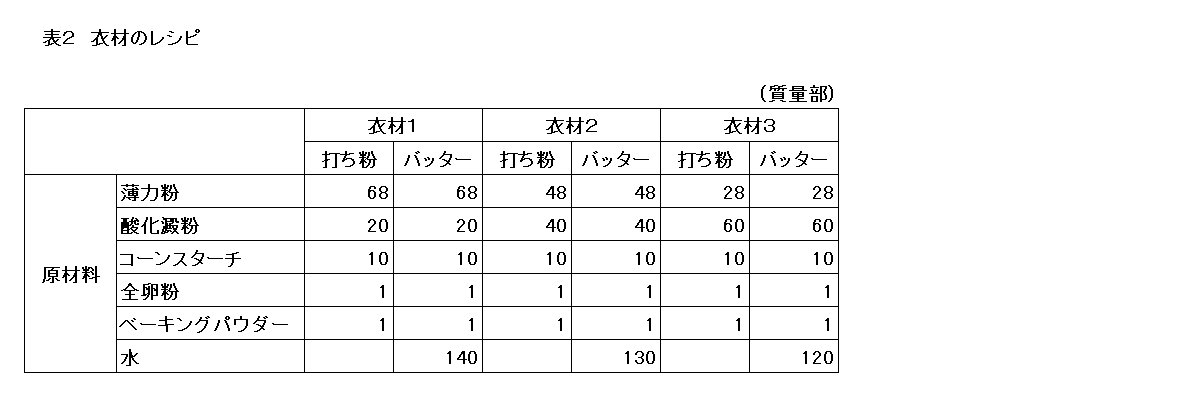
- Table 2 also shows the composition of the dressing prepared using oxidized starch.
- Example 1 (Method of producing oxidized starch) In a separable flask, 150 g of tapioca starch and 190 g of distilled water were added and dispersed to prepare a slurry having a dry matter equivalent concentration of 38.2% by mass. After setting the temperature of the obtained slurry to 37 ° C., 18.2 mL of an aqueous sodium hypochlorite solution (effective chlorine concentration 14.3%) was added at once to obtain the effective chlorine concentration described in Table 1. After the sodium hypochlorite aqueous solution was charged, a 3 mass% sodium hydroxide aqueous solution was added dropwise to adjust to the set pH (Table 1).
- the sweet potato was cut into slices 0.8-1.0 cm thick and exposed to water. 2. Above 1. The sweet potato was removed from the water and the skin was cut off. 3. Above 2. I drained the sweet potato well and made it fried. 4. The fried seeds were dusted with the flour obtained by the above-mentioned method, and further battered by the above-mentioned method, and then fried in canola oil at 175 ° C. for 3 minutes and 30 seconds. 5. It was removed from canola oil and drained to obtain tempura.
- Examples 2 to 5 Comparative Examples 1 to 4
- An oxidized starch was produced under the same conditions and method as in Example 1 except that the pH of the slurry was set and reacted as described in Table 1.
- Comparative Example 4 since the slurry was gelatinized during the oxidation treatment, the slurry could not be dewatered and a sample of oxidized starch was not obtained.
- Example 6 The same conditions and method as in Example 2 except that 9.1 mL of an aqueous sodium hypochlorite solution (effective chlorine concentration 14.3%) was charged at one time to obtain the effective chlorine concentration relative to the dry starch equivalent mass described in Table 1 Produced oxidized starch.
- Comparative example 5 The same conditions and method as in Comparative Example 2 except that 31.9 mL of an aqueous sodium hypochlorite solution (effective chlorine concentration 14.3%) was charged at one time to obtain the effective chlorine concentration relative to the dry starch equivalent mass described in Table 1 Produced oxidized starch.
- Example 7 After completing the oxidation reaction with sodium hypochlorite aqueous solution (effective chlorine concentration 14.3%) under the conditions of Example 2, the slurry was adjusted to pH 8 with 3 mass% hydrochloric acid. Then, 2.2 mL of acetic anhydride was dripped over 15 minutes, and the oxidized starch was acetylated. During the reaction, the pH was maintained at 7.8 to 8.5 with a 3% by mass aqueous solution of sodium hydroxide. After completion of the dropwise addition, after neutralization to pH 6 with 3% by mass hydrochloric acid, the oxidized acetylated tapioca starch in the slurry was washed and dehydrated. After dehydration, it was dried overnight at 40 ° C., crushed and sieved with a 60-mesh sieve (250 ⁇ m mesh), which was used as the oxidized starch of this example.
- oxidized starch was produced according to the method described in the example of Patent Document 3 described above.
- 150 g of tapioca starch and 190 g of distilled water were added and dispersed to prepare a slurry having a dry matter equivalent concentration of 38.2% by mass.
- 18.2 mL of an aqueous solution of sodium hypochlorite (effective chlorine concentration 14.3%) was divided and charged every 30 minutes (0.61 mL / times) every 2 minutes .
- Example 8 Using the oxidized starch obtained in Example 1, based on the recipe of coating material 2 and coating material 3 of Table 2, the raw materials were mixed in the compounding amounts of the same table to prepare flour and batter containing oxidized starch . Tempura was prepared and evaluated according to the method described in Example 1 using the obtained flour and batter. The evaluation results are shown in Table 3.
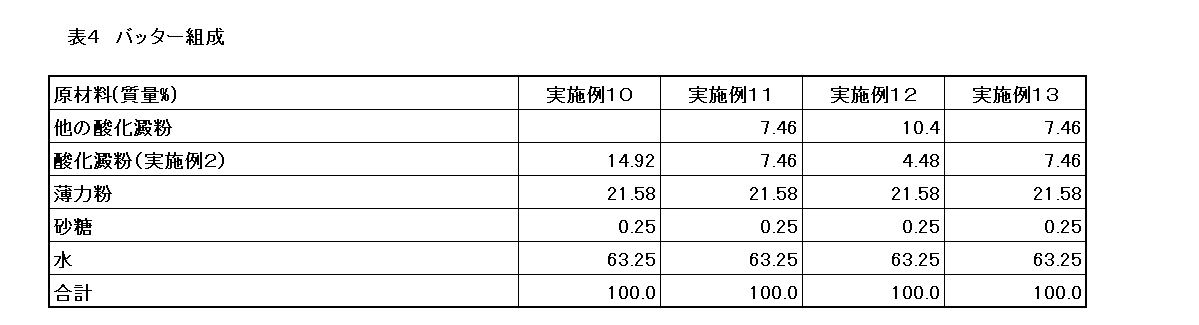
- Example 10 to 13 In this example, using the oxidized starch obtained in Example 2, raw materials were mixed based on the batter composition described in Table 4 to prepare a batter containing oxidized starch.
- Frozen donut dough (Tamago Donut, made by Orlando Foods) is oil-frozen with oil (FryUp 201, manufactured by J-Oil Mills Co., Ltd.) as it is frozen for 2 minutes, turned over and oiled for another 1 minute, Donut, Was produced.
- the batter containing the oxidized starch prepared above was applied to the donut, and oil was heated at 180 ° C. for 75 seconds on each side to prepare a coated donut.
- Example 13 frozen batter was added with batter directly containing oxidized starch while frozen, and oiled for 2 minutes at 180 ° C., turned over and oiled for an additional minute, to prepare a coated donut. The resulting battered donuts were placed at 21 ° C. for 4 hours.
- the battered donuts obtained in Examples 10 to 12 had hardness both immediately after preparation and after storage, and were excellent in crispy texture.
- the battered donut of Example 13 had a slightly thin batter, but was excellent in the crispy texture immediately after preparation and after storage.
- Example 14 Comparative Examples 7 to 8
- raw materials were mixed based on the composition described in Table 5 to prepare a batter for fried balls.
- the prepared fried batter was oiled at 175 ° C. (super canola oil, manufactured by J-Oil Mills Co., Ltd.), and Example 14 was subjected to oil for 2 minutes and 30 seconds, otherwise 3 minutes to prepare a fried ball. .
- the oiled fried ball was placed at 20 ° C. for 4 hours, and then placed in a sieve with an opening of 8.0 mm to recover the sieve fraction.
- the collected sieved fraction was put into a sieve of 5.6 mm mesh, and the sieved fraction was collected to obtain a sized fried ball.
- Example 14 The fried balls obtained in Example 14 had a large number of peaks. Also, it was very crispy as a result of eating. On the other hand, Comparative Example 7 and Comparative Example 8 had a small number of peaks. Also, as a result of eating, it was not so crisp.
Landscapes
- Chemical & Material Sciences (AREA)
- Life Sciences & Earth Sciences (AREA)
- Polymers & Plastics (AREA)
- Health & Medical Sciences (AREA)
- Engineering & Computer Science (AREA)
- Nutrition Science (AREA)
- Food Science & Technology (AREA)
- Biochemistry (AREA)
- Zoology (AREA)
- Materials Engineering (AREA)
- Chemical Kinetics & Catalysis (AREA)
- Medicinal Chemistry (AREA)
- Organic Chemistry (AREA)
- Grain Derivatives (AREA)
- General Preparation And Processing Of Foods (AREA)
- Polysaccharides And Polysaccharide Derivatives (AREA)
- Bakery Products And Manufacturing Methods Therefor (AREA)
- Noodles (AREA)
- Paints Or Removers (AREA)
Abstract
Description
特許文献1(特開平6-30713号公報)には、次亜塩素酸処理加工澱粉、焙焼デキストリン、酸化澱粉、低粘性酸処理澱粉、エーテル化澱粉またはエステル化澱粉を含む衣材を用いた乾燥天ぷらに関する技術が記載されている。また、同文献には、次亜塩素処理加工澱粉を特定量含む天ぷら粉を用いて得られた乾燥天ぷらを熱湯に浸漬したところ完全に復元して、風味、食感、色調の良い天ぷらとなったことが記載されている。
また、本発明者らが検討したところ、上述した特許文献3に記載の技術を用いた場合、揚げ物の衣に好ましい硬さとサクサク感を付与し、保管後もそれらの好ましさを維持するという点で改善の余地があることが明らかになった。
原料澱粉を含むスラリーを準備する工程と、
前記スラリー中の前記原料澱粉を酸化して酸化澱粉を得る工程と、
を含み、
酸化澱粉を得る前記工程が、
前記スラリーに酸化剤を添加する工程と、
前記スラリーのpHが9.2以上11.7以下である条件下に前記スラリーを所定時間維持することにより、前記原料澱粉を酸化する工程と、
を含む、衣材用酸化澱粉の製造方法が提供される。
前記本発明における衣材用酸化澱粉の製造方法により衣材用酸化澱粉を得る工程と、
前記衣材用酸化澱粉を配合して衣材を得る工程と、
を含む、フライ食品用衣材の製造方法が提供される。
前記本発明におけるフライ食品用衣材の製造方法によりフライ食品用衣材を得る工程と、
前記フライ食品用衣材を加熱調理する工程と、
を含む、フライ食品の製造方法が提供される。
たとえば、本発明によれば、前記本発明における製造方法により得られる衣材用酸化澱粉、衣材およびフライ食品が提供される。
(工程1)原料澱粉を含むスラリーを準備する工程
(工程2)上記スラリー中の原料澱粉を酸化して酸化澱粉を得る工程
そして、工程2すなわち酸化澱粉を得る工程が、以下の工程2-1および工程2-2を含む。
(工程2-1)上記スラリーに酸化剤を添加する工程
(工程2-2)上記スラリーのpHが9.2以上11.7以下である条件下にスラリーを所定時間維持することにより、原料澱粉を酸化する工程
以下、各工程についてさらに具体的に説明する。
工程1においては、原料澱粉のスラリーを準備する。スラリーは、具体的には原料澱粉および水を含む。
原料澱粉の由来となる植物の具体例として、とうもろこし、もちとうもろこし、米、もち米、小麦、甘藷、馬鈴薯、もち馬鈴薯、タピオカ、サゴヤシ等が挙げられる。
また、原料澱粉は、好ましくはコーンスターチ、ワキシーコーンスターチ、米澱粉、もち米澱粉、小麦澱粉、甘藷澱粉、馬鈴薯澱粉、ワキシー馬鈴薯澱粉、タピオカ澱粉、サゴ澱粉ならびにこれらのアセチル化澱粉およびヒドロキシプロピル化澱粉からなる群から選択される1種または2種以上であり、より好ましくはタピオカ澱粉ならびにこれらのアセチル化澱粉およびヒドロキシプロピル化澱粉からなる群から選択される1種または2種以上であり、さらに好ましくはタピオカ澱粉である。
また、揚げ物の調製時の硬さおよびサクサク感を向上する観点、およびこれらの好ましさを維持する観点から、原料澱粉は、好ましくは未化工の澱粉であり、より好ましくは未化工のタピオカ澱粉である。
また、工程2における酸化反応の安定性を高める観点から、スラリー中の原料澱粉の乾物換算質量濃度は、スラリー全体に対してたとえば50質量%以下であり、好ましくは45質量%以下である。
工程2は、酸化澱粉を得る工程であり、前述した工程2-1および工程2-2を含む。工程2-1は、工程2中に1回おこなわれても2回以上に分けておこなわれてもよく、2回目以降の工程2-1が、工程2-2中におこなわれてもよいが、工程2-1は、工程2中に1回おこなわれることが好ましい。
また、工程2-1が工程2-2の前におこなわれることがさらに好ましい。
ここで、上記有効塩素濃度とは、水溶液中で次亜塩素酸や次亜塩素酸イオン等の酸化力のある塩素化合物である有効塩素の濃度を指し、たとえば、第五版食品添加物公定書解説書(廣川書店、1987年)のD-383~D-384に記載の方法で測定することができる。
工程2-1に用いる酸化剤が塩素系酸化剤であるとき、工程2-2開始時のスラリー中の原料澱粉の乾物換算質量に対する有効塩素濃度は、酸化反応の効率を高める観点から、好ましくは1質量%/g以上であり、より好ましくは1.2質量%/g以上、さらに好ましくは1.4質量%/g以上、さらにより好ましくは1.6質量%/g以上である。
また、酸化反応の安定性を高める観点から、上記原料澱粉の乾物換算質量に対する有効塩素濃度は、好ましくは3.5質量%/g以下であり、より好ましくは3.0質量%/g以下、さらに好ましくは2.6質量%/g以下、さらにより好ましくは2.3質量%/g以下である。
ここで、上記原料澱粉の乾物換算質量に対する有効塩素濃度とは、原料澱粉の乾物換算質量1gに対する酸化剤の有効塩素濃度のことを指し、酸化反応が進行するにつれ低下する。
すなわち、スラリーのpHは、フライ食品の衣材として用いた際に、衣の好ましい硬さとサクサク感を維持する観点から、9.2以上であり、好ましくは9.4以上である。
また、原料澱粉の過度の酸化およびスラリーの糊化を抑制する観点から、スラリーのpHは、11.7以下であり、好ましくは11.5以下、より好ましくは11.0以下、さらに好ましくは10.5以下である。
ここで、スラリーのpHを維持するとは、酸化反応中のスラリーpHを設定値±0.2の範囲内に収めることをいう。
塩基の具体例として、水酸化ナトリウム、水酸化カリウム、水酸化カルシウム、水酸化マグネシウム等の金属水酸化物等が挙げられる。pHを前述した条件に安定的に維持する観点から、塩基は好ましくはアルカリ金属の水酸化物である。
また、酸化澱粉の製造安定性を高める観点から、工程2-2における反応温度は、好ましくは60℃以下であり、より50℃以下、さらに好ましくは45℃以下である。
また、工程2-2における所定時間は、前述の酸化反応終了までの時間とすることができるが、酸化澱粉の収率を高める観点から、好ましくは30分以上、より好ましくは60分以上である。また、酸化澱粉の製造効率を高める観点から、工程2-2における所定時間は、好ましくは500分以下、より好ましくは300分以下である。
また、工程2の後、酸化澱粉をエステル化またはエーテル化する工程(工程3)をさらに含んでもよい。
工程3で酸化澱粉におこなうエステル化の具体例として、アセチル化、リン酸化等が挙げられ、エーテル化の具体例として、ヒドロキシプロピル化等が挙げられる。
揚げ物の調製時の硬さおよびサクサク感を向上する観点、およびこれらの好ましさを維持する観点から、本実施形態で得られる酸化澱粉には、他の化工処理がなされていないことが好ましい。
工程4における酸の具体例として、塩酸、硝酸、硫酸等の無機酸;酢酸等の有機酸等が挙げられる。酸化反応を確実に停止する観点から、酸は好ましくは無機酸であり、より好ましくは塩酸であり、さらに好ましくは1質量%以上5質量%以下の濃度の塩酸である。
また、工程4においては、酸化反応を確実に停止する観点から、pHを7.0以下とすることが好ましく、6.5以下とすることがより好ましい。
また、工程4におけるpHの下限値は、酸化澱粉の分解を抑制する観点から、好ましくは3.5以上であり、より好ましくは4.5以上である。
このうち、酸化澱粉を乾燥する工程においては、たとえば脱水後の酸化澱粉を30℃以上150℃以下の温度で乾燥させてもよい。
なお、酸化澱粉を乾燥する工程の後に、酸化澱粉を粉砕する上記工程、および粉砕した酸化澱粉を篩う上記工程をおこなうことが好ましい。
衣の好ましい硬さとサクサク感を維持する観点からは、酸化澱粉の乾物換算質量濃度が15質量%のスラリーをラピッドビスコアナライザー(Rapid Visco Analyzer:RVA)にて95℃まで加熱した時の最高粘度は好ましくは900cP以下、より好ましくは700cP以下であるとともに、加熱の後、RVAにて25℃まで冷却した時の粘度は好ましくは6000cP以下、より好ましくは5000cP以下である。
また、95℃まで加熱した時の最高粘度の下限値は好ましくは50cP以上であり、加熱の後、RVAにて25℃まで冷却した時の粘度の下限値は好ましくは100cP以上である。
(95℃まで加熱した時の最高粘度と25℃まで冷却した時の粘度の測定方法)
1.専用のアルミニウム容器に酸化澱粉と水とを混合し、酸化澱粉の乾物換算質量濃度が15質量%のスラリーを調製する。上記アルミニウム容器に専用のパドルを入れ、ラピッドビスコアナライザー(Rapid Visco Analyzer:RVA)にセットする。
2.160rpmでの撹拌下で粘度を測定しながら、40℃で1分間維持し、その後、40℃から95℃まで6℃/分の速度で加熱する。
3.95℃を5分間維持した後、25℃まで4.5℃/分で冷却する。
4.95℃まで加熱した時の最高粘度である粘度A(cP)および25℃まで冷却した時の粘度B(cP)を読み取り、各粘度を測定する。
まず、本実施形態における衣材は、フライ食品に用いられ、本実施形態における製造方法により得られる酸化澱粉を含む。
また、本実施形態において、フライ食品用衣材の製造方法は、たとえば、前述した製造方法により酸化澱粉を得る工程と、衣材用酸化澱粉を配合して衣材を得る工程と、を含む。
また、同様の観点から、衣材中の本実施形態において得られる酸化澱粉の配合量は、衣材中の固形分全体を100質量%としたときに、好ましくは100質量%以下であり、より好ましくは80質量%以下、さらに好ましくは70質量%以下である。
他の酸化澱粉における前述した粘度の比(粘度B/粘度A)は、制限はなく、たとえば0超1.4未満である。
衣材が他の酸化澱粉をさらに含むとき、衣材中の他の酸化澱粉の含有量は、本実施形態の方法により得られる酸化澱粉1質量部に対して、衣の好ましい硬さとサクサク感を維持する観点から、好ましくは0質量部超である。また、衣の好ましい硬さとサクサク感を維持する観点から、衣材中の他の酸化澱粉の含有量は、本実施形態の方法により得られる酸化澱粉1質量部に対して、好ましくは5質量部以下であり、より好ましくは3質量部以下である。
また、衣材が他の酸化澱粉をさらに含むとき、衣材中の酸化澱粉の総含有量は、衣材中の固形分全体を100質量%としたときに、衣の好ましい硬さとサクサク感を維持する観点から、好ましくは3質量%超であり、より好ましくは5質量%以上であり、さらに好ましくは10質量%以上であり、さらにより好ましくは12質量%以上である。また、衣の好ましい硬さとサクサク感を維持する観点から、衣材中の酸化澱粉の総含有量は、衣材中の固形分全体を100質量%としたときに、好ましくは100質量%以下であり、より好ましくは80質量%以下、さらに好ましくは70質量%以下である。
また、酸化澱粉を含む固形分に水;卵液等の液状の食材;醤油等の液体調味料等の液体成分を配合してバッターとして用いることもできる。
バッター中の上記液体成分の含有量は、衣材の固形分100質量部に対して好ましくは90質量部以上、より好ましくは100質量部以上であり、また、好ましくは450質量部以下、より好ましくは300質量部以下、さらに好ましくは200質量部以下である。
本実施形態におけるフライ食品は、フライ食品用衣材を含むものであり、種物を含んでいてもよいし、含んでいなくてもよい。
たとえば、フライ食品には、揚げ玉のように種物を含まず、衣材のみを単独で調理した食品も含まれる。
また、本実施形態において、フライ食品の製造方法は、たとえば、前述した製造方法によりフライ食品用衣材を得る工程と、フライ食品用衣材加熱調理する工程と、を含む。
また、フライ食品が種物を含むとき、本実施形態におけるフライ食品用衣材とは、たとえば、食品中の種物を被覆する衣の材料、すなわち食品用被覆材として用いられ、さらに具体的には種物の表面に付着させる材料として用いられる。
フライ食品が種物を含むとき、フライ食品用衣材は、種物の一部を被覆していてもよいし、種物全体を被覆していてもよい。また、フライ食品用衣材は、種物の一部に付着していてもよいし、種物全体に付着していてもよい。
フライ食品の調理形態の具体例としては、種物に衣材を被覆した後、100℃~200℃の食用油中で油ちょうされた食品、薄く油をひいたフライパンや鉄板上で加熱された食品が挙げられる。また、本実施形態のフライ食品の製造方法は、たとえばフライ食品用衣材を加熱調理する工程を含む。
フライ食品として、たとえば天ぷら、から揚げ、竜田揚げなどが挙げられ、とんかつのようにパン粉やブレッダーをまぶしたものでもよい。また、本実施形態におけるフライ食品には、衣材で被覆をした後に、オーブン等で乾熱調理、マイクロ波加熱調理または過熱水蒸気調理されたフライ様食品も含まれる。フライ様食品では、油脂を含む衣材で種物の被覆をすることや衣材に油脂をまぶすことがさらに好ましい。
本実施形態における製造方法で得られたフライ食品は、加熱調理後のフライ食品の衣に好ましい硬さとサクサク感が付与し、保管後もそれらの好ましさを維持することができる。
タピオカ澱粉(水分13.5質量%、Siam Starch(1966) Co., Ltd.製)
コーンスターチ:コーンスターチY(株式会社J-オイルミルズ製)
全卵粉:乾燥全卵No.1(キューピータマゴ株式会社製)
ベーキングパウダー:Fアップ(大宮糧食工業株式会社製)
他の酸化澱粉:ジェルコールSP-2(株式会社J-オイルミルズ製、粘度B:203cP、粘度A:1554cP、(粘度B/粘度A)=0.13)
(水分の測定方法)
澱粉を水分計(電磁水分計:型番MX50、研精工業株式会社製)を用いて、130℃で加熱乾燥させて水分を測定した。
本例においては、酸化澱粉の製造および評価をおこなった。表1に、酸化澱粉の製造条件、得られた酸化澱粉を用いて調製した衣材の種類、ならびに、得られた衣材を用いて調製した天ぷらの調製直後および調製後から20℃で4時間保存した調製4時間後の評価結果を示す。
また、表2に、酸化澱粉を用いて調製した衣材の配合を示す。
(酸化澱粉の製造方法)
セパラブルフラスコにタピオカ澱粉150gと蒸留水190gを加えて分散し、乾物換算質量濃度が38.2質量%のスラリーを調製した。
得られたスラリーの温度を37℃にした後、次亜塩素酸ナトリウム水溶液(有効塩素濃度14.3%)18.2mLを一度に投入し、表1に記載の有効塩素濃度とした。
次亜塩素酸ナトリウム水溶液を投入後、3質量%水酸化ナトリウム水溶液を滴下して、設定したpH(表1)にした。
その後、適時水酸化ナトリウム水溶液を滴下して、反応終了までpHを設定値±0.03以内に維持し、酸化澱粉を得た。
反応終了は、スラリーを少量サンプリングして飽和ヨウ化カリウム水溶液に滴下し、紫色を呈しなくなった時点とした。
反応終了を確認後、スラリーに3質量%塩酸を添加してpH6まで中和した後、スラリー中の酸化澱粉を洗浄脱水した。
その後、40℃で1晩乾燥し、粉砕して60メッシュの篩(目開き250μm)で篩ったものを本例の酸化澱粉として用いた。
1.専用のアルミニウム容器に水分測定済の酸化澱粉と水とを混合し、酸化澱粉の乾物換算質量濃度が15質量%のスラリーを調製した。上記アルミニウム容器に専用のパドルを入れ、ラピッドビスコアナライザー(Rapid Visco Analyzer:RVA:型番RVA-4、ペルテン社製)にセットした。
2.160rpmでの撹拌下で粘度を測定しながら、40℃で1分間維持し、その後、40℃から95℃まで6℃/分の速度で加熱した。
3.95℃を5分間維持した後、25℃まで4.5℃/分で冷却した。
4.95℃まで加熱した時の最高粘度である粘度A(cP)および25℃まで冷却した時の粘度B(cP)を読み取り、各粘度を測定した。
表2に示す衣材のうち、衣材1のレシピに基づき原材料を同表の配合量にて混合し、酸化澱粉を含む打ち粉およびバッターを調製した。
1.サツマイモを厚さ0.8~1.0cmに輪切りして、水にさらした。
2.上記1.のサツマイモを水から取り出し、皮を切り落とした。
3.上記2.のサツマイモの水気をよく切って、揚げ種とした。
4.揚げ種に、前述の方法で得られた打ち粉をまぶし、さらに前述の方法で得られたバッターを付けた後、175℃のキャノーラ油で3分30秒揚げた。
5.キャノーラ油から取り出して油切りをして、天ぷらを得た。
得られた天ぷらの調製直後(1時間以内)および天ぷら調製後に20℃で4時間放置後に、4名の専門パネラーが食感評価をおこなった。以下の評価項目および評価基準にて評価をおこない、各項目について4人の平均点が2点超であるものを合格とした。
(硬さ)
5点:衣がとても硬い
4点:衣が硬い
3点:衣が少し硬い
2点:衣があまり硬くない
1点:衣が硬くない
(サクサク感)
5点:衣にとてもサクサク感がある
4点:衣にサクサク感がある
3点:衣に少しサクサク感がある
2点:衣にサクサク感が少ない
1点:衣にサクサク感が無い
(ドライ感)
5点:とてもカラッとしている
4点:カラッとしている
3点:少しカラッとしている
2点:少しベチャついている
1点:ベチャついている
(飲み込みやすさ)
5点:衣の歯切れがとても良く、とても飲み込みやすい
4点:衣の歯切れが良く、飲み込みやすい
3点:衣の歯切れがやや良く、やや飲み込みやすい
2点:衣に少しヒキが有り、少し飲み込みにくい
1点:衣にヒキがあり、飲み込みにくい
スラリーのpHを表1に記載のとおりそれぞれ設定して反応させた以外は、実施例1と同じ条件および方法で酸化澱粉を製造した。
ここで、比較例4については、酸化処理中にスラリーが糊化したため、スラリーを脱水できず、酸化澱粉のサンプルを得られなかった。
次亜塩素酸ナトリウム水溶液(有効塩素濃度14.3%)9.1mLを一度に投入し、表1に記載の澱粉乾物換算質量に対する有効塩素濃度とした以外は、実施例2と同じ条件および方法で酸化澱粉を製造した。
次亜塩素酸ナトリウム水溶液(有効塩素濃度14.3%)31.9mLを一度に投入し、表1に記載の澱粉乾物換算質量に対する有効塩素濃度とした以外は、比較例2と同じ条件および方法で酸化澱粉を製造した。
実施例2の条件で次亜塩素酸ナトリウム水溶液(有効塩素濃度14.3%)での酸化反応を終了した後、3質量%塩酸でスラリーをpH8に調製した。
その後、無水酢酸2.2mLを15分かけて滴下し、酸化澱粉をアセチル化した。反応中は3質量%水酸化ナトリウム水溶液でpHを7.8~8.5に維持した。
滴下終了後、3質量%塩酸でpH6まで中和した後、スラリー中の酸化アセチル化タピオカ澱粉を洗浄脱水した。
脱水後、40℃で1晩乾燥し、粉砕して60メッシュの篩(目開き250μm)で篩ったものを本例の酸化澱粉として用いた。
本例においては、前述した特許文献3の実施例に記載の方法に従って酸化澱粉を製造した。
セパラブルフラスコにタピオカ澱粉150gと蒸留水190gを加えて分散し、乾物換算質量濃度が38.2質量%のスラリーを調製した。
得られたスラリーの温度を37℃にした後、次亜塩素酸ナトリウム水溶液(有効塩素濃度14.3%)18.2mLを2分毎に30回(0.61mL/回)に分けて投入した。次亜塩素酸ナトリウム水溶液を投入中にスラリーのpHが7.5以上を保てるように3質量%水酸化ナトリウム水溶液を適宜滴下した。30回目の次亜塩素酸ナトリウム水溶液投入終了時点のスラリーのpHが最も高くなり、そのpHは8.5であった。
その後、3質量%水酸化ナトリウム水溶液で適時滴下することで、次亜塩素酸ナトリウム水溶液投入終了時点のpHを維持し、さらに90分間反応させた。
90分後にスラリーを少量サンプリングして飽和ヨウ化カリウム水溶液に滴下し、紫色を呈さないことを確認して、実施例1に記載と同じ方法で中和以降の工程に進み、酸化澱粉を得た。

一方、比較例1~3、5および6においては、酸化反応におけるスラリーのpHが低すぎたため、天ぷら調製4時間後の食感が各実施例に比べて劣っていた。
また、比較例4においては、酸化反応におけるスラリーのpHが高すぎたため、前述のとおり、酸化澱粉調製中にスラリーが糊化してしまい、酸化澱粉を得ることができなかった。
実施例1で得られた酸化澱粉を用いて、表2の衣材2および衣材3のレシピに基づき原材料を同表の配合量にて混合し、酸化澱粉を含む打ち粉およびバッターを調製した。
得られた打ち粉およびバッターを用いて実施例1に記載の方法に準じて天ぷらを調製し、評価した。評価結果を表3に示す。

本例では、実施例2で得られた酸化澱粉を用いて、表4に記載のバッター組成に基づき原材料を混合し、酸化澱粉を含むバッターを調製した。
冷凍ドーナツ生地(タマゴドーナツ、オーランドフーズ製)を、凍ったまま180℃に加熱した油(FryUp201、株式会社J-オイルミルズ製)にて2分油ちょうし、ひっくり返してさらに1分油ちょうし、ドーナツを作製した。
油ちょうしたドーナツの粗熱を取った後、先に調製した酸化澱粉を含むバッターをドーナツに付け、180℃に加熱した油で片面75秒ずつ油ちょうし、衣付きドーナツを作製した。
また、実施例13のみ、冷凍ドーナツ生地に凍ったまま直接酸化澱粉を含むバッターを付け、180℃で2分油ちょうし、ひっくり返してさらに1分油ちょうし、衣付きドーナツを作製した。
得られた各衣付きドーナツを、21℃で4時間置いた。
本例では、実施例2で得られた酸化澱粉および比較例1で得られた酸化澱粉を用いて、表5に記載の組成に基づき原材料を混合し揚げ玉用バッターを調製した。
調製した揚げ玉用バッターを、175℃に加熱した油(スーパーキャノーラ油、株式会社J-オイルミルズ製)にて、実施例14は2分30秒、それ以外は3分油ちょうし、揚げ玉を作製した。
油ちょうした揚げ玉を20℃で4時間置いた後、目開き8.0mmの篩に入れて、篩下画分を回収した。回収した篩下画分を目開き5.6mmの篩に入れて、篩上画分を回収し、整粒揚げ玉を得た。
<測定条件>
測定機器:TA.XT.plus Texture Analyzer(ステイブルマイクロシステムズ社製)
プランジャー:φ20mm円盤型
測定速度:0.5mm/秒
測定モード:50%圧縮

一方、比較例7および比較例8は、ピーク数が少なかった。また、食した結果、あまりサクサクしていなかった。
Claims (11)
- 原料澱粉を含むスラリーを準備する工程と、
前記スラリー中の前記原料澱粉を酸化して酸化澱粉を得る工程と、
を含み、
酸化澱粉を得る前記工程が、
前記スラリーに酸化剤を添加する工程と、
前記スラリーのpHが9.2以上11.7以下である条件下に前記スラリーを所定時間維持することにより、前記原料澱粉を酸化する工程と、
を含む、衣材用酸化澱粉の製造方法。 - 前記酸化剤が次亜塩素酸塩およびさらし粉からなる群から選択される1種または2種である、請求項1に記載の衣材用酸化澱粉の製造方法。
- 原料澱粉を酸化する前記工程において、前記スラリーに塩基を添加することにより前記pHを前記条件下に維持する、請求項1または2に記載の衣材用酸化澱粉の製造方法。
- 酸化剤を添加する前記工程が、原料澱粉を酸化する前記工程の前におこなわれる、請求項1乃至3いずれか1項に記載の衣材用酸化澱粉の製造方法。
- 原料澱粉を酸化する前記工程開始時の前記スラリー中の前記原料澱粉の乾物換算質量に対する有効塩素濃度が、1質量%/g以上3.5質量%/g以下である、請求項2乃至4いずれか1項に記載の衣材用酸化澱粉の製造方法。
- 前記原料澱粉がタピオカ澱粉である、請求項1乃至5いずれか1項に記載の衣材用酸化澱粉の製造方法。
- 前記酸化澱粉の乾物換算質量濃度が15質量%であるスラリーをラピッドビスコアナライザー(Rapid Visco Analyzer:RVA)にて測定して得られる、95℃まで加熱した時の最高粘度に対する25℃まで冷却した時の粘度の比が1.4以上20以下である、請求項1乃至6いずれか1項に記載の衣材用酸化澱粉の製造方法。
- 請求項1乃至7いずれか1項に記載の衣材用酸化澱粉の製造方法により衣材用酸化澱粉を得る工程と、
前記衣材用酸化澱粉を配合して衣材を得る工程と、
を含む、フライ食品用衣材の製造方法。 - 請求項8に記載のフライ食品用衣材の製造方法によりフライ食品用衣材を得る工程と、
前記フライ食品用衣材を加熱調理する工程と、
を含む、フライ食品の製造方法。 - 請求項1乃至7いずれか1項に記載の製造方法で製造された衣材用酸化澱粉をフライ食品用衣材として用いる、フライ食品の衣の硬さを維持する方法。
- 請求項1乃至7いずれか1項に記載の製造方法で製造された衣材用酸化澱粉をフライ食品用衣材として用いる、フライ食品の衣のサクサク感を維持する方法。
Priority Applications (4)
| Application Number | Priority Date | Filing Date | Title |
|---|---|---|---|
| JP2019532402A JP7194680B2 (ja) | 2017-07-28 | 2018-05-23 | 衣材用酸化澱粉の製造方法 |
| PE2020000137A PE20200712A1 (es) | 2017-07-28 | 2018-05-23 | Metodo para producir almidon oxidado para material de recubrimiento |
| CN201880047635.3A CN110891429A (zh) | 2017-07-28 | 2018-05-23 | 面衣材料用氧化淀粉的制造方法 |
| PH12020500200A PH12020500200A1 (en) | 2017-07-28 | 2020-01-27 | Method for producing oxidized starch for coating material |
Applications Claiming Priority (4)
| Application Number | Priority Date | Filing Date | Title |
|---|---|---|---|
| JP2017146200 | 2017-07-28 | ||
| JP2017-146200 | 2017-07-28 | ||
| JP2018-015564 | 2018-01-31 | ||
| JP2018015564 | 2018-01-31 |
Publications (1)
| Publication Number | Publication Date |
|---|---|
| WO2019021606A1 true WO2019021606A1 (ja) | 2019-01-31 |
Family
ID=65041094
Family Applications (1)
| Application Number | Title | Priority Date | Filing Date |
|---|---|---|---|
| PCT/JP2018/019771 Ceased WO2019021606A1 (ja) | 2017-07-28 | 2018-05-23 | 衣材用酸化澱粉の製造方法 |
Country Status (6)
| Country | Link |
|---|---|
| JP (1) | JP7194680B2 (ja) |
| CN (1) | CN110891429A (ja) |
| PE (1) | PE20200712A1 (ja) |
| PH (1) | PH12020500200A1 (ja) |
| TW (1) | TWI768084B (ja) |
| WO (1) | WO2019021606A1 (ja) |
Cited By (7)
| Publication number | Priority date | Publication date | Assignee | Title |
|---|---|---|---|---|
| WO2019151034A1 (ja) * | 2018-01-31 | 2019-08-08 | 株式会社J-オイルミルズ | 食品の製造方法 |
| WO2021086273A3 (en) * | 2019-10-29 | 2021-07-08 | Sms Corporation Co., Ltd. | Modified-acetylated distarch adipate and products containing thereof |
| JP2023000109A (ja) * | 2021-06-17 | 2023-01-04 | 昭和産業株式会社 | 揚げ物用衣材ミックス |
| JP2023063698A (ja) * | 2021-10-25 | 2023-05-10 | 株式会社ニップン | 揚げ物衣材用澱粉組成物 |
| JP2023136833A (ja) * | 2022-03-17 | 2023-09-29 | 日東富士製粉株式会社 | 揚げ物用まぶし粉及び、揚げ物の製造方法 |
| JP2024017606A (ja) * | 2022-07-28 | 2024-02-08 | 株式会社ニップン | 天ぷら用ミックス粉及び天ぷらの製造方法 |
| WO2025186954A1 (ja) * | 2024-03-06 | 2025-09-12 | 株式会社日清製粉ウェルナ | パン粉付きベーカリー食品用被覆組成物 |
Families Citing this family (1)
| Publication number | Priority date | Publication date | Assignee | Title |
|---|---|---|---|---|
| WO2023162282A1 (ja) * | 2022-02-25 | 2023-08-31 | 日清製粉プレミックス株式会社 | 生地加熱食品用加工澱粉及び生地加熱食品用ミックス |
Citations (7)
| Publication number | Priority date | Publication date | Assignee | Title |
|---|---|---|---|---|
| JPH07184598A (ja) * | 1993-12-27 | 1995-07-25 | Nisshin Ham Kk | ハムカツまたはソーセージカツの製造方法 |
| JPH08154610A (ja) * | 1994-12-12 | 1996-06-18 | Matsutani Chem Ind Ltd | 揚げ物用衣材 |
| JP2004517637A (ja) * | 2001-01-29 | 2004-06-17 | コーオペラティーベ、ベルコープ‐アン、プロドゥクティーベレニギング、バン、アルダペルメール、アン、デリバーテン、アベベ、ベー.アー. | 食物コーティング |
| JP2011254785A (ja) * | 2010-05-10 | 2011-12-22 | Nippon Shokuhin Kako Co Ltd | 揚げ物用衣材 |
| JP2012100613A (ja) * | 2010-11-12 | 2012-05-31 | J-Oil Mills Inc | 米飯改良剤およびそれを用いた米飯食品、ならびにそれらの製造方法 |
| WO2013054461A1 (ja) * | 2011-10-14 | 2013-04-18 | 株式会社J-オイルミルズ | 粒状物、それを用いた飲食品および粒状物の製造方法 |
| WO2013054460A1 (ja) * | 2011-10-14 | 2013-04-18 | 株式会社J-オイルミルズ | 米飯改良剤、それを用いた米飯食品および米飯改良剤の製造方法 |
Family Cites Families (9)
| Publication number | Priority date | Publication date | Assignee | Title |
|---|---|---|---|---|
| JPH01179658A (ja) * | 1988-01-06 | 1989-07-17 | Shimada Kagaku Kogyo Kk | 食品用打粉 |
| JP3153427B2 (ja) * | 1994-11-11 | 2001-04-09 | 日清製粉株式会社 | テンプラ、カラ揚げまたはフリッター用の衣組成物 |
| JPH1175749A (ja) * | 1997-09-16 | 1999-03-23 | Kumamoto Seifun Kk | 揚げ物衣用小麦粉組成物の製造法 |
| JP3943994B2 (ja) * | 2001-06-29 | 2007-07-11 | 株式会社日清製粉グループ本社 | 電子レンジ調理用衣材 |
| JP4663928B2 (ja) * | 2001-09-05 | 2011-04-06 | 日東富士製粉株式会社 | 衣用組成物 |
| JP5073860B1 (ja) * | 2011-07-28 | 2012-11-14 | 日本食品化工株式会社 | 蛋白質含有飲食品用分散剤及びそれを用いた蛋白質含有飲食品 |
| JP5938609B2 (ja) * | 2011-12-06 | 2016-06-22 | 旭化成株式会社 | バッター用プレミックス |
| JP5927293B2 (ja) * | 2012-05-14 | 2016-06-01 | 日本コーンスターチ株式会社 | 打粉用酸化澱粉およびその製造方法 |
| JP6478644B2 (ja) * | 2015-01-09 | 2019-03-06 | 日本食品化工株式会社 | カルボキシメチル化澱粉の製造方法、カルボキシメチル化澱粉及びその用途 |
-
2018
- 2018-05-23 JP JP2019532402A patent/JP7194680B2/ja active Active
- 2018-05-23 CN CN201880047635.3A patent/CN110891429A/zh active Pending
- 2018-05-23 PE PE2020000137A patent/PE20200712A1/es unknown
- 2018-05-23 WO PCT/JP2018/019771 patent/WO2019021606A1/ja not_active Ceased
- 2018-07-19 TW TW107124978A patent/TWI768084B/zh not_active IP Right Cessation
-
2020
- 2020-01-27 PH PH12020500200A patent/PH12020500200A1/en unknown
Patent Citations (7)
| Publication number | Priority date | Publication date | Assignee | Title |
|---|---|---|---|---|
| JPH07184598A (ja) * | 1993-12-27 | 1995-07-25 | Nisshin Ham Kk | ハムカツまたはソーセージカツの製造方法 |
| JPH08154610A (ja) * | 1994-12-12 | 1996-06-18 | Matsutani Chem Ind Ltd | 揚げ物用衣材 |
| JP2004517637A (ja) * | 2001-01-29 | 2004-06-17 | コーオペラティーベ、ベルコープ‐アン、プロドゥクティーベレニギング、バン、アルダペルメール、アン、デリバーテン、アベベ、ベー.アー. | 食物コーティング |
| JP2011254785A (ja) * | 2010-05-10 | 2011-12-22 | Nippon Shokuhin Kako Co Ltd | 揚げ物用衣材 |
| JP2012100613A (ja) * | 2010-11-12 | 2012-05-31 | J-Oil Mills Inc | 米飯改良剤およびそれを用いた米飯食品、ならびにそれらの製造方法 |
| WO2013054461A1 (ja) * | 2011-10-14 | 2013-04-18 | 株式会社J-オイルミルズ | 粒状物、それを用いた飲食品および粒状物の製造方法 |
| WO2013054460A1 (ja) * | 2011-10-14 | 2013-04-18 | 株式会社J-オイルミルズ | 米飯改良剤、それを用いた米飯食品および米飯改良剤の製造方法 |
Cited By (10)
| Publication number | Priority date | Publication date | Assignee | Title |
|---|---|---|---|---|
| WO2019151034A1 (ja) * | 2018-01-31 | 2019-08-08 | 株式会社J-オイルミルズ | 食品の製造方法 |
| JPWO2019151034A1 (ja) * | 2018-01-31 | 2021-01-14 | 株式会社J−オイルミルズ | 食品の製造方法 |
| JP7364473B2 (ja) | 2018-01-31 | 2023-10-18 | 株式会社J-オイルミルズ | 食品の製造方法 |
| WO2021086273A3 (en) * | 2019-10-29 | 2021-07-08 | Sms Corporation Co., Ltd. | Modified-acetylated distarch adipate and products containing thereof |
| JP2023000109A (ja) * | 2021-06-17 | 2023-01-04 | 昭和産業株式会社 | 揚げ物用衣材ミックス |
| JP7836154B2 (ja) | 2021-06-17 | 2026-03-26 | 昭和産業株式会社 | 揚げ物用衣材ミックス |
| JP2023063698A (ja) * | 2021-10-25 | 2023-05-10 | 株式会社ニップン | 揚げ物衣材用澱粉組成物 |
| JP2023136833A (ja) * | 2022-03-17 | 2023-09-29 | 日東富士製粉株式会社 | 揚げ物用まぶし粉及び、揚げ物の製造方法 |
| JP2024017606A (ja) * | 2022-07-28 | 2024-02-08 | 株式会社ニップン | 天ぷら用ミックス粉及び天ぷらの製造方法 |
| WO2025186954A1 (ja) * | 2024-03-06 | 2025-09-12 | 株式会社日清製粉ウェルナ | パン粉付きベーカリー食品用被覆組成物 |
Also Published As
| Publication number | Publication date |
|---|---|
| TWI768084B (zh) | 2022-06-21 |
| JPWO2019021606A1 (ja) | 2020-05-28 |
| PH12020500200A1 (en) | 2020-10-12 |
| PE20200712A1 (es) | 2020-06-25 |
| CN110891429A (zh) | 2020-03-17 |
| JP7194680B2 (ja) | 2022-12-22 |
| TW201912655A (zh) | 2019-04-01 |
Similar Documents
| Publication | Publication Date | Title |
|---|---|---|
| JP7194680B2 (ja) | 衣材用酸化澱粉の製造方法 | |
| JP6941602B2 (ja) | ブレッダー粉、これを用いたブレッダーミックス、衣材およびフライ(様)食品ならびにこれらの製造方法 | |
| JP4861889B2 (ja) | 羽根つき餃子及びその製造法 | |
| JP6482534B2 (ja) | フライ食品用衣材、これを用いた食品およびその製造方法 | |
| JP4739459B1 (ja) | 揚げ物用衣材 | |
| JP6530579B1 (ja) | 揚げ物衣用ミックス | |
| CN110113956A (zh) | 油炸食品用面衣材料 | |
| JP7622059B2 (ja) | 唐揚げバッター用粉体組成物 | |
| JP4160792B2 (ja) | 揚げ物用粉 | |
| WO2020170879A1 (ja) | ブレッダー粉 | |
| JP7392324B2 (ja) | バッター用油脂処理澱粉、バッター粉、およびバッター用油脂処理澱粉の製造方法 | |
| JPH0664A (ja) | 即席麺類の製造方法 | |
| JPS5911153A (ja) | 揚げ物用衣材 | |
| WO2020170880A1 (ja) | ブレッダー粉 | |
| JP7153145B1 (ja) | 揚げ物用衣材組成物 | |
| CN113727612A (zh) | 油炸食品用面衣材料 | |
| CN113747791A (zh) | 改性小麦粉 | |
| JP6912977B2 (ja) | 揚げ物用ミックス、及び揚げ物の製造方法 | |
| US12144366B2 (en) | Breadcrumb mix | |
| JP2019126314A (ja) | 天ぷら衣用ミックス | |
| TW202214119A (zh) | 非油炸食品用裹漿粉組成物及裹漿組成物 | |
| JP2018161093A (ja) | スナック菓子の製造方法 | |
| JP2006025678A (ja) | 天ぷら用衣ミックスおよび天ぷらの製造方法 | |
| WO2024210143A1 (ja) | 揚げ物食品用バッターミックス | |
| CN118317699A (zh) | 龙田油炸食品用面糊混合料及龙田油炸食品用面糊 |
Legal Events
| Date | Code | Title | Description |
|---|---|---|---|
| 121 | Ep: the epo has been informed by wipo that ep was designated in this application |
Ref document number: 18838492 Country of ref document: EP Kind code of ref document: A1 |
|
| ENP | Entry into the national phase |
Ref document number: 2019532402 Country of ref document: JP Kind code of ref document: A |
|
| NENP | Non-entry into the national phase |
Ref country code: DE |
|
| 122 | Ep: pct application non-entry in european phase |
Ref document number: 18838492 Country of ref document: EP Kind code of ref document: A1 |
|
| WWR | Wipo information: refused in national office |
Ref document number: 000137-2020 Country of ref document: PE |