WO2018225544A1 - 光硬化性組成物及び電子部品用接着剤 - Google Patents
光硬化性組成物及び電子部品用接着剤 Download PDFInfo
- Publication number
- WO2018225544A1 WO2018225544A1 PCT/JP2018/020226 JP2018020226W WO2018225544A1 WO 2018225544 A1 WO2018225544 A1 WO 2018225544A1 JP 2018020226 W JP2018020226 W JP 2018020226W WO 2018225544 A1 WO2018225544 A1 WO 2018225544A1
- Authority
- WO
- WIPO (PCT)
- Prior art keywords
- photocurable composition
- composition according
- compound
- liquid crystal
- group
- Prior art date
- Legal status (The legal status is an assumption and is not a legal conclusion. Google has not performed a legal analysis and makes no representation as to the accuracy of the status listed.)
- Ceased
Links
Classifications
-
- C—CHEMISTRY; METALLURGY
- C08—ORGANIC MACROMOLECULAR COMPOUNDS; THEIR PREPARATION OR CHEMICAL WORKING-UP; COMPOSITIONS BASED THEREON
- C08F—MACROMOLECULAR COMPOUNDS OBTAINED BY REACTIONS ONLY INVOLVING CARBON-TO-CARBON UNSATURATED BONDS
- C08F2/00—Processes of polymerisation
- C08F2/46—Polymerisation initiated by wave energy or particle radiation
- C08F2/48—Polymerisation initiated by wave energy or particle radiation by ultraviolet or visible light
- C08F2/50—Polymerisation initiated by wave energy or particle radiation by ultraviolet or visible light with sensitising agents
-
- C—CHEMISTRY; METALLURGY
- C08—ORGANIC MACROMOLECULAR COMPOUNDS; THEIR PREPARATION OR CHEMICAL WORKING-UP; COMPOSITIONS BASED THEREON
- C08K—Use of inorganic or non-macromolecular organic substances as compounding ingredients
- C08K3/00—Use of inorganic substances as compounding ingredients
- C08K3/01—Use of inorganic substances as compounding ingredients characterized by their specific function
- C08K3/013—Fillers, pigments or reinforcing additives
-
- C—CHEMISTRY; METALLURGY
- C08—ORGANIC MACROMOLECULAR COMPOUNDS; THEIR PREPARATION OR CHEMICAL WORKING-UP; COMPOSITIONS BASED THEREON
- C08K—Use of inorganic or non-macromolecular organic substances as compounding ingredients
- C08K5/00—Use of organic ingredients
- C08K5/16—Nitrogen-containing compounds
- C08K5/22—Compounds containing nitrogen bound to another nitrogen atom
- C08K5/24—Derivatives of hydrazine
- C08K5/25—Carboxylic acid hydrazides
-
- C—CHEMISTRY; METALLURGY
- C08—ORGANIC MACROMOLECULAR COMPOUNDS; THEIR PREPARATION OR CHEMICAL WORKING-UP; COMPOSITIONS BASED THEREON
- C08K—Use of inorganic or non-macromolecular organic substances as compounding ingredients
- C08K5/00—Use of organic ingredients
- C08K5/54—Silicon-containing compounds
- C08K5/541—Silicon-containing compounds containing oxygen
- C08K5/5415—Silicon-containing compounds containing oxygen containing at least one Si—O bond
- C08K5/5419—Silicon-containing compounds containing oxygen containing at least one Si—O bond containing at least one Si—C bond
-
- C—CHEMISTRY; METALLURGY
- C08—ORGANIC MACROMOLECULAR COMPOUNDS; THEIR PREPARATION OR CHEMICAL WORKING-UP; COMPOSITIONS BASED THEREON
- C08L—COMPOSITIONS OF MACROMOLECULAR COMPOUNDS
- C08L101/00—Compositions of unspecified macromolecular compounds
-
- C—CHEMISTRY; METALLURGY
- C08—ORGANIC MACROMOLECULAR COMPOUNDS; THEIR PREPARATION OR CHEMICAL WORKING-UP; COMPOSITIONS BASED THEREON
- C08L—COMPOSITIONS OF MACROMOLECULAR COMPOUNDS
- C08L33/00—Compositions of homopolymers or copolymers of compounds having one or more unsaturated aliphatic radicals, each having only one carbon-to-carbon double bond, and only one being terminated by only one carboxyl radical, or of salts, anhydrides, esters, amides, imides or nitriles thereof; Compositions of derivatives of such polymers
- C08L33/04—Homopolymers or copolymers of esters
-
- C—CHEMISTRY; METALLURGY
- C09—DYES; PAINTS; POLISHES; NATURAL RESINS; ADHESIVES; COMPOSITIONS NOT OTHERWISE PROVIDED FOR; APPLICATIONS OF MATERIALS NOT OTHERWISE PROVIDED FOR
- C09J—ADHESIVES; NON-MECHANICAL ASPECTS OF ADHESIVE PROCESSES IN GENERAL; ADHESIVE PROCESSES NOT PROVIDED FOR ELSEWHERE; USE OF MATERIALS AS ADHESIVES
- C09J11/00—Features of adhesives not provided for in group C09J9/00, e.g. additives
- C09J11/02—Non-macromolecular additives
- C09J11/04—Non-macromolecular additives inorganic
-
- C—CHEMISTRY; METALLURGY
- C09—DYES; PAINTS; POLISHES; NATURAL RESINS; ADHESIVES; COMPOSITIONS NOT OTHERWISE PROVIDED FOR; APPLICATIONS OF MATERIALS NOT OTHERWISE PROVIDED FOR
- C09J—ADHESIVES; NON-MECHANICAL ASPECTS OF ADHESIVE PROCESSES IN GENERAL; ADHESIVE PROCESSES NOT PROVIDED FOR ELSEWHERE; USE OF MATERIALS AS ADHESIVES
- C09J11/00—Features of adhesives not provided for in group C09J9/00, e.g. additives
- C09J11/02—Non-macromolecular additives
- C09J11/06—Non-macromolecular additives organic
-
- C—CHEMISTRY; METALLURGY
- C09—DYES; PAINTS; POLISHES; NATURAL RESINS; ADHESIVES; COMPOSITIONS NOT OTHERWISE PROVIDED FOR; APPLICATIONS OF MATERIALS NOT OTHERWISE PROVIDED FOR
- C09J—ADHESIVES; NON-MECHANICAL ASPECTS OF ADHESIVE PROCESSES IN GENERAL; ADHESIVE PROCESSES NOT PROVIDED FOR ELSEWHERE; USE OF MATERIALS AS ADHESIVES
- C09J163/00—Adhesives based on epoxy resins; Adhesives based on derivatives of epoxy resins
-
- C—CHEMISTRY; METALLURGY
- C09—DYES; PAINTS; POLISHES; NATURAL RESINS; ADHESIVES; COMPOSITIONS NOT OTHERWISE PROVIDED FOR; APPLICATIONS OF MATERIALS NOT OTHERWISE PROVIDED FOR
- C09J—ADHESIVES; NON-MECHANICAL ASPECTS OF ADHESIVE PROCESSES IN GENERAL; ADHESIVE PROCESSES NOT PROVIDED FOR ELSEWHERE; USE OF MATERIALS AS ADHESIVES
- C09J201/00—Adhesives based on unspecified macromolecular compounds
-
- C—CHEMISTRY; METALLURGY
- C09—DYES; PAINTS; POLISHES; NATURAL RESINS; ADHESIVES; COMPOSITIONS NOT OTHERWISE PROVIDED FOR; APPLICATIONS OF MATERIALS NOT OTHERWISE PROVIDED FOR
- C09J—ADHESIVES; NON-MECHANICAL ASPECTS OF ADHESIVE PROCESSES IN GENERAL; ADHESIVE PROCESSES NOT PROVIDED FOR ELSEWHERE; USE OF MATERIALS AS ADHESIVES
- C09J4/00—Adhesives based on organic non-macromolecular compounds having at least one polymerisable carbon-to-carbon unsaturated bond ; adhesives, based on monomers of macromolecular compounds of groups C09J183/00 - C09J183/16
-
- G—PHYSICS
- G02—OPTICS
- G02F—OPTICAL DEVICES OR ARRANGEMENTS FOR THE CONTROL OF LIGHT BY MODIFICATION OF THE OPTICAL PROPERTIES OF THE MEDIA OF THE ELEMENTS INVOLVED THEREIN; NON-LINEAR OPTICS; FREQUENCY-CHANGING OF LIGHT; OPTICAL LOGIC ELEMENTS; OPTICAL ANALOGUE/DIGITAL CONVERTERS
- G02F1/00—Devices or arrangements for the control of the intensity, colour, phase, polarisation or direction of light arriving from an independent light source, e.g. switching, gating or modulating; Non-linear optics
- G02F1/01—Devices or arrangements for the control of the intensity, colour, phase, polarisation or direction of light arriving from an independent light source, e.g. switching, gating or modulating; Non-linear optics for the control of the intensity, phase, polarisation or colour
- G02F1/13—Devices or arrangements for the control of the intensity, colour, phase, polarisation or direction of light arriving from an independent light source, e.g. switching, gating or modulating; Non-linear optics for the control of the intensity, phase, polarisation or colour based on liquid crystals, e.g. single liquid crystal display cells
- G02F1/133—Constructional arrangements; Operation of liquid crystal cells; Circuit arrangements
- G02F1/1333—Constructional arrangements; Manufacturing methods
- G02F1/1339—Gaskets; Spacers; Sealing of cells
Definitions
- the present invention relates to a photocurable composition, an adhesive for electronic parts, an electronic part, an adhesive for liquid crystal display cells, a liquid crystal sealant, and a liquid crystal display cell using the same.
- Photo-curable compositions are widely used in adhesive applications for electronic parts such as display sealants, solar cell sealants, and semiconductor sealants.
- Examples of the display sealant include a liquid crystal display sealant, an organic EL display sealant, and a touch panel adhesive. These sealants for display are required to have excellent curability and low outgassing and do not damage the display element.
- the photocurable composition does not undergo a curing reaction in a portion where light does not reach, there is a limit to the portion that can be used.
- liquid crystal sealant for a liquid crystal dropping method
- liquid crystal sealant when the liquid crystal sealant is exposed to light by the wiring portion of the array substrate of the liquid crystal display element or the black matrix portion of the color filter substrate.
- the problem of poor display in the vicinity of the seal is more serious than before.
- the primary curing by light becomes insufficient due to the presence of the light shielding portion, a large amount of uncured components remain in the liquid crystal sealant.
- the process proceeds to the secondary curing step by heat in this state, the dissolution of the uncured component in the liquid crystal is promoted by the heat, causing a display defect near the seal.
- Patent Documents 1 and 2 disclose a method using a thermal radical polymerization initiator.
- Patent Documents 3 to 5 disclose a method using a polyvalent carboxylic acid as a curing accelerator.
- the molecular weight in order to efficiently generate radicals in the thermal radical polymerization initiator, the molecular weight must be small to some extent, but low molecular compounds are easily dissolved in liquid crystals and have excellent reactivity, but thermal radical polymerization starts. Liquid crystal contamination by the agent itself becomes a problem. Moreover, when polyvalent carboxylic acid is used, there is a possibility that the moisture resistance reliability may be impaired, and it may not be used depending on the application.
- liquid crystal sealants have been developed very vigorously, but liquid crystal sealants that have excellent light-shielding part curability and low liquid crystal contamination have not yet been realized. Not.
- An object of the present invention is to provide a photocurable composition that is cured by irradiation with light such as ultraviolet light and visible light, and has high sensitivity to light and can be sufficiently cured even by low energy light. To do.
- a photocurable composition containing a compound having both an oxime ester structure and a thioxanthone structure in the molecule [2] The photocurable composition according to [1], which contains a curable compound. [3] The photocurable composition according to [2], wherein the curable compound is a (meth) acrylic compound. [4] The photocurable composition according to [2], wherein the curable compound is a mixture of a (meth) acrylic compound and an epoxy compound. [5] The photocurable composition according to any one of [1] to [4], which contains an organic filler.
- the photocurable composition of the present invention has high curability in a portion where light is not sufficiently irradiated, and has sufficient curability even with low-energy light irradiation considering damage to other members. It is useful as a sealing agent for electronic components or an adhesive for electronic components, particularly a sealing agent for displays, which is used in the manufacture of electronic components having the above and electronic components that need to be cured by visible light.
- the photocurable composition according to the present embodiment contains a compound having both an oxime ester structure and a thioxanthone structure in the molecule (hereinafter also referred to as “specific compound”).
- This specific compound functions as a photopolymerization initiator having a very high sensitivity to low energy light.
- a specific compound may be used individually by 1 type, and may use 2 or more types together.
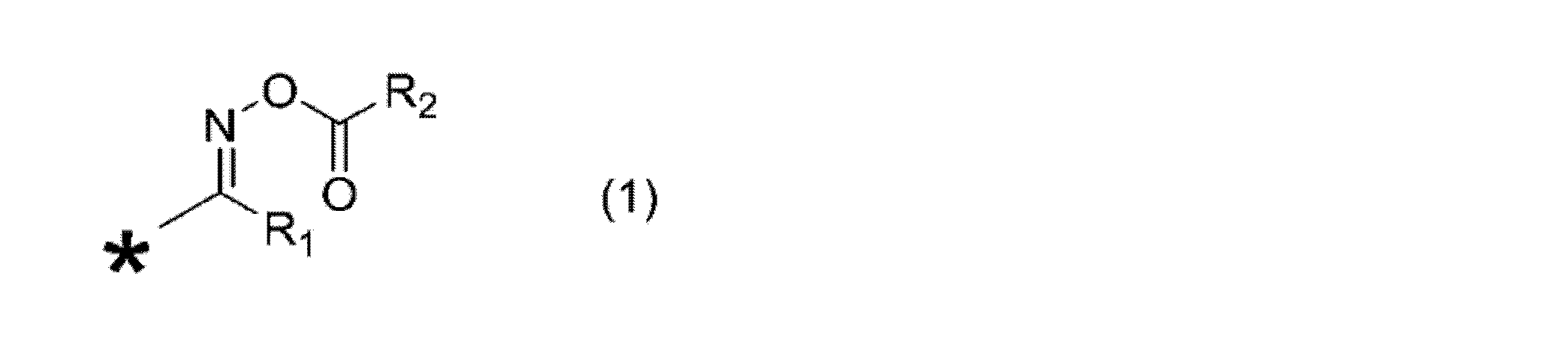
- the oxime ester structure possessed by the specific compound is, for example, a structure represented by the following formula (1).
- R 1 represents a (C1-C8) alkyl group or a (C1-C8) alkoxy group
- R 2 represents a hydrogen atom, a (C1-C8) alkyl group, or a (C2-C8) alkenyl group. Represents an aryl group or a heteroaryl group.
- Examples of the (C1-C8) alkyl group for R 1 in the above formula (1) include a linear, branched, or cyclic unsubstituted group, and a linear one is preferable. Specific examples include linear groups such as methyl group, ethyl group, n-propyl group, n-butyl group, n-hentyl group, n-hexyl group, n-heptyl group, n-octyl group; isopropyl group Branched chain groups such as isobutyl group, sec-butyl group and tert-butyl group; cyclic groups such as cyclopropyl group, cyclopentyl group and cyclohexyl group;
- the (C1-C8) alkyl group may be a group in which a chain alkyl group and a cyclic alkyl group are bonded, such as a 3-cyclopentylpropyl group.
- a (C1-C3) alkyl group is preferable from the viewpoint of compatibility with a curable compound or a solvent, and specific examples include a methyl group, an ethyl group, and an n-propyl group, and a methyl group is more preferable. .
- Examples of the (C1-C8) alkoxy group for R 1 in the above formula (1) include a linear or branched unsubstituted group, and a linear one is preferred. Specific examples include linear groups such as methoxy group, ethoxy group, n-propoxy group and n-butoxy group; branched chain groups such as isopropoxy group, isobutoxy group, sec-butoxy group and tert-butoxy group. And the like. Among these, a methoxy group is preferable.
- R 1 is preferably a methyl group.
- the (C1-C8) alkyl group in R 2 in the above formula (1) has the same meaning as the (C1-C8) alkyl group in R 1 , including preferred ones.
- Examples of the (C2-C8) alkenyl group for R 2 in the above formula (1) include linear or branched unsubstituted groups. Specific examples include vinyl group, 1-propenyl group, 2-propenyl group and the like.
- Examples of the aryl group and heteroaryl group in R 2 in the above formula (1) include a phenyl group, a pyridyl group, and a thienyl group.
- the aryl group and heteroaryl group are substituted with at least one substituent such as a carboxy group, a sulfo group, a hydroxy group, an acetylamino group, a halogen atom, a cyano group, a nitro group, a sulfamoyl group, an alkyl group, and an alkoxy group. Also good.
- substituent such as a carboxy group, a sulfo group, a hydroxy group, an acetylamino group, a halogen atom, a cyano group, a nitro group, a sulfamoyl group, an alkyl group, and an alkoxy group.
- substituent such as a carboxy group, a sulfo
- R 2 is preferably a hydrogen atom or a methyl group.
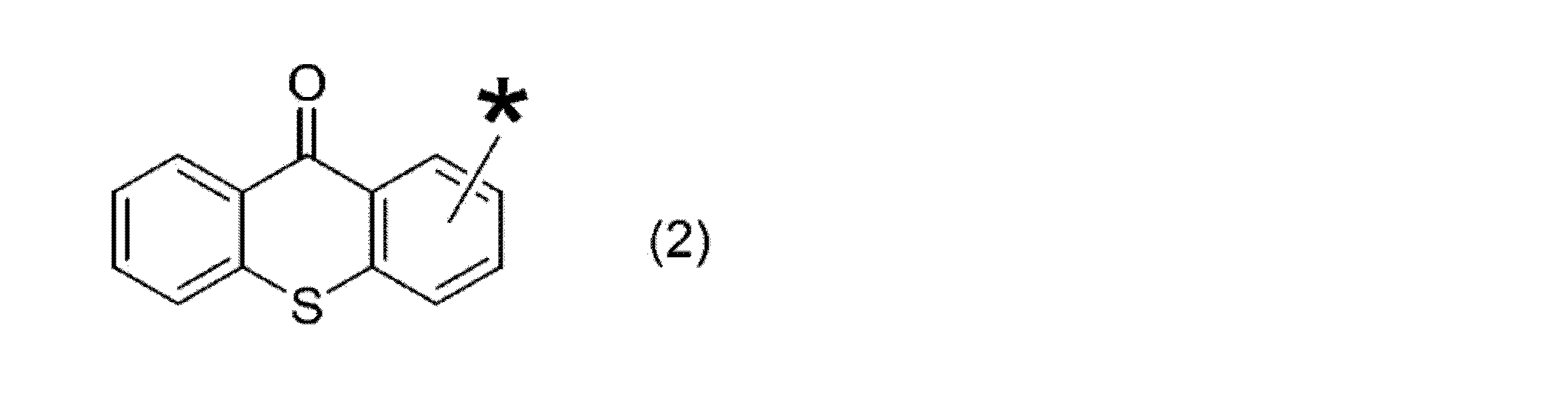
- a bonding position which may be a bonding position with a thioxanthone structure represented by the following formula (2), and the bonding group in the case of bonding to the thioxanthone structure through another bonding group. It may be a coupling position.
- the linking group include an alkylene group, an alkylidene group, and an alkylene oxide group.
- the thioxanthone structure possessed by the specific compound is a structure represented by the following formula (2).
- the thioxanthone structure represented by the above formula (2) may have other substituents in addition to the oxime ester structure represented by the above formula (1).
- substituents include carboxy group, sulfo group, hydroxy group, acetylamino group, halogen atom, cyano group, nitro group, sulfamoyl group, (C1-C8) alkyl group, (C1-C8) alkoxy group, and the like. It is done.
- the substituent may be bonded to R 1 in the formula (1) to form a cyclic structure.
- Specific examples of the specific compound include compounds having the following compound numbers 1 to 20. However, it is not limited to these. Of the compounds of compound numbers 1 to 20, compounds of compound numbers 1 to 17 and 20 are preferred, and compounds of compound number 1 are more preferred.
- the specific compound generates radicals by irradiation with light such as ultraviolet light and visible light, has high sensitivity to light, and exhibits sufficient reactivity even with low energy light. It also has good thermal stability, low volatility, good storage stability, and good solubility and is suitable for photopolymerization in the presence of air (oxygen). Therefore, the specific compound is useful as a photopolymerization initiator for polymerizing a curable compound capable of radical polymerization.
- the content of the specific compound is usually 0.001 to 10% by mass, preferably 0.002 to 5.0% by mass, and more preferably 0.1 to 3.% by mass in the total amount of the photocurable composition. 0% by mass.
- the content of the specific compound is 0.001% by mass or more, the photopolymerization of the photocurable composition tends to proceed sufficiently.
- the content of the specific compound is 10% by mass or less, the number of unreacted compounds decreases. As a result, deterioration of light resistance and storage stability of the photocurable composition and adverse effects on display characteristics when the photocurable composition is used as a sealant for display elements tend to be suppressed.
- the photocurable composition concerning this embodiment may contain other photoinitiators other than the above-mentioned specific compound.
- the other photopolymerization initiator is not particularly limited as long as it is a compound that generates a radical, an acid, a base, or the like by irradiation with ultraviolet light or visible light and initiates a chain polymerization reaction.
- photopolymerization initiators include benzyl dimethyl ketal, 1-hydroxycyclohexyl phenyl ketone, diethyl thioxanthone, benzophenone, 2-ethylanthraquinone, 2-hydroxy-2-methylpropiophenone, 2-methyl- [ 4- (methylthio) phenyl] -2-morpholino-1-propane, 2,4,6-trimethylbenzoyldiphenylphosphine oxide, camphorquinone, 9-fluorenone, diphenyl disulfide and the like.
- Examples of the photopolymerization initiator having an absorbance at the maximum absorption wavelength ( ⁇ max) in the wavelength region of 200 to 300 nm of 500 or more include IRGACURE RTM 651, 184, and 2959. Examples of the photopolymerization initiator having an absorbance at the maximum absorption wavelength ( ⁇ max) in the wavelength region of 200 to 300 nm of 1500 or more include IRGACURE RTM 2959.
- the photopolymerization initiator preferably has a molecular weight of 150 to 1000 from the viewpoint of preventing outgassing.
- those having a (meth) acryl group in the molecule are preferable, for example, 2-methacryloyloxyethyl isocyanate and 1- [4- (2-hydroxyethoxy) -phenyl] -2-hydroxy
- the reaction product with 2-methyl-1-propan-1-one is preferably used. This compound can be produced by the method described in International Publication No. 2006/027982.
- the content is preferably 0.001 to 10% by mass in the total amount of the photocurable composition, More preferably, the content is 1 to 5.0% by mass.
- the photocurable composition according to the present embodiment may contain a photoinitiation assistant such as a tertiary amine in order to further improve the curability.
- a photoinitiation assistant such as a tertiary amine
- the tertiary amines include, but are not limited to, ethyl p-dimethylaminobenzoate, isoamyl p-dimethylaminobenzoate, N, N-dimethylbenzylamine and the like.
- a high molecular weight compound in which a plurality of tertiary amines are branched with a polyhydric alcohol or the like in one molecule can also be used as appropriate.
- the content is preferably 0.005 to 20% by mass in the total amount of the photocurable composition, 0.01 More preferably, it is ⁇ 10% by mass.
- the photocurable composition according to this embodiment preferably contains a curable compound.
- a curable compound preferably contains a curable compound.
- (meth) acrylic compounds such as a (meth) acrylic ester compound and an epoxy (meth) acrylate compound, are preferable.
- a (meth) acryl compound may be used individually by 1 type, and may use 2 or more types together.
- (meth) acrylic ester compounds include N-acryloyloxyethylhexahydrophthalimide, acryloylmorpholine, 2-hydroxypropyl (meth) acrylate, 4-hydroxybutyl (meth) acrylate, cyclohexane-1,4-dimethanol mono (Meth) acrylate, tetrahydrofurfuryl (meth) acrylate, phenoxyethyl (meth) acrylate, phenyl polyethoxy (meth) acrylate, 2-hydroxy-3-phenyloxypropyl (meth) acrylate, o-phenylphenol monoethoxy (meta ) Acrylate, o-phenylphenol polyethoxy (meth) acrylate, p-cumylphenoxyethyl (meth) acrylate, isobornyl (meth) acrylate, tribromo Enyloxyethyl (meth) acrylate, dicyclopentanyl
- the epoxy (meth) acrylate compound can be obtained by a known method by reacting an epoxy compound with (meth) acrylic acid. Although it does not specifically limit as an epoxy compound used as a raw material, The epoxy compound more than bifunctional is preferable.
- the bifunctional or higher functional epoxy compound include resorcin diglycidyl ether, bisphenol A type epoxy compound, bisphenol F type epoxy compound, bisphenol S type epoxy compound, phenol novolac type epoxy compound, cresol novolak type epoxy compound, bisphenol A novolak type Epoxy compounds, bisphenol F novolac type epoxy compounds, alicyclic epoxy compounds, aliphatic chain epoxy compounds, glycidyl ester type epoxy compounds, glycidyl amine type epoxy compounds, hydantoin type epoxy compounds, isocyanurate type epoxy compounds, triphenolmethane skeleton Phenol novolac-type epoxy compounds having di- and diglycidyl ethers of bifunctional phenols (catechol, resorcinol, etc.)
- the photocurable composition according to the present embodiment when used as a liquid crystal sealant, bisphenol A type epoxy compounds and resorcin diglycidyl ether are preferable from the viewpoint of liquid crystal contamination.
- the ratio of the epoxy group and the (meth) acryloyl group in the epoxy (meth) acrylate compound is not particularly limited, and is appropriately selected from the viewpoint of process compatibility.
- the photocurable composition according to this embodiment preferably contains an epoxy compound (excluding the (meth) acrylic compound) in addition to the (meth) acrylic compound.
- An epoxy compound may be used individually by 1 type, and may use 2 or more types together.
- the epoxy compound is not particularly limited, but a bifunctional or higher functional epoxy compound is preferable.
- the bifunctional or higher functional epoxy compound include resorcin diglycidyl ether, bisphenol A type epoxy resin, bisphenol F type epoxy resin, bisphenol S type epoxy resin, phenol novolac type epoxy resin, cresol novolac type epoxy resin, bisphenol A novolak type Epoxy resin, bisphenol F novolac type epoxy resin, alicyclic epoxy resin, aliphatic chain epoxy resin, glycidyl ester type epoxy resin, glycidyl amine type epoxy resin, hydantoin type epoxy resin, isocyanurate type epoxy resin, triphenolmethane skeleton Phenol novolac epoxy resin containing diglycidyl etherified products of bifunctional phenols (catechol, resorcinol, etc.), difunctional alcohols Glycidyl etherified product, and the like thereof halide or hydrogenated product.
- the photocurable composition according to the present embodiment is
- the content thereof is usually 10 to 80% by mass, preferably 20 to 70% by mass, based on the total amount of the photocurable composition. is there.
- the photocurable composition according to this embodiment contains an epoxy compound, the content is usually 5 to 50% by mass, preferably 5 to 30% by mass, based on the total amount of the photocurable composition. It is.
- the photocurable composition according to the present embodiment may contain an organic filler.
- An organic filler may be used individually by 1 type, and may use 2 or more types together.
- Examples of the organic filler include urethane fine particles, acrylic fine particles, styrene fine particles, styrene olefin fine particles, and silicone fine particles.
- examples of the silicone fine particles include KMP-594, KMP-597, KMP-598 (manufactured by Shin-Etsu Chemical Co., Ltd.); Trefill RTM E-5500, 9701, EP-2001 (manufactured by Toray Dow Corning Co., Ltd.). preferable.
- As urethane fine particles JB-800T and HB-800BK (manufactured by Negami Industrial Co., Ltd.) are preferable.
- styrene fine particles Lavalon RTM T320C, T331C, SJ4400, SJ5400, SJ6400, SJ4300C, SJ5300C, and SJ6300C (manufactured by Mitsubishi Chemical Corporation) are preferable.
- styrene olefin fine particles Septon RTM SEPS 2004 and SEPS 2063 (manufactured by Kuraray Co., Ltd.) are preferable.
- These organic fillers may be core-shell organic fillers using two or more materials.
- acrylic fine particles and silicone fine particles are preferable.
- acrylic fine particles an acrylic rubber having a core-shell structure composed of two kinds of acrylic rubber is preferable, and the core layer is preferably n-butyl acrylate and the shell layer is more preferably methyl methacrylate.
- Acrylic fine particles whose core layer is n-butyl acrylate and whose shell layer is methyl methacrylate are sold by Aika Kogyo Co., Ltd. as Zefiac RTM F-351.
- Silicone fine particles include organopolysiloxane cross-linked powder, linear dimethylpolysiloxane cross-linked powder, and a composite silicone rubber in which a silicone resin (for example, polyorganosilsesquioxane resin) is coated on the surface of the silicone rubber.
- a silicone resin for example, polyorganosilsesquioxane resin
- Etc is a silicone rubber of a linear dimethylpolysiloxane crosslinked product powder, or a composite silicone rubber fine particle of a silicone resin-coated linear dimethylpolysiloxane crosslinked product powder.
- the shape of the rubber powder is preferably a sphere with little increase in viscosity after addition.
- the content is usually 5 to 50% by mass, preferably 5 to 40% by mass, based on the total amount of the photocurable composition. .
- the photocurable composition according to this embodiment may contain an inorganic filler.
- An inorganic filler may be used individually by 1 type, and may use 2 or more types together.
- examples of the inorganic filler include silica, silicon carbide, silicon nitride, boron nitride, calcium carbonate, magnesium carbonate, barium sulfate, calcium sulfate, mica, talc, clay, alumina, magnesium oxide, zirconium oxide, aluminum hydroxide, and hydroxide.
- Examples include magnesium, calcium silicate, aluminum silicate, lithium aluminum silicate, zirconium silicate, barium titanate, glass fiber, carbon fiber, molybdenum disulfide, asbestos, etc., preferably fused silica, crystalline silica, silicon nitride, boron nitride, carbonic acid
- the particles include calcium, barium sulfate, calcium sulfate, mica, talc, clay, alumina, aluminum hydroxide, calcium silicate, and aluminum silicate, and particles such as silica, alumina, and talc are preferable.
- the average particle size of the inorganic filler is suitably 2000 nm or less, preferably 1000 nm or less, more preferably 300 nm or less.
- the average particle diameter of the inorganic filler is 2000 nm or less, for example, when producing a narrow gap liquid crystal cell using the photocurable composition according to the present embodiment as a liquid crystal sealing agent for a liquid crystal dropping method, the upper and lower There is a tendency that a gap can be formed well when a glass substrate is bonded.
- a preferable minimum is about 10 nm, More preferably, it is about 100 nm.
- the particle diameter can be measured with a laser diffraction / scattering particle size distribution analyzer (dry type) (manufactured by Seishin Enterprise Co., Ltd .; LMS-30).
- the content of the photocurable composition according to the present embodiment contains an inorganic filler
- the content is usually 5 to 50% by mass, preferably 5 to 40% by mass, based on the total amount of the photocurable composition. .
- the adhesive strength to the glass substrate is improved and the moisture resistance reliability is also improved, so that a decrease in the adhesive strength after moisture absorption tends to be suppressed.
- the content of the inorganic filler is 50% by mass or less, for example, when the liquid crystal cell is produced using the photocurable composition according to the present embodiment as a liquid crystal sealing agent for a liquid crystal dropping method, the inorganic filler is crushed. It tends to be easier and better.
- the photocurable composition according to this embodiment may contain a silane coupling agent in order to improve adhesive strength and moisture resistance.
- a silane coupling agent may be used individually by 1 type, and may use 2 or more types together.
- silane coupling agents include 3-glycidoxypropyltrimethoxysilane, 3-glycidoxypropylmethyldimethoxysilane, 3-glycidoxypropylmethyldiethoxysilane, and 2- (3,4-epoxycyclohexyl).
- Ethyltrimethoxysilane N-phenyl- ⁇ -aminopropyltrimethoxysilane, N- (2-aminoethyl) 3-aminopropylmethyldimethoxysilane, N- (2-aminoethyl) 3-aminopropylmethyltrimethoxysilane, 3-aminopropyltriethoxysilane, 3-mercaptopropyltrimethoxysilane, vinyltrimethoxysilane, N- (2- (vinylbenzylamino) ethyl) 3-aminopropyltrimethoxysilane hydrochloride, 3-methacryloxypropyltrimethoxy Silane 3-chloropropyl methyl dimethoxy silane, 3-chloropropyl trimethoxy silane, and the like. Since these silane coupling agents are sold by Shin-Etsu Chemical Co., Ltd. as KBM series, KBE series, etc., they are easily available from
- the content is preferably 0.05 to 3% by mass in the total amount of the photocurable composition.
- thermosetting agent The photocurable composition according to this embodiment may contain a thermosetting agent.
- a thermosetting agent may be used individually by 1 type, and may use 2 or more types together.
- thermosetting agent reacts nucleophilically with an unshared electron pair or an anion in the molecule, and examples thereof include polyvalent amines, polyhydric phenols, and organic acid hydrazide compounds. Among these, organic acid hydrazide compounds are preferably used.
- examples of the aromatic hydrazide compound include terephthalic acid dihydrazide, isophthalic acid dihydrazide, 2,6-naphthoic acid dihydrazide, 2,6-pyridinedihydrazide, 1,2,4-benzenetrihydrazide, 1, Examples include 4,5,8-naphthoic acid tetrahydrazide and pyromellitic acid tetrahydrazide.
- Examples of the aliphatic hydrazide compound among the organic acid hydrazide compounds include form hydrazide, acetohydrazide, propionic acid hydrazide, oxalic acid dihydrazide, malonic acid dihydrazide, succinic acid dihydrazide, glutaric acid dihydrazide, adipic acid dihydrazide, and pimelic acid dihydrazide.
- organic acid hydrazide compounds isophthalic acid dihydrazide, malonic acid dihydrazide, adipic acid dihydrazide, tris (1-hydrazinocarbonylmethyl) isocyanurate, tris (1-hydrazinocarbonylethyl) are selected from the balance between curing reactivity and potential. ) Isocyanurate, tris (2-hydrazinocarbonylethyl) isocyanurate, and tris (3-hydrazinocarbonylpropyl) isocyanurate are preferred, and tris (2-hydrazinocarbonylethyl) isocyanurate is more preferred.
- the content is usually 0.1 to 10% by mass, preferably 1 to 5% by mass, based on the total amount of the photocurable composition. %.
- the photocurable composition according to this embodiment may contain a thermal radical polymerization initiator in order to improve the curing rate and curability.
- a thermal radical polymerization initiator may be used individually by 1 type, and may use 2 or more types together.
- the thermal radical polymerization initiator is not particularly limited as long as it is a compound that generates radicals by heating and initiates a chain polymerization reaction, such as organic peroxide, azo compound, benzoin compound, benzoin ether compound, acetophenone compound, benzopinacol, etc. And benzopinacol is preferably used.
- organic peroxides include Kayamek RTM A, M, R, L, LH, SP-30C, Parkadox CH-50L, BC-FF, Cadox B-40ES, Parkadox 14, Trigonox RTM 22-70E. 23-C70, 121, 121-50E, 121-LS50E, 21-LS50E, 42, 42LS, Kayaester RTM P-70, TMPO-70, CND-C70, OO-50E, AN, Kayabutyl RTM B, Parkardox 16, Kayacaron RTM BIC-75, AIC-75 (above, manufactured by Kayaku Akzo Co., Ltd.); Permec RTM N, H, S, F, D, G, Perhexa RTM H, HC, TMH, C, V, 22, MC, Pakyua RTM AH, AL, HB, Perbutyl RTM H, C, ND, L , Pakumi RTM H, D, PEROYL RTM IB
- examples of commercially available azo compounds include VA-044, 086, V-070, VPE-0201, VSP-1001 (above, manufactured by Wako Pure Chemical Industries, Ltd.) and the like.
- the content thereof is usually 0.0001 to 10% by mass in the total amount of the photocurable composition, preferably 0.00. It is 0005 to 5% by mass, and more preferably 0.001 to 3% by mass.
- the photocurable composition concerning this embodiment may contain additives, such as a hardening accelerator, a radical polymerization inhibitor, a pigment, a leveling agent, an antifoamer, and a solvent, as needed.
- additives such as a hardening accelerator, a radical polymerization inhibitor, a pigment, a leveling agent, an antifoamer, and a solvent, as needed.
- Examples of the curing accelerator include organic acids and imidazoles.
- Examples of the organic acid include organic carboxylic acid and organic phosphoric acid, and organic carboxylic acid is preferable. Specifically, phthalic acid, isophthalic acid, terephthalic acid, trimellitic acid, benzophenone tetracarboxylic acid, furandicarboxylic acid, succinic acid, adipic acid, dodecanedioic acid, sebacic acid, thiodipropionic acid, cyclohexanedicarboxylic acid, tris (2-Carboxymethyl) isocyanurate, tris (2-carboxyethyl) isocyanurate, tris (2-carboxypropyl) isocyanurate, bis (2-carboxyethyl) isocyanurate and the like.
- imidazole compounds examples include 2-methylimidazole, 2-phenylimidazole, 2-undecylimidazole, 2-heptadecylimidazole, 2-phenyl-4-methylimidazole, 1-benzyl-2-phenylimidazole, and 1-benzyl-2.
- the content thereof is usually 0.1 to 10% by mass, preferably 1 to 5% by mass, based on the total amount of the photocurable composition. %.
- the radical polymerization inhibitor is not particularly limited as long as it is a compound that prevents polymerization by reacting with radicals generated from a photo radical polymerization initiator or a thermal radical polymerization initiator, and is not limited to quinone, piperidine, hinders. Examples include radical polymerization inhibitors such as dophenol and nitroso.
- naphthoquinone 2-hydroxynaphthoquinone, 2-methylnaphthoquinone, 2-methoxynaphthoquinone, 2,2,6,6-tetramethylpiperidine-1-oxyl, 2,2,6,6-tetramethyl-4 -Hydroxypiperidine-1-oxyl, 2,2,6,6, -tetramethyl-4-methoxypiperidine-1-oxyl, 2,2,6,6-tetramethyl-4-phenoxypiperidine-1-oxyl, hydroquinone 2-methylhydroquinone, 2-methoxyhydroquinone, parabenzoquinone, butylated hydroxyanisole, 2,6-di-t-butyl-4-ethylphenol, 2,6-di-t-butylcresol, stearyl ⁇ - (3 , 5-Di-tert-butyl-4-hydroxyphenyl) propionate, 2,2'-methylenebis 4-ethyl-6-tert-but
- Adeka Adeka and the like.
- naphthoquinone, hydroquinone, nitroso, and piperidine radical polymerization inhibitors are preferred, and naphthoquinone, 2-hydroxynaphthoquinone, hydroquinone, 2,6-di-tert-butyl-p-cresol, polystop 7300P ( Hakuto Co., Ltd.) is more preferable, and Polystop 7300P (Hakuto Co., Ltd.) is more preferable.
- the content thereof is usually 0.0001 to 1% by mass, preferably 0.001 in the total amount of the photocurable composition. It is -0.5 mass%, More preferably, it is 0.01-0.2 mass%.
- the viscosity at 25 ° C. of the photocurable composition according to this embodiment is preferably 150 to 500 Pa ⁇ s, more preferably 200 to 500 Pa ⁇ s.
- the viscosity of the photocurable composition at 25 ° C. is preferably 250 to 400 Pa ⁇ s, and more preferably 280 to 320 Pa ⁇ s.
- Examples of the method for preparing the photocurable composition according to this embodiment include the following methods. First, the specific compound is heated and dissolved in the curable compound. Subsequently, after cooling to room temperature, an organic filler, an inorganic filler, a silane coupling agent, a thermosetting agent, a thermal radical polymerization initiator, an antifoaming agent, a leveling agent, a solvent, etc. are added as needed. And the photocurable composition which concerns on this embodiment can be prepared by mixing uniformly with well-known mixing apparatuses, such as a 3 roll, a sand mill, and a ball mill, and filtering with a metal mesh.
- well-known mixing apparatuses such as a 3 roll, a sand mill, and a ball mill, and filtering with a metal mesh.
- the photocurable composition according to the present embodiment is very useful as an electronic component sealant or an electronic component adhesive.
- the electronic component sealant or the electronic component adhesive include, but are not limited to, flexible printed wiring board adhesives, TAB adhesives, semiconductor adhesives, various display adhesives, and the like. is not.
- the photocurable composition according to this embodiment is very useful as an adhesive for liquid crystal display cells, particularly as a liquid crystal sealant.
- An example is shown below about the liquid crystal display cell at the time of using the photocurable composition which concerns on this embodiment as a liquid-crystal sealing compound.
- a liquid crystal display cell manufactured using an adhesive for a liquid crystal display cell has a pair of substrates each having a predetermined electrode formed on the substrate opposed to each other at a predetermined interval, and the periphery is sealed with a liquid crystal sealant, and a liquid crystal is interposed in the gap. Is enclosed.
- the kind of liquid crystal to be sealed is not particularly limited.
- the substrate is composed of a combination of substrates made of at least one of glass, quartz, plastic, silicone, etc. and having light transmission properties.
- the manufacturing method of a liquid crystal display cell is as follows, for example.
- a spacer (gap control material) is added to the liquid crystal sealant.
- the spacer include glass fiber, silica beads, and polymer beads.
- the diameter of the spacer varies depending on the purpose, but is usually 2 to 8 ⁇ m, preferably 4 to 7 ⁇ m.
- the amount of use is usually 0.1 to 4 parts by mass, preferably 0.5 to 2 parts by mass, more preferably about 0.9 to 1.5 parts by mass with respect to 100 parts by mass of the liquid crystal sealant. It is.
- the liquid crystal sealant is irradiated with ultraviolet rays by an ultraviolet irradiator and photocured.
- the amount of ultraviolet irradiation is preferably 500 to 6000 mJ / cm 2 , more preferably 1000 to 4000 mJ / cm 2 . Thereafter, if necessary, it is cured at 90 to 130 ° C. for 1 to 2 hours to obtain a liquid crystal display cell.
- the liquid crystal display cell thus obtained does not have a display defect due to liquid crystal contamination, and has excellent adhesion and moisture resistance reliability.
- the photocurable composition according to the present embodiment is very suitable for use in an electronic component designed to have a light-shielding portion and an adhesive application that needs to be cured with low energy light such as visible light.
- it is suitable as a liquid crystal display sealing agent, an organic EL sealing agent, and a touch panel adhesive used under a wiring light shielding portion.
- thermometer and a cooling pipe were installed in a 200 mL four-necked reaction vessel, and a nitrogen flow was started at a flow rate of 30 mL / min.
- 2-Acetylthioxanthone (0.50 g), hydroxylamine hydrochloride (0.20 g), and N, N-dimethylformamide (60 mL) were added to the reaction vessel and reacted at 80 ° C. for 4 hours.
- the reaction was stopped by adding 50 mL of water, extracted with methyl isobutyl ketone (200 mL), and washed with 50 mL of water three times.
- the solvent was removed using an evaporator to obtain an oxime product of 2-acetylthioxanthone (TX-OX / yellow solid).
- TX-OX / yellow solid The yellow solid (crude crystals) obtained here was used for the oxime esterification reaction as it was.
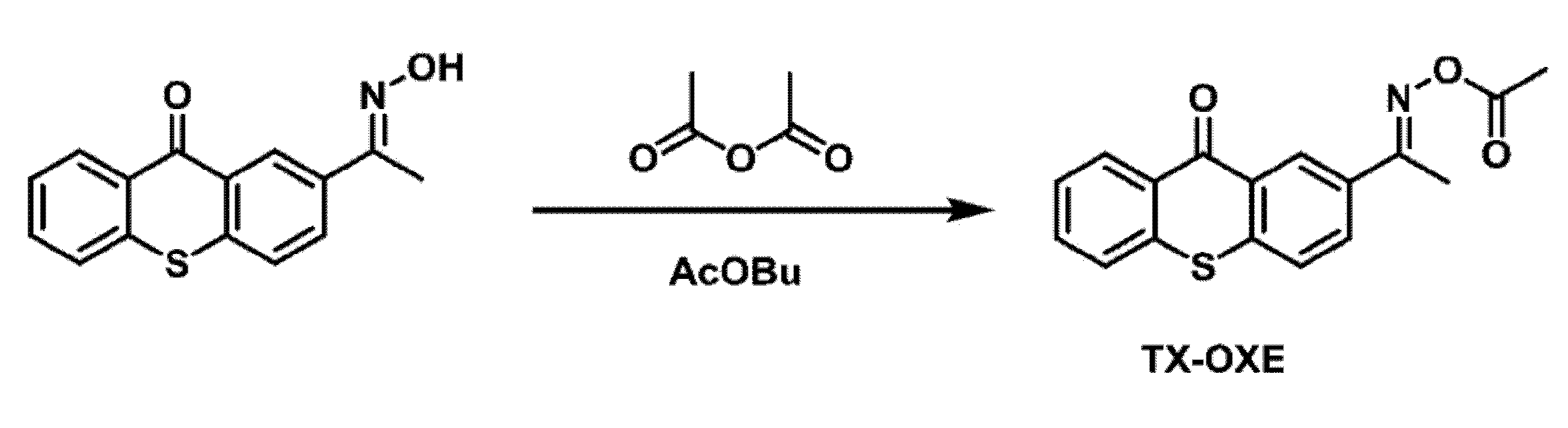
- thermometer and a cooling pipe were installed in a 200 mL four-necked reaction vessel, and a nitrogen flow was started at a flow rate of 30 mL / min.
- a total amount of TX-OX, acetic anhydride (0.24 g), and butyl acetate (30 mL) were added to the reaction vessel, and the reaction was carried out at 90 ° C. for 5 hours.
- the reaction was stopped by adding 50 mL of water, extracted with methyl isobutyl ketone (200 mL), and washed with 50 mL of water three times. The solvent was removed using an evaporator to obtain a yellow solid.
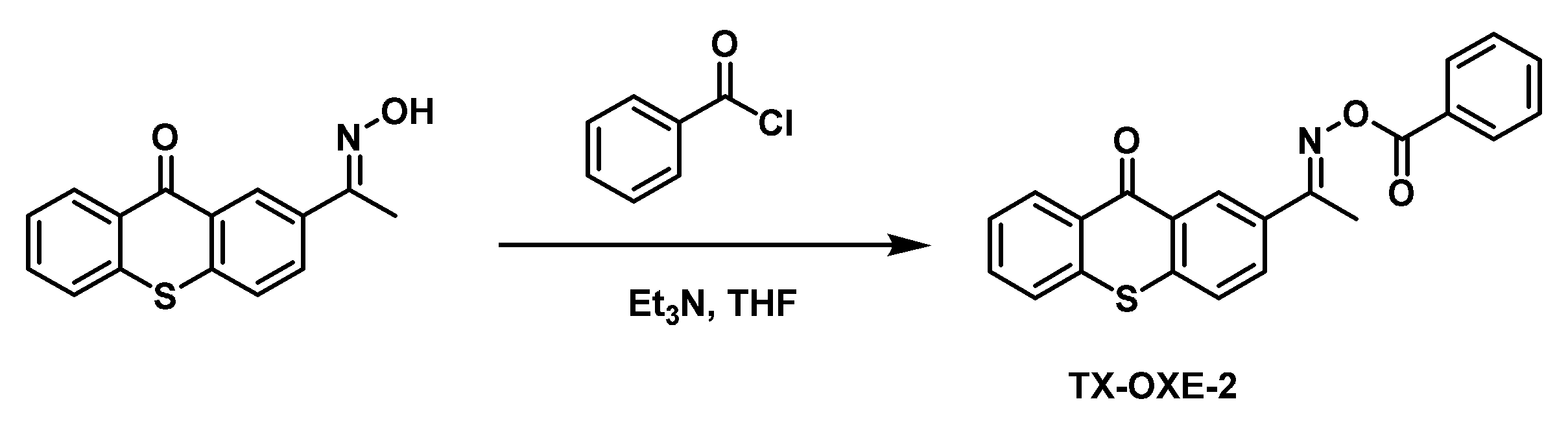
- thermometer and a cooling pipe were installed in a 200 mL four-necked reaction vessel, and a nitrogen flow was started at a flow rate of 30 mL / min.
- TX-OX 0.5 g
- benzoyl chloride 0.52 g
- triethylamine 0.47 g
- tetrahydrofuran 30 mL
- Examples 1 and 2 The curable compounds (B-1, B-2, B-3) shown in Table 1 below are mixed, the specific compound (A-1) shown in Table 1 below is heated and dissolved at 90 ° C., and then cooled to room temperature. did. Next, the remaining components in Table 1 below were added and stirred, and then dispersed in a three-roll mill. Then, the photocurable composition of Example 1 and 2 was prepared by filtering with a metal mesh (635 mesh). In addition, the numerical value of each component in Table 1 represents a mass part.
- Comparative Examples 1 and 2 Photocuring of Comparative Examples 1 and 2 in the same manner as in Examples 1 and 2, except that other components (O-2, O-3) shown in Table 1 below were used in place of the specific compound (A-1). A sex composition was prepared.
- the photocurable compositions of Examples 1 and 2 using TX-OXE as the specific compound were compared with the comparative photocurable composition using a compound having a similar structure.
- the curability in the deep part (low energy irradiated part) was good in both ultraviolet and visible light. That is, it was confirmed that the photocurable compositions of Examples 1 and 2 have excellent curability at low energy.
Landscapes
- Chemical & Material Sciences (AREA)
- Organic Chemistry (AREA)
- Health & Medical Sciences (AREA)
- Chemical Kinetics & Catalysis (AREA)
- Medicinal Chemistry (AREA)
- Polymers & Plastics (AREA)
- Physics & Mathematics (AREA)
- Nonlinear Science (AREA)
- Mathematical Physics (AREA)
- Crystallography & Structural Chemistry (AREA)
- Inorganic Chemistry (AREA)
- General Physics & Mathematics (AREA)
- Optics & Photonics (AREA)
- Sealing Material Composition (AREA)
- Adhesives Or Adhesive Processes (AREA)
- Liquid Crystal (AREA)
- Plural Heterocyclic Compounds (AREA)
- Epoxy Resins (AREA)
Abstract
Description
なお、本明細書中、「(メタ)アクリル」とは「アクリル及び/又はメタクリル」を意味し、「(メタ)アクリレート」とは「アクリレート及び/又はメタクリレート」を意味し、「(メタ)アクリロイル」とは「アクリロイル及び/又はメタクリロイル」を意味する。
[2] 硬化性化合物を含有する[1]に記載の光硬化性組成物。
[3] 前記硬化性化合物が(メタ)アクリル化合物である[2]に記載の光硬化性組成物。
[4] 前記硬化性化合物が、(メタ)アクリル化合物とエポキシ化合物との混合物である[2]に記載の光硬化性組成物。
[5] 有機フィラーを含有する[1]~[4]のいずれか一項に記載の光硬化性組成物。
[6] 前記有機フィラーが、ウレタン微粒子、アクリル微粒子、スチレン微粒子、スチレンオレフィン微粒子、及びシリコーン微粒子からなる群より選択される少なくとも1種の有機フィラーである[5]に記載の光硬化性組成物。
[7] 無機フィラーを含有する[1]~[6]のいずれか一項に記載の光硬化性組成物。
[8] シランカップリング剤を含有する[1]~[7]のいずれか一項に記載の光硬化性組成物。
[9] 熱硬化剤を含有する[1]~[8]のいずれか一項に記載の光硬化性組成物。
[10] 前記熱硬化剤が有機酸ヒドラジド化合物である[9]に記載の光硬化性組成物。
[11] [1]~[10]のいずれか一項に記載の光硬化性組成物を用いた電子部品用接着剤。
[12] [11]に記載の電子部品用接着剤を硬化して得られる硬化物で接着された電子部品。
[13] [1]~[10]のいずれか一項に記載の光硬化性組成物を用いた液晶表示セル用接着剤。
[14] [1]~[10]のいずれか一項に記載の光硬化性組成物を用いた液晶シール剤。
[15] [13]に記載の液晶表示セル用接着剤又は[14]に記載の液晶シール剤を用いて接着された液晶表示セル。
[分子内にオキシムエステル構造及びチオキサントン構造を併せ持つ化合物]
本実施形態に係る光硬化性組成物は、分子内にオキシムエステル構造及びチオキサントン構造を併せ持つ化合物(以下、「特定化合物」ともいう。)を含有する。この特定化合物は、低エネルギー光に対する感度が非常に高い光重合開始剤として機能する。特定化合物は、1種を単独で使用してもよく、2種以上を併用してもよい。

本実施形態に係る光硬化性組成物は、上記の特定化合物以外に、他の光重合開始剤を含有していてもよい。他の光重合開始剤としては、紫外光線や可視光線の照射によってラジカル、酸、塩基等を発生し、連鎖重合反応を開始させる化合物であれば特に限定されない。
本実施形態に係る光硬化性組成物は、硬化性をさらに高めるため、三級アミン類等の光開始助剤を含有していてもよい。三級アミン類としては、特に限定されないが、p-ジメチルアミノ安息香酸エチル、p-ジメチルアミノ安息香酸イソアミル、N,N-ジメチルベンジルアミン等が挙げられる。また、一分子内に複数の三級アミン類を多価アルコール等で分岐させた高分子量化合物も適宜使用することができる。
本実施形態に係る光硬化性組成物は、硬化性化合物を含有することが好ましい。硬化性化合物としては、光、熱等によって硬化する化合物であれば特に限定されないが、(メタ)アクリルエステル化合物、エポキシ(メタ)アクリレート化合物等の(メタ)アクリル化合物が好ましい。(メタ)アクリル化合物は、1種を単独で使用してもよく、2種以上を併用してもよい。
また、本実施形態に係る光硬化性組成物がエポキシ化合物を含有する場合、その含有率は、光硬化性組成物の総量中、通常5~50質量%であり、好ましくは5~30質量%である。
本実施形態に係る光硬化性組成物は、有機フィラーを含有していてもよい。有機フィラーは、1種を単独で使用してもよく、2種以上を併用してもよい。
本実施形態に係る光硬化性組成物は、無機フィラーを含有していてもよい。無機フィラーは、1種を単独で使用してもよく、2種以上を併用してもよい。
本実施形態に係る光硬化性組成物は、接着強度や耐湿性の向上を図るため、シランカップリング剤を含有していてもよい。シランカップリング剤は、1種を単独で使用してもよく、2種以上を併用してもよい。
本実施形態に係る光硬化性組成物は、熱硬化剤を含有していてもよい。熱硬化剤は、1種を単独で使用してもよく、2種以上を併用してもよい。
本実施形態に係る光硬化性組成物は、硬化速度及び硬化性を向上するため、熱ラジカル重合開始剤を含有していてもよい。熱ラジカル重合開始剤は、1種を単独で使用してもよく、2種以上を併用してもよい。
本実施形態に係る光硬化性組成物は、必要に応じて、硬化促進剤、ラジカル重合防止剤、顔料、レベリング剤、消泡剤、溶剤などの添加剤を含有していてもよい。
硬化促進剤としては、有機酸、イミダゾール等が挙げられる。
有機酸としては、有機カルボン酸、有機リン酸等が挙げられ、有機カルボン酸が好ましい。具体的には、フタル酸、イソフタル酸、テレフタル酸、トリメリット酸、ベンゾフェノンテトラカルボン酸、フランジカルボン酸、コハク酸、アジピン酸、ドデカン二酸、セバシン酸、チオジプロピオン酸、シクロヘキサンジカルボン酸、トリス(2-カルボキシメチル)イソシアヌレート、トリス(2-カルボキシエチル)イソシアヌレート、トリス(2-カルボキシプロピル)イソシアヌレート、ビス(2-カルボキシエチル)イソシアヌレート等が挙げられる。
イミダゾール化合物としては、2-メチルイミダゾール、2-フェニルイミダゾール、2-ウンデシルイミダゾール、2-ヘプタデシルイミダゾール、2-フェニル-4-メチルイミダゾール、1-ベンジル-2-フェニルイミダゾール、1-ベンジル-2-メチルイミダゾール、1-シアノエチル-2-メチルイミダゾール、1-シアノエチル-2-フェニルイミダゾール、1-シアノエチル-2-ウンデシルイミダゾール、2,4-ジアミノ-6(2’-メチルイミダゾール(1’))エチル-s-トリアジン、2,4-ジアミノ-6(2’-ウンデシルイミダゾール(1’))エチル-s-トリアジン、2,4-ジアミノ-6(2’-エチル-4-メチルイミダゾール(1’))エチル-s-トリアジン、2,4-ジアミノ-6(2’-メチルイミダゾール(1’))エチル-s-トリアジン・イソシアヌル酸付加物、2-メチルイミダゾールイソシアヌル酸の2:3付加物、2-フェニルイミダゾールイソシアヌル酸付加物、2-フェニル-3,5-ジヒドロキシメチルイミダゾール、2-フェニル-4-ヒドロキシメチル-5-メチルイミダゾール、1-シアノエチル-2-フェニル-3,5-ジシアノエトキシメチルイミダゾール等が挙げられる。
ラジカル重合防止剤としては、光ラジカル重合開始剤や熱ラジカル重合開始剤等から発生するラジカルと反応して重合を防止する化合物であれば特に限定されるものではなく、キノン系、ピペリジン系、ヒンダードフェノール系、ニトロソ系等のラジカル重合防止剤が挙げられる。具体的には、ナフトキノン、2-ヒドロキシナフトキノン、2-メチルナフトキノン、2-メトキシナフトキノン、2,2,6,6-テトラメチルピペリジン-1-オキシル、2,2,6,6-テトラメチル-4-ヒドロキシピペリジン-1-オキシル、2,2,6,6,-テトラメチル-4-メトキシピペリジン-1-オキシル、2,2,6,6-テトラメチル-4-フェノキシピペリジン-1-オキシル、ハイドロキノン、2-メチルハイドロキノン、2-メトキシハイドロキノン、パラベンゾキノン、ブチル化ヒドロキシアニソール、2,6-ジ-t-ブチル-4-エチルフェノール、2,6-ジ-t-ブチルクレゾール、ステアリルβ-(3,5-ジ-t-ブチル-4-ヒドロキシフェニル)プロピオネート、2,2’-メチレンビス(4-エチル-6-t-ブチルフェノール)、4,4’-チオビス(3-メチル-6-t-ブチルフェノール)、4,4’-ブチリデンビス(3-メチル-6-t-ブチルフェノール)、3,9-ビス[1,1-ジメチル-2-[β―(3-t-ブチル-4-ヒドロキシ-5-メチルフェニル)プロピオニルオキシ]エチル]、2,4,8,10-テトラオキサスピロ[5,5]ウンデカン、テトラキス-[メチレン-3-(3’,5’-ジ-t-ブチル-4’-ヒドロキシフェニルプロピオネート)]メタン、1,3,5-トリス(3’,5’-ジ-t-ブチル-4’-ヒドロキシベンジル)-sec-トリアジン-2,4,6-(1H,3H,5H)トリオン、パラメトキシフェノール、4-メトキシ-1-ナフトール、チオジフェニルアミン、N-ニトロソフェニルヒドロキシアミンのアルミニウム塩、商品名アデカスタブLA-81、商品名アデカスタブLA-82(いずれも株式会社アデカ製)等が挙げられる。これらの中でも、ナフトキノン系、ハイドロキノン系、ニトロソ系、ピペリジン系のラジカル重合防止剤が好ましく、ナフトキノン、2-ヒドロキシナフトキノン、ハイドロキノン、2,6-ジ-tert-ブチル-p-クレゾール、ポリストップ7300P(伯東株式会社製)がより好ましく、ポリストップ7300P(伯東株式会社製)がさらに好ましい。
本実施形態に係る光硬化性組成物の25℃における粘度は、150~500Pa・sが好ましく、200~500Pa・sがより好ましい。特に、本実施形態に係る光硬化性組成物を液晶シール剤として用いる場合、光硬化性組成物の25℃における粘度は、250~400Pa・sが好ましく、280~320Pa・sがより好ましい。粘度を250Pa・s以上とすることで、液晶の差し込みの発生が抑えられ、セル化が容易になる傾向にある。粘度を400Pa・s以下とすることで、液晶シール剤の塗布が容易になる傾向にある。
本実施形態に係る光硬化性組成物の調製方法の一例としては、次に示す方法が挙げられる。まず、硬化性化合物に、上記特定化合物を加熱溶解する。次いで、室温まで冷却した後、必要に応じて、有機フィラー、無機フィラー、シランカップリング剤、熱硬化剤、熱ラジカル重合開始剤、消泡剤、レベリング剤、溶剤等を添加する。そして、3本ロール、サンドミル、ボールミル等の公知の混合装置により均一に混合し、金属メッシュにて濾過することにより、本実施形態に係る光硬化性組成物を調製することができる。
本実施形態に係る光硬化性組成物は、電子部品用封止剤又は電子部品用接着剤として非常に有用である。電子部品用封止剤又は電子部品用接着剤としては、フレキシブルプリント配線板用接着剤、TAB用接着剤、半導体用接着剤、各種ディスプレイ用接着剤等が挙げられるが、これらに限定されるものではない。
まず、液晶シール剤にスペーサ(間隙制御材)を添加する。スペーサとしては、グラスファイバー、シリカビーズ、ポリマービーズ等が挙げられる。スペーサの直径は目的に応じ異なるが、通常2~8μm、好ましくは4~7μmである。その使用量は、液晶シール剤100質量部に対し、通常0.1~4質量部であり、好ましくは0.5~2質量部であり、より好ましくは0.9~1.5質量部程度である。
[2-アセチルチオキサントンの合成]


1H―NMR(400MHz,DMSO―d6);δ(ppm)2.30(s,3H),2.51(s,3H),7.53(ddd,1H)7.59-7.6(m,2H),7.64-7.68(m,1H),8.25(dd,1H),8.60-8.66(m,1H),8.85(d,1H)
1H-NMR(400MHz,DMSO-d6);δ(ppm)2.65(s,3H),7.58-7.67(m,3H),7.72-7.85(m,2H)7.89-8.28(m,5H),8.51(d,1H),8.85(s,1H)
下記表1に示す硬化性化合物(B-1、B-2、B-3)を混合し、下記表1に示す特定化合物(A-1)を90℃で加熱溶解させた後、室温まで冷却した。次いで、下記表1の残りの成分を添加して撹拌した後、3本ロールミルにて分散させた。その後、金属メッシュ(635メッシュ)で濾過することにより、実施例1及び2の光硬化性組成物を調製した。なお、表1中の各成分の数値は質量部を表す。
特定化合物(A-1)の代わりに下記表1に示すその他の成分(O-2、O-3)を用いたほかは実施例1及び2と同様にして、比較例1及び2の光硬化性組成物を調製した。
[遮光部硬化幅(紫外線照射)]
実施例1及び2、比較例1及び2の各光硬化性組成物に4μmのグラスファイバー(日本電気硝子株式会社製)を1質量%添加し、液晶シール剤を調製した。クロムをエッチングすることによって100μmのライン及びスペースを設けたガラス基板に液晶シール剤を塗布し、対向基板としてブラックマトリクス基板を貼り合わせた。次いで、ライン/スペースを設けた基板側から波長365nmの紫外光を3000mJ/cm2(100mW/cm2で30秒)の照射量で照射し、顕微鏡にて硬化幅を測定した。結果を下記表1に示す。
実施例1及び2、比較例1及び2の各光硬化性組成物に4μmのグラスファイバー(日本電気硝子株式会社製)を1質量%添加し、液晶シール剤を調製した。クロムをエッチングすることによって100μmのライン及びスペースを設けたガラス基板に液晶シール剤を塗布し、対向基板としてブラックマトリクス基板を貼り合わせた。次いで、ライン/スペースを設けた基板側から波長405nmの可視光を3000mJ/cm2(100mW/cm2で30秒)の照射量で照射し、顕微鏡にて硬化幅を測定した。結果を下記表1に示す。
E型粘度計(R115型粘度計(東機産業株式会社製))により実施例1及び2、比較例1及び2の各光硬化性組成物の25℃における粘度(Pa・s)を測定した。結果を下記表1に示す。

Claims (15)
- 分子内にオキシムエステル構造及びチオキサントン構造を併せ持つ化合物を含有する光硬化性組成物。
- 硬化性化合物を含有する請求項1に記載の光硬化性組成物。
- 前記硬化性化合物が(メタ)アクリル化合物である請求項2に記載の光硬化性組成物。
- 前記硬化性化合物が、(メタ)アクリル化合物とエポキシ化合物との混合物である請求項2に記載の光硬化性組成物。
- 有機フィラーを含有する請求項1~4のいずれか一項に記載の光硬化性組成物。
- 前記有機フィラーが、ウレタン微粒子、アクリル微粒子、スチレン微粒子、スチレンオレフィン微粒子、及びシリコーン微粒子からなる群より選択される少なくとも1種の有機フィラーである請求項5に記載の光硬化性組成物。
- 無機フィラーを含有する請求項1~6のいずれか一項に記載の光硬化性組成物。
- シランカップリング剤を含有する請求項1~7のいずれか一項に記載の光硬化性組成物。
- 熱硬化剤を含有する請求項1~8のいずれか一項に記載の光硬化性組成物。
- 前記熱硬化剤が有機酸ヒドラジド化合物である請求項9に記載の光硬化性組成物。
- 請求項1~10のいずれか一項に記載の光硬化性組成物を用いた電子部品用接着剤。
- 請求項11に記載の電子部品用接着剤を硬化して得られる硬化物で接着された電子部品。
- 請求項1~10のいずれか一項に記載の光硬化性組成物を用いた液晶表示セル用接着剤。
- 請求項1~10のいずれか一項に記載の光硬化性組成物を用いた液晶シール剤。
- 請求項13に記載の液晶表示セル用接着剤又は請求項14に記載の液晶シール剤を用いて接着された液晶表示セル。
Priority Applications (3)
| Application Number | Priority Date | Filing Date | Title |
|---|---|---|---|
| KR1020197034155A KR20200015487A (ko) | 2017-06-06 | 2018-05-25 | 광경화성 조성물 및 전자 부품용 접착제 |
| CN201880025666.9A CN110536908B (zh) | 2017-06-06 | 2018-05-25 | 光固化性组合物及电子部件用粘接剂 |
| JP2018548156A JP6486571B1 (ja) | 2017-06-06 | 2018-05-25 | 電子部品用接着剤 |
Applications Claiming Priority (2)
| Application Number | Priority Date | Filing Date | Title |
|---|---|---|---|
| JP2017-111973 | 2017-06-06 | ||
| JP2017111973 | 2017-06-06 |
Publications (1)
| Publication Number | Publication Date |
|---|---|
| WO2018225544A1 true WO2018225544A1 (ja) | 2018-12-13 |
Family
ID=64566485
Family Applications (1)
| Application Number | Title | Priority Date | Filing Date |
|---|---|---|---|
| PCT/JP2018/020226 Ceased WO2018225544A1 (ja) | 2017-06-06 | 2018-05-25 | 光硬化性組成物及び電子部品用接着剤 |
Country Status (5)
| Country | Link |
|---|---|
| JP (1) | JP6486571B1 (ja) |
| KR (1) | KR20200015487A (ja) |
| CN (1) | CN110536908B (ja) |
| TW (1) | TWI774777B (ja) |
| WO (1) | WO2018225544A1 (ja) |
Cited By (1)
| Publication number | Priority date | Publication date | Assignee | Title |
|---|---|---|---|---|
| CN111690355A (zh) * | 2019-03-15 | 2020-09-22 | 日本化药株式会社 | 显示器用密封剂及液晶显示器 |
Families Citing this family (1)
| Publication number | Priority date | Publication date | Assignee | Title |
|---|---|---|---|---|
| WO2022071116A1 (ja) * | 2020-09-30 | 2022-04-07 | 積水化学工業株式会社 | チオキサントン化合物、光重合開始剤、硬化性樹脂組成物、表示素子用組成物、液晶表示素子用シール剤、上下導通材料、及び、液晶表示素子 |
Citations (8)
| Publication number | Priority date | Publication date | Assignee | Title |
|---|---|---|---|---|
| JP2001233842A (ja) * | 1999-12-15 | 2001-08-28 | Ciba Specialty Chem Holding Inc | オキシムエステルの光開始剤 |
| JP2005154494A (ja) * | 2003-11-21 | 2005-06-16 | Toyo Ink Mfg Co Ltd | 光ラジカル重合開始剤及びそれを用いた光ラジカル重合性組成物 |
| JP2007199135A (ja) * | 2006-01-24 | 2007-08-09 | Mitsubishi Chemicals Corp | 感光性組成物、及び青紫色レーザー用感光性組成物並びにそれを用いた画像形成材料、画像形成材、及び画像形成方法 |
| JP2009116112A (ja) * | 2007-11-07 | 2009-05-28 | Taiyo Ink Mfg Ltd | 光硬化性樹脂組成物及びその硬化物パターン、並びに該硬化物パターンを具備するプリント配線板 |
| JP2010527339A (ja) * | 2007-05-11 | 2010-08-12 | ビーエーエスエフ ソシエタス・ヨーロピア | オキシムエステル光重合開始剤 |
| JP2012122045A (ja) * | 2010-05-19 | 2012-06-28 | Fujifilm Corp | 重合性組成物 |
| JP2014141583A (ja) * | 2013-01-24 | 2014-08-07 | Nippon Kagaku Kogyosho:Kk | 新規な光重合開始剤及びその使用方法 |
| CN106569388A (zh) * | 2015-09-30 | 2017-04-19 | 奇美实业股份有限公司 | 黑色矩阵用的感光性树脂组成物及其应用 |
Family Cites Families (17)
| Publication number | Priority date | Publication date | Assignee | Title |
|---|---|---|---|---|
| JP2004126211A (ja) | 2002-10-02 | 2004-04-22 | Mitsui Chemicals Inc | 液晶封止用樹脂組成物および液晶表示パネルの製造方法 |
| KR101299026B1 (ko) | 2006-05-26 | 2013-08-27 | 니폰 가야꾸 가부시끼가이샤 | 액정 실링제 및 이를 사용한 액정 표시 셀 |
| JP5268235B2 (ja) | 2006-07-05 | 2013-08-21 | 日本化薬株式会社 | 液晶シール剤およびそれを用いた液晶表示セル |
| JP5079310B2 (ja) * | 2006-11-15 | 2012-11-21 | 太陽ホールディングス株式会社 | ソルダーレジスト露光用フォトツール及びそれを用いて露光処理されるソルダーレジストパターンの形成方法 |
| JP5139735B2 (ja) | 2007-06-26 | 2013-02-06 | 積水化学工業株式会社 | 液晶滴下工法用シール剤、上下導通材料及び液晶表示素子 |
| JP5388091B2 (ja) | 2007-11-16 | 2014-01-15 | 日本化薬株式会社 | 液晶シール剤およびそれを用いた液晶表示セル |
| CN101565472B (zh) * | 2009-05-19 | 2011-05-04 | 常州强力电子新材料有限公司 | 酮肟酯类光引发剂 |
| KR20130140544A (ko) * | 2010-07-20 | 2013-12-24 | 니폰 가야꾸 가부시끼가이샤 | 액정 실링제 및 그것을 사용한 액정 표시셀 |
| JP6038033B2 (ja) * | 2010-10-05 | 2016-12-07 | ビーエーエスエフ ソシエタス・ヨーロピアBasf Se | ベンゾカルバゾール化合物のオキシムエステル誘導体ならびに前記誘導体の光重合性の組成物における光開始剤としての使用 |
| KR101860356B1 (ko) * | 2011-11-25 | 2018-05-24 | 금호석유화학 주식회사 | 액정 오염성을 개선한 표시소자용 실란트 조성물 및 그를 경화하여 형성된 실란트 |
| CN102516916B (zh) * | 2011-12-12 | 2013-08-14 | 东莞市派乐玛新材料技术开发有限公司 | 一种液晶密封剂组合物 |
| KR101479813B1 (ko) * | 2012-04-10 | 2015-01-06 | (주)엘지하우시스 | 반경화 감압 점착필름 |
| KR101545724B1 (ko) * | 2012-08-01 | 2015-08-19 | 주식회사 엘지화학 | 광경화성 및 열경화성을 갖는 수지 조성물과, 드라이 필름 솔더 레지스트 |
| WO2014204173A1 (ko) * | 2013-06-17 | 2014-12-24 | 주식회사 엘지화학 | 광경화성 및 열경화성을 갖는 수지 조성물 및 드라이 필름 솔더 레지스트 |
| JP6356582B2 (ja) * | 2014-11-25 | 2018-07-11 | 日東電工株式会社 | 接着シート、ダイシングシート付き接着シート及び半導体装置の製造方法 |
| CN104536264A (zh) * | 2014-12-26 | 2015-04-22 | 上海孚赛特新材料科技有限公司 | 黑色感光性树脂组合物及其应用 |
| TWI595015B (zh) * | 2015-03-27 | 2017-08-11 | Lg化學股份有限公司 | 光硬化與熱硬化樹脂組成物及乾膜式防焊劑 |
-
2018
- 2018-05-25 CN CN201880025666.9A patent/CN110536908B/zh not_active Expired - Fee Related
- 2018-05-25 WO PCT/JP2018/020226 patent/WO2018225544A1/ja not_active Ceased
- 2018-05-25 JP JP2018548156A patent/JP6486571B1/ja active Active
- 2018-05-25 KR KR1020197034155A patent/KR20200015487A/ko not_active Withdrawn
- 2018-05-31 TW TW107118679A patent/TWI774777B/zh active
Patent Citations (8)
| Publication number | Priority date | Publication date | Assignee | Title |
|---|---|---|---|---|
| JP2001233842A (ja) * | 1999-12-15 | 2001-08-28 | Ciba Specialty Chem Holding Inc | オキシムエステルの光開始剤 |
| JP2005154494A (ja) * | 2003-11-21 | 2005-06-16 | Toyo Ink Mfg Co Ltd | 光ラジカル重合開始剤及びそれを用いた光ラジカル重合性組成物 |
| JP2007199135A (ja) * | 2006-01-24 | 2007-08-09 | Mitsubishi Chemicals Corp | 感光性組成物、及び青紫色レーザー用感光性組成物並びにそれを用いた画像形成材料、画像形成材、及び画像形成方法 |
| JP2010527339A (ja) * | 2007-05-11 | 2010-08-12 | ビーエーエスエフ ソシエタス・ヨーロピア | オキシムエステル光重合開始剤 |
| JP2009116112A (ja) * | 2007-11-07 | 2009-05-28 | Taiyo Ink Mfg Ltd | 光硬化性樹脂組成物及びその硬化物パターン、並びに該硬化物パターンを具備するプリント配線板 |
| JP2012122045A (ja) * | 2010-05-19 | 2012-06-28 | Fujifilm Corp | 重合性組成物 |
| JP2014141583A (ja) * | 2013-01-24 | 2014-08-07 | Nippon Kagaku Kogyosho:Kk | 新規な光重合開始剤及びその使用方法 |
| CN106569388A (zh) * | 2015-09-30 | 2017-04-19 | 奇美实业股份有限公司 | 黑色矩阵用的感光性树脂组成物及其应用 |
Cited By (1)
| Publication number | Priority date | Publication date | Assignee | Title |
|---|---|---|---|---|
| CN111690355A (zh) * | 2019-03-15 | 2020-09-22 | 日本化药株式会社 | 显示器用密封剂及液晶显示器 |
Also Published As
| Publication number | Publication date |
|---|---|
| JPWO2018225544A1 (ja) | 2019-06-27 |
| TWI774777B (zh) | 2022-08-21 |
| TW201903098A (zh) | 2019-01-16 |
| KR20200015487A (ko) | 2020-02-12 |
| CN110536908B (zh) | 2022-04-19 |
| CN110536908A (zh) | 2019-12-03 |
| JP6486571B1 (ja) | 2019-03-20 |
Similar Documents
| Publication | Publication Date | Title |
|---|---|---|
| JP6478313B2 (ja) | 液晶シール剤及びそれを用いた液晶表示セル | |
| JP2018104662A (ja) | 光硬化性樹脂組成物及び電子部品用封止剤 | |
| JP6238850B2 (ja) | 液晶シール剤及びそれを用いた液晶表示セル | |
| JP2016024243A (ja) | 液晶シール剤及びそれを用いた液晶表示セル | |
| JP6338745B1 (ja) | 光硬化性樹脂組成物及び電子部品用封止剤 | |
| JP2019082598A (ja) | ディスプレイ用封止剤 | |
| JP2016109997A (ja) | 液晶シール剤及びそれを用いた液晶表示セル | |
| WO2014034684A1 (ja) | 液晶シール剤及びそれを用いた液晶表示セル | |
| JP6486571B1 (ja) | 電子部品用接着剤 | |
| JP6535002B2 (ja) | 液晶シール剤及びそれを用いた液晶表示セル | |
| WO2018225543A1 (ja) | 化合物及びそれを用いた光硬化性組成物 | |
| JP6744168B2 (ja) | 液晶シール剤及びそれを用いた液晶表示セル | |
| CN111690367A (zh) | 显示器用密封剂及液晶显示器 | |
| JP6710125B2 (ja) | 液晶シール剤及びそれを用いた液晶表示セル | |
| JP7266484B2 (ja) | 電子部品用封止剤 | |
| JP2017198726A (ja) | 液晶光学素子用シール剤及びそれを用いた液晶光学素子 | |
| JP6426050B2 (ja) | 液晶シール剤及びそれを用いた液晶表示セル | |
| JP2016038509A (ja) | 液晶シール剤及びそれを用いた液晶表示セル | |
| JP2018105989A (ja) | 表示素子用封止剤及びそれを用いた表示素子 | |
| JP6478788B2 (ja) | 液晶シール剤及びそれを用いた液晶表示セル | |
| JP2024115813A (ja) | 液晶滴下工法用液晶シール剤及びそれを用いた液晶表示セル | |
| JP6341603B2 (ja) | 液晶シール剤及びそれを用いた液晶表示セル | |
| JP6202683B2 (ja) | 液晶滴下工法用液晶シール剤及びそれを用いた液晶表示セル | |
| JP2015203834A (ja) | 液晶滴下工法用液晶シール剤及びそれを用いた液晶表示セル | |
| JP2018063274A (ja) | 液晶シール剤及びそれを用いた液晶表示セル |
Legal Events
| Date | Code | Title | Description |
|---|---|---|---|
| ENP | Entry into the national phase |
Ref document number: 2018548156 Country of ref document: JP Kind code of ref document: A |
|
| 121 | Ep: the epo has been informed by wipo that ep was designated in this application |
Ref document number: 18812816 Country of ref document: EP Kind code of ref document: A1 |
|
| ENP | Entry into the national phase |
Ref document number: 20197034155 Country of ref document: KR Kind code of ref document: A |
|
| NENP | Non-entry into the national phase |
Ref country code: DE |
|
| 122 | Ep: pct application non-entry in european phase |
Ref document number: 18812816 Country of ref document: EP Kind code of ref document: A1 |