WO2018003513A1 - フェノールノボラック樹脂、硬化性樹脂組成物及びその硬化物 - Google Patents
フェノールノボラック樹脂、硬化性樹脂組成物及びその硬化物 Download PDFInfo
- Publication number
- WO2018003513A1 WO2018003513A1 PCT/JP2017/022074 JP2017022074W WO2018003513A1 WO 2018003513 A1 WO2018003513 A1 WO 2018003513A1 JP 2017022074 W JP2017022074 W JP 2017022074W WO 2018003513 A1 WO2018003513 A1 WO 2018003513A1
- Authority
- WO
- WIPO (PCT)
- Prior art keywords
- resin
- resin composition
- phenol
- curable resin
- cured product
- Prior art date
- Legal status (The legal status is an assumption and is not a legal conclusion. Google has not performed a legal analysis and makes no representation as to the accuracy of the status listed.)
- Ceased
Links
Images




Classifications
-
- C—CHEMISTRY; METALLURGY
- C08—ORGANIC MACROMOLECULAR COMPOUNDS; THEIR PREPARATION OR CHEMICAL WORKING-UP; COMPOSITIONS BASED THEREON
- C08J—WORKING-UP; GENERAL PROCESSES OF COMPOUNDING; AFTER-TREATMENT NOT COVERED BY SUBCLASSES C08B, C08C, C08F, C08G or C08H
- C08J5/00—Manufacture of articles or shaped materials containing macromolecular substances
- C08J5/04—Reinforcing macromolecular compounds with loose or coherent fibrous material
-
- C—CHEMISTRY; METALLURGY
- C08—ORGANIC MACROMOLECULAR COMPOUNDS; THEIR PREPARATION OR CHEMICAL WORKING-UP; COMPOSITIONS BASED THEREON
- C08G—MACROMOLECULAR COMPOUNDS OBTAINED OTHERWISE THAN BY REACTIONS ONLY INVOLVING UNSATURATED CARBON-TO-CARBON BONDS
- C08G8/00—Condensation polymers of aldehydes or ketones with phenols only
- C08G8/04—Condensation polymers of aldehydes or ketones with phenols only of aldehydes
- C08G8/08—Condensation polymers of aldehydes or ketones with phenols only of aldehydes of formaldehyde, e.g. of formaldehyde formed in situ
- C08G8/20—Condensation polymers of aldehydes or ketones with phenols only of aldehydes of formaldehyde, e.g. of formaldehyde formed in situ with polyhydric phenols
- C08G8/22—Resorcinol
-
- C—CHEMISTRY; METALLURGY
- C08—ORGANIC MACROMOLECULAR COMPOUNDS; THEIR PREPARATION OR CHEMICAL WORKING-UP; COMPOSITIONS BASED THEREON
- C08G—MACROMOLECULAR COMPOUNDS OBTAINED OTHERWISE THAN BY REACTIONS ONLY INVOLVING UNSATURATED CARBON-TO-CARBON BONDS
- C08G59/00—Polycondensates containing more than one epoxy group per molecule; Macromolecules obtained by polymerising compounds containing more than one epoxy group per molecule using curing agents or catalysts which react with the epoxy groups
- C08G59/18—Macromolecules obtained by polymerising compounds containing more than one epoxy group per molecule using curing agents or catalysts which react with the epoxy groups ; e.g. general methods of curing
- C08G59/40—Macromolecules obtained by polymerising compounds containing more than one epoxy group per molecule using curing agents or catalysts which react with the epoxy groups ; e.g. general methods of curing characterised by the curing agents used
- C08G59/62—Alcohols or phenols
-
- C—CHEMISTRY; METALLURGY
- C08—ORGANIC MACROMOLECULAR COMPOUNDS; THEIR PREPARATION OR CHEMICAL WORKING-UP; COMPOSITIONS BASED THEREON
- C08G—MACROMOLECULAR COMPOUNDS OBTAINED OTHERWISE THAN BY REACTIONS ONLY INVOLVING UNSATURATED CARBON-TO-CARBON BONDS
- C08G59/00—Polycondensates containing more than one epoxy group per molecule; Macromolecules obtained by polymerising compounds containing more than one epoxy group per molecule using curing agents or catalysts which react with the epoxy groups
- C08G59/18—Macromolecules obtained by polymerising compounds containing more than one epoxy group per molecule using curing agents or catalysts which react with the epoxy groups ; e.g. general methods of curing
- C08G59/40—Macromolecules obtained by polymerising compounds containing more than one epoxy group per molecule using curing agents or catalysts which react with the epoxy groups ; e.g. general methods of curing characterised by the curing agents used
- C08G59/62—Alcohols or phenols
- C08G59/621—Phenols
-
- C—CHEMISTRY; METALLURGY
- C08—ORGANIC MACROMOLECULAR COMPOUNDS; THEIR PREPARATION OR CHEMICAL WORKING-UP; COMPOSITIONS BASED THEREON
- C08G—MACROMOLECULAR COMPOUNDS OBTAINED OTHERWISE THAN BY REACTIONS ONLY INVOLVING UNSATURATED CARBON-TO-CARBON BONDS
- C08G8/00—Condensation polymers of aldehydes or ketones with phenols only
- C08G8/04—Condensation polymers of aldehydes or ketones with phenols only of aldehydes
- C08G8/08—Condensation polymers of aldehydes or ketones with phenols only of aldehydes of formaldehyde, e.g. of formaldehyde formed in situ
- C08G8/12—Condensation polymers of aldehydes or ketones with phenols only of aldehydes of formaldehyde, e.g. of formaldehyde formed in situ with monohydric phenols having only one hydrocarbon substituent ortho on para to the OH group, e.g. p-tert.-butyl phenol
-
- C—CHEMISTRY; METALLURGY
- C08—ORGANIC MACROMOLECULAR COMPOUNDS; THEIR PREPARATION OR CHEMICAL WORKING-UP; COMPOSITIONS BASED THEREON
- C08J—WORKING-UP; GENERAL PROCESSES OF COMPOUNDING; AFTER-TREATMENT NOT COVERED BY SUBCLASSES C08B, C08C, C08F, C08G or C08H
- C08J5/00—Manufacture of articles or shaped materials containing macromolecular substances
- C08J5/18—Manufacture of films or sheets
-
- C—CHEMISTRY; METALLURGY
- C08—ORGANIC MACROMOLECULAR COMPOUNDS; THEIR PREPARATION OR CHEMICAL WORKING-UP; COMPOSITIONS BASED THEREON
- C08J—WORKING-UP; GENERAL PROCESSES OF COMPOUNDING; AFTER-TREATMENT NOT COVERED BY SUBCLASSES C08B, C08C, C08F, C08G or C08H
- C08J5/00—Manufacture of articles or shaped materials containing macromolecular substances
- C08J5/24—Impregnating materials with prepolymers which can be polymerised in situ, e.g. manufacture of prepregs
-
- C—CHEMISTRY; METALLURGY
- C08—ORGANIC MACROMOLECULAR COMPOUNDS; THEIR PREPARATION OR CHEMICAL WORKING-UP; COMPOSITIONS BASED THEREON
- C08L—COMPOSITIONS OF MACROMOLECULAR COMPOUNDS
- C08L61/00—Compositions of condensation polymers of aldehydes or ketones; Compositions of derivatives of such polymers
- C08L61/04—Condensation polymers of aldehydes or ketones with phenols only
- C08L61/06—Condensation polymers of aldehydes or ketones with phenols only of aldehydes with phenols
-
- C—CHEMISTRY; METALLURGY
- C08—ORGANIC MACROMOLECULAR COMPOUNDS; THEIR PREPARATION OR CHEMICAL WORKING-UP; COMPOSITIONS BASED THEREON
- C08L—COMPOSITIONS OF MACROMOLECULAR COMPOUNDS
- C08L61/00—Compositions of condensation polymers of aldehydes or ketones; Compositions of derivatives of such polymers
- C08L61/04—Condensation polymers of aldehydes or ketones with phenols only
- C08L61/06—Condensation polymers of aldehydes or ketones with phenols only of aldehydes with phenols
- C08L61/12—Condensation polymers of aldehydes or ketones with phenols only of aldehydes with phenols with polyhydric phenols
-
- C—CHEMISTRY; METALLURGY
- C08—ORGANIC MACROMOLECULAR COMPOUNDS; THEIR PREPARATION OR CHEMICAL WORKING-UP; COMPOSITIONS BASED THEREON
- C08L—COMPOSITIONS OF MACROMOLECULAR COMPOUNDS
- C08L63/00—Compositions of epoxy resins; Compositions of derivatives of epoxy resins
-
- C—CHEMISTRY; METALLURGY
- C09—DYES; PAINTS; POLISHES; NATURAL RESINS; ADHESIVES; COMPOSITIONS NOT OTHERWISE PROVIDED FOR; APPLICATIONS OF MATERIALS NOT OTHERWISE PROVIDED FOR
- C09D—COATING COMPOSITIONS, e.g. PAINTS, VARNISHES OR LACQUERS; FILLING PASTES; CHEMICAL PAINT OR INK REMOVERS; INKS; CORRECTING FLUIDS; WOODSTAINS; PASTES OR SOLIDS FOR COLOURING OR PRINTING; USE OF MATERIALS THEREFOR
- C09D163/00—Coating compositions based on epoxy resins; Coating compositions based on derivatives of epoxy resins
-
- H—ELECTRICITY
- H05—ELECTRIC TECHNIQUES NOT OTHERWISE PROVIDED FOR
- H05K—PRINTED CIRCUITS; CASINGS OR CONSTRUCTIONAL DETAILS OF ELECTRIC APPARATUS; MANUFACTURE OF ASSEMBLAGES OF ELECTRICAL COMPONENTS
- H05K1/00—Printed circuits
- H05K1/02—Details
- H05K1/03—Use of materials for the substrate
- H05K1/0313—Organic insulating material
- H05K1/0353—Organic insulating material consisting of two or more materials, e.g. two or more polymers, polymer + filler, + reinforcement
- H05K1/0366—Organic insulating material consisting of two or more materials, e.g. two or more polymers, polymer + filler, + reinforcement reinforced, e.g. by fibres, fabrics
-
- H—ELECTRICITY
- H10—SEMICONDUCTOR DEVICES; ELECTRIC SOLID-STATE DEVICES NOT OTHERWISE PROVIDED FOR
- H10W—GENERIC PACKAGES, INTERCONNECTIONS, CONNECTORS OR OTHER CONSTRUCTIONAL DETAILS OF DEVICES COVERED BY CLASS H10
- H10W70/00—Package substrates; Interposers; Redistribution layers [RDL]
- H10W70/60—Insulating or insulated package substrates; Interposers; Redistribution layers
- H10W70/67—Insulating or insulated package substrates; Interposers; Redistribution layers characterised by their insulating layers or insulating parts
- H10W70/69—Insulating materials thereof
- H10W70/695—Organic materials
-
- H—ELECTRICITY
- H10—SEMICONDUCTOR DEVICES; ELECTRIC SOLID-STATE DEVICES NOT OTHERWISE PROVIDED FOR
- H10W—GENERIC PACKAGES, INTERCONNECTIONS, CONNECTORS OR OTHER CONSTRUCTIONAL DETAILS OF DEVICES COVERED BY CLASS H10
- H10W74/00—Encapsulations, e.g. protective coatings
- H10W74/10—Encapsulations, e.g. protective coatings characterised by their shape or disposition
-
- H—ELECTRICITY
- H10—SEMICONDUCTOR DEVICES; ELECTRIC SOLID-STATE DEVICES NOT OTHERWISE PROVIDED FOR
- H10W—GENERIC PACKAGES, INTERCONNECTIONS, CONNECTORS OR OTHER CONSTRUCTIONAL DETAILS OF DEVICES COVERED BY CLASS H10
- H10W74/00—Encapsulations, e.g. protective coatings
- H10W74/40—Encapsulations, e.g. protective coatings characterised by their materials
-
- H—ELECTRICITY
- H10—SEMICONDUCTOR DEVICES; ELECTRIC SOLID-STATE DEVICES NOT OTHERWISE PROVIDED FOR
- H10W—GENERIC PACKAGES, INTERCONNECTIONS, CONNECTORS OR OTHER CONSTRUCTIONAL DETAILS OF DEVICES COVERED BY CLASS H10
- H10W74/00—Encapsulations, e.g. protective coatings
- H10W74/40—Encapsulations, e.g. protective coatings characterised by their materials
- H10W74/47—Encapsulations, e.g. protective coatings characterised by their materials comprising organic materials, e.g. plastics or resins
-
- H—ELECTRICITY
- H10—SEMICONDUCTOR DEVICES; ELECTRIC SOLID-STATE DEVICES NOT OTHERWISE PROVIDED FOR
- H10W—GENERIC PACKAGES, INTERCONNECTIONS, CONNECTORS OR OTHER CONSTRUCTIONAL DETAILS OF DEVICES COVERED BY CLASS H10
- H10W74/00—Encapsulations, e.g. protective coatings
- H10W74/40—Encapsulations, e.g. protective coatings characterised by their materials
- H10W74/47—Encapsulations, e.g. protective coatings characterised by their materials comprising organic materials, e.g. plastics or resins
- H10W74/473—Encapsulations, e.g. protective coatings characterised by their materials comprising organic materials, e.g. plastics or resins containing a filler
-
- C—CHEMISTRY; METALLURGY
- C08—ORGANIC MACROMOLECULAR COMPOUNDS; THEIR PREPARATION OR CHEMICAL WORKING-UP; COMPOSITIONS BASED THEREON
- C08J—WORKING-UP; GENERAL PROCESSES OF COMPOUNDING; AFTER-TREATMENT NOT COVERED BY SUBCLASSES C08B, C08C, C08F, C08G or C08H
- C08J2361/00—Characterised by the use of condensation polymers of aldehydes or ketones; Derivatives of such polymers
- C08J2361/04—Condensation polymers of aldehydes or ketones with phenols only
- C08J2361/06—Condensation polymers of aldehydes or ketones with phenols only of aldehydes with phenols
- C08J2361/08—Condensation polymers of aldehydes or ketones with phenols only of aldehydes with phenols with monohydric phenols
- C08J2361/10—Phenol-formaldehyde condensates
-
- C—CHEMISTRY; METALLURGY
- C08—ORGANIC MACROMOLECULAR COMPOUNDS; THEIR PREPARATION OR CHEMICAL WORKING-UP; COMPOSITIONS BASED THEREON
- C08J—WORKING-UP; GENERAL PROCESSES OF COMPOUNDING; AFTER-TREATMENT NOT COVERED BY SUBCLASSES C08B, C08C, C08F, C08G or C08H
- C08J2363/00—Characterised by the use of epoxy resins; Derivatives of epoxy resins
-
- C—CHEMISTRY; METALLURGY
- C08—ORGANIC MACROMOLECULAR COMPOUNDS; THEIR PREPARATION OR CHEMICAL WORKING-UP; COMPOSITIONS BASED THEREON
- C08J—WORKING-UP; GENERAL PROCESSES OF COMPOUNDING; AFTER-TREATMENT NOT COVERED BY SUBCLASSES C08B, C08C, C08F, C08G or C08H
- C08J2461/00—Characterised by the use of condensation polymers of aldehydes or ketones; Derivatives of such polymers
- C08J2461/04—Condensation polymers of aldehydes or ketones with phenols only
- C08J2461/06—Condensation polymers of aldehydes or ketones with phenols only of aldehydes with phenols
Definitions
- the present invention is a phenol novolac resin that has an excellent balance of fluidity, high shrinkage ratio during heat curing, and low elastic modulus, and can be suitably used for semiconductor sealing materials, and a curable resin containing the phenol novolac resin.
- the present invention relates to a composition and a cured product thereof.
- Phenol novolac resin is used as a curable resin composition in combination with, for example, an epoxy resin curing agent, and is used in adhesives, molding materials, paints, photoresist materials, color developing materials, etc. Are widely used in electrical and electronic fields such as semiconductor encapsulants and printed wiring board insulating materials from the standpoint of heat resistance and moisture resistance.
- the wafer level packaging technology is a mounting technology for manufacturing a semiconductor package by performing resin sealing, rewiring, and electrode formation in the state of a wafer, and dividing into pieces by dicing. Since collective sealing with the sealing resin is performed, warping occurs due to shrinkage when the resin is cured and a difference in shrinkage due to the linear expansion coefficient of the chip and the linear expansion coefficient of the sealing resin. Since this warpage significantly reduces the reliability of the package, the sealing resin is required to have low viscosity, low shrinkage, and low elastic modulus for the purpose of suppressing warpage.
- a phenol novolac resin containing 25% by mass or more of a trifunctional compound can be used as a curing agent for an epoxy resin in an electronic material, particularly a laminate having excellent moisture resistance and solder resistance.
- a resin having a substituent on the aromatic ring of at least one phenol constituting the resin see, for example, Patent Document 1.
- a naphthylene ether skeleton-containing epoxy resin is suitably used as a semiconductor sealing material (see, for example, Patent Document 2).
- the problem to be solved by the present invention is to provide a phenol novolac resin, a composition, and a cured product thereof, which are excellent in the balance between molding shrinkage and elastic modulus at the time of heat curing of a composition containing a phenol novolac resin. It is in.
- the alkylphenol novolak resin having an alkyl group having 4 to 8 carbon atoms as a substituent on the aromatic ring contains the starting alkylphenol, and 13
- the ratio of the integral value (a) of 146 to 148 ppm and the integral value (b) of 146 to 153 ppm in the C-NMR measurement is within a specific range, the balance between the molding shrinkage ratio and the elastic modulus during heat curing is excellent. As a result, the present invention has been completed.
- an alkylphenol novolak resin in which an alkylphenol (I) having an alkyl group having 4 to 8 carbon atoms as a substituent on an aromatic ring is linked via a methylene group,
- the ratio (a) / (b) of the integral value (a) of 146 to 148 ppm and the integral value (b) of 146 to 153 ppm in 13 C-NMR measurement is in the range of 0.05 to 0.30
- the present invention provides a phenol novolac resin characterized in that the area ratio of alkylphenol (I) in GPC measurement is in the range of 0.01 to 3.0%, a curable resin composition containing the phenol novolak resin, and a cured product thereof. .
- the phenol novolac resin, the curable resin composition which has an excellent balance between the molding shrinkage ratio and the elastic modulus at the time of heat curing of the resin composition and can be suitably used for a semiconductor sealing material, etc.
- a cured product, a semiconductor encapsulating material, a semiconductor device, a prepreg, a circuit board, a buildup film, a buildup board, a fiber reinforced composite material, and a fiber reinforced molded product can be provided.
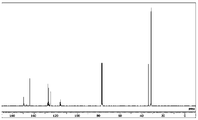
- FIG. 1 is a 13 C-NMR chart of the phenol novolac resin (A-1) synthesized in Synthesis Example 1.
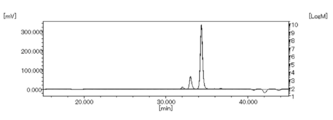
- FIG. 2 is a GPC chart of the phenol novolac resin (A-1) synthesized in Synthesis Example 1.
- FIG. 3 is a 13 C-NMR chart of the phenol novolac resin (A-3) synthesized in Synthesis Example 3.
- FIG. 4 is a GPC chart of the phenol novolac resin (A-3) synthesized in Synthesis Example 3.
- FIG. 5 is a 13 C-NMR chart of the phenol novolac resin (A′-1) synthesized in Comparative Synthesis Example 1.
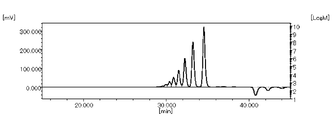
- FIG. 6 is a GPC chart of the phenol novolac resin (A′-1) synthesized in Comparative Synthesis Example 1.
- FIG. 1 is a 13 C-NMR chart of the phenol novolac resin (A-1) synthesized in Synthesis Example 1.
- FIG. 2 is a GPC chart of the phenol novolac resin (A
- FIG. 7 is a 13 C-NMR chart of the phenol novolac resin (A′-2) synthesized in Comparative Synthesis Example 2.
- FIG. 8 is a GPC chart of the phenol novolac resin (A′-2) synthesized in Comparative Synthesis Example 2.
- FIG. 9 is a 13 C-NMR chart of the phenol novolac resin (A′-3) synthesized in Comparative Synthesis Example 3.
- FIG. 10 is a GPC chart of the phenol novolac resin (A′-3) synthesized in Comparative Synthesis Example 3.
- the phenol novolac resin of the present invention is a phenol novolac resin made from alkylphenol (I) having an alkyl group having 4 to 8 carbon atoms as a substituent on an aromatic ring, and having a concentration of 146 to 148 ppm in 13 C-NMR measurement.
- the ratio of the integral value (a) to the integral value (b) of 146 to 153 ppm, (a) / (b) is in the range of 0.05 to 0.35, and the area ratio of alkylphenol (I) in GPC measurement is It is characterized by being in the range of 0.01 to 3.0%.
- peaks detected in the respective ranges of 146 to 148 ppm and 146 to 153 ppm are peaks derived from carbon atoms bonded to hydroxyl groups in the aromatic ring constituting the phenol novolac resin.
- 146 to 148 ppm is an aromatic ring existing at a position other than the terminal in one molecule, and 146 to 153 ppm is attributed to all carbon atoms of the aromatic ring bonded to a hydroxyl group in one molecule.
- a resin having this peak ratio (a) / (b) within a certain range, specifically within a range of 0.05 to 0.30 is used as one component of the curable resin composition.
- the present inventors have found that, due to having an alkyl group having 4 to 8 carbon atoms as a substituent on the aromatic ring, it has an excellent balance of molding shrinkage and elastic modulus during heat curing.
- this ratio (a) / (b) is less than 0.05, the cross-link density of the cured product is insufficient, resulting in insufficient heat resistance and increased mold shrinkage.
- melt viscosity becomes unsuitable for a sealing material, and the hydroxyl group concentration in the phenol novolac resin increases, and the bulky substituent becomes a steric hindrance, thereby causing a curing reaction. It is not practical because hydroxyl groups that do not contribute to the residue tend to remain, the molding shrinkage rate during curing increases, and the heat resistance of the cured product decreases.
- 13 C-NMR is carried out by the following measuring method.
- Device AL-400 manufactured by JEOL Ltd.
- Measurement mode Decoupling with reverse gate
- Solvent Deuterated chloroform Pulse angle: 30 ° pulse
- the phenol novolac resin of the present invention contains alkylphenol (I) used as a raw material in an area ratio of 0.01 to 3.0% in GPC measurement.
- alkylphenol (I) used as a raw material in an area ratio of 0.01 to 3.0% in GPC measurement.
- the phenol novolac resin of the present invention has the following general formula (1)
- R 1 , R 2 and R 3 are each independently a hydrogen atom or an alkyl group having 4 to 8 carbon atoms, and at least one of them is an alkyl group having 4 to 8 carbon atoms.
- N is an integer of 0-5.
- the substituent on the aromatic ring is in the ortho-position and para-position with respect to the hydroxyl group of the phenol, the viewpoint that the curing reaction proceeds well, the viewpoint that industrial raw materials are easy to obtain, This is preferable from the viewpoint of more excellent balance between molding shrinkage and elastic modulus.
- the average number of repetitions is more preferably in the range of 0.01 to 2.
- the substituent on the aromatic ring is preferably a t-butyl group, t
- An alkyl group having a branched structure such as an -octyl group is preferred, and a t-butyl group is most preferred.
- R 1 , R 2 and R 3 in the general formula (1) are t-butyl groups, so that the heat resistance of the cured product, the molding shrinkage, the elastic modulus, the resin In view of the excellent balance of melt viscosity, it is more preferable that R 1 is a t-butyl group and R 2 and R 3 are hydrogen atoms.
- n in the general formula (1) can be obtained by GPC measurement under the following conditions.
- the phenol novolac resin of the present invention gives a specific 13 C-NMR chart as described above.
- alkylphenol (I) having an alkyl group having 4 to 8 carbon atoms as a substituent on the aromatic ring is used, and the conditions are set to 50 to 180 ° C. under an aldehyde and an acidic catalyst. The method of making it react is mentioned.
- alkylphenol (I) having an alkyl group having 4 to 8 carbon atoms as a substituent on the aromatic ring examples include t-butylphenol, di-t-butylphenol, and t-octylphenol. Even if it is a thing, 2 or more types may be mixed and used. Among these, from the viewpoint of the heat shrinkage rate of the curable resin composition using the resulting phenol novolac resin, it is preferable that the alkyl group has a more bulky structure, and further, availability of raw materials is obtained.
- pt-butylphenol ot-butylphenol, 2,4-di-tert-butylphenol, pt-octylphenol, and pt-butylphenol. Most preferably, is used.
- the aldehyde may be any one that can form a novolak-type resin by causing a condensation reaction with the aforementioned alkylphenol (I), such as formaldehyde, trioxane, acetaldehyde, propionaldehyde, tetraoxymethylene, polyoxymethylene, Examples include chloral and hexamethylenetetramine. These may be used alone or in combination of two or more. Among them, it is preferable to use formaldehyde because of excellent reactivity.
- Formaldehyde may be used either as formalin in an aqueous solution or as paraformaldehyde in a solid state.
- the acidic catalyst examples include inorganic acids such as hydrochloric acid, sulfuric acid, and phosphoric acid, organic acids such as methanesulfonic acid, paratoluenesulfonic acid, and oxalic acid, and Lewis acids such as boron trifluoride, anhydrous aluminum chloride, and zinc chloride. An acid etc. are mentioned. These may be used alone or in combination of two or more.
- the above aldehyde is used in an amount of 0.05 to 0.40 mol per 1 mol of hydroxyl group in the alkylphenol (I), and the presence of the acidic catalyst is present.
- a method of reacting under a temperature condition of 50 to 180 ° C. is mentioned below.
- the reaction between the alkylphenol (I) and the aldehydes may be performed in a solvent as necessary.
- the solvent used here include water; methanol, ethanol, propanol, ethyl lactate, ethylene glycol, 1,2-propanediol, 1,3-propanediol, 1,4-butanediol, 1,5-pentanediol, 1,6-hexanediol, 1,7-heptanediol, 1,8-octanediol, 1,9-nonanediol, trimethylene glycol, diethylene glycol, polyethylene glycol, glycerin, 2-ethoxyethanol, ethylene glycol monomethyl ether, ethylene Glycol monoethyl ether, ethylene glycol monopropyl ether, ethylene glycol monobutyl ether, ethylene glycol monopentyl ether, ethylene glycol dimethyl ether, ethylene glycol ethy
- a step of distilling off unreacted raw materials and solvents a step of purification by washing with water or reprecipitation, and the like may be performed.
- the phenol novolac resin of the present invention can be made into a curable resin composition by using in combination with another compound having a functional group that reacts with a hydroxyl group.
- the curable resin composition can be suitably used for various electric / electronic member applications such as adhesives, paints, photoresists, printed wiring boards, and semiconductor sealing materials.
- Other compounds having a functional group that reacts with a hydroxyl group used in the present invention include, for example, a melamine compound, a guanamine compound, and a glycoluril substituted with at least one group selected from a methylol group, an alkoxymethyl group, and an acyloxymethyl group.
- examples thereof include compounds, urea compounds, resol resins, epoxy resins, isocyanate compounds, azide compounds, compounds containing double bonds such as alkenyl ether groups, acid anhydrides, and oxazoline compounds.
- Examples of the melamine compound include hexamethylol melamine, hexamethoxymethyl melamine, a compound in which 1 to 6 methylol groups of hexamethylol melamine are methoxymethylated, hexamethoxyethyl melamine, hexaacyloxymethyl melamine, hexamethylol melamine methylol
- Examples include compounds in which 1 to 6 groups are acyloxymethylated.
- guanamine compound examples include tetramethylol guanamine, tetramethoxymethyl guanamine, tetramethoxymethyl benzoguanamine, a compound in which 1 to 4 methylol groups of tetramethylol guanamine are methoxymethylated, tetramethoxyethyl guanamine, tetraacyloxyguanamine, tetra Examples thereof include compounds in which 1 to 4 methylol groups of methylolguanamine are acyloxymethylated.
- glycoluril compound examples include 1,3,4,6-tetrakis (methoxymethyl) glycoluril, 1,3,4,6-tetrakis (butoxymethyl) glycoluril, 1,3,4,6-tetrakis ( Hydroxymethyl) glycoluril and the like.
- urea compound examples include 1,3-bis (hydroxymethyl) urea, 1,1,3,3-tetrakis (butoxymethyl) urea and 1,1,3,3-tetrakis (methoxymethyl) urea. It is done.
- the resole resin may be, for example, an alkylphenol such as phenol, cresol or xylenol, a bisphenol such as phenylphenol, resorcinol, biphenyl, bisphenol A or bisphenol F, a phenolic hydroxyl group-containing compound such as naphthol or dihydroxynaphthalene, and an aldehyde compound.
- alkylphenol such as phenol, cresol or xylenol
- a bisphenol such as phenylphenol, resorcinol, biphenyl, bisphenol A or bisphenol F
- a phenolic hydroxyl group-containing compound such as naphthol or dihydroxynaphthalene
- aldehyde compound examples include polymers obtained by reacting under catalytic conditions.
- epoxy resin examples include bisphenol A type epoxy resin, bisphenol F type epoxy resin, biphenyl type epoxy resin, tetramethylbiphenyl type epoxy resin, polyhydroxynaphthalene type epoxy resin, phenol novolac type epoxy resin, cresol novolac type epoxy resin, Triphenylmethane type epoxy resin, tetraphenylethane type epoxy resin, dicyclopentadiene-phenol addition reaction type epoxy resin, phenol aralkyl type epoxy resin, naphthol novolak type epoxy resin, diglycidyloxynaphthalene, naphthol aralkyl type epoxy resin, naphthol- Phenol co-condensed novolac epoxy resin, naphthol-cresol co-condensed novolac epoxy resin, aromatic hydrocarbon formaldehyde Resin-modified phenolic resin type epoxy resin, biphenyl-modified novolak type epoxy resin, 1,1-bis (2,7-diglycidyloxy-1-naphthyl) al
- epoxy resins tetramethylbiphenol type epoxy resin, biphenyl aralkyl type epoxy resin, polyhydroxynaphthalene type epoxy resin, and novolac type epoxy resin are used in that a cured product having excellent flame retardancy can be obtained.
- a dicyclopentadiene-phenol addition reaction type epoxy resin is preferable in that a cured product having excellent dielectric properties is obtained.
- isocyanate compound examples include tolylene diisocyanate, diphenylmethane diisocyanate, hexamethylene diisocyanate, and cyclohexane diisocyanate.
- azide compound examples include 1,1'-biphenyl-4,4'-bisazide, 4,4'-methylidenebisazide, 4,4'-oxybisazide, and the like.
- Examples of the compound containing a double bond such as an alkenyl ether group include ethylene glycol divinyl ether, triethylene glycol divinyl ether, 1,2-propanediol divinyl ether, 1,4-butanediol divinyl ether, tetramethylene glycol divinyl ether.
- Examples of the acid anhydride include phthalic anhydride, trimellitic anhydride, pyromellitic anhydride, 3,3 ′, 4,4′-benzophenonetetracarboxylic dianhydride, biphenyltetracarboxylic dianhydride, 4,4 Aromatic acid anhydrides such as '-(isopropylidene) diphthalic anhydride, 4,4'-(hexafluoroisopropylidene) diphthalic anhydride; tetrahydrophthalic anhydride, methyltetrahydrophthalic anhydride, hexahydrophthalic anhydride And alicyclic carboxylic acid anhydrides such as methylhexahydrophthalic anhydride, endomethylenetetrahydrophthalic anhydride, dodecenyl succinic anhydride, and trialkyltetrahydrophthalic anhydride.
- an epoxy resin is particularly preferable because it becomes a curable composition having excellent curability and heat resistance in a cured product.
- a curing agent for epoxy resin may be blended.
- curing agents examples include various known curing agents for epoxy resins such as amine compounds, amide compounds, acid anhydride compounds, and phenol compounds.
- examples of the amine compound include diaminodiphenylmethane, diethylenetriamine, triethylenetetramine, diaminodiphenylsulfone, isophoronediamine, imidazole, BF 3 -amine complex, and guanidine derivative.
- examples of the amide compound include dicyandiamide. And a polyamide resin synthesized from a dimer of linolenic acid and ethylenediamine.
- Acid anhydride compounds include phthalic anhydride, trimellitic anhydride, pyromellitic anhydride, maleic anhydride, tetrahydrophthalic anhydride, methyltetrahydrophthalic anhydride, methyl nadic anhydride, hexahydrophthalic anhydride, methylhexahydro And phthalic anhydride.
- Phenol compounds include phenol novolac resin, cresol novolac resin, aromatic hydrocarbon formaldehyde resin-modified phenol resin, dicyclopentadiene phenol addition resin, phenol aralkyl resin (Zylok resin), naphthol aralkyl resin, triphenylol methane resin, Tetraphenylolethane resin, naphthol novolak resin, naphthol-phenol co-condensed novolak resin, naphthol-cresol co-condensed novolak resin, biphenyl-modified phenol resin (polyphenolic hydroxyl group-containing compound in which phenol nucleus is linked by bismethylene group), biphenyl Modified naphthol resin (polyvalent naphthol compound in which phenol nucleus is linked by bismethylene group), aminotriazine modified phenol resin (melamine, benzo Polyhydric phenolic hydroxyl group-containing compounds in which phenol nuclei are linked with anamin, etc.
- curable resin composition of the present invention may be used in combination with other thermosetting resins.
- thermosetting resins examples include cyanate ester resins, resins having a benzoxazine structure, maleimide compounds, active ester resins, vinyl benzyl compounds, acrylic compounds, and copolymers of styrene and maleic anhydride.
- the amount used is not particularly limited as long as the effects of the present invention are not impaired, but in the range of 1 to 50 parts by mass in 100 parts by mass of the curable resin composition. Preferably there is.
- cyanate ester resin examples include bisphenol A type cyanate ester resin, bisphenol F type cyanate ester resin, bisphenol E type cyanate ester resin, bisphenol S type cyanate ester resin, bisphenol sulfide type cyanate ester resin, and phenylene ether type cyanate ester resin.
- cyanate ester resins bisphenol A-type cyanate ester resins, bisphenol F-type cyanate ester resins, bisphenol E-type cyanate ester resins, and polyhydroxynaphthalene-type cyanate ester resins are particularly preferred in that a cured product having excellent heat resistance can be obtained.
- a naphthylene ether type cyanate ester resin or a novolak type cyanate ester resin is preferably used, and a dicyclopentadiene-phenol addition reaction type cyanate ester resin is preferred in that a cured product having excellent dielectric properties can be obtained.
- the resin having a benzoxazine structure is not particularly limited.
- a reaction product of bisphenol F, formalin, and aniline Fa type benzoxazine resin
- a reaction product of diaminodiphenylmethane, formalin, and phenol P- d-type benzoxazine resin
- reaction product of bisphenol A, formalin and aniline reaction product of dihydroxydiphenyl ether, formalin and aniline
- reaction product of diaminodiphenyl ether, formalin and phenol dicyclopentadiene-phenol addition resin and formalin Reaction product of phenol and aniline
- reaction product of phenolphthalein, formalin and aniline reaction product of diphenyl sulfide, formalin and aniline.
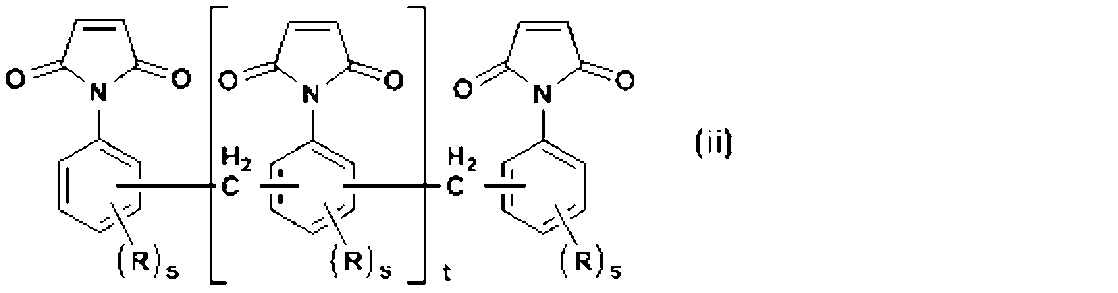
- maleimide compound examples include various compounds represented by any of the following structural formulas (i) to (iii).
- R is an m-valent organic group
- ⁇ and ⁇ are each a hydrogen atom, a halogen atom, an alkyl group, or an aryl group, and s is an integer of 1 or more.
- R is a hydrogen atom, an alkyl group, an aryl group, an aralkyl group, a halogen atom, a hydroxyl group or an alkoxy group, s is an integer of 1 to 3, and t is an average of 0 to 10 repeating units.
- R is a hydrogen atom, an alkyl group, an aryl group, an aralkyl group, a halogen atom, a hydroxyl group or an alkoxy group, s is an integer of 1 to 3, and t is an average of 0 to 10 repeating units.
- the active ester resin is not particularly limited, but generally an ester group having high reaction activity, such as phenol esters, thiophenol esters, N-hydroxyamine esters, and esters of heterocyclic hydroxy compounds, is contained in one molecule. A compound having two or more is preferably used.
- the active ester resin is preferably obtained by a condensation reaction between a carboxylic acid compound and / or a thiocarboxylic acid compound and a hydroxy compound and / or a thiol compound.
- an active ester resin obtained from a carboxylic acid compound or a halide thereof and a hydroxy compound is preferred, and an active ester resin obtained from a carboxylic acid compound or a halide thereof and a phenol compound and / or a naphthol compound is preferred. More preferred.
- the carboxylic acid compound include benzoic acid, acetic acid, succinic acid, maleic acid, itaconic acid, phthalic acid, isophthalic acid, terephthalic acid, pyromellitic acid, and the like, or a halide thereof.
- phenol compounds or naphthol compounds include hydroquinone, resorcin, bisphenol A, bisphenol F, bisphenol S, dihydroxydiphenyl ether, phenolphthalein, methylated bisphenol A, methylated bisphenol F, methylated bisphenol S, phenol, o-cresol, m -Cresol, p-cresol, catechol, ⁇ -naphthol, ⁇ -naphthol, 1,5-dihydroxynaphthalene, 1,6-dihydroxynaphthalene, 2,6-dihydroxynaphthalene, dihydroxybenzophenone, trihydroxybenzophenone, tetrahydroxybenzophenone, phloroglucin Benzenetriol, dicyclopentadiene-phenol addition resin, and the like.
- the active ester resin examples include an active ester resin containing a dicyclopentadiene-phenol addition structure, an active ester resin containing a naphthalene structure, an active ester resin that is an acetylated product of phenol novolac, and an activity that is a benzoylated product of phenol novolac.
- An ester resin or the like is preferable, and an active ester resin having a dicyclopentadiene-phenol addition structure and an active ester resin having a naphthalene structure are more preferable because they are excellent in improving peel strength.
- examples of the active ester resin containing a dicyclopentadiene-phenol addition structure include compounds represented by the following general formula (iv).
- R represents a phenyl group or a naphthyl group
- u represents 0 or 1
- n represents an average of 0.05 to 2.5 repeating units.
- R is preferably a naphthyl group
- u is preferably 0, and n is preferably 0.25 to 1.5.
- novolak resins other than the phenol novolak resin of the present invention, addition polymerization resins of alicyclic diene compounds such as dicyclopentadiene and phenol compounds, modified novolaks of phenolic hydroxyl group-containing compounds and alkoxy group-containing aromatic compounds Resin, phenol aralkyl resin (Zyloc resin), naphthol aralkyl resin, trimethylol methane resin, tetraphenylol ethane resin, biphenyl modified phenol resin, biphenyl modified naphthol resin, aminotriazine modified phenol resin, and various vinyl polymers May be.
- phenol aralkyl resin Zyloc resin
- naphthol aralkyl resin trimethylol methane resin
- tetraphenylol ethane resin biphenyl modified phenol resin
- biphenyl modified naphthol resin aminotriazine modified phenol resin
- various vinyl polymers May be.
- the above-mentioned various novolak resins are an acid catalyst for phenol, phenylphenol, resorcinol, biphenyl, bisphenol such as bisphenol A and bisphenol F, phenolic hydroxyl group-containing compounds such as naphthol and dihydroxynaphthalene, and aldehyde compounds.
- examples thereof include polymers obtained by reacting under conditions.
- the various vinyl polymers include polyhydroxystyrene, polystyrene, polyvinyl naphthalene, polyvinyl anthracene, polyvinyl carbazole, polyindene, polyacenaphthylene, polynorbornene, polycyclodecene, polytetracyclododecene, polynortricyclene, poly ( A homopolymer of a vinyl compound such as (meth) acrylate or a copolymer thereof may be mentioned.
- the blending ratio of the phenol novolac resin of the present invention and the other resin can be arbitrarily set according to the use, but the molding shrinkage ratio at the time of heat curing exhibited by the present invention, heat Since the balance effect of the elastic modulus is more remarkably exhibited, the proportion of the other resin is preferably 0.5 to 100 parts by mass with respect to 100 parts by mass of the phenol novolac resin of the present invention.
- a curing accelerator may be used in combination with the curable resin composition of the present invention.
- Curing accelerators include tertiary amine compounds such as imidazole and dimethylaminopyridine; phosphorus compounds such as triphenylphosphine; boron trifluoride amine complexes such as boron trifluoride and trifluoride monoethylamine complexes; thiodipropion Organic acid compounds such as acids; benzoxazine compounds such as thiodiphenol benzoxazine and sulfonyl benzoxazine; sulfonyl compounds and the like. These may be used alone or in combination of two or more.
- the addition amount of these catalysts is preferably in the range of 0.001 to 15 parts by mass per 100 parts by mass of the curable resin composition.
- a non-halogen flame retardant containing substantially no halogen atom may be blended.
- non-halogen flame retardant examples include a phosphorus flame retardant, a nitrogen flame retardant, a silicone flame retardant, an inorganic flame retardant, an organic metal salt flame retardant, and the like. It is not intended to be used alone, and a plurality of the same type of flame retardants may be used, or different types of flame retardants may be used in combination.
- the phosphorous flame retardant can be either inorganic or organic.
- the inorganic compounds include red phosphorus, monoammonium phosphate, diammonium phosphate, triammonium phosphate, ammonium phosphates such as ammonium polyphosphate, and inorganic nitrogen-containing phosphorus compounds such as phosphate amide. .
- the red phosphorus is preferably subjected to a surface treatment for the purpose of preventing hydrolysis and the like.
- the surface treatment method include (i) magnesium hydroxide, aluminum hydroxide, zinc hydroxide, water A method of coating with an inorganic compound such as titanium oxide, bismuth oxide, bismuth hydroxide, bismuth nitrate or a mixture thereof; (ii) an inorganic compound such as magnesium hydroxide, aluminum hydroxide, zinc hydroxide, titanium hydroxide; and A method of coating with a mixture of a thermosetting resin such as a phenol resin, (iii) thermosetting of a phenol resin or the like on a coating of an inorganic compound such as magnesium hydroxide, aluminum hydroxide, zinc hydroxide, or titanium hydroxide
- a method of double coating with a resin may be used.
- organic phosphorus compounds examples include 9,10-dihydro, as well as general-purpose organic phosphorus compounds such as phosphate ester compounds, phosphonic acid compounds, phosphinic acid compounds, phosphine oxide compounds, phosphorane compounds, and organic nitrogen-containing phosphorus compounds.
- the amount of these phosphorus-based flame retardants is appropriately selected depending on the type of phosphorus-based flame retardant, the other components of the resin composition, and the desired degree of flame retardancy.
- non-halogen flame retardants And 100 parts by mass of resin composition containing all other fillers and additives, etc.
- red phosphorus is used as a non-halogen flame retardant, it is blended in the range of 0.1 to 2.0 parts by mass.
- organic phosphorus compound it is preferably blended in the range of 0.1 parts by mass to 10.0 parts by mass, and blended in the range of 0.5 parts by mass to 6.0 parts by mass. More preferably.
- the phosphorus flame retardant when using the phosphorus flame retardant, may be used in combination with hydrotalcite, magnesium hydroxide, boron compound, zirconium oxide, black dye, calcium carbonate, zeolite, zinc molybdate, activated carbon, etc. Good.
- nitrogen flame retardant examples include triazine compounds, cyanuric acid compounds, isocyanuric acid compounds, phenothiazines, and the like, and triazine compounds, cyanuric acid compounds, and isocyanuric acid compounds are preferable.
- triazine compound examples include melamine, acetoguanamine, benzoguanamine, melon, melam, succinoguanamine, ethylene dimelamine, melamine polyphosphate, triguanamine, and the like, for example, (1) guanylmelamine sulfate, melem sulfate, melam sulfate (2) Cocondensates of phenols such as phenol, cresol, xylenol, butylphenol and nonylphenol with melamines such as melamine, benzoguanamine, acetoguanamine and formguanamine and formaldehyde, (3) (2) A mixture of a co-condensate and a phenol resin such as a phenol formaldehyde condensate, (4) those obtained by further modifying (2) and (3) above with paulownia oil, isomerized linseed oil or the like.
- cyanuric acid compound examples include cyanuric acid and melamine cyanurate.
- the amount of the nitrogen-based flame retardant is appropriately selected depending on the type of the nitrogen-based flame retardant, the other components of the resin composition, and the desired degree of flame retardancy.
- a non-halogen flame retardant in 100 parts by mass of the resin composition in which all other fillers and additives are blended, it is preferably blended in the range of 0.05 to 10 parts by weight, and blended in the range of 0.1 to 5 parts by weight. More preferably.
- a metal hydroxide, a molybdenum compound or the like may be used in combination.
- the silicone flame retardant is not particularly limited as long as it is an organic compound containing a silicon atom, and examples thereof include silicone oil, silicone rubber, and silicone resin.
- the amount of the silicone-based flame retardant is appropriately selected according to the type of the silicone-based flame retardant, the other components of the resin composition, and the desired degree of flame retardancy.
- a non-halogen flame retardant In addition, it is preferably blended in the range of 0.05 to 20 parts by mass in 100 parts by mass of the resin composition in which all other fillers and additives are blended.
- inorganic flame retardant examples include metal hydroxide, metal oxide, metal carbonate compound, metal powder, boron compound, and low melting point glass.
- metal hydroxide examples include aluminum hydroxide, magnesium hydroxide, dolomite, hydrotalcite, calcium hydroxide, barium hydroxide, and zirconium hydroxide.
- metal oxide examples include zinc molybdate, molybdenum trioxide, zinc stannate, tin oxide, aluminum oxide, iron oxide, titanium oxide, manganese oxide, zirconium oxide, zinc oxide, molybdenum oxide, cobalt oxide, bismuth oxide, Examples thereof include chromium oxide, nickel oxide, copper oxide, and tungsten oxide.
- metal carbonate compound examples include zinc carbonate, magnesium carbonate, calcium carbonate, barium carbonate, basic magnesium carbonate, aluminum carbonate, iron carbonate, cobalt carbonate, and titanium carbonate.
- metal powder examples include aluminum, iron, titanium, manganese, zinc, molybdenum, cobalt, bismuth, chromium, nickel, copper, tungsten, and tin.
- Examples of the boron compound include zinc borate, zinc metaborate, barium metaborate, boric acid, and borax.
- low-melting-point glass examples include Shipley (Bokusui Brown), hydrated glass SiO 2 —MgO—H 2 O, PbO—B 2 O 3 system, ZnO—P 2 O 5 —MgO system, and P 2 O 5. Glassy compounds such as —B 2 O 3 —PbO—MgO, P—Sn—O—F, PbO—V 2 O 5 —TeO 2 , Al 2 O 3 —H 2 O, and lead borosilicate Can be mentioned.
- the blending amount of the inorganic flame retardant is appropriately selected according to the type of the inorganic flame retardant, the other components of the resin composition, and the desired degree of flame retardancy.
- a non-halogen flame retardant in 100 parts by mass of the resin composition in which all other fillers and additives are blended, it is preferably blended in the range of 0.05 to 20 parts by weight, and in the range of 0.5 to 15 parts by weight. It is more preferable to mix with.
- organic metal salt flame retardant examples include ferrocene, acetylacetonate metal complex, organic metal carbonyl compound, organic cobalt salt compound, organic sulfonic acid metal salt, metal atom and aromatic compound or heterocyclic compound. And the like.
- the amount of the organic metal salt flame retardant is appropriately selected depending on the type of the organic metal salt flame retardant, the other components of the resin composition, and the desired degree of flame retardancy. It is preferably blended in the range of 0.005 to 10 parts by mass in 100 parts by mass of the resin composition containing all of the halogen-based flame retardant and other fillers and additives.
- the curable resin composition of the present invention can contain an inorganic filler as necessary.
- the inorganic filler include fused silica, crystalline silica, alumina, silicon nitride, and aluminum hydroxide.
- fused silica When particularly increasing the blending amount of the inorganic filler, it is preferable to use fused silica.
- the fused silica can be used in either a crushed shape or a spherical shape. However, in order to increase the blending amount of the fused silica and suppress an increase in the melt viscosity of the molding material, it is preferable to mainly use a spherical shape.
- the filling rate is preferably higher in consideration of flame retardancy, and particularly preferably 20% by mass or more with respect to the total mass of the epoxy resin composition.
- electroconductive fillers such as silver powder and copper powder, can be used.
- the curable resin composition of the present invention may contain various compounding agents such as a silane coupling agent, a release agent, a pigment, and an emulsifier, if necessary.
- the curable resin composition of the present invention is applied to a semiconductor sealing material, a semiconductor device, a prepreg, a printed circuit board, a buildup board, a buildup film, a fiber reinforced composite material, a fiber reinforced resin molded product, a conductive paste, and the like. Can do.
- the curable resin composition and a compounding agent such as an inorganic filler may be used as necessary by an extruder, a kneader. And a method of sufficiently melting and mixing until uniform using a roll or the like.
- fused silica is usually used as the inorganic filler, but when used as a high thermal conductive semiconductor encapsulant for power transistors and power ICs, crystalline silica, alumina, nitridation having higher thermal conductivity than fused silica.
- High filling such as silicon, or fused silica, crystalline silica, alumina, silicon nitride, or the like may be used.
- the filling rate is preferably 30 to 95 parts by weight of an inorganic filler per 100 parts by weight of the curable resin composition.
- flame retardancy, moisture resistance, solder crack resistance improvement, wire it is more preferably 70 parts by mass or more, and further preferably 80 parts by mass or more.
- the semiconductor sealing material is cast or molded using a transfer molding machine, an injection molding machine or the like, and further at 50 to 200 ° C. A method of heating for ⁇ 10 hours is mentioned.
- a curable resin composition blended with an organic solvent and varnished is used as a reinforcing substrate (paper, glass cloth, glass nonwoven fabric, aramid paper, aramid cloth). And a glass mat, a glass roving cloth, etc.), followed by heating at a heating temperature corresponding to the solvent type used, preferably 50 to 170 ° C.
- the mass ratio of the resin composition and the reinforcing substrate used at this time is not particularly limited, but it is usually preferable that the resin content in the prepreg is adjusted to 20 mass% to 60 mass%.
- organic solvent used here examples include methyl ethyl ketone, acetone, dimethylformamide, methyl isobutyl ketone, methoxy propanol, cyclohexanone, methyl cellosolve, ethyl diglycol acetate, propylene glycol monomethyl ether acetate, etc.
- a polar solvent having a boiling point of 160 ° C. or lower such as methyl ethyl ketone, acetone, dimethylformamide, etc.
- the non-volatile content is preferably 40% by mass to 80% by mass.
- the prepreg is laminated by a conventional method, and a copper foil is appropriately laminated at 170 to 300 ° C. under a pressure of 1 to 10 MPa. For example, a method of heating and pressing for 10 minutes to 3 hours can be mentioned.
- step 1 As a method for obtaining a build-up substrate from the curable resin composition of the present invention, a method through Steps 1 to 3 can be mentioned.
- step 1 first, the curable resin composition appropriately blended with rubber, filler, and the like is applied to a circuit board on which a circuit is formed using a spray coating method, a curtain coating method, or the like, and then cured.
- step 2 if necessary, after drilling a predetermined through-hole portion or the like on the circuit board coated with the curable resin composition, by treating with a roughening agent and washing the surface with hot water, Unevenness is formed on the substrate, and a metal such as copper is plated.
- step 3 the operations of steps 1 and 2 are sequentially repeated as desired to build up the resin insulating layer and the conductor layer having a predetermined circuit pattern alternately to form a build-up substrate.
- the through-hole portion is preferably formed after the outermost resin insulating layer is formed.
- the build-up board of the present invention is obtained by subjecting a copper foil with a resin obtained by semi-curing the resin composition on a copper foil to thermocompression bonding at 170 to 300 ° C. on a wiring board on which a circuit is formed. It is also possible to produce a build-up substrate by forming the chemical surface and omitting the plating process.
- Build-up film As a method for obtaining a build-up film from the curable resin composition of the present invention, for example, a curable resin composition is applied on a support film and then dried, and then a resin composition layer is formed on the support film. The method of forming is mentioned.
- the curable resin composition of the present invention is used for a build-up film, the film is softened under the lamination temperature condition (usually 70 ° C. to 140 ° C.) in the vacuum laminating method, and is applied to the circuit board simultaneously with the lamination of the circuit board. It is important to show fluidity (resin flow) in which existing via holes or through holes can be filled with resin, and it is preferable to blend the above-described components so as to exhibit such characteristics.
- the diameter of the through hole of the circuit board is usually 0.1 to 0.5 mm, and the depth is usually 0.1 to 1.2 mm, and it is preferable that the resin can be filled in this range.
- the composition is applied to the surface of the support film (Y) and further heated.
- a method of drying the organic solvent by blowing hot air or the like to form the resin composition layer (X) can be mentioned.
- organic solvent used herein examples include ketones such as acetone, methyl ethyl ketone, and cyclohexanone, acetates such as ethyl acetate, butyl acetate, cellosolve acetate, propylene glycol monomethyl ether acetate, and carbitol acetate, cellosolve, butyl carbitol, and the like.
- ketones such as acetone, methyl ethyl ketone, and cyclohexanone
- acetates such as ethyl acetate, butyl acetate, cellosolve acetate, propylene glycol monomethyl ether acetate, and carbitol acetate, cellosolve, butyl carbitol, and the like.
- Carbitols, aromatic hydrocarbons such as toluene and xylene, dimethylformamide, dimethylacetamide, N-methylpyrrolidone, etc. are preferably
- the thickness of the layer (X) of the resin composition to be formed usually needs to be equal to or greater than the thickness of the conductor layer. Since the thickness of the conductor layer of the circuit board is usually in the range of 5 to 70 ⁇ m, the thickness of the resin composition layer is preferably 10 to 100 ⁇ m.
- the layer (X) of the resin composition in the present invention may be protected by a protective film described later. By protecting with a protective film, it is possible to prevent dust and the like from being attached to the surface of the resin composition layer and scratches.
- the above-mentioned support film and protective film are made of polyolefin such as polyethylene, polypropylene and polyvinyl chloride, polyethylene terephthalate (hereinafter sometimes abbreviated as “PET”), polyester such as polyethylene naphthalate, polycarbonate, polyimide, and further. Examples thereof include metal foil such as pattern paper, copper foil, and aluminum foil.
- the support film and the protective film may be subjected to a release treatment in addition to the mud treatment and the corona treatment.
- the thickness of the support film is not particularly limited, but is usually 10 to 150 ⁇ m, and preferably 25 to 50 ⁇ m.
- the thickness of the protective film is preferably 1 to 40 ⁇ m.
- the support film (Y) described above is peeled off after being laminated on a circuit board or after forming an insulating layer by heat curing. If the support film (Y) is peeled after the resin composition layer constituting the build-up film is heat-cured, adhesion of dust and the like in the curing step can be prevented. In the case of peeling after curing, the support film is usually subjected to a release treatment in advance.
- a multilayer printed circuit board can be manufactured from the buildup film obtained as mentioned above.
- the layer (X) of the resin composition is protected by a protective film, after peeling off these layers, one side or both sides of the circuit board so that the layer (X) of the resin composition is in direct contact with the circuit board
- lamination is performed by a vacuum laminating method.
- the laminating method may be a batch method or a continuous method using a roll. If necessary, the build-up film and the circuit board may be heated (preheated) as necessary before lamination.
- the laminating conditions are preferably a pressure bonding temperature (lamination temperature) of 70 to 140 ° C.
- Fiber Reinforced Composite Material As a method for obtaining a fiber reinforced composite material (a sheet-like intermediate material in which a resin is impregnated with a reinforced fiber) from the resin composition of the present invention, varnish is prepared by uniformly mixing the components constituting the resin composition. And then, impregnating a reinforcing substrate made of reinforcing fibers with this, followed by a polymerization reaction.
- the curing temperature at the time of carrying out such a polymerization reaction is preferably in the temperature range of 50 to 250 ° C., in particular, after curing at 50 to 100 ° C. to obtain a tack-free cured product,
- the treatment is preferably performed at a temperature of 120 to 200 ° C.
- the reinforced fiber may be any of a twisted yarn, an untwisted yarn, or a non-twisted yarn, but the untwisted yarn and the untwisted yarn are preferable because both the formability and mechanical strength of the fiber-reinforced plastic member are compatible.
- the form of a reinforced fiber can use what the fiber direction arranged in one direction, and a textile fabric.
- the woven fabric can be freely selected from plain weaving, satin weaving, and the like according to the site and use. Specifically, since it is excellent in mechanical strength and durability, carbon fiber, glass fiber, aramid fiber, boron fiber, alumina fiber, silicon carbide fiber and the like can be mentioned, and two or more of these can be used in combination.
- carbon fiber is preferable from the viewpoint that the strength of the molded product is particularly good.
- the carbon fiber various types such as polyacrylonitrile-based, pitch-based, and rayon-based can be used. Among these, a polyacrylonitrile-based one that can easily obtain a high-strength carbon fiber is preferable.
- the amount of reinforcing fibers used when a reinforced varnish made of reinforcing fibers is impregnated into a fiber-reinforced composite material is such that the volume content of the reinforcing fibers in the fiber-reinforced composite material is 40% to 85%. It is preferable that the amount be in the range.
- Fiber-reinforced resin molded article As a method of obtaining a fiber-reinforced molded article (molded article obtained by curing a sheet-like member impregnated with resin in a reinforcing fiber) from the resin composition of the present invention, a fiber aggregate is laid on a mold, and the varnish is used. Using multiple layers of hand lay-up, spray-up, and male / female types, the base material made of reinforcing fiber is stacked while being impregnated with varnish, and the pressure is applied to the molded product.
- a vacuum bag method that covers a flexible mold that can be sealed and vacuum-tightly seals what is hermetically sealed, a SMC press method that compresses a varnish containing reinforcing fibers in advance into a sheet, and spreads the fibers.
- a prepreg in which reinforcing fibers are impregnated with the varnish is manufactured by an RTM method in which the varnish is injected into a laminated mold, and this is baked in a large autoclave. The method of hardening is mentioned.
- the fiber reinforced resin molded product obtained above is a molded product having a reinforced fiber and a cured product of the resin composition.
- the amount of the reinforced fiber in the fiber reinforced molded product is 40 mass. % To 70% by mass, and particularly preferably 50% to 70% by mass from the viewpoint of strength.
- Conductive paste examples of a method for obtaining a conductive paste from the resin composition of the present invention include a method of dispersing fine conductive particles in the curable resin composition.
- the conductive paste can be a paste resin composition for circuit connection or an anisotropic conductive adhesive depending on the type of fine conductive particles used.
- Data processing “GPC workstation EcoSEC-WorkStation” manufactured by Tosoh Corporation Measurement conditions: Column temperature 40 ° C Developing solvent Tetrahydrofuran Flow rate 1.0 ml / min Standard: The following monodisperse polystyrene having a known molecular weight was used in accordance with the measurement manual of “GPC workstation EcoSEC-WorkStation”.
- Synthesis example 1 A flask equipped with a thermometer, dropping funnel, condenser, fractionator, and stirrer was charged with 900 parts by mass of pt-butylphenol (6.0 mol) and 18 parts by mass of oxalic acid, and 45 minutes from room temperature to 98 ° C. The mixture was stirred while raising the temperature. Subsequently, 54 parts by mass (0.75 mol) of a 42% by mass formalin aqueous solution was added dropwise over 2 hours. After completion of dropping, the mixture was further stirred at 98 ° C. for 1 hour, and then heated up to 180 ° C. in 3 hours.
- a phenol novolac resin (A-1).
- the 13 C-NMR chart of the obtained phenol novolac resin (A-1) is shown in FIG. 1, and the GPC chart is shown in FIG.
- the hydroxyl equivalent of the phenol novolac resin (A-1) is 156 g / eq
- the melt viscosity (ICI) at 150 ° C. is 0.1 dPa ⁇ s
- the (a) / (b) value is 0.07
- n 0 GPC.
- the area ratio by measurement was 0.8%.
- Synthesis example 2 Except that 900 parts by mass (6.0 mol) of pt-butylphenol was changed to 675 parts by mass (4.3 mol) of pt-butylphenol and 225 parts by mass (1.7 mol) of ot-butylphenol.
- a phenol resin (A-2) was obtained.
- the area ratio by GPC measurement of the body was 0.4%.
- Synthesis example 3 900 parts by mass (6.0 mol) of pt-butylphenol was changed to 675 parts by mass (4.3 mol) of pt-butylphenol and 225 parts by mass (1.1 mol) of 2,4-di-t-butylphenol.
- a phenol resin (A-3) was obtained in the same manner as in Synthesis Example 1 except that the 42 mass% formalin aqueous solution was changed to 343 mass parts (4.7 mol).
- the 13 C-NMR chart of the obtained phenol novolac resin (A-3) is shown in FIG. 3, and the GPC chart is shown in FIG.
- the hydroxyl equivalent of the phenol novolac resin (A-3) is 166 g / eq
- the melt viscosity (ICI) at 150 ° C. is 0.2 dPa ⁇ s
- the (a) / (b) value is 0.08
- n 0 GPC.
- the area ratio by measurement was 0.7%.
- Comparative Synthesis Example 1 A phenol resin (A′-1) was obtained in the same manner as in Synthesis Example 1 except that 369 parts by mass (5.1 mol) of a 42% by mass formalin aqueous solution was used.
- FIG. 5 shows a 13 C-NMR chart of the obtained phenol novolak resin (A′-1), and FIG. 6 shows a GPC chart.
- the hydroxyl group equivalent of the phenol novolac resin (A′-3) is 168 g / eq
- the melt viscosity (ICI) at 150 ° C. is 1.9 dPa ⁇ s
- the (a) / (b) value is 0.37
- n 0.
- the area ratio by GPC measurement was 5.1%.
- Resin A-1 Phenol novolak resin obtained in Synthesis Example 1
- Resin A-2 Phenol novolak resin obtained in Synthesis Example 2
- Resin A-3 Phenol novolak resin obtained in Synthesis Example 3
- Resin A′-1 Phenol novolak resin obtained in Comparative Synthesis Example 1
- Resin A′-2 Phenol novolak resin obtained in Comparative Synthesis Example 2
- Resin A′-3 Phenol obtained in Comparative Synthesis Example 3
- Epoxy resin Cresol novolac type epoxy resin “N-655-EXP-S” equivalent: 201 g / eq (manufactured by DIC Corporation) ⁇
- TPP Triphenylphosphine ⁇ Fused silic
- ⁇ Silane coupling agent ⁇ -glycidoxytriethoxyxysilane “KBM-403” manufactured by Shin-Etsu Chemical Co., Ltd.
- ⁇ Carnauba Wax “PEARL WAX No. 1-P” manufactured by Electrochemical Co., Ltd.
- the curable resin composition obtained above was pulverized with a transfer molding machine at a pressure of 70 kg / cm 2 , a temperature of 175 ° C., and a time of 180 seconds, ⁇ 50 mm ⁇ 3 (t) mm. It was shaped into a disk and further cured at 180 ° C. for 5 hours.
- Shrinkage rate (%) ⁇ (inner diameter dimension of mold) ⁇ (longitudinal dimension of cured product at 25 ° C.) ⁇ / (Inner diameter dimension of mold cavity at 175 ° C.) ⁇ 100 (%)
Landscapes
- Chemical & Material Sciences (AREA)
- Organic Chemistry (AREA)
- Health & Medical Sciences (AREA)
- Chemical Kinetics & Catalysis (AREA)
- Medicinal Chemistry (AREA)
- Polymers & Plastics (AREA)
- Engineering & Computer Science (AREA)
- Materials Engineering (AREA)
- Manufacturing & Machinery (AREA)
- Life Sciences & Earth Sciences (AREA)
- Wood Science & Technology (AREA)
- Microelectronics & Electronic Packaging (AREA)
- Epoxy Resins (AREA)
- Compositions Of Macromolecular Compounds (AREA)
- Phenolic Resins Or Amino Resins (AREA)
- Structures Or Materials For Encapsulating Or Coating Semiconductor Devices Or Solid State Devices (AREA)
- Reinforced Plastic Materials (AREA)
- Oil, Petroleum & Natural Gas (AREA)
Abstract
Description
13C-NMR測定における146~148ppmの積分値(a)と146~153ppmの積分値(b)との比(a)/(b)が0.05~0.30の範囲であって、且つ
GPC測定におけるアルキルフェノール(I)の面積比が0.01~3.0%の範囲であることを特徴とするフェノールノボラック樹脂、およびこれ含む硬化性樹脂組成物とその硬化物を提供するものである。
以下、本発明を詳細に説明する。
本発明のフェノールノボラック樹脂は、芳香環上の置換基として炭素数4~8のアルキル基を有するアルキルフェノール(I)を原料とするフェノールノボラック樹脂であって、13C-NMR測定における146~148ppmの積分値(a)と146~153ppmの積分値(b)との比、(a)/(b)が0.05~0.35の範囲であり、GPC測定におけるアルキルフェノール(I)の面積比が0.01~3.0%の範囲であることを特徴とする。
装置:日本電子株式会社製 AL-400
測定モード:逆ゲート付きデカップリング
溶媒:重水素化クロロホルム
パルス角度:30°パルス
試料濃度 :30wt%
積算回数 :4000回

で表されるものを例示することができる。即ち、芳香環上の置換基は、フェノールの水酸基に対してオルト位、パラ位であることが、硬化反応が良好に進行する観点、原料の工業的入手が容易である観点、加熱硬化時の成形収縮率、弾性率のバランスがより優れる観点から好ましいものである。更に、繰り返し数の平均値としては、0.01~2の範囲であることがより好ましい。
<GPC測定条件>
測定装置 :東ソー株式会社製「HLC-8320 GPC」、
カラム:東ソー株式会社製ガードカラム「HXL-L」
+東ソー株式会社製「TSK-GEL G2000HXL」
+東ソー株式会社製「TSK-GEL G2000HXL」
+東ソー株式会社製「TSK-GEL G3000HXL」
+東ソー株式会社製「TSK-GEL G4000HXL」
検出器: RI(示差屈折計)
データ処理:東ソー株式会社製「GPCワークステーション EcoSEC-WorkStation」
測定条件: カラム温度 40℃
展開溶媒 テトラヒドロフラン
流速 1.0ml/分
標準 : 前記「GPCワークステーション EcoSEC―WorkStation」の測定マニュアルに準拠して、分子量が既知の下記の単分散ポリスチレンを用いた。
(使用ポリスチレン)
東ソー株式会社製「A-500」
東ソー株式会社製「A-1000」
東ソー株式会社製「A-2500」
東ソー株式会社製「A-5000」
東ソー株式会社製「F-1」
東ソー株式会社製「F-2」
東ソー株式会社製「F-4」
東ソー株式会社製「F-10」
東ソー株式会社製「F-20」
東ソー株式会社製「F-40」
東ソー株式会社製「F-80」
東ソー株式会社製「F-128」
試料 : 樹脂固形分換算で1.0質量%のテトラヒドロフラン溶液をマイクロフィルターでろ過したもの(50μl)。
前記のように、本発明のフェノールノボラック樹脂は、前述のように特定の13C-NMRチャートを与える。このようなフェノールノボラック樹脂を得る方法としては、炭素数4~8のアルキル基を芳香環上の置換基として有するアルキルフェノール(I)を用いて、アルデヒド類と酸性触媒下50~180℃の条件にて反応させる方法が挙げられる。
本発明のフェノールノボラック樹脂は、水酸基と反応する官能基を有する、その他の化合物を併用することで、硬化性樹脂組成物とすることができる。硬化性樹脂組成物は、接着剤や塗料、フォトレジスト、プリント配線基板、半導体封止材料等の各種の電気・電子部材用途に好適に用いることが出来る。



本発明の硬化性樹脂組成物は、半導体封止材料、半導体装置、プリプレグ、プリント回路基板、ビルドアップ基板、ビルドアップフィルム、繊維強化複合材料、繊維強化樹脂成形品、導電ペースト等に適用することができる。
本発明の硬化性樹脂組成物から半導体封止材料を得る方法としては、前記硬化性樹脂組成物、及び無機充填剤等の配合剤とを必要に応じて押出機、ニ-ダ、ロ-ル等を用いて均一になるまで充分に溶融混合する方法が挙げられる。その際、無機充填剤としては、通常、溶融シリカが用いられるが、パワートランジスタ、パワーIC用高熱伝導半導体封止材として用いる場合は、溶融シリカよりも熱伝導率の高い結晶シリカ,アルミナ,窒化ケイ素などの高充填化、または溶融シリカ、結晶性シリカ、アルミナ、窒化ケイ素などを用いるとよい。その充填率は硬化性樹脂組成物100質量部当たり、無機充填剤を30質量部~95質量部の範囲で用いることが好ましく、中でも、難燃性や耐湿性や耐半田クラック性の向上、線膨張係数の低下を図るためには、70質量部以上がより好ましく、80質量部以上であることがさらに好ましい。
本発明の硬化性樹脂組成物から半導体装置を得る方法としては、前記半導体封止材料を注型、或いはトランスファー成形機、射出成形機などを用いて成形し、さらに50~200℃で2~10時間の間、加熱する方法が挙げられる。
本発明の硬化性樹脂組成物からプリプレグを得る方法としては、有機溶剤を配合してワニス化した硬化性樹脂組成物を、補強基材(紙、ガラス布、ガラス不織布、アラミド紙、アラミド布、ガラスマット、ガラスロービング布など)に含浸したのち、用いた溶剤種に応じた加熱温度、好ましくは50~170℃で加熱することによって、得る方法が挙げられる。この時用いる樹脂組成物と補強基材の質量割合としては、特に限定されないが、通常、プリプレグ中の樹脂分が20質量%~60質量%となるように調製することが好ましい。
本発明の硬化性樹脂組成物からプリント回路基板を得る方法としては、前記プリプレグを、常法により積層し、適宜銅箔を重ねて、1~10MPaの加圧下に170~300℃で10分~3時間、加熱圧着させる方法が挙げられる。
本発明の硬化性樹脂組成物からビルドアップ基板を得る方法としては、工程1~3を経由する方法が挙げられる。工程1では、まず、ゴム、フィラーなどを適宜配合した前記硬化性樹脂組成物を、回路を形成した回路基板にスプレーコーティング法、カーテンコーティング法等を用いて塗布した後、硬化させる。工程2では、必要に応じて、硬化性樹脂組成物が塗布された回路基板に所定のスルーホール部等の穴あけを行った後、粗化剤により処理し、その表面を湯洗することによって、前記基板に凹凸を形成させ、銅などの金属をめっき処理する。工程3では、工程1~2の操作を所望に応じて順次繰り返し、樹脂絶縁層及び所定の回路パターンの導体層を交互にビルドアップしてビルドアップ基板を成形する。なお、前記工程において、スルーホール部の穴あけは、最外層の樹脂絶縁層の形成後に行うとよい。また、本発明のビルドアップ基板は、銅箔上で当該樹脂組成物を半硬化させた樹脂付き銅箔を、回路を形成した配線基板上に、170~300℃で加熱圧着することで、粗化面を形成、メッキ処理の工程を省き、ビルドアップ基板を作製することも可能である。
本発明の硬化性樹脂組成物からビルドアップフィルムを得る方法としては、例えば、支持フィルム上に硬化性樹脂組成物を塗布したのち、乾燥させて、支持フィルムの上に樹脂組成物層を形成する方法が挙げられる。本発明の硬化性樹脂組成物をビルドアップフィルムに用いる場合、該フィルムは、真空ラミネート法におけるラミネートの温度条件(通常70℃~140℃)で軟化し、回路基板のラミネートと同時に、回路基板に存在するビアホール或いはスルーホール内の樹脂充填が可能な流動性(樹脂流れ)を示すことが肝要であり、このような特性を発現するよう前記各成分を配合することが好ましい。
本発明の樹脂組成物から繊維強化複合材料(樹脂が強化繊維に含浸したシート状の中間材料)を得る方法としては、樹脂組成物を構成する各成分を均一に混合してワニスを調整し、次いでこれを強化繊維からなる強化基材に含浸した後、重合反応させることにより製造する方法が挙げられる。
本発明の樹脂組成物から繊維強化成形品(樹脂が強化繊維に含浸したシート状部材が硬化した成形品)を得る方法としては、型に繊維骨材を敷き、前記ワニスを多重積層してゆくハンドレイアップ法やスプレーアップ法、オス型・メス型のいずれかを使用し、強化繊維からなる基材にワニスを含浸させながら積み重ねて成形、圧力を成形物に作用させることのできるフレキシブルな型をかぶせ、気密シールしたものを真空(減圧)成型する真空バッグ法、あらかじめ強化繊維を含有するワニスをシート状にしたものを金型で圧縮成型するSMCプレス法、繊維を敷き詰めた合わせ型に前記ワニスを注入するRTM法などにより、強化繊維に前記ワニスを含浸させたプリプレグを製造し、これを大型のオートクレーブで焼き固める方法などが挙げられる。なお、前記で得られた繊維強化樹脂成形品は、強化繊維と樹脂組成物の硬化物とを有する成形品であり、具体的には、繊維強化成形品中の強化繊維の量は、40質量%~70質量%の範囲であることが好ましく、強度の点から50質量%~70質量%の範囲であることが特に好ましい。
本発明の樹脂組成物から導電ペーストを得る方法としては、例えば、微細導電性粒子を該硬化性樹脂組成物中に分散させる方法が挙げられる。前記導電ペーストは、用いる微細導電性粒子の種類によって、回路接続用ペースト樹脂組成物や異方性導電接着剤とすることができる。
測定装置 :東ソー株式会社製「HLC-8320 GPC」、
カラム:東ソー株式会社製ガードカラム「HXL-L」
+東ソー株式会社製「TSK-GEL G2000HXL」
+東ソー株式会社製「TSK-GEL G2000HXL」
+東ソー株式会社製「TSK-GEL G3000HXL」
+東ソー株式会社製「TSK-GEL G4000HXL」
検出器: RI(示差屈折計)
データ処理:東ソー株式会社製「GPCワークステーション EcoSEC-WorkStation」
測定条件: カラム温度 40℃
展開溶媒 テトラヒドロフラン
流速 1.0ml/分
標準 : 前記「GPCワークステーション EcoSEC-WorkStation」の測定マニュアルに準拠して、分子量が既知の下記の単分散ポリスチレンを用いた。
(使用ポリスチレン)
東ソー株式会社製「A-500」
東ソー株式会社製「A-1000」
東ソー株式会社製「A-2500」
東ソー株式会社製「A-5000」
東ソー株式会社製「F-1」
東ソー株式会社製「F-2」
東ソー株式会社製「F-4」
東ソー株式会社製「F-10」
東ソー株式会社製「F-20」
東ソー株式会社製「F-40」
東ソー株式会社製「F-80」
東ソー株式会社製「F-128」
試料 : 樹脂固形分換算で1.0質量%のテトラヒドロフラン溶液をマイクロフィルターでろ過したもの(50μl)。
装置:日本電子株式会社製 AL-400、
測定モード:逆ゲート付きデカップリング、
溶媒:重水素化クロロホルム、
パルス角度:30°パルス、
試料濃度 :30wt%、
積算回数 :4000回。
温度計、滴下ロート、冷却管、分留管、撹拌器を取り付けたフラスコに、p-t-ブチルフェノール900質量部(6.0モル)、蓚酸18質量部を仕込み、室温から98℃まで45分で昇温しながら撹拌した。続いて、42質量%ホルマリン水溶液54質量部(0.75モル)を2時間要して滴下した。滴下終了後、さらに98℃で1時間攪拌し、その後180℃まで3時間で昇温した。反応終了後、反応系内に残った水分と未反応物を加熱減圧下に除去しフェノールノボラック樹脂(A-1)を得た。得られたフェノールノボラック樹脂(A-1)の13C-NMRチャートを図1、GPCチャートを図2に示す。フェノールノボラック樹脂(A-1)の水酸基当量は156g/eq、150℃における溶融粘度(ICI)は0.1dPa・s,(a)/(b)値は0.07、n=0体のGPC測定による面積比は0.8%であった。
p-t-ブチルフェノール900質量部(6.0モル)を、p-t-ブチルフェノール675質量部(4.3モル)、o-t-ブチルフェノール225質量部(1.7モル)に変更した以外は合成例1と同様にして、フェノール樹脂(A-2)を得た。得られたフェノールノボラック樹脂(A-2)の水酸基当量は156g/eq、150℃における溶融粘度(ICI)は0.1dPa・s,(a)/(b)値は0.07、n=0体のGPC測定による面積比は0.4%であった。
p-t-ブチルフェノール900質量部(6.0モル)を、p-t-ブチルフェノール675質量部(4.3モル)と2,4-ジ-t-ブチルフェノール225質量部(1.1モル)に、42質量%ホルマリン水溶液を343質量部(4.7モル)に変更した以外は合成例1と同様にして、フェノール樹脂(A-3)を得た。得られたフェノールノボラック樹脂(A-3)の13C-NMRチャートを図3、GPCチャートを図4に示す。フェノールノボラック樹脂(A-3)の水酸基当量は166g/eq、150℃における溶融粘度(ICI)は0.2dPa・s,(a)/(b)値は0.08、n=0体のGPC測定による面積比は0.7%であった。
42質量%ホルマリン水溶液を369質量部(5.1モル)とした以外は合成例1と同様にして、フェノール樹脂(A’-1)を得た。得られたフェノールノボラック樹脂(A’-1)の13C-NMRチャートを図5、GPCチャートを図6に示す。得られたフェノールノボラック樹脂(A’-1)の水酸基当量は157g/eq、(a)/(b)値は0.315、n=0体の面積は0.6%であった。
温度計、滴下ロート、冷却管、分留管、撹拌器を取り付けたフラスコに、フェノールノボラック樹脂(A’-1)100質量部、p-t-ブチルフェノール4質量部を仕込み、150℃で3時間混合しフェノールノボラック樹脂(A’-2)を得た。得られたフェノールノボラック樹脂(A’-2)の13C-NMRチャートを図7、GPCチャートを図8に示す。フェノールノボラック樹脂(A’-2)の水酸基当量は157g/eq、[a]/[b]値は0.298、n=0体の面積は4.4%であった。
p-t-ブチルフェノール900質量部(6.0モル)を、p-t-ブチルフェノール675質量部(4.3モル)、p-t-オクチルフェノール225質量部(1.1モル)に、42質量%ホルマリン水溶液を343質量部(4.7モル)に変更した以外は合成例1と同様にして、フェノール樹脂(A’-3)を得た。得られたフェノールノボラック樹脂(A’-3)の13C-NMRチャートを図9、GPCチャートを図10に示す。フェノールノボラック樹脂(A’-3)の水酸基当量は168g/eq、150℃における溶融粘度(ICI)は1.9dPa・s,(a)/(b)値は0.37、n=0体のGPC測定による面積比は5.1%であった。
・樹脂A-1:合成例1で得られたフェノールノボラック樹脂
・樹脂A-2:合成例2で得られたフェノールノボラック樹脂
・樹脂A-3:合成例3で得られたフェノールノボラック樹脂
・樹脂A’-1:比較合成例1で得られたフェノールノボラック樹脂
・樹脂A’-2:比較合成例2で得られたフェノールノボラック樹脂
・樹脂A’-3:比較合成例3で得られたフェノールノボラック樹脂
・樹脂A’-4:2,2‘-メチレンビス(4-ターシャリーブチルフェノール)(水酸基当量156g/eq、(a)/(b)値0、n=0体面積0%)
・エポキシ樹脂:クレゾールノボラック型エポキシ樹脂「N-655-EXP-S」当量:201g/eq(DIC株式会社製)
・TPP:トリフェニルホスフィン
・溶融シリカ:球状シリカ「FB-560」電気化学株式会社製
・シランカップリング剤:γ-グリシドキシトリエトキシキシシラン「KBM-403」信越化学工業株式会社製
・カルナウバワックス:「PEARL WAX No.1-P」電気化学株式会社製
前記で得られた硬化性樹脂組成物を試験用金型に注入し、175℃、70kg/cm2、120秒の条件でスパイラルフロー値を測定した。その結果を表1~2に示す。
前記で作製した成形物を厚さ0.8mmの硬化物を幅5mm、長さ54mmのサイズに切り出し、これを試験片1とした。この試験片1を粘弾性測定装置(DMA:レオメトリック社製固体粘弾性測定装置「RSAII」、レクタンギュラーテンション法:周波数1Hz、昇温速度3℃/分)を用いて、弾性率変化が最大となる(tanδ変化率が最も大きい)温度をガラス転移温度、40℃での貯蔵弾性率を常温弾性率、260℃での貯蔵弾性率を熱時弾性率として測定した。
トランスファー成形機(コータキ精機製、KTS-15-1.5C)を用いて、金型温度150℃、成形圧力9.8MPa、硬化時間600秒の条件下で、樹脂組成物を注入成形して、縦110mm、横12.7mm、厚さ1.6mmの試験片を作製した。その後試験片を175℃で5時間ポストキュアし、金型キャビティの内径寸法と、室温(25℃)での試験片の外径寸法とを測定し、下記式により収縮率を算出した。
収縮率(%)={(金型の内径寸法)-(25℃での硬化物の縦方向の寸法)}/(175℃での金型キャビティの内径寸法)×100(%)
これらの結果を表1~2に示す。
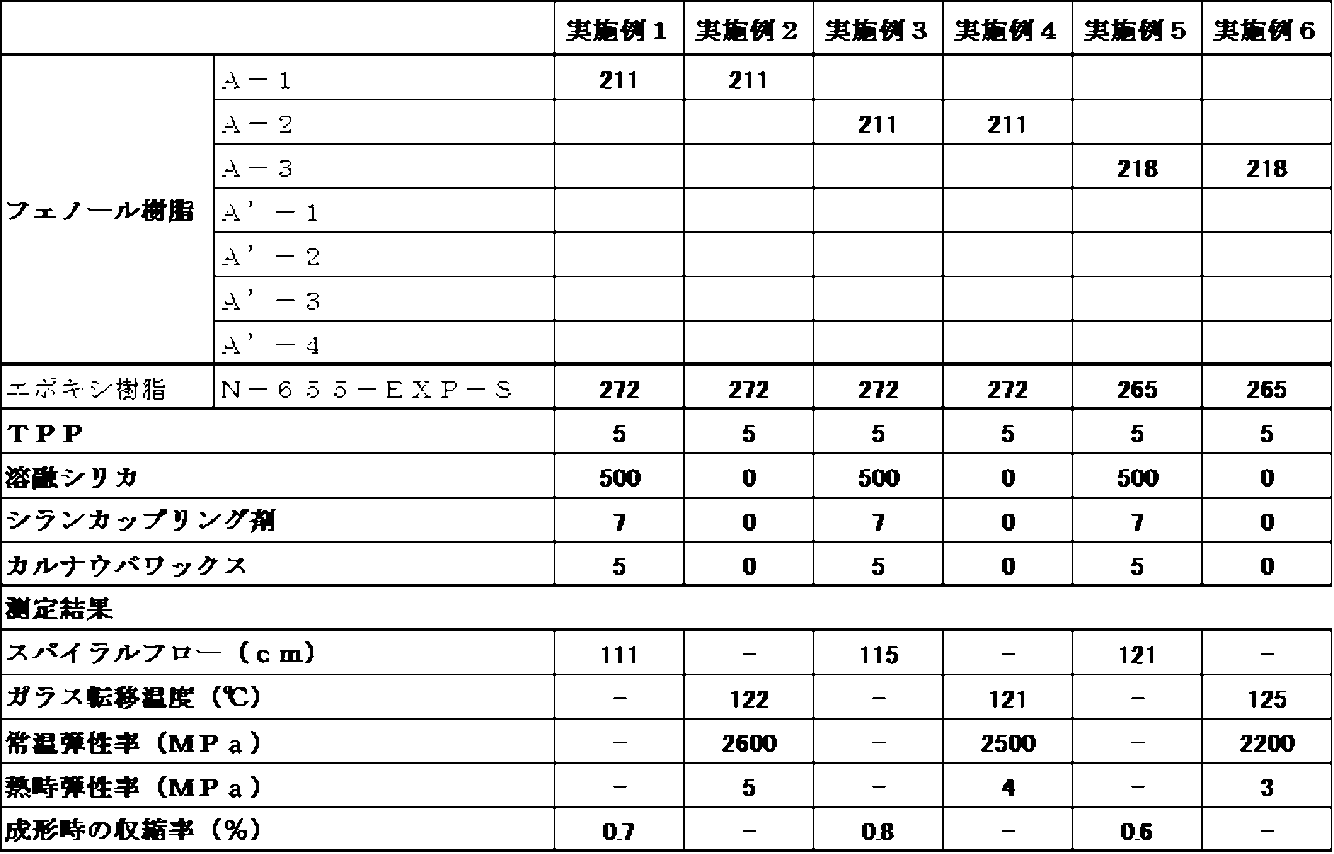

Claims (15)
- 炭素数4~8のアルキル基を芳香環上の置換基として有するアルキルフェノール(I)がメチレン基を介して連結されてなるアルキルフェノールノボラック樹脂であり、
13C-NMR測定における146~148ppmの積分値(a)と146~153ppmの積分値(b)との比(a)/(b)が0.05~0.30の範囲であって、且つ
GPC測定におけるアルキルフェノール(I)の面積比が0.01~3.0%の範囲であることを特徴とするフェノールノボラック樹脂。 - 前記フェノールノボラック樹脂が下記一般式(1)
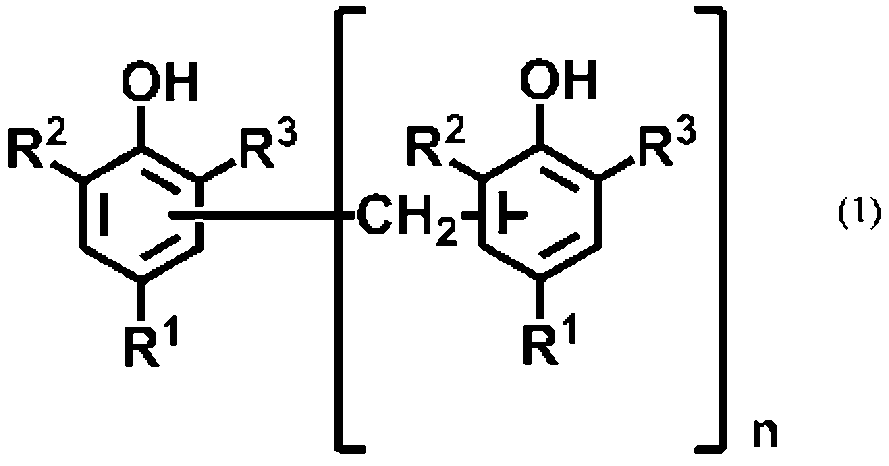
で表されるものであって、GPC測定におけるn=0体の面積比が0.01~3.0%の範囲である請求項1記載のフェノールノボラック樹脂。 - 前記一般式(1)中のR1、R2、R3の何れか1つ又は2つがt-ブチル基であり、残りが水素原子である請求項2記載のフェノールノボラック樹脂。
- 前記フェノールノボラック樹脂の150℃におけるICI粘度が0.01~3.0dPa・sである請求項1~3の何れか1項記載のフェノールノボラック樹脂。
- 請求項1~3の何れか1項記載のフェノールノボラック樹脂と、水酸基と反応する官能基を有する樹脂とを必須成分とする硬化性樹脂組成物。
- 前記水酸基と反応する官能基を有する樹脂がエポキシ樹脂である請求項5記載の硬化性樹脂組成物
- 更に、前記フェノールノボラック樹脂以外のエポキシ樹脂用硬化剤を含有する請求項6記載の硬化性樹脂組成物。
- 請求項5~7の何れか1項記載の硬化性樹脂組成物の硬化物。
- 請求項5~7の何れか1項記載の硬化性樹脂組成物と無機充填材とを含有する半導体封止材料。
- 請求項9に記載の半導体封止材料の硬化物である半導体装置。
- 請求項5~7の何れか1項記載の硬化性樹脂組成物と補強基材とを有する含浸基材の半硬化物であるプリプレグ。
- 請求項5~7の何れか1項記載の硬化性樹脂組成物の板状賦形物と銅箔とからなる回路基板。
- 請求項5~7の何れか1項記載の硬化性樹脂組成物の硬化物と基材フィルムとからなるビルドアップフィルム。
- 請求項5~7の何れか1項記載の硬化性樹脂組成物と強化繊維とを含有する繊維強化複合材料。
- 請求項14記載の繊維強化複合材料の硬化物である繊維強化成形品。
Priority Applications (4)
| Application Number | Priority Date | Filing Date | Title |
|---|---|---|---|
| KR1020187036681A KR102283386B1 (ko) | 2016-06-29 | 2017-06-15 | 페놀노볼락 수지, 경화성 수지 조성물 및 그 경화물 |
| JP2018514473A JP6443585B2 (ja) | 2016-06-29 | 2017-06-15 | フェノールノボラック樹脂、硬化性樹脂組成物及びその硬化物 |
| US16/312,588 US10808085B2 (en) | 2016-06-29 | 2017-06-15 | Phenol novolak resin, curable resin composition, and cured product thereof |
| CN201780041205.6A CN109415476B (zh) | 2016-06-29 | 2017-06-15 | 苯酚酚醛清漆树脂、固化性树脂组合物及其固化物 |
Applications Claiming Priority (2)
| Application Number | Priority Date | Filing Date | Title |
|---|---|---|---|
| JP2016128864 | 2016-06-29 | ||
| JP2016-128864 | 2016-06-29 |
Publications (1)
| Publication Number | Publication Date |
|---|---|
| WO2018003513A1 true WO2018003513A1 (ja) | 2018-01-04 |
Family
ID=60786355
Family Applications (1)
| Application Number | Title | Priority Date | Filing Date |
|---|---|---|---|
| PCT/JP2017/022074 Ceased WO2018003513A1 (ja) | 2016-06-29 | 2017-06-15 | フェノールノボラック樹脂、硬化性樹脂組成物及びその硬化物 |
Country Status (6)
| Country | Link |
|---|---|
| US (1) | US10808085B2 (ja) |
| JP (1) | JP6443585B2 (ja) |
| KR (1) | KR102283386B1 (ja) |
| CN (1) | CN109415476B (ja) |
| TW (1) | TWI731986B (ja) |
| WO (1) | WO2018003513A1 (ja) |
Cited By (9)
| Publication number | Priority date | Publication date | Assignee | Title |
|---|---|---|---|---|
| JP2018100362A (ja) * | 2016-12-21 | 2018-06-28 | Dic株式会社 | エポキシ樹脂、エポキシ樹脂組成物及びその硬化物 |
| JP2018145409A (ja) * | 2017-03-03 | 2018-09-20 | 味の素株式会社 | 樹脂組成物 |
| JP2020063338A (ja) * | 2018-10-15 | 2020-04-23 | パナソニックIpマネジメント株式会社 | 封止用樹脂組成物及び半導体パッケージ |
| WO2021039558A1 (ja) * | 2019-08-27 | 2021-03-04 | Dic株式会社 | フェノール樹脂、硬化性樹脂組成物及びその硬化物 |
| WO2022102489A1 (ja) * | 2020-11-16 | 2022-05-19 | Dic株式会社 | 樹脂組成物、硬化物、半導体封止材、及び、半導体装置 |
| JP2022151177A (ja) * | 2021-03-26 | 2022-10-07 | 住友ベークライト株式会社 | 封止用樹脂組成物および半導体素子の製造方法 |
| WO2023152840A1 (ja) * | 2022-02-09 | 2023-08-17 | 株式会社レゾナック | 配線形成用部材、配線形成用部材を用いた配線層の形成方法、及び、配線形成部材 |
| WO2023153443A1 (ja) * | 2022-02-09 | 2023-08-17 | 株式会社レゾナック | 配線形成用部材、配線形成用部材を用いた配線層の形成方法、及び、配線形成部材 |
| WO2024150769A1 (ja) * | 2023-01-10 | 2024-07-18 | 株式会社レゾナック | 配線形成用部材、配線層の形成方法、及び、配線形成部材 |
Families Citing this family (8)
| Publication number | Priority date | Publication date | Assignee | Title |
|---|---|---|---|---|
| TWI671355B (zh) * | 2018-01-03 | 2019-09-11 | Taiwan Union Technology Corporation | 樹脂組合物,以及使用該組合物所製得之預浸漬片、金屬箔積層板、與印刷電路板 |
| WO2020213559A1 (ja) * | 2019-04-16 | 2020-10-22 | フタムラ化学株式会社 | 活性炭吸着剤の製造方法 |
| KR20220022894A (ko) * | 2019-06-26 | 2022-02-28 | 미츠비시 가스 가가쿠 가부시키가이샤 | 레진 시트, 금속박 피복 적층판, 및 프린트 배선판 |
| JP7837874B2 (ja) * | 2020-03-19 | 2026-03-31 | キングスパン・ホールディングス・(アイアールエル)・リミテッド | フェノールフォーム及びその製造方法 |
| CN115702260B (zh) * | 2020-06-17 | 2025-04-15 | 日本制铁株式会社 | 电磁钢板用涂布组合物、电磁钢板、层叠铁芯以及旋转电机 |
| US12371599B2 (en) | 2020-06-17 | 2025-07-29 | Nippon Steel Corporation | Coating composition for electrical steel sheet, adhesive surface-coated electrical steel sheet and laminated core |
| CN115768922B (zh) * | 2020-06-17 | 2026-04-07 | 日本制铁株式会社 | 电磁钢板用涂布组合物、电磁钢板、层叠铁芯及旋转电机 |
| JP2023180969A (ja) * | 2022-06-10 | 2023-12-21 | 株式会社レゾナック | 封止用樹脂組成物、電子部品装置及び電子部品装置の製造方法 |
Citations (10)
| Publication number | Priority date | Publication date | Assignee | Title |
|---|---|---|---|---|
| JPS62212410A (ja) * | 1986-03-14 | 1987-09-18 | Asahi Chiba Kk | ノボラック樹脂の製造法 |
| JPH0641262A (ja) * | 1985-01-11 | 1994-02-15 | Dow Chem Co:The | ノボラック樹脂及びその調製方法 |
| JPH0649159A (ja) * | 1992-07-29 | 1994-02-22 | Sumitomo Durez Co Ltd | 摩擦材用ノボラック型フェノール樹脂組成物 |
| JPH08193110A (ja) * | 1995-01-13 | 1996-07-30 | Nippon Kayaku Co Ltd | ノボラック型樹脂、エポキシ樹脂、エポキシ樹脂組成物及びその硬化物 |
| JP2002302525A (ja) * | 2001-04-03 | 2002-10-18 | Sumitomo Bakelite Co Ltd | ノボラック型フェノール樹脂の製造方法 |
| JP2004238618A (ja) * | 2003-01-16 | 2004-08-26 | Sumitomo Bakelite Co Ltd | ノボラック型アルキルフェノール樹脂の製造方法 |
| JP2009096894A (ja) * | 2007-10-17 | 2009-05-07 | Showa Highpolymer Co Ltd | 低分子量ノボラック樹脂、その製造方法およびそれを使用した熱硬化性樹脂組成物 |
| JP2010235643A (ja) * | 2009-03-30 | 2010-10-21 | Dic Corp | 硬化性樹脂組成物、その硬化物、プリント配線基板、エステル化合物、エステル系樹脂、及びその製造方法 |
| JP2011074220A (ja) * | 2009-09-30 | 2011-04-14 | Dic Corp | エポキシ樹脂組成物、プリプレグ及び硬化物 |
| WO2012141174A1 (ja) * | 2011-04-11 | 2012-10-18 | 群栄化学工業株式会社 | エポキシ樹脂用硬化剤組成物及び熱硬化性成形材料 |
Family Cites Families (9)
| Publication number | Priority date | Publication date | Assignee | Title |
|---|---|---|---|---|
| US3928288A (en) * | 1973-04-11 | 1975-12-23 | Dow Chemical Co | Epoxy novolac resins having a narrow molecular weight distribution and process therefor |
| US5151496A (en) * | 1985-01-11 | 1992-09-29 | The Dow Chemical Company | Substituted phenol-formaldehyde novolac resins containing reduced quantities of 2-functional components and epoxy novolac resins prepared therefrom |
| JPH0710967A (ja) | 1993-06-29 | 1995-01-13 | Dainippon Ink & Chem Inc | エポキシ樹脂用硬化剤及びエポキシ樹脂組成物 |
| KR101310697B1 (ko) * | 2009-03-18 | 2013-09-25 | 디아이씨 가부시끼가이샤 | 인 원자 함유 페놀류의 제조 방법, 신규 인 원자 함유 페놀류, 경화성 수지 조성물, 그 경화물, 프린트 배선 기판, 및 반도체 봉지 재료 |
| US8173745B2 (en) * | 2009-12-16 | 2012-05-08 | Momentive Specialty Chemicals Inc. | Compositions useful for preparing composites and composites produced therewith |
| WO2011096273A1 (ja) * | 2010-02-03 | 2011-08-11 | Dic株式会社 | フェノール樹脂組成物、その製造方法、硬化性樹脂組成物、その硬化物、及びプリント配線基板 |
| JP5066231B2 (ja) * | 2010-07-28 | 2012-11-07 | 日東電工株式会社 | フリップチップ型半導体裏面用フィルム、短冊状半導体裏面用フィルムの製造方法、及び、フリップチップ型半導体装置 |
| CN103992622B (zh) * | 2014-06-10 | 2017-03-01 | 广东生益科技股份有限公司 | 一种无卤树脂组合物以及使用它的预浸料和印制电路用层压板 |
| JP6558671B2 (ja) | 2014-11-07 | 2019-08-14 | パナソニックIpマネジメント株式会社 | 封止用エポキシ樹脂組成物及び半導体装置 |
-
2017
- 2017-06-07 TW TW106118790A patent/TWI731986B/zh active
- 2017-06-15 WO PCT/JP2017/022074 patent/WO2018003513A1/ja not_active Ceased
- 2017-06-15 US US16/312,588 patent/US10808085B2/en active Active
- 2017-06-15 KR KR1020187036681A patent/KR102283386B1/ko active Active
- 2017-06-15 CN CN201780041205.6A patent/CN109415476B/zh active Active
- 2017-06-15 JP JP2018514473A patent/JP6443585B2/ja active Active
Patent Citations (10)
| Publication number | Priority date | Publication date | Assignee | Title |
|---|---|---|---|---|
| JPH0641262A (ja) * | 1985-01-11 | 1994-02-15 | Dow Chem Co:The | ノボラック樹脂及びその調製方法 |
| JPS62212410A (ja) * | 1986-03-14 | 1987-09-18 | Asahi Chiba Kk | ノボラック樹脂の製造法 |
| JPH0649159A (ja) * | 1992-07-29 | 1994-02-22 | Sumitomo Durez Co Ltd | 摩擦材用ノボラック型フェノール樹脂組成物 |
| JPH08193110A (ja) * | 1995-01-13 | 1996-07-30 | Nippon Kayaku Co Ltd | ノボラック型樹脂、エポキシ樹脂、エポキシ樹脂組成物及びその硬化物 |
| JP2002302525A (ja) * | 2001-04-03 | 2002-10-18 | Sumitomo Bakelite Co Ltd | ノボラック型フェノール樹脂の製造方法 |
| JP2004238618A (ja) * | 2003-01-16 | 2004-08-26 | Sumitomo Bakelite Co Ltd | ノボラック型アルキルフェノール樹脂の製造方法 |
| JP2009096894A (ja) * | 2007-10-17 | 2009-05-07 | Showa Highpolymer Co Ltd | 低分子量ノボラック樹脂、その製造方法およびそれを使用した熱硬化性樹脂組成物 |
| JP2010235643A (ja) * | 2009-03-30 | 2010-10-21 | Dic Corp | 硬化性樹脂組成物、その硬化物、プリント配線基板、エステル化合物、エステル系樹脂、及びその製造方法 |
| JP2011074220A (ja) * | 2009-09-30 | 2011-04-14 | Dic Corp | エポキシ樹脂組成物、プリプレグ及び硬化物 |
| WO2012141174A1 (ja) * | 2011-04-11 | 2012-10-18 | 群栄化学工業株式会社 | エポキシ樹脂用硬化剤組成物及び熱硬化性成形材料 |
Cited By (18)
| Publication number | Priority date | Publication date | Assignee | Title |
|---|---|---|---|---|
| JP2018100362A (ja) * | 2016-12-21 | 2018-06-28 | Dic株式会社 | エポキシ樹脂、エポキシ樹脂組成物及びその硬化物 |
| JP7067111B2 (ja) | 2017-03-03 | 2022-05-16 | 味の素株式会社 | 樹脂組成物 |
| JP2018145409A (ja) * | 2017-03-03 | 2018-09-20 | 味の素株式会社 | 樹脂組成物 |
| JP2020063338A (ja) * | 2018-10-15 | 2020-04-23 | パナソニックIpマネジメント株式会社 | 封止用樹脂組成物及び半導体パッケージ |
| WO2020080115A1 (ja) * | 2018-10-15 | 2020-04-23 | パナソニックIpマネジメント株式会社 | 封止用樹脂組成物及び半導体パッケージ |
| JP7241311B2 (ja) | 2018-10-15 | 2023-03-17 | パナソニックIpマネジメント株式会社 | 封止用樹脂組成物及び半導体パッケージ |
| WO2021039558A1 (ja) * | 2019-08-27 | 2021-03-04 | Dic株式会社 | フェノール樹脂、硬化性樹脂組成物及びその硬化物 |
| JP7036235B2 (ja) | 2019-08-27 | 2022-03-15 | Dic株式会社 | フェノール樹脂、硬化性樹脂組成物及びその硬化物 |
| KR20220013562A (ko) * | 2019-08-27 | 2022-02-04 | 디아이씨 가부시끼가이샤 | 페놀 수지, 경화성 수지 조성물 및 그 경화물 |
| JPWO2021039558A1 (ja) * | 2019-08-27 | 2021-09-27 | Dic株式会社 | フェノール樹脂、硬化性樹脂組成物及びその硬化物 |
| KR102686162B1 (ko) | 2019-08-27 | 2024-07-19 | 디아이씨 가부시끼가이샤 | 페놀 수지, 경화성 수지 조성물 및 그 경화물 |
| WO2022102489A1 (ja) * | 2020-11-16 | 2022-05-19 | Dic株式会社 | 樹脂組成物、硬化物、半導体封止材、及び、半導体装置 |
| JPWO2022102489A1 (ja) * | 2020-11-16 | 2022-05-19 | ||
| JP7205673B2 (ja) | 2020-11-16 | 2023-01-17 | Dic株式会社 | 樹脂組成物、硬化物、半導体封止材、及び、半導体装置 |
| JP2022151177A (ja) * | 2021-03-26 | 2022-10-07 | 住友ベークライト株式会社 | 封止用樹脂組成物および半導体素子の製造方法 |
| WO2023152840A1 (ja) * | 2022-02-09 | 2023-08-17 | 株式会社レゾナック | 配線形成用部材、配線形成用部材を用いた配線層の形成方法、及び、配線形成部材 |
| WO2023153443A1 (ja) * | 2022-02-09 | 2023-08-17 | 株式会社レゾナック | 配線形成用部材、配線形成用部材を用いた配線層の形成方法、及び、配線形成部材 |
| WO2024150769A1 (ja) * | 2023-01-10 | 2024-07-18 | 株式会社レゾナック | 配線形成用部材、配線層の形成方法、及び、配線形成部材 |
Also Published As
| Publication number | Publication date |
|---|---|
| TWI731986B (zh) | 2021-07-01 |
| CN109415476A (zh) | 2019-03-01 |
| JPWO2018003513A1 (ja) | 2018-07-05 |
| KR20190025558A (ko) | 2019-03-11 |
| JP6443585B2 (ja) | 2018-12-26 |
| US20190225758A1 (en) | 2019-07-25 |
| TW201815872A (zh) | 2018-05-01 |
| US10808085B2 (en) | 2020-10-20 |
| CN109415476B (zh) | 2021-05-14 |
| KR102283386B1 (ko) | 2021-07-30 |
Similar Documents
| Publication | Publication Date | Title |
|---|---|---|
| JP6443585B2 (ja) | フェノールノボラック樹脂、硬化性樹脂組成物及びその硬化物 | |
| JP4930656B2 (ja) | フェノール樹脂組成物、その製造方法、硬化性樹脂組成物、その硬化物、及びプリント配線基板 | |
| JP5892404B1 (ja) | 硬化性樹脂組成物、その硬化物、半導体封止材料、半導体装置、プリプレグ、回路基板、ビルドアップフィルム、ビルドアップ基板、繊維強化複合材料、及び繊維強化樹脂成形品 | |
| JP5904387B1 (ja) | エポキシ樹脂、硬化性樹脂組成物、硬化物、半導体封止材料、半導体装置、プレプリグ、回路基板、ビルドアップフィルム、ビルドアップ基板、繊維強化複合材料、及び繊維強化成形品 | |
| JP6809200B2 (ja) | エポキシ樹脂、硬化性樹脂組成物及びその硬化物 | |
| JP6350776B1 (ja) | エポキシ樹脂組成物 | |
| JP6828413B2 (ja) | フェノール樹脂、硬化性樹脂組成物及びその硬化物 | |
| JP6874359B2 (ja) | エポキシ樹脂、エポキシ樹脂組成物及びその硬化物 | |
| WO2018225411A1 (ja) | エポキシ樹脂、製造方法、エポキシ樹脂組成物及びその硬化物 | |
| JP2018100368A (ja) | エポキシ樹脂、硬化性樹脂組成物及びその硬化物 | |
| JP2017105898A (ja) | エポキシ樹脂、エポキシ樹脂の製造方法、硬化性樹脂組成物及びその硬化物 | |
| JP6024121B2 (ja) | シアン酸エステル樹脂、硬化性樹脂組成物、その硬化物、半導体封止材料、プリプレグ、回路基板、及び、ビルドアップフィルム | |
| JP7347118B2 (ja) | 多官能フェノール樹脂、多官能エポキシ樹脂、それらを含む硬化性樹脂組成物及びその硬化物 | |
| JP5966903B2 (ja) | シアン酸エステル樹脂、硬化性樹脂組成物、その硬化物、プリプレグ、回路基板、半導体封止材料、及びビルドアップフィルム | |
| WO2017199831A1 (ja) | エポキシ樹脂、製造方法、エポキシ樹脂組成物及びその硬化物 | |
| KR102686162B1 (ko) | 페놀 수지, 경화성 수지 조성물 및 그 경화물 | |
| JP5516979B2 (ja) | 新規リン原子含有フェノール樹脂、その製造方法、硬化性樹脂組成物、その硬化物、プリント配線基板用樹脂組成物、プリント配線基板、フレキシブル配線基板用樹脂組成物、半導体封止材料用樹脂組成物、及びビルドアップ基板用層間絶縁材料用樹脂組成物 | |
| JP6750427B2 (ja) | 多官能エポキシ樹脂、その製造方法、硬化性樹脂組成物及びその硬化物 | |
| JP2019011396A (ja) | エポキシ樹脂の製造方法、エポキシ樹脂、エポキシ樹脂組成物及びその硬化物 |
Legal Events
| Date | Code | Title | Description |
|---|---|---|---|
| ENP | Entry into the national phase |
Ref document number: 2018514473 Country of ref document: JP Kind code of ref document: A |
|
| 121 | Ep: the epo has been informed by wipo that ep was designated in this application |
Ref document number: 17819873 Country of ref document: EP Kind code of ref document: A1 |
|
| ENP | Entry into the national phase |
Ref document number: 20187036681 Country of ref document: KR Kind code of ref document: A |
|
| NENP | Non-entry into the national phase |
Ref country code: DE |
|
| 122 | Ep: pct application non-entry in european phase |
Ref document number: 17819873 Country of ref document: EP Kind code of ref document: A1 |