WO2017204270A1 - 光学用ポリビニルアルコール系フィルム、およびその製造方法、ならびにその光学用ポリビニルアルコール系フィルムを用いた偏光膜 - Google Patents
光学用ポリビニルアルコール系フィルム、およびその製造方法、ならびにその光学用ポリビニルアルコール系フィルムを用いた偏光膜 Download PDFInfo
- Publication number
- WO2017204270A1 WO2017204270A1 PCT/JP2017/019449 JP2017019449W WO2017204270A1 WO 2017204270 A1 WO2017204270 A1 WO 2017204270A1 JP 2017019449 W JP2017019449 W JP 2017019449W WO 2017204270 A1 WO2017204270 A1 WO 2017204270A1
- Authority
- WO
- WIPO (PCT)
- Prior art keywords
- polyvinyl alcohol
- film
- optical
- alcohol film
- bubbles
- Prior art date
- Legal status (The legal status is an assumption and is not a legal conclusion. Google has not performed a legal analysis and makes no representation as to the accuracy of the status listed.)
- Ceased
Links
Classifications
-
- C—CHEMISTRY; METALLURGY
- C08—ORGANIC MACROMOLECULAR COMPOUNDS; THEIR PREPARATION OR CHEMICAL WORKING-UP; COMPOSITIONS BASED THEREON
- C08J—WORKING-UP; GENERAL PROCESSES OF COMPOUNDING; AFTER-TREATMENT NOT COVERED BY SUBCLASSES C08B, C08C, C08F, C08G or C08H
- C08J5/00—Manufacture of articles or shaped materials containing macromolecular substances
- C08J5/18—Manufacture of films or sheets
-
- G—PHYSICS
- G02—OPTICS
- G02B—OPTICAL ELEMENTS, SYSTEMS OR APPARATUS
- G02B5/00—Optical elements other than lenses
- G02B5/30—Polarising elements
-
- B—PERFORMING OPERATIONS; TRANSPORTING
- B01—PHYSICAL OR CHEMICAL PROCESSES OR APPARATUS IN GENERAL
- B01D—SEPARATION
- B01D19/00—Degasification of liquids
- B01D19/02—Foam dispersion or prevention
-
- B—PERFORMING OPERATIONS; TRANSPORTING
- B29—WORKING OF PLASTICS; WORKING OF SUBSTANCES IN A PLASTIC STATE IN GENERAL
- B29C—SHAPING OR JOINING OF PLASTICS; SHAPING OF MATERIAL IN A PLASTIC STATE, NOT OTHERWISE PROVIDED FOR; AFTER-TREATMENT OF THE SHAPED PRODUCTS, e.g. REPAIRING
- B29C39/00—Shaping by casting, i.e. introducing the moulding material into a mould or between confining surfaces without significant moulding pressure; Apparatus therefor
- B29C39/003—Shaping by casting, i.e. introducing the moulding material into a mould or between confining surfaces without significant moulding pressure; Apparatus therefor characterised by the choice of material
-
- B—PERFORMING OPERATIONS; TRANSPORTING
- B29—WORKING OF PLASTICS; WORKING OF SUBSTANCES IN A PLASTIC STATE IN GENERAL
- B29C—SHAPING OR JOINING OF PLASTICS; SHAPING OF MATERIAL IN A PLASTIC STATE, NOT OTHERWISE PROVIDED FOR; AFTER-TREATMENT OF THE SHAPED PRODUCTS, e.g. REPAIRING
- B29C39/00—Shaping by casting, i.e. introducing the moulding material into a mould or between confining surfaces without significant moulding pressure; Apparatus therefor
- B29C39/02—Shaping by casting, i.e. introducing the moulding material into a mould or between confining surfaces without significant moulding pressure; Apparatus therefor for making articles of definite length, i.e. discrete articles
-
- B—PERFORMING OPERATIONS; TRANSPORTING
- B29—WORKING OF PLASTICS; WORKING OF SUBSTANCES IN A PLASTIC STATE IN GENERAL
- B29C—SHAPING OR JOINING OF PLASTICS; SHAPING OF MATERIAL IN A PLASTIC STATE, NOT OTHERWISE PROVIDED FOR; AFTER-TREATMENT OF THE SHAPED PRODUCTS, e.g. REPAIRING
- B29C41/00—Shaping by coating a mould, core or other substrate, i.e. by depositing material and stripping-off the shaped article; Apparatus therefor
- B29C41/24—Shaping by coating a mould, core or other substrate, i.e. by depositing material and stripping-off the shaped article; Apparatus therefor for making articles of indefinite length
- B29C41/26—Shaping by coating a mould, core or other substrate, i.e. by depositing material and stripping-off the shaped article; Apparatus therefor for making articles of indefinite length by depositing flowable material on a rotating drum
-
- B—PERFORMING OPERATIONS; TRANSPORTING
- B29—WORKING OF PLASTICS; WORKING OF SUBSTANCES IN A PLASTIC STATE IN GENERAL
- B29C—SHAPING OR JOINING OF PLASTICS; SHAPING OF MATERIAL IN A PLASTIC STATE, NOT OTHERWISE PROVIDED FOR; AFTER-TREATMENT OF THE SHAPED PRODUCTS, e.g. REPAIRING
- B29C41/00—Shaping by coating a mould, core or other substrate, i.e. by depositing material and stripping-off the shaped article; Apparatus therefor
- B29C41/34—Component parts, details or accessories; Auxiliary operations
- B29C41/36—Feeding the material on to the mould, core or other substrate
-
- G—PHYSICS
- G02—OPTICS
- G02B—OPTICAL ELEMENTS, SYSTEMS OR APPARATUS
- G02B1/00—Optical elements characterised by the material of which they are made; Optical coatings for optical elements
- G02B1/04—Optical elements characterised by the material of which they are made; Optical coatings for optical elements made of organic materials, e.g. plastics
-
- B—PERFORMING OPERATIONS; TRANSPORTING
- B29—WORKING OF PLASTICS; WORKING OF SUBSTANCES IN A PLASTIC STATE IN GENERAL
- B29K—INDEXING SCHEME ASSOCIATED WITH SUBCLASSES B29B, B29C OR B29D, RELATING TO MOULDING MATERIALS OR TO MATERIALS FOR MOULDS, REINFORCEMENTS, FILLERS OR PREFORMED PARTS, e.g. INSERTS
- B29K2029/00—Use of polyvinylalcohols, polyvinylethers, polyvinylaldehydes, polyvinylketones or polyvinylketals or derivatives thereof as moulding material
- B29K2029/04—PVOH, i.e. polyvinyl alcohol
-
- B—PERFORMING OPERATIONS; TRANSPORTING
- B29—WORKING OF PLASTICS; WORKING OF SUBSTANCES IN A PLASTIC STATE IN GENERAL
- B29L—INDEXING SCHEME ASSOCIATED WITH SUBCLASS B29C, RELATING TO PARTICULAR ARTICLES
- B29L2007/00—Flat articles, e.g. films or sheets
- B29L2007/008—Wide strips, e.g. films, webs
-
- C—CHEMISTRY; METALLURGY
- C08—ORGANIC MACROMOLECULAR COMPOUNDS; THEIR PREPARATION OR CHEMICAL WORKING-UP; COMPOSITIONS BASED THEREON
- C08J—WORKING-UP; GENERAL PROCESSES OF COMPOUNDING; AFTER-TREATMENT NOT COVERED BY SUBCLASSES C08B, C08C, C08F, C08G or C08H
- C08J2329/00—Characterised by the use of homopolymers or copolymers of compounds having one or more unsaturated aliphatic radicals, each having only one carbon-to-carbon double bond, and at least one being terminated by an alcohol, ether, aldehydo, ketonic, acetal, or ketal radical; Hydrolysed polymers of esters of unsaturated alcohols with saturated carboxylic acids; Derivatives of such polymer
- C08J2329/02—Homopolymers or copolymers of unsaturated alcohols
- C08J2329/04—Polyvinyl alcohol; Partially hydrolysed homopolymers or copolymers of esters of unsaturated alcohols with saturated carboxylic acids
Definitions
- the present invention is an optical polyvinyl alcohol film, in particular, an optical polyvinyl alcohol film with few bubble defects and excellent transparency, and an optical for producing a high-quality polarizing film or polarizing plate without display defects.
- the present invention relates to a polyvinyl alcohol film for use, a production method thereof, and a polarizing film using the optical polyvinyl alcohol film.
- a polyvinyl alcohol film is prepared by dissolving a polyvinyl alcohol resin and an additive such as a surfactant in water to prepare an aqueous solution (film forming stock solution), and then manufacturing the aqueous solution by a solution casting method (casting method). It is produced by filming and drying the resulting film.
- the polyvinyl alcohol film thus obtained is used in many applications as a film excellent in transparency and dyeability, and one of its useful applications is a polarizing film.
- a polarizing film is used as a basic component of a liquid crystal display, and in recent years, its use has been expanded to a device requiring high quality and high reliability.
- a polarizing film is made by swelling a polyvinyl alcohol film, which is an original fabric, with water (including warm water), dyeing with iodine, stretching for orienting iodine, and a boa for fixing the orientation state. It is manufactured through a process such as acid crosslinking. In order to produce a polarizing film having no display defects, it is necessary that the polyvinyl alcohol film as a raw material has no defects.
- the display defects of the polarizing film are Increasing and ultimately reducing the quality of the display.
- the bubbles in the polyvinyl alcohol film may cause color unevenness and film breakage during the production of the polarizing film.
- a method for producing a polyvinyl alcohol film in which a polyvinyl alcohol resin aqueous solution is defoamed with a multi-screw extruder see, for example, Patent Document 1
- a discharge temperature of the polyvinyl alcohol resin aqueous solution and a cast mold surface
- a method for producing a polyvinyl alcohol film having a temperature difference ⁇ T in a specific range for example, see Patent Document 2
- a method for replacing a filter used when filtering an aqueous solution of a polyvinyl alcohol resin for example, see Patent Document 3
- a method for producing a polarizing film using a polyvinyl alcohol-based film in which foreign matter having a size of 20 ⁇ m or more existing on the surface of the film is 10 or less per 1 m 2 see, for example, Patent Document 4
- a polyvinyl alcohol-based material having no undissolved material A method for producing a resin aqueous solution (for example,
- the resin temperature at the vent is set to 105 to 180 ° C.
- further improvement is desired for the production of a thin polyvinyl alcohol film having a thickness of 60 ⁇ m or less.
- the temperature difference ⁇ T between the discharge temperature of the polyvinyl alcohol resin aqueous solution and the surface of the cast mold is set to 5 to 10 ° C. (Example).
- further improvement is desired for the production of a thin polyvinyl alcohol film having a thickness of 60 ⁇ m or less.
- Patent Document 3 it is difficult to remove bubbles passing through the filter. Further, bubbles generated in the process after filtration cannot be avoided, and further improvement is required.
- Patent Document 4 a polyvinyl alcohol film in which foreign matter is reduced by filtration is used.
- Patent Document 5 can reduce undissolved material by pressure dissolution, it is difficult to remove fine bubbles unless appropriate defoaming is performed, and there is room for further improvement.
- Patent Document 6 relates to minute bubbles on the order of wavelengths and does not necessarily improve the bubble defects of polyvinyl alcohol films. Further, there is a problem that light scattering occurs due to minute bubbles and the haze of the film increases.
- an optical polyvinyl alcohol film having few bubble defects and excellent transparency, and it is possible to produce a high-quality polarizing film or polarizing plate with few display defects.
- An optical polyvinyl alcohol film, a method for producing the same, and a polarizing film using the optical polyvinyl alcohol film are provided.
- a bubble size which is a problem in the present invention, it includes not only those that can be visually confirmed, but also includes submicron-sized bubbles that cause light scattering.
- a spherical shape it includes an elliptical shape.
- All of the bubbles in the optical polyvinyl alcohol film for optical use are not necessarily the display defects of the polarizing film as they are, and for example, there are those that disappear in the swelling process and the subsequent polarizing film manufacturing process.
- the display defect of the polarizing film also increases. Therefore, it is necessary to reduce the number of bubbles per unit area in the optical polyvinyl alcohol film. .
- the present inventors have solved the above-mentioned problems by reducing the number of bubbles contained in the polyvinyl alcohol film for optics over a wide range up to a minute size. It was found that a high-quality polarizing film can be produced.
- the first gist of the present invention is a polyvinyl alcohol film having a width of 2 m or more and a length of 4 km or more, and an area surrounded by width A (m) ⁇ length B (km) (where A ⁇ 2 m). And B ⁇ 4 km), the number of bubbles having a diameter of 50 ⁇ m or more is 0.01 / m 2 or less.
- a second gist of the present invention is a method for producing an optical polyvinyl alcohol film according to the first gist, wherein a polyvinyl alcohol resin and a surfactant are dissolved in water to obtain a polyvinyl alcohol resin aqueous solution.
- An optical polyvinyl alcohol-based film manufacturing method comprising a film-forming step of casting and forming a film, and a drying step of drying the formed film.
- the 3rd summary of this invention is a polarizing film characterized by using the said polyvinyl alcohol film for optics.
- the number of bubbles having a diameter of 50 ⁇ m or more contained per unit area is 0.01 / m 2 or less, so that there are few bubble defects, low haze, and few display defects.
- a high-quality polarizing film can be obtained. Therefore, the polarizing film obtained using the above-mentioned optical polyvinyl alcohol film is excellent in polarizing performance.
- the haze of the optical polyvinyl alcohol film is 0.2% or less, it is possible to suppress a decrease in light transmittance of a polarizing film obtained using the film.
- the width is 4 m or more, it becomes possible to cope with an increase in the area of the polarizing film.
- a polyvinyl alcohol resin and a surfactant are dissolved in water to prepare a polyvinyl alcohol resin aqueous solution.
- a pretreatment is performed by filtration, and the pretreated polyvinyl alcohol resin aqueous solution is discharged and cast from a T-type slit die into a cast mold to form a film.
- the polyvinyl alcohol-type film for optics is manufactured by drying this formed film. For this reason, the said optical polyvinyl alcohol-type film with few bubble defects and low haze can be manufactured efficiently.
- the temperature difference ⁇ T (° C.) between the temperature T1 (° C.) of the polyvinyl alcohol resin aqueous solution discharged from the T-type slit die and the temperature T2 (° C.) of the cast mold surface is 4 in absolute value.
- the temperature is lower than or equal to ° C., a product having even fewer bubbles can be obtained.
- the thickness of the optical polyvinyl alcohol film is 45 ⁇ m or less, it is possible to cope with the thinning of the polarizing film obtained using the film.
- the optical polyvinyl alcohol-based film of the present invention has a width of 2 m or more and a length of 4 km or more, and is an area surrounded by width A (m) ⁇ length B (km) (A ⁇ 2 m and B ⁇ 4 km) ),
- the number of bubbles having a diameter of 50 ⁇ m or more is 0.01 / m 2 or less.
- the number of bubbles per 1 m 2 when inspecting (measuring) an area (A ⁇ 2 m and B ⁇ 4 km) surrounded by width A (m) ⁇ length B (km) in the polyvinyl alcohol film The number of bubbles having a diameter of 50 ⁇ m or more, preferably the number of bubbles having a diameter of 50 ⁇ m or more per 1 m 2 when measured over the entire length of the entire length of the polyvinyl alcohol film. For example, when inspecting a film of width 4 m ⁇ length 4 km (area 16,000 m 2 ), if 16 bubbles having a diameter of 50 ⁇ m or more are detected, the number of the bubbles is 0.001 / m 2 . Further, when the shape of the bubble was elliptical, (major axis + minor axis) / 2 was taken as the diameter.
- the number of bubbles having a diameter of 50 ⁇ m or more needs to be 0.01 / m 2 or less, preferably 0.001 / m 2 or less, particularly preferably 0.0001 / m 2 or less, more preferably 0.00001 pieces / m 2 or less.
- the number of bubbles exceeds 0.01 / m 2 , display defects of the polarizing film increase, and the object of the present invention cannot be achieved.
- the inspection (measurement) of the number of bubbles is performed as follows. First, a foreign matter (bright defect) having a diameter of 50 ⁇ m or more over a predetermined area is detected by an automatic foreign matter inspection apparatus while unwinding a polyvinyl alcohol film to be measured from a roll. Next, bubbles having a diameter of 50 ⁇ m or more are extracted from the enlarged photograph of the detected foreign matter, and the total number of bubbles is calculated. By dividing the total number by a predetermined area, the number of bubbles (number / m 2 ) is obtained. When the shape of the bubble is an ellipse, (major axis + minor axis) / 2 is the diameter.
- the “bright defect” is a defect that is detected as a bright luminescent spot with respect to the textured part (normal part of the film) when the defective part is detected by the automatic foreign matter inspection apparatus with the camera.
- the setting conditions of the automatic foreign matter inspection apparatus are as follows. Illumination: Transmission type, angle 90 ° (perpendicular to film), distance 300mm, light source halogen lamp 150W Detection: 20 CCD cameras, position 483 mm, 5000 pixels / unit, resolution 48 ⁇ m / pixel, 50 mm lens (F2.8)
- the long polyvinyl alcohol film for optics having a width of 2 m or more and a length of 4 km or more is swelled, dyed, boric acid crosslinked, stretched and washed while being conveyed in the length direction (flow direction: MD direction).
- the film is formed on the polarizing film through steps such as drying.
- the optical polyvinyl alcohol film is excellent in transparency and can produce a high-quality polarizing film or polarizing plate with few display defects.
- Methods for reducing the number of bubbles include the type and amount of surfactant added to the aqueous solution of the polyvinyl alcohol resin, the preparation method, the storage method of the polyvinyl alcohol resin aqueous solution, the defoaming conditions, the filtration conditions, and the film formation. And a method for optimizing the conditions. Among these, as will be described later, a method of optimizing the defoaming conditions for the aqueous solution and the film forming conditions for the film is particularly effective in the process for producing the optical polyvinyl alcohol film.
- the method for producing an optical polyvinyl alcohol film of the present invention comprises a step ( ⁇ ) of preparing a polyvinyl alcohol resin aqueous solution by dissolving a polyvinyl alcohol resin and an additive in water, and the polyvinyl alcohol resin aqueous solution.
- the said liquid preparation process ((alpha)) is demonstrated in detail.
- an unmodified polyvinyl alcohol resin that is, a resin produced by saponifying polyvinyl acetate obtained by polymerizing vinyl acetate is usually used.
- a resin obtained by saponifying a copolymer of vinyl acetate and a small amount (usually 10 mol% or less, preferably 5 mol% or less) of a copolymerizable component with vinyl acetate may be used. it can.
- components copolymerizable with vinyl acetate include unsaturated carboxylic acids (including salts, esters, amides, nitriles, etc.), and olefins having 2 to 30 carbon atoms (eg, ethylene, propylene, n-butene). , Isobutene, etc.), vinyl ethers, unsaturated sulfonates and the like.
- the modified polyvinyl alcohol-type resin obtained by chemically modifying the hydroxyl group after saponification can also be used.
- a polyvinyl alcohol resin having a 1,2-diol structure in the side chain can be used as the polyvinyl alcohol resin.
- a polyvinyl alcohol resin having a 1,2-diol structure in the side chain includes, for example, (i) a method for saponifying a copolymer of vinyl acetate and 3,4-diacetoxy-1-butene, and (ii) acetic acid.
- a method of saponifying and decarboxylating a copolymer of vinyl and vinyl ethylene carbonate (iii) saponifying and decarboxylating a copolymer of vinyl acetate and 2,2-dialkyl-4-vinyl-1,3-dioxolane It is obtained by a method of ketalization, (iv) a method of saponifying a copolymer of vinyl acetate and glyceryl monoallyl ether, or the like.
- the weight average molecular weight of the polyvinyl alcohol resin used in the present invention is preferably 100,000 to 300,000, particularly preferably 110,000 to 280,000, and more preferably 120,000 to 260,000. If the weight average molecular weight is too small, the degree of polarization of the polarizing film tends to decrease, and if it is too large, stretching during the production of the polarizing film tends to be difficult.
- the weight average molecular weight of the polyvinyl alcohol resin is a weight average molecular weight measured by GPC-MALS method.
- the average saponification degree of the polyvinyl alcohol resin used in the present invention is usually preferably 98 mol% or more, particularly preferably 99 mol% or more, more preferably 99.5 mol% or more, and particularly preferably 99 mol%. .8 mol% or more. If the average degree of saponification is too small, the degree of polarization of the polarizing film tends to decrease.
- the average saponification degree in the present invention is measured according to JIS K 6726.
- polyvinyl alcohol resin used in the present invention two or more kinds having different modified species, modified amount, weight average molecular weight, average saponification degree, etc. may be used in combination.
- the aqueous solution used as the film-forming stock solution is prepared using the said polyvinyl alcohol-type resin. That is, the polyvinyl alcohol-based resin is preferably washed with water and dehydrated using a centrifugal separator or the like to obtain a polyvinyl alcohol-based resin wet cake having a water content of 50% by weight or less. When the water content is too large, it tends to be difficult to obtain a desired aqueous solution concentration.
- the obtained polyvinyl alcohol-based resin wet cake is charged into a dissolution tank together with additives such as water, glycerin and other plasticizers and surfactants, and heated and stirred to dissolve to obtain a polyvinyl alcohol-based resin aqueous solution.
- additives such as water, glycerin and other plasticizers and surfactants
- the aqueous polyvinyl alcohol resin solution in addition to the polyvinyl alcohol resin, commonly used plastics such as glycerin, diglycerin, triglycerin, ethylene glycol, triethylene glycol, polyethylene glycol, and trimethylolpropane are used. It is preferable from the viewpoint of the film forming property of the optical polyvinyl alcohol film to contain an agent and at least one surfactant of nonionic, anionic and cationic properties.
- the content of the plasticizer in the aqueous polyvinyl alcohol resin solution is preferably 1 to 20% by weight of the entire aqueous solution.
- the surfactant in order to reduce the bubbles of the optical polyvinyl alcohol film, for the surfactant to be blended in the liquid preparation step ( ⁇ ), (I) type of surfactant, (Ii) surfactant content, (Iii) Surfactant formulation procedure, (Iv) a method for dissolving the surfactant, (V) a method for storing an aqueous polyvinyl alcohol resin solution in which a surfactant is dissolved, It is useful to optimize these five. Among these optimizations related to surfactants, several proposals have been made regarding (i) types of surfactants, (ii) compounding amounts, and (iv) dissolution methods. There are currently no effective proposals regarding (iii) blending procedures and (v) storage methods for polyvinyl alcohol resin aqueous solutions, and in particular, (iii) blending procedures have been optimized. It was hard to say.
- surfactants are formulated to promote uniform dissolution of polyvinyl alcohol-based resins in water, but the present inventors have generated some of these surfactants by decomposition by heating. It was found that the bubbles of the film increase when the low-boiling organic decomposition product foamed. Moreover, even if it melt
- a nonionic surfactant and an anionic surfactant are used when preparing an aqueous polyvinyl alcohol resin solution.
- nonionic surfactant examples include polyoxyethylene hexyl ether, polyoxyethylene heptyl ether, polyoxyethylene octyl ether, polyoxyethylene nonyl ether, polyoxyethylene decyl ether, polyoxyethylene dodecyl ether, and polyoxyethylene.
- Higher fatty acid alkanolamides such as propanolamide, butanolamide, caproic acid amide, caprylic acid amide, capric acid amide, lauric acid amide, palmitic acid amide, stearic acid amide, oleic acid amide and other higher fatty acid amides, hydroxyethyl laurylamine, Polyoxyethylene hexylamine, polyoxyethylene heptylamine, polyoxyethylene octylamine, polyoxyethylene nonylamine, polyoxyethylene Polyoxyethylene alkylamines such as oxyethylene decylamine,
- anionic surfactant examples include sulfate ester salt type, sodium hexyl sulfate, sodium heptyl sulfate, sodium octyl sulfate, sodium nonyl sulfate, sodium decyl sulfate, sodium dodecyl sulfate, sodium tetradecyl sulfate, sodium hexadecyl sulfate, Sodium octadecyl sulfate, sodium eicosyl sulfate, or alkyl sulfates such as potassium, calcium and ammonium salts thereof, sodium polyoxyethylene hexyl ether sulfate, sodium polyoxyethylene heptyl ether sulfate, sodium polyoxyethylene octyl ether sulfate, Sodium polyoxyethylene nonyl ether sulfate, sodium polyoxyethylene decyl ether sulfate, polyoxy
- fatty acid soaps N-acyl amino acids and salts thereof, polyoxyethylene alkyl ester carboxylates, carboxylate types such as acylated peptides, alkyl benzene sulfonates, alkyl naphthalene sulfonates , Naphthalene sulfonic acid salt formalin polycondensate, melamine sulfonic acid salt formalin condensate, dialkyl sulfosuccinic acid ester salt, sulfosuccinic acid alkyl disalt, polyoxyethylene alkyl sulfosuccinic acid disalt, alkyl sulfoacetate, ⁇ -olefin sulfone Sulfonates such as acid salts, N-acylmethyl taurate salts, dimethyl-5-sulfoisophthalate sodium salts, polyoxyethylene alkyl ether phosphates, polyoxyethylene
- nonionic surfactant in the present invention, it is preferable to use a nonionic surfactant and an anionic surfactant in combination.
- the nonionic surfactant in both cases where the nonionic surfactant is used alone and when the anionic surfactant is used alone, it becomes difficult to dissolve the polyvinyl alcohol resin in water, and bubbles of the optical polyvinyl alcohol film are used. Tends to increase and haze tends to increase.
- the amount of the surfactant (ii) is preferably 0.15 parts by weight or less, particularly preferably 0.1 parts by weight or less, and still more preferably 0.005 parts by weight or less with respect to 100 parts by weight of the polyvinyl alcohol resin. 07 parts by weight or less. Moreover, a preferable minimum is 0.01 weight part. If the amount of such a surfactant is too large, the surfactant tends to be difficult to dissolve sufficiently in the dissolution process, and even if dissolved, it is likely to precipitate during film formation, so the bubbles in the polyvinyl alcohol film increase. And haze tends to increase.
- the blending order when using plural kinds of surfactants is blended in the dissolution tank in the order of anionic surfactant and nonionic surfactant.
- the nonionic surfactant is preferably compounded in the order of the nonionic surfactant, the anionic surfactant and the nonionic surfactant in two steps.
- the dissolution step is performed by blowing water vapor in a dissolution tank equipped with a vertical circulation flow generation type stirring blade in view of excellent solubility. Specifically, steam is blown into the dissolution tank, and stirring is started when the temperature in the tank reaches 40 to 80 ° C., and further, water vapor is blown and dissolution is performed at a temperature in the tank of 90 to 100 ° C. Is preferred.
- steam is further blown to pressurize the inside of the tank to 0.1 to 1 MPa and pressurize and dissolve at a temperature in the tank of 130 to 150 ° C. It is.
- Such pressure dissolution is preferably performed at 130 to 150 ° C. for 1 to 10 hours. If the pressure dissolution temperature is too low, sufficient dissolution of the polyvinyl alcohol resin and the surfactant cannot be obtained, and the haze of the optical polyvinyl alcohol film tends to increase. A decomposition product of a resin or a surfactant is generated, and bubbles of the optical polyvinyl alcohol film tend to increase.
- the pressure dissolution time is too short, sufficient dissolution of the polyvinyl alcohol resin or the surfactant cannot be obtained, and the haze of the optical polyvinyl alcohol film tends to increase. Decomposition products of alcohol-based resins and surfactants are generated, and bubbles in the optical polyvinyl alcohol-based film tend to increase.
- the concentration of the aqueous polyvinyl alcohol resin solution may be adjusted to obtain a desired concentration by exhausting steam or adding water.
- the resin concentration of the aqueous polyvinyl alcohol resin solution is preferably 15 to 60% by weight, particularly preferably 18 to 55% by weight, and further preferably 20 to 50% by weight. If the resin concentration is too low, the drying load of the film increases, and if it is too high, the viscosity tends to be too high and uniform dissolution tends to be difficult.
- the polyvinyl alcohol resin aqueous solution after the surfactant is dissolved is subjected to the film forming step ( ⁇ ). Before being stored, it is temporarily stored in a storage tank, but it is preferable to perform such storage in a heated state.
- the storage temperature is preferably 100 to 150 ° C., particularly preferably 110 to 145 ° C., and further preferably 120 to 140 ° C. If the storage temperature is too low, the polyvinyl alcohol resin or surfactant tends to precipitate and the haze of the optical polyvinyl alcohol film tends to increase. If it is too high, the polyvinyl alcohol resin or surfactant is decomposed. There is a tendency that bubbles are generated in the optical polyvinyl alcohol film.
- the storage time is preferably within 30 hours, particularly preferably within 25 hours, and more preferably from 1 to 20 hours.
- the pretreatment step ( ⁇ ) is a step of subjecting the obtained aqueous polyvinyl alcohol resin solution to defoaming treatment and filtration treatment.
- the greatest feature of the production method of the present invention lies in the pretreatment step ( ⁇ ). Specifically, it is characterized by two methods of (vi) defoaming method and (vii) filtration method of an aqueous polyvinyl alcohol resin solution. There is. In these circumstances, no effective proposal has been made, and it is difficult to say that (vi) the defoaming method has been optimized.
- defoaming is preferably performed using a twin screw extruder having a vent from the viewpoint of productivity, and particularly preferably 2 from the viewpoint of defoaming efficiency. This is carried out by a foaming process at 100 to 130 ° C. and a steam discharge process at 90 to 100 ° C. using a screw extruder.
- the vent for discharging bubbles is naturally provided during the steam discharging process.
- the temperature of the foaming step is preferably 100 to 130 ° C, particularly preferably 100 to 120 ° C, and more preferably 100 to 115 ° C. If the temperature of the foaming process is too low, gas discharge from the vent tends to be difficult, and conversely, if it is too high, bubbles in the optical polyvinyl alcohol film tend to increase.
- the temperature in the steam discharge process is preferably 90 to 100 ° C., particularly preferably 92 to 98 ° C. If the temperature of the discharge process is too low or too high, bubbles tend to increase.
- a normal disk filter can be used for filtration, but in the present invention, two or more stages of filtration are used by using a plurality of disk filters having different openings in terms of filtration efficiency. Processing is preferably performed. Particularly preferred is a three-stage filtration process of coarse / medium / finish using three types of disc filters having different openings in terms of further filtration efficiency.
- the coarse disk filter preferably has an opening of 10 to 100 ⁇ m
- the medium disk filter preferably has an opening of 1 to 50 ⁇ m
- the finished disk filter has an opening of 0. Those of 1 to 10 ⁇ m are preferable.
- the pretreated polyvinyl alcohol-based resin aqueous solution is promptly provided for film formation.
- the film forming step ( ⁇ ) is a step of forming a film by discharging and casting the pretreated aqueous solution into a cast mold. In order to reduce bubbles in the optical polyvinyl alcohol film, the film forming step is performed. In the step ( ⁇ ), (viii) it is useful to cast a polyvinyl alcohol resin aqueous solution into a cast mold under a specific temperature condition to form a film.
- the filtered polyvinyl alcohol-based resin aqueous solution is introduced into a T-shaped slit die by a certain amount, and cast types such as cast drums (drum-type rolls) and endless belts, preferably from the viewpoints of making wide, long, and thin. It is discharged onto the cast drum.
- cast types such as cast drums (drum-type rolls) and endless belts, preferably from the viewpoints of making wide, long, and thin. It is discharged onto the cast drum.
- cast drums drum-type rolls
- endless belts preferably from the viewpoints of making wide, long, and thin.
- the surface roughness Ra of the cast drum used in the present invention is preferably 5 to 20 nm, particularly preferably 6 to 17 nm, and further preferably 7 to 15 nm. If the surface roughness Ra is too small, the adhesion between the surface of the cast drum and the film tends to be reduced, and there is a tendency for the polyvinyl alcohol film to dent. If it is too large, the aqueous solution foams on the rough portion of the cast drum surface. This tends to increase the bubbles in the polyvinyl alcohol film.
- the surface roughness Ra of the cast drum is measured as follows.
- the diameter of the cast drum is preferably 2 to 5 m, particularly preferably 3 to 4 m. If the diameter of the cast drum is too small, the drying length is insufficient and the productivity tends to decrease, and if it is too large, the equipment load tends to increase.
- the width of the cast drum is preferably 2 to 7 m, particularly preferably 3 to 6 m. If the width of the cast drum is too narrow, the productivity tends to decrease, and if it exceeds 7 m, the equipment load tends to increase.
- the rotation speed of the cast drum is preferably 5 to 30 m / min, particularly preferably 6 to 20 m / min. If the rotational speed is too slow, the productivity tends to decrease, and if it is too fast, drying tends to be insufficient.
- the temperature T1 (° C.) of the aqueous polyvinyl alcohol resin solution discharged from the T-type slit die is preferably 70 to 100 ° C., particularly preferably 80 to 90 ° C. If the temperature is too low, there is a tendency to cause poor flow, and if it is too high, foaming tends to occur.
- the temperature T2 (° C.) of the cast drum surface is preferably 50 to 99 ° C., particularly preferably 60 to 98 ° C., and further preferably 70 to 97 ° C. If the surface temperature is too low, drying tends to be poor, and if it is too high, the aqueous solution tends to foam and bubbles in the film tend to increase.
- the temperature difference ⁇ T (
- ) (° C.) between the temperature T1 (° C.) of the polyvinyl alcohol resin aqueous solution discharged from the T-type slit die and the temperature T2 (° C.) of the cast drum surface.
- the temperature difference ⁇ T (° C.) which is an absolute value, is too large, bubbles in the film tend to increase. Such bubbles are assumed to be generated not only from water vapor but also from dissolved gas in the aqueous solution.
- the dissolved gas in addition to oxygen and nitrogen, an organic gas which is a decomposition product of the surfactant is also included.
- the temperature unevenness on the cast drum surface is preferably 5 ° C. or less, particularly preferably 3 ° C. or less, and more preferably 2 ° C. or less from the viewpoint of film thickness accuracy.
- drying step ( ⁇ ) is a step in which the film formed is heated and dried.
- the drying method by heating is preferably performed by alternately bringing the front and back surfaces of the film formed into contact with a plurality of metal heating rolls (hereinafter referred to as “heat rolls”).
- the surface temperature of the hot roll is usually 40 to 150 ° C., preferably 50 to 140 ° C. If the surface temperature is too low, drying tends to be poor. If the surface temperature is too high, drying tends to be excessive, and appearance defects such as undulation tend to be caused.
- heat treatment process Furthermore, after the drying step ( ⁇ ) using the hot roll or the like, heat treatment may be performed as necessary.
- the heat treatment method include a method of blowing warm air on both surfaces of the film with a floating dryer (hereinafter sometimes referred to as “floating method”), a method of irradiating near infrared rays with an infrared lamp, and the like.
- the floating method is preferable because the dried state of both surfaces of the optical polyvinyl alcohol film can be made uniform.
- the gap between nips per 1 m of film width is preferable.
- a floating method with a tension of 1 to 10 N is particularly preferable.
- the heat treatment temperature is usually 70 to 150 ° C. If the heat treatment temperature is too low, the water resistance of the optical polyvinyl alcohol film tends to be insufficient, and if it is too high, the stretchability during the production of the polarizing film tends to decrease.
- Polyvinyl alcohol film for optics After the drying step ( ⁇ ), a long optical polyvinyl alcohol film of the present invention is obtained through a heat treatment step as necessary.
- This polyvinyl alcohol film for optics is produced into a film winding body by slitting both ends in the width direction of the film and winding the film around a core tube in a roll shape.
- optical polyvinyl alcohol film of the present invention is obtained.
- the thickness of the optical polyvinyl alcohol film of the present invention is preferably 60 ⁇ m or less, particularly preferably 15 to 45 ⁇ m from the viewpoint of avoiding breakage. If the thickness is too thick, it is difficult to reduce the thickness of the polarizing film.
- the optical polyvinyl alcohol-based film of the present invention needs to have a width of 2 m or more, preferably a width of 3 m or more, more preferably a width of 4 m or more, particularly preferably a width of 4 in terms of increasing the area of the polarizing film. ⁇ 7m.
- the optical polyvinyl alcohol-based film of the present invention is required to have a length of 4 km or more from the viewpoint of improving the productivity of the polarizing film, and preferably from the viewpoint of increasing the area of the polarizing film and thus the liquid crystal screen.
- the length is 5 km or more, and more preferably 5 to 30 km from the viewpoint of transportability.
- the optical polyvinyl alcohol film of the present invention preferably has a haze of 0.2% or less, particularly preferably 0.15% or less, and more preferably 0.1% or less. If the haze exceeds the upper limit, the light transmittance of the polarizing film tends to decrease.
- the optical polyvinyl alcohol film of the present invention has few defects and is preferably used as a raw film for a polarizing film.
- the polarizing film of the present invention is manufactured through steps such as swelling, dyeing, boric acid crosslinking, stretching, washing, drying, etc., by feeding the optical polyvinyl alcohol film from the film winding body and transferring it in the horizontal direction.
- the swelling process is performed before the dyeing process.
- water is usually used as the treatment liquid.
- the treatment liquid may contain a small amount of an additive such as an iodide compound, a surfactant, alcohol, and the like.
- the temperature of the swelling bath is usually about 10 to 45 ° C., and the immersion time in the swelling bath is usually about 0.1 to 10 minutes.
- the dyeing step is performed by bringing a liquid containing iodine or a dichroic dye into contact with the optical polyvinyl alcohol film.
- a liquid containing iodine or a dichroic dye into contact with the optical polyvinyl alcohol film.
- an iodine-potassium iodide aqueous solution is used.
- the iodine concentration is suitably 0.1-2 g / L
- the potassium iodide concentration is 1-100 g / L.
- the dyeing time is practically about 30 to 500 seconds.
- the temperature of the treatment bath is preferably 5 to 50 ° C.
- the aqueous solution may contain a small amount of an organic solvent compatible with water in addition to the aqueous solvent.
- the boric acid crosslinking step is performed using a boron compound such as boric acid or borax.
- the boron compound is used in the form of an aqueous solution or a water-organic solvent mixture at a concentration of about 10 to 100 g / L, and it is preferable that potassium iodide coexists in the solution from the viewpoint of stabilizing the polarization performance.
- the temperature during the treatment is preferably about 30 to 70 ° C., and the treatment time is preferably about 0.1 to 20 minutes. If necessary, the stretching operation may be performed during the treatment.
- stretching in a uniaxial direction is preferably 3 to 10 times, preferably 3.5 to 6 times.
- a slight stretching may be performed in a direction perpendicular to the stretching direction.
- the temperature during stretching is preferably 30 to 170 ° C.
- the stretching ratio may be finally set within the above range, and the stretching operation may be performed not only once but plural times in the polarizing film manufacturing process.
- the washing step is performed, for example, by immersing the optical polyvinyl alcohol film in an aqueous iodide solution such as water or potassium iodide, and removing precipitates generated on the surface of the optical polyvinyl alcohol film. it can.
- an aqueous potassium iodide solution such as water or potassium iodide
- the potassium iodide concentration is about 1 to 80 g / L.
- the temperature during the washing treatment is usually 5 to 50 ° C., preferably 10 to 45 ° C.
- the treatment time is usually 1 to 300 seconds, preferably 10 to 240 seconds.
- the optical polyvinyl alcohol film is dried in the air at 40 to 80 ° C. for 1 to 10 minutes.
- the polarization degree of the polarizing film of the present invention is preferably 99.8% or more, more preferably 99.9% or more. If the degree of polarization is too low, there is a tendency that the contrast in the liquid crystal display cannot be secured.
- the single transmittance of the polarizing film of the present invention is preferably 42% or more, more preferably 43% or more. If the single transmittance is too low, it tends to be impossible to achieve high brightness of the liquid crystal display.
- the single transmittance is a value obtained by measuring the light transmittance of a single polarizing film using a spectrophotometer.
- the polarizing film of the present invention is suitable for producing a polarizing plate having no display defect.
- the manufacturing method of the polarizing plate of this invention is demonstrated.
- the polarizing plate is produced by bonding an optically isotropic resin film as a protective film to one or both sides of the polarizing film of the present invention via an adhesive.
- the protective film include cellulose triacetate, cellulose diacetate, polycarbonate, polymethyl methacrylate, cycloolefin polymer, cycloolefin copolymer, polystyrene, polyethersulfone, polyarylene ester, poly-4-methylpentene, polyphenylene oxide, and the like. Or a sheet.
- the bonding method is performed by a known method. For example, after a liquid adhesive composition is uniformly applied to a polarizing film, a protective film, or both, the two are bonded and pressure-bonded, and heated or activated. This is done by irradiating energy rays.
- a polarizing plate can be formed by applying a curable resin such as urethane resin, acrylic resin, urea resin or the like to one or both surfaces of the polarizing film and curing to form a cured layer.
- a curable resin such as urethane resin, acrylic resin, urea resin or the like
- the polarizing film or polarizing plate using the optical polyvinyl alcohol film of the present invention has no display defects or color unevenness, and is a portable information terminal, personal computer, TV, projector, signage, electronic desk calculator, electronic watch, word processor, electronic Paper, game machine, video, camera, photo album, thermometer, audio, liquid crystal display devices such as automobile and machinery instruments, sunglasses, anti-glare glasses, stereoscopic glasses, wearable display, display elements (CRT, LCD, organic It is preferably used for antireflection layers for EL, electronic paper, etc.), optical communication equipment, medical equipment, building materials, toys and the like.
- ⁇ Evaluation method> Number of bubbles with a diameter of 50 ⁇ m or more (pieces / m 2 ) While the obtained polyvinyl alcohol film for optics was unwound from the film winding body, a foreign matter (bright defect) having a diameter of 50 ⁇ m or more over a width of 4 m ⁇ length of 4 km was detected by an automatic foreign matter inspection apparatus. Bubbles having a diameter of 50 ⁇ m or more were picked up from the enlarged photograph, and the total number of bubbles was calculated. The total number was divided by the area of 16,000 m 2 to obtain the number of bubbles (number / m 2 ).
- Example 1 Manufacture of optical polyvinyl alcohol film 1,000 kg of polyvinyl alcohol resin having a weight average molecular weight of 142,000 and a saponification degree of 99.8 mol%, 2,500 kg of water, 0.2 kg of sodium dodecyl sulfate as an anionic surfactant (0.02 wt. %) was added to a pressure dissolution can and stirred at 90 ° C., then 0.2 kg of polyoxyethylene dodecyl ether (0.02 wt% based on the resin) as a nonionic surfactant and 100 kg of glycerin as a plasticizer The mixture was heated while being pressurized by blowing water vapor, and stirred at 140 ° C.
- the polyvinyl alcohol-based resin aqueous solution was discharged (discharge speed 1.9 m / min) and cast from a T-type slit die discharge port onto a rotating cast drum to form a film.
- the film formed from the cast drum was peeled off, and after drying while alternately contacting the front and back surfaces of the film with a plurality of hot rolls, heat treatment was performed using a floating dryer, and the thickness was 45 ⁇ m.
- An optical polyvinyl alcohol film having a width of 5 m and a length of 5 km was obtained.
- the film winding body was obtained by slitting the film both ends of the obtained polyvinyl alcohol film for optics and winding it around the core tube in a roll shape.
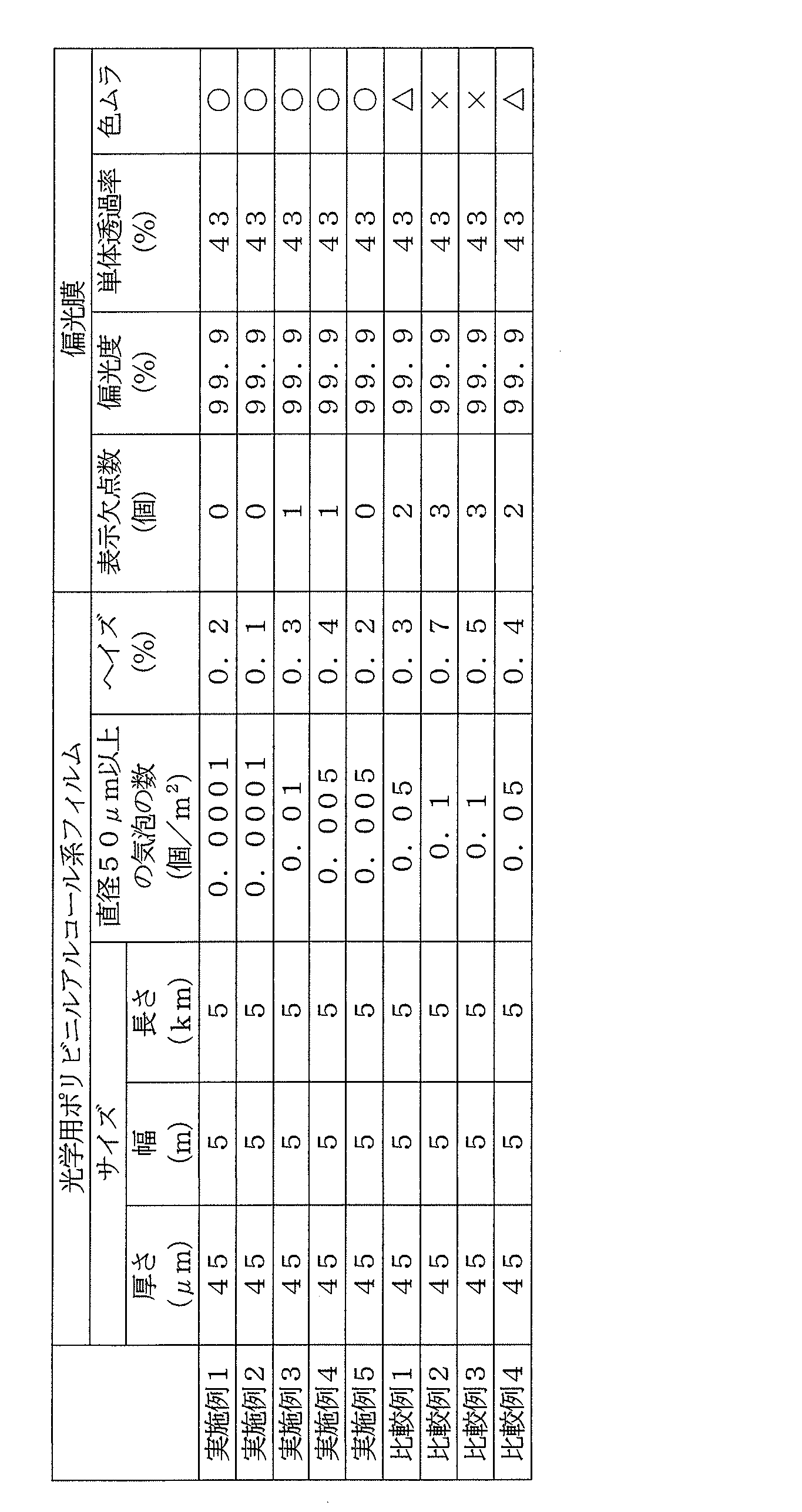
- Table 3 shows the properties of the obtained optical polyvinyl alcohol film.
- the optical polyvinyl alcohol film thus obtained is unwound from the wound body and transported in the horizontal direction using a transport roll. First, it is immersed in a water bath at a water temperature of 25 ° C. and swollen in the flow direction (MD direction). The film was stretched 1.7 times. Next, it is stretched 1.6 times in the flow direction (MD direction) while being immersed in an aqueous solution at 28 ° C. composed of iodine 0.5 g / L and potassium iodide 30 g / L, and then boric acid 40 g / L.
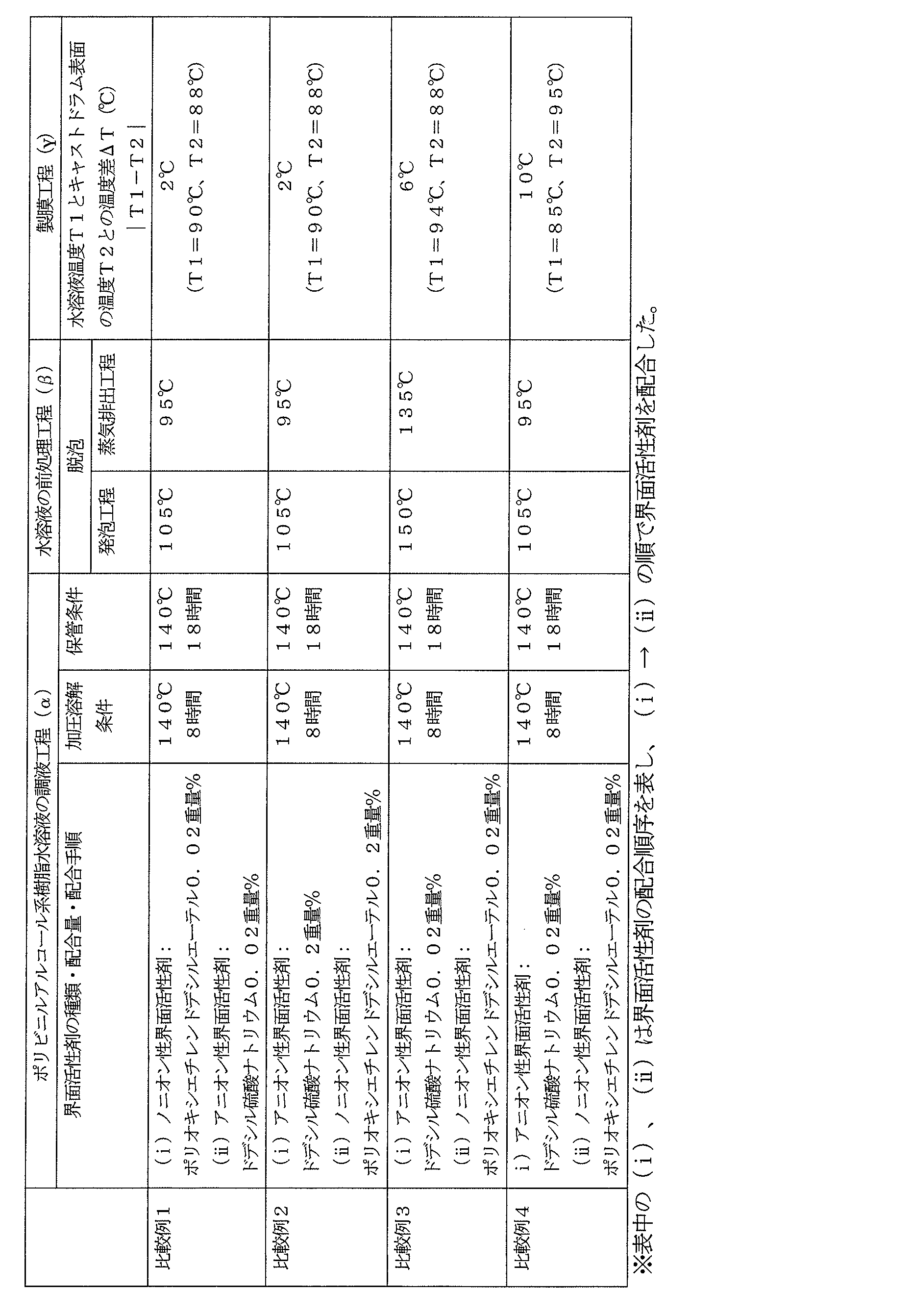
- Examples 2 to 5 and Comparative Examples 1 to 4 An optical polyvinyl alcohol film and a polarizing film were obtained in the same manner as in Example 1 except that the production was performed under the conditions shown in Tables 1 and 2 below. The properties of the obtained optical polyvinyl alcohol film and polarizing film are shown in Table 3 below.
- the number of bubbles is within the specific range of the present invention, so that the obtained polarizing film has few display defects, whereas the optical polyvinyl alcohol films of Comparative Examples 1 to 4 Since the number of bubbles is outside the specific range of the present invention, the polyvinyl alcohol film has many display defects of the obtained polarizing film.
- the polarizing film and polarizing plate obtained by using the optical polyvinyl alcohol film of the present invention have few display defects and excellent polarization performance
- portable information terminals personal computers, televisions, projectors, signage, electronic desk calculators , Electronic clock, word processor, electronic paper, game machine, video, camera, photo album, thermometer, audio, liquid crystal display devices such as automobiles and machinery instruments, sunglasses, anti-glare glasses, stereoscopic glasses, wearable display, display It is preferably used for an antireflection layer for elements (CRT, LCD, organic EL, electronic paper, etc.), optical communication equipment, medical equipment, building materials, toys and the like.
- elements CRT, LCD, organic EL, electronic paper, etc.
Landscapes
- Engineering & Computer Science (AREA)
- Chemical & Material Sciences (AREA)
- Physics & Mathematics (AREA)
- Mechanical Engineering (AREA)
- Manufacturing & Machinery (AREA)
- General Physics & Mathematics (AREA)
- Optics & Photonics (AREA)
- Chemical Kinetics & Catalysis (AREA)
- Organic Chemistry (AREA)
- Health & Medical Sciences (AREA)
- Medicinal Chemistry (AREA)
- Polymers & Plastics (AREA)
- Materials Engineering (AREA)
- Dispersion Chemistry (AREA)
- Polarising Elements (AREA)
- Moulding By Coating Moulds (AREA)
- Manufacture Of Macromolecular Shaped Articles (AREA)
Abstract
Description
例えば、幅4m×長さ4km(面積16,000m2)のフィルムを検査した時に、直径50μm以上の気泡が16個検出された場合、その気泡の数は0.001個/m2となる。また、気泡の形状が楕円形の場合は、(長径+短径)/2を直径とした。
上記自動異物検査装置の設定条件は下記の通りである。
照明:透過型、角度90°(フィルムに垂直)、距離300mm、光源ハロゲンランプ150W
検出:CCDカメラ20台、位置483mm、5000画素/台、分解能48μm/pixel、50mmレンズ(F2.8)
本発明の光学用ポリビニルアルコール系フィルムの製造方法は、ポリビニルアルコール系樹脂と添加剤を水に溶解してポリビニルアルコール系樹脂水溶液を調液する調液工程(α)と、上記ポリビニルアルコール系樹脂水溶液を脱泡処理および濾過処理する前処理工程(β)と、上記前処理済みポリビニルアルコール系樹脂水溶液をT型スリットダイからキャスト型に吐出および流延して製膜する製膜工程(γ)と、その製膜したフィルムを乾燥させる乾燥工程(δ)とを備えることを特徴とする。
まず、上記調液工程(α)について詳しく説明する。
本発明で用いられるポリビニルアルコール系樹脂としては、通常、未変性のポリビニルアルコール系樹脂、すなわち、酢酸ビニルを重合して得られるポリ酢酸ビニルをケン化して製造される樹脂が用いられる。必要に応じて、酢酸ビニルと、少量(通常、10モル%以下、好ましくは5モル%以下)の酢酸ビニルと共重合可能な成分との共重合体をケン化して得られる樹脂を用いることもできる。酢酸ビニルと共重合可能な成分としては、例えば、不飽和カルボン酸(例えば、塩、エステル、アミド、ニトリル等を含む)、炭素数2~30のオレフィン類(例えば、エチレン、プロピレン、n-ブテン、イソブテン等)、ビニルエーテル類、不飽和スルホン酸塩等があげられる。また、ケン化後の水酸基を化学修飾して得られる変性ポリビニルアルコール系樹脂を用いることもできる。
ここで、本発明における平均ケン化度は、JIS K 6726に準じて測定されるものである。
(i)界面活性剤の種類、
(ii)界面活性剤の配合量、
(iii)界面活性剤の配合手順、
(iv)界面活性剤の溶解方法、
(v)界面活性剤を溶解させたポリビニルアルコール系樹脂水溶液の保管方法、
の5つを最適化することが有用である。
これら界面活性剤に関する最適化の内、界面活性剤の(i)種類、(ii)配合量、(iv)溶解方法に関しては、これまでにいくつかの提案がなされているが、界面活性剤の(iii)配合手順と(v)ポリビニルアルコール系樹脂水溶液の保管方法の最適化に関しては、有効な提案がなされていないのが現状であり、特に(iii)配合手順に関しては、最適化されているとは言い難いものであった。
かかる界面活性剤の配合量が、多すぎると、溶解工程において界面活性剤が充分に溶解しにくい傾向があり、溶解したとしても製膜時に析出しやすいため、ポリビニルアルコール系フィルムの気泡が増加し、かつヘイズが増大してしまう傾向がある。
アニオン性界面活性剤が、最後に添加されると、溶解工程において界面活性剤が充分に溶解しない傾向があり、溶解したとしても製膜時に析出しやすいため、ポリビニルアルコール系フィルムの気泡が増加し、かつヘイズが増大する傾向がある。
かかる加圧溶解は、130~150℃で1~10時間行なわれることが好ましい。かかる加圧溶解温度が低すぎると、ポリビニルアルコール系樹脂や界面活性剤の充分な溶解が得られず、光学用ポリビニルアルコール系フィルムのヘイズが増大する傾向があり、高すぎても、ポリビニルアルコール系樹脂や界面活性剤の分解物が生じ、光学用ポリビニルアルコール系フィルムの気泡が増加する傾向がある。また、かかる加圧溶解時間が短すぎると、ポリビニルアルコール系樹脂や界面活性剤の充分な溶解が得られず、光学用ポリビニルアルコール系フィルムのヘイズが増大する傾向があり、長すぎても、ポリビニルアルコール系樹脂や界面活性剤の分解物が生じ、光学用ポリビニルアルコール系フィルムの気泡が増加する傾向にある。
また、保管時間は、30時間以内であることが好ましく、特に好ましくは25時間以内、更に好ましくは1~20時間である。かかる保管時間が、短すぎると、光学用ポリビニルアルコール系フィルムの気泡が増加する傾向があり、長すぎても、ポリビニルアルコール系樹脂や界面活性剤の分解物が生じ、光学用ポリビニルアルコール系フィルムの気泡が増加する傾向がある。
〔前処理工程(β)〕
つぎに、前記前処理工程(β)について説明する。前処理工程(β)は、得られたポリビニルアルコール系樹脂水溶液を脱泡処理および濾過処理する工程である。本発明の製造方法における最大の特徴は、かかる前処理工程(β)にあり、具体的には、ポリビニルアルコール系樹脂水溶液の(vi)脱泡方法と(vii)濾過方法の2つの方法に特徴がある。これらに関しては、有効な提案がなされていないのが現状であり、特に(vi)脱泡方法に関しては、最適化されているとは言い難い。
つぎに、前記製膜工程(γ)について説明する。製膜工程(γ)は、前処理された水溶液を、キャスト型に吐出および流延して製膜する工程であるが、光学用ポリビニルアルコール系フィルムの気泡を低減させるためには、かかる製膜工程(γ)において(viii)ポリビニルアルコール系樹脂水溶液を特定の温度条件でキャスト型に流延して製膜することが有用である。
以下、キャスト型としてキャストドラムを使用する場合を例にとって説明するが、本発明はこれに限定されるものではない。
上記キャストドラムの表面粗さRaは、つぎのようにして測定される。すなわち、キーエンス社製レーザーフォーカス顕微鏡VK-9700(測定長0.1mm、対物レンズ50倍)を用いて、キャストドラムの任意の3か所の表面粗さRaを測定し、その平均値を表面粗さとする。
かくして本発明の製造方法における製膜工程(γ)が行なわれ、製膜されたフィルムはキャストドラムから剥離され、乾燥に供される。
前記乾燥工程(δ)について詳しく説明する。この乾燥工程(δ)は、上記製膜されたフィルムを加熱して乾燥する工程である。
上記加熱による乾燥方法は、製膜されたフィルムの表面と裏面とを複数の金属製加熱ロール(以下、「熱ロール」と呼ぶ。)に交互に接触させることにより行なう方法が好ましい。熱ロールの表面温度は、通常40~150℃、好ましくは50~140℃である。かかる表面温度が低すぎると乾燥不良となる傾向があり、高すぎると乾燥しすぎることとなり、うねり等の外観不良を招く傾向がある。
さらに、上記熱ロール等による乾燥工程(δ)後、必要に応じて熱処理を行なってもよい。熱処理方法としては、フローティングドライヤーでフィルムの両面に温風を吹き付ける方法(以下、「フローティング法」と記載することがある。)や赤外線ランプで近赤外線を照射する方法等があげられる。中でも、光学用ポリビニルアルコール系フィルム両面の乾燥状態を均一にすることができる点で、フローティング法で行なうことが好ましく、光学用ポリビニルアルコール系フィルムの平坦性の点で、フィルム幅1m当たりのニップ間張力を1~10Nとしたフローティング法が特に好ましい。かかる熱処理温度は、通常、70~150℃である。熱処理温度が低すぎると、光学用ポリビニルアルコール系フィルムの耐水性が不足する傾向があり、高すぎると偏光膜製造時の延伸性が低下する傾向がある。
上記乾燥工程(δ)後、さらに必要に応じて熱処理工程を経由して、長尺の本発明の光学用ポリビニルアルコール系フィルムが得られる。この光学用ポリビニルアルコール系フィルムは、フィルムの幅方向の両端部がスリットされ、芯管にロール状に巻き取られることによりフィルム巻装体に作製される。
ここで、本発明の光学用ポリビニルアルコール系フィルムを用いて得られる偏光膜の製造方法について説明する。
なお、偏光度は、一般的に2枚の偏光膜を、その配向方向が同一方向になるように重ね合わせた状態で、波長λにおいて測定した光線透過率(H11)と、2枚の偏光膜を、配向方向が互いに直交する方向になる様に重ね合わせた状態で、波長λにおいて測定した光線透過率(H1)より、下式にしたがって算出される。
偏光度=〔(H11-H1)/(H11+H1)〕1/2
単体透過率は、分光光度計を用いて偏光膜単体の光線透過率を測定して得られる値である。
ここで、本発明の偏光板の製造方法について説明する。
上記偏光板は、本発明の偏光膜の片面または両面に、接着剤を介して、光学的に等方性の樹脂フィルムを保護フィルムとして貼合することにより作製される。保護フィルムとしては、例えば、セルローストリアセテート、セルロースジアセテート、ポリカーボネート、ポリメチルメタクリレート、シクロオレフィンポリマー、シクロオレフィンコポリマー、ポリスチレン、ポリエーテルスルホン、ポリアリーレンエステル、ポリ-4-メチルペンテン、ポリフェニレンオキサイド等のフィルムまたはシートがあげられる。
以下の実施例および比較例における光学用ポリビニルアルコール系フィルム、偏光膜の各物性の測定・評価をつぎのようにして行なった。
(1)直径50μm以上の気泡の数(個/m2)
得られた光学用ポリビニルアルコール系フィルムをフィルム巻装体から巻き出しながら、幅4m×長さ4kmにわたって直径50μm以上の異物(明欠陥)を自動異物検査装置にて検出し、検出された異物の拡大写真から直径50μm以上の気泡をピックアップして、気泡の総数を算出した。かかる総数を面積16,000m2で除することにより、気泡の数(個/m2)とした。なお、気泡の形状が楕円形の場合は、(長径+短径)/2を直径とした。
自動異物検査装置の詳細な設定条件は下記の通りである。
照明:透過型、角度90°(フィルムに垂直)、距離300mm、光源ハロゲンランプ150W
検出:CCDカメラ20台、位置483mm、5000画素/台、分解能48μm/pixel、50mmレンズ(F2.8)
得られた光学用ポリビニルアルコール系フィルムから50mm×50mmの試験片を10枚切り出し、日本電色社製ヘイズメーターNDH-2000を用いて測定し、10枚の平均値をヘイズ(%)とした。
得られた偏光膜から、長さ1m×幅1mの試験片を10枚切り出し、15,000lxの環境下で目視検査し、100μm以上の大きさの表示欠点の総数(個)を測定した。
得られた偏光膜から、4cm×4cmの試験片を25点切り出し、自動偏光フィルム測定装置(日本分光社製VAP7070)を用いて偏光度(%)と単体透過率(%)を測定し、平均値をとった。
得られた偏光膜から、長さ30cm×幅30cmの試験片を切り出し、クロスニコル状態の2枚の偏光板(単体透過率43.5%、偏光度99.9%)の間に45°の角度で挟んだのちに、表面照度14,000lxのライトボックスを用いて、透過モードで光学的な色ムラを観察し、以下の基準で評価した。
(評価基準)
○・・・色ムラがなかった。
△・・・かすかに色ムラがあった。
×・・・はっきりと色ムラがあった。
(光学用ポリビニルアルコール系フィルムの製造)
重量平均分子量142,000、ケン化度99.8モル%のポリビニルアルコール系樹脂1,000kg、水2,500kg、アニオン性界面活性剤としてドデシル硫酸ナトリウム0.2kg(樹脂に対して0.02重量%)を、加圧溶解缶に投入して90℃で撹拌した後、ノニオン性界面活性剤としてポリオキシエチレンドデシルエーテル0.2kg(樹脂に対して0.02重量%)、可塑剤としてグリセリン100kgを入れ、水蒸気を吹き込んで加圧しながら昇温し、140℃で8時間撹拌して均一に溶解したポリビニルアルコール系樹脂水溶液を得た(樹脂濃度25重量%)。
つぎに、該ポリビニルアルコール系樹脂水溶液を、保管槽で140℃18時間保管した後、ベントを有する2軸押出機を用いて、発泡工程と蒸気排気工程を経由させて脱泡した。上記発泡工程と蒸気排気工程における各脱泡温度は、下記のとおりである。
発泡工程:105℃
蒸気排出工程:95℃
T型スリットダイから吐出されるポリビニルアルコール系樹脂水溶液の温度T1:90℃
キャストドラム表面の温度T2:88℃(温度ムラ1℃以内)
温度差ΔT(=|T1-T2|):2℃
最後に、得られた光学用ポリビニルアルコール系フィルムのフィルム両端部をスリットして芯管にロール状に巻き取ることにより、フィルム巻装体を得た。得られた光学用ポリビニルアルコール系フィルムの特性を表3に示す。
得られた上記光学用ポリビニルアルコール系フィルムを上記巻装体から繰り出し、搬送ロールを用いて水平方向に搬送し、まず、水温25℃の水槽に浸漬して膨潤させながら流れ方向(MD方向)に1.7倍に延伸した。つぎに、ヨウ素0.5g/L、ヨウ化カリウム30g/Lよりなる28℃の水溶液中に浸漬して染色しながら流れ方向(MD方向)に1.6倍に延伸し、ついでホウ酸40g/L、ヨウ化カリウム30g/Lの組成の水溶液(55℃)に浸漬してホウ酸架橋しながら流れ方向(MD方向)に2.1倍に一軸延伸した。最後に、ヨウ化カリウム水溶液で洗浄を行ない、60℃で2分間乾燥して総延伸倍率5.8倍の偏光膜を得た。得られた偏光膜の特性を下記の表3に示す。
下記の表1および表2に示される条件で製造する以外は、実施例1と同様にして、光学用ポリビニルアルコール系フィルム、および偏光膜を得た。得られた光学用ポリビニルアルコール系フィルムと偏光膜の特性を下記の表3に示す。

Claims (9)
- 幅2m以上かつ長さ4km以上のポリビニルアルコール系フィルムであって、幅A(m)×長さB(km)で囲まれる面積(ただし、A≧2m、かつB≧4km)あたりに含まれる直径50μm以上の気泡数が0.01個/m2以下であることを特徴とする光学用ポリビニルアルコール系フィルム。
- ヘイズが0.2%以下であることを特徴とする請求項1記載の光学用ポリビニルアルコール系フィルム。
- 幅が4m以上であることを特徴とする請求項1または2記載の光学用ポリビニルアルコール系フィルム。
- 厚さが45μm以下であることを特徴とする請求項1~3のいずれか一項に記載の光学用ポリビニルアルコール系フィルム。
- 請求項1~4のいずれか一項に記載の光学用ポリビニルアルコール系フィルムの製造方法であって、ポリビニルアルコール系樹脂と界面活性剤を水に溶解してポリビニルアルコール系樹脂水溶液を調液する調液工程と、上記ポリビニルアルコール系樹脂水溶液を脱泡処理および濾過処理する脱泡濾過工程と、上記脱泡および濾過されたポリビニルアルコール系樹脂水溶液をT型スリットダイからキャスト型に吐出および流延して製膜する製膜工程と、その製膜したフィルムを乾燥させる乾燥工程とを備えたことを特徴とする光学用ポリビニルアルコール系フィルムの製造方法。
- 上記脱泡処理が、ベントを有する2軸押出機を用いて行なわれ、100~130℃の発泡工程と90~100℃蒸気排出工程からなることを特徴とする請求項5記載の光学用ポリビニルアルコール系フィルムの製造方法。
- 上記製膜工程において、T型スリットダイから吐出されるポリビニルアルコール系樹脂水溶液の温度T1(℃)と、キャスト型表面の温度T2(℃)との温度差ΔT(℃)が、絶対値で4℃以下であることを特徴とする請求項5または6記載の光学用ポリビニルアルコール系フィルムの製造方法。
- 請求項5~7のいずれか一項に記載の光学用ポリビニルアルコール系フィルムの製造方法により製造されることを特徴とする光学用ポリビニルアルコール系フィルム。
- 請求項1~4、8のいずれか一項に記載の光学用ポリビニルアルコール系フィルムが用いられていることを特徴とする偏光膜。
Priority Applications (4)
| Application Number | Priority Date | Filing Date | Title |
|---|---|---|---|
| JP2017528603A JP6848864B2 (ja) | 2016-05-27 | 2017-05-25 | 光学用ポリビニルアルコール系フィルム、およびその製造方法、ならびにその光学用ポリビニルアルコール系フィルムを用いた偏光膜 |
| CN202111428202.2A CN114252951A (zh) | 2016-05-27 | 2017-05-25 | 光学用聚乙烯醇系薄膜及其制造方法、以及利用该光学用聚乙烯醇系薄膜的偏光膜 |
| KR1020187033698A KR102400928B1 (ko) | 2016-05-27 | 2017-05-25 | 광학용 폴리비닐알코올계 필름 및 이의 제조 방법, 및 상기 광학용 폴리비닐알코올계 필름을 사용한 편광막 |
| CN201780031534.2A CN109154692B (zh) | 2016-05-27 | 2017-05-25 | 光学用聚乙烯醇系薄膜及其制造方法、以及利用该光学用聚乙烯醇系薄膜的偏光膜 |
Applications Claiming Priority (2)
| Application Number | Priority Date | Filing Date | Title |
|---|---|---|---|
| JP2016106071 | 2016-05-27 | ||
| JP2016-106071 | 2016-05-27 |
Publications (1)
| Publication Number | Publication Date |
|---|---|
| WO2017204270A1 true WO2017204270A1 (ja) | 2017-11-30 |
Family
ID=60411422
Family Applications (1)
| Application Number | Title | Priority Date | Filing Date |
|---|---|---|---|
| PCT/JP2017/019449 Ceased WO2017204270A1 (ja) | 2016-05-27 | 2017-05-25 | 光学用ポリビニルアルコール系フィルム、およびその製造方法、ならびにその光学用ポリビニルアルコール系フィルムを用いた偏光膜 |
Country Status (5)
| Country | Link |
|---|---|
| JP (1) | JP6848864B2 (ja) |
| KR (1) | KR102400928B1 (ja) |
| CN (2) | CN109154692B (ja) |
| TW (1) | TWI740946B (ja) |
| WO (1) | WO2017204270A1 (ja) |
Cited By (4)
| Publication number | Priority date | Publication date | Assignee | Title |
|---|---|---|---|---|
| WO2019012968A1 (ja) * | 2017-07-10 | 2019-01-17 | 日東電工株式会社 | 積層体および偏光膜の製造方法 |
| WO2019189684A1 (ja) * | 2018-03-29 | 2019-10-03 | 三菱ケミカル株式会社 | 水溶性フィルムおよびその製造方法、並びに薬剤包装体 |
| JP2021056507A (ja) * | 2019-09-30 | 2021-04-08 | 三菱ケミカル株式会社 | 偏光膜製造用ポリビニルアルコール系樹脂フィルムおよび偏光膜 |
| WO2021132207A1 (ja) * | 2019-12-24 | 2021-07-01 | 株式会社クラレ | ポリビニルアルコールフィルム及びそれを用いた偏光フィルムの製造方法 |
Families Citing this family (2)
| Publication number | Priority date | Publication date | Assignee | Title |
|---|---|---|---|---|
| WO2020116414A1 (ja) * | 2018-12-04 | 2020-06-11 | 株式会社クラレ | ポリビニルアルコールフィルム及びそれを用いた偏光フィルムの製造方法 |
| CN119773282B (zh) * | 2025-01-16 | 2025-10-21 | 安徽皖维高新材料股份有限公司 | 一种无面内线状漏光偏光片用pva光学膜及其制备方法 |
Citations (5)
| Publication number | Priority date | Publication date | Assignee | Title |
|---|---|---|---|---|
| JP2002059474A (ja) * | 2000-08-21 | 2002-02-26 | Nippon Synthetic Chem Ind Co Ltd:The | ポリビニルアルコール系フィルムの製造方法 |
| JP2004020631A (ja) * | 2002-06-12 | 2004-01-22 | Kuraray Co Ltd | 偏光フィルムの製造法 |
| JP2006188661A (ja) * | 2004-11-02 | 2006-07-20 | Nippon Synthetic Chem Ind Co Ltd:The | ポリビニルアルコール系フィルム、およびその製造方法 |
| JP2009013368A (ja) * | 2007-07-09 | 2009-01-22 | Nippon Synthetic Chem Ind Co Ltd:The | 光学用ポリビニルアルコール系フィルム、偏光膜、及び偏光板 |
| JP2015063395A (ja) * | 2013-08-28 | 2015-04-09 | 日本合成化学工業株式会社 | ポリビニルアルコール系フィルムロール及びそれを用いた偏光膜 |
Family Cites Families (18)
| Publication number | Priority date | Publication date | Assignee | Title |
|---|---|---|---|---|
| JPH05318574A (ja) * | 1992-05-15 | 1993-12-03 | Sumitomo Chem Co Ltd | 酸素吸収シートの製造方法 |
| CN1220205A (zh) * | 1997-12-15 | 1999-06-23 | 陈耀庭 | 废发泡聚苯乙烯塑料回收再生方法 |
| JP4226766B2 (ja) | 2000-08-21 | 2009-02-18 | 日本合成化学工業株式会社 | ポリビニルアルコール系フィルムの製造方法 |
| JP3699642B2 (ja) | 2000-08-21 | 2005-09-28 | 日本合成化学工業株式会社 | ポリビニルアルコール系樹脂水溶液の製造方法 |
| JP4485045B2 (ja) | 2000-11-15 | 2010-06-16 | 株式会社クラレ | 延伸加工用ビニルアルコール系重合体フィルムの製造法 |
| JP3609384B2 (ja) * | 2001-04-04 | 2005-01-12 | トキワ印刷株式会社 | 発泡体製造法及びその発泡体 |
| US20080113173A1 (en) * | 2004-11-02 | 2008-05-15 | The Nippon Synthetic Chemical Industry Co., Ltd. | Polyvinyl Alcohol Film and Process for Producing the Same |
| WO2006070627A1 (ja) * | 2004-12-28 | 2006-07-06 | The Nippon Synthetic Chemical Industry Co., Ltd. | ポリビニルアルコール系フィルム、およびそれを用いた偏光膜、偏光板 |
| JP2006188861A (ja) * | 2005-01-05 | 2006-07-20 | Sumitomo Mitsui Construction Co Ltd | トンネル用ライニング装置 |
| US8772400B2 (en) * | 2006-07-27 | 2014-07-08 | The Nippon Synthetic Chemical Industry Co., Ltd. | Polyvinyl alcohol-based film for optical use, polarizing film, and polarizing plate |
| JP2011111526A (ja) | 2009-11-26 | 2011-06-09 | Kuraray Co Ltd | ポリビニルアルコール系重合体フィルム |
| WO2012002194A1 (ja) * | 2010-07-02 | 2012-01-05 | 日本合成化学工業株式会社 | ポリビニルアルコール系フィルム、ポリビニルアルコール系フィルムの製造方法、偏光フィルム及び偏光板 |
| KR101399427B1 (ko) * | 2012-04-18 | 2014-05-27 | 에스케이씨 주식회사 | 폴리비닐알코올계 필름 및 이를 이용한 편광 필름 |
| WO2014086744A1 (en) * | 2012-12-06 | 2014-06-12 | Solvay Specialty Polymers Usa, Llc | Polyarylene foam materials |
| CN105263838B (zh) * | 2013-08-28 | 2018-06-08 | 日本合成化学工业株式会社 | 聚乙烯醇系薄膜卷和使用其的偏光膜 |
| JP6448924B2 (ja) * | 2013-08-28 | 2019-01-09 | 日本合成化学工業株式会社 | ポリビニルアルコール系フィルムロール |
| CN105268335A (zh) * | 2014-07-23 | 2016-01-27 | 上海一鸣过滤技术有限公司 | 一种亲水性聚醚砜微孔膜的制备方法 |
| CN204241713U (zh) * | 2014-12-13 | 2015-04-01 | 中国科学技术大学先进技术研究院 | 一种新型光学聚合物复合薄膜 |
-
2017
- 2017-05-25 CN CN201780031534.2A patent/CN109154692B/zh active Active
- 2017-05-25 KR KR1020187033698A patent/KR102400928B1/ko active Active
- 2017-05-25 WO PCT/JP2017/019449 patent/WO2017204270A1/ja not_active Ceased
- 2017-05-25 TW TW106117312A patent/TWI740946B/zh active
- 2017-05-25 CN CN202111428202.2A patent/CN114252951A/zh active Pending
- 2017-05-25 JP JP2017528603A patent/JP6848864B2/ja active Active
Patent Citations (5)
| Publication number | Priority date | Publication date | Assignee | Title |
|---|---|---|---|---|
| JP2002059474A (ja) * | 2000-08-21 | 2002-02-26 | Nippon Synthetic Chem Ind Co Ltd:The | ポリビニルアルコール系フィルムの製造方法 |
| JP2004020631A (ja) * | 2002-06-12 | 2004-01-22 | Kuraray Co Ltd | 偏光フィルムの製造法 |
| JP2006188661A (ja) * | 2004-11-02 | 2006-07-20 | Nippon Synthetic Chem Ind Co Ltd:The | ポリビニルアルコール系フィルム、およびその製造方法 |
| JP2009013368A (ja) * | 2007-07-09 | 2009-01-22 | Nippon Synthetic Chem Ind Co Ltd:The | 光学用ポリビニルアルコール系フィルム、偏光膜、及び偏光板 |
| JP2015063395A (ja) * | 2013-08-28 | 2015-04-09 | 日本合成化学工業株式会社 | ポリビニルアルコール系フィルムロール及びそれを用いた偏光膜 |
Cited By (9)
| Publication number | Priority date | Publication date | Assignee | Title |
|---|---|---|---|---|
| WO2019012968A1 (ja) * | 2017-07-10 | 2019-01-17 | 日東電工株式会社 | 積層体および偏光膜の製造方法 |
| WO2019189684A1 (ja) * | 2018-03-29 | 2019-10-03 | 三菱ケミカル株式会社 | 水溶性フィルムおよびその製造方法、並びに薬剤包装体 |
| CN111819226A (zh) * | 2018-03-29 | 2020-10-23 | 三菱化学株式会社 | 水溶性薄膜及其制造方法、以及药剂包装体 |
| JPWO2019189684A1 (ja) * | 2018-03-29 | 2021-02-12 | 三菱ケミカル株式会社 | 水溶性フィルムおよびその製造方法、並びに薬剤包装体 |
| EP3778728A4 (en) * | 2018-03-29 | 2021-05-26 | Mitsubishi Chemical Corporation | WATER-SOLUBLE FILM, ITS PRODUCTION PROCESS AND CHEMICAL AGENT PACKAGING |
| JP2021056507A (ja) * | 2019-09-30 | 2021-04-08 | 三菱ケミカル株式会社 | 偏光膜製造用ポリビニルアルコール系樹脂フィルムおよび偏光膜 |
| WO2021132207A1 (ja) * | 2019-12-24 | 2021-07-01 | 株式会社クラレ | ポリビニルアルコールフィルム及びそれを用いた偏光フィルムの製造方法 |
| JPWO2021132207A1 (ja) * | 2019-12-24 | 2021-07-01 | ||
| JP7512309B2 (ja) | 2019-12-24 | 2024-07-08 | 株式会社クラレ | ポリビニルアルコールフィルム及びそれを用いた偏光フィルムの製造方法 |
Also Published As
| Publication number | Publication date |
|---|---|
| KR102400928B1 (ko) | 2022-05-23 |
| JPWO2017204270A1 (ja) | 2019-03-22 |
| CN109154692A (zh) | 2019-01-04 |
| CN114252951A (zh) | 2022-03-29 |
| CN109154692B (zh) | 2022-01-11 |
| TWI740946B (zh) | 2021-10-01 |
| KR20190013761A (ko) | 2019-02-11 |
| JP6848864B2 (ja) | 2021-03-24 |
| TW201809090A (zh) | 2018-03-16 |
Similar Documents
| Publication | Publication Date | Title |
|---|---|---|
| JP6848864B2 (ja) | 光学用ポリビニルアルコール系フィルム、およびその製造方法、ならびにその光学用ポリビニルアルコール系フィルムを用いた偏光膜 | |
| JP6812795B2 (ja) | 偏光膜製造用ポリビニルアルコール系樹脂、およびその製造方法、ポリビニルアルコール系フィルムおよびその製造方法、偏光膜、ポリビニルアルコール系樹脂 | |
| JP5563418B2 (ja) | ポリビニルアルコール系重合体フィルムの製造方法 | |
| KR20190008213A (ko) | 폴리비닐알코올계 필름, 및 이의 제조 방법, 및 상기 폴리비닐알코올계 필름을 사용한 편광막 | |
| KR102359304B1 (ko) | 폴리비닐알코올계 필름, 및 이의 제조 방법, 및 상기 폴리비닐알코올계 필름을 사용한 편광막 | |
| JPWO2018003671A1 (ja) | 偏光膜用ポリビニルアルコール系フィルム、およびその製造方法、ならびにその偏光膜用ポリビニルアルコール系フィルムを用いた偏光膜 | |
| JP4968669B2 (ja) | 偏光膜用ポリビニルアルコール系フィルム及びそれを用いた偏光膜、偏光板 | |
| WO2016208652A1 (ja) | ポリビニルアルコール系フィルム、ポリビニルアルコール系フィルムの製造方法、及び偏光膜 | |
| JP2017213878A (ja) | ポリビニルアルコール系フィルムの製造方法、ポリビニルアルコール系フィルム、および偏光膜 | |
| TW202248309A (zh) | 聚乙烯醇系薄膜、及其製造方法、以及使用其之偏光膜、偏光板 | |
| WO2022138720A1 (ja) | 偏光膜製造用ポリビニルアルコール系フィルム、偏光膜製造用ポリビニルアルコール系フィルムの製造方法、偏光膜 | |
| KR20180013848A (ko) | 폴리비닐 알코올계 필름, 폴리비닐 알코올계 필름의 제조 방법 및 편광막 | |
| JP7196535B2 (ja) | 偏光膜製造用ポリビニルアルコール系フィルム、およびそれを用いてなる偏光膜、偏光板 | |
| KR102411613B1 (ko) | 폴리비닐알코올계 필름, 및 이의 제조 방법, 및 상기 폴리비닐알코올계 필름을 사용한 편광막 | |
| JP6816508B2 (ja) | 偏光膜製造用ポリビニルアルコール系フィルムの製造方法、偏光膜の製造方法 | |
| JP2021002061A (ja) | ポリビニルアルコール系フィルム、及び偏光膜 | |
| JP2017223941A (ja) | 偏光膜用ポリビニルアルコール系フィルム、およびその製造方法、ならびに偏光膜 | |
| WO2025205953A1 (ja) | ポリビニルアルコール系フィルム、偏光膜、及び偏光板 | |
| TW202605060A (zh) | 聚乙烯醇系薄膜、偏光膜、及偏光板 | |
| KR20240162479A (ko) | 폴리비닐 알코올계 필름, 및 이를 이용한 편광막, 및 편광판 | |
| KR20190139839A (ko) | 폴리비닐알코올계 필름, 편광막 및 편광판, 및 폴리비닐알코올계 필름의 제조 방법 | |
| JP2016221954A (ja) | ポリビニルアルコール系フィルムの製造方法、ポリビニルアルコール系フィルム、偏光膜、およびキャスト型 |
Legal Events
| Date | Code | Title | Description |
|---|---|---|---|
| ENP | Entry into the national phase |
Ref document number: 2017528603 Country of ref document: JP Kind code of ref document: A |
|
| ENP | Entry into the national phase |
Ref document number: 20187033698 Country of ref document: KR Kind code of ref document: A |
|
| 121 | Ep: the epo has been informed by wipo that ep was designated in this application |
Ref document number: 17802856 Country of ref document: EP Kind code of ref document: A1 |
|
| NENP | Non-entry into the national phase |
Ref country code: DE |
|
| 122 | Ep: pct application non-entry in european phase |
Ref document number: 17802856 Country of ref document: EP Kind code of ref document: A1 |