WO2016147857A1 - バインダ樹脂組成物、リチウムイオン二次電池用電極、及びリチウムイオン二次電池 - Google Patents
バインダ樹脂組成物、リチウムイオン二次電池用電極、及びリチウムイオン二次電池 Download PDFInfo
- Publication number
- WO2016147857A1 WO2016147857A1 PCT/JP2016/056299 JP2016056299W WO2016147857A1 WO 2016147857 A1 WO2016147857 A1 WO 2016147857A1 JP 2016056299 W JP2016056299 W JP 2016056299W WO 2016147857 A1 WO2016147857 A1 WO 2016147857A1
- Authority
- WO
- WIPO (PCT)
- Prior art keywords
- resin composition
- binder resin
- lithium ion
- ion secondary
- positive electrode
- Prior art date
- Legal status (The legal status is an assumption and is not a legal conclusion. Google has not performed a legal analysis and makes no representation as to the accuracy of the status listed.)
- Ceased
Links
Images

Classifications
-
- C—CHEMISTRY; METALLURGY
- C08—ORGANIC MACROMOLECULAR COMPOUNDS; THEIR PREPARATION OR CHEMICAL WORKING-UP; COMPOSITIONS BASED THEREON
- C08L—COMPOSITIONS OF MACROMOLECULAR COMPOUNDS
- C08L33/00—Compositions of homopolymers or copolymers of compounds having one or more unsaturated aliphatic radicals, each having only one carbon-to-carbon double bond, and only one being terminated by only one carboxyl radical, or of salts, anhydrides, esters, amides, imides or nitriles thereof; Compositions of derivatives of such polymers
- C08L33/18—Homopolymers or copolymers of nitriles
- C08L33/20—Homopolymers or copolymers of acrylonitrile
-
- C—CHEMISTRY; METALLURGY
- C08—ORGANIC MACROMOLECULAR COMPOUNDS; THEIR PREPARATION OR CHEMICAL WORKING-UP; COMPOSITIONS BASED THEREON
- C08L—COMPOSITIONS OF MACROMOLECULAR COMPOUNDS
- C08L101/00—Compositions of unspecified macromolecular compounds
-
- C—CHEMISTRY; METALLURGY
- C08—ORGANIC MACROMOLECULAR COMPOUNDS; THEIR PREPARATION OR CHEMICAL WORKING-UP; COMPOSITIONS BASED THEREON
- C08L—COMPOSITIONS OF MACROMOLECULAR COMPOUNDS
- C08L23/00—Compositions of homopolymers or copolymers of unsaturated aliphatic hydrocarbons having only one carbon-to-carbon double bond; Compositions of derivatives of such polymers
-
- C—CHEMISTRY; METALLURGY
- C08—ORGANIC MACROMOLECULAR COMPOUNDS; THEIR PREPARATION OR CHEMICAL WORKING-UP; COMPOSITIONS BASED THEREON
- C08L—COMPOSITIONS OF MACROMOLECULAR COMPOUNDS
- C08L27/00—Compositions of homopolymers or copolymers of compounds having one or more unsaturated aliphatic radicals, each having only one carbon-to-carbon double bond, and at least one being terminated by a halogen; Compositions of derivatives of such polymers
- C08L27/02—Compositions of homopolymers or copolymers of compounds having one or more unsaturated aliphatic radicals, each having only one carbon-to-carbon double bond, and at least one being terminated by a halogen; Compositions of derivatives of such polymers not modified by chemical after-treatment
- C08L27/12—Compositions of homopolymers or copolymers of compounds having one or more unsaturated aliphatic radicals, each having only one carbon-to-carbon double bond, and at least one being terminated by a halogen; Compositions of derivatives of such polymers not modified by chemical after-treatment containing fluorine atoms
- C08L27/14—Homopolymers or copolymers of vinyl fluoride
-
- C—CHEMISTRY; METALLURGY
- C09—DYES; PAINTS; POLISHES; NATURAL RESINS; ADHESIVES; COMPOSITIONS NOT OTHERWISE PROVIDED FOR; APPLICATIONS OF MATERIALS NOT OTHERWISE PROVIDED FOR
- C09D—COATING COMPOSITIONS, e.g. PAINTS, VARNISHES OR LACQUERS; FILLING PASTES; CHEMICAL PAINT OR INK REMOVERS; INKS; CORRECTING FLUIDS; WOODSTAINS; PASTES OR SOLIDS FOR COLOURING OR PRINTING; USE OF MATERIALS THEREFOR
- C09D133/00—Coating compositions based on homopolymers or copolymers of compounds having one or more unsaturated aliphatic radicals, each having only one carbon-to-carbon double bond, and at least one being terminated by only one carboxyl radical, or of salts, anhydrides, esters, amides, imides, or nitriles thereof; Coating compositions based on derivatives of such polymers
- C09D133/18—Homopolymers or copolymers of nitriles
-
- H—ELECTRICITY
- H01—ELECTRIC ELEMENTS
- H01M—PROCESSES OR MEANS, e.g. BATTERIES, FOR THE DIRECT CONVERSION OF CHEMICAL ENERGY INTO ELECTRICAL ENERGY
- H01M10/00—Secondary cells; Manufacture thereof
- H01M10/05—Accumulators with non-aqueous electrolyte
- H01M10/052—Li-accumulators
- H01M10/0525—Rocking-chair batteries, i.e. batteries with lithium insertion or intercalation in both electrodes; Lithium-ion batteries
-
- H—ELECTRICITY
- H01—ELECTRIC ELEMENTS
- H01M—PROCESSES OR MEANS, e.g. BATTERIES, FOR THE DIRECT CONVERSION OF CHEMICAL ENERGY INTO ELECTRICAL ENERGY
- H01M4/00—Electrodes
- H01M4/02—Electrodes composed of, or comprising, active material
- H01M4/13—Electrodes for accumulators with non-aqueous electrolyte, e.g. for lithium-accumulators; Processes of manufacture thereof
-
- H—ELECTRICITY
- H01—ELECTRIC ELEMENTS
- H01M—PROCESSES OR MEANS, e.g. BATTERIES, FOR THE DIRECT CONVERSION OF CHEMICAL ENERGY INTO ELECTRICAL ENERGY
- H01M4/00—Electrodes
- H01M4/02—Electrodes composed of, or comprising, active material
- H01M4/62—Selection of inactive substances as ingredients for active masses, e.g. binders, fillers
- H01M4/621—Binders
- H01M4/622—Binders being polymers
-
- C—CHEMISTRY; METALLURGY
- C08—ORGANIC MACROMOLECULAR COMPOUNDS; THEIR PREPARATION OR CHEMICAL WORKING-UP; COMPOSITIONS BASED THEREON
- C08L—COMPOSITIONS OF MACROMOLECULAR COMPOUNDS
- C08L2203/00—Applications
- C08L2203/20—Applications use in electrical or conductive gadgets
-
- H—ELECTRICITY
- H01—ELECTRIC ELEMENTS
- H01M—PROCESSES OR MEANS, e.g. BATTERIES, FOR THE DIRECT CONVERSION OF CHEMICAL ENERGY INTO ELECTRICAL ENERGY
- H01M2220/00—Batteries for particular applications
- H01M2220/30—Batteries in portable systems, e.g. mobile phone, laptop
-
- Y—GENERAL TAGGING OF NEW TECHNOLOGICAL DEVELOPMENTS; GENERAL TAGGING OF CROSS-SECTIONAL TECHNOLOGIES SPANNING OVER SEVERAL SECTIONS OF THE IPC; TECHNICAL SUBJECTS COVERED BY FORMER USPC CROSS-REFERENCE ART COLLECTIONS [XRACs] AND DIGESTS
- Y02—TECHNOLOGIES OR APPLICATIONS FOR MITIGATION OR ADAPTATION AGAINST CLIMATE CHANGE
- Y02E—REDUCTION OF GREENHOUSE GAS [GHG] EMISSIONS, RELATED TO ENERGY GENERATION, TRANSMISSION OR DISTRIBUTION
- Y02E60/00—Enabling technologies; Technologies with a potential or indirect contribution to GHG emissions mitigation
- Y02E60/10—Energy storage using batteries
-
- Y—GENERAL TAGGING OF NEW TECHNOLOGICAL DEVELOPMENTS; GENERAL TAGGING OF CROSS-SECTIONAL TECHNOLOGIES SPANNING OVER SEVERAL SECTIONS OF THE IPC; TECHNICAL SUBJECTS COVERED BY FORMER USPC CROSS-REFERENCE ART COLLECTIONS [XRACs] AND DIGESTS
- Y02—TECHNOLOGIES OR APPLICATIONS FOR MITIGATION OR ADAPTATION AGAINST CLIMATE CHANGE
- Y02T—CLIMATE CHANGE MITIGATION TECHNOLOGIES RELATED TO TRANSPORTATION
- Y02T10/00—Road transport of goods or passengers
- Y02T10/60—Other road transportation technologies with climate change mitigation effect
- Y02T10/70—Energy storage systems for electromobility, e.g. batteries
Definitions
- the present disclosure relates to a binder resin composition, and an electrode for a lithium ion secondary battery and a lithium ion secondary battery using the binder resin composition.
- a lithium ion secondary battery is an energy device having a high energy density, and is widely used as a power source for portable information terminals such as notebook computers and mobile phones.
- a positive electrode, an insulating layer, a negative electrode, and an insulating layer are stacked in this order, and a wound electrode group obtained by winding or a positive electrode, an insulating layer, and a negative electrode are stacked.
- a stacked electrode group is used.
- As an active material of the negative electrode a carbon material having a multilayer structure capable of inserting lithium ions between layers (forming a lithium intercalation compound) and releasing is mainly used.
- the positive electrode active material a lithium-containing metal composite oxide is mainly used.
- a polyolefin porous film is mainly used. Such a lithium ion secondary battery has high battery capacity and output, and good charge / discharge cycle characteristics.
- Lithium ion secondary batteries are at a high level in terms of safety, but due to their high capacity and high output, further improvements in terms of safety are desired. For example, when a lithium ion secondary battery is overcharged or an internal short circuit occurs, heat may be generated. In addition, since the lithium ion secondary battery contains a non-aqueous electrolyte containing an organic solvent, the organic solvent is chemically decomposed with heat generation to generate gas, and the internal pressure of the battery increases. It can happen.
- the safety of the lithium ion secondary battery is further improved by cutting off the current in the battery and suppressing heat generation.
- a method of using a mechanism for detecting the internal pressure of the battery and shutting off the current such as a safety valve provided in the sealing plate, and (2) the battery in the sealing plate
- PTC Positive Temperature Coefficient
- an electrode having a PTC layer has been proposed (see, for example, JP 2009-176599 A). Similar to the PTC element, the PTC layer is a layer having a function of increasing electric resistance (DC resistance) in accordance with heat generation of the battery.
- An electrode (at least one of a positive electrode and a negative electrode) disclosed in JP-A-2009-176599 is a laminate in which a positive electrode active material layer or a negative electrode active material layer, a PTC layer, and a current collector are stacked in this order.
- Japanese Patent Application Laid-Open No. 10-241665 proposes a method in which a PTC conductive material whose electric resistance (DC resistance) increases in response to heat generated from a battery is used in the electrode active material layer.
- the progress of the decomposition reaction of the electrolytic solution that causes the change in the internal pressure of the battery greatly depends not only on the battery temperature but also on the battery voltage, the environmental temperature, etc. May become inaccurate and the effect of suppressing heat generation may be insufficient.
- the method (2) since the electrode group which is the main heating element and the PTC element in the sealing plate are in a positional relationship, the responsiveness to the heat generation of the PTC element is lowered and the effect of suppressing the heat generation is ineffective. May be enough.
- the PTC layer of JP 2009-176599 A is composed of resin particles and conductive particles, and the resin particles are melted by overheating and the conductive particles are brought into a non-contact state, thereby interrupting the current. It is intended to be done.
- an electrode including a PTC layer disclosed in Japanese Patent Application Laid-Open No. 2009-176599 has a problem that a manufacturing process becomes complicated because the PTC layer is formed between the current collector and the electrode active material layer.
- the PTC conductive material described in JP-A-10-241665 is fine particles obtained by pulverizing pellets in which carbon black and polyethylene are mixed by a jet mill method.
- Japanese Patent Application Laid-Open No. 10-241665 discloses that the fine particles are contained in an electrode active material layer to exhibit a PTC function.
- the PTC conductive material described in JP-A-10-241665 since the conductive material is mixed with polyethylene, the conductivity is low and the battery characteristics are deteriorated. Also, as a result of the examination by the present inventors, it has been clarified that the PTC conductive material described in JP-A-10-241665 has an insufficient rate of increase in internal resistance of the battery when the temperature is raised. .
- the present invention has been made in view of the above circumstances, and has a function of increasing the internal resistance (hereinafter sometimes referred to as DC resistance) of a battery when the temperature rises, and has excellent battery characteristics during normal operation. It is an object of the present invention to provide an electrode for a lithium ion secondary battery that has a simple manufacturing process, a lithium ion secondary battery using the electrode, and a binder resin composition that can be used in manufacturing these electrodes. .
- a binder resin composition containing polyolefin particles, an organic solvent, and a polymer soluble in the organic solvent are included in the following embodiments.
- ⁇ 2> The binder resin composition according to ⁇ 1>, wherein the polyolefin particles have an average particle size of 0.1 ⁇ m to 30 ⁇ m.
- ⁇ 4> The binder resin composition according to any one of ⁇ 1> to ⁇ 3>, wherein the polymer includes at least one selected from the group consisting of a resin having a nitrile group and polyvinylidene fluoride.
- ⁇ 5> The binder resin composition according to any one of ⁇ 1> to ⁇ 4>, wherein the organic solvent contains N-methyl-2-pyrrolidone.
- the viscosity measured using an E-type viscometer at 25 ° C. and a rotational speed of 50 times / minute is 100 mPa ⁇ s to 1500 mPa ⁇ s, and any one of ⁇ 1> to ⁇ 5>
- a lithium ion secondary battery comprising the electrode for a lithium ion secondary battery according to ⁇ 7>.
- an electrode for a lithium ion secondary battery having a function of increasing the internal resistance of a battery when temperature rises, having excellent battery characteristics during normal operation, and having a simple manufacturing process, and
- the lithium ion secondary battery used, and the binder resin composition that can be used when manufacturing these can be provided.
- a numerical range indicated by using “to” indicates a range including the numerical values described before and after “to” as the minimum value and the maximum value, respectively.
- the upper limit value or the lower limit value described in one numerical range may be replaced with the upper limit value or the lower limit value of another numerical range.
- the upper limit value or the lower limit value of the numerical range may be replaced with the values shown in the examples.
- the content of each component in the composition is the sum of the plurality of substances present in the composition unless there is a specific indication when there are a plurality of substances corresponding to each component in the composition. Means quantity.
- the particle size of each component in the composition is a mixture of the plurality of types of particles present in the composition unless there is a specific indication when there are a plurality of types of particles corresponding to each component in the composition. Means the value of.
- the term “layer” refers to the case where the layer is formed only in a part of the region in addition to the case where the layer is formed over the entire region. Is also included.
- the term “lamination” indicates that layers are stacked, and two or more layers may be combined, or two or more layers may be detachable.
- the technology of the present invention can be widely applied to various non-aqueous secondary batteries including electrodes in a form in which an electrode active material layer (a positive electrode active material layer and a negative electrode active material layer) is formed on a current collector. It is not limited.
- a binder resin composition an electrode for a lithium ion secondary battery, and a lithium ion secondary battery will be described in detail as an example of an embodiment of the present invention.
- the binder resin composition of the present embodiment contains polyolefin particles, an organic solvent, and a polymer that is soluble in the organic solvent.
- the binder resin composition of this embodiment contains polyolefin particles.
- the polyolefin particles mean particles of an olefin polymer (polyolefin resin) in which the proportion of olefin structural units in the molecule is 50% by mass or more.
- the polyolefin particles are not particularly limited. Examples of the polyolefin particles include particles made of polyethylene, polypropylene, polymethylpentene, polybutene, or modified products thereof. Among these, from the viewpoint of oxidation resistance and reduction resistance, the polyolefin particles are preferably polyethylene or polyethylene modified products, or particles made of polypropylene or polypropylene modified products. Polyolefin particles can be used singly or in combination of two or more.
- the average particle size of the polyolefin particles is preferably 0.1 ⁇ m to 30 ⁇ m, more preferably 0.6 ⁇ m to 20 ⁇ m, and even more preferably 3 ⁇ m to 20 ⁇ m.
- the average particle diameter of the polyolefin particles is, for example, a transmission type in which the center part of a current collector in which an electrode active material layer containing polyolefin particles is formed to have a thickness of about 70 ⁇ m is in the range of 50 ⁇ m in length ⁇ 50 ⁇ m in width.
- the value of the length in the major axis direction of all polyolefin particles in the image of the electron micrograph can be a numerical value obtained by arithmetic averaging.
- the length in the major axis direction of a polyolefin particle is when the distance between two parallel tangents circumscribing the outer periphery of the polyolefin particle is maximized in a two-dimensional image of the polyolefin particle observed using a transmission electron microscope. Means the distance between tangents.
- the content of the polyolefin particles in the binder resin composition is preferably 1% by mass to 60% by mass, more preferably 5% by mass to 50% by mass, and more preferably 10% by mass to More preferably, it is 50 mass%.
- Lithium ion secondary batteries produced using a binder resin composition tend to improve battery characteristics as the content of polyolefin particles decreases, and to improve PTC characteristics as the content of polyolefin particles increases.
- the melting point (Tm) of the polyolefin particles is not particularly limited. From the viewpoint of improving the handleability and safety of a lithium ion secondary battery produced using a binder resin composition, polyolefin particles having a melting point (Tm) of 70 ° C. to 160 ° C. are preferred, and those of 80 ° C. to 150 ° C. are preferred. Polyolefin particles are more preferred, and polyolefin particles at 90 ° C. to 140 ° C. are even more preferred. As the melting point (Tm) of the polyolefin particles is lower, the PTC function is exhibited at a lower temperature, and thus the safety tends to be improved.
- the melting point (Tm) of the polyolefin particles can be calculated from the endothermic peak temperature after measuring the specific heat capacity of the polyolefin particles in the inert gas as a temperature function using, for example, a differential scanning calorimeter.
- the binder resin composition of the present embodiment contains a polymer that is soluble in an organic solvent described later.
- “soluble in an organic solvent” means that 1 g or more is dissolved in 100 mL of an organic solvent at room temperature (25 ° C.).
- the polymer soluble in the organic solvent is not particularly limited. Examples of the polymer soluble in the organic solvent include carboxymethyl cellulose derivatives such as carboxymethyl cellulose and sodium carboxymethyl cellulose, polyvinyl alcohol, polyvinyl pyrrolidone, alginic acid derivatives, polyacrylic acid derivatives, resins having a nitrile group, and polyvinylidene fluoride.
- Polymers soluble in organic solvents can be used alone or in combination of two or more.
- polymers soluble in an organic solvent at least one selected from the group consisting of a resin having a nitrile group and polyvinylidene fluoride is preferable from the viewpoints of adhesiveness, flexibility, and battery characteristics.
- a resin having a nitrile group examples include homopolymers of acrylonitrile and copolymers of acrylonitrile and other compounds having an ethylenically unsaturated bond.
- a resin having a nitrile group includes a structural unit having a nitrile group and the following formula (I) from the viewpoint of further improving flexibility and binding properties. It is preferable to have at least one structural unit selected from the group consisting of a structural unit derived from a monomer and a structural unit derived from a monomer represented by the following formula (II).
- the resin having a nitrile group preferably has a structural unit having a carboxy group.
- the structural unit having a nitrile group may be a structural unit derived from a nitrile group-containing monomer.
- the structural unit having a carboxy group may be a structural unit derived from a carboxy group-containing monomer.
- R 1 is H or CH 3
- R 2 is H or a monovalent hydrocarbon group
- n is a number from 1 to 50.
- R 3 is H or CH 3
- R 4 is an alkyl group having 4 to 100 carbon atoms.
- the nitrile group-containing monomer is not particularly limited.
- the nitrile group-containing monomer include acrylic nitrile group-containing monomers such as acrylonitrile and methacrylonitrile, cyan nitrile group-containing monomers such as ⁇ -cyanoacrylate and dicyanovinylidene, and fumaronitrile.
- fumaric nitrile group-containing monomers are exemplified.
- acrylonitrile is preferable in terms of ease of polymerization, cost performance, flexibility and flexibility of an electrode prepared using the binder resin composition, and the like.
- These nitrile group-containing monomers are used singly or in combination of two or more.
- acrylonitrile and methacrylonitrile are used as the nitrile group-containing monomer
- acrylonitrile is preferably contained in an amount of, for example, 5% by mass to 95% by mass with respect to the total amount of the nitrile group-containing monomer, and 50% by mass. More preferably, it is contained at 95% by mass.
- the monomer represented by the formula (I) is not particularly limited.
- R 1 is H or CH 3 .
- n is a number from 1 to 50, preferably a number from 2 to 30, and more preferably a number from 2 to 10.
- N which is the number of structural units in parentheses, indicates an integer value for a single molecule, but indicates a rational number that is an average value as an aggregate of a plurality of types of molecules.
- R 2 is H or a monovalent hydrocarbon group, for example, preferably a hydrocarbon group having 1 to 50 carbon atoms, more preferably a hydrocarbon group having 1 to 25 carbon atoms, More preferred is a hydrocarbon group of ⁇ 12. If the number of carbon atoms of the hydrocarbon group is 50 or less, sufficient swelling resistance to the electrolytic solution tends to be obtained.
- R 2 is particularly preferably an alkyl group having 1 to 12 carbon atoms or a phenyl group. This alkyl group may be either a straight chain or a branched chain.
- R 2 is an alkyl group or a phenyl group
- the alkyl group or the phenyl group is a halogen atom such as a fluorine atom, a chlorine atom, a bromine atom, or an iodine atom, a nitrogen atom-containing group, a phosphorus atom-containing group, or an oxygen atom-containing group.
- An aromatic group, and a substituent such as a cycloalkyl group having 3 to 10 carbon atoms.
- R 2 has a substituent, the carbon number of R 2 does not include the carbon number of the substituent.
- the monomer represented by the formula (I) include commercially available ethoxydiethylene glycol acrylate (manufactured by Kyoeisha Chemical Co., Ltd., trade name: Light acrylate EC-A), methoxytriethylene glycol acrylate (Kyoeisha).
- EO means an ethyleneoxy group
- n means an average value of the number of structural units of the ethyleneoxy group.
- methoxytriethylene glycol acrylate (R 1 in formula (I) is H, R 2 is CH 3 , and n is 3) from the viewpoint of reactivity when copolymerized with a nitrile group-containing monomer. Is preferred.
- These monomers represented by the formula (I) can be used singly or in combination of two or more.
- the monomer represented by the formula (II) is not particularly limited.
- R 3 is H or CH 3 .
- R 4 is an alkyl group having 4 to 100 carbon atoms, preferably 4 to 50 carbon atoms, more preferably 6 to 30 carbon atoms, and still more preferably 8 to 15 carbon atoms. If the carbon number of the alkyl group is 4 or more, the electrode produced using the binder resin composition tends to exhibit sufficient flexibility, and if the carbon number of the alkyl group is 100 or less, There is a tendency that sufficient swelling resistance can be obtained.
- the alkyl group constituting R 4 may be linear, branched or cyclic.
- the alkyl group constituting R 4 is a halogen atom such as a fluorine atom, a chlorine atom, a bromine atom or an iodine atom, a nitrogen atom-containing group, a phosphorus atom-containing group, an oxygen atom-containing group, an aromatic group, or a carbon number of 3 It may be substituted with substituents such as ⁇ 10 cycloalkyl groups. When R 4 has a substituent, the carbon number of R 5 does not include the carbon number of the substituent.
- alkyl group constituting R 4 examples include linear, branched, or cyclic saturated alkyl groups, and halogenated alkyl groups such as fluoroalkyl groups, chloroalkyl groups, bromoalkyl groups, and alkyl iodide groups. It is done.
- R 4 is a linear, branched, or cyclic saturated alkyl group
- n-butyl (meth) acrylate isobutyl (meth) acrylate, t-butyl (meth) acrylate, amyl (meth) acrylate, isoamyl (meth) acrylate, hexyl (meth) acrylate, heptyl (meth) acrylate, octyl (meth) acrylate, 2-ethylhexyl (meth) acrylate, nonyl (meth) Acrylate, decyl (meth) acrylate, isodecyl (meth) acrylate, lauryl (meth) acrylate, tridecyl (meth) acrylate, hexadecyl (meth) acrylate, stearyl (meth) acrylate, isostearyl (me).
- R 4 is a fluoroalkyl group, 1,1-bis (trifluoromethyl) -2,2,2-trifluoroethyl acrylate, 2,2,3,3,4,4,4-heptafluoro Butyl acrylate, 2,2,3,4,4,4-hexafluorobutyl acrylate, nonafluoroisobutyl acrylate, 2,2,3,3,4,4,5,5-octafluoropentyl acrylate, 2,2 , 3,3,4,4,5,5,5-nonafluoropentyl acrylate, 2,2,3,3,4,4,5,5,6,6,6-undecafluorohexyl acrylate, 2, 2,3,3,4,4,5,5,6,6,7,7,8,8,8-pentadecafluorooctyl acrylate, 3,3,4,4,5,5,6,6 7, 7, 8, 8, 9, 9, 10, 10, 10-heptadecafluorodecyl acrylate, 2,2,3,3,4,4,5,5,6,6,7,7,8,8,9
- the carboxy group-containing monomer is not particularly limited.
- the carboxy group-containing monomer include acrylic carboxyl group-containing monomers such as acrylic acid and methacrylic acid, croton carboxyl group-containing monomers such as crotonic acid, maleic acid, and anhydrides thereof.
- acrylic acid is preferable in terms of ease of polymerization, cost performance, flexibility and flexibility of an electrode produced using the binder resin composition, and the like.
- carboxy group-containing monomers are used singly or in combination of two or more.
- acrylic acid and methacrylic acid may be used in combination.
- the acrylic acid is preferably contained in an amount of, for example, 5% by mass to 95% by mass with respect to the total amount of the carboxy group-containing monomer. More preferably, the content is from 95% to 95% by mass.
- a resin having a nitrile group includes a structural unit having a nitrile group, a structural unit having a carboxy group, a structural unit derived from a monomer represented by formula (I), and a monomer represented by formula (II)
- other structural units derived from other monomers different from these structural units may be included as appropriate.
- Other monomers are not particularly limited.
- Other monomers include methyl (meth) acrylate, ethyl (meth) acrylate, (meth) acrylate compounds such as propyl (meth) acrylate, and vinyl halide compounds such as vinyl chloride, vinyl bromide and vinylidene chloride.
- Styrene compounds such as styrene, ⁇ -methylstyrene, sodium styrenesulfonate, imide compounds such as maleimide and N-phenylmaleimide, amide compounds such as (meth) acrylamide, vinyl acetate, sodium (meth) allylsulfonate, (meta ) Sodium allyloxybenzene sulfonate, 2-acrylamido-2-methylpropane sulfonic acid and its salts.
- amide compounds such as (meth) acrylamide, vinyl acetate, sodium (meth) allylsulfonate, (meta ) Sodium allyloxybenzene sulfonate, 2-acrylamido-2-methylpropane sulfonic acid and its salts.
- (Meth) acrylamide” means acrylamide or methacrylamide
- (meth) allyl” means allyl or methallyl.
- Resin having a nitrile group is a structural unit having a nitrile group, a structural unit having a carboxy group, a structural unit derived from a monomer represented by formula (I), and a monomer represented by formula (II)
- a structural unit having a nitrile group is a structural unit having a carboxy group
- the molar ratio between the structural unit and at least one structural unit selected from the group consisting of the structural unit derived from the monomer represented by formula (II) is, for example, 1 mol of the structural unit having a nitrile group.
- the structural unit having a carboxy group is preferably 0.01 mol to 0.2 mol, more preferably 0.02 mol to 0.1 mol, and still more preferably 0.03 mol to 0.06 mol. I) or formula (II) Is preferably 0.001 mol to 0.2 mol, more preferably 0.003 mol to 0.05 mol, still more preferably 0.005 mol to 0.00 mol. 02 moles.
- the structural unit having a carboxy group is 0.01 mol to 0.2 mol, and the total of the structural units derived from the monomer represented by the formula (I) or the formula (II) is 0.001 mol to 0.2 mol.
- the content of structural units derived from other monomers is preferably 0.005 mol to 0.1 mol with respect to 1 mol of structural units having a nitrile group, The ratio is more preferably 0.01 mol to 0.06 mol, and still more preferably 0.03 mol to 0.05 mol.
- the content of the polymer soluble in the organic solvent is determined based on the total amount of the binder resin composition (including the organic solvent) from the viewpoint of electrode adhesion and battery capacity in the lithium ion secondary battery produced using the binder resin composition. Is preferably 0.1% by mass to 30% by mass, more preferably 1% by mass to 20% by mass, and still more preferably 2% by mass to 10% by mass.
- the binder resin composition of this embodiment contains an organic solvent.
- the organic solvent is not particularly limited.
- Organic solvents include alcohol solvents such as ethanol, propanol, butanol, methyl cellosolve, butyl cellosolve, propylene glycol monomethyl ether, ketone solvents such as acetone, methyl ethyl ketone, methyl isobutyl ketone, cyclohexanone, ether solvents such as tetrahydrofuran, toluene, xylene, mesitylene And aromatic solvents such as dimethylformamide, dimethylacetamide, nitrogen atom-containing solvents such as N-methyl-2-pyrrolidone, and sulfur atom-containing solvents such as dimethyl sulfoxide. These organic solvents can be used individually by 1 type or in combination of 2 or more types.
- the organic solvent preferably contains N-methyl-2-pyrrolidone from the viewpoint of solubility.
- the binder resin composition has a viscosity of 100 mPa ⁇ s to 1500 mPa ⁇ s measured using an E-type viscometer at 25 ° C. and a rotation speed of 50 times / minute. It is preferably 100 mPa ⁇ s to 1000 mPa ⁇ s, and more preferably 200 mPa ⁇ s to 800 mPa ⁇ s.
- the binder resin composition is excellent in dispersion stability of polyolefin particles and can be applied to the production of an electrode for a lithium ion secondary battery.
- the electrode for a lithium ion secondary battery produced using the binder resin composition is excellent in the uniformity and adhesion strength of the electrode active material layer and has high flexibility of the electrode.
- a lithium ion secondary battery manufactured using the above electrode has a function of increasing the internal resistance of the battery when the temperature rises, has excellent battery characteristics during normal operation, and has a simple manufacturing process. It is.
- Electrode for lithium ion secondary battery and lithium ion secondary battery The electrode for a lithium ion secondary battery of the present embodiment (hereinafter simply referred to as “electrode of the present embodiment”) is produced using the binder resin composition of the present embodiment.
- the electrode of this embodiment may be either a positive electrode or a negative electrode or both.
- the lithium ion secondary battery of this embodiment is provided with the electrode of this embodiment.
- the lithium ion secondary battery of this embodiment includes a positive electrode, a negative electrode, an insulating layer, and a nonaqueous electrolyte.
- the binder resin composition of the present embodiment is used when producing either the positive electrode or the negative electrode.
- the binder resin composition of the present embodiment is used when producing at least one of the positive electrode and the negative electrode. Use a thing.
- the positive electrode is provided so as to face the negative electrode through an insulating layer described later, and includes a positive electrode current collector and a positive electrode active material layer.
- the positive electrode active material layer contains a positive electrode active material and is formed on the positive electrode current collector.
- a positive electrode active material forms as follows.
- Other materials such as a positive electrode active material, a binder resin composition, and a conductive material used as needed are mixed in a dry form to form a sheet, which is pressure-bonded to a positive electrode current collector (dry method).
- a positive electrode active material, a binder resin composition, and other materials such as a conductive material used as necessary are dissolved or dispersed in a dispersion solvent to form a positive electrode mixture paste, which is applied to a positive electrode current collector, Dry (wet method).
- the positive electrode current collector those commonly used in the field of lithium ion secondary batteries can be used. Specifically, stainless steel, aluminum, or a sheet containing titanium, foil, or the like can be given. Among these, an aluminum sheet or foil is preferable.
- the average thickness of the sheet and foil is not particularly limited, but for example, is preferably 1 ⁇ m to 500 ⁇ m, more preferably 2 ⁇ m to 100 ⁇ m, and still more preferably 5 ⁇ m to 50 ⁇ m.
- the positive electrode active material layer is formed on one or both surfaces in the thickness direction of the positive electrode current collector, contains the positive electrode active material, and may further contain a conductive material or the like as necessary.
- the positive electrode active material those commonly used in this field can be used, and examples thereof include lithium-containing composite metal oxides, olivine-type lithium salts, chalcogen compounds, and manganese dioxide.
- the lithium-containing composite metal oxide is a metal oxide containing lithium and a transition metal or a metal oxide in which a part of the transition metal in the metal oxide is substituted with a different element.
- examples of the different elements include Na, Mg, Sc, Y, Mn, Fe, Co, Ni, Cu, Zn, Al, Cr, Pb, Sb, V, and B. Mn, Al, Co, Ni, Mg and the like are preferable.
- the heterogeneous element may be one type or two or more types.
- a lithium-containing composite metal oxide is preferable as the positive electrode active material.
- the lithium-containing composite metal oxide include Li x CoO 2 , Li x NiO 2 , Li x MnO 2 , Li x Co y Ni 1-y O 2 , and Li x Co y M 1 1-y O z (formula M 1 represents at least one element selected from the group consisting of Na, Mg, Sc, Y, Mn, Fe, Ni, Cu, Zn, Al, Cr, Pb, Sb, V, and B.) , Li x Ni 1-y M 2 y O z where M 2 is from Na, Mg, Sc, Y, Mn, Fe, Co, Cu, Zn, Al, Cr, Pb, Sb, V, and B And at least one element selected from the group consisting of Li x Mn 2 O 4 , and Li x Mn 2 -y M 3 y O 4 (wherein M 3 is Na, Mg, Sc, Y, Fe) , Co
- x is 0 ⁇ x ⁇ 1.2
- y is 0 ⁇ y ⁇ 0.9
- z is 2.0 ⁇ z ⁇ 2.3.
- the x value indicating the molar ratio of lithium is increased or decreased by charging and discharging.
- the olivine type lithium salts such as LiFePO 4.
- the chalcogen compound include titanium disulfide and molybdenum disulfide.
- a positive electrode active material can be used individually by 1 type, or can use 2 or more types together.
- the positive electrode active material preferably contains a lithium manganese oxide represented by Li x Mn 2 O 4 or Li x Mn 2-y M 3 y O 4 from the viewpoint of safety.
- a lithium manganese oxide represented by Li x Mn 2 O 4 or Li x Mn 2-y M 3 y O 4 from the viewpoint of safety.
- the content of lithium manganese oxide is preferably 30% by mass or more, and more preferably 40% by mass or more, based on the total amount of the positive electrode active material. .
- the content of the polyolefin particles in the positive electrode active material layer is 0.1% by mass to 10% by mass from the viewpoint of achieving both battery characteristics and PTC function. %, More preferably 0.5% to 8% by weight, and even more preferably 2.5% to 6% by weight.
- Examples of the conductive material that may be used for the positive electrode active material layer include carbon black, graphite, carbon fiber, and metal fiber.
- Examples of carbon black include acetylene black, ketjen black, channel black, furnace black, lamp black, and thermal black.
- Examples of graphite include natural graphite and artificial graphite.
- a conductive material can be used individually by 1 type or in combination of 2 or more types.
- the current interruption temperature of the positive electrode is preferably set to 70 ° C. to 160 ° C., more preferably 90 ° C. to 120 ° C. If the current cut-off temperature is set to 70 ° C to 160 ° C, the current is cut off when an abnormality occurs in the battery itself or various devices equipped with the battery, heat generation is suppressed, and the power from the battery to the various devices is further reduced. Since supply etc. can be stopped, very high safety is obtained. Further, if the current interruption temperature is set to 90 ° C. to 120 ° C., there is an advantage that there is no malfunction during normal use, and the current can be reliably interrupted in the event of an abnormality such as overcharging.
- the current interruption temperature as described above mainly depends on the melting point (Tm) of the polyolefin particles contained in the binder resin composition.
- Tm melting point
- polyethylene particles are preferably used as the polyolefin particles, but are not limited thereto.
- said electric current interruption temperature shall be the temperature from which a DC resistance increase rate will be 110% or more with respect to DC resistance in 25 degreeC of a battery.
- the positive electrode active material layer can be formed, for example, by applying a positive electrode mixture paste on a current collector, drying it, and rolling it as necessary.
- the positive electrode mixture paste can be prepared by adding a positive electrode active material to a dispersion medium together with a binder resin composition and a conductive material used as necessary.
- the dispersion medium for example, N-methyl-2-pyrrolidone (NMP), tetrahydrofuran, and dimethylformamide can be used.
- the packing density of the positive electrode active material layer is preferably in the range of 2.2 g / cm 3 to 2.8 g / cm 3 , and preferably 2.3 g / cm 3 to more preferably in the range of 2.7 g / cm 3, and still more preferably in the range of 2.4g / cm 3 ⁇ 2.6g / cm 3. If the packing density of the positive electrode active material layer is 2.8 g / cm 3 or less, the non-aqueous electrolyte easily penetrates into the positive electrode active material layer, and the diffusion of lithium ions during charge / discharge with a large current is accelerated. Cycle characteristics tend to improve. On the other hand, when the packing density of the positive electrode active material layer is 2.2 g / cm 3 or more, the contact between the positive electrode active material and the conductive material is sufficiently ensured to lower the electrical resistance and improve the discharge rate characteristics. Tend.
- the positive electrode mixture paste as described above is applied to the positive electrode current collector to produce the positive electrode, after the dispersion medium of the positive electrode mixture paste is dried (positive electrode active material layer) ) Is preferably in the range of 100 g / m 2 to 300 g / m 2 , more preferably in the range of 150 g / m 2 to 250 g / m 2 , and 180 g / m 2 to 220 g / m 2. It is more preferable to make it in the range. If the coating amount is 100 g / m 2 or more, the positive electrode active material layer will not be too thin, and a sufficient battery capacity tends to be obtained.
- the thickness of the positive electrode active material layer is preferably 50 ⁇ m to 150 ⁇ m, more preferably 60 ⁇ m to 120 ⁇ m, and still more preferably 70 ⁇ m to 110 ⁇ m.
- the negative electrode is provided so as to face the positive electrode through an insulating layer described later, and includes a negative electrode current collector and a negative electrode active material layer.
- the negative electrode current collector include sheets and foils containing stainless steel, nickel, copper, and the like.
- the average thickness of the sheet and foil is not particularly limited, but for example, is preferably 1 ⁇ m to 500 ⁇ m, more preferably 2 ⁇ m to 100 ⁇ m, and still more preferably 5 ⁇ m to 50 ⁇ m.
- the negative electrode active material layer is formed on one or both surfaces in the thickness direction of the negative electrode current collector, contains the negative electrode active material, and may further contain a conductive material, a thickener and the like as necessary. .
- the negative electrode active material layer contains a negative electrode active material and is formed on the negative electrode current collector.
- a negative electrode active material forms as follows.
- Other materials such as a negative electrode active material, a binder resin composition, and a conductive material used as required are mixed in a dry form to form a sheet, and this is pressure-bonded to the negative electrode current collector (dry method).
- a negative electrode active material, a binder resin composition, and other materials such as a conductive material used as necessary are dissolved or dispersed in a dispersion solvent to form a negative electrode mixture paste, which is applied to a negative electrode current collector, Dry (wet method).
- the negative electrode active material a material that can occlude and release lithium ions and that is commonly used in the field of lithium ion secondary batteries can be used.
- the negative electrode active material include lithium metal, lithium alloy, intermetallic compound, carbon material, organic compound, inorganic compound, metal complex, and organic polymer compound.
- a negative electrode active material can be used individually by 1 type or in combination of 2 or more types.
- a carbon material is preferable as the negative electrode active material.
- Carbon materials include natural graphite (flaky graphite, etc.), graphite such as artificial graphite, carbon black such as acetylene black, ketjen black, channel black, furnace black, lamp black, thermal black, amorphous carbon, carbon fiber Etc.
- the volume average particle size of the carbon material is preferably 0.1 ⁇ m to 60 ⁇ m, and more preferably 0.5 ⁇ m to 30 ⁇ m.
- the BET specific surface area of the carbon material is preferably 1 m 2 / g to 10 m 2 / g.
- the spacing (d 002 ) between the carbon hexagonal planes in the X-ray wide angle diffraction method is 3.35 to 3.40 mm, and the crystallites in the c-axis direction Graphite having (Lc) of 100% or more is preferable.
- amorphous carbon having an interval (d 002 ) between carbon hexagonal planes in the X-ray wide-angle diffraction method of 3.5 to 3.95 cm. Is preferred.
- the amount used when the binder resin composition is used for the negative electrode active material layer is preferably such that the content of the polyolefin particles in the negative electrode active material layer is 0.1% by mass to 8% by mass, and 0.5% by mass. An amount of 5% by mass is more preferable, and an amount of 1% by mass to 3% by mass is even more preferable.
- Examples of the conductive material that may be used for the negative electrode active material layer include the same materials as those exemplified for the positive electrode active material layer.
- the negative electrode active material layer can be formed, for example, by applying a negative electrode mixture paste to the surface of the negative electrode current collector, drying, and rolling as necessary.
- the negative electrode mixture paste can be prepared, for example, by adding a negative electrode active material and a binder resin composition to a dispersion medium together with a conductive material, a thickener, and the like as necessary.
- the dispersion medium for example, N-methyl-2-pyrrolidone (NMP) and water can be used.
- the insulating layer (hereinafter sometimes referred to as a separator) is provided so as to be interposed between the positive electrode and the negative electrode, and insulates the positive electrode from the negative electrode.
- a separator an ion-permeable material such as an inorganic porous film can be used.
- the separator those commonly used in the field of lithium ion secondary batteries can be used, and examples thereof include a resin porous sheet. Examples of the resin constituting the resin porous sheet include polyolefins such as polyethylene and polypropylene, polyamides, and polyamideimides. Non-woven fabrics, woven fabrics and the like are also included in the resin porous sheet.
- porous sheet having pores formed in the inside having a diameter of about 0.05 ⁇ m to 0.15 ⁇ m is preferable.
- Such porous sheets tend to have high levels of ion permeability, mechanical strength, and insulation.
- the average thickness of the porous sheet is not particularly limited, but is preferably 0.5 ⁇ m to 30 ⁇ m, and more preferably 1 ⁇ m to 20 ⁇ m.
- the inorganic porous film mainly contains an inorganic compound and has high heat resistance.
- the inorganic compound include inorganic oxides such as alumina and silica, inorganic nitrides such as BN and Si 3 N 4 , and porous inorganic compounds such as zeolite. These inorganic compounds can be used individually by 1 type or in combination of 2 or more types.
- the inorganic porous film may further contain a heat resistant resin. Although it does not restrict
- the average thickness of the inorganic porous film is not particularly limited, but is preferably 0.5 ⁇ m to 30 ⁇ m, and more preferably 1 ⁇ m to 20 ⁇ m.
- Nonaqueous electrolyte examples include a liquid non-aqueous electrolyte, a gel-like non-aqueous electrolyte, and a solid electrolyte (for example, a polymer solid electrolyte).
- the liquid non-aqueous electrolyte contains a solute (supporting salt) and a non-aqueous solvent, and further contains various additives as necessary. Solutes usually dissolve in non-aqueous solvents.
- the insulating layer is impregnated with the liquid non-aqueous electrolyte.
- borate compounds include lithium bis (1,2-benzenediolate (2-)-O, O ′) borate, bis (2,3-naphthalenedioleate (2-)-O, O ′) boron.
- Lithium acid, bis (2,2′-biphenyldiolate (2-)-O, O ′) lithium borate, bis (5-fluoro-2-olate-1-benzenesulfonic acid-O, O ′) boric acid Lithium etc. are mentioned.
- the imide salt compound include lithium bistrifluoromethanesulfonate imide ((CF 3 SO 2 ) 2 NLi), lithium trifluoromethanesulfonate nonafluorobutanesulfonate ((CF 3 SO 2 ) (C 4 F 9 SO 2 )). NLi), lithium bispentafluoroethanesulfonate imide ((C 2 F 5 SO 2 ) 2 NLi), and the like.
- a solute may be used individually by 1 type, and may be used in combination of 2 or more type.
- the amount of solute dissolved in the non-aqueous solvent is preferably 0.5 mol / L to 2 mol / L.
- non-aqueous solvent those commonly used in this field can be used.
- cyclic carbonate ester, chain carbonate ester, and cyclic carboxylic acid ester are mentioned.
- the cyclic carbonate include propylene carbonate (PC) and ethylene carbonate (EC).
- the chain carbonate include diethyl carbonate (DEC), ethyl methyl carbonate (EMC), and dimethyl carbonate (DMC).
- the cyclic carboxylic acid ester include ⁇ -butyrolactone (GBL) and ⁇ -valerolactone (GVL).
- a non-aqueous solvent may be used individually by 1 type, and may be used in combination of 2 or more type as needed.
- vinylene carbonate (VC) in a nonaqueous solvent from a viewpoint which can improve a battery characteristic more.
- the content when vinylene carbonate (VC) is contained is preferably 0.1% by mass to 2% by mass, and more preferably 0.2% by mass to 1.5% by mass with respect to the total amount of the nonaqueous solvent.
- a coin-type battery can be manufactured as follows, for example. First, the positive electrode and the negative electrode are cut into a circle smaller than the coin outer can. A laminated body in which the positive electrode, the insulating layer, and the negative electrode are laminated in this order is manufactured, and in that state, accommodated in the coin outer can, and after pouring the nonaqueous electrolyte into the coin outer can, the coin outer can is sealed. . Thereby, a lithium ion secondary battery is obtained.
- a laminate-type lithium ion secondary battery can be manufactured, for example, as follows. First, the positive electrode and the negative electrode are cut into squares, and tabs are welded to the respective electrodes to produce positive and negative electrode terminals. A laminated body in which the positive electrode, the insulating layer, and the negative electrode are laminated in this order is prepared, and accommodated in an aluminum laminate pack in that state, and the positive and negative electrode terminals are taken out of the aluminum laminate pack and sealed. Next, the nonaqueous electrolyte is poured into the aluminum laminate pack, and the opening of the aluminum laminate pack is sealed. Thereby, a lithium ion secondary battery is obtained.
- the lithium ion secondary battery 1 of this embodiment has a bottomed cylindrical battery case 6 made of steel plated with nickel.
- the battery case 6 accommodates an electrode group 5 in which a strip-like positive electrode plate 2 and a negative electrode plate 3 are wound in a spiral shape with a separator 4 interposed therebetween.
- the positive electrode plate 2 and the negative electrode plate 3 are wound in a spiral shape in cross section via a separator 4 made of a polyethylene porous sheet.
- the separator 4 has a width of 58 mm and a thickness of 30 ⁇ m.
- a ribbon-like positive electrode tab terminal made of aluminum and having one end fixed to the positive electrode plate 2 is led out on the upper end surface of the electrode group 5.
- the other end of the positive electrode tab terminal is joined by ultrasonic welding to the lower surface of a disk-shaped battery lid that is disposed on the upper side of the electrode group 5 and serves as a positive electrode external terminal.
- a ribbon-like negative electrode tab terminal made of copper with one end fixed to the negative electrode plate 3 is led out on the lower end surface of the electrode group 5.
- the other end of the negative electrode tab terminal is joined to the inner bottom of the battery container 6 by resistance welding. Therefore, the positive electrode tab terminal and the negative electrode tab terminal are respectively led out to the opposite sides of the both end surfaces of the electrode group 5.
- FIG. 1 The battery lid is caulked and fixed to the upper part of the battery container 6 via an insulating resin gasket. For this reason, the inside of the lithium ion secondary battery 1 is sealed. In addition, a non-aqueous electrolyte (not shown) is injected into the battery container 6.
- the resistance increase rate of the DC resistance at 160 ° C. is preferably 110% or more with respect to the DC resistance of the battery at 25 ° C. More preferably, it is 140% or more.
- the lithium ion secondary battery of this embodiment has high safety and high output, and can be suitably used for the same applications as conventional nonaqueous electrolyte secondary batteries. In particular, it can be suitably used as a power source for various portable electronic devices such as a mobile phone, a notebook computer, a portable information terminal, an electronic dictionary, and a game machine. When used for such applications, even if the battery is overcharged at the time of charging, heat generation is suppressed, so that the battery is prevented from becoming hot or swollen.
- the lithium ion secondary battery of this embodiment is applicable also for uses, such as for electric power storage, and transportation equipment, such as an electric vehicle and a hybrid vehicle.
- an aqueous solution obtained by dissolving 0.968 g of a polymerization initiator ammonium persulfate in 76 g of purified water was added, and immediately, 183.8 g of nitrile group-containing monomer acrylonitrile, 9.7 g of acrylic acid of carboxy group-containing monomer ( 0.039 mol ratio relative to 1 mol of acrylonitrile) and methoxytriethylene glycol acrylate of the monomer represented by formula (I) (manufactured by Shin-Nakamura Chemical Co., Ltd., trade name: NK ester AM-30G) ) 6.5 g (0.0085 mol ratio with respect to 1 mol of acrylonitrile) was added dropwise over 2 hours while maintaining the temperature of the reaction system at 74 ° C.
- formula (I) manufactured by Shin-Nakamura Chemical Co., Ltd., trade name: NK ester AM-30G
- reaction solution was subjected to suction filtration, and the collected wet precipitate was washed three times with 1800 g of purified water, and then vacuum-dried at 80 ° C. for 10 hours to obtain a resin A having a nitrile group.
- the reaction was allowed to proceed at 60 ° C. for 3 hours while vigorously stirring the reaction solution, and then at 80 ° C. for 3 hours. After cooling to room temperature (25 ° C.), the reaction solution was subjected to suction filtration, and the precipitated resin was separated by filtration.
- the resin separated by filtration was sequentially washed with 300 mL of purified water (manufactured by Wako Pure Chemical Industries, Ltd.) and 300 mL of acetone (manufactured by Wako Pure Chemical Industries, Ltd.). The washed resin was dried at 60 ° C. and 1 torr (133 Pa) vacuum tube dryer for 24 hours to obtain a resin B having a nitrile group.
- Example 1 (1) Preparation of Binder Resin Composition To a fully dried 1 liter eggplant-shaped flask, Chemipearl (registered trademark) W310 (water-dispersed polyethylene particles, solid content 40% by mass, average particle size 9.5 ⁇ m (Mitsui Chemicals) (Catalog value), softening point 132 ° C (Mitsui Chemicals catalog value), Mitsui Chemicals Co., Ltd.) 45g, N-methyl-2-pyrrolidone (organic solvent, Wako Pure Chemical Industries, Ltd.) with stirring After adding 108 g of (made by Co., Ltd., special grade) and further stirring for 5 minutes, it concentrated under reduced pressure using the evaporator until the density
- Chemipearl (registered trademark) W310 water-dispersed polyethylene particles, solid content 40% by mass, average particle size 9.5 ⁇ m (Mitsui Chemicals) (Catalog value), softening
- positive electrode LiMn 2 O 4 positive electrode active material, manufactured by Mitsui Kinzoku Mining Co., Ltd.
- acetylene black conductive material, trade name: HS-100, average particle size 48 nm (electrochemical industry) catalog value ), Manufactured by Denki Kagaku Kogyo Co., Ltd.
- This positive electrode mixture paste was applied to one side of a 17 ⁇ m thick aluminum foil (positive electrode current collector, Mitsubishi Aluminum Co., Ltd.), dried at 60 ° C. for 5 hours, and then rolled to a thickness of 75 ⁇ m and a coating amount of 200 g / A positive electrode mixture layer having m 2 and a mixture density of 2.55 g / cm 3 was formed to produce positive electrode A.
- the positive electrode A was heated in a thermostat set at 120 ° C. for 15 minutes to obtain a positive electrode B.
- the positive electrode A was heated in a thermostat set at 160 ° C. for 15 minutes to obtain a positive electrode C.
- negative electrode Amorphous carbon negative electrode active material
- acetylene black conductive material, trade name: HS-100, average particle size 48 nm (Electrochemical Industry Co., Ltd. catalog value), Electrochemical Industry Co., Ltd. Manufactured) and a polyvinylidene fluoride solution (binder, solid content: 12% by mass), and the solid mass ratio (negative electrode active material: conductive particles: binder) is 87.6: 4.8: 7.
- N-methyl-2-pyrrolidone solvent, Wako Pure Chemical Industries, Ltd., special grade
- This negative electrode mixture paste was applied to a 10 ⁇ m thick copper foil (negative electrode current collector), dried at 100 ° C. for 30 minutes, and then rolled to a thickness of 62 ⁇ m, a coating amount of 60 g / m 2 , and a mixture density of 0.
- a negative electrode active material layer of 97 g / cm 3 was formed to produce a negative electrode.
- the produced positive electrode A, positive electrode B, and positive electrode C were each cut into a circle having a diameter of 14 mm to obtain three types of positive electrodes for evaluation.
- the produced negative electrode was cut into a circle having a diameter of 16 mm to obtain an evaluation negative electrode.
- Each of the three types of positive electrode for evaluation and the negative electrode for evaluation is an active material through a separator (trade name: Hypore, manufactured by Asahi Kasei E-Materials Co., Ltd., cut into a circle having a diameter of 19 mm) made of a polyethylene microporous membrane.
- Three types of laminated bodies were produced so that the layers were opposed to each other.
- Example 2 As polyolefin particles, Chemipearl (registered trademark) W308 (water-dispersed polyethylene particles, solid content 40% by mass, average particle size 6.0 ⁇ m (Mitsui Chemicals, Inc. catalog value), softening point 132 ° C. (Mitsui Chemicals, Inc. catalog) Value), manufactured by Mitsui Chemicals, Inc.) was used in the same manner as in Experimental Example 1 to prepare a binder resin composition (2). The viscosity of the binder resin composition (2) measured in the same manner as in Example 1 was 297 mPa ⁇ s. And three types of electrodes evaluation electrodes were produced like Example 1 except having used binder resin composition (2) instead of binder resin composition (1).
- Chemipearl (registered trademark) W308 water-dispersed polyethylene particles, solid content 40% by mass, average particle size 6.0 ⁇ m (Mitsui Chemicals, Inc. catalog value), softening point 132 ° C. (Mitsui Chemicals, Inc
- Example 3 As polyolefin particles, Chemipearl (registered trademark) W410 (water-dispersed polyethylene particles, solid content 40 mass%, average particle size 9.5 ⁇ m (Mitsui Chemicals catalog value), softening point 110 ° C. (Mitsui Chemicals catalog) Value), manufactured by Mitsui Chemicals, Inc.) was used in the same manner as in Experimental Example 1 to prepare a binder resin composition (3).
- the viscosity of the binder resin composition (3) measured in the same manner as in Example 1 was 305 mPa ⁇ s.
- three types of battery for electrode evaluation were produced like Example 1 except having used binder resin composition (3) instead of binder resin composition (1).
- Example 4 As polyolefin particles, Chemipearl (registered trademark) W408 (water-dispersed polyolefin particles, solid content 40% by mass, average particle size 6.0 ⁇ m (Mitsui Chemicals catalog value), softening point 110 ° C. (Mitsui Chemicals catalog) Value), manufactured by Mitsui Chemicals Co., Ltd.) was used in the same manner as in Experimental Example 1 to prepare a binder resin composition (4). The viscosity of the binder resin composition (4) measured in the same manner as in Example 1 was 300 mPa ⁇ s. And three types of electrodes evaluation electrodes were produced like Example 1 except having used binder resin composition (4) instead of binder resin composition (1).
- Chemipearl (registered trademark) W408 water-dispersed polyolefin particles, solid content 40% by mass, average particle size 6.0 ⁇ m (Mitsui Chemicals catalog value), softening point 110 ° C. (Mitsui Chemicals catalog) Value
- Example 5 As polyolefin particles, Chemipearl (registered trademark) W300 (water-dispersed polyethylene particles, solid content 40 mass%, average particle size 3.0 ⁇ m (Mitsui Chemicals catalog value), softening point 132 ° C. (Mitsui Chemicals catalog) Value), manufactured by Mitsui Chemicals, Inc.) was used in the same manner as in Experimental Example 1 to prepare a binder resin composition (5).
- the viscosity of the binder resin composition (5) measured in the same manner as in Example 1 was 311 mPa ⁇ s.
- three types of electrodes evaluation electrodes were produced like Example 1 except having used binder resin composition (5) instead of binder resin composition (1).
- Example 6 A binder resin composition (6) was prepared in the same manner as in Example 3 except that the resin B was used instead of the resin A as a polymer soluble in an organic solvent.
- the viscosity of the binder resin composition (6) measured in the same manner as in Example 1 was 275 mPa ⁇ s.
- three types of battery for electrode evaluation were produced like Example 3 except having used binder resin composition (6) instead of binder resin composition (1).
- Example 7 A binder resin composition (7) was prepared in the same manner as in Example 3 except that polyvinylidene fluoride was used in place of the resin A as a polymer soluble in an organic solvent.
- the viscosity of the binder resin composition (7) measured in the same manner as in Example 1 was 217 mPa ⁇ s.
- three types of battery for electrode evaluation were produced like Example 3 except having used binder resin composition (7) instead of binder resin composition (1).
- Comparative Example 2 LiMn 2 O 4 (positive electrode active material, manufactured by Mitsui Mining & Smelting Co., Ltd.), acetylene black (conductive material, trade name: HS-100, average particle size 48 nm (electrochemical industry) catalog value), electrochemical industry ( Manufactured by Co., Ltd.), resin A described in Synthesis Example 1 above, and powdered polyolefin particles (made by drying Chemipearl (registered trademark) W410 in powder form) in a mass ratio of solid content (positive electrode active material: conductive Material: Resin A: Polyethylene particles) were mixed so as to be 90.0: 4.5: 1.0: 4.5, and N-methyl-2-pyrrolidone (solvent, manufactured by Wako Pure Chemical Industries, Ltd.) It was sufficiently dispersed in a special grade to prepare a positive electrode mixture paste. Then, three types of electrode evaluation batteries were produced in the same manner as in Example 3 except that this positive electrode mixture paste was used.
- I (I 1C + I 3C + I 5C ) / 3
- V ( ⁇ V 1C + ⁇ V 3C + ⁇ V 5C ) / 3
- I 1C , I 3C , and I 5C are respectively corresponding 1C, 3C, and The discharge current value at 5C is shown, and ⁇ V 1C , ⁇ V 3C , and ⁇ V 5C show the voltage change 10 seconds after the start of discharge at the corresponding discharge current value.
- Table 1 shows the evaluation results of Examples 1 to 7 and Comparative Examples 1 and 2.
- “-” in the component of the binder resin composition means that the component is not blended, and “-” in the viscosity means that the viscosity is not measured.
- the binder resin compositions of Examples 1 to 7 were excellent in the dispersibility of the polyolefin particles, and the polyethylene particles were dispersed throughout the binder resin composition even after 14 days from standing. Further, the batteries for electrode evaluation of Examples 1 to 7 exhibited excellent discharge rate characteristics. Further, the batteries for electrode evaluation of Examples 1 to 7 were excellent in PTC characteristics at 160 ° C. From this, it was confirmed that the batteries for electrode evaluation of Examples 1 to 7 had a function of increasing the internal resistance of the battery when the temperature increased, and had excellent battery characteristics during normal operation.
- the binder resin composition of Comparative Example 1 that does not contain a polymer soluble in an organic solvent is inferior in dispersibility of the polyolefin particles, and when 24 hours have elapsed after standing, the polyolefin particles are in the upper layer of the binder resin composition. separated. From this, when the binder resin composition of Comparative Example 1 is used, it is expected that it is difficult to produce a uniform electrode active material layer.
- the electrode evaluation battery of Comparative Example 2 using a powdered polyolefin particle without using the binder resin composition for producing the positive electrode was excellent in PTC characteristics, but inferior in discharge rate characteristics.
Landscapes
- Chemical & Material Sciences (AREA)
- Chemical Kinetics & Catalysis (AREA)
- Engineering & Computer Science (AREA)
- General Chemical & Material Sciences (AREA)
- Electrochemistry (AREA)
- Organic Chemistry (AREA)
- Materials Engineering (AREA)
- Medicinal Chemistry (AREA)
- Polymers & Plastics (AREA)
- Health & Medical Sciences (AREA)
- Manufacturing & Machinery (AREA)
- Life Sciences & Earth Sciences (AREA)
- Wood Science & Technology (AREA)
- Battery Electrode And Active Subsutance (AREA)
Abstract
Description
また、特開平10-241665号公報には、電池の発熱に応じて電気抵抗(直流抵抗)が上昇するPTC導電材料を電極活物質層内に使用する方法が提案されている。
<1> ポリオレフィン粒子と、有機溶媒と、前記有機溶媒に可溶なポリマとを含有するバインダ樹脂組成物。
本明細書中に段階的に記載されている数値範囲において、一つの数値範囲で記載された上限値又は下限値は、他の段階的な記載の数値範囲の上限値又は下限値に置き換えてもよい。また、本明細書中に記載されている数値範囲において、その数値範囲の上限値又は下限値は、実施例に示されている値に置き換えてもよい。
本明細書において組成物中の各成分の含有量は、組成物中に各成分に該当する物質が複数種存在する場合、特に断らない限り、組成物中に存在する当該複数種の物質の合計量を意味する。
本明細書において組成物中の各成分の粒径は、組成物中に各成分に該当する粒子が複数種存在する場合、特に断らない限り、組成物中に存在する当該複数種の粒子の混合物についての値を意味する。
本明細書において「層」との語には、当該層が存在する領域を観察したときに、当該領域の全体に形成されている場合に加え、当該領域の一部にのみ形成されている場合も含まれる。
本明細書において「積層」との語は、層を積み重ねることを示し、二以上の層が結合されていてもよく、二以上の層が着脱可能であってもよい。
本実施形態のバインダ樹脂組成物は、ポリオレフィン粒子と、有機溶媒と、上記有機溶媒に可溶なポリマとを含有する。
本実施形態のバインダ樹脂組成物は、ポリオレフィン粒子を含有する。ポリオレフィン粒子とは、分子中におけるオレフィン構造単位の割合が50質量%以上であるオレフィン重合体(ポリオレフィン樹脂)の粒子を意味する。
ポリオレフィン粒子としては、特に限定されない。ポリオレフィン粒子としては、例えば、ポリエチレン、ポリプロピレン、ポリメチルペンテン、若しくはポリブテン、又はこれらの変性物からなる粒子が挙げられる。これらの中でも、耐酸化性及び耐還元性の観点から、ポリオレフィン粒子としては、ポリエチレン若しくはポリエチレンの変性物、又はポリプロピレン若しくはポリプロピレンの変性物からなる粒子が好ましい。ポリオレフィン粒子は、1種を単独で又は2種以上を組み合わせて使用できる。
ポリオレフィン粒子の平均粒径は、例えば、ポリオレフィン粒子を含む電極活物質層を、厚さが約70μmになるように形成した集電体について、その中央部の縦50μm×横50μmの範囲の透過型電子顕微鏡写真の画像内における全てのポリオレフィン粒子の長軸方向の長さの値を算術平均化した数値とすることができる。ポリオレフィン粒子の長軸方向の長さとは、透過型電子顕微鏡を用いて観察されるポリオレフィン粒子の2次元画像において、ポリオレフィン粒子の外周に外接する2本の平行な接線間の距離が最大となるときの接線間の距離を意味する。
ポリオレフィン粒子の融点(Tm)は、例えば、示差走査熱量計を用いて、温度関数として不活性ガス中におけるポリオレフィン粒子の比熱容量を測定後、吸熱ピーク温度から算出できる。
本実施形態のバインダ樹脂組成物は、後述する有機溶媒に可溶なポリマを含有する。ここで、「有機溶媒に可溶」とは、室温(25℃)で100mLの有機溶媒に1g以上溶解することを意味する。
有機溶媒に可溶なポリマとしては、特に限定されない。有機溶媒に可溶なポリマとしては、カルボキシメチルセルロース、カルボキシメチルセルロースナトリウム等のカルボキシメチルセルロース誘導体、ポリビニルアルコール、ポリビニルピロリドン、アルギン酸誘導体、ポリアクリル酸誘導体、ニトリル基を有する樹脂、ポリフッ化ビニリデン等が挙げられる。有機溶媒に可溶なポリマは、1種を単独で又は2種以上を組み合わせて使用できる。有機溶媒に可溶なポリマの中でも、接着性、可撓性、及び電池特性の観点から、ニトリル基を有する樹脂及びポリフッ化ビニリデンからなる群より選択される少なくとも1種が好ましい。
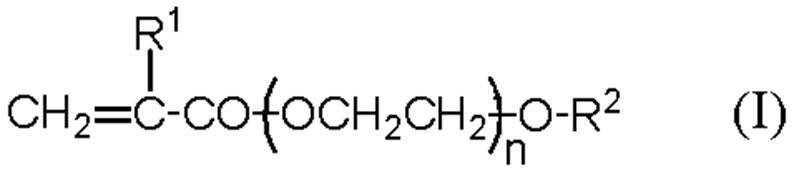
(式中、R1はH又はCH3であり、R2はH又は1価の炭化水素基であり、nは1~50の数である。)
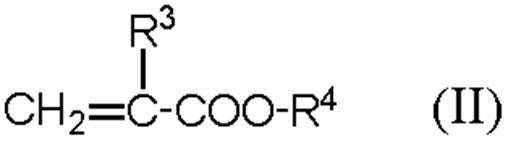
(式中、R3はH又はCH3であり、R4は炭素数4~100のアルキル基である。)
ニトリル基含有単量体としては、特に制限されない。ニトリル基含有単量体としては、例えば、アクリロニトリル及びメタクリロニトリルのようなアクリル系ニトリル基含有単量体、α-シアノアクリレート及びジシアノビニリデンのようなシアン系ニトリル基含有単量体、並びにフマロニトリルのようなフマル系ニトリル基含有単量体が挙げられる。これらの中では、重合のし易さ、コストパフォーマンス、バインダ樹脂組成物を用いて作製される電極の柔軟性及び可撓性等の点で、アクリロニトリルが好ましい。これらのニトリル基含有単量体は、1種を単独で又は2種以上を組み合わせて用いられる。ニトリル基含有単量体としてアクリロニトリルとメタクリロニトリルとを使用する場合、ニトリル基含有単量体の全量に対して、アクリロニトリルを、例えば、5質量%~95質量%含むことが好ましく、50質量%~95質量%含むことがより好ましい。
式(I)で表される単量体としては、特に限定されない。

nは1~50の数、好ましくは2~30の数、より好ましくは2~10の数である。括弧内の構造単位数であるnは、単一の分子については整数値を示すが、複数種の分子の集合体としては平均値である有理数を示す。
R2はH又は1価の炭化水素基であり、例えば、炭素数1~50の炭化水素基であることが好ましく、炭素数1~25の炭化水素基であることがより好ましく、炭素数1~12の炭化水素基であることが更に好ましい。炭化水素基の炭素数が50以下であれば、電解液に対する十分な耐膨潤性を得ることができる傾向にある。ここで、炭化水素基としては、例えば、アルキル基及びフェニル基が好ましい。R2は、特に、炭素数1~12のアルキル基又はフェニル基であることが好ましい。このアルキル基は、直鎖及び分岐鎖のいずれであってもよい。R2がアルキル基又はフェニル基である場合、このアルキル基又はフェニル基は、フッ素原子、塩素原子、臭素原子、ヨウ素原子等のハロゲン原子、窒素原子含有基、リン原子含有基、酸素原子含有基、芳香族基、炭素数3~10のシクロアルキル基などの置換基で置換されていてもよい。なお、R2が置換基を有する場合、R2の炭素数には置換基の炭素数を含めないものとする。
式(II)で表される単量体としては、特に限定されない。
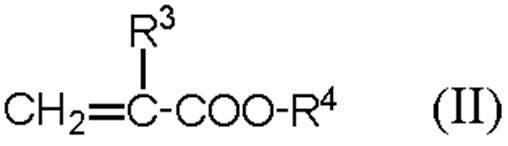
カルボキシ基含有単量体としては、特に制限されない。カルボキシ基含有単量体としては、例えば、アクリル酸及びメタクリル酸のようなアクリル系カルボキシル基含有単量体、クロトン酸のようなクロトン系カルボキシル基含有単量体、マレイン酸及びその無水物のようなマレイン系カルボキシル基含有単量体、イタコン酸及びその無水物のようなイタコン系カルボキシル基含有単量体、シトラコン酸及びその無水物のようなシトラコン系カルボキシル基含有単量体が挙げられる。これらの中でも、重合のし易さ、コストパフォーマンス、バインダ樹脂組成物を用いて作製される電極の柔軟性及び可撓性等の点で、アクリル酸が好ましい。これらのカルボキシ基含有単量体は、1種を単独で又は2種以上を組み合わせて用いられる。
カルボキシ基含有単量体としては、アクリル酸とメタクリル酸とを併用してもよい。カルボキシ基含有単量体としてアクリル酸とメタクリル酸とを併用する場合、カルボキシ基含有単量体の全量に対して、アクリル酸を、例えば、5質量%~95質量%含むことが好ましく、50質量%~95質量%含むことがより好ましい。
ニトリル基を有する樹脂は、ニトリル基を有する構造単位と、カルボキシ基を有する構造単位と、式(I)で表される単量体由来の構造単位及び式(II)で表される単量体由来の構造単位からなる群より選択される少なくとも1つの構造単位との他、これらの構造単位とは異なる他の単量体由来の構造単位を適宜有することもできる。他の単量体としては、特に限定されない。他の単量体としては、メチル(メタ)アクリレート、エチル(メタ)アクリレート、プロピル(メタ)アクリレート等の(メタ)アクリル酸エステル化合物、塩化ビニル、臭化ビニル、塩化ビニリデン等のハロゲン化ビニル化合物、スチレン、α-メチルスチレン、スチレンスルホン酸ナトリウム等のスチレン化合物、マレイミド、N-フェニルマレイミド等のイミド化合物、(メタ)アクリルアミド等のアミド化合物、酢酸ビニル、(メタ)アリルスルホン酸ナトリウム、(メタ)アリルオキシベンゼンスルホン酸ナトリウム、2-アクリルアミド-2-メチルプロパンスルホン酸及びその塩などが挙げられる。なお、「(メタ)アクリルアミド」はアクリルアミド又はメタクリルアミドを意味し、「(メタ)アリル」はアリル又はメタリルを意味する。これらの他の単量体は、1種を単独で又は2種以上を組み合わせて用いることができる。
ニトリル基を有する樹脂が、ニトリル基を有する構造単位と、カルボキシ基を有する構造単位と、式(I)で表される単量体由来の構造単位及び式(II)で表される単量体由来の構造単位からなる群より選択される少なくとも1つの構造単位とを有する場合、ニトリル基を有する構造単位と、カルボキシ基を有する構造単位と、式(I)で表される単量体由来の構造単位及び式(II)で表される単量体由来の構造単位からなる群より選択される少なくとも1つの構造単位とのモル比は、例えば、ニトリル基を有する構造単位1モルに対して、カルボキシ基を有する構造単位が、好ましくは0.01モル~0.2モル、より好ましくは0.02モル~0.1モル、更に好ましくは0.03モル~0.06モルであり、式(I)又は式(II)で表される単量体由来の構造単位の合計が、好ましくは0.001モル~0.2モル、より好ましくは0.003モル~0.05モル、更に好ましくは0.005モル~0.02モルである。カルボキシ基を有する構造単位が0.01モル~0.2モルであり、式(I)又は式(II)で表される単量体由来の構造単位の合計が0.001モル~0.2モルであれば、バインダ樹脂組成物を用いて作製されるリチウムイオン二次電池において、集電体、特に銅箔を用いた集電体との接着性及び電解液に対する耐膨潤性に優れ、電極の柔軟性及び可撓性が良好となる傾向にある。
また、他の単量体を使用する場合、他の単量体由来の構造単位の含有量は、ニトリル基を有する構造単位1モルに対して、好ましくは0.005モル~0.1モル、より好ましくは0.01モル~0.06モル、更に好ましくは0.03モル~0.05モルの割合である。
本実施形態のバインダ樹脂組成物は、有機溶媒を含有する。有機溶媒としては、特に限定されない。有機溶媒としては、エタノール、プロパノール、ブタノール、メチルセロソルブ、ブチルセロソルブ、プロピレングリコールモノメチルエーテル等のアルコール溶剤、アセトン、メチルエチルケトン、メチルイソブチルケトン、シクロヘキサノン等のケトン溶剤、テトラヒドロフラン等のエーテル溶剤、トルエン、キシレン、メシチレン等の芳香族溶剤、ジメチルホルムアミド、ジメチルアセトアミド、N-メチル-2-ピロリドン等の窒素原子含有溶剤、ジメチルスルホキシド等の硫黄原子含有溶剤などが挙げられる。これらの有機溶媒は、1種単独で又は2種以上を組み合わせて用いることができる。有機溶媒は、溶解性の観点から、N-メチル-2-ピロリドンを含むことが好ましい。
バインダ樹脂組成物は、ポリオレフィン粒子の分散安定性に優れ、リチウムイオン二次電池用電極の作製に応用できる。バインダ樹脂組成物を用いて作製されるリチウムイオン二次電池用電極は、電極活物質層の均一性及び密着強度に優れ、且つ、電極の可撓性が高い。更に、上記電極を用いて作製されるリチウムイオン二次電池は、温度が上昇した場合に電池の内部抵抗を上昇させる機能を備え、通常作動時には優れた電池特性を有し、且つ製造工程も簡便である。
本実施形態のリチウムイオン二次電池用電極(以下、単に「本実施形態の電極」という。)は、本実施形態のバインダ樹脂組成物を用いて作製される。本実施形態の電極は、正極及び負極のいずれか一方であっても両方であってもよい。また、本実施形態のリチウムイオン二次電池は、本実施形態の電極を備える。
正極は、後述する絶縁層を介して負極に対向するように設けられ、正極集電体及び正極活物質層を含む。
リチウム含有複合金属酸化物は、リチウムと遷移金属とを含む金属酸化物又は該金属酸化物中の遷移金属の一部が異種元素によって置換された金属酸化物である。ここで、異種元素としては、Na、Mg、Sc、Y、Mn、Fe、Co、Ni、Cu、Zn、Al、Cr、Pb、Sb、V、B等が挙げられ、Mn、Al、Co、Ni、Mg等が好ましい。異種元素は1種でもよく、2種以上でもよい。
また、オリビン型リチウム塩としては、例えば、LiFePO4が挙げられる。
カルコゲン化合物としては、例えば、二硫化チタン及び二硫化モリブデンが挙げられる。
正極活物質は1種を単独で使用でき又は2種以上を併用できる。
なお、上記の電流遮断温度は、電池の25℃における直流抵抗に対して、直流抵抗上昇率が110%以上となる温度とする。
また、放電容量及び放電レート特性の観点から、正極活物質層の厚さは、50μm~150μmであることが好ましく、60μm~120μmであることがより好ましく、70μm~110μmであることが更に好ましい。
負極は、後述する絶縁層を介して正極に対向するように設けられ、負極集電体及び負極活物質層を含む。負極集電体としては、ステンレス鋼、ニッケル、銅等を含むシート、箔などが挙げられる。シート及び箔の平均厚さは、特に限定されないが、例えば、1μm~500μmであることが好ましく、2μm~100μmであることがより好ましく、5μm~50μmであることが更に好ましい。負極活物質層は、負極集電体の厚み方向における一方又は両方の面に形成され、負極活物質を含有し、更に必要に応じて、導電材、増粘剤等を含有していてもよい。
また、炭素材料の中でも特に、サイクル特性及び安全性をより向上できる観点からは、X線広角回折法における炭素六角平面の間隔(d002)が3.5Å~3.95Åである非晶質炭素が好ましい。
負極活物質層は、例えば、負極合剤ペーストを負極集電体表面に塗布し、乾燥し、必要に応じて圧延することにより形成できる。
負極合剤ペーストは、例えば、負極活物質及びバインダ樹脂組成物を、必要に応じて、導電材、増粘剤等とともに分散媒に添加して混合することにより調製できる。分散媒には、例えば、N-メチル-2-ピロリドン(NMP)及び水を使用できる。
絶縁層(以下、セパレータという場合もある。)は、正極と負極との間に介在するように設けられ、正極と負極とを絶縁する。絶縁層には、無機多孔質膜等のイオン透過性を有するものを使用できる。セパレータとしては、リチウムイオン二次電池の分野で常用されるものを使用でき、例えば、樹脂製多孔質シートが挙げられる。樹脂製多孔質シートを構成する樹脂としては、ポリエチレン、ポリプロピレン等のポリオレフィン、ポリアミド、ポリアミドイミドなどが挙げられる。樹脂製多孔質シートには、不織布、織布等も含まれる。これらの中でも、内部に形成される空孔の径が0.05μm~0.15μm程度である多孔質シートが好ましい。このような多孔質シートは、イオン透過性、機械的強度、及び絶縁性を高い水準で兼ね備える傾向がある。また、多孔質シートの平均厚さは、特に制限されないが、0.5μm~30μmであることが好ましく、1μm~20μmであることがより好ましい。
非水電解質としては、例えば、液状非水電解質、ゲル状非水電解質、及び固体状電解質(例えば、高分子固体電解質)が挙げられる。液状非水電解質は、溶質(支持塩)と非水溶媒とを含み、更に必要に応じて各種添加剤を含む。溶質は通常非水溶媒中に溶解する。液状非水電解質は、例えば、絶縁層に含浸される。
また、電池特性をより向上できる観点から、非水溶媒にビニレンカーボネート(VC)を含有することが好ましい。ビニレンカーボネート(VC)を含有する場合の含有率は、非水溶媒全量に対して、0.1質量%~2質量%が好ましく、0.2質量%~1.5質量%がより好ましい。
本実施形態のリチウムイオン二次電池がコイン型電池である場合の構成について説明する。
コイン型電池は、例えば、次のようにして作製できる。まず、正極と負極とをコイン外装缶よりも小さい円形に切断する。正極、絶縁層、及び負極を、この順番に積層した積層体を作製し、その状態でコイン外装缶内に収容し、非水電解質をコイン外装缶内に注液後、コイン外装缶を密封する。これにより、リチウムイオン二次電池が得られる。
ラミネート型のリチウムイオン二次電池は、例えば、次のようにして作製できる。まず、正極と負極とを角形に切断し、それぞれの電極にタブを溶接し正負極端子を作製する。正極、絶縁層、及び負極をこの順番に積層した積層体を作製し、その状態でアルミニウム製のラミネートパック内に収容し、正負極端子をアルミラミネートパックの外に出し密封する。次いで、非水電解質をアルミラミネートパック内に注液し、アルミラミネートパックの開口部を密封する。これにより、リチウムイオン二次電池が得られる。
図1に示すように、本実施形態のリチウムイオン二次電池1は、ニッケルメッキが施されたスチール製で有底円筒状の電池容器6を有している。電池容器6には、帯状の正極板2及び負極板3がセパレータ4を介して断面渦巻状に捲回された電極群5が収容されている。電極群5は、正極板2及び負極板3がポリエチレン製多孔質シートのセパレータ4を介して断面渦巻状に捲回されている。セパレータ4は、例えば、幅が58mm、厚さが30μmに設定される。電極群5の上端面には、一端部を正極板2に固定されたアルミニウム製でリボン状の正極タブ端子が導出されている。正極タブ端子の他端部は、電極群5の上側に配置され正極外部端子となる円盤状の電池蓋の下面に超音波溶接で接合されている。一方、電極群5の下端面には、一端部を負極板3に固定された銅製でリボン状の負極タブ端子が導出されている。負極タブ端子の他端部は、電池容器6の内底部に抵抗溶接で接合されている。したがって、正極タブ端子及び負極タブ端子は、それぞれ電極群5の両端面の互いに反対側に導出されている。なお、電極群5の外周面全周には、図示を省略した絶縁被覆が施されている。電池蓋は、絶縁性の樹脂製ガスケットを介して電池容器6の上部にカシメ固定されている。このため、リチウムイオン二次電池1の内部は密封されている。また、電池容器6内には、図示しない非水電解液が注液されている。
本実施形態のリチウムイオン二次電池は、高い安全性を有し、しかも高出力であり、従来の非水電解質二次電池と同様の用途に好適に使用できる。特に、携帯電話、ノート型パソコン、携帯用情報端末、電子辞書、ゲーム機器等の各種携帯用電子機器類の電源として好適に使用できる。このような用途に利用する場合、充電時に万が一過充電状態になっても、発熱が抑制されるので、電池の高温化、膨れ等が防止される。また、本実施形態のリチウムイオン二次電池は、電力貯蔵用、電気自動車、ハイブリット自動車等の輸送機器用などの用途にも応用可能である。
撹拌機、温度計、冷却管、及び窒素ガス導入管を装備した3リットルのセパラブルフラスコに、精製水1804gを仕込み、窒素ガス通気量200mL/分の条件下で、撹拌しながら74℃まで昇温した後、窒素ガスの通気を止めた。次いで、重合開始剤の過硫酸アンモニウム0.968gを精製水76gに溶かした水溶液を添加し、直ちに、ニトリル基含有単量体のアクリロニトリル183.8g、カルボキシ基含有単量体のアクリル酸9.7g(アクリロニトリル1モルに対して0.039モルの割合)、及び式(I)で表される単量体のメトキシトリエチレングリコールアクリレート(新中村化学工業(株)製、商品名:NKエステルAM-30G)6.5g(アクリロニトリル1モルに対して0.0085モルの割合)の混合液を、反応系の温度を74℃±2℃に保ちながら、2時間かけて滴下した。続いて、懸濁した反応系に、過硫酸アンモニウム0.25gを精製水21.3gに溶かした水溶液を追加添加し、84℃まで昇温した後、反応系の温度を84℃±2℃に保ちながら、2.5時間反応を進めた。その後、1時間かけて40℃まで冷却した後、撹拌を止めて一晩室温(25℃)で放冷し、ニトリル基を有する樹脂が沈殿した反応液を得た。この反応液を吸引濾過し、回収した湿潤状態の沈殿を精製水1800gで3回洗浄した後、80℃で10時間真空乾燥して、ニトリル基を有する樹脂Aを得た。
撹拌機、温度計、及び冷却管を装着した1.0リットルのセパラブルフラスコ内に、窒素雰囲気下、ニトリル基含有単量体のアクリロニトリル(和光純薬工業(株)製)45.0g、式(II)で表される単量体のラウリルアクリレート(Aldrich社製)5.0g(アクリロニトリル1モルに対して0.0232モルの割合)、重合開始剤の過硫酸カリウム(和光純薬工業(株)製)1.175mg、連鎖移動剤のα-メチルスチレンダイマー(和光純薬工業(株)製)135mg、精製水(和光純薬工業(株)製)450mLを加えて反応液を調製した。反応液を激しく撹拌しながら、60℃で3時間反応を進めた後、80℃で3時間反応を進めた。室温(25℃)に冷却後、反応液を吸引濾過し、析出した樹脂を濾別した。濾別した樹脂を精製水(和光純薬工業(株)製)300mL及びアセトン(和光純薬工業(株)製)300mLで順に洗浄した。洗浄した樹脂を60℃、1torr(133Pa)の真空管乾燥機で24時間乾燥して、ニトリル基を有する樹脂Bを得た。
(1)バインダ樹脂組成物の調製
十分に乾燥させた1リットルのナス型フラスコに、ケミパール(登録商標)W310(水分散系ポリエチレン粒子、固形分40質量%、平均粒径9.5μm(三井化学(株)カタログ値)、軟化点132℃(三井化学(株)カタログ値)、三井化学(株)製)45gを仕込み、撹拌しながらN-メチル-2-ピロリドン(有機溶媒、和光純薬工業(株)製、特級)108gを加え、更に5分間撹拌した後、エバポレータを用いて、混合液のポリエチレン粒子の濃度が25質量%になるまで減圧濃縮した。得られた混合液に、合成例1で得られた樹脂A(有機溶媒に可溶なポリマ)をN-メチル-2-ピロリドンに溶解した溶液(樹脂Aの含有率:6質量%)67gを加えて5分間撹拌し、バインダ樹脂組成物(1)を得た。E型粘度計を用いて25℃且つ回転数50回/分の条件で測定されたバインダ樹脂組成物(1)の粘度は、285mPa・sであった。なお、E型粘度計としては、東京計器(株)製、VISCONIC-E型を使用した。
LiMn2O4(正極活物質、三井金属鉱業(株)製)、アセチレンブラック(導電材、商品名:HS-100、平均粒径48nm(電気化学工業(株)カタログ値)、電気化学工業(株)製)、及びバインダ樹脂組成物(1)を、固形分の質量比が、正極活物質:導電材:樹脂A:ポリエチレン粒子=90:4.5:1.0:4.5となるように混合し、N-メチル-2-ピロリドン(溶媒、和光純薬工業(株)製、特級)中に十分に分散させ、正極合剤ペーストを調製した。この正極合剤ペーストを厚さ17μmのアルミニウム箔(正極集電体、三菱アルミニウム(株))の片面に塗布し、60℃で5時間乾燥後、圧延して、厚さ75μm、塗布量200g/m2、合剤密度2.55g/cm3の正極合剤層を形成し、正極Aを作製した。正極Aを120℃に設定した恒温槽で15分間加熱し、正極Bを得た。次いで、正極Aを160℃に設定した恒温槽で15分間加熱し、正極Cを得た。
非晶質炭素(負極活物質)、アセチレンブラック(導電材、商品名:HS-100、平均粒径48nm(電気化学工業(株)カタログ値)、電気化学工業(株)製)、ポリフッ化ビニリデン溶液(結着材、固形分12質量%)とを、固形分の質量比(負極活物質:導電性粒子:結着材)が87.6:4.8:7.6になるように混合し、N-メチル-2-ピロリドン(溶媒、和光純薬工業(株)製、特級)中に十分に分散させ、負極合剤ペーストを調製した。この負極合剤ペーストを厚さ10μmの銅箔(負極集電体)に塗布し、100℃で30分間乾燥後、圧延して、厚さ62μm、塗布量60g/m2、合剤密度0.97g/cm3の負極活物質層を形成し、負極を作製した。
作製した正極A、正極B、及び正極Cを、それぞれ直径14mmの円形に切断し、3種類の評価用正極を得た。作製した負極を直径16mmの円形に切断し、評価用負極を得た。ポリエチレン微多孔膜からなるセパレータ(商品名:ハイポア、旭化成イーマテリアルズ(株)製、直径19mmの円形に切断したもの)を介し、3種類の評価用正極のそれぞれと評価用負極とを活物質層が対向するよう重ね合わせた3種類の積層体を作製した。この3種類の積層体のそれぞれをコイン外装缶(東洋システム(株)製)に入れ、電解液(1MのLiPF6を含むエチレンカーボネート/ジメチルカーボネート=3/7混合溶液(体積比))に対してビニレンカーボネートを0.5モル%添加したもの)を1mL添加後、コイン外装缶を密閉し、3種類の電極評価用電池を作製した。
ポリオレフィン粒子として、ケミパール(登録商標)W308(水分散系ポリエチレン粒子、固形分40質量%、平均粒径6.0μm(三井化学(株)カタログ値)、軟化点132℃(三井化学(株)カタログ値)、三井化学(株)製)を使用した以外は、実験例1と同様にしてバインダ樹脂組成物(2)を調製した。実施例1と同様にして測定されたバインダ樹脂組成物(2)の粘度は、297mPa・sであった。そして、バインダ樹脂組成物(1)の代わりにバインダ樹脂組成物(2)を使用した以外は、実施例1と同様にして3種類の電極評価用電池を作製した。
ポリオレフィン粒子として、ケミパール(登録商標)W410(水分散系ポリエチレン粒子、固形分40質量%、平均粒径9.5μm(三井化学(株)カタログ値)、軟化点110℃(三井化学(株)カタログ値)、三井化学(株)製)を使用した以外は、実験例1と同様にしてバインダ樹脂組成物(3)を調製した。実施例1と同様にして測定されたバインダ樹脂組成物(3)の粘度は、305mPa・sであった。そして、バインダ樹脂組成物(1)の代わりにバインダ樹脂組成物(3)を使用した以外は、実施例1と同様にして3種類の電極評価用電池を作製した。
ポリオレフィン粒子として、ケミパール(登録商標)W408(水分散系ポリオレフィン粒子、固形分40質量%、平均粒径6.0μm(三井化学(株)カタログ値)、軟化点110℃(三井化学(株)カタログ値)、三井化学(株)製)を使用した以外は、実験例1と同様にしてバインダ樹脂組成物(4)を調製した。実施例1と同様にして測定されたバインダ樹脂組成物(4)の粘度は、300mPa・sであった。そして、バインダ樹脂組成物(1)の代わりにバインダ樹脂組成物(4)を使用した以外は、実施例1と同様にして3種類の電極評価用電池を作製した。
ポリオレフィン粒子として、ケミパール(登録商標)W300(水分散系ポリエチレン粒子、固形分40質量%、平均粒径3.0μm(三井化学(株)カタログ値)、軟化点132℃(三井化学(株)カタログ値)、三井化学(株)製)を使用した以外は、実験例1と同様にしてバインダ樹脂組成物(5)を調製した。実施例1と同様にして測定されたバインダ樹脂組成物(5)の粘度は、311mPa・sであった。そして、バインダ樹脂組成物(1)の代わりにバインダ樹脂組成物(5)を使用した以外は、実施例1と同様にして3種類の電極評価用電池を作製した。
有機溶媒に可溶なポリマとして、樹脂Aの代わりに樹脂Bを使用した以外は、実施例3と同様にしてバインダ樹脂組成物(6)を調製した。実施例1と同様にして測定されたバインダ樹脂組成物(6)の粘度は、275mPa・sであった。そして、バインダ樹脂組成物(1)の代わりにバインダ樹脂組成物(6)を使用した以外は、実施例3と同様にして3種類の電極評価用電池を作製した。
有機溶媒に可溶なポリマとして、樹脂Aの代わりにポリフッ化ビニリデンを使用した以外は、実施例3と同様にしてバインダ樹脂組成物(7)を調製した。実施例1と同様にして測定されたバインダ樹脂組成物(7)の粘度は、217mPa・sであった。そして、バインダ樹脂組成物(1)の代わりにバインダ樹脂組成物(7)を使用した以外は、実施例3と同様にして3種類の電極評価用電池を作製した。
十分に乾燥させた1リットルのナス型フラスコに、ケミパール(登録商標)W310(水分散系ポリエチレン粒子、固形分40質量%、平均粒径9.5μm(三井化学(株)カタログ値)、軟化点132℃(三井化学(株)カタログ値)、三井化学(株)製)45gを仕込み、撹拌しながらN-メチル-2-ピロリドン(有機溶媒、和光純薬工業(株)製、特級)108gを加え、更に5分間撹拌した後、エバポレータを用いて、混合液のポリエチレン粒子の濃度が25質量%になるまで減圧濃縮し、バインダ樹脂組成物(8)を得た。実施例1と同様にして測定されたバインダ樹脂組成物(8)の粘度は、15mPa・sであった。そして、バインダ樹脂組成物(1)の代わりにバインダ樹脂組成物(8)を使用した以外は、実施例1と同様にして3種類の電極評価用電池を作製した。
LiMn2O4(正極活物質、三井金属鉱業(株)製)、アセチレンブラック(導電材、商品名:HS-100、平均粒径48nm(電気化学工業(株)カタログ値)、電気化学工業(株)製)、上記合成例1に記載の樹脂A、及び粉末状のポリオレフィン粒子(ケミパール(登録商標)W410を乾燥し粉末状にしたもの)を、固形分の質量比(正極活物質:導電材:樹脂A:ポリエチレン粒子)が90.0:4.5:1.0:4.5になるように混合し、N-メチル-2-ピロリドン(溶媒、和光純薬工業(株)製、特級)中に十分に分散させ、正極合剤ペーストを調製した。そして、この正極合剤ペーストを使用した以外は、実施例3と同様にして3種類の電極評価用電池を作製した。
(1)分散性の評価
実施例1~7及び比較例1で得られたバインダ樹脂組成物を静置し、静置直後、24時間経過後、7日間経過後、14日間経過後、及び28日間経過後の分散状態を観察した。ポリエチレン粒子がバインダ樹脂組成物の全体に分散している状態をA、ポリオレフィン粒子がバインダ樹脂組成物の上層に分離している状態をBとして評価した。なお、比較例2ではバインダ樹脂組成物を調製していないため、分散性の評価を行っていない。
実施例1~7及び比較例1~2で正極Aを使用した電極評価用電池を25℃に設定した恒温槽内に入れ、充放電装置(東洋システム(株)製、商品名:TOSCAT-3200)を用いて25℃で、以下の条件で充放電した。4.2V且つ0.5Cで定電流定電圧(CCCV)充電を行った後、0.5Cで2.7Vまで定電流(CC)放電を行い、放電容量を測定した。次いで、4.2V且つ0.5Cで定電流定電圧(CCCV)充電を行った後、3.0Cで2.7Vまで定電流(CC)放電を行い、下記の式から算出される値を放電レート特性とした。なお、放電電流値を示すCとは“電流値(A)/電池容量(Ah)”を意味する。
放電レート特性(%)=(3Cでの放電容量/0.5Cでの放電容量)×100
実施例1~7及び比較例1~2で正極Aを使用した電極評価用電池を25℃に設定した恒温槽内に入れ、25℃での直流抵抗(DCR)を測定し、これを初期抵抗とした。次に、実施例1~7及び比較例1~2で正極Bを使用した電極評価用電池を25℃に設定した恒温槽内に入れ、25℃での直流抵抗(DCR)を測定し、これを加熱後抵抗とした。初期抵抗及び加熱後抵抗から下記式に従って抵抗上昇率(%)を算出し、120℃でのPTC機能の指標とした。
抵抗上昇率(%)=(加熱後抵抗/初期抵抗)×100
なお、直流抵抗(DCR)は、下記の式より算出した。

実施例1~7及び比較例1~2で正極Cを使用した電極評価用電池を25℃に設定した恒温槽内に入れ、25℃での直流抵抗(DCR)を測定し、これを加熱後抵抗とした以外は、上記(3)120℃でのPTC特性(抵抗上昇率)と同様にして抵抗上昇率(%)を算出し、160℃でのPTC機能の指標とした。

また、正極の作製にバインダ樹脂組成物を用いず、粉末状のポリオレフィン粒子を用いた比較例2の電極評価用電池は、PTC特性に優れていたものの、放電レート特性に劣っていた。
本明細書に記載された全ての文献、特許出願、及び技術規格は、個々の文献、特許出願、及び技術規格が参照により取り込まれることが具体的かつ個々に記された場合と同程度に、本明細書中に参照により取り込まれる。
Claims (8)
- ポリオレフィン粒子と、有機溶媒と、前記有機溶媒に可溶なポリマとを含有するバインダ樹脂組成物。
- 前記ポリオレフィン粒子の平均粒径が0.1μm~30μmである、請求項1に記載のバインダ樹脂組成物。
- 前記ポリオレフィン粒子の含有率が1質量%~60質量%である、請求項1又は請求項2に記載のバインダ樹脂組成物。
- 前記ポリマが、ニトリル基を有する樹脂及びポリフッ化ビニリデンからなる群より選択される少なくとも1種を含む、請求項1~請求項3のいずれか1項に記載のバインダ樹脂組成物。
- 前記有機溶媒がN-メチル-2-ピロリドンを含む、請求項1~請求項4のいずれか1項に記載のバインダ樹脂組成物。
- E型粘度計を用いて25℃且つ回転数50回/分の条件で測定された粘度が100mPa・s~1500mPa・sである、請求項1~請求項5のいずれか1項に記載のバインダ樹脂組成物。
- 請求項1~請求項6のいずれか1項に記載のバインダ樹脂組成物を用いて作製されるリチウムイオン二次電池用電極。
- 請求項7に記載のリチウムイオン二次電池用電極を備えるリチウムイオン二次電池。
Priority Applications (5)
| Application Number | Priority Date | Filing Date | Title |
|---|---|---|---|
| JP2017506188A JP6658733B2 (ja) | 2015-03-18 | 2016-03-01 | バインダ樹脂組成物、リチウムイオン二次電池用電極、及びリチウムイオン二次電池 |
| CN201680015748.6A CN107408700A (zh) | 2015-03-18 | 2016-03-01 | 粘合剂树脂组合物、锂离子二次电池用电极和锂离子二次电池 |
| KR1020177027413A KR101985129B1 (ko) | 2015-03-18 | 2016-03-01 | 결합제 수지 조성물, 리튬 이온 이차 전지용 전극 및 리튬 이온 이차 전지 |
| KR1020197010791A KR20190042111A (ko) | 2015-03-18 | 2016-03-01 | 결합제 수지 조성물, 리튬 이온 이차 전지용 전극 및 리튬 이온 이차 전지 |
| US15/558,305 US10513604B2 (en) | 2015-03-18 | 2016-03-01 | Binder resin composition, electrode for lithium ion secondary battery and lithium ion secondary battery |
Applications Claiming Priority (2)
| Application Number | Priority Date | Filing Date | Title |
|---|---|---|---|
| JP2015-054733 | 2015-03-18 | ||
| JP2015054733 | 2015-03-18 |
Publications (1)
| Publication Number | Publication Date |
|---|---|
| WO2016147857A1 true WO2016147857A1 (ja) | 2016-09-22 |
Family
ID=56918848
Family Applications (1)
| Application Number | Title | Priority Date | Filing Date |
|---|---|---|---|
| PCT/JP2016/056299 Ceased WO2016147857A1 (ja) | 2015-03-18 | 2016-03-01 | バインダ樹脂組成物、リチウムイオン二次電池用電極、及びリチウムイオン二次電池 |
Country Status (6)
| Country | Link |
|---|---|
| US (1) | US10513604B2 (ja) |
| JP (1) | JP6658733B2 (ja) |
| KR (2) | KR101985129B1 (ja) |
| CN (1) | CN107408700A (ja) |
| TW (1) | TW201641562A (ja) |
| WO (1) | WO2016147857A1 (ja) |
Cited By (5)
| Publication number | Priority date | Publication date | Assignee | Title |
|---|---|---|---|---|
| WO2018135667A1 (ja) * | 2017-01-23 | 2018-07-26 | 日立化成株式会社 | エネルギーデバイス用電極及びエネルギーデバイス |
| JP2018120674A (ja) * | 2017-01-23 | 2018-08-02 | 日立化成株式会社 | エネルギーデバイス用電極及びエネルギーデバイス |
| KR20190103451A (ko) * | 2017-02-27 | 2019-09-04 | 히타치가세이가부시끼가이샤 | 에너지 디바이스 전극용 복합 수지, 에너지 디바이스 전극 형성용 조성물, 에너지 디바이스용 정극 및 에너지 디바이스 |
| KR20190112035A (ko) * | 2017-02-27 | 2019-10-02 | 히타치가세이가부시끼가이샤 | 에너지 디바이스 전극용 수지, 에너지 디바이스 전극 형성용 조성물, 에너지 디바이스 전극 및 에너지 디바이스 |
| WO2025033115A1 (ja) * | 2023-08-10 | 2025-02-13 | 株式会社Gsユアサ | 正極用スラリー、正極、正極の製造方法及び電池 |
Families Citing this family (4)
| Publication number | Priority date | Publication date | Assignee | Title |
|---|---|---|---|---|
| CN108352531B (zh) * | 2015-11-19 | 2021-08-31 | 日本瑞翁株式会社 | 锂离子二次电池用电极 |
| CN111613399B (zh) * | 2020-05-29 | 2022-07-22 | 珠海冠宇电池股份有限公司 | 一种ptc材料及其应用 |
| EP4253435A4 (en) * | 2020-11-30 | 2025-04-02 | Zeon Corporation | Binder composition for nonaqueous lithium ion secondary battery electrodes, method for producing same, binder solution for nonaqueous lithium ion secondary battery electrodes, slurry composition for nonaqueous lithium ion secondary battery electrodes, electrode for nonaqueous lithium ion secondary batteries, and nonaqueous lithium ion secondary battery |
| JP7202347B2 (ja) * | 2020-12-14 | 2023-01-11 | プライムプラネットエナジー&ソリューションズ株式会社 | 電極シートの製造方法 |
Citations (3)
| Publication number | Priority date | Publication date | Assignee | Title |
|---|---|---|---|---|
| JP2002313318A (ja) * | 2001-04-11 | 2002-10-25 | Matsushita Electric Ind Co Ltd | リチウム二次電池 |
| JP2009004360A (ja) * | 2007-05-21 | 2009-01-08 | Panasonic Corp | リチウムイオン二次電池およびその製造方法 |
| JP2015050084A (ja) * | 2013-09-03 | 2015-03-16 | 株式会社Gsユアサ | 非水電解質二次電池および非水電解質二次電池の製造方法 |
Family Cites Families (12)
| Publication number | Priority date | Publication date | Assignee | Title |
|---|---|---|---|---|
| JP3677975B2 (ja) | 1996-12-26 | 2005-08-03 | 三菱電機株式会社 | 電極及びこれを用いた電池 |
| WO1999067837A1 (fr) * | 1998-06-25 | 1999-12-29 | Mitsubishi Denki Kabushiki Kaisha | Electrode, procede de production de cette electrode et cellule renfermant l'electrode |
| MXPA01001907A (es) * | 1998-08-21 | 2003-05-15 | Stanford Res Inst Int | Impresion de circuitos y componentes electronicos. |
| CN100431216C (zh) * | 2004-05-14 | 2008-11-05 | 松下电器产业株式会社 | 锂离子二次电池 |
| KR100914109B1 (ko) * | 2004-05-14 | 2009-08-27 | 파나소닉 주식회사 | 리튬이온 2차전지 |
| CN100589273C (zh) * | 2005-03-23 | 2010-02-10 | 日立麦克赛尔株式会社 | 非水电解质电池及其制造方法 |
| US8293405B2 (en) * | 2007-05-21 | 2012-10-23 | Panasonic Corporation | Rechargeable lithium ion battery and method for producing the same |
| JP2009176599A (ja) | 2008-01-25 | 2009-08-06 | Panasonic Corp | 非水電解質二次電池 |
| JP2010092719A (ja) * | 2008-10-08 | 2010-04-22 | Hitachi Chem Co Ltd | 非水電解液系エネルギーデバイス電極用接着添加剤、これを用いた非水電解液系エネルギーデバイス電極用バインダ樹脂組成物、これを用いた非水電解液系エネルギーデバイス電極、及び非水電解液系エネルギーデバイス |
| JP5978837B2 (ja) | 2012-07-31 | 2016-08-24 | 日本ゼオン株式会社 | リチウムイオン二次電池電極用のスラリー組成物、リチウムイオン二次電池用電極及びリチウムイオン二次電池 |
| CN104685681A (zh) * | 2012-09-28 | 2015-06-03 | 古河电气工业株式会社 | 集电体,电极结构体,非水电解质电池,导电性填料及蓄电部件 |
| US10763509B2 (en) * | 2015-02-10 | 2020-09-01 | Hitachi Chemical Company, Ltd. | Positive electrode for lithium ion secondary battery, electrode for lithium ion secondary battery, electrode active material layer including polyolefin particles, and lithium ion secondary battery |
-
2016
- 2016-03-01 KR KR1020177027413A patent/KR101985129B1/ko not_active Expired - Fee Related
- 2016-03-01 CN CN201680015748.6A patent/CN107408700A/zh active Pending
- 2016-03-01 WO PCT/JP2016/056299 patent/WO2016147857A1/ja not_active Ceased
- 2016-03-01 US US15/558,305 patent/US10513604B2/en not_active Expired - Fee Related
- 2016-03-01 KR KR1020197010791A patent/KR20190042111A/ko not_active Ceased
- 2016-03-01 JP JP2017506188A patent/JP6658733B2/ja not_active Expired - Fee Related
- 2016-03-07 TW TW105106917A patent/TW201641562A/zh unknown
Patent Citations (3)
| Publication number | Priority date | Publication date | Assignee | Title |
|---|---|---|---|---|
| JP2002313318A (ja) * | 2001-04-11 | 2002-10-25 | Matsushita Electric Ind Co Ltd | リチウム二次電池 |
| JP2009004360A (ja) * | 2007-05-21 | 2009-01-08 | Panasonic Corp | リチウムイオン二次電池およびその製造方法 |
| JP2015050084A (ja) * | 2013-09-03 | 2015-03-16 | 株式会社Gsユアサ | 非水電解質二次電池および非水電解質二次電池の製造方法 |
Cited By (14)
| Publication number | Priority date | Publication date | Assignee | Title |
|---|---|---|---|---|
| WO2018135667A1 (ja) * | 2017-01-23 | 2018-07-26 | 日立化成株式会社 | エネルギーデバイス用電極及びエネルギーデバイス |
| JP2018120674A (ja) * | 2017-01-23 | 2018-08-02 | 日立化成株式会社 | エネルギーデバイス用電極及びエネルギーデバイス |
| CN110199409A (zh) * | 2017-01-23 | 2019-09-03 | 日立化成株式会社 | 能量装置用电极和能量装置 |
| JP7091602B2 (ja) | 2017-01-23 | 2022-06-28 | 昭和電工マテリアルズ株式会社 | エネルギーデバイス用電極及びエネルギーデバイス |
| JPWO2018135667A1 (ja) * | 2017-01-23 | 2019-11-07 | 日立化成株式会社 | エネルギーデバイス用電極及びエネルギーデバイス |
| CN110326138A (zh) * | 2017-02-27 | 2019-10-11 | 日立化成株式会社 | 能量装置电极用树脂、能量装置电极形成用组合物、能量装置电极以及能量装置 |
| CN110326139A (zh) * | 2017-02-27 | 2019-10-11 | 日立化成株式会社 | 能量装置电极用树脂、能量装置电极形成用组合物、能量装置电极以及能量装置 |
| CN110326140A (zh) * | 2017-02-27 | 2019-10-11 | 日立化成株式会社 | 能量装置电极用复合树脂、能量装置电极形成用组合物、能量装置用正极以及能量装置 |
| KR20190112035A (ko) * | 2017-02-27 | 2019-10-02 | 히타치가세이가부시끼가이샤 | 에너지 디바이스 전극용 수지, 에너지 디바이스 전극 형성용 조성물, 에너지 디바이스 전극 및 에너지 디바이스 |
| KR102340089B1 (ko) * | 2017-02-27 | 2021-12-15 | 쇼와덴코머티리얼즈가부시끼가이샤 | 에너지 디바이스 전극용 수지, 에너지 디바이스 전극 형성용 조성물, 에너지 디바이스 전극 및 에너지 디바이스 |
| KR102381115B1 (ko) * | 2017-02-27 | 2022-03-30 | 쇼와덴코머티리얼즈가부시끼가이샤 | 에너지 디바이스 전극용 복합 수지, 에너지 디바이스 전극 형성용 조성물, 에너지 디바이스용 정극 및 에너지 디바이스 |
| KR20190103451A (ko) * | 2017-02-27 | 2019-09-04 | 히타치가세이가부시끼가이샤 | 에너지 디바이스 전극용 복합 수지, 에너지 디바이스 전극 형성용 조성물, 에너지 디바이스용 정극 및 에너지 디바이스 |
| US11482706B2 (en) | 2017-02-27 | 2022-10-25 | Showa Denko Materials Co., Ltd. | Resin for energy device electrode, composition for forming energy device electrode, energy device electrode, and energy device |
| WO2025033115A1 (ja) * | 2023-08-10 | 2025-02-13 | 株式会社Gsユアサ | 正極用スラリー、正極、正極の製造方法及び電池 |
Also Published As
| Publication number | Publication date |
|---|---|
| US20180057678A1 (en) | 2018-03-01 |
| TW201641562A (zh) | 2016-12-01 |
| KR101985129B1 (ko) | 2019-05-31 |
| KR20170122243A (ko) | 2017-11-03 |
| CN107408700A (zh) | 2017-11-28 |
| US10513604B2 (en) | 2019-12-24 |
| KR20190042111A (ko) | 2019-04-23 |
| JP6658733B2 (ja) | 2020-03-04 |
| JPWO2016147857A1 (ja) | 2017-11-24 |
Similar Documents
| Publication | Publication Date | Title |
|---|---|---|
| JP6406363B2 (ja) | リチウムイオン二次電池用正極、リチウムイオン二次電池用電極、及びリチウムイオン二次電池 | |
| JP6658733B2 (ja) | バインダ樹脂組成物、リチウムイオン二次電池用電極、及びリチウムイオン二次電池 | |
| WO2016093095A1 (ja) | リチウムイオン二次電池用正極及びそれを用いたリチウムイオン二次電池 | |
| JP2013143380A (ja) | リチウム電池用の正極素材、それから得られる正極、及び該正極を採用したリチウム電池 | |
| US20210167393A1 (en) | Lithium ion secondary battery | |
| JP6904413B2 (ja) | エネルギーデバイス電極用樹脂、エネルギーデバイス電極形成用組成物、エネルギーデバイス電極及びエネルギーデバイス | |
| TW201841414A (zh) | 能源裝置用電極及能源裝置 | |
| WO2014119249A1 (ja) | 非水電解質二次電池用正極及び非水電解質二次電池 | |
| JP6536701B2 (ja) | バインダ樹脂組成物、バインダ樹脂組成物の製造方法、リチウムイオン二次電池電極形成用組成物、リチウムイオン二次電池電極形成用組成物の製造方法、リチウムイオン二次電池用電極、及びリチウムイオン二次電池 | |
| JP2017016950A (ja) | リチウムイオン二次電池 | |
| JP6699087B2 (ja) | リチウムイオン二次電池用正極およびその製造方法、並びにリチウムイオン二次電池 | |
| JP7091602B2 (ja) | エネルギーデバイス用電極及びエネルギーデバイス | |
| JP2026040446A (ja) | リチウム二次電池用バインダー、これを含む電極、およびこれを含むリチウム二次電池 | |
| JP2026040445A (ja) | リチウム二次電池用バインダー、これを含む電極、およびこれを含むリチウム二次電池 | |
| JP2018067400A (ja) | 組成物、下地層付き集電体、リチウムイオン二次電池用電極及びリチウムイオン二次電池 |
Legal Events
| Date | Code | Title | Description |
|---|---|---|---|
| 121 | Ep: the epo has been informed by wipo that ep was designated in this application |
Ref document number: 16764687 Country of ref document: EP Kind code of ref document: A1 |
|
| ENP | Entry into the national phase |
Ref document number: 2017506188 Country of ref document: JP Kind code of ref document: A |
|
| WWE | Wipo information: entry into national phase |
Ref document number: 15558305 Country of ref document: US |
|
| NENP | Non-entry into the national phase |
Ref country code: DE |
|
| ENP | Entry into the national phase |
Ref document number: 20177027413 Country of ref document: KR Kind code of ref document: A |
|
| 122 | Ep: pct application non-entry in european phase |
Ref document number: 16764687 Country of ref document: EP Kind code of ref document: A1 |