WO2013128697A1 - 耐擦傷性樹脂積層体、ディスプレイのフロントカバー材及び画像表示装置 - Google Patents
耐擦傷性樹脂積層体、ディスプレイのフロントカバー材及び画像表示装置 Download PDFInfo
- Publication number
- WO2013128697A1 WO2013128697A1 PCT/JP2012/075181 JP2012075181W WO2013128697A1 WO 2013128697 A1 WO2013128697 A1 WO 2013128697A1 JP 2012075181 W JP2012075181 W JP 2012075181W WO 2013128697 A1 WO2013128697 A1 WO 2013128697A1
- Authority
- WO
- WIPO (PCT)
- Prior art keywords
- resin
- resin layer
- scratch
- acrylic
- curable
- Prior art date
- Legal status (The legal status is an assumption and is not a legal conclusion. Google has not performed a legal analysis and makes no representation as to the accuracy of the status listed.)
- Ceased
Links
Images

Classifications
-
- C—CHEMISTRY; METALLURGY
- C09—DYES; PAINTS; POLISHES; NATURAL RESINS; ADHESIVES; COMPOSITIONS NOT OTHERWISE PROVIDED FOR; APPLICATIONS OF MATERIALS NOT OTHERWISE PROVIDED FOR
- C09D—COATING COMPOSITIONS, e.g. PAINTS, VARNISHES OR LACQUERS; FILLING PASTES; CHEMICAL PAINT OR INK REMOVERS; INKS; CORRECTING FLUIDS; WOODSTAINS; PASTES OR SOLIDS FOR COLOURING OR PRINTING; USE OF MATERIALS THEREFOR
- C09D133/00—Coating compositions based on homopolymers or copolymers of compounds having one or more unsaturated aliphatic radicals, each having only one carbon-to-carbon double bond, and at least one being terminated by only one carboxyl radical, or of salts, anhydrides, esters, amides, imides, or nitriles thereof; Coating compositions based on derivatives of such polymers
-
- B—PERFORMING OPERATIONS; TRANSPORTING
- B32—LAYERED PRODUCTS
- B32B—LAYERED PRODUCTS, i.e. PRODUCTS BUILT-UP OF STRATA OF FLAT OR NON-FLAT, e.g. CELLULAR OR HONEYCOMB, FORM
- B32B27/00—Layered products comprising a layer of synthetic resin
- B32B27/06—Layered products comprising a layer of synthetic resin as the main or only constituent of a layer, which is next to another layer of the same or of a different material
- B32B27/08—Layered products comprising a layer of synthetic resin as the main or only constituent of a layer, which is next to another layer of the same or of a different material of synthetic resin
-
- B—PERFORMING OPERATIONS; TRANSPORTING
- B32—LAYERED PRODUCTS
- B32B—LAYERED PRODUCTS, i.e. PRODUCTS BUILT-UP OF STRATA OF FLAT OR NON-FLAT, e.g. CELLULAR OR HONEYCOMB, FORM
- B32B27/00—Layered products comprising a layer of synthetic resin
- B32B27/36—Layered products comprising a layer of synthetic resin comprising polyesters
- B32B27/365—Layered products comprising a layer of synthetic resin comprising polyesters comprising polycarbonates
-
- B—PERFORMING OPERATIONS; TRANSPORTING
- B32—LAYERED PRODUCTS
- B32B—LAYERED PRODUCTS, i.e. PRODUCTS BUILT-UP OF STRATA OF FLAT OR NON-FLAT, e.g. CELLULAR OR HONEYCOMB, FORM
- B32B7/00—Layered products characterised by the relation between layers; Layered products characterised by the relative orientation of features between layers, or by the relative values of a measurable parameter between layers, i.e. products comprising layers having different physical, chemical or physicochemical properties; Layered products characterised by the interconnection of layers
- B32B7/02—Physical, chemical or physicochemical properties
- B32B7/022—Mechanical properties
-
- G02B1/105—
-
- G—PHYSICS
- G02—OPTICS
- G02B—OPTICAL ELEMENTS, SYSTEMS OR APPARATUS
- G02B1/00—Optical elements characterised by the material of which they are made; Optical coatings for optical elements
- G02B1/10—Optical coatings produced by application to, or surface treatment of, optical elements
- G02B1/14—Protective coatings, e.g. hard coatings
-
- B—PERFORMING OPERATIONS; TRANSPORTING
- B32—LAYERED PRODUCTS
- B32B—LAYERED PRODUCTS, i.e. PRODUCTS BUILT-UP OF STRATA OF FLAT OR NON-FLAT, e.g. CELLULAR OR HONEYCOMB, FORM
- B32B2457/00—Electrical equipment
- B32B2457/20—Displays, e.g. liquid crystal displays, plasma displays
Definitions
- the present invention is a surface protection panel used by being arranged on the front side (viewing side) of an image display device.
- the present invention relates to a conductive resin laminate.
- glass has been widely used from the viewpoint of hardness, heat resistance, and transparency in the fields of display covers for electronic devices.
- glass is easily broken by impact and the weight of the glass itself is heavy, an alternative to plastic is being studied.
- acrylic resins are widely used because of their high transparency and excellent surface hardness.
- acrylic resins are very brittle, the processing method is generally performed by cutting, and it cannot be said that the productivity is high.
- an acrylic resin when it comes into contact with a hard material such as steel wool, there is a problem that the matrix resin portion has a low scratch resistance and is easily damaged.
- Patent Document 1 an acrylic resin layer mainly composed of an acrylic resin having a thickness of 10 to 40 ⁇ m is laminated on both surfaces or one surface of a resin sheet composed of a resin material mainly composed of a polycarbonate resin,
- a polycarbonate resin laminated sheet for punching which has a total thickness of 0.2 to 2.0 mm by laminating a hard coat layer on an acrylic resin layer.
- Such a resin laminated sheet has the properties of high productivity and excellent scratch resistance by having excellent punching processability.
- the thickness of the layer containing the acrylic resin which comprises the laminated body containing polycarbonate resin, and the total thickness of this laminated body are controlled to a specific range, and also on the layer containing an acrylic resin, or the layer containing an acrylic resin
- a laminate including a polycarbonate resin suitable for a liquid crystal display cover having a balanced surface hardness, particularly pencil hardness, and impact resistance has been proposed by performing a hard coat treatment on a substrate including a polycarbonate resin.
- a method of laminating a hard coat layer composed of an ultraviolet curable resin or the like with a predetermined thickness is generally used.
- surface hardness such as scratch resistance and abrasion resistance is improved by the laminated scratch-resistant resin layer.
- Patent Document 3 a scratch-resistant resin layer having a thickness of 1 to 5 ⁇ m is laminated on a substrate composed of an acrylic resin as a thermoplastic matrix resin containing a hard dispersed phase. Resin laminates have been proposed. This scratch-resistant resin laminate has the property that even if the base material composed of an acrylic resin is different from the resin material, warping, undulation, peeling, etc. do not occur with the curing and shrinkage of the resin. .
- the scratch-resistant resin disclosed in Patent Document 3 has a configuration in which a thermoplastic resin, which is a matrix resin, includes a hard resin obtained by radical polymerization as a dispersed phase. This disperse phase improves the scratch resistance of the resin molded body, but there is still room for improvement from the viewpoint of surface hardness such as pencil hardness.
- an object of the present invention is to provide a scratch-resistant resin laminate having a scratch-resistant function as a high surface hardness while solving the problems of warping and waviness.
- the present invention comprises a structure in which a curable resin layer (B) containing an organic / inorganic hybrid hard coating agent is laminated on both sides or one side of an acrylic resin layer (A) containing an acrylic resin as a main component.
- a characteristic scratch-resistant resin laminate is proposed.
- the present invention also provides an organic / inorganic hybrid system on at least one surface of a resin laminate in which an acrylic resin layer (A) containing an acrylic resin as a main component is laminated on both surfaces or one surface of a resin substrate (C). Proposed is a scratch-resistant resin laminate comprising a structure in which a curable resin layer (B) containing a hard coating agent is laminated.
- the scratch-resistant resin laminate proposed by the present invention comprises a curable resin layer (B) containing an organic / inorganic hybrid hard coating agent, thereby eliminating the problems of warpage and undulation, and having a high surface hardness. It can have a scratch resistance function. More preferably, in the resin laminate having a specific configuration, by applying a curable resin layer (B) containing an organic / inorganic hybrid hard coating agent, a higher surface is provided while providing excellent punching workability. It can have a high scratch resistance function. Therefore, the scratch-resistant resin laminate can be suitably used as a front cover material for liquid crystal displays, particularly as a front cover material for mobile phones or liquid crystal pen tablets having a touch panel function.
- the present resin laminate a scratch-resistant resin laminate as an example of an embodiment of the present invention will be described.
- the present invention is not limited to this resin laminate.
- This resin laminate has a configuration in which a curable resin layer (B) containing an organic / inorganic hybrid hard coating agent is laminated on both sides or one side of an acrylic resin layer (A) containing an acrylic resin as a main component. . More preferably, the present resin laminate has at least one surface on a resin laminate in which an acrylic resin layer (A) containing an acrylic resin as a main component is laminated on both sides or one side of the resin base material (C). And a curable resin layer (B) containing an organic / inorganic hybrid hard coating agent.
- the acrylic resin layer (A) is a layer containing an acrylic resin as a main component.
- the monomer constituting the acrylic resin include methyl methacrylate, methacrylic acid, acrylic acid, benzyl (meth) acrylate, n-butyl (meth) acrylate, i-butyl (meth) acrylate, t-butyl ( (Meth) acrylate, 2-ethylhexyl (meth) acrylate, lauryl (meth) acrylate, tridecyl (meth) acrylate, stearyl (meth) acrylate, glycidyl (meth) acrylate, hydroxypropyl (meth) acrylate, 2-methoxyethyl (meth) Acrylate, 2-ethoxyethyl (meth) acrylate, cyclohexyl (meth) acrylate, isobornyl (meth) acrylate
- the acrylic resin layer (A) is preferably composed of a hard resin layer (a) having a pencil hardness of 3H or more. By forming the acrylic resin layer (A) with such a high surface hardness, it is possible to obtain advantages such as imparting extremely high surface hardness to the resin laminate.
- the pencil hardness of the acrylic resin layer (A) is more preferably 4H or more, and further preferably 5H or more.
- the acrylic resin layer (A) is composed of a hard resin layer (a) containing and dispersed in the acrylic resin a hard dispersed phase material that has better heat resistance or scratch resistance than the acrylic resin.
- the method of forming is mentioned.
- thermosetting resins examples include thermosetting resins. Specifically, polycondensation such as phenol resin, amino resin, epoxy resin, silicone resin, thermosetting polyimide resin, and thermosetting polyurethane resin.
- addition polymerization resins such as thermosetting acrylic resins, vinyl ester resins, unsaturated polyester resins, diallyl phthalate resins, and the like can be given. However, it is not limited to these. You may use a thermosetting resin individually or in combination of 2 or more types. Moreover, you may use combining these thermoplastic resins and the thermoplastic resin which has an unsaturated bond which can be bridge
- Examples of the shape of the hard dispersed phase include particles, spheres, lines, fibers, and the like. From the viewpoint of being easily dispersed evenly in the acrylic resin that is a thermoplastic matrix resin, a sphere is preferable. However, it is not limited to this.
- the particle size of the hard dispersed phase is appropriately set according to the purpose and application of the present resin laminate, but is preferably 0.1 to 1000 ⁇ m.
- the blending amount of the hard dispersed phase in the acrylic resin layer (A) is appropriately set depending on the purpose and application of the resin laminate, but is preferably 0.1 to 60% by weight.
- thermosetting resin material constituting a hard dispersed phase is added to the acrylic resin material.
- a hard dispersed phase can be formed by causing phase separation and crosslinking.
- the thermosetting resin may be molded into a particulate form in advance, added to the acrylic resin, and kneaded and molded at a temperature at which the thermosetting resin does not dissolve.
- the thickness of the acrylic resin layer (A) is preferably 40 ⁇ m or more.
- the thickness of the acrylic resin layer (A) is 40 ⁇ m or more, there is no possibility that the effect of improving the scratch resistance due to the contribution of the acrylic resin layer cannot be obtained.
- the thickness of the acrylic resin layer (A) is more preferably 50 ⁇ m or more.
- the thickness of the acrylic resin layer (A) is preferably 200 ⁇ m or less, and more preferably 100 ⁇ m or less.
- This resin laminated body has a curable resin layer (B).
- the curable resin layer (B) includes an organic / inorganic hybrid hard coating agent, and is a layer that plays a role of imparting high scratch resistance to the resin laminate without causing warpage or undulation.
- the curable resin layer (B) can be formed, for example, by laminating it as a coating film on another layer using a paint containing an organic / inorganic hybrid hard coating agent. However, it is not limited to this method. A known method is used as a method of laminating with other layers.
- laminating method using cover film, dip coating method, natural coating method, reverse coating method, comma coater method, roll coating method, spin coating method, wire bar method, extrusion method, curtain coating method, spray coating method, The gravure coat method etc. are mentioned.
- a method of laminating the curable resin layer (B) on another layer using a transfer sheet in which the curable resin layer (B) is bonded to the release layer may be employed.
- organic / inorganic hybrid coating agent examples include those composed of a curable resin composition containing an inorganic component having a reactive functional group.
- Such an organic / inorganic hybrid coating agent utilizes an inorganic component having a reactive functional group.
- the inorganic component is copolymerized and crosslinked with a radical polymerizable monomer, whereby an inorganic component is added to the organic binder.
- curing shrinkage hardly occurs and high scratch resistance can be exhibited.
- an organic / inorganic hybrid coating agent containing ultraviolet-reactive silica as an inorganic component having a reactive functional group can be mentioned. More preferable examples include organic / inorganic hybrid coating agents containing ultraviolet-reactive colloidal silica. Moreover, polyfunctional (meth) acrylate is mentioned as a radically polymerizable monomer.
- bifunctional (meth) acrylate ethylene oxide-modified diacrylate, 1,4-butanediol di (meth) acrylate, 1,6-hexanediol di (meth) acrylate, 1,9-nonanediol di ( (Meth) acrylate, bisphenol A ethylene oxide modified diacrylate, dimethylol-tricyclodecane di (meth) acrylate, tripropylene glycol di (meth) acrylate, neopentyl glycol di (meth) acrylate, epoxy (meth) diacrylate, urethane ( And (meth) diacrylate.
- trifunctional or higher polyfunctional (meth) acrylates include pentaerythritol hexaacrylate, ditrimethylolpropane tetraacrylate, pentaerythritol ethoxytetraacrylate, trimethylolpropane tri (meth) acrylate, and trimethylolpropane triethoxy (meth).
- examples include acrylate, urethane tri (meth) acrylate, urethane tetra (meth) acrylate, urethane hexa (meth) acrylate, polyester tetra (meth) acrylate, and polyester hexa (meth) acrylate.
- monofunctional (meth) acrylates can be added as appropriate for the purpose of adjusting the cure shrinkage and viscosity and improving the solubility of a small amount of additives in the hard coat.
- Monofunctional (meth) acrylates include methyl (meth) acrylate, ethyl (meth) acrylate, tert-butyl (meth) acrylate, isobornyl (meth) acrylate, octyl (meth) acrylate, isodecyl (meth) acrylate, methoxypolyethylene (Meth) acrylate, cyclohexyl (meth) acrylate, tetrahydrofurfuryl (meth) acrylate, phenoxyethyl (meth) acrylate, etc. are mentioned.
- the content of the inorganic component having a reactive functional group in the organic / inorganic hybrid coating agent is preferably 5% by mass or more and less than 65% by mass for reasons such as surface hardness, transparency, and punchability.
- the content is more preferably 10% by weight or more and less than 50% by weight, and most preferably 15% by weight or more and less than 50% by weight.
- a curable resin layer (B) contains a leveling agent as a surface adjustment component.
- the leveling agent include silicone leveling agents and acrylic leveling agents.
- those having a reactive functional group at the terminal are preferable, and those having a reactive functional group having two or more functionalities are more preferable. preferable.
- polyether-modified polydimethylsiloxane having an acrylic group having double bonds at both ends for example, “BYK-UV 3500” and “BYK-UV 3530” manufactured by Big Chemie Japan Co., Ltd.
- polyester-modified polydimethylsiloxane having an acrylic group having two double bonds at the end (“BYK-UV 3570” manufactured by BYK Japan).
- polyester-modified polydimethylsiloxane having an acrylic group that has a stable haze value and contributes to improvement of scratch resistance is particularly preferable.
- the curable resin layer (B) preferably contains a lubricant.
- the lubricant include silicon compounds, fluorine compounds, and mixed compounds thereof. By adding these, slipperiness can be improved.
- the curable resin layer (B) may contain, for example, an ultraviolet absorber, a light stabilizer, an antioxidant, and an antistatic agent as necessary.
- the thickness of the curable resin layer (B) is preferably in the range of 5 to 15 ⁇ m. When the thickness is 5 ⁇ m or more, the effect of improving the scratch resistance by the curable resin layer (B) is sufficiently obtained. On the other hand, when the thickness is 15 ⁇ m or less, the ultraviolet curing that constitutes the curable resin layer (B). There is no risk of warping, undulation, peeling or the like accompanying the curing / shrinking of the functional resin. Furthermore, there is no possibility that the transparency is remarkably impaired by the ultraviolet curable resin layer.
- the present resin laminate can achieve high hardness even with a thin resin laminate due to the synergistic effect of the acrylic resin layer (A) containing the hard dispersed phase and the curable resin layer (B).
- the thickness of the acrylic resin layer (A) is 200 ⁇ m, which is the upper limit of the above preferred range, and the thickness of the curable resin layer (B) is less than 5 ⁇ m, High hardness cannot be achieved.
- the thickness of the acrylic resin layer (A) is 40 ⁇ m, which is the lower limit of the above preferred range, and the thickness of the curable resin layer (B) exceeds 15 ⁇ m, There is a risk of warping and swell.
- the thickness of the acrylic resin layer (A) is 50 ⁇ m or more and 200 ⁇ m or less as a lamination ratio, and the curable resin layer (B). It is particularly preferable that the thickness of the film is 5 to 15 ⁇ m.
- the curable resin layer shrinks upon curing, and may cause curling when laminated with other layers. Since the shrinkage ratio of the curable resin layer tends to be proportional to the thickness of the curable resin layer, it is not practical from the viewpoint of curling to achieve high hardness only by the thickness of the curable resin layer.
- the curl accompanying the curing shrinkage of the resin laminate is preferably 3 mm or less, and more preferably 2 mm or less.
- a resin base material (C) is a layer which plays the role which provides punching workability to this resin laminated body.
- the resin substrate (C) includes polycarbonate (PC) resin, triacetyl cellulose (TAC) resin, polyethylene terephthalate (PET) resin, polymethyl methacrylate (PMMA) resin, methyl methacrylate-styrene copolymer (MS) resin, polysulfone resin, norbornene resin and cycloolefin resin are preferably formed from a resin composition containing at least one of them.
- a resin base material (C) is comprised from transparent resin.
- the resin base material (C) is particularly preferably formed from a polycarbonate resin in view of transparency, impact resistance, heat resistance and the like.
- the polycarbonate resin can be obtained, for example, by an interfacial polymerization method in which an aromatic dihydroxy compound or a small amount of a polyhydroxy compound is reacted with phosgene.
- the aromatic dihydroxy compound include bisphenol A synthesized from bisphenol and acetone.
- other bisphenol A can be produced by a transesterification method, a pyridine method or the like using a raw material as a raw material.
- polyester carbonates obtained by copolymerization of bisphenol A and dicarboxylic acid derivatives such as tere (iso) phthalic acid dichloride, bisphenol A derivatives such as those obtained by polymerization of tetramethylbisphenol A and the like. can do.
- the molecular weight of the polycarbonate-based resin is preferably a molecular weight that can produce a sheet by ordinary extrusion molding.
- the viscosity average molecular weight is 15000 to 40000, preferably 20000 to 35000, and more preferably 22000 to 30000. It is. If the molecular weight is smaller than this, the impact strength of the sheet obtained from the composition is lowered, which is not preferable. On the other hand, if the molecular weight is larger than this, the fluidity is lowered and the extrusion moldability may be deteriorated.
- the resin laminate needs to have an acrylic resin layer (A) and a curable resin layer (B) containing an organic / inorganic hybrid coating agent. Further preferably, a resin base material (C) is further provided. More specifically, (B) / (A), (B) / (A) / (B), (B) / (A) / (C), (B) / (A) / (C) / (B), (B) / (C) / (A) / (B), (B) / (A) / (C) / (A) and (B) / (A) / (C) / (A ) / (B).
- FIG. 1 illustrates the configuration of an embodiment of the present resin laminate.
- the resin laminate 12 has an acrylic resin layer 13 laminated on one side of the resin base material 12.
- a scratch-resistant resin laminate 15 having a configuration in which a curable resin layer 14 is laminated on one side is illustrated.
- the synergistic effect of the acrylic resin layer 13 and the curable resin layer 14 has an advantage that high surface hardness can be exhibited even when the thickness of the curable resin layer is as thin as 5 to 15 ⁇ m.
- FIG. 1B the scratch-resistant resin laminate 11 having a structure in which a curable resin layer 14 is laminated on both surfaces of a resin laminate in which an acrylic resin layer 13 is laminated on one surface of a resin substrate 12 is shown.
- the method for producing the resin laminate is not particularly limited, and a known method can be adopted.
- the apparatus for producing the resin laminate is constituted by, for example, one main extruder that extrudes a polycarbonate resin and a sub-extruder that extrudes an acrylic resin that constitutes an acrylic resin layer.
- the sub-extruder is smaller than the main extruder.
- the temperature condition of the main extruder is usually 230 to 290 ° C, preferably 240 to 280 ° C, and the temperature condition of the sub-extruder is usually 220 to 270 ° C, preferably 230 to 260 ° C.
- a known method such as a feed block method or a multi-manifold method can be used.
- the molten resin laminated in the feed block is guided to a sheet forming die such as a T die, and after being formed into a sheet shape, flows into a forming roll (metal elastic roll or polishing roll) whose surface is mirror-finished.
- a forming roll metal elastic roll or polishing roll
- the sheet-like molded product is mirror-finished and cooled while passing through the molding roll, thereby forming a laminate.
- the molten resin laminated in the die is similarly formed into a sheet inside the die, and then surface-finished and cooled by a forming roll to form a laminated body.
- the temperature of the die is usually 210 to 300 ° C., preferably 230 to 280 ° C.
- the molding roll temperature is usually 100 to 190 ° C., preferably 110 to 180 ° C.
- a vertical roll or a horizontal roll can be appropriately used.
- This resin laminate is useful as a front cover material for a surface protection panel used by being arranged on the front side (viewing side) of an image display device, particularly a mobile phone or a liquid crystal pen tablet having a touch panel function.
- film refers to a thin flat product that is extremely small compared to its length and width and whose maximum thickness is arbitrarily limited, and is usually supplied in the form of a roll (Japan) Industrial standard JISK6900), and in general, “sheet” refers to a product that is thin by definition in JIS and generally has a thickness that is small instead of length and width.
- sheet refers to a product that is thin by definition in JIS and generally has a thickness that is small instead of length and width.
- main component in the present specification includes the meaning of allowing other components to be contained within a range that does not hinder the function of the main component unless otherwise specified.
- the main component (when two or more components are main components, the total amount thereof) is 50% by mass or more, preferably 70% in the composition. It occupies at least 90% by mass, particularly preferably at least 90% by mass (including 100%).
- X is preferably greater than X” and “preferably Y”, with the meaning of “X to Y” unless otherwise specified. It means “smaller”.
- X or more when expressed as “X is an arbitrary number), it means “preferably larger than X” unless otherwise specified, and “Y or less” (Y is an arbitrary number). ) Includes the meaning of “preferably smaller than Y” unless otherwise specified.
- a cured resin layer was formed by a method similar to the method described in each example and comparative example, using 125 ⁇ m of A4 size PET film (trade name “Diafoil”, manufactured by Mitsubishi Plastics) as a resin base material. A central portion of each sample was cut into a 10 cm square and used as a test sample. In the evaluation, the warpage of the four corners was measured with a ruler, and the average value of the four points was taken as the curl value in the test sample.
- Example 1 A layer composed of a mixture of 80 parts by mass of polycarbonate resin (trade name “Iupilon S1000” manufactured by Mitsubishi Engineering Plastics) and 20 parts by mass of PCTG (trade name “SKYGREEN J2003”) as a base resin, hard A layer made of an acrylic resin (trade name “Altoglas HT121” manufactured by Arkema Co., Ltd.) having a conductive dispersed phase is extruded using an extruder, and the thickness of the base resin layer is 560 ⁇ m and the thickness of the acrylic resin layer is 140 ⁇ m.
- the laminate a was formed by coextrusion so that the thickness of the body was 700 ⁇ m.
- Organic / inorganic hybrid UV curable hard coating agent (trade name “EKS1105”, manufactured by DIC Corporation, content of inorganic component (silica) having UV reactive functional group) on the surface of the acrylic resin layer of the laminate a: 15 to 25 mass%)
- EKS1105 organic / inorganic hybrid UV curable hard coating agent
- a mixed solution of 10 parts by mass, Irgacure 184 (manufactured by Ciba Japan), and 2 parts by mass of MEK was applied using a bar coater, dried at 70 ° C. for 3 minutes, and then 500 mJ / cm 2.
- the resin laminate 1 having a thickness of the curable resin layer after drying of 5 ⁇ m was obtained.
- Organic / inorganic hybrid UV-curable hard coating agent (trade name “UVHC7800”, product name “UVHC7800”, ultraviolet ray-reactive functional group, manufactured by Momentive, Inc.) on the surface of the acrylic resin layer of the laminate a: 40 to 50 % By weight) is applied using a bar coater, dried at 90 ° C. for 1 minute, exposed at an exposure amount of 500 mJ / cm 2 , and a resin laminate 2 having a curable resin layer thickness of 6 ⁇ m after drying is obtained. Obtained.
- Example 3 Except for adding 5 parts of 100 parts hard coating agent to polyester-modified polydimethylsiloxane having an acrylic group (trade name “BYK-UV3570”, manufactured by Big Chemie Japan Co., Ltd.) as a leveling agent. In the same manner as in Example 2, a resin laminate 3 having a dried curable resin layer thickness of 6 ⁇ m was obtained.
- Organic / inorganic hybrid UV curable hard coating agent (trade name “EXCRATE RUA-069VE”, an inorganic component (silica) content having UV reactive functional group on the surface of the acrylic resin layer of laminate a : 5 to 15% by mass) using a bar coater, dried at 90 ° C. for 1 minute, exposed at an exposure amount of 500 mJ / cm 2 , and a curable resin layer having a thickness of 6 ⁇ m after drying.
- a laminate 4 was obtained.
- Organic / inorganic hybrid UV-curable hard coating agent (trade name “UVHC7300”, manufactured by Momentive, Inc., trade name “UVHC7300”) on the surface of the acrylic resin layer of the laminate a Content: 10 to 20 Mass%) is applied using a bar coater, dried at 90 ° C. for 1 minute, exposed at an exposure amount of 500 mJ / cm 2 , and a resin laminate 5 having a dried curable resin layer thickness of 6 ⁇ m is obtained. Obtained.
- a laminate b composed of an acrylic resin layer having a thickness of 700 ⁇ m was molded from an acrylic resin having a hard dispersed phase (trade name “Altglas HT121” manufactured by Arkema Co., Ltd.) with an extruder.
- An organic / inorganic hybrid ultraviolet curable hard coating agent (trade name “UVHC7800”, an inorganic component (silica) content having an ultraviolet reactive functional group: 40 to 50% by mass) manufactured by Momentive, Inc.) on one side of the laminate b, It applied using a bar coater, dried at 90 ° C. for 1 minute, and then exposed at an exposure amount of 500 mJ / cm 2 to obtain a resin laminate 6 having a dried curable resin layer thickness of 6 ⁇ m.
- Ultraviolet curable hard coating agent of main component urethane acrylate (trade name “EXCERATE RUA-066VE”) 10 parts by mass, Irgacure 184 (Ciba Japan Co., Ltd.) 0 .02 parts by mass and MEK 15 parts by mass are mixed using a bar coater, dried at 70 ° C. for 5 minutes, exposed at an exposure amount of 500 mJ / cm 2 , and the thickness of the curable resin layer after drying. Of 7 ⁇ m was obtained.
- ⁇ Comparative example 2> A UV curable hard coating agent (product name “UVHC1101”, manufactured by Momentive Co., Ltd.) of the main component urethane acrylate is applied to the surface of the acrylic resin layer of the laminate a using a bar coater and dried at 90 ° C. for 1 minute. The resin laminate 8 was exposed with an exposure amount of 500 mJ / cm 2 and the thickness of the curable resin layer after drying was 8 ⁇ m.
- An organic / inorganic hybrid ultraviolet curable hard coating agent (product name “UVHC7800”, an inorganic component (silica) content having an ultraviolet reactive functional group: 40 to 50% by mass) manufactured by Momentive, Inc.) on one side of the resin sheet c, It apply
- UVHC7800 an inorganic component (silica) content having an ultraviolet reactive functional group: 40 to 50% by mass
- a single layer resin sheet d having a thickness of 700 ⁇ m was formed using an acrylic resin (trade name “Acrypet VH001” manufactured by Mitsubishi Rayon Co., Ltd.) having no hard dispersed phase.
- a UV curable hard coating agent (manufactured by Asia Industry Co., Ltd., trade name “EXCERATE RUA-066VE”) of the main component urethane acrylate was applied to one side of the resin sheet d using a bar coater, dried at 70 ° C. for 5 minutes, It exposed with the exposure amount of 500 mJ / cm ⁇ 2 >, and obtained the resin laminated body 10 whose thickness of the curable resin layer after drying is 6 micrometers.
- ⁇ Curl test 2> A cured resin layer was formed by the same method as that described in each example and comparative example, using the following laminate d as a resin substrate. A central portion of each sample was cut into a 10 cm square and used as a test sample. In the evaluation, the warpage of the four corners was measured with a ruler, and the average value of the four points was taken as the curl value in the test sample. The curl value is a value including the thermal expansion of the original fabric.
- ⁇ Haze> It measured using NDH5000 (made by Nippon Denshoku Industries Co., Ltd.) as a test apparatus with respect to the test sample of the resin laminated body 5cm square of an Example and a comparative example. The test was performed according to JIS K 7136, and the average value was taken as the haze value in the test sample.
- Example 7 A layer composed of a mixture of 80 parts by mass of a polycarbonate resin (manufactured by Sumika Stylon, trade name “CALIBER 301-4”) and 20 parts by weight of PCTG (trade name “SKYGREEN J2003”) as a base resin, a hard A layer made of an acrylic resin (trade name “Altglas HT121” manufactured by Arkema Co., Ltd.) having a conductive disperse phase is extruded using an extruder and the thickness of the base resin layer is 240 ⁇ m and the thickness of the acrylic resin layer is 60 ⁇ m.
- the laminate d was formed by coextrusion so that the thickness of the body was 300 ⁇ m.
- Organic / inorganic hybrid ultraviolet curable hard coating agent (trade name “EKS1105”, manufactured by DIC Corporation, content of inorganic component (silica) having an ultraviolet reactive functional group) on the surface of the acrylic resin layer of the laminate d: 15 to 25 mass%)
- EKS1105 organic / inorganic hybrid ultraviolet curable hard coating agent
- a mixed solution of 10 parts by mass, Irgacure 184 (manufactured by Ciba Japan), and 2 parts by mass of MEK was applied using a bar coater, dried at 70 ° C. for 3 minutes, and then 500 mJ / cm 2.
- the resin laminate 11 having a thickness of the curable resin layer after drying of 12 ⁇ m was obtained.
- Organic / inorganic hybrid UV-curable hard coating agent (trade name “UVHC7800”, product name “UVHC7800”, ultraviolet ray-reactive functional group, manufactured by Momentive, Inc.) on the surface of the acrylic resin layer of the laminate d: 40 to 50 Mass%) is applied using a bar coater, dried at 90 ° C. for 1 minute, exposed at an exposure amount of 500 mJ / cm 2 , and a resin laminate 12 having a dried curable resin layer thickness of 12 ⁇ m is obtained. Obtained.
- Example 9 Except for adding 5 parts of 100 parts hard coating agent to polyester-modified polydimethylsiloxane having an acrylic group (trade name “BYK-UV3570”, manufactured by Big Chemie Japan Co., Ltd.) as a leveling agent. In the same manner as in Example 2, a resin laminate 13 having a dried curable resin layer thickness of 12 ⁇ m was obtained.
- Organic / inorganic hybrid UV curable hard coating agent (trade name “EXCRATE RUA-069VE”, inorganic component (silica) content having a UV-reactive functional group on the surface of the acrylic resin layer of the laminate d) : 5 to 15% by mass) using a bar coater, dried at 90 ° C. for 1 minute, exposed at an exposure amount of 500 mJ / cm 2 , and a curable resin layer having a thickness of 12 ⁇ m after drying.
- a laminate 14 was obtained.
- Organic / inorganic hybrid ultraviolet curable hard coating agent (trade name “UVHC7300”, manufactured by Momentive, Inc., trade name “UVHC7300”) on the surface of the acrylic resin layer of the laminate d Content: 10 to 20 Mass%) is applied using a bar coater, dried at 90 ° C. for 1 minute, exposed at an exposure amount of 500 mJ / cm 2 , and a resin laminate 15 having a dried curable resin layer thickness of 12 ⁇ m is obtained. Obtained.
- Ultraviolet curable hard coating agent of main component urethane acrylate (trade name “EXCRATE RUA-066VE”, manufactured by Asia Kogyo Co., Ltd.) 10 parts by mass on the surface of the acrylic resin layer of laminate d, Irgacure 184 (Ciba Japan Co., Ltd.) 0 .02 parts by mass and MEK 15 parts by mass are mixed using a bar coater, dried at 70 ° C. for 5 minutes, exposed at an exposure amount of 500 mJ / cm 2 , and the thickness of the curable resin layer after drying. Of 12 ⁇ m was obtained.
- main component urethane acrylate trade name “EXCRATE RUA-066VE”, manufactured by Asia Kogyo Co., Ltd.
- Irgacure 184 Ciba Japan Co., Ltd.
- MEK 15 parts by mass are mixed using a bar coater, dried at 70 ° C. for 5 minutes, exposed at an exposure amount of 500 mJ / cm 2
- UV curable hard coating agent product name “UVHC1101”, manufactured by Momentive Co., Ltd.
- UVHC1101 manufactured by Momentive Co., Ltd.
- the resin laminate 17 was exposed at an exposure amount of 500 mJ / cm 2 and the thickness of the curable resin layer after drying was 12 ⁇ m.
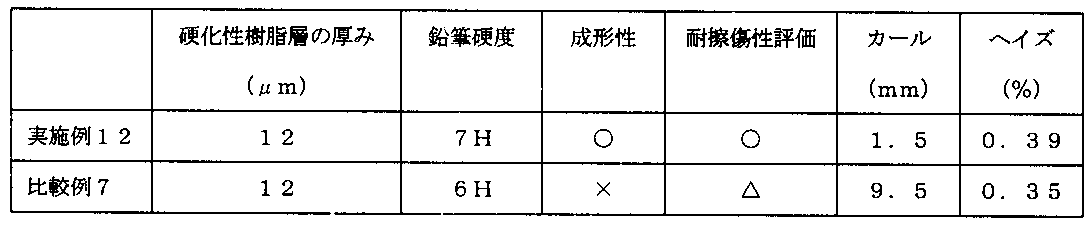
- Example 12 A layer composed of a mixture of 80 parts by mass of a polycarbonate resin (manufactured by Sumika Stylon, trade name “CALIBER 301-4”) and 20 parts by weight of PCTG (trade name “SKYGREEN J2003”) as a base resin, a hard A layer made of an acrylic resin (trade name “Altglas HT121” manufactured by Arkema Co., Ltd.) having a conductive dispersed phase is extruded using an extruder, and the thickness of the base resin layer is 105 ⁇ m and the thickness of the acrylic resin layer is 20 ⁇ m.
- the laminate e was formed by coextrusion so that the thickness of the body was 125 ⁇ m.
- Organic / inorganic hybrid ultraviolet curable hard coating agent (trade name “UVHC7800F” manufactured by MOMENTIVE, inorganic component having an ultraviolet reactive functional group (silica)) on the surface of the acrylic resin layer of the laminate e: 30-40% by mass) using a bar coater, dried at 90 ° C. for 1 minute, exposed at an exposure amount of 500 mJ / cm 2 , and a curable resin layer having a thickness of 10 ⁇ m after drying. Body 18 was obtained.
- Ultraviolet curable hard coating agent of main component urethane acrylate (trade name “EXCRATE RUA-066VE”, manufactured by Asia Kogyo Co., Ltd.) 10 parts by mass, Irgacure 184 (Ciba Japan Co., Ltd.) 0 .02 parts by mass and MEK 15 parts by mass are mixed using a bar coater, dried at 70 ° C. for 5 minutes, exposed at an exposure amount of 500 mJ / cm 2 , and the thickness of the curable resin layer after drying. Of 10 ⁇ m was obtained.
- main component urethane acrylate trade name “EXCRATE RUA-066VE”, manufactured by Asia Kogyo Co., Ltd.
- Irgacure 184 Ciba Japan Co., Ltd.
- MEK 15 parts by mass are mixed using a bar coater, dried at 70 ° C. for 5 minutes, exposed at an exposure amount of 500 mJ / cm 2 , and the thickness of the curable resin layer after drying
Landscapes
- Physics & Mathematics (AREA)
- Chemical & Material Sciences (AREA)
- General Physics & Mathematics (AREA)
- Optics & Photonics (AREA)
- Engineering & Computer Science (AREA)
- Life Sciences & Earth Sciences (AREA)
- Materials Engineering (AREA)
- Wood Science & Technology (AREA)
- Organic Chemistry (AREA)
- Mechanical Engineering (AREA)
- Laminated Bodies (AREA)
- Paints Or Removers (AREA)
Description
しかしながら、ガラスは衝撃により容易に割れ、またガラス自身の重量も重いことからプラスチックでの代替が検討されている。
しかしながら、アクリル系樹脂は非常に脆い性質のため、その加工方法は、切削加工で行われるのが一般的で、決して生産性の高いものとはいえない。
さらにアクリル系樹脂を使用した場合、例えば、スチールウール等の硬い素材に接したとき、特にマトリックス樹脂部の耐擦傷性が低いため傷が付きやすいという問題がある。
この分散相により樹脂成形体の耐擦傷性を向上させるものであるが、鉛筆硬度等の表面硬度の観点からは、依然として、改良の余地があった。
またより好ましくは、特定構成の樹脂積層体において、有機・無機ハイブリッド系ハードコーティング剤を含有する硬化性樹脂層(B)を適用させることで、優れた打ち抜き加工性を付与しつつ、より高い表面高度としての耐擦傷性機能を具備することができる。
したがって、本耐擦傷性樹脂積層体は、液晶ディスプレイのフロントカバー材、特に、タッチパネル機能を有する携帯電話や液晶ペンタブレットのフロントカバー材として好適に用いることができる。
本樹脂積層体は、アクリル系樹脂を主成分として含むアクリル系樹脂層(A)の両面又は片面に、有機・無機ハイブリッド系ハードコーティング剤を含む硬化性樹脂層(B)を積層した構成を有する。
また、より好ましくは、本樹脂積層体は、樹脂基材(C)の両面又は片面に、アクリル系樹脂を主成分として含むアクリル系樹脂層(A)が積層された樹脂積層体上の少なくとも一面に、有機・無機ハイブリッド系ハードコーティング剤を含む硬化性樹脂層(B)を積層した構成を有する。
アクリル系樹脂層(A)は、アクリル系樹脂を主成分として含む層である。
アクリル系樹脂を構成する単量体としては、例えば、メタクリル酸メチル、メタクリル酸、アクリル酸、ベンジル(メタ)アクリレート、n-ブチル(メタ)アクリレート、i-ブチル(メタ)アクリレート、t-ブチル(メタ)アクリレート、2-エチルヘキシル(メタ)アクリレート、ラウリル(メタ)アクリレート、トリデシル(メタ)アクリレート、ステアリル(メタ)アクリレート、グリシジル(メタ)アクリレート、ヒドロキシプロピル(メタ)アクリレート、2-メトキシエチル(メタ)アクリレート、2-エトキシエチル(メタ)アクリレート、シクロヘキシル(メタ)アクリレート、イソボルニル(メタ)アクリレート、ノルボルニル(メタ)アクリレート、ジシクロペンテニル(メタ)アクリレート、ジシクロペンタニル(メタ)アクリレート、ジシクロペンテニルオキシエチル(メタ)アクリレート、テトラヒドロフルフリル(メタ)アクリレート、アクリル(メタ)アクリレート、2-ヒドロキシエチル(メタ)アクリレート、コハク酸2-(メタ)アクロイルオキシエチル、マレイン酸2-(メタ)アクロイルオキシエチル、フタル酸2-(メタ)アクロイルオキシエチル、ヘキサヒドロフタル酸2-(メタ)アクリオイルオキシエチル、ペンタメチルピペリジル(メタ)アクリレート、テトラメチルピペリジル(メタ)アクリレート、ジメチルアミノエチル(メタ)アクリレート、ジエチルアミノエチル(メタ)アクリレート等が挙げられる。
これらは、単独で重合して使用してもよく、2種類以上を重合して使用してもよい。また、これらのアクリル系単量体と重合され得る他の単量体としては、例えばポリオレフィン系単量体、ビニル系単量体等が挙げられる。
より具体的には、アクリル系樹脂中に、アクリル系樹脂より耐熱性又は耐擦傷性の優れた硬質分散相材料を含有・分散してなる硬質樹脂層(a)によってアクリル系樹脂層(A)を形成する方法が挙げられる。
硬質分散相の粒径は、本樹脂積層体の使用目的、用途等に応じて適宜設定されるが、好ましくは0.1~1000μmである。硬質分散相のアクリル系樹脂層(A)中における配合量は、本樹脂積層体の使用目的、用途等に応じ適宜設定されるが、好ましくは0.1~60重量%である。
a)アクリル系樹脂材料に硬質分散相を構成する熱硬化性樹脂材料を添加する。
b)次に、溶融混練し、所定形状に成型した後、相分離及び架橋を生じさせることにより硬質分散相を構成することができる。また、熱硬化性樹脂を予め粒子状等に成型し、アクリル系樹脂中に添加し、熱硬化性樹脂が溶解しない温度で混練及び成型してもよい。
アクリル系樹脂層(A)の厚みは、40μm以上であることが好ましい。アクリル系樹脂層(A)の層厚みが40μm以上であるとアクリル系樹脂層の寄与による耐擦傷性の向上効果が得られない虞がない。かかる観点から、アクリル系樹脂層(A)の厚みは、50μm以上であることがより好ましい。また、成形加工性の観点から、アクリル樹脂層(A)の厚みは、200μm以下であることが好ましく、100μm以下であることがより好ましい。
本樹脂積層体は、硬化性樹脂層(B)を有する。硬化性樹脂層(B)は、有機・無機ハイブリッド系ハードコーティング剤を含み、反りやうねりが生じることなく、本樹脂積層体に、高い耐擦傷性を付与する役割を担う層である。
硬化性樹脂層(B)は、例えば、有機・無機ハイブリッド系ハードコーティング剤を含む塗料を用いて、他の層の上に塗膜として積層することで形成することができる。ただし、この方法に限定されるものではない。
他の層との積層方法としては、公知の方法が使用される。例えば、カバーフィルムを使用するラミネート方式、ディップコート法、ナチュラルコート法、リバースコート法、カンマコーター法、ロールコート法、スピンコート法、ワイヤーバー法、エクストルージョン法、カーテンコート法、スプレコート法、グラビアコート法等が挙げられる。その他、例えば、離型層に硬化性樹脂層(B)が接着されてなる転写シートを用いて、当該硬化性樹脂層(B)を他の層に積層する方法を採用してもよい。
有機・無機ハイブリッド系コーティング剤としては、反応性官能基を有する無機成分を含有する硬化性樹脂組成物から構成されるものを挙げることができる。
このような有機・無機ハイブリッド系コーティング剤は、反応性官能基を有する無機成分を利用して、例えば、この無機成分が、ラジカル重合性モノマーと共重合及び架橋することで、有機バインダーに無機成分を含有させてなる有機・無機複合系コーティング剤に比べて、硬化収縮が生じにくく、かつ高い耐擦傷性を発現することができる。
より好ましくは、硬化収縮の観点から、反応性官能基を有する無機成分として紫外線反応性のシリカを含む、有機・無機ハイブリッド系コーティング剤を挙げることができる。
さらに好ましくは、紫外線反応性のコロイダルシリカを含む、有機・無機ハイブリッド系コーティング剤を挙げることができる。
また、ラジカル重合性モノマーとしては、多官能性(メタ)アクリレートが挙げられる。例えば、2官能性(メタ)アクリレートとしては、エチレンオキサイド変性ジアクリレート、1,4-ブタンジオールジ(メタ)アクリレート、1,6-ヘキサンジオールジ(メタ)アクリレート、1,9-ノナンジオールジ(メタ)アクリレート、ビスフェノールAエチレンオキサイド変性ジアクリレート、ジメチロール-トリシクロデカンジ(メタ)アクリレート、トリプロピレングリコールジ(メタ)アクリレート、ネオペンチルグリコールジ(メタ)アクリレート、エポキシ(メタ)ジアクリレート、ウレタン(メタ)ジアクリレート等が挙げられる。
また3官能性以上の多官能性(メタ)アクリレートとしては、ペンタエリスリトールヘキサアクリレート、ジトリメチロールプロパンテトラアクリレート、ペンタエリスリトールエトキシテトラアクリレート、トリメチロールプロパントリ(メタ)アクリレートやトリメチロールプロパントリエトキシ(メタ)アクリレート、ウレタントリ(メタ)アクリレート、ウレタンテトラ(メタ)アクリレート、ウレタンヘキサ(メタ)アクリレート、ポリエステルテトラ(メタ)アクリレート、ポリエステルヘキサ(メタ)アクリレート等が挙げられる。
硬化性樹脂層(B)は、表面調整成分としてレベリング剤を含むことが好ましい。
レベリング剤としては、シリコーン系レベリング剤、アクリル系レベリング剤などを挙げることができ、特に、末端に反応性の官能基を有するものが好ましく、2官能以上の反応性の官能基を有するものがより好ましい。
具体的には、両末端に2重結合を有する、アクリル基を有するポリエーテル変性ポリジメチルシロキサン(例えば、ビックケミー・ジャパン株式会社製の「BYK-UV 3500」、「BYK-UV 3530」)や、2重結合を末端に2個ずつ計4個有する、アクリル基を有するポリエステル変性ポリジメチルシロキサン(ビックケミー・ジャパン株式会社製の「BYK-UV 3570」)などが挙げられる。
これらの中でも、ヘイズの値が安定し、かつ耐擦傷性の向上に寄与する、アクリル基を有するポリエステル変性ポリジメチルシロキサンが特に好ましい。
硬化性樹脂層(B)は滑剤を含むことが好ましい。
滑剤としては、例えば、ケイ素系化合物、フッ素系化合物又はこれらの混合化合物が挙げられる。これらを添加することで、滑り性を改善することができる。
硬化性樹脂層(B)の厚みは、5~15μmの範囲であることが好ましい。厚みが5μm以上であると硬化性樹脂層(B)による耐擦傷性の向上効果が十分に得られ、一方、厚みが15μm以下であることで、硬化性樹脂層(B)を構成する紫外線硬化性樹脂等の硬化・収縮に伴って反りやうねり、剥離等が生ずる虞がない。さらには、紫外線硬化性樹脂層により透明性を著しく損なう虞もない。
樹脂基材(C)は、本樹脂積層体に打ち抜き加工性を付与する役割を担う層である。かかる観点から、樹脂基材(C)としては、ポリカーボネート(PC)樹脂、トリアセチルセルロース(TAC)樹脂、ポリエチレンテレフタレート(PET)樹脂、ポリメチルメタクリレート(PMMA)樹脂、メタクリル酸メチル-スチレン共重合(MS)樹脂、ポリスルホン樹脂、ノルボルネン系樹脂及びシクロオレフィン樹脂の何れか一種以上を含む樹脂組成物から形成されることが好ましい。
本樹脂積層体の好ましい用途においては、樹脂基材(C)は、透明樹脂から構成されることが好ましい。
ポリカーボネート樹脂は、例えば、芳香族ジヒドロキシ化合物又はこれと少量のポリヒドロキシ化合物とともにホスゲンと反応させる界面重合法により得られる。
芳香族ジヒドロキシ化合物としては、例えばビスフェノールとアセトンから合成されるビスフェノールAが挙げられる。
また、その他ビスフェノールAを原料としてエステル交換法、ピリジン法等によって製造することができる。
また、ビスフェノールAとジカルボン酸誘導体、例えば、テレ(イソ)フタル酸ジクロリド等との共重合体により得られるポリエステルカーボネート、ビスフェノールAの誘導体、例えば、テトラメチルビスフェノールA等の重合により得られるものも例示することができる。
これより分子量が小さいと、組成物から得られるシートの衝撃強度が低くなり好ましくない。一方、これより分子量が大きいと、流動性が低下し、押出し成形性が悪くなる虞がある。
本樹脂積層体は、アクリル系樹脂層(A)と、有機・無機ハイブリッド系コーティング剤を含む硬化性樹脂層(B)を有することを要する。また好ましくは、さらに樹脂基材(C)を備える。
より具体的には、(B)/(A)、(B)/(A)/(B)、(B)/(A)/(C)、(B)/(A)/(C)/(B)、(B)/(C)/(A)/(B)、(B)/(A)/(C)/(A)及び(B)/(A)/(C)/(A)/(B)などが挙げられる。これらの構成の中でも、アクリル系樹脂(A)の両面又は片面に硬化性樹脂層(B)が積層された構成が好ましく、(B)/(A)/(C)及び(B)/(A)/(C)/(B)の構成がもっとも好ましい。
かかる構成によれば、アクリル系樹脂層13と硬化性樹脂層14の相乗効果により、硬化性樹脂層の厚みが5~15μと薄い場合であっても高い表面硬度を発現できるなどの利点を有する。
また図1の(b)では、樹脂基材12の片面にアクリル系樹脂層13が積層された樹脂積層体上の両面に硬化性樹脂層14を積層した構成の耐擦傷性樹脂積層体11を例示している。かかる構成によれば、樹脂基材12にも硬化性樹脂層14が積層された構成であるため、樹脂基材12に工程傷が発生することを抑制できるなどの利点を有する。なお、工程傷の発生を抑制するために形成される樹脂基材12側の硬化性樹脂層は、通常のハードコート層によって形成しても良い。
本樹脂積層体の製造方法としては、特に制限されるものではなく、公知の方法を採用することができる。
本樹脂積層体の製造装置としては、例えば、ポリカーボネート系樹脂を押出す一つのメイン押出機と、アクリル樹脂層を構成するアクリル系樹脂を押出すサブ押出機により構成される。通常、サブ押出機はメイン押出機より小型のものが採用される。
メイン押出機の温度条件は、通常230~290℃、好ましくは240~280℃ であり、サブ押出機の温度条件は通常220~270℃、好ましくは230~260℃である。また、樹脂中の異物を除去するために押出機のTダイより上流側にポリマーフィルターを設置することが好ましい。
このシート状成形物は、成形ロール通過中に鏡面仕上げと冷却が行われ、積層体が形成される。
また、マルチマニホールドダイの場合は、該ダイ内で積層された溶融樹脂は同様にダイ内部でシート状に成形された後、成形ロールにて表面仕上げ、及び冷却が行われ、積層体が形成される。ダイの温度としては、通常210~300℃、好ましくは230~280℃であり、成形ロール温度としては、通常100~190℃ 、好ましくは110~180℃である。ロールは縦型ロール又は横型ロールを適宜使用することができる。
本樹脂積層体は、画像表示装置の前面側(視認側)に配置して用いられる表面保護パネル、特にタッチパネル機能を有する携帯電話や液晶ペンタブレット等のフロントカバー材として有用である。
一般的に「フィルム」とは、長さ及び幅に比べて厚みが極めて小さく、最大厚みが任意に限定されている薄い平らな製品で、通常、ロールの形で供給されるものをいい(日本工業規格JISK6900)、一般的に「シート」とは、JISにおける定義上、薄く、一般にその厚みが長さと幅のわりには小さく平らな製品をいう。しかし、シートとフィルムの境界は定かでなく、本発明において文言上両者を区別する必要がないので、本発明においては、「フィルム」と称する場合でも「シート」を含むものとし、「シート」と称する場合でも「フィルム」を含むものとする。
この際、当該主成分の含有割合を特定するものではないが、主成分(2成分以上が主成分である場合には、これらの合計量)は組成物中の50質量%以上、好ましくは70質量%以上、特に好ましくは90質量%以上(100%含む)を占めるものである。
また、本発明において、「X以上」(Xは任意の数字)と表現した場合、特にことわらない限り「好ましくはXより大きい」の意を包含し、「Y以下」(Yは任意の数字)と表現した場合、特にことわらない限り「好ましくはYより小さい」の意を包含する。
先ずは、実施例・比較例で得たサンプルの各種物性値の測定方法及び評価方法について説明する。
実施例及び比較例の樹脂積層体に対して、表面における鉛筆硬度をJIS K 5600-5-4に準拠して測定を行った。
実施例及び比較例の樹脂積層体に対して、#0000のスチールウールを用いて荷重1000gで樹脂積層体の表面(硬化性樹脂層側)を50往復擦り、傷の有無を目視にて観察した。なお、表1において、○は「傷なし」、△は「傷ありだが実用レベル」、×は「傷あり」をそれぞれ表す。
実施例及び比較例の樹脂積層体20cm角の試験サンプルに対して、JIS K 6251のダンベル刃を用い、東洋精機社製スクリュープレス機で打ち抜き試験を行った。評価は打ち抜いたサンプル片及び基材にクラックもしくは基材の割れの有無により判別し、○は「割れ、クラックともになし」、×は「割れ若しくはクラックが発生」したことをそれぞれ表す。
樹脂基材としてA4サイズのPETフィルム(三菱樹脂製、商品名「ダイアホイル」)125μmを用いて、各実施例及び比較例に記載の方法と同様の手法で硬化樹脂層を形成させた。各サンプルの中央部分を10cm角に切り出して試験サンプルとした。評価は4隅の反りを定規で計測し、その4点の平均値を試験サンプルにおけるカール値とした。
基材樹脂としてポリカーボネート樹脂(三菱エンジニアリングプラスチックス社製、商品名「ユーピロンS1000」)80質量部と、PCTG(SKケミカル社製、商品名「SKYGREEN J2003」)20質量部の混合物からなる層、硬質性の分散相を有するアクリル系樹脂(Arkema社製、商品名「AltuglasHT121」)からなる層を押出成形機にて基材樹脂層の厚さが560μm、アクリル系樹脂層の厚さが140μm、積層体の厚さが700μmになるよう共押出で積層体aを成形した。押出条件は、アクリル樹脂層の押出温度が240℃、基材樹脂層の押出温度が265℃、ロール温度はR1=110℃、R2=120℃、R3=125℃であった。
積層体aのアクリル系樹脂層の面に有機・無機ハイブリッド系紫外線硬化性ハードコーティング剤(モメンティブ社製、商品名「UVHC7800」紫外線反応性官能基を有する無機成分(シリカ)含有量:40~50質量%)を、バーコーターを用いて塗布し、90℃で1分間乾燥後、500mJ/cm2の露光量で露光し、乾燥後の硬化性樹脂層の厚さが6μmの樹脂積層体2を得た。
レベリング剤として、アクリル基を有するポリエステル変性ポリジメチルシロキサン(ビックケミー・ジャパン株式会社製、商品名「BYK-UV3570」)をハードコーティング剤100部に対して、5部の割合で添加した以外は、実施例2と同様にして、乾燥後の硬化性樹脂層の厚さが6μmの樹脂積層体3を得た。
積層体aのアクリル系樹脂層の面に有機・無機ハイブリッド系紫外線硬化性ハードコーティング剤(亜細亜工業社製、商品名「EXCERATE RUA-069VE」紫外線反応性官能基を有する無機成分(シリカ)含有量:5~15質量%)を、バーコーターを用いて塗布し、90℃で1分間乾燥後、500mJ/cm2の露光量で露光し、乾燥後の硬化性樹脂層の厚さが6μmの樹脂積層体4を得た。
積層体aのアクリル系樹脂層の面に有機・無機ハイブリッド系紫外線硬化性ハードコーティング剤(モメンティブ社製、商品名「UVHC7300」紫外線反応性官能基を有する無機成分(シリカ)含有量:10~20質量%)を、バーコーターを用いて塗布し、90℃で1分間乾燥後、500mJ/cm2の露光量で露光し、乾燥後の硬化性樹脂層の厚さが6μmの樹脂積層体5を得た。
硬質性の分散相を有するアクリル系樹脂(Arkema社製、商品名「AltuglasHT121」)を押出成形機にて厚みが700μmのアクリル系樹脂層からなる積層体bを成形した。押出条件は、押出温度が240℃、ロール温度はR1=110℃、R2=120℃、R3=125℃であった。
積層体aのアクリル系樹脂層の面に主成分ウレタンアクリレートの紫外線硬化性ハードコーティング剤(亜細亜工業社製、商品名「EXCERATE RUA-066VE」)10質量部、イルガキュア184(チバジャパン社製)0.02質量部、MEK15質量部の混合溶液を、バーコーターを用いて塗布し、70℃で5分間乾燥後、500mJ/cm2の露光量で露光し、乾燥後の硬化性樹脂層の厚さが7μmの樹脂積層体7を得た。
積層体aのアクリル系樹脂層の面に主成分ウレタンアクリレートの紫外線硬化性ハードコーティング剤(モメンティブ社製、商品名「UVHC1101」)を、バーコーターを用いて塗布し、90℃で1分間乾燥後、500mJ/cm2の露光量で露光し、乾燥後の硬化性樹脂層の厚さが8μmの樹脂積層体8を得た。
<比較例3>
ポリカーボネート樹脂(三菱エンジニアリングプラスチックス社製、商品名「ユーピロンS1000」)を押出成形機にて厚みが700μmの樹脂シートcを成形した。押出条件は、押出温度が265℃、ロール温度はR1=110℃、R2=120℃、R3=125℃であった。
硬質性の分散相を有さないアクリル樹脂(三菱レイヨン社製、商品名「アクリペットVH001」)を用い、押出成形機にて厚みが700μmの単層樹脂シートdを形成した。押出条件は、押出温度が240℃、ロール温度はR1=100℃、R2=110℃、R3=125℃であった。

一方、有機・無機ハイブリッド系紫外線硬化性ハードコーティング剤を用いた実施例においては、高い鉛筆硬度を有し、反りやうねりの発生も見られなかった。
特に、実施例1~3、及び実施例6の有機・無機ハイブリッド系紫外線硬化性ハードコーティング剤においては、鉛筆硬度8Hを達成している。
しかしながら、比較例3ではポリカーボネート樹脂に有機・無機ハイブリッド系紫外線硬化性ハードコーティング剤を用いているにもかかわらず、基材樹脂の硬度が低いため十分な鉛筆硬度を得るには至らなかった。
これらの結果から、アクリル系樹脂との積層体に有機・無機ハイブリッド系ハードコーティング剤を含む硬化性樹脂層を積層させることでより高硬度の耐擦傷性樹脂積層体を得ることができる。
なお、本実施例及び比較例においてカール試験の差異をより明確にするためにPETフィルムを用いたが、積層体1~3においても同等の傾向が見られることが推定される。
樹脂基材として下記の積層体dを用いて、各実施例及び比較例に記載の方法と同様の手法で硬化樹脂層を形成させた。各サンプルの中央部分を10cm角に切り出して試験サンプルとした。評価は4隅の反りを定規で計測し、その4点の平均値を試験サンプルにおけるカール値とした。なお、カール値は原反の熱膨張分も含めた値である。
実施例及び比較例の樹脂積層体5cm角の試験サンプルに対して、試験機器としてNDH5000(日本電色産業工業社製)を用いて測定を行った。試験はJIS K 7136に則り行い、その平均値を試験サンプルにおけるヘイズ値とした。
基材樹脂としてポリカーボネート樹脂(住化スタイロン社製、商品名「CALIBRE301-4」)80質量部と、PCTG(SKケミカル社製、商品名「SKYGREEN J2003」)20質量部の混合物からなる層、硬質性の分散相を有するアクリル系樹脂(Arkema社製、商品名「AltuglasHT121」)からなる層を押出成形機にて基材樹脂層の厚さが240μm、アクリル系樹脂層の厚さが60μm、積層体の厚さが300μmになるよう共押出で積層体dを成形した。押出条件は、アクリル樹脂層の押出温度が240℃、基材樹脂層の押出温度が265℃、ロール温度はR1=110℃、R2=115℃、R3=95℃であった。
積層体dのアクリル系樹脂層の面に有機・無機ハイブリッド系紫外線硬化性ハードコーティング剤(モメンティブ社製、商品名「UVHC7800」紫外線反応性官能基を有する無機成分(シリカ)含有量:40~50質量%)を、バーコーターを用いて塗布し、90℃で1分間乾燥後、500mJ/cm2の露光量で露光し、乾燥後の硬化性樹脂層の厚さが12μmの樹脂積層体12を得た。
レベリング剤として、アクリル基を有するポリエステル変性ポリジメチルシロキサン(ビックケミー・ジャパン株式会社製、商品名「BYK-UV3570」)をハードコーティング剤100部に対して、5部の割合で添加した以外は、実施例2と同様にして、乾燥後の硬化性樹脂層の厚さが12μmの樹脂積層体13を得た。
積層体dのアクリル系樹脂層の面に有機・無機ハイブリッド系紫外線硬化性ハードコーティング剤(亜細亜工業社製、商品名「EXCERATE RUA-069VE」紫外線反応性官能基を有する無機成分(シリカ)含有量:5~15質量%)を、バーコーターを用いて塗布し、90℃で1分間乾燥後、500mJ/cm2の露光量で露光し、乾燥後の硬化性樹脂層の厚さが12μmの樹脂積層体14を得た。
積層体dのアクリル系樹脂層の面に有機・無機ハイブリッド系紫外線硬化性ハードコーティング剤(モメンティブ社製、商品名「UVHC7300」紫外線反応性官能基を有する無機成分(シリカ)含有量:10~20質量%)を、バーコーターを用いて塗布し、90℃で1分間乾燥後、500mJ/cm2の露光量で露光し、乾燥後の硬化性樹脂層の厚さが12μmの樹脂積層体15を得た。
積層体dのアクリル系樹脂層の面に主成分ウレタンアクリレートの紫外線硬化性ハードコーティング剤(亜細亜工業社製、商品名「EXCERATE RUA-066VE」)10質量部、イルガキュア184(チバジャパン社製)0.02質量部、MEK15質量部の混合溶液を、バーコーターを用いて塗布し、70℃で5分間乾燥後、500mJ/cm2の露光量で露光し、乾燥後の硬化性樹脂層の厚さが12μmの樹脂積層体16を得た。
積層体dのアクリル系樹脂層の面に主成分ウレタンアクリレートの紫外線硬化性ハードコーティング剤(モメンティブ社製、商品名「UVHC1101」)を、バーコーターを用いて塗布し、90℃で1分間乾燥後、500mJ/cm2の露光量で露光し、乾燥後の硬化性樹脂層の厚さが12μmの樹脂積層体17を得た。

一方で実施例7~実施例11はカールもほとんどなく、且つ300μmの薄膜基材にも関わらず、鉛筆硬度で8H以上といずれも高硬度の積層体が得られている。特に実施例7~9においては鉛筆硬度9Hと最高レベルの表面硬度を達成しており、中でも実施例9においては、レベリング剤を添加したことにより優れたヘイズ値を有している。
<成形性>
実施例12及び比較例7の樹脂積層体A4大の試験サンプルを用いて真空成形を実施した。試験条件は、成形温度は110℃、真空圧は0.1MPa、成形時間は10秒、金型角部のR=2mm、絞りの深さは20mmである。評価は成形後のサンプルを目視で評価し、○は「割れなし」、×は「割れあり」をそれぞれ表す。
基材樹脂としてポリカーボネート樹脂(住化スタイロン社製、商品名「CALIBRE301-4」)80質量部と、PCTG(SKケミカル社製、商品名「SKYGREEN J2003」)20質量部の混合物からなる層、硬質性の分散相を有するアクリル系樹脂(Arkema社製、商品名「AltuglasHT121」)からなる層を押出成形機にて基材樹脂層の厚さが105μm、アクリル系樹脂層の厚さが20μm、積層体の厚さが125μmになるよう共押出で積層体eを成形した。押出条件は、アクリル樹脂層の押出温度が240℃、基材樹脂層の押出温度が265℃、ロール温度はR1=110℃、R2=110℃、R3=80℃であった。
積層体eのアクリル系樹脂層の面に主成分ウレタンアクリレートの紫外線硬化性ハードコーティング剤(亜細亜工業社製、商品名「EXCERATE RUA-066VE」)10質量部、イルガキュア184(チバジャパン社製)0.02質量部、MEK15質量部の混合溶液を、バーコーターを用いて塗布し、70℃で5分間乾燥後、500mJ/cm2の露光量で露光し、乾燥後の硬化性樹脂層の厚さが10μmの樹脂積層体19を得た。
12 :樹脂基材
13 :アクリル系樹脂層
14 :硬化性樹脂層
Claims (11)
- アクリル系樹脂を主成分として含むアクリル系樹脂層(A)の両面又は片面に、有機・無機ハイブリッド系コーティング剤を含む硬化性樹脂層(B)を積層した構成を備え、当該アクリル系樹脂層(A)は、アクリル系樹脂層マトリックス中に硬質性の分散相を有する硬質樹脂(a)であり、当該有機・無機ハイブリッド系コーティング剤は、反応性官能基を有する無機成分を含有する硬化性樹脂組成物から構成され、硬化性樹脂層(B)の厚みが5~15μmの範囲であって、硬化性樹脂層(B)が積層された面の表面硬度が7H以上であることを特徴とする耐擦傷性樹脂積層体。
- 樹脂基材(C)の両面又は片面に、アクリル系樹脂を主成分として含むアクリル系樹脂層(A)が積層された樹脂積層体上の少なくとも一面に、有機・無機ハイブリッド系ハードコーティング剤を含む硬化性樹脂層(B)を積層した構成を備え、当該アクリル系樹脂層(A)は、アクリル系樹脂層マトリックス中に硬質性の分散相を有する硬質樹脂(a)であり、当該有機・無機ハイブリッド系コーティング剤は、反応性官能基を有する無機成分を含有する硬化性樹脂組成物から構成され、硬化性樹脂層(B)の厚みが5~15μmの範囲であって、硬化性樹脂層(B)が積層された面の表面硬度が7H以上であることを特徴とする耐擦傷性樹脂積層体。
- 前記反応性官能基を有する無機成分が、紫外線反応性のシリカであることを特徴とする請求項1又は2に記載の耐擦傷性樹脂積層体。
- 有機・無機ハイブリッド系ハードコーティング剤中の無機成分が10質量%以上50質量%未満である、請求項1~3の何れか一項記載の耐擦傷性樹脂積層体。
- 硬化性樹脂層(B)が、末端に反応性の官能基を有するレベリング剤を含む、請求項1~4の何れか一項記載の耐擦傷性樹脂積層体。
- 前記レベリング剤が、アクリル基を有するポリエーテル変性ポリジメチルシロキサン、又はアクリル基を有するポリエステル変性ポリジメチルシロキサンであることを特徴とする請求項5に記載の耐擦傷性樹脂積層体。
- 硬化性樹脂層(B)が、滑剤を含む、請求項1~6の何れか一項記載の耐擦傷性樹脂積層体。
- アクリル系樹脂層(A)が、鉛筆硬度3H以上の硬質樹脂層(a)である、請求項1~7の何れか一項記載の耐擦傷性樹脂積層体。
- 前記樹脂基材(C)が、ポリカーボネート(PC)樹脂、トリアセチルセルロース(TAC)樹脂、ポリエチレンテレフタレート(PET)樹脂、ポリメチルメタクリレート(PMMA)樹脂、メタクリル酸メチル-スチレン共重合(MS)樹脂、ポリスルホン樹脂、ノルボルネン系樹脂及びシクロオレフィン樹脂の群から選択される何れか一種以上を含む、請求項1~8の何れか一項記載の耐擦傷性樹脂積層体。
- 請求項1~9の何れか一項記載の耐擦傷性樹脂積層体を有するディスプレイのフロントカバー材。
- 請求項10記載のディスプレイのフロントカバー材を備える画像表示装置。
Priority Applications (6)
| Application Number | Priority Date | Filing Date | Title |
|---|---|---|---|
| KR1020137010983A KR20140118692A (ko) | 2012-02-28 | 2012-09-28 | 내찰상성 수지 적층체, 디스플레이의 프론트 커버재 및 화상 표시 장치 |
| JP2012544990A JP5237506B1 (ja) | 2012-02-28 | 2012-09-28 | 耐擦傷性樹脂積層体、ディスプレイのフロントカバー材及び画像表示装置 |
| CN201280003820.5A CN103402765B (zh) | 2012-02-28 | 2012-09-28 | 耐擦伤性树脂叠层体、显示器的前板材料及图像显示装置 |
| HK14104521.4A HK1191295B (en) | 2012-02-28 | 2012-09-28 | Abrasion-resistant resin laminate, material for front cover of display and image display device |
| KR1020137009511A KR101413900B1 (ko) | 2012-02-28 | 2012-09-28 | 내찰상성 수지 적층체, 디스플레이의 프론트 커버재 및 화상 표시 장치 |
| KR1020147006664A KR20140118976A (ko) | 2012-02-28 | 2012-09-28 | 내찰상성 수지 적층체, 디스플레이의 프론트 커버재 및 화상 표시 장치 |
Applications Claiming Priority (2)
| Application Number | Priority Date | Filing Date | Title |
|---|---|---|---|
| JP2012042064 | 2012-02-28 | ||
| JP2012-042064 | 2012-02-28 |
Publications (1)
| Publication Number | Publication Date |
|---|---|
| WO2013128697A1 true WO2013128697A1 (ja) | 2013-09-06 |
Family
ID=49081924
Family Applications (1)
| Application Number | Title | Priority Date | Filing Date |
|---|---|---|---|
| PCT/JP2012/075181 Ceased WO2013128697A1 (ja) | 2012-02-28 | 2012-09-28 | 耐擦傷性樹脂積層体、ディスプレイのフロントカバー材及び画像表示装置 |
Country Status (5)
| Country | Link |
|---|---|
| JP (1) | JP2013208896A (ja) |
| KR (3) | KR101413900B1 (ja) |
| CN (2) | CN103522698A (ja) |
| TW (2) | TWI534009B (ja) |
| WO (1) | WO2013128697A1 (ja) |
Cited By (6)
| Publication number | Priority date | Publication date | Assignee | Title |
|---|---|---|---|---|
| JP2015055659A (ja) * | 2013-09-10 | 2015-03-23 | 日油株式会社 | 反射防止フィルム |
| WO2015040931A1 (ja) * | 2013-09-20 | 2015-03-26 | リケンテクノス株式会社 | ポリ(メタ)アクリルイミド系樹脂層を含む透明多層フィルム、及びその製造方法 |
| WO2015146565A1 (ja) * | 2014-03-24 | 2015-10-01 | リケンテクノス株式会社 | ハードコート積層体から形成された物品の製造方法、及びポリ(メタ)アクリルイミド系樹脂層を含むハードコート積層体から形成された物品 |
| JP2015182273A (ja) * | 2014-03-24 | 2015-10-22 | リケンテクノス株式会社 | ハードコート積層体からなる物品の製造方法 |
| US10450431B2 (en) | 2013-07-10 | 2019-10-22 | Riken Technos Corporation | Poly(meth)acrylimide film, easy-adhesion film using same, and method for manufacturing such films |
| US10576498B2 (en) | 2014-03-21 | 2020-03-03 | Riken Technos Corporation | Method for producing multilayer coated film |
Families Citing this family (16)
| Publication number | Priority date | Publication date | Assignee | Title |
|---|---|---|---|---|
| KR102290576B1 (ko) * | 2013-10-11 | 2021-08-17 | 미츠비시 가스 가가쿠 가부시키가이샤 | 내찰상성 폴리카보네이트 수지 적층체 |
| JP6276211B2 (ja) | 2014-05-30 | 2018-02-07 | リケンテクノス株式会社 | 透明樹脂積層体 |
| JP6693041B2 (ja) * | 2014-07-14 | 2020-05-13 | 三菱ケミカル株式会社 | 積層体 |
| JP6908083B2 (ja) * | 2014-07-14 | 2021-07-21 | 三菱ケミカル株式会社 | 積層体 |
| JP6153977B2 (ja) | 2014-10-02 | 2017-06-28 | リケンテクノス株式会社 | 粘着フィルム |
| JP6026071B1 (ja) * | 2015-02-25 | 2016-11-16 | 三井化学株式会社 | 変性アクリル樹脂硬化物、及びその積層体、並びに、これらの製造方法 |
| JP6508330B2 (ja) * | 2015-03-31 | 2019-05-08 | 三菱ケミカル株式会社 | 積層体 |
| JP6430342B2 (ja) * | 2015-08-11 | 2018-11-28 | Towa株式会社 | 樹脂成形装置及び樹脂成形方法並びに成形型 |
| KR102373615B1 (ko) | 2015-08-24 | 2022-03-15 | 삼성디스플레이 주식회사 | 윈도우 부재를 포함하는 표시장치 및 윈도우 부재의 제조방법 |
| JP6669477B2 (ja) * | 2015-11-27 | 2020-03-18 | リケンテクノス株式会社 | 活性エネルギー線硬化性樹脂組成物、及びこれを用いたハードコート積層フィルム |
| JP6862183B2 (ja) | 2016-01-18 | 2021-04-21 | リケンテクノス株式会社 | ハードコート積層フィルム |
| KR102604087B1 (ko) | 2016-06-24 | 2023-11-21 | 삼성디스플레이 주식회사 | 윈도우 및 이를 포함하는 표시 장치 |
| JP6718340B2 (ja) * | 2016-09-08 | 2020-07-08 | 株式会社ダイセル | ハードコート積層体並びに成形体及びその製造方法 |
| JP7074541B2 (ja) | 2017-05-10 | 2022-05-24 | リケンテクノス株式会社 | ハードコート積層フィルム |
| JP2020011517A (ja) * | 2019-10-09 | 2020-01-23 | 三菱ケミカル株式会社 | 積層体 |
| KR20210113512A (ko) | 2020-03-06 | 2021-09-16 | 삼성디스플레이 주식회사 | 커버 윈도우 및 이를 포함하는 표시 장치 |
Citations (8)
| Publication number | Priority date | Publication date | Assignee | Title |
|---|---|---|---|---|
| WO1995017349A1 (en) * | 1993-12-21 | 1995-06-29 | Mitsubishi Chemical Corporation | Ultrafine reactive silica particles, suspension containing the same, and hard coating composition |
| JP2007047722A (ja) * | 2004-12-22 | 2007-02-22 | Nitto Denko Corp | 防眩性ハードコートフィルム及びその製造方法 |
| JP2007213079A (ja) * | 2006-02-08 | 2007-08-23 | Dongwoo Fine-Chem Co Ltd | 低反射フィルム及びその製造方法 |
| JP2008303343A (ja) * | 2007-06-11 | 2008-12-18 | Toray Ind Inc | 活性エネルギー線硬化組成物、及びそれを用いたディスプレイ用フィルター並びにディスプレイ |
| JP2009198863A (ja) * | 2008-02-22 | 2009-09-03 | Toray Ind Inc | 反射防止フィルムおよび画像表示装置 |
| JP2010044163A (ja) * | 2008-08-11 | 2010-02-25 | Meihan Shinku Kogyo Kk | ディスプレイ面板用透明多層シート |
| JP2010134436A (ja) * | 2008-10-31 | 2010-06-17 | Toray Advanced Film Co Ltd | ディスプレイ用フィルター |
| JP2010237572A (ja) * | 2009-03-31 | 2010-10-21 | Dainippon Printing Co Ltd | 光学シート |
Family Cites Families (6)
| Publication number | Priority date | Publication date | Assignee | Title |
|---|---|---|---|---|
| US5466491A (en) * | 1994-09-12 | 1995-11-14 | General Electric Company | Radiation curable silicon containing polyarcylate hardcoat compositions, method for making, and use |
| JPWO2003026881A1 (ja) * | 2001-09-25 | 2005-01-06 | 富士写真フイルム株式会社 | ハードコートフィルム、ハードコートフィルムを積層した基材、及びこれらを設けた画像表示装置 |
| JP2005096431A (ja) * | 2003-08-25 | 2005-04-14 | Mitsubishi Rayon Co Ltd | 光硬化性シートの硬化方法および、光硬化性シートを用いた成形品の製造方法 |
| JP2007296711A (ja) * | 2006-04-28 | 2007-11-15 | Mitsubishi Plastics Ind Ltd | 耐擦傷性樹脂積層体 |
| JP2008049623A (ja) * | 2006-08-25 | 2008-03-06 | Mitsubishi Plastics Ind Ltd | 打抜加工用ポリカーボネート樹脂積層シート及びその製造方法 |
| JP5103902B2 (ja) * | 2006-12-28 | 2012-12-19 | 大日本印刷株式会社 | ハードコートフィルム、及びその製造方法 |
-
2012
- 2012-09-28 CN CN201310497588.1A patent/CN103522698A/zh active Pending
- 2012-09-28 KR KR1020137009511A patent/KR101413900B1/ko active Active
- 2012-09-28 CN CN201280003820.5A patent/CN103402765B/zh active Active
- 2012-09-28 KR KR1020147006664A patent/KR20140118976A/ko not_active Withdrawn
- 2012-09-28 WO PCT/JP2012/075181 patent/WO2013128697A1/ja not_active Ceased
- 2012-09-28 KR KR1020137010983A patent/KR20140118692A/ko not_active Withdrawn
- 2012-10-25 TW TW103114651A patent/TWI534009B/zh active
- 2012-10-25 TW TW101139424A patent/TWI438099B/zh active
-
2013
- 2013-02-08 JP JP2013023702A patent/JP2013208896A/ja active Pending
Patent Citations (8)
| Publication number | Priority date | Publication date | Assignee | Title |
|---|---|---|---|---|
| WO1995017349A1 (en) * | 1993-12-21 | 1995-06-29 | Mitsubishi Chemical Corporation | Ultrafine reactive silica particles, suspension containing the same, and hard coating composition |
| JP2007047722A (ja) * | 2004-12-22 | 2007-02-22 | Nitto Denko Corp | 防眩性ハードコートフィルム及びその製造方法 |
| JP2007213079A (ja) * | 2006-02-08 | 2007-08-23 | Dongwoo Fine-Chem Co Ltd | 低反射フィルム及びその製造方法 |
| JP2008303343A (ja) * | 2007-06-11 | 2008-12-18 | Toray Ind Inc | 活性エネルギー線硬化組成物、及びそれを用いたディスプレイ用フィルター並びにディスプレイ |
| JP2009198863A (ja) * | 2008-02-22 | 2009-09-03 | Toray Ind Inc | 反射防止フィルムおよび画像表示装置 |
| JP2010044163A (ja) * | 2008-08-11 | 2010-02-25 | Meihan Shinku Kogyo Kk | ディスプレイ面板用透明多層シート |
| JP2010134436A (ja) * | 2008-10-31 | 2010-06-17 | Toray Advanced Film Co Ltd | ディスプレイ用フィルター |
| JP2010237572A (ja) * | 2009-03-31 | 2010-10-21 | Dainippon Printing Co Ltd | 光学シート |
Cited By (10)
| Publication number | Priority date | Publication date | Assignee | Title |
|---|---|---|---|---|
| US10450431B2 (en) | 2013-07-10 | 2019-10-22 | Riken Technos Corporation | Poly(meth)acrylimide film, easy-adhesion film using same, and method for manufacturing such films |
| JP2015055659A (ja) * | 2013-09-10 | 2015-03-23 | 日油株式会社 | 反射防止フィルム |
| WO2015040931A1 (ja) * | 2013-09-20 | 2015-03-26 | リケンテクノス株式会社 | ポリ(メタ)アクリルイミド系樹脂層を含む透明多層フィルム、及びその製造方法 |
| JP2015083370A (ja) * | 2013-09-20 | 2015-04-30 | リケンテクノス株式会社 | ポリ(メタ)アクリルイミド系樹脂透明多層フィルム、及びその製造方法 |
| JP2016153232A (ja) * | 2013-09-20 | 2016-08-25 | リケンテクノス株式会社 | ポリ(メタ)アクリルイミド系樹脂透明多層フィルム、及びその製造方法 |
| US10112369B2 (en) | 2013-09-20 | 2018-10-30 | Riken Technos Corporation | Transparent multilayer film containing poly(meth)acrylimide-based resin layer, and method for producing said transparent multilayer film |
| US10576498B2 (en) | 2014-03-21 | 2020-03-03 | Riken Technos Corporation | Method for producing multilayer coated film |
| WO2015146565A1 (ja) * | 2014-03-24 | 2015-10-01 | リケンテクノス株式会社 | ハードコート積層体から形成された物品の製造方法、及びポリ(メタ)アクリルイミド系樹脂層を含むハードコート積層体から形成された物品 |
| JP2015182273A (ja) * | 2014-03-24 | 2015-10-22 | リケンテクノス株式会社 | ハードコート積層体からなる物品の製造方法 |
| US10173392B2 (en) | 2014-03-24 | 2019-01-08 | Riken Technos Corporation | Process for producing article from layered hardcoat object, and article formed from layered hardcoat object including poly(meth)acrylimide-based resin layer |
Also Published As
| Publication number | Publication date |
|---|---|
| KR20140118692A (ko) | 2014-10-08 |
| KR20140118976A (ko) | 2014-10-08 |
| CN103402765A (zh) | 2013-11-20 |
| TW201334975A (zh) | 2013-09-01 |
| TWI534009B (zh) | 2016-05-21 |
| KR20130108582A (ko) | 2013-10-04 |
| HK1191295A1 (en) | 2014-07-25 |
| TW201437034A (zh) | 2014-10-01 |
| CN103522698A (zh) | 2014-01-22 |
| JP2013208896A (ja) | 2013-10-10 |
| KR101413900B1 (ko) | 2014-06-30 |
| TWI438099B (zh) | 2014-05-21 |
| CN103402765B (zh) | 2014-12-10 |
Similar Documents
| Publication | Publication Date | Title |
|---|---|---|
| WO2013128697A1 (ja) | 耐擦傷性樹脂積層体、ディスプレイのフロントカバー材及び画像表示装置 | |
| EP3075533B1 (en) | Transparent resin laminate | |
| KR20100091118A (ko) | 터치 패널용 적층 압출 수지판 및 터치 패널용 표면 도포판 | |
| CN107108934B (zh) | 硬涂层层叠膜 | |
| WO2016009831A1 (ja) | 積層体 | |
| JP6680036B2 (ja) | 積層体 | |
| KR102368754B1 (ko) | 합성 수지 적층체 | |
| JP6787925B2 (ja) | 透明樹脂積層体 | |
| JP5237506B1 (ja) | 耐擦傷性樹脂積層体、ディスプレイのフロントカバー材及び画像表示装置 | |
| JP2008049623A (ja) | 打抜加工用ポリカーボネート樹脂積層シート及びその製造方法 | |
| JP6417876B2 (ja) | 樹脂積層体 | |
| JP2011207046A (ja) | 樹脂板、並びにそれを用いた耐擦傷性樹脂板、ディスプレイ用保護板および携帯型情報端末の表示窓保護板 | |
| WO2021140875A1 (ja) | Bステージ塗膜形成用塗料、bステージ塗膜、及びbステージ塗膜の製造方法 | |
| JP2012121143A (ja) | 積層体、並びにそれを用いた耐擦傷性樹脂板、ディスプレイ用保護板およびタッチパネル用保護板 | |
| JP6565573B2 (ja) | 積層体とその製造方法 | |
| HK1191295B (en) | Abrasion-resistant resin laminate, material for front cover of display and image display device | |
| JP2016107468A (ja) | 積層体 | |
| JP2011232435A (ja) | ディスプレイ保護用樹脂板 | |
| JP5277775B2 (ja) | 耐擦傷性樹脂板及びその用途 | |
| JP2008040232A (ja) | 透明性シート | |
| KR20160059920A (ko) | 첨가제를 통한 분산성이 우수한 반사 방지필름 | |
| KR20250156078A (ko) | 방현성 적층체 및 그 제조 방법 | |
| JP2007296711A (ja) | 耐擦傷性樹脂積層体 | |
| KR20090109478A (ko) | 내찰상성 수지판 및 그 용도 | |
| KR20090103758A (ko) | 내찰상성 수지판 및 그것을 사용한 휴대형 정보 단말의 표시창 보호판 |
Legal Events
| Date | Code | Title | Description |
|---|---|---|---|
| ENP | Entry into the national phase |
Ref document number: 2012544990 Country of ref document: JP Kind code of ref document: A |
|
| ENP | Entry into the national phase |
Ref document number: 20137009511 Country of ref document: KR Kind code of ref document: A |
|
| 121 | Ep: the epo has been informed by wipo that ep was designated in this application |
Ref document number: 12869979 Country of ref document: EP Kind code of ref document: A1 |
|
| NENP | Non-entry into the national phase |
Ref country code: DE |
|
| 122 | Ep: pct application non-entry in european phase |
Ref document number: 12869979 Country of ref document: EP Kind code of ref document: A1 |