WO2012157627A1 - 硬化性放熱組成物 - Google Patents
硬化性放熱組成物 Download PDFInfo
- Publication number
- WO2012157627A1 WO2012157627A1 PCT/JP2012/062367 JP2012062367W WO2012157627A1 WO 2012157627 A1 WO2012157627 A1 WO 2012157627A1 JP 2012062367 W JP2012062367 W JP 2012062367W WO 2012157627 A1 WO2012157627 A1 WO 2012157627A1
- Authority
- WO
- WIPO (PCT)
- Prior art keywords
- curable heat
- inorganic filler
- composition according
- filler
- compound
- Prior art date
- Legal status (The legal status is an assumption and is not a legal conclusion. Google has not performed a legal analysis and makes no representation as to the accuracy of the status listed.)
- Ceased
Links
Images

Classifications
-
- C—CHEMISTRY; METALLURGY
- C08—ORGANIC MACROMOLECULAR COMPOUNDS; THEIR PREPARATION OR CHEMICAL WORKING-UP; COMPOSITIONS BASED THEREON
- C08G—MACROMOLECULAR COMPOUNDS OBTAINED OTHERWISE THAN BY REACTIONS ONLY INVOLVING UNSATURATED CARBON-TO-CARBON BONDS
- C08G18/00—Polymeric products of isocyanates or isothiocyanates
- C08G18/06—Polymeric products of isocyanates or isothiocyanates with compounds having active hydrogen
- C08G18/28—Polymeric products of isocyanates or isothiocyanates with compounds having active hydrogen characterised by the compounds used containing active hydrogen
- C08G18/40—High-molecular-weight compounds
- C08G18/58—Epoxy resins
-
- C—CHEMISTRY; METALLURGY
- C08—ORGANIC MACROMOLECULAR COMPOUNDS; THEIR PREPARATION OR CHEMICAL WORKING-UP; COMPOSITIONS BASED THEREON
- C08L—COMPOSITIONS OF MACROMOLECULAR COMPOUNDS
- C08L75/00—Compositions of polyureas or polyurethanes; Compositions of derivatives of such polymers
- C08L75/04—Polyurethanes
-
- C—CHEMISTRY; METALLURGY
- C08—ORGANIC MACROMOLECULAR COMPOUNDS; THEIR PREPARATION OR CHEMICAL WORKING-UP; COMPOSITIONS BASED THEREON
- C08G—MACROMOLECULAR COMPOUNDS OBTAINED OTHERWISE THAN BY REACTIONS ONLY INVOLVING UNSATURATED CARBON-TO-CARBON BONDS
- C08G18/00—Polymeric products of isocyanates or isothiocyanates
- C08G18/06—Polymeric products of isocyanates or isothiocyanates with compounds having active hydrogen
- C08G18/08—Processes
- C08G18/0804—Manufacture of polymers containing ionic or ionogenic groups
- C08G18/0819—Manufacture of polymers containing ionic or ionogenic groups containing anionic or anionogenic groups
- C08G18/0823—Manufacture of polymers containing ionic or ionogenic groups containing anionic or anionogenic groups containing carboxylate salt groups or groups forming them
-
- C—CHEMISTRY; METALLURGY
- C08—ORGANIC MACROMOLECULAR COMPOUNDS; THEIR PREPARATION OR CHEMICAL WORKING-UP; COMPOSITIONS BASED THEREON
- C08G—MACROMOLECULAR COMPOUNDS OBTAINED OTHERWISE THAN BY REACTIONS ONLY INVOLVING UNSATURATED CARBON-TO-CARBON BONDS
- C08G18/00—Polymeric products of isocyanates or isothiocyanates
- C08G18/06—Polymeric products of isocyanates or isothiocyanates with compounds having active hydrogen
- C08G18/28—Polymeric products of isocyanates or isothiocyanates with compounds having active hydrogen characterised by the compounds used containing active hydrogen
- C08G18/40—High-molecular-weight compounds
- C08G18/42—Polycondensates having carboxylic or carbonic ester groups in the main chain
- C08G18/44—Polycarbonates
-
- C—CHEMISTRY; METALLURGY
- C08—ORGANIC MACROMOLECULAR COMPOUNDS; THEIR PREPARATION OR CHEMICAL WORKING-UP; COMPOSITIONS BASED THEREON
- C08G—MACROMOLECULAR COMPOUNDS OBTAINED OTHERWISE THAN BY REACTIONS ONLY INVOLVING UNSATURATED CARBON-TO-CARBON BONDS
- C08G18/00—Polymeric products of isocyanates or isothiocyanates
- C08G18/06—Polymeric products of isocyanates or isothiocyanates with compounds having active hydrogen
- C08G18/28—Polymeric products of isocyanates or isothiocyanates with compounds having active hydrogen characterised by the compounds used containing active hydrogen
- C08G18/65—Low-molecular-weight compounds having active hydrogen with high-molecular-weight compounds having active hydrogen
- C08G18/66—Compounds of groups C08G18/42, C08G18/48, or C08G18/52
- C08G18/6633—Compounds of group C08G18/42
- C08G18/6659—Compounds of group C08G18/42 with compounds of group C08G18/34
-
- C—CHEMISTRY; METALLURGY
- C08—ORGANIC MACROMOLECULAR COMPOUNDS; THEIR PREPARATION OR CHEMICAL WORKING-UP; COMPOSITIONS BASED THEREON
- C08K—Use of inorganic or non-macromolecular organic substances as compounding ingredients
- C08K3/00—Use of inorganic substances as compounding ingredients
- C08K3/18—Oxygen-containing compounds, e.g. metal carbonyls
- C08K3/20—Oxides; Hydroxides
- C08K3/22—Oxides; Hydroxides of metals
-
- C—CHEMISTRY; METALLURGY
- C08—ORGANIC MACROMOLECULAR COMPOUNDS; THEIR PREPARATION OR CHEMICAL WORKING-UP; COMPOSITIONS BASED THEREON
- C08K—Use of inorganic or non-macromolecular organic substances as compounding ingredients
- C08K3/00—Use of inorganic substances as compounding ingredients
- C08K3/38—Boron-containing compounds
-
- C—CHEMISTRY; METALLURGY
- C08—ORGANIC MACROMOLECULAR COMPOUNDS; THEIR PREPARATION OR CHEMICAL WORKING-UP; COMPOSITIONS BASED THEREON
- C08K—Use of inorganic or non-macromolecular organic substances as compounding ingredients
- C08K5/00—Use of organic ingredients
- C08K5/0008—Organic ingredients according to more than one of the "one dot" groups of C08K5/01 - C08K5/59
- C08K5/0025—Crosslinking or vulcanising agents; including accelerators
-
- C—CHEMISTRY; METALLURGY
- C08—ORGANIC MACROMOLECULAR COMPOUNDS; THEIR PREPARATION OR CHEMICAL WORKING-UP; COMPOSITIONS BASED THEREON
- C08L—COMPOSITIONS OF MACROMOLECULAR COMPOUNDS
- C08L63/00—Compositions of epoxy resins; Compositions of derivatives of epoxy resins
-
- C—CHEMISTRY; METALLURGY
- C09—DYES; PAINTS; POLISHES; NATURAL RESINS; ADHESIVES; COMPOSITIONS NOT OTHERWISE PROVIDED FOR; APPLICATIONS OF MATERIALS NOT OTHERWISE PROVIDED FOR
- C09J—ADHESIVES; NON-MECHANICAL ASPECTS OF ADHESIVE PROCESSES IN GENERAL; ADHESIVE PROCESSES NOT PROVIDED FOR ELSEWHERE; USE OF MATERIALS AS ADHESIVES
- C09J163/00—Adhesives based on epoxy resins; Adhesives based on derivatives of epoxy resins
-
- C—CHEMISTRY; METALLURGY
- C09—DYES; PAINTS; POLISHES; NATURAL RESINS; ADHESIVES; COMPOSITIONS NOT OTHERWISE PROVIDED FOR; APPLICATIONS OF MATERIALS NOT OTHERWISE PROVIDED FOR
- C09J—ADHESIVES; NON-MECHANICAL ASPECTS OF ADHESIVE PROCESSES IN GENERAL; ADHESIVE PROCESSES NOT PROVIDED FOR ELSEWHERE; USE OF MATERIALS AS ADHESIVES
- C09J175/00—Adhesives based on polyureas or polyurethanes; Adhesives based on derivatives of such polymers
- C09J175/04—Polyurethanes
-
- C—CHEMISTRY; METALLURGY
- C09—DYES; PAINTS; POLISHES; NATURAL RESINS; ADHESIVES; COMPOSITIONS NOT OTHERWISE PROVIDED FOR; APPLICATIONS OF MATERIALS NOT OTHERWISE PROVIDED FOR
- C09K—MATERIALS FOR MISCELLANEOUS APPLICATIONS, NOT PROVIDED FOR ELSEWHERE
- C09K5/00—Heat-transfer, heat-exchange or heat-storage materials, e.g. refrigerants; Materials for the production of heat or cold by chemical reactions other than by combustion
-
- C—CHEMISTRY; METALLURGY
- C08—ORGANIC MACROMOLECULAR COMPOUNDS; THEIR PREPARATION OR CHEMICAL WORKING-UP; COMPOSITIONS BASED THEREON
- C08K—Use of inorganic or non-macromolecular organic substances as compounding ingredients
- C08K3/00—Use of inorganic substances as compounding ingredients
- C08K3/38—Boron-containing compounds
- C08K2003/382—Boron-containing compounds and nitrogen
- C08K2003/385—Binary compounds of nitrogen with boron
-
- C—CHEMISTRY; METALLURGY
- C08—ORGANIC MACROMOLECULAR COMPOUNDS; THEIR PREPARATION OR CHEMICAL WORKING-UP; COMPOSITIONS BASED THEREON
- C08K—Use of inorganic or non-macromolecular organic substances as compounding ingredients
- C08K3/00—Use of inorganic substances as compounding ingredients
- C08K3/01—Use of inorganic substances as compounding ingredients characterized by their specific function
- C08K3/013—Fillers, pigments or reinforcing additives
Definitions
- the present invention relates to a curable heat-dissipating composition that is not only excellent in heat dissipation, stress relaxation, and insulation reliability, but also excellent in adhesiveness during work and adhesion after curing, and suitable for fixing heat-dissipating electronic components.
- an insulating adhesive and sheet for conducting heat from the heat generation target part of the electronic component to the heat radiating member are used.
- these adhesives and sheets a composition in which a thermosetting resin is highly filled with an inorganic high heat dissipation filler is used.
- the amount of heat generated from electronic devices and electronic components tends to increase, and further improvements in thermal conductivity are required for adhesives and sheets used in these devices. For this purpose, it is necessary to fill the resin with an inorganic high heat dissipation filler more than ever.
- an epoxy resin has been mainly used from the viewpoint of adhesiveness to a base material (for example, Japanese Patent Application Laid-Open No. 2008-101227 (Patent Document 1), Japanese Patent Application Laid-Open No. 2008-280436). Gazette (Patent Document 2), JP 2010-109285 (Patent Document 3)).
- Patent Document 1 Japanese Patent Application Laid-Open No. 2008-101227
- Patent Document 2 Japanese Patent Application Laid-Open No. 2008-280436
- Gazette Patent Document 2
- JP 2010-109285 Patent Document 3
- the surface area of the epoxy resin increases as the blending amount of the filler increases, the amount of the resin adsorbed on the filler surface increases. As a result, there is a problem that the adhesiveness to the substrate and the adhesiveness after curing are significantly reduced.
- the epoxy resin composition highly filled with the filler has a problem that the moldability is extremely inferior.
- the present invention has adhesiveness when fixing electrical and electronic components even when filled with a high concentration of heat dissipation filler, has good workability, and has high adhesive strength by curing thereafter.
- the object is to provide a composition which can be fixed with
- the present inventors have developed a resin composition that combines a urethane resin having a specific structure with excellent flexibility, filler filling property, and fluidity during heating with an epoxy resin. It is found that by filling a high heat-dissipating filler with a high concentration, a curable heat-dissipating composition excellent in heat dissipation, adhesiveness during work, adhesiveness after curing, and long-term reliability after bonding can be obtained. Completed the invention.
- this invention provides the following curable thermal radiation composition and adhesive agent.
- a curable heat-dissipating composition characterized in that it is -96% by mass.
- the urethane resin (A) having a carboxyl group comprises (a) a polyisocyanate compound, (b) a polycarbonate diol compound, (c) a dihydroxy compound having a carboxyl group, and (d) a monohydroxy compound as necessary. 6.
- the curable heat-dissipating composition of the present invention can be used as an adhesive having high heat dissipation and adhesiveness during work, adhesiveness after curing, long-term reliability, power semiconductor, semiconductor element including optical semiconductor, semiconductor It can be used for fixing electrical parts in the field of devices, metal plates for circuits, circuits made of the metal plates, circuit boards, hybrid integrated circuits and the like.
- FIG. 2A is a plan view of a flat inorganic filler (C) used in the present invention.
- a mixed resin composed of a urethane resin (A) having a carboxyl group and an epoxy resin (B) is used as the matrix resin of the curable heat radiation composition.
- the urethane resin (A) having a carboxyl group used in the present invention is excellent in flexibility and excellent in fluidity when heated, it has adhesiveness even when highly filled with a highly heat-conductive inorganic filler. Excellent adhesion during thermosetting. Moreover, since it is flexible, it has excellent stress relaxation properties and excellent moisture resistance reliability, and a cured product using the resin (A) has high long-term reliability.
- the urethane resin (A) having a carboxyl group used in the present invention comprises (a) a polyisocyanate compound, (b) a polycarbonate diol compound, (c) a dihydroxy compound having a carboxyl group, and (d) a monohydroxy as required. Obtained by reacting a compound.
- polyisocyanate compound (a) examples include 2,4-toluene diisocyanate, 2,6-toluene diisocyanate, isophorone diisocyanate, 1,6-hexamethylene diisocyanate, 1,3-trimethylene diisocyanate, 1,4-tetra Methylene diisocyanate, 2,2,4-trimethylhexamethylene diisocyanate, 2,4,4-trimethylhexamethylene diisocyanate, 1,9-nonamethylene diisocyanate, 1,10-decamethylene diisocyanate, 1,4-cyclohexane diisocyanate, 2, 2'-diethyl ether diisocyanate, diphenylmethane diisocyanate, (o, m, or p) -xylene diisocyanate, methylene bis (cyclohexyl isocyanate), cycl Hexane-1,3-dimethylene diisocyanate, cyclohexane
- a small amount of a polyisocyanate compound having three or more isocyanate groups such as triphenylmethane triisocyanate can be used as long as it does not gel.
- polyisocyanate compound having an alicyclic compound having 6 to 30 carbon atoms other than the isocyanate group portion when used, excellent performance is exhibited in terms of long-term insulation reliability at high temperature and high humidity.
- the polyisocyanate compound having an alicyclic compound having 6 to 30 carbon atoms other than the isocyanate group portion include cyclohexane diisocyanate, isophorone diisocyanate, methylene bis (cyclohexyl isocyanate), cyclohexane-1,3-dimethylene diisocyanate, cyclohexane- 1,4-dimethylene diisocyanate may be mentioned.
- the polyisocyanate compound having an alicyclic compound having 6 to 30 carbon atoms other than these isocyanate group portions is added to at least 10 mol% or more, more preferably 30 mol of the total polyisocyanate component. % Or more is desirable.
- polycarbonate diol compound (b) examples include 1,3-propanediol, 1,4-butanediol, 1,5-pentanediol, 1,6-hexanediol, 3-methyl-1,5-pentanediol, -Methyl-1,8-octanediol, 1,9-nonanediol, 1,4-cyclohexanedimethanol, 1,3-cyclohexanedimethanol, 1,4-cyclohexanediol, 1,3-cyclohexanediol, tricyclohexanedi
- a polycarbonate diol compound having a structure in which diol components such as methanol and pentacyclopentadecanedimethanol are connected by a carbonate bond is preferable. These polycarbonate diol compounds can be used alone or in combination of two or more.
- diol having an alicyclic compound having 6 to 30 carbon atoms when a diol having an alicyclic compound having 6 to 30 carbon atoms is used, excellent performance is exhibited in terms of long-term insulation reliability particularly at high temperature and high humidity.
- the diol having an alicyclic compound having 6 to 30 carbon atoms include 1,4-cyclohexanedimethanol, 1,3-cyclohexanedimethanol, 1,4-cyclohexanediol, 1,3-cyclohexanediol, and tricyclohexane. Examples include decanedimethanol and pentacyclopentadecanedimethanol.
- the polycarbonate diol having an alicyclic compound having 6 to 30 carbon atoms may be used at least 10 mol% or more, more preferably 30 mol% or more of the total polycarbonate diol component. desirable.
- the preferred number average molecular weight of the polycarbonate diol compound (b) used in the present invention is 300 to 50,000. If it is less than 300, the long-term insulation reliability at high temperature and high humidity decreases, and if it exceeds 50,000, urethane resin synthesis becomes difficult.
- dihydroxy compound (c) having a carboxyl group examples include 2,2-dimethylolpropionic acid, 2,2-dimethylolbutanoic acid, N, N-bishydroxyethylglycine, N, N-bishydroxyethylalanine and the like.
- dimethylolpropionic acid and dimethylolbutanoic acid are particularly preferable from the viewpoint of solubility in a solvent.
- These dihydroxy compounds having a carboxyl group can be used alone or in combination of two or more.
- the urethane resin having a carboxyl group can be synthesized with only the three components (a), (b) and (c) described above. However, the purpose is to impart radical polymerizability and reactivity, and the terminal isocyanate residue. In order to eliminate the influence, the monohydroxy compound (d) can be reacted.
- Examples of the monohydroxy compound (d) include 2-hydroxyethyl (meth) acrylate having a radical polymerizable double bond, hydroxypropyl (meth) acrylate, hydroxybutyl (meth) acrylate, caprolactone of each of the above (meth) acrylates, or Alkylene oxide adducts, glycerin di (meth) acrylate, trimethylol di (meth) acrylate, pentaerythritol tri (meth) acrylate, dipentaerythritol penta (meth) acrylate, ditrimethylolpropane tri (meth) acrylate, allyl alcohol, Examples thereof include allyloxyethanol, and examples of the monohydroxy compound imparting reactivity include compounds having a carboxylic acid such as glycolic acid and hydroxypivalic acid.
- monohydroxy compounds can be used alone or in combination of two or more. Of these, 2-hydroxyethyl (meth) acrylate, hydroxypropyl (meth) acrylate, hydroxybutyl (meth) acrylate, allyl alcohol, glycolic acid, and hydroxypivalic acid are preferred. 2-hydroxyethyl (meth) acrylate Is more preferable.
- Monohydroxy compounds used for the purpose of eliminating the influence of terminal isocyanate residues include methanol, ethanol, n-propanol, isopropanol, n-butanol, isobutanol, sec-butanol, t-butanol, amyl alcohol, hexyl alcohol. And octyl alcohol.
- the number average molecular weight of the carboxyl group-containing urethane resin of the present invention is preferably from 500 to 100,000, particularly preferably from 2,000 to 30,000.
- the number average molecular weight is a value in terms of polystyrene measured by gel permeation chromatography. If the number average molecular weight is less than 500, the elongation, flexibility and strength of the cured film may be impaired. If the number average molecular weight exceeds 100,000, the solubility in a solvent will be low, and the viscosity will become too high even if dissolved. For this reason, restrictions in use are increased.
- the acid value of the carboxyl group-containing urethane resin of the present invention is preferably 5 to 150 mgKOH / g, particularly preferably 10 to 120 mgKOH / g. If the acid value is less than 5 mgKOH / g, the reactivity with the epoxy resin may be lowered and the heat resistance may be impaired, and if it exceeds 150 mgKOH / g, the cured film becomes too hard and brittle.
- the urethane resin (A) having a carboxyl group used in the present invention is prepared by using a suitable solvent in the presence or absence of a known urethanization catalyst such as dibutyltin dilaurate, polyisocyanate compound (a), polycarbonate It is obtained by reacting the diol compound (b), the dihydroxy compound (c) having a carboxyl group, and, if necessary, the monohydroxy compound (d).
- a known urethanization catalyst such as dibutyltin dilaurate, polyisocyanate compound (a), polycarbonate It is obtained by reacting the diol compound (b), the dihydroxy compound (c) having a carboxyl group, and, if necessary, the monohydroxy compound (d).
- the reaction mode is not particularly limited, but representative examples for industrial implementation will be described.
- the organic solvent used in the reaction is not particularly limited as long as it has low reactivity with isocyanate.
- generate is not preferable.
- the solvent remains in the cured product in order to exhibit heat dissipation, and a solvent that easily volatilizes is preferable from that viewpoint.
- solvents such as toluene, tetrahydrofuran, ethyl acetate, acetone, and methyl ethyl ketone are particularly preferable.
- the concentration of the reaction solution the concentration of the urethane resin having a carboxyl group is preferably 10 to 90% by mass, and more preferably 40 to 80% by mass.
- the feed molar ratio of the raw materials is adjusted by the desired number average molecular weight and acid value.
- the polyisocyanate compound (a) is such that the terminal is an isocyanate.
- the isocyanate remaining at both ends is reacted with the monohydroxy compound (d) at 20 to 150 ° C., more preferably at 70 to 120 ° C.
- the monohydroxy compound is added dropwise and then held at the same temperature to complete the reaction.
- the epoxy resin (B) used as a curing agent for the urethane resin (A) having a carboxyl group preferably has at least two epoxy groups on average in one molecule.
- Such an epoxy resin may have, for example, a silicone skeleton, a urethane skeleton, or a polyimide skeleton.
- Such epoxy resins include bisphenol A type epoxy resins, bisphenol F type epoxy resins, bisphenol S type epoxy resins, hydrogenated bisphenol A type epoxy resins, phenol novolac type epoxy resins, cresol novolac type epoxy resins, biphenyl type epoxy resins.
- Glycidier ether type epoxy resins such as biphenyl aralkyl type epoxy resin, naphthalene type epoxy resin, naphthalene aralkyl type epoxy resin, triphenylmethane type epoxy resin, trimethylolpropane triglycidyl ether, and pentaerythritol polyglycidyl ether, hexahydrophthal Acid glycidyl ester, dimer acid glycidyl ester, triglycidyl isocyanurate, and tetraglycidyl diaminodipheny Glycidyl amine type epoxy resins such as methane; and epoxidized polybutadiene, and linear aliphatic epoxy resins such as epoxidized soybean oil.
- the said epoxy resin can be used individually or in mixture of 2 or more types.
- the mass ratio of the urethane resin (A) having a carboxyl group and the epoxy resin (B) is preferably 100: 10 to 100, and more preferably 100: 20 to 80.
- the ratio of the epoxy resin is less than 10, the curing reaction does not proceed sufficiently. If it exceeds 100, the moldability deteriorates, so that the inorganic filler cannot be highly filled, and the tackiness and adhesiveness after curing also deteriorate.
- an inorganic filler (C) used by this invention arbitrary things can be used if it has a function of heat conduction. However, barium sulfate and titanium oxide are not included in the inorganic filler (C) used in the present invention.
- the inorganic filler (C) include ceramics such as silica, alumina, boron nitride, aluminum nitride and silicon carbide, carbon materials such as diamond and graphite, and metal powders such as copper, aluminum, iron and silver.
- the silica include fused silica produced by melting high-purity silica stone and crystalline silica produced by pulverizing natural quartz.
- the shape of the inorganic filler (C) may be either particulate or flat, or a mixture thereof.
- the particulate filler include alumina, aluminum nitride, boron nitride (for example, cubic), silica, diamond, and metal powder.
- the flat filler include boron nitride (for example, hexagonal), graphite, and metal powder.
- Etc. The inorganic filler (C) can contain an inorganic filler having a thermal conductivity of 20 W / m ⁇ K or more, at least 10% by mass, preferably at least 20% by mass. Thereby, the function of heat conduction is further improved.
- Examples of the inorganic filler having a thermal conductivity of 20 W / m ⁇ K or more include ceramics such as alumina, boron nitride, aluminum nitride, and silicon carbide, carbon materials such as diamond and graphite, and metal powders such as copper, aluminum, iron, and silver. Can be mentioned.
- thermal conductivity of the inorganic filler used in the present invention is measured by a method defined in JIS R 1611 (2010), a thermal diffusivity, specific heat, and thermal conductivity test method of fine ceramics by a laser flash method.
- the inorganic filler (C) is blended in an amount of 50 to 96% by mass, more preferably 55 to 92% by mass in the composition containing the urethane resin (A) having a carboxyl group, the epoxy resin (B) and the inorganic filler (C).
- the object of the present invention can be achieved. If it is less than 50% by mass, sufficient heat dissipation is not exhibited. When it exceeds 96 mass%, the tackiness of the composition, the adhesiveness after curing, etc. cannot be sufficiently obtained.
- the compounding quantity of an inorganic filler (C) can also be expressed by the sum total of the surface area of the inorganic filler in a curable thermal radiation composition.
- the total surface area of the inorganic filler is preferably 50 to 350 m 2 , more preferably 70 to 300 m 2 per 100 g of the curable heat radiation composition.
- the total surface area of the inorganic filler can be determined by the following method. That is, for example, when only P1 mass% of the filler 1 having a specific surface area S1 is contained in the curable heat-radiating composition, the surface area of the filler per 100 g of the curable heat-radiating composition is (S1 ⁇ P1).
- the surface area of the filler per 100 g of the curable heat-radiating composition is (S1 ⁇ P1 + S2 ⁇ P2). Therefore, the sum total of the surface area of the inorganic filler per 100 g of the curable heat-radiating composition containing the n-component inorganic filler is represented by the following general formula.
- the specific surface area of the inorganic filler is a value measured by a nitrogen gas adsorption method (BET method).
- the BET method is a method for measuring the specific surface area by adsorbing nitrogen gas whose adsorption occupying area of a single molecule is known to a powder at a liquid nitrogen temperature.
- an inorganic filler (C) can be used combining a particulate thing and a flat thing.
- the thermal conductivity of the cured product can be improved compared to when the particulate material is used alone, and the thermal conductivity of the cured product is more isotropic than when the flat material is used alone.
- the flat shape means the ratio between the major axis L and the thickness t of the particle 1 as shown in FIG. 1 as a plan view (a) and an XX sectional view (b) of the inorganic filler particle 1. In the form of 5: 1 to 20: 1.
- the measurement can be performed with a scanning electron microscope.
- the particulate form means a form that is typically spherical and has a flatness smaller than that of the flat shape.
- Boron nitride for example, hexagonal crystal
- graphite which are representative examples of flat fillers
- the thermal conductivity of hexagonal boron nitride is about 60 to 63 W / m ⁇ K in the plane direction and about a fraction of the value in the plane direction in the direction perpendicular to the plane direction. Is known to be several times larger.
- the function of heat dissipation may be necessary not only in the surface direction but also in the thickness direction, it is necessary to arrange flat fillers randomly or in the thickness direction.
- the flat filler can be randomly oriented by blending the particulate filler in a certain range, and the thermal conductivity in the thickness direction can be improved.
- the mass ratio is preferably 90:10 to 10:90, more preferably 85:15 to 15:85.
- the flat filler and the particulate filler used in the curable heat dissipation composition of the present invention each have a preferable average particle diameter range from the viewpoints of moldability, smoothness of the cured product, and thermal conductivity.
- the average particle size is preferably 0.5 to 50 ⁇ m, more preferably 1 to 30 ⁇ m.
- the average particle diameter is preferably 1 to 100 ⁇ m, more preferably 5 to 80 ⁇ m.
- the average particle diameter of the flat filler used simultaneously is smaller than the average particle diameter of the particulate filler, which is advantageous in terms of thermal conductivity in the thickness direction because the flat filler is randomly oriented.
- These average particle diameters are values obtained by measuring the particle size distribution by the laser diffraction / scattering method. Specifically, it can be measured by using a laser diffraction / scattering particle size distribution analyzer (LMS-2000e) manufactured by Seishin Corporation.
- LMS-2000e laser diffraction / scattering particle size distribution analyzer
- boron nitride is preferable as the flat filler, and alumina, aluminum nitride, and boron nitride are preferable as the particulate filler from the viewpoint of thermal conductivity, electrical insulation, and economy.
- the particulate filler alumina is, for example, CB manufactured by Showa Denko KK -A50S (average particle size 50 ⁇ m), and FAN-f50J (average particle size 50 ⁇ m) manufactured by Tokuyama Co., Ltd. can be preferably used as the particulate aluminum filler.
- a curing accelerator can be added to the curable heat radiation composition of the present invention for the purpose of promoting curability.
- the curing accelerator include tertiary amines, imidazole compounds, phosphine compounds and the like.
- tertiary amine compound examples include triethylamine, dimethylcyclohexylamine, N, N-dimethylpiperazine, benzyldimethylamine, 2- (N, N-dimethylaminomethyl) phenol, 2,4,6-tris (N , N-dimethylaminomethyl) phenol, 1,8-diazabiscyclo (5.4.0) undecene-1, and the like.
- imidazole compounds include 2-methylimidazole, 2-ethyl-4-methylimidazole, 2-phenylimidazole, 2-undecylimidazole, 1-cyanoethyl-2-methylimidazole, 1-cyanoethyl-2-phenyl.
- Imidazole 1-cyanoethyl-2-undecylimidazole, 1-cyanoethyl-2-methylimidazole trimellitate, 1-cyanoethyl-2-undecylimidazolium trimellitate, 2,4-diamino-6- [2'- Methylimidazolyl- (1 ′)]-ethyl-s-triazine, 2,4-diamino-6- [2′-undecylimidazolyl- (1 ′)]-ethyl-s-triazine, 2-methylimidazole isocyanuric acid Adduct, 2-phenylimidazole / isocyanuric acid Addendum, 2,4-diamino-6- [2'-methylimidazolyl- - (1 ')] - ethyl -s- triazine isocyanuric acid adduct, and the like.
- phosphine compound examples include triphenylphosphine and tolylphosphine.
- a coupling agent can be added to the curable heat dissipation composition of the present invention for the purpose of improving the dispersibility of the inorganic filler in the resin component and the adhesion to the substrate.
- Examples of coupling agents include silane, titanate, and aluminum.
- a silane coupling agent can be preferably used, and preferred specific examples thereof include ⁇ -aminopropyltrimethoxysilane, ⁇ -aminopropyltriethoxysilane, ⁇ - (2-aminoethyl) aminopropyltrimethyl.
- a monomer or oligomer having other polymerizable functional group can be used for the purpose of adjusting viscosity, physical properties, curability and the like.
- styrene having a radical polymerizable group styrene derivatives such as vinyl toluene, methyl (meth) acrylate, propyl (meth) acrylate, isopropyl (meth) acrylate, butyl (meth) acrylate, isoamyl (meth) acrylate, Hexyl (meth) acrylate, 2-hexyl (meth) acrylate, 2-ethylhexyl (meth) acrylate, octyl (meth) acrylate, isobornyl (meth) acrylate, cyclohexyl (meth) acrylate, dicyclopentenyl (meth) acrylate, benzyl ( (Meth) acrylate
- composition of this invention mix
- it can be formed into a sheet by heating and pressing at a temperature at which curing does not proceed and used as an adhesive sheet.
- the curable heat dissipation composition of the present invention is a power semiconductor, a semiconductor element including an optical semiconductor, a semiconductor device, and a circuit as an adhesive having high heat dissipation and adhesiveness during work, adhesiveness after curing, and long-term reliability. It can be used for fixing electrical components such as metal plates, circuits made of the metal plates, circuit boards, and hybrid integrated circuit fields.
- the number average molecular weight of the urethane resin having a carboxyl group, the acid value, the thermal conductivity of the curable heat-radiating composition, the adhesive strength, and the elastic modulus of the molded and cured plate were measured (evaluated) by the following methods.
- Thermal conductivity of curable heat dissipation composition The thermal conductivity in the plane direction is 30 mm (length) x 28 mm (width) x 8 mm (thickness) using a rectangular parallelepiped test piece and TPS-2500 (manufactured by Kyoto Electronics Co., Ltd.) by the hot disk method. It was measured.
- the thermal conductivity in the thickness direction was determined by measuring the thermal diffusivity using ai-Phase Mobile (manufactured by Eye Phase Co., Ltd.) by temperature wave thermal analysis, and obtaining the specific heat and density separately obtained. From the following formula.
- Adhesive strength Using a test piece of copper (manufactured by Nippon Test Panel Co., Ltd., C100P / single-sided # 240 polishing), a sheet of the curable heat-dissipating composition was inserted into the copper test piece / polished surface, 130 ° C. 20 After heat-adhering for minutes, the measurement was performed in a shear mode in accordance with JIS K6852 (1994). In addition, the magnitude
- the reaction was further carried out at 60 ° C. for 6 hours, and after confirming that the isocyanate had almost disappeared, 5 g of isobutanol (manufactured by Wako Pure Chemical Industries, Ltd.) was added dropwise, and the reaction was further carried out at 60 ° C. for 2 hours. went.
- the number average molecular weight of the obtained urethane resin having a carboxyl group was 8600, and the acid value of the solid content was 39.6 mgKOH / g.
- the reaction was further carried out at 60 ° C. for 6 hours, and after confirming that the isocyanate had almost disappeared, 5 g of isobutanol (manufactured by Wako Pure Chemical Industries, Ltd.) was added dropwise, and the reaction was further carried out at 60 ° C. for 2 hours. went.
- the obtained carboxyl group-containing polyurethane had a number average molecular weight of 7,900 and an acid value of solid content of 40.2 mgKOH / g.
- UHP-1K manufactured by Showa Denko Co., Ltd., boron nit
- This curable heat radiating composition was heat-molded at 130 ° C. for 20 minutes using a hot press to produce a molded and cured plate that was cured into a sheet, and when this thermal conductivity was measured, the thermal conductivity in the plane direction was An extremely high value of 37.4 W / m ⁇ K was exhibited.
- Examples 2-4 The equivalent ratio of the carboxyl group-containing urethane resin (carboxyl group equivalent 1396) obtained in Synthesis Example 2 and the bisphenol A type epoxy resin (YD-128, manufactured by Nippon Steel Chemical Co., Ltd., epoxy equivalent 189) is 1.05: 1.
- the curability of Examples 2 to 4 was the same as Example 1 except that the mass% ratio of the carboxyl group-containing urethane / epoxy resin preparation adjusted to 0.0 and the inorganic filler was changed as shown in Table 1.
- a heat-dissipating resin composition was prepared to produce a molded and cured plate. Table 1 shows the thermal conductivity measurement results in these plane directions. A high thermal conductivity of 8 W / m ⁇ K or higher was obtained.
- Comparative Example 1 A curable heat-dissipating resin composition was prepared in the same manner as in Example 1 except that the ratio of the inorganic filler (UHP-1K): carboxyl group-containing urethane / epoxy resin preparation was 40% by mass. Produced. When the thermal conductivity of this molded and hardened plate was measured, the thermal conductivity in the surface direction was 3.6 W / m ⁇ K.
- UHP-1K inorganic filler
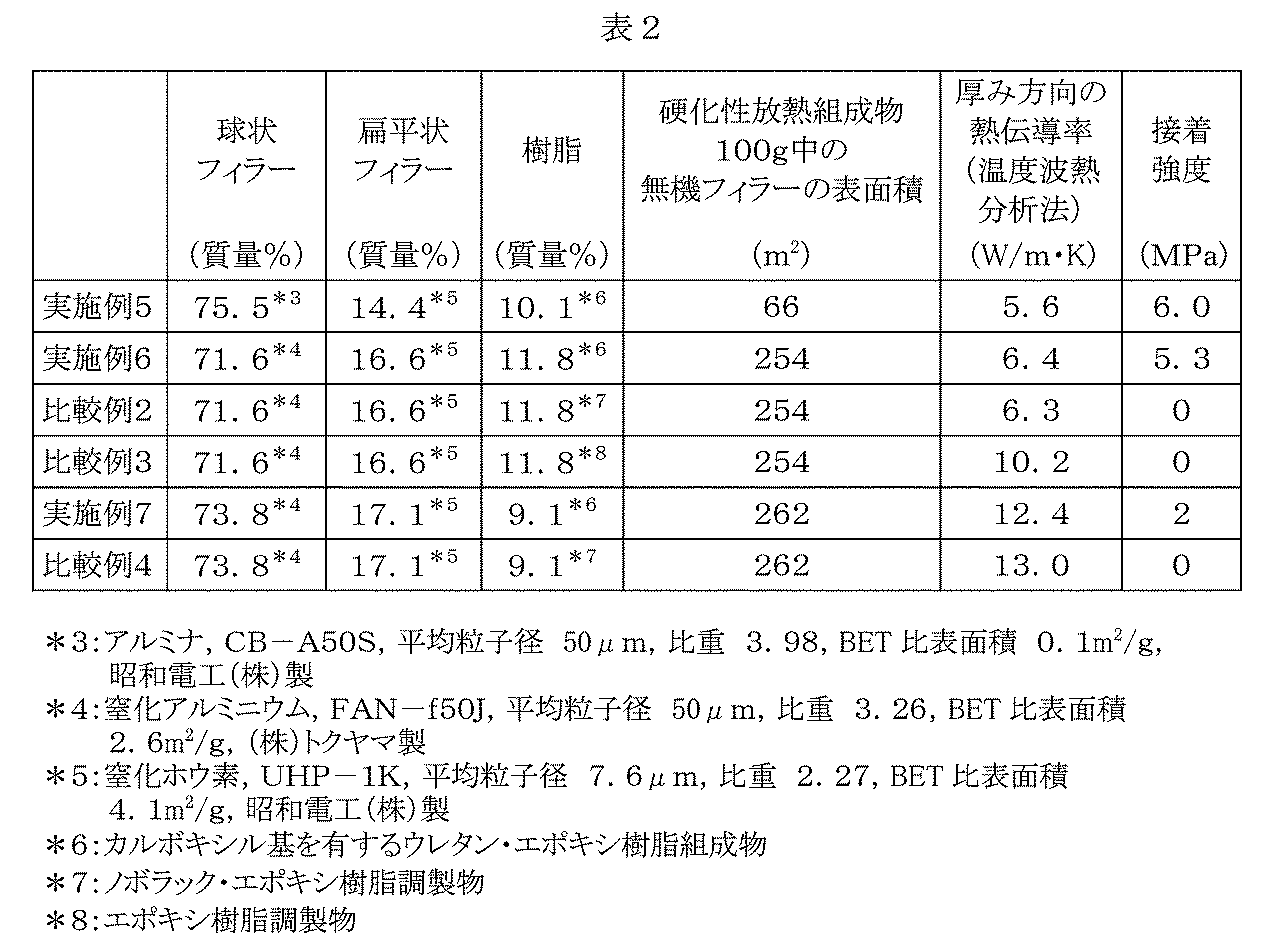
- Examples 5-7 As the inorganic filler, spherical inorganic filler CB-A50S (manufactured by Showa Denko KK / alumina thermal conductivity 36 W / m ⁇ K), particulate inorganic filler FAN-f50J (manufactured by Tokuyama KK / aluminum nitride thermal conductivity 200 W / m ⁇ K) and a flat inorganic filler UHP-1K (manufactured by Showa Denko KK, boron nitride) were used in the same manner as in Example 1 except that the composition was as shown in Table 2. A composition was prepared and a molded cured plate was produced. Table 2 shows the measurement results of each composition ratio, thickness direction thermal conductivity, and normal state adhesive strength of the curable heat radiation composition.
- Comparative Example 2 Commercially available novolac type phenolic resin BRG-556 (manufactured by Showa Denko KK, hydroxyl equivalent 103 (measured in accordance with JIS K0070)) and bisphenol A type epoxy resin YD-128 (manufactured by Nippon Steel Chemical Co., Ltd., epoxy equivalent 189)
- Novolak epoxy resin preparation adjusted to have an equivalent ratio of 1.05: 1.0: particulate aluminum nitride (FAN-f50J): boron nitride UHP-1K, 11.7: 71.6, respectively : 16.6 (mass% ratio), a curable heat radiation composition was prepared in the same manner as in Example 1, and a molded and cured plate was produced.
- Table 2 shows the measurement results of each composition ratio, thickness direction thermal conductivity, and normal state adhesive strength of the curable heat radiation composition.
- the heat conductivity value in the thickness direction of this molded and hardened plate showed a comparatively high value of 6.3 W / m ⁇ K.
- a sheet made from this resin composition was It was poor in flexibility and poor in adhesion with copper and could not be adhered.
- Comparative Example 3 Epoxy resin preparation in which 100 parts by mass of bisphenol A type epoxy resin YD-128 (manufactured by Nippon Steel Chemical Co., Ltd., epoxy equivalent 189) and 2.5 parts by mass of 1-cyanoethyl-2-methylimidazole as a curing agent were added: particulate Aluminum nitride (FAN-f50J): Boron nitride UHP-1K was set to 11.7: 71.6: 16.6 (mass% ratio), respectively, and a curable heat radiation composition was prepared in the same manner as in Example 1. A molded and hardened plate was produced. Table 2 shows the measurement results of each composition ratio, thickness direction thermal conductivity, and normal state adhesive strength of the curable heat radiation composition.
- Comparative Example 4 Commercially available novolac type phenolic resin BRG-556 (manufactured by Showa Denko KK, hydroxyl equivalent 103 (measured in accordance with JIS K0070)) and bisphenol A type epoxy resin YD-128 (manufactured by Nippon Steel Chemical Co., Ltd., epoxy equivalent 189) Novolak epoxy resin preparation adjusted to an equivalent ratio of 1.05: 1.0: particulate aluminum nitride (FAN-f50J): boron nitride (UHP-1K) 9.1: 73, respectively 8: 17.1 (mass% ratio), a curable heat radiation composition was prepared in the same manner as in Example 1, and a molded and cured plate was produced. Table 2 shows the measurement results of each composition ratio, thickness direction thermal conductivity, and adhesive strength of the curable heat radiation composition.
- the curable heat-dissipating resin composition of the present invention in which an epoxy and an inorganic filler are blended using a carboxyl group-containing urethane resin, has high thermal conductivity, flexibility, and good adhesion to metals. It is extremely useful in the field of semiconductor elements including semiconductors, semiconductor devices, circuit metal plates, circuits made of the metal plates, circuit boards, hybrid integrated circuits, and the like.
Landscapes
- Chemical & Material Sciences (AREA)
- Organic Chemistry (AREA)
- Chemical Kinetics & Catalysis (AREA)
- Medicinal Chemistry (AREA)
- Polymers & Plastics (AREA)
- Health & Medical Sciences (AREA)
- Engineering & Computer Science (AREA)
- Compositions Of Macromolecular Compounds (AREA)
- Manufacturing & Machinery (AREA)
- Physics & Mathematics (AREA)
- Thermal Sciences (AREA)
- Materials Engineering (AREA)
- Combustion & Propulsion (AREA)
- Adhesives Or Adhesive Processes (AREA)
- Polyurethanes Or Polyureas (AREA)
- Epoxy Resins (AREA)
Abstract
Description
[1] (A)カルボキシル基を有するウレタン樹脂、(B)エポキシ樹脂及び(C)無機フィラー(但し、硫酸バリウム及び酸化チタンを除く)を含有し、前記無機フィラー(C)の含有率が50~96質量%であることを特徴とする硬化性放熱組成物。
[2] 前記無機フィラー(C)が、20W/m・K以上の熱伝導率を有する無機フィラーを含有する前項[1]に記載の硬化性放熱組成物。
[3] 前記無機フィラー(C)中に、20W/m・K以上の熱伝導率を有する無機フィラーを少なくとも10質量%含有する前項[2]に記載の硬化性放熱組成物。
[4] カルボキシル基を有するウレタン樹脂(A)が、(a)ポリイソシアネート化合物、(b)ポリカーボネートジオール化合物、(c)カルボキシル基を有するジヒドロキシ化合物、及び必要に応じて(d)モノヒドロキシ化合物を反応させて得られる樹脂である前項[1]~[3]のいずれか1項に記載の硬化性放熱組成物。
[5] 前記ポリカーボネートジオール化合物(b)の数平均分子量が300~50000である前項[4]に記載の硬化性放熱組成物。
[6] 前記数平均分子量が300~50000のポリカーボネートジオール化合物を構成するジオールの少なくとも10モル%以上が、炭素数6~30の脂環式化合物である前項[5]に記載の硬化性放熱組成物。
[7] ポリイソシアネート化合物(a)の少なくとも10モル%以上が、イソシアネート基部分以外の炭素数が6~30の脂環式化合物である前項[4]に記載の硬化性放熱組成物。
[8] カルボキシル基を有するウレタン樹脂(A)の数平均分子量が500~100000であり、酸価が5~150mgKOH/gである前項[1]~[4]のいずれか1項に記載の硬化性放熱組成物。
[9] カルボキシル基を有するウレタン樹脂(A)とエポキシ樹脂(B)の質量比が100:10~100である前項[1]~[3]のいずれか1項に記載の硬化性放熱組成物。
[10] 前記無機フィラー(C)が、扁平状フィラーと粒子状フィラーの混合物である前項[1]~[3]のいずれか1項に記載の硬化性放熱組成物。
[11] 扁平状フィラーと粒子状フィラーとの質量比が90:10~10:90である前項[10]に記載の硬化性放熱組成物。
[12] 前記粒子状フィラーがアルミナ、窒化アルミニウムまたは窒化ホウ素であり、前記扁平状フィラーが窒化ホウ素である前項[10]または[11]に記載の硬化性放熱組成物。
[13] 前項[1]~[12]のいずれか1項に記載の硬化性放熱組成物からなる接着剤。
本発明では、硬化性放熱組成物のマトリックス樹脂として、カルボキシル基を有するウレタン樹脂(A)とエポキシ樹脂(B)とからなる混合樹脂を使用する。
また、末端のイソシアネート残基の影響を無くす目的で用いるモノヒドロキシ化合物としては、メタノール、エタノール、n-プロパノール、イソプロパノール、n-ブタノール、イソブタノール、sec-ブタノール、t-ブタノール、アミルアルコール、ヘキシルアルコール、オクチルアルコール等が挙げられる。
反応様式は特に大きな制限はないが、工業的に実施する上での代表的な例を説明する。
無機フィラー(C)としては、シリカ、アルミナ、窒化ホウ素、窒化アルミニウム、炭化ケイ素等のセラミックス、ダイヤモンド、黒鉛等の炭素材料、銅、アルミ、鉄、銀等の金属粉を挙げることができる。前記シリカには、例えば高純度の珪石を溶融して製造される溶融シリカ、天然石英を粉砕して製造される結晶性シリカが含まれる。
無機フィラー(C)の形状は、粒子状及び扁平状のいずれでも良く、その混合物でもよい。粒子状のフィラーとしては、例えばアルミナ、窒化アルミニウム、窒化ホウ素(例えば立方晶)、シリカ、ダイヤモンド、金属粉などが挙げられ、扁平状のフィラーとしては窒化ホウ素(例えば六方晶)、黒鉛、金属粉等が挙げられる。
無機フィラー(C)には、熱伝導率が20W/m・K以上の無機フィラーを少なくとも10質量%、好ましくは少なくとも20質量%含有させることができる。これにより熱伝導の機能がより向上する。熱伝導率が20W/m・K以上の無機フィラーとしては、アルミナ、窒化ホウ素、窒化アルミニウム、炭化ケイ素等のセラミックス、ダイヤモンド、黒鉛等の炭素材料、銅、アルミ、鉄、銀等の金属粉が挙げられる。
また無機フィラー(C)の配合量は、硬化性放熱組成物中における無機フィラーの表面積の総和で表現することもできる。この場合の無機フィラーの表面積の総和は、硬化性放熱組成物100g当たり50~350m2が好ましく、70~300m2がより好ましい。50m2未満では十分な放熱性は発現せず、350m2を超えると組成物の粘着性、硬化後の接着性等が十分得られない。
無機フィラーの表面積の総和は、次の方法で求めることができる。すなわち、例えば、比表面積S1のフィラー1のみを硬化性放熱組成物中にP1質量%含有している場合、硬化性放熱組成物100g当たりのフィラーの表面積は(S1×P1)となる。さらに、該硬化性放熱組成物に比表面積S2のフィラー2をP2質量%含んでいる場合は、硬化性放熱組成物100g当たりのフィラーの表面積は(S1×P1+S2×P2)となる。よって、n成分の無機フィラーを含有する硬化性放熱組成物100g当たりの無機フィラーの表面積の総和は以下の一般式で表される。

なお、本発明において、扁平状とは、図1に無機フィラー粒子1の平面図(a)、及びX-X断面図(b)を示すように、粒子1の長径Lと厚みtとの比が5:1~20:1である形態を意味する。その測定は走査型電子顕微鏡により行うことができる。
また、本発明において、粒子状とは、典型的には球状であり、上記の扁平状よりも扁平性が小さい形態を意味する。
本発明の硬化性放熱組成物においては、粒子状フィラーを一定の範囲で配合することにより扁平状フィラーをランダムに配向させて、厚さ方向の熱伝導率を向上させることができる。
これらの平均粒子径はレーザー回折・散乱法によって粒度分布を測定することによって得られた値である。具体的には、(株)セイシン企業製・レーザー回折散乱式粒度分布測定器(LMS-2000e)を使用することにより測定することができる。
カルボキシル基を有するウレタン樹脂の数平均分子量、酸価、硬化性放熱組成物の熱伝導率、接着強度及び成形硬化板の弾性率は下記の方法により測定(評価)した。
ゲルパーミエーションクロマトグラフィー(昭和電工(株)製,Shodex(登録商標)GPC SYSTEM-11)を用い、ポリスチレンに換算した値として求めた。
100ml三角フラスコに試料約0.2g程度を精密天秤にて精秤し、これにエタノール/トルエン=1/2(質量比)の混合溶媒10mlを加えて溶解する。更に、この容器に指示薬としてフェノールフタレインエタノール溶液を1~3滴添加し、試料が均一になるまで十分に撹拌する。これを、0.1N水酸化カリウム-エタノール溶液で滴定し、指示薬の微紅色が30秒間続いたときを、中和の終点とする。その結果から下記の計算式を用いて得た値を、樹脂の酸価とする。

面方向の熱伝導率は、30mm(縦)×28mm(横)×8mm(厚み)の直方体状試験片を用い、TPS-2500(京都電子(株)製)を使用してホットディスク法にて測定した。また、厚み方向の熱伝導率は、温度波熱分析法により、アイフェイズ・モバイル(ai-Phase Mobile)(アイフェイズ社製)を用いて熱拡散率を測定し、別途求めた比熱、及び密度から下記式により求めた。

銅(日本テストパネル(株)製,C100P・片面#240研磨)の試験片を用い、硬化性放熱組成物をシート状にしたものを上記銅試験片・研磨面に挿み込み、130℃20分の加熱接着を行った後、JIS K6852(1994)に準拠しせん断モードで測定した。なお、試験片の大きさは、幅14mm、厚さ9mm、長さ30mmとし、接着面積は、幅14×長さ25mmとした。
撹拌装置、温度計、コンデンサを備えた反応容器に、ポリカーボネートジオール化合物としてC-1015N((株)クラレ製ポリカーボネートジオール,原料ジオールモル比 1,9-ノナンジオール:2-メチル-1,8-オクタンジオール=15:85,分子量964)330.2g、カルボキシル基を有するジヒドロキシル化合物として2,2-ジメチロールブタン酸(日本化成(株)製)60.4g、溶媒としてテトラヒドロフラン(関東化学(株)製)571.2gを仕込み、反応液の温度を60℃まで上げて、滴下ロートにより、ポリイソシアネート化合物としてデスモジュール-W(住化バイエルウレタン(株)製)180.4gを30分かけて滴下した。滴下終了後、60℃で更に6時間反応を行い、ほぼイソシアネートが消失したことを確認した後、イソブタノール(和光純薬(株)製)5gを滴下し、更に60℃にて2時間反応を行った。
得られたカルボキシル基を有するウレタン樹脂の数平均分子量は8600、固形分の酸価は39.6mgKOH/gであった。
撹拌装置、温度計、コンデンサを備えた反応容器に、ポリカーボネートジオール化合物としてUM-CARB90(宇部興産(株)製,原料ジオールモル比 シクロヘキサンジメタノール:ヘキサンジオール=1:1,分子量891)315.7g、カルボキシル基を有するジヒドロキシル化合物として2,2-ジメチロールブタン酸(日本化成(株)製)58.6g、溶媒としてテトラヒドロフラン(関東化学(株)製)554.7gを仕込み、反応液の温度を60℃まで上げて、滴下ロートにより、ポリイソシアネート化合物としてデスモジュール-W(住化バイエルウレタン(株)製)180.4gを30分かけて滴下した。滴下終了後、60℃で更に6時間反応を行い、ほぼイソシアネートが消失したことを確認した後、イソブタノール(和光純薬(株)製)5gを滴下し、更に60℃にて2時間反応を行った。
得られたカルボキシル基含有ポリウレタンは、数平均分子量は7900、固形分の酸価は40.2mgKOH/gであった。
合成例1で得られたカルボキシル基を有するウレタン樹脂(カルボキシル基当量1416)とビスフェノールA型エポキシ樹脂(新日鉄化学(株)製,YD-128:エポキシ当量189)との当量比を1.05:1.0になるように調整したカルボキシル基を有するウレタン・エポキシ樹脂調製物(15質量%)に対して、無機フィラーとして扁平状無機フィラーUHP-1K(昭和電工(株)製・窒化ホウ素 熱伝導率 60W/m・K)を(85質量%,組成物100g中の表面積総和=349m2)配合したのち、自転・公転ミキサー((株)シンキー製,泡取り練り太郎)を用いて混練りし、目的の硬化性放熱樹脂組成物を得た。
この硬化性放熱組成物を熱プレスを用いて130℃20分加熱成形し、シート状にして硬化させた成形硬化板を作製し、この熱伝導率を測定したところ、面方向の熱伝導率は37.4W/m・Kと極めて高い値を示した。
合成例2で得られたカルボキシル基含有ウレタン樹脂(カルボキシル基当量1396)とビスフェノールA型エポキシ樹脂(YD-128,新日鉄化学(株)製,エポキシ当量189)との当量比を1.05:1.0になるように調整したカルボキシル基含有ウレタン・エポキシ樹脂調製物と無機フィラーとの質量%比を表1の通り変えた以外は、実施例1と同様にして実施例2~4の硬化性放熱樹脂組成物を調製し、成形硬化板を作製した。これらの面方向の熱伝導率測定結果を表1に示す。8W/m・K以上の高い熱伝導率が得られた。
無機フィラー(UHP-1K):カルボキシル基含有ウレタン・エポキシ樹脂調製物の比率を40質量%にした以外は、実施例1と同様の方法で硬化性放熱樹脂組成物を調製し、成形硬化板を作製した。この成形硬化板の熱伝導率を測定したところ、面方向の熱伝導率は、3.6W/m・Kであった。

無機フィラーとして、球状無機フィラーCB-A50S(昭和電工(株)製・アルミナ 熱伝導率 36W/m・K)、粒子状無機フィラーFAN-f50J((株)トクヤマ製・窒化アルミニウム 熱伝導率 200W/m・K)及び扁平状無機フィラーUHP-1K(昭和電工(株)製・窒化ホウ素)を併用し、表2に示した通りの組成とした他は、実施例1と同様にして硬化性放熱組成物を調製し、成形硬化板を作製した。硬化性放熱組成物の各組成比、厚み方向熱伝導率、及び常態接着強度の測定結果を表2に示す。
市販のノボラック型フェノール樹脂BRG-556(昭和電工(株)製,水酸基当量103(JIS K0070に準拠し測定))とビスフェノールA型エポキシ樹脂YD-128(新日鉄化学(株)製,エポキシ当量189)との当量比を1.05:1.0になるように調整したノボラック・エポキシ樹脂調製物:粒子状窒化アルミニウム(FAN-f50J):窒化ホウ素UHP-1Kをそれぞれ、11.7:71.6:16.6(質量%比)とし、実施例1と同様にして硬化性放熱組成物を調製し、成形硬化板を作製した。硬化性放熱組成物の各組成比、厚み方向熱伝導率、及び常態接着強度の測定結果を表2に示す。
この成形硬化板の厚み方向の熱伝導率の値は、6.3W/m・Kと比較的高い値を示したが、接着強度の測定を試みたところ、この樹脂組成物から作製したシートは、柔軟性に乏しく、銅との接着性に劣り接着させることはできなかった。
ビスフェノールA型エポキシ樹脂YD-128(新日鉄化学(株)製,エポキシ当量189)100質量部、硬化剤として1-シアノエチル-2- メチルイミダゾール 2.5質量部を添加したエポキシ樹脂調製物:粒子状窒化アルミニウム(FAN-f50J):窒化ホウ素UHP-1Kをそれぞれ、11.7:71.6:16.6(質量%比)とし、実施例1と同様にして硬化性放熱組成物を調製し、成形硬化板を作製した。硬化性放熱組成物の各組成比、厚み方向熱伝導率、及び常態接着強度の測定結果を表2に示す。
市販のノボラック型フェノール樹脂BRG-556(昭和電工(株)製,水酸基当量103(JIS K0070に準拠し測定))とビスフェノールA型エポキシ樹脂YD-128(新日鉄化学(株)製,エポキシ当量189)との当量比を1.05:1.0になるように調整したノボラック・エポキシ樹脂調製物:粒子状窒化アルミニウム(FAN-f50J):窒化ホウ素(UHP-1K)をそれぞれ、9.1:73.8:17.1(質量%比)とし、実施例1と同様にして硬化性放熱組成物を調製し、成形硬化板を作製した。硬化性放熱組成物の各組成比、厚み方向熱伝導率、及び接着強度の測定結果を表2に示す。
Claims (13)
- (A)カルボキシル基を有するウレタン樹脂、(B)エポキシ樹脂及び(C)無機フィラー(但し、硫酸バリウム及び酸化チタンを除く)を含有し、前記無機フィラー(C)の含有率が50~96質量%であることを特徴とする硬化性放熱組成物。
- 前記無機フィラー(C)が、20W/m・K以上の熱伝導率を有する無機フィラーを含有する請求項1に記載の硬化性放熱組成物。
- 前記無機フィラー(C)中に、20W/m・K以上の熱伝導率を有する無機フィラーを少なくとも10質量%含有する請求項2に記載の硬化性放熱組成物。
- カルボキシル基を有するウレタン樹脂(A)が、(a)ポリイソシアネート化合物、(b)ポリカーボネートジオール化合物、(c)カルボキシル基を有するジヒドロキシ化合物、及び必要に応じて(d)モノヒドロキシ化合物を反応させて得られる樹脂である請求項1~3のいずれか1項に記載の硬化性放熱組成物。
- 前記ポリカーボネートジオール化合物(b)の数平均分子量が300~50000である請求項4に記載の硬化性放熱組成物。
- 前記数平均分子量が300~50000のポリカーボネートジオール化合物を構成するジオールの少なくとも10モル%以上が、炭素数6~30の脂環式化合物である請求項5に記載の硬化性放熱組成物。
- ポリイソシアネート化合物(a)の少なくとも10モル%以上が、イソシアネート基部分以外の炭素数が6~30の脂環式化合物である請求項4に記載の硬化性放熱組成物。
- カルボキシル基を有するウレタン樹脂(A)の数平均分子量が500~100000であり、酸価が5~150mgKOH/gである請求項1~4のいずれか1項に記載の硬化性放熱組成物。
- カルボキシル基を有するウレタン樹脂(A)とエポキシ樹脂(B)の質量比が100:10~100である請求項1~3のいずれか1項に記載の硬化性放熱組成物。
- 前記無機フィラー(C)が、扁平状フィラーと粒子状フィラーの混合物である請求項1~3のいずれか1項に記載の硬化性放熱組成物。
- 扁平状フィラーと粒子状フィラーとの質量比が90:10~10:90である請求項10に記載の硬化性放熱組成物。
- 前記粒子状フィラーがアルミナ、窒化アルミニウムまたは窒化ホウ素であり、前記扁平状フィラーが窒化ホウ素である請求項10または11に記載の硬化性放熱組成物。
- 請求項1~12のいずれか1項に記載の硬化性放熱組成物からなる接着剤。
Priority Applications (3)
| Application Number | Priority Date | Filing Date | Title |
|---|---|---|---|
| CN201280023426.8A CN103562258B (zh) | 2011-05-16 | 2012-05-15 | 固化性散热组合物 |
| JP2013515156A JPWO2012157627A1 (ja) | 2011-05-16 | 2012-05-15 | 硬化性放熱組成物 |
| KR1020137025713A KR101525487B1 (ko) | 2011-05-16 | 2012-05-15 | 경화성 방열 조성물 |
Applications Claiming Priority (2)
| Application Number | Priority Date | Filing Date | Title |
|---|---|---|---|
| JP2011109302 | 2011-05-16 | ||
| JP2011-109302 | 2011-05-16 |
Publications (1)
| Publication Number | Publication Date |
|---|---|
| WO2012157627A1 true WO2012157627A1 (ja) | 2012-11-22 |
Family
ID=47176944
Family Applications (1)
| Application Number | Title | Priority Date | Filing Date |
|---|---|---|---|
| PCT/JP2012/062367 Ceased WO2012157627A1 (ja) | 2011-05-16 | 2012-05-15 | 硬化性放熱組成物 |
Country Status (5)
| Country | Link |
|---|---|
| JP (1) | JPWO2012157627A1 (ja) |
| KR (1) | KR101525487B1 (ja) |
| CN (1) | CN103562258B (ja) |
| TW (1) | TWI534256B (ja) |
| WO (1) | WO2012157627A1 (ja) |
Cited By (7)
| Publication number | Priority date | Publication date | Assignee | Title |
|---|---|---|---|---|
| US20150034473A1 (en) * | 2013-07-31 | 2015-02-05 | E I Du Pont De Nemours And Company | Thermally conductive dielectric for thermoformable circuits |
| JP2015160955A (ja) * | 2014-02-25 | 2015-09-07 | ザ・ボーイング・カンパニーTheBoeing Company | 航空宇宙応用のための熱伝導性柔軟性接着剤 |
| KR101613787B1 (ko) | 2013-06-18 | 2016-04-19 | 주식회사 엘지화학 | 열경화성 수지 조성물 및 이의 제조방법 |
| JP2017052915A (ja) * | 2015-09-11 | 2017-03-16 | 株式会社豊田中央研究所 | 樹脂複合材料及びその製造方法 |
| JP2020152802A (ja) * | 2019-03-20 | 2020-09-24 | 三菱ケミカル株式会社 | 樹脂組成物、塗料組成物及び塗装物 |
| JP2021059479A (ja) * | 2019-10-09 | 2021-04-15 | Dic株式会社 | ガスバリア性組成物、ガスバリア材、及び積層体 |
| CN113604007A (zh) * | 2021-08-05 | 2021-11-05 | 宁夏清研高分子新材料有限公司 | 一种lcpu改性环氧树脂基导热复合材料及其制备方法和应用 |
Families Citing this family (9)
| Publication number | Priority date | Publication date | Assignee | Title |
|---|---|---|---|---|
| CN107075258B (zh) * | 2014-10-01 | 2020-03-06 | 纳美仕有限公司 | 树脂组合物 |
| CN107207852B (zh) * | 2015-02-09 | 2020-04-14 | 株式会社有泽制作所 | 低介电树脂组合物 |
| KR102116223B1 (ko) | 2016-05-31 | 2020-05-28 | 한국전기연구원 | 금속/이차원 나노소재 하이브리드 방열체 및 그 제조방법 |
| CN106965100A (zh) * | 2017-04-19 | 2017-07-21 | 台山市远鹏研磨科技有限公司 | 一种湿式抛光垫及其制备方法 |
| CA3080094A1 (en) * | 2017-12-20 | 2019-06-27 | Covestro Deutschland Ag | Polycarbonate composition with good flame retardancy |
| KR102119752B1 (ko) * | 2018-10-02 | 2020-06-05 | 주식회사 이엠따블유 | 연성회로기판 모듈 및 이의 제조방법 |
| KR102572190B1 (ko) * | 2021-09-28 | 2023-08-29 | 이기영 | 이차전지용 방열수지 조성물의 제조방법 및 이의 경화방법 |
| CN113861668B (zh) * | 2021-11-17 | 2023-02-28 | 尼伦化学(上海)有限公司 | 一种高折光指数、高耐磨tpu粒子及制备方法 |
| TWI867943B (zh) * | 2024-01-18 | 2024-12-21 | 財團法人工業技術研究院 | 導熱組成物 |
Citations (4)
| Publication number | Priority date | Publication date | Assignee | Title |
|---|---|---|---|---|
| JP2008201847A (ja) * | 2007-02-16 | 2008-09-04 | Taiyo Ink Mfg Ltd | カルボシキル基含有ウレタン樹脂を含有する熱硬化性樹脂組成物及びその硬化物 |
| JP2009280686A (ja) * | 2008-05-21 | 2009-12-03 | Hitachi Chem Co Ltd | 熱硬化性樹脂組成物 |
| JP2011148862A (ja) * | 2010-01-19 | 2011-08-04 | Hitachi Chem Co Ltd | 熱硬化性樹脂組成物、フレキシブル配線板の保護膜の形成方法及びフレキシブル配線板 |
| JP2012004553A (ja) * | 2010-05-17 | 2012-01-05 | Showa Denko Kk | 発光素子用実装基板、発光素子用実装基板の製造方法、発光装置及び発光装置の製造方法並びに白色樹脂組成物 |
Family Cites Families (12)
| Publication number | Priority date | Publication date | Assignee | Title |
|---|---|---|---|---|
| JP4089636B2 (ja) * | 2004-02-19 | 2008-05-28 | 三菱電機株式会社 | 熱伝導性樹脂シートの製造方法およびパワーモジュールの製造方法 |
| FR2872820B1 (fr) * | 2004-07-07 | 2008-09-05 | Conception & Dev Michelin Sa | Systeme adhesif pour le collage direct d'un polyurethane cuit a du caoutchouc cru |
| JP4994679B2 (ja) * | 2005-03-04 | 2012-08-08 | 昭和電工株式会社 | 皮膜材料形成用ペースト |
| JP5233392B2 (ja) * | 2008-04-30 | 2013-07-10 | 東洋インキScホールディングス株式会社 | ポリウレタンポリウレア接着剤、それを用いた硬化性電磁波シールド性接着性フィルム及びその製造方法 |
| JP5506010B2 (ja) * | 2006-03-17 | 2014-05-28 | 昭和電工株式会社 | 樹脂組成物 |
| JP2009001642A (ja) * | 2007-06-20 | 2009-01-08 | Hitachi Chem Co Ltd | 熱硬化性樹脂組成物、これを用いたフレキシブル基板及び電子部品 |
| JP5043577B2 (ja) * | 2007-09-27 | 2012-10-10 | 太陽ホールディングス株式会社 | 熱硬化性樹脂組成物及びその硬化物 |
| JP2009096915A (ja) * | 2007-10-18 | 2009-05-07 | Hitachi Chem Co Ltd | 熱硬化性樹脂組成物、これを用いたフレキシブル基板及び電子部品 |
| WO2009090997A1 (ja) * | 2008-01-15 | 2009-07-23 | Toyo Ink Manufacturing Co., Ltd. | 硬化性電磁波シールド性接着性フィルム、その製造方法、及びその使用方法、並びに電磁波遮蔽物の製造方法及び電磁波遮蔽物 |
| DE102008007749A1 (de) * | 2008-02-05 | 2009-08-06 | Tesa Se | Thermisch aktivier- und härtbare Klebefolie insbesondere für die Verklebung von elektronischen Bauteilen und flexiblen gedruckten Leiterbahnen |
| JP2010229282A (ja) * | 2009-03-27 | 2010-10-14 | Toyo Ink Mfg Co Ltd | ポリウレタンポリウレア樹脂組成物、それを用いた硬化性電磁波シールド性接着性フィルム及びその製造方法 |
| WO2010147095A1 (ja) * | 2009-06-17 | 2010-12-23 | 昭和電工株式会社 | 放電ギャップ充填用組成物および静電放電保護体 |
-
2012
- 2012-05-14 TW TW101117103A patent/TWI534256B/zh not_active IP Right Cessation
- 2012-05-15 JP JP2013515156A patent/JPWO2012157627A1/ja active Pending
- 2012-05-15 WO PCT/JP2012/062367 patent/WO2012157627A1/ja not_active Ceased
- 2012-05-15 CN CN201280023426.8A patent/CN103562258B/zh not_active Expired - Fee Related
- 2012-05-15 KR KR1020137025713A patent/KR101525487B1/ko not_active Expired - Fee Related
Patent Citations (4)
| Publication number | Priority date | Publication date | Assignee | Title |
|---|---|---|---|---|
| JP2008201847A (ja) * | 2007-02-16 | 2008-09-04 | Taiyo Ink Mfg Ltd | カルボシキル基含有ウレタン樹脂を含有する熱硬化性樹脂組成物及びその硬化物 |
| JP2009280686A (ja) * | 2008-05-21 | 2009-12-03 | Hitachi Chem Co Ltd | 熱硬化性樹脂組成物 |
| JP2011148862A (ja) * | 2010-01-19 | 2011-08-04 | Hitachi Chem Co Ltd | 熱硬化性樹脂組成物、フレキシブル配線板の保護膜の形成方法及びフレキシブル配線板 |
| JP2012004553A (ja) * | 2010-05-17 | 2012-01-05 | Showa Denko Kk | 発光素子用実装基板、発光素子用実装基板の製造方法、発光装置及び発光装置の製造方法並びに白色樹脂組成物 |
Cited By (12)
| Publication number | Priority date | Publication date | Assignee | Title |
|---|---|---|---|---|
| KR101613787B1 (ko) | 2013-06-18 | 2016-04-19 | 주식회사 엘지화학 | 열경화성 수지 조성물 및 이의 제조방법 |
| US20150034473A1 (en) * | 2013-07-31 | 2015-02-05 | E I Du Pont De Nemours And Company | Thermally conductive dielectric for thermoformable circuits |
| WO2015017489A1 (en) * | 2013-07-31 | 2015-02-05 | E. I. Du Pont De Nemours And Company | Thermally conductive dielectric for thermoformable circuits |
| CN105452379A (zh) * | 2013-07-31 | 2016-03-30 | E.I.内穆尔杜邦公司 | 用于可热成形电路的导热电介质 |
| US9346992B2 (en) | 2013-07-31 | 2016-05-24 | E I Du Pont De Nemours And Company | Thermally conductive dielectric for thermoformable circuits |
| JP2015160955A (ja) * | 2014-02-25 | 2015-09-07 | ザ・ボーイング・カンパニーTheBoeing Company | 航空宇宙応用のための熱伝導性柔軟性接着剤 |
| JP2017052915A (ja) * | 2015-09-11 | 2017-03-16 | 株式会社豊田中央研究所 | 樹脂複合材料及びその製造方法 |
| JP2020152802A (ja) * | 2019-03-20 | 2020-09-24 | 三菱ケミカル株式会社 | 樹脂組成物、塗料組成物及び塗装物 |
| JP7582385B2 (ja) | 2019-03-20 | 2024-11-13 | 三菱ケミカル株式会社 | 樹脂組成物、塗料組成物及び塗装物 |
| JP2021059479A (ja) * | 2019-10-09 | 2021-04-15 | Dic株式会社 | ガスバリア性組成物、ガスバリア材、及び積層体 |
| CN113604007A (zh) * | 2021-08-05 | 2021-11-05 | 宁夏清研高分子新材料有限公司 | 一种lcpu改性环氧树脂基导热复合材料及其制备方法和应用 |
| CN113604007B (zh) * | 2021-08-05 | 2023-01-10 | 宁夏清研高分子新材料有限公司 | 一种lcpu改性环氧树脂基导热复合材料及其制备方法和应用 |
Also Published As
| Publication number | Publication date |
|---|---|
| TW201311875A (zh) | 2013-03-16 |
| CN103562258A (zh) | 2014-02-05 |
| KR20130133010A (ko) | 2013-12-05 |
| JPWO2012157627A1 (ja) | 2014-07-31 |
| KR101525487B1 (ko) | 2015-06-03 |
| TWI534256B (zh) | 2016-05-21 |
| CN103562258B (zh) | 2016-06-29 |
Similar Documents
| Publication | Publication Date | Title |
|---|---|---|
| WO2012157627A1 (ja) | 硬化性放熱組成物 | |
| EP3626770B1 (en) | Resin composition | |
| CN103374219B (zh) | 树脂组合物 | |
| TW200918571A (en) | Heat curable resin compositon | |
| JP7530016B2 (ja) | 熱伝導性樹脂組成物、硬化物および放熱方法 | |
| WO2007097405A1 (ja) | 低塩素多官能脂肪族グリシジルエーテル化合物を含む熱硬化性樹脂組成物、該組成物の硬化物およびその用途 | |
| JP7297338B2 (ja) | 硬化性樹脂組成物及びその製造方法 | |
| JP2010248350A (ja) | ポリウレタン樹脂組成物 | |
| TWI819200B (zh) | 顯示器用密封劑及液晶顯示器 | |
| JP2025521847A (ja) | 硬化性組成物 | |
| JP6225983B2 (ja) | 樹脂組成物 | |
| JP5857785B2 (ja) | 熱伝導性絶縁樹脂組成物および熱伝導性接着シ−ト | |
| TW201934716A (zh) | 顯示器用封裝劑 | |
| TWI743195B (zh) | 硬化性樹脂組成物、其硬化物及以該硬化物接合之接合體 | |
| TWI832151B (zh) | 組成物及包括其的電池 | |
| JP2025521986A (ja) | 硬化性組成物 | |
| JP5258191B2 (ja) | 半導体チップ接合用接着剤 | |
| JP7487731B2 (ja) | 硬化性組成物、蓄熱材、及び物品 | |
| JP7400184B2 (ja) | 熱伝導性接着剤 | |
| KR102535889B1 (ko) | 경화성 조성물 | |
| JP2015209438A (ja) | 硬化性樹脂組成物 | |
| JP2023549885A (ja) | 硬化性組成物 | |
| JP2015209437A (ja) | 硬化性樹脂組成物 | |
| JP2025521741A (ja) | 硬化性組成物 | |
| CN114058321A (zh) | 显示器用封装剂 |
Legal Events
| Date | Code | Title | Description |
|---|---|---|---|
| 121 | Ep: the epo has been informed by wipo that ep was designated in this application |
Ref document number: 12785815 Country of ref document: EP Kind code of ref document: A1 |
|
| ENP | Entry into the national phase |
Ref document number: 2013515156 Country of ref document: JP Kind code of ref document: A |
|
| ENP | Entry into the national phase |
Ref document number: 20137025713 Country of ref document: KR Kind code of ref document: A |
|
| NENP | Non-entry into the national phase |
Ref country code: DE |
|
| 122 | Ep: pct application non-entry in european phase |
Ref document number: 12785815 Country of ref document: EP Kind code of ref document: A1 |