WO2012133826A1 - 液晶配向剤、及びそれを用いた液晶配向膜 - Google Patents
液晶配向剤、及びそれを用いた液晶配向膜 Download PDFInfo
- Publication number
- WO2012133826A1 WO2012133826A1 PCT/JP2012/058688 JP2012058688W WO2012133826A1 WO 2012133826 A1 WO2012133826 A1 WO 2012133826A1 JP 2012058688 W JP2012058688 W JP 2012058688W WO 2012133826 A1 WO2012133826 A1 WO 2012133826A1
- Authority
- WO
- WIPO (PCT)
- Prior art keywords
- liquid crystal
- group
- aligning agent
- crystal aligning
- polyamic acid
- Prior art date
- Legal status (The legal status is an assumption and is not a legal conclusion. Google has not performed a legal analysis and makes no representation as to the accuracy of the status listed.)
- Ceased
Links
- 0 CC(C1)C(*)C1N Chemical compound CC(C1)C(*)C1N 0.000 description 3
- SGVNXWMGLDQSQI-UHFFFAOYSA-N CC(C1C)C2C=C1C(C)C2C Chemical compound CC(C1C)C2C=C1C(C)C2C SGVNXWMGLDQSQI-UHFFFAOYSA-N 0.000 description 1
- VWWAILZUSKHANH-UHFFFAOYSA-N CC1C(C)CC(C)C(C)C1 Chemical compound CC1C(C)CC(C)C(C)C1 VWWAILZUSKHANH-UHFFFAOYSA-N 0.000 description 1
- ZSAIWGXUIFEEGM-UHFFFAOYSA-N CC1C(C2)C(C)C(C)C2C1C Chemical compound CC1C(C2)C(C)C(C)C2C1C ZSAIWGXUIFEEGM-UHFFFAOYSA-N 0.000 description 1
- SEBGKBTXPHLVOS-UHFFFAOYSA-N CC1C(c2cccc(C3(C)C=CC(C)=CC3)c2)=CC=C(C)C1 Chemical compound CC1C(c2cccc(C3(C)C=CC(C)=CC3)c2)=CC=C(C)C1 SEBGKBTXPHLVOS-UHFFFAOYSA-N 0.000 description 1
- GZIDFJIMIVRESK-UHFFFAOYSA-N CC1C2C(C3)C(C(C)C4C)C4C3C2C1C Chemical compound CC1C2C(C3)C(C(C)C4C)C4C3C2C1C GZIDFJIMIVRESK-UHFFFAOYSA-N 0.000 description 1
- XXRQMINPGUKSFE-UHFFFAOYSA-N CC1C2C(C3)C(CC4C(C5)C6C(C7C(C)C(C)C8C7)C8C4C6)C5C3C2C1C Chemical compound CC1C2C(C3)C(CC4C(C5)C6C(C7C(C)C(C)C8C7)C8C4C6)C5C3C2C1C XXRQMINPGUKSFE-UHFFFAOYSA-N 0.000 description 1
- ARFLLUYZMHVMQE-UHFFFAOYSA-N CCC(C(C)C1)C(C)C1C1C(C)C(C)C(C)C1 Chemical compound CCC(C(C)C1)C(C)C1C1C(C)C(C)C(C)C1 ARFLLUYZMHVMQE-UHFFFAOYSA-N 0.000 description 1
- ZTDFZGQIUJFUCA-UHFFFAOYSA-N CCC1C(C2)C(C)C(C)C2C1C Chemical compound CCC1C(C2)C(C)C(C)C2C1C ZTDFZGQIUJFUCA-UHFFFAOYSA-N 0.000 description 1
- NKIXYJULGMJDDU-UHFFFAOYSA-N Cc(cc1)ccc1-c(cc1)ccc1-c1ccc(C)cc1 Chemical compound Cc(cc1)ccc1-c(cc1)ccc1-c1ccc(C)cc1 NKIXYJULGMJDDU-UHFFFAOYSA-N 0.000 description 1
Classifications
-
- C—CHEMISTRY; METALLURGY
- C08—ORGANIC MACROMOLECULAR COMPOUNDS; THEIR PREPARATION OR CHEMICAL WORKING-UP; COMPOSITIONS BASED THEREON
- C08G—MACROMOLECULAR COMPOUNDS OBTAINED OTHERWISE THAN BY REACTIONS ONLY INVOLVING UNSATURATED CARBON-TO-CARBON BONDS
- C08G73/00—Macromolecular compounds obtained by reactions forming a linkage containing nitrogen with or without oxygen or carbon in the main chain of the macromolecule, not provided for in groups C08G12/00 - C08G71/00
- C08G73/06—Polycondensates having nitrogen-containing heterocyclic rings in the main chain of the macromolecule
- C08G73/10—Polyimides; Polyester-imides; Polyamide-imides; Polyamide acids or similar polyimide precursors
-
- C—CHEMISTRY; METALLURGY
- C08—ORGANIC MACROMOLECULAR COMPOUNDS; THEIR PREPARATION OR CHEMICAL WORKING-UP; COMPOSITIONS BASED THEREON
- C08K—Use of inorganic or non-macromolecular organic substances as compounding ingredients
- C08K5/00—Use of organic ingredients
- C08K5/04—Oxygen-containing compounds
-
- C—CHEMISTRY; METALLURGY
- C08—ORGANIC MACROMOLECULAR COMPOUNDS; THEIR PREPARATION OR CHEMICAL WORKING-UP; COMPOSITIONS BASED THEREON
- C08L—COMPOSITIONS OF MACROMOLECULAR COMPOUNDS
- C08L79/00—Compositions of macromolecular compounds obtained by reactions forming in the main chain of the macromolecule a linkage containing nitrogen with or without oxygen or carbon only, not provided for in groups C08L61/00 - C08L77/00
- C08L79/04—Polycondensates having nitrogen-containing heterocyclic rings in the main chain; Polyhydrazides; Polyamide acids or similar polyimide precursors
- C08L79/08—Polyimides; Polyester-imides; Polyamide-imides; Polyamide acids or similar polyimide precursors
-
- G—PHYSICS
- G02—OPTICS
- G02F—OPTICAL DEVICES OR ARRANGEMENTS FOR THE CONTROL OF LIGHT BY MODIFICATION OF THE OPTICAL PROPERTIES OF THE MEDIA OF THE ELEMENTS INVOLVED THEREIN; NON-LINEAR OPTICS; FREQUENCY-CHANGING OF LIGHT; OPTICAL LOGIC ELEMENTS; OPTICAL ANALOGUE/DIGITAL CONVERTERS
- G02F1/00—Devices or arrangements for the control of the intensity, colour, phase, polarisation or direction of light arriving from an independent light source, e.g. switching, gating or modulating; Non-linear optics
- G02F1/01—Devices or arrangements for the control of the intensity, colour, phase, polarisation or direction of light arriving from an independent light source, e.g. switching, gating or modulating; Non-linear optics for the control of the intensity, phase, polarisation or colour
- G02F1/13—Devices or arrangements for the control of the intensity, colour, phase, polarisation or direction of light arriving from an independent light source, e.g. switching, gating or modulating; Non-linear optics for the control of the intensity, phase, polarisation or colour based on liquid crystals, e.g. single liquid crystal display cells
- G02F1/133—Constructional arrangements; Operation of liquid crystal cells; Circuit arrangements
- G02F1/1333—Constructional arrangements; Manufacturing methods
- G02F1/1337—Surface-induced orientation of the liquid crystal molecules, e.g. by alignment layers
-
- G—PHYSICS
- G02—OPTICS
- G02F—OPTICAL DEVICES OR ARRANGEMENTS FOR THE CONTROL OF LIGHT BY MODIFICATION OF THE OPTICAL PROPERTIES OF THE MEDIA OF THE ELEMENTS INVOLVED THEREIN; NON-LINEAR OPTICS; FREQUENCY-CHANGING OF LIGHT; OPTICAL LOGIC ELEMENTS; OPTICAL ANALOGUE/DIGITAL CONVERTERS
- G02F1/00—Devices or arrangements for the control of the intensity, colour, phase, polarisation or direction of light arriving from an independent light source, e.g. switching, gating or modulating; Non-linear optics
- G02F1/01—Devices or arrangements for the control of the intensity, colour, phase, polarisation or direction of light arriving from an independent light source, e.g. switching, gating or modulating; Non-linear optics for the control of the intensity, phase, polarisation or colour
- G02F1/13—Devices or arrangements for the control of the intensity, colour, phase, polarisation or direction of light arriving from an independent light source, e.g. switching, gating or modulating; Non-linear optics for the control of the intensity, phase, polarisation or colour based on liquid crystals, e.g. single liquid crystal display cells
- G02F1/133—Constructional arrangements; Operation of liquid crystal cells; Circuit arrangements
- G02F1/1333—Constructional arrangements; Manufacturing methods
- G02F1/1337—Surface-induced orientation of the liquid crystal molecules, e.g. by alignment layers
- G02F1/133711—Surface-induced orientation of the liquid crystal molecules, e.g. by alignment layers by organic films, e.g. polymeric films
- G02F1/133723—Polyimide, polyamide-imide
Definitions
- the present invention relates to a liquid crystal aligning agent suitable for application by an inkjet method and a liquid crystal aligning film obtained from the liquid crystal aligning agent.
- liquid crystal alignment film a so-called polyimide-based liquid crystal alignment film, which is obtained by applying and baking a liquid crystal alignment agent mainly composed of a polyimide precursor such as polyamic acid (also called polyamic acid) or a soluble polyimide solution, is widely used.
- a liquid crystal alignment agent mainly composed of a polyimide precursor such as polyamic acid (also called polyamic acid) or a soluble polyimide solution
- spin coating, dip coating, flexographic printing, and the like are generally known as methods for forming such a liquid crystal alignment film.
- flexographic printing requires various resin plates due to the different types of liquid crystal panels, the plate replacement in the manufacturing process is complicated, and film formation on a dummy substrate is required to stabilize the film formation process. There are problems such as the necessity of manufacturing the plate and the production cost of the liquid crystal display panel.
- an inkjet method has attracted attention as a new method for applying a liquid crystal alignment film without using a printing plate.
- the ink jet method is a method in which fine droplets are dropped on a substrate and a film is formed by wetting and spreading of the liquid. Not only the printing plate is not used, but also the printing pattern can be set freely, so that the manufacturing process of the liquid crystal display element can be simplified. In addition, there is an advantage that the waste of the coating liquid is reduced because the film formation on the dummy substrate which is necessary for flexographic printing is not necessary.
- the inkjet method is expected to reduce the cost of liquid crystal panels and improve production efficiency.
- the liquid crystal alignment film formed by the ink jet method is required to have small film thickness unevenness inside the coating surface and high film forming accuracy in the peripheral part of the coating.
- a liquid crystal alignment film formed by an ink-jet method has a trade-off relationship between the uniformity of the film thickness in the coating surface and the film forming accuracy in the periphery of the coating.
- a material with high in-plane uniformity has a saw-tooth shape in the periphery of the application instead of being linear.
- the material in which the coating peripheral part is a straight line has poor uniformity in the coated surface.
- Patent Document 1 Patent Document 2, Patent Document 3
- Patent Document 2 Patent Document 3
- Patent Document 3 Patent Document 3
- the present invention provides a polyimide-based liquid crystal aligning agent suitable for the inkjet method and a liquid crystal aligning film using the same, which can form a coating film having excellent uniformity in the thickness of the coating surface and linearity in the peripheral portion of the coating. There is to do.
- a liquid crystal aligning agent comprising: at least one polymer selected from the group consisting of a polyimide and a polyimide precursor; and a solvent containing an alkyl cellosolve acetate compound represented by the following formula (1).
- R 1 is an alkyl group having 1 to 8 carbon atoms.
- the polyimide precursor contains at least one selected from the group consisting of a polyamic acid ester and a polyamic acid.
- the solvent contains at least one selected from the group consisting of N-methylpyrrolidone and ⁇ -butyrolactone. 4).
- the liquid crystal aligning agent according to any one of 1 to 7 above having a viscosity of 5 to 20 mPa ⁇ s. 9.
- a method for forming a liquid crystal alignment film wherein the liquid crystal aligning agent according to any one of 1 to 8 is applied by an inkjet method.
- a liquid crystal alignment film obtained by applying the liquid crystal aligning agent according to any one of 1 to 8 above, drying and baking.
- the conventional liquid crystal aligning agent which is excellent in the uniformity of the film thickness in the coating surface and the linearity in the peripheral portion of the application, is compatible.
- a coating film having excellent characteristics that are difficult to obtain in this way can be obtained.
- the liquid crystal alignment film obtained from such a coating film has excellent characteristics in terms of in-plane uniformity and linearity in the peripheral portion.
- the polyimide precursor contained in the liquid crystal aligning agent of this invention produces
- the polyamic acid ester and the polyamic acid have the following formula (1) and the following formula (2), respectively.
- R 1 is an alkyl group having 1 to 5, preferably 1 to 2 carbon atoms.
- R 1 is particularly preferably a methyl group from the viewpoint of ease of imidization by heat.
- a 1 and A 2 are each independently a hydrogen atom or an alkyl group, alkenyl group, or alkynyl group having 1 to 10 carbon atoms that may have a substituent. is there.
- alkyl group examples include a methyl group, an ethyl group, a propyl group, a butyl group, a t-butyl group, a hexyl group, an octyl group, a decyl group, a cyclopentyl group, a cyclohexyl group, and a bicyclohexyl group.
- alkenyl group examples include those in which one or more CH 2 —CH 2 structures present in the above alkyl group are replaced with a CH ⁇ CH structure, and more specifically, vinyl groups, allyl groups, 1- Examples include propenyl group, isopropenyl group, 2-butenyl group, 1,3-butadienyl group, 2-pentenyl group, 2-hexenyl group, cyclopropenyl group, cyclopentenyl group, cyclohexenyl group and the like.
- Alkynyl groups include those in which one or more CH 2 —CH 2 structures present in the alkyl group are replaced with C ⁇ C structures, and more specifically, ethynyl groups, 1-propynyl groups, 2 -Propynyl group and the like.
- the above alkyl group, alkenyl group, or alkynyl group may have a substituent as long as it has 1 to 10 carbon atoms as a whole, and may further form a ring structure by the substituent.
- forming a ring structure with a substituent means that the substituents or a substituent and a part of the mother skeleton are combined to form a ring structure.
- substituents examples include halogen groups, hydroxyl groups, thiol groups, nitro groups, aryl groups, organooxy groups, organothio groups, organosilyl groups, acyl groups, ester groups, thioester groups, phosphate ester groups, amide groups, alkyls. Groups, alkenyl groups and alkynyl groups.
- halogen group as a substituent include a fluorine atom, a chlorine atom, a bromine atom, and an iodine atom.
- a phenyl group is mentioned as an aryl group which is a substituent.
- This aryl group may be further substituted with the other substituent described above.
- the organooxy group as a substituent can have a structure represented by —O—R.
- the R may be the same or different, and examples thereof include the alkyl group, alkenyl group, alkynyl group, and aryl group described above. These Rs may be further substituted with the substituent described above.
- Specific examples of the organooxy group include methoxy group, ethoxy group, propyloxy group, butoxy group, pentyloxy group, hexyloxy group, heptyloxy group, octyloxy group and the like.
- the organothio group can have a structure represented by —S—R.
- R include the alkyl group, alkenyl group, alkynyl group, and aryl group described above. These Rs may be further substituted with the substituent described above.
- Specific examples of the organothio group include a methylthio group, an ethylthio group, a propylthio group, a butylthio group, a pentylthio group, a hexylthio group, a heptylthio group, and an octylthio group.
- the organosilyl group as a substituent can have a structure represented by —Si— (R) 3 .
- the R may be the same or different, and examples thereof include the alkyl group, alkenyl group, alkynyl group, and aryl group described above. These Rs may be further substituted with the substituent described above.
- Specific examples of the organosilyl group include a trimethylsilyl group, a triethylsilyl group, a tripropylsilyl group, a tributylsilyl group, a tripentylsilyl group, a trihexylsilyl group, a pentyldimethylsilyl group, and a hexyldimethylsilyl group.
- the acyl group as a substituent can have a structure represented by —C (O) —R.
- R include the above-described alkyl group, alkenyl group, and aryl group. These Rs may be further substituted with the substituent described above.
- Specific examples of the acyl group include formyl group, acetyl group, propionyl group, butyryl group, isobutyryl group, valeryl group, isovaleryl group, benzoyl group and the like.
- As the ester group which is a substituent a structure represented by —C (O) O—R or —OC (O) —R can be shown. Examples of R include the aforementioned alkyl group, alkenyl group, alkynyl group, aryl group, and the like. These Rs may be further substituted with the substituent described above.
- the thioester group as a substituent can have a structure represented by —C (S) O—R or —OC (S) —R.
- R include the aforementioned alkyl group, alkenyl group, alkynyl group, aryl group, and the like. These Rs may be further substituted with the substituent described above.
- the phosphate group which is a substituent can have a structure represented by —OP (O) — (OR) 2 .
- the R may be the same or different, and examples thereof include the alkyl group, alkenyl group, alkynyl group, and aryl group described above. These Rs may be further substituted with the substituent described above.
- Examples of the substituent amide group include —C (O) NH 2 , —C (O) NHR, —NHC (O) R, —C (O) N (R) 2 , —NRC (O) R.
- the structure represented by can be shown.
- the R may be the same or different, and examples thereof include the alkyl group, alkenyl group, alkynyl group, and aryl group described above. These Rs may be further substituted with the substituent described above.
- Examples of the aryl group as a substituent include the same aryl groups as described above. This aryl group may be further substituted with the other substituent described above.
- Examples of the alkyl group as a substituent include the same alkyl groups as described above. This alkyl group may be further substituted with the other substituent described above.
- alkenyl group as a substituent examples include the same alkenyl groups as described above. This alkenyl group may be further substituted with the other substituent described above.
- alkynyl group that is a substituent examples include the same alkynyl groups as described above. This alkynyl group may be further substituted with the other substituent described above.
- the reactivity of the amino group and the liquid crystal orientation may be lowered.
- a 1 and A 2 a hydrogen atom or a carbon atom that may have a substituent is 1
- An alkyl group of 1 to 5 is more preferable, and a hydrogen atom, a methyl group, or an ethyl group is particularly preferable.
- X 1 and X 2 are each independently a tetravalent organic group
- Y 1 and Y 2 are each independently a divalent organic group.
- X 1 and X 2 are tetravalent organic groups and are not particularly limited. Two or more kinds of X 1 and X 2 may be mixed in the polyimide precursor. Specific examples of X 1 and X 2 include X-1 to X-46 shown below independently.
- X 1 and X 2 are each independently X-1, X-2, X-3, X-4, X-5, X-6, X-8, X from the availability of monomers. -16, X-19, X-21, X-25, X-26, X-27, X-28 or X-32 are preferred.
- the amount of tetracarboxylic dianhydride having these preferable X 1 and X 2 is preferably 2 to 100 mol%, more preferably 40 to 100 mol% of the total tetracarboxylic dianhydride.
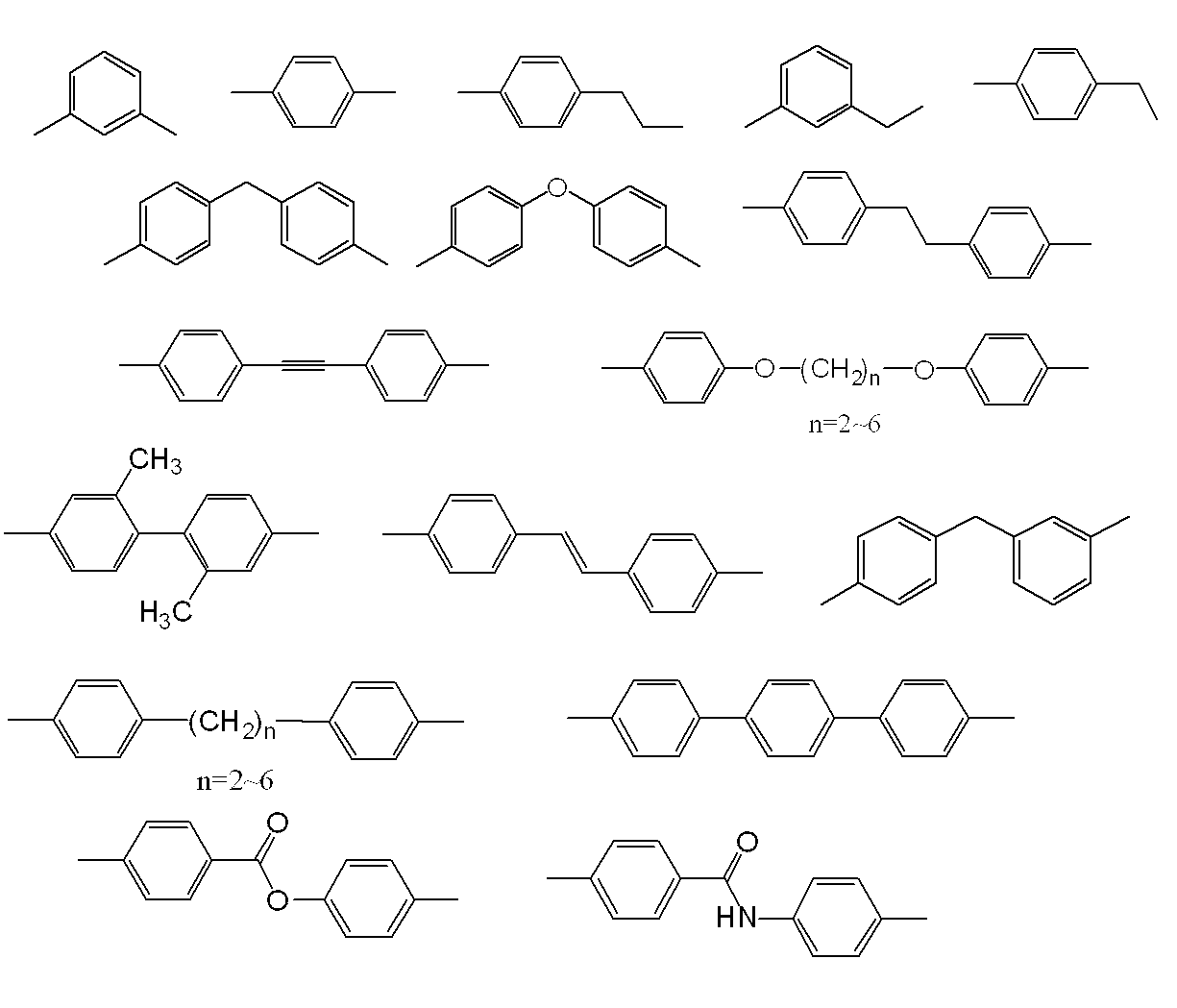
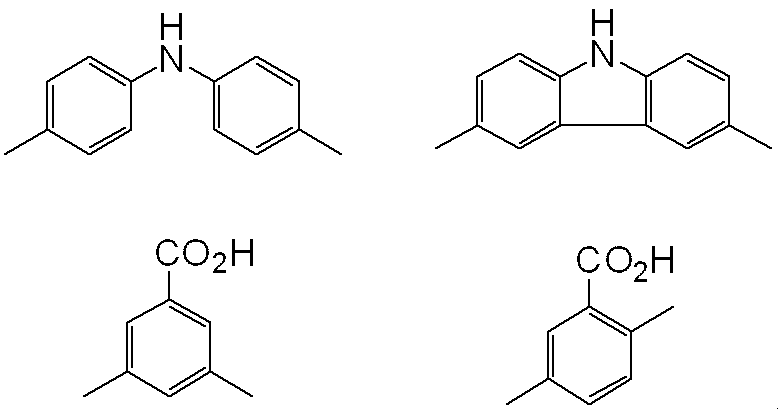
- Y 1 and Y 2 are each independently a divalent organic group and are not particularly limited. When showing a specific example of Y 1 and Y 2, include Y-1 ⁇ Y-103 below. As Y 1 and Y 2 , two or more types may be mixed independently.
- Y 1 is represented by Y-7, Y-10, Y-11, Y- 12, Y-13, Y-21, Y-22, Y-23, Y-25, Y-26, Y-27, Y-41, Y-42, Y-43, Y-44, Y-45, Diamines having Y-46, Y-48, Y-61, Y-63, Y-64, Y-71, Y-72, Y-73, Y-74, Y-75, or Y-98 are preferred.
- the amount of these diamines preferably used as Y 1 is preferably 1 to 100 mol%, more preferably 50 to 100 mol% of the total diamine.
- Y 1 is Y-76, Y-77, Y-78, Y-79, Y-80, Y-81, Y-82, Y-83, Y-84, Y-85, Y- 86, Y-87, Y-88, Y-89, Y-90, Y-91, Y-92, Y-93, Y-94, Y-95, Y-96, or Y-97 are more preferred.
- at least 1 sort (s) chosen from the structure represented by the following Formula is especially preferable.
- Y 2 is Y-19, Y-23, Y-25, Y-26, Y-27, Y-30, Y-31, Y-32, Y-33, Y-34, Y- 35, Y-36, Y-40, Y-41Y-42, Y-44, Y-45, Y-49, Y-50, Y-51 or Y-61 are more preferred, Y-31 or Y A diamine of ⁇ 40 is particularly preferred. The amount of these diamines preferably used as Y 2 is preferably 1 to 100 mol%, more preferably 50 to 100 mol% of the total diamine.
- the polyamic acid ester represented by the above formula (1) is obtained by reaction of any of the tetracarboxylic acid derivatives represented by the following formulas (6) to (8) with the diamine compound represented by the formula (9). be able to.
- the polyamic acid ester represented by the above formula (1) can be synthesized by the following methods (1) to (3) using the above monomer.
- a polyamic acid ester can be synthesized by esterifying a polyamic acid obtained from tetracarboxylic dianhydride and a diamine. Specifically, the polyamic acid and the esterifying agent are reacted in the presence of an organic solvent at ⁇ 20 ° C. to 150 ° C., preferably 0 ° C. to 50 ° C. for 30 minutes to 24 hours, preferably 1 to 4 hours. Can be synthesized.
- the esterifying agent those that can be easily removed by purification are preferable.
- the addition amount of the esterifying agent is preferably 2 to 6 molar equivalents per 1 mol of the polyamic acid repeating unit.
- the solvent used in the above reaction is preferably N, N-dimethylformamide, N-methyl-2-pyrrolidone, or ⁇ -butyrolactone from the solubility of the polymer, and these may be used alone or in combination. Good.
- the concentration at the time of synthesis is preferably 1 to 30% by mass, and more preferably 5 to 20% by mass from the viewpoint that polymer precipitation is unlikely to occur and a high molecular weight product is easily obtained.
- tetracarboxylic acid diester dichloride and diamine in the presence of a base and an organic solvent at ⁇ 20 ° C. to 150 ° C., preferably 0 ° C. to 50 ° C., for 30 minutes to 24 hours, preferably 1 to 4 hours. It can be synthesized by reacting.
- a base pyridine, triethylamine, 4-dimethylaminopyridine and the like can be used, but pyridine is preferable because the reaction proceeds gently.
- the addition amount of the base is preferably 2 to 4 times the molar amount of the tetracarboxylic acid diester dichloride from the viewpoint of easy removal and high molecular weight.
- the solvent used in the above reaction is preferably N-methyl-2-pyrrolidone or ⁇ -butyrolactone in view of the solubility of the monomer and polymer, and these may be used alone or in combination.
- the polymer concentration at the time of synthesis is preferably 1 to 30% by mass, and more preferably 5 to 20% by mass from the viewpoint that polymer precipitation is difficult to occur and a high molecular weight product is easily obtained.
- the solvent used for the synthesis of the polyamic acid ester is preferably dehydrated as much as possible, and it is preferable to prevent mixing of outside air in a nitrogen atmosphere.
- the polyamic acid ester can be synthesized by polycondensation of a tetracarboxylic acid diester and a diamine. Specifically, tetracarboxylic acid diester and diamine in the presence of a condensing agent, a base, and an organic solvent at 0 ° C. to 150 ° C., preferably 0 ° C. to 100 ° C., for 30 minutes to 24 hours, preferably 3 to 15 It can synthesize
- condensing agent examples include triphenyl phosphite, dicyclohexylcarbodiimide, 1-ethyl-3- (3-dimethylaminopropyl) carbodiimide hydrochloride, N, N′-carbonyldiimidazole, dimethoxy-1,3,5-triazide.
- Nylmethylmorpholinium O- (benzotriazol-1-yl) -N, N, N ′, N′-tetramethyluronium tetrafluoroborate, O- (benzotriazol-1-yl) -N, N , N ′, N′-tetramethyluronium hexafluorophosphate, (2,3-dihydro-2-thioxo-3-benzoxazolyl) phosphonate diphenyl, and the like.
- the amount of the condensing agent added is preferably 2 to 3 moles compared to the tetracarboxylic acid diester.
- tertiary amines such as pyridine and triethylamine can be used.
- the addition amount of the base is preferably 2 to 4 times mol with respect to the diamine component from the viewpoint of easy removal and high molecular weight.
- the reaction proceeds efficiently by adding Lewis acid as an additive.
- Lewis acid lithium halides such as lithium chloride and lithium bromide are preferable.
- the addition amount of the Lewis acid is preferably 0 to 1.0 times the mole of the diamine component.
- the polyamic acid ester solution obtained as described above can be polymerized by being poured into a poor solvent while being well stirred. Precipitation is performed several times, and after washing with a poor solvent, a purified polyamic acid ester powder can be obtained at room temperature or by heating and drying.
- the weight average molecular weight of the polyamic acid ester is preferably 5,000 to 300,000, and more preferably 10,000 to 200,000.
- the number average molecular weight is preferably 2,500 to 150,000, and more preferably 5,000 to 100,000.
- the polyamic acid represented by the above formula (2) can be obtained by a reaction between a tetracarboxylic dianhydride represented by the following formula (10) and a diamine compound represented by the formula (11).
- tetracarboxylic dianhydride and diamine are reacted in the presence of an organic solvent at ⁇ 20 ° C. to 150 ° C., preferably 0 ° C. to 50 ° C. for 30 minutes to 24 hours, preferably 1 to 12 hours.
- the organic solvent used in the above reaction is preferably N, N-dimethylformamide, N-methyl-2-pyrrolidone, or ⁇ -butyrolactone because of the solubility of the monomer and polymer, and these may be used alone or in combination of two or more. It may be used.
- the concentration of the polymer is preferably 1 to 30% by mass, and more preferably 5 to 20% by mass from the viewpoint that polymer precipitation is difficult to occur and a high molecular weight body is easily obtained.
- the polyamic acid obtained as described above can be recovered by precipitating the polymer by pouring into the poor solvent while thoroughly stirring the reaction solution. Moreover, the powder of polyamic acid refine
- a poor solvent is not specifically limited, Water, methanol, ethanol, hexane, butyl cellosolve, acetone, toluene etc. are mentioned.
- the weight average molecular weight of the polyamic acid is preferably 10,000 to 305,000, and more preferably 20,000 to 210,000.
- the number average molecular weight is preferably 5,000 to 152,500, and more preferably 10,000 to 105,000.
- the polyimide contained in the liquid crystal aligning agent of the present invention can be obtained by imidizing the above polyimide precursor.
- the method of imide thermal imidization by heating and catalyst imidization using a catalyst are generally used.
- the catalyst imidation in which the imidization reaction proceeds at a relatively low temperature is lower in the molecular weight of the resulting polyimide. Is less likely to occur.
- Catalytic imidation can be carried out in an organic solvent by stirring the polyamic acid in the presence of a basic catalyst and an acid anhydride, or stirring the polyamic acid ester in the presence of a basic catalyst.
- the reaction temperature at this time is ⁇ 20 to 250 ° C., preferably 0 to 180 ° C.
- the higher the reaction temperature the faster the imidization proceeds.
- the molecular weight of the polyimide may decrease.
- the amount of the basic catalyst is 1 to 60 moles, preferably 2 to 40 moles per mole of the repeating unit of the polyamic acid or polyamic acid ester.
- the amount of the acid anhydride for catalytic imidization of the polyamic acid is 2 to 100 moles, preferably 6 to 60 moles per mole of the repeating unit of the polyamic acid. If the amount of the basic catalyst or acid anhydride is small, the reaction does not proceed sufficiently. If the amount is too large, it becomes difficult to completely remove the reaction after completion of the reaction.
- the basic catalyst used for the catalytic imidation of polyamic acid include pyridine, triethylamine, trimethylamine, tributylamine, trioctylamine, etc. Among them, pyridine is preferable because it has an appropriate basicity for proceeding with the reaction. .
- Examples of the basic catalyst used for the catalytic imidation of the polyamic acid ester include triethylamine, trimethylamine, tributylamine, trioctylamine and the like, and triethylamine is particularly preferable because of its fast reaction.
- Examples of acid anhydrides used for catalytic imidation of polyamic acid include acetic anhydride, trimellitic anhydride, pyromellitic anhydride, etc. Among them, use of acetic anhydride facilitates purification after completion of the reaction. preferable.
- the organic solvent is not limited as long as it dissolves polyamic acid or polyamic acid ester. Specific examples thereof include N, N′-dimethylformamide, N, N′-dimethylacetamide, N-methyl- Examples include 2-pyrrolidone, N-methylcaprolactam, dimethyl sulfoxide, tetramethyl urea, dimethyl sulfone, hexamethyl sulfoxide, and ⁇ -butyrolactone.
- the imidization rate by catalytic imidation can be controlled by adjusting the amount of catalyst, reaction temperature, and reaction time.
- the produced polyimide can be obtained by collecting the reaction solution in a poor solvent and collecting the produced precipitate.
- the poor solvent to be used is not particularly limited, and examples thereof include methanol, acetone, hexane, butyl cellosolve, heptane, methyl ethyl ketone, methyl isobutyl ketone, ethanol, toluene, benzene, and water.
- the polyimide that has been poured into a poor solvent and precipitated is filtered, and then can be powdered by drying at normal temperature or under reduced pressure at normal temperature or under reduced pressure.
- the polyimide can be purified by repeating the steps of dissolving the polyimide powder in an organic solvent and reprecipitating it 2 to 10 times. When the impurities cannot be removed by a single precipitation recovery operation, it is preferable to perform this purification step.
- the molecular weight of the polyimide is not particularly limited, but is preferably 2,000 to 200,000, more preferably 4,000 to 50,000 in terms of weight average molecular weight from the viewpoint of ease of handling and stability of characteristics when a film is formed. 000.
- the molecular weight is determined by GPC (gel permeation chromatography).
- the terminal of the polyimide or polyamic acid or polyamic acid ester used in the present invention may be modified.
- the terminal modification can be synthesized by adding an acid anhydride, a monoamine compound, an acid chloride compound, a monoisocyanate compound or the like when synthesizing a polyamic acid or a polyamic acid ester.
- the liquid crystal aligning agent of the present invention is in the form of a solution in which at least one polymer selected from the group consisting of the polyimide precursor and polyimide is dissolved in an organic solvent.
- a polyimide precursor such as polyamic acid ester and / or polyamic acid and / or polyimide
- the resulting reaction solution itself may be used.
- the solution may be diluted with an appropriate solvent.
- a polyimide precursor and / or a polyimide is obtained as a powder, it may be dissolved in an organic solvent to form a solution.
- the organic solvent contained in the liquid crystal aligning agent of the present invention needs to contain an alkyl cellosolve acetate compound.
- the alkyl cellosolve acetate compound contained in the organic solvent is preferably a cellosolve acetate compound having an alkyl group having preferably 1 to 10, more preferably 1 to 6 carbon atoms. Preferable examples thereof include at least one selected from the group consisting of methyl cellosolve acetate, ethyl cellosolve acetate, and butyl cellosolve acetate. Of these, butyl cellosolve acetate is preferable from the viewpoint of an appropriate boiling point and volatilization rate. When the alkyl chain length of the alkyl cellosolve acetate is too long, the boiling point becomes high, causing a problem that the liquid crystal alignment film is not dried in the drying step.
- the organic solvent is not particularly limited as long as the polymer is uniformly dissolved.
- Specific examples include ⁇ -butyrolactone, N-methyl-2-pyrrolidone, N-ethyl-2-pyrrolidone, N, N-dimethylformamide, N, N-diethylformamide, N, N-dimethylacetamide, N -Methylcaprolactam, 2-pyrrolidone, N-vinyl-2-pyrrolidone, dimethyl sulfoxide, dimethyl sulfone, 1,3-dimethyl-imidazolidinone, 3-methoxy-N, N-dimethylpropanamide and the like. You may use these 1 type or in mixture of 2 or more types.
- ⁇ -butyrolactone or N-methyl-2-pyrrolidone is preferable from the viewpoint of versatility and solubility.
- the solvent for the liquid crystal aligning agent for ink jet coating contains a large amount of ⁇ -butyrolactone. Specifically, it is desirable to contain 50% by weight or more, more preferably 60% by weight or more of ⁇ -butyrolactone.
- the viscosity of the liquid crystal aligning agent of the present invention is preferably 5 mPa ⁇ s to 20 mPa ⁇ s, particularly preferably 5 mPa ⁇ s to 15 mPa ⁇ s, from the viewpoint of inkjet coating.
- the content of the solvent in the liquid crystal aligning agent of the present invention is selected in consideration of the above viscosity, and is preferably 95 to 99% by mass, and particularly preferably 96 to 98% by mass.
- a concentrated solution of the polymer may be prepared in advance and diluted when the liquid crystal aligning agent is used from the concentrated solution.
- the film thickness of the liquid crystal alignment film becomes too small to obtain a good liquid crystal alignment film.
- the content of the alkyl cellosolve acetate compound in the organic solvent is preferably 1% by mass to 60% by mass, more preferably 2% by mass to 40% by mass.
- the content is small, the in-plane uniformity and the peripheral portion linearity of the inkjet coating film are insufficient, and when the content is too large, the storage stability of the liquid crystal aligning agent during freezing deteriorates.
- the content (concentration) of the polymer in the liquid crystal aligning agent of the present invention can be appropriately changed by setting the thickness of the polyimide film to be formed, but a uniform and defect-free coating film is formed. Therefore, the content is preferably 1% by mass to 5% by mass, and particularly preferably 2% by mass to 4% by mass.
- the liquid crystal aligning agent of the present invention may contain the following solvent in addition to the organic solvent for dissolving the polymer component and the alkyl cellosolve acetate compound. You may contain the solvent for improving the coating-film uniformity at the time of apply
- a solvent having a surface tension lower than that of the organic solvent is generally used.
- ethyl cellosolve ethyl cellosolve
- butyl cellosolve ethyl carbitol
- butyl carbitol ethyl carbitol
- ethyl carbitol acetate ethylene glycol, 1-methoxy-2-propanol, 1-ethoxy-2-propanol, 1-butoxy-2 -Propanol, 1-phenoxy-2-propanol, propylene glycol monoacetate, propylene glycol diacetate, propylene glycol-1-monomethyl ether-2-acetate, propylene glycol-1-monoethyl ether-2-acetate, dipropylene glycol, 2- (2-ethoxypropoxy) propanol, lactate methyl ester, lactate ethyl ester, lactate n-propyl ester, lactate n-butyl ester, lactate isoamyl ester, etc. That. Two types of these solvents may be used
- the liquid crystal aligning agent of this invention may contain various additives, such as a silane coupling agent and a crosslinking agent.
- the silane coupling agent is added for the purpose of improving the adhesion between the substrate on which the liquid crystal alignment agent is applied and the liquid crystal alignment film formed thereon.
- Existing silane coupling agents are added. If the addition amount of the silane coupling agent is too large, unreacted ones may adversely affect the liquid crystal orientation. 0.01 to 5.0% by weight is preferable, and 0.1 to 1.0% by weight is more preferable.
- an imidization accelerator may be added to the liquid crystal aligning agent of the present invention in order to efficiently advance imidization of the polyimide precursor when the coating film is baked.
- Existing imidation accelerators are used. When adding an imidization accelerator, since imidation may advance by heating, it is preferable to add after diluting with a good solvent and a poor solvent.
- the liquid crystal alignment film of the present invention is a film obtained by applying the liquid crystal aligning agent to a substrate, drying and baking.
- the substrate on which the liquid crystal aligning agent of the present invention is applied is not particularly limited as long as it is a highly transparent substrate, and a glass substrate, a silicon nitride substrate, an acrylic substrate, a polycarbonate substrate such as a polycarbonate substrate, or the like can be used. From the viewpoint of simplification of the process, it is preferable to use a substrate on which an ITO electrode or the like is formed.
- an opaque material such as a silicon wafer can be used as long as it is only on one side of the substrate. In this case, a material that reflects light such as aluminum can be used for the electrode.
- the liquid crystal aligning agent of the present invention As a method for applying the liquid crystal aligning agent of the present invention, a spin coating method, a printing method, or the like can be used. As described above, the liquid crystal aligning agent of the present invention is particularly suitable for the ink jet method. When the liquid crystal aligning agent of the present invention is applied by an ink jet method to form a coating film, a coating film having excellent uniformity of the film thickness within the coating surface and linearity of the coating peripheral portion can be obtained.
- any temperature and time can be selected.
- drying is performed at 50 ° C. to 120 ° C. for 1 minute to 10 minutes, and then baking is performed at 150 ° C. to 300 ° C. for 5 minutes to 120 minutes.
- the thickness of the coating film after baking is not particularly limited, but if it is too thin, the reliability of the liquid crystal display element may be lowered, and therefore it is 5 to 300 nm, preferably 10 to 200 nm.
- the liquid crystal alignment treatment agent of the present invention can be used as a liquid crystal alignment film after being applied and baked on a substrate, then subjected to alignment treatment by rubbing treatment, photo-alignment treatment, or the like, or without alignment treatment in vertical alignment applications. it can.
- the liquid crystal display element of the present invention is a liquid crystal display element obtained by obtaining a substrate with a liquid crystal alignment film from the liquid crystal aligning agent of the present invention by the above-described method, performing an alignment treatment, and then preparing a liquid crystal cell by a known method. It is.
- the manufacturing method of the liquid crystal cell is not particularly limited, but for example, a pair of substrates on which the liquid crystal alignment film is formed is preferably 1 to 30 ⁇ m, more preferably 2 to 10 ⁇ m with the liquid crystal alignment film surface inside.
- a method is generally employed in which the spacer is fixed with a sealing agent after the spacer is sandwiched, and liquid crystal is injected and sealed.
- the method for enclosing the liquid crystal is not particularly limited, and examples thereof include a vacuum method of injecting liquid crystal after reducing the pressure inside the produced liquid crystal cell, and a dropping method of sealing after dropping the liquid crystal.
- CBDA cyclobutanetetracarboxylic dianhydride
- 1,3DMCBDE-Cl dimethyl 1,3-bis (chlorocarbonyl) -1,3-dimethylcyclobutane-2,4-dicarboxylate
- TDA 3,4-dicarboxy-1 , 2,3,4-Tetrahydro-1-naphthalene succinic dianhydride
- BDA 1,2,3,4-butanetetracarboxylic dianhydride
- PMDA pyromellitic dianhydride
- ODA 4,4′-oxydianiline
- p-PDA p-phenylenediamine
- C16DAB 4-hexadecyloxy-1,3-diaminobenzene
- C12DAB 4-dodecyloxy-1,3-diaminobenzene
- 4-ABA 4 -Aminobenzylamine
- DA-A Diamine of the following formula
- DA-B Diamine of the following formula DA-B
- the molecular weight of the polyimide, polyamic acid or polyamic acid ester in the synthesis example is measured by a GPC (room temperature gel permeation chromatography) apparatus, and the number average molecular weight (hereinafter also referred to as Mn) and the weight average molecular weight as polyethylene glycol and polyethylene oxide equivalent values. (Hereinafter also referred to as Mw) was calculated.
- GPC device manufactured by Shodex (GPC-101) Column: manufactured by Shodex (series of KD803 and KD805) Column temperature: 50 ° C Eluent: N, N-dimethylformamide (as additives, lithium bromide-hydrate (LiBr ⁇ H 2 O) 30 mmol / L, phosphoric acid / anhydrous crystal (o-phosphoric acid) 30 mmol / L, tetrahydrofuran (THF ) Is 10 mL / L) Flow rate: 1.0 mL / min Standard sample for preparing a calibration curve: TSK standard polyethylene oxide (weight average molecular weight (Mw) about 900,000, 150,000, 100,000, 30000) manufactured by Tosoh Corporation, and polyethylene glycol (peak top molecular weight manufactured by Polymer Laboratories) (Mp) about 12000, 4000, 1000). In order to avoid the overlap of peaks, two samples of 90000, 100000, 12000, 1000 mixed samples and 250,000
- the imidation ratio of polyimide was measured as follows. 20 mg of polyimide powder was put into an NMR sample tube, and 0.53 mL of deuterated dimethyl sulfoxide (DMSO-d6, 0.05% TMS mixed product) was added and completely dissolved. This solution was measured for proton NMR at 500 MHz with an NMR measuring instrument (JNM-ECA500) manufactured by JEOL Datum. The imidation rate is determined based on protons derived from structures that do not change before and after imidation as reference protons, and the peak integrated value of these protons and proton peaks derived from NH groups of polyamic acid appearing in the vicinity of 9.5 to 10.0 ppm.
- Imidization rate (%) (1 ⁇ ⁇ x / y) ⁇ 100
- x is the proton peak integrated value derived from the NH group of the polyamic acid
- y is the peak integrated value of the reference proton
- ⁇ is one NH group proton of the polyamic acid in the case of the polyamic acid (imidation rate is 0%).
- Example 1 To a 100 mL Erlenmeyer flask containing a stirrer, 1.75 g of the polyamic acid ester obtained in Synthesis Example 1 and 15.75 g of GBL were added and stirred to dissolve. Next, 22.5 g of GBL and 10.00 g of BCA were added to obtain a liquid crystal aligning agent.
- Example 3 1.80 g of the polyimide obtained in Synthesis Example 3 and 16.2 g of GBL were added to a 100 mL Erlenmeyer flask containing a stir bar, and dissolved by stirring. Next, 19.5 g of GBL and 12.5 g of BCA were added to obtain a liquid crystal aligning agent.
- Example 4 1.80 g of the polyimide obtained in Synthesis Example 4 and 16.2 g of GBL were added to a 100 mL Erlenmeyer flask containing a stir bar, and dissolved by stirring. Next, 24.5 g of GBL and 7.5 g of ECA were added to obtain a liquid crystal aligning agent.
- Example 5 To a 100 mL Erlenmeyer flask containing a stir bar, 0.72 g of the polyamic acid ester obtained in Synthesis Example 5 and 6.48 g of GBL were added, and dissolved by stirring. Next, 7.11 g of the polyamic acid solution obtained in Synthesis Example 6, 0.95 g of NMP, 29.7 g of GBL, and 5.00 g of BCA were added to obtain a liquid crystal aligning agent.
- Example 6> To a 100 mL Erlenmeyer flask containing a stir bar, 0.90 g of the polyamic acid ester obtained in Synthesis Example 2 and 8.10 g of GBL were added and stirred to dissolve. Next, 5.00 g of the polyamic acid solution obtained in Synthesis Example 7, 6.82 g of NMP, 19.18 g of GBL, and 10.0 g of ECA were added to obtain a liquid crystal aligning agent.
- ⁇ Comparative Example 1> To a 100 mL Erlenmeyer flask containing a stirrer, 1.75 g of the polyamic acid ester obtained in Synthesis Example 1 and 15.75 g of GBL were added and stirred to dissolve. Next, 22.5 g of GBL and 10.0 g of BCS were added to obtain a liquid crystal aligning agent.
- ⁇ Comparative Example 2> To a 100 mL Erlenmeyer flask containing a stir bar, 1.80 g of the polyamic acid ester obtained in Synthesis Example 2 and 16.2 g of GBL were added and dissolved by stirring. Next, 23.0 g of GBL and 9.0 g of BCS were added to obtain a liquid crystal aligning agent.
- ⁇ Comparative Example 5> To a 100 mL Erlenmeyer flask containing a stir bar, 1.75 g of the polyamic acid ester obtained in Synthesis Example 2 and 15.75 g of GBL were added and stirred to dissolve. Next, 22.5 g of GBL and 10.0 g of DEDnBE were added to obtain a liquid crystal aligning agent.
- ⁇ Comparative Example 7> To a 100 mL Erlenmeyer flask containing a stir bar, 1.75 g of the polyamic acid ester obtained in Synthesis Example 2 and 15.75 g of GBL were added and stirred to dissolve. Next, 22.5 g of GBL and 10.0 g of DEEA were added to obtain a liquid crystal aligning agent.
- ⁇ Comparative Example 9> To a 100 mL Erlenmeyer flask containing a stir bar, 1.75 g of the polyamic acid ester obtained in Synthesis Example 2 and 15.75 g of GBL were added and stirred to dissolve. Next, 22.5 g of GBL and 10.0 g of DEGBEA were added to obtain a liquid crystal aligning agent.
- ⁇ Comparative Example 10> To a 100 mL Erlenmeyer flask containing a stir bar, 1.75 g of the polyamic acid ester obtained in Synthesis Example 2 and 15.75 g of GBL were added and stirred to dissolve. Next, 22.5 g of GBL and 10.0 g of PGDA were added to obtain a liquid crystal aligning agent.
- Fine pattern coating device by inkjet printing (HIS-200-1H, manufactured by Hitachi Plant Technologies, Ltd.) Coating substrate: 100 ⁇ 100 mm ITO substrate Coating area: 72 ⁇ 80 mm
- Application conditions resolution 15 ⁇ m, stage speed 40 mm / sec, frequency 2000 Hz, pulse width 9.6 ⁇ sec, appropriate amount 42 pl, pitch width 60 ⁇ m, pitch length 141 ⁇ m, applied voltage: 15 V, nozzle gap 0.5 mm, standing time 30 sec, drying temperature 50 ° C, drying time 2 minutes (hot plate), main baking temperature 230 ° C, main baking time 30 minutes (IR oven)
- Examples 1 to 4 can obtain films having good in-plane uniformity and peripheral linearity.
- Comparative Examples 1 to 9 the fine droplets applied by the ink jet method were not spread on the substrate and could not be formed.
- Comparative Examples 10 to 12 although film formation was possible, in-plane film thickness unevenness was observed.
- liquid crystal aligning agent of the present invention and the liquid crystal alignment film using the same are widely useful for TN elements, STN elements, TFT liquid crystal elements, and vertical alignment type liquid crystal display elements. It should be noted that the entire contents of the specification, claims, and abstract of Japanese Patent Application No. 2011-079904 filed on March 31, 2011 are incorporated herein as the disclosure of the specification of the present invention. Is.
Landscapes
- Chemical & Material Sciences (AREA)
- Physics & Mathematics (AREA)
- Organic Chemistry (AREA)
- Health & Medical Sciences (AREA)
- Polymers & Plastics (AREA)
- Medicinal Chemistry (AREA)
- Chemical Kinetics & Catalysis (AREA)
- Nonlinear Science (AREA)
- General Physics & Mathematics (AREA)
- Optics & Photonics (AREA)
- Mathematical Physics (AREA)
- Crystallography & Structural Chemistry (AREA)
- Spectroscopy & Molecular Physics (AREA)
- Liquid Crystal (AREA)
- Macromolecular Compounds Obtained By Forming Nitrogen-Containing Linkages In General (AREA)
- Compositions Of Macromolecular Compounds (AREA)
Abstract
Description
しかしながら、フレキソ印刷では液晶パネルの品種違いにより様々な樹脂版が必要となること、製造工程ではその版交換が煩雑であるということ、成膜工程を安定させるためにダミー基板への成膜をしなければならないこと、版の製作が液晶表示パネルの製造コスト上昇の一因になるなどの問題がある。
上記塗布周辺部の成膜精度を高めるため、構造物によって配向膜を所定の範囲に閉じ込める方法が提案されている(特許文献1、特許文献2、特許文献3)。しかしながら、これらの方法は追加の構造物が必要になるという欠点を有する。
1.ポリイミド及びポリイミド前駆体からなる群から選ばれる少なくとも1種の重合体と、下記式( 1)で表されるアルキルセロソルブアセテート化合物を含む溶媒と、を含有することを特徴とする液晶配向剤。

2.前記ポリイミド前駆体が、ポリアミック酸エステル及びポリアミック酸からなる群から選ばれる少なくとも1種を含有する上記1に記載の液晶配向剤。
3.前記溶媒が、N-メチルピロリドン及びγ-ブチロラクトンからなる群から選ばれる少なくとも一種を含有する上記1又は2に記載の液晶配向剤。
4.前記アルキルセロソルブアセテート化合物が、メチルセロソルブアセテート、エチルセロソルブアセテート、及びブチルセロソルブアセテートからなる群から選ばれる少なくとも一種である上記1~3のいずれかに記載の液晶配向剤。
5.前記重合体を1質量%~5質量%含有する、上記1~4のいずれかに記載の液晶配向剤。
6.前記溶媒を95質量%~99質量%含有する、上記1~5のいずれかに記載の液晶配向剤。
7.前記溶媒が、アルキルセロソルブアセテート化合物を5質量%~50質量%含有する、上記1~6のいずれかに記載の液晶配向剤。
8.粘度が5~20mPa・sである上記1~7のいずれかに記載の液晶配向剤。
9.上記1~8のいずれかに記載の液晶配向剤をインクジェット法により塗布する液晶配向膜の形成方法。
10.上記1~8のいずれかに記載の液晶配向剤を塗布し、乾燥、焼成して得られる液晶配向膜。
本発明の液晶配向剤に含有されるポリイミド前駆体は、これをイミド化することによりポリイミドを生成するものであり、ポリアミック酸エステル及び/又はポリアミック酸を意味する。
ポリアミック酸エステル及びポリアミック酸は、それぞれ、下記式(1)及び下記式(2)を有する。

置換基であるハロゲン基としては、フッ素原子、塩素原子、臭素原子、ヨウ素原子が挙げられる。
置換基であるオルガノオキシ基としては、-O-Rで表される構造を示すことができる。このRは同一でも異なってもよく、前述したアルキル基、アルケニル基、アルキニル基、アリール基などを例示することができる。これらのRには前述した置換基がさらに置換していてもよい。オルガノオキシ基の具体例としては、メトキシ基、エトキシ基、プロピルオキシ基、ブトキシ基、ペンチルオキシ基、ヘキシルオキシ基、ヘプチルオキシ基、オクチルオキシ基などが挙げられる。
置換基であるエステル基としては、-C(O)O-R、又は-OC(O)-Rで表される構造を示すことができる。このRとしては、前述したアルキル基、アルケニル基、アルキニル基、アリール基などを例示することができる。これらのRには前述した置換基がさらに置換していてもよい。
置換基であるリン酸エステル基としては、-OP(O)-(OR)2で表される構造を示すことができる。このRは同一でも異なってもよく、前述したアルキル基、アルケニル基、アルキニル基、アリール基などを例示することができる。これらのRには前述した置換基がさらに置換していてもよい。
置換基であるアリール基としては、前述したアリール基と同じものを挙げることができる。このアリール基には前述した他の置換基がさらに置換していてもよい。
置換基であるアルキル基としては、前述したアルキル基と同じものを挙げることができる。このアルキル基には前述した他の置換基がさらに置換していてもよい。
置換基であるアルキニル基としては、前述したアルキニル基と同じものを挙げることができる。このアルキニル基には前述した他の置換基がさらに置換していてもよい。
一般に、嵩高い構造を導入すると、アミノ基の反応性や液晶配向性を低下させる可能性があるため、A1及びA2としては、水素原子、又は置換基を有してもよい炭素数1~5のアルキル基がより好ましく、水素原子、メチル基又はエチル基が特に好ましい。
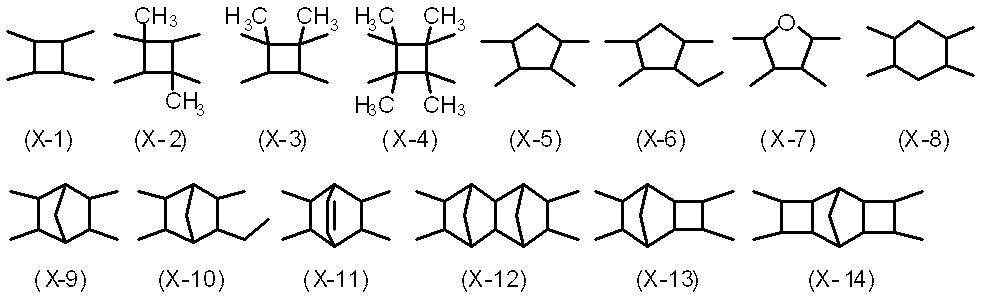
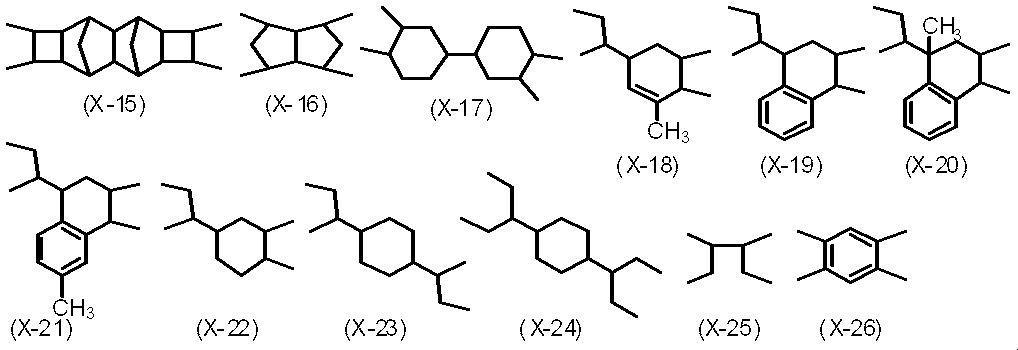
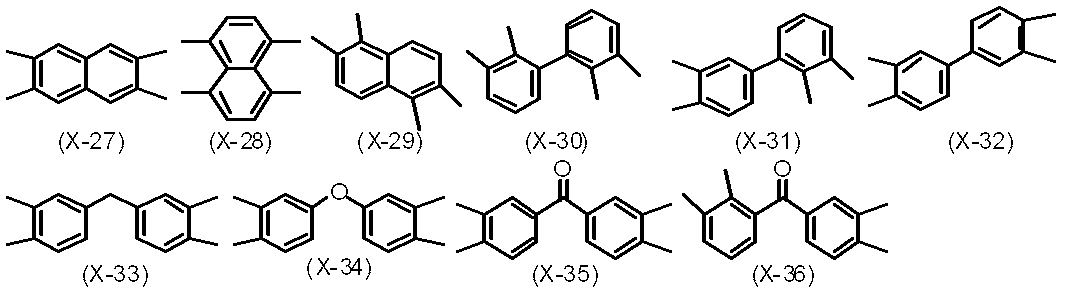
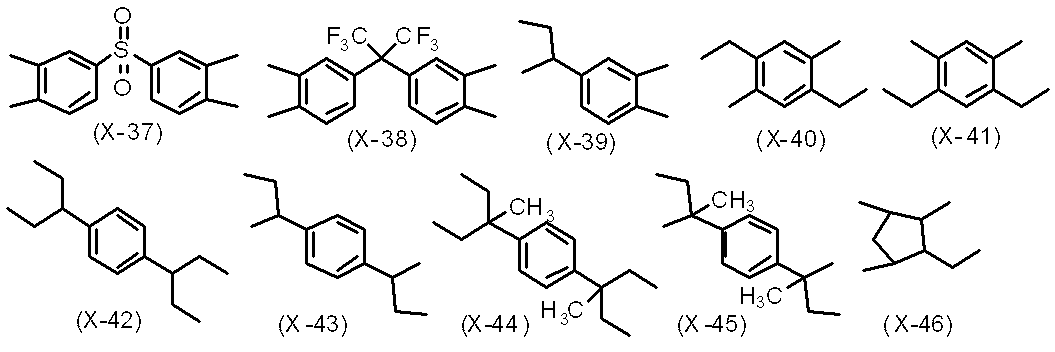
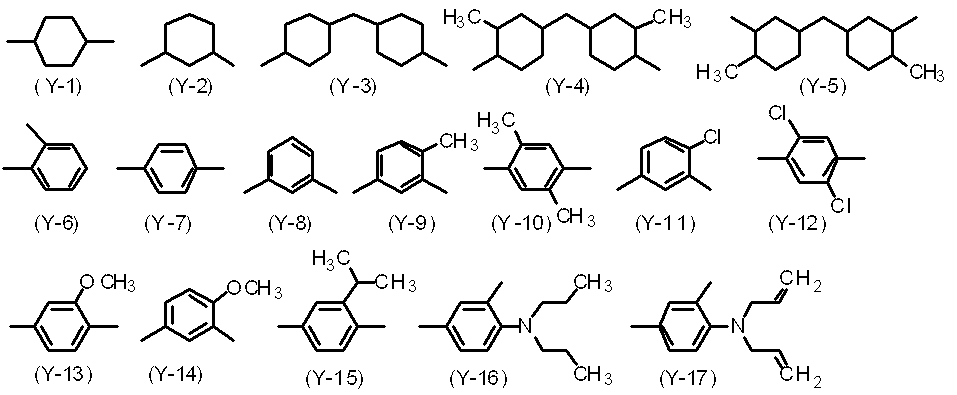

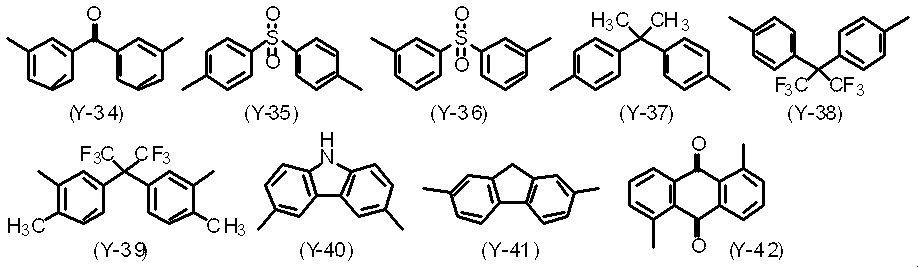
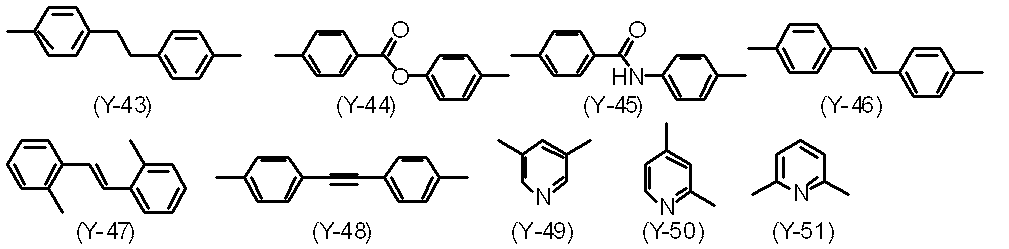
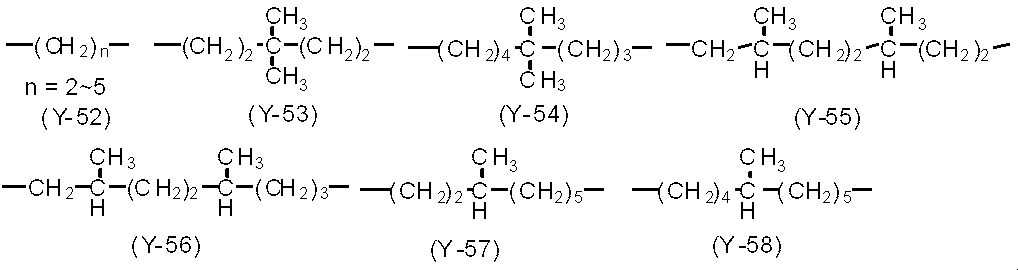
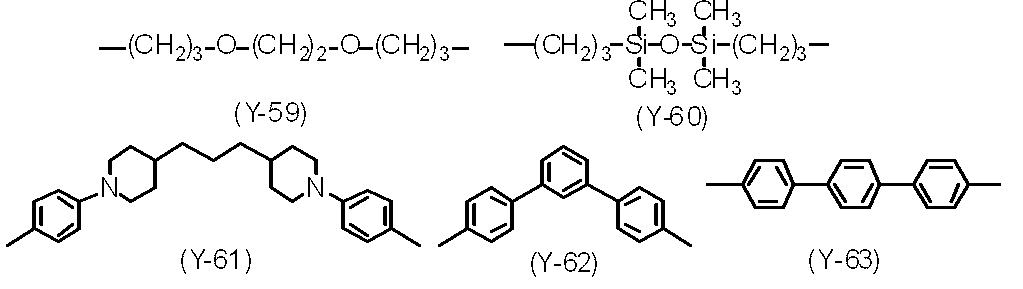
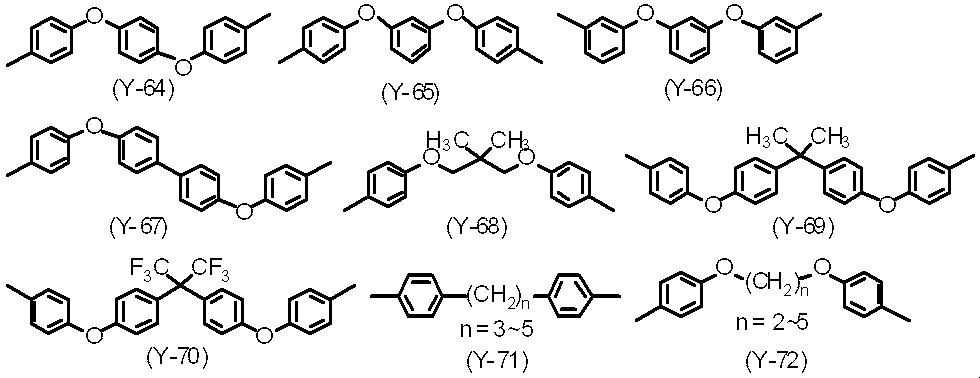


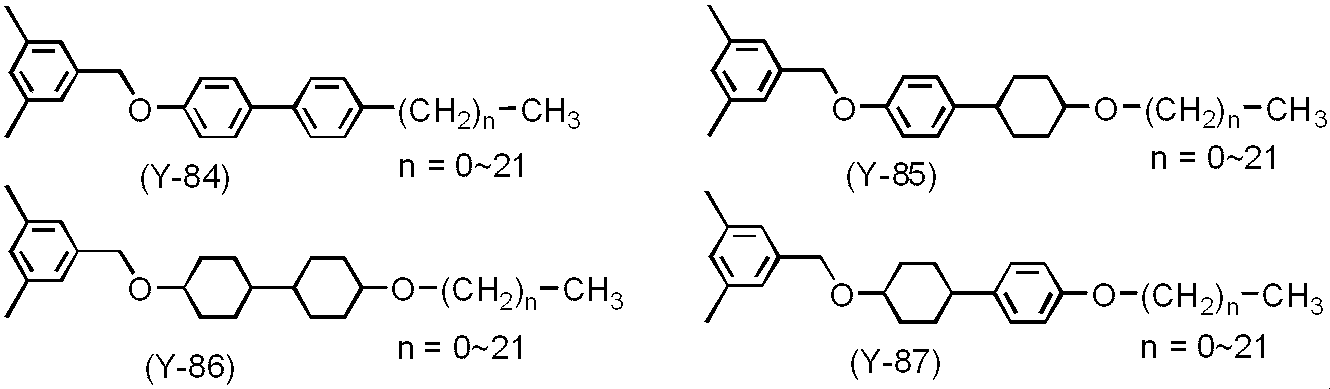
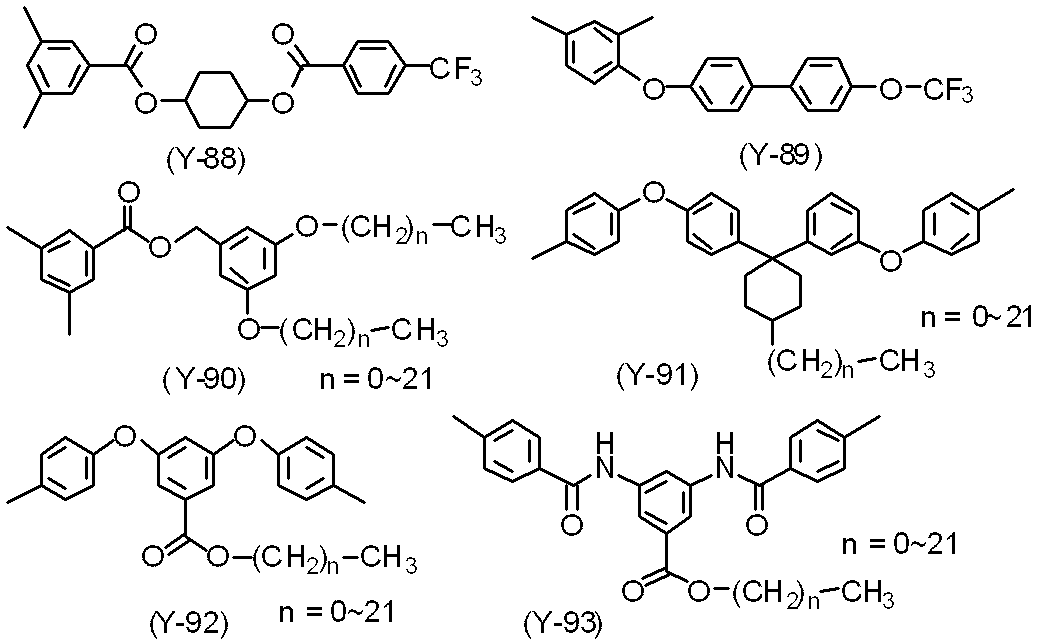
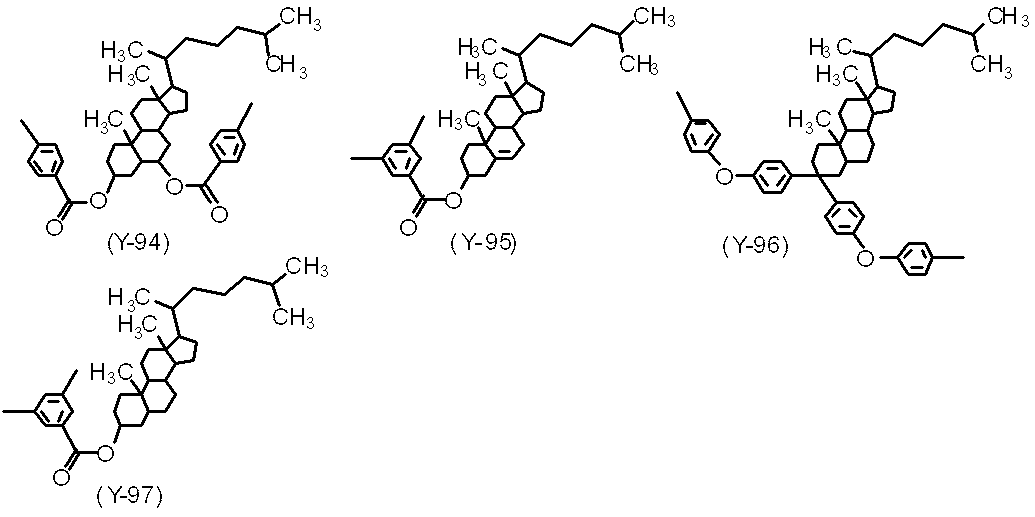
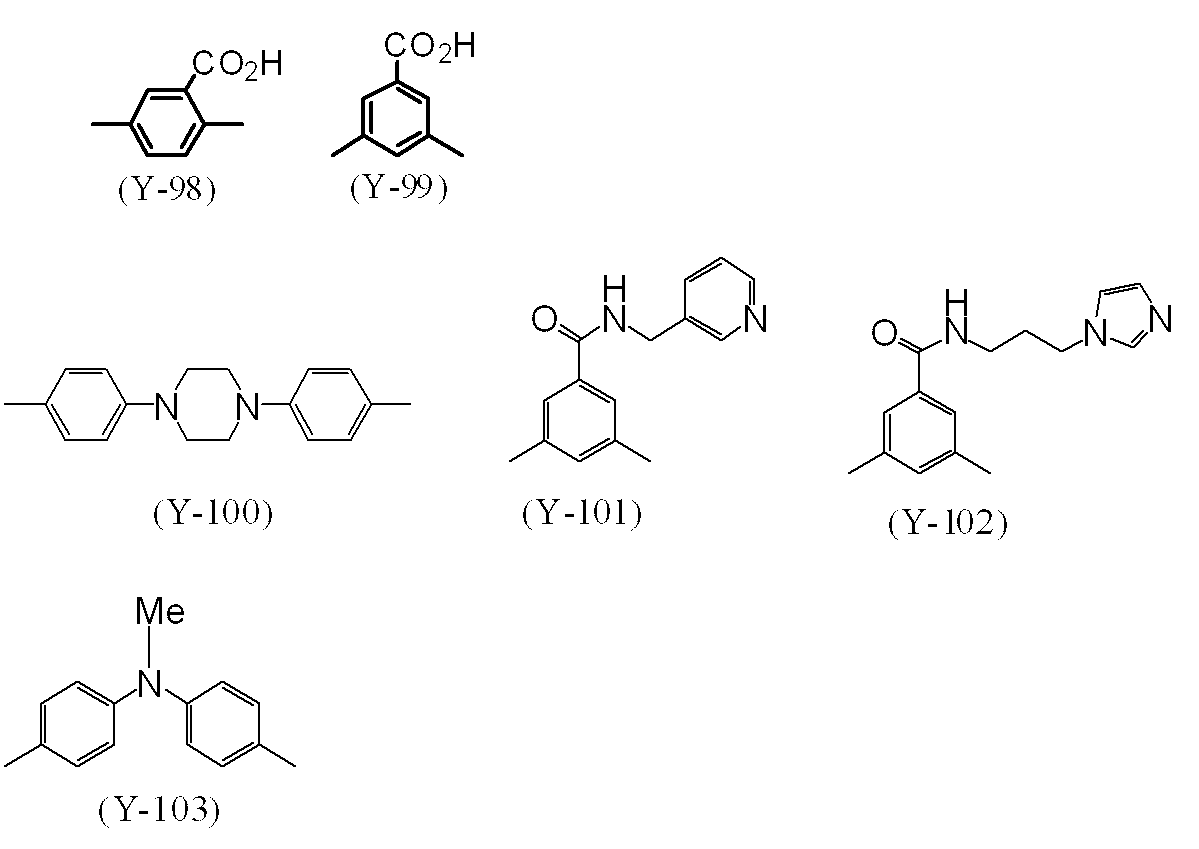
なかでも、プレチルト角を高くしたい場合は、側鎖に長鎖アルキル基、芳香族環、脂肪族環、ステロイド骨格、又はこれらを組み合わせた構造を有するジアミンをポリアミック酸エステルに導入することが好ましい。この場合、Y1としては、Y-76、Y-77、Y-78、Y-79、Y-80、Y-81、Y-82、Y-83、Y-84、Y-85、Y-86、Y-87、Y-88、Y-89、Y-90、Y-91、Y-92、Y-93、Y-94、Y-95、Y-96、又はY-97がより好ましい。
なかでも、下式で表される構造から選ばれる少なくとも1種類が特に好ましい。
上記式(1)で表されるポリアミック酸エステルは、下記式(6)~(8)で表されるテトラカルボン酸誘導体のいずれかと、式(9)で表されるジアミン化合物との反応によって得ることができる。
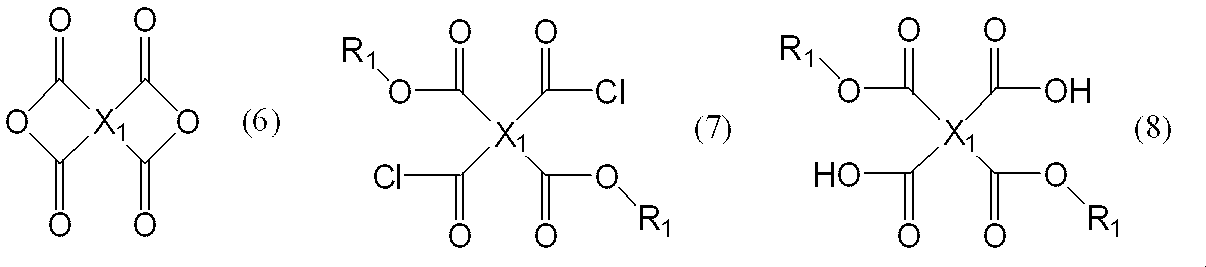

(1)ポリアミック酸から合成する場合
ポリアミック酸エステルは、テトラカルボン酸二無水物とジアミンから得られるポリアミック酸をエステル化することによって合成することができる。
具体的には、ポリアミック酸とエステル化剤を有機溶媒の存在下で-20℃~150℃、好ましくは0℃~50℃において、30分~24時間、好ましくは1~4時間反応させることによって合成することができる。
エステル化剤としては、精製によって容易に除去できるものが好ましく、N,N-ジメチルホルムアミドジメチルアセタール、N,N-ジメチルホルムアミドジエチルアセタール、N,N-ジメチルホルムアミドジプロピルアセタール、N,N-ジメチルホルムアミドジネオペンチルブチルアセタール、N,N-ジメチルホルムアミドジ-t-ブチルアセタール、1-メチル-3-p-トリルトリアゼン、1-エチル-3-p-トリルトリアゼン、1-プロピル-3-p-トリルトリアゼン、4-(4,6-ジメトキシー1,3,5-トリアジンー2-イル)-4-メチルモルホリニウムクロリドなどが挙げられる。エステル化剤の添加量は、ポリアミック酸の繰り返し単位1モルに対して、2~6モル当量が好ましい。
ポリアミック酸エステルは、テトラカルボン酸ジエステルジクロリドとジアミンから合成することができる。
前記塩基には、ピリジン、トリエチルアミン、4-ジメチルアミノピリジンなどが使用できるが、反応が穏和に進行するためにピリジンが好ましい。塩基の添加量は、除去が容易な量で、かつ高分子量体が得やすいという観点から、テトラカルボン酸ジエステルジクロリドに対して、2~4倍モルであることが好ましい。
ポリアミック酸エステルは、テトラカルボン酸ジエステルとジアミンを重縮合することにより合成することができる。
具体的には、テトラカルボン酸ジエステルとジアミンを縮合剤、塩基、及び有機溶媒の存在下で0℃~150℃、好ましくは0℃~100℃において、30分~24時間、好ましくは3~15時間反応させることによって合成することができる。
前記塩基には、ピリジン、トリエチルアミンなどの3級アミンが使用できる。塩基の添加量は、除去が容易な量で、かつ高分子量体が得やすいという観点から、ジアミン成分に対して2~4倍モルが好ましい。
上記3つのポリアミック酸エステルの合成方法の中でも、高分子量のポリアミック酸エステルが得られるため、上記(1)又は上記(2)の合成法が特に好ましい。
上記のようにして得られるポリアミック酸エステルの溶液は、よく撹拌させながら貧溶媒に注入することで、ポリマーを析出させることができる。析出を数回行い、貧溶媒で洗浄後、常温あるいは加熱乾燥して精製されたポリアミック酸エステルの粉末を得ることができる。貧溶媒は、特に限定されないが、水、メタノール、エタノール、ヘキサン、ブチルセロソルブ、アセトン、トルエン等が挙げられる。
ポリアミック酸エステルの重量平均分子量は、好ましくは5,000~300,000であり、より好ましくは、10,000~200,000である。また、数平均分子量は、好ましくは、2,500~150,000であり、より好ましくは、5,000~100,000である。
上記式(2)で表されるポリアミック酸は、下記式(10)で表されるテトラカルボン酸二無水物と式(11)で表されるジアミン化合物との反応によって得ることができる。
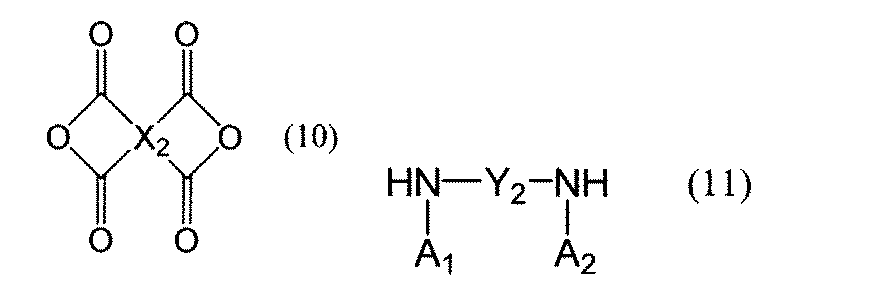
上記の反応に用いる有機溶媒は、モノマー及びポリマーの溶解性からN,N-ジメチルホルムアミド、N-メチル-2-ピロリドン、又はγ-ブチロラクトンが好ましく、これらは1種又は2種以上を混合して用いてもよい。ポリマーの濃度は、ポリマーの析出が起こりにくく、かつ高分子量体が得やすいという観点から、1~30質量%が好ましく、5~20質量%がより好ましい。
上記のようにして得られたポリアミック酸は、反応溶液をよく撹拌させながら貧溶媒に注入することで、ポリマーを析出させて回収することができる。また、析出を数回行い、貧溶媒で洗浄後、常温あるいは加熱乾燥することで精製されたポリアミック酸の粉末を得ることができる。貧溶媒は、特に限定されないが、水、メタノール、エタノール、ヘキサン、ブチルセロソルブ、アセトン、トルエン等が挙げられる。
ポリアミック酸の重量平均分子量は、好ましくは10,000~305,000であり、より好ましくは、20,000~210,000である。また、数平均分子量は、好ましくは、5,000~152,500であり、より好ましくは、10,000~105,000である。
<ポリイミド>
ポリアミック酸の触媒イミド化に用いる塩基性触媒としては、ピリジン、トリエチルアミン、トリメチルアミン、トリブチルアミン、トリオクチルアミンなどを挙げることができ、中でもピリジンは反応を進行させるのに適度な塩基性を持つので好ましい。ポリアミック酸エステルの触媒イミド化に用いる塩基性触媒としては、トリエチルアミン、トリメチルアミン、トリブチルアミン、トリオクチルアミンなどを挙げることができ、中でもトリエチルアミンは反応が速いことから特に好ましい。
ポリイミドの分子量は特に制限されないが、取り扱いのしやすさと、膜形成した際の特性の安定性の観点から重量平均分子量で2,000~200,000が好ましく、より好ましくは4,000~50,000である。分子量は、GPC(ゲルパーミエッションクロマトグラフィ)により求めたものである。
本発明で用いられるポリイミドまたはポリアミック酸またはポリアミック酸エステルの末端は修飾されていてもよい。末端修飾した重合体を用いることにより、溶解性や塗布性などを改善することができる。末端修飾は、ポリアミック酸またはポリアミック酸エステルを合成する際に、酸無水物、モノアミン化合物、酸クロリド化合物、モノイソシアネート化合物などを添加することで合成することができる。
本発明の液晶配向剤は、上記ポリイミド前駆体及びポリイミドからなる群から選ばれる少なくとも1種の重合体が有機溶媒中に溶解した溶液の形態である。かかる形態を有する限り、例えば、ポリアミック酸エステル及び/又はポリアミック酸などポリイミド前駆体及び/又はポリイミドを有機溶媒中で合成した場合には、得られる反応溶液そのものであってもよく、また、この反応溶液を適宜の溶媒で希釈したものであってもよい。また、ポリイミド前駆体及び/又はポリイミドを粉末として得た場合は、これを有機溶媒に溶解させて溶液としたものであってもよい。
有機溶媒中のアルキルセロソルブアセテート化合物の含有量は、好ましくは、1質量%~60質量%、より好ましくは、2質量%~40質量%である。少ない含有量では、インクジェット塗布膜の面内均一性、周辺部直線性が不十分となり、多すぎる含有量では液晶配向剤の冷凍時における保存安定性が悪化する。
一方、本発明の液晶配向剤における重合体の含有量(濃度)は、形成させようとするポリイミド膜の厚みの設定によっても適宜変更することができるが、均一で欠陥のない塗膜を形成させるという点から、好ましくは1質量%~5質量%であり、特に好ましくは2質量%~4質量%である。
上記シランカップリング剤の添加量は、多すぎると未反応のものが液晶配向性に悪影響を及ぼすことがあり、少なすぎると密着性への効果が現れないため、ポリマーの固形分に対して0.01~5.0重量%が好ましく、0.1~1.0重量%がより好ましい。上記シランカップリング剤を添加する場合は、ポリマーの析出を防ぐために、前記した塗膜均一性を向上させるための溶媒を加える前に添加するのが好ましい。
イミド化促進剤を添加する場合は、加熱することでイミド化が進行する可能性があるため、良溶媒及び貧溶媒で希釈した後に加えるのが好ましい。
本発明の液晶配向膜は、上記液晶配向剤を基板に塗布し、乾燥、焼成して得られる膜である。本発明の液晶配向剤を塗布する基板としては透明性の高い基板であれば特に限定されず、ガラス基板、窒化珪素基板、アクリル基板、ポリカーボネート基板等のプラスチック基板等を用いることができ、液晶駆動のためのITO電極等が形成された基板を用いることがプロセスの簡素化の観点から好ましい。また、反射型の液晶表示素子では片側の基板のみにならばシリコンウエハー等の不透明な物でも使用でき、この場合の電極はアルミニウム等の光を反射する材料も使用できる。
本発明の液晶表示素子は、上記した手法により本発明の液晶配向剤から液晶配向膜付き基板を得、配向処理を行った後、公知の方法で液晶セルを作成し、液晶表示素子としたものである。
液晶セルの製造方法は特に限定されないが、一例を挙げるならば、液晶配向膜が形成された1対の基板を液晶配向膜面を内側にして、好ましくは1~30μm、より好ましくは2~10μmのスペーサーを挟んで設置した後、周囲をシール剤で固定し、液晶を注入して封止する方法が一般的である。液晶封入の方法については特に制限されず、作製した液晶セル内を減圧にした後液晶を注入する真空法、液晶を滴下した後封止を行う滴下法などが例示できる。
なお、実施例及び比較例で使用する略号、及び各特性の測定方法は、以下のとおりである。
本実施例で用いた化合物における略語は以下のとおりである。
CBDA:シクロブタンテトラカルボン酸二無水物
1,3DMCBDE-Cl:ジメチル 1,3-ビス(クロロカルボニル)-1,3-ジメチルシクロブタン-2,4-ジカルボキシレート
TDA:3,4-ジカルボキシ-1,2,3,4-テトラヒドロ-1-ナフタレンコハク酸二無水物
BDA:1,2,3,4-ブタンテトラカルボン酸二無水物
PMDA:ピロメリット酸二無水物
p-PDA:p-フェニレンジアミン
C16DAB:4-ヘキサデシルオキシ-1,3-ジアミノベンゼン
C12DAB:4-ドデシルオキシ-1,3-ジアミノベンゼン
4-ABA:4-アミノベンジルアミン
DA-A:下記式DA-Aのジアミン
DA―B:下記式DA-Bのジアミン

NMP:N-メチル-2-ピロリドン
GBL:γ-ブチロラクトン
MCA:メチルセロソルブアセテート
ECA:エチルセロソルブアセテート
BCA:ブチルセロソルブアセテート
BCS:ブチルセロソルブ
DEDnBE:ジエチレングリコールジ-n-ブチルエーテル
TEDM:トリエチレングリコールジメチルエーテル
DEEA:ジエチレングリコールモノエチルエーテルアセテート
POEA:2-フェノキシエチルアセテート
DEGBEA:ジエチレングリコールモノブチルエーテルアセテート
PGDA:プロピレングリコールジアセテート
[粘度]
合成例において、ポリアミック酸エステル及びポリアミック酸体溶液の粘度はE型粘度計TVE-22H(東機産業社製)を用い、サンプル量1.1mL、コーンロータTE-1(1°34’、R24)、温度25℃で測定した。
合成例におけるポリイミドまたはポリアミック酸またはポリアミック酸エステルの分子量はGPC(常温ゲル浸透クロマトグラフィー)装置によって測定し、ポリエチレングリコール、ポリエチレンオキシド換算値として数平均分子量(以下、Mnとも言う。)と重量平均分子量(以下、Mwとも言う。)を算出した。
GPC装置:(株)Shodex社製(GPC-101)
カラム:Shodex社製(KD803、KD805の直列)
カラム温度:50℃
溶離液:N,N-ジメチルホルムアミド(添加剤として、臭化リチウム-水和物(LiBr・H2O)が30mmol/L、リン酸・無水結晶(o-リン酸)が30mmol/L、テトラヒドロフラン(THF)が10mL/L)
流速:1.0mL/分
検量線作成用標準サンプル:東ソー社製 TSK 標準ポリエチレンオキサイド(重量平均分子量(Mw) 約900000、150000、100000、30000)、及び、ポリマーラボラトリー社製 ポリエチレングリコール(ピークトップ分子量(Mp)約12000、4000、1000)。測定は、ピークが重なるのを避けるため、900000、100000、12000、1000の4種類を混合したサンプル、及び150000、30000、4000の3種類を混合したサンプルの2サンプルを別々に測定。
ポリイミドのイミド化率は次のようにして測定した。ポリイミド粉末20mgをNMRサンプル管に入れ、重水素化ジメチルスルホキシド(DMSO-d6、0.05%TMS混合品)0.53mLを添加し、完全に溶解させた。この溶液を日本電子データム社製NMR測定器(JNM-ECA500)にて500MHzのプロトンNMRを測定した。イミド化率は、イミド化前後で変化しない構造に由来するプロトンを基準プロトンとして決め、このプロトンのピーク積算値と、9.5~10.0ppm付近に現れるポリアミック酸のNH基に由来するプロトンピーク積算値とを用い次式によって求めた。
イミド化率(%)=(1-α・x/y)×100
上記式において、xはポリアミック酸のNH基由来のプロトンピーク積算値、yは基準プロトンのピーク積算値、αはポリアミック酸(イミド化率が0%)の場合におけるポリアミック酸のNH基プロトン一個に対する基準プロトンの個数割合である。
撹拌装置付きの300mL四つ口フラスコを窒素雰囲気とし、ODAを10.0g(49.9mmol)、NMP196.6g、塩基としてピリジン8.91g (112.7mmol) を加え、撹拌して溶解させた。次にこのジアミン溶液を撹拌しながら1,3DM-CBDE-Clを15.3g(46.9mmol)添加し、水冷下4時間反応させた。得られたポリアミック酸エステルの溶液を、2184gの水に撹拌しながら投入し、析出した白色沈殿をろ取し、続いて、2184gの水で1回、2184gのエタノールで1回、546gのエタノールで3回洗浄し、乾燥することで白色のポリアミック酸エステル樹脂粉末20.2gを得た。収率は、93%であった。また、このポリアミック酸エステルの分子量はMn=8651、Mw=18539であった。
300mL四つ口フラスコに、p-PDA(1.76g,16.3mmol)、DA-A(1.75g,4.60mmol)を入れ、NMP(83mL)、ピリジン(3.77g,47.7mmol)を加えて溶解させた。次にこの溶液を撹拌しながら1,3DMCBDE-Cl(6.46g,19.9mmol)を添加し、水冷下4時間反応させた。得られたポリアミック酸溶液に83mLのNMPを加え希釈した。この溶液を850gの水に攪拌しながら投入し、析出した白色沈殿をろ取し、続いて850gの水で1回、850gのエタノールで1回、210gのエタノールで3回洗浄し、乾燥することで白色のポリアミック酸エステル樹脂粉末7.35gを得た。収率は86%であった。また、このポリアミック酸エステルの分子量はMn=14244、Mw=30431であった。
TDAを30.03g(0.1mol)と、p-PDAを9.73g(0.09mol)と、C16DABを3.48g(0.01mol)とを、NMP 173g中、温度50℃で24時間反応させポリアミック酸溶液を調製した。このポリアミック酸溶液50gをNMPにより5質量%に希釈し、さらにイミド化触媒としてピリジン8.0g、無水酢酸17.2gを加え、温度40℃で3時間反応させた。この溶液を0.6Lのメタノール中に投入し、得られた沈殿物を濾別し、乾燥し、白色のポリイミド粉末を得た。得られた溶媒可溶性ポリイミドは、Mn=9237、Mw=22253であった。またイミド化率は85%であった。
テトラカルボン酸二無水物成分として、CBDAを13.53g(0.069mol)、PMDAを6.54g(0.030mol)、ジアミン成分として、DA-Bを8.13g(0.040mol)、4-ABAを3.67g(0.030mol)、C12DABを8.77g(0.030mol)用い、NMP161.8g中、室温で24時間反応させポリアミック酸溶液を得た。
このポリアミック酸溶液34.81gに、NMPを62.65g加えて希釈し、無水酢酸5.15gとピリジン2.19gを加え、温度50℃で3時間反応させてイミド化した。
この反応溶液を室温程度まで冷却後、メタノール366.8mL中に投入し、沈殿した固形物を回収した。さらに、この固形物をメタノールで数回洗浄した後、温度100℃で減圧乾燥して、ポリイミドの白色粉末を得た。このポリイミドの分子量はMn=11759、Mw=34870であった。また、イミド化率は90%であった。
300mL四つ口フラスコに、p-PDA(3.00g,27.7mmol)、DA-A(1.17g,3.08mmol)を入れ、NMP(54mL)、GBL(149mL)、ピリジン(5.50g,69.5mmol)を加えて溶解させた。次にこの溶液を撹拌しながら1,3DMCBDE-Cl(9.42g,29.0mmol)を添加し、水冷下4時間反応させた。4時間後、アクリル酸クロリド0.804g(8.88mmol)を加えて、水冷下で30分反応させた。この溶液を1230mLの2-プロパノールに攪拌しながら投入し、析出した白色沈殿をろ取し、続いて610mLの2-プロパノールで5回洗浄し、乾燥することで白色のポリアミック酸エステル樹脂粉末11.2gを得た。収率は96%であった。また、このポリアミック酸エステルの分子量はMn=14200、Mw=30500であった。
撹拌装置付き及び窒素導入管付きの300mL四つ口フラスコに、3,5-ジアミノ安息香酸を3.043g(20.0mmol)取り、NMPを18.19g加え、窒素を送りながら攪拌し溶解させた。次に、4,4’-ジアミノジフェニル-N―メチルアミンを17.06g(80.0mmol)、GBLを54.56g加えて、窒素を送りながら攪拌し溶解させた。このジアミン溶液を攪拌しながらBDAを17.63g(89.0mmol)、GBLを36.37g加え、水冷下で2時間攪拌した。次にPMDAを2.18g(10.0mmol)、GBLを72.74g加え、水冷下で24時間攪拌した。得られたポリアミック酸溶液の温度25.0℃における粘度は780mPa・sであった。また、このポリアミック酸の分子量はMn=11700、Mw=24780であった。さらにこの溶液にNMP/GBL比が1/9の混合溶液で0.3質量%に希釈した3-グリシドキシプロピルメチルジエトキシシラン溶液を39.92g加え、ポリアミック酸溶液を得た。
撹拌装置付き及び窒素導入管付きの500mL四つ口フラスコに、3,5-ジアミノ安息香酸を6.09g(40.0mmol)取り、NMPを71.0g加え、窒素を送りながら攪拌し溶解させた。次に、4,4’-ジアミノジフェニルアミンを31.88g(160mmol)、GBLを52.6g加えて、窒素を送りながら攪拌し溶解させた。このジアミン溶液を攪拌しながらBDAを31.70g(160mmol)、GBLを69.6g加え、水冷下で2時間攪拌した。次にPMDAを8.51g(39.0mmol)、GBLを77.5g加え、水冷下で24時間攪拌した。得られたポリアミック酸溶液の温度25.0℃における粘度は2810mPa・sであった。また、このポリアミック酸の分子量はMn=14200、Mw=30100であった。さらにこの溶液にNMP/GBL比が2/8の混合溶液で0.3質量%に希釈した3-グリシドキシプロピルメチルジエトキシシラン溶液を78.17g加え、ポリアミック酸溶液を得た。
攪拌子の入った100mL三角フラスコに合成例1で得られたポリアミック酸エステル1.75gとGBL15.75gを加え、攪拌して溶解させた。次にGBLを22.5g、BCAを10.00g加え、液晶配向剤を得た。
<実施例2>
攪拌子の入った100mL三角フラスコに合成例2で得られたポリアミック酸エステル1.80gとGBL16.2gを加え、攪拌して溶解させた。次にGBLを23.0g、MCAを9.0g加え、液晶配向剤を得た。
攪拌子の入った100mL三角フラスコに合成例3で得られたポリイミド1.80gとGBL16.2gを加え、攪拌して溶解させた。次にGBLを19.5g、BCAを12.5g加え、液晶配向剤を得た。
<実施例4>
攪拌子の入った100mL三角フラスコに合成例4で得られたポリイミド1.80gとGBL16.2gを加え、攪拌して溶解させた。次にGBLを24.5g、ECAを7.5g加え、液晶配向剤を得た。
<実施例5>
攪拌子の入った100mL三角フラスコに合成例5で得られたポリアミック酸エステル0.72gとGBL6.48gを加え、攪拌して溶解させた。次に合成例6で得られたポリアミック酸溶液7.11g、NMPを0.95g、GBLを29.7g、BCAを5.00g加え、液晶配向剤を得た。
<実施例6>
攪拌子の入った100mL三角フラスコに合成例2で得られたポリアミック酸エステル0.90gとGBL8.10gを加え、攪拌して溶解させた。次に合成例7で得られたポリアミック酸溶液5.00g、NMPを6.82g、GBLを19.18g、ECAを10.0g加え、液晶配向剤を得た。
攪拌子の入った100mL三角フラスコに合成例1で得られたポリアミック酸エステル1.75gとGBL15.75gを加え、攪拌して溶解させた。次にGBLを22.5g、BCSを10.0g加え、液晶配向剤を得た。
<比較例2>
攪拌子の入った100mL三角フラスコに合成例2で得られたポリアミック酸エステル1.80gとGBL16.2gを加え、攪拌して溶解させた。次にGBLを23.0g、BCSを9.0g加え、液晶配向剤を得た。
攪拌子の入った100mL三角フラスコに合成例3で得られたポリイミド1.80gとGBL16.2gを加え、攪拌して溶解させた。次にGBLを19.5g、BCSを12.5g加え、液晶配向剤を得た。
<比較例4>
攪拌子の入った100mL三角フラスコに合成例4で得られたポリイミド1.80gとGBL16.2gを加え、攪拌して溶解させた。次にGBLを24.5g、BCSを7.5g加え、液晶配向剤を得た。
攪拌子の入った100mL三角フラスコに合成例2で得られたポリアミック酸エステル1.75gとGBL15.75gを加え、攪拌して溶解させた。次にGBLを22.5g、DEDnBEを10.0g加え、液晶配向剤を得た。
<比較例6>
攪拌子の入った100mL三角フラスコに合成例2で得られたポリアミック酸エステル1.75gとGBL15.75gを加え、攪拌して溶解させた。次にGBLを22.5g、TEDMを10.0g加え、液晶配向剤を得た。
攪拌子の入った100mL三角フラスコに合成例2で得られたポリアミック酸エステル1.75gとGBL15.75gを加え、攪拌して溶解させた。次にGBLを22.5g、DEEAを10.0g加え、液晶配向剤を得た。
<比較例8>
攪拌子の入った100mL三角フラスコに合成例2で得られたポリアミック酸エステル1.75gとGBL15.75gを加え、攪拌して溶解させた。次にGBLを22.5g、POEAを10.0g加え、液晶配向剤を得た。
攪拌子の入った100mL三角フラスコに合成例2で得られたポリアミック酸エステル1.75gとGBL15.75gを加え、攪拌して溶解させた。次にGBLを22.5g、DEGBEAを10.0g加え、液晶配向剤を得た。
<比較例10>
攪拌子の入った100mL三角フラスコに合成例2で得られたポリアミック酸エステル1.75gとGBL15.75gを加え、攪拌して溶解させた。次にGBLを22.5g、PGDAを10.0g加え、液晶配向剤を得た。
<比較例11>
攪拌子の入った100mL三角フラスコに合成例5で得られたポリアミック酸エステル0.72gとGBL6.48gを加え、攪拌して溶解させた。次に合成例6で得られたポリアミック酸溶液7.11g、NMPを0.95g、GBLを29.7g、BCSを5.00g加え、液晶配向剤を得た。
<比較例12>
攪拌子の入った100mL三角フラスコに合成例2で得られたポリアミック酸エステル0.90gとGBL8.10gを加え、攪拌して溶解させた。次に合成例7で得られたポリアミック酸溶液5.00g、NMPを6.82g、GBLを19.18g、BCSを10.0g加え、液晶配向剤を得た。
上記の実施例1~4及び比較例1~10の各液晶配向剤を使用し、インクジェット印刷による基板への塗布を下記に示す装置、条件で行った。なお、上記の実施例1~4及び比較例1~10の各液晶配向剤の粘度は、いずれも、9mPa・sであった。
装置名:インクジェット印刷による微細パターン塗布装置(日立プラントテクノロジー社製、HIS-200-1H)
塗布基板:100×100mmITO基板
塗布面積:72×80mm
塗布条件:分解能15μm、ステージ速度40mm/sec、周波数2000Hz、パルス幅9.6μsec、液適量42pl、ピッチ幅60μm、ピッチ長141μm、印加電圧:15V、ノズルギャップ0.5mm、放置時間30sec、乾燥温度50℃、乾燥時間2分(ホットプレート)、本焼成温度230℃、本焼成時間30分(IRオーブン)
得られた膜を目視および光学顕微鏡で観察し、塗布性を確認した。
成膜可否:欠陥なく膜にできたものを○、そうでないものを×とした。
面内均一性:膜厚ムラが無く塗布面内が均一なものを○、ユズ肌ムラや線状ムラが発生したものを×とした。
周辺部直線性:塗膜端部の、塗布部と非塗布部の境界線が直線的なものを○、直進性に乏しいものを×とした。

なお、2011年3月31日に出願された日本特許出願2011-079904号の明細書、特許請求の範囲、及び要約書の全内容をここに引用し、本発明の明細書の開示として、取り入れるものである。
Claims (10)
- ポリイミド及びポリイミド前駆体からなる群から選ばれる少なくとも1種の重合体と、下記式( 1)で表されるアルキルセロソルブアセテート化合物を含む溶媒と、を含有することを特徴とする液晶配向剤。

- 前記ポリイミド前駆体が、ポリアミック酸エステル及びポリアミック酸からなる群から選ばれる少なくとも1種を含有する請求項1に記載の液晶配向剤。
- 前記溶媒が、N-メチルピロリドン及びγ-ブチロラクトンからなる群から選ばれる少なくとも一種を含有する請求項1又は2に記載の液晶配向剤。
- 前記アルキルセロソルブアセテート化合物が、メチルセロソルブアセテート、エチルセロソルブアセテート、及びブチルセロソルブアセテートからなる群から選ばれる少なくとも一種である請求項1~3のいずれかに記載の液晶配向剤。
- 前記重合体を1質量%~5質量%含有する、請求項1~4のいずれかに記載の液晶配向剤。
- 前記溶媒を95質量%~99質量%含有する、請求項1~5のいずれかに記載の液晶配向剤。
- 前記溶媒が、アルキルセロソルブアセテート化合物を5質量%~50質量%含有する、請求項1~6のいずれかに記載の液晶配向剤。
- 5~20mPa・sの粘度を有する請求項1~7のいずれかに記載の液晶配向剤。
- 請求項1~8のいずれかに記載の液晶配向剤をインクジェット法により塗布する液晶配向膜の形成方法。
- 請求項1~8のいずれかに記載の液晶配向剤を塗布し、乾燥、焼成して得られる液晶配向膜。
Priority Applications (3)
| Application Number | Priority Date | Filing Date | Title |
|---|---|---|---|
| JP2013507817A JP6064900B2 (ja) | 2011-03-31 | 2012-03-30 | 液晶配向剤、及びそれを用いた液晶配向膜 |
| CN201280026232.3A CN103562784B (zh) | 2011-03-31 | 2012-03-30 | 液晶取向剂及使用该液晶取向剂的液晶取向膜 |
| KR1020137028715A KR101864914B1 (ko) | 2011-03-31 | 2012-03-30 | 액정 배향제, 및 그것을 사용한 액정 배향막 |
Applications Claiming Priority (2)
| Application Number | Priority Date | Filing Date | Title |
|---|---|---|---|
| JP2011-079904 | 2011-03-31 | ||
| JP2011079904 | 2011-03-31 |
Publications (1)
| Publication Number | Publication Date |
|---|---|
| WO2012133826A1 true WO2012133826A1 (ja) | 2012-10-04 |
Family
ID=46931520
Family Applications (1)
| Application Number | Title | Priority Date | Filing Date |
|---|---|---|---|
| PCT/JP2012/058688 Ceased WO2012133826A1 (ja) | 2011-03-31 | 2012-03-30 | 液晶配向剤、及びそれを用いた液晶配向膜 |
Country Status (5)
| Country | Link |
|---|---|
| JP (2) | JP6064900B2 (ja) |
| KR (1) | KR101864914B1 (ja) |
| CN (1) | CN103562784B (ja) |
| TW (1) | TWI638007B (ja) |
| WO (1) | WO2012133826A1 (ja) |
Cited By (8)
| Publication number | Priority date | Publication date | Assignee | Title |
|---|---|---|---|---|
| WO2014024885A1 (ja) * | 2012-08-06 | 2014-02-13 | 日産化学工業株式会社 | 液晶配向剤、及びそれを用いた液晶配向膜 |
| WO2014084309A1 (ja) * | 2012-11-29 | 2014-06-05 | 日産化学工業株式会社 | 液晶配向処理剤、液晶配向膜および液晶表示素子 |
| JP2014162818A (ja) * | 2013-02-22 | 2014-09-08 | Toray Ind Inc | 耐熱性樹脂組成物および耐熱性樹脂膜の製造方法 |
| WO2015012316A1 (ja) * | 2013-07-24 | 2015-01-29 | 日産化学工業株式会社 | 液晶配向剤及びそれを用いた液晶配向膜 |
| WO2015060360A1 (ja) * | 2013-10-23 | 2015-04-30 | 日産化学工業株式会社 | 熱脱離性基を有するポリイミド前駆体及び/又はポリイミドを含む液晶配向剤 |
| WO2015060366A1 (ja) * | 2013-10-23 | 2015-04-30 | 日産化学工業株式会社 | 液晶配向剤、液晶配向膜、及び液晶表示素子 |
| JP2020038391A (ja) * | 2019-11-29 | 2020-03-12 | 株式会社ジャパンディスプレイ | 光配向膜用ワニス及び液晶表示装置 |
| JPWO2020203632A1 (ja) * | 2019-03-29 | 2020-10-08 |
Families Citing this family (5)
| Publication number | Priority date | Publication date | Assignee | Title |
|---|---|---|---|---|
| JP2014059545A (ja) * | 2012-08-21 | 2014-04-03 | Jsr Corp | 液晶配向剤、液晶配向膜及び液晶表示素子 |
| KR102295475B1 (ko) | 2015-02-11 | 2021-08-30 | 삼성디스플레이 주식회사 | 액정 광배향제, 이를 이용한 액정 광배향막, 이의 제조방법 및 상기 액정 광배향막을 포함하는 액정 표시 장치 |
| CN111344630B (zh) * | 2017-08-29 | 2023-04-04 | 日产化学株式会社 | 液晶取向剂、液晶取向膜和液晶表示元件 |
| JP7428978B2 (ja) * | 2019-02-21 | 2024-02-07 | 日産化学株式会社 | 液晶配向剤及びそれを用いた液晶表示素子 |
| WO2023276093A1 (ja) * | 2021-06-30 | 2023-01-05 | 昭和電工マテリアルズ株式会社 | 樹脂組成物、半導体装置の製造方法 |
Citations (2)
| Publication number | Priority date | Publication date | Assignee | Title |
|---|---|---|---|---|
| JPH0527245A (ja) * | 1991-07-22 | 1993-02-05 | Hitachi Chem Co Ltd | 液晶配向膜用組成物、これを用いた液晶配向膜、液晶挾持基板及び液晶表示素子 |
| JP2008242444A (ja) * | 2007-02-27 | 2008-10-09 | Jsr Corp | 液晶配向剤および液晶表示素子 |
Family Cites Families (12)
| Publication number | Priority date | Publication date | Assignee | Title |
|---|---|---|---|---|
| JPH07309351A (ja) * | 1994-05-17 | 1995-11-28 | Idemitsu Petrochem Co Ltd | 咬合具付き袋 |
| JPH08208983A (ja) * | 1995-02-06 | 1996-08-13 | Sumitomo Bakelite Co Ltd | 液晶配向剤 |
| CN1128384C (zh) * | 1998-03-19 | 2003-11-19 | 住友电木株式会社 | 液晶取向剂 |
| JP2002062537A (ja) * | 2000-08-21 | 2002-02-28 | Jsr Corp | Stn型液晶表示素子用液晶配向剤およびstn型液晶表示素子 |
| JP4156445B2 (ja) | 2003-06-04 | 2008-09-24 | 株式会社 日立ディスプレイズ | 液晶表示装置の製造方法 |
| JP2005154508A (ja) * | 2003-11-21 | 2005-06-16 | Hitachi Cable Ltd | ポリイミド組成物及びその製造方法 |
| JP4869892B2 (ja) | 2006-12-06 | 2012-02-08 | 株式会社 日立ディスプレイズ | 液晶表示装置 |
| KR101397294B1 (ko) * | 2006-12-27 | 2014-05-22 | 닛산 가가쿠 고교 가부시키 가이샤 | 액정 배향제, 그것을 사용한 액정 배향막 및 액정 표시 소자 |
| KR101308811B1 (ko) * | 2008-05-09 | 2013-09-13 | 아사히 가세이 이-매터리얼즈 가부시키가이샤 | 폴리이미드 전구체, 감광성 폴리이미드 전구체 조성물, 감광성 드라이 필름 및 그들을 사용한 플렉시블 프린트 배선 기판 |
| KR101656541B1 (ko) * | 2008-12-26 | 2016-09-09 | 닛산 가가쿠 고교 가부시키 가이샤 | 액정 배향제, 액정 배향막 및 액정 표시 소자 |
| EP2375278B1 (en) * | 2009-01-08 | 2020-04-08 | Sharp Kabushiki Kaisha | Composition for forming liquid crystal alignment film |
| JP5553531B2 (ja) | 2009-06-03 | 2014-07-16 | 株式会社ジャパンディスプレイ | 液晶表示装置 |
-
2012
- 2012-03-30 WO PCT/JP2012/058688 patent/WO2012133826A1/ja not_active Ceased
- 2012-03-30 KR KR1020137028715A patent/KR101864914B1/ko active Active
- 2012-03-30 JP JP2013507817A patent/JP6064900B2/ja active Active
- 2012-03-30 CN CN201280026232.3A patent/CN103562784B/zh active Active
- 2012-03-30 TW TW101111423A patent/TWI638007B/zh active
-
2016
- 2016-06-16 JP JP2016120164A patent/JP2016191932A/ja active Pending
Patent Citations (2)
| Publication number | Priority date | Publication date | Assignee | Title |
|---|---|---|---|---|
| JPH0527245A (ja) * | 1991-07-22 | 1993-02-05 | Hitachi Chem Co Ltd | 液晶配向膜用組成物、これを用いた液晶配向膜、液晶挾持基板及び液晶表示素子 |
| JP2008242444A (ja) * | 2007-02-27 | 2008-10-09 | Jsr Corp | 液晶配向剤および液晶表示素子 |
Cited By (25)
| Publication number | Priority date | Publication date | Assignee | Title |
|---|---|---|---|---|
| KR20150042227A (ko) * | 2012-08-06 | 2015-04-20 | 닛산 가가쿠 고교 가부시키 가이샤 | 액정 배향제, 및 그것을 사용한 액정 배향막 |
| KR102116155B1 (ko) | 2012-08-06 | 2020-05-27 | 닛산 가가쿠 가부시키가이샤 | 액정 배향제, 및 그것을 사용한 액정 배향막 |
| WO2014024885A1 (ja) * | 2012-08-06 | 2014-02-13 | 日産化学工業株式会社 | 液晶配向剤、及びそれを用いた液晶配向膜 |
| JPWO2014024885A1 (ja) * | 2012-08-06 | 2016-07-25 | 日産化学工業株式会社 | 液晶配向剤、及びそれを用いた液晶配向膜 |
| WO2014084309A1 (ja) * | 2012-11-29 | 2014-06-05 | 日産化学工業株式会社 | 液晶配向処理剤、液晶配向膜および液晶表示素子 |
| JP2014162818A (ja) * | 2013-02-22 | 2014-09-08 | Toray Ind Inc | 耐熱性樹脂組成物および耐熱性樹脂膜の製造方法 |
| JPWO2015012316A1 (ja) * | 2013-07-24 | 2017-03-02 | 日産化学工業株式会社 | 液晶配向剤及びそれを用いた液晶配向膜 |
| WO2015012316A1 (ja) * | 2013-07-24 | 2015-01-29 | 日産化学工業株式会社 | 液晶配向剤及びそれを用いた液晶配向膜 |
| CN105579897B (zh) * | 2013-07-24 | 2019-03-15 | 日产化学工业株式会社 | 液晶取向剂和使用了其的液晶取向膜 |
| CN105579897A (zh) * | 2013-07-24 | 2016-05-11 | 日产化学工业株式会社 | 液晶取向剂和使用了其的液晶取向膜 |
| TWI643905B (zh) * | 2013-07-24 | 2018-12-11 | 日產化學工業股份有限公司 | Liquid crystal alignment agent and liquid crystal alignment film using the same |
| JPWO2015060360A1 (ja) * | 2013-10-23 | 2017-03-09 | 日産化学工業株式会社 | 熱脱離性基を有するポリイミド前駆体及び/又はポリイミドを含む液晶配向剤 |
| US10336865B2 (en) | 2013-10-23 | 2019-07-02 | Nissan Chemical Industries, Ltd. | Liquid crystal aligning agent, liquid crystal alignment film and liquid crystal display device |
| JPWO2015060366A1 (ja) * | 2013-10-23 | 2017-03-09 | 日産化学工業株式会社 | 液晶配向剤、液晶配向膜、及び液晶表示素子 |
| US9976086B2 (en) | 2013-10-23 | 2018-05-22 | Nissan Chemical Industries, Ltd. | Liquid crystal aligning agent containing polyimide precursor having thermally-leaving group and/or polyimide |
| CN105659155A (zh) * | 2013-10-23 | 2016-06-08 | 日产化学工业株式会社 | 含有具有热离去性基团的聚酰亚胺前体和/或聚酰亚胺的液晶取向剂 |
| CN105659156B (zh) * | 2013-10-23 | 2019-02-01 | 日产化学工业株式会社 | 液晶取向剂、液晶取向膜和液晶表示元件 |
| WO2015060366A1 (ja) * | 2013-10-23 | 2015-04-30 | 日産化学工業株式会社 | 液晶配向剤、液晶配向膜、及び液晶表示素子 |
| CN105659156A (zh) * | 2013-10-23 | 2016-06-08 | 日产化学工业株式会社 | 液晶取向剂、液晶取向膜和液晶表示元件 |
| CN105659155B (zh) * | 2013-10-23 | 2020-01-21 | 日产化学工业株式会社 | 含有具有热离去性基团的聚酰亚胺前体和/或聚酰亚胺的液晶取向剂 |
| WO2015060360A1 (ja) * | 2013-10-23 | 2015-04-30 | 日産化学工業株式会社 | 熱脱離性基を有するポリイミド前駆体及び/又はポリイミドを含む液晶配向剤 |
| JPWO2020203632A1 (ja) * | 2019-03-29 | 2020-10-08 | ||
| WO2020203632A1 (ja) * | 2019-03-29 | 2020-10-08 | 日産化学株式会社 | 重合体組成物及び単層位相差材 |
| JP7517328B2 (ja) | 2019-03-29 | 2024-07-17 | 日産化学株式会社 | 重合体組成物及び単層位相差材 |
| JP2020038391A (ja) * | 2019-11-29 | 2020-03-12 | 株式会社ジャパンディスプレイ | 光配向膜用ワニス及び液晶表示装置 |
Also Published As
| Publication number | Publication date |
|---|---|
| JP6064900B2 (ja) | 2017-01-25 |
| KR20140037836A (ko) | 2014-03-27 |
| TW201307478A (zh) | 2013-02-16 |
| CN103562784A (zh) | 2014-02-05 |
| KR101864914B1 (ko) | 2018-06-05 |
| JP2016191932A (ja) | 2016-11-10 |
| TWI638007B (zh) | 2018-10-11 |
| JPWO2012133826A1 (ja) | 2014-07-28 |
| CN103562784B (zh) | 2016-09-28 |
Similar Documents
| Publication | Publication Date | Title |
|---|---|---|
| JP6064900B2 (ja) | 液晶配向剤、及びそれを用いた液晶配向膜 | |
| JP5915523B2 (ja) | ポリアミック酸エステル含有液晶配向剤、及び液晶配向膜 | |
| JP5708636B2 (ja) | 末端を修飾したポリアミック酸エステル含有液晶配向剤、及び液晶配向膜 | |
| JP6048143B2 (ja) | ポリアミック酸エステルとポリアミック酸とを含有する液晶配向剤及び液晶配向膜 | |
| JP6056752B2 (ja) | 液晶配向剤及びそれを用いた液晶配向膜 | |
| WO2011115080A1 (ja) | ポリアミック酸エステル液晶配向剤及びそれを用いた液晶配向膜 | |
| WO2011115079A1 (ja) | 光配向処理法用の液晶配向剤、及びそれを用いた液晶配向膜 | |
| JP6152849B2 (ja) | 液晶配向剤、及びそれを用いた液晶配向膜 | |
| JP6597645B2 (ja) | 液晶配向剤 | |
| JP5904119B2 (ja) | 末端を修飾したポリアミック酸エステルを含有する液晶配向剤、及び液晶配向膜 | |
| WO2014010402A1 (ja) | ポリアミック酸エステルを含有する液晶配向剤、液晶配向膜、及び液晶表示素子 | |
| WO2018038160A1 (ja) | 液晶配向剤、液晶配向膜及び液晶表示素子 | |
| JP6460342B2 (ja) | 液晶配向剤及びそれを用いた液晶表示素子 |
Legal Events
| Date | Code | Title | Description |
|---|---|---|---|
| 121 | Ep: the epo has been informed by wipo that ep was designated in this application |
Ref document number: 12763713 Country of ref document: EP Kind code of ref document: A1 |
|
| ENP | Entry into the national phase |
Ref document number: 2013507817 Country of ref document: JP Kind code of ref document: A |
|
| NENP | Non-entry into the national phase |
Ref country code: DE |
|
| ENP | Entry into the national phase |
Ref document number: 20137028715 Country of ref document: KR Kind code of ref document: A |
|
| 122 | Ep: pct application non-entry in european phase |
Ref document number: 12763713 Country of ref document: EP Kind code of ref document: A1 |