WO2011132592A1 - ポリビニルアルコール系重合体フィルム - Google Patents
ポリビニルアルコール系重合体フィルム Download PDFInfo
- Publication number
- WO2011132592A1 WO2011132592A1 PCT/JP2011/059227 JP2011059227W WO2011132592A1 WO 2011132592 A1 WO2011132592 A1 WO 2011132592A1 JP 2011059227 W JP2011059227 W JP 2011059227W WO 2011132592 A1 WO2011132592 A1 WO 2011132592A1
- Authority
- WO
- WIPO (PCT)
- Prior art keywords
- film
- pva
- mass
- polyvinyl alcohol
- surfactant
- Prior art date
- Legal status (The legal status is an assumption and is not a legal conclusion. Google has not performed a legal analysis and makes no representation as to the accuracy of the status listed.)
- Ceased
Links
Classifications
-
- C—CHEMISTRY; METALLURGY
- C08—ORGANIC MACROMOLECULAR COMPOUNDS; THEIR PREPARATION OR CHEMICAL WORKING-UP; COMPOSITIONS BASED THEREON
- C08J—WORKING-UP; GENERAL PROCESSES OF COMPOUNDING; AFTER-TREATMENT NOT COVERED BY SUBCLASSES C08B, C08C, C08F, C08G or C08H
- C08J5/00—Manufacture of articles or shaped materials containing macromolecular substances
- C08J5/18—Manufacture of films or sheets
-
- B—PERFORMING OPERATIONS; TRANSPORTING
- B29—WORKING OF PLASTICS; WORKING OF SUBSTANCES IN A PLASTIC STATE IN GENERAL
- B29D—PRODUCING PARTICULAR ARTICLES FROM PLASTICS OR FROM SUBSTANCES IN A PLASTIC STATE
- B29D7/00—Producing flat articles, e.g. films or sheets
- B29D7/01—Films or sheets
-
- C—CHEMISTRY; METALLURGY
- C08—ORGANIC MACROMOLECULAR COMPOUNDS; THEIR PREPARATION OR CHEMICAL WORKING-UP; COMPOSITIONS BASED THEREON
- C08K—Use of inorganic or non-macromolecular organic substances as compounding ingredients
- C08K5/00—Use of organic ingredients
- C08K5/0008—Organic ingredients according to more than one of the "one dot" groups of C08K5/01 - C08K5/59
- C08K5/005—Stabilisers against oxidation, heat, light, ozone
-
- C—CHEMISTRY; METALLURGY
- C08—ORGANIC MACROMOLECULAR COMPOUNDS; THEIR PREPARATION OR CHEMICAL WORKING-UP; COMPOSITIONS BASED THEREON
- C08K—Use of inorganic or non-macromolecular organic substances as compounding ingredients
- C08K5/00—Use of organic ingredients
- C08K5/16—Nitrogen-containing compounds
- C08K5/20—Carboxylic acid amides
-
- C—CHEMISTRY; METALLURGY
- C08—ORGANIC MACROMOLECULAR COMPOUNDS; THEIR PREPARATION OR CHEMICAL WORKING-UP; COMPOSITIONS BASED THEREON
- C08L—COMPOSITIONS OF MACROMOLECULAR COMPOUNDS
- C08L29/00—Compositions of homopolymers or copolymers of compounds having one or more unsaturated aliphatic radicals, each having only one carbon-to-carbon double bond, and at least one being terminated by an alcohol, ether, aldehydo, ketonic, acetal or ketal radical; Compositions of hydrolysed polymers of esters of unsaturated alcohols with saturated carboxylic acids; Compositions of derivatives of such polymers
- C08L29/02—Homopolymers or copolymers of unsaturated alcohols
- C08L29/04—Polyvinyl alcohol; Partially hydrolysed homopolymers or copolymers of esters of unsaturated alcohols with saturated carboxylic acids
-
- C—CHEMISTRY; METALLURGY
- C08—ORGANIC MACROMOLECULAR COMPOUNDS; THEIR PREPARATION OR CHEMICAL WORKING-UP; COMPOSITIONS BASED THEREON
- C08J—WORKING-UP; GENERAL PROCESSES OF COMPOUNDING; AFTER-TREATMENT NOT COVERED BY SUBCLASSES C08B, C08C, C08F, C08G or C08H
- C08J2329/00—Characterised by the use of homopolymers or copolymers of compounds having one or more unsaturated aliphatic radicals, each having only one carbon-to-carbon double bond, and at least one being terminated by an alcohol, ether, aldehydo, ketonic, acetal, or ketal radical; Hydrolysed polymers of esters of unsaturated alcohols with saturated carboxylic acids; Derivatives of such polymer
- C08J2329/02—Homopolymers or copolymers of unsaturated alcohols
- C08J2329/04—Polyvinyl alcohol; Partially hydrolysed homopolymers or copolymers of esters of unsaturated alcohols with saturated carboxylic acids
Definitions
- the present invention relates to a polyvinyl alcohol (hereinafter, “polyvinyl alcohol” may be abbreviated as “PVA”) polymer film, a method for producing the same, and a method for storing the PVA polymer film.
- PVA polyvinyl alcohol
- PVA polymer films formed from PVA polymers are used for optical applications such as polarizing film manufacturing raw materials, chemicals such as agricultural chemicals and detergents, taking advantage of the unique characteristics of water solubility and various other excellent physical properties. It is used in various applications such as medicine packaging and textile packaging.
- the color of the roll is extremely yellowish. It has become clear in recent years that there is a problem with This yellowing hardly affects the physical properties of the PVA polymer film such as mechanical strength, stretchability, haze, etc., but when used as a packaging material, the color of the contents becomes yellowish, or the polarizing film
- the light transmitted through the polarizing film obtained when used as a raw material for producing the product may be yellowish, and may give a bad impression to consumers and users.
- An object of the present invention is to provide a PVA polymer film in which the color of the film is hardly yellowish even after being stored for about several months in a warehouse whose temperature is controlled near room temperature.
- the present inventor is a PVA polymer film containing a PVA polymer and a surfactant, and the pH when dissolved in water is within a certain range.
- the present inventors have found that the above object can be achieved by a certain PVA polymer film, and have further studied based on the findings to complete the present invention.
- the present invention [1] A PVA polymer film containing 0.001 to 1 part by mass of a surfactant (B) with respect to 100 parts by mass of the PVA polymer (A) and the PVA polymer (A), A PVA polymer film having a pH of 2.0 to 8.0 at 20 ° C. when dissolved in water at a concentration of 7% by mass; [2] The PVA polymer film of the above [1], wherein the saponification degree of the PVA polymer (A) is 90 mol% or more, [3] The PVA polymer film of [1] or [2], which is obtained using the acidic substance (C), [4] The pKa (acid dissociation constant) at 25 ° C.
- PVA polymer film [5] The PVA polymer film according to any one of [1] to [4], wherein the surfactant (B) is a nonionic surfactant, [6] The PVA polymer film of the above [5], wherein the nonionic surfactant is an alkanolamide type surfactant, [7] The PVA polymer film as described in any one of [1] to [6] above, containing 0.01 to 3% by mass of the antioxidant (D) with respect to the surfactant (B).
- a method for producing any one PVA polymer film [9] The method according to [8] above, wherein the film-forming stock solution is obtained using an acidic substance (C). [10] The method according to [8] or [9] above, wherein the mixture has a pH at 20 ° C.
- a PVA polymer wherein the PVA polymer film according to any one of the above [1] to [7] is stored under conditions of a temperature of 0 to 40 ° C. and a humidity of 75% RH or less. Film storage method, About.
- the color of the film is hardly yellowish. Therefore, even when the PVA polymer film is used as a raw material for producing a packaging material or a polarizing film, it is difficult to give a bad impression to consumers and users. Moreover, according to the manufacturing method of this invention, said PVA-type polymer film can be manufactured easily and cheaply. Furthermore, if the PVA polymer film is stored by the storage method of the present invention, yellowing of the film can be more effectively suppressed.
- the present invention is described in further detail below.
- the PVA polymer film of the present invention contains a PVA polymer (A) and a surfactant (B).
- the PVA polymer (A) a polymer produced by saponifying a vinyl ester polymer obtained by polymerizing a vinyl ester monomer can be used.
- vinyl ester monomers include vinyl formate, vinyl acetate, vinyl propionate, vinyl valerate, vinyl laurate, vinyl stearate, vinyl benzoate, vinyl pivalate, vinyl versatate, and the like. Among these, vinyl acetate is preferable.
- the vinyl ester polymer is preferably obtained by using only one or two or more vinyl ester monomers as a monomer, and using only one vinyl ester monomer as a monomer. Although what was obtained is more preferable, the copolymer of 1 type, or 2 or more types of vinyl-ester type monomers and the other monomer copolymerizable with this may be sufficient.
- vinyl ester monomers include, for example, ethylene; olefins having 3 to 30 carbon atoms such as propylene, 1-butene and isobutene; acrylic acid or salts thereof; methyl acrylate, acrylic Such as ethyl acrylate, n-propyl acrylate, i-propyl acrylate, n-butyl acrylate, i-butyl acrylate, t-butyl acrylate, 2-ethylhexyl acrylate, dodecyl acrylate, octadecyl acrylate, etc.
- Acrylic acid ester methacrylic acid or salt thereof; methyl methacrylate, ethyl methacrylate, n-propyl methacrylate, i-propyl methacrylate, n-butyl methacrylate, i-butyl methacrylate, t-butyl methacrylate, methacrylic acid 2-ethylhexyl, dodecyl methacrylate
- Methacrylic acid esters such as octadecyl methacrylate; acrylamide, N-methylacrylamide, N-ethylacrylamide, N, N-dimethylacrylamide, diacetone acrylamide, acrylamide propanesulfonic acid or salt thereof, acrylamidopropyldimethylamine or salt thereof, N Acrylamide derivatives such as methylolacrylamide or derivatives thereof; methacrylamide, N-methylmethacrylamide, N-ethylmethacrylamide, methacrylamidepropanesulfonic acid or
- vinyl ethers such as methyl vinyl ether, ethyl vinyl ether, n-propyl vinyl ether, i-propyl vinyl ether, n-butyl vinyl ether, i-butyl vinyl ether, t-butyl vinyl ether, dodecyl vinyl ether, stearyl vinyl ether; acrylonitrile, methacrylonitrile, etc.
- Vinyl cyanide vinyl halides such as vinyl chloride, vinylidene chloride, vinyl fluoride, and vinylidene fluoride; allyl compounds such as allyl acetate and allyl chloride; maleic acid or its salt, ester or acid anhydride; itaconic acid or its salt , Esters or acid anhydrides; vinylsilyl compounds such as vinyltrimethoxysilane; isopropenyl acetate and the like.
- the vinyl ester polymer can have a structural unit derived from one or more of these other monomers.
- the proportion of structural units derived from the other monomers in the vinyl ester polymer is preferably 15 mol% or less based on the number of moles of all structural units constituting the vinyl ester polymer, More preferably, it is 5 mol% or less.
- the degree of polymerization of the PVA polymer (A) is not particularly limited, but is preferably 200 or more from the viewpoint of film strength and the like, more preferably in the range of 200 to 15,000, and 300 to 5, More preferably, it is within the range of 000.
- the degree of polymerization means an average degree of polymerization measured according to the description of JIS K6726-1994.
- the saponification degree of the PVA polymer (A) is preferably 90 mol% or more, and more preferably 93 mol% or more. When the degree of saponification is less than 90 mol%, the water resistance and durability of the PVA polymer film may be insufficient.
- the degree of saponification of the PVA polymer is the total number of moles of structural units (typically vinyl ester monomer units) that can be converted into vinyl alcohol units by saponification and the vinyl alcohol units of the PVA polymer. On the other hand, the ratio (mol%) occupied by the number of moles of the vinyl alcohol unit.
- the degree of saponification of the PVA polymer can be measured according to the description of JIS K6726-1994.
- the PVA polymer film of the present invention When producing the PVA polymer film of the present invention, one type of PVA polymer may be used alone as the PVA polymer (A), and the degree of polymerization, the degree of saponification, or the degree of modification may be used. Two or more different PVA polymers may be blended and used.
- the PVA polymer film of the present invention has a PVA polymer having an acidic functional group such as a carboxyl group or a sulfonic acid group; a PVA polymer having an acid anhydride group; a basic functional group such as an amino group.
- the secondary processability of the PVA polymer film is increased by a crosslinking reaction between PVA polymer molecules. May decrease. Therefore, in particular, when excellent secondary processability is required as typified by optical applications, the PVA polymer film is composed of a PVA polymer having an acidic functional group and a PVA polymer having an acid anhydride group. It is preferable that neither a polymer, a PVA polymer having a basic functional group, or a neutralized product thereof is contained, and the PVA polymer (A) is obtained using only a vinyl ester monomer as a monomer.
- PVA polymer produced by saponifying the obtained vinyl ester polymer and / or using only vinyl ester monomer and ethylene and / or olefin having 3 to 30 carbon atoms as monomers It is more preferable to include only the PVA polymer produced by saponifying the vinyl ester polymer.
- the type of the surfactant (B) used in the present invention is not particularly limited, and examples thereof include an anionic surfactant and a nonionic surfactant.
- anionic surfactant examples include carboxylic acid types such as potassium laurate; sulfate ester types such as octyl sulfate; and sulfonic acid types such as dodecylbenzene sulfonate.
- Nonionic surfactants include, for example, alkyl ether types such as polyoxyethylene oleyl ether; alkylphenyl ether types such as polyoxyethylene octylphenyl ether; alkyl ester types such as polyoxyethylene laurate; polyoxyethylene laurylamino Alkylamine type such as ether; alkylamide type such as polyoxyethylene lauric acid amide; polypropylene glycol ether type such as polyoxyethylene polyoxypropylene ether; alkanolamide type such as lauric acid diethanolamide and oleic acid diethanolamide; polyoxy Examples include allyl phenyl ether type such as alkylene allyl phenyl ether.
- Surfactant may be used alone or in combination of two or more.
- nonionic surfactants are preferred because they are excellent in reducing the abnormalities of the film surface during film formation, and the effects of the present invention are more prominent.
- a surfactant is more preferable, and a dialkanolamide (for example, diethanolamide) of an aliphatic carboxylic acid (for example, a saturated or unsaturated aliphatic carboxylic acid having 8 to 30 carbon atoms) is more preferable.
- the surfactant (B) is easily available and inexpensive, it is preferably used in the form of a mixture containing the surfactant (B).
- the content of the surfactant (B) in the mixture is preferably 70% by mass or more, more preferably 80% by mass or more, and further preferably 90% by mass or more.
- 99.99 mass% is mentioned, for example.
- surfactant (B) is an alkanolamide type nonionic interface.
- activators the corresponding alkanolamines are mentioned.
- the pH at 20 ° C. when dissolved in water at a concentration of 0.1% by mass (the resulting aqueous solution) PH) is preferably 8.0 or more, more preferably in the range of 8.5 to 12.0.
- the mixture containing the surfactant (B) is added to water so as to be 0.1% by mass and stirred (may be further heated and / or cooled if necessary), and then the mixture is heated to 20 ° C.
- the pH of the dispersion Even when a part of the components contained in the mixture containing the surfactant (B) is not completely dissolved and is in the form of a dispersion when the temperature is maintained, the pH of the dispersion The value obtained by measuring can be regarded as the above pH.
- the content of the surfactant (B) in the PVA polymer film needs to be in the range of 0.001 to 1 part by mass with respect to 100 parts by mass of the PVA polymer, and is 0.01 to 0.00. It is preferably in the range of 7 parts by mass, and more preferably in the range of 0.05 to 0.5 parts by mass. If the content is less than 0.001 part by mass, the effect of reducing the abnormality of the film surface during film formation hardly appears, and if it exceeds 1 part by mass, it elutes on the film surface and causes blocking, resulting in poor handling.
- the PVA polymer film of the present invention has a pH at 20 ° C. (pH of the resulting aqueous solution) in the range of 2.0 to 8.0 when dissolved in water at a concentration of 7% by mass. This is extremely important for suppressing yellowing of the film during long-term storage. When said pH is less than 2.0, yellowing considered to be due to deterioration of the PVA polymer itself tends to occur.
- the film having a pH of less than 2.0 requires special film-forming equipment that has been subjected to antiseptic processing during film formation. From this viewpoint, the pH is preferably 2.5 or more, and more preferably 3.0 or more. On the other hand, when the above pH exceeds 8.0, a sufficient yellowing suppression effect cannot be obtained.
- the pH is preferably 7.5 or less, more preferably 7.0 or less, further preferably 6.8 or less, and particularly preferably 6.5 or less. And most preferably 6.0 or less.
- the PVA polymer film is added to water so as to be 7% by mass and stirred (may be further heated and / or cooled as necessary), and then the temperature is maintained at 20 ° C. Even when some of the components contained in the PVA polymer film are not completely dissolved and are in the form of a dispersion, the value obtained by measuring the pH of the dispersion is the above value. It can be regarded as the pH.
- the method of controlling the pH at 20 ° C. when dissolved in water at a concentration of 7% by mass within the range of 2.0 to 8.0 is not necessarily limited. Since it is easy, the method of mix
- acidic substance (C) it is an acidic substance whose pKa (acid dissociation constant) in 25 degreeC is 3.5 or more.
- a strong acidic substance having a pKa of less than 3.5 the pH of the PVA polymer film obtained by dissolving the obtained PVA polymer film in water due to slight fluctuations in the amount of the acidic substance used may change significantly. If it becomes difficult to obtain the desired PVA polymer film, or if the concentration of such strong acidic substances varies in the PVA polymer film, yellowing occurs in the high concentration region. It may cause problems such as.
- the boiling point of the acidic substance (C) under normal pressure exceeds 120 ° C.
- the acidic substance gradually volatilizes from the PVA polymer film during long-term storage, which may reduce the yellowing suppression effect.
- an acidic substance having substantially no volatility at 120 ° C. under normal pressure also has a boiling point exceeding 120 ° C. under normal pressure.
- the acidic substance having substantially no volatility for example, about 1 g of the acidic substance precisely weighed in an evaporating dish is placed, and the acidic substance is kept even at 10 minutes at 120 ° C. under normal pressure. Examples include an acidic substance in which the mass reduction amount of the substance is 10% by mass or less.
- the boiling point of the acidic substance (C) is more preferably 125 ° C. or higher, and further preferably 130 ° C. or higher.
- Examples of acidic substances having a pKa at 25 ° C. of 3.5 or more and a boiling point under atmospheric pressure exceeding 120 ° C. include organic acids such as lactic acid, succinic acid, adipic acid, benzoic acid, capric acid, citric acid, and lauric acid; Examples include inorganic acidic substances such as boric acid, potassium dihydrogen phosphate, and sodium dihydrogen phosphate; amino acids such as aspartic acid and glutamic acid, but are not necessarily limited thereto. These acidic substances may be used alone or in combination of two or more. Among these, inorganic acidic substances are preferable because dissipation due to volatilization can be substantially ignored.
- the amount of the acidic substance (C) preferably used in the production process of the PVA polymer film of the present invention is 20 when the finally obtained PVA polymer film is dissolved in water at a concentration of 7% by mass.
- the amount at which the pH at 2.0 ° C. is in the range of 2.0 to 8.0.
- the content of the acidic substance (C) used in the PVA polymer film (however, in the form of a conjugate base, the acidic substance (C) having the same number of moles as the conjugate base is included. Cannot be determined in general depending on the type of acidic substance (C) used, but, for example, 0.0001 to 0.05 mol per 100 g of PVA polymer (A) The ratio becomes.
- the PVA polymer film of the present invention has a pH at 20 ° C. in the range of 2.0 to 8.0 when dissolved in water at a concentration of 7% by mass, but was dissolved in water.
- the PVA polymer film of the present invention showing such a pH further contains an antioxidant (D)
- the reason is not clear, but the yellowing suppression effect can be sustained for a longer period of time. .
- Such an effect of the antioxidant (D) is hardly observed in the case of a PVA polymer film in which the pH at 20 ° C. when dissolved in water at a concentration of 7% by mass is out of the above range.
- antioxidant D
- Organic type antioxidants such as a phenol type, a phosphite type, a thioester type, a benzotriazole type, a hindered amine type, are illustrated as a suitable thing.
- the content of the antioxidant (D) in the PVA polymer film of the present invention is preferably in the range of 0.01 to 3% by mass based on the mass of the surfactant (B). More preferably, it is in the range of ⁇ 1% by mass.
- the content rate is less than 0.01 mass% based on the mass of surfactant (B), it may become impossible to maintain the yellowing suppression effect over a longer period, and when it exceeds 3 mass%.
- antioxidant (D) may aggregate and it may appear as a fault on a PVA-type polymer film, and an external appearance may be impaired.
- the PVA polymer film is more rigid than other plastic films when it does not contain a plasticizer, and may have problems such as mechanical properties such as impact strength and process passability during secondary processing.
- a plasticizer E
- Preferred plasticizers include polyhydric alcohols, and specific examples include ethylene glycol, glycerin, propylene glycol, diethylene glycol, triethylene glycol, tetraethylene glycol, and trimethylolpropane. These plasticizers (E) may be used alone or in combination of two or more.
- the content of the plasticizer (E) in the PVA polymer film is preferably in the range of 1 to 30 parts by mass with respect to 100 parts by mass of the PVA polymer contained in the PVA polymer film. It is more preferably in the range of ⁇ 25 parts by mass, and still more preferably in the range of 5 to 20 parts by mass.
- the content is less than 1 part by mass, the above-described problem tends to occur.
- the content exceeds 30 parts by mass, the film becomes too flexible, and the handleability may deteriorate.
- the PVA polymer film of the present invention comprises only the PVA polymer (A) and the surfactant (B), the PVA polymer (A) and the surfactant (B) and the above-mentioned acidic substance (C) (However, when it is in the form of a conjugate base, it includes a salt containing the conjugate base), an antioxidant (D), and a plasticizer (E).
- PVA (A), surfactant (B), acidic substance (C) (however, in the case of a conjugate base, as long as the effects of the present invention are not inhibited as necessary)
- Other components other than the antioxidant (D) and the plasticizer (E) may be further included.
- Examples of such other components include moisture, ultraviolet absorbers, lubricants, colorants, fillers, preservatives, antifungal agents, and other polymer compounds other than those described above.
- a PVA polymer film containing a chelating agent typified by polycarboxylic acid or polyamine or a chelate compound in which a metal is coordinated to it tends to form a gel in the production process. Therefore, it is preferable that the PVA polymer film contains neither a chelating agent nor a chelating compound.
- the ratio of the total mass of the plasticizer (E) to the total mass of the PVA polymer film of the present invention is preferably in the range of 60 to 100% by mass, and in the range of 80 to 100% by mass. It is more preferable that the content is within the range of 90 to 100% by mass.
- the surfactant (B) is added in an amount of 0.001 to 1 part by mass (preferably 0 to 100 parts by mass of the PVA polymer (A) and the PVA polymer (A). 0.01 to 0.7 parts by mass, and more preferably 0.05 to 0.5 parts by mass).
- the film-forming stock solution include, for example, a PVA polymer solution in which the PVA polymer (A) is dissolved in a solvent and contains the surfactant (B) in the above ratio, or a PVA system in a water-containing state. Examples thereof include a melt obtained by melting the polymer (A) (which may further contain an organic solvent or the like) and the surfactant (B) in the above ratio.
- the PVA polymer film for example, using the above PVA polymer solution, a casting film forming method, a wet film forming method (discharging into a poor solvent), a wet and dry method, A film forming method, a gel film forming method (a method in which a PVA polymer solution is once cooled and gelated, and then a solvent is extracted and removed to obtain a PVA polymer film), or a combination thereof, Arbitrary methods, such as the melt extrusion film-forming method of obtaining the said melt using an extruder etc. and forming this by extruding this from T dies etc., are employable.
- the casting film forming method and the melt extrusion film forming method are preferable because a PVA polymer film having high transparency and little coloring can be obtained.
- the concentration of volatile components in the above stock solution for forming a film is preferably in the range of 50 to 90% by mass, and 55 to 80% by mass. % Is more preferable. If the volatile concentration is less than 50% by mass, the viscosity may increase and film formation may be difficult. On the other hand, if the concentration of volatile components exceeds 90% by mass, the viscosity becomes low and the thickness uniformity of the resulting film tends to be impaired, which is not preferable.
- a surfactant (B) and, if necessary, a solution obtained by dissolving a PVA polymer (A) in water are preferable.
- the method of adding at least 1 sort (s) of an acidic substance (C), antioxidant (D), a plasticizer (E), and said other component is preferable.
- the surfactant (B) when the surfactant (B) is blended in the preparation of the membrane forming stock solution, if it is used in the form of a mixture containing the surfactant (B), the complicated purification work of the surfactant (B) is not required. In addition, it is preferable because it is not necessary to use a more expensive high-purity surfactant (B), and the film-forming stock solution can be easily and inexpensively prepared. Furthermore, when the said film forming undiluted
- the thickness of the PVA polymer film of the present invention is not particularly limited, and can be set to an appropriate thickness depending on the application. Specifically, for example, for packaging materials, the average thickness is preferably in the range of 5 to 500 ⁇ m, and when used as a raw material for the polarizing film, the average thickness is preferably in the range of 5 to 150 ⁇ m. .
- the average thickness of a PVA polymer film measures the thickness of arbitrary 10 places (for example, arbitrary 10 places on the straight line drawn in the width direction of the PVA polymer film), and calculates
- the present invention also includes a method for storing a PVA polymer film, wherein the PVA polymer film of the present invention is stored under conditions of a temperature of 0 to 40 ° C. and a humidity of 75% RH or less.
- the PVA polymer film of the present invention is characterized by less yellowing when stored for a long period of time compared to conventional PVA polymer films, but tends to be more likely to yellow as the temperature during storage increases. Therefore, it is preferable to store at a temperature of 40 ° C. or lower. On the other hand, if the temperature during storage is too low, condensation may occur on the surface of the film when it is taken out from the storage place for use, which may cause abnormalities such as film blocking or tarmi.
- the temperature during storage is preferably 0 ° C. or higher.
- abnormalities such as film blocking and tarmi may occur due to moisture absorption of the PVA polymer film.
- the storage period when storing the PVA polymer film it is preferably within 2 years, more preferably from 1 month to 1.5 years, and even more preferably from 3 months to 1 year.
- the use of the PVA polymer film of the present invention is not particularly limited.
- packaging materials raw materials for producing optical films such as polarizing films and retardation films; water-soluble films such as laundry bags;
- the PVA polymer film of the present invention can be used as a release film, etc., but the color of the film is hardly yellowish even when stored in a warehouse for a long period of time. Therefore, it is preferable to use as a raw material for producing a packaging material, a polarizing film or a retardation film.
- the PVA polymer film of the present invention containing the surfactant (B) in the above ratio and having a pH at 20 ° C.
- Example 1 After dipping 100 parts by mass of PVA (polyvinyl saponified saponified product) having a saponification degree of 99.9 mol%, a polymerization degree of 2400, and a sodium acetate content of 2.4% by mass in 2500 parts by mass of distilled water at 35 ° C. for 24 hours. Then, centrifugal dehydration was performed to obtain a PVA water-containing chip. The sodium acetate content in the obtained PVA water-containing chip was 0.1% by mass relative to PVA, and the volatile content in the PVA water-containing chip was 70% by mass.
- PVA polyvinyl saponified saponified product
- the pH of the mixture at 20 ° C. when dissolved in water at a concentration of 0.1% by mass is 9.64.
- 3 parts by weight, 0.003 part by weight of 4,4′-butylidenebis (6-tert-butyl-3-methylphenol) (phenolic antioxidant) was added, and 1 mol / l potassium dihydrogen phosphate aqueous solution was further added.
- the obtained PVA film was cut into A4 size, and the yellowness (YI value) in the initial state was measured by the method described above to be 4.6.
- This PVA film was suspended and left in a hot air dryer adjusted to 80 ° C.
- the yellowness (YI value) of the film after 3 days, 5 days and 10 days from the standing was measured by the above-mentioned method, and they were 7.6, 9.0 and 10.1, respectively. Therefore, the yellowing degree ( ⁇ YI), which is the amount of increase from the initial value of the yellowness (YI value), was calculated as 3.0, 4.4, and 5.5, respectively.
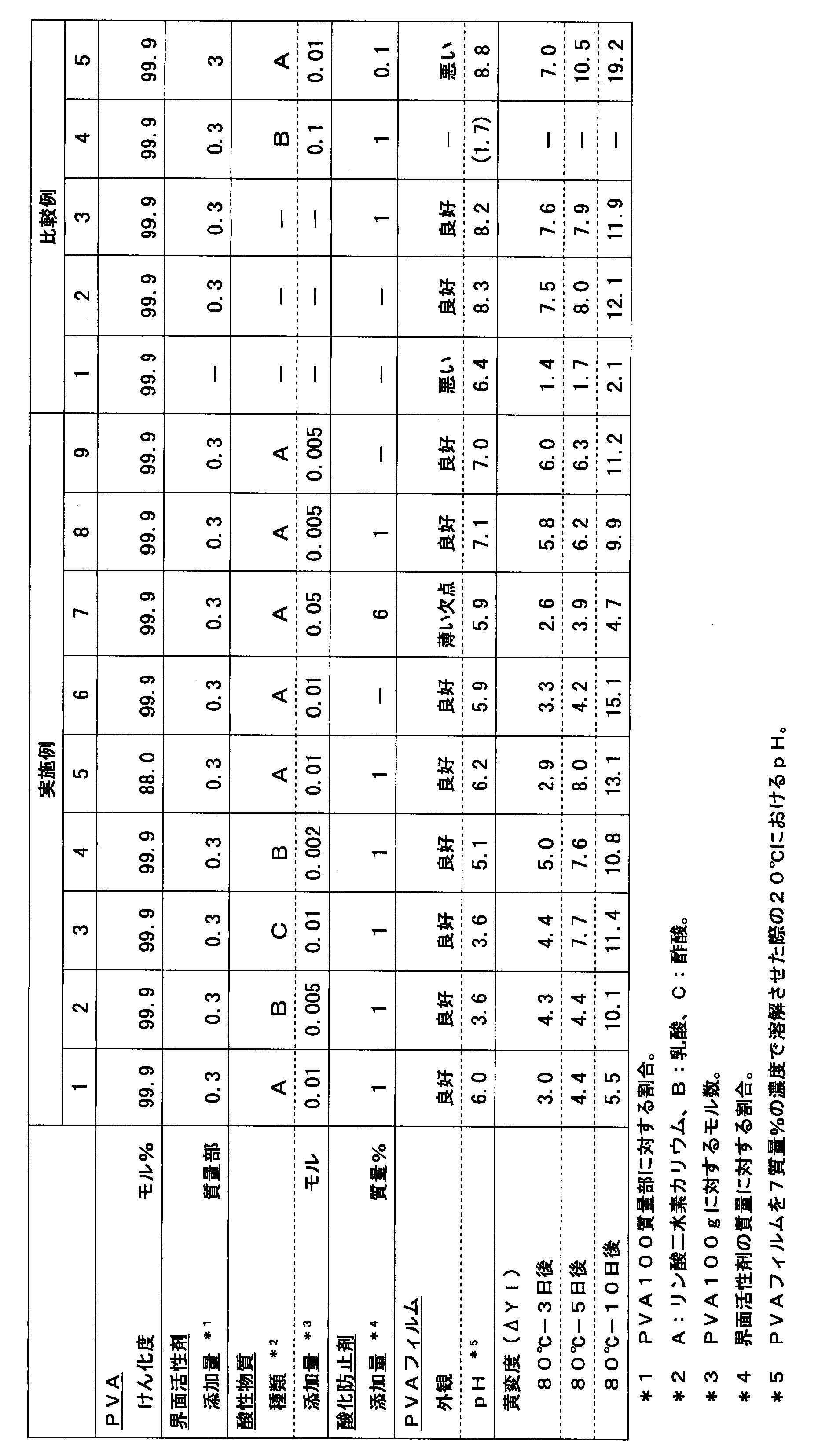
- the results of the above various evaluations are shown in Table 1.
- said film forming was performed continuously for 240 hours, generation
- Example 2 In Example 1, instead of adding 1 mol / l potassium dihydrogen phosphate aqueous solution at a rate of 10 ml to 100 g of PVA, 1 mol / l aqueous lactic acid solution was added at a rate of 5 ml to 100 g of PVA. Except for this, a PVA film was obtained in the same manner as in Example 1. In the obtained PVA film, no defects such as streaks were found, and the appearance was good. Various measurements were performed in the same manner as in Example 1 using the obtained PVA film. The results are shown in Table 1.
- Example 3 In Example 1, instead of adding 1 mol / l potassium dihydrogen phosphate aqueous solution at a rate of 10 ml per 100 g of PVA, 1 mol / l aqueous acetic acid solution was added at a rate of 10 ml per 100 g of PVA. Except for this, a PVA film was obtained in the same manner as in Example 1. In the obtained PVA film, no defects such as streaks were found, and the appearance was good. Various measurements were performed in the same manner as in Example 1 using the obtained PVA film. The results are shown in Table 1.
- Example 4 In Example 2, a PVA film was obtained in the same manner as in Example 2 except that the addition amount of the lactic acid aqueous solution was changed from a ratio of 5 ml to 100 g of PVA to a ratio of 2 ml to 100 g of PVA. In the obtained PVA film, no defects such as streaks were found, and the appearance was good. Various measurements were performed in the same manner as in Example 1 using the obtained PVA film. The results are shown in Table 1.
- Example 5 A PVA chip having a degree of saponification of 88.0 mol%, a degree of polymerization of 2400, and a sodium acetate content of 2.0% by mass was used as the PVA chip in the same manner as in Example 1. A hydrous chip was obtained. The sodium acetate content in the obtained PVA water-containing chip was 0.08% by mass relative to PVA, and the volatile content in the PVA water-containing chip was 86% by mass. This PVA water-containing chip was dried under reduced pressure at 20 ° C. to adjust the volatile content concentration to 70% by mass.
- a PVA film was obtained in the same manner as in Example 1 except that the obtained PVA water-containing chip was used instead of the PVA water-containing chip having a volatile content concentration of 70% by mass used in Example 1. In the obtained PVA film, no defects such as streaks were found, and the appearance was good. Various measurements were performed in the same manner as in Example 1 using the obtained PVA film. The results are shown in Table 1.
- Example 6 A PVA film was obtained in the same manner as in Example 1, except that 4,4′-butylidenebis (6-tert-butyl-3-methylphenol) was not added. In the obtained PVA film, no defects such as streaks were found, and the appearance was good. Various measurements were performed in the same manner as in Example 1 using the obtained PVA film. The results are shown in Table 1.
- Example 7 In Example 1, the amount of 4,4′-butylidenebis (6-tert-butyl-3-methylphenol) added was 0.003 with respect to 333 parts by mass of PVA water-containing chips (100 parts by mass in terms of dry state PVA).
- a PVA film was obtained in the same manner as in Example 1 except that the mass was changed to 0.018 parts by mass. Although the obtained PVA film does not become a practical problem, when it is observed under strong light such as sunlight, it is estimated that it is caused by 4,4′-butylidenebis (6-tert-butyl-3-methylphenol). The agglomerated defects that were observed were seen thin.
- Various measurements were performed in the same manner as in Example 1 using the obtained PVA film. The results are shown in Table 1.
- Example 8 In Example 1, a PVA film was obtained in the same manner as in Example 1 except that the addition amount of the potassium dihydrogen phosphate aqueous solution was changed from a ratio of 10 ml to 100 g of PVA to a ratio of 5 ml to 100 g of PVA. It was. In the obtained PVA film, no defects such as streaks were found, and the appearance was good. Various measurements were performed in the same manner as in Example 1 using the obtained PVA film. The results are shown in Table 1. In addition, when said film formation was performed continuously for 240 hours, generation
- Example 9 A PVA film was obtained in the same manner as in Example 8, except that 4,4′-butylidenebis (6-tert-butyl-3-methylphenol) was not added. In the obtained PVA film, no defects such as streaks were found, and the appearance was good. Various measurements were performed in the same manner as in Example 1 using the obtained PVA film. The results are shown in Table 1.
- Example 1 Example 1 was conducted except that none of glycerin, a mixture containing a surfactant, 4,4′-butylidenebis (6-t-butyl-3-methylphenol), and an aqueous potassium dihydrogen phosphate solution was added. In the same manner as in Example 1, a PVA film was obtained. The obtained PVA film had many defects such as streaks and was poor in appearance. Various measurements were performed in the same manner as in Example 1 using the obtained PVA film. The results are shown in Table 1.
- Example 2 A PVA film was prepared in the same manner as in Example 1 except that neither 4,4′-butylidenebis (6-tert-butyl-3-methylphenol) nor aqueous potassium dihydrogen phosphate solution was added. Got. In the obtained PVA film, no defects such as streaks were found, and the appearance was good. Various measurements were performed in the same manner as in Example 1 using the obtained PVA film. The results are shown in Table 1.
- Example 3 the PVA film was obtained like Example 1 except not having added potassium dihydrogen phosphate aqueous solution. In the obtained PVA film, no defects such as streaks were found, and the appearance was good. Various measurements were performed in the same manner as in Example 1 using the obtained PVA film. The results are shown in Table 1. In addition, when said film formation was performed continuously for 240 hours, generation
- Example 2 instead of adding a 1 mol / l lactic acid aqueous solution at a rate of 5 ml with respect to 100 g of PVA, the lactic acid was used as it was without diluting in water, and the proportion was 0.1 mol with respect to 100 g of PVA.
- a mixture of the PVA water-containing chip and various additives was obtained in the same manner as in Example 1 except that the mixture was added in step 1.
- an aqueous solution having a solid content concentration of 7% by mass was prepared. It was 1.7 when pH of the obtained aqueous solution was measured by the method similar to having mentioned above about the case of a PVA film.
- this mixture was melt-cast using an extruder, the plating applied to the molten resin flow path might corrode, so the film-forming was abandoned.
- Example 5 In Example 1, except that the addition amount of the mixture containing the surfactant was changed from 0.3 parts by mass to 3 parts by mass with respect to 333 parts by mass of the PVA water-containing chip (100 parts by mass in terms of dry state PVA). A PVA film was obtained in the same manner as Example 1. The obtained PVA film had many defects such as streaks and was poor in appearance. Various measurements were performed in the same manner as in Example 1 using the obtained PVA film. The results are shown in Table 1.
- Example 10 The PVA film obtained in Example 1 was wound up in a roll shape by 50 m in a paper tube having a diameter of 3 inches, and stored in a thermo-hygrostat adjusted to a temperature of 30 ° C. and a humidity of 50% RH. It was taken out after 6 months and the yellowness (YI value) of the PVA film was measured by the method described above. As a result, it was 5.4 with respect to 4.6 before the start of storage, and the yellowing degree ( ⁇ YI) was 0.8. It was small. Also, the film surface was good with no change from before storage. The evaluation results are shown in Table 2.
- Example 10 In Example 10, instead of using the PVA film obtained in Example 1, the PVA film was stored in the same manner as in Example 10 except that the PVA film obtained in Comparative Example 3 was used. The evaluation results of the PVA film taken out after 6 months are shown in Table 2.
- the PVA polymer film can be obtained in which the color of the film is hardly yellowish even when stored in a warehouse or the like for a long time
- the PVA polymer film is, for example, a packaging material; It can be preferably used as a raw material for producing an optical film such as a film or retardation film; a water-soluble film such as a laundry bag; a release film for producing artificial marble.
Landscapes
- Chemical & Material Sciences (AREA)
- Health & Medical Sciences (AREA)
- Chemical Kinetics & Catalysis (AREA)
- Medicinal Chemistry (AREA)
- Polymers & Plastics (AREA)
- Organic Chemistry (AREA)
- Engineering & Computer Science (AREA)
- Manufacturing & Machinery (AREA)
- Materials Engineering (AREA)
- Manufacture Of Macromolecular Shaped Articles (AREA)
- Mechanical Engineering (AREA)
- Compositions Of Macromolecular Compounds (AREA)
Abstract
Description
[1]PVA系重合体(A)、および当該PVA系重合体(A)100質量部に対して界面活性剤(B)を0.001~1質量部含むPVA系重合体フィルムであって、水に7質量%の濃度で溶解させた際の20℃におけるpHが2.0~8.0であるPVA系重合体フィルム、
[2]PVA系重合体(A)のけん化度が90モル%以上である、上記[1]のPVA系重合体フィルム、
[3]酸性物質(C)を用いて得られたものである、上記[1]または[2]のPVA系重合体フィルム、
[4]酸性物質(C)の25℃におけるpKa(酸解離定数)が3.5以上であり、且つ当該酸性物質(C)の常圧下での沸点が120℃を超える、上記[3]のPVA系重合体フィルム、
[5]界面活性剤(B)がノニオン系界面活性剤である、上記[1]~[4]のいずれか1つのPVA系重合体フィルム、
[6]ノニオン系界面活性剤がアルカノールアミド型の界面活性剤である、上記[5]のPVA系重合体フィルム、
[7]酸化防止剤(D)を界面活性剤(B)に対して0.01~3質量%含む、上記[1]~[6]のいずれか1つのPVA系重合体フィルム、
[8]PVA系重合体(A)および当該PVA系重合体(A)100質量部に対して界面活性剤(B)を0.001~1質量部含む製膜原液を調製する工程と、当該製膜原液を製膜する工程とを含み、上記製膜原液が、界面活性剤(B)を70質量%以上含む混合物を用いて得られたものである、上記[1]~[7]のいずれか1つのPVA系重合体フィルムの製造方法、
[9]上記製膜原液が酸性物質(C)を用いて得られたものである、上記[8]の製造方法、
[10]上記混合物が、水に0.1質量%の濃度で溶解させた際の20℃におけるpHが8.0以上となるものである、上記[8]または[9]の製造方法、
[11]上記[1]~[7]のいずれか1つのPVA系重合体フィルムを、温度0~40℃および湿度75%RH以下の条件下に保管することを特徴とする、PVA系重合体フィルムの保管方法、
に関する。
さらに、本発明の保管方法によりPVA系重合体フィルムを保管すれば、フィルムの黄変をより効果的に抑制することができる。
本発明のPVA系重合体フィルムは、PVA系重合体(A)と界面活性剤(B)とを含む。
Po = ([η]×103/8.29)(1/0.62)
酸化防止剤(D)の種類に特に制限はないが、フェノール系、ホスファイト系、チオエステル系、ベンゾトリアゾール系、ヒンダードアミン系などの有機系酸化防止剤が好適な物として例示される。
なお、以下の実施例および比較例において採用された、PVAフィルムを水に溶解させた際のpHおよびPVAフィルムの黄色度(YI値)の各測定方法を以下に示す。
PVAフィルム7gを室温の脱イオン水93g中に入れ、攪拌下に約90℃に加熱してフィルムを完全に溶解させた後、得られた水溶液を20℃に冷却し、pHメーター(METTLER TOLEDO社製「MP230」)を用いてその水溶液のpHを測定した。
サンプルとなるフィルムを8枚重ねて、色差計(日本電色工業株式会社製 Model「NF-902」)を用いてフィルムのYI値を8枚全体の値として測定した。
けん化度99.9モル%、重合度2400、酢酸ナトリウム含量2.4質量%のPVA(ポリ酢酸ビニルのけん化物)のチップ100質量部を35℃の蒸留水2500質量部に24時間浸漬した後、遠心脱水を行いPVA含水チップを得た。得られたPVA含水チップ中の酢酸ナトリウム含量はPVAに対して0.1質量%であり、またPVA含水チップ中の揮発分濃度は70質量%であった。
そのPVA含水チップ333質量部(乾燥状態PVA換算で100質量部)に対してグリセリン12質量部、界面活性剤を含む混合物(ラウリン酸ジエタノールアミドを95質量%の割合で含有し、且つジエタノールアミンを不純物として含む混合物。当該混合物を水に0.1質量%の濃度で溶解させた際の20℃におけるpH(PVAフィルムの場合について上記したのと同様の方法により測定)は9.64。)0.3質量部、4,4’-ブチリデンビス(6-t-ブチル-3-メチルフェノール)(フェノール系酸化防止剤)0.003質量部を添加し、さらに1mol/lのリン酸二水素カリウム水溶液をPVA100gに対して10mlとなる割合で添加した後、よく混合して混合物とし、これを最高温度130℃の二軸押出機で加熱溶融した。熱交換機で100℃に冷却した後、95℃の金属ドラム上に溶融押出製膜して乾燥することにより、フィルム幅1.2mで平均厚さ60μmのPVAフィルムを得た。得られたPVAフィルムにスジなどの欠陥は見られず外観が良好であった。得られたPVAフィルムを用いて、水に溶解させた際のpHを上記した方法により測定したところ6.0であった。
以上の各種評価の結果を表1に示した。なお、240時間連続して上記の製膜を行ったが、スジ状の欠点の発生は認められなかった。
実施例1において、1mol/lのリン酸二水素カリウム水溶液をPVA100gに対して10mlとなる割合で添加したことに代えて、1mol/lの乳酸水溶液をPVA100gに対して5mlとなる割合で添加したこと以外は実施例1と同様にして、PVAフィルムを得た。得られたPVAフィルムにスジなどの欠陥は見られず外観が良好であった。
得られたPVAフィルムを用いて実施例1と同様にして各種測定を行った。結果を表1に示した。
実施例1において、1mol/lのリン酸二水素カリウム水溶液をPVA100gに対して10mlとなる割合で添加したことに代えて、1mol/lの酢酸水溶液をPVA100gに対して10mlとなる割合で添加したこと以外は実施例1と同様にして、PVAフィルムを得た。得られたPVAフィルムにスジなどの欠陥は見られず外観が良好であった。
得られたPVAフィルムを用いて実施例1と同様にして各種測定を行った。結果を表1に示した。
実施例2において、乳酸水溶液の添加量をPVA100gに対して5mlとなる割合からPVA100gに対して2mlとなる割合に変更したこと以外は実施例2と同様にして、PVAフィルムを得た。得られたPVAフィルムにスジなどの欠陥は見られず外観が良好であった。
得られたPVAフィルムを用いて実施例1と同様にして各種測定を行った。結果を表1に示した。
PVAのチップとして、けん化度88.0モル%、重合度2400、酢酸ナトリウム含量2.0質量%のPVA(ポリ酢酸ビニルのけん化物)のチップを使用して、実施例1と同様にしてPVA含水チップを得た。得られたPVA含水チップ中の酢酸ナトリウム含量はPVAに対して0.08質量%であり、またPVA含水チップ中の揮発分濃度は86質量%であった。このPVA含水チップを20℃で減圧乾燥して、揮発分濃度を70質量%に調整した。
得られたPVA含水チップを、実施例1において使用された揮発分濃度が70質量%のPVA含水チップの代わりに用いたこと以外は実施例1と同様にしてPVAフィルムを得た。得られたPVAフィルムにスジなどの欠陥は見られず外観が良好であった。
得られたPVAフィルムを用いて実施例1と同様にして各種測定を行った。結果を表1に示した。
実施例1において、4,4’-ブチリデンビス(6-t-ブチル-3-メチルフェノール)を添加しなかったこと以外は実施例1と同様にして、PVAフィルムを得た。得られたPVAフィルムにスジなどの欠陥は見られず外観が良好であった。
得られたPVAフィルムを用いて実施例1と同様にして各種測定を行った。結果を表1に示した。
実施例1において、4,4’-ブチリデンビス(6-t-ブチル-3-メチルフェノール)の添加量を、PVA含水チップ333質量部(乾燥状態PVA換算で100質量部)に対して0.003質量部から0.018質量部に変更したこと以外は実施例1と同様にして、PVAフィルムを得た。得られたPVAフィルムには実用上の支障になるほどではないが、日光などの強い光の元で観察すると、4,4’-ブチリデンビス(6-t-ブチル-3-メチルフェノール)によって生じたと推定される凝集物状の欠点が薄く見られた。
得られたPVAフィルムを用いて実施例1と同様にして各種測定を行った。結果を表1に示した。
実施例1において、リン酸二水素カリウム水溶液の添加量をPVA100gに対して10mlとなる割合からPVA100gに対して5mlとなる割合に変更したこと以外は実施例1と同様にして、PVAフィルムを得た。得られたPVAフィルムにスジなどの欠陥は見られず外観が良好であった。
得られたPVAフィルムを用いて実施例1と同様にして各種測定を行った。結果を表1に示した。なお、240時間連続して上記の製膜を行ったところ、スジ状の欠点の発生がわずかに認められた。
実施例8において、4,4’-ブチリデンビス(6-t-ブチル-3-メチルフェノール)を添加しなかったこと以外は実施例8と同様にして、PVAフィルムを得た。得られたPVAフィルムにスジなどの欠陥は見られず外観が良好であった。
得られたPVAフィルムを用いて実施例1と同様にして各種測定を行った。結果を表1に示した。
実施例1において、グリセリン、界面活性剤を含む混合物、4,4’-ブチリデンビス(6-t-ブチル-3-メチルフェノール)、リン酸二水素カリウム水溶液のいずれも添加しなかったこと以外は実施例1と同様にして、PVAフィルムを得た。得られたPVAフィルムにはスジなどの欠陥が多くて外観が悪かった。
得られたPVAフィルムを用いて実施例1と同様にして各種測定を行った。結果を表1に示した。
実施例1において、4,4’-ブチリデンビス(6-t-ブチル-3-メチルフェノール)およびリン酸二水素カリウム水溶液のいずれも添加しなかったこと以外は実施例1と同様にして、PVAフィルムを得た。得られたPVAフィルムにスジなどの欠陥は見られず外観が良好であった。
得られたPVAフィルムを用いて実施例1と同様にして各種測定を行った。結果を表1に示した。
実施例1において、リン酸二水素カリウム水溶液を添加しなかったこと以外は実施例1と同様にして、PVAフィルムを得た。得られたPVAフィルムにスジなどの欠陥は見られず外観が良好であった。
得られたPVAフィルムを用いて実施例1と同様にして各種測定を行った。結果を表1に示した。なお、240時間連続して上記の製膜を行ったところ、スジ状の欠点の発生が認められた。
実施例2において、1mol/lの乳酸水溶液をPVA100gに対して5mlとなる割合で添加したことに代えて、乳酸を水に希釈せずそのまま用いてそれをPVA100gに対して0.1molとなる割合で添加したこと以外は実施例1と同様にして、PVA含水チップと各種添加物の混合物を得た。この混合物に水を加えることにより固形分濃度7質量%の水溶液を作製した。得られた水溶液のpHをPVAフィルムの場合について上記したのと同様の方法により測定したところ1.7であった。この混合物を押出機を用いて溶融製膜した場合、溶融樹脂流路に施されているメッキが腐食する可能性があるため、製膜を断念した。
実施例1において、界面活性剤を含む混合物の添加量を、PVA含水チップ333質量部(乾燥状態PVA換算で100質量部)に対して0.3質量部から3質量部に変更したこと以外は実施例1と同様にして、PVAフィルムを得た。得られたPVAフィルムにはスジなどの欠陥が多くて外観が悪かった。
得られたPVAフィルムを用いて実施例1と同様にして各種測定を行った。結果を表1に示した。
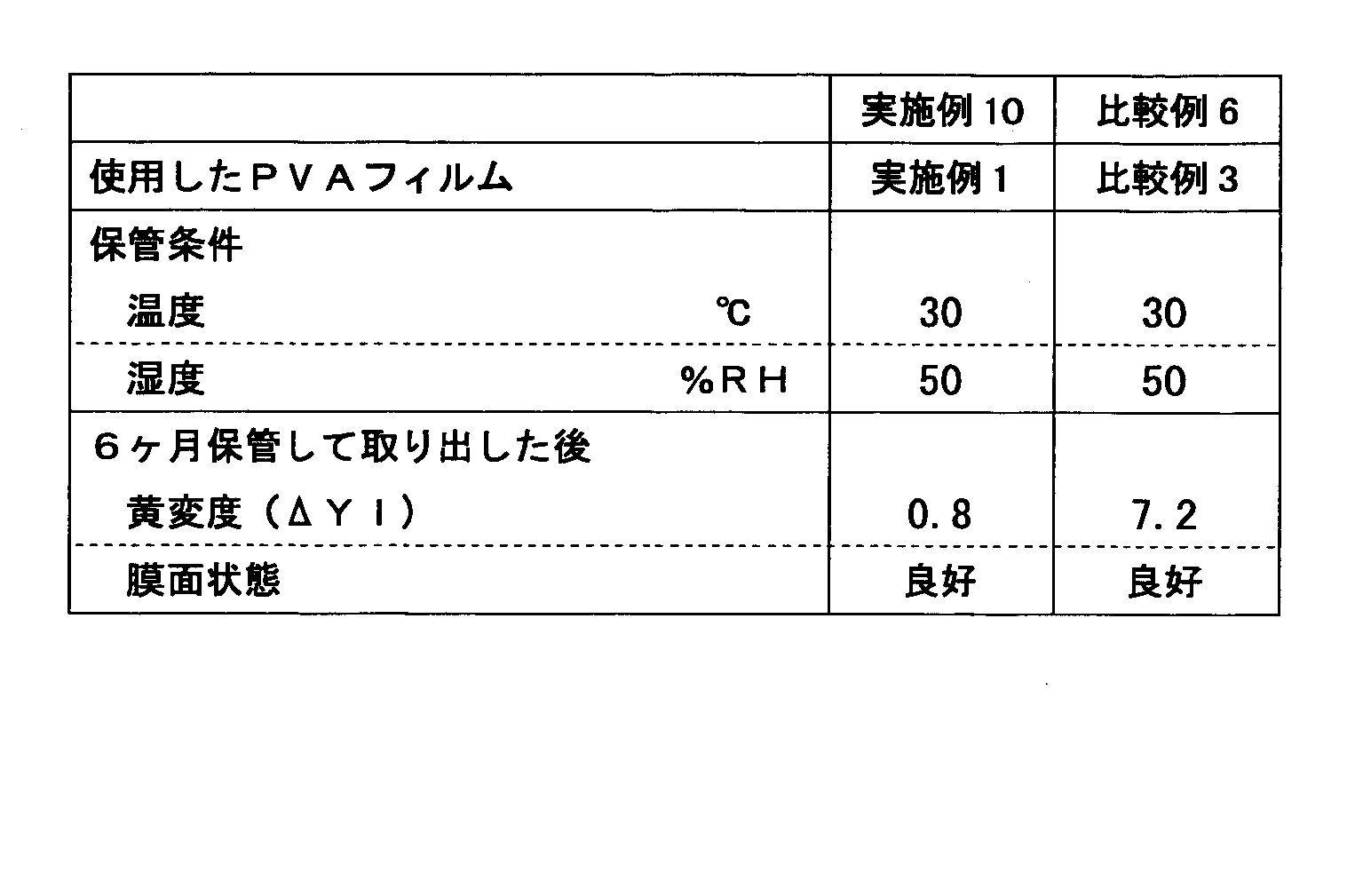
実施例1で得られたPVAフィルムを直径3インチの紙管にロール状に50m巻き取り、温度30℃および湿度50%RHに調整した恒温恒湿機内に保管した。6ヶ月後に取り出してPVAフィルムの黄色度(YI値)を上記した方法により測定したところ、保管開始前の4.6に対して5.4であり、黄変度(ΔYI)は0.8と小さかった。また、膜面は保管前と特に変化なく、良好であった。評価結果を表2に示した。
実施例10において、実施例1で得られたPVAフィルムを使用する代わりに比較例3で得られたPVAフィルムを使用したこと以外は実施例10と同様にしてPVAフィルムを保管した。6ヶ月間後取り出したPVAフィルムの評価結果を表2に示した。
Claims (11)
- ポリビニルアルコール系重合体(A)、および当該ポリビニルアルコール系重合体(A)100質量部に対して界面活性剤(B)を0.001~1質量部含むポリビニルアルコール系重合体フィルムであって、水に7質量%の濃度で溶解させた際の20℃におけるpHが2.0~8.0であるポリビニルアルコール系重合体フィルム。
- ポリビニルアルコール系重合体(A)のけん化度が90モル%以上である、請求項1に記載のポリビニルアルコール系重合体フィルム。
- 酸性物質(C)を用いて得られたものである、請求項1または2に記載のポリビニルアルコール系重合体フィルム。
- 酸性物質(C)の25℃におけるpKa(酸解離定数)が3.5以上であり、且つ当該酸性物質(C)の常圧下での沸点が120℃を超える、請求項3に記載のポリビニルアルコール系重合体フィルム。
- 界面活性剤(B)がノニオン系界面活性剤である、請求項1~4のいずれか1項に記載のポリビニルアルコール系重合体フィルム。
- ノニオン系界面活性剤がアルカノールアミド型の界面活性剤である、請求項5に記載のポリビニルアルコール系重合体フィルム。
- 酸化防止剤(D)を界面活性剤(B)に対して0.01~3質量%含む、請求項1~6のいずれか1項に記載のポリビニルアルコール系重合体フィルム。
- ポリビニルアルコール系重合体(A)および当該ポリビニルアルコール系重合体(A)100質量部に対して界面活性剤(B)を0.001~1質量部含む製膜原液を調製する工程と、当該製膜原液を製膜する工程とを含み、上記製膜原液が、界面活性剤(B)を70質量%以上含む混合物を用いて得られたものである、請求項1~7のいずれか1項に記載のポリビニルアルコール系重合体フィルムの製造方法。
- 上記製膜原液が酸性物質(C)を用いて得られたものである、請求項8に記載の製造方法。
- 上記混合物が、水に0.1質量%の濃度で溶解させた際の20℃におけるpHが8.0以上となるものである、請求項8または9に記載の製造方法。
- 請求項1~7のいずれか1項に記載のポリビニルアルコール系重合体フィルムを、温度0~40℃および湿度75%RH以下の条件下に保管することを特徴とする、ポリビニルアルコール系重合体フィルムの保管方法。
Priority Applications (3)
| Application Number | Priority Date | Filing Date | Title |
|---|---|---|---|
| JP2011536689A JP5638533B2 (ja) | 2010-04-20 | 2011-04-14 | ポリビニルアルコール系重合体フィルム |
| KR1020127029559A KR101752027B1 (ko) | 2010-04-20 | 2011-04-14 | 폴리비닐알코올계 중합체 필름 |
| CN201180019933.XA CN102834439B (zh) | 2010-04-20 | 2011-04-14 | 聚乙烯醇系聚合物膜 |
Applications Claiming Priority (2)
| Application Number | Priority Date | Filing Date | Title |
|---|---|---|---|
| JP2010096970 | 2010-04-20 | ||
| JP2010-096970 | 2010-04-20 |
Publications (1)
| Publication Number | Publication Date |
|---|---|
| WO2011132592A1 true WO2011132592A1 (ja) | 2011-10-27 |
Family
ID=44834113
Family Applications (1)
| Application Number | Title | Priority Date | Filing Date |
|---|---|---|---|
| PCT/JP2011/059227 Ceased WO2011132592A1 (ja) | 2010-04-20 | 2011-04-14 | ポリビニルアルコール系重合体フィルム |
Country Status (5)
| Country | Link |
|---|---|
| JP (1) | JP5638533B2 (ja) |
| KR (1) | KR101752027B1 (ja) |
| CN (1) | CN102834439B (ja) |
| TW (1) | TWI513710B (ja) |
| WO (1) | WO2011132592A1 (ja) |
Cited By (16)
| Publication number | Priority date | Publication date | Assignee | Title |
|---|---|---|---|---|
| JP2013171210A (ja) * | 2012-02-22 | 2013-09-02 | Sekisui Chem Co Ltd | ポリビニルアルコール樹脂フィルム材料、偏光フィルム及び偏光フィルムの製造方法 |
| JP2013227544A (ja) * | 2012-03-30 | 2013-11-07 | Kuraray Co Ltd | フィルムロールおよびその包装体 |
| JP2015196808A (ja) * | 2014-04-03 | 2015-11-09 | 株式会社クラレ | ポリビニルアルコールフィルムの製造方法 |
| CN107406179A (zh) * | 2015-04-15 | 2017-11-28 | 积水化学工业株式会社 | 药剂包装用膜 |
| WO2017217346A1 (ja) * | 2016-06-13 | 2017-12-21 | 日本合成化学工業株式会社 | ポリビニルアルコール系フィルム、およびその製造方法、ならびにそのポリビニルアルコール系フィルムを用いた偏光膜 |
| JP2018031015A (ja) * | 2016-08-23 | 2018-03-01 | 積水化学工業株式会社 | 水溶性樹脂組成物及び水溶性樹脂フィルム |
| US20180105338A1 (en) * | 2015-04-15 | 2018-04-19 | Sekisui Chemical Co., Ltd. | Chemical product packaging film |
| WO2018168903A1 (ja) * | 2017-03-15 | 2018-09-20 | 株式会社クラレ | 樹脂組成物、その製造方法及びそれを用いた成形体 |
| WO2020004608A1 (ja) * | 2018-06-29 | 2020-01-02 | 株式会社クラレ | ポリビニルアルコールフィルム、フィルムロールおよび偏光フィルム |
| WO2021132425A1 (ja) * | 2019-12-26 | 2021-07-01 | 株式会社クラレ | ポリビニルアルコールフィルム |
| WO2022004344A1 (ja) * | 2020-06-29 | 2022-01-06 | 株式会社クラレ | 水溶性フィルムおよび包装体 |
| JP7228722B1 (ja) | 2021-10-08 | 2023-02-24 | 長春石油化學股▲分▼有限公司 | ポリビニルアルコールフィルム、それを含む光学フィルム及びそれらの製造方法 |
| CN115996962A (zh) * | 2020-06-30 | 2023-04-21 | 株式会社可乐丽 | 乙酸乙烯酯、乙酸乙烯酯聚合物及乙烯醇聚合物 |
| US12018145B2 (en) | 2020-10-15 | 2024-06-25 | Kuraray Co., Ltd. | Polyvinyl alcohol resin film, method for discriminating polyvinyl alcohol resin film, and method for manufacturing polyvinyl alcohol resin film |
| WO2024143297A1 (ja) * | 2022-12-26 | 2024-07-04 | 株式会社クラレ | ポリビニルアルコールフィルム及び偏光子 |
| WO2024181532A1 (ja) * | 2023-03-01 | 2024-09-06 | 株式会社クラレ | ビニルアルコール系重合体を含む組成物、及びビニルアルコール系重合体の分離方法 |
Families Citing this family (8)
| Publication number | Priority date | Publication date | Assignee | Title |
|---|---|---|---|---|
| WO2013146459A1 (ja) * | 2012-03-30 | 2013-10-03 | 株式会社クラレ | ポリビニルアルコール系重合体フィルム |
| WO2014178402A1 (ja) | 2013-05-01 | 2014-11-06 | 積水化学工業株式会社 | ポリビニルアルコール水溶液 |
| JP6383664B2 (ja) * | 2013-08-09 | 2018-08-29 | 株式会社クラレ | 光学フィルム製造用原反フィルム |
| WO2015093499A1 (ja) * | 2013-12-19 | 2015-06-25 | 株式会社クラレ | フィルム |
| CN111819260B (zh) * | 2018-11-12 | 2021-05-11 | 日东电工株式会社 | 图像显示装置 |
| JP7282100B2 (ja) * | 2018-12-04 | 2023-05-26 | 株式会社クラレ | ポリビニルアルコールフィルム及びそれを用いた偏光フィルムの製造方法 |
| CN113227857B (zh) * | 2018-12-28 | 2023-06-27 | 株式会社可乐丽 | 聚乙烯醇膜和使用其的偏振膜的制造方法 |
| WO2025070923A1 (ko) * | 2023-09-26 | 2025-04-03 | 에스케이마이크로웍스 주식회사 | 필름 |
Citations (7)
| Publication number | Priority date | Publication date | Assignee | Title |
|---|---|---|---|---|
| JPS6195054A (ja) * | 1985-09-27 | 1986-05-13 | Kuraray Co Ltd | 熱安定性に優れたポリビニルアルコール系ポリマーの製造方法 |
| JPH06254958A (ja) * | 1993-03-03 | 1994-09-13 | Nippon Synthetic Chem Ind Co Ltd:The | ポリビニルアルコール系樹脂延伸フィルム |
| JP2001311828A (ja) * | 2000-05-02 | 2001-11-09 | Kuraray Co Ltd | 偏光フィルム用ポリビニルアルコールフィルムとその製造法および偏光フィルム |
| JP2006124668A (ja) * | 2004-09-28 | 2006-05-18 | Nippon Synthetic Chem Ind Co Ltd:The | エチレン−ビニルアルコール共重合体組成物およびそれを用いた多層構造体 |
| JP2006193694A (ja) * | 2005-01-17 | 2006-07-27 | Nippon Synthetic Chem Ind Co Ltd:The | ポリビニルアルコール系フィルムの製造方法およびポリビニルアルコール系フィルム |
| WO2008012902A1 (en) * | 2006-07-27 | 2008-01-31 | The Nippon Synthetic Chemical Industry Co., Ltd. | Polyvinyl alcohol-based film for optical uses and polarizing membrane and polarizing plate |
| WO2010126041A1 (ja) * | 2009-04-28 | 2010-11-04 | 日本合成化学工業株式会社 | ポリビニルアルコール系樹脂組成物 |
Family Cites Families (5)
| Publication number | Priority date | Publication date | Assignee | Title |
|---|---|---|---|---|
| JPS6195053A (ja) * | 1985-09-26 | 1986-05-13 | Kuraray Co Ltd | 熱安定性に優れたポリビニルアルコール系ポリマーの製造方法 |
| JPH1193075A (ja) * | 1997-09-16 | 1999-04-06 | Kuraray Co Ltd | ポリビニルアルコール系組成物およびその用途 |
| TWI247771B (en) * | 2000-05-01 | 2006-01-21 | Kuraray Co | Process for producing polyvinyl alcohol-based polymer film and polarizing film |
| JP2002146140A (ja) * | 2000-11-15 | 2002-05-22 | Nippon Synthetic Chem Ind Co Ltd:The | 樹脂組成物 |
| KR101544626B1 (ko) * | 2007-08-24 | 2015-08-17 | 가부시키가이샤 구라레 | 폴리비닐알코올 필름 및 그 제조법 |
-
2011
- 2011-04-14 KR KR1020127029559A patent/KR101752027B1/ko active Active
- 2011-04-14 JP JP2011536689A patent/JP5638533B2/ja active Active
- 2011-04-14 CN CN201180019933.XA patent/CN102834439B/zh active Active
- 2011-04-14 WO PCT/JP2011/059227 patent/WO2011132592A1/ja not_active Ceased
- 2011-04-19 TW TW100113456A patent/TWI513710B/zh active
Patent Citations (7)
| Publication number | Priority date | Publication date | Assignee | Title |
|---|---|---|---|---|
| JPS6195054A (ja) * | 1985-09-27 | 1986-05-13 | Kuraray Co Ltd | 熱安定性に優れたポリビニルアルコール系ポリマーの製造方法 |
| JPH06254958A (ja) * | 1993-03-03 | 1994-09-13 | Nippon Synthetic Chem Ind Co Ltd:The | ポリビニルアルコール系樹脂延伸フィルム |
| JP2001311828A (ja) * | 2000-05-02 | 2001-11-09 | Kuraray Co Ltd | 偏光フィルム用ポリビニルアルコールフィルムとその製造法および偏光フィルム |
| JP2006124668A (ja) * | 2004-09-28 | 2006-05-18 | Nippon Synthetic Chem Ind Co Ltd:The | エチレン−ビニルアルコール共重合体組成物およびそれを用いた多層構造体 |
| JP2006193694A (ja) * | 2005-01-17 | 2006-07-27 | Nippon Synthetic Chem Ind Co Ltd:The | ポリビニルアルコール系フィルムの製造方法およびポリビニルアルコール系フィルム |
| WO2008012902A1 (en) * | 2006-07-27 | 2008-01-31 | The Nippon Synthetic Chemical Industry Co., Ltd. | Polyvinyl alcohol-based film for optical uses and polarizing membrane and polarizing plate |
| WO2010126041A1 (ja) * | 2009-04-28 | 2010-11-04 | 日本合成化学工業株式会社 | ポリビニルアルコール系樹脂組成物 |
Cited By (36)
| Publication number | Priority date | Publication date | Assignee | Title |
|---|---|---|---|---|
| JP2013171210A (ja) * | 2012-02-22 | 2013-09-02 | Sekisui Chem Co Ltd | ポリビニルアルコール樹脂フィルム材料、偏光フィルム及び偏光フィルムの製造方法 |
| JP2013227544A (ja) * | 2012-03-30 | 2013-11-07 | Kuraray Co Ltd | フィルムロールおよびその包装体 |
| JP2015196808A (ja) * | 2014-04-03 | 2015-11-09 | 株式会社クラレ | ポリビニルアルコールフィルムの製造方法 |
| US10450118B2 (en) | 2015-04-15 | 2019-10-22 | Sekisui Chemical Co., Ltd. | Chemical product packaging film |
| CN107406179A (zh) * | 2015-04-15 | 2017-11-28 | 积水化学工业株式会社 | 药剂包装用膜 |
| US20180105338A1 (en) * | 2015-04-15 | 2018-04-19 | Sekisui Chemical Co., Ltd. | Chemical product packaging film |
| EP3284695B1 (en) | 2015-04-15 | 2021-02-17 | Sekisui Chemical Co., Ltd. | Chemical product packaging film |
| CN107406179B (zh) * | 2015-04-15 | 2020-04-21 | 积水化学工业株式会社 | 药剂包装用膜 |
| WO2017217346A1 (ja) * | 2016-06-13 | 2017-12-21 | 日本合成化学工業株式会社 | ポリビニルアルコール系フィルム、およびその製造方法、ならびにそのポリビニルアルコール系フィルムを用いた偏光膜 |
| JP2021185241A (ja) * | 2016-08-23 | 2021-12-09 | 積水化学工業株式会社 | 水溶性樹脂組成物及び水溶性樹脂フィルム |
| JP7352602B2 (ja) | 2016-08-23 | 2023-09-28 | 積水化学工業株式会社 | 水溶性樹脂組成物及び水溶性樹脂フィルム |
| JP2018031015A (ja) * | 2016-08-23 | 2018-03-01 | 積水化学工業株式会社 | 水溶性樹脂組成物及び水溶性樹脂フィルム |
| CN110603292B (zh) * | 2017-03-15 | 2022-04-19 | 株式会社可乐丽 | 树脂组合物、其制造方法和使用了其的成形体 |
| JP6411705B1 (ja) * | 2017-03-15 | 2018-10-24 | 株式会社クラレ | 樹脂組成物、その製造方法及びそれを用いた成形体 |
| WO2018168903A1 (ja) * | 2017-03-15 | 2018-09-20 | 株式会社クラレ | 樹脂組成物、その製造方法及びそれを用いた成形体 |
| CN110603292A (zh) * | 2017-03-15 | 2019-12-20 | 株式会社可乐丽 | 树脂组合物、其制造方法和使用了其的成形体 |
| US11560464B2 (en) | 2017-03-15 | 2023-01-24 | Kuraray Co., Ltd. | Resin composition, production method for resin composition, and molded body using resin composition |
| WO2020004608A1 (ja) * | 2018-06-29 | 2020-01-02 | 株式会社クラレ | ポリビニルアルコールフィルム、フィルムロールおよび偏光フィルム |
| CN112292624A (zh) * | 2018-06-29 | 2021-01-29 | 株式会社可乐丽 | 聚乙烯醇膜、膜卷和偏振膜 |
| JPWO2020004608A1 (ja) * | 2018-06-29 | 2021-08-05 | 株式会社クラレ | ポリビニルアルコールフィルム、フィルムロールおよび偏光フィルム |
| JP7308195B2 (ja) | 2018-06-29 | 2023-07-13 | 株式会社クラレ | ポリビニルアルコールフィルム、フィルムロールおよび偏光フィルム |
| JPWO2021132425A1 (ja) * | 2019-12-26 | 2021-07-01 | ||
| WO2021132425A1 (ja) * | 2019-12-26 | 2021-07-01 | 株式会社クラレ | ポリビニルアルコールフィルム |
| JP7490675B2 (ja) | 2019-12-26 | 2024-05-27 | 株式会社クラレ | ポリビニルアルコールフィルム |
| JP7691983B2 (ja) | 2020-06-29 | 2025-06-12 | 株式会社クラレ | 水溶性フィルムおよび包装体 |
| JPWO2022004344A1 (ja) * | 2020-06-29 | 2022-01-06 | ||
| WO2022004344A1 (ja) * | 2020-06-29 | 2022-01-06 | 株式会社クラレ | 水溶性フィルムおよび包装体 |
| CN115996962A (zh) * | 2020-06-30 | 2023-04-21 | 株式会社可乐丽 | 乙酸乙烯酯、乙酸乙烯酯聚合物及乙烯醇聚合物 |
| US12018145B2 (en) | 2020-10-15 | 2024-06-25 | Kuraray Co., Ltd. | Polyvinyl alcohol resin film, method for discriminating polyvinyl alcohol resin film, and method for manufacturing polyvinyl alcohol resin film |
| US12054606B2 (en) | 2020-10-15 | 2024-08-06 | Kuraray Co., Ltd. | Polyvinyl alcohol resin film, method for discriminating polyvinyl alcohol resin film, and method for manufacturing polyvinyl alcohol resin film |
| JP2023057007A (ja) * | 2021-10-08 | 2023-04-20 | 長春石油化學股▲分▼有限公司 | ポリビニルアルコールフィルム、それを含む光学フィルム及びそれらの製造方法 |
| JP7228722B1 (ja) | 2021-10-08 | 2023-02-24 | 長春石油化學股▲分▼有限公司 | ポリビニルアルコールフィルム、それを含む光学フィルム及びそれらの製造方法 |
| WO2024143297A1 (ja) * | 2022-12-26 | 2024-07-04 | 株式会社クラレ | ポリビニルアルコールフィルム及び偏光子 |
| WO2024181532A1 (ja) * | 2023-03-01 | 2024-09-06 | 株式会社クラレ | ビニルアルコール系重合体を含む組成物、及びビニルアルコール系重合体の分離方法 |
| JPWO2024181532A1 (ja) * | 2023-03-01 | 2024-09-06 | ||
| JP7719308B2 (ja) | 2023-03-01 | 2025-08-05 | 株式会社クラレ | ビニルアルコール系重合体を含む組成物、及びビニルアルコール系重合体の分離方法 |
Also Published As
| Publication number | Publication date |
|---|---|
| KR101752027B1 (ko) | 2017-06-28 |
| TW201141882A (en) | 2011-12-01 |
| CN102834439A (zh) | 2012-12-19 |
| TWI513710B (zh) | 2015-12-21 |
| JPWO2011132592A1 (ja) | 2013-07-18 |
| KR20130051934A (ko) | 2013-05-21 |
| CN102834439B (zh) | 2016-03-23 |
| JP5638533B2 (ja) | 2014-12-10 |
Similar Documents
| Publication | Publication Date | Title |
|---|---|---|
| JP5638533B2 (ja) | ポリビニルアルコール系重合体フィルム | |
| CN106715493B (zh) | 改性聚乙烯醇和水溶性膜 | |
| JP7795938B2 (ja) | ポリビニルアルコール樹脂フィルム、ポリビニルアルコール樹脂フィルムの判別方法、及びポリビニルアルコール樹脂フィルムの製造方法 | |
| JP5781676B1 (ja) | 水溶性フィルム、包装袋、内容物放出体、及び水溶性フィルムの製造方法 | |
| CN104185653B (zh) | 聚乙烯醇系聚合物膜和偏光膜 | |
| JP6943707B2 (ja) | 水溶性樹脂組成物及び水溶性樹脂フィルム | |
| WO2020022396A1 (ja) | ポリビニルアルコール系フィルム | |
| CN107922646A (zh) | 液体洗涤剂包装用水溶性薄膜及液体洗涤剂包装体 | |
| TW202134325A (zh) | 聚乙烯醇薄膜 | |
| US20250353981A1 (en) | Polyvinyl alcohol resin film, optical film, water-soluble film, and polyvinyl alcohol resin composition | |
| WO2024257411A1 (ja) | ポリビニルアルコール系樹脂フィルム、光学フィルム、水溶性フィルム、およびポリビニルアルコール系樹脂組成物 | |
| WO2024181406A1 (ja) | ポリビニルアルコール系樹脂フィルム、光学フィルム、水溶性フィルム、およびポリビニルアルコール系樹脂組成物 | |
| WO2024181405A1 (ja) | ポリビニルアルコール系樹脂フィルム、光学フィルム、水溶性フィルム、およびポリビニルアルコール系樹脂組成物 | |
| JP7314438B1 (ja) | 水溶性フィルム、製造方法及び包装体 | |
| JPWO2020138439A1 (ja) | 水溶性フィルムおよび包装体 | |
| CN113227858A (zh) | 聚乙烯醇膜和使用其的偏振膜的制造方法 | |
| CN113167959B (zh) | 聚乙烯醇膜和使用其的偏振膜的制造方法 | |
| JP2024032867A (ja) | 水溶性包装用フィルム | |
| TW201945448A (zh) | 聚乙烯醇薄膜及使用其之偏光薄膜的製造方法 | |
| JP7512205B2 (ja) | ポリビニルアルコールフィルム及びそれを用いた偏光フィルムの製造方法 | |
| CN113950506A (zh) | 聚乙烯醇膜和使用其的偏振膜的制造方法 | |
| JPWO2016121507A1 (ja) | フィルム | |
| JP6825358B2 (ja) | 水溶性フィルムの製造方法 | |
| TWI780626B (zh) | 聚乙烯醇薄膜之製造方法 | |
| JP2007231299A (ja) | ポリビニルアルコールフィルム |
Legal Events
| Date | Code | Title | Description |
|---|---|---|---|
| WWE | Wipo information: entry into national phase |
Ref document number: 201180019933.X Country of ref document: CN |
|
| WWE | Wipo information: entry into national phase |
Ref document number: 2011536689 Country of ref document: JP |
|
| 121 | Ep: the epo has been informed by wipo that ep was designated in this application |
Ref document number: 11771927 Country of ref document: EP Kind code of ref document: A1 |
|
| NENP | Non-entry into the national phase |
Ref country code: DE |
|
| ENP | Entry into the national phase |
Ref document number: 20127029559 Country of ref document: KR Kind code of ref document: A |
|
| 122 | Ep: pct application non-entry in european phase |
Ref document number: 11771927 Country of ref document: EP Kind code of ref document: A1 |