WO2010070819A1 - 電子材料用洗浄剤 - Google Patents
電子材料用洗浄剤 Download PDFInfo
- Publication number
- WO2010070819A1 WO2010070819A1 PCT/JP2009/006359 JP2009006359W WO2010070819A1 WO 2010070819 A1 WO2010070819 A1 WO 2010070819A1 JP 2009006359 W JP2009006359 W JP 2009006359W WO 2010070819 A1 WO2010070819 A1 WO 2010070819A1
- Authority
- WO
- WIPO (PCT)
- Prior art keywords
- acid
- cleaning agent
- salt
- electronic material
- substrate
- Prior art date
- Legal status (The legal status is an assumption and is not a legal conclusion. Google has not performed a legal analysis and makes no representation as to the accuracy of the status listed.)
- Ceased
Links
Classifications
-
- G—PHYSICS
- G11—INFORMATION STORAGE
- G11B—INFORMATION STORAGE BASED ON RELATIVE MOVEMENT BETWEEN RECORD CARRIER AND TRANSDUCER
- G11B5/00—Recording by magnetisation or demagnetisation of a record carrier; Reproducing by magnetic means; Record carriers therefor
- G11B5/84—Processes or apparatus specially adapted for manufacturing record carriers
- G11B5/8404—Processes or apparatus specially adapted for manufacturing record carriers manufacturing base layers
-
- C—CHEMISTRY; METALLURGY
- C11—ANIMAL OR VEGETABLE OILS, FATS, FATTY SUBSTANCES OR WAXES; FATTY ACIDS THEREFROM; DETERGENTS; CANDLES
- C11D—DETERGENT COMPOSITIONS; USE OF SINGLE SUBSTANCES AS DETERGENTS; SOAP OR SOAP-MAKING; RESIN SOAPS; RECOVERY OF GLYCEROL
- C11D1/00—Detergent compositions based essentially on surface-active compounds; Use of these compounds as a detergent
- C11D1/008—Polymeric surface-active agents
-
- C—CHEMISTRY; METALLURGY
- C11—ANIMAL OR VEGETABLE OILS, FATS, FATTY SUBSTANCES OR WAXES; FATTY ACIDS THEREFROM; DETERGENTS; CANDLES
- C11D—DETERGENT COMPOSITIONS; USE OF SINGLE SUBSTANCES AS DETERGENTS; SOAP OR SOAP-MAKING; RESIN SOAPS; RECOVERY OF GLYCEROL
- C11D1/00—Detergent compositions based essentially on surface-active compounds; Use of these compounds as a detergent
- C11D1/02—Anionic compounds
- C11D1/12—Sulfonic acids or sulfuric acid esters; Salts thereof
-
- C—CHEMISTRY; METALLURGY
- C11—ANIMAL OR VEGETABLE OILS, FATS, FATTY SUBSTANCES OR WAXES; FATTY ACIDS THEREFROM; DETERGENTS; CANDLES
- C11D—DETERGENT COMPOSITIONS; USE OF SINGLE SUBSTANCES AS DETERGENTS; SOAP OR SOAP-MAKING; RESIN SOAPS; RECOVERY OF GLYCEROL
- C11D3/00—Other compounding ingredients of detergent compositions covered in group C11D1/00
- C11D3/16—Organic compounds
- C11D3/34—Organic compounds containing sulfur
- C11D3/349—Organic compounds containing sulfur additionally containing nitrogen atoms, e.g. nitro, nitroso, amino, imino, nitrilo, nitrile groups containing compounds or their derivatives or thio urea
-
- C—CHEMISTRY; METALLURGY
- C11—ANIMAL OR VEGETABLE OILS, FATS, FATTY SUBSTANCES OR WAXES; FATTY ACIDS THEREFROM; DETERGENTS; CANDLES
- C11D—DETERGENT COMPOSITIONS; USE OF SINGLE SUBSTANCES AS DETERGENTS; SOAP OR SOAP-MAKING; RESIN SOAPS; RECOVERY OF GLYCEROL
- C11D3/00—Other compounding ingredients of detergent compositions covered in group C11D1/00
- C11D3/16—Organic compounds
- C11D3/36—Organic compounds containing phosphorus
- C11D3/361—Phosphonates, phosphinates or phosphonites
-
- C—CHEMISTRY; METALLURGY
- C11—ANIMAL OR VEGETABLE OILS, FATS, FATTY SUBSTANCES OR WAXES; FATTY ACIDS THEREFROM; DETERGENTS; CANDLES
- C11D—DETERGENT COMPOSITIONS; USE OF SINGLE SUBSTANCES AS DETERGENTS; SOAP OR SOAP-MAKING; RESIN SOAPS; RECOVERY OF GLYCEROL
- C11D2111/00—Cleaning compositions characterised by the objects to be cleaned; Cleaning compositions characterised by non-standard cleaning or washing processes
- C11D2111/10—Objects to be cleaned
- C11D2111/14—Hard surfaces
- C11D2111/22—Electronic devices, e.g. PCBs or semiconductors
Definitions
- the present invention relates to a cleaning agent for electronic materials. More specifically, the present invention relates to a cleaning agent for electronic materials that does not contaminate electronic materials and has excellent removability of fine particles on electronic materials that do not cause corrosion of manufacturing equipment.
- the surfactant proposed in Patent Document 1 is a nonionic surfactant, the zeta potential on the particle surface cannot be lowered sufficiently, and the anti-redeposition property is insufficient.
- the surfactant proposed in Patent Document 2 is an anionic surfactant, and although the effect of preventing re-adhesion of particles can be improved to some extent by lowering the zeta potential of the particle surface, it is possible to reduce the particle size. The removability of is insufficient.
- the above Patent Document 3 proposes an acidic cleaning agent using an organic acid and a surfactant. However, a trace amount of metal (calcium, magnesium, etc.) Since a poorly water-soluble salt is easily formed, there is a problem that these deposited salts contaminate the substrate.
- the problem of the present invention is that it has excellent cleaning power for miniaturized particles and can reduce metal contamination on the substrate, improve the yield rate during production and enable highly efficient advanced cleaning that enables cleaning in a short time.
- An object of the present invention is to provide a cleaning agent for electronic materials.
- the present invention contains sulfamic acid (A), an anionic surfactant (B) having at least one sulfonic acid group or its base in the molecule, a chelating agent (C), and water as essential components.
- a method for producing an electronic material comprising: a step of cleaning the electronic material using the cleaning agent.
- the electronic material cleaning agent of the present invention is excellent in the ability to prevent reattachment of particles to the electronic material and the removal of fine particles during the cleaning process, which has been a problem in the past, and improves device reliability and yield. It has the effect that it can be done. Furthermore, the electronic material cleaning agent of the present invention does not react with a trace amount of metal ions present in the water during cleaning to produce a water-insoluble substance, so there is no risk of secondary contamination from the cleaning agent. There is also an effect that there is no corrosion on the metal member used in the facility.
- the sulfamic acid (A) in the present invention is not particularly limited, and may be any commercially available reagent or industrial raw material, and may be in the form of powder or aqueous solution.
- the anionic surfactant (B) having at least one sulfonic acid group or its base in the molecule of the present invention is a weight average molecular weight (hereinafter referred to as Mw) having at least two repeating units in one molecule.
- Mw weight average molecular weight
- polymer anionic surfactant (B1) examples include polystyrene sulfonic acid, styrene / styrene sulfonic acid copolymer, poly ⁇ 2- (meth) acryloylamino-2,2-dimethylethanesulfonic acid ⁇ .
- the low-molecular-weight anionic surfactant (B2) include sulfosuccinic acid (mono or di) ester (salt) of alcohol having 6 to 24 carbon atoms ⁇ dioctylsulfosuccinic acid (salt), etc. ⁇ , 8 to 24 carbon atoms ⁇ -olefin sulfonate oxide (salt), alkylbenzene sulfonic acid (salt) having an alkyl group having 8 to 14 carbon atoms ⁇ octylbenzene sulfonic acid (salt), dodecylbenzene sulfonic acid (salt), etc. ⁇ , petroleum sulfonate ( Salt), toluenesulfonic acid (salt), xylenesulfonic acid (salt), cumenesulfonic acid (salt), and the like.
- the polymer anionic surfactant (B1) is preferable, and polystyrenesulfonic acid, poly ⁇ 2- (meth) acryloylamino are more preferable.
- polystyrenesulfonic acid, poly ⁇ 2- (meth) acryloylamino are more preferable.
- polystyrenesulfonic acid More preferable are polystyrenesulfonic acid, poly ⁇ 2- (meth) acryloylamino-2,2-dimethylethanesulfonic acid ⁇ , 2- (meth) acryloylamino-2,2-dimethylethanesulfonic acid / (meth) acrylic acid.
- Copolymers and salts thereof particularly preferred are polystyrenesulfonic acid, 2- (meth) acryloylamino-2,2-dimethylethanesulfonic acid / (meth) acrylic acid copolymer, and salts thereof.
- the salt include alkali metal salts, alkaline earth metal salts, ammonium salts, and quaternary compounds having 4 to 25 carbon atoms.
- examples include ammonium salts, aliphatic amine salts having 1 to 36 carbon atoms, amidine salts having 4 to 10 carbon atoms, alkanolamine salts having 1 to 23 carbon atoms, and aromatic or araliphatic amine salts having 6 to 20 carbon atoms. It is done.
- (B) may be used independently and may use 2 or more types together.
- alkali metal salt, ammonium salt, ammonium salt having 4 to 25 carbon atoms, aliphatic amine salt having 1 to 36 carbon atoms, amidine salt having 4 to 10 carbon atoms, and carbon number 1-23 alkanolamine salts are preferred. Further, from the viewpoint of metal contamination on the substrate, ammonium salts, ammonium salts having 4 to 25 carbon atoms, aliphatic amine salts having 1 to 36 carbon atoms, amidine salts having 4 to 10 carbon atoms, and 1 carbon atom are more preferable. -23 alkanolamine salts.
- aliphatic amine salts having 1 to 36 carbon atoms amidine salts having 4 to 10 carbon atoms and alkanolamine salts having 1 to 23 carbon atoms
- DABCO diethanolamine
- DBN diethanolamine
- 1H— Imidazole 2-methyl-1H-imidazole
- 2-ethyl-1H-imidazole monoethanolamine
- diethanolamine diethanolamine
- triethanolamine N-methyldiethanolamine
- 2-amino-2-methyl-1-propanol and 3-amino-1 -Salt of propanol 2-amino-2-methyl-1-propanol and 3-amino-1 -Salt of propanol.
- anionic surfactant (B) may be an acid or may form a salt, it is preferably a salt from the viewpoint of industrial availability.
- the Mw of the polymeric anionic surfactant (B1) is usually 1,000 to 2,000,000, preferably 1,200 to 1,000,000 from the viewpoint of preventing re-adhesion of particles and low foaming properties. 000, more preferably 1,500 to 80,000, particularly preferably 2,000 to 50,000.
- the Mw and number average molecular weight are measured at 40 ° C. using polyethylene oxide as a reference substance by gel permeation chromatography (hereinafter abbreviated as GPC).
- GPC gel permeation chromatography
- apparatus main body HLC-8120 (manufactured by Tosoh Corporation)
- column TSKgel ⁇ 6000, G3000 PWXL, manufactured by Tosoh Corporation
- detector differential refractometer detector built in the apparatus main body, eluent: 0.5% Sodium acetate / water / methanol (volume ratio 70/30), eluent flow rate: 1.0 mL / min, column temperature: 40 ° C., sample: 0.25% eluent solution, injection amount: 200 ⁇ L
- standard substance Tosoh TSK manufactured by Measured with TANDARD POLYETHYLENE OXIDE
- data processing software GPC-8020 model II (manufactured by Tosoh Corporation). Unless otherwise specified above and below
- polymeric anionic surfactant (B1) As a production method of the polymeric anionic surfactant (B1), (1) A method of producing by radical polymerization using an unsaturated monomer having a sulfonic acid group, (2) A method for producing a polymer compound by introducing a sulfonic acid group, (3) The following known methods such as a method of producing an aromatic compound having a sulfonic acid group in the molecule by a polycondensation reaction with formaldehyde can be mentioned.
- a method of producing by radical polymerization using an unsaturated monomer having a sulfonic acid group Consists of unsaturated monomers having sulfonic acid groups [styrene sulfonic acid and 2- (meth) acryloylamino-2,2-dimethylethanesulfonic acid, etc.] and other unsaturated monomers as required (styrene, acrylic acid, acrylamide, etc.)
- a monomer and a radical initiator persulfate, azobisamidinopropane salt, azobisisobutylnitrile, etc.
- a solvent such as water or an alcohol solvent.
- a method for producing a polymer compound by introducing a sulfonic acid group A method of introducing a sulfonic acid group into a polymer compound by the following method after obtaining a polymer compound (such as polystyrene sulfonic acid) having an unsaturated bond by the method of (1) above (hereinafter referred to as sulfonation). Is mentioned.
- Examples of the sulfonation reaction method include reaction solvents (1,2-dichloroethane, methylene dichloride, ethyl chloride, carbon tetrachloride, 1,1-dichloroethane, 1,1,2,3-tetrachloroethane, chloroform, and ethylene dichloride.
- Sulfonic acid by adding a sulfonating agent (such as sulfuric anhydride and chlorosulfonic acid) and reacting at 0 to 50 ° C., and filtering or distilling off the solvent as necessary.
- a polymer compound into which a group is introduced can be obtained.
- the amount (molar ratio) of the sulfonating agent used at this time is preferably 0.5 to 3 and more preferably 1 to 2.5 with respect to the number of moles of the unsaturated monomer constituting the polymer compound.
- the amount of solvent used (% by weight) is usually from 1 to 30, preferably from 2 to 20, based on the starting polymer compound, although it depends on the molecular weight of the polymer compound.
- the sulfonation rate (mol%) per constituent monomer unit of the obtained polymer compound is preferably 50 to 100, more preferably 80 to 99, from the viewpoint of solubility in water.
- the sulfonation rate is an index indicating how many sulfonic acid groups are introduced per constituent monomer unit in the polymer compound. For example, in the case of a polystyrene sulfonated product, the sulfonation rate is 100%. It means that one sulfonic acid group has been introduced for all aromatic rings in the polystyrene.
- the sulfonation rate can be determined by a known method. For example, the ratio of carbon atom to sulfur atom is measured by elemental analysis, or the amount of bound sulfuric acid (quantitative determination of anionic surfactant according to JIS K3362: 1998: corresponding ISO 2271).
- Aromatic compounds having a sulfonic acid group such as naphthalene sulfonic acid and anthracene sulfonic acid methyl naphthalene sulfonic acid
- other compounds such as naphthalene, phenol and cresol
- urea as necessary, acid (sulfuric acid) or alkali used as a catalyst (Sodium hydroxide or the like) is charged into a reaction vessel, and a predetermined amount of an aqueous formalin solution (for example, 37% by weight aqueous solution) is added dropwise over 1 to 4 hours with stirring at 70 to 90 ° C.
- a predetermined amount of an aqueous formalin solution for example, 37% by weight aqueous solution
- a method of stirring and cooling for 30 hours can be mentioned.
- aminopolycarboxylic acid (salt) (C1), hydroxycarboxylic acid (salt) (C2), cyclocarboxylic acid (salt) (C3), Ether carboxylic acid (salt) (C4), other carboxylic acid (salt) (C5), phosphonic acid (salt) (C6), condensed phosphoric acid (salt) (C7), etc. are mentioned.
- aminopolycarboxylic acid (salt) (C1), for example, ethylenediaminetetraacetic acid (EDTA) (salt), diethylenetriaminepentaacetic acid (DTPA) (salt), triethylenetetraminehexaacetic acid (TTHA) (salt), hydroxyethylethylenediamine Triacetic acid (HEDTA) (salt), dihydroxyethylethylenediaminetetraacetic acid (DHEDDA) (salt), nitrilolic acid acetic acid (NTA) (salt), hydroxyethyliminodiacetic acid (HIDA) (salt), ⁇ -alanine diacetate (salt) , Aspartic acid diacetate (salt), methylglycine diacetate (salt), iminodisuccinic acid (salt), serine diacetate (salt), hydroxyiminodisuccinic acid (salt), dihydroxyethylglycine (salt), aspartic
- hydroxycarboxylic acid (salt) examples include hydroxyacetic acid (salt), lactic acid (salt), tartaric acid (salt), malic acid (salt), hydroxybutyric acid (salt), glyceric acid (salt), citric acid (Salt), gluconic acid (salt), L-ascorbic acid (salt), isoascorbic acid (salt), erythorbic acid (salt), salicylic acid (salt), gallic acid (salt), and the like.
- cyclocarboxylic acid (salt) examples include pyromellitic acid (salt), benzopolycarboxylic acid (salt), and cyclopentanetetracarboxylic acid (salt).
- Examples of the ether carboxylic acid (salt) (C4) include carboxymethyl tartronate, carboxymethyloxysuccinate, oxydisuccinate, tartaric acid monosuccinate, and tartaric acid disuccinate.
- carboxylic acid (salt) examples include maleic acid (salt), fumaric acid (salt), and oxalic acid (salt).
- Examples of the phosphonic acid (salt) (C6) include methyldiphosphonic acid (salt), aminotri (methylenephosphonic acid) (salt), 1-hydroxyethylidene-1,1-diphosphonic acid (salt), ethylenediaminetetra (methylene Phosphonic acid) (salt), hexamethylenediaminetetra (methylenephosphonic acid) (salt), propylenediaminetetra (methylenephosphonic acid) (salt), diethylenetriaminepenta (methylenephosphonic acid) (salt), triethylenetetramine hexa (methylenephosphone) Acid) (salt), triaminotriethylamine hexa (methylenephosphonic acid) (salt), trans-1,2-cyclohexanediaminetetra (methylenephosphonic acid) (salt), glycol etherdiaminetetra (methylenephosphonic acid) (salt) and Tetraethylenepentamine Etc. descriptor (methylene phosphonic acid)
- Examples of the condensed phosphoric acid (salt) (C7) include pyrophosphoric acid (salt), metaphosphoric acid (salt), tripolyphosphoric acid (salt), hexametaphosphoric acid (salt), and the like. Etc.
- the chelating agent (C) may be used as an acid or a neutralized salt.
- examples of the salt include those having a cation component similar to that exemplified for the salt of the anionic surfactant (B). Moreover, these may be used independently or may use 2 or more types together.
- (C1), (C2), (C6), (C7) and salts thereof are preferable from the viewpoint of particle removability, and (C1), (C6), (C7) are more preferable. ) And their salts.
- Particularly preferred are ethylenediaminetetraacetic acid (EDTA) (salt), diethylenetriaminepentaacetic acid (DTPA) (salt), dihydroxyethylethylenediaminetetraacetic acid (DHEDDA) (salt), nitriloacetic acid acetic acid (NTA) (salt), hydroxyethyliminobis Acetic acid (HIDA) (salt), aspartic acid diacetic acid (salt), aspartic acid (salt), glutamic acid (salt), 1-hydroxyethylidene-1, 1-diphosphonic acid (salt), ethylenediaminetetra (methylenephosphonic acid) ( Salt), metaphosphoric acid (salt) and hexametaphosphoric acid (salt).
- DTPA diethylenetriaminepentaacetic acid
- DHEDDA dihydroxyethylethylenediaminetetraacetic acid
- NTA nitriloacetic acid
- HIDA hydroxyethyliminodiacetic acid
- EDTMP ethylenediaminetetra (methylenephosphonic acid)
- the water in the present invention is particularly preferably ion-exchanged water (conductivity: 0.2 ⁇ S / cm or less) or ultrapure water (electric resistivity: 18 M ⁇ ⁇ cm or more) from the viewpoint of preventing secondary contamination by metal impurities.
- ion-exchanged water conductivity: 0.2 ⁇ S / cm or less
- ultrapure water electric resistivity: 18 M ⁇ ⁇ cm or more
- components other than water are defined as an active ingredient.
- the content of (A) in the cleaning agent of the present invention is preferably 5 to 90%, more preferably 10 to 85%, particularly preferably 20 based on the weight of the active ingredient of the cleaning agent from the viewpoint of detergency. ⁇ 60%.
- the content of (B) in the cleaning agent of the present invention is preferably 0.1 to 50%, more preferably 1 to 30%, particularly preferably from the viewpoint of detergency, based on the weight of the active ingredient of the cleaning agent. Is 3-25%.
- the content of (C) in the cleaning agent of the present invention is preferably 0.1 to 50%, more preferably 0.5 to 40%, based on the weight of the active ingredient of the cleaning agent, from the viewpoint of detergency. Particularly preferred is 1 to 30%.
- the weight ratio [(B) / (C)] of (B) to (C) is preferably 0.1 to 7, more preferably 0.1 to 5, and particularly The range is preferably 0.2 to 2, and most preferably 0.3 to 1.
- the concentration of the active ingredient when using the cleaning agent of the present invention is preferably 0.01 to 50% by weight, more preferably 0.05 to 20% by weight, and particularly preferably 0.1 to 5% by weight from the viewpoint of detergency. %.
- the pH of the cleaning agent of the present invention at 25 ° C. is preferably 3.0 or less, particularly preferably 2.5 to 0.5, and most preferably from the viewpoints of cleaning properties for particles and organic substances and removability of metal contaminants. Is 2.0 to 0.8.
- the detergent of the present invention is a surfactant (E) other than the hydrophilic organic solvent (D), the anionic surfactant (B) having a sulfonic acid group or a base thereof, as long as the effect is not impaired.
- a surfactant (E) other than the hydrophilic organic solvent (D) the anionic surfactant (B) having a sulfonic acid group or a base thereof, as long as the effect is not impaired.
- One or more components selected from the group consisting of polyhydric alcohols having a valence or higher, a reducing agent, and other additives can be contained.
- the hydrophilic solvent (D) has an effect of improving the product stability of the cleaning agent and an effect of increasing the rinse property.
- Examples of (D) include organic solvents having a solubility [(D) / 100 gH2O] in water at 20 ° C. of 3 or more, preferably 10 or more.
- (D) include sulfoxide (dimethylsulfoxide, etc.); sulfone ⁇ dimethylsulfone, diethylsulfone, bis (2-hydroxyethyl) sulfone, sulfolane, 3-methylsulfolane, 2,4-dimethylsulfolane, etc. ⁇ ; amide ⁇ N, N-dimethylformamide, N-methylformamide, N, N-dimethylacetamide, N, N-dimethylpropionamide and the like ⁇ ; lactam ⁇ N-methyl-2-pyrrolidone, N-ethyl-2-pyrrolidone and N- Hydroxymethyl-2-pyrrolidone and the like ⁇ ; Lactones ⁇ -propiolactone, ⁇ -butyrolactone, ⁇ -butyrolactone, ⁇ -valerolactone and ⁇ -valerolactone, etc. ⁇ ; alcohols ⁇ methanol, ethanol and isopropanol,
- glycol and glycol ether are preferable from the viewpoint of rinsing properties, and more preferable are ethylene glycol monomethyl ether, diethylene glycol monomethyl ether, triethylene glycol monomethyl ether, diethylene glycol monobutyl ether and diethylene glycol monohexyl ether. is there.
- the content of the hydrophilic solvent (D) is preferably 1 to 70% by weight, more preferably 5 to 50% by weight, based on the weight of the active ingredient of the cleaning agent. %, Particularly preferably 10 to 40% by weight.
- the cleaning agent of the present invention further contains a nonionic surfactant (E).
- nonionic surfactant (E) examples include higher alcohols, phenols, alkylphenols, fatty acid, alkylene oxide adducts such as aliphatic amines (E1), alcohol fatty acid esters (E2), fatty acid alkanolamides (E3). Is mentioned.
- (E1) includes higher alcohol C 2-4 alkylene oxide adduct (addition mole number 1-30), phenol or alkylphenol alkylene oxide adduct (addition mole number 1-30), higher fatty acid ethylene oxide.
- Addition (addition mole number 1-30), aliphatic amine alkylene oxide adduct (addition mole number 1-30), alkylene glycol alkylene oxide adduct (addition mole number 5-200), polyoxypropylene glycol (number An ethylene oxide adduct having an average molecular weight of 200 to 4,000) (addition mole number 1 to 100), a propylene oxide adduct having a polyoxyethylene glycol (number average molecular weight 200 to 4,000) (addition mole number 1 to 100), And polyoxyethylene glycol (number average molecular weight 60 ⁇ 2,000) alkyl (1-20 carbon atoms) allyl ether; sorbitan monolaurate ethylene oxide a
- (E2) includes fatty acid (carbon number 8-24) esters of polyhydric alcohols (carbon number 2-30) such as glycerin monostearate, glycerin monooleate, sorbitan monolaurate, sorbitan monooleate and the like.
- Examples of (E3) include lauric acid monoethanolamide and lauric acid diethanolamide.
- (E1) is preferable from the viewpoint of the wettability of the cleaning agent with respect to the substrate for electronic materials and the organic substance removal property, and more preferable is addition of alkylene oxide having 2 to 3 carbon atoms of higher alcohol.
- Product (addition mole number 2 to 20), ethylene oxide addition product of phenol or alkylphenol (addition mole number 2 to 20) and alkylene oxide addition product of aliphatic amine having 9 to 18 carbon atoms (addition mole number 2 to 20) is there.
- the cleaning agent of the present invention contains a nonionic surfactant (E), the content thereof is preferably 0.1 to 10%, more preferably based on the weight of the active ingredient of the cleaning agent of the present invention. It is 0.2 to 5%, particularly preferably 0.3 to 3%.
- the surfactant (F) include anionic surfactants (F1) other than (B), cationic surfactants (F2), and amphoteric surfactants (F3).
- (F1) is a polymer type having at least one group selected from the group consisting of a sulfate ester (salt) group, a phosphate ester (salt) group, a phosphonic acid (salt) group, and a carboxylic acid (salt) group. And low molecular weight anionic surfactants.
- (F2) includes quaternary ammonium salt surfactants, amine surfactants, and the like.
- F3 includes betaine-type amphoteric surfactants, amino acid-type amphoteric surfactants, aminosulfonate-type amphoteric surfactants, and the like.
- (F1) is preferable from the viewpoint of detergency, and more preferable is polyacrylic acid (salt), methacryloyloxypolyoxyalkylene sulfate / acrylic acid copolymer.
- (F) may be used independently and may use 2 or more types together.
- examples of the salt include those having a cation component similar to that exemplified for the salt of (B) described above. These may be used alone or in combination of two or more.
- the content thereof is preferably 0.1 to 10%, more preferably based on the weight of the active ingredient of the detergent of the present invention. It is 0.2 to 5%, particularly preferably 0.3 to 3%.
- a trihydric or higher polyhydric alcohol may be added to the cleaning agent of the present invention for the purpose of enhancing the cleaning properties.
- the trihydric or higher polyhydric alcohols include aliphatic polyhydric alcohols, dehydration condensates of aliphatic polyhydric alcohols, sugars, sugar alcohols, trisphenols, and the like, and glycerin, saccharose, and sorbitol are preferable.
- a reducing agent may be added to the cleaning agent of the present invention for the purpose of controlling the etching property of the cleaning agent and preventing recontamination of the substrate due to ions in the cleaning agent.
- these reducing agents aldehydes, alkanolamines, phenol compounds, thiol reducing agents, sulfur oxo acids and phosphorus oxo acids are preferred.
- antioxidants include antioxidants, rust inhibitors, pH adjusters, buffers, antifoaming agents, preservatives, hydrotropes, and the like.
- Each metal content of Na, K, Ca, Fe, Cu, Al, Pb, Ni and Zn atoms in the cleaning agent of the present invention is 20 ppm based on the weight of the active ingredient of the cleaning agent from the viewpoint of preventing metal contamination.
- the following is preferable, more preferably 10 ppm or less, and particularly preferably 5 ppm or less.
- known methods such as atomic absorption spectrometry, high frequency inductively coupled plasma (ICP) emission spectrometry, and ICP mass spectrometry can be used.
- the cleaning agent of the present invention is a cleaning agent for cleaning an electronic material.
- the electronic material to be cleaned include a magnetic disk substrate (a glass substrate, an aluminum substrate, and an aluminum substrate with Ni-P plating).
- Flat panel display substrates glass substrates for liquid crystal panels, color filter substrates, array substrates, plasma display substrates, organic EL substrates, etc.
- semiconductor substrates semiconductor substrates (semiconductor elements, silicon wafers, etc.), compound semiconductor substrates (SiC substrates) , GaAs substrate, GaN substrate, AlGaAs substrate, etc.), sapphire substrate (LED, etc.), photomask substrate, solar cell substrate (silicon substrate, thin film solar cell glass substrate, etc.), optical lens, printed wiring board, light Communication cables, micro electro mechanical systems (MEMS), crystal units, etc. It is below.
- MEMS micro electro mechanical systems
- Electronic materials to be cleaned include magnetic disk glass substrates, flat panel display glass substrates (liquid crystal panel glass substrates, plasma display glass substrates and organic EL glass substrates), photomask glass substrates, and optical lenses. And the glass substrate for thin film type solar cells is particularly suitable.
- Objects to be cleaned include oil (coolant, etc.), dirt from human body (fingerprints and sebum, etc.), plasticizer (dioctyl phthalate, etc.), organic matter such as organic particles, and inorganic particles [polishing agent (colloidal silica, alumina, Inorganic materials such as cerium oxide and diamond) and polishing scraps (glass cullet, etc.).
- the cleaning agent of the present invention is extremely excellent in particle removability, it is used in a cleaning process for the purpose of removing particles such as abrasives, polishing debris, and grinding debris in the above-described substrate manufacturing process. More specifically, it is preferably applied as a cleaning agent in the cleaning step after the grinding step and the cleaning step after the polishing step. In addition, in order to prevent dirt (particles and organic matter dirt, etc.) floating in the atmosphere from being firmly attached to the surface of the substrate, the substrate may be immersed in the cleaning agent of the present invention before and after the cleaning step. .
- the substrate after being polished using alumina, silica, cerium oxide, diamond or the like as the abrasive is an electronic material to be cleaned, the effect of the cleaner of the present invention is particularly easily exhibited.
- Examples of the cleaning method using the cleaning agent of the present invention include ultrasonic cleaning, shower cleaning, spray cleaning, brush cleaning, immersion cleaning, immersion rocking cleaning, and single wafer cleaning. The effect of the cleaning agent of the invention is easily exhibited.
- the washing temperature when using the cleaning agent of the present invention is preferably 10 to 80 ° C., more preferably 15 to 60, and particularly preferably 20 to 50 from the viewpoint of detergency.
- the surface roughness (Ra) of the surface of the electronic material after being cleaned with the cleaning agent of the present invention is preferably 0.5 nm or less, more preferably 0.001 to 0.3 nm, from the viewpoint of surface flatness of the electronic material. Particularly preferred is 0.05 to 0.25 nm.
- the surface roughness (Ra) is measured under the following conditions using E-sweep manufactured by SII Nano Technology. Measurement mode: DFM (tapping mode) Scan area: 10 ⁇ m ⁇ 10 ⁇ m Number of scan lines: 256 (Y-direction scan) Correction: Flat correction in X and Y directions
- the method for producing an electronic material of the present invention is a method for producing an electronic material including a step of washing the electronic material with the above-described cleaning agent, and in particular, a magnetic disk substrate, a flat panel display substrate, a photomask substrate, an optical lens, and a solar cell It is suitable as a method for manufacturing a manufacturing substrate.
- the part means part by weight.
- Mw by GPC of the polymer was measured under the above-mentioned conditions, and ultrapure water having a specific resistance value of 18 M ⁇ or more was used.
- acrylamide-2-methylpropanesulfonic acid / acrylic acid copolymer aqueous solution was adjusted to pH 6.5 by gradually adding DBU while controlling the temperature at 25 ° C. (using about 280 parts of DBU). By adjusting the concentration with water, a 40% aqueous solution of acrylamide-2-methylpropanesulfonic acid / acrylic acid copolymer DBU salt (B-3), which is a polymeric anionic surfactant, was obtained.
- the Mw of (B-3) was 8,000.
- the crude polyether is cooled to about 80 ° C., 6 parts of ultrapure water and 100 parts of cation exchange resin ⁇ manufactured by Organo Corporation, Amberlite IR120B (I) ⁇ are added, and the mixture is kept at room temperature (about 20 ° C.) for 30 minutes. After stirring, filtration under reduced pressure and dehydration were performed to obtain a 9-mol adduct (E-1) of lauryl alcohol, which is a nonionic surfactant.
- the reaction was performed at 70 ° C. for 30 minutes until the internal pressure of the pressure-resistant reaction vessel showed the same pressure as that at the start of the dropping, and 10 mol adduct of laurylamine, a nonionic surfactant (E-2) Got.
- the obtained polyacrylic acid aqueous solution was neutralized with DBU (about 450 parts) until the pH reached 7, and the concentration was adjusted with ultrapure water, whereby the polyacrylic acid DBU salt (F— A 40% aqueous solution of 1) was obtained.
- the Mw of (F-1) was 10,000.
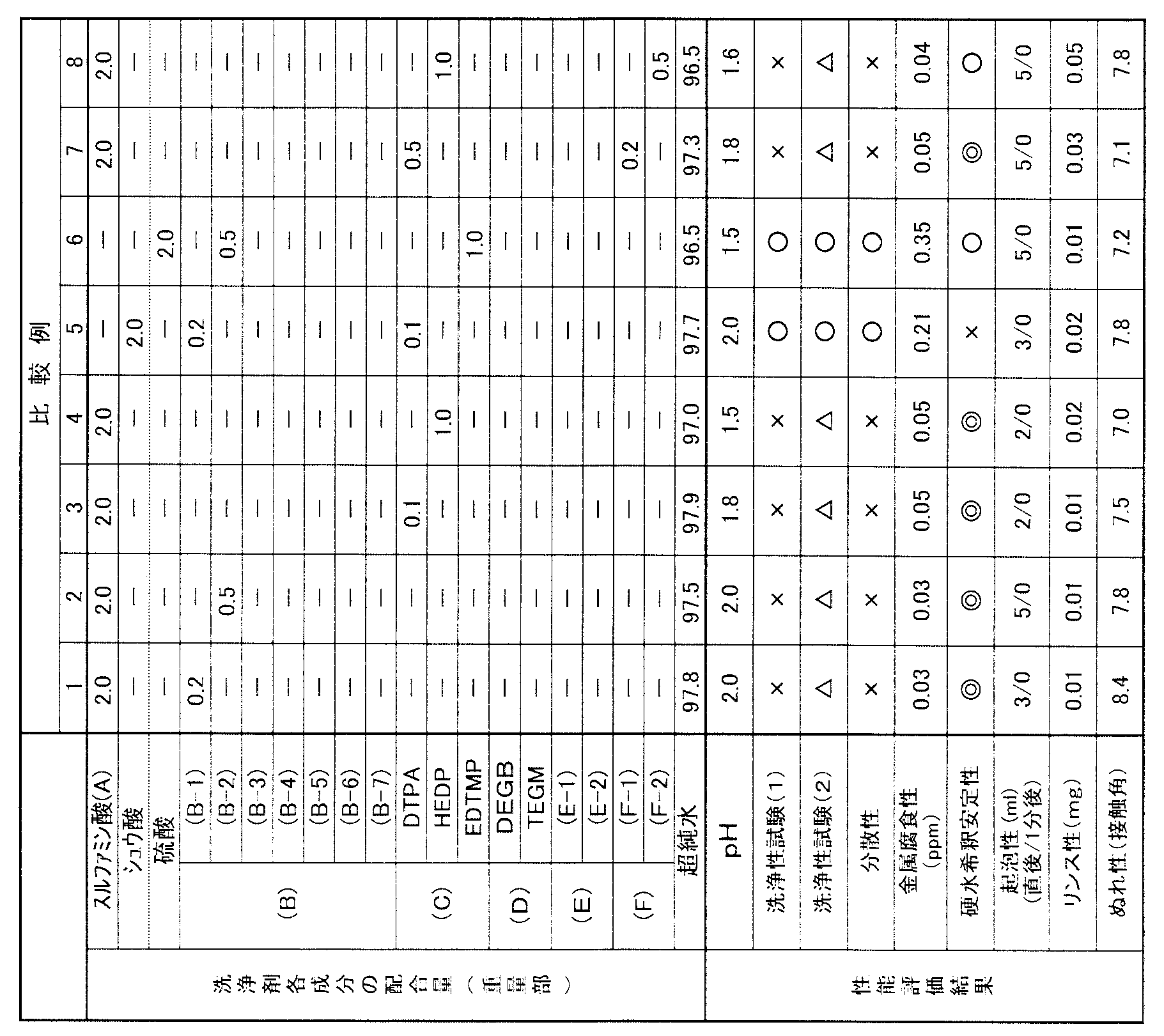
- Examples 1 to 15 and Comparative Examples 1 to 8 The ingredients in Tables 1 and 2 were mixed uniformly at 20 ° C. using the beaker in the number of parts shown in Tables 1 and 2 to obtain the cleaning agents of Examples 1 to 15 and Comparative Examples 1 to 8. Produced. However, the parts (A) to (E) shown in Tables 1 and 2 are parts of the active ingredient, and parts of ultrapure water are (B-1) to (B-7) and (F-1). , (F-2).
- DTPA Diethylenetriaminepentaacetic acid
- HEDP 1-hydroxyethylidene-1,1-diphosphonic acid
- EDTMP ethylenediaminetetra (methylenephosphonic acid)
- DEGB Diethylene glycol monobutyl ether
- TEGM Triethylene glycol monomethyl ether
- ⁇ Detergency test (1)> Using a commercially available colloidal silica slurry (average particle size of about 30 nm) as a polishing agent and a polishing cloth, a 2.5-inch glass substrate for a magnetic disk was polished and then blown with nitrogen to prepare a contaminated substrate. . 1,000 parts of the cleaning agent for the test was placed in a glass beaker, the produced contaminated substrate was immersed, and was cleaned at 30 ° C. for 5 minutes in an ultrasonic cleaner (200 kHz).
- an ultrasonic cleaner 200 kHz
- the substrate is taken out, thoroughly rinsed with ultrapure water, blown with nitrogen gas and dried, and the surface of the substrate is cleaned according to the following criteria, using a differential interference microscope (manufactured by Nikon, OPTIPHOT- 2 and 400 times magnification). This evaluation was conducted in a clean room of class 1,000 (HED-STD-209D, US Federal Standard, 1988) to prevent contamination from the atmosphere.
- ICP inductively coupled plasma
- ⁇ Dilution stability against hard water To 1,000 parts of ultrapure water, 3.3 parts of calcium chloride dihydrate (manufactured by Wako Pure Chemical Industries, Ltd.) and magnesium chloride hexahydrate (manufactured by Wako Pure Chemical Industries, Ltd.) 1.5 Part was dissolved to prepare artificial hard water. Using this artificial hard water, the cleaning agent was diluted to a 20-fold amount. Visual evaluation was made according to the following criteria. If turbidity does not occur, the dilution stability to hard water is high. ⁇ : Transparent ⁇ : Almost transparent ⁇ : Turbid
- a 1 L beaker was charged with 1 L of a test cleaning agent, and the temperature was adjusted to 25 ° C. in a constant temperature water bath, and then the glass substrate measured for the weight was completely immersed.
- the substrate was quickly taken out after being immersed for 30 seconds, immersed in 1 L of ultrapure water for 5 seconds, and then the substrate was suspended at 25 ° C. and naturally dried for about 30 minutes.
- the substrate weight after drying was measured, and the rinsing property (mg) was calculated and evaluated by the following formula. The smaller the value (the smaller the amount of cleaning agent remaining on the substrate), the higher the rinsability.
- Rinse property (mg) [Substrate weight after test (g) ⁇ Substrate weight before test (g)] ⁇ 10 ⁇ 3
- the electronic material cleaning agent and the cleaning method of the present invention are suitably used for cleaning with particles (abrasive grains, glass powder, ceramic powder, metal powder, etc.) and the like as objects to be cleaned. Therefore, the electronic material cleaning agent and cleaning method of the present invention can be used in cleaning steps in the manufacturing process of various electronic materials.
- the electronic material include a magnetic disk substrate (aluminum substrate, NiP substrate, glass substrate, magnetic disk, magnetic head, etc.), flat panel display substrate (liquid crystal panel glass substrate, color filter substrate, array substrate, plasma display).
- semiconductor substrate semiconductor substrate
- compound semiconductor substrate SiC substrate, GaAs substrate, GaN substrate, AlGaAs substrate, etc.
- sapphire substrate LED, etc.
- photomask Substrate solar cell substrate (single crystal silicon substrate, polycrystalline silicon substrate, thin film solar cell substrate, single crystal compound substrate, polycrystalline compound substrate, organic solar cell substrate), optical lens, printed wiring board, optical communication Cable, micro electro mechanical system (MEMS) and the like.
- MEMS micro electro
- the cleaning agent for electronic material of the present invention is suitable.
Landscapes
- Chemical & Material Sciences (AREA)
- Engineering & Computer Science (AREA)
- Life Sciences & Earth Sciences (AREA)
- Chemical Kinetics & Catalysis (AREA)
- Oil, Petroleum & Natural Gas (AREA)
- Wood Science & Technology (AREA)
- Organic Chemistry (AREA)
- Manufacturing & Machinery (AREA)
- Detergent Compositions (AREA)
- Cleaning Or Drying Semiconductors (AREA)
Abstract
Description
これらのパーティクルによる汚染を防止するために、界面活性剤を添加してパーティクル表面のゼータ電位を下げ、パーティクルの付着を低減する方法(特許文献1~3参照)等が提案されている。
さらに、基板上の金属汚染を低減するために、上記特許文献3では有機酸と界面活性剤を用いた酸性の洗浄剤が提案されているが、洗浄時に微量の金属(カルシウムやマグネシウム等)と容易に水難溶性の塩を形成するため、これらの析出した塩が基板を汚染するといった問題がある。
さらに、本発明の電子材料用洗浄剤は、洗浄時に水中に存在する微量の金属イオンと反応して水不溶解物を生じることが無いため、洗浄剤からの2次汚染の恐れがなく、製造設備に使用されている金属部材に対する腐食がないという効果も有する。
さらに好ましいのはポリスチレンスルホン酸、ポリ{2-(メタ)アクリロイルアミノ-2,2-ジメチルエタンスルホン酸}、2-(メタ)アクリロイルアミノ-2,2-ジメチルエタンスルホン酸/(メタ)アクリル酸共重合体及びこれらの塩、特に好ましいのはポリスチレンスルホン酸、2-(メタ)アクリロイルアミノ-2,2-ジメチルエタンスルホン酸/(メタ)アクリル酸共重合物及びこれらの塩である。
また基板への金属汚染の観点から、さらに好ましいのは、アンモニウム塩、炭素数4~25のアンモニウム塩、炭素数1~36の脂肪族アミン塩、炭素数4~10のアミジン塩及び炭素数1~23のアルカノールアミン塩である。
特に好ましいのは、炭素数1~36の脂肪族アミン塩、炭素数4~10のアミジン塩及び炭素数1~23のアルカノールアミン塩であり、最も好ましいのは、DABCO、DBU、DBN、1H-イミダゾール、2-メチル-1H-イミダゾール、2-エチル-1H-イミダゾール、モノエタノールアミン、ジエタノールアミン、トリエタノールアミン、N-メチルジエタノールアミン、2-アミノ-2-メチル-1-プロパノール及び3-アミノ-1-プロパノールの塩である。
具体的には、装置本体:HLC-8120(東ソー株式会社製)、カラム:東ソー株式会社製TSKgel α6000、G3000 PWXL、検出器:装置本体内蔵の示差屈折計検出器、溶離液:0.5%酢酸ソーダ・水/メタノール(体積比70/30)、溶離液流量:1.0mL/分、カラム温度:40℃、試料:0.25%の溶離液溶液、注入量:200μL、標準物質:東ソー(株)製TSK
TANDARD POLYETHYLENE OXIDE、データ処理ソフト:GPC-8020modelII(東ソー株式会社製)で測定される。
上記及び以下において特に規定しない限り、%は重量%を表す。
(1)スルホン酸基を有する不飽和モノマーを用いてラジカル重合により製造する方法、
(2)高分子化合物にスルホン酸基を導入することにより製造する方法、
(3)分子内にスルホン酸基を有する芳香族化合物を用いてホルムアルデヒドとの重縮合反応により製造する方法等の下記の公知の方法が挙げられる。
スルホン酸基を有する不飽和モノマー[スチレンスルホン酸及び2-(メタ)アクリロイルアミノ-2,2-ジメチルエタンスルホン酸等]と必要によりその他の不飽和モノマー(スチレン、アクリル酸及びアクリルアミド等)からなるモノマーと、ラジカル開始剤(過硫酸塩、アゾビスアミジノプロパン塩及びアゾビスイソブチルニトリル等)をモノマーに対して0.1~30%用い、水又はアルコール系溶剤等の溶媒中で30~150℃の温度で重合する。必要であれば、メルカプタン等の連鎖移動剤を用いてもよい。
上記(1)の方法等で不飽和結合を有する高分子化合物(ポリスチレンスルホン酸等)を得た後に、下記の方法により高分子化合物にスルホン酸基を導入する方法(以下、スルホン化と記載)が挙げられる。
この時のスルホン化剤の使用量(モル比)は、高分子化合物を構成する不飽和モノマーのモル数に対して、0.5~3が好ましく、さらに好ましくは1~2.5である。溶剤の使用量(重量%)は、該高分子化合物の分子量にもよるが、原料の高分子化合物に対して通常1~30、好ましくは2~20である。
スルホン化率は、公知の方法によって求めることができ、例えば元素分析により炭素原子と硫黄原子との比率を測定する方法や、結合硫酸量(JIS K3362:1998のアニオン界面活性剤の定量:対応ISO 2271)を測定する方法により求められる。
スルホン酸基を有する芳香族化合物(ナフタレンスルホン酸及びアントラセンスルホン酸メチルナフタレンスルホン酸等)と、必要によりその他の化合物(ナフタレン、フェノール及びクレゾール等)や尿素、触媒として用いる酸(硫酸等)又はアルカリ(水酸化ナトリウム等)を反応容器に仕込み、70~90℃の攪拌下で所定量のホルマリン水溶液(例えば37重量%水溶液)を1~4時間かけて滴下し、滴下後、還流下で3~30時間攪拌して冷却する方法が挙げられる。
等が挙げられる。
なお、キレート剤(C)が塩を形成する場合、その塩としては、上述のアニオン性界面活性剤(B)の塩で例示したものと同様のカチオン成分を有するものが挙げられる。また、これらは単独で使用しても、2種以上を併用してもよい。
特に好ましいのはエチレンジアミンテトラ酢酸(EDTA)(塩)、ジエチレントリアミンペンタ酢酸(DTPA)(塩)、ジヒドロキシエチルエチレンジアミン四酢酸(DHEDDA)(塩)、ニトリロ酸酢酸(NTA)(塩)、ヒドロキシエチルイミノ二酢酸(HIDA)(塩)、アスパラギン酸ジ酢酸(塩)、アスパラギン酸(塩)、グルタミン酸(塩)、1-ヒドロキシエチリデン-1、1-ジホスホン酸(塩)、エチレンジアミンテトラ(メチレンホスホン酸)(塩)及びメタリン酸(塩)及びヘキサメタリン酸(塩)である。
最も好ましいのはジエチレントリアミンペンタ酢酸(DTPA)(塩)、ジヒドロキシエチルエチレンジアミン四酢酸(DHEDDA)(塩)、ニトリロ酸酢酸(NTA)(塩)、ヒドロキシエチルイミノ二酢酸(HIDA)(塩)、1-ヒドロキシエチリデン-1、1-ジホスホン酸(塩)及びエチレンジアミンテトラ(メチレンホスホン酸)(EDTMP)(塩)である。
尚、本発明の含有量の部数の説明において水以外の成分を有効成分と定義する。
(D)としては、20℃における水に対する溶解度[(D)/100gH2O]が3以上、好ましくは10以上の有機溶剤が挙げられる。
(D)の具体例としては、スルホキシド(ジメチルスルホキシド等);スルホン{ジメチルスルホン、ジエチルスルホン、ビス(2-ヒドロキシエチル)スルホン、スルホラン、3-メチルスルホラン及び2,4-ジメチルスルホラン等};アミド{N,N-ジメチルホルムアミド、N-メチルホルムアミド、N,N-ジメチルアセトアミド及びN,N-ジメチルプロピオンアミド等};ラクタム{N-メチル-2-ピロリドン、N-エチル-2-ピロリドン及びN-ヒドロキシメチル-2-ピロリドン等};ラクトン{β-プロピオラクトン、β-ブチロラクトン、γ-ブチロラクトン、γ-バレロラクトン及びδ-バレロラクトン等};アルコール{メタノール、エタノール及びイソプロパノール等};グリコール及びグリコールエーテル{エチレングリコール、エチレングリコールモノメチルエーテル、トリエチレングリコールモノメチルエーテル、エチレングリコールモノエチルエーテル、ジエチレングリコール、ジエチレングリコールモノメチルエーテル、ジエチレングリコールモノエチルエーテル、ジエチレングリコールモノブチルエーテル、ジエチレングリコールモノヘキシルエーテル、プロピレングリコール、プロピレングリコールモノメチルエーテル、ジプロピレングリコールモノメチルエーテル、ブチレングリコール、ジエチレングリコールジメチルエーテル、ジエチレングリコールジエチルエーテル、トリエチレングリコールジメチルエーテル及びトリエチレングリコールジエチルエーテル等};オキサゾリジノン(N-メチル-2-オキサゾリジノン及び3,5-ジメチル-2-オキサゾリジノン等);ニトリル(アセトニトリル、プロピオニトリル、ブチロニトリル、アクリロニトリル及びメタクリルニトリル等);カーボネート(エチレンカーボネート及びプロピオンカーボネート等);ケトン(アセトン、ジエチルケトン、アセトフェノン、メチルエチルケトン、シクロヘキサノン、シクロペンタノン及びジアセトンアルコール等);環状エーテル(テトラヒドロフラン及びテトラヒドロピラン等)等が挙げられる。
(D)は単独で使用しても、2種以上を併用してもよい。
界面活性剤(F)としては、(B)以外のアニオン性界面活性剤(F1)、カチオン性界面活性剤(F2)、及び両性界面活性剤(F3)が挙げられる。
なお(F)は単独で用いてもよいし、2種以上を併用してもよい。
また、アニオン性界面活性剤(F1)が塩を形成する場合、その塩としては上述した(B)の塩で例示したものと同様のカチオン成分を有するものが挙げられる。これらは単独で使用してもよいし、2種以上を併用してもよい。
3価以上の多価アルコールとしては脂肪族多価アルコール、脂肪族多価アルコールの脱水縮合物、糖類、糖アルコール、トリスフェノール等が挙げられ、好ましいのはグリセリン、サッカロース及びソルビトールである。
これらの還元剤としては、アルデヒド類、アルカノールアミン、フェノール化合物、チオール系還元剤、硫黄のオキソ酸類及びリンのオキソ酸類が好ましい。
これらの金属原子の含有量の測定方法としては、公知の方法、例えば原子吸光法、高周波誘導結合プラズマ(ICP)発光分析法及びICP質量分析法が利用できる。
また、基板表面に大気中に浮遊する汚れ(パーティクル及び有機物汚れ等)が強固に付着することを防止する為に、上記の洗浄工程前後において当該基板を本発明の洗浄剤に浸漬してもよい。
尚、表面粗さ(Ra)は、エスアイアイ・ナノテクノロジー社製、E-sweepを用いて下記の条件により測定される。
測定モード :DFM(タッピングモード)
スキャンエリア:10μm×10μm
走査線数 :256本(Y方向スキャン)
補正 :X,Y方向のフラット補正あり
なお、以下における高分子のGPCによるMwは前述の条件により測定し、超純水は比抵抗値が18MΩ以上のものを使用した。
撹拌、温度調節及び還流が可能な反応容器にエチレンジクロライド100部を仕込み、攪拌下、窒素置換した後に90℃まで昇温し、エチレンジクロライドを還流させた。スチレン120部と、予め2,2’-アゾビスイソブチロニトリル1.7部をエチレンジクロライド20部に溶かした開始剤溶液を、それぞれ別々に6時間かけて同時に反応容器内に滴下し、滴下終了後さらに1時間重合を行った。
重合後、窒素シール下で20℃に冷却した後、温度を20℃に制御しながら無水硫酸105部を10時間かけて滴下し、滴下終了後さらに3時間スルホン化反応させた。反応後、溶媒を留去して固化させた後、超純水345部を投入して溶解し、ポリスチレンスルホン酸水溶液を得た。
得られたポリスチレンスルホン酸水溶液を40%水酸化ナトリウム水溶液(約110部)でpHが7になるまで中和し、超純水で濃度調整することにより、高分子アニオン性界面活性剤であるポリスチレンスルホン酸ナトリウム塩(B-1)の40%水溶液を得た。
尚、(B-1)のMwは、40,000、スルホン化率は97%であった。
攪拌及び温度調節が可能な反応容器にナフタレンスルホン酸21部及び超純水10部を仕込み、撹拌下、系内の温度を80℃に保ちながら、37%ホルムアルデヒド8部を3時間かけて滴下した。滴下終了後、105℃に昇温して25時間反応した後、室温(約25℃)まで冷却して水浴中、温度を25℃に制御しながらDBUを徐々に加え、pH6.5に調整した(DBU約15部使用)。超純水を加えて固形分を40%に調整して、高分子アニオン性界面活性剤であるナフタレンスルホン酸ホルマリン縮合物のDBU塩(B-2)の40%水溶液を得た。
尚、(B-2)のMwは、5,000であった。
攪拌及び温度調節が可能な反応容器にイソプロピルアルコール300部及び超純水100部を仕込み、窒素置換後、75℃に昇温した。撹拌下で、アクリルアミド-2-メチルプロパンスルホン酸227部、アクリル酸78部及び超純水131部からなる70%モノマー水溶液436部及びジメチル-2,2’-アゾビスイソブチレートの15%イソプロピルアルコール溶液95部を3.5時間かけて同時に滴下した。
滴下終了後、75℃で5時間撹拌した後、系内が固化しないように超純水を間欠的に投入し、イソプロピルアルコールが検出できなくなるまで水とイソプロピルアルコールの混合物を留去した。
得られたアクリルアミド-2-メチルプロパンスルホン酸/アクリル酸共重合体水溶液に、温度を25℃に制御しながらDBUを徐々に加えてpH6.5に調整して(DBU約280部使用)超純水で濃度調整することにより、高分子アニオン性界面活性剤であるアクリルアミド-2-メチルプロパンスルホン酸/アクリル酸共重合体DBU塩(B-3)の40%水溶液を得た。
尚、(B-3)のMwは8,000であった。
製造例1で用いた40%水酸化ナトリウム水溶液の代わりに2-アミノ-2-メチル-1-プロパノールを用いてpHが6になるまで中和した以外は製造例1と同様にして製造し、高分子アニオン性界面活性剤であるポリスチレンスルホン酸2-アミノ-2-メチル-1-プロパノール塩(B-4)の40%水溶液を得た。
尚、(B-4)のMwは、40,000、スルホン化率は97%であった。
製造例2で用いたDBUの代わりにDBNを用いてpHが7になるまで中和した以外は製造例2と同様にして製造し、高分子アニオン性界面活性剤であるナフタレンスルホン酸ホルマリン縮合物のDBN塩(B-5)の40%水溶液を得た。
尚、(B-5)のMwは、5,000であった。
製造例3で用いたDBUの代わりに2-メチル-1H-イミダゾールを用いてpHが7になるまで中和した以外は製造例3と同様にして製造し、高分子アニオン性界面活性剤であるアクリルアミド-2-メチルプロパンスルホン酸/アクリル酸共重合体2-メチル-1H-イミダゾール塩(B-6)の40%水溶液を得た。
尚、(B-6)のMwは8,000であった。
オクチルベンゼンスルホン酸136部及び超純水245部をビーカーに仕込み、均一になるまで溶解した。得られたオクチルベンゼンスルホン酸水溶液にDBN(約65部)を徐々に加えてpHが7になるまで中和し、超純水で濃度調整することにより、アニオン性界面活性剤であるオクチルベンゼンスルホン酸DBN塩(B-7)の40%水溶液を得た。
撹拌及び温度調節可能な耐圧反応容器に、ラウリルアルコール186部(1.0モル部)及び水酸化カリウム0.5部を仕込み、100℃、30mmHg以下の減圧下で30分間脱水した。エチレンオキサイド396部(9.0モル部)を、反応温度160℃を保ちながら、3時間かけて滴下した後、160℃で2時間熟成し、液状の粗製ポリエーテルを得た。この粗製ポリエーテルを約80℃まで冷却し、超純水6部及び陽イオン交換樹脂{オルガノ株式会社製、アンバーライトIR120B(I)}100部を加えて、室温(約20℃)で30分間撹拌した後、減圧濾過及び脱水を行い、非イオン性界面活性剤であるラウリルアルコールのエチレンオキサイド9モル付加物(E-1)を得た。
撹拌及び温度調節可能な耐圧反応容器に、ラウリルアミン296部(1.6モル部)を仕込み、アルゴンガスで置換してから減圧にし、95℃に昇温した。同温度にてエチレンオキサイド140.8部(3.2モル部:アミン1モル部に対して2.0モル部)を耐圧反応容器の内圧が0.3MPa以上にならないようにして、徐々に滴下した。約1.5時間の誘導期間を経て90~110℃の範囲で温度制御しながら計4時間反応させた。滴下終了後、95℃で耐圧反応容器の内圧が滴下開始時と同じ圧力を示すまで30分反応を行った。
得られたラウリルアミンのエチレンオキサイド2.0モル付加物(X-1)にテトラメチルエチレンジアミン0.8部[(X-1)に対して純分0.183%]を空気が混入しないように添加し、95℃にて1時間減圧脱水した。
温度を70℃に下げてからエチレンオキサイド563.2部(12.8モル部:アミン1モル部に対して8.0モル部)を耐圧反応容器の内圧が0.2MPa以上にならないようにして、温度を70~90℃に温度制御しながら、3時間かけて滴下した。
滴下終了後、70℃で耐圧反応容器の内圧が滴下開始時と同じ圧力を示すまで30分反応を行い、非イオン性界面活性剤であるラウリルアミンのエチレンオキサイド10モル付加物(E-2)を得た。
攪拌及び温度調節が可能な反応容器にイソプロピルアルコール300部及び超純水100部を仕込み、窒素置換後、75℃に昇温した。撹拌下で、アクリル酸の75%水溶液407部及びジメチル-2,2’-アゾビスイソブチレートの15%イソプロピルアルコール溶液95部を3.5時間かけて同時に滴下した。
滴下終了後、75℃で5時間撹拌した後、系内が固化しないように超純水を間欠的に投入し、イソプロピルアルコールが検出できなくなるまで水とイソプロピルアルコールの混合物を留去した。得られたポリアクリル酸水溶液をDBU(約450部)でpHが7になるまで中和し、超純水で濃度調整することにより、アニオン性界面活性剤であるポリアクリル酸DBU塩(F-1)の40%水溶液を得た。
尚、(F-1)のMwは10,000であった。
比較製造例1で用いたDBUの代わりに40%水酸化ナトリウム水溶液を用いてpHが7になるまで中和した以外は比較製造例1と同様にして製造し、アニオン性界面活性剤であるポリアクリル酸Na塩(F-2)の40%水溶液を得た。
尚、(F-2)のMwは10,000であった。
表1及び表2に記載の各成分を、表1及び表2に記載の配合部数で、ビーカーを用いて20℃で均一混合して実施例1~15及び比較例1~8の洗浄剤を作製した。
但し、表1及び表2に記載の(A)~(E)の部数は有効成分の部数であり、超純水の部数は(B-1)~(B-7)及び(F-1)、(F-2)中の水を含む。
DTPA:ジエチレントリアミンペンタ酢酸
HEDP:1-ヒドロキシエチリデン-1,1-ジホスホン酸
EDTMP:エチレンジアミンテトラ(メチレンホスホン酸)
DEGB:ジエチレングリコールモノブチルエーテル
TEGM:トリエチレングリコールモノメチルエーテル
実施例1~15及び比較例1~8の洗浄剤を、予め超純水で20倍量に希釈したものを試験用の洗浄剤として用いて、以下の方法で、pH、洗浄性試験(1)、洗浄性試験(2)、分散性、金属腐食性、起泡性、リンス性及びぬれ性を測定、評価した。
また硬水に対する希釈安定性については、実施例1~15及び比較例1~8の洗浄剤をそのまま使用した。
測定結果及び評価結果を表1及び表2に示す。

pHメーター(株式会社堀場製作所製、M-12)を用いて測定温度25℃で測定した。
研磨剤としての市販のコロイダルシリカスラリー(平均粒径約30nm)及び研磨布を用いて、2.5インチの磁気ディスク用ガラス基板を研磨した後、窒素でブローすることにより、汚染基板を作製した。
試験用の洗浄剤1,000部をガラス製ビーカーにとり、作製した汚染基板を浸漬し、超音波洗浄機(200kHz)内で、30℃、5分間の洗浄を行った。洗浄後、基板を取り出し、超純水で十分にリンスを行った後、窒素ガスでブローして乾燥し、下記の判定基準に従い、基板表面の洗浄性を微分干渉顕微鏡(Nikon社製、OPTIPHOT-2、倍率400倍)で評価した。
尚、本評価は大気からの汚染を防ぐため、クラス1,000(HED-STD-209D、米国連邦規格、1988年)のクリーンルーム内で実施した。
○:除去率約70%~90%程度
△:除去率約50%~70%程度
×:除去率約50%未満
研磨剤として市販の酸化セリウムスラリー(平均粒径約250nm)を以外は洗浄性試験(1)と同様の評価方法及び判定基準で評価した。
洗浄性試験(2)の評価で用いた酸化セリウムスラリー10gと試験用の洗浄剤90gをガラス製容器に秤量した。超音波洗浄機(200kHz)を用いて30℃、30分間超音波を照射し、容器内のスラリーを分散させた。超音波洗浄機から取り出し、室温下(23℃)で静置し、下記の判定基準に従い評価した。
◎:5日以上分散状態を保つ。
○:3~4日分散状態を保つ。
△:1~2日分散状態を保つ。
×:1日未満で分離する。
試験用の洗浄剤100部をポリプロピレン製容器にとり、この中にステンレス製テストピース(SUS304製、大きさ5cm×2.5m、厚さ0.1cm)を浸漬した。容器を密栓し、23℃に温調された室内で3日間放置した後、溶液中に溶け出した鉄イオンの含量(ppm)を高周波誘導結合プラズマ(ICP)発光分析装置(VARIAN社製、Varian730-ES)を用いて分析した。溶出量が少ないほど金属腐食性が低い。
尚、本試験前の試験用の洗浄剤中の鉄イオン含量は、いずれも検出限界(0.02ppm)以下であった。
1,000部の超純水に、塩化カルシウム2水和物(和光純薬工業(株)製)3.3部及び塩化マグネシウム6水和物(和光純薬工業(株)製)1.5部を溶解して人工硬水を調製した。この人工硬水を用いて、洗浄剤を20倍量になるように希釈した。
目視にて下記の判定基準に従い評価した。濁りを生じなければ硬水に対する希釈安定性が高い。
◎:透明
○:ほとんど透明
×:濁りあり
100mLのガラス製有栓メスシリンダー(JIS R3504「化学用体積計ガラス素材」の有栓メスシリンダーとして寸法が規定されたもの)に試験用の洗浄剤20mLを入れ、恒温水槽中で25℃に温調した後、有栓メスシリンダーの蓋を閉め、30秒間で60回上下に激しく振とうし、振とう直後と1分後のそれぞれの泡の量(mL)を測定した。
振とう直後の泡の量が少ないほど起泡性が低く、1分後の泡の量が少ないほど消泡性が高い。
予め試験に用いる2.5インチの磁気ディスク用ガラス基板の重量(g)を小数点以下第5位まで測定した。
1Lのビーカーに試験用の洗浄剤1Lを入れ、恒温水槽中で25℃に温調した後、上記重量を測定したガラス基板を完全に浸漬させた。
30秒間浸漬した後にすばやく基板を取り出し、1Lの超純水中に5秒間浸漬した後、25℃で基板を吊り下げ約30分間自然乾燥させた。
乾燥後の基板重量を測定し、下式によりリンス性(mg)を算出して評価した。値が小さい(基板への洗浄剤の残留量が少ない)ほど、リンス性が高い。
2.5インチの磁気ディスク用ガラス基板に対する試験用の洗浄剤の接触角(25℃、10秒後)を、全自動接触角計[協和界面科学株式会社製、PD-W]を用いて測定した。
接触角の値が小さいほど基板に対する洗浄剤のぬれ性が高いことを示す。
さらに本発明の洗浄剤は、比較例5又は6で使用されているスルファミン酸以外の酸を用いた洗浄剤と比べて金属腐食性が小さいことから、洗浄機等に用いられる金属に対しても腐食するおそれがない。また硬水に対する希釈安定性が高いことから、一般的な工業用水のような金属イオンを含有する水で希釈した場合においても析出物を生じるおそれが無く、ハンドリング性に優れるといった効果も有する。
また実施例の中で、親水性溶剤(D)を使用したもの(実施例7~11及び実施例13~15)はさらにリンス性に優れ、ノニオン性界面活性剤(E)を使用したもの(実施例4~5及び実施例7~15)は基板に対するぬれ性に優れることから、実際に使用する際に洗浄及びリンス時間の短縮の効果が期待できる。
従って、本発明の電子材料用洗浄剤及び洗浄方法は、各種の電子材料の製造工程における洗浄工程において使用することができる。
電子材料としては、例えば磁気ディスク用基板(アルミ基板、NiP基板、ガラス基板、磁気ディスク及び磁気ヘッド等)、フラットパネルディスプレイ用基板(液晶パネル用のガラス基板、カラーフィルター基板、アレイ基板、プラズマディスプレイ用基板及び有機EL用基板等)、半導体用基板(半導体素子及びシリコンウェハ等)、化合物半導体基板(SiC基板、GaAs基板、GaN基板、AlGaAs基板等)、サファイヤ基板(LED等)、フォトマスク用基板、太陽電池用基板(単結晶シリコン基板、多結晶シリコン基板、薄膜型太陽電池用基板、単結晶化合物基板、多結晶化合物基板、有機系太陽電池基板)、光学レンズ、プリント配線基板、光通信用ケーブル、微小電気機械システム(MEMS)などが挙げられる。
特に電子材料が、磁気ディスク用ガラス基板、フラットパネルディスプレイ用ガラス基板、フォトマスク用ガラス基板、光学レンズ又は薄膜太陽電池用ガラス基板である場合に本発明の電子材料用洗浄剤は好適である。
Claims (12)
- スルファミン酸(A)、分子内に少なくとも1個のスルホン酸基又はその塩基を有するアニオン性界面活性剤(B)、キレート剤(C)、及び水を必須成分として含有することを特徴とする電子材料用洗浄剤。
- 25℃でのpHが3.0以下である請求項1記載の電子材料用洗浄剤。
- 洗浄剤の有効成分の合計重量に基づいて、該スルファミン酸(A)の含有量が5~90重量%、該アニオン性界面活性剤(B)の含有量が0.1~50重量%、かつ該キレート剤(C)の含有量が0.1~50重量%である請求項1又は2記載の電子材料用洗浄剤。
- (C)に対する(B)の重量比率[(B)/(C)]が、0.1~7である請求項1~3のいずれか記載の電子材料用洗浄剤。
- 該(B)が、重量平均分子量が1,000~2,000,000の高分子アニオン性界面活性剤(B1)である請求項1~4のいずれか記載の電子材料用洗浄剤。
- 該(B1)が、ポリスチレンスルホン酸、ポリ{2-(メタ)アクリロイルアミノ-2,2-ジメチルエタンスルホン酸}、2-(メタ)アクリロイルアミノ-2,2-ジメチルエタンスルホン酸/(メタ)アクリル酸共重合体、ナフタレンスルホン酸ホルムアルデヒド縮合物及びこれらの塩からなる群より選ばれる少なくとも1種である請求項5記載の電子材料用洗浄剤。
- 該(C)が、アミノポリカルボン酸、ヒドロキシカルボン酸、ホスホン酸、縮合リン酸及びこれらの塩からなる群より選ばれる少なくとも1種である請求項1~6のいずれか記載の電子材料用洗浄剤。
- さらに、親水性溶剤(D)を含有する請求項1~7のいずれか記載の電子材料用洗浄剤。
- さらに、ノニオン性界面活性剤(E)を含有する請求項1~8のいずれか記載の電子材料用洗浄剤。
- 該電子材料が、研磨剤としてシリカ、アルミナ又はダイヤモンドを用いて研磨した後の基板である請求項1~9のいずれか記載の電子材料用洗浄剤。
- 該電子材料が、磁気ディスク用ガラス基板、フラットパネルディスプレイ用ガラス基板、フォトマスク用ガラス基板、光学レンズ、薄膜太陽電池用ガラス基板又は半導体基板である請求項1~10のいずれか記載の電子材料用洗浄剤。
- 請求項1~11のいずれか記載の洗浄剤を用いて電子材料を洗浄する工程を含む電子材料の製造方法。
Priority Applications (3)
| Application Number | Priority Date | Filing Date | Title |
|---|---|---|---|
| CN2009801496088A CN102245750B (zh) | 2008-12-19 | 2009-11-25 | 电子材料用清洗剂 |
| US13/139,235 US8324143B2 (en) | 2008-12-19 | 2009-11-25 | Cleaning agent for electronic materials |
| SG2011045101A SG172773A1 (en) | 2008-12-19 | 2009-11-25 | Cleaning agent for electronic materials |
Applications Claiming Priority (2)
| Application Number | Priority Date | Filing Date | Title |
|---|---|---|---|
| JP2008323080 | 2008-12-19 | ||
| JP2008-323080 | 2008-12-19 |
Publications (1)
| Publication Number | Publication Date |
|---|---|
| WO2010070819A1 true WO2010070819A1 (ja) | 2010-06-24 |
Family
ID=42268502
Family Applications (1)
| Application Number | Title | Priority Date | Filing Date |
|---|---|---|---|
| PCT/JP2009/006359 Ceased WO2010070819A1 (ja) | 2008-12-19 | 2009-11-25 | 電子材料用洗浄剤 |
Country Status (7)
| Country | Link |
|---|---|
| US (1) | US8324143B2 (ja) |
| JP (1) | JP5117480B2 (ja) |
| CN (1) | CN102245750B (ja) |
| MY (1) | MY158742A (ja) |
| SG (1) | SG172773A1 (ja) |
| TW (1) | TWI435931B (ja) |
| WO (1) | WO2010070819A1 (ja) |
Cited By (7)
| Publication number | Priority date | Publication date | Assignee | Title |
|---|---|---|---|---|
| JP2012017420A (ja) * | 2010-07-08 | 2012-01-26 | Neos Co Ltd | 水溶性洗浄剤組成物 |
| JP2013151677A (ja) * | 2011-12-28 | 2013-08-08 | Sanyo Chem Ind Ltd | 電子材料用洗浄剤 |
| US8816029B2 (en) | 2009-08-28 | 2014-08-26 | 3M Innovative Properties Company | Compositions and articles comprising polymerizable ionic liquid mixture, and methods of curing |
| US8853338B2 (en) | 2009-12-22 | 2014-10-07 | 3M Innovative Properties Company | Curable dental compositions and articles comprising polymerizable ionic liquids |
| CN104109483A (zh) * | 2013-04-17 | 2014-10-22 | 江阴江化微电子材料股份有限公司 | 一种太阳能电池片抛光液及其制备方法 |
| US9458327B2 (en) | 2009-08-28 | 2016-10-04 | 3M Innovative Properties Company | Polymerizable ionic liquid comprising multifunctional cation and antistatic coatings |
| US11447661B2 (en) * | 2017-12-27 | 2022-09-20 | Kao Corporation | Method for producing aluminum platter |
Families Citing this family (75)
| Publication number | Priority date | Publication date | Assignee | Title |
|---|---|---|---|---|
| WO2010070819A1 (ja) * | 2008-12-19 | 2010-06-24 | 三洋化成工業株式会社 | 電子材料用洗浄剤 |
| WO2010090146A1 (ja) * | 2009-02-03 | 2010-08-12 | 出光興産株式会社 | レジスト剥離剤組成物及びそれを用いたレジスト剥離方法 |
| SG178598A1 (en) | 2009-08-28 | 2012-04-27 | 3M Innovative Properties Co | Optical device with antistatic coating |
| JP5623318B2 (ja) * | 2011-03-24 | 2014-11-12 | 第一工業製薬株式会社 | 精密部品用洗浄剤組成物 |
| US8940104B2 (en) * | 2011-08-02 | 2015-01-27 | Brewer Science Inc. | Cleaning composition for temporary wafer bonding materials |
| KR20140097244A (ko) * | 2011-11-08 | 2014-08-06 | 토소우 에스엠디, 인크 | 특별한 표면 처리를 하고 양호한 입자 성능을 가진 실리콘 스퍼터링 타겟 및 그 제조 방법들 |
| JPWO2013088928A1 (ja) * | 2011-12-14 | 2015-04-27 | 旭硝子株式会社 | 洗浄剤、および炭化ケイ素単結晶基板の製造方法 |
| US9029308B1 (en) * | 2012-03-28 | 2015-05-12 | WD Media, LLC | Low foam media cleaning detergent |
| JPWO2013161877A1 (ja) * | 2012-04-27 | 2015-12-24 | 株式会社フジミインコーポレーテッド | 合金材料用洗浄剤及び合金材料の製造方法 |
| CN103060106B (zh) * | 2012-12-27 | 2014-07-02 | 上海艳紫化工科技有限公司 | 马桶清洁剂 |
| CN103045393B (zh) * | 2012-12-27 | 2014-05-07 | 上海艳紫化工科技有限公司 | 脱排油烟机清洁剂 |
| CN103060119B (zh) * | 2012-12-27 | 2014-05-28 | 海南展创光电技术有限公司 | 玻璃清洁剂 |
| CN103060121B (zh) * | 2012-12-27 | 2014-05-14 | 上海艳紫化工科技有限公司 | 浴缸清洁剂 |
| CN103074173B (zh) * | 2012-12-27 | 2014-04-23 | 上海艳紫化工科技有限公司 | 花岗岩清洁剂 |
| CN103045395B (zh) * | 2012-12-27 | 2014-05-07 | 上海艳紫化工科技有限公司 | 烤架清洁剂 |
| CN103060134B (zh) * | 2012-12-27 | 2014-08-27 | 上海艳紫化工科技有限公司 | 大理石清洁剂 |
| CN103060120B (zh) * | 2012-12-27 | 2014-08-06 | 上海艳紫化工科技有限公司 | 瓷砖清洁剂 |
| CN103045389B (zh) * | 2012-12-27 | 2014-12-03 | 上海艳紫化工科技有限公司 | 炉灶清洁剂 |
| CN103060117B (zh) * | 2013-01-21 | 2014-08-06 | 上海艳紫化工科技有限公司 | 玻璃幕墙专用清洁剂 |
| CN103060122B (zh) * | 2013-01-21 | 2014-05-07 | 上海艳紫化工科技有限公司 | 小汽车清洁剂 |
| CN103074169B (zh) * | 2013-01-21 | 2014-06-18 | 上海艳紫化工科技有限公司 | 液晶显示屏专用清洁剂 |
| CN103060118B (zh) * | 2013-01-21 | 2014-08-06 | 上海艳紫化工科技有限公司 | 重垢汽车清洁剂 |
| CN103060824B (zh) * | 2013-01-21 | 2015-06-03 | 陕西理工学院 | 通用金属表面清洁剂 |
| CN103074168B (zh) * | 2013-01-21 | 2014-07-16 | 上海艳紫化工科技有限公司 | 重垢轮胎清洁剂 |
| CN103060823B (zh) * | 2013-01-21 | 2014-12-31 | 上海艳紫化工科技有限公司 | 铝金属专用清洁剂 |
| CN103074166B (zh) * | 2013-01-21 | 2014-06-18 | 上海艳紫化工科技有限公司 | 汽车内胎清洁剂 |
| CN103074177B (zh) * | 2013-01-21 | 2014-08-06 | 上海艳紫化工科技有限公司 | 家用碱性清洁剂 |
| KR101956388B1 (ko) * | 2013-03-27 | 2019-03-08 | 동우 화인켐 주식회사 | 사파이어 웨이퍼 세정제 조성물 |
| JP2014199688A (ja) * | 2013-03-29 | 2014-10-23 | 東邦化学工業株式会社 | 磁気ディスク基板用洗浄剤 |
| JP2015063677A (ja) * | 2013-08-30 | 2015-04-09 | 三洋化成工業株式会社 | 磁気ディスク基板用洗浄剤 |
| CN105199874B (zh) * | 2014-06-20 | 2018-07-27 | 惠州Tcl金能电池有限公司 | 电池表面清洗剂及其制备方法 |
| KR102405063B1 (ko) * | 2014-06-30 | 2022-06-07 | 엔테그리스, 아이엔씨. | 텅스텐 및 코발트 상용성을 갖는 에치후 잔류물을 제거하기 위한 수성 및 반-수성 세정제 |
| JP2016037606A (ja) * | 2014-08-08 | 2016-03-22 | 三洋化成工業株式会社 | 電子材料用洗浄剤組成物及び電子材料の製造方法 |
| JPWO2016031485A1 (ja) * | 2014-08-29 | 2017-06-22 | 株式会社フジミインコーポレーテッド | 研磨用組成物および研磨用組成物の製造方法 |
| KR102296739B1 (ko) * | 2014-10-27 | 2021-09-01 | 삼성전자 주식회사 | 포토마스크용 세정 조성물을 이용한 집적회로 소자 제조 방법 |
| KR102456079B1 (ko) * | 2014-12-24 | 2022-11-21 | 삼성디스플레이 주식회사 | 산화물 제거용 세정 조성물 및 이를 이용한 세정 방법 |
| JP6256443B2 (ja) * | 2015-09-30 | 2018-01-10 | 栗田工業株式会社 | 製品洗浄方法 |
| JP6659449B2 (ja) * | 2016-05-09 | 2020-03-04 | 山口精研工業株式会社 | 無電解ニッケル−リンめっきされたアルミニウム磁気ディスク基板用研磨剤組成物 |
| US10954479B2 (en) * | 2016-07-26 | 2021-03-23 | Fujimi Incorporated | Composition for surface treatment and surface treatment method using the same |
| JP6734146B2 (ja) * | 2016-08-23 | 2020-08-05 | 山口精研工業株式会社 | 磁気ディスク基板用研磨剤組成物 |
| TWI742152B (zh) | 2016-09-02 | 2021-10-11 | 日商富士軟片股份有限公司 | 溶液、溶液收容體、感光化射線性或感放射線性樹脂組成物、圖案形成方法、半導體元件的製造方法 |
| CA3037975A1 (en) | 2016-09-28 | 2018-04-05 | Dow Global Technologies Llc | Solvents for use in the electronics industry |
| CN106800983A (zh) * | 2016-11-29 | 2017-06-06 | 洛阳新巨能高热技术有限公司 | 电子材料用新型清洗剂 |
| KR20190094426A (ko) * | 2017-01-18 | 2019-08-13 | 엔테그리스, 아이엔씨. | 표면으로부터 세리아 입자를 제거하기 위한 조성물 및 방법 |
| ES2978452T3 (es) * | 2017-02-13 | 2024-09-12 | Merck Patent Gmbh | Un método para producir agua ultrapura |
| CN110248896A (zh) | 2017-02-13 | 2019-09-17 | 默克专利股份公司 | 用于生产超纯水的方法 |
| JP7108622B2 (ja) | 2017-02-13 | 2022-07-28 | メルク パテント ゲゼルシャフト ミット ベシュレンクテル ハフツング | 超純水を製造するための方法 |
| JP7078605B2 (ja) * | 2017-03-06 | 2022-05-31 | 株式会社フジミインコーポレーテッド | 表面処理組成物、およびその製造方法、ならびに表面処理組成物を用いた表面処理方法および半導体基板の製造方法 |
| JP7140745B2 (ja) * | 2017-03-08 | 2022-09-21 | 株式会社フジミインコーポレーテッド | 表面処理組成物及びその製造方法、表面処理方法、並びに半導体基板の製造方法 |
| WO2018168207A1 (ja) * | 2017-03-14 | 2018-09-20 | 株式会社フジミインコーポレーテッド | 表面処理組成物、その製造方法、およびこれを用いた表面処理方法 |
| WO2018180256A1 (ja) * | 2017-03-31 | 2018-10-04 | 関東化學株式会社 | 洗浄液組成物 |
| TWI775891B (zh) * | 2017-07-04 | 2022-09-01 | 德商德國艾托特克公司 | 用於清潔金屬表面之清潔溶液及其方法與用途 |
| TWI827126B (zh) * | 2017-09-26 | 2023-12-21 | 日商福吉米股份有限公司 | 表面處理組合物、其製造方法以及使用此組合物的表面處理方法 |
| CN108004049A (zh) * | 2017-12-28 | 2018-05-08 | 广州云普电子科技有限公司 | 一种具备防腐防锈功能的电子材料清洗剂 |
| CN108580472B (zh) * | 2018-01-26 | 2021-02-19 | 广西洁邦环保科技有限公司 | 垃圾桶环保卫生清洗方法 |
| CN109097210A (zh) * | 2018-08-17 | 2018-12-28 | 台州市金算子知识产权服务有限公司 | 一种太阳能电池板用高效清洗剂及其制备方法 |
| CN109294758A (zh) * | 2018-08-31 | 2019-02-01 | 浙江帝恒实业有限公司 | 一种新能源汽车用清洗剂及其制备方法 |
| CN109112002B (zh) * | 2018-09-26 | 2020-12-22 | 蓝思科技(长沙)有限公司 | 用于清洗玻璃退镀电镀层后脏污的清洗剂、清洗方法和电子产品 |
| US11060051B2 (en) * | 2018-10-12 | 2021-07-13 | Fujimi Incorporated | Composition for rinsing or cleaning a surface with ceria particles adhered |
| US11634670B2 (en) | 2018-11-16 | 2023-04-25 | Toagosei Co. Ltd. | Cleaning agent for semiconductor component, and use thereof |
| EP3883520A1 (en) * | 2018-11-20 | 2021-09-29 | DENTSPLY SIRONA Inc. | Compositions and methods to antibacterial nanogel and hydrolytically stable antibacterial nanogel for dental compositions |
| KR102687599B1 (ko) | 2018-12-21 | 2024-07-24 | 주식회사 케이씨텍 | 세정액 조성물 및 그것을 이용한 세정 방법 |
| KR102171739B1 (ko) * | 2019-02-13 | 2020-10-29 | 주식회사 엔씨솔루션 | 태양광 패널용 세정제 조성물 |
| US11732214B2 (en) * | 2019-11-20 | 2023-08-22 | Nissan Chemical Corporation | Cleaning agent composition comprising an alkylamide solvent and a fluorine-containing quaternary ammonium salt |
| CN110846147B (zh) * | 2019-11-28 | 2021-04-13 | 维达力实业(深圳)有限公司 | 用于去除玻璃表面抛光粉的清洗剂及其制备方法和应用 |
| KR20220110490A (ko) * | 2019-12-03 | 2022-08-08 | 미쯔비시 케미컬 주식회사 | 세륨 화합물 제거용 세정액, 세정 방법 및 반도체 웨이퍼의 제조 방법 |
| CN110923727A (zh) * | 2019-12-12 | 2020-03-27 | 广东红日星实业有限公司 | 一种研磨液清洗剂及其制备方法 |
| CN113136264A (zh) * | 2021-04-25 | 2021-07-20 | 广东富行洗涤剂科技有限公司 | 用于光学三棱镜玻璃加工固化胶水去除的除胶液及工艺 |
| CN113414167B (zh) * | 2021-06-23 | 2023-08-18 | 北京北方华创微电子装备有限公司 | 表面活性剂及其制备方法、陶瓷件清洗方法 |
| CN113512728A (zh) * | 2021-06-25 | 2021-10-19 | 深圳市恒纬祥科技有限公司 | 一种除6系铝合金表面二氧化硅研磨液的清洗剂 |
| CN113862683B (zh) * | 2021-11-01 | 2024-02-09 | 长沙永安新材料有限公司 | 一种不锈钢抛光蜡的清洗剂及清洗工艺 |
| CN114196484B (zh) * | 2021-11-17 | 2023-09-29 | 广东世运电路科技股份有限公司 | 一种印制电路板制造中用的整孔剂 |
| CN115318747A (zh) * | 2022-08-16 | 2022-11-11 | 江西佳鼎光电科技有限公司 | 一种光学镜片超声波清洗工艺 |
| CN116332805A (zh) * | 2023-03-02 | 2023-06-27 | 江西百盛精细化学品有限公司 | β-萘磺酸甲醛缩合物的制备方法 |
| CN117230451A (zh) * | 2023-09-15 | 2023-12-15 | 上海华友金裕微电子有限公司 | 一种新能源汽车模块ic集成电路多元金属出光剂及方法 |
Citations (4)
| Publication number | Priority date | Publication date | Assignee | Title |
|---|---|---|---|---|
| JP2000144193A (ja) * | 1998-11-17 | 2000-05-26 | Fujimi Inc | リンス用組成物 |
| JP2001522396A (ja) * | 1997-04-30 | 2001-11-13 | ザ、プロクター、エンド、ギャンブル、カンパニー | 酸性石灰スケール除去組成物 |
| JP2004133384A (ja) * | 2002-08-14 | 2004-04-30 | Sony Corp | レジスト用剥離剤組成物及び半導体装置の製造方法 |
| JP2009087523A (ja) * | 2007-09-14 | 2009-04-23 | Sanyo Chem Ind Ltd | 磁気ディスク用ガラス基板洗浄剤 |
Family Cites Families (21)
| Publication number | Priority date | Publication date | Assignee | Title |
|---|---|---|---|---|
| JP2524020B2 (ja) | 1990-08-20 | 1996-08-14 | 株式会社日立製作所 | 液中微粒子付着制御法 |
| JPH0641770A (ja) | 1992-07-27 | 1994-02-15 | Daikin Ind Ltd | シリコンウエハ表面の処理方法 |
| SG78405A1 (en) * | 1998-11-17 | 2001-02-20 | Fujimi Inc | Polishing composition and rinsing composition |
| JP4516176B2 (ja) | 1999-04-20 | 2010-08-04 | 関東化学株式会社 | 電子材料用基板洗浄液 |
| JP4322998B2 (ja) | 1999-04-26 | 2009-09-02 | 花王株式会社 | 洗浄剤組成物 |
| JP3956587B2 (ja) | 1999-11-18 | 2007-08-08 | Hoya株式会社 | 磁気ディスク用ガラス基板の洗浄方法 |
| US6680286B1 (en) * | 2000-11-14 | 2004-01-20 | Sanyo Chemical Industries, Ltd. | Detergent composition comprising a quaternary ammonium salt of a carboxyl containing polymer |
| DE10153553A1 (de) * | 2001-07-07 | 2003-06-12 | Henkel Kgaa | Nichtwäßrige "3in1"-Geschirrspülmittel II |
| DE10153554A1 (de) * | 2001-07-07 | 2003-05-15 | Henkel Kgaa | Wäßrige "3in1"-Geschirrspülmittel II |
| HUP0401286A3 (en) * | 2001-08-17 | 2009-06-29 | Henkel Ag & Co Kgaa | Dishwasher detergent with improved protection against glass corrosion |
| JP4216494B2 (ja) * | 2001-09-21 | 2009-01-28 | 富士フイルム株式会社 | 平版印刷版原版 |
| JP2003151126A (ja) | 2001-11-09 | 2003-05-23 | Nippon Sheet Glass Co Ltd | 情報記録媒体用ガラス基板の洗浄方法及びそれに使用する洗浄装置 |
| US7033725B2 (en) * | 2001-11-30 | 2006-04-25 | Fuji Photo Film Co., Ltd. | Infrared-sensitive photosensitive composition |
| DE10159780A1 (de) * | 2001-12-05 | 2003-06-26 | Henkel Kgaa | Portionierte Wasch- und Reinigungsmittelzusammensetzung |
| DE10237200A1 (de) * | 2002-08-14 | 2004-03-04 | Henkel Kgaa | Portionierte Wasch- oder Reinigungsmittelzusammensetzung |
| JP4795614B2 (ja) | 2002-10-23 | 2011-10-19 | Hoya株式会社 | 情報記録媒体用ガラス基板及びその製造方法 |
| WO2006025373A1 (ja) * | 2004-08-31 | 2006-03-09 | Sanyo Chemical Industries, Ltd. | 界面活性剤 |
| US20090011972A1 (en) * | 2004-12-28 | 2009-01-08 | Sanyo Chemical Industries, Ltd. | Surfactant for Fine-Bubble Formation |
| JP2010097175A (ja) * | 2008-09-22 | 2010-04-30 | Fujifilm Corp | 平版印刷版の作製方法及び平版印刷版原版 |
| JP2010079083A (ja) * | 2008-09-26 | 2010-04-08 | Fujifilm Corp | 平版印刷版の製版方法 |
| WO2010070819A1 (ja) * | 2008-12-19 | 2010-06-24 | 三洋化成工業株式会社 | 電子材料用洗浄剤 |
-
2009
- 2009-11-25 WO PCT/JP2009/006359 patent/WO2010070819A1/ja not_active Ceased
- 2009-11-25 SG SG2011045101A patent/SG172773A1/en unknown
- 2009-11-25 CN CN2009801496088A patent/CN102245750B/zh not_active Expired - Fee Related
- 2009-11-25 US US13/139,235 patent/US8324143B2/en not_active Expired - Fee Related
- 2009-11-25 MY MYPI2011002770A patent/MY158742A/en unknown
- 2009-12-15 JP JP2009283693A patent/JP5117480B2/ja not_active Expired - Fee Related
- 2009-12-15 TW TW098142923A patent/TWI435931B/zh not_active IP Right Cessation
Patent Citations (4)
| Publication number | Priority date | Publication date | Assignee | Title |
|---|---|---|---|---|
| JP2001522396A (ja) * | 1997-04-30 | 2001-11-13 | ザ、プロクター、エンド、ギャンブル、カンパニー | 酸性石灰スケール除去組成物 |
| JP2000144193A (ja) * | 1998-11-17 | 2000-05-26 | Fujimi Inc | リンス用組成物 |
| JP2004133384A (ja) * | 2002-08-14 | 2004-04-30 | Sony Corp | レジスト用剥離剤組成物及び半導体装置の製造方法 |
| JP2009087523A (ja) * | 2007-09-14 | 2009-04-23 | Sanyo Chem Ind Ltd | 磁気ディスク用ガラス基板洗浄剤 |
Cited By (11)
| Publication number | Priority date | Publication date | Assignee | Title |
|---|---|---|---|---|
| US8816029B2 (en) | 2009-08-28 | 2014-08-26 | 3M Innovative Properties Company | Compositions and articles comprising polymerizable ionic liquid mixture, and methods of curing |
| US9127101B2 (en) | 2009-08-28 | 2015-09-08 | 3M Innovative Properties Company | Compositions and articles comprising polymerizable ionic liquid mixture, and methods of curing |
| WO2011025847A3 (en) * | 2009-08-28 | 2015-09-24 | 3M Innovative Properties Company | Compositions and articles comprising polymerizable ionic liquid mixture, and methods of curing |
| US9458327B2 (en) | 2009-08-28 | 2016-10-04 | 3M Innovative Properties Company | Polymerizable ionic liquid comprising multifunctional cation and antistatic coatings |
| US8853338B2 (en) | 2009-12-22 | 2014-10-07 | 3M Innovative Properties Company | Curable dental compositions and articles comprising polymerizable ionic liquids |
| US9168206B2 (en) | 2009-12-22 | 2015-10-27 | 3M Innovative Properties Company | Curable dental compositions and articles comprising polymerizable ionic liquids |
| JP2012017420A (ja) * | 2010-07-08 | 2012-01-26 | Neos Co Ltd | 水溶性洗浄剤組成物 |
| JP2013151677A (ja) * | 2011-12-28 | 2013-08-08 | Sanyo Chem Ind Ltd | 電子材料用洗浄剤 |
| CN104109483A (zh) * | 2013-04-17 | 2014-10-22 | 江阴江化微电子材料股份有限公司 | 一种太阳能电池片抛光液及其制备方法 |
| CN104109483B (zh) * | 2013-04-17 | 2016-11-09 | 江阴江化微电子材料股份有限公司 | 一种太阳能电池片抛光液及其制备方法 |
| US11447661B2 (en) * | 2017-12-27 | 2022-09-20 | Kao Corporation | Method for producing aluminum platter |
Also Published As
| Publication number | Publication date |
|---|---|
| TW201028466A (en) | 2010-08-01 |
| CN102245750A (zh) | 2011-11-16 |
| TWI435931B (zh) | 2014-05-01 |
| US8324143B2 (en) | 2012-12-04 |
| MY158742A (en) | 2016-11-15 |
| SG172773A1 (en) | 2011-08-29 |
| JP5117480B2 (ja) | 2013-01-16 |
| JP2010163609A (ja) | 2010-07-29 |
| US20110245127A1 (en) | 2011-10-06 |
| CN102245750B (zh) | 2013-09-18 |
Similar Documents
| Publication | Publication Date | Title |
|---|---|---|
| JP5117480B2 (ja) | 電子材料用洗浄剤 | |
| TWI398514B (zh) | 用於清潔磁光碟基板的清潔劑 | |
| JP5192953B2 (ja) | 磁気ディスク用ガラス基板洗浄剤 | |
| KR101525275B1 (ko) | 전자 재료용 세정제 및 세정 방법 | |
| JP4792396B2 (ja) | 界面活性剤 | |
| JP5575420B2 (ja) | 磁気ディスク基板用洗浄剤 | |
| JP2010163608A (ja) | 電子材料用洗浄剤 | |
| US7312186B2 (en) | Cleaning solution for semiconductor substrate | |
| JP2010138271A (ja) | 電子材料用洗浄剤 | |
| JP2008182221A (ja) | 半導体基板用洗浄剤 | |
| JP5323017B2 (ja) | 磁気ディスク基板用洗浄剤 | |
| JP2009084568A (ja) | 磁気ディスク基板用洗浄剤 | |
| JP5711589B2 (ja) | 磁気ディスク基板用洗浄剤 | |
| KR101956388B1 (ko) | 사파이어 웨이퍼 세정제 조성물 | |
| JP5774330B2 (ja) | 電子材料用洗浄剤 | |
| JP2008135576A (ja) | エレクトロニクス材料用洗浄剤 | |
| JP2005060660A (ja) | 半導体基板用洗浄液 | |
| CN102560519B (zh) | 一种金属防腐清洗液 | |
| CN101255386A (zh) | 半导体硅片化学机械抛光用清洗液 | |
| JP2014141668A (ja) | 電子材料用洗浄剤 | |
| JP2003068696A (ja) | 基板表面洗浄方法 | |
| JP5086450B2 (ja) | 磁気ディスク基板用洗浄剤 | |
| JP2014141669A (ja) | 電子材料用洗浄剤 | |
| JP2012197429A (ja) | 電子材料用洗浄剤 | |
| JP2013151677A (ja) | 電子材料用洗浄剤 |
Legal Events
| Date | Code | Title | Description |
|---|---|---|---|
| WWE | Wipo information: entry into national phase |
Ref document number: 200980149608.8 Country of ref document: CN |
|
| 121 | Ep: the epo has been informed by wipo that ep was designated in this application |
Ref document number: 09833129 Country of ref document: EP Kind code of ref document: A1 |
|
| WWE | Wipo information: entry into national phase |
Ref document number: 13139235 Country of ref document: US |
|
| NENP | Non-entry into the national phase |
Ref country code: DE |
|
| 122 | Ep: pct application non-entry in european phase |
Ref document number: 09833129 Country of ref document: EP Kind code of ref document: A1 |