WO2010058616A1 - グルタミン酸高含有酵母の製造方法 - Google Patents
グルタミン酸高含有酵母の製造方法 Download PDFInfo
- Publication number
- WO2010058616A1 WO2010058616A1 PCT/JP2009/059206 JP2009059206W WO2010058616A1 WO 2010058616 A1 WO2010058616 A1 WO 2010058616A1 JP 2009059206 W JP2009059206 W JP 2009059206W WO 2010058616 A1 WO2010058616 A1 WO 2010058616A1
- Authority
- WO
- WIPO (PCT)
- Prior art keywords
- yeast
- glutamic acid
- content
- weight
- culture
- Prior art date
- Legal status (The legal status is an assumption and is not a legal conclusion. Google has not performed a legal analysis and makes no representation as to the accuracy of the status listed.)
- Ceased
Links
Images

Classifications
-
- C—CHEMISTRY; METALLURGY
- C12—BIOCHEMISTRY; BEER; SPIRITS; WINE; VINEGAR; MICROBIOLOGY; ENZYMOLOGY; MUTATION OR GENETIC ENGINEERING
- C12N—MICROORGANISMS OR ENZYMES; COMPOSITIONS THEREOF; PROPAGATING, PRESERVING, OR MAINTAINING MICROORGANISMS; MUTATION OR GENETIC ENGINEERING; CULTURE MEDIA
- C12N1/00—Microorganisms, e.g. protozoa; Compositions thereof; Processes of propagating, maintaining or preserving microorganisms or compositions thereof; Processes of preparing or isolating a composition containing a microorganism; Culture media therefor
- C12N1/14—Fungi; Culture media therefor
- C12N1/16—Yeasts; Culture media therefor
-
- A—HUMAN NECESSITIES
- A23—FOODS OR FOODSTUFFS; TREATMENT THEREOF, NOT COVERED BY OTHER CLASSES
- A23L—FOODS, FOODSTUFFS OR NON-ALCOHOLIC BEVERAGES, NOT OTHERWISE PROVIDED FOR; PREPARATION OR TREATMENT THEREOF
- A23L2/00—Non-alcoholic beverages; Dry compositions or concentrates therefor; Preparation or treatment thereof
- A23L2/52—Adding ingredients
- A23L2/56—Flavouring or bittering agents
-
- A—HUMAN NECESSITIES
- A23—FOODS OR FOODSTUFFS; TREATMENT THEREOF, NOT COVERED BY OTHER CLASSES
- A23L—FOODS, FOODSTUFFS OR NON-ALCOHOLIC BEVERAGES, NOT OTHERWISE PROVIDED FOR; PREPARATION OR TREATMENT THEREOF
- A23L23/00—Soups; Sauces; Preparation or treatment thereof
-
- A—HUMAN NECESSITIES
- A23—FOODS OR FOODSTUFFS; TREATMENT THEREOF, NOT COVERED BY OTHER CLASSES
- A23L—FOODS, FOODSTUFFS OR NON-ALCOHOLIC BEVERAGES, NOT OTHERWISE PROVIDED FOR; PREPARATION OR TREATMENT THEREOF
- A23L27/00—Spices; Flavouring agents or condiments; Artificial sweetening agents; Table salts; Dietetic salt substitutes; Preparation or treatment thereof
- A23L27/20—Synthetic spices, flavouring agents or condiments
- A23L27/21—Synthetic spices, flavouring agents or condiments containing amino acids
- A23L27/22—Synthetic spices, flavouring agents or condiments containing amino acids containing glutamic acids
-
- A—HUMAN NECESSITIES
- A23—FOODS OR FOODSTUFFS; TREATMENT THEREOF, NOT COVERED BY OTHER CLASSES
- A23L—FOODS, FOODSTUFFS OR NON-ALCOHOLIC BEVERAGES, NOT OTHERWISE PROVIDED FOR; PREPARATION OR TREATMENT THEREOF
- A23L33/00—Modifying nutritive qualities of foods; Dietetic products; Preparation or treatment thereof
- A23L33/10—Modifying nutritive qualities of foods; Dietetic products; Preparation or treatment thereof using additives
- A23L33/14—Yeasts or derivatives thereof
- A23L33/145—Extracts
-
- A—HUMAN NECESSITIES
- A23—FOODS OR FOODSTUFFS; TREATMENT THEREOF, NOT COVERED BY OTHER CLASSES
- A23L—FOODS, FOODSTUFFS OR NON-ALCOHOLIC BEVERAGES, NOT OTHERWISE PROVIDED FOR; PREPARATION OR TREATMENT THEREOF
- A23L33/00—Modifying nutritive qualities of foods; Dietetic products; Preparation or treatment thereof
- A23L33/10—Modifying nutritive qualities of foods; Dietetic products; Preparation or treatment thereof using additives
- A23L33/17—Amino acids, peptides or proteins
- A23L33/175—Amino acids
-
- C—CHEMISTRY; METALLURGY
- C12—BIOCHEMISTRY; BEER; SPIRITS; WINE; VINEGAR; MICROBIOLOGY; ENZYMOLOGY; MUTATION OR GENETIC ENGINEERING
- C12N—MICROORGANISMS OR ENZYMES; COMPOSITIONS THEREOF; PROPAGATING, PRESERVING, OR MAINTAINING MICROORGANISMS; MUTATION OR GENETIC ENGINEERING; CULTURE MEDIA
- C12N1/00—Microorganisms, e.g. protozoa; Compositions thereof; Processes of propagating, maintaining or preserving microorganisms or compositions thereof; Processes of preparing or isolating a composition containing a microorganism; Culture media therefor
- C12N1/14—Fungi; Culture media therefor
- C12N1/16—Yeasts; Culture media therefor
- C12N1/18—Baker's yeast; Brewer's yeast
Definitions
- the present invention relates to a method for producing a yeast having a high glutamic acid content, a yeast having a high glutamic acid content, a yeast extract having a high glutamic acid content, and a food / beverage product containing a yeast extract having a high glutamic acid content.
- Patent Literature 1 describes a sweet taste improving agent containing a yeast extract as an active ingredient, and the yeast extract contains 5′-sodium inosinate and / or 5′-sodium adenylate and 5′-guanylic acid. Contains 1-15% sodium, 5'-sodium uridylate and 5'-sodium cytidylate, and 1-20% sodium glutamate, respectively.
- Patent Document 2 includes a step of digesting yeast containing 15 mg or more of free glutamine per gram of dry cells, and containing at least 3% glutamic acid derived from intracellular free glutamine with respect to the solid extract content. A method for producing the extract is described.
- Patent Document 3 discloses a yeast extract obtained by digesting or degrading yeast.
- the yeast extract is permeated through a filtration membrane having a diameter of 1 micrometer, and the permeation portion is subjected to gel filtration.
- a yeast extract characterized in that in peptides detected by absorptiometry at 220 nm, the ratio of those having a molecular weight of 10,000 or more is 10% or more with respect to the total amount of peptides detected.
- Patent Document 4 describes a yeast extract with a high glutamic acid content, which contains 13% by weight or more of L-glutamic acid (as Na salt).
- Patent Document 5 describes a yeast extract characterized in that the content of free amino acids is 25% by weight or more and the total content of nucleic acid-based taste-imparting components is 2% by weight or more.
- Patent Document 7 describes a yeast that is resistant to a glutamate antagonistic growth inhibitor and accumulates glutamate in the cells.
- Patent Document 8 is characterized by using Yarrowia lipolytica yeast that is resistant to the drug nystatin, which impairs the structure and function of cell membranes, and has the ability to accumulate 530 mg / l or more of L-glutamic acid in the microbial cells. A method for producing a yeast extract is described.
- Patent Document 1 describes a yeast extract containing 1 to 20% sodium glutamate, but what is actually used is a commercial product containing 5.0% sodium glutamate, and more Nothing is mentioned about things.
- Patent Document 2 is performed by genetic recombination, is complicated in operation, and is inferior in safety, palatability and the like as a food.
- Patent Document 3 describes that sodium glutamate (soda) is contained in an amount of 10% or more per solid content, but there is no mention of any examples.
- operation such as carrying out an enzyme process, is complicated.
- patent document 5 in addition to complicated operation, such as using an enzyme, glutamic acid per dry powder is about 13%.
- Patent Document 6 is merely an external addition of glutamic acid.
- patent document 7 glutamic acid content per dry cell weight is low.
- operation is complicated, such as giving drug tolerance provision to a parent strain.
- the present invention has been made in view of the above circumstances, and a method for producing a glutamic acid-rich yeast containing glutamic acid, particularly free glutamic acid at a higher concentration than before, a glutamic acid-rich yeast, a glutamic acid-rich yeast extract, and glutamic acid It aims at providing contained food and drink.
- the present inventors have found that the culture solution is raised to a specific pH (shifted to an alkaline region) during the cultivation of yeast in the stationary phase of growth. It has been found that the glutamic acid content, particularly the free glutamic acid content, increases. And it discovered that a yeast extract with high glutamic acid content could be manufactured by manufacturing a yeast extract using this yeast, and completed this invention. That is, the present invention adopts the following configuration.
- a method for culturing yeast comprising a step of subjecting a yeast in a stationary phase of liquid growth to a liquid culture under conditions where the pH of the liquid medium is 7.5 or more and less than 11.
- the liquid culturing step includes Adjusting the pH of the liquid medium to 7.5 or more and less than 11 after yeast growth enters a stationary phase; and further culturing the yeast within the pH range;
- the yeast culture method according to (1) comprising: (3) adjusting the pH of the liquid medium to 7.5 or more and less than 11,
- the culture method according to (2) which is a step of adding an alkaline substance to the liquid medium.
- the culture method according to (1) wherein in the liquid culturing step, a part of the cultured yeast is collected and the measurement of the free glutamic acid content in the yeast is intermittently performed.
- a method for producing yeast comprising a step of recovering yeast cultured by the culture method according to any one of (1) to (5).
- the yeast according to (7), wherein the content of free glutamic acid is 2.3 to 10.0% by weight per dry yeast cell.
- (10) A yeast extract extracted from the yeast according to (7).
- (11) The yeast extract according to (10), wherein the content of free glutamic acid in the yeast extract is 7 to 30% by weight per dry weight.
- (12) The yeast extract according to (11), wherein the content of free glutamic acid in the yeast extract is 20 to 30% by weight per dry weight.
- (15) A seasoning composition comprising the yeast extract according to any one of (10) to (13).
- (16) The yeast according to any one of (7) to (9) or (14), the yeast extract according to any one of (10) to (13), or the (15) Food / beverage products containing the seasoning composition of description.
- the glutamic acid content particularly, the free glutamic acid content is remarkably increased simply by shifting the pH of the liquid medium of yeast in the stationary growth phase to alkali. High content yeast can be produced.
- a glutamic acid-rich yeast extract containing glutamic acid, particularly free glutamic acid at a high concentration can be obtained.
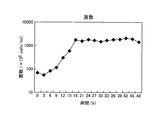
- FIG. 1 shows an increase curve of the number of bacteria with respect to culture time in Example 2.
- FIG. 2 shows an increase curve of dry yeast cell weight with respect to culture time in Example 2.
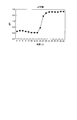
- FIG. 3 shows the change in pH of the liquid medium with respect to the culture time in Example 2.
- the yeast culture method of the present invention includes a step of subjecting a yeast in a stationary phase of growth to a liquid culture under conditions where the pH of the liquid medium is 7.5 or more and less than 11. By performing this culture method, it becomes possible to obtain a yeast with a high glutamic acid content.
- a yeast culture method of the present invention includes a step of subjecting a yeast in a stationary phase of growth to a liquid culture under conditions where the pH of the liquid medium is 7.5 or more and less than 11.
- the yeast may be a unicellular fungus, and specifically, Saccharomyces spp., Shizosaccharomyces spp., Pichia spp., Candida spp., Kluyveromyces spp., Williopsis spp., Debaryomyces spp., Galactomyces spp., Torulaspora spp. And bacteria belonging to the genus Zygosaccharomyces.
- Candida tropicalis, Candida lipolytica, Candida utilis, Candida sake, and Saccharomyces cerevisiae are edible. (Saccharomyces cerevisiae) and the like are preferable, and Saccharomyces cerevisiae and Candida utilis that are widely used are more preferable.
- the pH of the yeast liquid medium in the stationary stationary phase is 7.5 or more. What is necessary is just to carry out liquid culture on the conditions which are less than 11.
- the culture medium composition of these strains is not particularly limited, and those used in conventional methods can be used. For example, one or two or more selected from the group consisting of glucose, sucrose, acetic acid, ethanol, molasses, sulfite pulp waste liquid and the like used for culturing ordinary microorganisms are used as the carbon source, and the nitrogen source is urea.
- inorganic salts such as ammonia, ammonium sulfate, ammonium chloride or ammonium phosphate, and nitrogen-containing organic substances such as corn steep liquor (CSL), casein, yeast extract or peptone used.
- CSL corn steep liquor
- phosphoric acid component, potassium component, and magnesium component may be added to the medium.
- These include normal industrial products such as lime superphosphate, ammonium phosphate, potassium chloride, potassium hydroxide, magnesium sulfate, and magnesium hydrochloride.
- the raw material can be used.
- inorganic salts such as zinc, copper, manganese, and iron ions may be used.
- vitamins and nucleic acid-related substances may be added.
- the culture format may be batch culture, fed-batch culture or continuous culture, but industrially fed-batch culture or continuous culture is employed.
- Culture conditions in the logarithmic growth phase or culture conditions before pH adjustment may be in accordance with general yeast culture conditions.
- the temperature is 20 to 40 ° C., preferably 25 to 35 ° C., and the pH is 3.5 to 7.5, especially 4.0 to 6.0 is desirable.
- it is preferable that it is aerobic conditions.
- it is preferable to culture while aeration and stirring.
- the amount of aeration and the conditions for stirring can be appropriately determined in consideration of the culture volume and time, and the initial concentration of bacteria.
- the ventilation is 0.2-2V. V. M.M. (Volume per volume per minute) and stirring can be performed at about 50 to 800 rpm.
- the method for liquid culture of yeast in the stationary phase of growth under conditions where the pH of the liquid medium is 7.5 or more and less than 11 is not particularly limited.
- methods for adjusting the pH include adjusting the pH of the liquid medium to 7.5 or more and less than 11 when the cultured yeast enters the stationary phase, and adjusting the pH by adding an alkaline substance to the liquid medium.
- the amount of the alkaline substance added to the medium is not limited as long as the pH falls within the above range, but from the viewpoint of not diluting the medium excessively and adversely affecting glutamate production in the subsequent culture. 5% or less is desirable.
- the amount in the case of urea is not particularly limited, but is preferably about 0.5 to 5% with respect to the medium, although it depends on the cell concentration of the yeast to be cultured.
- the method of adjusting the pH of the liquid medium to 7.5 or more and less than 11 when the cultured yeast enters the stationary phase is not particularly limited.
- an alkaline substance is appropriately added to adjust the pH of the liquid medium. It may be adjusted to 7.5 or more and less than 11, preferably 7.5 or more and 10 or less.
- the pH adjustment may be performed at any time during the stationary phase, but is preferably performed immediately after entering the stationary phase. This is because it is possible to sufficiently increase the concentration of free glutamic acid in the yeast and to shorten the time required until the end of the entire process.
- the pH of the liquid medium of the yeast in the logarithmic growth phase is 7.5 or more and less than 11, it is not preferable because the growth of the yeast is suppressed and the content of free glutamic acid in the yeast does not increase.
- the yeast in culture shifts from the logarithmic growth phase to the stationary phase, it gradually shifts from the logarithmic growth state to the steady state and then completely enters the steady state. The time to gradually reach a complete steady state is also included in the stationary phase of the present invention.
- the alkaline substance is not particularly limited, and examples thereof include the following components.
- NH 4 OH ammonia water
- ammonia gas inorganic alkali such as sodium hydroxide, potassium hydroxide, calcium hydroxide and magnesium hydroxide
- alkaline base such as sodium carbonate and potassium carbonate
- organic alkali such as urea and the like.
- ammonia water, ammonia gas, and urea are preferred.
- the temperature and other conditions for culturing yeast in a stationary phase in a liquid medium having a pH of 7.5 or more and less than 11 may be in accordance with general yeast culture conditions.
- the temperature is preferably 25 to 35 ° C.
- the incubation time is preferably from 24 hours immediately after pH adjustment, more preferably from 1 to 15 hours, further preferably from 3 to 12 hours, particularly preferably from 3 to 6 hours.
- the free glutamic acid content in the yeast after the pH is shifted to 7.5 or more and less than 11 tends to increase with the passage of the culture time and decrease after reaching the peak. This also depends on conditions such as the cell concentration, pH and temperature of the yeast to be cultured. This is presumably because the influence of alkali on the yeast becomes too great if the culture is carried out for an excessively long time under alkaline conditions. Therefore, in the present invention, it is possible to appropriately select an optimal culture time for each culture condition, particularly for each pH after alkali shift, but after the pH shift, a part of the cultured yeast is recovered and free glutamic acid in the yeast is recovered. The content is measured intermittently, preferably at regular intervals.
- yeast having a very high free glutamic acid content of 2.3% to 10.0% by weight per dry yeast cell weight can be obtained. It has been confirmed that it can be obtained.
- yeast containing free glutamic acid can be obtained in the range of 4.0% by weight to 10.0% by weight per dry yeast cell weight.
- yeast extract having a high glutamic acid content, which is as high as ever before, with a free glutamic acid content of 20 to 30% by weight per dry weight is obtained. It has been confirmed that it can.
- a yeast having a high free glutamic acid content can be cultured, and a yeast having a very high free glutamic acid content can be produced by appropriately recovering the yeast. Accordingly, a yeast extract having a high free glutamic acid content can be prepared from the obtained yeast. In addition, it cannot be overemphasized that the yeast of this invention, yeast extract, etc. have high total glutamic acid content not only in free glutamic acid.
- Patent Document 1 and the like describe a yeast extract of 20% by weight in terms of sodium glutamate (molecular weight of about 169), but this is about 17% by weight as glutamic acid (molecular weight of about 147) content. Not too much. Also from this point, it is clear that the yeast obtained by the production method of the present invention is a yeast having a high glutamic acid content.
- the “free glutamic acid content per dry yeast cell” means the ratio (% by weight) of free glutamic acid contained in the solid content obtained by drying the yeast cells.
- the “content of free glutamic acid per dry weight of yeast extract” means the ratio (% by weight) of free glutamic acid contained in the solid content obtained by drying the yeast extract.
- a BF-5 biosensor manufactured by Oji Scientific Instruments As a method for measuring the content of free glutamic acid in yeast cells or yeast extract, for example, a BF-5 biosensor manufactured by Oji Scientific Instruments may be used.
- This apparatus is an apparatus for quantifying glutamic acid in a solution using an enzyme electrode that specifically reacts with glutamic acid, and this enzyme electrode does not react with glutamic acid in proteins and peptides. Therefore, it is possible to selectively quantify only free glutamic acid by using such an apparatus.
- the content of free glutamic acid can be measured using an amino acid automatic analyzer JLC-500 / V manufactured by JEOL Ltd. or an Acquity UPLC device manufactured by Waters (USA), but is particularly limited. It is not a thing.
- a yeast containing abundant glutamic acid, particularly free glutamic acid in the microbial cells can be produced.
- the thus obtained yeast having a high glutamic acid content of the present invention contains 2.3% by weight or more, preferably 2.3 to 7.4% by weight, more preferably 4.% by weight of free glutamic acid in the dry yeast cells. It can be contained in an amount of 0 to 7.4% by weight. For this reason, a yeast extract rich in free glutamic acid, which is a good taste component, can be easily obtained by extracting and producing a yeast extract from the yeast.
- the glutamic acid-rich yeast produced by the method of the present invention has a high free amino acid content and a high free glutamic acid content.
- free glutamic acid derived from yeast cells is 7 wt% or more, preferably 7 to 30 wt%, more preferably 12 wt% per dry weight in the yeast extract.
- a yeast extract containing ⁇ 30% by weight, more preferably 20-30% by weight can be obtained.
- the yeast extract obtained by this invention has very high taste property, and when it uses for food-drinks etc., it has a deep taste and can manufacture rich food-drinks.
- the present invention can produce a yeast having a high glutamic acid content by a simple process using only an alkali shift of a liquid medium. Further, as described above, it is not necessary to use a special medium as the medium, and it can be manufactured from inexpensive raw materials such as ammonia.
- a glutamic acid-rich yeast containing a high concentration of glutamic acid in the yeast can be obtained, but a fraction containing glutamic acid may be obtained from the glutamic acid-rich yeast.
- a method for fractionating a fraction containing glutamic acid from a yeast having a high glutamic acid content any method may be used as long as it is a commonly used method.
- a glutamic acid-rich yeast extract can be produced from the glutamic acid-rich yeast cultured by the above method.
- a method for producing a yeast extract having a high glutamic acid content any method may be used as long as it is a conventional method.
- an autolysis method, an enzymatic decomposition method, an acid decomposition method, an alkali extraction method, hot water, Extraction methods are adopted.
- glutamic acid in a yeast extract obtained only by a hot water extraction method is considered to be almost entirely free glutamic acid, unlike a yeast extract obtained by an enzymatic reaction method such as an autolysis method.
- the yeast with a high glutamic acid content of the present invention has a large amount of free glutamic acid. Therefore, even if the yeast extract is extracted only by hot water treatment, a yeast extract with good taste can be obtained.
- a hydrolysis treatment using an acid, an alkali or the like is generally performed using a vegetable or animal protein.
- the hydrolyzed product of protein contains MCP (chloropropanols) suspected to be carcinogenic.
- the high glutamic acid-containing yeast produced by the method of the present invention since the high glutamic acid-containing yeast produced by the method of the present invention has a high free glutamic acid content in the first place, after the yeast is extracted by a hot water extraction method or the like, it is decomposed by an acid or an alkali or an enzyme.
- a yeast extract having a sufficiently high content of free glutamic acid can be prepared without any treatment. That is, by using the high glutamic acid-containing yeast of the present invention, a yeast extract excellent in both taste and safety can be easily produced.
- a yeast extract powder containing a glutamic acid content can be obtained by powdering the glutamic acid-rich yeast extract of the present invention, and a yeast extract powder containing 7 to 30% by weight of free glutamic acid can be obtained by appropriately selecting the yeast. can get.
- dry yeast cells may be prepared from yeast having a high glutamic acid content cultured by the above method.
- any method can be used as long as it is a usual method, but industrially, freeze-drying method, spray-drying method, drum-drying method and the like are adopted.
- the glutamic acid-rich yeast of the present invention may be used as a seasoning composition.
- the seasoning composition may consist of only the yeast extract of the present invention, and contains other components such as a stabilizer and a preservative in addition to the yeast extract of the present invention. May be.
- the seasoning composition can be appropriately used for various foods and drinks as in the case of other seasoning compositions.
- the present invention relates to a glutamic acid-rich yeast obtained by the above method and a food or drink containing the glutamic acid-rich yeast extract extracted from the glutamic acid-rich yeast.
- a food or drink containing glutamic acid at a high concentration can be efficiently produced.
- These foods and drinks may be any foods and drinks that can normally be added with dry yeast, yeast extract, and seasoning compositions containing these, for example, alcoholic beverages, soft drinks, fermented foods, seasonings, soups. , Breads and confectionery.
- a preparation obtained from the above-mentioned yeast having a high glutamic acid content or a fraction of yeast having a high glutamic acid content may be added.
- a glutamic acid-rich yeast may be used as it is as a raw material.
- Yeast Sacharomyces cerevisiae AB9846 strain was cultured by the methods described in ⁇ 1> to ⁇ 8> below, and extract extraction and glutamic acid analysis were performed from the yeast culture solution.
- pH shift an alkaline region
- pH shift NH 4 OH water (10%)
- the content (% by weight) of free glutamic acid in dry yeast cells increases at pH 7.5 to less than 11.0 before pH shift and 6 hours after pH shift. Was confirmed.
- the set pH of 9.0 it increased from 2.2% by weight to 5.3% by weight due to the pH shift more than twice, and a remarkable effect of increasing the free glutamic acid content was confirmed.
- the set pH (pH after pH shift) is 8.00 to 9.00, as shown in Table 2, as the set pH is higher, the content of free glutamic acid in the dry yeast cells due to pH shift ( (% By weight) was confirmed to be large.
- the yeast extract prepared using a pH-shifted yeast having a set pH of 7.5 or more and less than 11.0 is compared with the yeast extract prepared using the yeast before the pH shift.
- the glutamic acid content (% by weight) per dry weight is increased, and a yeast extract having a high glutamic acid content can be obtained by preparing a yeast extract using the yeast produced by the production method of the present invention. It was confirmed that For example, in the yeast having a set pH of 9.00 described in Table 1, in the yeast extract prepared from the yeast before the pH shift, the glutamic acid content per dry weight is prepared from the yeast cultured for 6 hours after the pH shift. In the obtained yeast extract, it was 22.4% by weight.
- the glutamic acid content per dry weight is 19.4% by weight in a yeast extract prepared from yeast cultured for 3 hours after the pH shift.
- the yeast extract prepared from yeast cultured for 6 hours after the shift was 25.5% by weight.
- the glutamic acid content per dry weight was 21.3% by weight in the yeast extract prepared from yeast cultured for 6 hours after the pH shift.
- Pre-culture was performed in the same manner as in ⁇ 1> of Example 1, and then main culture was performed under the following conditions. Rather than shifting the pH after the stationary phase, urea was added to the main culture medium in advance to obtain a glutamic acid-rich yeast under conditions where the pH naturally shifted.
- a culture medium having the following composition was prepared in a volume of 2000 mL (set at 3 L at the end of feeding).
- (Medium composition) Ammonium chloride 0.18% (3L conversion at the end of feeding) 5.3g (NH 4 ) 2 HPO 4 0.04% (diammonium hydrogen phosphate, converted to end of fed-batch) 1.2 g 1% urea (3L conversion at the end of fed-batch) 30g
- FIG. 1 shows an increasing curve of the number of bacteria with respect to culture time.
- FIG. 2 shows an increase curve of dry yeast cell weight with respect to culture time.
- FIG. 3 shows the change of the pH of the culture solution with respect to the culture time.
- the increase in the number of bacteria ⁇ 10 6 cells / ml
- the dry yeast cell weight g / L
- the pH of the culture solution was measured, as shown in FIG. 3, after entering the stationary phase of growth, the pH shifted to alkali (7.5 or more and less than 11). The results are shown in Table 4.
- the glutamic acid content per dry yeast cell weight was 7.4% by weight at the time of pH increase, compared with 2.6% by weight before the pH increase, and 2.8%. Doubled.
- Extract extraction and glutamic acid analysis were performed from the yeast culture solution in the same manner as in Example 1 except that the conditions of preculture and main culture were as follows.
- Pre-culture solution 150ml The supernatant was removed from the preculture solution obtained by the same method as the preculture in Example 1, and the yeast concentration was concentrated to 15 to 20% and used as the preculture solution. 2000ml water H 2 SO 4 (97%) 1.33 ml Molasses (sugar content 36%) 6.7ml (NH 4 ) 2 HPO 4 0.06%
- yeast (Candita utilis JCM1462 strain) was used as a strain and cultured in the same manner as in Example 1, and extract extraction and glutamic acid analysis were performed from the yeast culture solution. The results are shown in Table 6.
- the free glutamic acid content was increased by about 3.7 times from 6.9 wt% to 26 wt%.
- the total free amino acid content increased from 11.4 wt% to 43 wt%.
- the free glutamic acid content of the yeast extract of the present invention was very high at 29.1% by weight.
- the yeast extract of the present invention is suitable as a seasoning.
- miso soup and consomme Soup was made.
- the compounding quantity of the yeast extract with respect to miso soup and consomme soup is 0.2%.
- miso soup and consomme soup were prepared in the same manner using Mist Powder N (manufactured by Asahi Food and Health Co., Ltd.) (glutamic acid content 4% by weight), and sensory evaluation was performed by the following method.
- the yeast having a high concentration of glutamic acid in the cells can be obtained by the method for producing a yeast having a high glutamic acid content of the present invention, it can be used in the food field such as the production of yeast extract.
Landscapes
- Life Sciences & Earth Sciences (AREA)
- Health & Medical Sciences (AREA)
- Chemical & Material Sciences (AREA)
- Engineering & Computer Science (AREA)
- Mycology (AREA)
- Polymers & Plastics (AREA)
- Nutrition Science (AREA)
- Food Science & Technology (AREA)
- Bioinformatics & Cheminformatics (AREA)
- Genetics & Genomics (AREA)
- Biotechnology (AREA)
- Zoology (AREA)
- Organic Chemistry (AREA)
- Wood Science & Technology (AREA)
- Microbiology (AREA)
- Tropical Medicine & Parasitology (AREA)
- Biomedical Technology (AREA)
- Botany (AREA)
- Virology (AREA)
- Medicinal Chemistry (AREA)
- Biochemistry (AREA)
- General Engineering & Computer Science (AREA)
- General Health & Medical Sciences (AREA)
- Proteomics, Peptides & Aminoacids (AREA)
- Coloring Foods And Improving Nutritive Qualities (AREA)
- Micro-Organisms Or Cultivation Processes Thereof (AREA)
- Seasonings (AREA)
- Seeds, Soups, And Other Foods (AREA)
- Non-Alcoholic Beverages (AREA)
Priority Applications (14)
| Application Number | Priority Date | Filing Date | Title |
|---|---|---|---|
| JP2009522253A JP4503700B1 (ja) | 2008-11-18 | 2009-05-19 | グルタミン酸高含有酵母の製造方法 |
| DK18161627.7T DK3385369T3 (da) | 2008-11-18 | 2009-10-30 | Fremgangsmåde til fremstilling af gær med højt indhold af glutaminsyre |
| RS20211087A RS62280B1 (sr) | 2008-11-18 | 2009-10-30 | Postupak za proizvodnju kvasca sa visokim sadržajem glutaminske kiseline |
| EP18161627.7A EP3385369B1 (en) | 2008-11-18 | 2009-10-30 | Method for producing yeast with high glutamic acid content |
| PL18161627T PL3385369T3 (pl) | 2008-11-18 | 2009-10-30 | Sposób wytwarzania drożdży o wysokiej zawartości kwasu glutaminowego |
| US13/128,677 US9005683B2 (en) | 2008-11-18 | 2009-10-30 | Method for producing yeast with high glutamic acid content |
| JP2009554805A JP4757944B2 (ja) | 2008-11-18 | 2009-10-30 | 酵母エキス |
| EP09827308.9A EP2402428B1 (en) | 2008-11-18 | 2009-10-30 | Method for producing yeast with high glutamic acid content |
| PCT/JP2009/005802 WO2010058527A1 (ja) | 2008-11-18 | 2009-10-30 | グルタミン酸高含有酵母の製造方法 |
| RS20180864A RS57450B1 (sr) | 2008-11-18 | 2009-10-30 | Postupak za proizvodnju kvasca sa visokim sadržajem glutaminske kiseline |
| BRPI0922088-7A BRPI0922088B1 (pt) | 2008-11-18 | 2009-10-30 | Métodos para cultivar uma levedura, e para produzir uma levedura,levedura, extrato de levedura, composição de tempero, e, alimento ou bebida |
| AU2009318734A AU2009318734B2 (en) | 2008-11-18 | 2009-10-30 | Method for producing yeast with high glutamic acid content |
| CN2009801454827A CN102216442A (zh) | 2008-11-18 | 2009-10-30 | 富含谷氨酸的酵母的生产方法 |
| JP2011055521A JP5717478B2 (ja) | 2008-11-18 | 2011-03-14 | 酵母 |
Applications Claiming Priority (2)
| Application Number | Priority Date | Filing Date | Title |
|---|---|---|---|
| JP2008-294642 | 2008-11-18 | ||
| JP2008294642 | 2008-11-18 |
Publications (1)
| Publication Number | Publication Date |
|---|---|
| WO2010058616A1 true WO2010058616A1 (ja) | 2010-05-27 |
Family
ID=42198057
Family Applications (1)
| Application Number | Title | Priority Date | Filing Date |
|---|---|---|---|
| PCT/JP2009/059206 Ceased WO2010058616A1 (ja) | 2008-11-18 | 2009-05-19 | グルタミン酸高含有酵母の製造方法 |
Country Status (9)
| Country | Link |
|---|---|
| US (1) | US9005683B2 (enExample) |
| EP (2) | EP3385369B1 (enExample) |
| JP (4) | JP4503700B1 (enExample) |
| CN (1) | CN102216442A (enExample) |
| BR (1) | BRPI0922088B1 (enExample) |
| DK (1) | DK3385369T3 (enExample) |
| PL (1) | PL3385369T3 (enExample) |
| RS (2) | RS62280B1 (enExample) |
| WO (1) | WO2010058616A1 (enExample) |
Cited By (1)
| Publication number | Priority date | Publication date | Assignee | Title |
|---|---|---|---|---|
| JP2013150585A (ja) * | 2012-01-26 | 2013-08-08 | Asahi Group Holdings Ltd | Gaba高含有酵母の製造方法 |
Families Citing this family (8)
| Publication number | Priority date | Publication date | Assignee | Title |
|---|---|---|---|---|
| JPWO2012039275A1 (ja) * | 2010-09-24 | 2014-02-03 | アサヒグループホールディングス株式会社 | 加熱反応調味料の製造方法、調味料及び飲食品 |
| US20150030749A1 (en) * | 2012-03-28 | 2015-01-29 | Sapporo Breweries Limited | Solution containing components of starting plant raw material, beverage, and method relating thereto |
| EP3290521B1 (en) | 2015-04-28 | 2023-10-04 | TableMark Co., Ltd. | Method for producing yeast extract |
| JP7133472B2 (ja) * | 2016-12-15 | 2022-09-08 | 三菱商事ライフサイエンス株式会社 | 乳酸菌発酵調味料 |
| EP3836800A1 (en) * | 2018-08-13 | 2021-06-23 | Chr. Hansen A/S | Production of alcohol-free fermented vegetable juice with pichia kluyveri yeast |
| WO2020172438A1 (en) * | 2019-02-20 | 2020-08-27 | The Regents Of The University Of California | Host yeast cells and methods useful for producing indigoidine |
| KR102158642B1 (ko) * | 2020-05-08 | 2020-09-22 | 주식회사 한국야쿠르트 | 글루탐산을 고발현하는 락토코커스 락티스 균주 및 이의 용도 |
| EP4375301A1 (en) | 2022-11-24 | 2024-05-29 | Ohly GmbH | Process for the production of beta-glucan |
Citations (6)
| Publication number | Priority date | Publication date | Assignee | Title |
|---|---|---|---|---|
| JPH0947295A (ja) * | 1995-08-08 | 1997-02-18 | Green Cross Corp:The | 蛋白質の製造方法 |
| JPH09276843A (ja) * | 1996-04-12 | 1997-10-28 | Canon Inc | 微生物の分解活性の増大方法及びこれを用いた土壌浄化方法 |
| JPH09294581A (ja) * | 1996-05-02 | 1997-11-18 | Ajinomoto Co Inc | 酵母及びそれを含んでなる飲食品 |
| JPH09313169A (ja) * | 1996-05-31 | 1997-12-09 | Ajinomoto Co Inc | 酵母エキスの製造法 |
| WO1998035049A1 (en) * | 1997-02-07 | 1998-08-13 | Oriental Yeast Co., Ltd. | Recombinant yeast pdi and process for preparing the same |
| JP2002171961A (ja) * | 2000-12-11 | 2002-06-18 | Japan Tobacco Inc | 新規酵母及び酵母エキス |
Family Cites Families (30)
| Publication number | Priority date | Publication date | Assignee | Title |
|---|---|---|---|---|
| JPS4725B1 (enExample) | 1968-01-24 | 1972-01-05 | ||
| US3616234A (en) * | 1969-08-11 | 1971-10-26 | Ajinomoto Kk | Method of preparing protease from candida lipolytica |
| US3914450A (en) * | 1973-04-09 | 1975-10-21 | Anheuser Busch | Concentrated extract of yeast and processes of making same |
| US3888839A (en) * | 1972-11-29 | 1975-06-10 | Anheuser Busch | Isolated yeast protein product with intact rna and a process for making same |
| JPS5431076B1 (enExample) | 1973-09-07 | 1979-10-04 | ||
| US4584269A (en) * | 1983-10-31 | 1986-04-22 | Genex Corporation | Method for stabilizing the enzymatic activity of phenylalanine ammonia lyase during L-phenylalanine production |
| JPS62275667A (ja) | 1986-05-22 | 1987-11-30 | Ajinomoto Co Inc | こく味調味料又はこく味の増強された食品の製造法 |
| JPS63112965A (ja) | 1986-06-09 | 1988-05-18 | Takeda Chem Ind Ltd | 酵母エキスの製造法 |
| JPS63123390A (ja) | 1986-11-10 | 1988-05-27 | Idemitsu Kosan Co Ltd | L−フエニルアラニンの製造方法 |
| JPH02219560A (ja) | 1989-02-22 | 1990-09-03 | Sanyo Kokusaku Pulp Co Ltd | 味質の改良された酵母エキスの製造法 |
| JPH0388709A (ja) | 1989-08-31 | 1991-04-15 | Canon Inc | 炭化物微粒子の製造方法 |
| JPH05227911A (ja) | 1992-02-18 | 1993-09-07 | Ajinomoto Co Inc | 調味料組成物 |
| JP3935510B2 (ja) | 1997-04-16 | 2007-06-27 | サッポロビール株式会社 | 酵母エキスの製造方法 |
| JP3519572B2 (ja) * | 1997-05-27 | 2004-04-19 | 日本たばこ産業株式会社 | 酵母エキス組成物およびそれを得るための酵母変異株 |
| EP1016708B1 (en) * | 1997-09-29 | 2006-11-29 | Japan Tobacco Inc. | Yeast extract composition, yeast for obtaining the same, and process for producing yeast extract composition |
| JP3088709B2 (ja) | 1998-05-18 | 2000-09-18 | 株式会社興人 | 甘味改善剤 |
| US20040086990A1 (en) * | 2001-02-26 | 2004-05-06 | Rogier Meulenberg | Method for increasing the intracellular glutamate concentration in yeast |
| JP3484428B2 (ja) | 2001-05-31 | 2004-01-06 | 明王物産株式会社 | 酵母エキスの製造方法 |
| JP4212792B2 (ja) | 2001-07-26 | 2009-01-21 | 株式会社興人 | ペースト状酵母エキス及びその製造方法 |
| JP2004248529A (ja) | 2003-02-18 | 2004-09-09 | Takeda-Kirin Foods Corp | 酵母エキスの製造方法 |
| JP2004254545A (ja) | 2003-02-25 | 2004-09-16 | Takeda-Kirin Foods Corp | 酵母エキスの製造方法 |
| JP4292577B2 (ja) | 2003-03-10 | 2009-07-08 | 味の素株式会社 | システイン高含有食品素材の製造法 |
| JP4398213B2 (ja) | 2003-09-29 | 2010-01-13 | 日本たばこ産業株式会社 | だしの呈味を強化する酵母エキス |
| JP4412658B2 (ja) * | 2004-08-31 | 2010-02-10 | 国立大学法人京都大学 | チオレドキシン高含有酵母およびその製造法 |
| JP4651361B2 (ja) | 2004-11-09 | 2011-03-16 | キリンフードテック株式会社 | グルタミン酸高含有酵母エキスおよびその製造方法 |
| JP2006280253A (ja) | 2005-03-31 | 2006-10-19 | Yamaguchi Univ | 耐熱性酵素を高生産できる酵母変異株 |
| JP2007049989A (ja) | 2005-07-20 | 2007-03-01 | Nippon Paper Chemicals Co Ltd | 酵母エキス及びその製造方法 |
| EP2182060B1 (en) | 2005-08-03 | 2012-10-24 | Asahi Glass Company, Limited | Transformed yeast host cells and method of producing foreign protein |
| ES2371781T3 (es) | 2006-05-10 | 2012-01-10 | Mitsubishi Gas Chemical Company, Inc. | Método para producir una levadura seca que contiene s-adenosil-l-metionina y composición para ingestión oral. |
| JP5637507B2 (ja) | 2008-03-31 | 2014-12-10 | 興人ライフサイエンス株式会社 | 酵母変異株と酵母エキス |
-
2009
- 2009-05-19 JP JP2009522253A patent/JP4503700B1/ja active Active
- 2009-05-19 WO PCT/JP2009/059206 patent/WO2010058616A1/ja not_active Ceased
- 2009-10-30 PL PL18161627T patent/PL3385369T3/pl unknown
- 2009-10-30 RS RS20211087A patent/RS62280B1/sr unknown
- 2009-10-30 JP JP2009554805A patent/JP4757944B2/ja active Active
- 2009-10-30 RS RS20180864A patent/RS57450B1/sr unknown
- 2009-10-30 US US13/128,677 patent/US9005683B2/en active Active
- 2009-10-30 EP EP18161627.7A patent/EP3385369B1/en active Active
- 2009-10-30 DK DK18161627.7T patent/DK3385369T3/da active
- 2009-10-30 EP EP09827308.9A patent/EP2402428B1/en active Active
- 2009-10-30 BR BRPI0922088-7A patent/BRPI0922088B1/pt active IP Right Grant
- 2009-10-30 CN CN2009801454827A patent/CN102216442A/zh active Pending
-
2010
- 2010-02-26 JP JP2010042776A patent/JP5587635B2/ja active Active
-
2011
- 2011-03-14 JP JP2011055521A patent/JP5717478B2/ja active Active
Patent Citations (6)
| Publication number | Priority date | Publication date | Assignee | Title |
|---|---|---|---|---|
| JPH0947295A (ja) * | 1995-08-08 | 1997-02-18 | Green Cross Corp:The | 蛋白質の製造方法 |
| JPH09276843A (ja) * | 1996-04-12 | 1997-10-28 | Canon Inc | 微生物の分解活性の増大方法及びこれを用いた土壌浄化方法 |
| JPH09294581A (ja) * | 1996-05-02 | 1997-11-18 | Ajinomoto Co Inc | 酵母及びそれを含んでなる飲食品 |
| JPH09313169A (ja) * | 1996-05-31 | 1997-12-09 | Ajinomoto Co Inc | 酵母エキスの製造法 |
| WO1998035049A1 (en) * | 1997-02-07 | 1998-08-13 | Oriental Yeast Co., Ltd. | Recombinant yeast pdi and process for preparing the same |
| JP2002171961A (ja) * | 2000-12-11 | 2002-06-18 | Japan Tobacco Inc | 新規酵母及び酵母エキス |
Cited By (1)
| Publication number | Priority date | Publication date | Assignee | Title |
|---|---|---|---|---|
| JP2013150585A (ja) * | 2012-01-26 | 2013-08-08 | Asahi Group Holdings Ltd | Gaba高含有酵母の製造方法 |
Also Published As
| Publication number | Publication date |
|---|---|
| RS57450B1 (sr) | 2018-09-28 |
| EP3385369B1 (en) | 2021-06-09 |
| BRPI0922088B1 (pt) | 2024-01-09 |
| CN102216442A (zh) | 2011-10-12 |
| RS62280B1 (sr) | 2021-09-30 |
| JP5587635B2 (ja) | 2014-09-10 |
| JP4503700B1 (ja) | 2010-07-14 |
| JP2010148517A (ja) | 2010-07-08 |
| DK3385369T3 (da) | 2021-08-16 |
| EP2402428A4 (en) | 2012-08-08 |
| PL3385369T3 (pl) | 2021-11-29 |
| EP2402428A1 (en) | 2012-01-04 |
| BRPI0922088A8 (pt) | 2017-09-19 |
| EP2402428B1 (en) | 2018-04-25 |
| JP2011115180A (ja) | 2011-06-16 |
| AU2009318734A1 (en) | 2010-05-27 |
| EP3385369A1 (en) | 2018-10-10 |
| JPWO2010058616A1 (ja) | 2012-04-19 |
| US9005683B2 (en) | 2015-04-14 |
| JPWO2010058527A1 (ja) | 2012-04-19 |
| JP5717478B2 (ja) | 2015-05-13 |
| JP4757944B2 (ja) | 2011-08-24 |
| US20110223287A1 (en) | 2011-09-15 |
| BRPI0922088A2 (pt) | 2015-08-11 |
Similar Documents
| Publication | Publication Date | Title |
|---|---|---|
| JP5587635B2 (ja) | 酵母の培養方法 | |
| JP6821557B2 (ja) | 酵母エキスの製造方法、それにより得られる酵母エキス、調味料組成物および食品 | |
| JP5730579B2 (ja) | アミノ酸高含有酵母の製造方法 | |
| JP6008505B2 (ja) | Gaba高含有酵母の製造方法 | |
| JP5693231B2 (ja) | アラニン高含有酵母の製造方法 | |
| JP6095078B2 (ja) | コク味を増強する調味料の製造方法 | |
| WO2010058527A1 (ja) | グルタミン酸高含有酵母の製造方法 | |
| JPWO2012067106A1 (ja) | 酵母エキスの製造方法 | |
| CN102905556B (zh) | 高含量含有丙氨酸的调味料组合物 |
Legal Events
| Date | Code | Title | Description |
|---|---|---|---|
| WWE | Wipo information: entry into national phase |
Ref document number: 2009522253 Country of ref document: JP |
|
| 121 | Ep: the epo has been informed by wipo that ep was designated in this application |
Ref document number: 09827397 Country of ref document: EP Kind code of ref document: A1 |
|
| NENP | Non-entry into the national phase |
Ref country code: DE |
|
| 122 | Ep: pct application non-entry in european phase |
Ref document number: 09827397 Country of ref document: EP Kind code of ref document: A1 |