EP3507866B1 - Leiteranschlussklemme - Google Patents
Leiteranschlussklemme Download PDFInfo
- Publication number
- EP3507866B1 EP3507866B1 EP17757776.4A EP17757776A EP3507866B1 EP 3507866 B1 EP3507866 B1 EP 3507866B1 EP 17757776 A EP17757776 A EP 17757776A EP 3507866 B1 EP3507866 B1 EP 3507866B1
- Authority
- EP
- European Patent Office
- Prior art keywords
- metal part
- sheet
- clamping spring
- conductor
- curvature
- Prior art date
- Legal status (The legal status is an assumption and is not a legal conclusion. Google has not performed a legal analysis and makes no representation as to the accuracy of the status listed.)
- Active
Links
Images






Classifications
-
- H—ELECTRICITY
- H01—ELECTRIC ELEMENTS
- H01R—ELECTRICALLY-CONDUCTIVE CONNECTIONS; STRUCTURAL ASSOCIATIONS OF A PLURALITY OF MUTUALLY-INSULATED ELECTRICAL CONNECTING ELEMENTS; COUPLING DEVICES; CURRENT COLLECTORS
- H01R4/00—Electrically-conductive connections between two or more conductive members in direct contact, i.e. touching one another; Means for effecting or maintaining such contact; Electrically-conductive connections having two or more spaced connecting locations for conductors and using contact members penetrating insulation
- H01R4/28—Clamped connections, spring connections
- H01R4/48—Clamped connections, spring connections utilising a spring, clip, or other resilient member
-
- H—ELECTRICITY
- H01—ELECTRIC ELEMENTS
- H01R—ELECTRICALLY-CONDUCTIVE CONNECTIONS; STRUCTURAL ASSOCIATIONS OF A PLURALITY OF MUTUALLY-INSULATED ELECTRICAL CONNECTING ELEMENTS; COUPLING DEVICES; CURRENT COLLECTORS
- H01R9/00—Structural associations of a plurality of mutually-insulated electrical connecting elements, e.g. terminal strips or terminal blocks; Terminals or binding posts mounted upon a base or in a case; Bases therefor
- H01R9/22—Bases, e.g. strip, block, panel
- H01R9/24—Terminal blocks
- H01R9/2416—Means for guiding or retaining wires or cables connected to terminal blocks
-
- H—ELECTRICITY
- H01—ELECTRIC ELEMENTS
- H01R—ELECTRICALLY-CONDUCTIVE CONNECTIONS; STRUCTURAL ASSOCIATIONS OF A PLURALITY OF MUTUALLY-INSULATED ELECTRICAL CONNECTING ELEMENTS; COUPLING DEVICES; CURRENT COLLECTORS
- H01R13/00—Details of coupling devices of the kinds covered by groups H01R12/70 or H01R24/00 - H01R33/00
- H01R13/46—Bases; Cases
- H01R13/502—Bases; Cases composed of different pieces
- H01R13/506—Bases; Cases composed of different pieces assembled by snap action of the parts
-
- H—ELECTRICITY
- H01—ELECTRIC ELEMENTS
- H01R—ELECTRICALLY-CONDUCTIVE CONNECTIONS; STRUCTURAL ASSOCIATIONS OF A PLURALITY OF MUTUALLY-INSULATED ELECTRICAL CONNECTING ELEMENTS; COUPLING DEVICES; CURRENT COLLECTORS
- H01R4/00—Electrically-conductive connections between two or more conductive members in direct contact, i.e. touching one another; Means for effecting or maintaining such contact; Electrically-conductive connections having two or more spaced connecting locations for conductors and using contact members penetrating insulation
- H01R4/28—Clamped connections, spring connections
- H01R4/48—Clamped connections, spring connections utilising a spring, clip, or other resilient member
- H01R4/4809—Clamped connections, spring connections utilising a spring, clip, or other resilient member using a leaf spring to bias the conductor toward the busbar
- H01R4/48185—Clamped connections, spring connections utilising a spring, clip, or other resilient member using a leaf spring to bias the conductor toward the busbar adapted for axial insertion of a wire end
- H01R4/4819—Clamped connections, spring connections utilising a spring, clip, or other resilient member using a leaf spring to bias the conductor toward the busbar adapted for axial insertion of a wire end the spring shape allowing insertion of the conductor end when the spring is unbiased
- H01R4/4821—Single-blade spring
-
- H—ELECTRICITY
- H01—ELECTRIC ELEMENTS
- H01R—ELECTRICALLY-CONDUCTIVE CONNECTIONS; STRUCTURAL ASSOCIATIONS OF A PLURALITY OF MUTUALLY-INSULATED ELECTRICAL CONNECTING ELEMENTS; COUPLING DEVICES; CURRENT COLLECTORS
- H01R4/00—Electrically-conductive connections between two or more conductive members in direct contact, i.e. touching one another; Means for effecting or maintaining such contact; Electrically-conductive connections having two or more spaced connecting locations for conductors and using contact members penetrating insulation
- H01R4/70—Insulation of connections
-
- H—ELECTRICITY
- H01—ELECTRIC ELEMENTS
- H01R—ELECTRICALLY-CONDUCTIVE CONNECTIONS; STRUCTURAL ASSOCIATIONS OF A PLURALITY OF MUTUALLY-INSULATED ELECTRICAL CONNECTING ELEMENTS; COUPLING DEVICES; CURRENT COLLECTORS
- H01R4/00—Electrically-conductive connections between two or more conductive members in direct contact, i.e. touching one another; Means for effecting or maintaining such contact; Electrically-conductive connections having two or more spaced connecting locations for conductors and using contact members penetrating insulation
- H01R4/28—Clamped connections, spring connections
- H01R4/48—Clamped connections, spring connections utilising a spring, clip, or other resilient member
- H01R4/4809—Clamped connections, spring connections utilising a spring, clip, or other resilient member using a leaf spring to bias the conductor toward the busbar
- H01R4/4846—Busbar details
- H01R4/485—Single busbar common to multiple springs
Definitions
- the invention relates to a conductor connection terminal with a sheet metal part and with at least one clamping spring that protrudes from the sheet metal part and is connected to the sheet metal part in a root area of the sheet metal part.
- Such conductor connection terminals are known, for example, in the form of box terminals, in which several electrical conductors are connected to one another in an electrically conductive manner using a common contact element.
- EP 1 855 353 B1 describes such a conductor connection terminal with a spring steel sheet and a busbar suspended in this spring steel sheet.
- the terminal points for connecting an electrical conductor are each formed between the free ends of leaf spring tongues and the busbar.
- the leaf spring tongues are cut free from the spring steel sheet in such a way that their tongue roots are firmly connected to the upper edge area of the spring steel sheet.
- the bus bar is inserted into a V-shaped accommodating space.
- the lengths of the leaf spring tongues are dimensioned in such a way that, when the clamping point is closed and unoccupied, their tongue ends reach through the window recess of the spring steel sheet and lie against the underside of the conductor rail.
- DE 40 03 701 A1 shows a device connection terminal with a contact insert plate, which is bent over in a V-shape to form a elbow joint towards the terminal leg section. This results in a shaped surface of the contact insert sheet, which directly represents a side half of a socket part of a plug connection that is integrated into the device connection terminal.
- DE 196 54 523 A1 discloses a conductor terminal which is formed from a busbar bar and a spring steel sheet, from which leaf springs are punched in the form of tongues, the tongue ends of which are punched free and are directed towards the busbar bar.
- U.S. 9,105,991 B1 shows an electrical contact element with a two-part housing, with a connecting element between the housing parts forming a clamping area for an electrical conductor.
- DE 10 2006 010309 A1 discloses a socket terminal, the socket terminal having two opposed contact members which are electrically connected to each other via a separate insert.
- the socket terminal has conductor entry channels that act as release buttons for an electrical conductor.
- DE 203 03 537 U1 discloses a box terminal for connecting a plurality of electrical conductors.
- a plurality of adjacent tongues are cut free from a carrier element, which together with a contact element form clamping points for electrical conductors to be clamped on.
- the contact tongues merge into the carrier element in a straight line.
- CN 202 888 493 U shows a three-part electrical connector, a clamping spring projecting from each part in order to form a clamping point for an electrical conductor to be clamped.
- US 4,397,514A discloses a conductor connection terminal with a self-retaining contact element, which is formed from a U-shaped busbar and a clamping spring connected to the busbar via a strap connection.
- the clamping spring is designed as a folded leaf spring with a spring loop.
- U.S. 7,150,646 B2 discloses a conductor terminal with a contact element consisting of a leaf spring section and a carrier section which are welded together.
- the carrier section is latched in the surrounding insulating housing and has a groove-shaped receptacle for a busbar rod.
- the sheet metal part is curved in the root area.
- the bulge has a groove base of a groove of the bulge oriented transversely to the main extension direction of the clamping spring.
- This bulge is not only present in the area of the tongue root of the clamping spring tongue, but is also found in the adjacent part of the sheet metal part, which merges into the side webs delimiting the opening.
- this curvature improves the spring elasticity of the clamping spring after it has been punched out.
- the clamping spring is first bent back against the spring force of the clamping spring in the bulge and then elastically deformed. In this way, the length of the clamping spring can be shortened or a very low-profile conductor connection terminal can be implemented.
- the bulge in particular when a multi-wire conductor is inserted, means that this occurs on the elastic part of the clamping spring, so that the clamping spring is already elastically deformed when the electrical conductor is inserted.
- the central extension of the clamping spring from the root area of the clamping spring to the clamping end of the clamping spring is to be regarded as the main direction of extension of the clamping spring.
- the main extension direction of the clamping spring can be defined by the area of the clamping spring lying in the conductor insertion channel between the root area and the bearing section of the sheet metal part.
- the main extension direction of the clamping spring is defined exclusively by the region of the clamping spring delimited in the conductor insertion channel by the side web and the bearing section of the sheet metal part.
- the sheet metal part is provided with two bulges in the root area. These two bulges can adjoin one another and be designed in opposite directions to one another, that is to say in an S-shape. This increases the elastic effect of the clamping spring. Following the first bulge, the second bulge can follow essentially in the direction of the clamping end of the clamping spring. In the direction of main extension of the clamping spring, this S-shaped design results in a kind of parallelism of the course of the clamping spring to the transverse web or to the surface of the transverse web that faces the conductor entry.
- the course of the main extension direction of the clamping spring is essentially in the conductor insertion channel, ie in the area between the support section and the side bar or the root area of the clamping spring.
- the first curvature and the second curvature can thus be designed in such a way that the main extension direction of the clamping spring in the non-deflected state of the clamping spring is parallel, i.e. approximately parallel +-10°, to the surface of a transverse web of the sheet metal part adjoining the root area or to the transverse alignment of the transverse web is aligned transversely to the direction of longitudinal extension of the transverse web or the direction in which the clamping springs are arranged.
- the conductor connection terminal can have an insulating material housing and a contact element, the contact element having the sheet metal part with the at least one clamping spring arranged thereon.
- the insulating housing has at least one conductor entry channel leading to a respective clamping spring. There is an opening in the sheet metal part for receiving a conductor entry channel in an associated one imported electrical conductor available.
- the insulating material housing can have channel side walls that delimit the conductor insertion channel and extend into the opening.
- channel side walls now protrude into the opening in the sheet metal part facilitates improved guidance, in particular of multi-wire conductors, through the opening.
- the strands are held together with the help of these channel side walls beyond the terminal point.
- the strands are prevented from moving out, for example due to the application of force by the clamping spring, or at least the risk of moving out is reduced, in that the channel side walls provide lateral guidance of the electrical conductor to be connected in the direction of conductor insertion beyond the clamping point.
- the sheet metal part can be bent in the area of the opening.
- the channel side walls then dip through the opening in the bent section of the sheet metal part. This enables a very compact embodiment of the conductor connection terminal with good conductor routing.
- each conductor entry channel there can be two channel side walls spaced apart from one another, which are arranged at a distance from one another and dip into the opening. This enables the conductor to be routed on both sides.
- the channel side walls may be T-shaped in cross-section, particularly for the outer channel side walls, or H-shaped in cross-section, i.e. double T-shaped.
- These duct side walls, which have an H-shaped cross section, can be provided in particular for the conductor entry ducts lying next to one another.
- These T- and H-shaped cross sections increase the stability of the channel side walls with a compact design.
- the groove of the first bulge can be located on the side of the sheet metal part that is opposite the side of the sheet metal part from which the clamping spring protrudes.
- the at least one clamping spring is formed in one piece from the material of the sheet metal part.
- the clamping spring is exposed from the sheet metal part (e.g. cut or punched free) and bent out of the plane of the sheet metal part. There is a hole in the plane of the sheet metal part. This opening is the window that remains after the clamping spring has been uncovered from the sheet metal part and is delimited by two side bars.
- the sheet metal part can carry an electrically conductive busbar opposite the free end of the clamping spring.
- the provision of such a separate conductor rail, on which the electrical conductor rests and is clamped by the spring force of the clamping spring, has the advantage that improved current transfer can be ensured by selecting a different, electrically conductive material, e.g. with a higher copper content.
- the clamping point can also be formed between the clamping spring and a web of the sheet metal part lying opposite the clamping spring.
- the conductor connection terminal can have an insulating material housing with a housing part in which the sheet metal part is accommodated.
- the housing part is then closed with a cover part, which can be latched to the housing part, for example.
- the cover part then has at least one conductor entry channel leading to the one of the respective clamping springs.
- the channel side walls are formed on a cover part.
- FIG. 1 shows a side sectional view of a first, single-row conductor terminal 1 for clamping electrical conductors.
- the conductor terminal 1 has an insulating material housing 2 which is formed from a housing part 3 and a cover part 4 which closes the housing part 3 at the front.
- the cover part 4 is pushed into the housing part 3 and locked with it.
- a contact element 5 is inserted, which has a sheet metal part 6 and a busbar 7 .
- the sheet metal part 6 has a clamping spring 8 which is exposed from the sheet metal part 6 (eg cut or punched free) and is bent out of the plane of the sheet metal part 6 .
- the bending out of the clamping spring 8 leaves an opening in the sheet metal part 6 limited by side webs 9.
- the freely movable end of the clamping spring 8 forms a clamping end which, for example, rests on the busbar 7 in the unoccupied state of rest and together with the busbar 7 forms a clamping point for clamping forms an electrical conductor clamped between the terminal end 10 and the busbar 7 .
- the sheet metal part is bent in a U-shape and has a support section 11 for the conductor rail 7 adjacent to the terminal end 10 .
- the cover part 4 has a conductor entry channel 12 which is delimited by the side walls 13 of the channel.
- the channel side walls 13 of the cover part 4 extend laterally past the clamping spring 8 into the opening in the sheet metal part 6 .
- the channel side walls 13 can protrude behind the sheet metal part 6 in the direction of conductor insertion L and protrude into a conductor collecting pocket 14 . However, they can also end at the side webs 9 of the sheet metal part 6 . This provides lateral guidance of an electrical conductor to be clamped beyond the clamping point.
- the clamping spring 8 is centered and guided laterally.
- the figure 2 omits conductor terminal 1 figure 1 now see with inserted and clamped electrical conductors 15.
- This electrical conductor 15 has an insulating material jacket 16 which surrounds the electrically conductive conductor core 17 .
- the stripped end of the electrical conductor 15 is guided laterally along the channel side walls 13 through the opening delimited by the side webs 9 of the sheet metal part 6 and dips into the conductor collecting pocket 14 .
- the Clamping spring 8 is now shifted away from busbar 7 and rests with its clamping edge 10 on electrical conductor 15 .
- the stripped end of the electrical conductor 15 rests on the side of the conductor rail 7 which is diametrically opposite the clamping edge 10 .
- the electrical conductor 15 is pressed against the busbar 7 by the spring force of the clamping spring 8 and the electrical conductor 15 is prevented from being pulled out by the sharp-edged clamping edge 10 of the clamping spring 8 .
- clamping spring 8 is convexly curved in the root area 18, i.e. in the transition to the frame-like sheet metal part 6 in this clamping position of the conductor rail 7.
- the root area 18 with this arched section contributes significantly to the spring elasticity and to the application of the necessary spring force.
- the sheet metal part 6 is folded opposite to the root area 18 with two spaced bends so that the side bars 9, which limit the opening, extend transversely (90 degrees +/-10 degrees) to the longitudinal direction of the clamped electrical conductor 15.
- the clamping end 10 of the clamping spring 8 moves out of the rest position ( figure 1 ) to clamp position ( figure 2 ) seen in conductor insertion direction L in front of this transverse section of the side bars 9.
- clamping spring 8 extends in a main extension direction H, which is defined by the central alignment of the clamping spring 8 in the conductor insertion channel 12 in the area of the clamping spring 8 delimited by the side web 9 and the bearing section 11 of the sheet metal part 6.
- FIG 3 shows a side sectional view through the sheet metal part 6.
- the clamping spring 8 is in the idle state in which the sharp-edged clamping end 10 rests on the support section 11 .
- the sheet metal part 6 is arched in the root area 18, i.e. in the transition from the transverse web 20 to the clamping spring 8.
- This curvature is S-shaped, i.e. it consists of a first curvature 29 and a second curvature 30 which are designed in opposite directions. At least one of these bulges 29, 30 has a groove 19, the bottom of which is aligned transversely to the main direction of extension H of the clamping spring 8.
- the first bulge 29 is present not only on the clamping spring 8 but also on the adjoining side bars 9 .
- the first and third bulges 29, 40 are also S-shaped, i.e. designed in opposite directions to one another.
- the clamping spring 8 is initially bent, starting from the clamping end 10 in the root region 18, at an angle ⁇ in the rest state and then at an angle ⁇ .
- These two bending radii ⁇ and ⁇ are different.
- the angle ⁇ can have an angle in the range of 38 degrees +/-2 degrees and the angle ⁇ can have an angle of 41.5 degrees +/-1 degree.
- the side bar 9 Adjacent to the clamping spring 8, the side bar 9 is initially bent down in the direction of the plane of the support leg 11 and then curved. This angle of curvature can be greater than 90 degrees and should be in the range of about 120 degrees +/- 20 degrees.
- transverse web 20 of the sheet metal part 6 adjoining the root region 18 is inclined at an angle ⁇ to the plane of the support section 11 .
- This angle ⁇ can be in the range of 38 degrees +/-2 degrees, for example.
- the transverse web 20 has a surface 41 which faces the conductor insertion channel 12 .
- the surface 41 and the main extension direction H of the clamping spring 8 have an approximately parallel position to one another.
- the transverse orientation of the transverse web 20 transversely to its direction of longitudinal extension and the main direction of extension are essentially parallel to one another.
- the main extension direction H of the clamping spring 8 is in the area of the conductor entry channel 12, i.e. the conductor receptacle, between the root area 18 and the bearing section 11 of the sheet metal part 6.
- FIG 4 reveals a second embodiment of the conductor terminal 1.
- the contact element 5 only has the sheet metal part 6 without a separate additional busbar 7.
- the electrical conductor 15 is clamped to the bearing section 11 of the sheet metal part 6 with the clamping spring 8.
- FIG 5 shows a perspective view of the sheet metal part 6 of the previously described conductor connection terminals 1. It is clear that several clamping springs 8 arranged next to one another are exposed from the sheet metal part 6 and are bent out of the plane spanned by the side webs 9 adjoining the respective root area 18 to form the opposite bearing section 11 . It is clear here that the side webs 9 remaining after the clamping spring 8 has been cut free delimit an opening 21 .
- the side bars 9 are transverse to the plane of the side webs 9 adjoining the root region 18 and then folded back again opposite to the conductor insertion direction L with the support section 11 .
- the clamping spring 8 (clamping tongue) is movably located in a region in front of the plane spanned by the vertical sections of the side webs 9, seen in the conductor insertion direction L.
- the support section 11 has a protruding lug 22 (material flap) behind the respective terminal end 10 of a clamping spring 8, viewed in the conductor insertion direction L, on which the busbar 7 (not shown) can be supported.
- the conductor rail 7 can be held in a form-fitting manner in the space between these lugs 22 and the side bars 9 .
- figure 6 shows a perspective view of the cover part 4 with the channel side walls 13 laterally limiting a respective conductor entry channel 12. It is clear that two adjacent channel side walls 13 of conductor entry channels 12 arranged next to one another are each connected to one another by a connecting web 23.
- the connecting web 23 then ends in front of narrower lugs 24 which are guided into an opening in the sheet metal part 6 delimited by a side web 9 .
- the webs 9 are then positioned between the lugs 24 connected to one another by the connecting web 23 of the cover part 4 .
- This cover part 4 is formed from a plastic material made of insulating material and has suitable latching elements for latching the cover part 4 to the housing part 3.
- the two outer channel side walls 13 are T-shaped in cross section.
- the intermediate pairs of channel side walls 13 with the connecting webs 23 are H-shaped or double-T-shaped in cross section.
- the cross section under consideration lies in the main area behind the lugs 24.
- figure 7 shows a perspective front side view of the housing part 3 of the single-row conductor terminal 1. It is clear that there are 3 latching projections 25 on the inside of the housing part, which are used to latch the cover part 4. Furthermore, protrude from the end face of the housing part 3 locking tabs 26, the into the appropriate snap-in opening of the cover part 4.
- the contact element is inserted into the interior of the housing part 3, which consists of the figure 5 shown sheet metal part 6 and possibly a busbar 7 is formed.
- the housing part 3 is then connected to the in figure 6 Cover part 4 shown closed.
- figure 8 shows a perspective rear view of the housing part 3 from figure 7 . It is clear that there is a test opening 27 on the back of the housing part 3 which leads to the side bars 9 of the sheet metal part 6 .
- the electrical potential present at the contact element can be measured by inserting an electrically conductive test tool.
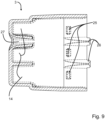
- figure 9 shows a longitudinal sectional view of the housing part 3 in plan view. It is clear that the housing part 3 has several conductor collection pockets arranged next to one another in the rear area. The test opening 27, which leads into the interior of the housing part 3, can also be seen.
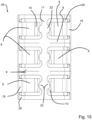
- FIG 10 shows a longitudinal sectional view of the cover part 4 in plan view. It becomes clear that the conductor entry channels 12 extend from the front side to the end of the cover part 4 .
- the conductor entry channels 12 initially have an expanded section and then taper conically into a tapered section.
- the conductor entry channels 12 are delimited by the channel side walls 13 which extend further beyond the conically tapering part and terminate in narrower lugs 24 .
- the material thickness of the channel side walls 13 increases starting from the lugs 14 towards the front side.
- the diametrically opposite duct side walls 13 of adjacent conductor entry ducts 12 are connected to one another in one piece by a respective connecting web 23 .
- the connecting web 23 and the channel side walls 13 are formed from the same insulating material, the channel side walls 13 and the connecting webs 23 do not appear separately in the sectional view, but are visible as a spread section with the channel side walls on the opposite surfaces of this material section.
- FIG 11 shows a front view of the cover part 4 with a view of the conductor entry channels 12. It is clear that in this cover part 4 for a three-pole conductor connection terminal 3 conductor entry channels 12 are arranged next to one another and spaced apart from one another by the channel side walls 13 with the connecting web 23. Each conductor entry channel 12 leads to a clamping point formed by a clamping spring 8 and the common conductor rail 7 extending transversely to the direction of extension of the conductor entry channels 12 in order to clamp an electrical conductor 15 inserted into a respective conductor entry channel 12 .
- FIG 12 shows a top view of the sheet metal part 6 of the previously described conductor connection terminals 1. It is clear that the clamping springs 8 are cut out of the sheet metal part 6 to form clamping tongues, with side webs 9 remaining. These side webs 9 are connected to one another in the root area via a common cross web 28, so that the sheet metal part 6 has a frame-like structure.
- This support section 11 also has a transverse web connecting the side webs 9, on which the lugs 22 are optionally arranged between the side webs 9 in the respective opening 21.
- FIG 13 shows another embodiment of a sheet metal part 36 for a two-row conductor terminal 31 recognize.
- the support section 11 is arranged in the plane of the vertical opening 21 or vertical section of the side bars 9 and connects two groups of clamping springs 8 which are connected to one another by a respective transverse bar 28 and are arranged mirrored to one another.
- the clamping tongues 8 of the opposing groups of clamping springs 8 protrude diagonally towards one another and are aligned with the support section 11 .
- figure 14 shows a side view of the sheet metal part 36 figure 13 . It is clear here that two clamping springs 8 are arranged one above the other and are aligned with the central support section 11 in the vertical section of the sheet metal part 36 .
- FIG 15 shows a view of the sheet metal part 36 figure 13 and 14 with a view of the central support section 11.
- the clamping end 10 of the clamping springs 8 is arranged tapering centrally at an obtuse angle.
- the clamping end 10 of the clamping springs 8 thus has no straight clamping edge, but a triangular clamping edge.
- This embodiment of the terminal end 10 can be used for each conductor terminal 1, 31, regardless of the number of poles and also independently of the design of the contact element 5 and the insulating housing 2, 32.
- opposing clamping springs 8 create two rows of spring clamp connections for electrical conductors 15 .
- figure 16 shows a side sectional view through such a two-row conductor terminal 31.
- the insulating material housing 32 is in turn designed in two parts with a housing part 33 and a cover part 34. It is only about twice as high as in the single-row embodiment. It is clear that the cover part 34 has two superimposed conductor entry channels 12 and, depending on the number of poles, several such pairs of conductor entry channels 12 arranged next to one another.
- channel side walls 13 are present on the cover part 34 and protrude through the opening in the sheet metal part 6 .
- the conductor rail 37 in the illustrated exemplary embodiments of a two-row conductor connection terminal 31 is no longer plate-shaped, but is designed as a sheet metal part bent in a U-shape.
- This busbar 37 is then built into the vertically standing support section 11 in such a way that the support section 11 with the material tabs 22 is surrounded on both sides by the busbar 37 .
- figure 17 shows a rear view of the two-row conductor terminal 31 on figure 16 . It is clear that here again there is a test opening 27 in the housing part 33 which leads to the sheet metal part 36 .
- figure 18 16 shows a front view of the two-row conductor connection terminal 31 from FIG.
- a six-pole conductor connection terminal 31 is thus provided, for example.
Landscapes
- Connections Arranged To Contact A Plurality Of Conductors (AREA)
- Connection Or Junction Boxes (AREA)
- Multi-Conductor Connections (AREA)
- Coupling Device And Connection With Printed Circuit (AREA)
- Cable Accessories (AREA)
Priority Applications (1)
| Application Number | Priority Date | Filing Date | Title |
|---|---|---|---|
| EP23168755.9A EP4224635B1 (de) | 2016-09-02 | 2017-08-28 | Leiteranschlussklemme |
Applications Claiming Priority (2)
| Application Number | Priority Date | Filing Date | Title |
|---|---|---|---|
| DE102016116510.7A DE102016116510A1 (de) | 2016-09-02 | 2016-09-02 | Leiteranschlussklemme |
| PCT/EP2017/071541 WO2018041774A2 (de) | 2016-09-02 | 2017-08-28 | Leiteranschlussklemme |
Related Child Applications (1)
| Application Number | Title | Priority Date | Filing Date |
|---|---|---|---|
| EP23168755.9A Division EP4224635B1 (de) | 2016-09-02 | 2017-08-28 | Leiteranschlussklemme |
Publications (2)
| Publication Number | Publication Date |
|---|---|
| EP3507866A2 EP3507866A2 (de) | 2019-07-10 |
| EP3507866B1 true EP3507866B1 (de) | 2023-04-26 |
Family
ID=59702739
Family Applications (2)
| Application Number | Title | Priority Date | Filing Date |
|---|---|---|---|
| EP17757776.4A Active EP3507866B1 (de) | 2016-09-02 | 2017-08-28 | Leiteranschlussklemme |
| EP23168755.9A Active EP4224635B1 (de) | 2016-09-02 | 2017-08-28 | Leiteranschlussklemme |
Family Applications After (1)
| Application Number | Title | Priority Date | Filing Date |
|---|---|---|---|
| EP23168755.9A Active EP4224635B1 (de) | 2016-09-02 | 2017-08-28 | Leiteranschlussklemme |
Country Status (10)
| Country | Link |
|---|---|
| US (1) | US11024988B2 (https=) |
| EP (2) | EP3507866B1 (https=) |
| JP (1) | JP7080876B2 (https=) |
| KR (1) | KR102514999B1 (https=) |
| CN (1) | CN109690875B (https=) |
| DE (1) | DE102016116510A1 (https=) |
| ES (2) | ES2946240T3 (https=) |
| PL (2) | PL3507866T3 (https=) |
| RU (1) | RU2739591C2 (https=) |
| WO (1) | WO2018041774A2 (https=) |
Cited By (2)
| Publication number | Priority date | Publication date | Assignee | Title |
|---|---|---|---|---|
| DE202024104663U1 (de) * | 2024-08-19 | 2025-11-20 | WAGO Verwaltungsgesellschaft mit beschränkter Haftung | Federkraftklemmanschluss und Leiteranschlussklemme |
| DE202024104666U1 (de) * | 2024-08-19 | 2025-11-20 | WAGO Verwaltungsgesellschaft mit beschränkter Haftung | Verbindungsklemme |
Families Citing this family (17)
| Publication number | Priority date | Publication date | Assignee | Title |
|---|---|---|---|---|
| TWM549469U (zh) * | 2017-05-16 | 2017-09-21 | Switchlab Inc | 用於接線端子之插線輔助套結構 |
| BR202019016911Y1 (pt) * | 2019-08-14 | 2024-03-12 | Gridspertise Latam S.A | Bloco de conexão elétrica |
| DE202019105887U1 (de) * | 2019-10-23 | 2021-01-26 | Wago Verwaltungsgesellschaft Mbh | Leiteranschlussklemme zum Anschließen eines elektrischen Leiters und Set aus einer Leiteranschlussklemme und einem elektrischen Leiter |
| DE102020104417B4 (de) | 2020-02-19 | 2022-08-11 | Bjb Gmbh & Co. Kg | Anschlussklemme |
| CN111585062B (zh) * | 2020-05-21 | 2024-12-31 | 厦门广泓工贸有限公司 | 一种新型接线端子 |
| DE102020120150A1 (de) | 2020-07-30 | 2022-02-03 | WAGO Verwaltungsgesellschaft mit beschränkter Haftung | Leiteranschlussklemme, Verwendung und Verfahren zur Montage einer Leiteranschlussklemme |
| DE102020120151A1 (de) | 2020-07-30 | 2022-02-03 | WAGO Verwaltungsgesellschaft mit beschränkter Haftung | Verbindungsklemme zum Verbinden elektrischer Leiter |
| CN114824889A (zh) * | 2022-05-09 | 2022-07-29 | 东莞市晨名电子科技有限公司 | 一种采用弯折压迫和弯折导电片方式的自耦合导线接线器 |
| CN116779233B (zh) * | 2023-08-24 | 2023-10-24 | 济南富利通电气技术有限公司 | 一种轨道式母线主干体 |
| DE202024102465U1 (de) * | 2024-05-14 | 2025-08-18 | WAGO Verwaltungsgesellschaft mit beschränkter Haftung | Leiteranschlussklemme |
| DE202024102466U1 (de) * | 2024-05-14 | 2025-08-18 | WAGO Verwaltungsgesellschaft mit beschränkter Haftung | Leiteranschlussklemme |
| DE202024102464U1 (de) * | 2024-05-14 | 2025-08-18 | WAGO Verwaltungsgesellschaft mit beschränkter Haftung | Leiteranschlussklemme |
| DE202024102553U1 (de) * | 2024-05-17 | 2025-08-19 | WAGO Verwaltungsgesellschaft mit beschränkter Haftung | Leiteranschlussklemme |
| DE202024102627U1 (de) * | 2024-05-22 | 2025-08-25 | WAGO Verwaltungsgesellschaft mit beschränkter Haftung | Leiteranschlussklemme |
| DE202024102624U1 (de) * | 2024-05-22 | 2025-08-25 | WAGO Verwaltungsgesellschaft mit beschränkter Haftung | Leiteranschlussklemme |
| DE202024102659U1 (de) * | 2024-05-23 | 2025-08-26 | WAGO Verwaltungsgesellschaft mit beschränkter Haftung | Leiteranschlussklemme |
| DE202024103724U1 (de) * | 2024-07-05 | 2025-10-08 | WAGO Verwaltungsgesellschaft mit beschränkter Haftung | Federkraftklemmanschluss und Leiteranschlussklemme |
Citations (2)
| Publication number | Priority date | Publication date | Assignee | Title |
|---|---|---|---|---|
| US4397514A (en) * | 1980-04-04 | 1983-08-09 | Legrand | Self-clamping electrical connectors and terminal blocks |
| US7150646B2 (en) * | 2004-06-22 | 2006-12-19 | Wago Verwaltungsgesellschaft Mbh | Clamp terminal for connecting electrical conductors |
Family Cites Families (33)
| Publication number | Priority date | Publication date | Assignee | Title |
|---|---|---|---|---|
| US2713668A (en) * | 1951-06-21 | 1955-07-19 | Hart Mfg Co | Quick detachable electrical connector |
| US2720634A (en) * | 1954-01-15 | 1955-10-11 | Hart Mfg Co | Quick detachable electrical connector |
| DE2317040C3 (de) * | 1973-04-05 | 1980-01-31 | Wago-Kontakttechnik Gmbh, 4950 Minden | Steckklemme zum Verbinden starrer elektrischer Leiter |
| US4482198A (en) * | 1982-11-08 | 1984-11-13 | Amp Incorporated | Shunt |
| DE4003701C2 (de) | 1990-02-05 | 1996-04-18 | Wago Verwaltungs Gmbh | Elektr. Anschlußklemme |
| EP0616386A3 (en) * | 1993-03-18 | 1996-03-13 | Tadao Tozuka | Plug-in connector. |
| US5758952A (en) * | 1996-07-26 | 1998-06-02 | Leviton Manufacturing Co., Inc. | Lampholder for compact fluorescent lamps |
| DE19654523C2 (de) | 1996-12-19 | 2003-10-09 | Wago Verwaltungs Gmbh | Verbindungsklemme mit mindestens zwei Klemmstellen zum Anschließen elektrischer Leiter |
| DE19654611B4 (de) * | 1996-12-20 | 2004-09-30 | Wago Verwaltungsgesellschaft Mbh | Federkraftklemmanschluß für elektrische Leiter |
| US6746286B2 (en) * | 2002-03-06 | 2004-06-08 | Ideal Industries, Inc. | Push-in wire connector |
| US6832938B2 (en) * | 2002-12-13 | 2004-12-21 | Tyco Electronics Corporation | Electrical connector with integral wire release member |
| DE20303537U1 (de) * | 2003-03-05 | 2003-05-15 | Electro-Terminal Ges. M.B.H. & Co. Kg, Innsbruck | Schraubenlose Dosenklemme |
| DE102006010309B4 (de) * | 2006-03-07 | 2008-01-24 | Phoenix Contact Gmbh & Co. Kg | Dosenklemme |
| DE102006019223B4 (de) * | 2006-04-21 | 2010-11-04 | Wago Verwaltungsgesellschaft Mbh | Isolierstoffgehäuse für elektrische Klemmen |
| DE102006019150B4 (de) * | 2006-04-21 | 2011-06-09 | Wago Verwaltungsgesellschaft Mbh | Elektrische Verbindungsklemme |
| DE102007017593B4 (de) * | 2006-04-28 | 2011-07-21 | WAGO Verwaltungsgesellschaft mbH, 32423 | Elektrische Anschluß- und Verbindungsklemme |
| DE102007024690B4 (de) * | 2007-05-25 | 2009-06-04 | Phoenix Contact Gmbh & Co. Kg | Elektrische Anschluß- oder Verbindungsklemme |
| US7507106B2 (en) * | 2007-06-14 | 2009-03-24 | Ideal Industries, Inc. | Push-in wire connector with improved busbar |
| US7972166B2 (en) * | 2007-06-29 | 2011-07-05 | The Patent Store, Llc | Waterproof push-in wire connectors |
| US7722384B2 (en) * | 2007-07-09 | 2010-05-25 | Ideal Industries, Inc. | In-line push-in wire connector |
| US8192226B2 (en) * | 2009-09-29 | 2012-06-05 | Ideal Industries, Inc. | One-piece conductive clip for push-in wire connector |
| JP5679551B2 (ja) * | 2010-10-07 | 2015-03-04 | 矢崎総業株式会社 | 圧着端子 |
| US20120208394A1 (en) * | 2011-02-15 | 2012-08-16 | Heavy Power Co., Ltd. | Reusable double-contact electrical wire connector for single-and multi-thread wires |
| US8187023B1 (en) * | 2011-05-13 | 2012-05-29 | Uta Auto Industrial Co., Ltd. | Wire connector with two spring plates |
| DE102011056410B4 (de) * | 2011-12-14 | 2013-06-27 | Wago Verwaltungsgesellschaft Mbh | Anschlussklemme |
| CN202888496U (zh) * | 2012-09-10 | 2013-04-17 | 深圳立讯精密工业股份有限公司 | 电连接器 |
| US9105991B1 (en) * | 2012-10-17 | 2015-08-11 | Steve W. Bliss | Crimpless electrical connector assembly |
| DE102012219741A1 (de) * | 2012-10-29 | 2014-04-30 | Tyco Electronics Amp Gmbh | Elektrischer Kontakt und Steckverbinder mit einem solchen elektrischen Kontakt |
| CN202888495U (zh) * | 2012-10-31 | 2013-04-17 | 蔡添庆 | 一种分体式结构连接器 |
| DE102014102517B4 (de) * | 2014-02-26 | 2021-06-10 | Wago Verwaltungsgesellschaft Mbh | Verbindungsklemme und Federkraftklemmkontakt hierzu |
| RU2576463C1 (ru) * | 2015-01-20 | 2016-03-10 | Дмитрий Анатольевич Семаков | Соединительная клемма для электрических проводов |
| DE102016111536A1 (de) * | 2016-06-23 | 2017-12-28 | Wago Verwaltungsgesellschaft Mbh | Kontakteinsatz einer Federkraftanschlussklemme sowie damit ausgebildete Federkraftanschlussklemme |
| JP6931223B2 (ja) * | 2017-07-25 | 2021-09-01 | 日本圧着端子製造株式会社 | 端子、及び電気コネクタ |
-
2016
- 2016-09-02 DE DE102016116510.7A patent/DE102016116510A1/de active Pending
-
2017
- 2017-08-28 ES ES17757776T patent/ES2946240T3/es active Active
- 2017-08-28 KR KR1020197005536A patent/KR102514999B1/ko active Active
- 2017-08-28 CN CN201780052504.XA patent/CN109690875B/zh active Active
- 2017-08-28 EP EP17757776.4A patent/EP3507866B1/de active Active
- 2017-08-28 WO PCT/EP2017/071541 patent/WO2018041774A2/de not_active Ceased
- 2017-08-28 RU RU2019103673A patent/RU2739591C2/ru active
- 2017-08-28 EP EP23168755.9A patent/EP4224635B1/de active Active
- 2017-08-28 ES ES23168755T patent/ES3054538T3/es active Active
- 2017-08-28 PL PL17757776.4T patent/PL3507866T3/pl unknown
- 2017-08-28 PL PL23168755.9T patent/PL4224635T3/pl unknown
- 2017-08-28 JP JP2019511781A patent/JP7080876B2/ja active Active
-
2019
- 2019-03-01 US US16/290,072 patent/US11024988B2/en active Active
Patent Citations (2)
| Publication number | Priority date | Publication date | Assignee | Title |
|---|---|---|---|---|
| US4397514A (en) * | 1980-04-04 | 1983-08-09 | Legrand | Self-clamping electrical connectors and terminal blocks |
| US7150646B2 (en) * | 2004-06-22 | 2006-12-19 | Wago Verwaltungsgesellschaft Mbh | Clamp terminal for connecting electrical conductors |
Cited By (2)
| Publication number | Priority date | Publication date | Assignee | Title |
|---|---|---|---|---|
| DE202024104663U1 (de) * | 2024-08-19 | 2025-11-20 | WAGO Verwaltungsgesellschaft mit beschränkter Haftung | Federkraftklemmanschluss und Leiteranschlussklemme |
| DE202024104666U1 (de) * | 2024-08-19 | 2025-11-20 | WAGO Verwaltungsgesellschaft mit beschränkter Haftung | Verbindungsklemme |
Also Published As
| Publication number | Publication date |
|---|---|
| EP4224635B1 (de) | 2025-10-01 |
| WO2018041774A2 (de) | 2018-03-08 |
| KR102514999B1 (ko) | 2023-03-29 |
| EP4224635A1 (de) | 2023-08-09 |
| JP2019530143A (ja) | 2019-10-17 |
| PL4224635T3 (pl) | 2026-02-23 |
| US11024988B2 (en) | 2021-06-01 |
| CN109690875A (zh) | 2019-04-26 |
| CN109690875B (zh) | 2021-05-28 |
| DE102016116510A1 (de) | 2018-03-08 |
| KR20190041475A (ko) | 2019-04-22 |
| RU2019103673A3 (https=) | 2020-10-07 |
| WO2018041774A3 (de) | 2018-04-26 |
| ES3054538T3 (en) | 2026-02-04 |
| RU2739591C2 (ru) | 2020-12-28 |
| EP3507866A2 (de) | 2019-07-10 |
| US20190199011A1 (en) | 2019-06-27 |
| RU2019103673A (ru) | 2020-10-02 |
| ES2946240T3 (es) | 2023-07-14 |
| PL3507866T3 (pl) | 2023-08-21 |
| JP7080876B2 (ja) | 2022-06-06 |
Similar Documents
| Publication | Publication Date | Title |
|---|---|---|
| EP3507866B1 (de) | Leiteranschlussklemme | |
| EP1777720B1 (de) | Elektrisches Bauteil, insbesondere Relaisfassung, mit Federklemmen und Verfahren zu seiner Herstellung | |
| EP2956993B1 (de) | Federklemmkontakt und verbindungsklemme für elektrische leiter | |
| EP3298659B1 (de) | Leiteranschlussklemme | |
| EP2915215B1 (de) | Reihenbausteinanordnung mit einem energiebussystem | |
| EP3734768B1 (de) | Steckverbinder einer elektrischen steckverbindung sowie damit gebildete elektrische steckverbindung | |
| DE102015114741B4 (de) | Steckverbinder und Set aus Steckverbinder und Verbinderteil | |
| DE102016122238A1 (de) | Federklemmkontakt zur Kontaktierung elektrischer Leiter, Leiteranschlussklemme und Verfahren zur Herstellung eines Federklemmkontakts | |
| EP3293833B1 (de) | Stromschienenverbinder | |
| WO2011047740A1 (de) | Federkraftanschlussklemme | |
| EP3477793B1 (de) | Abgriffsteckverbinder | |
| DE102011056043B4 (de) | Stromschienenabgriffelement | |
| EP3734771B1 (de) | Set aus einer elektrischen steckverbindung und einem funktionselement | |
| EP1515397A1 (de) | Anschlussvorrichtung zum Direktsteckanschluss von Leiterenden | |
| EP3196981B1 (de) | Querverbinder für reihenklemmen | |
| DE102009030645B4 (de) | Brückerelement und Set aus zumindest einem Klemmelement und Brückerelement | |
| EP3843221A1 (de) | Halterahmen für einen steckverbinder | |
| DE2521072C2 (de) | Verbindungsklemme zur elektrischen Verbindung eines Leiters mit einem Stift | |
| DE102019114553A1 (de) | Dehnverbinder für eine Schleifleitung und Schleifleitung | |
| EP1248318B1 (de) | Elektrischer Kontakt sowie Lampenfassung und Anschluss- oder Verbindungsklemme mit mindestens einem solchen Kontakt | |
| EP1037310B1 (de) | Hülsenförmiges Klemmelement zum abisolierfreien Anschluss elektrischer Leiter | |
| EP0336251A2 (de) | Schraubklemme | |
| DE9304392U1 (de) | Kontaktelement mit Schneidklemm- und Crimpanschluß | |
| DE29622991U1 (de) | Kontaktorgan mit Doppel-Schneidklemmanschluß | |
| EP1484818A2 (de) | Anschlussvorrichtung zum isolationsdurchdringenden Anschluss von wenigstens zwei Leitern |
Legal Events
| Date | Code | Title | Description |
|---|---|---|---|
| STAA | Information on the status of an ep patent application or granted ep patent |
Free format text: STATUS: UNKNOWN |
|
| STAA | Information on the status of an ep patent application or granted ep patent |
Free format text: STATUS: THE INTERNATIONAL PUBLICATION HAS BEEN MADE |
|
| PUAI | Public reference made under article 153(3) epc to a published international application that has entered the european phase |
Free format text: ORIGINAL CODE: 0009012 |
|
| STAA | Information on the status of an ep patent application or granted ep patent |
Free format text: STATUS: REQUEST FOR EXAMINATION WAS MADE |
|
| 17P | Request for examination filed |
Effective date: 20190227 |
|
| AK | Designated contracting states |
Kind code of ref document: A2 Designated state(s): AL AT BE BG CH CY CZ DE DK EE ES FI FR GB GR HR HU IE IS IT LI LT LU LV MC MK MT NL NO PL PT RO RS SE SI SK SM TR |
|
| AX | Request for extension of the european patent |
Extension state: BA ME |
|
| DAV | Request for validation of the european patent (deleted) | ||
| DAX | Request for extension of the european patent (deleted) | ||
| STAA | Information on the status of an ep patent application or granted ep patent |
Free format text: STATUS: EXAMINATION IS IN PROGRESS |
|
| 17Q | First examination report despatched |
Effective date: 20200903 |
|
| GRAP | Despatch of communication of intention to grant a patent |
Free format text: ORIGINAL CODE: EPIDOSNIGR1 |
|
| STAA | Information on the status of an ep patent application or granted ep patent |
Free format text: STATUS: GRANT OF PATENT IS INTENDED |
|
| INTG | Intention to grant announced |
Effective date: 20221114 |
|
| GRAS | Grant fee paid |
Free format text: ORIGINAL CODE: EPIDOSNIGR3 |
|
| GRAA | (expected) grant |
Free format text: ORIGINAL CODE: 0009210 |
|
| STAA | Information on the status of an ep patent application or granted ep patent |
Free format text: STATUS: THE PATENT HAS BEEN GRANTED |
|
| AK | Designated contracting states |
Kind code of ref document: B1 Designated state(s): AL AT BE BG CH CY CZ DE DK EE ES FI FR GB GR HR HU IE IS IT LI LT LU LV MC MK MT NL NO PL PT RO RS SE SI SK SM TR |
|
| REG | Reference to a national code |
Ref country code: GB Ref legal event code: FG4D Free format text: NOT ENGLISH |
|
| REG | Reference to a national code |
Ref country code: CH Ref legal event code: EP |
|
| REG | Reference to a national code |
Ref country code: DE Ref legal event code: R096 Ref document number: 502017014659 Country of ref document: DE |
|
| REG | Reference to a national code |
Ref country code: AT Ref legal event code: REF Ref document number: 1563512 Country of ref document: AT Kind code of ref document: T Effective date: 20230515 |
|
| REG | Reference to a national code |
Ref country code: IE Ref legal event code: FG4D Free format text: LANGUAGE OF EP DOCUMENT: GERMAN |
|
| P01 | Opt-out of the competence of the unified patent court (upc) registered |
Effective date: 20230516 |
|
| REG | Reference to a national code |
Ref country code: ES Ref legal event code: FG2A Ref document number: 2946240 Country of ref document: ES Kind code of ref document: T3 Effective date: 20230714 |
|
| REG | Reference to a national code |
Ref country code: LT Ref legal event code: MG9D |
|
| REG | Reference to a national code |
Ref country code: NL Ref legal event code: MP Effective date: 20230426 |
|
| PG25 | Lapsed in a contracting state [announced via postgrant information from national office to epo] |
Ref country code: NL Free format text: LAPSE BECAUSE OF FAILURE TO SUBMIT A TRANSLATION OF THE DESCRIPTION OR TO PAY THE FEE WITHIN THE PRESCRIBED TIME-LIMIT Effective date: 20230426 |
|
| PG25 | Lapsed in a contracting state [announced via postgrant information from national office to epo] |
Ref country code: SE Free format text: LAPSE BECAUSE OF FAILURE TO SUBMIT A TRANSLATION OF THE DESCRIPTION OR TO PAY THE FEE WITHIN THE PRESCRIBED TIME-LIMIT Effective date: 20230426 Ref country code: PT Free format text: LAPSE BECAUSE OF FAILURE TO SUBMIT A TRANSLATION OF THE DESCRIPTION OR TO PAY THE FEE WITHIN THE PRESCRIBED TIME-LIMIT Effective date: 20230828 Ref country code: NO Free format text: LAPSE BECAUSE OF FAILURE TO SUBMIT A TRANSLATION OF THE DESCRIPTION OR TO PAY THE FEE WITHIN THE PRESCRIBED TIME-LIMIT Effective date: 20230726 |
|
| PG25 | Lapsed in a contracting state [announced via postgrant information from national office to epo] |
Ref country code: RS Free format text: LAPSE BECAUSE OF FAILURE TO SUBMIT A TRANSLATION OF THE DESCRIPTION OR TO PAY THE FEE WITHIN THE PRESCRIBED TIME-LIMIT Effective date: 20230426 Ref country code: LV Free format text: LAPSE BECAUSE OF FAILURE TO SUBMIT A TRANSLATION OF THE DESCRIPTION OR TO PAY THE FEE WITHIN THE PRESCRIBED TIME-LIMIT Effective date: 20230426 Ref country code: LT Free format text: LAPSE BECAUSE OF FAILURE TO SUBMIT A TRANSLATION OF THE DESCRIPTION OR TO PAY THE FEE WITHIN THE PRESCRIBED TIME-LIMIT Effective date: 20230426 Ref country code: IS Free format text: LAPSE BECAUSE OF FAILURE TO SUBMIT A TRANSLATION OF THE DESCRIPTION OR TO PAY THE FEE WITHIN THE PRESCRIBED TIME-LIMIT Effective date: 20230826 Ref country code: HR Free format text: LAPSE BECAUSE OF FAILURE TO SUBMIT A TRANSLATION OF THE DESCRIPTION OR TO PAY THE FEE WITHIN THE PRESCRIBED TIME-LIMIT Effective date: 20230426 Ref country code: GR Free format text: LAPSE BECAUSE OF FAILURE TO SUBMIT A TRANSLATION OF THE DESCRIPTION OR TO PAY THE FEE WITHIN THE PRESCRIBED TIME-LIMIT Effective date: 20230727 |
|
| PG25 | Lapsed in a contracting state [announced via postgrant information from national office to epo] |
Ref country code: FI Free format text: LAPSE BECAUSE OF FAILURE TO SUBMIT A TRANSLATION OF THE DESCRIPTION OR TO PAY THE FEE WITHIN THE PRESCRIBED TIME-LIMIT Effective date: 20230426 |
|
| PG25 | Lapsed in a contracting state [announced via postgrant information from national office to epo] |
Ref country code: SK Free format text: LAPSE BECAUSE OF FAILURE TO SUBMIT A TRANSLATION OF THE DESCRIPTION OR TO PAY THE FEE WITHIN THE PRESCRIBED TIME-LIMIT Effective date: 20230426 |
|
| REG | Reference to a national code |
Ref country code: DE Ref legal event code: R097 Ref document number: 502017014659 Country of ref document: DE |
|
| PG25 | Lapsed in a contracting state [announced via postgrant information from national office to epo] |
Ref country code: SM Free format text: LAPSE BECAUSE OF FAILURE TO SUBMIT A TRANSLATION OF THE DESCRIPTION OR TO PAY THE FEE WITHIN THE PRESCRIBED TIME-LIMIT Effective date: 20230426 Ref country code: SK Free format text: LAPSE BECAUSE OF FAILURE TO SUBMIT A TRANSLATION OF THE DESCRIPTION OR TO PAY THE FEE WITHIN THE PRESCRIBED TIME-LIMIT Effective date: 20230426 Ref country code: RO Free format text: LAPSE BECAUSE OF FAILURE TO SUBMIT A TRANSLATION OF THE DESCRIPTION OR TO PAY THE FEE WITHIN THE PRESCRIBED TIME-LIMIT Effective date: 20230426 Ref country code: EE Free format text: LAPSE BECAUSE OF FAILURE TO SUBMIT A TRANSLATION OF THE DESCRIPTION OR TO PAY THE FEE WITHIN THE PRESCRIBED TIME-LIMIT Effective date: 20230426 Ref country code: DK Free format text: LAPSE BECAUSE OF FAILURE TO SUBMIT A TRANSLATION OF THE DESCRIPTION OR TO PAY THE FEE WITHIN THE PRESCRIBED TIME-LIMIT Effective date: 20230426 Ref country code: CZ Free format text: LAPSE BECAUSE OF FAILURE TO SUBMIT A TRANSLATION OF THE DESCRIPTION OR TO PAY THE FEE WITHIN THE PRESCRIBED TIME-LIMIT Effective date: 20230426 |
|
| PLBE | No opposition filed within time limit |
Free format text: ORIGINAL CODE: 0009261 |
|
| STAA | Information on the status of an ep patent application or granted ep patent |
Free format text: STATUS: NO OPPOSITION FILED WITHIN TIME LIMIT |
|
| PG25 | Lapsed in a contracting state [announced via postgrant information from national office to epo] |
Ref country code: MC Free format text: LAPSE BECAUSE OF FAILURE TO SUBMIT A TRANSLATION OF THE DESCRIPTION OR TO PAY THE FEE WITHIN THE PRESCRIBED TIME-LIMIT Effective date: 20230426 |
|
| PG25 | Lapsed in a contracting state [announced via postgrant information from national office to epo] |
Ref country code: MC Free format text: LAPSE BECAUSE OF FAILURE TO SUBMIT A TRANSLATION OF THE DESCRIPTION OR TO PAY THE FEE WITHIN THE PRESCRIBED TIME-LIMIT Effective date: 20230426 |
|
| 26N | No opposition filed |
Effective date: 20240129 |
|
| PG25 | Lapsed in a contracting state [announced via postgrant information from national office to epo] |
Ref country code: LU Free format text: LAPSE BECAUSE OF NON-PAYMENT OF DUE FEES Effective date: 20230828 |
|
| PG25 | Lapsed in a contracting state [announced via postgrant information from national office to epo] |
Ref country code: LU Free format text: LAPSE BECAUSE OF NON-PAYMENT OF DUE FEES Effective date: 20230828 |
|
| PG25 | Lapsed in a contracting state [announced via postgrant information from national office to epo] |
Ref country code: SI Free format text: LAPSE BECAUSE OF FAILURE TO SUBMIT A TRANSLATION OF THE DESCRIPTION OR TO PAY THE FEE WITHIN THE PRESCRIBED TIME-LIMIT Effective date: 20230426 |
|
| REG | Reference to a national code |
Ref country code: BE Ref legal event code: MM Effective date: 20230831 |
|
| REG | Reference to a national code |
Ref country code: IE Ref legal event code: MM4A |
|
| PG25 | Lapsed in a contracting state [announced via postgrant information from national office to epo] |
Ref country code: SI Free format text: LAPSE BECAUSE OF FAILURE TO SUBMIT A TRANSLATION OF THE DESCRIPTION OR TO PAY THE FEE WITHIN THE PRESCRIBED TIME-LIMIT Effective date: 20230426 |
|
| PG25 | Lapsed in a contracting state [announced via postgrant information from national office to epo] |
Ref country code: IE Free format text: LAPSE BECAUSE OF NON-PAYMENT OF DUE FEES Effective date: 20230828 |
|
| PG25 | Lapsed in a contracting state [announced via postgrant information from national office to epo] |
Ref country code: IE Free format text: LAPSE BECAUSE OF NON-PAYMENT OF DUE FEES Effective date: 20230828 |
|
| PG25 | Lapsed in a contracting state [announced via postgrant information from national office to epo] |
Ref country code: BE Free format text: LAPSE BECAUSE OF NON-PAYMENT OF DUE FEES Effective date: 20230831 |
|
| REG | Reference to a national code |
Ref country code: AT Ref legal event code: MM01 Ref document number: 1563512 Country of ref document: AT Kind code of ref document: T Effective date: 20230828 |
|
| PG25 | Lapsed in a contracting state [announced via postgrant information from national office to epo] |
Ref country code: AT Free format text: LAPSE BECAUSE OF NON-PAYMENT OF DUE FEES Effective date: 20230828 |
|
| PG25 | Lapsed in a contracting state [announced via postgrant information from national office to epo] |
Ref country code: AT Free format text: LAPSE BECAUSE OF NON-PAYMENT OF DUE FEES Effective date: 20230828 |
|
| PG25 | Lapsed in a contracting state [announced via postgrant information from national office to epo] |
Ref country code: BG Free format text: LAPSE BECAUSE OF FAILURE TO SUBMIT A TRANSLATION OF THE DESCRIPTION OR TO PAY THE FEE WITHIN THE PRESCRIBED TIME-LIMIT Effective date: 20230426 |
|
| PG25 | Lapsed in a contracting state [announced via postgrant information from national office to epo] |
Ref country code: BG Free format text: LAPSE BECAUSE OF FAILURE TO SUBMIT A TRANSLATION OF THE DESCRIPTION OR TO PAY THE FEE WITHIN THE PRESCRIBED TIME-LIMIT Effective date: 20230426 |
|
| PG25 | Lapsed in a contracting state [announced via postgrant information from national office to epo] |
Ref country code: CY Free format text: LAPSE BECAUSE OF FAILURE TO SUBMIT A TRANSLATION OF THE DESCRIPTION OR TO PAY THE FEE WITHIN THE PRESCRIBED TIME-LIMIT; INVALID AB INITIO Effective date: 20170828 |
|
| PG25 | Lapsed in a contracting state [announced via postgrant information from national office to epo] |
Ref country code: HU Free format text: LAPSE BECAUSE OF FAILURE TO SUBMIT A TRANSLATION OF THE DESCRIPTION OR TO PAY THE FEE WITHIN THE PRESCRIBED TIME-LIMIT; INVALID AB INITIO Effective date: 20170828 |
|
| PGFP | Annual fee paid to national office [announced via postgrant information from national office to epo] |
Ref country code: ES Payment date: 20250916 Year of fee payment: 9 |
|
| PGFP | Annual fee paid to national office [announced via postgrant information from national office to epo] |
Ref country code: DE Payment date: 20250827 Year of fee payment: 9 |
|
| PGFP | Annual fee paid to national office [announced via postgrant information from national office to epo] |
Ref country code: PL Payment date: 20250818 Year of fee payment: 9 Ref country code: IT Payment date: 20250825 Year of fee payment: 9 |
|
| PGFP | Annual fee paid to national office [announced via postgrant information from national office to epo] |
Ref country code: GB Payment date: 20250826 Year of fee payment: 9 |
|
| PGFP | Annual fee paid to national office [announced via postgrant information from national office to epo] |
Ref country code: FR Payment date: 20250825 Year of fee payment: 9 |
|
| PGFP | Annual fee paid to national office [announced via postgrant information from national office to epo] |
Ref country code: CH Payment date: 20250901 Year of fee payment: 9 |
|
| PG25 | Lapsed in a contracting state [announced via postgrant information from national office to epo] |
Ref country code: TR Free format text: LAPSE BECAUSE OF FAILURE TO SUBMIT A TRANSLATION OF THE DESCRIPTION OR TO PAY THE FEE WITHIN THE PRESCRIBED TIME-LIMIT Effective date: 20230426 |