EP3397250B1 - Systems for long term transdermal administration - Google Patents
Systems for long term transdermal administration Download PDFInfo
- Publication number
- EP3397250B1 EP3397250B1 EP16829220.9A EP16829220A EP3397250B1 EP 3397250 B1 EP3397250 B1 EP 3397250B1 EP 16829220 A EP16829220 A EP 16829220A EP 3397250 B1 EP3397250 B1 EP 3397250B1
- Authority
- EP
- European Patent Office
- Prior art keywords
- mil
- layer
- adhesive
- patch
- mpa
- Prior art date
- Legal status (The legal status is an assumption and is not a legal conclusion. Google has not performed a legal analysis and makes no representation as to the accuracy of the status listed.)
- Active
Links
Images



Classifications
-
- A—HUMAN NECESSITIES
- A61—MEDICAL OR VETERINARY SCIENCE; HYGIENE
- A61K—PREPARATIONS FOR MEDICAL, DENTAL OR TOILETRY PURPOSES
- A61K9/00—Medicinal preparations characterised by special physical form
- A61K9/70—Web, sheet or filament bases ; Films; Fibres of the matrix type containing drug
- A61K9/7023—Transdermal patches and similar drug-containing composite devices, e.g. cataplasms
- A61K9/703—Transdermal patches and similar drug-containing composite devices, e.g. cataplasms characterised by shape or structure; Details concerning release liner or backing; Refillable patches; User-activated patches
- A61K9/7038—Transdermal patches of the drug-in-adhesive type, i.e. comprising drug in the skin-adhesive layer
-
- A—HUMAN NECESSITIES
- A61—MEDICAL OR VETERINARY SCIENCE; HYGIENE
- A61K—PREPARATIONS FOR MEDICAL, DENTAL OR TOILETRY PURPOSES
- A61K9/00—Medicinal preparations characterised by special physical form
- A61K9/70—Web, sheet or filament bases ; Films; Fibres of the matrix type containing drug
-
- A—HUMAN NECESSITIES
- A61—MEDICAL OR VETERINARY SCIENCE; HYGIENE
- A61K—PREPARATIONS FOR MEDICAL, DENTAL OR TOILETRY PURPOSES
- A61K9/00—Medicinal preparations characterised by special physical form
- A61K9/70—Web, sheet or filament bases ; Films; Fibres of the matrix type containing drug
- A61K9/7023—Transdermal patches and similar drug-containing composite devices, e.g. cataplasms
- A61K9/703—Transdermal patches and similar drug-containing composite devices, e.g. cataplasms characterised by shape or structure; Details concerning release liner or backing; Refillable patches; User-activated patches
- A61K9/7084—Transdermal patches having a drug layer or reservoir, and one or more separate drug-free skin-adhesive layers, e.g. between drug reservoir and skin, or surrounding the drug reservoir; Liquid-filled reservoir patches
-
- A—HUMAN NECESSITIES
- A61—MEDICAL OR VETERINARY SCIENCE; HYGIENE
- A61K—PREPARATIONS FOR MEDICAL, DENTAL OR TOILETRY PURPOSES
- A61K41/00—Medicinal preparations obtained by treating materials with wave energy or particle radiation ; Therapies using these preparations
-
- A—HUMAN NECESSITIES
- A61—MEDICAL OR VETERINARY SCIENCE; HYGIENE
- A61K—PREPARATIONS FOR MEDICAL, DENTAL OR TOILETRY PURPOSES
- A61K47/00—Medicinal preparations characterised by the non-active ingredients used, e.g. carriers or inert additives; Targeting or modifying agents chemically bound to the active ingredient
- A61K47/30—Macromolecular organic or inorganic compounds, e.g. inorganic polyphosphates
- A61K47/34—Macromolecular compounds obtained otherwise than by reactions only involving carbon-to-carbon unsaturated bonds, e.g. polyesters, polyamino acids, polysiloxanes, polyphosphazines, copolymers of polyalkylene glycol or poloxamers
-
- A—HUMAN NECESSITIES
- A61—MEDICAL OR VETERINARY SCIENCE; HYGIENE
- A61K—PREPARATIONS FOR MEDICAL, DENTAL OR TOILETRY PURPOSES
- A61K9/00—Medicinal preparations characterised by special physical form
- A61K9/0012—Galenical forms characterised by the site of application
- A61K9/0014—Skin, i.e. galenical aspects of topical compositions
-
- A—HUMAN NECESSITIES
- A61—MEDICAL OR VETERINARY SCIENCE; HYGIENE
- A61K—PREPARATIONS FOR MEDICAL, DENTAL OR TOILETRY PURPOSES
- A61K9/00—Medicinal preparations characterised by special physical form
- A61K9/70—Web, sheet or filament bases ; Films; Fibres of the matrix type containing drug
- A61K9/7023—Transdermal patches and similar drug-containing composite devices, e.g. cataplasms
- A61K9/703—Transdermal patches and similar drug-containing composite devices, e.g. cataplasms characterised by shape or structure; Details concerning release liner or backing; Refillable patches; User-activated patches
- A61K9/7038—Transdermal patches of the drug-in-adhesive type, i.e. comprising drug in the skin-adhesive layer
- A61K9/7046—Transdermal patches of the drug-in-adhesive type, i.e. comprising drug in the skin-adhesive layer the adhesive comprising macromolecular compounds
- A61K9/7053—Transdermal patches of the drug-in-adhesive type, i.e. comprising drug in the skin-adhesive layer the adhesive comprising macromolecular compounds obtained by reactions only involving carbon to carbon unsaturated bonds, e.g. polyvinyl, polyisobutylene, polystyrene
-
- A—HUMAN NECESSITIES
- A61—MEDICAL OR VETERINARY SCIENCE; HYGIENE
- A61K—PREPARATIONS FOR MEDICAL, DENTAL OR TOILETRY PURPOSES
- A61K9/00—Medicinal preparations characterised by special physical form
- A61K9/70—Web, sheet or filament bases ; Films; Fibres of the matrix type containing drug
- A61K9/7023—Transdermal patches and similar drug-containing composite devices, e.g. cataplasms
- A61K9/703—Transdermal patches and similar drug-containing composite devices, e.g. cataplasms characterised by shape or structure; Details concerning release liner or backing; Refillable patches; User-activated patches
- A61K9/7038—Transdermal patches of the drug-in-adhesive type, i.e. comprising drug in the skin-adhesive layer
- A61K9/7046—Transdermal patches of the drug-in-adhesive type, i.e. comprising drug in the skin-adhesive layer the adhesive comprising macromolecular compounds
- A61K9/7053—Transdermal patches of the drug-in-adhesive type, i.e. comprising drug in the skin-adhesive layer the adhesive comprising macromolecular compounds obtained by reactions only involving carbon to carbon unsaturated bonds, e.g. polyvinyl, polyisobutylene, polystyrene
- A61K9/7061—Polyacrylates
-
- A—HUMAN NECESSITIES
- A61—MEDICAL OR VETERINARY SCIENCE; HYGIENE
- A61K—PREPARATIONS FOR MEDICAL, DENTAL OR TOILETRY PURPOSES
- A61K9/00—Medicinal preparations characterised by special physical form
- A61K9/70—Web, sheet or filament bases ; Films; Fibres of the matrix type containing drug
- A61K9/7023—Transdermal patches and similar drug-containing composite devices, e.g. cataplasms
- A61K9/703—Transdermal patches and similar drug-containing composite devices, e.g. cataplasms characterised by shape or structure; Details concerning release liner or backing; Refillable patches; User-activated patches
- A61K9/7038—Transdermal patches of the drug-in-adhesive type, i.e. comprising drug in the skin-adhesive layer
- A61K9/7046—Transdermal patches of the drug-in-adhesive type, i.e. comprising drug in the skin-adhesive layer the adhesive comprising macromolecular compounds
- A61K9/7069—Transdermal patches of the drug-in-adhesive type, i.e. comprising drug in the skin-adhesive layer the adhesive comprising macromolecular compounds obtained otherwise than by reactions only involving carbon to carbon unsaturated bonds, e.g. polysiloxane, polyesters, polyurethane, polyethylene oxide
-
- A—HUMAN NECESSITIES
- A61—MEDICAL OR VETERINARY SCIENCE; HYGIENE
- A61M—DEVICES FOR INTRODUCING MEDIA INTO, OR ONTO, THE BODY; DEVICES FOR TRANSDUCING BODY MEDIA OR FOR TAKING MEDIA FROM THE BODY; DEVICES FOR PRODUCING OR ENDING SLEEP OR STUPOR
- A61M35/00—Devices for applying media, e.g. remedies, on the human body
-
- A—HUMAN NECESSITIES
- A61—MEDICAL OR VETERINARY SCIENCE; HYGIENE
- A61K—PREPARATIONS FOR MEDICAL, DENTAL OR TOILETRY PURPOSES
- A61K9/00—Medicinal preparations characterised by special physical form
- A61K9/70—Web, sheet or filament bases ; Films; Fibres of the matrix type containing drug
- A61K9/7023—Transdermal patches and similar drug-containing composite devices, e.g. cataplasms
- A61K9/703—Transdermal patches and similar drug-containing composite devices, e.g. cataplasms characterised by shape or structure; Details concerning release liner or backing; Refillable patches; User-activated patches
Definitions
- the subject matter described herein relates to a transdermal delivery system comprising a backing for improved long term administration.
- the subject matter described herein further relates to a transdermal delivery system comprising at least one segmented layer for improved long term administration.
- the delivery system is suitable for prolonged administration of an active or therapeutic agent with improved adhesion to the skin at an administration site.
- Transdermal delivery systems have become more desirable as they have the advantage of avoiding difficulties associated with gastrointestinal absorption of an active agent (e.g. effect of gastrointestinal pH and/or enzyme activity on the active agent, drug-food interactions, gastrointestinal side effects, eliminates pulsed entry into system circulation, and avoid high first-pass effect through the liver). Transdermal delivery systems may also increase patient compliance due to the ability for the patient to self-administer and avoids more invasive treatments such as injections. Transdermal delivery may advantageously provide controlled, constant delivery of the active agent, which may result in less fluctuation in circulating levels of the agent as compared to oral delivery.
- an active agent e.g. effect of gastrointestinal pH and/or enzyme activity on the active agent, drug-food interactions, gastrointestinal side effects, eliminates pulsed entry into system circulation, and avoid high first-pass effect through the liver.
- Transdermal delivery systems may also increase patient compliance due to the ability for the patient to self-administer and avoids more invasive treatments such as injections. Transdermal delivery may advantageously provide controlled, constant
- transdermal patches Long term administration of transdermal patches is challenging, especially for patches that use occlusive backings. Most transdermal patches cannot remain adhered to the skin or other administration site for an extended period of time, e.g. at least or about 7 days. However, continuous contact of the patch with the patient's skin is necessary for proper drug delivery from the patch.
- the FDA lists problems associated with transdermal patches which includes the patch not flexing or conforming to the skin; the patch not sticking or the edges of the patch curling after 24 hours (www.fda.gov). Disadhesion may alter or prevent delivery of the drug from the patch. Friction between the layers of the patch and the administration site may also cause the patch to buckle, wrinkle, and/or fail by losing contact with the skin.
- transdermal patches that are approved for long term use are of small size (e.g. less than 25 cm 2 ) such as the Catapres ® or Ortho Evra ® patches or require an over-sized overlay to cover the patch.
- the use of an overlay increases patch size and results in about a 1.5-2 or 2-3 fold increase in the total patch area. Therefore, use of an overlay is only practical for relatively small patches (e.g. not more than about 40 cm 2 ).
- Many of the multi-day use patch manufacturers recommend using medical tape to secure the patch.
- the patient instructions for the fentanyl Duragesic ® patch recommends applying first aid tape at the edges or use of adhesive dressings as a patch overlay to prevent the problem of patches that do not stick to the skin properly (see www.duragesic.com).
- CA 2 332 012 describes a multi-layer laminate comprising at least one undamaged layer, at least one damaged sheet, i.e. a sheet being multi-part and consisting of sections lying side by side, at least one further layer, preferably an active ingredient-containing layer, and a detachable protective layer.
- the transdermal patch comprises a first backing layer; an interfacing adhesive layer; a second backing layer comprised of a plurality of segments that are at least partially separated; an adhesive active agent layer comprising at least one active agent; and a release liner, wherein the second backing layer and the adhesive active agent layer together form a composite layer where the composite layer is comprised of a plurality of segments that are at least partially separated, and wherein the composite layer further comprises a contact adhesive layer positioned between the adhesive active agent layer and the release liner.
- the first backing layer is comprised of an elastic material.
- the plurality of segments are at least partially connected.
- at least the first backing layer and the interfacing adhesive layers are laminated.
- the layers of the composite layer are laminated.
- the adhesive active agent layer is comprised of an adhesive matrix.
- the first backing layer is comprised of an elastic polymer film, a multi-directional elastic woven fabric, a multi-directional elastic nonwoven fabric, a stretchable polymer film, a stretchable woven fabric, or a stretchable nonwoven fabric.
- the polymer fabric or polymer film is comprised of one or more polymers selected from polyesters, polyethylenes, polypropylenes, polyvinylchloride, polyethylene vinyl acetate or copolymers thereof, and polyurethanes.
- the first backing layer has a thickness of about 0.2-50 mil, whereby a mil equals 0.0254 mm.
- the interfacing adhesive layer is comprised of one or more polymers selected from selected from acrylates, acrylate copolymers, polyisobutylene, silicone, polystyrene butyl rubber, polyethylene vinyl acetate and copolymers thereof, and plasticized polymers.
- the interfacing adhesive layer comprises a first adhesive layer adjacent the first backing layer and a second adhesive layer adjacent the second backing layer.
- the second backing layer is comprised of a material selected from an occlusive material and a breathable material.
- the second backing layer is comprised of one or more polymers selected from polyesters, polyethylenes, polypropylenes, polystyrenes, polyvinylchloride, and a polyethylene terephthalate/ethylene vinyl acetate laminate.
- the composite layer further comprises a tie layer positioned distal to the adhesive active agent layer.
- the tie layer is a rate-controlling membrane that controls the rate of active agent release.
- the composite layer further comprises a contact adhesive layer positioned between the adhesive active agent layer and the release liner.
- each segment of the composite layer has a size of about 2-40 cm 2 .
- At least the first backing layer and the release liner are sized to extend about 0.5-1.0 cm beyond the perimeter of the composite adhesive layer.
- the release liner is comprised of a material selected from a silicone coated material, a fluorocarbon coated material, and a fluorosilicone coated material.
- a transdermal patch for use in transdermal administration of an active agent comprises removing a release liner from the transdermal patch as described herein; and adhering the transdermal patch to the skin of a patient for a period up to about 10 days to deliver the active agent to said patient.
- active agent refers to a chemical material or compound suitable for topical or transdermal administration and that induces a desired effect.
- the terms include agents that are therapeutically effective, prophylactically effective, and cosmetically effective agents.
- active agent drug
- therapeutic agent are used interchangeably herein.
- hydrogel is used in the conventional sense to refer to water-swellable polymeric matrices that can absorb a substantial amount of water to form elastic gels, wherein “matrices” are three-dimensional networks of macromolecules held together by covalent or noncovalent crosslinks. Upon placement in an aqueous environment, dry hydrogels swell to the extent allowed by the degree of cross-linking.
- hydrogel composition refers to a composition that either contains a hydrogel or is entirely composed of a hydrogel.
- hydrogel compositions encompass not only hydrogels per se but also compositions that not only contain a hydrogel but also contain one or more non-hydrogel components or compositions, e.g., hydrocolloids, which contain a hydrophilic component (which may contain or be a hydrogel) distributed in a hydrophobic phase.
- Microx refers to a solid or semi-solid substance including, but not limited to, a polymeric material, adhesive or gel.
- the matrix typically serves as a repository or carrier for substances including the therapeutic agent.
- Opclusive refers to a material that limits the diffusion rate of moisture vapor and/or oxygen.
- a “non-occlusive” material allows a higher diffusion rate for moisture vapor and/or oxygen.
- skin refers to skin or other biological membranes or mucosal tissue, including the interior surface of body cavities that have a mucosal lining.
- skin should be interpreted as including “mucosal tissue” and vice versa. It will be understood by persons of skill in the art that in most or all instances the same inventive principles apply to administration through other biological membranes such as those which line the interior of the mouth (e.g. oral mucosal membranes), gastro-intestinal tract, blood-brain barrier, or other body tissues or organs or biological membranes which are exposed or accessible during surgery or during procedures such as laparoscopy or endoscopy.
- therapeutically effective amount refers to the amount of an active agent that is nontoxic but sufficient to provide the desired therapeutic effect.
- the amount that is “effective” will vary from subject to subject, depending on the age and general condition of the individual, the particular active agent or agents, and the like as known to those skilled in the art.
- transdermal refers to administration of an active agent to a body surface of an individual so that the agent passes through the body surface, e.g., skin, and into the individual's blood stream (systemic circulation).
- transdermal is intended to include transmucosal administration, i.e., administration of a drug to the mucosal (e.g., sublingual, buccal, vaginal, rectal) surface of an individual so that the agent passes through the mucosal tissue and into the individual's blood stream.
- transdermal patch and/or “transdermal system” all relate to a layered patch, device or system that provides transdermal delivery of an active agent therefrom.
- transdermal device and/or “transdermal system” all relate to a layered patch, device or system that provides transdermal delivery of an active agent therefrom.
- transdermal system all relate to a layered patch, device or system that provides transdermal delivery of an active agent therefrom.
- the terms are used interchangeably herein.
- the systems and devices described herein are designed for prolonged or long term transdermal administration of an active agent.
- the compositions may be used in devices, patches or systems suitable for transdermal delivery of the active agent.
- Reference to a transdermal device, system or patch herein applies equally to each of the terms.
- the devices and systems are especially useful for long term delivery of the active agent from the device.
- the system must remain adhered or substantially adhered to the administration site as delivery of the active agent from the transdermal device requires contact between the agent containing layer and the administration site (directly or indirectly).
- Most transdermal patches cannot or do not remain sufficiently adhered to the skin for an extended period of more than a couple of days. Many commercial patches advise users to replace patches that peel off the skin or become substantially unadhered.
- the adhesion problem becomes greater for larger patch sizes and/or for patches that are applied for longer durations such as more than 1-3 days. Friction between moving skin and the static backing layer increases shear resistance of the adhesive/drug layer that is adhered to the stiff backing layer. These patches are either lifted off the skin or become buckled up from the skin, causing the patch to lose contact with the skin. Eventually, this results in patch failure. This friction may also lead to skin irritation, particularly along the edges of the patch. The propensity for larger patches to buckle or fail practically limits the size of patches. Because the patch size is one factor in the dose of the active agent that is delivered, the patch size may also limit the dose and duration of administration of the active agent.
- the present transdermal devices and systems provide a transdermal device or system that includes a composite backing layer that reduces friction within the device or system and allows for long term wear, larger patch size, and/or reduced skin irritation.
- the present transdermal devices and systems provide a transdermal device or system that includes at least one layer that is at least partially segmented or divided.
- the transdermal device or system includes at least one internal patch layer that is at least partially segmented or divided, which reduces friction within the device or system and allows for long term wear, larger patch size, and/or reduced skin irritation.
- the transdermal device, patch or system is useful for long term or extended wear or administration.
- the transdermal device is suitable for administration of at least about 3 days or more.
- the transdermal device is suitable for administration of at least about or up to about 3-14 days.
- the transdermal device is suitable for administration up to about 10-14 days.
- the transdermal device is suitable for administration of at least about or up to about 3-5 days, 3-7 days, 3-10 days, 5-7 days, 5-10 days, 5-14 days, 6-10 days, 6-14 days, 7-10 days, 7-14 days, 8-10 days, 8-14 days, 9-10 days, 9-14 days, or 10-14 days.
- the transdermal device is suitable for administration of at least about or up to about 3 days, 4 days, 5 days, 6 days, 7 days, 8 days, 9 days, 10 days, or 14 days.
- suitable for administration it is meant that the device, patch or system remains sufficiently adhered to the administration site to allow for contact of the adhesive drug layer with the skin such that the active agent is transdermally delivered.
- the device, patch or system is continuously adhered to the administration site.
- the device, patch or system is substantially adhered to the administration site.
- Fig. 1 shows an embodiment of reference transdermal patch, device or system, generally designated at 10, having a composite backing layer or overlay.
- the device includes a composite backing layer 12, an adhesive drug layer 14 and an optional release liner 16.
- the backing layer provides a structural element for holding or supporting the adhesive drug layer.
- the backing layer may be formed of any suitable material as known in the art.
- the backing layer is occlusive or breathable.
- the backing layer is preferably impermeable or substantially impermeable to moisture by preventing passage of all or substantially all moisture.
- the barrier layer has an MVTR (moisture vapor transmission rate) of less than about 50 g/m 2 /day.
- the barrier layer has an MVTR of about 0.5-1500 g/m 2 /day or about 0.5-50 g/m 2 /day. In some specific but not limiting embodiments, the barrier layer has an MVTR of less than about or about 0.5 g/m 2 /day, 1 g/m 2 /day, 5 g/m 2 /day, 10 g/m 2 /day, 15 g/m 2 /day, 20 g/m 2 /day, 25 g/m 2 /day, 30 g/m 2 /day, 40 g/m 2 /day, or 50 g/m 2 /day.
- the backing layer is preferably inert and/or does not absorb components of the adhesive drug layer, including the active agent. In some embodiments, the backing layer preferably prevents release of components of the adhesive drug layer through the backing layer.
- the backing layer may be flexible, substantially flexible or nonflexible.
- the backing layer is preferably at least partially flexible such that the backing layer is able to conform at least partially to the shape of the skin where the patch is applied. In some embodiments, the backing layer is flexible such that the backing layer conforms to the shape of the skin where the patch is applied. In some embodiments, the backing layer is sufficiently flexible to maintain contact at the application site with movement, e.g. skin movement.
- the backing layer should permit the device to follow the contours of the skin or other application site and be worn comfortably on areas of skin such as at joints or other points of flexure, that are normally subjected to mechanical strain with little or no likelihood of the device disengaging from the skin due to differences in the flexibility or resiliency of the skin and the device.
- the backing layer does not affect and/or control the release profile of the active agent from the device. In some embodiments, the backing layer is not the predominant factor affecting and/or controlling the release profile of the active agent from the device.
- the transdermal patch has a size or surface area of about 5-200 cm 2 .
- the transdermal patch has a size or surface area of about 5-10 cm 2 , 5-15 cm 2 , 5-20 cm 2 , 5-25 cm 2 , 5-30 cm 2 , 5-40 cm 2 , 5-45 cm 2 , 5-50 cm 2 , 5-60 cm 2 , 5-70 cm 2 , 5-75 cm 2 , 5-80 cm 2 , 5-90 cm 2 , 5-100 cm 2 , 5-125 cm 2 , 5-150 cm 2 , 5-175 cm 2 , 10-15 cm 2 , 10-20 cm 2 , 10-25 cm 2 , 10-30 cm 2 , 10-40 cm 2 , 10-45 cm 2 , 10-50 cm 2 , 10-60 cm 2 , 10-70 cm 2 , 10-75 cm 2 , 10-80 cm 2 , 10-90 cm 2 , 10-100 cm 2 , 10-125 cm 2 , 10-150 cm 2 , 10-175 cm 2 , 10-200 cm
- the transdermal patch has a size or surface area of about 5 cm 2 , 10 cm 2 , 15 cm 2 , 20 cm 2 , 25 cm 2 , 30 cm 2 , 40 cm 2 , 45 cm 2 , 50 cm 2 , 60 cm 2 , 70 cm 2 , 75 cm 2 , 80 cm 2 , 90 cm 2 , 100 cm 2 , 125 cm 2 , 150 cm 2 , 175 cm 2 , or 200 cm 2 .
- different layers of the backing and/or the device may have a different surface area or size. in one embodiment, at least a portion (e.g. at least one layer) of the backing extends beyond the edge of at least the adhesive drug layer.
- the transdermal patch may be prepared to have a thickness such that the desired amount of drug formulation is contained within the patch including the desired components while maintaining a thickness that is wearable and comfortable for the subject.
- the transdermal patch has a thickness of about 2-200 mil including the composite backing layer and the adhesive drug layer.
- the transdermal patch has a thickness of about 2-10 mil, 2-25 mil, 2-30 mil, 2-40 mil, 2-50 mil, 2-75 mil, 2-80 mil, 2-100 mil, 2-125 mil, 2-150 mil, 2-175 mil, 2.5-10 mil, 2.5-25 mil, 2.5-30 mil, 2.5-40 mil, 2.5-50 mil, 2.5-75 mil, 2.5-80 mil, 2.5-100 mil, 2.5-125 mil, 2.5-150 mil, 2.5-175 mil, 2.5-200 mil, 3-10 mil, 3-25 mil, 3-30 mil, 3-40 mil, 3-50 mil, 3-75 mil, 3-80 mil, 3-100 mil, 3-125 mil, 3-150 mil, 3-175 mil, 3-200 mil, 5-10 mil, 5-25 mil, 5-30 mil, 5-40 mil, 5-50 mil, 5-75 mil, 5-80 mil, 5-100 mil, 5-125 mil, 5-150 mil, 5-175 mil, 5-200 mil, 7-10 mil, 7-25 mil, 7-30 mil, 7-40 mil, 7-50 mil, 7-75 mil, 7-80 mil, 7-100 mil, 7-125
- the transdermal patch has a thickness of about 2 mil, 2.5 mil, 3 mil, 4 mil, 5 mil, 7 mil, 7.5 mil, 8 mil, 10 mil, 15 mil, 20 mil, 25 mil, 30 mil, 40 mil, 50 mil, 60 mil, 70 mil, 75 mil, 80 mil, 90 mil, 100 mil, 125 mil, 150 mil, 175 mil, or 200 mil.
- a mil equals 0.0254 mm.
- the the- thickness for the patch describes above may apply to the patch including the optional release liner or the patch as applied (including only the backing and drug layers).
- the backing layer or overlay 12 is a composite comprising multiple or several layers to allow movement within the composite backing/and or the adhesive drug layer 14.
- the composite layers may be laminated or otherwise adhered as known in the art. Lamination generally refers to manufacture by layering and adhering materials.
- the backing layer comprises a first exterior or top layer 18, a second, middle layer 20, and a third or bottom layer 22.
- Fig. 3 the backing layer comprises a first exterior or top layer 18, a second, middle layer 20, and a third or bottom layer 22.
- At least the second/middle layer 20 and the third/bottom layer 22 of the composite backing as well as the adhesive/drug layer 14, collectively indicated at 38, allow for shear yield and/or movement to allow dissipation of movement within the transdermal delivery system.
- at least the first/top layer 18 and the second/middle layer 20 of the composite backing allow for shear yield and/or movement to allow dissipation of movement within the transdermal delivery system.
- the composite layer has a thickness of about 2-100 mil. In specific non-limiting embodiments, the composite layer has a thickness of about 5-10 mil, 5-15 mil, 5-20 mil, 5-25 mil, 5-30 mil, 5-40 mil, 5-50 mil, 5-60 mil, 5-70 mil, 5-75 mil, 5-80 mil, 5-90 mil, 5-100 mil, 10-15 mil, 10-20 mil, 10-25 mil, 10-30 mil, 10-40 mil, 10-50 mil, 10-60 mil, 10-70 mil, 10-75 mil, 10-80 mil, 10-90 mil, 10-100 mil, 15-20 mil, 15-25 mil, 15-30 mil, 15-40 mil, 15-50 mil, 15-60 mil, 15-70 mil, 15-75 mil, 15-80 mil, 15-90 mil, 15-100 mil, 20-25 mil, 20-30 mil, 20-40 mil, 20-50 mil, 20-60 mil, 20-70 mil, 20-75 mil, 20-80 mil, 20-90 mil, 20-100 mil, 25-30 mil, 25-40 mil, 25-50 mil, 25-60 mil, 25-70 mil, 25-75 mil, 20-80 mil, 20
- the first layer is a protective outer layer which serves at least to protect the patch.
- the first layer overlays or overhangs at least one edge of at least one of the second layer, third layer, or the adhesive/drug layer.
- the first layer is comprised of a woven or non-woven fabric, a woven or non-woven polymer fabric, a polymer film, which may be elastic, an occlusive polymer film, a polymer laminate and a polymer/metal laminate.
- a woven fabric is generally produced from warp and weft polymeric or natural fibers.
- Exemplary woven or non-woven fabrics are polyester fabrics.
- One exemplary woven fabric is a bi-elastic polyester fabric such as the KOB 053 available from Karl Otto GmbH & Co.
- the polymer film is an elastic polymer film.
- the first layer is comprised of one or more stretchable polymers. In some embodiments, the first layer is comprised of one or more polymers having a low shear strength or resistance.
- the shear strength may be measured by any methods as known in the art. Some exemplary methods of testing or measuring shear strength include the punch technique or test and the losipescu test as known to those skilled in the art. In some embodiments, the shear strength may be measured using a viscometer.
- the shear strength is expressed in terms of a percentage of the tensile strength of the polymer(s).
- one or more of the polymers of the second layer have a shear strength that is or is less than about 1-25% of its tensile strength.
- one or more of the polymers has a shear strength that is or is less than about 1-20%, 1-15%, 1-10%, 1-5%, 5-25%, 5-20%, 5-15%, 5-10%, 10-25%, 10-20%, 10-15%, 15-25%, 15-20%, or 20-25% of the tensile strength for the polymer.
- one or more of the polymers has a shear strength that is or is less than about 1%, 5%, 10%, 15%, 20%, 25%, 30%, or 40% of the tensile strength for the polymer. In some embodiments, the shear strength is about or less than about 0.1-15 MPa.
- the shear strength is about or less than about 0.1-10 MPa, 0.1-9 MPa, 0.1-8 MPa, 0.1-7 MPa, 0.1-6 MPa, 0.1-5 MPa, 0.1-4 MPa, 0.1-3 MPa, 0.1-2 MPa, 0.1-1 MPa, 0.1-0.5 MPa, 0.5-15 MPa, 0.5-10 MPa, 0.5-9 MPa, 0.5-8 MPa, 0.5-7 MPa, 0.5-6 MPa, 0.5-5 MPa, 0.5-4 MPa, 0.5-3 MPa, 0.5-2 MPa, 0.5-1 MPa, 1-15 MPa, 1-10 MPa, 1-9 MPa, 1-8 MPa, 1-7 MPa, 1-6 MPa, 1-5 MPa, 1-4 MPa, 1-3 MPa, 1-2 MPa, 2-15 MPa, 2-10 MPa, 2-9 MPa, 2-8 MPa, 2-7 MPa, 2-6 MPa, 2-5 MPa, 2-4 MPa, 2-3 MPa, 3-15 MPa, 3-10 MPa, 3-9 MPa, 3-8 MPa, 0.1-6 MPa
- Suitable polymers are known in the art and include elastomers, polyesters, polyethylenes, polypropylenes, polyurethanes, polyether amides and copolymers thereof.
- the polymer is polyethylene vinyl acetate, polyvinylchloride or copolymers thereof.
- the first layer is comprised of one or more of polyethylene terephthalate, polyvinyl acetate, polyvinylidene chloride, polyvinylchloride, and polyethylene vinyl acetate or copolymers thereof.
- Polymer/metal laminates are known in the art and include aluminum laminates and tin laminates, among others.
- the first layer is comprised of a laminate.
- the first layer is comprised of a polyethylene and polyester laminate such as the laminate sold under the name Scotchpak TM #9723.
- the first layer is formed of a polyurethane film, a thermoplastic polyester elastomer such as a Hytrel ® film available from DuPont ® , or a polyethylene vinyl acetate film.
- at least the first layer of the backing layer is occlusive.
- the first layer is a stretchable, elastic and/or flexible layer comprised of one or more polymers having a stretchability and/or elasticity of at least about 5% in at least one direction.
- the first layer, along with the second or middle layer absorbs the stress of the movement of the adhesive drug layer or device against the skin or other administration site.
- the first layer is comprised of one or more stretchable polymers having a stretchability and/or elasticity of at least about 5% or at least about 10% in at least one direction.
- the stretchability may be ascertained by any suitable means as known in the art. In some embodiments, the stretchability is determined at room temperature or at approximately 20-25 °C.
- the first layer is comprised of one or more stretchable polymers having a stretchability and/or elasticity of at least about 5-50%. In some embodiments, the first layer is comprised of one or more stretchable polymers having a stretchability and/or elasticity of at least about 5-40%, 5-30%, 5-25%, 5-20%, 5-15%, 5-10%, 10-50%, 10-40%, 10-30%, 10-25%, 10-20%, 10-15%, 15-50%, 15-40%, 15-30%, 15-25%, 15-20%, 20-50%, 20-40%, 20-30%, 20-25%, 25-50%, 25-40%, 25-30%, 30-50%, 30-40%, or 40-50%.
- the first layer is comprised of one or more stretchable polymers having a stretchability and/or elasticity of at least about 5%, 10%, 15%, 20%, 25%, 30%, 40%, or 50%.
- the first layer is stretchable, but not elastic. In other embodiments, the first layer is relatively stiff.
- the first layer has a thickness of about 0.2-50 mil. In non-limiting embodiments, the first layer has a thickness of between about 0.2-0.5 mil, 0.2-1 mil, 0.2-1.5 mil, 0.2-2 mil, 0.2-5 mil, 0.2-10 mil, 0.2-15 mil, 0.2-20 mil, 0.2-25 mil, 0.2-30 mil, 0.2-35 mil, 0.2-40 mil, 0.2-45 mil, 0.5-0.75 mil, 0.5-1 mil, 0.5-1.5 mil, 0.5-2 mil, 0.5-2.5 mil, 0.5-3 mil, 0.5-4 mil, 0.5-5 mil, 0.5-6 mil, 0.5-7 mil, 0.5-8 mil, 0.5-9 mil, 0.5-10 mil, 0.5-15 mil, 0.5-20 mil, 0.5-25 mil, 0.5-30 mil, 0.5-35 mil, 0.5-40 mil, 0.5-45 mil, 0.5-50 mil, 0.75-1 mil, 0.75-1.5 mil, 0.75-2 mil, 0.75-2.5 mil, 0.75-3 mil, 0.75-4 mil, 0.75-5 mil, 0.75-6 mil, 0.75-7 mil
- the first layer has a thickness of about 0.5 mil, 0.75 mil, 1 mil, 1.5 mil, 2 mil, 3 mil, 4 mil, 5 mil, 6 mil, 7 mil, 8 mil, 9 mil, 10 mil, 15 mil, or 20 mil.
- a mil equals 0.0254 mm.
- the composite backing layer further comprises a second or middle layer 20 adjacent the first or top layer.
- the second layer is preferably an adhesive, tie or binding layer positioned between the first and third layers.
- the second layer serves to adhere, attach or bind the first and third layers.
- one of the first or third layers may be relatively stiff and/or stationary and the other of the first and third layer may be flexible and/or elastic.
- the second layer, along with the flexible or relatively flexible layer absorbs the stress of the adhesive drug layer against the skin or other administration site.
- the second layer is comprised of polymers having a tensile or yield strength of less than about 5 MPa or about 10 MPa. The tensile strength is a measurement of the force required per unit area (MPa) at the break point of the polymer.
- the second layer is comprised of one or more polymers having a tensile strength of less than about 5-10 MPa. In some embodiments, the second layer is comprised of one or more polymers having a tensile strength of less than about 6-10 MPa, 7-10 MPa, 8-10 MPa, or 9-10 MPa. In some embodiments, the second layer is comprised of polymers such that the second layer as a whole has a tensile strength of less than about 10 MPa.
- the tensile or yield strength may be ascertained by any suitable means as known in the art. In one embodiment, the tensile or yield strength is determined by the ASTM D882 test which comprising pulling a polymer sample from both ends to determine the force required at the yield or break point.
- the tensile strength is the tensile strength at room temperature or at approximately 20-25 °C.
- the second layer is comprised of polymers having an elongation of not less than or at least about 10%.
- the second layer is comprised of polymers having an elongation of not less than or at least about 50%.
- the elongation refers to the percentage of elongation before the polymer breaks under an applied strain.
- the %elongation is the final length (L) of the polymer or polymer material after stretching, minus the initial length (L i ) divided by the initial length. The %elongation may be ascertained by any suitable means as known in the art.
- the %elongation is determined at room temperature or at approximately 20-25 °C.
- the second layer is comprised of polymers such that the second layer as a whole has a %elongation of at least about or not less than about 10% or about 50%.
- the second layer is comprised of one or more polymers having a %elongation of at least about 10-500%.
- the second layer is comprised of one or more polymers having a %elongation of at least about 10-75%, 10-100%, 10-150%, 10-200%, 10-250%, 10-300%, 10-400%, 50-75%, 50-100%, 50-150%, 50-200%, 50-250%, 50-300%, 50-400%, 50-500%, 75-100%, 75-150%, 75-200%, 75-250%, 75-300%, 75-400%, 75-500%, 100-150%, 100-200%, 100-250%, 100-300%, 100-400%, 100-500%, 150-200%, 150-250%, 150-300%, 150-400%, 150-500%, 200-250%, 200-300%, 200-400%, 200-500%, 250-300%, 250-400%, 250-500%, 300-400%, 300-500%, 400-500% or more.
- the second layer is comprised of one or more polymers having a low shear strength.
- Shear strength refers to the polymer's ability to resist forces that cause the internal structure to slide against itself.
- the shear strength is expressed in terms of a percentage of the tensile strength of the polymer(s).
- one or more of the polymers of the second layer have a shear strength that is or is less than about 1-25% of its tensile strength.
- one or more of the polymers has a shear strength that is or is less than about 1-20%, 1-15%, 1-10%, 1-5%, 5-25%, 5-20%, 5-15%, 5-10%, 10-25%, 10-20%, 10-15%, 15-25%, 15-20%, or 20-25% of the tensile strength for the polymer.
- one or more of the polymers has a shear strength that is or is less than about 1%, 5%, 10%, 15%, 20%, 25%, 30%, or 40% of the tensile strength for the polymer.
- the shear strength is about or less than about 0.1-15 MPa.
- the shear strength is about or less than about 0.1-10 MPa, 0.1-9 MPa, 0.1-8 MPa, 0.1-7 MPa, 0.1-6 MPa, 0.1-5 MPa, 0.1-4 MPa, 0.1-3 MPa, 0.1-2 MPa, 0.1-1 MPa, 0.1-0.5 MPa, 0.5-15 MPa, 0.5-10 MPa, 0.5-9 MPa, 0.5-8 MPa, 0.5-7 MPa, 0.5-6 MPa, 0.5-5 MPa, 0.5-4 MPa, 0.5-3 MPa, 0.5-2 MPa, 0.5-1 MPa, 1-15 MPa, 1-10 MPa, 1-9 MPa, 1-8 MPa, 1-7 MPa, 1-6 MPa, 1-5 MPa, 1-4 MPa, 1-3 MPa, 1-2 MPa, 2-15 MPa, 2-10 MPa, 2-9 MPa, 2-8 MPa, 2-7 MPa, 2-6 MPa, 2-5 MPa, 2-4 MPa, 2-3 MPa, 3-15 MPa, 3-10 MPa, 3-9 MPa, 3-8 MPa, 0.1-6 MPa
- the one or more polymers are selected from acrylates and acrylate copolymers, polyisobutylenes, silicone, polystyrene butyl rubber, polyethylene vinyl acetate and copolymers thereof.
- the second layer is comprised of an adhesive selected from acrylic adhesives, polyisobutylene adhesives, or silicone adhesives.
- the adhesive is a pressure sensitive adhesive.
- the second layer is comprised of plasticized polymers.
- the second layer has a thickness of about 0.5-30 mil. In non-limiting embodiments, the second layer has a thickness of between about 0.5-0.75 mil, 0.5-1 mil, 0.5-1.5 mil, 0.5-2 mil, 0.5-2.5 mil, 0.5-3 mil, 0.5-4 mil, 0.5-5 mil, 0.5-6 mil, 0.5-7 mil, 0.5-8 mil, 0.5-9 mil, 0.5-10 mil, 0.5-15 mil, 0.5-20 mil, 0.5-25 mil, 0.75-1 mil, 0.75-1.5 mil, 0.75-2 mil, 0.75-2.5 mil, 0.75-3 mil, 0.75-4 mil, 0.75-5 mil, 0.75-6 mil, 0.75-7 mil, 0.75-8 mil, 0.75-9 mil, 0.75-10 mil, 0.75-15 mil, 0.75-20 mil, 0.75-25 mil, 0.75-30 mil, 1-1.5 mil, 1-2 mil, 1-2.5 mil, 1-3 mil, 1-4 mil, 1-5 mil, 1-6 mil, 1-7 mil, 1-8 mil, 1-9 mil, 1-10 mil, 1-15 mil, 1-20 mil, 1-25 mil, 1-30 mil, 1-
- the second layer has a thickness of about 0.5 mil, 0.75 mil, 1 mil, 1.5 mil, 2 mil, 3 mil, 4 mil, 5 mil, 6 mil, 7 mil, 8 mil, 9 mil, 10 mil, 15 mil, 20 mil, 25 mil, or 30 mil.
- a mil equals 0.0254 mm.
- the composite backing layer further comprises a third or bottom layer adjacent the second or middle layer.
- the third layer is a stretchable and/or flexible layer.
- the third layer, along with the second or middle layer absorbs the stress of the movement of the adhesive drug layer against the skin or other administration site.
- the third layer is comprised of one or more stretchable polymers having a stretchability and/or elasticity of at least about 5% or at least about 10% in at least one direction.
- the stretchability may be ascertained by any suitable means as known in the art. In some embodiments, the stretchability is determined at room temperature or at approximately 20-25 °C.
- the third layer is comprised of one or more stretchable polymers having a stretchability or elasticity of at least about 5-50%. In some embodiments, the third layer is comprised of one or more stretchable polymers having a stretchability or elasticity of at least about 5-40%, 5-30%, 5-25%, 5-20%, 5-15%, 5-10%, 10-50%, 10-40%, 10-30%, 10-25%, 10-20%, 10-15%, 15-50%, 15-40%, 15-30%, 15-25%, 15-20%, 20-50%, 20-40%, 20-30%, 20-25%, 25-50%, 25-40%, 25-30%, 30-50%, 30-40%, or 40-50%. In specific, but not limiting embodiments, the third layer is comprised of one or more stretchable polymers having a stretchability or elasticity of at least about 5%, 10%, 15%, 20%, 25%, 30%, 40%, or 50%.
- the third layer is relatively stiff as compared to at least one of the first or second layers.
- the third layer is occlusive or substantially occlusive. In other embodiments, the third layer is breathable.
- the third layer has a thickness of about 0.5-40 mil. In non-limiting embodiments, the third layer has a thickness of between about 0.5-1 mil, 0.5-1.5 mil, 0.5-2 mil, 0.5-3 mil, 0.5-4 mil, 0.5-5 mil, 0.5-10 mil, 0.5-15 mil, 0.5-20 mil, 0.5-25 mil, 0.5-30 mil, 0.5-35 mil, 1-1.5 mil, 1-2 mil, 1-3 mil, 1-4 mil, 1-5 mil, 1-10 mil, 1-15 mil, 1-20 mil, 1-25 mil, 1-30 mil, 1-35 mil, 1-40 mil.
- the third layer has a thickness of about 0.5 mil, 1 mil, 1.5 mil, 2 mil, 3 mil, 4 mil, 5 mil, 10 mil, 15 mil, 20 mil, 25 mil, 30 mil, 35 mil, or 40 mil.
- a mil equals 0.0254 mm.
- the third layer is a non-woven or woven fabric formed of synthetic or natural fibers.
- the synthetic fibers are comprised of one or more polymer fibers.
- the third layer is a polymer film, polymer laminate, or polymer matrix.
- the polymer is selected from one or more of polyesters such as polyethylene terephthalate (PET), polyethylenes, vinyl acetates or copolymers thereof, polypropylenes, nylon, polystyrenes, polyvinylchloride, or polyurethanes, ethylene vinyl acetate (EVA) copolymers thereof, or mixtures/blends thereof.
- PET polyethylene terephthalate
- EVA ethylene vinyl acetate
- the third layer is a polymer film comprised of a polyethylene terephthalate/ethylene vinyl acetate laminate. In other embodiments, the third layer is comprised of polyethylene terephthalate. In embodiments, the natural fibers are comprised of at least one of cotton or silk.
- the third layer is attached or affixed to an adhesive/drug layer using any suitable means. In some embodiments, the third layer is affixed or attached to the adhesive/drug layer using a suitable adhesive.
- Example 1 which is a reference-example, describes preparation of an exemplary transdermal delivery system comprising a composite backing layer.
- a stretchable or flexible polymer layer is laminated onto an occlusive backing using an adhesive.
- An adhesive formulation is prepared, coated onto a release liner and the formulation is laminated onto the polymer side of the composite backing laminate.
- Example 7 which is a reference example, describes preparation of a further exemplary transdermal delivery system comprising a composite backing layer.
- a stretchable, woven fabric is laminated onto a polymer film using an adhesive.
- An adhesive drug formulation is prepared, coated onto a release liner and the formulation is laminated onto the polymer film side of the composite backing laminate.
- the layers of the composite backing comprise multiple cuts, incisions, or divisions so that the composite layer is comprised of a plurality of segments that are at least partially separated.
- Fig. 5 is a side view illustrating a reference composite backing comprising separate pieces for a first or top layer.
- the composite backing 26 comprises a first layer 28, a second adhesive layer 30, and a third layer 32 that may be occlusive or breathable.
- one or more layers of the composite backing is at least partially cut, incised or divided.
- at least the third layer 32 of the composite backing is at least partially cut, incised or divided.
- the third layer is at least partially cut, incised or divided such that the third layer is comprised of a plurality of portions or pieces. These cuts may be formed partially or completely through the layer.
- the layer is kiss cut such that at least one layer is cut while at least one of the layers (e.g. an elastic, flexible or stretchable layer) remains at least partially intact.
- the elastic or flexible polymer layer holds the layer comprising the cuts or incisions.
- both the elastic, flexible or stretchable layer and the adhesive layers are at least partially intact.
- Fig. 4A shows an exemplary grid pattern for the cuts or incisions 36.
- the cut layer is comprised of individually separated pieces of material 34 formed by the cuts in the layer material.
- the separate pieces may be any appropriate shape or form.
- the separated pieces are rectangular or square. It will be appreciated that the cuts may be regular or irregular in shape. It will further be appreciated that the resulting pieces may be the same or different shapes.
- one or more of the pieces are connected at one or more connection regions.
- Fig. 4B shows a layer formed of individual rectangular pieces of material.
- the cut layer is formed of multiple pieces of a relatively stiff material as described above.
- the layer comprising the cuts/pieces will behave like multiple patches of smaller area applied.
- the layer is conformable and/or stretchable along with the movement of skin. Further, the adhesion of each piece helps an adjacent piece because they are held or adhered together similar to a continuous layer.
- each piece of the cut layer has a surface area of between about 5-50 cm 2 . In some embodiments, each piece of the cut layer has a surface area of between about 10-30 cm 2 . In some embodiments, each piece has a surface area of about 10 cm 2 , 15 cm 2 , 20 cm 2 , 25 cm 2 , 30 cm 2 , 35 cm 2 , 40 cm 2 , 45 cm 2 , or 50 cm 2 . In some embodiments, the pieces of the layer may comprise a similar size. In other embodiments, the pieces of the layer comprise different sizes.
- the cuts, incisions or divisions extend at least partially along a planar surface of at least one layer of the composite backing.
- Fig. 9 is a top down view of a device as described herein in some embodiments. As seen in this embodiment, the cuts, incisions or divisions 70 extend along a portion of one or more layers 68 of the device, but do not extend across or along the entirety of the layer. In this embodiment, the cuts, incisions or divisions do not intersect. Instead, the layer(s) are intact at one or more of the edges and/or the areas where crosswise cuts, incisions or divisions would intersect 72. Rather than being separate pieces, the partially cut portions of the layer 76 are at least partially connected. This embodiment further shows the overhang of the first layer 66.
- Example 2 which is a reference-example, describes preparation of an exemplary layer comprising a discretely cut layer.
- a flexible polymer material is applied to a carrier formed of paper or other inert material.
- the carrier serves as a substrate to form the discretely cut layer.
- the flexible polymer is as described above including, but not limited to, a thin (0.5-1.0 mil, whereby a mil equals 0.0254 mm) polyurethane film.
- An occlusive material is applied to the flexible polymer material using a suitable adhesive as known in the art.
- the adhesive is selected from a polyisobutylene (PIB), an acrylate or acrylate co-polymer, or a silicone adhesive or binding agent.
- PIB polyisobutylene
- the resulting laminate comprises the carrier, flexible polymer, adhesive, and occlusive material.
- the laminate is at least partially cut such that the occlusive layer is separated into separated pieces. At least a portion of the flexible polymer layer remains intact
- Example 3 which is a reference-example, describes preparation of a transdermal delivery system using a composite backing layer comprising an occlusive layer kiss-cut into rectangular pieces.
- the device includes at least one adhesive/drug layer 14 adjacent the composite backing layer 12.
- the adhesive layer is an adhesive matrix comprising the active agent as described above.
- the adhesive layer adheres to the backing layer and/or skin at the administration site.
- the adhesive layer 14 is positioned adjacent the third or bottom layer 22 of the composite backing 12.
- the adhesive layer matrix serves to release the active agent to the skin as well as secure the patch to the skin.
- the adhesive/drug layer is an adhesive hydrogel-containing composition as described in U.S. Patent No. 8,728,445 .
- One suitable hydrogel-containing composition is comprised of a single, continuous hydrophilic phase.
- Another suitable composition comprises a discontinuous hydrophobic phase and a hydrophilic phase that is either continuous or discontinuous.
- the hydrogel composition comprises a discontinuous hydrophobic phase comprising at least one hydrophobic polymer, a plasticizer such as an elastomer, a tackifying resin and/or other excipients; and a hydrophilic phase comprised of at least one crosslinked hydrophilic polymer.
- the hydrophobic polymer may be a hydrophobic pressure-sensitive adhesive (PSA) polymer.
- PSA pressure-sensitive adhesive
- the hydrophobic polymer is a thermosetting polymer.
- the hydrophobic PSA polymers are crosslinked butyl rubbers, wherein a "butyl rubber,” as well known in the art, is an isoprene-isobutylene copolymer typically having an isoprene content in the range of about 0.5 to 3 wt%, or a vulcanized or modified version thereof, e.g., a halogenated (brominated or chlorinated) butyl rubber.
- the hydrophobic PSA polymer is butyl rubber crosslinked with polyisobutylene.
- hydrophobic polymers include, for example, natural rubber adhesives, vinyl ether polymers, polysiloxanes, polyisoprene, butadiene acrylonitrile rubber, polychloroprene, atactic polypropylene, and ethylene-propylene-diene terpolymers (also known as "EPDM” or "EPDM rubber”) (available as Trilene ® 65 and Trilene ® 67 from Uniroyal Chemical Co., Middlebury, Conn.). Still other suitable hydrophobic PSAs will be known to those of ordinary skill in the art and/or are described in the pertinent texts and literature. See, for example, the Handbook of Pressure-Sensitive Adhesive Technology, 2nd Ed., Satas, Ed.
- the hydrophobic polymers are the crosslinked butyl rubbers available in the Kalar ® series from Elementis Specialties, Inc. (Hightstown, N.J.), including Kalar ® 5200, Kalar ® 5215, Kalar ® 5246, and Kalar ® 5275.
- the hydrophobic phase comprises a plasticizer.
- plasticizer is meant that the component tends to decrease the glass transition temperature of the hydrophobic polymer and/or reduce its melt viscosity.
- Suitable plasticizing elastomers are natural and synthetic elastomeric polymers, including, for example, AB, ABA, and "multiarmed” (AB)x block copolymers, where for example, A is a polymerized segment or "block” comprising aryl-substituted vinyl monomers, preferably styrene, ⁇ -methyl styrene, vinyl toluene, and the like, B is an elastomeric, conjugated polybutadiene or polyisoprene block, and x has a value of 3 or more.
- the plasticizer is an elastomer including butadiene-based and isoprene-based polymers, particularly styrene-butadiene-styrene (SBS), styrene-butadiene (SB), styrene-isoprene-styrene (SIS), and styrene-isoprene (SI) block copolymers, where "S” denotes a polymerized segment or "block” of styrene monomers, "B” denotes a polymerized segment or block of butadiene monomers, and “I” denotes a polymerized segment or block of isoprene monomers.
- SBS styrene-butadiene-styrene
- SB styrene-butadiene
- SIS styrene-isoprene-styrene
- SI styrene-isoprene
- Suitable elastomers include radial block copolymers having a SEBS backbone (where "E” and “B” are, respectively, polymerized blocks of ethylene and butylene) and I and/or SI arms. Natural rubber (polyisoprene) and synthetic polyisoprene can also be used.
- the hydrophobic phase comprises a tackifying resin.
- the tackifying resin may be a relatively low molecular weight resin (weight average molecular weight generally less than about 50,000) having a fairly high glass transition temperature.
- Tackifying resins include, for example, rosin derivatives, terpene resins, and synthetic or naturally derived petroleum resins.
- the tackifying resin is selected from the group of non-polar tackifying resins, such as Regalrez ® 1085 (a hydrogenated hydrocarbon resin) and Regalite ® Resins such as Regalite ® 1900, available from Hercules, Escorez ® 1304 (also a hydrocarbon resins) and Escorez ® 1102 available from Exxon Chemical Company, Wingtack ® 95 (a synthetic polyterpene resin), or Wingtack ® 85, available from Goodyear Tire and Rubber.
- non-polar tackifying resins such as Regalrez ® 1085 (a hydrogenated hydrocarbon resin) and Regalite ® Resins such as Regalite ® 1900, available from Hercules, Escorez ® 1304 (also a hydrocarbon resins) and Escorez ® 1102 available from Exxon Chemical Company, Wingtack ® 95 (a synthetic polyterpene resin), or Wingtack ® 85, available from Goodyear Tire and Rubber.
- the hydrophobic phase comprises an optional antioxidant which serves to enhance the oxidative stability of the hydrogel composition.
- an optional antioxidant which serves to enhance the oxidative stability of the hydrogel composition.
- suitable plasticizers, tackifiers, and antioxidants are known in the art such as those described in U.S. Patent No. 8,728,445 .
- the composition comprises a discontinuous hydrophilic phase comprised of at least one crosslinked hydrophilic polymer that is insoluble in water under standard conditions of storage and use, but is water-swellable.
- the degree of crosslinking is selected so that the polymer will not melt during manufacture of the composition.
- Suitable hydrophilic polymers include, but are not limited to: crosslinked cellulosic polymers (such as crosslinked sodium carboxymethylcellulose); crosslinked acrylate polymers and copolymers; carbomers, i.e., hydroxylated vinylic polymers also referred to as "interpolymers," which are prepared by crosslinking a monoolefinic acrylic acid monomer with a polyalkyl ether of sucrose (commercially available under the trademark Carbopol ® from the B. F.
- crosslinked acrylamide-sodium acrylate copolymers gelatin; vegetable polysaccharides, such as alginates, pectins, carrageenans, or xanthan; starch and starch derivatives; and galactomannan and galactomannan derivatives.
- One particular crosslinked hydrophilic polymer is crosslinked sodium CMC, available as Aquasorb ® A500 from Aqualon, a division of Hercules, Inc.
- the composition comprises a continuous hydrophilic phase.
- the continuous hydrophilic phase comprises a water-swellable, water-insoluble polymer, a blend of a hydro hydrophilic polymer and a complementary oligomer capable of hydrogen bonding thereto, and an optional low molecular weight plasticizer.
- the water-swellable, water-insoluble polymer is generally capable of at least some degree of swelling when immersed in an aqueous liquid but is insoluble in water within a selected pH range, generally up to a pH of at least about 7.5 to 8.5.
- the polymer may be comprised of a cellulose ester, for example, cellulose acetate, cellulose acetate propionate (CAP), cellulose acetate butyrate (CAB), cellulose propionate (CP), cellulose butyrate (CB), cellulose propionate butyrate (CPB), cellulose diacetate (CDA), cellulose triacetate (CTA), or the like.
- CAP cellulose acetate
- CAB cellulose acetate butyrate
- CP cellulose propionate
- CB cellulose butyrate
- CDA cellulose triacetate
- CTA cellulose triacetate
- Commercially available cellulose esters suitable herein include CA 320, CA 398, CAB 381, CAB 551, CAB 553, CAP 482, CAP 504, all available from Eastman Chemical Company, Kingsport, Tenn. Such cellulose esters typically have a number average molecular weight of between about 10,000 and about 75,000.
- Other suitable water-swellable polymers are known in the art as described, for example, in U.S. Patent 8,728,445 .
- the hydrogel composition may also include conventional additives such as fillers, preservatives, pH regulators, softeners, thickeners, pigments, dyes, refractive particles, stabilizers, toughening agents, detackifiers, pharmaceutical agents, and permeation enhancers.
- conventional detackifying agents may also be used.
- Absorbent fillers may be advantageously incorporated to control the degree of hydration when the adhesive is on the skin or other body surface.
- Such fillers can include microcrystalline cellulose, talc, lactose, kaolin, mannitol, colloidal silica, alumina, zinc oxide, titanium oxide, magnesium silicate, magnesium aluminum silicate, hydrophobic starch, calcium sulfate, calcium stearate, calcium phosphate, calcium phosphate dihydrate, woven and non-woven paper and cotton materials.
- Other suitable fillers are inert, i.e., substantially non-adsorbent, and include, for example, polyethylenes, polypropylenes, polyurethane polyether amide copolymers, polyesters and polyester copolymers, nylon and rayon.
- a preferred filler is colloidal silica, e.g., Cab-O-Sil ® (Cabot Corporation, Boston Mass.).
- Preservatives include, by way of example, p-chloro-m-cresol, phenylethyl alcohol, phenoxyethyl alcohol, chlorobutanol, 4-hydroxybenzoic acid methylester, 4-hydroxybenzoic acid propylester, benzalkonium chloride, cetylpyridinium chloride, chlorohexidine diacetate or gluconate, ethanol, and propylene glycol.
- pH regulators include, but are not limited to, glycerol buffers, citrate buffers, borate buffers, phosphate buffers, or citric acid-phosphate buffers may also be included so as to ensure that the pH of the hydrogel composition is compatible with that of an individual's body surface.
- Suitable softeners include citric acid esters, such as triethylcitrate or acetyl triethylcitrate, tartaric acid esters such as dibutyltartrate, glycerol esters such as glycerol diacetate and glycerol triacetate; phthalic acid esters, such as dibutyl phthalate and diethyl phthalate; and/or hydrophilic surfactants, preferably hydrophilic non-ionic surfactants, such as, for example, partial fatty acid esters of sugars, polyethylene glycol fatty acid esters, polyethylene glycol fatty alcohol ethers, and polyethylene glycol sorbitan-fatty acid esters.
- citric acid esters such as triethylcitrate or acetyl triethylcitrate
- tartaric acid esters such as dibutyltartrate
- glycerol esters such as glycerol diacetate and glycerol tri
- Preferred thickeners herein are naturally occurring compounds or derivatives thereof, and include, by way of example: collagen; galactomannans; starches; starch derivatives and hydrolysates; cellulose derivatives such as methyl cellulose, hydroxypropylcellulose, hydroxyethyl cellulose, and hydroxypropyl methyl cellulose; colloidal silicic acids; and sugars such as lactose, saccharose, fructose and glucose.
- Synthetic thickeners such as polyvinyl alcohol, vinylpyrrolidone-vinylacetate-copolymers, polyethylene glycols, and polypropylene glycols may also be used.
- the adhesive drug layer is a composition that phase separates when moist as described in U.S. Patent No. 8,481,059 .
- the adhesive/drug layer comprises one or more drugs, active agents, and/or therapeutic agents.
- One or more active agents can be included in the composition of the invention.
- Suitable active agents that may be incorporated into the adhesives of the invention include the broad classes of compounds normally delivered through body surfaces and membranes such as, by way of illustration and not limitation: analeptic agents; analgesic agents; antiarthritic agents; anticancer agents, including antineoplastic drugs; anticholinergics; anticonvulsants; antidepressants; antidiabetic agents; antidiarrheals; antihelminthics; antihistamines; antihyperlipidemic agents; antihypertensive agents; anti-infective agents such as antibiotics, antifungal agents, antiviral agents and bacteriostatic and bactericidal compounds; antiinflammatory agents; antimigraine preparations; antinauseants; antiparkinsonism drugs; antipruritics; antipsychotics; antipyretics; antispasmodics; antituber
- the adhesive/drug layer comprises one or more drugs, active agents, and/or therapeutic agents for the treatment of Alzheimer's disease, dementia, and schizophrenia.
- adhesive/drug layer comprises one or more drugs including, but not limited to donepezil and/or memantine.
- the adhesive/drug layer may further comprise one or more permeation enhancers.
- permeation enhancers With some active agents, it may be desirable to administer the agent along with a suitable permeation enhancer in order to achieve a therapeutically effective flux through the skin or mucosa. Selection of suitable permeation enhancers will depend upon the agent being delivered, as well as the enhancer's compatibility with the other components of the adhesive.
- Exemplary permeation enhancers include, by way of illustration and not limitation, sulfoxides such as dimethylsulfoxide and decylmethylsulfoxide; ethers such as diethylene glycol monoethyl ether and diethylene glycol monomethyl ether; surfactants such as sodium laurate, sodium lauryl sulfate, cetyltrimethylammonium bromide, benzalkonium chloride, Poloxamer (231, 182, 184), Tween (20, 40, 60, 80) and lecithin; the 1-substituted azacycloheptan-2-ones, particularly 1-n-dodecylcyclazacycloheptan-2-one; alcohols such as ethanol, propanol, octanol, decanol, benzyl alcohol, and the like; fatty acids such as lauric acid, oleic acid and valeric acid; fatty acid esters such as isopropyl myristate, isopropy
- active agents "loaded” into the adhesive of the invention typically involves both absorption of water and desorption of the agent via a swelling-controlled diffusion mechanism.
- Active agent-containing adhesives may be included in adhesive cushions, wound dressings, transdermal drug delivery devices and the like.
- the transdermal delivery system includes a release liner 16 that at least partially contacts the adhesive layer.
- the release liner is a removable covering that prevents loss of the active agent from the adhesive layer during storage and/or protects the device against contamination.
- the release liner is typically a disposable layer that is removed prior to application of the device to the treatment site.
- the release liner preferably does not absorb components of the adhesive layer, including the active agent.
- the release liner preferably impermeable to components of the adhesive layer (including the active agent) and prevents release of components of the adhesive layer through the release liner. By impermeable, it is meant that the release liner prevents all or substantially all of the components of the adhesive layer from passing completely through the release liner.
- the release liner is easily removed or stripped from the adhesive/drug layer without removing a portion or a substantial portion of the adhesive drug layer.
- the release liner is formed of one or more of a film, non-woven fabric, woven fabric, laminate, and combinations thereof.
- the release liner is a silicone-coated polymer film or paper.
- the release liner is a silicone-coated polyethylene terephthalate (PET) film, a polyester film, a silicone-coated polyester film, a fluorocarbon film, or a fluorocarbon or fluorosilicone coated polymer film.
- the material for the release liner is treated with one or more of silicone, fluorocarbons, or fluorosilicones.
- the release liner is a comprised of a fluorocarbon or fluorosilicone coated PET film.
- the release liner is comprised of a polyester foil or other metalized laminate.
- the release liner may include features to increase ease of removal.
- the release liner includes a slit or cut 74 as shown in Fig. 9 to assist in removal of the liner from the device.
- the activity of a transdermal delivery system is defined (and dependent upon) the release rate of the active agent from the system, the total duration of release from the system, and the surface area of the delivery system.
- the backing layer overlays or overhangs at least one edge of at least one of the segmented patch layers. In some embodiments, the backing layer overhangs about 0.5-1.0 cm of at least one edge of at least one of the segmented patch layers.
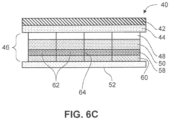
- Figs. 6A-6C show some embodiments of an exemplary transdermal patch, device or system, generally designated at 40, having internal segmented layers therein.
- Figure 6A describe a reference-embodiment, whereas the transdermal delivery systems shown in Figures 6B and 6C are according to the claimed invention.
- the device includes a backing layer 42, one or more adhesive interfacing layers 44, a segmented intermediate layer 46, and a release liner 52.
- the intermediate layer comprises an adhesive layer 50 comprising the drug or therapeutic agent.
- the intermediate layer comprises the adhesive drug layer 50 and a backing layer 48.
- one or more of the backing layer, interfacing layer(s), and intermediate layer(s) are laminated together to form the transdermal patch.
- the transdermal delivery system 40 comprises a backing or overlay layer 42, an adhesive interfacing layer 44, a segmented intermediate layer 46, and a release liner 52.
- the segmented intermediate layer comprises a backing layer 48 that may be occlusive or breathable, an adhesive drug layer 50, a rate-controlling tie layer or membrane 58, and a contact adhesive layer 60.
- the interfacing adhesive layer or layers adheres or connects the backing layer to the segmented patch layers (at least the uppermost layer).
- the interfacing layer is comprised of one or more polymers selected from acrylates, polyisobutylenes, silicone adhesives, polystyrene butyl rubber, polyethylene vinyl acetate and copolymers thereof.
- the interfacing adhesive layers are comprised of a cross-linked acrylate adhesive or its mixture. Exemplary cross-linked acrylate adhesives include the adhesives sold under the name Duro-Tak ® .
- Duro-Tak ® adhesives include Duro-Tak ® 387-2516, Duro-Tak ® 387-2852, Duro-Tak ® 87-2052 or mixtures thereof.
- at least one interfacing adhesive layer comprises a polyisobutylene (PIB) or acrylate adhesive containing crospovidone or colloidal silicone dioxide matrix modifiers.
- the interfacing layer comprises one or more adhesive layers.
- the interfacing layer comprises a plurality of adhesive layers.
- the interfacing layer comprises at least a first adhesive layer 54 and a second adhesive layer 56 .
- the first adhesive layer is formed of a material having good adhesion to the backing layer material. In embodiments, the first adhesive layer should not bleed into the backing layer, especially where the backing layer is a fabric.
- the second adhesive layer is preferably formed of a material having good adhesion to the proximal layer of the segmented patch. In some embodiments, the second adhesive layer is formed of a material having good adhesion to skin. It will be appreciated that the interfacing layer is comprised of at least one or a plurality of adhesive layers.
- the interfacing adhesive layer or at least one layer of the interfacing layer overlays or overhangs at least one edge of at least one of the segmented patch layers. In some embodiments, the adhesive layer or layers overhang about 0.5-1.0 cm of at least one edge of at least one of the segmented patch layers. It will be appreciated that one or more or all of the backing layer, first adhesive layer and second adhesive layer may overlay or overhang at least one edge of the segmented patch layers. It will further be appreciated that the backing layer, first adhesive layer and/or the second adhesive layer may overlay or overhang the same or different amounts.
- one or more of the interfacing adhesive layers is comprised of one or more pressure sensitive adhesive polymers.
- the adhesive polymer is an acrylic polymer.
- the adhesive polymer is an acrylic pressure sensitive adhesive polymer.
- the acrylic polymer is an acrylate or acrylate copolymer, or polyacrylate adhesive polymer.
- An acrylic pressure sensitive adhesive polymer is a polyacrylate that is a polymer of copolymer of a monomer or monomers selected from acrylic acid esters and methacrylic acid esters. Other monomers, such as acrylic acid and vinyl acetate, may be present.
- the acrylic polymer is based on acrylic esters such as 2-ethylhexyl acrylate (2-EHA) and ethyl acrylate.
- the polyacrylate polymer is a polymer or a copolymer of a monomer or monomers selected from acrylic acid and vinyl acetate.
- the acrylic polymer adhesive has pendent carboxyl (-COOH) or hydroxyl (-OH) functional groups.
- the acrylic polymer adhesive comprises at least one of polyacrylate, polymethacrylate, derivatives thereof, and co-polymers thereof.
- the acrylic adhesive is comprised of an acrylate copolymer comprising acrylic ester monomers or vinyl acetate monomers. Exemplary acrylate copolymers are sold under the trade-name DURO-TAK ® .
- one or more of the interfacing adhesive layers is comprised of one or more polymers comprising a pyrrolidone group, polyisobutylenes, polybutenes, mixtures and co-polymers thereof.
- one or more of the interfacing adhesive layers is comprised of a crosslinked polyvinylpyrrolidone.
- One exemplary polyvinylpyrrolidone is a crospovidone such as the micronized crospovidone sold under the name Kollidon ® CL-M available from BASF.
- the adhesive matrix comprises a blend or mixture of polyisobutylene and polybutene polymers.
- Polyisobutylene is a vinyl polymer comprised of the isobutylene monomer.
- Polybutene is a viscous, non-drying, liquid polymer, prepared by copolymerization of 1- and 2-butene with a small quantity of isobutylene.
- the polybutene in one embodiment has a molecular weight of between about 750-6000 Daltons, preferably between about 900-4000 Daltons, and preferably between about 900-3000 Daltons.
- the mixture comprises polybutene in the polyisobutylene blend at about 40 weight percent. More generally, the polybutene is present in the polyisobutylene blend in an amount between 20-50 weight percent, or between 25-45 weight percent.
- one or more of the interfacing adhesive layers is comprised of one or more silicone based adhesives, a medical adhesive, a tissue adhesive, a surgical adhesive, or a combination of adhesives. It will be appreciated that the adhesives and features as described for above embodiments may be used in the present embodiments.
- the interfacing adhesive layers have a thickness of about 0.5-5 mil. In non-limiting embodiments, the interfacing adhesive layers have a thickness of between about 0.5-0.75 mil, 0.5-1 mil, 0.5-1.5 mil, 0.5-2 mil, 0.5-2.5 mil, 0.5-3 mil, 0.5-3.5 mil, 0.5-4 mil, 0.5-4.5 mil, 0.75-1 mil, 0.75-1.5 mil, 0.75-2 mil, 0.75-2.5 mil, 0.75-3 mil, 0.75-3.5 mil, 0.75-4 mil, 0.75-4.5 mil, 0.75-5 mil, 1-1.5 mil, 1-2 mil, 1-2.5 mil, 1-3 mil, 1-3.5 mil, 1-4 mil, 1-4.5 mil, 1-5 mil, 1.5-2 mil, 1.5-2.5 mil, 1.5-3 mil, 1.5-3.5 mil, 1.5-4 mil, 1.5-4.5 mil, 1.5-5 mil, 2-2.5 mil, 2-3 mil, 2-3.5 mil, 2-4 mil, 2-4.5 mil, 2-5 mil, 2.5-3 mil, 2.5-3.5 mil, 2.5-4 mil, 2.5-4.5 mil, 2.5-5 mil, 3-3.5 mil, 3-4 mil, 3-4.5 mil, 2
- the interfacing adhesive layers have a thickness of about 0.5 mil, 1 mil, 1.5 mil, 2 mil, 2.5 mil, 3 mil, 3.5 mil, 4 mil, 4.5 mil, or 5 mil.
- a mil equals 0.0254 mm.
- An intermediate layer 46 is positioned between the interfacing adhesive layer 44 and the release liner 52 or skin.
- the intermediate layer is segmented, divided, cut, or otherwise separated into a plurality of sectioned parts.
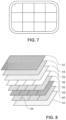
- Fig. 7 is an illustration of the segmented intermediate layer 46 as viewed from above.
- the overhang of the backing layer 42 and/or interfacing adhesive layer 44 is shown around the circumference of the intermediate layer.
- the segments are made by cuts or divisions 64 in a crosshatch pattern.
- the segments are made by cuts or divisions along the length and width (in this top-down view) of the intermediate layer. It will be appreciated that the segments may be formed by cuts or divisions along the length or width of the intermediate layer.
- the patch segments or portions 62 will have an elongated strip shape.
- the cuts or divisions preferably are made through the entirety of the intermediate layer.
- the intermediate layer is made up of a plurality of patch segments or portions 62.
- the cuts or divisions allow movement of the portions within the patch including movement in different directions.
- the cuts or incisions do not extend across the entirety of the layer such that the layer is not divided into separate segments. As shown in Fig. 9 , the cuts or incisions may not intersect and/or may not extend to an edge of the layer.
- Each segment or portion may have size (from a top/bottom view) of about 2-30 cm 2 .
- each segment or portion may have a size of about 2-25 cm 2 , 2-20 cm 2 , 2-15 cm 2 , 2-10 cm 2 , 2-5 cm 2 , 5-30 cm 2 , 5-25 cm 2 , 5-20 cm 2 , 5-15 cm 2 , 5-10 cm 2 , 10-30 cm 2 , 10-25 cm 2 , 10-20 cm 2 , 10-15 cm 2 , 15-30 cm 2 , 15-25 cm 2 , 15-20 cm 2 , 20-30 cm 2 , 20-25 cm 2 , or about 25-30 cm 2 . It will be appreciated that the segments may have the same or different sizes.
- the size of the segments near the outer edge of the patch may have a larger or smaller size than segments positioned near the center of the patch.
- the segments may have any shape as suitable for forming the intermediate layer and providing movement within the patch.
- the segments have a square, rectangular or other polygonal shape. It will be appreciated that the segments may all have the same or different shapes within a single layer.
- the intermediate layer comprises a plurality of layers.
- the intermediate layer comprises at least an intermediate backing layer 48 and an adhesive drug layer 50 comprising an active agent, therapeutic agent or drug.
- the adhesive backing layer 48 is positioned between the interfacing layer 44 or layers and the adhesive drug layer 50. It will be appreciated that one or more of the plurality of individual layers of the intermediate layer may include cuts, incisions or divisions at least partially through the respective layer.
- the intermediate backing layer may be formed of materials as described for backing layers above.
- the intermediate backing layer is formed of an occlusive material.
- the intermediate backing layer is formed of an occlusive polymer film or laminate.
- the intermediate backing layer is formed of a breathable material.
- the intermediate backing layer comprises a polymer film comprised of a polymer selected from at least one of polyesters, polyethylenes, polypropylenes, nylon, and/or polystyrenes.
- the polymer is selected from at least one of polyethylene terephthalate, ethylene vinyl acetate, polyethylene vinylacetate copolymer, polystyrene, and/or polyvinylchloride, and copolymers thereof.
- the intermediate backing layer is comprised of a polyethylene terephthalate/ethylene vinyl acetate laminate such as the Scotchpak TM 1012 (3M).
- the intermediate layer further comprises one or more adhesive drug (active agent or therapeutic agent) layers 50 positioned between the intermediate backing layer and the release liner 52 where present.
- the adhesive drug layer comprises one or more active agent, therapeutic agent or drug as described above.
- the adhesive/drug layer as described above is useful for use in this embodiment.
- the intermediate layer comprises one or more additional layers.
- the intermediate layer includes at least one tie layer 58.
- the tie layer is positioned between the adhesive drug layer and the release liner where present.
- the tie layer is an adhesive tie layer as described above.
- the tie layer is comprised of a nonwoven fabric or a nonwoven, porous polymer membrane material.
- the tie layer is a rate controlling membrane.
- the tie layer is comprised of a microporous polypropylene film.
- One exemplary film is the Celgard 2400 microporous film.
- the intermediate layer comprises one or more contact adhesive layers 60 positioned between the adhesive drug layer or tie layer, where present, and the release liner, where present.
- the contact adhesive layer adheres the patch to the subject's skin.
- the contact adhesive layer may be formed of one or more adhesives useful for adhering a patch to skin as described above.
- Fig. 8 which shows a transdermal delivery device according to the claimed invention, is an exploded view of one embodiment of a transdermal patch 40 comprising a segmented intermediate layer 46.
- the patch in this embodiment comprises, in order, a bi-elastic fabric backing layer 42, a first interfacing adhesive layer 54 formed of a first polymer film, a second interfacing adhesive layer 56, formed of a second polymer film that is different than the first polymer film, a segmented intermediate layer 46, and a protective release liner 52 .
- the segmented intermediate layer comprises an occlusive backing layer 48, an adhesive drug layer 50, a rate-controlling tie layer 58, and a contact adhesive layer 60.
- the backing layer has a thickness of between about 0.5-3 mil. In some embodiments, the backing layer has a thickness of about 0.5-0.75 mil, 0.5-1 mil, 0.5-1.5 mil, 0.5-2 mil, 0.5-2.5 mil, 0.75-1 mil, 0.75-1.5 mil, 0.75-2 mil, 0.75-2.5 mil, 0.75-3 mil, 1-1.5 mil, 1-2 mil, 1-2.5 mil, 1-3 mil, 1.5-2 mil, 1.5-2.5 mil, 1.5-3 mil, 2-2.5 mil, 2-3 mil, or 2.5-3 mil. In embodiments, the adhesive drug layer has a thickness of between about 1 to 25 mil.
- the adhesive drug layer has a thickness of between about 1-20 mil, 1-15 mil, 1-10 mil, 1-5 mil, 5-25 mil, 5-20 mil, 5-15 mil, 5-10 mil, 10-25 mil, 10-20 mil, 10-15 mil, 15-25 mil, or 15-20 mil.
- the rate-controlling tie layer has a thickness of between about 0.5 to 10 mil.
- the tie layer has at thickness of about 0.5-9 mil, 0.5-8 mil, 0.5-7 mil, 0.5-6 mil, 0.5-5 mil, 0.5-4 mil, 0.5-3 mil, 0.5-2 mil, 0.5-1.5 mil, 0.5-1 mil, 0.5-0.75 mil, 0.75-10 mil, 0.75-9 mil, 0.75-8 mil, 0.75-7 mil, 0.75-6 mil, 0.75-5 mil, 0.75-4 mil, 0.75-3 mil, 0.75-2 mil, 0.75-1.5 mil, 0.75-1 mil, 1-10 mil, 1-9 mil, 1-8 mil, 1-7 mil, 1-6 mil, 1-5 mil, 1-4 mil, 1-3 mil, 1-2 mil, 1-1.5 mil, 1.5-10 mil, 1.5-9 mil, 1.5-8 mil, 1.5-7 mil, 1.5-6 mil, 1.5-5 mil, 1.5-4 mil, 1.5-3 mil, 1.5-2 mil, 2-10 mil, 2-9 mil, 2-8 mil, 2-7 mil, 2-6 mil, 2-5 mil, 2-4 mil, 2-3 mil, 3-10 mil, 3-9 mil, 3-8 mil, 3-7 mil, 3-6 mil, 3-5 mil, 3
- the contact adhesive layer has a thickness of about 1 to 5 mil. In some embodiments, the contact adhesive layer has a thickness of about 1-4 mil, 1-3 mil, 1-2 mil, 2-5 mil, 2-4 mil, 2-3 mil, 3-5 mil, 3-4 mil, or 4-5 mil. Hereby a mil equals 0.0254 mm.
- Examples 4-6 which are reference-examples, describe in vivo adhesion studies of patches including a segmented layer and having various formulations and configurations. The results of these studies are presented in Table 1.
- Table 1 Adhesion Study Results
- Example 4 Example 5
- Example 6 Formulation # Test subjects 18 (total) 9 9 14 (total) 7 7 7 Breathable Top Layer Control KOB PU KOB KOB KOB KOB KOB KOB Border distance (cm) 0 0 0 0 0.5 1 0 0.5 Mean Adhesion Score 2.2 1.3 1.8 1.9 1.8 0.2 1.0 0.5
- Example 4 considered the effect of a segmented intermediate layer on a transdermal patch as well as the effect of the backing layer composition on patch adhesion.
- Both of the patches including a segmented intermediate layer had a lower adhesion score indicating a greater percentage of the patch area adhered to the skin over the seven days of wear.
- the adhesion score was ⁇ 2 so that ⁇ 75% to ⁇ 90% of the patch remained adhered to the skin over the test period.
- the patch without a segmented layer had a much lower adhesion score where at least 25% (and up to half) of the patch lifted off the skin.
- the patch comprising a woven bi-elastic polyester fabric (KOB 053 available from Karl Otto GmbH & Co.) as the backing layer had better adhesion than the patches having a polyurethane film backing layer.
- Example 5 considered the effect of having the backing layer overhang the segmented intermediate layer.
- Transdermal patches were prepared with the same composition and layers.
- a control patch had no overhang where the edge of the backing layer was flush with the edge of the intermediate layer.
- the control was compared to patches having an overhang of 0.5 cm or 1.0 cm.
- the patch having the 1.0 cm had exceptional adhesion where nearly 90% of the patch area remained adhered to the skin.
- the control and 0.5 cm overhang patches both had good adhesion with an adhesion score of less than 2 so that ⁇ 75% to ⁇ 90% of the patch remained adhered.
- the use of a border or overhang improved adhesion as compared to the patch without a border.
- Example 6 considered the effect of different compositions and configurations of the segmented intermediate layer on adhesion.
- a control patch without overhang (where the edge of the backing layers was flush with the edge of the intermediate layer) was compared to a patch having an overhang of a 0.5 cm border.
- the patch having a 0.5 cm border had over 90% adhesion.
- an improvement in adhesion over the patch with an overhang may be achieved by adjusting the formulation.
- segmenting at least a portion of the transdermal patch provided an increase in skin adhesion, especially over an extended wear duration.
- the transdermal patch including a segmented portion may be prepared to have a thickness such that the desired amount of drug formulation is contained within the patch including the desired components while maintaining a thickness that is wearable and comfortable for the subject as described above.
- the transdermal patch has a size or surface area of about 5-200 cm 2 . In some non-limiting embodiments, the transdermal patch has a size or surface area of about 5-10 cm 2 , 5-15 cm 2 , 5-20 cm 2 , 5-25 cm 2 , 5-30 cm 2 , 5-40 cm 2 , 5-45 cm 2 , 5-50 cm 2 , 5-60 cm 2 , 5-70 cm 2 , 5-75 cm 2 , 5-80 cm 2 , 5-90 cm 2 , 5-100 cm 2 , 5-125 cm 2 , 5-150 cm 2 , 5-175 cm 2 , 10-15 cm 2 , 10-20 cm 2 , 10-25 cm 2 , 10-30 cm 2 , 10-40 cm 2 , 10-45 cm 2 , 10-50 cm 2 , 10-60 cm 2 , 10-70 cm 2 , 10-75 cm 2 , 10-80 cm 2 , 10-90 cm 2 , 10-100 cm 2 , 10-125 cm 2 , 10-150 cm 2 , 10-175 cm 2 , 10-200 cm 2 , 15-20 cm 2
- the transdermal patch has a size or surface area of about 5 cm 2 , 10 cm 2 , 15 cm 2 , 20 cm 2 , 25 cm 2 , 30 cm 2 , 40 cm 2 , 45 cm 2 , 50 cm 2 , 60 cm 2 , 70 cm 2 , 75 cm 2 , 80 cm 2 , 90 cm 2 , 100 cm 2 , 125 cm 2 , 150 cm 2 , 175 cm 2 , or 200 cm 2 .
- transdermal patch for use in prolonged or long term administration of an active agent is provided herein.
- the systems described herein may be used for treating or preventing any condition receptive to treatment with a therapeutic agent, drug or active agent as described herein.
- the systems described herein are particularly useful for long term transdermal administration of the therapeutic agent, drug or active agent.
- the transdermal device is suitable for administration of the active agent or agents for at least about 3-14 days or more.
- a thin layer of a stretchable or flexible polymer (1-40 mil) is laminated onto an occlusive backing (e.g. Scotchpak ® 1012, polyester film laminate) with an adhesive such as polyisobutylene (PIB), acrylate, a silicone adhesive or other binding agent to form a laminate consisting of occlusive backing/adhesive/stretchable or flexible polymer.
- an adhesive such as polyisobutylene (PIB), acrylate, a silicone adhesive or other binding agent to form a laminate consisting of occlusive backing/adhesive/stretchable or flexible polymer.
- An adhesive drug formulation is blended, coated on a release liner, and dried.
- the adhesive drug formulation is laminated on the stretchable or flexible polymer side of the backing laminate.
- a thin polyurethane film (0.5 to 1.0 mil) with a paper carrier (e.g. 3M COTran TM 9701 Backing, 2 mil polyurethane film) is used as the top layer.
- a paper carrier e.g. 3M COTran TM 9701 Backing, 2 mil polyurethane film
- An occlusive backing (e.g. Scotchpak ® 1012, polyester film laminate) is laminated on the polyurethane film with an adhesive such as polyisobutylene (PIB), acrylate, a silicone adhesive or other binding agent to make a quad laminate consisting of a paper carrier/polyurethane/adhesive/occlusive backing.
- PIB polyisobutylene
- the occlusive backing layer is kiss-cut to divide it into multiple, discrete pieces as attached on the flexible elastic layer such as a polyurethane film.
- each discrete occlusive backing piece ranges from about 10 cm2 to about 40 cm2 depending on requirements.
- Each of the discrete backing pieces are adhered or stuck together on the polyurethane film by the adhesive.
- the laminate may be rolled in further converting process.
- An adhesive drug formulation is blended, coated on a release liner, and dried.
- the adhesive drug formulation is laminated on a discretely, kiss-cut occlusive film side of the backing laminate as prepared in Example 2.
- the paper carrier is removed from the polyurethane side to leave the final formulation laminate. It is die-cut into a required size which is a large patch containing multiple discrete pieces of occlusive film but all other layers are continuous.
- An exemplary patch is shown in Fig. 4B .
- a control patch comprising a flexible, occlusive backing comprised of a laminate of polyester and ethylene vinyl acetate copolymers (Scotchpak ® 1012 available from 3M), an adhesive layer, and a release liner.
- the adhesive formulation consisted of 8.03 wt% fumed silica (Aerosil ® 200P), 11.69 wt% propylene glycol, and 80.28 wt% Duro-Tak ® 387-2287 adhesive.
- the adhesive was coated on a release liner and dried.
- a nonwoven PET fabric tie layer (Remay 2250) was imbedded between two adhesive layers. One of the release liners was replaced with the backing layer for form the final control laminate.
- the control patch was formed by cutting the final laminate to a suitable size rectangular patch.
- a first segmented test patch comprising flexible, occlusive backing comprised of a polyurethane film (3M 9832 Polyurethane film, 0.8 mil), an interfacing adhesive layer (polyisobutylene), a segmented intermediate layer, and a release liner.
- the occlusive backing layer was laminated to the interfacing adhesive layer.
- the intermediate layer was formed using the adhesive formulation as described above and cut into twelve separate pieces.
- the separated adhesive layer was laminated with the laminated backing/interfacing layer and a release liner. The laminate was cut to a suitable size rectangular patch.
- a second segmented test patch comprising a flexible, occlusive backing comprised of a woven polyethylene terephthalate (PET) KOB fabric (15 mil), a first interfacial adhesive layer (Duro-Tak ® 387-2516 adhesive with a coat weight, 3 mg/cm 2 ), a second interfacial adhesive layer (a mixture of PIB adhesive with a coat weight of 5 mg/cm 2 ), a segmented intermediate layer, and a release liner.
- PET polyethylene terephthalate
- the occlusive backing layer was laminated to the first and second interfacing adhesive layers.
- the intermediate layer was formed using the adhesive formulation as described above and cut into twelve separate pieces.
- the separated adhesive layer was laminated to the laminated backing/interfacing layers.
- the laminate was cut to a suitable size rectangular patch.
- Fig. 3 illustrates a patch according to the second segmented test patch.
- a control patch and a first or second segmented test patch was applied to intact, healthy skin on the back of each of 18 volunteers.
- Nine volunteers wore the patches with woven PET fabric/PIB layer and the other nine volunteers wore the patches with polyurethane/Duro-Tak ® 387-2516/PIB layer.
- Each score was weighted by multiplying score by number of subjects having the score. All of the scores were added and averaged by dividing the total score by the total number of test subjects in order to calculate the daily average adhesion score over 7 days. The daily individual scores across the 7 days were averaged again to determine the 7 day mean adhesion score.
- the 7 day mean adhesion scores were 1.3 for the woven PET fabric from KOB, 1.8 for 0.8 mil polyurethane film, and 2.2 for the control, respectively.
- the breathable top layer improved the adhesion with the segmented patch design significantly.
- the woven PET fabric performed better than polyurethane film as the breathable top layer.
- a placebo adhesive formulation comprised layer comprised 15% Eudragit ® EPO, 10 wt% triethyl citrate, 5 wt% SPAN 20, 10 wt% glycerin, 13 wt% Kollidon ® CL-M, and 47 wt% of Duro-Tak ® 387-2287 acrylate adhesive.
- a placebo adhesive layer was formed by laminating an occlusive backing (Scotchpak ® 1012) with a layer of the placebo adhesive formulation (coat weight of 10 mg/cm 2 (2 mil)), a rate-controlling tie layer (Celgard ® 2400), and a contact adhesive layer (5 wt% SPAN 20 (sorbitan monolaurate), 10 wt% triethyl citrate, 20 wt% Kollidon ® CL-M and 65 wt% of Duro-Tak ® 387-2287 (coat weight of 5 mg/cm 2 )) to form an adhesive laminate.
- a test patch was formed by placing an occlusive backing (Scotchpak ® 1012) on top of the adhesive formulation layer and placing a release liner (Loparex ® 7300) on the bottom of the contact adhesive layer.
- the first interfacial adhesive was Duro-Tak ® 387-2516 with a coat weight of 3 mg/cm 2 .
- the second interfacial adhesive was a mixture of PIB adhesive (80 wt%) and Kollidon ® CL-M (20 wt%) with a coat weight of 5 mg/cm 2 .
- test patches were cut into 12 pieces, which were integrated by placing the breathable top layer laminate over the patch (over the occlusive backing layer).
- a control patch was prepared by integrating the breathable PET fabric/interfacial adhesive laminate such that the edge of the breathable top layer was flush with the integrated patch edge without extended border of the breathable laminate.
- a first overlaid patch was formed by integrating the breathable PET fabric/interfacial adhesive laminate such that the edge of the breathable top layer extended beyond the integrated patch edge by 0.5 cm.
- a second overlaid patch was formed by PET fabric/interfacial adhesive laminate such that the edge of the breathable top layer extended beyond the integrated patch edge by 1.0 cm.
- Each of the control, first overlaid patch and second overlaid patch were assembled to a rectangular patch.
- a control patch and a first or second overlaid test patch was applied to intact, healthy skin on the back of each of 14 volunteers. Seven volunteers wore a control and a first overlaid patch (0.5 cm) and the other seven volunteers wore a control patch and a second overlaid patch (1.0 cm) for seven days.
- control, first overlaid patch and second overlaid patch were evaluated for their adhesion for 7 days in comparison to the control without border.
- Each patch was scored for the degree of adhesion to the skin every day for 7 days according to the scale as in Example 4.
- Each score was weighted by multiplying the score by number of subjects having the score, and all the scores were added up and averaged by dividing total score by total number of test subjects to calculate daily average adhesion score every day over 7 days. The daily Individual scores across 7 days were averaged again to determine the 7 day mean adhesion score.
- the border improved the adhesion of the patches with the patches having the 1.0 cm border and the patches remain adhered for all seven subjects for 7 days.
- a breathable top layer was prepared by laminating a 15 mil thick bi-elastic woven PET fabric (KOB 053 available from Karl Otto Braun GmbH & Co. KG), a first interfacial adhesive layer (Duro-Tak ® 387-2516 (10 wt%) mixed with Duro-Tak ® 387-2287 (90 wt%) with a coat weight of 3 mg/cm 2 ) and a second interfacial adhesive layer (a mixture of PIB adhesive (80 wt%) and Kollidon ® CL-M (20 wt%) with a coat weight of 5 mg/cm 2 ).
- a first interfacial adhesive layer (Duro-Tak ® 387-2516 (10 wt%) mixed with Duro-Tak ® 387-2287 (90 wt%) with a coat weight of 3 mg/cm 2 )
- a second interfacial adhesive layer a mixture of PIB adhesive (80 wt%) and Kollidon ® CL-M (20
- a drug-in-adhesive layer (test formulation) comprised 2.59 wt% sodium bicarbonate, 10 wt% triethyl citrate, 2 wt% SPAN 20, 3 wt% lauryl lactate, 10 wt% glycerin, 15 wt% Kollidon ® CL-M, and 57.41 wt% of Duro-Tak ® 387-2287 acrylate adhesive.
- the drug-in-adhesive layer (coat weight 10 mg/cm 2 , 2 mil) was laminated with a rate controlling membrane (Celgard ® 2400), and a contact adhesive layer (2 wt% SPAN 20 (sorbitan monolaurate), 3 wt% lauryl lactate, 10 wt% triethyl citrate, 20 wt% Kollidon ® CL-M and 65 wt% of Duro-Tak ® 387-2287; coat weight of the contact adhesive was 5 mg/cm 2 ) to form an adhesive laminate.
- An occlusive backing (Scotchpak ® 1012), the adhesive laminate and a release liner (Loparex ® 7300) were laminated to form an intermediate layer.
- the occlusive backing and adhesive laminate layer were segmented into 12 pieces, which were integrated by placing the breathable top layer laminate over the patch (on the occlusive backing layer) to form the test patch.
- Two patches were prepared using the intermediate layer. For the first, the breathable top layer was placed so that the edge of the top layer was flush with the edge of the intermediate layer. For the second, the breathable top layer was placed so that the edge of the top layer extended beyond the first intermediate layer by 0.5 cm.
- control and test patch were a rectangular patch.
- Example 4 Patches were tested for 9 volunteers in the same way as Example 4. Each volunteer wore two patches, one without a border and the other with a border, 0.5 cm. Each patch was scored for the degree of adhesion to the skin every day for 7 days in the same way as Example 4.
- Each score was weighted by multiplying score by number of subjects having the score and all the scores were added up and averaged by dividing the total score by the total number of test subjects to calculate daily adhesion score every day over the 7 days. The averaged daily scores across the 7 days were averaged to determine the mean adhesion score for the 7 days.
- the 7 day mean adhesion score was 0.5 for the 0.5 cm border and 1.0 for the control without border.
- a thin layer of KOB 053 woven polyester fabric (Karl Otto GmbH & Co.) is laminated onto a Scotchpak TM 1012 (3M ® ) polyester film laminate with Duro-Tak 87-2052, an acrylate copolymer pressure sensitive adhesive (Henkel Corporation) to form a laminate consisting of woven fabric/adhesive/polymer film.
- An adhesive drug formulation is blended, coated on a release liner, and dried.
- the adhesive drug formulation is laminated on the polymer film side of the backing laminate.
Landscapes
- Health & Medical Sciences (AREA)
- Engineering & Computer Science (AREA)
- Bioinformatics & Cheminformatics (AREA)
- Life Sciences & Earth Sciences (AREA)
- Dermatology (AREA)
- Public Health (AREA)
- Veterinary Medicine (AREA)
- Animal Behavior & Ethology (AREA)
- General Health & Medical Sciences (AREA)
- Chemical & Material Sciences (AREA)
- Pharmacology & Pharmacy (AREA)
- Epidemiology (AREA)
- Medicinal Chemistry (AREA)
- Anesthesiology (AREA)
- Biomedical Technology (AREA)
- Heart & Thoracic Surgery (AREA)
- Hematology (AREA)
- Proteomics, Peptides & Aminoacids (AREA)
- Inorganic Chemistry (AREA)
- Medicinal Preparation (AREA)
- Pharmaceuticals Containing Other Organic And Inorganic Compounds (AREA)
- Medicines That Contain Protein Lipid Enzymes And Other Medicines (AREA)
Applications Claiming Priority (3)
| Application Number | Priority Date | Filing Date | Title |
|---|---|---|---|
| US201562273288P | 2015-12-30 | 2015-12-30 | |
| US201662367055P | 2016-07-26 | 2016-07-26 | |
| PCT/US2016/069558 WO2017117554A1 (en) | 2015-12-30 | 2016-12-30 | Systems and methods for long term transdermal administration |
Publications (3)
| Publication Number | Publication Date |
|---|---|
| EP3397250A1 EP3397250A1 (en) | 2018-11-07 |
| EP3397250B1 true EP3397250B1 (en) | 2024-09-25 |
| EP3397250C0 EP3397250C0 (en) | 2024-09-25 |
Family
ID=57861282
Family Applications (1)
| Application Number | Title | Priority Date | Filing Date |
|---|---|---|---|
| EP16829220.9A Active EP3397250B1 (en) | 2015-12-30 | 2016-12-30 | Systems for long term transdermal administration |
Country Status (11)
| Country | Link |
|---|---|
| US (6) | US10835499B2 (enExample) |
| EP (1) | EP3397250B1 (enExample) |
| JP (1) | JP6833855B2 (enExample) |
| KR (1) | KR102774558B1 (enExample) |
| CN (1) | CN108697655B (enExample) |
| AU (2) | AU2016381351B2 (enExample) |
| IL (2) | IL303255A (enExample) |
| MX (1) | MX2018008190A (enExample) |
| RU (1) | RU2737464C2 (enExample) |
| SG (1) | SG11201805570WA (enExample) |
| WO (1) | WO2017117554A1 (enExample) |
Families Citing this family (22)
| Publication number | Priority date | Publication date | Assignee | Title |
|---|---|---|---|---|
| JP2018511355A (ja) | 2015-01-28 | 2018-04-26 | クロノ セラピューティクス インコーポレイテッドChrono Therapeutics Inc. | 薬剤送達方法及びシステム |
| AU2016228779A1 (en) | 2015-03-12 | 2017-09-07 | Chrono Therapeutics Inc. | Craving input and support system |
| US10835499B2 (en) | 2015-12-30 | 2020-11-17 | Corium, Inc. | Systems and methods for long term transdermal administration |
| CN109922796B (zh) | 2016-06-23 | 2023-04-07 | 考里安有限责任公司 | 具有亲水和疏水域的粘合剂基质和治疗剂 |
| JP7071330B2 (ja) | 2016-07-27 | 2022-05-18 | コリウム, インコーポレイテッド | 炭酸水素ナトリウムのin situ変換で促進されたアミン薬物の経皮送達 |
| KR102424270B1 (ko) * | 2016-07-27 | 2022-07-25 | 코리움, 인크. | 경구 전달과 생물학적으로 동등한 약물동역학을 가진 경피 전달 시스템 |
| EP3490544A1 (en) | 2016-07-27 | 2019-06-05 | Corium International, Inc. | Memantine transdermal delivery systems |
| WO2018129304A1 (en) | 2017-01-06 | 2018-07-12 | Chrono Therapeutics Inc. | Transdermal drug delivery devices and methods |
| US11052054B2 (en) * | 2017-04-19 | 2021-07-06 | Inep Europe Sarl | Method for manufacturing a transdermal device |
| US20180303764A1 (en) * | 2017-04-19 | 2018-10-25 | Inep Europe Sarl | Method for manufacturing a transdermal device |
| EP3658127A1 (en) * | 2017-07-26 | 2020-06-03 | Corium, Inc. | Transdermal delivery system with a microporous membrane having solvent-filled pores |
| WO2019126531A1 (en) | 2017-12-20 | 2019-06-27 | Corium, Inc. | Transdermal adhesive composition comprising a volatile liquid therapeutic agent having low melting point |
| AU2019279884B2 (en) | 2018-05-29 | 2025-01-30 | Morningside Venture Investments Limited | Drug delivery methods and systems |
| US20200121507A1 (en) | 2018-10-18 | 2020-04-23 | Moldex-Metric, Inc. | Foam earplug with transdermal material |
| CN112206222A (zh) * | 2018-11-09 | 2021-01-12 | 北京德默高科医药技术有限公司 | 含有布洛芬结构类似物的多层经皮给药系统 |
| JP2022507660A (ja) | 2018-11-16 | 2022-01-18 | モーニングサイド ベンチャー インベストメンツ リミテッド | 温度によって調節される経皮薬剤送達システム |
| CN114269330B (zh) * | 2019-06-28 | 2025-07-22 | 帕斯帕特技术有限公司 | 透皮药物递送贴片、药物递送系统和药物递送方法 |
| RU2705896C1 (ru) * | 2019-07-26 | 2019-11-12 | Артем Олегович Бахметьев | Трансдермальный пластырь |
| US11471839B2 (en) * | 2019-08-06 | 2022-10-18 | Uop Llc | High selectivity membranes for hydrogen sulfide and carbon dioxide removal from natural gas |
| WO2021211915A1 (en) * | 2020-04-17 | 2021-10-21 | University Of Connecticut | Polycannabinoids, compounds, compositions and methods of use |
| US20210346207A1 (en) * | 2020-05-11 | 2021-11-11 | Marc Sheldon Stevens | Four-way stretch therapeutic compress assembly, system, and method |
| US11596772B2 (en) * | 2021-02-07 | 2023-03-07 | Lumen Catheters, LLC | Antimicrobial light-emitting percutaneous site dressing |
Family Cites Families (265)
| Publication number | Priority date | Publication date | Assignee | Title |
|---|---|---|---|---|
| US1880808A (en) | 1927-03-28 | 1932-10-04 | Eastman Kodak Co | Process of making cellulose esters of carboxylic acids |
| US1683347A (en) | 1927-08-25 | 1928-09-04 | Eastman Kodak Co | Process of making chloroform-soluble cellulose acetate |
| US1698049A (en) | 1928-01-18 | 1929-01-08 | Eastman Kodak Co | Process of making cellulosic esters containing halogen-substituted fatty-acid groups |
| US1984147A (en) | 1929-10-22 | 1934-12-11 | Eastman Kodak Co | Process for the production of cellulose esters and corresponding alkyl esters |
| US1880560A (en) | 1929-12-14 | 1932-10-04 | Eastman Kodak Co | Process for the hydrolysis of cellulose acetate |
| US1943119A (en) | 1929-12-17 | 1934-01-09 | Westinghouse Electric & Mfg Co | Circuitous elevator |
| US1939729A (en) | 1930-01-29 | 1933-12-19 | Thomas W Cohill | Elevator system |
| US2129052A (en) | 1936-02-04 | 1938-09-06 | Eastman Kodak Co | Hydrolyzed cellulose acetate |
| US3391142A (en) | 1966-02-09 | 1968-07-02 | Lilly Co Eli | Adamantyl secondary amines |
| NL134681C (enExample) | 1966-04-26 | |||
| US3546141A (en) | 1966-08-08 | 1970-12-08 | Mc Donnell Douglas Corp | Phosphorus-nitrogen polymers and process |
| US3493319A (en) | 1967-05-26 | 1970-02-03 | Us Agriculture | Esterification of cellulosic textiles with unsaturated long chain fatty acids in the presence of trifluoroacetic anhydride using controlled cellulose-acid-anhydride ratios |
| US4004654A (en) | 1971-07-07 | 1977-01-25 | Trebron Holdings Limited | Elevator structure supporting apparatus |
| NL7305644A (enExample) | 1972-04-20 | 1973-10-23 | ||
| DE2856393C2 (de) | 1978-12-27 | 1983-04-28 | Merz + Co GmbH & Co, 6000 Frankfurt | Arzneimittel zur Behandlung von Morbus Parkinson |
| US4752478A (en) | 1984-12-17 | 1988-06-21 | Merck & Co., Inc. | Transdermal system for timolol |
| DE3572485D1 (en) | 1984-12-22 | 1989-09-28 | Thomae Gmbh Dr K | Tetrahydro-benzothiazoles, their production and their use as intermediates or drugs |
| FR2576888B1 (fr) | 1985-02-05 | 1988-04-08 | Otis Elevator Co | Ascenseur transbordeur pour voies urbaines notamment |
| US4756710A (en) | 1985-04-05 | 1988-07-12 | Merck & Co., Inc. | pH-Mediated drug delivery system |
| US4880633A (en) | 1986-03-12 | 1989-11-14 | Merck & Co., Inc. | Transdermal drug delivery system |
| US4797284A (en) | 1986-03-12 | 1989-01-10 | Merck & Co., Inc. | Transdermal drug delivery system |
| DE3634016A1 (de) * | 1986-04-17 | 1987-10-29 | Lohmann Gmbh & Co Kg | Flaechenfoermiges therapeutisches system, verfahren zu seiner herstellung und seine verwendung |
| ATE71287T1 (de) | 1986-06-13 | 1992-01-15 | Alza Corp | Aktivierung eines transdermalen drogenabgabesystems durch feuchtigkeit. |
| US5686489A (en) | 1986-12-23 | 1997-11-11 | Tristrata Technology, Inc. | Alpha hydroxyacid esters for skin aging |
| US5071656A (en) | 1987-03-05 | 1991-12-10 | Alza Corporation | Delayed onset transdermal delivery device |
| DE3714140A1 (de) * | 1987-04-28 | 1988-11-10 | Lohmann Therapie Syst Lts | Wirkstoffhaltiges pflaster zur kontrollierten verabreichung von wirkstoffen an die haut, seine verwendung sowie verfahren zur gesteuerten verabreichung von wirkstoffen an die haut |
| US5538736A (en) * | 1987-04-28 | 1996-07-23 | Lts Lohmann Therapie-Systeme Gmbh | Active substance-containing plaster for the controlled administration of active substances to the skin |
| US4787888A (en) | 1987-06-01 | 1988-11-29 | University Of Connecticut | Disposable piezoelectric polymer bandage for percutaneous delivery of drugs and method for such percutaneous delivery (a) |
| FI95572C (fi) | 1987-06-22 | 1996-02-26 | Eisai Co Ltd | Menetelmä lääkeaineena käyttökelpoisen piperidiinijohdannaisten tai sen farmaseuttisen suolan valmistamiseksi |
| US4781924A (en) | 1987-11-09 | 1988-11-01 | Alza Corporation | Transdermal drug delivery device |
| US4837027A (en) | 1987-11-09 | 1989-06-06 | Alza Corporation | Transdermal drug delivery device |
| US4849224A (en) | 1987-11-12 | 1989-07-18 | Theratech Inc. | Device for administering an active agent to the skin or mucosa |
| US5656286A (en) | 1988-03-04 | 1997-08-12 | Noven Pharmaceuticals, Inc. | Solubility parameter based drug delivery system and method for altering drug saturation concentration |
| US5026556A (en) | 1988-11-10 | 1991-06-25 | Norwich Eaton Pharmaceuticals, Inc. | Compositions for the transdermal delivery of pharmaceutical actives |
| CA2007181C (en) | 1989-01-06 | 1998-11-24 | Angelo Mario Morella | Sustained release pharmaceutical composition |
| US5202128A (en) | 1989-01-06 | 1993-04-13 | F. H. Faulding & Co. Limited | Sustained release pharmaceutical composition |
| DE10299048I2 (de) | 1989-04-14 | 2006-07-13 | Merz Pharma Gmbh & Co Kgaa | Verwendung von Adamantan-Derivaten zur Pr{vention und Behandlung der cerebralen Isch{mie |
| DE3913734C2 (de) | 1989-04-26 | 1998-08-20 | Roehm Gmbh | Verwendung einer wäßrigen Hauthaftkleberlösung zur Herstellung einer mit Wasser leicht abwaschbaren Klebschicht |
| ATE107517T1 (de) | 1989-05-25 | 1994-07-15 | Takeda Chemical Industries Ltd | Transdermales therapeutisches mittel. |
| US5252588A (en) | 1990-04-27 | 1993-10-12 | Sekisui Kagaku Kogyo Kabushiki Kaisha | Percutaneously absorbable crosslinked polyvinylpyrrolidone eperisone or tolperisone preparation |
| IE62597B1 (en) | 1990-07-23 | 1995-02-08 | Alza Corp | Oral osmotic device for delivering nicotine |
| IT1243745B (it) | 1990-10-17 | 1994-06-21 | Vectorpharma Int | Composizioni terapeutiche transdermali contenenti farmaco e/o agente promotore dell'assorbimento cutaneo supportato su particelle microporose e microsfere polimeriche e loro preparazione. |
| US5614560A (en) | 1991-04-04 | 1997-03-25 | Children's Medical Center Corporation | Method of preventing NMDA receptor-mediated neuronal damage |
| US5123900A (en) * | 1991-08-16 | 1992-06-23 | Bertek, Inc. | Moisture permeable double disk |
| US5246705A (en) | 1992-04-08 | 1993-09-21 | Cygnus Therapeutic System | Occlusive, elastomeric backing materials in transdermal drug delivery systems, and associated methods of manufacture and use |
| JPH06199659A (ja) | 1992-10-28 | 1994-07-19 | Hisamitsu Pharmaceut Co Inc | 経皮治療用装置 |
| US5612411A (en) * | 1992-11-18 | 1997-03-18 | Kimberly-Clark Corporation | Absorbent phycocolloids and a method for their manufacture |
| US5489624A (en) * | 1992-12-01 | 1996-02-06 | Minnesota Mining And Manufacturing Company | Hydrophilic pressure sensitive adhesives |
| DE4310012A1 (de) | 1993-03-27 | 1994-09-29 | Roehm Gmbh | Dermales therapeutisches System aus einer schmelzfähigen Poly(meth)acrylat-Mischung |
| JPH06321445A (ja) | 1993-05-10 | 1994-11-22 | Toshiba Corp | エレベータ |
| US5424077A (en) | 1993-07-13 | 1995-06-13 | Church & Dwight Co., Inc. | Co-micronized bicarbonate salt compositions |
| US5567489A (en) * | 1993-09-16 | 1996-10-22 | The Dow Chemical Company | Multilayer halogen-free barrier film for ostomy and transdermal drug delivery applications |
| JP3135760B2 (ja) | 1993-10-18 | 2001-02-19 | 株式会社竹中工務店 | エレベータシステム |
| JPH07187525A (ja) | 1993-11-18 | 1995-07-25 | Masami Sakita | 複数ばこエレベータシステム |
| ATE194281T1 (de) | 1994-09-14 | 2000-07-15 | Minnesota Mining & Mfg | Matrix für transdermale wirkstofffreisetzung |
| US5557018A (en) | 1994-09-27 | 1996-09-17 | E. I. Du Pont De Nemours And Company | Partially flourinated polymers and process therefor |
| US5635203A (en) | 1994-09-29 | 1997-06-03 | Alza Corporation | Transdermal device having decreased delamination |
| CA2208132A1 (en) * | 1994-12-21 | 1996-06-27 | Theratech, Inc. | Transdermal delivery system with adhesive overlay and peel seal disc |
| WO1996040087A2 (en) | 1995-06-07 | 1996-12-19 | Cygnus, Inc. | Pressure sensitive acrylate adhesive composition cross-linked with aluminum acetylacetonate and containing a drug having a reactive aromatic hydroxyl group |
| US5785991A (en) * | 1995-06-07 | 1998-07-28 | Alza Corporation | Skin permeation enhancer compositions comprising glycerol monolaurate and lauryl acetate |
| US5730900A (en) | 1995-06-08 | 1998-03-24 | Fuji Photo Film Co., Ltd. | Film and process for preparation of the same and liquid crystal display |
| US5785153A (en) | 1995-11-29 | 1998-07-28 | Otis Elevator Company | Synchronizing elevator arrival at a level of a building |
| US5601156A (en) | 1995-11-29 | 1997-02-11 | Otis Elevator Company | Maintaining communications and power during transfer of horizontally moveable elevator cab |
| US5651426A (en) | 1995-11-29 | 1997-07-29 | Otis Elevator Company | Synchronous elevator shuttle system |
| US5758748A (en) | 1995-11-29 | 1998-06-02 | Otis Elevator Company | Synchronized off-shaft loading of elevator cabs |
| US5702720A (en) | 1995-12-22 | 1997-12-30 | Minnesota Mining And Manufacturing Company | Transdermal device for the delivery of flurbiprofen |
| US6929801B2 (en) | 1996-02-19 | 2005-08-16 | Acrux Dds Pty Ltd | Transdermal delivery of antiparkinson agents |
| TW513409B (en) | 1996-06-07 | 2002-12-11 | Eisai Co Ltd | Polymorphs of donepezil hydrochloride |
| US5861586A (en) | 1996-06-19 | 1999-01-19 | Otis Elevator Company | Horizontal and vertical passenger transport |
| US6512010B1 (en) | 1996-07-15 | 2003-01-28 | Alza Corporation | Formulations for the administration of fluoxetine |
| US5752585A (en) | 1996-07-25 | 1998-05-19 | Otis Elevator Company | Elevator shuttle with auxiliary elevators at terminals |
| US5924524A (en) | 1996-07-25 | 1999-07-20 | Otis Elevator Company | Integrated, multi-level elevator shuttle |
| US5958919A (en) | 1996-09-20 | 1999-09-28 | Washington University | Treatment of presymptomatic alzheimer's disease to prevent neuronal degeneration |
| ES2191834T3 (es) | 1996-10-24 | 2003-09-16 | Alza Corp | Agentes que facilitan la permeacion y destinados para composiciones, dispositivos y procedimientos de aporte transdermico de medicamentos. |
| CN1174031A (zh) | 1997-04-23 | 1998-02-25 | 谢先运 | 双氯芬酸钠透皮控释贴膏 |
| US5866585A (en) | 1997-05-22 | 1999-02-02 | Synchroneuron, Llc | Methods of treating tardive dyskinesia using NMDA receptor antagonists |
| US6174545B1 (en) | 1997-07-01 | 2001-01-16 | Alza Corporation | Drug delivery devices and process of manufacture |
| US20040018241A1 (en) | 1997-09-26 | 2004-01-29 | Noven Pharmaceuticals, Inc. | Bioadhesive compositions and methods for topical administration of active agents |
| US6193993B1 (en) | 1998-03-03 | 2001-02-27 | Eisai Co., Ltd. | Suppository containing an antidementia medicament |
| JP4205778B2 (ja) | 1998-04-17 | 2009-01-07 | 久光製薬株式会社 | 貼付製剤 |
| DE19820999A1 (de) * | 1998-05-11 | 1999-11-18 | Lohmann Therapie Syst Lts | Laminat zum Aufbringen auf einen Akzeptor |
| US6225348B1 (en) | 1998-08-20 | 2001-05-01 | Alfred W. Paulsen | Method of treating macular degeneration with a prostaglandin derivative |
| US6248363B1 (en) | 1999-11-23 | 2001-06-19 | Lipocine, Inc. | Solid carriers for improved delivery of active ingredients in pharmaceutical compositions |
| US6383471B1 (en) | 1999-04-06 | 2002-05-07 | Lipocine, Inc. | Compositions and methods for improved delivery of ionizable hydrophobic therapeutic agents |
| WO2001001962A1 (en) | 1999-07-05 | 2001-01-11 | Idea Ag. | A method for the improvement of transport across adaptable semi-permeable barriers |
| US6562368B2 (en) | 1999-12-16 | 2003-05-13 | Dermatrends, Inc. | Transdermal administration of oxybutynin using hydroxide-releasing agents as permeation enhancers |
| US20020192243A1 (en) | 1999-12-16 | 2002-12-19 | Tsung-Min Hsu | Transdermal and topical administration of drugs for the treatment of Alzheimer's disease using basic enhancers |
| US6455066B1 (en) | 2000-03-10 | 2002-09-24 | Epicept Corporation | Intradermal-penetration agents for topical local anesthetic administration |
| CA2415076C (en) | 2000-07-07 | 2010-04-13 | Mikhail M. Feldstein | Preparation of hydrophilic pressure sensitive adhesives having optimized adhesive properties |
| US7276249B2 (en) | 2002-05-24 | 2007-10-02 | Elan Pharma International, Ltd. | Nanoparticulate fibrate formulations |
| JP3962684B2 (ja) | 2000-11-06 | 2007-08-22 | サムヤン コーポレイション | 改善された水分吸収能および接着性を有する経皮投与剤 |
| US20040028724A1 (en) | 2000-11-07 | 2004-02-12 | Takaaki Terahara | Pharmaceutical preparation of percutaneous absorption type |
| JP4850346B2 (ja) | 2001-03-15 | 2012-01-11 | 救急薬品工業株式会社 | 粘膜貼付剤 |
| US20020182237A1 (en) | 2001-03-22 | 2002-12-05 | The Procter & Gamble Company | Skin care compositions containing a sugar amine |
| ATE438418T1 (de) | 2001-05-01 | 2009-08-15 | Av Topchiev Inst Petrochemical | Hydrogel-zusammensetzungen |
| US8206738B2 (en) | 2001-05-01 | 2012-06-26 | Corium International, Inc. | Hydrogel compositions with an erodible backing member |
| US8541021B2 (en) | 2001-05-01 | 2013-09-24 | A.V. Topchiev Institute Of Petrochemical Synthesis | Hydrogel compositions demonstrating phase separation on contact with aqueous media |
| US8840918B2 (en) | 2001-05-01 | 2014-09-23 | A. V. Topchiev Institute of Petrochemical Synthesis, Russian Academy of Sciences | Hydrogel compositions for tooth whitening |
| US20050215727A1 (en) | 2001-05-01 | 2005-09-29 | Corium | Water-absorbent adhesive compositions and associated methods of manufacture and use |
| AU2002316053A1 (en) | 2001-05-01 | 2002-11-11 | A.V. Topchiev Institute Of Petrochemical Synthesis | Two-phase, water-absorbent bioadhesive composition |
| US20050113510A1 (en) | 2001-05-01 | 2005-05-26 | Feldstein Mikhail M. | Method of preparing polymeric adhesive compositions utilizing the mechanism of interaction between the polymer components |
| US20040024028A1 (en) | 2001-08-02 | 2004-02-05 | Burton Steven L. | Method for reducing or eliminating smoking |
| NL1018729C2 (nl) | 2001-08-09 | 2003-02-11 | Tms Internat B V | Flexibele aansluitmodule en modulair systeem voor het meten en doorgeven van sensorsignalen. |
| CA2457011C (en) | 2001-08-20 | 2012-04-24 | Maiken Nedergaard | Treatment of glial tumors with glutamate antagonists |
| NZ531404A (en) | 2001-09-04 | 2006-03-31 | Trommsdorff Gmbh & Co | Plaster for the treatment of dysfunctions and disorders of nails, comprising sertaconazole |
| DE10159745A1 (de) | 2001-12-05 | 2003-07-03 | Lohmann Therapie Syst Lts | Transdermales Therapeutisches System mit verbessertem Langzeittragekomfort |
| ITMI20012827A1 (it) | 2001-12-28 | 2003-06-28 | Fidia Farmaceutici | Formulazioni adesive transdermiche di diclofenac sodico |
| US7273619B2 (en) | 2002-01-17 | 2007-09-25 | Samyang Corporation | Transdermal composition of an antivomiting agent |
| US7217853B2 (en) | 2002-05-24 | 2007-05-15 | Corium International, Inc. | Composition for cushions, wound dressings and other skin-contacting products |
| SG102714A1 (en) | 2002-05-27 | 2004-03-26 | Inventio Ag | Elevator installation with several self-propelled cars and at least three elevator hoistways situated adjacently |
| CA2496798A1 (en) | 2002-08-30 | 2004-03-11 | Alza Corporation | Embossable and writable multilaminate backing construction |
| CN100339070C (zh) | 2002-10-24 | 2007-09-26 | 莫茨药物股份两合公司 | 包含1-氨基环己烷衍生物类和乙酰胆碱酯酶抑制剂类的药物组合物 |
| CN1668521A (zh) | 2002-11-26 | 2005-09-14 | 蒂森克虏伯电梯股份有限公司 | 用于控制电梯装置的方法及用于执行该方法的电梯装置 |
| NZ541807A (en) | 2003-02-21 | 2009-07-31 | Bayer Schering Pharma Ag | UV stable transdermal therapeutic plaster |
| US7294376B2 (en) | 2003-08-26 | 2007-11-13 | The Goodyear Tire & Rubber Company | Tire with indicia |
| EP1526103B1 (de) | 2003-10-09 | 2012-01-11 | Inventio AG | Aufzugsanlage mit mehrstöckigen Kabinen für den Zonenbetrieb in einem Gebäude |
| CA2538856C (en) | 2003-10-10 | 2010-06-29 | Antares Pharma Ipl Ag | Transdermal pharmaceutical formulation for minimizing skin residues |
| EP1682060A1 (en) | 2003-10-14 | 2006-07-26 | Dermatrends, Inc. | Enhancing transdermal administration of hydrophilic drugs |
| AU2004316119B2 (en) | 2003-10-22 | 2008-04-24 | Merz Pharma Gmbh & Co. Kgaa | The use of 1-aminocyclohexane derivatives to modify deposition of fibrillogenic AB peptides in amyloidopathies |
| AU2004292966A1 (en) | 2003-11-21 | 2005-06-09 | Memory Pharmaceutical Corporation | Compositions and methods of treatment using L-type calcium channel blockers and cholinesterase inhibitors |
| US7176185B2 (en) | 2003-11-25 | 2007-02-13 | Tsrl, Inc. | Short peptide carrier system for cellular delivery of agent |
| KR20070007299A (ko) | 2004-01-30 | 2007-01-15 | 코리움 인터네셔널, 인크. | 활성제의 전달을 위한 급속 용해 필름 |
| KR20070030178A (ko) | 2004-02-17 | 2007-03-15 | 트랜스오랄 파마슈티칼스, 인코포레이티드 | 구강 점막을 가로지르는 수면제 전달용 조성물 및 이의사용 방법 |
| DE102004010516A1 (de) | 2004-03-04 | 2005-09-22 | Bayer Technology Services Gmbh | Verbessertes Verfahren zur zeitlichen Dosierung von Arzneistoffen |
| US7670838B2 (en) | 2004-05-24 | 2010-03-02 | The Board Of Trustees Of The Leland Stanford Junior University | Coupling of excitation and neurogenesis in neural stem/progenitor cells |
| JPWO2005115355A1 (ja) | 2004-05-28 | 2008-03-27 | 久光製薬株式会社 | 貼付製剤 |
| TW200616608A (en) | 2004-07-09 | 2006-06-01 | Forest Laboratories | Memantine as adjunctive treatment to atypical antipsychotics in schizophrenia patients |
| EP1616832A3 (de) | 2004-07-15 | 2006-07-12 | Inventio Ag | Auzugsanlage mit mindestens drei nebeneinander angeordneten, vertikalen Aufzugsschächten und Verfahren zum Betreiben einer solchen Aufzugsanlage |
| TWI343357B (en) | 2004-07-22 | 2011-06-11 | Inventio Ag | Elevator installation with individually movable elevator cars and method for operating such an elevator installation |
| MX2007001512A (es) | 2004-08-05 | 2007-04-20 | Corium Int Inc | Composicion adhesiva. |
| US8252321B2 (en) | 2004-09-13 | 2012-08-28 | Chrono Therapeutics, Inc. | Biosynchronous transdermal drug delivery for longevity, anti-aging, fatigue management, obesity, weight loss, weight management, delivery of nutraceuticals, and the treatment of hyperglycemia, alzheimer's disease, sleep disorders, parkinson's disease, aids, epilepsy, attention deficit disorder, nicotine addiction, cancer, headache and pain control, asthma, angina, hypertension, depression, cold, flu and the like |
| ES2596809T3 (es) | 2004-10-08 | 2017-01-12 | Noven Pharmaceuticals, Inc. | Dispositivo de administración transdérmica de fármacos que incluye un refuerzo oclusivo |
| ATE413166T1 (de) | 2004-11-22 | 2008-11-15 | Hisamitsu Pharmaceutical Co | Transdermales pflaster enthaltend einen schmelzpunktsenkenden hilfsstoff |
| US8058291B2 (en) | 2005-04-06 | 2011-11-15 | Adamas Pharmaceuticals, Inc. | Methods and compositions for the treatment of CNS-related conditions |
| US7619007B2 (en) | 2004-11-23 | 2009-11-17 | Adamas Pharmaceuticals, Inc. | Method and composition for administering an NMDA receptor antagonist to a subject |
| AU2005319115B9 (en) | 2004-12-21 | 2011-02-10 | A.V. Topchiev Institute Of Petrochemical Synthesis | Sustained release tooth whitening formulations and systems |
| US20060205822A1 (en) | 2004-12-22 | 2006-09-14 | Forest Laboratories, Inc. | 1-Aminocyclohexane derivatives for the treatment of multiple sclerosis, emotional lability and pseudobulbar affect |
| MX2007007302A (es) | 2005-01-11 | 2008-02-11 | Teva Pharm Fine Chemicals Srl | Proceso para la preparacion de clorhidrato de 1-amino-3,5-dimetiladamantano. |
| US20060163008A1 (en) | 2005-01-24 | 2006-07-27 | Michael Godwin | Autonomous linear retarder/motor for safe operation of direct drive gearless, rope-less elevators |
| US20080138388A1 (en) | 2005-02-04 | 2008-06-12 | Hisamitsu Pharmaceutical Co., Inc. | Transdermal Absorption Patch |
| US20060188558A1 (en) | 2005-02-18 | 2006-08-24 | Mylan Technologies, Inc. | Transdermal systems having control delivery system |
| ATE524486T1 (de) | 2005-04-27 | 2011-09-15 | Sederma S A S | Lys-thr-dipeptide und deren verwendung |
| US7888422B2 (en) | 2005-11-09 | 2011-02-15 | Mylan Technologies Inc. | Long-wearing removable pressure sensitive adhesive |
| DK2001671T3 (da) | 2006-03-28 | 2010-08-09 | Amcor Flexibles Transpac B V B | Halogenfri flerlagsfilm, som er impermeabel for aromaforbindelser |
| CN1895242B (zh) | 2006-04-13 | 2011-08-31 | 沈阳药科大学 | 双氯芬酸盐的透皮贴剂及制备方法 |
| IL175338A0 (en) | 2006-05-01 | 2006-09-05 | Biota Ltd | Orally administrable films and preparation thereof |
| CN101460156B (zh) | 2006-05-08 | 2011-06-08 | 帝国制药株式会社 | 抗痴呆药的经皮吸收制剂 |
| US20070259029A1 (en) | 2006-05-08 | 2007-11-08 | Mcentire Edward Enns | Water-dispersible patch containing an active agent for dermal delivery |
| JP5097359B2 (ja) | 2006-05-09 | 2012-12-12 | 久光製薬株式会社 | ドネペジル経皮吸収型製剤 |
| WO2007132476A2 (en) | 2006-05-15 | 2007-11-22 | Matrix Laboratories Limited | A process for the preparation of memantine hydrochloride |
| TW200815045A (en) | 2006-06-29 | 2008-04-01 | Jazz Pharmaceuticals Inc | Pharmaceutical compositions of ropinirole and methods of use thereof |
| US9248104B2 (en) | 2006-08-17 | 2016-02-02 | Core Tech Solutions, Inc. | Transdermal methods and systems for treating Alzheimer's disease |
| WO2008024408A2 (en) | 2006-08-22 | 2008-02-28 | Theraquest Biosciences, Inc. | Pharmaceutical formulations of cannabinoids for application to the skin and method of use |
| AU2007325918B2 (en) | 2006-11-03 | 2013-10-17 | Durect Corporation | Transdermal delivery systems comprising bupivacaine |
| US20080107719A1 (en) | 2006-11-08 | 2008-05-08 | Sukhon Likitlersuang | Transdermal drug delivery system |
| KR101408488B1 (ko) | 2006-12-01 | 2014-06-17 | 닛토덴코 가부시키가이샤 | 도네페질 함유 접착 제제의 경시적인 변색을 억제하는 방법 |
| EP2638906A1 (en) | 2006-12-01 | 2013-09-18 | Nitto Denko Corporation | Stabilized adhesive preparation containing donepezil |
| JP5237112B2 (ja) | 2006-12-01 | 2013-07-17 | 日東電工株式会社 | 経皮吸収製剤 |
| US20080226698A1 (en) | 2007-03-16 | 2008-09-18 | Mylan Technologies, Inc. | Amorphous drug transdermal systems, manufacturing methods, and stabilization |
| JP2008259629A (ja) | 2007-04-11 | 2008-10-30 | Hakujuji Co Ltd | 傷保護材 |
| JP5403948B2 (ja) | 2007-06-07 | 2014-01-29 | 久光製薬株式会社 | メマンチン含有経皮吸収製剤 |
| AU2008275101B2 (en) | 2007-07-10 | 2014-08-21 | Agile Therapeutics, Inc. | Dermal delivery device with in situ seal |
| WO2009026135A2 (en) | 2007-08-17 | 2009-02-26 | Alza Corporation | Controlled transdermal bisoprolol delivery system |
| US9017301B2 (en) | 2007-09-04 | 2015-04-28 | Mylan Technologies, Inc. | Transdermal drug delivery systems comprising a coated release liner |
| CN100560157C (zh) * | 2007-11-13 | 2009-11-18 | 重庆市生力医疗设备有限公司 | 超声波药贴 |
| JP2009203213A (ja) | 2008-02-28 | 2009-09-10 | Kosumedei Seiyaku Kk | 経皮吸収医薬組成物 |
| DE102008013701A1 (de) | 2008-03-11 | 2009-09-17 | Lts Lohmann Therapie-Systeme Ag | Transdermales Therapeutisches System mit stabilisierter Membran |
| KR101454362B1 (ko) | 2008-03-24 | 2014-10-23 | 아이큐어 주식회사 | 도네페질을 유효성분으로 함유하는 치매 치료용경피흡수제제 |
| EP2111857A1 (de) | 2008-04-25 | 2009-10-28 | Acino AG | Transdermales therapeutisches System zur Verabreichung von Fentanyl oder einem Analogstoff hiervon |
| US20090291127A1 (en) | 2008-05-21 | 2009-11-26 | Jianye Wen | Transdermal anti-dementia active agent formulations and methods for using the same |
| EP2279739B2 (en) | 2008-05-30 | 2018-02-28 | Nitto Denko Corporation | Donepezil-containing patch preparation and packaging thereof |
| US9636196B2 (en) * | 2008-06-13 | 2017-05-02 | ProBiora Health, LLC | Use of hydrogen peroxide-producing bacteria for tooth whitening |
| TW201006625A (en) | 2008-08-06 | 2010-02-16 | Hou-Fei Hu | Tool chuck for screwdriver |
| AR074062A1 (es) | 2008-10-31 | 2010-12-22 | Lexicon Pharmaceuticals Inc | Agonistas del receptor s1p para el tratamiento de la malaria cerebral y forma farmaceutica |
| EP2196197A1 (en) | 2008-12-15 | 2010-06-16 | Bouty S.P.A. | Antiviral patch |
| US20100178037A1 (en) | 2009-01-12 | 2010-07-15 | Te-Wei Chen | Display apparatus, video generation apparatus, and method thereof |
| WO2010083035A2 (en) | 2009-01-14 | 2010-07-22 | Corium International, Inc. | Transdermal administration of tamsulosin |
| CN101518599A (zh) * | 2009-03-24 | 2009-09-02 | 沈阳药科大学 | 祖师麻提取物缓释贴剂及其制备方法 |
| JP5758290B2 (ja) | 2009-05-01 | 2015-08-05 | 久光製薬株式会社 | 経皮吸収型製剤 |
| CN102630160B (zh) | 2009-09-16 | 2014-05-07 | 株式会社三养生物制药 | 透皮递送系统、其制备方法以及使用所述系统的透皮递送方法 |
| AU2010309030B2 (en) | 2009-10-21 | 2013-10-31 | Teikoku Seiyaku Co., Ltd. | Transdermally absorbable donepezil-containing preparation |
| CN102048678A (zh) | 2009-10-30 | 2011-05-11 | 北京隆旗生物科技有限公司 | 一种奥昔布宁的透皮吸收制剂及其制备方法与药物应用 |
| GB0921481D0 (en) | 2009-12-08 | 2010-01-20 | Vectura Ltd | Process and product |
| JP2012236773A (ja) | 2009-12-16 | 2012-12-06 | Goto Takeshi | 抗認知症薬物の経皮吸収製剤 |
| CA2785639A1 (en) | 2009-12-30 | 2011-07-07 | Novartis Ag | Melt extruded nicotine thin strips |
| US20100178307A1 (en) | 2010-01-13 | 2010-07-15 | Jianye Wen | Transdermal anti-dementia active agent formulations and methods for using the same |
| WO2011105486A1 (ja) | 2010-02-24 | 2011-09-01 | 久光製薬株式会社 | 貼付剤 |
| US20110244023A1 (en) | 2010-03-30 | 2011-10-06 | Phosphagenics Limited | Transdermal delivery patch |
| ES2547888T3 (es) | 2010-04-28 | 2015-10-09 | Hisamitsu Pharmaceutical Co., Inc. | Preparación que contiene donepezilo absorbible por vía transdérmica |
| US9012511B2 (en) | 2010-05-19 | 2015-04-21 | Alkermes Pharma Ireland Limited | Nanoparticulate cinacalcet compositions |
| DE102010024105A1 (de) | 2010-06-17 | 2011-12-22 | Grünenthal GmbH | Transdermale Verabreichung von Memantin |
| NZ605352A (en) | 2010-06-30 | 2013-10-25 | Nal Pharmaceuticals Ltd | Process for producing glycosaminoglycans |
| US20140370076A1 (en) | 2010-06-30 | 2014-12-18 | Nal Pharmaceuticals, Ltd. | Transdermal drug delivery system containing donepezil |
| PT2598119T (pt) | 2010-07-29 | 2018-12-17 | Allergan Inc | Soluções de brimonidina e timolol isentas de conservantes |
| JP5711743B2 (ja) | 2010-07-29 | 2015-05-07 | 久光製薬株式会社 | 医療用貼付剤 |
| MX2013004123A (es) | 2010-10-12 | 2013-12-16 | Univ Johns Hopkins | Composiciones antitusigenas que comprenden memantina. |
| WO2012057212A1 (ja) | 2010-10-28 | 2012-05-03 | 久光製薬株式会社 | 経皮吸収型製剤 |
| JP5699554B2 (ja) | 2010-11-11 | 2015-04-15 | 富士通株式会社 | ベクトル処理回路、命令発行制御方法、及びプロセッサシステム |
| CA2815898C (en) | 2010-11-17 | 2018-12-18 | Hexal Ag | Transdermal therapeutic system comprising buprenorphine |
| WO2012084969A1 (en) | 2010-12-22 | 2012-06-28 | Hexal Ag | Adhesive composition containing rotigotine and transdermal therapeutic system comprising the adhesive composition |
| WO2012089256A1 (en) | 2010-12-29 | 2012-07-05 | Pharmafilm S.R.L. | Medicated patch for improved transdermal permeation of diclofenac diethylammonium |
| TWI433904B (zh) | 2011-01-12 | 2014-04-11 | Taiwan Biotech Co Ltd | 多奈哌齊經皮貼片 |
| CN102775476B (zh) | 2011-05-12 | 2015-01-07 | 上海天伟生物制药有限公司 | 一种米卡芬净钠盐的制备方法 |
| US8673338B2 (en) | 2011-07-29 | 2014-03-18 | Massachusetts Eye And Ear Infirmary | Methods of delivering pharmaceutical agents |
| JP5820207B2 (ja) | 2011-09-13 | 2015-11-24 | 日東電工株式会社 | 経皮吸収促進用組成物および貼付製剤 |
| JP5808214B2 (ja) | 2011-09-30 | 2015-11-10 | 株式会社トクヤマ | 貼付剤 |
| WO2013078608A1 (en) | 2011-11-29 | 2013-06-06 | Ziqiang Gu | Donepezil pamoate and methods of making and using the same |
| BR112014014828A2 (pt) | 2011-12-21 | 2017-06-13 | 3M Innovative Properties Co | conjunto de emplastros adesivos com revestimento de sobreposição e sistema e método para a produção do mesmo |
| AU2013212005A1 (en) | 2012-01-27 | 2014-07-31 | Agile Therapeutics, Inc. | Transdermal hormone delivery |
| KR101239150B1 (ko) | 2012-02-28 | 2013-03-06 | 에스케이케미칼주식회사 | 도네페질-함유 경피흡수제제 및 그의 제조방법 |
| US9408802B1 (en) | 2012-03-22 | 2016-08-09 | Prosolus, Inc. | Seven day drug in adhesive transdermal delivery |
| US20140256690A1 (en) | 2013-03-08 | 2014-09-11 | Agile Therapeutics, Inc. | Contraceptive method |
| US20140276479A1 (en) * | 2013-03-14 | 2014-09-18 | Noven Pharmaceuticals, Inc. | Transdermal drug delivery system with overlay |
| WO2014174564A1 (ja) | 2013-04-22 | 2014-10-30 | 祐徳薬品工業株式会社 | メマンチン含有経皮吸収型貼付製剤 |
| ITTV20130057A1 (it) | 2013-04-23 | 2014-10-24 | Tarcisio Scomparin | "sistema elevatore e traslatore con struttura a portale che impiega cremagliere e piu' vie di corsa verticali ed orizzontali di almeno una cabina di trasporto di persone e cose per il superamento di ostacoli sopraelevato e non." |
| JP5415645B1 (ja) | 2013-06-28 | 2014-02-12 | 久光製薬株式会社 | 貼付剤の製造方法、貼付剤及び包装体 |
| EP3038608B1 (en) | 2013-08-30 | 2018-01-03 | 3M Innovative Properties Company | Estradiol containing transdermal drug delivery systems and compositions |
| WO2015042165A1 (en) | 2013-09-17 | 2015-03-26 | Corium International, Inc. | Topical adhesive composition, and device, for improving aesthetic appearance of skin |
| RU2646512C2 (ru) | 2013-10-07 | 2018-03-05 | ТЕЙКОКУ ФАРМА ЮЭсЭй, ИНК. | Устройства для трансдермальной доставки дексмедетомидина и способы их применения |
| EP3054933A4 (en) | 2013-10-11 | 2017-03-15 | Teikoku Pharma USA, Inc. | Topical sphingosine-1-phosphate receptor agonist formulations and methods of using the same |
| US11660344B2 (en) | 2013-11-17 | 2023-05-30 | Medrx Co., Ltd. | Transdermal colloidal solution agent |
| CN106029541B (zh) | 2013-12-05 | 2019-03-12 | 奥的斯电梯公司 | 具有一组不同数量的上下井道的高速无绳电梯 |
| WO2015084371A1 (en) | 2013-12-05 | 2015-06-11 | Otis Elevator Company | Ropeless high-rise elevator installation approach |
| KR101485822B1 (ko) | 2014-01-22 | 2015-01-23 | 주식회사 대웅제약 | 도네페질 또는 그의 염을 함유하는 경피흡수제제 |
| DE102014201804A1 (de) | 2014-01-31 | 2015-08-06 | Thyssenkrupp Elevator Ag | Verfahren zum Betreiben eines Aufzugsystems |
| JP2015151370A (ja) | 2014-02-14 | 2015-08-24 | 日東電工株式会社 | 貼付製剤 |
| CN106103329A (zh) | 2014-03-14 | 2016-11-09 | 奥的斯电梯公司 | 用于无绳电梯的稳健启动方法 |
| WO2015200472A1 (en) | 2014-06-24 | 2015-12-30 | KAT Transdermals LLC | Transdermal delivery system |
| US10071090B2 (en) | 2014-07-18 | 2018-09-11 | Buzzz Pharmaceuticals Limited | Oxymorphone transdermal patch |
| CN106687138B (zh) | 2014-09-03 | 2021-10-15 | 日东电工株式会社 | 包含双膦酸盐剂的细胞性免疫用疫苗药物组合物 |
| WO2016046675A1 (en) | 2014-09-28 | 2016-03-31 | Mohan M Alapati | Compositions and methods for the treatment of neurological diseases |
| DE102014220966A1 (de) | 2014-10-16 | 2016-04-21 | Thyssenkrupp Elevator Ag | Verfahren zum Betreiben einer Transportanlage sowie entsprechende Transportanlage |
| CN106794964B (zh) | 2014-10-16 | 2019-07-09 | 奥的斯电梯公司 | 用于具有磁性螺杆推进系统的电梯的横向中转站 |
| PT3235494T (pt) | 2014-12-18 | 2020-03-05 | Icure Pharm Inc | Preparação transdérmica contendo donepezilo como ingrediente ativo |
| CN107106723B (zh) * | 2014-12-30 | 2020-10-23 | 3M创新有限公司 | 具有吸收性粘合剂密封层的负压伤口敷料 |
| CN108135860A (zh) | 2015-06-22 | 2018-06-08 | 考里安国际公司 | 包含难溶性治疗剂的透皮粘合剂组合物 |
| US10017354B2 (en) | 2015-07-10 | 2018-07-10 | Otis Elevator Company | Control system for multicar elevator system |
| US10370222B2 (en) | 2015-07-16 | 2019-08-06 | Otis Elevator Company | Ropeless elevator system and a transfer system for a ropeless elevator system |
| CN112843023A (zh) | 2015-07-27 | 2021-05-28 | 久光制药株式会社 | 含有阿塞那平的贴剂的制造方法 |
| US10486940B2 (en) | 2015-08-25 | 2019-11-26 | Otis Elevator Company | Alignment system for an elevator car |
| CN106477429B (zh) | 2015-08-25 | 2020-08-21 | 奥的斯电梯公司 | 电梯轿厢引导机构 |
| US10135299B2 (en) | 2015-08-25 | 2018-11-20 | Otis Elevator Company | Elevator wireless power transfer system |
| ES2703398T3 (es) | 2015-09-01 | 2019-03-08 | Otis Elevator Co | Comunicación inalámbrica de ascensor y sistema de transferencia de potencia |
| CN106477431B (zh) | 2015-09-01 | 2020-01-21 | 奥的斯电梯公司 | 电梯轿厢的轿厢室隔离 |
| US20170066623A1 (en) | 2015-09-04 | 2017-03-09 | Otis Elevator Company | Ropeless elevator control system |
| CN106542392B (zh) | 2015-09-16 | 2020-09-15 | 奥的斯电梯公司 | 电梯制动控制系统 |
| AU2016231585B2 (en) | 2015-09-25 | 2018-08-09 | Otis Elevator Company | Elevator component separation assurance system and method of operation |
| US10486939B2 (en) | 2015-09-27 | 2019-11-26 | Otis Elevator Company | Breaking system for a hoisted structure and method of controlling braking a hoisted structure |
| US9598265B1 (en) | 2015-09-28 | 2017-03-21 | Smart Lifts, Llc | Vertically and horizontally mobile elevator cabins |
| US10532908B2 (en) | 2015-12-04 | 2020-01-14 | Otis Elevator Company | Thrust and moment control system for controlling linear motor alignment in an elevator system |
| US10835499B2 (en) * | 2015-12-30 | 2020-11-17 | Corium, Inc. | Systems and methods for long term transdermal administration |
| US20170190544A1 (en) | 2016-01-04 | 2017-07-06 | Otis Elevator Company | Lobby crowd control dispatching in mcrl system |
| CN105693556A (zh) | 2016-03-01 | 2016-06-22 | 巴斯特医药科技(常州)有限公司 | 卡巴拉汀酒石酸盐的转化方法及其产物制成的贴片 |
| CN109922796B (zh) | 2016-06-23 | 2023-04-07 | 考里安有限责任公司 | 具有亲水和疏水域的粘合剂基质和治疗剂 |
| JP7071330B2 (ja) | 2016-07-27 | 2022-05-18 | コリウム, インコーポレイテッド | 炭酸水素ナトリウムのin situ変換で促進されたアミン薬物の経皮送達 |
| EP3490544A1 (en) | 2016-07-27 | 2019-06-05 | Corium International, Inc. | Memantine transdermal delivery systems |
| KR102424270B1 (ko) | 2016-07-27 | 2022-07-25 | 코리움, 인크. | 경구 전달과 생물학적으로 동등한 약물동역학을 가진 경피 전달 시스템 |
| JP2018165790A (ja) | 2017-03-28 | 2018-10-25 | ブラザー工業株式会社 | 定着装置 |
| EP3658127A1 (en) | 2017-07-26 | 2020-06-03 | Corium, Inc. | Transdermal delivery system with a microporous membrane having solvent-filled pores |
| WO2019118782A1 (en) | 2017-12-13 | 2019-06-20 | Corium, Inc. | Method for depot creation during transdermal drug delivery |
| WO2019126531A1 (en) | 2017-12-20 | 2019-06-27 | Corium, Inc. | Transdermal adhesive composition comprising a volatile liquid therapeutic agent having low melting point |
| EP4362921A2 (en) | 2021-06-28 | 2024-05-08 | Corium, LLC | Corona discharge treated transdermal delivery system |
| EP4362922A2 (en) | 2021-06-28 | 2024-05-08 | Corium, LLC | Combination therapy treatment using transdermal delivery system |
| CN120513081A (zh) | 2022-12-28 | 2025-08-19 | 考里安有限责任公司 | 制备透皮递送系统的方法 |
| EP4642432A1 (en) | 2022-12-28 | 2025-11-05 | Corium, LLC | Pre-mixing method of preparing transdermal delivery system |
-
2016
- 2016-12-30 US US15/396,252 patent/US10835499B2/en active Active
- 2016-12-30 IL IL303255A patent/IL303255A/en unknown
- 2016-12-30 KR KR1020187021924A patent/KR102774558B1/ko active Active
- 2016-12-30 IL IL260290A patent/IL260290B2/en unknown
- 2016-12-30 AU AU2016381351A patent/AU2016381351B2/en active Active
- 2016-12-30 EP EP16829220.9A patent/EP3397250B1/en active Active
- 2016-12-30 CN CN201680082526.6A patent/CN108697655B/zh active Active
- 2016-12-30 MX MX2018008190A patent/MX2018008190A/es unknown
- 2016-12-30 RU RU2018127642A patent/RU2737464C2/ru active
- 2016-12-30 WO PCT/US2016/069558 patent/WO2017117554A1/en not_active Ceased
- 2016-12-30 SG SG11201805570WA patent/SG11201805570WA/en unknown
- 2016-12-30 JP JP2018534553A patent/JP6833855B2/ja active Active
- 2016-12-30 US US15/396,236 patent/US10966936B2/en active Active
-
2020
- 2020-10-09 US US17/067,416 patent/US11648214B2/en active Active
-
2021
- 2021-03-12 US US17/200,481 patent/US11679086B2/en active Active
-
2022
- 2022-09-20 AU AU2022235539A patent/AU2022235539A1/en not_active Abandoned
-
2023
- 2023-04-04 US US18/295,825 patent/US12161767B2/en active Active
- 2023-05-04 US US18/312,129 patent/US12168075B2/en active Active
Also Published As
Similar Documents
| Publication | Publication Date | Title |
|---|---|---|
| US12161767B2 (en) | Systems and methods for long term transdermal administration | |
| EP0651984B1 (en) | Medical adhesive sheet | |
| US9017301B2 (en) | Transdermal drug delivery systems comprising a coated release liner | |
| KR101065000B1 (ko) | 첩부제 | |
| EP1696013B1 (en) | Pressure sensitive adhesive and patch | |
| CA3010183C (en) | Systems and methods for long term transdermal administration | |
| US8758312B2 (en) | Patch preparation | |
| JP2000256189A (ja) | 口腔内貼付製剤 | |
| JPH0630983A (ja) | 貼付性に優れた貼付剤 | |
| EP2609913A1 (en) | Patch preparation | |
| WO2021132501A1 (ja) | テープ剤 | |
| JPWO2021132501A1 (ja) | テープ剤 | |
| JPH09194351A (ja) | 貼付剤 |
Legal Events
| Date | Code | Title | Description |
|---|---|---|---|
| STAA | Information on the status of an ep patent application or granted ep patent |
Free format text: STATUS: UNKNOWN |
|
| STAA | Information on the status of an ep patent application or granted ep patent |
Free format text: STATUS: THE INTERNATIONAL PUBLICATION HAS BEEN MADE |
|
| PUAI | Public reference made under article 153(3) epc to a published international application that has entered the european phase |
Free format text: ORIGINAL CODE: 0009012 |
|
| STAA | Information on the status of an ep patent application or granted ep patent |
Free format text: STATUS: REQUEST FOR EXAMINATION WAS MADE |
|
| 17P | Request for examination filed |
Effective date: 20180730 |
|
| AK | Designated contracting states |
Kind code of ref document: A1 Designated state(s): AL AT BE BG CH CY CZ DE DK EE ES FI FR GB GR HR HU IE IS IT LI LT LU LV MC MK MT NL NO PL PT RO RS SE SI SK SM TR |
|
| AX | Request for extension of the european patent |
Extension state: BA ME |
|
| DAV | Request for validation of the european patent (deleted) | ||
| DAX | Request for extension of the european patent (deleted) | ||
| RAP1 | Party data changed (applicant data changed or rights of an application transferred) |
Owner name: CORIUM, INC. |
|
| STAA | Information on the status of an ep patent application or granted ep patent |
Free format text: STATUS: EXAMINATION IS IN PROGRESS |
|
| 17Q | First examination report despatched |
Effective date: 20220629 |
|
| RAP3 | Party data changed (applicant data changed or rights of an application transferred) |
Owner name: CORIUM, LLC |
|
| P01 | Opt-out of the competence of the unified patent court (upc) registered |
Effective date: 20230518 |
|
| RAP3 | Party data changed (applicant data changed or rights of an application transferred) |
Owner name: CORIUM, LLC |
|
| GRAP | Despatch of communication of intention to grant a patent |
Free format text: ORIGINAL CODE: EPIDOSNIGR1 |
|
| STAA | Information on the status of an ep patent application or granted ep patent |
Free format text: STATUS: GRANT OF PATENT IS INTENDED |
|
| RIC1 | Information provided on ipc code assigned before grant |
Ipc: A61M 35/00 20060101ALI20231124BHEP Ipc: A61K 9/70 20060101AFI20231124BHEP |
|
| INTG | Intention to grant announced |
Effective date: 20231214 |
|
| GRAJ | Information related to disapproval of communication of intention to grant by the applicant or resumption of examination proceedings by the epo deleted |
Free format text: ORIGINAL CODE: EPIDOSDIGR1 |
|
| STAA | Information on the status of an ep patent application or granted ep patent |
Free format text: STATUS: EXAMINATION IS IN PROGRESS |
|
| INTC | Intention to grant announced (deleted) | ||
| GRAP | Despatch of communication of intention to grant a patent |
Free format text: ORIGINAL CODE: EPIDOSNIGR1 |
|
| STAA | Information on the status of an ep patent application or granted ep patent |
Free format text: STATUS: GRANT OF PATENT IS INTENDED |
|
| INTG | Intention to grant announced |
Effective date: 20240419 |
|
| GRAS | Grant fee paid |
Free format text: ORIGINAL CODE: EPIDOSNIGR3 |
|
| GRAA | (expected) grant |
Free format text: ORIGINAL CODE: 0009210 |
|
| STAA | Information on the status of an ep patent application or granted ep patent |
Free format text: STATUS: THE PATENT HAS BEEN GRANTED |
|
| AK | Designated contracting states |
Kind code of ref document: B1 Designated state(s): AL AT BE BG CH CY CZ DE DK EE ES FI FR GB GR HR HU IE IS IT LI LT LU LV MC MK MT NL NO PL PT RO RS SE SI SK SM TR |
|
| REG | Reference to a national code |
Ref country code: GB Ref legal event code: FG4D |
|
| REG | Reference to a national code |
Ref country code: CH Ref legal event code: EP |
|
| REG | Reference to a national code |
Ref country code: DE Ref legal event code: R096 Ref document number: 602016089584 Country of ref document: DE |
|
| REG | Reference to a national code |
Ref country code: IE Ref legal event code: FG4D |
|
| U01 | Request for unitary effect filed |
Effective date: 20241023 |
|
| U07 | Unitary effect registered |
Designated state(s): AT BE BG DE DK EE FI FR IT LT LU LV MT NL PT RO SE SI Effective date: 20241105 |
|
| P04 | Withdrawal of opt-out of the competence of the unified patent court (upc) registered |
Free format text: CASE NUMBER: APP_59257/2024 Effective date: 20241030 |
|
| U20 | Renewal fee for the european patent with unitary effect paid |
Year of fee payment: 9 Effective date: 20241205 |
|
| PG25 | Lapsed in a contracting state [announced via postgrant information from national office to epo] |
Ref country code: NO Free format text: LAPSE BECAUSE OF FAILURE TO SUBMIT A TRANSLATION OF THE DESCRIPTION OR TO PAY THE FEE WITHIN THE PRESCRIBED TIME-LIMIT Effective date: 20241225 |
|
| PG25 | Lapsed in a contracting state [announced via postgrant information from national office to epo] |
Ref country code: GR Free format text: LAPSE BECAUSE OF FAILURE TO SUBMIT A TRANSLATION OF THE DESCRIPTION OR TO PAY THE FEE WITHIN THE PRESCRIBED TIME-LIMIT Effective date: 20241226 |
|
| PG25 | Lapsed in a contracting state [announced via postgrant information from national office to epo] |
Ref country code: RS Free format text: LAPSE BECAUSE OF FAILURE TO SUBMIT A TRANSLATION OF THE DESCRIPTION OR TO PAY THE FEE WITHIN THE PRESCRIBED TIME-LIMIT Effective date: 20241225 |
|
| PG25 | Lapsed in a contracting state [announced via postgrant information from national office to epo] |
Ref country code: RS Free format text: LAPSE BECAUSE OF FAILURE TO SUBMIT A TRANSLATION OF THE DESCRIPTION OR TO PAY THE FEE WITHIN THE PRESCRIBED TIME-LIMIT Effective date: 20241225 Ref country code: NO Free format text: LAPSE BECAUSE OF FAILURE TO SUBMIT A TRANSLATION OF THE DESCRIPTION OR TO PAY THE FEE WITHIN THE PRESCRIBED TIME-LIMIT Effective date: 20241225 Ref country code: GR Free format text: LAPSE BECAUSE OF FAILURE TO SUBMIT A TRANSLATION OF THE DESCRIPTION OR TO PAY THE FEE WITHIN THE PRESCRIBED TIME-LIMIT Effective date: 20241226 |
|
| PG25 | Lapsed in a contracting state [announced via postgrant information from national office to epo] |
Ref country code: IS Free format text: LAPSE BECAUSE OF FAILURE TO SUBMIT A TRANSLATION OF THE DESCRIPTION OR TO PAY THE FEE WITHIN THE PRESCRIBED TIME-LIMIT Effective date: 20250125 |
|
| PG25 | Lapsed in a contracting state [announced via postgrant information from national office to epo] |
Ref country code: SM Free format text: LAPSE BECAUSE OF FAILURE TO SUBMIT A TRANSLATION OF THE DESCRIPTION OR TO PAY THE FEE WITHIN THE PRESCRIBED TIME-LIMIT Effective date: 20240925 |
|
| PG25 | Lapsed in a contracting state [announced via postgrant information from national office to epo] |
Ref country code: ES Free format text: LAPSE BECAUSE OF FAILURE TO SUBMIT A TRANSLATION OF THE DESCRIPTION OR TO PAY THE FEE WITHIN THE PRESCRIBED TIME-LIMIT Effective date: 20240925 |
|
| PG25 | Lapsed in a contracting state [announced via postgrant information from national office to epo] |
Ref country code: CZ Free format text: LAPSE BECAUSE OF FAILURE TO SUBMIT A TRANSLATION OF THE DESCRIPTION OR TO PAY THE FEE WITHIN THE PRESCRIBED TIME-LIMIT Effective date: 20240925 Ref country code: PL Free format text: LAPSE BECAUSE OF FAILURE TO SUBMIT A TRANSLATION OF THE DESCRIPTION OR TO PAY THE FEE WITHIN THE PRESCRIBED TIME-LIMIT Effective date: 20240925 |
|
| PG25 | Lapsed in a contracting state [announced via postgrant information from national office to epo] |
Ref country code: SK Free format text: LAPSE BECAUSE OF FAILURE TO SUBMIT A TRANSLATION OF THE DESCRIPTION OR TO PAY THE FEE WITHIN THE PRESCRIBED TIME-LIMIT Effective date: 20240925 |
|
| PG25 | Lapsed in a contracting state [announced via postgrant information from national office to epo] |
Ref country code: MC Free format text: LAPSE BECAUSE OF FAILURE TO SUBMIT A TRANSLATION OF THE DESCRIPTION OR TO PAY THE FEE WITHIN THE PRESCRIBED TIME-LIMIT Effective date: 20240925 |
|
| REG | Reference to a national code |
Ref country code: CH Ref legal event code: PL |
|
| PLBE | No opposition filed within time limit |
Free format text: ORIGINAL CODE: 0009261 |
|
| STAA | Information on the status of an ep patent application or granted ep patent |
Free format text: STATUS: NO OPPOSITION FILED WITHIN TIME LIMIT |
|
| GBPC | Gb: european patent ceased through non-payment of renewal fee |
Effective date: 20241230 |
|
| 26N | No opposition filed |
Effective date: 20250626 |
|
| PG25 | Lapsed in a contracting state [announced via postgrant information from national office to epo] |
Ref country code: GB Free format text: LAPSE BECAUSE OF NON-PAYMENT OF DUE FEES Effective date: 20241230 |
|
| PG25 | Lapsed in a contracting state [announced via postgrant information from national office to epo] |
Ref country code: CH Free format text: LAPSE BECAUSE OF NON-PAYMENT OF DUE FEES Effective date: 20241231 |
|
| PG25 | Lapsed in a contracting state [announced via postgrant information from national office to epo] |
Ref country code: IE Free format text: LAPSE BECAUSE OF NON-PAYMENT OF DUE FEES Effective date: 20241230 |
|
| U20 | Renewal fee for the european patent with unitary effect paid |
Year of fee payment: 10 Effective date: 20251110 |
|
| PG25 | Lapsed in a contracting state [announced via postgrant information from national office to epo] |
Ref country code: HR Free format text: LAPSE BECAUSE OF FAILURE TO SUBMIT A TRANSLATION OF THE DESCRIPTION OR TO PAY THE FEE WITHIN THE PRESCRIBED TIME-LIMIT Effective date: 20240925 |
|
| PG25 | Lapsed in a contracting state [announced via postgrant information from national office to epo] |
Ref country code: CY Free format text: LAPSE BECAUSE OF FAILURE TO SUBMIT A TRANSLATION OF THE DESCRIPTION OR TO PAY THE FEE WITHIN THE PRESCRIBED TIME-LIMIT Effective date: 20240925 |
|
| PG25 | Lapsed in a contracting state [announced via postgrant information from national office to epo] |
Ref country code: TR Free format text: LAPSE BECAUSE OF FAILURE TO SUBMIT A TRANSLATION OF THE DESCRIPTION OR TO PAY THE FEE WITHIN THE PRESCRIBED TIME-LIMIT Effective date: 20240925 |
|
| PG25 | Lapsed in a contracting state [announced via postgrant information from national office to epo] |
Ref country code: HU Free format text: LAPSE BECAUSE OF FAILURE TO SUBMIT A TRANSLATION OF THE DESCRIPTION OR TO PAY THE FEE WITHIN THE PRESCRIBED TIME-LIMIT; INVALID AB INITIO Effective date: 20161230 |