EP3389712B1 - Antibody molecules to pd-1 and uses thereof - Google Patents
Antibody molecules to pd-1 and uses thereof Download PDFInfo
- Publication number
- EP3389712B1 EP3389712B1 EP16831788.1A EP16831788A EP3389712B1 EP 3389712 B1 EP3389712 B1 EP 3389712B1 EP 16831788 A EP16831788 A EP 16831788A EP 3389712 B1 EP3389712 B1 EP 3389712B1
- Authority
- EP
- European Patent Office
- Prior art keywords
- cancer
- amino acid
- seq
- acid sequence
- inhibitor
- Prior art date
- Legal status (The legal status is an assumption and is not a legal conclusion. Google has not performed a legal analysis and makes no representation as to the accuracy of the status listed.)
- Active
Links
Images










Classifications
-
- C—CHEMISTRY; METALLURGY
- C07—ORGANIC CHEMISTRY
- C07K—PEPTIDES
- C07K16/00—Immunoglobulins [IG], e.g. monoclonal or polyclonal antibodies
- C07K16/18—Immunoglobulins [IG], e.g. monoclonal or polyclonal antibodies against material from animals or humans
- C07K16/28—Immunoglobulins [IG], e.g. monoclonal or polyclonal antibodies against material from animals or humans against receptors, cell surface antigens or cell surface determinants
- C07K16/2803—Immunoglobulins [IG], e.g. monoclonal or polyclonal antibodies against material from animals or humans against receptors, cell surface antigens or cell surface determinants against the immunoglobulin superfamily
- C07K16/2818—Immunoglobulins [IG], e.g. monoclonal or polyclonal antibodies against material from animals or humans against receptors, cell surface antigens or cell surface determinants against the immunoglobulin superfamily against CD28 or CD152
-
- A—HUMAN NECESSITIES
- A61—MEDICAL OR VETERINARY SCIENCE; HYGIENE
- A61K—PREPARATIONS FOR MEDICAL, DENTAL OR TOILETRY PURPOSES
- A61K31/00—Medicinal preparations containing organic active ingredients
- A61K31/33—Heterocyclic compounds
- A61K31/335—Heterocyclic compounds having oxygen as the only ring hetero atom, e.g. fungichromin
- A61K31/337—Heterocyclic compounds having oxygen as the only ring hetero atom, e.g. fungichromin having four-membered rings, e.g. taxol
-
- A—HUMAN NECESSITIES
- A61—MEDICAL OR VETERINARY SCIENCE; HYGIENE
- A61K—PREPARATIONS FOR MEDICAL, DENTAL OR TOILETRY PURPOSES
- A61K39/00—Medicinal preparations containing antigens or antibodies
- A61K39/395—Antibodies; Immunoglobulins; Immune serum, e.g. antilymphocytic serum
- A61K39/39533—Antibodies; Immunoglobulins; Immune serum, e.g. antilymphocytic serum against materials from animals
- A61K39/39541—Antibodies; Immunoglobulins; Immune serum, e.g. antilymphocytic serum against materials from animals against normal tissues, cells
-
- A—HUMAN NECESSITIES
- A61—MEDICAL OR VETERINARY SCIENCE; HYGIENE
- A61K—PREPARATIONS FOR MEDICAL, DENTAL OR TOILETRY PURPOSES
- A61K39/00—Medicinal preparations containing antigens or antibodies
- A61K39/395—Antibodies; Immunoglobulins; Immune serum, e.g. antilymphocytic serum
- A61K39/39533—Antibodies; Immunoglobulins; Immune serum, e.g. antilymphocytic serum against materials from animals
- A61K39/39558—Antibodies; Immunoglobulins; Immune serum, e.g. antilymphocytic serum against materials from animals against tumor tissues, cells, antigens
-
- A—HUMAN NECESSITIES
- A61—MEDICAL OR VETERINARY SCIENCE; HYGIENE
- A61K—PREPARATIONS FOR MEDICAL, DENTAL OR TOILETRY PURPOSES
- A61K45/00—Medicinal preparations containing active ingredients not provided for in groups A61K31/00 - A61K41/00
- A61K45/06—Mixtures of active ingredients without chemical characterisation, e.g. antiphlogistics and cardiaca
-
- A—HUMAN NECESSITIES
- A61—MEDICAL OR VETERINARY SCIENCE; HYGIENE
- A61P—SPECIFIC THERAPEUTIC ACTIVITY OF CHEMICAL COMPOUNDS OR MEDICINAL PREPARATIONS
- A61P35/00—Antineoplastic agents
-
- C—CHEMISTRY; METALLURGY
- C07—ORGANIC CHEMISTRY
- C07K—PEPTIDES
- C07K16/00—Immunoglobulins [IG], e.g. monoclonal or polyclonal antibodies
- C07K16/18—Immunoglobulins [IG], e.g. monoclonal or polyclonal antibodies against material from animals or humans
- C07K16/28—Immunoglobulins [IG], e.g. monoclonal or polyclonal antibodies against material from animals or humans against receptors, cell surface antigens or cell surface determinants
- C07K16/2803—Immunoglobulins [IG], e.g. monoclonal or polyclonal antibodies against material from animals or humans against receptors, cell surface antigens or cell surface determinants against the immunoglobulin superfamily
- C07K16/2827—Immunoglobulins [IG], e.g. monoclonal or polyclonal antibodies against material from animals or humans against receptors, cell surface antigens or cell surface determinants against the immunoglobulin superfamily against B7 molecules, e.g. CD80, CD86
-
- A—HUMAN NECESSITIES
- A61—MEDICAL OR VETERINARY SCIENCE; HYGIENE
- A61K—PREPARATIONS FOR MEDICAL, DENTAL OR TOILETRY PURPOSES
- A61K39/00—Medicinal preparations containing antigens or antibodies
- A61K2039/505—Medicinal preparations containing antigens or antibodies comprising antibodies
-
- A—HUMAN NECESSITIES
- A61—MEDICAL OR VETERINARY SCIENCE; HYGIENE
- A61K—PREPARATIONS FOR MEDICAL, DENTAL OR TOILETRY PURPOSES
- A61K39/00—Medicinal preparations containing antigens or antibodies
- A61K2039/505—Medicinal preparations containing antigens or antibodies comprising antibodies
- A61K2039/507—Comprising a combination of two or more separate antibodies
-
- A—HUMAN NECESSITIES
- A61—MEDICAL OR VETERINARY SCIENCE; HYGIENE
- A61K—PREPARATIONS FOR MEDICAL, DENTAL OR TOILETRY PURPOSES
- A61K39/00—Medicinal preparations containing antigens or antibodies
- A61K2039/545—Medicinal preparations containing antigens or antibodies characterised by the dose, timing or administration schedule
-
- A—HUMAN NECESSITIES
- A61—MEDICAL OR VETERINARY SCIENCE; HYGIENE
- A61K—PREPARATIONS FOR MEDICAL, DENTAL OR TOILETRY PURPOSES
- A61K2300/00—Mixtures or combinations of active ingredients, wherein at least one active ingredient is fully defined in groups A61K31/00 - A61K41/00
-
- C—CHEMISTRY; METALLURGY
- C07—ORGANIC CHEMISTRY
- C07K—PEPTIDES
- C07K2317/00—Immunoglobulins specific features
- C07K2317/90—Immunoglobulins specific features characterized by (pharmaco)kinetic aspects or by stability of the immunoglobulin
- C07K2317/94—Stability, e.g. half-life, pH, temperature or enzyme-resistance
Definitions
- T cells The ability of T cells to mediate an immune response against an antigen requires two distinct signaling interactions ( Viglietta, V. et al. (2007) Neurotherapeutics 4:666-675 ; Korman, A. J. et al. (2007) Adv. Immunol. 90:297-339 ).
- APC antigen-presenting cells
- TCR T cell receptor
- the immune system is tightly controlled by a network of costimulatory and co-inhibitory ligands and receptors. These molecules provide the second signal for T cell activation and provide a balanced network of positive and negative signals to maximize immune responses against infection, while limiting immunity to self ( Wang, L. et al. (Epub Mar. 7, 2011) J. Exp. Med. 208(3):577-92 ; Lepenies, B. et al. (2008) Endocrine, Metabolic & Immune Disorders--Drug Targets 8:279-288 ).
- costimulatory signals include the binding between the B7.1 (CD80) and B7.2 (CD86) ligands of the APC and the CD28 and CTLA-4 receptors of the CD4 + T-lymphocyte ( Sharpe, A. H. et al. (2002) Nature Rev. Immunol. 2:116-126 ; Lindley, P. S. et al. (2009) Immunol. Rev. 229:307-321 ). Binding of B7.1 or B7.2 to CD28 stimulates T cell activation, whereas binding of B7.1 or B7.2 to CTLA-4 inhibits such activation ( Dong, C. et al. (2003) Immunolog. Res. 28(1):39-48 ; Greenwald, R. J. et al. (2005) Ann. Rev.
- CD28 is constitutively expressed on the surface of T cells ( Gross, J., et al. (1992) J. Immunol. 149:380-388 ), whereas CTLA-4 expression is rapidly up-regulated following T-cell activation ( Linsley, P. et al. (1996) Immunity 4:535-543 ).
- B7 Superfamily B7 Superfamily
- FIG. 1 A. J. et al. (2001) Nature Immunol. 2(3):203-209 ; Sharpe, A. H. et al. (2002) Nature Rev. Immunol. 2: 116-126 ; Collins, M. et al. (2005) Genome Biol. 6:223.1-223.7 ; Korman, A. J. et al. (2007) Adv. Immunol. 90:297-339 ).
- B7 Superfamily Coyle, A. J. et al. (2001) Nature Immunol. 2(3):203-209 ; Sharpe, A. H. et al. (2002) Nature Rev. Immunol. 2: 116-126 ; Collins, M. et al. (2005) Genome Biol. 6:223.1-223.7 ; Korman, A. J. et al. (2007) Adv. Immunol. 90:297-339 ).
- B7 Superfamily Several members of the B7 Superfamily are known, including B7.1 (CD80), B7.2 (CD86), the inducible co-stimulator ligand (ICOS-L), the programmed death-1 ligand (PD-L1; B7-H1), the programmed death-2 ligand (PD-L2; B7-DC), B7-H3, B7-H4 and B7-H6 ( Collins, M. et al. (2005) Genome Biol. 6:223.1-223.7 ).
- the Programmed Death 1 (PD-1) protein is an inhibitory member of the extended CD28/CTLA-4 family of T cell regulators ( Okazaki et al. (2002) Curr Opin Immunol 14: 391779-82 ; Bennett et al. (2003) J. Immunol. 170:711-8 ).
- Other members of the CD28 family include CD28, CTLA-4, ICOS and BTLA.
- PD-1 is suggested to exist as a monomer, lacking the unpaired cysteine residue characteristic of other CD28 family members. PD-1 is expressed on activated B cells, T cells, and monocytes.
- the PD-1 gene encodes a 55 kDa type I transmembrane protein ( Agata et al. (1996) Int Immunol. 8:765-72 ). Although structurally similar to CTLA-4, PD-1 lacks the MYPPY motif (SEQ ID NO: 236) that is important for B7-1 and B7-2 binding.
- Two ligands for PD-1 have been identified, PD-L1 (B7-H1) and PD-L2 (B7-DC), that have been shown to downregulate T cell activation upon binding to PD-1 ( Freeman et al. (2000) J. Exp. Med. 192: 1027-34 ; Carter et al. (2002) Eur. J. Immunol.
- Both PD-L1 and PD-L2 are B7 homologs that bind to PD-1, but do not bind to other CD28 family members.
- PD-L1 is abundant in a variety of human cancers ( Dong et al. (2002) Nat. Med. 8:787-9 ).
- PD-1 is known as an immunoinhibitory protein that negatively regulates TCR signals ( Ishida, Y. et al. (1992) EMBO J. 11:3887-3895 ; Blank, C. et al. (Epub 2006 Dec. 29) Immunol. Immunother. 56(5):739-745 ).
- the interaction between PD-1 and PD-L1 can act as an immune checkpoint, which can lead to, e.g., a decrease in tumor infiltrating lymphocytes, a decrease in T-cell receptor mediated proliferation, and/or immune evasion by cancerous cells ( Dong et al. (2003) J. Mol. Med. 81:281-7 ; Blank et al. (2005) Cancer Immunol. Immunother.
- Immune suppression can be reversed by inhibiting the local interaction of PD-1 with PD-L1 or PD-L2; the effect is additive when the interaction of PD-1 with PD-L2 is blocked as well ( Iwai et al. (2002) Proc. Nat'l. Acad. Sci. USA 99: 12293-7 ; Brown et al. (2003) J. Immunol. 170: 1257-66 ).
- the KEYNOTE-042 (ClinicalTrials.gov identifier NCT02220894) study is described as a randomized, open-label, international, phase 3 study designed to compare the efficacy and safety of pembrolizumab (200-mg fixed dose every 3 weeks) with those of platinum-doublet chemotherapy as first-line therapy for PD-L1-positive advanced NSCLC.
- US-A-20150290316 describes methods for clinical treatment of cancer (e.g., advanced refractory Solid tumors or hematological malignancies) using an anti-KIR antibody in combination with an anti-PD-1 antibody.
- cancer e.g., advanced refractory Solid tumors or hematological malignancies
- WO-A-2015/112900 descibes antibody molecules that specifically bind to PD-1 and can be used to treat, prevent and/or diagnose cancerous or infectious conditions and disorders.
- Such agents can be used, e.g., for cancer immunotherapy and treatment of other conditions, such as chronic infection.
- antibody molecules e.g ., humanized antibody molecules
- Nucleic acid molecules encoding the antibody molecules, expression vectors, host cells and methods for making the antibody molecules are also provided.
- Pharmaceutical compositions and dose formulations comprising the antibody molecules are also provided.
- the anti-PD-1 antibody molecules disclosed herein can be used (alone or in combination with other agents or therapeutic modalities) to treat, prevent and/or diagnose disorders, such as cancerous disorders (e.g ., solid and soft-tissue tumors), as well as infectious diseases (e.g ., chronic infectious disorders or sepsis).
- compositions and methods for detecting PD-1, as well as methods for treating various disorders including cancer and/or infectious diseases, using the anti-PD-1 antibody molecules are disclosed herein.
- the anti-PD-1 antibody molecule is administered or used at a flat or fixed dose.
- the disclosure features a method of treating (e.g ., inhibiting, reducing, ameliorating, or preventing) a disorder, e.g., a hyperproliferative condition or disorder (e.g., a cancer) in a subject.
- the method includes administering to the subject an anti-PD-1 antibody molecule, e.g ., an anti-PD-1 antibody molecule described herein, at a dose of about 300 mg to 400 mg once every three weeks or once every four weeks.
- the anti-PD-1 antibody molecule is administered at a dose of about 300 mg once every three weeks.
- the anti-PD-1 antibody molecule is administered at a dose of about 400 mg once every four weeks.
- the disorder is a cancer, e.g ., a cancer described herein.
- the cancer is a skin cancer, e.g., a Merkel cell carcinoma or a melanoma.
- the cancer is a Merkel cell carcinoma.
- the cancer is a melanoma.
- the cancer is a breast cancer, e.g., a triple negative breast cancer (TNBC) or a HER2-negative breast cancer.
- the cancer is kidney cancer, e.g., a renal cell carcinoma (e.g., a clear cell renal cell carcinoma (CCRCC) or a non-clear cell renal cell carcinoma (nccRCC)).
- CCRCC clear cell renal cell carcinoma
- nccRCC non-clear cell renal cell carcinoma
- the cancer is a thyroid cancer, e.g ., an anaplastic thyroid carcinoma (ATC).
- the cancer is a neuroendocrine tumor (NET), e.g., an atypical pulmonary carcinoid tumor or an NET in pancreas, gastrointestinal (GI) tract, or lung.
- NET neuroendocrine tumor
- GI gastrointestinal
- the cancer is a lung cancer, e.g., a non-small cell lung cancer (NSCLC) (e.g., a squamous NSCLC or a non-squamous NSCLC).
- the cancer is an ovarian cancer.
- the cancer is a fallopian tube cancer.
- the cancer is a colorectal cancer (CRC) (e.g., a microsatellite instability-high colorectal cancer (MSI-high CRC) or a microsatellite stable colorectal cancer (MSS CRC)).
- CRC colorectal cancer
- MSI-high CRC microsatellite instability-high colorectal cancer
- MSS CRC microsatellite stable colorectal cancer
- the cancer is a leukemia (e.g., an acute myeloid leukemia (AML), e.g., a relapsed or refractory AML or a de novo AML).
- AML acute myeloid leukemia
- MDS myelodysplastic syndrome
- the anti-PD-1 antibody molecule is administered at a dose of about 400 mg once every four weeks or about 300 mg once every three weeks to treat a lung cancer, e.g., a non-small cell lung cancer (NSCLC) (e.g., a squamous NSCLC or a non-squamous NSCLC). In some embodiments, the anti-PD-1 antibody molecule is administered at a dose of about 300 mg once every three weeks to treat a lung cancer, e.g., a non-small cell lung cancer (NSCLC) (e.g., a squamous NSCLC or a non-squamous NSCLC).
- NSCLC non-small cell lung cancer
- the anti-PD-1 antibody molecule is administered at a dose of about 400 mg once every four weeks to treat a skin cancer, e.g ., a Merkel cell carcinoma or a melanoma. In certain embodiments, the anti-PD-1 antibody molecule is administered at a dose of about 400 mg once every four weeks to treat a Merkel cell carcinoma. In other embodiments, the anti-PD-1 antibody molecule is administered at a dose of about 400 mg once every four weeks to treat a melanoma. In some embodiments, the anti-PD-1 antibody molecule is administered at a dose of about 400 mg once every four weeks to treat a breast cancer, e.g., a triple negative breast cancer (TNBC) or a HER2-negative breast cancer.
- TNBC triple negative breast cancer
- the anti-PD-1 antibody molecule is administered at a dose of about 400 mg once every four weeks to treat a thyroid cancer, e.g ., an anaplastic thyroid carcinoma (ATC). In some embodiments, the anti-PD-1 antibody molecule is administered at a dose of about 400 mg once every four weeks to treat a neuroendocrine tumor (NET), e.g., an atypical pulmonary carcinoid tumor or an NET in pancreas, gastrointestinal (GI) tract, or lung.
- NET neuroendocrine tumor
- GI gastrointestinal
- the anti-PD-1 antibody molecule is administered at a dose of about 400 mg once every four weeks to treat a kidney cancer, e.g ., a renal cell carcinoma (e.g ., a clear cell renal cell carcinoma (CCRCC) or a non-clear cell renal cell carcinoma (nccRCC)).
- a kidney cancer e.g ., a renal cell carcinoma (e.g ., a clear cell renal cell carcinoma (CCRCC) or a non-clear cell renal cell carcinoma (nccRCC)
- CCRCC clear cell renal cell carcinoma
- nccRCC non-clear cell renal cell carcinoma
- the anti-PD-1 antibody molecule is administered at a dose of about 400 mg once every four weeks to treat an ovarian cancer.
- the anti-PD-1 antibody molecule is administered at a dose of about 400 mg once every four weeks to treat a fallopian tube cancer.
- the anti-PD-1 antibody molecule is administered at a dose of about 400 mg once every four weeks to treat a colorectal cancer (e.g., a microsatellite instability-high colorectal cancer (MSI-high CRC) or a microsatellite stable colorectal cancer (MSS CRC)).
- a colorectal cancer e.g., a microsatellite instability-high colorectal cancer (MSI-high CRC) or a microsatellite stable colorectal cancer (MSS CRC)
- the anti-PD-1 antibody molecule is administered at a dose of about 400 mg once every four weeks to treat a leukemia (e.g., an AML, e.g., a relapsed or refractory AML or a de novo AML).
- the anti-PD-1 antibody molecule is administered at a dose of about 400 mg once every four weeks to treat a myelodysplastic syndrome (MDS) (e.g.,
- the anti-PD-1 antibody molecule is administered by injection (e.g ., subcutaneously or intravenously) at a dose (e.g., a flat dose) of about 100 mg to 600 mg, e.g ., about 200 mg to 500 mg, e.g ., about 100 mg to 300 mg, about 250 mg to 450 mg, about 300 mg to 400 mg, about 250 mg to 350 mg, about 350 mg to 450 mg, or about 100 mg, about 200 mg, about 300 mg, or about 400 mg.
- the dosing schedule (e.g., flat dosing schedule) can vary from e.g., once a week to once every 2, 3, 4, 5, or 6 weeks.
- the anti-PD-1 antibody molecule is administered at a dose from about 300 mg to 400 mg once every three weeks or once every four weeks. In one embodiment, the anti-PD-1 antibody molecule is administered at a dose from about 300 mg once every three weeks. In one embodiment, the anti-PD-1 antibody molecule is administered at a dose from about 400 mg once every four weeks. In one embodiment, the anti-PD-1 antibody molecule is administered at a dose from about 300 mg once every four weeks. In one embodiment, the anti-PD-1 antibody molecule is administered at a dose from about 400 mg once every three weeks.
- the disclosure features a method of reducing an activity (e.g ., growth, survival, or viability, or all), of a hyperproliferative (e.g ., a cancer) cell.
- the method includes contacting the cell with an anti-PD-1 antibody molecule, e.g ., an anti-PD-1 antibody molecule described herein.
- the method can be performed in a subject, e.g ., as part of a therapeutic protocol, e.g., at a dose of about 300 mg to 400 mg of an anti-PD-1 antibody molecule once every three weeks or once every four weeks, In certain embodiments, the dose is about 300 mg of an anti-PD-1 antibody molecule once every three weeks.
- the dose is about 400 mg of an anti-PD-1 antibody molecule once every four weeks.
- the cancer cell can be, e.g., a cell from a cancer described herein, such as lung cancer (squamous), lung cancer (adenocarcinoma), head and neck cancer, cervical cancer (squamous), stomach cancer, thyroid cancer, skin cancer, melanoma, nasopharyngeal cancer (e.g ., differentiated or undifferentiated metastatic or locally recurrent nasopharyngeal carcinoma), kidney cancer, neuroendocrine tumor (NET), ovarian cancer, fallopian tube cancer, colorectal cancer, or breast cancer.
- a cancer described herein such as lung cancer (squamous), lung cancer (adenocarcinoma), head and neck cancer, cervical cancer (squamous), stomach cancer, thyroid cancer, skin cancer, melanoma, nasopharyngeal cancer (e.g ., differentiated or undifferentiated metastatic or locally
- the cancer is a skin cancer, e.g., a Merkel cell carcinoma or a melanoma. In one embodiment, the cancer is a Merkel cell carcinoma. In other embodiments, the cancer is a melanoma. In other embodiments, the cancer is a breast cancer, e.g., a triple negative breast cancer (TNBC) or a HER2-negative breast cancer. In other embodiments, the cancer is a kidney cancer, e.g., a renal cell carcinoma (e.g., clear cell renal cell carcinoma (CCRCC) or a non-clear cell renal cell carcinoma (nccRCC)). In other embodiments, the cancer is a thyroid cancer, e.g ., an anaplastic thyroid carcinoma (ATC).
- ATC an anaplastic thyroid carcinoma
- the cancer is a neuroendocrine tumor (NET), e.g., an atypical pulmonary carcinoid tumor or an NET in pancreas, gastrointestinal (GI) tract, or lung.
- NET neuroendocrine tumor
- the cancer is a lung cancer, e.g., a non-small cell lung cancer (NSCLC) (e.g., a squamous NSCLC or a non-squamous NSCLC).
- NSCLC non-small cell lung cancer
- the cancer is an ovarian cancer.
- the cancer is a fallopian tube cancer.
- the cancer is a colorectal cancer (CRC) (e.g., a microsatellite instability-high colorectal cancer (MSI-high CRC) or a microsatellite stable colorectal cancer (MSS CRC)).
- CRC colorectal cancer
- MSI-high CRC microsatellite instability-high colorectal cancer
- MSS CRC microsatellite stable colorectal cancer
- the cancer is a leukemia (e.g ., an acute myeloid leukemia (AML), e.g., a relapsed or refractory AML or a de novo AML).
- AML acute myeloid leukemia
- MDS myelodysplastic syndrome
- the disclosure features a composition (e.g ., one or more compositions or dosage forms), that includes an anti-PD-1 antibody molecule (e.g ., an anti-PD-1 antibody molecule as described herein).
- a composition e.g ., one or more compositions or dosage forms
- an anti-PD-1 antibody molecule e.g ., an anti-PD-1 antibody molecule as described herein.
- Formulations, e.g., dosage formulations, and kits, e.g., therapeutic kits, that include an anti-PD-1 antibody molecule ( e.g ., an anti-PD-1 antibody molecule as described herein) are also described herein.
- the composition or formulation comprises 300 mg or 400 mg of an anti-PD-1 antibody molecule (e.g ., an anti-PD-1 antibody molecule as described herein).
- the composition of formulation is administered or used once every three weeks or once every four weeks.
- compositions comprising a combination of two, three or more therapeutic agents chosen from one, two, or all of the following categories (i)-(iii): (i) an agent that enhances antigen presentation (e.g ., tumor antigen presentation); (ii) an agent that enhances an effector cell response (e.g ., B cell and/or T cell activation and/or mobilization); or (iii) an agent that decreases tumor immunosuppression.
- the combination includes an inhibitor of PD-1 (e.g., an anti-PD-1 antibody molecule as described herein).
- the anti-PD-1 antibody molecule is administered or used at a flat or fixed dose.
- therapeutic approaches that enhance anti-tumor immunity work more effectively when the immune response is optimized by targeting multiple components at one or more stages of an immune response, e.g ., an anti-tumor immune response.
- approaches that enhance antigen presentation e.g ., by activation and/or maturation of dendritic cells
- approaches that enhance cellular and humoral immune responses e.g., by stimulating, e.g., disinhibiting, phagocytes and/or tumor infiltrating lymphocytes (e.g., NK cells and T cells)
- tumor immunosuppressive signaling e.g., by increasing macrophage polarization, increasing T reg depletion and/or decreasing myeloid-derived suppressive cells (MDSCs)
- MDSCs myeloid-derived suppressive cells
- combination therapies that optimize one, two, or all of: (i) antigen presentation, e.g., increasing antigen presentation (e.g., by enhancing one or more of dendritic cell activity or maturation, antigen uptake, or antigen processing); (ii) effector cell response, e.g ., increasing effector cell response (e.g ., enhancing B cell and/or T cell activation and/or mobilization, e.g., in the lymph node); or (iii) tumor immunosuppression, e.g., decreasing tumor immunosuppression (e.g ., increasing T cell infiltration and tumor cell killing).
- antigen presentation e.g., increasing antigen presentation (e.g., by enhancing one or more of dendritic cell activity or maturation, antigen uptake, or antigen processing)
- effector cell response e.g ., increasing effector cell response (e.g ., enhancing B cell and/or T cell activation and/or mobilization, e.g
- the combinations described herein can provide a superior beneficial effect, e.g., in the treatment of a disorder, such as an enhanced anti-cancer effect, reduced toxicity and/or reduced side effects, compared to monotherapy administration of the therapeutic agents in the combination.
- a superior beneficial effect e.g., in the treatment of a disorder, such as an enhanced anti-cancer effect, reduced toxicity and/or reduced side effects, compared to monotherapy administration of the therapeutic agents in the combination.
- one or more of the therapeutic agents in the combination can be administered at a lower dosage, or for a shorter period of administration, than would be required to achieve the same therapeutic effect compared to the monotherapy administration.
- compositions and methods for treating cancer and other immune disorders using the aforesaid combination therapies are disclosed.
- the disclosure features a method of treating (e.g ., inhibiting, reducing, ameliorating, or preventing) a disorder, e.g., a hyperproliferative condition or disorder (e.g., a cancer) in a subject.
- the method includes administering to the subject a combination of two, three or more therapeutic agents chosen from one, two or all of the following categories (i)-(iii): (i) an agent that enhances antigen (e.g ., tumor antigen) presentation; (ii) an agent that enhances an effector cell response (e.g.
- the combination includes a PD-1 inhibitor (e.g., an anti-PD-1 antibody molecule as described herein).
- a PD-1 inhibitor e.g., an anti-PD-1 antibody molecule as described herein.
- the cancer treated can be, e.g., a cancer described herein, such as lung cancer (squamous), lung cancer (adenocarcinoma), head and neck cancer, cervical cancer (squamous), stomach cancer, thyroid cancer, skin cancer, melanoma, nasopharyngeal cancer (e.g ., differentiated or undifferentiated metastatic or locally recurrent nasopharyngeal carcinoma), kidney cancer, neuroendocrine tumor (NET), or breast cancer.
- the cancer is a skin cancer, e.g., a Merkel cell carcinoma or a melanoma.
- the cancer is a Merkel cell carcinoma.
- the cancer is a melanoma.
- the cancer is a breast cancer, e.g., a triple negative breast cancer (TNBC) or a HER2-negative breast cancer.
- the cancer is kidney cancer, e.g., a renal cell carcinoma (e.g., clear cell renal cell carcinoma (CCRCC) or a non-clear cell renal cell carcinoma (nccRCC)).
- the cancer is a thyroid cancer, e.g ., an anaplastic thyroid carcinoma (ATC).
- the cancer is a neuroendocrine tumor (NET), e.g., an atypical pulmonary carcinoid tumor or an NET in pancreas, gastrointestinal (GI) tract, or lung.
- NET neuroendocrine tumor
- NET neuroendocrine tumor
- GI gastrointestinal
- the cancer is a lung cancer, e.g., a non-small cell lung cancer (NSCLC) (e.g., a squamous NSCLC or a non-squamous NSCLC).
- NSCLC non-small cell lung cancer
- the cancer is an ovarian cancer.
- the cancer is a fallopian tube cancer.
- the cancer is a colorectal cancer (CRC) (e.g., a microsatellite instability-high colorectal cancer (MSI-high CRC) or a microsatellite stable colorectal cancer (MSS CRC)).
- CRC colorectal cancer
- MSI-high CRC microsatellite instability-high colorectal cancer
- MSS CRC microsatellite stable colorectal cancer
- the cancer is a leukemia (e.g., an acute myeloid leukemia (AML), e.g., a relapsed or refractory AML or a de novo AML).
- AML acute myeloid leukemia
- MDS myelodysplastic syndrome
- the disclosure features a method of reducing an activity (e.g ., growth, survival, or viability, or all), of a hyperproliferative (e.g ., a cancer) cell.
- the method includes contacting the cell with a combination of two, three or more therapeutic agents chosen from one, two or all of the following categories (i)-(iii): (i) an agent that enhances antigen (e.g ., tumor antigen) presentation; (ii) an agent that enhances an effector cell response ( e.g ., B cell and/or T cell activation and/or mobilization); or (iii) an agent that decreases tumor immunosuppression, thereby reducing an activity in the hyperproliferative cell.
- an agent that enhances antigen e.g ., tumor antigen
- an agent that enhances an effector cell response e.g ., B cell and/or T cell activation and/or mobilization
- an agent that decreases tumor immunosuppression thereby reducing an activity
- the combination includes a PD-1 inhibitor (e.g ., an anti-PD-1 antibody molecule as described herein).
- the method can be performed in a subject, e.g., as part of a therapeutic protocol.
- the cancer cell can be, e.g., a cell from a cancer described herein, such as lung cancer (squamous), lung cancer (adenocarcinoma), head and neck cancer, cervical cancer (squamous), stomach cancer, thyroid cancer, skin cancer, melanoma, nasopharyngeal cancer (e.g ., differentiated or undifferentiated metastatic or locally recurrent nasopharyngeal carcinoma), kidney cancer, neuroendocrine tumor (NET), ovarian cancer, fallopian tube cancer, colorectal cancer, or breast cancer.
- a PD-1 inhibitor e.g ., an anti-PD-1 antibody molecule as described herein.
- the method can be performed in a subject, e.g., as part of a
- the cancer is a skin cancer, e.g., a Merkel cell carcinoma or a melanoma. In one embodiment, the cancer is a Merkel cell carcinoma. In other embodiments, the cancer is a melanoma. In other embodiments, the cancer is a breast cancer, e.g., a triple negative breast cancer (TNBC) or a HER2-negative breast cancer. In other embodiments, the cancer is kidney cancer, e.g., a renal cell carcinoma (e.g., clear cell renal cell carcinoma (CCRCC) or a non-clear cell renal cell carcinoma (nccRCC)). In other embodiments, the cancer is a thyroid cancer, e.g ., an anaplastic thyroid carcinoma (ATC).
- ATC an anaplastic thyroid carcinoma
- the cancer is a neuroendocrine tumor (NET), e.g., an atypical pulmonary carcinoid tumor, or an NET in pancreas, gastrointestinal (GI) tract, or lung.
- NET neuroendocrine tumor
- the cancer is a lung cancer, e.g ., a non-small cell lung cancer (NSCLC) (e.g., a squamous NSCLC or a non-squamous NSCLC).
- NSCLC non-small cell lung cancer
- the cancer is an ovarian cancer.
- the cancer is a fallopian tube cancer.
- the cancer is a colorectal cancer (CRC) (e.g., a microsatellite instability-high colorectal cancer (MSI-high CRC) or a microsatellite stable colorectal cancer (MSS CRC)).
- CRC colorectal cancer
- MSI-high CRC microsatellite instability-high colorectal cancer
- MSS CRC microsatellite stable colorectal cancer
- the cancer is a leukemia (e.g ., an acute myeloid leukemia (AML), e.g., a relapsed or refractory AML or a de novo AML).
- AML acute myeloid leukemia
- MDS myelodysplastic syndrome
- the method further includes determining the level of an immune cell (e.g., a T cell) infiltrate (e.g., the level of tumor infiltrating lymphocytes (TIL)) in the subject.
- an immune cell e.g., a T cell
- TIL tumor infiltrating lymphocytes
- the level of the immune cell infiltrate is determined in vivo, e.g., non-invasively (e.g., by detecting an antibody to a T cell marker detectably labeled using a suitable imaging technique, e.g ., positron emission tomography (PET) scan).
- PET positron emission tomography
- the level of the immune cell infiltrate is determined in a sample (e.g ., a tumor biopsy) acquired from the subject ( e.g ., using immunohistochemical techniques).
- a sample e.g ., a tumor biopsy
- one or more agents of categories (i) or (ii), or both (i) and (ii) is/are administered.
- one or more agents of category (iii) is/are administered.
- the detection steps can also be used, e.g., to monitor the effectiveness of a therapeutic agent described herein.
- the detection step can be used to monitor the effectiveness of therapeutic agents of categories (i), (ii) and/or (iii).
- the disclosure features a composition (e.g ., one or more compositions or dosage forms), that includes a combination of two, three or more therapeutic agents chosen from one, two or all of the following categories (i)-(iii): (i) an agent that enhances antigen (e.g ., tumor antigen) presentation; (ii) an agent that enhances an effector cell response ( e.g ., activation and/or mobilization of B cell and/or T cell); or (iii) an agent that decreases tumor immunosuppression.
- the combination includes a PD-1 inhibitor (e.g ., an anti-PD-1 antibody molecule as described herein).
- the disclosure features a composition (e.g ., one or more compositions or dosage forms as described herein), for use in treating a disorder, e.g ., a cancer.
- the composition for use includes a combination of two, three or more therapeutic agents chosen from one, two or all of the following categories (i)-(iii): (i) an agent that enhances antigen (e.g ., tumor antigen) presentation; (ii) an agent that enhances an effector cell response ( e.g ., activation and/or mobilization of B cell and/or T cell); or (iii) an agent that decreases tumor immunosuppression.
- the combination used includes a PD-1 inhibitor (e.g ., an anti-PD-1 antibody molecule as described herein).
- the cancer can be, e.g., a cancer described herein, such as lung cancer (squamous), lung cancer (adenocarcinoma), head and neck cancer, cervical cancer (squamous), stomach cancer, thyroid cancer, skin cancer, melanoma, nasopharyngeal cancer (e.g ., differentiated or undifferentiated metastatic or locally recurrent nasopharyngeal carcinoma), kidney cancer, neuroendocrine tumor (NET), ovarian cancer, fallopian tube cancer, colorectal cancer, or breast cancer.
- a cancer described herein such as lung cancer (squamous), lung cancer (adenocarcinoma), head and neck cancer, cervical cancer (squamous), stomach cancer, thyroid cancer, skin cancer, melanoma, nasopharyngeal cancer (e.g ., differentiated or undifferentiated
- the cancer is a skin cancer, e.g., a Merkel cell carcinoma or a melanoma. In one embodiment, the cancer is a Merkel cell carcinoma. In other embodiments, the cancer is a melanoma. In other embodiments, the cancer is a breast cancer, e.g., a triple negative breast cancer (TNBC) or a HER2-negative breast cancer. In other embodiments, the cancer is kidney cancer, e.g., a renal cell carcinoma (e.g., clear cell renal cell carcinoma (CCRCC) or a non-clear cell renal cell carcinoma (nccRCC)). In other embodiments, the cancer is a thyroid cancer, e.g ., an anaplastic thyroid carcinoma (ATC).
- ATC an anaplastic thyroid carcinoma
- the cancer is a neuroendocrine tumor (NET), e.g ., an atypical pulmonary carcinoid tumor, or an NET in pancreas, gastrointestinal (GI) tract, or lung.
- NET neuroendocrine tumor
- the cancer is a lung cancer, e.g., a non-small cell lung cancer (NSCLC) (e.g., a squamous NSCLC or a non-squamous NSCLC).
- NSCLC non-small cell lung cancer
- the cancer is an ovarian cancer.
- the cancer is a fallopian tube cancer.
- the cancer is a colorectal cancer (CRC) (e.g., a microsatellite instability-high colorectal cancer (MSI-high CRC) or a microsatellite stable colorectal cancer (MSS CRC)).
- CRC colorectal cancer
- MSI-high CRC microsatellite instability-high colorectal cancer
- MSS CRC microsatellite stable colorectal cancer
- the cancer is a leukemia (e.g., an acute myeloid leukemia (AML), e.g., a relapsed or refractory AML or a de novo AML).
- AML acute myeloid leukemia
- MDS myelodysplastic syndrome
- Formulations e.g., dosage formulations, and kits, e.g., therapeutic kits, that include a combination of two, three or more therapeutic agents chosen from one, two or all of the following categories (i)-(iii): (i) an agent that enhances antigen (e.g ., tumor antigen) presentation; (ii) an agent that enhances an effector cell response ( e.g ., activation and/or mobilization of B cell and/or T cell); or (iii) an agent that decreases tumor immunosuppression, thereby reducing an activity in the cell, and (optionally) instructions for use, are also disclosed.
- the combination includes a PD-1 inhibitor (e.g ., an anti-PD-1 antibody molecule as described herein).
- the combinations of therapeutic agents disclosed herein include two or more therapeutic agents described herein.
- the therapeutic agents in the combination can belong to the same category, e.g ., two or more therapeutic agents of category (i), or can include at least one agent of two or more categories (e.g. , a therapeutic agent of category (i) combined with a therapeutic agent of category (ii)), as described below.
- Certain therapeutic agents can belong to two or more categories of categories (i)-(iii).
- a therapeutic agent e.g., a GITR agonist, an IDO antagonist, a TGF-b inhibitor, among others
- the combination includes one, two, three, four or more therapeutic agents that enhance antigen (e.g ., tumor antigen) presentation (referred to herein as an "antigen-presentation combination").
- the antigen presentation combination includes one or more of: an agent that enhances antigen presentation (e.g., a vaccine, e.g., a cell- or antigen-based vaccine); an agent that enhances lysis of tumor cells (e.g., an oncolytic virus); an agent that stimulates (e.g., disinhibits) a phagocyte, e.g., a Type I interferon (IFN) activator (e.g., a TLR agonist, a RIG-I-like receptor agonist (RLRs)), and/or an agent that activates and/or recruits a dendritic cell or a macrophage (e.g ., a macrophage I), e.g., a bi- or tri-specific cell engager
- IFN Type I interferon
- the antigen-presentation combination includes one, two, three, four, five or more therapeutic agents chosen from: (i) an agonist of Stimulator of Interferon Genes (a STING agonist), (ii) an agonist of a Toll-like receptor (TLR) (e.g., an agonist of TLR-3, -4, -5, -7, -8, or -9), (iii) a TIM-3 modulator ( e.g ., an anti-TIM-3 antibody molecule), (iv) a vascular endothelial growth factor receptor (VEGFR) inhibitor, (v) a c-Met inhibitor, (vi) a TGFb inhibitor ( e.g ., an anti-TGFb antibody), (vii) an IDO/TDO inhibitor, (viii) an A2AR antagonist, (ix) an oncolytic virus, (x) a vaccine (e.g ., a scaffold vaccine), or (xi) a bi- or tri-specific cell engager
- TLR To
- the antigen-presentation combination includes a STING agonist.
- the antigen-presentation combination includes a TLR agonist (e.g., a TLR7 agonist).
- the antigen-presentation combination includes a STING agonist and a TLR agonist (e.g., a TLR7 agonist).
- the antigen presentation combination is chosen from a STING agonist, a TLR agonist, an A2AR antagonist, or an oncolytic virus or a combination thereof, and optionally, one or more of (iii)-(vii) or (x)-(xi).
- the antigen presentation combination is chosen from a STING agonist or a TLR agonist, or a combination of both, and optionally, one or more of (iii)-(xi).
- the antigen-presentation combination includes a STING agonist, a TLR agonist (e.g., a TLR7 agonist) and a TIM-3 modulator (e.g., an anti-TIM-3 inhibitor).
- the antigen-presentation combination includes a STING agonist, a TLR agonist (e.g., a TLR7 agonist) and a VEGFR inhibitor.
- the antigen-presentation combination includes a STING agonist, a TLR agonist (e.g., a TLR7 agonist) and a c-MET inhibitor.
- the antigen-presenting combination includes an oncolytic virus.
- the antigen-presenting combination includes an oncolytic virus and a cytokine, e.g ., an oncolytic virus expressing one or more of GM-CSF, or a CSF (e.g., CSF1, or CSF2).
- the antigen-presenting combination includes a bi- or tri-specific cell engager, e.g., a bi- or tri-specific antibody molecule to CD47 and CD 19, with or without an Fc domain.
- the antigen-presenting combination includes a TGFb inhibitor (e.g ., an anti-TGFb antibody).
- the antigen-presenting combination includes an IDO/TDO inhibitor.
- the antigen-presenting combination includes an A2AR antagonist.
- the antigen-presenting combination includes a vaccine (e.g., IL-2 in combination with MUC1, or a dendritic cell based vaccine (e.g., Provenge ® )).
- the antigen-presenting combination includes a vaccine and a TLR agonist (e.g., a TLR agonist as described herein).
- the antigen-presentation combination includes a vaccine and a STING agonist.
- the antigen-presentation combination includes a vaccine, a STING agonist and a TLR agonist.
- the combination includes one, two, three, four, five or more therapeutic agents that enhance an effector cell response (referred to herein as an "effector cell combination").
- the effector cell combination includes a lymphocyte activator, e.g., an NK cell activator and/or a T cell activator.
- the effector cell combination activates (e.g., disinhibits) a tumor infiltrating lymphocyte (TIL), e.g., an NK cell or a T cell.
- TIL tumor infiltrating lymphocyte
- the effector cell combination includes an NK cell modulator chosen from a modulator (e.g., an antibody molecule) of an NK receptor (e.g., a modulator of one or more of NKG2A, KIR3DL, NKp46, MICA or CEACAM1); an interleukin or an interleukin variant (e.g ., IL-2, IL-15, IL-21, IL-13R or IL-12 cytokine or variant thereof, or a combination thereof); a bi- or tri-specific cell engager (e.g ., a bispecific antibody molecule of NKG2A and CD138, or a bispecific antibody molecule of CD3 and TCR); an NK cell therapy; or a vaccine that includes NK cells and an antigen/immune stimulant.
- a modulator e.g., an antibody molecule
- an NK receptor e.g., a modulator of one or more of NKG2A, KIR3DL, NKp46, MICA
- the effector cell combination includes an immunomodulator (e.g ., one or more of: an activator of a costimulatory molecule or an inhibitor of an immune checkpoint molecule as described herein).
- the effector cell combination includes a T cell modulator chosen from an inhibitor of a checkpoint inhibitor (e.g ., an inhibitor of one or more of: PD-1, PD-L1, TIM-3, LAG-3, VISTA, DKG- ⁇ , B7-H3, B7-H4, TIGIT, CTLA-4, BTLA, CD160, TIM1, IDO, LAIR1, IL-12, or a combination thereof, e.g ., an inhibitor of PD-1 and TIM-3, or an inhibitor of PD-1 and LAG-3).
- the inhibitor of the checkpoint inhibitor is an antibody molecule (e.g ., a mono- or bispecific antibody or fragment thereof as described herein).
- the inhibitor of the checkpoint inhibitor is an antibody molecule against PD-1, PD-L1, TIM-3, LAG-3, VISTA, B7-H4, CTLA-4 or TIGIT, or any combination thereof (e.g. a combination as described herein).
- the effector cell combination includes a T cell modulator chosen from an agonist or an activator of a costimulatory molecule.
- the agonist of the costimulatory molecule is chosen from an agonist (e.g., an agonistic antibody or antigen-binding fragment thereof, or a soluble fusion) of GITR, OX40, ICOS, SLAM (e.g ., SLAMF7), HVEM, LIGHT, CD2, CD27, CD28, CDS, ICAM-1, LFA-1 (CD11a/CD18), ICOS (CD278), 4-1BB (CD137), CD30, CD40, BAFFR, CD7, NKG2C, NKp80, CD160, B7-H3, or CD83 ligand.
- an agonist e.g., an agonistic antibody or antigen-binding fragment thereof, or a soluble fusion
- GITR e.g., OX40, ICOS
- SLAM e.g ., SLAMF7
- HVEM e.g ., SLAMF7
- HVEM HVEM
- LIGHT CD
- the effector cell combination includes a bispecific T cell engager (e.g., a bispecific antibody molecule that binds to CD3 and a tumor antigen (e.g., EGFR, PSCA, PSMA, EpCAM, HER2 among others).
- a bispecific T cell engager e.g., a bispecific antibody molecule that binds to CD3 and a tumor antigen (e.g., EGFR, PSCA, PSMA, EpCAM, HER2 among others).
- the effector cell combination includes one, two, three, four, five or more therapeutic agents chosen from: (i) a GITR modulator (e.g ., a GITR agonist), (ii) a PD-1 inhibitor (e.g ., an anti-PD-1 antibody molecule as described herein), (iii) a PD-L1 inhibitor, (iv) an inhibitor of IAP ( I nhibitor of A poptosis P rotein), (v) an inhibitor of EGFR ( E pidermal G rowth F actor Receptor), (vi) an inhibitor of target of rapamycin (mTOR), (vii) IL-15 or a variant thereof, (viii) a CTLA-4 inhibitor, (ix) a bispecific T cell engager (e.g., a bispecific antibody molecule that binds to CD3 and a tumor antigen (e.g., EGFR, PSCA, PSMA, EpCAM, HER2 among others), (x) a CD40
- the effector cell combination includes a GITR agonist.
- the effector cell combination includes a PD-1 inhibitor (e.g ., an anti-PD-1 antibody molecule as described herein).
- the effector cell combination includes a PD-L1 inhibitor.
- the effector cell combination includes a GITR agonist and a PD-1 inhibitor (e.g ., an anti-PD-1 antibody molecule as described herein).
- the effector cell combination includes a GITR agonist and a PD-L1 inhibitor.
- the effector cell combination includes a GITR agonist, a PD-1 inhibitor (e.g ., an anti-PD-1 antibody molecule as described herein), and a PD-L1 inhibitor. In other embodiments, the effector cell combination includes a PD-1 inhibitor (e.g ., an anti-PD-1 antibody molecule as described herein), and a PD-L1 inhibitor. In one embodiment, the effector cell combination includes a GITR agonist and an inhibitor of IAP. In another embodiment, the effector cell combination includes a GITR agonist and an inhibitor of an EGFR inhibitor. In yet another embodiment, the effector cell combination includes a GITR agonist and an inhibitor of an mTOR inhibitor.
- the effector cell combination includes IL-15 or a variant thereof. In one embodiment, the effector cell combination includes a CTLA-4 inhibitor. In one embodiment, the effector cell combination includes a bispecific T cell engager (e.g ., a bispecific antibody molecule that binds to CD3 and a tumor antigen ( e.g ., EGFR, PSCA, PSMA, EpCAM, HER2 among others). In one embodiment, the effector cell combination includes a CD40 agonist (e.g., an anti-CD40 antibody molecule). In one embodiment, the effector cell combination includes an OX40 agonist (e.g., an anti-OX40 antibody molecule). In one embodiment, the effector cell combination includes a CD27 agonist (e.g., an anti-CD27 antibody molecule).
- a bispecific T cell engager e.g ., a bispecific antibody molecule that binds to CD3 and a tumor antigen (e.g ., EGFR, PSCA, PSMA, EpCAM
- the combination includes one, two, three, four, five or more therapeutic agents that decrease tumor immunosuppression (referred to herein as an "anti-tumor immunosuppression combination").
- the combination modulates the activity or level of one or more of T reg , macrophage 2 or MDSCs.
- the combination increases one or more of M2 polarization, T reg depletion, or T cell recruitment.
- the anti-tumor immunosuppression combination includes one, two, three, four, five or more therapeutic agents chosen from: (i) an immunomodulator (e.g ., one or more of: an activator of a costimulatory molecule (e.g ., a GITR agonist), or an inhibitor of an immune checkpoint molecule (e.g., one or more of PD-1, PD-L1, LAG-3, TIM-3 or CTLA-4), as described herein), (ii) a CSF-1/1R inhibitor (e.g ., an inhibitor of macrophage colony-stimulating factor (M-CSF)), (iii) an IL-17 inhibitor, (iv) an IL-1 ⁇ inhibitor, (v) a CXCR2 inhibitor, (vi) an inhibitor of a phosphoinositide 3-kinase (PI3K, e.g ., PI3K ⁇ or PI3K ⁇ ), (vii) a BAFF-R inhibitor, (i) an immunomodulator (
- the immunomodulator is an inhibitor of an immune checkpoint molecule (e.g ., an inhibitor of PD-1, PD-L1, LAG-3, TIM-3, CEACAM (e.g ., CEACAM-1, -3 and/or -5), or CTLA-4, or any combination thereof).
- an immune checkpoint molecule e.g ., an inhibitor of PD-1, PD-L1, LAG-3, TIM-3, CEACAM (e.g ., CEACAM-1, -3 and/or -5), or CTLA-4, or any combination thereof.
- an immune checkpoint molecule e.g ., an inhibitor of PD-1, PD-L1, LAG-3, TIM-3, CEACAM (e.g ., CEACAM-1, -3 and/or -5), or CTLA-4, or any combination thereof.
- the anti-tumor immunosuppression combination includes one, two, three, four, five or more therapeutic agents chosen from a PD-1 inhibitor (e.g ., an anti-PD-1 antibody molecule as described herein), a PD-L1 inhibitor, a LAG-3 inhibitor, a TIM-3 modulator ( e.g ., an anti-TIM-3 inhibitor), a GITR agonist, a CSF-1/1R inhibitor ( e.g ., an M-CSF inhibitor), an IL-17 inhibitor, an IL-1 ⁇ inhibitor, or a CXCR2 inhibitor.
- a PD-1 inhibitor e.g ., an anti-PD-1 antibody molecule as described herein
- a PD-L1 inhibitor e.g ., an anti-PD-1 antibody molecule as described herein
- a PD-L1 inhibitor e.g ., an anti-PD-1 antibody molecule as described herein
- a PD-L1 inhibitor e.g ., an anti-PD-1 antibody molecule
- the anti-tumor immunosuppression combination includes one, two, or all of a CSF-1/1R inhibitor (e.g ., an M-CSF inhibitor), an IL-17 inhibitor, an IL-1 ⁇ inhibitor.
- the anti-tumor immunosuppression combination includes an IL-17 inhibitor, a CXCR2 inhibitor, a CRTH2 inhibitor, an A2AR antagonist, or a PFKFB3 inhibitor, or a combination thereof.
- the combination includes one or more therapeutic agents of the antigen-presentation combination. In other embodiments, the combination includes one or more therapeutic agents of the effector cell combination. In yet other embodiments, the combination includes one or more therapeutic agents of the anti-tumor immunosuppression combination. In other embodiments, the combination includes one or more therapeutic agents of the antigen-presentation combination and one or more therapeutic agents of the effector cell combination. In other embodiments, the combination includes one or more therapeutic agents of the antigen-presentation combination and one or more therapeutic agents of the anti-tumor immunosuppression combination.
- the combination includes one or more therapeutic agents of the antigen-presentation combination, one or more therapeutic agents of the effector cell combination and one or more therapeutic agents of the anti-tumor immunosuppression combination. In other embodiments, the combination includes one or more therapeutic agents of the antigen-presentation combination, one or more therapeutic agents of the effector cell combination and one or more therapeutic agents of the anti-tumor immunosuppression combination.
- the combination includes:
- the combination can be used to treat a cancer as described herein, such as lung cancer (squamous), lung cancer (adenocarcinoma), head and neck cancer, cervical cancer (squamous), stomach cancer, thyroid cancer, skin cancer, melanoma (e.g ., advanced melanoma), nasopharyngeal cancer, kidney cancer, neuroendocrine tumor (NET), ovarian cancer, fallopian tube cancer, colorectal cancer, or breast cancer.
- the cancer is a skin cancer, e.g ., a Merkel cell carcinoma or a melanoma.
- the cancer is a Merkel cell carcinoma.
- the cancer is a melanoma.
- the cancer is a breast cancer, e.g., a triple negative breast cancer (TNBC) or a HER2-negative breast cancer.
- the cancer is kidney cancer, e.g., a renal cell carcinoma (e.g., clear cell renal cell carcinoma (CCRCC) or a non-clear cell renal cell carcinoma (nccRCC)).
- the cancer is a thyroid cancer, e.g ., an anaplastic thyroid carcinoma (ATC).
- the cancer is a neuroendocrine tumor (NET), e.g., an atypical pulmonary carcinoid tumor or an NET in pancreas, gastrointestinal (GI) tract, or lung.
- NET neuroendocrine tumor
- NET neuroendocrine tumor
- GI gastrointestinal
- the cancer is a lung cancer, e.g., a non-small cell lung cancer (NSCLC) (e.g., a squamous NSCLC or a non-squamous NSCLC).
- NSCLC non-small cell lung cancer
- the cancer is an ovarian cancer.
- the cancer is a fallopian tube cancer.
- the cancer is a colorectal cancer (CRC) (e.g., a microsatellite instability-high colorectal cancer (MSI-high CRC) or a microsatellite stable colorectal cancer (MSS CRC)).
- CRC colorectal cancer
- MSI-high CRC microsatellite instability-high colorectal cancer
- MSS CRC microsatellite stable colorectal cancer
- the cancer is a leukemia (e.g ., an acute myeloid leukemia (AML), e.g., a relapsed or refractory AML or a de novo AML).
- AML acute myeloid leukemia
- MDS myelodysplastic syndrome
- the combination includes a therapeutic agent from the antigen-presentation combination (e.g ., one or more of a STING agonist, a TLR agonist, a vaccine or an oncolytic virus) in combination with a therapeutic agent from the effector cell and/or anti-tumor immunosuppression combination (e.g., an inhibitor of a checkpoint inhibitor, e.g., an inhibitor of PD-1, PD-L1, LAG-3, TIM-3, CEACAM ( e.g ., CEACAM-1, -3 and/or -5), or CTLA-4, or any combination thereof.
- a therapeutic agent from the antigen-presentation combination e.g ., one or more of a STING agonist, a TLR agonist, a vaccine or an oncolytic virus
- a therapeutic agent from the effector cell and/or anti-tumor immunosuppression combination e.g., an inhibitor of a checkpoint inhibitor, e.g., an inhibitor of PD-1, PD-L
- one or more of a STING agonist, a TLR agonist, a vaccine or an oncolytic virus is administered in combination with an anti-PD-1 antibody molecule as described herein.
- a STING agonist and/or a vaccine is administered in combination with an anti-PD-1 antibody molecule as described herein.
- an oncolytic virus is administered in combination with an anti-PD-1 antibody molecule as described herein.
- the combination can be used to treat a cancer as described herein, such as lung cancer (squamous), lung cancer (adenocarcinoma), head and neck cancer, cervical cancer (squamous), stomach cancer, thyroid cancer, skin cancer, melanoma (e.g ., advanced melanoma), nasopharyngeal cancer, kidney cancer, neuroendocrine tumor (NET), ovarian cancer, fallopian tube cancer, colorectal cancer, or breast cancer.
- the cancer is a skin cancer, e.g ., a Merkel cell carcinoma or a melanoma.
- the cancer is a Merkel cell carcinoma.
- the cancer is a melanoma.
- the cancer is a breast cancer, e.g., a triple negative breast cancer (TNBC) or a HER2-negative breast cancer.
- the cancer is kidney cancer, e.g., a renal cell carcinoma (e.g., clear cell renal cell carcinoma (CCRCC) or a non-clear cell renal cell carcinoma (nccRCC)).
- the cancer is a thyroid cancer, e.g ., an anaplastic thyroid carcinoma (ATC).
- the cancer is a neuroendocrine tumor (NET), e.g., an atypical pulmonary carcinoid tumor or an NET in pancreas, gastrointestinal (GI) tract, or lung.
- NET neuroendocrine tumor
- NET neuroendocrine tumor
- GI gastrointestinal
- the cancer is a lung cancer, e.g., a non-small cell lung cancer (NSCLC) (e.g., a squamous NSCLC or a non-squamous NSCLC).
- NSCLC non-small cell lung cancer
- the cancer is an ovarian cancer.
- the cancer is a fallopian tube cancer.
- the cancer is a colorectal cancer (CRC) (e.g., a microsatellite instability-high colorectal cancer (MSI-high CRC) or a microsatellite stable colorectal cancer (MSS CRC)).
- CRC colorectal cancer
- MSI-high CRC microsatellite instability-high colorectal cancer
- MSS CRC microsatellite stable colorectal cancer
- the cancer is a leukemia (e.g ., an acute myeloid leukemia (AML), e.g., a relapsed or refractory AML or a de novo AML).
- AML acute myeloid leukemia
- MDS myelodysplastic syndrome
- the combination includes a combination of therapeutic agents as provided in the section entitled "Exemplary Combinations of Antigen-Presentation Combinations, Effector Cell Combinations and Anti-tumor Immunosuppression Combinations" provided in the Detailed Description.
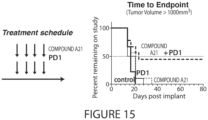
- the combination includes an inhibitor of an immune checkpoint molecule, e.g., an inhibitor of PD-1 (e.g., an anti-PD-1 antibody molecule described herein), and an IAP inhibitor, (S)-N-((S)-1-cyclohexyl-2-((S)-2-(4-(4-fluorobenzoyl)thiazol-2-yl)pyrrolidin-1-yl)-2-oxoethyl)-2-(methylamino)propanamide (Compound A21), or a compound disclosed in U.S. Patent No. 8,552,003 .
- an inhibitor of an immune checkpoint molecule e.g., an inhibitor of PD-1 (e.g., an anti-PD-1 antibody molecule described herein)
- IAP inhibitor e.g., an IAP inhibitor, (S)-N-((S)-1-cyclohexyl-2-((S)-2-(4-(4-fluorobenzoyl)thiazol-2-y
- the inhibitor of an immune checkpoint molecule e.g ., the inhibitor of PD-1 (e.g., the anti-PD-1 antibody molecule)
- the IAP inhibitor (S)-N-((S)-1-cyclohexyl-2-((S)-2-(4-(4-fluorobenzoyl)thiazol-2-yl)pyrrolidin-1-yl)-2-oxoethyl)-2-(methylamino)propanamide (Compound A21), or a compound disclosed in U.S. Patent No. 8,552,003 , is administered at a dose between 200 mg and 400 mg (e.g., at a dose of 300 mg), e.g., once every week, e.g ., orally.
- the combination is used to treat a cancer described herein, e.g., a colorectal cancer, a lung cancer (e.g., a non-small cell lung cancer (NSCLC)), or a breast cancer (e.g., a triple-negative breast cancer (e.g., NTBC)).
- a cancer described herein e.g., a colorectal cancer, a lung cancer (e.g., a non-small cell lung cancer (NSCLC)), or a breast cancer (e.g., a triple-negative breast cancer (e.g., NTBC)).
- a cancer described herein e.g., a colorectal cancer, a lung cancer (e.g., a non-small cell lung cancer (NSCLC)), or a breast cancer (e.g., a triple-negative breast cancer (e.g., NTBC)).
- NSCLC non-small cell lung cancer
- NTBC triple-negative breast cancer
- the combination includes an inhibitor of an immune checkpoint molecule, e.g., an inhibitor of PD-1 (e.g., an anti-PD-1 antibody molecule described herein), and an mTOR inhibitor, Everolimus (Compound A36), or a compound disclosed in PCT Publication No. WO 2014/085318 .
- the inhibitor of an immune checkpoint molecule e.g. , the inhibitor of PD-1 (e.g., the anti-PD-1 antibody molecule)
- the mTOR inhibitor, Everolimus (Compound A36), or a compound disclosed in PCT Publication No. WO 2014/085318 is administered at a dose between 2 mg and 8 mg (e.g., at a dose of 5 mg), e.g., once every week, e.g., orally.
- the combination is used to treat a cancer described herein, e.g., a colorectal cancer, a lung cancer (e.g., a non-small cell lung cancer (NSCLC)), or a breast cancer (e.g., a triple-negative breast cancer (e.g., NTBC)).
- a cancer described herein e.g., a colorectal cancer, a lung cancer (e.g., a non-small cell lung cancer (NSCLC)), or a breast cancer (e.g., a triple-negative breast cancer (e.g., NTBC)).
- NSCLC non-small cell lung cancer
- NTBC triple-
- the combination includes an inhibitor of an immune checkpoint molecule, e.g., an inhibitor of PD-1 (e.g., an anti-PD-1 antibody molecule described herein), and a DAC inhibitor, Panobinostat (Compound A19), or a compound disclosed in PCT Publication No. WO 2014/072493 .
- the inhibitor of an immune checkpoint molecule e.g ., the inhibitor of PD-1 (e.g., the anti-PD-1 antibody molecule)
- the DAC inhibitor, Panobinostat (Compound A19), or a compound disclosed in PCT Publication No. WO 2014/072493 is administered at a dose between 5 mg and 15 mg (e.g., at a dose of 10 mg), e.g., three times in a week (e.g., on the schedule of one week on/one week off), e.g., orally.
- the combination is used to treat a cancer described herein, e.g., a colorectal cancer, a lung cancer (e.g., a non-small cell lung cancer (NSCLC)), or a breast cancer (e.g., a triple-negative breast cancer (e.g ., NTBC)).
- a cancer described herein e.g., a colorectal cancer, a lung cancer (e.g., a non-small cell lung cancer (NSCLC)), or a breast cancer (e.g., a triple-negative breast cancer (e.g ., NTBC)).
- a cancer described herein e.g., a colorectal cancer, a lung cancer (e.g., a non-small cell lung cancer (NSCLC)), or a breast cancer (e.g., a triple-negative breast cancer (e.g ., NTBC)).
- NSCLC non-small cell lung cancer
- NTBC triple-negative breast cancer
- the combination includes an inhibitor of an immune checkpoint molecule, e.g., an inhibitor of PD-1 (e.g., an anti-PD-1 antibody molecule described herein), and an IL-1 ⁇ inhibitor, canakinumab, or a compound disclosed in PCT Publication No. WO 2002/16436 .
- the inhibitor of an immune checkpoint molecule e.g., the inhibitor of PD-1 (e.g., the anti-PD-1 antibody molecule)
- the IL-1 ⁇ inhibitor, canakinumab, or a compound disclosed in PCT Publication No. WO 2002/16436 is administered at a dose between 50 mg and 150 mg (e.g., at a dose of 100 mg), e.g., once every eight weeks, e.g ., subcutaneously.
- the combination is used to treat a cancer described herein, e.g., a colorectal cancer (e.g., a microsatellite stable colorectal cancer (MSS CRC)), a lung cancer (e.g., a non-small cell lung cancer (NSCLC)), or a breast cancer (e.g., a triple-negative breast cancer (e.g., NTBC)).
- a colorectal cancer e.g., a microsatellite stable colorectal cancer (MSS CRC)
- a lung cancer e.g., a non-small cell lung cancer (NSCLC)
- NSCLC non-small cell lung cancer
- breast cancer e.g., a triple-negative breast cancer (e.g., NTBC)
- the combination includes an inhibitor of an immune checkpoint molecule, e.g., an inhibitor of PD-1 (e.g., an anti-PD-1 antibody molecule described herein), and an IL-17 inhibitor, CJM112, or a compound disclosed in PCT Publication No. WO 2014/122613 .
- the inhibitor of an immune checkpoint molecule e.g., the inhibitor of PD-1 (e.g., the anti-PD-1 antibody molecule)
- the IL-17 inhibitor, CJM112, or a compound disclosed in PCT Publication No. WO 2014/122613 is administered at a dose between 10 mg and 50 mg (e.g., at a dose of 25 mg), e.g., once every four weeks, e.g ., intravenously.
- the combination is used to treat a cancer described herein, e.g., a colorectal cancer (e.g., an MSS CRC), a lung cancer (e.g., a non-small cell lung cancer (NSCLC)), or a breast cancer (e.g., a triple-negative breast cancer (e.g., NTBC)).
- a cancer described herein e.g., a colorectal cancer (e.g., an MSS CRC), a lung cancer (e.g., a non-small cell lung cancer (NSCLC)), or a breast cancer (e.g., a triple-negative breast cancer (e.g., NTBC
- the combination includes an inhibitor of an immune checkpoint molecule, e.g., an inhibitor of PD-1 (e.g., an anti-PD-1 antibody molecule described herein), and a MEK inhibitor or trametinib.
- the inhibitor of an immune checkpoint molecule e.g., the inhibitor of PD-1 (e.g., the anti-PD-1 antibody molecule)
- the MEK inhibitor or trametinib is administered at a dose between 0.2 mg and 1 mg (e.g., at a dose of 0.5 mg), e.g., once a day, e.g., orally.
- the combination is used to treat a cancer described herein, e.g., a colorectal cancer, a lung cancer (e.g., a non-small cell lung cancer (NSCLC)), or a breast cancer (e.g., a triple-negative breast cancer (e.g., NTBC)).
- a cancer described herein e.g., a colorectal cancer, a lung cancer (e.g., a non-small cell lung cancer (NSCLC)), or a breast cancer (e.g., a triple-negative breast cancer (e.g., NTBC)).
- NSCLC non-small cell lung cancer
- NTBC triple-negative breast cancer
- the combination includes an inhibitor of an immune checkpoint molecule, e.g., an inhibitor of PD-1 (e.g., an anti-PD-1 antibody molecule described herein), a BRAF inhibitor or dabrafenib, and a MEK inhibitor or trametinib.
- the inhibitor of an immune checkpoint molecule e.g., the inhibitor of PD-1 (e.g., the anti-PD-1 antibody molecule)
- the inhibitor of an immune checkpoint molecule e.g., the inhibitor of PD-1 (e.g., the anti-PD-1 antibody molecule)
- the BRAF inhibitor or dabrafenib is administered at a dose between 50 mg and 250 mg (e.g., at a dose of 150 mg) twice a day, e.g., orally.
- the MEK inhibitor or trametinib is administered at a dose between 1 mg and 3 mg (e.g., at a dose of 2 mg), e.g., once a day, e.g., orally.
- the inhibitor of an immune checkpoint molecule e.g., the inhibitor of PD-1 (e.g., the anti-PD-1 antibody molecule)
- the inhibitor of PD-1 is administered, e.g., at a dose between 200 mg and 600 mg (e.g., at a dose of 400 mg), e.g., once every 4 weeks, after the BRAF inhibitor or dabrafenib, the MEK inhibitor or trametinib, or both, is administered, e.g ., for a period of 2 to 8 weeks, e.g ., 4 weeks.
- the combination is used to treat a cancer described herein, e.g., a skin cancer (e.g., a melanoma, e.g., an unresectable or metastatic melanoma).
- a cancer that has a BRAF mutation, e.g ., a BRAF V600 mutation.
- the combination is used to treat a cancer in a subject having an elevated level of serum lactate dehydrogenase (LDH), compared to a reference LDH level.
- LDH serum lactate dehydrogenase
- the combination is used to treat a subject who has an unresectable or metastatic melanoma having a BRAF mutation (e.g ., a BRAF V600 mutation) and has an elevated level of LDH in serum, compared to a reference serum LDH level.
- a BRAF mutation e.g ., a BRAF V600 mutation
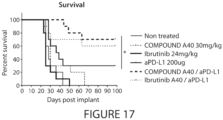
- the combination includes an inhibitor of an immune checkpoint molecule, e.g., an inhibitor of PD-1 (e.g., an anti-PD-1 antibody molecule described herein), and an EGFR inhibitor, (R,E)-N-(7-chloro-1-(1-(4-(dimethylamino)but-2-enoyl)azepan-3-yl)-1H-benzo[d]imidazol-2-yl)-2-methylisonicotinamide (Compound A40), or a compound disclosed in PCT Publication No. WO 2013/184757 .
- an inhibitor of an immune checkpoint molecule e.g., an inhibitor of PD-1 (e.g., an anti-PD-1 antibody molecule described herein)
- an EGFR inhibitor e.g., an EGFR inhibitor, (R,E)-N-(7-chloro-1-(1-(4-(dimethylamino)but-2-enoyl)azepan-3-yl)
- the inhibitor of an immune checkpoint molecule e.g., the inhibitor of PD-1 (e.g., the anti-PD-1 antibody molecule)
- WO 2013/184757 is administered at a dose between 10 mg and 50 mg (e.g ., at a dose of 25 mg), e.g., once a day (e.g., on day 1 to day 10 of a first dosing cycle), e.g ., orally.
- the combination is used to treat a cancer described herein, e.g., a colorectal cancer, a lung cancer (e.g., a non-small cell lung cancer (NSCLC)), or a breast cancer (e.g., a triple-negative breast cancer (e.g., NTBC)).
- a cancer described herein e.g., a colorectal cancer, a lung cancer (e.g., a non-small cell lung cancer (NSCLC)), or a breast cancer (e.g., a triple-negative breast cancer (e.g., NTBC)).
- NSCLC non-small cell lung cancer
- NTBC triple-negative breast cancer
- the combination includes an inhibitor of an immune checkpoint molecule, e.g., an inhibitor of PD-1 (e.g., an anti-PD-1 antibody molecule described herein), and a CSF-1/1R binding agent (e.g., a CSF-1R tyrosine kinase inhibitor), 4-((2-(((1R,2R)-2-hydroxycyclohexyl)amino)benzo[d]thiazol-6-yl)oxy)-N-methylpicolinamide (Compound A15), or a compound disclosed in PCT Publication No. WO 2005/073224 .
- an inhibitor of an immune checkpoint molecule e.g., an inhibitor of PD-1 (e.g., an anti-PD-1 antibody molecule described herein)
- a CSF-1/1R binding agent e.g., a CSF-1R tyrosine kinase inhibitor
- the inhibitor of an immune checkpoint molecule e.g., the inhibitor of PD-1 (e.g., the anti-PD-1 antibody molecule)
- the CSF-1/1R binding agent e.g., a CSF-1R tyrosine kinase inhibitor
- a dose between 50 mg and 1000 mg e.g., at a dose of 100 mg, 150 mg, 300 mg, 600 mg, 900 mg
- the combination is used to treat a cancer described herein, e.g., a brain cancer (e.g., a glioblastoma multiforme (GBM)), a breast cancer (e.g., a triple-negative breast cancer (e.g ., NTBC)), or a pancreatic cancer.
- a cancer described herein e.g., a brain cancer (e.g., a glioblastoma multiforme (GBM)), a breast cancer (e.g., a triple-negative breast cancer (e.g ., NTBC)), or a pancreatic cancer.
- a cancer described herein e.g., a brain cancer (e.g., a glioblastoma multiforme (GBM)), a breast cancer (e.g., a triple-negative breast cancer (e.g ., NTBC)), or a pancreatic cancer.
- GBM glioblastoma multiforme
- the combination includes an inhibitor of an immune checkpoint molecule, e.g., an inhibitor of PD-1 (e.g., an anti-PD-1 antibody molecule described herein), and an inhibitor of 6-phosphofructo-2-kinase/fructose-2,6-biphosphatase 3 (PFKFB3), PFK-158, or a compound disclosed in PCT Publication No. WO 2013/148228 .
- an inhibitor of an immune checkpoint molecule e.g., an inhibitor of PD-1 (e.g., an anti-PD-1 antibody molecule described herein)
- PFKFB3 6-phosphofructo-2-kinase/fructose-2,6-biphosphatase 3
- PFKFB3 6-phosphofructo-2-kinase/fructose-2,6-biphosphatase 3
- PFKFB3 6-phosphofructo-2-kinase/fructose-2,6-biphosphatase 3
- the inhibitor of an immune checkpoint molecule e.g., the inhibitor of PD-1 (e.g., the anti-PD-1 antibody molecule)
- the combination is used to treat a cancer described herein, e.g ., an ovarian cancer, a fallopian tube cancer, or a colorectal cancer (CRC).
- a cancer described herein e.g ., an ovarian cancer, a fallopian tube cancer, or a colorectal cancer (CRC).
- a combination includes an inhibitor of an immune checkpoint molecule, e.g., an inhibitor of PD-1 (e.g., an anti-PD-1 antibody molecule described herein), and a chemotherapeutic agent, e.g., a paclitaxel (e.g., a nab-paclitaxel).
- the inhibitor of an immune checkpoint molecule e.g., the inhibitor of PD-1 (e.g., the anti-PD-1 antibody molecule)
- the chemotherapeutic agent e.g., a paclitaxel (e.g., a nab-paclitaxel)
- a paclitaxel e.g., a nab-paclitaxel
- the combination is used to treat a cancer described herein, e.g., a breast cancer (e.g ., a HER2-negative breast cancer).
- the combination includes an inhibitor of an immune checkpoint molecule, e.g., an inhibitor of PD-1 (e.g., an anti-PD-1 antibody molecule described herein), and a TGF- ⁇ inhibitor, XOMA 089, or a compound disclosed in PCT Publication No. WO 2012/167143 .
- the inhibitor of an immune checkpoint molecule e.g., the inhibitor of PD-1 (e.g., the anti-PD-1 antibody molecule)
- the TGF- ⁇ inhibitor, XOMA 089, or a compound disclosed in PCT Publication No. WO 2012/167143 is administered at a dose between 0.1 mg/kg and 15 mg/kg, e.g ., between 0.1 mg/kg and 6 mg/kg or between 0.3 mg/kg and 3 mg/kg ( e.g ., at a dose of 0.1 mg/kg, 0.3 mg/kg, 1 mg/kg, 3 mg/kg, 6 mg/kg, 10 mg/kg, or 15 mg/kg), e.g., once every three weeks, e.g., intravenously.
- the combination is used to treat a cancer described herein, e.g ., a pancreatic cancer, a colorectal cancer (e.g., a microsatellite stable colorectal cancer (MSS-CRC)), a lung cancer (e.g., a non-small cell lung cancer), a breast cancer (e.g., a triple negative breast cancer), a liver cancer (e.g., a hepatocellular carcinoma), a prostate cancer, or a renal cancer (e.g., a clear cell renal cell carcinoma).
- a cancer described herein e.g a pancreatic cancer, a colorectal cancer (e.g., a microsatellite stable colorectal cancer (MSS-CRC)), a lung cancer (e.g., a non-small cell lung cancer), a breast cancer (e.g., a triple negative breast cancer), a liver cancer (e.g., a hepatocellular carcinoma), a prostate cancer, or
- the combination includes an inhibitor of an immune checkpoint molecule, e.g., an inhibitor of PD-1 (e.g., an anti-PD-1 antibody molecule described herein), and an inhibitor of PD-L1 or an anti-PD-L1 antibody molecule disclosed in U.S. Patent Application Publication No. 2016/0108123 .
- the inhibitor of an immune checkpoint molecule e.g., the inhibitor of PD-1 (e.g., the anti-PD-1 antibody molecule)
- is administered at a dose between 100 mg and 600 mg e.g., at a dose of 100 mg or 300 mg
- a dose of 100 mg or 300 mg e.g., once every 3 weeks, e.g ., intravenously.
- the inhibitor of PD-L1 or an anti-PD-L1 antibody molecule disclosed in U.S. Patent Application Publication No. 2016/0108123 is administered at a dose between 10 mg and 2000 mg (e.g ., between 20 mg and 1600 mg or between 80 mg and 1200 mg (e.g., at a dose of 20 mg, 80 mg, 240 mg, 800 mg, or 1200 mg), e.g., once every three weeks or once every six weeks, e.g ., intravenously.
- the combination is used to treat a cancer described herein, e.g., a solid tumor, e.g., a lung cancer (e.g., a non-small cell lung cancer), a breast cancer (e.g., a triple negative breast cancer), a uterine cancer (e.g ., an endometrial carcinoma), or a thyroid cancer (e.g., an anaplastic thyroid carcinoma).
- a cancer described herein e.g., a solid tumor, e.g., a lung cancer (e.g., a non-small cell lung cancer), a breast cancer (e.g., a triple negative breast cancer), a uterine cancer (e.g ., an endometrial carcinoma), or a thyroid cancer (e.g., an anaplastic thyroid carcinoma).
- a cancer described herein e.g., a solid tumor, e.g., a lung cancer (e.g., a non-small cell lung cancer), a breast cancer (e.
- the combination includes an inhibitor of an immune checkpoint molecule, e.g., an inhibitor of PD-1 (e.g., an anti-PD-1 antibody molecule described herein), and a chemotherapeutic agent (e.g., a hypomethylating agent, e.g., decitabine).
- the inhibitor of an immune checkpoint molecule e.g., the inhibitor of PD-1 (e.g., the anti-PD-1 antibody molecule)
- is administered at a dose between 200 mg and 600 mg e.g ., between 300 mg and 500 mg, e.g., at a dose of 400 mg
- a dose between 200 mg and 600 mg e.g ., between 300 mg and 500 mg, e.g., at a dose of 400 mg
- a dose between 200 mg and 600 mg e.g ., between 300 mg and 500 mg, e.g., at a dose of 400 mg
- a dose between 200 mg and 600 mg e.g ., between 300 mg and 500 mg
- the chemotherapeutic agent e.g., a hypomethylating agent, e.g., decitabine
- a dose between 5 mg/m 2 and 50 mg/m 2 e.g., between 10 mg/m 2 and 30 mg/m 2 , e.g., at a dose of 20 mg/m 2
- a dose between 5 mg/m 2 and 50 mg/m 2 e.g., between 10 mg/m 2 and 30 mg/m 2 , e.g., at a dose of 20 mg/m 2
- daily e.g., for 1, 2, 3, 4, 5, 6, 7, 8, or more days, e.g., intravenously.
- the inhibitor of an immune checkpoint molecule e.g., the inhibitor of PD-1 (e.g., the anti-PD-1 antibody molecule)
- the chemotherapeutic agent e.g., a hypomethylating agent, e.g ., decitabine
- days 1, 2, 3, 4, and 5 of the 28-day cycle e.g., a hypomethylating agent, e.g ., decitabine
- the combination is used to treat a cancer described herein, e.g ., a hematological cancer, e.g., a leukemia (e.g., an acute myeloid leukemia (AML), e.g., a relapsed or refractory AML or a de novo AML), or a myelodysplastic syndrome (MDS) (e.g., a high risk MDS).
- a cancer described herein e.g a hematological cancer, e.g., a leukemia (e.g., an acute myeloid leukemia (AML), e.g., a relapsed or refractory AML or a de novo AML), or a myelodysplastic syndrome (MDS) (e.g., a high risk MDS).
- a leukemia e.g., an acute myeloid leukemia (AML), e.g., a relapsed or
- the combination includes an inhibitor of an immune checkpoint molecule, e.g., an inhibitor of TIM-3 or an anti-TIM-3 antibody molecule disclosed in U.S. Patent Application Publication No. 2015/0218274 , and a chemotherapeutic agent (e.g., a hypomethylating agent, e.g., decitabine).
- a chemotherapeutic agent e.g., a hypomethylating agent, e.g., decitabine
- the inhibitor of an immune checkpoint molecule e.g., the inhibitor of TIM-3 or an anti-TIM-3 antibody molecule disclosed in U.S. Patent Application Publication No.
- 2015/0218274 is administered at a dose between 50 mg and 500 mg (e.g ., between 100 mg and 400 mg, e.g., at a dose of 240 mg), e.g., once every 2 weeks, e.g., intravenously.
- the chemotherapeutic agent e.g., a hypomethylating agent, e.g., decitabine
- a dose between 5 mg/m 2 and 50 mg/m 2 e.g., between 10 mg/m 2 and 30 mg/m 2 , e.g., at a dose of 20 mg/m 2
- the inhibitor of an immune checkpoint molecule e.g. , the inhibitor of TIM-3 or an anti-TIM-3 antibody molecule disclosed in U.S. Patent Application Publication No.
- the combination is used to treat a cancer described herein, e.g., a hematological cancer, e.g., a leukemia (e.g., an acute myeloid leukemia (AML), e.g., a relapsed or refractory AML or a de novo AML), or a myelodysplastic syndrome (MDS) (e.g., a high risk MDS).
- a cancer described herein e.g., a hematological cancer, e.g., a leukemia (e.g., an acute myeloid leukemia (AML), e.g., a relapsed or refractory AML or a de novo AML), or a myelodysplastic syndrome (MDS) (e.g., a high risk MDS).
- a hematological cancer e.g., a leukemia (e.g., an acute myeloid leukemia (AML
- the combination includes an inhibitor of PD-1 (e.g., an anti-PD-1 antibody molecule described herein), an inhibitor of TIM-3 (e.g., an anti-TIM-3 antibody molecule disclosed in U.S. Patent Application Publication No. 2015/0218274 ), and a chemotherapeutic agent (e.g., a hypomethylating agent, e.g., decitabine).
- the inhibitor of PD-1 e.g., the anti-PD-1 antibody molecule
- the inhibitor of TIM-3 (e.g., an anti-TIM-3 antibody molecule disclosed in U.S. Patent Application Publication No. 2015/0218274 ) is administered at a dose between 20 mg and 400 mg ( e.g ., between 40 mg and 200 mg or between 50 mg and 100 mg, e.g., at a dose of 80 mg), e.g., once every 2 weeks, e.g., intravenously.
- the chemotherapeutic agent e.g., a hypomethylating agent, e.g., decitabine
- a dose between 5 mg/m 2 and 50 mg/m 2 e.g., between 10 mg/m 2 and 30 mg/m 2 , e.g., at a dose of 20 mg/m 2
- a dose between 5 mg/m 2 and 50 mg/m 2 e.g., between 10 mg/m 2 and 30 mg/m 2 , e.g., at a dose of 20 mg/m 2
- daily e.g., for 1, 2, 3, 4, 5, 6, 7, 8, or more days, e.g., intravenously.
- the inhibitor of PD-1 (e.g., the anti-PD-1 antibody molecule) is administered on day 8 of a 28-day cycle
- the inhibitor of TIM-3 e.g., an anti-TIM-3 antibody molecule disclosed in U.S. Patent Application Publication No. 2015/0218274
- the chemotherapeutic agent e.g ., decitabine
- the combination is used to treat a cancer described herein, e.g., a hematological cancer, e.g., a leukemia (e.g., an acute myeloid leukemia (AML), e.g., a relapsed or refractory AML or a de novo AML), or a myelodysplastic syndrome (MDS) (e.g., a high risk MDS).
- a cancer described herein e.g., a hematological cancer, e.g., a leukemia (e.g., an acute myeloid leukemia (AML), e.g., a relapsed or refractory AML or a de novo AML), or a myelodysplastic syndrome (MDS) (e.g., a high risk MDS).
- a leukemia e.g., an acute myeloid leukemia (AML), e.g., a relapsed
- the combinations disclosed herein can be administered together in a single composition or administered separately in two or more different compositions, e.g ., compositions or dosage forms as described herein.
- the administration of the therapeutic agents can be in any order.
- the first agent and the additional agents e.g ., second, third agents
- a first therapeutic agent can be administered concurrently with, prior to, or subsequent to, the additional agent.
- a first agent is administered locally, e.g., a therapeutic agent of any of categories (i)-(iii) can be coupled to a tumor targeting agent, e.g., a tumor-targeting antibody (e.g., to form an antibody-drug conjugate), or any other delivery agent (e.g., a formulation such as a targeted formulation) such that administration of the first agent is localized to a desired site, e.g., a tumor site (e.g., a dendritic cell-enriched site).
- a tumor targeting agent e.g., a tumor-targeting antibody (e.g., to form an antibody-drug conjugate)
- any other delivery agent e.g., a formulation such as a targeted formulation
- the therapeutic agent is an antigen (e.g., a vaccine, e.g., an in situ cancer vaccine), which is targeted to the tumor environment, thus resulting in activation of dendritic cells.
- a vaccine e.g., an in situ cancer vaccine
- the therapeutic agent also can be locally administered, e.g., injected, at a tumor site (e.g., intratumoral or peritumoral administration). Localized delivery or administration of the therapeutic agent can reduce one or more side effects or toxicities that would otherwise be associated with systemic administration of the therapeutic agent.
- a therapeutic agent e.g ., STING or a TLR
- a tumor-binding antibody e.g ., an antibody that binds to HER2
- the first agent, the additional agent (e.g ., second or third agent), or all can be administered in an amount or dose that is higher, lower or the same than the amount or dosage of each agent used individually, e.g ., as a monotherapy.
- the administered amount or dosage of the first agent, the additional agent (e.g ., second or third agent), or all is lower ( e.g ., at least 20%, at least 30%, at least 40%, or at least 50%) than the amount or dosage of each agent used individually, e.g ., as a monotherapy.
- the amount or dosage of the first agent, the additional agent (e.g ., second or third agent), or all, that results in a desired effect is lower (e.g., at least 20%, at least 30%, at least 40%, or at least 50% lower).
- the combinations can be in the form of an antibody molecule, e.g ., a bi- or tri-specific molecule, against one or more therapeutic agents chosen from the antigen-presentation combination, the effector cell combination, or the anti-tumor immunosuppression combination, or any combination thereof.
- a bispecific molecule against two or more checkpoint inhibitors e.g ., an anti-PD-1 and an anti-LAG-3 antibody molecule.
- the combinations can be in the form of an antibody molecule, e.g ., a bi- or tri-specific molecule, against one or more therapeutic agents chosen from two or all of the antigen-presentation combination, the effector cell combination, and/or the anti-tumor immunosuppression combination.
- the antibody molecule is a full antibody or fragment thereof (e.g., a Fab, F(ab') 2 , Fv, or a single chain Fv fragment (scFv)).
- the antibody molecule has a heavy chain constant region (Fc) chosen from, e.g ., the heavy chain constant regions of IgG1, IgG2, IgG3, IgG4, IgM, IgA1, IgA2, IgD, and IgE; particularly, chosen from, e.g ., the heavy chain constant regions of IgG1, IgG2, IgG3, and IgG4, more particularly, the heavy chain constant region of IgG1 or IgG4 ( e.g ., human IgG1 or IgG4).
- the heavy chain constant region is human IgG1 or human IgG4.
- the constant region is altered, e.g ., mutated, to modify the properties of the antibody molecule (e.g ., to increase or decrease one or more of: Fc receptor binding, antibody glycosylation, the number of cysteine residues, effector cell function, or complement function).
- the antibody molecule is in the form of a bispecific or multispecific antibody molecule, e.g ., a bispecific, trispecific antibody molecule as described herein.
- the immunomodulator used in the combinations disclosed herein is an inhibitor of an immune checkpoint molecule.
- the immunomodulator is an inhibitor of PD-1, PD-L1, PD-L2, CTLA-4, TIM-3, LAG-3, CEACAM (e.g ., CEACAM-1, -3 and/or - 5), VISTA, BTLA, TIGIT, LAIR1, CD160, 2B4 and/or TGF beta.
- the inhibitor of an immune checkpoint molecule inhibits PD-1, PD-L1, LAG-3, TIM-3, CEACAM (e.g ., CEACAM-1, -3 and/or -5), CTLA-4, or any combination thereof.
- Inhibition of an inhibitory molecule can be performed at the DNA, RNA or protein level.
- an inhibitory nucleic acid e.g., a dsRNA, siRNA or shRNA
- a dsRNA, siRNA or shRNA can be used to inhibit expression of an inhibitory molecule.
- the inhibitor of an inhibitory signal is, a polypeptide e.g., a soluble ligand (e.g., PD-1-Ig or CTLA-4 Ig), or an antibody or antigen-binding fragment thereof, that binds to the inhibitory molecule; e.g ., an antibody or fragment thereof (also referred to herein as "an antibody molecule") that binds to PD-1, PD-L1, PD-L2, CEACAM (e.g ., CEACAM-1, -3 and/or -5), CTLA-4, TIM-3, LAG-3, VISTA, BTLA, TIGIT, LAIR1, CD160, 2B4 and/or TGF beta, or a combination thereof.
- a polypeptide e.g., a soluble ligand (e.g., PD-1-Ig or CTLA-4 Ig), or an antibody or antigen-binding fragment thereof, that binds to the inhibitory molecule; e.g ., an antibody
- the antibody molecule is in the form of a bispecific or multispecific antibody molecule.
- the bispecific antibody molecule has a first binding specificity to PD-1 or PD-L1 and a second binding specificity, e.g ., a second binding specificity to TIM-3, CEACAM ( e.g ., CEACAM-1, -3 and/or -5), LAG-3, or PD-L2.
- the bispecific antibody molecule binds to PD-1 or PD-L1 and TIM-3.
- the bispecific antibody molecule binds to PD-1 or PD-L1 and LAG-3.
- the bispecific antibody molecule binds to PD-1 or PD-L1 and CEACAM (e.g ., CEACAM-1, -3 and/or - 5). In another embodiment, the bispecific antibody molecule binds to PD-1 or PD-L1 and CEACAM-1. In still another embodiment, the bispecific antibody molecule binds to PD-1 or PD-L1 and CEACAM-3. In yet another embodiment, the bispecific antibody molecule binds to PD-1 or PD-L1 and CEACAM-5. In another embodiment, the bispecific antibody molecule binds to PD-1 or PD-L1. In yet another embodiment, the bispecific antibody molecule binds to PD-1 and PD-L2.
- CEACAM-1 e.g ., CEACAM-1, -3 and/or - 5
- the bispecific antibody molecule binds to PD-1 or PD-L1 and CEACAM-1. In still another embodiment, the bispecific antibody molecule binds to PD-1 or PD
- the bispecific antibody molecule binds to TIM-3 and LAG-3. In another embodiment, the bispecific antibody molecule binds to CEACAM ( e.g ., CEACAM-1, -3 and/or -5) and LAG-3. In another embodiment, the bispecific antibody molecule binds to CEACAM ( e.g. , CEACAM-1, -3 and/or -5) and TIM-3.
- any combination of the aforesaid molecules can be made in a multispecific antibody molecule, e.g ., a trispecific antibody that includes a first binding specificity to PD-1 or PD-1, and a second and third binding specificities to two or more of: TIM-3, CEACAM (e.g ., CEACAM-1, - 3 and/or -5), LAG-3, or PD-L2.
- a multispecific antibody molecule e.g ., a trispecific antibody that includes a first binding specificity to PD-1 or PD-1, and a second and third binding specificities to two or more of: TIM-3, CEACAM (e.g ., CEACAM-1, - 3 and/or -5), LAG-3, or PD-L2.
- the immunomodulator is an inhibitor of PD-1, e.g ., human PD-1 (e.g., an antibody molecule as described herein).
- the immunomodulator is an inhibitor of PD-L1, e.g ., human PD-L1.
- the inhibitor of PD-1 or PD-L1 is an antibody molecule to PD-1 or PD-L1.
- the PD-1 or PD-L1 inhibitor can be administered alone, or in combination with other immunomodulators, e.g ., in combination with an inhibitor of LAG-3, TIM-3, CEACAM ( e.g ., CEACAM-1, -3 and/or -5) or CTLA-4.
- the inhibitor of PD-1 or PD-L1, e.g., the anti-PD-1 or PD-L1 antibody molecule is administered in combination with a LAG-3 inhibitor, e.g ., an anti-LAG-3 antibody molecule.
- the inhibitor of PD-1 or PD-L1, e.g., the anti-PD-1 or PD-L1 antibody molecule is administered in combination with a TIM-3 inhibitor, e.g ., an anti-TIM-3 antibody molecule.
- the inhibitor of PD-1 or PD-L1, e.g., the anti-PD-1 or PD-L1 antibody molecule is administered in combination with a CEACAM inhibitor (e.g., CEACAM-1, -3 and/or -5 inhibitor), e.g., an anti- CEACAM antibody molecule.
- a CEACAM inhibitor e.g., CEACAM-1, -3 and/or -5 inhibitor
- the inhibitor of PD-1 or PD-L1 antibody molecule is administered in combination with a CEACAM-1 inhibitor, e.g ., an anti-CEACAM-1 antibody molecule.
- the inhibitor of PD-1 or PD-L1, e.g., the anti-PD-1 or PD-L1 antibody molecule is administered in combination with a CEACAM-5 inhibitor, e.g., an anti- CEACAM-5 antibody molecule.
- the inhibitor of PD-1 or PD-L1, e.g., the anti-PD-1 antibody molecule is administered in combination with a LAG-3 inhibitor, e.g., an anti-LAG-3 antibody molecule, and a TIM-3 inhibitor, e.g., an anti-TIM-3 antibody molecule.
- PD-1 inhibitor e.g ., one or more of PD-L2, CTLA-4, TIM-3, LAG-3, CEACAM (e.g ., CEACAM-1, -3 and/or -5), VISTA, BTLA, TIGIT, LAIR1, CD160, 2B4 and/or TGF beta
- PD-1 inhibitor e.g ., one or more of PD-L2, CTLA-4, TIM-3, LAG-3, CEACAM (e.g ., CEACAM-1, -3 and/or -5), VISTA, BTLA, TIGIT, LAIR1, CD160, 2B4 and/or TGF beta
- the immunomodulator is an inhibitor of CEACAM (e.g ., CEACAM-1, -3 and/or -5), e.g., human CEACAM ( e.g ., CEACAM-1, -3 and/or -5).
- the immunomodulator is an inhibitor of CEACAM-1, e.g ., human CEACAM-1.
- the immunomodulator is an inhibitor of CEACAM-3, e.g ., human CEACAM-3.
- the immunomodulator is an inhibitor of CEACAM-5, e.g ., human CEACAM-5.
- the inhibitor of CEACAM is an antibody molecule to CEACAM (e.g., CEACAM-1, -3 and/or -5).
- the CEACAM (e.g., CEACAM-1, -3 and/or -5) inhibitor can be administered alone, or in combination with other immunomodulators, e.g ., in combination with an inhibitor of LAG-3, TIM-3, PD-1, PD-L1 or CTLA-4.
- the immunomodulator is an inhibitor of LAG-3, e.g. , human LAG-3.
- the inhibitor of LAG-3 is an antibody molecule to LAG-3.
- the LAG-3 inhibitor can be administered alone, or in combination with other immunomodulators, e.g ., in combination with an inhibitor of CEACAM (e.g ., CEACAM-1, -3 and/or -5), TIM-3, PD-1, PD-L1 or CTLA-4.
- the immunomodulator is an inhibitor of TIM-3, e.g ., human TIM-3.
- the inhibitor of TIM-3 is an antibody molecule to TIM-3.
- the TIM-3 inhibitor can be administered alone, or in combination with other immunomodulators, e.g ., in combination with an inhibitor of CEACAM (e.g., CEACAM-1, -3 and/or -5), LAG-3, PD-1, PD-L1 or CTLA-4.
- CEACAM e.g., CEACAM-1, -3 and/or -5
- LAG-3 e.g., PD-1, PD-L1 or CTLA-4.
- the immunomodulator used in the combinations disclosed herein is an activator or agonist of a costimulatory molecule.
- the agonist of the costimulatory molecule is chosen from an agonist (e.g., an agonistic antibody or antigen-binding fragment thereof, or a soluble fusion) of OX40, CD2, CD27, CD28, CDS, ICAM-1, LFA-1 (CD11a/CD18), ICOS (CD278), 4-1BB (CD137), GITR, CD30, CD40, BAFFR, HVEM, CD7, LIGHT, NKG2C, SLAMF7, NKp80, CD160, B7-H3, or CD83 ligand.
- the immunomodulator is a GITR agonist.
- the GITR agonist is an antibody molecule to GITR.
- the GITR agonist can be administered alone, or in combination with other immunomodulators, e.g ., in combination with an inhibitor of PD-1, PD-L1, CTLA-4, CEACAM ( e.g ., CEACAM-1, -3 and/or -5), TIM-3 or LAG-3.
- the anti-GITR antibody molecule is a bispecific antibody that binds to GITR and PD-1, PD-L1, CTLA-4, CEACAM ( e.g ., CEACAM-1, -3 and/or -5), TIM-3 or LAG-3.
- the anti-GITR antibody molecule is administered in combination with an anti-PD-1 antibody molecule (e.g., an anti-PD-1 molecule as described herein).
- an anti-PD-1 antibody molecule e.g., an anti-PD-1 molecule as described herein.
- the GITR antibody molecule and the anti-PD-1 antibody molecule may be in the form of separate antibody composition, or as a bispecific antibody molecule.
- a GITR agonist can be administered in combination with other costimulatory molecule, e.g ., an agonist of OX40, CD2, CD27, CD28, CDS, ICAM-1, LFA-1 (CD11a/CD18), ICOS (CD278), 4-1BB (CD137), CD30, CD40, BAFFR, HVEM, CD7, LIGHT, NKG2C, SLAMF7, NKp80, CD160, B7-H3, or CD83 ligand.
- costimulatory molecule e.g ., an agonist of OX40, CD2, CD27, CD28, CDS, ICAM-1, LFA-1 (CD11a/CD18), ICOS (CD278), 4-1BB (CD137), CD30, CD40, BAFFR, HVEM, CD7, LIGHT, NKG2C, SLAMF7, NKp80, CD160, B7-H3, or CD83 ligand.
- the immunomodulator is an activator of a costimulatory molecule (e.g., an OX40 agonist).
- the OX40 agonist is an antibody molecule to OX40.
- the OX40 agonist can be administered alone, or in combination with other immunomodulators, e.g ., in combination with an inhibitor of PD-1, PD-L1, CTLA-4, CEACAM (e.g., CEACAM-1, -3 and/or - 5), TIM-3 or LAG-3.
- the anti-OX40 antibody molecule is a bispecific antibody that binds to GITR and PD-1, PD-L1, CTLA-4, CEACAM (e.g., CEACAM-1, -3 and/or -5), TIM-3 or LAG-3.
- an OX40 antibody molecule is administered in combination with an anti-PD-1 antibody molecule (e.g ., an anti-PD-1 molecule as described herein).
- the OX40 antibody molecule and the anti-PD-1 antibody molecule may be in the form of separate antibody composition, or as a bispecific antibody molecule.
- the OX40 agonist can be administered in combination with other costimulatory molecule, e.g ., an agonist of GITR, CD2, CD27, CD28, CDS, ICAM-1, LFA-1 (CD11a/CD18), ICOS (CD278), 4-1BB (CD137), CD30, CD40, BAFFR, HVEM, CD7, LIGHT, NKG2C, SLAMF7, NKp80, CD160, B7-H3, or CD83 ligand.
- costimulatory molecule e.g ., an agonist of GITR, CD2, CD27, CD28, CDS, ICAM-1, LFA-1 (CD11a/CD18), ICOS (CD278), 4-1BB (CD137), CD30, CD40, BAFFR, HVEM, CD7, LIGHT, NKG2C, SLAMF7, NKp80, CD160, B7-H3, or CD83 ligand.
- the PD-1 inhibitor is an anti-PD-1 antibody molecule as described in U.S. Patent Application Publication No. 2015/0210769 ( USSN 14/604,415 ), entitled “Antibody Molecules to PD-1 and Uses Thereof,”.
- the anti-PD-1 antibody molecule comprises at least one antigen-binding region, e.g., a variable region or an antigen-binding fragment thereof, from an antibody described herein, e.g ., an antibody chosen from any of BAP049-hum01, BAP049-hum02, BAP049-hum03, BAP049-hum04, BAP049-hum05, BAP049-hum06, BAP049-hum07, BAP049-hum08, BAP049-hum09, BAP049-hum10, BAP049-hum11, BAP049-hum12, BAP049-hum13, BAP049-hum14, BAP049-hum15, BAP049-hum16, BAP049-Clone-A, BAP049-Clone-B, BAP049-Clone-C, BAP049-Clone-D, or BAP049-Clone-E; or as described in Table 1, or encode
- the anti-PD-1 antibody molecule comprises at least one, two, three or four variable regions from an antibody described herein, e.g ., an antibody chosen from any of BAP049-hum01, BAP049-hum02, BAP049-hum03, BAP049-hum04, BAP049-hum05, BAP049-hum06, BAP049-hum07, BAP049-hum08, BAP049-hum09, BAP049-hum10, BAP049-hum11, BAP049-hum12, BAP049-hum13, BAP049-hum14, BAP049-hum15, BAP049-hum16, BAP049-Clone-A, BAP049-Clone-B, BAP049-Clone-C, BAP049-Clone-D, or BAP049-Clone-E; or as described in Table 1, or encoded by the nucleotide sequence in Table 1; or a sequence substantially
- the anti-PD-1 antibody molecule comprises at least one or two heavy chain variable regions from an antibody described herein, e.g ., an antibody chosen from any of BAP049-hum01, BAP049-hum02, BAP049-hum03, BAP049-hum04, BAP049-hum05, BAP049-hum06, BAP049-hum07, BAP049-hum08, BAP049-hum09, BAP049-hum10, BAP049-hum11, BAP049-hum12, BAP049-hum13, BAP049-hum14, BAP049-hum15, BAP049-hum16, BAP049-Clone-A, BAP049-Clone-B, BAP049-Clone-C, BAP049-Clone-D, or BAP049-Clone-E; or as described in Table 1, or encoded by the nucleotide sequence in Table 1; or a sequence substantially identical (
- the anti-PD-1 antibody molecule comprises at least one or two light chain variable regions from an antibody described herein, e.g ., an antibody chosen from any of BAP049-hum01, BAP049-hum02, BAP049-hum03, BAP049-hum04, BAP049-hum05, BAP049-hum06, BAP049-hum07, BAP049-hum08, BAP049-hum09, BAP049-hum10, BAP049-hum11, BAP049-hum12, BAP049-hum13, BAP049-hum14, BAP049-hum15, BAP049-hum16, BAP049-Clone-A, BAP049-Clone-B, BAP049-Clone-C, BAP049-Clone-D, or BAP049-Clone-E; or as described in Table 1, or encoded by the nucleotide sequence in Table 1; or a sequence substantially identical (
- the anti-PD-1 antibody molecule includes a heavy chain constant region for an IgG4, e.g., a human IgG4.
- the human IgG4 includes a substitution at position 228 according to EU numbering (e.g ., a Ser to Pro substitution).
- the anti-PD-1 antibody molecule includes a heavy chain constant region for an IgG1, e.g., a human IgG1.
- the human IgG1 includes a substitution at position 297 according to EU numbering (e.g ., an Asn to Ala substitution).
- the human IgG1 includes a substitution at position 265 according to EU numbering, a substitution at position 329 according to EU numbering, or both (e.g., an Asp to Ala substitution at position 265 and/or a Pro to Ala substitution at position 329).
- the human IgG1 includes a substitution at position 234 according to EU numbering, a substitution at position 235 according to EU numbering, or both (e.g., a Leu to Ala substitution at position 234 and/or a Leu to Ala substitution at position 235).
- the heavy chain constant region comprises an amino sequence set forth in Table 3, or a sequence substantially identical (e.g ., at least 80%, 85%, 90%, 92%, 95%, 97%, 98%, 99% or higher identical) thereto.
- the anti-PD-1 antibody molecule includes a kappa light chain constant region, e.g., a human kappa light chain constant region.
- the light chain constant region comprises an amino sequence set forth in Table 3, or a sequence substantially identical ( e.g ., at least 80%, 85%, 90%, 92%, 95%, 97%, 98%, 99% or higher identical) thereto.
- the anti-PD-1 antibody molecule includes a heavy chain constant region for an IgG4, e.g., a human IgG4, and a kappa light chain constant region, e.g., a human kappa light chain constant region, e.g., a heavy and light chain constant region comprising an amino sequence set forth in Table 3, or a sequence substantially identical ( e.g ., at least 80%, 85%, 90%, 92%, 95%, 97%, 98%, 99% or higher identical) thereto.
- the human IgG4 includes a substitution at position 228 according to EU numbering (e.g ., a Ser to Pro substitution).
- the anti-PD-1 antibody molecule includes a heavy chain constant region for an IgG1, e.g., a human IgG1, and a kappa light chain constant region, e.g., a human kappa light chain constant region, e.g., a heavy and light chain constant region comprising an amino sequence set forth in Table 3, or a sequence substantially identical ( e.g ., at least 80%, 85%, 90%, 92%, 95%, 97%, 98%, 99% or higher identical) thereto.
- the human IgG1 includes a substitution at position 297 according to EU numbering (e.g ., an Asn to Ala substitution).
- the human IgG1 includes a substitution at position 265 according to EU numbering, a substitution at position 329 according to EU numbering, or both (e.g., an Asp to Ala substitution at position 265 and/or a Pro to Ala substitution at position 329).
- the human IgG1 includes a substitution at position 234 according to EU numbering, a substitution at position 235 according to EU numbering, or both (e.g., a Leu to Ala substitution at position 234 and/or a Leu to Ala substitution at position 235).
- the anti-PD-1 antibody molecule includes a heavy chain variable domain and a constant region, a light chain variable domain and a constant region, or both, comprising the amino acid sequence of BAP049-Clone-A, BAP049-Clone-B, BAP049-Clone-C, BAP049-Clone-D, or BAP049-Clone-E; or as described in Table 1, or encoded by the nucleotide sequence in Table 1; or a sequence substantially identical ( e.g ., at least 80%, 85%, 90%, 92%, 95%, 97%, 98%, 99% or higher identical) to any of the aforesaid sequences.
- the anti-PD-1 antibody molecule optionally, comprises a leader sequence from a heavy chain, a light chain, or both, as shown in Table 4; or a sequence substantially identical thereto.
- the anti-PD-1 antibody molecule includes at least one, two, or three complementarity determining regions (CDRs) from a heavy chain variable region of an antibody described herein, e.g ., an antibody chosen from any of BAP049-hum01, BAP049-hum02, BAP049-hum03, BAP049-hum04, BAP049-hum05, BAP049-hum06, BAP049-hum07, BAP049-hum08, BAP049-hum09, BAP049-hum10, BAP049-hum11, BAP049-hum12, BAP049-hum13, BAP049-hum14, BAP049-hum15, BAP049-hum16, BAP049-Clone-A, BAP049-Clone-B, BAP049-Clone-C, BAP049-Clone-D, or BAP049-Clone-E; or as described in Table 1, or encoded by the
- the anti-PD-1 antibody molecule includes at least one, two, or three CDRs (or collectively all of the CDRs) from a heavy chain variable region comprising an amino acid sequence shown in Table 1, or encoded by a nucleotide sequence shown in Table 1.
- one or more of the CDRs (or collectively all of the CDRs) have one, two, three, four, five, six or more changes, e.g ., amino acid substitutions or deletions, relative to the amino acid sequence shown in Table 1, or encoded by a nucleotide sequence shown in Table 1.
- the anti-PD-1 antibody molecule includes at least one, two, or three CDRs from a light chain variable region of an antibody described herein, e.g ., an antibody chosen from any of BAP049-hum01, BAP049-hum02, BAP049-hum03, BAP049-hum04, BAP049-hum05, BAP049-hum06, BAP049-hum07, BAP049-hum08, BAP049-hum09, BAP049-hum10, BAP049-hum11, BAP049-hum12, BAP049-hum13, BAP049-hum14, BAP049-hum15, BAP049-hum16, BAP049-Clone-A, BAP049-Clone-B, BAP049-Clone-C, BAP049-Clone-D, or BAP049-Clone-E; or as described in Table 1, or encoded by the nucleotide sequence in Table
- the anti-PD-1 antibody molecule includes at least one, two, or three CDRs (or collectively all of the CDRs) from a light chain variable region comprising an amino acid sequence shown in Table 1, or encoded by a nucleotide sequence shown in Table 1.
- one or more of the CDRs (or collectively all of the CDRs) have one, two, three, four, five, six or more changes, e.g ., amino acid substitutions or deletions, relative to the amino acid sequence shown in Table 1, or encoded by a nucleotide sequence shown in Table 1.
- the anti-PD-1 antibody molecule includes a substitution in a light chain CDR, e.g., one or more substitutions in a CDR1, CDR2 and/or CDR3 of the light chain.
- the anti-PD-1 antibody molecule includes a substitution in the light chain CDR3 at position 102 of the light variable region, e.g., a substitution of a cysteine to tyrosine, or a cysteine to serine residue, at position 102 of the light variable region according to Table 1 (e.g., SEQ ID NO: 16 or 24 for murine or chimeric, unmodified; or any of SEQ ID NOs: 34, 42, 46, 54, 58, 62, 66, 70, 74, or 78 for a modified sequence).
- Table 1 e.g., SEQ ID NO: 16 or 24 for murine or chimeric, unmodified; or any of SEQ ID NOs: 34, 42, 46, 54, 58, 62, 66, 70, 74
- the anti-PD-1 antibody molecule includes at least one, two, three, four, five or six CDRs (or collectively all of the CDRs) from a heavy and light chain variable region comprising an amino acid sequence shown in Table 1, or encoded by a nucleotide sequence shown in Table 1.
- one or more of the CDRs (or collectively all of the CDRs) have one, two, three, four, five, six or more changes, e.g ., amino acid substitutions or deletions, relative to the amino acid sequence shown in Table 1, or encoded by a nucleotide sequence shown in Table 1.
- the anti-PD-1 antibody molecule includes all six CDRs from an antibody described herein, e.g ., an antibody chosen from any of BAP049-hum01, BAP049-hum02, BAP049-hum03, BAP049-hum04, BAP049-hum05, BAP049-hum06, BAP049-hum07, BAP049-hum08, BAP049-hum09, BAP049-hum10, BAP049-hum11, BAP049-hum12, BAP049-hum13, BAP049-hum14, BAP049-hum15, BAP049-hum16, BAP049-Clone-A, BAP049-Clone-B, BAP049-Clone-C, BAP049-Clone-D, or BAP049-Clone-E; or as described in Table 1, or encoded by the nucleotide sequence in Table 1, or closely related CDRs, e.g .
- the anti-PD-1 antibody molecule may include any CDR described herein.
- the anti-PD-1 antibody molecule includes a substitution in a light chain CDR, e.g., one or more substitutions in a CDR1, CDR2 and/or CDR3 of the light chain.
- the anti-PD-1 antibody molecule includes a substitution in the light chain CDR3 at position 102 of the light variable region, e.g., a substitution of a cysteine to tyrosine, or a cysteine to serine residue, at position 102 of the light variable region according to Table 1 (e.g., SEQ ID NO: 16 or 24 for murine or chimeric, unmodified; or any of SEQ ID NOs: 34, 42, 46, 54, 58, 62, 66, 70, 74, or 78 for a modified sequence).
- Table 1 e.g., SEQ ID NO: 16 or 24 for murine or chimeric, unmodified; or any of SEQ ID NOs: 34, 42, 46, 54, 58, 62, 66, 70, 74, or 78 for a modified sequence.
- the anti-PD-1 antibody molecule includes at least one, two, or three CDRs according to Kabat et al. (e.g., at least one, two, or three CDRs according to the Kabat definition as set out in Table 1) from a heavy chain variable region of an antibody described herein, e.g., an antibody chosen from any of BAP049-hum01, BAP049-hum02, BAP049-hum03, BAP049-hum04, BAP049-hum05, BAP049-hum06, BAP049-hum07, BAP049-hum08, BAP049-hum09, BAP049-hum10, BAP049-hum11, BAP049-hum12, BAP049-hum13, BAP049-hum14, BAP049-hum15, BAP049-hum16, BAP049-Clone-A, BAP049-Clone-B, BAP049-Clone-C, BAP049-C
- the anti-PD-1 antibody molecule includes at least one, two, or three CDRs according to Kabat et al. (e.g., at least one, two, or three CDRs according to the Kabat definition as set out in Table 1) from a light chain variable region of an antibody described herein, e.g., an antibody chosen from any of BAP049-hum01, BAP049-hum02, BAP049-hum03, BAP049-hum04, BAP049-hum05, BAP049-hum06, BAP049-hum07, BAP049-hum08, BAP049-hum09, BAP049-hum10, BAP049-hum11, BAP049-hum12, BAP049-hum13, BAP049-hum14, BAP049-hum15, BAP049-hum16, BAP049-Clone-A, BAP049-Clone-B, BAP049-Clone-C, BAP049-C
- the anti-PD-1 antibody molecule includes at least one, two, three, four, five, or six CDRs according to Kabat et al. (e.g., at least one, two, three, four, five, or six CDRs according to the Kabat definition as set out in Table 1) from the heavy and light chain variable regions of an antibody described herein, e.g ., an antibody chosen from any of BAP049-hum01, BAP049-hum02, BAP049-hum03, BAP049-hum04, BAP049-hum05, BAP049-hum06, BAP049-hum07, BAP049-hum08, BAP049-hum09, BAP049-hum10, BAP049-hum11, BAP049-hum12, BAP049-hum13, BAP049-hum14, BAP049-hum15, BAP049-hum16, BAP049-Clone-A, BAP049-Clone-B, BAP
- the anti-PD-1 antibody molecule includes all six CDRs according to Kabat et al. (e.g., all six CDRs according to the Kabat definition as set out in Table 1) from the heavy and light chain variable regions of an antibody described herein, e.g ., an antibody chosen from any of BAP049-hum01, BAP049-hum02, BAP049-hum03, BAP049-hum04, BAP049-hum05, BAP049-hum06, BAP049-hum07, BAP049-hum08, BAP049-hum09, BAP049-hum10, BAP049-hum11, BAP049-hum12, BAP049-hum13, BAP049-hum14, BAP049-hum15, BAP049-hum16, BAP049-Clone-A, BAP049-Clone-B, BAP049-Clone-C, BAP049-Clone-D, or BAP0
- the anti-PD-1 antibody molecule includes at least one, two, or three Chothia hypervariable loops (e.g., at least one, two, or three hypervariable loops according to the Chothia definition as set out in Table 1) from a heavy chain variable region of an antibody described herein, e.g., an antibody chosen from any of BAP049-hum01, BAP049-hum02, BAP049-hum03, BAP049-hum04, BAP049-hum05, BAP049-hum06, BAP049-hum07, BAP049-hum08, BAP049-hum09, BAP049-hum10, BAP049-hum11, BAP049-hum12, BAP049-hum13, BAP049-hum14, BAP049-hum15, BAP049-hum16, BAP049-Clone-A, BAP049-Clone-B, BAP049-Clone-C, BAP049-Cl
- the anti-PD-1 antibody molecule includes at least one, two, or three Chothia hypervariable loops (e.g., at least one, two, or three hypervariable loops according to the Chothia definition as set out in Table 1) of a light chain variable region of an antibody described herein, e.g., an antibody chosen from any of BAP049-hum01, BAP049-hum02, BAP049-hum03, BAP049-hum04, BAP049-hum05, BAP049-hum06, BAP049-hum07, BAP049-hum08, BAP049-hum09, BAP049-hum10, BAP049-hum11, BAP049-hum12, BAP049-hum13, BAP049-hum14, BAP049-hum15, BAP049-hum16, BAP049-Clone-A, BAP049-Clone-B, BAP049-Clone-C, BAP049-Cl
- the anti-PD-1 antibody molecule includes at least one, two, three, four, five, or six hypervariable loops (e.g., at least one, two, three, four, five, or six hypervariable loops according to the Chothia definition as set out in Table 1) from the heavy and light chain variable regions of an antibody described herein, e.g., an antibody chosen from any of BAP049-hum01, BAP049-hum02, BAP049-hum03, BAP049-hum04, BAP049-hum05, BAP049-hum06, BAP049-hum07, BAP049-hum08, BAP049-hum09, BAP049-hum10, BAP049-hum11, BAP049-hum12, BAP049-hum13, BAP049-hum14, BAP049-hum15, BAP049-hum16, BAP049-Clone-A, BAP049-Clone-B, BAP049-Cl
- the anti-PD-1 antibody molecule includes all six hypervariable loops (e.g., all six hypervariable loops according to the Chothia definition as set out in Table 1) of an antibody described herein, e.g ., an antibody chosen from any of BAP049-hum01, BAP049-hum02, BAP049-hum03, BAP049-hum04, BAP049-hum05, BAP049-hum06, BAP049-hum07, BAP049-hum08, BAP049-hum09, BAP049-hum10, BAP049-hum11, BAP049-hum12, BAP049-hum13, BAP049-hum14, BAP049-hum15, BAP049-hum16, BAP049-Clone-A, BAP049-Clone-B, BAP049-Clone-C, BAP049-Clone-D, or BAP049-Clone-E, or closely related hypervari
- the anti-PD-1 antibody molecule includes at least one, two, or three hypervariable loops that have the same canonical structures as the corresponding hypervariable loop of an antibody described herein, e.g ., an antibody chosen from any of BAP049-hum01, BAP049-hum02, BAP049-hum03, BAP049-hum04, BAP049-hum05, BAP049-hum06, BAP049-hum07, BAP049-hum08, BAP049-hum09, BAP049-hum10, BAP049-hum11, BAP049-hum12, BAP049-hum13, BAP049-hum14, BAP049-hum15, BAP049-hum16, BAP049-Clone-A, BAP049-Clone-B, BAP049-Clone-C, BAP049-Clone-D, or BAP049-Clone-E, e.g ., the
- the anti-PD-1 antibody molecule includes a combination of CDRs or hypervariable loops defined according to the Kabat et al. and Chothia et al.
- the anti-PD-1 antibody molecule includes at least one, two or three CDRs or hypervariable loops from a heavy chain variable region of an antibody described herein, e.g., an antibody chosen from any of BAP049-hum01, BAP049-hum02, BAP049-hum03, BAP049-hum04, BAP049-hum05, BAP049-hum06, BAP049-hum07, BAP049-hum08, BAP049-hum09, BAP049-hum10, BAP049-hum11, BAP049-hum12, BAP049-hum13, BAP049-hum14, BAP049-hum15, BAP049-hum16, BAP049-Clone-A, BAP049-Clone-B, BAP049-Clone-C, BAP049-Clone-D, or BAP049-Clone-E, according to the Kabat and Chothia definition ( e.g., a
- the anti-PD-1 antibody molecule can include VH CDR1 according to Kabat et al. or VH hypervariable loop 1 according to Chothia et al., or a combination thereof, e.g., as shown in Table 1.
- the combination of Kabat and Chothia CDR of VH CDR1 comprises the amino acid sequence GYTFTTYWMH (SEQ ID NO: 224), or an amino acid sequence substantially identical thereto ( e.g ., having at least one amino acid alteration, but not more than two, three or four alterations (e.g., substitutions, deletions, or insertions, e.g., conservative substitutions)).
- the anti-PD-1 antibody molecule can further include, e.g., VH CDRs 2-3 according to Kabat et al. and VL CDRs 1-3 according to Kabat et al., e.g., as shown in Table 1. Accordingly, in some embodiments, framework regions are defined based on a combination of CDRs defined according to Kabat et al. and hypervariable loops defined according to Chothia et al.
- the anti-PD-1 antibody molecule can include VH FR1 defined based on VH hypervariable loop 1 according to Chothia et al. and VH FR2 defined based on VH CDRs 1-2 according to Kabat et al., e.g., as shown in Table 1.
- the anti-PD-1 antibody molecule can further include, e.g ., VH FRs 3-4 defined based on VH CDRs 2-3 according to Kabat et al. and VL FRs 1-4 defined based on VL CDRs 1-3 according to Kabat et al.
- the anti-PD-1 antibody molecule can contain any combination of CDRs or hypervariable loops according to the Kabat and Chothia definitions.
- the anti-PD-1 antibody molecule includes at least one, two or three CDRs from a light chain variable region of an antibody described herein, e.g ., an antibody chosen from any of BAP049-hum01, BAP049-hum02, BAP049-hum03, BAP049-hum04, BAP049-hum05, BAP049-hum06, BAP049-hum07, BAP049-hum08, BAP049-hum09, BAP049-hum10, BAP049-hum11, BAP049-hum12, BAP049-hum13, BAP049-hum14, BAP049-hum15, BAP049-hum16, BAP049-Clone-A, BAP049-Clone-B, BAP049-Clone-C, BAP049-Clone-D
- the anti-PD-1 antibody molecule includes:
- the anti-PD-1 antibody molecule comprises (i) a heavy chain variable region (VH) comprising a VHCDR1 amino acid sequence chosen from SEQ ID NO: 1, SEQ ID NO: 4, or SEQ ID NO: 224; a VHCDR2 amino acid sequence of SEQ ID NO: 2 or SEQ ID NO: 5; and a VHCDR3 amino acid sequence of SEQ ID NO: 3; and (ii) a light chain variable region (VL) comprising a VLCDR1 amino acid sequence of SEQ ID NO: 10 or SEQ ID NO: 13, a VLCDR2 amino acid sequence of SEQ ID NO: 11 or SEQ ID NO: 14, and a VLCDR3 amino acid sequence of SEQ ID NO: 32 or SEQ ID NO: 33.
- VH heavy chain variable region
- VL light chain variable region
- the antibody molecule is a monospecific antibody molecule, a bispecific antibody molecule, or is an antibody molecule that comprises an antigen binding fragment of an antibody, e.g ., a half antibody or antigen binding fragment of a half antibody.
- a CDR e.g., Chothia CDR or Kabat CDR
- the antibody molecule is a monospecific antibody molecule, a bispecific antibody molecule, or is an antibody molecule that comprises an antigen binding fragment of an antibody, e.g ., a half antibody or antigen binding fragment of a half antibody.
- the antibody molecule is a bispecific antibody molecule having a first binding specificity for PD-1 and a second binding specificity for TIM-3, LAG-3, CEACAM (e.g ., CEACAM-1, CEACAM-3, and/or CEACAM-5), PD-L1 or PD-L2.
- the bispecific antibody molecule binds to PD-1 and TIM-3.
- the bispecific antibody molecule binds to PD-1 and LAG-3.
- the bispecific antibody molecule binds to PD-1 and CEACAM (e.g ., CEACAM-1, CEACAM-3, and/or CEACAM-5).
- the bispecific antibody molecule binds to PD-1 and CEACAM-1. In yet another embodiment, the bispecific antibody molecule binds to PD-1 and CEACAM-5. In another embodiment, the bispecific antibody molecule binds to PD-1 and PD-L1. In yet another embodiment, the bispecific antibody molecule binds to PD-1 and PD-L2.
- any combination of the aforesaid molecules can be made in a multispecific antibody molecule, e.g ., a trispecific antibody that includes a first binding specificity to PD-1, and a second and third binding specificity to one or more of: TIM-3, LAG-3, CEACAM (e.g ., CEACAM-1, CEACAM-3, or CEACAM-5), PD-L1 or PD-L2.
- a multispecific antibody molecule e.g ., a trispecific antibody that includes a first binding specificity to PD-1, and a second and third binding specificity to one or more of: TIM-3, LAG-3, CEACAM (e.g ., CEACAM-1, CEACAM-3, or CEACAM-5), PD-L1 or PD-L2.
- the anti-PD-1 antibody molecule is used in combination with a bispecific molecule comprising one or more of: TIM-3, LAG-3, CEACAM (e.g ., CEACAM-1, CEACAM-3, or CEACAM-5), PD-L1 or PD-L2.
- the bispecific antibody molecule used in combination binds to CEACAM (e.g ., CEACAM-1, CEACAM-3, and/or CEACAM-5) and LAG-3.
- the bispecific antibody molecule used in combination binds to CEACAM ( e.g ., CEACAM-1, CEACAM-3, and/or CEACAM-5) and TIM-3.
- the bispecific antibody molecule used in combination binds to LAG-3 and TIM-3.
- the combinations disclosed herein can result in one or more of: an increase in antigen presentation, an increase in effector cell function (e.g ., one or more of T cell proliferation, IFN- ⁇ secretion or cytolytic function), inhibition of regulatory T cell function, an effect on the activity of multiple cell types, such as regulatory T cell, effector T cells and NK cells), an increase in tumor infiltrating lymphocytes, an increase in T-cell receptor mediated proliferation, and a decrease in immune evasion by cancerous cells.
- the use of a PD-1 inhibitor in the combinations inhibits, reduces or neutralizes one or more activities of PD-1, resulting in blockade or reduction of an immune checkpoint.
- such combinations can be used to treat or prevent disorders where enhancing an immune response in a subject is desired.
- a method of modulating an immune response in a subject comprises administering to the subject a combination disclosed herein (e.g., a combination comprising a therapeutically effective amount of an anti-PD-1 antibody molecule), alone or in combination with one or more agents or procedures, such that the immune response in the subject is modulated.
- the antibody molecule enhances, stimulates or increases the immune response in the subject.
- the subject can be a mammal, e.g ., a primate, preferably a higher primate, e.g., a human (e.g., a patient having, or at risk of having, a disorder described herein).
- the subject is in need of enhancing an immune response.
- the subject has, or is at risk of, having a disorder described herein, e.g ., a cancer or an infectious disorder as described herein.
- the subject is, or is at risk of being, immunocompromised.
- the subject is undergoing or has undergone a chemotherapeutic treatment and/or radiation therapy.
- the subject is, or is at risk of being, immunocompromised as a result of an infection.
- a method of treating e.g ., one or more of reducing, inhibiting, or delaying progression
- the method comprises administering to the subject a combination disclosed herein (e.g., a combination comprising a therapeutically effective amount of an anti-PD-1 antibody molecule).
- the cancer treated with the combination includes but is not limited to, a solid tumor, a hematological cancer (e.g., leukemia, lymphoma, myeloma, e.g., multiple myeloma), and a metastatic lesion.
- a hematological cancer e.g., leukemia, lymphoma, myeloma, e.g., multiple myeloma
- a metastatic lesion e.g., leukemia, lymphoma, myeloma, e.g., multiple myeloma
- the cancer is a solid tumor.
- solid tumors include malignancies, e.g., sarcomas and carcinomas, e.g., adenocarcinomas of the various organ systems, such as those affecting the lung, breast, ovarian, lymphoid, gastrointestinal (e.g., colon), anal, genitals and genitourinary tract (e.g., renal, urothelial, bladder cells, prostate), pharynx, CNS (e.g., brain, neural or glial cells), head and neck, skin (e.g., melanoma), and pancreas, as well as adenocarcinomas which include malignancies such as colon cancers, rectal cancer, renal cancer (e.g ., renal-cell carcinoma (clear cell or non-clear cell renal cell carcinoma), liver cancer, lung cancer (e.g ., non-small cell lung cancer (squamous or non-squamous non-small cell lung cancer)), cancer of the small intestine and cancer
- the cancer is chosen from a lung cancer (e.g ., a non-small cell lung cancer (NSCLC) (e.g., a NSCLC with squamous and/or non-squamous histology, or a NSCLC adenocarcinoma)), a skin cancer (e.g., a Merkel cell carcinoma or a melanoma (e.g., an advanced melanoma)), a kidney cancer (e.g., a renal cancer (e.g., a renal cell carcinoma)), a liver cancer, a myeloma (e.g., a multiple myeloma), a prostate cancer, a breast cancer (e.g., a breast cancer that does not express one, two or all of estrogen receptor, progesterone receptor, or Her2/neu, e.g ., a triple negative breast cancer), a colorectal cancer, a pancreatic cancer, a head and neck cancer ( e.g a
- the cancer is chosen form a carcinoma (e.g. , advanced or metastatic carcinoma), melanoma or a lung carcinoma, e.g ., a non-small cell lung carcinoma.
- a carcinoma e.g. , advanced or metastatic carcinoma
- melanoma e.g., a non-small cell lung carcinoma.
- the cancer is a lung cancer, e.g ., a non-small cell lung cancer or small cell lung cancer.
- the non-small cell lung cancer is a stage I (e.g., stage Ia or Ib), stage II (e.g., stage IIa or IIb), stage III (e.g., stage IIIa or IIIb), or stage IV, non-small cell lung cancer.
- the cancer is a melanoma, e.g ., an advanced melanoma. In one embodiment, the cancer is an advanced or unresectable melanoma that does not respond to other therapies. In other embodiments, the cancer is a melanoma with a BRAF mutation ( e . g ., a BRAF V600 mutation). In yet other embodiments, the combination disclosed herein (e.g ., the combination comprising the anti-PD-1 antibody molecule) is administered after treatment with an anti-CTLA-4 antibody (e.g., ipilimumab) with or without a BRAF inhibitor (e.g., vemurafenib or dabrafenib).
- an anti-CTLA-4 antibody e.g., ipilimumab
- a BRAF inhibitor e.g., vemurafenib or dabrafenib.
- the cancer is a hepatocarcinoma, e.g ., an advanced hepatocarcinoma, with or without a viral infection, e.g., a chronic viral hepatitis.
- a hepatocarcinoma e.g ., an advanced hepatocarcinoma
- a viral infection e.g., a chronic viral hepatitis.
- the cancer is a prostate cancer, e.g ., an advanced prostate cancer.
- the cancer is a myeloma, e.g ., multiple myeloma.
- the cancer is a renal cancer, e.g ., a renal cell carcinoma (RCC) (e.g., a metastatic RCC, a non-clear cell renal cell carcinoma (nccRCC), or clear cell renal cell carcinoma (CCRCC)).
- RCC renal cell carcinoma
- nccRCC non-clear cell renal cell carcinoma
- CCRCC clear cell renal cell carcinoma
- the cancer microenvironment has an elevated level of PD-L1 expression.
- the cancer microenvironment can have increased IFN ⁇ and/or CD8 expression.
- the subject has, or is identified as having, a tumor that has one or more of high PD-L1 level or expression, or as being Tumor Infiltrating Lymphocyte (TIL)+ (e.g., as having an increased number of TILs), or both.
- TIL Tumor Infiltrating Lymphocyte
- the subject has, or is identified as having, a tumor that has high PD-L1 level or expression and that is TIL+.
- the methods described herein further include identifying a subject based on having a tumor that has one or more of high PD-L1 level or expression, or as being TIL+, or both.
- the methods described herein further include identifying a subject based on having a tumor that has high PD-L1 level or expression and as being TIL+.
- tumors that are TIL+ are positive for CD8 and IFN ⁇ .
- the subject has, or is identified as having, a high percentage of cells that are positive for one, two or more of PD-L1, CD8, and/or IFN ⁇ .
- the subject has or is identified as having a high percentage of cells that are positive for all of PD-L1, CD8, and IFN ⁇ .
- the methods described herein further include identifying a subject based on having a high percentage of cells that are positive for one, two or more of PD-L1, CD8, and/or IFN ⁇ . In certain embodiments, the methods described herein further include identifying a subject based on having a high percentage of cells that are positive for all of PD-L1, CD8, and IFN ⁇ . In some embodiments, the subject has, or is identified as having, one, two or more of PD-L1, CD8, and/or IFN ⁇ , and one or more of a lung cancer, e.g.
- squamous cell lung cancer or lung adenocarcinoma e.g ., an NSCLC
- a head and neck cancer e.g., a squamous cell cervical cancer; a stomach cancer; an esophageal cancer; a thyroid cancer (e.g. , anaplastic thyroid carcinoma); a skin cancer (e.g., a Merkel cell carcinoma or a melanoma), a breast cancer (e.g., an NTBC), and/or a nasopharyngeal cancer (NPC).
- NSCLC nasopharyngeal cancer
- the methods described herein further describe identifying a subject based on having one, two or more of PD-L1, CD8, and/or IFN ⁇ , and one or more of a lung cancer, e.g., squamous cell lung cancer or lung adenocarcinoma (e.g., an NSCLC); a head and neck cancer; a squamous cell cervical cancer; a stomach cancer; a thyroid cancer (e.g ., anaplastic thyroid carcinoma); a skin cancer (e.g., a Merkel cell carcinoma or a melanoma), an neuroendocrine tumor, a breast cancer ( e.g ., an NTBC), and/or a nasopharyngeal cancer.
- a lung cancer e.g., squamous cell lung cancer or lung adenocarcinoma (e.g., an NSCLC); a head and neck cancer; a squamous cell cervical cancer; a stomach cancer; a thyroid cancer (
- Methods and compositions disclosed herein are useful for treating metastatic lesions associated with the aforementioned cancers.
- the disclosure provides a method of treating an infectious disease in a subject, comprising administering to a subject a combination as described herein, e.g., a combination comprising a therapeutically effective amount of an anti-PD-1 antibody molecule described herein.
- the infection disease is chosen from hepatitis (e.g ., hepatis C infection), or sepsis.
- the disclosure provides a method of enhancing an immune response to an antigen in a subject, comprising administering to the subject: (i) the antigen; and (ii) a combination as described herein, e.g., a combination comprising a therapeutically effective amount of an anti-PD-1 antibody molecule described herein, such that an immune response to the antigen in the subject is enhanced.
- the antigen can be, for example, a tumor antigen, a viral antigen, a bacterial antigen or an antigen from a pathogen.
- the combinations as described herein can be administered to the subject systemically (e.g ., orally, parenterally, subcutaneously, intravenously, rectally, intramuscularly, intraperitoneally, intranasally, transdermally, or by inhalation or intracavitary installation), topically, or by application to mucous membranes, such as the nose, throat and bronchial tubes.
- the anti-PD-1 antibody molecule is administered by injection (e.g ., subcutaneously or intravenously) at a dose of about 1 to 30 mg/kg, e.g ., about 5 to 25 mg/kg, about 10 to 20 mg/kg, about 1 to 5 mg/kg, or about 3 mg/kg.
- the dosing schedule can vary from e.g ., once a week to once every 2, 3, or 4 weeks.
- the anti-PD-1 antibody molecule is administered at a dose from about 10 to 20 mg/kg every other week.
- the anti-PD-1 antibody molecule is administered by injection (e.g ., subcutaneously or intravenously) at a dose (e.g., a flat dose) of about 100 mg to 600 mg, e.g ., about 200 mg to 500 mg, e.g ., about 250 mg to 450 mg, about 300 mg to 400 mg, about 250 mg to 350 mg, about 350 mg to 450 mg, or about 100 mg, about 200 mg, about 300 mg, or about 400 mg.
- the dosing schedule (e.g., flat dosing schedule) can vary from e.g., once a week to once every 2, 3, 4, 5, or 6 weeks.
- the anti-PD-1 antibody molecule is administered at a dose from about 300 mg to 400 mg once every three weeks or once every four weeks. In one embodiment, the anti-PD-1 antibody molecule is administered at a dose from about 300 mg once every three weeks. In one embodiment, the anti-PD-1 antibody molecule is administered at a dose from about 400 mg once every four weeks. In one embodiment, the anti-PD-1 antibody molecule is administered at a dose from about 300 mg once every four weeks. In one embodiment, the anti-PD-1 antibody molecule is administered at a dose from about 400 mg once every three weeks.
- the anti-PD-1 antibody molecule is administered, alone or in combination (e.g., in combination with an anti-LAG-3 antibody molecule), at a dose of less than, or about, 5 mg/kg; less than, or about, 4 mg/kg; less than, or about, 3 mg/kg; less than, or about, 2 mg/kg; less than, or about, 1 mg/kg, every other week.
- the anti-PD-1 antibody molecule is administered at a dose of 1 to 5 mg/kg every other week; 1 to 4 mg/kg every other week, 1 to 3 mg/kg every other week, or 1 to 2 mg/kg every other week.
- the anti-LAG-3 antibody molecule is administered, alone or in combination ( e.g ., in combination with an anti-PD-1 antibody molecule) at a dose of 1 to 5 mg/kg every other week; 1 to 4 mg/kg every other week, 1 to 3 mg/kg every other week, or 1 to 2 mg/kg every other week.
- antibody molecules described herein are preferred for use in the methods described herein, although other anti-PD-1 antibodies can be used instead, or in combination with an anti-PD-1 antibody molecule of the disclosure.
- the methods and combinations described herein can include, or be used in combination with, other agents or therapeutic modalities.
- the methods described herein include administering to the subject a combination comprising an anti-PD-1 antibody molecule as described herein, in combination with an agent or therapeutic procedure or modality, in an amount effective to treat or prevent a disorder.
- the anti-PD-1 antibody molecule and the agent or therapeutic procedure or modality can be administered simultaneously or sequentially in any order. Any combination and sequence of the anti-PD-1 antibody molecules and other therapeutic agents, procedures or modalities (e.g., as described herein) can be used.
- the antibody molecule and/or other therapeutic agents, procedures or modalities can be administered during periods of active disorder, or during a period of remission or less active disease.
- the antibody molecule can be administered before the other treatment, concurrently with the treatment, post-treatment, or during remission of the disorder.
- the methods and compositions described herein are administered in combination with one or more of other antibody molecules, chemotherapy, other anti-cancer therapy (e.g ., targeted anti-cancer therapies, gene therapy, viral therapy, RNA therapy bone marrow transplantation, nanotherapy, or oncolytic drugs), cytotoxic agents, immune-based therapies (e.g ., cytokines or cell-based immune therapies), surgical procedures (e.g ., lumpectomy or mastectomy) or radiation procedures, or a combination of any of the foregoing.
- the additional therapy may be in the form of adjuvant or neoadjuvant therapy.
- the additional therapy is an enzymatic inhibitor (e.g ., a small molecule enzymatic inhibitor) or a metastatic inhibitor.
- exemplary cytotoxic agents that can be administered in combination with include antimicrotubule agents, topoisomerase inhibitors, anti-metabolites, mitotic inhibitors, alkylating agents, anthracyclines, vinca alkaloids, intercalating agents, agents capable of interfering with a signal transduction pathway, agents that promote apoptosis, proteosome inhibitors, and radiation ( e.g ., local or whole body irradiation ( e.g ., gamma irradiation).
- the additional therapy is surgery or radiation, or a combination thereof.
- the additional therapy is a therapy targeting one or more of PI3K/AKT/mTOR pathway, an HSP90 inhibitor, or a tubulin inhibitor.
- the methods and compositions described herein can include, be administered in combination with, one or more of: an immunomodulator (e.g ., an activator of a costimulatory molecule or an inhibitor of an inhibitory molecule, e.g., an immune checkpoint molecule); a vaccine, e.g., a therapeutic cancer vaccine; or other forms of cellular immunotherapy.
- an immunomodulator e.g ., an activator of a costimulatory molecule or an inhibitor of an inhibitory molecule, e.g., an immune checkpoint molecule
- a vaccine e.g., a therapeutic cancer vaccine
- Exemplary non-limiting combinations and uses of the combinations disclosed herein, e.g ., a combination comprising an anti-PD-1 antibody molecule, include the following.
- the combination disclosed herein e.g., a combination comprising an anti-PD-1 antibody molecule
- a modulator of a costimulatory molecule or an inhibitory molecule e.g. , a co-inhibitory ligand or receptor.
- the combination disclosed herein e.g., a combination comprising an anti-PD-1 antibody molecule, includes or is administered in combination with a modulator, e.g ., agonist, of a costimulatory molecule.
- a modulator e.g ., agonist
- the agonist of the costimulatory molecule is chosen from an agonist (e.g., an agonistic antibody or antigen-binding fragment thereof, or a soluble fusion) of OX40, CD2, CD27, CDS, ICAM-1, LFA-1 (CD11a/CD18), ICOS (CD278), 4-1BB (CD137), GITR, CD30, CD40, BAFFR, HVEM, CD7, LIGHT, NKG2C, SLAMF7, NKp80, CD160, B7-H3 or CD83 ligand.
- an agonist e.g., an agonistic antibody or antigen-binding fragment thereof, or a soluble fusion
- OX40 CD
- the combination disclosed herein includes or is administered in combination with an inhibitor of an inhibitory (or immune checkpoint) molecule chosen from PD-L1, PD-L2, CTLA-4, TIM-3, LAG-3, CEACAM (e.g ., CEACAM-1, CEACAM-3, and/or CEACAM-5), VISTA, BTLA, TIGIT, LAIR1, CD160, 2B4 and/or TGF beta.
- the inhibitor is a soluble ligand (e.g., a CTLA-4-Ig), or an antibody or antibody fragment that binds to PD-L1, PD-L2 or CTLA-4.
- the anti-PD-1 antibody molecule can be administered in combination with an anti-CTLA-4 antibody, e.g ., ipilimumab, for example, to treat a cancer (e.g., a cancer chosen from: a melanoma, e.g., a metastatic melanoma; a lung cancer, e.g ., a non-small cell lung carcinoma; or a prostate cancer).
- a cancer e.g., a cancer chosen from: a melanoma, e.g., a metastatic melanoma
- a lung cancer e.g ., a non-small cell lung carcinoma
- a prostate cancer e.g., a cancer chosen from: a melanoma, e.g., a metastatic melanoma
- a lung cancer e.g ., a non-small cell lung carcinoma
- a prostate cancer e.g., a cancer chosen from: a mel
- the combination disclosed herein e.g., a combination comprising an anti-PD-1 antibody molecule, includes or is administered in combination with an anti-LAG-3 antibody or antigen-binding fragment thereof.
- the combination disclosed herein e.g., a combination comprising an anti-PD-1 antibody molecule, includes or is administered in combination with an anti-TIM-3 antibody or antigen-binding fragment thereof.
- the combination disclosed herein e.g., a combination comprising an anti-PD-1 antibody molecule, includes or is administered in combination with an anti-LAG-3 antibody and an anti-TIM-3 antibody (or antigen-binding fragments thereof).
- the combination disclosed herein e.g ., a combination comprising an anti-PD-1 antibody molecule, includes or is administered in combination with a CEACAM inhibitor (e.g., CEACAM-1 and/or CEACAM-5 inhibitor), e.g., an anti- CEACAM antibody molecule.
- a CEACAM inhibitor e.g., CEACAM-1 and/or CEACAM-5 inhibitor
- the anti-PD-1 antibody molecule is administered in combination with a CEACAM-1 inhibitor, e.g ., an anti- CEACAM-1 antibody molecule.
- the anti-PD-1 antibody molecule is administered in combination with a CEACAM-5 inhibitor, e.g., an anti- CEACAM-5 antibody molecule.
- the combination of antibodies recited herein can be administered separately, e.g ., as separate antibodies or antigen-binding fragments thereof, or linked, e.g., as a bispecific or trispecific antibody molecule.
- a bispecific antibody that includes an anti-PD-1 antibody molecule and an anti-TIM-3, anti-CEACAM (e.g ., anti-CEACAM-1, CEACAM-3, and/or anti-CEACAM-5), or anti-LAG-3 antibody, or an antigen-binding fragment thereof, is administered.
- the combination of antibodies recited herein is used to treat a cancer, e.g ., a cancer as described herein (e.g., a solid tumor or a hematologic malignancy).
- the combination disclosed herein includes or is administered in combination with a cytokine.
- the cytokine can be administered as a fusion molecule to the anti-PD-1 antibody molecule, or as separate compositions.
- the anti-PD-1 antibody is administered in combination with one, two, three or more cytokines, e.g ., as a fusion molecule or as separate compositions.
- the cytokine is an interleukin (IL) chosen from one, two, three or more of IL-1, IL-2, IL-12, IL-15 or IL-21.
- IL interleukin
- a bispecific antibody molecule has a first binding specificity to a first target (e.g., to PD-1), a second binding specificity to a second target (e.g., LAG-3 or TIM-3), and is optionally linked to an interleukin (e.g., IL-12) domain e.g., full length IL-12 or a portion thereof.
- a first target e.g., to PD-1
- a second binding specificity to a second target e.g., LAG-3 or TIM-3
- an interleukin e.g., IL-12 domain
- the combination of anti-PD-1 antibody molecule and the cytokine described herein is used to treat a cancer, e.g., a cancer as described herein (e.g., a solid tumor).
- the combination disclosed herein e.g., a combination comprising an anti-PD-1 antibody molecule
- an antibody specific against an HLA C e.g., an antibody specific to Killer-cell Immunoglobulin-like Receptors
- the combination of anti-PD-1 antibody molecule and anti-KIR antibody is used to treat a cancer, e.g., a cancer as described herein (e.g., a solid tumor, e.g ., an advanced solid tumor).
- the combination disclosed herein e.g ., a combination comprising an anti-PD-1 antibody molecule
- a combination comprising an anti-PD-1 antibody molecule includes or is administered in combination with a cellular immunotherapy (e.g. , Provenge ® ( e.g ., Sipuleucel-T)), and optionally in combination with cyclophosphamide.
- the combination of anti-PD-1 antibody molecule, Provenge ® and/or cyclophosphamide is used to treat a cancer, e.g., a cancer as described herein (e.g., a prostate cancer, e.g., an advanced prostate cancer).
- the combination disclosed herein includes or is administered in combination with a vaccine, e.g ., a cancer vaccine, (e.g. , a dendritic cell renal carcinoma (DC-RCC) vaccine).
- a vaccine e.g ., a cancer vaccine, (e.g. , a dendritic cell renal carcinoma (DC-RCC) vaccine.
- the vaccine is peptide-based, DNA-based, RNA-based, or antigen-based, or a combination thereof.
- the vaccine comprises one or more peptides, nucleic acids (e.g ., DNA or RNA), antigens, or a combination thereof.
- the combination of anti-PD-1 antibody molecule and the DC-RCC vaccine is used to treat a cancer, e.g., a cancer as described herein (e.g., a renal carcinoma, e.g ., metastatic renal cell carcinoma (RCC) or clear cell renal cell carcinoma (CCRCC)).
- a cancer e.g., a cancer as described herein (e.g., a renal carcinoma, e.g ., metastatic renal cell carcinoma (RCC) or clear cell renal cell carcinoma (CCRCC)).
- a cancer as described herein e.g., a renal carcinoma, e.g ., metastatic renal cell carcinoma (RCC) or clear cell renal cell carcinoma (CCRCC)
- the combination disclosed herein e.g., a combination comprising an anti-PD-1 antibody molecule, includes or is administered in combination with an adjuvant.
- the combination disclosed herein includes or is administered in combination with chemotherapy, and/or immunotherapy.
- the anti-PD-1 antibody molecule can be used to treat a myeloma, alone or in combination with one or more of: chemotherapy or other anti-cancer agents (e.g., thalidomide analogs, e.g., lenalidomide), an anti-TIM-3 antibody, tumor antigen-pulsed dendritic cells, fusions ( e.g ., electrofusions) of tumor cells and dendritic cells, or vaccination with immunoglobulin idiotype produced by malignant plasma cells.
- the anti-PD-1 antibody molecule is used in combination with an anti-TIM-3 antibody to treat a myeloma, e.g ., a multiple myeloma.
- the combination disclosed herein e.g., a combination comprising an anti-PD-1 antibody molecule
- the anti-PD-1 antibody molecule is used with standard lung, e.g., NSCLC, chemotherapy, e.g., platinum doublet therapy, to treat lung cancer.
- the anti-PD-1 antibody molecule is used in combination with an indoleamine-pyrrole 2,3-dioxygenase (IDO) inhibitor (e.g ., (4E)-4-[(3-chloro-4-fluoroanilino)-nitrosomethylidene]-1,2,5-oxadiazol-3-amine (also known as INCB24360), indoximod (1-methyl-D-tryptophan), ⁇ -cyclohexyl-5H-Imidazo[5,1-a]isoindole-5-ethanol (also known as NLG919), etc.) in a subject with advanced or metastatic cancer (e.g., a patient with metastic and recurrent NSCL cancer).
- IDO indoleamine-pyrrole 2,3-dioxygenase
- the combination disclosed herein includes or is used in combination with one or more of: an immune-based strategy (e.g., interleukin-2 or interferon- ⁇ ), a targeting agent (e.g., a VEGF inhibitor such as a monoclonal antibody to VEGF); a VEGF tyrosine kinase inhibitor such as sunitinib, sorafenib, axitinib and pazopanib; an RNAi inhibitor; or an inhibitor of a downstream mediator of VEGF signaling, e.g., an inhibitor of the mammalian target of rapamycin (mTOR), e.g., everolimus and temsirolimus.
- an immune-based strategy e.g., interleukin-2 or interferon- ⁇
- a targeting agent e.g., a VEGF inhibitor such as a monoclonal antibody to VEGF
- a VEGF tyrosine kinase inhibitor such as
- a renal cancer e.g ., renal cell carcinoma (RCC) (e.g., clear cell renal cell carcinoma (CCRCC) or a non-clear cell renal cell carcinoma (nccRCC) or metastatic RCC, or a liver cancer (e.g ., a hepatocellular carcinoma).
- RCC renal cell carcinoma
- CCRCC clear cell renal cell carcinoma
- nccRCC non-clear cell renal cell carcinoma
- metastatic RCC e.g a hepatocellular carcinoma
- the combination disclosed herein e.g., a combination comprising an anti-PD-1 antibody molecule, includes or is used in combination with a MEK inhibitor (e.g ., a MEK inhibitor as described herein).
- the combination of the anti-PD-1 antibody and the MEK inhibitor is used to treat a cancer (e.g., a cancer described herein).
- the cancer treated with the combination is chosen from a melanoma, a colorectal cancer, a non-small cell lung cancer, an ovarian cancer, a breast cancer, a prostate cancer, a pancreatic cancer, a hematological malignancy or a renal cell carcinoma.
- the cancer includes a BRAF mutation (e.g ., a BRAF V600E mutation), a BRAF wildtype, a KRAS wildtype or an activating KRAS mutation.
- the cancer may be at an early, intermediate or late stage.
- the combination disclosed herein e.g ., a combination comprising an anti-PD-1 antibody molecule
- a combination includes or is used in combination with one, two or all of oxaliplatin, leucovorin or 5-FU (e.g., a FOLFOX co-treatment).
- combination further includes a VEGF inhibitor (e.g ., a VEGF inhibitor as disclosed herein).
- the combination of the anti-PD-1 antibody, the FOLFOX co-treatment, and the VEGF inhibitor is used to treat a cancer (e.g., a cancer described herein).
- the cancer treated with the combination is chosen from a melanoma, a colorectal cancer, a non-small cell lung cancer, an ovarian cancer, a breast cancer, a prostate cancer, a pancreatic cancer, a hematological malignancy or a renal cell carcinoma.
- the cancer may be at an early, intermediate or late stage.
- the combination disclosed herein e.g., a combination comprising an anti-PD-1 antibody molecule, includes or is administered with a tyrosine kinase inhibitor (e.g ., axitinib) to treat renal cell carcinoma and other solid tumors.
- a tyrosine kinase inhibitor e.g ., axitinib
- the combination disclosed herein e.g., a combination comprising an anti-PD-1 antibody molecule
- a 4-1BB receptor targeting agent e.g., an antibody that stimulates signaling through 4-1BB (CD-137), e.g ., PF-2566.
- the anti-PD-1 antibody molecule is administered in combination with a tyrosine kinase inhibitor (e.g ., axitinib) and a 4-1BB receptor targeting agent.
- the anti-PD-1 antibody molecule can be bound to a substance, e.g ., a cytotoxic agent or moiety (e.g ., a therapeutic drug; a compound emitting radiation; molecules of plant, fungal, or bacterial origin; or a biological protein (e.g., a protein toxin) or particle (e.g., a recombinant viral particle, e.g ., via a viral coat protein).
- the antibody can be coupled to a radioactive isotope such as an ⁇ -, ⁇ -, or ⁇ -emitter, or a ⁇ -and ⁇ -emitter.
- any combination and sequence of the anti-PD-1 antibody molecules and other therapeutic agents, procedures or modalities can be used.
- the antibody molecule and/or other therapeutic agents, procedures or modalities can be administered during periods of active disorder, or during a period of remission or less active disease.
- the antibody molecule can be administered before the other treatment, concurrently with the treatment, post-treatment, or during remission of the disorder.
- any of the combinations disclosed herein, alternatively or in combination, further includes one or more of the agents described in Table 7.
- the additional therapeutic agent is chosen from one or more of: 1) a protein kinase C (PKC) inhibitor; 2) a heat shock protein 90 (HSP90) inhibitor; 3) an inhibitor of a phosphoinositide 3-kinase (PI3K) and/or target of rapamycin (mTOR); 4) an inhibitor of cytochrome P450 (e.g., a CYP17 inhibitor or a 17alpha-Hydroxylase/C17-20 Lyase inhibitor); 5) an iron chelating agent; 6) an aromatase inhibitor; 7) an inhibitor of p53, e.g., an inhibitor of a p53/Mdm2 interaction; 8) an apoptosis inducer; 9) an angiogenesis inhibitor; 10) an aldosterone synthase inhibitor; 11) a smoothened (SMO) receptor inhibitor; 12) a prolactin receptor (PRLR) inhibitor; 13) a Wnt signaling inhibitor; 14)
- PIC protein
- the additional therapeutic agent is chosen from one or more of: Compound A8, Compound A17, Compound A23, Compound A24, Compound A27, Compound A29, Compound A33, and Compound A13.
- the additional therapeutic agent is chosen from one or more of: Compound A5, Compound A8, Compound A17, Compound A23, Compound A24, Compound A29, and Compound A40.
- the additional therapeutic agent is chosen from one or more of: Compound A9, Compound A16, Compound A17, Compound A21, Compound A22, Compound A25, Compound A28, Compound A48, and Compound 49.
- the cancer is chosen from a lung cancer (e.g ., a non-small cell lung cancer (NSCLC) (e.g., a NSCLC with squamous and/or non-squamous histology, or a NSCLC adenocarcinoma), or disclosed in a publication listed in Table 7.
- NSCLC non-small cell lung cancer
- a method of evaluating or monitoring the effectiveness of a therapy e.g., a combination therapy described herein, in a subject (e.g., a subject having a cancer, e.g., a cancer described herein).
- the method includes acquiring a value of effectiveness to the therapy, wherein said value is indicative of the effectiveness of the therapy.
- the value of effectiveness to the therapy comprises a measure of one, two, three, four, five, six, seven, eight, nine or more (e.g., all) of the following:
- the parameter of a TIL phenotype comprises the level or activity of one, two, three, four or more (e.g., all) of Hematoxylin and eosin (H&E) staining for TIL counts, CD8, FOXP3, CD4, or CD3, in the subject, e.g., in a sample from the subject (e.g., a tumor sample).
- H&E Hematoxylin and eosin
- the parameter of a myeloid cell population comprises the level or activity of one or both of CD68 or CD163, in the subject, e.g., in a sample from the subject (e.g., a tumor sample).
- the parameter of a surface expression marker comprises the level or activity of one, two or more (e.g., all) of PD-L1, LAG-3, or TIM-3, in the subject, e.g., in a sample from the subject (e.g., a tumor sample).
- the parameter of a biomarker of an immunologic response comprises the level or sequence of one or more nucleic acid-based markers, in the subject, e.g ., in a sample from the subject (e.g., a tumor sample).
- the parameter of systemic cytokine modulation comprises the level or activity of one, two, three, four, five, six, seven, eight, or more (e.g., all) of IL-18, IFN- ⁇ , ITAC (CXCL11), IL-6, IL-10, IL-4, IL-17, IL-15, or TGF-beta, in the subject, e.g. , in a sample from the subject (e.g., a blood sample, e.g., a plasma sample).
- a sample from the subject e.g., a blood sample, e.g., a plasma sample.
- the parameter of cfDNA comprises the sequence or level of one or more circulating tumor DNA (cfDNA) molecules, in the subject, e.g., in a sample from the subject (e.g., a blood sample, e.g., a plasma sample).
- a sample from the subject e.g., a blood sample, e.g., a plasma sample.
- the parameter of systemic immune-modulation comprises phenotypic characterization of an activated immune cell, e.g., a CD3-expressing cell, a CD8-expressing cell, or both, in the subject, e.g., in a sample from the subject (e.g., a blood sample, e.g., a PBMC sample).
- an activated immune cell e.g., a CD3-expressing cell, a CD8-expressing cell, or both
- a sample from the subject e.g., a blood sample, e.g., a PBMC sample.
- the parameter of microbiome comprises the sequence or expression level of one or more genes in the microbiome, in the subject, e.g., in a sample from the subject (e.g., a stool sample).
- the parameter of a marker of activation in a circulating immune cell comprises the level or activity of one, two, three, four, five or more (e.g., all) of circulating CD8+, HLA-DR+Ki67+, T cells, IFN- ⁇ , IL-18, or CXCL11 (IFN- ⁇ induced CCK) expressing cells, in a sample (e.g., a blood sample, e.g., a plasma sample).
- a sample e.g., a blood sample, e.g., a plasma sample.
- the parameter of a circulating cytokine comprises the level or activity of IL-6, in the subject, e.g., in a sample from the subject (e.g., a blood sample, e.g., a plasma sample).
- a sample from the subject e.g., a blood sample, e.g., a plasma sample.
- the therapy comprises a combination of
- the measure of one or more of (i)-(x) is obtained from a sample acquired from the subject.
- the sample is chosen from a tumor sample, a blood sample (e.g ., a plasma sample or a PBMC sample), or a stool sample.
- the subject is evaluated prior to receiving, during, or after receiving, the therapy, e.g ., the combination therapy.
- the measure of one or more of (i)-(x) evaluates a profile for one or more of gene expression, flow cytometry or protein expression.
- the presence of an increased level or activity of one, two, three, four, five, or more (e.g., all) of circulating CD8+, HLA-DR+Ki67+, T cells, IFN- ⁇ , IL-18, or CXCL11 (IFN- ⁇ induced CCK) expressing cells, and/or the presence of an decreased level or activity of IL-6, in the subject or sample, is a positive predictor of the effectiveness of the therapy.
- Additional embodiments provide a method of treating a cancer, comprising: identifying in a subject or a sample (e.g ., a subject's sample comprising cancer cells and optionally immune cells such as TILs) the presence of one, two or all of PD-L1, CD8, or IFN- ⁇ , thereby providing a value for one, two or all of PD-L1, CD8, and IFN- ⁇ .
- the method can further include comparing the PD-L1, CD8, and/or IFN- ⁇ values to a reference value, e.g ., a control value.
- a combination as described herein e.g ., a combination that includes an anti-PD-1 antibody described herein
- the cancer may be, e.g., a cancer described herein, such as lung cancer (squamous), lung cancer (adenocarcinoma), head and neck cancer, cervical cancer (squamous), stomach cancer, thyroid cancer (e.g., anaplastic thyroid carcinoma), skin cancer (e.g., Merkel cell carcinoma or melanoma), nasopharyngeal cancer, neuroendocrine tumor (e.g ., an atypical pulmonary carcinoid tumor), or breast cancer, e.g., TN breast cancer, e.g., IM-TN breast cancer.
- the cancer is ER+ breast cancer or pancreatic cancer.
- Also provided is a method of treating a cancer comprising: testing a subject or a sample (e . g ., a subject's sample comprising cancer cells) for the presence of PD-L1, thereby identifying a PD-L1 value, comparing the PD-L1 value to a control value, and if the PD-L1 value is greater than the control value, administering a therapeutically effective amount of a combination as described herein (e.g., a combination that includes an anti-PD-1 antibody described herein) to the subject, optionally in combination with one or more other agents, thereby treating the cancer.
- a combination as described herein e.g., a combination that includes an anti-PD-1 antibody described herein
- the cancer may be, e.g., a cancer as described herein, such as cancer is non-small cell lung (NSCLC) adenocarcinoma (ACA), NSCLC squamous cell carcinoma (SCC), or hepatocellular carcinoma (HCC).
- NSCLC non-small cell lung
- ACA adenocarcinoma
- SCC NSCLC squamous cell carcinoma
- HCC hepatocellular carcinoma
- the disclosure features diagnostic or therapeutic kits that include the antibody molecules described herein and instructions for use.
- antibody molecules e . g ., humanized antibody molecules
- PD-1 Programmed Death 1
- Nucleic acid molecules encoding the antibody molecules, expression vectors, host cells and methods for making the antibody molecules are also provided.
- Pharmaceutical compositions and dose formulations comprising the antibody molecules are also provided.
- the anti-PD-1 antibody molecules disclosed herein can be used (alone or in combination with other agents or therapeutic modalities) to treat, prevent and/or diagnose disorders, such as cancerous disorders (e.g., solid and soft-tissue tumors), as well as infectious diseases (e.g., chronic infectious disorders or sepsis).
- compositions and methods for detecting PD-1, as well as methods for treating various disorders including cancer and/or infectious diseases, using the anti-PD-1 antibody molecules are disclosed herein.
- the anti-PD-1 antibody molecule is administered or used at a flat or fixed dose.
- compositions comprising a combination of two, three or more therapeutic agents chosen from one, two, or all of the following categories (i)-(iii): (i) an agent that enhances antigen presentation (e.g., tumor antigen presentation) (e.g., by enhancing one or more of dendritic cell activity or maturation, antigen uptake, or antigen processing); (ii) an agent that enhances an effector cell response (e.g., an immune effector cell response, e.g., B cell and/or T cell activation and/or mobilization, e . g ., in the lymph node); or (iii) an agent that decreases tumor immunosuppression ( e .
- an agent that enhances antigen presentation e.g., tumor antigen presentation
- an agent that enhances an effector cell response e.g., an immune effector cell response, e.g., B cell and/or T cell activation and/or mobilization, e . g ., in the lymph
- the combination includes a PD-1 inhibitor (e . g ., an anti-PD-1 antibody molecule as described herein).
- a PD-1 inhibitor e . g ., an anti-PD-1 antibody molecule as described herein.
- the articles “a” and “an” refer to one or to more than one ( e.g. , to at least one) of the grammatical object of the article.
- “About” and “approximately” shall generally mean an acceptable degree of error for the quantity measured given the nature or precision of the measurements. Exemplary degrees of error are within 20 percent (%), typically, within 10%, and more typically, within 5% of a given value or range of values.
- a combination or “in combination with,” it is not intended to imply that the therapy or the therapeutic agents must be administered at the same time and/or formulated for delivery together, although these methods of delivery are within the scope described herein.
- the therapeutic agents in the combination can be administered concurrently with, prior to, or subsequent to, one or more other additional therapies or therapeutic agents.
- the therapeutic agents or therapeutic protocol can be administered in any order. In general, each agent will be administered at a dose and/or on a time schedule determined for that agent.
- the additional therapeutic agent utilized in this combination may be administered together in a single composition or administered separately in different compositions. In general, it is expected that additional therapeutic agents utilized in combination be utilized at levels that do not exceed the levels at which they are utilized individually. In some embodiments, the levels utilized in combination will be lower than those utilized individually.
- the additional therapeutic agent is administered at a therapeutic or lower-than therapeutic dose.
- the concentration of the second therapeutic agent that is required to achieve inhibition, e . g ., growth inhibition is lower when the second therapeutic agent is administered in combination with the first therapeutic agent, e . g ., the anti-PD-1 antibody molecule, than when the second therapeutic agent is administered individually.
- the concentration of the first therapeutic agent that is required to achieve inhibition, e . g ., growth inhibition is lower when the first therapeutic agent is administered in combination with the second therapeutic agent than when the first therapeutic agent is administered individually.
- the concentration of the first therapeutic agent that is required to achieve inhibition, e . g ., growth inhibition, is lower than the therapeutic dose of the first therapeutic agent as a monotherapy, e . g ., 10-20%, 20-30%, 30-40%, 40-50%, 50-60%, 60-70%, 70-80%, or 80-90% lower.
- the concentration of the first therapeutic agent that is required to achieve inhibition, e . g ., growth inhibition is lower than the therapeutic dose of the first therapeutic agent as a monotherapy, e . g ., 10-20%, 20-30%, 30-40%, 40-50%, 50-60%, 60-70%, 70-80%, or 80-90% lower.
- inhibitor includes a reduction in a certain parameter, e.g., an activity, of a given molecule, e.g., an immune checkpoint inhibitor.
- a certain parameter e.g., an activity, of a given molecule
- an immune checkpoint inhibitor e.g., an enzyme that catalyzes the production of a certain compound.
- inhibition of an activity e.g., a PD-1 or PD-L1 activity
- inhibition need not be 100%.
- activation includes an increase in a certain parameter, e.g. , an activity, of a given molecule, e.g. , a costimulatory molecule.
- a certain parameter e.g. , an activity, of a given molecule
- a costimulatory molecule e.g., a costimulatory molecule
- increase of an activity, e . g ., a costimulatory activity of at least 5%, 10%, 25%, 50%, 75% or more is included by this term.
- anti-cancer effect refers to a biological effect which can be manifested by various means, including but not limited to, e.g. , a decrease in tumor volume, a decrease in the number of cancer cells, a decrease in the number of metastases, an increase in life expectancy, decrease in cancer cell proliferation, decrease in cancer cell survival, or amelioration of various physiological symptoms associated with the cancerous condition.
- An "anti-cancer effect” can also be manifested by the ability of the peptides, polynucleotides, cells and antibodies in prevention of the occurrence of cancer in the first place.
- anti-tumor effect refers to a biological effect which can be manifested by various means, including but not limited to, e.g. , a decrease in tumor volume, a decrease in the number of tumor cells, a decrease in tumor cell proliferation, or a decrease in tumor cell survival.
- cancer refers to a disease characterized by the rapid and uncontrolled growth of aberrant cells. Cancer cells can spread locally or through the bloodstream and lymphatic system to other parts of the body. Examples of various cancers are described herein and include but are not limited to, breast cancer, prostate cancer, ovarian cancer, cervical cancer, skin cancer, pancreatic cancer, colorectal cancer, renal cancer, liver cancer, brain cancer, lymphoma, leukemia, lung cancer.
- tumor and “cancer” are used interchangeably herein, e.g. , both terms encompass solid and liquid, e.g. , diffuse or circulating, tumors. As used herein, the term “cancer” or “tumor” includes premalignant, as well as malignant cancers and tumors.
- APC antigen presenting cell
- an immune system cell such as an accessory cell (e.g. , a B-cell, a dendritic cell) that displays a foreign antigen complexed with major histocompatibility complexes (MHC's) on its surface.
- MHC's major histocompatibility complexes
- T-cells may recognize these complexes using their T-cell receptors (TCRs).
- APCs process antigens and present them to T-cells.
- costimulatory molecule refers to the cognate binding partner on a T cell that specifically binds with a costimulatory ligand, thereby mediating a costimulatory response by the T cell, such as, but not limited to, proliferation.
- Costimulatory molecules are cell surface molecules other than antigen receptors or their ligands that are required for an efficient immune response.
- Costimulatory molecules include, but are not limited to, an MHC class I molecule, TNF receptor proteins, Immunoglobulin-like proteins, cytokine receptors, integrins, signaling lymphocytic activation molecules (SLAM proteins), activating NK cell receptors, BTLA, a Toll ligand receptor, OX40, CD2, CD7, CD27, CD28, CD30, CD40, CDS, ICAM-1, LFA-1 (CD11a/CD18), 4-1BB (CD137), B7-H3, CDS, ICAM-1, ICOS (CD278), GITR, BAFFR, LIGHT, HVEM (LIGHTR), KIRDS2, SLAMF7, NKp80 (KLRF1), NKp44, NKp30, NKp46, CD19, CD4, CD8alpha, CD8beta, IL2R beta, IL2R gamma, IL7R alpha, ITGA4, VLA1, CD49a, ITGA4, I
- Immuno effector cell refers to a cell that is involved in an immune response, e . g ., in the promotion of an immune effector response.
- immune effector cells include T cells, e . g ., alpha/beta T cells and gammaldelta T cells, B cells, natural killer (NK) cells, natural killer T (NKT) cells, mast cells, and myeloid-derived phagocytes.
- Immuno effector or “effector” “function” or “response,” as that term is used herein, refers to function or response, e . g ., of an immune effector cell, that enhances or promotes an immune attack of a target cell.
- an immune effector function or response refers a property of a T or NK cell that promotes killing or the inhibition of growth or proliferation, of a target cell.
- primary stimulation and co-stimulation are examples of immune effector function or response.
- effector function refers to a specialized function of a cell. Effector function of a T cell, for example, may be cytolytic activity or helper activity including the secretion of cytokines.
- the terms “treat,” “treatment” and “treating” refer to the reduction or amelioration of the progression, severity and/or duration of a disorder, e . g ., a proliferative disorder, or the amelioration of one or more symptoms (preferably, one or more discernible symptoms) of the disorder resulting from the administration of one or more therapies.
- the terms “treat,” “treatment” and “treating” refer to the amelioration of at least one measurable physical parameter of a proliferative disorder, such as growth of a tumor, not necessarily discernible by the patient.
- the terms “treat”, “treatment” and “treating” -refer to the inhibition of the progression of a proliferative disorder, either physically by, e .
- the terms “treat”, “treatment” and “treating” refer to the reduction or stabilization of tumor size or cancerous cell count.
- compositions and methods of the present disclosure encompass polypeptides and nucleic acids having the sequences specified, or sequences substantially identical or similar thereto, e . g ., sequences at least 85%, 90%, 95% identical or higher to the sequence specified.
- substantially identical is used herein to refer to a first amino acid that contains a sufficient or minimum number of amino acid residues that are i) identical to, or ii) conservative substitutions of aligned amino acid residues in a second amino acid sequence such that the first and second amino acid sequences can have a common structural domain and/or common functional activity.
- amino acid sequences that contain a common structural domain having at least about 85%, 90%. 91%, 92%, 93%, 94%, 95%, 96%, 97%, 98% or 99% identity to a reference sequence, e . g ., a sequence provided herein.
- nucleotide sequence in the context of nucleotide sequence, the term "substantially identical" is used herein to refer to a first nucleic acid sequence that contains a sufficient or minimum number of nucleotides that are identical to aligned nucleotides in a second nucleic acid sequence such that the first and second nucleotide sequences encode a polypeptide having common functional activity, or encode a common structural polypeptide domain or a common functional polypeptide activity.
- the term "functional variant” refers to polypeptides that have a substantially identical amino acid sequence to the naturally-occurring sequence, or are encoded by a substantially identical nucleotide sequence, and are capable of having one or more activities of the naturally-occurring sequence.
- the sequences are aligned for optimal comparison purposes (e.g. , gaps can be introduced in one or both of a first and a second amino acid or nucleic acid sequence for optimal alignment and non-homologous sequences can be disregarded for comparison purposes).
- the length of a reference sequence aligned for comparison purposes is at least 30%, preferably at least 40%, more preferably at least 50%, 60%, and even more preferably at least 70%, 80%, 90%, 100% of the length of the reference sequence.
- the amino acid residues or nucleotides at corresponding amino acid positions or nucleotide positions are then compared.
- amino acid or nucleic acid “identity” is equivalent to amino acid or nucleic acid “homology”
- the percent identity between the two sequences is a function of the number of identical positions shared by the sequences, taking into account the number of gaps, and the length of each gap, which need to be introduced for optimal alignment of the two sequences.
- the comparison of sequences and determination of percent identity between two sequences can be accomplished using a mathematical algorithm.
- the percent identity between two amino acid sequences is determined using the Needleman and Wunsch ((1970) J. Mol. Biol. 48:444-453 ) algorithm which has been incorporated into the GAP program in the GCG software package (available at www.gcg.com), using either a Blossum 62 matrix or a PAM250 matrix, and a gap weight of 16, 14, 12, 10, 8, 6, or 4 and a length weight of 1, 2, 3, 4, 5, or 6.
- the percent identity between two nucleotide sequences is determined using the GAP program in the GCG software package (available at www.gcg.com), using a NWSgapdna.CMP matrix and a gap weight of 40, 50, 60, 70, or 80 and a length weight of 1, 2, 3, 4, 5, or 6.
- a particularly preferred set of parameters are a Blossum 62 scoring matrix with a gap penalty of 12, a gap extend penalty of 4, and a frameshift gap penalty of 5.
- the percent identity between two amino acid or nucleotide sequences can be determined using the algorithm of E. Meyers and W. Miller ((1989) CABIOS, 4:11-17 ) which has been incorporated into the ALIGN program (version 2.0), using a PAM120 weight residue table, a gap length penalty of 12 and a gap penalty of 4.
- nucleic acid and protein sequences described herein can be used as a "query sequence" to perform a search against public databases to, for example, identify other family members or related sequences.
- Such searches can be performed using the NBLAST and XBLAST programs (version 2.0) of Altschul, et al. (1990) J. Mol. Biol. 215:403-10 .
- Gapped BLAST can be utilized as described in Altschul et al., (1997) Nucleic Acids Res. 25:3389-3402 .
- the default parameters of the respective programs e.g. , XBLAST and NBLAST
- XBLAST and NBLAST can be used. See www.ncbi.nlm.nih.gov.
- hybridizes under low stringency, medium stringency, high stringency, or very high stringency conditions describes conditions for hybridization and washing.
- Guidance for performing hybridization reactions can be found in Current Protocols in Molecular Biology, John Wiley & Sons, N.Y. (1989), 6.3.1-6.3.6 . Aqueous and nonaqueous methods are described in that reference and either can be used.
- Specific hybridization conditions referred to herein are as follows: 1) low stringency hybridization conditions in 6X sodium chloride/sodium citrate (SSC) at about 45°C, followed by two washes in 0.2X SSC, 0.1% SDS at least at 50°C (the temperature of the washes can be increased to 55°C for low stringency conditions); 2) medium stringency hybridization conditions in 6X SSC at about 45°C, followed by one or more washes in 0.2X SSC, 0.1% SDS at 60°C; 3) high stringency hybridization conditions in 6X SSC at about 45°C, followed by one or more washes in 0.2X SSC, 0.1% SDS at 65°C; and preferably 4) very high stringency hybridization conditions are 0.5M sodium phosphate, 7% SDS at 65°C, followed by one or more washes at 0.2X SSC, 1% SDS at 65°C. Very high stringency conditions (4) are the preferred conditions and the ones that should be used unless otherwise specified.
- molecules of the present disclosure may have additional conservative or non-essential amino acid substitutions, which do not have a substantial effect on their functions.
- amino acid is intended to embrace all molecules, whether natural or synthetic, which include both an amino functionality and an acid functionality and capable of being included in a polymer of naturally-occurring amino acids.
- exemplary amino acids include naturally-occurring amino acids; analogs, derivatives and congeners thereof; amino acid analogs having variant side chains; and all stereoisomers of any of any of the foregoing.
- amino acid includes both the D- or L- optical isomers and peptidomimetics.
- a “conservative amino acid substitution” is one in which the amino acid residue is replaced with an amino acid residue having a similar side chain.
- Families of amino acid residues having similar side chains have been defined in the art. These families include amino acids with basic side chains (e.g., lysine, arginine, histidine), acidic side chains (e.g., aspartic acid, glutamic acid), uncharged polar side chains (e.g., glycine, asparagine, glutamine, serine, threonine, tyrosine, cysteine), nonpolar side chains (e.g., alanine, valine, leucine, isoleucine, proline, phenylalanine, methionine, tryptophan), beta-branched side chains (e.g., threonine, valine, isoleucine) and aromatic side chains ( e . g ., tyrosine, phenylalanine, tryptophan, hist
- polypeptide polypeptide
- peptide protein
- protein protein
- the terms “polypeptide”, “peptide” and “protein” (if single chain) are used interchangeably herein to refer to polymers of amino acids of any length.
- the polymer may be linear or branched, it may comprise modified amino acids, and it may be interrupted by non-amino acids.
- the terms also encompass an amino acid polymer that has been modified; for example, disulfide bond formation, glycosylation, lipidation, acetylation, phosphorylation, or any other manipulation, such as conjugation with a labeling component.
- the polypeptide can be isolated from natural sources, can be a produced by recombinant techniques from a eukaryotic or prokaryotic host, or can be a product of synthetic procedures.
- nucleic acid refers to a polymeric form of nucleotides of any length, either deoxyribonucleotides or ribonucleotides, or analogs thereof.
- the polynucleotide may be either single-stranded or double-stranded, and if single-stranded may be the coding strand or non-coding (antisense) strand.
- a polynucleotide may comprise modified nucleotides, such as methylated nucleotides and nucleotide analogs.
- the sequence of nucleotides may be interrupted by non-nucleotide components.
- a polynucleotide may be further modified after polymerization, such as by conjugation with a labeling component.
- the nucleic acid may be a recombinant polynucleotide, or a polynucleotide of genomic, cDNA, semisynthetic, or synthetic origin which either does not occur in nature or is linked to another polynucleotide in a nonnatural arrangement.
- isolated refers to material that is removed from its original or native environment (e . g ., the natural environment if it is naturally occurring).
- a naturally-occurring polynucleotide or polypeptide present in a living animal is not isolated, but the same polynucleotide or polypeptide, separated by human intervention from some or all of the coexisting materials in the natural system, is isolated.
- Such polynucleotides could be part of a vector and/or such polynucleotides or polypeptides could be part of a composition, and still be isolated in that such vector or composition is not part of the environment in which it is found in nature.
- the combinations of the present disclosure include one or more of the following: A1B1, A1B2, A1B3, A1B4, A1B5, A1B6, A1B7, A1B8, A1B9, A1B10, A1B11, A1B12, A2B1, A2B2, A2B3, A2B4, A2B5, A2B6, A2B7, A2B8, A2B9, A2B10, A2B11, A2B12, A3B1, A3B2, A3B3, A3B4, A3B5, A3B6, A3B7, A3B8, A3B9, A3B10, A3B11, A3B12, A4B1, A4B2, A4B3, A4B4, A4B5, A4B6, A4B7, A4B8, A4B9, A4B10, A4B11, A4B12, A5B1, A5B2, A5B3, A5B4, A5B5, A5B6,
- the antibody molecule binds to a mammalian, e . g ., human, PD-1.
- the antibody molecule binds specifically to an epitope, e . g ., linear or conformational epitope, ( e.g. , an epitope as described herein) on PD-1.
- antibody molecule refers to a protein, e . g ., an immunoglobulin chain or fragment thereof, comprising at least one immunoglobulin variable domain sequence.
- antibody molecule includes, for example, a monoclonal antibody (including a full length antibody which has an immunoglobulin Fc region).
- an antibody molecule comprises a full length antibody, or a full length immunoglobulin chain.
- an antibody molecule comprises an antigen binding or functional fragment of a full length antibody, or a full length immunoglobulin chain.
- an antibody molecule is a multispecific antibody molecule, e .
- a multispecific antibody molecule is a bispecific antibody molecule.
- a bispecific antibody has specificity for no more than two antigens.
- a bispecific antibody molecule is characterized by a first immunoglobulin variable domain sequence which has binding specificity for a first epitope and a second immunoglobulin variable domain sequence that has binding specificity for a second epitope.
- an antibody molecule is a monospecific antibody molecule and binds a single epitope.
- a monospecific antibody molecule having a plurality of immunoglobulin variable domain sequences, each of which binds the same epitope.
- an antibody molecule is a multispecific antibody molecule, e . g ., it comprises a plurality of immunoglobulin variable domains sequences, wherein a first immunoglobulin variable domain sequence of the plurality has binding specificity for a first epitope and a second immunoglobulin variable domain sequence of the plurality has binding specificity for a second epitope.
- the first and second epitopes are on the same antigen, e . g ., the same protein (or subunit of a multimeric protein).
- the first and second epitopes overlap.
- the first and second epitopes do not overlap.
- the first and second epitopes are on different antigens, e .
- a multispecific antibody molecule comprises a third, fourth or fifth immunoglobulin variable domain.
- a multispecific antibody molecule is a bispecific antibody molecule, a trispecific antibody molecule, or tetraspecific antibody molecule,
- a multispecific antibody molecule is a bispecific antibody molecule.
- a bispecific antibody has specificity for no more than two antigens.
- a bispecific antibody molecule is characterized by a first immunoglobulin variable domain sequence which has binding specificity for a first epitope and a second immunoglobulin variable domain sequence that has binding specificity for a second epitope.
- the first and second epitopes are on the same antigen, e . g ., the same protein (or subunit of a multimeric protein).
- the first and second epitopes overlap.
- the first and second epitopes do not overlap.
- the first and second epitopes are on different antigens, e .
- a bispecific antibody molecule comprises a heavy chain variable domain sequence and a light chain variable domain sequence which have binding specificity for a first epitope and a heavy chain variable domain sequence and a light chain variable domain sequence which have binding specificity for a second epitope.
- a bispecific antibody molecule comprises a half antibody having binding specificity for a first epitope and a half antibody having binding specificity for a second epitope.
- a bispecific antibody molecule comprises a half antibody, or fragment thereof, having binding specificity for a first epitope and a half antibody, or fragment thereof, having binding specificity for a second epitope.
- a bispecific antibody molecule comprises a scFv, or fragment thereof, have binding specificity for a first epitope and a scFv, or fragment thereof, have binding specificity for a second epitope.
- the first epitope is located on PD-1 and the second epitope is located on a TIM-3, LAG-3, CEACAM (e.g., CEACAM-1 and/or CEACAM-5), PD-L1, or PD-L2.
- an antibody molecule comprises a diabody, and a single-chain molecule, as well as an antigen-binding fragment of an antibody (e . g ., Fab, F(ab') 2 , and Fv).
- an antibody molecule can include a heavy (H) chain variable domain sequence (abbreviated herein as VH), and a light (L) chain variable domain sequence (abbreviated herein as VL).
- VH heavy chain variable domain sequence
- VL light chain variable domain sequence
- an antibody molecule comprises or consists of a heavy chain and a light chain (referred to herein as a half antibody.
- an antibody molecule in another example, includes two heavy (H) chain variable domain sequences and two light (L) chain variable domain sequence, thereby forming two antigen binding sites, such as Fab, Fab', F(ab') 2 , Fc, Fd, Fd', Fv, single chain antibodies (scFv for example), single variable domain antibodies, diabodies (Dab) (bivalent and bispecific), and chimeric (e.g., humanized) antibodies, which may be produced by the modification of whole antibodies or those synthesized de novo using recombinant DNA technologies. These functional antibody fragments retain the ability to selectively bind with their respective antigen or receptor.
- Antibodies and antibody fragments can be from any class of antibodies including, but not limited to, IgG, IgA, IgM, IgD, and IgE, and from any subclass (e.g., IgG1, IgG2, IgG3, and IgG4) of antibodies.
- the preparation of antibody molecules can be monoclonal or polyclonal.
- An antibody molecule can also be a human, humanized, CDR-grafted, or in vitro generated antibody.
- the antibody can have a heavy chain constant region chosen from, e.g., IgG1, IgG2, IgG3, or IgG4.
- the antibody can also have a light chain chosen from, e . g ., kappa or lambda.
- immunoglobulin (Ig) is used interchangeably with the term "antibody” herein.
- antigen-binding fragments of an antibody molecule include: (i) a Fab fragment, a monovalent fragment consisting of the VL, VH, CL and CH1 domains; (ii) a F(ab')2 fragment, a bivalent fragment comprising two Fab fragments linked by a disulfide bridge at the hinge region; (iii) a Fd fragment consisting of the VH and CH1 domains; (iv) a Fv fragment consisting of the VL and VH domains of a single arm of an antibody, (v) a diabody (dAb) fragment, which consists of a VH domain; (vi) a camelid or camelized variable domain; (vii) a single chain Fv (scFv), see e.g.
- antibody includes intact molecules as well as functional fragments thereof. Constant regions of the antibodies can be altered, e . g ., mutated, to modify the properties of the antibody ( e . g ., to increase or decrease one or more of: Fc receptor binding, antibody glycosylation, the number of cysteine residues, effector cell function, or complement function).
- Antibody molecules can also be single domain antibodies.
- Single domain antibodies can include antibodies whose complementary determining regions are part of a single domain polypeptide. Examples include, but are not limited to, heavy chain antibodies, antibodies naturally devoid of light chains, single domain antibodies derived from conventional 4-chain antibodies, engineered antibodies and single domain scaffolds other than those derived from antibodies.
- Single domain antibodies may be any of the art, or any future single domain antibodies.
- Single domain antibodies may be derived from any species including, but not limited to mouse, human, camel, llama, fish, shark, goat, rabbit, and bovine.
- a single domain antibody is a naturally occurring single domain antibody known as heavy chain antibody devoid of light chains. Such single domain antibodies are disclosed in WO 9404678 , for example.
- variable domain derived from a heavy chain antibody naturally devoid of light chain is known herein as a VHH or nanobody to distinguish it from the conventional VH of four chain immunoglobulins.
- VHH molecule can be derived from antibodies raised in Camelidae species, for example in camel, llama, dromedary, alpaca and guanaco. Other species besides Camelidae may produce heavy chain antibodies naturally devoid of light chain; such VHHs are within the scope of the disclosure.
- VH and VL regions can be subdivided into regions of hypervariability, termed “complementarity determining regions” (CDR), interspersed with regions that are more conserved, termed “framework regions” (FR or FW).
- CDR complementarity determining regions
- FR framework regions
- CDR complementarity determining region
- HCDR1, HCDR2, HCDR3 three CDRs in each heavy chain variable region
- LCDR1, LCDR2, LCDR3 three CDRs in each light chain variable region
- the CDR amino acid residues in the heavy chain variable domain (VH) are numbered 31-35 (HCDR1), 50-65 (HCDR2), and 95-102 (HCDR3); and the CDR amino acid residues in the light chain variable domain (VL) are numbered 24-34 (LCDR1), 50-56 (LCDR2), and 89-97 (LCDR3).
- the CDR amino acids in the VH are numbered 26-32 (HCDR1), 52-56 (HCDR2), and 95-102 (HCDR3); and the amino acid residues in VL are numbered 26-32 (LCDR1), 50-52 (LCDR2), and 91-96 (LCDR3).
- the CDRs consist of amino acid residues 26-35 (HCDR1), 50-65 (HCDR2), and 95-102 (HCDR3) in human VH and amino acid residues 24-34 (LCDR1), 50-56 (LCDR2), and 89-97 (LCDR3) in human VL.
- the anti-PD-1 antibody molecules can include any combination of one or more Kabat CDRs and/or Chothia hypervariable loops, e . g ., described in Table 1.
- the following definitions are used for the anti-PD-1 antibody molecules described in Table 1: HCDR1 according to the combined CDR definitions of both Kabat and Chothia, and HCCDRs 2-3 and LCCDRs 1-3 according the CDR definition of Kabat.
- each VH and VL typically includes three CDRs and four FRs, arranged from amino-terminus to carboxy-terminus in the following order: FR1, CDR1, FR2, CDR2, FR3, CDR3, FR4.
- an "immunoglobulin variable domain sequence” refers to an amino acid sequence which can form the structure of an immunoglobulin variable domain.
- the sequence may include all or part of the amino acid sequence of a naturally-occurring variable domain.
- the sequence may or may not include one, two, or more N- or C-terminal amino acids, or may include other alterations that are compatible with formation of the protein structure.
- antigen-binding site refers to the part of an antibody molecule that comprises determinants that form an interface that binds to the PD-1 polypeptide, or an epitope thereof.
- the antigen-binding site typically includes one or more loops (of at least four amino acids or amino acid mimics) that form an interface that binds to the PD-1 polypeptide.
- the antigen-binding site of an antibody molecule includes at least one or two CDRs and/or hypervariable loops, or more typically at least three, four, five or six CDRs and/or hypervariable loops.
- Compet or “cross-compete” are used interchangeably herein to refer to the ability of an antibody molecule to interfere with binding of an anti-PD-1 antibody molecule, e.g., an anti-PD-1 antibody molecule provided herein, to a target, e . g ., human PD-1.
- the interference with binding can be direct or indirect (e.g., through an allosteric modulation of the antibody molecule or the target).
- the extent to which an antibody molecule is able to interfere with the binding of another antibody molecule to the target, and therefore whether it can be said to compete can be determined using a competition binding assay, for example, a FACS assay, an ELISA or BIACORE assay.
- a competition binding assay is a quantitative competition assay.
- a first anti-PD-1 antibody molecule is said to compete for binding to the target with a second anti-PD-1 antibody molecule when the binding of the first antibody molecule to the target is reduced by 10% or more, e.g., 20% or more, 30% or more, 40% or more, 50% or more, 55% or more, 60% or more, 65% or more, 70% or more, 75% or more, 80% or more, 85% or more, 90% or more, 95% or more, 98% or more, 99% or more in a competition binding assay (e.g., a competition assay described herein).
- a competition binding assay e.g., a competition assay described herein.
- monoclonal antibody or “monoclonal antibody composition” as used herein refer to a preparation of antibody molecules of single molecular composition.
- a monoclonal antibody composition displays a single binding specificity and affinity for a particular epitope.
- a monoclonal antibody can be made by hybridoma technology or by methods that do not use hybridoma technology (e.g., recombinant methods).
- An "effectively human" protein is a protein that does not evoke a neutralizing antibody response, e . g ., the human anti-murine antibody (HAMA) response.
- HAMA can be problematic in a number of circumstances, e.g., if the antibody molecule is administered repeatedly, e.g., in treatment of a chronic or recurrent disease condition.
- a HAMA response can make repeated antibody administration potentially ineffective because of an increased antibody clearance from the serum (see, e.g., Saleh et al. Cancer Immunol. Immunother., 32: 180-190 (1990 )) and also because of potential allergic reactions (see, e.g., LoBuglio et al., Hybridoma, 5:5117-5123 (1986 )).
- the antibody molecule can be a polyclonal or a monoclonal antibody.
- the antibody can be recombinantly produced, e . g ., produced by phage display or by combinatorial methods.
- Phage display and combinatorial methods for generating antibodies are known in the art (as described in, e.g., Ladner et al. U.S. Patent No. 5,223,409 ; Kang et al. International Publication No. WO 92/18619 ; Dower et al. International Publication No. WO 91/17271 ; Winter et al. International Publication WO 92/20791 ; Markland et al. International Publication No. WO 92/15679 ; Breitling et al. International Publication WO 93/01288 ; McCafferty et al. International Publication No. WO 92/01047 ; Garrard et al. International Publication No.
- WO 92/09690 Ladner et al. International Publication No. WO 90/02809 ; Fuchs et al. (1991) Bio/Technology 9:1370-1372 ; Hay et al. (1992) Hum Antibody Hybridomas 3:81-85 ; Huse et al. (1989) Science 246:1275-1281 ; Griffths et al. (1993) EMBO J 12:725-734 ; Hawkins et al. (1992) J Mol Biol 226:889-896 ; Clackson et al. (1991) Nature 352:624-628 ; Gram et al.
- the antibody is a fully human antibody (e.g., an antibody made in a mouse which has been genetically engineered to produce an antibody from a human immunoglobulin sequence), or a non-human antibody, e.g., a rodent (mouse or rat), goat, primate (e.g., monkey), camel antibody.
- a rodent mouse or rat
- the non-human antibody is a rodent (mouse or rat antibody).
- Methods of producing rodent antibodies are known in the art.
- Human monoclonal antibodies can be generated using transgenic mice carrying the human immunoglobulin genes rather than the mouse system. Splenocytes from these transgenic mice immunized with the antigen of interest are used to produce hybridomas that secrete human mAbs with specific affinities for epitopes from a human protein (see , e.g. , Wood et al. International Application WO 91/00906 , Kucherlapati et al. PCT publication WO 91/10741 ; Lonberg et al. International Application WO 92/03918 ; Kay et al. International Application 92/03917 ; Lonberg, N. et al. 1994 Nature 368:856-859 ; Green, L.L.
- An antibody can be one in which the variable region, or a portion thereof, e.g., the CDRs, are generated in a non-human organism, e . g ., a rat or mouse. Chimeric, CDR-grafted, and humanized antibodies are within the disclosure. Antibodies generated in a non-human organism, e . g ., a rat or mouse, and then modified, e.g., in the variable framework or constant region, to decrease antigenicity in a human are within the disclosure.
- Chimeric antibodies can be produced by recombinant DNA techniques known in the art (see Robinson et al., International Patent Publication PCT/US86/02269 ; Akira, et al., European Patent Application 184,187 ; Taniguchi, M., European Patent Application 171,496 ; Morrison et al., European Patent Application 173,494 ; Neuberger et al., International Application WO 86/01533 ; Cabilly et al. U.S. Patent No. 4,816,567 ; Cabilly et al., European Patent Application 125,023 ; Better et al. (1988 Science 240:1041-1043 ); Liu et al.
- a humanized or CDR-grafted antibody will have at least one or two but generally all three recipient CDRs (of heavy and or light immunoglobulin chains) replaced with a donor CDR.
- the antibody may be replaced with at least a portion of a non-human CDR or only some of the CDRs may be replaced with non-human CDRs. It is only necessary to replace the number of CDRs required for binding of the humanized antibody to PD-1.
- the donor will be a rodent antibody, e . g ., a rat or mouse antibody
- the recipient will be a human framework or a human consensus framework.
- the immunoglobulin providing the CDRs is called the "donor” and the immunoglobulin providing the framework is called the “acceptor.”
- the donor immunoglobulin is a non-human (e.g., rodent).
- the acceptor framework is a naturally-occurring (e.g., a human) framework or a consensus framework, or a sequence about 85% or higher, preferably 90%, 95%, 99% or higher identical thereto.
- the term "consensus sequence” refers to the sequence formed from the most frequently occurring amino acids (or nucleotides) in a family of related sequences ( See e.g. , Winnaker, From Genes to Clones (Verlagsgesellschaft, Weinheim, Germany 1987 ). In a family of proteins, each position in the consensus sequence is occupied by the amino acid occurring most frequently at that position in the family. If two amino acids occur equally frequently, either can be included in the consensus sequence.
- a “consensus framework” refers to the framework region in the consensus immunoglobulin sequence.
- An antibody can be humanized by methods known in the art (see e.g., Morrison, S. L., 1985, Science 229:1202-1207 , by Oi et al., 1986, BioTechniques 4:214 , and by Queen et al. US 5,585,089 , US 5,693,761 and US 5,693,762 ).
- Humanized or CDR-grafted antibodies can be produced by CDR-grafting or CDR substitution, wherein one, two, or all CDRs of an immunoglobulin chain can be replaced. See e.g. , U.S. Patent 5,225,539 ; Jones et al. 1986 Nature 321:552-525 ; Verhoeyan et al. 1988 Science 239: 1534 ; Beidler et al. 1988 J. Immunol. 141:4053-4060 ; Winter US 5,225,539 ,. Winter describes a CDR-grafting method which may be used to prepare the humanized antibodies of the present disclosure (UK Patent Application GB 2188638A, filed on March 26, 1987 ; Winter US 5,225,539 ).
- humanized antibodies in which specific amino acids have been substituted, deleted or added. Criteria for selecting amino acids from the donor are described in US 5,585,089 , e.g., columns 12-16 of US 5,585,089 , e.g., columns 12-16 of US 5,585,089 ,. Other techniques for humanizing antibodies are described in Padlan et al. EP 519596 A1, published on December 23, 1992 .
- the antibody molecule can be a single chain antibody.
- a single-chain antibody (scFV) may be engineered (see, for example, Colcher, D. et al. (1999) Ann N Y Acad Sci 880:263-80 ; and Reiter, Y. (1996) Clin Cancer Res 2:245-52 ).
- the single chain antibody can be dimerized or multimerized to generate multivalent antibodies having specificities for different epitopes of the same target protein.
- the antibody molecule has a heavy chain constant region chosen from, e.g., the heavy chain constant regions of IgG1, IgG2, IgG3, IgG4, IgM, IgA1, IgA2, IgD, and IgE; particularly, chosen from, e.g., the (e.g., human) heavy chain constant regions of IgG1, IgG2, IgG3, and IgG4.
- the antibody molecule has a light chain constant region chosen from, e . g ., the (e.g., human) light chain constant regions of kappa or lambda. The constant region can be altered, e .
- the antibody has: effector function; and can fix complement. In other embodiments the antibody does not; recruit effector cells; or fix complement. In another embodiment, the antibody has reduced or no ability to bind an Fc receptor. For example, it is a isotype or subtype, fragment or other mutant, which does not support binding to an Fc receptor, e . g ., it has a mutagenized or deleted Fc receptor binding region.
- Antibodies with altered function e.g. altered affinity for an effector ligand, such as FcR on a cell, or the C1 component of complement can be produced by replacing at least one amino acid residue in the constant portion of the antibody with a different residue (see e.g., EP 388,151 A1 , U.S. Pat. No. 5,624,821 and U.S. Pat. No. 5,648,260 ,). Similar type of alterations could be described which if applied to the murine, or other species immunoglobulin would reduce or eliminate these functions.
- an antibody molecule can be derivatized or linked to another functional molecule (e.g., another peptide or protein).
- a "derivatized" antibody molecule is one that has been modified. Methods of derivatization include but are not limited to the addition of a fluorescent moiety, a radionucleotide, a toxin, an enzyme or an affinity ligand such as biotin. Accordingly, the antibody molecules of the disclosure are intended to include derivatized and otherwise modified forms of the antibodies described herein, including immunoadhesion molecules.
- an antibody molecule can be functionally linked (by chemical coupling, genetic fusion, noncovalent association or otherwise) to one or more other molecular entities, such as another antibody (e.g ., a bispecific antibody or a diabody), a detectable agent, a cytotoxic agent, a pharmaceutical agent, and/or a protein or peptide that can mediate association of the antibody or antibody portion with another molecule (such as a streptavidin core region or a polyhistidine tag).
- another antibody e.g ., a bispecific antibody or a diabody
- detectable agent e.g., a detectable agent, a cytotoxic agent, a pharmaceutical agent, and/or a protein or peptide that can mediate association of the antibody or antibody portion with another molecule (such as a streptavidin core region or a polyhistidine tag).
- One type of derivatized antibody molecule is produced by crosslinking two or more antibodies (of the same type or of different types, e.g., to create bispecific antibodies).
- Suitable crosslinkers include those that are heterobifunctional, having two distinctly reactive groups separated by an appropriate spacer (e.g ., m-maleimidobenzoyl-N-hydroxysuccinimide ester) or homobifunctional (e.g ., disuccinimidyl suberate).
- Such linkers are available from Pierce Chemical Company, Rockford, Ill.
- Exemplary fluorescent detectable agents include fluorescein, fluorescein isothiocyanate, rhodamine, 5dimethylamine-1-napthalenesulfonyl chloride, phycoerythrin.
- An antibody may also be derivatized with detectable enzymes, such as alkaline phosphatase, horseradish peroxidase, ⁇ -galactosidase, acetylcholinesterase, glucose oxidase.
- detectable enzymes such as alkaline phosphatase, horseradish peroxidase, ⁇ -galactosidase, acetylcholinesterase, glucose oxidase.
- detectable enzymes such as alkaline phosphatase, horseradish peroxidase, ⁇ -galactosidase, acetylcholinesterase, glucose oxidase.
- detectable enzymes such as alkaline phosphatase, horseradish peroxidase, ⁇ -galactosidase, acetylcholinesterase, glucose oxidase.
- an antibody is derivatized with a detectable enzyme, it is detected by adding additional reagents that the enzyme
- an antibody may be derivatized with biotin, and detected through indirect measurement of avidin or streptavidin binding.
- suitable fluorescent materials include umbelliferone, fluorescein, fluorescein isothiocyanate, rhodamine, dichlorotriazinylamine fluorescein, dansyl chloride or phycoerythrin; an example of a luminescent material includes luminol; and examples of bioluminescent materials include luciferase, luciferin, and aequorin.
- Labeled antibody molecule can be used, for example, diagnostically and/or experimentally in a number of contexts, including (i) to isolate a predetermined antigen by standard techniques, such as affinity chromatography or immunoprecipitation; (ii) to detect a predetermined antigen (e.g., in a cellular lysate or cell supernatant) in order to evaluate the abundance and pattern of expression of the protein; (iii) to monitor protein levels in tissue as part of a clinical testing procedure, e . g ., to determine the efficacy of a given treatment regimen.
- standard techniques such as affinity chromatography or immunoprecipitation
- detect a predetermined antigen e.g., in a cellular lysate or cell supernatant
- a predetermined antigen e.g., in a cellular lysate or cell supernatant
- An antibody molecules may be conjugated to another molecular entity, typically a label or a therapeutic (e.g., a cytotoxic or cytostatic) agent or moiety.
- Radioactive isotopes can be used in diagnostic or therapeutic applications.
- the disclosure provides radiolabeled antibody molecules and methods of labeling the same.
- a method of labeling an antibody molecule is disclosed. The method includes contacting an antibody molecule, with a chelating agent, to thereby produce a conjugated antibody.
- the antibody molecule can be conjugated to a therapeutic agent.
- Therapeutically active radioisotopes have already been mentioned.
- examples of other therapeutic agents include taxol, cytochalasin B, gramicidin D, ethidium bromide, emetine, mitomycin, etoposide, tenoposide, vincristine, vinblastine, colchicine, doxorubicin, daunorubicin, dihydroxy anthracin dione, mitoxantrone, mithramycin, actinomycin D, 1-dehydrotestosterone, glucocorticoids, procaine, tetracaine, lidocaine, propranolol, puromycin, maytansinoids, e.g., maytansinol (see e.g., U.S.
- Therapeutic agents include, but are not limited to, antimetabolites (e.g., methotrexate, 6-mercaptopurine, 6-thioguanine, cytarabine, 5-fluorouracil decarbazine), alkylating agents (e.g., mechlorethamine, thioepa chlorambucil, CC-1065, melphalan, carmustine (BSNU) and lomustine (CCNU), cyclothosphamide, busulfan, dibromomannitol, streptozotocin, mitomycin C, and cis-dichlorodiamine platinum (II) (DDP) cisplatin), anthracyclinies (e.g., daunorubicin (formerly
- dactinomycin (formerly actinomycin), bleomycin, mithramycin, and anthramycin (AMC)
- anti-mitotic agents e.g., vincristine, vinblastine, taxol and maytansinoids
- the disclosure features a method of providing a target binding molecule that specifically binds to a target disclosed herein, e.g., PD-1 receptor.
- the target binding molecule is an antibody molecule.
- the method includes: providing a target protein that comprises at least a portion of non-human protein, the portion being homologous to (at least 70, 75, 80, 85, 87, 90, 92, 94, 95, 96, 97, 98% identical to) a corresponding portion of a human target protein, but differing by at least one amino acid (e.g., at least one, two, three, four, five, six, seven, eight, or nine amino acids); obtaining an antibody molecule that specifically binds to the antigen; and evaluating efficacy of the binding agent in modulating activity of the target protein.
- the method can further include administering the binding agent (e.g., antibody molecule) or a derivative (e.g., a humanized antibody molecule) to a human subject.
- the antibody molecule is a multi-specific (e.g., a bispecific or a trispecific) antibody molecule.
- Protocols for generating bispecific or heterodimeric antibody molecules are known in the art; including but not limited to, for example, the "knob in a hole" approach described in, e.g., US5731168 ; the electrostatic steering Fc pairing as described in, e.g., WO 09/089004 , WO 06/106905 and WO 2010/129304 ; Strand Exchange Engineered Domains (SEED) heterodimer formation as described in, e.g., WO 07/110205 ; Fab arm exchange as described in, e.g.
- SEED Strand Exchange Engineered Domains
- double antibody conjugate e . g ., by antibody cross-linking to generate a bi-specific structure using a heterobifunctional reagent having an amine-reactive group and a sulfhydryl reactive group as described in, e .
- bispecific antibody determinants generated by recombining half antibodies (heavy-light chain pairs or Fabs) from different antibodies through cycle of reduction and oxidation of disulfide bonds between the two heavy chains, as described in, e.g., US 4444878 ; trifunctional antibodies, e.g., three Fab' fragments cross-linked through sulfhdryl reactive groups, as described in, e . g ., US5273743 ; biosynthetic binding proteins, e .
- VH-CH1 regions of two antibodies two Fab fragments linked through a polypeptide spacer between the CH1 region of one antibody and the VH region of the other antibody typically with associated light chains, as described in, e . g ., US5591828 ; bispecific DNA-antibody conjugates, e . g ., crosslinking of antibodies or Fab fragments through a double stranded piece of DNA, as described in, e.g., US5635602 ; bispecific fusion proteins, e.g., an expression construct containing two scFvs with a hydrophilic helical peptide linker between them and a full constant region, as described in, e .
- multivalent and multispecific binding proteins e . g ., dimer of polypeptides having first domain with binding region of Ig heavy chain variable region, and second domain with binding region of Ig light chain variable region, generally termed diabodies (higher order structures are also disclosed creating bispecific, trispecific, or tetraspecific molecules, as described in, e . g ., US5837242 ; minibody constructs with linked VL and VH chains further connected with peptide spacers to an antibody hinge region and CH3 region, which can be dimerized to form bispecific/multivalent molecules, as described in, e .
- VH and VL domains linked with a short peptide linker e.g., 5 or 10 amino acids
- a short peptide linker e.g., 5 or 10 amino acids
- trimers and tetramers as described in, e.g., US5844094
- the anti-PD-1 antibody molecule (e.g., a monospecific, bispecific, or multispecific antibody molecule) is covalently linked, e.g. , fused, to another partner e.g. , a protein e.g. , one, two or more cytokines, e.g. , as a fusion molecule for example a fusion protein.
- the fusion molecule comprises one or more proteins, e . g ., one, two or more cytokines.
- the cytokine is an interleukin (IL) chosen from one, two, three or more of IL-1, IL-2, IL-12, IL-15 or IL-21.
- IL interleukin
- a bispecific antibody molecule has a first binding specificity to a first target (e.g. , to PD-1), a second binding specificity to a second target (e . g ., LAG-3 or TIM-3), and is optionally linked to an interleukin (e . g ., IL-12) domain e . g ., full length IL-12 or a portion thereof.
- a first target e.g. , to PD-1
- a second binding specificity to a second target e . g ., LAG-3 or TIM-3
- an interleukin e . g ., IL-12 domain e . g ., full length IL-12 or a portion thereof.
- a “fusion protein” and a “fusion polypeptide” refer to a polypeptide having at least two portions covalently linked together, where each of the portions is a polypeptide having a different property.
- the property may be a biological property, such as activity in vitro or in vivo.
- the property can also be simple chemical or physical property, such as binding to a target molecule, catalysis of a reaction, etc.
- the two portions can be linked directly by a single peptide bond or through a peptide linker, but are in reading frame with each other.
- nucleic acid molecule encoding the above antibody molecule, vectors and host cells thereof.
- the nucleic acid molecule includes but is not limited to RNA, genomic DNA and cDNA.
- compositions that include a combination of one or more of: (i) an agent that enhances antigen (e.g., tumor antigen) presentation; (ii) an agent that enhances an effector cell response (e.g., B cell and/or T cell activation and/or mobilization); or (iii) an agent that decreases tumor immunosuppression, thereby treating the disorder, e . g ., the hyperproliferative condition or disorder (e.g., the cancer).
- the combination includes a PD-1 inhibitor (e . g ., an anti-PD-1 antibody molecule as described herein). Exemplary agents that can be used in these combinations are provided herein.
- the combination includes a STING agonist.
- the combination is used to treat a cancer, e.g. , a cancer described herein e.g. , a solid tumor (e.g. , a breast cancer, a squamous cell carcinoma, a melanoma, an ovarian cancer, a fallopian tube carcinoma, a peritoneal carcinoma, a soft tissue sarcoma, an esophageal cancer, a head and neck cancer, an endometrial cancer, a cervical cancer, or a basal cell carcinoma), e.g., a hematologic malignancy ( e.g. , a leukemia ( e.g.
- the cancer is chosen from a head and neck cancer (e . g ., a head and neck squamous cell carcinoma (HNSCC), a skin cancer (e . g ., melanoma), a lung cancer (e.g. , a non-small cell lung cancer (NSCLC)), or a breast cancer (e.g. , a triple negative breast cancer (TNBC)).
- HNSCC head and neck squamous cell carcinoma
- NSCLC non-small cell lung cancer
- TNBC triple negative breast cancer
- the STING agonist is cyclic dinucleotide, e . g ., a cyclic dinucleotide comprising purine or pyrimidine nucleobases (e.g., adenosine, guanine, uracil, thymine, or cytosine nucleobases).
- the nucleobases of the cyclic dinucleotide comprise the same nucleobase or different nucleobases.
- the STING agonist comprises an adenosine or a guanosine nucleobase. In some embodiments, the STING agonist comprises one adenosine nucleobase and one guanosine nucleobase. In some embodiments, the STING agonist comprises two adenosine nucleobases or two guanosine nucleobases.
- the STING agonist comprises a modified cyclic dinucleotide, e . g ., comprising a modified nucleobase, a modified ribose, or a modified phosphate linkage.
- the modified cyclic dinucleotide comprises a modified phosphate linkage, e.g., a thiophosphate.
- the STING agonist comprises a cyclic dinucleotide (e.g., a modified cyclic dinucleotide) with 2',5' or 3',5' phosphate linkages. In some embodiments, the STING agonist comprises a cyclic dinucleotide (e.g., a modified cyclic dinucleotide) with Rp or Sp stereochemistry around the phosphate linkages.
- the STING agonist is Rp,Rp dithio 2',3' c-di-AMP (e.g., Rp,Rp-dithio c-[A(2',5')pA(3',5')p]), or a cyclic dinucleotide analog thereof.
- the STING agonist is a compound depicted in U.S. Patent Publication No. US2015/0056224 (e.g., a compound in Figure 2c, e.g. , compound 21 or compound 22).
- the STING agonist is c-[G(2',5')pG(3',5')p], a dithio ribose O-substituted derivative thereof, or a compound depicted in Fig. 4 of PCT Publication Nos. WO 2014/189805 and WO 2014/189806 .
- the STING agonist is c-[A(2',5')pA(3',5')p] or a dithio ribose O-substitued derivative thereof, or is a compound depicted in Fig. 5 of PCT Publication Nos. WO 2014/189805 and WO 2014/189806 .
- the STING agonist is c-[G(2',5')pA(3',5')p], or a dithio ribose O-substitued derivative thereof, or is a compound depicted in Fig. 5 of PCT Publication Nos. WO 2014/189805 and WO 2014/189806 .
- the STING agonist is 2'-0-propargyl-cyclic-[A(2',5')pA(3',5')p] (2'-0-propargyl- ML-CDA) or a compound depicted in Fig. 7 of PCT Publication No. WO 2014/189806 .
- STING agonists are disclosed, e.g. , in PCT Publication Nos. WO 2014/189805 and WO 2014/189806 , and U.S. Publication No. 2015/0056225 .
- a combination described herein includes a Toll-like receptor (TLR) agonist.
- the combination is used to treat a cancer, e.g. , a cancer described herein, e.g. , a solid tumor (e.g. , a breast cancer, a squamous cell carcinoma, a melanoma, an ovarian cancer, a fallopian tube carcinoma, a peritoneal carcinoma, a soft tissue sarcoma, an esophageal cancer, a head and neck cancer, an endometrial cancer, a cervical cancer, or a basal cell carcinoma), e.g. , a hematologic malignancy (e.g.
- a leukemia e.g. , a chronic lymphocytic leukemia (CLL), or a lymphoma (e . g ., a marginal zone B-cell lymphoma, a small lymphocytic lymphoma, a follicular lymphoma, Hodgkin lymphoma, non-Hodgkin lymphoma)
- CLL chronic lymphocytic leukemia
- a lymphoma e.g., a marginal zone B-cell lymphoma, a small lymphocytic lymphoma, a follicular lymphoma, Hodgkin lymphoma, non-Hodgkin lymphoma
- TLRs are a family of pattern recognition receptors that were initially identified as sensors of the innate immune system that recognize microbial pathogens.
- the TLRs include TLR-1, TLR-2, TLR-3, TLR-4, TLR-5, TLR-6, TLR-7, TLR-8, TLR-9, and TLR-10.
- TLR-1, -2, -4, -5, and - 6, are expressed on the surface of cells and TLR-3, -7/8, and -9 are expressed with the ER compartment.
- Human dendritic cell subsets can be identified on the basis of distinct TLR expression patterns.
- the myeloid or "conventional" subset of human dendritic cells express TLRs 1-8 and the plasmacytoid subset of dendritic cells express only TLR-7 and TLR-9.
- Ligand binding to TLRs invokes a cascade of intra-cellular signaling pathways that induce the production of factors involved in inflammation and immunity.
- the myeloid subset and the plasmacytoid subset of human dendritic cells result in antigen-specific CD4+ and CD8+ T cell priming and activation of NK cells and T-cells, respectively.
- the TLR agonist is chosen from one or more of a TLR-1 agonist, a TLR-2 agonist, a TLR-3 agonist, a TLR-4 agonist, a TLR-5 agonist, a TLR-6 agonist, a TLR-7 agonist, a TLR-8 agonist, a TLR-9 agonist, a TLR-10 agonist, a TLR-1/2 agonist, a TLR-2/6 agonist, or a TLR-7/8 agonist.
- the TLR agonist is a TLR7 agonist.
- the TLR agonist is imiquimod or 3-(2-Methylpropyl)-3,5,8-triazatricyclo[7.4.0.02,6]trideca-1(9),2(6),4,7,10,12-hexaen-7-amine.
- Imiquimod or 3-(2-Methylpropyl)-3,5,8-triazatricyclo[7.4.0.02,6]trideca-1(9),2(6),4,7,10,12-hexaen-7-amine can bind to and activate TLR-7 and/or TLR-8.
- the TLR agonist is 852A.
- 852A is disclosed, e.g., in Inglefield et al. J Interferon Cytokine Res. 2008;28(4):253-63 . 852A can bind to and activate TLR-7 and/or TLR-8.
- the TLR agonist is Bacille Calmette-Guérin (BCG). BCG can bind to and activate TLR-9.
- the TLR agonist is EMD 120108.
- EMD 120108 is a synthetic oligonucleotide containing phosphorothioate oligodeoxynucleotide.
- EMD 1201081 can bind to and activate TLR-9, e.g., in monocytes/macrophages, plasmacytoid dendritic cells (DCs) and B cells, initiating immune signaling pathways, activating B cells and inducing T-helper cell cytokine production.
- TLR-9 e.g., in monocytes/macrophages, plasmacytoid dendritic cells (DCs) and B cells, initiating immune signaling pathways, activating B cells and inducing T-helper cell cytokine production.
- the TLR agonist is IMO-2055.
- IMO-2055 is a synthetic oligonucleotide containing unmethylated CpG dinucleotides. Mimicking unmethylated CpG sequences in bacterial DNA, IMO-2055 can bind to and activate TLR-9, e . g ., in monocytes/macrophages, plasmacytoid dendritic cells (DCs) and B cells, initiating immune signaling pathways and activating B cells and DCs and inducing T-helper cell cytokine production.
- TLR-9 e . g ., in monocytes/macrophages, plasmacytoid dendritic cells (DCs) and B cells, initiating immune signaling pathways and activating B cells and DCs and inducing T-helper cell cytokine production.
- TLR agonists that can be used in the combination include, e . g ., TLR-1/2 agonists (e.g ., Pam3Cys), TLR-2 agonists ( e.g. , CFA, MALP2, Pam2Cys, FSL-1, or Hib-OMPC), TLR-3 agonists ( e .
- TLR-1/2 agonists e.g ., Pam3Cys
- TLR-2 agonists e.g. , CFA, MALP2, Pam2Cys, FSL-1, or Hib-OMPC
- TLR-3 agonists e .
- polyribosinic:polyribocytidic acid Poly I:C
- polyadenosine-polyuridylic acid poly AU
- polyinosinic-polycytidylic acid stabilized with poly-L-lysine and carboxymethylcellulose Hiltonol ®
- TLR-4 agonists e.g., monophosphoryl lipid A (MPL), LPS, sialyl-Tn (STn)
- TLR-5 agonists e.g. , bacterial flagellin
- TLR-7 agonists e.g.
- TLR-7/8 agonists e.g., resiquimod or loxoribine
- TLR-9 agonists e . g ., unmethylated CpG dinucleotide (CpG-ODN)
- the TLR agonist is used in combination with a GITR agonist, e . g ., as described in WO2004060319 , and International Publication No.: WO2014012479 .
- a combination described herein includes a vascular endothelial growth factor (VEGF) receptor inhibitor (e.g. , an inhibitor of one or more of VEGFR (e.g. , VEGFR-1, VEGFR-2, VEGFR-3) or VEGF).
- VEGF vascular endothelial growth factor
- the combination is used to treat a cancer, e.g. , a cancer described herein, e.g. , a solid tumor (e.g.
- a melanoma a breast cancer, a colon cancer, an esophageal cancer, a gastrointestinal stromal tumor (GIST), a kidney cancer (e.g., a renal cell cancer), a liver cancer, a non-small cell lung cancer (NSCLC), an ovarian cancer, a pancreatic cancer, a prostate cancer, or a stomach cancer), e.g. , a hematologic malignancy (e.g. , a lymphoma).
- GIST gastrointestinal stromal tumor
- a kidney cancer e.g., a renal cell cancer
- NSCLC non-small cell lung cancer
- ovarian cancer a pancreatic cancer
- a prostate cancer or a stomach cancer
- a hematologic malignancy e.g. , a lymphoma
- the VEGFR inhibitor is vatalanib succinate (Compound A47) or a compound disclosed in EP 296122 .
- the VEGFR inhibitor is an inhibitor of one or more of VEGFR-2, PDGFRbeta, KIT or Raf kinase C, 1-methyl-5-((2-(5-(trifluoromethyl)-1H-imidazol-2-yl)pyridin-4-yl)oxy)-N-(4-(trifluoromethyl)phenyl)-1H-benzo[d]imidazol-2-amine (Compound A37) or a compound disclosed in PCT Publication No. WO 2007/030377 .
- VEGFR pathway inhibitors that can be used in the combinations disclosed herein include, e . g ., bevacizumab (AVASTIN ® ), axitinib (INLYTA ® ); brivanib alaninate (BMS-582664, (S)-((R)-1-(4-(4-Fluoro-2-methyl-1H-indol-5-yloxy)-5-methylpyrrolo[2,1-f][1,2,4]triazin-6-yloxy)propan-2-yl)2-aminopropanoate); sorafenib (NEXAVAR ® ); pazopanib (VOTRIENT ® ); sunitinib malate (SUTENT ® ); cediranib (AZD2171, CAS 288383-20-1 ); vargatef (BIBF1120, CAS 928326-83-4 ); Foretinib (GSK1363089); telatin
- anti-VEGF antibodies that can be used in the combinations disclosed herein include, e.g., a monoclonal antibody that binds to the same epitope as the monoclonal anti-VEGF antibody A4.6.1 produced by hybridoma ATCC HB 10709; a recombinant humanized anti-VEGF monoclonal antibody generated according to Presta et al. (1997) Cancer Res. 57:4593-4599 .
- the anti-VEGF antibody is Bevacizumab (BV), also known as rhuMAb VEGF or AVASTIN ® .
- antibodies include those that bind to a functional epitope on human VEGF comprising of residues F17, Ml 8, D19, Y21, Y25, Q89, 191 , Kl 01, El 03, and C104 or, alternatively, comprising residues F17, Y21, Q22, Y25, D63, 183 and Q89.
- a combination described herein includes an inhibitor of c-MET.
- the combination is used to treat a cancer, e.g., a cancer described herein, e.g., a solid tumor (e.g. , a non-small cell lung cancer, a pancreatic cancer, a liver cancer, a thyroid cancer (e.g., anaplastic thyroid carcinoma), a brain tumor (e.g. , a glioblastoma), a kidney cancer ( e.g. , a renal cell carcinoma), or a head and neck cancer ( e . g ., a head and neck squamous cell carcinoma).
- the cancer is a liver cancer, e.g. , a hepatocellular carcinoma (HCC) (e.g. , a c-MET-expressing HCC).
- HCC hepatocellular carcinoma
- the c-MET inhibitor is Compound A17 or a compound described in U.S. Patent Nos. 7,767,675 and 8,420,645 ).
- c-MET a receptor tyrosine kinase overexpressed or mutated in many tumor cell types, plays key roles in tumor cell proliferation, survival, invasion, metastasis, and tumor angiogenesis. Inhibition of c-MET may induce cell death in tumor cells overexpressing c-MET protein or expressing constitutively activated c-MET protein.
- the c-MET inhibitor is JNJ-38877605.
- JNJ-38877605 is an orally available, small molecule inhibitor of c-Met. JNJ-38877605 selectively binds to c-MET, thereby inhibiting c-MET phosphorylation and disrupting c-Met signal transduction pathways.
- the c-Met inhibitor is AMG 208.
- AMG 208 is a selective small-molecule inhibitor of c-MET. AMG 208 inhibits the ligand-dependent and ligand-independent activation of c-MET, inhibiting its tyrosine kinase activity, which may result in cell growth inhibition in tumors that overexpress c-Met.
- the c-Met inhibitor is AMG 337.
- AMG 337 is an orally bioavailable inhibitor of c-Met.
- AMG 337 selectively binds to c-MET, thereby disrupting c-MET signal transduction pathways.
- the c-Met inhibitor is LY2801653.
- LY2801653 is an orally available, small molecule inhibitor of c-Met. LY2801653 selectively binds to c-MET, thereby inhibiting c-MET phosphorylation and disrupting c-Met signal transduction pathways.
- c-Met inhibitor is MSC2156119J.
- MSC2156119J is an orally bioavailable inhibitor of c-Met.
- MSC2156119J selectively binds to c-MET, which inhibits c-MET phosphorylation and disrupts c-Met-mediated signal transduction pathways.
- the c-MET inhibitor is capmatinib.
- Capmatinib is also known as INCB028060.
- Capmatinib is an orally bioavailable inhibitor of c-MET.
- Capmatinib selectively binds to c-Met, thereby inhibiting c-Met phosphorylation and disrupting c-Met signal transduction pathways.
- the c-MET inhibitor is crizotinib.
- Crizotinib is also known as PF-02341066.
- Crizotinib is an orally available aminopyridine-based inhibitor of the receptor tyrosine kinase anaplastic lymphoma kinase (ALK) and the c-Met/hepatocyte growth factor receptor (HGFR).
- ALK receptor tyrosine kinase anaplastic lymphoma kinase
- HGFR c-Met/hepatocyte growth factor receptor
- Crizotinib in an ATP-competitive manner, binds to and inhibits ALK kinase and ALK fusion proteins.
- crizotinib inhibits c-Met kinase, and disrupts the c-Met signaling pathway. Altogether, this agent inhibits tumor cell growth.
- the c-MET inhibitor is golvatinib.
- Golvatinib is an orally bioavailable dual kinase inhibitor of c-MET and VEGFR-2 with potential antineoplastic activity. Golvatinib binds to and inhibits the activities of both c-MET and VEGFR-2, which may inhibit tumor cell growth and survival of tumor cells that overexpress these receptor tyrosine kinases.
- the c-MET inhibitor is tivantinib.
- Tivantinib is also known as ARQ 197.
- Tivantinib is an orally bioavailable small molecule inhibitor of c-MET. Tivantinib binds to the c-MET protein and disrupts c-Met signal transduction pathways, which may induce cell death in tumor cells overexpressing c-MET protein or expressing consitutively activated c-Met protein.
- a combination described herein includes a transforming growth factor beta (TGF- ⁇ ) inhibitor.
- the combination is used to treat a cancer, e.g., a cancer described herein, e.g. , a solid tumor (e.g. , a brain cancer (e.g. , a glioma), a melanoma, a kidney cancer ( e.g. , a renal cell carcinoma), a pleural malignant mesothelioma ( e.g. , a relapsed pleural malignant mesothelioma), or a breast cancer (e.g. , a metastatic breast cancer)).
- a cancer described herein e.g., a solid tumor (e.g. , a brain cancer ( e.g. , a glioma), a melanoma, a kidney cancer ( e.g. , a renal cell carcinoma), a pleural malignant meso
- the cancer is chosen from a colorectal cancer (e.g. , a microsatelliate stable colorectal cancer (MSS CRC), a liver cancer (e.g. , a hepatocellular carcinoma), a lung cancer (e.g. , a non-small cell lung cancer (HSCLC)), a breast cancer (e.g. , a triple negative breast cancer (TNBC)), a TGFb-expressing cancer, a pancreatic cancer, a prostate cancer, or a renal cancer (e.g. , a renal cell carcinoma).
- a colorectal cancer e.g. , a microsatelliate stable colorectal cancer (MSS CRC)
- a liver cancer e.g. , a hepatocellular carcinoma
- a lung cancer e.g. , a non-small cell lung cancer (HSCLC)
- HSCLC non-small cell lung cancer
- TNBC triple negative breast cancer
- TGFb-expressing cancer
- TGF- ⁇ belongs to a large family of structurally-related cytokines including, e . g ., bone morphogenetic proteins (BMPs), growth and differentiation factors, activins and inhibins.
- BMPs bone morphogenetic proteins
- the TGF- ⁇ inhibitors described herein can bind and/or inhibit one or more isoforms of TGF- ⁇ (e.g., one, two, or all of TGF- ⁇ 1, TGF- ⁇ 2, or TGF- ⁇ 3).
- TGF- ⁇ maintains homeostasis and limits the growth of epithelial, endothelial, neuronal and hematopoietic cell lineages, e . g ., through the induction of anti-proliferative and apoptotic responses.
- Canonical and non-canonical signaling pathways are involved in cellular responses to TGF- ⁇ . Activation of the TGF- ⁇ /Smad canonical pathway can mediate the anti-proliferative effects of TGF- ⁇ .
- the non-canonical TGF- ⁇ pathway can activate additional intra-cellular pathways, e .
- mitogen-activated protein kinases MAPK
- phosphatidylinositol 3 kinase/Protein Kinase B phosphatidylinositol 3 kinase/Protein Kinase B
- Rho-like GTPases Tian et al. Cell Signal. 2011; 23(6):951-62 ; Blobe et al. N Engl J Med. 2000; 342(18):1350-8 ), thus modulating epithelial to mesenchymal transition (EMT) and/or cell motility.
- EMT epithelial to mesenchymal transition
- TGF- ⁇ signaling pathway is associated with human diseases, e . g ., cancers, cardio-vascular diseases, fibrosis, reproductive disorders, and wound healing.
- the role of TGF- ⁇ in cancer is dependent on the disease setting (e . g ., tumor stage and genetic alteration) and/or cellular context.
- TGF- ⁇ can modulate a cancer-related process, e . g ., by promoting tumor growth ( e . g ., inducing EMT), blocking anti-tumor immune responses, increasing tumor-associated fibrosis, or enhancing angiogenesis ( Wakefield and Hill Nat Rev Cancer. 2013; 13(5):328-41 ).
- a combination comprising a TGF- ⁇ inhibitor described herein is used to treat a cancer in a late stage, a metastatic cancer, or an advanced cancer.
- TGF- ⁇ plays an important role in immune regulation ( Wojtowicz-Praga Invest New Drugs. 2003; 21(1):21-32 ; Yang et al. Trends Immunol. 2010; 31(6):220-7 ). TGF- ⁇ can down-regulate the host-immune response via several mechanisms, e.g.
- the TGF- ⁇ inhibitor is fresolimumab ( CAS Registry Number: 948564-73-6 ).
- Fresolimumab is also known as GC1008.
- Fresolimumab is a human monoclonal antibody that binds to and inhibits TGF-beta isoforms 1, 2 and 3.
- the heavy chain of fresolimumab has the amino acid sequence of: QVQLVQSGAEVKKPGSSVKVSCKASGYTFSSNVISWVRQAPGQGLEWMGGVIPIVDIANYA QRFKGRVTITADESTSTTYMELSSLRSEDTAVYYCASTLGLVLDAMDYWGQGTLVTVSSAST KGPSVFPLAPCSRSTSESTAALGCLVKDYFPEPVTVSWNSGALTSGVHTFPAVLQSSGLYSLS SVVTVPSSSLGTKTYTCNVDHKPSNTKVDKRVESKYGPPCPSCPAPEFLGGPSVFLFPPKPKD TLMISRTPEVTCVVVDVSQEDPEVQFNWYVDGVEVHNAKTKPREEQFNSTYRVVSVLTVLH QDWLNGKEYKCKVSNKGLPSSIEKTISKAKGQPREPQVYTLPPSQEEMTKNQVSLTCLVKGF YPSDIAVEWESNGQPENNYKTTPP
- Fresolimumab is disclosed, e . g ., in WO 2006/086469 , US 8,383,780 , and US 8,591,901 .
- the TGF- ⁇ inhibitor is XOMA 089.
- XOMA 089 is also known as XPA.42.089.
- XOMA 089 is a fully human monoclonal antibody that specifically binds and neutralizes TGF-beta 1 and 2 ligands.
- the heavy chain variable region of XOMA 089 has the amino acid sequence of: QVQLVQSGAEVKKPGSSVKVSCKASGGTFSSYAISWVRQAPGQGLEWMGGIIPIFGTANYAQ KFQGRVTITADESTSTAYMELSSLRSEDTAVYYCARGLWEVRALPSVYWGQGTLVTVSS (SEQ ID NO: 240) (disclosed as SEQ ID NO: 6 in WO 2012/167143 ).
- the light chain variable region of XOMA 089 has the amino acid sequence of: (disclosed as SEQ ID NO: 8 in WO 2012/167143 ).
- XOMA 089 binds with high affinity to the human TGF- ⁇ isoforms. Generally, XOMA 089 binds with high affinity to TGF- ⁇ 1 and TGF- ⁇ 2, and to a lesser extent to TGF- ⁇ 3. In Biacore assays, the K D of XOMA 089 on human TGF- ⁇ is 14.6 pM for TGF- ⁇ 1, 67.3 pM for TGF- ⁇ 2, and 948 pM for TGF- ⁇ 3. Given the high affinity binding to all three TGF- ⁇ isoforms, in certain embodiments, XOMA 089 is expected to bind to TGF- ⁇ 1, 2 and 3 at a dose of XOMA 089 as described herein. XOMA 089 cross-reacts with rodent and cynomolgus monkey TGF- ⁇ and shows functional activity in vitro and in vivo , making rodent and cynomolgus monkey relevant species for toxicology studies.
- the combination includes an inhibitor of PD-1 (e.g., an anti-PD-1 antibody molecule described herein) and a TGF- ⁇ inhibitor (e.g., a TGF- ⁇ inhibitor described herein).
- an inhibitor of PD-1 e.g., an anti-PD-1 antibody molecule described herein
- a TGF- ⁇ inhibitor e.g., a TGF- ⁇ inhibitor described herein.
- resistance to PD-1 immunotherapy is associated with the presence of a transcriptional signature which includes, e.g. , genes connected to TGF- ⁇ signaling and TGF- ⁇ -dependent processes, e.g., wound healing or angiogenesis ( Hugo et al. Cell. 2016; 165(1):35-44 ).
- TGF- ⁇ blockade extends the therapeutic window of a therapy that inhibits the PD-1/PD-L1 axis.
- TGF- ⁇ inhibitors can affect the clinical benefits of PD-1 immunotherapy, e.g. , by modulating tumor microenvironment, e.g.
- a number of elements of the anti-tumor immunity cycle express both PD-1 and TGF- ⁇ receptors, and PD-1 and TGF- ⁇ receptors are likely to propagate non-redundant cellular signals.
- PD-1 and TGF- ⁇ receptors are likely to propagate non-redundant cellular signals.
- the use of either a dominant-negative form of TGFBRII, or abrogation of TGF- ⁇ production in T cells delays tumor growth ( Donkor et al. Immunity. 2011; 35(1): 123-34 ; Diener et al. Lab Invest. 2009; 89(2): 142-51 ).
- TGF- ⁇ signaling in adoptively transferred T cells increases their persistence and antitumor activity ( Chou et al. J Immunol. 2012; 189(8):3936-46 ).
- the antitumor activity of the transferred T cells may decrease over time, partially due to PD-1 upregulation in tumor-infiltrating lymphocytes, supporting a combination of PD-1 and TGF- ⁇ inhibition as described herein.
- the use of neutralizing antibodies against either PD-1 or TGF- ⁇ can also affect Tregs, given their high expression levels of PD-1 and their responsiveness to TGF- ⁇ stimulation ( Riella et al. Am J Transplant. 2012; 12(10):2575-87 ), supporting a combination of PD-1 and TGF- ⁇ inhibition to treat cancer, e . g ., by enhancing the modulation of Tregs differentiation and function.
- cancers can use TGF- ⁇ to escape immune surveillance to facilitate tumor growth and metastatic progression.
- high levels of TGF- ⁇ are associated with tumor aggressiveness and poor prognosis, and TGF- ⁇ pathway can promote one or more of cancer cell motility, invasion, EMT, or a stem cell phenotype.
- Immune regulation mediated by cancer cells and leukocyte populations e.g., through a variety of cell-expressed or secreted molecules, e . g ., IL-10 or TGF- ⁇
- a combined inhibition of TGF- ⁇ with a checkpoint inhibitor e .
- an inhibitor of PD-1 described herein is used to treat a cancer that does not respond, or responds poorly, to a checkpoint inhibitor (e . g ., anti-PD-1) monotherapy, e.g. , a pancreatic cancer or a colorectal cancer (e.g. , a microsatellite stable colorectal cancer (MSS-CRC)).
- a combined inhibition of TGF- ⁇ with a checkpoint inhibitor e . g ., an inhibitor of PD-1 described herein
- a cancer that shows a high level of effector T cell infiltration e.g.
- a lung cancer e.g.
- a non-small cell lung cancer e.g. , a non-small cell lung cancer
- a breast cancer e.g. , a triple negative breast cancer
- a liver cancer e.g. , a hepatocellular carcinoma
- a prostate cancer e.g., a renal cancer
- the combination of a TGF- ⁇ inhibitor and an inhibitor of PD-1 results in a synergistic effect.
- the TGF- ⁇ inhibitor, XOMA 089, or a compound disclosed in PCT Publication No. WO 2012/167143 is administered at a dose between 0.1 mg/kg and 20 mg/kg, e . g ., between 0.1 mg/kg and 15 mg/kg, between 0.1 mg/kg and 12 mg/kg, between 0.3 mg/kg and 6 mg/kg, between 1 mg/kg and 3 mg/kg, between 0.1 mg/kg and 1 mg/kg, between 0.1 mg/kg and 0.5 mg/kg, between 0.1 mg/kg and 0.3 mg/kg, between 0.3 mg/kg and 3 mg/kg, between 0.3 mg/kg and 1 mg/kg, between 3 mg/kg and 6 mg/kg, or between 6 mg/kg and 12 mg/kg, e .
- g . at a dose of about 0.1 mg/kg, 0.3 mg/kg, 0.5 mg/kg, 1 mg/kg, 3 mg/kg, 6 mg/kg, 12 mg/kg, or 15 mg/kg, e . g ., once every week, once every two weeks, once every three weeks, once every four weeks, or once every six weeks.
- the TGF- ⁇ inhibitor, XOMA 089, or a compound disclosed in PCT Publication No. WO 2012/167143 is administered at a dose between 0.1 mg/kg and 15 mg/kg (e.g., between 0.3 mg/kg and 12 mg/kg or between 1 mg/kg and 6 mg, e.g., about 0.1 mg/kg, 0.3 mg/kg, 1 mg/kg, 3 mg/kg, 6 mg/kg, 12 mg/kg, or 15 mg/kg), e . g ., once every three weeks.
- WO 2012/167143 can be administered at a dose between 0.1 mg/kg and 1 mg/kg (e.g., between 0.1 mg/kg and 1 mg/kg, e.g., 0.3 mg/kg), e.g., once every three weeks.
- the TGF- ⁇ inhibitor, XOMA 089, or a compound disclosed in PCT Publication No. WO 2012/167143 is administered intravenously.
- the combination includes a TGF- ⁇ inhibitor, XOMA 089, or a compound disclosed in PCT Publication No. WO 2012/167143 , and an inhibitor of PD-1 (e.g. , an anti-PD-1 antibody described herein).
- the TGF- ⁇ inhibitor, XOMA 089, or a compound disclosed in PCT Publication No. WO 2012/167143 is administered at a dose between 0.1 mg/kg and 15 mg/kg (e.g., between 0.3 mg/kg and 12 mg/kg or between 1 mg/kg and 6 mg, e.g., about 0.1 mg/kg, 0.3 mg/kg, 1 mg/kg, 3 mg/kg, 6 mg/kg, 12 mg/kg, or 15 mg/kg), e.g., once every three weeks, e.g., intravenously, and the inhibitor of PD-1 ( e.g. , the anti-PD-1 antibody molecule) is administered at a dose between 50 mg and 500 mg ( e .
- PD-1 e.g. , the anti-PD-1 antibody molecule
- the inhibitor of PD-1 (e.g. , the anti-PD-1 antibody molecule) is administered at a dose between 100 mg and 300 mg ( e.g. , at a dose of about 100 mg, 200 mg, or 300 mg), e.g. , once every 3 weeks, e . g ., by intravenous infusion.
- the TGF- ⁇ inhibitor, XOMA 089, or a compound disclosed in PCT Publication No. WO 2012/167143 is administered at a dose of about 0.1 mg/kg or 0.3 mg/kg, e . g ., once every 3 weeks, e.g. , by intravenous infusion, and the inhibitor of PD-1 ( e.g. , the anti-PD-1 antibody molecule) is administered at a dose of about 100 mg, e.g., once every 3 weeks, e . g ., by intravenous infusion.
- WO 2012/167143 is administered at a dose of about 0.3 mg/kg, e.g., once every 3 weeks, e.g., by intravenous infusion, and the inhibitor of PD-1 (e.g. , the anti-PD-1 antibody molecule) is administered at a dose of about 100 mg or 300 mg, e.g., once every 3 weeks, e.g., by intravenous infusion.
- WO 2012/167143 is administered at a dose of about 1 mg/kg, 3 mg/kg, 6 mg/kg, 12 mg/kg, or 15 mg/kg, e.g., once every 3 weeks, e.g., by intravenous infusion, and the inhibitor of PD-1 (e.g. , the anti-PD-1 antibody molecule) is administered at a dose of about 300 mg, e.g. , once every 3 weeks, e . g ., by intravenous infusion.
- the inhibitor of PD-1 e.g. , the anti-PD-1 antibody molecule
- the TGF- ⁇ inhibitor, XOMA 089, or a compound disclosed in PCT Publication No. WO 2012/167143 is administered at a dose between 0.1 mg and 0.2 mg ( e . g ., about 0.1 mg/kg), e.g. , once every three weeks, e.g. , by intravenous infusion, and the inhibitor of PD-1 ( e.g. , the anti-PD-1 antibody molecule) is administered at a dose between 50 mg and 200 mg ( e . g ., about 100 mg), e.g. , once every three weeks, e . g ., by intravenous infusion.
- PD-1 e.g. , the anti-PD-1 antibody molecule
- the TGF- ⁇ inhibitor, XOMA 089, or a compound disclosed in PCT Publication No. WO 2012/167143 is administered at a dose between 0.2 mg and 0.5 mg (e.g., about 0.3 mg/kg), e.g. , once every three weeks, e.g. , by intravenous infusion, and the inhibitor of PD-1 (e.g. , the anti-PD-1 antibody molecule) is administered at a dose between 50 mg and 200 mg (e.g., about 100 mg), e.g. , once every three weeks, e . g ., by intravenous infusion.
- PD-1 e.g. , the anti-PD-1 antibody molecule
- the TGF- ⁇ inhibitor, XOMA 089, or a compound disclosed in PCT Publication No. WO 2012/167143 is administered at a dose between 0.2 mg and 0.5 mg ( e.g. , about 0.3 mg/kg), e.g., once every three weeks, e.g., by intravenous infusion, and the inhibitor of PD-1 (e.g. , the anti-PD-1 antibody molecule) is administered at a between 200 mg and 400 mg (e.g., about 300 mg), e.g., once every three weeks, e.g., by intravenous infusion.
- PD-1 e.g., the anti-PD-1 antibody molecule
- the TGF- ⁇ inhibitor, XOMA 089, or a compound disclosed in PCT Publication No. WO 2012/167143 is administered at a dose between 0.5 mg and 2 mg (e.g., about 1 mg/kg), e.g., once every three weeks, e.g., by intravenous infusion, and the inhibitor of PD-1 (e.g. , the anti-PD-1 antibody molecule) is administered at a between 200 mg and 400 mg (e.g., about 300 mg), e.g., once every three weeks, e.g., by intravenous infusion.
- PD-1 e.g., the anti-PD-1 antibody molecule
- the TGF- ⁇ inhibitor, XOMA 089, or a compound disclosed in PCT Publication No. WO 2012/167143 is administered at a dose between 2 mg and 5 mg (e.g., about 3 mg/kg), e.g., once every three weeks, e.g., by intravenous infusion, and the inhibitor of PD-1 (e.g. , the anti-PD-1 antibody molecule) is administered at a between 200 mg and 400 mg (e.g., about 300 mg), e.g., once every three weeks, e.g., by intravenous infusion.
- PD-1 e.g., the anti-PD-1 antibody molecule
- the TGF- ⁇ inhibitor, XOMA 089, or a compound disclosed in PCT Publication No. WO 2012/167143 is administered at a dose between 5 mg and 10 mg (e.g., about 6 mg/kg), e.g., once every three weeks, e.g., by intravenous infusion, and the inhibitor of PD-1 (e.g. , the anti-PD-1 antibody molecule) is administered at a between 200 mg and 400 mg (e.g., about 300 mg), e.g. , once every three weeks, e.g., by intravenous infusion.
- PD-1 e.g., the anti-PD-1 antibody molecule
- the TGF- ⁇ inhibitor, XOMA 089, or a compound disclosed in PCT Publication No. WO 2012/167143 is administered at a dose between 10 mg and 15 mg ( e.g. , about 12 mg/kg), e.g., once every three weeks, e.g., by intravenous infusion, and the inhibitor of PD-1 ( e.g. , the anti-PD-1 antibody molecule) is administered at a between 200 mg and 400 mg ( e . g ., about 300 mg), e.g. , once every three weeks, e.g., by intravenous infusion.
- PD-1 e.g. , the anti-PD-1 antibody molecule
- the TGF- ⁇ inhibitor, XOMA 089, or a compound disclosed in PCT Publication No. WO 2012/167143 is administered at a dose between 10 mg and 20 mg ( e . g ., about 15 mg/kg), e.g., once every three weeks, e.g., by intravenous infusion, and the inhibitor of PD-1 (e.g. , the anti-PD-1 antibody molecule) is administered at a between 200 mg and 400 mg (e.g., about 300 mg), e.g., once every three weeks, e.g., by intravenous infusion.
- PD-1 e.g., the anti-PD-1 antibody molecule
- the TGF- ⁇ inhibitor, XOMA 089, or a compound disclosed in PCT Publication No. WO 2012/167143 is administered before the inhibitor of PD-1 ( e.g. , the anti-PD-1 antibody molecule) is administered.
- the TGF- ⁇ inhibitor, XOMA 089, or a compound disclosed in PCT Publication No. WO 2012/167143 is administered after the inhibitor of PD-1 ( e.g. , the anti-PD-1 antibody molecule) is administered.
- the TGF- ⁇ inhibitor, XOMA 089, or a compound disclosed in PCT Publication No. WO 2012/167143 , and the inhibitor of PD-1 (e.g. , the anti-PD-1 antibody molecule) are administered separately with at least a 30-minute ( e . g ., at least 1, 1.5, or 2 hours) break between the two administrations.
- the TGF- ⁇ inhibitor, XOMA 089, or a compound disclosed in PCT Publication No. WO 2012/167143 is administered in combination with an inhibitor of PD-1 (e.g. , an anti-PD-1 antibody molecule) to treat a pancreatic cancer, a colorectal cancer (e.g. , a microsatellite stable colorectal cancer (MSS-CRC)), a lung cancer (e . g ., a non-small cell lung cancer), a breast cancer (e.g. , a triple negative breast cancer), a liver cancer ( e.g. , a hepatocellular carcinoma), a prostate cancer, or a renal cancer (e.g. , a clear cell renal cell carcinoma).
- PD-1 e.g. , an anti-PD-1 antibody molecule
- a pancreatic cancer e.g. , a colorectal cancer (e.g. , a microsatellite stable colorectal cancer (MSS
- a combination described herein includes an inhibitor of indoleamine 2,3-dioxygenase (IDO) and/or tryptophan 2,3-dioxygenase (TDO).
- the combination is used to treat a cancer, e.g. , a cancer described herein, e.g. , a solid tumor ( e.g. , melanoma, non-small cell lung cancer, colon cancer, squamous cell head and neck cancer, ovarian cancer, peritoneal cancer, fallopian tube cancer, breast cancer ( e . g ., metastatic or HER2-negative breast cancer)), e.g. , a hematologic malignancy (e.g.
- a lymphoma e.g. , a non-Hodgkin's lymphoma or a Hodgkin's lymphoma (e.g., a diffuse large B-cell lymphoma (DLBCL))).
- a lymphoma e.g. , a non-Hodgkin's lymphoma or a Hodgkin's lymphoma (e.g., a diffuse large B-cell lymphoma (DLBCL))).
- DLBCL diffuse large B-cell lymphoma
- the IDO/TDO inhibitor is chosen from (4E)-4-[(3-chloro-4-fluoroanilino)-nitrosomethylidene]-1,2,5-oxadiazol-3-amine (also known as INCB24360), indoximod (1-methyl-D-tryptophan), or ⁇ -cyclohexyl-5H-Imidazo[5,1-a]isoindole-5-ethanol (also known as NLG919).
- the IDO/TDO inhibitor is epacadostat ( CAS Registry Number: 1204669-58-8 ).
- Epacadostat is also known as INCB24360 or INCB024360 (Incyte).
- Epacadostat is a potent and selective indoleamine 2,3-dioxygenase (IDO1) inhibitor with IC50 of 10 nM, highly selective over other related enzymes such as IDO2 or tryptophan 2,3-dioxygenase (TDO).
- the IDO/TDO inhibitor is indoximod (New Link Genetics).
- Indoximod the D isomer of 1-methyl-tryptophan, is an orally administered small-molecule indoleamine 2,3-dioxygenase (IDO) pathway inhibitor that disrupts the mechanisms by which tumors evade immune-mediated destruction.
- IDO indoleamine 2,3-dioxygenase
- the IDO/TDO inhibitor is NLG919 (New Link Genetics).
- NLG919 is a potent IDO (indoleamine-(2,3)-dioxygenase) pathway inhibitor with Ki/EC50 of 7 nM/75 nM in cell-free assays.
- the IDO/TDO inhibitor is F001287 (Flexus/BMS).
- F001287 is a small molecule inhibitor of indoleamine 2,3-dioxygenase 1 (IDO1).
- a combination described herein includes an adenosine A2a receptor (A2aR) antagonist (e.g. , an inhibitor of A2aR pathway, e.g. , an adenosine inhibitor, e.g. , an inhibitor of A2aR or CD-73).
- A2aR adenosine A2a receptor
- the combination is used to treat a cancer, e.g. , a cancer described herein.
- the cancer is a lung cancer, e.g. , a non-small cell lung cancer (NSCLC).
- NSCLC non-small cell lung cancer
- the A2aR antagonist is istradefylline ( CAS Registry Number: 155270-99-8 ).
- Istradefylline is also known as KW-6002 or 8-[(E)-2-(3,4-dimethoxyphenyl)vinyl]-1,3-diethyl-7-methyl-3,7-dihydro-1H-purine-2,6-dione.
- Istradefylline is disclosed, e.g. , in LeWitt et al. (2008) Annals of Neurology 63 (3): 295-302 ).
- the A2aR antagonist is tozadenant (Biotie). Tozadenant is also known as SYN115 or 4-hydroxy-N-(4-methoxy-7-morpholin-4-yl-1,3-benzothiazol-2-yl)-4-methylpiperidine-1-carboxamide. Tozadenant blocks the effect of endogenous adenosine at the A2a receptors, resulting in the potentiation of the effect of dopamine at the D2 receptor and inhibition of the effect of glutamate at the mGluR5 receptor. In some embodiments, the A2aR antagonist is preladenant ( CAS Registry Number: 377727-87-2 ).
- Preladenant is also known as SCH 420814 or 2-(2-Furanyl)-7-[2-[4-[4-(2-methoxyethoxy)phenyl]-1-piperazinyl]ethyl]7H-pyrazolo[4,3-e][1,2,4]triazolo[1,5-c]pyrimidine-5-amine.
- Preladenant was developed as a drug that acted as a potent and selective antagonist at the adenosine A2A receptor.
- the A2aR antagonist is vipadenan. Vipadenan is also known as BIIB014, V2006, or 3-[(4-amino-3-methylphenyl)methyl]-7-(furan-2-yl)triazolo[4,5-d]pyrimidin-5-amine.
- the A2aR antagonist is PBF-509 (Palobiofarma).
- the A2aR antagonist, e . g ., PBF-509 is administered at a daily dose of about 80 mg, 160 mg, or 240 mg.
- A2aR antagonists include, e . g ., ATL-444, MSX-3, SCH-58261, SCH-412,348, SCH-442,416, VER-6623, VER-6947, VER-7835, CGS-15943, or ZM-241,385.
- the A2aR antagonist is an A2aR pathway antagonist (e.g., a CD-73 inhibitor, e . g ., an anti-CD73 antibody) is MEDI9447.
- MEDI9447 is a monoclonal antibody specific for CD73. Targeting the extracellular production of adenosine by CD73 may reduce the immunosuppressive effects of adenosine.
- MEDI9447 was reported to have a range of activities, e . g ., inhibition of CD73 ectonucleotidase activity, relief from AMP-mediated lymphocyte suppression, and inhibition of syngeneic tumor growth.
- MEDI9447 can drive changes in both myeloid and lymphoid infiltrating leukocyte populations within the tumor microenvironment. These changes include, e . g ., increases in CD8 effector cells and activated macrophages, as well as a reduction in the proportions of myeloid-derived suppressor cells (MDSC) and regulatory T lymphocytes.
- MDSC myeloid-derived suppressor cells
- a combination as described herein includes an oncolytic virus.
- oncolytic viruses are capable of selectively replicating in and triggering the death of or slowing the growth of a cancer cell. In some cases, oncolytic viruses have no effect or a minimal effect on non-cancer cells.
- the combination is used to treat a cancer, e.g., a cancer described herein.
- the cancer is a brain cancer, e . g ., a glioblastoma (GBM).
- An oncolytic virus includes, but is not limited to, an oncolytic adenovirus, oncolytic Herpes Simplex Viruses, oncolytic retrovirus, oncolytic parvovirus, oncolytic vaccinia virus, oncolytic Sindbis virus, oncolytic influenza virus, or oncolytic RNA virus (e.g., oncolytic reovirus, oncolytic Newcastle Disease Virus (NDV), oncolytic measles virus, or oncolytic vesicular stomatitis virus (VSV)).
- an oncolytic adenovirus e.g., oncolytic Herpes Simplex Viruses, oncolytic retrovirus, oncolytic parvovirus, oncolytic vaccinia virus, oncolytic Sindbis virus, oncolytic influenza virus, or oncolytic RNA virus (e.g., oncolytic reovirus, oncolytic Newcastle Disease Virus (NDV), oncolytic measles virus, or oncolytic vesicular stomatitis
- the oncolytic virus is a recombinant herpes virus, e . g ., a herpes simplex virus (HSV) that comprises a gene encoding GM-CSF.
- HSV herpes simplex virus
- insertion of GM-CSF gene can enhance an anti-tumor immune response, e . g ., by recruiting and stimulating dendritic cells to tumor site.
- Other modifications can be made to the virus, e . g ., to attenuate the virus and/or to increase selectivity for cancer cells.
- the recombinant herpes virus lacks a functional ICP34.5 gene, a functional ICP47 gene, or both.
- deletion of ICP34.5 gene prevents HSV infection of non-tumor cells or provides tumor-selective replication.
- deletion of ICP47 gene allows for or increases antigen presentation. Deletion of ICP47 can cause increased expression of the HSV US11 gene and allows US11 to be expressed as an immediate early and not a late gene. This may further enhance the degree of viral replication and oncolysis of tumor cells.
- HSV-1 strain JS1 is used, e.g., to improve tumor cell killing ability compared with other HSV-1 strains.
- the recombinant herpes virus is talimogene laherparepvec (T-VEC).
- T-VEC is based on herpes simplex virus type 1 (HSV-1) modified to include a gene that codes for human GM-CSF.
- HSV-1 herpes simplex virus type 1
- Talimogene laherparepvec is described, e . g ., in International Application Publication No. WO 2014/036412 .
- the combination is used to treat a melanoma, a head and neck cancer, a pancreatic cancer, a breast cancer, a colorectal cancer, or a renal cancer (e.g., a renal cell carcinoma).
- the oncolytic virus is recombinant herpes virus, e.g., a neuroattenuated, replication-restricted herpes simplex virus type 1 (HSV-1).
- the recombinant herpes virus is ICP34.5 gene-deleted.
- the recombinant herpes virus is not capable of replication in non-divising cells.
- the recombinant herpes virus is engineered from wild-type strain 17.
- the recombinant herpes virus is HSV1716 (SEPREHVIR ® ).
- HSV1716 SEPREHVIR ®
- oncolytic HSV1716 replicates in, and lyses dividing cells such as tumor cells.
- HSV1716 is described, e . g ., in International Application Publication No. WO 2003/068809 .
- the combination is used to treat a glioma (e.g. , a high grade glioma), a head and neck cancer (e.g.
- a squamous cell carcinoma of head and neck a melanoma
- a liver cancer e.g. , a hepatocellular carcinoma
- a pleural mesothelioma a non-CNS pediatric cancer.
- the oncolytic virus is a vaccinia virus.
- the vaccinia virus includes a gene that activate cytotoxic T cell production (e.g., a TIR-domain-containing adapter-inducing interferon- ⁇ (TRIF) gene), a gene that decreases immune blockade (e.g., a hydroxyprostaglandin dehydrogenase 15-(NAD) (HPGD) gene), or both.
- the surface of the vaccinia virus is deglycosylated.
- the vaccinia virus has one or more (e.g., two, three or all) of the properties chosen from cancer lysis, immune adaptation, T cell stimulation, or removal of immune inhibition.
- the vaccinia virus is engineered from strain Western Reserve.
- the oncolytic virus is WO-12 (Western Oncolytics Ltd., US).
- the combination is used to treat a solid tumor.
- the oncolytic virus is a recombinant poliovirus, e . g ., a live attenuated, nonpathogenic oncolytic virus in which the internal ribosomal entry site (IRES) is replaced with a heterologous IRES, e.g., to reduce or avoid neurovirulence.
- the heterologous IRES is an IRES from human rhinovirus type 2 (HRV2).
- the recombinant poliovirus is oncolytic poliovirus PVS-RIPO (also known as PVSRIPO).
- PVS-RIPO is a genetically modified nonpathogenic version of the oral poliovirus Sabin type 1 where the internal ribosomal entry site (IRES) on the poliovirus is replaced with the IRES from human rhinovirus type 2 (HRV2).
- IRES internal ribosomal entry site
- HRV2 human rhinovirus type 2
- the poliovirus can be selectively taken up by and replicates in tumor cells expressing CD155 (poliovirus receptor, PVR or NECL5) eventually causing tumor cell lysis.
- CD155 an oncofetal cell adhesion molecule and tumor antigen, is ectopically expressed in certain cancers, such as GMB, and plays a role in tumor cell migration, invasion, and metastasis.
- PVS-RIPO is described, e . g ., in International Application Publication No. WO 2014/081937 .
- the combination is used to treat a solid tumor, e . g ., a solid tumor expressing CD155.
- the combination is used to treat a brain cancer, e.g. , a glioblastoma.
- the oncolytic virus is a virus, e . g ., recombinant oncolytic virus, described in US2010/0178684 A1 .
- a recombinant oncolytic virus comprises, or comprises a nucleic acid sequence (e . g ., heterologous nucleic acid sequence) encoding, an inhibitor of an immune or inflammatory response, e . g ., as described in US2010/0178684 A1 .
- the recombinant oncolytic virus e .
- oncolytic NDV comprises, or comprises a nucleic acid sequence encoding, a pro-apoptotic protein (e.g., apoptin), a cytokine (e.g., GM-CSF, CSF, interferon-gamma, interleukin-2 (IL-2), tumor necrosis factor-alpha), an immunoglobulin (e.g., an antibody against ED-B firbonectin), a tumor associated antigen, a bispecific adapter protein (e.g., bispecific antibody or antibody fragment directed against NDV HN protein and a T cell co-stimulatory receptor, such as CD3 or CD28; or a fusion protein between human IL-2 and single chain antibody directed against NDV HN protein).
- a pro-apoptotic protein e.g., apoptin
- a cytokine e.g., GM-CSF, CSF, interferon-gamma, interleukin-2 (IL-2), tumor necros
- the oncolytic virus is a chimeric oncolytic NDV described in US 8591881 B2 , US 2012/0122185 A1 , or US 2014/0271677 A1 .
- the oncolytic virus comprises a conditionally replicative adenovirus (CRAd), which is designed to replicate exclusively in cancer cells. See , e.g. , Alemany et al. Nature Biotechnol. 18(2000):723-27 .
- CRAd conditionally replicative adenovirus
- an oncolytic adenovirus comprises one described in Table 1 on page 725 of Alemany et al.
- Exemplary oncolytic viruses include but are not limited to the following:
- an oncolytic virus described herein is administering by injection, e . g ., subcutaneous, intra-arterial, intravenous, intramuscular, intrathecal, or intraperitoneal injection. In embodiments, an oncolytic virus described herein is administered intratumorally, transdermally, transmucosally, orally, intranasally, or via pulmonary administration.
- Exemplary Vaccines e.g. , Scaffold Vaccines
- a combination described herein includes a vaccine, e . g ., a scaffold vaccine.
- the combination is used to treat a cancer, e . g ., a cancer described herein.
- Cancer vaccines are disclosed, e.g. , in PCT Publication Nos. WO 2007/070660 and WO 2012/167230 , EP 1960009 B1 , U.S. Patent Nos. US 8,067,237 and US 8,932,583 , and U.S. Publication No. US 2011/0020216 .
- the components that can be used within cancer vaccines e . g ., implantable scaffold materials
- WO 2009/102465 and WO 2013/106852 are disclosed, e . g ., in PCT Publication Nos. WO 2009/102465 and WO 2013/106852 .
- Methods that can be used for administration of cancer vaccines are disclosed, e . g ., in PCT Publication Nos. WO 2013/158673 , WO 2012/048165 , and WO 2012/149358 .
- the cancer vaccine includes a macroporous scaffold comprising (i) cells or a cell recruitment composition, and (ii) a deployment signal capable of inducing or promoting migration of cells, and (iii) a bioactive composition coated or seeded onto/into the scaffold, which causes cells recruited into the scaffold be modified. Migration of the modified cells can be promoted by the open, interconnected macropores and the deployment signal.
- the cancer vaccine induces an endogenous immune response to a cancer target via administration of a porous scaffold bearing a recruitment composition and a target antigen composition, wherein an endogenous antigen presenting cell is recruited into the scaffold to encounter antigen and where said cell resides until a deployment signal induces egress to a lymph node tissue outside the scaffold, thereby stimulating an endogenous immune response to said cancer target.
- the cancer vaccine is used to remove a target cell from a mammal using a scaffold composition.
- an in situ cancer vaccine is generated via recruitment of cancer cells to an implanted scaffold and destruction of the cells using a cytotoxic agent.
- a cytosine-guanosine oligonucleotide (CpG-ODN) is used as a component of a scaffold, which can effectively reprogram and deploy dendritic cells recruited to the scaffold, and generate an effective anti-tumor response.
- polyinosine-polycytidylic acid (poly I:C) and/or CpG ODN are used to exert a synergistic effect on tumor inhibition.
- porous rods comprising an immune cell recruitment compound (e.g. GM-CSF) and an immune cell activation compound (e.g. CpG ODN), and optionally comprising an antigen such as a tumor lysate, are used, e.g., to elicit an immune response to a vaccine antigen.
- an immune cell recruitment compound e.g. GM-CSF
- an immune cell activation compound e.g. CpG ODN
- an antigen such as a tumor lysate
- pores that facilitate recruitment or release of cells are formed in situ within hydrogels following hydrogel injection.
- injectable shape memory porous hydrogel polymer is used for administration.
- the combinations disclosed herein include a cancer or tumor vaccine.
- tumor vaccines that can be used include peptides of melanoma antigens, such as peptides of gp100, MAGE antigens, Trp-2, MART1 and/or tyrosinase, tumor cells transfected to express the cytokine GM-CSF, DNA-based vaccines, RNA-based vaccines, and viral transduction-based vaccines.
- the cancer vaccine may be prophylactic or therapeutic.
- a vaccine is prepared using autologous or allogeneic tumor cells. These cellular vaccines have been shown to be most effective when the tumor cells are transduced to express GM-CSF. GM-CSF has been shown to be a potent activator of antigen presentation for tumor vaccination ( Dranoff et al. (1993) Proc. Natl. Acad. Sci. U.S.A. 90: 3539-43 ).
- the combinations disclosed herein, e . g ., PD-1 blockade, can be used in conjunction with a collection of recombinant proteins and/or peptides expressed in a tumor in order to generate an immune response to these proteins.
- These proteins are normally viewed by the immune system as self antigens and are therefore tolerant to them.
- the tumor antigen may also include the protein telomerase, which is required for the synthesis of telomeres of chromosomes and which is expressed in more than 85% of human cancers and in only a limited number of somatic tissues ( Kim, N et al. (1994) Science 266: 2011-2013 ). (These somatic tissues may be protected from immune attack by various means).
- Tumor antigen may also be "neo-antigens" expressed in cancer cells because of somatic mutations that alter protein sequence or create fusion proteins between two unrelated sequences (e.g., bcr-abl in the Philadelphia chromosome), or idiotype from B cell tumors.
- tumor vaccines may include the proteins from viruses implicated in human cancers such a Human Papilloma Viruses (HPV), Hepatitis Viruses (HBV and HCV), Kaposi's Herpes Sarcoma Virus (KHSV), and Epstein-Barr virus (EBV).
- HPV Human Papilloma Viruses
- HBV and HCV Hepatitis Viruses
- KHSV Kaposi's Herpes Sarcoma Virus
- EBV Epstein-Barr virus
- Another form of tumor specific antigen which may be used in conjunction with PD-1 blockade is purified heat shock proteins (HSP) isolated from the tumor tissue itself. These heat shock proteins contain fragments of proteins from the tumor cells and these HSPs are highly efficient at delivery to antigen presenting cells for eliciting tumor immunity ( Suot, R & Srivastava, P (1995) Science 269:1585-1588 ; Tamura, Y. et al. (1997) Science 278:117-
- DC Dendritic cells
- DC's can be produced ex vivo and loaded with various protein and peptide antigens as well as tumor cell extracts ( Nestle, F. et al. (1998) Nature Medicine 4: 328-332 ). DCs may also be transduced by genetic means to express these tumor antigens as well. DCs have also been fused directly to tumor cells for the purposes of immunization ( Kugler, A. et al. (2000) Nature Medicine 6:332-336 ). As a method of vaccination, DC immunization may be effectively combined with other agent, e.g., PD-1 blockade, to activate more potent anti-tumor responses.
- other agent e.g., PD-1 blockade
- a combination described herein includes a bispecific T-cell engager.
- the combination is used to treat a cancer, e.g. , a cancer described herein, e.g. , a solid tumor (e . g ., a gastrointestinal cancer, a melanoma, or a lung cancer) or a hematologic malignancy (e.g., a lymphoma (e.g., non-Hodgkin's lymphoma) or a leukemia (e.g. , an acute lymphoblastic leukemia).
- a cancer e.g. , a cancer described herein, e.g. , a solid tumor (e . g ., a gastrointestinal cancer, a melanoma, or a lung cancer) or a hematologic malignancy (e.g., a lymphoma (e.g., non-Hodgkin's lymphoma) or a leukemia (
- Bi-specific T-cell engagers are a class of artificial bispecific monoclonal antibodies that can direct a host's immune system, e . g ., the T cells' cytotoxic activity, against cancer cells.
- Bi-specific T-cell engagers can form a link between T cells and tumor cells, which causes T cells to exert cytotoxic activity on tumor cells by producing proteins like perforin and granzymes, independently of the presence of MHC I or co-stimulatory molecules. These proteins enter tumor cells and initiate the cell's apoptosis. This action mimics physiological processes observed during T cell attacks against tumor cells.
- the bi-specific T-cell engager is a fusion protein comprising two single-chain variable fragments (scFvs) of different antibodies.
- one of the scFvs binds to T cells, e.g., via the CD3 receptor, and the other to a tumor cell, e.g., via a tumor specific molecule.
- the bi-specific T-cell engager is a bispecific antibody molecule of NKG2A and CD138, or a bispecific antibody molecule of CD3 and TCR. In some embodiments, the bispecific T-cell engager is a bispecific antibody molecule that binds to CD3 and a tumor antigen (e.g. , EGFR, PSCA, PSMA, EpCAM, HER2 among others).
- a tumor antigen e.g. , EGFR, PSCA, PSMA, EpCAM, HER2 among others.
- the bi-specific T-cell engager is blinatumomab ( CAS Registry Number: 853426-35-4 ).
- Blinatumomab is also known as MT103.
- Blinatumomab specifically targets a CD3 site for T cells and a CD19 site for B cells.
- the bi-specific T-cell engager is MT110.
- MT110 is a single-chain antibody that targets EpCAM and CD3.
- MT110 is disclosed, e.g. , in Amann et al. J Immunother. 2009;32(5):452-64 .
- the bi-specific T-cell engager targets melanoma-associated chondroitin sulfate proteoglycan (MCSP). In some embodiments, the bi-specific T-cell engager targets CD33. In some embodiments the bi-specific T-cell engager comprises trastuzumab (targeting HER2/neu), cetuximab, or panitumumab (both targeting the EGF receptor), a functional fragment thereof. In some embodiments, the bi-specific T-cell engager targets CD66e and EphA2.
- a combination described herein includes a GITR agonist.
- the combination is used to treat a cancer, e.g., a cancer described herein, e.g., a solid tumor or a hematologic malignancy.
- the cancer is chosen from a forkhead box P3 (FoxP3)-expressing cancer, a head and neck cancer (e . g ., a head and neck squamous cell carcinoma (HNSCC)), or a lung cancer (e.g. , a non-small cell lung cancer (NSCLC)).
- FoxP3 forkhead box P3
- HNSCC head and neck cancer
- NSCLC non-small cell lung cancer
- the GITR agonist is an anti-GITR antibody molecule.
- anti-GITR antibody molecules are described, e . g ., in International Application Publication No. WO 2016/057846 ( e . g ., Mab7).
- the anti-GITR antibody molecule comprises an HCDR1 sequence of GFSLSSY (SEQ ID NO: 301) (disclosed as SEQ ID NO: 84 of WO 2016/057846 ), an HCDR2 sequence of WGGGG (SEQ ID NO: 302) (disclosed as SEQ ID NO: 80 of WO 2016/057846 ), an HCDR3 sequence of HAYGHDGGFAMDY (SEQ ID NO: 303) (disclosed as SEQ ID NO: 29 of WO 2016/057846 ), an LCDR1 of SESVSSN (SEQ ID NO: 304) (disclosed as SEQ ID NO: 85 of WO 2016/057846 ), an LCDR2 of GAS (SEQ ID NO: 305) (disclosed as SEQ ID NO: 82 of WO 2016/057846 ), and an LCDR3 of SYSYPF (SEQ ID NO: 306) (disclosed as SEQ ID NO: 83 of WO 2016/057846 ), all according
- the anti-GITR antibody molecule comprises an HCDR1 sequence of SYGVD (SEQ ID NO: 307) (disclosed as SEQ ID NO: 22 of WO 2016/057846 ), an HCDR2 sequence of VIWGGGGTYYASSLMG (SEQ ID NO: 308) (disclosed as SEQ ID NO: 25 of WO 2016/057846 ), an HCDR3 sequence of HAYGHDGGFAMDY (SEQ ID NO: 303) (disclosed as SEQ ID NO: 29 of WO 2016/057846 ), an LCDR1 of RASESVSSNVA (SEQ ID NO: 309) (disclosed as SEQ ID NO: 30 of WO 2016/057846 ), an LCDR2 of GASNRAT (SEQ ID NO: 310) (disclosed as SEQ ID NO: 33 of WO 2016/057846 ), and an LCDR3 of GQSYSYPFT (SEQ ID NO: 311) (disclosed as SEQ ID NO: 34 of WO 2016/
- the anti-GITR antibody molecule comprises a heavy chain variable region (VH) amino acid sequence of EVQLVESGGGLVQSGGSLRLSCAASGFSLSSYGVDWVRQAPGKGLEWVGVIWGGGGTYYA SSLMGRFTISRDNSKNTLYLQMNSLRAEDTAVYYCARHAYGHDGGFAMDYWGQGTLVTVS S (SEQ ID NO: 312) (disclosed as SEQ ID NO: 99 of WO 2016/057846 ).
- VH heavy chain variable region
- the anti-GITR antibody molecule comprises a light chain variable region (VL) amino acid sequence of EIVMTQSP A TLSVSPGERA TLSCRASESVSSNV A WYQQRPGQAPRLLIYGASNRA TGIP ARFS GSGSGTDFTLTISRLEPEDFAVYYCGQSYSYPFTFGQGTKLEIK (SEQ ID NO: 313) (disclosed as SEQ ID NO: 7 of WO 2016/057846 ).
- VL light chain variable region
- the anti-GITR antibody molecule comprises a heavy chain (HC) amino acid sequence of: EVQLVESGGGLVQSGGSLRLSCAASGFSLSSYGVDWVRQAPGKGLEWVGVIWGGGGTYYA SSLMGRFTISRDNSKNTLYLQMNSLRAEDTAVYYCARHAYGHDGGFAMDYWGQGTLVTVS SASTKGPSVFPLAPSSKSTSGGTAALGCLVKDYFPEPVTVSWNSGALTSGVHTFPAVLQSSGL YSLSSVVTVPSSSLGTQTYICNVNHKPSNTKVDKRVEPKSCDKTHTCPPCPAPELLGGPSVFLF PPKPKDTLMISRTPEVTCVVVDVSHEDPEVKFNWYVDGVEVHNAKTKPREEQYNSTYRVVS VLTVLHQDWLNGKEYKCKVSNKALPAPIEKTISKAKGQPREPQVYTLPPSREEMTKNQVSLT CLVKGFYPSDIAVEWESNGQPENNY
- the anti-GITR antibody molecule comprises a light chain (LC) amino acid sequence of EIVMTQSPATLSVSPGERATLSCRASESVSSNVAWYQQRPGQAPRLLIYGASNRATGIPARFS GSGSGTDFTLTISRLEPEDFAVYYCGQSYSYPFTFGQGTKLEIKRTVAAPSVFIFPPSDEQLKSG TASVVCLLNNFYPREAKVQWKVDNALQSGNSQESVTEQDSKDSTYSLSSTLTLSKADYEKH KVYACEVTHQGLSSPVTKSFNRGEC (SEQ ID NO: 315) (disclosed as SEQ ID NO: 66 of WO 2016/057846 ).
- Exemplary GITR agonists include, e.g., GITR fusion proteins and anti-GITR antibodies (e.g., bivalent anti-GITR antibodies), such as, a GITR fusion protein described in U.S. Patent No.: 6,111,090 , European Patent No.: 0920505B1 , U.S Patent No.: 8,586,023 , PCT Publication Nos.: WO 2010/003118 and 2011/090754 , or an anti-GITR antibody described, e.g. , in U.S. Patent No.: 7,025,962 , European Patent No.: 1947183B1 , U.S. Patent No.: 7,812,135 , U.S.
- anti-GITR antibodies e.g., bivalent anti-GITR antibodies
- Patent No.: 8,388,967 U.S. Patent No.: 8,591,886 , European Patent No.: EP 1866339 , PCT Publication No.: WO 2011/028683 , U.S. Patent No.: 8,709,424 , PCT Publication No.:WO 2013/039954 , International Publication No.: WO2013/039954 , U.S.
- the GITR agonist is used in combination with a PD-1 inhibitor, e.g ., as described in WO2015/026684 .
- the GITR agonist is used in combination with a TLR agonist, e.g ., as described in WO2004/060319 , and International Publication No.: WO2014/012479 .
- PD-1 is a CD28/CTLA-4 family member expressed, e.g ., on activated CD4 + and CD8 + T cells, T regs , and B cells. It negatively regulates effector T cell signaling and function. PD-1 is induced on tumor-infiltrating T cells, and can result in functional exhaustion or dysfunction ( Keir et al. (2008) Annu. Rev. Immunol. 26:677-704 ; Pardoll et al. (2012) Nat Rev Cancer 12(4):252-64 ). PD-1 delivers a coinhibitory signal upon binding to either of its two ligands, Programmed Death-Ligand 1 (PD-L1) or Programmed Death-Ligand 2 (PD-L2).
- PD-L1 Programmed Death-Ligand 1
- PD-L2 Programmed Death-Ligand 2
- PD-L1 is expressed on a number of cell types, including T cells, natural killer (NK) cells, macrophages, dendritic cells (DCs), B cells, epithelial cells, vascular endothelial cells, as well as many types of tumors.
- High expression of PD-L1 on murine and human tumors has been linked to poor clinical outcomes in a variety of cancers ( Keir et al. (2008) Annu. Rev. Immunol. 26:677-704 ; Pardoll et al. (2012) Nat Rev Cancer 12(4):252-64 ).
- PD-L2 is expressed on dendritic cells, macrophages, and some tumors. Blockade of the PD-1 pathway has been preclinically and clinically validated for cancer immunotherapy.
- blockade of PD-1 pathway can restore exhausted/dysfunctional effector T cell function (e.g ., proliferation, IFN- ⁇ secretion, or cytolytic function) and/or inhibit T reg cell function ( Keir et al. (2008) Annu. Rev. Immunol. 26:677-704 ; Pardoll et al. (2012) Nat Rev Cancer 12(4):252-64 ).
- Blockade of the PD-1 pathway can be effected with an antibody, an antigen binding fragment thereof, an immunoadhesin, a fusion protein, or oligopeptide of PD-1, PD-L1 and/or PD-L2.
- PD-1 Programmed Death 1
- isoforms mammalian, e.g ., human PD-1, species homologs of human PD-1, and analogs comprising at least one common epitope with PD-1.
- the amino acid sequence of PD-1, e.g., human PD-1 is known in the art, e.g., Shinohara T et al. (1994) Genomics 23(3):704-6 ; Finger LR, et al. Gene (1997) 197(1-2): 177-87 .
- the anti-PD-1 antibody molecules described herein can be used alone or in combination with one or more additional agents described herein in accordance with a method described herein.
- the combinations described herein include a PD-1 inhibitor, e.g ., an anti-PD-1 antibody molecule (e.g ., humanized antibody molecules) as described herein.
- the anti-PD-1 antibody molecule e.g ., an isolated or recombinant antibody molecule
- the anti-PD-1 antibody molecule has one or more of the following properties:
- the antibody molecule binds to PD-1 with high affinity, e.g ., with a K D that is about the same, or at least about 10%, 20%, 30%, 40%, 50%, 60%, 70%, 80% or 90% higher or lower than the K D of a murine or chimeric anti-PD-1 antibody molecule, e.g ., a murine or chimeric anti-PD-1 antibody molecule described herein.
- the K D of the murine or chimeric anti-PD-1 antibody molecule is less than about 0.4, 0.3, 0.2, 0.1, or 0.05 nM, e.g ., measured by a Biacore method.
- the K D of the murine or chimeric anti-PD-1 antibody molecule is less than about 0.2 nM, e.g ., about 0.135 nM. In other embodiments, the K D of the murine or chimeric anti PD-1 antibody molecule is less than about 10, 5, 3, 2, or 1 nM, e.g ., measured by binding on cells expressing PD-1 ( e.g., 300.19 cells). In some embodiments, the K D of the murine or chimeric anti PD-1 antibody molecule is less than about 5 nM, e.g ., about 4.60 nM (or about 0.69 ⁇ g/mL).
- the anti-PD-1 antibody molecule binds to PD-1 with a K off slower than 1 ⁇ 10 -4 , 5 ⁇ 10 -5 , or 1 ⁇ 10 -5 s -1 , e.g., about 1.65 ⁇ 10 -5 s -1 . In some embodiments, the anti-PD-1 antibody molecule binds to PD-1 with a K on faster than 1 ⁇ 10 4 , 5 ⁇ 10 4 , 1 ⁇ 10 5 , or 5 ⁇ 10 5 M -1 s -1 , e.g., about 1.23 ⁇ 10 5 M -1 s -1 .
- the expression level of the antibody molecule is higher, e.g ., at least about 0.5, 1, 2, 3, 4, 5, 6, 7, 8, 9 or 10-fold higher, than the expression level of a murine or chimeric antibody molecule, e.g ., a murine or chimeric anti-PD-1 antibody molecule described herein.
- the antibody molecule is expressed in CHO cells.
- the anti-PD-1 antibody molecule reduces one or more PD-1-associated activities with an IC 50 (concentration at 50% inhibition) that is about the same or lower, e.g ., at least about 10%, 20%, 30%, 40%, 50%, 60%, 70%, 80% or 90% lower, than the IC 50 of a murine or chimeric anti-PD-1 antibody molecule, e.g ., a murine or chimeric anti-PD-1 antibody molecule described herein.
- the IC 50 of the murine or chimeric anti-PD-1 antibody molecule is less than about 6, 5, 4, 3, 2, or 1 nM, e.g ., measured by binding on cells expressing PD-1 ( e.g., 300.19 cells).
- the IC 50 of the murine or chimeric anti-PD-1 antibody molecule is less than about 4 nM, e.g ., about 3.40 nM (or about 0.51 ⁇ g/mL).
- the PD-1-associated activity reduced is the binding of PD-L1 and/or PD-L2 to PD-1.
- the anti-PD-1 antibody molecule binds to peripheral blood mononucleated cells (PBMCs) activated by Staphylococcal enterotoxin B (SEB).
- SEB Staphylococcal enterotoxin B
- the anti-PD-1 antibody molecule increases the expression of IL-2 on whole blood activated by SEB.
- the anti-PD-1 antibody increases the expression of IL-2 by at least about 2, 3, 4, or 5-fold, compared to the expression of IL-2 when an isotype control (e.g., IgG4) is used.
- the anti-PD-1 antibody molecule has improved stability, e.g ., at least about 0.5, 1, 2, 3, 4, 5, 6, 7, 8, 9 or 10-fold more stable in vivo or in vitro, than a murine or chimeric anti-PD-1 antibody molecule, e.g ., a murine or chimeric anti-PD-1 antibody molecule described herein.
- the anti PD-1 antibody molecule is a humanized antibody molecule and has a risk score based on T cell epitope analysis of 300 to 700, 400 to 650, 450 to 600, or a risk score as described herein.
- the anti-PD-1 antibody molecule comprises at least one antigen-binding region, e.g., a variable region or an antigen-binding fragment thereof, from an antibody described herein, e.g ., an antibody chosen from any of BAP049-hum01, BAP049-hum02, BAP049-hum03, BAP049-hum04, BAP049-hum05, BAP049-hum06, BAP049-hum07, BAP049-hum08, BAP049-hum09, BAP049-hum10, BAP049-hum11, BAP049-hum12, BAP049-hum13, BAP049-hum14, BAP049-hum15, BAP049-hum16, BAP049-Clone-A, BAP049-Clone-B, BAP049-Clone-C, BAP049-Clone-D, or BAP049-Clone-E; or as described in Table 1, or encode
- the anti-PD-1 antibody molecule comprises at least one, two, three or four variable regions from an antibody described herein, e.g ., an antibody chosen from any of BAP049-hum01, BAP049-hum02, BAP049-hum03, BAP049-hum04, BAP049-hum05, BAP049-hum06, BAP049-hum07, BAP049-hum08, BAP049-hum09, BAP049-hum10, BAP049-hum11, BAP049-hum12, BAP049-hum13, BAP049-hum14, BAP049-hum15, BAP049-hum16, BAP049-Clone-A, BAP049-Clone-B, BAP049-Clone-C, BAP049-Clone-D, or BAP049-Clone-E; or as described in Table 1, or encoded by the nucleotide sequence in Table 1; or a sequence substantially
- the anti-PD-1 antibody molecule comprises at least one or two heavy chain variable regions from an antibody described herein, e.g ., an antibody chosen from any of BAP049-hum01, BAP049-hum02, BAP049-hum03, BAP049-hum04, BAP049-hum05, BAP049-hum06, BAP049-hum07, BAP049-hum08, BAP049-hum09, BAP049-hum10, BAP049-hum11, BAP049-hum12, BAP049-hum13, BAP049-hum14, BAP049-hum15, BAP049-hum16, BAP049-Clone-A, BAP049-Clone-B, BAP049-Clone-C, BAP049-Clone-D, or BAP049-Clone-E; or as described in Table 1, or encoded by the nucleotide sequence in Table 1; or a sequence substantially identical (
- the anti-PD-1 antibody molecule comprises at least one or two light chain variable regions from an antibody described herein, e.g ., an antibody chosen from any of BAP049-hum01, BAP049-hum02, BAP049-hum03, BAP049-hum04, BAP049-hum05, BAP049-hum06, BAP049-hum07, BAP049-hum08, BAP049-hum09, BAP049-hum10, BAP049-hum11, BAP049-hum12, BAP049-hum13, BAP049-hum14, BAP049-hum15, BAP049-hum16, BAP049-Clone-A, BAP049-Clone-B, BAP049-Clone-C, BAP049-Clone-D, or BAP049-Clone-E; or as described in Table 1, or encoded by the nucleotide sequence in Table 1; or a sequence substantially identical (
- the anti-PD-1 antibody molecule includes a heavy chain constant region for an IgG4, e.g., a human IgG4.
- the human IgG4 includes a substitution at position 228 according to EU numbering (e.g ., a Ser to Pro substitution).
- the anti-PD-1 antibody molecule includes a heavy chain constant region for an IgG1, e.g., a human IgG1.
- the human IgG1 includes a substitution at position 297 according to EU numbering (e.g. , an Asn to Ala substitution).
- the human IgG1 includes a substitution at position 265 according to EU numbering, a substitution at position 329 according to EU numbering, or both (e.g., an Asp to Ala substitution at position 265 and/or a Pro to Ala substitution at position 329).
- the human IgG1 includes a substitution at position 234 according to EU numbering, a substitution at position 235 according to EU numbering, or both (e.g., a Leu to Ala substitution at position 234 and/or a Leu to Ala substitution at position 235).
- the heavy chain constant region comprises an amino sequence set forth in Table 3, or a sequence substantially identical (e.g ., at least 80%, 85%, 90%, 92%, 95%, 97%, 98%, 99% or higher identical) thereto.
- the anti-PD-1 antibody molecule includes a kappa light chain constant region, e.g., a human kappa light chain constant region.
- the light chain constant region comprises an amino sequence set forth in Table 3, or a sequence substantially identical ( e.g ., at least 80%, 85%, 90%, 92%, 95%, 97%, 98%, 99% or higher identical) thereto.
- the anti-PD-1 antibody molecule includes a heavy chain constant region for an IgG4, e.g., a human IgG4, and a kappa light chain constant region, e.g., a human kappa light chain constant region, e.g., a heavy and light chain constant region comprising an amino sequence set forth in Table 3, or a sequence substantially identical ( e.g ., at least 80%, 85%, 90%, 92%, 95%, 97%, 98%, 99% or higher identical) thereto.
- the human IgG4 includes a substitution at position 228 according to EU numbering (e.g ., a Ser to Pro substitution).
- the anti-PD-1 antibody molecule includes a heavy chain constant region for an IgG1, e.g., a human IgG1, and a kappa light chain constant region, e.g., a human kappa light chain constant region, e.g., a heavy and light chain constant region comprising an amino sequence set forth in Table 3, or a sequence substantially identical ( e.g ., at least 80%, 85%, 90%, 92%, 95%, 97%, 98%, 99% or higher identical) thereto.
- the human IgG1 includes a substitution at position 297 according to EU numbering (e.g ., an Asn to Ala substitution).
- the human IgG1 includes a substitution at position 265 according to EU numbering, a substitution at position 329 according to EU numbering, or both (e.g., an Asp to Ala substitution at position 265 and/or a Pro to Ala substitution at position 329).
- the human IgG1 includes a substitution at position 234 according to EU numbering, a substitution at position 235 according to EU numbering, or both ( e.g., a Leu to Ala substitution at position 234 and/or a Leu to Ala substitution at position 235).
- the anti-PD-1 antibody molecule includes a heavy chain variable domain and a constant region, a light chain variable domain and a constant region, or both, comprising the amino acid sequence of BAP049-Clone-A, BAP049-Clone-B, BAP049-Clone-C, BAP049-Clone-D, or BAP049-Clone-E; or as described in Table 1, or encoded by the nucleotide sequence in Table 1; or a sequence substantially identical ( e.g ., at least 80%, 85%, 90%, 92%, 95%, 97%, 98%, 99% or higher identical) to any of the aforesaid sequences.
- the anti-PD-1 antibody molecule optionally, comprises a leader sequence from a heavy chain, a light chain, or both, as shown in Table 4; or a sequence substantially identical thereto.
- the anti-PD-1 antibody molecule includes at least one, two, or three complementarity determining regions (CDRs) from a heavy chain variable region of an antibody described herein, e.g. , an antibody chosen from any of BAP049-hum01, BAP049-hum02, BAP049-hum03, BAP049-hum04, BAP049-hum05, BAP049-hum06, BAP049-hum07, BAP049-hum08, BAP049-hum09, BAP049-hum10, BAP049-hum11, BAP049-hum12, BAP049-hum13, BAP049-hum14, BAP049-hum15, BAP049-hum16, BAP049-Clone-A, BAP049-Clone-B, BAP049-Clone-C, BAP049-Clone-D, or BAP049-Clone-E; or as described in Table 1, or encoded by the
- the anti-PD-1 antibody molecule includes at least one, two, or three CDRs (or collectively all of the CDRs) from a heavy chain variable region comprising an amino acid sequence shown in Table 1, or encoded by a nucleotide sequence shown in Table 1.
- one or more of the CDRs (or collectively all of the CDRs) have one, two, three, four, five, six or more changes, e.g ., amino acid substitutions or deletions, relative to the amino acid sequence shown in Table 1, or encoded by a nucleotide sequence shown in Table 1.
- the anti-PD-1 antibody molecule includes at least one, two, or three CDRs from a light chain variable region of an antibody described herein, e.g ., an antibody chosen from any of BAP049-hum01, BAP049-hum02, BAP049-hum03, BAP049-hum04, BAP049-hum05, BAP049-hum06, BAP049-hum07, BAP049-hum08, BAP049-hum09, BAP049-hum10, BAP049-hum11, BAP049-hum12, BAP049-hum13, BAP049-hum14, BAP049-hum15, BAP049-hum16, BAP049-Clone-A, BAP049-Clone-B, BAP049-Clone-C, BAP049-Clone-D, or BAP049-Clone-E; or as described in Table 1, or encoded by the nucleotide sequence in Table
- the anti-PD-1 antibody molecule includes at least one, two, or three CDRs (or collectively all of the CDRs) from a light chain variable region comprising an amino acid sequence shown in Table 1, or encoded by a nucleotide sequence shown in Table 1.
- one or more of the CDRs (or collectively all of the CDRs) have one, two, three, four, five, six or more changes, e.g., amino acid substitutions or deletions, relative to the amino acid sequence shown in Table 1, or encoded by a nucleotide sequence shown in Table 1.
- the anti-PD-1 antibody molecule includes a substitution in a light chain CDR, e.g., one or more substitutions in a CDR1, CDR2 and/or CDR3 of the light chain.
- the anti-PD-1 antibody molecule includes a substitution in the light chain CDR3 at position 102 of the light variable region, e.g., a substitution of a cysteine to tyrosine, or a cysteine to serine residue, at position 102 of the light variable region according to Table 1 ( e.g., SEQ ID NO: 16 or 24 for murine or chimeric, unmodified; or any of SEQ ID NOs: 34, 42, 46, 54, 58, 62, 66, 70, 74, or 78 for a modified sequence).
- the anti-PD-1 antibody molecule includes at least one, two, three, four, five or six CDRs (or collectively all of the CDRs) from a heavy and light chain variable region comprising an amino acid sequence shown in Table 1, or encoded by a nucleotide sequence shown in Table 1.
- one or more of the CDRs (or collectively all of the CDRs) have one, two, three, four, five, six or more changes, e.g ., amino acid substitutions or deletions, relative to the amino acid sequence shown in Table 1, or encoded by a nucleotide sequence shown in Table 1.
- the anti-PD-1 antibody molecule includes all six CDRs from an antibody described herein, e.g ., an antibody chosen from any of BAP049-hum01, BAP049-hum02, BAP049-hum03, BAP049-hum04, BAP049-hum05, BAP049-hum06, BAP049-hum07, BAP049-hum08, BAP049-hum09, BAP049-hum10, BAP049-hum11, BAP049-hum12, BAP049-hum13, BAP049-hum14, BAP049-hum15, BAP049-hum16, BAP049-Clone-A, BAP049-Clone-B, BAP049-Clone-C, BAP049-Clone-D, or BAP049-Clone-E; or as described in Table 1, or encoded by the nucleotide sequence in Table 1, or closely related CDRs, e.g .
- the anti-PD-1 antibody molecule may include any CDR described herein.
- the anti-PD-1 antibody molecule includes a substitution in a light chain CDR, e.g., one or more substitutions in a CDR1, CDR2 and/or CDR3 of the light chain.
- the anti-PD-1 antibody molecule includes a substitution in the light chain CDR3 at position 102 of the light variable region, e.g., a substitution of a cysteine to tyrosine, or a cysteine to serine residue, at position 102 of the light variable region according to Table 1 (e.g., SEQ ID NO: 16 or 24 for murine or chimeric, unmodified; or any of SEQ ID NOs: 34, 42, 46, 54, 58, 62, 66, 70, 74, or 78 for a modified sequence).
- Table 1 e.g., SEQ ID NO: 16 or 24 for murine or chimeric, unmodified; or any of SEQ ID NOs: 34, 42, 46, 54, 58, 62, 66, 70, 74, or 78 for a modified sequence.
- the anti-PD-1 antibody molecule includes at least one, two, or three CDRs according to Kabat et al. (e.g., at least one, two, or three CDRs according to the Kabat definition as set out in Table 1) from a heavy chain variable region of an antibody described herein, e.g., an antibody chosen from any of BAP049-hum01, BAP049-hum02, BAP049-hum03, BAP049-hum04, BAP049-hum05, BAP049-hum06, BAP049-hum07, BAP049-hum08, BAP049-hum09, BAP049-hum10, BAP049-hum11, BAP049-hum12, BAP049-hum13, BAP049-hum14, BAP049-hum15, BAP049-hum16, BAP049-Clone-A, BAP049-Clone-B, BAP049-Clone-C, BAP049-
- the anti-PD-1 antibody molecule includes at least one, two, or three CDRs according to Kabat et al. (e.g., at least one, two, or three CDRs according to the Kabat definition as set out in Table 1) from a light chain variable region of an antibody described herein, e.g., an antibody chosen from any of BAP049-hum01, BAP049-hum02, BAP049-hum03, BAP049-hum04, BAP049-hum05, BAP049-hum06, BAP049-hum07, BAP049-hum08, BAP049-hum09, BAP049-hum10, BAP049-hum11, BAP049-hum12, BAP049-hum13, BAP049-hum14, BAP049-hum15, BAP049-hum16, BAP049-Clone-A, BAP049-Clone-B, BAP049-Clone-C, BAP049-
- the anti-PD-1 antibody molecule includes at least one, two, three, four, five, or six CDRs according to Kabat et al. ( e.g., at least one, two, three, four, five, or six CDRs according to the Kabat definition as set out in Table 1) from the heavy and light chain variable regions of an antibody described herein, e.g ., an antibody chosen from any of BAP049-hum01, BAP049-hum02, BAP049-hum03, BAP049-hum04, BAP049-hum05, BAP049-hum06, BAP049-hum07, BAP049-hum08, BAP049-hum09, BAP049-hum10, BAP049-hum11, BAP049-hum12, BAP049-hum13, BAP049-hum14, BAP049-hum15, BAP049-hum16, BAP049-Clone-A, BAP049-Clone-B, B
- the anti-PD-1 antibody molecule includes all six CDRs according to Kabat et al. ( e.g., all six CDRs according to the Kabat definition as set out in Table 1) from the heavy and light chain variable regions of an antibody described herein, e.g.
- the anti-PD-1 antibody molecule includes at least one, two, or three Chothia hypervariable loops (e.g., at least one, two, or three hypervariable loops according to the Chothia definition as set out in Table 1) from a heavy chain variable region of an antibody described herein, e.g., an antibody chosen from any of BAP049-hum01, BAP049-hum02, BAP049-hum03, BAP049-hum04, BAP049-hum05, BAP049-hum06, BAP049-hum07, BAP049-hum08, BAP049-hum09, BAP049-hum10, BAP049-hum11, BAP049-hum12, BAP049-hum13, BAP049-hum14, BAP049-hum15, BAP049-hum16, BAP049-Clone-A, BAP049-Clone-B, BAP049-Clone-C, BAP049-C
- the anti-PD-1 antibody molecule includes at least one, two, or three Chothia hypervariable loops (e.g., at least one, two, or three hypervariable loops according to the Chothia definition as set out in Table 1) of a light chain variable region of an antibody described herein, e.g., an antibody chosen from any of BAP049-hum01, BAP049-hum02, BAP049-hum03, BAP049-hum04, BAP049-hum05, BAP049-hum06, BAP049-hum07, BAP049-hum08, BAP049-hum09, BAP049-hum10, BAP049-hum11, BAP049-hum12, BAP049-hum13, BAP049-hum14, BAP049-hum15, BAP049-hum16, BAP049-Clone-A, BAP049-Clone-B, BAP049-Clone-C, BAP049-C
- the anti-PD-1 antibody molecule includes at least one, two, three, four, five, or six hypervariable loops (e.g., at least one, two, three, four, five, or six hypervariable loops according to the Chothia definition as set out in Table 1) from the heavy and light chain variable regions of an antibody described herein, e.g ., an antibody chosen from any of BAP049-hum01, BAP049-hum02, BAP049-hum03, BAP049-hum04, BAP049-hum05, BAP049-hum06, BAP049-hum07, BAP049-hum08, BAP049-hum09, BAP049-hum10, BAP049-hum11, BAP049-hum12, BAP049-hum13, BAP049-hum14, BAP049-hum15, BAP049-hum16, BAP049-Clone-A, BAP049-Clone-B, BAP049-
- the anti-PD-1 antibody molecule includes all six hypervariable loops (e.g., all six hypervariable loops according to the Chothia definition as set out in Table 1) of an antibody described herein, e.g ., an antibody chosen from any of BAP049-hum01, BAP049-hum02, BAP049-hum03, BAP049-hum04, BAP049-hum05, BAP049-hum06, BAP049-hum07, BAP049-hum08, BAP049-hum09, BAP049-hum10, BAP049-hum11, BAP049-hum12, BAP049-hum13, BAP049-hum14, BAP049-hum15, BAP049-hum16, BAP049-Clone-A, BAP049-Clone-B, BAP049-Clone-C, BAP049-Clone-D, or BAP049-Clone-E, or closely related hyper
- the anti-PD-1 antibody molecule includes at least one, two, or three hypervariable loops that have the same canonical structures as the corresponding hypervariable loop of an antibody described herein, e.g. , an antibody chosen from any of BAP049-hum01, BAP049-hum02, BAP049-hum03, BAP049-hum04, BAP049-hum05, BAP049-hum06, BAP049-hum07, BAP049-hum08, BAP049-hum09, BAP049-hum10, BAP049-hum11, BAP049-hum12, BAP049-hum13, BAP049-hum14, BAP049-hum15, BAP049-hum16, BAP049-Clone-A, BAP049-Clone-B, BAP049-Clone-C, BAP049-Clone-D, or BAP049-Clone-E, e.g ., the
- the anti-PD-1 antibody molecule includes a combination of CDRs or hypervariable loops defined according to the Kabat et al. and Chothia et al.
- the anti-PD-1 antibody molecule includes at least one, two or three CDRs or hypervariable loops from a heavy chain variable region of an antibody described herein, e.g ., an antibody chosen from any of BAP049-hum01, BAP049-hum02, BAP049-hum03, BAP049-hum04, BAP049-hum05, BAP049-hum06, BAP049-hum07, BAP049-hum08, BAP049-hum09, BAP049-hum10, BAP049-hum11, BAP049-hum12, BAP049-hum13, BAP049-hum14, BAP049-hum15, BAP049-hum16, BAP049-Clone-A, BAP049-Clone-B, BAP049-Clone-C, BAP049-Clone-D, or BAP049-Clone-E, according to the Kabat and Chothia definition ( e.g.,
- the anti-PD-1 antibody molecule can include VH CDR1 according to Kabat et al. or VH hypervariable loop 1 according to Chothia et al., or a combination thereof, e.g., as shown in Table 1.
- the combination of Kabat and Chothia CDR of VH CDR1 comprises the amino acid sequence GYTFTTYWMH (SEQ ID NO: 224), or an amino acid sequence substantially identical thereto ( e.g ., having at least one amino acid alteration, but not more than two, three or four alterations (e.g., substitutions, deletions, or insertions, e.g., conservative substitutions)).
- the anti-PD-1 antibody molecule can further include, e.g., VH CDRs 2-3 according to Kabat et al. and VL CDRs 1-3 according to Kabat et al., e.g., as shown in Table 1. Accordingly, in some embodiments, framework regions are defined based on a combination of CDRs defined according to Kabat et al. and hypervariable loops defined according to Chothia et al.
- the anti-PD-1 antibody molecule can include VH FR1 defined based on VH hypervariable loop 1 according to Chothia et al. and VH FR2 defined based on VH CDRs 1-2 according to Kabat et al., e.g., as shown in Table 1.
- the anti-PD-1 antibody molecule can further include, e.g ., VH FRs 3-4 defined based on VH CDRs 2-3 according to Kabat et al. and VL FRs 1-4 defined based on VL CDRs 1-3 according to Kabat et al.
- the anti-PD-1 antibody molecule can contain any combination of CDRs or hypervariable loops according to the Kabat and Chothia definitions.
- the anti-PD-1 antibody molecule includes at least one, two or three CDRs from a light chain variable region of an antibody described herein, e.g ., an antibody chosen from any of BAP049-hum01, BAP049-hum02, BAP049-hum03, BAP049-hum04, BAP049-hum05, BAP049-hum06, BAP049-hum07, BAP049-hum08, BAP049-hum09, BAP049-hum10, BAP049-hum11, BAP049-hum12, BAP049-hum13, BAP049-hum14, BAP049-hum15, BAP049-hum16, BAP049-Clone-A, BAP049-Clone-B, BAP049-Clone-C, BAP049-Clone-D
- the antibody molecule is a monospecific antibody molecule, a bispecific antibody molecule, or is an antibody molecule that comprises an antigen binding fragment of an antibody, e.g ., a half antibody or antigen binding fragment of a half antibody.
- a CDR e.g., Chothia CDR or Kabat CDR
- the antibody molecule is a monospecific antibody molecule, a bispecific antibody molecule, or is an antibody molecule that comprises an antigen binding fragment of an antibody, e.g ., a half antibody or antigen binding fragment of a half antibody.
- the antibody molecule is a bispecific antibody molecule having a first binding specificity for PD-1 and a second binding specificity for TIM-3, LAG-3, CEACAM (e.g., CEACAM-1 and/or CEACAM-5), PD-L1 or PD-L2.
- a bispecific antibody molecule having a first binding specificity for PD-1 and a second binding specificity for TIM-3, LAG-3, CEACAM (e.g., CEACAM-1 and/or CEACAM-5), PD-L1 or PD-L2.
- the anti-PD-1 antibody molecule includes:
- the anti-PD-1 antibody molecule comprises a VH comprising a VHCDR1 amino acid sequence of SEQ ID NO: 4, a VHCDR2 amino acid sequence of SEQ ID NO: 5, and a VHCDR3 amino acid sequence of SEQ ID NO: 3; and a VL comprising a VLCDR1 amino acid sequence of SEQ ID NO: 13, a VLCDR2 amino acid sequence of SEQ ID NO: 14, and a VLCDR3 amino acid sequence of SEQ ID NO: 33.
- the anti-PD-1 antibody molecule comprises a VH comprising a VHCDR1 amino acid sequence of SEQ ID NO: 1; a VHCDR2 amino acid sequence of SEQ ID NO: 2; and a VHCDR3 amino acid sequence of SEQ ID NO: 3; and a VL comprising a VLCDR1 amino acid sequence of SEQ ID NO: 10, a VLCDR2 amino acid sequence of SEQ ID NO: 11, and a VLCDR3 amino acid sequence of SEQ ID NO: 32.
- the anti-PD-1 antibody molecule comprises a VH comprising a VHCDR1 amino acid sequence of SEQ ID NO: 224, a VHCDR2 amino acid sequence of SEQ ID NO: 5, and a VHCDR3 amino acid sequence of SEQ ID NO: 3; and a VL comprising a VLCDR1 amino acid sequence of SEQ ID NO: 13, a VLCDR2 amino acid sequence of SEQ ID NO: 14, and a VLCDR3 amino acid sequence of SEQ ID NO: 33.
- the anti-PD-1 antibody molecule comprises a VH comprising a VHCDR1 amino acid sequence of SEQ ID NO: 224; a VHCDR2 amino acid sequence of SEQ ID NO: 2; and a VHCDR3 amino acid sequence of SEQ ID NO: 3; and a VL comprising a VLCDR1 amino acid sequence of SEQ ID NO: 10, a VLCDR2 amino acid sequence of SEQ ID NO: 11, and a VLCDR3 amino acid sequence of SEQ ID NO: 32.
- the antibody molecule is a humanized antibody molecule. In another embodiment, the antibody molecule is a monospecific antibody molecule. In yet another embodiment, the antibody molecule is a bispecific antibody molecule.
- the anti-PD-1 antibody molecule includes:
- the anti-PD-1 antibody molecule includes:
- the anti-PD-1 antibody molecule comprises the VHCDR1 amino acid sequence of SEQ ID NO: 1. In another embodiment, the anti-PD-1 antibody molecule comprises the VHCDR1 amino acid sequence of SEQ ID NO: 4. In yet another embodiment, the anti-PD-1 antibody molecule comprises the VHCDR1 amino acid sequence of SEQ ID NO: 224.
- the light or the heavy chain variable framework (e.g ., the region encompassing at least FR1, FR2, FR3, and optionally FR4) of the anti-PD-1 antibody molecule can be chosen from: (a) a light or heavy chain variable framework including at least 80%, 85%, 87% 90%, 92%, 93%, 95%, 97%, 98%, or preferably 100% of the amino acid residues from a human light or heavy chain variable framework, e.g ., a light or heavy chain variable framework residue from a human mature antibody, a human germline sequence, or a human consensus sequence; (b) a light or heavy chain variable framework including from 20% to 80%, 40% to 60%, 60% to 90%, or 70% to 95% of the amino acid residues from a human light or heavy chain variable framework, e.g ., a light or heavy chain variable framework residue from a human mature antibody, a human germline sequence, or a human consensus sequence; (c) a non-human framework (e.g ., a non-human framework
- the light or heavy chain variable framework region (particularly FR1, FR2 and/or FR3) includes a light or heavy chain variable framework sequence at least 70, 75, 80, 85, 87, 88, 90, 92, 94, 95, 96, 97, 98, 99% identical or identical to the frameworks of a VL or VH segment of a human germline gene.
- the anti-PD-1 antibody molecule comprises a heavy chain variable domain having at least one, two, three, four, five, six, seven, ten, fifteen, twenty or more changes, e.g ., amino acid substitutions or deletions, from an amino acid sequence of BAP049-chi-HC, e.g ., the amino acid sequence of the FR region in the entire variable region, e.g ., shown in FIGs. 9A-9B , or SEQ ID NO: 18, 20, 22 or 30.
- the anti-PD-1 antibody molecule comprises a heavy chain variable domain having one or more of: E at position 1, V at position 5, A at position 9, V at position 11, K at position 12, K at position 13, E at position 16, L at position 18, R at position 19, I or V at position 20, G at position 24, I at position 37, A or S at position 40, T at position 41, S at position 42, R at position 43, M or L at position 48, V or F at position 68, T at position 69, I at position 70, S at position 71, A or R at position 72, K or N at position 74, T or K at position 76, S or N at position 77, L at position 79, L at position 81, E or Q at position 82, M at position 83, S or N at position 84, R at position 87, A at position 88, or T at position 91 of amino acid sequence of BAP049-chi-HC, e.g., the amino acid sequence of the FRin the entire variable region, e.g., shown in
- the anti-PD-1 antibody molecule comprises a light chain variable domain having at least one, two, three, four, five, six, seven, ten, fifteen, twenty or more amino acid changes, e.g ., amino acid substitutions or deletions, from an amino acid sequence of BAP049-chi-LC, e.g ., the amino acid sequence shown in FIGs. 10A-10B , or SEQ ID NO: 24 or 26.
- the anti-PD-1 antibody molecule comprises a heavy chain variable domain having one or more of: E at position 1, V at position 2, Q at position 3, L at position 4, T at position 7, D or L or A at position 9, F or T at position 10, Q at position 11, S or P at position 12, L or A at position 13, S at position 14, P or L or V at position 15, K at position 16, Q or D at position 17, R at position 18, A at position 19, S at position 20, I or L at position 21, T at position 22, L at position 43, K at position 48, A or S at position 49, R or Q at position 51, Y at position 55, I at position 64, S or P at position 66, S at position 69, Y at position 73, G at position 74, E at position 76, F at position 79, N at position 82, N at position 83, L or I at position 84, E at position 85, S or P at position 86, D at position 87, A or F or I at position 89, T or Y at position 91, F at position
- the anti-PD-1 antibody molecule includes one, two, three, or four heavy chain framework regions (e.g., a VHFW amino acid sequence shown in Table 2, or encoded by the nucleotide sequence shown in Table 2), or a sequence substantially identical thereto.
- heavy chain framework regions e.g., a VHFW amino acid sequence shown in Table 2, or encoded by the nucleotide sequence shown in Table 2
- the anti-PD-1 antibody molecule includes one, two, three, or four light chain framework regions (e.g., a VLFW amino acid sequence shown in Table 2, or encoded by the nucleotide sequence shown in Table 2), or a sequence substantially identical thereto.
- light chain framework regions e.g., a VLFW amino acid sequence shown in Table 2, or encoded by the nucleotide sequence shown in Table 2
- the anti-PD-1 antibody molecule includes one, two, three, or four heavy chain framework regions (e.g., a VHFW amino acid sequence shown in Table 2, or encoded by the nucleotide sequence shown in Table 2), or a sequence substantially identical thereto; and one, two, three, or four light chain framework regions (e.g., a VLFW amino acid sequence shown in Table 2, or encoded by the nucleotide sequence shown in Table 2), or a sequence substantially identical thereto.
- heavy chain framework regions e.g., a VHFW amino acid sequence shown in Table 2, or encoded by the nucleotide sequence shown in Table 2
- light chain framework regions e.g., a VLFW amino acid sequence shown in Table 2, or encoded by the nucleotide sequence shown in Table 2
- the anti-PD-1 antibody molecule comprises the heavy chain framework region 1 (VHFW1) of BAP049-hum01, BAP049-hum02, BAP049-hum03, BAP049-hum04, BAP049-hum05, BAP049-hum06, BAP049-hum07, BAP049-hum08, BAP049-hum09, BAP049-hum10, BAP049-hum11, BAP049-hum12, BAP049-hum13, BAP049-hum15, BAP049-hum16, BAP049-Clone-A, BAP049-Clone-B, BAP049-Clone-C, BAP049-Clone-D, or BAP049-Clone-E ( e.g ., SEQ ID NO: 147).
- the antibody molecule comprises the heavy chain framework region 1 (VHFW1) of BAP049-hum14 or BAP049-hum15 (VHFW1) of BAP
- the anti-PD-1 antibody molecule comprises the heavy chain framework region 2 (VHFW2) of BAP049-hum01, BAP049-hum02, BAP049-hum05, BAP049-hum06, BAP049-hum07, BAP049-hum09, BAP049-hum11, BAP049-hum12, BAP049-hum13, BAP049-Clone-A, BAP049-Clone-B, BAP049-Clone-C, or BAP049-Clone-E ( e.g ., SEQ ID NO: 153).
- VHFW2 heavy chain framework region 2
- the antibody molecule comprises the heavy chain framework region 2 (VHFW2) of BAP049-hum03, BAP049-hum04, BAP049-hum08, BAP049-hum10, BAP049-hum14, BAP049-hum15, or BAP049-Clone-D (e.g ., SEQ ID NO: 157).
- the antibody molecule comprises the heavy chain framework region 2 (VHFW2) of BAP049-hum16 (e.g ., SEQ ID NO: 160).
- the anti-PD-1 antibody molecule comprises the heavy chain framework region 3 (VHFW3) of BAP049-hum01, BAP049-hum02, BAP049-hum05, BAP049-hum06, BAP049-hum07, BAP049-hum09, BAP049-hum11, BAP049-hum12, BAP049-hum13, BAP049-Clone-A, BAP049-Clone-B, BAP049-Clone-C, or BAP049-Clone-E ( e.g ., SEQ ID NO: 162).
- VHFW3 heavy chain framework region 3
- the antibody molecule comprises the heavy chain framework region 3 (VHFW3) of BAP049-hum03, BAP049-hum04, BAP049-hum08, BAP049-hum10, BAP049-hum14, BAP049-hum15, BAP049-hum16, or BAP049-Clone-D (e.g ., SEQ ID NO: 166).
- VHFW3 heavy chain framework region 3
- the anti-PD-1 antibody molecule comprises the heavy chain framework region 4 (VHFW4) of BAP049-hum01, BAP049-hum02, BAP049-hum03, BAP049-hum04, BAP049-hum05, BAP049-hum06, BAP049-hum07, BAP049-hum08, BAP049-hum09, BAP049-hum10, BAP049-hum11, BAP049-hum12, BAP049-hum13, BAP049-hum14, BAP049-hum15, BAP049-hum16, BAP049-Clone-A, BAP049-Clone-B, BAP049-Clone-C, BAP049-Clone-D, or BAP049-Clone-E (e.g., SEQ ID NO: 169).
- VHFW4 heavy chain framework region 4
- the anti-PD-1 antibody molecule comprises the light chain framework region 1 (VLFW1) of BAP049-hum08, BAP049-hum09, BAP049-hum15, BAP049-hum16, or BAP049-Clone-C ( e.g. , SEQ ID NO: 174).
- VLFW1 light chain framework region 1
- the antibody molecule comprises the light chain framework region 1 (VLFW1) of BAP049-hum01, BAP049-hum04, BAP049-hum05, BAP049-hum07, BAP049-hum10, BAP049-hum11, BAP049-hum14, BAP049-Clone-A, BAP049-Clone-B, BAP049-Clone-D, or BAP049-Clone-E ( e.g ., SEQ ID NO: 177).
- the antibody molecule comprises the light chain framework region 1 (VLFW1) of BAP049-hum06 (e.g ., SEQ ID NO: 181).
- the antibody molecule comprises the light chain framework region 1 (VLFW1) of BAP049-hum13 (e.g ., SEQ ID NO: 183). In some embodiments, the antibody molecule comprises the light chain framework region 1 (VLFW1) of BAP049-hum02, BAP049-hum03, or BAP049-hum12 ( e.g ., SEQ ID NO: 185).
- the anti-PD-1 antibody molecule comprises the light chain framework region 2 (VLFW2) of BAP049-hum01, BAP049-hum02, BAP049-hum03, BAP049-hum06, BAP049-hum08, BAP049-hum09, BAP049-hum10, BAP049-hum11, BAP049-hum14, BAP049-hum15, BAP049-hum16, BAP049-Clone-A, BAP049-Clone-B, BAP049-Clone-D, or BAP049-Clone-E ( e.g ., SEQ ID NO: 187).
- VLFW2 light chain framework region 2
- the antibody molecule comprises the light chain framework region 2 (VLFW2) of BAP049-hum04, BAP049-hum05, BAP049-hum07, BAP049-hum13, or BAP049-Clone-C (e.g., SEQ ID NO: 191).
- the antibody molecule comprises the light chain framework region 2 (VLFW2) of BAP049-hum12 (e.g ., SEQ ID NO: 194).
- the anti-PD-1 antibody molecule comprises the light chain framework region 3 (VLFW3) of BAP049-hum06, BAP049-hum07, BAP049-hum08, BAP049-hum09, BAP049-hum10, BAP049-hum11, BAP049-hum12, BAP049-hum13, BAP049-hum14, BAP049-hum15, BAP049-hum16, BAP049-Clone-C, BAP049-Clone-D, or BAP049-Clone-E (e.g., SEQ ID NO: 196).
- VLFW3 light chain framework region 3
- the antibody molecule comprises the light chain framework region 3 (VLFW3) of BAP049-hum02 or BAP049-hum03 (e.g ., SEQ ID NO: 200). In some embodiments, the antibody molecule comprises the light chain framework region 3 (VLFW3) of BAP049-hum01 or BAP049-Clone-A ( e.g ., SEQ ID NO: 202). In some embodiments, the antibody molecule comprises the light chain framework region 3 (VLFW3) of BAP049-hum04, BAP049-hum05, or BAP049-Clone-B ( e.g ., SEQ ID NO: 205).
- the anti-PD-1 antibody molecule comprises the light chain framework region 4 (VLFW4) of BAP049-hum01, BAP049-hum02, BAP049-hum03, BAP049-hum04, BAP049-hum05, BAP049-hum06, BAP049-hum07, BAP049-hum08, BAP049-hum09, BAP049-hum10, BAP049-hum11, BAP049-hum12, BAP049-hum13, BAP049-hum14, BAP049-hum15, BAP049-hum16, BAP049-Clone-A, BAP049-Clone-B, BAP049-Clone-C, BAP049-Clone-D, or BAP049-Clone-E ( e.g. , SEQ ID NO: 208).
- VLFW4 light chain framework region 4
- the anti-PD-1 antibody molecule comprises the heavy chain framework regions 1-3 of BAP049-hum01, BAP049-hum02, BAP049-hum05, BAP049-hum06, BAP-hum07, BAP049-hum09, BAP049-hum11, BAP049-hum12, BAP049-hum13, BAP049-Clone-A, BAP049-Clone-B, BAP049-Clone-C, or BAP049-Clone-E (e.g ., SEQ ID NO: 147 (VHFW1), SEQ ID NO: 153 (VHFW2), and SEQ ID NO: 162 (VHFW3)).
- VHFW1 VHFW1
- VHFW2 VHFW3
- the antibody molecule comprises the heavy chain framework regions 1-3 of BAP049-hum03, BAP049-hum04, BAP049-hum08, BAP049-hum10, or BAP049-Clone-D (e.g ., SEQ ID NO: 147 (VHFW1), SEQ ID NO: 157 (VHFW2), and SEQ ID NO: 166 (VHFW3)).
- the antibody molecule comprises the heavy chain framework regions 1-3 of BAP049-hum14 or BAP049-hum15 (e.g., SEQ ID NO: 151 (VHFW1), SEQ ID NO: 157 (VHFW2), and SEQ ID NO: 166 (VHFW3)).
- the antibody molecule comprises the heavy chain framework regions 1-3 of BAP049-hum16 (e.g ., SEQ ID NO: 147 (VHFW1), SEQ ID NO: 160 (VHFW2), and SEQ ID NO: 166 (VHFW3)).
- the antibody molecule further comprises the heavy chain framework region 4 (VHFW4) of BAP049-hum01, BAP049-hum02, BAP049-hum03, BAP049-hum04, BAP049-hum05, BAP049-hum06, BAP049-hum07, BAP049-hum08, BAP049-hum09, BAP049-hum 10, BAP049-hum11, BAP049-hum 12, BAP049-hum 13, BAP049-hum 14, BAP049-hum15, BAP049-hum16, BAP049-Clone-A, BAP049-Clone-B, BAP049-Clone-C, BAP049-Clone-D, or BAP049-Clone-E ( e.g ., SEQ ID NO: 169).
- VHFW4 heavy chain framework region 4
- the anti-PD-1 antibody molecule comprises the light chain framework regions 1-3 of BAP049-hum01 or BAP049-Clone-A (e.g ., SEQ ID NO: 177 (VLFW1), SEQ ID NO: 187 (VLFW2), and SEQ ID NO: 202 (VLFW3)).
- the antibody molecule comprises the light chain framework regions 1-3 of BAP049-hum02 or BAP049-hum03 (e.g ., SEQ ID NO: 185 (VLFW1), SEQ ID NO: 187 (VLFW2), and SEQ ID NO: 200 (VLFW3)).
- the antibody molecule comprises the light chain framework regions 1-3 of BAP049-hum04, BAP049-hum05, or BAP049-Clone-B (e.g ., SEQ ID NO: 177 (VLFW1), SEQ ID NO: 191 (VLFW2), and SEQ ID NO: 205 (VLFW3)).
- the antibody molecule comprises the light chain framework regions 1-3 of BAP049-hum06 (e.g ., SEQ ID NO: 181 (VLFW1), SEQ ID NO: 187 (VLFW2), and SEQ ID NO: 196 (VLFW3)).
- the antibody molecule comprises the light chain framework regions 1-3 of BAP049-hum07 (e.g ., SEQ ID NO: 177 (VLFW1), SEQ ID NO: 191 (VLFW2), and SEQ ID NO: 196 (VLFW3)).
- the antibody molecule comprises the light chain framework regions 1-3 of BAP049-hum08, BAP049-hum09, BAP049-hum15, BAP049-hum16, or BAP049-Clone-C ( e.g ., SEQ ID NO: 174 (VLFW1), SEQ ID NO: 187 (VLFW2), and SEQ ID NO: 196 (VLFW3)).
- the antibody molecule comprises the light chain framework regions 1-3 of BAP049-hum10, BAP049-hum11, BAP049-hum14, BAP049-Clone-D, or BAP049-Clone-E (e.g ., SEQ ID NO: 177 (VLFW1), SEQ ID NO: 187 (VLFW2), and SEQ ID NO: 196 (VLFW3)).
- the antibody molecule comprises the light chain framework regions 1-3 of BAP049-hum12 (e.g ., SEQ ID NO: 185 (VLFW1), SEQ ID NO: 194 (VLFW2), and SEQ ID NO: 196 (VLFW3)).
- the antibody molecule comprises the light chain framework regions 1-3 of BAP049-hum13 (e.g. , SEQ ID NO: 183 (VLFW1), SEQ ID NO: 191 (VLFW2), and SEQ ID NO: 196 (VLFW3)).
- the antibody molecule further comprises the light chain framework region 4 (VLFW4) of BAP049-hum01, BAP049-hum02, BAP049-hum03, BAP049-hum04, BAP049-hum05, BAP049-hum06, BAP049-hum07, BAP049-hum08, BAP049-hum09, BAP049-hum10, BAP049-hum11, BAP049-hum12, BAP049-hum13, BAP049-hum14, BAP049-hum15, BAP049-hum16, BAP049-Clone-A, BAP049-Clone-B, BAP049-Clone-C, BAP049-Clone-D, or BAP049-Clone-E ( e.g ., SEQ ID NO: 208).
- VLFW4 light chain framework region 4
- the anti-PD-1 antibody molecule comprises the heavy chain framework regions 1-3 of BAP049-hum01 or BAP049-Clone-A (e.g., SEQ ID NO: 147 (VHFW1), SEQ ID NO: 153 (VHFW2), and SEQ ID NO: 162 (VHFW3)) and the light chain framework regions 1-3 of BAP049-hum01 or BAP049-Clone-A (e.g ., SEQ ID NO: 177 (VLFW1), SEQ ID NO: 187 (VLFW2), and SEQ ID NO: 202 (VLFW3)).
- the anti-PD-1 antibody molecule comprises the heavy chain framework regions 1-3 of BAP049-hum02 (e.g ., SEQ ID NO: 147 (VHFW1), SEQ ID NO: 153 (VHFW2), and SEQ ID NO: 162 (VHFW3)) and the light chain framework regions 1-3 of BAP049-hum02 (e.g ., SEQ ID NO: 185 (VLFW1), SEQ ID NO: 187 (VLFW2), and SEQ ID NO: 200 (VLFW3)).
- BAP049-hum02 e.g ., SEQ ID NO: 147 (VHFW1), SEQ ID NO: 153 (VHFW2), and SEQ ID NO: 162 (VHFW3)
- VHFW3 the heavy chain framework regions 1-3 of BAP049-hum02
- VLFW1 SEQ ID NO: 185
- VLFW2 SEQ ID NO: 187
- VLFW3 SEQ ID NO: 200
- the anti-PD-1 antibody molecule comprises the heavy chain framework regions 1-3 of BAP049-hum03 (e.g ., SEQ ID NO: 147 (VHFW1), SEQ ID NO: 157 (VHFW2), and SEQ ID NO: 166 (VHFW3)) and the light chain framework regions 1-3 of BAP049-hum03 (e.g ., SEQ ID NO: 185 (VLFW1), SEQ ID NO: 187 (VLFW2), and SEQ ID NO: 200 (VLFW3)).
- BAP049-hum03 e.g ., SEQ ID NO: 147 (VHFW1), SEQ ID NO: 157 (VHFW2), and SEQ ID NO: 166 (VHFW3)
- VHFW3 the heavy chain framework regions 1-3 of BAP049-hum03
- VLFW1 SEQ ID NO: 185
- VLFW2 SEQ ID NO: 187
- SEQ ID NO: 200 VLFW3
- the anti-PD-1 antibody molecule comprises the heavy chain framework regions 1-3 of BAP049-hum04 (e.g ., SEQ ID NO: 147 (VHFW1), SEQ ID NO: 157 (VHFW2), and SEQ ID NO: 166 (VHFW3)) and the light chain framework regions 1-3 of BAP049-hum04 (e.g ., SEQ ID NO: 177 (VLFW1), SEQ ID NO: 191 (VLFW2), and SEQ ID NO: 205 (VLFW3)).
- BAP049-hum04 e.g ., SEQ ID NO: 147 (VHFW1), SEQ ID NO: 157 (VHFW2), and SEQ ID NO: 166 (VHFW3)
- VHFW3 the heavy chain framework regions 1-3 of BAP049-hum04
- the anti-PD-1 antibody molecule comprises the heavy chain framework regions 1-3 of BAP049-hum05 or BAP049-Clone-B (e.g ., SEQ ID NO: 147 (VHFW1), SEQ ID NO: 153 (VHFW2), and SEQ ID NO: 162 (VHFW3)) and the light chain framework regions 1-3 of BAP049-hum05 or BAP049-Clone-B (e.g ., SEQ ID NO: 177 (VLFW1), SEQ ID NO: 191 (VLFW2), and SEQ ID NO: 205 (VLFW3)).
- the anti-PD-1 antibody molecule comprises the heavy chain framework regions 1-3 of BAP049-hum06 (e.g ., SEQ ID NO: 147 (VHFW1), SEQ ID NO: 153 (VHFW2), and SEQ ID NO: 162 (VHFW3)) and the light chain framework regions 1-3 of BAP049-hum06 (e.g. , SEQ ID NO: 181 (VLFW1), SEQ ID NO: 187 (VLFW2), and SEQ ID NO: 196 (VLFW3)).
- BAP049-hum06 e.g ., SEQ ID NO: 147 (VHFW1), SEQ ID NO: 153 (VHFW2), and SEQ ID NO: 162 (VHFW3)
- VHFW3 the heavy chain framework regions 1-3 of BAP049-hum06
- VLFW1 SEQ ID NO: 181
- SEQ ID NO: 187 VLFW2
- VLFW3 SEQ ID NO: 196
- the anti-PD-1 antibody molecule comprises the heavy chain framework regions 1-3 of BAP049-hum07 (e.g ., SEQ ID NO: 147 (VHFW1), SEQ ID NO: 153 (VHFW2), and SEQ ID NO: 162 (VHFW3)) and the light chain framework regions 1-3 of BAP049-hum07 (e.g., SEQ ID NO: 177 (VLFW1), SEQ ID NO: 191 (VLFW2), and SEQ ID NO: 196 (VLFW3)).
- BAP049-hum07 e.g ., SEQ ID NO: 147 (VHFW1), SEQ ID NO: 153 (VHFW2), and SEQ ID NO: 162 (VHFW3)
- VHFW3 the heavy chain framework regions 1-3 of BAP049-hum07
- VLFW1 SEQ ID NO: 177
- SEQ ID NO: 191 VLFW2
- VLFW3 SEQ ID NO: 196
- the anti-PD-1 antibody molecule comprises the heavy chain framework regions 1-3 of BAP049-hum08 (e.g. , SEQ ID NO: 147 (VHFW1), SEQ ID NO: 157 (VHFW2), and SEQ ID NO: 166 (VHFW3)) and the light chain framework regions 1-3 of BAP049-hum08 (e.g. , SEQ ID NO: 174 (VLFW1), SEQ ID NO: 187 (VLFW2), and SEQ ID NO: 196 (VLFW3)).
- BAP049-hum08 e.g. , SEQ ID NO: 147 (VHFW1), SEQ ID NO: 157 (VHFW2), and SEQ ID NO: 166 (VHFW3)
- VHFW3 the heavy chain framework regions 1-3 of BAP049-hum08
- VLFW1 SEQ ID NO: 174
- VLFW2 SEQ ID NO: 187
- VLFW3 SEQ ID NO: 196
- the anti-PD-1 antibody molecule comprises the heavy chain framework regions 1-3 of BAP049-hum09 or BAP049-Clone-C (e. g., SEQ ID NO: 147 (VHFW1), SEQ ID NO: 153 (VHFW2), and SEQ ID NO: 162 (VHFW3)) and the light chain framework regions 1-3 of BAP049-hum09 or BAP049-Clone-C (e.g ., SEQ ID NO: 174 (VLFW1), SEQ ID NO: 187 (VLFW2), and SEQ ID NO: 196 (VLFW3)).
- the anti-PD-1 antibody molecule comprises the heavy chain framework regions 1-3 of BAP049-hum10 or BAP049-Clone-D (e.g., SEQ ID NO: 147 (VHFW1), SEQ ID NO: 157 (VHFW2), and SEQ ID NO: 166 (VHFW3)) and the light chain framework regions 1-3 of BAP049-hum10 or BAP049-Clone-D (e.g ., SEQ ID NO: 177 (VLFW1), SEQ ID NO: 187 (VLFW2), and SEQ ID NO: 196 (VLFW3)).
- VHFW1 VHFW1
- VHFW2 SEQ ID NO: 157
- VHFW3 SEQ ID NO: 166
- the anti-PD-1 antibody molecule comprises the heavy chain framework regions 1-3 of BAP049-hum11 or BAP049-Clone-E (e.g ., SEQ ID NO: 147 (VHFW1), SEQ ID NO: 153 (VHFW2), and SEQ ID NO: 162 (VHFW3)) and the light chain framework regions 1-3 of BAP049-hum11 or BAP049-Clone-E (e.g ., SEQ ID NO: 177 (VLFW1), SEQ ID NO: 187 (VLFW2), and SEQ ID NO: 196 (VLFW3)).
- the anti-PD-1 antibody molecule comprises the heavy chain framework regions 1-3 of BAP049-hum12 (e.g ., SEQ ID NO: 147 (VHFW1), SEQ ID NO: 153 (VHFW2), and SEQ ID NO: 162 (VHFW3)) and the light chain framework regions 1-3 of BAP049-hum12 (e.g. , SEQ ID NO: 185 (VLFW1), SEQ ID NO: 194 (VLFW2), and SEQ ID NO: 196 (VLFW3)).
- BAP049-hum12 e.g ., SEQ ID NO: 147 (VHFW1), SEQ ID NO: 153 (VHFW2), and SEQ ID NO: 162 (VHFW3)
- VHFW3 the heavy chain framework regions 1-3 of BAP049-hum12
- VLFW1 SEQ ID NO: 185
- VLFW2 SEQ ID NO: 194
- VLFW3 SEQ ID NO: 196
- the anti-PD-1 antibody molecule comprises the heavy chain framework regions 1-3 of BAP049-hum13 (e.g ., SEQ ID NO: 147 (VHFW1), SEQ ID NO: 153 (VHFW2), and SEQ ID NO: 162 (VHFW3)) and the light chain framework regions 1-3 of BAP049-hum13 (e.g ., SEQ ID NO: 183 (VLFW1), SEQ ID NO: 191 (VLFW2), and SEQ ID NO: 196 (VLFW3)).
- the anti-PD-1 antibody molecule comprises the heavy chain framework regions 1-3 of BAP049-hum14 (e.g ., SEQ ID NO: 151 (VHFW1), SEQ ID NO: 157 (VHFW2), and SEQ ID NO: 166 (VHFW3)) and the light chain framework regions 1-3 of BAP049-hum14 (e.g ., SEQ ID NO: 177 (VLFW1), SEQ ID NO: 187 (VLFW2), and SEQ ID NO: 196 (VLFW3)).
- BAP049-hum14 e.g ., SEQ ID NO: 151 (VHFW1), SEQ ID NO: 157 (VHFW2), and SEQ ID NO: 166 (VHFW3)
- VHFW3 the heavy chain framework regions 1-3 of BAP049-hum14
- VLFW1 SEQ ID NO: 177
- SEQ ID NO: 187 VLFW2
- SEQ ID NO: 196 VLFW3
- the anti-PD-1 antibody molecule comprises the heavy chain framework regions 1-3 of BAP049-hum15 (e.g., SEQ ID NO: 151 (VHFW1), SEQ ID NO: 157 (VHFW2), and SEQ ID NO: 166 (VHFW3)) and the light chain framework regions 1-3 of BAP049-hum15 (e.g ., SEQ ID NO: 174 (VLFW1), SEQ ID NO: 187 (VLFW2), and SEQ ID NO: 196 (VLFW3)).
- BAP049-hum15 e.g., SEQ ID NO: 151 (VHFW1), SEQ ID NO: 157 (VHFW2), and SEQ ID NO: 166 (VHFW3)
- VHFW3 the heavy chain framework regions 1-3 of BAP049-hum15
- VLFW1 SEQ ID NO: 174
- VLFW2 SEQ ID NO: 187
- VLFW3 SEQ ID NO: 196
- the anti-PD-1 antibody molecule comprises the heavy chain framework regions 1-3 of BAP049-hum16 (e.g., SEQ ID NO: 147 (VHFW1), SEQ ID NO: 160 (VHFW2), and SEQ ID NO: 166 (VHFW3)) and the light chain framework regions 1-3 of BAP049-hum16 (e.g. , SEQ ID NO: 174 (VLFW1), SEQ ID NO: 187 (VLFW2), and SEQ ID NO: 196 (VLFW3)).
- BAP049-hum16 e.g., SEQ ID NO: 147 (VHFW1), SEQ ID NO: 160 (VHFW2), and SEQ ID NO: 166 (VHFW3)
- VHFW3 the heavy chain framework regions 1-3 of BAP049-hum16
- VLFW1 SEQ ID NO: 174
- VLFW2 SEQ ID NO: 187
- VLFW3 SEQ ID NO: 196
- the anti-PD-1 antibody molecule further comprises the heavy chain framework region 4 (VHFW4) of BAP049-hum01, BAP049-hum02, BAP049-hum03, BAP049-hum04, BAP049-hum05, BAP049-hum06, BAP049-hum07, BAP049-hum08, BAP049-hum09, BAP049-hum10, BAP049-hum11, BAP049-hum12, BAP049-hum13, BAP049-hum14, BAP049-hum15, BAP049-hum16, BAP049-Clone-A, BAP049-Clone-B, BAP049-Clone-C, BAP049-Clone-D, or BAP049-Clone-E ( e.g.
- VHFW4 heavy chain framework region 4
- VLFW4 light chain framework region 4
- the anti-PD-1 antibody molecule comprises a heavy chain framework region having a combination of framework regions FW1, FW2 and FW3 as shown in FIGs. 5 or 7 .
- the antibody molecule comprises a light chain framework region having a combination of framework regions FW1, FW2 and FW3 as shown in FIGs. 5 or 7 .
- the antibody molecule comprises a heavy chain framework region having a combination of framework regions FW1, FW2 and FW3 as shown in FIGs. 5 or 7 , and a light chain framework region having a combination of framework regions FW1, FW2 and FW3 as shown in FIGs. 5 or 7 .
- the heavy or light chain variable domain, or both, of the anti-PD-1 antibody molecule includes an amino acid sequence, which is substantially identical to an amino acid disclosed herein, e.g., at least 80%, 85%, 90%, 92%, 95%, 97%, 98%, 99% or higher identical to a variable region of an antibody described herein, e.g ., an antibody chosen from any of BAP049-hum01, BAP049-hum02, BAP049-hum03, BAP049-hum04, BAP049-hum05, BAP049-hum06, BAP049-hum07, BAP049-hum08, BAP049-hum09, BAP049-hum10, BAP049-hum11, BAP049-hum12, BAP049-hum13, BAP049-hum14, BAP049-hum15, BAP049-Clone-A, BAP049-Clone-B, BAP049-Clone-C, BAP049-
- the heavy or light chain variable region, or both, of the anti-PD-1 antibody molecule includes an amino acid sequence encoded by a nucleic acid sequence described herein or a nucleic acid that hybridizes to a nucleic acid sequence described herein (e.g ., a nucleic acid sequence as shown in Tables 1 and 2) or its complement, e.g ., under low stringency, medium stringency, or high stringency, or other hybridization condition described herein.
- the anti-PD-1 antibody molecule comprises at least one, two, three, or four antigen-binding regions, e.g ., variable regions, having an amino acid sequence as set forth in Table 1, or a sequence substantially identical thereto ( e.g ., a sequence at least about 85%, 90%, 95%, 99% or more identical thereto, or which differs by no more than 1, 2, 5, 10, or 15 amino acid residues from the sequences shown in Table 1.
- antigen-binding regions e.g ., variable regions, having an amino acid sequence as set forth in Table 1, or a sequence substantially identical thereto (e.g ., a sequence at least about 85%, 90%, 95%, 99% or more identical thereto, or which differs by no more than 1, 2, 5, 10, or 15 amino acid residues from the sequences shown in Table 1.
- the anti-PD-1 antibody molecule includes a VH and/or VL domain encoded by a nucleic acid having a nucleotide sequence as set forth in Table 1, or a sequence substantially identical thereto ( e.g ., a sequence at least about 85%, 90%, 95%, 99% or more identical thereto, or which differs by no more than 3, 6, 15, 30, or 45 nucleotides from the sequences shown in Table 1.
- the anti-PD-1 antibody molecule comprises at least one, two, or three CDRs from a heavy chain variable region having an amino acid sequence as set forth in Table 1, or a sequence substantially homologous thereto (e.g. , a sequence at least about 85%, 90%, 95%, 99% or more identical thereto, and/or having one, two, three or more substitutions, insertions or deletions, e.g ., conserved substitutions).
- the anti-PD-1 antibody molecule comprises at least one, two, or three CDRs from a light chain variable region having an amino acid sequence as set forth in Table 1, or a sequence substantially homologous thereto (e.g ., a sequence at least about 85%, 90%, 95%, 99% or more identical thereto, and/or having one, two, three or more substitutions, insertions or deletions, e.g ., conserved substitutions).
- the anti-PD-1 antibody molecule comprises at least one, two, three, four, five or six CDRs from heavy and light chain variable regions having an amino acid sequence as set forth in Table 1), or a sequence substantially homologous thereto (e.g ., a sequence at least about 85%, 90%, 95%, 99% or more identical thereto, and/or having one, two, three or more substitutions, insertions or deletions, e.g ., conserved substitutions).
- the anti-PD-1 antibody molecule comprises at least one, two, or three CDRs and/or hypervariable loops from a heavy chain variable region having an amino acid sequence of an antibody described herein, e.g ., an antibody chosen from any of BAP049-hum01, BAP049-hum02, BAP049-hum03, BAP049-hum04, BAP049-hum05, BAP049-hum06, BAP049-hum07, BAP049-hum08, BAP049-hum09, BAP049-hum10, BAP049-hum11, BAP049-hum12, BAP049-hum13, BAP049-hum14, BAP049-hum15, BAP049-hum16, BAP049-Clone-A, BAP049-Clone-B, BAP049-Clone-C, BAP049-Clone-D, or BAP049-Clone-E, as summarized in Table 1, or
- the anti-PD-1 antibody molecule comprises at least one, two, or three CDRs and/or hypervariable loops from a light chain variable region having an amino acid sequence of an antibody described herein, e.g ., an antibody chosen from any of BAP049-hum01, BAP049-hum02, BAP049-hum03, BAP049-hum04, BAP049-hum05, BAP049-hum06, BAP049-hum07, BAP049-hum08, BAP049-hum09, BAP049-hum10, BAP049-hum11, BAP049-hum12, BAP049-hum13, BAP049-hum14, BAP049-hum15, BAP049-hum16, BAP049-Clone-A, BAP049-Clone-B, BAP049-Clone-C, BAP049-Clone-D, or BAP049-Clone-E, as summarized in Table 1, or
- the anti-PD-1 antibody molecule has a variable region that is identical in sequence, or which differs by 1, 2, 3, or 4 amino acids from a variable region described herein (e.g ., an FR region disclosed herein).
- the anti-PD-1 antibody molecule is a full antibody or fragment thereof (e.g., a Fab, F(ab') 2 , Fv, or a single chain Fv fragment (scFv)).
- the anti-PD-1 antibody molecule is a monoclonal antibody or an antibody with single specificity.
- the anti-PD-1 antibody molecule can also be a humanized, chimeric, camelid, shark, or an in vitro -generated antibody molecule.
- the anti-PD-1 antibody molecule thereof is a humanized antibody molecule.
- the heavy and light chains of the anti-PD-1 antibody molecule can be full-length (e.g., an antibody can include at least one, and preferably two, complete heavy chains, and at least one, and preferably two, complete light chains) or can include an antigen-binding fragment (e.g ., a Fab, F(ab') 2 , Fv, a single chain Fv fragment, a single domain antibody, a diabody (dAb), a bivalent antibody, or bispecific antibody or fragment thereof, a single domain variant thereof, or a camelid antibody).
- an antibody can include at least one, and preferably two, complete heavy chains, and at least one, and preferably two, complete light chains
- an antigen-binding fragment e.g ., a Fab, F(ab') 2 , Fv, a single chain Fv fragment, a single domain antibody, a diabody (dAb), a bivalent antibody, or bispecific antibody or fragment thereof, a single domain variant thereof, or a came
- the anti-PD-1 antibody molecule has a heavy chain constant region (Fc) chosen from, e.g. , the heavy chain constant regions of IgG1, IgG2, IgG3, IgG4, IgM, IgA1, IgA2, IgD, and IgE; particularly, chosen from, e.g ., the heavy chain constant regions of IgG1, IgG2, IgG3, and IgG4, more particularly, the heavy chain constant region ofIgG 1 or IgG2 ( e.g ., human IgG1, IgG2 or IgG4).
- the heavy chain constant region is human IgG1.
- the anti-PD-1 antibody molecule has a light chain constant region chosen from, e.g ., the light chain constant regions of kappa or lambda, preferably kappa ( e.g ., human kappa).
- the constant region is altered, e.g ., mutated, to modify the properties of the anti-PD-1 antibody molecule ( e.g. , to increase or decrease one or more of: Fc receptor binding, antibody glycosylation, the number of cysteine residues, effector cell function, or complement function).
- the constant region is mutated at positions 296 (M to Y), 298 (S to T), 300 (T to E), 477 (H to K) and 478 (N to F) to alter Fc receptor binding (e.g., the mutated positions correspond to positions 132 (M to Y), 134 (S to T), 136 (T to E), 313 (H to K) and 314 (N to F) of SEQ ID NOs: 212 or 214; or positions 135 (M to Y), 137 (S to T), 139 (T to E), 316 (H to K) and 317 (N to F) of SEQ ID NOs: 215, 216, 217 or 218).
- the mutated positions correspond to positions 132 (M to Y), 134 (S to T), 136 (T to E), 313 (H to K) and 314 (N to F) of SEQ ID NOs: 212 or 214; or positions 135 (M to Y), 137 (S to T), 139 (T to
- the heavy chain constant region of an IgG4, e.g., a human IgG4, is mutated at position 228 according to EU numbering (e.g ., S to P), e.g., as shown in Table 3.
- the anti-PD-1 antibody molecules comprises a human IgG4 mutated at position 228 according to EU numbering (e.g ., S to P), e.g., as shown in Table 3; and a kappa light chain constant region, e.g ., as shown in Table 3.
- the heavy chain constant region of an IgG is mutated at one or more of position 297 according to EU numbering (e.g., N to A), position 265 according to EU numbering (e.g., D to A), position 329 according to EU numbering ( e.g., P to A), position 234 according to EU numbering ( e.g., L to A), or position 235 according to EU numbering ( e.g ., L to A), e.g., as shown in Table 3.
- EU numbering e.g., N to A
- position 265 according to EU numbering e.g., D to A
- position 329 according to EU numbering e.g., P to A
- position 234 according to EU numbering e.g., L to A
- position 235 e.g., L to A
- the anti-PD-1 antibody molecules comprises a human IgG1 mutated at one or more of the aforesaid positions, e.g., as shown in Table 3; and a kappa light chain constant region, e.g., as shown in Table 3.
- the anti-PD-1 antibody molecule is isolated or recombinant.
- the anti-PD-1 antibody molecule is a humanized antibody molecule.
- the anti-PD-1 antibody molecule has a risk score based on T cell epitope analysis of less than 700, 600, 500, 400 or less.
- the anti-PD-1 antibody molecule is a humanized antibody molecule and has a risk score based on T cell epitope analysis of 300 to 700, 400 to 650, 450 to 600, or a risk score as described herein.
- the anti-PD-1 antibody molecule includes:
- the anti-PD-1 antibody molecule comprises:
- the anti-PD-1 antibody molecule comprises:
- the VHCDR1 comprises the amino acid sequence of SEQ ID NO: 1. In other embodiments, the VHCDR1 comprises the amino acid sequence of SEQ ID NO: 4. In yet other embodiments, the VHCDR1 amino acid sequence of SEQ ID NO: 224.
- the aforesaid antibody molecules have a heavy chain variable region comprising at least one framework (FW) region comprising the amino acid sequence of any of SEQ ID NOs: 147, 151, 153, 157, 160, 162, 166, or 169, or an amino acid sequence at least 90% identical thereto, or having no more than two amino acid substitutions, insertions or deletions compared to the amino acid sequence of any of SEQ ID NOs: 147, 151, 153, 157, 160, 162, 166, or 169.
- FW framework
- the aforesaid antibody molecules have a heavy chain variable region comprising at least one framework region comprising the amino acid sequence of any of SEQ ID NOs: 147, 151, 153, 157, 160, 162, 166, or 169.
- the aforesaid antibody molecules have a heavy chain variable region comprising at least two, three, or four framework regions comprising the amino acid sequences of any of SEQ ID NOs: 147, 151, 153, 157, 160, 162, 166, or 169.
- the aforesaid antibody molecules comprise a VHFW1 amino acid sequence of SEQ ID NO: 147 or 151, a VHFW2 amino acid sequence of SEQ ID NO: 153, 157, or 160, and a VHFW3 amino acid sequence of SEQ ID NO: 162 or 166, and, optionally, further comprising a VHFW4 amino acid sequence of SEQ ID NO: 169.
- the aforesaid antibody molecules have a light chain variable region comprising at least one framework region comprising the amino acid sequence of any of SEQ ID NOs: 174, 177, 181, 183, 185, 187, 191, 194, 196, 200, 202, 205, or 208, or an amino acid sequence at least 90% identical thereto, or having no more than two amino acid substitutions, insertions or deletions compared to the amino acid sequence of any of 174, 177, 181, 183, 185, 187, 191, 194, 196, 200, 202, 205, or 208.
- the aforesaid antibody molecules have a light chain variable region comprising at least one framework region comprising the amino acid sequence of any of SEQ ID NOs: 174, 177, 181, 183, 185, 187, 191, 194, 196, 200, 202, 205, or 208.
- the aforesaid antibody molecules have a light chain variable region comprising at least two, three, or four framework regions comprising the amino acid sequences of any of SEQ ID NOs: 174, 177, 181, 183, 185, 187, 191, 194, 196, 200, 202, 205, or 208.
- the aforesaid antibody molecules comprise a VLFW1 amino acid sequence of SEQ ID NO: 174, 177, 181, 183, or 185, a VLFW2 amino acid sequence of SEQ ID NO: 187, 191, or 194, and a VLFW3 amino acid sequence of SEQ ID NO: 196, 200, 202, or 205, and, optionally, further comprising a VLFW4 amino acid sequence of SEQ ID NO: 208.
- the aforesaid antibodies comprise a heavy chain variable domain comprising an amino acid sequence at least 85% identical to any of SEQ ID NOs: 38, 50, 82, or 86.
- the aforesaid antibody molecules comprise a heavy chain variable domain comprising the amino acid sequence of SEQ ID NO: 38, 50, 82, or 86.
- the aforesaid antibody molecules comprise a light chain variable domain comprising an amino acid sequence at least 85% identical to any of SEQ ID NOs: 42, 46, 54, 58, 62, 66, 70, 74, or 78.
- the aforesaid antibody molecules comprise a light chain variable domain comprising the amino acid sequence of SEQ ID NO: 42, 46, 54, 58, 62, 66, 70, 74, or 78.
- the aforesaid antibody molecules comprise a heavy chain variable domain comprising the amino acid sequence of SEQ ID NO: 38.
- the aforesaid antibody molecules comprise a heavy chain comprising the amino acid sequence of SEQ ID NO: 40.
- the aforesaid antibody molecules comprise a heavy chain comprising the amino acid sequence of SEQ ID NO: 91.
- the aforesaid antibody molecules comprise a heavy chain variable domain comprising the amino acid sequence of SEQ ID NO: 50.
- the aforesaid antibody molecules comprise a heavy chain comprising the amino acid sequence of SEQ ID NO: 52 or SEQ ID NO: 102.
- the aforesaid antibody molecules comprise a heavy chain variable domain comprising the amino acid sequence of SEQ ID NO: 82.
- the aforesaid antibody molecules comprise a heavy chain comprising the amino acid sequence of SEQ ID NO: 84.
- the aforesaid antibody molecules comprise a heavy chain variable domain comprising the amino acid sequence of SEQ ID NO: 86.
- the aforesaid antibody molecules comprise a heavy chain comprising the amino acid sequence of SEQ ID NO: 88.
- the aforesaid antibody molecules comprise a light chain variable domain comprising the amino acid sequence of SEQ ID NO: 42.
- the aforesaid antibody molecules comprise a light chain comprising the amino acid sequence of SEQ ID NO: 44.
- the aforesaid antibody molecules comprise a light chain variable domain comprising the amino acid sequence of SEQ ID NO: 46.
- the aforesaid antibody molecules comprise a light chain comprising the amino acid sequence of SEQ ID NO: 48.
- the aforesaid antibody molecules comprise a light chain variable domain comprising the amino acid sequence of SEQ ID NO: 54.
- the aforesaid antibody molecules comprise a light chain comprising the amino acid sequence of SEQ ID NO: 56.
- the aforesaid antibody molecules comprise a light chain variable domain comprising the amino acid sequence of SEQ ID NO: 58.
- the aforesaid antibody molecules comprise a light chain comprising the amino acid sequence of SEQ ID NO: 60.
- the aforesaid antibody molecules comprise a light chain variable domain comprising the amino acid sequence of SEQ ID NO: 62.
- the aforesaid antibodies comprise a light chain comprising the amino acid sequence of SEQ ID NO: 64.
- the aforesaid antibody molecules comprise a light chain variable domain comprising the amino acid sequence of SEQ ID NO: 66.
- the aforesaid antibody molecules comprise a light chain comprising the amino acid sequence of SEQ ID NO: 68.
- the aforesaid antibody molecules comprise a light chain variable domain comprising the amino acid sequence of SEQ ID NO: 70.
- the aforesaid antibody molecules comprise a light chain comprising the amino acid sequence of SEQ ID NO: 72.
- the aforesaid antibody molecules comprise a light chain variable domain comprising the amino acid sequence of SEQ ID NO: 74.
- the aforesaid antibody molecules comprise a light chain comprising the amino acid sequence of SEQ ID NO: 76.
- the aforesaid antibody molecules comprise a light chain variable domain comprising the amino acid sequence of SEQ ID NO: 78.
- the aforesaid antibody molecules comprise a light chain comprising the amino acid sequence of SEQ ID NO: 80.
- the aforesaid antibody molecules comprise a heavy chain variable domain comprising the amino acid sequence of SEQ ID NO: 38 and a light chain variable domain comprising the amino acid sequence of SEQ ID NO: 42.
- the aforesaid antibody molecules comprise a heavy chain variable domain comprising the amino acid sequence of SEQ ID NO: 38 and a light chain variable domain comprising the amino acid sequence of SEQ ID NO: 66.
- the aforesaid antibody molecules comprise a heavy chain variable domain comprising the amino acid sequence of SEQ ID NO: 38 and a light chain variable domain comprising the amino acid sequence of SEQ ID NO: 70.
- the aforesaid antibody molecules comprise a heavy chain variable domain comprising the amino acid sequence of SEQ ID NO: 50 and a light chain variable domain comprising the amino acid sequence of SEQ ID NO: 70.
- the aforesaid antibody molecules comprise a heavy chain variable domain comprising the amino acid sequence of SEQ ID NO: 38 and a light chain variable domain comprising the amino acid sequence of SEQ ID NO: 46.
- the aforesaid antibody molecules comprise a heavy chain variable domain comprising the amino acid sequence of SEQ ID NO: 50 and a light chain variable domain comprising the amino acid sequence of SEQ ID NO: 46.
- the aforesaid antibody molecules comprise a heavy chain variable domain comprising the amino acid sequence of SEQ ID NO: 50 and a light chain variable domain comprising the amino acid sequence of SEQ ID NO: 54.
- the aforesaid antibody molecules comprise a heavy chain variable domain comprising the amino acid sequence of SEQ ID NO: 38 and a light chain variable domain comprising the amino acid sequence of SEQ ID NO: 54.
- the aforesaid antibody molecules comprise a heavy chain variable domain comprising the amino acid sequence of SEQ ID NO: 38 and a light chain variable domain comprising the amino acid sequence of SEQ ID NO: 58.
- the aforesaid antibody molecules comprise a heavy chain variable domain comprising the amino acid sequence of SEQ ID NO: 38 and a light chain variable domain comprising the amino acid sequence of SEQ ID NO: 62.
- the aforesaid antibody molecules comprise a heavy chain variable domain comprising the amino acid sequence of SEQ ID NO: 50 and a light chain variable domain comprising the amino acid sequence of SEQ ID NO: 66.
- the aforesaid antibody molecules comprise a heavy chain variable domain comprising the amino acid sequence of SEQ ID NO: 38 and a light chain variable domain comprising the amino acid sequence of SEQ ID NO: 74.
- the aforesaid antibody molecules comprise a heavy chain variable domain comprising the amino acid sequence of SEQ ID NO: 38 and a light chain variable domain comprising the amino acid sequence of SEQ ID NO: 78.
- the aforesaid antibody molecules comprise a heavy chain variable domain comprising the amino acid sequence of SEQ ID NO: 82 and a light chain variable domain comprising the amino acid sequence of SEQ ID NO: 70.
- the aforesaid antibody molecules comprise a heavy chain variable domain comprising the amino acid sequence of SEQ ID NO: 82 and a light chain variable domain comprising the amino acid sequence of SEQ ID NO: 66.
- the aforesaid antibody molecules comprise a heavy chain variable domain comprising the amino acid sequence of SEQ ID NO: 86 and a light chain variable domain comprising the amino acid sequence of SEQ ID NO: 66.
- the aforesaid antibody molecules comprise a heavy chain comprising the amino acid sequence of SEQ ID NO: 91 and a light chain comprising the amino acid sequence of SEQ ID NO: 44.
- the aforesaid antibody molecules comprise a heavy chain comprising the amino acid sequence of SEQ ID NO: 91 and a light chain comprising the amino acid sequence of SEQ ID NO: 56.
- the aforesaid antibody molecules comprise a heavy chain comprising the amino acid sequence of SEQ ID NO: 91 and a light chain comprising the amino acid sequence of SEQ ID NO: 68.
- the aforesaid antibody molecules comprise a heavy chain comprising the amino acid sequence of SEQ ID NO: 91 and a light chain comprising the amino acid sequence of SEQ ID NO: 72.
- the aforesaid antibody molecules comprise a heavy chain comprising the amino acid sequence of SEQ ID NO: 102 and a light chain comprising the amino acid sequence of SEQ ID NO: 72.
- the aforesaid antibody molecules comprise a heavy chain comprising the amino acid sequence of SEQ ID NO: 40 and a light chain comprising the amino acid sequence of SEQ ID NO: 44.
- the aforesaid antibody molecules comprise a heavy chain comprising the amino acid sequence of SEQ ID NO: 40 and a light chain comprising the amino acid sequence of SEQ ID NO: 48.
- the aforesaid antibody molecules comprise a heavy chain comprising the amino acid sequence of SEQ ID NO: 52 and a light chain comprising the amino acid sequence of SEQ ID NO: 48.
- the aforesaid antibody molecules comprise a heavy chain comprising the amino acid sequence of SEQ ID NO: 52 and a light chain comprising the amino acid sequence of SEQ ID NO: 56.
- the aforesaid antibody molecules comprise a heavy chain comprising the amino acid sequence of SEQ ID NO: 40 and a light chain comprising the amino acid sequence of SEQ ID NO: 56.
- the aforesaid antibodies comprise a heavy chain comprising the amino acid sequence of SEQ ID NO: 40 and a light chain comprising the amino acid sequence of SEQ ID NO: 60.
- the aforesaid antibody molecules comprise a heavy chain comprising the amino acid sequence of SEQ ID NO: 40 and a light chain comprising the amino acid sequence of SEQ ID NO: 64.
- the aforesaid antibody molecules comprise a heavy chain comprising the amino acid sequence of SEQ ID NO: 52 and a light chain comprising the amino acid sequence of SEQ ID NO: 68.
- the aforesaid antibody molecules comprise a heavy chain comprising the amino acid sequence of SEQ ID NO: 40 and a light chain comprising the amino acid sequence of SEQ ID NO: 68.
- the aforesaid antibody molecules comprise a heavy chain comprising the amino acid sequence of SEQ ID NO: 52 and a light chain comprising the amino acid sequence of SEQ ID NO: 72.
- the aforesaid antibody molecules comprise a heavy chain comprising the amino acid sequence of SEQ ID NO: 40 and a light chain comprising the amino acid sequence of SEQ ID NO: 72.
- the aforesaid antibody molecules comprise a heavy chain comprising the amino acid sequence of SEQ ID NO: 40 and a light chain comprising the amino acid sequence of SEQ ID NO: 76.
- the aforesaid antibody molecules comprise a heavy chain comprising the amino acid sequence of SEQ ID NO: 40 and a light chain comprising the amino acid sequence of SEQ ID NO: 80.
- the aforesaid antibody molecules comprise a heavy chain comprising the amino acid sequence of SEQ ID NO: 84 and a light chain comprising the amino acid sequence of SEQ ID NO: 72.
- the aforesaid antibodies comprise a heavy chain comprising the amino acid sequence of SEQ ID NO: 84 and a light chain comprising the amino acid sequence of SEQ ID NO: 68.
- the aforesaid antibody molecules comprise a heavy chain comprising the amino acid sequence of SEQ ID NO: 88 and a light chain comprising the amino acid sequence of SEQ ID NO: 68.
- the aforesaid antibody molecules are chosen from a Fab, F(ab')2, Fv, or a single chain Fv fragment (scFv).
- the aforesaid antibody molecules comprise a heavy chain constant region selected from IgG1, IgG2, IgG3, and IgG4.
- the aforesaid antibody molecules comprise a light chain constant region chosen from the light chain constant regions of kappa or lambda.
- the aforesaid antibody molecules comprise a human IgG4 heavy chain constant region with a mutation at position 228 according to EU numbering or position 108 of SEQ ID NO: 212 or 214 and a kappa light chain constant region.
- the aforesaid antibody molecules comprise a human IgG4 heavy chain constant region with a Serine to Proline mutation at position 228 according to EU numbering or position 108 of SEQ ID NO: 212 or 214 and a kappa light chain constant region.
- the aforesaid antibody molecules comprise a human IgG1 heavy chain constant region with an Asparagine to Alanine mutation at position 297 according to EU numbering or position 180 of SEQ ID NO: 216 and a kappa light chain constant region.
- the aforesaid antibody molecules comprise a human IgG1 heavy chain constant region with an Aspartate to Alanine mutation at position 265 according to EU numbering or position 148 of SEQ ID NO: 217, and Proline to Alanine mutation at position 329 according to EU numbering or position 212 of SEQ ID NO: 217 and a kappa light chain constant region.
- the aforesaid antibody molecules comprise a human IgG1 heavy chain constant region with a Leucine to Alanine mutation at position 234 according to EU numbering or position 117 of SEQ ID NO: 218, and Leucine to Alanine mutation at position 235 according to EU numbering or position 118 of SEQ ID NO: 218 and a kappa light chain constant region.
- the aforesaid antibody molecules are capable of binding to human PD-1 with a dissociation constant (K D ) of less than about 0.2 nM.
- the aforesaid antibody molecules bind to human PD-1 with a K D of less than about 0.2 nM, 0.15 nM, 0.1 nM, 0.05 nM, or 0.02 nM, e.g., about 0.13 nM to 0.03 nM, e.g., about 0.077 nM to 0.088 nM, e.g., about 0.083 nM, e.g., as measured by a Biacore method.
- the aforesaid antibody molecules bind to cynomolgus PD-1 with a K D of less than about 0.2 nM, 0.15 nM, 0.1 nM, 0.05 nM, or 0.02 nM, e.g., about 0.11 nM to 0.08 nM, e.g., about 0.093 nM, e.g., as measured by a Biacore method.
- the aforesaid antibody molecules bind to both human PD-1 and cynomolgus PD-1 with similar K D , e.g., in the nM range, e.g., as measured by a Biacore method. In some embodiments, the aforesaid antibody molecules bind to a human PD-1-Ig fusion protein with a K D of less than about 0.1 nM, 0.075 nM, 0.05 nM, 0.025 nM, or 0.01 nM, e.g., about 0.04 nM, e.g., as measured by ELISA.
- the aforesaid antibody molecules bind to Jurkat cells that express human PD-1 (e.g ., human PD-1-transfected Jurkat cells) with a K D of less than about 0.1 nM, 0.075 nM, 0.05 nM, 0.025 nM, or 0.01 nM, e.g., about 0.06 nM, e.g., as measured by FACS analysis.
- human PD-1 e.g ., human PD-1-transfected Jurkat cells
- the aforesaid antibody molecules bind to cynomolgus T cells with a K D of less than about 1nM, 0.75 nM, 0.5 nM, 0.25 nM, or 0.1 nM, e.g., about 0.4 nM, e.g., as measured by FACS analysis.
- the aforesaid antibody molecules bind to cells that express cynomolgus PD-1 (e.g., cells transfected with cynomolgus PD-1) with a K D of less than about 1nM, 0.75 nM, 0.5 nM, 0.25 nM, or 0.01 nM, e.g., about 0.6 nM, e.g., as measured by FACS analysis.
- the aforesaid antibody molecules are not cross-reactive with mouse or rat PD-1.
- the aforesaid antibodies are cross-reactive with rhesus PD-1.
- the cross-reactivity can be measured by a Biacore method or a binding assay using cells that expresses PD-1 ( e.g ., human PD-1-expressing 300.19 cells).
- the aforesaid antibody molecules bind an extracellular Ig-like domain of PD-1.
- the aforesaid antibody molecules are capable of reducing binding of PD-1 to PD-L1, PD-L2, or both, or a cell that expresses PD-L1, PD-L2, or both.
- the aforesaid antibody molecules reduce ( e.g ., block) PD-L1 binding to a cell that expresses PD-1 ( e.g ., human PD-1-expressing 300.19 cells) with an IC50 of less than about 1.5 nM, 1 nM, 0.8 nM, 0.6 nM, 0.4 nM, 0.2 nM, or 0.1 nM, e.g ., between about 0.79 nM and about 1.09 nM, e.g., about 0.94 nM, or about 0.78 nM or less, e.g., about 0.3 nM.
- the aforesaid antibodies reduce ( e.g., block) PD-L2 binding to a cell that expresses PD-1 (e.g., human PD-1-expressing 300.19 cells) with an IC50 of less than about 2 nM, 1.5 nM, 1 nM, 0.5 nM, or 0.2 nM, e.g., between about 1.05 nM and about 1.55 nM, or about 1.3 nM or less, e.g., about 0.9 nM.
- PD-1 e.g., human PD-1-expressing 300.19 cells
- an IC50 of less than about 2 nM, 1.5 nM, 1 nM, 0.5 nM, or 0.2 nM, e.g., between about 1.05 nM and about 1.55 nM, or about 1.3 nM or less, e.g., about 0.9 nM.
- the aforesaid antibody molecules are capable of enhancing an antigenspecific T cell response.
- the antibody molecule is a monospecific antibody molecule or a bispecific antibody molecule.
- the antibody molecule has a first binding specificity for PD-1 and a second binding specificity for TIM-3, LAG-3, CEACAM ( e.g ., CEACAM-1, CEACAM-3, and/or CEACAM-5), PD-L1 or PD-L2.
- the antibody molecule comprises an antigen binding fragment of an antibody, e.g ., a half antibody or antigen binding fragment of a half antibody.
- the aforesaid antibody molecules increase the expression of IL-2 from cells activated by Staphylococcal enterotoxin B (SEB) (e.g., at 25 ⁇ g/mL) by at least about 2, 3, 4, 5-fold, e.g., about 2 to 3-fold, e.g., about 2 to 2.6-fold, e.g., about 2.3-fold, compared to the expression of IL-2 when an isotype control (e.g., IgG4) is used, e.g., as measured in a SEB T cell activation assay or a human whole blood ex vivo assay.
- SEB Staphylococcal enterotoxin B
- the aforesaid antibody molecules increase the expression of IFN- ⁇ from T cells stimulated by anti-CD3 (e.g., at 0.1 ⁇ g/mL) by at least about 2, 3, 4, 5-fold, e.g., about 1.2 to 3.4-fold, e.g ., about 2.3-fold, compared to the expression of IFN- ⁇ when an isotype control (e.g., IgG4) is used, e.g., as measured in an IFN- ⁇ activity assay.
- an isotype control e.g., IgG4
- the aforesaid antibody molecules increase the expression of IFN- ⁇ from T cells activated by SEB (e.g., at 3 pg/mL) by at least about 2, 3, 4, 5-fold, e.g., about 0.5 to 4.5-fold, e.g., about 2.5-fold, compared to the expression of IFN- ⁇ when an isotype control (e.g., IgG4) is used, e.g., as measured in an IFN- ⁇ activity assay.
- an isotype control e.g., IgG4
- the aforesaid antibody molecules increase the expression of IFN- ⁇ from T cells activated with an CMV peptide by at least about 2, 3, 4, 5-fold, e.g ., about 2 to 3.6-fold, e.g., about 2.8-fold, compared to the expression of IFN- ⁇ when an isotype control (e.g., IgG4) is used, e.g., as measured in an IFN- ⁇ activity assay.
- an isotype control e.g., IgG4
- an isotype control e.g., IgG4
- the aforesaid antibody molecules has a Cmax between about 100 ⁇ g/mL and about 500 ⁇ g/mL, between about 150 ⁇ g/mL and about 450 ⁇ g/mL, between about 250 ⁇ g/mL and about 350 ⁇ g/mL, or between about 200 ⁇ g/mL and about 400 ⁇ g/mL, e.g ., about 292.5 ⁇ g/mL, e.g ., as measured in monkey.
- the aforesaid antibody molecules has a T 1/2 between about 250 hours and about 650 hours, between about 300 hours and about 600 hours, between about 350 hours and about 550 hours, or between about 400 hours and about 500 hours, e.g., about 465.5 hours, e.g., as measured in monkey.
- the aforesaid antibody molecules bind to PD-1 with a Kd slower than 5 ⁇ 10 -4 , 1 ⁇ 10 -4 , 5 ⁇ 10 -5 , or 1 ⁇ 10 -5 s -1 , e.g., about 2.13 ⁇ 10 -4 s -1 , e.g., as measured by a Biacore method.
- the aforesaid antibody molecules bind to PD-1 with a Ka faster than 1 ⁇ 10 4 , 5 ⁇ 10 4 , 1 ⁇ 10 5 , or 5 ⁇ 10 5 M -1 s -1 , e.g., about 2.78 ⁇ 10 5 M -1 s -1 , e.g., as measured by a Biacore method.
- the aforesaid anti-PD-1 antibody molecules bind to one or more residues within the C strand, CC' loop, C' strand and FG loop of PD-1.
- the domain structure of PD-1 is described, e.g., in Cheng et al., "Structure and Interactions of the Human Programmed Cell Death 1 Receptor” J. Biol. Chem. 2013, 288:11771-11785 . As described in Cheng et.
- an anti-PD-1 antibody as described herein binds to at least one residue in one or more of the ranges F43-M50, S51-N54, Q55-F62, and L108-I114 of PD-1.
- an anti-PD-1 antibody as described herein binds to at least one residue in two, three, or all four of the ranges F43-M50, S51-N54, Q55-F62, and L108-I114 of PD-1. In some embodiments, the anti-PD-1 antibody binds to a residue in PD-1 that is also part of a binding site for one or both of PD-L1 and PD-L2.
- the disclosure provides an isolated nucleic acid molecule encoding any of the aforesaid antibody molecules, vectors and host cells thereof.
- An isolated nucleic acid encoding the antibody heavy chain variable region or light chain variable region, or both, of any the aforesaid antibody molecules is also provided.
- the isolated nucleic acid encodes heavy chain CDRs 1-3, wherein said nucleic acid comprises a nucleotide sequence of SEQ ID NO: 108-112, 223, 122-126, 133-137, or 144-146.
- the isolated nucleic acid encodes light chain CDRs 1-3, wherein said nucleic acid comprises a nucleotide sequence of SEQ ID NO: 113-120, 127-132, or 138-143.
- the aforesaid nucleic acid further comprises a nucleotide sequence encoding a heavy chain variable domain, wherein said nucleotide sequence is at least 85% identical to any of SEQ ID NO: 39, 51, 83, 87, 90, 95, or 101.
- the aforesaid nucleic acid further comprises a nucleotide sequence encoding a heavy chain variable domain, wherein said nucleotide sequence comprises any of SEQ ID NO: 39, 51, 83, 87, 90, 95, or 101.
- the aforesaid nucleic acid further comprises a nucleotide sequence encoding a heavy chain, wherein said nucleotide sequence is at least 85% identical to any of SEQ ID NO: 41, 53, 85, 89, 92, 96, or 103.
- the aforesaid nucleic acid further comprises a nucleotide sequence encoding a heavy chain, wherein said nucleotide sequence comprises any of SEQ ID NO: 41, 53, 85, 89, 92, 96, or 103.
- the aforesaid nucleic acid further comprises a nucleotide sequence encoding a light chain variable domain, wherein said nucleotide sequence is at least 85% identical to any of SEQ ID NO: 43, 47, 55, 59, 63, 67, 71, 75, 79, 93, 97, 99, 104, or 106.
- the aforesaid nucleic acid further comprises a nucleotide sequence encoding a light chain variable domain, wherein said nucleotide sequence comprises any of SEQ ID NO: 43, 47, 55, 59, 63, 67, 71, 75, 79, 93, 97, 99, 104, or 106.
- the aforesaid nucleic acid further comprises a nucleotide sequence encoding a light chain, wherein said nucleotide sequence is at least 85% identical to any of SEQ ID NO: 45, 49, 57, 61, 65, 69, 73, 77, 81, 94, 98, 100, 105 or 107.
- the aforesaid nucleic acid further comprises a nucleotide sequence encoding a light chain, wherein said nucleotide sequence comprises any of SEQ ID NO: 45, 49, 57, 61, 65, 69, 73, 77, 81, 94, 98, 100, 105 or 107.
- one or more expression vectors and host cells comprising the aforesaid nucleic acids are provided.
- a method of producing an antibody molecule or fragment thereof, comprising culturing the host cell as described herein under conditions suitable for gene expression is also provided.
- the disclosure features a method of providing an antibody molecule described herein.
- the method includes: providing a PD-1 antigen (e.g., an antigen comprising at least a portion of a PD-1 epitope); obtaining an antibody molecule that specifically binds to the PD-1 polypeptide; and evaluating if the antibody molecule specifically binds to the PD-1 polypeptide, or evaluating efficacy of the antibody molecule in modulating, e.g ., inhibiting, the activity of the PD-1.
- the method can further include administering the antibody molecule to a subject, e.g ., a human or non-human animal.
- compositions e.g ., pharmaceutical compositions, which include a pharmaceutically acceptable carrier, excipient or stabilizer, and at least one of the therapeutic agents, e.g ., anti-PD-1 antibody molecules described herein.
- the composition e.g ., the pharmaceutical composition, includes a combination of the antibody molecule and one or more agents, e.g., a therapeutic agent or other antibody molecule, as described herein.
- the antibody molecule is conjugated to a label or a therapeutic agent.
- the PD-1 inhibitor is an inhibitor, e.g ., an anti-PD-1 antibody molecule, other than the anti-PD-1 antibody molecule of Table 1.
- the PD-1 inhibitor comprises an anti-PD-1 antibody molecule of Table 1 and an anti-PD-1 antibody molecule other than the antibody molecule of Table 1.
- the PD-1 inhibitor is an anti-PD-1 antibody chosen from Nivolumab, Pembrolizumab or Pidilizumab.
- the anti-PD-1 antibody is Nivolumab.
- Alternative names for Nivolumab include MDX- 1106, MDX-1106-04, ONO-4538, or BMS-936558.
- the anti-PD- 1 antibody is Nivolumab ( CAS Registry Number: 946414-94-4 ).
- Nivolumab is a fully human IgG4 monoclonal antibody which specifically blocks PD-1.
- Nivolumab (clone 5C4) and other human monoclonal antibodies that specifically bind to PD-1 are disclosed in US 8,008,449 and WO2006/121168 .
- the inhibitor of PD-1 is Nivolumab, and having a sequence disclosed herein (or a sequence substantially identical or similar thereto, e.g ., a sequence at least 85%, 90%, 95% identical or higher to the sequence specified).
- the heavy and light chain amino acid sequences of Nivolumab are as follows:
- the anti-PD-1 antibody is Pembrolizumab.
- Pembrolizumab also referred to as Lambrolizumab, MK-3475, MK03475, SCH-900475 or KEYTRUDA ® ; Merck
- Pembrolizumab and other humanized anti-PD-1 antibodies are disclosed in Hamid, O. et al. (2013) New England Journal of Medicine 369 (2): 134-44 , US 8,354,509 and WO2009/114335 .
- the heavy and light chain amino acid sequences of Pembrolizumab are as follows:
- the inhibitor of PD-1 is Pembrolizumab disclosed in, e.g., US 8,354,509 and WO 2009/114335 , and having a sequence disclosed herein (or a sequence substantially identical or similar thereto, e.g., a sequence at least 85%, 90%, 95% identical or higher to the sequence specified).
- the anti-PD-1 antibody is Pidilizumab.
- Pidilizumab (CT-011; Cure Tech) is a humanized IgG1k monoclonal antibody that binds to PD-1.
- Pidilizumab and other humanized anti-PD-1 monoclonal antibodies are disclosed in WO2009/101611 .
- anti-PD-1 antibodies include AMP 514 (Amplimmune), among others, e.g ., anti-PD-1 antibodies disclosed in US 8,609,089 , US 2010028330 , and/or US 20120114649 .
- Additional exemplary anti-PD-1 antibodies also include, e.g ., REGN2810, BGB-108, and BGB-A317.
- the PD-1 inhibitor is an immunoadhesin (e.g ., an immunoadhesin comprising an extracellular or PD-1 binding portion of PD-L1 or PD-L2 fused to a constant region (e.g., an Fc region of an immunoglobulin sequence).
- the PD-1 inhibitor is AMP-224 (B7-DCIg; Amplimmune; e.g ., disclosed in WO2010/027827 and WO2011/066342 ), is a PD-L2 Fc fusion soluble receptor that blocks the interaction between PD-1 and B7-H1.
- a combination described herein includes a PD-L1 or PD-L2 inhibitor.
- the combination is used to treat a cancer, e.g., a cancer described herein, e.g., a solid tumor or a hematologic malignancy.
- the cancer is a thyroid cancer (e.g ., an anaplastic thyroid cancer), an endometrial cancer, a lymphoma, a lung cancer ( e.g ., a non-small cell lung cancer), a breast cancer (e.g. , a triple negative breast cancer), or an MSI-high cancer.
- the PD-L1 inhibitor is an anti-PD-L1 antibody or fragment thereof.
- the anti-PD-L1 antibody or fragment thereof is an anti-PD-L1 antibody molecule disclosed in U.S. Patent Application Publication No. 2016/0108123 ( USSN 14/881,888 ), entitled “Antibody Molecules to PD-L1 and Uses Thereof,”.
- the anti-PD-L1 antibody molecule includes at least one or two heavy chain variable domain (optionally including a constant region), at least one or two light chain variable domain (optionally including a constant region), or both, comprising the amino acid sequence of any of BAP058-hum01, BAP058-hum02, BAP058-hum03, BAP058-hum04, BAP058-hum05, BAP058-hum06, BAP058-hum07, BAP058-hum08, BAP058-hum09, BAP058-hum10, BAP058-hum11, BAP058-hum12, BAP058-hum13, BAP058-hum14, BAP058-hum15, BAP058-hum16, BAP058-hum17, BAP058-Clone-K, BAP058-Clone-L, BAP058-Clone-M, BAP058-Clone-N, or BAP058-Clone-O;
- the anti-PD-L1 antibody molecule includes at least one, two, or three complementarity determining regions (CDRs) from a heavy chain variable region and/or a light chain variable region of an antibody described herein, e.g ., an antibody chosen from any of BAP058-hum01, BAP058-hum02, BAP058-hum03, BAP058-hum04, BAP058-hum05, BAP058-hum06, BAP058-hum07, BAP058-hum08, BAP058-hum09, BAP058-hum10, BAP058-hum11, BAP058-hum12, BAP058-hum13, BAP058-hum14, BAP058-hum15, BAP058-hum16, BAP058-hum17, BAP058-Clone-K, BAP058-Clone-L, BAP058-Clone-M, BAP058-Clone-N, or BAP0
- the anti-PD-L1 antibody molecule includes at least one, two, or three CDRs (or collectively all of the CDRs) from a heavy chain variable region comprising an amino acid sequence shown in Table 1 of US 2016/0108123 , or encoded by a nucleotide sequence shown in Table 1.
- one or more of the CDRs (or collectively all of the CDRs) have one, two, three, four, five, six or more changes, e.g ., amino acid substitutions or deletions, relative to the amino acid sequence shown in Table 1, or encoded by a nucleotide sequence shown in Table 1.
- the anti-PD-L1 antibody molecule includes at least one, two, or three CDRs (or collectively all of the CDRs) from a light chain variable region comprising an amino acid sequence shown in Table 1 of US 2016/0108123 , or encoded by a nucleotide sequence shown in Table 1.
- one or more of the CDRs (or collectively all of the CDRs) have one, two, three, four, five, six or more changes, e.g. , amino acid substitutions or deletions, relative to the amino acid sequence shown in Table 1, or encoded by a nucleotide sequence shown in Table 1.
- the anti-PD-L1 antibody molecule includes a substitution in a light chain CDR, e.g., one or more substitutions in a CDR1, CDR2 and/or CDR3 of the light chain.
- the anti-PD-L1 antibody molecule includes at least one, two, three, four, five or six CDRs (or collectively all of the CDRs) from a heavy and light chain variable region comprising an amino acid sequence shown in Table 1, or encoded by a nucleotide sequence shown in Table 1 of US 2016/0108123 .
- one or more of the CDRs (or collectively all of the CDRs) have one, two, three, four, five, six or more changes, e.g ., amino acid substitutions or deletions, relative to the amino acid sequence shown in Table 1, or encoded by a nucleotide sequence shown in Table 1.
- the anti-PD-L1 antibody molecule includes:
- the anti-PD-L1 antibody molecule includes:
- the anti-PD-L1 antibody molecule comprises the VHCDR1 amino acid sequence of SEQ ID NO: 1 disclosed in Table 1 of US 2016/0108123 . In another embodiment, the anti-PD-L1 antibody molecule comprises the VHCDR1 amino acid sequence of SEQ ID NO: 4 disclosed in Table 1 of US 2016/0108123 . In yet another embodiment, the anti-PD-L1 antibody molecule comprises the VHCDR1 amino acid sequence of SEQ ID NO: 195, each disclosed in Table 1 of US 2016/0108123 .
- the anti-PD-L1 antibody molecule comprises the VH amino acid sequence of EVQLVQSGAEVKKPGATVKISCKVSGYTFTSYWMYWVRQARGQRLEWIGRIDPNSGSTKYN EKFKNRFTISRDNSKNTLYLQMNSLRAEDTAVYYCARDYRKGLYAMDYWGQGTTVTVSS (SEQ ID NO: 316) or SEQ ID NO: 78 of US 2016/0108123 , and the VL amino acid sequence of AIQLTQSPSSLSASVGDRVTITCKASQDVGTAVAWYLQKPGQSPQLLIYWASTRHTGVPSRFS GSGSGTDFTFTISSLEAEDAATYYCQQYNSYPLTFGQGTKVEIK (SEQ ID NO: 317) or SEQ ID NO: 82 of US 2016/0108123 , each disclosed in Table 1 of US 2016/0108123 .
- the anti-PD-L1 antibody molecule comprises the VH amino acid sequence of EVQLVQSGAEVKKPGATVKISCKVSGYTFTSYWMYWVRQATGQGLEWMGRIDPNSGSTKY NEKFKNRVTITADKSTSTAYMELSSLRSEDTAVYYCARDYRKGLYAMDYWGQGTTVTVSS (SEQ ID NO: 318) or SEQ ID NO: 30 of US 2016/0108123 , and the VL amino acid sequence of DVVMTQSPLSLPVTLGQPASISCKASQDVGTAVAWYQQKPGQAPRLLIYWASTRHTGVPSRF SGSGSGTEFTLTISSLQPDDFATYYCQQYNSYPLTFGQGTKVEIK (SEQ ID NO: 319) or SEQ ID NO: 66 of US 2016/0108123 , each disclosed in Table 1 of US 2016/0108123 .
- the anti-PD-L1 antibody molecule comprises the heavy chain amino acid sequence of SEQ ID NO: 80 of US 2016/0108123 , and the light chain amino acid sequence of SEQ ID NO: 84 of US 2016/0108123 , each disclosed in Table 1 of US 2016/0108123 .
- the anti-PD-L1 antibody molecule comprises the heavy chain amino acid sequence of SEQ ID NO: 96 of US 2016/0108123 , and the light chain amino acid sequence of SEQ ID NO: 68 of US 2016/0108123 , each disclosed in Table 1 of US 2016/0108123 .
- a PD-L1 inhibitor e.g ., an anti-PD-L1 antibody molecule described herein
- a composition described herein can be formulated into a formulation (e.g ., a dose formulation or dosage form) suitable for administration (e.g ., intravenous administration) to a subject as described herein.
- the formulation is a liquid formulation.
- the formulation is a lyophilized formulation, e.g ., lyophilized or dried from a liquid formulation.
- the formulation is a reconstituted formulation, e.g ., reconstituted from a lyophilized formulation.
- the formulation comprises the PD-L1 inhibitor (e.g ., the anti-PD-L1 antibody molecule) and a buffering agent.
- the formulation comprises a PD-L1 inhibitor (e.g ., an anti-PD-L1 antibody molecule) present at a concentration of 10 to 500 mg/mL, e.g ., 25 to 250 mg/mL, 50 to 150 mg/mL, 50 to 100 mg/mL, or 100 to 200 mg/mL, e.g., 50 mg/mL, 100 mg/mL, 150 mg/mL, or 200 mg/mL.
- the PD-1 inhibitor e.g. , the anti-PD-1 antibody molecule
- the PD-1 inhibitor is present at a concentration of 50 to 150 mg/mL, e.g., 100 mg/mL.
- the formulation has a pH of 5 to 6 ( e.g., 5.5). In certain embodiments, the formulation is for intravenous infusion, e.g ., following dilution. In some embodiments, the formulation comprises one or more pharmaceutically acceptable excipients.
- the formulation comprises a buffering agent comprising histidine (e.g., a histidine buffer).
- the formulation comprises L-histidine, L-histidine hydrochloride monohydrate, or both.
- the buffering agent e.g ., histidine buffer
- the buffering agent is present at a concentration of 1 mM to 20 mM, e.g., 2 mM to 15 mM, 3 mM to 10 mM, 4 mM to 9 mM, 5 mM to 8 mM, or 6 mM to 7 mM, e.g., 1 mM, 2 mM, 3 mM, 4 mM, 5 mM, 6 mM, 6.7 mM, 7 mM, 8 mM, 9 mM, 10 mM, 11 mM, 12 mM, 13 mM, 14 mM, 15 mM, 16 mM, 17 mM, 18
- the formulation further comprises a carbohydrate.
- the carbohydrate is sucrose.
- the carbohydrate e.g ., sucrose
- the carbohydrate is present at a concentration of 50 mM to 150 mM, e.g., 25 mM to 150 mM, 50 mM to 100 mM, 60 mM to 90 mM, 70 mM to 80 mM, or 70 mM to 75 mM, e.g., 25 mM, 50 mM, 60 mM, 70 mM, 73.3 mM, 80 mM, 90 mM, 100 mM, or 150 mM.
- the formulation further comprises a surfactant.
- the surfactant is polysorbate 20.
- the surfactant or polysorbate 20) is present at a concentration of 0.005 % to 0.025% (w/w), e.g., 0.0075% to 0.02% or 0.01 % to 0.015% (w/w), e.g., 0.005%, 0.0075%, 0.01%, 0.013%, 0.015%, or 0.02% (w/w).
- the formulation comprises an inhibitor of PD-L1 (e.g., an anti-PD-L1 antibody molecule), a histidine buffer, a carbohydrate, and a surfactant.
- the formulation comprises an inhibitor of PD-L1 (e.g., an anti-PD-L1 antibody molecule), and one or more ( e.g ., two, three, or all) of L-histidine, L-histidine hydrochloride monohydrate, sucrose, or polysorbate 20, e.g., at a pH of 5 to 6.
- the formulation comprises an inhibitor of PD-L1 (e.g., an anti-PD-L1 antibody molecule), L-histidine, L-histidine hydrochloride monohydrate, sucrose, and polysorbate 20, e.g., at a pH of 5 to 6.
- an inhibitor of PD-L1 e.g., an anti-PD-L1 antibody molecule
- L-histidine e.g., an anti-PD-L1 antibody molecule
- L-histidine hydrochloride monohydrate e.g., sucrose
- polysorbate 20 e.g., at a pH of 5 to 6.
- a formulation described herein can be stored in a container.
- 50 mg to 150 mg e.g., 80 mg to 120 mg, 90 mg to 110 mg, 100 mg to 120 mg, 100 mg to 110 mg, 110 mg to 120 mg, or 110 mg to 130 mg, of the PD-L1 inhibitor (e.g ., the anti-PD-L1 antibody molecule), is present in the container ( e.g ., vial).
- the PD-L1 inhibitor e.g ., the anti-PD-L1 antibody molecule
- exemplary buffering agents that can be used in the formulation described herein include, but are not limited to, an arginine buffer, a citrate buffer, or a phosphate buffer.
- Other exemplary carbohydrates that can be used in the formulation described herein include, but are not limited to, trehalose, mannitol, sorbitol, or a combination thereof.
- the formulation described herein may also contain a tonicity agent, e.g., sodium chloride, and/or a stabilizing agent, e.g., an amino acid ( e.g. , glycine, arginine, methionine, or a combination thereof).
- the combination includes an inhibitor of PD-L1 or an antibody molecule disclosed in US 2016/0108123 , and an inhibitor of PD-1 (e.g. , an anti-PD-1 antibody described herein).
- a PD-1 inhibitor e.g., an anti-PD-1 antibody molecule described herein
- a PD-L1 inhibitor e.g ., an anti-PD-L1 antibody molecule described herein
- RMP1-14 was used in the study.
- Co-administration of RMP1-14 and the anti-PD-L1 antibody molecule resulted in enhanced anti-tumor activity relative to both single agents in this model.
- the anti-PD-L1 antibody molecule and RMP1-14 in combination resulted in 4/10 animals with complete responses as well as 3/10 animals demonstrating partial responses.
- the combination therapy resulted in nonsignificant enhancement of the median time to end point to 46 days, which was 21 days longer than animals treated with isotype and over 20 days longer than either antibody alone.
- the inhibitor of PD-1 binds PD-1 and inhibits its interaction with PD-L1, PD-L2, or both.
- the inhibitor of PD-L1 binds PD-L1 and inhibits its interaction with PD-1, B7.1, or both.
- PD-1 and PD-L1 mediate overlapping but also distinct functions on the T-cell. Both receptors can deliver negative signals to the T-cell when engaged.
- PD-L1 can mediate an immunosuppressive function through its interaction with B7.1, e.g ., blocking the ability of B7.1 to activate T-cells through binding to CD28 and further dampening the generation of an immune response ( Butte et al. Immunity. 2007; 27(1): 111-22 ).
- B7.1 e.g ., blocking the ability of B7.1 to activate T-cells through binding to CD28 and further dampening the generation of an immune response
- Butte et al. Immunity. 2007; 27(1): 111-22 butte et al. Immunity. 2007; 27(1): 111-22 .
- a combined inhibition of PD-L1 and PD-1 can result in a nonredundant and/or complementary anti-cancer immunity ( Dong et al. Nat Med. 2002; 8(8):793-800 ; Yamazaki et al J Immunol. 2002; 169(10):5538-45 ; Taube et al. Sci Transl Med.
- a combination of an inhibitor of PD-1 (e.g ., an anti-PD-1 antibody molecule described herein) and an inhibitor of PD-L1 (e.g., an anti-PD-L1 antibody molecule described herein) increases activation of T cells, compared to the inhibitor of PD-1 or the inhibitor of PD-L1 alone.
- a combination of an inhibitor of PD-1 (e.g., an anti-PD-1 antibody molecule described herein) and an inhibitor of PD-L1 (e.g ., an anti-PD-L1 antibody molecule described herein) has a synergistic anti-cancer activity.
- the PD-L1 inhibitor or an anti-PD-L1 antibody molecule disclosed in US 2016/0108123 is administered at a dose (e.g., a flat dose) between 10 mg and 2000 mg, e.g ., between 20 mg and 1600 mg, between 40 mg and 1200 mg, between 80 mg and 800 mg, between 100 mg and 600 mg, between 200 mg and 300 mg, between 20 mg and 100 mg, between 40 mg and 200 mg, between 100 mg and 400 mg, between 200 mg and 600 mg, between 800 mg and 1200 mg, or between 1200 mg and 1600 mg, e.g., at a dose ( e.g., a flat dose) of about 10 mg, 20 mg, 40 mg, 80 mg, 100 mg, 150 mg, 200 mg, 240 mg, 300 mg, 400 mg, 500 mg, 600 mg, 800 mg, 1000 mg, 1200 mg, 1600 mg, or 2000 mg, e.g., once every three weeks, once every four weeks, or once every six weeks.
- a dose e.g., a flat dose
- the PD-L1 inhibitor or an anti-PD-L1 antibody molecule disclosed in US 2016/0108123 is administered at a dose between 20 mg and 1200 mg ( e.g ., between 80 mg and 800 mg, e.g., about 20 mg, 80 mg, 240 mg, 800 mg, or 1200 mg), e.g., once every three weeks or once every six weeks.
- the PD-L1 inhibitor or an anti-PD-L1 antibody molecule disclosed in US 2016/0108123 can be administered at a dose between 10 mg and 100 mg ( e.g ., between 20 mg and 80 mg, e.g., 20 mg, 40 mg, or 80 mg), e.g., once every three weeks or once every six weeks.
- the PD-L1 inhibitor or an anti-PD-L1 antibody molecule disclosed in US 2016/0108123 is administered by intravenous infusion.
- the PD-L1 inhibitor or an anti-PD-L1 antibody molecule disclosed in US 2016/0108123 is administered at a dose between 10 mg and 100 mg ( e.g. , between 20 mg and 80 mg, e.g., 20 mg, 40 mg, or 80 mg), e.g., once every three weeks or once every six weeks, e.g., by intravenous infusion, and the PD-1 inhibitor (e.g ., the anti-PD-1 antibody molecule) is administered at a dose between 50 mg and 500 mg ( e.g ., between 100 mg and 400 mg, e.g., at a dose of about 100 mg, 200 mg, 300 mg, or 400 mg), e.g., once every 3 weeks or once every 4 weeks, e.g ., by intravenous infusion.
- the PD-1 inhibitor e.g ., the anti-PD-1 antibody molecule
- the inhibitor of PD-1 (e.g., the anti-PD-1 antibody molecule) is administered at a dose between 100 mg and 300 mg ( e.g., at a dose of about 100 mg, 200 mg, or 300 mg), e.g., once every 3 weeks, e.g., by intravenous infusion.
- the PD-L1 inhibitor or an anti-PD-L1 antibody molecule disclosed in US 2016/0108123 is administered at a dose of about 20 mg, e.g., once every three weeks, and the inhibitor of PD-1 (e.g., the anti-PD-1 antibody molecule) is administered at a dose of about 100 mg or 300 mg, e.g., once every three weeks.
- the PD-L1 inhibitor or an anti-PD-L1 antibody molecule disclosed in US 2016/0108123 is administered at a dose of about 20 mg, 80 mg, 240 mg, 800 mg, or 1200 mg, e.g., once every three weeks, and the inhibitor of PD-1 (e.g., the anti-PD-1 antibody molecule) is administered at a dose of about 300 mg, e.g., once every three weeks.
- the PD-L1 inhibitor or an anti-PD-L1 antibody molecule disclosed in US 2016/0108123 is administered at a dose between 10 mg and 50 mg (e.g. , about 20 mg), e.g., once every three weeks or once every six weeks, e.g., by intravenous infusion, and the PD-1 inhibitor (e.g., the anti-PD-1 antibody molecule) is administered at a dose between 50 mg and 200 mg (e.g., about 100 mg), e.g., once every 3 weeks, e.g ., by intravenous infusion.
- the PD-L1 inhibitor or an anti-PD-L1 antibody molecule disclosed in US 2016/0108123 is administered at a dose between 10 mg and 50 mg ( e.g., about 20 mg), e.g., once every three weeks or once every six weeks, e.g., by intravenous infusion, and the PD-1 inhibitor (e.g., the anti-PD-1 antibody molecule) is administered at a dose between 200 mg and 400 mg ( e.g ., about 300 mg), e.g., once every 3 weeks, e.g ., by intravenous infusion.
- the PD-L1 inhibitor or an anti-PD-L1 antibody molecule disclosed in US 2016/0108123 is administered at a dose between 50 mg and 100 mg ( e.g. , about 80 mg), e.g., once every three weeks or once every six weeks, e.g., by intravenous infusion, and the PD-1 inhibitor ( e.g., the anti-PD-1 antibody molecule) is administered at a dose between 200 mg and 400 mg ( e.g ., about 300 mg), e.g., once every 3 weeks, e.g ., by intravenous infusion.
- the PD-L1 inhibitor or an anti-PD-L1 antibody molecule disclosed in US 2016/0108123 is administered at a dose between 200 mg and 300 mg ( e.g ., about 240 mg), e.g., once every three weeks or once every six weeks, e.g., by intravenous infusion, and the PD-1 inhibitor (e.g., the anti-PD-1 antibody molecule) is administered at a dose between 200 mg and 400 mg (e.g., about 300 mg), e.g., once every 3 weeks, e.g ., by intravenous infusion.
- the PD-L1 inhibitor or an anti-PD-L1 antibody molecule disclosed in US 2016/0108123 is administered at a dose between 500 mg and 1000 mg (e.g ., about 800 mg), e.g., once every three weeks or once every six weeks, e.g ., by intravenous infusion, and the PD-1 inhibitor (e.g., the anti-PD-1 antibody molecule) is administered at a dose between 200 mg and 400 mg ( e.g., about 300 mg), e.g., once every 3 weeks, e.g ., by intravenous infusion.
- 500 mg and 1000 mg e.g ., about 800 mg
- the PD-1 inhibitor e.g., the anti-PD-1 antibody molecule
- the PD-L1 inhibitor or an anti-PD-L1 antibody molecule disclosed in US 2016/0108123 is administered at a dose between 1000 mg and 1500 mg ( e.g ., about 1200 mg), e.g., once every three weeks or once every six weeks, e.g ., by intravenous infusion, and the PD-1 inhibitor ( e.g., the anti-PD-1 antibody molecule) is administered at a dose between 200 mg and 400 mg ( e.g., about 300 mg), e.g., once every 3 weeks, e.g ., by intravenous infusion.
- 1000 mg and 1500 mg e.g ., about 1200 mg
- the PD-1 inhibitor e.g., the anti-PD-1 antibody molecule
- the PD-L1 inhibitor or an anti-PD-L1 antibody molecule disclosed in US 2016/0108123 is administered before the PD-1 inhibitor (e.g ., the anti-PD-1 antibody molecule) is administered.
- the PD-L1 inhibitor or an anti-PD-L1 antibody molecule disclosed in US 2016/0108123 can be administered first and followed by a dextrose solution flush for about 1 hour before starting administration of the PD-1 inhibitor ( e.g ., the anti-PD-1 antibody molecule).
- the PD-L1 inhibitor or an anti-PD-L1 antibody molecule disclosed in US 2016/0108123 is administered after the PD-1 inhibitor (e.g. , the anti-PD-1 antibody molecule) is administered.
- the PD-L1 inhibitor or an anti-PD-L1 antibody molecule disclosed in US 2016/0108123 is administered in combination with an inhibitor of PD-1 (e.g., an anti-PD-1 antibody molecule) to treat a solid tumor, e.g., a lung cancer (e.g., a non-small cell lung cancer), a breast cancer ( e.g., a triple negative breast cancer), a uterine cancer ( e.g., an endometrial carcinoma), or a thyroid cancer (e.g ., an anaplastic thyroid carcinoma).
- a solid tumor e.g., a lung cancer (e.g., a non-small cell lung cancer), a breast cancer (e.g., a triple negative breast cancer), a uterine cancer (e.g., an endometrial carcinoma), or a thyroid cancer (e.g ., an anaplastic thyroid carcinoma).
- the PD-L1 inhibitor is an antibody molecule.
- the anti-PD-L1 inhibitor is chosen from YW243.55.S70, MPDL3280A, MEDI-4736, MSB-0010718C, or MDX-1105.
- the anti-PD-L1 antibody is MSB0010718C.
- MSB0010718C (also referred to as A09-246-2; Merck Serono) is a monoclonal antibody that binds to PD-L1.
- Pembrolizumab and other humanized anti-PD-L1 antibodies are disclosed in WO2013/079174 , and having a sequence disclosed herein (or a sequence substantially identical or similar thereto, e.g. , a sequence at least 85%, 90%, 95% identical or higher to the sequence specified).
- the heavy and light chain amino acid sequences of MSB0010718C include at least the following:
- the PD-L1 inhibitor is YW243.55.S70.
- the YW243.55.S70 antibody is an anti-PD-L1 antibody described in WO 2010/077634 (heavy and light chain variable region sequences shown in SEQ ID NOs. 20 and 21, respectively), and having a sequence disclosed therein (or a sequence substantially identical or similar thereto, e.g ., a sequence at least 85%, 90%, 95% identical or higher to the sequence specified).
- the PD-L1 inhibitor is MDX-1105.
- MDX-1105 also known as BMS-936559, is an anti-PD-L1 antibody described in WO2007/005874 , and having a sequence disclosed therein (or a sequence substantially identical or similar thereto, e.g ., a sequence at least 85%, 90%, 95% identical or higher to the sequence specified).
- the PD-L1 inhibitor is MDPL3280A (Genentech / Roche).
- MDPL3280A is a human Fc optimized IgG1 monoclonal antibody that binds to PD-L1.
- MDPL3280A and other human monoclonal antibodies to PD-L1 are disclosed in U.S. Patent No.: 7,943,743 , PCT Publication No. WO 2013/019906 , and U.S Publication No.: 2012/0039906 .
- MDPL3280A (also known as atezolizumab or RO5541267 ) can include a heavy chain variable region comprising the amino acid sequence of SEQ ID NO: 24, as disclosed in WO 2013/019906 , and a light chain variable region comprising the amino acid sequence of SEQ ID NO: 21, as disclosed in WO 2013/019906 (or a sequence substantially identical or similar thereto, e.g ., a sequence at least 85%, 90%, 95% identical or higher to the sequence specified).
- the PD-L1 inhibitor is MEDI-4736 (also known as durvalumab).
- MEDI-4736 is described in WO 2011/066389 and WO 2015/036499 .
- MEDI-4736 can include a light chain variable region comprising the amino acid sequence of SEQ ID NO: 1, as disclosed in WO 2015/036499 , and a heavy chain variable region comprising the amino acid sequence of SEQ ID NO:2, as disclosed in WO 2015/036499 (or a sequence substantially identical or similar thereto, e.g., a sequence at least 85%, 90%, 95% identical or higher to the sequence specified).
- the PD-L2 inhibitor is AMP-224.
- AMP-224 is a PD-L2 Fc fusion soluble receptor that blocks the interaction between PD-1 and B7-H1 (B7-DCIg; Amplimmune; e.g ., disclosed in WO2010/027827 and WO2011/066342 ).
- a combination described herein includes a LAG-3 inhibitor.
- the combination is used to treat a cancer, e.g., a cancer described herein, e.g., a solid tumor or a hematologic malignancy.
- the cancer is a lung cancer (e.g., a non-small cell lung cancer), a skin cancer (e.g., a melanoma), or a renal cancer (e.g., a renal cell carcinoma).
- the LAG-3 inhibitor is an anti-LAG-3 antibody or fragment thereof.
- the anti-LAG-3 antibody or fragment thereof is an anti-LAG-3 antibody molecule as described in US 2015/0259420 , entitled “Antibody Molecules to LAG-3 and Uses Thereof,”.
- the anti-LAG-3 antibody molecule includes at least one, two, three, four, five or six CDRs (or collectively all of the CDRs) from a heavy and light chain variable region (e.g., at least one, two, or three CDRs from a heavy chain variable region, at least one, two, or three CDRs from a light chain variable region, or both) from an antibody chosen from any of BAP050-hum01, BAP050-hum02, BAP050-hum03, BAP050-hum04, BAP050-hum05, BAP050-hum06, BAP050-hum07, BAP050-hum08, BAP050-hum09, BAP050-hum10, BAP050-hum11, BAP050-hum12, BAP050-hum13, BAP050-hum14, BAP050-hum15, BAP050-hum16, BAP050-hum17, BAP050-hum18, BAP050-hum19, BAP050-hum20, huBAP050(Ser
- the anti-LAG-3 antibody molecule comprises at least one, two, three or four variable regions (e.g ., at least one or two heavy chain variable regions (optionally including a constant region), at least one or two light chain variable regions (optionally including a constant region), or both) from an antibody described herein, e.g ., an antibody chosen from any of BAP050-hum01, BAP050-hum02, BAP050-hum03, BAP050-hum04, BAP050-hum05, BAP050-hum06, BAP050-hum07, BAP050-hum08, BAP050-hum09, BAP050-hum10, BAP050-hum11, BAP050-hum12, BAP050-hum13, BAP050-hum14, BAP050-hum15, BAP050-hum16, BAP050-hum17, BAP050-hum18, BAP050-hum19, BAP050-hum20, huBAP050(Ser) ( e.g ., BAP05) (e.g
- the anti-LAG-3 antibody molecule includes at least one, two, or three CDRs (or collectively all of the CDRs) from a heavy chain variable region comprising an amino acid sequence shown in Table 1 of US 2015/0259420 , or encoded by a nucleotide sequence shown in Table 1.
- one or more of the CDRs (or collectively all of the CDRs) have one, two, three, four, five, six or more changes, e.g ., amino acid substitutions or deletions, relative to the amino acid sequence shown in Table 1, or encoded by a nucleotide sequence shown in Table 1.
- the anti-LAG-3 antibody molecule includes at least one, two, or three CDRs (or collectively all of the CDRs) from a light chain variable region comprising an amino acid sequence shown in Table 1 of US 2015/0259420 , or encoded by a nucleotide sequence shown in Table 1.
- one or more of the CDRs (or collectively all of the CDRs) have one, two, three, four, five, six or more changes, e.g ., amino acid substitutions or deletions, relative to the amino acid sequence shown in Table 1, or encoded by a nucleotide sequence shown in Table 1.
- the anti-PD-L1 antibody molecule includes a substitution in a light chain CDR, e.g., one or more substitutions in a CDR1, CDR2 and/or CDR3 of the light chain.
- the anti-LAG-3 antibody molecule includes at least one, two, three, four, five or six CDRs (or collectively all of the CDRs) from a heavy and light chain variable region comprising an amino acid sequence shown in Table 1, or encoded by a nucleotide sequence shown in Table 1 of US 2015/0259420 .
- one or more of the CDRs (or collectively all of the CDRs) have one, two, three, four, five, six or more changes, e.g ., amino acid substitutions or deletions, relative to the amino acid sequence shown in Table 1, or encoded by a nucleotide sequence shown in Table 1.
- the anti-LAG-3 antibody molecule includes:
- the anti-LAG-3 antibody molecule includes:
- the anti-LAG-3 antibody molecule comprises the VHCDR1 amino acid sequence of SEQ ID NO: 1. In another embodiment, the anti-LAG-3 antibody molecule comprises the VHCDR1 amino acid sequence of SEQ ID NO: 4. In yet another embodiment, the anti-LAG-3 antibody molecule comprises the VHCDR1 amino acid sequence of SEQ ID NO: 286, each disclosed in Table 1 of US 2015/0259420 .
- the anti-LAG-3 antibody molecule comprises a VH comprising the amino acid sequence of QVQLVQSGAEVKKPGASVKVSCKASGFTLTNYGMNWVRQARGQRLEWIGWINTDTGEPTY ADDFKGRFVFSLDTSVSTAYLQISSLKAEDTAVYYCARNPPYYYGTNNAEAMDYWGQGTTV TVSS (SEQ ID NO: 320) or SEQ ID NO: 104 of US 2015/0259420 , and a VL comprising the amino acid sequence of DIQMTQSPSSLSASVGDRVTITCSSSQDISNYLNWYLQKPGQSPQLLIYYTSTLHLGVPSRFSG SGSGTEFTLTISSLQPDDFATYYCQQYYNLPWTFGQGTKVEIK (SEQ ID NO: 321) or SEQ ID NO: 56 of US 2015/0259420 , each disclosed in Table 1 of US 2015/0259420 .
- the anti-LAG-3 antibody molecule comprises a VH comprising the amino acid sequence of QVQLVQSGAEVKKPGASVKVSCKASGFTLTNYGMNWVRQAPGQGLEWMGWINTDTGEPT YADDFKGRFVFSLDTSVSTAYLQISSLKAEDTAVYYCARNPPYYYGTNNAEAMDYWGQGTT VTVSS (SEQ ID NO: 322) or SEQ ID NO: 108 of US 2015/0259420 , and a VL comprising the amino acid sequence of DIQMTQSPSSLSASVGDRVTITCSSSQDISNYLNWYQQKPGKAPKLLIYYTSTLHLGIPPRFSGS GYGTDFTLTINNIESEDAAYYFCQQYYNLPWTFGQGTKVEIK (SEQ ID NO: 323) or SEQ ID NO: 36 of US 2015/0259420 , each disclosed in Table 1 of US 2015/0259420 .
- the anti-LAG-3 antibody molecule comprises a heavy chain comprising the amino acid sequence of SEQ ID NO: 122 of US 2015/0259420 , and a light chain comprising the amino acid sequence of SEQ ID NO: 58 of US 2015/0259420 , each disclosed in Table 1 of US 2015/0259420 .
- the anti-LAG-3 antibody molecule comprises a heavy chain comprising the amino acid sequence of SEQ ID NO: 134 of US 2015/0259420 and a light chain comprising the amino acid sequence of SEQ ID NO: 38 of US 2015/0259420 , each disclosed in Table 1 of US 2015/0259420 .
- the anti-LAG-3 antibody is BMS-986016.
- BMS-986016 also referred to as BMS986016; Bristol-Myers Squibb
- BMS-986016 and other humanized anti-LAG-3 antibodies are disclosed in US 2011/0150892 , WO2010/019570 , and WO2014/008218 .
- a combination described herein includes a TIM-3 inhibitor.
- the combination is used to treat a cancer, e.g., a cancer described herein, e.g., a solid tumor or a hematologic malignancy.
- the cancer is a lung cancer (e.g., a non-small cell lung cancer), a skin cancer ( e.g., a melanoma), or a renal cancer ( e.g., a renal cell carcinoma).
- the cancer is other than a non-small cell lung cancer, a melanoma, and a renal cell carcinoma.
- the TIM-3 inhibitor is an anti-TIM-3 antibody or fragment thereof.
- the anti-TIM-3 antibody or fragment thereof is an anti-TIM-3 antibody molecule as described in US 2015/0218274 , entitled “Antibody Molecules to TIM-3 and Uses Thereof,”.
- the anti-TIM-3 antibody molecule includes at least one, two, three, four, five or six CDRs (or collectively all of the CDRs) from a heavy and light chain variable region (e.g., at least one, two, or three CDRs from a heavy chain variable region, at least one, two, or three CDRs from a light chain variable region, or both) from an antibody chosen from any of ABTIM3, ABTIM3-hum01, ABTIM3-hum02, ABTIM3-hum03, ABTIM3-hum04, ABTIM3-hum05, ABTIM3-hum06, ABTIM3-hum07, ABTIM3-hum08, ABTIM3-hum09, ABTIM3-hum10, ABTIM3-hum11, ABTIM3-hum12, ABTIM3-hum13, ABTIM3-hum14, ABTIM3-hum15, ABTIM3-hum16, ABTIM3-hum17, ABTIM3-hum18, ABTIM
- the anti-TIM-3 antibody molecule comprises at least one, two, three or four variable regions (e.g ., at least one or two heavy chain variable regions (optionally including a constant region), at least one or two light chain variable regions (optionally including a constant region), or both) from an antibody described herein, e.g ., an antibody chosen from any of ABTIM3, ABTIM3-hum01, ABTIM3-hum02, ABTIM3-hum03, ABTIM3-hum04, ABTIM3-hum05, ABTIM3-hum06, ABTIM3-hum07, ABTIM3-hum08, ABTIM3-hum09, ABTIM3-hum10, ABTIM3-hum11, ABTIM3-hum 12, ABTIM3-hum13, ABTIM3-huml4, ABTIM3-hum15, ABTIM3-hum16, ABTIM3-hum17, ABTIM3-hum18, ABTIM3-hum19, ABTIM3-hum20,
- variable regions
- the anti-TIM-3 antibody molecule includes at least one, two, or three CDRs (or collectively all of the CDRs) from a heavy chain variable region comprising an amino acid sequence shown in Tables 1-4 of US 2015/0218274 , or encoded by a nucleotide sequence shown in Tables 1-4.
- one or more of the CDRs (or collectively all of the CDRs) have one, two, three, four, five, six or more changes, e.g ., amino acid substitutions or deletions, relative to the amino acid sequence shown in Tables 1-4, or encoded by a nucleotide sequence shown in Table 1-4.
- the anti-TIM-3 antibody molecule includes at least one, two, or three CDRs (or collectively all of the CDRs) from a light chain variable region comprising an amino acid sequence shown in Tables 1-4 of US 2015/0218274 , or encoded by a nucleotide sequence shown in Tables 1-4.
- one or more of the CDRs (or collectively all of the CDRs) have one, two, three, four, five, six or more changes, e.g., amino acid substitutions or deletions, relative to the amino acid sequence shown in Tables 1-4, or encoded by a nucleotide sequence shown in Tables 1-4.
- the anti-TIM-3 antibody molecule includes a substitution in a light chain CDR, e.g., one or more substitutions in a CDR1, CDR2 and/or CDR3 of the light chain.
- the anti-TIM-3 antibody molecule includes at least one, two, three, four, five or six CDRs (or collectively all of the CDRs) from a heavy and light chain variable region comprising an amino acid sequence shown in Tables 1-4 of US 2015/0218274 , or encoded by a nucleotide sequence shown in Tables 1-4.
- one or more of the CDRs (or collectively all of the CDRs) have one, two, three, four, five, six or more changes, e.g ., amino acid substitutions or deletions, relative to the amino acid sequence shown in Tables 1-4, or encoded by a nucleotide sequence shown in Tables 1-4.
- the anti-TIM-3 antibody molecule includes:
- the anti-TIM-3 antibody molecule comprises a VH comprising the amino acid sequence of QVQLVQSGAEVKKPGASVKVSCKASGYTFTSYNMHWVRQAPGQGLEWIGDIYPGQGDTSY NQKFKGRATMTADKSTSTVYMELSSLRSEDTAVYYCARVGGAFPMDYWGQGTLVTVSS (SEQ ID NO: 324) or SEQ ID NO: 32 of US 2015/0218274 , and a VL comprising the amino acid sequence of DIVLTQSPDSLAVSLGERATINCRASESVEYYGTSLMQWYQQKPGQPPKLLIYAASNVESGVP DRFSGSGSGTDFTLTISSLQAEDVAVYYCQQSRKDPSTFGGGTKVEIK (SEQ ID NO: 325) or SEQ ID NO: 20 of US 2015/0218274 , each disclosed in Table 1 of US 2015/0218274 .
- the anti-TIM-3 antibody molecule comprises a VH comprising the amino acid sequence of QVQLVQSGAEVKKPGSSVKVSCKASGYTFTSYNMHWVRQAPGQGLEWMGDIYPGNGDTSY NQKFKGRVTITADKSTSTVYMELSSLRSEDTAVYYCARVGGAFPMDYWGQGTTVTVSS (SEQ ID NO: 326) or SEQ ID NO: 52 of US 2015/0218274 , and a VL comprising the amino acid sequence of AIQLTQSPSSLSASVGDRVTITCRASESVEYYGTSLMQWYQQKPGKAPKLLIYAASNVESGVP SRFSGSGSGTDFTLTISSLQPEDFATYFCQQSRKDPSTFGGGTKVEIK (SEQ ID NO: 327) or SEQ ID NO: 64 of US 2015/0218274 , each disclosed in Table 1 of US 2015/0218274 .
- the anti-TIM-3 antibody molecule comprises a heavy chain comprising the amino acid sequence of SEQ ID NO: 34 of US 2015/0218274 , and a light chain comprising the amino acid sequence of SEQ ID NO: 22 of US 2015/0218274 , each disclosed in Table 1 of US 2015/0218274 .
- the anti-TIM-3 antibody molecule comprises a heavy chain comprising the amino acid sequence of SEQ ID NO: 54 of US 2015/0218274 , and a light chain comprising the amino acid sequence of SEQ ID NO: 66 of US 2015/0218274 , each disclosed in Table 1 of US 2015/0218274 .
- Exemplary anti-TIM-3 antibodies are also disclosed in U.S. Patent No. 8,552,156 , WO 2011/155607 , EP 2581113 and U.S Publication No. 2014/044728 .
- a combination described herein includes an inhibitor of TIM-3 (e.g., an anti-TIM-3 antibody molecule described herein) and a chemotherapeutic agent (e.g., a hypomethylating agent, e.g., decitabine).
- the inhibitor of TIM-3 e.g., an antiTIM-3 antibody molecule disclosed in U.S. Patent Application Publication No. 2015/0218274
- is administered at a dose between 10 mg and 1000 mg e.g ., between 20 mg and 800 mg, between 80 mg and 400 mg, e.g., at a dose of 240 mg
- a dose of 240 mg e.g., once every 2 weeks, e.g., intravenously.
- the inhibitor of TIM-3 (e.g., an anti-TIM-3 antibody molecule disclosed in U.S. Patent Application Publication No. 2015/0218274 ) is stored in the form of liquid ( e.g., in a vial) for intravenous infusion.
- liquid e.g., in a vial
- the chemotherapeutic agent e.g., a hypomethylating agent, e.g., decitabine
- a dose between 5 mg/m 2 and 50 mg/m 2 e.g., between 10 mg/m 2 and 30 mg/m 2 ( e.g., at a dose of 20 mg/m 2 ), e.g., daily, e.g., for 1, 2, 3, 4, 5, 6, 7, 8, or more days, e.g. , intravenously.
- the inhibitor of TIM-3 e.g ., an anti-TIM-3 antibody molecule disclosed in U.S. Patent Application Publication No.
- 2015/0218274 can be administered on Days 8 and 22 of a 28-day cycle, and the chemotherapeutic agent (e.g., a hypomethylating agent, e.g., decitabine) can be administered on Days 1, 2, 3, 4, and 5 of the 28-day cycle.
- the chemotherapeutic agent e.g., a hypomethylating agent, e.g., decitabine
- the chemotherapeutic agent is administered by intravenous infusion over a period of 30 minutes to 2 hours, e.g ., 1 hour.
- the combination further includes an inhibitor of PD-1 (e.g., an anti-PD-1 antibody molecule described herein).
- the inhibitor of PD-1 e.g., the anti-PD-1 antibody molecule
- the inhibitor of PD-1 is administered at a dose between 200 mg and 600 mg ( e.g ., between 300 mg and 500 mg, e.g., at a dose of 400 mg), e.g., once every 4 weeks, e.g ., intravenously.
- the inhibitor of PD-1 e.g., an anti-PD-1 antibody molecule described herein
- the inhibitor of PD-1 (e.g., the anti-PD-1 antibody molecule) is stored in the form of lyophilisate ( e.g ., in a vial) for intravenous infusion.
- the inhibitor of TIM-3 when used in combination with the inhibitor of PD-1 (e.g., an anti-PD-1 antibody molecule described herein), the inhibitor of TIM-3 (e.g., an anti-TIM-3 antibody molecule disclosed in U.S. Patent Application Publication No.
- 2015/0218274 is administered at a dose between 20 mg and 400 mg ( e.g ., between 40 mg and 200 mg or between 50 mg and 100 mg, e.g., at a dose of 80 mg), e.g., once every 2 weeks, e.g., intravenously.
- the inhibitor of PD-1 e.g., an anti-PD-1 antibody molecule described herein
- the inhibitor of TIM-3 e.g., an anti-TIM-3 antibody molecule disclosed in U.S. Patent Application Publication No. 2015/0218274
- the inhibitor of TIM-3 is administered before the inhibitor of PD-1 (e.g., an anti-PD-1 antibody molecule described herein) is administered.
- the inhibitor of TIM-3 e.g., an anti-TIM-3 antibody molecule disclosed in U.S.
- Patent Application Publication No. 2015/0218274 is administered first and followed by a saline or dextrose solution flush, e.g., for about 1 hour, before starting administration of the inhibitor of PD-1 (e.g., an anti-PD-1 antibody molecule described herein).
- the inhibitor of TIM-3 e.g., an anti-TIM-3 antibody molecule disclosed in U.S. Patent Application Publication No. 2015/0218274
- the inhibitor of PD-1 e.g., an anti-PD-1 antibody molecule described herein
- the inhibitor of PD-1 e.g., an anti-PD-1 antibody molecule described herein
- the inhibitor of TIM-3 e.g., an anti-TIM-3 antibody molecule disclosed in U.S. Patent Application Publication No. 2015/0218274
- PD-1 e.g., an anti-PD-1 antibody molecule described herein
- TIM-3 e.g., an anti-TIM-3 antibody molecule disclosed in U.S. Patent Application Publication No. 2015/0218274
- the inhibitor of PD-1 e.g., an anti-PD-1 antibody molecule described herein
- the inhibitor of TIM-3 e.g., an anti-TIM-3 antibody molecule disclosed in U.S. Patent Application Publication No. 2015/0218274
- the combination is used to treat a cancer, e.g., a cancer described herein, e.g., a hematological cancer, e.g., a leukemia (e.g., an acute myeloid leukemia (AML)), or a myelodysplastic syndrome (MDS).
- a cancer e.g., a cancer described herein, e.g., a hematological cancer, e.g., a leukemia (e.g., an acute myeloid leukemia (AML)), or a myelodysplastic syndrome (MDS).
- the cancer is a leukemia, e.g ., a relapsed or refractory AML, or a de novo AML (e.g., an AML unfit for standard of care).
- the cancer is an MDS, e.g., a high risk MDS.
- a combination described herein includes a CTLA-4 inhibitor.
- the combination is used to treat a cancer, e.g., a cancer described herein, e.g., a solid tumor or a hematologic malignancy.
- Exemplary anti-CTLA-4 antibodies include Tremelimumab (IgG2 monoclonal antibody available from Pfizer, formerly known as ticilimumab, CP-675,206); and Ipilimumab (CTLA-4 antibody, also known as MDX-010, CAS No. 477202-00-9 ).
- the combination includes an anti-PD-1 antibody molecule, e.g ., as described herein, and an anti-CTLA-4 antibody, e.g ., ipilimumab.
- an anti-CTLA-4 antibody e.g ., ipilimumab.
- Exemplary doses that can be use include a dose of anti-PD-1 antibody molecule of about 1 to 10 mg/kg, e.g., 3 mg/kg, and a dose of an anti-CTLA-4 antibody, e.g ., ipilimumab, of about 3 mg/kg.
- anti-CTLA-4 antibodies are disclosed, e.g., in U.S. Pat. No. 5,811,097 .
- a combination described herein includes an inhibitor of Inhibitor of Apoptosis Protein (IAP).
- the combination is used to treat a cancer, e.g ., a cancer described herein, e.g., a solid tumor (e.g., a colorectal cancer (CRC), a lung cancer (e.g., a non-small cell lung cancer (NSCLC)), a breast cancer (e.g., a triple negative breast cancer (TNBC)), an ovarian cancer, or a pancreatic cancer), e.g., a hematologic malignancy (e.g., a multiple myeloma).
- a cancer described herein e.g., a solid tumor (e.g., a colorectal cancer (CRC), a lung cancer (e.g., a non-small cell lung cancer (NSCLC)), a breast cancer (e.g., a triple negative breast cancer (TNBC)), an ovarian cancer,
- the IAP inhibitor is (S)-N-((S)-1-cyclohexyl-2-((S)-2-(4-(4-fluorobenzoyl)thiazol-2-yl)pyrrolidin-1 -yl)-2-oxoethyl)-2-(methylamino)propanamide (Compound A21) or a compound disclosed in U.S. Patent No. 8,552,003 .
- the IAP inhibitor (S)-N-((S)-1-cyclohexyl-2-((S)-2-(4-(4-fluorobenzoyl)thiazol-2-yl)pyrrolidin-1-yl)-2-oxoethyl)-2-(methylamino)propanamide (Compound A21), or a compound disclosed in U.S. Patent No. 8,552,003 , is an oral small molecule SMAC-mimetic that binds to the BIR3 domain of CIAP1, XIAP, and optionally CIAP2.
- the CIAP1 and CIAP2 proteins are components of TNF death receptor family protein complexes.
- binding of the IAP inhibitor, (S)-N-((S)-1-cyclohexyl-2-((S)-2-(4-(4-fluorobenzoyl)thiazol-2-yl)pyrrolidin-1-yl)-2-oxoethyl)-2-(methylamino)propanamide can activate an E3 ligase function of CIAP1, induce ubiquitination and proteosomal degradation of CIAP1, and/or activate NF- ⁇ B signaling downstream of the receptors ( Gyrd-Hansen M, Meier P (2010) Nat.
- the IAP inhibitor (S)-N-((S)-1-cyclohexyl-2-((S)-2-(4-(4-fluorobenzoyl)thiazol-2-yl)pyrrolidin-1-yl)-2-oxoethyl)-2-(methylamino)propanamide (Compound A21), or a compound disclosed in U.S. Patent No. 8,552,003 , is used for increasing antitumor immunity in a subject.
- the IAP inhibitor (S)-N-((S)-1-cyclohexyl-2-((S)-2-(4-(4-fluorobenzoyl)thiazol-2-yl)pyrrolidin-1-yl)-2-oxoethyl)-2-(methylamino)propanamide (Compound A21), or a compound disclosed in U.S. Patent No. 8,552,003 , can enhance human and mouse T cell proliferation and function in vitro after co-stimulation, and/or response to prophylactic and therapeutic antitumor vaccines in vivo, e.g., through activation of NF- ⁇ B ( Dougan et al. (2010) J. Exp. Med. p. 2195-206 ).
- NF- ⁇ B activity is involved in cross-priming of T cells during immunogenic cell death in response to release of danger-associated inflammatory molecules ( Yatim et al. (2015) Science p. 328-34 ), indicating a mechanism for enhancing T cell function and anti-tumor immunity.
- the IAP inhibitor (S)-N-((S)-1-cyclohexyl-2-((S)-2-(4-(4-fluorobenzoyl)thiazol-2-yl)pyrrolidin-1-yl)-2-oxoethyl)-2-(methylamino)propanamide (Compound A21), or a compound disclosed in U.S. Patent No.
- the combination described herein includes an IAP inhibitor, (S)-N-((S)-1-cyclohexyl-2-((S)-2-(4-(4-fluorobenzoyl)thiazol-2-yl)pyrrolidin-1-yl)-2-oxoethyl)-2-(methylamino)propanamide (Compound A21), or a compound disclosed in U.S. Patent No. 8,552,003 , and an inhibitor of an immune checkpoint molecule, e.g., an inhibitor of PD-1 (e.g ., an anti-PD-1 antibody molecule).
- an immune checkpoint molecule e.g., an inhibitor of PD-1 (e.g ., an anti-PD-1 antibody molecule).
- the IAP inhibitor (S)-N-((S)-1-cyclohexyl-2-((S)-2-(4-(4-fluorobenzoyl)thiazol-2-yl)pyrrolidin-1-yl)-2-oxoethyl)-2-(methylamino)propanamide (Compound A21), or a compound disclosed in U.S. Patent No. 8,552,003 , is an orally available small molecule that activates NF-kB signaling downstream of TNF receptor family members.
- NF- ⁇ B is a master regulator of transcription in immune cells, and also acts in tumor cells directly ( Perkins (2012) Nat. Rev. Cancer p. 121-32 ).
- NF- ⁇ B activity is required for cross-priming of CD8+ T lymphocytes undergoing immunogenic cell death ( Yatim et al. (2015) Science p. 328-34 ).
- Compound A21 stimulated proliferation of T lymphocytes, induced IFNgamma, and suppressed production of IL-10 in vitro.
- Clinical studies with Compound A21 demonstrated induction of circulating cytokines including TNFalpha, IL-8, IL-10 and CCL2 ( Infante et al. (2014) J. Clin. Oncol. p. 3103-10 ).
- Clinical data suggest that Compound A21 increased the rate of pathological complete response of TNBC to treatment with paclitaxel.
- the IAP inhibitor (S)-N-((S)-1-cyclohexyl-2-((S)-2-(4-(4-fluorobenzoyl)thiazol-2-yl)pyrrolidin-1-yl)-2-oxoethyl)-2-(methylamino)propanamide (Compound A21), or a compound disclosed in U.S. Patent No. 8,552,003 , enhances, or is used to enhance, an anti-tumor activity of the inhibitor of an immune checkpoint molecule, e.g., the inhibitor of PD-1 (e.g., an anti-PD-1 antibody molecule).
- an immune checkpoint molecule e.g., the inhibitor of PD-1 (e.g., an anti-PD-1 antibody molecule).
- the IAP inhibitor (S)-N-((S)-1-cyclohexyl-2-((S)-2-(4-(4-fluorobenzoyl)thiazol-2-yl)pyrrolidin-1-yl)-2-oxoethyl)-2-(methylamino)propanamide (Compound A21), or a compound disclosed in U.S. Patent No. 8,552,003 , and the inhibitor of an immune checkpoint molecule, e.g., an inhibitor of PD-1 (e.g., an anti-PD-1 antibody molecule), each is administered at a dose and/or on a time schedule, that in combination, achieves a desired anti-tumor activity.
- an immune checkpoint molecule e.g., an inhibitor of PD-1 (e.g., an anti-PD-1 antibody molecule)
- the IAP inhibitor (S)-N-((S)-1-cyclohexyl-2-((S)-2-(4-(4-fluorobenzoyl)thiazol-2-yl)pyrrolidin-1-yl)-2-oxoethyl)-2-(methylamino)propanamide (Compound A21), or a compound disclosed in U.S. Patent No. 8,552,003 , is administered at a dose between of 300 mg and 900 mg, e.g., once a week.
- the IAP inhibitor (S)-N-((S)-1-cyclohexyl-2-((S)-2-(4-(4-fluorobenzoyl)thiazol-2-yl)pyrrolidin-1-yl)-2-oxoethyl)-2-(methylamino)propanamide (Compound A21), or a compound disclosed in U.S. Patent No. 8,552,003 , is administered less frequently than once a week, e.g ., is administered once every two weeks, once every three weeks, or once every four weeks.
- the IAP inhibitor e.g ., (S)-N-((S)-1-cyclohexyl-2-((S)-2-(4-(4-fluorobenzoyl)thiazol-2-yl)pyrrolidin-1-yl)-2-oxoethyl)-2-(methylamino)propanamide (Compound A21) or a compound disclosed in U.S. Patent No. 8,552,003 , is administered at a dose of approximately 1800 mg or less, e.g., once weekly.
- the IAP inhibitor (S)-N-((S)-1-cyclohexyl-2-((S)-2-(4-(4-fluorobenzoyl)thiazol-2-yl)pyrrolidin-1-yl)-2-oxoethyl)-2-(methylamino)propanamide (Compound A21), or a compound disclosed in U.S. Patent No.
- 8,552,003 is administered at a dose between 160 mg and 1800 mg, between 200 mg and 1200 mg, between 300 mg and 900 mg, between 400 mg and 800 mg, or between 500 mg and 700 mg, e.g., at a dose of 300 mg, 400 mg, 500 mg, 600 mg, 700 mg, 800 mg, or 900 mg, e.g., once a week, once every two weeks, once every three weeks, or once every four weeks.
Landscapes
- Health & Medical Sciences (AREA)
- Chemical & Material Sciences (AREA)
- Life Sciences & Earth Sciences (AREA)
- Medicinal Chemistry (AREA)
- Immunology (AREA)
- General Health & Medical Sciences (AREA)
- Organic Chemistry (AREA)
- Pharmacology & Pharmacy (AREA)
- Public Health (AREA)
- Veterinary Medicine (AREA)
- Animal Behavior & Ethology (AREA)
- Engineering & Computer Science (AREA)
- Epidemiology (AREA)
- Genetics & Genomics (AREA)
- Biochemistry (AREA)
- Bioinformatics & Cheminformatics (AREA)
- Microbiology (AREA)
- Mycology (AREA)
- Biomedical Technology (AREA)
- Proteomics, Peptides & Aminoacids (AREA)
- Molecular Biology (AREA)
- Biophysics (AREA)
- Oncology (AREA)
- Chemical Kinetics & Catalysis (AREA)
- General Chemical & Material Sciences (AREA)
- Nuclear Medicine, Radiotherapy & Molecular Imaging (AREA)
- Medicines Containing Antibodies Or Antigens For Use As Internal Diagnostic Agents (AREA)
- Peptides Or Proteins (AREA)
- Medicines That Contain Protein Lipid Enzymes And Other Medicines (AREA)
- Pharmaceuticals Containing Other Organic And Inorganic Compounds (AREA)
- Preparation Of Compounds By Using Micro-Organisms (AREA)
Priority Applications (1)
| Application Number | Priority Date | Filing Date | Title |
|---|---|---|---|
| EP24169342.3A EP4424322A3 (en) | 2015-12-17 | 2016-12-16 | Antibody molecules to pd-1 and uses thereof |
Applications Claiming Priority (10)
| Application Number | Priority Date | Filing Date | Title |
|---|---|---|---|
| US201562269044P | 2015-12-17 | 2015-12-17 | |
| US201662331371P | 2016-05-03 | 2016-05-03 | |
| US201662344784P | 2016-06-02 | 2016-06-02 | |
| US201662347331P | 2016-06-08 | 2016-06-08 | |
| US201662359781P | 2016-07-08 | 2016-07-08 | |
| US201662381384P | 2016-08-30 | 2016-08-30 | |
| US201662400787P | 2016-09-28 | 2016-09-28 | |
| US201662414128P | 2016-10-28 | 2016-10-28 | |
| US201662431846P | 2016-12-09 | 2016-12-09 | |
| PCT/US2016/067200 WO2017106656A1 (en) | 2015-12-17 | 2016-12-16 | Antibody molecules to pd-1 and uses thereof |
Related Child Applications (1)
| Application Number | Title | Priority Date | Filing Date |
|---|---|---|---|
| EP24169342.3A Division EP4424322A3 (en) | 2015-12-17 | 2016-12-16 | Antibody molecules to pd-1 and uses thereof |
Publications (2)
| Publication Number | Publication Date |
|---|---|
| EP3389712A1 EP3389712A1 (en) | 2018-10-24 |
| EP3389712B1 true EP3389712B1 (en) | 2024-04-10 |
Family
ID=57915060
Family Applications (2)
| Application Number | Title | Priority Date | Filing Date |
|---|---|---|---|
| EP16831788.1A Active EP3389712B1 (en) | 2015-12-17 | 2016-12-16 | Antibody molecules to pd-1 and uses thereof |
| EP24169342.3A Withdrawn EP4424322A3 (en) | 2015-12-17 | 2016-12-16 | Antibody molecules to pd-1 and uses thereof |
Family Applications After (1)
| Application Number | Title | Priority Date | Filing Date |
|---|---|---|---|
| EP24169342.3A Withdrawn EP4424322A3 (en) | 2015-12-17 | 2016-12-16 | Antibody molecules to pd-1 and uses thereof |
Country Status (13)
| Country | Link |
|---|---|
| US (1) | US20180371093A1 (https=) |
| EP (2) | EP3389712B1 (https=) |
| JP (4) | JP2019503349A (https=) |
| KR (1) | KR102833068B1 (https=) |
| CN (1) | CN108495651A (https=) |
| AU (1) | AU2016369537B2 (https=) |
| BR (1) | BR112018012138A2 (https=) |
| CL (1) | CL2018001560A1 (https=) |
| ES (1) | ES2986067T3 (https=) |
| IL (1) | IL259987A (https=) |
| MX (1) | MX2018007423A (https=) |
| PH (1) | PH12018501206A1 (https=) |
| WO (1) | WO2017106656A1 (https=) |
Families Citing this family (90)
| Publication number | Priority date | Publication date | Assignee | Title |
|---|---|---|---|---|
| WO2015048312A1 (en) | 2013-09-26 | 2015-04-02 | Costim Pharmaceuticals Inc. | Methods for treating hematologic cancers |
| PE20170255A1 (es) | 2014-01-24 | 2017-03-22 | Dana Farber Cancer Inst Inc | Moleculas de anticuerpo que se unen a pd-1 y usos de las mismas |
| WO2015109391A1 (en) | 2014-01-24 | 2015-07-30 | Children's Hospital Of Eastern Ontario Research Institute Inc. | Smc combination therapy for the treatment of cancer |
| HUE045065T2 (hu) | 2014-01-31 | 2019-12-30 | Novartis Ag | TIM-3 antitest molekulák és felhasználásaik |
| KR102442436B1 (ko) | 2014-03-14 | 2022-09-15 | 노파르티스 아게 | Lag-3에 대한 항체 분자 및 그의 용도 |
| KR20170060042A (ko) | 2014-09-13 | 2017-05-31 | 노파르티스 아게 | Alk 억제제의 조합 요법 |
| EP4245376A3 (en) | 2014-10-14 | 2023-12-13 | Novartis AG | Antibody molecules to pd-l1 and uses thereof |
| MX383464B (es) | 2015-07-13 | 2025-03-14 | Cytomx Therapeutics Inc | Anticuerpos anti-pd-1, anticuerpos anti-pd-1 activables, y métodos de uso de los mismos. |
| EP3217993A1 (en) * | 2015-07-20 | 2017-09-20 | Virttu Biologics Limited | Treatment of cancer by infusion of oncolytic herpes simplex virus to the blood |
| HRP20211058T8 (hr) | 2015-07-29 | 2021-11-26 | Novartis Ag | Kombinirane terapije koje sadrže molekule antitijela protiv lag-3 |
| RU2018105846A (ru) * | 2015-07-29 | 2019-08-28 | Новартис Аг | Комбинация антагониста pd-1 с ингибитором egfr |
| IL300122A (en) | 2015-11-18 | 2023-03-01 | Merck Sharp ַ& Dohme Llc | Substances that bind to PD1 and/or LAG3 |
| US20200261573A1 (en) * | 2015-12-17 | 2020-08-20 | Novartis Ag | Combination of c-met inhibitor with antibody molecule to pd-1 and uses thereof |
| MY203926A (en) * | 2016-02-24 | 2024-07-24 | Childrens Hospital Of Eastern Ontario Res Institute Inc | Smc combination therapy for the treatment of cancer |
| TWI794171B (zh) | 2016-05-11 | 2023-03-01 | 美商滬亞生物國際有限公司 | Hdac抑制劑與pd-l1抑制劑之組合治療 |
| TWI808055B (zh) | 2016-05-11 | 2023-07-11 | 美商滬亞生物國際有限公司 | Hdac 抑制劑與 pd-1 抑制劑之組合治療 |
| CN109843327B (zh) | 2016-07-07 | 2022-05-13 | 小利兰·斯坦福大学托管委员会 | 抗体佐剂缀合物 |
| WO2018186924A1 (en) * | 2017-01-17 | 2018-10-11 | The University Of Chicago | Dysfunctional antigen-specific cd8+ t cells in the tumor microenvironment |
| AU2018224094B2 (en) | 2017-02-24 | 2025-04-17 | Macrogenics, Inc. | Bispecific binding molecules that are capable of binding CD137 and tumor antigens, and uses thereof |
| WO2018209270A1 (en) | 2017-05-11 | 2018-11-15 | Northwestern University | Adoptive cell therapy using spherical nucleic acids (snas) |
| JP2020527572A (ja) * | 2017-07-20 | 2020-09-10 | ノバルティス アーゲー | 抗lag−3抗体の投薬量レジメンおよびその使用 |
| WO2019018640A1 (en) * | 2017-07-21 | 2019-01-24 | Novartis Ag | POSOLOGICAL REGIMES FOR ANTI-GITREN ANTIBODIES AND USES THEREOF |
| JP2020530838A (ja) | 2017-08-04 | 2020-10-29 | メルク・シャープ・アンド・ドーム・コーポレーションMerck Sharp & Dohme Corp. | がん治療のためのベンゾ[b]チオフェンSTINGアゴニスト |
| SG11202000198QA (en) | 2017-08-04 | 2020-02-27 | Genmab As | Binding agents binding to pd-l1 and cd137 and use thereof |
| RU2020109328A (ru) | 2017-08-04 | 2021-09-06 | Мерк Шарп И Доум Корп. | Комбинации антагонистов pd-1 и бензо[b]тиофеновых агонистов sting для лечения рака |
| WO2019036855A1 (en) | 2017-08-21 | 2019-02-28 | Adagene Inc. | Anti-cd137 molecules and use thereof |
| US11306144B2 (en) | 2017-08-25 | 2022-04-19 | Five Prime Therapeutics, Inc. | B7-H4 antibodies and methods of use thereof |
| WO2019104716A1 (en) * | 2017-12-01 | 2019-06-06 | Adagene Inc. | Methods for using cd137 ligand as biomarker for treatment with anti-cd137 antibody |
| WO2019122941A1 (en) * | 2017-12-21 | 2019-06-27 | Debiopharm International Sa | Combination anti cancer therapy with an iap antagonist and an anti pd-1 molecule |
| US20200368205A1 (en) * | 2018-01-10 | 2020-11-26 | Array Biopharma Inc. | Methods and combination therapy to treat cancer |
| US12398209B2 (en) | 2018-01-22 | 2025-08-26 | Janssen Biotech, Inc. | Methods of treating cancers with antagonistic anti-PD-1 antibodies |
| IL276365B2 (en) | 2018-02-01 | 2023-10-01 | Nkmax Co Ltd | A method for the production of natural killer cells and a preparation for cancer treatment |
| WO2019148445A1 (en) | 2018-02-02 | 2019-08-08 | Adagene Inc. | Precision/context-dependent activatable antibodies, and methods of making and using the same |
| SG11202007590TA (en) | 2018-02-13 | 2020-09-29 | Merck Sharp & Dohme | Methods for treating cancer with anti-pd-1 antibodies |
| JP2021513540A (ja) * | 2018-02-13 | 2021-05-27 | メルク・シャープ・アンド・ドーム・コーポレーションMerck Sharp & Dohme Corp. | 抗pd−1抗体及び抗ctla4抗体によるがんの処置方法 |
| BR112020016986A2 (pt) | 2018-02-21 | 2021-03-02 | Five Prime Therapeutics, Inc. | formulações de anticorpo contra b7-h4 |
| KR20200144094A (ko) | 2018-03-02 | 2020-12-28 | 파이브 프라임 테라퓨틱스, 인크. | B7-h4 항체 및 이의 사용 방법 |
| TWI791794B (zh) * | 2018-03-20 | 2023-02-11 | 瑞士商諾華公司 | 藥物組合 |
| TWI841554B (zh) | 2018-03-21 | 2024-05-11 | 丹麥商珍美寶股份有限公司 | 以鉑為主之劑與抗組織因子抗體-藥物共軛物的組合治療癌症之方法 |
| JP7550449B2 (ja) * | 2018-04-02 | 2024-09-13 | デューク ユニバーシティ | ネオアジュバントがん治療 |
| WO2019195658A1 (en) * | 2018-04-05 | 2019-10-10 | Dana-Farber Cancer Institute, Inc. | Sting levels as a biomarker for cancer immunotherapy |
| TW202506732A (zh) | 2018-05-07 | 2025-02-16 | 丹麥商珍美寶股份有限公司 | 使用抗pd-1抗體與抗組織因子抗體-藥物共軛體之組合以治療癌症之方法 |
| UA129352C2 (uk) | 2018-05-07 | 2025-03-26 | Генмаб А/С | Способи лікування раку за допомогою комбінації антитіла до pd-1 і кон'югата антитіла до тканинного фактора та лікарського засобу |
| EA202092696A1 (ru) * | 2018-05-15 | 2021-04-05 | Медиммун Лимитед | Лечение рака |
| US12448448B2 (en) | 2018-06-20 | 2025-10-21 | Incyte Corporation | Anti-PD-1 antibodies and uses thereof |
| US11331269B2 (en) * | 2018-09-06 | 2022-05-17 | Massachusetts Institute Of Technology | Methods and compositions targeting lung microbiota and its responding immune pathways for lung cancer treatment |
| EP3853251A1 (en) * | 2018-09-19 | 2021-07-28 | INSERM (Institut National de la Santé et de la Recherche Médicale) | Methods and pharmaceutical composition for the treatment of cancers resistant to immune checkpoint therapy |
| KR20210076025A (ko) * | 2018-10-15 | 2021-06-23 | 파이브 프라임 테라퓨틱스, 인크. | 암 병용 요법 |
| TWI844571B (zh) | 2018-10-30 | 2024-06-11 | 丹麥商珍美寶股份有限公司 | 使用抗血管內皮生長因子(vegf)抗體與抗組織因子(tf)抗體-藥物共軛體之組合以治療癌症之方法 |
| US11046769B2 (en) * | 2018-11-13 | 2021-06-29 | Compass Therapeutics Llc | Multispecific binding constructs against checkpoint molecules and uses thereof |
| SI3880186T1 (sl) | 2018-11-14 | 2024-07-31 | Regeneron Pharmaceuticals, Inc., | Intralezijska uporaba zaviralcev PD-1 za zdravljenje kožnega raka |
| AU2019397033B2 (en) | 2018-12-12 | 2023-06-29 | Kite Pharma, Inc. | Chimeric antigen receptors and CAR-T cells and methods of use |
| KR20210107730A (ko) * | 2018-12-21 | 2021-09-01 | 노파르티스 아게 | 골수 형성이상 증후군의 치료 또는 예방에서의 il-1 베타 항체의 용도 |
| CN111346225A (zh) * | 2018-12-21 | 2020-06-30 | 上海张江生物技术有限公司 | 含有蛋白质的药物制剂 |
| MA55084A (fr) * | 2019-02-28 | 2022-01-05 | Regeneron Pharma | Administration d'inhibiteurs de pd-1 pour le traitement du cancer de la peau |
| WO2020190725A1 (en) | 2019-03-15 | 2020-09-24 | Bolt Biotherapeutics, Inc. | Immunoconjugates targeting her2 |
| EP3947737A2 (en) * | 2019-04-02 | 2022-02-09 | INSERM (Institut National de la Santé et de la Recherche Médicale) | Methods of predicting and preventing cancer in patients having premalignant lesions |
| WO2020222109A1 (en) | 2019-05-02 | 2020-11-05 | Janssen Biotech, Inc. | Csf-1/csf-1r gene set |
| CN118593691A (zh) | 2019-05-03 | 2024-09-06 | 凯德药业股份有限公司 | 施用嵌合抗原受体免疫疗法的方法 |
| CN110179977A (zh) * | 2019-05-22 | 2019-08-30 | 华中科技大学同济医学院附属同济医院 | 用于治疗黑色素瘤、肺癌或结直肠癌的组合药物制剂 |
| JP7680375B2 (ja) * | 2019-06-03 | 2025-05-20 | ザ・ユニバーシティ・オブ・シカゴ | コラーゲン結合薬物担体を用いてがんを処置するための方法および組成物 |
| US20220378821A1 (en) * | 2019-07-02 | 2022-12-01 | Effector Therapeutics, Inc. | Methods of treating braf-mutated cancer cells |
| JP6881658B2 (ja) | 2019-07-05 | 2021-06-02 | 小野薬品工業株式会社 | Pd−1/cd3二重特異性タンパク質による血液がん治療 |
| US20220332825A1 (en) | 2019-08-08 | 2022-10-20 | Ono Pharmaceutical Co., Ltd. | Bispecific protein |
| US20220390455A1 (en) * | 2019-11-05 | 2022-12-08 | Bristol-Myers Squibb Company | M-protein assays and uses thereof |
| IL292665B2 (en) | 2019-11-06 | 2026-02-01 | Kite Pharma Inc | Chimeric antigen receptor T cell therapy |
| BR112022011902A2 (pt) * | 2019-12-20 | 2022-09-06 | Novartis Ag | Terapias de combinação |
| BR112022012310A2 (pt) * | 2020-01-17 | 2022-09-06 | Novartis Ag | Combinação compreendendo um inibidor de tim-3 e um agente hipometilante para uso no tratamento de síndrome mielodisplásica ou leucemia mielomonocítica crônica |
| EP4117787A4 (en) * | 2020-03-12 | 2024-01-17 | University of Cincinnati | AGENTS AND COMPOSITIONS FOR TREATING GLIOBLASTOMA |
| US20230235077A1 (en) * | 2020-06-24 | 2023-07-27 | The General Hospital Corporation | Materials and methods of treating cancer |
| EP4232068A1 (en) * | 2020-10-26 | 2023-08-30 | Cytune Pharma | IL-2/IL-15RBetaGamma AGONIST FOR TREATING NON-MELANOMA SKIN CANCER |
| WO2022090203A1 (en) * | 2020-10-26 | 2022-05-05 | Cytune Pharma | IL-2/IL-15Rβү AGONIST FOR TREATING SQUAMOUS CELL CARCINOMA |
| AU2021383611A1 (en) | 2020-11-17 | 2023-06-29 | Peter Maccallum Cancer Institute | Methods of treating cancer with a combination of tucatinib and an anti-pd-1/anti-pd-l1 antibody |
| WO2022105817A1 (en) * | 2020-11-18 | 2022-05-27 | Suzhou Transcenta Therapeutics Co., Ltd. | Bi-functional molecules |
| WO2022106579A1 (en) * | 2020-11-20 | 2022-05-27 | Institut National De La Sante Et De La Recherche Medicale (Inserm) | Compounds for treating a disease associated with macrophage senescence |
| WO2022156727A1 (zh) * | 2021-01-21 | 2022-07-28 | 浙江养生堂天然药物研究所有限公司 | 治疗肿瘤的组合物及方法 |
| US20240247065A1 (en) * | 2021-05-19 | 2024-07-25 | Merck Sharp & Dohme Llc | Methods of treatment of cancer patients having altered setd2 biomarker with a pd-1 antagonist |
| CA3225254A1 (en) | 2021-07-13 | 2023-01-19 | BioNTech SE | Multispecific binding agents against cd40 and cd137 in combination therapy for cancer |
| CN115607678A (zh) * | 2021-07-13 | 2023-01-17 | 杭州阿诺生物医药科技有限公司 | 用于治疗癌症的组合疗法 |
| CN115671289B (zh) * | 2021-07-27 | 2024-04-26 | 广州嘉越医药科技有限公司 | 药物组合及其应用 |
| EP4413040A1 (en) | 2021-10-06 | 2024-08-14 | Genmab A/S | Multispecific binding agents against pd-l1 and cd137 in combination |
| WO2023083439A1 (en) | 2021-11-09 | 2023-05-19 | BioNTech SE | Tlr7 agonist and combinations for cancer treatment |
| EP4522657A1 (en) | 2022-05-12 | 2025-03-19 | Genmab A/S | Binding agents capable of binding to cd27 in combination therapy |
| KR20250097844A (ko) | 2022-10-28 | 2025-06-30 | 카이트 파마 인코포레이티드 | 면역요법의 효능 향상 및 지속적인 반응 |
| WO2024108058A2 (en) * | 2022-11-18 | 2024-05-23 | Nkmax Co., Ltd. | Methods of inducing pd-l1 expression |
| CN120302979A (zh) | 2022-12-01 | 2025-07-11 | 生物技术公司 | 针对CD40和CD137的多特异性抗体与抗PD1 Ab和化学治疗的组合治疗 |
| CN120752053A (zh) * | 2023-03-03 | 2025-10-03 | 正大天晴药业集团南京顺欣制药有限公司 | 含抗tim-3抗体的药物组合 |
| CN121620391A (zh) | 2023-04-06 | 2026-03-06 | 金麦安博股份有限公司 | 用于治疗癌症的针对pd-l1和cd137的多特异性结合剂 |
| TW202509071A (zh) | 2023-05-12 | 2025-03-01 | 丹麥商珍美寶股份有限公司 | 能夠與ox40結合之抗體、其變異體及其用途 |
| TW202540189A (zh) | 2023-11-30 | 2025-10-16 | 德商生物新技術公司 | 在組合療法中能夠結合ox40之抗體 |
Family Cites Families (305)
| Publication number | Priority date | Publication date | Assignee | Title |
|---|---|---|---|---|
| US4433059A (en) | 1981-09-08 | 1984-02-21 | Ortho Diagnostic Systems Inc. | Double antibody conjugate |
| US4444878A (en) | 1981-12-21 | 1984-04-24 | Boston Biomedical Research Institute, Inc. | Bispecific antibody determinants |
| US4816567A (en) | 1983-04-08 | 1989-03-28 | Genentech, Inc. | Recombinant immunoglobin preparations |
| JPS6147500A (ja) | 1984-08-15 | 1986-03-07 | Res Dev Corp Of Japan | キメラモノクロ−ナル抗体及びその製造法 |
| EP0173494A3 (en) | 1984-08-27 | 1987-11-25 | The Board Of Trustees Of The Leland Stanford Junior University | Chimeric receptors by dna splicing and expression |
| GB8422238D0 (en) | 1984-09-03 | 1984-10-10 | Neuberger M S | Chimeric proteins |
| JPS61134325A (ja) | 1984-12-04 | 1986-06-21 | Teijin Ltd | ハイブリツド抗体遺伝子の発現方法 |
| US4978672A (en) | 1986-03-07 | 1990-12-18 | Ciba-Geigy Corporation | Alpha-heterocyclc substituted tolunitriles |
| GB8607679D0 (en) | 1986-03-27 | 1986-04-30 | Winter G P | Recombinant dna product |
| US5225539A (en) | 1986-03-27 | 1993-07-06 | Medical Research Council | Recombinant altered antibodies and methods of making altered antibodies |
| US5869620A (en) | 1986-09-02 | 1999-02-09 | Enzon, Inc. | Multivalent antigen-binding proteins |
| JP3101690B2 (ja) | 1987-03-18 | 2000-10-23 | エス・ビィ・2・インコーポレイテッド | 変性抗体の、または変性抗体に関する改良 |
| DE3884470T2 (de) | 1987-06-17 | 1994-03-10 | Sandoz Ag | Cyclosporine und deren Benutzung als Arzneimittel. |
| JPH021556A (ja) | 1988-06-09 | 1990-01-05 | Snow Brand Milk Prod Co Ltd | ハイブリッド抗体及びその作製方法 |
| EP0436597B1 (en) | 1988-09-02 | 1997-04-02 | Protein Engineering Corporation | Generation and selection of recombinant varied binding proteins |
| US5223409A (en) | 1988-09-02 | 1993-06-29 | Protein Engineering Corp. | Directed evolution of novel binding proteins |
| US5530101A (en) | 1988-12-28 | 1996-06-25 | Protein Design Labs, Inc. | Humanized immunoglobulins |
| GB8905669D0 (en) | 1989-03-13 | 1989-04-26 | Celltech Ltd | Modified antibodies |
| DE3920358A1 (de) | 1989-06-22 | 1991-01-17 | Behringwerke Ag | Bispezifische und oligospezifische, mono- und oligovalente antikoerperkonstrukte, ihre herstellung und verwendung |
| WO1991000906A1 (en) | 1989-07-12 | 1991-01-24 | Genetics Institute, Inc. | Chimeric and transgenic animals capable of producing human antibodies |
| WO1991003493A1 (en) | 1989-08-29 | 1991-03-21 | The University Of Southampton | Bi-or trispecific (fab)3 or (fab)4 conjugates |
| US5208020A (en) | 1989-10-25 | 1993-05-04 | Immunogen Inc. | Cytotoxic agents comprising maytansinoids and their therapeutic use |
| DE69120146T2 (de) | 1990-01-12 | 1996-12-12 | Cell Genesys Inc | Erzeugung xenogener antikörper |
| US5273743A (en) | 1990-03-09 | 1993-12-28 | Hybritech Incorporated | Trifunctional antibody-like compounds as a combined diagnostic and therapeutic agent |
| US5427908A (en) | 1990-05-01 | 1995-06-27 | Affymax Technologies N.V. | Recombinant library screening methods |
| GB9012995D0 (en) | 1990-06-11 | 1990-08-01 | Celltech Ltd | Multivalent antigen-binding proteins |
| GB9015198D0 (en) | 1990-07-10 | 1990-08-29 | Brien Caroline J O | Binding substance |
| DK0585287T3 (da) | 1990-07-10 | 2000-04-17 | Cambridge Antibody Tech | Fremgangsmåde til fremstilling af specifikke bindingsparelementer |
| DE69133557D1 (de) | 1990-08-29 | 2007-03-15 | Pharming Intellectual Pty Bv | Homologe rekombination in säugetier-zellen |
| ATE158021T1 (de) | 1990-08-29 | 1997-09-15 | Genpharm Int | Produktion und nützung nicht-menschliche transgentiere zur produktion heterologe antikörper |
| CA2095633C (en) | 1990-12-03 | 2003-02-04 | Lisa J. Garrard | Enrichment method for variant proteins with altered binding properties |
| US5582996A (en) | 1990-12-04 | 1996-12-10 | The Wistar Institute Of Anatomy & Biology | Bifunctional antibodies and method of preparing same |
| EP1820858B1 (en) | 1991-03-01 | 2009-08-12 | Dyax Corporation | Chimeric protein comprising micro-protein having two or more disulfide bonds and embodiments thereof |
| US20030206899A1 (en) | 1991-03-29 | 2003-11-06 | Genentech, Inc. | Vascular endothelial cell growth factor antagonists |
| US6582959B2 (en) | 1991-03-29 | 2003-06-24 | Genentech, Inc. | Antibodies to vascular endothelial cell growth factor |
| ATE414768T1 (de) | 1991-04-10 | 2008-12-15 | Scripps Research Inst | Bibliotheken heterodimerer rezeptoren mittels phagemiden |
| EP0519596B1 (en) | 1991-05-17 | 2005-02-23 | Merck & Co. Inc. | A method for reducing the immunogenicity of antibody variable domains |
| DE4118120A1 (de) | 1991-06-03 | 1992-12-10 | Behringwerke Ag | Tetravalente bispezifische rezeptoren, ihre herstellung und verwendung |
| US6511663B1 (en) | 1991-06-11 | 2003-01-28 | Celltech R&D Limited | Tri- and tetra-valent monospecific antigen-binding proteins |
| WO1994004679A1 (en) | 1991-06-14 | 1994-03-03 | Genentech, Inc. | Method for making humanized antibodies |
| US5637481A (en) | 1993-02-01 | 1997-06-10 | Bristol-Myers Squibb Company | Expression vectors encoding bispecific fusion proteins and methods of producing biologically active bispecific fusion proteins in a mammalian cell |
| DE4122599C2 (de) | 1991-07-08 | 1993-11-11 | Deutsches Krebsforsch | Phagemid zum Screenen von Antikörpern |
| US5932448A (en) | 1991-11-29 | 1999-08-03 | Protein Design Labs., Inc. | Bispecific antibody heterodimers |
| DE69309472T2 (de) | 1992-01-23 | 1997-10-23 | Merck Patent Gmbh, 64293 Darmstadt | Fusionsproteine von monomeren und dimeren von antikörperfragmenten |
| CA2372813A1 (en) | 1992-02-06 | 1993-08-19 | L.L. Houston | Biosynthetic binding protein for cancer marker |
| EP0563475B1 (en) | 1992-03-25 | 2000-05-31 | Immunogen Inc | Cell binding agent conjugates of derivatives of CC-1065 |
| EP0640130B1 (en) | 1992-05-08 | 1998-04-15 | Creative Biomolecules, Inc. | Chimeric multivalent protein analogues and methods of use thereof |
| US6005079A (en) | 1992-08-21 | 1999-12-21 | Vrije Universiteit Brussels | Immunoglobulins devoid of light chains |
| DK1621554T4 (da) | 1992-08-21 | 2012-12-17 | Univ Bruxelles | Immunoglobuliner blottet for lette kæder |
| US5844094A (en) | 1992-09-25 | 1998-12-01 | Commonwealth Scientific And Industrial Research Organization | Target binding polypeptide |
| GB9221657D0 (en) | 1992-10-15 | 1992-11-25 | Scotgen Ltd | Recombinant bispecific antibodies |
| AU687727B2 (en) | 1992-10-28 | 1998-03-05 | Genentech Inc. | Vascular endothelial cell growth factor antagonists |
| EP0627932B1 (en) | 1992-11-04 | 2002-05-08 | City Of Hope | Antibody construct |
| GB9323648D0 (en) | 1992-11-23 | 1994-01-05 | Zeneca Ltd | Proteins |
| ES2156149T3 (es) | 1992-12-04 | 2001-06-16 | Medical Res Council | Proteinas de union multivalente y multiespecificas, su fabricacion y su uso. |
| US6476198B1 (en) | 1993-07-13 | 2002-11-05 | The Scripps Research Institute | Multispecific and multivalent antigen-binding polypeptide molecules |
| US5635602A (en) | 1993-08-13 | 1997-06-03 | The Regents Of The University Of California | Design and synthesis of bispecific DNA-antibody conjugates |
| WO1995009917A1 (en) | 1993-10-07 | 1995-04-13 | The Regents Of The University Of California | Genetically engineered bispecific tetravalent antibodies |
| EP0787185A2 (en) | 1994-10-20 | 1997-08-06 | MorphoSys AG | Targeted hetero-association of recombinant proteins to multi-functional complexes |
| US5731168A (en) | 1995-03-01 | 1998-03-24 | Genentech, Inc. | Method for making heteromultimeric polypeptides |
| IL117645A (en) | 1995-03-30 | 2005-08-31 | Genentech Inc | Vascular endothelial cell growth factor antagonists for use as medicaments in the treatment of age-related macular degeneration |
| CA2222055A1 (en) | 1995-05-23 | 1996-11-28 | Morphosys Gesellschaft Fur Proteinoptimierung Mbh | Multimeric proteins |
| US5811097A (en) | 1995-07-25 | 1998-09-22 | The Regents Of The University Of California | Blockade of T lymphocyte down-regulation associated with CTLA-4 signaling |
| BR9606706A (pt) | 1995-10-16 | 1999-04-06 | Unilever Nv | Análogo de fragmento de anticorpo biespecífico ou bivalente uso processo para produzir o mesmo |
| WO1997038102A1 (en) | 1996-04-04 | 1997-10-16 | Unilever Plc | Multivalent and multispecific antigen-binding protein |
| MY129541A (en) | 1996-06-25 | 2007-04-30 | Novartis Ag | Substituded 3,5-diphenyl-1,2,4-triazoles and their use as pharmaceutical metal chelators |
| US6111090A (en) | 1996-08-16 | 2000-08-29 | Schering Corporation | Mammalian cell surface antigens; related reagents |
| ES2308787T3 (es) | 1996-08-16 | 2008-12-01 | Schering Corporation | Antigenos de superficie de celular de mamiferos; reactivos relacionados. |
| KR100816621B1 (ko) | 1997-04-07 | 2008-03-24 | 제넨테크, 인크. | 항-vegf 항체 |
| PT971959E (pt) | 1997-04-07 | 2006-05-31 | Genentech Inc | Anticorpos humanizados e metodos para formar anticorpos humanizados |
| US6884879B1 (en) | 1997-04-07 | 2005-04-26 | Genentech, Inc. | Anti-VEGF antibodies |
| US20020032315A1 (en) | 1997-08-06 | 2002-03-14 | Manuel Baca | Anti-vegf antibodies |
| EP0979102A4 (en) | 1997-04-30 | 2005-11-23 | Enzon Inc | DETAILED POLYPEPTIDE MODIFIED BY POLYALKYLENE OXIDE |
| US20020062010A1 (en) | 1997-05-02 | 2002-05-23 | Genentech, Inc. | Method for making multispecific antibodies having heteromultimeric and common components |
| US20030207346A1 (en) | 1997-05-02 | 2003-11-06 | William R. Arathoon | Method for making multispecific antibodies having heteromultimeric and common components |
| WO1998056906A1 (en) | 1997-06-11 | 1998-12-17 | Thoegersen Hans Christian | Trimerising module |
| CO4940418A1 (es) | 1997-07-18 | 2000-07-24 | Novartis Ag | Modificacion de cristal de un derivado de n-fenil-2- pirimidinamina, procesos para su fabricacion y su uso |
| JP2001520039A (ja) | 1997-10-21 | 2001-10-30 | ヒューマン ジノーム サイエンシーズ, インコーポレイテッド | ヒト腫瘍壊死因子レセプター様タンパク質、tr11,tr11sv1およびtr11sv2 |
| US6689607B2 (en) | 1997-10-21 | 2004-02-10 | Human Genome Sciences, Inc. | Human tumor, necrosis factor receptor-like proteins TR11, TR11SV1 and TR11SV2 |
| DK1027439T3 (da) | 1997-10-27 | 2010-05-10 | Bac Ip Bv | Multivalente antigenbindende proteiner |
| PT1049787E (pt) | 1998-01-23 | 2005-04-29 | Vlaams Interuniv Inst Biotech | Derivados de anticorpos multipropositos |
| AU2591599A (en) | 1998-02-09 | 1999-08-23 | Genentech Inc. | Novel tumor necrosis factor receptor homolog and nucleic acids encoding the same |
| CZ121599A3 (cs) | 1998-04-09 | 1999-10-13 | Aventis Pharma Deutschland Gmbh | Jednořetězcová molekula vázající několik antigenů, způsob její přípravy a léčivo obsahující tuto molekulu |
| ES2246567T3 (es) | 1998-04-15 | 2006-02-16 | Brigham & Womens Hospital | Composiciones para receptores inhibidores de celulas t y usos de las mismas. |
| DE19819846B4 (de) | 1998-05-05 | 2016-11-24 | Deutsches Krebsforschungszentrum Stiftung des öffentlichen Rechts | Multivalente Antikörper-Konstrukte |
| GB9812545D0 (en) | 1998-06-10 | 1998-08-05 | Celltech Therapeutics Ltd | Biological products |
| AU5728999A (en) | 1998-07-28 | 2000-02-21 | Micromet Ag | Heterominibodies |
| US6333396B1 (en) | 1998-10-20 | 2001-12-25 | Enzon, Inc. | Method for targeted delivery of nucleic acids |
| US6703020B1 (en) | 1999-04-28 | 2004-03-09 | Board Of Regents, The University Of Texas System | Antibody conjugate methods for selectively inhibiting VEGF |
| US7534866B2 (en) | 2005-10-19 | 2009-05-19 | Ibc Pharmaceuticals, Inc. | Methods and compositions for generating bioactive assemblies of increased complexity and uses |
| US7527787B2 (en) | 2005-10-19 | 2009-05-05 | Ibc Pharmaceuticals, Inc. | Multivalent immunoglobulin-based bioactive assemblies |
| WO2001003720A2 (en) | 1999-07-12 | 2001-01-18 | Genentech, Inc. | Promotion or inhibition of angiogenesis and cardiovascularization by tumor necrosis factor ligand/receptor homologs |
| GB0018891D0 (en) | 2000-08-01 | 2000-09-20 | Novartis Ag | Organic compounds |
| JP2003531588A (ja) | 2000-04-11 | 2003-10-28 | ジェネンテック・インコーポレーテッド | 多価抗体とその用途 |
| CA2409991A1 (en) | 2000-05-24 | 2001-11-29 | Imclone Systems Incorporated | Bispecific immunoglobulin-like antigen binding proteins and method of production |
| CA2410551A1 (en) | 2000-06-30 | 2002-01-10 | Vlaams Interuniversitair Instituut Voor Biotechnologie Vzw (Vib) | Heterodimeric fusion proteins |
| WO2002008293A2 (en) | 2000-07-25 | 2002-01-31 | Immunomedics Inc. | Multivalent target binding protein |
| GB0020685D0 (en) | 2000-08-22 | 2000-10-11 | Novartis Ag | Organic compounds |
| US20040242847A1 (en) | 2000-10-20 | 2004-12-02 | Naoshi Fukushima | Degraded agonist antibody |
| US6995162B2 (en) | 2001-01-12 | 2006-02-07 | Amgen Inc. | Substituted alkylamine derivatives and methods of use |
| US7829084B2 (en) | 2001-01-17 | 2010-11-09 | Trubion Pharmaceuticals, Inc. | Binding constructs and methods for use thereof |
| WO2002072635A2 (en) | 2001-03-13 | 2002-09-19 | University College London | Specific binding members |
| DK1399484T3 (da) | 2001-06-28 | 2010-11-08 | Domantis Ltd | Dobbelt-specifik ligand og anvendelse af denne |
| US6833441B2 (en) | 2001-08-01 | 2004-12-21 | Abmaxis, Inc. | Compositions and methods for generating chimeric heteromultimers |
| EP1293514B1 (en) | 2001-09-14 | 2006-11-29 | Affimed Therapeutics AG | Multimeric single chain tandem Fv-antibodies |
| DE60213842T2 (de) | 2001-10-30 | 2007-09-06 | Novartis Ag | Staurosporin-derivate als hemmer der flt3-rezeptor-tyrosinkinase-wirkung |
| AU2002357072A1 (en) | 2001-12-07 | 2003-06-23 | Centocor, Inc. | Pseudo-antibody constructs |
| PT1478648E (pt) | 2002-02-01 | 2014-07-15 | Ariad Pharma Inc | Compostos contendo fósforo e suas utilizações |
| GB0203285D0 (en) | 2002-02-12 | 2002-03-27 | Brown Susanne M | An herpes simplex virus complex |
| JP2006502091A (ja) | 2002-03-01 | 2006-01-19 | イミューノメディクス、インコーポレイテッド | クリアランス速度を高めるための二重特異性抗体点変異 |
| KR100984595B1 (ko) | 2002-03-13 | 2010-09-30 | 어레이 바이오파마 인크. | Mek 억제제로서의 n3 알킬화 벤즈이미다졸 유도체 |
| WO2003087163A1 (en) | 2002-04-15 | 2003-10-23 | Chugai Seiyaku Kabushiki Kaisha | METHOD OF CONSTRUCTING scDb LIBRARY |
| US7495090B2 (en) | 2002-05-23 | 2009-02-24 | The Regents Of The University Of California | Nucleic acids encoding chimeric CD154 polypeptides |
| GB0215676D0 (en) | 2002-07-05 | 2002-08-14 | Novartis Ag | Organic compounds |
| US20040047858A1 (en) | 2002-09-11 | 2004-03-11 | Blumberg Richard S. | Therapeutic anti-BGP(C-CAM1) antibodies and uses thereof |
| DE60332483D1 (de) | 2002-11-15 | 2010-06-17 | Novartis Vaccines & Diagnostic | Methoden zur verhinderung und behandlung von krebs-metastasierung und mit krebs-metastasierung einhergehendem knochenverlust |
| CN101899114A (zh) | 2002-12-23 | 2010-12-01 | 惠氏公司 | 抗pd-1抗体及其用途 |
| GB0230203D0 (en) | 2002-12-27 | 2003-02-05 | Domantis Ltd | Fc fusion |
| EP2572714A1 (en) | 2002-12-30 | 2013-03-27 | 3M Innovative Properties Company | Immunostimulatory Combinations |
| SI1611112T1 (sl) | 2003-02-11 | 2012-12-31 | Vernalis (R&D) Limited | Izoksazolne spojine kot inhibitorji vroäśinskih ĺ ok proteinov |
| GB0305702D0 (en) | 2003-03-12 | 2003-04-16 | Univ Birmingham | Bispecific antibodies |
| WO2004094613A2 (en) | 2003-04-22 | 2004-11-04 | Ibc Pharmaceuticals | Polyvalent protein complex |
| US7618632B2 (en) | 2003-05-23 | 2009-11-17 | Wyeth | Method of treating or ameliorating an immune cell associated pathology using GITR ligand antibodies |
| UA101945C2 (uk) | 2003-05-30 | 2013-05-27 | Дженентек, Инк. | Лікування злоякісного новоутворення за допомогою бевацизумабу |
| NZ544924A (en) | 2003-06-27 | 2009-03-31 | Biogen Idec Inc | Modified binding molecules comprising connecting peptides |
| KR20060041205A (ko) | 2003-07-01 | 2006-05-11 | 이뮤노메딕스, 인코오포레이티드 | 양특이성 항체들의 다가 담체들 |
| WO2005007190A1 (en) | 2003-07-11 | 2005-01-27 | Schering Corporation | Agonists or antagonists of the clucocorticoid-induced tumour necrosis factor receptor (gitr) or its ligand for the treatment of immune disorders, infections and cancer |
| US7696322B2 (en) | 2003-07-28 | 2010-04-13 | Catalent Pharma Solutions, Inc. | Fusion antibodies |
| WO2005044853A2 (en) | 2003-11-01 | 2005-05-19 | Genentech, Inc. | Anti-vegf antibodies |
| US20050106667A1 (en) | 2003-08-01 | 2005-05-19 | Genentech, Inc | Binding polypeptides with restricted diversity sequences |
| JPWO2005035586A1 (ja) | 2003-10-08 | 2007-11-22 | 協和醗酵工業株式会社 | 融合蛋白質組成物 |
| EP1682103A1 (en) | 2003-10-27 | 2006-07-26 | Novartis AG | Indolyl-pyrroledione derivatives for the treatment of neurological and vascular disorders related to beta-amyloid generation and/or aggregation |
| WO2005055808A2 (en) | 2003-12-02 | 2005-06-23 | Genzyme Corporation | Compositions and methods to diagnose and treat lung cancer |
| EP1697748A4 (en) | 2003-12-22 | 2007-07-04 | Centocor Inc | METHODS FOR GENERATING MULTIMEDIA MOLECULES |
| GB0329825D0 (en) | 2003-12-23 | 2004-01-28 | Celltech R&D Ltd | Biological products |
| US20050266425A1 (en) | 2003-12-31 | 2005-12-01 | Vaccinex, Inc. | Methods for producing and identifying multispecific antibodies |
| SI2311873T1 (sl) | 2004-01-07 | 2018-12-31 | Novartis Vaccines And Diagnostics, Inc. | M-CSF-specifična monoklonska protitelesa in njihova uporaba |
| JP2007518823A (ja) | 2004-01-23 | 2007-07-12 | アムゲン インコーポレイテッド | キノリン、キナゾリン、ピリジン、及びピリミジン化合物と炎症、血管新生、及び癌に対する治療におけるそれら化合物の用途 |
| US8383575B2 (en) | 2004-01-30 | 2013-02-26 | Paul Scherrer Institut | (DI)barnase-barstar complexes |
| GB0409799D0 (en) | 2004-04-30 | 2004-06-09 | Isis Innovation | Method of generating improved immune response |
| WO2005113556A1 (en) | 2004-05-13 | 2005-12-01 | Icos Corporation | Quinazolinones as inhibitors of human phosphatidylinositol 3-kinase delta |
| US20060002932A1 (en) | 2004-06-04 | 2006-01-05 | Duke University | Methods and compositions for enhancement of immunity by in vivo depletion of immunosuppressive cell activity |
| SI1761528T1 (sl) | 2004-06-11 | 2008-06-30 | Japan Tobacco Inc | 5-amino-2,4,7-triokso-3,4,7,8-tetrahidro-2H-pirido(2,3-D)pirimidinski derivati in sorodne spojine za zdravljenje raka |
| GB0512324D0 (en) | 2005-06-16 | 2005-07-27 | Novartis Ag | Organic compounds |
| US20060009360A1 (en) | 2004-06-25 | 2006-01-12 | Robert Pifer | New adjuvant composition |
| EP1786918A4 (en) | 2004-07-17 | 2009-02-11 | Imclone Systems Inc | NEW BISPECIFIC ANTIBODY TETRAVALENT |
| GB0417487D0 (en) | 2004-08-05 | 2004-09-08 | Novartis Ag | Organic compound |
| WO2006028936A2 (en) | 2004-09-02 | 2006-03-16 | Genentech, Inc. | Heteromultimeric molecules |
| TR201901929T4 (tr) | 2005-02-08 | 2019-03-21 | Genzyme Corp | TGFBeta'ya antikorlar. |
| PT2343320T (pt) | 2005-03-25 | 2018-01-23 | Gitr Inc | Anticorpos anti-gitr e as suas utilizações |
| AU2006232287B2 (en) | 2005-03-31 | 2011-10-06 | Chugai Seiyaku Kabushiki Kaisha | Methods for producing polypeptides by regulating polypeptide association |
| CA2604032C (en) | 2005-04-06 | 2017-08-22 | Ibc Pharmaceuticals, Inc. | Methods for generating stably linked complexes composed of homodimers, homotetramers or dimers of dimers and uses |
| ES2971647T3 (es) | 2005-04-15 | 2024-06-06 | Macrogenics Inc | Diacuerpos covalentes y usos de los mismos |
| DK1877090T3 (da) | 2005-05-06 | 2014-04-14 | Providence Health System | Trimert ox40-immunoglobulin-fusionsprotein og fremgangsmåder til anvendelse heraf |
| DK2439273T3 (da) | 2005-05-09 | 2019-06-03 | Ono Pharmaceutical Co | Humane monoklonale antistoffer til programmeret død-1(pd-1) og fremgangsmåder til behandling af cancer ved anvendelse af anti-pd-1- antistoffer alene eller i kombination med andre immunterapeutika |
| GB0510390D0 (en) | 2005-05-20 | 2005-06-29 | Novartis Ag | Organic compounds |
| US20060263367A1 (en) | 2005-05-23 | 2006-11-23 | Fey Georg H | Bispecific antibody devoid of Fc region and method of treatment using same |
| WO2007004415A1 (ja) | 2005-07-01 | 2007-01-11 | Murata Manufacturing Co., Ltd. | 多層セラミック基板およびその製造方法ならびに多層セラミック基板作製用複合グリーンシート |
| PT1907424E (pt) | 2005-07-01 | 2015-10-09 | Squibb & Sons Llc | Anticorpos monoclonais humanos para o ligando 1 de morte programada (pd-l1) |
| US7612181B2 (en) | 2005-08-19 | 2009-11-03 | Abbott Laboratories | Dual variable domain immunoglobulin and uses thereof |
| GT200600381A (es) | 2005-08-25 | 2007-03-28 | Compuestos organicos | |
| ATE452913T1 (de) | 2005-08-26 | 2010-01-15 | Pls Design Gmbh | Bivalente igy antikörperkonstrukte für diagnostische und therapeutische anwendungen |
| TWI387592B (zh) | 2005-08-30 | 2013-03-01 | Novartis Ag | 經取代之苯并咪唑及其作為與腫瘤形成相關激酶之抑制劑之方法 |
| WO2007044887A2 (en) | 2005-10-11 | 2007-04-19 | Transtarget, Inc. | Method for producing a population of homogenous tetravalent bispecific antibodies |
| EP1777294A1 (en) | 2005-10-20 | 2007-04-25 | Institut National De La Sante Et De La Recherche Medicale (Inserm) | IL-15Ralpha sushi domain as a selective and potent enhancer of IL-15 action through IL-15Rbeta/gamma, and hyperagonist (IL15Ralpha sushi -IL15) fusion proteins |
| EP1962961B1 (en) | 2005-11-29 | 2013-01-09 | The University Of Sydney | Demibodies: dimerisation-activated therapeutic agents |
| PL2251034T3 (pl) | 2005-12-02 | 2018-07-31 | Icahn School Of Medicine At Mount Sinai | Chimeryczne wirusy prezentujące nienatywne białka powierzchniowe i zastosowania tych wirusów |
| SG10202003901UA (en) | 2005-12-13 | 2020-05-28 | Incyte Holdings Corp | Heteroaryl substituted pyrrolo[2,3-b]pyridines and pyrrolo[2,3-b]pyrimidines as janus kinase inhibitors |
| EP1963368B3 (en) | 2005-12-13 | 2020-06-10 | Eli Lilly And Company | Anti-il-17 antibodies |
| WO2007070660A2 (en) | 2005-12-13 | 2007-06-21 | President And Fellows Of Harvard College | Scaffolds for cell transplantation |
| WO2007133822A1 (en) | 2006-01-19 | 2007-11-22 | Genzyme Corporation | Gitr antibodies for the treatment of cancer |
| JO2660B1 (en) | 2006-01-20 | 2012-06-17 | نوفارتيس ايه جي | Pi-3 inhibitors and methods of use |
| MX2008010561A (es) | 2006-02-15 | 2009-03-02 | Imclone Systems Inc | Anticuerpos funcionales. |
| CA2646508A1 (en) | 2006-03-17 | 2007-09-27 | Biogen Idec Ma Inc. | Stabilized polypeptide compositions |
| WO2007112362A2 (en) | 2006-03-24 | 2007-10-04 | The Regents Of The University Of California | Construction of a multivalent scfv through alkyne-azide 1,3-dipolar cycloaddition |
| PT1999154E (pt) | 2006-03-24 | 2013-01-24 | Merck Patent Gmbh | Domínios proteicos heterodiméricos modificados |
| EP2009101B1 (en) | 2006-03-31 | 2017-10-25 | Chugai Seiyaku Kabushiki Kaisha | Antibody modification method for purifying bispecific antibody |
| CA2649288C (en) | 2006-04-19 | 2015-11-24 | Novartis Ag | 6-o-substituted benzoxazole and benzothiazole compounds and methods of inhibiting csf-1r signaling |
| UA93548C2 (uk) | 2006-05-05 | 2011-02-25 | Айерем Елелсі | Сполуки та композиції як модулятори хеджхогівського сигнального шляху |
| ES2469676T3 (es) | 2006-05-25 | 2014-06-18 | Bayer Intellectual Property Gmbh | Complejos moleculares dim�ricos |
| US20070274985A1 (en) | 2006-05-26 | 2007-11-29 | Stefan Dubel | Antibody |
| NZ573646A (en) | 2006-06-12 | 2012-04-27 | Wyeth Llc | Single-chain multivalent binding proteins with effector function |
| PE20110220A1 (es) | 2006-08-02 | 2011-04-11 | Novartis Ag | DERIVADOS DE 2-OXO-ETIL-AMINO-PROPIONAMIDA-PIRROLIDIN-2-IL-SUSTITUIDOS COMO INHIBIDORES DEL ENLACE DE LA PROTEINA Smac AL INHIBIDOR DE LA PROTEINA DE APOPTOSIS |
| US8759297B2 (en) | 2006-08-18 | 2014-06-24 | Armagen Technologies, Inc. | Genetically encoded multifunctional compositions bidirectionally transported between peripheral blood and the cns |
| AR064801A1 (es) | 2006-08-18 | 2009-04-29 | Xoma Technology Ltd | Anticuerpo especifico prlr (receptor de prolactina) y sus usos |
| AU2007286808B2 (en) | 2006-08-21 | 2012-12-06 | Genentech, Inc. | Aza-benzofuranyl compounds and methods of use |
| WO2008027236A2 (en) | 2006-08-30 | 2008-03-06 | Genentech, Inc. | Multispecific antibodies |
| US7767206B2 (en) | 2006-10-02 | 2010-08-03 | Amgen Inc. | Neutralizing determinants of IL-17 Receptor A and antibodies that bind thereto |
| GB0620894D0 (en) | 2006-10-20 | 2006-11-29 | Univ Southampton | Human immune therapies using a CD27 agonist alone or in combination with other immune modulators |
| KR20090105913A (ko) | 2006-11-02 | 2009-10-07 | 다니엘 제이 카폰 | 이동 부분을 갖는 하이브리드 면역글로불린 |
| RS54510B1 (sr) | 2006-11-22 | 2016-06-30 | Incyte Holdings Corporation | Imidazotriazini i imidazopirimidini kao inhibitori kinaze |
| US20080318886A1 (en) | 2006-12-05 | 2008-12-25 | Prussak Charles E | Methods of Increasing Cancer Sensitivity to Chemotherapeutic Agents Using Chimeric ISF35 |
| EA017405B9 (ru) | 2006-12-08 | 2014-05-30 | АйАрЭм ЭлЭлСи | Соединения и композиции в качестве ингибиторов протеинкиназы |
| US20100178684A1 (en) | 2006-12-21 | 2010-07-15 | Woo Savio L C | Transgenic oncolytic viruses and uses thereof |
| ES2593484T3 (es) | 2007-03-29 | 2016-12-09 | Genmab A/S | Anticuerpos biespecíficos y métodos de producción de los mismos |
| EP2144930A1 (en) | 2007-04-18 | 2010-01-20 | ZymoGenetics, Inc. | Single chain fc, methods of making and methods of treatment |
| BR122017025062B8 (pt) | 2007-06-18 | 2021-07-27 | Merck Sharp & Dohme | anticorpo monoclonal ou fragmento de anticorpo para o receptor de morte programada humano pd-1, polinucleotídeo e composição compreendendo o referido anticorpo ou fragmento |
| US9770535B2 (en) | 2007-06-21 | 2017-09-26 | President And Fellows Of Harvard College | Scaffolds for cell collection or elimination |
| NZ599338A (en) | 2007-06-27 | 2013-11-29 | Marinepolymer Tech Inc | Complexes of il-15 and il-15ralpha and uses thereof |
| US8591886B2 (en) | 2007-07-12 | 2013-11-26 | Gitr, Inc. | Combination therapies employing GITR binding molecules |
| KR20100058509A (ko) | 2007-07-31 | 2010-06-03 | 메디뮨 엘엘씨 | 다중특이적 에피토프 결합 단백질 및 이의 용도 |
| CA2696263C (en) | 2007-08-15 | 2017-06-13 | Bing Liu | Monospecific and multispecific antibodies and method of use |
| EP2650311A3 (en) | 2007-11-27 | 2014-06-04 | Ablynx N.V. | Amino acid sequences directed against heterodimeric cytokines and/or their receptors and polypeptides comprising the same |
| US20090148905A1 (en) | 2007-11-30 | 2009-06-11 | Claire Ashman | Antigen-binding constructs |
| JP5421925B2 (ja) | 2007-12-19 | 2014-02-19 | ジェネンテック, インコーポレイテッド | 5−アニリノイミダゾピリジン及び使用の方法 |
| US9266967B2 (en) | 2007-12-21 | 2016-02-23 | Hoffmann-La Roche, Inc. | Bivalent, bispecific antibodies |
| US8242247B2 (en) | 2007-12-21 | 2012-08-14 | Hoffmann-La Roche Inc. | Bivalent, bispecific antibodies |
| US20090162359A1 (en) | 2007-12-21 | 2009-06-25 | Christian Klein | Bivalent, bispecific antibodies |
| US8227577B2 (en) | 2007-12-21 | 2012-07-24 | Hoffman-La Roche Inc. | Bivalent, bispecific antibodies |
| JP6157046B2 (ja) | 2008-01-07 | 2017-07-05 | アムジェン インコーポレイテッド | 静電的ステアリング(electrostaticsteering)効果を用いた抗体Fcヘテロ二量体分子を作製するための方法 |
| CN101970499B (zh) | 2008-02-11 | 2014-12-31 | 治疗科技公司 | 用于肿瘤治疗的单克隆抗体 |
| CN102006891B (zh) | 2008-02-13 | 2017-04-26 | 哈佛学院董事会 | 连续的细胞程序化装置 |
| EP2262837A4 (en) | 2008-03-12 | 2011-04-06 | Merck Sharp & Dohme | PD-1 BINDING PROTEINS |
| EP2252293B1 (en) | 2008-03-14 | 2018-06-27 | Intellikine, LLC | Kinase inhibitors and methods of use |
| PE20091628A1 (es) | 2008-03-19 | 2009-11-19 | Novartis Ag | Formas cristalinas y dos formas solvatadas de sales de acido lactico de 4-amino-5-fluoro-3-[5-(4-metilpiperazin-1-il)-1h-benzimidazol-2-il]quinolin-2(1h)-ona |
| TWI472529B (zh) | 2008-05-21 | 2015-02-11 | Incyte Corp | 2-氟-N-甲基-4-〔7-(喹啉-6-基-甲基)-咪唑并〔1,2-b〕〔1,2,4〕三-2-基〕苯甲醯胺之鹽類及其相關製備方法 |
| ES2554513T3 (es) | 2008-05-23 | 2015-12-21 | Novartis Ag | Derivados de quinolinas y quinoxalinas como inhibidores de la proteína tirosina quinasa |
| PE20100087A1 (es) | 2008-06-25 | 2010-02-08 | Irm Llc | Compuestos y composiciones como inhibidores de cinasa |
| NZ590667A (en) | 2008-07-02 | 2013-01-25 | Emergent Product Dev Seattle | Tgf-b antagonist multi-target binding proteins |
| BRPI0915231A2 (pt) | 2008-07-08 | 2018-06-12 | Intellikine Inc | compostos inibidores de quinase e métodos de uso |
| SI2315780T1 (sl) | 2008-07-17 | 2015-11-30 | Novartis Ag | Sestavki in postopki uporabe za terapevtska protitelesa |
| US20100041663A1 (en) | 2008-07-18 | 2010-02-18 | Novartis Ag | Organic Compounds as Smo Inhibitors |
| AR072999A1 (es) | 2008-08-11 | 2010-10-06 | Medarex Inc | Anticuerpos humanos que se unen al gen 3 de activacion linfocitaria (lag-3) y los usos de estos |
| ES2522346T3 (es) | 2008-08-22 | 2014-11-14 | Novartis Ag | Compuestos de pirrolopirimidina como inhibidores de CDK |
| JP2012500855A (ja) | 2008-08-25 | 2012-01-12 | アンプリミューン、インコーポレーテッド | Pd−1アンタゴニストおよび感染性疾患を処置するための方法 |
| AU2009288730B2 (en) | 2008-08-25 | 2013-06-20 | Amplimmune, Inc. | Compositions of PD-1 antagonists and methods of use |
| PL2344474T3 (pl) | 2008-09-02 | 2016-03-31 | Novartis Ag | Pochodne pikolinamidu jako inhibitory kinaz |
| UA104147C2 (uk) | 2008-09-10 | 2014-01-10 | Новартис Аг | Похідна піролідиндикарбонової кислоти та її застосування у лікуванні проліферативних захворювань |
| CN102149820B (zh) | 2008-09-12 | 2014-07-23 | 国立大学法人三重大学 | 能够表达外源gitr配体的细胞 |
| CA2738429C (en) | 2008-09-26 | 2016-10-25 | Intellikine, Inc. | Heterocyclic kinase inhibitors |
| MA32934B1 (fr) | 2008-11-28 | 2012-01-02 | Novartis Ag | Combinaisons inhibitrices hsp90 |
| EP3255060A1 (en) | 2008-12-09 | 2017-12-13 | F. Hoffmann-La Roche AG | Anti-pd-l1 antibodies and their use to enhance t-cell function |
| EP2987856B1 (en) | 2009-02-05 | 2018-07-25 | Icahn School of Medicine at Mount Sinai | Chimeric newcastle disease viruses and uses thereof |
| JP5844159B2 (ja) | 2009-02-09 | 2016-01-13 | ユニヴェルシテ デクス−マルセイユUniversite D’Aix−Marseille | Pd−1抗体およびpd−l1抗体ならびにその使用 |
| UA103918C2 (en) | 2009-03-02 | 2013-12-10 | Айерем Элелси | N-(hetero)aryl, 2-(hetero)aryl-substituted acetamides for use as wnt signaling modulators |
| WO2010129304A2 (en) | 2009-04-27 | 2010-11-11 | Oncomed Pharmaceuticals, Inc. | Method for making heteromultimeric molecules |
| KR20180077322A (ko) | 2009-04-30 | 2018-07-06 | 텔 하쇼머 메디컬 리서치 인프라스트럭쳐 앤드 서비시스 리미티드. | 항-ceacam1 항체들과 이를 이용하는 방법들 |
| WO2010149755A1 (en) | 2009-06-26 | 2010-12-29 | Novartis Ag | 1, 3-disubstituted imidazolidin-2-one derivatives as inhibitors of cyp 17 |
| AR077975A1 (es) | 2009-08-28 | 2011-10-05 | Irm Llc | Derivados de pirazol pirimidina y composiciones como inhibidores de cinasa de proteina |
| KR101790802B1 (ko) | 2009-09-03 | 2017-10-27 | 머크 샤프 앤드 돔 코포레이션 | 항-gitr 항체 |
| IT1395574B1 (it) | 2009-09-14 | 2012-10-16 | Guala Dispensing Spa | Dispositivo di erogazione |
| GB0919054D0 (en) | 2009-10-30 | 2009-12-16 | Isis Innovation | Treatment of obesity |
| PL2504364T3 (pl) | 2009-11-24 | 2017-12-29 | Medimmune Limited | Ukierunkowane środki wiążące przeciwko B7-H1 |
| WO2011066342A2 (en) | 2009-11-24 | 2011-06-03 | Amplimmune, Inc. | Simultaneous inhibition of pd-l1/pd-l2 |
| US8440693B2 (en) | 2009-12-22 | 2013-05-14 | Novartis Ag | Substituted isoquinolinones and quinazolinones |
| CA2785907A1 (en) | 2009-12-29 | 2011-07-28 | Emergent Product Development Seattle, Llc | Ron binding constructs and methods of use thereof |
| UY33227A (es) | 2010-02-19 | 2011-09-30 | Novartis Ag | Compuestos de pirrolopirimidina como inhibidores de la cdk4/6 |
| HRP20241208T1 (hr) | 2010-04-20 | 2024-11-22 | Genmab A/S | Heterodimerni proteini koji sadrže fc fragment protutijela i postupci za njihovu proizvodnju |
| AU2011262758B8 (en) | 2010-06-11 | 2014-09-04 | Kyowa Kirin Co., Ltd. | Anti-tim-3 antibody |
| AU2011275749C1 (en) | 2010-07-09 | 2015-09-17 | Aduro Biotech Holdings, Europe B.V. | Agonistic antibody to CD27 |
| AU2011290672B2 (en) | 2010-08-20 | 2015-07-09 | Novartis Ag | Antibodies for epidermal growth factor receptor 3 (HER3) |
| CA2809089C (en) | 2010-08-23 | 2018-12-18 | Board Of Regents, The University Of Texas System | Anti-ox40 antibodies and methods of using the same |
| US8507222B2 (en) | 2010-09-21 | 2013-08-13 | Altor Bioscience Corporation | Multimeric IL-15 soluble fusion molecules and methods of making and using same |
| CN107648668B (zh) | 2010-10-06 | 2021-06-18 | 哈佛学院董事会 | 用于基于材料的细胞疗法的可注射的成孔水凝胶 |
| US10045947B2 (en) | 2011-04-28 | 2018-08-14 | President And Fellows Of Harvard College | Injectable preformed macroscopic 3-dimensional scaffolds for minimally invasive administration |
| EP2714073B1 (en) | 2011-06-03 | 2021-03-10 | President and Fellows of Harvard College | In situ antigen-generating cancer vaccine |
| CN103732623B (zh) | 2011-06-03 | 2017-09-29 | 佐马技术有限公司 | 对TGF‑β具有特异性的抗体 |
| WO2012177624A2 (en) | 2011-06-21 | 2012-12-27 | The Johns Hopkins University | Focused radiation for augmenting immune-based therapies against neoplasms |
| MX368257B (es) | 2011-08-01 | 2019-09-26 | Genentech Inc | Antagonistas de unión al eje pd-1e inhibidores de mek y sus usos en el tratamiento de cáncer. |
| WO2013039954A1 (en) | 2011-09-14 | 2013-03-21 | Sanofi | Anti-gitr antibodies |
| WO2013054320A1 (en) | 2011-10-11 | 2013-04-18 | Tel Hashomer Medical Research Infrastructure And Services Ltd. | Antibodies to carcinoembryonic antigen-related cell adhesion molecule (ceacam) |
| SG11201401422VA (en) | 2011-10-27 | 2014-09-26 | Genmab As | Production of heterodimeric proteins |
| KR101764096B1 (ko) | 2011-11-28 | 2017-08-02 | 메르크 파텐트 게엠베하 | 항-pd-l1 항체 및 그의 용도 |
| US9556271B2 (en) | 2011-12-01 | 2017-01-31 | The Brigham And Women's Hospital, Inc. | Anti-CEACAM1 recombinant antibodies for cancer therapy |
| CN104411331B (zh) | 2012-01-13 | 2018-08-21 | 哈佛学院董事会 | 在结构聚合装置中tlr激动剂的控制传递 |
| UY34591A (es) | 2012-01-26 | 2013-09-02 | Novartis Ag | Compuestos de imidazopirrolidinona |
| UY34632A (es) | 2012-02-24 | 2013-05-31 | Novartis Ag | Compuestos de oxazolidin- 2- ona y usos de los mismos |
| CN106074368B (zh) | 2012-03-29 | 2019-01-22 | 先进癌症治疗有限责任公司 | Pfkfb3抑制剂和用作抗癌治疗剂的方法 |
| DK2838515T3 (da) | 2012-04-16 | 2020-02-24 | Harvard College | Mesoporøse siliciumdioxidsammensætninger til modulering af immunresponser |
| FI2838548T3 (fi) | 2012-04-17 | 2023-10-02 | Univ Washington Through Its Center For Commercialization | HLA:n luokan II puutteelliset solut, HLA:n luokan II puutteelliset solut, jotka kykenevät ilmentämään HLA:n luokan II proteiineja, ja niiden käytöt |
| CN104379574B (zh) | 2012-05-15 | 2017-03-01 | 诺华股份有限公司 | 用于抑制abl1、abl2和bcr‑abl1的活性的苯甲酰胺衍生物 |
| PE20161416A1 (es) | 2012-05-15 | 2017-01-08 | Novartis Ag | Derivados de benzamida para la inhibicion de la actividad abl1, abl2 y bcr-abl1 |
| CA2870339C (en) | 2012-05-15 | 2020-06-02 | Novartis Ag | Compounds and compositions for inhibiting the activity of abl1, abl2 and bcr-abl1 |
| WO2013171642A1 (en) | 2012-05-15 | 2013-11-21 | Novartis Ag | Benzamide derivatives for inhibiting the activity of abl1, abl2 and bcr-abl1 |
| JO3300B1 (ar) | 2012-06-06 | 2018-09-16 | Novartis Ag | مركبات وتركيبات لتعديل نشاط egfr |
| KR101566539B1 (ko) | 2012-06-08 | 2015-11-05 | 국립암센터 | 신규한 Th2 세포 전환용 에피토프 및 이의 용도 |
| UY34887A (es) | 2012-07-02 | 2013-12-31 | Bristol Myers Squibb Company Una Corporacion Del Estado De Delaware | Optimización de anticuerpos que se fijan al gen de activación de linfocitos 3 (lag-3) y sus usos |
| CN112587671A (zh) | 2012-07-18 | 2021-04-02 | 博笛生物科技有限公司 | 癌症的靶向免疫治疗 |
| WO2014022332A1 (en) | 2012-07-31 | 2014-02-06 | The Brigham And Women's Hospital, Inc. | Modulation of the immune response |
| KR20210008155A (ko) | 2012-08-30 | 2021-01-20 | 암젠 인크 | 단순 헤르페스 바이러스 및 면역 체크포인트 억제제를 사용한 흑색종의 치료방법 |
| PL2904011T3 (pl) * | 2012-10-02 | 2018-01-31 | Bristol Myers Squibb Co | Połączenie przeciwciał anty-kir i przeciwciał anty-pd-1 w leczeniu raka |
| US20150359853A1 (en) | 2012-10-24 | 2015-12-17 | Admune Therapeutics Llc | Il-15r alpha forms, cells expressing il-15r alpha forms, and therapeutic uses of il-15r alpha and il-15/il-15r alpha complexes |
| JP2015536964A (ja) | 2012-11-08 | 2015-12-24 | ノバルティス アーゲー | B−raf阻害剤とヒストン脱アセチル化酵素阻害剤を含む医薬組合せおよび増殖性疾患の治療におけるそれらの使用 |
| CN104936608A (zh) | 2012-11-21 | 2015-09-23 | 杜克大学 | 用于人肿瘤的溶瘤脊髓灰质炎病毒 |
| EP2925365A1 (en) | 2012-11-28 | 2015-10-07 | Novartis AG | Combination therapy |
| LT2953969T (lt) | 2013-02-08 | 2019-12-10 | Novartis Ag | Anti-il-17a antikūnai ir jų panaudojimas autoimuninių ir uždegiminių ligų gydymui |
| US9498532B2 (en) | 2013-03-13 | 2016-11-22 | Novartis Ag | Antibody drug conjugates |
| JP6387360B2 (ja) | 2013-03-14 | 2018-09-05 | ノバルティス アーゲー | 変異idhの阻害薬としての3−ピリミジン−4−イル−オキサゾリジン−2−オン |
| US9242969B2 (en) | 2013-03-14 | 2016-01-26 | Novartis Ag | Biaryl amide compounds as kinase inhibitors |
| EP2968525A4 (en) | 2013-03-14 | 2016-10-26 | Icahn School Med Mount Sinai | MORBUS NEWCASTLE VIRUSES AND USES THEREOF |
| PE20160080A1 (es) | 2013-05-18 | 2016-02-21 | Aduro Biotech Inc | Composiciones y metodos para activar la senalizacion que depende del estimulador del gen de interferon |
| WO2014189806A1 (en) | 2013-05-18 | 2014-11-27 | Aduro Biotech, Inc. | Compositions and methods for inhibiting "stimulator of interferon gene" dependent signalling |
| AR097306A1 (es) | 2013-08-20 | 2016-03-02 | Merck Sharp & Dohme | Modulación de la inmunidad tumoral |
| WO2015036499A1 (en) | 2013-09-11 | 2015-03-19 | Medimmune Limited | Anti-b7-h1 antibodies for treating tumors |
| AP2016009099A0 (en) | 2013-11-01 | 2016-03-31 | Novartis Ag | Aminoheteroaryl benzamides as kinase inhibitors |
| US9512084B2 (en) | 2013-11-29 | 2016-12-06 | Novartis Ag | Amino pyrimidine derivatives |
| GB201322583D0 (en) | 2013-12-19 | 2014-02-05 | Alligator Bioscience Ab | Antibodies |
| PE20170255A1 (es) * | 2014-01-24 | 2017-03-22 | Dana Farber Cancer Inst Inc | Moleculas de anticuerpo que se unen a pd-1 y usos de las mismas |
| HUE045065T2 (hu) | 2014-01-31 | 2019-12-30 | Novartis Ag | TIM-3 antitest molekulák és felhasználásaik |
| KR102442436B1 (ko) | 2014-03-14 | 2022-09-15 | 노파르티스 아게 | Lag-3에 대한 항체 분자 및 그의 용도 |
| MA41044A (fr) | 2014-10-08 | 2017-08-15 | Novartis Ag | Compositions et procédés d'utilisation pour une réponse immunitaire accrue et traitement contre le cancer |
| EP4245376A3 (en) | 2014-10-14 | 2023-12-13 | Novartis AG | Antibody molecules to pd-l1 and uses thereof |
| HUE057337T2 (hu) * | 2017-02-10 | 2022-05-28 | Novartis Ag | 1-(4-amino-5-bróm-6-(1H-pirazol-1-il)pirimidin-2-il)-1H-pirazol-4-ol és alkalmazása rák kezelésében |
| EP3582811B1 (en) * | 2017-02-14 | 2024-07-10 | Novartis AG | Dosing schedule of a wnt inhibitor and an anti-pd-1 antibody molecule in combination |
| JP7273732B2 (ja) * | 2017-05-31 | 2023-05-15 | ノバルティス アーゲー | 5-ブロモ-2,6-ジ(1h-ピラゾール-1-イル)ピリミジン-4-アミン及び新たな塩の結晶形 |
-
2016
- 2016-12-16 ES ES16831788T patent/ES2986067T3/es active Active
- 2016-12-16 EP EP16831788.1A patent/EP3389712B1/en active Active
- 2016-12-16 JP JP2018531392A patent/JP2019503349A/ja active Pending
- 2016-12-16 MX MX2018007423A patent/MX2018007423A/es unknown
- 2016-12-16 AU AU2016369537A patent/AU2016369537B2/en active Active
- 2016-12-16 CN CN201680079836.2A patent/CN108495651A/zh active Pending
- 2016-12-16 WO PCT/US2016/067200 patent/WO2017106656A1/en not_active Ceased
- 2016-12-16 US US16/062,427 patent/US20180371093A1/en active Pending
- 2016-12-16 BR BR112018012138-0A patent/BR112018012138A2/pt active Search and Examination
- 2016-12-16 KR KR1020187019916A patent/KR102833068B1/ko active Active
- 2016-12-16 EP EP24169342.3A patent/EP4424322A3/en not_active Withdrawn
-
2018
- 2018-06-07 PH PH12018501206A patent/PH12018501206A1/en unknown
- 2018-06-12 IL IL259987A patent/IL259987A/en unknown
- 2018-06-12 CL CL2018001560A patent/CL2018001560A1/es unknown
-
2020
- 2020-06-02 JP JP2020096122A patent/JP7569166B2/ja active Active
-
2022
- 2022-09-26 JP JP2022152739A patent/JP2022180567A/ja active Pending
-
2024
- 2024-08-30 JP JP2024150345A patent/JP2024174916A/ja active Pending
Also Published As
| Publication number | Publication date |
|---|---|
| US20180371093A1 (en) | 2018-12-27 |
| MX2018007423A (es) | 2018-11-09 |
| CN108495651A (zh) | 2018-09-04 |
| JP2022180567A (ja) | 2022-12-06 |
| KR20180088907A (ko) | 2018-08-07 |
| AU2016369537B2 (en) | 2024-03-14 |
| EP3389712A1 (en) | 2018-10-24 |
| CL2018001560A1 (es) | 2018-07-27 |
| EP4424322A3 (en) | 2025-04-16 |
| BR112018012138A2 (pt) | 2018-12-04 |
| RU2018125773A (ru) | 2020-01-21 |
| JP2019503349A (ja) | 2019-02-07 |
| WO2017106656A1 (en) | 2017-06-22 |
| EP4424322A2 (en) | 2024-09-04 |
| CA3007671A1 (en) | 2017-06-22 |
| PH12018501206A1 (en) | 2019-02-11 |
| JP2020143149A (ja) | 2020-09-10 |
| JP7569166B2 (ja) | 2024-10-17 |
| AU2016369537A1 (en) | 2018-06-28 |
| KR102833068B1 (ko) | 2025-07-14 |
| RU2018125773A3 (https=) | 2020-05-15 |
| ES2986067T3 (es) | 2024-11-08 |
| IL259987A (en) | 2018-07-31 |
| WO2017106656A8 (en) | 2018-06-28 |
| JP2024174916A (ja) | 2024-12-17 |
Similar Documents
| Publication | Publication Date | Title |
|---|---|---|
| JP7569166B2 (ja) | Pd-1に対する抗体分子およびその使用 | |
| US12600777B2 (en) | Combination therapies comprising antibody molecules to LAG-3 | |
| US20230013364A1 (en) | Combination therapies comprising antibody molecules to pd-1 | |
| US20210284737A1 (en) | Antibody molecules to pd-l1 and uses thereof | |
| EP3878465A1 (en) | Combination therapies comprising antibody molecules to tim-3 | |
| CA3007671C (en) | Antibody molecules to pd-1 and uses thereof | |
| RU2788092C2 (ru) | Молекулы антител к pd-1 и их применения | |
| HK40102321A (en) | Antibody molecules to pd-l1 and uses thereof | |
| BR112017007379B1 (pt) | Molécula de anticorpo isolada capaz de se ligar ao 1 (pd-l1), e composição farmacêutica | |
| HK1234676B (en) | Antibody molecules to pd-l1 and uses thereof | |
| HK1234676A1 (en) | Antibody molecules to pd-l1 and uses thereof |
Legal Events
| Date | Code | Title | Description |
|---|---|---|---|
| STAA | Information on the status of an ep patent application or granted ep patent |
Free format text: STATUS: UNKNOWN |
|
| STAA | Information on the status of an ep patent application or granted ep patent |
Free format text: STATUS: THE INTERNATIONAL PUBLICATION HAS BEEN MADE |
|
| PUAI | Public reference made under article 153(3) epc to a published international application that has entered the european phase |
Free format text: ORIGINAL CODE: 0009012 |
|
| STAA | Information on the status of an ep patent application or granted ep patent |
Free format text: STATUS: REQUEST FOR EXAMINATION WAS MADE |
|
| 17P | Request for examination filed |
Effective date: 20180704 |
|
| AK | Designated contracting states |
Kind code of ref document: A1 Designated state(s): AL AT BE BG CH CY CZ DE DK EE ES FI FR GB GR HR HU IE IS IT LI LT LU LV MC MK MT NL NO PL PT RO RS SE SI SK SM TR |
|
| AX | Request for extension of the european patent |
Extension state: BA ME |
|
| DAV | Request for validation of the european patent (deleted) | ||
| DAX | Request for extension of the european patent (deleted) | ||
| STAA | Information on the status of an ep patent application or granted ep patent |
Free format text: STATUS: EXAMINATION IS IN PROGRESS |
|
| REG | Reference to a national code |
Ref country code: HK Ref legal event code: DE Ref document number: 1262462 Country of ref document: HK |
|
| 17Q | First examination report despatched |
Effective date: 20200102 |
|
| REG | Reference to a national code |
Ref country code: DE Ref legal event code: R079 Free format text: PREVIOUS MAIN CLASS: A61K0039395000 Ipc: A61K0045060000 Ref document number: 602016086872 Country of ref document: DE |
|
| GRAP | Despatch of communication of intention to grant a patent |
Free format text: ORIGINAL CODE: EPIDOSNIGR1 |
|
| STAA | Information on the status of an ep patent application or granted ep patent |
Free format text: STATUS: GRANT OF PATENT IS INTENDED |
|
| RIC1 | Information provided on ipc code assigned before grant |
Ipc: A61K 39/00 20060101ALI20231005BHEP Ipc: C07K 16/28 20060101ALI20231005BHEP Ipc: A61P 35/00 20060101ALI20231005BHEP Ipc: A61K 45/06 20060101AFI20231005BHEP |
|
| INTG | Intention to grant announced |
Effective date: 20231020 |
|
| GRAS | Grant fee paid |
Free format text: ORIGINAL CODE: EPIDOSNIGR3 |
|
| GRAA | (expected) grant |
Free format text: ORIGINAL CODE: 0009210 |
|
| STAA | Information on the status of an ep patent application or granted ep patent |
Free format text: STATUS: THE PATENT HAS BEEN GRANTED |
|
| P01 | Opt-out of the competence of the unified patent court (upc) registered |
Effective date: 20240227 |
|
| AK | Designated contracting states |
Kind code of ref document: B1 Designated state(s): AL AT BE BG CH CY CZ DE DK EE ES FI FR GB GR HR HU IE IS IT LI LT LU LV MC MK MT NL NO PL PT RO RS SE SI SK SM TR |
|
| REG | Reference to a national code |
Ref country code: GB Ref legal event code: FG4D |
|
| REG | Reference to a national code |
Ref country code: CH Ref legal event code: EP |
|
| REG | Reference to a national code |
Ref country code: DE Ref legal event code: R096 Ref document number: 602016086872 Country of ref document: DE |
|
| REG | Reference to a national code |
Ref country code: IE Ref legal event code: FG4D |
|
| REG | Reference to a national code |
Ref country code: NL Ref legal event code: FP |
|
| REG | Reference to a national code |
Ref country code: LT Ref legal event code: MG9D |
|
| REG | Reference to a national code |
Ref country code: GR Ref legal event code: EP Ref document number: 20240401554 Country of ref document: GR Effective date: 20240819 |
|
| PG25 | Lapsed in a contracting state [announced via postgrant information from national office to epo] |
Ref country code: IS Free format text: LAPSE BECAUSE OF FAILURE TO SUBMIT A TRANSLATION OF THE DESCRIPTION OR TO PAY THE FEE WITHIN THE PRESCRIBED TIME-LIMIT Effective date: 20240810 |
|
| PG25 | Lapsed in a contracting state [announced via postgrant information from national office to epo] |
Ref country code: BG Free format text: LAPSE BECAUSE OF FAILURE TO SUBMIT A TRANSLATION OF THE DESCRIPTION OR TO PAY THE FEE WITHIN THE PRESCRIBED TIME-LIMIT Effective date: 20240410 |
|
| PG25 | Lapsed in a contracting state [announced via postgrant information from national office to epo] |
Ref country code: FI Free format text: LAPSE BECAUSE OF FAILURE TO SUBMIT A TRANSLATION OF THE DESCRIPTION OR TO PAY THE FEE WITHIN THE PRESCRIBED TIME-LIMIT Effective date: 20240410 Ref country code: HR Free format text: LAPSE BECAUSE OF FAILURE TO SUBMIT A TRANSLATION OF THE DESCRIPTION OR TO PAY THE FEE WITHIN THE PRESCRIBED TIME-LIMIT Effective date: 20240410 |
|
| PG25 | Lapsed in a contracting state [announced via postgrant information from national office to epo] |
Ref country code: PT Free format text: LAPSE BECAUSE OF FAILURE TO SUBMIT A TRANSLATION OF THE DESCRIPTION OR TO PAY THE FEE WITHIN THE PRESCRIBED TIME-LIMIT Effective date: 20240812 |
|
| PG25 | Lapsed in a contracting state [announced via postgrant information from national office to epo] |
Ref country code: PL Free format text: LAPSE BECAUSE OF FAILURE TO SUBMIT A TRANSLATION OF THE DESCRIPTION OR TO PAY THE FEE WITHIN THE PRESCRIBED TIME-LIMIT Effective date: 20240410 |
|
| PG25 | Lapsed in a contracting state [announced via postgrant information from national office to epo] |
Ref country code: LV Free format text: LAPSE BECAUSE OF FAILURE TO SUBMIT A TRANSLATION OF THE DESCRIPTION OR TO PAY THE FEE WITHIN THE PRESCRIBED TIME-LIMIT Effective date: 20240410 |
|
| PG25 | Lapsed in a contracting state [announced via postgrant information from national office to epo] |
Ref country code: PT Free format text: LAPSE BECAUSE OF FAILURE TO SUBMIT A TRANSLATION OF THE DESCRIPTION OR TO PAY THE FEE WITHIN THE PRESCRIBED TIME-LIMIT Effective date: 20240812 Ref country code: PL Free format text: LAPSE BECAUSE OF FAILURE TO SUBMIT A TRANSLATION OF THE DESCRIPTION OR TO PAY THE FEE WITHIN THE PRESCRIBED TIME-LIMIT Effective date: 20240410 Ref country code: NO Free format text: LAPSE BECAUSE OF FAILURE TO SUBMIT A TRANSLATION OF THE DESCRIPTION OR TO PAY THE FEE WITHIN THE PRESCRIBED TIME-LIMIT Effective date: 20240710 Ref country code: LV Free format text: LAPSE BECAUSE OF FAILURE TO SUBMIT A TRANSLATION OF THE DESCRIPTION OR TO PAY THE FEE WITHIN THE PRESCRIBED TIME-LIMIT Effective date: 20240410 Ref country code: IS Free format text: LAPSE BECAUSE OF FAILURE TO SUBMIT A TRANSLATION OF THE DESCRIPTION OR TO PAY THE FEE WITHIN THE PRESCRIBED TIME-LIMIT Effective date: 20240810 Ref country code: HR Free format text: LAPSE BECAUSE OF FAILURE TO SUBMIT A TRANSLATION OF THE DESCRIPTION OR TO PAY THE FEE WITHIN THE PRESCRIBED TIME-LIMIT Effective date: 20240410 Ref country code: FI Free format text: LAPSE BECAUSE OF FAILURE TO SUBMIT A TRANSLATION OF THE DESCRIPTION OR TO PAY THE FEE WITHIN THE PRESCRIBED TIME-LIMIT Effective date: 20240410 Ref country code: BG Free format text: LAPSE BECAUSE OF FAILURE TO SUBMIT A TRANSLATION OF THE DESCRIPTION OR TO PAY THE FEE WITHIN THE PRESCRIBED TIME-LIMIT Effective date: 20240410 Ref country code: RS Free format text: LAPSE BECAUSE OF FAILURE TO SUBMIT A TRANSLATION OF THE DESCRIPTION OR TO PAY THE FEE WITHIN THE PRESCRIBED TIME-LIMIT Effective date: 20240710 |
|
| REG | Reference to a national code |
Ref country code: ES Ref legal event code: FG2A Ref document number: 2986067 Country of ref document: ES Kind code of ref document: T3 Effective date: 20241108 |
|
| REG | Reference to a national code |
Ref country code: DE Ref legal event code: R097 Ref document number: 602016086872 Country of ref document: DE |
|
| PG25 | Lapsed in a contracting state [announced via postgrant information from national office to epo] |
Ref country code: DK Free format text: LAPSE BECAUSE OF FAILURE TO SUBMIT A TRANSLATION OF THE DESCRIPTION OR TO PAY THE FEE WITHIN THE PRESCRIBED TIME-LIMIT Effective date: 20240410 |
|
| PG25 | Lapsed in a contracting state [announced via postgrant information from national office to epo] |
Ref country code: EE Free format text: LAPSE BECAUSE OF FAILURE TO SUBMIT A TRANSLATION OF THE DESCRIPTION OR TO PAY THE FEE WITHIN THE PRESCRIBED TIME-LIMIT Effective date: 20240410 |
|
| PG25 | Lapsed in a contracting state [announced via postgrant information from national office to epo] |
Ref country code: CZ Free format text: LAPSE BECAUSE OF FAILURE TO SUBMIT A TRANSLATION OF THE DESCRIPTION OR TO PAY THE FEE WITHIN THE PRESCRIBED TIME-LIMIT Effective date: 20240410 |
|
| PG25 | Lapsed in a contracting state [announced via postgrant information from national office to epo] |
Ref country code: RO Free format text: LAPSE BECAUSE OF FAILURE TO SUBMIT A TRANSLATION OF THE DESCRIPTION OR TO PAY THE FEE WITHIN THE PRESCRIBED TIME-LIMIT Effective date: 20240410 Ref country code: SK Free format text: LAPSE BECAUSE OF FAILURE TO SUBMIT A TRANSLATION OF THE DESCRIPTION OR TO PAY THE FEE WITHIN THE PRESCRIBED TIME-LIMIT Effective date: 20240410 |
|
| PG25 | Lapsed in a contracting state [announced via postgrant information from national office to epo] |
Ref country code: SM Free format text: LAPSE BECAUSE OF FAILURE TO SUBMIT A TRANSLATION OF THE DESCRIPTION OR TO PAY THE FEE WITHIN THE PRESCRIBED TIME-LIMIT Effective date: 20240410 |
|
| PG25 | Lapsed in a contracting state [announced via postgrant information from national office to epo] |
Ref country code: SM Free format text: LAPSE BECAUSE OF FAILURE TO SUBMIT A TRANSLATION OF THE DESCRIPTION OR TO PAY THE FEE WITHIN THE PRESCRIBED TIME-LIMIT Effective date: 20240410 Ref country code: SK Free format text: LAPSE BECAUSE OF FAILURE TO SUBMIT A TRANSLATION OF THE DESCRIPTION OR TO PAY THE FEE WITHIN THE PRESCRIBED TIME-LIMIT Effective date: 20240410 Ref country code: RO Free format text: LAPSE BECAUSE OF FAILURE TO SUBMIT A TRANSLATION OF THE DESCRIPTION OR TO PAY THE FEE WITHIN THE PRESCRIBED TIME-LIMIT Effective date: 20240410 Ref country code: EE Free format text: LAPSE BECAUSE OF FAILURE TO SUBMIT A TRANSLATION OF THE DESCRIPTION OR TO PAY THE FEE WITHIN THE PRESCRIBED TIME-LIMIT Effective date: 20240410 Ref country code: DK Free format text: LAPSE BECAUSE OF FAILURE TO SUBMIT A TRANSLATION OF THE DESCRIPTION OR TO PAY THE FEE WITHIN THE PRESCRIBED TIME-LIMIT Effective date: 20240410 Ref country code: CZ Free format text: LAPSE BECAUSE OF FAILURE TO SUBMIT A TRANSLATION OF THE DESCRIPTION OR TO PAY THE FEE WITHIN THE PRESCRIBED TIME-LIMIT Effective date: 20240410 |
|
| PLBE | No opposition filed within time limit |
Free format text: ORIGINAL CODE: 0009261 |
|
| STAA | Information on the status of an ep patent application or granted ep patent |
Free format text: STATUS: NO OPPOSITION FILED WITHIN TIME LIMIT |
|
| 26N | No opposition filed |
Effective date: 20250113 |
|
| PG25 | Lapsed in a contracting state [announced via postgrant information from national office to epo] |
Ref country code: SI Free format text: LAPSE BECAUSE OF FAILURE TO SUBMIT A TRANSLATION OF THE DESCRIPTION OR TO PAY THE FEE WITHIN THE PRESCRIBED TIME-LIMIT Effective date: 20240410 |
|
| PG25 | Lapsed in a contracting state [announced via postgrant information from national office to epo] |
Ref country code: MC Free format text: LAPSE BECAUSE OF FAILURE TO SUBMIT A TRANSLATION OF THE DESCRIPTION OR TO PAY THE FEE WITHIN THE PRESCRIBED TIME-LIMIT Effective date: 20240410 |
|
| PG25 | Lapsed in a contracting state [announced via postgrant information from national office to epo] |
Ref country code: LU Free format text: LAPSE BECAUSE OF NON-PAYMENT OF DUE FEES Effective date: 20241216 |
|
| PG25 | Lapsed in a contracting state [announced via postgrant information from national office to epo] |
Ref country code: SE Free format text: LAPSE BECAUSE OF FAILURE TO SUBMIT A TRANSLATION OF THE DESCRIPTION OR TO PAY THE FEE WITHIN THE PRESCRIBED TIME-LIMIT Effective date: 20240410 |
|
| REG | Reference to a national code |
Ref country code: AT Ref legal event code: UEP Ref document number: 1674227 Country of ref document: AT Kind code of ref document: T Effective date: 20240410 |
|
| PG25 | Lapsed in a contracting state [announced via postgrant information from national office to epo] |
Ref country code: IE Free format text: LAPSE BECAUSE OF NON-PAYMENT OF DUE FEES Effective date: 20241216 |
|
| PGFP | Annual fee paid to national office [announced via postgrant information from national office to epo] |
Ref country code: NL Payment date: 20251126 Year of fee payment: 10 |
|
| REG | Reference to a national code |
Ref country code: CH Ref legal event code: U11 Free format text: ST27 STATUS EVENT CODE: U-0-0-U10-U11 (AS PROVIDED BY THE NATIONAL OFFICE) Effective date: 20260101 |
|
| PGFP | Annual fee paid to national office [announced via postgrant information from national office to epo] |
Ref country code: DE Payment date: 20251119 Year of fee payment: 10 |
|
| PGFP | Annual fee paid to national office [announced via postgrant information from national office to epo] |
Ref country code: GB Payment date: 20251120 Year of fee payment: 10 |
|
| PGFP | Annual fee paid to national office [announced via postgrant information from national office to epo] |
Ref country code: AT Payment date: 20251126 Year of fee payment: 10 |
|
| PGFP | Annual fee paid to national office [announced via postgrant information from national office to epo] |
Ref country code: IT Payment date: 20251126 Year of fee payment: 10 |
|
| PGFP | Annual fee paid to national office [announced via postgrant information from national office to epo] |
Ref country code: FR Payment date: 20251124 Year of fee payment: 10 |
|
| PGFP | Annual fee paid to national office [announced via postgrant information from national office to epo] |
Ref country code: GR Payment date: 20251128 Year of fee payment: 10 Ref country code: TR Payment date: 20251210 Year of fee payment: 10 Ref country code: BE Payment date: 20251127 Year of fee payment: 10 |
|
| PGFP | Annual fee paid to national office [announced via postgrant information from national office to epo] |
Ref country code: ES Payment date: 20260115 Year of fee payment: 10 |
|
| PGFP | Annual fee paid to national office [announced via postgrant information from national office to epo] |
Ref country code: CH Payment date: 20260101 Year of fee payment: 10 |