EP2444246B1 - Glaslaminatsubstrat mit verbesserter Stoß- und statischer Aufladebeständigkeit - Google Patents
Glaslaminatsubstrat mit verbesserter Stoß- und statischer Aufladebeständigkeit Download PDFInfo
- Publication number
- EP2444246B1 EP2444246B1 EP11191985.8A EP11191985A EP2444246B1 EP 2444246 B1 EP2444246 B1 EP 2444246B1 EP 11191985 A EP11191985 A EP 11191985A EP 2444246 B1 EP2444246 B1 EP 2444246B1
- Authority
- EP
- European Patent Office
- Prior art keywords
- glass
- core
- laminate substrate
- skin layers
- psi
- Prior art date
- Legal status (The legal status is an assumption and is not a legal conclusion. Google has not performed a legal analysis and makes no representation as to the accuracy of the status listed.)
- Expired - Lifetime
Links
Images

Classifications
-
- B—PERFORMING OPERATIONS; TRANSPORTING
- B32—LAYERED PRODUCTS
- B32B—LAYERED PRODUCTS, i.e. PRODUCTS BUILT-UP OF STRATA OF FLAT OR NON-FLAT, e.g. CELLULAR OR HONEYCOMB, FORM
- B32B17/00—Layered products essentially comprising sheet glass, or glass, slag, or like fibres
- B32B17/06—Layered products essentially comprising sheet glass, or glass, slag, or like fibres comprising glass as the main or only constituent of a layer, next to another layer of a specific material
-
- B—PERFORMING OPERATIONS; TRANSPORTING
- B32—LAYERED PRODUCTS
- B32B—LAYERED PRODUCTS, i.e. PRODUCTS BUILT-UP OF STRATA OF FLAT OR NON-FLAT, e.g. CELLULAR OR HONEYCOMB, FORM
- B32B13/00—Layered products comprising a a layer of water-setting substance, e.g. concrete, plaster, asbestos cement, or like builders' material
- B32B13/04—Layered products comprising a a layer of water-setting substance, e.g. concrete, plaster, asbestos cement, or like builders' material comprising such water setting substance as the main or only constituent of a layer, which is next to another layer of the same or of a different material
-
- C—CHEMISTRY; METALLURGY
- C03—GLASS; MINERAL OR SLAG WOOL
- C03B—MANUFACTURE, SHAPING, OR SUPPLEMENTARY PROCESSES
- C03B17/00—Forming molten glass by flowing-out, pushing-out, extruding or drawing downwardly or laterally from forming slits or by overflowing over lips
- C03B17/02—Forming molten glass coated with coloured layers; Forming molten glass of different compositions or layers; Forming molten glass comprising reinforcements or inserts
-
- C—CHEMISTRY; METALLURGY
- C03—GLASS; MINERAL OR SLAG WOOL
- C03B—MANUFACTURE, SHAPING, OR SUPPLEMENTARY PROCESSES
- C03B17/00—Forming molten glass by flowing-out, pushing-out, extruding or drawing downwardly or laterally from forming slits or by overflowing over lips
- C03B17/06—Forming glass sheets
- C03B17/064—Forming glass sheets by the overflow downdraw fusion process; Isopipes therefor
-
- C—CHEMISTRY; METALLURGY
- C03—GLASS; MINERAL OR SLAG WOOL
- C03B—MANUFACTURE, SHAPING, OR SUPPLEMENTARY PROCESSES
- C03B33/00—Severing cooled glass
- C03B33/02—Cutting or splitting sheet glass or ribbons; Apparatus or machines therefor
-
- C—CHEMISTRY; METALLURGY
- C03—GLASS; MINERAL OR SLAG WOOL
- C03B—MANUFACTURE, SHAPING, OR SUPPLEMENTARY PROCESSES
- C03B33/00—Severing cooled glass
- C03B33/07—Cutting armoured, multi-layered, coated or laminated, glass products
- C03B33/076—Laminated glass comprising interlayers
-
- C—CHEMISTRY; METALLURGY
- C03—GLASS; MINERAL OR SLAG WOOL
- C03C—CHEMICAL COMPOSITION OF GLASSES, GLAZES OR VITREOUS ENAMELS; SURFACE TREATMENT OF GLASS; SURFACE TREATMENT OF FIBRES OR FILAMENTS MADE FROM GLASS, MINERALS OR SLAGS; JOINING GLASS TO GLASS OR OTHER MATERIALS
- C03C17/00—Surface treatment of glass, not in the form of fibres or filaments, by coating
- C03C17/02—Surface treatment of glass, not in the form of fibres or filaments, by coating with glass
-
- C—CHEMISTRY; METALLURGY
- C09—DYES; PAINTS; POLISHES; NATURAL RESINS; ADHESIVES; COMPOSITIONS NOT OTHERWISE PROVIDED FOR; APPLICATIONS OF MATERIALS NOT OTHERWISE PROVIDED FOR
- C09K—MATERIALS FOR MISCELLANEOUS APPLICATIONS, NOT PROVIDED FOR ELSEWHERE
- C09K2323/00—Functional layers of liquid crystal optical display excluding electroactive liquid crystal layer characterised by chemical composition
-
- C—CHEMISTRY; METALLURGY
- C09—DYES; PAINTS; POLISHES; NATURAL RESINS; ADHESIVES; COMPOSITIONS NOT OTHERWISE PROVIDED FOR; APPLICATIONS OF MATERIALS NOT OTHERWISE PROVIDED FOR
- C09K—MATERIALS FOR MISCELLANEOUS APPLICATIONS, NOT PROVIDED FOR ELSEWHERE
- C09K2323/00—Functional layers of liquid crystal optical display excluding electroactive liquid crystal layer characterised by chemical composition
- C09K2323/05—Bonding or intermediate layer characterised by chemical composition, e.g. sealant or spacer
-
- C—CHEMISTRY; METALLURGY
- C09—DYES; PAINTS; POLISHES; NATURAL RESINS; ADHESIVES; COMPOSITIONS NOT OTHERWISE PROVIDED FOR; APPLICATIONS OF MATERIALS NOT OTHERWISE PROVIDED FOR
- C09K—MATERIALS FOR MISCELLANEOUS APPLICATIONS, NOT PROVIDED FOR ELSEWHERE
- C09K2323/00—Functional layers of liquid crystal optical display excluding electroactive liquid crystal layer characterised by chemical composition
- C09K2323/05—Bonding or intermediate layer characterised by chemical composition, e.g. sealant or spacer
- C09K2323/051—Inorganic, e.g. glass or silicon oxide
-
- C—CHEMISTRY; METALLURGY
- C09—DYES; PAINTS; POLISHES; NATURAL RESINS; ADHESIVES; COMPOSITIONS NOT OTHERWISE PROVIDED FOR; APPLICATIONS OF MATERIALS NOT OTHERWISE PROVIDED FOR
- C09K—MATERIALS FOR MISCELLANEOUS APPLICATIONS, NOT PROVIDED FOR ELSEWHERE
- C09K2323/00—Functional layers of liquid crystal optical display excluding electroactive liquid crystal layer characterised by chemical composition
- C09K2323/05—Bonding or intermediate layer characterised by chemical composition, e.g. sealant or spacer
- C09K2323/053—Organic silicon compound, e.g. organosilicon
-
- C—CHEMISTRY; METALLURGY
- C09—DYES; PAINTS; POLISHES; NATURAL RESINS; ADHESIVES; COMPOSITIONS NOT OTHERWISE PROVIDED FOR; APPLICATIONS OF MATERIALS NOT OTHERWISE PROVIDED FOR
- C09K—MATERIALS FOR MISCELLANEOUS APPLICATIONS, NOT PROVIDED FOR ELSEWHERE
- C09K2323/00—Functional layers of liquid crystal optical display excluding electroactive liquid crystal layer characterised by chemical composition
- C09K2323/06—Substrate layer characterised by chemical composition
- C09K2323/061—Inorganic, e.g. ceramic, metallic or glass
-
- G—PHYSICS
- G02—OPTICS
- G02F—OPTICAL DEVICES OR ARRANGEMENTS FOR THE CONTROL OF LIGHT BY MODIFICATION OF THE OPTICAL PROPERTIES OF THE MEDIA OF THE ELEMENTS INVOLVED THEREIN; NON-LINEAR OPTICS; FREQUENCY-CHANGING OF LIGHT; OPTICAL LOGIC ELEMENTS; OPTICAL ANALOGUE/DIGITAL CONVERTERS
- G02F1/00—Devices or arrangements for the control of the intensity, colour, phase, polarisation or direction of light arriving from an independent light source, e.g. switching, gating or modulating; Non-linear optics
- G02F1/01—Devices or arrangements for the control of the intensity, colour, phase, polarisation or direction of light arriving from an independent light source, e.g. switching, gating or modulating; Non-linear optics for the control of the intensity, phase, polarisation or colour
- G02F1/13—Devices or arrangements for the control of the intensity, colour, phase, polarisation or direction of light arriving from an independent light source, e.g. switching, gating or modulating; Non-linear optics for the control of the intensity, phase, polarisation or colour based on liquid crystals, e.g. single liquid crystal display cells
- G02F1/133—Constructional arrangements; Operation of liquid crystal cells; Circuit arrangements
- G02F1/1333—Constructional arrangements; Manufacturing methods
- G02F1/133302—Rigid substrates, e.g. inorganic substrates
-
- H—ELECTRICITY
- H01—ELECTRIC ELEMENTS
- H01J—ELECTRIC DISCHARGE TUBES OR DISCHARGE LAMPS
- H01J2217/00—Gas-filled discharge tubes
- H01J2217/38—Cold-cathode tubes
- H01J2217/49—Display panels, e.g. not making use of alternating current
- H01J2217/492—Details
- H01J2217/49264—Vessels
Definitions
- the present invention relates to electronic substrates and, more particularly, to a glass laminate substrate, such as for example use in flat panel displays, wherein selected layers in the substrate include a residual compressive stress or a residual tensile stress to enhance static and impact loading resistance of the substrate.
- LCDs liquid crystal displays
- LCDs have become increasingly popular for displaying information in calculators, watches, video games, audio and video equipment, portable computers and even car dashboards.
- CRTs cathode ray tubes
- FPD flat panel display
- PDs plasma displays
- FEDs field emission displays
- OLEDs organic light-emitting polymer displays
- two glass plates are used to carry functional layers, such as electro conductive layers for pixel addressing, color filters, liquid crystal orientation or alignment layers in LCDs or phosphor layers in FEDs and PDs.
- functional layers such as electro conductive layers for pixel addressing, color filters, liquid crystal orientation or alignment layers in LCDs or phosphor layers in FEDs and PDs.
- a liquid crystal compound (LCDs) a light-emitting polymer (OLEDs) or a plasma-forming gas (PDs) is disposed.
- LCDs liquid crystal compound
- OLEDs light-emitting polymer
- PDs plasma-forming gas
- Plastic sheets can be made thinner than glass sheets on account of their flexibility (hence providing good crack resistance) and resistance to impact and static loading. Plastic sheets also have a lower specific gravity than glass sheets, and thus an LCD with a plastic substrate is lighter and thinner than that with a glass substrate.
- plastic sheets have three properties that limit their application in displays: a lower glass transition temperature, a lower transmission for visible light and a higher rate of gas permeability than glass sheets.
- the lower glass transition temperature limits the maximum use temperature of the plastic sheet.
- the plastic sheets will thermally decomposed when exposed to the high, 300-600°C temperatures required for the manufacture of a-Si or p-Si based TFTs of the kind used in LCD and OLED displays.
- the lower optical transmissivity reduces picture brightness.
- the gas permeability of a plastic sheet can lead to degradation of the organic light emitting materials used in OLED displays. Such limitations restrict the application of plastic sheets in displays.
- a glass laminate substrate which can offer the advantages of glass sheets in conjunction with enhanced strength.
- the need also exists for an enhanced strength glass laminate substrate that can be formed in bulk and subsequently reduced to size without incurring significant loss due to scrap.
- a further need exists for a glass laminate substrate that can have reduced thickness, and hence reduced weight, while providing enhanced resistance to loading forces.
- a need also exists for a glass laminate substrate having a substantially predetermined resistance to impact and static loading.
- US 3,673,049 discloses high strength, laminated articles made of glass, glass-ceramic, glass and glass-ceramic materials.
- the present invention provides a glass laminate substrate, wherein the substrate has increased resistance to impact and static loading, while providing the benefits of glass sheets.
- the glass laminate substrate includes selected layers having a residual compressive or a residual tensile stress to enhance the loading resistance of the substrate.
- the glass laminate substrate can be used as an electronic substrate such as, but not limited to, focal plane arrays, opto-electronic devices, photovoltaic cells, optical devices, flat panel displays, and integrated circuits at both wafer and assembly stage.
- the glass laminate substrate includes a transparent glass core and a pair of transparent glass skin layers, wherein the core has a higher coefficient of thermal expansion than the skin layers.
- the relative thickness of the core with respect to the skin layers and the coefficients of thermal expansion are selected to generate a residual compressive stress in the skin layers and a residual tensile stress in the core.
- the residual stresses increase the loading resistance of the substrate.
- the compressive stress in the skin layers and the tensile stress in the core can be selected to permit subsequent scribing and separating of the substrate without incurring unacceptable levels of substrate breakage or debris generation.
- a glass laminate substrate can be employed for example in a flat panel display, wherein the substrate includes a pair of spaced transparent glass skin layers having a first coefficient of thermal expansion; and a transparent glass core intermediate the skin layers, the transparent glass core having a higher second coefficient of thermal expansion; wherein the glass skin layers have a residual compressive stress in a range from 20.7 MPa to 103.4 MPa (3,000 psi to 15,000 psi) and the glass core has a residual tensile stress less than 27.6 MPa (4,000 psi); wherein the glass skin layers have a higher setpoint than the transparent glass core; wherein a total thickness of the laminate structure is between 0.4mm and 1.1mm; and wherein a thickness of the glass skin layers is between 8% and 15% of a total thicknesss of the laminate structure.
- the glass laminate substrate is selected to retain at least approximately 4,000 psi (27.6 Mpa) of compressive stress in the skin layers and less than approximately 1,000 psi (6.9 Mpa) tensile stress in the core.
- the glass laminate substrate includes at least one glass interlayer located between the skin layer and the core.
- the residual compressive stress in the skin layers and the residual tensile stress in the glass core create a stored energy in the glass laminate substrate that provides a resistance to both flaw creation and flaw propagation, wherein the stored energy is sufficiently low to allow scribing and separating of the substrate without substrate failure or adverse generation of contaminating glass debris such as particles or fragments.
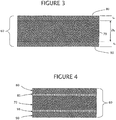
- the present invention includes a glass laminate substrate 60 (such as shown in the examples of Figures 3 and 4 ) for use in flat panel displays.
- a glass laminate substrate 60 (such as shown in the examples of Figures 3 and 4 ) for use in flat panel displays.
- flat panel display is an example of an electronic substrate and can include, but is not limited to liquid crystal displays (LCDs), plasma displays, (PDs), field emission displays (FEDs) and organic light-emitting polymer displays (OLEDs).
- LCDs liquid crystal displays
- PDs plasma displays
- FEDs field emission displays
- OLEDs organic light-emitting polymer displays
- FIG. 1 a schematic representation of an LCD is provided, wherein glass sheets 20, 30 (shown without lamination) are separated by a gap 40 that is filled with a liquid crystal material.
- the edges of the sheets 20, 30 are sealed together with a low modulus polymer adhesive 44, and disposed in a relatively rigid frame (not shown).
- a diffuser plate 46 is spaced from the sheet 30 by a predetermined separation, wherein the diffuser plate acts as a backlight source.
- the sheet 20 has an exposed surface 22 and a gap surface 24, and the sheet 30 includes a gap surface 32 and an exposed surface 34.
- the surfaces 22 and 32 experience compression, and are thus relatively resistant to the loading.
- the surfaces 24 and 34 are subject to increased tensile stress which can lead to failure of the sheets 20, 30 depending on the severity of the loading and inherent flaws found on the surfaces 24 and 34.
- the glass laminate substrate 60 as made according to the present invention employs a residual compressive stress to at least partially counteract a tensile stress associated with a loading of the substrate.
- the relationship of residual compressive and residual tensile stress in the glass laminate substrate 60 can also be selected to enhance resistance to impact and static loading without generating unacceptable levels of debris (or substrate failure) in the scribing and separating process.
- the glass laminate substrate 60 of the present invention can be used in place of the glass sheets 20, 30 to provide enhanced strength at the exposed and gap surfaces, thereby increasing the ability of the resulting display to resist impact and static loading.
- the glass laminate substrate 60 includes a glass core (layer) 70 bounded by a pair of spaced glass skin layers 80, 90.
- the glass laminate substrate 60 is constructed to have a generally predetermined relationship of residual compressive stress in the skin layers 80, 90 and residual tensile stress in the core 70.
- the skin layers 80, 90 are directly bonded to the glass core 70.
- intermediate layers can be located between the core 70 and the skin layers 80, 90.
- These intermediate layers can include, but are not limited to glass interlayers 85, 95.
- the interlayers 85, 95 are located between the skin layers 80, 90 and the glass core 70, wherein the skin layers and the interlayers have a residual compressive stress and the core has a residual tensile stress.
- the skin layers 80, 90 can be directly, integrally, bonded to the core 70, or indirectly bonded to the core by, for example, at least one interlayer 85, 95 respectively.
- ⁇ s E c 1 ⁇ v c ⁇ s ⁇ ⁇ c T * ⁇ 25 t s t c + E c E s 1 ⁇ v s 1 ⁇ v c
- ⁇ c E s 1 ⁇ v s ⁇ c ⁇ ⁇ s T * ⁇ 25 t c t s + E s E c 1 ⁇ v c 1 ⁇ v s
- E c and E s are the elastic moduli of the core and skin glasses, respectively; v c and v s are the Poisson's ratios of the core and skin glasses, respectively; ⁇ s is the average coefficient of thermal expansion of the skin layer glass from room temperature to the setpoint (T*); ⁇ c is the average coefficient of thermal expansion of the core glass from room temperature to the setpoint (T*); T* is the lower of the set points of the core and skin glasses (setpoint is defined as 5°C above the glass strain point); t s is the thickness of each skin layer; and t c is one half the core thickness.
- CTE coefficients of thermal expansion
- the amount of residual stress (compressive in the skin layers and tensile in the core) can be set.
- the glass material of skin layers 80, 90 has a lower CTE than the CTE of the core glass material.
- one advantageous configuration employs a skin layer CTE and a core CTE that are within, approximately 35%, it is understood any of a variety of CTE differences can be employed between the skin glass and the core glass as demonstrated by the following examples.
- Such laminate has a surface strength approximately 10% to 25% greater than a corresponding unlaminated core, as measured by the industry known ring-on-ring strength test. It has been observed that the internal tensile stress being less than approximately 1,000 psi (6.9 Mpa) allows the glass laminate substrate to be scribed and cut without appreciable risk of shattering or creating appreciable glass particles which can contaminate the glass surface.
- the glass laminate substrate 60 can be satisfactorily performed with a tensile stress as high as 4,000 psi (27.6 MPa) in the core 70, without unacceptable levels of debris generation or failure of the substrate.
- a tensile stress as high as 4,000 psi (27.6 MPa) in the core 70, without unacceptable levels of debris generation or failure of the substrate.
- the residual tensile stress in the core it is desirable for the residual tensile stress in the core to be less than about 2,000 psi (13.8 MPa), and more desirably less than about 1,500 psi (10.3 MPa).
- a residual tensile stress in the core 70 of less than approximately 1,000 psi (6.9 MPa), and beneficially less than approximately 750 psi (5.2 MPa) allows sufficient residual compressive stress in the skin layers 80, 90 to enhance impact and static loading resistance while providing acceptable levels of debris generation and substrate failure (shatter) rates during the scribing and separating process.
- the residual compressive stress in the skin layers 80, 90 might advantageously be in a range between approximately 3,000 to 15,000 psi (20.7 MPa to 103.4 MPa), while the tensile stress in the glass core 70 is maintained below a level which permits scribing and separating of the glass laminate substrate 60 without shattering or appreciable debris generation, such as less than approximately 4,000 psi (27.6 MPa), advantageously less than about 2,000 psi (13.8 MPa) and in select configurations less than approximately 1,500 psi (10.3 MPa).
- the allowable residual tensile stress in the core 70 is at least partially determined by the particular composition of the core, as well as the glass of skin layers 80, 90, and hence the residual tensile stress can vary while providing superior results.
- the ratio of the absolute magnitude of the residual compressive stress to the residual tensile stress can range from approximately 2 to approximately 20, wherein the residual tensile stress is less than approximately 4,000 and even more advantageously less than 1,500 psi (10.3 Mpa).
- the residual compressive stress in the skin layers 80, 90 can be on the order of 9,000 psi (62.01 Mpa), thereby increasing the surface strength of the glass laminate substrate 60 by approximately 50%.
- the release of energy in such strength maximized glass laminate substrate 60 can create substantial substrate failure rates and debris generation in the scribing and separating process.
- the residual compressive stress and the residual tensile stress are selected to optimally enhance resulting strength of the particular glass laminate substrate 60 without appreciable substrate failure rates or debris generation during the scribing and separating process.
- N fragments are: ⁇ c ⁇ c N N (psi) (MPa) (psi) (# fragments/50mmx50mm area) (# fragments/in 2 ) 500 3.45 500 0.02 0.005 1000 6.89 1000 0.28 0.07 1500 10.3 1500 1.4 0.35 2000 13.8 2000 4.5 1.1 2500 17.2 2500 10.9 2.7 3000 20.7 3000 22.6 5.6 3500 24.1 3500 41.8 10.4 4000 27.6 4000 71.3 17.8
- An exemplary three layer 1m x 1m glass laminate substrate 60 having a thickness of 0.7mm has a surface area along a formed edge of slightly over 1 in 2 (6.45 cm 2 ).
- an approximately 2000 psi (13.8 MPa) residual tensile stress in the core 70 is suggested for maintaining particle generation at or below one particle per square inch (6.45 cm 2 ) for the scribing and separating process.
- the glass laminate substrate 60 can be constructed to provide a residual tensile stress in the core 70 of up to approximately 4,000 psi (27.6 MPa) so as to exhibit acceptable debris generation and substrate failure rates during the scribing and separating process.
- a satisfactory glass material for the core 70 has been found to be Coming Code 1737 glass, and a satisfactory glass material for the skin layers 80, 90 has been found to be EAGLE 2000TM glass manufactured by Coming.
- the glasses can have a matched or identical refractive index. These materials when used in a laminate with the skin thickness of approximately 0.02 mm to 0.2 mm have been found to provide adequate protection against surface damage during handling, assembly and lifetime of the display.
- the glass laminate substrate 60 which is directed to incorporation into a display, minimization of weight is a factor.
- the glass laminate substrate 60 as for a flat panel display application, might have a thickness less than about 2.0 mm and may be less than approximately 1.5 mm, with a typical thickness of about 1.1 mm or less, wherein the skin layers 80, 90 (and interlayers 85, 95, if employed) and the core 70 form an at least substantially planar laminate.
- the minimization of weight is often a primary consideration, and hence the thickness of the glass laminate substrate 60 is often approximately 0.4 mm to approximately 0.6 mm.
- the glass laminate substrate 60 may have a thickness of approximately 0.7 mm.
- the total thickness of a glass laminate substrate 60 made for use in a flat panel display might be between approximately 0.4 mm and approximately 1.1 mm, wherein the thickness of the skin layers 80, 90 is selected to be between approximately 8% to 15% of the total substrate thickness, with a more optimal thickness of the skin layers being approximately 10% of the total substrate thickness.
- the glass laminate substrate 60 while having a thickness which is generally too small for tempering the glass, provides increased strength through the residual stresses. Therefore, the glass laminate substrate 60 can be constructed of glass that is not tempered.
- the glass laminate substrate of the present invention also addresses flaw generation and flaw propagation in glass to provide the substrate with improved resistance to damage.
- the glass laminate substrate 60 of the example in Figure 3 provides the skin layers 80, 90 with residual compressive stress such that the skin layers are more resistant to damage by an amount of the residual compressive stress.
- an additional 5,000 psi (34.5 MPa) stress is required to create a flaw when compared to stress required to create the same size flaw in an unlaminated glass.
- the glass laminate substrate of the present invention will be less susceptible to damage during the handling/processing steps of making the flat panel display, such as an LCD. Further, the residual stress results in a permanent strengthening effect of the glass laminate substrate 60. That is, to create the same level of tensile stress required to drive a crack in the glass laminate substrate 60 will require a stress in excess of the residual compressive stress in the skin layer. Again, using the present example of a 5000 psi (34.5 MPa) residual compressive stress in the skin layer, a 5000 psi (34.5 MPa) excess tensile stress is required to drive a crack across the laminated glass substrate than across an unlaminated glass.
- each skin layer 80,90 comprises the same material and thickness, thereby providing a symmetrical stress about the core 70.
- each interlayer 85, 95 comprises the same material and thickness thereby providing symmetrical stress about the core 70. That is, the residual compressive stress in the skin layers 80, 90 (or within the interlayers 85, 95) can be substantially equal.
- the skin layers 80, 90 (and/or interlayers 85, 95) on a given core 70 can be of different material, CTE or thickness, which may be advantageous for applications where there is asymmetric loading. For example, by doubling the thickness of one skin layer, the glass laminate substrate 60 can exhibit an increased resistance to bending in a horizontal orientation, such as rack storage.
- an asymmetric residual stress in the skin layers can be set at a predetermined level, such as for example, approximately 10%.
- the residual compressive stress in the skin layers 80, 90 is within approximately 20%, advantageously within approximately 10% such as within approximately 5% of each other.
- Example 4 is a representative construction of the 5-layer configuration seen in Figure 4 .
- An advantage of including the interlayers 85,95 in the glass laminate substrate 60 lies in the ability to maintain a relatively large residual compressive stress in the skin layers 80, 90 while reducing the residual tensile stress in the core 70.
- the values of compressive stress relate to the respective thicknesses of the interlayer 85,95 and skin layer 80, 90 relative to that of the glass core 70.
- e o t c k c e c + t i k i e i + t s k s e s t c k c + t i k i + t s k s
- the 5-layer 3-glass laminate substrate 60 has 11% lower core tension and 11% lower compression in the interlayers 85, 95 compared with a 3 layer 2-glass laminate comprising a Corning Code 0317 glass core 70 and skin layers 80, 90 of EAGLE 2000TM glass by Coming, while the compression in the skin layers is 1% higher.
- the 5-layer 3-glass system with interlayers 85, 95 offers the advantage of significantly reducing the tensile stress in the core 70 while preserving the compressive stress in the skin layers 80, 90.
- the reduced internal tensile stress in the core 70 assists in reducing shattering and debris generation during the scribing and separating process.
- the amount of residual stress can be set by design. That is, the amount of residual stress (compressive in the skin layers 80, 90 and interlayers 85, 95 and tensile in the core 70) can be substantially predetermined.
- the residual stresses in the glass laminate substrate 60 are formed through bonding the multiple layers together at a temperature above the lowest setpoint of the constituent layer glasses.
- lamination will occur during the forming of the molten glass into a sheet form so as to achieve a sufficient bond between adjacent layers (such as the core 70 to the skin layers 80, 90, or the interlayers 85, 95 to the core and the skin layers).
- adjacent layers such as the core 70 to the skin layers 80, 90, or the interlayers 85, 95 to the core and the skin layers.
- fusion drawing of the skin (and interlayer) glass and the core glass is a satisfactory method for formation of the glass laminate substrate 60.
- alternative methods such as slot drawing, double slot drawing or other suitable bonding methods could be used to form the glass laminate substrate 60.
- the glass material of the core 70 and the skin layers 80, 90 (and the interlayers 85, 95) is selected to provide a compatible viscosity to form a substantially transparent and distortion free interface.
- molten glass is delivered to a slot orifice made from a refractory metal such as platinum.
- a laminated down draw apparatus has multiple slot orifices located parallel to each other and the ability to deliver different molten glass streams to each orifice.
- the fluid nature of the glass at this forming condition typically 100,000 poises
- the glass laminate substrate 60 is formed with a controllable overflow distribution system and a forming member, such that the core 70 and skin layers 80, 90 (and glass interlayers 85, 95) flow concurrently along a forming member until cooling to a viscosity suitable for forming a single glass laminate substrate with the desired thicknesses.
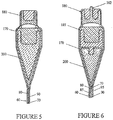
- the glass which forms the core 70 and the glass which forms the skin layers 80, 90 are separately melted and delivered through an appropriate delivery system to a corresponding overflow distributor 170, 180 respectively.
- the overflow distributor 180 is mounted above the overflow distributor 170 so that the glass from the overflow distributor 180 flows over top edge portions of the overflow distributor 180 and down the sides to form a uniform flow layer of appropriate thickness on both sides of the overflow distributor 180 below such top edge portions.
- the bottom overflow distributor 170 has a wedge-shaped forming member 200 associated therewith.
- the forming member 200 has converging sidewall portions which communicate at their top end with the sidewalls of the overflow distributor 170 and terminate at their converging bottom ends in a draw line.
- the molten glass overflowing the bottom overflow distributor 170 flows downwardly along the distributor walls and forms an initial glass flow layer adjacent to the converging outer surfaces of the forming member 200, whereas the molten glass overflowing the distributor 180 from above flows downwardly over the upper distributor walls and flows over outer surface portions of the core layer, thereby creating a laminated glass stream.
- the two individual layers of glass from each converging sidewall of the forming member 200 are brought together and fused at the draw line to form a single continuous laminate.
- the two layers of the core glass fuse to form the core 70, which separates the layers of skin glass.
- the residual stress derives from the difference in the CTE between the skin layers 80, 90 and the core 70 and the respective setpoints.
- the skin glass and core glass bond at an elevated temperature, and as the materials cool to ambient temperature, the skin glass (lower CTE) tends to contract less than the core glass (higher CTE).
- a compressive stress is generated in skin layers 80, 90 and a tensile stress is generated in the core 70.
- additional layers such as the interlayers 185, 195, can be incorporated in the glass laminate substrate 60, by stacking additional overflow distributors and associated forming members (and their respective glass delivery systems).
- the 5-layer glass laminate substrate 60 illustrated in Figure 4 can thus be formed by the system shown in Figure 6 , wherein overflow distributor 180 (forming the skin layers 80, 90) is above overflow distributor 185 (forming the interlayers 185, 195) which in turn is above the overflow distributor 170 (forming the core 70).
- the overflow distributor 180 can include a central wall 182 to allow two different glasses to issue from the distributor, thereby forming skin layer 80 of a different material than the skin layer 90.
- the overflow distributor 180 is shown with the central wall 182, it should be understood that the overflow distributor 185 can alternatively include the central wall, thereby providing for the interlayers 185 and 195 to be of different materials.
- Asymmetric layer thicknesses are achievable by adjusting the relative glass flow over the two sides of any given overflow distributor (and associated forming member) such as by tilting the forming member or employing a varying of different flow rate, or a combination thereof.
- the dimensional control and resulting pristine glass surface conditions make the fusion, or overflow process, a satisfactory method for making the glass laminate substrate 60.
- the skin glass, EAGLE 2000TM glass from Corning will set up first and contract free of stress.
- the glass, Corning Code 0317, of the core 70 is the softest glass of the glass laminate substrate 60 and has a setpoint of 581°C, and hence no stress is set up in the core glass until the core glass cools to 581°C.
- the interlayer glass, Corning Code 7059 has a setpoint of 598°C so the interlayer glass will set up before the core glass and experience tension while inducing compression in the skin glass as the laminate 60 is cooling from 598°C to 581°C.
- the core glass begins to set up which, due to the core glass having the highest CTE value, will experience the most tension and induce net compression in both the interlayers 85,95 and the skin layers 80, 90.
- any of a variety of layers, coatings or films, including functional layers can be applied to the glass laminate substrate. While these additional layers do not typically have a significant residual compressive or tensile stress, as discussed herein the skin layers 80, 90 (and the interlayers 85, 95 if employed) can be constructed to compensate for these subsequent layers deposited on the substrate. For example, the thickness (or materials) of the skin layers 80, 90 and/or interlayers 85, 95 can be selected to create compensating residual stresses to accommodate such additional layers.
- the glass laminate substrate 60 can be formed to exhibit an unbalanced surface compressive stress, such that subsequent layers tend to equalize the compressive stress on opposite surfaces of the core 70.
Landscapes
- Chemical & Material Sciences (AREA)
- Engineering & Computer Science (AREA)
- Materials Engineering (AREA)
- Organic Chemistry (AREA)
- Life Sciences & Earth Sciences (AREA)
- Chemical Kinetics & Catalysis (AREA)
- General Chemical & Material Sciences (AREA)
- Geochemistry & Mineralogy (AREA)
- Structural Engineering (AREA)
- Laminated Bodies (AREA)
- Joining Of Glass To Other Materials (AREA)
- Liquid Crystal (AREA)
Claims (7)
- Laminatsubstrat, umfassend:ein Paar mit Zwischenabstand angeordneter, transparenter Glashautschichten mit einem ersten Wärmeausdehnungskoeffizienten;einen transparenten Glaskern zwischen den Glashautschichten, wobei der transparente Glaskern einen höheren zweiten Wärmeausdehnungskoeffizienten aufweist;wobei die Glashautschichten eine verbliebene Druckspannung im Bereich von 20,7 MPa bis 103,4 MPa (3.000 psi bis 15.000 psi) aufweisen, und wobei der Glaskern eine verbliebene Zugspannung von weniger als 27,6 MPa (4.000 psi) aufweist;wobei die Glashautschichten einen höheren Setting Point als der transparente Glaskern aufweisen;wobei eine Gesamtdicke des Laminatsubstrats zwischen 0,4 mm und 1,1 mm liegt; undwobei eine Dicke der Glashautschichten zwischen 8% und 15% einer Gesamtdicke des Laminatsubstrats liegt.
- Laminatsubstrat nach Anspruch 1, wobei die verbliebene Zugspannung in dem Glaskern niedriger ist als 13,8 MPA (2000 psi).
- Laminatsubstrat nach Anspruch 1, wobei die verbliebene Zugspannung in dem Glaskern niedriger ist als 10,3 MPA (1500 psi).
- Laminatsubstrat nach Anspruch 1, wobei die verbliebene Zugspannung in dem Glaskern niedriger ist als 6,9 MPA (1000 psi).
- Laminatsubstrat nach Anspruch 1, wobei die verbliebene Druckspannung in dem Paar von Glashautschichten im Wesentlichen identisch ist.
- Laminatsubstrat nach Anspruch 1, wobei das Paar von Glashautschichten aus unterschiedlichem Material, besteht, einen unterschiedlichen CTE oder unterschiedliche Dicke aufweist.
- Laminatsubstrat nach Anspruch 1, ferner umfassend eine Glaszwischenschicht zwischen dem Glaskern und wenigstens einer Glashautschicht.
Applications Claiming Priority (2)
| Application Number | Priority Date | Filing Date | Title |
|---|---|---|---|
| US11/011,323 US7201965B2 (en) | 2004-12-13 | 2004-12-13 | Glass laminate substrate having enhanced impact and static loading resistance |
| EP05853548.5A EP1836274B1 (de) | 2004-12-13 | 2005-12-08 | Glaslaminatsubstrat mit verbesserter stoss- und statischer belastbarkeit |
Related Parent Applications (3)
| Application Number | Title | Priority Date | Filing Date |
|---|---|---|---|
| EP05853548.5 Division | 2005-12-08 | ||
| EP05853548.5A Division EP1836274B1 (de) | 2004-12-13 | 2005-12-08 | Glaslaminatsubstrat mit verbesserter stoss- und statischer belastbarkeit |
| EP05853548.5A Division-Into EP1836274B1 (de) | 2004-12-13 | 2005-12-08 | Glaslaminatsubstrat mit verbesserter stoss- und statischer belastbarkeit |
Publications (2)
| Publication Number | Publication Date |
|---|---|
| EP2444246A1 EP2444246A1 (de) | 2012-04-25 |
| EP2444246B1 true EP2444246B1 (de) | 2018-01-31 |
Family
ID=36584300
Family Applications (2)
| Application Number | Title | Priority Date | Filing Date |
|---|---|---|---|
| EP11191985.8A Expired - Lifetime EP2444246B1 (de) | 2004-12-13 | 2005-12-08 | Glaslaminatsubstrat mit verbesserter Stoß- und statischer Aufladebeständigkeit |
| EP05853548.5A Expired - Lifetime EP1836274B1 (de) | 2004-12-13 | 2005-12-08 | Glaslaminatsubstrat mit verbesserter stoss- und statischer belastbarkeit |
Family Applications After (1)
| Application Number | Title | Priority Date | Filing Date |
|---|---|---|---|
| EP05853548.5A Expired - Lifetime EP1836274B1 (de) | 2004-12-13 | 2005-12-08 | Glaslaminatsubstrat mit verbesserter stoss- und statischer belastbarkeit |
Country Status (7)
| Country | Link |
|---|---|
| US (1) | US7201965B2 (de) |
| EP (2) | EP2444246B1 (de) |
| JP (2) | JP5649267B2 (de) |
| KR (1) | KR101180200B1 (de) |
| CN (1) | CN101076447B (de) |
| TW (1) | TWI284091B (de) |
| WO (1) | WO2006065657A2 (de) |
Families Citing this family (175)
| Publication number | Priority date | Publication date | Assignee | Title |
|---|---|---|---|---|
| JP2007212801A (ja) * | 2006-02-10 | 2007-08-23 | Fujitsu Hitachi Plasma Display Ltd | フラットパネルディスプレイおよびそれを備えたディスプレイパネル装置 |
| US8007913B2 (en) * | 2006-02-10 | 2011-08-30 | Corning Incorporated | Laminated glass articles and methods of making thereof |
| US7978281B2 (en) | 2008-09-16 | 2011-07-12 | General Dynamics Land Systems | Low stress mounting support for ruggedized displays |
| US9346699B2 (en) | 2008-10-06 | 2016-05-24 | Corning Incorporated | Method of making a glass laminate having controlled strength |
| DE102009025972B4 (de) | 2009-06-15 | 2018-12-27 | Sage Electrochromics, Inc. | Verbundglasscheibe und deren Verwendung |
| JP2011034871A (ja) * | 2009-08-04 | 2011-02-17 | Nec Lighting Ltd | 面発光装置 |
| JP5652742B2 (ja) * | 2010-02-12 | 2015-01-14 | 日本電気硝子株式会社 | 強化板ガラス及びその製造方法 |
| JP5644129B2 (ja) * | 2010-02-12 | 2014-12-24 | 日本電気硝子株式会社 | 強化板ガラス及びその製造方法 |
| US9302937B2 (en) | 2010-05-14 | 2016-04-05 | Corning Incorporated | Damage-resistant glass articles and method |
| TWI519414B (zh) * | 2010-06-29 | 2016-02-01 | 康寧公司 | 具有提高機械強度之玻璃片 |
| US8826693B2 (en) * | 2010-08-30 | 2014-09-09 | Corning Incorporated | Apparatus and method for heat treating a glass substrate |
| EP2646243B1 (de) * | 2010-11-30 | 2016-02-03 | Corning Incorporated | Glas mit oberfläche und zentralen regionen unter kompression |
| US20120192928A1 (en) * | 2011-01-27 | 2012-08-02 | Mark Francis Krol | Laminated pv module package |
| WO2012116316A1 (en) | 2011-02-25 | 2012-08-30 | Schott Corporation | Transparent laminate structures |
| US20120280368A1 (en) * | 2011-05-06 | 2012-11-08 | Sean Matthew Garner | Laminated structure for semiconductor devices |
| TWI547369B (zh) | 2011-05-27 | 2016-09-01 | 康寧公司 | 玻璃塑膠積層之裝置、處理線、及方法 |
| US9090505B2 (en) | 2011-07-15 | 2015-07-28 | Corning Incorporated | Microwave-based glass laminate fabrication |
| TWI572480B (zh) | 2011-07-25 | 2017-03-01 | 康寧公司 | 經層壓及離子交換之強化玻璃疊層 |
| US10347782B2 (en) | 2011-08-04 | 2019-07-09 | Corning Incorporated | Photovoltaic module package |
| US9516149B2 (en) | 2011-09-29 | 2016-12-06 | Apple Inc. | Multi-layer transparent structures for electronic device housings |
| US9850162B2 (en) * | 2012-02-29 | 2017-12-26 | Corning Incorporated | Glass packaging ensuring container integrity |
| JP2015006959A (ja) * | 2011-10-31 | 2015-01-15 | 旭硝子株式会社 | ガラス基板、ガラス基板の製造方法、およびカバーガラス |
| US20130114219A1 (en) * | 2011-11-08 | 2013-05-09 | Sean Matthew Garner | Opto-electronic frontplane substrate |
| CN107540242B (zh) | 2012-02-28 | 2020-11-20 | 康宁股份有限公司 | 具有低摩擦涂层的玻璃制品 |
| JP2015091737A (ja) * | 2012-02-28 | 2015-05-14 | 旭硝子株式会社 | 積層強化ガラス |
| US9109879B2 (en) | 2012-02-29 | 2015-08-18 | Corning Incorporated | Systems for and methods of characterizing the thickness profile of laminated glass structures |
| WO2013130665A2 (en) * | 2012-02-29 | 2013-09-06 | Corning Incorporated | Low cte, ion-exchangeable glass compositions and glass articles comprising the same |
| US9359251B2 (en) | 2012-02-29 | 2016-06-07 | Corning Incorporated | Ion exchanged glasses via non-error function compressive stress profiles |
| IN2014DN07758A (de) | 2012-02-29 | 2015-05-15 | Corning Inc | |
| TWI564262B (zh) * | 2012-02-29 | 2017-01-01 | 康寧公司 | 高cte之硼矽酸鉀核心玻璃與包含其之玻璃物件 |
| US8895941B2 (en) | 2012-02-29 | 2014-11-25 | Corning Incorporated | Laminated glass sheet depth profile determination |
| US11179295B2 (en) | 2012-02-29 | 2021-11-23 | Corning Incorporated | Glass packaging ensuring container integrity |
| TWI614227B (zh) * | 2012-02-29 | 2018-02-11 | 康寧公司 | 低cte之無鹼硼鋁矽酸鹽玻璃組成物及包含其之玻璃物件 |
| US9796616B2 (en) | 2012-05-24 | 2017-10-24 | Corning Incorporated | Apparatus and method for producing laminated glass sheet |
| US9556052B2 (en) * | 2012-05-24 | 2017-01-31 | Corning Incorporated | Laminate fusion draw apparatus and method of use thereof |
| US8646291B2 (en) * | 2012-05-24 | 2014-02-11 | Corning Incorporated | Apparatus and method for control of glass streams in laminate fusion |
| US10011512B2 (en) | 2012-05-24 | 2018-07-03 | Corning Incorporated | Suspension and control system for glass laminate fusion |
| CN104684861B (zh) * | 2012-06-08 | 2018-02-23 | 康宁股份有限公司 | 具有高玻璃‑聚合物中间层粘附强度的层压玻璃结构 |
| CN104428261B (zh) | 2012-07-13 | 2018-09-11 | 康宁股份有限公司 | 制备层压玻璃片的方法和设备 |
| CN105358320B (zh) * | 2012-08-31 | 2021-06-01 | 康宁股份有限公司 | 强化的薄玻璃-聚合物层压件 |
| EP2903945B1 (de) * | 2012-10-04 | 2020-09-02 | Corning Incorporated | Artikel mit einer glasschicht und einer glaskeramikschicht und verfahren zur herstellung des artikels |
| KR102173671B1 (ko) * | 2012-10-04 | 2020-11-04 | 코닝 인코포레이티드 | 감광성 유리를 통한 압축 응력 적층 유리 제품 및 이의 제조 방법 |
| KR102173670B1 (ko) * | 2012-10-04 | 2020-11-04 | 코닝 인코포레이티드 | 세라믹 상을 갖는 적층 유리 제품 및 이의 제조방법 |
| WO2014079478A1 (en) | 2012-11-20 | 2014-05-30 | Light In Light Srl | High speed laser processing of transparent materials |
| US9212081B2 (en) | 2012-11-21 | 2015-12-15 | Corning Incorporated | Methods of cutting a laminate strengthened glass substrate |
| JP2014125360A (ja) * | 2012-12-25 | 2014-07-07 | Nippon Electric Glass Co Ltd | 強化板ガラス及びその製造方法 |
| EP2754524B1 (de) | 2013-01-15 | 2015-11-25 | Corning Laser Technologies GmbH | Verfahren und Vorrichtung zum laserbasierten Bearbeiten von flächigen Substraten, d.h. Wafer oder Glaselement, unter Verwendung einer Laserstrahlbrennlinie |
| US10538450B2 (en) | 2013-01-26 | 2020-01-21 | Corning Incorporated | Laminated glass structure and method of manufacture |
| US9434632B2 (en) * | 2013-02-26 | 2016-09-06 | Corning Incorporated | Glass forming apparatus and method |
| US9340451B2 (en) | 2013-02-28 | 2016-05-17 | Corning Incorporated | Machining of fusion-drawn glass laminate structures containing a photomachinable layer |
| US9393760B2 (en) | 2013-02-28 | 2016-07-19 | Corning Incorporated | Laminated glass articles with phase-separated claddings and methods for forming the same |
| EP2781296B1 (de) | 2013-03-21 | 2020-10-21 | Corning Laser Technologies GmbH | Vorrichtung und verfahren zum ausschneiden von konturen aus flächigen substraten mittels laser |
| TWI631019B (zh) * | 2013-04-19 | 2018-08-01 | 美商康寧公司 | 形成積層玻璃結構之方法 |
| EP2988931A1 (de) * | 2013-04-22 | 2016-03-02 | Corning Incorporated | Verbundglasstrukturen mit hoher glas-polymer-zwischenschichthaftung |
| TWI627141B (zh) | 2013-04-30 | 2018-06-21 | 康寧公司 | 用於沿等壓管堰控制熔融玻璃流的設備與方法 |
| US9527767B2 (en) * | 2013-05-09 | 2016-12-27 | Corning Incorporated | Alkali-free phosphoborosilicate glass |
| CN105452184B (zh) * | 2013-06-14 | 2018-11-23 | 康宁股份有限公司 | 具有耐划痕表面的层叠玻璃制品 |
| EP3008022B1 (de) * | 2013-06-14 | 2020-12-30 | Corning Incorporated | Laminierte dichtungsfolie |
| TW201500186A (zh) | 2013-06-14 | 2015-01-01 | 康寧公司 | 製造具有改良邊緣狀態的層合玻璃物件之方法 |
| US11079309B2 (en) | 2013-07-26 | 2021-08-03 | Corning Incorporated | Strengthened glass articles having improved survivability |
| CN105764865A (zh) | 2013-08-15 | 2016-07-13 | 康宁股份有限公司 | 掺杂有碱金属和不含碱金属的硼铝硅酸盐玻璃 |
| WO2015023561A2 (en) | 2013-08-15 | 2015-02-19 | Corning Incorporated | Intermediate to high cte glasses and glass articles comprising the same |
| WO2015027007A2 (en) | 2013-08-23 | 2015-02-26 | Corning Incorporated | Strengthened glass articles, edge-strengthened laminated glass articles, and methods for making the same |
| TW201518080A (zh) * | 2013-09-30 | 2015-05-16 | Corning Inc | 形成玻璃疊層片之外層的設備與方法 |
| CN112919828A (zh) | 2013-10-14 | 2021-06-08 | 康宁股份有限公司 | 离子交换方法以及通过该离子交换方法得到的经过化学强化的玻璃基材 |
| EP3063098A1 (de) | 2013-11-01 | 2016-09-07 | Corning Incorporated | Vorrichtung und verfahren zur herstellung einer glasscheibe |
| TWI656022B (zh) | 2013-11-13 | 2019-04-11 | 美商康寧公司 | 疊層玻璃物件及其製造方法 |
| JP6075719B2 (ja) * | 2013-11-19 | 2017-02-08 | 日本電気硝子株式会社 | 強化ガラス板、及び強化ガラス板の製造方法 |
| WO2015077109A1 (en) * | 2013-11-20 | 2015-05-28 | Corning Incorporated | Scratch-resistant boroaluminosilicate glass |
| EP3074351B1 (de) * | 2013-11-30 | 2019-05-29 | Corning Inc. | Aufhängung und steuerungssystem für die verschmelzung eines glaslaminats |
| US10138155B2 (en) | 2013-12-03 | 2018-11-27 | Corning Incorporated | Apparatus and method for severing a moving ribbon of inorganic material |
| CN105939973B (zh) | 2013-12-03 | 2019-08-20 | 康宁股份有限公司 | 用于切断玻璃板的设备和方法 |
| US10442719B2 (en) | 2013-12-17 | 2019-10-15 | Corning Incorporated | Edge chamfering methods |
| US10293436B2 (en) | 2013-12-17 | 2019-05-21 | Corning Incorporated | Method for rapid laser drilling of holes in glass and products made therefrom |
| US9676167B2 (en) | 2013-12-17 | 2017-06-13 | Corning Incorporated | Laser processing of sapphire substrate and related applications |
| US9815730B2 (en) | 2013-12-17 | 2017-11-14 | Corning Incorporated | Processing 3D shaped transparent brittle substrate |
| US9850160B2 (en) * | 2013-12-17 | 2017-12-26 | Corning Incorporated | Laser cutting of display glass compositions |
| US20150165560A1 (en) | 2013-12-17 | 2015-06-18 | Corning Incorporated | Laser processing of slots and holes |
| US11556039B2 (en) | 2013-12-17 | 2023-01-17 | Corning Incorporated | Electrochromic coated glass articles and methods for laser processing the same |
| US9701563B2 (en) | 2013-12-17 | 2017-07-11 | Corning Incorporated | Laser cut composite glass article and method of cutting |
| US9321677B2 (en) | 2014-01-29 | 2016-04-26 | Corning Incorporated | Bendable glass stack assemblies, articles and methods of making the same |
| US9517968B2 (en) | 2014-02-24 | 2016-12-13 | Corning Incorporated | Strengthened glass with deep depth of compression |
| KR102385315B1 (ko) | 2014-03-13 | 2022-04-11 | 코닝 인코포레이티드 | 유리 제품 및 이의 형성 방법 |
| WO2015148618A1 (en) * | 2014-03-27 | 2015-10-01 | Corning Incorporated | Glass article |
| WO2015164569A1 (en) | 2014-04-25 | 2015-10-29 | Corning Incorporated | Apparatus and method of manufacturing composite glass articles |
| US10549401B2 (en) | 2014-04-29 | 2020-02-04 | Corning Incorporated | Abrasive jet forming laminated glass structures |
| TWI649277B (zh) | 2014-05-07 | 2019-02-01 | 美商康寧公司 | 成形玻璃物件及其形成方法 |
| KR102433785B1 (ko) * | 2014-05-07 | 2022-08-18 | 코닝 인코포레이티드 | 적층 유리 제품 및 이의 형성방법 |
| TWI700473B (zh) | 2014-06-04 | 2020-08-01 | 美商康寧公司 | 用於量測玻璃物品厚度的方法及系統 |
| TWI697403B (zh) | 2014-06-19 | 2020-07-01 | 美商康寧公司 | 無易碎應力分布曲線的玻璃 |
| TWI730945B (zh) | 2014-07-08 | 2021-06-21 | 美商康寧公司 | 用於雷射處理材料的方法與設備 |
| WO2016010949A1 (en) | 2014-07-14 | 2016-01-21 | Corning Incorporated | Method and system for forming perforations |
| CN107073641B (zh) | 2014-07-14 | 2020-11-10 | 康宁股份有限公司 | 接口块;用于使用这种接口块切割在波长范围内透明的衬底的系统和方法 |
| KR20170028943A (ko) * | 2014-07-14 | 2017-03-14 | 코닝 인코포레이티드 | 조정가능한 레이저 빔 촛점 라인을 사용하여 투명한 재료를 처리하는 방법 및 시스템 |
| EP3169479B1 (de) | 2014-07-14 | 2019-10-02 | Corning Incorporated | Verfahren und system zum stoppen von inzidenter rissausbreitung in einem transparenten material |
| EP3183223A1 (de) | 2014-08-21 | 2017-06-28 | Corning Incorporated | Verfahren zur verhinderung von blasen in schichtglasartikeln und daraus geformte verbundglasartikel |
| CN107207315A (zh) * | 2014-08-28 | 2017-09-26 | 康宁股份有限公司 | 具有扩散性对比反差的可离子交换芯层和包覆层的层叠玻璃制品及其制造方法 |
| CN106687420B (zh) | 2014-08-28 | 2020-03-27 | 康宁股份有限公司 | 用于切割玻璃板的设备和方法 |
| TWI725945B (zh) | 2014-10-07 | 2021-05-01 | 美商康寧公司 | 具有已定應力輪廓的玻璃物件 |
| CN108046589A (zh) | 2014-10-08 | 2018-05-18 | 康宁股份有限公司 | 包含金属氧化物浓度梯度的玻璃和玻璃陶瓷 |
| WO2016069824A1 (en) | 2014-10-30 | 2016-05-06 | Corning Incorporated | Methods for strengthening the edge of laminated glass articles and laminated glass articles formed therefrom |
| US10513455B2 (en) | 2014-10-30 | 2019-12-24 | Corning Incorporated | Method and apparatus for sealing the edge of a glass article |
| JP7255968B2 (ja) | 2014-10-30 | 2023-04-11 | コーニング インコーポレイテッド | ガラスセラミック組成物及びこれを組み込んだラミネートガラス |
| US10150698B2 (en) | 2014-10-31 | 2018-12-11 | Corning Incorporated | Strengthened glass with ultra deep depth of compression |
| WO2016073539A1 (en) | 2014-11-04 | 2016-05-12 | Corning Incorporated | Deep non-frangible stress profiles and methods of making |
| CN107108343B (zh) * | 2014-11-05 | 2020-10-02 | 康宁股份有限公司 | 具有非平面特征和不含碱金属的玻璃元件的玻璃制品 |
| WO2016085778A1 (en) | 2014-11-26 | 2016-06-02 | Corning Incorporated | Thin glass sheet and system and method for forming the same |
| WO2016083862A1 (en) | 2014-11-28 | 2016-06-02 | Corning Incorporated | Methods for producing shaped glass articles |
| US10047001B2 (en) | 2014-12-04 | 2018-08-14 | Corning Incorporated | Glass cutting systems and methods using non-diffracting laser beams |
| WO2016094282A1 (en) * | 2014-12-08 | 2016-06-16 | Corning Incorporated | Laminated glass article with low compaction and method for forming the same |
| CN107406293A (zh) | 2015-01-12 | 2017-11-28 | 康宁股份有限公司 | 使用多光子吸收方法来对经热回火的基板进行激光切割 |
| CN107428599B (zh) * | 2015-02-02 | 2020-10-27 | 康宁股份有限公司 | 强化层压玻璃制品边缘的方法及由此形成的层压玻璃制品 |
| WO2016126752A1 (en) | 2015-02-04 | 2016-08-11 | Corning Incorporated | System for forming a glass article |
| US11773004B2 (en) | 2015-03-24 | 2023-10-03 | Corning Incorporated | Laser cutting and processing of display glass compositions |
| KR20170131638A (ko) | 2015-03-27 | 2017-11-29 | 코닝 인코포레이티드 | 가스 투과성 유리창 및 이의 제작방법 |
| CN107531538A (zh) | 2015-05-01 | 2018-01-02 | 康宁股份有限公司 | 用于控制玻璃片厚度的方法和设备 |
| CN107848267A (zh) * | 2015-06-02 | 2018-03-27 | 康宁股份有限公司 | 面板具有玻璃‑玻璃层叠结构的玻璃层叠体 |
| US10793462B2 (en) | 2015-07-07 | 2020-10-06 | Corning Incorporated | Apparatuses and methods for heating moving glass ribbons at separation lines and/or for separating glass sheets from glass ribbons |
| WO2017011296A1 (en) | 2015-07-10 | 2017-01-19 | Corning Incorporated | Methods of continuous fabrication of holes in flexible substrate sheets and products relating to the same |
| US11613103B2 (en) | 2015-07-21 | 2023-03-28 | Corning Incorporated | Glass articles exhibiting improved fracture performance |
| US10579106B2 (en) | 2015-07-21 | 2020-03-03 | Corning Incorporated | Glass articles exhibiting improved fracture performance |
| EP3150564B1 (de) | 2015-09-30 | 2018-12-05 | Corning Incorporated | Halogenierte chemische polyimidsiloxanzusammensetzungen und glasgegenstände mit halogenierten polylmidsiloxanbeschichtungen mit geringer reibung |
| CN108137396B (zh) | 2015-10-14 | 2022-04-26 | 康宁股份有限公司 | 具有确定的应力分布的层压玻璃制品及其形成方法 |
| US20170121058A1 (en) | 2015-10-30 | 2017-05-04 | Corning Incorporated | Glass articles with mixed polymer and metal oxide coatings |
| US11034134B2 (en) * | 2015-11-05 | 2021-06-15 | Corning Incorporated | Laminated glass article with determined modulus contrast and method for forming the same |
| EP3377453A1 (de) | 2015-11-20 | 2018-09-26 | Corning Incorporated | Verbundglasbänder und vorrichtungen zur herstellung von verbundglasbändern |
| TWI697463B (zh) | 2015-12-11 | 2020-07-01 | 美商康寧公司 | 具有金屬氧化物濃度梯度之可熔融成形的玻璃基物件 |
| CN111423110A (zh) | 2016-04-08 | 2020-07-17 | 康宁股份有限公司 | 包含金属氧化物浓度梯度的玻璃基制品 |
| KR20200091500A (ko) | 2016-04-08 | 2020-07-30 | 코닝 인코포레이티드 | 두 영역을 포함하는 응력 프로파일을 포함하는 유리-계 물품, 및 제조 방법 |
| JP2019513683A (ja) * | 2016-04-18 | 2019-05-30 | コーニング インコーポレイテッド | 選択的マイクロ波加熱および能動冷却を用いてガラス積層板を熱的に焼き戻す方法 |
| US10889520B2 (en) | 2016-04-19 | 2021-01-12 | Corning Incorporated | Glass forming apparatuses and methods for making glass ribbons |
| TW201806884A (zh) * | 2016-05-04 | 2018-03-01 | 康寧公司 | 玻璃積層系統與方法 |
| KR20220076536A (ko) | 2016-05-04 | 2022-06-08 | 코닝 인코포레이티드 | 알루미노실리케이트 색 유리 조성물 및 이를 포함하는 유리 제품 |
| JP6938543B2 (ja) | 2016-05-06 | 2021-09-22 | コーニング インコーポレイテッド | 透明基板からの、輪郭設定された形状のレーザ切断及び取り外し |
| EP3246298A1 (de) | 2016-05-12 | 2017-11-22 | Corning Incorporated | Pharmazeutische glasbeschichtung zur erzielung von partikelreduktion |
| EP3452422B1 (de) | 2016-05-23 | 2023-10-11 | Corning Incorporated | Glasartikelstützanordnung |
| US10410883B2 (en) | 2016-06-01 | 2019-09-10 | Corning Incorporated | Articles and methods of forming vias in substrates |
| JP2019521065A (ja) * | 2016-06-07 | 2019-07-25 | コーニング インコーポレイテッド | 三次元積層ガラス物品を製造する方法 |
| US20200307173A1 (en) * | 2016-06-07 | 2020-10-01 | Corning Incorporated | Methods for producing laminate glass articles |
| US10794679B2 (en) | 2016-06-29 | 2020-10-06 | Corning Incorporated | Method and system for measuring geometric parameters of through holes |
| US11307352B2 (en) | 2016-07-15 | 2022-04-19 | Corning Incorporated | Optical waveguide article with laminate structure and method for forming the same |
| WO2018013506A1 (en) | 2016-07-15 | 2018-01-18 | Corning Incorporated | Lighting unit with laminate structure |
| KR20190035805A (ko) | 2016-07-29 | 2019-04-03 | 코닝 인코포레이티드 | 레이저 처리를 위한 장치 및 방법 |
| WO2018039002A1 (en) | 2016-08-24 | 2018-03-01 | Corning Incorporated | Glass manufacturing apparatus and methods |
| KR102423775B1 (ko) | 2016-08-30 | 2022-07-22 | 코닝 인코포레이티드 | 투명 재료의 레이저 가공 |
| US10730783B2 (en) | 2016-09-30 | 2020-08-04 | Corning Incorporated | Apparatuses and methods for laser processing transparent workpieces using non-axisymmetric beam spots |
| KR102428350B1 (ko) | 2016-10-24 | 2022-08-02 | 코닝 인코포레이티드 | 시트형 유리 기판의 레이저 기반 기계 가공을 위한 기판 프로세싱 스테이션 |
| US10752534B2 (en) | 2016-11-01 | 2020-08-25 | Corning Incorporated | Apparatuses and methods for laser processing laminate workpiece stacks |
| KR102445875B1 (ko) | 2017-01-03 | 2022-09-21 | 코닝 인코포레이티드 | 만곡된 커버 유리 및 디스플레이 또는 터치 패널을 갖는 차량 인테리어 시스템 및 이를 형성시키는 방법 |
| CN110446604B (zh) | 2017-01-18 | 2022-09-23 | 康宁股份有限公司 | 具有工程应力分布的基于玻璃的制品及制造方法 |
| US10688599B2 (en) | 2017-02-09 | 2020-06-23 | Corning Incorporated | Apparatus and methods for laser processing transparent workpieces using phase shifted focal lines |
| US10580725B2 (en) | 2017-05-25 | 2020-03-03 | Corning Incorporated | Articles having vias with geometry attributes and methods for fabricating the same |
| US11078112B2 (en) | 2017-05-25 | 2021-08-03 | Corning Incorporated | Silica-containing substrates with vias having an axially variable sidewall taper and methods for forming the same |
| US10626040B2 (en) | 2017-06-15 | 2020-04-21 | Corning Incorporated | Articles capable of individual singulation |
| US20190030861A1 (en) | 2017-07-27 | 2019-01-31 | Corning Incorporated | Composite laminate with high depth of compression |
| KR102529169B1 (ko) * | 2017-09-13 | 2023-05-08 | 코닝 인코포레이티드 | 충격 성능이 개선된 만곡된 커버 유리를 갖는 차량 인테리어 시스템 및 이를 형성하는 방법 |
| US20190161399A1 (en) | 2017-11-30 | 2019-05-30 | Corning Incorporated | Glass articles with low-friction coatings and methods for coating glass articles |
| US11078103B2 (en) * | 2017-11-30 | 2021-08-03 | Corning Incorporated | Glass articles made from laminated glass tubing and systems and methods for converting laminated glass tubing into the glass articles |
| US12180108B2 (en) | 2017-12-19 | 2024-12-31 | Corning Incorporated | Methods for etching vias in glass-based articles employing positive charge organic molecules |
| US11554984B2 (en) | 2018-02-22 | 2023-01-17 | Corning Incorporated | Alkali-free borosilicate glasses with low post-HF etch roughness |
| KR20210042340A (ko) * | 2018-08-10 | 2021-04-19 | 코닝 인코포레이티드 | 라미네이트 유리 시트들을 형성하는 방법 및 장치 |
| US11091389B2 (en) | 2018-08-31 | 2021-08-17 | Corning Incorporated | Methods for making coated glass articles such as coated glass containers |
| US20200156991A1 (en) | 2018-11-20 | 2020-05-21 | Corning Incorporated | Glass articles having damage-resistant coatings and methods for coating glass articles |
| CN109437601A (zh) * | 2018-12-21 | 2019-03-08 | 厦门祐尼三的新材料科技有限公司 | 一种具有夹层电路的3d玻璃及其制备方法和应用 |
| CN113853298B (zh) * | 2019-04-11 | 2023-08-01 | 康宁公司 | 使用cte不匹配改进的边缘强度 |
| EP3953172A1 (de) | 2019-04-11 | 2022-02-16 | Corning Incorporated | Verbesserte kantenbelastung mittels differentieller kühlung |
| US11724963B2 (en) | 2019-05-01 | 2023-08-15 | Corning Incorporated | Pharmaceutical packages with coatings comprising polysilazane |
| US11707411B2 (en) | 2019-08-09 | 2023-07-25 | Corning Incorporated | Pharmaceutical packages with coatings comprising polycyanurates |
| CN111098681B (zh) * | 2019-11-13 | 2022-05-27 | 江苏铁锚玻璃股份有限公司 | 一种封闭自启动式节能星空玻璃天窗 |
| WO2022051645A2 (en) | 2020-09-04 | 2022-03-10 | Corning Incorporated | Ultraviolet light-blocking coated pharmaceutical packages |
| CN114449792A (zh) * | 2020-10-30 | 2022-05-06 | Oppo广东移动通信有限公司 | 壳体及其制作方法、电子设备 |
| CN117980274A (zh) * | 2021-09-13 | 2024-05-03 | 康宁公司 | 用于制造具有减少的静电吸引力的玻璃制品的方法和装置 |
| EP4405309A1 (de) | 2021-09-21 | 2024-07-31 | Corning Incorporated | Beschichtete glasartikel mit haftförderndem bereich |
| KR20230095145A (ko) | 2021-12-21 | 2023-06-29 | 삼성디스플레이 주식회사 | 유리 제품 및 이를 포함하는 표시 장치 |
| CN117292612B (zh) * | 2023-09-08 | 2026-04-17 | 昆山国显光电有限公司 | 盖板及显示面板 |
Family Cites Families (34)
| Publication number | Priority date | Publication date | Assignee | Title |
|---|---|---|---|---|
| US3597305A (en) | 1968-06-06 | 1971-08-03 | Corning Glass Works | Subsurface fortified glass or glass-ceramic laminates |
| US3737294A (en) * | 1970-08-28 | 1973-06-05 | Corning Glass Works | Method for making multi-layer laminated bodies |
| US3849097A (en) * | 1970-10-07 | 1974-11-19 | Corning Glass Works | Method for continuously hot forming strong laminated bodies |
| US3673049A (en) | 1970-10-07 | 1972-06-27 | Corning Glass Works | Glass laminated bodies comprising a tensilely stressed core and a compressively stressed surface layer fused thereto |
| US3746526A (en) | 1971-03-10 | 1973-07-17 | Corning Glass Works | Method for forming subsurface fortified laminates |
| US3958052A (en) * | 1974-06-12 | 1976-05-18 | Corning Glass Works | Subsurface-fortified glass laminates |
| US4102644A (en) | 1976-09-03 | 1978-07-25 | Milliken Research Corporation | Tint compositions for nylon having improved fugitivity properties |
| US4102664A (en) * | 1977-05-18 | 1978-07-25 | Corning Glass Works | Method for making glass articles with defect-free surfaces |
| US4214886A (en) | 1979-04-05 | 1980-07-29 | Corning Glass Works | Forming laminated sheet glass |
| US4483452A (en) * | 1981-12-07 | 1984-11-20 | Corning Glass Works | Television bulb |
| US4999246A (en) | 1987-02-26 | 1991-03-12 | Pda Engineering | Glass laminated structure, laminating apparatus, and methodology |
| JPH0522215Y2 (de) | 1987-09-22 | 1993-06-07 | ||
| JP3305022B2 (ja) | 1992-12-02 | 2002-07-22 | 藤森工業株式会社 | 電極基板 |
| US5342426A (en) | 1993-07-16 | 1994-08-30 | Corning Incorporated | Making glass sheet with defect-free surfaces and alkali metal-free soluble glasses therefor |
| US5508237A (en) | 1994-03-14 | 1996-04-16 | Corning Incorporated | Flat panel display |
| US5831694A (en) | 1995-06-14 | 1998-11-03 | Hitachi, Ltd. | TFT panel for high resolution- and large size- liquid crystal display |
| JPH10259041A (ja) | 1997-03-19 | 1998-09-29 | Fujitsu Ltd | 貼り合わせガラス基板構造およびその製造方法 |
| US5880795A (en) | 1996-05-10 | 1999-03-09 | Hitachi, Ltd. | Liquid crystal display module and projection-type liquid crystal display device |
| TW542933B (en) | 1996-12-19 | 2003-07-21 | Sharp Kk | Liquid crystal display device and process for producing the same |
| US6252639B1 (en) | 1997-08-25 | 2001-06-26 | Harris Corporation | Vibration and shock resistant liquid crystal display and associated methods |
| US6353283B1 (en) | 1997-10-20 | 2002-03-05 | Corning Incorporated | Implosion-resistant cathode ray tube envelope |
| EP1024952B1 (de) | 1997-10-24 | 2002-06-26 | Agfa-Gevaert | Verbundscheibe mit einem dünnen borosilikatglassubstrat als eine bildende schicht |
| JPH11322367A (ja) * | 1998-05-14 | 1999-11-24 | Asahi Glass Co Ltd | フラットパネルディスプレイ用ガラス基板およびその製造方法 |
| US6049094A (en) | 1998-05-21 | 2000-04-11 | National Semiconductor Corporation | Low stress package assembly for silicon-backed light valves |
| JP4006747B2 (ja) | 1998-06-29 | 2007-11-14 | 日本電気硝子株式会社 | ディスプレイ基板の製造方法 |
| US6356334B1 (en) | 1998-08-06 | 2002-03-12 | National Semiconductor Corporation | Liquid crystal display assembly and method for reducing residual stresses |
| US6083313A (en) | 1999-07-27 | 2000-07-04 | Advanced Refractory Technologies, Inc. | Hardcoats for flat panel display substrates |
| JP3817983B2 (ja) * | 1999-08-25 | 2006-09-06 | 旭硝子株式会社 | ディスプレイ用真空外囲器 |
| JP2001261355A (ja) * | 2000-03-23 | 2001-09-26 | Asahi Glass Co Ltd | ガラス基板端面の強度向上方法およびフラットパネルディスプレイ用ガラス基板 |
| JP2002174810A (ja) * | 2000-12-08 | 2002-06-21 | Hoya Corp | ディスプレイ用ガラス基板及びその製造方法並びにこれを用いたディスプレイ |
| JP3864750B2 (ja) | 2001-10-18 | 2007-01-10 | 株式会社日立製作所 | 表示素子用基板及びそれを用いた表示素子 |
| JP4153254B2 (ja) | 2002-07-18 | 2008-09-24 | 日本板硝子株式会社 | 合わせガラス |
| CN1276504C (zh) * | 2002-10-30 | 2006-09-20 | 矽品精密工业股份有限公司 | 一种防止翘曲现象发生的基板 |
| US7514149B2 (en) * | 2003-04-04 | 2009-04-07 | Corning Incorporated | High-strength laminated sheet for optical applications |
-
2004
- 2004-12-13 US US11/011,323 patent/US7201965B2/en not_active Expired - Lifetime
-
2005
- 2005-12-08 JP JP2007546778A patent/JP5649267B2/ja not_active Expired - Fee Related
- 2005-12-08 EP EP11191985.8A patent/EP2444246B1/de not_active Expired - Lifetime
- 2005-12-08 WO PCT/US2005/044664 patent/WO2006065657A2/en not_active Ceased
- 2005-12-08 KR KR1020077015939A patent/KR101180200B1/ko not_active Expired - Fee Related
- 2005-12-08 EP EP05853548.5A patent/EP1836274B1/de not_active Expired - Lifetime
- 2005-12-08 CN CN2005800425617A patent/CN101076447B/zh not_active Expired - Fee Related
- 2005-12-12 TW TW094144171A patent/TWI284091B/zh not_active IP Right Cessation
-
2014
- 2014-09-16 JP JP2014187566A patent/JP5820039B2/ja not_active Expired - Fee Related
Non-Patent Citations (1)
| Title |
|---|
| None * |
Also Published As
| Publication number | Publication date |
|---|---|
| JP5649267B2 (ja) | 2015-01-07 |
| EP2444246A1 (de) | 2012-04-25 |
| EP1836274A4 (de) | 2009-09-02 |
| JP2008522950A (ja) | 2008-07-03 |
| TWI284091B (en) | 2007-07-21 |
| EP1836274B1 (de) | 2018-01-31 |
| KR101180200B1 (ko) | 2012-09-10 |
| CN101076447A (zh) | 2007-11-21 |
| US20060127679A1 (en) | 2006-06-15 |
| JP5820039B2 (ja) | 2015-11-24 |
| JP2015078115A (ja) | 2015-04-23 |
| WO2006065657A3 (en) | 2006-08-24 |
| US7201965B2 (en) | 2007-04-10 |
| WO2006065657A2 (en) | 2006-06-22 |
| KR20070087650A (ko) | 2007-08-28 |
| TW200635762A (en) | 2006-10-16 |
| CN101076447B (zh) | 2012-04-04 |
| EP1836274A2 (de) | 2007-09-26 |
Similar Documents
| Publication | Publication Date | Title |
|---|---|---|
| EP2444246B1 (de) | Glaslaminatsubstrat mit verbesserter Stoß- und statischer Aufladebeständigkeit | |
| KR102421511B1 (ko) | 유리 제품 | |
| US8322160B2 (en) | Process and apparatus for producing glass sheet | |
| KR101775208B1 (ko) | 높은 cte 칼륨 보로실리케이트 코어 유리 및 이를 포함하는 유리 제품 | |
| EP3008026B1 (de) | Verbundglasartikel mit kratzfester oberfläche | |
| KR102173671B1 (ko) | 감광성 유리를 통한 압축 응력 적층 유리 제품 및 이의 제조 방법 | |
| US8322161B2 (en) | Process and apparatus for producing glass sheet | |
| KR102129504B1 (ko) | 유리층 및 유리-세라믹층을 갖는 제품 및 이의 제조 방법 | |
| TWI417255B (zh) | A manufacturing method of a glass plate and a manufacturing apparatus for a glass plate | |
| KR20060041206A (ko) | 초-박 유리 디스플레이 분야용 유리 제품 | |
| KR20170066580A (ko) | 결정된 응력 프로파일을 갖는 유리 제품 및 이의 제조 방법 | |
| WO2009081740A1 (ja) | ガラス板の製造方法及び製造設備 | |
| EP2426093A1 (de) | Glasplatte für ein substrat | |
| KR102544090B1 (ko) | 열적으로 강화된 소비자 전자제품 유리 및 이에 대한 시스템 및 방법 | |
| US11161772B2 (en) | Thin multilayer laminate | |
| KR20230109717A (ko) | 압축 상단 층이 있는 유리 폴리머 적층 | |
| JP2010219057A (ja) | ディスプレイパネル | |
| CN102399048A (zh) | 浮法玻璃的制造方法 |
Legal Events
| Date | Code | Title | Description |
|---|---|---|---|
| AC | Divisional application: reference to earlier application |
Ref document number: 1836274 Country of ref document: EP Kind code of ref document: P |
|
| AK | Designated contracting states |
Kind code of ref document: A1 Designated state(s): AT BE |
|
| PUAI | Public reference made under article 153(3) epc to a published international application that has entered the european phase |
Free format text: ORIGINAL CODE: 0009012 |
|
| 17P | Request for examination filed |
Effective date: 20121019 |
|
| 17Q | First examination report despatched |
Effective date: 20130416 |
|
| GRAP | Despatch of communication of intention to grant a patent |
Free format text: ORIGINAL CODE: EPIDOSNIGR1 |
|
| RIC1 | Information provided on ipc code assigned before grant |
Ipc: C03C 17/02 20060101ALI20170905BHEP Ipc: C03B 33/07 20060101ALN20170905BHEP Ipc: C03B 17/06 20060101ALI20170905BHEP Ipc: B32B 17/06 20060101AFI20170905BHEP |
|
| INTG | Intention to grant announced |
Effective date: 20170926 |
|
| RBV | Designated contracting states (corrected) |
Designated state(s): DE FR |
|
| GRAS | Grant fee paid |
Free format text: ORIGINAL CODE: EPIDOSNIGR3 |
|
| GRAA | (expected) grant |
Free format text: ORIGINAL CODE: 0009210 |
|
| AC | Divisional application: reference to earlier application |
Ref document number: 1836274 Country of ref document: EP Kind code of ref document: P |
|
| AK | Designated contracting states |
Kind code of ref document: B1 Designated state(s): DE FR |
|
| REG | Reference to a national code |
Ref country code: DE Ref legal event code: R096 Ref document number: 602005053469 Country of ref document: DE |
|
| REG | Reference to a national code |
Ref country code: DE Ref legal event code: R097 Ref document number: 602005053469 Country of ref document: DE |
|
| PLBE | No opposition filed within time limit |
Free format text: ORIGINAL CODE: 0009261 |
|
| STAA | Information on the status of an ep patent application or granted ep patent |
Free format text: STATUS: NO OPPOSITION FILED WITHIN TIME LIMIT |
|
| 26N | No opposition filed |
Effective date: 20181102 |
|
| PGFP | Annual fee paid to national office [announced via postgrant information from national office to epo] |
Ref country code: DE Payment date: 20191114 Year of fee payment: 15 |
|
| PGFP | Annual fee paid to national office [announced via postgrant information from national office to epo] |
Ref country code: FR Payment date: 20191122 Year of fee payment: 15 |
|
| REG | Reference to a national code |
Ref country code: DE Ref legal event code: R119 Ref document number: 602005053469 Country of ref document: DE |
|
| PG25 | Lapsed in a contracting state [announced via postgrant information from national office to epo] |
Ref country code: FR Free format text: LAPSE BECAUSE OF NON-PAYMENT OF DUE FEES Effective date: 20201231 |
|
| PG25 | Lapsed in a contracting state [announced via postgrant information from national office to epo] |
Ref country code: DE Free format text: LAPSE BECAUSE OF NON-PAYMENT OF DUE FEES Effective date: 20210701 |