EP2360118A2 - Lithiumeisenphosphat mit olivinstruktur und analyseverfahren dafür - Google Patents
Lithiumeisenphosphat mit olivinstruktur und analyseverfahren dafür Download PDFInfo
- Publication number
- EP2360118A2 EP2360118A2 EP09822201A EP09822201A EP2360118A2 EP 2360118 A2 EP2360118 A2 EP 2360118A2 EP 09822201 A EP09822201 A EP 09822201A EP 09822201 A EP09822201 A EP 09822201A EP 2360118 A2 EP2360118 A2 EP 2360118A2
- Authority
- EP
- European Patent Office
- Prior art keywords
- iron phosphate
- lithium iron
- olivine
- type lithium
- lithium
- Prior art date
- Legal status (The legal status is an assumption and is not a legal conclusion. Google has not performed a legal analysis and makes no representation as to the accuracy of the status listed.)
- Granted
Links
Images

Classifications
-
- H—ELECTRICITY
- H01—ELECTRIC ELEMENTS
- H01M—PROCESSES OR MEANS, e.g. BATTERIES, FOR THE DIRECT CONVERSION OF CHEMICAL ENERGY INTO ELECTRICAL ENERGY
- H01M4/00—Electrodes
- H01M4/02—Electrodes composed of, or comprising, active material
- H01M4/36—Selection of substances as active materials, active masses, active liquids
- H01M4/58—Selection of substances as active materials, active masses, active liquids of inorganic compounds other than oxides or hydroxides, e.g. sulfides, selenides, tellurides, halogenides or LiCoFy; of polyanionic structures, e.g. phosphates, silicates or borates
- H01M4/5825—Oxygenated metallic salts or polyanionic structures, e.g. borates, phosphates, silicates, olivines
-
- G—PHYSICS
- G01—MEASURING; TESTING
- G01N—INVESTIGATING OR ANALYSING MATERIALS BY DETERMINING THEIR CHEMICAL OR PHYSICAL PROPERTIES
- G01N23/00—Investigating or analysing materials by the use of wave or particle radiation, e.g. X-rays or neutrons, not covered by groups G01N3/00 – G01N17/00, G01N21/00 or G01N22/00
- G01N23/20—Investigating or analysing materials by the use of wave or particle radiation, e.g. X-rays or neutrons, not covered by groups G01N3/00 – G01N17/00, G01N21/00 or G01N22/00 by using diffraction of the radiation by the materials, e.g. for investigating crystal structure; by using scattering of the radiation by the materials, e.g. for investigating non-crystalline materials; by using reflection of the radiation by the materials
-
- C—CHEMISTRY; METALLURGY
- C01—INORGANIC CHEMISTRY
- C01B—NON-METALLIC ELEMENTS; COMPOUNDS THEREOF; METALLOIDS OR COMPOUNDS THEREOF NOT COVERED BY SUBCLASS C01C
- C01B25/00—Phosphorus; Compounds thereof
- C01B25/16—Oxyacids of phosphorus; Salts thereof
- C01B25/26—Phosphates
- C01B25/45—Phosphates containing plural metal, or metal and ammonium
-
- C—CHEMISTRY; METALLURGY
- C01—INORGANIC CHEMISTRY
- C01B—NON-METALLIC ELEMENTS; COMPOUNDS THEREOF; METALLOIDS OR COMPOUNDS THEREOF NOT COVERED BY SUBCLASS C01C
- C01B25/00—Phosphorus; Compounds thereof
- C01B25/16—Oxyacids of phosphorus; Salts thereof
- C01B25/26—Phosphates
- C01B25/455—Phosphates containing halogen
-
- G—PHYSICS
- G01—MEASURING; TESTING
- G01N—INVESTIGATING OR ANALYSING MATERIALS BY DETERMINING THEIR CHEMICAL OR PHYSICAL PROPERTIES
- G01N1/00—Sampling; Preparing specimens for investigation
- G01N1/28—Preparing specimens for investigation including physical details of (bio-)chemical methods covered elsewhere, e.g. G01N33/50, C12Q
- G01N1/38—Diluting, dispersing or mixing samples
-
- G—PHYSICS
- G01—MEASURING; TESTING
- G01N—INVESTIGATING OR ANALYSING MATERIALS BY DETERMINING THEIR CHEMICAL OR PHYSICAL PROPERTIES
- G01N31/00—Investigating or analysing non-biological materials by the use of the chemical methods specified in the subgroup; Apparatus specially adapted for such methods
- G01N31/16—Investigating or analysing non-biological materials by the use of the chemical methods specified in the subgroup; Apparatus specially adapted for such methods using titration
-
- H—ELECTRICITY
- H01—ELECTRIC ELEMENTS
- H01M—PROCESSES OR MEANS, e.g. BATTERIES, FOR THE DIRECT CONVERSION OF CHEMICAL ENERGY INTO ELECTRICAL ENERGY
- H01M4/00—Electrodes
- H01M4/02—Electrodes composed of, or comprising, active material
- H01M4/62—Selection of inactive substances as ingredients for active masses, e.g. binders, fillers
- H01M4/624—Electric conductive fillers
-
- H—ELECTRICITY
- H01—ELECTRIC ELEMENTS
- H01M—PROCESSES OR MEANS, e.g. BATTERIES, FOR THE DIRECT CONVERSION OF CHEMICAL ENERGY INTO ELECTRICAL ENERGY
- H01M4/00—Electrodes
- H01M4/02—Electrodes composed of, or comprising, active material
- H01M4/62—Selection of inactive substances as ingredients for active masses, e.g. binders, fillers
- H01M4/628—Inhibitors, e.g. gassing inhibitors, corrosion inhibitors
-
- H—ELECTRICITY
- H01—ELECTRIC ELEMENTS
- H01M—PROCESSES OR MEANS, e.g. BATTERIES, FOR THE DIRECT CONVERSION OF CHEMICAL ENERGY INTO ELECTRICAL ENERGY
- H01M10/00—Secondary cells; Manufacture thereof
- H01M10/05—Accumulators with non-aqueous electrolyte
- H01M10/052—Li-accumulators
- H01M10/0525—Rocking-chair batteries, i.e. batteries with lithium insertion or intercalation in both electrodes; Lithium-ion batteries
-
- H—ELECTRICITY
- H01—ELECTRIC ELEMENTS
- H01M—PROCESSES OR MEANS, e.g. BATTERIES, FOR THE DIRECT CONVERSION OF CHEMICAL ENERGY INTO ELECTRICAL ENERGY
- H01M4/00—Electrodes
- H01M4/02—Electrodes composed of, or comprising, active material
- H01M2004/021—Physical characteristics, e.g. porosity, surface area
-
- H—ELECTRICITY
- H01—ELECTRIC ELEMENTS
- H01M—PROCESSES OR MEANS, e.g. BATTERIES, FOR THE DIRECT CONVERSION OF CHEMICAL ENERGY INTO ELECTRICAL ENERGY
- H01M4/00—Electrodes
- H01M4/02—Electrodes composed of, or comprising, active material
- H01M4/13—Electrodes for accumulators with non-aqueous electrolyte, e.g. for lithium-accumulators; Processes of manufacture thereof
- H01M4/136—Electrodes based on inorganic compounds other than oxides or hydroxides, e.g. sulfides, selenides, tellurides, halogenides or LiCoFy
-
- H—ELECTRICITY
- H01—ELECTRIC ELEMENTS
- H01M—PROCESSES OR MEANS, e.g. BATTERIES, FOR THE DIRECT CONVERSION OF CHEMICAL ENERGY INTO ELECTRICAL ENERGY
- H01M4/00—Electrodes
- H01M4/02—Electrodes composed of, or comprising, active material
- H01M4/62—Selection of inactive substances as ingredients for active masses, e.g. binders, fillers
- H01M4/624—Electric conductive fillers
- H01M4/625—Carbon or graphite
-
- Y—GENERAL TAGGING OF NEW TECHNOLOGICAL DEVELOPMENTS; GENERAL TAGGING OF CROSS-SECTIONAL TECHNOLOGIES SPANNING OVER SEVERAL SECTIONS OF THE IPC; TECHNICAL SUBJECTS COVERED BY FORMER USPC CROSS-REFERENCE ART COLLECTIONS [XRACs] AND DIGESTS
- Y02—TECHNOLOGIES OR APPLICATIONS FOR MITIGATION OR ADAPTATION AGAINST CLIMATE CHANGE
- Y02E—REDUCTION OF GREENHOUSE GAS [GHG] EMISSIONS, RELATED TO ENERGY GENERATION, TRANSMISSION OR DISTRIBUTION
- Y02E60/00—Enabling technologies; Technologies with a potential or indirect contribution to GHG emissions mitigation
- Y02E60/10—Energy storage using batteries
-
- Y—GENERAL TAGGING OF NEW TECHNOLOGICAL DEVELOPMENTS; GENERAL TAGGING OF CROSS-SECTIONAL TECHNOLOGIES SPANNING OVER SEVERAL SECTIONS OF THE IPC; TECHNICAL SUBJECTS COVERED BY FORMER USPC CROSS-REFERENCE ART COLLECTIONS [XRACs] AND DIGESTS
- Y10—TECHNICAL SUBJECTS COVERED BY FORMER USPC
- Y10T—TECHNICAL SUBJECTS COVERED BY FORMER US CLASSIFICATION
- Y10T436/00—Chemistry: analytical and immunological testing
- Y10T436/20—Oxygen containing
Definitions
- the present invention relates to lithium iron phosphate having an olivine structure and a method for analyzing the same. More specifically, the present invention relates to an olivine-type lithium iron phosphate having a composition of Formula I and comprising Li 3 PO 4 and/or Li 2 CO 3 .
- lithium secondary batteries having high energy density and voltage, long life span and low self-discharge are commercially available and widely used.
- the lithium secondary batteries generally use a carbon material as an anode active material. Also, the use of lithium metals, sulfur compounds, silicon compounds, tin compounds and the like as the anode active material are considered. Meanwhile, the lithium secondary batteries generally use lithium cobalt composite oxide (LiCoO 2 ) as a cathode active material. Also, the use of lithium-manganese composite oxides such as LiMnO 2 having a layered crystal structure and LiMn 2 O 4 having a spinel crystal structure and lithium nickel composite oxide (LiNO 2 ) as the cathode active material has been considered.
- LiCoO 2 is currently used owing to superior physical properties such as cycle life, but has disadvantages of low stability and high-cost due to use of cobalt, which suffers from natural resource limitations, and limitations of mass-use as a power source for electric automobiles.
- LiNiO 2 is unsuitable for practical application to mass-production at a reasonable cost due to many features associated with preparation methods thereof.
- Lithium manganese oxides such as LiMnO 2 and LiMn 2 O 4 have a disadvantage of short cycle life.
- Lithium transition metal phosphate is largely divided into LixM 2 (PO 4 ) 3 having a NASICON structure and LiMPO 4 having an olivine structure, and is found to exhibit superior high-temperature stability, as compared to conventional LiCoO 2 .
- Li 3 V 2 (PO 4 ) 3 is the most widely known NASICON structure compound
- LiFePO 4 and Li(Mn, Fe)PO 4 are the most widely known olivine structure compounds.
- LiFePO 4 has a high voltage of 3.5 V and a high bulk density of 3.6 g/cm 3 , as compared to lithium, has a theoretical capacity of 170 mAh/g and exhibits superior high-temperature stability, as compared to cobalt (Co), and utilizes cheap Fe, thus being highly applicable as the cathode active material for lithium secondary batteries.
- LiFePO 4 exhibits low electrical conductivity, thus disadvantageously causing an increase in inner resistance of batteries, when used as the cathode active material. This increase also leads to an increase in polarization potential, when electric circuits close, and thus a decrease in battery capacity.
- prior arts including Japanese Patent Application Publication No. 2001-110414 , etc. disclose incorporation of a conductive material into olivine-type metal phosphate to improve conductivity.
- LiFePO 4 is generally prepared by a solid-phase method or a hydrothermal method using Li 2 CO 3 or LiOH as a lithium source. These methods have a disadvantage in that a large volume of Li 2 CO 3 is produced during baking due to lithium and carbon sources added to improve electrical conductivity.
- Such Li 2 CO 3 may be decomposed upon charge or react with an electrolytic solution to produce CO 2 gas, thus disadvantageously generating excessive amount of gas during storage or cycles. This also disadvantageously causes a swelling phenomenon and deterioration in high-temperature stability.
- lithium iron phosphate such as LiFePO 4 that exhibits superior electrical conductivity, while containing a minimum amount of Li 2 CO 3 .
- lithium iron phosphate having an olivine crystal structure containing Li 3 PO 4 and a minimum of Li 2 CO 3 can decrease a swelling phenomenon and thus improve not only high-temperature stability, but also rate properties owing to high ionic conductivity. Based on this discovery, the present invention has been completed.
- an olivine-type lithium iron phosphate having a composition represented by Formula below, comprising 0.1 to 5% by weight of Li 3 PO 4 , based on the total weight of the compound, and comprising no Li 2 CO 3 or, if present, comprising Li 2 CO 3 in an amount less than 0.25% by weight: Li 1 + a ⁇ Fe 1 - x ⁇ M x ⁇ PO 4 - b ⁇ X b wherein M is selected from Al, Mg. Ti and combinations thereof; X is selected from F, S, N and combinations thereof;
- the lithium iron phosphate comprises an extremely small amount of lithium carbonate, thus decreasing gas generation and exhibiting superior high-temperature and storage stabilities.
- the lithium iron phosphate comprises Li 3 PO 4 that has considerably superior electrochemical stability, thermal stability and ionic conductivity, thus advantageously exhibiting excellent rate properties, when used as a cathode active material for lithium secondary batteries.
- the idea that the incorporation of Li 3 PO 4 into lithium iron phosphate causes improvement in electrical conductivity thereof is novel.
- Li 2 CO 3 may be formed by reaction of a carbon material added to improve conductivity with lithium ions, or be an unreacted residual lithium precursor. It is preferred that the content of Li 2 CO 3 be as little as possible. In particular, the swelling phenomenon may increase, when Li 2 CO 3 is present in an amount not less than 0.25% by weight. Accordingly, the Li 2 CO 3 is preferably present in an amount less than 0.25% by weight, more preferably, not more than 0.1% by weight.
- Li 3 PO 4 exhibits considerably excellent electrochemical stability and superior thermal stability. Accordingly, Li 3 PO 4 can improve high-temperature stability of the olivine-type lithium iron phosphate without inducing side-reactions in batteries and deteriorating charge/discharge properties thereof. Furthermore, Li 3 PO 4 can improve ionic conductivity, thus advantageously compensating for low conductivity of olivine-type lithium iron phosphate and improving rate properties of batteries.
- Li 3 PO 4 is present in an amount exceeding 5% by weight, battery capacity is disadvantageously deteriorated under equivalent specifications. Accordingly, it is required that Li 3 PO 4 be present in an amount of 0.1 to 5 % by weight.
- the Li 3 PO 4 may be separately added or formed in the process of preparing lithium iron phosphate by a supercritical hydrothermal method.
- the olivine-type lithium iron phosphate comprising an appreciate amount of Li 3 PO 4 and/or Li 2 CO 3 according to the present invention has a pH of 8.5 to 11.5, more preferably of 10.0 to 11.5.
- the content of Li 3 PO 4 and Li 2 CO 3 may be measured by pH titration.
- the content of Li 3 PO 4 and Li 2 CO 3 may be determined by mixing 10 g of a sample with 100 ml of distilled water, followed by stirring for 5 minute, filtering and titrating with acid such as HCl.
- the solution (100 ml) contains substantially all of Li 3 PO 4 and Li 2 CO 3 in the sample.
- the solution may be prepared by repeatedly soaking and decanting the sample (10 g). This case is not greatly dependent upon factors such as a total time for which the sample is added.
- the Li 2 CO 3 and Li 3 PO 4 be present on the surface of olivine-type lithium iron phosphate particles. This is because, in the case where Li 3 PO 4 is present on the surface of particles, the Li 3 PO 4 can advantageously efficiently improve ionic conductivity, while, in the case where Li 2 CO 3 is present in olivine-type lithium iron phosphate particles, it is difficult to remove the particles.
- the olivine-type lithium iron phosphate has a composition of Formula I below: Li 1 + a ⁇ Fe 1 - x ⁇ M x ⁇ PO 4 - b ⁇ X b wherein M is selected from Al, Mg, Ni. Co, Mn, Ti, Ga, Cu, V, Nb, Zr. Ce, In, Zn, Y and combinations thereof; X is selected from F, S, N and combinations thereof; and -0.5 ⁇ a ⁇ +0.5,0 ⁇ x ⁇ 0.5,0 ⁇ b ⁇ 0.1.
- x may be zero and the metal element, M, is an optional element, which is represented by Li 1+a FePO 4 .
- M is an optional element, which is represented by Li 1+a FePO 4 .
- the olivine crystal structure advantageously becomes highly stable, thereby improving electrical conductivity electrical conductivity.
- M is present in an amount of 0.5 or higher, because it may induce deterioration in capacity.
- lithium iron phosphate examples include, but are not limited to, LiFePO 4 , Li(Fe,Mn)PO 4 , Li(Fe,Co)PO 4 , Li(Fe,Ni)PO 4 and the like.
- the lithium iron phosphate may be coated with a conductive material selected from carbon, precious metals, metals, conductive polymers and combinations thereof.
- a conductive material selected from carbon, precious metals, metals, conductive polymers and combinations thereof.
- the lithium iron phosphate coated with carbon can efficiently improve conductivity, without greatly increasing preparation costs and weight.
- the shape of the olivine-type lithium iron phosphate is not particularly limited.
- the olivine-type lithium iron phosphate may have a spherical shape in view of tap density.
- the olivine-type lithium iron phosphate may be secondary particles having a mean particle diameter (D50) of 5 to 40 ⁇ m formed by aggregating primary particles having a mean particle diameter (D50) of 100 to 300 nm.
- the secondary particles preferably have a mean particle diameter of 5 to 40 ⁇ m, in view of slurry mixing and electrode surface smoothness. It is undesirable that the secondary particles have a mean particle diameter of 40 ⁇ m or higher, because precipitation slowly occurs upon slurry mixing.
- the use of the olivine-type lithium iron phosphate in the form of secondary particles enables reduction in amount of binder and solvent used to prepare an electrode, shortening of mixing and drying periods and thus improvement in process efficiency.
- the secondary particles may have a porosity of 15 to 40%. These high porosity secondary particles may become partially deformed during pressing in the preparation of electrode and be converted into primary particles, thus improving electrical conductivity electrical conductivity. As a result, capacity and energy density of electrodes and batteries can be maximized.
- the olivine-type lithium iron phosphate may be prepared by a supercritical hydrothermal method.
- lithium iron phosphate may be carried out in accordance with the following steps (a) to (c):
- step (a) as a lithium precursor, one of the ingredients, Li 2 CO 3 , Li(OH), Li(OH) ⁇ H 2 O, LiNO 3 or the like may be used.
- an iron (Fe) precursor a bivalent iron-containing compound such as FeSO 4 , FeC 2 O 4 ⁇ 2H 2 O or FeCl 2 may be used.
- a phosphorus (P) precursor an ammonium salt such as H 3 PO 4 , NH 4 H 2 PO 4 , (NH 4 ) 2 HPO 4 or P 2 O 5 may be used.
- the alkalinizing agent may be alkali metal hydroxide, alkaline earth metal hydroxide or an ammonia compound.
- the supercritical or subcritical water may have a temperature of 200 to 700°C under pressure of 180 to 550 bar.
- the calcination temperature may be 600 to 1,200°C.
- the lithium iron phosphate in the form of the secondary particles may be prepared by drying a mixture consisting of primary particles having a predetermined particle diameter, a binder and a solvent, followed by aggregating.
- the primary particles and the binder are present in the mixture in an amount of 5 to 20 wt% and 5 to 20 wt%, respectively, with respect to the weight of the solvent.
- the porosity of the secondary particles can be controlled by varying the ratio of the primary particles and the solvent.
- the solvent used in the step may include all organic solvents including polar solvents such as water and non-polar solvents.
- the binder used in the step include, but are not limited to, sucrose and lactose-based sugars, PVDF- or PE-based polymers and cokes which are soluble in a polar solvent.
- the dying and preparation of the secondary particles may be carried out at the same time by various methods known in the art, including spray drying, fluidized-bed drying, vibration drying, etc.
- spray drying is preferred, because it enables preparation of secondary particles in the form of spheres and thus improves tap density.
- the drying may be carried out at 120 to 200°C under inert gas (e.g., Ar, N 2 ) atmosphere.
- inert gas e.g., Ar, N 2
- the present invention provides a cathode mix comprising the lithium iron phosphate as a cathode active material.
- the cathode mix may optionally comprise a conductive material, a binder, a filler and the like.
- the conductive material is commonly added in an amount of 1 to 30% by weight, based on the total weight of the compound including the cathode active material. Any conductive material may be used without particular limitation so long as it has suitable conductivity without causing adverse chemical changes in the fabricated secondary battery.
- conductive materials including graphite such as natural or artificial graphite; carbon blacks such as carbon black, acetylene black, Ketjen black, channel black, furnace black, lamp black and thermal black; conductive fibers such as carbon fibers and metallic fibers; metallic powders such as carbon fluoride powder, aluminum powder and nickel powder; conductive whiskers such as zinc oxide and potassium titanate; conductive metal oxides such as titanium oxide; and polyphenylene derivatives.
- the binder is a component which helps binding of an active material to a conductive material and current collector.
- the binder is commonly added in an amount of 1 to 30% by weight, based on the total weight of the compound including the anode active material.
- the binder include polyvinylidene, polyvinyl alcohol, carboxymethylcellulose (CMC), starch, hydroxypropylcellulose, regenerated cellulose, polyvinyl pyrollidone, tetrafluoroethylene, polyethylene, polypropylene, ethylene propylene diene terpolymer (EPDM), sulfonated EPDM, styrene butadiene rubber, fluoro rubber and various copolymers.
- the filler is a component used to inhibit electrode expansion. There is no particular limit to the filler, so long as it does not cause adverse chemical changes in the fabricated battery and is a fibrous material.
- the filler there may be used olefin polymers such as polyethylene and polypropylene; and fibrous materials such as glass fibers and carbon fibers.
- the cathode active material may be composed of the olzvine-type lithium iron phosphate in accordance with the present invention alone, or in combination with other lithium transition metal composite oxides.
- the present invention provides a cathode wherein the cathode mix is applied to a collector.
- the cathode for secondary batteries may be prepared by applying a slurry obtained by mixing the cathode mix with a solvent such as NMP to a cathode current collector, followed by drying and press-rolling.
- the cathode current collector is generally fabricated to have a thickness of 3 to 500 ⁇ m.
- the cathode current collector there is no particular limit to the cathode current collector, so long as it has suitable conductivity without causing adverse chemical changes in the fabricated battery.
- the cathode current collector mention may be made of stainless steel, aluminum, nickel, titanium, sintered carbon, and aluminum or stainless steel which was surface-treated with carbon, nickel, titanium or silver. If necessary, these current collectors may also be processed to form fine irregularities on the surface thereof so as to enhance adhesive strength to the cathode active materials.
- the current collectors may be used in various forms including films, sheets, foils, nets, porous structures, foams and non-woven fabrics.
- the present invention provides a lithium secondary battery comprising the cathode, the anode, a separator, and a lithium salt-containing non-aqueous electrolyte.
- the anode is prepared by applying an anode mix comprising an anode active material to an anode current collector, followed by drying.
- the anode mix may comprise the afore-mentioned ingredients, i.e., the conductive material, the binder and the filler.
- the anode current collector is generally fabricated to have a thickness of 3 to 500 ⁇ m.
- the anode current collector there is no particular limit to the anode current collector, so long as it has suitable conductivity without causing adverse chemical changes in the fabricated battery.
- the anode current collector mention may be made of copper, stainless steel, aluminum, nickel, titanium, sintered carbon, and copper or stainless steel which was surface-treated with carbon, nickel, titanium or silver, and aluminumcadmium alloys. Similar to the cathode current collector, if necessary, these current collectors may also be processed to form fine irregularities on the surface thereof so as to enhance adhesive strength to the anode active materials.
- the current collectors may be used in various forms including films, sheets, foils, nets, porous structures, foams and non-woven fabrics.
- the separator is interposed between the cathode and anode.
- an insulating thin film having high ion permeability and mechanical strength is used.
- the separator typically has a pore diameter of 0.01 to 10 ⁇ m and a thickness of 5 to 300 ⁇ m.
- sheets or non-woven fabrics made of an olefin polymer such as polypropylene and/or glass fibers or polyethylene, which have chemical resistance and hydrophobicity, are used.
- a solid electrolyte such as a polymer
- the solid electrolyte may also serve as both the separator and electrolyte.
- the lithium salt-containing, non-aqueous electrolyte is composed of a non-aqueous electrolyte and a lithium salt.
- a non-aqueous electrolytic solution a non-aqueous electrolytic solution, solid electrolyte and inorganic solid electrolyte may be utilized.
- non-protic organic solvents such as N-methyl-2-pyrollidinone, propylene carbonate, ethylene carbonate, butylene carbonate, dimethyl carbonate, diethyl carbonate, gamma-butyrolactone, 1,2-dimethoxy ethane, tetrahydroxy Franc, 2-methyl tetrahydrofuran, dimethylsulfoxide, 1,3-dioxolane, formamide, dimethylformamide, dioxolane, acetonitrile, nitromethane, methyl formate, methyl acetate, phosphoric acid triester, trimethoxy methane, dioxolane derivatives, sulfolane, methyl sulfolane, 1,3-dimethyl-2-imidazolidinone, propylene carbonate derivatives, tetrahydrofuran derivatives, ether, methyl propionate and
- non-protic organic solvents such as N-methyl-2-pyrollidinone, propylene carbonate,
- organic solid electrolyte utilized in the present invention, mention may be made of polyethylene derivatives, polyethylene oxide derivatives, polypropylene oxide derivatives, phosphoric acid ester polymers, poly agitation lysine, polyester sulfide, polyvinyl alcohols, polyvinylidene fluoride, and polymers containing ionic dissociation groups.
- inorganic solid electrolyte utilized in the present invention, mention may be made of nitrides, halides and sulphates of lithium such as Li 3 N, LiI, Li 5 NI 2 , Li 3 N-LiI-LiOH, LiSiO 4 , LiSiO 4 -LiI-LiOH, Li 2 SiS 3 , Li 4 SiO 4 , Li 4 SiO 4 -LiI-LiOH and Li 3 PO 4 -Li 2 S-SiS 2 .
- nitrides, halides and sulphates of lithium such as Li 3 N, LiI, Li 5 NI 2 , Li 3 N-LiI-LiOH, LiSiO 4 , LiSiO 4 -LiI-LiOH, Li 2 SiS 3 , Li 4 SiO 4 , Li 4 SiO 4 -LiI-LiOH and Li 3 PO 4 -Li 2 S-SiS 2 .
- the lithium salt is a material that is readily soluble in the above-mentioned non-aqueous electrolyte and may include, for example, LiCl, LiBr, LiI, LiClO 4 .
- pyridine triethylphosphite, triethanolamine, cyclic ether, ethylenediamine, n-glyme, hexaphosphoric triamide, nitrobenzene derivatives, sulfur, quinone imine dyes, N-substituted oxazolidinone, N,N-substituted imidazolidine, ethylene glycol dialkyl ether, ammonium salts, pyrrole, 2-methoxy ethanol, aluminum trichloride or the like may be added to the non-aqueous electrolyte.
- the non-aqueous electrolyte may further include halogen-containing solvents such as carbon tetrachloride and ethylene trifluoride. Further, in order to improve high-temperature storage characteristics, the non-aqueous electrolyte may additionally include carbon dioxide gas.
- the present invention also provides a method for analyzing presence of Li 3 PO 4 and/or Li 3 Fe 2 (PO4) 3 in lithium iron phosphate and its content, if present.
- a method to confirm whether or not the lithium iron phosphate having a composition of Formula I and an olivine crystal structure contains Li 3 PO 4 uses x-ray diffraction of an element having Ka of 1.6 to 2.
- the element having Ka of 1.6 to 2 may be cobalt (Co) or iron (Fe).
- the Li 3 PO 4 is characterized in that it is not readily detectable by Cu or Ka X-ray diffraction due to interference. Accordingly, the inventors of the present invention confirmed through various attempts that the use of X-ray diffraction utilizing an element having Ka of 1.6 to 2 enables efficient analysis of the presence of Li 3 PO 4 .
- a method to assay the amount of Li 2 CO 3 and/or Li 3 PO 4 present in the lithium iron phosphate having a composition of Formula I and an olivine crystal structure comprises mixing 10g of a sample with 100 ml distilled water, stirring the mixture for 5 to 10 minutes, filtering the reaction mixture, titrating the filtrate with acid and measuring pH of the resulting solution.
- the method for measuring the content of Li 2 CO 3 or Li 3 PO 4 at a considerably high accuracy can be accomplished by pH titration.
- Soaking and decanting may be repeatedly performed to allow Li 2 CO 3 or Li 3 PO 4 contained in the sample to be present in distilled water and thus improve an accuracy of the content. This process is not greatly dependent upon factors such as total sample-addition time.
- the content of water-soluble base present in a powder was measured according to the following method:
- aqueous solution containing 0.5 mole of iron sulfate (FeSO 4 ⁇ 7H 2 O) and 0.55 mole of phosphate was pumped into a first mixer under a pressure of 270 bar at a rate of 10 ml/min at ambient temperature, and a solution containing ammonia water and lithium hydroxide (NH 3 0.05 mole, LiOH ⁇ H 2 O 1 mole) was pumped thereto under a predetermined pressure at a rate of 10 ml/min at ambient temperature.
- a 1% aqueous sucrose (C 12 H 22 O 11 , w/w) solution was added to the iron sulfate aqueous solution.
- Lithium-iron phosphates of Examples 2 to 6 and Comparative Example 1 were prepared in the same manner as in Example 1, while varying pH, as set forth in the following Table 1, by controlling the amount of ammonia added.
- lithium iron phosphates according to Examples of the present invention have at least pH 8.5, preferably, at least pH 10.0.
- LiFePO 4 prepared in the several Examples was analyzed by Co X-ray and the results thus obtained are shown in FIG. 1 .
- LiFePO 4 synthesized under supercritical and super/subcritical conditions contains impurities, only Li 3 PO 4 is formed.
- Cu X-ray cannot accurately confirm whether or not LiFePO 4 contains impurities due to noise caused by Fe. Accordingly, the structure of impurities can be accurately confirmed by Co X-ray analysis, as shown in FIG. 1 .
- Impurities may remain in the conventional synthesis of LiFePO 4 , since an excess of compounds containing Li and P is used for the hydrothermal reaction.
- an excess of compounds containing Li and P is used for the hydrothermal reaction.
- only Li 3 PO 4 is formed or Li 2 CO 3 is formed in an extremely small amount.
- the method e.g ., solid-phase method
- Li, Fe and P react with carbon, when they react with one another, thus inevitably entailing formation of a relatively great amount of Li 2 CO 3 .
- Secondary batteries were fabricated using the lithium iron phosphate of Examples 1 and 2 and Comparative Example 1 as cathode active materials and were tested for properties such as rate properties or high temperature properties.
- cathode active material 90% by weight of lithium iron phosphate as a cathode active material, 5% by weight of Super-P as a conductive material and 5% by weight of PVdF as a binder were added to NMP (N-methyl-2-pyrrolidone) to prepare a cathode mixture slurry.
- NMP N-methyl-2-pyrrolidone
- the cathode mixture slurry was coated on one surface of an aluminum foil, followed by drying and pressing, to fabricate a cathode.
- the cathode and the anode were laminated using cellguard TM as a separator to fabricate an electrode assembly and a lithium non-aqueous electrolyte containing 1M LiPF 6 in cyclic and linear carbonate mix solvent was added to the electrode assembly to fabricate a battery (423450 polymer battery).
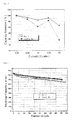
- Example 1 The batteries made of the cathode active materials of Example 1 and Comparative Example 1 were measured for capacity maintenance rate with an increase in C-rate, and the results thus obtained are shown as a graph in FIG. 3 .
- the battery of the present invention (Example 1) exhibited considerably superior capacity maintenance with an increase in C-rate, as compared to Comparative Example 1.
- Example 1 represented by an upper curve in the graph
- Comparative Example 1 exhibited superior cycle properties, as compared to Comparative Example 1.
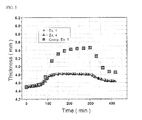
- the batteries made of the cathode active materials of Examples 1 and 4 and Comparative Example 1 were measured for high-temperature storage properties and the results thus obtained are shown in a graph of FIG. 5 .
- the high-temperature storage properties were measured by placing fully charged batteries in a chamber at a high temperature of 90°C for 4 hours and measuring thickness variations in batteries at ambient temperature.
- the batteries according to the present invention underwent a significantly small thickness increase as a function of time, as compared to Comparative Example 1.
- the lithium iron phosphate according to the present invention comprises an appropriate amount of Li 3 PO 4 and in an extremely small amount of Li 2 CO 3 , thus advantageously imparting high-temperature storage stabilities as well as stability and rate properties to lithium secondary batteries, when used as a cathode active material for the lithium secondary batteries.
Landscapes
- Chemical & Material Sciences (AREA)
- Organic Chemistry (AREA)
- General Chemical & Material Sciences (AREA)
- Electrochemistry (AREA)
- Chemical Kinetics & Catalysis (AREA)
- Inorganic Chemistry (AREA)
- Crystallography & Structural Chemistry (AREA)
- Health & Medical Sciences (AREA)
- Life Sciences & Earth Sciences (AREA)
- Pathology (AREA)
- Immunology (AREA)
- General Physics & Mathematics (AREA)
- General Health & Medical Sciences (AREA)
- Biochemistry (AREA)
- Analytical Chemistry (AREA)
- Physics & Mathematics (AREA)
- Engineering & Computer Science (AREA)
- Materials Engineering (AREA)
- Molecular Biology (AREA)
- Manufacturing & Machinery (AREA)
- Battery Electrode And Active Subsutance (AREA)
- Secondary Cells (AREA)
Applications Claiming Priority (2)
| Application Number | Priority Date | Filing Date | Title |
|---|---|---|---|
| KR20080103569 | 2008-10-22 | ||
| PCT/KR2009/006086 WO2010047525A2 (ko) | 2008-10-22 | 2009-10-21 | 올리빈 구조의 리튬 철인산화물 및 이의 분석 방법 |
Publications (3)
| Publication Number | Publication Date |
|---|---|
| EP2360118A2 true EP2360118A2 (de) | 2011-08-24 |
| EP2360118A4 EP2360118A4 (de) | 2012-10-03 |
| EP2360118B1 EP2360118B1 (de) | 2015-01-07 |
Family
ID=42119832
Family Applications (1)
| Application Number | Title | Priority Date | Filing Date |
|---|---|---|---|
| EP09822201.1A Active EP2360118B1 (de) | 2008-10-22 | 2009-10-21 | Lithiumeisenphosphat mit Olivinstruktur und Herstellungsverfahren dafür |
Country Status (11)
| Country | Link |
|---|---|
| US (1) | US10249877B2 (de) |
| EP (1) | EP2360118B1 (de) |
| JP (1) | JP5442744B2 (de) |
| KR (3) | KR101089089B1 (de) |
| CN (2) | CN102186769A (de) |
| BR (1) | BRPI0919654B1 (de) |
| CA (1) | CA2741080C (de) |
| ES (1) | ES2533426T3 (de) |
| RU (1) | RU2484009C2 (de) |
| TW (1) | TWI548589B (de) |
| WO (1) | WO2010047525A2 (de) |
Cited By (4)
| Publication number | Priority date | Publication date | Assignee | Title |
|---|---|---|---|---|
| WO2014004789A3 (en) * | 2012-06-27 | 2014-07-03 | Precursor Energetics, Inc. | Molecular precursors for synthesis of lithium-iron-containing cathode materials |
| WO2015003947A1 (en) * | 2013-07-08 | 2015-01-15 | Basf Se | Electrode materials for lithium ion batteries |
| US10109846B2 (en) | 2014-03-07 | 2018-10-23 | Electrochem Solutions, Inc. | Mixed cathode material with high energy density |
| US10135069B2 (en) | 2010-10-08 | 2018-11-20 | Semiconductor Energy Laboratory Co., Ltd. | Electrode material and method for manufacturing power storage device |
Families Citing this family (38)
| Publication number | Priority date | Publication date | Assignee | Title |
|---|---|---|---|---|
| TWI459616B (zh) * | 2004-08-16 | 2014-11-01 | Showa Denko Kk | Lithium batteries with positive and the use of its lithium batteries |
| CN102893432B (zh) | 2010-04-21 | 2016-01-13 | 株式会社Lg化学 | 碳包覆的具有橄榄石晶体结构的锂铁磷酸盐和使用所述锂铁磷酸盐的锂二次电池 |
| BR112012028032B1 (pt) * | 2010-05-08 | 2020-03-17 | Lg Chem, Ltd. | Material ativo de catodo para baterias secundárias, mistura de catodo para baterias secundárias, catodo para baterias secundárias de lítio, bateria secundária de lítio e pacote de bateria médio e grande |
| JP5552360B2 (ja) * | 2010-05-12 | 2014-07-16 | トヨタ自動車株式会社 | 複合正極活物質の製造方法、全固体電池の製造方法および複合正極活物質 |
| US8932481B2 (en) | 2010-08-31 | 2015-01-13 | Samsung Sdi Co., Ltd. | Cathode active material, method of preparing the same, and cathode and lithium battery including the cathode active material |
| EP2613384B1 (de) * | 2010-09-01 | 2018-05-23 | LG Chem, Ltd. | Aktives kathodenmaterial für eine lithium-sekundärbatterie |
| KR101347589B1 (ko) | 2011-02-15 | 2014-01-06 | 주식회사 엘지화학 | 이차전지용 양극 합제 및 이를 포함하는 이차전지 |
| CN102455341B (zh) * | 2011-03-04 | 2014-07-30 | 深圳市海盈科技有限公司 | 磷酸铁锂材料批次一致性检测判定的方法 |
| US20140113191A1 (en) * | 2011-03-28 | 2014-04-24 | University Of Hyogo | Electrode material for secondary battery, method for producing electrode material for secondary battery, and secondary battery |
| JP5673953B2 (ja) * | 2011-09-05 | 2015-02-18 | 太平洋セメント株式会社 | 正極活物質 |
| CN102386414B (zh) * | 2011-11-23 | 2013-01-02 | 陕西科技大学 | 一种金属离子/ LiFePO4/C复合材料的制备方法 |
| CN102565167B (zh) * | 2011-12-02 | 2014-01-01 | 深圳市贝特瑞新能源材料股份有限公司 | 辨别锂离子电池正极材料组份的方法 |
| US9660266B2 (en) | 2012-11-21 | 2017-05-23 | Lg Chem, Ltd. | Lithium secondary battery |
| CN104718657B (zh) | 2012-11-21 | 2018-01-12 | 株式会社Lg 化学 | 锂二次电池 |
| KR101522526B1 (ko) * | 2012-11-26 | 2015-05-26 | 주식회사 엘지화학 | 무기 입자의 제조방법 및 그로부터 얻어진 무기 입자 |
| US9711787B2 (en) | 2012-11-30 | 2017-07-18 | Lg Chem, Ltd. | Anode active material for lithium secondary battery, preparation method thereof, and lithium secondary battery comprising the same |
| US9991509B2 (en) | 2012-11-30 | 2018-06-05 | Lg Chem, Ltd. | Anode active material including porous silicon oxide-carbon material composite and method of preparing the same |
| KR101596272B1 (ko) | 2013-01-03 | 2016-02-22 | 주식회사 엘지화학 | 리튬 복합 전이금속 산화물 제조용 장치, 이를 이용하여 제조된 리튬 복합 전이금속 산화물, 및 그 제조방법 |
| KR101561376B1 (ko) | 2013-01-10 | 2015-10-19 | 주식회사 엘지화학 | 리튬 인산철 나노분말 제조방법 |
| KR101572345B1 (ko) | 2013-01-10 | 2015-11-26 | 주식회사 엘지화학 | 탄소 코팅 리튬 인산철 나노분말 제조방법 |
| KR101561374B1 (ko) | 2013-01-10 | 2015-10-19 | 주식회사 엘지화학 | 리튬 인산철 나노분말 제조방법 |
| US9583279B2 (en) | 2013-07-01 | 2017-02-28 | Samsung Sdi Co., Ltd. | Secondary battery |
| JP6137088B2 (ja) * | 2014-08-29 | 2017-05-31 | トヨタ自動車株式会社 | リチウムイオン電池用正極活物質層の製造方法、及びリチウムイオン電池用正極活物質層 |
| US20160351904A1 (en) * | 2015-05-28 | 2016-12-01 | Board Of Regents, The University Of Texas System | Cathode additive for rechargeable lithium batteries |
| KR20160143356A (ko) | 2015-06-05 | 2016-12-14 | 최현범 | 엑스선 회절 분석용 구조체 |
| CN105842389B (zh) * | 2016-03-18 | 2017-12-19 | 浙江瑞邦科技有限公司 | 一种磷酸铁锂/碳复合材料中残留游离锂含量的检测方法 |
| JP6627708B2 (ja) * | 2016-10-07 | 2020-01-08 | トヨタ自動車株式会社 | リチウムイオン二次電池、及び、リチウムイオン二次電池の製造方法 |
| KR101879324B1 (ko) * | 2016-12-09 | 2018-07-18 | 제이에이치화학공업(주) | 리튬 이차 전지용 양극 활물질 전구체 및 그 제조 방법 |
| DE112018001658T5 (de) * | 2017-03-30 | 2020-01-02 | Tdk Corporation | Festkörperbatterie |
| CN110021752B (zh) * | 2019-01-24 | 2022-10-25 | 湖北锂诺新能源科技有限公司 | 一种锂、铝和氟共掺杂磷酸铁锂正极材料及制备方法 |
| GB201905177D0 (en) * | 2019-04-11 | 2019-05-29 | Johnson Matthey Plc | Lithium metal phosphate, its preparation and use |
| RU2727620C1 (ru) * | 2019-11-27 | 2020-07-22 | Общество с ограниченной ответственностью "РУСТОР" | Способ получения активного материала катода на основе литий-обогащенного фосфата Li1+xFe1-yPO4 со структурой оливина, электродная масса и катод литий-ионного аккумулятора |
| FR3112030B1 (fr) * | 2020-06-26 | 2022-12-16 | Accumulateurs Fixes | Utilisation d’éléments électrochimiques secondaires au lithium contenant un mélange d'un oxyde lithié de nickel et d'un phosphate lithié de manganèse et de fer pour des applications automobiles |
| CN112687345B (zh) * | 2020-12-28 | 2024-05-14 | 中国科学院过程工程研究所 | 一种磷酸萃取过程的预测方法和预测装置 |
| JP7010402B1 (ja) * | 2021-03-31 | 2022-01-26 | 住友大阪セメント株式会社 | リチウムイオン二次電池用正極材料、リチウムイオン二次電池用正極、リチウムイオン二次電池 |
| CN113896181B (zh) * | 2021-10-09 | 2023-02-10 | 四川裕宁新能源材料有限公司 | 一种生产低成本纳米电池级磷酸铁的方法 |
| CN116026908B (zh) * | 2021-10-25 | 2025-06-10 | 中南大学 | 伏安分析锂离子浓度的方法、锂离子伏安分析用电极及其制备方法、锂离子伏安分析用装置 |
| WO2025150888A1 (ko) * | 2024-01-10 | 2025-07-17 | 주식회사 엘지에너지솔루션 | 양극 및 이의 제조방법 |
Family Cites Families (40)
| Publication number | Priority date | Publication date | Assignee | Title |
|---|---|---|---|---|
| JP4329730B2 (ja) | 1994-10-27 | 2009-09-09 | 宇部興産株式会社 | 非水二次電池とその製造方法 |
| JP4085473B2 (ja) | 1998-06-18 | 2008-05-14 | 宇部興産株式会社 | 非水二次電池の充電方法 |
| JP2001110414A (ja) | 1999-10-04 | 2001-04-20 | Nippon Telegr & Teleph Corp <Ntt> | リチウム二次電池正極活物質およびリチウム二次電池 |
| JP3952118B2 (ja) | 2000-02-04 | 2007-08-01 | 信越化学工業株式会社 | 活性なケイ素を含むケイ素酸化物及びその評価方法 |
| JP4302852B2 (ja) | 2000-03-31 | 2009-07-29 | Jfeスチール株式会社 | 金属材表面酸化物の測定方法およびx線回折装置 |
| CA2320661A1 (fr) * | 2000-09-26 | 2002-03-26 | Hydro-Quebec | Nouveau procede de synthese de materiaux limpo4 a structure olivine |
| JP4734701B2 (ja) | 2000-09-29 | 2011-07-27 | ソニー株式会社 | 正極活物質の製造方法及び非水電解質電池の製造方法 |
| JP4848582B2 (ja) | 2000-10-06 | 2011-12-28 | ソニー株式会社 | 正極活物質の製造方法 |
| US6645452B1 (en) | 2000-11-28 | 2003-11-11 | Valence Technology, Inc. | Methods of making lithium metal cathode active materials |
| DE10117904B4 (de) * | 2001-04-10 | 2012-11-15 | Zentrum für Sonnenenergie- und Wasserstoff-Forschung Baden-Württemberg Gemeinnützige Stiftung | Binäre, ternäre und quaternäre Lithiumeisenphosphate, Verfahren zu ihrer Herstellung und ihre Verwendung |
| EP1456895B1 (de) * | 2001-12-21 | 2017-03-29 | Massachusetts Institute Of Technology | Leitfähige lithium-speicherelectrode |
| JP4180363B2 (ja) | 2002-01-31 | 2008-11-12 | 日本化学工業株式会社 | リン酸第一鉄含水塩結晶、その製造方法及びリチウム鉄リン系複合酸化物の製造方法 |
| JP4207434B2 (ja) * | 2002-02-14 | 2009-01-14 | ソニー株式会社 | 正極活物質及び非水電解質電池の製造方法 |
| JP2004020519A (ja) | 2002-06-20 | 2004-01-22 | Jfe Steel Kk | 金属材料表層の内部酸化層評価方法 |
| JP2004095386A (ja) | 2002-08-30 | 2004-03-25 | Sumitomo Osaka Cement Co Ltd | リチウムイオン電池用正極材料の製造方法およびリチウムイオン電池 |
| FR2848549B1 (fr) | 2002-12-16 | 2005-01-21 | Commissariat Energie Atomique | Procede de preparation de composes d'insertion d'un metal alcalin, materiaux actifs les contenant, et dispositifs comprenant ces materiaux actifs |
| JP4747482B2 (ja) * | 2003-07-29 | 2011-08-17 | 三菱化学株式会社 | リチウム二次電池用正極材料、リチウム二次電池用正極及びリチウム二次電池 |
| JP4522683B2 (ja) * | 2003-10-09 | 2010-08-11 | 住友大阪セメント株式会社 | 電極材料粉体の製造方法と電極材料粉体及び電極並びにリチウム電池 |
| DE10353266B4 (de) * | 2003-11-14 | 2013-02-21 | Süd-Chemie Ip Gmbh & Co. Kg | Lithiumeisenphosphat, Verfahren zu seiner Herstellung und seine Verwendung als Elektrodenmaterial |
| CA2550496C (en) | 2003-12-23 | 2013-02-19 | Universite De Montreal | Process for preparing an at least partially lithiated transition metal oxyanion-based lithium-ion reversible electrode material and electrode material obtained therefrom |
| JP4610925B2 (ja) * | 2004-05-11 | 2011-01-12 | 日本電信電話株式会社 | 非水電解質二次電池 |
| CN101015074A (zh) | 2004-08-18 | 2007-08-08 | 财团法人电力中央研究所 | 有机电解质电池及用于其中的正极片的制造方法 |
| KR100673303B1 (ko) | 2004-08-18 | 2007-01-24 | 박해경 | 폐 탈질 촉매의 성능평가 및 재생방법 |
| JP4779323B2 (ja) | 2004-08-24 | 2011-09-28 | 日産自動車株式会社 | 非水電解質リチウムイオン二次電池用正極材料およびその製造方法 |
| TWI279020B (en) * | 2004-11-03 | 2007-04-11 | Tatung Co Ltd | Preparation of olivine LiFePO4 cathode materials for lithium batteries via a solution method |
| US7648693B2 (en) * | 2005-04-13 | 2010-01-19 | Lg Chem, Ltd. | Ni-based lithium transition metal oxide |
| US9954227B2 (en) * | 2005-06-29 | 2018-04-24 | Umicore | Crystalline nanometric LiFePO4 |
| US7524529B2 (en) * | 2005-09-09 | 2009-04-28 | Aquire Energy Co., Ltd. | Method for making a lithium mixed metal compound having an olivine structure |
| CA2534243A1 (fr) * | 2006-01-25 | 2007-07-25 | Hydro Quebec | Particules d'oxyde metallique enrobees a faible taux de dissolution, procedes de preparation et utilisation dans les systemes electrochimiques |
| CA2535064A1 (fr) * | 2006-02-01 | 2007-08-01 | Hydro Quebec | Materiau multi-couches, procede de fabrication et utilisation comme electrode |
| WO2007094644A1 (en) * | 2006-02-17 | 2007-08-23 | Lg Chem, Ltd. | Preparation method of lithium-metal composite oxides |
| JP2008012088A (ja) | 2006-07-06 | 2008-01-24 | Matsushita Electric Ind Co Ltd | 洗濯機 |
| CA2569991A1 (en) * | 2006-12-07 | 2008-06-07 | Michel Gauthier | C-treated nanoparticles and agglomerate and composite thereof as transition metal polyanion cathode materials and process for making |
| KR100805910B1 (ko) | 2006-12-29 | 2008-02-21 | 한양대학교 산학협력단 | 리튬 전지용 올리빈형 양극 활물질, 이의 제조 방법, 및이를 포함하는 리튬 전지 |
| JP4289406B2 (ja) * | 2007-02-19 | 2009-07-01 | トヨタ自動車株式会社 | 電極活物質およびその製造方法 |
| JP2009032656A (ja) * | 2007-02-28 | 2009-02-12 | Sanyo Electric Co Ltd | リチウム二次電池用活物質の製造方法、リチウム二次電池用電極の製造方法、リチウム二次電池の製造方法、及びリチウム二次電池用活物質の品質モニタリング方法 |
| CA2622675A1 (en) * | 2007-02-28 | 2008-08-28 | Sanyo Electric Co., Ltd. | Method of producing active material for lithium secondary battery, method of producing electrode for lithium secondary battery, method of producing lithium secondary battery, and method of monitoring quality of active material for lithium secondary battery |
| JP5323410B2 (ja) | 2007-07-27 | 2013-10-23 | 日本化学工業株式会社 | リチウム鉄リン系複合酸化物炭素複合体の製造方法及びリチウム、鉄及びリンを含む共沈体の製造方法 |
| KR101587671B1 (ko) * | 2008-03-31 | 2016-01-21 | 도다 고교 가부시끼가이샤 | 인산철리튬 입자 분말의 제조 방법, 올리빈형 구조의 인산철리튬 입자 분말, 상기 인산철리튬 입자 분말을 이용한 정극재 시트 및 비수용매계 이차 전지 |
| EP2360117B1 (de) | 2008-10-22 | 2015-05-06 | LG Chem, Ltd. | Lithiumeisenphosphat mit olivinstruktur und herstellungsverfahren dafür |
-
2009
- 2009-10-21 BR BRPI0919654-4A patent/BRPI0919654B1/pt active IP Right Grant
- 2009-10-21 TW TW098135687A patent/TWI548589B/zh active
- 2009-10-21 CN CN2009801413916A patent/CN102186769A/zh active Pending
- 2009-10-21 EP EP09822201.1A patent/EP2360118B1/de active Active
- 2009-10-21 ES ES09822201.1T patent/ES2533426T3/es active Active
- 2009-10-21 JP JP2011533104A patent/JP5442744B2/ja active Active
- 2009-10-21 WO PCT/KR2009/006086 patent/WO2010047525A2/ko not_active Ceased
- 2009-10-21 KR KR1020090100186A patent/KR101089089B1/ko active Active
- 2009-10-21 RU RU2011115054/05A patent/RU2484009C2/ru active
- 2009-10-21 CN CN201510621863.5A patent/CN105322166B/zh active Active
- 2009-10-21 CA CA2741080A patent/CA2741080C/en active Active
-
2010
- 2010-02-19 US US12/709,021 patent/US10249877B2/en active Active
-
2011
- 2011-09-02 KR KR1020110088757A patent/KR101183929B1/ko active Active
- 2011-09-02 KR KR1020110088756A patent/KR101156951B1/ko active Active
Cited By (5)
| Publication number | Priority date | Publication date | Assignee | Title |
|---|---|---|---|---|
| US10135069B2 (en) | 2010-10-08 | 2018-11-20 | Semiconductor Energy Laboratory Co., Ltd. | Electrode material and method for manufacturing power storage device |
| WO2014004789A3 (en) * | 2012-06-27 | 2014-07-03 | Precursor Energetics, Inc. | Molecular precursors for synthesis of lithium-iron-containing cathode materials |
| WO2015003947A1 (en) * | 2013-07-08 | 2015-01-15 | Basf Se | Electrode materials for lithium ion batteries |
| US10026954B2 (en) | 2013-07-08 | 2018-07-17 | Basf Se | Electrode materials for lithium ion batteries |
| US10109846B2 (en) | 2014-03-07 | 2018-10-23 | Electrochem Solutions, Inc. | Mixed cathode material with high energy density |
Also Published As
| Publication number | Publication date |
|---|---|
| TWI548589B (zh) | 2016-09-11 |
| KR101183929B1 (ko) | 2012-09-18 |
| CN105322166A (zh) | 2016-02-10 |
| WO2010047525A3 (ko) | 2010-07-29 |
| JP5442744B2 (ja) | 2014-03-12 |
| RU2484009C2 (ru) | 2013-06-10 |
| CA2741080C (en) | 2014-02-25 |
| JP2012506363A (ja) | 2012-03-15 |
| KR20100044714A (ko) | 2010-04-30 |
| KR20110111344A (ko) | 2011-10-11 |
| US10249877B2 (en) | 2019-04-02 |
| RU2011115054A (ru) | 2012-11-27 |
| TW201029920A (en) | 2010-08-16 |
| EP2360118B1 (de) | 2015-01-07 |
| KR20110114510A (ko) | 2011-10-19 |
| BRPI0919654A2 (pt) | 2015-12-08 |
| KR101089089B1 (ko) | 2011-12-06 |
| CN105322166B (zh) | 2020-06-12 |
| CA2741080A1 (en) | 2010-04-29 |
| ES2533426T3 (es) | 2015-04-10 |
| WO2010047525A2 (ko) | 2010-04-29 |
| CN102186769A (zh) | 2011-09-14 |
| BRPI0919654B1 (pt) | 2019-07-30 |
| KR101156951B1 (ko) | 2012-06-20 |
| EP2360118A4 (de) | 2012-10-03 |
| US20100261060A1 (en) | 2010-10-14 |
Similar Documents
| Publication | Publication Date | Title |
|---|---|---|
| EP2360118B1 (de) | Lithiumeisenphosphat mit Olivinstruktur und Herstellungsverfahren dafür | |
| EP2360117B1 (de) | Lithiumeisenphosphat mit olivinstruktur und herstellungsverfahren dafür | |
| EP2339675B1 (de) | Aktives material für eine positive elektrode mit verbesserten elektrodeneffizienz- und energiedichteeigenschaften | |
| EP2562859B1 (de) | Lithiumeisenphosphat mit einer olivinkristallstruktur sowie lithiumsekundärbatterie damit | |
| US9812707B2 (en) | Carbon-coated lithium iron phosphate of olivine crystal structure and lithium secondary battery using the same | |
| EP2562855A2 (de) | Lithiumeisenphosphat mit sulfidgebundenen schwefelverbindungen sowie lithiumsekundärbatterie damit | |
| EP2874227B1 (de) | Lithiumsekundärbatterie | |
| KR101240174B1 (ko) | 양극 활물질 및 이를 이용한 리튬 이차전지 | |
| EP2339673B1 (de) | Lithium-sekundärbatterie mit verbesserten elektrodeneffizienz- und energiedichteeigenschaften | |
| EP2874226A1 (de) | Lithium-zweitbatterie |
Legal Events
| Date | Code | Title | Description |
|---|---|---|---|
| PUAI | Public reference made under article 153(3) epc to a published international application that has entered the european phase |
Free format text: ORIGINAL CODE: 0009012 |
|
| 17P | Request for examination filed |
Effective date: 20110415 |
|
| AK | Designated contracting states |
Kind code of ref document: A2 Designated state(s): AT BE BG CH CY CZ DE DK EE ES FI FR GB GR HR HU IE IS IT LI LT LU LV MC MK MT NL NO PL PT RO SE SI SK SM TR |
|
| DAX | Request for extension of the european patent (deleted) | ||
| A4 | Supplementary search report drawn up and despatched |
Effective date: 20120830 |
|
| RIC1 | Information provided on ipc code assigned before grant |
Ipc: H01M 4/62 20060101ALI20120824BHEP Ipc: H01M 4/02 20060101ALN20120824BHEP Ipc: H01M 4/58 20100101AFI20120824BHEP Ipc: C01B 25/46 20060101ALI20120824BHEP Ipc: H01M 4/136 20100101ALN20120824BHEP Ipc: C01B 25/45 20060101ALI20120824BHEP |
|
| 17Q | First examination report despatched |
Effective date: 20130415 |
|
| REG | Reference to a national code |
Ref country code: DE Ref legal event code: R079 Ref document number: 602009028883 Country of ref document: DE Free format text: PREVIOUS MAIN CLASS: C01B0025300000 Ipc: H01M0004580000 |
|
| RIC1 | Information provided on ipc code assigned before grant |
Ipc: H01M 4/62 20060101ALI20140711BHEP Ipc: H01M 4/136 20100101ALN20140711BHEP Ipc: H01M 4/58 20100101AFI20140711BHEP Ipc: H01M 4/02 20060101ALN20140711BHEP Ipc: C01B 25/45 20060101ALI20140711BHEP Ipc: H01M 10/0525 20100101ALN20140711BHEP |
|
| GRAP | Despatch of communication of intention to grant a patent |
Free format text: ORIGINAL CODE: EPIDOSNIGR1 |
|
| INTG | Intention to grant announced |
Effective date: 20140912 |
|
| GRAS | Grant fee paid |
Free format text: ORIGINAL CODE: EPIDOSNIGR3 |
|
| GRAA | (expected) grant |
Free format text: ORIGINAL CODE: 0009210 |
|
| AK | Designated contracting states |
Kind code of ref document: B1 Designated state(s): AT BE BG CH CY CZ DE DK EE ES FI FR GB GR HR HU IE IS IT LI LT LU LV MC MK MT NL NO PL PT RO SE SI SK SM TR |
|
| REG | Reference to a national code |
Ref country code: GB Ref legal event code: FG4D |
|
| REG | Reference to a national code |
Ref country code: CH Ref legal event code: NV Representative=s name: NOVAGRAAF INTERNATIONAL SA, CH Ref country code: CH Ref legal event code: EP |
|
| REG | Reference to a national code |
Ref country code: IE Ref legal event code: FG4D |
|
| REG | Reference to a national code |
Ref country code: AT Ref legal event code: REF Ref document number: 706293 Country of ref document: AT Kind code of ref document: T Effective date: 20150215 |
|
| REG | Reference to a national code |
Ref country code: SE Ref legal event code: TRGR |
|
| REG | Reference to a national code |
Ref country code: DE Ref legal event code: R096 Ref document number: 602009028883 Country of ref document: DE Effective date: 20150226 |
|
| REG | Reference to a national code |
Ref country code: ES Ref legal event code: FG2A Ref document number: 2533426 Country of ref document: ES Kind code of ref document: T3 Effective date: 20150410 |
|
| REG | Reference to a national code |
Ref country code: NL Ref legal event code: VDEP Effective date: 20150107 |
|
| REG | Reference to a national code |
Ref country code: AT Ref legal event code: MK05 Ref document number: 706293 Country of ref document: AT Kind code of ref document: T Effective date: 20150107 |
|
| REG | Reference to a national code |
Ref country code: LT Ref legal event code: MG4D |
|
| PG25 | Lapsed in a contracting state [announced via postgrant information from national office to epo] |
Ref country code: LT Free format text: LAPSE BECAUSE OF FAILURE TO SUBMIT A TRANSLATION OF THE DESCRIPTION OR TO PAY THE FEE WITHIN THE PRESCRIBED TIME-LIMIT Effective date: 20150107 Ref country code: BG Free format text: LAPSE BECAUSE OF FAILURE TO SUBMIT A TRANSLATION OF THE DESCRIPTION OR TO PAY THE FEE WITHIN THE PRESCRIBED TIME-LIMIT Effective date: 20150407 Ref country code: HR Free format text: LAPSE BECAUSE OF FAILURE TO SUBMIT A TRANSLATION OF THE DESCRIPTION OR TO PAY THE FEE WITHIN THE PRESCRIBED TIME-LIMIT Effective date: 20150107 Ref country code: NO Free format text: LAPSE BECAUSE OF FAILURE TO SUBMIT A TRANSLATION OF THE DESCRIPTION OR TO PAY THE FEE WITHIN THE PRESCRIBED TIME-LIMIT Effective date: 20150407 |
|
| PG25 | Lapsed in a contracting state [announced via postgrant information from national office to epo] |
Ref country code: PL Free format text: LAPSE BECAUSE OF FAILURE TO SUBMIT A TRANSLATION OF THE DESCRIPTION OR TO PAY THE FEE WITHIN THE PRESCRIBED TIME-LIMIT Effective date: 20150107 Ref country code: LV Free format text: LAPSE BECAUSE OF FAILURE TO SUBMIT A TRANSLATION OF THE DESCRIPTION OR TO PAY THE FEE WITHIN THE PRESCRIBED TIME-LIMIT Effective date: 20150107 Ref country code: AT Free format text: LAPSE BECAUSE OF FAILURE TO SUBMIT A TRANSLATION OF THE DESCRIPTION OR TO PAY THE FEE WITHIN THE PRESCRIBED TIME-LIMIT Effective date: 20150107 Ref country code: NL Free format text: LAPSE BECAUSE OF FAILURE TO SUBMIT A TRANSLATION OF THE DESCRIPTION OR TO PAY THE FEE WITHIN THE PRESCRIBED TIME-LIMIT Effective date: 20150107 Ref country code: GR Free format text: LAPSE BECAUSE OF FAILURE TO SUBMIT A TRANSLATION OF THE DESCRIPTION OR TO PAY THE FEE WITHIN THE PRESCRIBED TIME-LIMIT Effective date: 20150408 Ref country code: IS Free format text: LAPSE BECAUSE OF FAILURE TO SUBMIT A TRANSLATION OF THE DESCRIPTION OR TO PAY THE FEE WITHIN THE PRESCRIBED TIME-LIMIT Effective date: 20150507 |
|
| REG | Reference to a national code |
Ref country code: DE Ref legal event code: R097 Ref document number: 602009028883 Country of ref document: DE |
|
| PG25 | Lapsed in a contracting state [announced via postgrant information from national office to epo] |
Ref country code: EE Free format text: LAPSE BECAUSE OF FAILURE TO SUBMIT A TRANSLATION OF THE DESCRIPTION OR TO PAY THE FEE WITHIN THE PRESCRIBED TIME-LIMIT Effective date: 20150107 Ref country code: SK Free format text: LAPSE BECAUSE OF FAILURE TO SUBMIT A TRANSLATION OF THE DESCRIPTION OR TO PAY THE FEE WITHIN THE PRESCRIBED TIME-LIMIT Effective date: 20150107 Ref country code: DK Free format text: LAPSE BECAUSE OF FAILURE TO SUBMIT A TRANSLATION OF THE DESCRIPTION OR TO PAY THE FEE WITHIN THE PRESCRIBED TIME-LIMIT Effective date: 20150107 Ref country code: RO Free format text: LAPSE BECAUSE OF FAILURE TO SUBMIT A TRANSLATION OF THE DESCRIPTION OR TO PAY THE FEE WITHIN THE PRESCRIBED TIME-LIMIT Effective date: 20150107 Ref country code: CZ Free format text: LAPSE BECAUSE OF FAILURE TO SUBMIT A TRANSLATION OF THE DESCRIPTION OR TO PAY THE FEE WITHIN THE PRESCRIBED TIME-LIMIT Effective date: 20150107 |
|
| PLBE | No opposition filed within time limit |
Free format text: ORIGINAL CODE: 0009261 |
|
| STAA | Information on the status of an ep patent application or granted ep patent |
Free format text: STATUS: NO OPPOSITION FILED WITHIN TIME LIMIT |
|
| 26N | No opposition filed |
Effective date: 20151008 |
|
| PG25 | Lapsed in a contracting state [announced via postgrant information from national office to epo] |
Ref country code: IT Free format text: LAPSE BECAUSE OF FAILURE TO SUBMIT A TRANSLATION OF THE DESCRIPTION OR TO PAY THE FEE WITHIN THE PRESCRIBED TIME-LIMIT Effective date: 20150107 |
|
| PG25 | Lapsed in a contracting state [announced via postgrant information from national office to epo] |
Ref country code: SI Free format text: LAPSE BECAUSE OF FAILURE TO SUBMIT A TRANSLATION OF THE DESCRIPTION OR TO PAY THE FEE WITHIN THE PRESCRIBED TIME-LIMIT Effective date: 20150107 |
|
| PG25 | Lapsed in a contracting state [announced via postgrant information from national office to epo] |
Ref country code: BE Free format text: LAPSE BECAUSE OF FAILURE TO SUBMIT A TRANSLATION OF THE DESCRIPTION OR TO PAY THE FEE WITHIN THE PRESCRIBED TIME-LIMIT Effective date: 20150107 Ref country code: LU Free format text: LAPSE BECAUSE OF FAILURE TO SUBMIT A TRANSLATION OF THE DESCRIPTION OR TO PAY THE FEE WITHIN THE PRESCRIBED TIME-LIMIT Effective date: 20151021 |
|
| PG25 | Lapsed in a contracting state [announced via postgrant information from national office to epo] |
Ref country code: MC Free format text: LAPSE BECAUSE OF FAILURE TO SUBMIT A TRANSLATION OF THE DESCRIPTION OR TO PAY THE FEE WITHIN THE PRESCRIBED TIME-LIMIT Effective date: 20150107 |
|
| REG | Reference to a national code |
Ref country code: IE Ref legal event code: MM4A |
|
| REG | Reference to a national code |
Ref country code: FR Ref legal event code: PLFP Year of fee payment: 8 |
|
| PG25 | Lapsed in a contracting state [announced via postgrant information from national office to epo] |
Ref country code: IE Free format text: LAPSE BECAUSE OF NON-PAYMENT OF DUE FEES Effective date: 20151021 |
|
| PG25 | Lapsed in a contracting state [announced via postgrant information from national office to epo] |
Ref country code: SM Free format text: LAPSE BECAUSE OF FAILURE TO SUBMIT A TRANSLATION OF THE DESCRIPTION OR TO PAY THE FEE WITHIN THE PRESCRIBED TIME-LIMIT Effective date: 20150107 Ref country code: HU Free format text: LAPSE BECAUSE OF FAILURE TO SUBMIT A TRANSLATION OF THE DESCRIPTION OR TO PAY THE FEE WITHIN THE PRESCRIBED TIME-LIMIT; INVALID AB INITIO Effective date: 20091021 |
|
| PG25 | Lapsed in a contracting state [announced via postgrant information from national office to epo] |
Ref country code: CY Free format text: LAPSE BECAUSE OF FAILURE TO SUBMIT A TRANSLATION OF THE DESCRIPTION OR TO PAY THE FEE WITHIN THE PRESCRIBED TIME-LIMIT Effective date: 20150107 |
|
| PG25 | Lapsed in a contracting state [announced via postgrant information from national office to epo] |
Ref country code: MT Free format text: LAPSE BECAUSE OF FAILURE TO SUBMIT A TRANSLATION OF THE DESCRIPTION OR TO PAY THE FEE WITHIN THE PRESCRIBED TIME-LIMIT Effective date: 20150107 Ref country code: TR Free format text: LAPSE BECAUSE OF FAILURE TO SUBMIT A TRANSLATION OF THE DESCRIPTION OR TO PAY THE FEE WITHIN THE PRESCRIBED TIME-LIMIT Effective date: 20150107 |
|
| REG | Reference to a national code |
Ref country code: FR Ref legal event code: PLFP Year of fee payment: 9 |
|
| PG25 | Lapsed in a contracting state [announced via postgrant information from national office to epo] |
Ref country code: MK Free format text: LAPSE BECAUSE OF FAILURE TO SUBMIT A TRANSLATION OF THE DESCRIPTION OR TO PAY THE FEE WITHIN THE PRESCRIBED TIME-LIMIT Effective date: 20150107 Ref country code: PT Free format text: LAPSE BECAUSE OF FAILURE TO SUBMIT A TRANSLATION OF THE DESCRIPTION OR TO PAY THE FEE WITHIN THE PRESCRIBED TIME-LIMIT Effective date: 20150107 |
|
| REG | Reference to a national code |
Ref country code: FR Ref legal event code: PLFP Year of fee payment: 10 |
|
| REG | Reference to a national code |
Ref country code: DE Ref legal event code: R081 Ref document number: 602009028883 Country of ref document: DE Owner name: LG ENERGY SOLUTION LTD., KR Free format text: FORMER OWNER: LG CHEM. LTD., SEOUL, KR Ref country code: DE Ref legal event code: R081 Ref document number: 602009028883 Country of ref document: DE Owner name: LG ENERGY SOLUTION, LTD., KR Free format text: FORMER OWNER: LG CHEM. LTD., SEOUL, KR |
|
| P01 | Opt-out of the competence of the unified patent court (upc) registered |
Effective date: 20230408 |
|
| REG | Reference to a national code |
Ref country code: GB Ref legal event code: 732E Free format text: REGISTERED BETWEEN 20230824 AND 20230831 |
|
| REG | Reference to a national code |
Ref country code: FI Ref legal event code: PCE Owner name: LG ENERGY SOLUTION, LTD., KR |
|
| REG | Reference to a national code |
Ref country code: DE Ref legal event code: R081 Ref document number: 602009028883 Country of ref document: DE Owner name: LG ENERGY SOLUTION, LTD., KR Free format text: FORMER OWNER: LG ENERGY SOLUTION LTD., SEOUL, KR |
|
| REG | Reference to a national code |
Ref country code: ES Ref legal event code: PC2A Owner name: LG ENERGY SOLUTION, LTD. Effective date: 20240826 |
|
| PGFP | Annual fee paid to national office [announced via postgrant information from national office to epo] |
Ref country code: ES Payment date: 20241114 Year of fee payment: 16 |
|
| PGFP | Annual fee paid to national office [announced via postgrant information from national office to epo] |
Ref country code: FI Payment date: 20250922 Year of fee payment: 17 |
|
| PGFP | Annual fee paid to national office [announced via postgrant information from national office to epo] |
Ref country code: GB Payment date: 20250922 Year of fee payment: 17 |
|
| PGFP | Annual fee paid to national office [announced via postgrant information from national office to epo] |
Ref country code: FR Payment date: 20250925 Year of fee payment: 17 |
|
| PGFP | Annual fee paid to national office [announced via postgrant information from national office to epo] |
Ref country code: SE Payment date: 20250923 Year of fee payment: 17 |
|
| REG | Reference to a national code |
Ref country code: CH Ref legal event code: U11 Free format text: ST27 STATUS EVENT CODE: U-0-0-U10-U11 (AS PROVIDED BY THE NATIONAL OFFICE) Effective date: 20251101 |
|
| PGFP | Annual fee paid to national office [announced via postgrant information from national office to epo] |
Ref country code: DE Payment date: 20250922 Year of fee payment: 17 |
|
| PGFP | Annual fee paid to national office [announced via postgrant information from national office to epo] |
Ref country code: CH Payment date: 20251101 Year of fee payment: 17 |