EP2358929B1 - Fiber or foil from polymers with high tg and process for their manufacture - Google Patents
Fiber or foil from polymers with high tg and process for their manufacture Download PDFInfo
- Publication number
- EP2358929B1 EP2358929B1 EP09748064.4A EP09748064A EP2358929B1 EP 2358929 B1 EP2358929 B1 EP 2358929B1 EP 09748064 A EP09748064 A EP 09748064A EP 2358929 B1 EP2358929 B1 EP 2358929B1
- Authority
- EP
- European Patent Office
- Prior art keywords
- polymer
- fiber
- solution
- poly
- recurring units
- Prior art date
- Legal status (The legal status is an assumption and is not a legal conclusion. Google has not performed a legal analysis and makes no representation as to the accuracy of the status listed.)
- Not-in-force
Links
- 229920000642 polymer Polymers 0.000 title claims description 146
- 239000000835 fiber Substances 0.000 title claims description 123
- 238000000034 method Methods 0.000 title claims description 53
- 230000008569 process Effects 0.000 title claims description 36
- 239000011888 foil Substances 0.000 title claims description 30
- 238000004519 manufacturing process Methods 0.000 title claims description 22
- XLYOFNOQVPJJNP-UHFFFAOYSA-N water Substances O XLYOFNOQVPJJNP-UHFFFAOYSA-N 0.000 claims description 45
- 229910001868 water Inorganic materials 0.000 claims description 44
- 239000000203 mixture Substances 0.000 claims description 29
- 229920000110 poly(aryl ether sulfone) Polymers 0.000 claims description 29
- 239000002904 solvent Substances 0.000 claims description 28
- 238000005345 coagulation Methods 0.000 claims description 24
- 230000015271 coagulation Effects 0.000 claims description 24
- 239000003960 organic solvent Substances 0.000 claims description 24
- 125000002887 hydroxy group Chemical group [H]O* 0.000 claims description 16
- 239000007788 liquid Substances 0.000 claims description 14
- ZMXDDKWLCZADIW-UHFFFAOYSA-N N,N-dimethylformamide Substances CN(C)C=O ZMXDDKWLCZADIW-UHFFFAOYSA-N 0.000 claims description 10
- 150000005846 sugar alcohols Polymers 0.000 claims description 7
- 150000001412 amines Chemical class 0.000 claims description 4
- 239000011800 void material Substances 0.000 claims description 4
- 239000007787 solid Substances 0.000 claims description 3
- 239000000243 solution Substances 0.000 description 62
- 238000009987 spinning Methods 0.000 description 23
- 229920006393 polyether sulfone Polymers 0.000 description 22
- 229920002492 poly(sulfone) Polymers 0.000 description 18
- 238000006243 chemical reaction Methods 0.000 description 17
- -1 poly(aryl sulfone) Polymers 0.000 description 15
- 239000000463 material Substances 0.000 description 13
- 238000006116 polymerization reaction Methods 0.000 description 13
- OKKJLVBELUTLKV-UHFFFAOYSA-N Methanol Chemical compound OC OKKJLVBELUTLKV-UHFFFAOYSA-N 0.000 description 12
- MVPPADPHJFYWMZ-UHFFFAOYSA-N chlorobenzene Chemical compound ClC1=CC=CC=C1 MVPPADPHJFYWMZ-UHFFFAOYSA-N 0.000 description 12
- 239000004695 Polyether sulfone Substances 0.000 description 11
- IJGRMHOSHXDMSA-UHFFFAOYSA-N Atomic nitrogen Chemical compound N#N IJGRMHOSHXDMSA-UHFFFAOYSA-N 0.000 description 10
- SECXISVLQFMRJM-UHFFFAOYSA-N N-Methylpyrrolidone Chemical compound CN1CCCC1=O SECXISVLQFMRJM-UHFFFAOYSA-N 0.000 description 10
- 125000003118 aryl group Chemical group 0.000 description 10
- 230000001112 coagulating effect Effects 0.000 description 10
- 239000012510 hollow fiber Substances 0.000 description 10
- 239000000654 additive Substances 0.000 description 9
- ZCILODAAHLISPY-UHFFFAOYSA-N biphenyl ether Natural products C1=C(CC=C)C(O)=CC(OC=2C(=CC(CC=C)=CC=2)O)=C1 ZCILODAAHLISPY-UHFFFAOYSA-N 0.000 description 9
- 125000004432 carbon atom Chemical group C* 0.000 description 9
- 229920001577 copolymer Polymers 0.000 description 9
- 229920001519 homopolymer Polymers 0.000 description 9
- 150000003457 sulfones Chemical class 0.000 description 9
- HEDRZPFGACZZDS-UHFFFAOYSA-N Chloroform Chemical group ClC(Cl)Cl HEDRZPFGACZZDS-UHFFFAOYSA-N 0.000 description 8
- FXHOOIRPVKKKFG-UHFFFAOYSA-N N,N-Dimethylacetamide Chemical compound CN(C)C(C)=O FXHOOIRPVKKKFG-UHFFFAOYSA-N 0.000 description 8
- 239000003880 polar aprotic solvent Substances 0.000 description 8
- BWHMMNNQKKPAPP-UHFFFAOYSA-L potassium carbonate Chemical compound [K+].[K+].[O-]C([O-])=O BWHMMNNQKKPAPP-UHFFFAOYSA-L 0.000 description 8
- 229920000491 Polyphenylsulfone Polymers 0.000 description 7
- 239000000178 monomer Substances 0.000 description 7
- 238000006068 polycondensation reaction Methods 0.000 description 7
- VPWNQTHUCYMVMZ-UHFFFAOYSA-N 4,4'-sulfonyldiphenol Chemical compound C1=CC(O)=CC=C1S(=O)(=O)C1=CC=C(O)C=C1 VPWNQTHUCYMVMZ-UHFFFAOYSA-N 0.000 description 6
- 238000005227 gel permeation chromatography Methods 0.000 description 6
- 238000002156 mixing Methods 0.000 description 6
- HXJUTPCZVOIRIF-UHFFFAOYSA-N sulfolane Chemical compound O=S1(=O)CCCC1 HXJUTPCZVOIRIF-UHFFFAOYSA-N 0.000 description 6
- 238000005406 washing Methods 0.000 description 6
- LFQSCWFLJHTTHZ-UHFFFAOYSA-N EtOH Substances CCO LFQSCWFLJHTTHZ-UHFFFAOYSA-N 0.000 description 5
- 239000004642 Polyimide Substances 0.000 description 5
- 230000000996 additive effect Effects 0.000 description 5
- 125000001931 aliphatic group Chemical group 0.000 description 5
- 238000001125 extrusion Methods 0.000 description 5
- 239000007789 gas Substances 0.000 description 5
- 229910052757 nitrogen Inorganic materials 0.000 description 5
- 229920001721 polyimide Polymers 0.000 description 5
- 229920005989 resin Polymers 0.000 description 5
- 239000011347 resin Substances 0.000 description 5
- 229920003295 Radel® Polymers 0.000 description 4
- 230000015572 biosynthetic process Effects 0.000 description 4
- IISBACLAFKSPIT-UHFFFAOYSA-N bisphenol A Chemical compound C=1C=C(O)C=CC=1C(C)(C)C1=CC=C(O)C=C1 IISBACLAFKSPIT-UHFFFAOYSA-N 0.000 description 4
- 239000006227 byproduct Substances 0.000 description 4
- 239000000460 chlorine Substances 0.000 description 4
- 230000000875 corresponding effect Effects 0.000 description 4
- 238000001035 drying Methods 0.000 description 4
- 125000001033 ether group Chemical group 0.000 description 4
- 238000001914 filtration Methods 0.000 description 4
- 238000010438 heat treatment Methods 0.000 description 4
- 239000012528 membrane Substances 0.000 description 4
- 239000011148 porous material Substances 0.000 description 4
- 229910000027 potassium carbonate Inorganic materials 0.000 description 4
- 239000000047 product Substances 0.000 description 4
- GPAPPPVRLPGFEQ-UHFFFAOYSA-N 4,4'-dichlorodiphenyl sulfone Chemical compound C1=CC(Cl)=CC=C1S(=O)(=O)C1=CC=C(Cl)C=C1 GPAPPPVRLPGFEQ-UHFFFAOYSA-N 0.000 description 3
- UHOVQNZJYSORNB-UHFFFAOYSA-N Benzene Chemical compound C1=CC=CC=C1 UHOVQNZJYSORNB-UHFFFAOYSA-N 0.000 description 3
- ZAMOUSCENKQFHK-UHFFFAOYSA-N Chlorine atom Chemical compound [Cl] ZAMOUSCENKQFHK-UHFFFAOYSA-N 0.000 description 3
- LYCAIKOWRPUZTN-UHFFFAOYSA-N Ethylene glycol Chemical compound OCCO LYCAIKOWRPUZTN-UHFFFAOYSA-N 0.000 description 3
- YXFVVABEGXRONW-UHFFFAOYSA-N Toluene Chemical compound CC1=CC=CC=C1 YXFVVABEGXRONW-UHFFFAOYSA-N 0.000 description 3
- 229920001400 block copolymer Polymers 0.000 description 3
- BTANRVKWQNVYAZ-UHFFFAOYSA-N butan-2-ol Chemical compound CCC(C)O BTANRVKWQNVYAZ-UHFFFAOYSA-N 0.000 description 3
- 229910052801 chlorine Inorganic materials 0.000 description 3
- 239000000701 coagulant Substances 0.000 description 3
- 238000000635 electron micrograph Methods 0.000 description 3
- 230000005484 gravity Effects 0.000 description 3
- 238000001000 micrograph Methods 0.000 description 3
- 210000003739 neck Anatomy 0.000 description 3
- 239000002798 polar solvent Substances 0.000 description 3
- 229920001601 polyetherimide Polymers 0.000 description 3
- 229920000036 polyvinylpyrrolidone Polymers 0.000 description 3
- 239000001267 polyvinylpyrrolidone Substances 0.000 description 3
- 235000013855 polyvinylpyrrolidone Nutrition 0.000 description 3
- 239000011541 reaction mixture Substances 0.000 description 3
- 229920013730 reactive polymer Polymers 0.000 description 3
- 150000003839 salts Chemical class 0.000 description 3
- 238000003860 storage Methods 0.000 description 3
- 125000001174 sulfone group Chemical group 0.000 description 3
- IAZDPXIOMUYVGZ-UHFFFAOYSA-N Dimethylsulphoxide Chemical compound CS(C)=O IAZDPXIOMUYVGZ-UHFFFAOYSA-N 0.000 description 2
- YNQLUTRBYVCPMQ-UHFFFAOYSA-N Ethylbenzene Chemical compound CCC1=CC=CC=C1 YNQLUTRBYVCPMQ-UHFFFAOYSA-N 0.000 description 2
- PEDCQBHIVMGVHV-UHFFFAOYSA-N Glycerine Chemical compound OCC(O)CO PEDCQBHIVMGVHV-UHFFFAOYSA-N 0.000 description 2
- KFZMGEQAYNKOFK-UHFFFAOYSA-N Isopropanol Chemical compound CC(C)O KFZMGEQAYNKOFK-UHFFFAOYSA-N 0.000 description 2
- LRHPLDYGYMQRHN-UHFFFAOYSA-N N-Butanol Chemical compound CCCCO LRHPLDYGYMQRHN-UHFFFAOYSA-N 0.000 description 2
- WHNWPMSKXPGLAX-UHFFFAOYSA-N N-Vinyl-2-pyrrolidone Chemical compound C=CN1CCCC1=O WHNWPMSKXPGLAX-UHFFFAOYSA-N 0.000 description 2
- 239000004793 Polystyrene Substances 0.000 description 2
- NINIDFKCEFEMDL-UHFFFAOYSA-N Sulfur Chemical compound [S] NINIDFKCEFEMDL-UHFFFAOYSA-N 0.000 description 2
- 239000002253 acid Substances 0.000 description 2
- 238000013019 agitation Methods 0.000 description 2
- IYABWNGZIDDRAK-UHFFFAOYSA-N allene Chemical group C=C=C IYABWNGZIDDRAK-UHFFFAOYSA-N 0.000 description 2
- 125000003277 amino group Chemical group 0.000 description 2
- 239000000010 aprotic solvent Substances 0.000 description 2
- 125000000732 arylene group Chemical group 0.000 description 2
- 229940106691 bisphenol a Drugs 0.000 description 2
- WERYXYBDKMZEQL-UHFFFAOYSA-N butane-1,4-diol Chemical compound OCCCCO WERYXYBDKMZEQL-UHFFFAOYSA-N 0.000 description 2
- 238000013461 design Methods 0.000 description 2
- KZTYYGOKRVBIMI-UHFFFAOYSA-N diphenyl sulfone Chemical compound C=1C=CC=CC=1S(=O)(=O)C1=CC=CC=C1 KZTYYGOKRVBIMI-UHFFFAOYSA-N 0.000 description 2
- 230000000694 effects Effects 0.000 description 2
- 239000012530 fluid Substances 0.000 description 2
- 238000001891 gel spinning Methods 0.000 description 2
- 125000004435 hydrogen atom Chemical group [H]* 0.000 description 2
- 125000005647 linker group Chemical group 0.000 description 2
- 239000000155 melt Substances 0.000 description 2
- 238000002844 melting Methods 0.000 description 2
- 230000008018 melting Effects 0.000 description 2
- 238000010327 methods by industry Methods 0.000 description 2
- 238000000386 microscopy Methods 0.000 description 2
- 238000005191 phase separation Methods 0.000 description 2
- 229920002239 polyacrylonitrile Polymers 0.000 description 2
- 229920002223 polystyrene Polymers 0.000 description 2
- 239000002244 precipitate Substances 0.000 description 2
- 238000002360 preparation method Methods 0.000 description 2
- 125000004805 propylene group Chemical group [H]C([H])([H])C([H])([*:1])C([H])([H])[*:2] 0.000 description 2
- 229920005604 random copolymer Polymers 0.000 description 2
- 239000000376 reactant Substances 0.000 description 2
- 238000011084 recovery Methods 0.000 description 2
- 230000003014 reinforcing effect Effects 0.000 description 2
- 239000000126 substance Substances 0.000 description 2
- HHVIBTZHLRERCL-UHFFFAOYSA-N sulfonyldimethane Chemical compound CS(C)(=O)=O HHVIBTZHLRERCL-UHFFFAOYSA-N 0.000 description 2
- 229910052717 sulfur Inorganic materials 0.000 description 2
- 239000011593 sulfur Substances 0.000 description 2
- 238000003786 synthesis reaction Methods 0.000 description 2
- 238000004448 titration Methods 0.000 description 2
- 238000002166 wet spinning Methods 0.000 description 2
- 238000004804 winding Methods 0.000 description 2
- DNIAPMSPPWPWGF-GSVOUGTGSA-N (R)-(-)-Propylene glycol Chemical compound C[C@@H](O)CO DNIAPMSPPWPWGF-GSVOUGTGSA-N 0.000 description 1
- NWUYHJFMYQTDRP-UHFFFAOYSA-N 1,2-bis(ethenyl)benzene;1-ethenyl-2-ethylbenzene;styrene Chemical compound C=CC1=CC=CC=C1.CCC1=CC=CC=C1C=C.C=CC1=CC=CC=C1C=C NWUYHJFMYQTDRP-UHFFFAOYSA-N 0.000 description 1
- CHRJZRDFSQHIFI-UHFFFAOYSA-N 1,2-bis(ethenyl)benzene;styrene Chemical compound C=CC1=CC=CC=C1.C=CC1=CC=CC=C1C=C CHRJZRDFSQHIFI-UHFFFAOYSA-N 0.000 description 1
- 125000001140 1,4-phenylene group Chemical group [H]C1=C([H])C([*:2])=C([H])C([H])=C1[*:1] 0.000 description 1
- MBDUIEKYVPVZJH-UHFFFAOYSA-N 1-ethylsulfonylethane Chemical compound CCS(=O)(=O)CC MBDUIEKYVPVZJH-UHFFFAOYSA-N 0.000 description 1
- PLVUIVUKKJTSDM-UHFFFAOYSA-N 1-fluoro-4-(4-fluorophenyl)sulfonylbenzene Chemical compound C1=CC(F)=CC=C1S(=O)(=O)C1=CC=C(F)C=C1 PLVUIVUKKJTSDM-UHFFFAOYSA-N 0.000 description 1
- SSUBAQORPAUJGD-UHFFFAOYSA-N 1-methylpyrrolidin-2-one;pyrrolidin-2-one Chemical compound O=C1CCCN1.CN1CCCC1=O SSUBAQORPAUJGD-UHFFFAOYSA-N 0.000 description 1
- ZDULHUHNYHJYKA-UHFFFAOYSA-N 2-propan-2-ylsulfonylpropane Chemical compound CC(C)S(=O)(=O)C(C)C ZDULHUHNYHJYKA-UHFFFAOYSA-N 0.000 description 1
- BVKZGUZCCUSVTD-UHFFFAOYSA-L Carbonate Chemical compound [O-]C([O-])=O BVKZGUZCCUSVTD-UHFFFAOYSA-L 0.000 description 1
- 239000004150 EU approved colour Substances 0.000 description 1
- CTQNGGLPUBDAKN-UHFFFAOYSA-N O-Xylene Chemical compound CC1=CC=CC=C1C CTQNGGLPUBDAKN-UHFFFAOYSA-N 0.000 description 1
- 239000002033 PVDF binder Substances 0.000 description 1
- 229920012266 Poly(ether sulfone) PES Polymers 0.000 description 1
- 239000004697 Polyetherimide Substances 0.000 description 1
- 239000002202 Polyethylene glycol Substances 0.000 description 1
- 229920002684 Sepharose Polymers 0.000 description 1
- 239000004902 Softening Agent Substances 0.000 description 1
- 229910000288 alkali metal carbonate Inorganic materials 0.000 description 1
- 150000008041 alkali metal carbonates Chemical class 0.000 description 1
- 125000000217 alkyl group Chemical group 0.000 description 1
- 150000004945 aromatic hydrocarbons Chemical class 0.000 description 1
- 238000010533 azeotropic distillation Methods 0.000 description 1
- 230000009286 beneficial effect Effects 0.000 description 1
- 230000008901 benefit Effects 0.000 description 1
- KCXMKQUNVWSEMD-UHFFFAOYSA-N benzyl chloride Chemical compound ClCC1=CC=CC=C1 KCXMKQUNVWSEMD-UHFFFAOYSA-N 0.000 description 1
- 229940073608 benzyl chloride Drugs 0.000 description 1
- VCCBEIPGXKNHFW-UHFFFAOYSA-N biphenyl-4,4'-diol Chemical compound C1=CC(O)=CC=C1C1=CC=C(O)C=C1 VCCBEIPGXKNHFW-UHFFFAOYSA-N 0.000 description 1
- 238000009835 boiling Methods 0.000 description 1
- 238000004364 calculation method Methods 0.000 description 1
- 229910052799 carbon Inorganic materials 0.000 description 1
- 239000003729 cation exchange resin Substances 0.000 description 1
- 229920002678 cellulose Polymers 0.000 description 1
- 229920001429 chelating resin Polymers 0.000 description 1
- NEHMKBQYUWJMIP-UHFFFAOYSA-N chloromethane Chemical compound ClC NEHMKBQYUWJMIP-UHFFFAOYSA-N 0.000 description 1
- 239000002131 composite material Substances 0.000 description 1
- 150000001875 compounds Chemical class 0.000 description 1
- 230000001276 controlling effect Effects 0.000 description 1
- 238000001816 cooling Methods 0.000 description 1
- 230000002596 correlated effect Effects 0.000 description 1
- 238000007872 degassing Methods 0.000 description 1
- 239000008367 deionised water Substances 0.000 description 1
- 229910021641 deionized water Inorganic materials 0.000 description 1
- CCAFPWNGIUBUSD-UHFFFAOYSA-N diethyl sulfoxide Chemical compound CCS(=O)CC CCAFPWNGIUBUSD-UHFFFAOYSA-N 0.000 description 1
- 239000006185 dispersion Substances 0.000 description 1
- 238000004821 distillation Methods 0.000 description 1
- 239000000975 dye Substances 0.000 description 1
- 238000005516 engineering process Methods 0.000 description 1
- RTZKZFJDLAIYFH-UHFFFAOYSA-N ether Substances CCOCC RTZKZFJDLAIYFH-UHFFFAOYSA-N 0.000 description 1
- 238000002474 experimental method Methods 0.000 description 1
- 238000007380 fibre production Methods 0.000 description 1
- 238000011049 filling Methods 0.000 description 1
- 125000000524 functional group Chemical group 0.000 description 1
- 238000007306 functionalization reaction Methods 0.000 description 1
- 239000011521 glass Substances 0.000 description 1
- 235000011187 glycerol Nutrition 0.000 description 1
- 239000012760 heat stabilizer Substances 0.000 description 1
- WGCNASOHLSPBMP-UHFFFAOYSA-N hydroxyacetaldehyde Natural products OCC=O WGCNASOHLSPBMP-UHFFFAOYSA-N 0.000 description 1
- 125000005462 imide group Chemical group 0.000 description 1
- 230000006872 improvement Effects 0.000 description 1
- 230000000977 initiatory effect Effects 0.000 description 1
- 238000002347 injection Methods 0.000 description 1
- 239000007924 injection Substances 0.000 description 1
- 239000004611 light stabiliser Substances 0.000 description 1
- 229910052751 metal Inorganic materials 0.000 description 1
- 239000002184 metal Substances 0.000 description 1
- 238000012544 monitoring process Methods 0.000 description 1
- DNIAPMSPPWPWGF-UHFFFAOYSA-N monopropylene glycol Natural products CC(O)CO DNIAPMSPPWPWGF-UHFFFAOYSA-N 0.000 description 1
- QJGQUHMNIGDVPM-UHFFFAOYSA-N nitrogen group Chemical group [N] QJGQUHMNIGDVPM-UHFFFAOYSA-N 0.000 description 1
- 238000007344 nucleophilic reaction Methods 0.000 description 1
- 229940006093 opthalmologic coloring agent diagnostic Drugs 0.000 description 1
- 230000001590 oxidative effect Effects 0.000 description 1
- 239000011236 particulate material Substances 0.000 description 1
- ISWSIDIOOBJBQZ-UHFFFAOYSA-N phenol group Chemical group C1(=CC=CC=C1)O ISWSIDIOOBJBQZ-UHFFFAOYSA-N 0.000 description 1
- 125000000843 phenylene group Chemical group C1(=C(C=CC=C1)*)* 0.000 description 1
- 239000000049 pigment Substances 0.000 description 1
- 238000011020 pilot scale process Methods 0.000 description 1
- 229920013655 poly(bisphenol-A sulfone) Polymers 0.000 description 1
- 229920005649 polyetherethersulfone Polymers 0.000 description 1
- 229920001223 polyethylene glycol Polymers 0.000 description 1
- 229920005594 polymer fiber Polymers 0.000 description 1
- 229920002981 polyvinylidene fluoride Polymers 0.000 description 1
- 238000012805 post-processing Methods 0.000 description 1
- BDERNNFJNOPAEC-UHFFFAOYSA-N propan-1-ol Chemical compound CCCO BDERNNFJNOPAEC-UHFFFAOYSA-N 0.000 description 1
- AJENTGJUWPNAEZ-UHFFFAOYSA-N propane-1,2-diol;propan-2-ol Chemical compound CC(C)O.CC(O)CO AJENTGJUWPNAEZ-UHFFFAOYSA-N 0.000 description 1
- 229960004063 propylene glycol Drugs 0.000 description 1
- 235000013772 propylene glycol Nutrition 0.000 description 1
- 239000012429 reaction media Substances 0.000 description 1
- 230000009257 reactivity Effects 0.000 description 1
- 230000002787 reinforcement Effects 0.000 description 1
- 238000000926 separation method Methods 0.000 description 1
- 238000000935 solvent evaporation Methods 0.000 description 1
- 239000011877 solvent mixture Substances 0.000 description 1
- 229910001220 stainless steel Inorganic materials 0.000 description 1
- 239000010935 stainless steel Substances 0.000 description 1
- 238000003756 stirring Methods 0.000 description 1
- 150000003462 sulfoxides Chemical class 0.000 description 1
- 230000008685 targeting Effects 0.000 description 1
- ISXOBTBCNRIIQO-UHFFFAOYSA-N tetrahydrothiophene 1-oxide Chemical compound O=S1CCCC1 ISXOBTBCNRIIQO-UHFFFAOYSA-N 0.000 description 1
- 239000004753 textile Substances 0.000 description 1
- 238000009941 weaving Methods 0.000 description 1
- 239000008096 xylene Substances 0.000 description 1
Images


Classifications
-
- D—TEXTILES; PAPER
- D01—NATURAL OR MAN-MADE THREADS OR FIBRES; SPINNING
- D01D—MECHANICAL METHODS OR APPARATUS IN THE MANUFACTURE OF ARTIFICIAL FILAMENTS, THREADS, FIBRES, BRISTLES OR RIBBONS
- D01D5/00—Formation of filaments, threads, or the like
- D01D5/06—Wet spinning methods
-
- D—TEXTILES; PAPER
- D01—NATURAL OR MAN-MADE THREADS OR FIBRES; SPINNING
- D01F—CHEMICAL FEATURES IN THE MANUFACTURE OF ARTIFICIAL FILAMENTS, THREADS, FIBRES, BRISTLES OR RIBBONS; APPARATUS SPECIALLY ADAPTED FOR THE MANUFACTURE OF CARBON FILAMENTS
- D01F6/00—Monocomponent artificial filaments or the like of synthetic polymers; Manufacture thereof
- D01F6/58—Monocomponent artificial filaments or the like of synthetic polymers; Manufacture thereof from homopolycondensation products
- D01F6/66—Monocomponent artificial filaments or the like of synthetic polymers; Manufacture thereof from homopolycondensation products from polyethers
- D01F6/665—Monocomponent artificial filaments or the like of synthetic polymers; Manufacture thereof from homopolycondensation products from polyethers from polyetherketones, e.g. PEEK
-
- D—TEXTILES; PAPER
- D01—NATURAL OR MAN-MADE THREADS OR FIBRES; SPINNING
- D01F—CHEMICAL FEATURES IN THE MANUFACTURE OF ARTIFICIAL FILAMENTS, THREADS, FIBRES, BRISTLES OR RIBBONS; APPARATUS SPECIALLY ADAPTED FOR THE MANUFACTURE OF CARBON FILAMENTS
- D01F6/00—Monocomponent artificial filaments or the like of synthetic polymers; Manufacture thereof
- D01F6/58—Monocomponent artificial filaments or the like of synthetic polymers; Manufacture thereof from homopolycondensation products
- D01F6/74—Monocomponent artificial filaments or the like of synthetic polymers; Manufacture thereof from homopolycondensation products from polycondensates of cyclic compounds, e.g. polyimides, polybenzimidazoles
-
- D—TEXTILES; PAPER
- D01—NATURAL OR MAN-MADE THREADS OR FIBRES; SPINNING
- D01F—CHEMICAL FEATURES IN THE MANUFACTURE OF ARTIFICIAL FILAMENTS, THREADS, FIBRES, BRISTLES OR RIBBONS; APPARATUS SPECIALLY ADAPTED FOR THE MANUFACTURE OF CARBON FILAMENTS
- D01F6/00—Monocomponent artificial filaments or the like of synthetic polymers; Manufacture thereof
- D01F6/58—Monocomponent artificial filaments or the like of synthetic polymers; Manufacture thereof from homopolycondensation products
- D01F6/76—Monocomponent artificial filaments or the like of synthetic polymers; Manufacture thereof from homopolycondensation products from other polycondensation products
Definitions
- the present invention relates to a fiber or foil comprising an optionally functionalized polymer with a high T g , in particular from polycondensation polymers with high T g , and a process for their manufacture.
- GB1134961 discloses a process for the production of threads of a polyarylsulfone which comprises wet spinning a solution consisting essentially of a polyarylsulfone in an organic solvent into a coagulating bath consisting of 5 to 90 % by volume of the organic solvent and 95 to 10 % by volume of a liquid in which the polyarylsulfone is insoluble and with which said solvent is miscible.
- the organic solvent is chloroform and the polymer concentration in the spinning solution is 15 to 40 grams per 100 ml of chloroform (i.e., ca. 9 to 21 % by weight).
- the thread is subjected to a stretching treatment, advantageously by 100 to 300 %.
- the poly(aryl sulfone) spun has preferably a relative viscosity, measured on a 1 % by weight solution in chloroform at 30°C, which is in the range of 1.6 to 4.2.
- Example 1 a solution of a polyarylsulfoneether (made from bisphenol-A and 4,4'-dichlorodiphenylsulphone) was spun at a speed of 11 m/min through a spinneret with 20 orifices 80 ⁇ m in diameter into a coagulation bath at 20°C containing 60 volume % -EtOH and 40 volume % CHCl 3 . After leaving the 100 cm long coagulation bath, the fibers were washed in a 40-cm long bath with EtOH. The moist fibers were stretched by 200 % between two rolls rotating at different speeds.
- a polyarylsulfoneether made from bisphenol-A and 4,4'-dichlorodiphenylsulphone
- DD 233385 A1 relates to a process for the manufacture of porous polymer bodies which are suitable as fiber-type products for use in the textile industry, for the manufacture of composite materials or in plane or tubular form as membranes.
- Porous polymeric shaped objects are produced by coagulation of a polymer solution, preferentially of acrylonitrile polymer or copolymer, in which 1-60 weight % of the polymer are substituted by an additive such that the finely dispersed additive is insoluble and non-swellable in the solvent and remains in the shaped object.
- Polysulfones are briefly mentioned in the discussion of the state of the art.
- the total concentration of the additives and polymer in solution is between 5-25 weight % with a constant concentration of solvent for each designated concentration of polymer and additive in the region of 5-25 weight % independently of the ratio of polymer to additive.
- the invention aims at providing a technologically simple process for the manufacture of porous bodies, which possess a thermally and mechanically resistant system of hollow spaces.
- EP 1 627 941 A1 discloses a fiber having a first porous layer and an adjacent second porous layer concentrically arranged therewith, said first porous layer comprising particulate material, said second porous layer comprising a polymeric material, and wherein the pores of the layers are at least permeable to fluid.
- Preferred polymeric materials are polyethersulfone, polysulfone, polyetherimide, polyimide, polyacrylonitrile, polyethylene-co-vinylalcohol, polyvinylidenefluoride and cellulose esters.
- Example 1 of EP 1 627 941 A1 a homogeneous polymer solution 1 was prepared by mixing 9.5 wt % poly(ether sulfone), 24 wt % polyethylene glycol, 4.5 wt % PVP, 6.8 wt % dry Sepharose FF (34 ⁇ m), 6wt % water and 49.2 wt % N-methyl pyrrolidone (NMP).
- a homogeneous polymer solution 2 was prepared by mixing 16 wt % polyethersulfone, 38.75 wt % N-methyl pyrrolidone and 6.5 wt % water. Both solutions were extruded simultaneously through a tube-in-orifice spinneret. After passing an air gap of 45 mm, the double layer nascent fibre entered a water bath where phase separation took place.
- WO 03/097221 A1 relates to a hollow fiber membrane having supporting material for reinforcement, preparation thereof and a spinneret for preparing the same.
- a spun undiluted solution was prepared by melting polyether sulfone as polymer and PVP (poly vinyl pyrrolidone) as additive in NMP.
- the viscosity of the prepared spun undiluted solution was 2,000 cps at 25°C.
- a mixture of water and NMP was used as the internal coagulating solution, and DTY (draw twisting yam) was used as reinforcing support.
- the spun undiluted solution, the internal coagulating solution, and the reinforcing support were simultaneously discharged to the external coagulating solution for which a mixture of water and NMP was used.
- the distance between the spinneret and the external coagulating solution was 10 cm, and the temperature of the coagulating tub was 30°C.
- US 2006/0099414 A1 relates to functional porous fibers.
- a polysulfone hollow fiber was produced by dissolving 30 wt. % polysulfone (UDEL 3500) and mixing it with 30 wt. % of a styrene-divinylbenzene type cation-exchange resin (Amberlite IR-120) in NMP.
- the spinning rate was 0.35 m/min.
- US 6,248,267 B1 relates to a method for manufacturing a fibril system fiber, wherein a polymer solution, in which a macromolecular polymer having a film forming ability is dissolved in a solvent (for example poly(ether sulfone), see Example 40, in columns 41 and 42), is extruded into a mixing cell via a spinneret orifice, and simultaneously, a coagulating agent fluid in a gas chase of the macromolecular polymer is sprayed into the mixing cell so as to flow in the direction of the axis of discharge of the polymer solution, the macromolecular polymer coagulates within the mixing cell and fibril system fibers are formed.
- a solvent for example poly(ether sulfone), see Example 40, in columns 41 and 42
- US 4,481,260 relates to aromatic polysulfone type resin hollow fiber membranes and a process for producing the same.
- Said process comprises extruding a spinning solution of an aromatic polysulfone type resin in an organic polar solvent, from an annular spinning nozzle which is provided with a resin-extruding annular orifice while simultaneously injecting an internal coagulating liquid into said annular spinning nozzle.
- Said spinning solution containing a glycol has a resin concentration of 10 to 35 % by weight,
- the internal coagulating liquid is miscible with the organic polar solvent and incapable of dissolving the aromatic polysulfone type resin.
- the extrudate in the form of a hollow fiber, thereof obtained, is introduced in an external coagulating liquid is miscible with the organic polar solvent and incapable of dissolving the aromatic polysulfone type resin.
- US 6,017,474 discloses a method to produce highly permeable polyethersulfone hollow fibers for gas separation.
- All the polyethersulfone hollow fibers in the working examples were prepared by a dry-wet spinning process using polymer dopes containing N-mthyl-2-pyrrolidone (NMP) and also containing a suitable nonsolvent-additive, in particular water.
- the polymer dopes have moderate polymer concentration and moderate viscosity. In particular in the examples, the polymer concentration was 29.4 wt % or 27 wt %.
- water was used both as external and internal coagulant.
- meltspun fibers have in general no longer any reactive groups, for example, hydroxyl or amino groups.
- An object of the present invention is therefore to provide a fiber and/or foil, as well as a process for their manufacture which allow to overcome these problems.
- the invention thus provides in a first aspect a process for the manufacture of a fiber or foil comprising at least one optionally functionalized polymer with a high T g selected from the group consisting ofpoly(aryl ether sulfone) (PAES), comprising the steps of
- fiber and "foil” as used herein have to be interpreted broadly.
- the term “fiber” relates to all moulds, wherein one dimension (in the following to be referred to also as “length”) significantly exceeds the other two dimensions.
- the term “fiber” encompasses moulds wherein the length exceeds the largest dimension vertical to it by a factor of at least 10, preferably of at least 100, even more preferably of at least 10000, and most preferably by a factor of at least 1,000,000.
- fiber shall include massive and hollow fibers. Moreover the fibers and hollow fibers may contain several layers of which not all layers comprise the polymer from a high T g polymer. Hollow fibers have no core in the strict sense, but resemble a foil wherein the two ends are connected to each other.
- core shall thus refer to the core of a massive fiber as well as the core of a layer comprising the high T g polymer in a hollow fiber or a foil.
- foil as used herein shall encompass all moulds wherein two dimensions are significantly larger than the remaining third dimension (the third dimension being referred to also as “thickness").
- the term foil includes a film, sheet, and laminate. The foil can be even or uneven. Moreover, the foil can comprise more than one layer.
- the polymer to be used in the process, and the fiber or foil of the present invention is at least one optionally functionalized polymer with a high T g (glass temperature) selected from the group consisting of poly(aryl ether sulfone) (PAES).
- T g glass temperature
- Non limitative examples of poly(aryl ether sulfone)s are polymers of which more than 50 wt. %, up to 100 wt. %, of the recurring units are recurring units (R3) of formula (A) and/or (B) : wherein :
- polymers of which more than 50 wt. %, up to 100 wt. %, of the recurring units are recurring units of one or more of formulae (C), (D), (E) and (F) :
- Polymers comprising more than 50 wt. % of recurring units of formula (C) are commonly known as "polyphenylsulfones" and are commercially available notably from SOLVAY ADVANCED POLYMERS, L.L.C. as RADEL ® R poly(aryl ether sulfone)s.
- Polymers comprising more than 50 wt. % of recurring units of formula (D) are commonly known as "polyetherethersulfones”.
- Polymers comprising more than 50 wt. % of recurring units of formula (E) are commonly known as polyethersulfones and are commercially available notably from SOLVAY ADVANCED POLYMERS, L.L.C. as RADEL ® A poly(aryl ether sulfone)s.
- Polymers comprising more than 50 wt. % of recurring units of formula (F) are commonly known as "bisphenol A polysulfones" (or just “polysulfones”) and are commercially available notably from SOLVAY ADVANCED POLYMERS, L.L.C. as UDEL ® .
- the polymer composition may contain one and only one poly(aryl ether sulfone) (P3).
- the polymer composition may contain two or more poly(aryl ether sulfone)s (P3) ; for example, it may contain at least one polyphenylsulfone and at least one polysulfone, or at least one polyphenylsulfone and at least one polyethersulfone.
- the poly(aryl ether sulfone) (P3) can be prepared by any method. Methods well known in the art are those described in U.S. Pat. Nos. 3,634,355 ; 4,008,203 ; 4,108,837 and 4,175,175 , the whole content of which is herein incorporated by reference.
- the poly(aryl ether sulfone) (P3) is a poly(biphenyl ether sulfone).
- Recurring units (R3) are preferably of one ore more formulae of the general type : wherein R 1 through R 4 are -O-, -SO 2 - -S-, -CO-, with the proviso that at least one of R 1 through R 4 is -SO 2 and at least one of R 1 through R 4 is -O- ; Ar 1 , Ar 2 and Ar 3 are arylene groups containing 6 to 24 carbon atoms, and are preferably phenylene or p-biphenylene ; and a and b are either 0 or 1.
- recurring units (R3) are chosen from and mixtures thereof
- recurring units (R3) are chosen from and mixtures thereof.
- a PPSU polymer is intended to denote any polymer of which more than 50 wt. % of the recurring units are recurring units (R3) of formula (H).
- the poly(biphenyl ether sulfone) may be notably a homopolymer or a copolymer such as a random or block copolymer.
- its recurring units may notably be composed of (i) recurring units (R3) of at least two different formulae chosen from formulae (H) to (L), or (ii) recurring units (R3) of one or more formulae (H) to (L) and recurring units (R3*), different from recurring units (R3), such as : and mixtures thereof
- the poly(biphenyl ether sulfone) was a PPSU homopolymer, i.e. a polymer of which all the recurring units are of formula (H).
- RADEL ® R polyphenylsulfone from SOLVAY ADVANCED POLYMERS, L.L.C. is an example of a PPSU homopolymer.
- the poly(biphenyl ether sulfone) can be prepared by any method. Methods well known in the art are those described in U.S. Pat. Nos. 3,634,355 ; 4,008,203 ; 4,108,837 and 4,175,175 , the whole content of which is herein incorporated by reference.
- the poly(aryl ether sulfone) is a polysulfone.
- a polysulfone is intended to denote any polymer of which more than 50 wt. % of the recurring units are recurring units (R3) of one or more formulae containing at least one ether group (-O-), at least one sulfone group (-SO 2 -) et at least one group as shown hereafter:
- recurring units (R3) are chosen from and mixtures thereof.
- recurring units (R2) are:
- the polysulfone may notably be a homopolymer, a copolymer such as a random or block copolymer.
- its recurring units may notably be composed of (i) recurring units (R3) of formulas (M) and (N), or
- the most preferred polysulfone is a homopolymer of which the recurring units are recurring units (R3) of formula
- Such a polysulfone homopolymer is notably commercialized by SOLVAY ADVANCED POLYMERS, L.L.C. under the trademark UDEL ® .
- the poly(aryl ether sulfone) is a polyethersulfone.
- a polyethersulfone is intended to denote any polymer of which more than 50 wt. % of the recurring units are recurring units (R3) of formula
- the polyethersulfone may be notably a homopolymer, or a copolymer such as a random or a block copolymer.
- a copolymer When the polyethersulfone is a copolymer, its recurring units are advantageously a mix of recurring units (R3) of formula (S) and of recurring units (R3*), different from recurring units (R3), such as : and mixtures thereof
- the polyethersulfone is a homopolymer, or it is a copolymer the recurring units of which are a mix composed of recurring units (R3) of formula (S) and of recurring units (R3*) of formula (T), or it can also be a mix of the previously cited homopolymer and copolymer.
- SOLVAY ADVANCED POLYMERS L.L.C. commercializes various polyethersulfones under the trademark RADEL ® A.
- the poly(aryl ether sulfone) is a polyimidoethersulfone.
- a polyimidoethersulfone is intended to denote a polymer of which at least 5 wt. % of the recurring units are recurring units (R3) of formula (X), (Y) and/or (Z), as represented below : wherein:
- the poly(aryl ether sulfones) which are used according to the present invention may be prepared by various methods, for example by the so-called carbonate method. Generally described, the process is conducted by contacting substantially equimolar amounts of at least one aromatic bishydroxy monomer, e.g.
- dihalodiarylsulfone e.g., 4,4'-dichlorodiphenyl sulfone, 4,4'-difluorodiphenyl sulfone or the like
- the components are generally dissolved or dispersed in a solvent mixture comprising a polar aprotic solvent together with a solvent which forms an azeotrope with water, whereby water formed as a byproduct during the polymerization may be removed by azeotropic distillation continuously throughout the polymerization.
- the polar aprotic solvents employed are those generally known in the art and widely used for the manufacture of poly(aryl ether sulfones).
- the sulfur-containing solvents known and generically described in the art as dialkyl sulfoxides and dialkylsulfones wherein the alkyl groups may contain from 1 to 8 carbon atoms, including cyclic alkylidene analogs thereof, are disclosed in the art for use in the manufacture of poly(aryl ether sulfones).
- sulfur-containing solvents that may be suitable for the purposes of this invention are dimethylsulfoxide, dimethylsulfone, diphenylsulfone, diethylsulfoxide, diethylsulfone, diisopropylsulfone, tetrahydrothiophene-1,1-dioxide (commonly called tetramethylene sulfone or sulfolane) and tetrahydrothiophene-1-monoxide.
- Nitrogen-containing polar aprotic solvents including dimethylacetamide, dimethylformamide and N-methyl-pyrrolidinone pyrrolidinone and the like have been disclosed in the art for use in these processes, and may also be found useful in the practice of the present invention.
- the solvent that forms an azeotrope with water will necessarily be selected to be inert with respect to the monomer components and polar aprotic solvent.
- Those disclosed and described in the art as suitable for use in such polymerization processes include aromatic hydrocarbons such as benzene, toluene, xylene, ethylbenzene, chlorobenzene and the like.
- the azeotrope-forming solvent and polar aprotic solvent are typically employed in a weight ratio of from about 1:10 to about 1:1, preferably from about 1:5 to about 1:1.
- the temperature of the reaction mixture will be maintained in a range of from about 160°C to about 250°C, preferably from about 200°C to about 230°C, still more preferably from about 200°C to about 225°C for about 0.5 to 3 hours.
- the boiling temperature of the solvent selected usually limits the temperature of the reaction.
- the reaction may be conveniently carried out in an inert atmosphere, e.g., nitrogen, at atmospheric pressure, although higher or lower pressures may also be used.
- an inert atmosphere e.g., nitrogen
- the reaction medium be maintained substantially anhydrous during the polycondensation. While amounts of water up to about one percent, preferably no more than 0.5 percent by weight, can be tolerated, and are somewhat beneficial when employed with fluorinated dihalobenzenoid compounds, amounts of water substantially greater than this are desirably avoided as the reaction of water with the halo compound leads to formation of phenolic species and low molecular weight products are obtained. Substantially anhydrous conditions may be conveniently maintained during the polymerization by removing water continuously from the reaction mass with the azeotrope-forming solvent as an azeotrope.
- substantially all of the azeotrope-forming solvent for example, chlorobenzene, will be removed by distillation as an azeotrope with the water formed in the reaction, leaving a solution comprising the poly(aryl ether sulfone) product dissolved in the polar aprotic solvent.
- azeotrope-forming solvent for example, chlorobenzene
- the polymer is endcapped to improve melt and oxidative stability.
- the endcapping is accomplished by adding a reactive aromatic halide or an aliphatic halide such as methyl chlorine, benzyl chloride or the like to the polymerization mixture, converting any terminal hydroxyl groups into ether groups.
- the polymer is intentionally left with excess hydroxyl groups to produce a reactive polymer.
- the poly(aryl ether sulfone) is subsequently recovered by methods well known and widely employed in the art such as, for example, coagulation, solvent evaporation and the like.
- the recovery method must avoid reaching temperatures where the polymer will react.
- the polymer reaction is conducted with an excess of the bishydroxy monomer.
- a solution of the polymer in at least one halogen-free organic solvent (S1) for the polymer is employed.
- the organic solvent (S1) is halogen-free there is no particular limitation to the solvent.
- the organic solvent (S1) is however a polar aprotic solvent.
- the solvent (S1) and/or the solvent (S2) is selected from the group consisting of dipolar aprotic solvents, particularly preferred from the group consisting of DMF, DMA, NMP and mixtures thereof.
- solvent for the polymer and “soluble” generally imply that the polymer is soluble to an extent of at least 97 %, preferably at least 99 % at an applied temperature.
- insoluble generally implies that the with the linking groups being in ortho, meta or para position and R' being a hydrogen atom or an alkyl radical comprising from 1 to 6 carbon atoms, with R being an aliphatic divalent group of up to 6 carbon atoms, such as methylene, ethylene, isopropylene and the like, and mixtures thereof.
- Aromatic polyetherimides of which essentially all, if not all, the recurring units are of formula (XLI), and/or their corresponding amic acid forms (XLII) and/or (XLII) are commercially available from General Electric, now SABIC, as EXTEM ® polyetherimides.
- more than 75 wt. % and more preferably more than 90 wt. % of the recurring units of the aromatic polyimide (P1) are recurring units (R1). Still more preferably, essentially all, if not all, the recurring units of the aromatic polyimide (P1) are recurring units (R1).
- the blend (B) can comprise one and only one aromatic polyimide (P1). Alternatively, it can comprise two, three, or even more than three aromatic polyimides (P1).
- a solution of the polymer in at least one halogen-free organic solvent (S1) for the polymer is employed.
- the organic solvent (S1) is halogen-free there is no particular limitation to the solvent.
- the organic solvent (S1) is however a polar aprotic solvent.
- the solvent (S1) and/or the solvent (S2) is selected from the group consisting of dipolar aprotic solvents, particularly preferred from the group consisting of DMF, DMA, NMP and mixtures thereof
- solvent for the polymer and “soluble” generally imply that the polymer is soluble to an extent of at least 97 %, preferably at least 99 % at an applied temperature.
- insoluble generally implies that the polymer is soluble to an extent of at most 3 %, preferably at most 1 % at an applied temperature.
- step (aa) the solution of the polymer is in general provided at a temperature of from -10°C to 150°C, preferably 20°C to 80°C.
- the solution can be provided in step (aa) in a suitable storage device which is not limited as long as it allows the storage of the polymer solution and the pushing of the solution through a nozzle.
- a suitable storage device may be an extruder, preferably equipped with a metered pump to allow in step (bb) that a desired specific amount of solution can be pushed through a nozzle.
- nozzle as used herein is to be interpreted broadly as a device with at least one opening through which a polymer solution might be pushed in order to yield a fiber or foil.
- shape of the nozzle and the number and shape of the openings which the nozzle contains, as long as the nozzle allows manufacturing the desired foil or fiber.
- a spinneret is in general a small metal plate, thimble, or cap with one or more fine holes through which a liquid mass containing the material to be spun (polymer melt or solution) is forced for spinning filaments.
- step (cc) the solution is introduced into a coagulation bath comprising
- the liquid (L1) is not specifically limited as long as the polymer is insoluble in it.
- (L1) is halogen-free.
- the at least one liquid (L1) is water and/or a C 1 to C 15 mono- or polyhydric alcohol.
- the C 1 to C 15 mono- or polyhydric alcohol are methanol, ethanol, 1,2-ethanediol, propanol, 1,2-propanediol, glycerin, n-butanol, 2-butanol, HO-(CHR 1 -O-CHR 2 ) n -OH, wherein R 1 and R 2 are independently from each other H or CH 3 and n is from 1 to 5, etc.
- the C 1 to C 15 mono- or polyhydric alcohol is preferably a C 1 to C 10 mono- or polyhydric alcohol.
- the at least one organic solvent (S2) is identical or different from the organic solvent (S1).
- the solvent (S2) is identical to the at least one solvent (S1). More, preferably, all organic solvents (S2) used are identical to all solvents (S1) used.
- the temperature of the coagulation bath is in general in the range of from -10 to 100°C, preferably in the range of from 20 to 60°C.
- an airgap of from 0.2 cm to 20 cm, preferably of from 0.5 cm to 10 cm is used between the nozzle and the coagulation bath.
- the gas in the airgap may vary broadly. Preferably, air or nitrogen is used.
- the temperature of the gas is in general in the range of from 10 to 50°C, preferably 20 to 35°C.
- the polymer solution enters the coagulation bath directly so that there is no air gap, for example, the spinneret is submerged in the coagulation bath.
- the process further comprises a step (dd) of drawing the fiber or foil obtained in step (cc).
- the fiber or foil obtained in step (cc) is drawn by 5 % to 300 %.
- This drawing occurs after the solution had been pushed through a nozzle between a first and a second roll and is thus different from jet drawing which is established by setting a specific ratio of the speed of the solution coming from the nozzle to the rotation speed of the first roll.
- drawing can be performed in the longitudinal and/or in the transverse direction.
- drawing of a foil is performed in the longitudinal direction, i.e. in the direction of the flow of the solution through the nozzle.
- the spinning solution may contain other substances, such as those additives which are conventionally used in the wet spinning of polymer fibers, for example colouring agents, pigments, heat stabilizers, light stabilizers, dye affinity aids, softening agents and spinning aids.
- additives which are conventionally used in the wet spinning of polymer fibers, for example colouring agents, pigments, heat stabilizers, light stabilizers, dye affinity aids, softening agents and spinning aids.
- the invention is directed to a fiber as defined in claims 7 to 10.
- the invention is directed to a fiber, comprising at least one functionalized polymer with a high T g selected from the group consisting of poly(aryl ether sulfone) (PAES), obtainable by a process comprising the steps of
- PAES poly(aryl ether sulfone)
- the at least one liquid (L1) is water and/or a C 1 to C 15 mono- or polyhydric alcohol. Water and/or a C 1 to C 10 mono- or polyhydric alcohol are preferred.
- the present invention is directed to a fiber, comprising at least one optionally functionalized polymer with a high T g selected from the group consisting ofpoly(aryl ether sulfone) (PAES), comprising a porous core, wherein porosity, as defined as the ratio between the volume of void-space Vv and the total (bulk) volume V B of the fibers, including the solid and void component, is at least 5 % ; and wherein the fiber or foil has (a) a tenacity ⁇ 6 cN/tex, and/or (b) an elongation at break ⁇ 150 %.
- PAES poly(aryl ether sulfone)
- the porosity ⁇ may be of at least 10 %, at least 20 %, at least 30 % or at least 40 % ; it may also be of at most 60 %, at most 50 %, at most 40 %, at most 30 % or at most 20 %. In a preferred embodiment of the third aspect, the porosity ⁇ is preferably of at least 7 %. In a particular preferred embodiment of the third aspect, the porosity ⁇ is in the range of from 7 % to 60 %, and even more preferably in the range of from 7 % to 50 %.
- the porosity ⁇ of a fiber (and in a corresponding manner the porosity ⁇ of a foil) can be estimated from the weight and diameter of the fiber as follows.
- Fiber tex is a commonly used term to express linear density and is equal to the weight in grams of 1 kilometer of yarn.
- the volume of the fiber multiplied by the density of the polymer will yield the tex of the fiber.
- the polymer has a specific gravity of 1.37 g/cc.
- the porosity is 0.428, or 42.8 %.
- the fiber or foil according to the third aspect has a strength of ⁇ 7 cN/tex, more preferably ⁇ 10 cN/tex and most preferably of ⁇ 13 cN/tex.
- the fiber according to the third aspect has an elongation at break of ⁇ 200 %.
- the polymer with a high T g in the fiber or foil may be unfunctionalized or functionalized.
- the polymer with a high T g in the fiber or foil is functionalized with one or more functional groups, in particular with one or more hydroxyl and/or amine groups, more particularly hydroxyl groups.
- the term "functionalized” often refers to the reactive nature of the polymer.
- a polymer is considered reactive if, when treated further under appropriate conditions, the polymer reacts further.
- the usually reactive nature of functionalized polymers makes it difficult to prepare fibers from such materials via melt extrusion. When melting such polymers it is most common to cause the reactive groups of the polymer to react, thereby producing a fiber with fewer, or zero reactive groups. As a result, such a fiber is not a fiber which contains functionalized groups.
- endgroup concentration 2 , 000 , 000 / total endgroup concentration
- Mw weight average molecular weight 4 , 000 , 000 / total endgroup concentration , where the total endgroup concentration is measured in units of molar microequivalents per gram of polymer. Therefore, if one is targeting a particular polymer molecular weight, the total endgroup concentration is fixed. It is also easily noted that the molecular weight and total endgroup concentration are inversely correlated so that the only way to increase endgroup concentration is to produce lower molecular weight.
- the endgroups of the polymers are either Chlorine or Hydroxyl. Since the hydroxyl endgroups are the more reactive of the endgroups, to produce a material with residual reactivity, the reaction is generally operated in such a manner as to produce an excess of OH groups.
- the methods for achieving this are well known to those skilled in the art and include conducting the reaction with an excess of the Bisphenol S monomer.
- the fiber of the third aspect is preferably obtainable by the process of the first aspect of the present invention. Preferred embodiments of the process of the first embodiment are equally applicable.
- the present invention is directed in a fourth aspect to a fiber, comprising at least one optionally functionalized polymer with a high T g selected from the group consisting of poly(aryl ether sulfone) (PAES), having a tenacity of ⁇ 12 CN/tex and/or an elongation at break ⁇ 60 %.
- PAES poly(aryl ether sulfone)
- the fiber of the fourth aspect has a modulus of ⁇ 100 CN/tex.
- the fineness of fiber is measured according to DIN 53812 as weight/length.
- the tenacity, modulus and breaking elongation as used herein is measured according to DIN 53816.
- the fiber of the fourth aspect has a tenacity (tenacity) of > 12 CN/tex, more preferably of > 13 cN/tex, and most preferably of > 15 cN/tex, and an elongation at break of ⁇ 180 %.
- the fiber of the fourth aspect has a tenacity of from 4,8 to 9,5 CN/tex and an elongation at break of ⁇ 100 %.
- the fiber of the fourth aspect is preferably obtained by the process of the first aspect of the present invention. Preferred embodiments of the process of the first embodiment are equally applicable. Moreover, the fiber of the fourth aspect has preferably the porosity features of the third aspect of the present invention.
- the fiber or foil according to the first to fourth aspects of the present invention comprises a polymer, comprising polymer chains that are functionalized at their ends by an amine or hydroxy group.
- the fiber of the present invention has usually a number average diameter d fib of from 2 to 5000 ⁇ m, preferably of from 5 to 1000 ⁇ m, more preferably of from 10 to 250 ⁇ m. Most preferably, the fiber of the present invention has a number average diameter (thickness) d fib of from 5 to 100 ⁇ m.
- the optionally functionalized polymer is preferably an optionally functionalized poly(aryl ether sulfone) ; besides, it is preferably functionalized, e.g. it can be amine or hydroxy-terminated.
- Filaments can be used as such or as a bundle of multiple filaments.
- the weight average molecular weight of the polymer is in the range of from 5,000 to 120,000, more preferably in the range of from 10,000 to 100,000.
- the weight average molecular weight of the polymer is in general determined by gel permeation chromatography using preferably polystyrene standards.
- the fibers according to the present invention can show significantly improved mechanical properties. Specific combinations of tenacity and elongation at break can be achieved easily.
- a 500 ml, 4-neck round bottom flask is equipped through its center neck with an overhead stirrer attached to a stainless steel paddle.
- a Claisen adapter fitted with a Dean-Stark trap and a water-cooled condenser is attached to a side neck, and a thermocouple thermometer attached to a temperature controller is inserted into the reactor through the Claisen adapter.
- a gas inlet tube and a stopper are placed in the other necks of the round bottom flask.
- the reactor is placed in an oil bath fitted with heaters connected to the temperature controller.
- Bisphenol S 127.64 pbw (parts by weight), 4,4'-dichlorodiphenyl sulfone (143.58 pbw), anhydrous potassium carbonate (70.49 pbw), anhydrous sulfolane (541.94 pbw) and anhydrous chlorobenzene (77.42 pbw) are charged to the reactor.
- the agitator is started to 300 rpm and the reactor is degassed by evacuating using a vacuum pump and then filling with nitrogen. The degassing operation is repeated two more times, and a steady stream of nitrogen through the reactor solution is started. Heating is initiated and the stirring speed is increased to 400 rpm, taking care not to splash the reaction solution above the heated zone of the reactor wall. As the temperature of the reaction mixture increases, chlorobenzene, along with the water formed as a reaction byproduct, distills as an azeotrope and is collected in the Dean-Stark trap ; the collected distillate is not returned to the reaction flask. When the viscosity starts to increase, the agitator speed is increased to 500 rpm.
- the predetermined reaction temperature typically in the range of 200-240°C, will generally be attained within about 50 to 60 minutes after initiating the heating cycle, and will be maintained for the time needed to reach the target molecular weight, typically 15 to 60 minutes. Still longer heating periods may be required for particular combinations of monomers and reactants and when other reactant stoichiometries are used.
- Those skilled in polycondensation process engineering will be familiar with the variety of methods widely employed in laboratory and plant operations for following the progress of a polymerization reaction. For example, the solution viscosity of the reaction mass increases as the polymerization proceeds, thereby increasing the load on the agitator motor. The progress of the polymerization reaction may thus be followed by monitoring the corresponding increase in load on the agitator motor circuit.
- the polymerization process is quenched by adding a mixture of sulfolane (88 pbw) and chlorobenzene (431 pbw) slowly from an addition funnel to cool the reaction mixture, typically to a temperature in the range of about 160-180°C to reduce the viscosity of the reaction mass for filtering.
- the diluted polymer solution now comprises 232.2 pbw (theoretical yield) of the polymer dissolved in a mixture of chlorobenzene and sulfolane, at a concentration of approximately 16 wt %, together with suspended byproduct salts.
- the solution is filtered to remove the byproduct salts. Filtration may be conveniently accomplished using a 2 micron filter medium in a pressure filter funnel under 10-20 psig nitrogen pressure.
- the polymer is coagulated and recovered by slowly adding 100 pbw of the cooled solution to 500 pbw of a 70:30 mixture of methanol and water in a blender under high speed agitation.
- the precipitate is collected by filtration, returned to the blender, and given successive washings using 400 pbw methanol, 400 pbw deionized water and finally 400 pbw methanol.
- the washed precipitate is collected by filtration and dried in a vacuum oven (60 mm) at 120°C with an air-bleed.
- Monomer stoichiometry and potassium carbonate/bisphenol S ratio may vary around a 1:1 ratio as desired, for example, as an aid in controlling the final molecular weight and endgroup ratio of the product.
- the polymerization is conducted using a slight excess ofbisphenol S (2 %) and the potassium carbonate to bisphenol S ratio is 1:1.
- the monomer mole ratio may also be adjusted as desired to achieve other levels of endgroups, and that molecular weight may be further controlled by extending or reducing the reaction hold time or by use of higher or lower reaction temperatures.
- Poly(ether sulfones) having a reduced viscosity generally in the range of from 0.3 to 1.0 dl/g may be prepared in this manner.
- a poly(ether sulfone) with a reduced viscosity of 0.39 dl/g was produced. This material was found to have MW, as measured by Gel Permeation Chromatography (GPC), of 30040. Hydroxyl endgroup concentrations, as measured by titration, were 101 ⁇ eq/g and chlorine endgroup concentration was determined to be 33 ⁇ eq/g.
- Preparation of poly(biphenyl ether sulfones) on a pilot scale and in production equipment may be accomplished substantially by the polymerization process outlined for laboratory use. However, as will be understood by those skilled in the process engineering arts, heating times, agitation and polymer recovery methods will necessarily be varied to accommodate the requirements of the particular large scale process equipment selected for conducting the polymerization.
- a poly(ether sulfone) (PES) with the chemical structure having a weight average molecular weight of 40,200, as measured by Gel Permeation Chromatography (GPC) measured at room temperature using polystyrene standards was used. Hydroxyl end-group concentrations, as measured by titration, was 91 ⁇ eq/g (microequivalents per gram) and chlorine endgroup concentration was determined to be 10 ⁇ eq/g. Per Flory & Stockmeyer's polycondensation theory, this endgroups concentration suggests a weight average molecular weight of 39601 (4,000,000/101), quite consistent with the value measured by GPC. It is further noted that this material, by design, has a dominance of the reactive OH endgroups, by design. It is in general of importance that these OH endgroups remain essentially undestroyed in the fiber production process.
- the number of reactive hydroxyl endgroups can be increased by producing a lower molecular weight polymer.
- spinning dope a solution of the polymer in an organic solvent S1 is prepared (in the following to be referred to as "spinning dope") and pushed through a spinneret by means of extrusion. More specific data regarding the Examples performed are indicated in the Tables.
- the spinning dope is stored in a thermally stabilized vessel at a temperature of 20 - 110°G.
- the dope is filtered through a filter element with about 10 ⁇ m mesh size and pushed through a spinning pipe (spinneret) into the coagulation bath, either directly or through an air gap (0,5 - 10 cm).
- the spinnerets used had from 1 to 500 holes with perimeters from 40 - 150 ⁇ m. A typical size was 100 holes with each 60 ⁇ m perimeter.
- the means to push the dope through the spinneret are not particularly limited. It is however preferred to use an extruder combined with a melt pump.
- the injection speed V die [m/min] of the spinning dope varies as indicated in the spinning examples.
- the coagulation bath length varies from 20 - 120 cm and the coagulation temperature T varies from 10 - 90°C. Pure water, Water /DMF 50:50 % mixtures and pure isopropanol were used as coagulants.
- the fiber is taken up by a first roller which rotates with a spinning speed V1 of from 6 to 40 m/min yielding jet draw ratios from - 80 % up to 150%.
- the fiber moves to a second roller (Speed V2 [m/min]).
- the space between the first and the second roller is the drawing section.
- the extent of drawing in the Examples varies from 0 - 169 % which is adjusted by different V1/V2 ratios.
- the drawing is performed in air or in a heated water bath (80 cm length) at 95°C.
- a washing bath in general with pure water having 95°C, is situated between the second and the third roller.
- the third roller is followed by a washing pot commonly named "godet" (closed box ; pure water with a temperature of about 60°C) having an effective washing length of about 10 m.
- the speed V4 of the godet is equal to speed V2.
- washing godet is followed by a finishing bath where antistatic finish is applied (0.5 % solution of phosphorous ester salts).
- the fiber (either monofilament or multifilament) is wound on a bobbin and dried under air or by passing through a heated funnel (160°C - 220°C, length 1,5 - 3 m) followed by a roller four (speed V5) before winding.
- V5 can be ⁇ V4 to allow for fiber shrinkage during drying (0.1 - 20 %) or >V4 to minimize shrinkage during drying (1 - 30 %).
- Such drying methods are well known to those skilled in the art.
- the poly(ether sulfone) described above was dissolved into DMA at concentrations ranging from 27.5 % to 40 % (Examples C1 to C5) and 50 % (Examples 1 and 2), and processed into various coagulation solvents as shown in Table 1.
- the airgap was filled with air.
- the temperature of the coagulation bath was either room temperature (RT) or 60°C, as noted in Table 1.
- Examples C1 through C5 demonstrate that, although variations in coagulation bath composition and polymer composition were attempted, the fibers were weak with low elongation at break which is a clear indicator of the brittle nature of the material.
- Examples 4 to 6 were conducted as Examples 1-3, except for the differences indicated in Table 2. Examples 4 to 6 demonstrate how strong fibers may be obtained. Especially strong fibers have a tenacity being >10cN/tex. As will be obvious to those skilled in the art, when the fibers are brittle, as is the case for those produced from low polymer concentrations (examples C1-C5), the fibers cannot be drawn. Examples 4 to 6 demonstrate that strong fibers can be produced by the process of the present invention. While the examples show draws up to 167 %, those skilled in the art realize that higher draw ratios can lead to improved properties. Of particular interest is the fact that high tenacity fiber was produced with high porosity, especially as noted by examples 4 and 6.
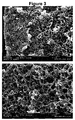
- FIG. 3 A comparison between Fig. 3 and Fig. 4 illustrates the effect of drawing on the morphology.
- the fiber of Fig. 3 was manufactured without drawing, while the fiber of Fig. 4 was manufactured by including a step of drawing by 100 %. It can be clearly seen that the pores shown in Fig. 4 are smaller than the pores shown in Fig. 3 .
- the fibers of Examples 1 to 14 had a porous core, wherein a porosity ⁇ , defined as the ratio between the volume of void-space Vv and the total (bulk) volume V B of the fibers, including the solid and void component, is at least 5 %.
Landscapes
- Engineering & Computer Science (AREA)
- Textile Engineering (AREA)
- Chemical & Material Sciences (AREA)
- Chemical Kinetics & Catalysis (AREA)
- General Chemical & Material Sciences (AREA)
- Mechanical Engineering (AREA)
- Compositions Of Macromolecular Compounds (AREA)
- Artificial Filaments (AREA)
- Spinning Methods And Devices For Manufacturing Artificial Fibers (AREA)
Applications Claiming Priority (2)
| Application Number | Priority Date | Filing Date | Title |
|---|---|---|---|
| US10617708P | 2008-10-17 | 2008-10-17 | |
| PCT/EP2009/063572 WO2010043705A1 (en) | 2008-10-17 | 2009-10-16 | Fiber or foil from polymers with high tg and process for their manufacture |
Publications (2)
| Publication Number | Publication Date |
|---|---|
| EP2358929A1 EP2358929A1 (en) | 2011-08-24 |
| EP2358929B1 true EP2358929B1 (en) | 2014-04-30 |
Family
ID=41351501
Family Applications (1)
| Application Number | Title | Priority Date | Filing Date |
|---|---|---|---|
| EP09748064.4A Not-in-force EP2358929B1 (en) | 2008-10-17 | 2009-10-16 | Fiber or foil from polymers with high tg and process for their manufacture |
Country Status (7)
| Country | Link |
|---|---|
| US (1) | US8637583B2 (enExample) |
| EP (1) | EP2358929B1 (enExample) |
| JP (1) | JP5624045B2 (enExample) |
| CN (1) | CN102187023B (enExample) |
| BR (1) | BRPI0919681A2 (enExample) |
| CA (1) | CA2739033C (enExample) |
| WO (1) | WO2010043705A1 (enExample) |
Families Citing this family (11)
| Publication number | Priority date | Publication date | Assignee | Title |
|---|---|---|---|---|
| US20150322210A1 (en) * | 2012-12-17 | 2015-11-12 | Solvay Specialty Polymers Usa, Llc | Polyaryl Ether Polymers End-Capped with Phenolic Amino Acids |
| EP2956576B1 (en) * | 2013-02-13 | 2020-07-08 | President and Fellows of Harvard College | Immersed rotary jet spinning devices (irjs) and uses thereof |
| WO2014130275A2 (en) | 2013-02-22 | 2014-08-28 | Ticona Llc | High performance polymer composition with improved flow properties |
| US9534086B2 (en) | 2014-05-07 | 2017-01-03 | International Business Machines Corporation | Methods of forming poly(aryl ether sulfone)s and articles therefrom |
| CN106574184A (zh) | 2014-08-21 | 2017-04-19 | 提克纳有限责任公司 | 包含聚芳基醚酮和低环烷液晶聚合物的组合物 |
| EP3183321A1 (en) | 2014-08-21 | 2017-06-28 | Ticona LLC | Polyaryletherketone composition |
| RU2617652C1 (ru) * | 2015-12-24 | 2017-04-25 | Открытое акционерное общество "Институт пластмасс имени Г.С. Петрова" | Способ коагуляционного выделения полисульфона |
| RU2756466C2 (ru) * | 2016-11-08 | 2021-09-30 | Тейджин Арамид Б.В. | Процесс для производства волокна из полиэфиркетонкетона |
| CN117604663A (zh) | 2019-01-14 | 2024-02-27 | 哈佛学院院长等 | 聚焦旋转喷射纺丝装置及其使用方法 |
| KR102411507B1 (ko) * | 2020-08-13 | 2022-06-21 | 한국화학연구원 | 비결정성 슈퍼 엔지니어링 플라스틱 섬유 및 이의 제조방법 |
| KR20230122578A (ko) * | 2020-12-23 | 2023-08-22 | 사이텍 인더스트리스 인코포레이티드 | 제어된 형태를 갖는 폴리아크릴로니트릴계 섬유의 제조 방법 |
Family Cites Families (36)
| Publication number | Priority date | Publication date | Assignee | Title |
|---|---|---|---|---|
| CA847963A (en) | 1970-07-28 | Zutty Nathan | Process for preparing polyarylene polyethers | |
| CA1017097A (en) | 1962-11-06 | 1977-09-06 | Imperial Chemical Industries Limited | Manufacture of polysulphones |
| DE1545106C3 (de) | 1963-07-16 | 1979-05-31 | Union Carbide Corp., New York, N.Y. (V.St.A.) | Verfahren zur Herstellung von linearen Polyarylenpolyäthern |
| US4175175A (en) | 1963-07-16 | 1979-11-20 | Union Carbide Corporation | Polyarylene polyethers |
| NL6604887A (enExample) | 1966-04-13 | 1967-07-25 | ||
| US3634355A (en) | 1968-03-21 | 1972-01-11 | Ici Ltd | Aromatic polymers from dihalogenoben-zenoid compounds and alkali metal hydroxide |
| GB1586972A (en) | 1977-02-01 | 1981-03-25 | Ici Ltd | Production of aromatic polyethers |
| JPS5812932B2 (ja) * | 1977-06-30 | 1983-03-10 | 日本ゼオン株式会社 | 中空繊維の製造方法 |
| JPS588504A (ja) * | 1981-07-08 | 1983-01-18 | Toyobo Co Ltd | ポリスルホン中空繊維気体分離膜 |
| JPS58132111A (ja) * | 1982-01-29 | 1983-08-06 | Asahi Chem Ind Co Ltd | ポリスルホン中空糸 |
| AT377016B (de) | 1983-03-09 | 1985-01-25 | Chemiefaser Lenzing Ag | Verfahren zur herstellung von schwer entflammbaren, hochtemperaturbestaendigen polyimidfasern |
| DD233385A1 (de) | 1984-12-28 | 1986-02-26 | Adw Ddr | Verfahren zur herstellung poroeser polymerformkoerper |
| DE3814715A1 (de) | 1988-04-30 | 1989-11-09 | Basf Ag | Aus der schmelze geformte faeden aus mindestens einem aromatischen polymeren |
| DE69033282T2 (de) * | 1989-05-23 | 1999-12-30 | Teijin Ltd., Osaka | Poly(arylen-äther-keton), verfahren zur herstellung desselben und dessen verwendung |
| JPH0755980B2 (ja) * | 1989-05-23 | 1995-06-14 | 帝人株式会社 | ポリ(アリ―レンエ―テルケトン)の製造方法 |
| JP2594396B2 (ja) * | 1989-12-22 | 1997-03-26 | 三井東圧化学株式会社 | ポリイミド成形品 |
| DE69027595T2 (de) * | 1989-12-22 | 1997-01-23 | Mitsui Toatsu Chemicals | Polyimid giessling |
| DE4009208A1 (de) | 1990-03-22 | 1991-09-26 | Basf Ag | Geformte gebilde aus aromatischen polyethersulfonen, die gegen uv-strahlung stabilisiert sind und ein verfahren zu deren herstellung |
| US5207803A (en) * | 1990-09-28 | 1993-05-04 | Springs Industries | Method for dyeing aromatic polyamide fibrous materials: n,n-diethyl(meta-toluamide) dye carrier |
| US5258149A (en) * | 1990-11-27 | 1993-11-02 | W. R. Grace & Co.-Conn. | Process of making a membrane for high efficiency removal of low density lipoprotein-cholesterol from whole blood |
| US5215554A (en) * | 1991-06-12 | 1993-06-01 | Permea, Inc. | Membranes having enhanced selectivity and method of producing such membranes |
| JP3232117B2 (ja) * | 1991-11-19 | 2001-11-26 | 鐘淵化学工業株式会社 | ポリスルホン多孔質中空糸 |
| US5367046A (en) | 1992-04-10 | 1994-11-22 | The United States Of America As Represented By The Administrator Of The National Aeronautics And Space Administration | Low dielectric polyimide fibers |
| EP0908541B1 (en) | 1996-03-06 | 2005-06-01 | Mitsubishi Rayon Co., Ltd. | Fibril based fibers, method of manufacturing same, spinning nozzle used in same, and moldings obtained therefrom |
| SG67983A1 (en) | 1997-06-21 | 1999-10-19 | Univ Singapore | Highly permeable polyethersulfone hollow fiber membranes for gas separation |
| GB2355464B (en) | 2000-02-11 | 2004-08-11 | Victrex Mfg Ltd | Aromatic polyetherketones |
| GB2364319B (en) | 2000-07-06 | 2003-01-15 | Gharda Chemicals Ltd | Melt processible polyether ether ketone polymer |
| WO2003097221A1 (en) | 2002-05-17 | 2003-11-27 | Para Limited | Hollow fiber membrane having supporting material for reinforcement, preparation thereof and spinneret for preparing the same |
| ES2414864T3 (es) | 2002-06-28 | 2013-07-23 | Neokidney Holding B.V. | Método para la preparación de fibras porosas funcionales |
| EP1627941A1 (en) | 2004-08-17 | 2006-02-22 | Mosaic Systems B.V. | Functional porous multilayer fibre and its preparation |
| CN1313658C (zh) | 2005-11-15 | 2007-05-02 | 北京服装学院 | 一种聚醚砜纤维及其制备方法和应用 |
| US8881915B2 (en) * | 2006-04-26 | 2014-11-11 | Toyo Boseki Kabushiki Kaisha | Polymeric porous hollow fiber membrane |
| CN101680125B (zh) * | 2007-03-23 | 2012-12-26 | 索维高级聚合物股份有限公司 | 改进的织物 |
| CN101143304A (zh) * | 2007-07-17 | 2008-03-19 | 天津工业大学 | 一种中空纤维膜及其制备方法 |
| WO2009142433A2 (ko) * | 2008-05-19 | 2009-11-26 | 한양대학교 산학협력단 | 중공사, 중공사 형성용 도프 용액 조성물 및 이를 이용한 중공사의 제조방법 |
| WO2009142434A2 (ko) * | 2008-05-19 | 2009-11-26 | 한양대학교 산학협력단 | 중공사, 중공사 형성용 도프 용액 조성물 및 이를 이용한 중공사의 제조방법 |
-
2009
- 2009-10-16 JP JP2011531503A patent/JP5624045B2/ja not_active Expired - Fee Related
- 2009-10-16 US US13/124,078 patent/US8637583B2/en not_active Expired - Fee Related
- 2009-10-16 CA CA2739033A patent/CA2739033C/en not_active Expired - Fee Related
- 2009-10-16 BR BRPI0919681A patent/BRPI0919681A2/pt not_active IP Right Cessation
- 2009-10-16 EP EP09748064.4A patent/EP2358929B1/en not_active Not-in-force
- 2009-10-16 CN CN200980141388.4A patent/CN102187023B/zh not_active Expired - Fee Related
- 2009-10-16 WO PCT/EP2009/063572 patent/WO2010043705A1/en not_active Ceased
Also Published As
| Publication number | Publication date |
|---|---|
| WO2010043705A1 (en) | 2010-04-22 |
| CN102187023A (zh) | 2011-09-14 |
| BRPI0919681A2 (pt) | 2017-10-31 |
| JP2012505973A (ja) | 2012-03-08 |
| JP5624045B2 (ja) | 2014-11-12 |
| US20110263729A1 (en) | 2011-10-27 |
| CA2739033A1 (en) | 2010-04-22 |
| CN102187023B (zh) | 2014-07-09 |
| US8637583B2 (en) | 2014-01-28 |
| CA2739033C (en) | 2017-06-20 |
| EP2358929A1 (en) | 2011-08-24 |
Similar Documents
| Publication | Publication Date | Title |
|---|---|---|
| EP2358929B1 (en) | Fiber or foil from polymers with high tg and process for their manufacture | |
| KR100960049B1 (ko) | 폴리케톤 섬유의 제조방법 | |
| EP3033368B1 (en) | Process for making polyarylethers and use in membrane preparation | |
| JP7018931B2 (ja) | 多孔質膜 | |
| KR20060074131A (ko) | 폴리케톤 섬유의 제조방법 및 그 방법에 의해 제조된폴리케톤 섬유 | |
| KR101415046B1 (ko) | 내열성 및 수투과도가 향상된 메타 아라미드 중공사 및 그 제조 방법 | |
| CN111282455A (zh) | 外压式中空纤维工业纳滤膜及制备方法 | |
| KR100595990B1 (ko) | 폴리케톤 섬유 및 그의 제조 방법 | |
| KR101881827B1 (ko) | 다단 응고조로 구성된 아라미드 섬유의 제조장치 및 이에 의한 아라미드 섬유 | |
| KR20110009366A (ko) | 폴리케톤 섬유의 효과적인 연신방법 | |
| WO2020127456A1 (en) | Porous membranes for high pressure filtration | |
| KR100949602B1 (ko) | 폴리케톤 섬유의 제조방법 | |
| EP0465251A1 (en) | Compositions of aromatic polybenzidmidazoles and polysulfones and fibers therefrom | |
| KR20240035225A (ko) | 중공사 분리막 제조방법 및 이로부터 제조된 중공사 분리막 | |
| US5208298A (en) | Stable solution of polybenzimidazole and polysulfons blends | |
| CN113684549A (zh) | 一种聚酰胺纤维的纺丝工艺 | |
| US20130313739A1 (en) | Membrane-forming dope solution for carbon membranes and method for producing carbon hollow fiber membranes using the same | |
| KR101076649B1 (ko) | 폴리케톤 섬유의 제조방법 | |
| JPH028047B2 (enExample) | ||
| JPH0841728A (ja) | 高弾性率ポリベンザゾール繊維 | |
| JPH07251049A (ja) | 非晶質芳香族ポリエ−テルケトン中空糸分離膜及びその製造方法 | |
| JPS6242046B2 (enExample) | ||
| JPH01215307A (ja) | 芳香族ポリスルホン中空糸膜 | |
| KR20170081798A (ko) | 아세틸화 알킬 셀룰로오스 분리막 및 그의 제조방법 | |
| KR20100050301A (ko) | 폴리케톤 섬유의 제조방법 |
Legal Events
| Date | Code | Title | Description |
|---|---|---|---|
| PUAI | Public reference made under article 153(3) epc to a published international application that has entered the european phase |
Free format text: ORIGINAL CODE: 0009012 |
|
| 17P | Request for examination filed |
Effective date: 20110517 |
|
| AK | Designated contracting states |
Kind code of ref document: A1 Designated state(s): AT BE BG CH CY CZ DE DK EE ES FI FR GB GR HR HU IE IS IT LI LT LU LV MC MK MT NL NO PL PT RO SE SI SK SM TR |
|
| RAP1 | Party data changed (applicant data changed or rights of an application transferred) |
Owner name: SOLVAY SPECIALTY POLYMERS USA, LLC. |
|
| DAX | Request for extension of the european patent (deleted) | ||
| 17Q | First examination report despatched |
Effective date: 20120312 |
|
| GRAP | Despatch of communication of intention to grant a patent |
Free format text: ORIGINAL CODE: EPIDOSNIGR1 |
|
| INTG | Intention to grant announced |
Effective date: 20130820 |
|
| GRAP | Despatch of communication of intention to grant a patent |
Free format text: ORIGINAL CODE: EPIDOSNIGR1 |
|
| INTG | Intention to grant announced |
Effective date: 20140109 |
|
| GRAS | Grant fee paid |
Free format text: ORIGINAL CODE: EPIDOSNIGR3 |
|
| GRAA | (expected) grant |
Free format text: ORIGINAL CODE: 0009210 |
|
| AK | Designated contracting states |
Kind code of ref document: B1 Designated state(s): AT BE BG CH CY CZ DE DK EE ES FI FR GB GR HR HU IE IS IT LI LT LU LV MC MK MT NL NO PL PT RO SE SI SK SM TR |
|
| REG | Reference to a national code |
Ref country code: GB Ref legal event code: FG4D Ref country code: CH Ref legal event code: EP |
|
| REG | Reference to a national code |
Ref country code: AT Ref legal event code: REF Ref document number: 665233 Country of ref document: AT Kind code of ref document: T Effective date: 20140515 |
|
| REG | Reference to a national code |
Ref country code: IE Ref legal event code: FG4D |
|
| REG | Reference to a national code |
Ref country code: DE Ref legal event code: R096 Ref document number: 602009023688 Country of ref document: DE Effective date: 20140612 |
|
| REG | Reference to a national code |
Ref country code: AT Ref legal event code: MK05 Ref document number: 665233 Country of ref document: AT Kind code of ref document: T Effective date: 20140430 |
|
| REG | Reference to a national code |
Ref country code: LT Ref legal event code: MG4D |
|
| REG | Reference to a national code |
Ref country code: NL Ref legal event code: VDEP Effective date: 20140430 |
|
| PG25 | Lapsed in a contracting state [announced via postgrant information from national office to epo] |
Ref country code: GR Free format text: LAPSE BECAUSE OF FAILURE TO SUBMIT A TRANSLATION OF THE DESCRIPTION OR TO PAY THE FEE WITHIN THE PRESCRIBED TIME-LIMIT Effective date: 20140731 Ref country code: IS Free format text: LAPSE BECAUSE OF FAILURE TO SUBMIT A TRANSLATION OF THE DESCRIPTION OR TO PAY THE FEE WITHIN THE PRESCRIBED TIME-LIMIT Effective date: 20140830 Ref country code: BG Free format text: LAPSE BECAUSE OF FAILURE TO SUBMIT A TRANSLATION OF THE DESCRIPTION OR TO PAY THE FEE WITHIN THE PRESCRIBED TIME-LIMIT Effective date: 20140730 Ref country code: LT Free format text: LAPSE BECAUSE OF FAILURE TO SUBMIT A TRANSLATION OF THE DESCRIPTION OR TO PAY THE FEE WITHIN THE PRESCRIBED TIME-LIMIT Effective date: 20140430 Ref country code: NO Free format text: LAPSE BECAUSE OF FAILURE TO SUBMIT A TRANSLATION OF THE DESCRIPTION OR TO PAY THE FEE WITHIN THE PRESCRIBED TIME-LIMIT Effective date: 20140730 Ref country code: CY Free format text: LAPSE BECAUSE OF FAILURE TO SUBMIT A TRANSLATION OF THE DESCRIPTION OR TO PAY THE FEE WITHIN THE PRESCRIBED TIME-LIMIT Effective date: 20140430 Ref country code: NL Free format text: LAPSE BECAUSE OF FAILURE TO SUBMIT A TRANSLATION OF THE DESCRIPTION OR TO PAY THE FEE WITHIN THE PRESCRIBED TIME-LIMIT Effective date: 20140430 Ref country code: FI Free format text: LAPSE BECAUSE OF FAILURE TO SUBMIT A TRANSLATION OF THE DESCRIPTION OR TO PAY THE FEE WITHIN THE PRESCRIBED TIME-LIMIT Effective date: 20140430 |
|
| PG25 | Lapsed in a contracting state [announced via postgrant information from national office to epo] |
Ref country code: HR Free format text: LAPSE BECAUSE OF FAILURE TO SUBMIT A TRANSLATION OF THE DESCRIPTION OR TO PAY THE FEE WITHIN THE PRESCRIBED TIME-LIMIT Effective date: 20140430 Ref country code: ES Free format text: LAPSE BECAUSE OF FAILURE TO SUBMIT A TRANSLATION OF THE DESCRIPTION OR TO PAY THE FEE WITHIN THE PRESCRIBED TIME-LIMIT Effective date: 20140430 Ref country code: PL Free format text: LAPSE BECAUSE OF FAILURE TO SUBMIT A TRANSLATION OF THE DESCRIPTION OR TO PAY THE FEE WITHIN THE PRESCRIBED TIME-LIMIT Effective date: 20140430 Ref country code: AT Free format text: LAPSE BECAUSE OF FAILURE TO SUBMIT A TRANSLATION OF THE DESCRIPTION OR TO PAY THE FEE WITHIN THE PRESCRIBED TIME-LIMIT Effective date: 20140430 Ref country code: LV Free format text: LAPSE BECAUSE OF FAILURE TO SUBMIT A TRANSLATION OF THE DESCRIPTION OR TO PAY THE FEE WITHIN THE PRESCRIBED TIME-LIMIT Effective date: 20140430 Ref country code: SE Free format text: LAPSE BECAUSE OF FAILURE TO SUBMIT A TRANSLATION OF THE DESCRIPTION OR TO PAY THE FEE WITHIN THE PRESCRIBED TIME-LIMIT Effective date: 20140430 |
|
| PG25 | Lapsed in a contracting state [announced via postgrant information from national office to epo] |
Ref country code: PT Free format text: LAPSE BECAUSE OF FAILURE TO SUBMIT A TRANSLATION OF THE DESCRIPTION OR TO PAY THE FEE WITHIN THE PRESCRIBED TIME-LIMIT Effective date: 20140901 |
|
| PG25 | Lapsed in a contracting state [announced via postgrant information from national office to epo] |
Ref country code: DK Free format text: LAPSE BECAUSE OF FAILURE TO SUBMIT A TRANSLATION OF THE DESCRIPTION OR TO PAY THE FEE WITHIN THE PRESCRIBED TIME-LIMIT Effective date: 20140430 Ref country code: CZ Free format text: LAPSE BECAUSE OF FAILURE TO SUBMIT A TRANSLATION OF THE DESCRIPTION OR TO PAY THE FEE WITHIN THE PRESCRIBED TIME-LIMIT Effective date: 20140430 Ref country code: SK Free format text: LAPSE BECAUSE OF FAILURE TO SUBMIT A TRANSLATION OF THE DESCRIPTION OR TO PAY THE FEE WITHIN THE PRESCRIBED TIME-LIMIT Effective date: 20140430 Ref country code: BE Free format text: LAPSE BECAUSE OF FAILURE TO SUBMIT A TRANSLATION OF THE DESCRIPTION OR TO PAY THE FEE WITHIN THE PRESCRIBED TIME-LIMIT Effective date: 20140430 Ref country code: EE Free format text: LAPSE BECAUSE OF FAILURE TO SUBMIT A TRANSLATION OF THE DESCRIPTION OR TO PAY THE FEE WITHIN THE PRESCRIBED TIME-LIMIT Effective date: 20140430 Ref country code: RO Free format text: LAPSE BECAUSE OF FAILURE TO SUBMIT A TRANSLATION OF THE DESCRIPTION OR TO PAY THE FEE WITHIN THE PRESCRIBED TIME-LIMIT Effective date: 20140430 |
|
| REG | Reference to a national code |
Ref country code: DE Ref legal event code: R097 Ref document number: 602009023688 Country of ref document: DE |
|
| PLBE | No opposition filed within time limit |
Free format text: ORIGINAL CODE: 0009261 |
|
| STAA | Information on the status of an ep patent application or granted ep patent |
Free format text: STATUS: NO OPPOSITION FILED WITHIN TIME LIMIT |
|
| 26N | No opposition filed |
Effective date: 20150202 |
|
| REG | Reference to a national code |
Ref country code: DE Ref legal event code: R097 Ref document number: 602009023688 Country of ref document: DE Effective date: 20150202 |
|
| PG25 | Lapsed in a contracting state [announced via postgrant information from national office to epo] |
Ref country code: LU Free format text: LAPSE BECAUSE OF FAILURE TO SUBMIT A TRANSLATION OF THE DESCRIPTION OR TO PAY THE FEE WITHIN THE PRESCRIBED TIME-LIMIT Effective date: 20141016 Ref country code: MC Free format text: LAPSE BECAUSE OF FAILURE TO SUBMIT A TRANSLATION OF THE DESCRIPTION OR TO PAY THE FEE WITHIN THE PRESCRIBED TIME-LIMIT Effective date: 20140430 |
|
| REG | Reference to a national code |
Ref country code: CH Ref legal event code: PL |
|
| REG | Reference to a national code |
Ref country code: IE Ref legal event code: MM4A |
|
| PG25 | Lapsed in a contracting state [announced via postgrant information from national office to epo] |
Ref country code: SI Free format text: LAPSE BECAUSE OF FAILURE TO SUBMIT A TRANSLATION OF THE DESCRIPTION OR TO PAY THE FEE WITHIN THE PRESCRIBED TIME-LIMIT Effective date: 20140430 Ref country code: LI Free format text: LAPSE BECAUSE OF NON-PAYMENT OF DUE FEES Effective date: 20141031 Ref country code: CH Free format text: LAPSE BECAUSE OF NON-PAYMENT OF DUE FEES Effective date: 20141031 |
|
| REG | Reference to a national code |
Ref country code: FR Ref legal event code: PLFP Year of fee payment: 7 |
|
| PG25 | Lapsed in a contracting state [announced via postgrant information from national office to epo] |
Ref country code: IE Free format text: LAPSE BECAUSE OF NON-PAYMENT OF DUE FEES Effective date: 20141016 |
|
| PGFP | Annual fee paid to national office [announced via postgrant information from national office to epo] |
Ref country code: IT Payment date: 20151026 Year of fee payment: 7 |
|
| PG25 | Lapsed in a contracting state [announced via postgrant information from national office to epo] |
Ref country code: SM Free format text: LAPSE BECAUSE OF FAILURE TO SUBMIT A TRANSLATION OF THE DESCRIPTION OR TO PAY THE FEE WITHIN THE PRESCRIBED TIME-LIMIT Effective date: 20140430 |
|
| PG25 | Lapsed in a contracting state [announced via postgrant information from national office to epo] |
Ref country code: MT Free format text: LAPSE BECAUSE OF FAILURE TO SUBMIT A TRANSLATION OF THE DESCRIPTION OR TO PAY THE FEE WITHIN THE PRESCRIBED TIME-LIMIT Effective date: 20140430 Ref country code: TR Free format text: LAPSE BECAUSE OF FAILURE TO SUBMIT A TRANSLATION OF THE DESCRIPTION OR TO PAY THE FEE WITHIN THE PRESCRIBED TIME-LIMIT Effective date: 20140430 Ref country code: HU Free format text: LAPSE BECAUSE OF FAILURE TO SUBMIT A TRANSLATION OF THE DESCRIPTION OR TO PAY THE FEE WITHIN THE PRESCRIBED TIME-LIMIT; INVALID AB INITIO Effective date: 20091016 |
|
| REG | Reference to a national code |
Ref country code: FR Ref legal event code: PLFP Year of fee payment: 8 |
|
| PGFP | Annual fee paid to national office [announced via postgrant information from national office to epo] |
Ref country code: FR Payment date: 20160919 Year of fee payment: 8 |
|
| PGFP | Annual fee paid to national office [announced via postgrant information from national office to epo] |
Ref country code: DE Payment date: 20161011 Year of fee payment: 8 Ref country code: GB Payment date: 20161012 Year of fee payment: 8 |
|
| PG25 | Lapsed in a contracting state [announced via postgrant information from national office to epo] |
Ref country code: IT Free format text: LAPSE BECAUSE OF NON-PAYMENT OF DUE FEES Effective date: 20161016 |
|
| REG | Reference to a national code |
Ref country code: DE Ref legal event code: R119 Ref document number: 602009023688 Country of ref document: DE |
|
| GBPC | Gb: european patent ceased through non-payment of renewal fee |
Effective date: 20171016 |
|
| PG25 | Lapsed in a contracting state [announced via postgrant information from national office to epo] |
Ref country code: MK Free format text: LAPSE BECAUSE OF FAILURE TO SUBMIT A TRANSLATION OF THE DESCRIPTION OR TO PAY THE FEE WITHIN THE PRESCRIBED TIME-LIMIT Effective date: 20140430 |
|
| REG | Reference to a national code |
Ref country code: FR Ref legal event code: ST Effective date: 20180629 |
|
| PG25 | Lapsed in a contracting state [announced via postgrant information from national office to epo] |
Ref country code: GB Free format text: LAPSE BECAUSE OF NON-PAYMENT OF DUE FEES Effective date: 20171016 Ref country code: DE Free format text: LAPSE BECAUSE OF NON-PAYMENT OF DUE FEES Effective date: 20180501 |
|
| PG25 | Lapsed in a contracting state [announced via postgrant information from national office to epo] |
Ref country code: FR Free format text: LAPSE BECAUSE OF NON-PAYMENT OF DUE FEES Effective date: 20171031 |