EP2319846B1 - Process for preparing oxycodone hydrochloride having less than 25ppm 14-hydroxycodeinone - Google Patents
Process for preparing oxycodone hydrochloride having less than 25ppm 14-hydroxycodeinone Download PDFInfo
- Publication number
- EP2319846B1 EP2319846B1 EP10011787.8A EP10011787A EP2319846B1 EP 2319846 B1 EP2319846 B1 EP 2319846B1 EP 10011787 A EP10011787 A EP 10011787A EP 2319846 B1 EP2319846 B1 EP 2319846B1
- Authority
- EP
- European Patent Office
- Prior art keywords
- hydroxycodeinone
- ppm
- oxycodone hydrochloride
- solution
- oxycodone
- Prior art date
- Legal status (The legal status is an assumption and is not a legal conclusion. Google has not performed a legal analysis and makes no representation as to the accuracy of the status listed.)
- Expired - Lifetime
Links
Images


Classifications
-
- C—CHEMISTRY; METALLURGY
- C07—ORGANIC CHEMISTRY
- C07D—HETEROCYCLIC COMPOUNDS
- C07D489/00—Heterocyclic compounds containing 4aH-8, 9 c- Iminoethano-phenanthro [4, 5-b, c, d] furan ring systems, e.g. derivatives of [4, 5-epoxy]-morphinan of the formula:
- C07D489/06—Heterocyclic compounds containing 4aH-8, 9 c- Iminoethano-phenanthro [4, 5-b, c, d] furan ring systems, e.g. derivatives of [4, 5-epoxy]-morphinan of the formula: with a hetero atom directly attached in position 14
- C07D489/08—Oxygen atom
-
- A—HUMAN NECESSITIES
- A61—MEDICAL OR VETERINARY SCIENCE; HYGIENE
- A61K—PREPARATIONS FOR MEDICAL, DENTAL OR TOILETRY PURPOSES
- A61K31/00—Medicinal preparations containing organic active ingredients
- A61K31/33—Heterocyclic compounds
- A61K31/395—Heterocyclic compounds having nitrogen as a ring hetero atom, e.g. guanethidine or rifamycins
- A61K31/435—Heterocyclic compounds having nitrogen as a ring hetero atom, e.g. guanethidine or rifamycins having six-membered rings with one nitrogen as the only ring hetero atom
- A61K31/47—Quinolines; Isoquinolines
- A61K31/485—Morphinan derivatives, e.g. morphine, codeine
-
- A—HUMAN NECESSITIES
- A61—MEDICAL OR VETERINARY SCIENCE; HYGIENE
- A61K—PREPARATIONS FOR MEDICAL, DENTAL OR TOILETRY PURPOSES
- A61K47/00—Medicinal preparations characterised by the non-active ingredients used, e.g. carriers or inert additives; Targeting or modifying agents chemically bound to the active ingredient
- A61K47/30—Macromolecular organic or inorganic compounds, e.g. inorganic polyphosphates
-
- A—HUMAN NECESSITIES
- A61—MEDICAL OR VETERINARY SCIENCE; HYGIENE
- A61K—PREPARATIONS FOR MEDICAL, DENTAL OR TOILETRY PURPOSES
- A61K9/00—Medicinal preparations characterised by special physical form
- A61K9/0012—Galenical forms characterised by the site of application
- A61K9/0053—Mouth and digestive tract, i.e. intraoral and peroral administration
-
- A—HUMAN NECESSITIES
- A61—MEDICAL OR VETERINARY SCIENCE; HYGIENE
- A61K—PREPARATIONS FOR MEDICAL, DENTAL OR TOILETRY PURPOSES
- A61K9/00—Medicinal preparations characterised by special physical form
- A61K9/14—Particulate form, e.g. powders, Processes for size reducing of pure drugs or the resulting products, Pure drug nanoparticles
-
- A—HUMAN NECESSITIES
- A61—MEDICAL OR VETERINARY SCIENCE; HYGIENE
- A61K—PREPARATIONS FOR MEDICAL, DENTAL OR TOILETRY PURPOSES
- A61K9/00—Medicinal preparations characterised by special physical form
- A61K9/20—Pills, tablets, discs, rods
-
- A—HUMAN NECESSITIES
- A61—MEDICAL OR VETERINARY SCIENCE; HYGIENE
- A61K—PREPARATIONS FOR MEDICAL, DENTAL OR TOILETRY PURPOSES
- A61K9/00—Medicinal preparations characterised by special physical form
- A61K9/20—Pills, tablets, discs, rods
- A61K9/2095—Tabletting processes; Dosage units made by direct compression of powders or specially processed granules, by eliminating solvents, by melt-extrusion, by injection molding, by 3D printing
-
- A—HUMAN NECESSITIES
- A61—MEDICAL OR VETERINARY SCIENCE; HYGIENE
- A61K—PREPARATIONS FOR MEDICAL, DENTAL OR TOILETRY PURPOSES
- A61K9/00—Medicinal preparations characterised by special physical form
- A61K9/48—Preparations in capsules, e.g. of gelatin, of chocolate
-
- A—HUMAN NECESSITIES
- A61—MEDICAL OR VETERINARY SCIENCE; HYGIENE
- A61K—PREPARATIONS FOR MEDICAL, DENTAL OR TOILETRY PURPOSES
- A61K9/00—Medicinal preparations characterised by special physical form
- A61K9/48—Preparations in capsules, e.g. of gelatin, of chocolate
- A61K9/4833—Encapsulating processes; Filling of capsules
-
- A—HUMAN NECESSITIES
- A61—MEDICAL OR VETERINARY SCIENCE; HYGIENE
- A61P—SPECIFIC THERAPEUTIC ACTIVITY OF CHEMICAL COMPOUNDS OR MEDICINAL PREPARATIONS
- A61P25/00—Drugs for disorders of the nervous system
- A61P25/04—Centrally acting analgesics, e.g. opioids
-
- A—HUMAN NECESSITIES
- A61—MEDICAL OR VETERINARY SCIENCE; HYGIENE
- A61P—SPECIFIC THERAPEUTIC ACTIVITY OF CHEMICAL COMPOUNDS OR MEDICINAL PREPARATIONS
- A61P29/00—Non-central analgesic, antipyretic or antiinflammatory agents, e.g. antirheumatic agents; Non-steroidal antiinflammatory drugs [NSAID]
-
- C—CHEMISTRY; METALLURGY
- C07—ORGANIC CHEMISTRY
- C07D—HETEROCYCLIC COMPOUNDS
- C07D489/00—Heterocyclic compounds containing 4aH-8, 9 c- Iminoethano-phenanthro [4, 5-b, c, d] furan ring systems, e.g. derivatives of [4, 5-epoxy]-morphinan of the formula:
- C07D489/02—Heterocyclic compounds containing 4aH-8, 9 c- Iminoethano-phenanthro [4, 5-b, c, d] furan ring systems, e.g. derivatives of [4, 5-epoxy]-morphinan of the formula: with oxygen atoms attached in positions 3 and 6, e.g. morphine, morphinone
-
- C—CHEMISTRY; METALLURGY
- C07—ORGANIC CHEMISTRY
- C07D—HETEROCYCLIC COMPOUNDS
- C07D489/00—Heterocyclic compounds containing 4aH-8, 9 c- Iminoethano-phenanthro [4, 5-b, c, d] furan ring systems, e.g. derivatives of [4, 5-epoxy]-morphinan of the formula:
- C07D489/02—Heterocyclic compounds containing 4aH-8, 9 c- Iminoethano-phenanthro [4, 5-b, c, d] furan ring systems, e.g. derivatives of [4, 5-epoxy]-morphinan of the formula: with oxygen atoms attached in positions 3 and 6, e.g. morphine, morphinone
- C07D489/04—Salts; Organic complexes
Definitions
- the present invention relates to a process for reducing the amount of 14-hydroxycodeinone in an oxycodone hydrochloride preparation.
- Oxycodone is a semi-synthetic opioid analgesic that exerts an agonist effect at specific, saturable opioid receptors in the CNS and other tissues. In man, oxycodone may produce any of a variety of effects including analgesia.
- Purdue Pharma L.P currently sells sustained-release oxycodone in dosage forms containing 10, 20, 40, and 80 mg oxycodone hydrochloride under the trade name OxyContin®.
- U.S. Patent Nos. 5,266,331 ; 5,508,042 ; 5,549,912 ; and 5,656,295 disclose sustained release oxycodone formulations.
- WO 2004/016618 discloses oxycodone hydrochloride polymorphs and their preparation.
- Thebaine a compound derived from opium, although having no medicinal use in itself, is useful as a starting material in synthetic schemes for the production of oxycodone.
- codeine can be utilized as the starting material for the production of oxycodone.
- 14-hydroxycodeinone is the immediate precursor to oxycodone in these schemes.
- Patent No. 6,008,355 and in Tetrahedron 55, 1999 (Coop and Rice ).
- U.S. Patent No. 6,177,567 describes the hydrogenation of 14-hydroxycodeinone to oxycodone by reduction with diphenylsilane and Pd(Ph3P)/ZnCl2 or with sodium hypophosphite in conjunction with a Pd/C catalyst in aqueous acetic acid.
- Oxycodone hydrochloride API active pharmaceutical ingredient
- Oxycodone hydrochloride API active pharmaceutical ingredient
- the present invention pertains to a process for preparing an oxycodone hydrochloride composition having less than 25 ppm 14-hydroxycodeinone as determined by the HPLC method of Example 6, comprising hydrogenating an oxycodone hydrochloride composition having at least 100 ppm 14-hydroxycodeinone as determined by the HPLC method of Example 6 in a suitable solvent to produce an oxycodone hydrochloride composition having less than 25 ppm 14-hydroxycodeinone.
- the solvent is selected from the group consisting of water, an alcohol, an ether, an amide, N-methylpyrrolidone, a carboxylic acid, and an appropriate mixture of any two or more of the aforementioned solvents.
- the process further comprises recovering the oxycodone hydrochloride composition having less than 25 ppm 14-hydroxycodeinone from the solvent, wherein the recovery step comprises crystallizing the oxycodone hydrochloride composition having less than 25 ppm 14-hydroxycodeinone and filtering the crystallized composition from the solvent.
- the invention is directed to said process for preparing the oxycodone hydrochloride composition having a 14-hydroxycodeinone level of less than 25 ppm comprising subjecting the oxycodone hydrochloride composition having a 14-hydroxycodeinone level of greater than 100 ppm to hydrogenation to an extent that the amount of 14-hydroxycodeinone in the composition is reduced to an amount of less than 25 ppm, less than 15 ppm, less than 10 ppm, or less than 5 ppm.
- the oxycodone composition having a 14-hydroxycodeinone level of less than 25 ppm can be subsequently hydrogenated to further decrease the amount of 14-hydroxycodeinone, e.g., from 15 ppm to 10 ppm or less.
- the starting material is an oxycodone hydrochloride composition comprising 14-hydroxycodeinone in an amount of 100 ppm or higher
- the final oxycodone hydrochloride composition has a 14-hydroxycodeinone level of less than 25 ppm, less than 15 ppm, less than 10 ppm, or less than 5 ppm.
- the process for preparing the oxycodone hydrochloride composition having a 14-hydroxycodeinone level of less than 25 ppm comprises hydrogenating the starting material under reflux.
- the process for preparing the oxycodone hydrochloride composition having a 14-hydroxycodeinone level of less than 25 ppm comprises hydrogenating under reflux the starting oxycodone hydrochloride composition having a 14-hydroxycodeinone level of greater than 100 ppm in the suitable solvent for a time sufficient to produce an oxycodone composition having a 14-hydroxycodeinone level of less than 25 ppm, less than 15 ppm, less than 10 ppm, or less than 5 ppm; and recovering the oxycodone hydrochloride composition having a 14-hydroxycodeinone level of less than 25 ppm by crystallization and removal from the solvent by filtration.
- the oxycodone hydrochloride composition prepared according to the present invention can have a lower limit of 0.25 ppm, 0.5 ppm, 1 ppm, 2 ppm or 5 ppm of 14-hydroxycodeinone.
- ppm means “parts per million”. As used to refer to 14-hydroxycodeinone, "ppm” means parts per million of 14-hydroxycodeinone in a particular sample.
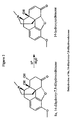
- 8,14-dihydroxy-7,8-dihydrocodeinone includes either 8 ⁇ ,14-dihydroxy-7,8-dihydrocodeinone; or 8 ⁇ ,14-dihydroxy-7,8-dihydrocodeinone or can include a mixture of both compounds.
- the oxycodone hydrochloride preparation can be, e.g., an oxycodone active pharmaceutical ingredient (API), such as oxycodone hydrochloride U.S.P., uncombined or combined with one or more other ingredients.
- API oxycodone active pharmaceutical ingredient
- the oxycodone preparation can be a final pharmaceutical dosage form, or an intermediate preparation for a final dosage form, that can be tested for the presence of 14-hydroxycodeinone and/or codeinone, e.g., for quality assurance purposes.
- the oxycodone hydrochloride preparation is oxycodone hydrochloride API and contains at least 95% oxycodone hydrochloride, at least 98% oxycodone hydrochloride, at least 99% oxycodone hydrochloride, or at least 99.9% oxycodone hydrochloride.
- the method of detecting the presence of 14-hydroxycodeinone in an oxycodone preparation can be performed in accordance with commonly assigned U.S. Provisional Application Serial No. 60/557,502 , entitled “Methods For Detecting 14-Hydroxycodeinone” filed March 30, 2004 and in accordance with U.S. Provisional Application entitled “Methods For Detecting 14-Hydroxycodeinone” filed January 31, 2005 (both priority documents of WO 2005/098414 ).
- the present invention pertains to a process for preparing an oxycodone hydrochloride composition having less than 25 ppm 14-hydroxycodeinone as determined by the HPLC method of Example 6, comprising hydrogenating an oxycodone hydrochloride composition having at least 100 ppm 14-hydroxycodeinone as determined by the HPLC method of Example 6 in a suitable solvent to produce an oxycodone hydrochloride composition having less than 25 ppm 14-hydroxycodeinone.
- the process further comprises recovering the oxycodone hydrochloride composition having less than 25 ppm 14-hydroxycodeinone from the solvent, wherein the recovery step comprises crystallizing the oxycodone hydrochloride composition having less than 25 ppm 14-hydroxycodeinone and filtering the crystallized composition from the solvent.
- the solvent is selected from the group consisting of water, an alcohol, an ether, an amide, N-methylpyrrolidone, a carboxylic acid, and an appropriate mixture of any two or more of the aforementioned solvents.
- the solvent is selected from the group consisting of water, an alcohol, an ether, N-methylpyrrolidone, and an appropriate mixture of any two or more of the aforementioned solvents.
- the solvent is selected from the group consisting of water, isopropanol, methanol, ethanol, tetrahydrofuran, dioxane, N-methylpyrrolidone, and an appropriate mixture of any two or more of the aforementioned solvents.
- the solvent is selected from the group consisting of water, isopropanol, methanol, ethanol, and an appropriate mixture of any two or more of the aforementioned solvents.
- the solvent is a combination of isopropanol and water.
- At least a portion of the 14-hydroxycodeinone is derived from 8 ⁇ ,14-dihydroxy-7,8-dihydrocodeinone.
- the invention is directed to a process for preparing an oxycodone hydrochloride composition having a 14-hydroxycodeinone level of less than 25 ppm as defined in the claims.
- the process comprises reacting the oxycodone hydrochloride composition with a catalytically effective amount of a transition metal compound and a gas comprising hydrogen, at a temperature and for a period of time sufficient to reduce the content of 14-hydroxycodeinone to a level wherein the resultant oxycodone hydrochloride composition comprises 14-hydroxycodeinone in an amount of less than 25 ppm, less than 15 ppm; less than 10 ppm, or less than 5 ppm.
- the process of the present invention also may result in the reduction of other alpha, beta, unsaturated ketones in oxycodone compositions, in addition to 14-hydroxycodeinone such as, e.g., codeinone.
- an oxycodone hydrochloride composition e.g., oxycodone hydrochloride API
- a solvent e.g., benzyl alcohol
- the composition is then hydrogenated under adequate conditions for a sufficient period; the catalyst is removed from the solvent; and the oxycodone hydrochloride composition having a 14-hydroxycodeinone level of less than 25 ppm is isolated and removed by crystallization and filtration.
- Hydrogenation of the 14-hydroxycodeinone in the processes of the present invention can be accomplished by using, e.g., pressurized-catalytic hydrogenation or catalytic transfer hydrogenation in an appropriate acid, e.g., acetic acid.
- a particular hydrogenation reaction employs hydrogen gas or NaHPO 2 along with a palladium-carbon catalyst.
- a hydrogen donor for use in the hydrogenation of the 14-hydroxycodeinone can be selected from hydrogen, primary and secondary alcohols, primary and secondary amines, carboxylic acids and their esters and amine salts, readily dehydrogenatable hydrocarbons (e.g., lower alkylsubstituted aromatic hydrocarbons such as ethylbenzene, diethylbenzene, isopropylbenzene, diisopropylbenzene, o-ethyltoluene, m-ethyltoluene, p-ethyltoluene, o-isopropyltoluene, m-isopropyltoluene, p-isopropyltoluene, ethylnaphthalene, propylnapththalene, isopropylnaphthalene, and diethylnaphthalene; paraffins such as ethane
- the hydrogenation is carried out at a pressure from 5 PSIG (34.47 kPa) to 200 PSIG (1378.95 kPa), or from 40 PSIG (275.79 kPa) to 60 PSIG (413.69 kPa). In certain embodiments, the hydrogenation is carried out at a temperature of from 20 °C to 100 °C, or from 40 °C to 85 °C.
- the hydrogenation is carried out at a pH of less than 5, less than 3, or less than 1, e.g., about 0.5.
- the 14-hydroxycodeinone is converted to oxycodone by hydrogenation utilizing diphenylsilane and Pd(Ph 3 P)/ZnCl 2 and sodium hypophosphite in conjunction with a Pd/C catalyst in aqueous organic acid; or Pd/C catalytic transfer hydrogenation.
- the total reaction time of the hydrogenation reaction is for a duration sufficient to reduce the content of the 14-hydroxycodeinone to a level that is less than 25 ppm, less than 15 ppm, less than 10 ppm, or less than 5 ppm.
- the actual reaction time can vary depending upon the temperature and efficiency of the hydrogenation system.
- the total reaction time to achieve the desired reduction in 14-hydroxycodeinone can be, e.g., from 10 minutes to 36 hours.
- the hydrogenation of the 14-hydroxycodeinone can be carried out in the presence of a noble metal catalyst.
- suitable catalysts can be selected from Raney cobalt, Raney nickel, palladium on carbon, platinum on carbon, palladium on alumina, platinum oxide, ruthenium on alumina, rhodium on alumina, or rhodium on carbon.
- One particular catalyst for this reduction is 5% palladium on carbon.
- the quantity of palladium on carbon catalyst can be from 0.05% w/w to 50% w/w, or from 0.5% w/w to 5%, in relation to the treated composition.
- the reaction is carried out in a solvent such as water; an alcohol (such as, e.g., isopropanol, methanol or ethanol); tetrahydrofuran;; an ether (such as dioxane); an amide (such as, e.g., dimethylformamide, diethylformamide, dimethylacetamide, or other N-alkyl substituted lower fatty acid amides); N-methylpyrrolidone; a carboxylic acid (such as formic, acetic, propionic acid or other lower alkanoic acid) or an appropriate mixture of any two or more of the aforementioned solvents.
- a solvent such as water; an alcohol (such as, e.g., isopropanol, methanol or ethanol); tetrahydrofuran;; an ether (such as dioxane); an amide (such as, e.g., dimethylformamide, diethylformamide, dimethylacetamide, or other
- the solvent is typically mixed with the 14-hydroxycodeinone-containing oxycodone hydrochloride composition prior to hydrogenation.
- the 14-hydroxycodeinone is derived from 8 ⁇ ,14-dihydroxy-7,8-dihydrocodeinone.
- the 8,14-dihydroxy-7,8-dihydrocodeinone component is converted to 14-hydroxycodeinone by acid-catalyzed dehydration.
- 14-hydroxycodeinone is increased in the final product.
- this can be reduced by providing reducing conditions sufficient for the 14-hydroxycodeinone to be readily converted to oxycodone.
- the reducing conditions sufficient to drive the 14-hydroxycodeinone to oxycodone can be provided, e.g., by a catalyst with a hydrogen donor.
- the pH of the solution can be adjusted to a pH of from 1.5 to 2.5, preferably to 1.8, (e.g., from a pH of less than 1) with a suitable basic agent, e.g., sodium hydroxide.
- a suitable basic agent e.g., sodium hydroxide.
- the pH adjustment is performed after the hydrogenation step and prior to removal of catalyst and isolation of the oxycodone hydrochloride composition having a 14-hydroxycodeinone level of less than 25 ppm.
- the oxycodone hydrochloride having a 14-hydroxycodeinone level of less than 25 ppm can be incorporated into pharmaceutical dosage forms, e.g., by admixtures of the oxycodone hydrochloride having a 14-hydroxycodeinone level of less than 25 ppm with conventional excipients, i.e., pharmaceutically acceptable organic or inorganic carrier substances.
- the dosage forms can provide a sustained release of the active.
- Suitable pharmaceutically acceptable carriers include alcohols, gum arabic, vegetable oils, benzyl alcohols, polyethylene glycols, gelate, carbohydrates such as lactose, amylose or starch, magnesium stearate, talc, silicic acid, viscous paraffin, perfume oil, fatty acid monoglycerides and diglycerides, pentaerythritol fatty acid esters, hydroxymethylcellulose, polyvinylpyrrolidone.
- compositions intended for oral use may be prepared according to any method known in the art and such compositions may contain one or more agents selected from the group consisting of inert, non-toxic pharmaceutically acceptable excipients which are suitable for the manufacture of tablets.
- excipients include, for example an inert diluent such as lactose; granulating and disintegrating agents such as cornstarch; binding agents such as starch; and lubricating agents such as magnesium stearate.
- the tablets may be uncoated or they may be coated by known techniques for elegance or to delay release of the active ingredients.
- Formulations for oral use may also be presented as hard gelatin capsules wherein the active ingredient is mixed with an inert diluent.
- the oral dosage forms may be in the form of tablets (sustained release and/or immediate release), troches, lozenges, powders or granules, hard or soft capsules, microparticles (e.g., microcapsules, microspheres), buccal tablets, suppositories, solutions, suspensions.
- the pharmaceutical dosage forms may be for use in treating pain. This may be achieved by administering to a human patient the dosage forms described herein.
- the dosage form When the dosage form is oral, the dosage form contains from 10 mg to 320 mg of oxycodone hydrochloride having a 14-hydroxycodeinone level of less than 25 ppm.
- Particularly preferred dosages for twice daily dosing are 5 mg, 10 mg, 15 mg, 20 mg, 30 mg, 40 mg, 50 mg, 60 mg, 80 mg, 100 mg, or 160 mg.
- Particularly preferred dosages for once daily dosing are 10 mg, 20 mg, 30 mg, 40 mg, 60 mg, 80 mg, 100 mg, 120 mg, 160 mg, or 320 mg.
- the oxycodone hydrochloride having a 14-hydroxycodeinone level of less than 25 ppm can also be formulated with suitable pharmaceutically acceptable excipients to provide a sustained release of the oxycodone hydrochloride having a 14-hydroxycodeinone level of less than 25 ppm.
- suitable pharmaceutically acceptable excipients can be prepared in accordance with U.S. Patent Nos. 5,266,331 ; 5,508,042 ; 5,549,912 ; and 5,656,295 .
- the oxycodone hydrochloride having a 14-hydroxycodeinone level of less than 25 ppm can be formulated as a sustained release oral formulation in any suitable tablet, coated tablet or multiparticulate formulation known to those skilled in the art.
- the sustained release dosage form may include a sustained release material which is incorporated into a matrix along with the oxycodone or salt thereof.
- the sustained release dosage form may optionally comprise particles containing oxycodone having a 14-hydroxycodeinone level of less than 25 ppm.
- the particles have a diameter from 0.1 mm to 2.5 mm, preferably from 0.5 mm to 2 mm.
- the particles are film coated with a material that permits release of the active at a sustained rate in an aqueous medium.
- the film coat is chosen so as to achieve, in combination with the other stated properties, desired release properties.
- the sustained release coating formulations should preferably be capable of producing a strong, continuous film that is smooth and elegant, capable of supporting pigments and other coating additives, non-toxic, inert, and tack-free.
- a hydrophobic material is used to coat inert pharmaceutical beads such as nu pariel 18/20 beads, and a plurality of the resultant solid sustained release beads may thereafter be placed in a gelatin capsule in an amount sufficient to provide an effective sustained release dose when ingested and contacted by an environmental fluid, e.g., gastric fluid or dissolution media.
- an environmental fluid e.g., gastric fluid or dissolution media.
- the sustained release bead formulations slowly release the active, e.g., when ingested and exposed to gastric fluids, and then to intestinal fluids.
- the sustained release profile of the formulations can be altered, for example, by varying the amount of overcoating with the hydrophobic material, altering the manner in which a plasticizer is added to the hydrophobic material, by varying the amount of plasticizer relative to hydrophobic material, by the inclusion of additional ingredients or excipients, by altering the method of manufacture.
- the dissolution profile of the ultimate product may also be modified, for example, by increasing or decreasing the thickness of the retardant coating.
- Spheroids or beads coated with the agent(s) of the present description are prepared, e.g., by dissolving the agent(s) in water and then spraying the solution onto a substrate, for example, nu pariel 18/20 beads, using a Wurster insert.
- additional ingredients are also added prior to coating the beads in order to assist the binding of the active to the beads, and/or to color the solution.
- a product which includes hydroxypropylmethylcellulose with or without colorant e.g., Opadry ® , commercially available from Colorcon, Inc.
- the resultant coated substrate in this example beads, may then be optionally overcoated with a barrier agent, to separate the active(s) from the hydrophobic sustained release coating.
- a barrier agent is one which comprises hydroxypropylmethylcellulose.
- any film-former known in the art may be used. It is preferred that the barrier agent does not affect the dissolution rate of the final product.
- the beads may then be overcoated with an aqueous dispersion of the hydrophobic material.
- the aqueous dispersion of hydrophobic material preferably further includes an effective amount of plasticizer, e.g. triethyl citrate.
- plasticizer e.g. triethyl citrate.
- Pre-formulated aqueous dispersions of ethylcellulose, such as Aquacoat ® or Surelease ® may be used. If Surelease ® is used, it is not necessary to separately add a plasticizer.
- pre-formulated aqueous dispersions of acrylic polymers such as Eudragit ® can be used.
- the coating solutions preferably contain, in addition to the film-former, plasticizer, and solvent system (i.e., water), a colorant to provide elegance and product distinction.
- Color may be added to the solution of the therapeutically active agent instead, or in addition to the aqueous dispersion of hydrophobic material.
- color may be added to Aquacoat ® via the use of alcohol or propylene glycol based color dispersions, milled aluminum lakes and opacifiers such as titanium dioxide by adding color with shear to water soluble polymer solution and then using low shear to the plasticized Aquacoat ® .
- any suitable method of providing color to the formulations may be used.
- Suitable ingredients for providing color to the formulation when an aqueous dispersion of an acrylic polymer is used include titanium dioxide and color pigments, such as iron oxide pigments. The incorporation of pigments, may, however, increase the retard effect of the coating.
- Plasticized hydrophobic material may be applied onto the substrate comprising the agent(s) by spraying using any suitable spray equipment known in the art.
- a Wurster fluidized-bed system is used in which an air jet, injected from underneath, fluidizes the core material and effects drying while the acrylic polymer coating is sprayed on.
- a further overcoat of a film-former such as Opadry ® , is optionally applied to the beads. This overcoat is provided, if at all, in order to substantially reduce agglomeration of the beads.
- the release of the agent(s) from the sustained release formulation can be further influenced, i.e., adjusted to a desired rate, by the addition of one or more release-modifying agents, or by providing one or more passageways through the coating.
- the ratio of hydrophobic material to water soluble material is determined by, among other factors, the release rate required and the solubility characteristics of the materials selected.
- the release-modifying agents which function as pore-formers may be organic or inorganic, and include materials that can be dissolved, extracted or leached from the coating in an environment of use.
- the pore-formers may comprise one or more hydrophilic materials such as hydroxypropylmethylcellulose.
- the sustained release coatings can also include erosion-promoting agents such as starch and gums.
- the sustained release coatings can also include materials useful for making microporous lamina in the environment of use, such as polycarbonates comprised of linear polyesters of carbonic acid in which carbonate groups reoccur in the polymer chain.
- the release-modifying agent may also comprise a semi-permeable polymer.
- the release-modifying agent is selected from hydroxypropylmethylcellulose, lactose, metal stearates, and mixtures of any of the foregoing.
- the sustained release coatings may also include an exit means comprising at least one passageway or orifice.
- the passageway may be formed by such methods as those disclosed in U.S. Patent Nos. 3,845,770 ; 3,916,8989 ; 4,063,064 ; and 4,088,864 .
- the sustained release formulation is achieved via a matrix optionally having a sustained release coating as set forth herein.
- the materials suitable for inclusion in a sustained release matrix may depend on the method used to form the matrix.
- a matrix in addition to the oxycodone hydrochloride having a 14-hydroxycodeinone level of less than 25 ppm may include:
- Hydrophilic and/or hydrophobic materials such as gums, cellulose ethers, acrylic resins, protein derived materials; the list is not meant to be exclusive, and any pharmaceutically acceptable hydrophobic material or hydrophilic material which is capable of imparting sustained release of the agent(s) and which melts (or softens to the extent necessary to be extruded) may be used.
- the oral dosage form may contain between 1% and 80% (by weight) of at least one hydrophilic or hydrophobic material.
- the hydrophobic material is a hydrocarbon
- the hydrocarbon preferably has a melting point of between 25°C and 90°C.
- fatty (aliphatic) alcohols are preferred.
- the oral dosage form may contain up to 60% (by weight) of at least one digestible, long chain hydrocarbon.
- the oral dosage form contains up to 60% (by weight) of at least one polyalkylene glycol.
- the hydrophobic material is preferably selected from the group consisting of alkylcelluloses, acrylic and methacrylic acid polymers and copolymers, shellac, zein, hydrogenated castor oil, hydrogenated vegetable oil, or mixtures thereof.
- the hydrophobic material is a pharmaceutically acceptable acrylic polymer, including acrylic acid and methacrylic acid copolymers, methyl methacrylate, methyl methacrylate copolymers, ethoxyethyl methacrylates, cyanoethyl methacrylate, aminoalkyl methacrylate copolymer, poly(acrylic acid), poly(methacrylic acid), methacrylic acid alkylamine copolymer, poly(methyl methacrylate), poly(methacrylic acid)(anhydride), polymethacrylate, polyacrylamide, poly(methacrylic acid anhydride), and glycidyl methacrylate copolymers.
- the hydrophobic material is selected from materials such as hydroxyal
- the hydrophobic materials are water-insoluble with more or less pronounced hydrophilic and/or hydrophobic trends.
- the hydrophobic materials have a melting point from 25°C to 200°C, preferably from 45°C to 90°C.
- the hydrophobic material may comprise natural or synthetic waxes, fatty alcohols (such as lauryl, myristyl, stearyl, cetyl or preferably cetostearyl alcohol), fatty acids, including fatty acid esters, fatty acid glycerides (mono-, di-, and triglycerides), hydrogenated fats, hydrocarbons, normal waxes, stearic aid, stearyl alcohol and hydrophobic and hydrophilic materials having hydrocarbon backbones.
- fatty alcohols such as lauryl, myristyl, stearyl, cetyl or preferably cetostearyl alcohol
- fatty acids including fatty acid esters, fatty acid glycerides (mono-, di-, and trigly
- Suitable waxes include, for example, beeswax, glycowax, castor wax and carnauba wax.
- a wax-like substance is defined as any material which is normally solid at room temperature and has a melting point of from 25°C to 100°C.
- Suitable hydrophobic materials which may be used include digestible, long chain (C 8 -C 50 , especially C 12 -C 40 ), substituted or unsubstituted hydrocarbons, such as fatty acids, fatty alcohols, glyceryl esters of fatty acids, mineral and vegetable oils and natural and synthetic waxes. Hydrocarbons having a melting point of between 25°C and 90°C are preferred. Of the long chain hydrocarbon materials, fatty (aliphatic) alcohols are preferred.
- the oral dosage form may contain up to 60% (by weight) of at least one digestible, long chain hydrocarbon.
- hydrophobic material is included in the matrix formulations.
- an additional hydrophobic material is included, it is preferably selected from natural and synthetic waxes, fatty acids, fatty alcohols, and mixtures of the same. Examples include beeswax, carnauba wax, stearic acid and stearyl alcohol.
- One particular suitable matrix comprises at least one water soluble hydroxyalkyl cellulose, at least one C 12 -C 36 , preferably C 14 -C 22 , aliphatic alcohol and, optionally, at least one polyalkylene glycol.
- the at least one hydroxyalkyl cellulose is preferably a hydroxy (C 1 to C 6 ) alkyl cellulose, such as hydroxypropylcellulose, hydroxypropylmethylcellulose and, especially, hydroxyethylcellulose.
- the amount of the at least one hydroxyalkyl cellulose in the present oral dosage form will be determined, inter alia, by the precise rate of oxycodone hydrochloride release required.
- the at least one aliphatic alcohol may be, for example, lauryl alcohol, myristyl alcohol or stearyl alcohol. In particular oral dosage forms, however, the at least one aliphatic alcohol is cetyl alcohol or cetostearyl alcohol.
- the amount of the at least one aliphatic alcohol in the present oral dosage form will be determined, as above, by the precise rate of oxycodone release required. It will also depend on whether at least one polyalkylene glycol is present in or absent from the oral dosage form. In the absence of at least one polyalkylene glycol, the oral dosage form preferably contains between 20% and 50% (by wt) of the at least one aliphatic alcohol. When at least one polyalkylene glycol is present in the oral dosage form, then the combined weight of the at least one aliphatic alcohol and the at least one polyalkylene glycol preferably constitutes between 20% and 50% (by wt) of the total dosage.
- a ratio (w/w) of the at least one hydroxyalkyl cellulose to the at least one aliphatic alcohol/polyalkylene glycol of between 1:2 and 1:4 is preferred, with a ratio of between 1:3 and 1:4 being particularly preferred.
- the at least one polyalkylene glycol may be, for example, polypropylene glycol or, which is preferred, polyethylene glycol.
- the number average molecular weight of the at least one polyalkylene glycol is preferred between 1,000 and 15,000, especially between 1,500 and 12,000.
- Another suitable sustained release matrix would comprise an alkylcellulose (especially ethyl cellulose), a C 12 to C 36 aliphatic alcohol and, optionally, a polyalkylene glycol.
- the matrix includes a pharmaceutically acceptable combination of at least two hydrophobic materials.
- a sustained release matrix may also contain suitable quantities of other materials, e.g. diluents, lubricants, binders, granulating aids, colorants, flavorants and glidants that are conventional in the pharmaceutical art.
- any method of preparing a matrix formulation known to those skilled in the art may be used.
- incorporation in the matrix may be effected, for example, by (a) forming granules comprising at least one water soluble hydroxyalkyl cellulose, and the oxycodone hydrochloride having a 14-hydroxycodeinone level of less than 25 ppm; (b) mixing the hydroxyalkyl cellulose containing granules with at least one C 12 - C 36 aliphatic alcohol; and (c) optionally, compressing and shaping the granules.
- the granules are formed by wet granulating the hydroxyalkyl cellulose granules with water.
- a spheronizing agent together with the active can be spheronized to form spheroids.
- Microcrystalline cellulose is a preferred spheronizing agent.
- a suitable microcrystalline cellulose is, for example, the material sold as Avicel PH 101 (Trade Mark, FMC Corporation).
- the spheroids may also contain a binder. Suitable binders, such as low viscosity, water soluble polymers, will be well known to those skilled in the pharmaceutical art. However, water soluble hydroxy lower alkyl cellulose, such as hydroxypropylcellulose, are preferred.
- the spheroids may contain a water insoluble polymer, especially an acrylic polymer, an acrylic copolymer, such as a methacrylic acid-ethyl acrylate copolymer, or ethyl cellulose.
- the sustained release coating will generally include a hydrophobic material such as (a) a wax, either alone or in admixture with a fatty alcohol; or (b) shellac or zein.
- Sustained release matrices can also be prepared via melt-granulation or melt-extrusion techniques.
- melt-granulation techniques involve melting a normally solid hydrophobic material, e.g. a wax, and incorporating a powdered drug therein.
- an additional hydrophobic substance e.g. ethylcellulose or a water-insoluble acrylic polymer, into the molten wax hydrophobic material. Examples of sustained release formulations prepared via melt-granulation techniques are found in U.S. Patent No. 4,861,598 .
- the additional hydrophobic material may comprise one or more water-insoluble wax-like thermoplastic substances possibly mixed with one or more wax-like thermoplastic substances being less hydrophobic than said one or more water-insoluble wax-like substances.
- the individual wax-like substances in the formulation should be substantially non-degradable and insoluble in gastrointestinal fluids during the initial release phases.
- Useful water-insoluble wax-like substances may be those with a water-solubility that is lower than 1:5,000 (w/w).
- a sustained release matrix may also contain suitable quantities of other materials, e.g., diluents, lubricants, binders, granulating aids, colorants, flavorants and glidants that are conventional in the pharmaceutical art.
- suitable quantities of these additional materials will be sufficient to provide the desired effect to the desired formulation.
- a sustained release matrix incorporating melt-extruded multiparticulates may also contain suitable quantities of other materials, e.g. diluents, lubricants, binders, granulating aids, colorants, flavorants and glidants that are conventional in the pharmaceutical art in amounts up to 50% by weight of the particulate if desired.
- suitable quantities of other materials e.g. diluents, lubricants, binders, granulating aids, colorants, flavorants and glidants that are conventional in the pharmaceutical art in amounts up to 50% by weight of the particulate if desired.
- the preparation of a suitable melt-extruded matrix may, for example, include the steps of blending the oxycodone hydrochloride having a 14-hydroxycodeinone level of less than 25 ppm together with at least one hydrophobic material and preferably the additional hydrophobic material to obtain a homogeneous mixture.
- the homogeneous mixture is then heated to a temperature sufficient to at least soften the mixture sufficiently to extrude the same.
- the resulting homogeneous mixture is then extruded to form strands.
- the extrudate is preferably cooled and cut into multiparticulates by any means known in the art.
- the strands are cooled and cut into multiparticulates.
- the multiparticulates are then divided into unit doses.
- the extrudate preferably has a diameter of from 0.1 to 5 mm and provides sustained release of the therapeutically active agent for a time period of from 8 to 24 hours.
- An optional process for preparing the melt extrusions includes directly metering into an extruder a hydrophobic material, the oxycodone hydrochloride having a 14-hydroxycodeinone level of less than 25 ppm, and an optional binder; heating the homogenous mixture; extruding the homogenous mixture to thereby form strands; cooling the strands containing the homogeneous mixture; cutting the strands into particles having a size from 0.1 mm to 12 mm; and dividing said particles into unit doses.
- a relatively continuous manufacturing procedure is realized.
- the diameter of the extruder aperture or exit port can also be adjusted to vary the thickness of the extruded strands.
- the exit part of the extruder need not be round; it can be oblong or rectangular.
- the exiting strands can be reduced to particles using a hot wire cutter, guillotine.
- melt extruded multiparticulate system can be, for example, in the form of granules, spheroids or pellets depending upon the extruder exit orifice.
- melt-extruded multiparticulate(s) and “melt-extruded multiparticulate system(s)” and “melt-extruded particles” shall refer to a plurality of units, preferably within a range of similar size and/or shape and containing one or more active agents and one or more excipients, preferably including a hydrophobic material as described herein.
- melt-extruded multiparticulates will be of a range of from 0.1 to 12 mm in length and have a diameter of from 0.1 to 5 mm.
- melt-extruded multiparticulates can be any geometrical shape within this size range.
- the extrudate may simply be cut into desired lengths and divided into unit doses of the therapeutically active agent without the need of a spheronization step.
- oral dosage forms are prepared to include an effective amount of melt-extruded multiparticulates within a capsule.
- a plurality of the melt-extruded multiparticulates may be placed in a gelatin capsule in an amount sufficient to provide an effective sustained release dose when ingested and contacted by gastric fluid.
- a suitable amount of the multiparticulate extrudate is compressed into an oral tablet using conventional tableting equipment using standard techniques.
- Techniques and compositions for making tablets (compressed and molded), capsules (hard and soft gelatin) and pills are also described in Remington's Pharmaceutical Sciences, (Arthur Osol, editor), 1553-1593 (1980 ).
- the extrudate can be shaped into tablets as set forth in U.S. Patent No. 4,957,681 (Klimesch , et. al.), described in additional detail above.
- the sustained release melt-extruded multiparticulate systems or tablets can be coated, or the gelatin capsule containing the multiparticulates can be further coated, with a sustained release coating such as the sustained release coatings described above.
- a sustained release coating such as the sustained release coatings described above.
- Such coatings preferably include a sufficient amount of hydrophobic material to obtain a weight gain level from 2 to 30 percent, although the overcoat may be greater depending upon the desired release rate, among other things.
- the melt-extruded unit dosage forms may further include combinations of melt-extruded particles before being encapsulated. Furthermore, the unit dosage forms can also include an amount of an immediate release agent for prompt release.
- the immediate release agent may be incorporated, e.g., as separate pellets within a gelatin capsule, or may be coated on the surface of the multiparticulates after preparation of the dosage forms (e.g., sustained release coating or matrix-based).
- the unit dosage forms may also contain a combination of sustained release beads and matrix multiparticulates to achieve a desired effect.
- the sustained release formulations preferably slowly release the agent(s), e.g., when ingested and exposed to gastric fluids, and then to intestinal fluids.
- the sustained release profile of the melt-extruded formulations can be altered, for example, by varying the amount of retardant, i.e., hydrophobic material, by varying the amount of plasticizer relative to hydrophobic material, by the inclusion of additional ingredients or excipients, by altering the method of manufacture.
- melt extruded material is prepared without the inclusion of the oxycodone hydrochloride having a 14-hydroxycodeinone level of less than 25 ppm, which can be added thereafter to the extrudate.
- Such formulations typically will have the agents blended together with the extruded matrix material, and then the mixture would be tableted in order to provide a slow release formulation.
- the dosage forms may optionally be coated with one or more materials suitable for the regulation of release or for the protection of the formulation.
- coatings are provided to permit either pH-dependent or pH-independent release.
- a pH-dependent coating serves to release the active in desired areas of the gastro-intestinal (GI) tract, e.g., the stomach or small intestine, such that an absorption profile is provided which is capable of providing at least eight hours and preferably twelve hours to up to twenty-four hours of analgesia to a patient.
- GI gastro-intestinal
- the coating is designed to achieve optimal release regardless of pH-changes in the environmental fluid, e.g., the GI tract. It is also possible to formulate compositions which release a portion of the dose in one desired area of the GI tract, e.g., the stomach, and release the remainder of the dose in another area of the GI tract, e.g., the small intestine.
- Formulations that utilize pH-dependent coatings to obtain formulations may also impart a repeat-action effect whereby unprotected drug is coated over the enteric coat and is released in the stomach, while the remainder, being protected by the enteric coating, is released further down the gastrointestinal tract.
- Coatings which are pH-dependent and may be used include shellac, cellulose acetate phthalate (CAP), polyvinyl acetate phthalate (PVAP), hydroxypropylmethylcellulose phthalate, and methacrylic acid ester copolymers, zein.
- the substrate e.g., tablet core bead, matrix particle
- the oxycodone hydrochloride having a 14-hydroxycodeinone level of less than 25 ppm thereof is coated with a hydrophobic material selected from (i) an alkylcellulose; (ii) an acrylic polymer; or (iii) mixtures thereof.
- the coating may be applied in the form of an organic or aqueous solution or dispersion.
- the coating may be applied to obtain a weight gain from 2 to 25% of the substrate in order to obtain a desired sustained release profile. Coatings derived from aqueous dispersions are described, e.g., in detail in U.S. Patent Nos. 5,273,760 and 5,286,493 .
- sustained release formulations and coatings which may be used include those described in U.S. Patent Nos. 5,324,351 ; 5,356,467 , and 5,472,712 .
- Cellulosic materials and polymers including alkylcelluloses, provide hydrophobic materials well suited for coating the beads.
- one preferred alkylcellulosic polymer is ethylcellulose, although the artisan will appreciate that other cellulose and/or alkylcellulose polymers may be readily employed, singly or in any combination, as all or part of a hydrophobic coating.
- the hydrophobic material comprising the sustained release coating is a pharmaceutically acceptable acrylic polymer, including acrylic acid and methacrylic acid copolymers, methyl methacrylate copolymers, ethoxyethyl methacrylates, cyanoethyl methacrylate, poly(acrylic acid), poly(methacrylic acid), methacrylic acid alkylamide copolymer, poly(methyl methacrylate), polymethacrylate, poly(methyl methacrylate) copolymer, polyacrylamide, aminoalkyl methacrylate copolymer, poly(methacrylic acid anhydride), and glycidyl methacrylate copolymers.
- acrylic acid and methacrylic acid copolymers including acrylic acid and methacrylic acid copolymers, methyl methacrylate copolymers, ethoxyethyl methacrylates, cyanoethyl methacrylate, poly(acrylic acid), poly(methacrylic acid), methacrylic acid al
- the acrylic polymer is comprised of one or more ammonio methacrylate copolymers.
- Ammonio methacrylate copolymers are well known in the art, and are described in NF XVII as fully polymerized copolymers of acrylic and methacrylic acid esters with a low content of quaternary ammonium groups.
- methacrylic acid ester-type polymers are useful for preparing pH-dependent coatings.
- Eudragit ® E is an example of a methacrylic acid copolymer which swells and dissolves in acidic media.
- Eudragit ® L is a methacrylic acid copolymer which does not swell at pH ⁇ 5.7 and is soluble at pH > 6.
- Eudragit ® S does not swell at pH ⁇ 6.5 and is soluble at pH > 7.
- Eudragit ® RL and Eudragit ® RS are water swellable, and the amount of water absorbed by these polymers is pH-dependent, however, dosage forms coated with Eudragit ® RL and RS are pH-independent.
- the acrylic coating comprises a mixture of two acrylic resin lacquers commercially available from Rohm Pharma under the trade names Eudragit ® RL30D and Eudragit ® RS30D, respectively.
- Eudragit ® RL30D and Eudragit ® RS30D are copolymers of acrylic and methacrylic esters with a low content of quaternary ammonium groups, the molar ratio of ammonium groups to the remaining neutral (meth)acrylic esters being 1:20 in Eudragit ® RL30D and 1:40 in Eudragit ® RS30D.
- the mean molecular weight is 150,000.
- RL high permeability
- RS low permeability
- Eudragit ® RL/RS mixtures are insoluble in water and in digestive fluids. However, coatings formed from the same are swellable and permeable in aqueous solutions and digestive fluids.
- the Eudragit ® RL/RS dispersions may be mixed together in any desired ratio in order to ultimately obtain a sustained release formulation having a desirable dissolution profile. Desirable sustained release formulations may be obtained, for instance, from a retardant coating derived from 100% Eudragit ® RL, 50% Eudragit ® RL and 50% Eudragit ® RS, and 10% Eudragit ® RL:Eudragit ® 90% RS. Of course, one skilled in the art will recognize that other acrylic polymers may also be used, such as, for example, Eudragit ® L.
- the coating comprises an aqueous dispersion of a hydrophobic material
- the inclusion of an effective amount of a plasticizer in the aqueous dispersion of hydrophobic material will further improve the physical properties of the sustained release coating.
- a plasticizer into an ethylcellulose coating containing sustained release coating before using the same as a coating material.
- the amount of plasticizer included in a coating solution is based on the concentration of the film-former, e.g., most often from 1 to 50 percent by weight of the film-former. Concentration of the plasticizer, however, can only be properly determined after careful experimentation with the particular coating solution and method of application.
- plasticizers for ethylcellulose include water insoluble plasticizers such as dibutyl sebacate, diethyl phthalate, triethyl citrate, tributyl citrate, and triacetin, although it is possible that other water-insoluble plasticizers (such as acetylated monoglycerides, phthalate esters, castor oil) may be used.
- Triethyl citrate is an especially preferred plasticizer for the aqueous dispersions of ethyl cellulose.
- plasticizers for the acrylic polymers include citric acid esters such as triethyl citrate NF XVI, tributyl citrate, dibutyl phthalate, and possibly 1,2-propylene glycol.
- Other plasticizers which have proved to be suitable for enhancing the elasticity of the films formed from acrylic films such as Eudragit ® RL/RS lacquer solutions include polyethylene glycols, propylene glycol, diethyl phthalate, castor oil, and triacetin.
- Triethyl citrate is an especially preferred plasticizer for the aqueous dispersions of ethyl cellulose.
- Sustained release dosage forms may also be prepared as osmotic dosage formulations.
- the osmotic dosage forms preferably include a bilayer core comprising a drug layer (containing the oxycodone hydrochloride having a 14-hydroxycodeinone level of less than 25 ppm) and a delivery or push layer, wherein the bilayer core is surrounded by a semipermeable wall optionally having at least one passageway disposed therein.
- passageway includes aperture, orifice, bore, pore, porous element through which oxycodone hydrochloride having a 14-hydroxycodeinone level of less than 25 ppm can be pumped, diffuse or migrate through a fiber, capillary tube, porous overlay, porous insert, microporous member, or porous composition.
- the passageway can also include a compound that erodes or is leached from the wall in the fluid environment of use to produce at least one passageway.
- Representative compounds for forming a passageway include erodible poly(glycolic) acid, or poly(lactic) acid in the wall; a gelatinous filament; a water-removable poly(vinyl alcohol); leachable compounds such as fluid-removable pore-forming polysaccharides, acids, salts or oxides.
- a passageway can be formed by leaching a compound from the wall, such as sorbitol, sucrose, lactose, maltose, or fructose, to form a sustained-release dimensional pore-passageway.
- the dosage form can be manufactured with one or more passageways in spaced-apart relation on one or more surfaces of the dosage form.
- a passageway and equipment for forming a passageway are disclosed in U.S.
- Patent Nos. 3,845,770 ; 3,916,899 ; 4,063,064 and 4,088,864 Passageways comprising sustained-release dimensions sized, shaped and adapted as a releasing-pore formed by aqueous leaching to provide a releasing-pore of a sustained-release rate are disclosed in U.S. Patent Nos. 4,200,098 and 4,285,987 .
- the drug layer may also comprise at least one polymer hydrogel.
- the polymer hydrogel may have an average molecular weight of between 500 and 6,000,000.
- Examples of polymer hydrogels include a maltodextrin polymer comprising the formula (C 6 H 12 O 5 ) n ⁇ H 2 O, wherein n is 3 to 7,500, and the maltodextrin polymer comprises a 500 to 1,250,000 number-average molecular weight; a poly(alkylene oxide) represented by, e.g., a poly(ethylene oxide) and a poly(propylene oxide) having a 50,000 to 750,000 weight-average molecular weight, and more specifically represented by a poly(ethylene oxide) of at least one of 100,000, 200,000, 300,000 or 400,000 weight-average molecular weights; an alkali carboxyalkylcellulose, wherein the alkali is sodium or potassium, the alkyl is methyl, ethyl, propyl, or butyl of 10,000 to 175,000 weight-average mo
- the delivery or push layer comprises an osmopolymer.
- an osmopolymer include a member selected from the group consisting of a polyalkylene oxide and a carboxyalkylcellulose.
- the polyalkylene oxide possesses a 1,000,000 to 10,000,000 weight-average molecular weight.
- the polyalkylene oxide may be a member selected from the group consisting of polymethylene oxide, polyethylene oxide, polypropylene oxide, polyethylene oxide having a 1,000,000 average molecular weight, polyethylene oxide comprising a 5,000,000 average molecular weight, polyethylene oxide comprising a 7,000,000 average molecular weight, cross-linked polymethylene oxide possessing a 1,000,000 average molecular weight, and polypropylene oxide of 1,200,000 average molecular weight.
- Typical osmopolymer carboxyalkylcellulose comprises a member selected from the group consisting of alkali carboxyalkylcellulose, sodium carboxymethylcellulose, potassium carboxymethylcellulose, sodium carboxyethylcellulose, lithium carboxymethylcellulose, carboxyalkylhydroxyalkylcellulose, carboxymethylhydroxyethylcellulose, carboxyethylhydroxyethylcellulose and carboxymethylhydroxypropylcellulose.
- the osmopolymers used for the displacement layer exhibit an osmotic pressure gradient across the semipermeable wall.
- the osmopolymers imbibe fluid into dosage form, thereby swelling and expanding as an osmotic hydrogel (also known as osmogel), whereby they push the oxycodone hydrochloride having a 14-hydroxycodeinone level of less than 25 ppm thereof from the osmotic dosage form.
- osmogel also known as osmogel
- the push layer may also include one or more osmotically effective compounds also known as osmagents and as osmotically effective solutes. They imbibe an environmental fluid, for example, from the gastrointestinal tract, into dosage form and contribute to the delivery kinetics of the displacement layer.
- osmotically active compounds comprise a member selected from the group consisting of osmotic salts and osmotic carbohydrates.
- specific osmagents include sodium chloride, potassium chloride, magnesium sulfate, lithium phosphate, lithium chloride, sodium phosphate, potassium sulfate, sodium sulfate, potassium phosphate, glucose, fructose and maltose.
- the push layer may optionally include a hydroxypropylalkylcellulose possessing a 9,000 to 450,000 number-average molecular weight.
- the hydroxypropylalkylcellulose is represented by a member selected from the group consisting of hydroxypropylmethylcellulose, hydroxypropylethylcellulose, hydroxypropylisopropylcellulose, hydroxypropylbutylcellulose, and hydroxypropylpentylcellulose.
- the push layer optionally may comprise a nontoxic colorant or dye.
- colorants or dyes include Food and Drug Administration Colorant (FD&C), such as FD&C No. 1 blue dye, FD&C No. 4 red dye, red ferric oxide, yellow ferric oxide, titanium dioxide, carbon black, and indigo.
- FD&C Food and Drug Administration Colorant
- the push layer may also optionally comprise an antioxidant to inhibit the oxidation of ingredients.
- antioxidants include a member selected from the group consisting of ascorbic acid, ascorbyl palmitate, butylated hydroxyanisole, a mixture of 2- and 3- tertiary-butyl-4-hydroxyanisole, butylated hydroxytoluene, sodium isoascorbate, dihydroguaretic acid, potassium sorbate, sodium bisulfate, sodium metabisulfate, sorbic acid, potassium ascorbate, vitamin E, 4-chloro-2,6-ditertiary butylphenol, alphatocopherol, and propylgallate.
- the dosage form comprises a homogenous core comprising oxycodone hydrochloride having a 14-hydroxycodeinone level of less than 25 ppm, a pharmaceutically acceptable polymer (e.g., polyethylene oxide), optionally a disintegrant (e.g., polyvinylpyrrolidone), optionally an absorption enhancer (e.g., a fatty acid, a surfactant, a chelating agent, a bile salt).
- a pharmaceutically acceptable polymer e.g., polyethylene oxide
- a disintegrant e.g., polyvinylpyrrolidone
- an absorption enhancer e.g., a fatty acid, a surfactant, a chelating agent, a bile salt.
- the homogenous core is surrounded by a semipermeable wall having a passageway (as defined above) for the release of the oxycodone hydrochloride having a 14-hydroxycodeinone level of less than 25
- the semipermeable wall comprises a member selected from the group consisting of a cellulose ester polymer, a cellulose ether polymer and a cellulose ester-ether polymer.
- Representative wall polymers comprise a member selected from the group consisting of cellulose acylate, cellulose diacylate, cellulose triacylate, cellulose acetate, cellulose diacetate, cellulose triacetate, mono-, di- and tricellulose alkenylates, and mono-, di- and tricellulose alkinylates.
- the poly(cellulose) used comprises a number-average molecular weight of 20,000 to 7,500,000.
- Additional semipermeable polymers comprise acetaldehyde dimethycellulose acetate, cellulose acetate ethylcarbamate, cellulose acetate methylcarbamate, cellulose diacetate, propylcarbamate, cellulose acetate diethylaminoacetate; semipermeable polyamide; semipermeable polyurethane; semipermeable sulfonated polystyrene; semipermeable cross-linked polymer formed by the coprecipitation of a polyanion and a polycation as disclosed in U.S. Patent Nos.
- the semipermeable wall is nontoxic, inert, and it maintains its physical and chemical integrity during the dispensing life of the drug.
- the dosage form comprises a binder.
- a binder includes a therapeutically acceptable vinyl polymer having a 5,000 to 350,000 viscosity-average molecular weight, represented by a member selected from the group consisting of poly-n-vinylamide, poly-n-vinylacetamide, poly(vinyl pyrrolidone), also known as poly-n-vinylpyrrolidone, poly-n-vinylcaprolactone, poly-n-vinyl-5-methyl-2-pyrrolidone, and poly-n-vinyl-pyrrolidone copolymers with a member selected from the group consisting of vinyl acetate, vinyl alcohol, vinyl chloride, vinyl fluoride, vinyl butyrate, vinyl laureate, and vinyl stearate.
- Other binders include for example, acacia, starch, ge
- the dosage form comprises a lubricant, which may be used during the manufacture of the dosage form to prevent sticking to die wall or punch faces.
- lubricants include magnesium stearate, sodium stearate, stearic acid, calcium stearate, magnesium oleate, oleic acid, potassium oleate, caprylic acid, sodium stearyl fumarate, and magnesium palmitate.
- the pharmaceutical dosage form includes a therapeutic composition comprising an amount of oxycodone hydrochloride having a 14-hydroxycodeinone level of less than 25 ppm equivalent to 10 to 40 mg oxycodone hydrochloride, 25 to 500 mg of poly(alkylene oxide) having a 150,000 to 500,000 average molecular weight, 1 to 50 mg of polyvinylpyrrolidone having a 40,000 average molecular weight, and 0 to 7.5 mg of a lubricant.
- the sustained release formulations may be formulated as a pharmaceutical suppository for rectal administration comprising a suitable suppository base, and oxycodone hydrochloride having a 14-hydroxycodeinone level of less than 25 ppm.
- a pharmaceutical suppository for rectal administration comprising a suitable suppository base, and oxycodone hydrochloride having a 14-hydroxycodeinone level of less than 25 ppm.
- Preparation of sustained release suppository formulations is described in, e.g., U.S. Patent No. 5,215,758 .
- the drug Prior to absorption, the drug must be in solution. In the case of suppositories, solution must be preceded by dissolution of the suppository base, or the melting of the base and subsequent partition of the drug from the suppository base into the rectal fluid. The absorption of the drug into the body may be altered by the suppository base.
- the particular suppository base to be used in conjunction with a particular drug must be chosen giving consideration to the physical properties of the drug. For example, lipid-soluble drugs will not partition readily into the rectal fluid, but drugs that are only slightly soluble in the lipid base will partition readily into the rectal fluid.
- factors affecting the dissolution time (or release rate) of the drugs are the surface area of the drug substance presented to the dissolution solvent medium, the pH of the solution, the solubility of the substance in the specific solvent medium, and the driving forces of the saturation concentration of dissolved materials in the solvent medium.
- factors affecting the absorption of drugs from suppositories administered rectally include suppository vehicle, absorption site pH, drug pKa, degree of ionization, and lipid solubility.
- the suppository base chosen should be compatible with the active. Further, the suppository base is preferably non-toxic and nonirritating to mucous membranes, melts or dissolves in rectal fluids, and is stable during storage.
- the suppository base comprises a fatty acid wax selected from the group consisting of mono-, di- and triglycerides of saturated, natural fatty acids of the chain length C 12 to C 18 .
- a wax may be used to form the proper shape for administration via the rectal route.
- This system can also be used without wax, but with the addition of diluent filled in a gelatin capsule for both rectal and oral administration.
- Suitable commercially available mono-, di- and triglycerides include saturated natural fatty acids of the 12-18 carbon atom chain sold under the trade name Novata TM (types AB, AB, B,BC, BD, BBC, E, BCF, C, D and 299), manufactured by Henkel, and Witepsol TM (types H5, H12, H15, H175, H185, H19, H32, H35, H39, H42, W25, W31, W35, W45, S55, S58, E75, E76 and E85), manufactured by Dynamit Nobel.
- Novata TM types AB, AB, B,BC, BD, BBC, E, BCF, C, D and 299
- Witepsol TM types H5, H12, H15, H175, H185, H19, H32, H35, H39, H42, W25, W31, W35, W45, S55, S58, E75, E76 and E85
- suppository bases may be substituted in whole or in part for the above-mentioned mono-, di- and triglycerides.
- the amount of base in the suppository is determined by the size (i.e. actual weight) of the dosage form, the amount of base (e.g., alginate) and drug used.
- the amount of suppository base is from 20 percent to 90 percent by weight of the total weight of the suppository.
- the amount of suppository base in the suppository is from 65 percent to 80 percent, by weight of the total weight of the suppository.
- the oxycodone hydrochloride having a 14-hydroxycodeinone level of less than 25 ppm may be used as a substitute for the oxycodone hydrochloride in any existing commercial product such as, e.g., Tylox®, Roxilox®, Roxicet®, Percocet®, Oxycet®, Percodan®, Roxycodone®, OxyContin® and OxyIR®.
- Tylox®, Roxilox®, Roxicet®, Percocet®, Oxycet®, Percodan®, Roxycodone®, OxyContin® and OxyIR® Such formulations are listed in the PDR 58th Edition (2004) and the FDA Orange Book.
- Example 1 In Example 1, 37.7 g of oxycodone HCl (35.4 g dry basis, ca. 500 ppm 14-hydroxycodeinone) was placed in a 500 mL Parr reaction bottle and combined with 0.55 g 5% Pd/C catalyst, 50% water wet (Johnson Matthey type 87L), and 182.2 g of 61.9% isopropanol/water (w/w). The mixture was placed under an inert atmosphere and heated with shaking to 45 - 50 °C. Upon dissolution of all starting material, the pressure in the bottle was vented to the atmosphere and hydrogen pressure was applied (45 PSIG (310.26 kPa)) for 4 hours. At the end of the hydrogenation, the hydrogen was vented off and the solution was allowed to cool to room temperature.
- oxycodone HCl 35.4 g dry basis, ca. 500 ppm 14-hydroxycodeinone
- the mixture was heated to 75 °C to dissolve the crystallized solids and then suction filtered over a 0.2 ⁇ m PTFE membrane into a 1 L jacketed cylindrical flask (equipped with a condenser, a nitrogen atmosphere, a mechanical stirrer, a type K thermocouple, and a programmable refrigerated recirculator).
- the Parr bottle was rinsed with deionized water (11.7 g), which was added to the 1 L flask through the filter.
- Isopropanol (334.7 g) was added to the flask and the mixture was re-heated with stirring to 75 °C and held to dissolve any crystallized solids.
- the solution was cooled with stirring to 0 - 10 °C over 8 hours (linear ramp) and held at 0 - 10 °C for 20 hours.
- the crystallized solid was then collected by suction filtration and washed with 107 g of cold 95:5 isopropanol/water (w/w).
- the solvent-wet material was transferred to a drying dish and placed in a vacuum desiccator with an open container of deionized water. The solid was held in this manner, under vacuum, overnight. The material was then dried under vacuum at 60 °C.
- Example 2 35.0 g of oxycodone HCl (33.3 g dry basis, ca. 4000 ppm 14-hydroxycodeinone) was placed in a 500 mL Parr reaction bottle and combined with 0.49 g 5% Pd/C catalyst, 50% water wet (Johnson Matthey type 87L), and 159.9 g of 62.3% isopropanol/water. The mixture was placed under an inert atmosphere and then heated with shaking to 45 - 50 °C. Upon dissolution of the starting material, the pressure in the bottle was vented to the atmosphere and hydrogen pressure was applied (45 PSIG (310.26 kPa)). After 5.25 hours of shaking, the hydrogen was vented off, and the solution was allowed to cool to room temperature. The mixture was re-heated the next day and hydrogenation was continued for 4.75 hours.
- oxycodone HCl 33.3 g dry basis, ca. 4000 ppm 14-hydroxycodeinone
- the mixture was heated to 75 °C and then suction filtered over a 0.2 ⁇ m PTFE membrane into a 1L jacketed cylindrical flask (equipped with a distillation head, a nitrogen atmosphere, a mechanical stirrer, a type K thermocouple, and a programmable refrigerated recirculator).
- the Parr bottle was rinsed with deionized water (11.7 g), which was added to the 1L flask through the filter.
- Isopropanol 295.6 g was added to the flask and the mixture was heated to boiling (ca. 81 °C). To remove water and increase the yield, isopropanol/water azeotrope was distilled from the flask until 305.7g had been collected. Fresh isopropanol (305.6g) was added and the distillation head was removed and replaced with a condenser.
- the mixture was cooled with stirring from boiling to 0 - 10 °C over 8 hours (linear ramp) and held at 0 - 10 °C for 20 hours.
- the crystallized solid was then collected by suction filtration and washed with 107 g of cold 95:5 isopropanol/water. The material was dried as described in Example 1.
- Example 3 27.83 g of oxycodone free-base, water wet (24.57 g dry basis, 0.0779 mol, ca. 3000 ppm 14-hydroxycodeinone), 39.8 g of deionized water, 81.9g of isopropanol, 0.49 g 5% Pd/C catalyst, 50% water wet (Johnson Matthey type 87L), and conc. HC1 (11.3 g, 0.117 mol, 1.50 equivalents based on 37.7% HC1 assay) were combined in a 500 ml Parr shaker bottle.
- the hydrogen pressure was vented and the system was placed under an inert atmosphere.
- the pH of the solution was adjusted from 0.5 to 1.8 with 20.7 g NaOH saturated isopropanol (some solid sodium hydroxide was also present).
- the solution was re-heated to 75 °C and then pressure filtered through a 0.2 ⁇ m PTFE membrane filter housed in heat-traced 47 mm SS filter holder into a 500 ml jacketed cylindrical reactor (condenser, N 2 , mechanical stirrer, programmable refrigerated recirculator).
- the Parr bottle was rinsed with 8.6 g of deionized water, which was added to the flask through the filter.
- the circulator was set to cool from 80 °C to 0 °C over 8 hours. Approximately 24 hours after starting the cooling program, the solids were collected by suction filtration and washed three times with 95:5 isopropanol/water (232.8 g total). The material was dried as described in Example 1.
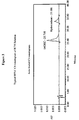
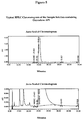
- Examples 1-3 were analyzed to determine the level of 14-hydroxycodeinone under 100 parts per million (PPM) level by a HPLC method using a Waters Atlantis 5 ⁇ m dC18, 3 X 250 mm column maintained at 50 °C and isocratic elution using pH 9.35, 17 mM ammonium carbonate buffer and methanol (60:40). Quantitation was achieved by measuring the peak area response with UV detection at 220 nm using external standard. This method utilized mobile phase with volatile components that are compatible with LC/MS analysis.
- PPM parts per million
- ammonium carbonate 1.6 ⁇ 0.1 g was weighed and placed into a 1-L beaker. 1000 mL of water was added to the beaker and stirred with a magnetic stirrer until the ammonium carbonate was dissolved. The pH was adjusted to 9.35 - 9.40 with ammonium hydroxide.
- a stock 14-hydroxycodeinone standard solution was prepared by weighing 25 ⁇ 2 mg of 14-hydroxycodeinone reference material and transferring it into a 250-mL volumetric flask. Approximately 100 mL of 0.85 % H 3 PO 4 solution was added to the flask and sonicated for approximately 2 minutes or until dissolved. The solution was diluted to volume with 0.85 % H 3 PO 4 solution and mixed thoroughly. This was the stock 14-hydroxycodeinone standard solution.
- a working solution of 100 ppm 14-hydroxycodeinone standard solution for system suitability was prepared by pipetting 5.0 mL of the stock 14-hydroxycodeinone standard solution into a 100-mL volumetric flask, diluting the solution to volume with water and mixing thoroughly.
- a working solution of 10 ppm 14-hydroxycodeinone standard solution for sensitivity was prepared by pipetting 5.0 mL of working 100 ppm 14-hydroxycodeinone standard solution into a 50-mL volumetric flask, diluting the solution to volume with water and mixing thoroughly.
- a stock hydrocodone standard solution was prepared by weighing 25 ⁇ 2 mg of hydrocodone reference material and transferring contents into a 250-mL volumetric flask. Approximately 100 mL of 0.85 % H 3 PO 4 solution was added to the flask and sonicated for approximately 2 minutes or until dissolved. The solution was diluted to volume with 0.85 % H 3 PO 4 solution and mixed thoroughly.
- Stock Hydrocodone Standard Solution was prepared by weighing 25 ⁇ 2 mg of Hydrocodone reference material and transferring contents into a 250-mL volumetric flask. Approximately 100 mL of 0.85 % H 3 PO 4 solution was added to the flask and sonicated for approximately 2 minute or until dissolved. The solution was diluted to volume with 0.85 % H 3 PO 4 Solution and mixed thoroughly.
- a sample solution was prepared by weighing about 250 mg oxycodone API sample into a scintillation vial. 5.0 mL of water was pipetted into the vial to dissolve the sample. The vial was tightly capped and sonicated for approximately 5 minutes or until the sample was dissolved. The contents were then shaken and mixed thoroughly.
- the Resolution Test Mixture was prepared by pipetting separately 10.0 mL of each stock standard solution of hydrocodone above and 14-hydroxycodeinone above into the same 100 mL volumetric flask and diluted to volume with a sufficient amount of water and mixed thoroughly.
- HPLC conditions were as follows: Column: Waters, Atlantis dC18, 3 x 250 mm, 5 ⁇ m. Column temperature: 50 °C Detector wavelength: 220 nm Injection volume: 6 ⁇ l Quantitation: Peak area of 14-hydroxycodeinone Mobile Phase: (60:40) 17mM ammonium carbonate, pH 9.35 - 9.40 Methanol Flow rate: 0.4 mL/minute Run time: 70 minutes for the samples and 40 minutes for the standard and RTM solutions
- a system suitability test was performed by injecting the Working 100 ppm 14-hydroxycodeinone standard solution into the system and by performing the system suitability test as described in the USP ⁇ 621> by making six different runs of 6 ⁇ L injections.
- the system suitability test results met the following criteria listed in Table 1 below. TABLE 1 Test No.
- Oxycodone (RRT) Oxycodone-N-Oxide (ONO) 0.16 Noroxycodone 0.31 Oxymorphone 0.45 7,8-Dihydro-8, 14-Dihydroxycodeinone (DDC) 0.58 14-Hydroxycodeine 0.73 14-Hydroxycodeinone 0.79 6- ⁇ -Oxycodol 0.96 Hydrocodone 0.95 Oxycodone 1.0 Thebaine 1.89
- OHC 14-hydroxycodeinone
- the solution was then suction filtered over a 0.2 micron PTFE membrane to remove the catalyst. An aliquot of 2 mL was taken out of about 18 mL filtrate solution. To this solution, 2.0 mL isopropyl alcohol was added to obtain a clear solution, followed by 4.0 mL of ethyl acetate. The solution was stirred, cooled and kept at 0-5° C for 20 hours to afford oxycodone hydrochloride crystals. The crystalline solid was isolated by suction filtration. The wet solid was dried in an oven at 50° C and 10 mmHg pressure. The dried solid weighed 0.12 g.
- Examples 1-3 were analyzed by the following alternative method to determine the amount of codeinone and 14-hydroxycodeinone present. This method uses a Waters Symmetry C 18 column maintained at 40°C with isocratic elution using a mobile phase of sodium phosphate buffer, sodium dodecyl sulfate (SDS), acetonitrile (ACN), and methanol (MeOH).
- SDS sodium dodecyl sulfate
- ACN acetonitrile
- MeOH methanol
- Oxycodone low ABUK material 500 ⁇ 5mg was Oxycodone low ABUK material was weighed into a 10-ml volumetric flask. 1-ml of stock standard II was pipetted and diluted to volume with ⁇ 0.85% phosphoric acid solution II and mixed.
- Oxycodone low ABUK material 500 ⁇ 5mg was weighed into a 10-ml volumetric flask, diluted to volume with ⁇ 0.85% phosphoric acid solution II and mixed. (This solution was used to calculate the residual content of both Codeinone and 14-Hydroxycodeinone in the working standard).
- Oxycodone HCl 500 ⁇ 5mg was weighed, in duplicate, into separate 10-mL volumetric flasks for each of Examples 1, 2 and 3. The Oxycodone HCl was then diluted to volume with the ⁇ 0.85% phosphoric acid solution II and swirled to dissolve the sample. A sufficient amount of this sample was transferred to an HPLC vial for injection.
- the expected retention times were as follows: Components Expected Retention Times Codeinone 14 ⁇ 2 min 14-Hydroxycodeinone 27 ⁇ 4 min Oxycodone 32 ⁇ 6 min
- Example 1 utilizing the procedure of Example 6 gave a result of ⁇ 5 ppm of codeinone and 8 ppm of 14-hydroxycodeinone.
- Example 2 utilizing the procedure of Example 6 gave a result of ⁇ 5 ppm of codeinone and ⁇ 5 ppm of 14-hydroxycodeinone.
- Example 3 utilizing the procedure of Example 6 gave a result of ⁇ 5 ppm of codeinone and 10 ppm of 14-hydroxycodeinone.
Landscapes
- Health & Medical Sciences (AREA)
- Chemical & Material Sciences (AREA)
- Organic Chemistry (AREA)
- Veterinary Medicine (AREA)
- Public Health (AREA)
- General Health & Medical Sciences (AREA)
- Animal Behavior & Ethology (AREA)
- Life Sciences & Earth Sciences (AREA)
- Pharmacology & Pharmacy (AREA)
- Medicinal Chemistry (AREA)
- Epidemiology (AREA)
- Chemical Kinetics & Catalysis (AREA)
- Nuclear Medicine, Radiotherapy & Molecular Imaging (AREA)
- General Chemical & Material Sciences (AREA)
- Pain & Pain Management (AREA)
- Bioinformatics & Cheminformatics (AREA)
- Engineering & Computer Science (AREA)
- Emergency Medicine (AREA)
- Neurosurgery (AREA)
- Neurology (AREA)
- Biomedical Technology (AREA)
- Rheumatology (AREA)
- Nutrition Science (AREA)
- Physiology (AREA)
- Inorganic Chemistry (AREA)
- Pharmaceuticals Containing Other Organic And Inorganic Compounds (AREA)
- Organic Low-Molecular-Weight Compounds And Preparation Thereof (AREA)
- Polysaccharides And Polysaccharide Derivatives (AREA)
- Medicinal Preparation (AREA)
- Low-Molecular Organic Synthesis Reactions Using Catalysts (AREA)
- Medicines That Contain Protein Lipid Enzymes And Other Medicines (AREA)
- Saccharide Compounds (AREA)
Priority Applications (7)
| Application Number | Priority Date | Filing Date | Title |
|---|---|---|---|
| MEP-2016-148A ME02482B (me) | 2004-03-30 | 2005-03-30 | PROCES ZA DOBIJANJE OKSIKODON HIDROHLORIDA SA MANJE OD 25 ppm 14-HIDROKSIKODEINONA |
| EP11186168.8A EP2426132B1 (en) | 2004-03-30 | 2005-03-30 | Process for preparing oxycodone hydrochloride compositions having less than 25ppm 14-hydroxycodeinone |
| DK11186168.8T DK2426132T3 (en) | 2004-03-30 | 2005-03-30 | A process for preparing the oxycodone hydrochloride composition having less than 25 ppm 14-hydroxycodeinone |
| SI200532083A SI2319846T1 (sl) | 2004-03-30 | 2005-03-30 | Postopek za pripravo oksikodon hidroklorida z manj kot 25 ppm 14-hidroksikodeinona |
| RS20160561A RS54941B1 (sr) | 2004-03-30 | 2005-03-30 | Proces za dobijanje oksikodon hidrohlorida sa manje od 25ppm 14-hidroksikodeinona |
| PL11186168T PL2426132T3 (pl) | 2004-03-30 | 2005-03-30 | Spusób wytwarzania kompozycji chlorowodorku oksykodonu zawierającej mniej niż 25 ppm 14-hydroksykodeinonu |
| HRP20160885TT HRP20160885T1 (hr) | 2004-03-30 | 2016-07-15 | Postupak za pripremu oksikodon hidroklorida koji sadrži manje od 25ppm 14-hidroksikodeinona |
Applications Claiming Priority (6)
| Application Number | Priority Date | Filing Date | Title |
|---|---|---|---|
| US55749204P | 2004-03-30 | 2004-03-30 | |
| US60153404P | 2004-08-13 | 2004-08-13 | |
| US62007204P | 2004-10-18 | 2004-10-18 | |
| US64862505P | 2005-01-31 | 2005-01-31 | |
| US65177805P | 2005-02-10 | 2005-02-10 | |
| EP05730345.5A EP1730151B2 (en) | 2004-03-30 | 2005-03-30 | Process for preparing oxycodone hydrochloride having less than 25 ppm 14-hydroxycodeinone |
Related Parent Applications (3)
| Application Number | Title | Priority Date | Filing Date |
|---|---|---|---|
| EP05730345.5 Division | 2005-03-30 | ||
| EP05730345.5A Division-Into EP1730151B2 (en) | 2004-03-30 | 2005-03-30 | Process for preparing oxycodone hydrochloride having less than 25 ppm 14-hydroxycodeinone |
| EP05730345.5A Division EP1730151B2 (en) | 2004-03-30 | 2005-03-30 | Process for preparing oxycodone hydrochloride having less than 25 ppm 14-hydroxycodeinone |
Related Child Applications (2)
| Application Number | Title | Priority Date | Filing Date |
|---|---|---|---|
| EP11186168.8A Division EP2426132B1 (en) | 2004-03-30 | 2005-03-30 | Process for preparing oxycodone hydrochloride compositions having less than 25ppm 14-hydroxycodeinone |
| EP11186168.8A Division-Into EP2426132B1 (en) | 2004-03-30 | 2005-03-30 | Process for preparing oxycodone hydrochloride compositions having less than 25ppm 14-hydroxycodeinone |
Publications (2)
| Publication Number | Publication Date |
|---|---|
| EP2319846A1 EP2319846A1 (en) | 2011-05-11 |
| EP2319846B1 true EP2319846B1 (en) | 2016-05-04 |
Family
ID=35124996
Family Applications (7)
| Application Number | Title | Priority Date | Filing Date |
|---|---|---|---|
| EP10011792.8A Expired - Lifetime EP2305683B2 (en) | 2004-03-30 | 2005-03-30 | Pharmaceutical dosage form comprising oxycodone hydrochloride having less than 25 ppm 14-hydroxycodeinone |
| EP10011788.6A Expired - Lifetime EP2316837B1 (en) | 2004-03-30 | 2005-03-30 | Process for preparing oxycodone hydrochloride having less than 25ppm 14-hydroxycodeinone |
| EP10011787.8A Expired - Lifetime EP2319846B1 (en) | 2004-03-30 | 2005-03-30 | Process for preparing oxycodone hydrochloride having less than 25ppm 14-hydroxycodeinone |
| EP11186168.8A Expired - Lifetime EP2426132B1 (en) | 2004-03-30 | 2005-03-30 | Process for preparing oxycodone hydrochloride compositions having less than 25ppm 14-hydroxycodeinone |
| EP05730345.5A Expired - Lifetime EP1730151B2 (en) | 2004-03-30 | 2005-03-30 | Process for preparing oxycodone hydrochloride having less than 25 ppm 14-hydroxycodeinone |
| EP10011791A Withdrawn EP2311839A1 (en) | 2004-03-30 | 2005-03-30 | Oxycodone hydrochloride composition having less than 25 ppm 14-hydroxycodeinone |
| EP10011793.6A Expired - Lifetime EP2314589B1 (en) | 2004-03-30 | 2005-03-30 | Process for preparing oxycodone hydrochloride compositions having less than 25ppm 14-hydroxycodeinone |
Family Applications Before (2)
| Application Number | Title | Priority Date | Filing Date |
|---|---|---|---|
| EP10011792.8A Expired - Lifetime EP2305683B2 (en) | 2004-03-30 | 2005-03-30 | Pharmaceutical dosage form comprising oxycodone hydrochloride having less than 25 ppm 14-hydroxycodeinone |
| EP10011788.6A Expired - Lifetime EP2316837B1 (en) | 2004-03-30 | 2005-03-30 | Process for preparing oxycodone hydrochloride having less than 25ppm 14-hydroxycodeinone |
Family Applications After (4)
| Application Number | Title | Priority Date | Filing Date |
|---|---|---|---|
| EP11186168.8A Expired - Lifetime EP2426132B1 (en) | 2004-03-30 | 2005-03-30 | Process for preparing oxycodone hydrochloride compositions having less than 25ppm 14-hydroxycodeinone |
| EP05730345.5A Expired - Lifetime EP1730151B2 (en) | 2004-03-30 | 2005-03-30 | Process for preparing oxycodone hydrochloride having less than 25 ppm 14-hydroxycodeinone |
| EP10011791A Withdrawn EP2311839A1 (en) | 2004-03-30 | 2005-03-30 | Oxycodone hydrochloride composition having less than 25 ppm 14-hydroxycodeinone |
| EP10011793.6A Expired - Lifetime EP2314589B1 (en) | 2004-03-30 | 2005-03-30 | Process for preparing oxycodone hydrochloride compositions having less than 25ppm 14-hydroxycodeinone |
Country Status (38)
Families Citing this family (110)
| Publication number | Priority date | Publication date | Assignee | Title |
|---|---|---|---|---|
| US7776314B2 (en) | 2002-06-17 | 2010-08-17 | Grunenthal Gmbh | Abuse-proofed dosage system |
| US20070048228A1 (en) | 2003-08-06 | 2007-03-01 | Elisabeth Arkenau-Maric | Abuse-proofed dosage form |
| DE102004020220A1 (de) * | 2004-04-22 | 2005-11-10 | Grünenthal GmbH | Verfahren zur Herstellung einer gegen Missbrauch gesicherten, festen Darreichungsform |
| US8075872B2 (en) | 2003-08-06 | 2011-12-13 | Gruenenthal Gmbh | Abuse-proofed dosage form |
| DE102005005446A1 (de) | 2005-02-04 | 2006-08-10 | Grünenthal GmbH | Bruchfeste Darreichungsformen mit retardierter Freisetzung |
| WO2005016313A1 (de) * | 2003-08-06 | 2005-02-24 | Grünenthal GmbH | Gegen missbrauch gesicherte darreichungsform |
| DE10361596A1 (de) * | 2003-12-24 | 2005-09-29 | Grünenthal GmbH | Verfahren zur Herstellung einer gegen Missbrauch gesicherten Darreichungsform |
| DE10336400A1 (de) * | 2003-08-06 | 2005-03-24 | Grünenthal GmbH | Gegen Missbrauch gesicherte Darreichungsform |
| US7201920B2 (en) | 2003-11-26 | 2007-04-10 | Acura Pharmaceuticals, Inc. | Methods and compositions for deterring abuse of opioid containing dosage forms |
| TWI483944B (zh) * | 2004-03-30 | 2015-05-11 | Euro Celtique Sa | 含有小於25ppm14-羥可待因酮之羥可酮鹽酸鹽組成物、醫藥劑型、延遲釋出口服劑型及醫藥上可以接受的包裝 |
| DE102004032103A1 (de) * | 2004-07-01 | 2006-01-19 | Grünenthal GmbH | Gegen Missbrauch gesicherte, orale Darreichungsform |
| DE102004032049A1 (de) * | 2004-07-01 | 2006-01-19 | Grünenthal GmbH | Gegen Missbrauch gesicherte, orale Darreichungsform |
| GB0421149D0 (en) * | 2004-09-23 | 2004-10-27 | Johnson Matthey Plc | Preparation of oxycodone |
| US20080152595A1 (en) * | 2004-11-24 | 2008-06-26 | Acura Pharmaceuticals, Inc. | Methods and compositions for deterring abuse of orally administered pharmaceutical products |
| DE102005005449A1 (de) | 2005-02-04 | 2006-08-10 | Grünenthal GmbH | Verfahren zur Herstellung einer gegen Missbrauch gesicherten Darreichungsform |
| PT1861405E (pt) * | 2005-03-04 | 2009-07-27 | Euro Celtique Sa | Método de diminuír a quantidade de cetonas insaturadas em alfa-beta numa composição de opiáceos |
| WO2007011819A2 (en) * | 2005-07-15 | 2007-01-25 | The Penn State Research Foundation | Ferritin as a therapeutic target in abnormal cells |
| EP1971607A2 (en) * | 2005-11-22 | 2008-09-24 | Controlled Chemicals, Inc. | Processes for reducing contaminating michael acceptor levels in oxycodone and other compositions |
| US20070117826A1 (en) * | 2005-11-23 | 2007-05-24 | Forest Laboratories, Inc. | Pharmaceutical formulations comprising ibuprofen, oxycodone, and 14-hydroxycodeinone |
| AU2007224221B2 (en) * | 2006-03-02 | 2013-02-14 | SpecGx LLC | Processes for preparing morphinan-6-one products with low levels of alpha, beta-unsaturated ketone compounds |
| SA07280459B1 (ar) | 2006-08-25 | 2011-07-20 | بيورديو فارما إل. بي. | أشكال جرعة صيدلانية للتناول عن طريق الفم مقاومة للعبث تشتمل على مسكن شبه أفيوني |
| US20080125592A1 (en) * | 2006-10-17 | 2008-05-29 | Penick Corporation | Process for preparing oxymorphone, naltrexone, and buprenorphine |
| DK2073636T3 (da) * | 2006-10-17 | 2012-11-19 | Penick Corp | Fremgangsmåde til fremstilling af oxymorphon |
| CA2674915C (en) | 2006-10-17 | 2015-06-30 | Penick Corporation | Process for preparing oxymorphone |
| WO2008070658A1 (en) * | 2006-12-04 | 2008-06-12 | Noramco, Inc. | Process for preparing oxycodone having reduced levels of 14-hydroxycodeinone |
| CA2671551C (en) * | 2006-12-04 | 2015-02-10 | Noramco, Inc. | Process for reducing impurities in oxycodone base |
| GB0624880D0 (en) * | 2006-12-14 | 2007-01-24 | Johnson Matthey Plc | Improved method for making analgesics |
| DE102007011485A1 (de) | 2007-03-07 | 2008-09-11 | Grünenthal GmbH | Darreichungsform mit erschwertem Missbrauch |
| PL2125824T5 (pl) * | 2007-03-23 | 2024-11-04 | SpecGx LLC | Ulepszony sposób wytwarzania oksymorfonu z oripawiny |
| AU2008241528B2 (en) * | 2007-04-16 | 2013-07-04 | Mallinckrodt Llc | Novel opiate reduction utilizing catalytic hydrogen transfer reaction |
| EP2249811A1 (en) | 2008-01-25 | 2010-11-17 | Grünenthal GmbH | Pharmaceutical dosage form |
| US8372432B2 (en) | 2008-03-11 | 2013-02-12 | Depomed, Inc. | Gastric retentive extended-release dosage forms comprising combinations of a non-opioid analgesic and an opioid analgesic |
| CA2720108C (en) * | 2008-03-11 | 2016-06-07 | Depomed, Inc. | Gastric retentive extended-release dosage forms comprising combinations of a non-opioid analgesic and an opioid analgesic |
| NZ588863A (en) | 2008-05-09 | 2012-08-31 | Gruenenthal Chemie | Process for the preparation of an intermediate powder formulation and a final solid dosage form under usage of a spray congealing step |
| RU2523896C2 (ru) * | 2008-09-18 | 2014-07-27 | ПУРДЬЮ ФАРМА Эл.Пи. | Фармацевтические лекарственные формы, содержащие поли-(эпсилон-капролактон) |
| CN102573806B (zh) | 2009-07-22 | 2015-02-25 | 格吕伦塔尔有限公司 | 用于对氧化敏感的阿片类物质的抗破坏剂型 |
| PE20121067A1 (es) * | 2009-07-22 | 2012-09-05 | Gruenenthal Chemie | Forma de dosificacion de liberacion controlada extruida por fusion en caliente |
| AU2010286354A1 (en) * | 2009-08-31 | 2012-04-19 | Depomed, Inc. | Gastric retentive pharmaceutical compositions for immediate and extended release of acetaminophen |
| ES2569925T3 (es) | 2009-09-30 | 2016-05-13 | Acura Pharmaceuticals, Inc. | Métodos y composiciones de disuasión del abuso |
| US9198861B2 (en) | 2009-12-22 | 2015-12-01 | Mallinckrodt Llc | Methods of producing stabilized solid dosage pharmaceutical compositions containing morphinans |
| US8597681B2 (en) | 2009-12-22 | 2013-12-03 | Mallinckrodt Llc | Methods of producing stabilized solid dosage pharmaceutical compositions containing morphinans |
| ES2606227T3 (es) * | 2010-02-03 | 2017-03-23 | Grünenthal GmbH | Preparación de una composición farmacéutica en polvo mediante una extrusora |
| EP2377866B1 (en) | 2010-03-23 | 2014-02-26 | Siegfried AG | Preparation of low impurity opiates in a continuous flow reactor |
| BR112012028773A2 (pt) | 2010-05-10 | 2016-07-19 | Euro Celtique Sa | composições farmacêuticas compreendendo hidromorfona e naloxona |
| AU2011252041B2 (en) | 2010-05-10 | 2014-04-03 | Euro-Celtique S.A. | Combination of active loaded granules with additional actives |
| AU2011252040C1 (en) | 2010-05-10 | 2015-04-02 | Euro-Celtique S.A. | Manufacturing of active-free granules and tablets comprising the same |
| TWI478928B (zh) | 2010-06-11 | 2015-04-01 | Rhodes Technologies | 用於製備n-烯丙基化合物之過渡金屬催化的製程及其用途 |
| EP2580218B1 (en) | 2010-06-11 | 2015-02-25 | Rhodes Technologies | Process for n-dealkylation of tertiary amines |
| CA2804101C (en) | 2010-07-02 | 2021-01-19 | Johnson Matthey Public Limited Company | Process for the synthesis and purification of oxycodone |
| US8912781B2 (en) * | 2010-07-30 | 2014-12-16 | Cirrus Logic, Inc. | Integrated circuit switching power supply controller with selectable buck mode operation |
| PL2611425T3 (pl) | 2010-09-02 | 2014-09-30 | Gruenenthal Gmbh | Odporna na ingerencję postać dawki zawierająca polimer anionowy |
| PL2611426T3 (pl) | 2010-09-02 | 2014-09-30 | Gruenenthal Gmbh | Postać dawkowania zawierająca nieorganiczne sole, odporna na zgniatanie |
| US8858963B1 (en) | 2011-05-17 | 2014-10-14 | Mallinckrodt Llc | Tamper resistant composition comprising hydrocodone and acetaminophen for rapid onset and extended duration of analgesia |
| US8741885B1 (en) | 2011-05-17 | 2014-06-03 | Mallinckrodt Llc | Gastric retentive extended release pharmaceutical compositions |
| US8658631B1 (en) | 2011-05-17 | 2014-02-25 | Mallinckrodt Llc | Combination composition comprising oxycodone and acetaminophen for rapid onset and extended duration of analgesia |
| HRP20171458T1 (hr) | 2011-07-29 | 2017-11-17 | Grünenthal GmbH | Tableta otporna na mijenjanje koja pruža neposredno oslobađanje lijeka |
| ES2655900T3 (es) | 2011-07-29 | 2018-02-22 | Grünenthal GmbH | Pastilla a prueba de manipulación que proporciona una liberación inmediata de un medicamento |
| US9414988B2 (en) | 2011-09-05 | 2016-08-16 | Siegfried Ltd. | Kit comprising a packaging material and a solid pharmaceutical or nutraceutical product contained in the packaging material |
| JP6110384B2 (ja) | 2011-09-16 | 2017-04-05 | パーデュー ファーマ エルピー | 不正改変抵抗性医薬製剤 |
| US20140294947A1 (en) | 2011-09-16 | 2014-10-02 | Purdue Pharma L.P. | Tamper resistant immediate release formulations |
| US20150265536A1 (en) | 2011-12-09 | 2015-09-24 | Purdue Pharma L.P. | Pharmaceutical dosage forms comprising poly(epsilon-caprolactone) and polyethylene oxide |
| EP2819656A1 (en) | 2012-02-28 | 2015-01-07 | Grünenthal GmbH | Tamper-resistant dosage form comprising pharmacologically active compound and anionic polymer |
| EP2819653B1 (en) | 2012-03-02 | 2017-01-11 | Rhodes Pharmaceuticals L.P. | Tamper resistant immediate release formulations |
| SG11201406025UA (en) | 2012-04-17 | 2014-11-27 | Purdue Pharma Lp | Systems and methods for treating an opioid-induced adverse pharmacodynamic response |
| PT2838512T (pt) | 2012-04-18 | 2018-11-09 | Gruenenthal Gmbh | Forma farmacêutica resistente à adulteração e resistente à libertação inesperada de alta quantidade (dose-dumping) |
| US10064945B2 (en) | 2012-05-11 | 2018-09-04 | Gruenenthal Gmbh | Thermoformed, tamper-resistant pharmaceutical dosage form containing zinc |
| EP2872121B1 (en) | 2012-07-12 | 2018-09-05 | SpecGx LLC | Extended release, abuse deterrent pharmaceutical compositions |
| JP6236446B2 (ja) | 2012-07-16 | 2017-11-22 | ローズ テクノロジーズ | 改善されたオピオイド合成方法 |
| ES2647949T3 (es) * | 2012-07-16 | 2017-12-27 | Rhodes Technologies | Proceso para la síntesis mejorada de opioides |
| SI2880037T1 (sl) * | 2012-08-03 | 2019-04-30 | Johnson Matthey Public Limited Company | Postopek za pripravo oksikodona |
| MX392839B (es) | 2012-11-30 | 2025-03-24 | Acura Pharmaceuticals Inc | Liberacion autorregulada de ingrediente farmaceutico activo. |
| WO2014123899A1 (en) | 2013-02-05 | 2014-08-14 | Purdue Pharma L.P. | Tamper resistant pharmaceutical formulations |
| US9770710B2 (en) | 2013-02-20 | 2017-09-26 | University Of Washington Through Its Center For Commercialization | Hydrogenation and disproportionation catalysis |
| US10751287B2 (en) | 2013-03-15 | 2020-08-25 | Purdue Pharma L.P. | Tamper resistant pharmaceutical formulations |
| MX2015016254A (es) | 2013-05-29 | 2016-04-20 | Gruenenthal Gmbh | Forma de dosificacion resistente al uso indebido con perfil de liberacion bimodal. |
| EP3003279A1 (en) | 2013-05-29 | 2016-04-13 | Grünenthal GmbH | Tamper-resistant dosage form containing one or more particles |
| MX368846B (es) | 2013-07-12 | 2019-10-18 | Gruenenthal Gmbh | Forma de dosificación resistente a la alteración que contiene polímero de acetato de etilen-vinilo. |
| GB201313211D0 (en) | 2013-07-24 | 2013-09-04 | Cambrex Karlskoga Ab | New process |
| GB201313915D0 (en) * | 2013-08-02 | 2013-09-18 | Johnson Matthey Plc | Process |
| BR112016002079A2 (pt) | 2013-08-02 | 2017-09-05 | Johnson Matthey Plc | Processo para preparação de um aditivo ácido de oximorfona, solução aquosa de aditivo ácido de oximorfona, aditivo ácido de oximorfona sólido, e, alcaloide de oximorfona sólido |
| ES2741810T3 (es) | 2013-11-07 | 2020-02-12 | SpecGx LLC | Producción de 6-hidroximorfinanos sin el aislamiento de intermedios |
| CN105916505A (zh) | 2013-11-13 | 2016-08-31 | 欧洲凯尔特公司 | 用于治疗疼痛和阿片样物质肠功能障碍综合征的氢吗啡酮和纳洛酮 |
| EP3073994A1 (en) | 2013-11-26 | 2016-10-05 | Grünenthal GmbH | Preparation of a powdery pharmaceutical composition by means of cryo-milling |
| US10227354B2 (en) | 2013-12-18 | 2019-03-12 | Cody Laboratories, Inc. | Conversion of oxycodone base to oxycodone hydrochloride |
| US9062062B1 (en) | 2013-12-18 | 2015-06-23 | Cody Laboratories, Inc. | Synthesis of oxycodone hydrochloride |
| US8846923B1 (en) | 2013-12-18 | 2014-09-30 | Cody Laboratories, Inc. | Preparation of 14-hydroxycodeinone sulfate |
| MX374394B (es) | 2014-01-15 | 2025-03-06 | Rhodes Tech | Proceso para la sintesis mejorada de oxicodona. |
| ES2672795T3 (es) | 2014-01-15 | 2018-06-18 | Rhodes Technologies | Proceso para la síntesis mejorada de oximorfona |
| CA2938699A1 (en) | 2014-02-05 | 2015-08-13 | Kashiv Pharma Llc | Abuse-resistant drug formulations with built-in overdose protection |
| EP3122336A4 (en) | 2014-03-26 | 2017-10-25 | Sun Pharma Advanced Research Company Ltd | Abuse deterrent immediate release biphasic matrix solid dosage form |
| EP3142646A1 (en) | 2014-05-12 | 2017-03-22 | Grünenthal GmbH | Tamper resistant immediate release capsule formulation comprising tapentadol |
| JP2017516789A (ja) | 2014-05-26 | 2017-06-22 | グリュネンタール・ゲゼルシャフト・ミト・ベシュレンクテル・ハフツング | エタノール過量放出に対して防護されている多粒子 |
| MA40332A (fr) * | 2014-07-09 | 2021-04-28 | Rhodes Tech | Réduction des niveaux de cétone alpha, beta-insaturée dans des compositions de dérivés de morphinane |
| CA2910865C (en) | 2014-07-15 | 2016-11-29 | Isa Odidi | Compositions and methods for reducing overdose |
| US20160052932A1 (en) | 2014-08-25 | 2016-02-25 | Johnson Matthey Public Limited Company | Processes for Making Opioids Including 14-Hydroxycodeinone and 14-hydroxymorphinone |
| US9849124B2 (en) | 2014-10-17 | 2017-12-26 | Purdue Pharma L.P. | Systems and methods for treating an opioid-induced adverse pharmacodynamic response |
| CN105777766B (zh) * | 2014-12-15 | 2017-11-24 | 北大方正集团有限公司 | Delta‑7溴甲纳曲酮的制备方法 |
| US9918979B2 (en) | 2015-01-29 | 2018-03-20 | Johnson Matthey Public Limited Company | Process of preparing low ABUK oxymorphone hydrochloride |
| AU2016251854A1 (en) | 2015-04-24 | 2017-10-19 | Grunenthal Gmbh | Tamper-resistant dosage form with immediate release and resistance against solvent extraction |
| GB201513203D0 (en) | 2015-07-27 | 2015-09-09 | Cambrex Charles City Inc | New process |
| WO2017040607A1 (en) | 2015-08-31 | 2017-03-09 | Acura Pharmaceuticals, Inc. | Methods and compositions for self-regulated release of active pharmaceutical ingredient |
| EP3346991A1 (en) | 2015-09-10 | 2018-07-18 | Grünenthal GmbH | Protecting oral overdose with abuse deterrent immediate release formulations |
| US9943513B1 (en) | 2015-10-07 | 2018-04-17 | Banner Life Sciences Llc | Opioid abuse deterrent dosage forms |
| US10335405B1 (en) | 2016-05-04 | 2019-07-02 | Patheon Softgels, Inc. | Non-burst releasing pharmaceutical composition |
| US20180104236A1 (en) | 2016-09-26 | 2018-04-19 | Euro-Celtique S. A. | Methods of treatment comprising administering a high daily dose of oxycodone and naloxone in a 2:1 weight ratio |
| US10335375B2 (en) | 2017-05-30 | 2019-07-02 | Patheon Softgels, Inc. | Anti-overingestion abuse deterrent compositions |
| CN110770238B (zh) * | 2017-06-20 | 2022-10-04 | 庄信万丰股份有限公司 | 用于从14-羟可待因酮制备盐酸氧可酮的氢化方法 |
| US12201629B2 (en) | 2017-06-30 | 2025-01-21 | Purdue Pharma L.P. | Method of treatment and dosage forms thereof |
| CN110330500B (zh) * | 2019-07-12 | 2021-11-23 | 宜昌人福药业有限责任公司 | 一种6β-羟基-7,8-二氢-吗啡衍生物的立体选择性合成方法 |
| CN113009060B (zh) * | 2021-02-24 | 2022-10-21 | 西南药业股份有限公司 | 高效液相色谱法测定盐酸羟考酮含量的方法 |
Family Cites Families (97)
| Publication number | Priority date | Publication date | Assignee | Title |
|---|---|---|---|---|
| DE286431C (enExample) | ||||
| US100000A (en) * | 1870-02-22 | Improved sun-bonnet for horses | ||
| US420098A (en) * | 1890-01-28 | Mowing-machine | ||
| US1468805A (en) | 1923-09-25 | Htabtin ereund | ||
| US105553A (en) | 1870-07-19 | Improvement in kettle for melting, mixing, and casting metals | ||
| DE296916C (enExample) * | ||||
| US1485673A (en) * | 1924-03-04 | Ministrator | ||
| US710223A (en) * | 1901-06-10 | 1902-09-30 | Thew Automatic Shovel Company | Power-shovel. |
| SU64699A1 (ru) | 1944-01-26 | 1944-11-30 | А.И. Лютенберг | Способ получени сол нокислого дигидрооксикодеинона |
| ES212554A1 (es) | 1953-12-01 | 1954-08-16 | Casanovas Albajes Cesar | Un procedimiento para la obtención de un vidrio orgánico |
| US2772270A (en) | 1954-10-21 | 1956-11-27 | M J Lewenstein | 14-hydroxymorphinone and 8, 14-dihydroxydihydromorphinone |
| US2806033A (en) | 1955-08-03 | 1957-09-10 | Lewenstein | Morphine derivative |
| US3173878A (en) * | 1960-02-26 | 1965-03-16 | Ibm | Process of making microcapsules |
| US3173876A (en) * | 1960-05-27 | 1965-03-16 | John C Zobrist | Cleaning methods and compositions |
| NL271831A (enExample) | 1960-11-29 | |||
| US3276586A (en) | 1963-08-30 | 1966-10-04 | Rosaen Filter Co | Indicating means for fluid filters |
| US3916898A (en) | 1964-05-20 | 1975-11-04 | Searle & Co | Administration of medicaments and the like |
| NL6714885A (enExample) | 1967-11-02 | 1969-05-06 | ||
| US3541006A (en) | 1968-07-03 | 1970-11-17 | Amicon Corp | Ultrafiltration process |
| US3541005A (en) | 1969-02-05 | 1970-11-17 | Amicon Corp | Continuous ultrafiltration of macromolecular solutions |
| US3845770A (en) | 1972-06-05 | 1974-11-05 | Alza Corp | Osmatic dispensing device for releasing beneficial agent |
| US3916899A (en) | 1973-04-25 | 1975-11-04 | Alza Corp | Osmotic dispensing device with maximum and minimum sizes for the passageway |
| US3905981A (en) * | 1973-10-12 | 1975-09-16 | Research Corp | N-dealkylation of tertiary amines |
| US3894026A (en) | 1973-10-16 | 1975-07-08 | Merck & Co Inc | Production of thebaine |
| GB1478759A (en) | 1974-11-18 | 1977-07-06 | Alza Corp | Process for forming outlet passageways in pills using a laser |
| US4077407A (en) | 1975-11-24 | 1978-03-07 | Alza Corporation | Osmotic devices having composite walls |
| US4063064A (en) | 1976-02-23 | 1977-12-13 | Coherent Radiation | Apparatus for tracking moving workpiece by a laser beam |
| US3984026A (en) * | 1976-03-26 | 1976-10-05 | Shoup Russel W | Combined can opening and sealing device |
| US4045440A (en) | 1976-09-16 | 1977-08-30 | The United States Of America As Represented By The Department Of Health, Education And Welfare | Method of producing thebaine from codeine and oripavine from morphine |
| US4200098A (en) | 1978-10-23 | 1980-04-29 | Alza Corporation | Osmotic system with distribution zone for dispensing beneficial agent |
| US4285987A (en) * | 1978-10-23 | 1981-08-25 | Alza Corporation | Process for manufacturing device with dispersion zone |
| US4272540A (en) * | 1979-04-24 | 1981-06-09 | Sisa, Incorporated | 14-Methoxymorphinan-6-one compounds and therapeutic methods of treating pain and drug dependence with them |
| US4370333A (en) | 1981-06-29 | 1983-01-25 | Sisa, Incorporated | 17-Cyclopropylmethyl-3-hydroxy-14-methoxy 7α-methyl-morphinan-6-one and therapeutic method of treating pain with it |
| US4795813A (en) * | 1981-08-17 | 1989-01-03 | The Florida Board Of Regents On Behalf Of The Florida State University | Synthesis of derivatives of codeine and other 3-O-alkylmorphines |
| US5112975A (en) | 1984-03-27 | 1992-05-12 | Mallinckrodt Specialty Chemicals Company | Preparation of noroxymorphone from morphine |
| US4639520A (en) | 1984-03-27 | 1987-01-27 | Mallinckrodt, Inc. | Preparation of 14-hydroxy-N-ethoxy-carbonyl-norcodeinone |
| US4861598A (en) | 1986-07-18 | 1989-08-29 | Euroceltique, S.A. | Controlled release bases for pharmaceuticals |
| US4810699A (en) * | 1987-02-20 | 1989-03-07 | American Home Products Corporation | Substituted 1,3,4,9-tetrahydropyrano[3,4,-b]indole-1-acetic acids, pharmaceutical compositions containing them, and methods for treating inflammatory conditions and for analgesic purposes using them |
| US4810669A (en) * | 1987-07-07 | 1989-03-07 | Oki Electric Industry Co., Ltd. | Method of fabricating a semiconductor device |
| DE3812567A1 (de) | 1988-04-15 | 1989-10-26 | Basf Ag | Verfahren zur herstellung pharmazeutischer mischungen |
| HU208633B (en) | 1991-02-04 | 1993-12-28 | Alkaloida Vegyeszeti Gyar | Process for production of analgetic compositions as applicable for blocking of opioid-binding spaces /2-receptors/ causing respiration depression |
| US5215758A (en) | 1991-09-11 | 1993-06-01 | Euroceltique, S.A. | Controlled release matrix suppository for pharmaceuticals |
| US5266331A (en) | 1991-11-27 | 1993-11-30 | Euroceltique, S.A. | Controlled release oxycodone compositions |
| US5656295A (en) | 1991-11-27 | 1997-08-12 | Euro-Celtique, S.A. | Controlled release oxycodone compositions |
| US5472712A (en) | 1991-12-24 | 1995-12-05 | Euroceltique, S.A. | Controlled-release formulations coated with aqueous dispersions of ethylcellulose |
| US5273760A (en) | 1991-12-24 | 1993-12-28 | Euroceltigue, S.A. | Stabilized controlled release substrate having a coating derived from an aqueous dispersion of hydrophobic polymer |
| US5286493A (en) | 1992-01-27 | 1994-02-15 | Euroceltique, S.A. | Stabilized controlled release formulations having acrylic polymer coating |
| US5324351A (en) | 1992-08-13 | 1994-06-28 | Euroceltique | Aqueous dispersions of zein and preparation thereof |
| JP3433871B2 (ja) * | 1996-01-26 | 2003-08-04 | 株式会社デンソー | 集積化半導体歪みセンサ及びその製造方法 |
| DE09003265T1 (de) | 1996-06-26 | 2010-04-29 | Board of Regents, The University of Texas System, Austin | Extrudierbare pharmazeutische Schmelzklebstoffformulierung |
| US5869669A (en) | 1996-07-26 | 1999-02-09 | Penick Corporation | Preparation of 14-hydroxynormorphinones from normorphinone dienol acylates |
| ES2121554B1 (es) * | 1996-12-23 | 1999-06-16 | Univ Santiago Compostela | Procedimiento de obtencion de 14-hidroximofinonas mediante fotooxidac ion de alcaloides morfinicos con sistema alcoxidienico en el anillo c. |
| GB9713703D0 (en) | 1997-06-30 | 1997-09-03 | Johnson Matthey Plc | Preparation of opiates |
| GB9717629D0 (en) | 1997-08-21 | 1997-10-22 | Johnson Matthey Plc | Removal of residual organic solvents |
| US6710223B1 (en) | 1997-09-10 | 2004-03-23 | The Procter & Gamble Company | Method for improving skin condition |
| GB9805516D0 (en) | 1998-03-17 | 1998-05-13 | Johnson Matthey Plc | Preparation of opiates |
| AU1426200A (en) * | 1998-10-14 | 2000-05-01 | Amic Ab | A matrix and method of producing said matrix |
| US6177567B1 (en) * | 1999-10-15 | 2001-01-23 | Boehringer Ingelheim Chemicals, Inc. | Method for preparing oxycodone |
| US6284769B1 (en) * | 1999-12-03 | 2001-09-04 | The Board Of Trustees Of The University Of Illinois | Nonpeptide kappa opioid receptor antagonists |
| US6133132A (en) * | 2000-01-20 | 2000-10-17 | Advanced Micro Devices, Inc. | Method for controlling transistor spacer width |
| ATE431145T1 (de) * | 2000-02-08 | 2009-05-15 | Euro Celtique Sa | Missbrauchssichere orale opioid-agonist zubereitungen |
| WO2001092188A1 (en) | 2000-05-29 | 2001-12-06 | Shionogi & Co., Ltd. | Method for labeling with tritium |
| US7200357B2 (en) * | 2000-10-20 | 2007-04-03 | Universal Electronics Inc. | Automotive storage and playback device and method for using the same |
| UA81224C2 (uk) | 2001-05-02 | 2007-12-25 | Euro Celtic S A | Дозована форма оксикодону та її застосування |
| EP1709957A3 (en) * | 2001-06-05 | 2007-02-14 | Control Delivery Systems | Sustained-release analgesic compounds |
| CN100356907C (zh) | 2001-06-08 | 2007-12-26 | 恩德制药公司 | 利用丙烯酸酯聚合物的控释剂型和其制备方法 |
| DK1416842T3 (da) | 2001-07-18 | 2009-03-16 | Euro Celtique Sa | Farmaceutiske kombinationer af oxycodon og naloxon |
| WO2003059423A1 (en) * | 2002-01-15 | 2003-07-24 | Aerogen, Inc. | Systems and methods for clearing aerosols from the effective anatomic dead space |
| WO2003082204A2 (en) * | 2002-03-26 | 2003-10-09 | Euro-Celtique S.A. | Sustained-release gel coated compositions |
| CN1665482A (zh) * | 2002-04-29 | 2005-09-07 | 阿尔扎公司 | 羟可待酮控制输送给药的方法和剂型 |
| WO2003101132A1 (en) * | 2002-05-27 | 2003-12-04 | Ntt Docomo, Inc. | Mobile communication system, transmission station, reception station, relay station, communication path deciding method, and communication path deciding program |
| JP2005528423A (ja) | 2002-05-31 | 2005-09-22 | アルザ・コーポレーシヨン | オキシコドンの変動性投薬用量の浸透圧的送達のための剤形および組成物 |
| AU2003247876B2 (en) * | 2002-07-05 | 2006-10-05 | Collegium Pharmaceutical, Inc | Abuse-deterrent pharmaceutical compositions of opiods and other drugs |
| US20040058946A1 (en) * | 2002-07-05 | 2004-03-25 | Buchwald Stephen L. | Abuse-resistant prodrugs of oxycodone and other pharmaceuticals |
| WO2004016618A1 (en) * | 2002-08-15 | 2004-02-26 | Noramco, Inc. | Oxycodone-hydrochloride polymorhs |
| US7192966B2 (en) | 2002-11-15 | 2007-03-20 | Branded Products For The Future | Pharmaceutical composition |
| JP2006515861A (ja) * | 2002-11-29 | 2006-06-08 | フォレスト ラボラトリーズ インコーポレーテッド | イブプロフェンとオキシコドンを含有する単位剤形での急性痛の治療方法 |
| FR2850576B1 (fr) * | 2003-02-05 | 2007-03-23 | Ethypharm Sa | Composition comprenant un melange de principes actifs, et procede de preparation |
| MXPA05009757A (es) | 2003-03-13 | 2005-12-05 | Controlled Chemicals Inc | Conjugados de oxicodona con menor potencial de abuso y duracion de accion extendida. |
| US6864370B1 (en) * | 2003-06-05 | 2005-03-08 | Zhaiwei Lin | Process for manufacturing oxycodone |
| DE10336400A1 (de) | 2003-08-06 | 2005-03-24 | Grünenthal GmbH | Gegen Missbrauch gesicherte Darreichungsform |
| TWI483944B (zh) * | 2004-03-30 | 2015-05-11 | Euro Celtique Sa | 含有小於25ppm14-羥可待因酮之羥可酮鹽酸鹽組成物、醫藥劑型、延遲釋出口服劑型及醫藥上可以接受的包裝 |
| US20070172958A1 (en) * | 2004-03-30 | 2007-07-26 | Euro-Celtique S.A. | Methods for detecting 14-hydroxy codeinone and codeinone |
| US20050226929A1 (en) | 2004-04-12 | 2005-10-13 | Jianbo Xie | Controlled release opioid analgesic formulation |
| JP5329083B2 (ja) | 2004-06-25 | 2013-10-30 | テッセラ,インコーポレイテッド | ポストおよびパッドを有する部品 |
| GB0421149D0 (en) | 2004-09-23 | 2004-10-27 | Johnson Matthey Plc | Preparation of oxycodone |
| PT1861405E (pt) | 2005-03-04 | 2009-07-27 | Euro Celtique Sa | Método de diminuír a quantidade de cetonas insaturadas em alfa-beta numa composição de opiáceos |
| WO2006138020A2 (en) | 2005-06-16 | 2006-12-28 | Mallinckrodt Inc. | A synthetic route to 14-hydroxyl opiates through 1-halo-thebaine or analogs |
| EP1971607A2 (en) | 2005-11-22 | 2008-09-24 | Controlled Chemicals, Inc. | Processes for reducing contaminating michael acceptor levels in oxycodone and other compositions |
| US20070117826A1 (en) | 2005-11-23 | 2007-05-24 | Forest Laboratories, Inc. | Pharmaceutical formulations comprising ibuprofen, oxycodone, and 14-hydroxycodeinone |
| AU2007224221B2 (en) | 2006-03-02 | 2013-02-14 | SpecGx LLC | Processes for preparing morphinan-6-one products with low levels of alpha, beta-unsaturated ketone compounds |
| SA07280459B1 (ar) | 2006-08-25 | 2011-07-20 | بيورديو فارما إل. بي. | أشكال جرعة صيدلانية للتناول عن طريق الفم مقاومة للعبث تشتمل على مسكن شبه أفيوني |
| WO2008070658A1 (en) * | 2006-12-04 | 2008-06-12 | Noramco, Inc. | Process for preparing oxycodone having reduced levels of 14-hydroxycodeinone |
| CA2671551C (en) * | 2006-12-04 | 2015-02-10 | Noramco, Inc. | Process for reducing impurities in oxycodone base |
| GB2450691A (en) | 2007-07-02 | 2009-01-07 | Alpharma Aps | One-pot preparation of oxycodone from thebaine |
| CA2804101C (en) | 2010-07-02 | 2021-01-19 | Johnson Matthey Public Limited Company | Process for the synthesis and purification of oxycodone |
| US9062062B1 (en) * | 2013-12-18 | 2015-06-23 | Cody Laboratories, Inc. | Synthesis of oxycodone hydrochloride |
-
2005
- 2005-03-15 TW TW101106699A patent/TWI483944B/zh not_active IP Right Cessation
- 2005-03-15 TW TW094107824A patent/TWI365880B/zh not_active IP Right Cessation
- 2005-03-15 TW TW103140205A patent/TW201509943A/zh unknown
- 2005-03-23 MY MYPI20090495A patent/MY154985A/en unknown
- 2005-03-23 MY MYPI20051252A patent/MY143205A/en unknown
- 2005-03-23 MY MYPI2011004160A patent/MY172063A/en unknown
- 2005-03-29 PE PE2005000361A patent/PE20050880A1/es active IP Right Grant
- 2005-03-30 RS RS20180297A patent/RS57000B1/sr unknown
- 2005-03-30 LT LTEP10011793.6T patent/LT2314589T/lt unknown
- 2005-03-30 CN CN2010106226501A patent/CN102127086B/zh not_active Expired - Lifetime
- 2005-03-30 RS RS20150215A patent/RS53891B1/sr unknown
- 2005-03-30 HU HUE10011787A patent/HUE029913T2/en unknown
- 2005-03-30 PT PT100117878T patent/PT2319846T/pt unknown
- 2005-03-30 NZ NZ601326A patent/NZ601326A/xx not_active IP Right Cessation
- 2005-03-30 EP EP10011792.8A patent/EP2305683B2/en not_active Expired - Lifetime
- 2005-03-30 KR KR1020157009780A patent/KR20150046393A/ko not_active Ceased
- 2005-03-30 SI SI200531950T patent/SI2305683T1/sl unknown
- 2005-03-30 HR HRP20110425TT patent/HRP20110425T4/hr unknown
- 2005-03-30 AP AP2006003738A patent/AP2232A/xx active
- 2005-03-30 MX MX2013004023A patent/MX363228B/es unknown
- 2005-03-30 CN CN2005800106471A patent/CN1960994B/zh not_active Expired - Lifetime
- 2005-03-30 SI SI200532046T patent/SI2426132T1/sl unknown
- 2005-03-30 PT PT100117928T patent/PT2305683E/pt unknown
- 2005-03-30 ME MEP-2018-71A patent/ME03068B/me unknown
- 2005-03-30 DK DK11186168.8T patent/DK2426132T3/en active
- 2005-03-30 ES ES11186168.8T patent/ES2566363T3/es not_active Expired - Lifetime
- 2005-03-30 DE DE202005021371U patent/DE202005021371U1/de not_active Expired - Lifetime
- 2005-03-30 PT PT05730345T patent/PT1730151E/pt unknown
- 2005-03-30 KR KR1020137000989A patent/KR101410141B1/ko not_active Expired - Lifetime
- 2005-03-30 DK DK05730345.5T patent/DK1730151T4/da active
- 2005-03-30 SI SI200531289T patent/SI1730151T2/sl unknown
- 2005-03-30 PT PT111861688T patent/PT2426132E/pt unknown
- 2005-03-30 JP JP2007506507A patent/JP4912294B2/ja not_active Expired - Lifetime
- 2005-03-30 SG SG201101931-2A patent/SG170735A1/en unknown
- 2005-03-30 WO PCT/US2005/010666 patent/WO2005097801A1/en not_active Ceased
- 2005-03-30 NZ NZ602862A patent/NZ602862A/en not_active IP Right Cessation
- 2005-03-30 KR KR1020147030767A patent/KR20140133615A/ko not_active Ceased
- 2005-03-30 KR KR1020197038467A patent/KR20200000499A/ko not_active Ceased
- 2005-03-30 KR KR1020097019843A patent/KR100993911B1/ko not_active Expired - Lifetime
- 2005-03-30 HU HUE11186168A patent/HUE028233T2/en unknown
- 2005-03-30 EP EP10011788.6A patent/EP2316837B1/en not_active Expired - Lifetime
- 2005-03-30 PL PL05730345.5T patent/PL1730151T5/pl unknown
- 2005-03-30 EP EP10011787.8A patent/EP2319846B1/en not_active Expired - Lifetime
- 2005-03-30 ME MEP-2016-58A patent/ME02411B/me unknown
- 2005-03-30 RS RS20160561A patent/RS54941B1/sr unknown
- 2005-03-30 BR BRPI0508758A patent/BRPI0508758B8/pt active IP Right Grant
- 2005-03-30 ES ES10011792.8T patent/ES2535618T3/es not_active Expired - Lifetime
- 2005-03-30 SG SG10201406658VA patent/SG10201406658VA/en unknown
- 2005-03-30 KR KR1020117022725A patent/KR101200700B1/ko not_active Expired - Lifetime
- 2005-03-30 DK DK10011787.8T patent/DK2319846T3/en active
- 2005-03-30 EP EP11186168.8A patent/EP2426132B1/en not_active Expired - Lifetime
- 2005-03-30 KR KR1020127017379A patent/KR20120106784A/ko not_active Ceased
- 2005-03-30 ES ES10011788.6T patent/ES2665287T3/es not_active Expired - Lifetime
- 2005-03-30 ES ES10011793T patent/ES2938727T3/es not_active Expired - Lifetime
- 2005-03-30 DE DE602005026786T patent/DE602005026786D1/de not_active Expired - Lifetime
- 2005-03-30 CA CA2774121A patent/CA2774121C/en not_active Expired - Lifetime
- 2005-03-30 KR KR1020187021551A patent/KR20180088505A/ko not_active Ceased
- 2005-03-30 DK DK10011788.6T patent/DK2316837T3/en active
- 2005-03-30 EA EA200601520A patent/EA013208B1/ru not_active IP Right Cessation
- 2005-03-30 PL PL10011792T patent/PL2305683T3/pl unknown
- 2005-03-30 AU AU2005230826A patent/AU2005230826C1/en not_active Expired
- 2005-03-30 ME MEP-2011-91A patent/ME01299B/me unknown
- 2005-03-30 PL PL10011787.8T patent/PL2319846T3/pl unknown
- 2005-03-30 DK DK10011792T patent/DK2305683T3/en active
- 2005-03-30 EP EP05730345.5A patent/EP1730151B2/en not_active Expired - Lifetime
- 2005-03-30 EP EP10011791A patent/EP2311839A1/en not_active Withdrawn
- 2005-03-30 SI SI200532200T patent/SI2316837T1/en unknown
- 2005-03-30 NZ NZ549430A patent/NZ549430A/en not_active IP Right Cessation
- 2005-03-30 ME MEP-2016-148A patent/ME02482B/me unknown
- 2005-03-30 RS RS20110209A patent/RS51693B2/sr unknown
- 2005-03-30 AR ARP050101243A patent/AR049012A1/es active IP Right Grant
- 2005-03-30 CN CN2010101515524A patent/CN101812065B/zh not_active Ceased
- 2005-03-30 KR KR1020067022569A patent/KR100930730B1/ko not_active Expired - Lifetime
- 2005-03-30 LT LTEP10011788.6T patent/LT2316837T/lt unknown
- 2005-03-30 ES ES10011787.8T patent/ES2585576T3/es not_active Expired - Lifetime
- 2005-03-30 US US11/093,626 patent/US7129248B2/en not_active Expired - Lifetime
- 2005-03-30 KR KR1020147001423A patent/KR20140021716A/ko not_active Withdrawn
- 2005-03-30 KR KR1020107013435A patent/KR20100069719A/ko not_active Ceased
- 2005-03-30 KR KR1020127006697A patent/KR20120046309A/ko not_active Ceased
- 2005-03-30 PT PT100117886T patent/PT2316837T/pt unknown
- 2005-03-30 EP EP10011793.6A patent/EP2314589B1/en not_active Expired - Lifetime
- 2005-03-30 PL PL11186168T patent/PL2426132T3/pl unknown
- 2005-03-30 SG SG201101934-6A patent/SG170736A1/en unknown
- 2005-03-30 CN CN201210256799.1A patent/CN102887903B/zh not_active Expired - Lifetime
- 2005-03-30 CN CN201210257643.5A patent/CN102838607B/zh not_active Expired - Lifetime
- 2005-03-30 RS RS20160189A patent/RS54598B1/sr unknown
- 2005-03-30 CA CA2557845A patent/CA2557845C/en not_active Expired - Lifetime
- 2005-03-30 AT AT05730345T patent/ATE501150T1/de active
- 2005-03-30 HU HUE10011788A patent/HUE036451T2/hu unknown
- 2005-03-30 PL PL10011788T patent/PL2316837T3/pl unknown
- 2005-03-30 CA CA2913355A patent/CA2913355C/en not_active Expired - Lifetime
- 2005-03-30 ES ES05730345T patent/ES2362282T5/es not_active Expired - Lifetime
- 2005-03-30 SI SI200532083A patent/SI2319846T1/sl unknown
-
2006
- 2006-03-29 US US11/391,897 patent/US20060173029A1/en not_active Abandoned
- 2006-08-29 ZA ZA200607181A patent/ZA200607181B/en unknown
- 2006-09-04 CR CR8593A patent/CR8593A/es unknown
- 2006-09-08 MX MX2020008878A patent/MX2020008878A/es unknown
- 2006-09-12 IL IL178038A patent/IL178038A/en active IP Right Grant
- 2006-09-28 MA MA29351A patent/MA28492B1/fr unknown
- 2006-10-26 EC EC2006006953A patent/ECSP066953A/es unknown
- 2006-10-27 NO NO20064935A patent/NO337669B1/no unknown
-
2007
- 2007-01-16 US US11/653,531 patent/US7674799B2/en not_active Expired - Lifetime
- 2007-01-16 US US11/653,529 patent/US7683072B2/en not_active Expired - Lifetime
- 2007-01-16 US US11/653,530 patent/US7674798B2/en not_active Expired - Lifetime
- 2007-03-29 US US11/729,741 patent/US7674800B2/en not_active Expired - Lifetime
- 2007-07-04 FI FI20070284U patent/FI7843U1/fi not_active IP Right Cessation
- 2007-08-02 DK DK200700214U patent/DK200700214U3/da not_active IP Right Cessation
- 2007-09-03 AT AT0052507U patent/AT9952U1/de not_active IP Right Cessation
-
2009
- 2009-01-30 AU AU2009200335A patent/AU2009200335B2/en not_active Expired
- 2009-03-04 US US12/380,800 patent/US20090227615A1/en not_active Abandoned
-
2010
- 2010-02-24 US US12/711,948 patent/US8822687B2/en not_active Expired - Lifetime
- 2010-09-29 US US12/893,681 patent/US20110207762A1/en not_active Abandoned
-
2011
- 2011-03-17 JP JP2011058728A patent/JP5118223B2/ja not_active Expired - Lifetime
- 2011-05-23 CY CY20111100503T patent/CY1111487T1/el unknown
- 2011-06-30 IL IL213888A patent/IL213888A0/en active IP Right Grant
- 2011-06-30 IL IL213889A patent/IL213889A/en active IP Right Grant
- 2011-06-30 CR CR20110376A patent/CR20110376A/es unknown
- 2011-06-30 IL IL213890A patent/IL213890A/en active IP Right Grant
- 2011-06-30 IL IL213891A patent/IL213891A0/en active IP Right Grant
- 2011-07-12 IL IL214050A patent/IL214050A/en active IP Right Grant
- 2011-11-17 JP JP2011251260A patent/JP5378486B2/ja not_active Expired - Lifetime
-
2012
- 2012-02-06 US US13/366,755 patent/US9073933B2/en active Active
- 2012-05-30 JP JP2012123160A patent/JP5543991B2/ja not_active Expired - Lifetime
-
2014
- 2014-03-07 JP JP2014045713A patent/JP2014139205A/ja active Pending
- 2014-10-23 IL IL235298A patent/IL235298A/en active IP Right Grant
-
2015
- 2015-03-30 HR HRP20150358TT patent/HRP20150358T1/hr unknown
- 2015-04-17 CY CY20151100357T patent/CY1116327T1/el unknown
- 2015-05-28 JP JP2015108759A patent/JP2015187134A/ja active Pending
- 2015-05-29 US US14/725,110 patent/US20150258086A1/en not_active Abandoned
- 2015-05-29 US US14/725,210 patent/US20150265598A1/en not_active Abandoned
- 2015-05-29 US US14/725,153 patent/US9522919B2/en not_active Expired - Lifetime
- 2015-09-03 IL IL241117A patent/IL241117B/en active IP Right Grant
-
2016
- 2016-03-01 HR HRP20160223T patent/HRP20160223T1/hr unknown
- 2016-03-02 US US15/058,812 patent/US20160250205A1/en not_active Abandoned
- 2016-03-02 US US15/058,390 patent/US20160176888A1/en not_active Abandoned
- 2016-03-02 US US15/058,960 patent/US20160175300A1/en not_active Abandoned
- 2016-03-02 US US15/058,363 patent/US20160175298A1/en not_active Abandoned
- 2016-03-02 US US15/058,420 patent/US9777011B2/en not_active Expired - Fee Related
- 2016-03-02 US US15/058,379 patent/US20160175299A1/en not_active Abandoned
- 2016-03-02 US US15/058,912 patent/US20160176889A1/en not_active Abandoned
- 2016-03-04 US US15/061,733 patent/US20160251365A1/en not_active Abandoned
- 2016-03-04 US US15/061,681 patent/US20160185790A1/en not_active Abandoned
- 2016-03-04 US US15/061,477 patent/US20160185788A1/en not_active Abandoned
- 2016-03-04 CY CY20161100188T patent/CY1117228T1/el unknown
- 2016-03-04 US US15/061,588 patent/US20160251364A1/en not_active Abandoned
- 2016-03-04 US US15/061,541 patent/US20160185789A1/en not_active Abandoned
- 2016-03-04 US US15/061,640 patent/US20160264588A1/en not_active Abandoned
- 2016-03-04 US US15/061,416 patent/US20160251363A1/en not_active Abandoned
- 2016-07-15 HR HRP20160885TT patent/HRP20160885T1/hr unknown
- 2016-07-20 CY CY20161100711T patent/CY1117841T1/el unknown
-
2017
- 2017-03-08 JP JP2017043530A patent/JP6503392B2/ja not_active Expired - Lifetime
- 2017-09-29 US US15/721,167 patent/US10259819B2/en not_active Expired - Lifetime
-
2018
- 2018-03-08 HR HRP20180407TT patent/HRP20180407T1/hr unknown
- 2018-03-12 CY CY20181100298T patent/CY1120171T1/el unknown
- 2018-07-31 JP JP2018144003A patent/JP2018184462A/ja active Pending
-
2019
- 2019-01-30 US US16/262,683 patent/US10407434B2/en not_active Expired - Lifetime
- 2019-08-30 US US16/557,937 patent/US10689389B2/en not_active Expired - Lifetime
- 2019-11-20 US US16/690,052 patent/US10696684B2/en not_active Expired - Lifetime
-
2020
- 2020-06-12 US US16/900,600 patent/US11384091B2/en not_active Expired - Lifetime
-
2021
- 2021-03-15 US US17/202,320 patent/US11236098B2/en not_active Expired - Lifetime
-
2022
- 2022-07-11 US US17/811,736 patent/US20230159548A1/en not_active Abandoned
-
2023
- 2023-06-07 US US18/330,932 patent/US12060361B2/en not_active Expired - Lifetime
Non-Patent Citations (1)
| Title |
|---|
| None * |
Also Published As
Similar Documents
| Publication | Publication Date | Title |
|---|---|---|
| US11236098B2 (en) | Process for preparing oxycodone hydrochloride having less than 25 ppm 14-hydroxycodeinone | |
| HK1155729B (en) | Process for preparing oxycodone hydrochloride having less than 25ppm 14-hydroxycodeinone | |
| HK1155728B (en) | Pharmaceutical dosage form comprising oxycodone hydrochloride having less than 25 ppm 14-hydroxycodeinone | |
| HK1098745B (en) | Process for preparing oxycodone hydrochloride having less than 25 ppm 14-hydroxycodeinone | |
| HK1156303A (en) | Process for preparing oxycodone hydrochloride having less than 25ppm 14-hydroxycodeinone | |
| HK1149561A (en) | Process for preparing oxycodone hydrochloride having less than 25ppm 14-hydroxycodeinone | |
| HK1149560A (en) | Oxycodone hydrochloride composition having less than 25 ppm 14-hydroxycodeinone |
Legal Events
| Date | Code | Title | Description |
|---|---|---|---|
| PUAI | Public reference made under article 153(3) epc to a published international application that has entered the european phase |
Free format text: ORIGINAL CODE: 0009012 |
|
| 17P | Request for examination filed |
Effective date: 20100929 |
|
| AC | Divisional application: reference to earlier application |
Ref document number: 1730151 Country of ref document: EP Kind code of ref document: P |
|
| AK | Designated contracting states |
Kind code of ref document: A1 Designated state(s): AT BE BG CH CY CZ DE DK EE ES FI FR GB GR HU IE IS IT LI LT LU MC NL PL PT RO SE SI SK TR |
|
| AX | Request for extension of the european patent |
Extension state: AL BA HR LV MK YU |
|
| REG | Reference to a national code |
Ref country code: HK Ref legal event code: DE Ref document number: 1155729 Country of ref document: HK |
|
| TPAC | Observations filed by third parties |
Free format text: ORIGINAL CODE: EPIDOSNTIPA |
|
| 17Q | First examination report despatched |
Effective date: 20121221 |
|
| GRAP | Despatch of communication of intention to grant a patent |
Free format text: ORIGINAL CODE: EPIDOSNIGR1 |
|
| INTG | Intention to grant announced |
Effective date: 20160212 |
|
| GRAS | Grant fee paid |
Free format text: ORIGINAL CODE: EPIDOSNIGR3 |
|
| GRAA | (expected) grant |
Free format text: ORIGINAL CODE: 0009210 |
|
| AC | Divisional application: reference to earlier application |
Ref document number: 1730151 Country of ref document: EP Kind code of ref document: P |
|
| AK | Designated contracting states |
Kind code of ref document: B1 Designated state(s): AT BE BG CH CY CZ DE DK EE ES FI FR GB GR HU IE IS IT LI LT LU MC NL PL PT RO SE SI SK TR |
|
| AX | Request for extension of the european patent |
Extension state: AL BA HR LV MK YU |
|
| REG | Reference to a national code |
Ref country code: GB Ref legal event code: FG4D |
|
| REG | Reference to a national code |
Ref country code: CH Ref legal event code: EP |
|
| REG | Reference to a national code |
Ref country code: AT Ref legal event code: REF Ref document number: 796820 Country of ref document: AT Kind code of ref document: T Effective date: 20160515 |
|
| REG | Reference to a national code |
Ref country code: IE Ref legal event code: FG4D |
|
| REG | Reference to a national code |
Ref country code: DE Ref legal event code: R096 Ref document number: 602005049265 Country of ref document: DE |
|
| RAP2 | Party data changed (patent owner data changed or rights of a patent transferred) |
Owner name: EURO-CELTIQUE S.A. |
|
| REG | Reference to a national code |
Ref country code: HR Ref legal event code: TUEP Ref document number: P20160885 Country of ref document: HR Ref country code: CH Ref legal event code: NV Representative=s name: BOVARD AG, CH |
|
| REG | Reference to a national code |
Ref country code: RO Ref legal event code: EPE |
|
| REG | Reference to a national code |
Ref country code: PT Ref legal event code: SC4A Ref document number: 2319846 Country of ref document: PT Date of ref document: 20160812 Kind code of ref document: T Free format text: AVAILABILITY OF NATIONAL TRANSLATION Effective date: 20160726 |
|
| REG | Reference to a national code |
Ref country code: DK Ref legal event code: T3 Effective date: 20160812 |
|
| REG | Reference to a national code |
Ref country code: SE Ref legal event code: TRGR |
|
| REG | Reference to a national code |
Ref country code: NL Ref legal event code: FP |
|
| REG | Reference to a national code |
Ref country code: HR Ref legal event code: T1PR Ref document number: P20160885 Country of ref document: HR |
|
| REG | Reference to a national code |
Ref country code: ES Ref legal event code: FG2A Ref document number: 2585576 Country of ref document: ES Kind code of ref document: T3 Effective date: 20161006 |
|
| REG | Reference to a national code |
Ref country code: EE Ref legal event code: FG4A Ref document number: E012345 Country of ref document: EE Effective date: 20160726 |
|
| REG | Reference to a national code |
Ref country code: HK Ref legal event code: GR Ref document number: 1155729 Country of ref document: HK |
|
| REG | Reference to a national code |
Ref country code: GR Ref legal event code: EP Ref document number: 20160401801 Country of ref document: GR Effective date: 20161118 |
|
| REG | Reference to a national code |
Ref country code: DE Ref legal event code: R097 Ref document number: 602005049265 Country of ref document: DE |
|
| REG | Reference to a national code |
Ref country code: FR Ref legal event code: PLFP Year of fee payment: 13 |
|
| PLBE | No opposition filed within time limit |
Free format text: ORIGINAL CODE: 0009261 |
|
| STAA | Information on the status of an ep patent application or granted ep patent |
Free format text: STATUS: NO OPPOSITION FILED WITHIN TIME LIMIT |
|
| 26N | No opposition filed |
Effective date: 20170207 |
|
| REG | Reference to a national code |
Ref country code: HU Ref legal event code: AG4A Ref document number: E029913 Country of ref document: HU |
|
| REG | Reference to a national code |
Ref country code: FR Ref legal event code: PLFP Year of fee payment: 14 |
|
| REG | Reference to a national code |
Ref country code: HR Ref legal event code: ODRP Ref document number: P20160885 Country of ref document: HR Payment date: 20190220 Year of fee payment: 15 |
|
| REG | Reference to a national code |
Ref country code: AT Ref legal event code: UEP Ref document number: 796820 Country of ref document: AT Kind code of ref document: T Effective date: 20160504 |
|
| REG | Reference to a national code |
Ref country code: HR Ref legal event code: ODRP Ref document number: P20160885 Country of ref document: HR Payment date: 20200225 Year of fee payment: 16 |
|
| REG | Reference to a national code |
Ref country code: HR Ref legal event code: ODRP Ref document number: P20160885 Country of ref document: HR Payment date: 20210326 Year of fee payment: 17 |
|
| REG | Reference to a national code |
Ref country code: HR Ref legal event code: ODRP Ref document number: P20160885 Country of ref document: HR Payment date: 20220330 Year of fee payment: 18 |
|
| REG | Reference to a national code |
Ref country code: HR Ref legal event code: ODRP Ref document number: P20160885 Country of ref document: HR Payment date: 20230307 Year of fee payment: 19 |
|
| P01 | Opt-out of the competence of the unified patent court (upc) registered |
Effective date: 20230505 |
|
| PGFP | Annual fee paid to national office [announced via postgrant information from national office to epo] |
Ref country code: LU Payment date: 20240220 Year of fee payment: 20 |
|
| PGFP | Annual fee paid to national office [announced via postgrant information from national office to epo] |
Ref country code: GR Payment date: 20240222 Year of fee payment: 20 |
|
| PGFP | Annual fee paid to national office [announced via postgrant information from national office to epo] |
Ref country code: IS Payment date: 20240306 Year of fee payment: 20 |
|
| REG | Reference to a national code |
Ref country code: HR Ref legal event code: ODRP Ref document number: P20160885 Country of ref document: HR Payment date: 20240314 Year of fee payment: 20 |
|
| PGFP | Annual fee paid to national office [announced via postgrant information from national office to epo] |
Ref country code: LT Payment date: 20240220 Year of fee payment: 20 |
|
| PGFP | Annual fee paid to national office [announced via postgrant information from national office to epo] |
Ref country code: NL Payment date: 20240220 Year of fee payment: 20 Ref country code: IE Payment date: 20240222 Year of fee payment: 20 |
|
| PGFP | Annual fee paid to national office [announced via postgrant information from national office to epo] |
Ref country code: AT Payment date: 20240222 Year of fee payment: 20 |
|
| PGFP | Annual fee paid to national office [announced via postgrant information from national office to epo] |
Ref country code: MC Payment date: 20240226 Year of fee payment: 20 |
|
| PGFP | Annual fee paid to national office [announced via postgrant information from national office to epo] |
Ref country code: RO Payment date: 20240321 Year of fee payment: 20 Ref country code: HU Payment date: 20240311 Year of fee payment: 20 Ref country code: FI Payment date: 20240223 Year of fee payment: 20 Ref country code: EE Payment date: 20240221 Year of fee payment: 20 Ref country code: DE Payment date: 20240220 Year of fee payment: 20 Ref country code: CZ Payment date: 20240226 Year of fee payment: 20 Ref country code: BG Payment date: 20240227 Year of fee payment: 20 Ref country code: GB Payment date: 20240220 Year of fee payment: 20 Ref country code: PT Payment date: 20240221 Year of fee payment: 20 Ref country code: SK Payment date: 20240228 Year of fee payment: 20 |
|
| PGFP | Annual fee paid to national office [announced via postgrant information from national office to epo] |
Ref country code: SI Payment date: 20240301 Year of fee payment: 20 |
|
| PGFP | Annual fee paid to national office [announced via postgrant information from national office to epo] |
Ref country code: TR Payment date: 20240304 Year of fee payment: 20 Ref country code: SE Payment date: 20240220 Year of fee payment: 20 Ref country code: PL Payment date: 20240221 Year of fee payment: 20 Ref country code: IT Payment date: 20240220 Year of fee payment: 20 Ref country code: FR Payment date: 20240221 Year of fee payment: 20 Ref country code: DK Payment date: 20240220 Year of fee payment: 20 Ref country code: BE Payment date: 20240220 Year of fee payment: 20 |
|
| PGFP | Annual fee paid to national office [announced via postgrant information from national office to epo] |
Ref country code: CH Payment date: 20240401 Year of fee payment: 20 |
|
| PGFP | Annual fee paid to national office [announced via postgrant information from national office to epo] |
Ref country code: ES Payment date: 20240402 Year of fee payment: 20 |
|
| PGFP | Annual fee paid to national office [announced via postgrant information from national office to epo] |
Ref country code: CY Payment date: 20240221 Year of fee payment: 20 |
|
| REG | Reference to a national code |
Ref country code: DE Ref legal event code: R071 Ref document number: 602005049265 Country of ref document: DE |
|
| REG | Reference to a national code |
Ref country code: CH Ref legal event code: PL Ref country code: DK Ref legal event code: EUP Expiry date: 20250330 |
|
| REG | Reference to a national code |
Ref country code: NL Ref legal event code: MK Effective date: 20250329 |
|
| REG | Reference to a national code |
Ref country code: LT Ref legal event code: MM9A Effective date: 20250330 |
|
| PG25 | Lapsed in a contracting state [announced via postgrant information from national office to epo] |
Ref country code: IE Free format text: LAPSE BECAUSE OF EXPIRATION OF PROTECTION Effective date: 20250330 |
|
| REG | Reference to a national code |
Ref country code: GB Ref legal event code: PE20 Expiry date: 20250329 Ref country code: SK Ref legal event code: MK4A Ref document number: E 22068 Country of ref document: SK Expiry date: 20250330 Ref country code: IE Ref legal event code: MK9A |
|
| PG25 | Lapsed in a contracting state [announced via postgrant information from national office to epo] |
Ref country code: CZ Free format text: LAPSE BECAUSE OF EXPIRATION OF PROTECTION Effective date: 20250330 |
|
| PG25 | Lapsed in a contracting state [announced via postgrant information from national office to epo] |
Ref country code: SK Free format text: LAPSE BECAUSE OF EXPIRATION OF PROTECTION Effective date: 20250330 Ref country code: GB Free format text: LAPSE BECAUSE OF EXPIRATION OF PROTECTION Effective date: 20250329 |
|
| REG | Reference to a national code |
Ref country code: SE Ref legal event code: EUG |
|
| REG | Reference to a national code |
Ref country code: AT Ref legal event code: MK07 Ref document number: 796820 Country of ref document: AT Kind code of ref document: T Effective date: 20250330 |
|
| REG | Reference to a national code |
Ref country code: ES Ref legal event code: FD2A Effective date: 20250602 |
|
| REG | Reference to a national code |
Ref country code: BE Ref legal event code: MK Effective date: 20250330 |
|
| REG | Reference to a national code |
Ref country code: HR Ref legal event code: PB20 Ref document number: P20160885 Country of ref document: HR Effective date: 20250330 |
|
| PG25 | Lapsed in a contracting state [announced via postgrant information from national office to epo] |
Ref country code: ES Free format text: LAPSE BECAUSE OF EXPIRATION OF PROTECTION Effective date: 20250331 |
|
| PG25 | Lapsed in a contracting state [announced via postgrant information from national office to epo] |
Ref country code: PT Free format text: LAPSE BECAUSE OF EXPIRATION OF PROTECTION Effective date: 20250409 |