EP2228344B1 - Poröses siliciumdioxidteilchen mit oberflächenglätte, verfahren zur herstellung des porösen siliciumdioxidteilchens und kosmetikum, umfassend das poröse siliciumdioxidteilchen - Google Patents
Poröses siliciumdioxidteilchen mit oberflächenglätte, verfahren zur herstellung des porösen siliciumdioxidteilchens und kosmetikum, umfassend das poröse siliciumdioxidteilchen Download PDFInfo
- Publication number
- EP2228344B1 EP2228344B1 EP07859798.6A EP07859798A EP2228344B1 EP 2228344 B1 EP2228344 B1 EP 2228344B1 EP 07859798 A EP07859798 A EP 07859798A EP 2228344 B1 EP2228344 B1 EP 2228344B1
- Authority
- EP
- European Patent Office
- Prior art keywords
- porous silica
- based particles
- particles
- silica
- dispersion
- Prior art date
- Legal status (The legal status is an assumption and is not a legal conclusion. Google has not performed a legal analysis and makes no representation as to the accuracy of the status listed.)
- Not-in-force
Links
Images


Classifications
-
- B—PERFORMING OPERATIONS; TRANSPORTING
- B01—PHYSICAL OR CHEMICAL PROCESSES OR APPARATUS IN GENERAL
- B01J—CHEMICAL OR PHYSICAL PROCESSES, e.g. CATALYSIS OR COLLOID CHEMISTRY; THEIR RELEVANT APPARATUS
- B01J6/00—Heat treatments such as Calcining; Fusing ; Pyrolysis
- B01J6/001—Calcining
-
- A—HUMAN NECESSITIES
- A61—MEDICAL OR VETERINARY SCIENCE; HYGIENE
- A61K—PREPARATIONS FOR MEDICAL, DENTAL OR TOILETRY PURPOSES
- A61K8/00—Cosmetics or similar toiletry preparations
- A61K8/02—Cosmetics or similar toiletry preparations characterised by special physical form
- A61K8/0241—Containing particulates characterized by their shape and/or structure
- A61K8/025—Explicitly spheroidal or spherical shape
-
- A—HUMAN NECESSITIES
- A61—MEDICAL OR VETERINARY SCIENCE; HYGIENE
- A61K—PREPARATIONS FOR MEDICAL, DENTAL OR TOILETRY PURPOSES
- A61K8/00—Cosmetics or similar toiletry preparations
- A61K8/02—Cosmetics or similar toiletry preparations characterised by special physical form
- A61K8/0241—Containing particulates characterized by their shape and/or structure
- A61K8/0279—Porous; Hollow
-
- A—HUMAN NECESSITIES
- A61—MEDICAL OR VETERINARY SCIENCE; HYGIENE
- A61K—PREPARATIONS FOR MEDICAL, DENTAL OR TOILETRY PURPOSES
- A61K8/00—Cosmetics or similar toiletry preparations
- A61K8/18—Cosmetics or similar toiletry preparations characterised by the composition
- A61K8/19—Cosmetics or similar toiletry preparations characterised by the composition containing inorganic ingredients
- A61K8/25—Silicon; Compounds thereof
-
- A—HUMAN NECESSITIES
- A61—MEDICAL OR VETERINARY SCIENCE; HYGIENE
- A61Q—SPECIFIC USE OF COSMETICS OR SIMILAR TOILETRY PREPARATIONS
- A61Q1/00—Make-up preparations; Body powders; Preparations for removing make-up
- A61Q1/02—Preparations containing skin colorants, e.g. pigments
-
- A—HUMAN NECESSITIES
- A61—MEDICAL OR VETERINARY SCIENCE; HYGIENE
- A61Q—SPECIFIC USE OF COSMETICS OR SIMILAR TOILETRY PREPARATIONS
- A61Q17/00—Barrier preparations; Preparations brought into direct contact with the skin for affording protection against external influences, e.g. sunlight, X-rays or other harmful rays, corrosive materials, bacteria or insect stings
- A61Q17/04—Topical preparations for affording protection against sunlight or other radiation; Topical sun tanning preparations
-
- A—HUMAN NECESSITIES
- A61—MEDICAL OR VETERINARY SCIENCE; HYGIENE
- A61Q—SPECIFIC USE OF COSMETICS OR SIMILAR TOILETRY PREPARATIONS
- A61Q19/00—Preparations for care of the skin
-
- C—CHEMISTRY; METALLURGY
- C01—INORGANIC CHEMISTRY
- C01B—NON-METALLIC ELEMENTS; COMPOUNDS THEREOF; METALLOIDS OR COMPOUNDS THEREOF NOT COVERED BY SUBCLASS C01C
- C01B33/00—Silicon; Compounds thereof
- C01B33/113—Silicon oxides; Hydrates thereof
- C01B33/12—Silica; Hydrates thereof, e.g. lepidoic silicic acid
-
- C—CHEMISTRY; METALLURGY
- C01—INORGANIC CHEMISTRY
- C01B—NON-METALLIC ELEMENTS; COMPOUNDS THEREOF; METALLOIDS OR COMPOUNDS THEREOF NOT COVERED BY SUBCLASS C01C
- C01B33/00—Silicon; Compounds thereof
- C01B33/113—Silicon oxides; Hydrates thereof
- C01B33/12—Silica; Hydrates thereof, e.g. lepidoic silicic acid
- C01B33/18—Preparation of finely divided silica neither in sol nor in gel form; After-treatment thereof
-
- A—HUMAN NECESSITIES
- A61—MEDICAL OR VETERINARY SCIENCE; HYGIENE
- A61K—PREPARATIONS FOR MEDICAL, DENTAL OR TOILETRY PURPOSES
- A61K2800/00—Properties of cosmetic compositions or active ingredients thereof or formulation aids used therein and process related aspects
- A61K2800/40—Chemical, physico-chemical or functional or structural properties of particular ingredients
- A61K2800/41—Particular ingredients further characterized by their size
- A61K2800/412—Microsized, i.e. having sizes between 0.1 and 100 microns
-
- Y—GENERAL TAGGING OF NEW TECHNOLOGICAL DEVELOPMENTS; GENERAL TAGGING OF CROSS-SECTIONAL TECHNOLOGIES SPANNING OVER SEVERAL SECTIONS OF THE IPC; TECHNICAL SUBJECTS COVERED BY FORMER USPC CROSS-REFERENCE ART COLLECTIONS [XRACs] AND DIGESTS
- Y10—TECHNICAL SUBJECTS COVERED BY FORMER USPC
- Y10T—TECHNICAL SUBJECTS COVERED BY FORMER US CLASSIFICATION
- Y10T428/00—Stock material or miscellaneous articles
- Y10T428/29—Coated or structually defined flake, particle, cell, strand, strand portion, rod, filament, macroscopic fiber or mass thereof
- Y10T428/2982—Particulate matter [e.g., sphere, flake, etc.]
Definitions
- the present invention relates to porous silica-based particles having a high surface smoothness, a method for producing the porous silica-based particles, and a cosmetic comprising the porous silica-based particles.
- a number of methods for producing porous silica-based particles are known for producing porous silica-based particles, and representative examples thereof include (1) a method in which silica sol or the like is spray-dried with use of a spray dryer, and (2) a method in which silica-based particles are produced by an emulsion method.
- Patent Document 1 discloses a spray-drying method in which porous silica-based particles having an average particle diameter of 1 to 20 ⁇ m are produced by spray-drying a colloidal liquid containing primary particles having an average particle diameter of not more than 250 nm (i.e., fine silica-based particles) with use of a spray dryer.
- Patent Document 2 discloses an emulsion method in which water glass (i.e., sodium silicate) is added into an organic solvent containing a surfactant such as an ester of sorbitan fatty acid to give an emulsion which is then neutralized to produce porous silica-based particles having an average particle diameter of 0.1 to 5,000 ⁇ m.
- a surfactant such as an ester of sorbitan fatty acid
- spherical porous silica-based particles and the like are blended as a feeling-improving agent into a cosmetic.
- Patent Document 3 discloses a method for producing a solid cosmetic such as a powdery foundation having high slippage and smooth feeling of use by blending porous silica-based particles into a cosmetic.
- Patent Document 4 discloses that blending of spherical porous silica-based particles having a refractive index of 1.3 to 1.8 into a cosmetic improves spreadability of the cosmetic in use and uniformity of a cosmetic film.
- Non-patent Document 1 discloses that foreign matters such as small particles with a nanosize attached to the surface of commercially available silica-based particles are removed by an ultrasonic cleaning method to improve the surface smoothness of the particles. Non-patent Document 1 further describes that the silica-based particles thus obtained are suitable for applications of cosmetics such as foundations.
- Non-patent Document 1 Toshiyuki KANI, Tokyo University of Agriculture and Technology 2007, Page 45-64
- WO 2007/122930 A1 describes a core-shell silica having high sphericity and narrow particle size distribution, and a method for easily producing such a core-shell silica.
- JP 2003 066462 A describes completely spherical fine particles each consisting of a core part and a surface part and having 0.5 to 30 ⁇ m average particle size, which are characterized in that the surface part has 1.2-2.0 g/cc density.
- the present inventors have made extensive and intensive studies with a view to solving the above problems and, as a result, have found that, when a dried powder of porous silica-based particles produced by the spray-drying method, the emulsion method or the like is put into water followed by stirring under given conditions, foreign matters such as small particles with a nanosize can be removed from the surface of the particles, and that porous silica-based particles having a desired average particle diameter can be obtained by further subjecting the treated particles to a wet classification device or devices.
- the finding has led to the completion of the present invention,
- An object of the present invention is to provide porous silica-based particles having a surface smoothness of a level to such an extent that, when the entire surface of the particle is observed from a photograph thereof taken by a scanning electron microscope (SEM) with a magnifying power of 10,000, a foreign matter attached to the surface thereof can be hardly seen, and a method for producing the porous silica-based particles.
- Another object of the present invention is to provide a cosmetic comprising the porous silica-based particles having the above properties as a feeling-improving agent (sometimes herein referred to as "a feeling-improving material").
- the present invention provides porous silica-based particles obtainable by a method for producing porous silica-based particles having an average particle diameter of 0.5 to 30 ⁇ m and having a surface smoothness of a level to such an extent that, when the entire surface of the particle is observed from a photograph thereof taken by a scanning electron microscope (SEM) with a magnifying power of 10,000, a foreign matter attached to the surface thereof can be hardly seen, which comprises the steps of:
- the porous silica-based particles according to the present invention have an average particle diameter of 0.5 to 30 ⁇ m and have a surface smoothness of a level to such an extent that, when the entire surface of the particle is observed from a photograph thereof taken by a scanning electron microscope (SEM) with a magnifying power of 10,000, a foreign matter attached to the surface thereof can be hardly seen.
- SEM scanning electron microscope
- the porous silica-based particles it is preferable that, when a surface roughness value of the particle is given by measuring a difference between a circumscribed circle and an inscribed circle at a boundary of the particle observed from a photograph of a cross-section thereof taken by a transmission electron microscope (TEM) with a magnifying power of 100,000, the particles have a surface roughness value of not more than 20 nm.
- TEM transmission electron microscope
- porous silica-based particles have a non-sphericity of not more than 5%.
- porous silica-based particles have an oil absorption rate in a range of 20 to 300 ml/100 g.
- porous silica-based particles have a pore volume in a range of 0.05 to 3.0 ml/g.
- porous silica-based particles have a coefficient of variation (CV value) in a range of 5 to 50%.
- the porous silica-based particles have a silica purity (SiO 2 content) of not less than 96% by weight.
- the present invention further provides a method for producing porous silica-based particles having an average particle diameter of 0.5 to 30 ⁇ m and having a surface smoothness of a level to such an extent that, when the entire surface of the particles is observed from a photograph thereof taken by a scanning electron microscope (SEM) with a magnifying power of 10,000, a foreign matter attached to the surface thereof can be hardly seen, which comprises the steps of:
- the pH of the slurry containing the dried powder of the porous silica-based particles is in a range of 5 to 10.
- the zeta potential of the porous silica-based particles contained in the water is in a range of -20 to -60 mV.
- the stirring operation in the step (b) above is performed for at least three minutes at a stirring speed of 10 to 5,000 rpm.
- the wet classification device used in the step (c) above is a centrifugal separator, a liquid cyclone, or an elutriator (a natural sedimentation device).
- the wet classification device used in the step (d) above is a centrifugal separator, a liquid cyclone, or an elutriator (a natural sedimentation device).
- the drying operation in the step (f) above is performed for 1 to 24 hours at a temperature of room temperature to 200°C.
- the dried powder of the porous silica-based particles obtained in the step (f) above is further calcined at a temperature of 200 to 800°C for 1 to 24 hours.
- the present invention further provides a cosmetic comprising the porous silica-based particles according to the present invention, said porous silica-based particles having the surface smoothness as described above.
- the cosmetic is a makeup cosmetic, a skin care cosmetic, or a sunscreen cosmetic.
- the porous silica-based particles according to the present invention are spherical silica-based particles which have, despite its porous nature, an average particle diameter of 0.5 to 30 ⁇ m and also a surface smoothness of a level to such an extent that, when the entire surface of the particle is observed from a photograph thereof taken by a scanning electron microscope (SEM) with a magnifying power of 10,000, a foreign matter attached to the surface thereof can be hardly seen.
- the porous silica-based particles have the following properties:
- the porous silica-based particles having the above properties can be produced in a simple and easy manner without the need to use any special equipment (for example, an ultrasonic cleaning device).
- the porous silica-based particles have the high sphericity and further have a sharp particle size distribution. Accordingly, as the frictional resistance among the particles becomes low, the particles are suitable for use in blending into cosmetics. That is, when the cosmetics blended with the porous silica-based particles as a feeling-improving material are used, most of the panelists for a sensory test thereof will have good feelings of smoothness, moistness, rolling effect, even spreadability, adhesiveness, and sustainability of the rolling effect on or onto the skin, all of which are main feeling properties requisite for the feeling-improving material to be blended in cosmetics, and, thus, a balanced effect unattainable by the conventional silica-based particles can be imparted to the cosmetics.
- the cosmetics comprising such porous silica-based particles can be satisfactorily expected to offer, for example, the effect of removing sebum. Further, a grating feeling which is inherent in silica-based particles can be reduced, and, thus, it is expected that a range of application to the cosmetics as the feeling-improving material may be significantly expanded.
- porous silica-based particles according to the present invention and the method for producing such particles are described below in more detail.
- the porous silica-based particles according to the present invention have an average particle diameter of 0.5 to 30 ⁇ m, preferably 2 to 10 ⁇ m, and have a surface smoothness of a level to such an extent that, when the entire surface of the particle is observed from a photograph thereof taken by a scanning electron microscope (SEM) with a magnifying power of 10,000, a foreign matter attached to the surface thereof can be hardly seen.
- SEM scanning electron microscope
- the expression "a surface smoothness of a level to such an extent that a foreign matter attached to the surface thereof can be hardly seen” refers to such a state that, when the entire surface of the porous silica-based particle is observed from a photograph thereof taken by a scanning electron microscope (SEM) with a magnifying power of 10,000, a foreign matter attached to the surface thereof can be hardly seen. In this case, even though small particles with a nanosize (observed as white dots in Fig.
- the above requirement is satisfied when the number of the small particles (including particles observed as white dots on the photograph) which are present per ⁇ m 2 of the plane surface as determined using an SEM photograph is 5 or less.
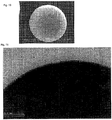
- the expression sometimes refers to such a state that, as shown in Fig. 11 , when a surface roughness value of the porous silica-based particle is given by measuring a difference between a circumscribed circle and an inscribed circle at a boundary of the particle observed from a photograph of a cross-section thereof taken by a transmission electron microscope (TEM) with a magnifying power of 100,000, the particles have a surface roughness value of not more than 20 nm.
- TEM transmission electron microscope
- the surface roughness value is not more than 20 nm, preferably not more than 15 nm, still preferably not more than 10 nm, on the average of the particles as measured by the above method. When the surface roughness value exceeds 20 nm, the frictional resistance among particles in rolling of the particles is increased.
- the frictional resistance among the particles in rolling of the particles becomes high. Therefore, upon applying a powder of such particles onto the skin, most of the panelists as described above will not have good feelings of smoothness, moistness, rolling effect, even spreadability, adhesiveness, sustainability of the rolling effect, as required for the feeling-improving material, and will feel to be grating, the feeling of which is not good but is inherent in the silica-based particles.
- the non-sphericity of the porous silica-based particles is not more than 5%, preferably not more than 2%, still more preferably not more than 1%.
- the non-sphericity of the porous silica-based particles is more than 5%, upon applying a powder of such particles onto the skin, most of the panelists as described above will not have good feelings of smoothness, moistness, rolling effect, even spreadability, adhesiveness, sustainability of the rolling effect, as required for the feeling-improving material, and will feel to be grating, the feeling of which is not good but is inherent in the silica-based particles.
- non-sphericity refers to the proportion of particles which are not spherical or not near-spherical, in other words, the proportion of particles which have been bonded to each other or one another or collapsed for some reasons.
- the oil absorption rate of the porous silica-based particles is 20 to 300 ml/100 g, preferably 60 to 230 ml/100 g.
- the oil absorption rate is less than 20 ml/100 g, as the effect of removing sebum becomes low, the particles having such oil absorption rate are not necessarily practical as an ingredient of the cosmetic.
- the oil absorption rate is more than 300 ml/100 g, as the effect of removing sebum becomes high, the skin may be irritated, and further, as the porosity of the particle per se becomes high, the compressive strength of the particle is lowered. Therefore, the particle is likely to be collapsed upon applying a powder of such particles onto the skin, resulting in a significantly deteriorated sustainability of the rolling effect.
- the pore volume of the porous silica-based particles is 0.05 to 3.0 ml/g, preferably 0.3 to 1.9 ml/g.
- the pore volume is less than 0.05 ml/g, as the porosity of the particle per se becomes low, the oil absorption into pores existing in the particle is lowered. Further, in this case, as the particle per se is relatively heavy, upon applying a powder of such particles onto the skin, most of the panelists as described above will not have good feelings of smoothness, rolling effect, even spreadability and sustainability of the rolling effect.
- the pore volume is more than 3.0 ml/g, as the porosity of the particle per se becomes high, the compressive strength of the particle is lowered. Therefore, the particle is likely to be collapsed upon applying a powder of such particles onto the skin, resulting in a significantly deteriorated sustainability of the rolling effect.
- the coefficient of variation (CV value) of the porous silica-based particles is 5 to 50%, preferably 10 to 30%.
- CV value The coefficient of variation of the porous silica-based particles.
- the coefficient of variation is more than 50%, such particles will necessarily make random rolling, and consequently, the feeling properties requisite for the feeling-improving material as described above will not be satisfied.
- the particles having a coefficient of variation of less than 5% can be used, the production of such porous silica-based particles requires a high cost, and any particular effect which is worth the cost may not be expected. For the above reason, the lower limit of the coefficient of variation is set at 5%.
- the purity (SiO 2 content) of the porous silica-based particles is not less than 96% by weight, preferably not less than 99% by weight.
- the purity is less than 96% by weight, the purity required of silicic anhydride in the Standards of Cosmetic Ingredients will not be satisfied and, consequently, it is difficult to use the porous silica-based particles as a cosmetic ingredient.
- the porous silica-based particles are produced by a spray-drying method which will be described later, there is no need to use a starting feed material containing an organic component. Accordingly, the porous silica-based particles do not contain carbon or carbonaceous materials originated from the organic component.
- the carbon content (C content) of the porous silica-based particles is less than 1,000 ppm by weight, preferably less than 100 ppm by weight.
- the carbon content is not less than 1,000 ppm by weight, coloring or an unusual odor considered as deriving from a deterioration in the organic component sometimes occurs and, consequently, the usefulness of the porous silica-based particles as a cosmetic ingredient is lowered.
- porous silica-based particles according to the present invention The method for producing porous silica-based particles according to the present invention is described below in detail. However, it should be noted that the porous silica-based particles according to the present invention are not limited to those produced by the method.
- the present invention provides a method for producing porous silica-based particles having an average particle diameter of 0.5 to 30 ⁇ m and having a surface smoothness of a level to such an extent that, when the entire surface of the particle is observed from a photograph thereof taken by a scanning electron microscope (SEM) with a magnifying power of 10,000, a foreign matter attached to the surface thereof can be hardly seen, which comprises the steps of:
- a dispersion of fine silica-based particles, or a mixture of the above dispersion of the fine silica-based particles and an aqueous solution of silicic acid is subjected to a spray dryer at which spray-drying is performed to produce a dried powder of porous silica-based particles having diameters ranging from 0.1 to 50 ⁇ m.
- the dispersion of fine silica-based particles may be a commercially available product produced by a conventional method.
- a silica sol in which spherical or non-spherical fine silica-based particles having an average particle diameter of 0.005 to 0.5 ⁇ m, preferably 0.005 to 0.1 ⁇ m (sometimes herein referred to as "fine silica-based particles") are dispersed in water, is preferred.
- fine silica-based particles having an average particle diameter of less than 0.005 ⁇ m can be used satisfactorily.
- the lower limit of the average particle diameter is set at 0.005 ⁇ m.
- Examples of such dispersion of fine silica-based particles include a silica sol containing fine silica-based particles having an average particle diameter of about 0.005 ⁇ m (CataloidTM SI-550, manufactured by JGC Catalysts and Chemicals Ltd.), a silica sol containing fine silica-based particles having an average particle diameter of about 0.015 ⁇ m (CataloidTM S-20L, manufactured by JGC Catalysts and Chemicals Ltd.), and a dispersion containing fumed silica having an average particle diameter of about 0.012 ⁇ m (AEROSILTM 200, manufactured by NIPPON AEROSIL CO., LTD.).
- the dispersion is preferably an aqueous dispersion.
- the dispersion may, if necessary, contain an alcohol such as ethanol, propanol, or butanol.
- the aqueous solution of silicic acid may be one prepared by treating an aqueous solution of a silicate such as an alkali metal silicate or a silicate of an organic base with a cation exchange resin to dealkalize from the silicate (for example, to remove sodium ions).
- a silicate such as an alkali metal silicate or a silicate of an organic base
- a cation exchange resin to dealkalize from the silicate (for example, to remove sodium ions).
- alkali metal silicates such as sodium silicate (water glass) and potassium silicate and silicates of organic bases such as quaternary ammonium silicate.
- an aqueous solution of silicic acid that has a pH value of 2 to 6, preferably 2 to 3, and contains a silicon compound in a range of 0.5 to 10% by weight, preferably 3 to 4% by weight, in terms of SiO 2 , is preferred.
- the pH value is less than 2
- the treatment time necessary for cation exchange is very long, and the cost effectiveness is low.
- the pH value is more than 6 the degree of dealkalization from the silicate becomes low, and consequently, the stability of the prepared aqueous solution of silicic acid is lowered.
- the content of silicon compound is less than 0.5% by weight, the production of the fine silica-based particles in a cost-effective manner becomes difficult.
- the content of silicon compound is more than 10% by weight, the stability of the aqueous solution of silicic acid is lowered.
- the aqueous solution of silicic acid having the above properties is preferably one prepared by diluting water glass (sodium silicate) with water and treating the diluted water glass with a cation exchange resin to remove alkali component (e.g., sodium ions) from the water glass
- a mixture of the dispersion of fine silica-based particles and the aqueous solution of silicic acid can be used satisfactorily.
- porous silica-based particles having a number of pores or voids In order to prepare porous silica-based particles having a number of pores or voids, the use of only the dispersion of fine silica-based particles or a material containing at least the dispersion of fine silica-based particles is preferred.
- the silicon compound contained in the aqueous solution of silicic acid functions as a binder component among the fine silica-based particles. Accordingly, when the production of porous silica-based particles having high compressive strength is required, mixing an appropriate amount of the aqueous solution of silicic acid into the dispersion of fine silica-based particles is preferred.
- the use of only the aqueous solution of silicic acid is not preferred because the porosity of the formed silica-based particles is disadvantageously lowered.
- Spray-drying in this step can be performed by a conventional method using a commercially available spray dryer (for example, a disk rotation type spray dryer or a nozzle type spray dryer).
- a commercially available spray dryer for example, a disk rotation type spray dryer or a nozzle type spray dryer.
- the spray-drying is performed by spraying the dispersion of fine silica-based particles, or a silica component-containing dispersion of a mixture comprising the dispersion of the fine silica-based particles and the aqueous solution of silicic acid (hereinafter referred to simply as "dispersion"), for example, at a rate of 1 to 3 liters/min into a hot air stream.
- the temperature at the inlet is 70 to 400°C, preferably 100 to 300°C, and the temperature at the outlet is preferably 40 to 60°C.
- the level of drying of the silica-based particles sprayed (which are obtainable from the solid materials contained in the dispersion) is unsatisfactory.
- the temperature at the inlet is above 400°C, the shape of the silica-based particles sprayed is disadvantageously distorted during spray-drying.
- the temperature at the outlet is below 40°C, as the level of drying of the silica-based particles sprayed becomes low, the silica-based particles and the like sprayed will be deposited on the wall inside the apparatus of the spray dryer.
- the dispersion is previously adjusted to a solid content of 1 to 50% by weight, preferably 5 to 30% by weight, and then is preferably subjected to a spray dryer for spray-drying.
- a solid content of 1 to 50% by weight, preferably 5 to 30% by weight, and then is preferably subjected to a spray dryer for spray-drying.
- the solid content is less than 1% by weight, the cost effectiveness is lowered.
- the solid content is more than 50% by weight, the viscosity of the slurry is increased and the shape of the spray-dried product is distorted.
- the silicon compound contained in the aqueous solution of silicic acid is dehydrated and polycondensed, and consequently is converted to a silica component. Accordingly, in the porous silica-based particles thus obtained, the silicon compound contained in the aqueous solution of silicic acid is present as a dehydrated and polycondensed product.
- the porous silica-based particles thus obtained have diameters of about 0.1 to 50 ⁇ m.
- the porous silica-based particles produced by the spray-drying are generally in a spherical or substantially spherical form.
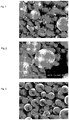
- small particles having diameters of less than about 1 ⁇ m, in particular small particles with a nanosize and the like produced in the step of spray-drying are attached to the surface of the porous silica-based particles as the spray-dried product. That is, as shown in Fig. 2 , when the entire surface of the porous silica-based particles is taken by a scanning electron microscope (SEM) with a magnifying power of 10,000, the small particles and the like are observed as a foreign matter attached to the surface of the porous silica-based particles.
- SEM scanning electron microscope
- the attachment of the small particles and the like onto the surface of the porous silica-based particles is considered attributable to electrostatic force which acts on between the particles.
- the dried powder of the porous silica-based particles obtained in the step (a) is put into water, and a slurry of the mixture is stirred under pH conditions on which the zeta potential of the porous silica-based particles contained in the water comes to in a range of -15 to -70 mV, to obtain a dispersion of porous silica-based particles with a foreign matter attached to the surface of the particles having been removed therefrom.
- the zeta potential of the porous silica-based particles is low (as an absolute value of the negative potential), the repulsive force by the electric double layer does not satisfactorily function, and therefore, the zeta potential of the particle is preferably in a range of -15 to -70 mV, preferably -20 to -60 mV, more preferably -25 to -55 mV.
- the small particles are temporarily separated from the surface of the porous silica-based particles by the mechanical stirring operation.
- the small particles are disadvantageously attached again to the surface of the porous silica-based particles with the elapse of time.
- the small particles re-attached to the surface of the porous silica-based particles even when subjected to a subsequent wet classification step, will not be removed from the surface of the porous silica-based particles without difficulties.
- the particles with a zeta potential being less than -70 mV can be used.
- the porous silica-based particles having a zeta potential of less than -70 mV will not be prepared, although a zeta potential close to the above figure may be obtained by increasing the amount of the alkali added in the slurry.
- the silica-based particles having a zeta potential of less than -70 mV may be obtainable by incorporation of other metal components into the particles.
- the particles obtainable therefrom may not have a silica purity (SiO 2 content) of not less than 96 % by weight, the purity of which is generally required for silica ingredients to be blended in cosmetics..
- the pH value in the slurry is brought to 5 to 10, preferably 7 to 9.
- the pH value is less than 5, as the amount of the silanol group dissociated from the surface of the particle is not so much, the zeta potential may not be maintained in a satisfactory value.
- the pH value is more than 10, the surface of the porous silica-based particles begins to be dissolved, and the silanol group present on the surface of the particle and the silanol group present on the surface of the small particles disadvantageously may cause a reaction of polycondensation to adhere the particles to one another. Further, in some cases, the desired silica purity (SiO 2 content) may not be maintained.
- Pure water such as an ion-exchange water or a distilled water can be used as the water in which the porous silica-based particles are to be dispersed.
- the use of pure water with addition of an appropriate amount of alkali such as ammonia or aqueous ammonia is preferred.
- the pH value of the dispersion prepared by putting and dispersing the porous silica-based particles in pure water varies also depending upon the properties of the particles, but is in many cases 3 to 8. In this case, the pH value of the dispersion containing porous silica-based particles prepared using a dispersion of the fine silica-based particles mixed with the aqueous solution of silicic acid is likely to be on the acid side.
- the stirring treatment be performed at a stirring speed of 10 to 5,000 rpm, preferably 100 to 1,000 rpm, for three minutes or longer, preferably 0.5 to 24 hours.
- the stirring speed is less than 10 rpm
- the small particles and other attached foreign matters may not be removed from the surface of the porous silica-based particles easily.
- the stirring speed is more than 5,000 rpm
- the particles contained in the slurry will collide with one another and, consequently, some particles may be collapsed.
- the stirring time is less than 3 minutes, the small particles and other attached foreign matters may not be removed from the surface of the porous silica-based particles easily.
- stirring for more than 24 hours is not beneficial because removable foreign matters attached to the porous silica-based particles can be removed from the surface of the particles by stirring for about 24 hours.
- a dispersion containing porous silica-based particles having diameters ranging primarily from 0.5 to 50 ⁇ m is prepared by subjecting the dispersion obtained in the step (b) to a wet classification device to separate and remove a supernatant containing at least porous silica-based particles having diameters of less than 0.5 ⁇ m.
- a commercially available conventional device can be used as the wet classification device, and examples thereof include centrifugal separators, liquid cyclones, or elutriators (e.g., natural sedimentation devices). Among them, a centrifugal separator or a liquid cyclone is preferred for the preparation of the dispersion on a commercial scale.
- the operation of the wet classification device varies also depending, for example, upon the desired average particle diameter of porous silica-based particles to be collected as the classified product.
- the wet classification device is preferably operated at a centrifugal force of 1 to 10,000 G, preferably 10 to 1,000 G, for 1 to 200 minutes, preferably 2 to 30 minutes.
- the reason why, in this step, the supernatant liquid containing porous silica-based particles having diameters of less than 0.5 ⁇ m is separated and removed is that for obtaining the porous silica-based particles having an average particle diameter of not less than 0.5 ⁇ m.
- the average particle diameter of the porous silica-based particles is less than 0.5 ⁇ m, upon applying a powder of such particles onto the skin, most of the panelists as described above will feel a lack of rolling effect as the spherical powder and, at the same time, a poor even spreadability.
- a dispersion containing porous silica-based particles having diameters ranging primarily from 0.5 to 30 ⁇ m is prepared by subjecting the dispersion obtained in the step (c) to a wet classification device to separate and remove a sediment or precipitate containing at least porous silica-based particles having diameters of more than 30 ⁇ m.
- examples of the wet classification devices include centrifugal separators, liquid cyclones, or elutriators (e.g., natural sedimentation devices). Among them, the use of a centrifugal separator or a liquid cyclone is preferred.
- the operation of the wet classification device varies also depending, for example, upon the desired average particle diameter of porous silica-based particles to be collected as the classified product.
- the wet classification device is preferably operated at a centrifugal force of 1 to 100 G, preferably 2 to 50 G, for 0.1 to 100 minutes, preferably 0.4 to 30 minutes.
- the sediment containing porous silica-based particles having diameters of more than 30 ⁇ m is separated and removed is that for obtaining the porous silica-based particles having an average particle diameter of not more than 30 ⁇ m.
- the average particle diameter of the porous silica-based particles is more than 30 ⁇ m, upon applying a powder of such particles onto the skin, most of the panelists as described above will feel to be harsh and grating.
- a wet classification method for porous silica-based particles has been described above.
- the order of the operation in the wet classification of the porous silica-based particles can be reversed.
- a method may be adopted in which porous silica-based particles having diameters of more than 30 ⁇ m are first separated and removed in the step (d), and porous silica-based particles having diameters of less than 0.5 ⁇ m are then separated and removed in the step (c).
- a cake-like substance of porous silica-based particles is prepared by filtering the dispersion obtained in the step (d) to separate solid material.
- the dispersion can be filtered through a commercially available device by a conventional method, and examples thereof include Buchner funnels, filter presses, horizontal belt filters, synchroTM filters, precoat filters, drum filters, belt filters, tray filters, and centrifugal separators.
- the cake-like substance is satisfactorily washed with pure water such as an ion-exchange water or a distilled water, before the subsequent step.
- a dried powder of porous silica-based particles having an average particle diameter of 0.5 to 30 ⁇ m is prepared by drying and then crushing or breaking up the cake-like substance obtained in the step (e).
- the cake-like substance is dried under the atmosphere pressure or the reduced pressure at a temperature of room temperature to 200°C, preferably 50 to 150°C, for 1 to 24 hours, preferably 2 to 12 hours.
- the drying temperature is below the room temperature, the cake-like substance will not be satisfactorily dried.
- the drying time is less than one hour, in some cases, the cake-like substance will not be satisfactorily dried.
- the dried powder of the porous silica-based particles obtained in the step (f) has a compressive strength of 0.1 to 50 kgf/mm 2 .
- the dried powder of the porous silica-based particles should be calcined.
- the dried powder of the porous silica-based particles obtained in the step (f) is preferably calcined at a temperature of 200 to 800°C for 1 to 24 hours.
- the calcining temperature is less than 200°C, the siloxane bonding among primary particles (i.e., fine silica-based particles) constituting the porous silica-based particles is not satisfactory and, thus, an improvement in compressive strength may not be expected.
- the calcining temperature is more than 800°C
- the pores or caves existing in the particles may be disappeared or decreased due to sintering of the particles, which makes it difficult to maintain a desired porosity, and sometimes results in the production of crystalline silica (such as quartz).
- the calcining time is less than one hour, the siloxane bonding among primary particles (i.e., fine silica-based particles) constituting the porous silica-based particles is not satisfactory and, thus, an improvement in compressive strength may not be expected.
- the calcining time exceeds 24 hours, no particular effect can be attained and, thus, the cost effectiveness is not good.
- porous silica-based particles having a compressive strength of 0.5 to 100 kgf/mm 2 are obtained.
- the dried powder or calcined powder of the porous silica-based particles may be properly selected and used.
- the dried powder of the porous silica-based particles obtained in the step (a) or the calcined powder prepared by calcining the dried powder is supplied for treatment to a dry classification device with a cyclonic separation.
- this dry classification method is disadvantageous in that, although a dried or calcined powder of porous silica-based particles which have a regulated particle size distribution and have a desired CV value may be obtained, in some cases, for example, small particles and the like attached to the surface of the particles will not be completely removed and, further, during the operation of the dry classification, the surface smoothness of the particles can be significantly lowered due to disintegration of the particles by collision among the particles or by collision against the side wall of the apparatus in the dry classification device (this tendency is particularly significant when the powder is a dried powder) and abrasion of the surface of the particles by friction.
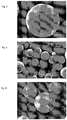
- the present inventors have subjected the dry classified product to the treatment in the step (b) according to the present invention, and further to the treatment in the steps (c) and (d) and, as a result, have found that, as can be seen from photographs taken by a scanning electron microscope (SEM) with a magnifying power of 3,000 ( Fig. 5 ) and with a magnifying power of 10,000 ( Fig. 6 ), concaves and convexes produced (for example, by attached foreign matters and by a surface abrasion) on the surface of the particles will not be repaired. Accordingly, it has been found that the dry classification device should not be used for the production of porous silica-based particles having a smooth surface.
- SEM scanning electron microscope
- porous silica-based particles obtained by spray-drying with use of a spray dryer has been described above. It is a matter of course that the porous silica-based particles obtained by the emulsion method may be treated in the steps (b) to (f) according to the present invention (if necessary further including the calcination step). That is, porous silica-based particles, obtained by this method, that have an average particle diameter of 0.5 to 30 ⁇ m and have a smooth surface also fall within the scope of the present invention.
- porous silica-based particles obtained above may, if necessary, be ultrasonically treated as long as damage such as abrasion or disintegration to the particles does not occur. However, it is considered that there is substantially no necessity of conducting the ultrasonic treatment.
- the cosmetics according to the present invention are produced by blending the porous silica-based particles with various cosmetic ingredients which will be described later.
- the amount of the porous silica-based particles blended into the cosmetic according to the present invention may vary depending, for example, upon the type of the cosmetic to be prepared and cosmetic ingredients to be blended, but is 0.1 to 30% by weight, preferably 1 to 10% by weight, based on the cosmetic.
- the blending amount of the porous silica-based particles is less than 0.1% by weight, as the feeling-improving effect will not be obtainable, it becomes unpractical.
- the blending amount is more than 30% by weight, long lasting performance of the cosmetic is not expected.
- Examples of various cosmetic ingredients include fats and oils such as olive oils, rape-seed oils, and beef tallows; waxes such as jojoba oils, carnauba waxes, candelilla waxes, and beeswaxes; hydrocarbons such as paraffins, squalanes, synthetic and botanical squalanes, ⁇ -olefin oligomers, microcrystalline waxes, pentane, and hexane; fatty acids such as stearic acid, myristic acid, oleic acid, and ⁇ -hydroxy acid; alcohols such as isostearyl alcohol, octyldodecanol, lauryl alcohol, ethanol, isopropanol, butyl alcohol, myristyl alcohol, cetanol, stearyl alcohol, and behenyl alcohol; alkyl glyceryl ethers; esters such as isopropyl myristate, isopropyl palmitate, eth
- Inorganic compounds such as titanium oxide or zinc oxide as described above may be those having a surface previously subjected to silicon treatment, fluorine treatment, metallic soap treatment or the like.
- the cosmetic may contain resin particles such as polymethylmethacrylate, nylon, silicone resin, silicone rubber, polyethylene, polyester, or polyurethane particles.
- arbutin, kojic acid, vitamin C, sodium ascorbate, magnesium ascorbyl phosphate, ascorbyl dipalmitate, ascorbyl glucoside, other ascorbic acid derivatives, placental extracts, sulfur, botanical extracts such as oil-soluble licorice extracts and mulberry bark extracts, linoleic acid, linolenic acid, lactic acid, or tranexamic acid may be incorporated as active ingredients having a whitening effect.
- active ingredients having an antiaging effect such as vitamin C, cartenoid, flavonoid, tannin, camphor derivatives, lignan, saponin, retinoic acid and retinoic acid structural analogs, N-acetylglucosamine, and ⁇ -hydroxy acid; polyhydric alcohols such as glycerin, propylene glycol, and 1,3-butylene glycol; saccharides such as mixed isomerized sugar, trehalose, and pullulan; biopolymers such as sodium hyaluronate, collagen, elastin, chitin/chitosan, and sodium chondroitin sulfate; amino acids, betaine, ceramide, sphingolipid, cholesterol, and derivatives thereof; ⁇ -aminocapronic acid; glycyrrhetinic acid; or various vitamins may be incorporated as active ingredients having a roughened skin amelioration effect.
- active ingredients having an antiaging effect such as vitamin C, cartenoid, flavonoid,
- cosmetic ingredients described, for example, in Japanese Standards of Quasi-drug Ingredients 2006 (issued by YAKUJI NIPPO LIMITED, on June 16, 2006 ) and International Cosmetic Ingredient Dictionary and Handbook (issued by The Cosmetic, Toiletry, and Fragrance Association, Eleventh Edition 2006 ) can be used without particular limitation.
- the cosmetics according to the present invention can be produced by conventional methods.
- the cosmetics produced by the conventional methods may be used in various forms such as powder, cake, pencil, stick, cream, gel, mousse, liquid, and cream forms, and specific examples thereof include cleaning cosmetics such as soaps, cleansing foams, and makeup removing creams; skin care cosmetics, for example, for moisture retention/rough skin prevention, acne, care for keratin, massage, wrinkles/flabbiness, drabness/shadow, ultraviolet care, whitening, and antioxidation care; base makeup cosmetics such as powder foundations, liquid foundations, cream foundations, mousse foundations, pressed powders, and makeup bases; point makeup cosmetics such as eye shadows, eye blows, eyeliners, mascaras, and lip glosses; haircare cosmetics, for example, for hair restoration, scurf prevention, itchiness prevention, cleaning, conditioning/styling, permanent/waving, and hair coloring/hair bleaching; body care cosmetics such as for cleaning, sunscreen, skin care, slimming, blood circulation improvement, itchiness inhibition, body odor prevention, hidroschesis
- a slurry liquid with a solid content of 0.1 to 5% by weight is prepared by mixing a powder of porous silica-based particles with an aqueous solution containing glycerin of 40% by weight. Then, the slurry liquid is subjected to an ultrasonic generation apparatus (model US-2, manufactured by iuch) where the slurry liquid is treated for five minutes to obtain a dispersed liquid thereof. Next, a sample is extracted from the dispersed liquid to which the aqueous solution containing glycerin may be added for adjustment of the solid content thereof.
- the sample is placed in a glass cell (a size of length 10 mm, width 10 mm, and height 45 cm), and by using such a cell, the average particle diameter of the porous silica-based particles is measured with use of a centrifugal sedimentation type particle size distribution analyzer (CAPA-700, manufactured by HORIBA, Ltd.).
- a centrifugal sedimentation type particle size distribution analyzer CAA-700, manufactured by HORIBA, Ltd.
- a powder of porous silica-based particles is subjected to vapor deposition of gold in a vacuum vapor deposition device (JFC-1200, manufactured by JEOL LTD.) at a degree of vacuum of 8 Pa for 40 seconds to prepare a sample.
- a photograph of the sample is then taken by a scanning electron microscope (SEM) (JSM-5600, manufactured by JEOL LTD.) with a magnifying power of 10,000 at an accelerated voltage of 15 kV.
- SEM scanning electron microscope
- samples of more than 100 particles randomly picked out are, using the SEM photograph, visually observed for the presence or absence of foreign matters such as small particles with a nanosize attached to the surface of the porous silica-based particles, and the number of particles for which six (6) or more of the small particles are seen per ⁇ m 2 of the plane surface on the porous silica-based particles is visually counted.
- a powder of porous silica-based particles is homogeneously mixed with about 1 g of an epoxy resin (EPO-KWICK, manufactured by BUEHLHER), and the mixture is cured at room temperature. Thereafter, the cured product is subjected to a section processing of a 20 ⁇ m area by a gallium-ion sputtering with an FIB machine (FB-2100, manufactured by Hitachi, Ltd.) to prepare a sample with a section having a thickness of 100 to 200 nm. Next, a photograph of a cross-section of the sample is taken by a transmission electron microscope (TEM) (HF-2200, manufactured by Hitachi, Ltd.) with a magnifying power of 100,000 at an accelerated voltage of 200 kV. Further, for each of any ten microphotographs, a difference between the circumscribed circle and the inscribed circle at a boundary of the particle is measured, and the average of the measured data is regarded as the surface roughness value.
- TEM transmission electron microscope
- Non-sphericity % N x + N y / N x 100 , wherein "N" represents the total number of the particles observed; “N x " represents the counted number of the non-spherical particles as described above, and “N y " represents the counted number of the agglomerated particles as described above.
- a powder of porous silica-based particles is put in a magnetic crucible (model B-2), and is dried at a temperature of 105°C for 2 hours. Then, the dried powder is placed in a desiccators, and is cooled to room temperature. Next, 1 g of a sample is weighed, and the specific surface area (m 2 /g) of the sample is measured by a BET method with a full-automatic surface area measuring apparatus (Multisorb 12, manufactured by YUASA-IONICS COMPANY , LIMITED).
- a powder of porous silica-based particles is put in a crucible, and is dried at a temperature of 105°C for one hour. Then, the dried powder is placed in a desiccators, and is cooled to room temperature.
- Pore volume ml / g R ⁇ V ⁇ Vc / W , wherein "V” represents an adsorption amount (ml) in a standard state at a pressure of 735 mmHg; “Vc” represents the volume of a cell blank (ml) at a pressure of 735 mmHg; and “W” represents the weight of the sample (g); and “R” represents the density ratio of nitrogen gas to liquid nitrogen, the value of which is 0.001567.
- One particle which falls within a range of an average particle diameter ⁇ 0.5 ⁇ m is picked out as a sample from a powder of the porous silica-based particles. Then, a load is applied at a given loading rate to the sample with use of a micro compression tester (MCTM-200, manufactured by SHIMADZU CORPORATION), and the weighted value when the particle is collapsed is regarded as the compressive strength (kgf/mm 2 ) for the particle. Further, this operation is repeated four times to measure the compressive strength for five samples. The measured values are averaged, and the average thus obtained is regarded as the compressive strength of the particle.
- MCTM-200 micro compression tester
- a dispersion prepared by dispersing porous silica-based particles obtained by spray-drying in water or a dispersion after adjustment of pH by the addition of ammonia or the like to the dispersion is stirred in a thermostatic chamber of 25°C for at least 30 minutes, and a glass electrode of a pH meter (F22, manufactured by HORIBA, Ltd.) corrected with standard solutions each having pH of 4, 7 and 9 is then inserted into the dispersion to measure pH thereof.
- a pH meter F22, manufactured by HORIBA, Ltd.
- 1 g of a powder of porous silica-based particles is dried at a temperature of 105°C for 2 hours.
- the drying loss (%) is calculated from the weight reduced by the drying and the weight (1 g) before the drying.
- 1 g of a powder of the porous silica-based particles is calcined at a temperature of 850°C for 30 minutes.
- the ignition loss (%) is calculated from the weight reduced by the calcining and the weight (1 g) before the calcining.
- the drying loss is not less than 2% by weight and the ignition loss is not less than 5% by weight.
- the present inventors have found that, when the drying loss is less than 2% by weight or when the ignition loss is less than 5% by weight, it is difficult to remove the small particles and the like attached to the surface of the porous silica-based particles. Accordingly, in the present invention, these numerical values are used as an index.
- the heated mixture is cooled down to room temperature, 20 to 25 ml of hot water is added, and the solution is immediately filtered.
- the residue is washed with warm water until the wash liquid no longer exhibits a reaction of the chloride.
- the residue together with a filter paper is then placed in a platinum crucible and is ignited until ashing, is further ignited for 30 minutes and is cooled down to room temperature.
- the weight of the ash is measured, and the purity of silica (SiO 2 content) is calculated.
- a dispersion prepared by dispersing porous silica-based particles obtained by spray-drying in water or a dispersion after adjustment of pH by the addition of ammonia or the like to the dispersion is subjected to a zeta potential measurement apparatus based on an ultrasonic attenuation spectroscopy method (DT-1200, manufactured by Dispersion Technology Inc.) where the zeta potential of the particles contained in the dispersion is measured.
- DT-1200 ultrasonic attenuation spectroscopy method
- a powder of porous silica-based particles is subjected to a sensory test by 20 expert panelists, and hearing investigations are performed for seven evaluation items, namely, about the feeling properties of smoothness, moistness, rolling effect, even spreadability, adhesiveness to the skin, sustainability of the rolling effect and a degree of grating which is inherent in silica-based particles.
- the results are evaluated on each item in accordance with the following criteria (a) for scoring.
- the total of the scores recorded by the panelists is calculated, and the feeling of the porous silica-based particles is evaluated on each item in accordance with the following criteria (b) for evaluation.
- a powder foundation blended with a powder of porous silica-based particles is subjected to a sensory test by 20 expert panelists, and hearing investigations are performed for six evaluation items, namely, about the feeling properties of (1) even spreadability, moistness, and smoothness during applying it onto the skin, and (2) uniformity, moistness, and softness of a cosmetic film after the applying onto the skin.
- the results are evaluated on each item in accordance with the following criteria (a) for scoring.
- the total of the scores recorded by the panelists is calculated, and the feeling of use of the foundation is evaluated on each item in accordance with the following criteria (b) for evaluation.
- a silica sol containing fine silica-based particles having an average particle diameter of 15 nm (Cataloid S-20L, SiO 2 content 20% by weight, manufactured by JGC Catalysts and Chemicals Ltd.) was subjected to a spray dryer (NIRO ATMIZER, manufactured by NIRO LTD.) for spray-drying under conditions of an inlet temperature of 240°C, an outlet temperature of 55°C, and a spraying speed of 2 liters/minutes to give Dried Powder 1A of porous silica-based particles having an average particle diameter of 5 ⁇ m.
- a spray dryer NIRO ATMIZER, manufactured by NIRO LTD.
- Dispersion (1) 2,160 cc of pure water was added to 240 g of Dried Powder 1A of porous silica-based particles obtained in the step (a) above, and the mixture was adjusted to pH 8 by the addition of aqueous ammonia, followed by stirring at a rotating speed of 300 rpm for 2 hours to give Dispersion (1) having a solid content of 10% by weight.
- the zeta potential of the particles contained in Dispersion (1) was measured and found to be -35 mV.
- Dispersion (1) obtained in the step (b) above was put in four centrifugal cans with a capacity of 700 cc (600 g of the dispersion for each can) and was centrifuged with a centrifugal separator (CF7D2, rotor: RT3S3, manufactured by Hitachi Koki Co., Ltd.) under conditions of a temperature of room temperature, a rotating speed of 500 rpm (corresponding to a centrifugal acceleration of 48.6 G), and a time of 370 seconds (6.2 minutes), so that particles mainly having particle diameters of not less than 2.5 ⁇ m are sedimented or settled.
- a centrifugal separator C7D2, rotor: RT3S3, manufactured by Hitachi Koki Co., Ltd.
- a supernatant containing porous silica-based particles mainly having particle diameters of not more than 2.5 ⁇ m was gently extracted, separated, and removed. Then, 600 cc of pure water, the pH of which was adjusted to 8 by adding an aqueous ammonia therein, was mixed with the sediment or precipitate (including a residual liquid) for each can, and the mixture was stirred for 2 hours.
- centrifugal operation was again performed at a rotating speed of 500 rpm (corresponding to a centrifugal acceleration of 48.6 G) for 370 seconds (6.2 minutes) for each can.
- a supernatant containing porous silica-based particles mainly having particle diameters of not more than 2.5 ⁇ m was then gently extracted, separated, and removed.
- 600 cc of pure water was mixed with the sediment or precipitate, and the mixture was stirred for one hour to give Dispersion (2) containing porous silica-based particles mainly having particle diameters of 2.5 to 50 ⁇ m.
- Dispersion (2) obtained in the step (c) above was centrifuged by a centrifugal separator (CF7D2, rotor: RT3S3, manufactured by Hitachi Koki Co., Ltd.) under conditions of a temperature of room temperature, a rotating speed of 300 rpm (corresponding to a centrifugal acceleration of 17.5 G), and a time of 64 seconds (1.1 minutes) so that particles mainly having particle diameters of more than 10 ⁇ m are sedimented or settled for each can.
- a centrifugal separator C7D2, rotor: RT3S3, manufactured by Hitachi Koki Co., Ltd.
- Dispersion (3) obtained in the step (d) above was filtered through a quantitative filter paper (No. 5C, manufactured by Advantec Toyo Kaisha, Ltd.) using a Buchner funnel (3.2 L, manufactured by Sekiya Chemical Glass Apparatus Co. Ltd.), followed by repeated washing with pure water to obtain a cake-like substance.
- a quantitative filter paper No. 5C, manufactured by Advantec Toyo Kaisha, Ltd.
- a Buchner funnel 3.2 L, manufactured by Sekiya Chemical Glass Apparatus Co. Ltd.
- Example Dried Powder 2A Dried Powder 2A of porous silica-based particles
- Example Dried Powder 2A thus obtained, the average particle diameter, coefficient of variation of particles, surface smoothness, surface roughness, non-sphericity, specific surface area, oil absorption rate, pore volume, compressive strength, silica purity, drying loss, and ignition loss were determined by the above measuring methods. The results are shown in Table 3.
- Example Dried Powder 2A the state of the surface of particles was observed by a scanning electron microscope with magnifying powers of 3,000 and 10,000. As a result, for both the magnifying powers, foreign matters such as small particles attached to the particle surface could be hardly seen.
- the carbon content was measured with a carbon/sulfur analyzer (EMIA-320 V: manufactured by HORIBA, Ltd.) and found to be below the detection limit (100 ppm).
- Example Dried Powder 2A obtained in the step (f) above was calcined at a temperature of 450°C for three hours to obtain Calcined Powder 3A of porous silica-based particles (hereinafter referred to as "Example Calcined Powder 3A").
- Example Calcined Powder 3A thus obtained, the average particle diameter, coefficient of variation of particles, surface smoothness, surface roughness, non-sphericity, specific surface area, oil absorption rate, pore volume, compressive strength, silica purity, drying loss, and ignition loss were determined by the above measuring methods. The results are shown in Table 4.
- Example Calcined Powder 3A the state of the surface of particles was observed by a scanning electron microscope with magnifying powers of 3,000 and 10,000. As a result, for both the magnifying powers, foreign matters such as small particles attached to the particle surface could be hardly seen. Photographs taken by an electron microscope (SEM) at that time are shown in Fig. 3 (magnifying power: 3,000) and Fig. 4 (magnifying power: 10,000).
- a surface roughness value defined by a difference between a circumscribed circle and an inscribed circle of the particle was determined from a photograph taken at that time by an electron microscope (TEM) and was found to be not more than 10 nm. The photograph taken by the electron microscope (TEM) is shown in Fig. 11 .
- Dried Powders 1B to 1E of porous silica-based particles shown in Table 1 were obtained by spray-drying silica sols in the same manner as in Example 1, except that, instead of the silica sol used in Example 1, dispersions of fine silica-based particles containing fine silica-based particles manufactured by JGC Catalysts and Chemicals Ltd. and manufactured by NIPPON AEROSIL CO., LTD. shown in Table 1 were used and some of spray-drying conditions were varied dependent upon the necessity.
- Example Dried Powders 2B to 2E Dried Powders 2B to 2E of porous silica-based particles
- Example Dried Powders 2B to 2E thus obtained, the average particle diameter, coefficient of variation of particles, surface smoothness, surface roughness, non-sphericity, specific surface area, oil absorption rate, pore volume, compressive strength, silica purity, drying loss, and ignition loss were determined in the same manner as in Example 1. The results are shown in Table 3.
- Example Dried Powders 2B to 2E the state of the surface of particles was observed by a scanning electron microscope with magnifying powers of 3,000 and 10,000. As a result, for both the magnifying powers, foreign matters such as small particles attached to the particle surface could be hardly seen.
- Example Dried Powders 2B to 2E thus obtained were calcined under the same conditions as in Example 1 to obtain Calcined Powders 3B to 3E of porous silica-based particles (hereinafter referred to as "Example Calcined Powders 3B to 3E").
- Example Calcined Powders 3B to 3E thus obtained, the average particle diameter, coefficient of variation of particles, surface smoothness, surface roughness, non-sphericity, specific surface area, oil absorption rate, pore volume, compressive strength, silica purity, drying loss, and ignition loss were determined in the same manner as in Example 1. The results are shown in Table 4.
- Example Calcined Powders 3B to 3E the state of the surface of particles was observed by a scanning electron microscope with magnifying powers of 3,000 and 10,000. As a result, for both the magnifying powers, foreign matters such as small particles attached to the particle surface could be hardly seen.
- the dispersion of fine silica-based particles containing the fine silica-based particles (SiO 2 content: 100% by weight) used in Example 5 and an aqueous solution of silicic acid (containing 5% by weight of a silicon compound in terms of SiO 2 ) were mixed together at weight ratios shown in Table 1, followed by additional stirring for one hour.
- the mixed dispersions thus obtained were subjected to a spray dryer (NIRO ATMIZER, manufactured by NIRO LTD.) at which spray drying was performed under conditions of an inlet temperature of 240°C, an outlet temperature of 55°C, and a spraying speed of 2 liters/minute to obtain Dried Powders 1F and 1G of porous silica-based particles shown in Table 1.
- Example Dried Powders 2F and 2G Dried Powders 2F and 2G of porous silica-based particles
- Example Dried Powders 2F and 2G thus obtained, the average particle diameter, coefficient of variation of particles, surface smoothness, surface roughness, non-sphericity, specific surface area, oil absorption rate, pore volume, compressive strength, silica purity, drying loss, and ignition loss were determined in the same manner as in Example 1. The results are shown in Table 3.
- Example Dried Powders 2F and 2G the state of the surface of particles was observed by a scanning electron microscope with magnifying powers of 3,000 and 10,000. As a result, for both the magnifying powers, foreign matters such as small particles attached to the particle surface could be hardly seen.
- Example Dried Powders 2F and 2G thus obtained were calcined under the same conditions as in Example 1 to obtain Calcined Powders 3F and 3G of porous silica-based particles (hereinafter referred to as "Example Calcined Powders 3F and 3G").
- Example Calcined Powders 3F and 3G thus obtained, the average particle diameter, coefficient of variation of particles, surface smoothness, surface roughness, non-sphericity, specific surface area, oil absorption rate, pore volume, compressive strength, silica purity, drying loss, and ignition loss were determined in the same manner as in Example 1. The results are shown in Table 4.
- Example Calcined Powders 3F and 3G the state of the surface of particles was observed by a scanning electron microscope with magnifying powers of 3,000 and 10,000. As a result, for both the magnifying powers, foreign matters such as small particles attached to the particle surface could be hardly seen.
- Example No. 1 2 3 4 5 6 7 Prepared Example Dried Powder (spray-dried product) 1A 1B 1C 1D 1E 1F 1G Materials used in spraying Dispersion of fine silica-based particles
- Type of fine silica-based particles A A B A C C C Average diameter of fine particles (nm) 15 15 15 15 7 7 7 7
- Fine silica-based particles B CATALOIDTM S-30L, manufactured by JGC Catalysts and Chemicals Ltd.
- Fine silica-based particles C AEROSILTM 380, manufactured by NIPPON AEROSIL CO., LTD.
- Aqueous solution of silicic acid manufactured by JGC Catalysts and Chemicals Ltd.
- the pH adjustment of the dispersions was performed by the addition of aqueous ammonia having a properly adjusted NH 3 concentration.
- Example Dried Powders 2H to 2J Dried Powders 2H to 2J of porous silica-based particles
- Example Dried Powders 2a to 2e Dried Powders 2a to 2e of porous silica-based particles
- Example Dried Powders 2H to 2J and Comparative Dried Powders 2a to 2e thus obtained the average particle diameter, coefficient of variation of particles, surface smoothness, surface roughness, non-sphericity, specific surface area, oil absorption rate, pore volume, compressive strength, silica purity, drying loss, and ignition loss were determined in the same manner as in Example 1. The results are shown in Table 6.
- Example Dried Powders 2H to 2J the state of the surface of particles was observed by a scanning electron microscope with magnifying powers of 3,000 and 10,000. As a result, for both the magnifying powers, foreign matters such as small particles attached to the particle surface could be hardly seen.
- Example Dried Powders 2H to 2J and Comparative Dried Powders 2a to 2e thus obtained were calcined under the same conditions as in Example 1 to obtain Calcined Powders 3H to 3J of porous silica-based particles (hereinafter referred to as "Example Calcined Powders 3H to 3J") and Calcined Powders 3a to 3e of porous silica-based particles (hereinafter referred to as "Comparative Calcined Powders 3a to 3e").
- Example Calcined Powders 3H to 3J and Comparative Calcined Powders 3a to 3e thus obtained, the average particle diameter, coefficient of variation of particles, surface smoothness, surface roughness, non-sphericity, specific surface area, oil absorption rate, pore volume, compressive strength, silica purity, drying loss, and ignition loss were determined in the same manner as in Example 1. The results are shown in Table 7.
- Example Calcined Powders 3H to 3J the state of the surface of particles was observed by a scanning electron microscope with magnifying powers of 3,000 and 10,000. As a result, for both the magnifying powers, foreign matters such as small particles attached to the particle surface could be hardly seen.
- Dried Powder 1A of porous silica-based particles obtained in the step (a) in Example 1 was classified using a separator-type dry classification device (TTSP, manufactured by Hosokawa Micron Corporation) under such conditions that particles having particle diameters of more than 15 ⁇ m were separated.
- TTSP separator-type dry classification device
- Comparative Dried Powder 1f a dried powder of porous silica-based particles classified under a dry condition
- Example 2f Dried Powder 2f of porous silica-based particles
- Comparative Dried Powder 2f the state of the surface of particles was observed by a scanning electron microscope with magnifying powers of 3,000 and 10,000. As a result, for both the magnifying powers, foreign matters such as small particles attached to the particle surface were seen.
- Comparative Dried Powder 2f thus obtained was calcined under the same conditions as in Example 1 to obtain Calcined Powder 3f of porous silica-based particles (hereinafter referred to as "Comparative Calcined Powder 3f").
- a surface roughness value defined by a difference between a circumscribed circle and an inscribed circle of the particle was determined from a photograph taken at that time by an electron microscope (TEM) and was found to be 130 nm. The photograph taken by the electron microscope (TEM) is shown in Fig. 12 .
- Example 2h Dried Powder 2h of pre-calcined porous silica-based particles
- Comparative Dried Powder 2h thus obtained was calcined under the same conditions as in Example 1 to obtain Calcined Powder 3h of porous silica-based particles (hereinafter referred to as "Comparative Calcined Powder 3h").
- Comparative Calcined Powder 3h the state of the surface of particles was observed by a scanning electron microscope with magnifying powers of 3,000 and 10,000.
- Comparative Calcined Powder 3f obtained in Comparative Example 6 for both the magnifying powers, foreign matters such as small particles attached to the particle surface were seen.
- a photograph taken with a magnifying power of 10,000 attached matters other than small particles (the matters of which are attached as foreign matters produced on the particle surface as a result of collision against the side wall of the apparatus or abrasion of the particles) were seen. Photographs taken by an electron microscope (SEM) at that time are shown in Fig. 7 (magnifying power: 3,000) and Fig. 8 (magnifying power: 10,000).
- the dispersion was then subjected to the step (c) described in Example 1, and the operation was performed under the same conditions as in Example 1, except that the operation was repeated six times.
- Example 2i Dried Powder 2i of pre-calcined porous silica-based particles
- Comparative Dried Powder 2i thus obtained was calcined under the same conditions as in Example 1 to obtain Calcined Powder 3i of porous silica-based particles (hereinafter referred to as "Comparative Calcined Powder 3i").
- Comparative Calcined Powder 3i the state of the surface of particles was observed by a scanning electron microscope with magnifying powers of 3,000 and 10,000. As a result, for both the magnifying powers, foreign matters such as small particles attached to the particle surface were seen, although the degree of attachment of the foreign matter is not so significant as compared with that in Comparative Calcined Powder 3f obtained in Comparative Example 6. Further, some non-spherical particles produced as a result of cracking of spherical particles were seen. Further, in a photograph taken with a magnifying power of 10,000, the attachment of foreign matters other than small particles on the particle surface was seen. Photographs taken by an electron microscope (SEM) at that time are shown in Fig. 9 (magnifying power: 3,000) and Fig. 10 (magnifying power: 10,000).
- 2,160 cc of pure water was added to 240 g of the dried powder of porous silica-based particles obtained in Comparative Example 6, that is, 240 g of Comparative Dried Powder 1f classified under a dry condition.
- the mixture was subjected to an ultrasonic cleaning device (US-3, 38 kHz, manufactured by SND CO., LTD.) and treated for 10 minutes to disperse the porous silica-based particles in the water and also to wash the surface of the particles, and thus, a dispersion having a solid content of 10% by weight was prepared.
- Dispersion was then subjected to the steps (c) to (f) described in Comparative Example 8, and the operation was performed under the same conditions as in Comparative Example 8 to obtain Dried Powder 2j of porous silica-based particles (hereinafter referred to as "Comparative Dried Powder 2j").
- Comparative Dried Powder 2j thus obtained was calcined under the same conditions as in Example 1 to obtain Calcined Powder 3j of porous silica-based particles (hereinafter referred to as "Comparative Calcined Powder 3j").
- Comparative Calcined Powder 3j the state of the surface of particles was observed by a scanning electron microscope with magnifying powers of 3,000 and 10,000. As a result, for both the magnifying powers, foreign matters such as small particles attached to the particle surface were not seen. However, a number of non-spherical particles produced as a result of cracking of spherical particles were seen.
- Comparative Dried Powder 2k thus obtained was calcined under the same conditions as in Example 1 to obtain Calcined Powder 3k of porous silica-based particles (hereinafter referred to as "Comparative Calcined Powder 3k").
- Comparative Calcined Powder 3k the state of the surface of particles was observed by a scanning electron microscope with magnifying powers of 3,000 and 10,000. As a result, for both the magnifying powers, foreign matters such as small particles attached to the particle surface could be hardly seen.
- Comparative Calcined Powder 2k was prepared for use in Comparative Examples which will be described later.
- Comparative Dried Powder 2n thus obtained was calcined under the same conditions as in Example 1 to obtain Calcined Powder 3n of porous silica-based particles (hereinafter referred to as "Comparative Calcined Powder 3n").
- Comparative Calcined Powder 3n the state of the surface of particles was observed by a scanning electron microscope with magnifying powers of 3,000 and 10,000. As a result, for both the magnifying powers, foreign matters such as small particles attached to the particle surface could be hardly seen.
- the average particle diameter of Comparative Calcined Powder 2n was 34 ⁇ m.
- Comparative Calcined Powder 2n was prepared for use in Comparative Examples which will be described later.
- Comparative Example No. 6 Dried powder or calcined powder used Comparative Dried Powder 1f (dry-classified product) Comparative Calcined Powder 1h (commercially available product) Average particle diameter ( ⁇ m) 5 5 Coefficient of variation of particles (%) 59 58 Surface smoothness (%) 0 0 Non-sphericity (%) 4.1 2.3 Specific surface area (m 2 /g) 143 150 Pore volume (ml/g) 0.3 0.3 Drying loss (wt%) 4 0.1 Ignition loss (wt%) 7 1.4 [Table 9] Comparative Example No.
- Example Calcined Powders 3A to 3J obtained in Examples 1 to 10 and Comparative Calcined Powders 3a to 3n (except for 3g, 31, and 3m that were unused numbers) obtained in Comparative Examples 1 to 11 were provided, and feeling properties upon applying these powders onto the skin were evaluated by the expert panelists in accordance with the above test method. The results are shown in Table 11.
- Example Calcined Powders were excellent and suitable as a feeling-improving material for cosmetics, whereas the Comparative Calcined Powders were unsuitable as the feeling-improving material.
Landscapes
- Health & Medical Sciences (AREA)
- Life Sciences & Earth Sciences (AREA)
- Chemical & Material Sciences (AREA)
- Animal Behavior & Ethology (AREA)
- General Health & Medical Sciences (AREA)
- Public Health (AREA)
- Veterinary Medicine (AREA)
- Organic Chemistry (AREA)
- Birds (AREA)
- Inorganic Chemistry (AREA)
- Epidemiology (AREA)
- Dermatology (AREA)
- Physics & Mathematics (AREA)
- Thermal Sciences (AREA)
- Chemical Kinetics & Catalysis (AREA)
- Silicon Compounds (AREA)
- Cosmetics (AREA)
Claims (11)
- Verfahren zum Herstellen von porösen Teilchen auf Siliciumdioxid-Basis mit einem mittleren Teilchendurchmesser von 0,5 bis 30 µm, welches die folgenden Schritte umfasst:(a) Sprühtrocknen einer Dispersion von feinen Teilchen auf Silicumdioxid-Basis oder eines Gemisches von der vorstehenden Dispersion von den feinen Teilchen auf Siliciumdioxid-Basis und einer wässrigen Lösung von Kieselsäure unter Verwendung eines Sprühtrockners, wobei die feinen Teilchen auf Silicumdioxid-Basis einen mittleren Teilchendurchmesser, der nicht größer als 0,5 µm ist, aufweisen, wobei ein getrocknetes Pulver von porösen Teilchen auf Siliciumdioxid-Basis mit Durchmessern in einem Bereich von vorwiegend 0,1 bis 50 µm erhalten wird;(b) Geben des getrockneten Pulvers von den in Schritt (a) erhaltenen porösen Teilchen auf Siliciumdioxid-Basis in Wasser und dann Rühren einer Aufschlämmung von dem Gemisch unter pH-Wert-Bedingungen, unter welchen das Zeta-Potential der in dem Wasser enthaltenen porösen Teilchen auf Siliciumdioxid-Basis in einen Bereich von -15 bis -70 mV liegt, wobei eine Dispersion von porösen Teilchen auf Siliciumdioxid-Basis erhalten wird, wobei ein Fremdkörper, der an der Oberfläche davon gebunden war, davon entfernt wurde;(c) Aussetzen der in Schritt (b) erhaltenen Dispersion einer Nassklassierungsvorrichtung, in welcher ein Überstand, der mindestens poröse Teilchen auf Siliciumdioxid-Basis mit Durchmessern von kleiner als 0,5 µm enthält, abgetrennt und entfernt wird, wobei eine Dispersion erhalten wird, die poröse Teilchen auf Siliciumdioxid-Basis mit Durchmessern in einem Bereich von vorwiegend 0,5 bis 50 µm enthält;(d) Aussetzen der in Schritt (c) erhaltenen Dispersion einer Nassklassierungsvorrichtung, in welcher ein Niederschlag oder Präzipitate, die mindestens poröse Teilchen auf Siliciumdioxid-Basis mit Durchmessern von größer als 30 µm enthalten, abgetrennt und entfernt werden, wobei eine Dispersion erhalten wird, die poröse Teilchen auf Siliciumdioxid-Basis mit Durchmessern in einem Bereich von vorwiegend 0,5 bis 30 µm enthält;(e) Filtrieren der in Schritt (d) erhaltenen Dispersion, wobei feste darin enthaltene Materialien abgetrennt werden, wobei eine kuchenähnliche Substanz von porösen Teilchen auf Siliciumdioxid-Basis erhalten wird; und(f) Trocknen der in Schritt (e) erhaltenen kuchenähnlichen Substanz und dann Zerstoßen oder Aufbrechen einer Gruppe von so erhaltenen Teilchen, wobei ein getrocknetes Pulver von porösen Teilchen auf Siliciumdioxid-Basis mit einem mittleren Teilchendurchmesser von 0,5 bis 30 µm erhalten wird.
- Verfahren zum Herstellen von porösen Teilchen auf Siliciumdioxid-Basis gemäß Anspruch 1, wobei in Schritt (b) vorstehend der pH-Wert der Aufschlämmung, die das getrocknete Pulver von den porösen Teilchen auf Siliciumdioxid-Basis enthält, in einem Bereich von 5 bis 10 liegt.
- Verfahren zum Herstellen von porösen Teilchen auf Siliciumdioxid-Basis gemäß Anspruch 1 oder 2, wobei in Schritt (b) vorstehend das Zeta-Potential von den porösen Teilchen auf Siliciumdioxid-Basis, die in dem Wasser enthalten sind, in einem Bereich von -20 bis -60 mV liegt.
- Verfahren zum Herstellen von porösen Teilchen auf Siliciumdioxid-Basis gemäß einem der Ansprüche 1 bis 3, wobei der Rührvorgang in Schritt (b) vorstehend mindestens drei Minuten lang bei einer Rührgeschwindigkeit von 10 bis 5000 UpM durchgeführt wird.
- Verfahren zum Herstellen von porösen Teilchen auf Siliciumdioxid-Basis gemäß einem der Ansprüche 1 bis 4, wobei die in Schritt (c) vorstehend verwendete Nassklassierungsvorrichtung und die in Schritt (d) vorstehend verwendete Nassklassierungsvorrichtung aus einem Zentrifugalabscheider, einem Naßzyklon und einem Elutriator (einer natürlichen Niederschlagbildungsvorrichtung) ausgewählt sind.
- Verfahren zum Herstellen von porösen Teilchen auf Siliciumdioxid-Basis gemäß einem der Ansprüche 1 bis 5, wobei der Trocknungsvorgang in Schritt (f) vorstehend 1 bis 24 Stunden lang bei einer Temperatur von Raumtemperatur bis 200°C durchgeführt wird und/oder wobei das in Schritt (f) vorstehend erhaltene getrocknete Pulver von den porösen Teilchen auf Siliciumdioxid-Basis ferner bei einer Temperatur von 200 bis 800°C 1 bis 24 Stunden lang kalziniert wird.
- Poröse Teilchen auf Siliciumdioxid-Basis, welche durch das Verfahren gemäß einem der Ansprüche 1 bis 6 erhalten werden können, wobei die porösen Teilchen auf Siliciumdioxid-Basis einen Oberflächenrauheitswert von nicht höher als 20 nm aufweisen,
die porösen Teilchen auf Siliciumdioxid-Basis eine Ölabsorptionsrate in einem Bereich von 20 bis 300 ml/100 g aufweisen,
die porösen Teilchen auf Siliciumdioxid-Basis ein Porenvolumen in einem Bereich von 0,05 bis 3,0 ml/g aufweisen, und
die porösen Teilchen auf Siliciumdioxid-Basis einen Variationskoeffizienten (CV-Wert) in einem Bereich von 5 bis 50 % aufweisen. - Poröse Teilchen auf Siliciumdioxid-Basis gemäß Anspruch 7, wobei die Teilchen eine Nicht-Sphärizität von nicht höher als 5 % aufweisen.
- Poröse Teilchen auf Siliciumdioxid-Basis gemäß einem der Ansprüche 7 bis 8, wobei die Teilchen eine Siliciumdioxid-Reinheit (SiO2-Gehalt) von nicht niedriger als 96 Gew.-% aufweisen.
- Kosmetikum, umfassend die porösen Teilchen auf Siliciumdioxid-Basis gemäß einem der Ansprüche 7 bis 9.
- Kosmetikum gemäß Anspruch 10, wobei das Kosmetikum ein Makeup-Kosmetikum, ein Hautpflegekosmetikum oder ein Sonnenschutzkosmetikum ist.
Applications Claiming Priority (2)
| Application Number | Priority Date | Filing Date | Title |
|---|---|---|---|
| JP2007317754A JP5631530B2 (ja) | 2007-12-07 | 2007-12-07 | 表面平滑性を備えた多孔質シリカ系粒子、その製造方法および該多孔質シリカ系粒子を配合してなる化粧料 |
| PCT/JP2007/073980 WO2009072218A1 (ja) | 2007-12-07 | 2007-12-12 | 表面平滑性を備えた多孔質シリカ系粒子、その製造方法および該多孔質シリカ系粒子を配合してなる化粧料 |
Publications (3)
| Publication Number | Publication Date |
|---|---|
| EP2228344A1 EP2228344A1 (de) | 2010-09-15 |
| EP2228344A4 EP2228344A4 (de) | 2016-02-24 |
| EP2228344B1 true EP2228344B1 (de) | 2019-02-20 |
Family
ID=40717404
Family Applications (1)
| Application Number | Title | Priority Date | Filing Date |
|---|---|---|---|
| EP07859798.6A Not-in-force EP2228344B1 (de) | 2007-12-07 | 2007-12-12 | Poröses siliciumdioxidteilchen mit oberflächenglätte, verfahren zur herstellung des porösen siliciumdioxidteilchens und kosmetikum, umfassend das poröse siliciumdioxidteilchen |
Country Status (5)
| Country | Link |
|---|---|
| US (2) | US9327258B2 (de) |
| EP (1) | EP2228344B1 (de) |
| JP (1) | JP5631530B2 (de) |
| KR (1) | KR101441169B1 (de) |
| WO (1) | WO2009072218A1 (de) |
Families Citing this family (44)
| Publication number | Priority date | Publication date | Assignee | Title |
|---|---|---|---|---|
| JP4994474B2 (ja) * | 2009-05-21 | 2012-08-08 | 竹本油脂株式会社 | 中空異形微粒子、その製造方法、中空異形微粒子を含有する化粧品原料及び樹脂組成物 |
| JP5701883B2 (ja) * | 2009-09-23 | 2015-04-15 | エフエエフ ケミカルズ アクティーゼルスカブ | メソ多孔性及びマクロ多孔性シリカゲルの調製 |
| EP2519214A4 (de) * | 2009-12-29 | 2016-01-20 | Grace W R & Co | Zusammensetzungen zur herstellung von folien mit gewünschtem verdunklungsgrad sowie verfahren zu ihrer herstellung und verwendung |
| US8609068B2 (en) * | 2010-02-24 | 2013-12-17 | J.M. Huber Corporation | Continuous silica production process and silica product prepared from same |
| JP5426462B2 (ja) * | 2010-04-13 | 2014-02-26 | 花王株式会社 | フィラー |
| JP5762120B2 (ja) * | 2010-05-11 | 2015-08-12 | 日揮触媒化成株式会社 | シリカ系粒子の製造方法 |
| US9028605B2 (en) * | 2011-02-25 | 2015-05-12 | J.M. Huber Corporation | Coating compositions comprising spheroid silica or silicate |
| DE102012203565A1 (de) * | 2012-03-07 | 2013-09-12 | Beiersdorf Ag | Siliciumdioxid in Rasierprodukten |
| JP2014108953A (ja) * | 2012-12-03 | 2014-06-12 | Kao Corp | 乳化化粧料 |
| JP6037807B2 (ja) * | 2012-12-05 | 2016-12-07 | 日揮触媒化成株式会社 | 植物成長促進剤 |
| JP6457213B2 (ja) * | 2013-07-31 | 2019-01-23 | 株式会社コーセー | 油性化粧料 |
| EP3052072B1 (de) * | 2013-09-30 | 2018-04-18 | DSM IP Assets B.V. | Topische sonnenschutzzusammensetzungen enthaltend titandioxid und silica |
| FR3020766B1 (fr) * | 2014-05-07 | 2020-05-08 | Pylote | Particules inorganiques individualisees |
| CN106660812B (zh) * | 2014-06-30 | 2017-10-27 | 日挥触媒化成株式会社 | 多孔二氧化硅系粒子、其制造方法及配合其的化妆料 |
| US9889072B2 (en) | 2014-10-02 | 2018-02-13 | Jgc Catalysts And Chemicals Ltd. | Porous silica particle, method for producing the same, and cleansing cosmetic containing the same |
| KR101765242B1 (ko) | 2015-07-23 | 2017-08-08 | (주)뷰티화장품 | 균일한 크기의 기공이 형성된 실리카 입자를 포함하는 미백 및 주름개선용 하이드로겔 팩의 제조방법 |
| BR112019024941B1 (pt) | 2017-05-31 | 2022-04-26 | Jgc Catalysts And Chemicals Ltd | Partículas ocas e cosméticos |
| KR20240166043A (ko) | 2017-09-11 | 2024-11-25 | 프레지던트 앤드 펠로우즈 오브 하바드 칼리지 | 다분산성 중합체 나노구체들을 포함하는 마이크로구체들 및 다공성 금속 산화물 마이크로구체들 |
| KR20240042544A (ko) | 2017-09-11 | 2024-04-02 | 프레지던트 앤드 펠로우즈 오브 하바드 칼리지 | 다공성 금속 산화물 마이크로구체들 |
| WO2019065392A1 (ja) | 2017-09-29 | 2019-04-04 | キヤノン株式会社 | シリカ凝集体、吸着材、吸着カラム、浄化システム、液体の処理方法、およびシリカ凝集体の製造方法 |
| TWI761649B (zh) * | 2017-12-27 | 2022-04-21 | 日商日揮觸媒化成股份有限公司 | 多孔二氧化矽粒子及其製造方法 |
| EP3613794B1 (de) | 2018-02-07 | 2022-01-19 | Daicel Corporation | Celluloseacetatpartikel, kosmetische zusammensetzung und verfahren zur herstellung von celluloseacetatpartikeln |
| PL3807217T3 (pl) * | 2018-06-12 | 2024-04-08 | Evonik Operations Gmbh | Sferyczne cząstki krzemionki kompatybilne z cyną o zmniejszonej RDA |
| JP7747427B2 (ja) * | 2018-12-07 | 2025-10-01 | 株式会社 資生堂 | 水型又は水中油型化粧料 |
| JP7138587B2 (ja) * | 2019-03-06 | 2022-09-16 | 株式会社トクヤマ | 球状シリカエアロゲル粉体 |
| CN113747876A (zh) * | 2019-03-12 | 2021-12-03 | 巴斯夫色彩与效果有限公司 | 含有多孔金属氧化物球体的化妆品或个人护理配制剂 |
| FR3093644B1 (fr) * | 2019-03-12 | 2021-07-02 | Basf Beauty Care Solutions France Sas | Nouvelle utilisation cosmétique de sphères poreuses d’oxyde métallique |
| CN109820735B (zh) * | 2019-03-14 | 2021-07-02 | 东华大学 | 一种树枝状多孔SiO2基复合树脂及其制备和应用 |
| JP7149885B2 (ja) | 2019-03-22 | 2022-10-07 | 株式会社ダイセル | セルロース誘導体粒子、化粧品組成物及びセルロース誘導体粒子の製造方法 |
| JP7289962B2 (ja) * | 2019-03-22 | 2023-06-12 | 株式会社ダイセル | セルロース誘導体粒子、化粧品組成物及びセルロース誘導体粒子の製造方法 |
| EP3981381B1 (de) * | 2019-06-06 | 2024-11-06 | Kao Corporation | Partikelhaltige zusammensetzung |
| JP7637468B2 (ja) * | 2019-06-06 | 2025-02-28 | 花王株式会社 | 大気有害物質付着抑制剤 |
| JP2021104933A (ja) * | 2019-12-13 | 2021-07-26 | ロレアル | 粉末化粧用組成物 |
| CN114845685A (zh) * | 2019-12-23 | 2022-08-02 | 株式会社资生堂 | 粉末固体化妆品 |
| JP7448352B2 (ja) * | 2019-12-24 | 2024-03-12 | 株式会社 資生堂 | 水中油型乳化日焼け止め化粧料 |
| KR102603919B1 (ko) * | 2020-03-27 | 2023-11-21 | (주)석경에이티 | 대구경 SiO2 분말의 제조 방법 및 이를 포함하는 화장료 조성물 |
| JP7575266B2 (ja) * | 2020-12-25 | 2024-10-29 | Agc株式会社 | シリカ粒子及びその用途、並びにシリカ粒子の製造方法 |
| JP7041787B1 (ja) | 2021-10-20 | 2022-03-24 | デンカ株式会社 | 球状シリカ粒子の製造方法 |
| JP7041786B1 (ja) * | 2021-10-20 | 2022-03-24 | デンカ株式会社 | 球状シリカ粒子及びそれを用いた樹脂組成物 |
| JP7041788B1 (ja) | 2021-10-20 | 2022-03-24 | デンカ株式会社 | 球状シリカ粒子及びそれを用いた樹脂組成物 |
| CN114455598B (zh) * | 2022-03-14 | 2022-09-16 | 金三江(肇庆)硅材料股份有限公司 | 一种造纸颜料用疏水高分散高吸附二氧化硅及其制备方法 |
| EP4538229A1 (de) * | 2022-06-13 | 2025-04-16 | Agc Inc. | Verfahren zur herstellung von kugelförmigem siliciumdioxidpulver |
| CN115304070B (zh) * | 2022-08-16 | 2023-10-27 | 河南大学 | 一种多尺度微孔道球形二氧化硅的制备方法 |
| US20250171319A1 (en) * | 2023-03-06 | 2025-05-29 | Tokuyama Corporation | Porous spherical silica, catalyst carrier, cosmetic, analytical column, polish, resin composition, and method of producing porous spherical silica |
Citations (1)
| Publication number | Priority date | Publication date | Assignee | Title |
|---|---|---|---|---|
| EP2008971A1 (de) * | 2006-04-20 | 2008-12-31 | Asahi Glass Company, Limited | Kern-schale-siliciumdioxid und herstellungsverfahren dafür |
Family Cites Families (22)
| Publication number | Priority date | Publication date | Assignee | Title |
|---|---|---|---|---|
| JPS61270201A (ja) | 1985-01-23 | 1986-11-29 | Catalysts & Chem Ind Co Ltd | 真球状無機酸化物粉末の製造法 |
| JPS6296310A (ja) * | 1985-10-24 | 1987-05-02 | Denki Kagaku Kogyo Kk | 溶融シリカ球状体の製造方法 |
| JPS62230609A (ja) | 1986-04-01 | 1987-10-09 | Asahi Glass Co Ltd | シリカ系粒子 |
| US4837011A (en) * | 1987-09-08 | 1989-06-06 | Revlon, Inc. | Cosmetic powder employing spherical silica particles |
| JP2545282B2 (ja) * | 1989-04-17 | 1996-10-16 | 日東化学工業株式会社 | 球状シリカ粒子の製造方法 |
| JPH048215A (ja) | 1990-04-26 | 1992-01-13 | Iseki & Co Ltd | 草刈機における帯刃外れ防止装置 |
| US5078801A (en) * | 1990-08-14 | 1992-01-07 | Intel Corporation | Post-polish cleaning of oxidized substrates by reverse colloidation |
| JP3488719B2 (ja) * | 1992-01-30 | 2004-01-19 | 株式会社コーセー | 多孔性球状粉体及びこれを含有する化粧料 |
| JPH0826716A (ja) * | 1994-07-22 | 1996-01-30 | Showa Denko Kk | 多孔質球状シリカ粒子の製造方法 |
| JP3647959B2 (ja) * | 1996-02-01 | 2005-05-18 | 水澤化学工業株式会社 | 非晶質シリカ系定形粒子の製造方法 |
| JPH11147711A (ja) * | 1997-11-11 | 1999-06-02 | Asahi Glass Co Ltd | アルミナ微小球体及びその製造方法 |
| JP3744683B2 (ja) * | 1998-04-02 | 2006-02-15 | 水澤化学工業株式会社 | 比表面積の制御された球状シリカゲルの製法 |
| JP4412759B2 (ja) * | 1999-04-30 | 2010-02-10 | 水澤化学工業株式会社 | 球状シリカゲル粒子及びその製法 |
| JP4059368B2 (ja) * | 1999-07-23 | 2008-03-12 | Agcエスアイテック株式会社 | 微小粒子状シリカゲル及び金属化合物微粒子内包粒子状シリカゲル |
| JP2003066462A (ja) * | 2001-08-24 | 2003-03-05 | Catalysts & Chem Ind Co Ltd | 真球状微粒子および液晶表示装置 |
| CN1227157C (zh) * | 2001-09-25 | 2005-11-16 | 三菱化学株式会社 | 硅石 |
| US20030108580A1 (en) * | 2001-10-30 | 2003-06-12 | Steffen Hasenzahl | Use of granulates based on pyrogenically - produced silicon dioxide in cosmetic compositions |
| JP2005054131A (ja) * | 2003-08-07 | 2005-03-03 | Mitsubishi Rayon Co Ltd | 吸着性シリカ充填材及びその製造方法並びに封止用樹脂組成物 |
| JP2005054130A (ja) * | 2003-08-07 | 2005-03-03 | Mitsubishi Rayon Co Ltd | 吸着性シリカ充填材及びその製造方法並びに封止用樹脂組成物 |
| JP3850025B2 (ja) | 2003-08-11 | 2006-11-29 | 株式会社トキワ | 粉末固型化粧料 |
| JP4636869B2 (ja) * | 2004-12-21 | 2011-02-23 | 日揮触媒化成株式会社 | 多孔質シリカ系粒子の製造方法および該方法から得られる多孔質シリカ系粒子 |
| JP2006248971A (ja) | 2005-03-10 | 2006-09-21 | Kose Corp | 立体感強調化粧料 |
-
2007
- 2007-12-07 JP JP2007317754A patent/JP5631530B2/ja not_active Expired - Fee Related
- 2007-12-12 WO PCT/JP2007/073980 patent/WO2009072218A1/ja not_active Ceased
- 2007-12-12 US US12/746,007 patent/US9327258B2/en active Active
- 2007-12-12 EP EP07859798.6A patent/EP2228344B1/de not_active Not-in-force
- 2007-12-12 KR KR1020107012341A patent/KR101441169B1/ko active Active
-
2015
- 2015-03-24 US US14/667,064 patent/US20150251150A1/en not_active Abandoned
Patent Citations (1)
| Publication number | Priority date | Publication date | Assignee | Title |
|---|---|---|---|---|
| EP2008971A1 (de) * | 2006-04-20 | 2008-12-31 | Asahi Glass Company, Limited | Kern-schale-siliciumdioxid und herstellungsverfahren dafür |
Also Published As
| Publication number | Publication date |
|---|---|
| KR20100106335A (ko) | 2010-10-01 |
| KR101441169B1 (ko) | 2014-09-17 |
| JP5631530B2 (ja) | 2014-11-26 |
| EP2228344A1 (de) | 2010-09-15 |
| WO2009072218A1 (ja) | 2009-06-11 |
| EP2228344A4 (de) | 2016-02-24 |
| JP2009137806A (ja) | 2009-06-25 |
| US20100247914A1 (en) | 2010-09-30 |
| US9327258B2 (en) | 2016-05-03 |
| US20150251150A1 (en) | 2015-09-10 |
Similar Documents
| Publication | Publication Date | Title |
|---|---|---|
| EP2228344B1 (de) | Poröses siliciumdioxidteilchen mit oberflächenglätte, verfahren zur herstellung des porösen siliciumdioxidteilchens und kosmetikum, umfassend das poröse siliciumdioxidteilchen | |
| EP3162762B1 (de) | Poröse silicapartikel, verfahren zur herstellung davon und damit vermischtes kosmetikum | |
| CN108685765B (zh) | 有机无机复合粒子及化妆料 | |
| US11806421B2 (en) | Porous-cellulose particles and production method thereof, and cosmetic | |
| JP5791771B2 (ja) | 表面平滑性に優れた多孔質シリカ系粒子および該多孔質シリカ系粒子を配合してなる化粧料 | |
| JP7170633B2 (ja) | 中空粒子及び化粧料 | |
| JP5921188B2 (ja) | 紫外線遮蔽効果を有するシリカ系粒子の製造方法および該方法から得られたシリカ系粒子並びに該シリカ系粒子を配合してなる化粧料 | |
| US11701307B2 (en) | Organic-inorganic composite particles, manufacturing method therefor, and cosmetic | |
| JP7436595B2 (ja) | 複合粉体及びその製造方法 | |
| EP4019553A1 (de) | Stärke enthaltende teilchen, ihr herstellungsverfahren und kosmetische zubereitung | |
| JP2022141826A (ja) | 複合粉体及びその製造方法 | |
| EP3318243B1 (de) | Verbundstoffpulver mit in einem porösen polymer imprägnierten jade-pulverpartikeln, kosmetische zusammensetzung damit und herstellungsverfahren dafür |
Legal Events
| Date | Code | Title | Description |
|---|---|---|---|
| PUAI | Public reference made under article 153(3) epc to a published international application that has entered the european phase |
Free format text: ORIGINAL CODE: 0009012 |
|
| 17P | Request for examination filed |
Effective date: 20100624 |
|
| AK | Designated contracting states |
Kind code of ref document: A1 Designated state(s): AT BE BG CH CY CZ DE DK EE ES FI FR GB GR HU IE IS IT LI LT LU LV MC MT NL PL PT RO SE SI SK TR |
|
| AX | Request for extension of the european patent |
Extension state: AL BA HR MK RS |
|
| DAX | Request for extension of the european patent (deleted) | ||
| RA4 | Supplementary search report drawn up and despatched (corrected) |
Effective date: 20160122 |
|
| RIC1 | Information provided on ipc code assigned before grant |
Ipc: A61Q 17/04 20060101ALI20160115BHEP Ipc: B01J 6/00 20060101ALI20160115BHEP Ipc: A61K 8/25 20060101ALI20160115BHEP Ipc: A61Q 1/02 20060101ALI20160115BHEP Ipc: C01B 33/18 20060101AFI20160115BHEP Ipc: A61K 8/02 20060101ALI20160115BHEP Ipc: C01B 33/12 20060101ALI20160115BHEP Ipc: A61Q 19/00 20060101ALI20160115BHEP |
|
| STAA | Information on the status of an ep patent application or granted ep patent |
Free format text: STATUS: EXAMINATION IS IN PROGRESS |
|
| 17Q | First examination report despatched |
Effective date: 20180202 |
|
| GRAJ | Information related to disapproval of communication of intention to grant by the applicant or resumption of examination proceedings by the epo deleted |
Free format text: ORIGINAL CODE: EPIDOSDIGR1 |
|
| STAA | Information on the status of an ep patent application or granted ep patent |
Free format text: STATUS: GRANT OF PATENT IS INTENDED |
|
| GRAP | Despatch of communication of intention to grant a patent |
Free format text: ORIGINAL CODE: EPIDOSNIGR1 |
|
| INTG | Intention to grant announced |
Effective date: 20180723 |
|
| RIN1 | Information on inventor provided before grant (corrected) |
Inventor name: MIYOSHI, YASUTAKA Inventor name: KAWASHIMA, TSUNEO Inventor name: MIYAZAKI, TAKUMI Inventor name: ENOMOTO, NAOYUKI |
|
| GRAS | Grant fee paid |
Free format text: ORIGINAL CODE: EPIDOSNIGR3 |
|
| GRAJ | Information related to disapproval of communication of intention to grant by the applicant or resumption of examination proceedings by the epo deleted |
Free format text: ORIGINAL CODE: EPIDOSDIGR1 |
|
| GRAL | Information related to payment of fee for publishing/printing deleted |
Free format text: ORIGINAL CODE: EPIDOSDIGR3 |
|
| STAA | Information on the status of an ep patent application or granted ep patent |
Free format text: STATUS: EXAMINATION IS IN PROGRESS |
|
| GRAR | Information related to intention to grant a patent recorded |
Free format text: ORIGINAL CODE: EPIDOSNIGR71 |
|
| STAA | Information on the status of an ep patent application or granted ep patent |
Free format text: STATUS: GRANT OF PATENT IS INTENDED |
|
| INTC | Intention to grant announced (deleted) | ||
| RIN1 | Information on inventor provided before grant (corrected) |
Inventor name: MIYAZAKI, TAKUMI Inventor name: KAWASHIMA, TSUNEO Inventor name: MIYOSHI, YASUTAKA Inventor name: ENOMOTO, NAOYUKI |
|
| GRAA | (expected) grant |
Free format text: ORIGINAL CODE: 0009210 |
|
| STAA | Information on the status of an ep patent application or granted ep patent |
Free format text: STATUS: THE PATENT HAS BEEN GRANTED |
|
| INTG | Intention to grant announced |
Effective date: 20181221 |
|
| RIN1 | Information on inventor provided before grant (corrected) |
Inventor name: MIYAZAKI, TAKUMI Inventor name: MIYOSHI, YASUTAKA Inventor name: ENOMOTO, NAOYUKI Inventor name: KAWASHIMA, TSUNEO |
|
| AK | Designated contracting states |
Kind code of ref document: B1 Designated state(s): AT BE BG CH CY CZ DE DK EE ES FI FR GB GR HU IE IS IT LI LT LU LV MC MT NL PL PT RO SE SI SK TR |
|
| REG | Reference to a national code |
Ref country code: GB Ref legal event code: FG4D |
|
| REG | Reference to a national code |
Ref country code: CH Ref legal event code: EP |
|
| REG | Reference to a national code |
Ref country code: DE Ref legal event code: R096 Ref document number: 602007057655 Country of ref document: DE |
|
| REG | Reference to a national code |
Ref country code: AT Ref legal event code: REF Ref document number: 1097908 Country of ref document: AT Kind code of ref document: T Effective date: 20190315 |
|
| REG | Reference to a national code |
Ref country code: IE Ref legal event code: FG4D |
|
| REG | Reference to a national code |
Ref country code: LT Ref legal event code: MG4D |
|
| REG | Reference to a national code |
Ref country code: NL Ref legal event code: MP Effective date: 20190220 |
|
| PG25 | Lapsed in a contracting state [announced via postgrant information from national office to epo] |
Ref country code: SE Free format text: LAPSE BECAUSE OF FAILURE TO SUBMIT A TRANSLATION OF THE DESCRIPTION OR TO PAY THE FEE WITHIN THE PRESCRIBED TIME-LIMIT Effective date: 20190220 Ref country code: PT Free format text: LAPSE BECAUSE OF FAILURE TO SUBMIT A TRANSLATION OF THE DESCRIPTION OR TO PAY THE FEE WITHIN THE PRESCRIBED TIME-LIMIT Effective date: 20190620 Ref country code: LT Free format text: LAPSE BECAUSE OF FAILURE TO SUBMIT A TRANSLATION OF THE DESCRIPTION OR TO PAY THE FEE WITHIN THE PRESCRIBED TIME-LIMIT Effective date: 20190220 Ref country code: FI Free format text: LAPSE BECAUSE OF FAILURE TO SUBMIT A TRANSLATION OF THE DESCRIPTION OR TO PAY THE FEE WITHIN THE PRESCRIBED TIME-LIMIT Effective date: 20190220 |
|
| PG25 | Lapsed in a contracting state [announced via postgrant information from national office to epo] |
Ref country code: BG Free format text: LAPSE BECAUSE OF FAILURE TO SUBMIT A TRANSLATION OF THE DESCRIPTION OR TO PAY THE FEE WITHIN THE PRESCRIBED TIME-LIMIT Effective date: 20190520 Ref country code: GR Free format text: LAPSE BECAUSE OF FAILURE TO SUBMIT A TRANSLATION OF THE DESCRIPTION OR TO PAY THE FEE WITHIN THE PRESCRIBED TIME-LIMIT Effective date: 20190521 Ref country code: IS Free format text: LAPSE BECAUSE OF FAILURE TO SUBMIT A TRANSLATION OF THE DESCRIPTION OR TO PAY THE FEE WITHIN THE PRESCRIBED TIME-LIMIT Effective date: 20190620 Ref country code: LV Free format text: LAPSE BECAUSE OF FAILURE TO SUBMIT A TRANSLATION OF THE DESCRIPTION OR TO PAY THE FEE WITHIN THE PRESCRIBED TIME-LIMIT Effective date: 20190220 Ref country code: NL Free format text: LAPSE BECAUSE OF FAILURE TO SUBMIT A TRANSLATION OF THE DESCRIPTION OR TO PAY THE FEE WITHIN THE PRESCRIBED TIME-LIMIT Effective date: 20190220 |
|
| REG | Reference to a national code |
Ref country code: AT Ref legal event code: MK05 Ref document number: 1097908 Country of ref document: AT Kind code of ref document: T Effective date: 20190220 |
|
| PG25 | Lapsed in a contracting state [announced via postgrant information from national office to epo] |
Ref country code: CZ Free format text: LAPSE BECAUSE OF FAILURE TO SUBMIT A TRANSLATION OF THE DESCRIPTION OR TO PAY THE FEE WITHIN THE PRESCRIBED TIME-LIMIT Effective date: 20190220 Ref country code: SK Free format text: LAPSE BECAUSE OF FAILURE TO SUBMIT A TRANSLATION OF THE DESCRIPTION OR TO PAY THE FEE WITHIN THE PRESCRIBED TIME-LIMIT Effective date: 20190220 Ref country code: DK Free format text: LAPSE BECAUSE OF FAILURE TO SUBMIT A TRANSLATION OF THE DESCRIPTION OR TO PAY THE FEE WITHIN THE PRESCRIBED TIME-LIMIT Effective date: 20190220 Ref country code: EE Free format text: LAPSE BECAUSE OF FAILURE TO SUBMIT A TRANSLATION OF THE DESCRIPTION OR TO PAY THE FEE WITHIN THE PRESCRIBED TIME-LIMIT Effective date: 20190220 Ref country code: ES Free format text: LAPSE BECAUSE OF FAILURE TO SUBMIT A TRANSLATION OF THE DESCRIPTION OR TO PAY THE FEE WITHIN THE PRESCRIBED TIME-LIMIT Effective date: 20190220 Ref country code: RO Free format text: LAPSE BECAUSE OF FAILURE TO SUBMIT A TRANSLATION OF THE DESCRIPTION OR TO PAY THE FEE WITHIN THE PRESCRIBED TIME-LIMIT Effective date: 20190220 |
|
| REG | Reference to a national code |
Ref country code: DE Ref legal event code: R097 Ref document number: 602007057655 Country of ref document: DE |
|
| PG25 | Lapsed in a contracting state [announced via postgrant information from national office to epo] |
Ref country code: PL Free format text: LAPSE BECAUSE OF FAILURE TO SUBMIT A TRANSLATION OF THE DESCRIPTION OR TO PAY THE FEE WITHIN THE PRESCRIBED TIME-LIMIT Effective date: 20190220 |
|
| PLBE | No opposition filed within time limit |
Free format text: ORIGINAL CODE: 0009261 |
|
| STAA | Information on the status of an ep patent application or granted ep patent |
Free format text: STATUS: NO OPPOSITION FILED WITHIN TIME LIMIT |
|
| PG25 | Lapsed in a contracting state [announced via postgrant information from national office to epo] |
Ref country code: AT Free format text: LAPSE BECAUSE OF FAILURE TO SUBMIT A TRANSLATION OF THE DESCRIPTION OR TO PAY THE FEE WITHIN THE PRESCRIBED TIME-LIMIT Effective date: 20190220 |
|
| 26N | No opposition filed |
Effective date: 20191121 |
|
| PG25 | Lapsed in a contracting state [announced via postgrant information from national office to epo] |
Ref country code: SI Free format text: LAPSE BECAUSE OF FAILURE TO SUBMIT A TRANSLATION OF THE DESCRIPTION OR TO PAY THE FEE WITHIN THE PRESCRIBED TIME-LIMIT Effective date: 20190220 |
|
| PG25 | Lapsed in a contracting state [announced via postgrant information from national office to epo] |
Ref country code: TR Free format text: LAPSE BECAUSE OF FAILURE TO SUBMIT A TRANSLATION OF THE DESCRIPTION OR TO PAY THE FEE WITHIN THE PRESCRIBED TIME-LIMIT Effective date: 20190220 |
|
| REG | Reference to a national code |
Ref country code: CH Ref legal event code: PL |
|
| REG | Reference to a national code |
Ref country code: BE Ref legal event code: MM Effective date: 20191231 |
|
| PG25 | Lapsed in a contracting state [announced via postgrant information from national office to epo] |
Ref country code: MC Free format text: LAPSE BECAUSE OF FAILURE TO SUBMIT A TRANSLATION OF THE DESCRIPTION OR TO PAY THE FEE WITHIN THE PRESCRIBED TIME-LIMIT Effective date: 20190220 |
|
| PG25 | Lapsed in a contracting state [announced via postgrant information from national office to epo] |
Ref country code: IE Free format text: LAPSE BECAUSE OF NON-PAYMENT OF DUE FEES Effective date: 20191212 Ref country code: LU Free format text: LAPSE BECAUSE OF NON-PAYMENT OF DUE FEES Effective date: 20191212 |
|
| PG25 | Lapsed in a contracting state [announced via postgrant information from national office to epo] |
Ref country code: BE Free format text: LAPSE BECAUSE OF NON-PAYMENT OF DUE FEES Effective date: 20191231 Ref country code: LI Free format text: LAPSE BECAUSE OF NON-PAYMENT OF DUE FEES Effective date: 20191231 Ref country code: CH Free format text: LAPSE BECAUSE OF NON-PAYMENT OF DUE FEES Effective date: 20191231 |
|
| PG25 | Lapsed in a contracting state [announced via postgrant information from national office to epo] |
Ref country code: CY Free format text: LAPSE BECAUSE OF FAILURE TO SUBMIT A TRANSLATION OF THE DESCRIPTION OR TO PAY THE FEE WITHIN THE PRESCRIBED TIME-LIMIT Effective date: 20190220 |
|
| PG25 | Lapsed in a contracting state [announced via postgrant information from national office to epo] |
Ref country code: HU Free format text: LAPSE BECAUSE OF FAILURE TO SUBMIT A TRANSLATION OF THE DESCRIPTION OR TO PAY THE FEE WITHIN THE PRESCRIBED TIME-LIMIT; INVALID AB INITIO Effective date: 20071212 Ref country code: MT Free format text: LAPSE BECAUSE OF FAILURE TO SUBMIT A TRANSLATION OF THE DESCRIPTION OR TO PAY THE FEE WITHIN THE PRESCRIBED TIME-LIMIT Effective date: 20190220 |
|
| PGFP | Annual fee paid to national office [announced via postgrant information from national office to epo] |
Ref country code: IT Payment date: 20221111 Year of fee payment: 16 Ref country code: GB Payment date: 20221027 Year of fee payment: 16 Ref country code: FR Payment date: 20221110 Year of fee payment: 16 Ref country code: DE Payment date: 20221102 Year of fee payment: 16 |
|
| P01 | Opt-out of the competence of the unified patent court (upc) registered |
Effective date: 20230517 |
|
| REG | Reference to a national code |
Ref country code: DE Ref legal event code: R119 Ref document number: 602007057655 Country of ref document: DE |
|
| GBPC | Gb: european patent ceased through non-payment of renewal fee |
Effective date: 20231212 |
|
| PG25 | Lapsed in a contracting state [announced via postgrant information from national office to epo] |
Ref country code: DE Free format text: LAPSE BECAUSE OF NON-PAYMENT OF DUE FEES Effective date: 20240702 |
|
| PG25 | Lapsed in a contracting state [announced via postgrant information from national office to epo] |
Ref country code: GB Free format text: LAPSE BECAUSE OF NON-PAYMENT OF DUE FEES Effective date: 20231212 |
|
| PG25 | Lapsed in a contracting state [announced via postgrant information from national office to epo] |
Ref country code: FR Free format text: LAPSE BECAUSE OF NON-PAYMENT OF DUE FEES Effective date: 20231231 |
|
| PG25 | Lapsed in a contracting state [announced via postgrant information from national office to epo] |
Ref country code: GB Free format text: LAPSE BECAUSE OF NON-PAYMENT OF DUE FEES Effective date: 20231212 Ref country code: FR Free format text: LAPSE BECAUSE OF NON-PAYMENT OF DUE FEES Effective date: 20231231 Ref country code: DE Free format text: LAPSE BECAUSE OF NON-PAYMENT OF DUE FEES Effective date: 20240702 |
|
| PG25 | Lapsed in a contracting state [announced via postgrant information from national office to epo] |
Ref country code: IT Free format text: LAPSE BECAUSE OF NON-PAYMENT OF DUE FEES Effective date: 20231212 |