EP2107913B1 - Use of thiolated polysaccharides for tissue augmentation - Google Patents
Use of thiolated polysaccharides for tissue augmentation Download PDFInfo
- Publication number
- EP2107913B1 EP2107913B1 EP07855366A EP07855366A EP2107913B1 EP 2107913 B1 EP2107913 B1 EP 2107913B1 EP 07855366 A EP07855366 A EP 07855366A EP 07855366 A EP07855366 A EP 07855366A EP 2107913 B1 EP2107913 B1 EP 2107913B1
- Authority
- EP
- European Patent Office
- Prior art keywords
- thiol
- agents
- group
- polymer
- use according
- Prior art date
- Legal status (The legal status is an assumption and is not a legal conclusion. Google has not performed a legal analysis and makes no representation as to the accuracy of the status listed.)
- Active
Links
Images

Classifications
-
- A—HUMAN NECESSITIES
- A61—MEDICAL OR VETERINARY SCIENCE; HYGIENE
- A61K—PREPARATIONS FOR MEDICAL, DENTAL OR TOILETRY PURPOSES
- A61K8/00—Cosmetics or similar toiletry preparations
- A61K8/18—Cosmetics or similar toiletry preparations characterised by the composition
- A61K8/72—Cosmetics or similar toiletry preparations characterised by the composition containing organic macromolecular compounds
- A61K8/73—Polysaccharides
- A61K8/735—Mucopolysaccharides, e.g. hyaluronic acid; Derivatives thereof
-
- A—HUMAN NECESSITIES
- A61—MEDICAL OR VETERINARY SCIENCE; HYGIENE
- A61L—METHODS OR APPARATUS FOR STERILISING MATERIALS OR OBJECTS IN GENERAL; DISINFECTION, STERILISATION OR DEODORISATION OF AIR; CHEMICAL ASPECTS OF BANDAGES, DRESSINGS, ABSORBENT PADS OR SURGICAL ARTICLES; MATERIALS FOR BANDAGES, DRESSINGS, ABSORBENT PADS OR SURGICAL ARTICLES
- A61L26/00—Chemical aspects of, or use of materials for, wound dressings or bandages in liquid, gel or powder form
- A61L26/0009—Chemical aspects of, or use of materials for, wound dressings or bandages in liquid, gel or powder form containing macromolecular materials
- A61L26/0023—Polysaccharides
-
- A—HUMAN NECESSITIES
- A61—MEDICAL OR VETERINARY SCIENCE; HYGIENE
- A61L—METHODS OR APPARATUS FOR STERILISING MATERIALS OR OBJECTS IN GENERAL; DISINFECTION, STERILISATION OR DEODORISATION OF AIR; CHEMICAL ASPECTS OF BANDAGES, DRESSINGS, ABSORBENT PADS OR SURGICAL ARTICLES; MATERIALS FOR BANDAGES, DRESSINGS, ABSORBENT PADS OR SURGICAL ARTICLES
- A61L26/00—Chemical aspects of, or use of materials for, wound dressings or bandages in liquid, gel or powder form
- A61L26/0061—Use of materials characterised by their function or physical properties
- A61L26/008—Hydrogels or hydrocolloids
-
- A—HUMAN NECESSITIES
- A61—MEDICAL OR VETERINARY SCIENCE; HYGIENE
- A61L—METHODS OR APPARATUS FOR STERILISING MATERIALS OR OBJECTS IN GENERAL; DISINFECTION, STERILISATION OR DEODORISATION OF AIR; CHEMICAL ASPECTS OF BANDAGES, DRESSINGS, ABSORBENT PADS OR SURGICAL ARTICLES; MATERIALS FOR BANDAGES, DRESSINGS, ABSORBENT PADS OR SURGICAL ARTICLES
- A61L27/00—Materials for grafts or prostheses or for coating grafts or prostheses
- A61L27/14—Macromolecular materials
- A61L27/20—Polysaccharides
-
- A—HUMAN NECESSITIES
- A61—MEDICAL OR VETERINARY SCIENCE; HYGIENE
- A61L—METHODS OR APPARATUS FOR STERILISING MATERIALS OR OBJECTS IN GENERAL; DISINFECTION, STERILISATION OR DEODORISATION OF AIR; CHEMICAL ASPECTS OF BANDAGES, DRESSINGS, ABSORBENT PADS OR SURGICAL ARTICLES; MATERIALS FOR BANDAGES, DRESSINGS, ABSORBENT PADS OR SURGICAL ARTICLES
- A61L27/00—Materials for grafts or prostheses or for coating grafts or prostheses
- A61L27/50—Materials characterised by their function or physical properties, e.g. injectable or lubricating compositions, shape-memory materials, surface modified materials
- A61L27/52—Hydrogels or hydrocolloids
-
- A—HUMAN NECESSITIES
- A61—MEDICAL OR VETERINARY SCIENCE; HYGIENE
- A61L—METHODS OR APPARATUS FOR STERILISING MATERIALS OR OBJECTS IN GENERAL; DISINFECTION, STERILISATION OR DEODORISATION OF AIR; CHEMICAL ASPECTS OF BANDAGES, DRESSINGS, ABSORBENT PADS OR SURGICAL ARTICLES; MATERIALS FOR BANDAGES, DRESSINGS, ABSORBENT PADS OR SURGICAL ARTICLES
- A61L27/00—Materials for grafts or prostheses or for coating grafts or prostheses
- A61L27/50—Materials characterised by their function or physical properties, e.g. injectable or lubricating compositions, shape-memory materials, surface modified materials
- A61L27/54—Biologically active materials, e.g. therapeutic substances
-
- A—HUMAN NECESSITIES
- A61—MEDICAL OR VETERINARY SCIENCE; HYGIENE
- A61L—METHODS OR APPARATUS FOR STERILISING MATERIALS OR OBJECTS IN GENERAL; DISINFECTION, STERILISATION OR DEODORISATION OF AIR; CHEMICAL ASPECTS OF BANDAGES, DRESSINGS, ABSORBENT PADS OR SURGICAL ARTICLES; MATERIALS FOR BANDAGES, DRESSINGS, ABSORBENT PADS OR SURGICAL ARTICLES
- A61L27/00—Materials for grafts or prostheses or for coating grafts or prostheses
- A61L27/50—Materials characterised by their function or physical properties, e.g. injectable or lubricating compositions, shape-memory materials, surface modified materials
- A61L27/60—Materials for use in artificial skin
-
- A—HUMAN NECESSITIES
- A61—MEDICAL OR VETERINARY SCIENCE; HYGIENE
- A61P—SPECIFIC THERAPEUTIC ACTIVITY OF CHEMICAL COMPOUNDS OR MEDICINAL PREPARATIONS
- A61P17/00—Drugs for dermatological disorders
-
- A—HUMAN NECESSITIES
- A61—MEDICAL OR VETERINARY SCIENCE; HYGIENE
- A61Q—SPECIFIC USE OF COSMETICS OR SIMILAR TOILETRY PREPARATIONS
- A61Q19/00—Preparations for care of the skin
- A61Q19/08—Anti-ageing preparations
-
- A—HUMAN NECESSITIES
- A61—MEDICAL OR VETERINARY SCIENCE; HYGIENE
- A61K—PREPARATIONS FOR MEDICAL, DENTAL OR TOILETRY PURPOSES
- A61K2800/00—Properties of cosmetic compositions or active ingredients thereof or formulation aids used therein and process related aspects
- A61K2800/40—Chemical, physico-chemical or functional or structural properties of particular ingredients
- A61K2800/52—Stabilizers
- A61K2800/522—Antioxidants; Radical scavengers
-
- A—HUMAN NECESSITIES
- A61—MEDICAL OR VETERINARY SCIENCE; HYGIENE
- A61K—PREPARATIONS FOR MEDICAL, DENTAL OR TOILETRY PURPOSES
- A61K2800/00—Properties of cosmetic compositions or active ingredients thereof or formulation aids used therein and process related aspects
- A61K2800/80—Process related aspects concerning the preparation of the cosmetic composition or the storage or application thereof
- A61K2800/91—Injection
-
- A—HUMAN NECESSITIES
- A61—MEDICAL OR VETERINARY SCIENCE; HYGIENE
- A61L—METHODS OR APPARATUS FOR STERILISING MATERIALS OR OBJECTS IN GENERAL; DISINFECTION, STERILISATION OR DEODORISATION OF AIR; CHEMICAL ASPECTS OF BANDAGES, DRESSINGS, ABSORBENT PADS OR SURGICAL ARTICLES; MATERIALS FOR BANDAGES, DRESSINGS, ABSORBENT PADS OR SURGICAL ARTICLES
- A61L2300/00—Biologically active materials used in bandages, wound dressings, absorbent pads or medical devices
- A61L2300/40—Biologically active materials used in bandages, wound dressings, absorbent pads or medical devices characterised by a specific therapeutic activity or mode of action
Definitions
- the invention relates to the use of polymers for tissue augmentation for medical and cosmetic reasons.
- polymers like e.g. hyaluronic acid crosslinked with ether and ester compounds (crosslinked with divinyl sulfone: WO 2006/056204 ; crosslinking with aldehydes: US 4,713,448 ; crosslinked with multifunctional epoxy compounds: EP 0 161 887 ) are usually used. After implantation into the human body these compounds may lead to inflammatory reactions, allergic reactions and foreign body reactions ( Parade et al. Skinmed. 4 (2005): 345-349 ; Lemperle et al. Plast. Reconstr. Surg. 118 (2006): 92S-107S ). Such inflammatory processes may lead to the development of reactive oxygen compounds.
- oxygen to reactive oxygen compounds is part of the normal metabolic processes within the framework of cellular processes, auto-oxidation reactions and enzymatic reactions. Further causes for the formation of reactive oxygen compounds are, e.g., inflammatory processes, joint and tissue injuries as well as exogenic environmental factors, such as UV radiation, cigarette smoke, radiation exposure and ozone. Normally, there exists a balance between oxidative and reductive processes. If, however, the oxidative reactions prevail, an oxidative stress (oxidative condition) will develop. By the attack of the free radicals, lipids, proteins and DNA become damaged. This damage is, i.a., probably the cause of age-related changes and diseases, e.g. of the aging of skin, diabetes, vascular diseases and neurodegenerative diseases.
- Free radicals such as hydroxyl radicals
- Free radicals in many cases are co-responsible for inflammatory diseases, e.g. for the development and perpetuation of inflammatory diseases of the joints, such as rheumatoid arthritis.
- free radicals will cause the degradation of hyaluronic acid in the synovial fluid, leading to a decrease in the viscosity and in the lubricating effect of the synovial fluid ( Lepperdinger et al. in Chemistry and Biology of Hyaluronan (2004): 71-82 ).
- the tear fluid contains radical scavengers, such as, e.g., cysteine, ascorbic acid and reduced glutathione, and antioxidant enzymes, such as, e.g., lactoferrin and lysozyme, so as to protect the eye surface against oxidative damage by free radicals (hydroxyl radicals, e.g.) ( Rose et al., Proc. Soc. Exp. Biol. Med. 217 (1998): 397-407 ).
- radical scavengers such as, e.g., cysteine, ascorbic acid and reduced glutathione
- antioxidant enzymes such as, e.g., lactoferrin and lysozyme
- radical scavengers By the removal of free radicals by means of radical scavengers, inflammatory processes can be inhibited. Endogenous protective functions against reactive oxygen compounds are carried out by enzymes, such as catalase, superoxide dismutase (SOD) and glutathione peroxidase (GPx), as well as reduced glutathione (GSH) and iron and copper forming proteins (e.g. ferritin, albumin, lactoferrin).
- SOD superoxide dismutase
- GSH reduced glutathione
- iron and copper forming proteins e.g. ferritin, albumin, lactoferrin.
- Important exogenous antioxidants are ascorbic acid and derivatives, tocopherole and retinoids.
- anti-inflammatory low-molecular medicaments such as, e.g., Diclofenac and Piroxicam
- radical-scavenging properties Aruoma and Halliwell, Xenobiotica 18 (1988): 459-470 ).
- Hyaluronic acid which is used often for tissue augmentation, exhibits itself a minor anti-inflammatory effect and is a weak scavenger of hydroxy radicals.
- the combined application of hyaluronic acid with mannitol has been proposed ( WO 2004/073759 ).
- mannitol may diffuse out of the hyaluronic acid depot.
- the enzyme superoxide dimutase was conjugated to hyluronic acid which resulted in a decrease of enzyme activity of 30% ( Sakurai et al. Glycoconj J.
- the document WO 00/16818 discloses the use of chemically modified hyaluronic acids which gel in situ. However in the document WO 00/16818 there is no thiols groups remaining after the cross-linking reaction.
- the present invention relates to the use of a thiol-group-containing polymer for producing an implant for the augmentation and stabilisation of tissue, wherein the polymer is a polysaccharide, which is preferably bio-degradable.
- the application occurs preferably via subdermal, intradermal, subcutaneous or intramuscular injection.
- thiol-group-containing polymers i.e. thiol-group-containing, physiologically tolerable polymer compounds
- these polymers exhibit at the same time an anti-inflammatory/antioxidative protective effect.
- Oxidative processes play a decisive role in a large number of diseases, since such processes lead to a damage of DNA, proteins and lipids.
- the oxidative processes may be induced by extrinsic causes (e.g. by environmental influences, such as radiation (UV radiation, ionizing radiation), oxidating agents et.), and intrinsic causes (e.g. by inflammations), respectively.
- Direct coupling of thiol antioxidants to the polymer has the advantage that the antioxidative protective effect is maintained during the whole dwell time of the polymer and that the crosslinking due to the functions of disulfide bonds contributes to the stability of the polymer.
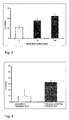
- the improvement of the hydroxy scavenger and anti-oxidative properties of hyaluronic acid achieved by thiolation is exemplified in Fig. 2 , Fig. 3 and Fig. 4 .
- the term "implant” relates to an injectable, preferable sterile, fluid, gel-like or semi solid preparation, which will essentially stay for at least several weeks to month or even for years at or in the vicinity of the site of application until the implant is degraded at least partially, preferably substantially completely.
- the thiol-group-containing polymer has a molecular mass of at least 10000 g/mol, preferably of at least 25000 g/mol, in particular at least 50000 g/mol.
- the molecular mass of the inventive thiol-group containing polymer is of particular relevance if it is important that, when using the polymer, the latter will remain directly at the active site or in the immediate vicinity thereof for a longer period of time than antioxidants known so far which have a substantially lower molecular mass. This is particularly advantageous if it is important to control local oxidation processes or to stop them, respectively, or to reduce them. Therefore, it is preferred for the thiol-group-containing polymer to have at least a molecular mass of 10000 g/mol.
- the thiol-groups within the polymer preferably form inter- and/or intra-molecular disulfide bonds.
- the inventive thiol-group-containing polymer may be used for reducing glutathion disulfide which plays a decisive role in the detoxification of hydrogen peroxide. Due to their antioxidant properties, thiol-group-containing polymers furthermore inhibit the oxidative stress directly caused by the hydroxyl radicals and, thus, they can prevent damage of the DNA, lipids and proteins. Furthermore, thiol-group-containing polymers inhibit the formation of hydroxyl radicals by complexing divalent iron ions. In this way, the Fenton reaction of hydrogen peroxide to hydroxyl radicals can be stopped or largely reduced, respectively.
- the polymer according to the present invention can be used cosmetically or therapeutically whereby soft tissue, in particular dermal tissue, muscle tissue and connective tissue, is preferably augmented.
- Cosmetic dermal augmentation is preferably used to treat cosmetically deep wrinkles in the face region, in particular in nasolabial folds, upper lips folds and forehead folds, fine folds in the eye and cheek region, small skin unevenness and building up cheeks of shrunken cheeks.
- the thiol-group portion of the polymer preferably is more than 20 ⁇ mol/g of polymer, preferably more than 50 ⁇ mol/g of polymer, in particular more than 100 ⁇ mol/g, of polymer.
- the antioxidant properties of the inventive thiol-group-containing polymers are particularly advantageous if the polymer comprises at least 50 ⁇ mol of thiol-groups per gram of polymer.
- polymers which are physiologically tolerable and which can be modified by thiol-groups are suitable.
- Basis polymers are selected from the group of polysaccharides.
- Thiol-group-containing polymers are preferably selected from the group consisting of thiol-group containing hyaluronic acid, thiol-group containing chitosan and combinations of these thiol-group-containing polymers have proved to be particularly advantageous for the use according to the invention.
- Some of these polymers such as, e.g., thiolated hyaluronic acid, are already being used as excipients in medicaments, e.g. so as to introduce active substances more easily and efficiently in mucus layers (cf. e.g. WO 00/25823 ) .
- thiolated hyaluronic acid are already being used as excipients in medicaments, e.g. so as to introduce active substances more easily and efficiently in mucus layers (cf. e.g. WO 00/25823 ) .
- the thiol-groups of the polymers are capable of significantly increase the antioxidant properties possibly present in non-thiolated polymers, or to impart antioxidant properties to the polymers.
- the dwell time can be influenced by the choice of the polymer.
- the biopolymers hyaluronic acid and chitosan are degraded by hyaluronidase and lysozyme, respectively, naturally present in a mammal, in particular in a human.
- synthetic polymers like polyacrylic acid or polyacrylamide no enzymes are present in a mammal body which has the consequence that said polymers have to be removed from the body by surgery, whereby bio-degradable polymers over a time period of at least 6, 12, 24 or even 60 months are degraded by enzymes and consequently removed from the body.
- the at least one thiol-group of the inventively used polymer preferably is derived from a physiologically tolerable thiol compound, e.g. cysteine, cysteamine and N-acetyl-cysteine, which means that these thiol compounds or their derivatives can be used to thiolate polymers.
- a physiologically tolerable thiol compound e.g. cysteine, cysteamine and N-acetyl-cysteine
- the thiolation can be effected by all kinds of chemical reactions by which thiol compounds are bound to polymers, in particular to water-soluble polymers.
- cysteine and cysteine derivatives are advisable for the thiolation, since the former are physiologically tolerable, on the one hand, and easy and cheap to obtain, on the other hand.
- Cysteine and cysteine derivatives preferably can be bound to the polymer via an amide bond.
- the inventive polymer may also be prepared in that in the course of the production of the polymer, at least one monomer is (co-) polymerized with thiol-groups, which has free thiol-groups in the polymer, which means that the thiol-groups are not directly reacted in the polymerizing reaction.
- a polymer which contains at least one monomer which has free thiol-groups in the polymer is also preferred according to the invention (cf. e.g. Bernkop-Schnürch, Adv. Drug Deliv. Rev. 57 (2005): 1569-1582 ).
- the implant of the invention is provided in a corresponding formulation.
- the auxiliary substances required therein will each depend on the formulation and are sufficiently known to the person skilled in the art (cf. e.g. Sarfaraz Niazi, "Handbook of Pharmaceutical Manufacturing Formulations", CRC Press (2004 )).
- the thiol-group-containing polymers according to the invention may also be used subcutaneously and intradermally for dermal augmentation .
- polymers such as, e.g., hyaluronic acid
- auxiliary agents for alleviating signs of skin aging (wrinkles, dryness, loss of elasticity) which, i.a., are associated with a reduction of hyaluronic acid by free radicals in the tissue ( Agren et al., Free Radic. Biol. Med. 23 (1997): 996-1001 ).
- the radical-mediated degradation of thiol-group-containing hyaluronic acid slows down after a subcutaneous or intradermal application.
- the thiol-group-containing polymer may be present at a concentration of from 0.001-20% (m/v), preferably of from 0.01-10% (m/v).
- the formulations may, moreover, contain additional excipients which are normally used for preparations for subcutaneous or intradermal application, e.g. buffer salts, stabilizers, excipients for adjusting the desired osmolality, excipients for adjusting the desired viscosity, and excipients for enhancing the tolerance of the formulation.
- the osmolality and the pH of the finished formulation preferably are in the physiologic range.
- the implant is particularly preferred formulated as gel or as aqueous, preferably single phase, preparation.
- the implant according to the invention which comprises at least one thiol-group-containing polymer can be formulated in a plurality of application forms. Particularly advantageous is the provision of the formulation as aqueous solution/preparation. If the implant is provided as an aqueous solution, the latter may be administered in a simple manner subcutaenously, intradermally or intramuscularly at a desired location.
- polymers having the form of gels and aqueous low-viscous solutions, or in the form of solid preparations (also as inserts for the controlled active substance release) as implants in the human body may cause inflammatory reactions in the surrounding tissue.
- these inflammatory reactions can be alleviated or entirely eliminated, respectively.
- This applies e.g., to the intradermal and subcutaneous application of thiol-group-containing polymers for injection underneath wrinkles, to the use of thiol-group-containing polymers for sphincter augmentation and to the implantation of (semi-)solid preparations based on thiol-group-containing polymers.
- the polymer according to the present invention as a homogeneous single phase aqueous preparation which can be distributed after the application in an easy way and which can be degraded equally slowly by enzymes present at the site of application.
- crosslinked polymer particles as disclosed, for instance, in the WO 99/31167 only two-phase formulations can be produced which consist of a suspension of particles in a liquid carrier medium.
- an augmentation e.g. injections underneath wrinkles
- the carrier medium is absorbed rather quickly from the body and the residual particles have a significantly reduced volume. Therefore, the application has to be corrected which makes it difficult to obtain a satisfying result.
- the medicament or the implant furthermore additionally comprises at least one active substance; for the application in dermatology, preferably an active substance from the group of the local anesthetics (e.g. lidocaine, prilocaine, procaine, mepivacaine), antimycotics (e.g. omoconazole, clotrimazole, bifonazole, miconazole, floconazole, itraconazole, oxiconazole, fenticonazole, terbinafine, ciclopirox, amorolfine), antihistamines, antiallergic agents, anti-inflammatory agents, antibiotics (e.g.
- an active substance from the group of the local anesthetics e.g. lidocaine, prilocaine, procaine, mepivacaine
- antimycotics e.g. omoconazole, clotrimazole, bifonazole, miconazole, floconazole, itraconazole, oxicon
- tetracyclin and derivatives fusidinic acid, chloramphenicol, neomycin, bacitracin, gentamicin, tyrothricin, mupirocin, virginiamycin, rifaximin and amicacin), chemotherapeutic agents, antiviral agents, emollients, skin-protecting agents, agents for treating wounds, topical anti-acne agents and corticosteroids, non-steroidal antiphlogistics, agent for treating hemorrhoids, topical antiseptics and iodine-containing agents.
- At least one pharmaceutical excipient from the group of the buffer salts, preserving agents, excipients for adjusting the desired osmolality, excipients for adjusting the desired viscosity, stabilizers, softeners, coating materials, flow agents, binders, lubricants, fillers, desiccants, disintegrating agents, solvents, solubilizers and excipients for increasing the tolerance of the formulation, may be contained in the implant.
- the medicament, or implant may comprise further active substances.
- Active substances which preferably are admixed to the thiol-group-containing polymer, may themselves have antioxidant properties or may serve to heal, alleviate or prevent the antioxidant disease or the disease caused by oxidative stress, respectively.
- Anti-inflammatory substances and vitamins having antioxidant activity shall be mentioned by way of example in this context.
- the implant additionally comprises at least one unmodified polymer.
- implants which comprise both thiol-group-containing polymers and also unmodified polymers, their mixing ratio relative to each other is variable.
- unmodified polymers polymers are summarized which are entirely unmodified, or which are modified, yet do not have any thiol-group, respectively.
- the implant comprises the thiol-group-containing polymer at a concentration of from 0.001 to 100 % by weight, preferably of from 0.01 to 90 % by weight, even more preferred of from 0.05 to 80 % by weight; wherein the administration occurs more preferably at a concentration of 0.1 to 20%, or even most preferably of 0.1 to 10%.
- the implant according to the invention may either entirely consist of thiol-group-containing polymer, or it may be mixed with excipients, carriers and pharmaceutically active substances.
- the polymer Due to the thiol-groups contained in the polymer of the invention, the polymer has antioxidant properties.
- the tissue to be augmented is selected from the group consisting of dermal tissue, muscle tissue and connective tissue.
- a further aspect of the present invention relates to an implant for tissue augmentation comprising at least one thiol-group-containing polymer as defined above.
- Yet a further aspect of the present invention relates to a method for the cosmetic treatment of skin, and for reducing and/or preventing the aging of skin, in which a thiol-group-containing polymer as defined above is applied subcutaneously and/or intradermally.
- Thiol-group-containing polymers may be used for the cosmetic treatment of the skin and for reducing aging of the skin.
- Polymers such as, e.g., hyaluronic acid, are auxiliary agents well known and frequently used in cosmetics, e.g. for injection underneath wrinkles and into lips. For this purpose, mostly a viscous gel of long-chain molecules is used which is very slowly degraded by the body.
- the polymers are broken up with UV light, massaged into the skin, and subsequently laser-treated, whereby the massaged-in polymer fragments again react to macromolecules in the skin.
- Such polymers are used as an alternative to collagen.
- hydroxyl radical-scavenging properties of the inventive thiol-group-containing polymers were evaluated with the deoxyribose test ( Halliwell et al., Food Chem. Toxicol. 33 (1995): 601-617 ).
- hydroxyl radicals are generated by iron ions which attack deoxyribose.
- the resultant degradation products react with thiobarbituric acid to a pink colouring agent whose absorption is measured.
- both the radical-scavenging and also the complexing properties of the inventive thiol-group-containing polymers are tested.
- inventive thiol-group-containing polymers were also evaluated with the deoxyribose test in dependence on their concentration and their degree of modification. It is important that the inventive thiol-group-containing polymers still unfold their antioxidant activity even at low concentrations because in this way - in combination with the extended dwell time of these thiol-group-containing polymers - a long-lasting effect can be achieved. Moreover, in preparations for ocular, intra-articular, intradermal or subcutaneous applications, high-molecular polymeric compounds can be used only at relatively low initial concentrations, since otherwise, due to their high viscosity, an optimum tolerance is no longer ensured.
- polymer solutions were freshly prepared by dissolving the polymer in phosphate buffer, pH 7.4, so that the final concentration of the polymer in the entire sample solution was 0.1% (m/v). If necessary, the pH of the sample solution was adjusted to 7.4 by the addition of NaOH.
- Phosphate buffer, pH 7.4 without polymer served as the control.
- Figs. 2 and 3 The results are illustrated in Figs. 2 and 3 .
- the inhibition of the oxidation effect (in %) of hydroxyl radicals by the polymers is illustrated.
- the values illustrated are the mean values of at least 3 test repetitions ⁇ standard deviation.
- Fig. 2 it is shown that by the covalent binding of thiol compounds, the antioxidant effect of hyaluronic acid could be significantly increased.
- the dependence of the antioxidant effect of the polymers according to the invention on the degree of modification with thiol compounds is illustrated in Fig. 3 by way of the example of thiolated hyaluronic acid.
- Thiolated hyaluronic acid having a degree of modification of 200 ⁇ M of thiol-groups/g of polymer thus has a higher antioxidant effect than thiolated hyaluronic acid having a degree of modification of 70 ⁇ M of thiol-groups/g of polymer,
- Example 2 Inhibition of the lipid peroxidation in the skin by thiol-group-containing polymers:
- Polymer solutions are freshly prepared in isotonic phosphate buffer so that the final concentration of the polymer in the entire sample solution was 0.05% (m/v).
- the pH of the sample solutions was adjusted to 7.4 by the addition of NaOH.
- Isotonic phosphate buffer, pH 7.4 served as the control.
- 100 mg of porcine dermis were added.
- the samples were incubated at 95°C for 60 min. The reaction was stopped by the addition of 0.3 ml of 20% (v/v) trifluoroacetic acid.
- Oxidation inhibition in % (1 - (A s /A c )) * 100, wherein A s is the adsorption of the sample, and A c is the absorption of the control.
- Example 3 Intradermal application of the thiol-group-containing polymers according to the present invention:
- Example 4 Production of a preparation for the subcutaneous and intradermal use for dermal augmentation:
- a preparation for the subcutaneous and intradermal use was manufactured as follows: 1 g sterile thiol-group containing hyaluronic acid was solved under aseptic conditions and in the absence of oxygen in a 100 ml sterile phosphate buffer pH 7.4. The osmality of this preparation was adjusted by the addition of NaCl to give an osmality of the solution between 200 and 400 mosmol/kg. The solution was filled into flasks and packed gas impermeable.
- Example 5 Formulation for augmenting of scar tissue:
- a preparation was produced as follows: 3 g sterile thiol-group containing hyaluronic acid was solved under aseptic conditions in 100 ml sterile phosphate buffer pH 7.4 and partially crosslinked. Afterwards, the osmality for suggested addition of NaCl to give an osmality of the solution between 200 and 400 mosmol/kg. The solution was filled into flasks and closed gas impermeable.
- Example 6 Formulation for augmenting the anal and urethral sphincter muscles:
- the thiol-group containing polymers have been used to augment the internal anal sphincter in order to prevent anal incontinence by supporting natural occuring cushioning in the anal canal.
- the same formulation was used also to augment the urethral sphincter muscles (see also US 5,785,642 ).
- Incontinence is a often ocurring problem, in particular for women, whose pelvic floor is significantly weakened after pregnancy. If the pelvic floor muscles cannot be forced by conventional methods, the injection of materials for augmentation of the urethra is a good alternative.
- a formulation for the augmentation of the sphincter was produced as follows: 5 g sterile thiol-group -containing chitosan was solved under aseptic conditions in 100 ml sterile borate buffer pH 6.5 and partially crosslinked, the osmality was adjusted by addition of NaCl to 200 to 400 mosmol/kg. The solution was filled into syringes.
- Example. 7 Enzymatic degradation of a single phase crosslinked thiol-group-containing hyaluronic acid formulation and a crosslinked hyaluronic acid particle comprising formulation:
- thiol-group-containing polymers in particular of thiol-group-containing hyaluronic acid
- Thiol-group-containing hyaluronic acid and commercially available formulations comprising crosslinked hyaluronic acid particles have been digested with hyaluronidase. In both cases the hyaluronic acid was degraded, whereby the degradation was comparable with an unmodified hyaluronic acid in the case of thiol-group-containing hyaluronic acid and the fragments formed show a much higher molecular weight as the crosslinked hyaluron acid comprising particles.
- crosslinked thiol-group-containing hyaluronic acids according to the present invention stay longer at the side of application than crosslinked hyaluronic acid particles.
Landscapes
- Health & Medical Sciences (AREA)
- Life Sciences & Earth Sciences (AREA)
- Chemical & Material Sciences (AREA)
- Public Health (AREA)
- Veterinary Medicine (AREA)
- General Health & Medical Sciences (AREA)
- Animal Behavior & Ethology (AREA)
- Epidemiology (AREA)
- Dermatology (AREA)
- Medicinal Chemistry (AREA)
- Oral & Maxillofacial Surgery (AREA)
- Transplantation (AREA)
- Engineering & Computer Science (AREA)
- Materials Engineering (AREA)
- Dispersion Chemistry (AREA)
- Birds (AREA)
- Molecular Biology (AREA)
- Gerontology & Geriatric Medicine (AREA)
- Biomedical Technology (AREA)
- Bioinformatics & Cheminformatics (AREA)
- Nuclear Medicine, Radiotherapy & Molecular Imaging (AREA)
- General Chemical & Material Sciences (AREA)
- Organic Chemistry (AREA)
- Chemical Kinetics & Catalysis (AREA)
- Pharmacology & Pharmacy (AREA)
- Pharmaceuticals Containing Other Organic And Inorganic Compounds (AREA)
- Materials For Medical Uses (AREA)
- Polysaccharides And Polysaccharide Derivatives (AREA)
- Medicinal Preparation (AREA)
- Polymers With Sulfur, Phosphorus Or Metals In The Main Chain (AREA)
- Graft Or Block Polymers (AREA)
- Addition Polymer Or Copolymer, Post-Treatments, Or Chemical Modifications (AREA)
Priority Applications (3)
| Application Number | Priority Date | Filing Date | Title |
|---|---|---|---|
| SI200730903T SI2107913T1 (sl) | 2006-12-22 | 2007-12-21 | Uporaba tioliranih polisaharidov za tkivno avgmentacijo |
| PL07855366T PL2107913T3 (pl) | 2006-12-22 | 2007-12-21 | Zastosowania tiolowanych polisacharydów do augmentacji tkanek |
| CY20121100352T CY1112623T1 (el) | 2006-12-22 | 2012-04-09 | Χρηση πολυσακχαριδιων που περιεχουν λειτουργιες θειολης για αυξηση του ιστου |
Applications Claiming Priority (3)
| Application Number | Priority Date | Filing Date | Title |
|---|---|---|---|
| US87153406P | 2006-12-22 | 2006-12-22 | |
| AT21362006 | 2006-12-22 | ||
| PCT/AT2007/000585 WO2008077172A2 (en) | 2006-12-22 | 2007-12-21 | Use of polymers |
Publications (2)
| Publication Number | Publication Date |
|---|---|
| EP2107913A2 EP2107913A2 (en) | 2009-10-14 |
| EP2107913B1 true EP2107913B1 (en) | 2012-02-15 |
Family
ID=41514873
Family Applications (1)
| Application Number | Title | Priority Date | Filing Date |
|---|---|---|---|
| EP07855366A Active EP2107913B1 (en) | 2006-12-22 | 2007-12-21 | Use of thiolated polysaccharides for tissue augmentation |
Country Status (16)
| Country | Link |
|---|---|
| US (1) | US9597277B2 (enExample) |
| EP (1) | EP2107913B1 (enExample) |
| JP (1) | JP5513893B2 (enExample) |
| CN (1) | CN101622017B (enExample) |
| AT (1) | ATE545436T1 (enExample) |
| AU (1) | AU2007336692B2 (enExample) |
| BR (1) | BRPI0722061B8 (enExample) |
| CA (1) | CA2673323C (enExample) |
| CY (1) | CY1112623T1 (enExample) |
| DK (1) | DK2107913T3 (enExample) |
| ES (1) | ES2391862T3 (enExample) |
| PL (1) | PL2107913T3 (enExample) |
| PT (1) | PT2107913E (enExample) |
| RU (1) | RU2432181C2 (enExample) |
| SI (1) | SI2107913T1 (enExample) |
| WO (1) | WO2008077172A2 (enExample) |
Cited By (1)
| Publication number | Priority date | Publication date | Assignee | Title |
|---|---|---|---|---|
| EP2725042A4 (en) * | 2011-06-27 | 2014-11-05 | Nof Corp | POLYMER AND METHOD FOR ITS MANUFACTURE |
Families Citing this family (53)
| Publication number | Priority date | Publication date | Assignee | Title |
|---|---|---|---|---|
| JP3287804B2 (ja) | 1998-07-23 | 2002-06-04 | 株式会社ミツバ | ワイパ装置の取付け構造 |
| FR2861734B1 (fr) | 2003-04-10 | 2006-04-14 | Corneal Ind | Reticulation de polysaccharides de faible et forte masse moleculaire; preparation d'hydrogels monophasiques injectables; polysaccharides et hydrogels obtenus |
| DK2818184T3 (en) | 2007-11-16 | 2019-02-25 | Allergan Inc | Compositions and methods for the treatment of purple |
| US8394782B2 (en) | 2007-11-30 | 2013-03-12 | Allergan, Inc. | Polysaccharide gel formulation having increased longevity |
| US8357795B2 (en) | 2008-08-04 | 2013-01-22 | Allergan, Inc. | Hyaluronic acid-based gels including lidocaine |
| EP2324064B1 (en) | 2008-09-02 | 2017-11-08 | Tautona Group LP | Threads of hyaluronic acid and/or derivatives thereof, methods of making thereof and uses thereof |
| CN101721349B (zh) | 2008-10-16 | 2011-07-20 | 常州百瑞吉生物医药有限公司 | 可注射原位交联水凝胶及其制备方法和用途 |
| CZ302503B6 (cs) | 2009-12-11 | 2011-06-22 | Contipro C A.S. | Zpusob prípravy derivátu kyseliny hyaluronové oxidovaného v poloze 6 glukosaminové cásti polysacharidu selektivne na aldehyd a zpusob jeho modifikace |
| CZ302504B6 (cs) | 2009-12-11 | 2011-06-22 | Contipro C A.S. | Derivát kyseliny hyaluronové oxidovaný v poloze 6 glukosaminové cásti polysacharidu selektivne na aldehyd, zpusob jeho prípravy a zpusob jeho modifikace |
| US20110172180A1 (en) | 2010-01-13 | 2011-07-14 | Allergan Industrie. Sas | Heat stable hyaluronic acid compositions for dermatological use |
| US9114188B2 (en) | 2010-01-13 | 2015-08-25 | Allergan, Industrie, S.A.S. | Stable hydrogel compositions including additives |
| JP5749283B2 (ja) * | 2010-03-12 | 2015-07-15 | アラーガン・アンデュストリー・ソシエテ・パール・アクシオン・サンプリフィエAllergan Industrie Sas | 皮膚状態を改善するための流体組成物 |
| ES2729994T3 (es) | 2010-03-22 | 2019-11-07 | Allergan Inc | Hidrogeles reticulados de polisacárido y proteína-polisacárido para aumento de tejido blando |
| US8716204B2 (en) | 2010-07-27 | 2014-05-06 | Zimmer, Inc. | Synthetic synovial fluid compositions and methods for making the same |
| US8889123B2 (en) | 2010-08-19 | 2014-11-18 | Allergan, Inc. | Compositions and soft tissue replacement methods |
| US8883139B2 (en) | 2010-08-19 | 2014-11-11 | Allergan Inc. | Compositions and soft tissue replacement methods |
| US9005605B2 (en) | 2010-08-19 | 2015-04-14 | Allergan, Inc. | Compositions and soft tissue replacement methods |
| CN102399295B (zh) | 2010-09-09 | 2013-11-06 | 常州百瑞吉生物医药有限公司 | 低巯基化改性度生物相容高分子巯基化衍生物及其交联材料和用途 |
| CZ20101001A3 (cs) | 2010-12-31 | 2012-02-08 | Cpn S.R.O. | Hyaluronová vlákna, zpusob jejich prípravy a použití |
| US9393263B2 (en) | 2011-06-03 | 2016-07-19 | Allergan, Inc. | Dermal filler compositions including antioxidants |
| US9408797B2 (en) | 2011-06-03 | 2016-08-09 | Allergan, Inc. | Dermal filler compositions for fine line treatment |
| EP2714002B1 (en) | 2011-06-03 | 2019-04-03 | Allergan, Inc. | Dermal filler compositions including antioxidants |
| US20130096081A1 (en) | 2011-06-03 | 2013-04-18 | Allergan, Inc. | Dermal filler compositions |
| EP2545925B1 (en) * | 2011-07-12 | 2018-02-14 | Holy Stone Healthcare Co.,Ltd. | Compositions comprising hyaluronic acid for treating and preventing mucosa related diseases |
| US20130244943A1 (en) | 2011-09-06 | 2013-09-19 | Allergan, Inc. | Hyaluronic acid-collagen matrices for dermal filling and volumizing applications |
| US9662422B2 (en) | 2011-09-06 | 2017-05-30 | Allergan, Inc. | Crosslinked hyaluronic acid-collagen gels for improving tissue graft viability and soft tissue augmentation |
| CZ303879B6 (cs) | 2012-02-28 | 2013-06-05 | Contipro Biotech S.R.O. | Deriváty na bázi kyseliny hyaluronové schopné tvorit hydrogely, zpusob jejich prípravy, hydrogely na bázi techto derivátu, zpusob jejich prípravy a pouzití |
| CZ304512B6 (cs) | 2012-08-08 | 2014-06-11 | Contipro Biotech S.R.O. | Derivát kyseliny hyaluronové, způsob jeho přípravy, způsob jeho modifikace a použití |
| CZ2012842A3 (cs) | 2012-11-27 | 2014-08-20 | Contipro Biotech S.R.O. | Nanomicelární kompozice na bázi C6-C18-acylovaného hyaluronanu, způsob přípravy C6-C18-acylovaného hyaluronanu, způsob přípravy nanomicelární kompozice a stabilizované nanomicelární kompozice a použití |
| US9782345B2 (en) | 2013-10-17 | 2017-10-10 | Jade Therapeutics, Inc. | Ocular composition and method |
| CZ2014150A3 (cs) | 2014-03-11 | 2015-05-20 | Contipro Biotech S.R.O. | Konjugáty oligomeru kyseliny hyaluronové nebo její soli, způsob jejich přípravy a použití |
| SG11201608402WA (en) * | 2014-05-07 | 2016-11-29 | Croma Pharma Ges M B H | Aqueous ophthalmic solution and method for treating dry eye syndrome |
| CZ2014451A3 (cs) | 2014-06-30 | 2016-01-13 | Contipro Pharma A.S. | Protinádorová kompozice na bázi kyseliny hyaluronové a anorganických nanočástic, způsob její přípravy a použití |
| EP3620184A1 (en) | 2014-09-30 | 2020-03-11 | Allergan Industrie, SAS | Stable hydrogel compositions including additives |
| WO2016128783A1 (en) | 2015-02-09 | 2016-08-18 | Allergan Industrie Sas | Compositions and methods for improving skin appearance |
| KR20170118105A (ko) | 2015-02-13 | 2017-10-24 | 알러간 인더스트리 에스에이에스 | 턱과 같은 얼굴 이목구비를 조각, 확대 또는 교정하기 위한 임플란트 |
| CZ309295B6 (cs) | 2015-03-09 | 2022-08-10 | Contipro A.S. | Samonosný, biodegradabilní film na bázi hydrofobizované kyseliny hyaluronové, způsob jeho přípravy a použití |
| CZ306479B6 (cs) | 2015-06-15 | 2017-02-08 | Contipro A.S. | Způsob síťování polysacharidů s využitím fotolabilních chránicích skupin |
| CZ306662B6 (cs) | 2015-06-26 | 2017-04-26 | Contipro A.S. | Deriváty sulfatovaných polysacharidů, způsob jejich přípravy, způsob jejich modifikace a použití |
| JP2018532753A (ja) | 2015-10-30 | 2018-11-08 | クロマ−ファーマ ゲゼルシャフト エム.ベー.ハー. | 滅菌水性点眼液の治療的使用 |
| CA3001634C (en) | 2015-10-30 | 2023-05-23 | Croma-Pharma Gesellschaft M.B.H. | Therapeutic use of a sterile aqueous ophthalmic solution |
| CN105537002A (zh) * | 2015-12-17 | 2016-05-04 | 昆明孚锐特经贸有限公司 | 一种硫化铜钼混合精矿浮选分离抑制剂的制备和应用 |
| ITUA20164153A1 (it) * | 2016-06-07 | 2017-12-07 | Jointherapeutics S R L | Composizioni polisaccaridiche impiegabili nella riparazione tissutale |
| CZ308106B6 (cs) | 2016-06-27 | 2020-01-08 | Contipro A.S. | Nenasycené deriváty polysacharidů, způsob jejich přípravy a jejich použití |
| AR110125A1 (es) * | 2016-11-07 | 2019-02-27 | Croma Pharma Ges M B H | Compuestos poliméricos que liberan sulfuro de hidrógeno |
| EP3618803A1 (en) | 2017-05-03 | 2020-03-11 | Croma-Pharma GmbH | Sterile aqueous ophthalmic solution containing n-(n-acetylcysteinyl)-chitosan for treating non-infectious corneal disorders |
| KR102852956B1 (ko) * | 2018-06-15 | 2025-09-03 | 크로마-파르마 게엠베하 | 안정화된 히알루론산 |
| IL279447B2 (en) * | 2018-06-15 | 2025-05-01 | Croma Pharma Gmbh | A hydrogel-based preparation containing a cross-linked polymer |
| CN110279610B (zh) * | 2019-06-26 | 2021-06-11 | 常州百瑞吉生物医药有限公司 | 一种透明质酸皮肤保护组合物及其制备方法和应用 |
| ES2985960T3 (es) | 2019-12-19 | 2024-11-07 | Croma Pharma Gmbh | Hialuronano modificado con tiol e hidrogel que comprende el hialuronano reticulado |
| CN113134116B (zh) * | 2020-01-20 | 2022-09-06 | 山东威高宏瑞医学科技有限公司 | 内镜微创手术用的填充组合物及填充制剂 |
| CA3206171A1 (en) * | 2020-12-30 | 2022-07-07 | Convatec Technologies Inc. | Surface treatment system and method for subcutaneous device |
| CN119798798A (zh) * | 2025-01-09 | 2025-04-11 | 常州百瑞吉生物医药股份有限公司 | 水性溶液透明质酸寡糖组合物的制备方法及组合物、应用 |
Citations (2)
| Publication number | Priority date | Publication date | Assignee | Title |
|---|---|---|---|---|
| WO2000016818A1 (en) * | 1998-09-18 | 2000-03-30 | Orthogene L.L.C. | Functionalized derivatives of hyaluronic acid and formation of hydrogels in situ using same |
| FR2920671A1 (fr) * | 2007-09-07 | 2009-03-13 | Cousin Biotech Soc Par Actions | Implant textile, notamment pour la refection des hernies |
Family Cites Families (17)
| Publication number | Priority date | Publication date | Assignee | Title |
|---|---|---|---|---|
| US4716224A (en) | 1984-05-04 | 1987-12-29 | Seikagaku Kogyo Co. Ltd. | Crosslinked hyaluronic acid and its use |
| US4713448A (en) | 1985-03-12 | 1987-12-15 | Biomatrix, Inc. | Chemically modified hyaluronic acid preparation and method of recovery thereof from animal tissues |
| EP0784487A1 (en) * | 1993-03-19 | 1997-07-23 | Medinvent | A composition and a method for tissue augmentation |
| FR2727117A1 (fr) | 1994-11-18 | 1996-05-24 | Geffard Michel | Utilisation de conjugues de la polylysine pour la preparation de medicaments utiles dans le traitement des maladies neurodegeneratives et des affections degeneratives a caractere autoimmun |
| US6214331B1 (en) | 1995-06-06 | 2001-04-10 | C. R. Bard, Inc. | Process for the preparation of aqueous dispersions of particles of water-soluble polymers and the particles obtained |
| US5785642A (en) | 1996-10-18 | 1998-07-28 | Micro Therapeutics, Inc. | Methods for treating urinary incontinence in mammals |
| US6620927B2 (en) * | 2001-02-22 | 2003-09-16 | Anika Therapeutics, Inc. | Thiol-modified hyaluronan |
| US6610810B2 (en) * | 2001-03-13 | 2003-08-26 | Glyn Owen Phillips | Biopolymers obtained by solid state irradiation in an unsaturated gaseous atmosphere |
| ITMI20011238A1 (it) * | 2001-06-12 | 2002-12-12 | Bartholdy Consultadoria E Serv | Polimeri polisaccaridici di origine naturale coniugati chimicamente asostanze farmacologicamente o biologicamente attive e loro proprieta' |
| ATA13842001A (de) | 2001-08-31 | 2002-10-15 | Mucobiomer Biotechnologische F | Chitosan-thio-alkyl-amidin konjugate und deren kosmetische sowie pharmazeutische verwendung |
| GB2386900B (en) | 2002-03-25 | 2006-11-01 | Johnson & Johnson Medical Ltd | Use in wound dressings of chemically modified polysaccharides |
| US20050176620A1 (en) * | 2002-06-21 | 2005-08-11 | Prestwich Glenn D. | Crosslinked compounds and methods of making and using thereof |
| WO2004073759A1 (en) | 2003-02-19 | 2004-09-02 | Aventis Pharmaceuticals Holdings Inc. | Composition and method for intradermal soft tissue augmentation |
| US20050282747A1 (en) * | 2003-10-01 | 2005-12-22 | The Research Foundation Of State University Of New York At Stony Brook | Methods and compositions for wound healing |
| CA2574232A1 (en) | 2004-07-22 | 2006-01-26 | Thiomatrix Forschungs - Und Beratungs Gmbh | Use of compounds containing thiol groups as an efflux pump inhibitor |
| EP1817347B1 (en) | 2004-11-24 | 2017-05-17 | Albumedix A/S | Method of cross-linking hyaluronic acid with divinylsulfone |
| US20070087059A1 (en) * | 2005-10-17 | 2007-04-19 | Frank Everaerts | Bioactive delivery matrix compositions and methods |
-
2007
- 2007-12-21 SI SI200730903T patent/SI2107913T1/sl unknown
- 2007-12-21 DK DK07855366.6T patent/DK2107913T3/da active
- 2007-12-21 ES ES07855366T patent/ES2391862T3/es active Active
- 2007-12-21 JP JP2009541680A patent/JP5513893B2/ja active Active
- 2007-12-21 WO PCT/AT2007/000585 patent/WO2008077172A2/en not_active Ceased
- 2007-12-21 RU RU2009128235/15A patent/RU2432181C2/ru active
- 2007-12-21 AT AT07855366T patent/ATE545436T1/de active
- 2007-12-21 BR BRPI0722061A patent/BRPI0722061B8/pt active IP Right Grant
- 2007-12-21 PT PT07855366T patent/PT2107913E/pt unknown
- 2007-12-21 CA CA2673323A patent/CA2673323C/en active Active
- 2007-12-21 US US12/520,820 patent/US9597277B2/en active Active
- 2007-12-21 AU AU2007336692A patent/AU2007336692B2/en active Active
- 2007-12-21 PL PL07855366T patent/PL2107913T3/pl unknown
- 2007-12-21 CN CN200780047621.3A patent/CN101622017B/zh active Active
- 2007-12-21 EP EP07855366A patent/EP2107913B1/en active Active
-
2012
- 2012-04-09 CY CY20121100352T patent/CY1112623T1/el unknown
Patent Citations (2)
| Publication number | Priority date | Publication date | Assignee | Title |
|---|---|---|---|---|
| WO2000016818A1 (en) * | 1998-09-18 | 2000-03-30 | Orthogene L.L.C. | Functionalized derivatives of hyaluronic acid and formation of hydrogels in situ using same |
| FR2920671A1 (fr) * | 2007-09-07 | 2009-03-13 | Cousin Biotech Soc Par Actions | Implant textile, notamment pour la refection des hernies |
Cited By (2)
| Publication number | Priority date | Publication date | Assignee | Title |
|---|---|---|---|---|
| EP2725042A4 (en) * | 2011-06-27 | 2014-11-05 | Nof Corp | POLYMER AND METHOD FOR ITS MANUFACTURE |
| US9127099B2 (en) | 2011-06-27 | 2015-09-08 | Nof Corporation | Polymer and method for producing same |
Also Published As
| Publication number | Publication date |
|---|---|
| BRPI0722061A2 (pt) | 2014-04-01 |
| AU2007336692A1 (en) | 2008-07-03 |
| JP5513893B2 (ja) | 2014-06-04 |
| CA2673323C (en) | 2013-07-16 |
| DK2107913T3 (da) | 2012-05-21 |
| EP2107913A2 (en) | 2009-10-14 |
| CY1112623T1 (el) | 2016-02-10 |
| PT2107913E (pt) | 2012-05-10 |
| RU2432181C2 (ru) | 2011-10-27 |
| RU2009128235A (ru) | 2011-01-27 |
| BRPI0722061B1 (pt) | 2018-05-15 |
| CN101622017B (zh) | 2018-09-11 |
| WO2008077172A2 (en) | 2008-07-03 |
| US9597277B2 (en) | 2017-03-21 |
| ATE545436T1 (de) | 2012-03-15 |
| PL2107913T3 (pl) | 2012-07-31 |
| SI2107913T1 (sl) | 2012-05-31 |
| US20100028399A1 (en) | 2010-02-04 |
| AU2007336692B2 (en) | 2013-12-12 |
| CN101622017A (zh) | 2010-01-06 |
| BRPI0722061B8 (pt) | 2021-06-22 |
| CA2673323A1 (en) | 2008-07-03 |
| WO2008077172A3 (en) | 2009-05-14 |
| JP2010512859A (ja) | 2010-04-30 |
| ES2391862T3 (es) | 2012-11-30 |
Similar Documents
| Publication | Publication Date | Title |
|---|---|---|
| EP2107913B1 (en) | Use of thiolated polysaccharides for tissue augmentation | |
| US20250288718A1 (en) | Heat stable hyaluronic acid compositions for dermatological use | |
| KR102015676B1 (ko) | 항산화제를 포함하는 피부 충전제 조성물 | |
| KR101554758B1 (ko) | 다당류 젤 제형 | |
| US20120225842A1 (en) | Hyaluronic acid compositions for dermatological use | |
| BR112021014505A2 (pt) | Composição farmacêutica ou dermatológica para sua utilização como medicamento, utilização cosmética não terapêutica ou dermatológica de uma composição, e utilização de uma composição farmacêutica | |
| CA3240397A1 (en) | Hydrogel microparticle-based soft tissue fillers | |
| CA3101408A1 (en) | Hydrogel composition comprising a crosslinked polymer | |
| CN118234764A (zh) | 一种制备透明质酸接枝聚(n-异丙基丙烯酰胺)(ha-g-pnipam)的方法 | |
| AU2018260925B2 (en) | Polysaccharide gel formulation | |
| Rashid et al. | Overview of Hydrogels as Transdermal Delivery System for Pharmaceutical and Cosmetic Applications, and Hyaluronic Acid as a Polymer Model in Hydrogel Preparation | |
| Osmani et al. | In-situ Forming Parenteral Drug Delivery: A New-fangled Loom In |
Legal Events
| Date | Code | Title | Description |
|---|---|---|---|
| PUAI | Public reference made under article 153(3) epc to a published international application that has entered the european phase |
Free format text: ORIGINAL CODE: 0009012 |
|
| 17P | Request for examination filed |
Effective date: 20090722 |
|
| AK | Designated contracting states |
Kind code of ref document: A2 Designated state(s): AT BE BG CH CY CZ DE DK EE ES FI FR GB GR HU IE IS IT LI LT LU LV MC MT NL PL PT RO SE SI SK TR |
|
| 17Q | First examination report despatched |
Effective date: 20100115 |
|
| DAX | Request for extension of the european patent (deleted) | ||
| GRAP | Despatch of communication of intention to grant a patent |
Free format text: ORIGINAL CODE: EPIDOSNIGR1 |
|
| RTI1 | Title (correction) |
Free format text: USE OF THIOLATED POLYSACCHARIDES FOR TISSUE AUGMENTATION |
|
| GRAS | Grant fee paid |
Free format text: ORIGINAL CODE: EPIDOSNIGR3 |
|
| GRAA | (expected) grant |
Free format text: ORIGINAL CODE: 0009210 |
|
| AK | Designated contracting states |
Kind code of ref document: B1 Designated state(s): AT BE BG CH CY CZ DE DK EE ES FI FR GB GR HU IE IS IT LI LT LU LV MC MT NL PL PT RO SE SI SK TR |
|
| REG | Reference to a national code |
Ref country code: CH Ref legal event code: EP Ref country code: GB Ref legal event code: FG4D |
|
| REG | Reference to a national code |
Ref country code: IE Ref legal event code: FG4D |
|
| REG | Reference to a national code |
Ref country code: AT Ref legal event code: REF Ref document number: 545436 Country of ref document: AT Kind code of ref document: T Effective date: 20120315 |
|
| REG | Reference to a national code |
Ref country code: CH Ref legal event code: NV Representative=s name: BOGENSBERGER PATENT- & MARKENBUERO DR. BURKHARD BO |
|
| REG | Reference to a national code |
Ref country code: DE Ref legal event code: R096 Ref document number: 602007020754 Country of ref document: DE Effective date: 20120412 |
|
| REG | Reference to a national code |
Ref country code: RO Ref legal event code: EPE |
|
| REG | Reference to a national code |
Ref country code: NL Ref legal event code: T3 |
|
| REG | Reference to a national code |
Ref country code: PT Ref legal event code: SC4A Free format text: AVAILABILITY OF NATIONAL TRANSLATION Effective date: 20120426 |
|
| REG | Reference to a national code |
Ref country code: DK Ref legal event code: T3 |
|
| REG | Reference to a national code |
Ref country code: SE Ref legal event code: TRGR |
|
| REG | Reference to a national code |
Ref country code: SK Ref legal event code: T3 Ref document number: E 11540 Country of ref document: SK |
|
| LTIE | Lt: invalidation of european patent or patent extension |
Effective date: 20120215 |
|
| PG25 | Lapsed in a contracting state [announced via postgrant information from national office to epo] |
Ref country code: LT Free format text: LAPSE BECAUSE OF FAILURE TO SUBMIT A TRANSLATION OF THE DESCRIPTION OR TO PAY THE FEE WITHIN THE PRESCRIBED TIME-LIMIT Effective date: 20120215 |
|
| REG | Reference to a national code |
Ref country code: PL Ref legal event code: T3 |
|
| PG25 | Lapsed in a contracting state [announced via postgrant information from national office to epo] |
Ref country code: LV Free format text: LAPSE BECAUSE OF FAILURE TO SUBMIT A TRANSLATION OF THE DESCRIPTION OR TO PAY THE FEE WITHIN THE PRESCRIBED TIME-LIMIT Effective date: 20120215 Ref country code: GR Free format text: LAPSE BECAUSE OF FAILURE TO SUBMIT A TRANSLATION OF THE DESCRIPTION OR TO PAY THE FEE WITHIN THE PRESCRIBED TIME-LIMIT Effective date: 20120516 |
|
| REG | Reference to a national code |
Ref country code: HU Ref legal event code: AG4A Ref document number: E013832 Country of ref document: HU |
|
| PG25 | Lapsed in a contracting state [announced via postgrant information from national office to epo] |
Ref country code: EE Free format text: LAPSE BECAUSE OF FAILURE TO SUBMIT A TRANSLATION OF THE DESCRIPTION OR TO PAY THE FEE WITHIN THE PRESCRIBED TIME-LIMIT Effective date: 20120215 |
|
| REG | Reference to a national code |
Ref country code: ES Ref legal event code: NE2A Effective date: 20121022 |
|
| REG | Reference to a national code |
Ref country code: ES Ref legal event code: FG2A Ref document number: 2391862 Country of ref document: ES Kind code of ref document: T3 Effective date: 20121130 |
|
| PLBE | No opposition filed within time limit |
Free format text: ORIGINAL CODE: 0009261 |
|
| STAA | Information on the status of an ep patent application or granted ep patent |
Free format text: STATUS: NO OPPOSITION FILED WITHIN TIME LIMIT |
|
| 26N | No opposition filed |
Effective date: 20121116 |
|
| REG | Reference to a national code |
Ref country code: DE Ref legal event code: R097 Ref document number: 602007020754 Country of ref document: DE Effective date: 20121116 |
|
| REG | Reference to a national code |
Ref country code: CH Ref legal event code: PCAR Free format text: NEW ADDRESS: FALLSGASSE 7, 9492 ESCHEN (LI) |
|
| PG25 | Lapsed in a contracting state [announced via postgrant information from national office to epo] |
Ref country code: MC Free format text: LAPSE BECAUSE OF NON-PAYMENT OF DUE FEES Effective date: 20121231 |
|
| REG | Reference to a national code |
Ref country code: IE Ref legal event code: MM4A |
|
| PG25 | Lapsed in a contracting state [announced via postgrant information from national office to epo] |
Ref country code: IE Free format text: LAPSE BECAUSE OF NON-PAYMENT OF DUE FEES Effective date: 20121221 |
|
| PG25 | Lapsed in a contracting state [announced via postgrant information from national office to epo] |
Ref country code: MT Free format text: LAPSE BECAUSE OF FAILURE TO SUBMIT A TRANSLATION OF THE DESCRIPTION OR TO PAY THE FEE WITHIN THE PRESCRIBED TIME-LIMIT Effective date: 20120215 |
|
| REG | Reference to a national code |
Ref country code: FR Ref legal event code: PLFP Year of fee payment: 9 |
|
| REG | Reference to a national code |
Ref country code: FR Ref legal event code: PLFP Year of fee payment: 10 |
|
| REG | Reference to a national code |
Ref country code: FR Ref legal event code: PLFP Year of fee payment: 11 |
|
| PGFP | Annual fee paid to national office [announced via postgrant information from national office to epo] |
Ref country code: SK Payment date: 20191127 Year of fee payment: 13 Ref country code: PT Payment date: 20191218 Year of fee payment: 13 Ref country code: CZ Payment date: 20191218 Year of fee payment: 13 Ref country code: CY Payment date: 20191219 Year of fee payment: 13 Ref country code: HU Payment date: 20191216 Year of fee payment: 13 Ref country code: FI Payment date: 20191220 Year of fee payment: 13 Ref country code: BG Payment date: 20191220 Year of fee payment: 13 |
|
| PGFP | Annual fee paid to national office [announced via postgrant information from national office to epo] |
Ref country code: LU Payment date: 20191219 Year of fee payment: 13 Ref country code: SI Payment date: 20191121 Year of fee payment: 13 Ref country code: DK Payment date: 20191227 Year of fee payment: 13 Ref country code: IS Payment date: 20191120 Year of fee payment: 13 |
|
| REG | Reference to a national code |
Ref country code: AT Ref legal event code: HC Ref document number: 545436 Country of ref document: AT Kind code of ref document: T Owner name: CROMA PHARMA GMBH, AT Effective date: 20200805 |
|
| REG | Reference to a national code |
Ref country code: FI Ref legal event code: MAE |
|
| REG | Reference to a national code |
Ref country code: DK Ref legal event code: EBP Effective date: 20201231 |
|
| PG25 | Lapsed in a contracting state [announced via postgrant information from national office to epo] |
Ref country code: PT Free format text: LAPSE BECAUSE OF NON-PAYMENT OF DUE FEES Effective date: 20210621 Ref country code: CY Free format text: LAPSE BECAUSE OF NON-PAYMENT OF DUE FEES Effective date: 20201221 Ref country code: CZ Free format text: LAPSE BECAUSE OF NON-PAYMENT OF DUE FEES Effective date: 20201221 Ref country code: FI Free format text: LAPSE BECAUSE OF NON-PAYMENT OF DUE FEES Effective date: 20201221 |
|
| REG | Reference to a national code |
Ref country code: SK Ref legal event code: MM4A Ref document number: E 11540 Country of ref document: SK Effective date: 20201221 |
|
| PG25 | Lapsed in a contracting state [announced via postgrant information from national office to epo] |
Ref country code: BG Free format text: LAPSE BECAUSE OF NON-PAYMENT OF DUE FEES Effective date: 20210630 Ref country code: HU Free format text: LAPSE BECAUSE OF NON-PAYMENT OF DUE FEES Effective date: 20201222 Ref country code: LU Free format text: LAPSE BECAUSE OF NON-PAYMENT OF DUE FEES Effective date: 20201221 |
|
| PG25 | Lapsed in a contracting state [announced via postgrant information from national office to epo] |
Ref country code: SK Free format text: LAPSE BECAUSE OF NON-PAYMENT OF DUE FEES Effective date: 20201221 |
|
| PG25 | Lapsed in a contracting state [announced via postgrant information from national office to epo] |
Ref country code: DK Free format text: LAPSE BECAUSE OF NON-PAYMENT OF DUE FEES Effective date: 20201231 |
|
| REG | Reference to a national code |
Ref country code: SI Ref legal event code: KO00 Effective date: 20211129 |
|
| PG25 | Lapsed in a contracting state [announced via postgrant information from national office to epo] |
Ref country code: SI Free format text: LAPSE BECAUSE OF NON-PAYMENT OF DUE FEES Effective date: 20201222 |
|
| P01 | Opt-out of the competence of the unified patent court (upc) registered |
Effective date: 20230515 |
|
| PGFP | Annual fee paid to national office [announced via postgrant information from national office to epo] |
Ref country code: SE Payment date: 20231220 Year of fee payment: 17 Ref country code: RO Payment date: 20231212 Year of fee payment: 17 Ref country code: NL Payment date: 20231220 Year of fee payment: 17 |
|
| PGFP | Annual fee paid to national office [announced via postgrant information from national office to epo] |
Ref country code: BE Payment date: 20231220 Year of fee payment: 17 |
|
| PGFP | Annual fee paid to national office [announced via postgrant information from national office to epo] |
Ref country code: CH Payment date: 20240101 Year of fee payment: 17 |
|
| PGFP | Annual fee paid to national office [announced via postgrant information from national office to epo] |
Ref country code: TR Payment date: 20231219 Year of fee payment: 17 |
|
| PGFP | Annual fee paid to national office [announced via postgrant information from national office to epo] |
Ref country code: DE Payment date: 20241210 Year of fee payment: 18 |
|
| PGFP | Annual fee paid to national office [announced via postgrant information from national office to epo] |
Ref country code: PL Payment date: 20241213 Year of fee payment: 18 |
|
| PGFP | Annual fee paid to national office [announced via postgrant information from national office to epo] |
Ref country code: GB Payment date: 20241224 Year of fee payment: 18 |
|
| PGFP | Annual fee paid to national office [announced via postgrant information from national office to epo] |
Ref country code: FR Payment date: 20241223 Year of fee payment: 18 |
|
| PGFP | Annual fee paid to national office [announced via postgrant information from national office to epo] |
Ref country code: AT Payment date: 20241220 Year of fee payment: 18 |
|
| PGFP | Annual fee paid to national office [announced via postgrant information from national office to epo] |
Ref country code: ES Payment date: 20250131 Year of fee payment: 18 |
|
| PGFP | Annual fee paid to national office [announced via postgrant information from national office to epo] |
Ref country code: IT Payment date: 20241227 Year of fee payment: 18 |
|
| PG25 | Lapsed in a contracting state [announced via postgrant information from national office to epo] |
Ref country code: RO Free format text: LAPSE BECAUSE OF NON-PAYMENT OF DUE FEES Effective date: 20241221 |
|
| REG | Reference to a national code |
Ref country code: SE Ref legal event code: EUG |
|
| REG | Reference to a national code |
Ref country code: CH Ref legal event code: PL |
|
| REG | Reference to a national code |
Ref country code: NL Ref legal event code: MM Effective date: 20250101 |
|
| PG25 | Lapsed in a contracting state [announced via postgrant information from national office to epo] |
Ref country code: NL Free format text: LAPSE BECAUSE OF NON-PAYMENT OF DUE FEES Effective date: 20250101 |
|
| REG | Reference to a national code |
Ref country code: BE Ref legal event code: MM Effective date: 20241231 |
|
| PG25 | Lapsed in a contracting state [announced via postgrant information from national office to epo] |
Ref country code: IS Free format text: LAPSE BECAUSE OF NON-PAYMENT OF DUE FEES Effective date: 20210628 Ref country code: BE Free format text: LAPSE BECAUSE OF NON-PAYMENT OF DUE FEES Effective date: 20241231 |
|
| PG25 | Lapsed in a contracting state [announced via postgrant information from national office to epo] |
Ref country code: CH Free format text: LAPSE BECAUSE OF NON-PAYMENT OF DUE FEES Effective date: 20241231 |