EP1945397B1 - Brazing material with continuous length layer of elastomer containing a flux - Google Patents
Brazing material with continuous length layer of elastomer containing a flux Download PDFInfo
- Publication number
- EP1945397B1 EP1945397B1 EP06837365.3A EP06837365A EP1945397B1 EP 1945397 B1 EP1945397 B1 EP 1945397B1 EP 06837365 A EP06837365 A EP 06837365A EP 1945397 B1 EP1945397 B1 EP 1945397B1
- Authority
- EP
- European Patent Office
- Prior art keywords
- flux
- brazing material
- brazing
- flux composition
- composition
- Prior art date
- Legal status (The legal status is an assumption and is not a legal conclusion. Google has not performed a legal analysis and makes no representation as to the accuracy of the status listed.)
- Active
Links
Images




Classifications
-
- B—PERFORMING OPERATIONS; TRANSPORTING
- B23—MACHINE TOOLS; METAL-WORKING NOT OTHERWISE PROVIDED FOR
- B23K—SOLDERING OR UNSOLDERING; WELDING; CLADDING OR PLATING BY SOLDERING OR WELDING; CUTTING BY APPLYING HEAT LOCALLY, e.g. FLAME CUTTING; WORKING BY LASER BEAM
- B23K35/00—Rods, electrodes, materials, or media, for use in soldering, welding, or cutting
- B23K35/22—Rods, electrodes, materials, or media, for use in soldering, welding, or cutting characterised by the composition or nature of the material
- B23K35/34—Rods, electrodes, materials, or media, for use in soldering, welding, or cutting characterised by the composition or nature of the material comprising compounds which yield metals when heated
-
- B—PERFORMING OPERATIONS; TRANSPORTING
- B23—MACHINE TOOLS; METAL-WORKING NOT OTHERWISE PROVIDED FOR
- B23K—SOLDERING OR UNSOLDERING; WELDING; CLADDING OR PLATING BY SOLDERING OR WELDING; CUTTING BY APPLYING HEAT LOCALLY, e.g. FLAME CUTTING; WORKING BY LASER BEAM
- B23K35/00—Rods, electrodes, materials, or media, for use in soldering, welding, or cutting
- B23K35/22—Rods, electrodes, materials, or media, for use in soldering, welding, or cutting characterised by the composition or nature of the material
- B23K35/36—Selection of non-metallic compositions, e.g. coatings or fluxes; Selection of soldering or welding materials, conjoint with selection of non-metallic compositions, both selections being of interest
- B23K35/362—Selection of compositions of fluxes
-
- B—PERFORMING OPERATIONS; TRANSPORTING
- B23—MACHINE TOOLS; METAL-WORKING NOT OTHERWISE PROVIDED FOR
- B23K—SOLDERING OR UNSOLDERING; WELDING; CLADDING OR PLATING BY SOLDERING OR WELDING; CUTTING BY APPLYING HEAT LOCALLY, e.g. FLAME CUTTING; WORKING BY LASER BEAM
- B23K1/00—Soldering, e.g. brazing, or unsoldering
- B23K1/20—Preliminary treatment of work or areas to be soldered, e.g. in respect of a galvanic coating
-
- B—PERFORMING OPERATIONS; TRANSPORTING
- B23—MACHINE TOOLS; METAL-WORKING NOT OTHERWISE PROVIDED FOR
- B23K—SOLDERING OR UNSOLDERING; WELDING; CLADDING OR PLATING BY SOLDERING OR WELDING; CUTTING BY APPLYING HEAT LOCALLY, e.g. FLAME CUTTING; WORKING BY LASER BEAM
- B23K35/00—Rods, electrodes, materials, or media, for use in soldering, welding, or cutting
- B23K35/22—Rods, electrodes, materials, or media, for use in soldering, welding, or cutting characterised by the composition or nature of the material
- B23K35/36—Selection of non-metallic compositions, e.g. coatings or fluxes; Selection of soldering or welding materials, conjoint with selection of non-metallic compositions, both selections being of interest
-
- B—PERFORMING OPERATIONS; TRANSPORTING
- B23—MACHINE TOOLS; METAL-WORKING NOT OTHERWISE PROVIDED FOR
- B23K—SOLDERING OR UNSOLDERING; WELDING; CLADDING OR PLATING BY SOLDERING OR WELDING; CUTTING BY APPLYING HEAT LOCALLY, e.g. FLAME CUTTING; WORKING BY LASER BEAM
- B23K35/00—Rods, electrodes, materials, or media, for use in soldering, welding, or cutting
- B23K35/22—Rods, electrodes, materials, or media, for use in soldering, welding, or cutting characterised by the composition or nature of the material
- B23K35/36—Selection of non-metallic compositions, e.g. coatings or fluxes; Selection of soldering or welding materials, conjoint with selection of non-metallic compositions, both selections being of interest
- B23K35/3601—Selection of non-metallic compositions, e.g. coatings or fluxes; Selection of soldering or welding materials, conjoint with selection of non-metallic compositions, both selections being of interest with inorganic compounds as principal constituents
- B23K35/3602—Carbonates, basic oxides or hydroxides
-
- B—PERFORMING OPERATIONS; TRANSPORTING
- B23—MACHINE TOOLS; METAL-WORKING NOT OTHERWISE PROVIDED FOR
- B23K—SOLDERING OR UNSOLDERING; WELDING; CLADDING OR PLATING BY SOLDERING OR WELDING; CUTTING BY APPLYING HEAT LOCALLY, e.g. FLAME CUTTING; WORKING BY LASER BEAM
- B23K35/00—Rods, electrodes, materials, or media, for use in soldering, welding, or cutting
- B23K35/22—Rods, electrodes, materials, or media, for use in soldering, welding, or cutting characterised by the composition or nature of the material
- B23K35/36—Selection of non-metallic compositions, e.g. coatings or fluxes; Selection of soldering or welding materials, conjoint with selection of non-metallic compositions, both selections being of interest
- B23K35/3601—Selection of non-metallic compositions, e.g. coatings or fluxes; Selection of soldering or welding materials, conjoint with selection of non-metallic compositions, both selections being of interest with inorganic compounds as principal constituents
- B23K35/3607—Silica or silicates
-
- B—PERFORMING OPERATIONS; TRANSPORTING
- B23—MACHINE TOOLS; METAL-WORKING NOT OTHERWISE PROVIDED FOR
- B23K—SOLDERING OR UNSOLDERING; WELDING; CLADDING OR PLATING BY SOLDERING OR WELDING; CUTTING BY APPLYING HEAT LOCALLY, e.g. FLAME CUTTING; WORKING BY LASER BEAM
- B23K35/00—Rods, electrodes, materials, or media, for use in soldering, welding, or cutting
- B23K35/22—Rods, electrodes, materials, or media, for use in soldering, welding, or cutting characterised by the composition or nature of the material
- B23K35/36—Selection of non-metallic compositions, e.g. coatings or fluxes; Selection of soldering or welding materials, conjoint with selection of non-metallic compositions, both selections being of interest
- B23K35/3612—Selection of non-metallic compositions, e.g. coatings or fluxes; Selection of soldering or welding materials, conjoint with selection of non-metallic compositions, both selections being of interest with organic compounds as principal constituents
- B23K35/3613—Polymers, e.g. resins
-
- B—PERFORMING OPERATIONS; TRANSPORTING
- B23—MACHINE TOOLS; METAL-WORKING NOT OTHERWISE PROVIDED FOR
- B23K—SOLDERING OR UNSOLDERING; WELDING; CLADDING OR PLATING BY SOLDERING OR WELDING; CUTTING BY APPLYING HEAT LOCALLY, e.g. FLAME CUTTING; WORKING BY LASER BEAM
- B23K35/00—Rods, electrodes, materials, or media, for use in soldering, welding, or cutting
- B23K35/22—Rods, electrodes, materials, or media, for use in soldering, welding, or cutting characterised by the composition or nature of the material
- B23K35/36—Selection of non-metallic compositions, e.g. coatings or fluxes; Selection of soldering or welding materials, conjoint with selection of non-metallic compositions, both selections being of interest
- B23K35/365—Selection of non-metallic compositions of coating materials either alone or conjoint with selection of soldering or welding materials
-
- C—CHEMISTRY; METALLURGY
- C08—ORGANIC MACROMOLECULAR COMPOUNDS; THEIR PREPARATION OR CHEMICAL WORKING-UP; COMPOSITIONS BASED THEREON
- C08K—Use of inorganic or non-macromolecular organic substances as compounding ingredients
- C08K3/00—Use of inorganic substances as compounding ingredients
- C08K3/02—Elements
- C08K3/08—Metals
-
- C—CHEMISTRY; METALLURGY
- C08—ORGANIC MACROMOLECULAR COMPOUNDS; THEIR PREPARATION OR CHEMICAL WORKING-UP; COMPOSITIONS BASED THEREON
- C08K—Use of inorganic or non-macromolecular organic substances as compounding ingredients
- C08K5/00—Use of organic ingredients
- C08K5/0008—Organic ingredients according to more than one of the "one dot" groups of C08K5/01 - C08K5/59
- C08K5/0016—Plasticisers
-
- Y—GENERAL TAGGING OF NEW TECHNOLOGICAL DEVELOPMENTS; GENERAL TAGGING OF CROSS-SECTIONAL TECHNOLOGIES SPANNING OVER SEVERAL SECTIONS OF THE IPC; TECHNICAL SUBJECTS COVERED BY FORMER USPC CROSS-REFERENCE ART COLLECTIONS [XRACs] AND DIGESTS
- Y10—TECHNICAL SUBJECTS COVERED BY FORMER USPC
- Y10T—TECHNICAL SUBJECTS COVERED BY FORMER US CLASSIFICATION
- Y10T428/00—Stock material or miscellaneous articles
- Y10T428/29—Coated or structually defined flake, particle, cell, strand, strand portion, rod, filament, macroscopic fiber or mass thereof
- Y10T428/2913—Rod, strand, filament or fiber
- Y10T428/2933—Coated or with bond, impregnation or core
- Y10T428/294—Coated or with bond, impregnation or core including metal or compound thereof [excluding glass, ceramic and asbestos]
- Y10T428/2951—Metal with weld modifying or stabilizing coating [e.g., flux, slag, producer, etc.]
Definitions
- This invention relates to a flux composition for use in brazing operations, a brazing material and, and a method of manufacturing said brazing material.
- brazing soldering and welding are similar, there are important differences. Soldering is generally performed at lower temperatures (below 450° Celsius), but does not produce as strong a joint. Welding is a high-temperature process in which the two metals to be joined are actually melted and fused together. Brazing is a method of joining two pieces of metal together with a third, molten filler material. Welded and brazed joints are usually at least as strong as the metals being joined. The welding process is preferable for applications which benefit from or require highly localized, pinpoint heating. Brazing is particularly useful in more difficult applications, such as joining of larger areas, linear joining, and joining metals or alloys having different melting points.
- brazing In brazing the components to be joined are assembled so that there is a small gap, the so-called “joint gap” between their mating surfaces.
- the components are heated (or at least heated in the region of the proposed joint) to a temperature above the melting point of the brazing material but below the melting point of the components to be joined (or, in the case of two or more components are made of dissimilar metals or alloys, below the lower or lowest melting point of any of the components to be joined). Heat may be provided by torch, furnace, induction or any other heating method that may be used in joining components.
- the brazing material melts, wetting the surfaces of the components being joined, and is drawn or held in the joint gap by capillary action. Upon cooling, the brazing material solidifies, forming a metallurgical bond between the surfaces of the joined components.
- Brazing may be used to join metal-to-metal, alloy-to-alloy, metal-to-alloy, metal-to-ceramic, alloy-to-ceramic, or ceramic-to-ceramic. Ceramic components may be coated with metals or alloys prior to brazing. Brazing materials frequently melt at temperatures above 425° Celsius.
- Brazing materials may be comprised of one or more base metals, or eutectic mixtures or alloys thereof, such as aluminum, copper, gold, platinum, silver, tin, phosphorous, palladium, nickel, manganese, zinc, cadmium, chromium, boron, silicon, iron, carbon, sulphur, titanium, zirconium, tungsten, cobalt, molybdenum, niobium, selenium, lead, palladium, bismuth, beryllium, lithium and indium; other metals, metal alloys or minerals may also be used.
- base metals such as aluminum, copper, gold, platinum, silver, tin, phosphorous, palladium, nickel, manganese, zinc, cadmium, chromium, boron, silicon, iron, carbon, sulphur, titanium, zirconium, tungsten, cobalt, molybdenum, niobium, selenium, lead, palladium, bismuth, be
- brazing material may be referred to as "brazing alloy,” “brazing material,” “brazing compound,” “brazing metal,” “brazing filler” or “filler metal.” Throughout this application, any and all materials, elements, compounds or compositions used as brazing materials are referred to herein as “brazing material” or “brazing materials”.
- brazing material adheres to the surfaces to be joined.
- both the brazing material and the joint area of the component surfaces are free from oxide films that may degrade the strength of the brazed joint. This may be done by carrying out the brazing operation in a reducing atmosphere, such as in a furnace.
- a flux composition or a flux compound referred to as a "flux,” “brazing flux” or “flux cover" is used to eliminate existing oxides or inhibit oxide films from forming on the brazing material and the surfaces of the components being joined.
- the flux must be capable of removing metal oxides at pre-selected brazing temperatures while remaining substantially inert with respect to the brazing material. Since fluxes are usually reactive (e.g., capable of removing oxides), the flux should be transformed to its molten state at or near the melting temperature of the brazing material. The flux is first applied to the surfaces of the components to be joined and is then activated to remove oxides and clean the surfaces by the application of heat at or around the joint.
- the flux Although the principal purpose of the flux is to eliminate or inhibit the oxidation (formation of oxides) of the brazing material and of at least selected areas of the surfaces of the components being joined, the flux also must melt and flow at a temperature below the melting point of the brazing material, wet the surfaces of the components and brazing material, facilitate the wetting of the components by the molten brazing material, and be capable of being displaced by molten brazing material.
- Fluxes generally comprise a eutectic mixture of borates (including, without limitation, fluoroborates), fluorides (including, without limitation, bifluorides), chlorides, or salts thereof and one or more of the alkali metals, and are typically highly corrosive and hygroscopic in nature so that the flux adequately cleans the surfaces to be joined.
- Nonhygroscopic and noncorrosive flux compositions are known in the art.
- Known fluxes include those described in U.S. Patents 6,395,223 , 6,277,210 , 5,781,846 and 4,301,211 . Fluxes in the form of a liquid, solid, powder, slurry or paste may be applied to a brazing material or components to be joined.
- US 4,301,211 discloses a combination of brazing alloy and flux.
- the brazing material comprises a brazing alloy having a coating comprising a brazing flux and an elastomer.
- the flux is applied to the surfaces to be brazed and the surfaces are heated to allow the flux to melt, flow and coat the surfaces.
- the brazing flux in the form of a powder or paste to be applied to the joint area when the components are cold. The joint area is then heated until the brazing temperature is reached, and then the brazing material is applied.
- brazing material in the form of a rod, wire, strip, disk, sheet, sheath or other form factor
- brazing material may be positioned at the mouth of the joint gap by melting the end portion of the brazing material.
- Linear brazing materials in the form of a "brazing rods” or “brazing wires” are well known in the art and include non-circular linear forms such as sheets or strips.
- a brazing rod is a fixed length brazing material generally of approximately 20 inches (50cm) or less.
- Linear brazing materials may be formed into circular or quasi-circular shape (e.g., oval, elliptical, hexagonal, semi-circular or "U"), loose coils, flat shapes (e.g., disks), corneals, saddles, bowls or other custom shapes.
- a brazing wire is a brazing material of continuous length.
- continuous length means a length greater than approximately twenty inches. Neither a bare brazing rod nor a bare brazing wire contain a flux core or flux coating.
- Flux-coated brazing rods and flux-cored wires have been developed to eliminate the separate steps of applying the flux to the joint and removing and disposing of residual flux, thereby reducing the cost of manufacture.
- Flux-coated brazing materials have flux pre-applied to an exterior or exposed surface of the brazing material.
- Flux-cored brazing materials have flux pre-applied to on an interior surface, such as a channel, core, groove or other hollow form or cavity within a brazing material.
- Flux-coated and flux-cored brazing rods or wires may be made by first mixing a brazing flux composition, for example with water or an organic solvent or a liquid or semi-liquid binder to form a flux paste composition, a solid flux composition or a flux powder composition (such as by milling, crushing or pulverizing a solid flux). Binders commonly used include acrylic resins (e.g., 1-methoxy-2-propanol-acetate) and synthetic rubber compounds (e.g., butylpolybutadiene, polyisoprene, butadienestyrene and polyisobutylene).
- the flux paste may be applied to a brazing material using an extrusion press to extrude a concentric coating of the flux paste composition of a desired thickness onto the brazing rods and the coated rods are then baked to harden the flux coating.
- the flux paste or powder may be deposited within a core, notch, groove, hole, crevice, cavity or other hollow area within a brazing material, to form a brazing material form, e.g. a flux-cored wire or sheath of brazing material, for example as described in U.S. Pat. Nos. 5,781,846 and 6,395,223 , owned by Omni Technologies Corporation.
- a brazing material form e.g. a flux-cored wire or sheath of brazing material, for example as described in U.S. Pat. Nos. 5,781,846 and 6,395,223 , owned by Omni Technologies Corporation.
- flux-cored and flux-coated brazing materials the surfaces of the components to be joined are heated and the flux-cored brazing material form is brought into contact with the heated surfaces, causing the flux to melt and flow and thereby causing the brazing material to melt and flow.
- Continuous length flux-coated brazing materials are not currently known in the art.
- the brazing process is performed in a limited physical space and it is often necessary or desirable to bend, curl, angle or otherwise deform a linear brazing material (or to have a brazing material that is pre-formed in a bent or deformed shape) so that is may be appropriately positioned with respect to the joint gap and the components to be joined.
- a disadvantage of currently available flux-coated and flux-cored brazing rods or wires made in the above-described manner is that the fluxes are relatively brittle.
- the flux coating or flux core when known flux-coated or flux-cored brazing materials are curled, bent or deformed (e.g., during transit, storage, handling or use) the flux coating or flux core easily cracks, fracture, peels or chips so that it becomes a non-continuous flux and portions of the flux coating or flux core may detach from the rods or wires.
- the flux coating or flux core becomes detached and non-continuous, it loses its usefulness and effectiveness because it may produce a joint having less mechanical bond or strength.
- a further disadvantage of known flux-coated and flux-cored brazing materials is that the brittle flux-coating or flux-core does not allow the brazing material to be coiled, spooled, wound or manufactured into rings or other form factors that may be formed from the flux cored or coated wire or rod into a substantially circular, oval or elliptical shapes.
- the brazing material is formed into a circular, oval or elliptical shape it causes the brittle flux coating or flux core to crack, peel, fracture (which permit moisture to enter the flux) and possibly detach from the brazing material.
- the length of the rod or wire is limited to shorter lengths (generally less than 20 inches [50cm]) and non-continuous forms that cannot be transported and handled in spooled, coiled, wound, rolled form or produced in other forms capable that permit the brazing material to be packaged, transported, stored or used in compact or compressed form.
- Another disadvantage is that current flux coating processes only lend themselves to coating brazing material, lengths less than or equal to approximately 20 inches (50cm), such as rods, due to the required post-cure step of baking the coating to cure or harden the flux--a step necessary to impart durability to the flux coating.
- the currently available form of flux coated brazing materials is limited to a rod of approximately 20 inches (50cm) or less, thus limiting the usefulness of the length and causing waste, as the last inch of the rod is generally discarded as being too small to effectively use.
- a coated or cored brazing material that may be bent, curved, angled, curled, conformed or otherwise deformed in the brazing process.
- a continuously coated or cored brazing material of a continuous length that has a durable and flexible flux composition so that it may be spooled, coiled, wound, conformed, made or deformed into other circular or quasi-circular, non-linear or other form factors (e.g. rings, disks or ribbons).
- a durable, flexible flux composition that effectively prepares the surfaces to be joined, is clean burning and that may be deposited on the surface or core of a brazing material.
- a further alternative object of the invention is to provide a flux composition that has suitable surface hardness when applied as a coating or core so as to provide durability during transit, handling, storage, use and disposal. It is a further alternative object of the invention to provide brazing material that has a durable and flexible flux core or flux coating and is of a continuous length. It is a further alternative object, not according to the claimed invention, to provide a process for coating or coring a semi-continuous length, continuous length, quasi-circular, nonlinear or other form or shape of brazing material whereby a post cure or baked hardening is not required. It is a further alternative object certain embodiments of the invention to provide a continuous length of flux-coated brazing material in a brazing process.
- Yet another alternative object is to provide a process for surface preparation of brazing material to provide an interlock or enhanced binding surface for coating or coring a brazing material with a flux.
- a further alternative object is to provide a flux composition suitable for continuous coating or coring of a substantially round, oval, elliptical cross-section form (such as a wire, tube or cable) or of substantially flat surfaces or cross-section (such as a strip, sheath or sheet).
- Another alternative object is to provide a method of manufacturing a continuous length of flux-coated brazing material that may be wound, coiled or spooled.
- the method includes spooling or coiling to facilitate automatic wire feed or manual brazing applications.
- Still another alternative object is to provide a method of manufacturing a continuous length of flux-coated brazing material that may be fed into automatic, semi-automatic, or manual forming equipment to make flux-coated brazing rings, flux-coated washers, flux-coated shims or other flux-coated brazing pre-forms.
- Some embodiments may use a continuous length of flux-coated brazing material that is heated in torch, induction, furnace, or other common heating method used for joining metals.
- a flux composition for use in a brazing operation comprising: a solvent; a binder dissolved in the solvent; a flux powder or flux paste added to the polymer solution; and a plasticizer, wherein the flux composition comprises: between 30% by weight and 50% by weight non-hygroscopic flux; between 10% by weight and 30% by weight binder; between 30% by weight and 50% by weight solvent; and between 1 % by weight and 20% by weight plasticizer; and wherein the composition yields no metal oxides and no more than fifty parts per million of carbon, ash, fumes, smoke or other by-product contaminants when the composition is heated in a brazing operation.
- a flux composition suitable for coating or coring a brazing material 1 when used as either a coating or a coring material the flux is referred to herein as a "flux coating composition" and that retains both sufficient hardness or toughness (durability) and sufficient flexibility (elasticity) so that the coated or cored brazing material 1 may be bent, conformed, or deformed as needed to enhance the usefulness and effectiveness of the brazing.
- the flux coating composition 2 of the claimed invention preferably utilizes a clean burning binder that yields a brazed joint substantially free of impurities or joint contamination.
- a flux coating composition 2 should preferably have at least one of the following characteristics or properties:
- the flux-coated brazing material 1 i.e., the brazing material 1 following application of the flux coating composition 2 preferably has at least one of the following characteristics or properties:
- the preferred flux coating composition 2 of the invention has properties (d) and (f) specified above and most preferably one or more or all of the remaining properties (a) to (c), (e) and (g).
- the preferred flux-coated or flux-cored brazing material 1 of the invention has properties (h) and (1), and most preferably one or more of the remaining properties (i) through (n).
- Applicants have discovered that one or more of the above properties (a) to (g) are possessed by such flux coating compositions 2 having elastomers of relatively high molecular weight, such as aliphatic polycarbonates and possibly others of the compositions described in Table 1, and certain plasticizer compounds (including, without limitation, those plasticizers identified in Table 3).
- a plasticizer enhances the flexibility, adhesion, surface durability and toughness of the flux coating composition 2.
- "high molecular weight” means a weight of greater than 50,000 daltons; preferably a high molecular weight is between approximately 150,000 and approximately 500,000 daltons.
- Typical of these polycarbonates are poly(alkylene carbonate), poly(propylene carbonate) and poly(ethylene carbonate).
- the Aliphatic Polycarbonates may be used on their own with a flux to make a flux coating composition 2.
- aliphatic polycarbonates preferably poly(propylene carbonate) or poly(ethylene carbonate) or poly(alkylene carbonate) may be combined with one or more plasticizer compounds and a flux.
- the elastomer is the poly(alkylene carbonate) of U.S. Patent 6,248,860
- a suitable solvent is DE Acetate although this is, of course, by no means the only solvent that maybe employed.
- Additional high molecular weight elastomers believed to be suitable for the invention are described in Table 1. Additional solvents believed to be suitable for the elastomer and/or flux are described in Table 2. Additional plasticizers believed to be suitable are described in Table 3. Other solvents or plasticizers may also be used as appropriate.
- the flux coating composition 2 may be made with any flux
- the preferred flux is produced by formulation of a non-hydroscopic flux or non-corrosive flux, such as described in U.S. Pat. No. 6,395,223 owned by Omni Technology Corporation (e.g., potassium fluoroborate flux complex).
- the flux is milled to a fine particle distribution of greater than or equal to approximately 200 mesh solids, preferably between 200 and 350 mesh solids.
- the flux is then mixed with an elastomer (also referred herein as a "binder"), and more preferably also with a plasticizer.
- the flux coating composition 2 is formed as predetermined ratios with the following other ingredients: Non-Hygroscopic Flux 30-50% by weight a binder from TABLE 1 10-30% by weight a solvent from TABLE 2 30-50% by weight a plasticizer from TABLE 3 1 -20% by weight
- the flux coating composition 2 is then mixed to a concentration of approximately 60% by weight solids in preparation for coating application to the surface of the brazing material 1.
- An alternative embodiment of the flux coating composition 2 suitable for a strong, durable hard coating with a suitable flexibility for spooling is as follows:
- an aliphatic polycarbonate preferably poly(propylene carbonate) or other elastomer, and most preferably poly(alkylene carbonate)
- having a high molecular weight at the higher end of the "high molecular weight” range is preferable, most preferably in the range of between approximately 150,000 daltons and approximately 500,000 daltons, would be used with glass transition temperature greater than 40° C.
- brazing materials 1 and brazing fluxes may be used for the purpose of this invention.
- a non-hygroscopic, non-corrosive flux of U.S. Pat. Nos. 6,395,223 and 6,277,210 is preferred.
- the flux coating composition 2 of the claimed invention when applied to brazing material 1 in accordance with the method taught herein, does not require post-cure air drying, heating or baking. Instead, the coating dries to sufficient hardness during the process of forming the flux-coated brazing material 1 according to the method described herein.
- An embodiment of the claimed invention comprises flux coating composition 2 as applied to any brazing material 1, and preferably brazing materials 1 of silver, copper, phosphorus, tin, zinc, nickel, cadmium, manganese, and alloys thereof.
- brazing materials 1 of silver, copper, phosphorus, tin, zinc, nickel, cadmium, manganese, and alloys thereof.
- Such metals and alloys are well known in the art and are commercially available (for example, such alloys are currently sold under the trademark SILVALOY® by Wolverine Joining Technologies, LLC) coated with a mix containing a potassium borate/potassium fluoroborate flux as described in U.S. Patents 6,277,210 and 6,395,223 (commercially available and sold under the registered trademark SILVACOTE TM available from Wolverine Joining Technologies, LLC).
- brazing material 1 is prepared for coating or coring by treating or enhancing the brazing material 1 surface in a manner to create an abrasion, scratch, perforation, scar or other defamation, preferably a microdefamation of between approximately 10 to 40 microinches (0.00001 to 0.00004 inches, 0.00025 to 0.001mm), to facilitate a mechanical bond between the brazing material 1 surface and the flux coating composition 2.
- the mechanical bond functions to receive and secure the flux coating when it is applied to the surface of the brazing material 1.
- defamation may be performed utilizing a rotary straightener (e.g., such as that made by EMS, Bristol Conn.) and replacing the rotary inserts with a hard or hardened material capable of scratching, scaring or causing other abrasion to the surface of a brazing material 1, for example, without limitation, molded fibrous material or laminate having a heat-hardened binder (e.g., Micarta® [a registered trademark of International Paper Company], epoxy, epoxy glass, melamine and phenolic laminates), diamond, sapphire, carbon, steel or any other mineral, element, composition or material that is harder than the brazing material 1 surface to be enhanced.
- a rotary straightener e.g., such as that made by EMS, Bristol Conn.
- a hard or hardened material capable of scratching, scaring or causing other abrasion to the surface of a brazing material 1
- molded fibrous material or laminate having a heat-hardened binder e.g., Micarta® [
- This process functions to straighten the wire for coating in addition to scarifying the surface with a rotary surface enhancement that functions as a micro-lock to secure the flux coating.
- Flat surfaces may be prepared using MD Technology of Wolverine Tube, Inc., as described in U.S. Patent 5,775,187 .
- other methods of imparting a surface enhancement on a brazing material 1 include, without limitation, sand or grit blasting, wire brushing, roll forming, and die drawing.
- FIG 4A through Figure 4G illustrate the progressive process preferred by the inventors for coating brazing material 1 with the flux coating composition 2 of the claimed invention.
- the brazing material 1 of the illustration in Fig. 4A comprises a wire of brazing metal, such as a metal alloy, that has undergone a process to create microdeformation surface enhancement (3 in Figure 2 ).
- the brazing material 1 (brazing wire in this case) is fed through a pressurized coating reservoir 10 filled with the prepared flux coating composition.
- Brazing wire enters the reservoir through an entrance guide 11 that can be such as capillary medical tubing or other tube or conduit 12 that is slightly larger than the diameter of the brazing wire.
- the brazing wire exits the entrance guide 11 it comes in contact with the flux coating composition 2 within the reservoir, and then exits through die orifice 13 (in Fig. 4D ) that is of prescribed diameter larger than the wire to yield a specified coating thickness.
- the flux coating composition 2 is heated to a temperature of between 25° and 150°C, preferably between approximately 150° and 220°F (65°- 105° C) and pressurized to between 5-40 pounds per square inch (“psi”) (34.474 - 275.790 kiloPascals) at the coating reservoir prior to application.
- Coating thickness is regulated through an adjustable die orifice 13 as illustrated in Fig 4D and through regulation of the applied pressure.
- the coated brazing wire enters a drying chamber 14 Fig. 4E consisting of both radiant and convection tunnel drying. Drying may range between 100° and 300° Celsius, with optimal drying temperatures range from 250° - 400°F (120°-205° Celsius).
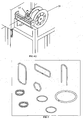
- Coated brazing wire is supported through the drying ovens under tension from a caterpillar belt drive 15 established at the end of the process line Fig. 4F such as a Witles Albert model NAK 100 transporter with Linatex material type belt, which regulates the speed of the coating and drying process. Coated brazing wire can then be directly level layer wound onto spools 16 (in Fig.
- the flux coating composition 2 of the claimed invention may also be used to coat forms other than brazing wire, such as strip and other continuous forms and other shapes of brazing materials 1. Spooled or coiled flux coated brazing material 1 may be utilized on automatic wire or strip feed brazing operations. It may also be utilized on automatic forming equipment for manufacturing brazing rings, washers, shims or other brazing pre-forms such as those depicted in Figure 6 . Alternatively, the flux coating composition 2 may be applied after the use of such forming equipment.
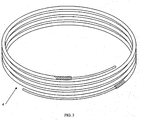
- the flux coated brazing material 1 includes a solid wire core surrounded by a flux coating FIG. 1 to a coated ratio by weight of 5-20% coating.
- This and similarly shaped flux coated brazing materials 1 facilitate ease of brazing as the flux coated brazing material 1 can be formed into a plurality of desired shapes and sizes and may be easily positioned over or with a joint or surface to be brazed.
- the application of heat to the flux coating composition 2 causes the binder to decompose well before the melting point of the flux. This allows the flux to melt uninhibited just prior to the melting point of the solid metal core which improves alloy flow and minimizes oxides which form during the heating process.
- brazing may be accomplished with little or no residual ash, carbon or impurities. Additionally the pre-engineered flux coating composition provides for the proper amount of chemical flux within the matrix of the flux coating composition 2 to provide the required fluxing action without leaving behind unreacted glasses of the potassium fluoroborate compounds, yielding a cleaner finished brazed joint.
- Yet another embodiment of the invention is a method of manufacturing a continuous length coated brazing material 1, comprising the steps of providing a brazing material 1 form of continuous length, providing a flux coating composition 2, applying a coating of said flux coating composition 2 to a surface of said brazing material 1 form; and in-line drying the flux coated brazing material 1.
- the brazing material 1 is treated to have a surface enhancement before the flux coating composition 2 is applied.
- the flux coated brazing material 1 is spooled, coiled or wound after it is dried.
- a method of brazing at least two components comprising the steps of placing at least two components in close proximity to create a joint gap, providing a flux coating composition 2 as described herein, providing a brazing material 1, applying said flux coating composition 2 to said two components or to said brazing material 1, heating the coated components or coated brazing material 1 to a preselected brazing temperature, and bringing the components and brazing material 1 in close proximity so that the brazing material 1 becomes molten, wets the components and flows into the joint gap.
- Another embodiment provides a method of brazing at least two components with a continuous length or non-linear flux-coated brazing material 1, comprising the steps of providing at least two components in close proximity to create a joint gap, providing a continuous length or non-linear flux-coated brazing material 1 as discussed herein, heating the two components or flux-coated brazing material 1 to a preselected brazing temperature, and bringing the two components and flux-coated brazing material 1 in close proximity so that the flux coated brazing material 1 becomes molten, wets the two components and flows into the joint gap.
- a method for preparing a flux-coated brazing material 1 as shown in FIG. 9 comprising the steps of preparing a flux coating composition 2 comprising a flux component mixed with a binder from TABLE 1, a solvent from TABLE 2, and plasticizer from TABLE 3 in proportionate ratios to constitute proper performance of the coating, preparing a brazing material 1 having a surface enhancement, depositing the flux coating composition 2 onto the brazing material 1 surface in a pressurized and heated reservoir chamber, to create a coating ratio of between 5-20% flux by weight, and processing said flux coated brazing material 1 longitudinally through a tunnel drying oven consisting of both radiant and convection drying.
- the flux coating composition 2 comprises a clean burning binder which decomposes to carbon dioxide and water
- the brazing material 1 is a wire having a diameter of between approximately 0.005-0.200 inches (0.0125-5.0mm)
- the flux-coated brazing material 1 comprises approximately 80-95% metal and approximately 5-20% flux coating composition 2
- the brazing material 1 base metal is of various alloy compositions of Cu, Ag, P, Ni, Zn, Sn, Cd, Mn or any of the brazing fillers described in Table 4
- the flux coating composition 2 is applied in a uniform controlled coating thickness of flux to a tolerance of +/-0.001 of an inch (+/-0.025mm).
- the brazing material 1 form is a wire, strip, ring or preformed shapes
- flux coated brazing material 1 of continuous length may be formed into various form factors including wire loose coils, spools 16, preforms, rings, flat wire and strip. See FIG.
- the flux coating composition 2 has a clean burning constituent binder so that it is suitable for furnace and induction brazing and produces clean fluxing action leaving minimal flux residue, ash or carbon residue once consumed at temperatures ranging from 600°-1600°F (316-871 °C), and possibly for some brazing materials 1 as high as 1700°F (927°C) the dried flux coating composition 2 on said flux coated brazing material 1 is flexible, durable and does not readily crack, peel, chip, fracture or detach the surface of the brazing material 1. Further embodiments include the coating is durable enough to be fed through semi-auto or automatic braze alloy feed mechanisms.
- brazing material 1 any brazing material 1 or the metals or alloys or ceramics that may be joined thereby, of any flux composition. Any brazing flux or brazing material 1 may be used for the purposes of the invention.
- compositions having amounts higher than the lower limits are also expected to be effective for the purposes of the invention and so they are also encompassed within the claimed invention.
- TABLE 1 ELASTOMERS (BINDERS) Poly(propylene carbonate) Polyurethanes Poly(ethylene carbonate) Aromatic Polycarbonates Poly(alkylene carbonate) Cellulose Aliphatic Carbonates Poly Vinyl Chlorides Latex Compounds Silicates Polyesters TABLE 2: SOLVENTS Glycol Ether Acetates Esters Alcohols Glycols Polyols Ethers Alkanolamines Ethyleneamines Aromatic Solvents Aliphatic Naphthas Terpenes Water Ketones N-Methyl-2-pyrrolidone TABLE 3: PLASTICIZERS Citrates Sulfates Phosphates Phthalates Adipates Sebacate Esters Polyols Caster Oil
Landscapes
- Engineering & Computer Science (AREA)
- Mechanical Engineering (AREA)
- Chemical & Material Sciences (AREA)
- Inorganic Chemistry (AREA)
- Application Of Or Painting With Fluid Materials (AREA)
- Electric Connection Of Electric Components To Printed Circuits (AREA)
- Nonmetallic Welding Materials (AREA)
- Laminated Bodies (AREA)
Priority Applications (1)
| Application Number | Priority Date | Filing Date | Title |
|---|---|---|---|
| PL06837365T PL1945397T3 (pl) | 2005-11-10 | 2006-11-09 | Materiał do lutowania twardego z ciągłą warstwą elastomeru zawierającą topnik |
Applications Claiming Priority (2)
| Application Number | Priority Date | Filing Date | Title |
|---|---|---|---|
| US73532305P | 2005-11-10 | 2005-11-10 | |
| PCT/US2006/043856 WO2007058969A2 (en) | 2005-11-10 | 2006-11-09 | Brazing material with continuous length layer of elastomer containing a flux |
Publications (3)
| Publication Number | Publication Date |
|---|---|
| EP1945397A2 EP1945397A2 (en) | 2008-07-23 |
| EP1945397A4 EP1945397A4 (en) | 2012-07-25 |
| EP1945397B1 true EP1945397B1 (en) | 2016-03-02 |
Family
ID=38049173
Family Applications (1)
| Application Number | Title | Priority Date | Filing Date |
|---|---|---|---|
| EP06837365.3A Active EP1945397B1 (en) | 2005-11-10 | 2006-11-09 | Brazing material with continuous length layer of elastomer containing a flux |
Country Status (11)
| Country | Link |
|---|---|
| US (4) | US20070251602A1 (pl) |
| EP (1) | EP1945397B1 (pl) |
| JP (1) | JP2009515703A (pl) |
| KR (2) | KR101414467B1 (pl) |
| CN (2) | CN101500746A (pl) |
| AU (1) | AU2006315655A1 (pl) |
| BR (1) | BRPI0618466A2 (pl) |
| CA (1) | CA2629176C (pl) |
| MX (1) | MX2008006132A (pl) |
| PL (1) | PL1945397T3 (pl) |
| WO (1) | WO2007058969A2 (pl) |
Families Citing this family (42)
| Publication number | Priority date | Publication date | Assignee | Title |
|---|---|---|---|---|
| US20070210037A1 (en) * | 2006-02-24 | 2007-09-13 | Toshifumi Ishida | Cooling block forming electrode |
| WO2007140236A1 (en) | 2006-05-25 | 2007-12-06 | Bellman-Melcor Development, Llc | Filler metal with flux for brazing and soldering and method of making and using same |
| US8274014B2 (en) | 2006-05-25 | 2012-09-25 | Bellman-Melcor Development, Llc | Filler metal with flux for brazing and soldering and method of making and using same |
| WO2008073419A2 (en) | 2006-12-11 | 2008-06-19 | Lucas Milhaupt, Inc. | Low and non-silver filler metals and alloys and corresponding joinder systems and methods |
| US8116432B2 (en) * | 2007-04-20 | 2012-02-14 | General Electric Company | X-ray tube target brazed emission layer |
| US20090200363A1 (en) * | 2008-02-13 | 2009-08-13 | Trane International Inc. | Braze Ring |
| CA2741639C (en) | 2008-10-28 | 2015-12-15 | Edward L. Cooper | Conduit |
| US8354615B2 (en) * | 2009-03-05 | 2013-01-15 | Lincoln Global, Inc. | Manual welding electrode |
| US8127827B2 (en) * | 2009-04-23 | 2012-03-06 | Dunn Edmund M | Process and apparatus for direct chill casting |
| WO2011053506A1 (en) | 2009-10-26 | 2011-05-05 | Lucas-Milhaupt, Inc. | Low silver, low nickel brazing material |
| CA2687926A1 (en) | 2009-11-25 | 2011-05-25 | Lucas Milhaupt, Inc. | Brazing material |
| US8535454B2 (en) * | 2010-11-23 | 2013-09-17 | Promerus, Llc | Polymer composition for microelectronic assembly |
| US8186564B1 (en) * | 2011-01-07 | 2012-05-29 | Exedy America Corporation | Brazing preform manufacture |
| US9352419B2 (en) * | 2011-01-13 | 2016-05-31 | Siemens Energy, Inc. | Laser re-melt repair of superalloys using flux |
| DE102011100608B4 (de) | 2011-03-03 | 2024-03-28 | OSRAM Opto Semiconductors Gesellschaft mit beschränkter Haftung | Suspension zum Schutz eines Halbleitermaterials und Verfahren zur Herstellung eines Halbleiterkörpers |
| US10987763B2 (en) * | 2011-09-23 | 2021-04-27 | Lucas-Milhaupt, Inc. | Luminescent braze preforms |
| US20150030874A1 (en) * | 2011-09-23 | 2015-01-29 | Lucas-Milhaupt, Inc. | Luminescent Braze Preforms |
| US9272350B2 (en) * | 2012-03-30 | 2016-03-01 | Siemens Energy, Inc. | Method for resistance braze repair |
| FR2988633B1 (fr) * | 2012-03-30 | 2014-11-21 | Faurecia Interieur Ind | Procede pour assembler une premiere et une deuxieme piece, en particulier des pieces de vehicule automobile, par brasage par induction |
| US8740041B2 (en) * | 2012-07-03 | 2014-06-03 | Flux Brazing Schweiss-Und Lotstoffe Usa, Llc | Extruded brazing ring with integrated flux |
| US9821414B2 (en) * | 2013-01-31 | 2017-11-21 | Siemens Energy, Inc. | Welding electrode |
| EP2808114A3 (en) * | 2013-05-30 | 2015-09-02 | Lucas-Milhaupt, Inc. | Process for flux coating braze preforms and discrete parts |
| US9731383B2 (en) | 2014-07-09 | 2017-08-15 | Bellman-Melcor Development, Llc | Filler metal with flux for brazing and soldering and method of using same |
| CN107075916B (zh) * | 2014-12-22 | 2019-11-08 | 哈里伯顿能源服务公司 | 热稳定多晶硬质材料与钎焊材料之间的化学强化粘结 |
| WO2016200560A1 (en) * | 2015-06-08 | 2016-12-15 | Siemens Energy, Inc. | Welding electrode |
| WO2017018155A1 (ja) * | 2015-07-27 | 2017-02-02 | 住友金属鉱山株式会社 | 被覆はんだワイヤおよびその製造方法 |
| JP6471676B2 (ja) * | 2015-07-27 | 2019-02-20 | 住友金属鉱山株式会社 | 被覆はんだワイヤおよびその製造方法 |
| US10744601B2 (en) | 2015-08-07 | 2020-08-18 | Bellman-Melcor Development, Llc | Bonded brazing ring system and method for adhering a brazing ring to a tube |
| CN105217374B (zh) * | 2015-09-14 | 2018-02-16 | 三江学院 | 一种焊锡丝自动卷圈切割顶出装置 |
| JP6437419B2 (ja) * | 2015-11-11 | 2018-12-12 | 日鐵住金溶接工業株式会社 | 炭酸ガスシールドアーク溶接用フラックス入りワイヤ |
| JP2017094360A (ja) | 2015-11-25 | 2017-06-01 | 日鐵住金溶接工業株式会社 | Ar−CO2混合ガスシールドアーク溶接用フラックス入りワイヤ |
| US20170157715A1 (en) * | 2015-12-02 | 2017-06-08 | Bellman-Melcor Development, Llc | Brazing Ring with Spikes and Method for Securing a Brazing Ring to a Tube |
| CN105436747B (zh) * | 2015-12-03 | 2018-04-17 | 哈焊所华通(常州)焊业股份有限公司 | 一种铝焊丝镀钛工艺 |
| PL3226258T3 (pl) | 2016-04-01 | 2019-04-30 | Gebauer & Griller Metallwerk Gmbh | Izolowany przewód elektryczny |
| CN105921909A (zh) * | 2016-07-18 | 2016-09-07 | 浙江亚通焊材有限公司 | 一种用于制备高温粘带纤料的粘结剂及高温粘带纤料 |
| DE102016116265A1 (de) * | 2016-08-31 | 2018-03-01 | Faurecia Emissions Control Technologies, Germany Gmbh | Lotwerkstoff auf Kupferbasis und Verwendung des Lotwerkstoffs |
| US11229969B2 (en) | 2017-09-21 | 2022-01-25 | Saf-Holland, Inc. | Brazed fifth wheel hitch assembly components and method of constructing same |
| CN108188615B (zh) * | 2017-12-29 | 2020-08-28 | 郑州机械研究所有限公司 | 一种带螺旋骨架抗冲击的自钎复合钎料饼及其制备方法 |
| CN108296669B (zh) * | 2017-12-29 | 2020-08-28 | 郑州机械研究所有限公司 | 一种带螺旋骨架抗冲击的复合钎料饼及其制备方法 |
| WO2019191609A1 (en) | 2018-03-30 | 2019-10-03 | Hobart Brothers Company | Tubular wires made from copper coated strip |
| WO2020223394A1 (en) * | 2019-04-30 | 2020-11-05 | Indium Corporation | Solder preform with internal flux core including thermochromic indicator |
| KR102522081B1 (ko) * | 2021-05-28 | 2023-04-18 | 한국생산기술연구원 | 분말 연속 와이어 제조 장치 |
Family Cites Families (133)
| Publication number | Priority date | Publication date | Assignee | Title |
|---|---|---|---|---|
| US400869A (en) * | 1889-04-02 | hodgson | ||
| US607504A (en) | 1898-07-19 | David crowther | ||
| US1529748A (en) * | 1924-07-19 | 1925-03-17 | Nelda M Hilker | Vanity case |
| US1650905A (en) * | 1925-12-21 | 1927-11-29 | Oscar L Mills | Welding rod |
| US1629748A (en) | 1926-01-28 | 1927-05-24 | Stoody Co | Method of making welding rods and the resulting product |
| US1865169A (en) * | 1927-07-27 | 1932-06-28 | Westinghouse Electric & Mfg Co | Welding electrode |
| US1968618A (en) * | 1932-01-05 | 1934-07-31 | Joseph E Padgett | Driving axle |
| US2005189A (en) | 1933-07-10 | 1935-06-18 | Albert H Herr | Solder coupling |
| US2055276A (en) | 1934-07-03 | 1936-09-22 | Ici Ltd | Pipe joint or coupling |
| US2279284A (en) * | 1941-03-22 | 1942-04-07 | Wassermann Rene | Silver alloy |
| US2442087A (en) * | 1945-03-02 | 1948-05-25 | Mills Alloys Inc | Welding rod |
| US2499641A (en) * | 1945-12-22 | 1950-03-07 | Monroe Sherman | Brazing and hard soldering flux |
| US2465503A (en) * | 1947-10-08 | 1949-03-29 | Lincoln Electric Co | Welding electrode |
| US2565477A (en) | 1948-04-10 | 1951-08-28 | Dynoflow Solder Corp | Fluxed solder rod |
| GB692710A (en) | 1950-04-12 | 1953-06-10 | Thessco Ind Res Ltd | Improvements in or relating to self-fluxing solders |
| US2785285A (en) * | 1953-03-18 | 1957-03-12 | Nat Cylinder Gas Co | Composite welding electrode |
| US2958941A (en) * | 1954-02-17 | 1960-11-08 | Air Reduction | Flux-filled brazing rod and method of brazing with same |
| US3051822A (en) * | 1955-03-23 | 1962-08-28 | Chemetron Corp | Welding with blanket and gas arc-shield |
| US2927043A (en) | 1957-02-20 | 1960-03-01 | Solar Aircraft Co | Aluminum coating processes and compositions |
| US3033713A (en) | 1960-04-20 | 1962-05-08 | Air Reduction | Improved-stabilized brazing fluxes and binders |
| US3077131A (en) * | 1961-08-03 | 1963-02-12 | Pittsburgh Steel Co | Die rolling apparatus for knurling wire |
| NL298923A (pl) * | 1962-10-12 | |||
| BE640425A (pl) * | 1962-12-07 | |||
| US3198560A (en) | 1963-03-06 | 1965-08-03 | Parker Hannifin Corp | Brazed tube coupling |
| DE1298967B (de) | 1964-11-10 | 1969-07-10 | Guenther Dr | Verfahren zum Fuellen von Vertiefungen in der Oberflaeche von Loetdraehten mit Flussmittel |
| US3239125A (en) | 1963-12-20 | 1966-03-08 | Raychem Corp | Solder ring |
| US3290772A (en) | 1964-02-05 | 1966-12-13 | Gen Electric | Method of making a brazed joint |
| US3365565A (en) * | 1964-07-20 | 1968-01-23 | Hobert Brothers Company | Welding electrodes |
| CH466006A (de) * | 1964-09-07 | 1968-11-30 | Elek Ska Svetsningsaktiebolage | Verfahren zur Herstellung eines einen Kern einschliessenden, rohrförmigen Schweissdrahtes oder Schweissstabes |
| US3318729A (en) * | 1965-08-05 | 1967-05-09 | Du Pont | Tubular welding rod having a chlorine or fluorine substituted ethylenically unsaturated aliphatic hydrocarbon polymer core |
| US3688967A (en) * | 1966-05-09 | 1972-09-05 | Kobe Steel Ltd | Solid composite backing structure for single welding |
| GB1180735A (en) | 1966-05-27 | 1970-02-11 | Johnson Matthey Co Ltd | Improved Brazing Ring |
| CH483290A (de) * | 1966-11-23 | 1969-12-31 | Oerlikon Buehrle Elektroden | Gefüllter Schweissdraht |
| JPS516096B1 (pl) * | 1967-01-23 | 1976-02-25 | ||
| US3542998A (en) * | 1967-06-07 | 1970-11-24 | Air Reduction | Cored electrode for welding in air |
| US3620830A (en) * | 1968-01-17 | 1971-11-16 | Lincoln Electric Co | Automatic arc welding electrode with an electrically conductive flux coating |
| US3534390A (en) * | 1968-04-29 | 1970-10-13 | Stoody Co | Welding wire |
| US3619429A (en) * | 1969-06-04 | 1971-11-09 | Yawata Welding Electrode Co | Method for the uniform extrusion coating of welding flux compositions |
| US3620869A (en) * | 1969-07-16 | 1971-11-16 | Clevepak Corp | Method of making tubes |
| US4121750A (en) | 1969-12-15 | 1978-10-24 | Vereinigte Aluminium-Werke Aktiengesellschaft | Processes for soldering aluminum-containing workpieces |
| US3695795A (en) | 1970-03-20 | 1972-10-03 | Conn Eng Assoc Corp | Production of powdered metal |
| US3610663A (en) | 1970-04-20 | 1971-10-05 | Aesoquip Corp | Brazed connection |
| US3642998A (en) * | 1970-04-22 | 1972-02-15 | Frederick A Jennings | Corrosion-inhibiting toolbox |
| US3703254A (en) | 1970-05-07 | 1972-11-21 | Ncr Co | Pre-fluxed solder powder |
| US3639721A (en) | 1970-11-13 | 1972-02-01 | Aeroquip Corp | Method of installing brazing rings |
| US3745644A (en) | 1971-07-28 | 1973-07-17 | Carrier Corp | Method for attaching solder rings to work pieces |
| US3980859A (en) | 1974-05-23 | 1976-09-14 | Huntington Alloys, Inc. | Cored wire junction |
| US3967036A (en) * | 1974-07-11 | 1976-06-29 | The International Nickel Company, Inc. | Flux-coated arc welding electrode |
| US4041274A (en) * | 1974-07-11 | 1977-08-09 | The International Nickel Company, Inc. | Maraging stainless steel welding electrode |
| US3935414A (en) * | 1974-10-11 | 1976-01-27 | Unicore, Inc. | Automatic fixed position pipe welding |
| GB1481140A (en) | 1975-05-23 | 1977-07-27 | Inst Elektroswarki Patona | Consumable wire |
| JPS5214511A (en) * | 1975-07-25 | 1977-02-03 | Hitachi Cable Ltd | Process for producing a linear additive |
| DE2719357A1 (de) * | 1977-04-30 | 1978-11-09 | Kjellberg Esab Gmbh | Verfahren zur herstellung von fuelldraehten und fuelldrahtelektroden |
| NZ188341A (en) * | 1977-09-16 | 1980-05-08 | Johnson Matthey Co Ltd | Brazing composition:brazing alloy and thermoplastic materi |
| US4174962A (en) * | 1978-04-27 | 1979-11-20 | Caterpillar Tractor Co. | Filled tubular article for controlled insertion into molten metal |
| GB2027617B (en) * | 1978-08-01 | 1982-07-07 | Johnson Matthey Co Ltd | Flux coated brazing materials |
| US4214145A (en) * | 1979-01-25 | 1980-07-22 | Stoody Company | Mild steel, flux-cored electrode for arc welding |
| US4900895A (en) * | 1980-05-09 | 1990-02-13 | Alloy Rods Global, Inc. | Rectangular electrode |
| JPS5768296A (en) * | 1980-10-16 | 1982-04-26 | Nissan Motor Co Ltd | Automatic welding wire for surface hardening and overlaying |
| US4447472A (en) * | 1982-09-23 | 1984-05-08 | Essex Group, Inc. | Magnet wire coating method and article |
| US4430122A (en) * | 1982-09-29 | 1984-02-07 | Eutectic Corporation | Flux-cored arc welding tubular electrode |
| FR2541937B1 (fr) * | 1983-03-03 | 1985-09-13 | Vallourec | Produit composite a enveloppe metallique tubulaire agrafee et ame pulverulente apte a l'enroulage |
| SE8304658L (sv) * | 1983-08-29 | 1985-03-01 | Werner Adolf Holmgren | Forfarande och anordning for kontinuerlig tillverkning av pulverfylld svetselektrod |
| US4497849A (en) * | 1983-09-26 | 1985-02-05 | Hughes Howard C | Process for polymer coating electrical conductors |
| JPS60250893A (ja) | 1984-05-25 | 1985-12-11 | Sumitomo Light Metal Ind Ltd | アルミニウム製熱交換器用アルミニウム合金ろう |
| US4587097A (en) * | 1984-06-22 | 1986-05-06 | Allied Corporation | Homogeneous low melting temperature brazing filler metal for joining ferrous and non-ferrous alloys |
| US4800131A (en) | 1984-12-20 | 1989-01-24 | Alloy Rods Global, Inc. | Cored wire filler metals and a method for their manufacture |
| US4762674A (en) | 1984-12-27 | 1988-08-09 | Westinghouse Electric Corp. | Brazing sleeve having ceramic flux band and method for applying same |
| US4571352A (en) * | 1985-01-16 | 1986-02-18 | Sanden Corporation | Method for coating aluminum metal body with aluminum alloy brazing filler metal |
| JPS61184395A (ja) * | 1985-02-12 | 1986-08-18 | Sanden Corp | アルミニウム製熱交換器の防食処理法 |
| US4624860A (en) * | 1985-10-15 | 1986-11-25 | Imperial Clevite Inc. | Method of applying a coating to a metal substrate using brazing material and flux |
| JPS62144894A (ja) * | 1985-12-18 | 1987-06-29 | Asahi Chem Ind Co Ltd | 横置曲線溶接棒 |
| US5098010A (en) * | 1987-01-30 | 1992-03-24 | Carmichael Arthur O | Process using protective flux coatings for delaying joining and soldering operations |
| CA1303605C (en) | 1987-11-19 | 1992-06-16 | Stephen B. Unruh | Heat exchanger tube having embossed ring bell and brazing ring |
| US4901909A (en) | 1988-08-18 | 1990-02-20 | Fusion Incorporated | Flux and process for brazing aluminum material |
| US5219425A (en) * | 1989-08-25 | 1993-06-15 | Kabushiki Kaisha Kobe Seiko Sho | Flux containing wire for use in stainless steel welding |
| DE8910519U1 (de) | 1989-09-04 | 1989-10-12 | FONTARGEN GmbH, 6719 Eisenberg | Lötdraht als Hartlot |
| US4993054A (en) * | 1989-09-27 | 1991-02-12 | General Electric Company | Brazed X-ray tube anode assembly |
| US5228727A (en) | 1989-12-28 | 1993-07-20 | Showa Aluminum Corporation | Tubular body having pipe joint member attached thereto and method of producing same |
| AU636481B2 (en) * | 1990-05-18 | 1993-04-29 | Bracco International B.V. | Polymeric gas or air filled microballoons usable as suspensions in liquid carriers for ultrasonic echography |
| NO174455C (no) * | 1991-06-14 | 1994-05-11 | Norsk Hydro As | Fremgangsmåte for sammenföyning av aluminiumkomponenter |
| US5175411A (en) | 1991-08-23 | 1992-12-29 | Westinghouse Electric Corp. | Method for welding structural gaps |
| US5184767A (en) | 1991-12-31 | 1993-02-09 | Compaq Computer Corporation | Non-wicking solder preform |
| JPH06190586A (ja) * | 1992-12-25 | 1994-07-12 | Showa Alum Corp | フラックス被覆アルミニウムろう材 |
| US5781846A (en) | 1993-02-25 | 1998-07-14 | Jossick; James L. | Flux cored brazing composition |
| RU2044606C1 (ru) | 1993-04-30 | 1995-09-27 | Николай Николаевич Зубков | Способ получения поверхностей с чередующимися выступами и впадинами (варианты) и инструмент для его осуществления |
| US5360158A (en) | 1993-07-15 | 1994-11-01 | The S.A. Day Mfg. Co., Inc. | Method for joining aluminum alloy tubes |
| US5418072A (en) * | 1993-09-20 | 1995-05-23 | Alcan International Limited | Totally consumable brazing encapsulate for use in joining aluminum surfaces |
| CA2127836A1 (en) * | 1994-03-18 | 1995-09-19 | Jian Ming Ni | Elongated flexible welding electrode |
| US5700573A (en) * | 1995-04-25 | 1997-12-23 | Mccullough; Francis Patrick | Flexible biregional carbonaceous fiber, articles made from biregional carbonaceous fibers, and method of manufacture |
| DE19537216A1 (de) * | 1995-10-06 | 1997-04-10 | Solvay Fluor & Derivate | Flußmittelbeschichtete Metallbauteile |
| US5749971A (en) * | 1996-03-28 | 1998-05-12 | Ni; Chong Yang | Apparatus for making a welding flux coating continously on a welding electrode |
| US5791005A (en) * | 1996-11-14 | 1998-08-11 | The Mill-Rose Company | Scarifying and deburring tool |
| US5806752A (en) | 1996-12-04 | 1998-09-15 | Ford Global Technologies, Inc. | Manufacture of aluminum assemblies by open-air flame brazing |
| JPH10249583A (ja) * | 1997-03-05 | 1998-09-22 | Nippon Steel Weld Prod & Eng Co Ltd | ガスシールドアーク溶接用フラックス入りワイヤ |
| US5820939A (en) | 1997-03-31 | 1998-10-13 | Ford Global Technologies, Inc. | Method of thermally spraying metallic coatings using flux cored wire |
| NL1005765C2 (nl) * | 1997-04-08 | 1998-10-09 | Koni Bv | Dubbelwerkende demper met stangslag-volumecompensatie. |
| JP2002512655A (ja) | 1997-06-30 | 2002-04-23 | ピー・エイ・シー・ポリマーズ・インコーポレイテッド | 官能化されたポリ(アルキレンカーボネート)およびその使用 |
| US6426483B1 (en) | 1998-02-17 | 2002-07-30 | Lincoln Global, Inc. | Electrode and method of making same |
| TW464582B (en) * | 1998-02-17 | 2001-11-21 | Lincoln Global Inc | Welding wire and method of making same |
| JP3337416B2 (ja) * | 1998-02-24 | 2002-10-21 | 株式会社デンソー | ろう付け性に優れた自動車熱交換器用アルミニウム押出多孔偏平管およびその製造方法 |
| KR100546502B1 (ko) * | 1998-03-25 | 2006-01-26 | 솔베이 플루오르 운트 데리바테 게엠베하 | 신규 융제 |
| US6093761A (en) * | 1999-04-14 | 2000-07-25 | Stanton Advanced Materials, Inc. | Binder system and method for particulate material |
| US20020046627A1 (en) | 1998-06-10 | 2002-04-25 | Hitoshi Amita | Solder powder, flux, solder paste, soldering method, soldered circuit board, and soldered joint product |
| US6203628B1 (en) * | 1998-08-20 | 2001-03-20 | Toyo Aluminium Kabushiki Kaisha | Flux compositions for brazing aluminum, their films and brazing method |
| JP3747307B2 (ja) * | 1998-10-15 | 2006-02-22 | 株式会社神戸製鋼所 | 溶接材料用水ガラス及びその製造方法 |
| US6120848A (en) * | 1998-11-17 | 2000-09-19 | Ford Motor Company | Method of making a braze sheet |
| ES2212997T3 (es) * | 1999-03-05 | 2004-08-16 | Alcoa Inc. | Metodo de depositar un fundente o un fundente y metal sobre un sustrato metalico por soldadura fuerte. |
| US6264062B1 (en) * | 1999-06-09 | 2001-07-24 | Craig D. Lack | Solder preforms with predisposed flux for plumbing applications |
| ATE317739T1 (de) | 1999-06-25 | 2006-03-15 | Jerry L Schuster | Silberhartlötflussmittel und herstellungsverfahren dafür |
| US6395223B1 (en) * | 1999-06-25 | 2002-05-28 | Omn. Technologies Corporation | Method of making a flux, a brazing wire, and a brazing paste |
| RO121807B1 (ro) * | 1999-10-25 | 2008-05-30 | Solvay Fluor Und Derivate Gmbh | Flux pentru aplicare uscată |
| US6317913B1 (en) * | 1999-12-09 | 2001-11-20 | Alcoa Inc. | Method of depositing flux or flux and metal onto a metal brazing substrate |
| CA2328628A1 (en) * | 1999-12-21 | 2001-06-21 | Cecile J. Schoenheider | Moldable compositions |
| US6497770B2 (en) * | 2000-02-17 | 2002-12-24 | Toyo Aluminium Kabushiki Kaisha | Flux-containing compositions for brazing aluminum, films and brazing method thereby |
| KR100494015B1 (ko) | 2000-03-31 | 2005-06-10 | 현대종합금속 주식회사 | 아아크 용접용 와이어 |
| US6376585B1 (en) * | 2000-06-26 | 2002-04-23 | Apex Advanced Technologies, Llc | Binder system and method for particulate material with debind rate control additive |
| JP3600786B2 (ja) * | 2000-09-13 | 2004-12-15 | シャープ株式会社 | 糸はんだ、糸はんだ製造装置および接合部品 |
| WO2002031023A1 (en) * | 2000-10-11 | 2002-04-18 | Pohang Iron & Steel Co., Ltd. | Copolymer comprising alkylene carbonate and method of preparing same |
| US6608286B2 (en) * | 2001-10-01 | 2003-08-19 | Qi Fen Jiang | Versatile continuous welding electrode for short circuit welding |
| US7442877B2 (en) * | 2001-10-12 | 2008-10-28 | Yazaki Corporation | Wire manufacturing method wire manufacturing apparatus and wire |
| WO2003068447A1 (en) | 2002-02-13 | 2003-08-21 | Honeywell International Inc. | Solder paste formulations, methods of production and uses thereof |
| US7337941B2 (en) * | 2002-04-22 | 2008-03-04 | Alcoa Inc. | Flux coated brazing sheet |
| US6830632B1 (en) * | 2002-07-24 | 2004-12-14 | Lucas Milhaupt, Inc. | Flux cored preforms for brazing |
| US20040171721A1 (en) * | 2002-12-16 | 2004-09-02 | Esemplare Pascal E. | Stabilizing polyalkylene carbonate resins |
| AU2003292617A1 (en) | 2002-12-27 | 2004-07-29 | Yazaki Corporation | Electrical wire coating method |
| GB0308895D0 (en) | 2003-04-17 | 2003-05-21 | Johnson Matthey Plc | Coating compositions |
| JP2005032533A (ja) * | 2003-07-11 | 2005-02-03 | Goto Denshi Kk | 電線へのワニスの形成装置およびワニスの形成方法 |
| US7267187B2 (en) | 2003-10-24 | 2007-09-11 | Smith International, Inc. | Braze alloy and method of use for drilling applications |
| US20050089440A1 (en) | 2003-10-24 | 2005-04-28 | Kembaiyan Kumar T. | Braze alloy |
| US7718719B2 (en) * | 2003-12-13 | 2010-05-18 | Pascal Esemplare | Method of stabilizing a normally solid polyalkylene carbonate resin against thermal and hydrolytic decomposition for at least producing tough coatings with excellent adhesion to both ferrous and non-ferrous metals |
| JP2006225718A (ja) * | 2005-02-17 | 2006-08-31 | Kobe Steel Ltd | 低温靭性および耐SR割れ性に優れた高強度Cr−Mo鋼用溶着金属 |
| KR101455738B1 (ko) * | 2007-01-04 | 2014-10-28 | 알파 메탈즈, 인코포레이티드 | 플럭스 포뮬레이션 |
-
2006
- 2006-11-09 MX MX2008006132A patent/MX2008006132A/es active IP Right Grant
- 2006-11-09 EP EP06837365.3A patent/EP1945397B1/en active Active
- 2006-11-09 CN CNA2006800502603A patent/CN101500746A/zh active Pending
- 2006-11-09 CN CN2011104525804A patent/CN102848092A/zh active Pending
- 2006-11-09 WO PCT/US2006/043856 patent/WO2007058969A2/en not_active Ceased
- 2006-11-09 KR KR1020087013946A patent/KR101414467B1/ko not_active Expired - Fee Related
- 2006-11-09 JP JP2008540225A patent/JP2009515703A/ja active Pending
- 2006-11-09 BR BRPI0618466-9A patent/BRPI0618466A2/pt not_active IP Right Cessation
- 2006-11-09 KR KR1020137021581A patent/KR20130094867A/ko not_active Ceased
- 2006-11-09 PL PL06837365T patent/PL1945397T3/pl unknown
- 2006-11-09 AU AU2006315655A patent/AU2006315655A1/en not_active Abandoned
- 2006-11-09 CA CA2629176A patent/CA2629176C/en active Active
- 2006-11-09 US US11/558,400 patent/US20070251602A1/en not_active Abandoned
-
2008
- 2008-11-26 US US12/324,410 patent/US8753455B2/en active Active
-
2010
- 2010-12-08 US US12/963,051 patent/US20110073216A1/en not_active Abandoned
-
2014
- 2014-06-12 US US14/303,140 patent/US9656352B2/en not_active Expired - Fee Related
Also Published As
| Publication number | Publication date |
|---|---|
| CA2629176A1 (en) | 2007-05-24 |
| JP2009515703A (ja) | 2009-04-16 |
| CN102848092A (zh) | 2013-01-02 |
| EP1945397A4 (en) | 2012-07-25 |
| KR20090117914A (ko) | 2009-11-16 |
| US20070251602A1 (en) | 2007-11-01 |
| US20140360628A1 (en) | 2014-12-11 |
| US8753455B2 (en) | 2014-06-17 |
| EP1945397A2 (en) | 2008-07-23 |
| KR101414467B1 (ko) | 2014-07-18 |
| PL1945397T3 (pl) | 2016-08-31 |
| WO2007058969A2 (en) | 2007-05-24 |
| KR20130094867A (ko) | 2013-08-26 |
| US9656352B2 (en) | 2017-05-23 |
| CA2629176C (en) | 2013-01-08 |
| BRPI0618466A2 (pt) | 2011-08-30 |
| US20090101238A1 (en) | 2009-04-23 |
| AU2006315655A1 (en) | 2007-05-24 |
| MX2008006132A (es) | 2008-10-23 |
| CN101500746A (zh) | 2009-08-05 |
| US20110073216A1 (en) | 2011-03-31 |
| AU2006315655A8 (en) | 2008-07-03 |
| WO2007058969A3 (en) | 2007-12-21 |
Similar Documents
| Publication | Publication Date | Title |
|---|---|---|
| US9656352B2 (en) | Flux composition for brazing | |
| EP2583792B1 (en) | Saw wire | |
| EP1250467B1 (de) | Lotlegierung | |
| DE102013014528B4 (de) | Cadmium- und phosphorfreie Lotlegierung, ein Schichtlot, einen gelöteten Gegenstand, eine Kombination einer Lotlegierung und ein Verfahren zum Verbinden von Metallteilen | |
| JP5084076B2 (ja) | スラグ除去向上溶接ワイヤ | |
| JP2018199214A (ja) | 研磨物品及び形成方法 | |
| US4699848A (en) | Composition of abrasion-resistant material for application to a surface | |
| DE10000988A1 (de) | Verfahren zum Herstellen einer Schutzschicht auf der Oberfläche eines Bauteils o. dgl. Werkstückes, Lotwerkstoff dafür sowie deren Verwendung | |
| CN111940944A (zh) | 一种钎焊材料及其制备方法 | |
| KR900000400B1 (ko) | 균질의 저융점 구리기초합금, 이로부터 제조된 균질의 경납땜 호일과 그 제조방법, 및 이를 이용한 금속결합방법 | |
| JP3356843B2 (ja) | ろう付用アルミニウム材料の製造方法 | |
| CN118204676A (zh) | 一种无铅镉的银基钎焊材料及其制备方法 | |
| DE69123431T2 (de) | Teilweise Eliminierung von Kupferablagerungen auf einem Stahlstreifen mit Hilfe mechanischer Mittel | |
| CN108044252B (zh) | 一种带螺旋骨架抗冲击的药芯复合钎料饼及其制备方法 | |
| DE102006058376A1 (de) | Lötfolie und Verfahren zur Herstellung derselben | |
| JP2009072827A (ja) | はんだ層形成部材の製造方法 | |
| CN115255709A (zh) | 具有钎剂导流作用的药芯钎料环的制备方法及药芯钎料环 | |
| CN1935443A (zh) | 气体保护电弧焊接用实芯焊丝 | |
| JPH0364443A (ja) | 圧延用複合ロール及びその製造法 | |
| CN108188615B (zh) | 一种带螺旋骨架抗冲击的自钎复合钎料饼及其制备方法 | |
| CN115846936A (zh) | 一种高强耐磨钎料及其制备方法、pdc钻头的钎焊方法 | |
| CN119098712A (zh) | 一种包芯的银铜锌焊丝、生产方法及包芯设备 | |
| DE2362736C3 (de) | Flußmittel zum Schutz der Nahtwurzel beim Lichtbogenschweißen von legierten Stählen und Paste auf dessen Basis | |
| JPH0535711B2 (pl) | ||
| DE10000989A1 (de) | Verfahren zum Herstellen einer Schutzschicht auf der Oberfläche eines Bauteils o. dgl. Werkstückes, Lotwerkstoff dafür sowie deren Verwendung |
Legal Events
| Date | Code | Title | Description |
|---|---|---|---|
| PUAI | Public reference made under article 153(3) epc to a published international application that has entered the european phase |
Free format text: ORIGINAL CODE: 0009012 |
|
| 17P | Request for examination filed |
Effective date: 20080513 |
|
| AK | Designated contracting states |
Kind code of ref document: A2 Designated state(s): AT BE BG CH CY CZ DE DK EE ES FI FR GB GR HU IE IS IT LI LT LU LV MC NL PL PT RO SE SI SK TR |
|
| AX | Request for extension of the european patent |
Extension state: AL BA HR MK RS |
|
| REG | Reference to a national code |
Ref country code: HK Ref legal event code: DE Ref document number: 1121099 Country of ref document: HK |
|
| A4 | Supplementary search report drawn up and despatched |
Effective date: 20120622 |
|
| RIC1 | Information provided on ipc code assigned before grant |
Ipc: B23K 1/20 20060101AFI20120618BHEP Ipc: B23K 35/365 20060101ALI20120618BHEP |
|
| DAX | Request for extension of the european patent (deleted) | ||
| RAP1 | Party data changed (applicant data changed or rights of an application transferred) |
Owner name: OMNI TECHNOLOGIES CORPORATION Owner name: LUCAS-MILHAUPT WARWICK LLC |
|
| 17Q | First examination report despatched |
Effective date: 20131003 |
|
| REG | Reference to a national code |
Ref country code: DE Ref legal event code: R079 Ref document number: 602006048096 Country of ref document: DE Free format text: PREVIOUS MAIN CLASS: B23K0001200000 Ipc: B23K0035360000 |
|
| GRAP | Despatch of communication of intention to grant a patent |
Free format text: ORIGINAL CODE: EPIDOSNIGR1 |
|
| RIC1 | Information provided on ipc code assigned before grant |
Ipc: B23K 35/365 20060101ALI20141126BHEP Ipc: C08K 3/00 20060101ALI20141126BHEP Ipc: C08K 5/00 20060101ALI20141126BHEP Ipc: C08K 3/08 20060101ALI20141126BHEP Ipc: B23K 35/362 20060101ALI20141126BHEP Ipc: B23K 35/36 20060101AFI20141126BHEP |
|
| INTG | Intention to grant announced |
Effective date: 20141222 |
|
| REG | Reference to a national code |
Ref country code: HK Ref legal event code: WD Ref document number: 1121099 Country of ref document: HK |
|
| RAP1 | Party data changed (applicant data changed or rights of an application transferred) |
Owner name: LUCAS-MILHAUPT, INC. |
|
| GRAP | Despatch of communication of intention to grant a patent |
Free format text: ORIGINAL CODE: EPIDOSNIGR1 |
|
| INTG | Intention to grant announced |
Effective date: 20150817 |
|
| GRAS | Grant fee paid |
Free format text: ORIGINAL CODE: EPIDOSNIGR3 |
|
| GRAA | (expected) grant |
Free format text: ORIGINAL CODE: 0009210 |
|
| AK | Designated contracting states |
Kind code of ref document: B1 Designated state(s): AT BE BG CH CY CZ DE DK EE ES FI FR GB GR HU IE IS IT LI LT LU LV MC NL PL PT RO SE SI SK TR |
|
| REG | Reference to a national code |
Ref country code: GB Ref legal event code: FG4D |
|
| REG | Reference to a national code |
Ref country code: AT Ref legal event code: REF Ref document number: 777664 Country of ref document: AT Kind code of ref document: T Effective date: 20160315 Ref country code: CH Ref legal event code: EP |
|
| REG | Reference to a national code |
Ref country code: IE Ref legal event code: FG4D |
|
| REG | Reference to a national code |
Ref country code: DE Ref legal event code: R096 Ref document number: 602006048096 Country of ref document: DE |
|
| REG | Reference to a national code |
Ref country code: NL Ref legal event code: MP Effective date: 20160302 |
|
| REG | Reference to a national code |
Ref country code: LT Ref legal event code: MG4D |
|
| REG | Reference to a national code |
Ref country code: AT Ref legal event code: MK05 Ref document number: 777664 Country of ref document: AT Kind code of ref document: T Effective date: 20160302 |
|
| PG25 | Lapsed in a contracting state [announced via postgrant information from national office to epo] |
Ref country code: FI Free format text: LAPSE BECAUSE OF FAILURE TO SUBMIT A TRANSLATION OF THE DESCRIPTION OR TO PAY THE FEE WITHIN THE PRESCRIBED TIME-LIMIT Effective date: 20160302 Ref country code: ES Free format text: LAPSE BECAUSE OF FAILURE TO SUBMIT A TRANSLATION OF THE DESCRIPTION OR TO PAY THE FEE WITHIN THE PRESCRIBED TIME-LIMIT Effective date: 20160302 Ref country code: GR Free format text: LAPSE BECAUSE OF FAILURE TO SUBMIT A TRANSLATION OF THE DESCRIPTION OR TO PAY THE FEE WITHIN THE PRESCRIBED TIME-LIMIT Effective date: 20160603 |
|
| PG25 | Lapsed in a contracting state [announced via postgrant information from national office to epo] |
Ref country code: NL Free format text: LAPSE BECAUSE OF FAILURE TO SUBMIT A TRANSLATION OF THE DESCRIPTION OR TO PAY THE FEE WITHIN THE PRESCRIBED TIME-LIMIT Effective date: 20160302 Ref country code: LT Free format text: LAPSE BECAUSE OF FAILURE TO SUBMIT A TRANSLATION OF THE DESCRIPTION OR TO PAY THE FEE WITHIN THE PRESCRIBED TIME-LIMIT Effective date: 20160302 Ref country code: LV Free format text: LAPSE BECAUSE OF FAILURE TO SUBMIT A TRANSLATION OF THE DESCRIPTION OR TO PAY THE FEE WITHIN THE PRESCRIBED TIME-LIMIT Effective date: 20160302 Ref country code: AT Free format text: LAPSE BECAUSE OF FAILURE TO SUBMIT A TRANSLATION OF THE DESCRIPTION OR TO PAY THE FEE WITHIN THE PRESCRIBED TIME-LIMIT Effective date: 20160302 Ref country code: SE Free format text: LAPSE BECAUSE OF FAILURE TO SUBMIT A TRANSLATION OF THE DESCRIPTION OR TO PAY THE FEE WITHIN THE PRESCRIBED TIME-LIMIT Effective date: 20160302 |
|
| PG25 | Lapsed in a contracting state [announced via postgrant information from national office to epo] |
Ref country code: EE Free format text: LAPSE BECAUSE OF FAILURE TO SUBMIT A TRANSLATION OF THE DESCRIPTION OR TO PAY THE FEE WITHIN THE PRESCRIBED TIME-LIMIT Effective date: 20160302 Ref country code: IS Free format text: LAPSE BECAUSE OF FAILURE TO SUBMIT A TRANSLATION OF THE DESCRIPTION OR TO PAY THE FEE WITHIN THE PRESCRIBED TIME-LIMIT Effective date: 20160702 |
|
| REG | Reference to a national code |
Ref country code: FR Ref legal event code: PLFP Year of fee payment: 11 |
|
| PG25 | Lapsed in a contracting state [announced via postgrant information from national office to epo] |
Ref country code: CZ Free format text: LAPSE BECAUSE OF FAILURE TO SUBMIT A TRANSLATION OF THE DESCRIPTION OR TO PAY THE FEE WITHIN THE PRESCRIBED TIME-LIMIT Effective date: 20160302 Ref country code: PT Free format text: LAPSE BECAUSE OF FAILURE TO SUBMIT A TRANSLATION OF THE DESCRIPTION OR TO PAY THE FEE WITHIN THE PRESCRIBED TIME-LIMIT Effective date: 20160704 Ref country code: RO Free format text: LAPSE BECAUSE OF FAILURE TO SUBMIT A TRANSLATION OF THE DESCRIPTION OR TO PAY THE FEE WITHIN THE PRESCRIBED TIME-LIMIT Effective date: 20160302 Ref country code: SK Free format text: LAPSE BECAUSE OF FAILURE TO SUBMIT A TRANSLATION OF THE DESCRIPTION OR TO PAY THE FEE WITHIN THE PRESCRIBED TIME-LIMIT Effective date: 20160302 |
|
| REG | Reference to a national code |
Ref country code: DE Ref legal event code: R097 Ref document number: 602006048096 Country of ref document: DE |
|
| PG25 | Lapsed in a contracting state [announced via postgrant information from national office to epo] |
Ref country code: BE Free format text: LAPSE BECAUSE OF FAILURE TO SUBMIT A TRANSLATION OF THE DESCRIPTION OR TO PAY THE FEE WITHIN THE PRESCRIBED TIME-LIMIT Effective date: 20160302 Ref country code: IT Free format text: LAPSE BECAUSE OF FAILURE TO SUBMIT A TRANSLATION OF THE DESCRIPTION OR TO PAY THE FEE WITHIN THE PRESCRIBED TIME-LIMIT Effective date: 20160302 |
|
| PLBE | No opposition filed within time limit |
Free format text: ORIGINAL CODE: 0009261 |
|
| STAA | Information on the status of an ep patent application or granted ep patent |
Free format text: STATUS: NO OPPOSITION FILED WITHIN TIME LIMIT |
|
| PG25 | Lapsed in a contracting state [announced via postgrant information from national office to epo] |
Ref country code: DK Free format text: LAPSE BECAUSE OF FAILURE TO SUBMIT A TRANSLATION OF THE DESCRIPTION OR TO PAY THE FEE WITHIN THE PRESCRIBED TIME-LIMIT Effective date: 20160302 |
|
| 26N | No opposition filed |
Effective date: 20161205 |
|
| PG25 | Lapsed in a contracting state [announced via postgrant information from national office to epo] |
Ref country code: BG Free format text: LAPSE BECAUSE OF FAILURE TO SUBMIT A TRANSLATION OF THE DESCRIPTION OR TO PAY THE FEE WITHIN THE PRESCRIBED TIME-LIMIT Effective date: 20160602 Ref country code: SI Free format text: LAPSE BECAUSE OF FAILURE TO SUBMIT A TRANSLATION OF THE DESCRIPTION OR TO PAY THE FEE WITHIN THE PRESCRIBED TIME-LIMIT Effective date: 20160302 |
|
| REG | Reference to a national code |
Ref country code: CH Ref legal event code: PL |
|
| PG25 | Lapsed in a contracting state [announced via postgrant information from national office to epo] |
Ref country code: CH Free format text: LAPSE BECAUSE OF NON-PAYMENT OF DUE FEES Effective date: 20161130 Ref country code: LI Free format text: LAPSE BECAUSE OF NON-PAYMENT OF DUE FEES Effective date: 20161130 |
|
| REG | Reference to a national code |
Ref country code: IE Ref legal event code: MM4A |
|
| PG25 | Lapsed in a contracting state [announced via postgrant information from national office to epo] |
Ref country code: LU Free format text: LAPSE BECAUSE OF NON-PAYMENT OF DUE FEES Effective date: 20161130 |
|
| REG | Reference to a national code |
Ref country code: FR Ref legal event code: PLFP Year of fee payment: 12 |
|
| PG25 | Lapsed in a contracting state [announced via postgrant information from national office to epo] |
Ref country code: IE Free format text: LAPSE BECAUSE OF NON-PAYMENT OF DUE FEES Effective date: 20161109 |
|
| PG25 | Lapsed in a contracting state [announced via postgrant information from national office to epo] |
Ref country code: CY Free format text: LAPSE BECAUSE OF FAILURE TO SUBMIT A TRANSLATION OF THE DESCRIPTION OR TO PAY THE FEE WITHIN THE PRESCRIBED TIME-LIMIT Effective date: 20160302 Ref country code: HU Free format text: LAPSE BECAUSE OF FAILURE TO SUBMIT A TRANSLATION OF THE DESCRIPTION OR TO PAY THE FEE WITHIN THE PRESCRIBED TIME-LIMIT; INVALID AB INITIO Effective date: 20061109 |
|
| PG25 | Lapsed in a contracting state [announced via postgrant information from national office to epo] |
Ref country code: MC Free format text: LAPSE BECAUSE OF FAILURE TO SUBMIT A TRANSLATION OF THE DESCRIPTION OR TO PAY THE FEE WITHIN THE PRESCRIBED TIME-LIMIT Effective date: 20160302 |
|
| PGFP | Annual fee paid to national office [announced via postgrant information from national office to epo] |
Ref country code: TR Payment date: 20221101 Year of fee payment: 17 Ref country code: GB Payment date: 20221128 Year of fee payment: 17 Ref country code: FR Payment date: 20221123 Year of fee payment: 17 Ref country code: DE Payment date: 20221125 Year of fee payment: 17 |
|
| PGFP | Annual fee paid to national office [announced via postgrant information from national office to epo] |
Ref country code: PL Payment date: 20221102 Year of fee payment: 17 |
|
| REG | Reference to a national code |
Ref country code: DE Ref legal event code: R119 Ref document number: 602006048096 Country of ref document: DE |
|
| GBPC | Gb: european patent ceased through non-payment of renewal fee |
Effective date: 20231109 |
|
| PG25 | Lapsed in a contracting state [announced via postgrant information from national office to epo] |
Ref country code: DE Free format text: LAPSE BECAUSE OF NON-PAYMENT OF DUE FEES Effective date: 20240601 |
|
| PG25 | Lapsed in a contracting state [announced via postgrant information from national office to epo] |
Ref country code: GB Free format text: LAPSE BECAUSE OF NON-PAYMENT OF DUE FEES Effective date: 20231109 |
|
| PG25 | Lapsed in a contracting state [announced via postgrant information from national office to epo] |
Ref country code: FR Free format text: LAPSE BECAUSE OF NON-PAYMENT OF DUE FEES Effective date: 20231130 |
|
| PG25 | Lapsed in a contracting state [announced via postgrant information from national office to epo] |
Ref country code: GB Free format text: LAPSE BECAUSE OF NON-PAYMENT OF DUE FEES Effective date: 20231109 Ref country code: FR Free format text: LAPSE BECAUSE OF NON-PAYMENT OF DUE FEES Effective date: 20231130 Ref country code: DE Free format text: LAPSE BECAUSE OF NON-PAYMENT OF DUE FEES Effective date: 20240601 |
|
| PG25 | Lapsed in a contracting state [announced via postgrant information from national office to epo] |
Ref country code: PL Free format text: LAPSE BECAUSE OF NON-PAYMENT OF DUE FEES Effective date: 20231109 |